

Submitted:
18 September 2025
Posted:
22 September 2025
You are already at the latest version
Abstract
Smartphone overdependence among South Korean adolescents, affecting nearly 40%, poses a growing public health concern, with usage patterns varying by regional context. Leveraging conceptually informed AI/ML models, this study (1) develops a high-performing, low-risk screening tool to monitor disease burden, (2) leverages AI/ML to explore psychologically meaningful constructs, and (3) provides place-based policy implication profiles to inform public health policy. This study uses data from 1,873 adolescents in the 2023 Smartphone Overdependence Survey by the National Information Society Agency (NISA) in South Korea. Across the sample, adolescents were about 14 years old (SD=2.4) and equally distributed by sex (48.1% male). We then conceptually selected 131 features across 2 domains and 10 identified constructs. A nested modeling approach identified a low-risk screening tool using 59 features that achieved strong predictive accuracy (AUC = 81.5%), with smartphone use case features contributing approximately 20% to performance. Construct-specific models confirmed the importance of Smartphone Use Cases, Perceived Digital Competence & Risk, and Consequences & Dependence (AUC range: 80.6%–89.1%) and uncovered cognitive patterns warranting further study. Place-stratified analysis revealed substantial regional variation in model performance (AUC range: 71.4%–91.1%) and distinct local feature effects. Overall, this study demonstrated the value of integrating conceptual frameworks with AI/ML to detect adolescent smartphone overdependence, offering novel approaches to monitoring disease burden, advancing construct-level insights, and providing targeted, place-based public health policy recommendations within the South Korean context.
Keywords:
smartphone overdependence
; adolescents
; conceptually informed modeling
; artificial intelligence (AI)
; machine learning (ML)
; low-risk screening tools
; construct-level analysis
; explainable AI (XAI)
; urbanicity / place-based analysis
; South Korea
1. Introduction
Smartphones have become deeply embedded in modern life, particularly for adolescents who rely on them for education, entertainment, and social interaction. In South Korea, nearly all adolescents (99.1%) owned a smartphone in 2024 [1], and screen time has continued to rise at an estimated annual growth rate of 12.6% since 2016 [2]. By 2021, adolescents reported approximately five hours of daily smartphone use [3]. This mass exposure and rising engagement have fueled growing concerns about excessive and poorly controlled use. Researchers have conceptualized this phenomenon as a potential behavioral addiction [4,5], emphasizing impaired self-regulation, functional impairment, and parallels with other behavioral addictions. This aligns with the International Classification of Diseases (ICD)-11, which highlights loss of control and persistence despite adverse consequences as defining features of addictive disorders [6]. In South Korea, government policy formally defines this as smartphone overdependence, a state in which excessive use reduces regulation and produces problematic consequences [7]. Smartphone overdependence is defined as a maladaptive state characterized by salience, impaired self-regulation, and negative social, physical, and academic consequences, and it is measured through the validated Smartphone Overdependence Scale used in Korea’s national surveys [8]. This construct is theoretically and clinically relevant as impulsivity and emotional dysregulation have been identified as core mechanisms [4,9,10], while personality characteristics and mental health vulnerabilities further increase risk [11]. Empirical evidence also demonstrates associations with poor sleep recovery and physical inactivity [12], disordered eating behaviors [13], and heightened suicide risk [14]. These findings clarify that smartphone overdependence extends beyond screen time, representing a significant behavioral health concern that warrants policy and clinical attention. The Smartphone Overdependence Scale, widely used in public health monitoring, captures tolerance, withdrawal, and daily life disturbance, reflecting a marked decline in self-control such that smartphone use becomes the most salient activity in daily life [15].
The NISA report [7] estimates that 37% to 40% of Korean adolescents between the ages of 10-19 meet criteria for smartphone overdependence, the highest among all age groups. These prevalence estimates are particularly noteworthy given consistent associations with depression, anxiety, obsessive–compulsive (OCD), attention deficit hyperactivity disorder (ADHD), stress, loneliness, suicidal ideation, and substance use [16,17,18]. A meta-analysis also found negative effects on academic achievement [19], while more recent studies report poor sleep and reduced recovery from fatigue [12], heightened risk of depression and suicidality [14], and co-occurring maladaptive behaviors such as food addiction and emotional eating [13]. At the personality level, adolescents at risk often exhibit higher neuroticism and lower self-control [11]. Collectively, these studies converge on the conclusion that adolescent smartphone overdependence produces wide-ranging harms across clinical, educational, and public health domains.
In response, South Korean policy emphasizes early detection, monitoring, and intervention, with schools playing a central role in screening [20]. These policies parallel global trends across several countries, where in France, smartphones are prohibited in classrooms for students under 15 [21], while at least 18 U.S. states restrict smartphone use during the school day [22]. In Korea, schools administer structured self-report screening tools to classify students by risk level and connect them with interventions such as psychological counseling, parental education, and behavioral therapy, reflecting a coordinated, multi-system response [23].
Despite these efforts, current approaches rely heavily on lengthy self-report surveys that require multiple reporters and include psychologically intrusive questions. For example, items often ask whether students feel hopeless without their phones, experience declines in academic performance, or feel depressed after extended use [24]. While designed to identify risk, such questions can be distressing for adolescents, who may have less capacity than adults to tolerate self-reflection on sensitive topics. As a result, questions that appear benign to adults may feel intrusive or embarrassing to youth, potentially triggering anxiety or disengagement. Evidence shows that intrusive surveys increase response bias, reduce accuracy, and lead to higher dropout rates [25,26,27]. Ethical frameworks reinforce these concerns, where the Belmont Report emphasizes beneficence and minimizing harm [28], and the APA Code of Ethics requires psychologists to avoid or reduce harm to participants [29]. Empirical work supports these cautions: Hasking et al. [30] found that 15% of adolescents with poorer psychological functioning reported distress during survey completion, with declines in well-being afterward. These findings point to a methodological and ethical gap; the very tools used to detect overdependence may inadvertently cause harm.
Given these limitations, predictive modeling using artificial intelligence and machine learning (AI/ML) has gained attention as a promising alternative. AI/ML technologies, already established in diverse domains [31], are increasingly recognized for their potential as efficient and sensitive mental health screening tools [32]. Unlike traditional surveys, predictive models can achieve high accuracy with fewer and less intrusive indicators. For example, Kim and Song [33] achieved 87.6% precision in predicting adolescent smartphone overdependence using multi-year survey data, while Lee and Kim [34] obtained high performance with a compact set of loggable smartphone-related variables. Other international studies confirm strong performance using psychological and demographic features [35,36]. However, to date, no study has developed a low-dimensional AI/ML model tailored specifically to adolescents, nor explicitly incorporated conceptually informed, ethically minimal feature sets designed to reduce burden and discomfort.
A second research gap concerns contextual variation. Sapienza et al. [37] found that urban residents spend more total time on smartphones, often for productivity, whereas rural residents spend proportionally more time on entertainment. In Bangladesh and Korea, higher population density has been linked to elevated risk [38], while research in China found rural adolescents more vulnerable, citing loneliness and anxiety [39,40]. These contradictions likely reflect differences in samples, measures, operational definitions, and cultural environments. To capture contextual differences in South Korea, this study adopts the government’s official administrative classifications of urbanicity, which distinguishes metropolitan cities, medium/small cities, and towns/rural districts under the Local Autonomy Act [41], thereby ensuring that our analysis is aligned with national survey frameworks and directly relevant to policy contexts. Together, they underscore the need for models that are not only accurate but also contextually sensitive and culturally grounded.
In South Korea, where nearly all adolescents own smartphones and national policy formally recognizes overdependence, the development of such models is both urgent and essential. The present study directly responds to this need by integrating conceptual frameworks with AI/ML to create adolescent-friendly, ethically minimal, and place-sensitive approaches to detection and policy. The specific aims and contributions are outlined in the following section.
1.1. Research Aims & Contributions
This study aims to advance the understanding, detection, and policy implications of adolescent smartphone overdependence in South Korea through the integration of conceptual frameworks and AI/ML methods. Grounded in public health and social sciences, we outline three aims:
- Develop a high-performing, low-risk screening tool to detect adolescents at risk for smartphone overdependence using conceptually informed AI/ML modeling;
- Leverage AI/ML toward construct exploration of contributing factors; and
- Provide place-based policy profiles that offer insights into local variation in risk factors and model performance, enabling targeted intervention.
The study contributes methodologically by introducing a framework that prioritizes conceptually meaningful constructs over purely data-driven feature sets. Practically, it informs the design of adolescent-friendly screeners aligned with ethical research principles. Conceptually, it shows how AI/ML can illuminate patterns in adolescent behavior that align with psychologically meaningful constructs, offering new directions for behavioral research. From a policy perspective, it advances place-sensitive approaches to digital well-being, providing insights that can support regionally adaptive public health interventions.
2. Materials and Methods
The following sections outline our data, approach to feature selection and grouping, and analyses.
2.1. Data
Secondary data, collected by the National Information Society Agency (NISA) in South Korea, was used. The NISA Smartphone Overdependence Survey is a nationally representative household survey of individuals aged 3–69 years in South Korea, based on probability weighting. The full sample consisted of 22,844 household members who had used a smartphone within the past month and were present and available for the interview, which took place from September to November 2023. During the interview, each participant was asked approximately 192 questions covering demographic characteristics, smartphone usage, online video services, counseling and education, awareness of overdependency, and psychosocial characteristics. In the current study, we include all 1,873 adolescent participants aged 10-18 from the full sample. The upper threshold of age 18 was selected since it marks the final year of high school in South Korea and avoids conflating adolescent experiences with those of emerging adults. College, typically age 19 in Korea, has been shown to signal a profound shift in lifestyle, social environment, academic context, and resultant smartphone use patterns [42]. This age range is consistent with other Korean epidemiological and behavioral health studies demonstrating that smartphone use and its psychological consequences are most relevant within school-aged populations [16,43,44].
2.2. Outcome
The outcome variable in this study is smartphone overdependence. This variable was measured with the 10-item Smartphone Overdependence Scale developed by Korea’s National Information Society Agency [45]. The Smartphone Overdependence Scale assesses three domains: (1) self-control failure, reflecting difficulties in regulating smartphone use; (2) salience, including concentration disruption due to smartphone use; and (3) serious consequences, such as health, academic, or interpersonal conflicts caused by use. The scale uses a 4-point Likert ranging from Strongly disagree (1) to Strongly agree (4). Based on total scores, adolescents are categorized as high-risk (≥31 points), potential risk (23–30 points), or no risk (<23 points), consistent with prior Korean adolescent work [46,47]. In our AI/ML models, we use the binary any-risk vs no-risk target as our label by combining the potential risk and high-risk groups. This is in line with our research aim to develop a low-risk screener for public health detection. The Smartphone Overdependence Scale has been validated in large, nationally representative adolescent samples. In the 2020 Korea Youth Risk Behavior Survey (n = 54,948), Cronbach’s was 0.92 [47], and the original development study reported = 0.84 [45], further supporting reliability across populations. Convergent validity has been demonstrated through consistent associations with stress, low sleep quality, unhappiness, sadness/despair, and loneliness—patterns theoretically aligned with overdependence [45]. The Cronbach’s in the present study sample was 0.86.
2.3. Conceptual Feature Selection & Construct Grouping
From the NISA survey, all individual items related to adolescents were considered candidates for inclusion. While the original NISA survey includes five broad domains (smartphone use, online video use, prevention and counseling, problem perception, and psychosocial characteristics), we regrouped items based on theoretical grounding. Two overarching domains (demographics and urbanicity) and ten theoretically grounded constructs were identified. Only items aligning with one of these domains or constructs were retained for analysis. After one-hot encoding, we drop 14 features with missingness due to skip logic and one feature due to never being endorsed in the sample. In the case of skip logic missingness, other retained features were determined to provide conceptual overlap. For example, the feature “do you think the content you typically use on smartphone video streaming services is primarily entertainment?” would overlap with the retained binary indicator of “TV/Entertainment as the #1 mostly used video content". Other examples include Likert scale questions about their experience with smartphone preventive education. In these cases, a “0" fill approach would not be appropriate and would substantially restrict the sample (69% of adolescents never attended a preventive program). Instead, we retain the attendance feature. The final dataset resulted in a total of 92 survey items and 132 features after one-hot encoding. In Appendix A, Table A1 and Table A2 outline the 2 domains and 10 constructs, and their respective 132 features. Below, we define each construct and summarize its relevance to adolescent smartphone overdependence.
- Intent to Seek Smartphone Education. This construct captures adolescents’ intention to engage in preventive education related to smartphone use [48]. Intention to seek smartphone education can be understood as a proxy within the broader help-seeking framework for behavioral addictions. Treatment- or help-seeking studies highlight its association with smartphone struggles across countries [48,49,50] and in other smartphone-accessible issues such as internet gaming disorder, internet addiction, and social network sites [51,52].
- Preventive Education. This reflects actual participation in any educational or intervention programs to prevent smartphone addiction [53,54]. Although evidence for their efficacy and effectiveness remains mixed [55,56,57,58], adolescents who have received such education often demonstrate greater awareness and are more likely to engage in help-seeking behaviors. Those who have received such education tend to have greater awareness of the risks, perceive the programs as more helpful when at high risk, and even demonstrate reduced overdependence and improved self-control in some cases [53,59,60].
- Smartphone Use Cases. This measures the frequency of engagement with different smartphone functions (e.g., gaming, video streaming, navigation) [61]. Prior studies have found important associations between the types of smartphone usage and overdependence across populations, including adolescents [34,62]. Entertainment and social networking applications, in particular, have been linked to increased overdependence due to their reward structures and habit-forming properties [63].
- Home Environment. The home environment includes both physical and psychological aspects of the household context [64]. Prior studies have shown that conditions such as socioeconomic status, family structure, and parental support can shape adolescent behavior and potentially influence smartphone use [65,66]. For instance, socioeconomic status is linked to adolescents’ screen media use [67].
- Parental Prevention Efforts. Parental prevention efforts refer to the strategies parents use to manage and guide their children’s media use, including rule-setting, supervision, and open dialogue [68,69,70]. Active parental prevention efforts have been found to reduce risk for smartphone addiction, while overly restrictive or absent parenting may increase it [71,72,73]. In addition, parental mediation and psychological control significantly predict problematic smartphone use through mechanisms such as psychological reactance and resilience [71,74,75].
- Social Support. Social support refers to the perception that one is cared for, valued, and part of a network of mutual obligations [76,76]. Strong social support has been associated with reduced smartphone overdependence, potentially by mitigating negative emotions and enhancing self-regulation [77,77].
- Perceived Digital Competence & Risk. This construct refers to individuals’ perceived abilities to effectively navigate digital environments (e.g., digital content creation, privacy awareness) as well as their perceived smartphone issues (e.g., excessive use, difficulty controlling short-form video consumption). These perceptions may shape how individuals engage with digital technology and manage potential overdependence [83]. Notably, from a cognitive-behavioral perspective, such self-evaluations can reflect cognitive distortions [84]. In smartphone literature, maladaptive cognitions and impaired self-regulation reinforce problematic use [46,47]. In addition, perceived digital competence has emerged as a relevant construct where prior research has demonstrated that higher digital literacy can buffer risks in some groups but also exacerbate overdependence when combined with stress or limited coping resources [85].
- Smartphone Consequences & Dependence. Smartphone Consequences and dependence is characterized by emotional suffering, typically involving symptoms of depression and anxiety [19,90,91]. Excessive smartphone use has been linked to increased psychological distress and related cognitive and neurological effects [19,92].
2.4. Artificial Intelligence/Machine Learning Models
This section describes our conceptual framework and development of AI/ML models, and then presents our evaluation methods. All analyses were conducted using Python version 3.10.13, with commonly used data science and machine learning libraries (e.g., scikit-learn, pandas, XGBoost, LightGBM). The codebase can be made available upon reasonable request to the corresponding author.
2.4.1. Conceptual Framework
We build various AI/ML models using two primary approaches: 1) nested modeling and 2) construct-based modeling. In the nested modeling, we begin with simple demographics and add sets of features one construct at a time. The sequence of nesting is based on the risk for psychological discomfort. In other words, we consider the ethical considerations with implementation-informed design. This conceptual approach was chosen to develop the low-risk screener. This would also identify the screener with the minimum features needed for high prediction accuracy. Next, we take a construct-based modeling approach to identify which construct feature sets have the most predictive power and examine the feature importance within. This provides a conceptual approach toward the construct exploration of contributing factors leveraging AI/ML.
2.4.2. AI/ML Classification Modeling
To examine smartphone overdependency among adolescents, we developed classification models to predict our binary outcome of any risk for adolescent smartphone overdependency. Here we discuss our data processing and AI/ML procedures.
Data Processing
Our dataset comprises of numerical and categorical variables. First, we one-hot encode the categorical variables in our dataset. To standardize our data, we then train a scalar on our training set using the StandardScalar function from the scikit-learn library [93]. This resulting scalar is then applied to the test set to prevent data leakage.
AI/ML Procedures
We applied widely used high-performing algorithms to maximize classification performance. They include logistic regression (LogReg), decision trees (DT), random forest (RF), extreme gradient boosting (XGBoost), multi-layer perceptron (MLP), and light gradient-boosting machine (LightGBM) [94,95,96,97,98]. We then split the data into an 80/20 training and out-of-sample test sets. The training set had 1,498 adolescents, and the test set had 375 adolescents, which were held constant across algorithms and all experiments. We use 5-fold cross-validation, nested within the training set, for hyperparameter tuning and out-of-sample testing for final performance evaluation. We tune hyperparameters specific to each algorithm using Optuna (an automatic hyperparameter optimization framework) with 50 iterations to minimize mean logarithmic loss across the 5-fold cross-validation (mean val loss) [99]. For MLP and gradient boosting algorithms, we utilize early stopping to prevent overfitting. We report the search spaces and hyperparameters for our reported models in Appendix B. In the final testing, model performance was assessed using three metrics: mean val loss, test loss, and the out-of-sample area under the receiver operating characteristic curve (AUC). The consistency between mean val loss and test loss was used to assess model generalizability, while the out-of-sample AUC was employed to evaluate the model’s ability to discriminate between classes on unseen data [100,101].
2.4.3. eXplainable AI (XAI) Techniques
We apply XAI techniques to improve the interpretability of the model by identifying features that meaningfully contribute to its predictions [102,103]. This ensures transparency and interpretability of our classification models for predicting adolescent smartphone overdependency. We use two XAI tools, Shapley Additive exPlanations (SHAP) and Partial Dependence Plots (PDPs) [104,105].
SHAP assess both global (mean feature impact) and local (instance-specific) contributions of each predictor, clarifying how features influence predictions [105]. Additionally, we employed PDPs to analyze key nonlinearities, inflection points, and interaction thresholds in predictor-outcome relationships [106]. Section 3 presents SHAP beeswarm plots and PDPs to illustrate SHAP value distributions and the functional effects of high-impact predictors. We compute SHAP values to quantify and examine the rank and directionality of features, providing insights into how predictors influence predictions. We generate PDPs to visualize global marginal effects on the average prediction, providing insights into nonlinear relationships and slope inflection points.
2.4.4. Place-Stratified Predictive Analysis
We conduct a place-stratified predictive analysis by evaluating the performance of our AI/ML models on sample subsets stratified by the South Korean government administrative urbanicity classifications [41]: 1) Metropolitan City, 2) Medium or Small City, and 3) Town or Rural District. Group comparisons found 31 significant differences by urbanicity out of 128 one-hot encoded features (Table 1). This may lead to nationally trained models missing key place-based nuances or inconsistent performance. Using our out-of-sample test set and stratifying the predictions by urbanicity, we recalculate the AUCs, SHAP, and PDPs only for those sample subsets and examine differences in feature importance and trends (see Table A4, Table A5, Table A6 in Appendix C for group comparisons across all study variables). We use these insights to provide place-based policy profiles in Section 4.1.
3. Results
The following sections present the results the sample descriptive results, an overview of AI/ML results from each modeling approach (nested and construct-based), and further explore four exemplar models.
3.1. Sample Descriptive
A total of 1,873 adolescents aged 18 years or younger were included in the analysis, with 1,498 in the training set and 375 in the test set. No significant group differences between the training and test sets were observed in any of the study variables (see Appendix Table A9, Table A10, Table A11, Table A12, Table A13 for detailed analysis).
Within the total sample, the mean age was 14.34 years (SD = 2.40), and 51.9% of participants were of female sex. 44.4% of participants residing in Metropolitan Cities, 38.1% in Medium/Small Cities, and 17.5% in Town/Rural Districts. A majority (71.8%) reported that both parents were working, while 7.8% lived in single-parent households and 0.7% identified as being from multicultural families i.e., having at least one foreign-born parent. About 21.8% lived in single-family homes, while the remainder resided in apartments or other multi-unit dwellings. The average monthly household income was 4.25 million KRW (SD = 1.12; approximately 3,100 USD).
3.2. Overview of AI/ML Results
The following sections present the AI/ML results from the nested and construct-based modeling frameworks.
Performance Comparison for Nested AI/ML Classifiers
In the nested framework, 12 nested AI/ML classifiers were trained. Overall, the results show generalizability across training and test sets with consistent mean val loss and test loss of each nested classifier. The baseline model (M0 [Demographics]) performed at chance (AUC = 0.51), and M1 (+Urbanicity) modestly improved performance (AUC = 0.57). Adding a single intent to seek smartphone education item in M2 increased the AUC to 0.63, but further smartphone prevention education-related features in M3 did not yield gains. A substantial improvement emerged in M4 (+Smartphone Use Cases), which added behavioral features related to smartphone use. This model achieved an AUC of 0.81, an 18-point increase, indicating it as a “good test” [100]. We identify the M4 (+Smartphone Use Cases) as our low-risk screener as it offers high performance while using low-burden, non-intrusive features and requires no psychological assessments.
Subsequent models added features related to social context (M5–M7), self-regulation (M8), and perceived digital competence & risk (M9), leading to incremental improvements. The highest performance was observed in M11 (+Consequences & Dependence), which reached an AUC of 0.92 and qualifies as an “excellent test” [100]. However, the inclusion of psychologically sensitive content and longer assessments makes later models less suitable for early-stage or population-level screening for public health surveillance goals. The strength of the M4 (+Smartphone Use Cases) model lies in its balance between predictive power and feasibility (see Table A14 in Appendix D for more details).
Performance Comparison Between Construct-Based AI/ML Classifiers
In our construct-based modeling framework, we train 12 individual, construct-specific AI/ML classifiers. Overall, we find stable performances between the mean val loss and the test loss, indicating generalizability. Three constructs – Smartphone Consequences & Dependence (Smart CD), Perceived Digital Competence & Risk (Perceived DCR), and Smartphone Use Cases (Use Case) – achieve high performances, indicating a “good test” while all others indicate “poor tests” [100]. Notably, we find that the Parental Prevention Efforts and constructs related to smartphone education result in “poor tests” despite qualitatively being related to smartphone overdependence.
3.3. Four Exemplar Models
We present four exemplar models: 1) the M4 (+Smartphone Use Cases) nested model, 2) the Smartphone Consequences & Dependence (Smart CD) construct-based model, 3) the Perceived Digital Competence & Risk (Perceived DCR) construct-based model, and 4) the Smartphone Use Cases (Use Case) construct-based model. For each model, we present the mean val loss, test loss, and AUC (see Table 2 and Figure 1). Next, using XAI techniques, we examine the feature importance across models (see Figure 2 and PDP plots below). We then present the place-stratified results regarding each model’s performance (see Table 3) and relative SHAP feature importance (see Figure 3).
3.3.1. M4 (+Smartphone Use Cases) Nested Model
Of the 12 nested classifiers, the M4 (+Smartphone Use Cases) model is the best candidate for a low-risk screener with detection and public health surveillance goals in mind. This model is parsimonious, using 59/131 features, and balances the tradeoff between high-performance (AUC=0.81; Figure 1) and minimizing psychological discomfort. The majority of the predictive power comes from the adolescent’s behavioral use cases of their smartphone requiring no psychological reflection, assessment, or discomfort. These features added a substantial improvement of 18 percentage points, going from an AUC of 0.63 in M3 to 0.81 in M4, achieving a “good test” designation [100]. In addition, this model shows good generalizability across training and test sets with stable mean val loss (0.58) and test loss (0.55) scores.
Feature Importance
The SHAP beeswarm plot for M4 (+Smartphone Use Cases) is presented in Figure 2, subplot (a). Overall, higher endorsement of these features predicted a higher likelihood of being at risk for smartphone overdependency. Some notable nuances are that “Edu Intent” (3-point Likert) was the most important and appears to have a thresholding effect, where only high endorsement (red) led to a higher likelihood of smartphone overdependency. In the PDP, this results in only the endorsement of 3 being associated with a likelihood of overdependency (Figure 4, subplot A.). In contrast, the “Gaming” (8-point Likert) and “Short Form Video Usage Portion” (4-point Likert) features indicate a clear positive relationship where higher endorsement (red) is associated with a higher likelihood of overdependency. The PDPs for both features show a linear trend (Figure 4, subplot B. and subplot C.). The PDPs also revealed a notable nonlinear trend in the marginal effect of “Phone Use Case—Navigation” (7-point Likert), where extreme low (0-1) and high (4-6) levels of endorsement led to a higher likelihood of overdependency while only medium (2-3) levels of endorsement led to a lower likelihood (Figure 4, subplot D.). This may be due to the integral use of smartphones for navigation, where not using it at all is out of the norm and may indicate overuse of other use cases, while overuse would increase reliance and dependency on one’s smartphone (See Appendix E for all other PDPs).
Place-Stratified Results
Place-stratified analyses revealed that Metropolitan City adolescents have the highest performance, with an AUC of 0.87 (compared to 0.81 in the National performance; Table 3). In contrast, the performance among Medium/Small City adolescents is the lowest, with an AUC of 0.75, which would only indicate a “fair test” [100]. Among Town/Rural District adolescents, the discriminative power remains about the same, with an AUC of 0.80.
Placed-Stratified Feature Importance
Place-stratified analysis of SHAP feature importance found that across all strata, “Edu Intent—Intent to Participate in Prevention Program”, “Phone Use Case—Gaming”, and “Phone Use Case Video—Short Form consistently ranked as the top three predictors of smartphone overdependency. “Phone Use Case—Navigation“ ranked moderately across all regions, appearing between 7th and 8th in all strata, with no major fluctuations in relative importance. Additionally, “Phone Use Case-Online Learning” ranked higher in Metropolitan Cities (7th) compared to the National and Town/Rural District strata (both 9th), and was the lowest in Medium/Small Cities (10th). In Town/Rural Districts, “Phone Use Case—Webtoon” was ranked 4th—one position higher than in other regions—exceeding “Phone Use Case—Selling Goods and Services”, which ranked 5th. Overall, the place-stratified results show strong consistency in the top-ranked predictors, with minor differences in mid- and lower-ranked features by regional context.
3.3.2. Smartphone Consequences & Dependence Classifier Results
The Smart CD model had the highest performance across all construct-based models with an AUC of 0.89. However, this construct asks adolescents to do the highest degree of intrusive reflection specific to their potential problems and dependency issues related to their smartphone use. Therefore, it is not surprising that it is the most predictive, but it also carries the largest potential for psychological discomfort.
Feature Importance
The SHAP beeswarm plot for the Smart CD model is presented in Figure 2, subplot (b). We find that consequences are more predictive than the dependence on smartphones for “Stress Relief”. PDPs revealed three patterns of marginal effects: 1) linear, step-wise increase, 2) thresholding effect, and 3) binary effect. “Social Isolation” (3-point Likert) followed the linear, step-wise increase. “Physical Effects“ (4-point Likert) and “Depression” (4-point Likert) followed the thresholding effect, where there was an initial increase in predicted probability of overdependence that later flattens out. “Stress Relief” (4-point Likert), “Low Battery Nervousness” (4-point Likert), “Sleep Issues” (4-point Likert), and “Periodic Check Nervousness” (4-point Likert) followed the binary effect. Figure 5 shows examples of each pattern (See Appendix F for all other PDPs).
Place-Stratified Results
The Smart CD model performance between the National and stratified by urbanicity samples are presented in Table 3. The results show that the performance among Metropolitan City adolescents is the highest with an AUC of 0.91, indicating an “excellent test” [100]. Both the performances among Medium/Small City and Town/Rural District adolescents are the same, with an AUC of 0.87, performing slightly worse than the National model but still in the “good test” range [100].
Placed-Stratified Feature Importance
Place-stratified analysis of SHAP feature importance found that across all strata—National, Metropolitan City, Medium/Small City, and Town/Rural District— “Low Battery Nervousness”, “Physical Effects”, and “Periodic Check Nervousness” consistently appeared as the top contributors to the predicted probability of smartphone overdependence. In the Metropolitan City stratum, “Physical Effects” was the most important feature, followed by “Low Battery Nervousness” and “Periodic Check Nervousness”. This ordering differs from the overall National model, where “Physical Effects” ranked slightly lower. In the Medium/Small City stratum, the top-ranked features mirrored those of the National sample, with “Low Battery Nervousness” and “Physical Effects” leading in importance. In the Town/Rural District stratum, “Low Battery Nervousness” and “Physical Effects” again ranked highest. Notably, “Sleep Issues” appeared slightly more prominently in this group than in the others. Across all regions, all Smart CD features contributed positively to predicted overdependence when endorsed at higher levels. Feature rank order varied only slightly between strata, indicating overall stability in the predictor structure across places.
3.3.3. Perceived Digital Competence & Risk Classifier Results
Next, the Perceived DCR model achieves an AUC of 0.84 and asks questions regarding one’s self-perceptions rather than experienced harms.
Feature Importance
SHAP analysis revealed mixed results where higher endorsement (red) of perceived phone issues was often associated with a higher likelihood of overdependency and higher endorsement of perceived ability was often protective (Figure 2, subplot (c)). Several deviant cases are discussed. “Perceived Phone Issues—Short Form Video Usage Control Difficulty” (4-point Likert) revealed that moderate endorsement was more protective than low endorsement. This may reflect instances of denial in use control difficulties. “Perceived Ability—Assess Online Information Reliability” and “Perceived Ability—Online Privacy Awareness” were not protective, and higher endorsement (red) predicted higher likelihoods for overdependency, perhaps reflecting illusions of control and cognitive distortions. “Perceived Ability—Online Social Issue Engagement” and “Perceived Ability—Digital Content Creation” were also not protective and may reflect a higher reliance on smartphones for socialization and creativity. Three notable parabolic or higher-order trends emerged for the Perceived DCR model PDPs in their marginal effects: 1) a positive to negative curve, 2) a negative to positive curve, and 3) a positive to negative to positive curve, revealing complex cognitive patterns in smartphone overdependency. Figure 6 shows examples of each pattern (See Appendix G for all other PDPs).
Place-Stratified Results
The performance of the Perceived DCR model stratified by urbanicity is presented in Table 3. Across all strata, the performance remains in the “good test” range. Among Metropolitan City adolescents, the AUC is 0.85, while among both the Medium/Small City and Town/Rural District adolescents, the AUC is 0.83.
Placed-Stratified Feature Importance
Across all strata, three perceived phone issues consistently ranked highest: “Smartphone Overdependence”, “Excessive Smartphone Using Time”, and “Short Form Video Usage Control Difficulty”. These self-perceived issues demonstrated stable predictive strength across Metropolitan and Medium/Small cities. In contrast, the Town/Rural District stratum showed slight reordering in feature importance. While “Smartphone Overdependence” and “Excessive Smartphone Using Time” remained top predictors, “Negative side effect on gaming” ranked higher than”Short Form Video Usage Control Difficulty”, and “Perceived Ability—Online Social Issue Engagement” appeared more prominently. Specifically, “Online Social Issue Engagement” ranked 5th in the Rural/Town stratum (vs. 7th in others), and “Negative Side Effects on Messenger” ranked 6th (vs. 10th in others). Overall, while the top self-perceived dependence and usage difficulty features remained stable across regions, the Town/Rural District model showed relatively greater importance for social and emotional factors—such as issue engagement and messaging-related effects—while cognitive-evaluative skills and digital production activities showed relatively reduced predictive influence.
3.3.4. Smartphone Use Cases Results
The final “good test” classifier is the Use Case model with an AUC of 0.80, which only uses behavioral tracking related indicators. The Use Case model suggests potential in leveraging raw behavioral tracking data directly from smartphones.
Feature Importance
SHAP analysis revealed nuances in which types of smartphone use cases are predictive of overdependency (Figure 2, subplot (d)). 13 of the top 20 important use cases had a predominantly positive relationship, where higher endorsement (red) was associated with overdependency. The three most important features of this pattern were “Gaming”, “Short Form Video Usage Portion”, and “Webtoon”. Four of the top 20 features had a predominantly negative relationship, where lower endorsement (blue) was associated with overdependency. The three most important features of this pattern were “Navigation”, “News”, and “Health”. This may reflect a bifurcation where smartphone use cases for entertainment are more likely to predict overdependency, while use cases that capture a non-entertainment utility value are more protective. The Use Case PDPs generally supported the SHAP findings with minor nuances or thresholding effects across Likert responses, but still held overall positive or negative trends. Notably, the PDP of the “Navigation” (7-point Likert) feature was consistent with the nested M4 (+Smartphone Use Cases) model, where the same trend and cutoffs were found. Extreme low (0-1) and high (4-6) levels of endorsement led to a higher likelihood of overdependency while only medium (2-3) levels of endorsement led to a lower likelihood. This consistency across models supports the robustness of this feature’s relationship. Figure 7 shows examples and presents the “Navigation” PDPs (See Appendix H for all other PDPs).
Place-Stratified Results
The performance of the Use Case model stratified by urbanicity is presented in Table 3. These results show that among Metropolitan City adolescents, there is a substantial jump in performance with an increase of 8 percentage points for an AUC of 0.88. However, the performance substantially drops for the Medium/Small City adolescents with a decrease of 10 percentage points for an AUC of 0.70 falling into the “fair test” range [100]. The performance among Town/Rural Districts decreases marginally to 0.79 but falls from a “good test” to “fair test” [100].
Placed-Stratified Feature Importance
Across all strata, four features consistently emerged as top predictors: “Gaming”, “Short-Form Video Usage Portion”, “Webtoon”, and “Navigation”. “Gaming”, “Short-Form Video Usage Portion”, and “Webtoon” consistently showed strong positive contributions to predicted risk. “Navigation” was the only feature with a mixed effect, consistently ranked in the top but associated with slightly lower predicted risk at moderate levels of use. In the Metropolitan City stratum, “Gaming” ranked first, followed by “Navigation”, “Webtoon”, and “Short-Form Video Usage Portion”. Phone use for “News” showed negative contributions to predictions in this stratum. Overall, behavioral features with immersive or compulsive qualities dominated. In the Medium/Small City stratum, “Navigation” and “Short-Form Video Usage Portion” were the top predictors, followed by “Gaming” and “Webtoon”. Notably, “Listening to Music” ranked 10th only in this region, indicating that more passive forms of phone use may be more salient here. In the Town/Rural District stratum, the top four features mirrored those in the National sample. However, there was greater diversity in the top 10 features, including “Photography” (ranked 9th), which did not appear in other regions. This suggests that expressive and leisure-oriented smartphone behaviors play a more prominent role in rural contexts. Features like “Selling Goods & Services”, “Online Learning”, “Messenger”, “Online Shopping”, and “Scheduling” were present across all strata with moderate contributions, while “Listening to Music” appeared in all regions except Metropolitan cities, ranking the lowest in predictive strength but showing regional relevance.
4. Discussion
This study is the first to develop a high-performing, low-risk, AI/ML-based screener for adolescent smartphone overdependence in South Korea using conceptually informed modeling and a place-stratified analysis approach. By combining ethical considerations with conceptually-informed design, we identified a parsimonious screening model that balances predictive power with psychological safety. The M4 (+Smartphone Use Cases) model, leveraging only behavioral use data and demographic characteristics, achieved an AUC of 0.81 nationally, and 0.87 in Metropolitan Cities, comparable to more invasive models using psychological assessments. This confirms our working hypothesis that a minimal set of non-invasive indicators can yield strong predictive power.
These results align with prior literature emphasizing the importance of smartphone use patterns, particularly entertainment-related activities, in predicting overdependence [33,107]. Our XAI analyses provided further insight, showing that use cases like gaming and short-form video were strong predictors of risk, while utilitarian use cases such as navigation exhibited a nonlinear pattern, where both low and high engagement signaled higher risk. This thresholding and parabolic trend in use mirrors earlier findings in digital addiction and behavioral tracking, suggesting that moderate use may reflect healthy regulation, whereas extremes indicate dependency [37].
In parallel, our construct-based models expand on the potential of AI/ML conceptual exploration. Our models confirmed the theoretical relevance of both perception and consequence-based constructs. The Smartphone Consequences & Dependence model achieved the highest performance (AUC = 0.89), but its predictive strength likely reflects conceptual redundancy with the overdependence outcome itself. Many items in this construct directly assess perceived harm and experienced behavioral symptoms that closely mirror the criteria used to define smartphone overdependence, limiting their theoretical distinctiveness despite high classification accuracy.
In contrast, the Perceived Digital Competence & Risk model (AUC = 0.84) provides more meaningful theoretical insight. It aligns closely with cognitive-behavioral frameworks by examining how adolescents evaluate and perceive their own ability and issues with smartphone use. Features related to perceived control, awareness of usage patterns, and beliefs about digital competencies correspond to key mechanisms in models of behavioral addiction and cognitive distortions. Cognitive distortions are systematic errors in thinking that bias perceptions of self, the world, or one’s control, and are central mechanisms targeted in cognitive-behavioral therapy [108]. The nonlinear and parabolic trends observed in this model’s PDPs suggest that adolescents’ cognitive self-perceptions are complex, potentially involving both denial and overconfidence,patterns well-documented in cognitive-behavioral theory [108,109,110] and often targeted in CBT-based interventions for addictive behaviors [111]. Notably, some indicators, such as overconfidence in digital literacy, were associated with increased risk, perhaps reflecting distorted cognitions or rationalizations, well-known patterns in CBT models that justify and maintain excessive use [84,108], which merit further psychological investigation. In the following section, we present place-based policy implication profiles based on our place-stratified analysis.
4.1. Place-Based Policy Implication Profiles
We identify tangible implications that can guide place-based policy responses across regional contexts for the prevention and intervention of smartphone overdependence among adolescents. The NISA survey uses the classification of municipalities outlined in South Korea’s Local Autonomy Act to stratify urbanicity. The Act distinguishes municipalities by population size and administrative capacity, designating metropolitan cities (≥ 500,000 residents), medium/small cities (≥ 50,000 but < 500,000), and town/rural counties as distinct units of local governance [41]. This stratification is also aligned with high–middle–low accessibility clusters in South Korea’s social infrastructures, illustrating how access patterns shape opportunity structures [112]. Each distinct stratum experiences its own unique exposures and consequences, requiring tailored preventive strategies. This approach is consistent with prior literature on spatial inequalities. For instance, Parker et al. [113] showed that urban, suburban, and rural communities differ in lived experiences in ways that extend beyond a simple binary, underscoring the need for nuanced stratification. By linking smartphone overdependence to broader discussions about urbanicity differences, our place-based profiles extend existing policy discussions toward more context-sensitive responses that can be readily utilized by the South Korean government.
Metropolitan Cities
Metropolitan cities in Korea are densely populated, often with several million residents, and heavily reliant on mass transit systems [18]. Adolescents in these areas face intense academic pressure, high participation in private education, and constant digital connectivity, with evidence showing stronger associations between overdependence and anxiety in metropolitan youth [18]. Within this context, our result shows that adolescents at risk for smartphone overdependency exhibit significant engagement in immersive digital entertainment activities such as gaming and short-form video consumption. These activities frequently coincide with comparatively higher perceived digital competency and varied smartphone uses. This aligns with Sapienza et al. [37], who found that urban residents worldwide favor utility and multifunctional applications to navigate complex city environments. Policy approaches in metropolitan areas should therefore emphasize media literacy components focused on self-monitoring and balanced digital engagement, rather than broad usage restrictions. School-based initiatives can effectively incorporate media literacy components focused on self-monitoring techniques and healthy smartphone usage discussions among peers. Additionally, given the strong association between anxiety-driven behaviors and smartphone overdependence which have been particularly shown in high-density urban setting [38], integrating targeted mental health services within schools is recommended to directly address compulsive patterns of smartphone use.
Medium & Small Cities
Medium and small cities in Korea typically range from several hundred thousand to just over one million residents, with mixed public and private transportation and stronger community-based schooling [33]. Adolescents here are exposed to moderate digital intensity and often benefit from closer community ties, with municipal youth centers and local after-school programs providing key venues for prevention [33]. In our results, adolescents in medium and small cities who are at risk of overdependency often show diverse usage patterns, including shopping, scheduling, and educational platforms, but also display compulsive reliance on smartphones for stress relief. This reflects patterns noted in China, where rural-to-urban transitional contexts were associated with smartphone use as a coping tool for loneliness and anxiety [39,40]. Policies here should deliver tailored education that normalizes healthy stress management beyond digital devices, such as emotional literacy workshops, digital citizenship training, and habit-tracking supports. Interventions that highlight the risks of entertainment-driven coping while offering practical alternatives may reduce compulsive reliance in these middle-tier contexts.
Towns & Rural Districts
Rural districts are sparsely populated, with limited broadband infrastructure and fewer specialized health services [114]. At-risk adolescents in the towns and rural areas show predominantly use smartphones for expressive and leisure-related activities such as video streaming and engagement in online social interactions in the present study. These patterns are consistent with Sapienza et al. [37], who noted that rural users disproportionately use smartphones for entertainment, likely due to limited offline recreation opportunities. Similar rural-specific vulnerabilities have been documented in Bangladesh, where urbanicity predicted higher smartphone addiction in children, and in China, where rural adolescents reported greater dependence due to isolation and anxiety [39,40]. South Korean data further suggest that overdependence in rural adolescents is associated with anxiety and psychosocial difficulties [18]. These findings underscore that rural smartphone use often reflects structural constraints rather than mere individual preference. Accordingly, rural policies must go beyond limiting screen time to address structural constraints, such as expanding offline youth facilities, strengthening community-driven recreation, and establishing safe online interaction guidelines. As Song suggested, telehealth services should also be prioritized to compensate for the lack of in-person resources, alongside school-linked screening and parent/teacher training to bridge prevention gaps [114]. Finally, because stress coping emerged as a prominent predictor of smartphone overdependence, interventions should actively incorporate adolescents’ input on their daily smartphone use to inform the development of meaningful and accessible offline alternatives.
4.2. Limitations & Future Research
This study has several limitations. First, all data were derived from self-report surveys, including behavioral indicators. Future research should explore the integration of passive smartphone tracking data, which may offer higher ecological validity and remove social desirability bias. In addition, Ecological Momentary Assessment methods can improve these studies. Second, while we stratified models by urbanicity, other contextual variables—such as school type or family environment—could further refine prediction. Third, while our models were interpretable using SHAP and PDP, further work using longitudinal data is needed to establish causal pathways.
Future studies should also investigate protective features and resilience factors, particularly in adolescents who report high usage but do not develop dependency. Additionally, given the complex, nonlinear relationships found in perceived digital competence & risk indicators, qualitative or mixed-methods research may help unpack underlying cognitive distortions of smartphone use.
Although biological sex was accounted for as a demographic variable, sex-disaggregated analyses were not conducted in this study. Prior research in Korean adolescents has produced mixed findings regarding sex differences in smartphone overdependence, and no definitive pattern has been established. For example, Noh et al. [8] reported a higher risk among girls, but other studies did not emphasize or systematically examine sex differences [115]. Moreover, Chen et al. [116] found no significant sex differences in smartphone addiction prevalence among Chinese medical college students. Given this lack of consistent evidence and considering the study’s primary objective of developing an overall predictive model, subgroup analyses were not pursued. Future research should explore sex variations more directly and robustly.
5. Conclusions
This study’s contributions are both methodological and practical. Methodologically, this study demonstrates the utility of conceptually informed construct modeling over “kitchen sink” approaches. Psychologically salient constructs-particularly those relating to use patterns, perceived digital competence & risk, and consequences—outperform broader demographic or contextual predictors. Practically, our work supports the adoption of low-burden, adolescent-friendly screeners in school settings, aligning with ethical frameworks (e.g., the Belmont Report; APA Code of Ethics) that call for minimal harm in youth research. Conceptually, this study illustrates the use of AI/ML to uncover potential theoretical phenomena. In our case, cognitive patterns point to potential cognitive distortions. Policy-wise, our work contributes to the growing field of place-based AI/ML by demonstrating that predictive accuracy and feature importance vary significantly by urbanicity. Our results suggest that risk for overdependence is not uniform across regions. Local social, technological, and cultural contexts shape which factors matter most. These findings support the development of regionally tailored public health messaging and digital wellness interventions. Adolescents from medium or small cities consistently showed lower model performance across classifiers, suggesting that these communities may exhibit more heterogeneous or undercaptured patterns of smartphone use. This nuance emphasizes the need for locally adaptive tools and supports critiques that national models risk obscuring regional variation [117].
Author Contributions
Conceptualization, A.H.K. and U.L.; Methodology, A.H.K.; Software, A.H.K. and V.S.; Validation, A.H.K.; Formal Analysis, A.H.K. and U.L.; Investigation, A.H.K., U.L., and Y.C.; Resources, A.H.K., U.L., and Y.C.; Data Curation, A.H.K., U.L., S.K., and V.S.; Writing – Original Draft Preparation, A.H.K., U.L., Y.C., S.K., and V.S.; Writing – Review & Editing, A.H.K., U.L., Y.C., S.K., and V.S.; Visualization, A.H.K. and U.L.; Supervision, A.H.K.; Project Administration, A.H.K. and U.L.
Funding
This research received no external funding.
Institutional Review Board Statement
This study involved a secondary analysis of publicly available data. The Institutional Review Board at the University of Alabama (ID: 25-02-8385, February 17, 2025) reviewed the protocol and determined that ethical approval was not required, as this manuscript does not involve human subjects research as defined by DHHS and FDA regulations.
Data Availability Statement
The data used in this study were obtained from the Public Data Portal of the Republic of Korea (https://www.data.go.kr/data/15038425/fileData.do). This is a publicly available dataset provided by a government agency and does not require special access permission.
Conflicts of Interest
“The authors declare no conflicts of interest.”
Appendix A. Conceptual Feature Selection & Construct Grouping

Table A1.
Conceptual Feature Selection & Construct Grouping (Part 1).
| Domains/Constructs | Features |
|---|---|
| Demographics | Male |
| Age | |
| Elementary School | |
| Middle School | |
| High School | |
| Urbanicity | Metropolitan City |
| Medium/Small City | |
| Town/Rural District | |
| Preventive Education Experiences | Smartphone Overdependence Prevention Education |
| Awareness of Smartphone Overdependence Treatment | |
| Intent to Seek Smartphone Education | Intent to Participate in Prevention Program |
| Smartphone Use Cases | Phone Use Case—Email |
| Phone Use Case—Messenger | |
| Phone Use Case—Making New Friends | |
| Phone Use Case—Scheduling | |
| Phone Use Case—Health | |
| Phone Use Case—Zoom Meetings | |
| Phone Use Case—Online Shopping | |
| Phone Use Case—Selling Goods & Services | |
| Phone Use Case—Banking | |
| Phone Use Case—Investment | |
| Phone Use Case—Gaming | |
| Phone Use Case—Watching Videos | |
| Phone Use Case—Listening Music | |
| Phone Use Case—Listening Radio | |
| Phone Use Case—Webtoon | |
| Phone Use Case—Photography | |
| Phone Use Case—Travel | |
| Phone Use Case—Adult Content | |
| Phone Use Case—Gambling | |
| Phone Use Case—News | |
| Phone Use Case—Educational Web Search | |
| Phone Use Case—Hobby Web Search | |
| Phone Use Case—Navigation | |
| Phone Use Case—Online Learning | |
| Smartphone Online Video Usage | |
| Phone Use Case Video—Short Form Platform YouTube | |
| Phone Use Case Video—Short Form Platform TikTok | |
| Phone Use Case Video—Short Form Platform Reels | |
| Phone Use Case Video—Short Form Platform Etc | |
| Phone Use Case Video—Short Form Platform Never | |
| Phone Use Case Video—Short Form Video Usage Portion | |
| Phone Use Case Video—Mostly Food | |
| Phone Use Case Video—Mostly Sports | |
| Phone Use Case Video—Mostly Fashion/Beauty | |
| Phone Use Case Video—Mostly Gaming | |
| Phone Use Case Video—Mostly Dramas/Variety Show | |
| Phone Use Case Video—Mostly Animation/Comics | |
| Phone Use Case Video—Mostly TV/Entertainment | |
| Phone Use Case Video—Mostly Music/Dance | |
| Phone Use Case Video—Mostly Talk/Streaming | |
| Phone Use Case Video—Mostly Movies | |
| Phone Use Case Video—Mostly Products | |
| Phone Use Case Video—Mostly Current Affairs | |
| Phone Use Case Video—Mostly Lifestyle | |
| Phone Use Case Video—Mostly Edu | |
| Phone Use Case Video—Mostly Kids | |
| Phone Use Case Video—Mostly Vlog | |
| Phone Use Case Video—Mostly Other | |
| Home Environment | House |
| Apartment | |
| Mansion | |
| etc | |
| Multicultural Family | |
| Single Parent Family | |
| Both Parents Work | |
| Monthly Family Income | |
| Parental Prevention Efforts | Complete Smartphone Use Restriction |
| Limit Smartphone Usage Time | |
| Restrict Smartphone Apps | |
| Teach Smartphone Usage | |
| Smartphone Use Pros and Cons | |
| Recommended Beneficial Smartphone Apps | |
| Use Beneficial Apps Together | |
| Use Beneficial Games Together | |
| Family Smartphone Rules | |
| Social Support | Family Support Generosity |
| Friend Support In Difficulty | |
| Society Fair Opportunities and Benefits |
Note: Part 2 of this table is presented in Table A2.
Table A2.
Conceptual Feature Selection & Construct Grouping (Part 2).
| Domains/Constructs | Features |
|---|---|
| Self-Regulation Assessments | Smartphone Usage Avoid While Walking |
| Smartphone Usage Habits Check | |
| Smartphone Usage History Check | |
| Digital Detox | |
| Designated Smartphone Placement | |
| Use Work Mode | |
| Direct Conversation | |
| Hobby Engagement | |
| Perceived Digital | Perceived Phone Issues—Smartphone Usage Dependence Comparison |
| Competence & Risk | Perceived Phone Issues—Neg Side Effects on SNS |
| Perceived Phone Issues—Neg Side Effects on Email | |
| Perceived Phone Issues—Neg Side Effects on Messenger | |
| Perceived Phone Issues—Neg Side Effects on New Friends | |
| Perceived Phone Issues—Neg Side Effects on Scheduling | |
| Perceived Phone Issues—Neg Side Effects on Health | |
| Perceived Phone Issues—Neg Side Effects on Zoom | |
| Perceived Phone Issues—Neg Side Effects on Shopping | |
| Perceived Phone Issues—Neg Side Effects on Selling | |
| Perceived Phone Issues—Neg Side Effects on Banking | |
| Perceived Phone Issues—Neg Side Effects on Investment | |
| Perceived Phone Issues—Neg Side Effects on Gaming | |
| Perceived Phone Issues—Neg Side Effects on Watching Videos | |
| Perceived Phone Issues—Neg Side Effects on Listening Music | |
| Perceived Phone Issues—Neg Side Effects on Listening Radio | |
| Perceived Phone Issues—Neg Side Effects on Webtoon | |
| Perceived Phone Issues—Neg Side Effects on Photography | |
| Perceived Phone Issues—Neg Side Effects on Travel | |
| Perceived Phone Issues—Neg Side Effects on X-Rated Content | |
| Perceived Phone Issues—Neg Side Effects on Gambling Game | |
| Perceived Phone Issues—Neg Side Effects on News | |
| Perceived Phone Issues—Neg Side Effects on Edu | |
| Perceived Phone Issues—Neg Side Effects on Interests | |
| Perceived Phone Issues—Neg Side Effects on Navigation | |
| Perceived Phone Issues—Neg Side Effects on Distance Class | |
| Perceived Phone Issues—Excessive Smartphone Usage | |
| Perceived Phone Issues—Short Form Video Usage Control Difficulty | |
| Perceived Competence—Necessary Information Access | |
| Perceived Competence—Assess Online Information Reliability | |
| Perceived Competence—Online Social Issue Engagement | |
| Perceived Competence—Digital Content Creation | |
| Perceived Competence—Online Privacy Awareness | |
| Perceived Competence—Use Online Information Academia Work | |
| Life Satisfaction | Relationship Satisfaction |
| Work Satisfaction | |
| Leisure Activities Satisfaction | |
| Overall Life Satisfaction | |
| Smartphone | Smartphone Periodic Check Nervousness |
| Consequences & Dependence | Smartphone Low Battery Nervousness |
| Smartphone Usage Depression | |
| Smartphone Usage Physical Effects | |
| Smartphone Usage Sleep Issues | |
| Smartphone Communication Social Isolation | |
| Stress Relief Through Smartphone |
Note: Part 1 of this table is presented in Table A1. Neg. stands for Negative.
Appendix B. Hyperparameters for Our 4 Exemplar Models
In Table A3, we present the hyperparameters for our four best-performing models.
Table A3.
Hyperparameters for our 4 Best Models
| Model Name | Algorithm | Hyperparameters |
| Nest M4 model | Random Forest | n_estimators = 1967; max_depth = 81; min_samples_split = 4; min_samples_leaf = 1 |
| SmartCD Only | LightGBM | n_estimators = 254; learning_rate = 0.064495018055983; max_depth = 3; num_leaves = 222; min_child_samples = 17; feature_fraction = 0.469378476101846; bagging_fraction = 0.52804982292064; bagging_freq = 6; lambda_l1 = 0.186535833027839; lambda_l2 = 0.0000131738014410991 |
| Perceived DCR Only | XGBoost | num_boost_round = 674; subsample = 0.85597440455654; min_child_weight = 1; max_depth = 38; learning_rate = 0.0127554708475019; = 0.229654735805916; colsample_bytree = 0.287803548558039; reg_alpha = 0.00651358918568053; reg_lambda = 0.791652034688638 |
| Use Case Only | XGBoost | num_boost_round = 562; subsample = 0.583206150016204; min_child_weight = 1; max_depth = 74; learning_rate = 0.0113916452910645; = 0.00109214155684023; colsample_bytree = 0.300084001241431; reg_alpha = 0.277286668793397; reg_lambda = 0.0305140602390746 |
Appendix C. Sample Descriptives
The following sections present tables outlining place-stratified and training vs test set descriptive comparisons across all study variables.
Appendix C.1. Place-Stratified Descriptive Comparisons
Appendix C.2. Training vs Test Set Descriptive Comparisons
Table A9–Table A13 present the training vs test set descriptive comparisons. One-way ANOVAs are used for continuous and ordinal variables while Chi-square tests are used for categorical ones.
Table A4.
All 128 One-Hot Encoded Features of Adolescents by Urbanicity: Adolescents Aged 18 Years or Younger (N = 1,873)
Table A4.
All 128 One-Hot Encoded Features of Adolescents by Urbanicity: Adolescents Aged 18 Years or Younger (N = 1,873)
| Variable Category | Variable | Metropolitan City (n=831) | Medium/Small City (n=714) | Town/Rural District (n=328) | p-value |
|---|---|---|---|---|---|
| Demographics | |||||
| Age (mean, SD) | 14.35 (2.35) | 14.35 (2.45) | 14.29 (2.4) | 0.917 | |
| Sex (Male; n (%)) | 401 (48.3%) | 355 (49.7%) | 144 (43.9%) | 0.215 | |
| Elementary School Students (n (%)) | 205 (24.7%) | 189 (26.5%) | 88 (26.8%) | 0.637 | |
| Middle School Students (n (%)) | 317 (38.1%) | 263 (36.8%) | 127 (38.7%) | 0.802 | |
| High School Students (n (%)) | 309 (37.2%) | 262 (36.7%) | 113 (34.5%) | 0.679 | |
| Home Environment | |||||
| House (n (%)) | 167 (20.1%) | 152 (21.3%) | 90 (27.4%) | 0.022* | |
| Apartment (n (%)) | 473 (56.9%) | 394 (55.2%) | 172 (52.4%) | 0.377 | |
| Mansion (n (%)) | 170 (20.5%) | 129 (18.1%) | 53 (16.2%) | 0.197 | |
| Other Housing (n (%)) | 21 (2.5%) | 39 (5.5%) | 13 (4.0%) | — | |
| Multicultural Family (n (%)) | 7 (0.8%) | 2 (0.3%) | 4 (1.2%) | — | |
| Single-Parent Family (n (%)) | 55 (6.6%) | 60 (8.4%) | 31 (9.5%) | 0.200 | |
| Both Parents Working (n (%)) | 588 (70.8%) | 520 (72.8%) | 236 (72.0%) | 0.664 | |
| Monthly Household Income (mean, SD) | 3.26 (0.75) | 3.2 (0.82) | 3.23 (0.77) | 0.424 | |
| Smartphone Use Cases | |||||
| Email (M (SD)) | 1.85 (1.89) | 1.89 (1.89) | 1.98 (2.05) | 0.601 | |
| Messenger (M (SD)) | 5.31 (1.46) | 5.41 (1.42) | 5.02 (1.75) | <0.001*** | |
| Making New Friends (M (SD)) | 1.45 (1.98) | 1.25 (1.79) | 1.33 (1.85) | 0.126 | |
| Scheduling (M (SD)) | 2.06 (2.13) | 1.86 (2.06) | 1.62 (2.08) | 0.004** | |
| Health (M (SD)) | 1.76 (2.04) | 1.59 (1.91) | 1.46 (1.98) | 0.045* | |
| Zoom Meetings (M (SD)) | 0.73 (1.57) | 0.54 (1.33) | 0.59 (1.41) | 0.030* | |
| Online Shopping (M (SD)) | 2.1 (2.16) | 2.04 (2.13) | 2.18 (2.32) | 0.596 | |
| Selling Goods & Services (M (SD)) | 1.65 (2.06) | 1.51 (2.0) | 1.77 (2.27) | 0.149 | |
| Banking (M (SD)) | 1.49 (1.93) | 1.39 (1.85) | 1.35 (2.01) | 0.411 | |
| Investment (M (SD)) | 0.86 (1.52) | 0.63 (1.28) | 0.62 (1.29) | <0.001*** | |
| Gaming (M (SD)) | 4.89 (1.83) | 4.92 (1.73) | 4.63 (1.97) | 0.052 | |
| Watching Videos (M (SD)) | 5.25 (1.62) | 5.32 (1.58) | 5.02 (1.81) | 0.018* | |
| Listening Music (M (SD)) | 4.51 (1.97) | 4.48 (2.04) | 4.03 (2.35) | <0.001*** | |
| Listening Radio (M (SD)) | 1.55 (2.03) | 1.69 (2.08) | 1.54 (2.09) | 0.380 | |
| Webtoon (M (SD)) | 3.35 (2.27) | 3.32 (2.2) | 3.11 (2.33) | 0.241 | |
Table A5.
All 128 One-Hot Encoded Features of Adolescents by Urbanicity (continued): Smartphone Use Cases
Table A5.
All 128 One-Hot Encoded Features of Adolescents by Urbanicity (continued): Smartphone Use Cases
| Variable Category | Variable | Metropolitan City (n=831) | Medium/Small City (n=714) | Town/Rural District (n=328) | p-value |
|---|---|---|---|---|---|
| Photography (M (SD)) | 3.5 (1.96) | 3.43 (1.94) | 3.42 (2.2) | 0.745 | |
| Travel (M (SD)) | 1.71 (1.94) | 1.6 (1.86) | 1.84 (2.04) | 0.144 | |
| Adult Content (M (SD)) | 0.5 (1.15) | 0.33 (0.94) | 0.3 (0.94) | <0.001*** | |
| Gambling (M (SD)) | 0.48 (1.2) | 0.29 (0.87) | 0.32 (1.04) | <0.001*** | |
| News (M (SD)) | 2.57 (2.21) | 2.3 (2.04) | 2.16 (2.16) | 0.004** | |
| Educational Web Search (M (SD)) | 4.06 (1.81) | 3.84 (1.78) | 3.64 (2.26) | 0.002** | |
| Hobby Web Search (M (SD)) | 3.87 (1.9) | 3.73 (1.9) | 3.68 (2.25) | 0.234 | |
| Navigation (M (SD)) | 2.42 (1.92) | 2.37 (1.95) | 2.12 (2.0) | 0.049* | |
| Online Learning (M (SD)) | 3.63 (2.23) | 3.45 (2.2) | 3.62 (2.33) | 0.274 | |
| Smartphone Online Video Usage (n (%)) | 798 (96.0%) | 694 (97.2%) | 313 (95.4%) | 0.285 | |
| Short Form Platform YouTube (n (%)) | 443 (53.3%) | 315 (44.1%) | 162 (49.4%) | 0.002** | |
| Short Form Platform TikTok (n (%)) | 145 (17.4%) | 165 (23.1%) | 68 (20.7%) | 0.021* | |
| Short Form Platform Reels (n (%)) | 77 (9.3%) | 81 (11.3%) | 34 (10.4%) | 0.405 | |
| Short Form Platform Etc (n (%)) | 8 (1.0%) | 6 (0.8%) | 2 (0.6%) | — | |
| Short Form Platform Never (n (%)) | 125 (15.0%) | 127 (17.8%) | 47 (14.3%) | 0.229 | |
| Short Form Video Usage (M (SD)) | 1.67 (1.1) | 1.73 (1.15) | 1.8 (1.17) | 0.207 | |
| Mostly Food (n (%)) | 130 (15.6%) | 80 (11.2%) | 47 (14.3%) | 0.038* | |
| Mostly Sports (n (%)) | 40 (4.8%) | 39 (5.5%) | 14 (4.3%) | — | |
| Mostly Fashion/Beauty (n (%)) | 38 (4.6%) | 37 (5.2%) | 20 (6.1%) | — | |
| Mostly Gaming (n (%)) | 250 (30.1%) | 222 (31.1%) | 90 (27.4%) | 0.489 | |
| Mostly Dramas/Variety Show (n (%)) | 83 (10.0%) | 54 (7.6%) | 24 (7.3%) | — | |
| Mostly Animation/Comics (n (%)) | 56 (6.7%) | 63 (8.8%) | 24 (7.3%) | — | |
| Mostly TV/Entertainment (n (%)) | 42 (5.1%) | 46 (6.4%) | 19 (5.8%) | — | |
| Mostly Music/Dance (n (%)) | 45 (5.4%) | 53 (7.4%) | 24 (7.3%) | — | |
| Mostly Talk/Streaming (n (%)) | 17 (2.0%) | 16 (2.2%) | 5 (1.5%) | — | |
| Mostly Movies (n (%)) | 18 (2.2%) | 9 (1.3%) | 8 (2.4%) | — | |
| Mostly Products (n (%)) | 12 (1.4%) | 11 (1.5%) | 2 (0.6%) | — | |
| Mostly Current Affairs (n (%)) | 3 (0.4%) | 10 (1.4%) | 2 (0.6%) | — | |
| Mostly Lifestyle (n (%)) | 4 (0.5%) | 2 (0.3%) | 5 (1.5%) | — | |
| Mostly Edu (n (%)) | 49 (5.9%) | 34 (4.8%) | 26 (7.9%) | — | |
| Mostly Kids (n (%)) | 6 (0.7%) | 11 (1.5%) | 2 (0.6%) | — | |
| Mostly Vlog (n (%)) | 4 (0.5%) | 7 (1.0%) | 1 (0.3%) | — | |
| Mostly Other (n (%)) | 1 (0.1%) | 0 (0.0%) | 0 (0.0%) | — |
Table A6.
All 128 One-Hot Encoded Features of Adolescents by Urbanicity (continued): Psychosocial Factors, Consequences, Regulation, Support, Satisfaction
Table A6.
All 128 One-Hot Encoded Features of Adolescents by Urbanicity (continued): Psychosocial Factors, Consequences, Regulation, Support, Satisfaction
| Variable Category | Variable | Metropolitan City (n=831) | Medium/Small City (n=714) | Town/Rural District (n=328) | p-value |
|---|---|---|---|---|---|
| Perceived Digital Risk | |||||
| Smartphone Usage Dependence Comparison (M (SD)) | 2.71 (0.74) | 2.76 (0.75) | 2.72 (0.78) | 0.376 | |
| Side Effects on SNS (n (%)) | 48 (5.8%) | 56 (7.8%) | 22 (6.7%) | — | |
| Side Effects on Email (n (%)) | 15 (1.8%) | 11 (1.5%) | 4 (1.2%) | — | |
| Side Effects on Messenger (n (%)) | 23 (2.8%) | 28 (3.9%) | 16 (4.9%) | — | |
| Side Effects on New Friends (n (%)) | 21 (2.5%) | 16 (2.2%) | 14 (4.3%) | — | |
| Side Effects on Scheduling (n (%)) | 13 (1.6%) | 4 (0.6%) | 0 (0.0%) | — | |
| Side Effects on Health (n (%)) | 7 (0.8%) | 2 (0.3%) | 1 (0.3%) | — | |
| Side Effects on Zoom (n (%)) | 3 (0.4%) | 5 (0.7%) | 0 (0.0%) | — | |
| Side Effects on Shopping (n (%)) | 34 (4.1%) | 24 (3.4%) | 13 (4.0%) | — | |
| Side Effects on Selling (n (%)) | 8 (1.0%) | 7 (1.0%) | 6 (1.8%) | — | |
| Side Effects on Banking (n (%)) | 1 (0.1%) | 3 (0.4%) | 2 (0.6%) | — | |
| Side Effects on Investment (n (%)) | 9 (1.1%) | 3 (0.4%) | 3 (0.9%) | — | |
| Side Effects on Gaming (n (%)) | 353 (42.5%) | 313 (43.8%) | 108 (32.9%) | 0.003** | |
| Side Effects on Watching Videos (n (%)) | 68 (8.2%) | 52 (7.3%) | 21 (6.4%) | — | |
| Side Effects on Listening Music (n (%)) | 0 (0.0%) | 2 (0.3%) | 3 (0.9%) | — | |
| Side Effects on Listening Radio (n (%)) | 1 (0.1%) | 1 (0.1%) | 1 (0.3%) | — | |
| Side Effects on Webtoon (n (%)) | 28 (3.4%) | 13 (1.8%) | 7 (2.1%) | — | |
| Side Effects on Photography (n (%)) | 2 (0.2%) | 0 (0.0%) | 1 (0.3%) | — | |
| Side Effects on Travel (n (%)) | 1 (0.1%) | 1 (0.1%) | 0 (0.0%) | — | |
| Side Effects on X-Rated Content (n (%)) | 30 (3.6%) | 9 (1.3%) | 8 (2.4%) | — | |
| Side Effects on Gambling Game (n (%)) | 2 (0.2%) | 12 (1.7%) | 2 (0.6%) | — | |
| Side Effects on News (n (%)) | 3 (0.4%) | 1 (0.1%) | 2 (0.6%) | — | |
| Side Effects on Edu (n (%)) | 1 (0.1%) | 3 (0.4%) | 0 (0.0%) | — | |
| Side Effects on Interests (n (%)) | 1 (0.1%) | 0 (0.0%) | 0 (0.0%) | — | |
| Side Effects on Navigation (n (%)) | 2 (0.2%) | 3 (0.4%) | 0 (0.0%) | — | |
| Side Effects on Distance Class (n (%)) | 1 (0.1%) | 5 (0.7%) | 4 (1.2%) | — | |
| Excessive Smartphone Usage (M (SD)) | 2.57 (0.69) | 2.62 (0.69) | 2.62 (0.77) | 0.218 | |
| Short Form Video Usage Control Difficulty (M (SD)) | 1.71 (1.09) | 1.81 (1.15) | 1.81 (1.08) | 0.139 | |
| Perceived Digital Competence | |||||
| Necessary Information Access (M (SD)) | 3.25 (0.64) | 3.25 (0.66) | 3.3 (0.67) | 0.404 | |
| Assess Online Information Reliability (M (SD)) | 2.98 (0.75) | 2.94 (0.77) | 3.05 (0.78) | 0.070 | |
| Online Social Issue Engagement (M (SD)) | 2.8 (0.85) | 2.7 (0.85) | 2.81 (0.81) | 0.037* | |
| Digital Content Creation (M (SD)) | 2.49 (0.98) | 2.43 (0.98) | 2.62 (0.99) | 0.012* | |
| Online Privacy Awareness (M (SD)) | 2.66 (0.88) | 2.57 (0.86) | 2.79 (0.86) | <0.001*** | |
| Use Online Information for Academia/Work (M (SD)) | 2.89 (0.87) | 2.67 (0.94) | 2.81 (0.92) | <0.001*** | |
Table A7.
All 128 One-Hot Encoded Features of Adolescents by Urbanicity (continued): Psychosocial Factors, Consequences, Regulation, Support, Satisfaction
Table A7.
All 128 One-Hot Encoded Features of Adolescents by Urbanicity (continued): Psychosocial Factors, Consequences, Regulation, Support, Satisfaction
| Variable Category | Variable | Metropolitan City (n=831) | Medium/Small City (n=714) | Town/Rural District (n=328) | p-value |
|---|---|---|---|---|---|
| Smartphone Consequences & Dependence | |||||
| Low Battery Nervousness (M (SD)) | 2.71 (0.83) | 2.85 (0.86) | 2.75 (0.85) | 0.004** | |
| Smartphone Usage Depression (M (SD)) | 2.16 (0.87) | 2.23 (0.81) | 2.17 (0.83) | 0.250 | |
| Physical Effects (M (SD)) | 2.27 (0.89) | 2.35 (0.86) | 2.32 (0.89) | 0.170 | |
| Periodic Check Nervousness (M (SD)) | 2.57 (0.75) | 2.61 (0.76) | 2.52 (0.73) | 0.175 | |
| Smartphone Usage Sleep Issues (M (SD)) | 2.21 (0.84) | 2.29 (0.86) | 2.21 (0.89) | 0.174 | |
| Social Isolation (M (SD)) | 2.05 (0.79) | 2.13 (0.81) | 2.11 (0.73) | 0.133 | |
| Stress Relief Through Smartphone (M (SD)) | 2.41 (0.83) | 2.43 (0.85) | 2.35 (0.85) | 0.437 | |
| Preventative Education | |||||
| Received Preventive Education (n (%)) | 589 (31.4%) | 466 (31.1%) | 123 (32.8%) | 0.819 | |
| Awareness of Treatment Options (n (%)) | 958 (51.1%) | 768 (51.3%) | 190 (50.7%) | 0.979 | |
| Intent to Seek Smartphone Education | |||||
| Participation Intention (M (SD)) | 2.25 (0.71) | 2.21 (0.72) | 2.27 (0.74) | 0.370 | |
| Parental Prevention Efforts | |||||
| Complete Restriction (n (%)) | 81 (9.7%) | 71 (9.9%) | 33 (10.1%) | 0.984 | |
| Teaches How to Use the Phone Use (n (%)) | 397 (47.8%) | 284 (39.8%) | 130 (39.6%) | 0.002** | |
| Restrict Smartphone Apps (n (%)) | 508 (61.1%) | 439 (61.5%) | 185 (56.4%) | 0.256 | |
| Teaches Pros and Cons (n (%)) | 514 (61.9%) | 422 (59.1%) | 176 (53.7%) | 0.037* | |
| Recommends Good Apps (n (%)) | 396 (47.7%) | 277 (38.8%) | 152 (46.3%) | <0.001*** | |
| Uses Good Apps Together (n (%)) | 252 (30.3%) | 210 (29.4%) | 93 (28.4%) | 0.793 | |
| Plays Good Games Together (n (%)) | 225 (27.1%) | 206 (28.9%) | 75 (22.9%) | 0.130 | |
| Family Smartphone Rules (n (%)) | 354 (42.6%) | 272 (38.1%) | 133 (40.5%) | 0.199 | |
| Social Support | |||||
| Family Support (M (SD)) | 3.29 (0.69) | 3.17 (0.75) | 3.26 (0.66) | 0.005** | |
| Friend Support (M (SD)) | 3.13 (0.67) | 3.07 (0.69) | 3.17 (0.68) | 0.044* | |
| Societal Fairness Perception (M (SD)) | 2.93 (0.71) | 2.81 (0.75) | 3.03 (0.79) | <0.001*** | |
Table A8.
All 128 One-Hot Encoded Features of Adolescents by Urbanicity (continued): Psychosocial Factors, Consequences, Regulation, Support, Satisfaction
Table A8.
All 128 One-Hot Encoded Features of Adolescents by Urbanicity (continued): Psychosocial Factors, Consequences, Regulation, Support, Satisfaction
| Variable Category | Variable | Metropolitan City (n=831) | Medium/Small City (n=714) | Town/Rural District (n=328) | p-value |
|---|---|---|---|---|---|
| Social Support | |||||
| Family Support (M (SD)) | 3.29 (0.69) | 3.17 (0.75) | 3.26 (0.66) | 0.005** | |
| Friend Support (M (SD)) | 3.13 (0.67) | 3.07 (0.69) | 3.17 (0.68) | 0.044* | |
| Societal Fairness Perception (M (SD)) | 2.93 (0.71) | 2.81 (0.75) | 3.03 (0.79) | <0.001*** | |
| Self-Regulation Assessments | |||||
| Smartphone Usage Avoid While Walking (n (%)) | 518 (62.3%) | 455 (63.7%) | 223 (68.0%) | 0.195 | |
| Smartphone Usage Habits Check (n (%)) | 226 (27.2%) | 186 (26.1%) | 96 (29.3%) | 0.554 | |
| Smartphone Use History Check (n (%)) | 164 (19.7%) | 162 (22.7%) | 72 (22.0%) | 0.347 | |
| Digital Detox (n (%)) | 210 (25.3%) | 153 (21.4%) | 55 (16.8%) | 0.006** | |
| Designated Placement (n (%)) | 286 (34.4%) | 200 (28.0%) | 105 (32.0%) | 0.026* | |
| Use of Work Mode (n (%)) | 414 (49.8%) | 316 (44.3%) | 136 (41.5%) | 0.015* | |
| Engaging in Conversation (n (%)) | 374 (45.0%) | 285 (39.9%) | 134 (40.9%) | 0.109 | |
| Hobby Engagement (n (%)) | 208 (25.0%) | 212 (29.7%) | 94 (28.7%) | 0.106 | |
| Life Satisfaction | |||||
| Relationship Satisfaction (M (SD)) | 3.25 (0.58) | 3.28 (0.6) | 3.31 (0.6) | 0.193 | |
| Work Satisfaction (M (SD)) | 2.91 (0.7) | 2.89 (0.73) | 2.99 (0.72) | 0.077 | |
| Leisure Satisfaction (M (SD)) | 2.86 (0.7) | 2.84 (0.71) | 2.91 (0.77) | 0.300 | |
| Overall Life Satisfaction (M (SD)) | 3.08 (0.57) | 3.04 (0.59) | 3.08 (0.65) | 0.462 | |
Note. p-values are based on comparisons between the different urbanicity strata when cell sizes . One-way ANOVA was used for continuous variables; Pearson’s chi-square test was used for categorical variables. *p < .05, **p < .01, ***p < .001 considered statistically significant.
Table A9.
All 131 One-Hot Encoded Features of Descriptive Characteristics of the Sample by Training and Test Sets (Aged 18 or Younger, )
Table A9.
All 131 One-Hot Encoded Features of Descriptive Characteristics of the Sample by Training and Test Sets (Aged 18 or Younger, )
| Variable Category | Variable | Total Sample (N=1,873) | Training Set (n=1,498) | Test Set (n=375) | p-value |
|---|---|---|---|---|---|
| Demographics | |||||
| Age (mean, SD) | 14.34 (2.40) | 14.34 (2.39) | 14.34 (2.42) | 1.000 | |
| Sex (Male; n (%)) | 900 (48.1%) | 728 (48.6%) | 172 (45.9%) | 0.639 | |
| Elementary School Students (n (%)) | 482 (25.7%) | 389 (26.0%) | 93 (24.8%) | 0.898 | |
| Middle School Students (n (%)) | 707 (37.7%) | 565 (37.7%) | 142 (37.9%) | 0.999 | |
| High School Students (n (%)) | 684 (36.5%) | 544 (36.3%) | 140 (37.3%) | 0.935 | |
| Urbanicity | |||||
| Metropolitan City (n (%)) | 831 (44.4%) | 656 (43.8%) | 175 (46.7%) | 0.605 | |
| Medium or Small City (n (%)) | 714 (38.1%) | 571 (38.1%) | 143 (38.1%) | 1.000 | |
| Town or Rural District (n (%)) | 328 (17.5%) | 271 (18.1%) | 57 (15.2%) | 0.420 | |
| Home Environment | |||||
| House (n (%)) | 409 (21.8%) | 331 (22.1%) | 78 (20.8%) | 0.863 | |
| Apartment (n (%)) | 1,039 (55.5%) | 829 (55.3%) | 210 (56.0%) | 0.974 | |
| Mansion (n (%)) | 352 (18.8%) | 276 (18.4%) | 76 (20.3%) | 0.716 | |
| Other Housing (n (%)) | 73 (3.9%) | 62 (4.1%) | 11 (2.9%) | — | |
| Multicultural Family (n (%)) | 13 (0.7%) | 11 (0.7%) | 2 (0.5%) | — | |
| Single-Parent Family (n (%)) | 146 (7.8%) | 114 (7.6%) | 32 (8.5%) | 0.837 | |
| Both Parents Working (n (%)) | 1,344 (71.8%) | 1,086 (72.5%) | 258 (68.8%) | 0.364 | |
| Monthly Household Income (mean, SD) | 3.23 (0.78) | 3.24 (0.79) | 3.18 (0.76) | 0.442 | |
Table A10.
All 131 One-Hot Encoded Features (continued): Smartphone Use Cases
| Variable Category | Variable | Total Sample (N=1,873) | Training Set (n=1,498) | Test Set (n=375) | p-value |
|---|---|---|---|---|---|
| Smartphone Use Cases | |||||
| Email (M (SD)) | 1.89 (1.91) | 1.89 (1.94) | 1.87 (1.81) | 0.983 | |
| Messenger (M (SD)) | 5.3 (1.51) | 5.29 (1.51) | 5.32 (1.49) | 0.966 | |
| Making New Friends (M (SD)) | 1.35 (1.89) | 1.36 (1.89) | 1.3 (1.9) | 0.857 | |
| Scheduling (M (SD)) | 1.91 (2.1) | 1.89 (2.11) | 2.0 (2.06) | 0.652 | |
| Health (M (SD)) | 1.64 (1.98) | 1.63 (1.97) | 1.67 (2.03) | 0.945 | |
| Zoom Meetings (M (SD)) | 0.63 (1.46) | 0.64 (1.47) | 0.61 (1.4) | 0.938 | |
| Online Shopping (M (SD)) | 2.09 (2.17) | 2.08 (2.17) | 2.13 (2.18) | 0.934 | |
| Selling Goods & Services (M (SD)) | 1.62 (2.08) | 1.62 (2.08) | 1.61 (2.07) | 0.987 | |
| Banking (M (SD)) | 1.43 (1.91) | 1.47 (1.94) | 1.24 (1.78) | 0.110 | |
| Investment (M (SD)) | 0.73 (1.4) | 0.71 (1.36) | 0.81 (1.54) | 0.529 | |
| Gaming (M (SD)) | 4.85 (1.82) | 4.84 (1.85) | 4.92 (1.67) | 0.718 | |
| Watching Videos (M (SD)) | 5.24 (1.64) | 5.22 (1.65) | 5.3 (1.6) | 0.695 | |
| Listening Music (M (SD)) | 4.42 (2.07) | 4.44 (2.05) | 4.32 (2.16) | 0.625 | |
| Listening Radio (M (SD)) | 1.6 (2.06) | 1.61 (2.07) | 1.58 (2.02) | 0.976 | |
| Webtoon (M (SD)) | 3.3 (2.25) | 3.27 (2.25) | 3.42 (2.28) | 0.519 | |
| Photography (M (SD)) | 3.46 (2.0) | 3.46 (2.02) | 3.49 (1.91) | 0.967 | |
| Travel (M (SD)) | 1.69 (1.93) | 1.71 (1.94) | 1.61 (1.86) | 0.652 | |
| Adult Content (M (SD)) | 0.4 (1.04) | 0.4 (1.04) | 0.41 (1.06) | 0.956 | |
| Gambling (M (SD)) | 0.38 (1.06) | 0.37 (1.04) | 0.43 (1.13) | 0.570 | |
| News (M (SD)) | 2.4 (2.14) | 2.38 (2.16) | 2.47 (2.05) | 0.770 | |
| Educational Web Search (M (SD)) | 3.9 (1.89) | 3.91 (1.91) | 3.88 (1.82) | 0.971 | |
| Hobby Web Search (M (SD)) | 3.78 (1.97) | 3.78 (1.96) | 3.81 (2.0) | 0.947 | |
| Navigation (M (SD)) | 2.35 (1.95) | 2.34 (1.97) | 2.37 (1.88) | 0.978 | |
| Online Learning (M (SD)) | 3.56 (2.23) | 3.56 (2.26) | 3.55 (2.13) | 0.999 | |
| Smartphone Online Video Usage (n (%)) | 1,805 (96.4%) | 1,441 (96.2%) | 364 (97.1%) | 0.722 | |
| Short Form Platform YouTube (n (%)) | 920 (49.1%) | 740 (49.4%) | 180 (48.0%) | 0.889 | |
| Short Form Platform TikTok (n (%)) | 378 (20.2%) | 294 (19.6%) | 84 (22.4%) | 0.489 | |
| Short Form Platform Reels (n (%)) | 192 (10.3%) | 146 (9.7%) | 46 (12.3%) | 0.355 | |
| Short Form Platform Etc (n (%)) | 16 (0.9%) | 13 (0.9%) | 3 (0.8%) | 0.992 | |
| Short Form Platform Never (n (%)) | 299 (16.0%) | 248 (16.6%) | 51 (13.6%) | 0.377 | |
| Short Form Video Usage (M (SD)) | 1.72 (1.13) | 1.69 (1.13) | 1.83 (1.13) | 0.109 | |
Table A11.
All 131 One-Hot Encoded Features (continued): Smartphone Use Cases
| Variable Category | Variable | Total Sample (N=1,873) | Training Set (n=1,498) | Test Set (n=375) | p-value |
|---|---|---|---|---|---|
| Smartphone Use Cases | |||||
| Mostly Food (n (%)) | 929 (49.6%) | 742 (49.5%) | 187 (49.9%) | 0.897 | |
| Mostly Sports (n (%)) | 586 (31.3%) | 469 (31.3%) | 117 (31.2%) | 0.961 | |
| Mostly Fashion/Beauty (n (%)) | 429 (22.9%) | 337 (22.5%) | 92 (24.5%) | 0.388 | |
| Mostly Gaming (n (%)) | 770 (41.1%) | 616 (41.1%) | 154 (41.1%) | 0.918 | |
| Mostly Dramas/Variety Show (n (%)) | 730 (39.0%) | 580 (38.7%) | 150 (40.0%) | 0.642 | |
| Mostly Animation/Comics (n (%)) | 631 (33.7%) | 510 (34.0%) | 121 (32.3%) | 0.541 | |
| Mostly TV/Entertainment (n (%)) | 620 (33.1%) | 491 (32.8%) | 129 (34.4%) | 0.548 | |
| Mostly Music/Dance (n (%)) | 612 (32.7%) | 491 (32.8%) | 121 (32.3%) | 0.869 | |
| Mostly Talk/Streaming (n (%)) | 563 (30.1%) | 446 (29.8%) | 117 (31.2%) | 0.607 | |
| Mostly Movies (n (%)) | 537 (28.7%) | 424 (28.3%) | 113 (30.1%) | 0.500 | |
| Mostly Products (n (%)) | 529 (28.2%) | 419 (28.0%) | 110 (29.3%) | 0.625 | |
| Mostly Current Affairs (n (%)) | 497 (26.5%) | 394 (26.3%) | 103 (27.5%) | 0.647 | |
| Mostly Lifestyle (n (%)) | 493 (26.3%) | 394 (26.3%) | 99 (26.4%) | 0.974 | |
| Mostly Edu (n (%)) | 488 (26.1%) | 391 (26.1%) | 97 (25.9%) | 0.946 | |
| Mostly Kids (n (%)) | 439 (23.4%) | 350 (23.4%) | 89 (23.7%) | 0.879 | |
| Mostly Vlog (n (%)) | 1,032 (55.2%) | 775 (54.6%) | 257 (57.1%) | 0.703 | |
| Mostly Other (n (%)) | 1,870 (99.8%) | 1,496 (99.9%) | 374 (99.7%) | 0.323 | |
| Perceived Digital Risk | |||||
| Smartphone Usage Dependence Comparison (M (SD)) | 2.73 (0.75) | 2.72 (0.74) | 2.74 (0.79) | 0.889 | |
| Side Effects on SNS (n (%)) | 126 (6.7%) | 112 (7.5%) | 14 (3.7%) | — | |
| Side Effects on Email (n (%)) | 30 (1.6%) | 24 (1.6%) | 6 (1.6%) | — | |
| Side Effects on Messenger (n (%)) | 67 (3.6%) | 53 (3.5%) | 14 (3.7%) | — | |
| Side Effects on New Friends (n (%)) | 51 (2.7%) | 37 (2.5%) | 14 (3.7%) | — | |
| Side Effects on Scheduling (n (%)) | 17 (0.9%) | 12 (0.8%) | 5 (1.3%) | — | |
| Side Effects on Health (n (%)) | 10 (0.5%) | 10 (0.7%) | 0 (0.0%) | — | |
| Side Effects on Zoom (n (%)) | 8 (0.4%) | 7 (0.5%) | 1 (0.3%) | — | |
| Side Effects on Shopping (n (%)) | 71 (3.8%) | 55 (3.7%) | 16 (4.3%) | — | |
| Side Effects on Selling (n (%)) | 21 (1.1%) | 19 (1.3%) | 2 (0.5%) | — | |
| Side Effects on Banking (n (%)) | 6 (0.3%) | 5 (0.3%) | 1 (0.3%) | — | |
| Side Effects on Investment (n (%)) | 15 (0.8%) | 12 (0.8%) | 3 (0.8%) | — | |
| Side Effects on Gaming (n (%)) | 774 (41.3%) | 607 (40.5%) | 167 (44.5%) | 0.369 | |
Table A12.
All 131 One-Hot Encoded Features (continued): Smartphone Use Cases
| Variable Category | Variable | Total Sample (N=1,873) | Training Set (n=1,498) | Test Set (n=375) | p-value |
|---|---|---|---|---|---|
| Side Effects on Watching Videos (n (%)) | 141 (7.5%) | 113 (7.5%) | 28 (7.5%) | — | |
| Side Effects on Listening Music (n (%)) | 5 (0.3%) | 5 (0.3%) | 0 (0.0%) | — | |
| Side Effects on Listening Radio (n (%)) | 3 (0.2%) | 3 (0.2%) | 0 (0.0%) | — | |
| Side Effects on Webtoon (n (%)) | 48 (2.6%) | 36 (2.4%) | 12 (3.2%) | — | |
| Side Effects on Photography (n (%)) | 3 (0.2%) | 2 (0.1%) | 1 (0.3%) | — | |
| Side Effects on Travel (n (%)) | 2 (0.1%) | 2 (0.1%) | 0 (0.0%) | — | |
| Side Effects on X-Rated Content (n (%)) | 47 (2.5%) | 35 (2.3%) | 12 (3.2%) | — | |
| Side Effects on Gambling Game (n (%)) | 16 (0.9%) | 13 (0.9%) | 3 (0.8%) | — | |
| Side Effects on News (n (%)) | 6 (0.3%) | 6 (0.4%) | 0 (0.0%) | — | |
| Side Effects on Edu (n (%)) | 4 (0.2%) | 4 (0.3%) | 0 (0.0%) | — | |
| Side Effects on Interests (n (%)) | 1 (0.1%) | 1 (0.1%) | 0 (0.0%) | — | |
| Side Effects on Navigation (n (%)) | 5 (0.3%) | 5 (0.3%) | 0 (0.0%) | — | |
| Side Effects on Distance Class (n (%)) | 10 (0.5%) | 5 (0.3%) | 5 (1.3%) | — | |
| Excessive Smartphone Usage (M (SD)) | 2.6 (0.71) | 2.6 (0.69) | 2.59 (0.75) | 0.947 | |
| Short Form Video Usage Control Difficulty (M (SD)) | 1.76 (1.11) | 1.74 (1.12) | 1.85 (1.09) | 0.209 | |
| Perceived Digital Competence | |||||
| Necessary Information Access (M (SD)) | 3.26 (0.65) | 3.25 (0.66) | 3.29 (0.65) | 0.619 | |
| Assess Online Information Reliability (M (SD)) | 2.98 (0.76) | 2.97 (0.76) | 3.0 (0.75) | 0.791 | |
| Online Social Issue Engagement (M (SD)) | 2.77 (0.84) | 2.76 (0.85) | 2.78 (0.82) | 0.972 | |
| Digital Content Creation (M (SD)) | 2.49 (0.99) | 2.47 (0.99) | 2.57 (0.97) | 0.197 | |
| Online Privacy Awareness (M (SD)) | 2.65 (0.88) | 2.64 (0.88) | 2.68 (0.86) | 0.756 | |
| Use Online Information for Academia/Work (M (SD)) | 2.79 (0.91) | 2.79 (0.93) | 2.8 (0.85) | 0.981 | |
| Smartphone Consequences & Dependence | |||||
| Low Battery Nervousness (M (SD)) | 2.77 (0.85) | 2.76 (0.85) | 2.79 (0.84) | 0.790 | |
| Smartphone Usage Depression (M (SD)) | 2.19 (0.84) | 2.18 (0.83) | 2.22 (0.9) | 0.740 | |
| Physical Effects (M (SD)) | 2.31 (0.88) | 2.31 (0.87) | 2.33 (0.91) | 0.923 | |
| Periodic Check Nervousness (M (SD)) | 2.58 (0.75) | 2.57 (0.75) | 2.6 (0.76) | 0.836 | |
| Smartphone Usage Sleep Issues (M (SD)) | 2.24 (0.86) | 2.23 (0.85) | 2.29 (0.9) | 0.539 | |
| Social Isolation (M (SD)) | 2.09 (0.79) | 2.08 (0.78) | 2.14 (0.8) | 0.494 | |
| Stress Relief Through Smartphone (M (SD)) | 2.41 (0.84) | 2.4 (0.84) | 2.42 (0.85) | 0.918 | |
Table A13.
All 131 One-Hot Encoded Features (continued): Risk, Competence, Consequences, Prevention, Support, Regulation, Satisfaction
Table A13.
All 131 One-Hot Encoded Features (continued): Risk, Competence, Consequences, Prevention, Support, Regulation, Satisfaction
| Variable Category | Variable | Total Sample (N=1,873) | Training Set (n=1,498) | Test Set (n=375) | p-value |
|---|---|---|---|---|---|
| Preventative Education | |||||
| Received Preventive Education (n (%)) | 589 (31.4%) | 466 (31.1%) | 123 (32.8%) | 0.819 | |
| Awareness of Treatment Options (n (%)) | 958 (51.1%) | 768 (51.3%) | 190 (50.7%) | 0.979 | |
| Intent to Seek Smartphone Education | |||||
| Participation Intention (M (SD)) | 2.24 (0.72) | 2.25 (0.73) | 2.2 (0.69) | 0.501 | |
| Parental Prevention Efforts | |||||
| Complete Restriction (n (%)) | 1,132 (60.4%) | 912 (60.9%) | 220 (58.7%) | 0.735 | |
| Teaches How to Use the Phone Use (n (%)) | 811 (43.3%) | 652 (43.5%) | 159 (42.4%) | 0.926 | |
| Restrict Smartphone Apps (n (%)) | 1,132 (60.4%) | 912 (60.9%) | 220 (58.7%) | 0.735 | |
| Teaches Pros and Cons (n (%)) | 1,112 (59.4%) | 885 (59.1%) | 227 (60.5%) | 0.877 | |
| Recommends Good Apps (n (%)) | 825 (44.0%) | 650 (43.4%) | 175 (46.7%) | 0.521 | |
| Uses Good Apps Together (n (%)) | 555 (29.6%) | 439 (29.3%) | 116 (30.9%) | 0.827 | |
| Plays Good Games Together (n (%)) | 506 (27.0%) | 393 (26.2%) | 113 (30.1%) | 0.315 | |
| Family Smartphone Rules (n (%)) | 759 (40.5%) | 599 (40.0%) | 160 (42.7%) | 0.640 | |
| Social Support | |||||
| Family Support (M (SD)) | 3.24 (0.71) | 3.23 (0.71) | 3.27 (0.70) | 0.616 | |
| Friend Support (M (SD)) | 3.12 (0.68) | 3.11 (0.67) | 3.13 (0.70) | 0.940 | |
| Societal Fairness Perception (M (SD)) | 2.9 (0.75) | 2.91 (0.74) | 2.86 (0.76) | 0.520 | |
| Self-Regulation Assessments | |||||
| Smartphone Usage Avoid While Walking (n (%)) | 1,196 (63.9%) | 949 (63.4%) | 247 (65.9%) | 0.663 | |
| Smartphone Usage Habits Check (n (%)) | 508 (27.1%) | 408 (27.2%) | 100 (26.7%) | 0.976 | |
| Smartphone Use History Check (n (%)) | 398 (21.2%) | 311 (20.8%) | 87 (23.2%) | 0.587 | |
| Digital Detox (n (%)) | 418 (22.3%) | 349 (23.3%) | 69 (18.4%) | 0.126 | |
| Designated Placement (n (%)) | 591 (31.6%) | 468 (31.2%) | 123 (32.8%) | 0.845 | |
| Use of Work Mode (n (%)) | 866 (46.2%) | 689 (46.0%) | 177 (47.2%) | 0.916 | |
| Engaging in Conversation (n (%)) | 793 (42.3%) | 647 (43.2%) | 146 (38.9%) | 0.328 | |
| Hobby Engagement (n (%)) | 514 (27.4%) | 409 (27.3%) | 105 (28.0%) | 0.964 | |
| Life Satisfaction | |||||
| Relationship Satisfaction (M (SD)) | 3.27 (0.59) | 3.27 (0.60) | 3.25 (0.57) | 0.798 | |
| Work Satisfaction (M (SD)) | 2.92 (0.71) | 2.92 (0.70) | 2.9 (0.75) | 0.853 | |
| Leisure Satisfaction (M (SD)) | 2.86 (0.72) | 2.87 (0.72) | 2.82 (0.69) | 0.384 | |
| Overall Life Satisfaction (M (SD)) | 3.07 (0.59) | 3.06 (0.59) | 3.07 (0.62) | 0.969 | |
Note. p-values are based on comparisons between the training and test sets when cell sizes . One-way ANOVA was used for continuous variables; Pearson’s chi-square test was used for categorical variables. *p < .05 considered statistically significant.
Appendix D. AI/ML Results
Appendix D.1. Performance Comparison for Nested AI/ML Classifiers
We present the model performance of the 12 nested AI/ML classifiers in Table A14, which presents the AUCs for several high-performing models.
Table A14.
Performance metrics across nested AI/ML models for smartphone overdependence
| Model | Name | Algorithm | AUC | Mean Val Loss | Test Loss | # Features |
|---|---|---|---|---|---|---|
| M0 | Demographics | RF | 0.51 | 0.69 | 0.69 | 5 |
| M1 | +Urbanicity | DT | 0.57 | 0.70 | 0.69 | 8 |
| M2 | +Intent to Seek Smartphone Edu | RF | 0.63 | 0.67 | 0.67 | 9 |
| M3 | +Preventative Education Experiences | LightGBM | 0.63 | 0.67 | 0.67 | 11 |
| M4 | +Smartphone Use Cases | RF | 0.81 | 0.58 | 0.55 | 59 |
| M5 | +Home Environment | LightGBM | 0.80 | 0.59 | 0.54 | 66 |
| M6 | +Parental Prevention Efforts | XGB | 0.82 | 0.58 | 0.53 | 75 |
| M7 | +Social Support | RF | 0.80 | 0.59 | 0.57 | 78 |
| M8 | +Self-Regulation Assessments | XGB | 0.82 | 0.56 | 0.54 | 86 |
| M9 | +Perceived Digital Competence & Risk | XGB | 0.89 | 0.48 | 0.47 | 120 |
| M10 | +Life Satisfaction | RF | 0.88 | 0.51 | 0.47 | 124 |
| M11 | +Smartphone Consequences & Dependence | XGB | 0.92 | 0.45 | 0.39 | 131 |
Note: We compare AUC (area under the receiver operating characteristic curve), mean validation loss, test loss and number of features across models. Algorithms used are Random Forest (RF), Decision Tree (DT), Light Gradient-Boosting Machine (LightGBM), Extreme Gradient Boosting (XGBoost).
Appendix D.2. Performance Comparison Between Construct-Based AI/ML Classifiers
We present the model performances of the 12 construct-based AI/ML classifiers in Table A15.
Table A15.
Performance metrics between construct-based AI/ML models for smartphone overdependence
| Construct | Shorthand | Algorithm | AUC | Mean Val Loss | Test Loss | # Features |
|---|---|---|---|---|---|---|
| Smartphone Consequences & Dependence | Smart CD | LightGBM | 0.89 | 0.50 | 0.42 | 7 |
| Perceived Digital Competence & Risk | Perceived DCR | XGB | 0.84 | 0.52 | 0.49 | 34 |
| Smartphone Use Cases | Use Case | XGB | 0.80 | 0.59 | 0.54 | 48 |
| Self-Regulation Assessments | Self-Reg | RF | 0.64 | 0.67 | 0.66 | 8 |
| Parental Prevention Efforts | Par Prev | XGB | 0.62 | 0.68 | 0.67 | 9 |
| Intent to Seek Smartphone Edu | Intent Edu | LogReg | 0.61 | 0.67 | 0.67 | 1 |
| Urbanicity | Urb | LogReg | 0.58 | 0.69 | 0.69 | 3 |
| Home Environment | Home Envir | LogReg | 0.56 | 0.70 | 0.69 | 8 |
| Preventative Education Experiences | Prev Edu | DT | 0.55 | 0.69 | 0.69 | 2 |
| Life Satisfaction | Life Sat | RF | 0.54 | 0.69 | 0.69 | 4 |
| Social Support | SoSu | RF | 0.53 | 0.70 | 0.69 | 3 |
| Demographics | Demo | RF | 0.51 | 0.69 | 0.69 | 5 |
Note: We compare AUC (area under the receiver operating characteristic curve), mean validation loss, test loss and number of features across models. Algorithms used are Random Forest (RF), Decision Tree (DT), Light Gradient-Boosting Machine (LightGBM), Extreme Gradient Boosting (XGBoost), and Logistic Regression (LogReg).
Appendix E. M4 (+Smartphone Use Cases) PDPs
Additional M4 (+Smartphone Use Cases) PDPs are presented in Figure A1, Figure A2, Figure A3, Figure A4, Figure A5, and Figure A6.
Figure A1.
PDP plot of Webtoon in the M4 (+Smartphone Use Cases) model.
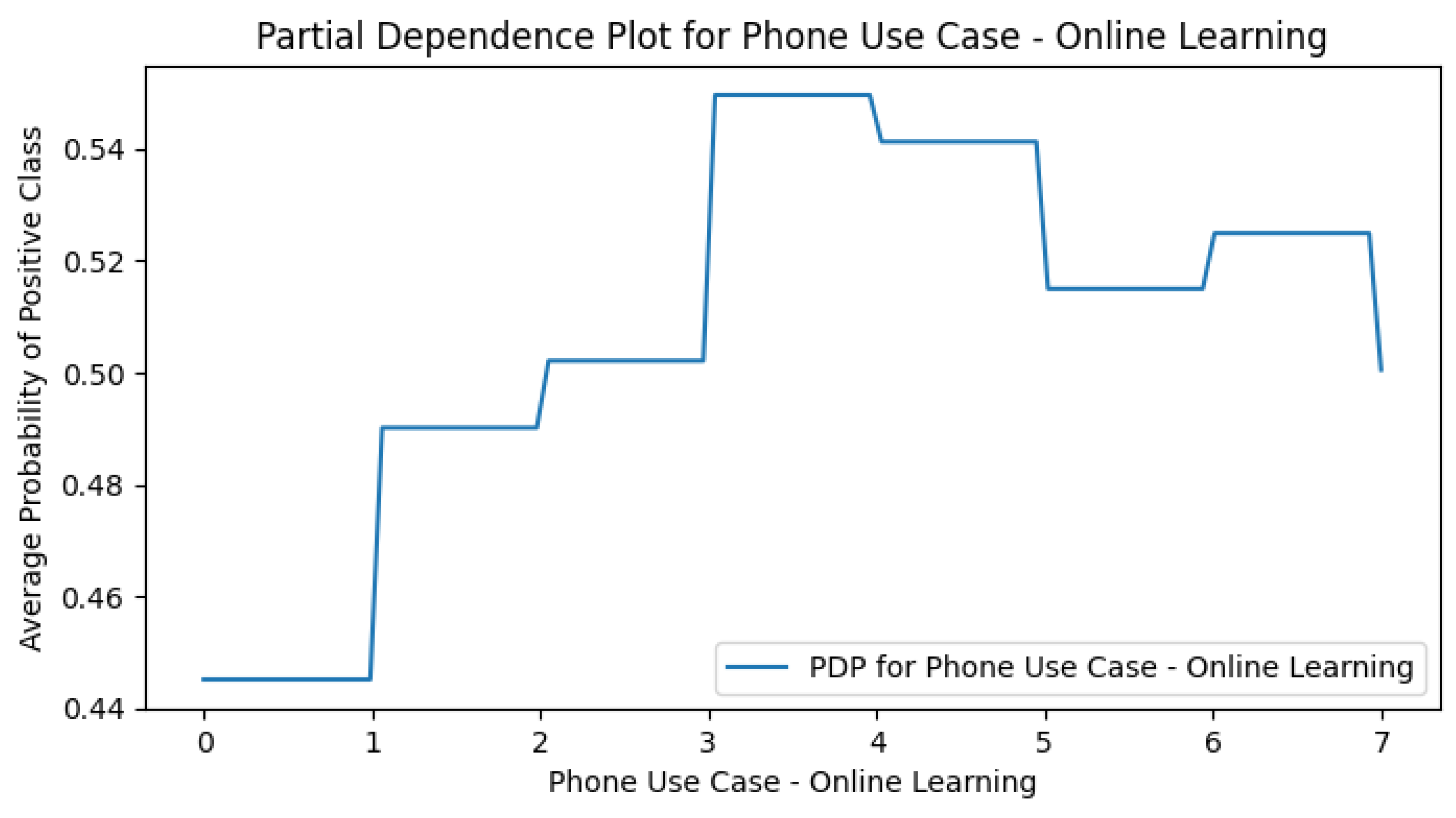
Figure A2.
PDP plot of Messenger in the M4 (+Smartphone Use Cases) model.
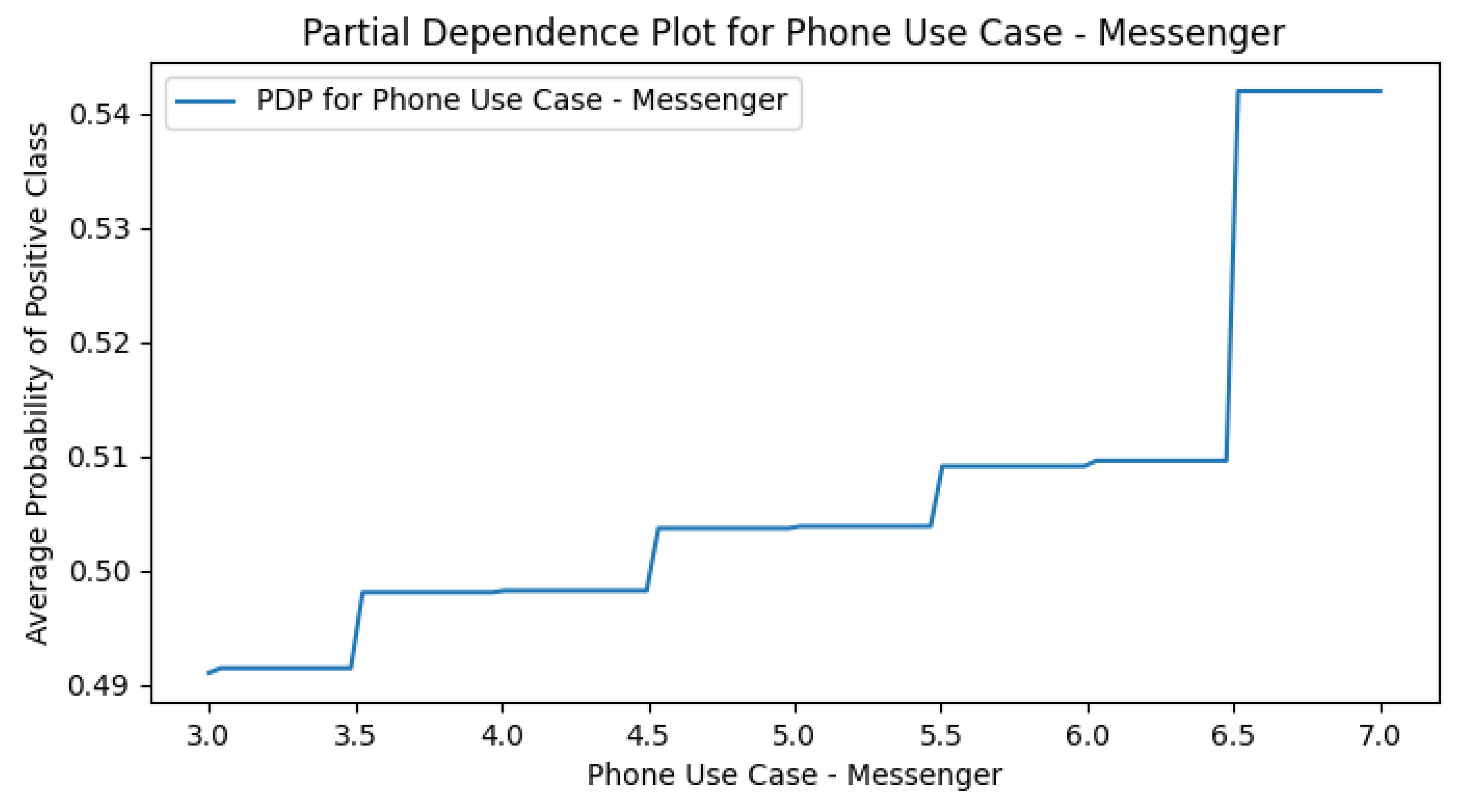
Figure A3.
PDP plot of Scheduling in the M4 (+Smartphone Use Cases) model.
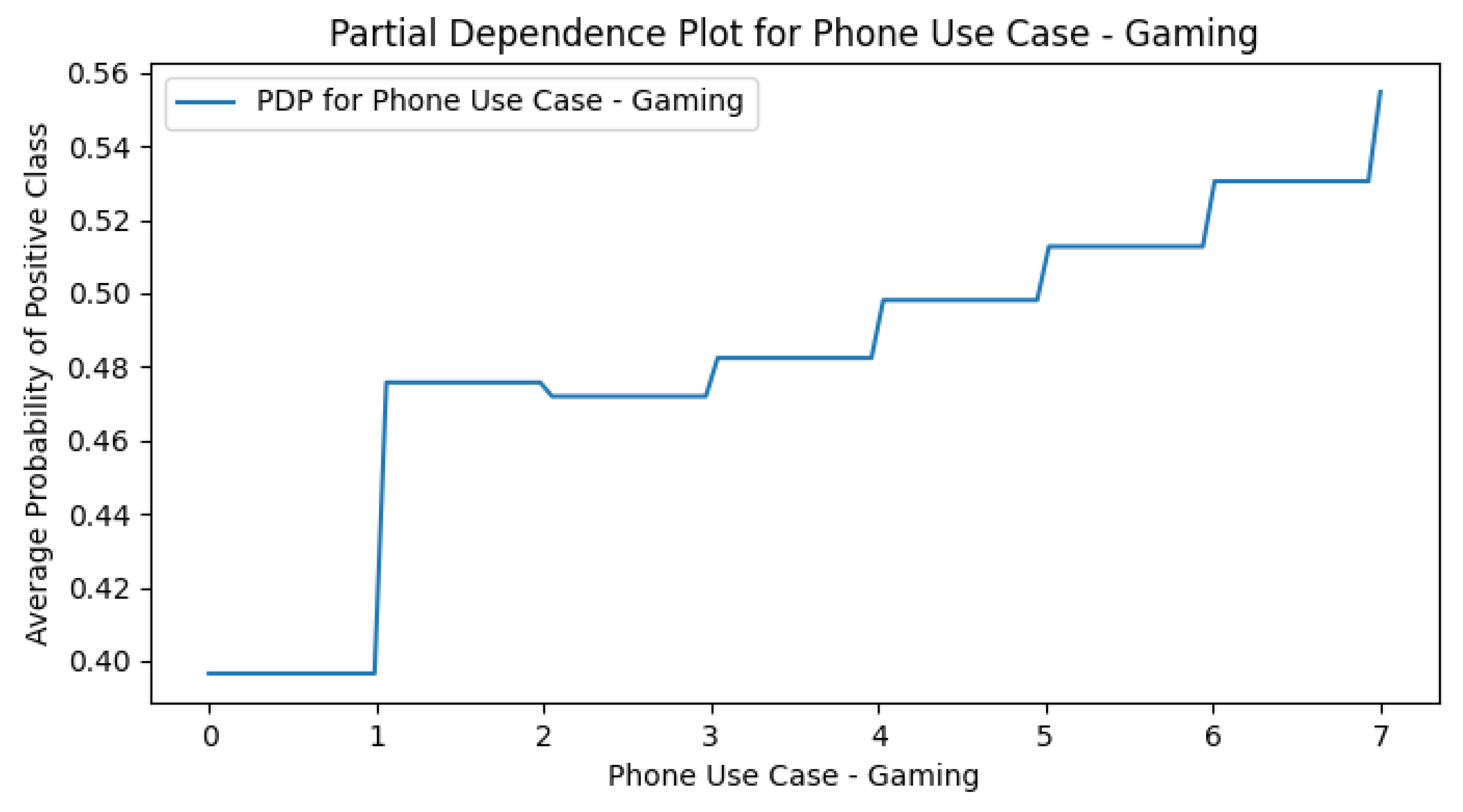
Figure A4.
PDP plot of Online Learning in the M4 (+Smartphone Use Cases) model.
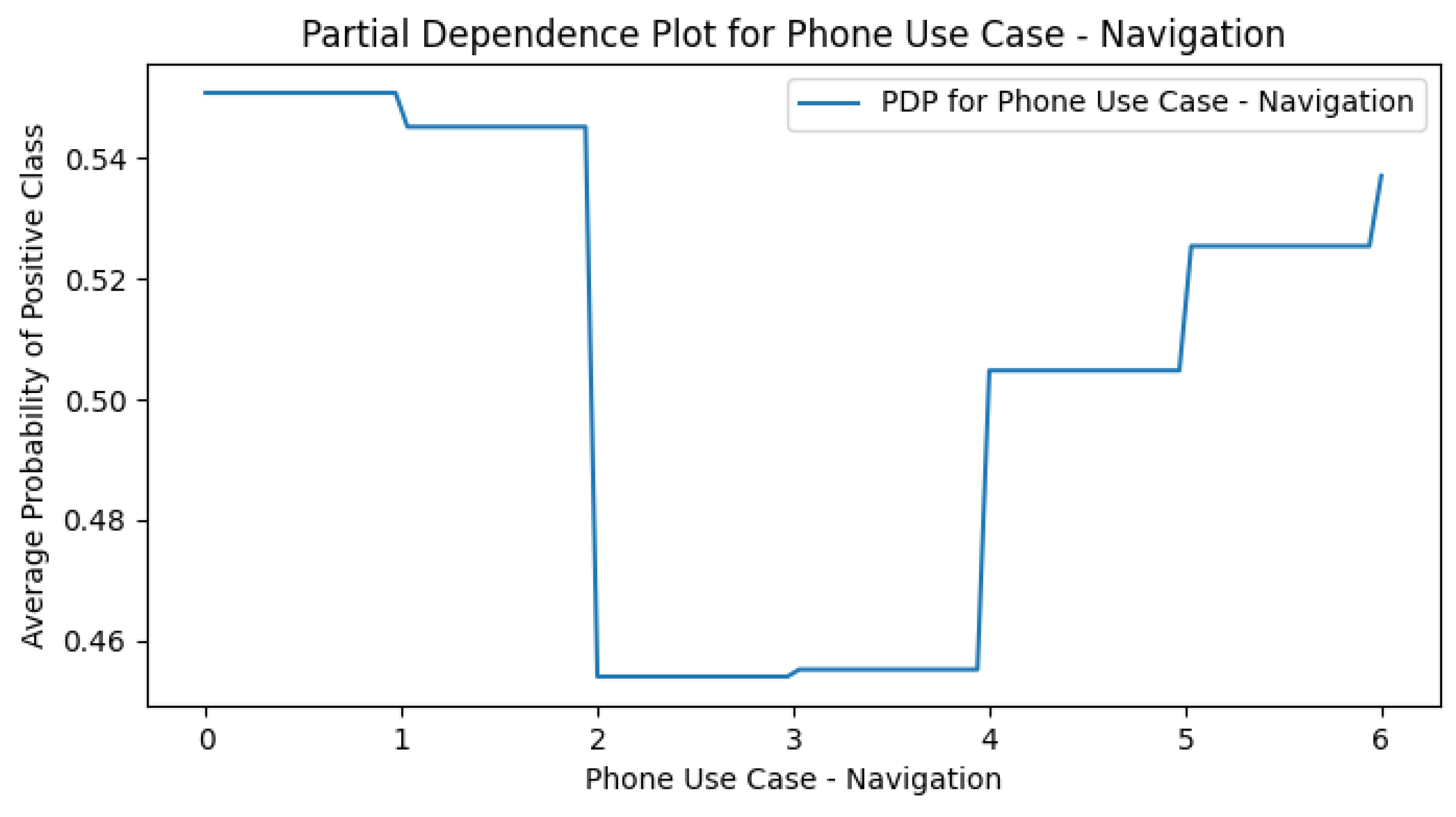
Figure A5.
PDP plot of Online Shopping in the M4 (+Smartphone Use Cases) model.
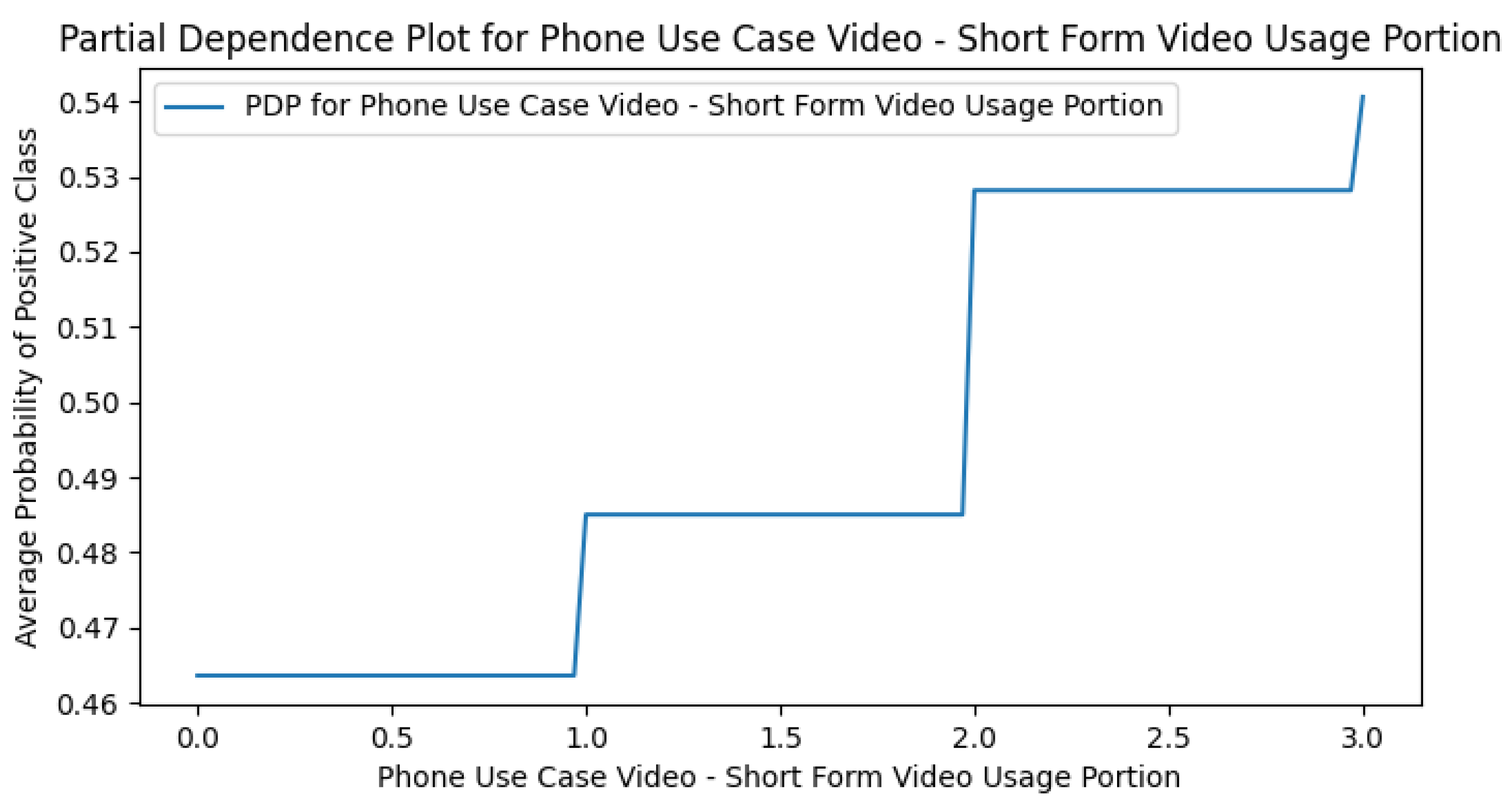
Figure A6.
PDP plot of Selling Goods & Services in the M4 (+Smartphone Use Cases) model.
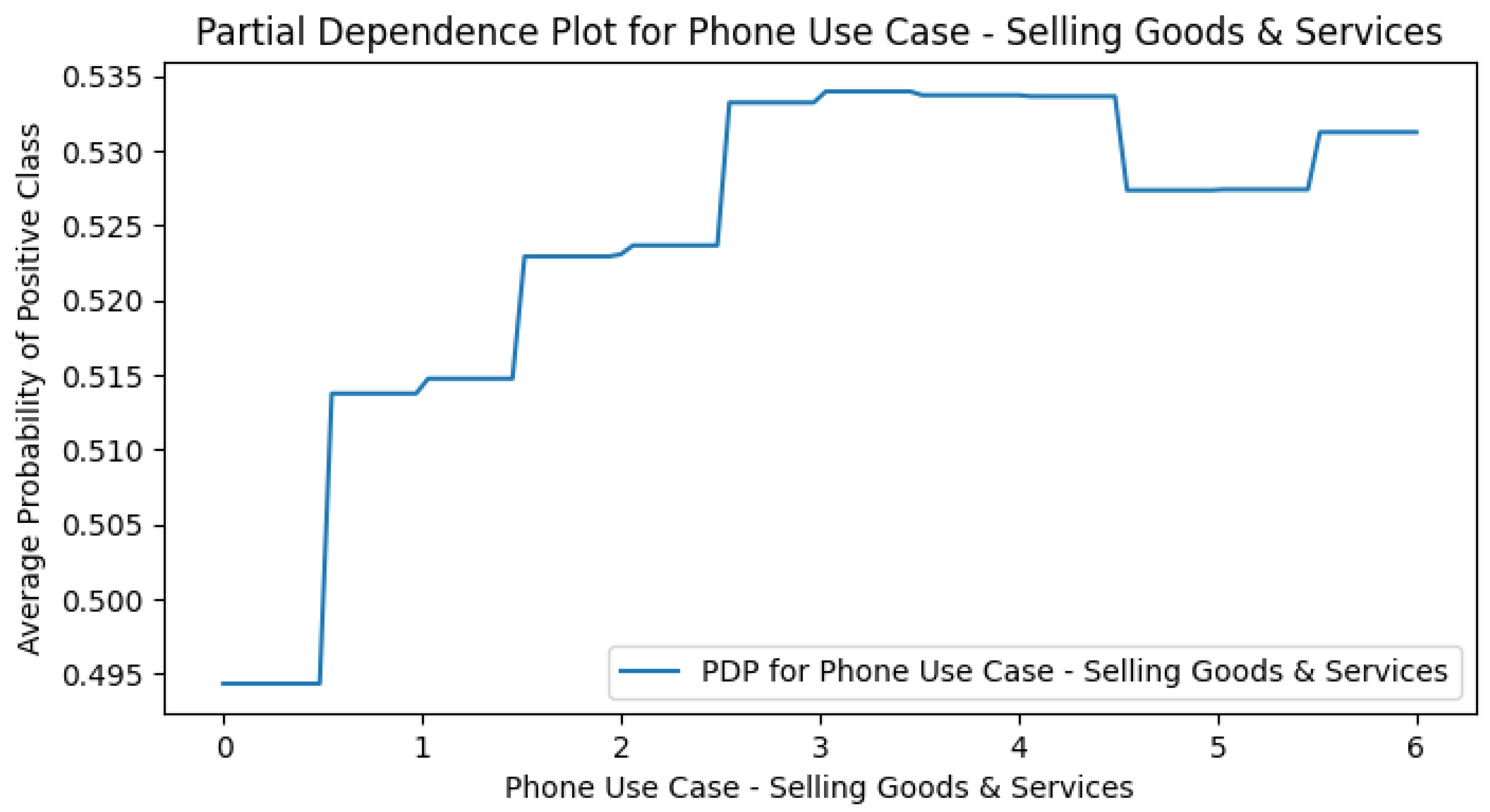
Appendix F. Smart CD PDPs
Figure A7.
PDP plot of Depression in the Smart CD model.
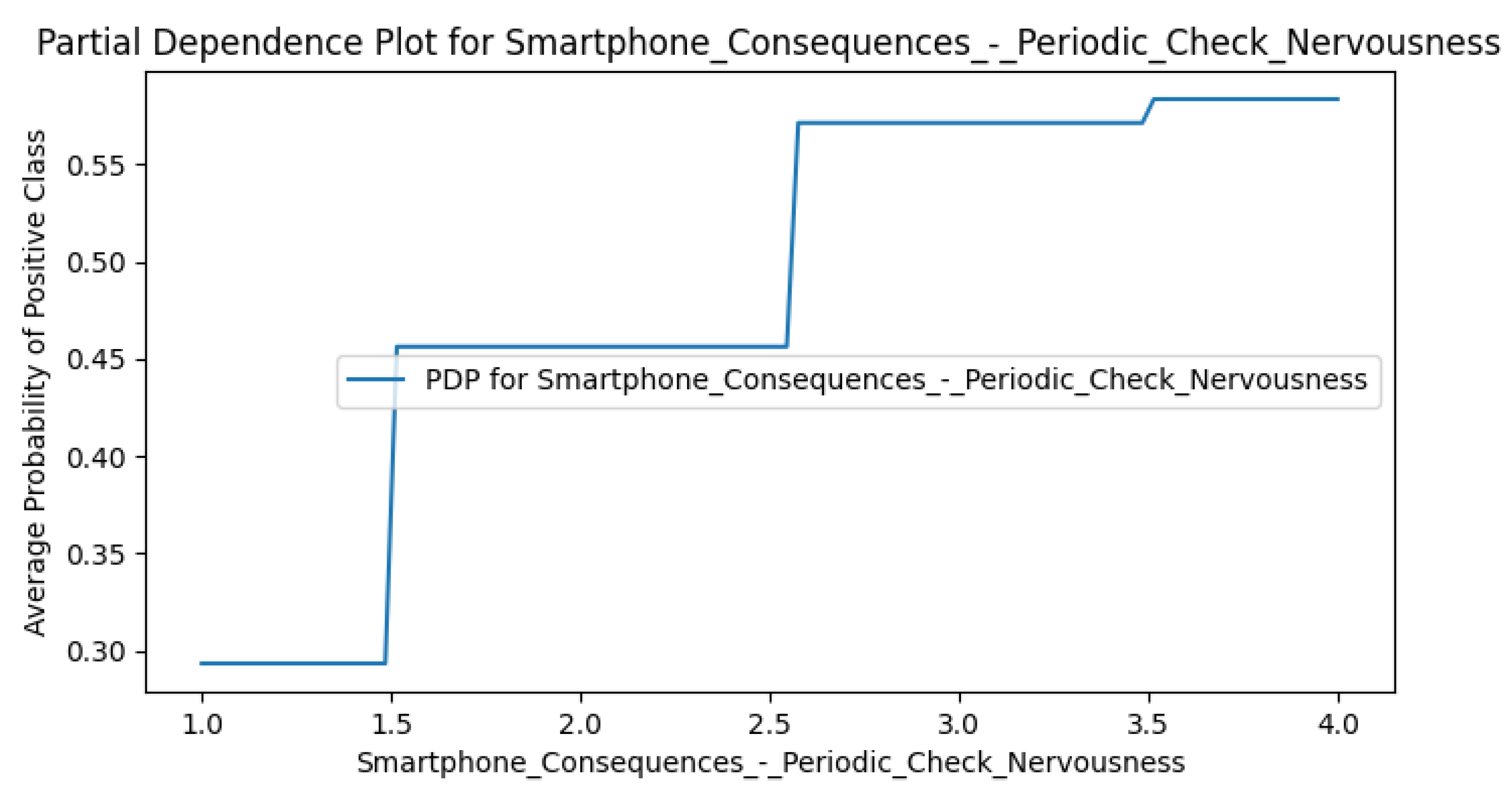
Figure A8.
PDP plot of Sleep Issues in the Smart CD model.
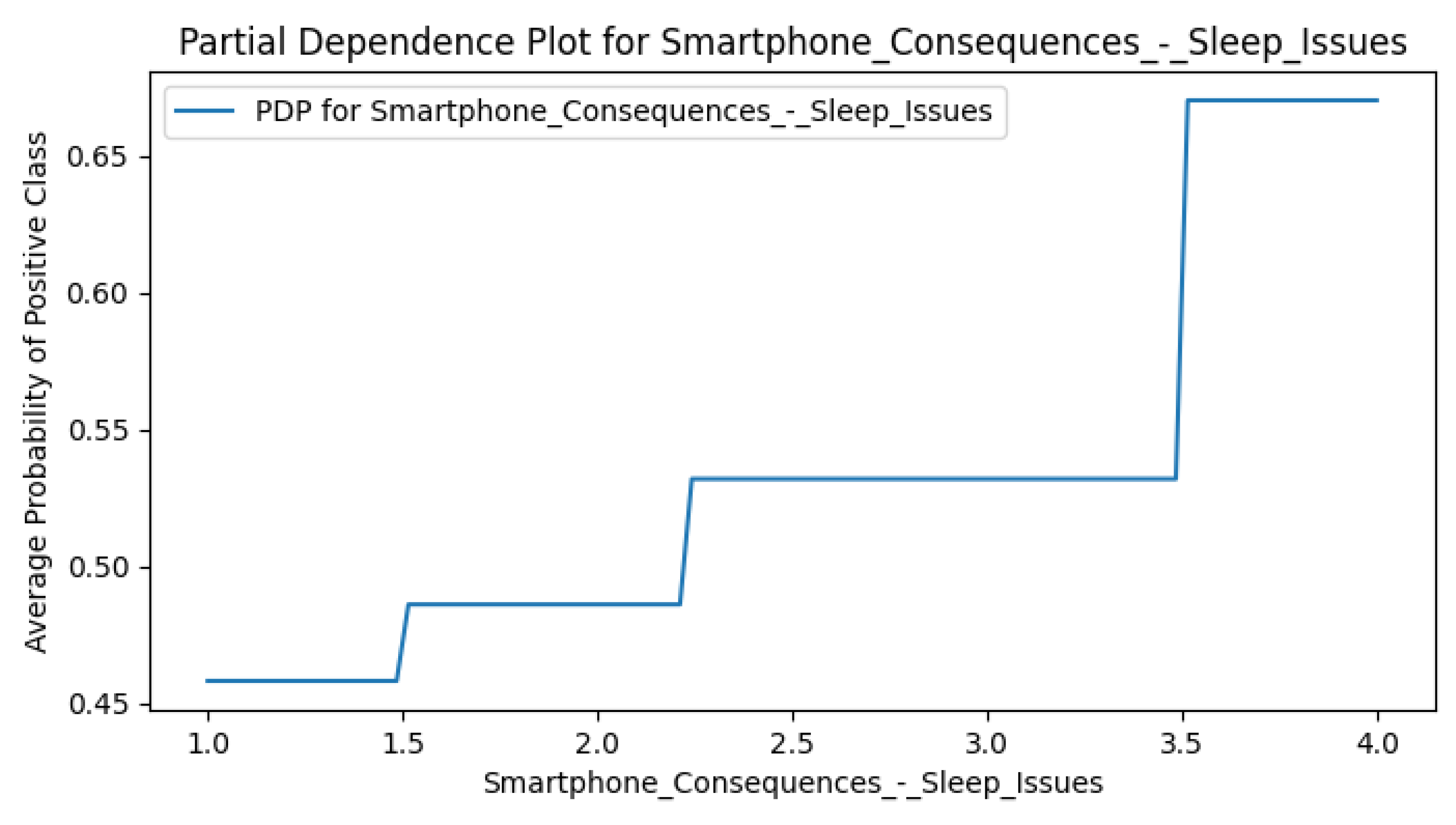
Figure A9.
PDP plot of Stress Relief in the Smart CD model.
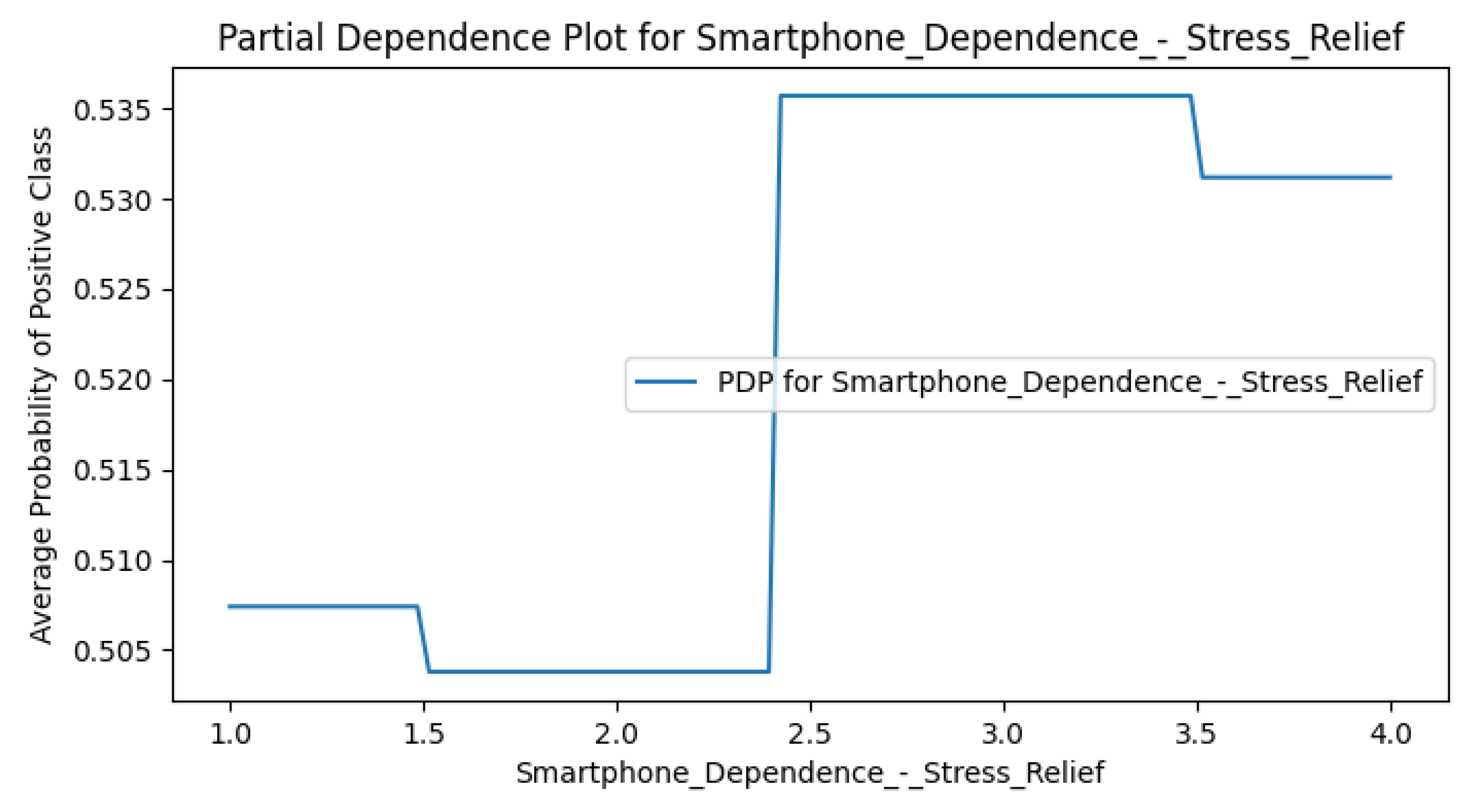
Appendix G. Perceived DCR PDPs
Additional Perceived DCR PDPs are presented in Figure A10, Figure A11, Figure A12, Figure A13, Figure A14, Figure A15.
Figure A10.
PDP plot of Usage Dependence in the Perceived DCR model.
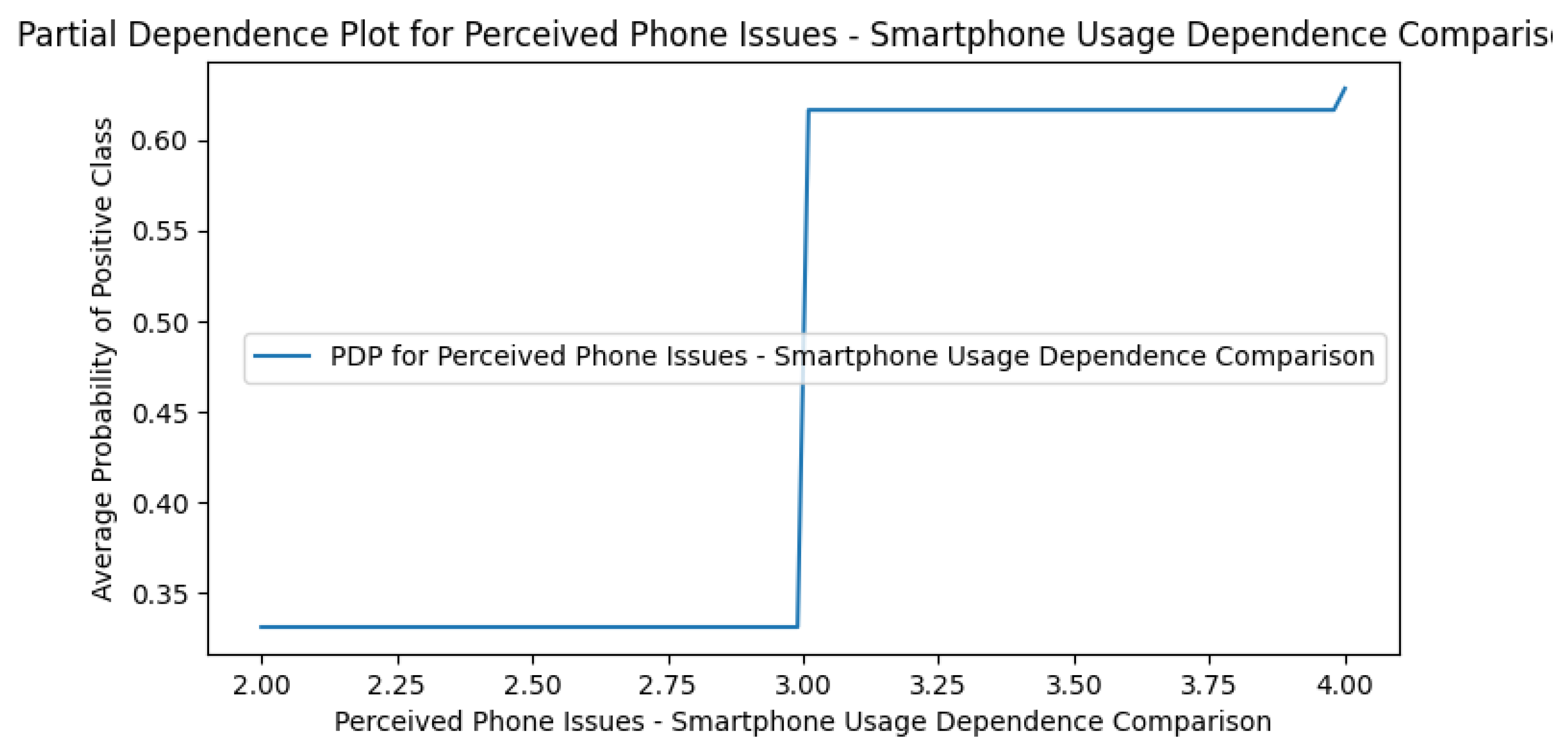
Figure A11.
PDP plot of Excessive Usage in the Perceived DCR model.
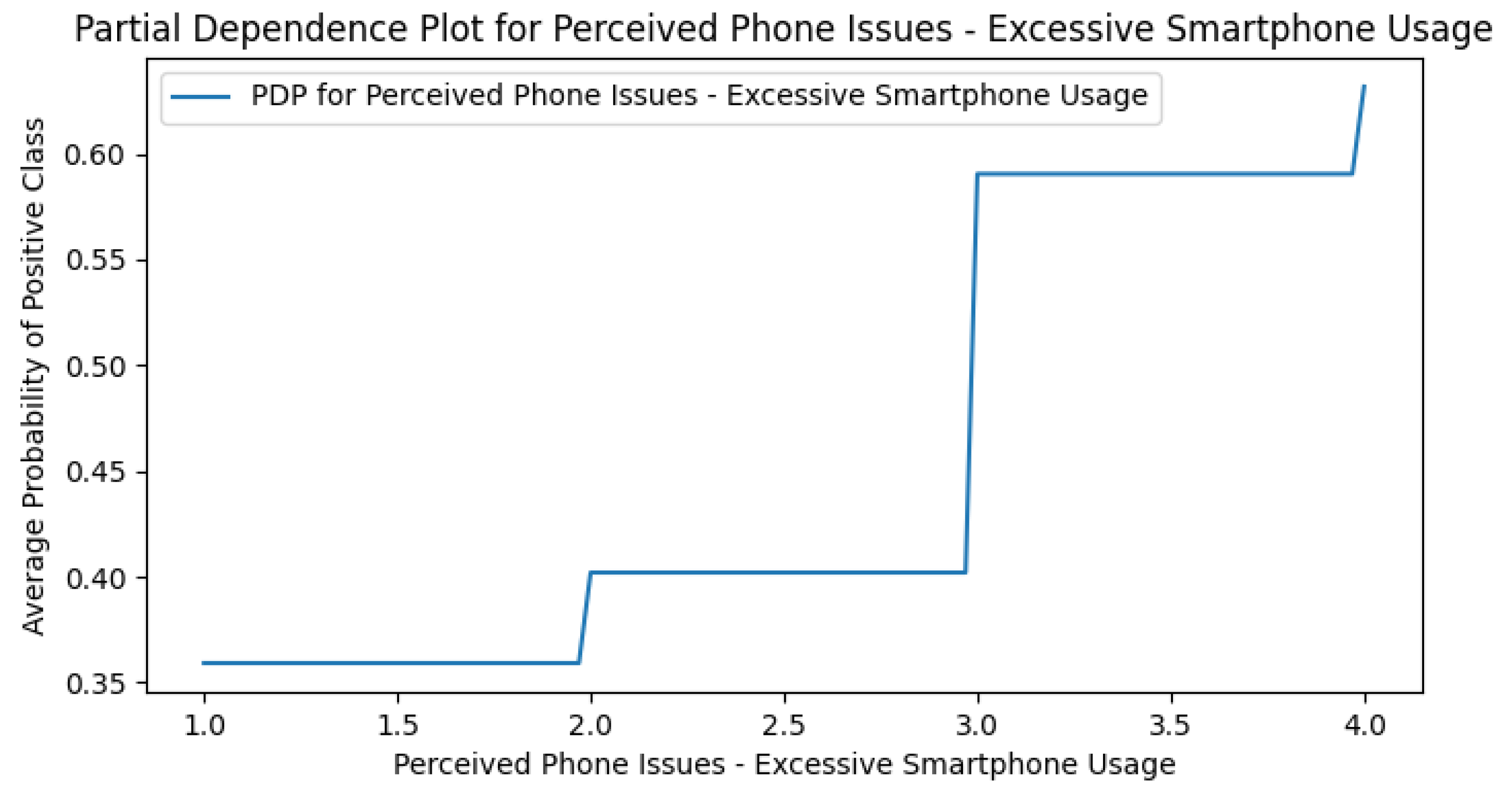
Figure A12.
PDP plot of Short Form Usage Control in the Perceived DCR model.
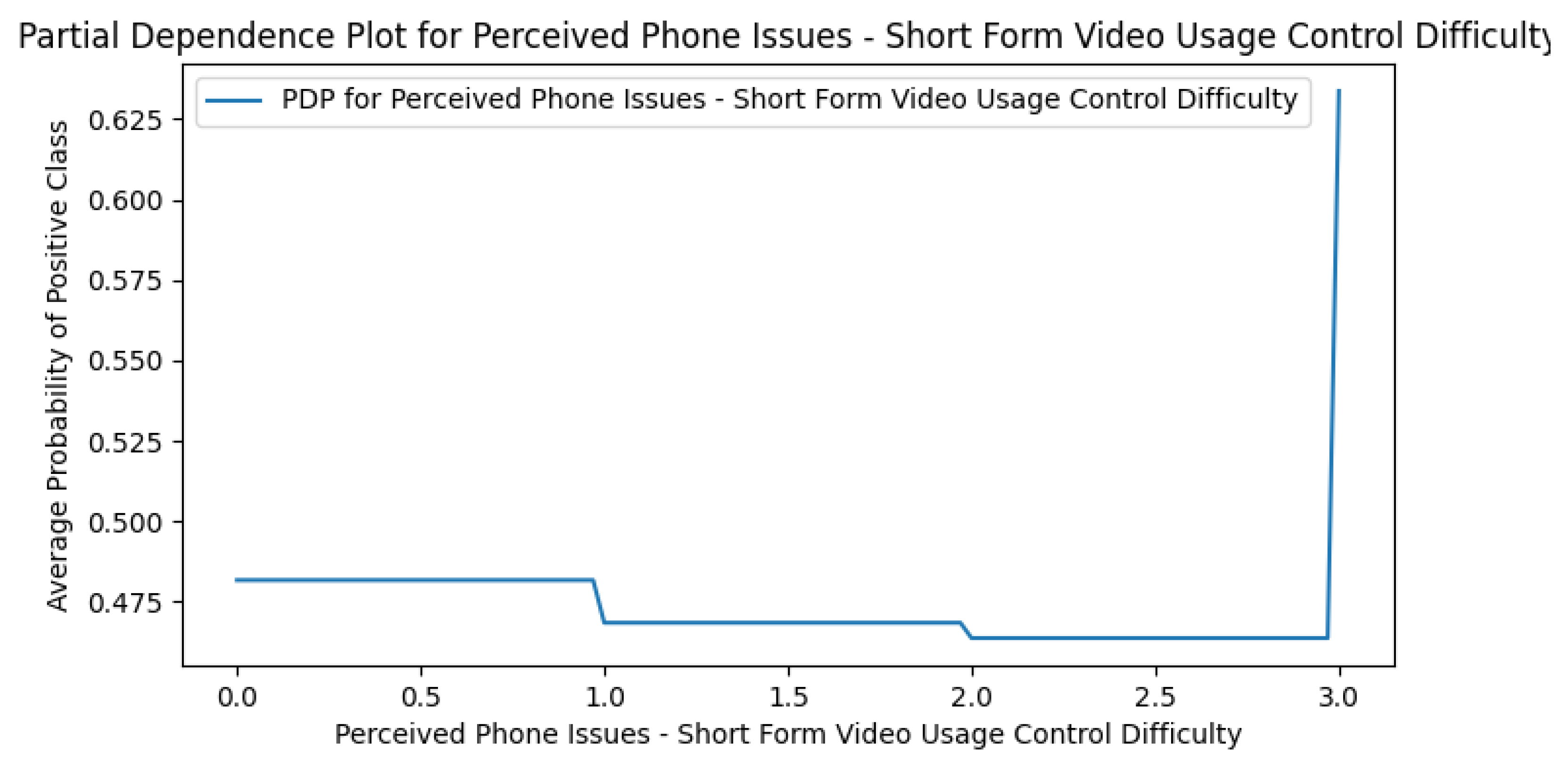
Figure A13.
PDP plot of Neg Side Effects on Gaming in the Perceived DCR model.
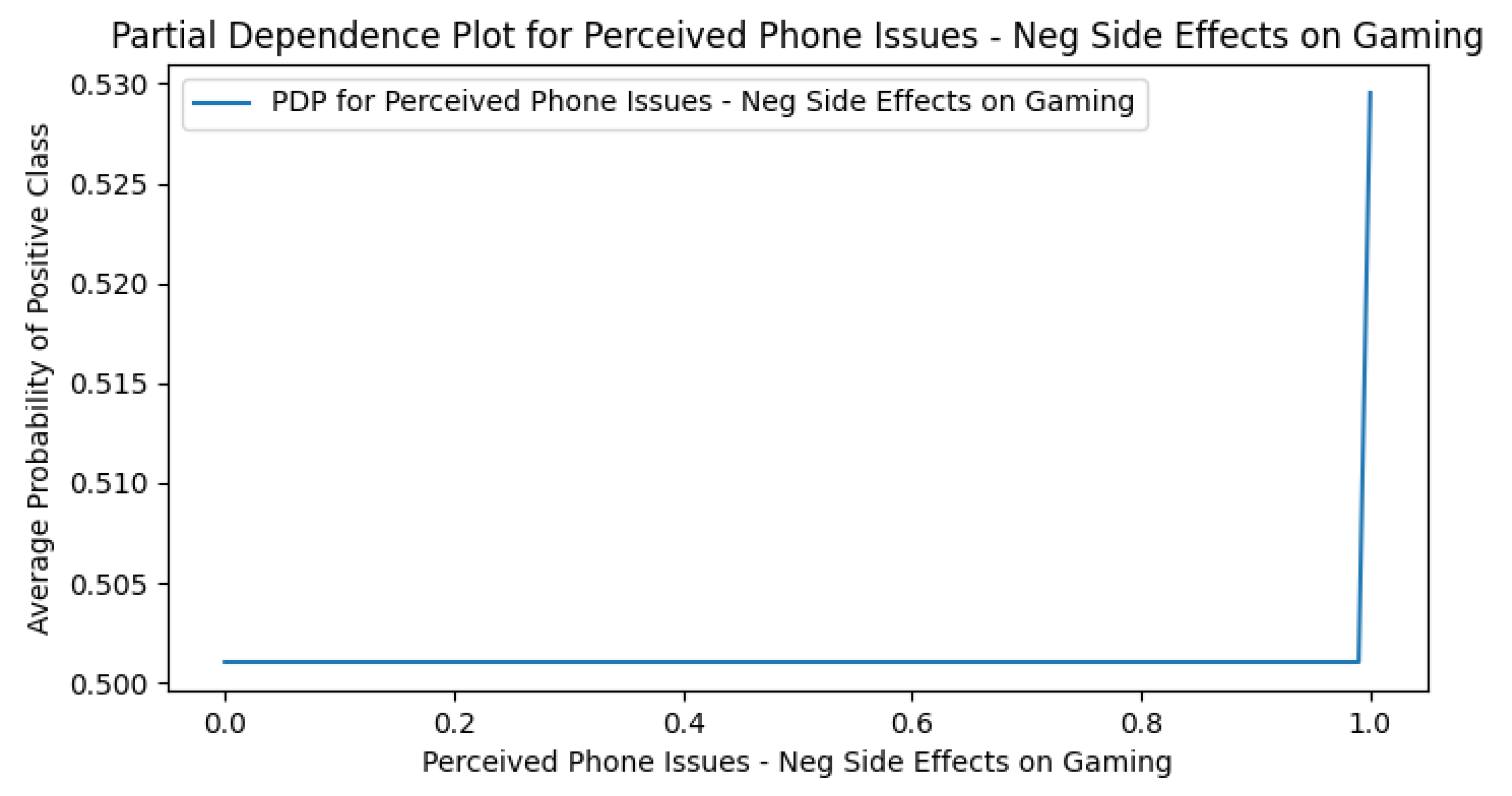
Figure A14.
PDP plot of Online Social Issue Engagement in the Perceived DCR model.
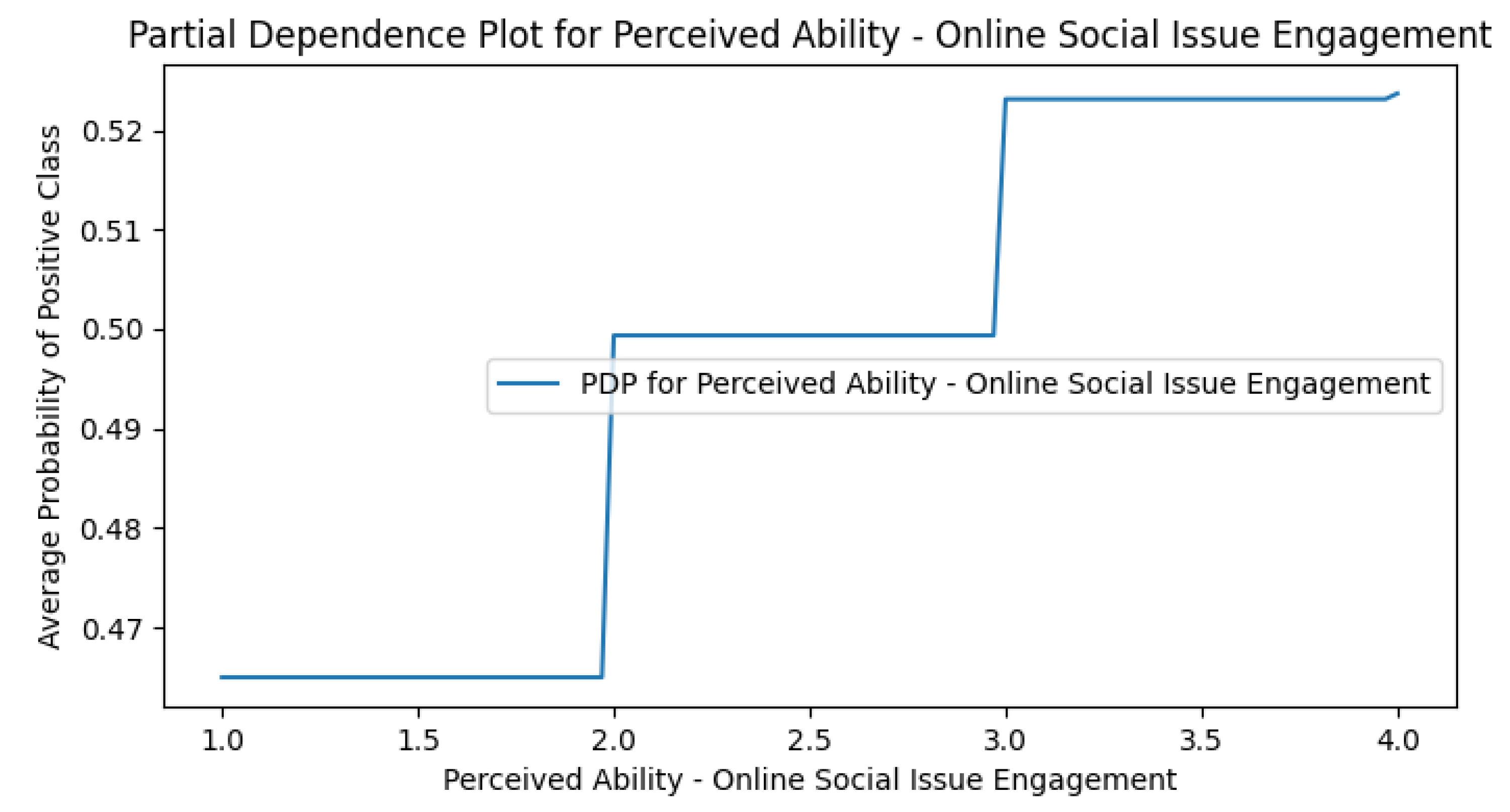
Figure A15.
PDP plot of Neg Side Effects on SNS in the Perceived DCR model.
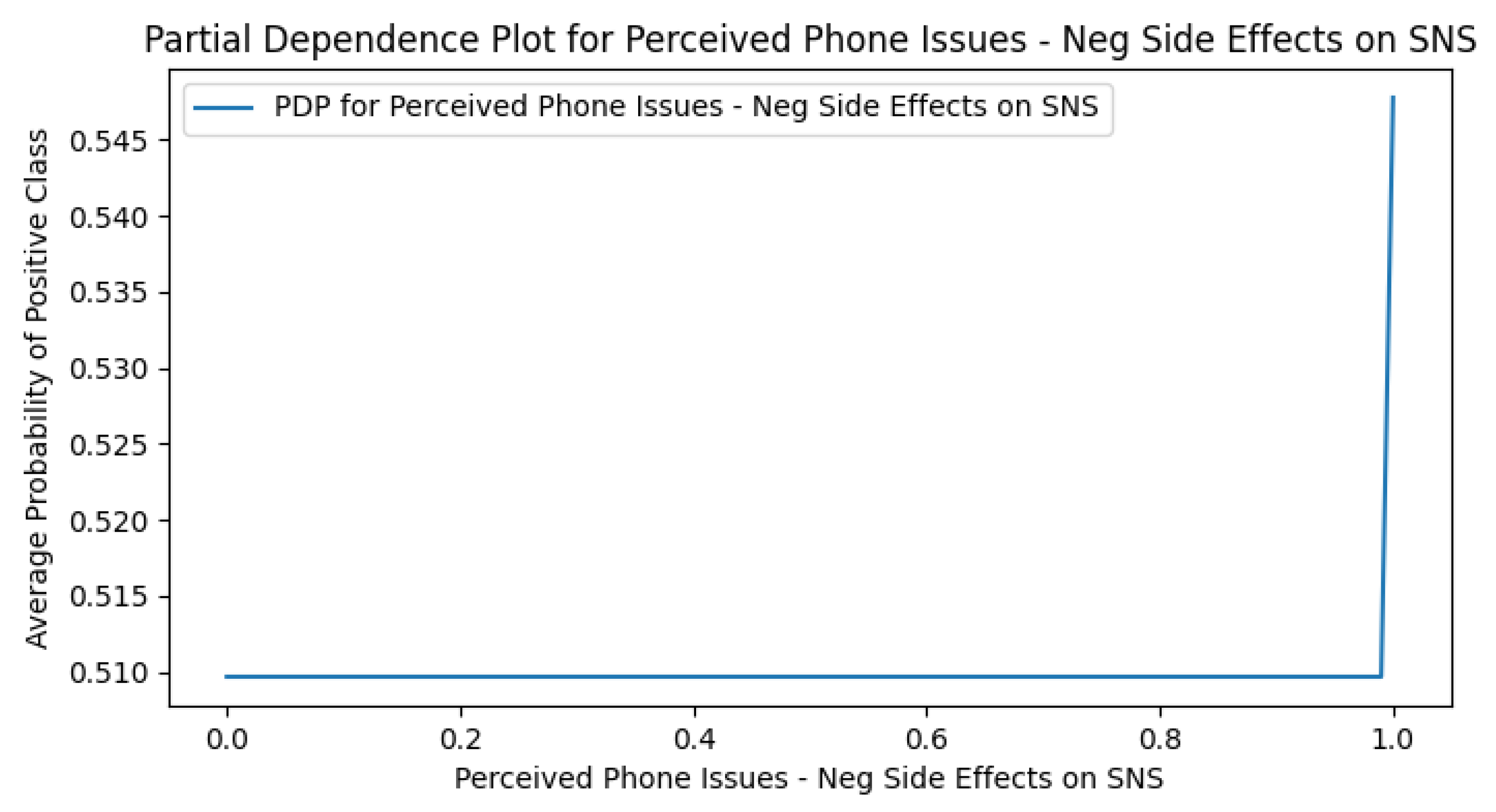
Appendix H. Use Case Only PDPs
Additional Use Case Only PDPs are presented in Figure A16, Figure A17, Figure A18, Figure A19, Figure A20, Figure A21, Figure A22.
Figure A16.
PDP plot of Selling Goods & Services in the Use Case Only model.
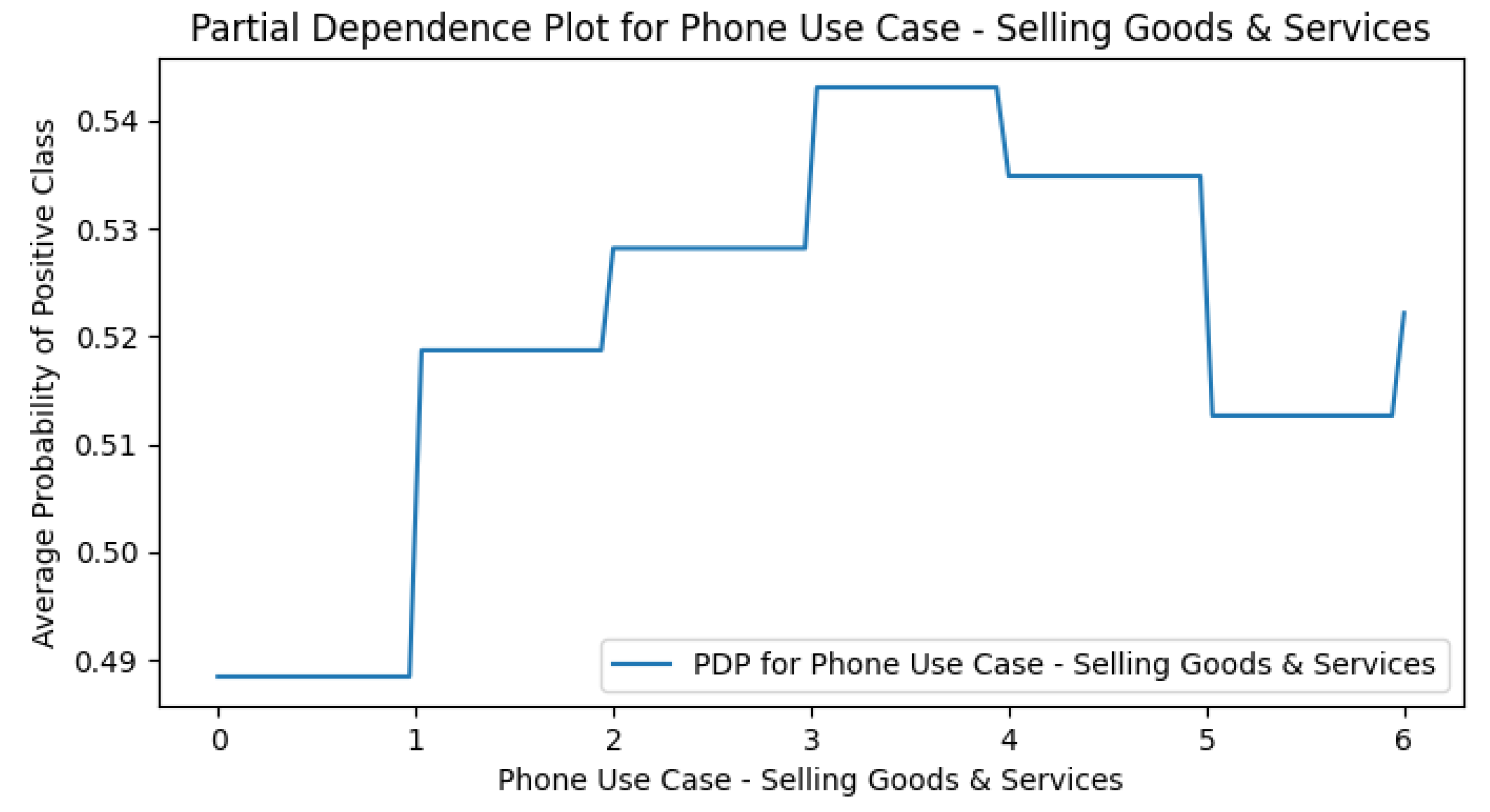
Figure A17.
PDP plot of Webtoon in the Use Case Only model.
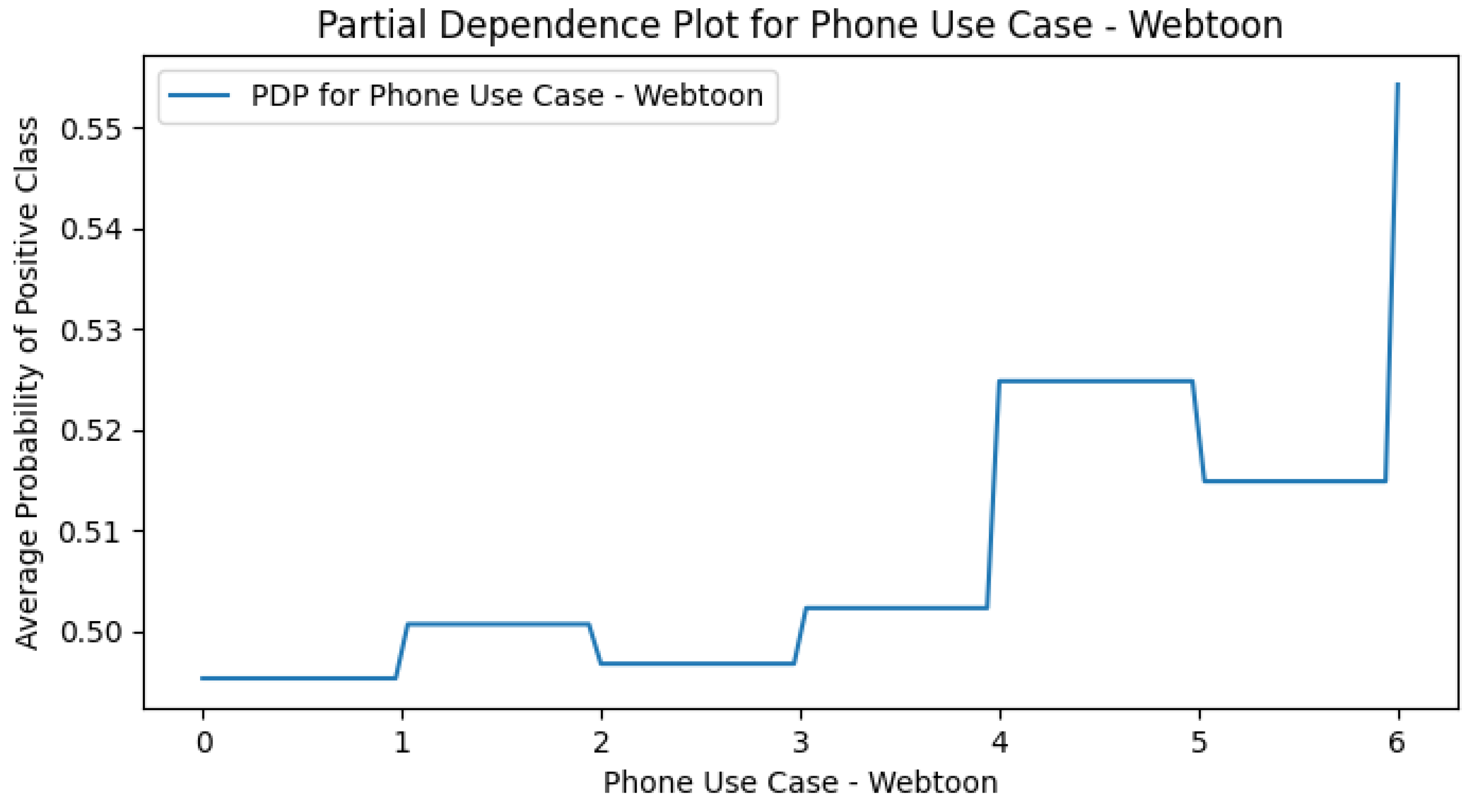
Figure A18.
PDP plot of Scheduling in the Use Case Only model.
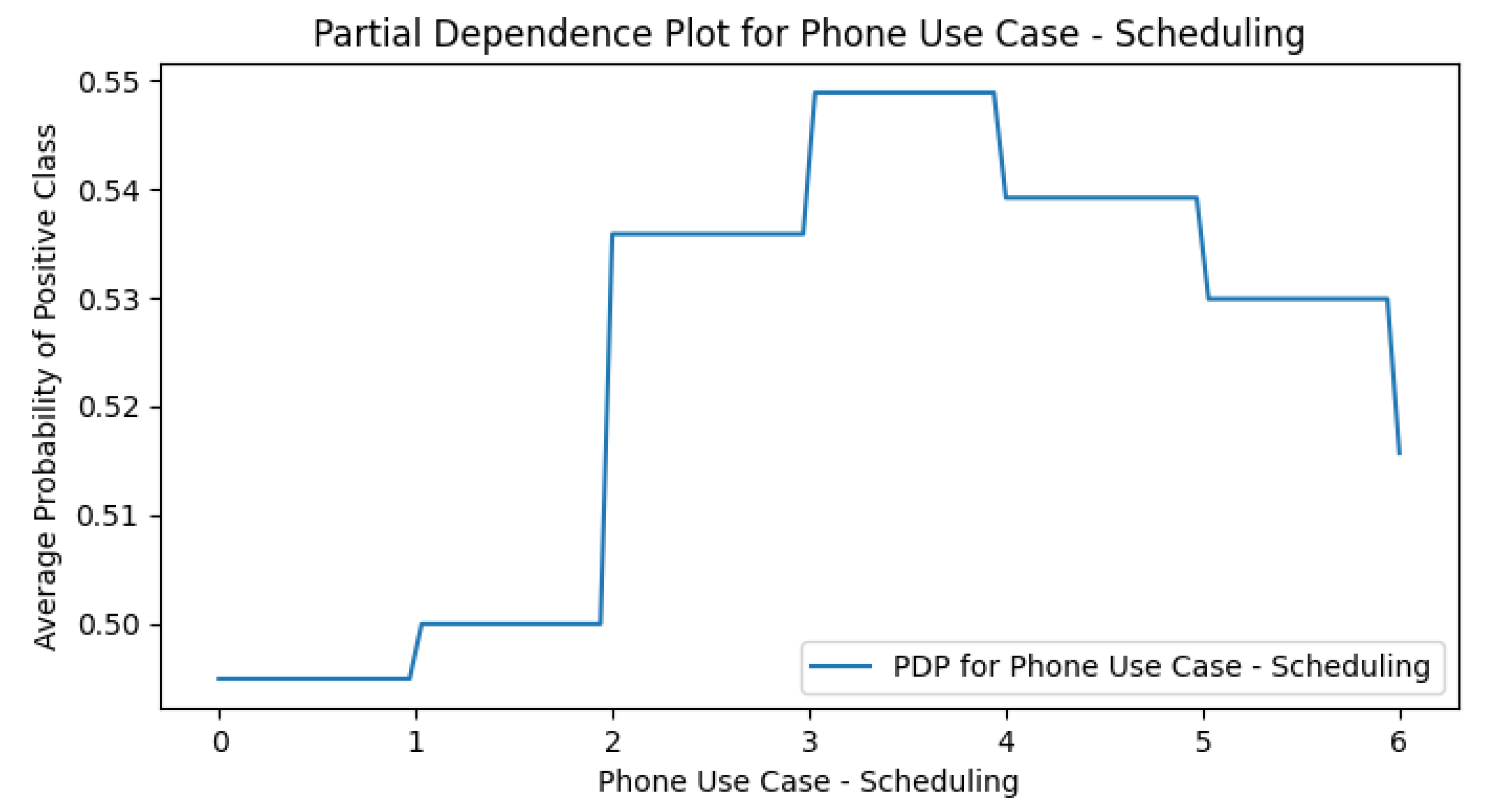
Figure A19.
PDP plot of News in the Use Case Only model.
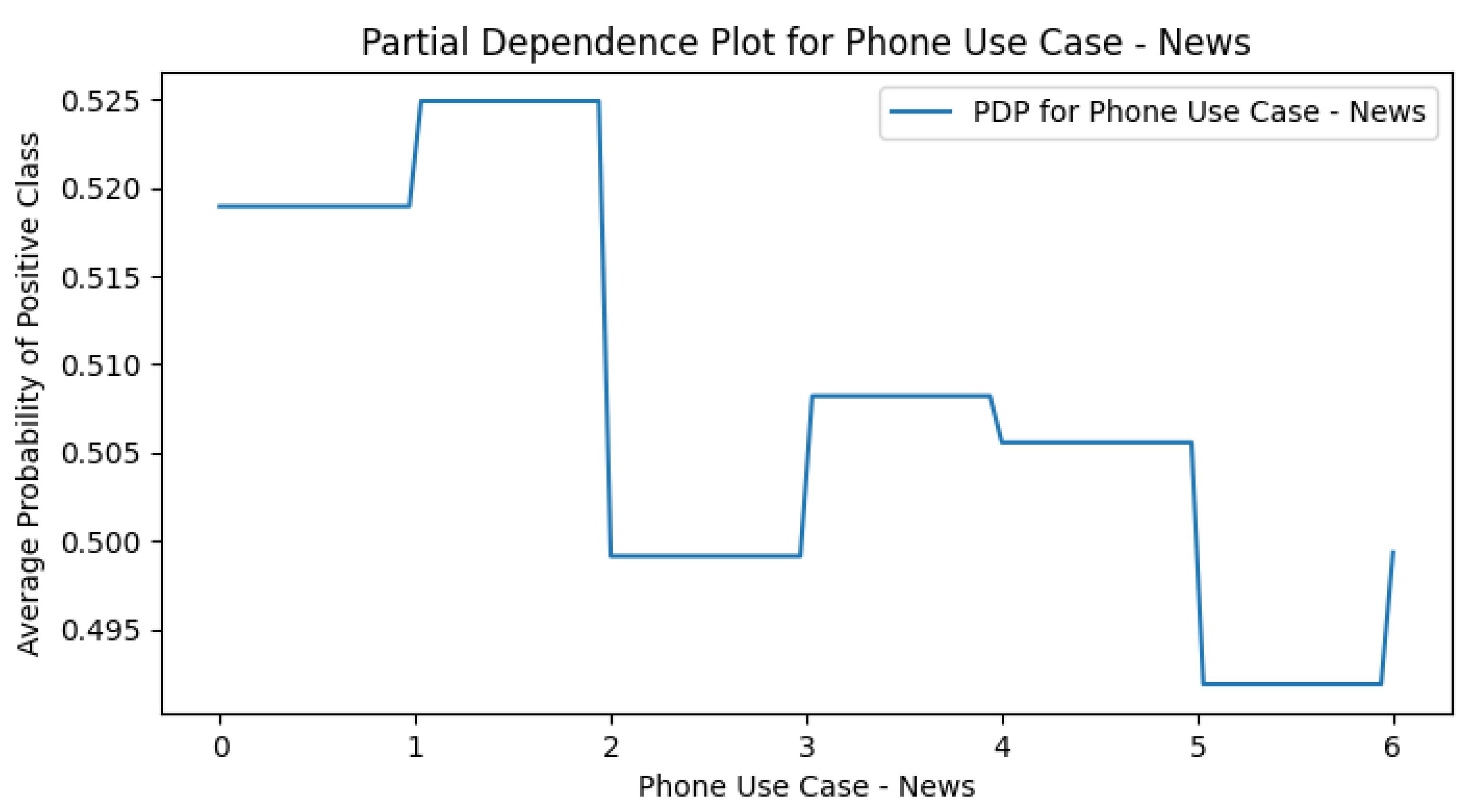
Figure A20.
PDP plot of Messenger in the Use Case Only model.
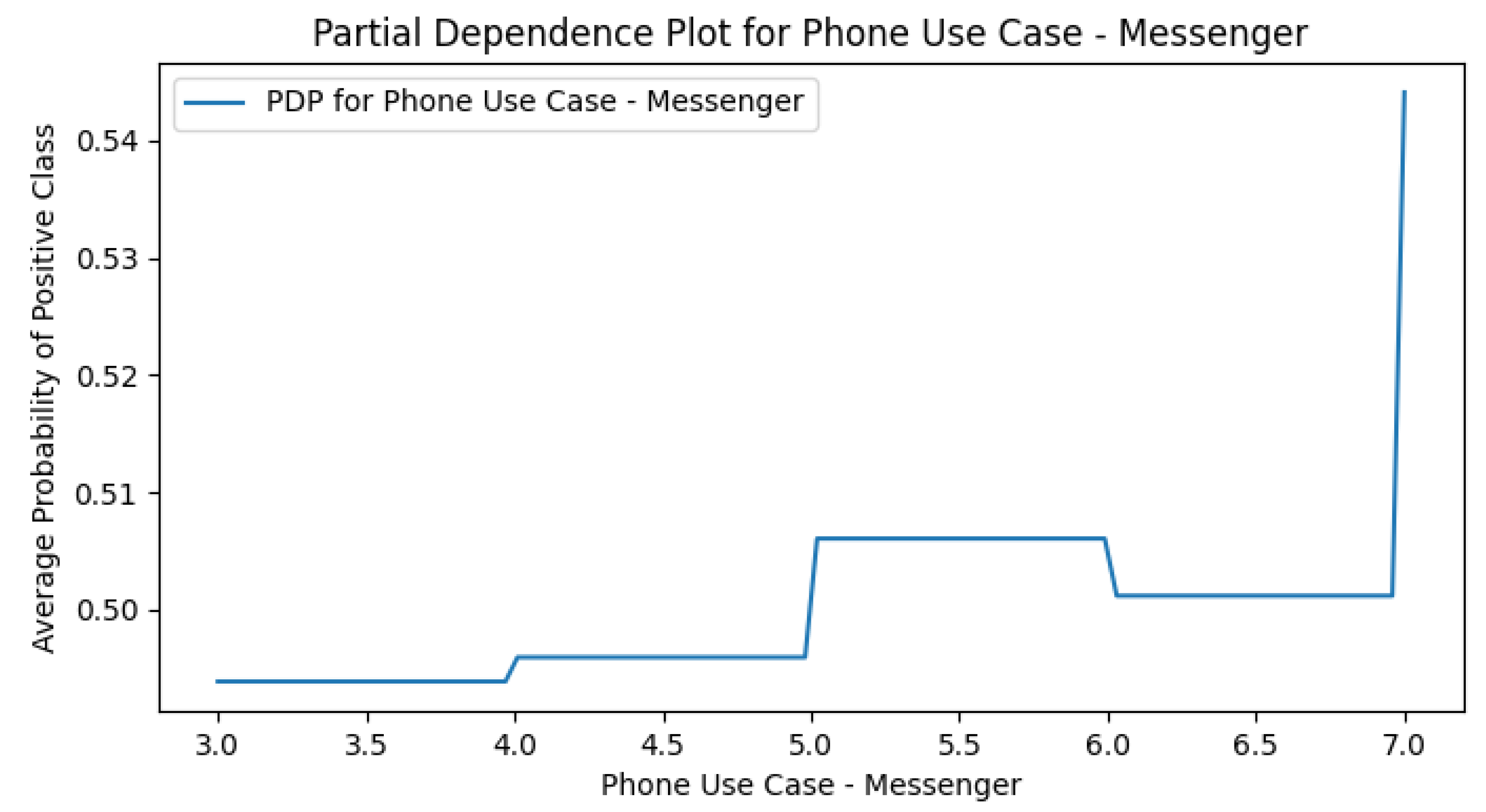
Figure A21.
PDP plot of Online Learning in the Use Case Only model.
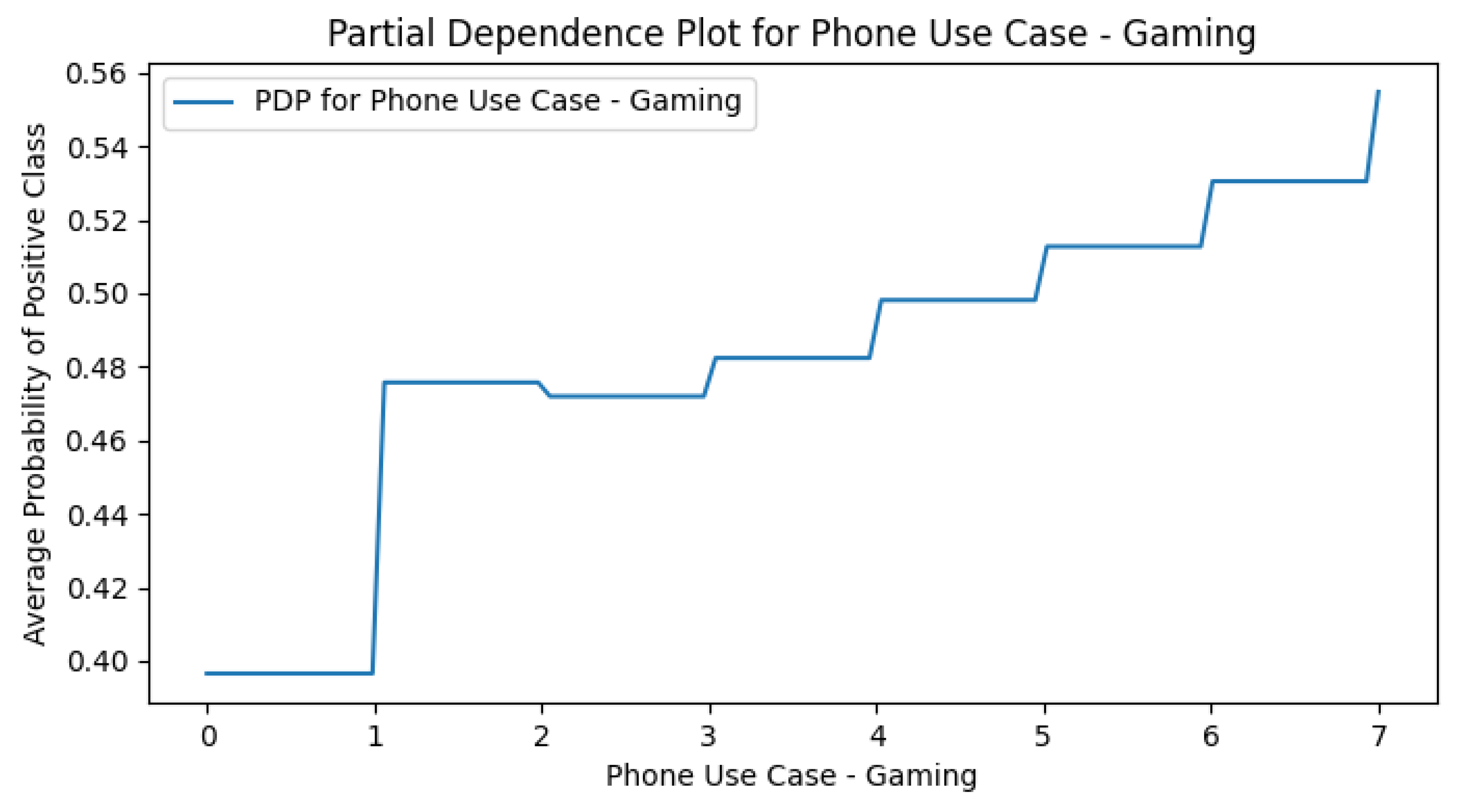
Figure A22.
PDP plot of Short Form Video Usage Portion in the Use Case Only model.
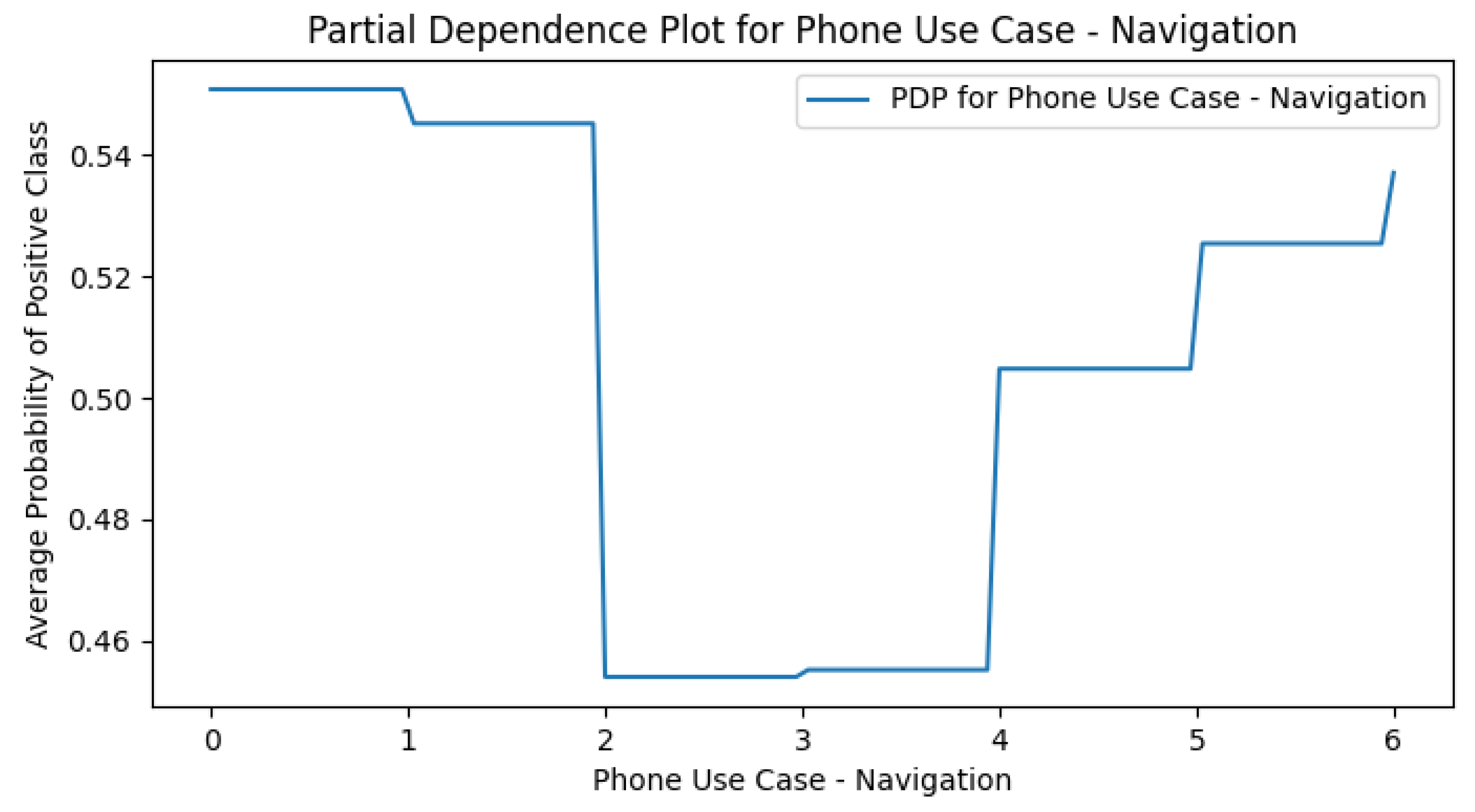
References
- Statista. Ownership rate of smartphones in South Korea as of September 2022, by age group. https://www.statista.com/statistics/897195/south-korea-smartphone-ownership-by-age-group/, 2022. Accessed: 2023-11-30.
- Bae, S.R.; Lee, C.H.; Kim, N.D. A study on the status of media use among adolescents and policy responses by target group II: 648 Teenagers. Technical report, National Youth Policy Institute, 2021.
- Oh, J.; Kim, M.; Rhee, S.Y.; Rahmati, M.; Koyanagi, A.; Smith, L.; Kim, M.S.; Fond, G.; Boyer, L.; Kim, S.; et al. National trends in the prevalence of screen time and its association with biopsychosocial risk factors among Korean adolescents, 2008–2021. Journal of Adolescent Health 2024, 74, 504–513. [Google Scholar] [CrossRef]
- Billieux, J.; Maurage, P.; Lopez-Fernandez, O.; Kuss, D.J.; Griffiths, M.D. Can disordered mobile phone use be considered a behavioral addiction? An update on current evidence and a comprehensive model for future research. Current Addiction Reports 2015, 2, 156–162. [Google Scholar] [CrossRef]
- Panova, T.; Carbonell, X. Is smartphone addiction really an addiction? Journal of behavioral addictions 2018, 7, 252–259. [Google Scholar] [CrossRef] [PubMed]
- World Health Organization. International Classification of Diseases, 11th Revision: Disorders due to addictive behaviours (Chapter 6), 2019. Online database, accessed on 2025-09-07.
- National Information Society Agency. 2020 Survey on Smartphone Overdependence. Research Report NIA VIII-RSE-C-19067, National Information Society Agency, Seoul, Korea, 2020.
- Noh, D.; Shim, M.S. Factors influencing smartphone overdependence among adolescents. Scientific Reports 2024, 14, 7725. [Google Scholar] [CrossRef] [PubMed]
- Cho, J.; Kim, H. The role of impulsivity and emotional dysregulation in smartphone overdependence explored through network analysis. Scientific Reports 2025, 15, 1852. [Google Scholar] [CrossRef]
- Elhai, J.D.; Levine, J.C.; Dvorak, R.D.; Hall, B.J. Fear of missing out, need for touch, anxiety and depression are related to problematic smartphone use. Computers in Human Behavior 2016, 63, 509–516. [Google Scholar] [CrossRef]
- Seo, B.K.; Hwang, Y.; Cho, H. Mental health and personality characteristics of university students at risk of smartphone overdependence. International Journal of Environmental Research and Public Health 2023, 20, 2331. [Google Scholar] [CrossRef]
- Hwang, I.W.; Choe, J.P.; Park, J.H.; Lee, J.M. Association between physical activity, sedentary behavior, satisfaction with sleep fatigue recovery and smartphone dependency among Korean adolescents: an age-and gender-matched study. International Journal of Environmental Research and Public Health 2022, 19, 16034. [Google Scholar] [CrossRef]
- Park, E.J.; Hwang, S.S.H.; Lee, M.S.; Bhang, S.Y. Food addiction and emotional eating behaviors co-occurring with problematic smartphone use in adolescents? International Journal of Environmental Research and Public Health 2022, 19, 4939. [Google Scholar] [CrossRef]
- Shinetsetseg, O.; Jung, Y.H.; Park, Y.S.; Park, E.C.; Jang, S.Y. Association between smartphone addiction and suicide. International journal of environmental research and public health 2022, 19, 11600. [Google Scholar] [CrossRef]
- Bae, S.M. Influence of smartphone usage types and excessive expectation for smartphone on adolescents’ smartphone overdependence. Informatization Policy 2018, 25, 65–83. [Google Scholar]
- Cha, J.H.; Choi, Y.J.; Ryu, S.; Moon, J.H. Association between smartphone usage and health outcomes of adolescents: A propensity analysis using the Korea Youth Risk Behavior Survey. PLOS ONE 2023, 18, e0294553. [Google Scholar] [CrossRef]
- Yun, H.; Choi, E.K. Association between smartphone overdependence and mental health in South Korean adolescents: A secondary data analysis. Child Health Nursing Research 2024, 30, 87–96. [Google Scholar] [CrossRef]
- Lee, Y.S.; Joo, J.H.; Shin, J.; Nam, C.M.; Park, E.C. Association between smartphone overdependence and generalized anxiety disorder among Korean adolescents. Journal of affective disorders 2023, 321, 108–113. [Google Scholar] [CrossRef] [PubMed]
- Wacks, Y.; Weinstein, A.M. Excessive smartphone use is associated with health problems in adolescents and young adults. Frontiers in psychiatry 2021, 12, 669042. [Google Scholar] [CrossRef] [PubMed]
- Ministry of Science and ICT (Republic of Korea). Intelligent Informatization Basic Act [Act No. 17344, revised June 9, 2020, effective December 10, 2020], Article 54, 2020. Retrieved from Ministry of Government Legislation.
- France 24. Digital pause: France pilots school mobile phone ban, 2024.
- Camera, L. Which states ban or restrict cellphones in schools?, 2024. U.S. News & World Report.
- Joung, J.; Oh, E.; Lee, E.J. The experiences of counselors caring for children and adolescents with problematic smartphone use. Scientific Reports 2023, 13, 12297. [Google Scholar] [CrossRef] [PubMed]
- Qudah, M.F.A.; Albursan, I.S.; Bakhiet, S.F.A.; Hassan, E.M.A.H.; Alfnan, A.A.; Aljomaa, S.S.; Al-Khadher, M.M.A. Smartphone addiction and its relationship with cyberbullying among university students. International Journal of Mental Health and Addiction 2019, 17, 628–643. [Google Scholar] [CrossRef]
- Tourangeau, R.; Yan, T. Sensitive questions in surveys. Psychological Bulletin 2007, 133, 859–883. [Google Scholar] [CrossRef]
- Agostino, H.; Toulany, A. Considerations for privacy and confidentiality in adolescent health care service delivery. Paediatrics & child health 2023, 28, 172–177. [Google Scholar] [CrossRef]
- Thrall, J.S.; McCloskey, L.; Ettner, S.L.; Rothman, E.; Tighe, J.E.; Emans, S.J. Confidentiality and adolescents’ use of providers for health information and for pelvic examinations. Archives of Pediatrics & Adolescent Medicine 2000, 154, 885–892. [Google Scholar] [CrossRef]
- Department of Health, Education, and Welfare. The Belmont Report: Ethical principles and guidelines for the protection of human subjects of research. Technical report, U.S. Government Printing Office, 1979. DHEW Publication No. (OS) 78-0012.
- American Psychological Association. Ethical principles of psychologists and code of conduct (2002, amended June 1, 2010 and January 1, 2017), 2017. Retrieved from https://www.apa.org/ethics/code.
- Hasking, P.; Tatnell, R.C.; Martin, G. Adolescents’ reactions to participating in ethically sensitive research: a prospective self-report study. Child and Adolescent Psychiatry and Mental Health 2015, 9, 39. [Google Scholar] [CrossRef]
- Cruz-Gonzalez, P.; He, A.W.J.; Lam, E.P.; Ng, I.M.C.; Li, M.W.; Hou, R.; Chan, J.N.M.; Sahni, Y.; Guasch, N.V.; Miller, T.; et al. Artificial intelligence in mental health care: a systematic review of diagnosis, monitoring, and intervention applications. Psychological Medicine 2025, 55, e18. [Google Scholar] [CrossRef] [PubMed]
- Topol, E. Deep medicine: How artificial intelligence can make healthcare human again; Hachette UK, 2019.
- Kim, E.; Song, M.K. Smartphone dependency latent profile classification and association with emotional and behavioral difficulties among high school students in Korea. Research in Community and Public Health Nursing 2024, 35, 84–98. [Google Scholar] [CrossRef]
- Lee, J.; Kim, W. Prediction of problematic smartphone use: A machine learning approach. International journal of environmental research and public health 2021, 18, 6458. [Google Scholar] [CrossRef] [PubMed]
- Giraldo-Jiménez, C.F.; Gaviria-Chavarro, J.; Sarria-Paja, M.; Bermeo Varón, L.A.; Villarejo-Mayor, J.J.; Rodacki, A.L.F. Smartphones dependency risk analysis using machine-learning predictive models. Scientific Reports 2022, 12, 22649. [Google Scholar] [CrossRef]
- Xiao, B.; Parent, N.; Rahal, L.; Shapka, J. Using machine learning to explore the risk factors of problematic smartphone use among Canadian adolescents during COVID-19: The important role of fear of missing out (FoMO). Applied Sciences 2023, 13, 4970. [Google Scholar] [CrossRef]
- Sapienza, A.; Lítlá, M.; Lehmann, S.; Alessandretti, L. Exposure to urban and rural contexts shapes smartphone usage behavior. PNAS Nexus 2023, 2, pgad357. [Google Scholar] [CrossRef]
- Yoo, J.D.; Lee, I.S.; Yang, J.H. A Study on Regional Smartphone Addiction with Demographic and Sociodemographic Factors. Journal of Social Science Research 2014, 40, 51–75. [Google Scholar] [CrossRef]
- Luo, J.; Cai, G.; Zu, X.; Huang, Q.; Cao, Q. Mobile phone addiction and negative emotions: an empirical study among adolescents in Jiangxi Province. Frontiers in Psychiatry 2025, 16, 1541605. [Google Scholar] [CrossRef]
- Wang, J.; Luo, Y.; Yan, N.; Wang, Y.; Shiferaw, B.D.; Tang, J.; Pei, Y.; Chen, Q.; Zhu, Y.; Wang, W. Network structure of mobile phone addiction and anxiety symptoms among rural Chinese adolescents. BMC Psychiatry 2023, 23, 491. [Google Scholar] [CrossRef]
- Korea Legislation Research Institute (KLRI). Local Autonomy Act (지방자치법), Articles 3 & 10. https://elaw.klri.re.kr/eng_service/lawView.do?hseq=44511&lang=ENG, 2021. Defines population thresholds and administrative subdivision powers for cities; see Articles 3 & 10. Accessed 5 October 2021.
- Jun, M.; Lee, S.; Shim, T. First-year college student life experiences during COVID-19 in South Korea. International journal of environmental research and public health 2021, 18, 9895. [Google Scholar] [CrossRef]
- Lee, G.W.; Moon, J.; Lee, D. Changes in Smartphone Usage among Adolescents and Associated Subjective Health Concerns: A Secondary Analysis of the Korea Youth Risk Behavior Survey. Children 2024, 11, 890. [Google Scholar] [CrossRef]
- Song, H.Y.; Kim, J.H. Smartphone use type, fear of missing out, social support, and smartphone screen time among adolescents in Korea: Interactive effects. Frontiers in public health 2022, 10, 822741. [Google Scholar] [CrossRef]
- National Information Society Agency. Development of Smartphone Overdependence Scale: Final Report. In Digital Culture Forum Policy Research Report; Agency, N.I.S., Ed.; National Information Society Agency: Daegu, South Korea, 2016; pp. 253–281. Published as part of the 2016 National Information Society Agency Digital Culture Forum Policy Research Report.
- Kim, N.H.; Lee, J.M.; Yang, S.H.; Lee, J.M. Association between smartphone overdependency and mental health in Korean adolescents during the COVID pandemic; age-and gender-matched study. Frontiers in Public Health 2022, 10, 1056693. [Google Scholar] [CrossRef]
- Jaeyoung, L. Mediating Effect of Loneliness on Anxiety and Smartphone Overdependence among Korean Adolescents: Based on the 16th Korea Youth Risk Behavior Survey. www. h 2024, 24, 29–36. [Google Scholar]
- Kim, S.K.; Shin, H.R.; Kim, Y.S. Study on Relation Between Education Level and Overdependence on Smartphone for Middle-Aged and Elderly People: Focused on Mediator Effect of Willingness to Participate in Smartphone Overdependence Prevention Program. Journal of Social Science 2020, 31, 31–46. [Google Scholar] [CrossRef]
- Qiu, L.; Wangzhou, K.; Liu, Y.; Ding, J.; Li, H.; Ma, J. Status of professional mental health help-seeking intention associated factors among medical students: a cross-sectional study in China. Frontiers in Psychiatry 2024, 15, 1376170. [Google Scholar] [CrossRef] [PubMed]
- Carter, B.; Payne, M.; Rees, P.; Sohn, S.Y.; Brown, J.; Kalk, N.J. A multi-school study in England, to assess problematic smartphone usage and anxiety and depression. Acta Paediatrica 2024, 113, 2240–2248. [Google Scholar] [CrossRef] [PubMed]
- Yang, X.; Ding, N.; Tu, X.; Zhao, C.; Xu, H.; Lai, X.; Zhang, G. The role of illness representations of internet gaming disorder (IGD) in help-seeking intention among undergraduates: a longitudinal study. Addictive Behaviors 2022, 128, 107233. [Google Scholar] [CrossRef]
- Osiesi, M.P.; Adeniran, S.A.; Akomolafe, O.D. Moderating effect of health knowledge and mental health on the association between undergraduates’ attitudes toward help-seeking and internet addiction. BMC Public Health 2025, 25, 1–12. [Google Scholar] [CrossRef]
- Lee, Y.G. Factors Affecting Help-Seeking for Smartphone Overdependence Among Adolescents. Journal of Information Policy 2018, 25, 82–98. [Google Scholar] [CrossRef]
- Korea Intelligent Information Society Agency (NIA). 2023년 스마트폰 과의존 실태조사 보고서, 2024. See Appendix 2 (Questionnaire) for prevention education item wording.
- Kwon, M.S.; Yu, J.S. Development and effect of a smartphone overdependence prevention program for university students based on self-determination theory. Journal of Korean Academy of Nursing 2020, 50, 116–131. [Google Scholar] [CrossRef]
- Yu, J.S.; Ham, O.K.; Kwon, M.S. Effects of on-campus and off-campus smartphone overdependence prevention programs among university students. Asian Nursing Research 2022, 16, 215–223. [Google Scholar] [CrossRef]
- Choi, E.H.; Chun, M.Y.; Lee, I.; Yoo, Y.G.; Kim, M.J. The effect of mind subtraction meditation intervention on smartphone addiction and the psychological wellbeing among adolescents. International Journal of Environmental Research and Public Health 2020, 17, 3263. [Google Scholar] [CrossRef] [PubMed]
- Yum, J.; Choi, S.; Chung, M.; Choi, I.; Jeong, S. The effects of smartphone addiction intervention for elementary school students. Journal of Cybercommunication Academic Society 2016, 33, 125–160. [Google Scholar]
- Cha, S.S.; Seo, B.K. Smartphone use and smartphone addiction in middle school students in Korea: Prevalence, social networking service, and game use. Health Psychology Open 2018, 5, 2055102918755046. [Google Scholar] [CrossRef] [PubMed]
- Kim, D.I.; Keum, C.M.; Park, A.T.; Lee, S.H. The effectiveness of an internet and smartphone addiction prevention program for youth. Asian Journal of Education 2017, 18, 293–314. [Google Scholar] [CrossRef]
- National Information Society Agency. 2023 Survey on Smartphone Overdependence. Research Report NIA VIII-RSE-C-23065, National Information Society Agency, 2023.
- Chan, S.J.; Yeo, K.J.; Handayani, L. Types of smartphone usage and problematic smartphone use among adolescents: A review of literature. International Journal of Evaluation and Research in Education 2023, 12, 563–570. [Google Scholar] [CrossRef]
- Cho, S.; Lee, S.; Woo, H.J.; Ko, Y.H.; Jeong, K.H. Relationship Between Types of Smartphone Use Among Adolescents and Smartphone Addiction: Focusing on Gender Differences. Journal of Men’s Health 2025, 21, 33–43. [Google Scholar] [CrossRef]
- Khan, F.N.; Begum, M.; Imad, M. Relationship Between Students’ Home Environment and Their Academic Achievement at Secondary School Level. Pakistan Journal of Distance & Online Learning 2019, 5, 223–234. [Google Scholar]
- Conley, D. A Room with a View or a Room of One’s Own? Housing and Social Stratification. Sociological Forum 2001, 16, 263–280. [Google Scholar] [CrossRef]
- Carlson, M.J.; Corcoran, M.E. Family Structure and Children’s Behavioral and Cognitive Outcomes. Journal of Marriage and Family 2001, 63, 779–792. [Google Scholar] [CrossRef]
- Männikkö, N.; Ruotsalainen, H.; Miettunen, J.; Marttila-Tornio, K.; Kääriäinen, M. Parental socioeconomic status, adolescents’ screen time and sports participation through externalizing and internalizing characteristics. Heliyon 2020, 6. [Google Scholar] [CrossRef]
- Sasson, H.; Mesch, G.S. Parental Mediation. In The International Encyclopedia of Media Literacy; Hobbs, R.; Mihailidis, P., Eds.; Wiley, 2019; pp. 1–6. [CrossRef]
- Nagata, J.M.; Paul, A.; Yen, F.; Smith-Russack, Z.; Shao, I.Y.; Al-Shoaibi, A.A.; Ganson, K.T.; Testa, A.; Kiss, O.; He, J.; et al. Associations between media parenting practices and early adolescent screen use. Pediatric Research 2025, 97, 403–410. [Google Scholar] [CrossRef] [PubMed]
- Efrati, Y.; Rosenberg, H.; Ophir, Y. Effective parental strategies against problematic smartphone use among adolescents: A 6-month prospective study. Addictive Behaviors 2024, 154, 108024. [Google Scholar] [CrossRef] [PubMed]
- Chen, Y.; Gu, Q.; Xu, Y.; Liang, J.; Ni, C. A chain mediation model reveals the association between parental mediation and smartphone addiction of Chinese adolescents. Scientific Reports 2025, 15, 15777. [Google Scholar] [PubMed]
- Lee, J.; Lee, S.; Shin, Y. Lack of Parental Control Is Longitudinally Associated With Higher Smartphone Addiction Tendency in Young Children: A Population-Based Cohort Study. Journal of Korean Medical Science 2024, 39, e254. [Google Scholar] [CrossRef]
- Meng, Z.; Min, K.; Ma, R.; Yang, J.; Zhang, H.; Li, Q. The mediating effect of parental monitoring in the association between parent–child relationship harmony and smartphone addiction: findings from a nationwide youth survey in China. BMC Public Health 2025, 25, 1184. [Google Scholar] [CrossRef]
- Liu, Z.; Wang, S.; Zhao, X. Relationship between parental psychological control and problematic smartphone use among College students in China during and after the COVID-19 pandemic: a mediation analysis. Sustainability 2023, 15, 12967. [Google Scholar] [CrossRef]
- Li, Q.; Liu, Z. Parental psychological control and adolescent smartphone addiction: roles of reactance and resilience. BMC psychology 2025, 13, 139. [Google Scholar] [CrossRef]
- Cobb, S. Social support as a moderator of life stress. Biopsychosocial Science and Medicine 1976, 38, 300–314. [Google Scholar] [CrossRef]
- Zhong, G.; Shu, Y.; Zhou, Y.; Li, H.; Zhou, J.; Yang, L. The relationship between social support and smartphone addiction: the mediating role of negative emotions and self-control. BMC psychiatry 2025, 25, 167. [Google Scholar] [CrossRef] [PubMed]
- Karoly, P. Mechanisms of Self-Regulation: A View. Annual Review of Psychology 1993, 44, 23–52. [Google Scholar] [CrossRef]
- Baumeister, R.F.; Vohs, K.D. Self-Regulation, ego depletion, and motivation. Social and personality psychology compass 2007, 1, 115–128. [Google Scholar] [CrossRef]
- Duckworth, A.L.; Gendler, T.S.; Gross, J.J. Situational strategies for self-control. Perspectives on Psychological Science 2016, 11, 35–55. [Google Scholar] [CrossRef]
- Ding, Y.; Wan, X.; Lu, G.; Huang, H.; Liang, Y.; Yu, J.; Chen, C. The Associations Between Smartphone Addiction and Self-Esteem, Self-Control, and Social Support Among Chinese Adolescents: A Meta-Analysis. Frontiers in Psychology 2022, 13. [Google Scholar] [CrossRef]
- Bibi, A.; Mushtaq, A.; Aurangzeb, W.; Ahmed, S.Z.; Ahmad, M. Role of self-regulation in controlling cyber loafing and smartphone addiction: Reducing health risk at the university level. Journal of Education and Health Promotion 2025, 14, 125. [Google Scholar] [CrossRef]
- Livingstone, S.; Helsper, E. Balancing opportunities and risks in teenagers’ use of the internet: The role of online skills and internet self-efficacy. New media & society 2010, 12, 309–329. [Google Scholar]
- Beck, A.T. Thinking and depression: I. Idiosyncratic content and cognitive distortions. Archives of general psychiatry 1963, 9, 324–333. [Google Scholar] [CrossRef]
- Jeong, J.H.; Bae, S.M. The relationship between types of smartphone use, digital literacy, and smartphone addiction in the elderly. Psychiatry Investigation 2022, 19, 832. [Google Scholar] [CrossRef]
- Shin, D.C.; Johnson, D.M. Avowed Happiness as an Overall Assessment of the Quality of Life. Social Indicators Research 1978, 5, 475–492. [Google Scholar] [CrossRef]
- Pavot, W.; Diener, E. Review of the satisfaction with life scale. Psychological assessment 1993, 5, 164. [Google Scholar] [CrossRef]
- Diener, E.; Oishi, S.; Tay, L. Advances in subjective well-being research. Nature human behaviour 2018, 2, 253–260. [Google Scholar] [CrossRef]
- Kartol, A.; Üztemur, S. Let Me Check My Phone: Smartphone Addiction and Its Links to Life Satisfaction and Psychological Resilience. British Journal of Guidance & Counselling 2025, pp. 1–12. [CrossRef]
- Mirowsky, J.; Ross, C.E. Measurement for a Human Science. Journal of Health and Social Behavior 2002, 43, 152–170. [Google Scholar] [CrossRef] [PubMed]
- Chen, H.; Ma, J.; Guan, J.; Yin, L.; Shi, Z.; Zhang, Y. The impact of psychological distress on problematic smartphone use among college students: The mediating role of metacognitions about smartphone use. Frontiers in Psychology 2022, 13, 932838. [Google Scholar] [CrossRef] [PubMed]
- Song, X.; Zhu, W.; Zhang, Y.; Lan, Y. Smartphone dependence and its influence on physical and mental health. Frontiers in Psychiatry 2025, 16, 1281841. [Google Scholar] [CrossRef]
- Pedregosa, F.; Varoquaux, G.; Gramfort, A.; Michel, V.; Thirion, B.; Grisel, O.; Blondel, M.; Prettenhofer, P.; Weiss, R.; Dubourg, V.; et al. Scikit-learn: Machine Learning in Python. Journal of Machine Learning Research 2011, 12, 2825–2830. [Google Scholar]
- Hosmer, Jr., D.W.; Lemeshow, S. Applied Logistic Regression, 2 ed.; Wiley: New York, NY, 2000. [CrossRef]
- Quinlan, J.R. Induction of Decision Trees. Machine Learning 1986, 1, 81–106. [Google Scholar] [CrossRef]
- Breiman, L. Random Forests. Machine Learning 2001, 45, 5–32. [Google Scholar] [CrossRef]
- Chen, T.; Guestrin, C. XGBoost: A Scalable Tree Boosting System. In Proceedings of the Proceedings of the 22nd ACM SIGKDD International Conference on Knowledge Discovery and Data Mining, New York, NY, USA, 2016; KDD ´16, pp. 785–794. [CrossRef]
- Ke, G.; Meng, Q.; Finley, T.; Wang, T.; Chen, W.; Ma, W.; Ye, Q.; Liu, T.Y. LightGBM: A Highly Efficient Gradient Boosting Decision Tree. In Proceedings of the Advances in Neural Information Processing Systems 30, 2017, NIPS 2017, pp. 3146–3154.
- Akiba, T.; Sano, S.; Yanase, T.; Ohta, T.; Koyama, M. Optuna: A Next-generation Hyperparameter Optimization Framework. In Proceedings of the Proceedings of the 25th ACM SIGKDD International Conference on Knowledge Discovery and Data Mining, 2019.
- Carter, J.V.; Pan, J.; Rai, S.N.; Galandiuk, S. ROC-ing along: Evaluation and interpretation of receiver operating characteristic curves. Surgery 2016, 159, 1638–1645. [Google Scholar] [CrossRef]
- Hastie, T.; Tibshirani, R.; Friedman, J.H.; Friedman, J.H. The elements of statistical learning: data mining, inference, and prediction; Vol. 2, Springer, 2009.
- Holzinger, A.; Saranti, A.; Molnar, C.; Biecek, P.; Samek, W. , Explainable AI Methods—A Brief Overview. In Explainable AI Methods; Springer International Publishing, 2022; pp. 13–38. [CrossRef]
- Ignatiev, A. Towards Trustable Explainable AI. In Proceedings of the Proceedings of the Twenty-Ninth International Joint Conference on Artificial Intelligence. International Joint Conferences on Artificial Intelligence Organization, 2020, IJCAI-20, pp. 5154–5158. [CrossRef]
- Aumann, R. , The Shapley Value. In Game Theory and Applications; Elsevier, 1990; p. 158–165.
- Lundberg, S.M.; Lee, S.I. A unified approach to interpreting model predictions. Advances in neural information processing systems 2017, 30. [Google Scholar]
- Molnar, C. Interpretable machine learning; Lulu. com, 2020.
- Cho, S.; Lee, S.; Woo, H.J.; Ko, Y.H.; Jeong, K.H. Relationship between types of smartphone use among adolescents and smartphone addiction: Focusing on gender differences. Journal of Men’s Health 2025, 21, 33–43. [Google Scholar] [CrossRef]
- Beck, A.T.; Rush, A.J.; Shaw, B.F.; Emery, G.; DeRubeis, R.J.; Hollon, S.D. Cognitive therapy of depression; Guilford Publications, 2024.
- Gao, L.; Zhu, X.; Caselli, G.; Wang, Y.; Chu, X.; Chen, H. Distinct roles of specific metacognitive beliefs in adolescent problematic mobile phone use: A cross-lagged panel network analysis. Addictive Behaviors 2025, 165, 108291. [Google Scholar] [CrossRef] [PubMed]
- Davis, R.A. A cognitive-behavioral model of pathological Internet use. Computers in human behavior 2001, 17, 187–195. [Google Scholar] [CrossRef]
- Young, K.S. CBT-IA: the first treatment model for Internet addiction. Journal of Cognitive Psychotherapy 2011, 25. [Google Scholar] [CrossRef]
- Lee, S.; Im, J.; Cho, K. Understanding spatial inequalities and stratification in transportation accessibility to social infrastructures in South Korea: multi-dimensional planning insights. Scientific Reports 2024, 14, 18445. [Google Scholar] [CrossRef]
- Parker, K.; Horowitz, J.; Brown, A.; Fry, R.; Cohn, D.; Igielnik, R. What unites and divides urban, suburban and rural communities 2018.
- Song, I. The effects of adolescents’ relationships with parents and school/institute teachers as protective factors on smartphone addiction: Comparative analysis of elementary, middle, and high school levels in South Korea. Asian Journal for Public Opinion Research 2021, 9, 106–141. [Google Scholar]
- Lee, B.R.; Lee, J.H. Association between smartphone overdependence and sexual behavior in adolescents: a secondary data analysis of the 19th Youth Health Behavior Survey. Child Health Nursing Research 2025, 31, 134. [Google Scholar] [CrossRef]
- Chen, B.; Liu, F.; Ding, S.; Ying, X.; Wang, L.; Wen, Y. Gender differences in factors associated with smartphone addiction: a cross-sectional study among medical college students. BMC psychiatry 2017, 17, 341. [Google Scholar] [CrossRef]
- Yoo, Y.S.; Cho, O.H.; Cha, K.S. Associations between overuse of the internet and mental health in adolescents. Nursing & Health Sciences 2014, 16, 193–200. [Google Scholar] [CrossRef]
Figure 1.
The Area Under the Receiver Operating Characteristic curves (AUC) of the M4 (+Smartphone Use Cases) nested model, the Smartphone Consequences & Dependence (Smart CD) construct-based model, the Perceived Digital Competence & Risk (Perceived DCR) construct-based model, and the Smartphone Use Cases (Use Case) construct-based model are presented.
Figure 1.
The Area Under the Receiver Operating Characteristic curves (AUC) of the M4 (+Smartphone Use Cases) nested model, the Smartphone Consequences & Dependence (Smart CD) construct-based model, the Perceived Digital Competence & Risk (Perceived DCR) construct-based model, and the Smartphone Use Cases (Use Case) construct-based model are presented.
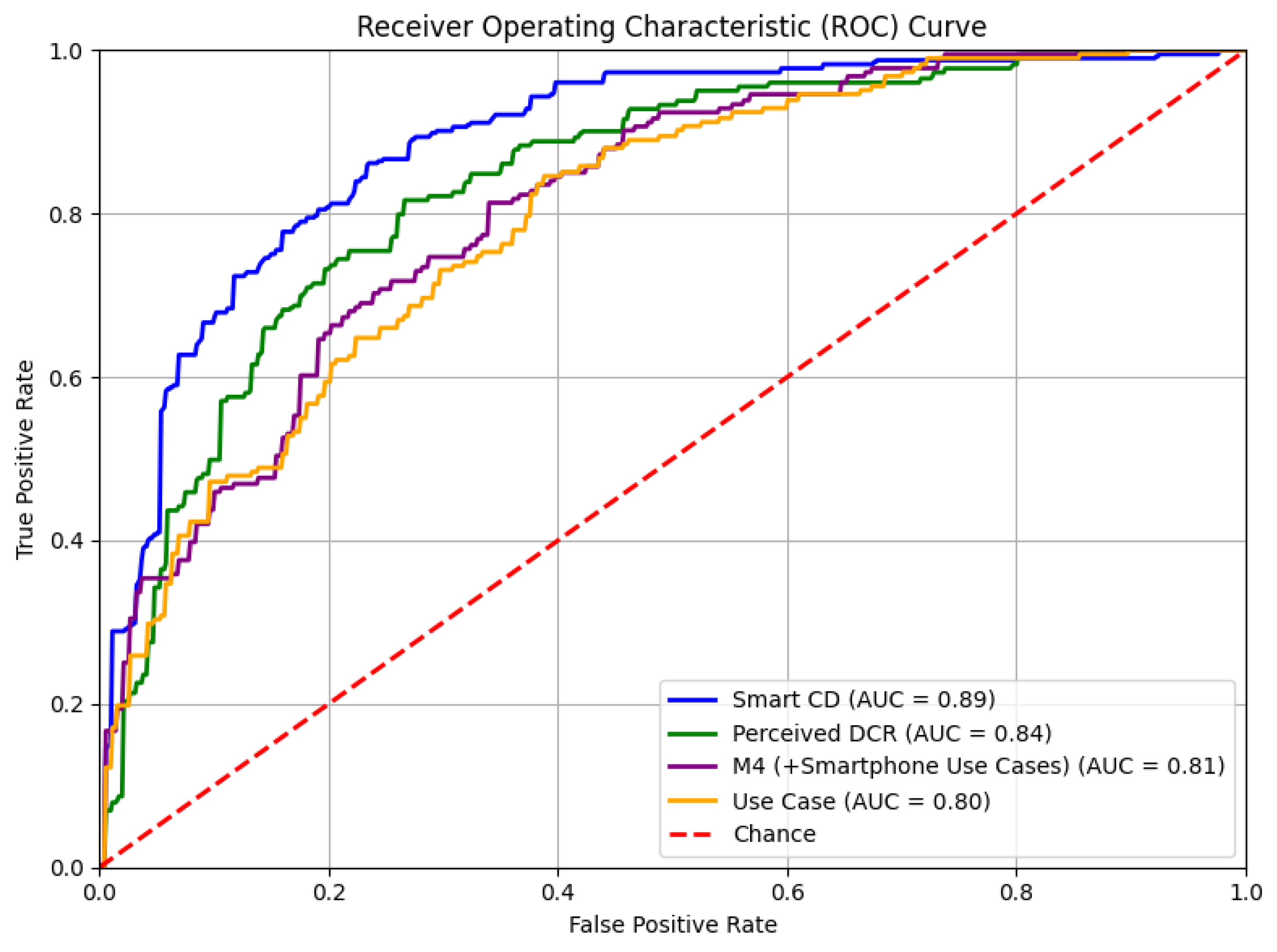
Figure 2.
The SHAP beeswarm plots of the M4 (+Smartphone Use Cases) nested model, the Smartphone Consequences & Dependence (Smart CD) construct-based model, the Perceived Digital Competence & Risk (Perceived DCR) construct-based model, and the Smartphone Use Cases (Use Case) construct-based model are presented.
Figure 2.
The SHAP beeswarm plots of the M4 (+Smartphone Use Cases) nested model, the Smartphone Consequences & Dependence (Smart CD) construct-based model, the Perceived Digital Competence & Risk (Perceived DCR) construct-based model, and the Smartphone Use Cases (Use Case) construct-based model are presented.
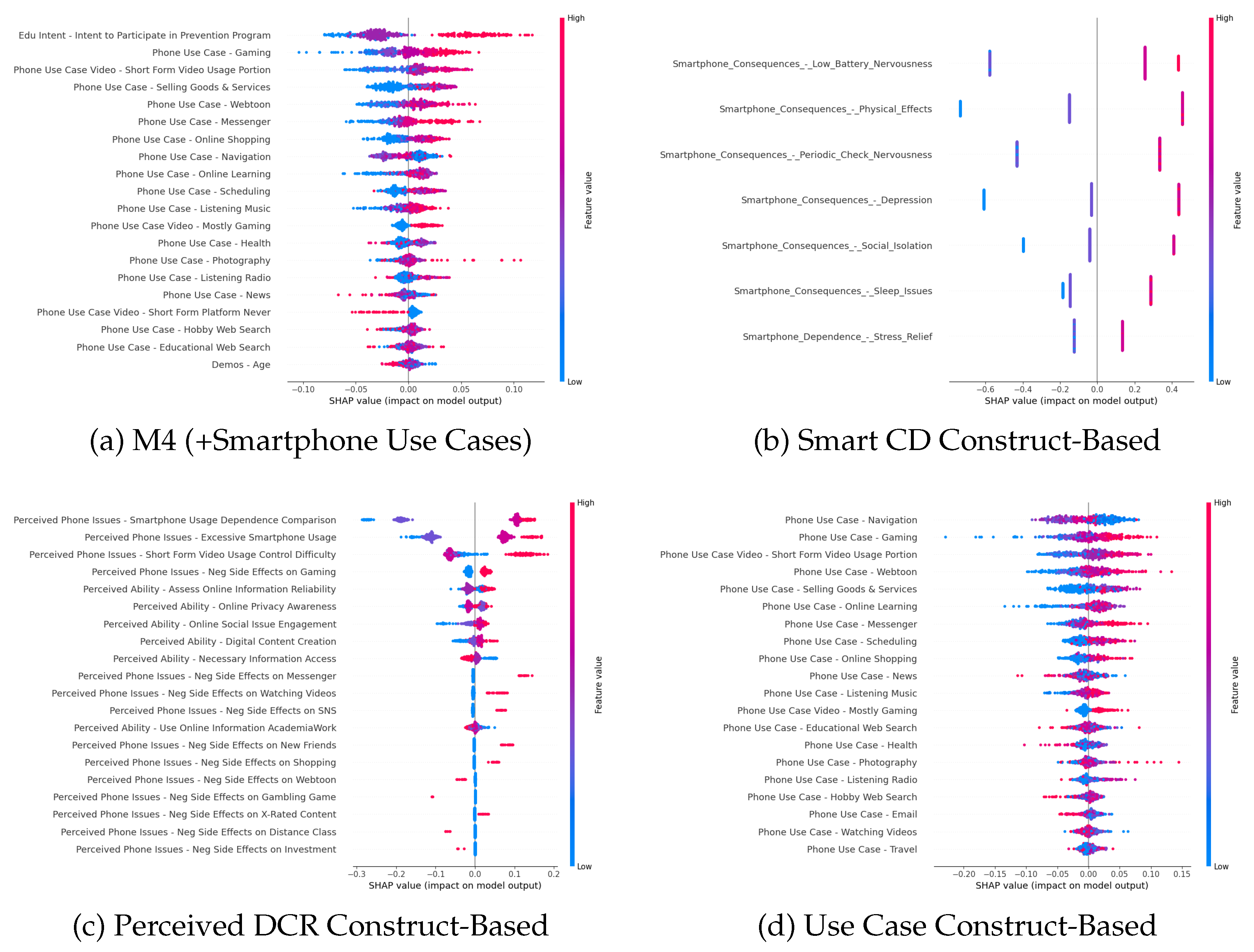
| (a) M4 (+Smartphone Use Cases) | (b) Smart CD Construct-Based |
| (c) Perceived DCR Construct-Based | (d) Use Case Construct-Based |
Figure 3.
The place-stratified SHAP feature importance rankings of the M4 (+Smartphone Use Cases) nested model, the Smartphone Consequences & Dependence (Smart CD) construct-based model, the Perceived Digital Competence & Risk (Perceived DCR) construct-based model, and the Smartphone Use Cases (Use Case) construct-based model are presented.
Figure 3.
The place-stratified SHAP feature importance rankings of the M4 (+Smartphone Use Cases) nested model, the Smartphone Consequences & Dependence (Smart CD) construct-based model, the Perceived Digital Competence & Risk (Perceived DCR) construct-based model, and the Smartphone Use Cases (Use Case) construct-based model are presented.
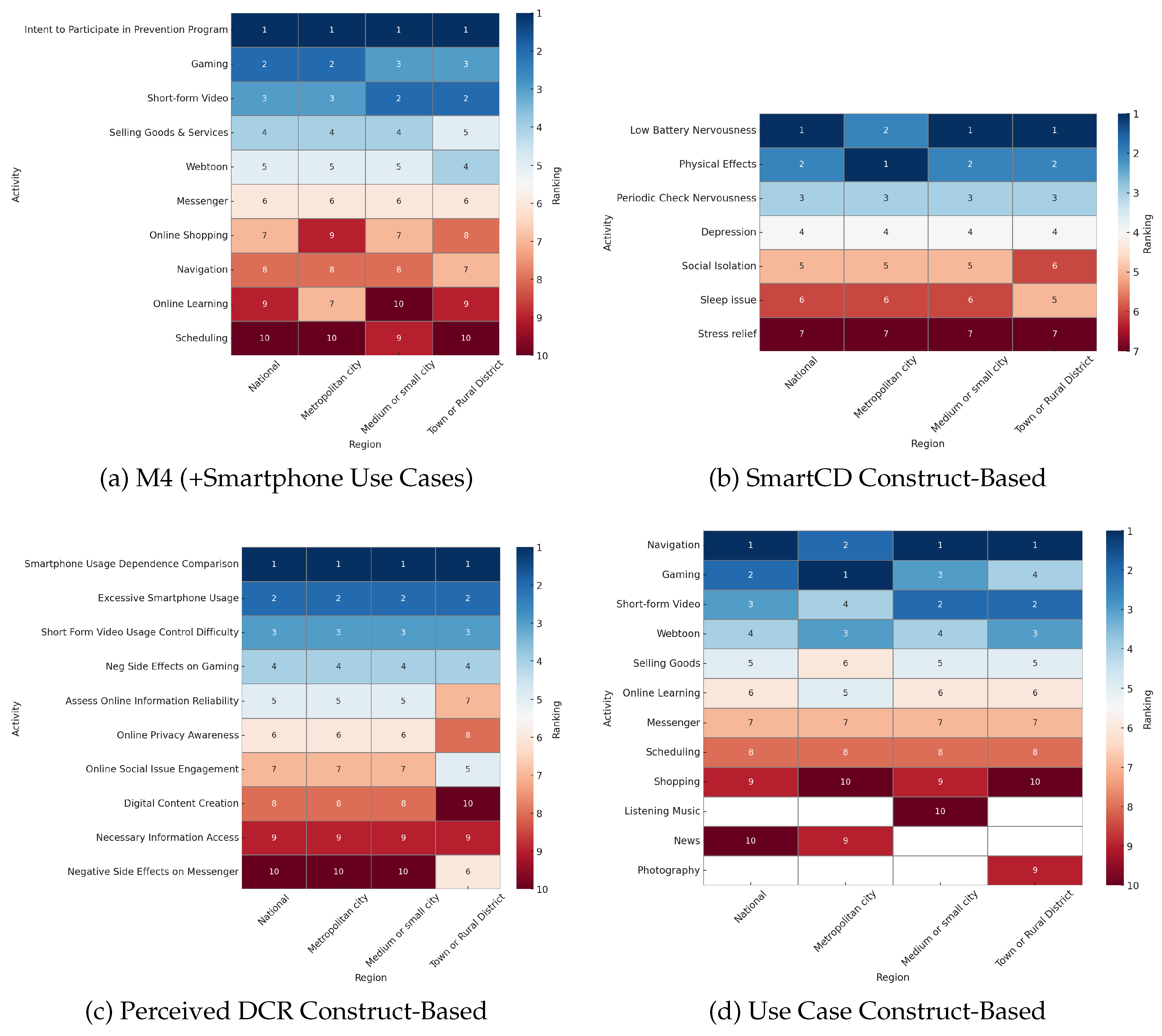
| (a) M4 (+Smartphone Use Cases) | (b) SmartCD Construct-Based |
| (c) Perceived DCR Construct-Based | (d) Use Case Construct-Based |
Figure 4.
Partial Dependence Plots (PDP) of select features in the Nested M4 (+Smartphone Use Cases) model. Subplot A. shows the PDP for “Edu Intent—Intent to Participate in Prevention Program”. Subplot B. “Phone Use Case—Gaming” shows the PDP for Subplot C. “Phone Use Case Video—Short Form Video Usage Portion” shows the PDP for Subplot D. shows the PDP for “Phone Use Case—Navigation”.
Figure 4.
Partial Dependence Plots (PDP) of select features in the Nested M4 (+Smartphone Use Cases) model. Subplot A. shows the PDP for “Edu Intent—Intent to Participate in Prevention Program”. Subplot B. “Phone Use Case—Gaming” shows the PDP for Subplot C. “Phone Use Case Video—Short Form Video Usage Portion” shows the PDP for Subplot D. shows the PDP for “Phone Use Case—Navigation”.
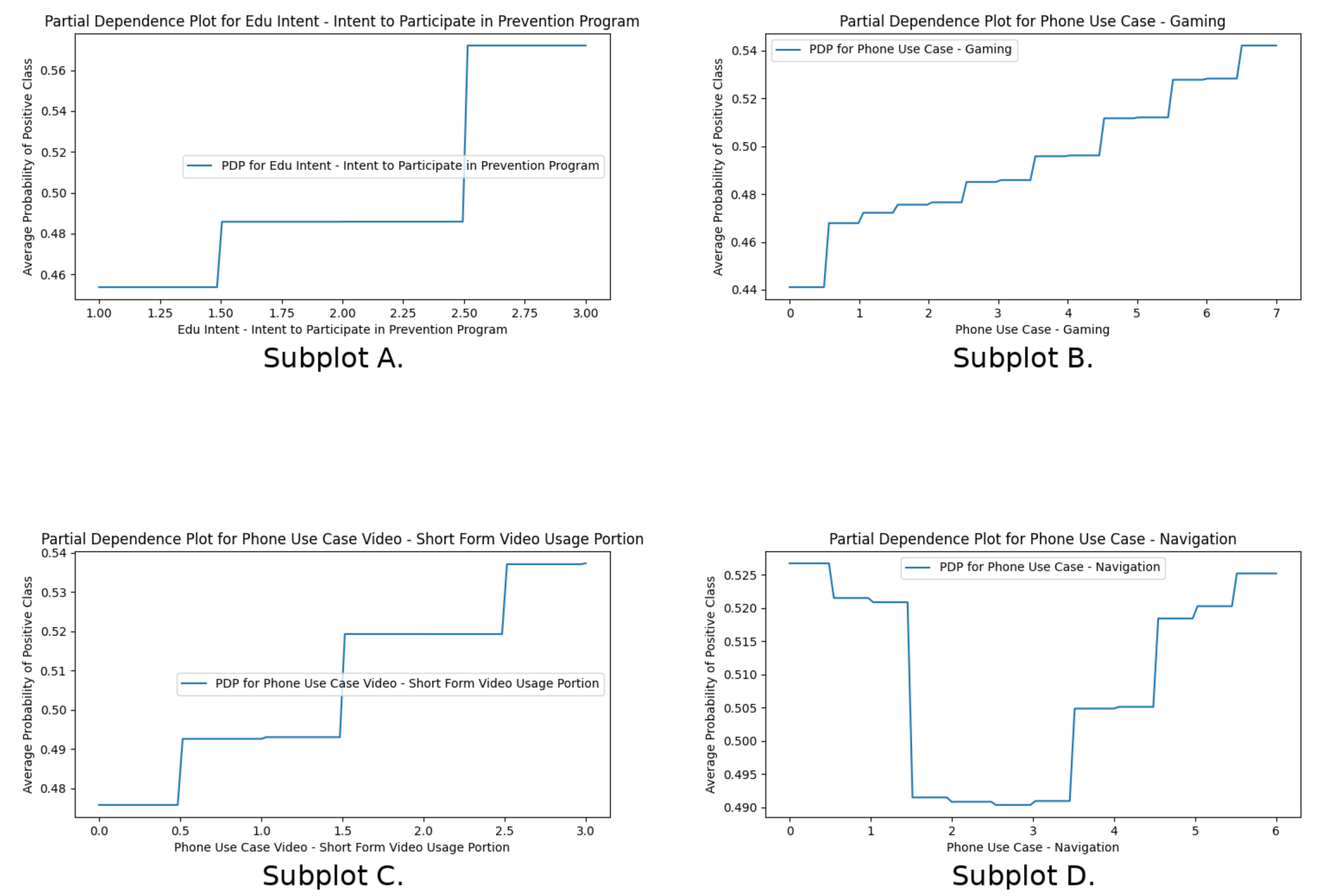
Figure 5.
PDP examples of the three marginal effects patterns from the Smart CD model. Subplot A. shows “Social Isolation” as the linear, step-wise increase pattern; Subplot B. shows the “Physical Effects” as the thresholding effect pattern; and Subplot C. shows the “Periodic Check Nervousness” as the binary effect pattern.
Figure 5.
PDP examples of the three marginal effects patterns from the Smart CD model. Subplot A. shows “Social Isolation” as the linear, step-wise increase pattern; Subplot B. shows the “Physical Effects” as the thresholding effect pattern; and Subplot C. shows the “Periodic Check Nervousness” as the binary effect pattern.
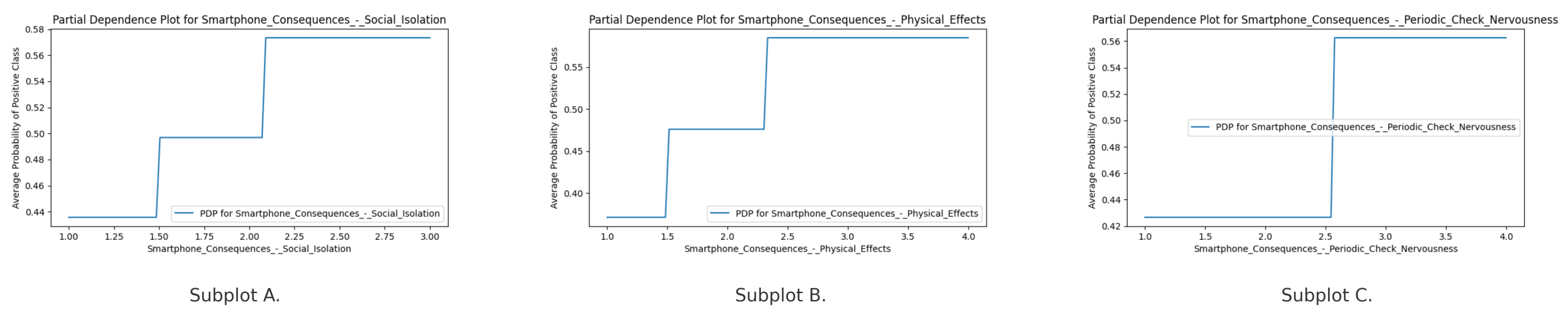
Figure 6.
PDP examples of the three marginal effects patterns from the Perceived DCR model. Subplot A. shows “Perceived Ability – Digital Content Creation” as the positive to negative curve; Subplot B. shows the “Perceived Ability – Assess Online Information Reliability” as the negative to positive curve; and Subplot C. shows the “Perceived Ability – Online Privacy Awareness” as the positive to negative to positive curve.
Figure 6.
PDP examples of the three marginal effects patterns from the Perceived DCR model. Subplot A. shows “Perceived Ability – Digital Content Creation” as the positive to negative curve; Subplot B. shows the “Perceived Ability – Assess Online Information Reliability” as the negative to positive curve; and Subplot C. shows the “Perceived Ability – Online Privacy Awareness” as the positive to negative to positive curve.
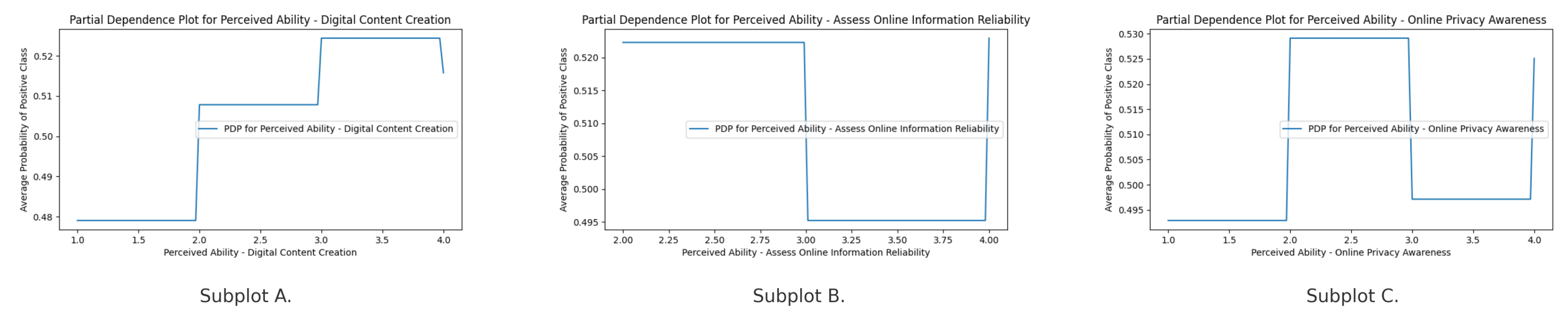
Figure 7.
PDP examples and of the “Navigation” feature from the Use Case model. Subplot A. shows “Phone Use Case – Online Shopping” with several dips but overall retaining a positive relationship; Subplot B. shows the “Phone Use Case – Gaming” with an initial thresholding jump but overall retaining a positive relationship; and Subplot C. shows the “Phone Use Case—Navigation” with a parabolic curve.
Figure 7.
PDP examples and of the “Navigation” feature from the Use Case model. Subplot A. shows “Phone Use Case – Online Shopping” with several dips but overall retaining a positive relationship; Subplot B. shows the “Phone Use Case – Gaming” with an initial thresholding jump but overall retaining a positive relationship; and Subplot C. shows the “Phone Use Case—Navigation” with a parabolic curve.
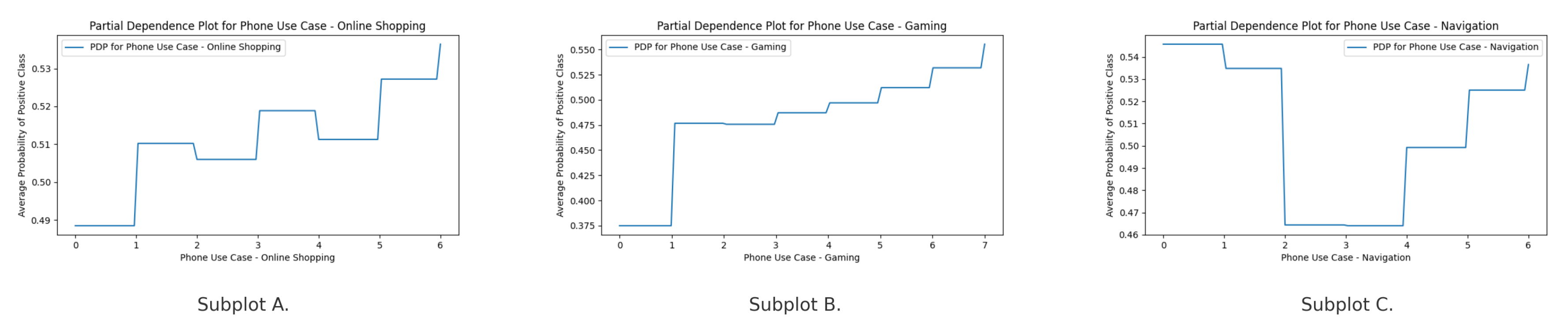
Table 1.
Significantly Different Place-Stratified Features by Urbanicity (N = 1,873)
| Construct | Variable | Metropolitan City | Medium or | Town or |
|---|---|---|---|---|
| Small City | Rural District | |||
| (n=831) | (n=714) | (n=328) | ||
| Home Environment | House (n (%))* | 167 (20.1%) | 152 (21.3%) | 90 (27.4%) |
| Smartphone Use Cases | Messenger (M (SD))*** | 5.31 (1.46) | 5.41 (1.42) | 5.02 (1.75) |
| Scheduling (M (SD))** | 2.06 (2.13) | 1.86 (2.06) | 1.62 (2.08) | |
| Health (M (SD))* | 1.76 (2.04) | 1.59 (1.91) | 1.46 (1.98) | |
| Zoom Meetings (M (SD))* | 0.73 (1.57) | 0.54 (1.33) | 0.59 (1.41) | |
| Investment (M (SD))*** | 0.86 (1.52) | 0.63 (1.28) | 0.62 (1.29) | |
| Watching Videos (M (SD))* | 5.25 (1.62) | 5.32 (1.58) | 5.02 (1.81) | |
| Listening Music (M (SD))*** | 4.51 (1.97) | 4.48 (2.04) | 4.03 (2.35) | |
| Adult Content (M (SD))*** | 0.50 (1.15) | 0.33 (0.94) | 0.30 (0.94) | |
| Gambling (M (SD))*** | 0.48 (1.20) | 0.29 (0.87) | 0.32 (1.04) | |
| News (M (SD))** | 2.57 (2.21) | 2.30 (2.04) | 2.16 (2.16) | |
| Educational Web Search (M (SD))** | 4.06 (1.81) | 3.84 (1.78) | 3.64 (2.26) | |
| Navigation (M (SD))* | 2.42 (1.92) | 2.37 (1.95) | 2.12 (2.00) | |
| Short Form YouTube (n (%))** | 443 (53.3%) | 315 (44.1%) | 162 (49.4%) | |
| TikTok (n (%))* | 145 (17.4%) | 165 (23.1%) | 68 (20.7%) | |
| Mostly Food (n (%))* | 130 (15.6%) | 80 (11.2%) | 47 (14.3%) | |
| Gaming Side Effects (n (%))** | 353 (42.5%) | 313 (43.8%) | 108 (32.9%) | |
| Issue Engagement (M (SD))* | 2.80 (0.85) | 2.70 (0.85) | 2.81 (0.81) | |
| Perceived Digital | Content Creation (M (SD))* | 2.49 (0.98) | 2.43 (0.98) | 2.62 (0.99) |
| Competence & Risk | Privacy Awareness (M (SD))*** | 2.66 (0.88) | 2.57 (0.86) | 2.79 (0.86) |
| Info for School/Work (M (SD))*** | 2.89 (0.87) | 2.67 (0.94) | 2.81 (0.92) | |
| Consequences & Dependence | Low Battery Nervousness (M (SD))** | 2.71 (0.83) | 2.85 (0.86) | 2.75 (0.85) |
| Parental Prevention | Teaches Use (n (%))** | 397 (47.8%) | 284 (39.8%) | 130 (39.6%) |
| Teaches Pros/Cons (n (%))* | 514 (61.9%) | 422 (59.1%) | 176 (53.7%) | |
| Recommends Apps (n (%))*** | 396 (47.7%) | 277 (38.8%) | 152 (46.3%) | |
| Social Support | Family Support (M (SD))** | 3.29 (0.69) | 3.17 (0.75) | 3.26 (0.66) |
| Friend Support (M (SD))* | 3.13 (0.67) | 3.07 (0.69) | 3.17 (0.68) | |
| Fairness Perception (M (SD))*** | 2.93 (0.71) | 2.81 (0.75) | 3.03 (0.79) | |
| Self-Regulation | Digital Detox (n (%))** | 210 (25.3%) | 153 (21.4%) | 55 (16.8%) |
| Designated Placement (n (%))* | 286 (34.4%) | 200 (28.0%) | 105 (32.0%) | |
| Work Mode (n (%))* | 414 (49.8%) | 316 (44.3%) | 136 (41.5%) |
Note. Values are means (SD) or counts (percentage). One-way ANOVA used for continuous; chi-square for categorical. Significance: *p < 0.05, **p < 0.01, ***p < 0.001.
Table 2.
Performance metrics across the four exemplar AI/ML models for smartphone overdependence
| Model Name/Construct | Shorthand | Algorithm | AUC | Mean Val Loss | Test Loss | Num Features |
|---|---|---|---|---|---|---|
| +Smartphone Use Cases | M4 | RF | 0.81 | 0.58 | 0.55 | 59 |
| Smartphone Consequences & Dependence | Smart CD | LightGBM | 0.89 | 0.50 | 0.42 | 7 |
| Perceived Digital Competence & Risk | Perceived DCR | XGB | 0.84 | 0.52 | 0.49 | 34 |
| Smartphone Use Cases | Use Case | XGB | 0.80 | 0.59 | 0.54 | 48 |
Note: We compare AUC (area under the receiver operating characteristic curve), mean validation loss, test loss, and number of features across models. Algorithms used are Random Forest (RF), Light Gradient-Boosting Machine (LightGBM), and Extreme Gradient Boosting (XGBoost).
Table 3.
AUCs stratified by urbanicity
| Model | National AUC | Place-Stratified AUC | ||
|---|---|---|---|---|
| Metropolitan City | Medium or Small City | Town or Rural District | ||
| M4 (+Smartphone Use Cases) | 0.81 | 0.87 | 0.75 | 0.80 |
| Smart CD Construct | 0.89 | 0.91 | 0.87 | 0.87 |
| Perceived DCR Construct | 0.84 | 0.85 | 0.83 | 0.83 |
| Use Case Construct | 0.80 | 0.88 | 0.70 | 0.79 |
Note: The place-stratified AUCs of the M4 (+Smartphone Use Cases) nested model, the Smartphone Consequences & Dependence (Smart CD) construct-based model, the Perceived Digital Competence & Risk (Perceived DCR) construct-based model, and the Smartphone Use Cases (Use Case) construct-based model are presented.
Disclaimer/Publisher’s Note: The statements, opinions and data contained in all publications are solely those of the individual author(s) and contributor(s) and not of MDPI and/or the editor(s). MDPI and/or the editor(s) disclaim responsibility for any injury to people or property resulting from any ideas, methods, instructions or products referred to in the content. |
© 2025 by the authors. Licensee MDPI, Basel, Switzerland. This article is an open access article distributed under the terms and conditions of the Creative Commons Attribution (CC BY) license (http://creativecommons.org/licenses/by/4.0/).
Copyright: This open access article is published under a Creative Commons CC BY 4.0 license, which permit the free download, distribution, and reuse, provided that the author and preprint are cited in any reuse.