

Submitted:
31 July 2025
Posted:
01 August 2025
You are already at the latest version
Abstract
Wheat streak mosaic virus (WSMV) infects most Poaceae family species. The virus is transmitted by wheat curl mites (WCM) which can acquire the virions from infected volunteer wheat (Triticum aestivum L.) and other grassy weeds, such as brome grass (Bromus tectorum) and transmit it back to wheat. This process can result in the blending of different WSMV isolates or strains infecting a host. The impact of virus strain infection on wheat symptom severity and yield components has not yet been investigated in South Dakota. The present study characterized the impact of two WSMV isolates: one from wheat (WSMV-w) and the other from brome grass (WSMV-br). Two winter wheat cultivars: Millennium and Mace, were inoculated at the 2 to 3 leaf stage with WSMV-w, WSMV-br or a buffer under growth chamber (GC) and greenhouse (GH) conditions. There were no significant differences in plant height between WSMV-br and WSMV-w inoculated plants in the GC. However, plant height was significantly different (P < 0.0001) in Millennium inoculated with WSMV-br and WSMV-w in the GH. Plant height was reduced by 10% and 15% due to WSMV-br and WSMV-w infection, respectively. For Millennium, 18% of plants inoculated with WSMV-w exhibited severe mottling compared to 12% of plants inoculated with WSMV-br. Fresh weight was reduced by 22% and 58% by WSMV-br and WSMV-w, respectively. These results suggest that although the WSMV isolate recovered from brome grass may not be as aggressive as that recovered from wheat, it still has the potential to cause significant losses.
Keywords:
Wheat streak mosaic virus (WSMV)
; wheat
; Bromus tectorum (brome grass)
; alternate host
; isolate
Introduction
Wheat streak mosaic virus (WSMV) is a major viral disease of wheat (Triticum aestivum L., 2n = 42, AABBDD) across the globe capable of causing devastating yield losses under optimum conditions for infection and development [1,2]. The virus belongs to the Potyviriadea family and Tritimovirus genus [3,4]. Early infection coupled with favorable conditions, such as warm spring temperatures (24 to 28 °C) and high relative humidity, can result in extensive epidemics that can cause over 80% reduction in yield thereby resulting in significant economic losses [5,6,7].
Infection by WSMV impedes nodal root growth and development which reduces plants’ water and nutrient uptake capabilities. Water stress conditions exacerbate the impact of the virus on wheat [2,8]). In addition, WSMV causes leaf mottling, streaking, chlorosis and necrosis which reduce the total foliar surface that is able to capture light for photosynthesis. This diminishes the efficiency and capacity of photosynthetic processes and reduces photosynthetic assimilates, resulting in decreased plant vigor, number of secondary tillers, test weight and yield of both grain and non-harvestable biomass [2,3,6,9]. In some years, yield losses due to WSMV are experienced in individual fields rather than a vast region as WSMV may occur in pockets more often than across extensive fields.
WSMV is transmitted by both the adult form and nymphs of wheat curl mite (WCM), Aceria tosichella Keifer. WCM is an eriophyid obligatory phytophagous parasite capable of transmitting viral plant diseases such as the High Plains wheat mosaic virus, also known as High Plains Virus, Triticum mosaic virus, and WSMV within the poaceae family [10,11]. The WCM can only survive on green leaves of grassy species, such as barley (Hordeum vulgare) and barley grass, domesticated and wild oats (Avena fatua), corn (Zea mays), millet (Poaceae), green foxtail (Setaria viridis) and brome grass. The presence of such alternative hosts provides a live substrate for the WCM to survive on and complete its short life cycle (7-10 days at 25 °C) Hadi, et al. [9]. From WSMV acquisition, the WCM can remain infective up to 6 days under normal conditions. However, Orlob [12] reported that near freezing temperatures slowed down WCM development such that viruliferous WCM remained alive up to 30 days.
Wheat curl mites are blown by wind or carried by other insects from infected alternate hosts back to the primary host, winter wheat in fall and spring. This can lead to mixing of virus strains between cultivated crops and wild hosts [13]. Strains from different hosts or alternate hosts may differ in their virulence. This may have implications on management practices such as choice of cultivar. This study was conducted to determine the differential aggressiveness and potential impact on yield characteristics between WSMV-br, a WSMV isolate from downy brome grass (Bromus tectorum), and WSMV-w, a WSMV isolate from wheat.
Materials and Methods
Viral Isolates and Maintenance
Leaf samples from WSMV-like symptomatic wheat and downy brome grass were collected from the same field in Lyman County, South Dakota (SD) in the fall of 2016. Leaf samples were collected into separate, clearly labeled zip-lock bags and placed in an ice-filled cooler for transportation to the lab at the university station in Brookings, SD. A sample of the collected leaves from both wheat and down brome grass were stored at -80 °C while the remaining sample was used to determine symptom causation. An enzyme-linked immunosorbent assay (ELISA), as described by Seifers, et al. [14], revealed that the mottling symptoms on both the wheat and brome grass were due to WSMV. The isolates were then designated WSMV-w and WSMV-br to represent isolate source. WSMV-w and WSMV-br were independently maintained and increased in a susceptible host in a greenhouse.
Plant Material and Inoculum
Two hard red winter wheat cultivars, ‘Mace’ (PI 651043) and ‘Millennium’ (PI 613099), resistant and susceptible to WSMV, respectively [15]; were each inoculated with: (i) a buffer solution of 0.1 M potassium phosphate representing a non-inoculated check, (ii) WSMV-w and (iii) WSMV-br at the 2 to 3 leaf growth stage.
The WSMV-w and WSMV-br symptomatic leaves from the inoculum increases were independently and thoroughly mashed using a blender in 0.1 M potassium phosphate buffer (pH 7.4) at 1:10 (weight by volume) to form a smoothie-like mixture. The mixtures were separately filtered with a cheesecloth to obtain the sap containing WSMV-w and WSMV-br that were used to inoculate plants by mechanically rubbing the sap onto the leaves using a ceramic pestle. The inoculated plants were maintained at 20 °C with a 14 hour photoperiod in a growth chamber (GC) while another set was maintained in two separate greenhouse (GH) runs at a night and day temperature range of 25 °C and 28 °C with a 16 hour photoperiod, making a total of three repetitions of the study.
Experimental Design, Data Collection, and Analyses
The study was set as a randomized complete block design with a split plot arrangement where cultivars were the main plot and the isolate or inoculum (buffer solution, WSMV-w and WSMV-br) were designated sub-plots in both the growth chamber and the two greenhouse runs. There were 12 plants per plot in the GC study where a plot consisted of 4 deep pots measuring 6.4cm in diameter and 25.4cm deep. The GH study consisted of 40 plants per plot and each plot comprised 4 pots with a 16.5cm diameter and 16.5cm depth. For both GC and GH studies, each block was replicated 4 times and an equal number of seeds planted in each plot.
Virus severity symptoms were scored 21 days after inoculation (dai) based on a modified WSMV rating system by Sharp, et al. [16]. Severity was rated on a 1 to 5 scale of symptom severity where a score of 1 meant no visual symptoms observed and a score of 5 meant severe mottling greater than 40%, stunting and chlorosis of entire plant leaves (Table 1). Plant height (cm) and fresh weight (g) were recorded at 22 and 28 dai, respectively. The whole plants were harvested and placed in a drier at 45 °C for 5 days and dry weight (g) was recorded thereafter. Plant height was recorded on individual plants per plot while fresh weight and dry weight were recorded as whole plot.
All plant growth characteristics data, namely; plant height and biomass, were analyzed using a generalized linear model (Proc Glimmix, SAS 9.4; SAS Institute, Cary NC) with a restricted maximum likelihood estimation technique, where the effects of cultivar and isolate were considered fixed while greenhouse seasons and blocks or replicates were considered random. Mean difference comparisons were calculated with Tukey estimation procedure and the probability (p) for significant difference was set at 0.05. A nonparametric analysis approach (Proc Freq, SAS 9.4; SAS Institute, Cary NC) was used on the ordinal viral severity data to generate descriptive results, as well as to assess if there were significant isolate effects calculated by Fischer Exact and Friedman’s Chi-square procedures. Spearman’s correlation coefficients of plant growth characteristics against viral symptom scores were also calculated using Proc CORR (SAS Institute, Cary NC) for both the GC and combined GH runs.
Results
Viral Symptoms: Growth Chamber
In the GC study, of all Mace plants inoculated with WSMV-br, 54% had a virus severity score of 1 (no virus symptoms); 44% had a score of 2 (some mottling) and 2% had a viral severity score of 3 (advanced mottling) (Table 2). Not a single Mace plant inoculated with WSMV-br had a score of 4 or 5. Thus, more plants inoculated with WSMV-br had a viral score of 1. On the other hand, 94% of Mace plants inoculated with WSMV-w had a viral score of 1; 4% had a viral score of 2. None of the plants inoculated with a buffer solution developed symptoms.
For Millennium, 50% of the plants inoculated with WSMV-br had a viral severity score of 1 compared to 4% for plants inoculated with WSMV-w. 44% of plants inoculated with WSMV-br had a viral score of 2 compared to 50% of plants inoculated with WSMV-w. There were more plants with a viral severity score of 3 for Millennium inoculated with WSMV-w (46%) than for those inoculated with WSMV-br (6%). Both cultivars had significant (p<0.0001) Cochran-Mantel-Haenszel (Friedman’s Chi-square test) and Fisher’s Exact Test probabilities suggesting that there was, at least, a significant difference between isolates for each cultivar based on viral severity scores.
Viral Symptoms: Greenhouse
The GH viral severity results (Table 3) had a similar pattern to GC results. For Mace, 96% of plants inoculated with WSMV-br were scored 1 (no disease symptom) while 86% of plants inoculated with WSMV-w had a rating of 1. Only 2% of plants inoculated with WSMV-br had a score of 2 compared to 7% for plants inoculated with WSMV-w. Just 2% of Mace plants had advanced mottling score for WSMV-br inoculation compared to 4% of plants inoculated with WSMV-w. None of the plants inoculated with WSMV-br had a score of 4 or 5. For plants inoculated with WSMV-w, 2% had severe mottling and stunting symptoms (score of 4) and only 1% had a score of 5. Plants inoculated with a buffer did not develop any symptoms.
For Millennium, however, fewer plants had a score of 1 for both virus isolates in the GH trial compared to the GC. Of the plants inoculated with WSMV-br, only 15% had a virus score of 1 while 4% of plants inoculated with WSMV-w had a rating of 1. Plants inoculated with WSMV-br and WSMV-w that had a symptomatic score of 5 were 13% and 18%, respectively. As with the GC trial, both Mace and Millennium had a significant Fisher’s Exact Test and Friedman’s Chi-square test (p<0.0001), indicating that the two isolates affected each cultivar differently.
Plant Growth Characteristics: GC and GH
Since the covariance estimates for random effects were zero for both GC and GH, the random effects did not influence the outcome of the fixed effects from the restricted maximum likelihood estimation technique. The GC F-statistic probabilities (Table 4) for isolate and cultivar by isolate interaction effects were indicative of possible differences between isolates and probable disparity in terms of the impact of these isolates on plant height. Similarly, the F statistic probabilities of the GH seasons (Table 4) for both isolate and cultivar by isolate interaction effects relating to plant height, fresh weight and dry weight were significant (p<0.0001) suggesting a differential impact of the isolates.
In terms of means, the GC data revealed non-significant differences in fresh weight and dry weight between isolates and control buffer within cultivars within each cultivar (Table 5). In terms of plant height, there was no evidence at p=0.05 that the two isolates impacted plant height of either Mace or Millennium differently. However, either isolate significantly reduced plant height of both cultivars when contrasted with plants inoculated with the buffer.
Combined GH data analyses for plant height, fresh weight and dry weight showed that the isolates did not affect these plant growth characteristics differently in the resistant cultivar, Mace (Table 5, Figure 1). However, WSMV-w had a much more devastating impact on Millennium than WSMV-br (p<0.0001) on the assessed plant growth characteristics. Plant height reduction by WSMV-w was greater in Millennium compared to Mace.
The Spearman analyses of viral score against plant growth characteristics showed that viral severity produced a direct negative effect on plant height and total biomass (Table 6). Associations between WSMV severity and plant growth characteristics were stronger in the GH than in the GC than in the GH.
Discussion
The impact of WSMV on wheat yield when conditions are optimal cannot be overemphasized. Plant stuntedness and reduced biomass observed in the present study demonstrate the damage that WSMV can inflict on potential wheat yield. This study established that the WSMV-br isolate was not as aggressive as the WSMV-w isolate, particularly on the susceptible cultivar, Millennium, in both the GC and GH. However, both WSMV isolates affected growth characteristics associated with yield. Although the overall impact patterns of the viral isolates on wheat were similar in both the GC and GH, the impact of both isolates on plant growth characteristics was more pronounced in the GH than in the GC, probably due to the temperature differences. The cooler temperature conditions in the GC slowed down WSMV’s capability to replicate and translocate within the plants compared to the GH conditions, hence the subdued symptoms and impact on plant growth characteristics [17]. The difference in viral severity scores across the two cultivars were as expected since Mace has Wms1 gene that confers resistance to WSMV even at higher temperatures [15,18], whereas Millennium cultivar is known to be susceptible to WSMV.
WSMV-br caused as much as 22% and 16% reduction in fresh and dry biomass while WSMV-w resulted in 58% and 55% loss in fresh and dry biomass. This perhaps underlines the notion that there is a diversity of viral strains that has not been identified and characterized due to WSMV’s capability for rapid adaptive genetic changes, which is typical of RNA viruses [10,18,19,20]. WSMV strain diversity may arise as a result of selection pressure during periods of unfavorable abiotic conditions. These abiotic stresses could be microenvironments, which may increase the potential for the rise of varying strains within fields [21]. The two isolates used in this study were consistent in their differential virulence and pathogenicity on Mace and Millennium in both the GC and GH, suggesting possible genomic differences of the two isolates, especially considering that the studies were conducted in controlled environments, thereby eliminating the effect of the genotype by environment interactions.
Pathogenicity of WSMV has been extensively studied and probably well understood in plant virology [22]. However, the aggressiveness of WSMV strains from various alternate hosts is not widely known. The susceptibilities of a range of WSMV alternate hosts have been studied, including some brome grasses [23]. However, such studies have not been extensive enough to identify the Bromus species that are actual WSMV alternate hosts and even some that do not show disease symptoms but still host WCM and WSMV. Specifically, there are different subspecies of Bromus that have varying responses to WSMV; for example, B. inermis or smooth brome does not show WSMV symptoms when inoculated while B. arvensis or field brome show viral infection symptoms. It is of paramount importance, therefore, to determine and understand the dynamic aggressiveness of WSMV isolates from such alternate hosts for disease management purposes.
Managing WSMV and other viral diseases is a complex process. The complexity emanates from the fact that it is not just the virus at play but the vector, WCM, as well - let alone environmental factors. Two WCM biotypes have been identified in the wheat growing northern plain: type 1 and 2 which react differently to host resistance and have varying abilities to transmit WSMV, yet both WCM biotypes coexist in the same field and same wheat heads [23,24]. Biotype 2 has higher fecundity in the presence WSMV compared to biotype 1 [10,25]. Robinson and Murray [5]reported that phylogenetic analyses of genetic sequences of coat protein of several WSMV isolates collected from numerous parts of the world revealed a great deal of genetic diversity and recombination events in the two WSMV types. This complex pathogen-vector dynamic presents more challenges to resistant cultivar development as dynamic has the propensity to evolve quickly to surmount existing resistance, especially the gene-for-gene type of resistance [19,26].
The confirmed isolate diversity and the fast genetic based adaptation proficiency demonstrated by WSMV [10,19] can present challenges to existing resistant genes and cultivar development efforts since, first; the currently effective resistant genes are more likely to be compromised due to selection pressure on WSMV overtime. Secondly, present resistance sources may not be effective against some of the existing or potential isolates [5,27]. Therefore, routine collection and characterization of WSMV isolates is critical for WSMV management, particularly through breeding because breeders ought to know what strain or combination of strains they are breeding against. In order to overcome such a dynamic and complex pathogen-vector-host interaction, it is imperative that breeding efforts focus on durable resistance by considering all resistance systems, such as preformed impeding structures and biochemical products to hinder WCM from lodging on to a cultivar, thereby limiting the colonization ability of WSMV. Development and use of resistant cultivars that incorporate diverse WSMV resistance sources should be a fundamental aspect of a broader integrated WSMV management approach.
Acknowledgements
The authors would like to thank South Dakota Wheat Commission and the USDA-NIFA Hatch grant No. 1016117 for funding this study.
References
- E. Byamukama et al., “Quantification of yield loss caused by Triticum mosaic virus and Wheat streak mosaic virus in winter wheat under field conditions,” Plant disease, vol. 98, no. 1, pp. 127-133, 2014. [CrossRef]
- G. P. Pradhan, Q. Xue, K. E. Jessup, B. Hao, J. A. Price, and C. M. Rush, “Physiological responses of hard red winter wheat to infection by Wheat streak mosaic virus,” Phytopathology, vol. 105, no. 5, pp. 621-627, 2015. [CrossRef]
- D. Rotenberg et al., “Occurrence of viruses and associated grain yields of paired symptomatic and nonsymptomatic tillers in Kansas winter wheat fields,” Phytopathology, vol. 106, no. 2, pp. 202-210, 2016. [CrossRef]
- J. T. Slykhuis, “Aceria tulipae Keifer (Acarina: Eriophyidae) in relation to the spread of wheat streak mosaic,” 1955.
- M. D. Robinson and T. D. Murray, “Genetic variation of Wheat streak mosaic virus in the United States Pacific Northwest,” Phytopathology, vol. 103, no. 1, pp. 98-104, 2013. [CrossRef]
- M. Velandia, R. M. Rejesus, D. C. Jones, J. A. Price, F. Workneh, and C. M. Rush, “Economic impact of Wheat streak mosaic virus in the Texas High Plains,” Crop protection, vol. 29, no. 7, pp. 699-703, 2010. [CrossRef]
- R. Hunger, J. Sherwood, C. Evans, and J. Montana, “Effects of planting date and inoculation date on severity of wheat streak mosaic in hard red winter wheat cultivars,” 1992.
- J. Price, F. Workneh, S. Evett, D. Jones, J. Arthur, and C. Rush, “Effects of Wheat streak mosaic virus on root development and water-use efficiency of hard red winter wheat,” Plant Disease, vol. 94, no. 6, pp. 766-770, 2010.
- B. Hadi, M. Langham, L. Osborne, and K. Tilmon, “Wheat streak mosaic virus on wheat: biology and management,” Journal of Integrated Pest Management, vol. 2, no. 1, pp. J1-J5, 2011.
- K. Singh, S. N. Wegulo, A. Skoracka, and J. K. Kundu, “Wheat streak mosaic virus: a century old virus with rising importance worldwide,” Molecular Plant Pathology, vol. 19, no. 9, pp. 2193-2206, 2018.
- A. R. Stilwell, D. C. Rundquist, D. B. Marx, and G. L. Hein, “Differential spatial gradients of wheat streak mosaic virus into winter wheat from a central mite-virus source,” Plant Disease, vol. 103, no. 2, pp. 338-344, 2019.
- G. Orlob, “Feeding and transmission characteristics of Acería tulipae Keifer as vector of Wheat streak mosaic virus,” 1966.
- S. J. Vincent, B. A. Coutts, and R. A. Jones, “Effects of introduced and indigenous viruses on native plants: Exploring their disease causing potential at the agro-ecological interface,” PLoS One, vol. 9, no. 3, p. e91224, 2014.
- D. Seifers, T. Martin, T. Harvey, S. Haber, and S. Haley, “Temperature sensitivity and efficacy of Wheat streak mosaic virus resistance derived from CO960293 wheat,” Plant Disease, vol. 90, no. 5, pp. 623-628, 2006.
- R. A. Graybosch et al., “Registration of ‘Mace’hard red winter wheat,” Journal of Plant Registrations, vol. 3, no. 1, pp. 51-56, 2009.
- G. L. Sharp et al., “Field evaluation of transgenic and classical sources of wheat streak mosaic virus resistance,” Crop Science, vol. 42, no. 1, pp. 105-110, 2002.
- E. N. Wosula, S. Tatineni, S. N. Wegulo, and G. L. Hein, “Effect of temperature on wheat streak mosaic disease development in winter wheat,” Plant disease, vol. 101, no. 2, pp. 324-330, 2017. [CrossRef]
- S. Tatineni, R. A. Graybosch, G. L. Hein, S. N. Wegulo, and R. French, “Wheat cultivar-specific disease synergism and alteration of virus accumulation during co-infection with Wheat streak mosaic virus and Triticum mosaic virus,” Phytopathology, vol. 100, no. 3, pp. 230-238, 2010. [CrossRef]
- E. Lehnhoff, Z. Miller, F. Menalled, D. Ito, and M. Burrows, “Wheat and barley susceptibility and tolerance to multiple isolates of Wheat streak mosaic virus,” Plant Disease, vol. 99, no. 10, pp. 1383-1389, 2015. [CrossRef]
- J. S. Hall, R. French, T. J. Morris, and D. C. Stenger, “Structure and temporal dynamics of populations within wheat streak mosaic virus isolates,” Journal of Virology, vol. 75, no. 21, pp. 10231-10243, 2001.
- J. E. McNeil, R. French, G. L. Hein, P. S. Baenziger, and K. M. Eskridge, “Characterization of genetic variability among natural populations of wheat streak mosaic virus,” Phytopathology, vol. 86, no. 11, pp. 1222-1227, 1996.
- Fuentes-Bueno, J. A. Price, C. M. Rush, D. L. Seifers, and J. P. Fellers, “Triticum mosaic virus isolates in the southern Great Plains,” Plant disease, vol. 95, no. 12, pp. 1516-1519, 2011.
- D. Ito, Z. Miller, F. Menalled, M. Moffet, and M. Burrows, “Relative susceptibility among alternative host species prevalent in the Great Plains to Wheat streak mosaic virus,” Plant Disease, vol. 96, no. 8, pp. 1185-1192, 2012.
- E. Wosula, A. J. McMechan, C. Oliveira-Hofman, S. N. Wegulo, and G. Hein, “Differential transmission of two isolates of Wheat streak mosaic virus by five wheat curl mite populations,” Plant disease, vol. 100, no. 1, pp. 154-158, 2016.
- B. Siriwetwiwat, Interactions between the wheat curl mite, Aceria tosichella Keifer (Eriophyidae), and wheat streak mosaic virus and distribution of wheat curl mite biotypes in the field. The University of Nebraska-Lincoln, 2006.
- R. A. Jones, “Plant virus emergence and evolution: origins, new encounter scenarios, factors driving emergence, effects of changing world conditions, and prospects for control,” Virus research, vol. 141, no. 2, pp. 113-130, 2009. [CrossRef]
- M. Fahim, A. Mechanicos, L. Ayala-Navarrete, S. Haber, and P. Larkin, “Resistance to wheat streak mosaic virus–a survey of resources and development of molecular markers,” Plant Pathology, vol. 61, no. 3, pp. 425-440, 2012. [CrossRef]
Figure 1.
Response of Mace and Millennium cultivars inoculated with a buffer solution of 0.1 M potassium phosphate and two isolates of Wheat streak mosaic virus (WSMV), WSMV-w and WSMV-br from winter wheat and brome grass, respectively.
Figure 1.
Response of Mace and Millennium cultivars inoculated with a buffer solution of 0.1 M potassium phosphate and two isolates of Wheat streak mosaic virus (WSMV), WSMV-w and WSMV-br from winter wheat and brome grass, respectively.
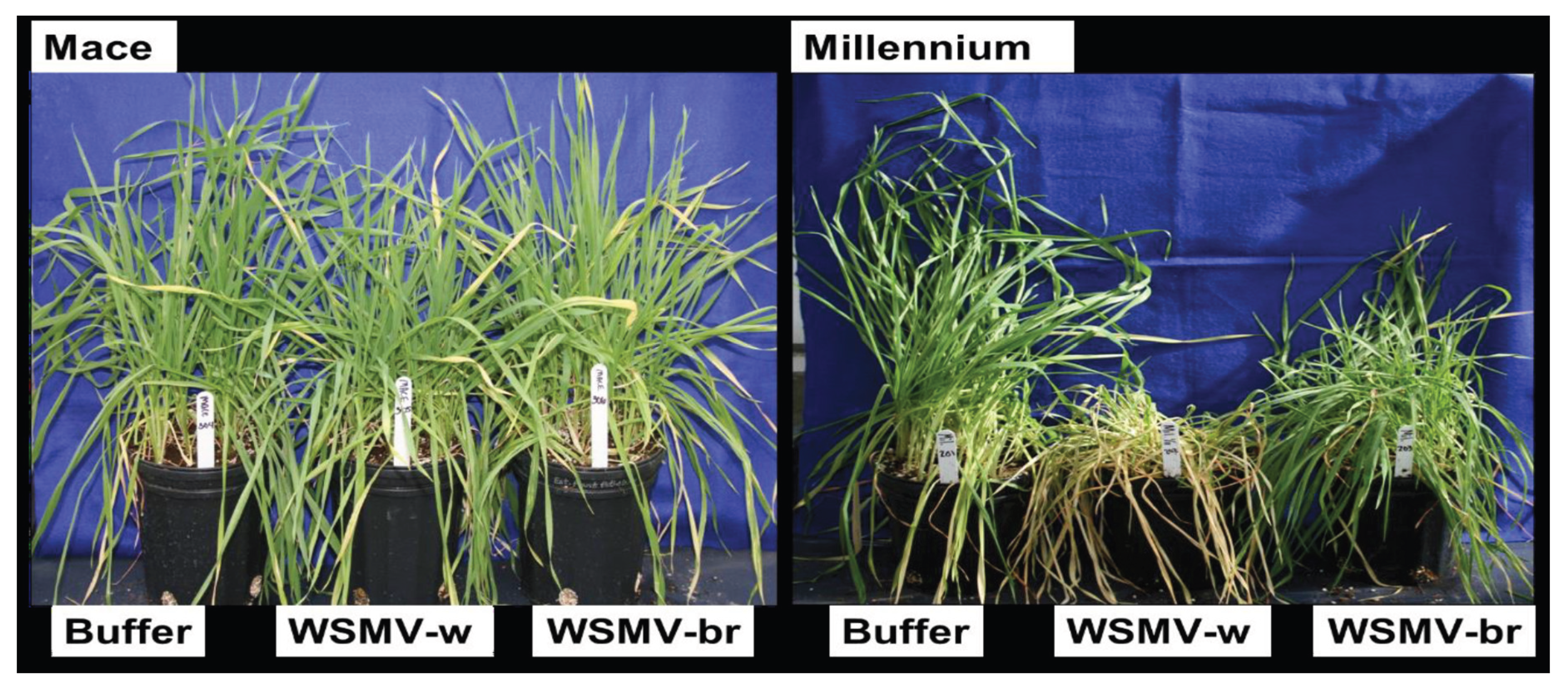

Table 1.
Wheat streak mosaic virus severity scoring key for hard red winter wheat cultivars modified from Sharp, et al. [16].
Table 1.
Wheat streak mosaic virus severity scoring key for hard red winter wheat cultivars modified from Sharp, et al. [16].
| Rate (score) | Score description |
|---|---|
| 1 | No disease symptoms |
| 2 | Light mottling [1-10%] |
| 3 | Advanced mottling [11-25%] |
| 4 | Severe mottling [26-40%] and stunting |
| 5 | Severe mottling [>40%], stunting and chlorosis |
Table 2.
Frequency (%) of plants with various Wheat streak mosaic severity scores for two winter wheat cultivars, Mace and Millennium, inoculated with Wheat streak mosaic virus isolates from wheat (WSMV-w) and brome grass (WSMV-br) in the growth chamber.
Table 2.
Frequency (%) of plants with various Wheat streak mosaic severity scores for two winter wheat cultivars, Mace and Millennium, inoculated with Wheat streak mosaic virus isolates from wheat (WSMV-w) and brome grass (WSMV-br) in the growth chamber.
| Viral severity score | Frequency (%) | ||||
|---|---|---|---|---|---|
| Mace | Millennium | ||||
| Isolate | Isolate | ||||
| WSMV-br | WSMV-w | WSMV-br | WSMV-w | ||
| No symptoms (score 1) | 54a | 94 | 50 | 4 | |
| Light mottling [1 - 10%] (score 2) | 44 | 4 | 44 | 50 | |
| Advanced mottling | 2 | 0 | 6 | 46 | |
| [11 - 25%] (score 3) | |||||
| Severe mottling and stunting | 0 | 2 | 0 | 0 | |
| [26 - 40%] (score 4) | |||||
| Severe mottling | 0 | 0 | 0 | 0 | |
| [>40%] stunting and | |||||
| chlorosis (score 5) | |||||
| Fisher Exact test | <0.0001 | <0.0001 | |||
| Friedman’s Chi-square test | <0.0001 | <0.0001 | |||
aPercent of all plants with the viral severity score from corresponding inoculum type.
Table 3.
Frequency (%) of plants with various Wheat streak mosaic virus severity scores for two winter wheat cultivars, Mace and Millennium, inoculated with Wheat streak mosaic virus isolates from wheat (WSMV-w) and brome grass (WSMV-br) in two greenhouse runs.
Table 3.
Frequency (%) of plants with various Wheat streak mosaic virus severity scores for two winter wheat cultivars, Mace and Millennium, inoculated with Wheat streak mosaic virus isolates from wheat (WSMV-w) and brome grass (WSMV-br) in two greenhouse runs.
| Viral severity score | Frequency (%) | ||||
|---|---|---|---|---|---|
| Mace | Millennium | ||||
| Isolate | Isolate | ||||
| WSMV-br | WSMV-w | WSMV-br | WSMV-w | ||
| No symptoms (score 1) | 96a | 86 | 15 | 4 | |
| Some mottling [1 - 10%] | 2 | 7 | 28 | 10 | |
| (score 2) | |||||
| Advanced mottling | 2 | 4 | 33 | 48 | |
| [11 - 25%] (score 3) | |||||
| Severe mottling | 0 | 2 | 13 | 20 | |
| [26 - 40 %] and stunting | |||||
| (score 4) | |||||
| Severe mottling | 0 | 1 | 13 | 18 | |
| [>40%] stunting and | |||||
| chlorosis (score 5) | |||||
| Fisher Exact test | <0.0001 | <0.0001 | |||
| Friedman’s Chi-square test | <0.0001 | <0.0001 | |||
aPercent of all plants with the viral severity score from corresponding inoculum type.
Table 4.
Fixed effects variance analyses showing probabilities of the F-statistic for plant height, fresh weight and dry weight in both the growth chamber and combined analyses of two greenhouse runs.
Table 4.
Fixed effects variance analyses showing probabilities of the F-statistic for plant height, fresh weight and dry weight in both the growth chamber and combined analyses of two greenhouse runs.
| Effect | Growth Chamber F statistic probability | Combined greenhouse F statistic probability | |||||
|---|---|---|---|---|---|---|---|
| dfa | Plant height | Fresh weight | Dry weight | Plant Height | Fresh weight | Dry weight | |
| Cultivar | 1 | <.0001 | 0.8117 | 0.2534 | 0.0214 | 0.0022 | 0.0002 |
| Inoculum | 2 | <.0001 | 0.7151 | 0.0833 | <.0001 | <.0001 | <.0001 |
| Cultivar*Inoculum | 2 | 0.0053 | 0.3801 | 0.0489 | <.0001 | <.0001 | <.0001 |
adf = degrees of freedom.
Table 5.
Within cultivar comparisons of the impact of two Wheat streak mosaic virus (WSMV) isolates, WSMV-w and WSMV-br, and a buffer made from 0.1 M potassium phosphate buffer solution as a control check on plant growth characteristics in the growth chamber and in combined analyses of two greenhouse runs.
Table 5.
Within cultivar comparisons of the impact of two Wheat streak mosaic virus (WSMV) isolates, WSMV-w and WSMV-br, and a buffer made from 0.1 M potassium phosphate buffer solution as a control check on plant growth characteristics in the growth chamber and in combined analyses of two greenhouse runs.
| Cultivar | Compared treatments | Growth Chamber difference in |
Combined greenhouse difference in |
||||||||||
|---|---|---|---|---|---|---|---|---|---|---|---|---|---|
| Plant height (cm) |
P-value | Fresh weight (g) |
P-value | Dry weight (g) |
P-value | Plant height (cm) |
P-value | Fresh weight (g) |
P-value | Dry weight (g) |
P-value | ||
| Mace | WSMV-br vs Buffer | -1.33 | 0.0001 | -0.53 | 0.4639 | 0.05 | 0.0564 | -2.72 | <.0001 | -2.26 | 0.1241 | -0.21 | 0.5949 |
| Mace | WSMV-br vs WSMV-w | -0.46 | 0.3304 | 0.03 | 0.9975 | 0.05 | 0.0527 | -0.43 | 0.3318 | 1.44 | 0.4234 | 0.40 | 0.1464 |
| Mace | Buffer vs WSMV-w | 0.88 | 0.0191 | 0.56 | 0.4315 | 0.00 | 0.9996 | 2.29 | <.0001 | 3.71 | 0.0044 | 0.60 | 0.0132 |
| Millennium | WSMV-br vs Buffer | -2.17 | <.0001 | -0.02 | 0.9989 | -0.03 | 0.4593 | -3.45 | <.0001 | -5.47 | <.0001 | -0.75 | 0.0013 |
| Millennium | WSMV-br vs WSMV-w | 0.16 | 0.8754 | -0.36 | 0.7193 | 0.02 | 0.7061 | 1.93 | <.0001 | 9.23 | <.0001 | 1.85 | <.0001 |
| Millennium | Buffer vs WSMV-w | 2.33 | <.0001 | -0.34 | 0.7380 | 0.04 | 0.1202 | 5.38 | <.0001 | 14.7 | <.0001 | 2.60 | <.0001 |
Table 6.
Spearman’s correlation coefficient analyses of viral score and plant growth characteristics (plant height, fresh weight and dry weight) in combined analyses of two greenhouse runs and growth chamber.
Table 6.
Spearman’s correlation coefficient analyses of viral score and plant growth characteristics (plant height, fresh weight and dry weight) in combined analyses of two greenhouse runs and growth chamber.
| Greenhouse | Growth chamber | |||
|---|---|---|---|---|
| ra | p-value | r | p-value | |
| Plant height (cm) | -0.56 | <0.0001 | -0.12 | 0.0449 |
| Fresh weight (g) | -0.40 | <0.0001 | -0.26 | <0.0001 |
| Dry weight (g) | -0.44 | <0.0001 | -0.16 | 0.1222 |
aSpearman’s correlation coefficient.
Disclaimer/Publisher’s Note: The statements, opinions and data contained in all publications are solely those of the individual author(s) and contributor(s) and not of MDPI and/or the editor(s). MDPI and/or the editor(s) disclaim responsibility for any injury to people or property resulting from any ideas, methods, instructions or products referred to in the content. |
© 2025 by the authors. Licensee MDPI, Basel, Switzerland. This article is an open access article distributed under the terms and conditions of the Creative Commons Attribution (CC BY) license (http://creativecommons.org/licenses/by/4.0/).
Copyright: This open access article is published under a Creative Commons CC BY 4.0 license, which permit the free download, distribution, and reuse, provided that the author and preprint are cited in any reuse.


