
Submitted:
30 July 2025
Posted:
04 August 2025
You are already at the latest version
Abstract
While the application of artificial intelligence (AI) in education has garnered growing scholarly attention, research specific to vocational education remains limited. In China, vocational education plays a critical role in cultivating skilled workers, yet students in this context often face distinctive academic anxiety and mental health challenges. This study, grounded in the conservation of resources theory, investigates how AI usage influences academic anxiety among Chinese vocational students. Drawing on data from 511 questionnaires, we employed structural equation modeling (SEM) and fuzzy set qualitative comparative analysis (fsQCA) to examine both linear and configurational relationships. The results reveal that AI usage significantly and negatively predicts academic anxiety, with class engagement serving as a key mediating variable. Moreover, teacher support for AI usage, as a conditional resource, positively moderates the link between AI usage and class engagement. The fsQCA further identifies three distinct configurational pathways leading to low academic anxiety. These findings contribute to the literature on AI in vocational education by uncovering its psychological impact and offering theoretical and practical insights for educational management in this domain.
Keywords:
Chinese vocational education
; AI usage
; academic anxiety
; class engagement
; teacher support
1. Introduction
The rapid advancement of AI technology has made its use in education a subject of significant academic and practical interest [1]. As an innovative educational and learning tool, AI has become an important pillar of education [2]. Against this backdrop, numerous studies have begun examining the influence of AI on students’ learning outcomes and cognitive levels. Existing literature shows that in higher education, students’ academic performance, motivation, and engagement may all be enhanced by the application of AI [3]. Additionally, some research has shown that using AI may improve mental health by offering psychological support [5] in addition to learning feedback [4]. Nonetheless, the majority of previous studies on the combination of AI and education have been on either primary and secondary education or higher education institutions, with insufficient discussion on the vocational education. Vocational education plays a significant role in developing socially adept talent in China, and the academic and mental health challenges that students encounter are distinct [6]. Due to the influence of traditional societal and historical perspectives, the social recognition of vocational education may not be as high as that of higher education [7], which could exacerbate psychological stress among vocational education students. Additionally, influenced by the stratified education system, vocational education students generally have weaker academic foundations and insufficient learning confidence, potentially leading to greater academic anxiety [8]. Therefore, the academic anxiety issues faced by vocational education students are being highly addressed.
AI, as an innovative and powerful learning tool [9], may play a significant role in student learning within vocational education. Some studies have begun to explore the application of AI in vocational education, such as the introduction of intelligent training systems and virtual simulation platforms by some higher vocational colleges to assist in skill development [10], and preliminary investigations into the role of AI in optimizing class teaching [11]. However, overall, the application of AI in vocational education is still mostly limited to teaching tools, lacking systematic attention to students’ actual usage and its impact on class engagement and mental health (such as academic anxiety). Therefore, the first objective of this study is to explore how AI usage affects academic anxiety in vocational education students.
The conservation of resources (COR) theory offers a valuable lens to explore how AI usage influences academic anxiety in vocational education students [12]. According to this theory, when faced with potential stress and challenges, individuals not only strive to prevent resource loss but also acquire and utilise internal and external resources to increase resources for coping with stress [12]. Students can obtain new learning resources and tools through the instant feedback [13], diversified learning content, and interactive experiences provided by AI [14]. The input of these external resources helps stimulate students’ class engagement. The influence of AI usage on academic anxiety may be significantly mediated by class engagement. Therefore, this study’s second goal is to investigate how class engagement mediates the effect of AI usage on academic anxiety in students enrolled in vocational education..
In addition, perceived teacher support for AI usage is considered an important moderating factor. In educational settings, teachers not only organise class teaching but also guide students in adopting new technologies [15]. Students’ perceptions of teachers’ encouragement, guidance, and support for AI usage directly affect their trust , enthusiasm , and ability to use AI tools [16], this could mitigate the association between class participation and AI usage. Prior research has shown that when students feel more technical support and emotional encouragement from teachers, they are more willing to transform external resources into class engagement, which in turn stimulates higher levels of learning motivation and concentration [17]. Accordingly, the third objective of this study is to further examine the moderating role of perceived teacher support for AI usage in the relationship between AI usage and class engagement. The theoretical model is illustrated in Figure 1.
The AI usage has complex effects on students’ psychology and behavior [18,19,20], and its impact on academic anxiety among vocational education students may involve multiple equivalent pathways. While quantitative methods can objectively verify the causal relationships between variables, but struggle to account for other explanatory antecedent conditions, leading to overly rigid research logic. Thus, this research also seeks to elucidate the connection between academic anxiety and AI usage.Based on empirical research, we perform a configurational analysis of the antecedents that cause low academic anxiety using the fuzzy-set qualitative comparative analysis (fsQCA) method.
This study has certain theoretical contributions. First, this study combines COR theory to investigate the connection between vocational education students’ AI usage and academic anxiety. Second, this study explores the precise processes via which academic anxiety is impacted by the usage of AI among students enrolled in vocational education, exposing the pathways that link the two. Third, this study explores the boundary conditions of perceived teacher support for AI usage and conducts a configurational analysis of the antecedents that trigger low academic anxiety. This study extends the application of COR theory within vocational education, offering novel theoretical insights and actionable guidance for improving both instructional and administrative practices.
2. Literature Review and Hypotheses Development
2.1. AI Usage and Academic Anxiety
In the field of education, AI usage usually refers to the extent to which AI is used to assist in completing learning tasks and achieving learning goals [21]. Academic anxiety usually refers to the emotional reactions of tension, uneasiness, and fear that individuals experience in learning activities due to the pressure they feel or their concerns about academic failure [22]. It is often closely related to learning motivation, academic self-efficacy, and academic performance [23]. In China, students in the vocational education system often exhibit high levels of academic anxiety due to their weak learning foundation, low confidence in learning, confusion about their future careers, and relatively low social recognition [8]. This usually manifests as concern about exam results, fear of failure, and high academic pressure. With the widespread use of AI in education [5], AI usage is likely to help reduce academic anxiety among vocational education students. On the one hand, the use of AI enables anytime, anywhere learning and personalised learning feedback support based on individual needs, thereby improving learning motivation, efficiency, and outcomes [24], which in turn alleviates anxiety. On the other hand, the use of AI helps to understand complex and difficult knowledge and helps to complete complex learning tasks [25], which further enhances learning confidence and self-efficacy [26] and reduces anxiety levels. Therefore, we believe that the use of AI can alleviate the academic anxiety levels of vocational education students.
The resource gain perspective of the COR theory [12] provides an important theoretical basis for our view. The COR theory initially emphasised that resource loss exacerbates an individual’s stress and anxiety responses. This theory was expanded in subsequent studies, pointing out the important role of resource acquisition, accumulation, and appreciation in an individual’s resistance to stress and sustained effort [27]. It also emphasises that individuals form a “resource enhancement spiral” after acquiring resources, meaning that those who obtain resources will continue to invest more resources to acquire even more, thereby experiencing less stress and anxiety [28]. In vocational education, we believe that AI usage itself constitutes an important technical resource [29], helping students acquire more knowledge and information resources [30]. The accumulation of these initial resources helps to form a resource value-added spiral, further increasing the cognitive and emotional resources of vocational education students, such as improving their sense of learning efficacy, autonomy, and control [31], and ultimately significantly alleviating academic anxiety. Therefore, we propose the first hypothesis:
H1:
AI usage is negatively correlated with academic anxiety.
2.2. AI Usage and Class Engagement
Class engagement refers to the degree to which students show focus and actively interact in class, and is a key indicator of the quality of the learning process [32]. Higher class engagement not only helps students master knowledge but also helps improve teacher-student relationships, promote critical thinking, and enhance problem-solving skills [33]. However, Chinese vocational education students are often reluctant to participate in class [6]due to weak learning foundations and self-directed learning abilities [7]. The emergence of AI can help improve this situation. First, the use of AI helps students develop personalised learning plans based on their learning situations [34], thereby improving learning relevance and confidence [35]. Research shows that increased learning confidence helps students participate more actively in class [6]. Second, the use of AI provides timely feedback, which helps reduce learning difficulties and associated anxiety [36] and enhances the willingness to express in class. Finally, for vocational education students, the use of AI helps improve the efficiency of answering questions in class [15]. It further strengthens the willingness of students and teachers to interact, stimulates students’ interest in practice and motivation to explore, and encourages them to participate more actively in class activities [37,38]. Therefore, we believe that the use of AI by vocational education students can increase their class engagement.
According to COR theory, the reason why AI usage can effectively enhance vocational education students’ class engagement is mainly because it positively influences students’ resource systems [12]. Individuals tend to cope with stress and challenges by acquiring, accumulating, and protecting resources [12]. When vocational education students use AI technology to obtain more cognitive, emotional, and control resources, it not only reduces their to feel nervous and anxious tendency when facing learning, but also increases their willingness to participate further in the class, thus forming a virtuous cycle of resource accumulation. First, the use of AI can provide timely feedback and help individuals think about the questions posed by teachers [16], significantly enhancing students’ cognitive and skill resources, helping them to master knowledge and skills more efficiently, and thereby reducing the stress caused by insufficient ability in the class. Second, the use of AI can provide targeted learning support [25], enhancing students’ emotional resources and psychological support, further enhancing their self-confidence and sense of control in the class, and ultimately making them more willing to participate in class. This process of acquiring and accumulating resources encourages students to engage in class tasks and interactions with a more positive attitude, further accumulating key resources such as knowledge, skills, and social interaction, and forming a virtuous cycle. Therefore, from the perspective of resource preservation, we believe that AI usage helps to stimulate students’ willingness and behavior to actively participate in the class by increasing their various individual resources. Therefore, we propose the second hypothesis:
H2:
AI usage and class engagement are positively correlated.
2.3. The Mediating Role of Class Engagement in The Relationship Between AI Usage and Academic Anxiety
According to the COR theory, individuals facing learning pressures and challenges will strive to acquire, accumulate, and maintain various resources to reduce the threats posed by resource loss and maintain mental health [12]. The use of AI by vocational education students not only helps them acquire rich cognitive resources (such as personalized knowledge and instant feedback) [21], but also provides them with intelligent support and real-life vocational skill practice scenarios [24], strengthening their feeling of control and self-efficacy as well as building psychological and emotional resource. The acquisition and accumulation of these resources enable students to exhibit more positive engagement behaviors in the class, such as being more willing to ask questions, discuss, operate, and present [39], thereby continuously acquiring new knowledge, skills, and social interaction resources in the learning process and forming a virtuous cycle of resource gains.
At the same time, class engagement can also be regarded as a process of resource acquisition [35]. When students actively engage in class activities through interactions with teachers and peers [40], as well as practical operations in real or simulated scenarios, they continuously accumulate knowledge resources and emotional support resources, thereby enhancing their confidence and ability to cope with academic challenges [16,41]. This continuous accumulation of resources helps alleviate uncertainty and feelings of helplessness in the learning process, thereby reducing academic anxiety caused by fears of failure or falling behind. Therefore, class engagement plays a key mediating role between the resource acquisition effect stimulated by AI usage and students’ academic anxiety. AI usage indirectly helps students accumulate more resources in learning situations by promoting their class engagement, thereby effectively reducing academic anxiety. Consequently, our research posits the third theory.:
H3:
Class engagement mediates the relationship between AI usage and academic anxiety.
2.4. The Moderating Effect of Perceived Teacher Support for AI Usage
Perceived teacher support denotes the degree to which students feel that educators are concerned for their well-being and capable of offering aid when required [42]. In vocational education, teacher support significantly enhances students’ learning motivation and engagement [43]. This study argues that perceived teacher support for AI usage can be defined as the extent to which students subjectively feel that teachers encourage, support, guide their use of AI tools to aid learning. On the one hand, teachers who actively guide and support can make students feel that the use of AI is understood and encouraged [17]. This emotional support can significantly reduce students’ doubts and stress about the use of technology [44] and enhance their confidence and interest in class learning. On the other hand, the specific guidance and help provided by teachers is seen as key instrumental and informational support, which improves students’ motivation and ability to engage in class [41].
According to COR theory, perceived teacher support for AI usage can be seen as an important social resource. When vocational education students feel that their teachers support AI usage, they are more likely to feel resource security when using AI for learning [27]. Teacher research indicates that when teachers express recognition and affirmation of students’ learning behaviors, students are more likely to invest their resources (such as attention, time, and emotional commitment) into related learning activities [39]. This “additional security resource” provided through teacher support can significantly alleviate students’ anxiety and uncertainty when trying new learning tools [17,45]. And can reduce the negative consequences of overreliance on technology, thereby reinforcing the resource-enhancing effects of AI usage and making students more actively engaged in class discussions and practices. In addition, teacher support for AI usage is not only an external emotional social resource, but can also be specifically regarded as a conditional resource and instrumental resource [27]. Conditional resources refer to external conditions that help individuals obtain other resources, such as supportive norms in the environment [28]. Teachers actively encourage students’ use of AI tools, creating a learning atmosphere that allows for experimentation and encourages exploration, further reducing students’ psychological burden of worrying about being misunderstood or blamed for using AI [46]. At the same time, by providing specific guidance on AI usage, teachers can help students master AI applications more efficiently and confidently through these direct instrumental resources, providing the necessary conditions for students to acquire cognitive, skill, and control resources [47], thereby enabling them to focus their resources on class engagement. Based on this, we believe that the higher the level of perceived teacher support for AI usage, the easier it is for the cognitive, emotional, and control resources brought about by AI usage to be transformed into class engagement and interaction, forming a virtuous cycle of resources. Therefore, we propose the following hypothesis:
H4:
Perceived teacher support for AI usage serves as a moderator in the relationship between AI usage and class engagement, such that this positive association is strengthened when perceived teacher support for AI usage is higher.
Moreover, given that class engagement mediates the link between AI usage and academic anxiety, and perceived teacher support for AI usage moderates the relationship between AI usage and class engagement, it follows that perceived teacher support may also influence the strength of this indirect pathway. Accordingly, this study posits the following hypothesis:
H5:
Perceived teacher support for AI usage moderates the indirect effect of AI usage on academic anxiety via class engagement. Specifically, as perceived teacher support increases for AI usage, the indirect impact of AI usage on academic anxiety through class engagement becomes stronger.
3. Methods
3.1. Sample and Collection
This study adopted random sampling and distributed electronic questionnaires via the “QuestionStar” platform to students from vocational colleges in Sichuan, Chongqing, Henan, and Shanghai. At the beginning of the survey, participants were informed of the research purpose, the voluntary nature of participation, and that all data would be used solely for academic purposes with strict confidentiality. Those unwilling to participate could exit the survey at any time.
To ensure relevance, a screening question—“Do you utilize AI in your daily learning and life?”—was included at the outset; respondents who answered “no” were excluded. As an incentive, participants received a 4-yuan red envelope after manual review. To reduce common method bias, data were collected in three waves at two-week intervals. Demographic variables and AI usage were collected at TIME 1 (T1); perceived teacher support for AI usage and class engagement at TIME 2 (T2); and academic anxiety at TIME 3 (T3). Questionnaires were matched using the last four digits of participants’ phone numbers, resulting in 564 matched cases. After removing responses with patterned answers (e.g., selecting the same option 10 consecutive times), 511 valid questionnaires remained, yielding a response rate of 90.6%.
Among the 511 questionnaires, 54.6% were from males and 45.4% from females. First-year students accounted for 16.2%, second-year students for 52.1%, and third-year students for 31.7%. The average age was 20.4 years. Other demographic information is detailed in Table 1.
3.2. Measurement
The measurement tools used in this study were selected based on the following criteria: (1) They were sourced from internationally recognised, authoritative journals and widely accepted. (2) Validated across multiple cultural contexts, including China, demonstrating good reliability and validity. Additionally, to enhance the accuracy and adaptability of the measurement items, this study employed the widely used “back-translation method” to repeatedly revise and refine the wording of the original scale, ultimately developing a 5-point Likert-scale questionnaire incorporating core variables. Scores range from 1 to 5, indicating varying degrees of agreement, with 1 representing “completely disagree” and 5 representing “completely agree.”
AI usage. AI usage was assessed with a three-item scale from Pok et al. [48], including items like “I use AI to fulfil most of my learning functions.” The scale demonstrated good reliability in this study, with a Cronbach’s α of 0.812.
Perceived teacher support for AI usage. This construct was measured using an eight-item scale developed by Patrick et al. [49]. An example item is “I have a teacher I can count on when I need help with the usage of AI.” The Cronbach’s α in the current study was 0.950.
Class engagement. Class engagement was evaluated using a 12-item scale from Reeve and Lee [32], with items such as “I try hard to do well in the class.” The scale showed high reliability, with a Cronbach’s α of 0.927.
Academic anxiety. Academic anxiety was measured using a seven-item scale developed by Liu and Lu [23]. A sample item reads, “To finish my homework makes me feel pressure.” The Cronbach’s α for this scale in this study was 0.915.
Control variables. Referring to existing research on academic anxiety among vocational education students [50], this study controlled for gender, age, grade, and subject as variables to avoid interference with the conclusions of this study.
3.3. Data Analysis
This study utilised SPSS 27.0 software to examine descriptive statistics, including means, standard deviations, and common method bias. AMOS 24.0 software was employed for confirmatory factor analysis, structural equation modelling, path coefficient testing, and mediation and moderation effect testing. Among them, the mediation and moderation effect tests used the bias-corrected nonparametric percentile Bootstrap estimation method to perform 2,000 random repeated samples on the sample (n=511). The fsQCA 4.1 was used to perform fuzzy set qualitative comparative analysis to test the configuration path of low academic anxiety.
4. Results
4.1. Common Method Bias Test
Despite utilizing a multi-time point methodology for data collection, common method bias may persist owing to the self-reported characteristics of the data. This study employed SPSS 27.0 to perform Harman’s single-factor analysis on four principal variables. The findings indicated that the initial principal component accounted for 39.172% of the variation, falling short of the 40% threshold [51]. This study utilized a common method latent factor test by integrating the common method factor as a latent variable into the structural equation model. The findings indicated that the model fit indices did not exhibit substantial improvement (ΔCFI = 0.008, ΔTLI = 0.006, ΔRMSEA = 0.002, ΔSRMR = 0.005). These methodologies suggest that the common method bias in this study is not significant.
4.2. Confirmatory Factor Analysis
This study employed confirmatory factor analysis to assess the discriminant validity of the variables. The findings are presented in Table 2. The results indicate that the four-factor model has superior fit compared to alternative models, demonstrating that the four factors possess strong discriminant validity, implying that the variables pertain to distinct constructs.
4.3. Descriptive Statistical Analysis
Table 3 presents the findings of the correlation analyze for each variable. The results demonstrate that the correlation coefficients among the primary variables are significant, so offering first support for our hypothesis.
4.4. Hypothesis Testing
This research employed AMOS 24.0 software to evaluate the fit indices and associated hypotheses of the structural equation model. Table 4 presents the outcomes of the fit index assessments for the structural equation model. The principal fit indices of the structural equation model are within acceptable ranges (χ2/df = 2.224; CFI = 0.929; TLI = 0.924; RMSEA = 0.049; SRMR = 0.041), indicating a satisfactory overall fit of the model.
As can be seen from Table 4, AI usage and academic anxiety show a significant negative correlation (B = -0.281, SE = 0.054, p < 0.001), supporting Hypothesis 1. AI usage and class engagement showed a significant positive correlation (B = 0.257, SE = 0.053, p < 0.001), supporting Hypothesis 2.
This study used the Bootstrap method to test the mediating and moderating effects. The test results at Bootstrap=2000 are shown in Table 5. The indirect effect of AI usage on academic anxiety through class engagement is significant (B=-0.086, SE=0.020, p<0.05), and the 95% confidence interval is [-0.129, -0.050], which does not include 0, indicating that the mediating effect is valid. Hypothesis 3 is supported.
Table 4 indicates that the interaction between AI usage and perceived teacher support for AI usage significantly influences class engagement (B = 0.155, SE = 0.049, p < 0.05), hence corroborating Hypothesis 4. This study performed a simple slope test, with findings illustrated in Figure 2. A high perceived teacher support for AI usage correlates strongly with class engagement, whereas a low perceived teacher support for AI usage correlates little.
This study used the Bootstrap method within structural equation modeling to conduct 2,000 resampling tests of the moderated mediation effect. As shown in Table 5, when perceived teacher support for AI usage was high, the indirect effect of AI usage on academic anxiety through class engagement was 0.468 (95% CI [0.362, 0.585]), excluding zero, indicating a significant mediation. Conversely, when perceived teacher support was low, the indirect effect was 0.222 (95% CI [0.100, 0.347]), also excluding zero, but representing a weaker mediation. The difference between high and low support groups was significant (B = 0.245, SE = 0.079, p < 0.05, 95% CI [0.095, 0.400]), confirming the presence of a moderated mediation effect and supporting Hypothesis 5.
4.5. fsQCA
4.5.1. Variable Selection and Calibration
In the aforementioned study, we demonstrated that there is a significant correlation between AI usage, perceived teacher support for AI usage, and class engagement and academic anxiety. Therefore, this section conducts a configurational analysis of low academic anxiety using AI usage, perceived teacher support for AI usage, and class engagement as antecedent conditions.
Based on previous research (Kang et al., 2024), we first calculated the mean values of the variables AI usage, perceived teacher support for AI usage, class engagement, and academic anxiety, and then used the quartile method to calculate the 75%, 50%, and 25% measurement values as the three anchor thresholds.
After data calibration, an analysis of the necessity and sufficiency of each single antecedent condition revealed that, as shown in Table 6, none of the single antecedent conditions met the absolute necessity criterion (consistency scores were all less than 0.9); simultaneously, none of the antecedent conditions were sufficient conditions for the outcome. Therefore, this study required combining multiple antecedent conditions for configurational analysis.
4.5.2. fsQCA Results
This study utilised the fsQCA 4.1 software for analysis and constructed a truth table. First, the consistency threshold was set to 0.8, the PRI consistency threshold to 0.75, and the case frequency threshold to 1 to construct the truth table. “☑“ signifies the presence of the antecedent condition, “⊠“ denotes its absence, and “blank” indicates that the condition may or may not be present in the configuration. The results are shown in Table 7. This study found three patterns of low academic anxiety. The first is the combination of AI usage and perceived teacher support for AI usage, the second is the combination of AI usage and class engagement, and the third is the combination of perceived teacher support for AI usage and class engagement. The consistency level of each path in the three configurations of this study was higher than 0.8, and the overall consistency was also greater than 0.8, with an overall coverage of 0.821 (>0.5), indicating that the three combination paths are sufficient conditions for low academic anxiety among students, that is, all configurations are effective forms of result realization. The overall model has strong explanatory power. The above findings indicate that AI usage, perceived teacher support for AI usage, and class engagement do not all need to reach high levels; the realisation of any two conditions can still lead to low academic performance.
4.5.3. Robustness Test
To test the robustness of the configuration paths influencing low academic anxiety and determine whether the explanatory power of the analysis results is stable, this study used a variable consistency threshold value to verify this, that is, by raising the original consistency threshold level of the case to test the robustness. We raised the consistency value from 0.8 to 0.9, ran the software again, and obtained new conditional configuration results for low academic anxiety, which were consistent with the results in Table 7, indicating that the results had not changed. The obtained conditional configuration path has good robustness in explaining low academic anxiety.
5. Discussion
5.1. Theoretical Implication
Firstly, AI technology has been highly touted in the field of education due to its powerful functions [52]. However, existing studies have mostly focused on the promotional role of AI in teaching effectiveness, student academic performance, creativity, and innovative behavior [53], while the discussion of the mechanism of AI’s role in student mental health, especially academic anxiety, remains relatively weak. This study systematically examined the impact of AI usage on academic anxiety among vocational education students, expanding the research on educational technology in the field of mental health and providing a new perspective for interdisciplinary research on AI and educational psychology. In addition, using vocational education students as a sample, we further enriched the research landscape of AI technology in the field of vocational education, responding to recent calls for attention to the special characteristics of vocational education students’ learning and psychological adaptation.
Secondly, we explored the mediating role of class engagement in the impact of AI usage on academic anxiety among vocational education students. Currently, vocational education students generally face multiple pressures, such as weak learning foundations and insufficient learning confidence [8]. The class has become the core arena for shaping their skills and building their career confidence. A high level of class engagement not only affects learning outcomes but also directly affects their psychological adaptation and future career development. Our research shows that with the increasing integration of AI into vocational education, the use of AI can provide rich external resources such as personalised tutoring, instant feedback, and simulated vocational teaching [15], shifting class engagement from traditional passive listening to active exploration and in-depth interaction [54]. This study verifies the important bridging role of class engagement between AI usage and academic anxiety, enriching the understanding of educational psychological mechanisms in a digital learning environment.
Thirdly, this study expands on related research on teacher support in the context of educational technology by revealing the moderating effect of perceived teacher support for AI usage. Our study validates that teacher support, as an important external resource, can influence students’ AI usage positivity and ability by encouraging, supporting, and guiding students in their use of AI [16], providing a positive boost for students to transform AI usage resources into learning benefits [17]. This finding highlights the critical role of teachers as “AI learning facilitators” and confirms the key role of external support factors in the effectiveness of educational technology [40].
Finally, this study used the fsQCA method to reveal the multiple conditions that trigger low academic anxiety, enriching the understanding of the complexity of the causes of academic anxiety among vocational education students. The results show that low academic anxiety can be achieved through three main paths: first, the combination of AI usage and perceived teacher support for AI usage; second, the combination of AI usage and class engagement; and third, the combination of perceived teacher support for AI usage and class engagement. This result demonstrates the importance of resource diversity, i.e., different types of resources (technical resources, contextual support, and classroom learning engagement) can work together in multiple ways to significantly reduce academic anxiety without requiring all resources, namely AI usage, class engagement, and perceived teacher support for AI usage, to reach high levels simultaneously. This also reflects the principle of “equifinality” emphasised in educational psychology research. This not only complements previous research that has focused on single or linear mechanisms, and further introduces a novel conceptual approach to unpack the complex pathways of academic anxiety in digitally mediated learning environments.
5.2. Practical Implication
Firstly, we found that in the context of insufficient class engagement and obvious academic anxiety among vocational education students, AI usage provides an important resource that can help alleviate this situation. This suggests that vocational education administrators should attach importance to AI technology as an important learning aid [47] and give full play to its positive role in improving student class engagement and academic anxiety. First, students should be encouraged and guided to recognize the positive effects of using AI to assist in classroom and learning, so that they can actively use AI in the classroom with confidence and an open attitude [25], make full use of the vast learning resources provided by AI, help enhance classroom interaction, and alleviate their academic anxiety. Second, administrators also need to provide the necessary technical support to help students use AI more reasonably and efficiently [55]. For example, AI cognitive skills training courses and lectures can be conducted, AI learning spaces or interactive groups can be set up, and resources can be invested to provide the necessary equipment support to create a favourable environment for students to use AI. Third, the fsQCA results reveal three configurations that trigger low academic anxiety, reminding administrators to pay attention to the characteristics of different classes or student groups and to focus on improving AI usage, class engagement, and teacher support for AI usage in order to achieve the goal of alleviating academic anxiety.
Secondly, we found that teacher support for AI usage can strengthen the positive effect of AI usage on class engagement. Therefore, teachers should improve their cognitive attitudes and technical capabilities regarding AI tools, encourage and support students’ use of AI, thereby increasing students’ class engagement and alleviating academic anxiety. On the one hand, teachers should maintain an open and supportive attitude toward AI, allowing and encouraging students to use AI in classroom learning [47], creating an open and inclusive classroom learning atmosphere, and reducing students’ concerns about not daring to use AI for fear of criticism [1]. For example, when evaluating students’ classroom performance, teachers should positively express their recognition of the use of AI to assist in the learning process. On the other hand, in addition to attitudinal and emotional support, teachers should also provide technical guidance and demonstrations on the standardised and efficient use of AI tools to reduce students’ barriers to using technology [46]. For example, teachers can demonstrate in class how to use AI tools for intelligent question and answer sessions, translation, writing, and learning plan development. They can also set up special AI usage teaching and classroom sessions to better understand students’ usage and provide targeted guidance.
Finally, for vocational education students, it is important to proactively understand and use AI technology to assist learning, take the initiative to use intelligent technology to improve their learning foundation and class engagement confidence, and alleviate their academic anxiety. On the one hand, they should correctly understand the role and functions of AI, overcome their fear of the unknown and the threat of technical barriers to using AI technology [56], recognize that AI-assisted learning can play a positive role, and embrace AI with an open and confident attitude [10]. On the other hand, they should actively learn how to use AI technology, such as by watching online courses and consulting teachers and classmates, to understand the diverse tools and related search commands of AI, so as to give full play to the powerful functions of AI technology in assisting learning and class engagement.
5.3. Limitations and Future Research
The main limitations of this study are as follows, and they should be given full consideration in future research. The first limitation of this study is that all data were obtained from student self-reports. Although this study employed multiple methods to verify that CMV was not severe, CMV cannot be eliminated. Future research should adopt more scientific measurement methods, such as teacher evaluations for class engagement and academic anxiety, to enhance the robustness of the data. Second, although we endeavoured to obtain student survey samples from vocational education schools in multiple regions, including Sichuan, Chongqing, and Shanghai, which enhanced the representativeness and generalizability of the research conclusions, the coverage of the sample areas still needs to be improved, and future research can consider this. Third, although we used a multi-time point approach to collect data and used the fsQCA analysis method to infer causal relationships, the data we used was still cross-sectional data, which cannot reveal the causal relationships of the entire model. Future research may consider using longitudinal research designs or experimental methods to investigate the dynamic changes in academic anxiety and better infer causal relationships. Finally, we examined the important moderating role of perceived teacher support for AI usage. Future research may explore other factors at the individual and organisational levels to broaden the boundaries of the study.
References
- Ma, K.; Zhang, Y.; Hui, B. How Does AI Affect College? The Impact of AI Usage in College Teaching on Students’ Innovative Behavior and Well-Being. Behavioral Sciences 2024, 14, 1223. [Google Scholar] [CrossRef]
- Guo, F.; Zhang, L.; Shi, T.; Coates, H. Whether and When Could Generative AI Improve College Student Learning Engagement?
- Abbas, M.; Jam, F.A.; Khan, T.I. Is It Harmful or Helpful? Examining the Causes and Consequences of Generative AI Usage among University Students. Int. J. Educ. Technol. High. Educ. 2024, 21, 10. [Google Scholar] [CrossRef]
- Zhang, H.; Lee, I.; Ali, S.; DiPaola, D.; Cheng, Y.; Breazeal, C. Integrating Ethics and Career Futures with Technical Learning to Promote AI Literacy for Middle School Students: An Exploratory Study. Int J Artif Intell Educ 2023, 33, 290–324. [Google Scholar] [CrossRef]
- Zhao, H.; Min, Q. Exploring Continued Usage of an AI Teaching Assistant among University Students: A Temporal Distance Perspective. Inf. Manage. 2024, 61, 104012. [Google Scholar] [CrossRef]
- Liu, S.; Hardy, I. Understanding Chinese National Vocational Education Reform: A Critical Policy Analysis. J. Vocat. Educ. Train. 2023, 75, 1055–1077. [Google Scholar] [CrossRef]
- Wang, G. ‘A Cultured Man Is Not a Tool’: The Impact of Confucian Legacies on the Standing of Vocational Education in China. J. Vocat. Educ. Train. 2024, 76, 179–196. [Google Scholar] [CrossRef]
- Guan, S.; Blair, E. Exploring Conceptualisations of Vocational Education in China: How the Hierarchical Education System Mirrors Social Hierarchy. British Journal of Sociology of Education 2024. [Google Scholar] [CrossRef]
- Tang, P.M.; Koopman, J.; Yam, K.C.; Cremer, D.D.; Zhang, J.H.; Reynders, P. The Self-Regulatory Consequences of Dependence on Intelligent Machines at Work: Evidence from Field and Experimental Studies. Human Resource Management 2023, 62, 721–744. [Google Scholar] [CrossRef]
- Kalam, K.T.; Rahman, J.M.; Islam, Md.R.; Dewan, S.M.R. ChatGPT and Mental Health: Friends or Foes? Health Sci. Rep. 2024, 7, e1912. [Google Scholar] [CrossRef]
- Zhou, M.; Peng, S. The Usage of AI in Teaching and Students’ Creativity: The Mediating Role of Learning Engagement and the Moderating Role of AI Literacy. Behav. Sci. 2025, 15, 587. [Google Scholar] [CrossRef]
- Hobfoll, S.E. Conservation of Resources: A New Attempt at Conceptualizing Stress. Am. Psychol. 1989, 44, 513–524. [Google Scholar] [CrossRef]
- Wijaya, T.T.; Yu, Q.; Cao, Y.; He, Y.; Leung, F.K.S. Latent Profile Analysis of AI Literacy and Trust in Mathematics Teachers and Their Relations with AI Dependency and 21st-Century Skills. Behavioral Sciences 2024, 14, 1008. [Google Scholar] [CrossRef]
- Cheng, B.; Lin, H.X.; Kong, Y.R. Challenge or Hindrance? How and When Organizational Artificial Intelligence Adoption Influences Employee Job Crafting. Journal of Business Research 2023, 164, 113987. [Google Scholar] [CrossRef]
- Naffi, N.; Montufar, C.S. Autoformation En Outils d’intelligence Artificielle Générative : Un Levier Pour Guider et Optimiser La Conception Pédagogique. RITPU 2025, 22. [Google Scholar] [CrossRef]
- Ghanem, S.I. Enhancing Academic Advising with Real-Time Classroom Engagement Using AI. Interact. Learn. Environ. 2025, 1–16. [Google Scholar] [CrossRef]
- Yang, M.; Wu, X.; Deris, F.D. Exploring <span Style=“font-Variant:Small-Caps;”>EFL</span> Learners’ Positive Emotions, Technostress and Psychological Well-being in AI-assisted Language Instruction with/without Teacher Support in Malaysia. British Educational Res J 2025. [Google Scholar] [CrossRef]
- Liu, Y.; Li, Y.; Song, K.; Chu, F. The Two Faces of Artificial Intelligence (AI): Analyzing How AI Usage Shapes Employee Behaviors in the Hospitality Industry. International Journal of Hospitality Management 2024, 122, 103875. [Google Scholar] [CrossRef]
- Song, Q.; Ren, Q.; Chen, Y.; Ren, Y. The double-edged sword effect of employee personal initiative behavior on coworker relationships: The moderating role of the employee warmth trait. Acta Psychologica Sinica 2023, 55, 2013. [Google Scholar] [CrossRef]
- Valova, I.; Mladenova, T.; Kanev, G. Students’ Perception of ChatGPT Usage in Education. Int. J. Adv. Comput. Sci. Appl. 2024, 15, 466–473. [Google Scholar] [CrossRef]
- Tang, P.M.; Koopman, J.; McClean, S.T.; Zhang, J.H.; Li, C.H.; Cremer, D.D.; Lu, Y.Z.; Ng, C.T.S. When Conscientious Employees Meet Intelligent Machines: An Integrative Approach Inspired by Complementarity Theory and Role Theory. AMJ 2022, 65, 1019–1054. [Google Scholar] [CrossRef]
- Zhang, C.; Shi, L.; Tian, T.; Zhou, Z.; Peng, X.; Shen, Y.; Li, Y.; Ou, J. <p>Associations between Academic Stress and Depressive Symptoms Mediated by Anxiety Symptoms and Hopelessness among Chinese College Students</P>. Psychol. Res. Behav. Manag. 2022, 15, 547–556. [Google Scholar] [CrossRef]
- Liu, Y.; Lu, Z. Chinese High School Students’ Academic Stress and Depressive Symptoms: Gender and School Climate as Moderators. Stress Health 2012, 28, 340–346. [Google Scholar] [CrossRef]
- Lin, C.-Y.; Wang, C.-C. Why Do Graduate Students Use Generative AI in Thesis Writing? The Influence of Self-Efficacy, Time Pressure, and Trust. Curr. Psychol. 2025. [Google Scholar] [CrossRef]
- Gao, S. Can Artificial Intelligence Give a Hand to Open and Distributed Learning? A Probe into the State of Undergraduate Students’ Academic Emotions and Test Anxiety in Learning via ChatGPT. Int. Rev. Res. Open Distrib. Learn. 2024, 25, 199–218. [Google Scholar] [CrossRef]
- Verdenhofa, O.; Kinderis, R.; Berjozkina, G. Ai as a Creative Partner: How Artificial Intelligence Impacts Student Creativity and Innovation: Case Study of Students from Latvia, Ukraine and Spain. Balt. J. Econ. Stud. 2024, 10, 111–119. [Google Scholar] [CrossRef]
- Hobfoll, S.E.; Johnson, R.J.; Ennis, N.; Jackson, A.P. “resource Loss, Resource Gain, and Emotional Outcomes among Inner City Women”: Correction to Hobfoll et al. (2003). J. Pers. Soc. Psychol. 2003, 85, 248–248. [Google Scholar] [CrossRef]
- Hobfoll, S.E.; Stevens, N.R.; Zalta, A.K. Expanding the Science of Resilience: Conserving Resources in the Aid of Adaptation. Psychol. Inq. 2015, 26, 174–180. [Google Scholar] [CrossRef] [PubMed]
- Chan, C.K.Y. AI as the Therapist: Student Insights on the Challenges of Using Generative AI for School Mental Health Frameworks. Behav. Sci. 2025, 15, 287. [Google Scholar] [CrossRef]
- Fajt, B.; Schiller, E. ChatGPT in Academia: University Students’ Attitudes towards the Use of ChatGPT and Plagiarism. J. Acad. Ethics 2025, 1–20. [Google Scholar] [CrossRef]
- Wang, Y.-Y.; Chuang, Y.-W. Artificial Intelligence Self-Efficacy: Scale Development and Validation. Educ. Inf. Technol. 2024, 29, 4785–4808. [Google Scholar] [CrossRef]
- Reeve, J.; Lee, W. Students’ Classroom Engagement Produces Longitudinal Changes in Classroom Motivation. J. Educ. Psychol. 2014, 106, 527–540. [Google Scholar] [CrossRef]
- Hossen, M.K.; Uddin, M.S. From Data to Insights: Using Gradient Boosting Classifier to Optimize Student Engagement in Online Classes with Explainable AI. Educ. Inf. Technol. 2025. [Google Scholar] [CrossRef]
- Xie, X.; Zhang, L.J.; Wilson, A.J. Comparing ChatGPT Feedback and Peer Feedback in Shaping Students’ Evaluative Judgement of Statistical Analysis: A Case Study. Behav. Sci. 2025, 15, 884. [Google Scholar] [CrossRef] [PubMed]
- Guo, Y.; Wang, Y. Exploring the Effects of Artificial Intelligence Application on EFL Students’ Academic Engagement and Emotional Experiences: A Mixed-methods Study. Eur. J. Educ. 2025, 60. [Google Scholar] [CrossRef]
- Karataş, F.; Abedi, F.Y.; Ozek Gunyel, F.; Karadeniz, D.; Kuzgun, Y. Incorporating AI in Foreign Language Education: An Investigation into ChatGPT’s Effect on Foreign Language Learners. Educ. Inf. Technol. 2024, 29, 19343–19366. [Google Scholar] [CrossRef]
- Alt, D.; Kapshuk, Y.; Dekel, H. Promoting Perceived Creativity and Innovative Behavior: Benefits of Future Problem-Solving Programs for Higher Education Students. Think. Ski. Creat. 2023, 47, 101201. [Google Scholar] [CrossRef]
- Pang, W.; Wei, Z. Shaping the Future of Higher Education: A Technology Usage Study on Generative AI Innovations. Information 2025, 16, 95. [Google Scholar] [CrossRef]
- Sichterman, B.; Banihashem, S.K.; Verstappen, M.; Schipper, M.; Waisvisz, P.; Noroozi, O.; Van Ginkel, S. Can AI Feedback Stand Alone for Fostering Students’ Presentation Performance? A Comparison of AI-Only versus Teacher-Supported AI Feedback. Interact. Learn. Environ. 2025, 1–18. [Google Scholar] [CrossRef]
- Pahi, K.; Hawlader, S.; Hicks, E.; Zaman, A.; Phan, V. Enhancing Active Learning through Collaboration between Human Teachers and Generative AI. Computers and Education Open 2024, 6, 100183. [Google Scholar] [CrossRef]
- Tang, Q.; Deng, W.; Huang, Y.; Wang, S.; Zhang, H. Can Generative Artificial Intelligence Be a Good Teaching Assistant?—An Empirical Analysis Based on Generative <span Style=“font-Variant:Small-Caps;”>AI</span>-assisted Teaching. Computer Assisted Learning 2025, 41. [Google Scholar] [CrossRef]
- Trickett, E.; Moos, R. Social Environment of Junior High and High-School Classrooms. J. Educ. Psychol. 1973, 65, 93–102. [Google Scholar] [CrossRef]
- Trent, J.; Liu, X. A ‘Useful’ Vocational Education English Language Teacher by Any Other Name. Short Stories of Teacher Identity Construction and Reconstruction in Vocational Education in China. J. Vocat. Educ. Train. 2024, 76, 1205–1223. [Google Scholar] [CrossRef]
- Lin, H.; Chen, Q. Artificial Intelligence (AI) -Integrated Educational Applications and College Students’ Creativity and Academic Emotions: Students and Teachers’ Perceptions and Attitudes. BMC Psychol. 2024, 12, 487. [Google Scholar] [CrossRef] [PubMed]
- Van Ginkel, S.; Gulikers, J.; Biemans, H.; Mulder, M. Towards a Set of Design Principles for Developing Oral Presentation Competence: A Synthesis of Research in Higher Education. Educ. Res. Rev. 2015, 14, 62–80. [Google Scholar] [CrossRef]
- Chou, C.-M.; Shen, T.-C.; Shen, T.-C.; Shen, C.-H. Teachers’ Adoption of AI-Supported Teaching Behavior and Its Influencing Factors: Using Structural Equation Modeling. J. Comput. Educ. 2024. [Google Scholar] [CrossRef]
- Wut, T.; Ka-mun Sum, C.; Shun-mun Wong, H. Does Perceived Risk of AI Matter? Teachers’ AI Literacy and Institutional Support: Perspective from Self-Determination Theory. Educ. Inf. Technol. 2025. [Google Scholar] [CrossRef]
- Pok Man Tang; Joel Koopman; Shawn T. McClean; Jack H. Zhang; Chi Hon Li; David De Cremer; Yizhen Lu; Chin Tung Stewart Ng When Conscientious Employees Meet Intelligent Machines: An Integrative Approach Inspired by Complementarity Theory and Role Theory. AMJ 2022, 65, 1019–1054. [Google Scholar] [CrossRef]
- Patrick, H.; Ryan, A.M.; Kaplan, A. Early Adolescents’ Perceptions of the Classroom Social Environment, Motivational Beliefs, and Engagement. J. Educ. Psychol. 2007, 99, 83–98. [Google Scholar] [CrossRef]
- Ma, Y.; Chen, M. AI-Empowered Applications Effects on EFL Learners’ Engagement in the Classroom and Academic Procrastination. BMC Psychol. 2024, 12, 739. [Google Scholar] [CrossRef]
- Podsakoff, P.M.; MacKenzie, S.B.; Lee, J.-Y.; Podsakoff, N.P. Common Method Biases in Behavioral Research: A Critical Review of the Literature and Recommended Remedies. Journal of Applied Psychology 2003, 88, 879–903. [Google Scholar] [CrossRef]
- Lin, X.-F.; Shen, W.; Huang, S.; Wang, Y.; Zhou, W.; Ling, X.; Li, W. Exploring Chinese Teachers’ Concerns about Teaching Artificial Intelligence: The Role of Knowledge and Perceived Social Good. Asia Pac. Educ. Rev. 2025. [Google Scholar] [CrossRef]
- Zhang, S.; Zhao, X.; Nan, D.; Kim, J.H. Beyond Learning with Cold Machine: Interpersonal Communication Skills as Anthropomorphic Cue of AI Instructor. Int. J. Educ. Technol. High. Educ. 2024, 21, 27. [Google Scholar] [CrossRef]
- Kestin, G.; Miller, K.; Klales, A.; Milbourne, T.; Ponti, G. AI Tutoring Outperforms In-Class Active Learning: An RCT Introducing a Novel Research-Based Design in an Authentic Educational Setting. Sci. Rep. 2025, 15. [Google Scholar] [CrossRef]
- Shah, C.S.; Mathur, S.; Vishnoi, S.Kr. Is ChatGPT Enhancing Youth’s Learning, Engagement and Satisfaction? Journal of Computer Information Systems 2024, 1–16. [Google Scholar] [CrossRef]
- Dahri, N.A.; Yahaya, N.; Al-Rahmi, W.M. Exploring the Influence of ChatGPT on Student Academic Success and Career Readiness. Educ. Inf. Technol. 2025, 30, 8877–8921. [Google Scholar] [CrossRef]
Figure 1.
Theoretical Model Diagram.
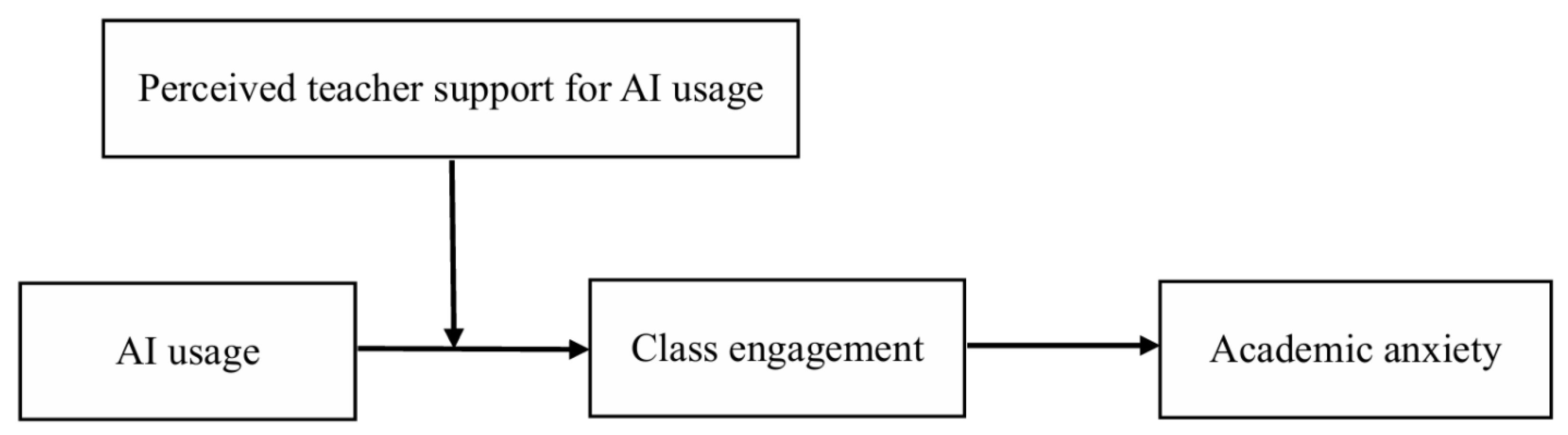
Figure 2.
The moderation effect of Class engagement on the relationship between Perceived teacher support for AI usage and Academic anxiety.
Figure 2.
The moderation effect of Class engagement on the relationship between Perceived teacher support for AI usage and Academic anxiety.
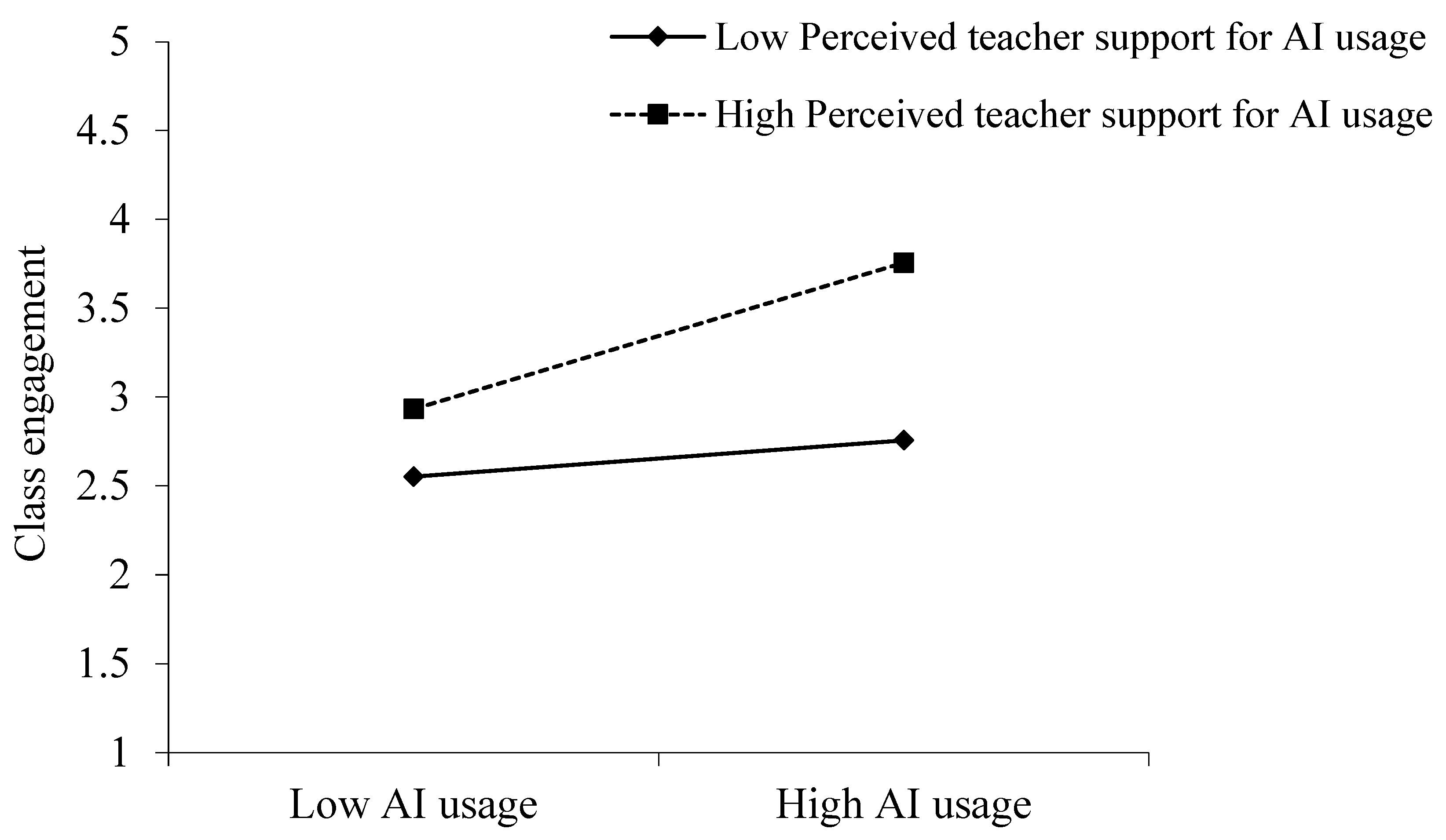

Table 1.
Descriptive statistics of demographic variables.
| Variable | Categories | Code | Frequency | Percentage |
|---|---|---|---|---|
| Sex | Male | 1 | 279 | 54.6 |
| Female | 2 | 232 | 45.4 | |
| Grade | Freshman | 1 | 83 | 16.2 |
| Sophomore | 2 | 266 | 52.1 | |
| Junior | 4 | 162 | 31.7 | |
| Subject | Natural Sciences | 1 | 59 | 11.5 |
| Agricultural Sciences | 2 | 69 | 13.5 | |
| Pharmaceutical Sciences | 3 | 39 | 7.6 | |
| Engineering and Technology Sciences | 4 | 153 | 29.9 | |
| Humanities and Social Sciences | 5 | 191 | 37.4 |
Note. N=511.
Table 2.
Results of confirmatory factor analyses.
| Model | Factors | χ2 | df | χ2/df | CFI | TLI | RMSEA | SRMR |
|---|---|---|---|---|---|---|---|---|
| 4-factor model | AIU; PS; CE; AA | 811.452 | 399 | 2.034 | 0.959 | 0.956 | 0.450 | 0.033 |
| 3-factor model | AIU+PS; CE; AA | 1258.214 | 402 | 3.130 | 0.916 | 0.909 | 0.064 | 0.063 |
| 2-factor model | AIU+PS+CE; AA | 3236.913 | 404 | 8.012 | 0.723 | 0.702 | 0.117 | 0.124 |
| 1-factor model | AIU+PS+CE+AA | 4756.972 | 405 | 11.746 | 0.575 | 0.544 | 0.145 | 0.145 |
Note. AIU= AI usage; PS= Perceived teacher support for AI usage, CE= Class engagement; AA= Academic anxiety.
Table 3.
Means, standard deviations, and correlations of variables.
| Variables | 1 | 2 | 3 | 4 | 5 | 6 | 7 | 8 |
|---|---|---|---|---|---|---|---|---|
| 1. Gender | - | |||||||
| 2. Age | -0.038 | - | ||||||
| 3. Grade | 0.012 | 0.022 | - | |||||
| 4. Subject | -0.028 | 0.055 | 0.046 | - | ||||
| 5. AI usage | 0.028 | 0.061 | -0.021 | 0.122** | 0.770 | |||
| 6. Perceived teacher support for AI usage | 0.036 | -0.022 | 0.051 | 0.066 | 0.382** | 0.783 | ||
| 7. Class engagement | -0.066 | 0.074 | 0.077 | 0.082 | 0.366** | 0.432** | 0.778 | |
| 8. Academic anxiety | -0.008 | -0.007 | 0.019 | -0.105* | -0.382**- | -0.435** | -0.412** | 0.957 |
| Mean | 1.454 | 20.370 | 2.155 | 3.681 | 3.290 | 3.345 | 3.414 | 2.698 |
| SD | 0.498 | 1.838 | 0.676 | 1.390 | 0.980 | 0.947 | 0.928 | 0.942 |
| Cronbach’s α | - | - | - | - | 0.812 | 0.950 | 0.927 | 0.915 |
| AVE | - | - | - | - | 0.593 | 0.613 | 0.606 | 0.608 |
| CR | - | - | - | - | 0.814 | 0.927 | 0.959 | 0.916 |
Note. N=511; Bolding indicates the square root of AVE;**p < .01.
Table 4.
Summary of path-analytic results.
| Variables | Class engagement | Academic anxiety | ||
|---|---|---|---|---|
| B | SE | B | SE | |
| AI usage | 0.257*** | 0.053 | -0.281*** | 0.054 |
| Perceived teacher support for AI usage | 0.345*** | 0.047 | ||
| Perceived teacher support for AI usage×Class engagement | 0.155** | 0.049 | ||
| Class engagement | -0.335*** | 0.048 | ||
| Gender | -0.133* | 0.061 | -0.041 | 0.062 |
| Age | 0.029 | 0.017 | 0.015 | 0.017 |
| Education | 0.078 | 0.046 | 0.049 | 0.046 |
| Subject | 0.020 | 0.022 | -0.030 | 0.022 |
Note. B= Path coefficients; SE=Standardized errors; Path coefficients are standardized; model fit statistics: χ2/df = 2.224; CFI = 0.929; TLI = 0.924; RMSEA = 0.049; SRMR = 0.041; *p < .01; **p < .05; ***p < .001.
Table 5.
Bootstrapping results for testing mediation effect and moderated mediation effect.
| Items | B | SE | 95% Boot CI |
|---|---|---|---|
| Indirect effect | -0.086** | 0.020 | [-0.129, -0.050] |
| Direct effect | -0.281** | 0.053 | [-0.382, -0.172] |
| High (+CE) | 0.468** | 0.057 | [0.362, 0.585] |
| Low (-CE) | 0.222** | 0.063 | [0.100, 0.347] |
| Difference | 0.245** | 0.079 | [0.095, 0.400] |
Note. B= Path coefficients; SE=Standardized errors; CI that excludes zero indicates that the indirect effects are significant; Path coefficients are standardized; Number of bootstrap sCEples are 2000; Level of confidence is 95%; **p < .05.
Table 6.
Results of the necessary conditions analysis.
| Conditional variables | Consistency | Coverage |
|---|---|---|
| AI usage | 0.718 | 0.712 |
| ~AI usage | 0.739 | 0.546 |
| Perceived teacher support for AI usage | 0.719 | 0.738 |
| ~Perceived teacher support for AI usage | 0.746 | 0.538 |
| Class engagement | 0.687 | 0.744 |
| ~Class engagement | 0.754 | 0.525 |
Note. N=511; Dependent variable is low academic anxiety.
Table 7.
Configuration analysis results.
| Conditional variables | Low academic anxiety | ||
|---|---|---|---|
| Path | P1 | P2 | P3 |
| AI usage | ☑ | ☑ | |
| Perceived teacher support for AI usage | ☑ | ☑ | |
| Class engagement | ☑ | ☑ | |
| Raw coverage | 0.583 | 0.554 | 0.562 |
| Unique coverage | 0.093 | 0.065 | 0.073 |
| Consistency | 0.824 | 0.825 | 0.838 |
| Solution coverage | 0.821 | ||
| Solution consistency | 0.865 | ||
Disclaimer/Publisher’s Note: The statements, opinions and data contained in all publications are solely those of the individual author(s) and contributor(s) and not of MDPI and/or the editor(s). MDPI and/or the editor(s) disclaim responsibility for any injury to people or property resulting from any ideas, methods, instructions or products referred to in the content. |
© 2025 by the authors. Licensee MDPI, Basel, Switzerland. This article is an open access article distributed under the terms and conditions of the Creative Commons Attribution (CC BY) license (http://creativecommons.org/licenses/by/4.0/).
Copyright: This open access article is published under a Creative Commons CC BY 4.0 license, which permit the free download, distribution, and reuse, provided that the author and preprint are cited in any reuse.


