

Submitted:
30 July 2025
Posted:
31 July 2025
You are already at the latest version
Abstract
Municipal Solid Waste (MSW) management in Nigeria is a sorely underperforming sector in Nigeria. This underperformance has long been attributed to the neglect from its Federal and State Governments. However, critical assessment shows the need to adopt a systems approach and integrate data science technologies in identifying challenges and proposing solutions to Nigeria’s waste management sector. The study adopts a narrative review design, following the lacking research and waste quantitative data in assessing MSW management in Nigeria. It examines systems theory engineering models and assessment tools in the context of waste management, and adopts a case-study examination of Lagos State waste management processes and stakeholders. The study’s findings show that Nigeria is still significantly dependent on open dumping systems and incineration systems. Its waste recycling sector is inefficient and incapable of mitigating current waste pressures. This is evident in Lagos, as the state’s plastic recycling ranges between 3-6% of all plastic waste generated. The informal waste collectors (IWC) hold significant influence and these entities have continuously resisted formalisation from the Federal and State governments. Examining the 2020 waste management policy reveals some ambiguity in the responsibilities of the various stakeholders in the policy and institutional framework. The study proposes key strategies towards mitigating the lack of waste management enforcement mechanisms, absence of waste-to-wealth strategies, poor funding, and limited public awareness on recycling. This study’s value is in its systems approach to combatting Nigeria’s MSW pressure. This approach is underscored by the inclusion and astute application of data science technologies and stakeholder engagement across both public and private sectors. The study seeks to provide a foundation for more empirical research following the data gap and lack of academic research on Nigeria’s MSW management, in the hopes that it will catalyse sustainable MSW management solutions.
Keywords:
municipal solid waste (MSW)
; data science
; systems approach
; SDGs
; recycling
; Nigeria
1. Introduction
Waste is simply anything that needs to disposed of following its lost utility. According to [1], this lost utility could be as a result of being worn out, broken, contaminated and spoilt. A critical investigation into the term ‘waste’ unravels a plethora of classifications by form such as liquids, solids and gaseous wastes. There is the waste classification by sources such as garbage or refuse from homes and other environments that have some form of activities. The State of Vermont Agency of Natural Resources Department of Environmental Conservation defines solid waste as tangible and non-free flowing unwanted materials or substance resulting from human activities [2]. It is popularly termed ‘Municipal Solid Waste’ (MSW), because its sources have largely been identified to be residential, commercial, agricultural and industrial operations [3]. The identification of these sources lends credence to the thought that population growth and economic development remain the most significant contributors and challenges to waste generation and management, respectively.
This study adopts the wider term of Data Science as opposed to the trending and specialised terms of Artificial Intelligence (AI) and Machine Learning (ML). This is because data science encompasses the essential principles, methods and infrastructure that is critical in enabling AI and ML technologies function optimally. Fundamentally, ML and AI are specialised components and offshoots of data science technologies. Generally, Data science can be termed the core and fundamental broader scope of what encompasses the optimal utilisation of both technologies. The emergence of data science technologies in waste management follows the need to advance sustainability objectives as clearly stated in the sustainable development goals (SDGs), adopted for the 2030 Agenda for Sustainable Development [4]. This is shown in Figure 1, depicting data-driven waste management practices and technologies, and its direct alignment with critical SDGs
- SDG11 (Sustainable Cities and Communities): Improper waste management has been evidenced to have direct implications, on environmental and public health [5], [6,7,8,9]. Both health dimensions cater to the optimal sustenance of humans and their immediate environs. By providing smart waste collection and processing, route optimisation, and illegal dumping detection, the aim is to ensure a cleaner, healthier and more liveable environment.
- SDG12 (Responsible Consumption and Production): Waste is a result of production and consumption of good and services, and these vary by individual need, product type, supply chain, and other demographics. The need to reduce waste generation demands a streamlined approach that robustly attacks waste generation at the source, promotes recycling and optimises resource management using applicable circular economy modelling and real-time monitoring [10,11,12].
- SDG13 (Climate Action): Research has established solid waste generation as a significant driver of climate change through greenhouse gas (GHG) emissions and environmental degradation. For instance, methane (CH4) emission from open dumpsites and landfills significantly traps heat in the atmosphere, creates an offensive odour and accelerates global warming [13]. In developing economies like Nigeria, the popularly employed open-air waste incineration approach releases significant amounts of carbon dioxide (CO2) and particulate matter (PM). Incinerating plastic waste releases fossil-fuel-based CO2, which contributes to increasing carbon levels [14,15,16]. Additionally, [17] identifies deforestation as a source of high waste generation due to increased demand for raw materials from tree cutting, excessive mining and water resource depletion. These activities require excessive energy use in both production and disposal. Adopting data science approaches and technologies will help facilitate CH4 emission tracking through AI and satellite data, optimising waste-to-energy conversion in order to reduce carbon foot print, and providing accurate climate impact predictions.
- SDG3 (Good Health and Well-being): Waste management has been shown to correlate directly with immediate communities’ quality of life. [18] proposes the use of data analytics in predicting epidemic outbreaks as a result of poor waste management, and IoT sensors are capable of tracking air pollution following waste decomposition and incineration. Utilising data science in this regard holds two functions, minimising health hazards from improper waste disposal and improving overall public health through consistent monitoring.
- SDG6 (Clean Water and Sanitation): It may be argued that water treatment is not wholly categorised under solid waste management. Nevertheless, the removal of solid waste as pollutants in water sources makes it a critical aspect of MSW management. Moreso, as both surface and groundwater sources are critical to drinking, sanitation and aquatic life, it has become critically necessary to optimise waste treatment processes
Examining data science application through the lens of the SDGs paints a larger magnitude in which data science can capably function in streamlining waste management approaches for Nigerian waste management. This underscores the interwoven possibilities and impact between optimised waste management, sustainable urban development, reduced environmental impact, improved health and efficient resource management. On a national level, employing data science to waste management is a fastidious effort to address challenges concerning waste reduction, climate resilience and public health. From a developing economy perspective like Nigeria’s that struggles with efficient and sustainable delivery in its MSW management, applying optimally matched strategies necessitates this narrative review of applicable technologies and strategies to MSW management.
Moreover, few studies have presented an accurate view of the current waste landscape in Nigeria following the poor waste data collection infrastructure. Even the many studies that examine waste management and data science in developed countries or on a global scale rarely adopt a systems approach, inclusive of stakeholders. Hence, the adoption of a narrative review in the Nigerian context as only government reports and policy documents provide accurate and relevant information on the current state of waste management in some of the nation’s key cities. Government reports and feasibility studies are excluded from systematic reviews due to stipulated methodological filters. Whereas, a narrative review permits a consideration of local knowledge systems, technical practices and context specific barriers that are pivotal to developing a suitable Nigerian framework for successfully adopting data science technologies for efficient and sustainable MSW management practices. This review aims to examine Nigeria’s current municipal solid waste (MSW) management approaches and evaluate the use of possible data science techniques and technologies via a systems approach that advances the nation’s waste management sector towards environmental sustainability.
The specific objectives include:
- To analyse the application of system theory models and assessment tools in MSW management.
- To examine the current waste management landscape in Nigeria, including collection methods, disposal practices and recycling rates.
- To develop a framework for stakeholder engagement and policy integration that supports sustainable implementation of data-driven waste management approaches in the Nigerian context.
2. Systems Theory in Waste Management
The last two decades have highlighted the importance of adopting a systems approach in actualizing sustainable MSW management, especially with the growing complex phases required in maintaining environmental quality in a sustainability fashion. Moreover, increased pressure for the adoption of the circular economy highlights the desire to employ more socially acceptable options that preserve biodiversity and natural ecosystems. To this effect [19], classified five system engineering models and eight analytical tools for system assessment that form the critical technology hub for solid waste management. The five system engineering models form the inner core of the hub and these include CBA-Cost Benefit Analysis; FM-Forecasting Models; SM-Simulation Models; OM-Optimization Models; IMS- Integrated Modelling Systems. Whereas, the eight system assessment tools form the outer layer and these include: SD-Scenario Development; MFA-Material Flow Analysis; LCA- Life-Cycle Assessment; RA- Risk Assessment; EIA- Environmental Impact Assessment; SEA- Strategic Environmental Assessment; SoEA-Socio-Economic Assessment; SA-Sustainable Assessment [19].
Table 1 and Table 2 highlight the numerous possible functions of system models and systems assessment tools in policy analysis and decision making in the context of assessing quantitative data relevant to MSW management. Nevertheless, their individual application has largely been critiqued as limited in scope due to the nature of the applied models and assessment tool. According to [19], almost none of the models developed before the year 2000 considered the complete waste management cycle from waste prevention through to final disposal, with the exception of LCA. Similarly, the models failed to initially consider the involvement of relevant stakeholders such as government agencies, local communities, formal and informal waste sector service providers.
However, advancements in computing power and data science technologies have facilitated the combination of numerous models and assessment tools simultaneously. The results produced are more robust, providing information on extensive subjects within waste management decision-making. These underscore the need for systems theory application as it is the only feasible utilisation of a holistic perspective in achieving ideal solution procedures for MSW management systems. Especially as balancing simplification of modelling efforts while attempting to sufficiently capture the essential features that represent real-world complications, remains a challenge regardless of the advancements in AI and Machine Learning.
Moreover, the ‘Applications to MSW Management’ column in Table 2 emphasises multiple combinations of different system assessment tools in order to attain more complex results. Currently, this can be achieved with some software tools: Waste Analysis Software Tool for Environmental Decisions (WASTED), Waste-Integrated Systems for Assessment of Recovery and Disposal (WISARD), Waste and Resources Assessment Tool for the Environment (WRATE), Environmental Assessment of Solid Waste Systems and Technologies (EASEWASTE), FLUX, and Software for Substance Flow Analysis (STAN). In making holistic and data-informed waste management decisions several of these software may also be employed in critical assessment of relevant variables. Hence, the objective of this paper in examining the application of data science technologies through a systems lens to waste management strategies. To this effect [71] presented a multi-methodological case study that highlights the core principles of systems theory in MSW management; as shown in Table 3.
[71] examination of the basic tenets of the systems theory identifies and emphasises the dynamic yet systemic nature of waste management, as it robustly weaves together multiple methodologies originally cited by [19] with active stakeholder participation using applicable data-informed approaches at every stage. Employing multi-method integration in order to capture dynamic and systems associated complexities, underscores the utilisation of Soft Systems Methodology (SSM) for framing and definition of complex problems. Additionally, system dynamics for quantification of insights through collected data and Optimisation Models (OM) enables finalisation on the more actionable path within existing constraints.
However, critical examination suggests that [71] focus on stakeholders is narrow, as the informal sectors, NGOs and citizens are not directly engaged. Moreover, it is a case-study type and highlights possible challenges in transferability to other socio-economic context such as Nigeria where the behaviour among varying stakeholder under a different waste-management governance structure is yet to be identified or examined. This demonstrates the necessity of contextual examinations irrespective of significant applicable and transferable strategies. Hence, this study’s intent to examine the current state of waste management in Nigeria and propose data science technologies utilisation within a systems framework applicable in the necessary context.
3. Waste Management in Nigeria
3.1. Current Landscape
The Nigerian waste management sector suffers from continuous neglect, due to both the State and Local governments not prioritising their respective jurisdictions’ environmental security and sustainable development. [90] believes this to be environmental genocide when considering the huge amounts of waste materials that are consistently generated within most commercial and population dense cities across the nation. [91] cites the following as characteristic of Nigeria’s waste management “wobbly, shambles, awkward due to the financial burden involved, weak technical capacity and poor waste management technology”. [92] in conducting a temporal assessment of the past and current approaches to MSW management in Nigeria, identified the nation’s population growth and population concentration within few cities as a significant contributor to waste generation. This perspective holds much validity in the Nigerian context given that there is no robust infrastructure that sustainably caters to the different phases of waste management, neither are there any deliberate measures allocated towards effectively reducing MSW generation in Nigeria.
Several studies criticise the non-existence of government nationally documented datasets that actively reflects the state of waste in Nigeria [92,93,94,95]. This in turn has affected this research, making it reliant on a significant number of case studies that research waste management in cities, states and some niches in the Nigerian context. The most significant peer-reviewed literature on a national scale incorporating waste data being a bit dated, namely, [96] evaluating similar studies that evaluated the contribution of different sectors to MSW generation, composition of solid waste in various cities, average composition of market waste (Ibadan), and monthly variation of solid waste generation (Ogbomosho). The lack thereof of research incorporating data to conduct original research regarding MSW management in Nigeria, further emphasises the need for data science technology integration within the existing waste management practices.
The negligence of the State and Local governments agencies (which comprise the formal waste management system- FWMS) in delivering favourable outcomes with concern to MSW management, has created the informal waste management system (IWMS). [97] defines the IWMS as the ‘unregulated and unregistered activities of people involved in waste collection, disposal and recycling’. The IWMS encompasses informal waste workers such as street waste collectors, landfill scavengers, residential waste gatherers, and mobile recyclable materials purchasers [98,99]. The significance of IWMS within the waste management domain is attributable to their function as the principal advocates of Nigeria's recycling infrastructure and operational paradigm. While they are largely termed ‘informal waste collectors (IWCs), they have wide reaching operations across Nigeria’s major cities involving large scale manual sorting of mixed waste for recycling at disposal sites, unmanaged landfills, public waste receptacles, and waste from sanitation workers' collection vehicles [99]. However, within the Nigerian landscape both the formal and informal supposedly operate a mutually beneficial relationship. This is because there has been government action in some states attempting to formalise or phase out these IWCs. This government action follows a large criticism of their negligent and unhygienic approaches towards waste separation and their haphazard street dumping of unrecyclable waste. This presents occupational risks to the informal recyclers, endangering nearby communities and flawing the possibility of robust sourcing and recycling of recovered materials.
3.2. Nigeria’s MSW Management Approaches and Practices
Nigeria’s increasing waste generation can be attributed to increasing shifts in population concentration following rapid rural-to-urban migration, urbanisation, and industrialisation. The State and Local government inefficiency, and the Federal government’s neglect are synthesising factors that has made open dumpsites the most employed waste management method in the country. The management approaches are as follows:
3.2.1. Open Dumping Systems
According to [90], open dumpsites accounts for 65% of waste generated in Nigeria and contains the highest amounts of biodegradable waste materials. It is further categorised into three: open ground dumping, dumping in gutters, and dumping in water bodies
- Open Ground Dumping: As Nigeria lacks a robust waste sorting programme, open ground dumping is quite popular because it allows the dumpsite accept all forms of heterogenous waste. However, there are no existing controls in these dumpsites such as subsurface drainage systems for the collection of leachate-waste water. Moreover, there is almost always leachate plumes during rainy seasons that if left alone flow into nearby surface water [100]. Thereby causing both land and ground water pollution.
- Dumping in Gutters: These are mostly perpetrated by market sellers, motorists, and pedestrians who feel no loyalty to the environment, as they are either passing through or staying for a short time. The operating mindset is that it is not near their home environment. Even when local government area (LGA) authorities unclog the gutters around the markets and clear blockages, it is fast filled up again with refuse and other solid waste. While one may always want to blame the government, this speaks to the poor environmental behaviour of many Nigerian citizens.
- Dumping in Water: [101,102] examine water dumping in the context of developing economies as driven by weak waste regulations, unchecked industrialisation and poor waste management infrastructure. According to [103], it poses significant environmental, social, and economic consequences given that the disposal of agricultural, industrial and domestic waste into near water bodies are neither checked nor curbed. While the environmental and public health impacts are often emphasised, the economic implications are much wider and hardly highlighted. This includes reduced tourism and economic growth especially for areas with surrounding waterbodies, rising healthcare costs and possible epidemic due to pollution related diseases, loss of fishing and dependent livelihoods.
3.2.2. Incineration Systems
In Nigeria, incineration is the second most utilised method for eliminating waste products and reducing waste quantity pressure on landfills. It is combusting waste materials into residuals such as carbon dioxide, ash, liquids and residues. However, the approach often used in Nigeria is environmentally hazardous because the incineration facilities are ill-equipped to effectively discharge the collected waste. [104] review on modern advancements in waste incineration systems identify the following technologies, namely, moving grate systems, fluidised bed combustion (FBC), selective catalytic reduction (SCR) and selective non-catalytic reduction (SNCR), co-generation by using combined hart and power (CHP), fabric filters and baghouse systems, and activated carbon injection. These new technologies are intended to vary the operations of their respective incinerators depending on the nature of waste materials to be incinerated. The absence of such technologies in Nigeria incinerators and the larger utilisation of open waste burning has compromised the nation’s environmental standards following the hazardous emission consistently released into the atmosphere. The amount of waste and the significant amount of emissions released further highlights Nigeria’s waste-to-energy potential if necessary analysis and infrastructure development steps are taken. [105] in examining Nigeria’s potential in waste-to-energy conversion posits that thermal conversion of exclusive organic waste substances holds the potential to yield between 14.52 and 23.08 terawatt-hours of electrical energy per annum. This generation capacity corresponds to a mean hourly electrical output of 1658–2635 megawatts. The incorporation of cellulosic and textile materials into the thermal conversion process further enhances the potential energy yield to between 18.69 and 29.71 terawatt-hours annually. Thereby elevating the mean hourly electrical generation capacity to a range of 2134 to 3391 megawatts [105]. This strongly establishes the importance of adopting modern incinerators in a bid to achieve some aspects of waste-to-energy processes, especially as Nigeria suffers from epileptic power supply.
3.2.3. Composting and Vermicomposting Systems
Waste composting is a natural phenomenon that decomposes organic waste into fertilizers for enriching the soil. These approaches can be used in enriching soil fertility, reducing landfill waste and supporting sustainable agriculture [106]. While composting follows the biological clock of decomposing and is often slow, vermicomposting speeds up the biological clock of decomposition by using earthworms [107]. In more developed countries, vermicomposting is adopted for agriculture waste due to the improved nutrient concentration of nitrogen, phosphorus and potassium (NPK) that it offers as compared to traditional composting [108]. Nevertheless, [109] reveals that large scale commercial Nigerian farmers avoid both the traditional composting and vermicomposting citing the following constraints; production of volatile organic compound emission, microbial pathogen identification, suboptimal nutritional composition, and extended temporal requirements for organic matter transformation during the composting process. They are more attuned to using synthetic fertilizer, and leaving significant amounts of organic and agricultural waste lying under-utilised.
3.2.4. Controlled/Sanitary Landfills
These are buried facilities that are engineered to collect land field leachate and prevents the waste leachate from contaminating the ground soil. The initial design of sanitary landfills was limited by the absence of leachate plume remediation infrastructure, coupled with inadequate containment of atmospheric contaminants emanating from accumulated waste deposits within the landfill environment [110,111,112]. However, innovative technology has modernized landfills by equipping it with leachate plumes treatment mechanism. Regarding air pollution, there have been advancements in landfill gas (LFG) collection systems, liners and cover systems, biofilters and gas treatment [113,114]. Concerning heat generation, integrating sprinkler systems and moisture control in leachate recirculation and cooling, aeration pipes for providing oxygen to regulate microbial activity, and temperature sensors and firebreaks to detect overheating zones and reduce the possibility of spontaneous combustion, respectively [115]. Integrating data science technologies with these advancements would be beneficial in advancing Nigeria’s waste management practices
3.2.5. Recycling System
This method simply identifies new ways to adopt discarded materials and reutilize them as material input in the production of new goods. As earlier stated, recycling in Nigeria is predominantly conducted by informal waste collectors (IWCs) who largely operate in urban areas. However, following the illegal purview on their activities, recycling (recovered waste) accounts for 1% of total waste [90]. This is because the formal agencies responsible for providing the recycling infrastructure are negligent in doing so. According to [92], there are middlemen within the waste-picking business chain who conduct bulk purchases of these recyclables from waste pickers. These individuals possess significant influence because they have the resources to purchase and recycle materials in sizable quantities as needed by other industries. Hence, they use their market influence in dictating prices and transaction policies that prove deleterious to the socioeconomic interests of marginalized waste recovery practitioners operating in the informal waste sector [99].
Attempts to regulate this has birthed Public-Private Partnerships (PPP) that constitute a differentiated policy framework intended to facilitate collaborative engagement between private commercial entities and public government institutions to optimize resource allocation, human capital utilization, and conceptual innovation directed toward the amelioration of societal waste challenges [92]. A critical determinant in the efficacy of private sector participation is the capacity of governmental authorities to endorse, implement, and maintain contractual agreements. These documented instruments delineate requisite services and stipulate punitive measures and regulatory consequences applicable upon non-fulfilment of contractual obligations. [116] observed that the allocation of contractual arrangements and the subsequent supervision and enforcement of compliance fall within the jurisdictional purview of the Administrative Environmental Protection Bureau (AEPB), necessitating the establishment of a systematic protocol that ensures and promotes sustainable engagement from private sector participants. Regardless, the current state of MSW management in Nigeria demands a questioning of the AEPB’s effectiveness and the applicability of their protocols.
3.3. National Legal Policy and Frameworks
Currently, Nigeria employs the National Policy on Solid Waste Management 2020 in influencing the institutional framework of MSW management and processes at the Federal, State and Local Government levels. The policy document lists its use of 20 National regulations on solid waste and 14 acting bodies in formulating its current institutional arrangements for MSW management in Nigeria [117].
The institutional arrangements within the policy provides a comprehensive stakeholder identification and outlines their powers and responsibilities. Applying data science technologies across all government levels and spheres of waste management operations necessitates a comprehensive understanding of each parties’ influence and interests. The current framework and hierarchical representation of these institutional arrangements, and a pictorial summary of stakeholders’ roles and responsibilities are shown in Figure 2 and Figure 3, respectively.
3.4. Case Study Assessment
3.4.1. Lagos
According to [118], Lagos state is the smallest (land mass of 3,345 km2) yet is the most populous and most industrialised state in Nigeria, boasting of over 24 million residents as at 2021, and containing Africa’s largest coastal city; Lagos. Following its large population and economic nature, Lagos is responsible for over 15% of the nation’s GDP and is stated to be Africa’s largest state economy [119]. The rapid industrialisation, increased rural-to-urban and regional migration have caused a significant shift in Lagos’ population density and urbanisation levels. Consequently, these developments exert considerable strain on the extant waste management infrastructure, which [120] posits has failed to develop commensurately with demographic expansion. The confluence of all these variables and their cumulative impact precipitates the acute MSW management challenges within Lagos.
These difficulties are further compounded by the substantial volume of waste generation, spatial constraints and the proliferation of unplanned settlements beyond the formal boundaries of the Lagos metropolitan area. Several case-studies show that Lagos has been granted incomparable access to resources to help it facilitate robust engineering consultation, waste receptacle manufacturing and distribution, regulatory framework development, and technical expertise dissemination [121,122,123]. [124] identifies the state’s use of public-private partnership (PPP) arrangements, transfer loading station infrastructure, recycling collection facilities, community waste management centres, standardized waste container production, and various additional waste management protocols and infrastructure systems. Regardless, state reports cite the Lagos Waste Management Authority (LAWMA) as inefficient in its operations following the significant poorly disposed waste that pervades the Lagos environment [119]. Figure 4 presents an overview of MSW management within Lagos citing waste collection and recycling to be less than 33% and 12%, respectively (on a daily basis). This disparity highlights the established waste pressure, especially as 43% of most generated waste are organic, leaving approximately 57% to be non-organic (recyclables:29% and non-recyclables:18%). The poor recycling rates for generated waste further establishes Lagos State’s poor performance in waste management and necessitates immediate action in combatting this waste pressure.
3.4.2. Current State of MSW Management in Lagos
Following, Lagos’ significant industrial, commercial and population dense nature, its plethora of activities and sources of waste generated, collected and generated across the city, are highly varied. The applicable systems and infrastructures employed in the state’s intended proper management of its various waste are presented in Figure 5. Recent reports, highlights the state as generating 13,000 metric tons (MT) of solid waste each day; calculating for a daily rate per person with a population of 24 million, the result is 0.54kg per person per day [119]. In 2021, 4.75 million MT of solid waste was generated, data estimates put the amount collected and disposed through appropriate channels to be in the range of 33-54% [119]. While the range is questionable, the proposed lower limit highlights the enormity of waste that is uncollected and mismanaged. This underscores little success of the state government and its agency in waste sourcing and type segregation. According to [125], all property occupants are statutorily obligated to procure and maintain adequate waste containment receptacles, for which LAWMA has provided standardized specifications pertaining to residential and commercial use. Regardless, there are challenges in effective regulatory enforcement and stakeholder adherence to these LAWMA stipulated requirements. Despite mentions of waste source segregation as shown in Figure 5, there is growing evidence on the majority of waste collection vehicles in Lagos lacking the requisite compartmentalized design needed to preserve waste stream separation during transportation [119].
3.4.3. Collection and Disposal
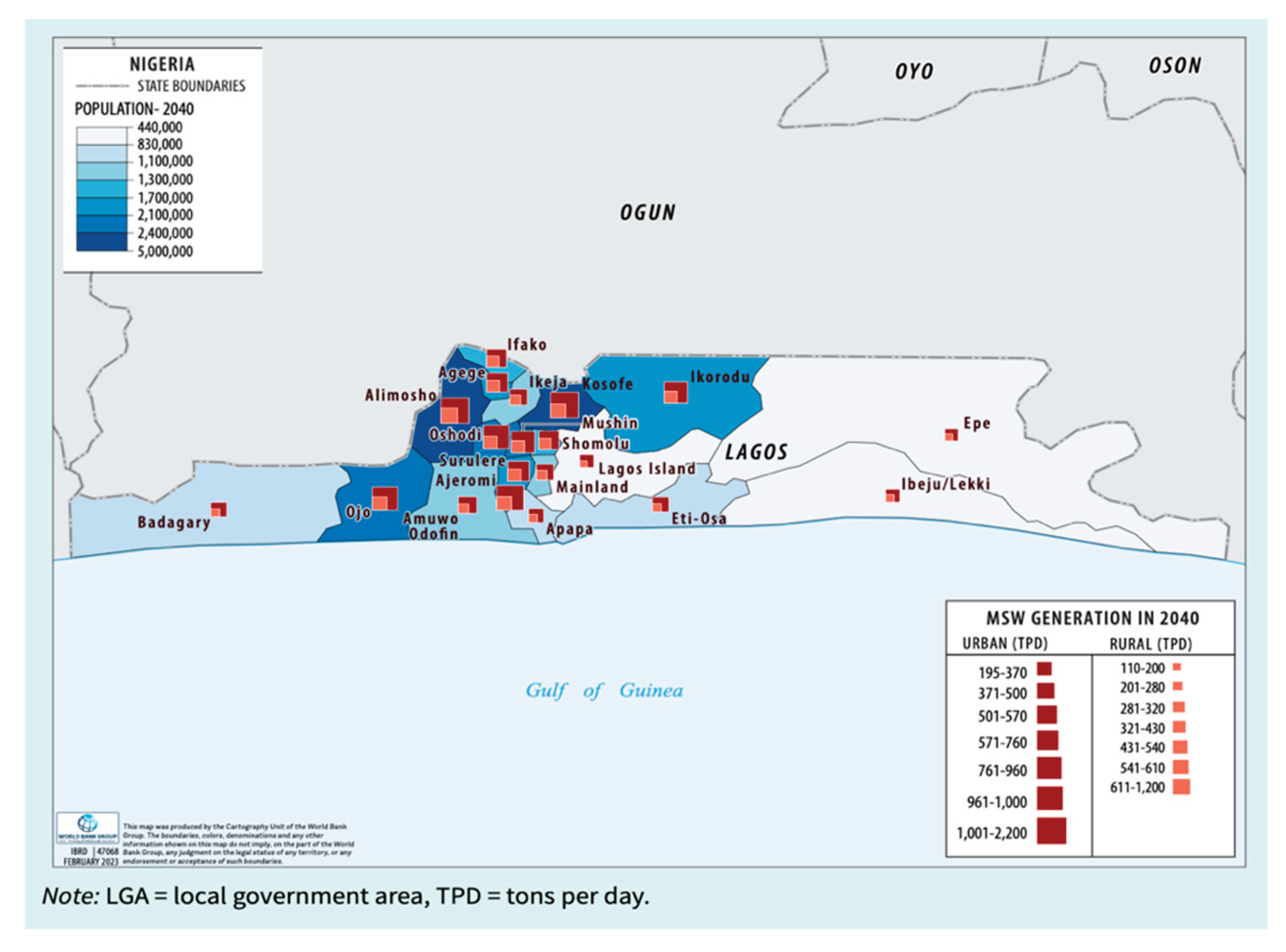
LAWMA operates in conjunction with 487 authorised private waste management entities to execute solid waste management initiatives within the state. This collaboration facilitated an increase in waste collection volumes from 0.79 million metric tonnes in 2018 to 1.56 million metric tonnes in 2020 [119]. In 2020, the metropolitan area was serviced by a fleet of 920 compactor vehicles, collectively completing over 800 collection circuits daily that are distributed between LAWMA and the private sector partnerships (PSP). In 2021, there was effort to improve service provision and collection frequency by the acquisition of 202 additional vehicles, 102 of which were compactor units [119]. Notwithstanding these investments, the current collection infrastructure remains insufficient to address the comprehensive waste management requirements, resulting in a financial deficit that necessitates increased private sector participation. One may normally recommend a significantly higher number of vehicles as a solution to the waste management collection challenge given the waste generated. However, the paucity of empirical data regarding waste fleet operational efficiency impedes precise calculations of the required vehicle indices. The flaw in this domain highlights the necessity of data science technologies as further comprehensive investigation is needed to establish accurate quantitative parameters. This is especially critical as furfure projections for 2030 and 2040, estimate Lagos MSW generation growth by 32% and 82%, respectively. This implies 17,300 tons per day (TPD) and 23,700 TPD by 2030 and 2040 [119]. Figure 7a and 7b show the spatial distribution of MSW generated across all the LGAs within Lagos state, with the results showing that the central district areas are anticipated to produce elevated volumes of waste material, attributable to the projected high population density concentrations in this geographical area.
Figure 6.
2021 MSW flow in Lagos State Source: [119].
Figure 6.
2021 MSW flow in Lagos State Source: [119].
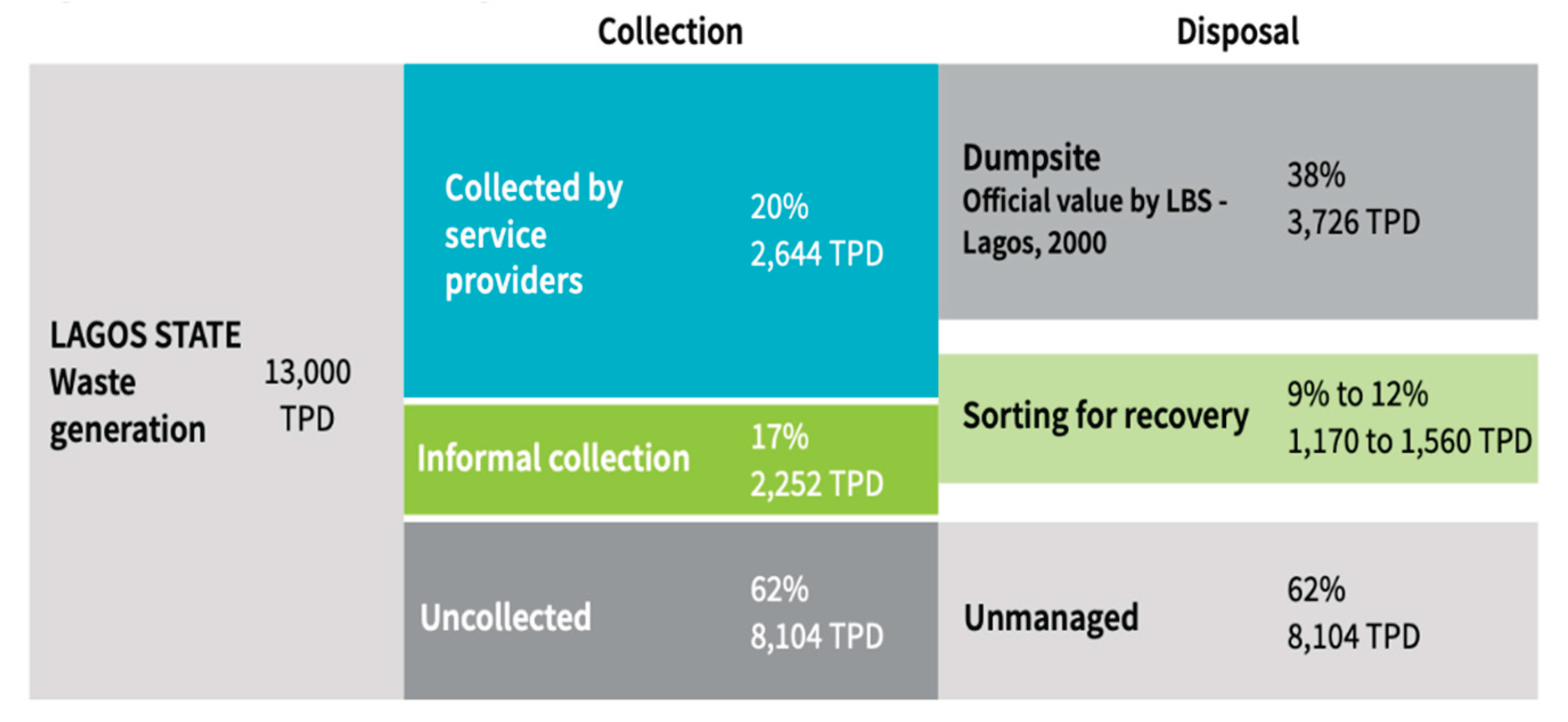
Figure 7.
a: Projected daily MSW generation across all 20 LGAs in Lagos State by the year 2030 Source: [119].
Figure 7.
a: Projected daily MSW generation across all 20 LGAs in Lagos State by the year 2030 Source: [119].
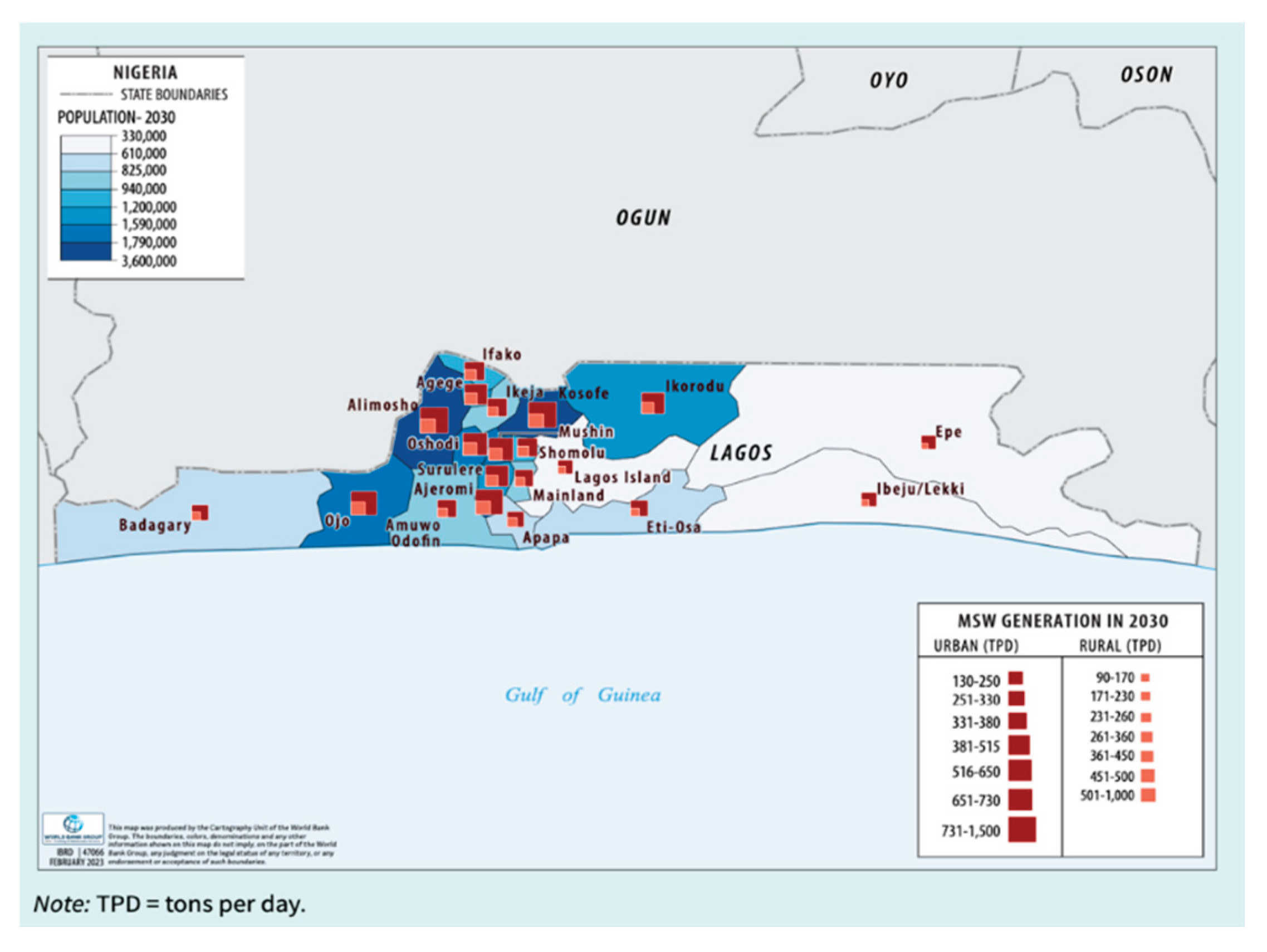
Figure 7.
b: Projected daily MSW generation across all 20 LGAs in Lagos State for the year 2040 Source: [119].
Figure 7.
b: Projected daily MSW generation across all 20 LGAs in Lagos State for the year 2040 Source: [119].
3.4.4. Recycling and Resource Recovery
Concerning recycling and resource recovery from waste, the Lagos State Government employs strategic partnerships with several private sector participants through either joint venture arrangements, or the issuance of operational permits for collection and materials processing facilities within the state [125]. While the formal sector of recycling and its registered recycling enterprises have undergone a significant increase between 2020 and 2022, still the informal sector participants substantially outnumber formally registered processing and recycling entities, with 2022 estimates placing registered entities at 3,700 [126]. According to [127], the resource recovery initiatives within Lagos reveal systematic sustainability challenges, wherein numerous programs have been operationally discontinued. Such a pragmatic failure can be attributed to the following causative factors including inadequate financial sustainability mechanisms, operational inefficiencies, insufficient legislative enforcement, and deficient strategic methodologies. [92] observed that due to the more significant participation of informal recycle participants, the pricing mechanisms within the MSW sector remains unregulated. This disproportionately affects formal waste collectors and sorting personnel who receive significantly below-market compensation for recoverable materials. This inequitable pricing structure diminishes incentivization for these critical participants within the waste management value chain.
An illustration of the plastic value chain in Nigeria, as shown in Figure 8 provides an example of the stakeholders actively participating in the recycling industry. However, stakeholder effectiveness is specifically thwarted by two major bottlenecks:
- Informal Sector Inefficiency: LAWMA’s view of informal scavengers is that of a nuisance as the recent policies by the State Government aims to phase out unregistered pickers. However, the transition has met resistance as these pickers are unwilling to lose their income and are reluctant in qualifying themselves to meet the State Government’s criteria to be registered [97,98]. The need for formalizing the informal sector is due to the sorting and segregation hurdles following the sector’s unsorted collection, which disrupts stability of the supply chain. Informal sector operations impede traceability and data monitoring, as they do not facilitate any accurate and consistent assessment of the amounts of data collected by scavengers and sent for recycle/recovery. Moreover, most informal operators limit their recovery operations to simple plastics such as bottles and bags, leaving more complex plastics unrecycled. Hence without formal integration, the informal sector remains an outlier limiting the states and nation’s recycling value chain efficiency.
- Limited infrastructure: Nigeria possesses very few global standard industrial recycling plants making its formal recycling infrastructure rudimentary at best. [128] report cites only Alkem Nigeria as operationally capable of treating used plastic and converting it to raw materials. The processing constraint of many acclaimed recyclers suggests an overdependence on simple re-granulators, with no ability to produce secondary raw materials. The operators simply repack scraps for sale and this limits value addition in the value chain cycle as there are few operators capable melt-index filtrating and compounding operations [99,129]. Simultaneously, waste recycling operations are further stifled by the poor intermittent electric supply which makes recycling processes significantly more expensive.
These two constitute the core challenges influencing the data gap and significant amounts of unaccounted waste. This has led to several studies admitting that official figures are grossly understated and the result is a variation in the recorded amount of waste annually generated. This is especially evident in the estimates of plastic waste leaving a significant amount undocumented and untracked. This data deficit on waste flows hampers decision making and impedes policy planning and financial investment plans. For instance, from a cost-benefit perspective, quantification of waste supply is necessary in refining recycling capacity at both national and state levels. Similarly, the respective enforcement agencies are unable to accurately quantify regulation compliance levels. For instance, the inability track circulation of single-use plastics or assessing adherence of recycling targets to stipulated guidelines. While the environmental and public health impacts are immediately glaring, the economic implications are a more nascent threat. This is because a robust recycling sector independent of expensive imports presents the opportunity of an underutilized enterprise, especially as recycled plastic resin and basic metal can be re-utilized as primary materials in new production processes.
4. Proposing Data Science Utilisation in Nigeria’s Waste Management
4.1. Policy Reformation and Governance
A robust adoption of the systems theory approach (models and assessment tools) and data science technologies requires some improvement to existing policies and operational frameworks on MSW management. A critical assessment of the current National Policy on Solid Waste Management 2020 guidelines, reveals loopholes that compromise the future effectiveness of the intended data utilization technologies at the national, state and local government level by all the necessary parties. Identifying these challenges demands a comparison of approaches to MSW strategies and policies typically employed within developed nations, and contextually suited interventions and strategies to mitigate the impacts of the identified challenges.

Table 4.
Nigeria’s waste management policy challenges, interventions and proposed strategies.
| POLICY CHALLENGE | INTERVENTION | STRATEGY |
|---|---|---|
| Lack of stringent enforcement mechanisms | Enable independent environmental regulatory bodies with robust digital monitoring tools. |
|
| Fragmented Institutional Responsibilities | Adopt centralized segregation agency models as observed in Japan and Nordic nations like Denmark [130], Norway and Sweden [131,132]. |
|
| Poor Funding | Advancing waste management systems through inclusion of user fees, environmental levies and robust PPP frameworks. |
|
| Underdeveloped Technical and Data management Infrastructure | Real-time monitoring and data analytics. |
|
| Some Ambiguity in the Role of Stakeholders and PPP arrangements | Applying a structured stakeholder strategy |
|
| Underutilized Waste-to-Wealth and Recycling Strategies | Adopting parts of the circular economy model. |
|
| Poorly Defined Data Collection and Monitoring Frameworks | Adopt data-driven decision-making with public transparency. |
|
| Limited Focus on Awareness Campaigns | Behavioural Change Communication (BCC) and Social Marketing Techniques. |
|
| Insufficient Incentives for Research and Development (R&D) | Public-Private Research Partnerships (PPP) and Technology incubators. |
|
4.2. Stakeholder Prioritisation and Engagement
4.2.1. Staekholders Prioritisation
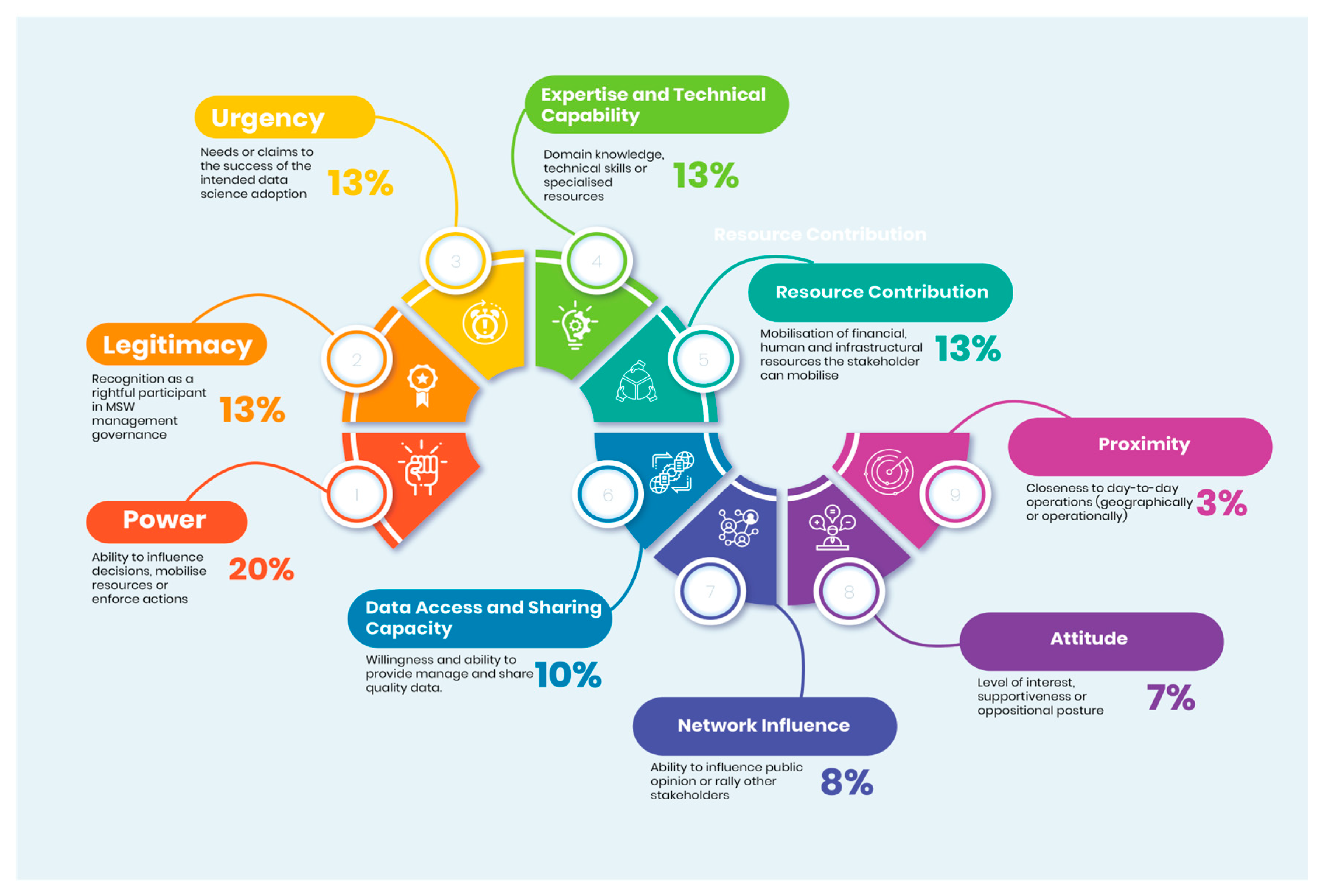
Given the complexity in roles and interest of the numerous stakeholders, the study will adopt a Multi-Criteria Decision Analysis (MCDA) using the Analytic Hierarchy Process (AH) scoring in prioritising the most crucial stakeholders. These weights follow a subjective yet grounded emphasis on holistic stakeholder engagement and data science application
- PRIORITISATION CRITERIA AND WEIGHTS
Figure 9.
Stakeholder Prioritisation Criteria and Weights.
-
Scoring Matrix: Adopting a scaling matrix of 0 to 5. Where:0= Non-existent; 1= Very Low; 2= Low; 3= Medium, 4= High, and 5= Very High
-
Formulae for calculating Composite Score:Composite Score= (0.20*Power) + (0.13*Legitimacy) + (0.13*Urgency) + (0.13*Expertise and Technical Capacity) + (0.13*Resource Contribution) + (0.10*Data Access and Sharing Capacity) + (0.08*Network Issue) + (0.07*Attitude) + (0.03*Proximity).
The results within Table 5 provides a robust and systemic prioritisation of the stakeholders with a ranking on their importance to the intended central body meant to regulate and monitor waste management practices at all government levels. The results reveal that adopting a systems approach for data science technologies necessitates a prioritisation of the State Waste Management Authority, the State Ministry on Environment, Private Waste Companies and Waste Technology Providers. These four stakeholders are the most critical given their combination of weighted indicators. These weights signify the necessity of their roles (earlier highlighted in Figure 3) in facilitating a sustainable and data-driven transformation of the current waste management practices in Nigeria
4.2.2. Stakeholder Engagement Framework
Policy intervention and strategies in section 4.1 highlight the significance of stakeholder engagement. Based on the proposed reformation and strategies, Figure 10 illustrates a 5-point engagement objective programme required for active participation and inclusion among stakeholders.
These objectives EO:1-5 acts as a guiding framework for navigating and achieving sustainable stakeholder engagement. They can be applied in a contextually fitting matter at any government level.
5. Recommendation for Future Studies
The paper seeks to highlight the data collection challenge and motivate the execution of research that employs empirical data in relevant sectors of Nigerian MSW management. The following studies would be crucial in the future
- Evaluating the long-term impacts of innovative technology pilots through longitudinal studies that measure how implemented technologies impact critical key performance metrics (KPIs) of Nigeria’s MSW management over the next 3 to 5 years. This will aid the identification of technology adoption barriers and maintenance challenges in the Nigerian context, also informing mitigating and scaling strategies.
- Investigating the behavior economics behind general public fee compliance. This study will identify and measure the social and psychological drivers of Nigerian household and commercial compliance to waste fee-payment. This study is highly contextual as urban, rural and peri-urban settings are bound to provide different results.
- Assessment of governance and regulatory effectiveness by examining how variations in enforcement capacity, inter-agency and inter-government level coordination influences MSW management outcomes
- Exploring the outcomes in equity and inclusion as a result of technology-driven waste management. This will require spatial analysis in assessing how IoT and data-centric systems have impacted waste management service delivery in marginalized and low-income areas.
6. Conclusion
In conclusion, Nigeria’s waste management requires critical changes by integrating data science technologies into its current waste management practices. However, improved efficiency in management extends beyond the simple application of technologies and techniques. It demands a systematic approach that enables a holistic perspective of needed resources, required processes and relevant stakeholders. This facilitates a more comprehensive evaluation of the costs and profits to each considered strategy in improving MSW management, before final decision-making. Operationalising the systems theory in MSW management provides numerous applications for identifying, creating, optimising, and assessing proposed critical waste management projects. The employment of these technologies in new software aids decision making, and improves feasibility and success rate of intended MSW management strategies. Advancements in technology and AI have expanded systems theory application to MSW management to include the simultaneous analyses of social constructs like public concern and acceptance. This signifies the increasing complexity in MSW management decisions and the need to rapidly respond to the mounting waste pressures in Nigeria.
Examining Nigeria’s current waste management landscape and using the commercial hub of Lagos as a case study provides growing evidence on the magnitude of the nation’s waste management problem. This follows increasing population and population density, government neglect, failing infrastructure, influence of the IWCs, and poor enforcement of wate management laws by NESREA and FMEnv. Nevertheless, this presents an opportunity for policy reformation and improved governance of MSW management in Nigeria. On a contextual level, it is important to clearly identify and understand the needs of the most relevant stakeholders in any scenario, as Table 5 prioritises State Ministries and Waste Management agencies, Private waste companies and Waste Technology providers. For sustainable engagement it is crucial that interaction with all stakeholders including the general public adopts the depicted stakeholder engagement objectives in Figure 10. This paper may be critiqued on the grounds of lacking academic rigor in mythology and employed research materials. Regardless, the lack of material prompts such an approach in providing a robust assessment of Nigeria’s waste landscape, identifying key challenges and proposing a sustainable systems approach towards mitigating the current waste pressures.
Author Contributions
G.C. Offorson: conceptualisation, drafting, editing, methodology, visualisation, project administration; G. C. Eyinna: conceptualisation, primary designs and visualisation; E. P. Agbo: editing, methodology; S.E. Asuk: editing and supervision; O.A. Ibiang: editing and supervision.
Funding
This research did not receive any specific grant from funding agencies in the public, commercial, or not-for-profit sectors.
Declaration of Competing Interests
The authors declare that they have no known competing financial interests or personal relationships that could have appeared to influence the work reported in this paper.
Conflicts of Interest
The authors declare no competing interests to disclose.
References
- Sondh, S.; Upadhyay, D.S.; Patel, S.; Patel, R.N. A strategic review on Municipal Solid Waste (living solid waste) management system focusing on policies, selection criteria and techniques for waste-to-value. J. Clean. Prod. 2022, 356, 131908. [Google Scholar] [CrossRef]
- Nlebem, B.S. Strategies for Managing Agricultural Waste to Enhance Global Environmental Sustainability: The Role of Farmers in Rivers State, Nigeria. In Proceedings of the Rivers State University Faculty of Education Conference Journal; 2022; Vol. 2; pp. 302–315. [Google Scholar]
- Mukherjee, C.; Denney, J.; Mbonimpa, E.G.; Slagley, J.; Bhowmik, R. A review on municipal solid waste-to-energy trends in the USA. Renew. Sustain. Energy Rev. 2020, 119, 109512. [Google Scholar] [CrossRef]
- Weiland, S.; Hickmann, T.; Lederer, M.; Marquardt, J.; Schwindenhammer, S. The 2030 agenda for sustainable development: transformative change through the sustainable development goals? Polit. Gov. 2021, 9, 90–95. [Google Scholar] [CrossRef]
- Khan, S.A.R.; Zhang, Y.; Kumar, A.; Zavadskas, E.; Streimikiene, D. Measuring the impact of renewable energy, public health expenditure, logistics, and environmental performance on sustainable economic growth. Sustain. Dev. 2020, 28, 833–843. [Google Scholar] [CrossRef]
- Nordahl, S.L.; Devkota, J.P.; Amirebrahimi, J.; Smith, S.J.; Breunig, H.M.; Preble, C.V.; Satchwell, A.J.; Jin, L.; Brown, N.J.; Kirchstetter, T.W.; et al. Life-Cycle Greenhouse Gas Emissions and Human Health Trade-Offs of Organic Waste Management Strategies. Environ. Sci. Technol. 2020, 54, 9200–9209. [Google Scholar] [CrossRef]
- Debrah, J.K.; Vidal, D.G.; Dinis, M.A.P. Raising awareness on solid waste management through formal education for sustainability: A developing countries evidence review. Recycling 2021, 6, 6. [Google Scholar] [CrossRef]
- Abubakar, I.R.; Maniruzzaman, K.M.; Dano, U.L.; AlShihri, F.S.; AlShammari, M.S.; Ahmed, S.M.S.; Al-Gehlani, W.A.G.; Alrawaf, T.I. Environmental sustainability impacts of solid waste management practices in the global South. Int. J. Environ. Res. Public. Health 2022, 19, 12717. [Google Scholar] [CrossRef]
- Lin, L.; Yang, H.; Xu, X. Effects of water pollution on human health and disease heterogeneity: a review. Front. Environ. Sci. 2022, 10, 880246. [Google Scholar] [CrossRef]
- Sharma, H.B.; Vanapalli, K.R.; Samal, B.; Cheela, V.S.; Dubey, B.K.; Bhattacharya, J. Circular economy approach in solid waste management system to achieve UN-SDGs: Solutions for post-COVID recovery. Sci. Total Environ. 2021, 800, 149605. [Google Scholar] [CrossRef]
- Beccarello, M.; Di Foggia, G. Sustainable development goals data-driven local policy: Focus on SDG 11 and SDG 12. Adm. Sci. 2022, 12, 167. [Google Scholar] [CrossRef]
- Adesoji, A.A.; Ade-Omowaye, J.; Afolalu, A.; Sunday, O.A. Waste to Wealth: Engineering Solutions for SDG 12. In Proceedings of the 2024 International Conference on Science, 2024, Engineering and Business for Driving Sustainable Development Goals (SEB4SDG); IEEE; pp. 1–8.
- Al-Wabel, M.I.; Ahmad, M.; Rasheed, H.; Rafique, M.I.; Ahmad, J.; Usman, A.R.A. Environmental Issues Due to Open Dumping and Landfilling. In Circular Economy in Municipal Solid Waste Landfilling. In Circular Economy in Municipal Solid Waste Landfilling: Biomining & Leachate Treatment; Pathak, P., Palani, S.G., Eds.; Radionuclides and Heavy Metals in the Environment; Springer International Publishing: Cham, 2022; ISBN 978-3-031-07784-5. [Google Scholar]
- Lee, H.; Yi, S.-M.; Holsen, T.M.; Seo, Y.-S.; Choi, E. Estimation of CO2 emissions from waste incinerators: Comparison of three methods. Waste Manag. 2018, 73, 247–255. [Google Scholar] [CrossRef]
- Shen, M.; Huang, W.; Chen, M.; Song, B.; Zeng, G.; Zhang, Y. (Micro) plastic crisis: un-ignorable contribution to global greenhouse gas emissions and climate change. J. Clean. Prod. 2020, 254, 120138. [Google Scholar] [CrossRef]
- Stegmann, P.; Daioglou, V.; Londo, M.; van Vuuren, D.P.; Junginger, M. Plastic futures and their CO2 emissions. Nature 2022, 612, 272–276. [Google Scholar] [CrossRef]
- Pona, H.T.; Xiaoli, D.; Ayantobo, O.O.; Tetteh, N.D. Environmental health situation in Nigeria: current status and future needs. Heliyon 2021, 7. [Google Scholar] [CrossRef] [PubMed]
- Popescu, S.M.; Mansoor, S.; Wani, O.A.; Kumar, S.S.; Sharma, V.; Sharma, A.; Arya, V.M.; Kirkham, M.B.; Hou, D.; Bolan, N. Artificial intelligence and IoT driven technologies for environmental pollution monitoring and management. Front. Environ. Sci. 2024, 12, 1336088. [Google Scholar] [CrossRef]
- Chang, N.-B.; Pires, A.; Martinho, G. Empowering Systems Analysis for Solid Waste Management: Challenges, Trends, and Perspectives. Crit. Rev. Environ. Sci. Technol. 2011, 41, 1449–1530. [Google Scholar] [CrossRef]
- Makarichi, L.; Techato, K.; Jutidamrongphan, W. Material flow analysis as a support tool for multi-criteria analysis in solid waste management decision-making. Resour. Conserv. Recycl. 2018, 139, 351–365. [Google Scholar] [CrossRef]
- Sharma, B.K.; Chandel, M.K. Life cycle cost analysis of municipal solid waste management scenarios for Mumbai, India. Waste Manag. 2021, 124, 293–302. [Google Scholar] [CrossRef]
- Khan, A.H.; Sharholy, M.; Alam, P.; Al-Mansour, A.I.; Ahmad, K.; Kamal, M.A.; Alam, S.; Pervez, M.N.; Naddeo, V. Evaluation of cost benefit analysis of municipal solid waste management systems. J. King Saud Univ.-Sci. 2022, 34, 101997. [Google Scholar] [CrossRef]
- Intharathirat, R.; Abdul Salam, P. Analytical Hierarchy Process-Based Decision Making for Sustainable MSW Management Systems in Small and Medium Cities. In Sustainable Waste Management: Policies and Case Studies; Ghosh, S.K., Ed.; Springer Singapore: Singapore, 2020; ISBN 9789811370700. [Google Scholar]
- Torkayesh, A.E.; Rajaeifar, M.A.; Rostom, M.; Malmir, B.; Yazdani, M.; Suh, S.; Heidrich, O. Integrating life cycle assessment and multi criteria decision making for sustainable waste management: key issues and recommendations for future studies. Renew. Sustain. Energy Rev. 2022, 168, 112819. [Google Scholar] [CrossRef]
- Haraguchi, M.; Siddiqi, A.; Narayanamurti, V. Stochastic cost-benefit analysis of urban waste-to-energy systems. J. Clean. Prod. 2019, 224, 751–765. [Google Scholar] [CrossRef]
- Medina-Mijangos, R.; De Andrés, A.; Guerrero-Garcia-Rojas, H.; Seguí-Amórtegui, L. A methodology for the technical-economic analysis of municipal solid waste systems based on social cost-benefit analysis with a valuation of externalities. Environ. Sci. Pollut. Res. 2021, 28, 18807–18825. [Google Scholar] [CrossRef] [PubMed]
- Chhay, L.; Reyad, M.A.H.; Suy, R.; Islam, M.R.; Mian, M.M. Municipal solid waste generation in China: influencing factor analysis and multi-model forecasting. J. Mater. Cycles Waste Manag. 2018, 20, 1761–1770. [Google Scholar] [CrossRef]
- Alzamora, B.R.; de Vasconcelos Barros, R.T.; de Oliveira, L.K.; Gonçalves, S.S. Forecasting and the influence of socioeconomic factors on municipal solid waste generation: A literature review. Environ. Dev. 2022, 44, 100734. [Google Scholar] [CrossRef]
- Izquierdo-Horna, L.; Kahhat, R.; Vázquez-Rowe, I. Reviewing the influence of sociocultural, environmental and economic variables to forecast municipal solid waste (MSW) generation. Sustain. Prod. Consum. 2022, 33, 809–819. [Google Scholar] [CrossRef]
- Kucharavy, D.; Damand, D.; Barth, M. Technological forecasting using mixed methods approach. Int. J. Prod. Res. 2023, 61, 5411–5435. [Google Scholar] [CrossRef]
- Singh, A. Solid waste management through the applications of mathematical models. Resour. Conserv. Recycl. 2019, 151, 104503. [Google Scholar] [CrossRef]
- de Medeiros Engelmann, P.; dos Santos, V.H.J.M.; da Rocha, P.R.; dos Santos, G.H.A.; Lourega, R.V.; de Lima, J.E.A.; Pires, M.J.R. Analysis of solid waste management scenarios using the WARM model: Case study. J. Clean. Prod. 2022, 345, 130687. [Google Scholar] [CrossRef]
- Martín-Pascual, J.; Fernández-González, J.M.; Ceccomarini, N.; Ordoñez, J.; Zamorano, M. The study of economic and environmental viability of the treatment of organic fraction of municipal solid waste using Monte Carlo simulation. Appl. Sci. 2020, 10, 9028. [Google Scholar] [CrossRef]
- Han, J.-C.; Shang, F.; Li, P.; Li, B.; Zhou, Y.; Huang, Y. Coupling Bayesian-Monte Carlo simulations with substance flow analysis for efficient pollutant management: a case study of phosphorus flows in China. Resour. Conserv. Recycl. 2021, 169, 105550. [Google Scholar] [CrossRef]
- Behbahaninia, A.; Banifateme, M.; Azmayesh, M.H.; Naderi, S.; Pignatta, G. Markov and monte carlo simulation of waste-to-energy power plants considering variable fuel analysis and failure rates. J. Energy Resour. Technol. 2022, 144, 062101. [Google Scholar] [CrossRef]
- Hannan, M.A.; Akhtar, M.; Begum, R.A.; Basri, H.; Hussain, A.; Scavino, E. Capacitated vehicle-routing problem model for scheduled solid waste collection and route optimization using PSO algorithm. Waste Manag. 2018, 71, 31–41. [Google Scholar] [CrossRef]
- Sulemana, A.; Donkor, E.A.; Forkuo, E.K.; Oduro-Kwarteng, S. Optimal routing of solid waste collection trucks: A review of methods. J. Eng. 2018, 2018, 4586376. [Google Scholar] [CrossRef]
- Asefi, H.; Lim, S.; Maghrebi, M.; Shahparvari, S. Mathematical modelling and heuristic approaches to the location-routing problem of a cost-effective integrated solid waste management. Ann. Oper. Res. 2019, 273, 75–110. [Google Scholar] [CrossRef]
- Caramia, M.; Pinto, D.M.; Pizzari, E.; Stecca, G. Clustering and routing in waste management: A two-stage optimisation approach. EURO J. Transp. Logist. 2023, 12, 100114. [Google Scholar] [CrossRef]
- Pires, A.; Martinho, G.; Chang, N.-B. Solid waste management in European countries: A review of systems analysis techniques. J. Environ. Manage. 2011, 92, 1033–1050. [Google Scholar] [CrossRef]
- Abisourour, J.; Hachkar, M.; Mounir, B.; Farchi, A. Methodology for integrated management system improvement: combining costs deployment and value stream mapping. Int. J. Prod. Res. 2020, 58, 3667–3685. [Google Scholar] [CrossRef]
- Carvalho, F.; Santos, G.; Gonçalves, J. Critical analysis of information about integrated management systems and environmental policy on the Portuguese firms’ website, towards sustainable development. Corp. Soc. Responsib. Environ. Manag. 2020, 27, 1069–1088. [Google Scholar] [CrossRef]
- Gavareshki, M.H.K.; Abbasi, M.; Karbasian, M.; Rostamkhani, R. Presenting a productive and sustainable model of integrated management system for achieving an added value in organisational processes. Int. J. Product. Qual. Manag. 2020, 30, 429. [Google Scholar] [CrossRef]
- Schoeman, Y.; Oberholster, P.; Somerset, V. A decision-support framework for industrial waste management in the iron and steel industry: A case study in Southern Africa. Case Stud. Chem. Environ. Eng. 2021, 3, 100097. [Google Scholar] [CrossRef]
- Cobo, S.; Dominguez-Ramos, A.; Irabien, A. From linear to circular integrated waste management systems: A review of methodological approaches. Resour. Conserv. Recycl. 2018, 135, 279–295. [Google Scholar] [CrossRef]
- Campitelli, A.; Kannengießer, J.; Schebek, L. Approach to assess the performance of waste management systems towards a circular economy: waste management system development stage concept (WMS-DSC). MethodsX 2022, 9, 101634. [Google Scholar] [CrossRef]
- Meglin, R. Economic and Environmental Assessment of a Regional Construction and Building Materials Industry in Switzerland: An Applied Combination of Material-Flow Analysis, Life-Cycle Assessment and Input-Output Analysis. PhD Thesis, ETH Zurich, 2022.
- López-Leyva, J.A.; Murillo-Aviña, G.J.; Mellink-Méndez, S.K.; Ramos-García, V.M. Energy- and water-integrated management system to promote the low-carbon manufacturing industry: an interdisciplinary Mexican case study. Environ. Dev. Sustain. 2023, 26, 10787–10806. [Google Scholar] [CrossRef]
- Chen, X.; He, Y.; Zhou, L. Assessing the energy efficiency potential of a closed-loop supply chain for household durable metal products in China. Int. J. Prod. Res. 2024, 62, 8952–8969. [Google Scholar] [CrossRef]
- Rieckhof, R.; Guenther, E. Integrating life cycle assessment and material flow cost accounting to account for resource productivity and economic-environmental performance. Int. J. Life Cycle Assess. 2018, 23, 1491–1506. [Google Scholar] [CrossRef]
- Yadav, P.; Samadder, S.R. Environmental impact assessment of municipal solid waste management options using life cycle assessment: a case study. Environ. Sci. Pollut. Res. 2018, 25, 838–854. [Google Scholar] [CrossRef]
- Khandelwal, H.; Dhar, H.; Thalla, A.K.; Kumar, S. Application of life cycle assessment in municipal solid waste management: A worldwide critical review. J. Clean. Prod. 2019, 209, 630–654. [Google Scholar] [CrossRef]
- Moni, S.M.; Mahmud, R.; High, K.; Carbajales-Dale, M. Life cycle assessment of emerging technologies: A review. J. Ind. Ecol. 2020, 24, 52–63. [Google Scholar] [CrossRef]
- Zhang, J.J. Life Cycle Assessment. In Encyclopedia of Sustainable Management; Idowu, S., Schmidpeter, R., Capaldi, N., Zu, L., Del Baldo, M., Abreu, R., Eds.; Springer International Publishing: Cham, 2022; ISBN 978-3-030-02006-4. [Google Scholar]
- Berticelli, R.; Pandolfo, A.; D, R.F.; Salazar, O.S.; Bohrer, R.E.G. Life cycle sustainability assessment and multi-criteria decision analysis: selection of a strategy for municipal solid waste management in Brazil. Int. J. Environ. Waste Manag. 2024, 34, 367–393. [Google Scholar] [CrossRef]
- Hemmati, M.; Bayati, N.; Ebel, T. Life cycle sustainability assessment of waste-to-electricity plants for 2030 power generation development scenarios in western Lombok, Indonesia under multi-criteria decision-making approach. J. Build. Eng. 2024, 95, 110335. [Google Scholar] [CrossRef]
- Zeleňáková, M.; Labant, S.; Zvijáková, L.; Weiss, E.; Čepelová, H.; Weiss, R.; Fialová, J.; Minďaš, J. Methodology for environmental assessment of proposed activity using risk analysis. Environ. Impact Assess. Rev. 2020, 80, 106333. [Google Scholar] [CrossRef]
- Sluser, B.; Plavan, O.; Teodosiu, C. Environmental impact and risk assessment. In Assessing Progress Towards Sustainability; Elsevier, 2022; pp. 189–217.
- Baloyi-Chauke, N.T. Environmental Impact Assessment (EIA) report quality for hazardous waste treatment facilities in South Africa. PhD Thesis, North-West University (South Africa), 2023.
- Rathi, A.K.A. Integration of the standalone ‘risk assessment’section in project level environmental impact assessment reports for value addition: An Indian case analysis. Sustainability 2023, 15, 2296. [Google Scholar] [CrossRef]
- Nita, A. Empowering impact assessments knowledge and international research collaboration-A bibliometric analysis of Environmental Impact Assessment Review journal. Environ. Impact Assess. Rev. 2019, 78, 106283. [Google Scholar] [CrossRef]
- Deus, R.M.; Mele, F.D.; Bezerra, B.S.; Battistelle, R.A.G. A municipal solid waste indicator for environmental impact: Assessment and identification of best management practices. J. Clean. Prod. 2020, 242, 118433. [Google Scholar] [CrossRef]
- Liu, Y.; Xu, M.; Ge, Y.; Cui, C.; Xia, B.; Skitmore, M. Influences of environmental impact assessment on public acceptance of waste-to-energy incineration projects. J. Clean. Prod. 2021, 304, 127062. [Google Scholar] [CrossRef]
- Cremiato, R.; Mastellone, M.L.; Tagliaferri, C.; Zaccariello, L.; Lettieri, P. Environmental impact of municipal solid waste management using Life Cycle Assessment: The effect of anaerobic digestion, materials recovery and secondary fuels production. Renew. Energy 2018, 124, 180–188. [Google Scholar] [CrossRef]
- Soesanto, Q.M.B.; Utomo, L.R.; Rachman, I.; Matsumoto, T. Life cycle assessment and cost benefit analysis of municipal waste management strategies. LIFE 2021, 7, 30–2021. [Google Scholar]
- Riera-Spiegelhalder, M.; Campos-Rodrigues, L.; Ensenado, E.M.; Dekker-Arlain, J. den; Papadopoulou, O.; Arampatzis, S.; Vervoort, K. Socio-economic assessment of ecosystem-based and other adaptation strategies in coastal areas: A systematic review. J. Mar. Sci. Eng. 2023, 11, 319. [Google Scholar] [CrossRef]
- Rungsitikul, W. Evaluation of environmental impacts for non-metallic part in waste printed circuit boards (PCBs) using combined material flow analysis (MFA) and life cycle assessment (LCA). 2018.
- Birat, J.-P. MFA vs. LCA, particularly as environment management methods in industry: an opinion. Matér. Tech. 2020, 108, 503. [Google Scholar] [CrossRef]
- Maçin, K.E.; Arıkan, O.A.; Damgaard, A. An MFA–LCA framework for goal-oriented waste management studies: ‘Zero Waste to Landfill’ strategies for institutions. Waste Manag. Res. J. Sustain. Circ. Econ. 2024, 0734242X241287734. [Google Scholar] [CrossRef]
- Widiyanti, A.; Rancak, G.T.; Ramadan, B.S.; Hanaseta, E. Comprehensive literature review of material flow analysis (MFA) of plastics waste: recent trends, policy, management, and methodology. J. Mater. Cycles Waste Manag. 2025, 27, 1–18. [Google Scholar] [CrossRef]
- Adamides, E.D.; Mitropoulos, P.; Giannikos, I.; Mitropoulos, I. A multi-methodological approach to the development of a regional solid waste management system. J. Oper. Res. Soc. 2009, 60, 758–770. [Google Scholar] [CrossRef]
- Xames, M.D.; Topcu, T.G. How Can Digital Twins Support the Economic, Environmental, and Social Sustainability of Healthcare Systems: A Systematic Review Focused on the Triple-Bottom-Line. IEEE Access 2025. [Google Scholar] [CrossRef]
- Neo, E.R.; Low, J.S.; Goodship, V.; Coles, S.R.; Debattista, K. Cross-modal generative models for multi-modal plastic sorting. J. Clean. Prod. 2023, 415, 137919. [Google Scholar] [CrossRef]
- Henaien, A.; Elhadj, H.B.; Fourati, L.C. A sustainable smart IoT-based solid waste management system. Future Gener. Comput. Syst. 2024, 157, 587–602. [Google Scholar] [CrossRef]
- Mohankumar, A.; Gowtham, R.; Gokul, B.; Mohammed Asradh, U. Optimizing Urban Sustainability: A Smart Waste Management System with Arduino Technology. Asian J. Appl. Sci. Technol. AJAST 2024, 8, 182–192. [Google Scholar] [CrossRef]
- Prata, J.; Simões, C.L.; Simoes, R. Improvements to Municipal Solid Waste Collection Systems Using Real-Time Monitoring. Sustainability 2025, 17, 1405. [Google Scholar] [CrossRef]
- Iratni, A.; Chang, N.-B. Advances in control technologies for wastewater treatment processes: status, challenges, and perspectives. IEEECAA J. Autom. Sin. 2019, 6, 337–363. [Google Scholar] [CrossRef]
- Saeed, M.; Ahsan, M.; Saeed, M.H.; Mehmood, A.; El-Morsy, S. Assessment of solid waste management strategies using an efficient complex fuzzy hypersoft set algorithm based on entropy and similarity measures. IEEE Access 2021, 9, 150700–150714. [Google Scholar] [CrossRef]
- Tang, J.; Wang, T.; Xia, H.; Cui, C. An overview of artificial intelligence application for optimal control of municipal solid waste incineration process. Sustainability 2024, 16, 2042. [Google Scholar] [CrossRef]
- Shariff, S.M. Autoregressive integrated moving average (ARIMA) and long short-term memory (LSTM) network models for forecasting energy consumptions. Eur. J. Electr. Eng. Comput. Sci. 2022, 6, 7–10. [Google Scholar] [CrossRef]
- Ullah, W.; Ullah, A.; Hussain, T.; Muhammad, K.; Heidari, A.A.; Del Ser, J.; Baik, S.W.; De Albuquerque, V.H.C. Artificial Intelligence of Things-assisted two-stream neural network for anomaly detection in surveillance Big Video Data. Future Gener. Comput. Syst. 2022, 129, 286–297. [Google Scholar] [CrossRef]
- Mohanty, A.; Mohanty, S.K.; Mohapatra, A.G. Real-Time Monitoring and Fault Detection in AI-Enhanced Wastewater Treatment Systems. In The AI Cleanse: Transforming Wastewater Treatment Through Artificial Intelligence; Garg, M.C., Ed.; Springer Water; Springer Nature Switzerland: Cham, 2024; ISBN 978-3-031-67236-1. [Google Scholar]
- Oliveira, P.; Salomé Duarte, M.; Novais, P. Conception and evaluation of anomaly detection models for monitoring analytical parameters in wastewater treatment plants. AI Commun. 2024, 37, 443–465. [Google Scholar] [CrossRef]
- Fasting, M.S. Industry 4.0 in Waste Management. Master’s Thesis, NTNU, 2019.
- Gulyamov, S. Intelligent waste management using IoT, blockchain technology and data analytics. In Proceedings of the E3S Web of Conferences; EDP Sciences, 2024; Vol. 501; p. 01010. [Google Scholar]
- Ioannidis, M. Reducing waste in warehouse operations through EWM system optimization: A case study of SAP-enabled solutions. Master’s Thesis, Πανεπıotaστ\acute\etaμıotao Πεıotaραıota\acuteømegaς, 2024.
- Shah, P.J.; Anagnostopoulos, T.; Zaslavsky, A.; Behdad, S. A stochastic optimization framework for planning of waste collection and value recovery operations in smart and sustainable cities. Waste Manag. 2018, 78, 104–114. [Google Scholar] [CrossRef] [PubMed]
- Gambella, C.; Maggioni, F.; Vigo, D. A stochastic programming model for a tactical solid waste management problem. Eur. J. Oper. Res. 2019, 273, 684–694. [Google Scholar] [CrossRef]
- Kumar, N.; Sinwar, D.; Saini, M.; Saini, D.K.; Kumar, A.; Kaur, M.; Singh, D.; Lee, H.-N. Efficient computational stochastic framework for performance optimization of E-waste management plant. J. King Saud Univ.-Comput. Inf. Sci. 2022, 34, 4712–4728. [Google Scholar] [CrossRef]
- Alao, J.O.; Ayejoto, D.A.; Fahad, A.; Mohammed, M.A.A.; Saqr, A.M.; Joy, A.O. Environmental Burden of Waste Generation and Management in Nigeria. In Technical Landfills and Waste Management; Souabi, S., Anouzla, A., Eds.; Springer Water; Springer Nature Switzerland: Cham, 2024; ISBN 978-3-031-55664-7. [Google Scholar]
- Alao, J.O.; Fahad, A.; Danladi, E.; Danjuma, T.T.; Mary, E.T.; Diya’ulhaq, A. Geophysical and hydrochemical assessment of the risk posed by open dumpsite at Kaduna Central Market, Nigeria. Sustain. Water Resour. Manag. 2023, 9, 170. [Google Scholar] [CrossRef]
- Ezeudu, O.B.; Agunwamba, J.C.; Ugochukwu, U.C.; Ezeudu, T.S. Temporal assessment of municipal solid waste management in Nigeria: prospects for circular economy adoption. Rev. Environ. Health 2021, 36, 327–344. [Google Scholar] [CrossRef]
- Ezirim, I.; Agbo, F. Role of National Policy in Improving Health Care Waste Management in Nigeria. J. Health Pollut. 2018, 8, 180913. [Google Scholar] [CrossRef]
- Ike, C.C.; Ezeibe, C.C.; Anijiofor, S.C.; Daud, N.N. Solid waste management in Nigeria: problems, prospects, and policies. J. Solid Waste Technol. Manag. 2018, 44, 163–172. [Google Scholar] [CrossRef]
- Nzeadibe, T.C.; Ejike-Alieji, A.U.P. Solid waste management during Covid-19 pandemic: policy gaps and prospects for inclusive waste governance in Nigeria. Local Environ. 2020, 25, 527–535. [Google Scholar] [CrossRef]
- Nnaji, C.C. Status of municipal solid waste generation and disposal in Nigeria. Manag. Environ. Qual. Int. J. 2015, 26, 53–71. [Google Scholar] [CrossRef]
- Oguntoyinbo, O.O. Informal waste management system in Nigeria and barriers to an inclusive modern waste management system: A review. Public Health 2012, 126, 441–447. [Google Scholar] [CrossRef] [PubMed]
- Ogbonna, A.C.; Mikailu, A. The role of the informal sector in sustainable municipal solid waste management: A case study of Lagos State, Nigeria. Ann. Fac. Eng. Hunedoara 2019, 17, 117–122. [Google Scholar]
- Ogwueleka, T.C.; Naveen, B.P. Activities of informal recycling sector in North-Central, Nigeria. Energy Nexus 2021, 1, 100003. [Google Scholar] [CrossRef]
- Alao, J.O. Impacts of open dumpsite leachates on soil and groundwater quality. Groundw. Sustain. Dev. 2023, 20, 100877. [Google Scholar] [CrossRef]
- Breukelman, H.; Krikke, H.; Löhr, A. Failing services on urban waste management in developing countries: A review on symptoms, diagnoses, and interventions. Sustainability 2019, 11, 6977. [Google Scholar] [CrossRef]
- Ozoh, A.N.; Longe, B.T.; Akpe, V.; Cock, I.E. Indiscriminate solid waste disposal and problems with water-polluted urban cities in Africa. J. Coast. Zone Manag. 2021, 24, 1000005. [Google Scholar]
- Koop, S.H.A.; Van Leeuwen, C.J. The challenges of water, waste and climate change in cities. Environ. Dev. Sustain. 2017, 19, 385–418. [Google Scholar] [CrossRef]
- Nanda, S.; Berruti, F. Municipal solid waste management and landfilling technologies: a review. Environ. Chem. Lett. 2021, 19, 1433–1456. [Google Scholar] [CrossRef]
- Umar, Y.; Yakubu, R.O.; Abdulazeez, A.A.; Ijeoma, M.W. Exploring Nigeria’s waste-to-energy potential: a sustainable solution for electricity generation. Clean Energy 2024, 8, 82–95. [Google Scholar] [CrossRef]
- Gupta, C.; Prakash, D.; Gupta, S.; Nazareno, M.A. Role of Vermicomposting in Agricultural Waste Management. In Sustainable Green Technologies for Environmental Management. In Sustainable Green Technologies for Environmental Management; Shah, S., Venkatramanan, V., Prasad, R., Eds.; Springer Singapore: Singapore, 2019; ISBN 9789811327711. [Google Scholar]
- Zhou, Y.; Xiao, R.; Klammsteiner, T.; Kong, X.; Yan, B.; Mihai, F.-C.; Liu, T.; Zhang, Z.; Awasthi, M.K. Recent trends and advances in composting and vermicomposting technologies: A review. Bioresour. Technol. 2022, 360, 127591. [Google Scholar] [CrossRef] [PubMed]
- Alshehrei, F.; Ameen, F. Vermicomposting: A management tool to mitigate solid waste. Saudi J. Biol. Sci. 2021, 28, 3284–3293. [Google Scholar] [CrossRef] [PubMed]
- Ayilara, M.S.; Olanrewaju, O.S.; Babalola, O.O.; Odeyemi, O. Waste management through composting: Challenges and potentials. Sustainability 2020, 12, 4456. [Google Scholar] [CrossRef]
- Iravanian, A.; Ravari, S.O. Types of contamination in landfills and effects on the environment: A review study. In Proceedings of the IOP conference series: Earth and environmental science; IOP Publishing, 2020; Vol. 614; p. 012083. [Google Scholar]
- Mor, S.; Ravindra, K. Municipal solid waste landfills in lower-and middle-income countries: Environmental impacts, challenges and sustainable management practices. Process Saf. Environ. Prot. 2023, 174, 510–530. [Google Scholar] [CrossRef]
- Salami, L.; Popoola, L.T. A Comprehensive Review of Atmospheric Air Pollutants Assessment Around Landfill Sites. Air Soil Water Res. 2023, 16, 11786221221145379. [Google Scholar] [CrossRef]
- Thomasen, T.B.; Scheutz, C.; Kjeldsen, P. Treatment of landfill gas with low methane content by biocover systems. Waste Manag. 2019, 84, 29–37. [Google Scholar] [CrossRef]
- Chetri, J.K.; Reddy, K.R. Advancements in Municipal Solid Waste Landfill Cover System: A Review. J. Indian Inst. Sci. 2021, 101, 557–588. [Google Scholar] [CrossRef]
- Kamaruddin, M.A.; Norashiddin, F.A.; Yusoff, M.S.; Hanif, M.H.M.; Wang, L.K.; Wang, M.-H.S. Sanitary Landfill Operation and Management. In Solid Waste Engineering and Management. In Solid Waste Engineering and Management; Wang, L.K., Wang, M.-H.S., Hung, Y.-T., Eds.; Handbook of Environmental Engineering; Springer International Publishing: Cham, 2021; ISBN 978-3-030-84178-2. [Google Scholar]
- Imam, A.; Mohammed, B.; Wilson, D.C.; Cheeseman, C.R. Solid waste management in Abuja, Nigeria. Waste Manag. 2008, 28, 468–472. [Google Scholar] [CrossRef]
- 2: Ministry of Environment National Policy on Solid Waste Management, 2020.
- Johnson, A. How Africa’s largest city is staying afloat 2021.
- A: Lagos State Development Plan 2052, 2052.
- Chidi, O.C.; Badejo, A.E. EMERGING ISSUES IN THE DEVELOPMENT OF LAGOS AS A MEGA-CITY. UDS Int. J. Dev. 2024, 11, 1092–1104. [Google Scholar]
- Dawodu, A.; Oladejo, J.; Tsiga, Z.; Kanengoni, T.; Cheshmehzangi, A. Underutilization of waste as a resource: bottom-up approach to waste management and its energy implications in Lagos, Nigeria. Intell. Build. Int. 2022, 14, 261–282. [Google Scholar] [CrossRef]
- Auwalu, F.K.; Bello, M. Exploring the contemporary challenges of urbanization and the role of sustainable urban development: a study of Lagos City, Nigeria. J. Contemp. Urban Aff. 2023, 7, 175–188. [Google Scholar] [CrossRef]
- Etim, E.; Choedron, K.T.; Ajai, O. Municipal solid waste management in Lagos State: Expansion diffusion of awareness. Waste Manag. 2024, 190, 261–272. [Google Scholar] [CrossRef] [PubMed]
- Adam, S.U. Effects of Private Waste Collectors’ Capacity, Experience and Trip-count on Revenue in Lagos State. J. Arid Zone Econ. 2024, 3, 119–132. [Google Scholar]
- Akpan, M.J.D. Solid Waste Management Laws and Methods of Disposal in Nigeria: A Case Study of Lagos, Akwa Ibom and Cross River States. J. Emerg. Trends Econ. Manag. Sci. 2023, 14, 215–226. [Google Scholar]
- Olatunji, K. ASWOL website launched toverify genuine waste pickers. Guard. Niger. News - Niger. World News.
- Ezeudu, O.B.; Oraelosi, T.C.; Agunwamba, J.C.; Ugochukwu, U.C. Co-production in solid waste management: analyses of emerging cases and implications for circular economy in Nigeria. Environ. Sci. Pollut. Res. 2021, 28, 52392–52404. [Google Scholar] [CrossRef]
- 2020.
- Akanle, O.; Shittu, O. Value chain actors and recycled polymer products in Lagos metropolis: Toward ensuring sustainable development in Africa’s megacity. Resources 2018, 7, 55. [Google Scholar] [CrossRef]
- Morais, M.A.C.; Ishida, A. An overview of residential food waste recycling initiatives in Japan. Clean. Waste Syst. 2025, 100232. [Google Scholar] [CrossRef]
- Sandhi, A.; Rosenlund, J. Municipal solid waste management in Scandinavia and key factors for improved waste segregation: A review. Clean. Waste Syst. 2024, 8, 100144. [Google Scholar] [CrossRef]
- Кoваленкo, Є.В.; Рoсoхата, А.С.; Артюхoв, А.Є.; Нєшева, А.Д.; Казимірoва, В.О.; Гавриленкo, О.М. Development of Waste Management Systems in the Context of Energy Policy and Their Impact on Ecology and Sustainability: The Experience of the Scandinavian Countries. Екoнoмічний Прoстір.
- Gopalakrishnan, P.K.; Hall, J.; Behdad, S. Cost analysis and optimization of Blockchain-based solid waste management traceability system. Waste Manag. 2021, 120, 594–607. [Google Scholar] [CrossRef]
- de Sousa Dutra, R.M.; Siman, R.R. Strategies for financial sustainability of municipal solid waste management systems. Rev. Gestao Soc. E Ambient. 2024, 18, 1–17. [Google Scholar]
- Coker, M.A.; Obo, U.B.; Ugwu, U. Managing sustainable development in our modern cities: Issues and challenges of implementing Calabar urban renewal programmes, 1999-2011. Asian Soc. Sci. 2013, 9, 74. [Google Scholar] [CrossRef]
Figure 1.
Application of Data Science technologies in Waste Management towards achieving SDGs.
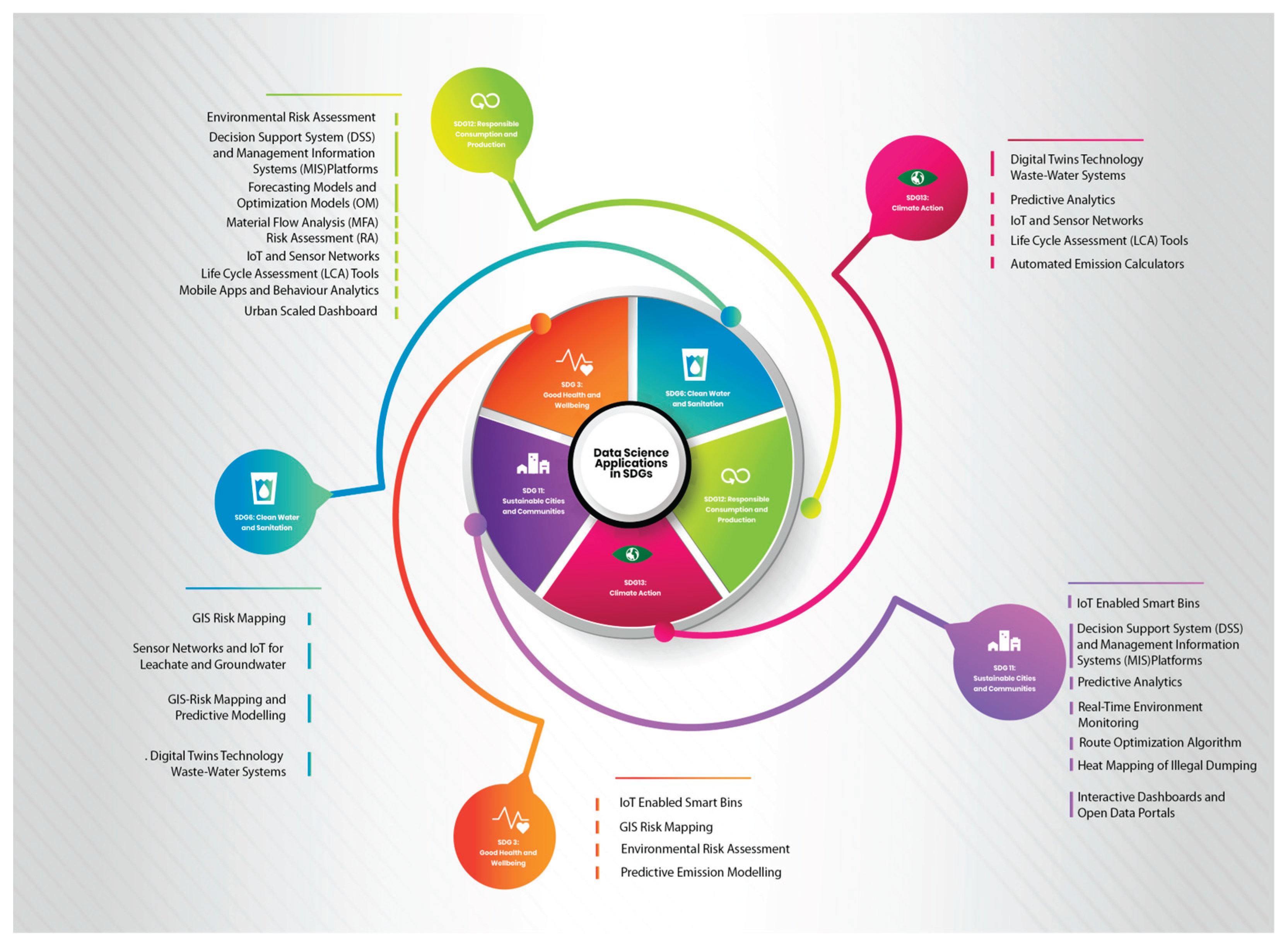
Figure 2.
Institutional Structure for MSW in Nigeria Source: [117].
Figure 2.
Institutional Structure for MSW in Nigeria Source: [117].
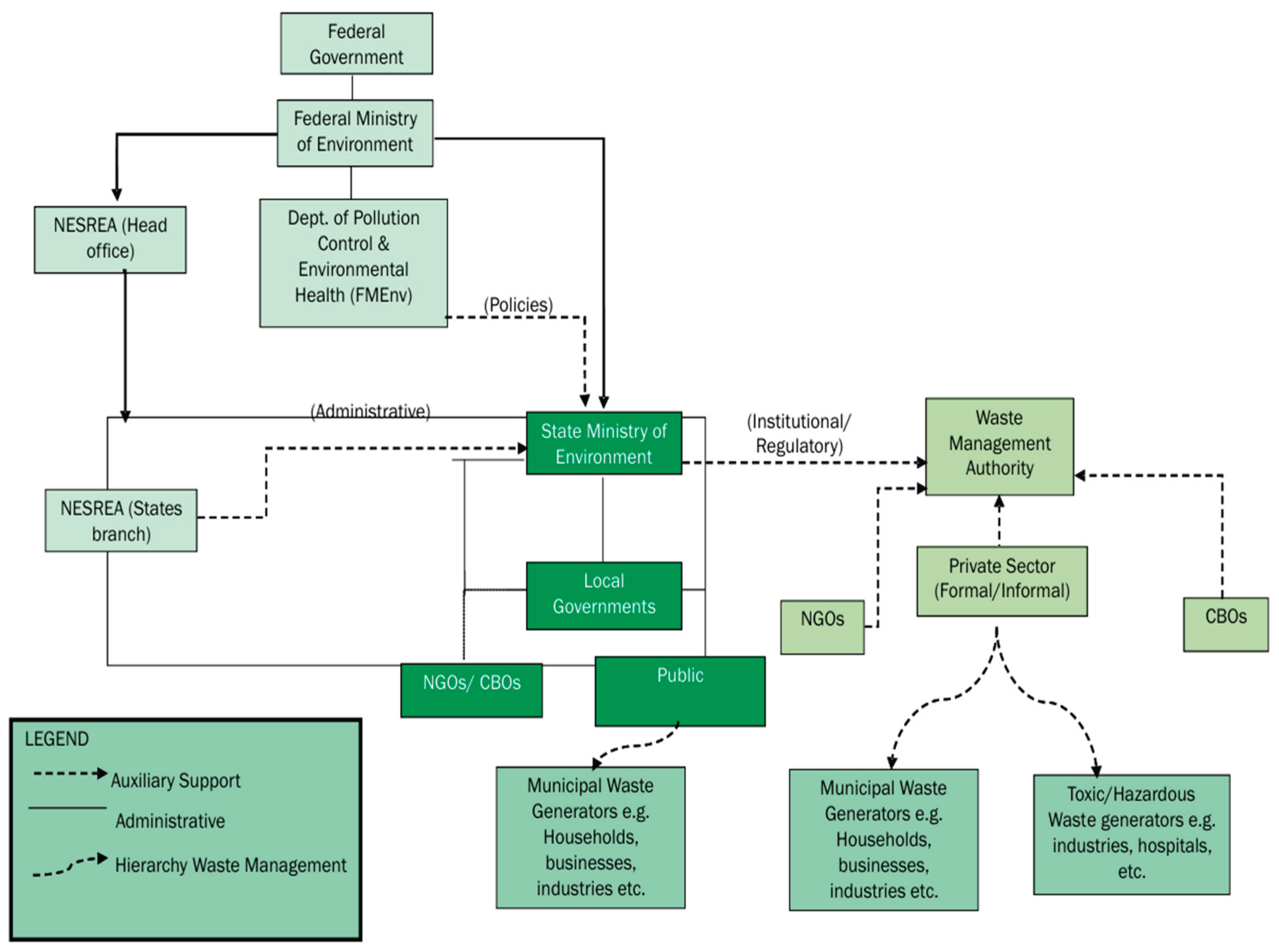
Figure 3.
Summarised responsibilities of Nigerian waste management stakeholders.
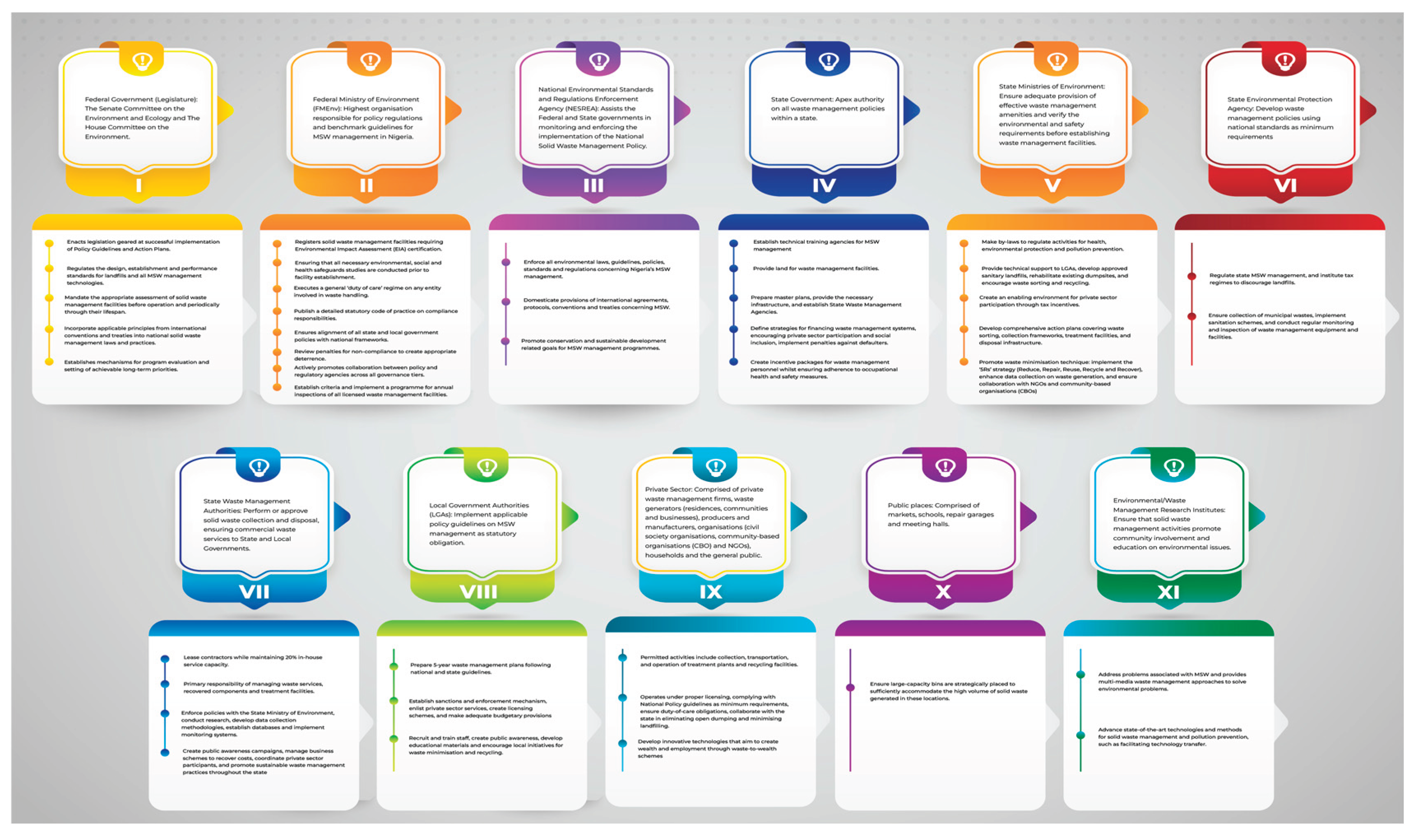
Figure 4.
An overview of MSW management data in Lagos State; where MT=metric tons and TPD= tons per day. Source: [119].
Figure 4.
An overview of MSW management data in Lagos State; where MT=metric tons and TPD= tons per day. Source: [119].
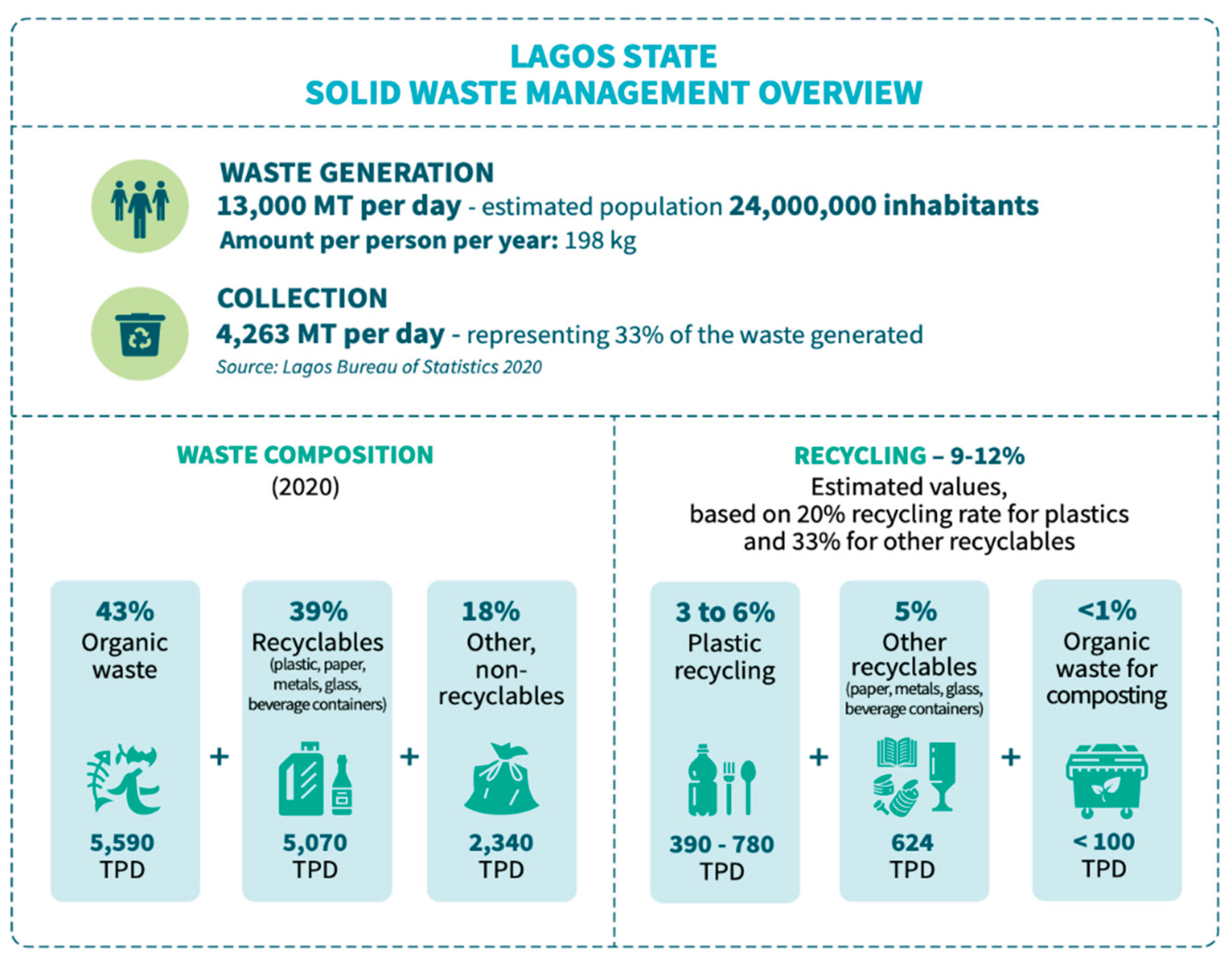
Figure 5.
Illustration of Lagos State MSW management sector Source: [119].
Figure 5.
Illustration of Lagos State MSW management sector Source: [119].
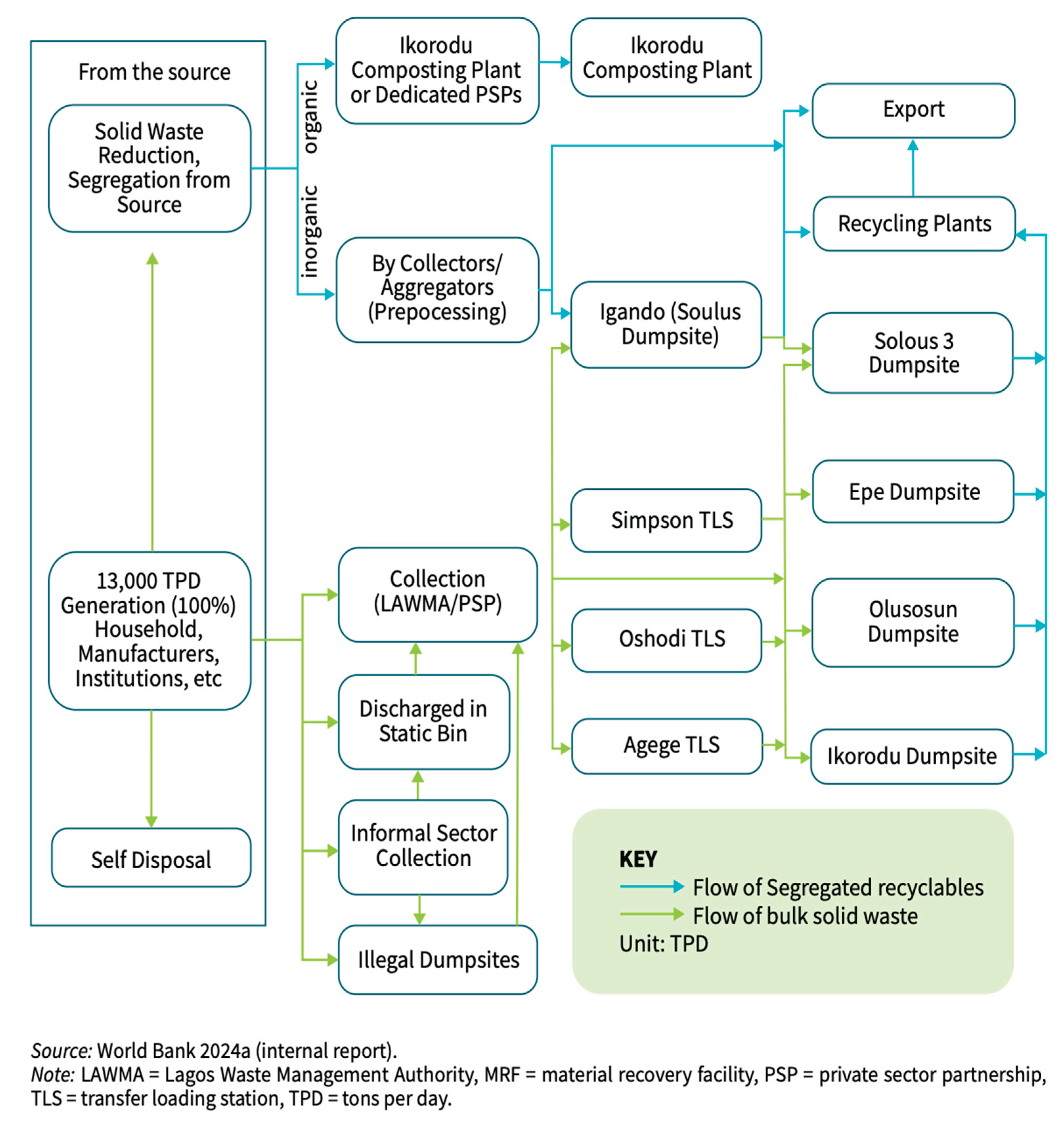
Figure 8.
Plastic Value Chain across Nigeria showing the relevant stakeholders Source: [119].
Figure 8.
Plastic Value Chain across Nigeria showing the relevant stakeholders Source: [119].
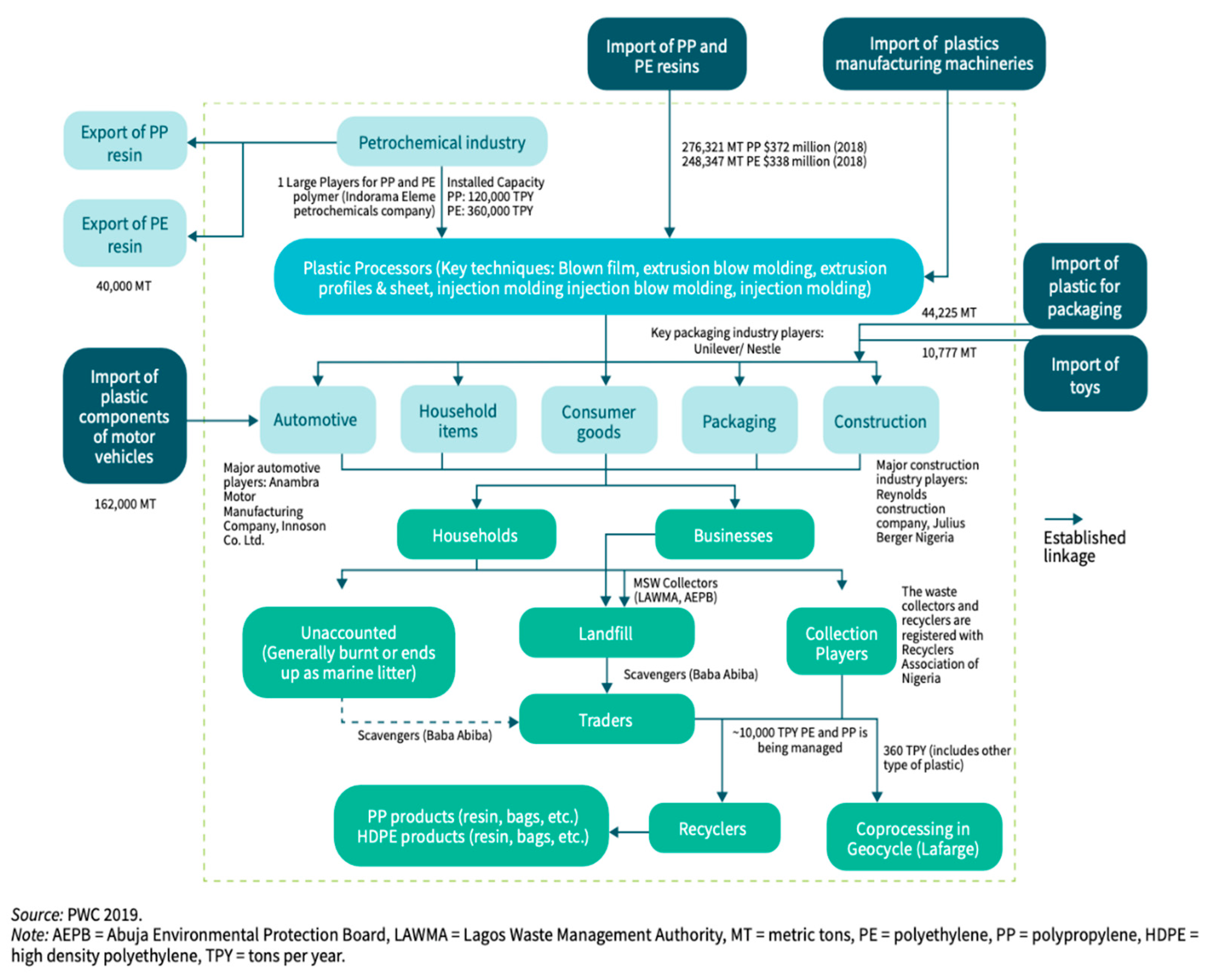
Figure 10.
Fundamental Stakeholder Engagement Objectives (EO).
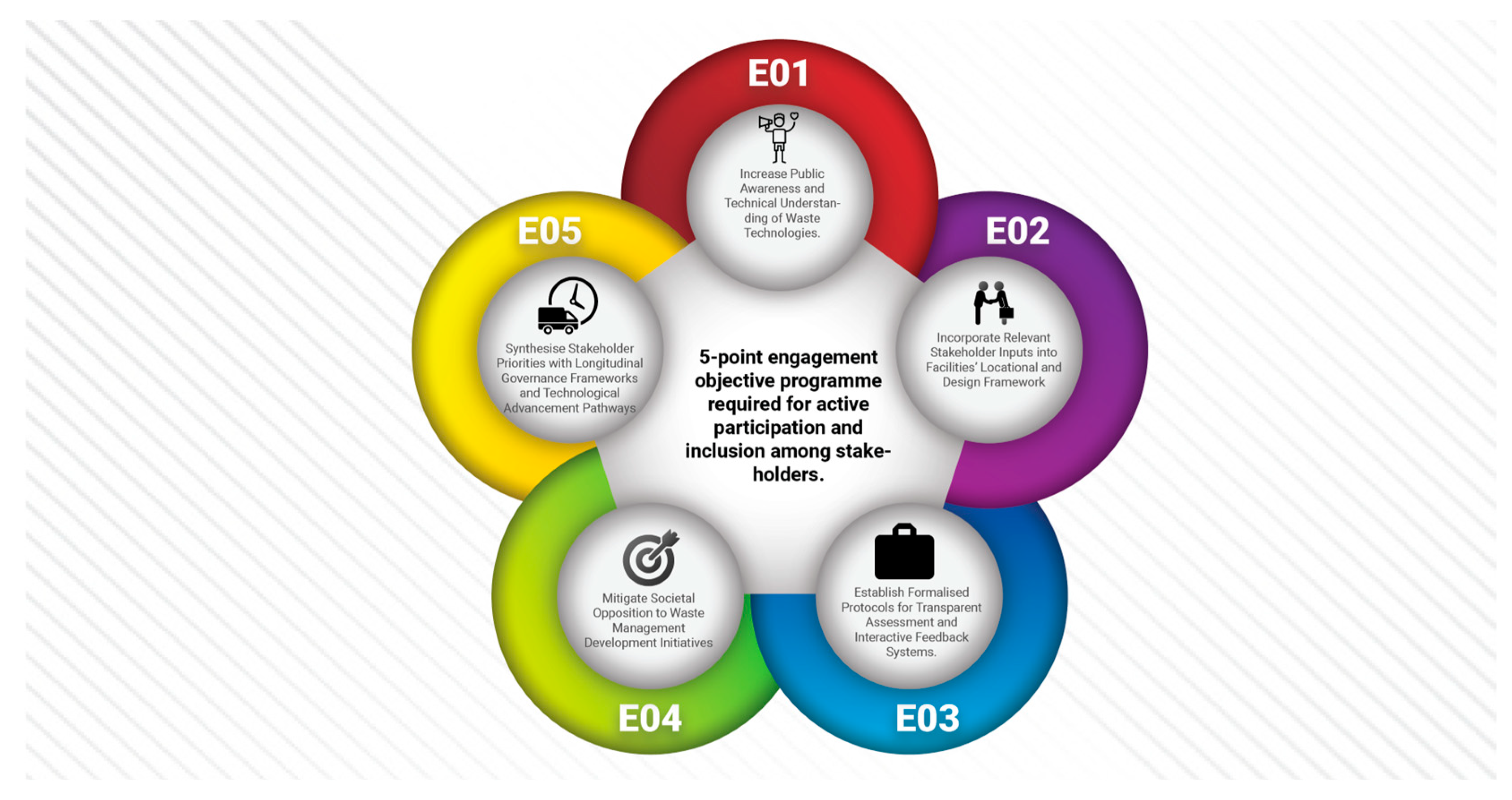
Table 1.
Examining the system engineering models, distinct attributes and application to MSW management.
Table 1.
Examining the system engineering models, distinct attributes and application to MSW management.
| SYSTEM ENGINEERING MODEL | ATTRIBUTES [19] | APPLICATION IN MSW MANAGEMENT |
|---|---|---|
| Cost-Benefit Analysis (CBA) |
|
|
| Forecasting Models (FM) |
|
|
| Simulation Models (SM) |
|
|
| Optimisation Models (OM) |
|
|
| Integrated Modelling Systems (IMS) |
|
|
Table 2.
Examining the systems assessment tools, characteristics and their application in MSW management.
Table 2.
Examining the systems assessment tools, characteristics and their application in MSW management.
| SYSTEMS ASSESSMENT TOOLS | CHARACTERISTICS [19] and [40] | APPLICATION IN MSW MANAGEMENT |
|---|---|---|
| Scenario Development (SD) |
|
|
| Material Flow Analysis (MFA) |
|
|
| Life-Cycle Assessment (LCA) |
|
|
| Risk Assessment (RA) |
|
|
| Environmental Impact Assessment (EIA) |
|
|
| Strategic Environmental Assessment (SEA) |
|
|
| Socioeconomic Assessment (SoEA) |
|
|
| Sustainable Assessment (SA) |
|
|
Table 3.
Examining each systems theory core principle using [71] view and the resultant data science application to MSW management.
Table 3.
Examining each systems theory core principle using [71] view and the resultant data science application to MSW management.
| SYSTEMS THEORY PRINCIPLE | [71] view | DATA SCIENCE APPLICATION TO WASTE MANAGEMENT |
|---|---|---|
| Holistic Perspective |
|
|
| Interconnectivity and Feedback Loops |
|
|
| Dynamic and Adaptive Nature |
|
|
| Input-Throughput-Output Model |
|
Table 5.
Prioritisation and ranking of critical stakeholders in facilitating data-science driven MSW management in Nigeria.
Table 5.
Prioritisation and ranking of critical stakeholders in facilitating data-science driven MSW management in Nigeria.
| Stakeholder | Power | Legitimacy | Urgency | Attitude | Proximity | Expertise and Technical Capability | Resource Contribution | Network Influence | Data Access and Sharing Capacity | Composite Score | Rank |
|---|---|---|---|---|---|---|---|---|---|---|---|
| State Waste Management Authorities | 5 | 5 | 5 | 5 | 5 | 3 | 5 | 3 | 5 | 4.74 | 1st |
| State Ministry on Environment | 5 | 5 | 5 | 5 | 5 | 3 | 5 | 3 | 5 | 4.58 | 2nd |
| Private waste companies | 4 | 4 | 4 | 5 | 4 | 5 | 5 | 4 | 5 | 4.35 | 3rd |
| Waste Technology Providers | 3 | 3 | 3 | 3 | 4 | 5 | 5 | 5 | 5 | 3.91 | 4th |
| Federal Ministry of Environment | 5 | 5 | 5 | 3 | 1 | 2 | 4 | 3 | 1 | 3.66 | 5th |
| Local Government Area (LGA) councils | 4 | 4 | 5 | 4 | 4 | 2 | 2 | 5 | 2 | 3.41 | 6th |
| NGOs | 2 | 3 | 5 | 5 | 4 | 3 | 3 | 5 | 4 | 3.41 | 6th |
| NESREA | 4 | 5 | 3 | 3 | 1 | 1 | 3 | 3 | 1 | 3.10 | 8th |
| Academic Institutions | 3 | 2 | 2 | 5 | 3 | 5 | 3 | 4 | 4 | 3.08 | 9th |
| CBOs | 1 | 2 | 5 | 3 | 5 | 4 | 2 | 5 | 4 | 3.05 | 10th |
| Financial Institutions | 1 | 2 | 1 | 1 | 0 | 3 | 5 | 1 | 1 | 1.80 | 11th |
| General Public | 1 | 1 | 5 | 4 | 5 | 1 | 0 | 0 | 0 | 1.54 | 12th |
Disclaimer/Publisher’s Note: The statements, opinions and data contained in all publications are solely those of the individual author(s) and contributor(s) and not of MDPI and/or the editor(s). MDPI and/or the editor(s) disclaim responsibility for any injury to people or property resulting from any ideas, methods, instructions or products referred to in the content. |
© 2025 by the authors. Licensee MDPI, Basel, Switzerland. This article is an open access article distributed under the terms and conditions of the Creative Commons Attribution (CC BY) license (http://creativecommons.org/licenses/by/4.0/).
Copyright: This open access article is published under a Creative Commons CC BY 4.0 license, which permit the free download, distribution, and reuse, provided that the author and preprint are cited in any reuse.


