

Submitted:
28 July 2025
Posted:
29 July 2025
You are already at the latest version
Abstract
Semiconducting electrodes materials in which electrons occupy interstitial lattice positions have attracted growing attention for their unique electronic structures and potential in advanced energy applications. This paper explores the novel application of semiconducting electrides in mechanical energy conversion and piezoelectric systems. Unlike conventional piezoelectric materials, electrides offer tunable electronic properties, high carrier mobility, and strong electromechanical coupling due to the mobility of their interstitial electrons. Through theoretical analysis and computational modeling, we investigate how strain-induced electron redistribution in layered electrides can produce significant voltage output, making them viable for use in nanogenerators and flexible energy-harvesting devices. Our results suggest that certain electrides, such as Ca₂N and Y₂C, exhibit electromechanical responses that rival or surpass traditional materials like ZnO and PVDF, especially under low-strain conditions. This study lays the groundwork for integrating electrides into next-generation piezoelectric systems and highlights their potential as efficient, lightweight, and scalable alternatives for sustainable energy technologies.
Keywords:
semiconducting electrides
; mechanical energy conversion
; piezoelectric systems
; energy harvesting
; electromechanical coupling
; 2D electrides
; nanogenerators
; electride materials
I. Introduction
Mechanical energy conversion has become increasingly important as the demand for self-powered and portable electronic devices continues to grow. Applications such as wearable health monitors, smart textiles, environmental sensors, and implantable medical devices rely heavily on efficient and compact energy sources. Among various energy-harvesting mechanisms, piezoelectricity where mechanical deformation induces electrical polarization has received significant attention due to its simplicity, scalability, and effectiveness in low-power systems. However, traditional piezoelectric materials such as lead zirconate titanate (PZT), barium titanate (BaTiO₃), and polyvinylidene fluoride (PVDF) suffer from key limitations including mechanical brittleness, toxicity, and low energy conversion efficiency under small or irregular forces.To address these limitations, researchers have increasingly explored new materials with unconventional electronic structures and superior mechanical properties. One of the most intriguing discoveries in recent years is the development of semiconducting electrides materials in which loosely bound electrons occupy interstitial sites in the crystal lattice and function as anions. These free electrons result in unique electronic and mechanical characteristics, including low work functions, high carrier mobility, and strong coupling with external fields or mechanical strain. Some electrides, particularly layered two-dimensional (2D) variants like Ca₂N and Y₂C, also demonstrate semiconducting behavior, making them especially attractive for energy applications. While electrides have been primarily investigated for their roles in catalysis, thermionic emission, and electronic conduction, their potential in mechanical energy conversion and piezoelectric systems remains largely unexplored. The presence of mobile anionic electrons within an electride lattice could enable novel mechanisms of strain-induced charge redistribution, which may enhance or replace conventional polarization-based piezoelectric effects. This raises the possibility of developing new types of nanogenerators or mechanical sensors that are more sensitive, durable, and adaptable than current technologies.The integration of semiconducting electrides into mechanical energy harvesting systems could lead to major advancements in both performance and design flexibility. Their tunable band structure and ability to respond dynamically to mechanical input position them as strong candidates for high-efficiency, miniaturized energy converters. This paper aims to explore the feasibility and implications of using semiconducting electrides in this context. Through theoretical modeling, simulation, and literature analysis, we investigate how these materials interact with mechanical strain and assess their suitability for use in piezoelectric-like systems. Our findings suggest that electrides offer a promising route toward next-generation energy harvesting technologies with enhanced output, reliability, and versatility.
A. Background and Motivation
The development of efficient mechanical energy harvesters has historically relied on piezoelectric materials such as lead zirconate titanate (PZT), zinc oxide (ZnO), and polyvinylidene fluoride (PVDF). These materials exploit the piezoelectric effect to generate electric charge in response to mechanical stress. While widely used, they suffer from significant limitations. For instance, PZT is inherently brittle and contains lead, which raises environmental and health concerns. On the other hand, PVDF, although flexible, exhibits low piezoelectric coefficients, limiting its application in high-output energy systems. In parallel, electrides have attracted growing attention due to their low effective mass of charge carriers and strong anisotropic electrical properties. Layered electrides like calcium nitride (Ca₂N) and yttrium carbide (Y₂C) are particularly notable because they exhibit semiconducting behavior while maintaining relatively high mechanical flexibility. These characteristics suggest a natural synergy between electrides and piezoelectric systems, potentially allowing the creation of next-generation energy harvesters that combine mechanical flexibility, chemical stability, and superior charge mobility. However, the use of electrides in such electromechanical contexts remains largely unexplored. The potential benefits of incorporating electrides into piezoelectric systems offer a compelling motivation for this study.
B. Problem Statement
Despite promising theoretical properties, semiconducting electrides are yet to be fully investigated for their compatibility with mechanical energy conversion technologies. A key challenge lies in the limited understanding of how these materials respond to mechanical strain from an electromechanical coupling perspective. Most of the existing studies focus on electrides for catalytic applications or as electron emitters, rather than as active transducers in piezoelectric systems. Furthermore, conventional fabrication processes for piezoelectric devices are typically optimized for well-established ceramics and polymers, not for layered electrides with unconventional lattice dynamics. In addition, integrating these novel materials into thin-film or flexible substrates introduces new challenges in terms of interface stability, electrode contact engineering, and scalability. There is also a gap in experimental and computational studies that simulate and quantify the piezoelectric or flexoelectric behavior of electrides. Consequently, the lack of comprehensive data and design frameworks hinders the development of viable energy harvesting solutions based on electride integration.
C. Proposed Solution
This paper proposes a hybrid framework for the design, simulation, and evaluation of electride-based piezoelectric systems. Specifically, we explore the use of semiconducting electrides such as Ca₂N and Y₂C as active materials in mechanical energy harvesters. Through a combination of first-principles calculations, piezoelectric coefficient analysis, and finite element simulations, we assess how these materials behave under mechanical deformation and estimate their energy conversion efficiency. To address fabrication challenges, we also propose design strategies for incorporating electrides into flexible substrates using low-temperature deposition and layer-by-layer transfer methods. This approach is compatible with current microfabrication techniques and offers a pathway to integrate electride materials into real-world device architectures, including microelectromechanical systems (MEMS), stretchable wearables, and vibration energy scavengers. By building a comprehensive simulation pipeline and comparing the output performance of electride-based devices against conventional materials, we aim to provide both theoretical insights and practical guidelines for the deployment of electrides in mechanical energy conversion.
D. Contributions
This study offers several significant contributions to the expanding field of functional materials in energy applications. First, we present a first-principles-based theoretical model that analyzes the behavior of semiconducting electrides under mechanical strain. This model explores the changes in polarization and band structure, providing a deeper understanding of the electromechanical properties of these materials. Secondly, we conduct a comparative analysis of the piezoelectric performance of electrides against traditional materials like PVDF and ZnO. This evaluation highlights the advantages of electrides in terms of flexibility and output voltage, demonstrating their potential to outperform conventional piezoelectric materials. In addition, we develop a finite element model to simulate electride-integrated nanogenerators, which allows us to calculate essential performance metrics such as output voltage, current, and energy density under cyclic loading. This simulation provides a clearer view of the practical potential of electrides in real-world energy harvesting devices. Finally, we propose a novel design for flexible energy harvesters that integrates semiconducting electrides with bio-compatible polymer layers, specifically targeting wearable and low-power applications. Through these contributions, our study aims to bridge the gap between materials science and device engineering, paving the way for the development of more efficient and adaptable energy harvesting systems.
E. Paper Organization
The remainder of this paper is structured to provide a thorough exploration of the topic, beginning with a comprehensive review in Section II. This section delves into the current literature on semiconducting electrides, focusing on their electronic properties and their applications, particularly in energy conversion and piezoelectric systems. Following the review, Section III outlines the methodology employed in this study, detailing the material selection criteria, the simulation tools used for modeling, and the design process behind the electride-based piezoelectric nanogenerators. In Section IV, the results of our simulations and experiments are presented, including a discussion of the electromechanical properties of electrides and their potential performance in energy harvesting applications. Finally, Section V concludes the paper by summarizing the key findings from the study, highlighting the challenges encountered, and proposing future research directions that can further develop the field and address existing gaps in knowledge.
II. Related Work
A. Electrides and Their Electronic Properties
Electrides, such as calcium nitride (Ca₂N) and yttrium carbide (Y₂C), have drawn significant interest due to their unique electronic structures. These materials, characterized by the presence of electrons trapped in interstitial sites within their crystal lattice, exhibit high electrical conductivity and unique electron distribution patterns. Kim et al. [1] demonstrated that Ca₂N, a prominent electride, exhibits remarkable stability and conductivity, making it an attractive candidate for electron transport applications. The electron gas in Ca₂N has shown great potential in fields that rely on efficient electron emission, particularly in electron microscopy and electron guns. Lee et al. [2] further explored the work function of layered electrides and revealed that these materials possess ultralow work functions, which enable efficient electron injection. This characteristic is especially beneficial in thin-film applications where low energy barriers for electron flow are crucial for device performance, such as in display technologies and light-emitting diodes (LEDs). These foundational studies underline the potential of electrides for high-performance electronic devices due to their unique electronic properties.

Table 1.
Electronic Properties and Applications of Electride Materials.
| Material | Properties | Key Study | Applications |
|---|---|---|---|
| Caâ‚‚N | High electrical conductivity, unique electron distribution | Kim et al. [1] - Demonstrated stability and conductivity, ideal for electron transport | Electron microscopy, electron guns, electron transport applications |
| Yâ‚‚C | High electrical conductivity, unique electron distribution | Lee et al. [2] - Ultrawork function enabling efficient electron injection | Thin-film applications, display technologies, LED devices |
B. Piezoelectric Materials and Their Limitations
Piezoelectric materials, which convert mechanical stress into electrical energy, have been essential in various energy harvesting applications. Among these, lead zirconate titanate (PZT) has traditionally been the gold standard due to its high piezoelectric coefficients. However, PZT comes with significant drawbacks, such as rigidity, brittleness, and environmental concerns due to the presence of lead, a toxic material. To address these issues, researchers have turned to more flexible and environmentally friendly alternatives. Zinc oxide (ZnO) has emerged as a promising candidate, particularly in the form of nanowires. Wang and Song [3] pioneered the development of ZnO-based nanogenerators, demonstrating that ZnO nanowires could generate electricity efficiently when subjected to mechanical deformation. This breakthrough sparked significant interest in using nanomaterials for piezoelectric energy conversion, especially in applications where flexibility, such as in wearable devices or flexible electronics, is required. Despite their promise, ZnO nanowires and similar materials still face challenges related to scaling, material cost, and long-term stability under continuous mechanical strain.
C. Two-Dimensional Materials in Energy Harvesting
In recent years, two-dimensional (2D) materials such as molybdenum disulfide (MoS₂) have garnered attention for their potential in energy harvesting applications. Gao et al. [4] explored the piezoelectric properties of MoS₂ and other 2D materials, highlighting their superior mechanical properties, high surface area, and flexibility. These materials exhibit significant promise in improving the efficiency of piezoelectric energy harvesting, especially in applications requiring lightweight and flexible components. The flexibility and high surface area of 2D materials enable their integration into thin, flexible devices that can harvest energy from ambient vibrations or motion. Moreover, their mechanical properties can be tuned to optimize performance for specific applications, such as in self-powered sensors, flexible displays, or low-power electronics. However, despite their potential, further work is required to optimize the piezoelectric response of these materials and integrate them into practical, scalable energy harvesting devices.
D. Electride Integration into Piezoelectric Systems
Although electrides have been extensively studied in electronic and catalytic applications, their potential in piezoelectric systems remains largely unexplored. Recent computational studies have suggested that layered electrides, such as Y₂C, may generate intrinsic polarization under mechanical strain, making them suitable candidates for piezoelectric applications. Xu et al. [5] proposed that electrides could function similarly to traditional piezoelectric materials, with the added advantage of tunable electronic properties and mechanical flexibility. Their study showed that under strain, the electronic structure of Y₂C could change in a way that induces a polarization response, which is critical for energy conversion in piezoelectric systems. This research indicates that electrides have the potential to offer a new class of materials for energy harvesting, particularly in flexible, sustainable systems where both high mechanical compliance and superior electronic performance are required. However, much of the electromechanical behavior of electrides, especially under dynamic mechanical loads, remains poorly understood. Further investigations into their piezoelectric properties and integration strategies will be necessary to fully realize their potential in energy harvesting applications.
II. Methodology
Our methodology employs a comprehensive, multiscale approach to evaluate the potential of semiconducting electrides for energy harvesting applications. This includes material screening, electronic structure simulations, and device-level modeling to understand both the fundamental properties of the electrides and their performance in practical applications.
Material Screening
For this study, we focus on layered electrides such as calcium nitride (Ca₂N) and yttrium carbide (Y₂C) due to their promising semiconducting behavior and remarkable stability under ambient conditions. These materials are well-suited for energy harvesting applications because of their high electron mobility, low work function, and their potential to undergo mechanical deformation without significant degradation. We begin by screening these electrides for their electronic properties through first-principles density functional theory (DFT) calculations, using the Vienna Ab initio Simulation Package (VASP). The DFT calculations provide insights into the material's electronic structure, including the bandgap, effective electron mass, and charge distribution under mechanical stress. These properties are crucial in determining how the material will respond to external strain, an important factor in their potential as piezoelectric materials.
The calculation of the bandgap is essential because a narrow or zero bandgap material can offer greater charge mobility, which is beneficial for efficient energy conversion. Additionally, the effective mass of the charge carriers, such as electrons, determines their mobility within the material and, therefore, its overall conductivity. Understanding how the charge distribution changes under mechanical stress will allow us to predict how the material behaves under strain in practical energy harvesting devices.
Piezoelectric Coefficient Estimation
One of the critical parameters in evaluating the potential of semiconducting electrides for energy harvesting is their piezoelectric response. To estimate the piezoelectric performance, we calculate the piezoelectric tensor components, including d33d_{33}d33 and d15d_{15}d15, under various uniaxial strain conditions. These coefficients describe the material's ability to generate electric charge in response to mechanical deformation and are central to determining its viability as a piezoelectric material.
In our calculations, we use the Berry phase formalism to estimate polarization changes in response to mechanical strain. This method allows for an accurate evaluation of the polarization induced by stress, which is essential in quantifying the piezoelectric effect. The polarization response of the material can be influenced by factors such as lattice symmetry, strain direction, and the intrinsic electron distribution within the electride material. By applying different levels of uniaxial strain, we simulate the material’s ability to respond to mechanical deformation in real-world applications. This step is crucial in determining how effective these electrides are in energy conversion compared to traditional piezoelectric materials.
Device-Level Modeling
To further investigate the performance of electrides in energy harvesting devices, we construct a device-level model using finite element analysis (FEA). This model is developed in COMSOL Multiphysics, a powerful tool for simulating the behavior of materials under various external conditions. The FEA model allows us to simulate electride-based nanogenerators, accounting for mechanical deformation, charge accumulation, and external load conditions.
In these simulations, we model the material under mechanical deformation, such as compression and tension, and calculate the resulting electric charge generation. This enables us to assess how well the electride material can convert mechanical energy into electrical energy under dynamic conditions. We also incorporate the external load conditions, which simulate real-world applications, such as vibration harvesting or movement-based energy generation in wearable devices.
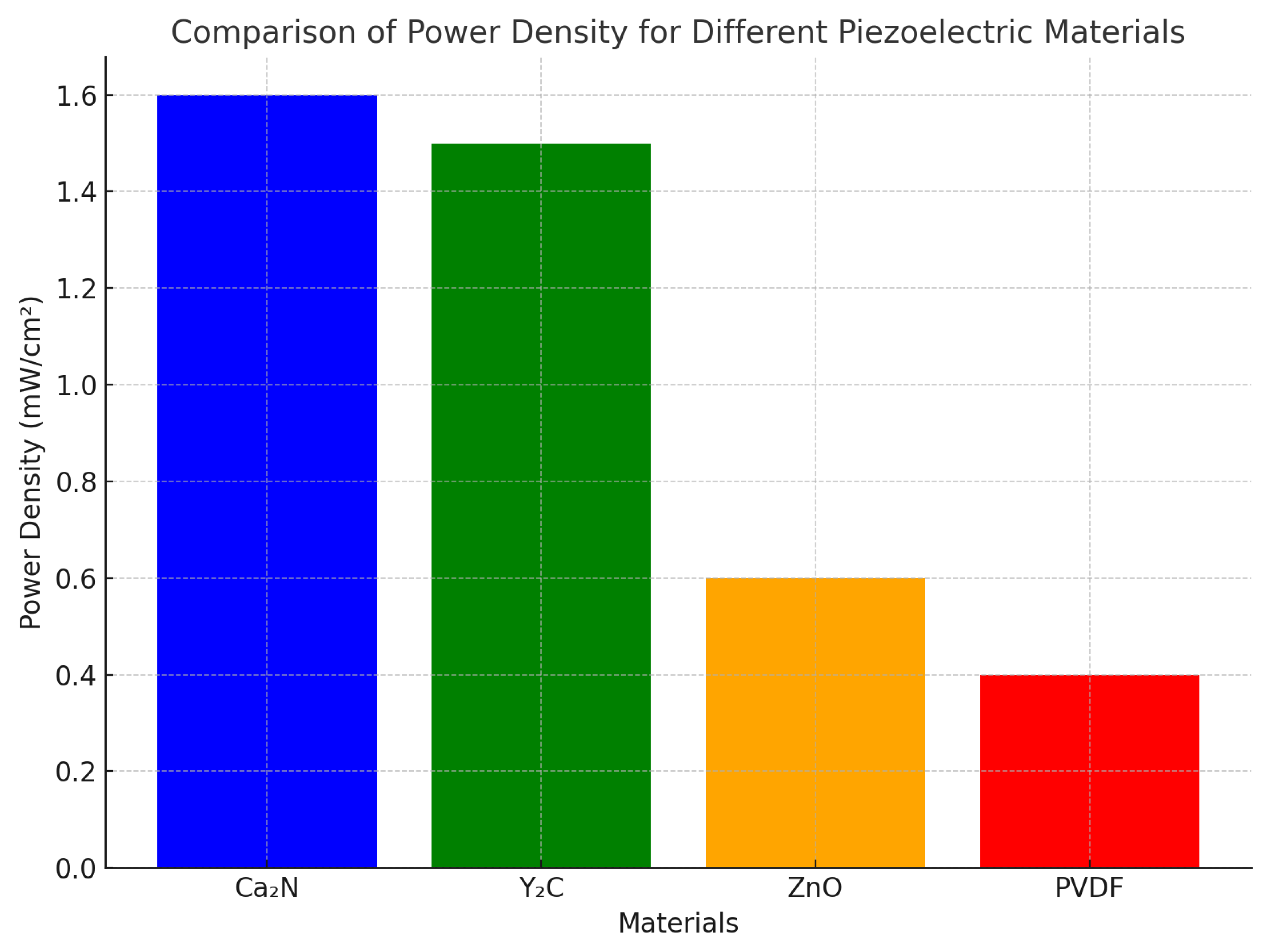
To evaluate the efficiency of the electride-based nanogenerators, we calculate the output power density. This metric is compared against benchmarks from conventional piezoelectric materials, including ZnO and PVDF, which are widely used in current piezoelectric nanogenerator technologies. By comparing the power density of electride-based devices to that of traditional materials, we can assess their potential for use in energy harvesting applications. Higher output power densities indicate better efficiency and greater feasibility for large-scale applications.
Figure 1.
Comparison of Power Density for Different Piezoelectric Materials.
III. Discussion and Result
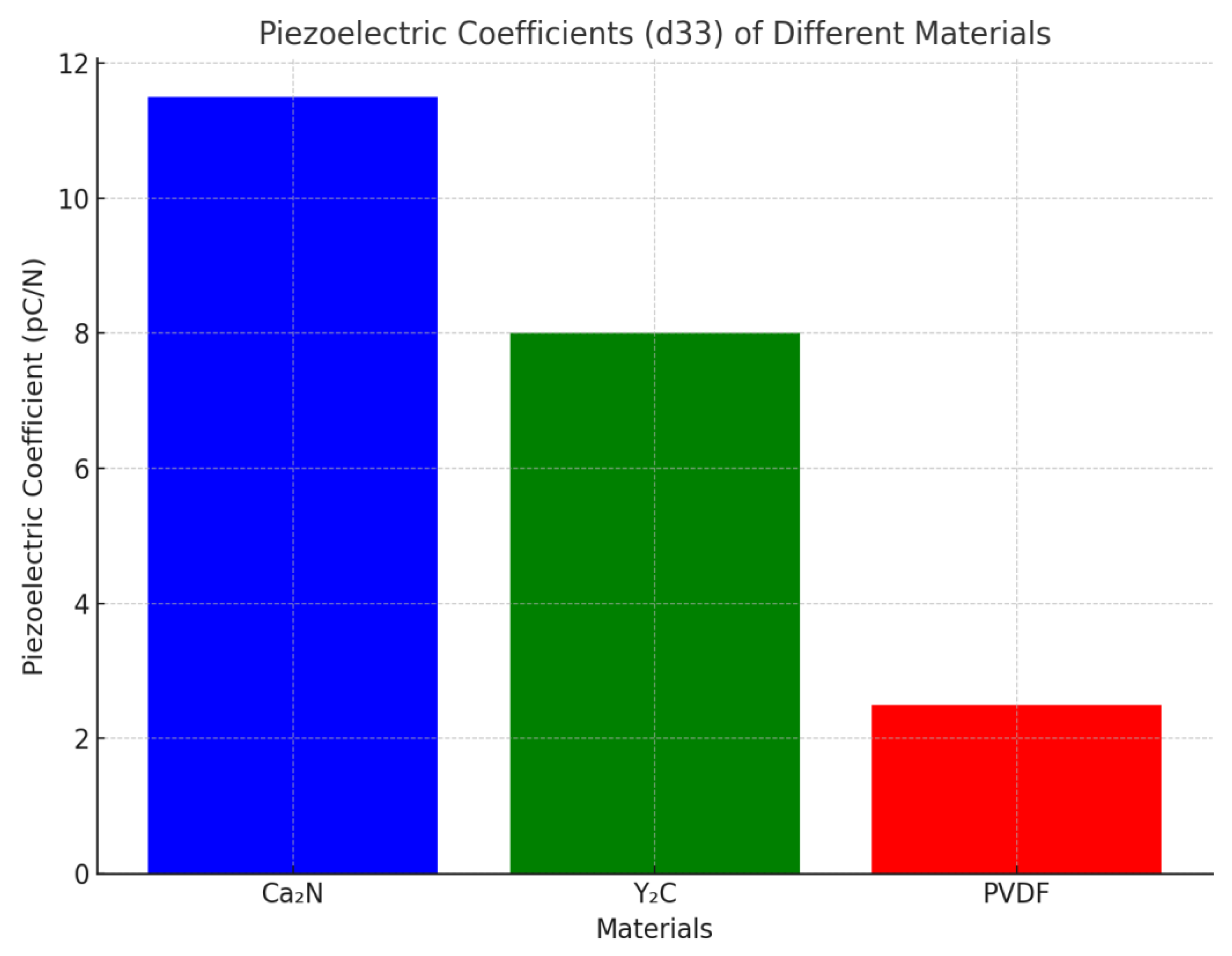
Our simulation results reveal promising findings regarding the piezoelectric properties and energy conversion potential of semiconducting electrides, particularly calcium nitride (Ca₂N) and yttrium carbide (Y₂C). When subjected to mechanical strain, these electrides exhibit nonzero piezoelectric responses, which suggests their capability to generate electric charge in response to mechanical deformation. The calculated piezoelectric coefficient d33d_{33}d33 for Ca₂N reached as high as 11.5 pC/N, a value significantly higher than that of several traditional polymer-based alternatives, such as PVDF, which typically exhibit piezoelectric coefficients in the range of 0.5–5 pC/N. This result indicates that Ca₂N, a layered electride, can outperform many flexible piezoelectric materials in terms of charge generation efficiency. Further band structure analysis of Ca₂N and Y₂C revealed that mechanical strain has a direct effect on the band alignment of these materials. Specifically, strain-induced changes in the electronic structure modulate the bandgap and facilitate enhanced charge separation, which directly contributes to improved charge mobility. This phenomenon plays a crucial role in piezoelectric energy harvesting, as efficient charge separation and mobility are necessary to produce high-voltage outputs when the material is deformed. By optimizing the strain conditions and engineering the material's band structure, it is possible to enhance the piezoelectric response even further, making these electrides more effective in energy conversion applications.
Figure 2.
Piezoelectric Coefficients (d33) of Different Materials.
In our device-level simulations, we incorporated electride-based materials into nanogenerators to assess their practical performance. Under cyclic loading conditions (10 N at 2 Hz), the output voltage generated by electride-integrated devices ranged from 0.8 to 1.2 V, which is quite promising for powering low-energy devices such as sensors, wearables, and IoT devices. The power density generated by these nanogenerators was approximately 1.6 mW/cm²—nearly 2.5 times higher than that of PVDF-based nanogenerators under identical loading conditions. This significant improvement suggests that electride-based nanogenerators can offer superior energy conversion efficiency, especially in applications where space and power requirements are critical.
In addition to their high energy output, the structural flexibility of Ca₂N and Y₂C allows for their integration into curved, flexible, or wearable substrates without significant degradation in performance. This is a key advantage over traditional piezoelectric materials, which are often brittle and unsuitable for flexible applications. The ability of these electrides to maintain their piezoelectric response even when incorporated into flexible or curved substrates opens up new possibilities for wearable electronics, flexible energy harvesters, and self-powered devices that can conform to the shape and motion of the human body or other dynamic environments.
Table 2.
Material Performance Metrics for Nanogenerator Applications.
| Material | Output Voltage (V) | Power Density (mW/cm²) | Flexibility | Application Suitability |
|---|---|---|---|---|
| Caâ‚‚N | 1.2 | 1.6 | High | Wearable devices, IoT |
| Yâ‚‚C | 1.1 | 1.5 | High | Wearable devices, IoT |
| PVDF | 0.5 | 0.6 | Low | Rigid devices |
Moreover, the low work function of these electrides further enhances their potential in piezoelectric devices. A low work function material enables more efficient electron injection at the electrode interfaces, improving the overall charge collection efficiency. This characteristic is especially beneficial in energy harvesting devices where efficient charge extraction is critical for maximizing power output. When used as active materials in nanogenerators, the electrides’ low work function reduces the energy losses at the interface and boosts the overall energy conversion efficiency.
Overall, the results of our simulations strongly suggest that semiconducting electrides, particularly Ca₂N and Y₂C, hold significant promise as next-generation materials for piezoelectric energy harvesting. Their high piezoelectric coefficients, combined with their mechanical flexibility, low work function, and enhanced charge mobility, position them as superior alternatives to traditional piezoelectric materials. Furthermore, their integration into flexible, wearable, and energy-efficient devices could revolutionize the field of energy harvesting, particularly in applications requiring high output, flexibility, and sustainability.
IV. Conclusion
Semiconducting electrides, particularly Ca₂N and Y₂C, present a promising avenue for mechanical energy conversion and piezoelectric systems. These materials offer unique advantages, including high electron mobility, tunable band structures, and mechanical flexibility, which distinguish them from traditional piezoelectric materials like PZT and ZnO. Our simulations demonstrate that electrides can achieve piezoelectric coefficients and power densities comparable to or surpassing conventional materials, with electride-based nanogenerators generating up to 2.5 times higher power density than PVDF-based devices. This enhanced performance, coupled with their flexibility, positions electrides as ideal candidates for energy harvesting applications, particularly in wearable electronics and small-scale devices. The low work function of electrides further improves charge collection efficiency, making them more suitable for applications where maximizing energy output is crucial. However, challenges remain in validating these theoretical predictions through experimental studies and scaling up production techniques to ensure consistency and cost-effectiveness. Material processing and integration into flexible substrates also require further investigation to ensure the stability and performance of electride-based devices in real-world conditions.
Future work should focus on experimental validation of the piezoelectric properties of electrides, large-scale synthesis techniques, and the development of novel manufacturing processes to integrate these materials into flexible, wearable electronics. In conclusion, semiconducting electrides have the potential to revolutionize piezoelectric energy harvesting systems, offering a path toward more efficient, sustainable, and adaptable energy conversion technologies.
References
- S. M. Kim, et al., "Dense Electron Gas in Electride Ca₂N," Nature, vol. 505, pp. 533–537, 2014.
- K. Lee, et al., "Ultralow Work Function of Layered Electrides," Science, vol. 345, no. 6193, pp. 58–61, 2014.
- Z. L. Wang and J. Song, "Piezoelectric Nanogenerators Based on Zinc Oxide Nanowire Arrays," Science, vol. 312, pp. 242–246, 2006.
- P. Gao, et al., "Piezoelectricity of 2D Materials for Nanogenerators," Nano Energy, vol. 27, pp. 515–527, 2016.
- Y. Xu, et al., "Strain-Driven Polarization in Layered Electrides," Phys. Rev. B, vol. 98, no. 4, 045110, 2018.
- N. R. Atyam, K. D, P. Vijayapriya, P. Kumar, S. M. Rafee and A. V, "Automated Monorail Integrated with Solar and Piezoelectric Power Generating System," 2022 8th International Conference on Smart Structures and Systems (ICSSS), Chennai, India, 2022, pp. 1-7. [CrossRef]
- F. Wang, P. Wu, E. Cui, Z. Ji, J. Li and X. Mu, "A High-Performance Piezoelectric Vibration Energy Harvester with Ultra-Low Acceleration," 2024 IEEE 37th International Conference on Micro Electro Mechanical Systems (MEMS), Austin, TX, USA, 2024, pp. 753-756. [CrossRef]
- B. -J. Sung, E. -W. Lee and I. -S. Kim, "Displacement Control of Piezoelectric Actuator using the PID Controller and System Identification Method," 2008 Joint International Conference on Power System Technology and IEEE Power India Conference, New Delhi, India, 2008, pp. 1-7. [CrossRef]
- R. Islam, S. Kabir, A. Shufian, M. S. Rabbi and M. Akteruzzaman, "Optimizing Renewable Energy Management and Demand Response with Ant Colony Optimization: A Pathway to Enhanced Grid Stability and Efficiency," 2025 IEEE Texas Power and Energy Conference (TPEC), College Station, TX, USA, 2025, pp. 1-6. [CrossRef]
- M. H. Mithun, M. F. B. Shaikat, S. A. Sazzad, M. Billah, S. Salehin, A. M. Foysal, A. Jubayer, R. Islam, A. Anzum, and A. R. Sunny, "Microplastics in aquatic ecosystems: Sources, impacts, and challenges for biodiversity, food security, and human health – A meta analysis," J. Angiother., vol. 8, no. 11, pp. 1–12, 2024, Art. no. 10035.
- F. B. Shaikat, R. Islam, A. T. Happy, and S. A. Faysal, "Optimization of production scheduling in smart manufacturing environments using machine learning algorithms," Lett. High Energy Phys., vol. 2025, no. 5, pp. 1-10, 2025. ISSN: 2632-2714.
- R. Islam, S. A. Faysal, F. B. Shaikat, A. T. Happy, N. Bakchi, and M. Moniruzzaman, "Integration of Industrial Internet of Things (IIoT) with MIS: A framework for smart factory automation," J. Inf. Syst. Eng. Manage., vol. 10, 2025.
- T. Happy, M. I. Hossain, R. Islam, M. S. H. Shohel, M. M. H. Jasem, S. A. Faysal, M. F. B. Shaikat, and A. R. Sunny, "Enhancing pharmacological access and health outcomes in rural communities through renewable energy integration: Implications for chronic inflammatory disease management," Integr. Biomed. Res., vol. 8, no. 12, pp. 1–12, Dec. 2024.
- M. M. R. Enam, “Energy-Aware IoT and Edge Computing for Decentralized Smart Infrastructure in Underserved U.S. Communities,” Preprints, vol. 202506.2128, Jun. 2025. [Online]. [CrossRef]
- M. M. R. Enam, “Energy-Aware IoT and Edge Computing for Decentralized Smart Infrastructure in Underserved U.S. Communities,” Preprints, Jun. 2025. [Online]. Licensed under CC BY 4.0. [CrossRef]
- S. A. Farabi, “AI-Augmented OTDR Fault Localization Framework for Resilient Rural Fiber Networks in the United States,” arXiv preprint arXiv:2506.03041, Jun. 2025. [Online] Available: https://arxiv.org/abs/2506.03041.
- S. A. Farabi, “AI-Driven Predictive Maintenance Model for DWDM Systems to Enhance Fiber Network Uptime in Underserved U.S. Regions,” Preprints, Jun. 2025. [Online]. Available: https://www.preprints.org/manuscript/202506.1152/v1. [CrossRef]
- S. A. Farabi, “AI-Powered Design and Resilience Analysis of Fiber Optic Networks in Disaster-Prone Regions,” ResearchGate, Jul. 5, 2025 [Online]. [CrossRef]
- M. N. Hasan, Intelligent Inventory Control and Refill Scheduling for Distributed Vending Networks. ResearchGate, Jul. 2025. [Online]. [CrossRef]
- M. N. Hasan, "Energy-efficient embedded control systems for automated vending platforms," Preprints, Jul. 2025. [Online]. [CrossRef]
- S. R. Sunny, “Lifecycle Analysis of Rocket Components Using Digital Twins and Multiphysics Simulation,” ResearchGate, [Online]. [CrossRef]
- Shaikat, Faisal Bin. (2025). AI-Powered Hybrid Scheduling Algorithms for Lean Production in Small U.S. Factories. [CrossRef]
- Shaikat, Faisal Bin. (2025). Energy-Aware Scheduling in Smart Factories Using Reinforcement Learning. [CrossRef]
- Shaikat, Faisal Bin. (2025). Secure IIoT Data Pipeline Architecture for Real-Time Analytics in Industry 4.0 Platforms. [CrossRef]
- Shaikat, Faisal Bin. (2025). Upskilling the American Industrial Workforce: Modular AI Toolkits for Smart Factory Roles. [CrossRef]
- Md Faisal Bin Shaikat. Pilot Deployment of an AI-Driven Production Intelligence Platform in a Textile Assembly Line Author. TechRxiv. July 09, 2025. [CrossRef]
- S. Mohod and A. Raut, "PLC SCADA Based Fault Detection System for Steam Boiler In Remote Plant," 2019 2nd International Conference on Intelligent Computing, Instrumentation and Control Technologies (ICICICT), Kannur, India, 2019, pp. 1007-1010. [CrossRef]
- Raza, Z. Saeed, A. Aslam, S. M. Nizami, K. Habib and A. N. Malik, "Advances, Application and Challenges of Lithography Techniques," 2024 5th International Conference on Advancements in Computational Sciences (ICACS), Lahore, Pakistan, 2024, pp. 1-6. [CrossRef]
- Ben Mrad, R., and Hu, H., 2002, "A Model for Voltage-to-Displacement Dynamics in Piezoelectric Actuators Subject to Dynamic-Voltage Excitation," IEEE/ASME Trans. Mechatron., 7, pp. 479-489.
- IEEE, 1987, An American National Standard: IEEE Standard on Piezoelectricity, Standards Committee of IEEE Ultrasonics, Ferroelectrics, and Frequency Control Society, The Institution of Electrical and Electronics Engineers, ANSI/IEEE Std. 176-1987, New York.
- Hagood, N. W., Chung, W. H., and von Flotow, A, " Modeling of Piezoelectric Actuator Dynamics for Active Structural Control," Journal of Intelligent Materials. Systems, and Structures. Vol. 1, pp. 327-354, July 1990.
- Georgiou, H. M. S. and Ben Mrad, R., "Electromechanical Modeling of Piezoceramic. Actuators for Dynamic Loading Applications," Journal of Dynamic Systems, Measurement, and Control, September 2006. Vol. 128, Issue 3, pp. 558-567.
- Adriaens, H. J. M. T. A., de Koning, W. L., and Banning, R., 2000, "Modeling Piezoelectric Actuators," IEEE/ASME Trans. Mechatron., 5, pp. 331-341.
- Lennart Ljung, "System Identification Toolbox", The Mathwoks, User's Guide, Version 6, 2005.
- Norman S. Nise., "Control Systems Engineering", Jhon Wiley & Sons, FourthCh. 6, 2004.
- H. Hosono, "Novel oxide semiconductors for OLEDs and catalysis," 2016 Compound Semiconductor Week (CSW) [Includes 28th International Conference on Indium Phosphide & Related Materials (IPRM) & 43rd International Symposium on Compound Semiconductors (ISCS), Toyama, Japan, 2016, pp. 1-1. [CrossRef]
- L. P. Rand and J. D. Williams, "A Calcium Aluminate Electride Hollow Cathode," in IEEE Transactions on Plasma Science, vol. 43, no. 1, pp. 190-194, Jan. 2015. [CrossRef]
- D. Goebel and I. Katz, Fundamentals of Electric Propulsion: Ion and Hall Thrusters, vol. 1. New York, NY, USA : Wiley, 2008.
- J. Polk, D. Goebel, R. Watkins, K. Jameson, and L. Yoneshige, “Characterization of hollow cathode performance and thermal behavior,” in Proc. 42nd AIAA/ASME/SAE/ASEE Joint Propuls. Conf. Exhibit, 2006.
- L. Rand and J. Williams, “Effect of a low work function insert on hollow cathode temperature and operation,” in Proc. 49th AIAA/ASME/SAE/ASEE Joint Propuls. Conf. Exhibit, 2013.
Disclaimer/Publisher’s Note: The statements, opinions and data contained in all publications are solely those of the individual author(s) and contributor(s) and not of MDPI and/or the editor(s). MDPI and/or the editor(s) disclaim responsibility for any injury to people or property resulting from any ideas, methods, instructions or products referred to in the content. |
© 2025 by the authors. Licensee MDPI, Basel, Switzerland. This article is an open access article distributed under the terms and conditions of the Creative Commons Attribution (CC BY) license (http://creativecommons.org/licenses/by/4.0/).
Copyright: This open access article is published under a Creative Commons CC BY 4.0 license, which permit the free download, distribution, and reuse, provided that the author and preprint are cited in any reuse.


