
Submitted:
25 July 2025
Posted:
29 July 2025
You are already at the latest version
Abstract
This review aims to understand what urban planning and management can do and how to reduce disaster risk and adapt to climate change impacts in cities. In order to do so it examines different streams of literature, as the topic lies at the interface of different disciplinary fields that have insofar developed quite separately but are all relevant to respond the initial question. Such disciplinary fields include urban planning (in hazardous areas), recovery planning, disaster risk reduction that itself is an umbrella including various disciplines from engineering to geography and sociology, and more recently climate change adaptation. In order to navigate in such vast realm of knowledge a conceptual framework is proposed to guide in the selection of relevant literature and the strategy for selecting the latter is described in a methodological section. This review shares elements of a critical and theoretical review in that it does not aim at being comprehensive nor systematically search each of the disciplinary domain that are addressed. Whilst acknowledging the limitations and some biases in the selection of articles and books, it does reflect a certain evolution in the discourse on urban planning for resilience. It is discussed how the latter concept has emerged as useful to bridge between disaster risk reduction, sustainability and climate change adaptation, especially as cities experience increased exposure and vulnerability to stresses that have become more compound, multihazard and cascading. In the conclusions gaps and challenges that must be addressed by researchers, practitioners and policymakers are discussed.
Keywords:
urban resilience
; urban planning & hazards
; urban vulnerabilities
; disaster risk reduction & climate change adaptation in cities
1. Introduction
Urban planning is intrinsically concerned with the future, it projects into the future a desired image and configuration of cities, including the provision of services supporting all sort of activities ranging from economic to educational to recreational [1]. However, the pace of changes in the last decades, the increasingly complex interrelationships between systems at various levels from local to global, and the exponential growth of urban population has rendered the exercise of thinking about the future of cities extremely challenging [2]. The complex interlinkages between humankind and nature, political, social, and economic contradictions are coalescing in crises that are coming unforeseen and/or not prepared for and underestimated in their longer-term consequences [3]. Foresight and scenarios [4,5] that are increasingly requested by decision and policy makers to support anticipatory and preparedness capacity [6] have captured the attention of urban planners only recently [7,8]. For planners accepting to deal with high uncertainties that may potentially undermine projects and visions for the future is a relatively recent acquisition [9]. Crises often accelerate processes that are already latent in systems towards new states shaped by the response, by existing (or absent) capacities, resources, plans [10].
This review aims at understanding what urban planning can do and how to reduce disaster risk and adapt to climate change. Scholars such as Burby [11,12,13] considered urban and land use planning as non-structural disaster risk mitigation measure as opposed to structural measures and defences such as levees or landslides consolidation. By breaking the nexus of hazard-exposure and vulnerability which creates risk conditions and losses once the hazardous event materializes, urban and land use planning may bring longer term benefits than many structural measures alone. In the absence of sound planning in fact, structural measures may become even counterproductive by encouraging increased urbanisation in hazardous areas [14]. [15] pointed at land use planning failures as one of the reasons for the missed translation of available knowledge on hazards and risks into action. Twenty years later, there seem to be more favourable conditions for increased engagement of urban planners in preventative practices for two main reasons. On the one hand sustainability as both a goal and a practice has gained momentum in almost every activity connected to urban and land use planning [16]. On the other hand, in the last decades large scale severe disasters have affected cities, making evident the multiple vulnerabilities that characterize complex urban environments and create the conditions for cascading failures, sometimes with catastrophic outcomes [17]. Climate change is an additional stress, a hazard on its own impacting on the availability of water, increased heatwaves and sea level rise, the latter being a significant threat for coastal cities [18]. It also exacerbates hazards that are triggered by extreme weather, such as floods, landslides, avalanches, storms, and forest fires [19].
Yet the pace of advancement and the dissemination of good practices is still insufficient as disasters impacting cities and towns show at each extreme occurrence. Therefore, an additional question that is addressed by the review is why despite the significant advancement of knowledge on extreme hazards and on good adaptation and mitigation practices, the translation into the everyday activity of planners and city managers is still slow and fragmented.
Writing such a review is challenging. The proposed pathway is explained in the methodological section 2. In the latter a map of the related topics that must be addressed is provided and the strategy for literature selection illustrated. Subsequent sections (from 3 to 6) tackle each topic following the logic order provided in the map. The topics cover three main areas of reflection:
- The knowledge that supports the identification and assessment of risks to the built environment, settled communities and infrastructures;
- The tools and the modalities of intervention urban planning can deploy to reduce and mitigate expected negative impacts and damages;
- The constraints and obstacles in implementing such plans and interventions.
An important caveat must be introduced. As suggested by the title, the review relies significantly on long term research and applications developed in various projects with multiple teams and with public administrations in Europe. The mapping of the topics to be addressed derives from such experience. By doing so it does neither claim nor aim at being systematic and exhaustive. Part of the selected literature derives from what was considered and shared as core and referential by practitioners and scholars in the various research and applied projects. Nevertheless, quite an extensive and significant effort of searching and updating literature has been carried out on the different topics identified as key. Such effort has been iterative in the attempt to clarify and elucidate what those topics actually are and why they are considered key [20] to respond to the two related review questions. In this respect, the review is closer to what various authors have named as “critical or integrative” review [21,22] and some others [23] as “theoretical review”.
2. Urban Planning for Reducing Risks and Adapting to Climate Change: The Approach to the Review
Providing a review on how urban planning can be considered and used as a measure of DRR and CCA is an intrinsically interdisciplinary task given the vast realm of knowledge that should be explored. Therefore, this review starts by providing a pathway through fields of research and practice that intersect in identifying how urban planning can forge safer, more sustainable and resilient cities in the face of a variety of stresses and shocks. According to Chaudhary and Piracha [24] Twentieth century research moved from understanding disasters as acts of nature to conceptualizing them as a “complex nexus of natural-human-social-economic factors”. Complexity is a key concept for this review. Contemporary cities have been defined as complex as they are implicated in intricated relationships with other cities and regions across spatial scales [25,26]. Cities share several features with complex systems as defined by Park et al [27]. Such features include the non-linear interrelationships between urban components and systems, the path dependency of locational choices, the difficulty to forecast the response and recovery after severe shocks given causal-effect loops among multiple factors and dimensions.
The underlying understanding of the systems and the fields that have been considered for reviewing and searching the literature is synthetized in the framework in Figure 1. Cities are the object of local adaptation plans on the one hand and of sectoral plans that tackle certain types of hazards (such as earthquakes, floods, heatwaves) and associated exposure and vulnerabilities on the other. Urban resilience is a relatively more recent concept useful to bridge and integrate CCA and DRR. One main point shown in the figure is that sectoral provisions for DRR and CCA must be mainstreamed in planning across the whole timescale of disasters, from prevention to reconstruction. Implementation is a key aspect of any type of planning to achieve the desired and promised goals. There are barriers and obstacles to implementation that slow or even impede the mainstreaming of DRR and CCA into ordinary urban development and redevelopment plans.
This framework is the result of long term research that has been undertaken in a number of projects, mainly funded by the European Commission since Framework Program 6 and through activities carried out in the field with several regional and municipal civil protection authorities mainly in Italy and at the European level in the context of working groups promoted by DH ECHO of the European Commission [28]. The Armonia project [see [29]] explored how urban planning in Europe was dealing with natural hazards and risks and what tools specifically tailored to support urban planning were available. The 7FP Ensure project [1] dealt with multiple dimensions of vulnerability in multirisk contexts. The Horizon 2020 Educen [2] project specifically addressed the issue of how to make cities more resilient in face of crises triggered by large disasters and climate change across multiple temporal scales. Other projects such as the 7FP Know4DRR [see [30]], Idea [28] and Lode [3] projects granted by DG ECHO investigated the potential of using damage and loss data to better understand local exposure and vulnerability and the impact of climate change.
Coherently with the framework in Figure 1, the review explores the following fields and sub-fields of study:
- Comprehensive risk assessment in and for urban areas, with particular regard to the risk components of exposure and vulnerability to single and multi-hazard conditions,
- Resilience and urban resilience in particular as a concept that can help reconciling until now disjunct policies and provisions for CCA and DRR,
- Urban planning for resilience, addressing the role urban planning plays across the entire timescale of disasters and crises bridging between DRR and CCA,
- Issues inherent in plans implementation due to governance pitfalls and to land property rights.
The review strategy to cover those interconnected but still very large fields and subfields is summarized in table 1. In the rows respectively the search categories, a brief explanation of the latter, the keywords used in searches, the number of references within each category, and the selected databases are reported. The latter are Scopus and GoogleScholar; in both cases the search has been limited to the first 30 entries.
Columns 2 to 4 correspond to the above highlighted sub-fields for which searches have been conducted. In column 5 how illustration examples that have been used in the review to make the argument more tangible have been selected.
Column 1 refers to articles and books that have become authoritative sources of knowledge in the fields of DRR and CCA tackling one or more aspects related to communities and cities exposure, vulnerability, and resilience. The covered period goes back to sixty years ago, acknowledging that there are milestones in the development of disaster studies that are key, as they highlighted problems that persist or provide interpretations and understandings that are still interesting to explore today. In order to identify such authoritative references, overviews of research in disaster and climate change adaptation have been considered. Mitchell [31] discussed the advancement of research since the Forties grouping tackled topics into four main groups among which in his words “the extent of human occupance of hazardous zones”. Alexander in two contributions [32,33] looks at the period since 1977 to identify the major disciplinary contributions to the field of disaster studies provided by social sciences on the one hand and hard sciences and engineering on the other. More recently Kendra and Nigg [34] investigate the same interplay between engineering and social sciences providing a historical overview of disaster studies in the USA since the Seventies. Kelman et al [35] point at the tension between hazard centred and vulnerability paradigms that characterizes also the domain of climate change adaptation. Gall et al [36] provide a list of 135 seminal papers through a combined Web of Sciences’ Global Citation Score and keywords searches. It must be pointed out that authoritative sources are also those that constitute the common background of most researchers in the field. By being the field of natural hazards, DRR and CCA very wide, such nucleus of established and cornerstone sources may be quite large and depending on the main disciplinary approach of the scholar. Therefore, the selection of such authoritative references is subjective and corresponding to the interpretation and the pathways that have been followed in the review. Albeit being subjective the selection, the relevance of the selected literature is shared by many scholars according to the number of citations as provided by GoogleScholar. The latter provides a partial but still plausible hint on how influential a certain author and/or article/book has been. The articles/books that have been considered under the label of authoritative references received an average of more than 1000 citations (in many instances many more than that). Older publications, especially in the case of books [11,12] have not received similar number of quotes. Still, they have been considered as authoritative references as well as [10] and [13,15] as they are largely referred to in the selected articles and reviews.
For the remaining columns a combination of methods has been followed. Whenever possible review articles have been used to identify relevant sources or corroborate already made choices. Such reviews were useful to identify further literature and the illustration examples that have been mentioned in the text. In addition to the literature reviews and to the extraction of relevant articles and cases, specific searches have been performed scanning databases such as Scopus and GoogleScholar using combinations of key words. As urban planning is an applied endeavor for which the interplay between research and practice is crucial [36], besides scientific papers written by planners that work in academia, some reports developed by practitioners and international organisations have been considered as equally relevant. In particular, the two reports published by the European Commission JRC on the Science for Disaster Risk Management in 2017 and 2020 [37,38] were used as relevant state of the art, given the large number of scholars and stakeholders (around 800) who collaborated as authors, advisors, and reviewers. It is worth mentioning that each subchapter in both Reports received five independent reviews.
It should be noted that all referred articles and books have been actually red, they have not been selected on the basis of the title or the abstract content but considering their relevance within the proposed framework.
A table with the entire list of quoted articles and books classified according to the above criteria is provided in the table in Annex 1.
Whilst bringing together in a coherent fashion what scholars and practitioners from different fields have said on what needs to be done and how to make cities more resilient in the face of disasters and climate change may be considered a value, there are some limitations the reader should be warned about. First the same framing of the problem is as stated subjective. Even though the framing is shared by a number of scholars in the field, especially for some part (the one related to the needed integration between climate change and disaster risk reduction in particular) the majority of publications focus on one of the aspects that have been considered. Second, selected articles reflect a preference for contributions providing enhanced understanding of urban phenomena in hazardous areas providing solutions and operational tools for intervention. In fact, by targeting both researchers and practitioners as an audience the review espouses a position of pragmatic applicability of concepts and tools [39]. This is true in particular for some streams of searched literature such as resilience that may count by now on a very vast production of papers. In some other cases, such as problems of implementation or multi-hazard and multi-risk assessment literature is more scant and most available articles and books have been considered in the review. In fact, for the latter the search has been far more demanding and requiring more combinations of keywords to extract results from databases and a thorough search in the references provided in the red papers and books. Third, in more general terms the challenges in providing a transparent and rigorous interdisciplinary review have to be highlighted [40]. An important obstacle to interdisciplinary reviews that affects also the present one is the search that can be made in databases through keywords [41]. Whilst for a well circumscribed topic the keywords are relatively straightforward, in the case of multiple disciplinary domains that must be searched, the combination of keywords is crucial in providing certain results and excluding others, even though the latter may be relevant. Multiple searches have been conducted using synonyms, different combinations of keywords also considering those that are not so frequently used in literature, however omissions cannot be excluded even though a bit mitigated by making use of the so called “authoritative references”.

Table 1.
Summary of the criteria followed for the review.
| The strategy that has been followed here can be considered a hybrid between different types of reviews as classified for example by Cooper [42], Grant et al [22], Peré et al [23]. By relying on literature reviews for topics for which those were available it can be considered an umbrella review. By making an attempt to produce a new conceptualization of the broad problem set for the review, it shares elements of mapping, “critical” and/or “theoretical” review. As for the former, it provides a mapping of literature in different disciplinary domains, from engineering to climate change studies on the specific aspect of urban resilience and risk prevention. As for the latter as defined in Paré et al [23] it makes an attempt to bring the different streams of literature into a conceptual framework. By doing so it acknowledges that there is a mature body of knowledge on the topic of urban prevention, urban resilience which nevertheless would benefit from improved integration of contributions and explicit analysis of interrelationships between them (critical review according to Snyder [21]. |
Authoritative references in DRR & CCA |
Multirisk Exposure and Vulnerability of urban areas | Urban Resilience | Planning for DRR and/or CCA and Linking DRR to CCA | Challenges and obstacles to plans implementation | Illustrative examples |
| Articles and books that have become authoritative references for researchers and practitioners; Books and articles in this category have recorded more than 1000 citations according to GoogleScholar |
Articles, books, reports on the challenges and the available methodologies for assessing risk and multirisk in urban areas | Literature on urban resilience and on resilience more in general with implications for urban areas | Literature on how disaster prevention and management, and on climate impacts adaptation is or can be mainstreamed in land use and urban planning; Literature on the need and opportunities for bridging/linking/connecting CCA and DRR. | Literature on challenges and obstacles to plans implementation in general and more specifically on plans for CCA and disaster prevention and management | Case studies have been mainly drawn from citations of consulted articles and books selected according to the criteria in the previous columns; Some (such as Cologne, Thessalonikki, Barcelona) have been also found while searching literature according to the criteria in the previous columns. |
|
 |
Urban vulnerability; vulnerability assessment cities; Exposure to natural hazards/disasters in urban areas/cities; exposed sectors to natural hazards/disasters; Exposed urban areas/ functions; multihazard/ multirisk conditions; multi hazard in urban areas/cities; urban xposure/vulnerability to floods, earthquakes, landslides… |
Urban resilience; resilience of urban systems; communities resilience; resilience of urban infrastructures; operationalization, measurability of resilience | Urban planning for DRR; Urban planning for resilience; climate adaptation cities; Linking DRR to CCA; hazards and climate impacts assessment; Urban planning in flood/earthquakes or seismic/landslides areas |
Implementation of public policies; Implementation obstacles/challenges/failures of CCA in cities ; Obstacles/challenges, failures in delivering/implemeneting urban plans for DRR |
Following the keywords in the previous columns | |
| 20 | 18 | 25 | 30 | 29 | 5 | |
| Searched Databases Reports |
GoogleScholar, Scopus Poljansek, K et al, Science for disaster risk management 2017. Knowing better and losing less, European Commission, DG-JRC; Casajus Valles, A. et al, Science for Disaster Risk Management 2020: acting today, protecting tomorrow, European Commission, DG-JRC |
|||||
3. Assessing Disasters and Climate Change Impacts in Cities
Available literature often tends to assume that impacts in large metropolitan areas and in small-medium size cities are similar, whilst this should be a matter of further investigation and verification [43]. In Menoni and Boni [44] a very first attempt has been made to propose a taxonomy of different types of cities, ranging from metropolitan areas that are fully implicated in global flows and networks to inner peripheries, that are largely marginalized and experiencing shrinking in population, economic opportunities, and services. Large cities and metropolitan areas generally dispose of important resources for facing a crisis, such as hospitals, fire departments, and are provided with redundant networks [43]. The presence of such resources represents a significant strength with respect to more remote places for which access to services is often a problem even in normal times. However, the same resources can be vulnerable to a variety of threats [45] and this vulnerability should be better understood not only individually, considering each facility per se, but also at a more systemic level. Both metropolitan areas and small-medium size cities may be equally exposed to a variety of natural hazards and potential impacts of climate change, however their exposure and vulnerability, two key components of risk may be rather different, requiring therefore fine grain contextual analysis to diagnose the actual risk conditions and identify potential prevention and adaptation measures.
3.1. Open Questions in Assessing Exposure and Vulnerabilities in Cities
Out of the three main components of risk assessment, hazard has been investigated the most by scientists who are experts on different hazardous phenomena. In addition, good practices available on how hazard knowledge and information can be supplemented in the form and at the scales that are more appropriate to support urban planning are available. Fleischhauer et al [29] reported the experience of various European countries and found the French Risk Prevention Plan to be a best practice. Hazard information is key to identify the most exposed communities and assets.
Exposure is generally defined as a quantitative measure of the number of people or assets located in “harms’ way” [46]. Current geospatial technologies, remote satellite imagery, and geographic information systems provide jointly a very powerful instrument to produce and update maps showing urban areas exposed to hazards [47,48] Gunasekera et al 2015). Whilst advances enabled by ever evolving technologies are remarkable, there is still room for improvement. For example, information related to critical networks should be better integrated to analyse the spatial interrelationships between the built environment and infrastructures [49].
The attribution of economic values to exposed assets and infrastructures is a further key step to understand what are the assets that would cost more to repair or substitute in case of impact[50]. However, the monetary assessment of exposure is not straightforward. For residential buildings one may count on databases that provide the market value in different areas. This is important information to characterize the attractiveness of urban zones also in case of reconstruction. In fact, experience shows that rebuilding in areas that were losing their attractivity already before the disaster will generate an empty and largely underutilized built stock [51]. For other artefacts, valuation is more challenging. Considering for example a museum, a congress centre, or a library, one would need to know the actual cost of realization of such assets, in case they are modern, or the cost of repair which is generally high for a historic landmark [52]. Additionally, for most public facilities, perishable content is not easy to estimate and certainly is not the type of data that can be obtained by remote sensing or satellite images. Last but not least, the large variety assets, goods, machinery, workers characterizing industrial and commercial firms does not permit to standardize the evaluation of damage to economic activities [53]. Even though challenges exist for assessing exposure, there is no doubt that assessing urban vulnerability is far more complex [54]. It is not by chance that most risk assessments that have been conducted until now in urban environments are actually combining hazards and exposure with limited consideration of vulnerability [55]. This is because vulnerability, intended as propensity to damage, requires a much finer grain knowledge of the quality of exposed assets and systems, and of the interlinkages between the latter.
Literature has been rather rich in contributions on social vulnerabilities, addressing the condition of the poorer, the disadvantaged who are far harder hit by disasters and climate change. The poorer live in more precarious conditions, often occupy dangerous areas and lack resources to search for alternative sheltering solutions and to recover [56,57,58]. Less ample is the literature on economic vulnerabilities, looking at what makes economies and activities more prone to failure following the impact of a disaster at both macro and micro levels [59]. The macro level is relevant for cities the more they have been specializing in the competitive globalized world [60]. Specialization in fact implies relying on few sectors for success, generating lack of redundancy and alternatives that has been considered by some scholars as a factor of economic vulnerability [61]. At the micro level, the location of economic activities (production and services) in particularly hazardous areas or with high physical and systemic vulnerabilities, imply that they will suffer heavily and for long time the disaster’s impact [62]. DuPont and Noy [63] analyzed the economic recovery of Kobe, Japan fifteen years after the severe earthquake that hit the city in 1995 and found that neither the port activities nor certain sectors such as mining and manufacturing have fully resumed to the pre-disaster levels.
Most frameworks for vulnerability assessment, though, address mainly physical vulnerability of buildings and to a lesser extent networks. Furthermore, only rarely physical vulnerability of the urban fabric of a city or parts of cities is considered [64]. Carreño et al [65] offer an interesting example of how exposure, vulnerability and hazards have been analysed and integrated in the seismic risk assessment of Barcelona, Spain. The vulnerability of cities cannot be obtained by a simple sum of individual structures’ vulnerability and depends instead on the layout, morphology, type of interaction, structural and non-structural between buildings, networks, and natural systems such as water and soil. For example, railways or elevated roads that run very close to buildings are likely to hit them in case of collapse and provoke domino-like effects. Poudel et al [66] have shown how the vulnerability of the health care system to seismic risk can be effectively assessed and represented in applications to the city of Thessaloniki in Greece. Step by step the proposed methodology guides through the assessment of the exposure and vulnerability of each component of hospitals towards that of supporting lifelines up to the overall systemic performance of hospitals given their interconnections and dependency on lifelines.
Whilst physical vulnerability is a key component especially for those hazards such as cyclones and earthquakes that are very destructive, it does not cover important vulnerability features that are of relevance in cities. Systemic vulnerabilities due to interdependencies between components of the same system and among systems that make the latter unable to keep functioning when parts of one or more systems have been compromised have been studied mostly for critical infrastructures [67]. However, systemic vulnerabilities may regard all flows in cities, from food, to mobility, transportation of goods, information, power [65]. Limongi and Galderisi [68] showed the application of a framework to assess systemic vulnerability in the area of the Phlegrean Fields in Naples. They evaluated the systemic vulnerability of each identified homogeneous spatial unit considering the relative accessibility from residential areas to main services strategic in case of emergency and to major evacuation routes. They also considered the distance from train stations and the redundancy of both transport routes and strategic services. Finally, they showed how the assessment of the interlinkages between physical, functional-systemic, social, and economic vulnerability can support prioritization of needed intervention [68].
3.2. Towards Multi-Hazard and Multi-Risk Assessment
There is an increasing awareness of the fact that often both large metropolitan areas and small urban centres are likely to be exposed to multi-hazard conditions, especially when they are located in mountain areas or along the coastline both being environments in which multiple hazards may co-exist [69]. In large urban agglomeration natural extremes may trigger incidents in industrial facilities and critical infrastructures. The acronym na-tech has been coined for this type of incidents by Showalter and Fran Myers [70] (See Cruz and Okada [71] for an overview). The cases of hurricane Katrina triggering the leakage of LPG in residential areas in New Orleans [72], explosions of petrochemical plants and the Fukushima nuclear accident triggered by the Tohoku earthquake in Japan 2011 are scaring examples. Questions regarding the potential for increased na-tech occurrences as a consequence of climate change are already investigated by researchers [73].
The term multi-hazard refers to the co-existence of natural or man made threats in the same area that may also trigger one another [74,75]. Multi-risk assessments require that the combination of hazards, exposure and vulnerability to the different types of potential threats be carried out. However, exposure and vulnerabilities may be hazard specific and therefore their combination in a comprehensive multi-risk assessment is difficult [76]. Among the few examples of how such multi-risk assessment can be conducted in practice, Van Westen and Woldai [77] developed a training toolkit based on GIS for assessing multi-hazards in urban environments. Grünthal et al [78] provided one of the first multi-risk assessments for the city of Cologne, Germany. Boni et al [79] provided a methodology for assessing exposure of the built environment and the population to multiple hazards.
4. Resilience as a Bridging Concept Between DRR and CCA
Natural hazards and disaster risk, climate change, sustainability have been separated fields of study and applications until recently, when calls for convergence and closer cooperation between the scientific communities and practitioners have been raising [80,81]. The separation of the three fields has challenged public administrations, as it produced a separation of mandates between officials that is hard to justify [82] or a working overload and fatigue for officials tasked with multiple legislative requirements on prevention, adaptation, sustainability. Integrating capacities and mandates of risk prevention and climate change adaptation would facilitate the work of cities managers, especially in cities exposed to multi-hazard conditions [83].
Resilience is a concept that has gained prominence in each of the domains of CCA, DRR and sustainability, providing an opportunity to bridge them not only theoretically but also operationally. Resilience can be understood widely as a set of “networked capacities” [84] in different domains, social, operational, informational, cognitive, economic, to make the impacts of an extreme event less catastrophic than could be the case without such capacities.
Initially interpreted closely to its semantic origin as the capacity of affected systems to bounce back to pre-disruption normalcy [85], the concept has evolved as critiques to this “mechanistic” view were raised. Kosovac and Logan [86] stressed that bouncing back to unsustainable pre-event conditions is not desirable; according to Manyena et al [87] recovery should aim at more sustainable conditions, bouncing forward rather than back.
Multiple definitions of resilience have been proposed and continuously refined in different disciplinary domains. The latter can be roughly categorized as “social” [87,88], engineering [89], ecological [90], socio-ecological [91]. Rus et al [93] develop an extensive literature review embedding the notions of resourcefulness, redundancy, and especially robustness proposed by Bruneau et al [93] bridging it with notions deriving from the social domains [84,93]. Speranza et al [94] building as well on extensive literature review, propose a framework for socio-ecological resilience. Recent literature reviews discuss how urban resilience lies at the intersection of physical, socio-economic, socio-ecological resilience [95,96]. Communities and individual capacities that are essential on their own rely though on a minimal threshold of functioning of the physical infrastructure that underpin life in cities [97].
Sharifi [93] points at the need to consider both spatial and temporal cross scale dimensions. As for cross spatial scale dimension, communities cannot be considered as isolated entities and the interrelationships with the higher scales, from regional to national to global cannot be neglected. Whilst it is true that many decisions and implementations of land use and urban plans are local and create local vulnerabilities [98], the consequences of which may be felt at much larger scale, the opposite is also true, that decisions that are made at much larger scales have significant impacts locally. As an example of the former, damage provoked by the 2011 flood in Thailand to hard disk producers provoked significant indirect damage across the globe [99]. As an example of the latter, damage to transport systems that are typically designed at regional, national and international scales may render cities isolated in the aftermath of an extreme. Systems interrelationship across scales also occur between natural and built environments. Typically for riverine or mountain floods the scale of the catchment must be addressed in order to assess what impact may occur at a certain section where a city is located. Deforestation and even substitution of vegetal species may destabilize slopes and create the conditions for debris flows that will affect downslope settlements as was the case of Sarno, Italy, 1998 [100].
As for cross scale temporal dimension, resilience has been increasingly associated with the entire disaster cycle, covering from capacity to anticipate and prepare before events strike, to absorb, respond and recover [101,27,102]. According to such understanding, anticipation and forward looking attitudes are crucial to be better prepared and capable of managing change future may bring.
Operationalization is key to translate theoretical, conceptual notions of resilience into practical tools that can be used to assess and enact measures, decisions, interventions to make cities more resilient. Different metrics and frameworks have been proposed to assess to what extent a system is getting closer or farer from a resilient condition. Some frameworks have been provided by international organisations such as Arup [103], World Bank and GFDRR [104]. Others have been proposed by scholars: Henry and Ramirez-Marquez [105] as well as Gonzales-Quintero & Avila-Foucat [106] have identified indicators to measure cities, institutions, and communities’ performance towards resilience.
Models proposed by Linkov et al [107], Park et al [27], Harrison and Wlliams [95] for assessing and enhancing resilience of complex systems are very relevant for cities. Linkov et al [107] identify four domains that must be addressed across the timescale of disasters, namely, the informational, cognitive, social domains besides the physical. The relevance acknowledged to cognitive and informational aspects is consistent with knowledge and lessons learned being essential for systems’ and communities’ resilience [108]. Fox-Lent et al [109] applied the Linkov e al [107] framework to the Rockaway Peninsula, New York, USA, following hurricane Sandy, pointing at factors and areas that should be the object of planning and investment for future resilience. Co-mapping has been attempted in participatory approaches to resilience, consistently with the fact that spatiality is a critical component of urban resilience assessment [110].
In designing resilience assessment frameworks, it must be clarified what is measured exactly: whether the outcome of policies and strategies aiming at reinforcing the resilience of systems or the process leading to the desired outcome. This is not a trivial matter. First because a system can be resilient to one hazard but not necessarily to others [86]. Furthermore, some authors [111,112] stress the relevance of the process that is already able to unleash capacities improving the system’s performance. Da Silva [97] stresses that resilience will be the result of a number of interconnected measures and actions taken jointly by individuals and institutions.
A further point that is stressed relates to the normative/prescriptive or rather descriptive role of resilience assessment frameworks. The latter can be used to appraise the current situation and the advancement made thanks to new initiatives and interventions or instead dictate what conditions must be fulfilled for a system to be considered resilient or on a resilient pathway. Hybrid schemes are possible too [94]. In elaborating on the semantics of the term, Strunz [113] proposes an interesting point of view. On the one hand he suggests that the fuzziness and indeterminacy of “resilience thinking” allows the convergence of different disciplinary approaches [114] on viable solutions to the complex issue of urban resilience. A point that is shared also by Graveline and Germaine [85]. On the other hand, Strunz [113] highlights that mixing the descriptive and normative facets of resilience is problematic. He suggests instead distinguishing between: i. the tools that can be used for assessing resilience, ii. the “sustainability” targets that must be attained, and iii. the transformative, dynamic aspect related to the trajectory that must be followed in order to attain the sustainability goals. This way sustainability and resilience are linked rather than diverging concepts (as also in Godschalk [115]).
5. Urban Planning for Resilience
Urban planning has a role to play in each phase of the so-called disaster cycle, from prevention to emergency response, recovery and reconstruction. Prevention is the more traditional arena for urban planning to provide land use restrictions and indications for the built environment to reduce the potential for future both physical and systemic damage [116]. Building codes for earthquake resistance and increasingly for floodproofing are an important example of tools by law that must be adopted in all areas considered at risk. So even though the legislation has been often passed or revised after the occurrence of a disaster, it must be applied also in areas that have not experienced a recent event. Guidelines on how to use urban planning tools to prevent disasters are available in literature and in several reports produced by international organisations [117,118]. However, most often than not provisions and tools are adopted only after a severe event occurrence [119]. Decisions that are taken in the recovery and reconstruction have significant long-term implications for the resilience of cities of the future. The “window” of opportunities that disasters open make the adoption of preventative measures easier. It is in the recovery, defined here as the timeframe stretched between the end of the emergency and full reconstruction, when most important decisions are made regarding the location and construction of shelters, the destiny of construction material waste, the provisional location of vital services and infrastructures [120]. Often the temporary city that is rapidly built in the aftermath of disasters to meet the immediate needs of the affected populations becomes the new part of the future development for the good or for the bad [121].
During the years that are needed for the full reconstruction following a disaster, especially when many structures and infrastructures have been destroyed, guaranteeing that the initial vision and push for resilience will endure administrative and financial challenges is not always straightforward. In addition, Vale and Campanella [122] remind that reconstruction entails many layers from more material to fully immaterial and intangible, requiring the healing of the community that has suffered the trauma of the disaster. This is the reason why rehabilitation of cultural heritage is often considered by affected communities as an important milestone of reconstruction [123].
CCA has pushed some cities to reconsider their development and redevelopment programs and projects with the intent to reduce damage in the future [124,125]. The changes in urban planning and management that took place in New York following the damage and losses provoked by hurricane Sandy have been reported in literature [126,127,128]. Perhaps the most important aspect of the Special Initiative for Rebuilding and Resiliency was to embed climate change as a key design and planning criterium for recovery. An initiative that combined short-term rehabilitation through infrastructural defence measures including nature based solutions with longer term flexible planning. Instead of taking as a reference the “worst case scenario” alternative solutions for a range of different scenarios have been considered to develop a long-term plan adaptable to changing hazard conditions.
The response phase is the least considered. Still a too small part of literature supports the idea of stronger interlinkages between urban and emergency planning [129,130]. There are three distinct domains in which urban planning offers important elements for improved emergency planning. First the full inclusion of a spatial perspective into emergency plans. This means considering the latter as a territorial construct, not just an administrative tool to coordinate the intervention of responders. Second, the increased reliance on scenarios in emergency planning implies that a stronger focus on the spatial context is needed as scenarios unfold in a city, that is characterized by a given topography, pattern, and fabric. An eminent example is provided by the CLE tool required in Italy as part of seismic emergency plans [131], CLE being the acronym of Emergency Limit Conditions (in Italian Condizioni Limite per l’Emergenza). The latter permits to assess those critical components and networks the failure of which would compromise the measures foreseen by emergency plans [132]. Third, urban and regional planning is also vital to ensure the feasibility of measures that will be required either from the population or rescuers. The prepositioning of rescue material (from snow cats to generators) requires free areas to be available and destinated for that purpose in the urban master plan. From a broader perspective, urban planning may provide important insight into the functioning of cities and regions from the standpoint of residents and users. This knowledge is key for identifying criticalities, priorities and draw the logistics of emergency plans.
The temporal scales are related to each other: the better prevention the less damage will be suffered requiring less effort to recover and reconstruct. Recovery and reconstruction are intimately interconnected as recent research has documented [133]. Recovery and reconstruction have a fundamental print on what will happen in case new extremes will occur [134]. Not all recoveries are the same, in some cases cities are able to attain better conditions, also in terms of reduced vulnerabilities, in others decline and degradation take over hampering full reconstruction and healing of communities[135].
During recovery and reconstruction there are often pressures to retake on board ideas that have been on the surface for long time but never implemented such as a new highway for better connecting places, a new airport to make the city more central globally as was the case following the 1995 Kobe earthquake in Japan[136]. There is no clear line dividing reconstruction from development and actually it has been often proposed that they should be pursued hand in hand especially when more sustainable conditions must be achieved [137]. Some scholars [138,139] have pointed at the need to plan for recovery as is normally done for emergencies, in order to prepare resources, legal provisions, and clear procedures to smooth the burden on public administrations and provide a vision to guide towards wanted outcomes.
6. Challenges to Implement Plans for Resilience
Despite the emphasis with which current urban studies have refocused on sustainability and adaptation, reality on the ground looks grim as there are still important gaps along the pathway to resilience. As intense precipitation occurs apparently at more frequent rates than used to be the case in the past, more cities experience flooding, damages due to landslides and debris flows in mountain regions, storm surges in maritime areas. Scenes are rather similar from the 2021 July floods in Belgium, Germany, and the Netherlands [140] or more recently from Italy in May 2023. Wrong choices in land use and urban planning can explain most of the damage, even independently from climate change [141,142]. According to Correa [143] “land use and occupation reflect the development model that has prevailed in a given country” making disaster risk “the cumulative result of historical deficiencies in development planning”. The EU Commission [144] points at still ineffective urbanism as a significant cause of damage due to natural disasters and extreme events induced or made more frequent and more intense by climate change and blames among other factors the growth of sprawl in all Member States. Despite of well-intentioned legislation, still cities surface grows more in the most hazardous areas, according to Rentschler et al [145].
Following analyses and interviews related to three large scale EU funded projects proposing nature-based adaptation solutions, O’Sullivan et al [146] found that the level of implementation is often too restricted and too limited to be really a game changer at the city level.
Olazabal et al [147] examining in depth the adaptation policies of 59 coastal cities with more than one million inhabitants, found that delivery of the comprehensive action on the ground is rather limited. Most analyzed climate adaptation plans and documents do not provide the necessary detail in terms of funding and prioritization of actions, with few exceptions. According to this analysis, cities that have integrated their CCA and DRR plans have achieved more concrete proposed interventions. Corrêa do Lago et al [143] reached the same conclusions through a literature review on cities in Europe. Coppola et al [148] investigated the implementation of resilience practices in Rome and Milan, the main Italian champions of the 100 Resilience Cities program of the Rockefeller Foundation. By digging inside the processes and the activities that actually unfolded in the two cities they found that the “need to operationalise a fuzzy understanding of resilience through its placement within a specific specialised area of government” was a factor limiting the actual integration of the new policy into the administrative and political environment of both cities. Examining the cases of New York and Rotterdam, Hölscher et al [149] showed that current power structures and failure in cross sectoral governance with long term view hampers the truly transformative and systemic management that would be needed to reduce in practice vulnerabilities and exposure.
Implementation challenges are different for large, metropolitan areas and small-medium size cities. As for the former, coordination of interventions that must be executed in different areas, neighborhoods, sub-jurisdictions that are part of the larger urban environment but in the meantime present their own specificities must be achieved. As for the latter, Reckien et al [150] found significant disparities between large and medium-small European cities in planning for adaptation out of the 885 cities of their sample. Small and medium size cities often struggle for funding and resources, and staff skilled in instruments and tools that are available to promote resilience practices. Shamsuddin [151] identifies three potential obstacles to implementation, namely fatigue, when people get tired of tackling crises and risks, complacency, when they overstate their actual preparedness and absorption capabilities, and overconfidence, when expectations regarding what has been already done overshadow the changing landscape of threats and risks. The latter two risks to implementation policies are shared also by Kosovac and Logan [86]. Making resilience practices pervading a very large number of cities and a wide part of their population requires to go beyond pioneering demonstration projects and be part of ordinary planning activities. A truly transformative approach is needed to achieve implementation at scale, involving the entire chain of stakeholders, from planners and designers to developers, to global real estate entrepreneurs, to owners, administrations, and citizens (Hartmann [152]).
6.1. The Relevance of Land Property Rights Management for Enforcing Urban Plans for Resilience
Existing legal and juridical norms and systems that delimit property rights on land and set the rules and the conditions at which the use of the owned land should obey in the name of public good [153] have a significant impact on the enforcement of climate adaptation and DRR projects and on the concrete measures necessary to achieve resilience [154,155]. Even hazard maps have been contested on the basis of their presumed impact on the economic values of properties. An enlightening case is brought by Handmer [156] who reported the withdrawal of flood hazard maps that were issued as part of innovative floodplains management policies in New South Wales, Australia, following the strong opposition of resident groups and the uptake of their cause by political parties right before elections. Failure to fully enforce the Stafford Act on natural hazards risk management in its component related to urban development control has been considered key to explain increased exposure and urban vulnerability to floods in the US [157]. Sentences of the US Supreme Court that counteracted the preventative measures of jurisdictions to protect coastal and riverine communities from large scale impacts of floods and storms were discussed by Platt and Dawson [158]. More recently, Raska et al [159] indicate that the legal framework and the constitution of property rights of both agricultural and urban land constitute a significant barrier to the implementation of nature-based solutions in various European countries.
In a comparative study on the level of implementation of regulatory coastal management in different countries worldwide, Alterman and Pellach [160] highlight the need to consider the inevitable contested impacts on land property rights of setback, relocation and other measures of adaptation to sea level rise and to more frequent extreme storms. An issue they state has been insufficiently dealt with insofar.
Hartmann [152] proposed a complex policy framework that he names “clumsy” combining different land management approaches to address the equally “clumsy” pressure by different stakeholders to increasingly concentrate urban functions from residential to transport and commercial in floodplains.
Figure 2 is a first attempt to summarize some of the most relevant challenges that must be addressed to fully account for land ownership regime in implementing urban plans for DRR and CCA. In the figure first the distinction between public and private land is made. In the former rules and plans to reduce risks based on available knowledge on hazards and vulnerabilities are made easier from a juridical point of view. As for private land urban and land use plans have the power to either raise dramatically the value of land by declaring it fit for development or instead downgrade it when the land is excluded from such development [161]. As a consequence, the separation between the property of land and its use is particularly problematic in urban areas to the point that in some countries there has been very strong support towards compensating not only taking (of the land) but also restrictions to development and building [162,163].
Tools that can be used by planners to achieve resilience goals in the case of privately owned land, are shown in the grey boxes. Acquisition programs to subtract the most hazardous areas from the market is in principle possible but very costly for local administrations. A system of incentives and disincentives based on taxation and insurance may work better than strict regulation [152]. Transfer of development rights has been also proposed as a viable instrument [164], though practical implementation cases showed the obstacles and challenges to be addressed, especially in case of very large number of properties are involved. An interesting overview of challenges and potential benefits of transfer of development rights as an instrument is provided by Hills and Schleicher [165].
In the last four boxes at the bottom of the figure, the challenges implied by large versus fragmented small properties are addressed. As often taxation related to new development or redevelopment is a vital source of revenues for local governments, using the leverage of development permits to foster resilience and prevention capacity may backlash on the availability of services. Large developers have the strength and the power to contrast local governments by putting pressure to accomplish their goals that reward them in the real estate market. Such developers are often international large companies with the capacity to overcome disputes even when they take long time to be settled and to seize any political opportunity (for example through local elections) that may favour their plans. On the opposite side, very fragmented properties constitute a tremendous obstacle to any effort to rationalize current cities’ conditions and patterns [166]. Projects of partial relocation from the most exposed areas to natural hazards, betterment aimed at reducing vulnerabilities that are opposed even by a minority group of owners, are likely to fail as they would require to succeed that the entirety of urban areas will be transformed comprehensively in a coherent manner [167].
6.2. Governance for Urban Resilience
The implementation of plans for urban resilience, and the difficult management of property rights, requires strong governance intended as “the system of institutions, mechanisms, policy and legal frameworks and other arrangements to guide, coordinate and oversee DRR and related areas of policy”(UNDRR, Glossary). Platt [162] a framework in which societal efforts towards risk management are triggered by the impact of a recent disaster, increased perception of hazards, and risk assessments. Building on the latter, a modified framework is proposed to represent elements of urban resilience governance in Figure 3.
At the centre the political and governance system is pushed either by increased costs of the impact of natural hazards on the built environment and/or by the sense of urgency provoked by threats that become or are perceived as becoming more severe or frequent to legislate and invest more resources in prevention and adaptation. New laws can be passed, as was the case with the European Flood Directive issued in 2007 five years after the severe 2002 flood that affected Central Europe, or laws can be revised following new and more updated risk assessments. Financial and human resources must be identified for the enforcement of such laws and to implement risk reduction and mitigation plans and measures.
As urban resilience lays at the junction of different systems, some local, like the built environment, and many others at larger scale such as supply chains, transport systems, lifelines in general, also solutions must be equally cross-sectoral and implying both vertical and horizontal collaboration among sectors of government. Cross-sectoral governance is intended as both horizontal and vertical integration, respectively between departments and organisations dealing with different aspects, tasks relevant to the functioning of a city and between the municipal level with higher levels. The understanding of the hazards, impacts, and of the measures and tools for implementation that are viable (the “what” and “how” in the figure), requires different expertise whilst the identification and selection of solutions requires the engagement and participation of multiple stakeholders [168,169]. The need for cross sectoral policies and arrangements overcoming siloed initiatives to make Australian cities better prepared for and able to withstand the impact of natural hazards was already mentioned by Handmer [156]. The EC-JRC Handbook on Sustainable Urban Planning [170] explicitly considers cross-sectoral governance as needed to tackle in a coordinated fashion the multiple social, economic, spatial, and environmental dimensions of cities. According to the EC-JRC Handbook, cross sectoral “produces added value from the joint consideration of multiple policies building on governance capacity, funding, and implementation instruments”.
The role of civil society at large to achieve at least a wide consensus on the need of certain types of intervention or limitations on land uses should not be neglected in the governance scheme [23]. Public participatory approaches in plan making and implementation are deemed key to successfully support ambitious sustainability and adaptation objectives [171]. Having in mind as warned by Reckien et al [150], that public participation efforts should not be just “tokenistic” but rather provide the real opportunity for citizens and associations to have a say on risk related choices that are at the end not a technical but rather a social matter [172]. Available literature on participatory approaches to urban planning for resilience [173,174] address both the challenges and the opportunities of working with local stakeholders. Warner et al [175] discussed the controversies that the Dutch Plan “making space for the rivers” encountered in those areas where residents and economic activities had to be relocated for this purpose. Especially as this type of measures have “winners” and “losers”: the former who benefit from enhanced safety and reduced flood hazard and those who have to sacrifice and move elsewhere. Wamsler et al [176] warn that current organizational and power structures hamper genuine involvement of citizens and grassroot participation to decisions regarding adaptation and solutions such as nature based.
7. Conclusions
This article has provided a review of some of the main challenges of integrating DRR and CCA goals to be pursued by urban planners and the way forward that has been indicated by scholars and practitioners in the last few decades. The following table summarizes the main choices made for this review according to the criteria proposed by Cooper [42] in his taxonomy of review types (Table 2).
The framework in Figure 1 that has guided the review constitutes the main contribution of the author, as the underlying understanding of the aspects that must be considered from assessment to implementation. As discussed in the methodological section, it has followed a hybrid method combining different strategies of mapping, umbrella, and theoretical reviews. By doing so, by lacking systematicity and by making specific choices on the ground of applicability and usability of concepts and proposed tools, it is certainly “vulnerable on the ground of subjectivity” [23]. An effort has been made to render the reasoning behind the selection as transparent and explainable as possible.
Considering the audience useful contributions and relevant gaps are suggested as takeaways for different users of this review. Researchers of different disciplinary domains may find the proposed conceptualization of how their specific domain is related to others useful in the effort to provide improved risk assessments and scientific guidance to DRR and CCA measures in complex urban environments. Significant gaps in current research still relate to multi-risk assessment and to the integration of methods developed insofar separately by the “climate change” and “disasters” scientific communities.
Practitioners may find the operationalization of urban resilience to streamline efforts towards adaptation, sustainability and disaster prevention in more integrated planning useful. Even though assessing the quality and achievement of adaptation [147] and DRR policies before an extreme event tests them is difficult, comparative analysis and post disaster forensic investigation [177] may help in eliciting those prevention measures and interventions that proved more or less successful in past cases. Forensic investigation is a field of studies that was initially proposed by Oliver Smith et al [178] to examine in depth the drivers and root causes of damage and losses. This is an area that deserves further research and analytical effort.
Policymakers may find useful, albeit challenging under current governance arrangements, the quest for cross-sectoral frameworks to overcome current siloed interventions that often backlash one against the other instead of achieving the desired results in terms of risk reduction and adaptation capacity. The issue of policy implementation and enforcement of legislation is a very wide one. However, in the review the specific aspect of how to implement measures for cities and communities’ resilience is treated with emphasis on spatial and temporal factors. On the one hand the need for implementation at scale, considering the differences between different typologies of cities, in terms of extent, specialization, urban fabric given geographical and morphological constraints is discussed. DRR and CCA policies must become criteria that inform not only visions and large master plans but also smaller scale decisions on granting building permits, deciding the location of a new infrastructure, regeneration of neighborhoods. On the other hand, the time across the so called “disaster cycle” when intervention is made has to be explicitly considered in legislation. The need for timely intervention should also become more central to future reflection: a plan, a project that is meaningful and potentially beneficial at a given time may become obsolete and even counterproductive years later. This is true also for structural mitigation measures such as levees, because the river might have changed, or urban development has occupied the areas originally devoted to deploy them [179].
Last but not least for more successful implementation, professional intervention by local governments and officials must go hand in hand with initiatives aimed at raising risk awareness and preparedness within communities [140] to get support also for interventions that go against some short term economic interests.
| [1] | See Menoni et al. (2012). Assessing multifaceted vulnerability and resilience in order to design risk-mitigation strategies. Natural hazards, 64 |
| [2] | |
| [3] |
References
- Ratcliffe, J.; Krawczyk, E. Imagineering city futures: The use of prospective through scenarios in urban planning. Futures 2011, 43, 642–653. [Google Scholar] [CrossRef]
- Wilkinson, A.; Kupers, R.; Mangalagiu, D. How plausibility-based scenario practices are grappling with complexity to appreciate and address 21st century challenges. Technological Forecasting and Social Change 2013, 80, 699–710. [Google Scholar] [CrossRef]
- Ramírez, R.; Selin, C. Plausibility and probability in scenario planning. Foresight 2014, 16, 54–74. [Google Scholar] [CrossRef]
- Ringland, G. Scenario planning. Managing for the future; John Wiley & Sons Ltd.: 1999.
- Wibeck, V.; Eliasson, K.; Neset, T.S. Co-creation research for transformative times: Facilitating foresight capacity in view of global sustainability challenges. Environmental Science & Policy 2022, 128, 290–298. [Google Scholar] [CrossRef]
- Wayland, R. Strategic foresight in a changing world. Foresight 2015, 17, 444–459. [Google Scholar] [CrossRef]
- Daffara, P. Rethinking tomorrow's cities: Emerging issues on city foresight. Futures 2011, 43, 680–689. [Google Scholar] [CrossRef]
- Tjark, G.; Allam, Z. Strategic Foresight and Futures Thinking in Urban Development: Reframing Planning Perspectives and Decolonising Urban Futures, Future Cities Series: Practical Guidance for innovative, resilient and inclusive Cities of the Future, UN-Habitat, ISOCARP. 2022. [Google Scholar]
- Saunders, W.; Kilvington, M. Innovative land use planning for natural hazard risk reduction: A consequence-driven approach from New Zealand. International Journal of DRR 2016, 18, 244–255. [Google Scholar] [CrossRef]
- Quarantelli, E. L. The future is not the past repeated: Projecting disasters in the 21st century from current trends. Journal of contingencies and crisis management 1996, 4, 228–240. [Google Scholar] [CrossRef]
- Burby, R. (Ed.) Cooperating with nature. Confronting natural hazards with land-use planning for sustainable communities; Joseph Henry Press: Washington D.C, 1998. [Google Scholar]
- Rubin, C.; Saperstein, M.; Barbee, D. Community recovery from a major natural disaster. FMHI Publications 1985, 87. [Google Scholar]
- White, G. F. Strategic aspects of urban flood-plain occupance. Journal of the Hydraulics Division 1960, 86, 89–102. [Google Scholar] [CrossRef]
- Breen, M.J.; Kebede, A.S.; König, C.S. The safe development paradox in flood risk management: a critical review. Sustainability 2022, 14, 16955. [Google Scholar] [CrossRef]
- White, G.F.; Kates, R.W.; Burton, I. Knowing better and losing even more: the use of knowledge in hazards management. Global Environmental Change Part B: Environmental Hazards 2001, 3, 81–92. [Google Scholar] [CrossRef]
- Petit-Boix, A.; Leipold, S. Circular economy in cities: Reviewing how environmental research aligns with local practices. Journal of Cleaner Production 2018, 195, 1270–1281. [Google Scholar] [CrossRef]
- Depietri, Y.; McPhearson, T. Changing urban risk: 140 years of climatic hazards in New York City. Climatic Change 2018, 148, 95–108. [Google Scholar] [CrossRef]
- Forzieri, G.; Feyen, L.; Russo, S.; Vousdoukas, M.; Alfieri, L.; Outten, S.; Cid, A. Multi-hazard assessment in Europe under climate change. Climatic Change 2016, 137. [Google Scholar] [CrossRef]
- Van Aalst, M. K. The impacts of climate change on the risk of natural disasters. Disasters 2006, 30, 5–18. [Google Scholar] [CrossRef]
- McDougall, R. Reviewing literature in bioethics research: Increasing rigour in non-systematic reviews. Bioethics 2015, 29, 523–528. [Google Scholar] [CrossRef]
- Snyder, H. Literature review as a research methodology: An overview and guidelines. Journal of business research 2019, 104, 333–339. [Google Scholar] [CrossRef]
- Grant, M.J.; Booth, A. A typology of reviews: an analysis of 14 review types and associated methodologies. Health information & libraries journal 2009, 26, 91–108. [Google Scholar]
- Paré, G.; Trudel, M.C.; Jaana, M.; Kitsiou, S. Synthesizing information systems knowledge: A typology of literature reviews. Information & management 2015, 52, 183–199. [Google Scholar]
- Chaudhary, M.T.; Piracha, A. Natural Disasters—Origins, Impacts, Management. Barretta, R., Agarwal, R., Zur. K., and Ruta, G. (Eds), Encyclopedia 2021, 1, 1101–1131. [Google Scholar] [CrossRef]
- McPhearson, T.; Haasea, D.; Kabischa, N. Advancing understanding of the complex nature of urban systems. Editorial, Ecological Indicators 2016, 70, 566–573. [Google Scholar] [CrossRef]
- Bai, X.; Surveyer, A.; Elmqvist, T.; Gatzweiler, F.W.; Güneralp, B.; Parnell, S.; Webb, R. Defining and advancing a systems approach for sustainable cities. Current opinion in environmental sustainability 2016, 23, 69–78. [Google Scholar] [CrossRef]
- Park, J.; Seager, T.P.; Rao, P.S.C.; Convertino, M.; Linkov, I. Integrating risk and resilience approaches to catastrophe management in engineering systems. Risk analysis 2013, 33, 356–367. [Google Scholar] [CrossRef] [PubMed]
- Molinari, D.; Menoni, S.; Aronica, G.T.; Ballio, F.; Berni, N.; Pandolfo, C.; Minucci, G. Ex post damage assessment: an Italian experience. Natural Hazards and Earth System Sciences 2014, 14. [Google Scholar] [CrossRef]
- Fleischhauer, M.; Greiving, S.; Wanczura, S. D: hazards and spatial planning in Europe; Dortmunder Vertrieb für Bau- und Planungsliteratur, 2006.
- Weichselgartner, J.; Pigeon, P. The role of knowledge in disaster risk reduction. International Journal of Disaster Risk Science 2015, 6, 107–116. [Google Scholar] [CrossRef]
- Mitchell, J. K. Natural hazards research. Manners, I. R., & Mikesell, M. W. (Eds). Perspectives on environment 1974, 311-341.
- Alexander, D. E. Alexander, D. E. A survey of the field of natural hazards and disaster studies. In Carrara, A. &Guzzetti, F. (Eds) Geographical information systems in assessing natural hazards (pp. 1-19); Springer Netherlands: Dordrecht, 1995. [Google Scholar]
- Alexander, D. The study of natural disasters, 1977–97: Some reflections on a changing field of knowledge. Disasters 1997, 21, 284–304. [Google Scholar] [CrossRef]
- Kendra, J.; Nigg, J. Engineering and the social sciences: historical evolution of interdisciplinary approaches to hazard and disaster. Engineering Studies 2014, 6, 134–158. [Google Scholar] [CrossRef]
- Kelman, I.; Gaillard, J.C.; Lewis, J.; Mercer, J. Learning from the history of disaster vulnerability and resilience research and practice for climate change. Natural Hazards 2016, 82, 129–143. [Google Scholar] [CrossRef]
- Gall, M.; Nguyen, K.H.; Cutter, S.L. Integrated research on disaster risk: Is it really integrated? . International journal of disaster risk reduction 2015, 12, 255–267. [Google Scholar] [CrossRef]
- Poljansek, K.; et al. Science for disaster risk management 2017.
- Casajus Valles, A.; et al. a: for Disaster Risk Management 2020, 2020.
- Cornish, F. Evidence synthesis in international development: a critique of systematic reviews and a pragmatist alternative. Anthropology & medicine 2015, 22, 263–277. [Google Scholar]
- Montuori, A. The complexity of transdisciplinary literature reviews. Complicity: An International Journal of Complexity and Education 2013, 10.
- Polonioli, A. In search of better science: on the epistemic costs of systematic reviews and the need for a pluralistic stance to literature search. Scientometrics 2020, 122, 1267–1274. [Google Scholar] [CrossRef]
- Cooper, H. M. Organizing knowledge syntheses: A taxonomy of literature reviews. Knowledge in society 1988, 1, 104. [Google Scholar] [CrossRef]
- Cross, J. A. Megacities and small towns: different perspectives on hazard vulnerability. Global Environmental Change Part B: Environmental Hazards 2001, 3.
- Menoni, S.; Boni, M.P. A systemic approach for dealing with chained damages triggered by natural hazards in complex human settlements. International Journal of DRR 2020, 51, 101751. [Google Scholar] [CrossRef]
- Handmer, J. Natural and anthropogenic hazards in the Sydney sprawl: Is the city sustainable?. Mitchell, J (Ed) Crucibles of hazard : mega-cities and disasters in transition; UN University Press: Tokyo, New York, Paris, 1999. [Google Scholar]
- Birkmann, J.; Welle, T. Assessing the risk of loss and damage: exposure, vulnerability and risk to climate-related hazards for different country classifications. International Journal of Global Warming 2015, 8, 191–212. [Google Scholar] [CrossRef]
- Corbane, C.; et al. Current and innovative methods to define exposure. in K. Poljansek et al., Science for disaster risk management 2017. Knowing better and losing less, European Commission, DG-JRC, 2017; p. 59-69.
- Gunasekera, R.; Ishizawa, O.; Aubrecht, C.; Blankespoor, B.; Murray, S.; Pomonis, A.; Daniell, J. Developing an adaptive global exposure model to support the generation of country disaster risk profiles. Earth-Science Reviews 2015, 150, 594–608. [Google Scholar] [CrossRef]
- Schotten, R.; Mühlhofer, E.; Chatzistefanou, G.A.; Bachmann, D.; Chen, A.S.; Koks, E.E. Data for critical infrastructure network modelling of natural hazard impacts: Needs and influence on model characteristics. Resilient Cities and Structures 2024, 3. [Google Scholar] [CrossRef]
- De Bono, M.; Mora, M.G. A global exposure model for disaster risk assessment, International Journal of DRR 2014, 10, 442-451.
- Carbonara, S.; Stefano, D. Recupero edilizio, valori immobiliari e declino demografico nell’Abruzzo post-sisma 2009. In Proceedings of the 2nd International Forum of Architecture and Urbanism, Pescara, Italy, November 8-10 2018. [Google Scholar]
- Romao, X.; Pauperio, E. An indicator for post-disaster economic loss valuation of impacts on cultural heritage. International Journal of Architectural Heritage 2021, 15, 678–697. [Google Scholar] [CrossRef]
- Pesaro, G. The Contribution of the Economic Thinking to Innovate DRR Policies and Action. In Galderisi A. and Colucci A. Smart, Resilient and Transition Cities: Emerging Approaches and Tools for A Climate-Sensitive Urban Development; Springer: 2018.
- Diaz-Sarachaga, J.M.; Jato-Espino, D. Analysis of vulnerability assessment frameworks and methodologies in urban areas. Natural Hazards 2020, 100, 437–457. [Google Scholar] [CrossRef]
- Jurgilevich, A.; Räsänen, A.; Groundstroem, F.; Juhola, S. A systematic review of dynamics in climate risk and vulnerability assessments. Environmental Research Letters 2017, 12. [Google Scholar] [CrossRef]
- Tapsell, S.; McCarthy, S.; Faulkner, H.; Alexander, M. Social vulnerability to natural hazards. State of the art report from CapHaz-Net’s WP4. London, 2010.
- Singh, S.R.; Eghdami, M.R.; Singh, S. The concept of social vulnerability: A review from disasters perspectives. International Journal of Interdisciplinary and Multidisciplinary Studies 2014, 1, 71–82. [Google Scholar]
- Blaikie, P.; Cannon, T.; Davis, I.; Wisner, B. At risk: natural hazards, people's vulnerability and disasters; Routledge: 2014.
- Rose, A. Economic resilience to natural and man-made disasters: Multidisciplinary origins and contextual dimensions. Environmental hazards 2007, 7, 383–398. [Google Scholar] [CrossRef]
- Sassen, S. Global networks, linked cities; Routledge: 2016.
- Hutton, M. Neither passive nor powerless: reframing economic vulnerability via resilient pathways. In Consumer Vulnerability (pp. 46-68); Routledge: 2018.
- Noy, I.; Yonson, R. Economic vulnerability and resilience to natural hazards: A survey of concepts and measurements. Sustainability 2018, 10, 2850. [Google Scholar] [CrossRef]
- duPont, I.V.W.; Noy, I. What happened to Kobe? A reassessment of the impact of the 1995 earthquake in Japan. Economic Development and Cultural Change 2015, 63, 777–812. [Google Scholar]
- Mili, R.R.; Hosseini, K.A.; Izadkhah, Y.O. Developing a holistic model for earthquake risk assessment and disaster management interventions in urban fabrics. International journal of DRR 2018, 27, 355–365. [Google Scholar]
- Carreño, M.L.; Cardona, O.D.; Barbat, A. Urban seismic risk evaluation: a holistic approach. Natural Hazards 2007, 40, 137–172. [Google Scholar] [CrossRef]
- Poudel, A.; Argyroudis, S.; Pitilakis, K. Systemic seismic risk assessment of urban healthcare system considering interdependencies to critical infrastructures. International Journal of DRR 2024, 103, 104304. [Google Scholar] [CrossRef]
- Curt, C.; Tacnet, J.M. Resilience of critical infrastructures: Review and analysis of current approaches. Risk Analysis 2018, 38, 2441–2458. [Google Scholar] [CrossRef]
- Galderisi, A.; Limongi, G. A comprehensive assessment of exposure and vulnerabilities in multi-hazard urban environments: A key tool for risk-informed planning strategies. Sustainability 2021, 13, 9055. [Google Scholar] [CrossRef]
- Hart, D.E.; Pitman, S.J.; Byun, D.S. Earthquakes, coasts… and climate change? Multi-hazard opportunities, challenges and approaches for coastal cities. Journal of coastal research 2020, 95, 819–823. [Google Scholar] [CrossRef]
- Showalter, P.; Fran Myers, M. Natural disasters as the cause of technological emergencies: a review of the decade 1980-1989; Natural Hazard Research and Applications Center, University of Colorado: Boulder, Colorado, 1992. [Google Scholar]
- Cruz, A.M.; Okada, N. Methodology for preliminary assessment of Natech risk in urban areas. Natural Hazards 2008, 46. [Google Scholar] [CrossRef]
- Santella, N.; Steinberg, L.J.; Sengul, H. Petroleum and hazardous material releases from industrial facilities associated with Hurricane Katrina. Risk Analysis: An International Journal 2010, 30, 635–649. [Google Scholar] [CrossRef]
- Luo, X.; Cruz, A.M.; Tzioutzios, D. Extracting Natech reports from large databases: development of a semi-intelligent Natech identification framework. International Journal of Disaster Risk Science 2020, 11, 735–750. [Google Scholar] [CrossRef]
- Gill, J.C.; Malamud, B.D. Reviewing and visualizing the interactions of natural hazards. Reviews of geophysics 2014, 52, 680–722. [Google Scholar] [CrossRef]
- Gill, J.C.; Malamud, B.D. Hazard interactions and interaction networks (cascades) within multi-hazard methodologies. Earth System Dynamics 2016, 7, 659–679. [Google Scholar] [CrossRef]
- Zschau, J. 2.5 Where are we with multihazards, multirisks assessment capacities? Qualitative and quantitative approaches to risk assessment, In Poljansek K., M. Marín Ferrer, T. De Groeve, I. Clark (eds.) “Science for disaster risk Science for disaster risk management 2017. Knowing better and losing less, European Commission, DG-JRC: 2017.
- van Westen, C.; Woldai, T. The Riskcity training package on multi-hazard risk assessment. International Journal of Applied Geospatial Research (IJAGR) 2012, 3, 41–52. [Google Scholar] [CrossRef]
- Grünthal, G.; Thieken, A.H.; Schwarz, J.; Radtke, K.S.; Smolka, A.; Merz, B. Comparative risk assessments for the city of Cologne–storms, floods, earthquakes. Natural Hazards 2006, 38, 21–44. [Google Scholar] [CrossRef]
- Boni, M.P.; Faiella, A.; Gazzola, V.; Pergalani, F. A multi-hazard and multi-risk assessment methodological approach to support Civil Protection planning in wide areas. International Journal of Disaster Risk Reduction 2025, 119, 105343. [Google Scholar] [CrossRef]
- Galderisi, A.; Colucci, A. Smart, Resilient and Transition Cities: Emerging Approaches and Tools for A Climate-Sensitive Urban Development; Elsevier: 2019.
- Vogel, C.; Susanne, C.M.; Roger, E.K.; Geoffrey, D.D. Linking vulnerability, adaptation, and resilience science to practice: pathways, players and partnerships1. In Integrating science and policy (pp. 97-127); Routledge: 2012.
- Glaas, E.; Jonsson, A.; Hjerpe, M.; Andersson-Skold, Y. Managing climate change vulnerabilities: formal institutions and knowledge use as determinants of adaptive capacity at the local level in Sweden, Local Environment: The International Journal of Justice and Sustainability 2010, 15, 525-539.
- Thomalla, F.; Downing, T.; Spanger-Siegfried, E.; Han, G.; Rockström, J. Reducing hazard vulnerability: towards a common approach between DRR and climate adaptation. Disasters 2006, 30, 39–48. [Google Scholar] [CrossRef]
- Norris, F.; Stevens, S.; Pfefferbaum, B.; Wyche, K.; Pfefferbaum, R. Community resilience as a metaphor, theory, set of capacities, and strategy for disaster readiness. American Journal of Community Psychology 2008, 41, 127–150. [Google Scholar] [CrossRef] [PubMed]
- Graveline, M.H.; Germain, D. Disaster risk resilience: Conceptual evolution, key issues, and opportunities. International Journal of Disaster Risk Science 2022, 13, 330–341. [Google Scholar] [CrossRef]
- Kosovac, A.; Logan, T.M. Resilience: lessons to be learned from safety and acceptable risk. Journal of safety science and resilience 2021, 2, 253–257. [Google Scholar]
- Manyena, S. B. The concept of resilience revisited. Disasters 2006, 30, 434–450. [Google Scholar] [CrossRef]
- Davoudi, S.; Shaw, K.; Haider, L.J.; Quinlan, A.E.; Peterson, G.D.; Wilkinson, C.; Davoudi, S. Resilience: a bridging concept or a dead end? “Reframing” resilience: challenges for planning theory and practice interacting traps: resilience assessment of a pasture management system in Northern Afghanistan urban resilience: what does it mean in planning practice? Resilience as a useful concept for CCA? The politics of resilience for planning: a cautionary note: edited by Simin Davoudi and Libby Porter. Planning theory & practice 2012, 13, 299–333. [Google Scholar]
- Bruneau, M.; Chang, S.E.; Eguchi, R.T.; Lee, G.C.; O'Rourke, T.D.; Reinhorn, A.M.; Von Winterfeldt, D. A framework to quantitatively assess and enhance the seismic resilience of communities. Earthquake spectra 2003, 19, 733–752. [Google Scholar] [CrossRef]
- Carpenter, S.; Walker, B.; Anderies, J.M.; Abel, N. From metaphor to measurement: resilience of what to what? . Ecosystems 2001, 4, 765–781. [Google Scholar] [CrossRef]
- Gunderson, L.H.; Holling, C.S. (Eds.) . Panarchy: understanding transformations in human and natural systems; Island press: 2002.
- Rus, K.; Kilar, V.; Koren, D. Resilience assessment of complex urban systems to natural disasters: A new literature review. International journal of DRR 2018, 31, 311–330. [Google Scholar] [CrossRef]
- Sharifi, A. A critical review of selected tools for assessing community resilience. Ecological indicators 2016, 69, 629–647. [Google Scholar] [CrossRef]
- Speranza, C.I.; Wiesmann, U.; Rist, S. An indicator framework for assessing livelihood resilience in the context of social–ecological dynamics. Global Environmental Change 2014, 28, 109–119. [Google Scholar] [CrossRef]
- Harrison, C.G.; Williams, P.R. A systems approach to natural disaster resilience. Simulation Modelling Practice and Theory 2016, 65, 11–31. [Google Scholar] [CrossRef]
- Ribeiro, P.J.G.; Gonçalves, L.A.P.J. Urban resilience: A conceptual framework. Sustainable Cities and Society 2019, 50, 101625. [Google Scholar] [CrossRef]
- Da Silva, J.; Kernaghan, S.; Luque, A. A systems approach to meeting the challenges of urban climate change. International Journal of Urban Sustainable Development 2012, 4, 125–145. [Google Scholar] [CrossRef]
- King, D.; Gurtner, Y.; Firdaus, A.; Harwood, S.; Cottrell, A. Land use planning for DRR and CCA: Operationalizing policy and legislation at local levels. International journal of disaster resilience in the built environment 2016, 7, 158–172. [Google Scholar] [CrossRef]
- Kwok, A. O. Natural disasters and supply chain disruption in Southeast Asia; NeilsonJournals Publishing: 2018.
- Crosta, G.B.; Dal Negro, P.J.N.H. Observations and modelling of soil slip-debris flow initiation processes in pyroclastic deposits: the Sarno 1998 event. Natural Hazards and Earth System Sciences 2003, 3, 53–69. [Google Scholar] [CrossRef]
- Béné, C. Towards a quantifiable measure of resilience. IDS Working Papers 2013, 2013, 1–27. [Google Scholar] [CrossRef]
- Chen, C.; Xu, L.; Zhao, D.; Xu, T.; Lei, P. A new model for describing the urban resilience considering adaptability, resistance and recovery. Safety science 2020, 128, 104756. [Google Scholar] [CrossRef]
- Bhreasai, A.N.; Persson, E.; Measuring Resilience. A Guide to Tracking Progress, ARUP. 2023. Available online: https://www.arup.com (accessed on day month year).
- Correa, E.; Ramírez, F.; Sanahuja, H. Populations at Risk of Disaster: A Resettlement Guide; The World Bank: Washington, DC, 2011. [Google Scholar]
- Henry, D.; Ramirez-Marquez, J.E. Generic metrics and quantitative approaches for system resilience as a function of time. Reliability Engineering & System Safety 2012, 99, 114–122. [Google Scholar] [CrossRef]
- Gonzalez-Quintero, C.; Avila-Foucat, V.S. Operationalization and measurement of social-ecological resilience: a systematic review. Sustainability 2019, 11, 6073. [Google Scholar] [CrossRef]
- Linkov, I.; Eisenberg, D.A.; Bates, M.E.; Chang, D.; Convertino, M.; Allen, J.H.; Seager, T.P. Measurable resilience for actionable policy. 2013. [Google Scholar]
- Klein, R.J.; Nicholls, R.J.; Thomalla, F. Resilience to natural hazards: How useful is this concept? . Global environmental change part B: environmental hazards 2003, 5, 35–45. [Google Scholar] [CrossRef]
- Fox-Lent, C.; Linkov, I. Resilience matrix for comprehensive urban resilience planning. Resilience-Oriented Urban Planning: Theoretical and Empirical Insights 2018, 29-47.
- Cariolet, J.M.; Vuillet, M.; Diab, Y. Mapping urban resilience to disasters–A review. Sustainable Cities and Society 2019, 51, 101746. [Google Scholar] [CrossRef]
- Galderisi, A. , D. A New Framework for a Resilience-Based Disaster Risk Management. In Handbook of DRR for Resilience: New Frameworks for Building Resilience to Disasters (pp. 131-156); Springer International Publishing: Cham, 2021. [Google Scholar]
- Jabareen, Y.; Jabareen, Y. The risk city resilience trajectory. The Risk City: Cities Countering Climate Change: Emerging Planning Theories and Practices around the World 2015, 137-159.
- Strunz, S. Is conceptual vagueness an asset? Arguments from philosophy of science applied to the concept of resilience. Ecological economics 2012, 76, 112–118. [Google Scholar]
- Peek, L.; Tobin, J.; Adams, R.M.; Wu, H.; Mathews, M.C. A framework for convergence research in the hazards and disaster field: The natural hazards engineering research infrastructure CONVERGE facility. Frontiers in Built Environment 2020, 6, 110. [Google Scholar] [CrossRef]
- Godschalk, D. R. Urban hazard mitigation: Creating resilient cities. Natural hazards review 2003, 4, 136–143. [Google Scholar] [CrossRef]
- Chmutina, K.; Bosher, L.; Coaffee, J.; Rowlands, R. Towards integrated security and resilience framework: a tool for decision-makers. Procedia Economics and Finance 2014, 18, 25–32. [Google Scholar] [CrossRef]
- Jha, A.K.; Miner, T.W.; Stanton-Geddes, Z. (Eds.) . Building urban resilience: principles, tools, and practice; World Bank Publications: 2013.
- UNDRR. Implementation guide for land use and urban planning. Words into Action, UN, 2020. Available online: https://www.undrr.org/words-into-action/implementation-guide-land-use-and-urban-planning (accessed on day month year).
- Wamsler, C. ‘Planning ahead': Adapting settlements before disasters strike. In Hazards and the Built Environment (pp. 318-354); Routledge: 2008.
- Shaw, R. Post disaster recovery: Issues and challenges. Disaster recovery: Used or misused development opportunity, in Shaw (ed) Post disaster recovery: Issues and challenges; Springer: 2014; pp. 1-13.
- March, A.; Kornakova, M. (eds). Urban planning for disaster recovery. Butterworth Heinemann; Elsevier: 2017.
- Vale, L.J. , Campanella T.J. The Resilient City. How modern city recover form disaster; Oxford University Press: NY, 2005. [Google Scholar]
- Clemente, M.; Salvati, L. ‘Interrupted’ landscapes: post-earthquake reconstruction in between Urban renewal and social identity of local communities. Sustainability 2017, 9, 2015. [Google Scholar] [CrossRef]
- Wamsler, C.; Brink, E.; Rivera, C. Planning for climate change in urban areas: from theory to practice. Journal of Cleaner Production 2013, 50, 68–81. [Google Scholar] [CrossRef]
- Meerow, S.; Mitchell, C.L. Weathering the storm: The politics of urban CCA planning. Environment and Planning A: Economy and Space 2017, 49, 2619–2627. [Google Scholar] [CrossRef]
- Rosenzweig, C.; Solecki, W. Hurricane Sandy and adaptation pathways in New York: Lessons from a first-responder city. Global Environmental Change 2014, 28, 395–408. [Google Scholar] [CrossRef]
- Finn, D.; Chandrasekhar, D.; Xiao, Y. A region recovers: Planning for resilience after superstorm Sandy. Journal of Planning Education and Research 2023, 43, 136–149. [Google Scholar] [CrossRef]
- Grove, K.; Rickards, L.; Wakefield, S. Becoming non-commensurable: synthesis, design, and the politics of urban experimentation in post-Superstorm Sandy New York. S: Sustainability, 2023. [Google Scholar]
- Francini, M.; Gaudio, S.; Palermo, A.; Viapiana, M.F. A performance-based approach for innovative emergency planning, Sustainable Cities and Society 2020, 53, 101906.
- Gonzalez-Mathiesen, C.; Ruane, S.; March, A. Integrating wildfire risk management and spatial planning–A historical review of two Australian planning systems. International Journal of DRR 2021, 53, 101984. [Google Scholar] [CrossRef]
- Francini, M.; Palermo, A.; Viapiana, M.F. Il piano di emergenza nell'uso e nella gestione del territorio: atti del convegno scientifico Società italiana degli urbanisti-Università della Calabria, Rende (CS), 22-23 novembre 2019. 2020. [Google Scholar]
- Dolce, M.; Speranza, E.; Bocchi, F.; Conte, C. The method I. OPà. CLE for the formulation and calculation of structural operational efficiency indices for the assessment of emergency limit conditions., Proceedings of Anidis Pistoia 2017, 2-13.
- Galderisi, A. , Setti G., Tognon A. Disaster Recovery Reform and Resilience. In DRR for Resilience. In DRR for Resilience: Disaster and Social Aspects; Springer International Publishing: Cham, 2022; pp. 25–54. [Google Scholar]
- Finucane, M.L.; Acosta, J.; Wicker, A.; Whipkey, K. Short-term solutions to a long-term challenge: Rethinking disaster recovery planning to reduce vulnerabilities and inequities. International journal of environmental research and public health 2020, 17, 482. [Google Scholar] [CrossRef]
- Vale, L.J.; Campanella, T.J. (Eds.) . The resilient city: How modern cities recover from disaster; Oxford University Press: 2005.
- Edgington, D. W. Reflections on the Hanshin Earthquake of 1995 and the Reconstruction of Kobe, Japan. P. Daly and RM Feener (eds) 2016, 108–40. [Google Scholar]
- Daly, P.; Mahdi, S.; McCaughey, J.; Mundzir, I.; Halim, A.; Srimulyani, E. Rethinking relief, reconstruction and development: Evaluating the effectiveness and sustainability of post-disaster livelihood aid. International Journal of DRR 2020, 49. [Google Scholar] [CrossRef]
- Horney, J.; Dwyer, C.; Aminto, M.; Berke, P.; Smith, G. Developing indicators to measure post-disaster community recovery in the United States. Disasters 2017, 41, 124–149. [Google Scholar] [CrossRef]
- Kim, K.; Olshansky, R.B. The theory and practice of building back better. Journal of the American Planning Association 2014, 80, 289–292. [Google Scholar] [CrossRef]
- Hemmati, M.; Kornhuber, K.; Kruczkiewicz, A. Enhanced urban adaptation efforts needed to counter rising extreme rainfall risks. NPJ Urban Sustainability 2022, 2, 16. [Google Scholar] [CrossRef]
- Raju, E.; Boyd, E.; Otto, F. Stop blaming the climate for disasters. Communications Earth & Environment 2022, 3, 1. [Google Scholar] [CrossRef]
- Lahsen, M.; Ribot, J. Politics of attributing extreme events and disasters to climate change. Wiley Interdisciplinary Reviews: Climate Change 2022, 13, e750. [Google Scholar] [CrossRef]
- Corrêa do Lago, A.; Sánchez Chaparro, T.; Lumbreras, J. A Decade of Climate Action and the Mission towards Climate Neutrality and Adaptation in European Cities: Delivering Urban Transformations? Sustainability 2023, 15. [Google Scholar] [CrossRef]
- European Commission. SWD, Overview of Natural and Man Made Hazards. 2020. Available online: https://op.europa.
- Rentschler, J.; Avner, P.; Marconcini, M.; Su, R.; Strano, E.; Vousdoukas, M.; Hallegatte, S. Global evidence of rapid urban growth in flood zones since 1985. Nature 2023, 622, 87–92. [Google Scholar] [CrossRef] [PubMed]
- O'Sullivan, F.; Mell, I.; Clement, S. Novel solutions or rebranded approaches: evaluating the use of nature-based solutions (NBS) in Europe. Frontiers in Sustainable Cities 2020, 2, 572527. [Google Scholar] [CrossRef]
- Olazabal, M.; De Gopegui, M.R. Adaptation planning in large cities is unlikely to be effective. Landscape and Urban Planning 2021, 206. [Google Scholar] [CrossRef]
- Coppola, A.; Crivello, S.; Haupt, W. Urban resilience as new ways of governing: the implementation of the 100 Resilient Cities initiative in Rome and Milan. Risk and Resilience: Socio-Spatial and Environmental Challenges 2020, 113-136.
- Hölscher, K.; Frantzeskaki, N.; McPhearson, T.; Loorbach, D. Tales of Transforming Cities: Transformative Climate Governance Capacities in New York City, U. S. and Rotterdam, Netherlands. Journal of Environmental Management 2019, 231, 843–857. [Google Scholar] [PubMed]
- Reckien, D.; Salvia, M.; Heidrich, O.; Church, J.M.; Pietrapertosa, F.; De Gregorio-Hurtado, S.; Dawson, R. How are cities planning to respond to climate change? Assessment of local climate plans from 885 cities in the EU-28. Journal of cleaner production 2018, 191, 207–219. [Google Scholar]
- Shamsuddin, S. Resilience resistance: The challenges and implications of urban resilience implementation. Cities 2020, 103, 102763. [Google Scholar] [CrossRef] [PubMed]
- Hartmann, T. Clumsy floodplains: Responsive land policy for extreme floods; Routledge: 2016.
- Platt, R. H. Land Use and Society: Fundamentals and Issues. Land Use and Society: Geography, Law, and Public Policy 2014, 13-39.
- Caron, C.; Menon, G.; Kuritz, L. Land tenure & disasters. USAID Issue brief. 2014.
- Hepperle, E.; Dixon-Gough, R.; Mansberger, R.; Paulsson, J.; Hernik, J.; Kalbro, T. (Eds.) . Land Development Strategies: Patterns, Risks, and Responsibilities Publisher: vdf Hochschulverlag AGEditor: Erwin Hepperle, Hans Lenk. 2009. [Google Scholar]
- Handmer, J. W. Flood policy reversal in Australia. Disasters 1985, 9, 279–285. [Google Scholar] [CrossRef]
- May, P.J.; Deyle, R.E. Governing land use in hazardous areas with a patchwork system. In Burby R.J. (ed) Cooperating with nature: Confronting natural hazards with land-use planning for sustainable communities, 1998; pp 57-82.
- Platt, R.; Dawson, A. The taking issue and the regulation of hazardous areas, Natural Hazards Research Working Paper n. 95, Natural Hazards Research and Applications Information Center, Institute of Behavioral Science, University of Colorado, Boulder, 97. 19 June.
- Raška, P.; Bezak, N.; Ferreira, C.S.; Kalantari, Z.; Banasik, K.; Bertola, M.; Hartmann, T. Identifying barriers for nature-based solutions in flood risk management: An interdisciplinary overview using expert community approach. Journal of environmental management 2022, 310, 114725. [Google Scholar] [CrossRef]
- Alterman, R.; Pellach, C. Regulating coastal zones: International perspectives on land management instruments (p. 456); Taylor & Francis: 2021.
- Mitchell, D.; Myers, M.; Grant, D. Land Valuation: Key Tool for Disaster Risk Management. Land Tenure Journal 2014, 1. [Google Scholar]
- Platt, R. H. Disasters and democracy: The politics of extreme natural events; Island Press: 2012.
- Hooijer, A.; Klijn, F.; Pedroli, G.B.M.; Van Os, A.G. Towards sustainable flood risk management in the Rhine and Meuse river basins: synopsis of the findings of IRMA-SPONGE. River research and applications 2004, 20, 343–357. [Google Scholar] [CrossRef]
- Burby, R.J.; Dalton, L.C. Plans can matter! Public administration review 1994, 229–238. [Google Scholar] [CrossRef]
- Hills Jr, R.M.; Schleicher, D. Building Coalitions Out of Thin Air: Transferable Development Rights and “Constituency Effects” in Land Use Law. Journal of Legal Analysis 2020, 12, 79–135. [Google Scholar] [CrossRef]
- Orr, A.M.; Stewart, J.L.; Jackson, C.; White, J.T. Ownership diversity and fragmentation: A barrier to urban centre resilience. Environment and Planning B: Urban Analytics and City Science 2023, 50, 660–677. [Google Scholar] [CrossRef]
- Glavovic, B.C.; Saunders, W.S.A.; Becker, J.S. Land-use planning for natural hazards in New Zealand: the setting, barriers, ‘burning issues’ and priority actions. Natural hazards 2010, 54, 679–706. [Google Scholar] [CrossRef]
- Cash, D.W.; Clark, W.C.; Alcock, F.; Dickson, N.M.; Eckley, N.; Guston, D.H.; Mitchell, R.B. Knowledge systems for sustainable development. Proceedings of the national academy of sciences 2003, 100, 8086–8091. [Google Scholar] [CrossRef] [PubMed]
- Booth, L.; Schueller, L.A.; Scolobig, A.; Marx, S. Stakeholder solutions for building interdisciplinary and international synergies between CCA and DRR. International journal of DRR 2020, 46. [Google Scholar]
- Fioretti, C.; Pertoldi, M.; Busti, M.; Van Heerden, S. (Eds.) Handbook of Sustainable Urban Development Strategies, EUR 29990 EN, Publications Office of the European Union, Luxembourg, 2020, JRC118841.
- Djalante, R. Adaptive governance and resilience: the role of multi-stakeholder platforms in DRR. Natural Hazards and Earth System Sciences 2012, 12. [Google Scholar]
- Calabresi, G.; Bobbitt, P. Tragic choices; WW Norton &, Co. 1978.
- Soltesova, K.; Brown, A.; Dayal, A.; Dodman, D. Community participation in urban adaptation to climate change: Potential and limits for community-based adaptation approaches. In Community-Based Adaptation to Climate Change (pp. 214-225); Routledge: 2014.
- Cloutier, G.; Joerin, F.; Dubois, C.; Labarthe, M.; Legay, C.; Viens, D. Planning adaptation based on local actors’ knowledge and participation: a climate governance experiment. Climate Policy 2015, 15, 458–474. [Google Scholar] [CrossRef]
- Warner, J.; Edelenbos, J.; van Buuren, A. Space for the River Governance experiences with multifunctional river flood management in the US and Europe; IWA Publishing: 2012.
- Wamsler, C.; Alkan-Olsson, J.; Björn, H.; Falck, H.; Hanson, H.; Oskarsson, T.; Zelmerlow, F. Beyond participation: when citizen engagement leads to undesirable outcomes for nature-based solutions and CCA. Climatic Change 2020, 158, 235–254. [Google Scholar] [CrossRef]
- Mendoza, M.T.; Schwarze, R. Sequential Disaster Forensics: A case study on direct and socio-economic impacts. Sustainability 2019, 11. [Google Scholar] [CrossRef]
- Oliver-Smith, A.; Alcántara-Ayala, I.; Burton, I.; Lavell, A. Forensic Investigations of Disasters (FORIN): a conceptual framework and guide to research (IRDR FORIN Publication No. 2); Integrated Research on Disaster Risk: Beijing, 2016. [Google Scholar]
- Duy, P.; Tight, M.; Chapman, L.; Linh, P.; Thuong, L. Increasing vulnerability to floods in new development areas: evidence from Ho Chi Minh City. International Journal of Climate Change Strategies and Management 2017, 10, 197–212. [Google Scholar] [CrossRef]
Figure 1.
Overall concept framing the review.
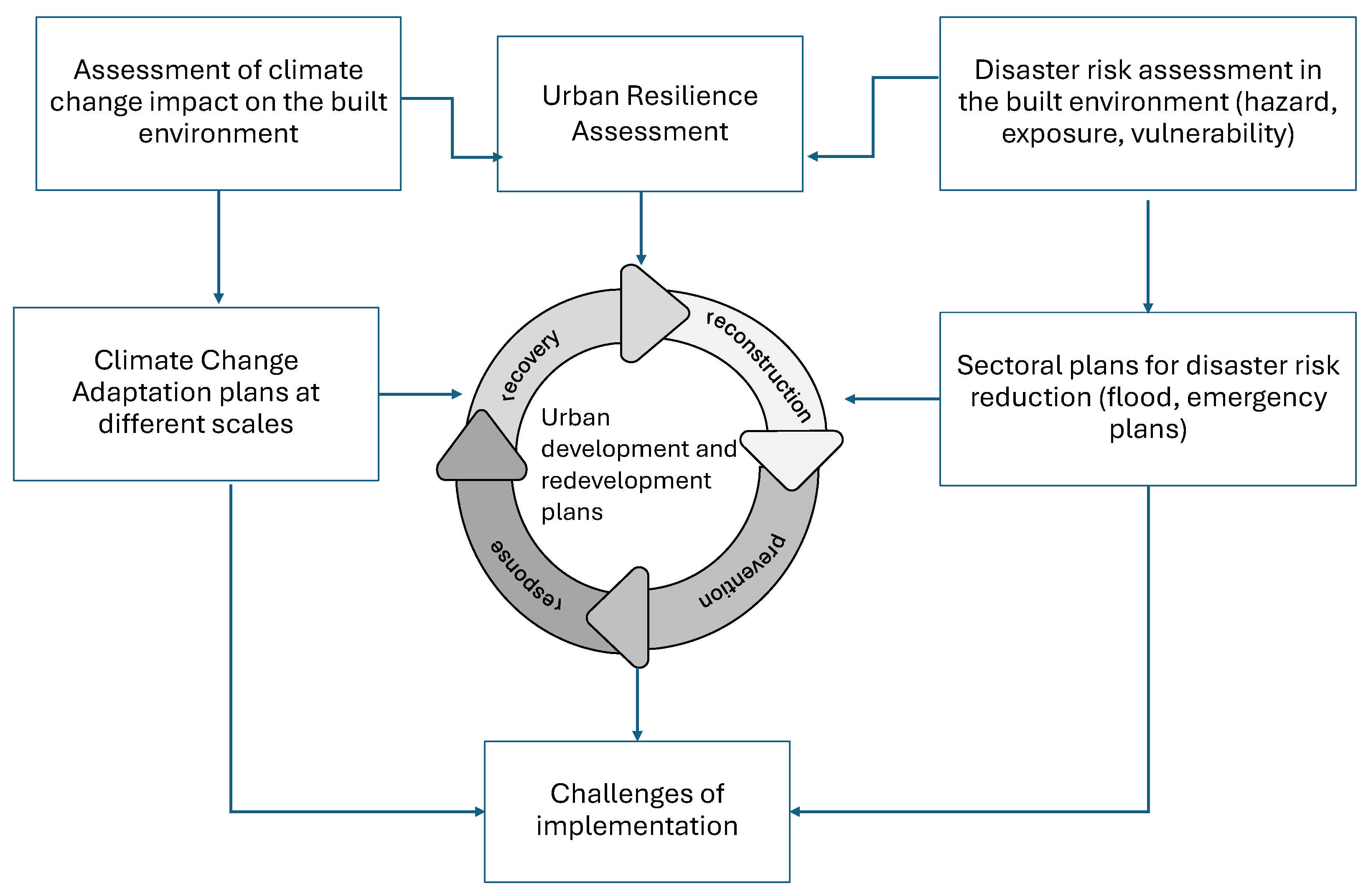
Figure 2.
Managing land ownership and tenure arrangements explicitly for DRR and CCA.
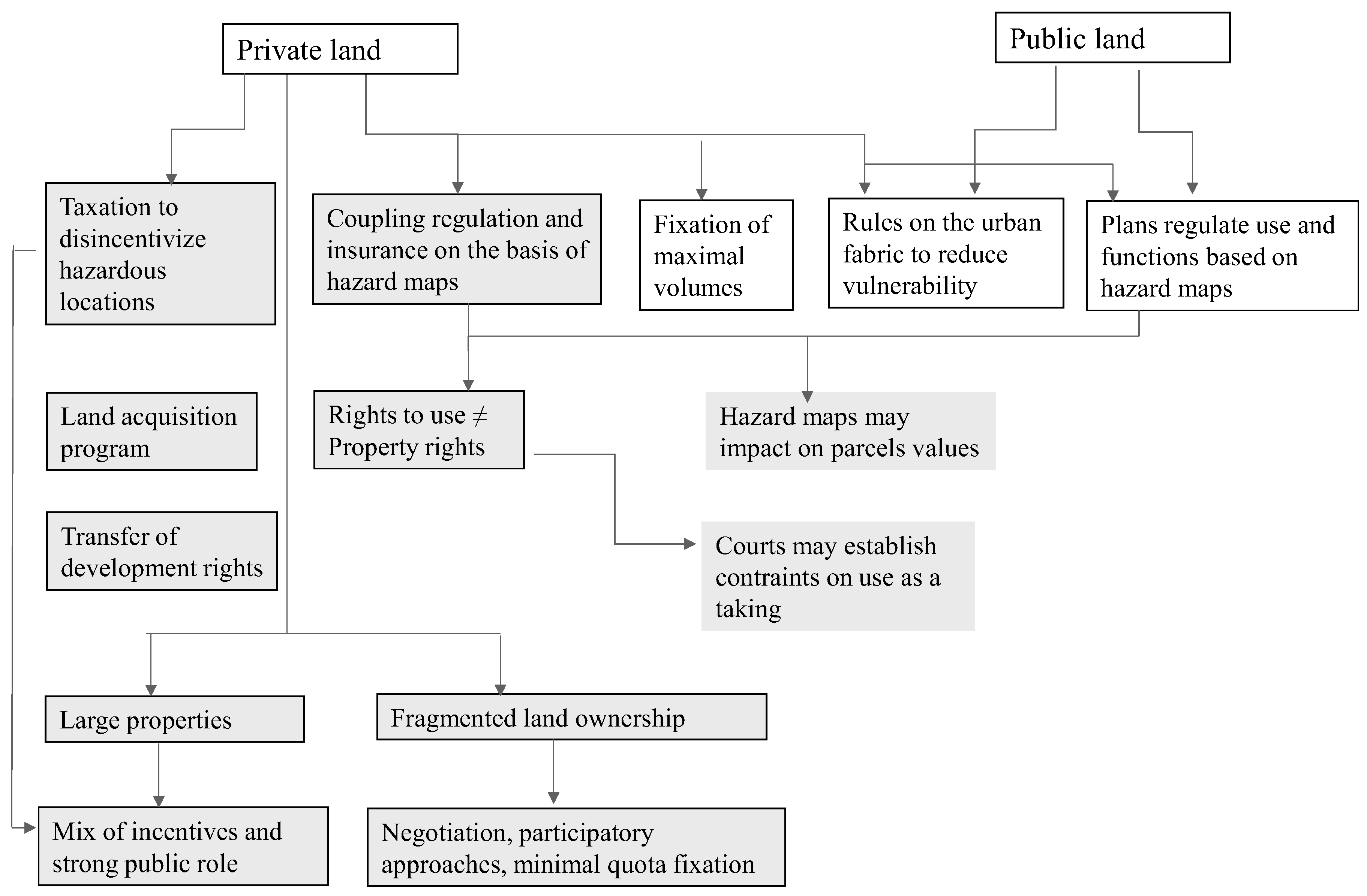
Figure 3.
Risk and climate adaptation governance framework.
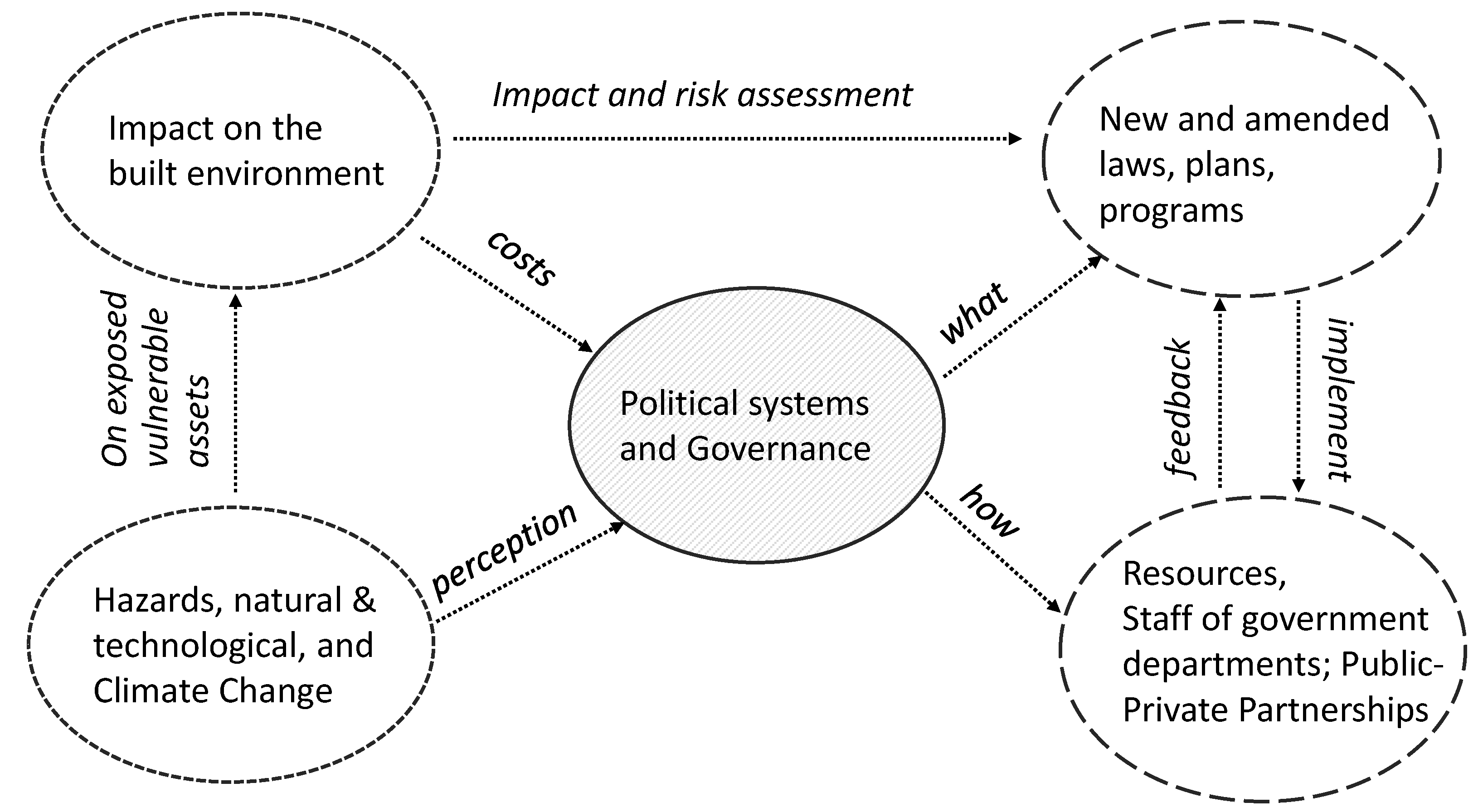
Table 2.
Choices made for the review according to the taxonomy by Cooper (1998).
| Characteristics of the review | Categories |
| Focus | Practices or applications (to urban planning) |
| Goal | Identification of central issues (according to the proposed framing) |
| Pespective | Espousal of a position |
| Coverage | Central or Pivotal (considering the authoritative references) |
| Organisation | Conceptual |
| Audience | Scholars (urban planners and experts in disaster and climate change studies), practitioners, and policy makers |
Disclaimer/Publisher’s Note: The statements, opinions and data contained in all publications are solely those of the individual author(s) and contributor(s) and not of MDPI and/or the editor(s). MDPI and/or the editor(s) disclaim responsibility for any injury to people or property resulting from any ideas, methods, instructions or products referred to in the content. |
© 2025 by the authors. Licensee MDPI, Basel, Switzerland. This article is an open access article distributed under the terms and conditions of the Creative Commons Attribution (CC BY) license (http://creativecommons.org/licenses/by/4.0/).
Copyright: This open access article is published under a Creative Commons CC BY 4.0 license, which permit the free download, distribution, and reuse, provided that the author and preprint are cited in any reuse.


