
Submitted:
23 July 2025
Posted:
28 July 2025
You are already at the latest version
Abstract
This study focuses on the development and characterization of an antimicrobial dental gel using natural ingredients, including neem extract, clove oil, honey, and vitamin E. Three gel formulations (F1, F2, and F3) were prepared with varying concentrations of these ingredients and evaluated for their antimicrobial activity, pH, viscosity, spreadability, and skin irritation potential. The results showed that all formulations exhibited antimicrobial activity against Streptococcus mutans, with F3 demonstrating the most significant activity. F3 had a pH of 7.0, viscosity of 9632 cps, and spreadability of 26.08. The study suggests that the F3 formulation holds potential for development as a natural, plant-based oral gel for managing and preventing oral infections.
Keywords:
neem extract
; clove oil
; antimicrobial dental gel
; natural oral care
; streptococcus mutans
; oral infections
; herbal formulation
1. Introduction
Oral health remains a critical component of general well-being, yet a significant portion of the global population continues to suffer from common dental conditions such as dental caries, gingivitis, and the accumulation of hard calculus. These conditions, if left untreated, can lead to more serious systemic health issues and a decline in quality of life. Conventional treatment options, while effective, may be limited by issues such as patient compliance, side effects, or lack of accessibility in underserved areas [1]. In recent years, there has been growing interest in the use of natural agents for the prevention and treatment of oral diseases. Among these, neem (Azadirachta indica) and clove oil, which contains the active compound eugenol, have demonstrated notable antibacterial, anti-inflammatory, and analgesic properties. Neem, traditionally used in Ayurvedic medicine, has been shown to inhibit the growth of various oral pathogens and reduce plaque formation. Similarly, clove oil is well-documented for its effectiveness against oral bacteria and its ability to reduce pain and inflammation [2] Additionally, natural substances such as honey and vitamin E have garnered attention for their roles in wound healing and tissue regeneration. Honey exhibits antimicrobial properties and promotes the healing of mucosal tissues, while vitamin E acts as a powerful antioxidant, protecting oral tissues from oxidative stress and supporting epithelial regeneration. The use of Carbopol, a mucoadhesive polymer, offers a promising delivery system for these active ingredients. Carbopol-based gels can adhere to the mucosal surfaces of the oral cavity, allowing for prolonged contact time, sustained release of therapeutic agents, and improved patient compliance. This research aims to formulate and evaluate three mucoadhesive gel prototypes, each containing varying concentrations of neem extract, clove oil, honey, and vitamin E. By analyzing parameters such as antibacterial efficacy, mucoadhesive strength, pH stability, and user acceptability, the study seeks to identify the most effective formulation for potential use in the prevention and management of common oral health conditions [3].
1.1. Key Herbal Ingredients
1.1.1. Neem (Azadirachta indica)
- Common Names: Neem, Indian Lilac, Margosa Tree.
- Botanical Source: Obtained from dried leaves and bark of Azadirachta indica.
- Family: Meliaceae.
-
Ecology and Habitat:
- ○
- Climate: Tropical to subtropical; drought-resistant.
- ○
- Soil: Well-drained sandy or loamy soils.
- ○
- Tolerance: Poor, dry, and rocky soils.
-
Plant Description:
- ○
- Type: Evergreen tree.
- ○
- Height: Typically grows 15–20 meters tall, can reach up to 35–40 meters in ideal conditions.
- ○
- Leaves: Pinnate leaves with 8–19 leaflets, bright green, serrated edges.
- ○
- Flowers: Small, white, fragrant flowers in clusters.
- ○
- Fruit: Smooth, olive-like drupe; green when unripe and yellow when mature [4].
- Preparation and Dental Application: Azadirachta indica was collected in Kale plant center, Nagpur and identified by Prof. Acharya Botany Dep., Wardha. RTMNU, Nagpur. Neem bark extract is used in dental gels due to its strong antibacterial and anti-inflammatory effects. The process begins by cleaning, drying, and grinding the bark into a fine powder. This powder is then subjected to solvent extraction—commonly with ethanol, methanol, or water—to draw out beneficial compounds such as nimbin and nimbidin. Once filtered and concentrated by removing the solvent, the extract is incorporated into dental gel formulations. Its inclusion helps fight harmful oral microbes, soothe gum irritation, and promote better oral health.
1.1.2. Clove Oil (Eugenia caryophyllata)
- Common Name: Clove Oil.
- Botanical Source: Obtained from dried flower buds of Eugenia caryophyllata.
- Family: Myrtaceae.
- Oil Extraction Method: Steam distillation.
- Part Used for Oil Extraction: Dried flower buds, leaves, and stems are used.
- Major Constituents of Clove Oil: Eugenol (70–90%) – primary active compound, Eugenyl acetate, Caryophyllene, Humulene.
- Aroma: Strong, spicy, warm, and woody scent.
- Plant Description: Clove is a medium-sized evergreen tree that grows up to 8–12 meters tall. It has large green leaves and clusters of aromatic flower buds that start pale, then turn green, and finally develop into a bright red when ready for harvesting [5].
- Medicinal Properties and Dental Application: Clove oil, primarily composed of the active compound eugenol, is widely used in dental care due to its potent analgesic, anti-inflammatory, and antimicrobial properties. When incorporated into dental gels, clove oil offers several therapeutic benefits including pain relief, antibacterial effects, and anti-inflammatory effects [6].
2. Materials and Methods
2.1. Preparation of Gel Formulations
Carbopol 940 gel was prepared by soaking Carbopol 940 in water and neutralizing with triethanolamine to pH 6.0. Weighed amounts of methyl and propyl paraben were added to the water prior to the addition of Carbopol 940. In another beaker, the required quantity of propylene glycol was taken, to which accurately measured amounts of neem extract and clove extract, corresponding to their Minimum Inhibitory Concentrations (MICs), was incorporated. This mixture was then added to the beaker containing Carbopol 940 with continuous stirring until a homogenous product was formed. The volume was made up with distilled water and stirring was done vigorously. All the prepared gels were then subjected to evaluation tests in order to select the best formulation. The composition of different gel formulations is listed in Table 1 [7].
2.2. Evaluation of Formulated Gel
Gels were evaluated for their clarity, pH, viscosity, spreadability, skin irritation, and antimicrobial studies using standard procedures. All studies were carried out in triplicate, and average values were reported [8].
2.2.1. Physical Stability
Gels were inspected visually for their color, homogeneity, consistency, and spreadability [9].
2.2.2. pH Measurement
pH values of 1% aqueous solutions of the prepared gels were measured by a pH meter [10].
2.2.3. Spreadability
For the determination of spreadability, an excess of sample was applied between two glass slides and compressed to uniform thickness by placing a 1 kg weight for 5 minutes. A weight (50 g) was then added to the pan. The time in which the upper glass slide moves over the lower plate was taken as a measure of spreadability [11].
The spreadability (S) was calculated using the formula: S = (M \times L) / T Where:
- S = Spreadability
- M = Mass attached with the slide
- L = Length moved by the glass slide
- T = Time required to travel a distance by the slid
2.2.4. Homogeneity
All developed gels were tested for homogeneity by visual inspection after the gels had set in the container for their appearance and presence of any aggregate [12].
2.2.5. Extrudability Study
The force required to extrude the material from the tube was measured. Extrudability was based upon the quantity in percentage of gel and gel extruded from a lacquered aluminium collapsible tube on application of weight in grams required to extrude at least a 0.5 cm ribbon of gel in 10 seconds [13].
2.2.6. Content Uniformity
Drug content of the gel was determined by dissolving accurately weighed 1 gm of gels in Methanol. After suitable dilution, absorbance was recorded using a UV-visible spectrophotometer (UV – 1700, Shimadzu, Japan) at 222 nm. Drug content was determined using the slope of a standard curve [14].
2.2.7. Viscosity Measurement
The viscosity of the different gel formulations was determined at 25^\circ \text{C} using a cone and plate viscometer [15].
3. Antimicrobial Assay
3.1. Bacterial Strain and Maintenance
The bacterial strain used in this study was the Gram-positive bacterium Streptococcus mutans. Bacterial strains were grown and maintained on nutrient agar slants, then stored at 4^\circ \text{C}. Test strains were prepared and tested against the extracts for estimating the minimum inhibitory concentration (MIC) [16].
3.2. Well Diffusion Method
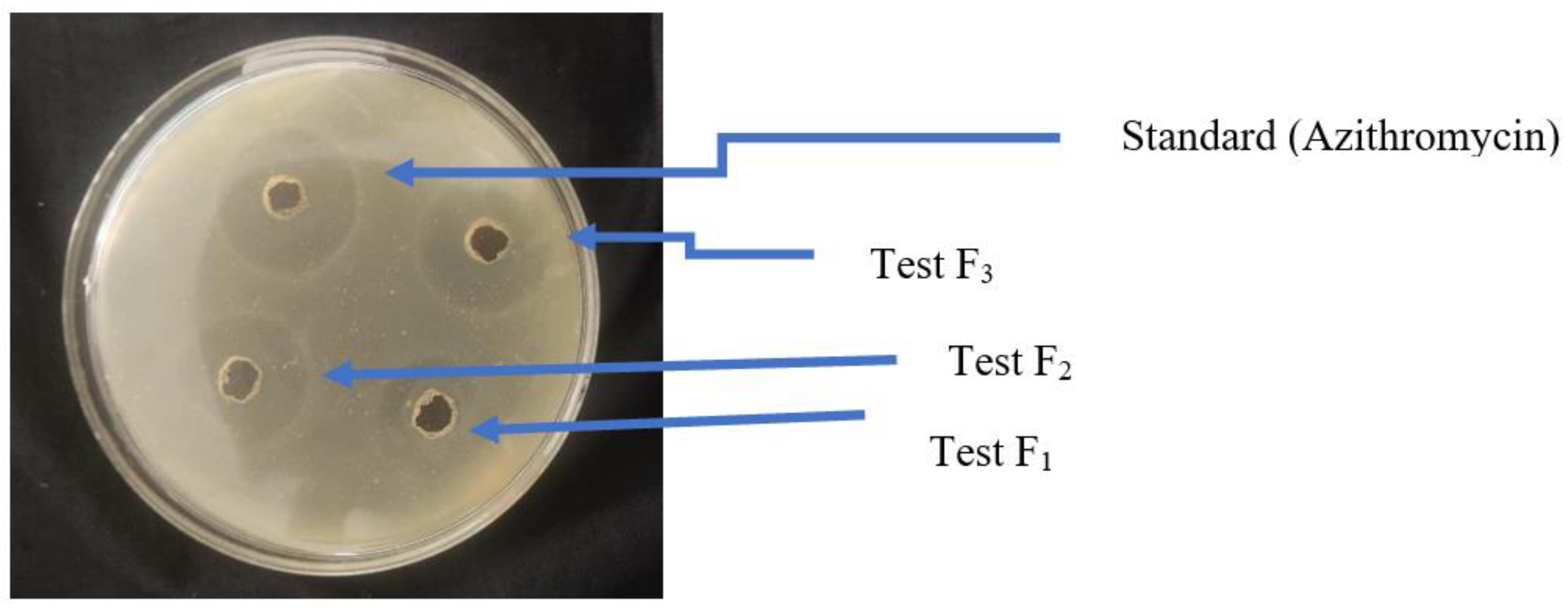
An agar well diffusion method was used to evaluate antimicrobial activity against Streptococcus mutans. Wells measuring 6 mm in diameter were created, and the plates were incubated at 37^\circ \text{C} for 24 hours. The diameters of the resulting inhibition zones were recorded in millimeters to assess antibacterial effectiveness [17,18].
Zone of Inhibition
The zone of inhibition is a clear, circular area that appears around an antimicrobial agent (such as an antibiotic disc) placed on an agar plate inoculated with bacteria. It indicates how effectively the agent inhibits bacterial growth. Antimicrobial activity of the formulations was evaluated by measuring the zones of inhibition against Streptococcus mutans [19].
Figure 1.
Zone of Inhibition.
3.3. Determination of MIC (Minimum Inhibitory Concentration)
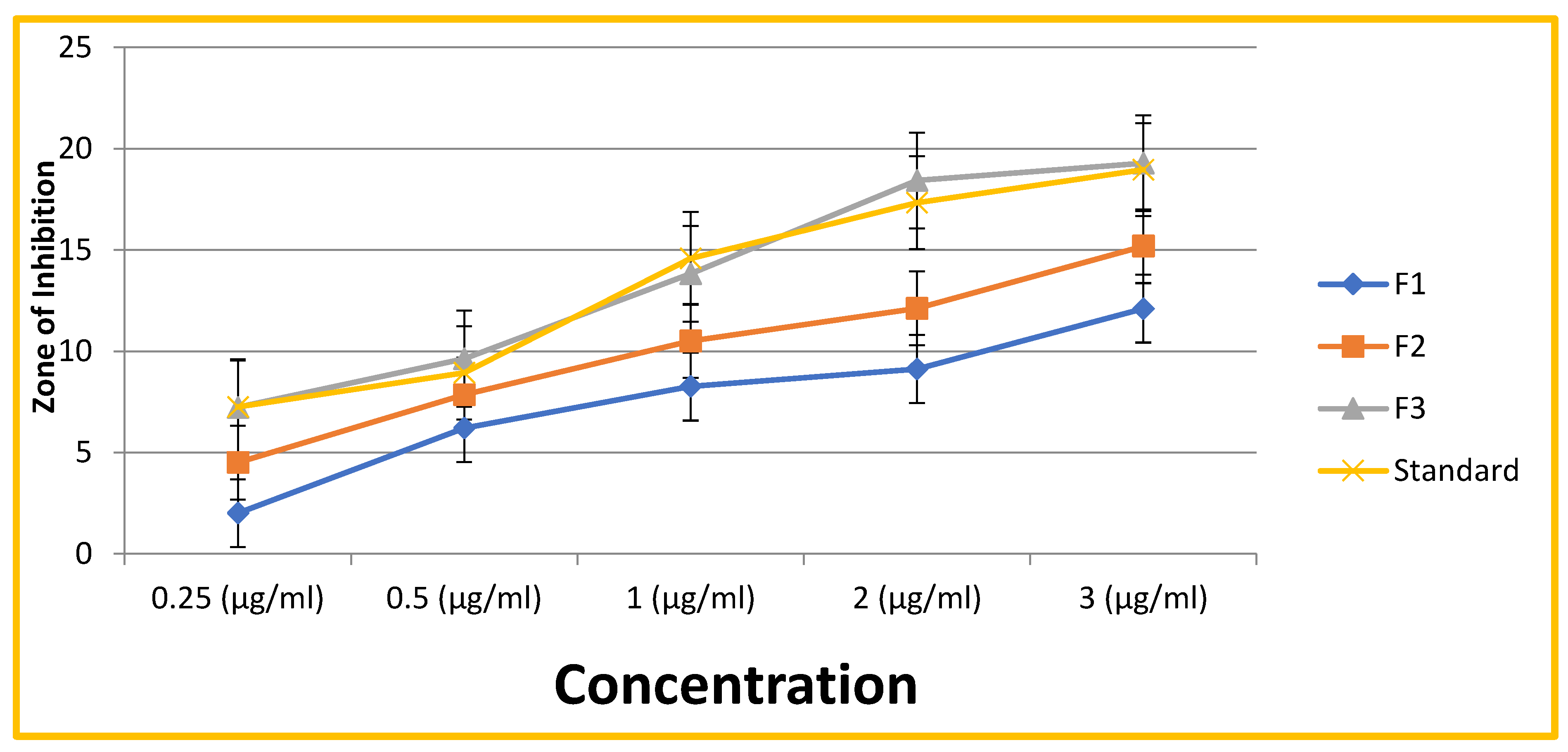
A cup plate method was used to calculate the MIC. Serial dilutions (0.25, 0.5, 1, 2, 3 mg/ml) of extracts were prepared directly in a plate containing MH agar. The bacterial inoculum was added to get a final concentration of 5 \times 10^5 \text {CFU/ML} in each well. Azithromycin was utilized as a standard drug at final concentrations of 0.126-129 mg/ml. The petri dish was incubated for 24 hours at room temperature for 37^\circ \text{C}. The MIC was shown as the minimum concentration of gel that completely inhibited bacterial growth after 24-48 hours [20].

Table 2.
Minimum Inhibitory Concentration (MIC) of Formulations against Streptococcus mutans.
| Formulation | Different Concentrations (µg/ml) | ||||
| Concentration | 0.25 (µg/ml) | 0.5 (µg/ml) | 1 (µg/ml) | 2 (µg/ml) | 3 (µg/ml) |
| F1 | 2.00±0.22 | 6.21±0.56 | 8.25±0.46 | 9.12±0.98 | 12.10±0.50 |
| F2 | 4.52±0.25 | 7.85±1.85 | 10.50±1.52 | 12.11±0.82 | 15.18±0.45 |
| F3 | 7.23±0.55 | 9.63±0.61 | 13.82±0.44 | 18.42±0.66 | 19.28±1.75 |
| Standard | 7.25± 0.21 | 8.93±0.50 | 14.58±0.71 | 17.33±0.51 | 18.96±0.84 |
Figure 2.
Graph for Zone of Inhibition/Concentration.
4. Results & Discussion
The evaluation of the formulated gels yielded the following results, as summarized in Table 3.
5. Discussion
- pH: Formulations F2 and F3 showed a neutral pH of 7.0, which is generally considered suitable for oral application, minimizing irritation to oral tissues. F1 had a slightly acidic pH of 6.0.
- Appearance and Odor: F1 and F2 were slightly opaque, while F3 had a brownish appearance, likely due to the higher concentration of herbal extracts. The odor increased from mild in F1 to strong in F3, correlating with the increased herbal content.
- Spreadability: F3 demonstrated significantly higher spreadability (26.08 gms.cm/sec) compared to F1 and F2, indicating better applicability and ease of use. This is crucial for a dental gel to ensure proper coverage of oral surfaces.
- Viscosity: F3 exhibited the highest viscosity (9632 cps), which is consistent with its enhanced spreadability. An optimal viscosity is important for retaining the gel at the site of application and allowing for sustained release of active ingredients.
- Skin Irritation: All three formulations were found to be non-irritant, suggesting they are safe for topical application on oral mucosal membranes.
- Extrudability: F3 showed the best Extrudability (+++), indicating it can be easily dispensed from a tube, which is a key factor for user convenience.
- Antimicrobial Activity: All formulations exhibited antimicrobial activity against Streptococcus mutans. Crucially, F3 demonstrated the most significant antimicrobial activity, aligning with its higher concentrations of neem extract and clove oil. This superior efficacy is further supported by the MIC data presented in Table 2, where F3 showed the lowest MIC values across various concentrations, indicating its greater potency in inhibiting bacterial growth compared to F1, F2, and even the standard drug at some concentrations. The synergistic effects of neem, clove oil, honey, and vitamin E likely contribute to the enhanced performance of F3.
6. Summary
This study developed and evaluated three antimicrobial dental gel formulations (F1, F2, and F3) using natural ingredients like neem extract, clove oil, honey, and vitamin E. The formulations were tested for their antimicrobial activity, pH, viscosity, spreadability, and skin irritation potential. The results showed that all formulations exhibited antimicrobial activity, with F3 demonstrating the most significant activity against Streptococcus mutans. The study suggests that F3 has potential as a natural oral gel for managing and preventing oral infections, warranting further research and development.
7. Conclusions
The F3 formulation, containing the highest concentration of neem extract, clove oil, and honey, exhibited the most potent antimicrobial activity without compromising physicochemical properties. The synergistic effects of the natural ingredients likely contributed to its improved performance against common oral pathogens. The promising results suggest that F3 holds significant potential for development as a natural oral gel for managing and preventing oral infections. Further studies, including in vivo evaluations and long-term stability assessments, are warranted to explore its therapeutic effectiveness and safety profile.
References
- Dörfer C, Benz C, Aida J, Campard G. The relationship of oral health with general health and NCDs: a brief review. International dental journal. 2017 Oct; 67:14-8.
- Alzohairy, MA. Therapeutics role of Azadirachta indica (Neem) and their active constituents in diseases prevention and treatment. Evidence-Based Complementary and Alternative Medicine. 2016;2016 (1):7382506.
- Tashkandi, H. Honey in wound healing: An updated review. Open life sciences. 2021 Oct 6;16(1):1091-100.
- Biswas K, Chattopadhyay I, Banerjee RK, Bandyopadhyay U. Biological activities and medicinal properties of neem (Azadirachta indica). Current science. 2002 Jun 10:1336-45.
- Haro-González JN, Castillo-Herrera GA, Martínez-Velázquez M, Espinosa-Andrews H. Clove essential oil (Syzygium aromaticum L. Myrtaceae): Extraction, chemical composition, food applications, and essential bioactivity for human health. Molecules. 2021 Oct 22;26(21):6387.
- Dhakad AK, Kumar R, Choudhary R, Singh S, Khan S, Poonia PK. Traditional to modern perspectives on Neem (Azadirachta indica): A gateway to bioactive compounds, sustainable agrochemicals and industrial applications. Industrial Crops and Products. 2025 Sep 1;231:121155.
- Voleti VK, Shaik SB, Konduru C, Peyam S, Yaramsetti CK, Pasala S, Pitchaimuthu SP. Formulation and development of dental gel containing clove oil for the treatment of human periodontal diseases. J Com pr Pharm. 2016;3:1-7.
- Raj PG, Ranjeetha AR, Aishwarya KS, Ananya MS, Anjana NK. Formulation And Evaluation Of Topical Gel Containing Econazole Nitrate. IJP. 2024;11(11):636-40.
- Dantas MG, Reis SA, Damasceno CM, Rolim LA, Rolim-Neto PJ, Carvalho FO, Quintans-Junior LJ, Almeida JR. Development and evaluation of stability of a gel formulation containing the monoterpene borneol. The Scientific World Journal. 2016;2016(1):7394685.
- Traynor B, Uvegi H, Olivetti E, Lothenbach B, Myers RJ. Methodology for pH measurement in high alkali cementitious systems. Cement and Concrete Research. 2020 Sep 1;135:106122.
- Raj PG, Ranjeetha AR, Aishwarya KS, Ananya MS, Anjana NK. Formulation And Evaluation Of Topical Gel Containing Econazole Nitrate. IJP. 2024;11(11):636-40.
- Patel H, Panchal MS, Shah S, Vadalia KR. Formulation and evaluation of transdermal gel of sildenafil citrate. Int J Pharm Res Allied Sci. 2012 Mar 5;1(3):103-8.
- Raj PG, Ranjeetha AR, Aishwarya KS, Ananya MS, Anjana NK. Formulation And Evaluation Of Topical Gel Containing Econazole Nitrate. IJP. 2024;11(11):636-40.
- Nematpour N, Moradipour P, Zangeneh MM, Arkan E, Abdoli M, Behbood L. The application of nanomaterial science in the formulation a novel antibiotic: Assessment of the antifungal properties of mucoadhesive clotrimazole loaded nanofiber versus vaginal films. Materials Science and Engineering: C. 2020 May 1; 110:110635.
- Panwar A, Upadhyay N, Bairagi M, Gujar S, Darwhekar G, Jain D. Emulgel: A review. Asian J Pharm Life Sci. 2011;2231:4423.
- Abdelkader HS, Alayafi AA, Ahmed HE, Bin Osail RA. The antibacterial activity of nanosilver coupled edible plant extracts against Streptococcus mutans, the cause of dental caries. J. Pharm. Res. Int. 2021;33:167-86.
- Finn, RK. Theory of agar diffusion methods for bioassay. Analytical Chemistry. 1959 Jun 1;31(6):975-7.
- Schantz EJ, Lauffer MA. Diffusion measurements in agar gel. Biochemistry. 1962 Jul 1;1(4):658-63.
- Hossain TJ. Methods for screening and evaluation of antimicrobial activity: A review of protocols, advantages, and limitations. European Journal of Microbiology and Immunology. 2024 May 14;14(2):97-115.
- Barnes L, Heithoff DM, Mahan SP, House JK, Mahan MJ. Antimicrobial susceptibility testing to evaluate minimum inhibitory concentration values of clinically relevant antibiotics. STAR protocols. 2023 Sep 15;4(3):102512.
Table 1.
Composition of Different Gel Formulations.
| Sr. No | Ingredients | Functions | F1 | F2 | F3 |
| 1. | Carbopol 940 | Gelling agent | 4.0 | 4.0 | 4.0 |
| 2. | Neem extract | Antibacterial | 2.0 | 3.5 | 5.0 |
| 3. | Clove oil | Analgesic, Antiseptic | 0.5 | 0.75 | 1.0 |
| 4. | Peppermint oil | Flavour, mild antiseptic | 0.25 | 0.30 | 0.50 |
| 5. | Honey | Healing, Humectant | 2.0 | 3.5 | 5.0 |
| 6. | Vitamin E oil | Antioxidant | 0.5 | 0.5 | 0.5 |
| 7. | Propylene glycol | Humectant, Solvent | 10.0 | 10.0 | 10.0 |
| 8. | Triethanolamine | pH adjuster | - | - | - |
| 9. | Methyl Paraben | Preservative | 0.1 g | 0.1 g | 0.1 g |
Table 3.
Evaluation Parameters of Formulated Gels.
| FORMULATION | CLARITY | pH | SPREADABILITY (gms.cm/sec)* | VISCOSITY (cps) | SKIN IRRITATION | EXTRDURABILITY | ANTIMICROBIAL ACTIVITY |
| F1 | ++ | 6.0 | 20.66 ±0.1159 | 7954 | NI | ++ | Shows Antimicrobial Activity |
| F2 | ++ | 7.0 | 20.01 ±0.0152 | 8122 | NI | ++ | Shows Antimicrobial Activity |
| F3 | +++ | 7.0 | 26.08 ±0.0152 | 9632 | NI | +++ | Shows Most Significant Antimicrobial activity |
Disclaimer/Publisher’s Note: The statements, opinions and data contained in all publications are solely those of the individual author(s) and contributor(s) and not of MDPI and/or the editor(s). MDPI and/or the editor(s) disclaim responsibility for any injury to people or property resulting from any ideas, methods, instructions or products referred to in the content. |
© 2025 by the authors. Licensee MDPI, Basel, Switzerland. This article is an open access article distributed under the terms and conditions of the Creative Commons Attribution (CC BY) license (http://creativecommons.org/licenses/by/4.0/).
Copyright: This open access article is published under a Creative Commons CC BY 4.0 license, which permit the free download, distribution, and reuse, provided that the author and preprint are cited in any reuse.


