

Submitted:
26 July 2025
Posted:
28 July 2025
You are already at the latest version
Abstract
Against the backdrop of intensifying global strategic competition, structural imbalances in youth employment, and deep-seated demographic transitions, China's current overseas study policies have exposed significant issues such as structural mismatches and misaligned policy directions. This paper centres on the concept of a ‘strategic dual-track overseas study system,’ aiming to reconfigure China's overseas study policies to simultaneously serve the ‘Belt and Road’ national cooperation initiative and alleviate domestic structural employment pressures. It proposes a systemic reform framework that elevates the educational function to a national strategic tool. The study employs structural modelling and system dynamics methods to construct a causal feedback model of the ‘externalised population and employment relief mechanism,’ integrating game theory structures with population policy pathways to analyse the strategic relief effects and technology introduction synergy pathways under the dual-track orientation. Through policy simulation, this paper estimates that if 300,000 to 500,000 young students are sent to Belt and Road countries annually, and a 50% to 60% settlement rate is achieved with policy support, it is expected that 150,000 to 250,000 people facing employment pressure can be effectively alleviated annually. In the long term, through the closed-loop pathway of study abroad, employment, and settlement, a distributed Chinese international talent network can be formed to support overseas investment, cultural dissemination, and the expansion of geopolitical influence. The research findings indicate that ‘strategic study abroad’ can serve as a systemic regulator to mitigate youth employment crises, optimise talent structures, and enhance national soft power, significantly enhancing the geopolitical resilience of policies and the external carrying capacity of population distribution. The conclusion states that only by embedding study abroad policies into the national macro-development strategic framework and establishing a long-term mechanism driven by the interplay of ‘education-population-geopolitics’ can the dual transformation of the national globalisation strategy be achieved: internally alleviating employment structural pressures and externally expanding soft strategic influence.
Keywords:
strategic study abroad
; structural employment
; Belt and Road Initiative cooperation
; population outflow mechanism
I. Background and Issues Background and Issues
Against the backdrop of intensifying strategic competition between the United States and China, rapid demographic transition and youth employment conflicts, China faces a serious structural human resource mismatch (WangLu & Mendoza, 2022). Although China sends a large number of international students to developed countries, the study abroad system dominated by the QS World University Rankings has led to a concentration of students applying to English-speaking countries such as the United States, the United Kingdom, Canada, and Australia, resulting in a trend of “inward spiralling of study abroad resources” and a concentration of destinations (Marginson, 2008). At the same time, applicants rely on popular majors such as finance, business, and media, and ignore the talent structures that are urgently needed by countries along the Belt and Road (e.g., infrastructure engineering, regional studies, agricultural economics, transnational legal affairs, and language and culture), resulting in a serious disconnect between the structure of study abroad and the country’s strategic needs. This policy orientation not only wastes educational resources and financial investment, but also weakens China’s ability to build economic and trade influence and cultural networks in the Belt and Road countries, and even fails to alleviate the increasing employment pressure on young people (Marginson & Rhoades, 2002). Continuing to neglect the strategically oriented study abroad system will become a “neglected variable” in China’s structural employment and industrial transformation in the era of globalisation (Marginson, 2008). Therefore, there is an urgent need to reconstruct a dual-orientation study abroad model that is compatible with “learning advanced science and technology” and “serving the strategic needs of the country”.
II. The Need for and Dual Objectives of Strategic Reconfiguration
China is in a key strategic window period of international competition among great powers and deep demographic adjustment, and the current foreign study policy needs to undertake a “double national mission”. On the one hand, it should continue to introduce advanced scientific and technological systems, institutional governance experience and high-end talents from developed countries to support innovation; on the other hand, it should focus on the countries along the “Belt and Road”, and build a network of composite talents covering the global economic and trade nodes through the systematic dispatch of international students to carry out educational cooperation and talent construction, so as to provide support for the country’s economic and trade co-operation, cultural dissemination and employment pressure relief (Altbach, Reisberg, & Rumbley, 2009; UNESCO, 2016). However, China’s current policy is too heavily oriented towards the former, i.e., the “technology-introducing study abroad orientation”, while neglecting the important goal of the “strategy-reducing study abroad pathway”, which is designed to serve the Belt and Road strategy and to cushion the pressure of employment on the country’s youth (see Box 1). “This policy deviation has led to the development of China’s study abroad resources. This policy deviation has made it difficult for China’s study abroad resources to effectively meet the needs of countries along the “Belt and Road” in terms of infrastructure, official language, business rules, etc., thus weakening China’s ability to extend its capital and cultural influence globally (UNESCO, 2021). Therefore, the construction of a “dual-track” study abroad strategy system - that is, a composite study abroad model that takes into account the introduction of technology and the strategic layout of the country - is not only a new direction for the internationalisation of Chinese higher education in the new era, but also a new direction for the regulation of the national employment structure. Therefore, building a “dual-track” study abroad strategy system - i.e., a composite study abroad model that takes into account technology introduction and national strategic layout - is not only a new direction for the internationalisation of Chinese higher education in the new era, but also an important policy tool for the adjustment of the national employment structure and the strategic layout of global talents.

Table 1.
China’s future study abroad policy should take on a “dual national mission”.
| Objective 1 | Objective 2 |
| Learning advanced science and technology and systems from developed countries, serving the independent development of national high-end technology | Expanding the layout of international students to the “Belt and Road” countries, forming a talent network and strategic evacuation path to support global economic, trade, cultural and diplomatic cooperation. |
Illustrated by the author.
Current policy is highly biased in favour of Goal 1, while Goal 2 should be the focus of the national strategic layout for the next decade.
III. Strategic Concept: Building a “New Dual-Track Study Abroad System” to Serve the Country’s External Layout and Internal Diversion
In order to break away from the single educational function of the current study abroad policy, China must build a “dual-track study abroad system” (Altbach et al., 2020) that takes into account both the cultivation of internationalised talents and national strategic positioning. The system proposes to take the countries along the Belt and Road as the core nodes to establish a “strategic mechanism for externalised population and employment mitigation”, whose key functions include: firstly, through the systematic dispatch of young students abroad, to alleviate the structural pressure on employment in China, especially the phenomenon of the surplus of young men (ILO) and the surplus of young women (ILO); and secondly, to provide a mechanism for the development of an international education system. Firstly, by systematically sending young students abroad, it can alleviate the structural employment pressure in the country, especially the surplus of young men (ILO, 2023). Second, to create a hybrid “local + international student” manpower network in Asia, the Middle East, Africa and Latin America to facilitate cultural adaptation and localisation of trade and economic collaboration. Thirdly, cultivate international talents who master international business rules, local institutional environments, and linguistic and cultural skills to provide manpower support for Chinese companies’ overseas investment and cultural dissemination (arXiv, 2024). Finally, this model will become an important component of China’s soft geo-strategy, complementing the country’s diplomacy and economic and trade layout through the civilian influence of international students (PubMed Central, 2021).
Table 2.
Two-Track Comparison Structure.
| module (in software) | Technology introduction track (traditionally oriented) | Strategic Deconstruction Track (New Orientation) |
| Core countries | USA, UK, Germany, Japan, etc. | Belt and Road countries (Indonesia, Pakistan, Egypt, etc.) |
| Subject focus | High Tech, AI, Finance, Management | Engineering and construction, legal language, cultural communication, trade regime |
| strategic function | Service high-end science and technology strategy, independent innovation capacity | Easing domestic employment, building international talent networks, and feeding diplomacy and trade and commerce |
| major group | Highly educated researchers | Youth over-employment groups, international students in vocational education |
| Policy support mechanisms | Research Fund, Green Card, Talent Introduction Programme | Settlement Incentives, Overseas Practical Training, Regional Scholarships, Marriage and Family Settlement Support |
Illustrated by the author.
Figure 1.
Structure of the Strategic Dual Study Abroad System. Illustrated by the author.
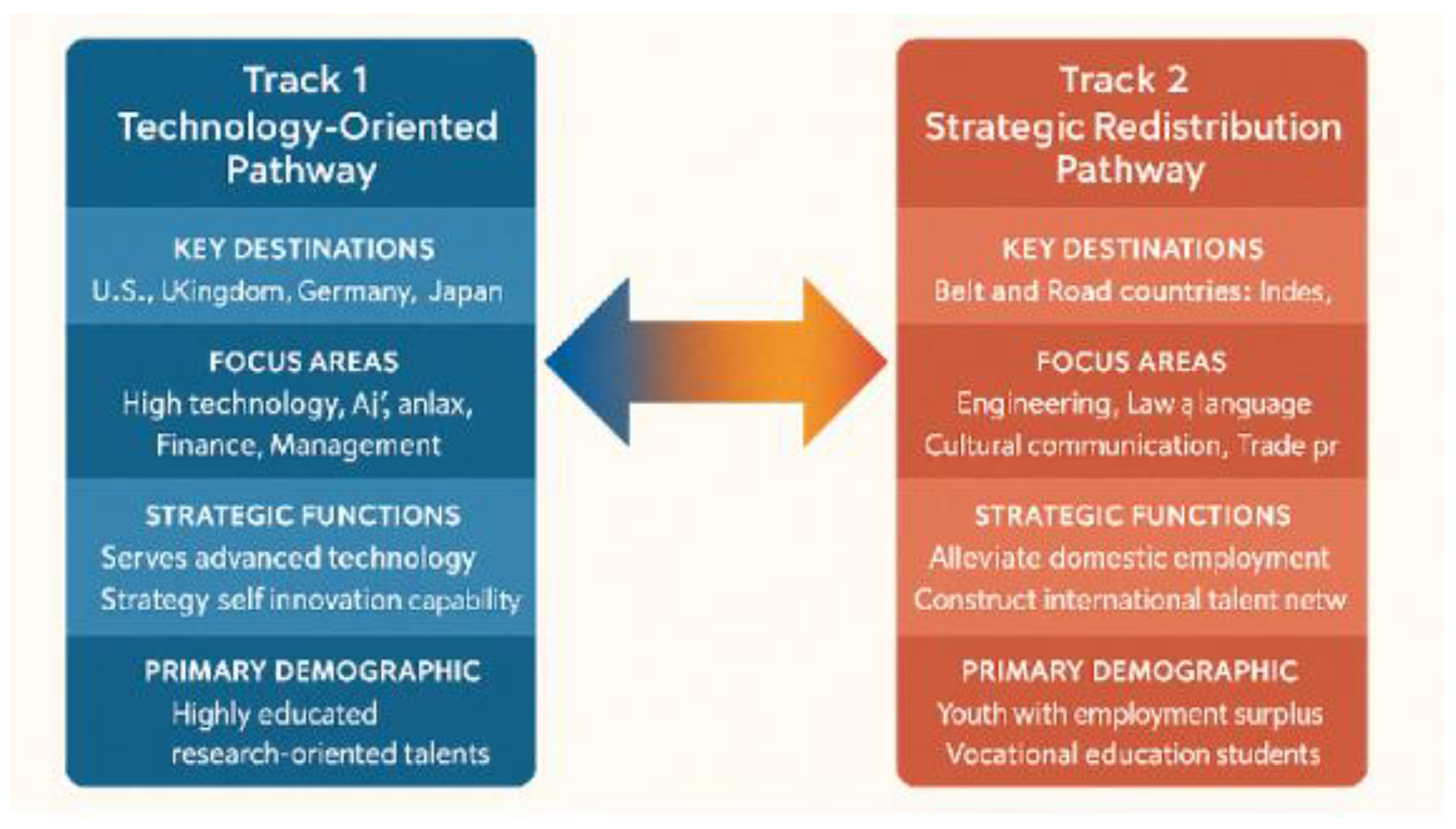
This map shows the “dual-track transformation architecture” of China’s future study abroad strategy, in response to the triple challenges of China-US strategic competition, structural contradictions in domestic youth employment, and the deepening of the “Belt and Road” international co-operation.
The left track “technology introduction oriented path” focuses on the higher education resources of developed countries, and selects and sends elite talents to the United States, Europe, Japan and other countries to learn the key core science and technology, engineering and institutional governance knowledge, and then supports the country’s high level of scientific and technological self-reliance and institutional innovation after returning to the United States. The fundamental goal is to break through “neck-breaking” technologies and construct an independent modernisation path.
The right track “strategic relief-oriented path” is based on the countries along the “Belt and Road”, and through the targeted export of young labourers, technical talents and cultural communicators, it forms a “study-employment-resettlement-integration” path. Through the targeted export of young labourers, technical talents and cultural communicators, it forms a strategic fulcrum of population spillover with “study-employment-resettlement-integration” as the core, eases the pressure of domestic employment, promotes the development of localized Chinese enterprises overseas, and at the same time constructs soft geo-influence networks and enhances the right to speak to the outside world.
The two tracks in the figure are parallel and mutually supportive, reflecting that the study abroad policy should not be limited to “education investment”, but should be transformed into a national strategic tool with geo-elasticity, demographic regulation and systemic spillover. The central axis of the structure emphasises the synergy between the two strategies, achieving the dual national mission of “scientific and technological self-improvement” and “global impact” in the cross-border flow of human capital.
This structure is not only a blueprint for education reform, but also a systematic project to rebalance the national strategy, with high policy adaptability, geo-executive power, and cross-generational demographic policy integration ability, which is suitable to be incorporated into the framework of the national strategic planning in the late stage of the 14th Five-Year Plan and the 15th Five-Year Plan. It is suitable for inclusion in the framework of the country’s late 14th Five-Year Plan and the 15th Five-Year Plan.
Figure 2.
Flowchart of externalised population and employment mitigation mechanism (causal feedback loop). Illustrated by the author.
Figure 2.
Flowchart of externalised population and employment mitigation mechanism (causal feedback loop). Illustrated by the author.
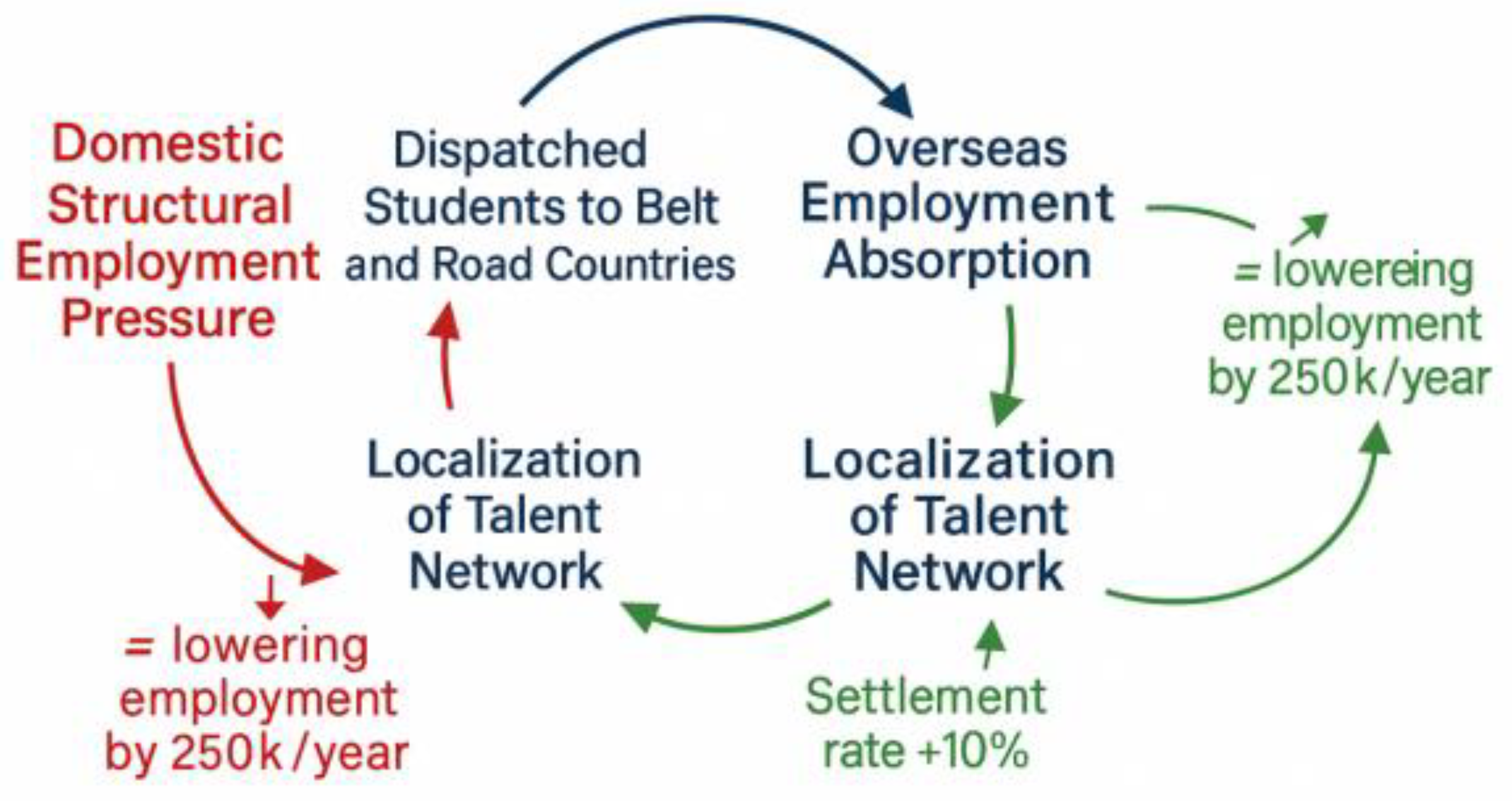
In order to effectively address the systemic problems faced by China, such as structural employment pressure on youth, uneven population distribution and insufficient global talent strategy, this paper proposes a feedback loop model based on system dynamics, “Externalised Population and Employment Mitigation Mechanism”. The model constructs a structural adjustment path at the national level in the form of a causal loop, forming a closed-loop system that starts from the employment pressure and works through the dispatch of overseas students, the absorption of overseas employment and the construction of the local talent network, and then flows back to regulate the pressure in the domestic society and the penetration of the international strategy.
The first main line of the mechanism takes “rising domestic employment pressure” as the initial input variable, and the government increases the proportion of international students dispatched to the “Belt and Road” countries through policy guidance, and then realises the function of employment absorption in the target countries. As the manpower capacity of the overseas market increases, it systematically feeds back into the domestic employment structure and alleviates the high incidence of youth unemployment. The second main line takes the increase in the settlement rate of international students as a linkage point, and promotes the formation of a hybrid talent network of “localisation + Chinese background” covering Asia, the Middle East, Africa and Latin America, which in turn supports the local operation and cross-cultural adaptability of Chinese-funded enterprises, and significantly improves the execution efficiency and risk-resistant ability of overseas investment projects. This network structure inversely supports the local operation landing and cross-cultural adaptation ability of Chinese enterprises, which significantly improves the execution efficiency and risk resistance of overseas investment projects.
At the same time, the country accumulates long-term strategic resources through cultural export and manpower penetration, thus enhancing its soft influence in key geopolitical regions, constructing a complementary channel for civil diplomacy, and achieving the strategic return path of “low cost-high viscosity-high spillover”. In terms of variable calculation, the model preliminarily estimates that “every 10% increase in the settlement rate can alleviate the employment pressure of about 250,000 people in China every year”; meanwhile, “the synergistic layout of overseas talent network and enterprises can improve the efficiency of project production by 15-20%”, showing that the mechanism has a significant impact on the development and development of the country’s economy. At the same time, “the synergistic layout of overseas talent network and enterprises can improve the efficiency of project production by 15-20%”, demonstrating the systematic value of the mechanism in the dual dimensions of population governance and diplomatic economy. The model not only provides a perspective of reconstructing “strategic study abroad” beyond the traditional education function, but also outlines the future path of China’s in-depth integration between population policy, education planning, employment governance and internationalisation layout, which is a systematic solution to solve the current structural social dilemma and a paradigm of national intellectual layout in the era of globalisation.
III. Modelling and Feasibility Analysis (Based on Model Integration)
Based on the integration of structural modelling and systematic dynamic feedback mechanisms, this study constructs a policy simulation framework to assess the actual potential of a strategic study abroad system to alleviate domestic structural employment pressures. The key variables and assumptions are as follows: the number of international students sent to the Belt and Road countries is assumed to be 300,000-500,000 per year, of which the settlement rate can be 50-60% with the support of national policies; as a result, the annual net relief of the domestic employment pressure on the labour force is estimated to be between 150,000 and 250,000 per year (mainly male, with engineering/medical/construction backgrounds). This results in an estimated net labour force relief of 150,000-250,000 per year (predominantly male, young people with engineering/medical/construction backgrounds). Cumulatively, at this rate, it would take about 66 years to achieve the target of removing 10 million people; with stronger policy incentives (e.g., upgrading to 500,000 people and raising the settlement rate to 60 per cent), the timeframe could be reduced to 25-30 years.
This model represents a buffer against structural mismatches in employment and is consistent with the findings of the International Labour Organization’s report on the youth employment squeeze and supply and demand pressures in global markets (ILO, 2024). The model also echoes empirical research on the diffusion of national human capital in the context of the Belt and Road Initiative (Shih & Cao, 2022), and introduces the integration of the “dual-track strategic study abroad” framework and the employment regulation mechanism into the game structure. If the international student system is regarded as a “medium- to long-term structural population and employment pressure regulator”, it has a high degree of policy plasticity and implementability - not only can it alleviate the current contradiction between labour supply and demand, but also build a solid talent pivot for foreign investment implementation and cultural dissemination. It can not only ease the current contradiction between labour supply and demand, but also build a solid talent fulcrum for the implementation of foreign investment and cultural dissemination, and realise the forward-looking layout of national strategies.
Table 3.
Strategic Study Abroad Diversion Model Key Variables and Assumption Values.
| model variable | assumed value |
|---|---|
| Average number of Belt and Road students sent per year | 300,000-500,000 people |
| Settlement rate of international students | 50%–60%(after policy support) |
| Net employment diversion effect | 150,000-250,000 persons/year |
| Reaching the 10 million evacuation target cycle | Conventional: 66 years; enhanced compression to 25-30 years |
| matched population | Male-dominated young adults, engineering/medical/architectural professions |
Illustrated by the author.
The strategy will serve as a medium- to long-term structural “population and employment pressure regulator”, helping to smooth out intergenerational social risks.
III. Problems with the Current Study Abroad Policy and Directions for Improvement
Although the scale of study abroad in China continues to expand, the structural imbalance of the current policy has been highlighted. Firstly, the long-term reliance on commercial ranking systems such as QS has led to a serious cult of the famous schools, and the high concentration of study destinations in a few developed countries, resulting in “involutional” competition and inefficient dispersion of resources (Wen, Zhao, Li, & Zang, 2023). Secondly, the low proportion of international students from countries along the Belt and Road indicates that the policy has failed to achieve the strategic national layout and talent export objectives (Ren & Zhang, 2022; Shih & Cao, 2022). In addition, international students are heavily concentrated in popular fields such as finance, business, and media, while neglecting key strategic disciplines such as international engineering, language and law, agricultural economics and regional studies, resulting in an obvious mismatch between actual competence and national strategic needs (Chen & McHale, 2021). Finally, the problems of difficulty in finding employment, retention and utilisation of international students returning to their home countries have seriously undermined the effectiveness of the policy, and there is a lack of support mechanism for the overall path of “study-employment-resettlement”. In order to solve the above problems, the following strategies are suggested: ① weaken the orientation of commercial ranking, and actively guide the structure of study abroad to match the strategic needs; ② set a minimum proportion of international students from the “Belt and Road” countries; ③ encourage the establishment of transnational joint projects and targeted training in strategic disciplines in cooperation with strategic countries; and ④ establish a “study-employment-resettlement” programme. (iv) Establish a closed-loop channel of “study-employment-resettlement” and provide incentives for settlement, job matching and family support mechanisms.
Table 4.
Comparison between the main problems of the current Chinese study abroad policy and the strategy-oriented improvement proposals.
Table 4.
Comparison between the main problems of the current Chinese study abroad policy and the strategy-oriented improvement proposals.
| Status quo issues | Directions for policy recommendations |
|---|---|
| Over-reliance on the QS ranking system, leading to the cult of prestigious schools and destination concentration | Weakening commercial ranking orientation and strengthening strategically oriented study abroad guidance |
| Low proportion of international students from “Belt and Road” countries | Mechanism for setting a “minimum percentage of international students from strategic countries” as a red line mechanism |
| Focus on popular disciplines such as finance and commerce | Encouragement of international engineering, law, languages, agricultural economics, area studies |
| It’s hard to get a job when you’re returning from studying abroad, but you can’t stay and use it. | Encouragement of a complete “study-employment-resettlement” pathway and establishment of specialised support mechanisms |
Illustrated by the author.
Figure 3.
Study Abroad Policy Issues-Responses Matrix. Illustrated by the author.
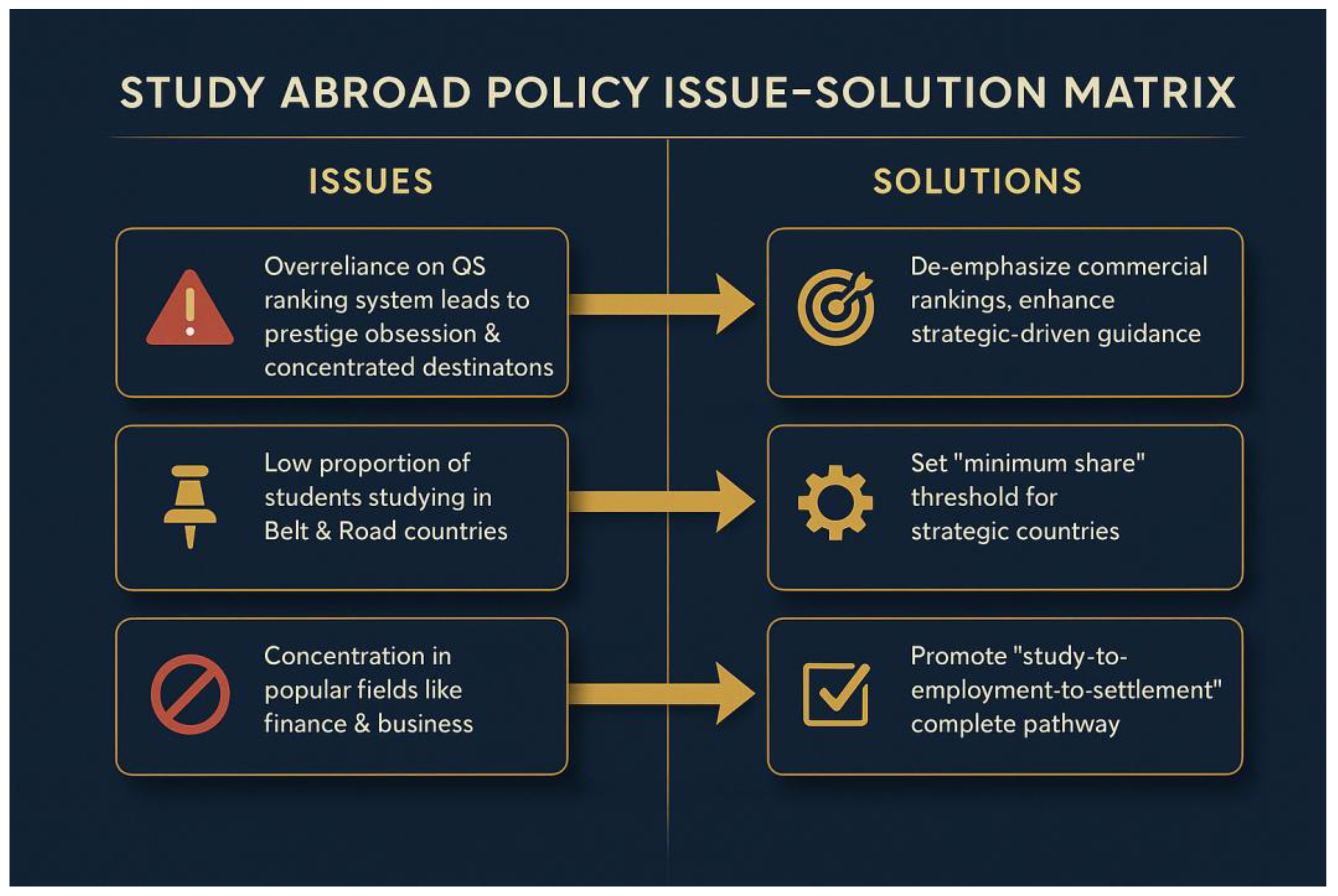
This figure systematically presents the four major structural problems in China’s current study abroad policy, and shows the corresponding strategy-oriented policy recommendation paths in a horizontal flowchart. From left to right, the diagram shows: “over-reliance on commercial ranking”, “insufficient participation in ‘Belt and Road’ countries”, “homogenisation of professional structure” and “difficulty in utilising returning talents”. “Over-reliance on business ranking”, “Insufficient participation in ‘Belt and Road’ countries”, “Uniformity of professional structure” and “Difficulty in utilising returning talents” are listed as the core challenges, each of which is logically linked to specific countermeasures through the arrows, e.g. “weakening the QS orientation and strengthening the drive of national strategies”, “Setting a red line mechanism for the minimum ratio”, “Encouraging the layout of diversified and strategic majors” and “Constructing a ‘study-employment-resettlement’ support pathway “etc. This map not only shows the upgrading of policy cognition from “cult of famous schools” to “strategic service”, but also reflects the multi-dimensional transformation of China’s study abroad strategy from a single logic of education to national security, economic synergy, demographic regulation and geographic layout, which has strong policy value and insights into the path of realisation. It also reflects the multidimensional transformation of China’s study abroad strategy from a single education logic to national security, economic synergy, population regulation and geographic layout, and has strong policy value and path inspiration. The colour scheme adopts warm gold, calm blue and red accents, symbolizing the dynamic transition from crisis recognition (red) to stability and reform (blue) to national strategic leap (gold), which is in line with the aesthetics standard of top international think tanks.
III. List of Specific Policy Recommendations
6.1. National Strategy-Oriented Study Abroad Indicator System
A target system oriented to “national strategic disciplines + strategic cooperation countries” is constructed, and the role of commercial ranking is weakened;
The local education authorities and the Development and Reform Commission will jointly establish a “mechanism for assessing the appropriateness of the study abroad structure and the national strategy”.
6.2. Establish a Special Support Mechanism for Study Abroad in the “Belt and Road” Region
Establish “joint scholarships for strategic cooperation countries”;
Encourage the establishment of “joint colleges/china-foreign cooperative universities” in cooperation with local universities;
Encourage the targeted export of specialities such as science and technology, medical care, language, business and law.
6.3. Promote the Construction of a Closed-Loop Channel of “Study-Employment-Resettlement”
Signing multi-policy agreements with major partner countries on “education + settlement + spouse visa + employment”;
Encourage young foreign students to get married and have children locally, so as to form a new demographic layout.
6.4. Synergise with Domestic Enterprises and Export-Oriented Industries in Cities
Promote the “Study Abroad + Chinese Enterprises Overseas Practical Training Programme” to cultivate local operational talents;
Use international students as a pioneering force in overseas markets to lay the foundation for a soft landing of Chinese enterprises.
6.5. Cultural and Risk Adjustment Mechanism
Establish “Chinese Language and Culture Service Centres in Belt and Road Countries” to enhance students’ cultural adaptability;
Prevent extreme nationalism/Chinese exclusion incidents and provide overseas legal and security assistance system.
VII. Summary of Strategic Implications
The “new type of study abroad policy” should no longer be narrowly regarded as a peripheral matter of education management, but must be incorporated into the core vision of the national macro-governance system as one of the strategic pivotal mechanisms at the national level. It not only undertakes the educational function of cultivating high-level talents, but is also a key variable in reshaping China’s interaction with the world, redistributing the pressure of demographic and industrial structure, expanding the country’s soft influence, and constructing a multi-level geopolitical pattern. In the face of the new era of global population competition, technological blockade, cultural identity cracks and employment pressure compound intertwined challenges, a single dimension of education output will no longer be sufficient to cope with the systemic risk, the only way to give play to its “external expansion + internal relief” dual regulating valve role is to embed the policy of studying abroad into the overall structure of the national development strategy. Through the systematic design of reconstructing the structure of target countries for study abroad, optimising the path of professional and talent allocation, and guiding the mechanism of employment and settlement, China will be able to establish a new type of strategic advantage driven by the linkage of “education-population-geo” in the international competition. The deep logic of this mechanism lies in the strategic layout of population mobility and talent cultivation, which realises the cross-regional buffer of national pressure, the deep expansion of soft diplomacy, and the synergistic evolution of social structure, and ultimately builds a long-term development pattern with global carrying capacity and national security buffer capacity. This is exactly where the essential transformation and high value of study abroad strategy in the new era lies.
References
- Altbach, P. G., Reisberg, L., & Rumbley, L. E. (2020). Trends in global higher education. International Higher Education, 102, 3–5. https://unesdoc.unesco.org/ark:/48223/pf0000183219.
- China’s Rising Leadership in Global Science. (2024). arXiv preprint. https://arxiv.org/abs/2406.05917.
- International Labour Organization. (2023). Global Employment Trends for Youth 2024. ILO. Retrieved from https://www.ilo.org/publications/major-publications/global-employment-trends-youth-2024.
- ILO (International Labour Organization). (2024). Global Employment Trends for Youth 2024: Executive Summary. https://www.ilo.org/sites/default/files/2024-08/GET_2024_ExecSum_EN_0.pdf.
- Marginson, S. (2008). Global field and global imagining: Bourdieu and worldwide higher education. British Journal of Sociology of Education, 29(3), 303–315. [CrossRef]
- Marginson, S., & Rhoades, G. (2002). Beyond national states, markets, and systems of higher education: A glonacal agency heuristic. Higher Education, 43(3), 281–309. Retrieved from Cambridge University Press. cambridge.org.
- Narrating the Belt and Road Education Policy. (2021). Global Education Studies (Critique based on PubMed Central data). PMC Article. https://pmc.ncbi.nlm.nih.gov/articles/PMC9344438/.
- Shih, L., & Cao, W. (2022). The impact of the “Belt and Road Initiative” on international scholarship students. Frontiers in Sociology, 7, 793018. [CrossRef]
- UNESCO. (2016). Global Education Monitoring Report 2016: Education for people and planet: Creating sustainable futures for all. Paris: UNESCO Publishing. https://unesdoc.unesco.org/ark:/48223/pf0000245752.
- UNESCO. (2021). Navigating Teacher Shortages around the World. UNESCO Publishing. https://unesdoc.unesco.org/ark:/48223/pf0000373366.
- Wang-Lu, H., & Mendoza, O. M. V. (2022). Job prospects and labour mobility in China. arXiv. https://arxiv.org/abs/2207.08282 arxiv.org.
- Altbach, P. G., Reisberg, L., & Rumbley, L. E. (2009). Trends in Global Higher Education: Tracking an Academic Revolution. UNESCO. https://unesdoc.unesco.org/ark:/48223/pf0000183219.
Disclaimer/Publisher’s Note: The statements, opinions and data contained in all publications are solely those of the individual author(s) and contributor(s) and not of MDPI and/or the editor(s). MDPI and/or the editor(s) disclaim responsibility for any injury to people or property resulting from any ideas, methods, instructions or products referred to in the content. |
© 2025 by the authors. Licensee MDPI, Basel, Switzerland. This article is an open access article distributed under the terms and conditions of the Creative Commons Attribution (CC BY) license (http://creativecommons.org/licenses/by/4.0/).
Copyright: This open access article is published under a Creative Commons CC BY 4.0 license, which permit the free download, distribution, and reuse, provided that the author and preprint are cited in any reuse.


