

Submitted:
25 July 2025
Posted:
28 July 2025
You are already at the latest version
Abstract
\(\gamma\,\)Cas-type stars is an enigmatic group of Be stars with unusually hard X-rays and an X-ray luminosity of \(10^{31}-10^{33}\,\)erg\,s$^{-1}$, which is higher than a typical value for classical Be stars. To test how the X-ray and optical radiation from \(\gamma\,\)Cas-type stars is generated, we review the optical observations of these stars and an analysis of their X-ray light curves. The periods of the line profiles variations appeared to be close to the periods of changes in their X-ray luminosities. We suppose that a significant fraction of X-ray emission is formed close to the region where optical emission does. The X-ray brightness of the binary \(\gamma\,\)Cas-type stars HD\,45314, HD\,45995 and NGC\,6649-9 vary with periods of ~50-90 seconds, which may be the rotation periods of white dwarfs in Be+WD binary systems. It means that at least hard part of the X-ray emission from these \(\gamma\,\)Cas-type stars is formed as result of an accretion onto rapidly rotating white dwarfs. The soft part of X-rays from \(\gamma\,\)Cas-type stars can be interpreted as a result of a reconnection of the local magnetic field lines of Be star and those in the circumstellar decretion disk.
Keywords:
stars: gamma Cas-type
; stars: spectra
; stars: line profile variability
; stars: X-ray
1. Introduction
The most prominent subclass of non-supergiant B stars is classical Be stars. These are rapidly rotating B stars having Balmer emission lines indicating the presence of a Keplerian, rotationally supported, circumstellar decretion gas disk [1]. Classical Be stars represent a considerable fraction of B stars, reaching up to 20% for the early subtypes of these objects [2]. The emission lines in the spectra of Be stars are often two-component, the shape of which is determined by the structure of the disk, its physical conditions, and the angle between the plane of the disk and a line of sight [3,4]. The line profiles in the spectra of most Be stars are highly variable e.g., [5].
The disks of Be stars are variable in size and density, as evidenced by the rapid variations of the emission line profiles up to their almost complete disappearance [6]. Most of the Be stars are in general X-ray sources with a typical X-ray luminosity of . About 10% of the B stars have been found to have strong magnetic fields, up to tens of the kilogauss [7]. At the same time, despite decades of polarization observations of Be stars, none of them is found to have a magnetic field, with the possible exception of the star Eri [8] and X Per [9]. Grunhut& Wade [10] and Wade [11] suggested that all Be stars are non-magnetic.
ud-Doula et al. [12] presented magnetohydrodynamical simulations for how a pre-existing Keplerian decretion disc forming from the matter of rapidly rotating Be stars accelerated by radiation pressure can be disrupted by a stellar dipole magnetic field. Authors established that a polar surface field strength of just 10 G can significantly disrupt the disc, while a field of 100 G, close to the observational upper limit for most Be stars, completely destroys the disc over till a few days.
Among the classical Be stars there exists a subset of Oe and early Be called Cas-type stars ( Cas analogs) which differ from the majority of Be stars. They demonstrate a hard (keV) and strong ( erg ) X-ray luminosity. The origin of such peculiar X-ray emission is poorly known. A comparison of the pattern of optical and X-ray variability can help us to better understand the causes of X-ray generation.
In the present paper, the optical and X-ray spectral and photometric variability of the Cassiopeia-type stars are reviewed. The statements one may conclude on these objects from an analysis of their variability are presented.
2. The General Characteristic of Gamma Cas-Type Stars
The Cas-type stars is a group (∼12%) of early-type Be/Oe stars [13] with optical spectra similar to those of other Be stars. If we determine the hardness of the X-ray spectra as the ratio of the corrected for the interstellar medium (ISM) absorption fluxes in the hard (2.0–10.0 keV) band to the flux in the soft (0.5–2.0 keV) energy bands, then for Cas-type stars, this ratio exceeds 1.6 [14].
To date, 26 stars of the Cas-type and 2 candidates are known [14,19,20,21]. The complete list of Cas-type stars and their parameters is given at URL http://www.astro.spbu.ru/LPV/?q=gcstars. The estimated total number of Cas-type stars in the Milky Way is [22]. The state of the decretion disks of Be stars could be varied [23,24]. Two Cas-type systems go through decretion disk-loss phases: Cas itself [6,25], Aqr [26].
A significant fraction of Cas-type stars are binaries. Two Cas-type stars have long been known as binary system: Cas itself [27] and Aqr [28]. Naze et al. [21] added the Be binary Tau [29] to the list of binary Cas-type stars. Naze et al. [30] determined the radial velocities of 16 stars of this type, revealing shifts and/or changes of line profiles. The orbits of six new binaries were determined.
In addition to that, five additional Cas-type stars demonstrate velocity variations compatible with the presence of companions and appear to be binary candidates [30]. This means that more than 50% of such stars are binaries, or presumably binaries. Two of Cas-type stars: Tau and HD 157832 are binary Be+sdO systems accordingly to [21] .
In conformity with [30] binaries Cas-type stars have long periods (80-200 d), small radial velocity amplitudes (), and masses of companions (excluding Aqr) in an interval from 0.6 to 1.2 solar masses. The mass of Aqr secondary is equal to [28]. At the same time, according to [31] the secondary mass is estimated as .
The masses of the secondaries in binary Be stars with known orbits are consistent with the assumption that they are WD. Preliminary observations of five Cas-type binaries ( Cas, FR CMa, HD 45995, V558 Lyr, V782 Cas, and Aqr) with the CHARA Array interferometer [32] show no evidence of the companion flux, leaving white dwarfs as the only viable candidates for companions. Gies et al. [33] supposed that the unusual X-ray properties of Cas-type stars can be explained by their being the Be+WD binaries. Stars Tau and HD 157832 are identified as Be+sdO/sdB binaries or binary candidates [34]. The future CHARA interferometer observations of Tau and HD 157832 could in principle help to detect secondaries in these binary systems.
3. Optical Spectra of Gamma Cas-Type Stars
Spectral observations of the star Cas itself, the prototype of the class, started 160 years ago with Secchi [35] observations. He visually discovered the emission in the H line. In 1894 Campbell, visually observing at Mount Hamilton observatory with the 36-inch refractor and attached spectroscope, found that the H line also is bright in a few B stars including Cas and Aqr [36].
Merrill et al. [37] selected stars of class Be with emission hydrogen lines which form a fairly continuous sequence in the structure of the hydrogen lines from ordinary B stars to novae. They tabulated the list of 90 Be stars with bright emission Balmer lines including four Cas-type stars: V782 Cas, PZ Gem, HD 45995 and HD 161103. Merrill and Burwell [38] compiled the first catalog of OBA stars whose spectra have bright hydrogen lines. All bright Cas-type stars are included in this catalog.
Struve [39] analyzing the emission lines of Be stars which are typically double peaked, with the peak separation correlated to the observed line width, suggested that Be stars are rapid rotators forming an equatorial mass-loss disk in which the emission lines are formed. Since then, a sea of spectra of Be stars and Cas-type stars as subset of this class of stars have been obtained by both professional and amateur astronomers. All of these spectra could be described in principle in the framework of the Struve’s model.
A lot of spectra of Be stars are accumulated in the BeSS database1. The structure and principles of building the database are described by Neiner et al. [40,41]. The optical observations of nine bright northern Cas-type stars with low to medium spectral resolution and high time resolution from 1.5 to 600 seconds are cited in [42].
For illustration in Figure 1, the mean spectra of selected Cas-type stars, which observations are cited in [42], are plotted. All these spectra were obtained at 1.25 m telescope from the Crimean Astronomical Station of the Sternberg Astronomical Institute of Moscow University equipped with the low resolution A-spectrograph [43]. The H equivalent widths EW(H) are: -25.69 Å (Cas); -26.1 Å (Aqr); -13.3 Å (V558 Lyr). The value of EW(H) for Cas is close to the typical ones for Cas e.g., ([44] their Figure 1). Analyzing these data, one can conclude that the equivalent widths of the H line are lower for stars of later spectral classes.
4. Line Profile Variability
For an analysis of the Line Profile Variations (LPVs) in the stellar spectra, the differential line profiles (residual spectra) are usually used:
where is the flux in the spectrum with a number i, which is normalized to the continuum, is the flux at wavelength averaged over all observations. In analyzing the differential profiles the Doppler shifts (radial velocities) V from the laboratory wavelength of the line instead of the wavelength are usually used. Here , where c is the speed of light.
For each point on the line profile corresponding to the Doppler shift , the array of values: , , where N is the number of spectra analyzed, represents the time series of the values of [16,17,45].
The line profiles in the spectra of Be stars and in the spectra of Cas-type stars as part of them are variable on different time scales from years to hours [46]. Line profile variations on the year scales are shown by Rauw et al. [24] in their Fig. 2. Archival amateur spectra of Cas-type stars extracted from the BeSS database show LPVs at month scales [24] their Fig. 9.
Archival BeSS spectra were used by Borre at al. [47] to analyze line profile variations in the spectra of Cas. They used the BeSS data but removed spectra that were obviously of lower resolution. After removal of spectra with saturated profiles or low resolving power, 371 spectra remained. The analysis was limited to spectra observed after 15 August 2006 since there were very few spectra taken before this date. The spectra were corrected for the heliocentric reference frame, binned in wavelength to Å, and normalized to the continuum. The data in each wavelength bin were divided by a fitted second-degree polynomial to remove long-term (possibly non-periodic) trends.
The Fourier power spectrum of LPVs is given in Figure 2. In this figure, the Fourier components corresponding to the orbital period of the binary system Cas (a) and its first harmonic (b) are clearly visible.
The most remarkable feature seen in Figure 2 is the blue versus red asymmetric amplitude distribution in the wings of the H emission line at the orbital frequency of the companion. The simplest explanation of this asymmetry is a one-armed spiral that can result from the gravity field rotational distortion of the Be star alone [48], that is, without the need for a companion star.
At the same time in many binary stars the gravitational effect of the companion is expected to dominate over the quadrupole moment of the B star, and a two-armed spiral would be developed that is phase-locked to the companion, where one arm roughly points at the companion and the other one points away from the companion.
Kholtygin et al. [17] analyzed the variability of the Cas-type star HD 45995 in both optical and X-ray ranges. The analyzed observations of HD 45995 were carried out at the 1.25-m telescope of the Crimean Station of SAI and at the 6-m BTA telescope of the Special Astrophysical Observatory (SAO) of the Russian Academy of Sciences using the MSS spectrograph [49]. The spectra of HD 45995 were supplemented with those from the BeSS database. The authors detected both short regular LPVs with periods of 11 to 87 minutes and long regular LPVs in the (350–380 days) time range.
It was shown, using the BeSS database, that mainly Balmer LPVs are changed in long time intervals while the line profiles of other elements are practically stable (see e.g., Fig. 2 in [17].
In June 2023 the spectra of V558 Lyr were obtained at the 1.25-m telescope with a time resolution of 30 seconds. The nightly average line profiles of H, H, and HeI 4922 are given in Figure 3. The differences between these mean spectra are maximal (nearly 5%) for the H and less than 1% for the H and HeI 4922 lines.
Optical and X-ray variability of Cas-type star SAO 49725 were investigated by Kholtygin et al. [16]. All analyzed observations were made at the 6-m BTA telescope using the SCORPIO multi-mode focal reducer [50] on August 17, 2021. The regular LPVs in the spectrum of SAO 49725 with periods from 70 to 223 minutes were registered. The presence of ultra-fast spectral variations with a period of minutes is also suspected.
Naze et al. [51] investigated the short-term optical variability of two Cas analogues, Aqr and BZ Cru, using the intensive ground-based spectroscopic and space-borne photometric monitorings.
The optical variability pattern of Cas-type stars practically does not differ from those for non- Cas-type stars e.g., [5]. This means that only a comparison of optical and X-ray variability can help to understand the unusual nature of Cas-type stars.
Space photometry of Cas from the Solar Mass Ejection Imager (SMEI) satellite (2003- 2011) and from the BRIght Target Explorer (BRITE)-Constellation of nano-satellites (2015- 2019) were investigated in the period range from hours to days was anylysed by [47]. Authors confirmed the 0.82215(1) frequency (1.21 day rotation period) first presented by Smith et al. [52] and Henry & Smith [53].
In BRITE data, they found a dominant signal at a frequency of 2.47936(2) with a period of 0.4 days). The 2.48 signal appeared to also be detected in some SMEI data between 2003 and 2011. The 2.48 variation cannot be due to rotation and would most likely be NRPs. The fact that nearly all Be stars are observed to have NRPs [3] confirms this explanation.
Nazé et al. [54] had been analysed all the Transiting Exoplanet Survey Satellite (TESS) observations of Cas-type stars excluding HD 110432, whose TESS light curve was already reported earlier [51]. In TESS photometry, Nazé et al. [54] noted long-term trends, the presence of frequency groups with variable amplitudes, and low-frequency red noise.
An analysis of the TESS light curves of HD 45995 [17] allowed authors to clarify the stellar rotation period days. The TESS light curves of HD 45995 contain both components with periods of 0.44 to 0.48 days typical for the non-radial pulsations of Be stars and transient components with periods of in an interval of 4–14 days, which can be instrumental. A correlation was found between the equivalent widths of the H line and the amplitude of the TESS brightness variations.
Labadie-Bartz et al. [55] analyzed the photometric observations of Cas with the SMEI, BRITE, and TESS satellites. The results of TESS observations of the selected high-mass X-ray binaries were analyzed by Ramsay et al. [56]. The authors revealed the presence of periodic modulations on time-scales of 0.3-0.5 d. Nine periodic components of the photometric variations in the interval from to were detected for Cas-type star BZ Cru.
5. X-Ray Variability
It is well known that the X-ray spectra of Cas-type stars are strongly variable e.g., and references therein [57]. To illustrate the X-ray variability over long time intervals, Kholtygin et al. [22] compared the observed X-ray spectra of Cas obtained in different years.
X-ray spectra of Cas in the energy range of 0.2-8 keV were extracted from archival observations carried out on the XMM-Newton orbital observatory in 2010 and 2014. The procedure for processing X-ray observations is described in [58].
In Figure 4 (Left panel) the observed X-ray fluxes of Cas normalized to 1 ks exposure are given. In the case of constant X-ray luminosity of the star, the reduced fluxes corresponding to the same exposure should be close to each other. However, as one can see from the figure, these fluxes differ significantly. These differences can be associated with both a real change in the fluxes themselves and with a change in circumstellar absorption.
In the energy band of 6-8 keV, a group of hydrogen and helium-like Fe lines is clearly visible, as well as a Fe line. To analyze the variability of the line profiles of these lines, they were normalized to the X-ray continuum. Normalized line profiles are given in Figure 4 (Right panel). As can be seen in the figure, the deviations of individual profiles from the average profile (5-8%) are within the error of measurement, which indicates that the variability of the X-ray line profiles is weak.
Gunderson et al. [57] investigated the temporal and spectral features of Cas X-ray emission in the context of the hypothesis of white dwarf (WD) accretion. The authors analyzed simultaneous observations of the XMM (ID 0743600101) and NuSTAR (ID 30001147002) observations on 24 July 2014.
The authors investigated the temporal and spectral features of Cassiopeia’s X-ray emission within the context of the white dwarf (WD) accretion hypothesis. They checked whether the short-term variability in Cas is periodic or stochastic. If the magnetic field of WD is strong enough to control the accretion, then the accretion will be concentrated at spots on the poles of the surface that then rotate into and out of our view. This leads to periodic variations in the X-ray flux. If, on the contrary, the magnetic field is too weak to direct the flows the variability will be stochastic and better described by the observed phenomena called “flickering” [59].
Gunderson et al. [57] concluded that there is no periodic signal in Cas X-rays, i.e., the X-ray emission in both soft and hard wave bands vary stochastically. They claimed two sources of the X-ray variability. Their model consisted of a cooling flow model to describe the hypothesized WD that is generating the hard X-rays along with a power-law DEM for the unknown, softer secondary source. The second source is proposed to be a shock between the infalling Be decretion disk material and the accretion disk of the WD. The variations of the soft X-rays appear to be purely due to absorption variations, while those of the hard goes are due to flickering like in nonmagnetic cataclysmic variables. Finally, authors claim that the WD hypothesis can explain both spectral and temporal features of Cas’s X-ray emission.
In Figure 5 the dynamical spectra of Cas for the XMM (ID 0743600101) observation are plotted. Strong spectral variations can be seen during 34 ks of XMM observations. Variations in X-ray light curves for these stars are definitely detectable [60].
XMM data show the softness dip events in the light curve, where the count rates drop significantly in the region of 1–3 ks in the light curve as seen in the bottom right panel of Figure 5. Smith and Lopes de Oliveira [61] interpreted these dips as due to absorption. They are accompanied by minor, nearly simultaneous dips in the hard X-ray band.
X-ray light curves demonstrate the various kinds of variability, both regular and stochastic. Parmar et al. [62] detected flare-like events (X-ray flares) in the Exosat Cas X-ray light curve. Horaguchi et al. [63] observed Cas with the Large Area Proportional Counter (2-20 keV) on board the Ginga satellite in 1989. They also detected the numerous flares in the X-ray light curve. These flares can be interpreted as follow by the reconnection of the local magnetic field lines on the surface of the Be stars and those in the disk.
Some researchers had detected regular components in the X-ray light curves of Cas itself and in light curves of other stars of this type. Thus, Frontera et al. [64] reported a X-ray modulation with a timescale of h from Exosat observations in 1984. A h oscillation was suspected by Haberl [65] from ROSAT observation in 1993. Owens et al. [66] found evidence for a h and h in the BeppoSAX observation of Cas carried out in 1998. They interpreted the X-rays of Cas as a result of the accretion onto the white dwarf.
Horaguchi et al. [63] calculated the power spectral density in a time interval from 64 to 2048 s and concluded that there are no periodic variations, but rather stochastic variations on time scales of a few hours. The calculated Fourier spectra can be fitted with a power law of with . Such red noise spectra were detected for numerous subsequent X-ray observations of Cas e.g., [24].
An 8.4 ks ROSAT PSPC observation of Cas Haberl et al. [65] revealed evidence for a soft component which can be modeled as black body radiation of keV. It is believed to emanate from the heated surface of a white dwarf near the magnetic pole. This component appears to be modulated with a period of minutes, which may be the spin period of the white dwarf.
An analysis of the RXTE light curve of Cas obtained in 1996 by Smith et al. [67] reveals a red-noise-like behavior of the discrete Fourier transform power density spectrum (PDS) . In the light curve, dominate the frequent shots (flares) which are clearly larger in amplitude than expected from statistical or instrumental noise.
Robinson and Smith [68] discussed X-ray observations of Cas obtained in 1998 November also with RXTE. A comparison of the results with the 1996 data set shows that the mean X-ray level in 1998 was only 60% of the 1996 level. The shape of the PDS is similar to that in 1996, going as .
These authors argue against the idea proposed by [69] and supported by [70] that the X-ray emission from Cas arises as a result of mass accretion onto a hypothetical white dwarf companion. Estimates by [68] show that the X-ray luminosity is too large to be accounted for by accretion onto a white dwarf. They also analyzed the suggestion that the unusual X-ray activity from Cas may be caused by an active, late-type companion. However, the characteristics of such companion to Cas are similar to those of other active late-type stars and are quite different from those seen on Cas. Basing on anticorrelation between the UV continuum and X-ray light curves and the correlation of X-ray fluxes with the strength of Fe V absorption lines Robinson & Smith [68] suppose that the X-rays originate at or near the surface of Cas.
Horaguchi et al. [57] reject the assumption of accretion onto a white dwarf as the source of X-ray emission. They argument that a low-mass companion of a Be star also cannot explain the unusual X-ray emission of Cas-type stars. The simultaneous observations cited in these papers are correlated, and thus there is evidence that all X-ray emission comes from the same region.
Simultaneous observations [52,71,72,73] (e.g. Fig. 8 in [74]) demonstrate the correlated pattern of spectral and photometric variability on timescales of hours and days. Since the migration time of matter from the inner parts of the disk to the orbit of the companion is estimated to several years, these correlations can hardly be explained by the companion scenarios but may be interpreted in the framework of the small-scale magnetic fields /disk interaction scenario [61,73] and references therein. This led to the alternative scenario where the X-ray emission is the result of magnetically generated structures near the stellar surface [74].
In the magnetic interaction scenario, the X-ray emission is expected to react fast to changes in the disk. To check this scenario, a few Cas-type stars have been monitored in the optical domain and X-ray observations were triggered when the disk conditions were changing. The correlation between the equivalent width of the H line of O9e Cas-type star HD 45314 and its X-ray suggest a direct association between the level of X-ray emission and the disk density [75]. On the other hand, the mean level of the X-ray flux of the Cas-type star Aqr remains stable between 2013 and 2018, despite the huge change in H emission strength between those epochs [76]. Further monitoring of Cas stars is needed to understand what determines the connection between the Be-disk and the X-ray emission [74].
6. Discussion and Conclusions
The origin of the Cas phenomenon remains one of the major unsolved enigmas in stellar X-ray astrophysics [74]. A good introduction into this problem is given by Nazé et al. [77]. The joint optical and X-ray spectral and photometric analysis could help shed light on this issue.
The different models are attracted to explain the unusually strong and hard X-rays from the Cas-type stars. The first one assumes the generation of X-rays via the interaction of local stellar magnetic fields with the decretion disk (star/disk magnetic interaction scenario) [78]. The X-ray radiation generated this way consists of two components [67]. They are the slowly varying base flux corresponding to the minimum level seen during any given phase and superimposed on base flux rapid flares (shots) with lifetimes from s to minutes. Smith et al. [71] found close associations between the flux of the UV continuum near 1400 Å and the average intensity of the X-ray emission, both of which were found to vary on a timescale comparable to the expected rotation rate of the star.
The second model assumes that the X-ray emission is connected with the companion of the Be star. In support of this model there exist a lot of evidences of the importance of the mass exchange in a massive close binary system leading to formation of Be stars. The Be+sdO binary systems could be formed through Case B of the mass exchange when the donor star filled its Roche surface during the expansion that during the H-shell burning e.g., [80]. Shao and Li [81] supposed that most of Be stars may be formed as a result of binary interaction.
After a time close to the main-sequence (MS) lifetime of the Be star, the sdO stars will initiate He-shell burning and grow in radius and luminosity, and the second stage of mass exchange starts. If the remnant after the second mass exchange stage has a core mass greater than then the star implodes as a H-poor supernova. In this case, the binary Be+NS system is formed e.g., [82]. If the initial masses in the close binary systems are lower than in the previous case, than nuclear burning will cease and the remnants will be white dwarfs [79,83].
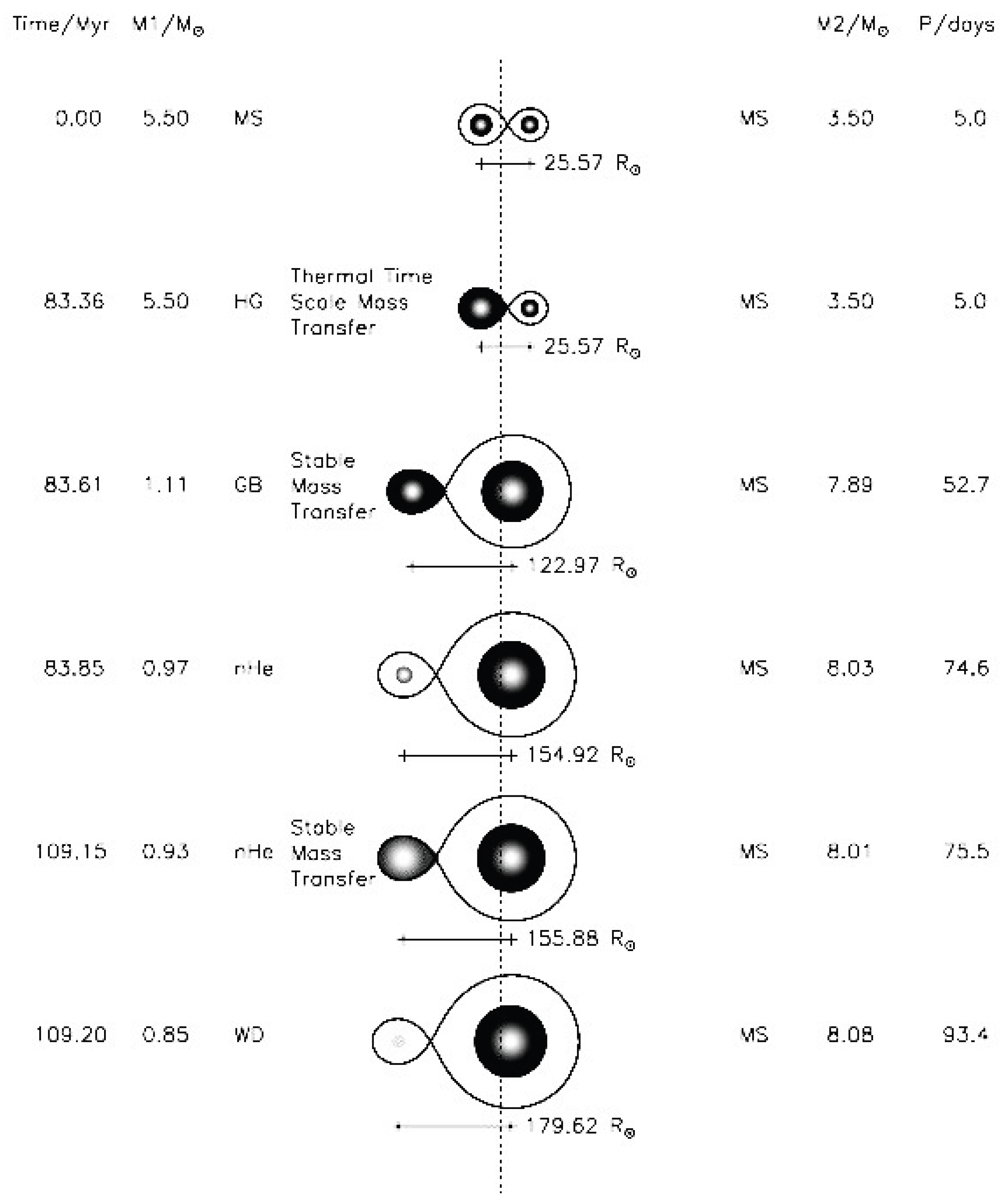
The sketch of the possible scenario of the formation of the Be+WD binary system is presented in Figure 6. The final characteristics of the system are close to those given in Figure 6 and correspond to the parameters of V558 Lyr binary presented in [30].
As can be seen from the above written, binary stars of the Cas-type can only be of the following kinds: Be+NS, Be+sdO/sdB, and Be+WD. Consider all of these cases in turn to understand if it is possible to explain the unusual hard X-rays for these types of binary system.
A) Binary systems Be+NS. Recently Postnov et al. [84] assumed that Cas together with its analogues is a new group of Be-type X-ray binaries hosting rapidly rotating neutron stars at the propeller stage formed in supernova explosions with small kicks.
This hypothesis does not seem too realistic. Firstly, the short duration of the propeller phase during the NS evolution contradicts the observed fraction of Cas-type stars among the early-type Be stars [85]. Secondly, all known orbits of binary Cas-type stars are circular [30]. The probability that all the orbits of binary systems after the supernova explosion will be circular is very small. Thirdly, according to [86] the strengths of the observed Fe K fluorescent emission lines in Cas stars in a propeller scenario are too small in comparison with the observed ones.
B) Systems Be+sdO/sdB. Langer et al. [87] proposed that in such systems the X-rays of Cas-type stars arise from the collision between the wind of a companion subdwarf and the disk of a Be star. Accordingly to [74] the X-ray luminosity generated by this mechanism is several orders of magnitude lower than the typical luminosity of the Cas-type stars.
C) Binary systems Be+WD are considered as the most likely candidates for the role of Cas-type stars e.g, [33,57,65,69]. A problem with such a scenario is that the mass-loss rate necessary for it exceeds the typical wind mass loss rate of Cas-type stars by several orders of magnitude [24]. The contribution of the star-disk interaction in this scenario is questionable.
Resuming, we can conclude that now it is impossible to exclude neither the first model of the X-ray generation nor the second one. This means that one can suppose that the generation of X-rays in Cas-type stars occurs according to a hybrid scenario and the total flux of X-rays from a star of Cas-type can be presented in the following manner:
Here, the first term in this sum is X-rays from the primary Be stars similar to solar X-rays and from an interaction between putative magnetic loop systems from the star and its decretion disk [78]. The second term is formed mainly as a result of the accretion of disk matter to the rapidly rotating white dwarf and/or following the mechanism proposed by Langer et al. [87].
The question is which term in the formula (2) is responsible for the hard part of the X-rays. In the spectra of all Cas-type stars, the line complex at 6.4-7.2 keV (K + Fe XXV + Fe XXVI) is always presents. Based on this [22,69,74,86] and many others concluded that a hard part of the total X-ray flux goes from the hot gas heated during the accretion onto the compact secondary star.
This conclusion is at least partly supported by [42] saying that the generation of X-ray emission from Cas-type stars most likely occurs in a hybrid scenario. The flare part of the total X-ray flux is formed by the interaction of the local stellar magnetic fields and the magnetic field of the disk, while the hard part is generated due to an accretion onto a rapidly rotating white dwarf.
The important question is whether there is a contribution of a nonthermal component to the X-ray emission of stars of type Cas-type stars. Shrader et al. [88] analyzing the Suzaku and INTEGRAL observatories of Cas concluded that there is no compelling need for an additional non-thermal high-energy component. However, in the paper [58] the possible non-thermal X-ray contribution described by the Power Law (PL) component to the Cas-type stars X-rays was examined.
Ryspaeva& Kholtygin [58] concluded that the inclusion of the additional PL component significantly reduces the value for the thermal component of the hot plasma. In this case, as in models without such a component, the profile of Fe K line at 6.4 keV is reproduced. At the same time, the addition of a power-law component to the X-ray spectrum does not improve the agreement between the observed and model spectra, leaving open the question of the reality of the contribution of the non-thermal component.
The first term in Eq. 2 is connected, mainly, as mentioned above, with the interaction of local magnetic fields with the decretion disk. The periods of the optical spectral and photometric variations of Cas-type stars must correspond to their rotation periods (close to one day) or to the periods of non-radial pulsations h [89]. The finding of such periods in the X-ray light curves indicates the contribution of this mechanism to the X-ray emission of the star, as shown in a comparison of the periods of the optical and X-ray periods for Cas presented in [22]. These authors detect regular X-ray components with periods from 11 to 182 minutes in the X-ray light curves obtained from XMM observations in 2010 and 2014.
Lopes de Oliveira [90] analyzed the EPIC-pn light curves at 0.8–10 keV from the 2004 February 5 XMM observations of Cas and found periodic variations with periods from 51 to 169 minutes. These periods coincide with those obtained by [22] at the level of one standard deviation. For frequencies mHZ the Fourier power and for mHZ.
In contrast Rauw et al. [24] found no periodicity down to 5 second periods using EPIC-MOS1, EPIC-MOS2, and EPIC-pn counts for January 2021 XMM observations. The radical difference in the result of the Fourier analysis of the X-ray light curves obtained in different epochs could be explained by the transient nature of the periodic X-ray variability.
The analyses of soft X-ray ‘dips’ in the X-ray light curves of Cas show that such dips can be accompanied by minor, nearly simultaneous dips in the hard X-ray band [61]. The authors interpreted the soft X-ray dips in the scenario of ’magnetic star–disc interaction’ as transits of soft X-ray-absorbing blobs across the lines of sight to the Be star. They claim that these blobs are similar to the ‘cloudlets’ responsible for migrating sub-features in UV and optical spectral lines.
The second term in Eq. 2 can be explained by accretion to the compact component in the Cas-type binary. This can mean that in the corresponding X-ray light curves the regular components with periods corresponding to the rotation periods of white dwarfs may be present.
For few Cas-type stars, minute oscillations were detected not only in optical line profiles but also in the X-ray emission as well [91,92]. These oscillations cannot be related to high modes of non-radial pulsations of Be star but may correspond to the rotation period of a white dwarf in the Be+WD binary system e.g, [93].
Finally, we can conclude that simultaneous analyzes of optical and X-ray variability can help to better understand in a future what the nature of Cas-type stars is. Many queries remain to be unanswered up to now. New observations of these enigmatic stars and the development of the magnetic field line reconnection theory will help to solve their enigma.
Funding
This research was funded by RSF grant number 23-22-0090.
Institutional Review Board Statement
Not applicable.
Informed Consent Statement
Not applicable.
Data Availability Statement
Most data and codes are publicly available. Spectra are available upon requests.
Acknowledgments
Author also thanks the organizers of “Hot Stars 2024” for setting up a great conference and for their effort to help the participants of the conference to be happy during the conference.
Conflicts of Interest
The authors declare no conflicts of interest. The funders had no role in the design of the study; in the collection, analyses, or interpretation of the data; in the writing of the manuscript; or in the decision to publish the results.
References
- Porter, J.M.; Rivinius, T. Classical Be Stars. PASP 2003, 115, 1153–1170. [Google Scholar] [CrossRef]
- Rivinius, T.; Klement, R. Classical Be stars. arXiv e-prints 2024, arXiv:2411.06882. [Google Scholar] [CrossRef]
- Rivinius, T.; Carciofi, A.C.; Martayan, C. Classical Be stars. Rapidly rotating B stars with viscous Keplerian decretion disks. Astronomy and Astrophysics Review 2013, arXiv:astro-ph.SR/1310.396221, 69. [Google Scholar] [CrossRef]
- Silaj, J.; Jones, C.E.; Tycner, C.; Sigut, T.A.A.; Smith, A.D. A Systematic Study of Hα Profiles of Be Stars. APJS 2010, 187, 228–250. [Google Scholar] [CrossRef]
- Kholtygin, A.F.; Dodin, A.V.; Yakunin, I.A.; Ryspaeva, E.B. Optical and X-Ray Variability of Be Stars: omega Ori. Astrophysical Bulletin 2025, 81, 49–56. [Google Scholar] [CrossRef]
- Baade, D.; Labadie-Bartz, J.; Rivinius, T.; Carciofi, A.C. The historical active episodes of the disks around γ Cassiopeiae (B0.5 IVe) and 59 Cygni (B1 IVe) revisited. AAP 2023, 678, A47. [Google Scholar] [CrossRef]
- Makarenko, E.I.; Igoshev, A.P.; Kholtygin, A.F. Testing the fossil field hypothesis: could strongly magnetized OB stars produce all known magnetars? MNRAS 2021, arXiv:astro-ph.HE/2104.10579]504, 5813–5828. [Google Scholar] [CrossRef]
- Hubrig, S.; Ilyin, I.; Kholtygin, A.F.; Schöller, M.; Skarka, M. Searching for the presence of a weak magnetic field in the Be star λ Eri using FORS 2 spectropolarimetric time series. Astronomische Nachrichten 2017, 338, 926–937. [Google Scholar] [CrossRef]
- Valyavin, G.; Ikhsanov, N.R.; Beskrovnaya, N.G.; Gadelshin, D.; Galazutdinov, G.A.; Semenko, E.; Romanyuk, I.I.; Kholtygin, A.F.; Sabin, L.; Hiriart, D.; et al. Possible Detection of a Magnetic Field in X Persei. In Proceedings of the Stars: From Collapse to Collapse; Balega, Y.Y.; Kudryavtsev, D.O.; Romanyuk, I.I.; Yakunin, I.A., Eds., Vol. 510, Astronomical Society of the Pacific Conference Series; 2017; p. 229. [Google Scholar]
- Grunhut, J.H.; Wade, G.A.; MiMeS Collaboration. The incidence of magnetic fields in massive stars: An overview of the MiMeS survey component. In Proceedings of the Stellar Polarimetry: from Birth to Death; American Institute of Physics Conference Series. Hoffman, J.L., Bjorkman, J., Whitney, B., Eds.; 2012; pp. 67–74. [Google Scholar] [CrossRef]
- Wade, G.A.; Petit, V.; Grunhut, J.H.; Neiner, C.; MiMeS Collaboration. Magnetic Fields of Be Stars: Preliminary Results from a Hybrid Analysis of the MiMeS Sample. In Proceedings of the Bright Emissaries: Be Stars as Messengers of Star-Disk Physics; Astronomical Society of the Pacific Conference Series. Sigut, T.A.A., Jones, C.E., Eds.; 2016; 506, p. 207. [Google Scholar]
- ud-Doula, A.; Owocki, S.P.; Kee, N.D. Disruption of circumstellar discs by large-scale stellar magnetic fields. MNRAS 2018, arXiv:astro-ph.SR/1805.03001]478, 3049–3055. [Google Scholar] [CrossRef]
- Nazé, Y.; Robrade, J. SRG/eROSITA survey of Be stars. MNRAS 2023, arXiv:astro-ph.SR/2307.13308]525, 4186–4201. [Google Scholar] [CrossRef]
- Nazé, Y.; Motch, C. Hot stars observed by XMM-Newton. II. A survey of Oe and Be stars. AAP 2018, arXiv:astro-ph.SR/1809.03341]619, A148. [Google Scholar] [CrossRef]
- Kholtygin, A.K.; Burlak, M.A.; Tsiopa, O.A. Unusual Fast Spectral Variability of γ Cas. Astronomicheskij Tsirkulyar 2021, 1649, 1. [Google Scholar] [CrossRef]
- Kholtygin, A.F.; Yakunin, I.A.; Bukharinov, V.S.; Mokshin, D.N.; Ryspaeva, E.B.; Tsiopa, O.A. Optical and X-Ray Variability of gamma Cas Stars II: SAO 49725. Astrophysical Bulletin 2024, 79, 437–444. [Google Scholar] [CrossRef]
- Kholtygin, A.F.; Yakunin, I.A.; Burlak, M.A.; Ryspaeva, E.B. Optical and X-ray Variability of gamma Cas Stars: HD 45995. Astrophysical Bulletin 2023, 78, 557–566. [Google Scholar] [CrossRef]
- Kholtygin, A.F.; Dodin, A.V.; Yakunin, I.A.; Ryspaeva, E.B. Optical and X-Ray Variability of gamma Cas Stars: V558 Lyr. Astrophysical Bulletin 2025, 81, in. [Google Scholar]
- Smith, M.A.; Lopes de Oliveira, R.; Motch, C. A Census of the Class of X-ray Active γ Cas Stars. In Proceedings of the Bright Emissaries: Be Stars as Messengers of Star-Disk Physics; Sigut, T.A.A.; Jones, C.E., Eds., Vol. 506, Astronomical Society of the Pacific Conference Series; 2016; p. 299. [Google Scholar]
- Nazé, Y.; Motch, C.; Rauw, G.; Kumar, S.; Robrade, J.; Lopes de Oliveira, R.; Smith, M.A.; Torrejón, J.M. Three discoveries of γ Cas analogues from dedicated XMM-Newton observations of Be stars. MNRAS 2020, arXiv:astro-ph.SR/2002.05415]493, 2511–2517. [Google Scholar] [CrossRef]
- Nazé, Y.; Rauw, G.; Smith, M.A.; Motch, C. The X-ray emission of Be+stripped star binaries. MNRAS 2022, arXiv:astro-ph.SR/2208.03990]516, 3366–3380. [Google Scholar] [CrossRef]
- Kholtygin, A.F.; Ryspaeva, E.B.; Yakunin, I.A.; Tsiopa, O.A. Variability of optical and X-ray spectra of Gamma Cassiopeia stars. INASAN Science Reports 2023, 8, 86–92. [Google Scholar] [CrossRef]
- Krtička, J.; Kurfürst, P.; Krtičková, I. Magnetorotational instability in decretion disks of critically rotating stars and the outer structure of Be and Be/X-ray disks. AAP 2015, arXiv:astro-ph.SR/1410.7831]573, A20. [Google Scholar] [CrossRef]
- Rauw, G.; Nazé, Y.; Motch, C.; Smith, M.A.; Guarro Fló, J.; Lopes de Oliveira, R. The X-ray Emission of γ Cassiopeiae During the 2020-2021 Disc Eruption. AAP 2022, arXiv:astro-ph.SR/2206.08730]664, A184. [Google Scholar] [CrossRef]
- Draper, Z.H.; Wisniewski, J.P.; Bjorkman, K.S.; Meade, M.R.; Haubois, X.; Mota, B.C.; Carciofi, A.C.; Bjorkman, J.E. Disk-loss and Disk-renewal Phases in Classical Be Stars. II. Contrasting with Stable and Variable Disks. APJ 2014, arXiv:astro-ph.SR/1402.5240]786, 120. [Google Scholar] [CrossRef]
- Wisniewski, J.P.; Draper, Z.H.; Bjorkman, K.S.; Meade, M.R.; Bjorkman, J.E.; Kowalski, A.F. Disk-Loss and Disk-Renewal Phases in Classical Be Stars. I. Analysis of Long-Term Spectropolarimetric Data. APJ 2010, arXiv:astro-ph.SR/0912.1504]709, 1306–1320. [Google Scholar] [CrossRef]
- Miroshnichenko, A.S.; Bjorkman, K.S.; Krugov, V.D. Binary Nature and Long-Term Variations of γ Cassiopeiae. PASP 2002, 114, 1226–1233. [Google Scholar] [CrossRef]
- Bjorkman, K.S.; Miroshnichenko, A.S.; McDavid, D.; Pogrosheva, T.M. A Study of π Aquarii during a Quasi-normal Star Phase: Refined Fundamental Parameters and Evidence for Binarity. ApJ 2002, 573, 812–824. [Google Scholar] [CrossRef]
- Ruždjak, D.; Božić, H.; Harmanec, P.; Fiřt, R.; Chadima, P.; Bjorkman, K.; Gies, D.R.; Kaye, A.B.; Koubský, P.; McDavid, D.; et al. Properties and nature of Be stars. 26. Long-term and orbital changes of ζ Tauri. A&A 2009, 506, 1319–1333. [Google Scholar] [CrossRef]
- Nazé, Y.; Rauw, G.; Czesla, S.; Smith, M.A.; Robrade, J. Velocity monitoring of γ Cas stars reveals their binarity status. MNRAS 2022, arXiv:astro-ph.SR/2111.09579510, 2286–2304. [Google Scholar] [CrossRef]
- Tsujimoto, M.; Hayashi, T.; Morihana, K.; Moritani, Y. X-ray and optical spectroscopic study of a γ Cassiopeiae analog source π Aquarii. PASJ 2023, arXiv:astro-ph.HE/2211.1080375, 177–186. [Google Scholar] [CrossRef]
- Klement, R.; Rivinius, T.; Gies, D.R.; Baade, D.; Mérand, A.; Monnier, J.D.; Schaefer, G.H.; Lanthermann, C.; Anugu, N.; Kraus, S.; et al. The CHARA Array Interferometric Program on the Multiplicity of Classical Be Stars: New Detections and Orbits of Stripped Subdwarf Companions. APJ 2024, arXiv:astro-ph.SR/2312.08252962, 70. [Google Scholar] [CrossRef]
- Gies, D.R.; Wang, L.; Klement, R. Gamma Cas Stars as Be+White Dwarf Binary Systems. ApJ Letters 2023, arXiv:astro-ph.SR/2212.06916942, L6. [Google Scholar] [CrossRef]
- Wang, L.; Gies, D.R.; Peters, G.J.; Han, Z. The Orbital and Physical Properties of Five Southern Be+sdO Binary Systems. AJ 2023, arXiv:astro-ph.SR/2303.12616165, 203. [Google Scholar] [CrossRef]
- Secchi, A. Schreiben des Herrn Prof. Secchi, Directors der Sternwarte des Collegio Romano, an den Herausgeber. Astronomische Nachrichten 1866, 68, 63. [Google Scholar] [CrossRef]
- Campbell, W.W. Stars whose spectra contain both bright and dark hydrogen lines. APJ 1895, 2, 177–183. [Google Scholar] [CrossRef]
- Merrill, P.W.; Humason, M.L.; Burwell, C.G. Discovery and Observations of Stars of Class Be. APJ 1925, 61, 389–417. [Google Scholar] [CrossRef]
- Merrill, P.W.; Burwell, C.G. Catalogue and Bibliography of Stars of Classes B and A whose Spectra have Bright Hydrogen Lines. APJ 1933, 78, 87. [Google Scholar] [CrossRef]
- Struve, O. On the Origin of Bright Lines in Spectra of Stars of Class B. APJ 1931, 73, 94. [Google Scholar] [CrossRef]
- Neiner, C.; de Batz, B.; Cochard, F.; Floquet, M.; Mekkas, A.; Desnoux, V. The Be Star Spectra (BeSS) Database. AJ 2011, 142, 149. [Google Scholar] [CrossRef]
- Neiner, C. The BeSS database: a fruitful professional-amateur collaboration. In Proceedings of the SF2A-2018: Proceedings of the Annual meeting of the French Society of Astronomy and Astrophysics. [CrossRef]
- Kholtygin, A.; Yakunin, I.; Ryspaeva, E.; Mokshin, D. A nature of the X-ray and optical emission from gamma Cassiopeia stars. In Proceedings of the Modern Astronomy: From the Early Universe to Exoplanets and Black Holes (VAK 2024, 2024, pp. [Google Scholar] [CrossRef]
- Ikonnikova, N.P.; Shaposhnikov, I.A.; Esipov, V.F.; Burlak, M.A.; Arkhipova, V.P.; Dodin, A.V.; Potanin, S.A.; Shatsky, N.I. Spectroscopic Variability of the Compact Planetary Nebula Hb 12. Astronomy Letters 2021, arXiv:astro-ph.SR/2111.0049147, 560–580. [Google Scholar] [CrossRef]
- Pollmann, E.; Vollmann, W.; Henry, G.W. Long-term monitoring of Halpha emission strength and photometric V magnitude of gamma Cas. Information Bulletin on Variable Stars 2014, 6109, 1. [Google Scholar]
- Kholtygin, A.F.; Moiseeva, A.V.; Kurdoyakova, M.S.; Yakunin, I.A.; Kostenkov, A.E.; Karataeva, G.M. Super-Fast Line-Profile Variability in the Spectra of OBA Stars. IV: ζ Ori A. Astrophysical Bulletin 2021, 76, 185–195. [Google Scholar] [CrossRef]
- Kogure, T.; Hirata, R. The Be star phenomena. I. General properties. Bulletin of the Astronomical Society of India 1982, 10, 281–309. [Google Scholar]
- Borre, C.C.; Baade, D.; Pigulski, A.; Panoglou, D.; Weiss, A.; Rivinius, T.; Handler, G.; Moffat, A.F.J.; Popowicz, A.; Wade, G.A.; et al. Short-term variability and mass loss in Be stars. V. Space photometry and ground-based spectroscopy of γ Cas. AAP 2020, arXiv:astro-ph.SR/2002.04646635, A140. [Google Scholar] [CrossRef]
- Okazaki, A.T. Long-Term V/R Variations of Be Stars Due to Global One-Armed Oscillations of Equatorial Disks. PASJ 1991, 43, 75–94. [Google Scholar] [CrossRef]
- Panchuk, V.E.; Chuntonov, G.A.; Naidenov, I.D. Main stellar spectrograph of the 6-meter telescope. Analysis, reconstruction, and operation. Astrophysical Bulletin 2014, 69, 339–355. [Google Scholar] [CrossRef]
- Afanasiev, V.L.; Moiseev, A.V. The SCORPIO Universal Focal Reducer of the 6-m Telescope. Astronomy Letters 2005, 31, 194–204. [Google Scholar] [CrossRef]
- Nazé, Y.; Pigulski, A.; Rauw, G.; Smith, M.A. Let there be more variability in two γ Cas stars. MNRAS 2020, arXiv:astro-ph.SR/2002.12656494, 958–974. [Google Scholar] [CrossRef]
- Smith, M.A.; Henry, G.W.; Vishniac, E. Rotational and Cyclical Variability in γ Cassiopeia. APJ 2006, 647, 1375–1386. [Google Scholar] [CrossRef]
- Henry, G.W.; Smith, M.A. Rotational and Cyclical Variability in γ Cassiopeiae. II. Fifteen Seasons. APJ 2012, arXiv:astro-ph.SR/1209.4394760, 10. [Google Scholar] [CrossRef]
- Nazé, Y.; Rauw, G.; Pigulski, A. TESS light curves of γ Cas stars. MNRAS 2020, arXiv:astro-ph.SR/2008.08334498, 3171–3183. [Google Scholar] [CrossRef]
- Labadie-Bartz, J.; Baade, D.; Carciofi, A.C.; Rubio, A.; Rivinius, T.; Borre, C.C.; Martayan, C.; Siverd, R.J. Short-term variability and mass loss in Be stars - VI. Frequency groups in γ Cas detected by TESS. MNRAS 2021, arXiv:astro-ph.SR/2012.06454502, 242–259. [Google Scholar] [CrossRef]
- Ramsay, G.; Hakala, P.; Charles, P.A. A TESS search for donor-star pulsations in high-mass X-ray binaries. MNRAS 2022, arXiv:astro-ph.SR/2208.02064516, 1219–1236. [Google Scholar] [CrossRef]
- Gunderson, S.J.; Huenemoerder, D.P.; Torrejón, J.M.; Swarm, D.K.; Nichols, J.S.; Pradhan, P.; Ignace, R.; Guenther, H.M.; Pollock, A.M.T.; Schulz, N.S. A Time-dependent Spectral Analysis of γ Cassiopeiae. APJ 2025, arXiv:astro-ph.HE/2411.11825978, 105. [Google Scholar] [CrossRef]
- Ryspaeva, E.B.; Kholtygin, A.F. A possible nonthermal X-ray emission from γ Cas analogues stars. Open Astronomy 2021, 30, 132–143. [Google Scholar] [CrossRef]
- Bruch, A. Flickering in cataclysmic variables : its properties and origins. AAP 1992, 266, 237–265. [Google Scholar]
- Smith, M.A.; Lopes de Oliveira, R.; Motch, C. Characterization of the X-Ray Light Curve of the γ Cas-like B1e Star HD 110432. APJ 2012, arXiv:astro-ph.HE/1206.1377755, 64. [Google Scholar] [CrossRef]
- Smith, M.A.; Lopes de Oliveira, R. Soft and hard X-ray dips in the light curves of γ Cassiopeiae. MNRAS 2019, arXiv:astro-ph.SR/1907.11782488, 5048–5056. [Google Scholar] [CrossRef]
- Parmar, A.N.; Israel, G.L.; Stella, L.; White, N.E. The X-ray time variability and spectrum of gamma Cassiopeiae (X 0053+604). AAP 1993, 275, 227–235. [Google Scholar]
- Horaguchi, T.; Kogure, T.; Hirata, R.; Kawai, N.; Matsuoka, M.; Murakami, T.; Doazan, V.; Slettebak, A.; Huang, C.C.; Cao, H.; et al. The Be Star Gamma Cassiopeiae: X-Ray, Far-UV, and Optical Observations in Early 1989. PASJ 1994, 46, 9–26. [Google Scholar] [CrossRef]
- Frontera, F.; dal Fiume, D.; Robba, N.R.; Manzo, G.; Re, S.; Costa, E. Time Variability of Gamma Cassiopeiae in X-Rays. APJl 1987, 320, L127. [Google Scholar] [CrossRef]
- Haberl, F. γ Cassiopeiae: evidence for a Be star/white dwarf X-ray binary? AAP 1995, 296, 685. [Google Scholar]
- Owens, A.; Oosterbroek, T.; Parmar, A.N.; Schulz, R.; Stüwe, J.A.; Haberl, F. BeppoSAX broad-band observations of Gamma Cassiopeiae. AAP 1999, 348, 170–174. [Google Scholar] [CrossRef]
- Smith, M.A.; Robinson, R.D.; Corbet, R.H.D. A Multiwavelength Campaign on γ Cassiopeiae. I. The Case for Surface X-Ray Flaring. APJ 1998, 503, 877–893. [Google Scholar] [CrossRef]
- Robinson, R.D.; Smith, M.A. A Search for Rotational Modulation of X-Ray Centers on the Classical BE Star γ Cassiopeiae. APJ 2000, 540, 474–488. [Google Scholar] [CrossRef]
- Murakami, T.; Koyama, K.; Inoue, H.; Agrawal, P.C. X-Ray Spectrum from Gamma Cassiopeiae. APJl 1986, 310, L31. [Google Scholar] [CrossRef]
- Kubo, S.; Murakami, T.; Ishida, M.; Corbet, R.H.D. ASCA X-Ray Observations of Gamma Cassiopeiae. PASJ 1998, 50, 417–426. [Google Scholar] [CrossRef]
- Smith, M.A.; Robinson, R.D.; Hatzes, A.P. A Multiwavelength Campaign on γ Cassiopeiae. II. The Case for Corotating, Circumstellar Clouds. APJ 1998, 507, 945–954. [Google Scholar] [CrossRef]
- Smith, M.A.; Robinson, R.D. A Multiwavelength Campaign on γ Cassiopeiae. III. The Case for Magnetically Controlled Circumstellar Kinematics. APJ 1999, 517, 866–882. [Google Scholar] [CrossRef]
- Smith, M.A. Ultraviolet Activity as Indicators of Small-scale Magnetic Fields in γ Cassiopeiae. PASP 2019, arXiv:astro-ph.SR/1812.08746]131, 044201. [Google Scholar] [CrossRef]
- Rauw, G. X-Ray Emission of Massive Stars and Their Winds. In Handbook of X-ray and Gamma-ray Astrophysics; Bambi, C.; Sangangelo, A., Eds.; 2022; p. 108. [CrossRef]
- Rauw, G.; Nazé, Y.; Smith, M.A.; Miroshnichenko, A.S.; Guarro Fló, J.; Campos, F.; Prendergast, P.; Danford, S.; González-Pérez, J.N.; Hempelmann, A.; et al. Intriguing X-ray and optical variations of the γ Cassiopeiae analog HD 45314. AAP 2018, arXiv:astro-ph.SR/1802.05512615, A44. [Google Scholar] [CrossRef]
- Nazé, Y.; Rauw, G.; Smith, M. Surprises in the simultaneous X-ray and optical monitoring of π Aquarii. AAP 2019, arXiv:astro-ph.SR/1910.11050632, A23. [Google Scholar] [CrossRef]
- Nazé, Y. Going Forward to Unveil the Nature of γ Cas Analogs. Galaxies 2025, 13, 8. [Google Scholar] [CrossRef]
- Smith, M.A.; Lopes de Oliveira, R.; Motch, C. The X-ray emission of the γ Cassiopeiae stars. Advances in Space Research 2016, arXiv:astro-ph.SR/1512.0644658, 782–808. [Google Scholar] [CrossRef]
- Willems, B.; Kolb, U. Detached white dwarf main-sequence star binaries. AAP 2004, 419, 1057–1076. [Google Scholar] [CrossRef]
- Pols, O.R.; Cote, J.; Waters, L.B.F.M.; Heise, J. The formation of Be stars through close binary evolution. Astronomy and Astrophysics 1991, 241, 419. [Google Scholar]
- Shao, Y.; Li, X.D. On the Formation of Be Stars through Binary Interaction. APJ 2014, arXiv:astro-ph.HE/1410.0100796, 37. [Google Scholar] [CrossRef]
- Habets, G.M.H.J. The evolution of a single and a binary helium star of 2.5 solar mass up to neon ignition. AAP 1986, 165, 95–109. [Google Scholar]
- Raguzova, N.V. Population synthesis of Be/white dwarf binaries in the Galaxy. AAP 2001, 367, 848–858. [Google Scholar] [CrossRef]
- Postnov, K.; Oskinova, L.; Torrejón, J.M. A propelling neutron star in the enigmatic Be-star γ Cassiopeia. MNRAS 2017, arXiv:astro-ph.HE/1610.07799465, L119–L123. [Google Scholar] [CrossRef]
- Smith, M.A.; Lopes de Oliveira, R.; Motch, C. Is there a propeller neutron star in γ Cas? MNRAS 2017, arXiv:astro-ph.HE/1704.05060469, 1502–1509. [Google Scholar] [CrossRef]
- Rauw, G. Fluorescent Fe K line emission of γ Cas stars. I. Do γ Cas stars host propelling neutron stars? AAP 2024, arXiv:astro-ph.SR/2312.12373682, A179. [Google Scholar] [CrossRef]
- Langer, N.; Baade, D.; Bodensteiner, J.; Greiner, J.; Rivinius, T.; Martayan, C.; Borre, C.C. γ Cas stars: Normal Be stars with discs impacted by the wind of a helium-star companion? AAP 2020, arXiv:astro-ph.SR/1911.06508633, A40. [Google Scholar] [CrossRef]
- Shrader, C.R.; Hamaguchi, K.; Sturner, S.J.; Oskinova, L.M.; Almeyda, T.; Petre, R. High-energy Properties of the Enigmatic Be Star γ Cassiopeiae. APJ 2015, arXiv:astro-ph.HE/1410.4050799, 84. [Google Scholar] [CrossRef]
- Rivinius, T.; Baade, D.; Štefl, S. Non-radially pulsating Be stars. AAP 2003, 411, 229–247. [Google Scholar] [CrossRef]
- Lopes de Oliveira, R.; Smith, M.A.; Motch, C. γ Cassiopeiae: an X-ray Be star with personality. AAP 2010, arXiv:astro-ph.HE/0903.2600512, A22. [Google Scholar] [CrossRef]
- Kholtygin, A.F.; Moiseeva, A.V.; Yakunin, I.A.; Burlak, M.A.; Ryspaeva, E.B.; Tsiopa, O.A.; Kurdoyakova, M.S. Superfast Stellar Pulsations from O to A Stars. Geomagnetism and Aeronomy 2022, 62, 1136–1140. [Google Scholar] [CrossRef]
- Kholtygin, A.F.; Ryspaeva, E.B. gamma Cas Stars: The Origin of the X-ray Emission. Geomagnetism and Aeronomy 2024, 64, 1267–1272. [Google Scholar] [CrossRef]
- Webb, N.A. Accreting white dwarfs. arXiv e-prints, arXiv:2303.10055. [CrossRef]
Figure 1.
Average normalized spectrum of selected Cas-type stars: Cas (B0.5IVpe) a, [15], Aqr (B1III-IVe) b, [16], HD 45995 (B1.5Vne) c, [17], and V558 Lyr (B3Ve) d, [18].

Figure 2.
Fourier amplitude spectrum of H line profiles for Cas BeSS data. The H line profile is shown on top of figure. Arrows marks: (a) stellar orbital frequency, (b) doubled stellar orbital frequency. The sign I at 6564.5 Å on the line profile at the top of the figure shows the telluric contamination. Adapted from [47].
Figure 2.
Fourier amplitude spectrum of H line profiles for Cas BeSS data. The H line profile is shown on top of figure. Arrows marks: (a) stellar orbital frequency, (b) doubled stellar orbital frequency. The sign I at 6564.5 Å on the line profile at the top of the figure shows the telluric contamination. Adapted from [47].
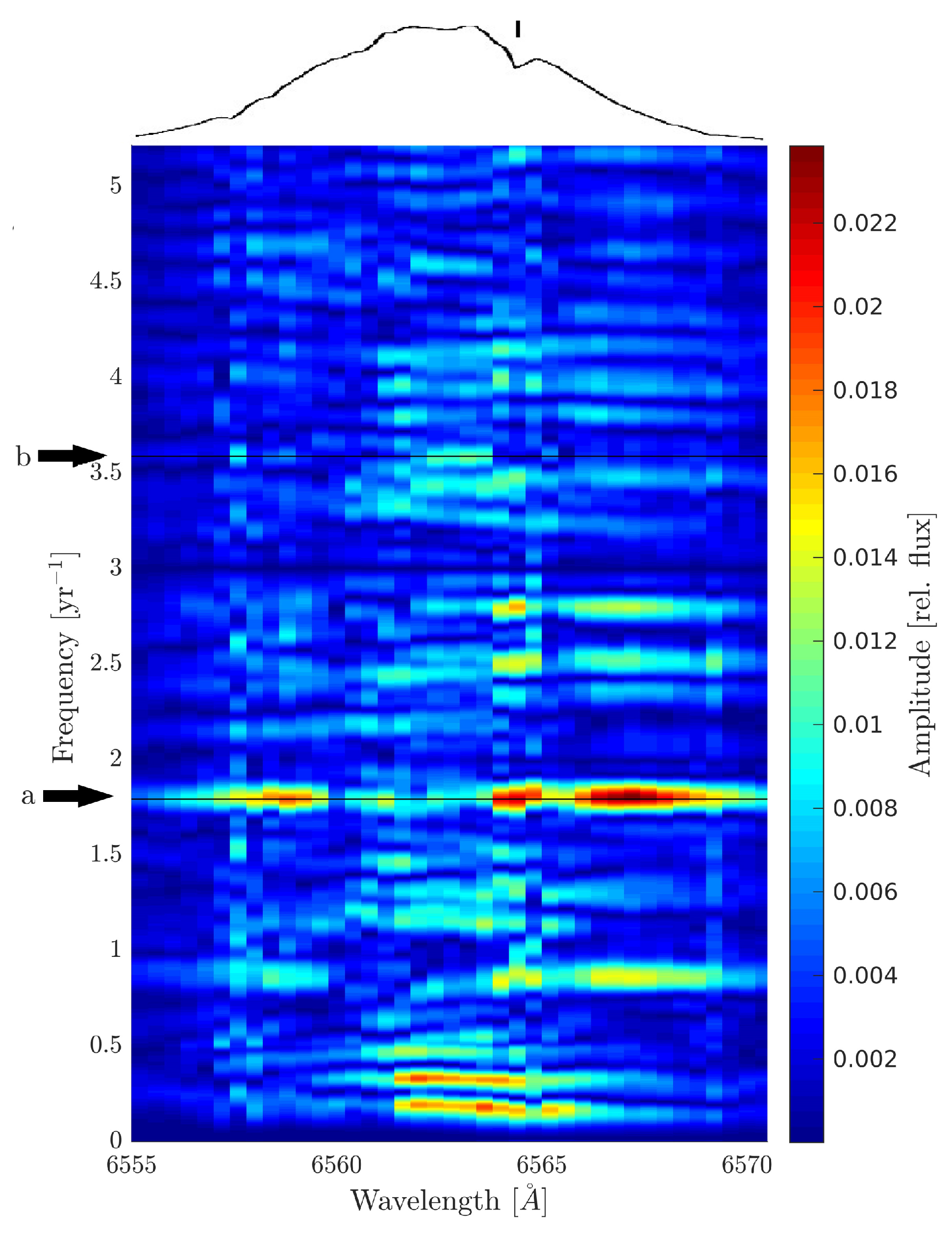
Figure 3.
Daily averaged normalized spectra of V558 Lyr obtained on 22.06.2022 (solid blue lines) and 23.06.2022 (dashed red lines) for lines H, H, and HeI 4922 [18]
Figure 3.
Daily averaged normalized spectra of V558 Lyr obtained on 22.06.2022 (solid blue lines) and 23.06.2022 (dashed red lines) for lines H, H, and HeI 4922 [18]
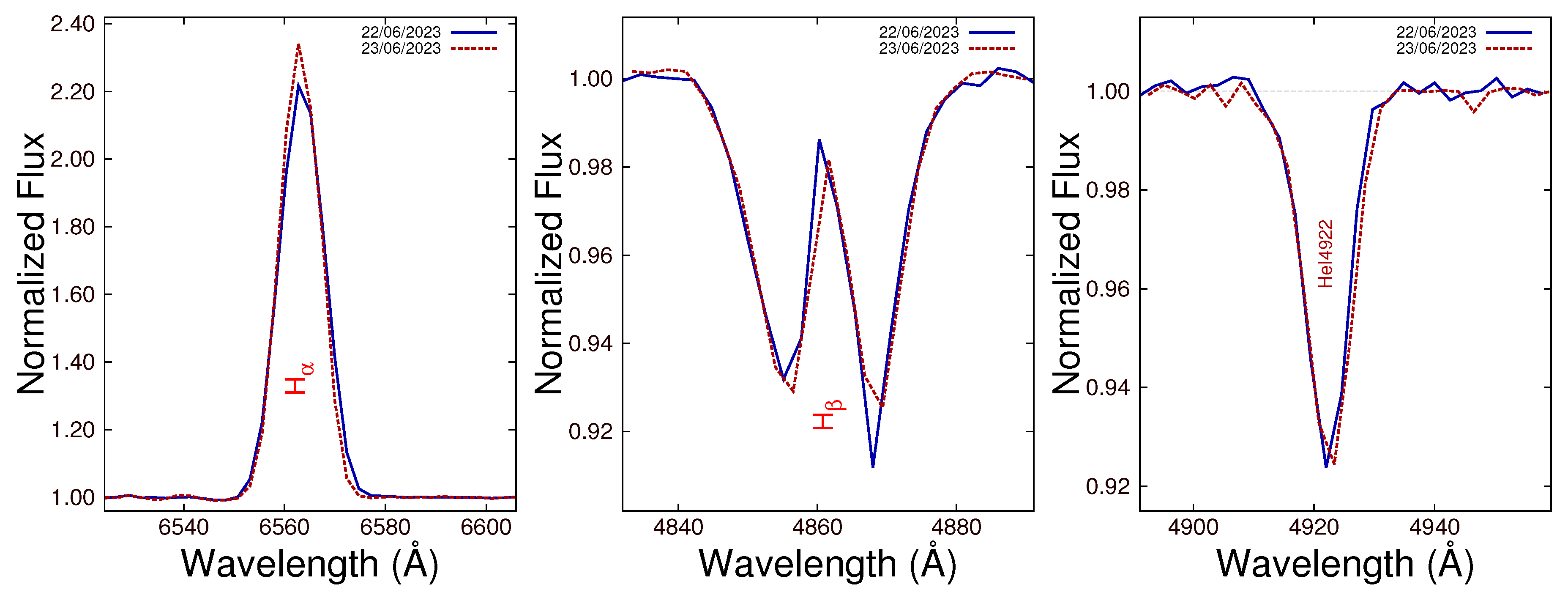
Figure 4.
Left panel: Observed X-ray fluxes in the Cas spectrum, normalized to 1 ks exposure. Right panel : Continuum normalized fluxes in the 6-8 keV energy range. From Kholtygin et al. [22].
Figure 4.
Left panel: Observed X-ray fluxes in the Cas spectrum, normalized to 1 ks exposure. Right panel : Continuum normalized fluxes in the 6-8 keV energy range. From Kholtygin et al. [22].
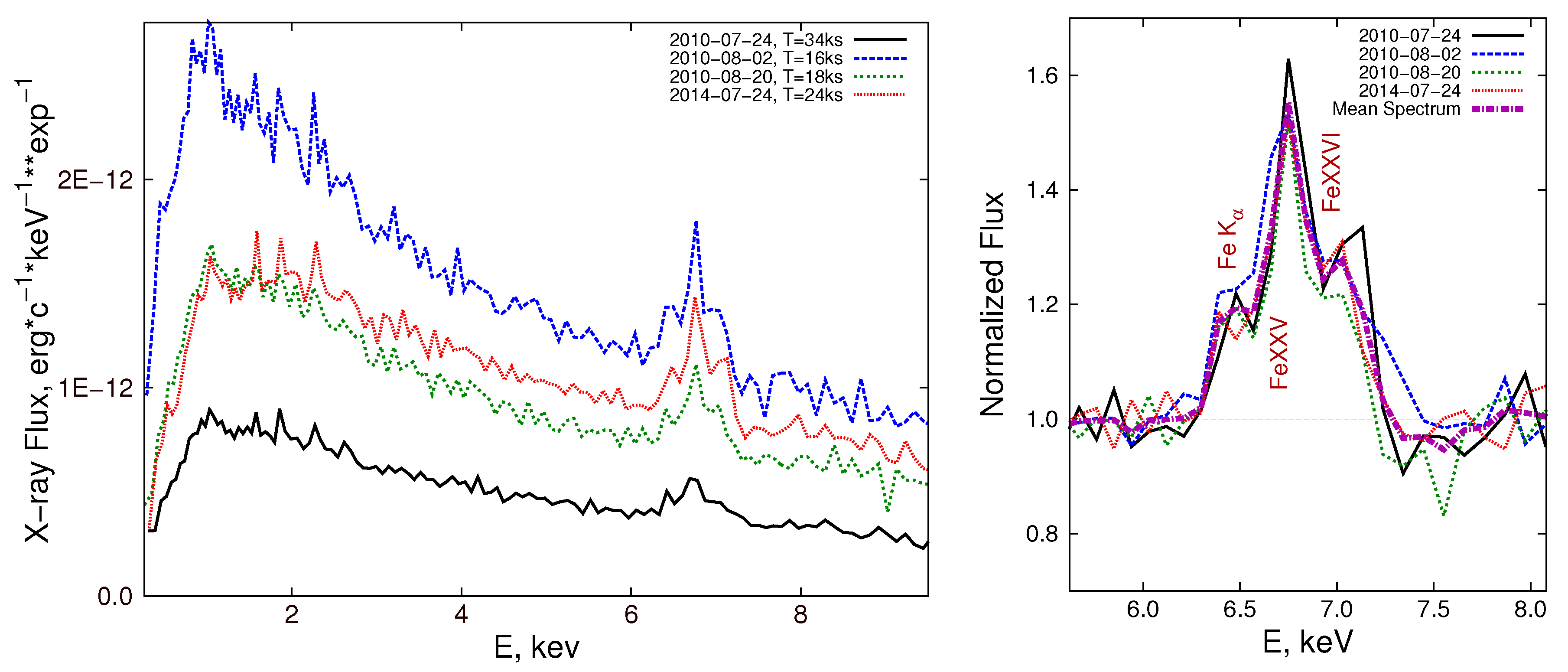
Figure 5.
Cas XMM dynamic spectrum. Top: XMM PN spectra binned by a constant factor of 10. Bottom left: count map of the XMM PN camera observation binned by constant factors of 10 in energy and 60 s in time. The legend is given in the top right corner. Bottom right: corresponding count-rate light curve of the observation binned at 60 s. Adapted from [57].
Figure 5.
Cas XMM dynamic spectrum. Top: XMM PN spectra binned by a constant factor of 10. Bottom left: count map of the XMM PN camera observation binned by constant factors of 10 in energy and 60 s in time. The legend is given in the top right corner. Bottom right: corresponding count-rate light curve of the observation binned at 60 s. Adapted from [57].
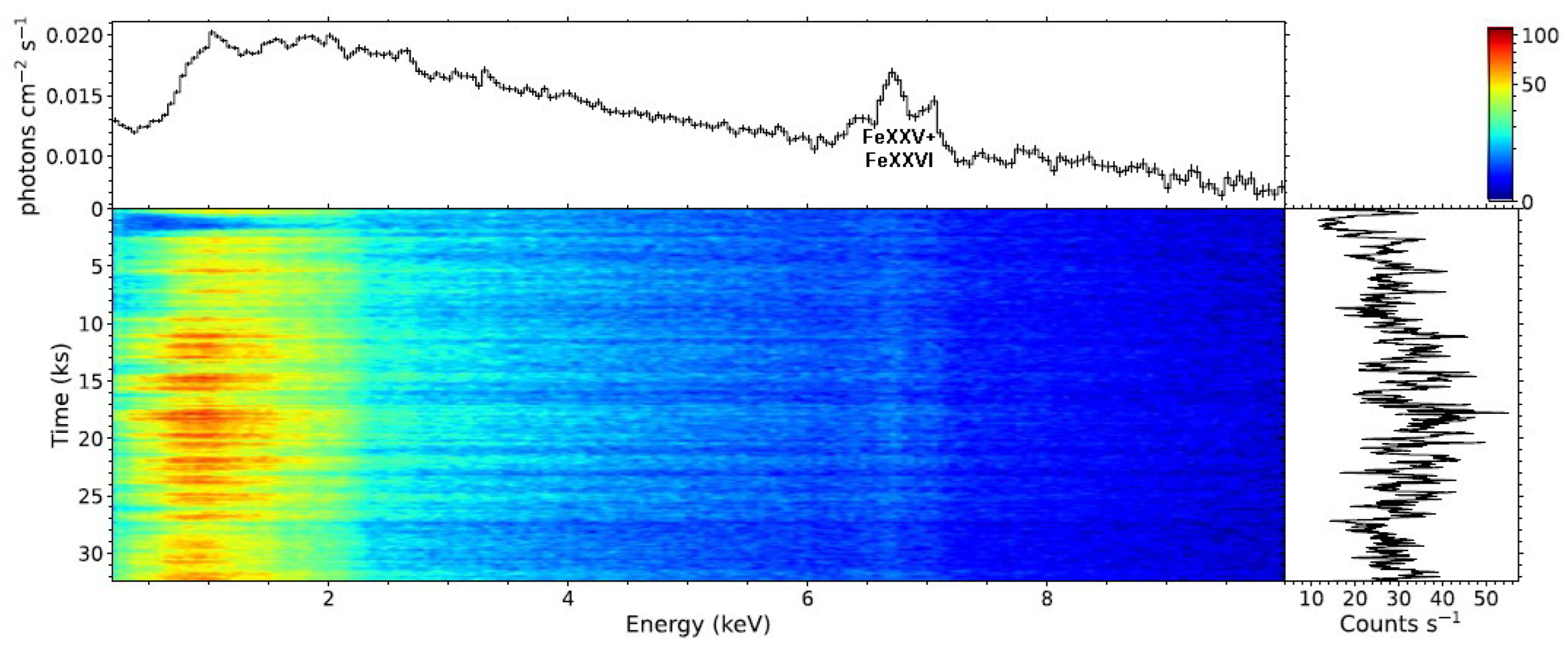
Figure 6.
Presentation of the main evolutionary phases leading to the formation of a Be+WD binary system. MS denotes main sequence, HG – Hertzsprung gap, GB – giant branch, and WD – white dwarf. Adapted from [79]
Figure 6.
Presentation of the main evolutionary phases leading to the formation of a Be+WD binary system. MS denotes main sequence, HG – Hertzsprung gap, GB – giant branch, and WD – white dwarf. Adapted from [79]
Disclaimer/Publisher’s Note: The statements, opinions and data contained in all publications are solely those of the individual author(s) and contributor(s) and not of MDPI and/or the editor(s). MDPI and/or the editor(s) disclaim responsibility for any injury to people or property resulting from any ideas, methods, instructions or products referred to in the content. |
© 2025 by the authors. Licensee MDPI, Basel, Switzerland. This article is an open access article distributed under the terms and conditions of the Creative Commons Attribution (CC BY) license (http://creativecommons.org/licenses/by/4.0/).
Copyright: This open access article is published under a Creative Commons CC BY 4.0 license, which permit the free download, distribution, and reuse, provided that the author and preprint are cited in any reuse.