
Submitted:
23 July 2025
Posted:
24 July 2025
You are already at the latest version
Abstract
The broadband Internet has revolutionized various aspects of human life and has had a profound impact on the world. More than 60% of individual activities and social interactions, meetings, communications, entertainment, education, employment, financial services and shopping, and other offline/online transactions are based on the Internet, which needs more comprehensive planning and attention. In this paper, we first raise and answer five questions about broadband Internet: What are the current status and future directions of this technology? Where and why does big data exist in broadband Internet technology? Which type of Internet access is preferable and which one needs more attention? What are functional/technical challenges and solutions to improve the current situation? What are the positive and negative individual/social impacts of broadband Internet? In addition to pointing out the place of broadband Internet in fourteen aspects, fifteen criteria to compare wired and wireless and key individual/social impacts (six for positive and six for negative) of broadband Internet are outlined. Moreover, issues that directly and/or indirectly affect the global development of broadband Internet are listed and twenty items on balanced sustainable development and strategic planning of broadband Internet are introduced. Furthermore, we propose ten spatio-temporal user/operator-centric strategies to improve the performance metrics of global broadband Internet, decrease its negative social effects, and reduce the digital divide in the world. Finally, we take a look at emerging technologies related to broadband Internet.
Keywords:
Broadband Internet
; Wired
; Wireless
; Big data
; Digital divide
; Social impacts
; Sustainable development
; Strategic planning
; Fixed and mobile convergence (FMC)
; Emerging technologies
1. Introduction
The term Internet was first used in a radio operator manual in 1945 [1]. In 1969, it evolved under the Advanced Research Projects Agency NETwork (ARPANET) to connect computers at various universities and the Department of Defense of the United States of America (USA) [2]. Transmission Control Protocol/Internet Protocol (TCP/IP) was officially adopted and used by ARPANET and the Defense Data Network (DDN) in January 1983, which is the start time of the Internet. The Internet supports a large number of nodes to transfer information from one node to another [3]. It is the global system of interconnected networks that uses Internet protocols to communicate between networks, users, and devices, even consisting of a group of smaller networks [1,4]. This network includes private and public, governmental and non-governmental, academic and non-academic, and commercial and non-commercial subnets, linked by wired (two-pair or coaxial or optical fiber cable), wireless (radio/light waves) networking technologies, and a combination of them [5,6]. Nowadays, the economic, industrial, communications, cultural, educational, health, medical, and social development of countries is dependent on the Internet.
Broadband refers to high-speed data transfer and a wide range of services, applications, and capabilities such as configurations and technologies that require high bandwidth of frequency and high-speed data transmission between interconnected elements. The Federal Communications Commission (FCC) defines basic broadband as a transmission speed of at least 25Mbps downstream and 3Mbps upstream. The Infrastructure Investment and Jobs Act (IIJA) considers 100Mbps downstream and 20Mbps upstream as minimum rates for broadband [7]. Although the first definition is more acceptable for telecommunication systems, the second definition is considered the standard for uploading and downloading data speeds in the broadband Internet. Because most of the new applications and services of digital media require broadband Internet access, therefore, it can be measured by the usefulness of such access to subscribers (persons, homes, businesses, industries, and institutions) and the applications and services that use broadband Information Communication Technologies (ICTs) [8,9]. Given the sharp increase in the use of Internet-based services and the demand for high-speed applications, higher download and upload speeds are expected to be defined and considered in the future for broadband Internet.
The quality of service of Internet-based applications, the concern of operators, and the satisfaction of subscribers can be measured and evaluated based on various functional/technical criteria, such as download and upload speeds, packet loss, network latency and jitter, availability, reliability, security, establishment and setup time, and subscription cost [10]. These differ in wired and wireless networks and in fixed and mobile scenarios, because end-to-end distance, network bandwidth, hardware configurations, end-user problems, and physical issues are different. High-speed and good-quality broadband networks are needed to support a large number of services and applications to help the following objectives in line with the digital world and virtual space [11,12,13]:
- Sustainable and balanced development;
- The convenience of citizens’ lives based on online services;
- Internet-based services in a fair way around the world;
- Internet business boom;
- offline/online electronic government and banking;
- Virtual and online education;
- Services based on video streaming;
- Online interactive games;
- Big data generation and processing;
- Edge/fog/cloud fixed-mobile computing;
- Generative Artificial Intelligence (AI);
- Blockchain and cryptocurrency;
- Internet of Things (IoT);
- Metaverse and applications based on Augmented Reality (AR), Virtual Reality (VR), and eXtended Reality (XR);
- Sixth Generation (6G).
The possibility of providing new services in digital media and the high speed of service delivery using optical fiber as the most suitable cable platform for reliable, symmetrical and high speed data transmission in upstream and downstream links and the 5th Generation (5G) standard of mobile wireless cellular communications are serious concerns and requests of Internet users [14].These two technologies are complementary to each other and with their convergence, broadband Internet access can be provided all over the world from anything to anything, whenever, wherever, for fixed and mobile applications to transfer and exchange broadband (high-speed) information and supporting broadband digital Internet-based services and applications [15,16,17,18]. One of the aspects of the digital divide is the Internet connectivity in rural and remote areas. One solution to having broadband Internet in these areas is Low Earth Orbit (LEO) satellite Internet such as SpaceX’s Starlink and Amazon’s Project Kuiper, which are in the testing phase [19,20]. With the cooperation and constructive interaction of these fixed and mobile platforms, it is possible to achieve high-speed Internet with low latency and gain the benefits of three platforms. Therefore, sustainable and balanced development will be implemented by sharing infrastructure, converging fixed/mobile wired/wireless networks, and leveraging the benefits of cellular 5G, Fiber-To-The-x (FTTx), and satellite-based platforms and networks.
The individual/social impacts of broadband Internet are wide-ranging, offering transformative benefits in terms of communication, education, economic opportunity, and social participation. Although the Internet has several positive effects, high-speed Internet access significantly reduces civic and political participation, and broadband penetration destroys several dimensions of social capital [21]. It creates destabilizing democracies and delegitimizing state institutions, with wide-ranging effects on the psyche and exacerbating digital inequalities. Furthermore, these benefits are tempered by challenges such as digital inequality, privacy concerns, misinformation/disinformation, and the potential for social isolation [22]. To maximize positive impacts while mitigating negative consequences, it is crucial to continue to address issues related to access, security, digital literacy, and responsible use of the Internet.
The remainder of this paper is organized as follows. In Section 2, the definitions, benefits, different types, issues, and solutions related to poor connectivity of the broadband Internet are presented. In Section 3, we take a look at the current status and future predictions of broadband Internet, focusing on the time spent by each individual, the latest statistics on users’ access to the Internet and its penetration rate, and the effects of broadband Internet on the Gross Domestic Product (GDP) and the economy. Section 4 shows the global data volume, the number of data centers, and the related issues of big data on broadband Internet. In addition to presenting fourteen benefits and positive impacts of broadband Internet and deriving fifteen criteria for comparing wired and wireless broadband Internet, Section 5 illustrates three different types of Internet access and some additional considerations that are needed, and compares fixed FTTx and fixed/mobile cellular 5G broadband Internet. In Section 6, functional and technical problems and solutions for improving the state of broadband Internet are presented. In addition to pointing out the place of high-speed broadband Internet in various aspects of human life, its positive and negative individual/social impacts are summarized in Section 7. In Section 8, issues that directly and/or indirectly affect the global development of broadband Internet, mitigate its negative social impacts, and reduce the digital divide in the world are outlined. Moreover, ten spatio-temporal user-centric and/or operator-centric strategies for balanced sustainable development and strategic planning of broadband Internet are introduced. Section 9 looks at emerging technologies related to broadband Internet. Finally, the conclusions of this study and future work are presented in Section 10.
2. Broadband Internet
Broadband means a large bandwidth that can carry multiple signals at a wide range of frequencies, support different types of Internet traffic, and allow multiple data streams to be sent. An Internet connection is high-speed if it can connect multiple devices simultaneously to enable streaming and access to modern applications [23,24,25,26]. The terms broadband and high-speed are mostly interchangeable when the Internet meets or exceeds a transmission speed of 100Mbps download and 20Mbps upload [27,28]. It is possible to find proper situations for all types of high-speed communications, various types of sending and receiving broadband information, and providing services that require high-speed data using broadband Internet with wired access using an optical fiber or wireless access using 5G cellular or satellite.
Broadband Internet is the backbone of today’s new connections. It refers to high-speed Internet access that is always on and faster than traditional Internet access. It encompasses a variety of technologies that provide high-data-rate connections to homes, businesses, and mobile users and equipment. Also, it has far-reaching individual/social impacts, influencing various aspects of society in both positive and negative ways. Its widespread availability and use have fundamentally changed how people communicate, access information, work, and interact with the world [29]. Briefly, the advantages of broadband Internet are:
- High speed that allows quick downloads, streaming, and browsing;
- Always on and the connection is continuous;
- Supporting multiple devices simultaneously makes it ideal for households and businesses;
- Improved performance metrics can be achieved for video streaming, online gaming, and Voice over Internet Protocol (VoIP).
Here are six common types of broadband Internet:
- Digital Subscriber Line (DSL). Uses existing two-pair cooper telephone lines to transmit data. It offers speeds ranging from a few Mbps to around 100Mbps.
- Cable Internet. Delivered through the same coaxial cables that provide cable television. Speeds can range from 10Mbps to over 1Gbps.
- Broadband over Power Line (BPL). Uses existing electrical wiring to provide Internet access. It is less common and speeds can vary.
- Fiber-optic Internet. Transmits and receives light signals through a wired fiber optic channel. It offers the highest speeds, often ranging from 100Mbps to 10Gbps.
- Wireless broadband. Includes fixed wireless using radio waves from a base station) and mobile broadband via cellular Fourth Generation-Long Term Evolution (4G-LTE), 4.5th Generation-Long Term Evolution-Advanced (4.5G-LTE-A), and 5G networks. Speeds can vary widely based on the technology and network conditions.
- Satellite Internet. Provides Internet access via satellites orbiting the Earth. It is useful in remote and rural areas where other types of broadband Internet are unavailable or not cost-effective. Speeds typically range from 12Mbps to 100Mbps.
Accessing the above-mentioned broadband Internet may force the following items:
- Availability. Depending on location, some types of broadband may not be available.
- Cost. Generally, it is more expensive than dial-up, varying by speed and provider.
- Data limit. Some providers impose data limits (caps), which can affect heavy users.
- Slow Internet speeds caused by network congestion, outdated hardware, or Internet Service Provider (ISP) limitations.
- Frequent disconnections due to router issues, signal interference, or ISP problems.
- Latency and high ping affect online gaming and video calls, often due to distance from servers or network congestion.
- Limited coverage that causes rural and remote areas to suffer from poor or no broadband access.
- Data caps and speed reductions due to bandwidth throttling by ISPs, cause speeds to slow down after a certain data limit.
- Hardware problems, such as faulty routers, outdated modems, or improper setup impact connectivity.
- Cybersecurity threats and weak security expose networks to hacking and malware.
- Work disruptions. Remote work and online meetings suffer from poor connectivity.
- Education setbacks. Online learning becomes difficult with slow or unstable Internet.
- Economic challenges. Businesses relying on digital services face losses.
- Healthcare delays. Telemedicine services become unreliable.
- Reduced digital inclusion. Limited access worsens the digital divide in underprivileged areas.
Eight user-based and/or operator-based solutions to achieve the desired connection by providing improved quality, high download and upload speeds, low latency, and high security and privacy are as follows [36,37,38,39]:
- Improve router placement. Keep routers in open areas away from walls and interference.
- Upgrade Internet plan. Ensure your plan supports high-speed and unlimited data if needed.
- Use a wired connection (Ethernet). Reduces latency and improves speed over Wireless-Fidelity (Wi-Fi).
- Update hardware. Use modern routers/modems that support the latest standards.
- Optimize network settings. Update Quality of Service (QoS) settings to reorder essential applications.
- Expand infrastructure. Governments and ISPs should invest in fiber optics and rural broadband expansion.
- Use Virtual Private Networks (VPNs) or alternative ISPs. They can bypass throttling and provide higher performance.
- Regular maintenance. Including restarting devices, clearing caches, and keeping firmware up to date.
Broadband Internet status and future predictions, challenges and issues, positive and negative impacts, and local and global solutions to improve its situation are presented in more detail in the next sections.
3. What Are the Current Status and Future Predictions of Broadband Internet?
We are witnessing an era of rapid digital expansion, where online engagement continues to accelerate across diverse domains. The Internet, especially social networks, is being increasingly used for a broad spectrum of economic and cultural initiatives, with substantial investments aimed at spreading messages and engaging audiences. However, despite this growth, effectively identifying and connecting with the targeted communities to share information remains a complex and persistent challenge [40].
The percentage of time spent by each individual on various activities in the beginning and end years of the 1980 to 2024 time period shown in Figure 1 shows the change in the distribution of activity time after 45 years. As can be seen, the percentage of time spent on various activities has decreased by at least 50%, excluding the Internet. Time spent online has increased from 0 to over 60 percent of all activities, while other activities accounted for less than 40 percent of each person’s time in 2024 [41]. Time spent on the Internet is expected to increase to 70% by the end of 2025. The average daily Internet usage time in the world shows that the Philippines, Brazil, Colombia, and South Africa have more than 10 hours, while the average Internet usage time in the world per person is about 7 hours [42].
The newest statistics [42] on the users worldwide accessing the Internet show that 95.9% of mobile phones, 93.7% of smartphones, 62.2% of any laptop or desktop, 11.5% of game consoles, and 4.4% of virtual reality devices are accessing the Internet. It is expected that these percentages will be increased in the future, especially by online gaming, video streaming, AR/VR/XR, and Metaverse.
Broadband Internet access is rapidly changing the way people live, work, and even play and have fun [43]. According to the International Telecommunications Union (ITU) report [44,45], which examines the economic effects of fixed and mobile broadband and data from 139 countries in the time interval 2010-2020, a 10% increase in fixed and mobile broadband penetration increases GDP per capita in developed countries by 0.77% and 1.5%, respectively. Based on the European Telecommunications Network Operators’ association (ETNO) report [46], communities, where 50% of the population has a Fiber-To-The-Home (FTTH) connection with a speed of at least 1Gbps, have 0.9% to 2% higher per capital GDP than communities without an optical fiber broadband network. It means that broadband investment is the main driver of country growth and development. Although it is difficult to fully quantify this, the importance of broadband connectivity in the social and economic development of countries is undeniable [44]. The global broadband subscription market alone was worth more than $356 billion at the end of 2021, accounting for between 2% and 7% of a country’s GDP [45,46,47].
The significant difference between the number of Internet users in different countries and the penetration rate in different parts of the world (as shown in Table 1 for high-population countries at the beginning of 2025) are the main reasons for the digital divide. For example, India and China, respectively, with 1463865525 and 1416096094, are the two countries with the highest number of people connected to the Internet, while their Internet penetration rates are around 55% and 78%, respectively. In addition, Pakistan, Bangladesh, and Nigeria have penetration rates lower than 50 percent [48,49,50]. However, as depicted in Table 2 for countries with a high penetration rate at the start of 2025, in some countries, such as the Kingdom of Saudi Arabia (KSA), the United Arab Emirates (UAE) and Bahrain, the penetration rate is 100%, it is about 91.92% for Malta, the 25th country in this list. The penetration rate is decreasing from 100% for high-ranking countries to 13.2% and 12.5% for Chad and Burundi, respectively, which causes the average Internet penetration rate to be approximately 68.7% in the world.
Although Internet access is available in different countries, download and upload speeds for fixed and mobile Internet users vary from place to place. For example, the highest average fixed download speed is in Monaco at 262Mbps and mobile in the UAE at 240Mbps, while in some countries the average is below 10Mbps. The amount of latency and jitter (standard deviation of latency) also vary around the world, which is further compounded [51].
A total of 5.65 billion people use the Internet in the middle of 2025, resulting in a penetration rate of 68.7. Internet users increased by 136 million (+2.5 percent) during 2024, but 2.58 billion people remained offline in the middle of 2025 [52]. Countries have established national broadband plans to create a higher penetration rate of connectivity, and therefore, the global population of unconnected people is predicted to decrease from 45% in 2019 to 27% in 2026 [53,54]. The higher the broadband maturity of a country, the greater its ability to improve digitalization and increase the absorption of economic impacts. However, the benefits of broadband go beyond those that directly lead to revenue generation. According to a World Bank study [55], educated people’s chances of finding a job increase by 7% to 13% if they have access to broadband Internet.
4. Where and Why Does Big Data Exist in Broadband Internet Technology?
As shown in Figure 2, the global volume of data is projected to rise further to bytes by the end of 2025 [50]. This growth is driven by the increasing use of IoT devices, social networks, real-time data processing such as online gaming, and cloud-based storage for different applications and services like video streaming. In other words, the volume of Internet data, including all work, social, and personal uses, will be about 60Gbps per day per person in a world population of 8.23 billion.
As depicted in Table 3, the volume of data on the Internet for video, social networks, and online gaming services is about 75% and that for Web browsing, messaging, marketplace, file sharing, cloud, VPN, and audio services is about 25%. The first place is for video with 53.72% and the lowest rank is for voice with 0.3% of the total volume of Internet data [50].
As demonstrated in Figure 3, there are about 11800 data centers around the world. 5426, 46% of them, are located in the United States of America. The second rank belongs to Germany with 529 data centers, about 9.7% of the USA data centers, and 4.5% of the total numbers. 10458 of them, about 88.6% of data centers are located in 25 countries, which means that about 11.4% of the total (i.e., only 1342 data centers) are in the rest of the world [56].
It is expected that in addition to increasing the number of data centers worldwide, adding new data centers above the earth in LEO, Medium Earth Orbit (MEO), and Geostationary Earth Orbit (GEO) satellites, namely 3D data centers, is needed because of
- Increasing the number of Internet users and Internet penetration rate;
- Increasing the number of new services and applications that use broadband Internet;
- Accepting higher values for downstream and upstream speeds and lower latency and jitter in new services.
Comparing the list of 25 first countries of the world given the number of Internet data centers and 25 top world economies countries according to 2025 GDP [57], i.e., USA, China, Germany, India, Japan, United Kingdom (UK), France, Italy, Canada, Brazil, Russia, Spain, South Kora, Australia, Mexico, Turkey, Indonesia, Netherlands, KSA, Poland, Switzerland, Belgium, Argentina, Sweden, and Ireland, shows that 19 countries of the first list are the same as 19 countries of the second list. This similarity is due to the impacts of broadband Internet and economy on each other. On the one hand, broadband Internet, which improves the economy, requires more data centers, while on the other hand, the economy allows us to have data centers and provide broadband Internet in a country. Also, several research directions, especially big data and artificial intelligence, require further exploration.
5. Which Type of Internet Access Is Preferable and Which One Needs More Attention?
Broadband Internet access can be classified into different categories, such as wired or wireless, fixed or mobile, short or long coverage, low or high data speed, radio wave or light signal, low or high subscription fee and cost of service usage, and fast or slow deployment and startup. There are various platforms like two-pair, coaxial, and optical fiber cable in wired scenarios and Wi-Fi, Worldwide Interoperability for Microwave Access (WiMAX), 4/4.5/5G, LEO/GEO satellites, and balloons in wireless scenarios. Optical fiber and 5G cover a high number of users and support different services of the broadband Internet, and LEO satellite is a new candidate, especially for rural and remote areas.
To evaluate and compare various types of broadband Internet access, 15 criteria are considered [50,58,59,60] that can be divided into two categories as shown in Figure 4 and Figure 5. The first category includes data volume, download and upload speeds, effective range, subscription fees, users’ willingness (desire to access, and mobility and comfort, which are important to users directly and operators indirectly. Also, the second category includes security, reliability, interference, latency, jitter, packet loss, establishment and setup time, and link observation and maintenance, which are important to operators directly and users indirectly. All system parameters and performance metrics depend on the type of access, the channel used, technology, etc. Hence, in the aforementioned criteria, the effect of system parameters including transmit power, transceiver loss and gain, working frequency, bandwidth, noise level, interference, and threshold level of the receiver is visible.
5.1. Fixed Broadband Internet Based on Cable
- High bandwidth and speed with symmetrical connectivity;
- Low dependency of service quality on the distance;
- Placing a large number of cables together;
- High security;
- Corrosion resistance and long life of cables;
- Thinner and lighter than two-pair and coaxial cables;
- No need for frequent replacement.
The disadvantages of this access are as follows:
- High cost of establishment and setup;
- Different cabling compared to copper cable;
- Lack of optical fiber in many areas;
- Need a different modem;
- High fragility and low bending of cables.
Realization and expansion of FTTx network in Fiber-To-The-Node (FTTN), Fiber-To-The-Cabinet (FTTC), Fiber-To-The-Business (FTTB), and Fiber-To-The-Premises (FTTP) or FTTH types, is of special interest. As presented below, they differ in the type of channel, speed in establishment and setup, data speed, and cost.
- FTTN. From the network to the cabinet that is far from the access node (more than 300 meters) is of optical fiber cable and from the access node to users is of copper (twisted-pair or coaxial) cable. If the end user is far from the cabinet, the quality of the provided service will be greatly reduced.
- FTTC. The channel from the network to the cabinet, which is close to the home/office is more than 300 meters of optical fiber, and in most cases, copper cable is used from the cabinet to the user. This type of Internet platform offers sufficient speed for home use and is cheaper than other types of FTTx, but the downloading and uploading speed is limited [63].
- FTTB. The channel from the network to the cabinet and from the cabinet to the building is fiber optic. In the building, wired or wireless access using a modem can be given.
5.2. Mobile/Fixed Broadband Internet Based on Cellular 5G
5G supports high-speed data transfer, low latency, high reliability, high availability, and high connection density. Based on 5G, data speeds on mobile and fixed broadband Internet access can reach 20Gbps, allowing users to enjoy access to files, services, and applications. The latency will be ten times lower than 4G and it will be able to remote actions in real time. Cellular 5G offers a positive experience in smart cities and IoT. By sharing the information of the sensors of the cars and those of the city, and then exchanging data, the quality of life in cities can be improved and the navigation of the autonomous car can be facilitated by choosing better routes, reducing the number of accidents, find available parking spaces, etc. 5G networks are expected to effectively support typical applications such as enhanced Mobile Broad Band (eMBB), Ultra-Reliable Low Latency Communications (URLLC), and massive Machine-Type Communications (mMTC) [66,67,68,69,70].
In summary, the 5G features are:
- Improved connectivity between multiple devices;
- Connect a much larger number of different devices;
- Enhanced Internet experience in streaming and gaming;
- High reliability;
- Increased availability;
- High energy efficiency;
- Virtual network implementation and network slicing;
- Configure subnets to do connections for specific needs.
These features come at the cost of the following downsides:
- Faster battery drainage, when streaming high volume of data;
- Limited coverage, spotty in some, not available in all areas;
- Expensive infrastructure of new base stations and equipment;
- Signal interference from trees, buildings, and obstacles.
5G is divided into low (less than 1GHz), mid (1GHz-6GHz), and high (24GHz-40GHz) frequency bands. The low-band offers lower speeds with greater coverage, the mid-band has a balance of speed and coverage, and the high-band offers higher speeds with smaller coverage. Besides, frequency bands for 5G-New Radio (5G-NR) are divided into two different frequency ranges. Range 1 from 410MHz to 7125MHz and range 2 in millimeter waves from 24.25GHz to 71GHz. Moreover, frequency bands 600MHz, 700MHz, 800MHz, 900MHz, 1.5GHz, 2.1GHz, 2.3GHz, and 2.6GHz are considered for traditional coverage applications and new specific usages such as IoT, industry automation, and critical use cases [71,72].
5.3. Broadband Internet Based on Satellite
GEO satellite Internet experiences high latency and power loss, LEO satellite Internet requires handover between the satellites of the constellation, and the cost of both of them is high. However, they are of interest for sparsely populated areas where wired copper/fiber-optic cable networks and wireless Wi-Fi, WiMAX, and cellular 4G/5G coverage are not possible and are not economically justified for operators.
SpaceX’s Starlink and Amazon’s Project Kuiper are being tested and launched as the latest satellite technology to provide broadband Internet [73,74]. Both of them are LEO satellite constellation that provides high-speed Internet access to underserved areas of the world and is a great choice for people living in remote areas [75,76]. Compared to this technology, fiber-based Internet is more reliable because it uses a wired connection. The limitation of capacity and power in fiber optic is not so worrying and it has higher speed and lower latency and jitter than LEO-satellite Internet. While this technology offers faster speeds and more reliable services in clear-sky situations, 5G supports high-speed and wide-coverage Internet that is more widely available than satellite Internet and generally costs less for urban areas [73,74,75,76,77,78,79]. Starlink’s and Kuiper’s upfront costs for equipment and service fees are significantly higher than 5G and FTTx plans.
LEO satellite Internet is currently in the testing phase, it has many energy and bandwidth issues, its coverage will be limited to areas with a clear sky, it can be affected by weather (snow, rain, and ice), and some of the bottlenecks will be determined later [73,75]. Moreover, it is only available in limited areas, so there may be some bugs [77]. For users in areas with limited FTTx and 5G coverage, in remote/rural areas [78], it may be the best choice
5.4. Comparison of FTTx-Based and 5G-Based Broadband Internet
FTTx and 5G networks are widely used. For users who have access to FTTx and 5G networks, higher speeds and lower costs make them more attractive options. Businesses must also consider the long-term implications of their choices [50,80,81,82]. Table 4 and Table 5 compare FTTx and 5G based on the criteria of the first and second types, respectively.
A more detailed functional and technical comparison is as follows:
- Data volume. Mostly data volume is unlimited in FTTx but limited in 5G.
- Download/upload data speed. 5G can reach a maximum downstream speed of 20Gbps and an upstream speed of 10Gbps, while the data speed in FTTx can reach 1 petabit ( bits) per second (practical speed of 100Gbps) symmetrically for upload and download links. In FTTx, upload and download rates can be equal and the highest speed is for FTTH, FTTB, and FTTC, respectively [61,62,63]. During peak hours, wireless networks will be slower, but fiber optic connections will not change much download or upload data speed [80,81,82].
- Effective range. Wireless connections can only feed a limited area, and when the user moves too far from the coverage area of the base station, access point, or modem, they drop the connection or start experiencing signal instability. This is not the case with optical fiber, and regardless of how far the user is from the signal source, it always receives a strong signal. 5G-Home (5G-Mobile) can reach up to 10m (3km), but signals passing through fiber can have acceptable quality up to about 70km.
- Users’ desire to access. 5G broadband Internet is welcomed due to the possibility of high mobility and high download speed while users’ need for high data speed in broadband and symmetrical applications promises the growth of FTTx. Hence, it is necessary to create access points with a coverage radius of 100m to 300m in countries with no or limited optical fiber [78,79,80], and accelerate setup and access to 5G broadband Internet to meet the mobility needs of users.
- Mobility & comfort. Subscribers are looking for 24/7 connectivity and want a seamless connection wherever they are, which is an inherent advantage of wireless Internet.
- Cost. Given operators, wireless connection is significantly cheaper than optical fiber because Internet service providers must install fiber optic cable to establish a connection. In contrast, 5G networks are more expensive to build due to the dense infrastructure required for urban and suburban areas. FTTx is cheaper for fixed subscribers due to no limit on the amount of data available while 5G is more cost-effective to distribute and more expensive to access. FTTx, especially FTTH, typically offers lower monthly subscription costs. In some cases, 5G Fixed Wireless Access (FWA) can be cost-effective compared to FTTH, especially in rural areas or where FTTH deployment is challenging.
- Security. 5G requires encryption because data is transmitted over a wireless medium. In the fiber-based Internet, the majority of the transmission medium is optical fiber, and data requires less encryption. Hence, both provide users’ data security, but a 5G connection requires more data protection due to its reliance on wireless radio waves [80,81].
- Reliability. Fiber-based Internet is immune to the wear and tear seen in copper cables. In the 5G Internet, if the distribution and position of the base stations are properly designed, which guarantees reliable communication, the failure is only caused by the connections of the parties.
- Interference & resource management. With fiber optic connections, there is greater resistance to interference, while adjacent and cochannel interference is highly influential in 5G cellular connections. Since wireless connections are interference-limited, radio resources must be optimally allocated to different service providers and base stations, while there is no limit to the number of adjacent fiber optic cables, and optical signal reuse is becoming more and more common in FTTx access.
- Latency. FTTx has a lower latency than 5G, which is more suitable for latency-sensitive applications like business, stock market, and gaming, while 5G with 3-4 times the latency of fixed Internet is great for completing activities like video broadcasting, Internet browsing, and using cloud applications. The technology used in FTTx can affect the latency [80,81,82].
- Jitter. This shows latency changes. Applications such as the stock market and online games are very sensitive to it. On average, jitter is much lower in FTTx-based fixed Internet connections than in 5G connections.
- Packet loss. It depends on the quality of the communication link. The more stable and lower the random fluctuations, the lower the packet loss. Hence, FTTx fixed Internet is more suitable than 5G fixed/mobile Internet, because, it does not experience random propagation changes.
- Setup time. 5G Internet does not require cables to install, but FTTx Internet connections are more time-consuming and difficult to establish and set up because fiber or copper cables are to be run from the home/building to the cabinet and service provider. After making the connections, the Internet can be accessed directly or via a Wi-Fi modem.
- Link observation & maintenance. Inspection and maintenance of the channel and connections are important in FTTx, but in 5G, since it has an air transmission channel, only necessary to monitor and maintain connections in the transmitter and receiver sides.
6. What Are Functional and Technical Challenges and Solutions to Improve the Current Situation?
Figure 6 shows seven functional/technical challenges in the current broadband Internet. For each of them, many solutions are proposed.
-
Infrastructure gap & physical barriers. The infrastructure that exists is outdated or insufficient to meet current demands. Many low-dense rural and remote areas lack the necessary infrastructure to support broadband Internet [83,84]. Additionally, mountains, forests, and oceans can be difficult to reach with traditional broadband infrastructure, making providing reliable Internet service costly or logistically challenging. Five solutions to mitigate these challenges are:
- Government investment. Governments can invest in building or subsidizing broadband infrastructure in underserved areas.
- Public-private partnerships. Collaboration between government organizations and private companies can accelerate the improvement and expansion of services in different parts of the country.
- Fiber-optic networks. Expanding fiber-optic broadband, which offers faster and more reliable services than traditional copper cable networks, can significantly improve Internet quality. Investment in nationwide fiber infrastructure is a key long-term solution.
- Wireless terrestrial technologies. High-altitude wireless towers and mesh networks can be used to bypass physical barriers. Although FWA broadband Internet can be deployed in urban and rural areas, this could be a more affordable solution compared to digging trenches for fiber-optic cables, especially for connecting homes in rural or less dense areas. In addition, 5G technology promises ultra-fast, low-latency wireless Internet that could dramatically improve broadband speeds, particularly in urban and suburban areas, where fiber-optic installations might be cost-prohibitive. It also has the potential to provide more reliable coverage in rural areas where traditional broadband infrastructure is lacking.
- Satellite Internet. Satellite Internet providers and companies like SpaceX and Amazon are deploying satellite constellations to offer high-speed Internet to remote and underserved hard-to-reach areas, overcoming the geographical barrier and bridging the digital divide in regions where terrestrial broadband infrastructure is lacking, and laying traditional cables is expensive.
-
Environmental impact of infrastructure. The installation and maintenance of broadband infrastructure, such as laying fiber-optic cables or setting up cell towers, can have environmental impacts, particularly in sensitive areas [85]. Two solutions to reduce these impacts are:
- Sustainable practices. Using eco-friendly materials, minimizing disruption to ecosystems, and adopting energy-efficient technologies can reduce the environmental footprint of broadband infrastructure.
- Satellite & wireless alternatives. Exploring less intrusive alternatives like satellite broadband or wireless Internet could lessen the environmental impact compared to traditional cable or fiber installations.
-
Speed & quality of service. Even in areas with broadband access, speeds can often be slow, and service quality may be inconsistent, especially during peak hours or in areas with high user demand [86,87]. Three solutions to improve the situation are:
- Upgrading networks. Service providers can invest in modernizing their networks (e.g., upgrading from copper lines to fiber-optic cables) to improve speed and reliability.
- Technological innovations. Incorporating new technologies like 5G or Wi-Fi 6 can help improve broadband speeds and efficiency, especially in urban areas.
- Quality of service management. Providers can optimize their networks with better traffic management systems to avoid congestion during peak times.
-
Network security & privacy Concerns. As more people and businesses rely on broadband Internet, the risks of cyberattacks, privacy violations, and data breaches increase [88,89]. Three solutions to decrease these items are:
- Stronger regulations. Governments can implement stricter cybersecurity laws to protect users’ data and ensure that service providers maintain robust security measures.
- Public awareness. Educating Internet users on how to protect their privacy and secure their devices can reduce the likelihood of cyber threats.
- End-to-end encryption: Encouraging ISPs and platforms to implement strong encryption practices can protect data from being intercepted
-
Digital literacy. Even if people have access to affordable and high-speed Internet, they may not know how to use it effectively. This creates a barrier to full utilization, especially in older or less educated populations [90,91]. Two solutions for improving digital literacy are:
- Digital literacy programs. Offering free or low-cost training programs for individuals to improve their digital skills can empower more people to take advantage of the Internet.
- User-friendly devices & interfaces. Ensuring that devices (computers, smartphones, etc.) and Internet services are easy to use can help bridge the digital literacy gap.
-
Lack of competition. In many regions, only one or two Internet service providers dominate the market, which can lead to high prices and poor services. Three solutions to solve this problem are:
- Encouraging competition. Governments can incentivize new providers to enter the market, particularly in underserved regions.
- Regulatory oversight: Governments can regulate ISPs to prevent monopolistic practices and encourage fair pricing, while also ensuring that consumer needs are met.
- Community broadband projects. In areas with few options, communities can band together to create their broadband networks or cooperatives.
-
Affordability. Broadband can be prohibitively expensive for low-income families or people living in developing countries, leading to digital inequality [92,93]. Three solutions for reducing prices are:
- Subsidized plans. Governments or Non-Governmental Organizations (NGOs) can help by providing subsidies for low-income households, ensuring they have access to affordable broadband.
- More competition. Encouraging competition among ISPs can help reduce prices.
- Flexible pricing: Service providers can offer tiered pricing plans based on usage, making broadband more accessible to a wider range of income levels.
7. What Are Individual/Social Impacts of Broadband Internet?
According to Figure 7, we can point to the place of wired and wireless broadband Internet in different urban and nonurban, individual and social, and local and global aspects of modern human life.
- Global communications. Cross-border communication and cooperation will be facilitated, and global trade relations and cultural exchanges will be strengthened.
- Economy. It accelerates commerce, promotes innovation, and allows new markets to aid economic development.
- Electronic banking & stock market. It becomes possible to do banking and financial transactions using electronic and mobile devices without the need to physically be present in a bank or financial/credit institution.
- Smart government. Citizens can do all administrative and business matters through the Internet without the need to travel.
- Remote job & telework. It expands the possibility of telecommuting and flexible work schedules that benefit both employers and employees.
- Education. It provides access to online learning resources, virtual classrooms, and international educational collaborations by improving and leveling access for interested people.
- Healthcare & treatment. Telemedicine allows online diagnosis and treatment, improved patient care and access, and data sharing among healthcare professionals. The high-speed Internet increases the amount of information contained in the healthcare marketplace [94].
- Traffic & urban transport. Using the location and status information of the stations and traffic lines makes transportation planning practical and traffic control intelligent.
- Public safety. Wireless broadband is essential for the cooperation of police, fire, health and other government agencies in both normal and emergency cases.
- Accessibility. High-speed Internet is an important tool to meet the needs of people with disabilities. Through various broadband-based applications and technologies, they have access to new smart devices that improve their quality of life.
- Nature & living environment. It promotes paperless transactions and virtual meetings that reduce the consumption of natural resources and harmful environmental impacts.
- Agriculture. It gives farmers real-time information on weather, markets, planting and harvesting, and productivity.
- Entertainment. Enriching the possible options for leisure and entertainment, it allows high-quality gaming, video streaming, and interactive virtual media experiences.
Given the special position of high-speed broadband Internet, this technology has wide-ranging individual/social impacts and affects various aspects of society, both positively and negatively. Its widespread availability and use have fundamentally changed the way people communicate, access information, work, and interact with the world.
7.1. Positive Individual/Social Impacts
Based on several research works and studies [97,98,99,100,101,102,103,104,105,106,107], broadband Internet has six positive impacts on individual/social aspects of human life as follows:
-
- Global connectivity. Broadband Internet has made it easier for people to communicate across the globe. Platforms like email, social media, video calls, and messaging apps enable instant communications, bringing people closer regardless of geographic location.
- Social networks. Social media platforms (Facebook, Twitter, Instagram, etc.) allow people to stay connected, share experiences, and form communities. This connectivity can create new relationships and support systems.
- Collaborative tools. Tools like Zoom, Microsoft Teams, and Slack allow for seamless communication and collaboration in both professional and personal settings, bridging time and space barriers.
-
- Educational opportunities. Broadband Internet provides access to a wealth of information, online courses, tutorials, and educational resources. It allows individuals to enhance their knowledge, acquire new skills, and pursue formal education through online universities and virtual classrooms.
- Self-learning & skill development. People can learn at their own pace and access resources on diverse subjects, empowering lifelong learning and skill-building.
- Remote education. In areas where physical schools or universities are not available, broadband Internet can enable distance learning and online education, opening up opportunities for students in rural or underserved areas.
-
- Remote work. Broadband Internet has revolutionized the job market by enabling remote work. This has led to greater job flexibility, work-life balance, and opportunities for individuals in remote areas to access jobs that were previously unavailable.
- The gig economy. The rise of platforms like Upwork, Fiverr, and Etsy has allowed individuals to start their businesses, offer freelance services, or engage in the gig economy, often leading to increased income and economic independence.
- Entrepreneurship & innovation. With access to the Internet, entrepreneurs can create and promote online businesses, and small businesses can tap into global markets. The ability to reach customers via e-commerce platforms, digital marketing, and social media opens up new avenues for growth and success.
-
- Telemedicine. Broadband Internet enables telemedicine, allowing individuals to consult healthcare professionals remotely, access mental health services, and track their health through digital tools.
- Health education & awareness. Online resources and forums provide valuable information on health topics, empowering people to make informed decisions about their health and well-being.
- Support communities. Online support groups and forums provide emotional and social support to individuals facing health challenges, including chronic illnesses, mental health issues, and addiction recovery.
-
- Civic participation. Broadband Internet allows people to engage in political discourse, access news, and participate in social movements, making it easier to be informed and involved in social and political issues. Online petitions, social media activism, and digital campaigns have all become significant tools for advocacy.
- Empowerment of marginalized groups. Broadband access provides a platform for marginalized groups to raise awareness about their causes, express their voices, and connect with others facing similar challenges. This can lead to social and political change.
- E-government services. Broadband Internet enables the delivery of government services online, making it easier for people to access information, apply for services, vote in elections, and engage with governmental institutions.
-
Cultural exchange & diversity [107]
- Global exposure: The Internet breaks down cultural barriers by giving people access to a vast array of cultural content, including music, movies, art, and literature from around the world. This fosters cross-cultural understanding and appreciation.
- Cultural preservation: Communities can use the Internet to document, share, and preserve their cultural heritage, promoting diversity and preventing the loss of cultural traditions.
7.2. Negative Individual/Social Impacts
Based on new research works and studies [108,109,110,111,112,113,114,115,116,117,118,119], broadband Internet has six negative impacts as follows:
-
- Inequality in access. Not everyone has equal access to broadband Internet. Rural areas, low-income populations, and developing countries may face difficulties in getting affordable and reliable Internet access, leading to a "digital divide." This gap limits access to educational, professional, and social opportunities for these individuals and communities.
- Economic inequality. Those without access to broadband Internet are at a disadvantage in terms of economic opportunities, education, and social participation, exacerbating social inequality.
-
Social isolation [111]
- Reduced face-to-face interaction. While broadband Internet facilitates online communications, it may also reduce the amount of time people spend in face-to-face interactions, leading to feelings of loneliness and social isolation. In extreme cases, people may become overly reliant on virtual interactions and withdraw from real-world relationships.
- Impact on mental health. Excessive use of social media and online platforms can lead to mental health issues such as anxiety, depression, and loneliness. Comparisons to idealized online personas and cyberbullying are also contributing factors.
-
- Spread of false information. The Internet has made it easier for misinformation and disinformation to spread rapidly. Social media platforms and websites can amplify rumors, fake news, and conspiracy theories, leading to confusion, mistrust, and social division.
- Polarization. The Internet can create "echo chambers," where people are exposed only to views that align with their existing beliefs. This can contribute to political and social polarization, making it harder for individuals to find common ground or engage in constructive debate.
-
- Data exploitation. The widespread use of broadband Internet has led to concerns over personal privacy and the exploitation of data. Internet users’ personal information is often collected, tracked, and monetized by tech companies, leading to fears about surveillance, identity theft, and the misuse of data.
- Cybersecurity threats. As more individuals and organizations move online, the risk of cybercrimes (e.g., hacking, identity theft, fraud) increases, making it necessary for stronger security measures and regulations.
-
Impact on traditional industries [117]
- Job losses. Some industries and jobs have been disrupted or replaced by technology due to broadband Internet. For example, traditional brick-and-mortar retail businesses have faced challenges from e-commerce, and automation has replaced certain manual labor jobs.
- Changing social norms. The rise of digital communicatios has led to shifts in social norms, such as the decline of traditional forms of entertainment (e.g., television, newspapers) in favor of digital media, potentially eroding cultural traditions associated with older forms of media.
-
- Negative online behavior. The anonymity provided by the Internet can lead to cyberbullying, harassment, and hate speech. This is particularly harmful to vulnerable populations, including young people, minorities, and women.
- Trolling & online abuse. People may become targets of malicious online behavior, which can cause emotional distress and lead to significant psychological harm.
8. Sustainable Broadband Internet
The Internet has positive and negative effects on various aspects of life. Areas with broadband Internet can attract investors, become a place for tech workers, and boost the local economy. The unavailability of broadband services and data speeds sufficient to meet the minimum needs of today’s human beings in suburbs, rural, and remote areas, creates unequal economic opportunities and the digital divide [120,121,122,123]. Hence, alignment towards a unified, coherent, and sustainable Internet should consider the following strategies and solutions.
8.1. Balanced Development and Strategic Planning
In broadband networks that provide high-speed Internet services based on sustainable quantitative and qualitative development, foresight, strategic and management planning, and compatibility and friendliness with the environment, attention to the following points is necessary:
- Accelerating the macro plans to achieve high bandwidth;
- Creating direct and indirect employment opportunities;
- Helping to make the digital economy and business based on the Internet platform more effective;
- National and global added value in scientific, cultural, educational, social, medical, and environmental fields;
- Network integrity and accessibility;
- Making changes and expanding the network and services;
- Compliance with territorial geography;
- Providing services for different fixed and mobile users;
- Access to urban, suburban, rural, and remote areas;
- Coverage of all types of services;
- Acceptable data download and upload speeds and volume;
- Decreasing latency, jitter, and packet loss;
- Lowering subscription, service, and maintenance costs;
- Decreasing costs of updating devices and software;
- Improving security and defense against cyber threats;
- Benefiting from optical fiber platforms in smart homes and cities, IoT, and future broadband services;
- High durability of fiber optics against corrosion and ability to increase the number of channels with low interference;
- Reduction of electromagnetic radiation and interference in wireless technologies;
- Environmental pollution as little as possible;
- Reducing damage to nature to provide electrical energy.
Taking into account the points mentioned above, the following suggestions for balanced development and strategic planning, locally and globally, are as follows.
- ICT policy-making and compliance;
- Regulatory mechanisms in the digital field and Internet;
- The possibility of using the Internet without discrimination;
- Supporting innovative Internet-based businesses;
- Creating a safe and inclusive digital environment;
- The ability for all ages, genders, and races to benefit from digital evolution.
8.2. Ten Spatio-Temporal User/Operator-Centric Strategies to Improve Global Broadband Internet
The development of different countries will depend on high-speed fixed and mobile broadband connections. The new services and applications help the development of the broadband Internet while the broadband Internet can pave and accelerate the development of new technologies. A critical problem is unacceptable connections in areas with low-speed Internet as the world moves toward video streaming, online gaming, IoT, and Metaverse. So, the development of wired/wireless fixed/mobile broadband Internet is important in reducing the digital divide.
Broadband Internet access guarantees strong economic development. FTTx and 5G technologies play an important role in this direction and their deployment is commercially viable in densely populated and urban areas [124,125]. Infrastructure costs have limited the way FTTx and 5G can deliver effective broadband Internet services to rural areas [125]. Due to the small population and economy, the communication infrastructure of rural areas lags behind their urban counterparts [126,127,128].
By addressing the problem of the digital divide and the need for strong economic development, broadband Internet penetration significantly reduces civic engagement, political participation, and non-profit involvement in public affairs [129,130]. An important question is How Does It Affect Global Social Capital and Interactions that Enable People to Work More Effectively Together to Pursue Common Objectives?
As demonstrated in Figure 8, ten solutions to improve the current state, upgrade the broadband Internet network, and solve the associated problems related to the digital divide and the social impacts of the broadband Internet are as follows:
-
Governments’ attention and operators’ focus on balanced broadband Internet access. Balanced and stable development of wired/wireless fixed/mobile broadband Internet makes it possible to achieve and enjoy the benefits below:
- New job opportunities;
- Improving the penetration rate of broadband Internet;
- Providing high-quality services and applications;
- Increasing average download and upload data rates;
- Average latency, jitter, and packet loss reduction;
- Making new high-speed/low-latency services;
- Achieving high economic added value;
- Increasing subscriber satisfaction.
- Sharing infrastructure and convergence of fixed and mobile broadband Internet. Because of reducing costs and increasing broadband coverage in a joint manner, governments and network operators are growing infrastructure sharing [131]. Moreover, Fixed and Mobile Convergence (FMC) Internet allows fixed and mobile networks to work together to provide complete, reliable, and inexpensive services. FMC provides a variety of quality services to fixed and mobile users regardless of terminal, network, application, and location [121]. It is also useful for operators, especially in places where one platform cannot provide services while it can be created by another platform. It means subscribers can get a wide range of services at a reasonable price [132].
-
Data transfer from wireless 5G to wired FTTx. In locations with optical fiber, mobile users covered by 5G who are fixed or have limited mobility, transmit and receive data over optical fiber infrastructure. In this way, the following four advantages can be obtained:
- Increasing the speed of downloading and uploading data;
- Releasing the occupied frequency channels;
- Removing interference and radio pollution;
- Reducing latency, jitter, and packet loss.
- Virtualized Fiber Wireless (V-FiWi) broadband access network. It effectively integrates heterogeneous Virtual Networks (VNs) originating from the Service Provider (SP) into the same Substrate Network (SN) provided by the Infrastructure Provider (InP). It plays a key role in providing distinct requirements between wireless frontend and fiber backhaul subnets to enable heterogeneous resource allocation [133].
- Dynamic spectrum reuse using Cognitive Radio (CR). Networks are positioned as a preferred paradigm for addressing spectrum capacity challenges with next-generation networks driving the intersection of multimedia, broadband, and broadcast service. CRs solve these issues through spatiotemporal access to the dynamic spectrum in in-band and out-band classes, underlaying and overlaying scenarios, and various low, mid, and high frequency ranges in 5G and 6G [134]. Also, spectrum efficiency is improved by using CR learning models, network densification architectures, massive Multi-Input Multi-Output (MIMO), and beamforming [135,136].
- Special attention to new digital technologies requiring high data rates and low latency. The new digital technologies that require broadband Internet are IoT, 6G, Metaverse [137], video streaming, and online gaming [138]. Their expansion requires the existence and access to broadband Internet and ICT. These technologies encourage operators to put more effort into their development and broadband Internet [139,140,141,142].
- Integrated terrestrial-satellite network. With the growth of global communications and the pervasiveness of the IoT, connectivity to rural and remote areas is considered important for future networks [143]. 6G and beyond will enable a fully connected world, providing ubiquitous wireless connectivity for everyone. The convergence of Communications, Computing, Control, Localization, and Sensing (3CLS) and multi-sensor XR programs change the future networks such that they provide heterogeneous services and unified network coverage for everyone and everything [144,145]. Hence, integrated terrestrial-satellite networks provide broadband access to all users worldwide [146].
- Establish and increase the number of data centers around the world. High latency is due to multiple connections, long-distance data transfer, information processing, and computations in distant data centers, and jitter is due to time variations and randomness of these four items. The increase and distribution of data centers around the world and above the earth adjusted with the number of users, Internet penetration rate, and the required volume and uploading and downloading data rate can be a suitable solution.
- Support of governments in the development of broadband Internet and creation of incentive aspects. The costs of upgrading the mobile network from 4G to 5G and the high time and costs of creating the basic infrastructure of the optical fiber-based network are the factors that prevent and slow down the development of broadband Internet. With the support of the government, it can be solved and the process accelerated. To encourage operators to provide fixed and mobile broadband services and to interest domestic, office, and business fixed users in using stable, reliable, and inexpensive FTTx broadband Internet, financial and spiritual incentives and tax exemptions are needed because the investment return time in these platforms is longer than existing 4G/4.5G wireless and copper cable platforms.
- Find the solutions to decrease the negative social impacts of broadband Internet. This issue needs solutions because high-speed Internet replaces offline activities such as civic partnership, political participation, and face-to-face interactions. Addressing these challenges requires jointly targeted solutions like expanding access to underserved communities, promoting digital literacy, and mitigating potential harms.
9. Emerging Technologies Related to Broadband Internet
Emerging key technologies, applications, and services directly impact and are impacted by the broadband Internet and indirectly have positive and negative impacts on society and the economy. In other words, although software and hardware advances in ICT and Internet technologies play a key role in achieving sustainable development and bringing developing countries closer to developed countries, digital infrastructure is negatively impacted by various socio-economic factors. Hence, improving the current status and sustainable development of the broadband Internet and digital technology in the world requires awareness, targeted research, and implementation of the following technologies:
-
Emerging wired and wireless networks
- Self-Organizing Network (SON). It is an automated technology that streamlines the management and optimization of mobile radio access networks, enabling self-configuration, self-optimization, and self-healing capabilities. The benefits of SONs are reduced manual intervention, improved efficiency, enhanced network performance, lower operational costs, faster deployment, and scalability. Applications of SONs are mobile networks, 5G networks, and enterprise networks [147,148].
- Wireless Mesh Network (WMN). This network has the potential to offer relatively stable broadband Internet access. The swift evolution and proliferation of Wireless Mesh Networks (WMNs) necessitate that Internet Service Providers (ISPs) deliver seamless connectivity to users anytime and anywhere. To meet these demands, Software Defined Networking (SDN) and Software Defined Wireless Networking (SDWN) have been introduced as transformative frameworks for wired and wireless networks, respectively. These approaches significantly enhance operational efficiency, streamline network control and management, and expedite the integration of emerging technologies within both wired and wireless networking environments [149].
- 5G Cloud-Radio Access Network (5G-C-RAN). The escalating demand for enhanced Mobile Broadband (eMBB), massive Machine-Type Communications (mMTC), and Ultra-Reliable Low-Latency Communications (URLLC) has catalyzed the deployment of a broad spectrum of 5G use cases. Realizing these diverse service requirements hinges on network slicing, which enables the instantiation of multiple isolated virtual networks atop a shared physical infrastructure. Given the constraints of finite radio resources and the surge in data traffic, there is a critical need for sophisticated resource allocation mechanisms. The Adaptive Slice Allocation (ASA) framework effectively addresses this by integrating dynamic slice admission control and real-time resource optimization, thereby ensuring stringent Quality of Service (QoS) compliance under variable network states and latency demands. ASA outperforms static slice allocation (SSA) by providing optimized resource efficiency, robust slice isolation, and enhanced QoS guarantees, making it highly suitable for complex multiservice 5G environments [150].
-
Big data, vast-scale data archives, and massive-scale data centers
- Big data. Big data is extensively utilized across diverse domains, including business, scientific research, government operations, healthcare, finance, and advanced technology, where it serves as a foundational asset for refining analytical methodologies, optimizing operational efficiency, and driving data-informed decision-making. Its integration enables enhanced precision, scalability, and overall quality in both strategic and real-time application [151]. Key challenges of big data are storage and processing, data quality, data privacy and security, and skills gap [152,153].
- Vast-scale data archive. The management of vast-scale data archives necessitates advanced frameworks for efficient data processing and meaningful insight extraction. A key challenge in the design and optimization of data-centric computing platforms is the ability to scale effectively, accommodating a high volume of CPU cores and orchestrating millions of concurrent threads to sustain peak performance. Furthermore, the convergence of High-Performance Computing (HPC), Data Analytics (DA), and Artificial Intelligence (AI) presents additional complexity, requiring unified computational architectures capable of supporting high-volume, low-latency data processing across diverse workloads [154].
- Massive-Scale Data Center (MSDC). A 100,000 server scale MSDC, a key component of the current content-centric Internet architecture, requires significantly more connectivity resources than traditional broadband Internet transit networks to handle massive traffic [155].
- AI-driven data center. With the rapid advancement of cloud computing, big data, and AI technologies, data centers increasingly demand high-speed and low-latency network connectivity. Traditional copper cables, limited by bandwidth and transmission distance, are unable to meet the needs of modern data centers, especially AI-driven data centers. Optical fiber has become the preferred fiber connectivity solution with its high bandwidth, low latency, and strong anti-interference capabilities [156,157].
-
Edge/fog/cloud computing
- Edge Intelligence (EI). The EI paradigm has recently emerged as a promising solution to overcome the inherent limitations of cloud computing (latency, autonomy, cost, etc.) in the development and provision of next-generation IoT services. Therefore, motivated by its increasing popularity, relevant research effort was spent exploring,m different perspectives and at different degrees of detail, the many aspects of EI [158].
- Fog computing. With the rapid growth of IoT applications, the classic centralized cloud computing paradigm faces several challenges, such as network failure, high latency, low data volume and speed, and small number of users covered. Therefore, it is necessary to place data processing and storage in IoT devices, which allows the fog to provide services with faster response and higher quality [159].
- Edge-fog-cloud computing. Edge/Fog/Cloud computing is a layered computing architecture that distributes processing power across different levels. It is a powerful approach to data processing that combines the benefits of distributed processing, reduced latency, and centralized resources. Edge computing handles data processing at the source, fog computing acts as a middle ground, and cloud computing provides centralized resources. The edge computing layer handles data processing and analysis at or near the source of the data, such as IoT devices, sensors, or smart appliances. The fog computing layer acts as a middle ground between the edge and the cloud, providing additional computing resources and services to edge devices. It filters, aggregates, and processes data before sending it to the cloud. The cloud computing layer provides centralized computing resources, storage, and services, often located far from the source of the data. The benefits of edge-fog-cloud architecture are reduced latency, improved efficiency, real-time analysis, enhanced security, scalability and flexibility, and cost savings for applications like smart cities and IoT devices [160,161].
-
Artificial intelligence and natural language processing
- Generative AI. Generative AI is a subfield of AI that focuses on creating new data, such as text, image, audio, and video, by learning from existing data. These AI models can generate new content based on natural language input or other data, enabling applications like chatbots, content creation, and scientific research. It creates new data, learns from existing data, uses diverse input, and applies it to various fields. Generative AI has applications in diverse areas such as healthcare, entertainment, and scientific research [162,163].
- Generative Pre-trained Transformer (GPT) models. Recommender systems play a pivotal role in domains such as e-commerce, streaming services, and social media platforms. Traditional methods, including collaborative filtering and content-based filtering, are often limited by issues such as cold-start scenarios and data sparsity. Recent advances in Natural Language Processing (NLP) and deep learning, particularly with models such as GPT, offer promising alternatives by enabling a deeper understanding of user intent and delivering personalized and contextually relevant recommendations [164].
- Sentiment analysis. It also known as opinion mining, is a branch of Natural Language Processing (NLP) dedicated to extracting human emotions, opinions, and beliefs from unstructured textual data. With the rapid expansion of social media platforms and the exponential growth of user-generated content, such as reviews, comments, and feedback, sentiment analysis has emerged as a vital yet complex area of research. Among the most pressing challenges in this space is the proliferation of toxic online content. Social media’s anonymity and lack of stringent moderation allow individuals from diverse cultural and ideological backgrounds to express harmful or abusive language without accountability. This environment has fostered a surge in cyberbullying and toxic discourse, highlighting the urgent need for robust, automated systems capable of detecting and curbing such behavior in real time [165].
-
Distributed ledger and Cryptocurrency
- Distributed ledger. The current centralized architecture introduces numerous issues involving a single point of failure, security, privacy, transparency, and data integrity. These challenges are an obstacle in the way of the future development of applications. Moving into one of the distributed ledger technologies may be the correct choice to resolve these issues. Among the common and popular types of distributed ledger technologies is the blockchain [166].
- Cryptocurrency. Cryptocurrency has become a prominent and transformative subject over the past decade, driving significant technological advancements and attracting global investments exceeding trillions of dollars. Its distinctive decentralized architecture confers numerous advantages, including enhanced security, transparency, and operational efficiency, which underpin its widespread applicability and data-intensive nature. In this landscape, the convergence of two pivotal domains, i.e., cryptocurrency and big data, represents a critical step toward harnessing the full potential of digital innovation and enabling more strategic, data-driven insights across industries [167].
-
IoTThe IoT represents a new technology that enables both virtual and physical objects to be connected and communicate with each other using the Internet, and produce new digitized services that improve the quality of human life. Increasing the information about the environment around us, automation and control, saving time, optimum use of energy, and fast generating, processing, transmitting, and receiving data, are the main advantages of IoT in different aspects of life. The key challenges that should be solved are as follows:
-
MetaverseThe metaverse is a concept for a persistent and shared three-dimensional world with the convergence of physical/digital and social/economic connections, where people can interact, work, play, and socialize, often through avatars. It is envisioned as the next evolution of the Internet, blending the physical and digital realms. Key technologies are VR, AR, XR, AI, blockchain and Non-Fungible Tokens (NFTs), edge computing, IoT, and 5G. Potential applications are:
- Socializing and entertainment;
- Work and collaboration;
- Education and training;
- Commerce and shopping;
- Healthcare;
- Government services.
The metaverse faces numerous challenges, including:- Adoption, accessibility, and inclusivity;
- Privacy and security;
- Regulatory and legal restrictions;
- potential negative impacts on mental health and well-being;
- Ethical considerations;
-
6GThe high-speed broadband 5G cellular network will improve the quality of service for growing mobile users and the massive IoT. It will also provide ultra-low-latency services required by smart city applications [178]. 6G is building upon 5G to offer faster speeds, lower latency, and enhanced capabilities for various applications. It aims to achieve speeds of up to 1Tbps and ultra-low latency of around 1us. 6G is expected to enable advancements in areas, such as VR, AR, AI, and IoT. The following communications play pivotal roles in this integration, facilitating optimal resource utilization, agile service delivery, extended coverage, enhanced network resilience, increased capacity, higher network density, improved availability, strengthened safety and security, and lower energy consumption:
- Long-Distance and High-Mobility Communications (LDHMC);
- ultra-massive Machine-Type Communications (umMTC);
- Extremely Low-Power Communications (ELPC);
- Holographic communications;
- massive Broad-Bandwidth Machine-Type (mBBMT) communications;
- Mobile Broad-Bandwidth and Low-Latency (MBBLL) communications;
- massive Low-Latency Machine-Type (mLLMT) communications.
The development of 6G networks presents a series of multifaceted challenges that necessitate innovative and interdisciplinary solutions. To meet these demands, 6G incorporates advanced paradigms such as artificial intelligence (AI), network softwarization, cloudification, virtualization, and network slicing. Foundational technologies include Network Function Virtualization (NFV), Software-Defined Networking (SDN), and intelligent network slicing, all of which contribute to greater flexibility, scalability, and efficiency. Furthermore, 6G envisions transformative infrastructure models, such as Resource-as-a-Service (RaaS) and Infrastructure-as-a-Service (IaaS), underpinned by sophisticated management and service orchestration mechanisms to enable dynamic, on-demand resource allocation and end-to-end automation [178,179,180,181].
10. Conclusion and Future Work
Today, we live in a mixed environment that is a combination of a digital world online and offline. In this environment, it is the technology that defines our behavior and unites people in a large world. Broadband Internet is crucial in all aspects of cultural, economic, political, educational, health, transportation, and civic life. The three main factors that accelerate broadband Internet and global digitalization are the increasing number of Internet users and devices, the significant adoption of Internet-based services that require high data rates, and the emergence of various broadband Internet-based services. Each wired and wireless broadband Internet platform has its advantages and disadvantages, and none of the platforms is responsible for all conditions, scenarios, and services alone. Generally, all platforms should interact with each other to provide services.
Ten important elements in choosing wired/wireless fixed/mobile access are the type of connection, data speed and volume required, information security, mobility, flexibility, cost, establishment and setup speed, observation and maintenance, coverage area, and interference. A wired connection has higher reliability, more security, and less interference, while a wireless connection has higher mobility, more flexibility, faster setup and provision of services, and the ease of adding users, devices, and equipment.
In this review paper, we had a look at some statistics as the outputs of comparative studies about broadband Internet, such as Internet engagement compared to other things and current status and future predictions of broadband Internet in the world. The five highlighted remarks of this study are as follows:
- Broadband Internet has wide-ranging social impacts and benefits in communications and information access, education, healthcare, economic opportunities, financial transactions, and social participation and connection.
- It enables a wide range of related services and applications, including video streaming, online gaming, video conferencing, and access to various online platforms. It supports smart home and IoT, remote work capabilities, and various business operations.
- Emerging digital technologies are at the forefront of digital transformation, reshaping industries and impacting society in profound ways. Broadband Internet and some emerging technologies, such as networking; big data and archiving, scheduling, routing and large-scale data and information processing; edge-fog-cloud computing; artificial intelligence and learning; blockchain and cryptocurrency, influence and are influenced by each other.
- The broadband Internet faces challenges such as digital inequality, privacy concerns, dis/misinformation, and the possibility of social isolation.
- Addressing accessibility, security, digital literacy, and responsible use of broadband Internet and digital technology is crucial to maximize their positive impacts and minimize their negative consequences.
To reduce the digital divide, a multi-faceted approach is needed. This includes improving access to affordable Internet and devices, providing digital literacy training, and creating relevant online content. In addition, addressing infrastructure gaps, promoting public-private partnerships, and supporting community-based initiatives are crucial steps. Hence, to find an optimum stable broadband Internet, the following items need more attention:
- Connecting all people and protecting human rights;
- Accelerating the access of communities to the Internet;
- Internet integration and preventing its fragmentation;
- Data governance and privacy protection;
- Applying emerging technologies and artificial intelligence;
- Creating safety, security, and responsibility.
It is necessary to investigate and address technical issues in interesting topics such as data transmission from 5G wireless to wired FTTx, integrated terrestrial-satellite networks, virtual fiber-wireless, and CR-based dynamic spectrum reuse. Furthermore, according to the criteria mentioned in this research, energy efficiency as a criterion related to sustainability, accessibility to connect rural/remote areas, and the number of connections per square meter an important criteria for massive access in IoT environments and highly distributed applications/services needing low-latency and high-speed data should be considered in broadband Internet development and future strategies.
Author Contributions
Conceptualization, S.S.M.; methodology, S.S.M. and K.S.M.; software, S.S.M. and K.S.M.; validation, S.S.M. and K.S.M.; formal analysis, S.S.M.; investigation, S.S.M.; resources, S.S.M.; data curation, S.S.M.; writing—original draft preparation, S.S.M.; writing—review and editing, S.S.M. and K.S.M.; visualization, S.S.M. and K.S.M.; supervision, S.S.M.; project administration, S.S.M.; funding acquisition, S.S.M. All authors have read and agreed to the published version of the manuscript.
Funding
This work was supported by Shahid Rajaee Teacher Training University (SRTTU) under grant number **** (**.**.****).
Institutional Review Board Statement
Not applicable.
Informed Consent Statement
Not applicable.
Data Availability Statement
Data is contained within the article.
Acknowledgments
This work is an updated and expanded version of the outputs of the comprehensive research program (contract number 8901, 18-06-1403), part of “Challenges and Solutions of Broadband Internet,” done in Shahid Rajaee Teacher Training University (SRTTU) and the technical-functional observational project entitled “Broadband Internet in the World,” done in ICT Research Institute (ITRC). We would like to express our deepest gratitude to Dr. Seyed Mohammad Razavizadeh and his colleagues at ITRC for their help and support.
Conflicts of Interest
The authors declare no conflicts of interest.
Abbreviations
The following abbreviations are used in this manuscript:
| 4G | 4th Generation |
| 4.5G | 4.5th Generation |
| 5G | 5th Generation |
| 6G | 6th Generation |
| AI | Artificial Intelligence |
| AR | Augmented Reality |
| ARPANET | Advanced Research Projects Agency NETwork |
| ASA | Adaptive Slice Allocation |
| BPL | Broadband over Power Lines |
| CPU | Central Processing Unit |
| CR | Cognitive Radio |
| C-RAN | Cloud-Radio Access Network |
| DA | Data Analytics |
| DDN | Defense Data Network |
| DSL | Digital Subscriber Line |
| EI | Edge Intelligence |
| ELPC | Extremely Low-Power Communications |
| eMBB | enhanced Mobile Broad Band |
| ETNO | European Telecommunications Network Operators’ association |
| FCC | Federal Communications Commission |
| FTTB | Fiber-To-The-Business |
| FTTC | Fiber-To-The-Cabinet |
| FTTH | Fiber-To-The-Home |
| FTTN | Fiber-To-The-Node |
| FTTP | Fiber-To-The-Premises |
| FTTx | Fiber-To-The-x |
| FWA | Fixed Wireless Access |
| GDP | Gross Domestic Product |
| GEO | Geostationary Earth Orbit |
| GPT | Generative Pre-trained Transformer |
| HPC | High-Performance Computing |
| IaaS | Infrastructure-as-a-Service |
| ICT | Information Communication Technology |
| IIJA | Infrastructure Investment and Jobs Act |
| IoT | Internet of Things |
| ISP | Internet Service Provider |
| ITU | International Telecommunications Union |
| KSA | Kingdom of Saudi Arabia |
| LDHMC | Long-Distance and High-Mobility Communications |
| LEO | Low Earth Orbit |
| LTE | Long Term Evolution |
| LTE-A | Long Term Evolution-Advanced |
| MBBLL | Mobile Broad-Bandwidth and Low-Latency |
| mBBMT | massive Broad-Bandwidth Machine-Type |
| MEO | Medium Earth Orbit |
| mLLMT | massive Low-Latency Machine-Type |
| mMTC | massive Machine-Type Communications |
| MSDC | Massive-Scale Data Center |
| NFT | Non-Fungible Token |
| NFV | Network Function Virtualization |
| NGO | Non-Governmental Organization |
| NLP | Natural Language Processing |
| NR | New Radio |
| QoS | Quality of Service |
| RaaS | Resource-as-a-Service |
| SDG | Sustainable Development Goal |
| SDN | Software-Defined Networking |
| SDWN | Software Defined Wireless Networking |
| SON | Self-Organizing Network |
| SSA | Static Slice Allocation |
| TCP/IP | Transmission Control Protocol/Internet Protocol |
| UAE | United Arab Emirates |
| UK | United Kingdom |
| umMTC | ultra-massive Machine-Type Communications |
| URLLC | Ultra-Reliable Low Latency Communications |
| USA | United States of America |
| VPN | Virtual Private Network |
| VR | Virtual Reality |
| WiFi | Wireless-Fidelity |
| WiMAX | Worldwide Interoperability for Microwave Access |
| WMN | Wireless Mesh Network |
| XR | eXtended Reality |
References
- Comer, D.E. The Internet Book: Everything You Need to Know about Computer Networking and How the Internet Works, 5th ed.; Chapman & Hall/CRC Press: Boca Raton, Florida, USA, 2019.
- Russell, S.; Abdelzaher, T. The Internet of battlefield things: The next generation of command, control, communications and intelligence (C3I) decision-making. In Proceedings of the IEEE Military Commun. Conf. (MILCOM), Los Angeles, CA, USA, 29-31 Oct. 2018. [CrossRef]
- Anderson, J.Q. The Future of the Internet. Pew Internet and American life project. Available online: https://eloncdn.blob.core.wind ows.net/eu3/sites/964/2019/06/2010survey.pdf (accessed on 5 Feb. 2024).
- Kurose, J.F.: Ross, K.W. Computer Networking: A Top-Down Approach Featuring the Internet, 2nd ed.; Pearson: London, U.K., 2002.
- OFCOM, Internet futures spotlight on the technologies which may shape the Internet of the future. Available online: https:// www.ofcom.org.uk/data/assets/pdf_file/0013/222205/internet-futur es (accessed on 8 July 2024).
- Roberts L.G.; Wolff, S. Brief history of the Internet, Internet Soc. Available online: https://www.internetsociety .org/wp-content/uploads /2017/09/ISOC-History-of-the-Internet_1997 (accessed on 07 Jan. 2025).
- Perry, D.G.; Blumenthal, S.H.; Hinden, R.M. The ARPANET and the DARPA Internet. Library Hi. Tech. 1988, 6(2), 51–62. [CrossRef]
- Development Sector. How broadband, digitization and ICT regulation impact the global economy: Global econometric modelling, ITU Publications. Available online: https://www.itu.Int/dms_pub/itu-d/opb/pref/D-PREF-EF.BDR-2020 (accessed on 20 May 2025).
- Walvick, E.A. Broadband: Services, application and evolution. In Proceedings of the IEEE Int. Conf. on Commun., Including Supercomm Technical Sessions, Atlanta, GA, USA, 16-19 April 1990. [CrossRef]
- Boonsongsrikul, B.; et al. Performance metrics and strategy for evaluating Internet speed tests in fixed broadband networks. In Proceedings of the IEEE Int. Conf. on Big Data and Smart Computing (BigComp), Bangkok, Thailand, 18-21 Feb. 2024. [CrossRef]
- Kwok, T. C. Residential broadband Internet services and applications requirements. IEEE Commun. Mag. 1997, 35(6), 76-83. [CrossRef]
- Deutschmann, J.: Hielscher, K.-S.; German, R. Broadband Internet access via satellite: Performance measurements with different operators and applications. In Proceedings of the 16th ITG Symposium on Broadband Coverage in Germany, Berlin, Germany, 07-08 June 2022. [https://ieeexplore.ieee.org/document/9861788].
- Valentin-Sivico, J.; Canfield, C.; Low, S.A.; Gollnick, C. Evaluating the impact of broadband access and Internet use in a small underserved rural community. Telecommu. Policy 2023, 47(4), 102499. [CrossRef]
- Borges, R.M.; et al. Integrating optical and wireless techniques towards novel fronthaul and access architectures in a 5G NR framework. Appl. Sci. 2021, 11, 5048. [CrossRef]
- Raddo, T.R.; Rommel, S.; Cimoli, B.; Monroy, I.T. The optical fiber and mmWave wireless convergence for 5G fronthaul networks. In Proceedings of the IEEE 2nd 5G World Forum (5GWF), Dresden, Germany, 30 Sept.-2 Oct. 2019. [CrossRef]
- Briglauer, W.; Kramer, J.; Palan, N. Socioeconomic benefits of high-speed broadband availability and service adoption: A survey. Telecommun. Policy 2024, 48(7), 102808. [CrossRef]
- Lee, K.; Leonard, R. High-speed Internet access and diffusion of new technologies in nonmetro areas. Telecommu. Policy 2023, 47(9), 102620. [CrossRef]
- Poulopoulos, V.; Wallace, M. Digital technologies and the role of data in cultural heritage: The past, the present, and the future. Big Data Cogn. Comput. 2022, 6, 73. [CrossRef]
- Osoro, O.B.; Oughton, E.G. A techno-economic framework for satellite networks applied to low earth orbit constellations: Assessing Starlink, OneWeb and Kuiper. IEEE Access 2021, 9, 141611–141625. [CrossRef]
- Liang, J.; Chaudhry, A.U.; Yanikomeroglu, H. Phasing parameter analysis for satellite collision avoidance in Starlink and Kuiper constellations. In Proceedings of the IEEE 4th 5G World Forum (5GWF), Montreal, QC, Canada, 13-15 Oct. 2021. [CrossRef]
- Anderson, B. The social impact of broadband household internet access. Inf. Commu. & Soc. 2008, 11, 5-24. [CrossRef]
- Peterka-Benton, D. Fighting disinformation online: The digital services act in the American context. Soc. Sci. 2025, 14, 28. [CrossRef]
- Digital Summit. Optical fiber expansion and 5G: Correlations and synergies. Available online: https://carrier.huawei.com/media/CNBG/Downloads/Industry-Perpectives/white_paper_fiber_5g_digital-summit_en (accessed on 10 May 2025).
- AdvantagesList. 22 advantages and disadvantages of broadband connection. Available online: https://advantageslist.com/advant ages-and-disadvantages-of-broadband (accessed on 20 May 2025).
- Quora. What is the advantage of broadband Internet. Available online: https://www.quora.com/What-is-the-advantage-of-broadband-Internet (accessed on 15 April 2025).
- Broadband Speedchecker. Advantages of broadband Internet. Available online: https://www.broadband speedchecker.co.uk/guid es/advantages-of-broadband (accessed on 10 May 2025).
- Internet for All. Introduction to broadband and high speed Internet. Broadband USA, Available online: https://broadband usa.ntia.doc.gov/sites/default/files/202212/Introduction_to_Broadband_and_High_ Speed_Internet_FINAL_0 (accessed on 5 May 2025).
- GFOA. Infrastructure investment and jobs act (IIJA) implementation resources. Available online: https://www.gfoa.org/the-infrastructure-investment-and-jobs-act-iija-was (accessed on 10 Jan. 2025).
- Li, C.; Ning, G.; Xia, Y.; Guo, K.; Liu, Q. Does the Internet bring people closer together or further apart? The impact of Internet usage on interpersonal communications. Behav. Sci. 2022, 12, 425. [CrossRef]
- Fejrskov, M.; Pedersen, J.M.; Vasilomanolakis, E. Cyber-security research by ISPs: A NetFlow and DNS anonymization policy. In Proceedings of the Int. Conf. on Cyber Security and Protection of Digital Services (Cyber Security), Dublin, Ireland, 15-19 June 2020. [CrossRef]
- Hassan, E.S.; et al. Optimizing bandwidth utilization and traffic control in ISP networks for enhanced smart agriculture. PLOS ONE 2024, 19(3), e0300650. [CrossRef]
- Song, C.; Gu, J.; Shi, L.; Qi, Y.; Liu, M. Towards cascading problem for dynamic rate allocations in ISP networks with SDN. In Proceedings of the 15th Int. Conf. on Mobile Ad-Hoc and Sensor Networks (MSN), Shenzhen, China, 11-13 Dec. 2019. [CrossRef]
- McArthur, D.P.; Hong, J. Are slow Internet connections limiting home working opportunities? Travel Behav. and Soc. 2023, 33,100629. [CrossRef]
- Kumar, S.K.A.; Ihita, G.V.; Chaudhari, S.; Arumugam, P. A survey on rural Internet connectivity in India. In Proceedings of the 14th Int. Conf. on COMmunication Systems & NETworkS (COMSNETS), Bangalore, India, 4-8 January 2022. [CrossRef]
- Yu, J.; Bekerian, D.A.; Osback, C. Navigating the digital landscape: Challenges and barriers to effective information use on the Internet. Encyclopedia 2024, 4, 1665–1680. [CrossRef]
- Chen, C.; Song, Y.; Jiang, Y.; Zhang, M. Optimizing network service continuity with quality-driven resource migration. Electronics 2024, 13, 1666. [CrossRef]
- Roblek, V.; Mesko, M.; Bach, M.P.; Thorpe, O.; Sprajc, P. The interaction between Internet, sustainable development, and emergence of society 5.0. Data 2020, 5, 80. [CrossRef]
- Afolalu, O.; Tsoeu, M.S. Enterprise networking optimization: A review of challenges, solutions, and technological interventions. Future Internet 2025, 17, 133. [CrossRef]
- Saflor, C.S.; et al. Towards sustainable Internet service provision: Analyzing consumer preferences through a hybrid TOPSIS–SEM–neural network framework. Sustainability 2024, 16, 4767. [CrossRef]
- Poulopoulos, V.; Wallace, M. Social media analytics as a tool for cultural spaces-The case of Twitter trending topics. Big Data Cogn. Comput. 2022, 6, 63. [CrossRef]
- EEAGLI. How couples met (1930-2024): Data is beautiful, How couples meet and stay together (2017-2020-2022). Available online: https://www.youtube.com/watch?v=_0gh-Nt9AnE (accessed on 23 Feb. 2025).
- Demandsage. How many people use the Internet in 2025 (Latest data). Available online: https://www.demandsage.com/internet-user-statistics (accessed on 20 May 2025).
- De, R.; Pandey, N.; Pal, A. Impact of digital surge during Covid-19 pandemic: A viewpoint on research and practice. Int. J. Inf. Manage. 2020, 55, 102171. [CrossRef]
- Zhong, S.; Qiu, L.; Sun, B. Internet and firm development. Int. J. Crowd Sci. 2020, 4(2), 171–187. [CrossRef]
- ITU. Economic impact of broadband, digitization and ICT regulation. Available online: https://www.itu.int/en/ITU-D/Regulatory-Market /Pages/Economic-Contribution.aspx (accessed on 10 May 2025).
- M. Minges. Exploring the relationship between broadband and economic growth. World Development Report 102955, Available online: https://documents1.worldbank.org/curated/en/178701467988875888/pdf/ 102955-WP-Box394845B-PUBLIC-WDR16-BP-Exploring-the-Relation ship-between-Broadband-and-Economic-Growth-Minges (accessed on 10 Dec. 2024).
- ETNO Association. The state of digital communications 2023. Available online: https://etno.eu/library/reports/ 112-the-state-of-digital-communi cations (accessed on 20 Dec. 2024).
- Worldometer. Countries in the world by population (2025). Available online: https://www.worldometers.info/ world-population/population-by-country/ (accessed on 15 June 2025).
- World Population Review. Internet Penetration by Country 2025. Available online: https://worldpopulation review.com/country-rankings/internet-penetration-by-country (accessed on 15 June 2025).
- Shirvani Moghaddam, S. The past, present, and future of the Internet: A statistical, technical, and functional comparison of wired/wireless fixed/mobile Internet. Electronics 2024, 13(10), 1986. [CrossRef]
- Stephen. A World of Differences: Comparing Internet Speeds Across Countries. Data Science Society, Available online: https://www.datasciencesociety.net/a-world-of-differences-comparing-internet-speeds-across-countries/ (accessed on 5 Dec. 2024).
- Kemp, S. Digital 2025: Global Overview Report. Datareportal, Available online: https://datareportal.com/ reports/digital-2025-global-overview-report (accessed on 05 Jan. 2025).
- OECD. Labour market outcomes. Available online: https://gpseducation.oecd.org/revieweducationpolicies/ node=41763& filter=all (accessed on 2 Jan. 2024).
- Setyadi, D.; Karnowahadi; Sulistyani, E. Probability model for looking for a job educated job seeker at the labor market in central Java province (Sakernas data). In Proceedings of the Int. Conf. on Manage., Bus., and Technol., University of Jember, Indonesia, 12 Oct. 2021. [CrossRef]
- ITU. One-third of the global population remains unconnected. Available online: https://dig.watch/updates/itu-report-one-third-of-the-global-population-remains-unconnected (accessed on 15 Jan. 2025).
- Ranked. The top 25 countries with the most data centers, Visual capitalist licensing. Available online: https://licensing.visualcapi talist.com/product/ranked-the-top-25-countries-with-the-most-data-centers/ (accessed on 10 Jan. 2025).
- Worldometer. GDP by country. Available online: https://www.worldometers.info/gdp/gdp-by-country/ (accessed on 6 June 2025).
- Boonsongsrikul, A.; et al. Performance metrics and strategy for evaluating Internet speed tests in fixed broadband networks. In Proceedings of the IEEE Int. Conf. on Big Data and Smart Computing (BigComp), Bangkok, Thailand, 18-21 Feb. 2024. [CrossRef]
- Patel, K.; Mistry, C.; Gupta, R.; Tanwar, S.; Kumar, N. A systematic review on performance evaluation metric selection method for IoT-based applications. Microprocessors and Microsystems 2023, 101, 104894. [CrossRef]
- Feamster, N.; Livingood, J. Measuring Internet speed: current challenges and future recommendations. Commun. of the ACM 2020, 63(12), 72-–80. [CrossRef]
- Data Bridge. Global fiber to the x (FTTx) market—Industry trends and forecast to 2029. Available online: https://www.databridg emarketresearch.com/reports/global-fttx-market (accessed on 22 Aug. 2024).
- Insight. Fiber-to-the-home/building (FTTH/B)—Global market trajectory & analytics. Available online: https://www.prysmian group.com/en/insight/telecoms/nexst/global-ftth-b-and-fttx-reports-ongoing-growth-trends (accessed on 25 Aug. 2024).
- Airband. What is the difference between FTTC, FFTP and FTTH. Available online: https://www.airband.co.uk/ what-is-the-difference-between-fttc-and-fttp (accessed on 5 Sept. 2024).
- Philpott, M.; Fellenbaum, A.; McBride, S. Fiber development index analysis: 2023. OMDIA. Available online: https://omdia.tech. informa.com/-/media/tech/omdia/marketing/commissioned-research/pdfs/fiber-development-index-analysis-2023.pdf?rev=0 ec487802cde443da62f20bccc2708c4 (accessed on 18 Jan. 2024).
- Analysys Mason. Full-fiber access as strategic infrastructure: Strengthening public policy for Europe. Available online: https://www.analysysmason.com/contentassets/ae94d4d039a144529906c1a8ca58d1ea/ analysys_mason_full_fibre_europe_rdfi0. pdf (accessed on 16 Jan. 2024).
- Shehab, M.J.; et al. 5G networks towards smart and sustainable cities: A review of recent developments, applications and future perspectives. IEEE Access 2022, 10, 2987–3006. [CrossRef]
- Shafi, M.; et al. 5G: A tutorial overview of standards, trials, challenges, deployment and practice. IEEE J. Select. Areas Commun. 2017, 35(6), 1201–1221. [CrossRef]
- IEEE Future Networks. IEEE 5G and beyond technology roadmap. White Paper, Accessed. Available online: https://futurenetwo rks.ieee.org/roadmap/roadmap-white-paper:text=IEEE%205G%20and%20Beyond% 20Roadmap%20White%20Paper&text=It%2 0describes%20key%20technology%20trends,of%20service%20 and%20network%20slicing (accessed on 25 Jan. 2024).
- Cheung, N. A brief survey of 5G wireless networks. White Paper. Wiley. Available online: https://www.wiley.com/learn/comput erscience/pdf/engineering-5g-whitepaper.pdf (accessed on 28 Jan. 2024).
- Huawei. 5G applications. Position Paper. Available online: https://www-file.huawei.com/-/media/corporate/pdf/public-policy/position_pape_5g_applications.pdf (accessed on 31 Jan. 2024).
- Aldubaikhy, A.; et al. mmWave IEEE 802.11ay for 5G fixed wireless access. IEEE Wireless Commun. 2020, 27(2), 88-95. [CrossRef]
- Misra, N.N.; et al. IoT, big data, and artificial intelligence in agriculture and food industry. IEEE Internet of Things 2022, 9(9), 6305–6324. [CrossRef]
- N. Clarke. Is Starlink as fast as fiber. Starlink Hardware, Available online: https://www.starlinkhardware.com/is-starlink-as-fast-as-fiber (accessed on 11 Oct. 2024).
- Shaengchart, Y.; Kraiwanit, T. Public perception of the Starlink satellite project in a developing country. Corporate & Bus. Strategy Rev. 2023, 4(3), 66-–73. [CrossRef]
- Shaengchart, Y.; Kraiwanit, T.; Butcharoen, S. Factors influencing the effects of the Starlink satellite project on the Internet service provider market in Thailand. Technol. Soc. 2023, 74, 102279. [CrossRef]
- Ma, S.; Chou, Y.C.; Zhao, H.; Chen, L.; Ma, X.; Liu, J. Network characteristics of LEO satellite constellations: A Starlink-based measurement from end users. In Proceedings of the IEEE INFOCOM, New York, NY, USA, 17-20 May 2023. [CrossRef]
- Di Vruno, F.; et al. Unintended electromagnetic radiation from Starlink satellites detected with LOFAR between 110 and 188 MHz. Astron. Astrophys. 2023, 676(A&A), A75, 1–20. [CrossRef]
- HS, S.; Supreeth, M. Starlink satellite Internet service. Int. J. Res. Publication and Rev. 2022, 3(6), 4501–4504. [https://ijrpr.com/uploa ds/V3ISSUE6/IJRPR5359.pdf].
- Li, Y.; et al. A networking perspective on Starlink’s self-driving LEO mega-constellation. In Proceedings of the ACM MobiCom’23, Madrid, Spain, 2-6 Oct. 2023. [CrossRef]
- VIAVI Perspectives. The key differences between fiber optic & wireless broadband. Available online: https://blog.viavisolutions .com/2022/07/13/the-key-differences-between-fiber-optic-wireless-broadband (accessed on 3 Sept. 2024).
- Comnet. Optical fiber communication vs. cellular communication. Available online: https://www.comnet.net/about/news/opt ical-fiber-communication-vs-cellular-communication (accessed on 3 Sept. 2024).
- KEMS. Fiber Internet vs. 4G/5G—What’s the difference and which is better? Available online: https://www.zajil.com/fiber Internet-vs-4g-5g/ (accessed on 10 Aug. 2024).
- Duanmu, X.; Yu, J.; Yuan, X.; Zhang, X. How does digital infrastructure mitigate urban–rural disparities? Sustainability 2025, 17, 1561. [CrossRef]
- Philip, L.; Williams, F. Remote rural home-based businesses and digital inequalities: Understanding needs and expectations in a digitally underserved community. J. Rural Stud. 2019, 68, 306–318. [CrossRef]
- Loerincik, Y.; Suh, S.; Jolliet, O. Life cycle environmental impact of the Internet infrastructure in a university. In Proceedings of the IEEE Int. Symposium on Electronics and the Environment, Boston, MA, USA, 19-22 May 2003. [CrossRef]
- Jajszczyk, A. Quality of service challenges in IP networks. In Proceedings of the 3rd Int. Conf. on Communications and Networking in China, Hangzhou, China, 25-27 Aug. 2008. [CrossRef]
- Ahmed, R.; Mahmood, M.R.; Abdul Matin, M. Challenges in meeting QoS requirements toward 6G wireless networks: A state of the art survey. Emerg. Telecommun. Technologies 2022. [CrossRef]
- Gupta, M.K.; Rai, A.K.; Farooq, M.; P., S. Network security and protection strategies for big data: Challenges and innovations. In Proceedings of the 6th Int. Conf. on Contemporary Computing and Informatics (IC3I), Gautam Buddha Nagar, India, 14-16 Sept. 2023. [CrossRef]
- Khan, R.; Kumar, P.; Jayakody, D.N.K.; Liyanage, M. A survey on security and privacy of 5G technologies: Potential solutions, recent advancements, and future directions. IEEE Commun. Surveys & Tut. 2020, 22(1), 196–248. [CrossRef]
- Tinmaz, H.; et al. A systematic review on digital literacy. Smart Learn. Environ. 2022, 9(21). [CrossRef]
- Milenkova, V.; Lendzhova, V. Digital citizenship and digital literacy in the conditions of social crisis. Comput. 2021, 10, 40. [CrossRef]
- Reddick, C.G.; Enriquez, R.; Harris, R.G.; Sharma, B. Determinants of broadband access and affordability: An analysis of a community survey on the digital divide. Cities 2020, 106, 102904. [CrossRef]
- Weiss, J.W.; Yates, D.J.; Gulati, G.J.J. Affordable broadband: Bridging the global digital divide, a social justice approach. In Proceedings of the 49th Hawaii Int. Conf. on System Sciences (HICSS), Koloa, HI, USA, 5-8 Jan. 2016. [CrossRef]
- Van Parys, J.; Brown, Z.Y. Broadband Internet access and health outcomes: Patient and provider responses in medicare. Nat. Bur. Econ. Res. 2023, 31579. [CrossRef]
- Cui, P.; et al. End-to-end delay performance analysis of industrial internet of things: A stochastic network calculus perspective. IEEE Internet of Things 2024, 11(3), 5374–5387. [CrossRef]
- ITU. Broadband drives the Internet of things. Broadband Commission for Digital Development, Available online: https://www.broadbandcommission.org/Documents/Media%20Corner%20Files%20and%20pdfs/ Broadband%20drives%20the %20Internet%20of%20Things (accessed on 10 Jan. 2025).
- Stubbe, D. Communication commentary: Communicating with the Internet generation: Challenges and opportunities. Focus 2012, 10(3).[. [CrossRef]
- Fan, Z.; Yan, Q. The communication feature of "Newspaper-Internet interaction" in the new media age. In Proceedings of the Int. Conf. on Management and Service Science, Beijing, China, 20-22 Sept. 2009. [CrossRef]
- Haleem, A.; Javaid, M.; Qadri, M.A.; Suman, R. Understanding the role of digital technologies in education: A review. Sustainable Operations and Comput. 2022, 3, 275–285. [CrossRef]
- Storm, B.C.; Stone, S.M.; Benjamin, A.S. Using the Internet to access information inflates future use of the Internet to access other information. Memory 2016, 25(6), 717-–723. [CrossRef]
- Denzer, M.; Schank, T.; Upward, R. Does the Internet increase the job finding rate? Evidence from a period of expansion in Internet use. Inf. Econ. and Policy 2021, 55, 100900. [CrossRef]
- Almayanda Alauddin, F.D.; Aman, A.; Ghazali, M.F.; Daud, S. The influence of digital platforms on gig workers: A systematic literature review. Heliyon 025, 11(1), e41491. [CrossRef]
- Çikrıkci, O. The effect of Internet use on well-being: Meta-analysis. Comput. in Human Behav. 2016, 65, 560–566. [CrossRef]
- Vuorre, M.; Przybylski, A. K. Global well-being and mental health in the Internet age. Clin. Psychological Sci. 2023, 12(5), 917–935. [CrossRef]
- Yilmaz, I.; Akbarzadeh, S.; Abbasov, N.; Bashirov, G. The double-edged sword: Political engagement on social media and its impact on democracy support in authoritarian regimes. Political Res. Quarterly 2024, 78(2), 419–436. [CrossRef]
- Nam, T. Dual effects of the internet on political activism: Reinforcing and mobilizing. Government Inf. Quarterly 2012, 29(1), S90–S97. [CrossRef]
- Taipale, S. The use of e-government services and the Internet: The role of socio-demographic, economic and geographical predictors. Telecommun. Policy 2013, 37(4–5), 413–422. [CrossRef]
- Lythreatis, S.; Kumar Singh, S.; El-Kassar, A.-N. The digital divide: A review and future research agenda. Technological Forecasting and Social Change 2022, 175, 121359. [CrossRef]
- Masonta, M.T. Towards bridging the digital divide using innovative and community-based interventions. In Proceedings of the IST-Africa Conf. (IST-Africa), Tshwane, South Africa, 31 May-2 June 2023. [CrossRef]
- Chan, V.W.S. Initiative on reducing the “digital divide”. IEEE Commun. Mag. 2021, 59(5), 4–5. [CrossRef]
- Hashempour-Sadeghian, M.; Abbasi Shavazi, M.T. Internet and social isolation: A Comparative study of the effect of Internet use on social isolation between young and middle-aged individuals. Shiraz E-Med J. 2021, 23(5), e114601. [CrossRef]
- Hernon, P. Disinformation and misinformation through the internet: Findings of an exploratory study. Government Inf. Quart. 1995, 12(2), 133–139. [CrossRef]
- Shah, S.B.; et al. Navigating the web of disinformation and misinformation: Large language models as double-edged swords. IEEE Access 2024. [CrossRef]
- Chung, W.; Paynter, J. Privacy issues on the Internet. In Proceedings of the 35th Annual Hawaii Int. Conf. on System Sciences, Big Island, HI, USA, 10 Jan. 2002. [CrossRef]
- Bergstrom, A. Online privacy concerns: A broad approach to understanding the concerns of different groups for different uses. Comput. in Human Behav. 2015, 53, 419–426. [CrossRef]
- Anton, A.I.; Earp, J.B.; Young, J.D. How Internet users’ privacy concerns have evolved since 2002. IEEE Secur. & Privacy 2010, 8(1), 21–27. [CrossRef]
- Li, Q.; Zhao, S. The impact of digital economy development on industrial restructuring: Evidence from China. Sustainability 2023, 15, 10847. [CrossRef]
- Wolak, J.; Mitchell, K.J.; Finkelhor, D. Does online harassment constitute bullying? An exploration of online harassment by known peers and online-only contacts. J. Adolescent Health 2007, 41(6), S51–S58. [CrossRef]
- Hosani, H.A.; Yousef, M.; Shouq, S.A.; Iqbal, F.; Mouheb, D. A comparative analysis of cyberbullying and cyberstalking laws in the UAE, US, UK and Canada. In Proceedings of the IEEE/ACS 16th Int. Conf. on Computer Systems and Applications (AICCSA), Abu Dhabi, UAE, 3-7 Nov. 2019. [CrossRef]
- Sanchez-Arias, R.; Jaimes, L.G.; Taj, S.; Habib, M.S. Understanding the state of broadband connectivity: An analysis of speed tests and emerging technologies. IEEE Access 2023, 11, 101580–101603. [CrossRef]
- TechTarget Mobile Computing. Fixed-mobile convergence (FMC). Available online: https://www.techtarget.com/ searchmobileco mputing/definition/fixed-mobile-convergence (accessed on 1 Sept. 2024).
- The World Bank. GDP (current US$). Available online: https://data.worldbank.org/indicator/NY.GDP. MKTP.CD?locations (accessed on 10 May 2025).
- OMDIA. Global fiber development index: A global index comparing fiber development on a country-by-country basis. World Broadband Association, Available online: https://worldbroadbandassociation .com/wp-content/uploads/2021/08/FDI-White-Paper-Final_151020 (accessed on 4 Jan. 2025).
- Habibzadeh, A.; Shirvani Moghaddam, S.; Razavizadeh, M.; Shirvani Moghaddam, M. Analysis and performance evaluation of an efficient handover algorithm for cognitive HetNets. Int. J. Commun. Syst. 2017, 30(16), 3315. [CrossRef]
- Lappalainen, A.; Rosenberg, C. Can 5G fixed broadband bridge the rural digital divide. IEEE Commun. Standards Mag. 2022, 6(2), 79–84. [CrossRef]
- Zhang, Y.; et al. Challenges and opportunities of future rural wireless communications. IEEE Commun. Mag. 2021, 59(12), 16–22. [CrossRef]
- Khaturia, M.; Jha, P.; Karandikar, A. Connecting the unconnected: toward frugal 5G network architecture and standardization. IEEE Commun. Standards Mag. 2020, 4(2), 64–71. [CrossRef]
- Xiang, M.; et al. Broadband usage for rural communities in the north island of Aotearoa New Zealand. Intell. and Converged Networks 2022, 3(3), 244–259. [CrossRef]
- Geraci, A.; Nardotto, M.; Reggiani, T. Sabatini, F. Broadband Internet and social capital. J. Public Econ. 2022, 206, 104578. [CrossRef]
- Katz, P.; Jung, J. The Economic Impact of Broadband and Digitization through the COVID-19 Pandemic Econometric Modelling. ITU Publications. Available online: http://handle.itu.int/11.1002/pub/819126c2-en (accessed on 2 September 2024).
- Kumar, S.K.A.; Oughton, E.J. Infrastructure sharing strategies for wireless broadband. IEEE Commun. Mag. 2023, 61(7), 46–52, 2023. [CrossRef]
- Sutherland, E. Fixed-mobile convergence. Discussion Paper. In Proceedings of the Global Symposium for Regulators (GSR2007), ITU, Dubai, United Arab Emirates, 5–7 February 2007; Available online: https://www.itu.int/ITU-D/treg/Events/Seminars/ GSR/GSR07/discussion_papers/fixedmobileconvergence.pdf (accessed on 5 Nov. 2024).
- He, C.; et al. Energy-aware virtual network migration for Internet of things over fiber wireless broadband access network. IEEE Internet of Things 2022, 9(23), 24492–24505. [CrossRef]
- Barkire, D.I.; Kone, B.; Kora, A.D. 6G access network performance based on dynamic spectrum sharing. In Proceedings of the 27th Int. Conf. on Advanced Communications Technology (ICACT), Pyeong Chang, Korea, Republic of, 16-19 Feb. 2025. [CrossRef]
- Rapetswa, K.; Cheng, L. Convergence of mobile broadband and broadcast services: A cognitive radio sensing and sharing perspective. Internet and Converged Networks 2020, 1(1), 99–114. [CrossRef]
- Shirvani Moghaddam, S.; Habibzadeh, A. Cooperative spectrum sensing based on generalized likelihood ratio test for cognitive radio channels with unknown primary user’s power and colored noise. Int. J. Sensors, Wireless Commun. and Control 2018, 8(3), 204–216. [CrossRef]
- Zulhusni, M. Is the metaverse dead? How AI can build the ultimate experience. TECHWIRE ASIA, Available: https://techwireasia .com/08/2023/how-can-the-combination-of-game-an d-ai-revive-the-metaverse/ (accessed on 5 Dec. 2024).
- Koss, H. What Does the Future of Gaming Look Like? Builtin. Available online: https://builtin.com/media-gaming/future-of-gaming (accessed on 3 Jan. 2025).
- Zhang, X.; Wei, X.; Zhou, L.; Qian, Y. Social-content-aware scalable video streaming in internet of video things. IEEE Internet of Things 2022, 9(1), 830–843. [CrossRef]
- Zanella, A.; et al. Internet of things for smart cities. IEEE Internet of Things 2014, 1(1), 22–32. [CrossRef]
- Lee, W.; Choi, S.I.; Jang, Y.H.; Lee, S.H. Distributed hybrid NOMA/OMA user allocation for wireless IoT networks. IEEE Internet of Things 2024, 11(3), 5316–5330. [CrossRef]
- Kumar, R.; Mani Raj, R.; Rohan, V.; Raj, R. Internet of things (IoT devices)-A literature review. Int. J. Current Eng. and Technol. 2022, 12(3), 214–215. [https://inpressco.com/wp-content/uploads/2022/05/Paper3214-217.pdf].
- Zhu, X.; Jiang, C. Integrated satellite-terrestrial networks towards 6G: Architectures, applications, and challenges. IEEE Internet of Things 2022, 9(1), 437–461. [CrossRef]
- Saad, W.; Bennis, M.; Chen, M. A vision of 6G wireless systems: Applications, trends, technologies, and open research problems. IEEE Netw. 2020, 34(3), 134–142. [CrossRef]
- Akyildiz, F.; Kak, A.; Nie, S. 6G and beyond: The future of wireless communications systems. IEEE Access 2020, 8, 133995–134030. [CrossRef]
- Souza, M.A.D.; et al. A techno-economic framework for installing broadband networks in rural and remote areas. IEEE Access 2021, 9, 58421–58447. [CrossRef]
- Marchetti, N.; Prasad, N.R.; Johansson, J.; Cai, T. Self-organizing networks: State-of-the-art, challenges and perspectives. In Proceedings of the 8th Int. Conf. on Communications, Bucharest, Romania, 10-12 June 2010. [CrossRef]
- Dake, D. Artificial intelligence self-organizing (AI-SON) frameworks for 5G-enabled networks: A review. J. Comput. and Commun. 2023, 11, 33–62. [CrossRef]
- Elzain, H.; Wu, Y. Software defined wireless mesh network flat distribution control plane. Future Internet 2019, 11, 166. [CrossRef]
- AlQahtani, S.A. Towards an optimal cloud-based resource management framework for next-generation Internet with multi-slice capabilities. Future Internet 2023, 15, 343. [CrossRef]
- Berros, N.; El Mendili, F.; Filaly, Y.; El Bouzekri El Idrissi, Y. Enhancing digital health services with big data analytics. Big Data Cogn. Comput. 2023, 7, 64. [CrossRef]
- Rahul, K.; Banyal, R.K.; Arora, N. A systematic review on big data applications and scope for industrial processing and healthcare sectors. J. Big Data 2023, 10, 133. [CrossRef]
- Gupta, B.; Kumar, A.; Dwivedi, R.K. Big data and its applications– A review. In Proceedings of the Int. Conf. on Advances in Computing, Communication Control and Networking (ICACCCN), Greater Noida, India, 12-13 Oct. 2018. [CrossRef]
- Marozzo, F.; Talia, D. Perspectives on big data, cloud-based data analysis and machine learning systems. Big Data Cogn. Comput. 2023, 7, 104. [CrossRef]
- Alberro, L.; Velazquez, F.; Azpiroz, S.; Grampin, E.; Richart, M. Experimenting with routing protocols in the data center: An ns-3 simulation approach. Future Internet 2022, 14, 292. [CrossRef]
- Nayak, K.; Tiwari, D.; Pattanayak, S. IntelliFiber: Optical network optimization through machine learning algorithms. In Proceedings of the 14th Int. Conf. on Computing Communication and Networking Technologies (ICCCNT), Delhi, India, 6-8 July 2023. [CrossRef]
- Jovanovic, O.; Jones, R.T.; Gaiarin, S.; Yankov, M.P.; Da Ros, F.; Zibar, D. Optimization of fiber optics communication systems via end-to-end learning. In Proceedings of the 22nd Int. Conf. on Transparent Optical Networks (ICTON), Bari, Italy, 19-23 July 2020. [CrossRef]
- Barbuto, V.; Savaglio, C.; Chen, M.; Fortino, G. Disclosing edge intelligence: A systematic meta-survey. Big Data Cogn. Comput. 2023, 7, 44. [CrossRef]
- Atlam, H.F.; Walters, R.J.; Wills, G.B. Fog computing and the Internet of things: A review. Big Data Cogn. Comput. 2018, 2, 10. [CrossRef]
- Al-Qamash, A.; Soliman, I.; Abulibdeh, R.; Saleh, M. Cloud, fog, and edge computing: A software engineering perspective. In Proceedings of the Int. Conf. on Computer and Applications (ICCA), Beirut, Lebanon, 25-26 Aug. 2018. [CrossRef]
- Geihs, K.; Baraki, H.; de la Oliva, A. Performance analysis of edge-fog-cloud architectures in the Internet of things. In Proceedings of the IEEE/ACM 13th Int. Conf. on Utility and Cloud Computing (UCC), Leicester, UK, 7-10 Dec. 2020. [CrossRef]
- Kaswan, K.S.; Dhatterwal, J.S.; Malik, K.; Baliyan, A. Generative AI: A review on models and applications. In Proceedings of the Int. Conf. on Communication, Security and Artificial Intelligence (ICCSAI), Greater Noida, India, 23-25 Nov. 2023. [CrossRef]
- Lv, Z. Generative artificial intelligence in the metaverse era. Cogn. Robot. 2023, 3, 208-217. [CrossRef]
- Al-Hasan, T.M.; Sayed, A.N.; Bensaali, F.; Himeur, Y.; Varlamis, I.; Dimitrakopoulos, G. From traditional recommender systems to GPT-based chatbots: A survey of recent developments and future directions. Big Data Cogn. Comput. 2024, 8, 36. [CrossRef]
- Gamal, D.; Alfonse, M.; Jimenez-Zafra, S.M.; Aref, M. Intelligent multi-lingual cyber-hate detection in online social networks: Taxonomy, approaches, datasets, and open challenges. Big Data Cogn. Comput. 2023, 7, 58. [CrossRef]
- Atlam, H.F.; Azad, M.A.; Alzahrani, A.G.; Wills, G. A review of blockchain in Internet of things and AI. Big Data Cogn. Comput. 2020, 4, 28. [CrossRef]
- Hassani, H.; Huang, X.; Silva, E. Big-crypto: Big data, blockchain and cryptocurrency. Big Data Cogn. Comput. 2018, 2, 34. [CrossRef]
- Pintus, M.; Colucci, F.; Maggio, F. Emerging developments in real-time edge AIoT for agricultural image classification. IoT 2025, 6, 13. [CrossRef]
- Ahsan, M.S.; Pathan, A.-S.K. A comprehensive survey on the requirements, applications, and future challenges for access control models in IoT: The state of the art. IoT 2025, 6, 9. [CrossRef]
- Anam, H.; Abbas, S.M.; Collings, I.B.; Mukhopadhyay, S. Materials-driven advancements in chipless radio-frequency identification and antenna technologies. Sensors 2025, 25, 2867. [CrossRef]
- Javier-Alvarez, S.; Hernandez-Duran, P.; Lopez-Guerrero, M.; Orozco-Barbosa, L. 2CA-R2: A hybrid MAC protocol for machine-type communications. Sensors 2025, 25, 2994. [CrossRef]
- Park, H.B.; Lee, S.K.; Cho, S.Y. Distributed inference in IoT-based aerial network of UAVs. Internet of Things 2025, 30, 101479. [CrossRef]
- Egbengwu, V.; Garn, W.; Turner, C.J. Metaverse for manufacturing: Leveraging extended reality technology for human-centric production systems. Sustainability 2025, 17, 280. [CrossRef]
- Almeida, G.G.F. Metaverse city: Conceptual views and formation factors towards the digital society. Encyclopedia 2025, 5, 62. [CrossRef]
- Almeman, K.; EL Ayeb, F.; Berrima, M.; Issaoui, B.; Morsy, H. The integration of AI and Metaverse in education: A systematic literature review. Appl. Sci. 2025, 15, 863. [CrossRef]
- Nleya, S.M.; Velempini, M. Industrial Metaverse: A comprehensive review, environmental impact, and challenges. Appl. Sci. 2024, 14, 5736. [CrossRef]
- Illi, C.; Elhassouny, A. Edu-Metaverse: A comprehensive review of virtual learning environments. IEEE Access 2025, 13, 30186-—30211. [CrossRef]
- Serodio, C.; Cunha, J.; Candela, G.; Rodriguez, S.; Sousa, X.R.; Branco, F. The 6G ecosystem as support for IoE and private networks: Vision, requirements, and challenges. Future Internet 2023, 15, 348. [CrossRef]
- Singh, S.; Rosak-Szyrocka, J.; Drotar, I.; Fernando, X. Oceania’s 5G multi-tier fixed wireless access link’s long-term resilience and feasibility analysis. Future Internet 2023, 15, 334. [CrossRef]
- Shafi, M.; Jha, R.K.; Jain, S. 6G: Technology evolution in future wireless networks. IEEE Access 2024, 12, 57548—57573. [CrossRef]
- Zaoutis, E.A.; Liodakis, G.S.; Baklezos, A.T.; Nikolopoulos, C.D.; Ioannidou, M.P.; Vardiambasis, I.O. 6G Wireless communications and artificial intelligence-controlled reconfigurable intelligent surfaces: From supervised to federated learning. Appl. Sci. 2025, 15, 3252. [CrossRef]
Figure 1.
The percentage of time spent on various life activities in 1980 and 2024 [41].
Figure 1.
The percentage of time spent on various life activities in 1980 and 2024 [41].
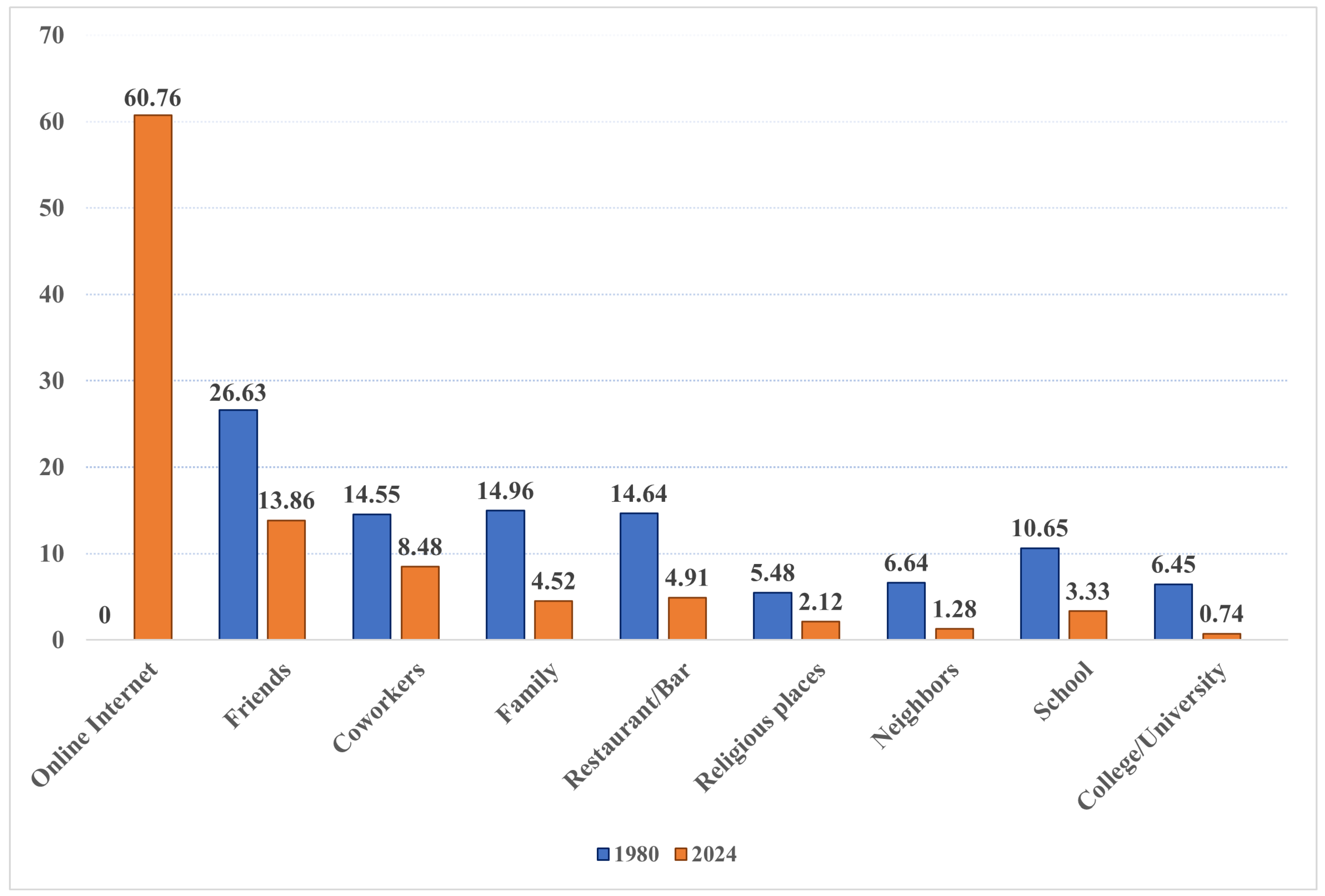
Figure 2.
Annual global Internet data volume (in zettabytes) [50].
Figure 2.
Annual global Internet data volume (in zettabytes) [50].
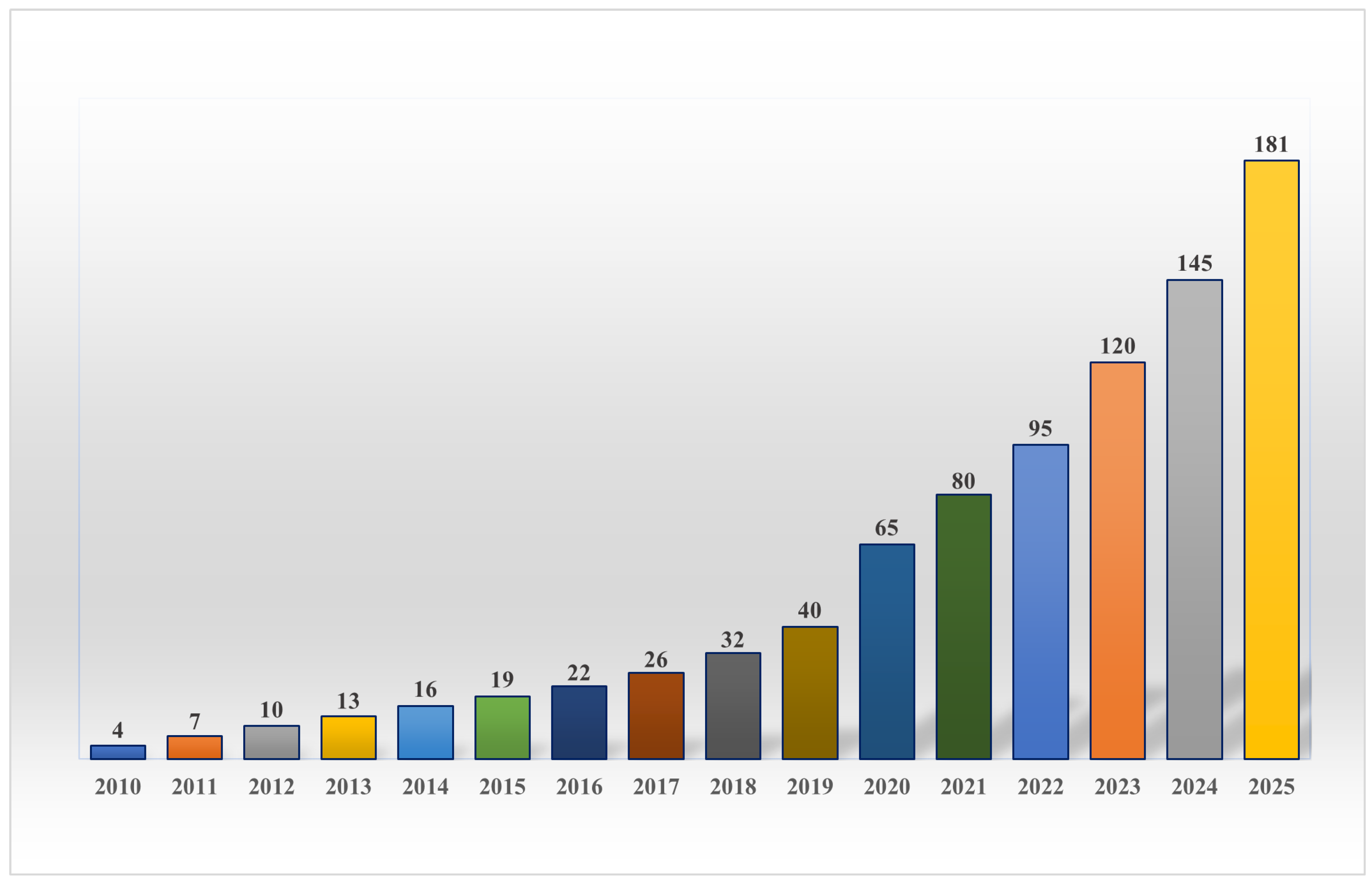
Figure 3.
The top 25 countries with the most Internet data centers [56].
Figure 3.
The top 25 countries with the most Internet data centers [56].
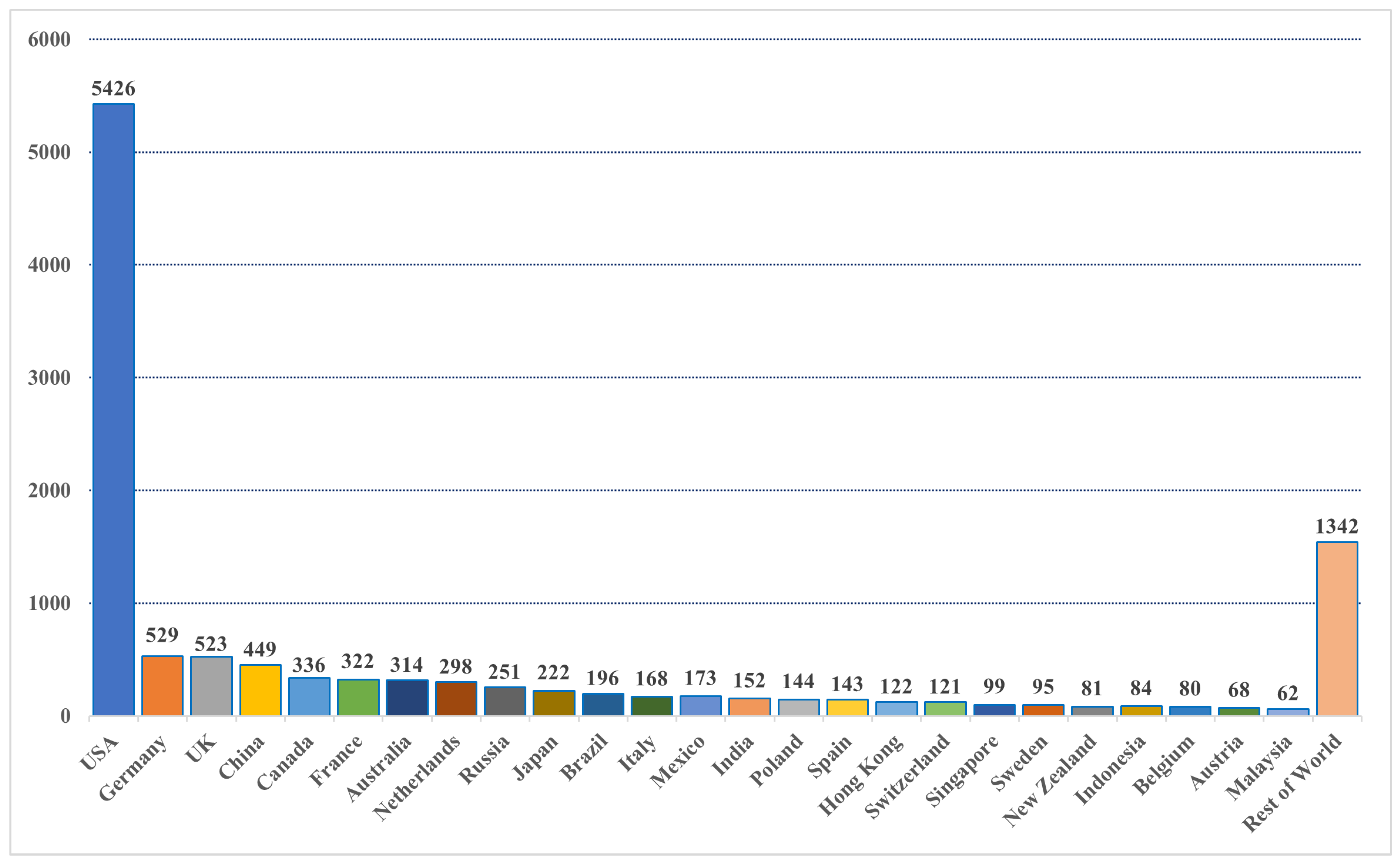
Figure 4.
First type of criteria for evaluating broadband Internet.
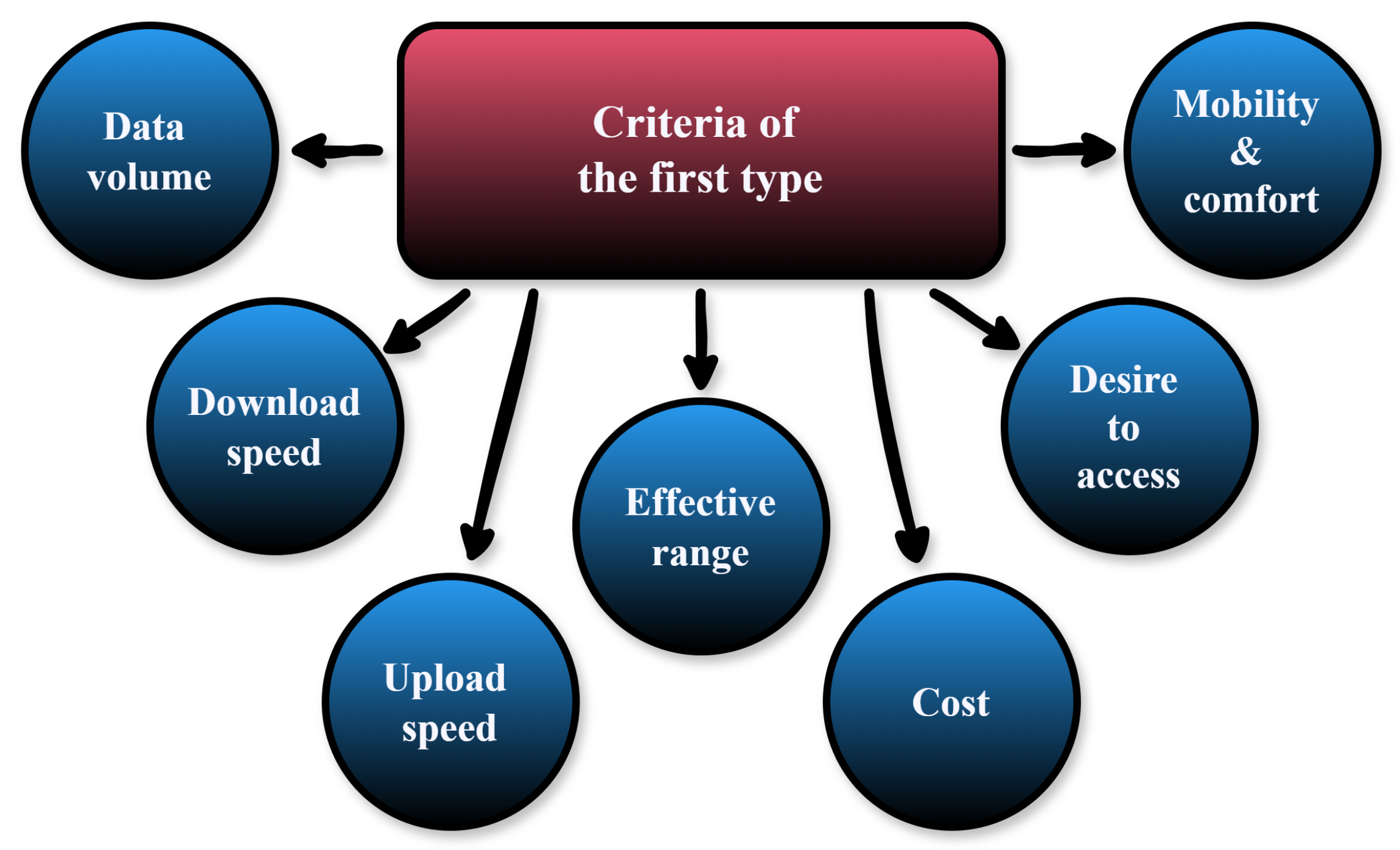
Figure 5.
Second type of criteria for evaluating broadband Internet.
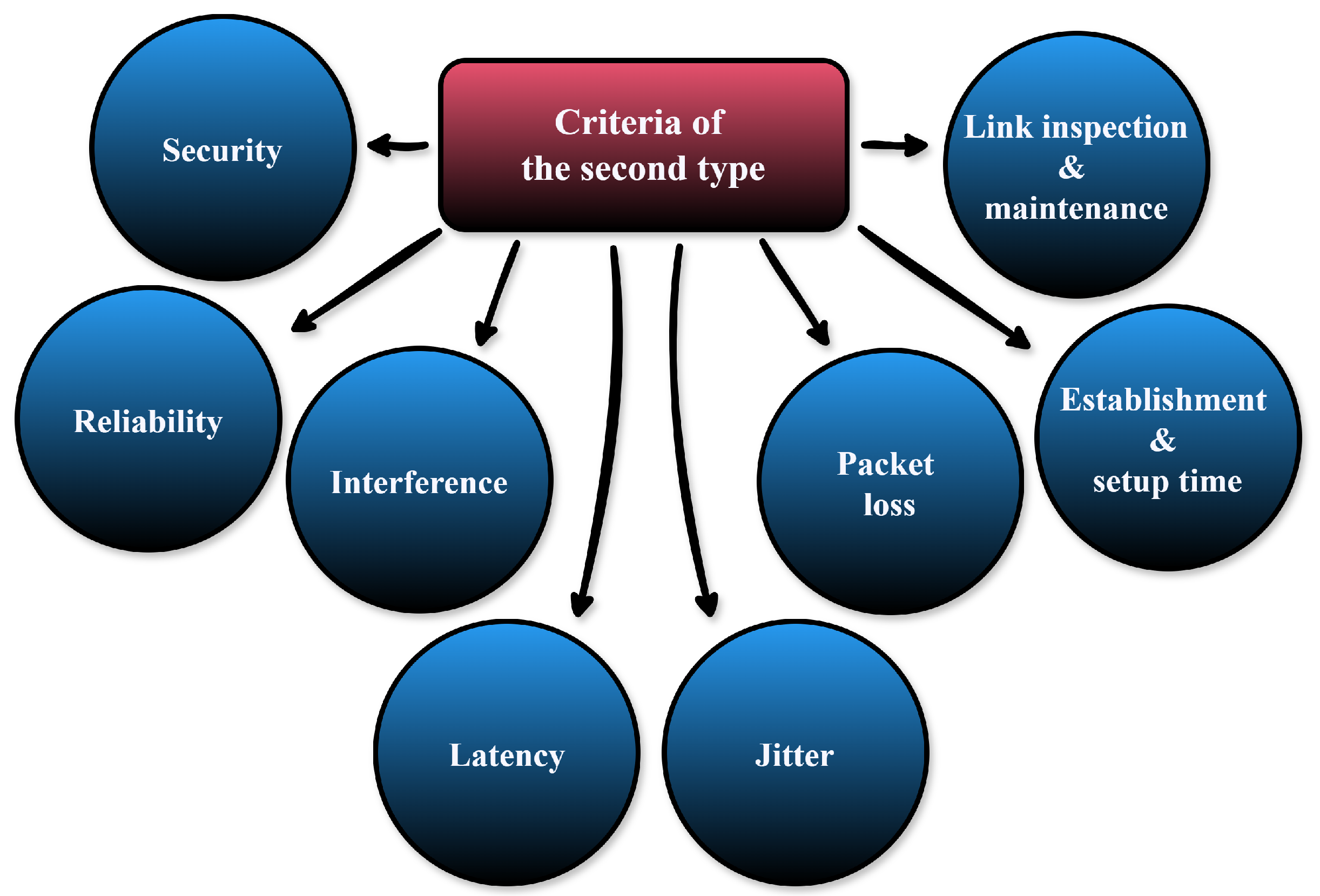
Figure 6.
Seven key challenges in the current broadband Internet.
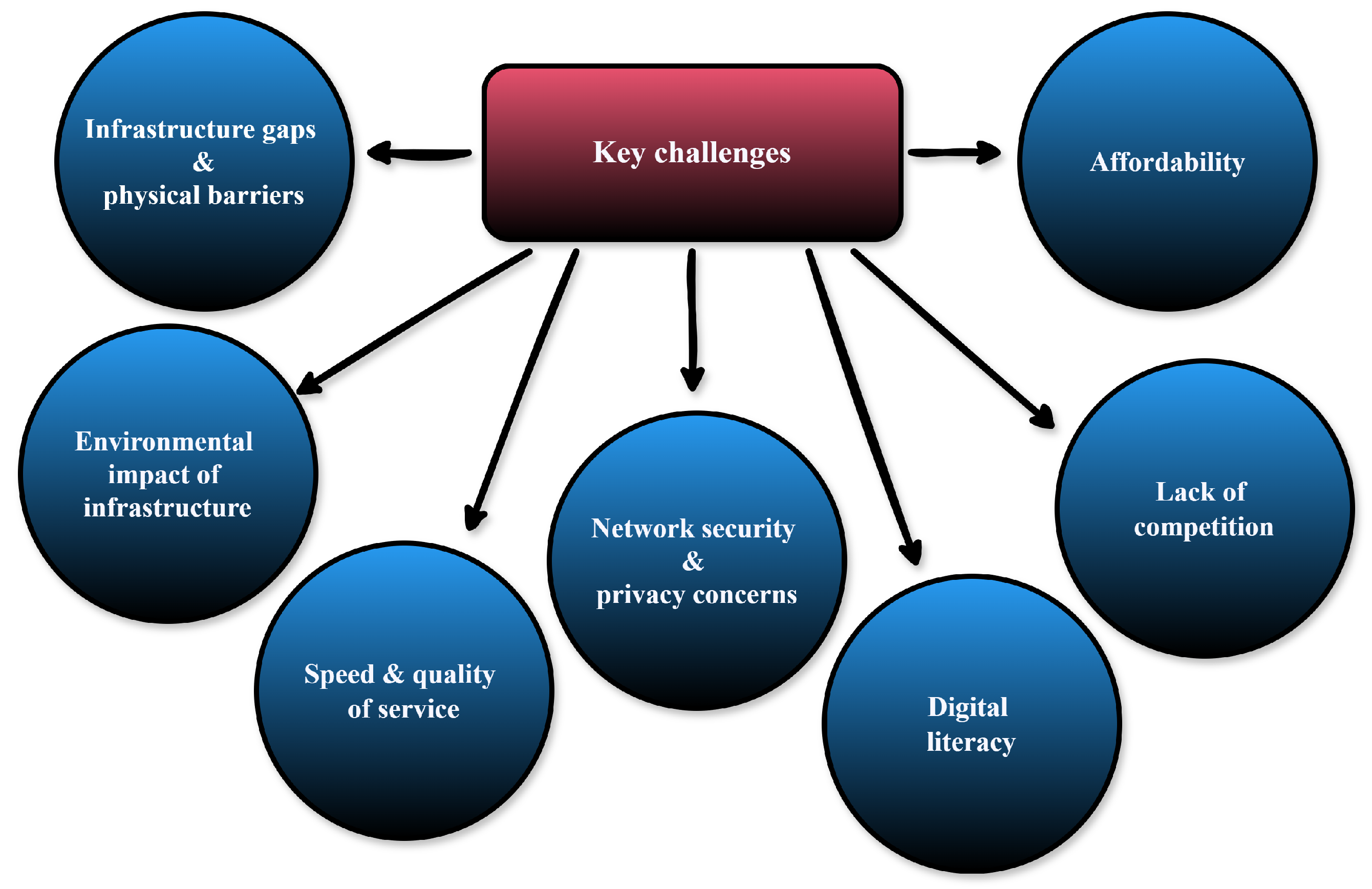
Figure 7.
Place of broadband Internet in different aspects of human life.
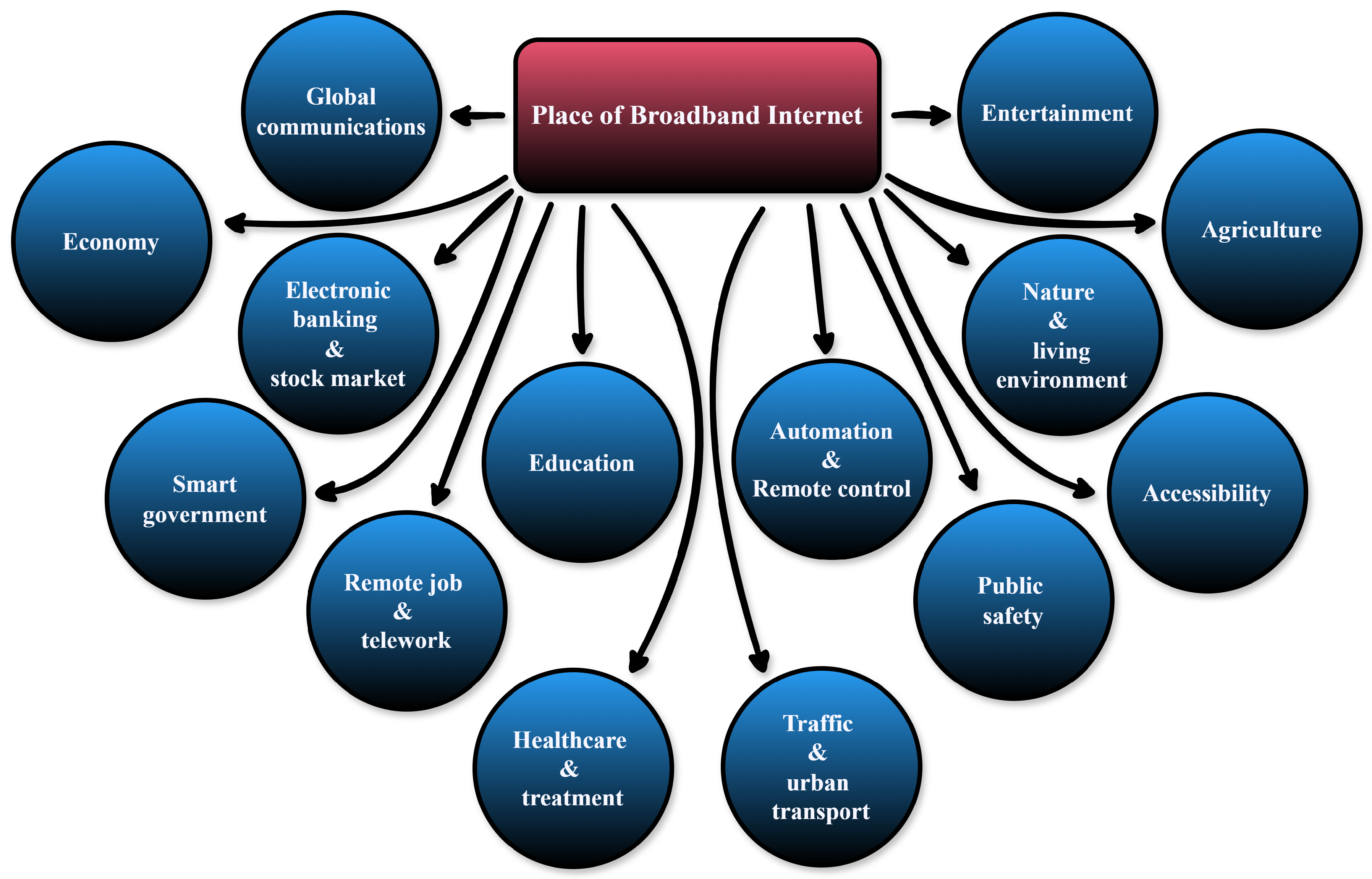
Figure 8.
Ten strategies to improve global broadband Internet.
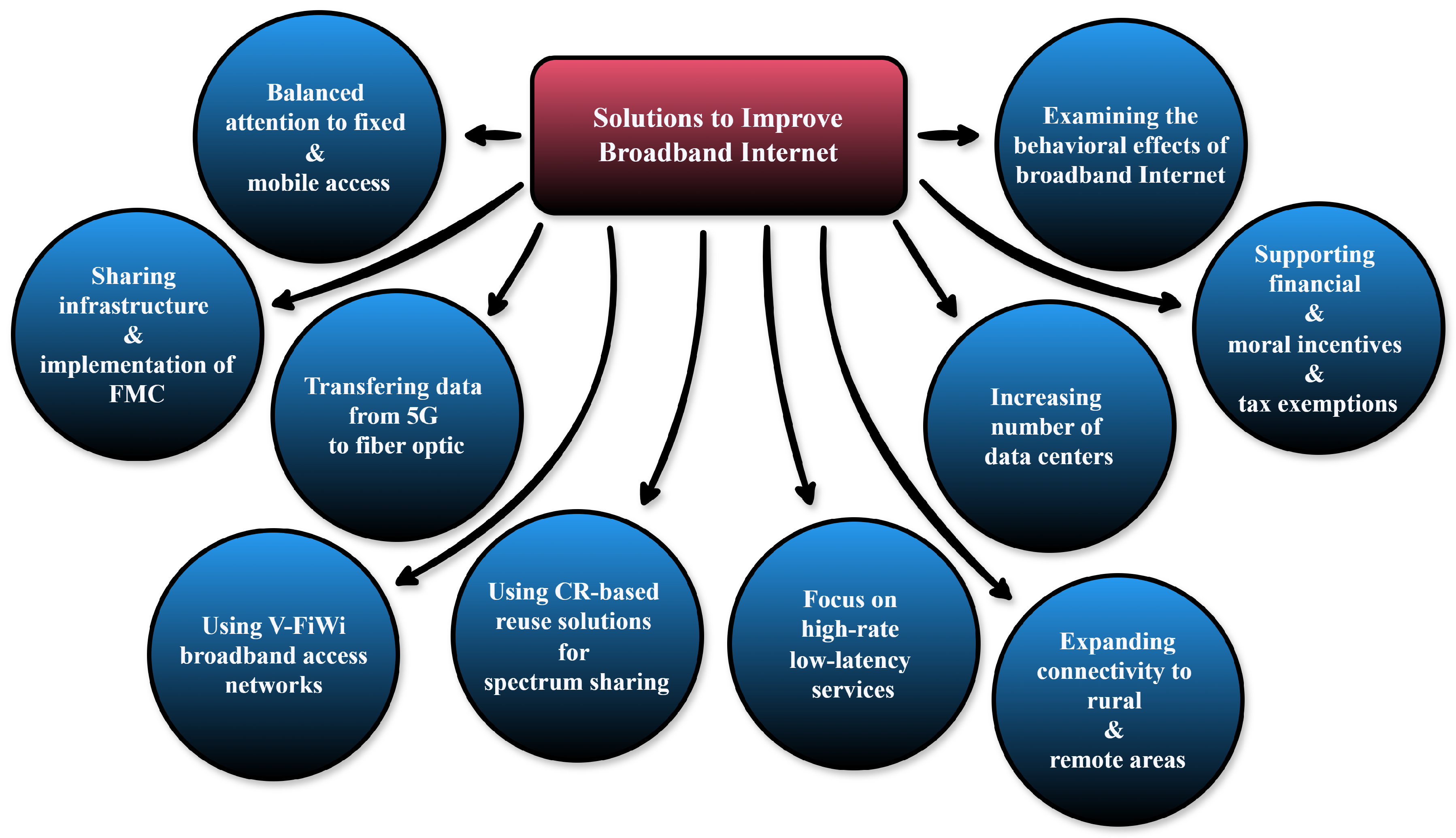

| Rank | Country | Region | Internet Users (millions) | Internet Penetration Rate (%) |
|---|---|---|---|---|
| 1 | China | Asia | 1107 | 78.17 |
| 2 | India | Asia | 806 | 55.1 |
| 3 | USA | North America | 318 | 91.68 |
| 4 | Indonesia | Asia | 212 | 74.13 |
| 5 | Brazil | South America | 183 | 85.92 |
| 6 | Russia | Europe/Asia | 133 | 92.25 |
| 7 | Pakistan | Asia | 116 | 45.49 |
| 8 | Mexico | North America | 110 | 83.33 |
| 9 | Japan | Asia | 109 | 88.62 |
| 10 | Nigeria | Africa | 107 | 44.96 |
| 11 | Philippines | Asia | 97.5 | 83.33 |
| 12 | Egypt | Africa | 96.3 | 81.61 |
| 13 | Vietnam | Asia | 79.8 | 78.24 |
| 14 | Germany | Europe | 77.8 | 92.48 |
| 15 | Bangladesh | Asia | 77.7 | 44.15 |
| 16 | Turkey | Europe/Asia | 77.3 | 88.14 |
| 17 | Iran | Asia | 73.2 | 79.22 |
| 18 | Thailand | Asia | 65.4 | 91.34 |
| 19 | UK | Europe | 63.6 | 91.41 |
| 20 | France | Europe | 63.4 | 95.5 |
| 21 | Italy | Europe | 53.3 | 90.33 |
| 22 | South Africa | Africa | 50.8 | 78.4 |
| 23 | South Korea | Asia | 50.4 | 97.42 |
| 24 | Spain | Europe | 46.2 | 95.45 |
| 25 | Argentina | South America | 41.2 | 89.76 |
| Rank | Country | Region | Internet Penetration Rate (%) |
|---|---|---|---|
| 1 | KSA | Asia | 100 |
| 1 | UAE | Asia | 100 |
| 1 | Bahrain | Asia | 100 |
| 4 | Kuwait | Asia | 99.75 |
| 5 | Luxemburg | Europe | 99.35 |
| 6 | Norway | Europe | 99 |
| 7 | Denmark | Europe | 98.78 |
| 8 | Malaysia | Asia | 97.69 |
| 9 | South Korea | Asia | 97.42 |
| 10 | Switzerland | Europe | 97.34 |
| 11 | Netherlands | Europe | 97.01 |
| 12 | Sweden | Europe | 95.75 |
| 13 | Spain | Europe | 95.45 |
| 14 | Austria | Europe | 95.33 |
| 15 | Oman | Asia | 95.25 |
| 16 | Belgium | Europe | 94.63 |
| 17 | Singapore | Asia | 94.29 |
| 18 | Chile | South America | 94.12 |
| 19 | Finland | Europe | 93.51 |
| 20 | Estonia | Europe | 93.18 |
| 21 | Kazakhstan | Asia | 92.88 |
| 22 | Germany | Europe | 92.48 |
| 23 | Russia | Europe/Asia | 92.25 |
| 24 | Latvia | Europe | 92.19 |
| 25 | Malta | Europe | 91.92 |
| - | World | - | 68.7 |
Table 3.
Internet data ratio in different applications [50].
Table 3.
Internet data ratio in different applications [50].
| Rank | Category | Data Ratio (%) |
|---|---|---|
| 1 | Video | 53.72 |
| 2 | Social | 12.69 |
| 3 | Gaming | 9.86 |
| 4 | Web browsing | 5.67 |
| 5 | Messaging | 5.35 |
| 6 | Marketplace | 4.54 |
| 7 | File sharing | 3.74 |
| 8 | Cloud | 2.73 |
| 9 | VPN | 1.39 |
| 10 | Audio | 0.31 |
Table 4.
Comparison of FTTX and 5G based on the criteria of the 1st type.
| Criterion | Technology | |
|---|---|---|
| FFTX | 5G | |
| Data volume | Unlimited | 1TB per month |
| Download rate | 100Gbps | 20Gbps |
| Upload rate | 100Gbps | 10Gbps |
| Effective range | 70km | 10m (fixed) / 3km (mobile) |
| Subscription cost | High | Average |
| Mobility & comfort | Average | High |
| Desire to access | High for fixed users | High for mobile users |
Table 5.
Comparison of FTTX and 5G based on the criteria of the 2nd type.
| Criterion | Technology | |
|---|---|---|
| FTTX | 5G | |
| Security | High | High with cryptography |
| Reliability | High | Average |
| Interference | Low | High |
| Global average latency | 9ms | 28ms |
| Global average jitter | 3ms | 9ms |
| Packet loss | Insignificant | Average |
| Establishment & setup time | Average | Low |
| Observation & maintenance | High | Low |
Disclaimer/Publisher’s Note: The statements, opinions and data contained in all publications are solely those of the individual author(s) and contributor(s) and not of MDPI and/or the editor(s). MDPI and/or the editor(s) disclaim responsibility for any injury to people or property resulting from any ideas, methods, instructions or products referred to in the content. |
© 2025 by the authors. Licensee MDPI, Basel, Switzerland. This article is an open access article distributed under the terms and conditions of the Creative Commons Attribution (CC BY) license (http://creativecommons.org/licenses/by/4.0/).
Copyright: This open access article is published under a Creative Commons CC BY 4.0 license, which permit the free download, distribution, and reuse, provided that the author and preprint are cited in any reuse.


