

Submitted:
10 July 2025
Posted:
23 July 2025
You are already at the latest version
Abstract
In recent times, the incidence of radiation pollution on account of encounter with some emissions from materials used in construction works has been on increase. This study aimed at studying the Spectro-Physical Analysis of Radiation Emission In Selected Building Construction with a view to establishing the emission level to prevent radiation hazards. The following ingredients/equipment were employed in laboratory experiments: a sieve ; Washing can/cylinder; Cement; water; Fine aggregate (sharp sand); Gravel; Gamma ray spectrometer. Some of the apparatus used, are Electron Microscope, Gamma ray spectrometer, spectrometer counter and others. Dosage rate indices was high in the case of Sand and Granite samples, with Thorium level for the three samples falls withing tolerable limit of less than 200 milligram. However, Uranium was found in little amount, continuous exposure to the element over a prolonged period of time can be dangerous. The study recommend adoption of protective measure to guide against the low emission from Uranium, so as to prevent health hazard.ingle paragraph of about 200 words maximum. For research articles, abstracts should give a pertinent overview of the work. We strongly encourage authors to use the following style of structured abstracts, but without headings: (1) Background: Place the question addressed in a broad context and highlight the purpose of the study; (2) Methods: briefly describe the main methods or treatments applied; (3) Results: summarize the article’s main findings; (4) Conclusions: indicate the main conclusions or interpretations. The abstract should be an objective representation of the article and it must not contain results that are not presented and substantiated in the main text and should not exaggerate the main conclusions.
Keywords:
radiation
; emission
; materials
; spectrometer
1. Introduction
One of the largest industries in the world is construction. According to [1], the construction industry is one of the most dynamic moderators of the overall economy in a country [1,2] with more than 75% of the workforce employed directly on the construction site. It is also a potential source of employment and employs nearly 7% of the total employed workforce globally [2]. This poses serious health hazards to a large number of people. The dangers that lurk on a construction site from left to right have been demonstrated through research.
Safety and the avoidance of any unnecessary risk from radiation exposure at work, in the medical profession, or in the general environment are the two main goals of radiation protection. Therefore, any quantitative suggestions on exposure standards and practices must be made in light of quantitative evaluations of the radiation risks associated with their application. According to [3] district is in the Rift valley, where significant background radiation levels are reportedly present [1,2].
According to medical assessments, the locals have seen a rise in cancer cases, with esophageal cancer being particularly common [4]. Increased cancer cases in the area were noted in the [4] Bomet Environment District plan (2005–2010) report, despite the absence of any interventions.
If no action is taken to decrease the risks, working on a building site will eventually prove to be a dangerous occupation. The majority of people will become aware of this and begin to steer clear of the construction sector, which will force many individuals to hunt for other employment, have a significant negative impact on the economy, and raise unemployment.
Not only will the site workers be at risk but also the end users. This will affect the greater public because they may not know. The following research questions were articulated for the purpose of the study: i. What are the physical structural components of the selected building materials?
ii. What is the pattern of emission of the selected building materials? iii. What are the radioactive properties of the selected building material?
The aim of this study is to carry out radiation analysis of selected building materials on site with the view to preventing exposure of workers to harmful radiation. However, the following research variables are sued to prosecute the objectives, they are: to study the physical and structural components of the selected building materials; to analyse the pattern of emission of each selected building materials from selected locations and to study the radioactive properties of each of the selected building materials. The sole purpose of this research was to investigate selected building construction materials to see if they have radioactive properties and to see if they have a negative/harmful effect on the construction workers that work with the materials. Therefore, this work is focused on investigating the possible health risks every construction faces every day and to find preventive measures that can be put in place of the workers.
1.1. Naturally Occurring Radioactive Materials (NORMs)
Most materials found in the building industry are naturally radioactive compounds, as are those used for other purposes and found naturally in the crust of the planet. These are substances that include radioactive elements that are found in the environment naturally. Among other areas, they can be found in limestone, water, soil, and rocks. Numerous elements are included in these NORMs, such as radium, uranium, thorium, potassium, radon, and others [1]. It has been discovered that most building materials have NORM elements, the most significant of which are 40K, 226R, and 232Th. These radionuclides are the most common in building materials and are used to calculate the radiological hazards of such materials, according to earlier research on the assessment of radiological risks associated with those materials [2,3,4,5].
1.2. Alpha Radiation in NORMs
Alpha radiation is a form of ionizing radiation produced by naturally occurring radioactive materials (NORMs). Alpha particles, which consist of two protons and two neutrons, are created by an atom's nucleus during alpha decay, a kind of radioactive decay. Alpha radiation is made up of extremely small particles that are far smaller than the radionuclide from which it originated [4]. Alpha radiation consists of heavy, charged particles that cannot move very far in air. A sheet of paper can be used to block them. By ingestion, inhalation, or external exposure, NORMs can expose people to alpha radiation. Radioactive particles that produce alpha radiation can be inhaled or consumed through contaminated food and drink when they are suspended in the air. External exposure can happen when people come into contact with objects or surfaces that contain isotopes that release alpha radiation [3].
The degree and duration of exposure to NORM alpha radiation affect health in different ways. Alpha radiation has the potential to damage living tissues, raising the risk of cancer. Alpha particles, however, have a limited range in air and tissue since they are large and heavy. This implies that ingestion or inhalation of alpha radiation may harm sensitive tissues in the lungs or digestive system [2,3,4,5,6].
1.3. Beta Radiation in NORMs
Beta radiation is another form of ionizing radiation that naturally occurring radioactive materials (NORMs) can produce. Radioactively decaying elements, such as beta particles, are classified as non-oxidizing radioactive materials (NORMs). A neutron in the nucleus of an atom decays to produce an electron and a proton, which are then released from the nucleus.
Exposure to NORM beta radiation can happen in a number of ways, such as ingestion, inhalation, and external exposure. Glass and plastic can block beta particles even though they are smaller and more permeable than alpha particles. Though generally less hazardous than gamma radiation, they pose a greater risk of exposure to external radiation than alpha particles.
Exposure to beta radiation is concerning when NORMs are disturbed, as occurs during industrial operations involving minerals and ores, much like it is with alpha radiation.
Regulations and safety guidelines are in place to control the amount of beta radiation that employees and the general public are exposed to from NORMs. In businesses dealing with NORMs, monitoring, safety precautions, and cautious handling of items containing beta-emitting radionuclides are essential to preserving the safety of people and the environment [2,3,5].
1.4. Radiological Indexes
Several factors are often used to analyze and quantify the radiation present while evaluating the quantity of radioactivity. These parameters includes : Activity concentration and exposure.
Activity Concentration: The amount of radioactivity per unit volume, mass, or quantity of a material is known as activity concentration. It is frequently used to calculate the amount of radioactivity in a sample or material. Depending on the measuring system, the unit of activity concentration is usually becquerels per unit volume (Bq/L), becquerels per unit mass (Bq/kg), or curies per unit volume.
(Ci/L). R=ΔN/Δt
Exposure: The ionization created in the air by photons or charged particles from a radioactive source is measured as exposure. It is usually expressed in terms of coulombs per kilogram (C/kg) or roentgen (R).
Its formula is given by:
F = Γ×α / r or X = A Γ/ d2
X= exposure rate, A source activity, Γ= specific gamma ray constant, d= distance from the source [3,4,5,6,7&8].
The following research questions were articulated for the purpose of the study: i. What are the physical structural components of the selected building materials?
ii. What is the pattern of emission of the selected building materials? iii. What are the radioactive properties of the selected building material?
The aim of this study is to carry out radiation analysis of selected building materials on site with the view to preventing exposure of workers to harmful radiation. However, the following research variables are sued to prosecute the objectives, they are: to study the physical and structural components of the selected building materials; to analyse the pattern of emission of each selected building materials from selected locations and to study the radioactive properties of each of the selected building materials. The sole purpose of this research was to investigate selected building construction materials to see if they have radioactive properties and to see if they have a negative/harmful effect on the construction workers that work with the materials. Therefore, this work is focused on investigating the possible health risks every construction faces every day and to find preventive measures that can be put in place of the workers
To analyse the physical and pattern of emission of each selected building materials from selected locations, the following represents the methodology used in this research.
2. Materials and Methods
To analyse the physical and pattern of emission of each selected building materials from selected locations, the following represents the methodology used in this research.
2.1. Materials Used
The following ingredients/equipment were employed in laboratory experiments: a sieve; Washing can/cylinder; Cement; water; Fine aggregate (sharp sand); Gravel; Gamma ray spectrometer.
2.2. Test for Radioactivity
Some of the Test carried out includes the following: Using a gamma ray spectrometer. This equipment was used to test for radiation emission in the selected building materials gotten from a local market. The following readings were taken down; Dose rate (NGY/H-1); Potassium K 40 (%); and Uranium (PPM) and Thorium TH (PPM).
2.3. Apparatus
Some of the apparatus used, are Electron Microscope, Gamma ray spectrometer, spectrometer counter and others.
2.4. Procedures
Get the gamma ray spectrometer and place it at the middle of the location and get the readings, Repeat the first procedure for 90 seconds and get your readings at 30 seconds intervals, Get your selected materials and place then at the selected location, Spread the samples over an area of 20 meters for better results, Place the gamma spectrometer on each of the samples of 90 seconds and get your readings, Record all readings for all the samples, Prepare a detailed report of the findings and draw conclusions about the material’s properties, structure, and any observed changes due to radiation or other factors. Using an electron microscope to detect radiation in a material involves several steps, as electron microscopes themselves do not directly measure radiation. Instead, they can be used to examine radiation-induced damage or changes in a material.
3. Results
3.1. Data Analysis and Discussion
Results of Test for Physical Properties Conducted In the Laboratory
Sieve Analysis
In Table 1, Coefficient of Curvature (Cc) was presented. Results of the Sieve analysis was presented in Table 1. The coefficient of curvature, also known as the Cc value or the gradation coefficient, is a measure of the curvature of the particle size distribution curve. It quantifies the range or spread of particle sizes present in the soil sample. It would be discovered that the highest percentage of passing soil occurred with Sieve sizes 20 10 and 5mm respectively [4,5,6].
The formula to calculate the coefficient of curvature is:
Coefficient of curvature (CC) = D302
D10 x D60
Where: D₁₀, D30, and D₆₀ are the particle diameter corresponding to 10%, 30%, and 60% passing, respectively, in the cumulative particle size distribution curve. Where; D₁₀ = 0.3 D30 = 0.7 and D₆₀ = 1.6, CC = 1.2. Because a soil's coefficient of curvature must be between 1 and 3, a result of 1 indicates that the soil is appropriately graded. Coefficient of Uniformity (Cᵤ): The coefficient of uniformity, also known as the Cᵤ value or the uniformity coefficient,as presented in Figure 1, is a measure of the particle size uniformity or the degree of uniformity of the soil sample. It quantifies the ratio between the particle diameter that corresponds to 60% passing (D₆₀) and the particle diameter that corresponds to 10% passing (D₁₀). The formula to calculate the coefficient of uniformity is:
Cᵤ = D₆₀ / D₁₀
Where; D₁₀ = 0.3 D30 = 0.7 and D₆₀ = 1.6 and Cu = 5.3
A CU value of 5.3 indicates that the soil has been adequately graded. If the Cu value is higher, the soil mass likely contains soil particles of different sizes, and if it is between 4 and 6, the soil has been correctly graded. This view toes the line of submissions in [5,6, 7,8].
3.2. Sieve Analysis for Granite
Coefficient of Curvature (Cc): The coefficient of curvature, also known as the Cc value or the gradation coefficient, is a measure of the curvature of the particle size distribution curve. It quantifies the range or spread of particle sizes present in the soil sample (Figure 2). The formula to calculate the coefficient of curvature is:
Coefficient of curvature(CC) = D302
D10 x D60 Where:
D₁₀, D30, and D₆₀ are the particle diameter corresponding to 10%, 30%, and 60% passing, respectively, in the cumulative particle size distribution curve. Where; D₁₀ = 0.3 D30 = 0.7 and D₆₀ = 1.6; CC = 2.1
Because a soil's coefficient of curvature must be between 1 and 3, a result of 1 indicates that the soil is appropriately graded according to [9, 10,11, 12 and 13].
Coefficient of Uniformity (Cᵤ): The coefficient of uniformity, also known as the Cᵤ value or the uniformity coefficient, is a measure of the particle size uniformity or the degree of uniformity of the soil sample. It quantifies the ratio between the particle diameter that corresponds to 60% passing (D₆₀) and the particle diameter that corresponds to 10% passing (D₁₀). The formula to calculate the coefficient of uniformity is:
Cᵤ = D₆₀ / D₁₀
Where; D₁₀ = 0.3 D30 = 0.7 and D₆₀ = 1.6 Cu = 4
A CU value of 4 indicates that the soil has been adequately graded. If the Cu value is higher, the aggregate mass likely contains particles of different sizes, and if it is less that 6, the soil has been correctly graded [3, 14, 15, 16 and 17].

Table 2.
Sieve analysis for Granite.
| Sieve Size#break#( mm) | Mass of Sieve (g) | Mass of Seive + Granite (g) | Mass of Granite#break# (g) | Percentage of Retained Granite (%) | Percentage of Passing Granite (%) |
|---|---|---|---|---|---|
| 37.5 | 726 | 726 | 0 | 0 | 100 |
| 31.5 | 772 | 772 | 0 | 0 | 100 |
| 26.5 | 733 | 733 | 0 | 0 | 100 |
| 19.0 | 718 | 903 | 185 | 9.25 | 90.75 |
| 16.0 | 737 | 1142 | 405 | 20.25 | 70.5 |
| 13.2 | 699 | 1120 | 421 | 21.2 | 49.3 |
| 10.0 | 672 | 1463 | 791 | 39.55 | 9.75 |
| 4.75 | 767 | 944 | 177 | 8.85 | 0.9 |
| 2.00 | 724 | 738 | 14 | 0.7 | 0.2 |
| Pan | 518 | 525 | 7 | 0.2 | 0.00 |
| TOTAL | 998.6 | 99.9 | |||
3.3. Soundness Test
The Cement samples were subjected to soundness and consistency test and results presented in Table 3 and Table 4 respectively. The L1 and L2values are 10mm respectively which indicated good soundness and little water content and consistency of 30% which was adjudged as right in line with standards.
The results of analysis for No significant change in the volume expansion was observed for either of the cement samples. When no expansivity is recorded during the soundness test, it suggests that the cement sample maintained its volume stability and did not exhibit any significant expansion or contraction. This is considered desirable and indicates that the cement is likely to perform well in practical applications, without causing structural problems or compromised durability.
After trying different water ratios, the above result was obtained as the final consistency of the different brands that were tested. The range of standard consistency of cement should be within 25-35 % which indicates that both of the samples have good consistencies [4,5,10,17 and 18].
3.4. Fineness Test
Considering that the fineness of cement should not be less than 78% according to ASTM, and in Table 5, both of the sample cements passed the requirements.
3.5. Radiological Tests Results
The radiological indices are analyzed using the specific activity concentrations of 22U, 232Th, and 40K obtained from the radiological tests performed. The various indices are calculated to find the possible radiological risks to human beings, the indices evaluated were highlighted in the previous section and how they were found was also explained in previous sections. In summary, [11, 17, 19, 20] affirm that radiological indices are analyzed using the specific activity concentrations of 22U, 232Th, and 40K obtained from the radiological tests. Concentration of Uranium 22 and Thorium has been established overtime as a major contamination in environmental pollution.
The following parameters were tested on location of samples used for the analysis, that is, Dose rate, Potassium, Uranium, and Thorium. The most occurred indices is Thorium with mean indices values of 19.4Ppm. Similar presentation could be found in [21], [22] and [19].
In [22],[23] and [24] certain samples were used to test for energy parameters, such as Uranium and other radio active nucleoside. in the context of this study radiation emission test conducted on Sand include presence of Potassium, Uranium and Thorium, the detail was presented in Table 7. It was discovered that Thorium has the significant occurrence though in non dangerous threshold.
The experimental results of Radiation emission test on Granite was as reflected in Table 8. Thorium with mean value 25.1 was found to be significant in term of occurrence as compared to sand and research location earlier done and location. It is similar to output [12,24,25] where measurement of radioactivity emission threshold of selected Building material was carried out.
Similarly like as presented in the previous Table 6, Table 7 and Table 8, experimental results of Radiation emission test on Cement was as presented in Table 9. As applicable in Sand and Granite cases, Thorium with mean value 26.8 was found to be significant in term of occurrence as compared to sand and research location earlier done and location. It is similar to results presented in [8] and also similar to the ones in [9], [10] and [26]. where measurement of radioactivity emission threshold of selected Building material was carried out.
Table 6.
Values of indices derived from the experiment conducted on the location that the selected samples was placed.
Table 6.
Values of indices derived from the experiment conducted on the location that the selected samples was placed.
| Indices Parameters | 30 seconds | 90 seconds | Mean Average |
|---|---|---|---|
| Dose Rate (Ngy/H-1) | 84.2 | 102.4 | 93.3 |
| Potassium (%) | 1.5 | 1.8 | 1.65 |
| Uranium (Ppm) | 3.1 | 3.6 | 3.35 |
| Thorium (Ppm) | 16.7 | 22.1 | 19.4 |
Table 7.
Values of indices gotten from the experiment conducted on Sand.
| 30 seconds | 60 seconds | 90 seconds | Mean Average | |
|---|---|---|---|---|
| Dose Rate (Ngy/H-1) | 113.8 | 108.8 | 105.9 | 109.5 |
| Potassium (%) | 1.1 | 1.3 | 1.5 | 1.3 |
| Uranium (Ppm) | 4.8 | 3.5 | 3.9 | 4.0 |
| Thorium (Ppm) | 26.9 | 25.6 | 23.0 | 25.1 |
Table 8.
Values of the indices gotten from the experiment conducted on Granite.
| 30 seconds | 60 seconds | 90 seconds | Mean Average | |
|---|---|---|---|---|
| Dose Rate (Ngy/H-1) | 123.2 | 114.2 | 118.2 | 118.5 |
| Potassium (%) | 1.8 | 1.8 | 1.8 | 1.8 |
| Uranium (Ppm) | 5.9 | 4.1 | 4.0 | 4.6 |
| Thorium (Ppm) | 22.9 | 25.3 | 27.2 | 25.1 |
Table 9.
The values of the indices from the experiment conducted on cement.
| 30 seconds | 60 seconds | 90 seconds | Mean Average | |
|---|---|---|---|---|
| Dose Rate (Ngy/H-1) | 80.0 | 89.3 | 93.7 | 87.6 |
| Potassium (%) | 1.1 | 1.2 | 1.2 | 1.16 |
| Uranium (Ppm) | 2.7 | 0.0 | 0.1 | 0.9 |
| Thorium (Ppm) | 22.2 | 30.1 | 28.1 | 26.8 |
3.6. Standardization of Each of the Radio Nuclides
i.DOSE RATE: The standard dose rate ranges from 50 – 200 milligray per hour according to the international commission on radiological protection.
ii. URANIUM: According to the word health and organization they have set a guideline of 30 micrograms per liter which translates to 30 parts per million.
THORIUM: Thorium is a naturally occurring element found in the earth’s crust. Typical concentrations in soil can range from 1-20 ppm but can be higher in some regions. The range of thorium in soil is a general reference derived from geological surveys and studies rather than standard set by a specific organization. Like the following: United states geological survey(USGS),Environmental protection agency(EPA), International atomic energy agency(IAEA) and United nations scientific committee on the effects of atomic radiation this was supported in [23],[24] and [25].. Similarly also in [24], [23], [26], [27], [28] and [29].
4. Conclusions
The findings from the investigation allow for the following interpretations: From the particle size distribution of fine aggregate (sand) sample, the coefficient of uniformity is of the value 5.3 which falls within the approved range of 4 to 6 and the coefficient of curvature is of value 1.2, which falls within the approved range of 1 to 3. It can therefore be said that the soil is properly graded.
From the particle size distribution of coarse aggregate (gravel) sample, the coefficient of uniformity is of the value 5.3 which falls within the approved range of 4 to 6 and the coefficient of curvature is of value 1.2, which falls within the approved range of 1 to 3. It can therefore be said that the soil is properly graded.
From the result of the soundness test conducted for both samples, no significant change in the volume expansion was observed for either of the cement samples. This means that the cement samples maintained their volume stability.
According to the results obtained from the consistency test, cement P-32.5N had a consistency of 32% As the range of standard consistency of cement should be within 25-35 %, it indicates that the samples have good consistencies.
Considering that the genuineness of cement should not be less than 78% according to ASTM, the sample cement passed the requirements with fineness of P-32.5N as 94% .
From the particle size distribution curve, the cement particles of both samples have a high passing percentage value.
Finally, Dosage rate indices was high in the case of Sand and Granite samples, with Thorium level for the three samples falls withing tolerable limit of less than 200 milligram. However, Uranium was found in little amount, continuous exposure to the element over a prolonged period of time can be dangerous.
Author Contributions
Conceptualization, A.L. and V.U.; methodology, A.L.; software, A.L.; validation, C.A., and A.F.; formal analysis, A.L., investigation, U.F. resources, U.F.; data curation, A.L.; writing—original draft preparation, U.F.; writing—review and editing, A.L.; visualization, C.A.; supervision, A.L.; project administration, A.F. and A.L. All authors have read and agreed to the published version of the manuscript.
Funding
This research received funding in publication by Covenant University Center for Research, Innovation and Discovery (CUCRID) and cidb Center of Excellence University of Johannesburg is appreciated for the support.
Acknowledgments
The support of Covenant University Center for Research, Innovation and Discovery (CUCRID) and cidb Center of Excellence Faculty of Engineering and Built Environment University of Johannesburg is appreciated.
Conflicts of Interest
The authors declare no conflicts of interest.
References
- Amran, M. , Al-Fakih, A., Chu, S. H., Fediuk, R., Haruna, S., Azevedo, A., & Vatin, N. Long-term durability properties of geopolymer concrete: An in-depth review. Case Studies in Construction Materials 2021, 15, e00661. [Google Scholar]
- Amran, M. , Onaizi, A. M., Qader, D. N., & Murali, G. Innovative use of fly ash-finely powdered glass cullet as a nano additives for a sustainable concrete: Strength and microstructure and cost analysis. Case Studies in Construction Materials 2022, 17, e01688. [Google Scholar]
- Gholampour, A. , & Ozbakkaloglu, T. Time-dependent and long-term mechanical properties of concretes incorporating different grades of coarse recycled concrete aggregates. Engineering Structures 2018, 157, 224–234. [Google Scholar]
- Anton, A. , Reiter, L., Wangler, T., Frangez, V., Flatt, R. J., & Dillenburger, B. A 3D concrete printing prefabrication platform for bespoke columns. Automation in Construction 2021, 122, 103467. [Google Scholar]
- Du, P. , Zhang, Y., Long, Y., & Xing, L. Effect of the acidity coefficient on the properties of molten modified blast furnace slag and those of the produced slag fibers. Materials 2022, 15, 3113. [Google Scholar] [PubMed]
- Courland, R. (2022). Concrete planet: the strange and fascinating story of the world’s most common man-made material. Rowman & Littlefield.
- Becerra-Duitama, J. A. , & Rojas-Avellaneda, D. Pozzolans: A review. Engineering and Applied Science Research 2022, 49, 495–504. [Google Scholar]
- Hamada, H. M. , Thomas, B. S., Tayeh, B., Yahaya, F. M., Muthusamy, K., & Yang, J. Use of oil palm shell as an aggregate in cement concrete: A review. Construction and Building Materials 2020, 265, 120357. [Google Scholar]
- Khan, I. U. , Sun, W., & Lewis, E. Review of low-level background radioactivity studies conducted from 2000 to date in people Republic of China. Journal of Radiation Research and Applied Sciences 2020, 13, 406–415. [Google Scholar] [CrossRef]
- Boak, J. , & Kleinberg, R. (2020). Shale gas, tight oil, shale oil and hydraulic fracturing. In Future Energy (pp. 67-95). Elsevier.
- Bourtsalas, A. C. Energy recovery from solid wastes in China and a Green-BRI mechanism for advancing sustainable waste management of the global South. Waste Disposal & Sustainable Energy.
- Designation: C150/C150M − 16´116´1 Standard Specification for Portland Cement 1. (n.d.). [CrossRef]
- Gharti, R. B. , Hitan, D. K., Prasad, M. K., & Oli, H. B. Chemical analysis of limestone of bojhe, halesi-tuwachung municipality, for industrial applications. Amrit Research Journal 2020, 1, 59–64. [Google Scholar]
- Khatun, M. A. , Ferdous, J., & Haque, M. M. Natural Radioactivity Measurement and Assessment of Radiological Hazards in Some Building Materials Used in Bangladesh. Journal of Environmental Protection 2018, 09, 1034–1048. [Google Scholar] [CrossRef]
- Du, S. , Zhao, Q., & Shi, X. Quantification of the reaction degree of fly ash in blended cement systems. Cement and Concrete Research 2023, 167, 107121. [Google Scholar]
- Noureldin, A. S. , and R. S. McDaniel.(1990) "Evaluation of Steel Slag Asphalt Surface Mixtures," Presented at Transportation Research Board 69th Annual Meeting, Washington, DC, January, 1990.
- Sola, P. , Injarean, U., Picha, R., Kranrod, C., Kukusamude, C., & Tokonami, S. Measurement of NORM in Building Materials to Assess Radiological Hazards to Human Health and Develop the Standard Guidelines for Residents in Thailand: Case Study in Sand Samples Collected from Seven Northeastern Thailand Provinces. Atmosphere 2021, 12, 1024. [Google Scholar] [CrossRef]
- Maki, Omar. The Effect of Aluminium Dross on Mechanical and Corrosion Properties of Concrete. The Effect of Aluminium Dross on Mechanical and Corrosion Properties of Concrete. International Journal of Innovative Research in Science Engineering and Technology 2014, 3. [Google Scholar]
- Oyebisi, S. , & Owamah, H. Application of machine learning techniques in the prediction of excess lifetime cancer risks of agricultural byproducts used as building and construction materials. Cleaner Waste Systems 2023, 5, 100088. [Google Scholar] [CrossRef]
- Mehta, P. K. , & Monteiro, P. J. M. (2006). Concrete: Microstructure, Properties, and Materials. McGraw-Hill Education.
- Motz, H. , & Geiseler, J. "Products of steel slags an opportunity to save natural resources." Waste Management 2001, 21, 285–293. [Google Scholar] [PubMed]
- Shittu, Abdullahi; Ismail, Aznan Fazli; Samat, Supian. Determination of indoor doses and excess lifetime cancer risks caused by building materials containing natural radionuclides in Malaysia. Nuclear Engineering and Technology 2019, 51, 325–336. [Google Scholar] [CrossRef]
- Siddeeg, S. M. , Suliman, M. A., Ben Rebah, F., Mnif, W., Ahmed, A. Y., & Salih, I. Comparative Study of Natural Radioactivity and Radiological Hazard Parameters of Various Imported Tiles Used for Decoration in Sudan. Symmetry 2018, 10, 746. [Google Scholar]
- National Research Council (US) (1999) Committee on Evaluation of EPA Guidelines for Exposure to Naturally Occurring Radioactive Materials. Evaluation of Guidelines for Exposures to Technologically Enhanced Naturally Occurring Radioactive Materials.
- Washington (DC): National Academies Press (US); 1999. 7, Environmental Protection Agency Guidances and Regulations for Naturally Occurring Radionuclides. Available from: https://www.ncbi.nlm.nih.gov/books/NBK230655/.
- 10.3390/sym10120746. "Steel Slag—Its Production, Processing, Characteristics, and Cementitious Properties." Journal of Materials in Civil Engineering, 16, 230-236.
- United Nations Scientific Committee on the Effects of Atomic Radiation. Effects of Ionizing Radiation: Report to the General Assembly, with Scientific Annexes, https://www.unscear.org/docs/publications/2008/UNSCEAR_2008_Report_Vol.I.pdf (2008).
- Turner, J. E. (1995). Atoms, Radiation, and Radiation Protection. John Wiley & Sons. United Nations Scientific Committee on the Effects of Atomic Radiation. Sources and Effects of Ionizing Radiation, United Nations Scientific Committee on the Effects of Atomic Radiation UNSCEAR 2000 Report to the General Assembly, with Scientific Annexes. [CrossRef]
- Xie, Z. , & Xi, Y. "Use of recycled glass and fly ash for precast concrete. Journal of Materials in Civil Engineering 2001, 13, 436–442. [Google Scholar]
- Zhang, Z. J. Research on the History and Compositions of Concrete. Advanced Materials Research 2014, 988, 207–210. [Google Scholar] [CrossRef]
Figure 1.
Patricle size distribution of sand.
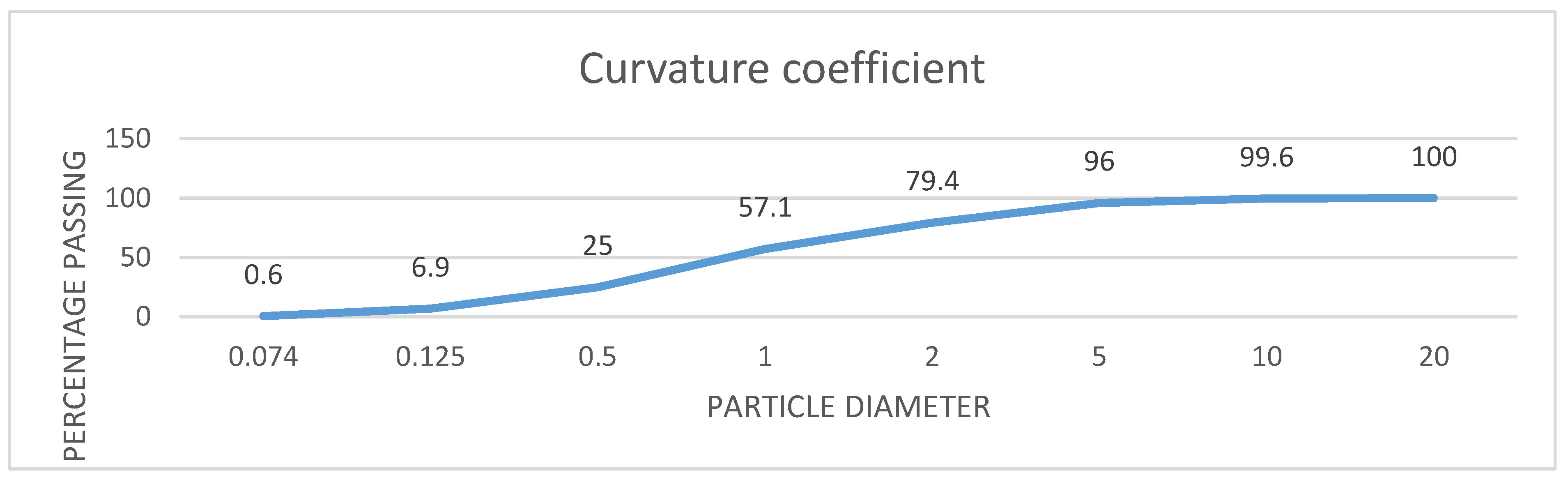
Figure 2.
Coefficient Curvature.
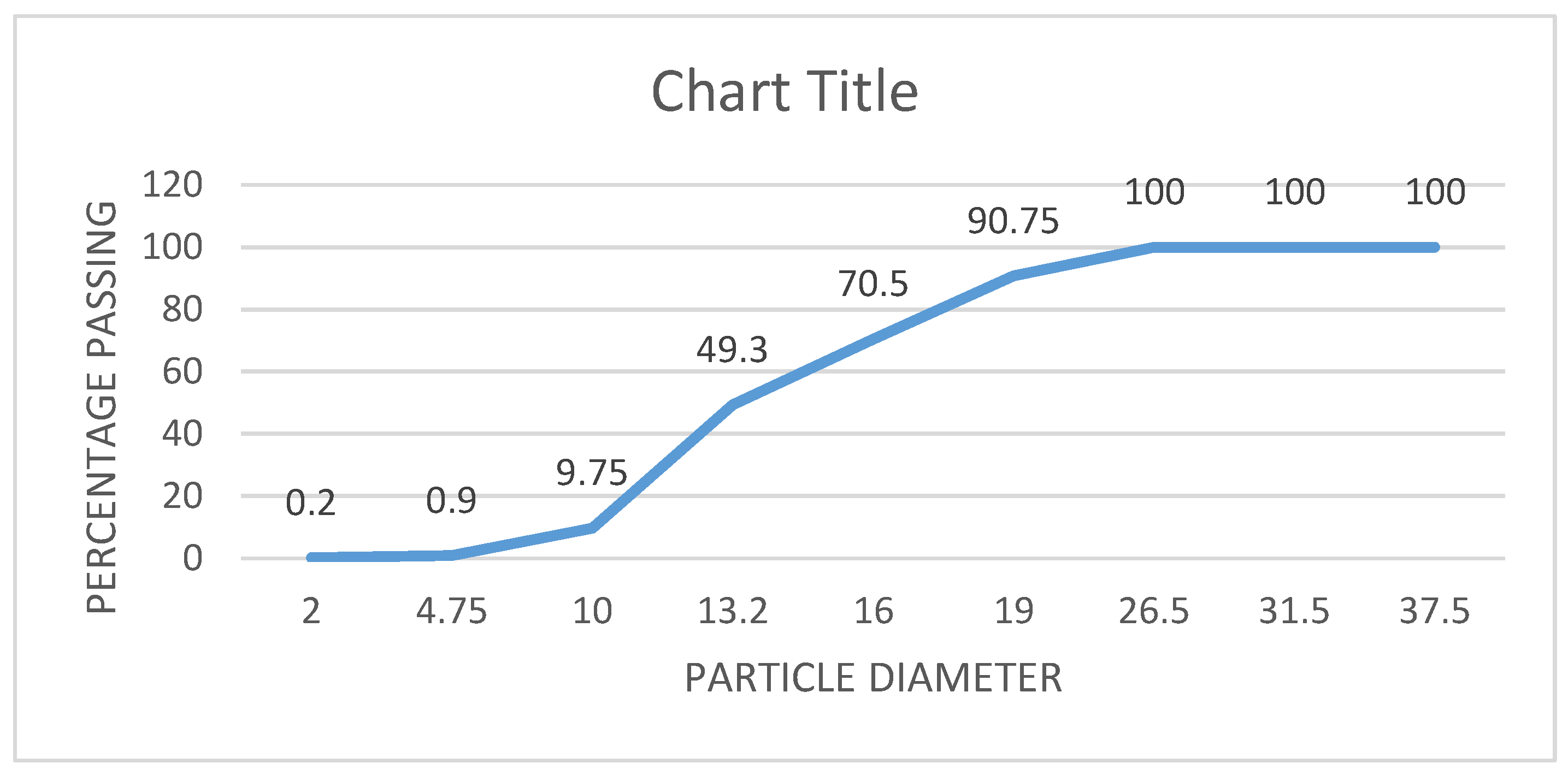
Table 1.
Sieve Analysis of Sand.
| Sieve Size#break#( mm) | Mass of Sieve (g) | mass of Seive + Soil (g) | mass of Soil#break# (g) | Percentage of Retained Soil (%) | Percentage of Passing Soil (%) |
|---|---|---|---|---|---|
| 20 | 207 | 207 | 0 | 0 | 100 |
| 10 | 173 | 177 | 4 | 0.4 | 99.6 |
| 5 | 189 | 225 | 36 | 3.6 | 96 |
| 2 | 218 | 384 | 166 | 16.6 | 79.4 |
| 1 | 152 | 375 | 223 | 22.3 | 57.1 |
| 0.5 | 130 | 451 | 321 | 32.1 | 25 |
| 0.125 | 126 | 307 | 181 | 18.1 | 6.9 |
| 0.074 | 121 | 184 | 63 | 6.3 | 0.6 |
| Pan | 410 | 416 | 9 | 0.6 | 0.0 |
| TOTAL | 1000 | 100 |
Table 3.
Soundness Test of cement.
| CEMENT | L1(mm) | L2 (mm) | Soundness (L1-L2) |
|---|---|---|---|
| P-32.5N | 10 | 10 | 0 |
Table 4.
Consistency Test.
| CEMENT | Water content (g) | Consistency (%) |
|---|---|---|
| P-32.5N | 90 | 30 |
Table 5.
Fineness Test of Cement.
| CEMENT | SAMPLE PASSED (g) | SAMPLE RETAINED (g) |
|---|---|---|
| P-32.5N | 94 | 6 |
Disclaimer/Publisher’s Note: The statements, opinions and data contained in all publications are solely those of the individual author(s) and contributor(s) and not of MDPI and/or the editor(s). MDPI and/or the editor(s) disclaim responsibility for any injury to people or property resulting from any ideas, methods, instructions or products referred to in the content. |
© 2025 by the authors. Licensee MDPI, Basel, Switzerland. This article is an open access article distributed under the terms and conditions of the Creative Commons Attribution (CC BY) license (http://creativecommons.org/licenses/by/4.0/).
Copyright: This open access article is published under a Creative Commons CC BY 4.0 license, which permit the free download, distribution, and reuse, provided that the author and preprint are cited in any reuse.


