
Submitted:
21 July 2025
Posted:
22 July 2025
You are already at the latest version
Abstract
This paper explores a pilot project aimed at integrating Alexandria’s tangible and intangible cultural heritage in alignment with UNESCO Creative Cities Network (UCCN) objectives in the field of literature. Alexandria, historically known for its cosmopolitan identity, possesses a rich cultural heritage that includes Pharaonic and Greco-Roman sites protected by Law 215 [1], as well as heritage buildings like villas, mosques, and museums [2]. Its intangible heritage encompasses fishermen’s songs, multicultural languages, traditional crafts, Sufi rituals, and a distinctive cuisine[2]. Despite this wealth, challenges such as neglect, insufficient documentation, and demolition of historic buildings threaten the city’s cultural identity[3].
To address these issues, the study proposes a culture mapping approach that merges tangible and intangible elements, creating an adaptable framework compatible with UCCN goals. The methodology combines analytical research with qualitative tools focus groups, interviews, and observations within a pilot area covering parts of Al Gomrok and Wasat districts. This area reflects the city's literary and cultural domains (maps 25–26). The project offers a replicable model that reinforces Alexandria’s role in global cultural diversity and sustainable development, highlighting the integration of literary legacy with architectural heritage.
Keywords:
tangible cultural heritage
; intangible cultural heritage
; unesco creative cities network (uccn)
; culture mapping
; sustainable cultural development
; literary heritage
1. Introduction
Cultural heritage is the heritage of tangible and intangible features that are unique to a group or culture, are handed down from earlier generations, are kept in the present, and are provided to future generations for their benefit. Intangible heritage includes customs, oral traditions, music, languages, poetry, dance, celebrations, religious events, and traditional knowledge systems and skills. Tangible heritage includes material heritage such as monuments, buildings, statues, paintings and objects[4].
To promote international cooperation among communities that have made investments in culture and creativity as a tactical lever for long-term urban development, the UNESCO Creative cities Network (UCCN) was established in 2004. It covers seven artistic disciplines: design, film, gastronomy, literature, media arts, crafts & folk art and music. The goal is to make their cities safe, resilient, inclusive, and sustainable in accordance with the United Nations 2030 Agenda for Sustainable Development[5].
Alexandria has a rich heritage, both tangible and intangible, that has been shaped over the years by many different people. For tangible cultural heritage in Alexandria there are numerous archaeological sites, including the Roman Amphitheatre, al-Shatbi tombs, Kom al-Shokafa catacomb, al-Ras al-Soda temple, and Tigran tomb from the Graeco-Roman era[6]. Numerous mosques, public structures, and private residences were built during the Ottoman, modern, and current eras. Foreign architects from the 20th century have left their creations in Alexandria, representing the European influence on architecture and adding to the city’s heritage[7]. Alexandria has a rich and varied intangible heritage, with expressions of the five domains of intangible heritage. These include the unique songs and dances of fisherman and Sayyed Darwish’s music, the dialect of Alexandria, traditional handicraft, fishing nets and gold jewellery, and the distinctive cuisine of Alexandria, which is known for its many seafood specialties[2].
This paper introduces a pilot project to integrate tangible and intangible cultural heritage of Alexandria through applying the UNESCO initiative of creative city network. It examines the synergies and difficulties of the integration and offers recommendations for ways in which to apply the pilot project to Alexandria. In addition, this paper will prepare mapping of creative assets of the city, draft a strategy and action plan implementing the UNESCO objectives at local and international levels, and plan management unit.
To sum up, incorporating culture’s tangible and intangible aspects within one structure may serve as a steady foundation for the city’s development as a UNESCO Creative City. This kind of integration meets the ambitions of the UCCN and the Sustainable Development Goals while supporting the economy, bringing people together and maintaining traditions. This framework could be replicated by other cities with cultural heritage encountering the same problems.
1.1. Problem Statement
Alexandria’s intangible heritage is abundant, but its utilization is hindered by lack of documentation and in danger of neglect [7]. Lack of knowledge is also an issue that threatens Alexandria’s cultural heritage, with authorities, institutions, research institutes, non-governmental organizations, and initiatives unable to raise public awareness.
It is necessary to face the frightening directions to the demolition of historical buildings rather than building a new one [8]. Accordingly, this paper examines an alternative approach by reusing and rehabilitating the historical buildings. Another dimension to the definition of the problem is added through searching for a benchmark and global system to apply its principals to cultural heritage.
The incorporation of Alexandria in the UNESCO Creative City Network (UCCN) and the United Nations 2030 Agenda for Sustainable Development will ensure the protection of its cultural heritage on both a national and international level. Adopting an international strategy will raise awareness of the importance of intangible cultural assets in society and integrate preservation into planning projects [9].
The research gap of knowledge is that in the UCCN programme, there is no clear framework for integrating tangible and intangible cultural heritage in cities that cannot separate both resources. Because Alexandria has a rich heritage of both tangible and intangible cultural heritage [6], it is necessary to create a new framework to apply to Alexandria as a creative city in the Unesco network or any city that cannot separate both of its heritage.
1.2. Research Importance
The merging of tangible and intangible cultural heritage will result from its value to enhance the role of tourism, in addition to its importance in terms of culture, society, and the economy. It will strengthen the linkages between many world civilizations and enrich their diversity. It seeks to lay solid, sociocultural-based communication for government and community integration to enhance the economy and provide job opportunities.
1.3. Research Hypothesis
The research presupposes that, if tangible and intangible cultural heritage can be combined, protected with a strategic framework in place for Alexandria to be included in the network of creative cities, then the following points would increase the success of the project:
- hare experiences, knowledge, and best practices.
- launch pilot projects, collaborations, and initiatives involving the public and commercial sectors, as well as civil society.
- Establish professional and artistic exchange networks; and
- Conduct studies, research, and evaluations on the experience.
1.4. Aim and Objectives
It is important to note that the preservation process of tangible heritage is closely related to the safeguarding of intangible cultural heritage, but there is not a clear system in the UNESCO creative city network for integrating them. Thus, the main aim of this study is to develop an appropriate framework for implementing the UCCN application on cities with tangible and intangible cultural heritage. The research will apply the framework by integrating them into Alexandria as a creative city in literature and place it on the international touristic map.
Objectives of the study are based on the following:
- Analyze the efficiency of cities that contain both tangible and intangible cultural history.
- To determine if the requirements of the UNESCO Creative Cities Network can be achieved by merging both heritage and determining the extent of their efficiency.
- Measure the efficiency of integration to achieve the goals of the Sustainable Development Agenda 2030 and the relationship between the goal and the integration.
- Setting a framework fit with the creative cities that contain both tangible and intangible history.
2. Materials and Methods
2-1. Case study Profile
2-1-1. Case Study Boundaries
To apply the integration of UCCN application on the pilot project, a specific area in Alexandria has been chosen. That area is maps number 25, 26 (Figure 1), from the Alexandria listed heritage map. Those boundaries start with Cornish road at north, Moharambek and KomelDikka at south, Ras El Tin at west and Alexandria stadium at east. Those two maps located on two of Alexandria districts which are Al Gomrok and Wasat including Raml station and al Manshia area.[10]
The reason for implementing those two maps is because they consider the major region in Alexandria, which has a significant number of historical districts, buildings, squares, and streets, as well as a rich history of the five domains of Alexandria’s intangible cultural heritage[11].
2-1-2. Historical Background of the Case Study Area:
- 1-
- Mahatet El-Raml district
Mahatet El-Raml district in Alexandria is regarded as one of the major hubs for exploring, traveling, and entertainment in the area. The renowned tram station (Figure 2) and the sizeable public square are what make the region distinctive (Saad Zaghloul Square). It is also renowned for having a strong sense of authenticity and historical significance. As the heart of the ancient city, this area of the city was created between 1890 and 1950 by a variety of Italian architects.
The constant presence of sellers on the streets, which draws shoppers and tourists, is one of its distinguishing characteristics. The business streets composing the region also house a number of hotels, eateries, and performance venues. The neighbourhood has seen a lot of alterations that have impacted how it operates and the experience of its visitors due to the city of Alexandria’s growing population density and social changes over time [12].
It is regarded as one of the key locations to visit in Alexandria to take in the city’s distinctive waterfront image because of its strategic location, heritage iconic buildings like (kom El-deka), open spaces, parks, restaurants, hotels, trades shops, offices, clubs, residential buildings, cinemas, Alex stadium, cathedrals and mosques, Alex national general court, Bibliotheca Alexandria, and the train station [13].
- 2-
- Al-Manshiy district
When the French arrived in Egypt, Alexandria was a complete ruin, most of the city eroded, and it remained a narrow strip connecting between the “Raquda” of the village and “Pharos” the island. The population of the city was eight thousand people, residing in the strip that begins after Al-Manshiya and connects to Ras Al-Tin, the neighborhoods that later became Al-Gumrok and Al-Anfoushi. “Kom Al-Hillah” was the name of the Mansheya area, and Muhammad Ali decided to give lands from it to every foreign community to build a consulate. In the north, Salah Salem Street, and in the south, France Street and Victory Road, and the statue of Muhammad Ali (Figure 3), Al-Jumhuriya Restaurant, Sheikh Ibrahim Pasha Mosque, and the Egyptian neighborhood in Mansheya and the residences of the Egyptian people, in the area known as the “Gdarelmagarba”. A large part of these dwellings was removed in 1958, when the government built “Al-Nasr Road”[14].
In 1866, the Greek consul “Tusitsa” built the Al-Borsa building in Alexandria, which became the commercial center of the city. After the 1952 revolution, the building was transformed into the “Socialist Union”. During the British occupation, the British set up gallows in the middle of the square and executed several people by hanging, and others by beating with fire. From the balcony of the “Tusitza” Palace, Abdel Nasser was subjected to an assassination attempt in 1954 and the nationalization speech in 1956. In 1977, angry crowds attacked the building and burned it, after which the state decided to demolish it completely, so that it turns today into a “garage” bearing the name “The Socialist Union Garage.” The statue of Muhammad Ali, the first statue built in modern Egypt in the year 1868, is in the center of the Consuls Square[14].
2-2. Research Design and Approach
2-2-1. Case Study Selection Criteria
Because Alexandria has a large amount of tangible and intangible cultural property[11], it is difficult to apply UCCN to the entire city in this research; so, a pilot project will be chosen to apply it more broadly to Alexandria.
Based on the above and the maps displayed earlier, it can be inferred that the downtown region, which is centred in maps Nos. 25 and 26 of the Alexandria preservation folder, is the most prevalent place in which tangible and intangible cultural heritage is gathered in Alexandria. The two maps represent Mahatet El-Raml district and Al-Manshiy district. As a cosmopolitan city, this neighborhood contains various activities relating to Alexandria’s intangible history, particularly literature[14].
Listed below are the criteria to be used at the case study, first, Background the case study contains enough recent history to provide information on tangible and intangible cultural heritage of Alexandria. Secondly, this district Outcomes clearly addresses whether performance and related information are associated not only with resulting changes in Unesco creative city network program Activities but also to be associated with changes in program outcomes and can apply on any district in Alexandria. In addition, the case study provides evidence that the authors have established effective contacts within the relevant organizations to support the case study, and its findings and conclusions. Also, the case study findings expected to be useful to state and local governments as a pilot project to apply it on the total heritage map of Alexandria, as a matter of fact, the case study provide some description of the logic model supporting the UNESCO creative city network program, including linkage between strategic goals and performance measures and target. Moreover, the case study clearly articulates the conclusion that follows from its analysis of the use of performance information, and if appropriate, identifies any best practices identified as part of the analysis.
Finally, the case study offers perceptions, observations, lessons learned or best practises that could help further the study of performance management and evaluation.
2-2-2. Criteria for selecting Alexandria as a city of literature in UCCN
Literature is any collection of written work, but it is also used more narrowly for writings specifically considered to be an art form, such as prose fiction, drama, and poetry. It can also include works in various non-fiction genres, such as biography, diaries, memoirs, letters, and essays. It is a method of capturing, keeping, and disseminating information and amusement with the potential to serve social, psychological, spiritual, or political purposes as well. These works are grouped according to historical eras or artistic characteristics, and depending on whether they are poetry, prose, or theatre[15].
Few towns have ever been as international as Alexandria. It experienced two golden eras: first, when it served as the intellectual centre of the classical world under the rule of the Ptolemaic house; and second, when it served as the largest port in the eastern Mediterranean in the late 19th and early 20th centuries, under the rule of the Mohammed Ali family. From ancient to modern times, poets, historians, and travellers have all been enthralled by Alexandria, the enormous Egyptian city on the Mediterranean that Alexander the Great founded in 332 B.C [16].
Alexandria has always been a centre for writing and literature as well as a meeting place for thinkers of all stripes. It is the city that underwent historical events that shaped the literary personalities of numerous writers and intellectuals, such Constantine Cavafy, Lawrence Darrell, and other writers that followed in their footsteps to write about this white marble metropolis [17].
The literature field has been chosen to prepare Alexandria to be one of the UNESCO creative city networks. A larger network of creative cities, including 295 UNESCO Creative Cities worldwide and 39 cities of literature, was established in 2004 and includes the City of Literature initiative of UNESCO. Members come from more than 90 countries and represent seven creative disciplines, including design, cinema, gastronomy, literature, music, and media arts. They also represent crafts and folk art. The Global Coalition for Cultural Diversity program of UNESCO, which was started in 2002, gave rise to the Network[18].
2-3. Data Collection Methods
2-3-1. Tangible Cultural Heritage of the Case Study Area:
The study area of El Raml Station and El Manshia was explored by using collected documents, checking maps, referring to official inventories and observing the field sites. In this way, a thorough understanding of the architecture and the history of the area was achieved.
2-3-1-1. Listed Heritage Buildings of the Study Area in Alexandria City
The main source used to spotlight and record the listed buildings was the Alexandria heritage inventory, especially maps 25 and 26 [19]. On these maps (Figure 4), heritage buildings were sorted by their status on both local, city and national levels. The county distributed five buildings nationally, 162 in the city and 211 at the local level (Table 1)[11].
The attractions include the Cavafy House, the Museum and the former home of Sayed Darwish. Observations were made at the site to check the present state and style of the buildings and photos were taken to aid in classifying and mapping them.
2-3-1-2. Listed Heritage Districts of the Study Area in Alexandria City
Each historic district was identified using references from other studies as well as an on-site investigation. The region includes areas rich in history such as the Greek, Turkish and El – Atareen district (Figure 5), all having their own architecture, past events and culture[20]. Analysis of archived documents and old maps[19] showed the outline of local districts and how they have developed. During site visits, old shop names, original urban arrangements and customs that remain in Al-Sagha, Souq Al-Turk and Zanket Al-Setat have been documented. A series of interviews with local people and people who preserve heritage in the district was held in the Latin District, which has a multicultural past, to record its non-physical plans.
2-3-1-3. Listed Heritage Streets of the Study Area in Alexandria City
Information on historic streets was gathered using archives, books and by walking along them. These streets were highlighted because of their role in Egyptian culture, history and because they reflect major figures and events[14]. To understand the original lines of tree-lined streets in the urban landscape, Fouad Street (Figure 6), has been mapped with the other roads to see how far its original design remained (Figure 7). The tangible cultural heritage of the area was accurately captured using official data, older references, maps, scientific work and field studies[10].
2-3-2. Literature as Intangible Cultural Heritage in the Study Case Area
Data on literary intangible cultural heritage was gathered in the study area by studying old records, examining historical books and visiting El Raml Station and El Mansheya. This part is about recording important writers and journalists from Alexandria and their workplaces, bringing together intangible and tangible heritages. The fact that tangible heritage is closely linked with intangible heritage in Alexandria led to study literary works by considering the buildings where they were created and locations where literary figures gathered. The resources for this study were newspaper records, inventories held by authorities, records from cities, old photos and several academic studies. A survey was carried out to prove that the settlements have a physical presence and to study their condition, using photos for support[11].
2-4. Cultural Mapping for the Study Case Area:
In this study, a customized and implemented framework from cultural mapping was selected by the researcher for the case area (Figure 8). based on (pillai, 2013) the process consisted of many different sections: [21]
- 1-
- Framing the Mapping Exercise: The mapping exercise began with acquiring the mapping brief describing the purpose, the people involved, who would use the information and the timeline for using it. The aim was to preserve and combine cultural elements found in the city’s streets and surroundings, regularly from Cornish Road to the north and Moharam-bek to the south, Ras El Tin to the west and Alexandria Stadium to the east.
- 2-
- Site Profiling: During Site Profiling, by taking pictures and exploring various aspects of the town, including land use, various patterns, architecture, building conditions and the value of heritage sites. During the study, attention was given to pool traffic by stressing the roads of Fouad and Nabi Daniel and examining how different buildings looked and their conditions.
- 3-
- Stakeholder Engagement: The process involved mapping how and where residents, vendors, actors from different institutions and tourists engaged in economic activities within the city.
- 4-
- Establishing Goals and Objectives: At the time of the map, its main purpose was to document site values, check what was happening and assist future planning, conservation and growth. It was focused on the town level, while looking at all sides of cultural life (social, environmental, economic).
- 5-
- Determining Tools and Techniques: Manual tools such as drawing sketches, interviewing, taking pictures, utilizing archives and drawing plans were used. Some digital devices were chosen to present information and analyze data. [21]
2-4-1. Process of Mapping
At this point, on-site data capture, collection and visualization was followed by synthesizing the collected data to detect how the study area’s cultural elements affect each other. There were three levels to how data was collected.
- At the beginning, quantitative approaches were used to note and record physical assets such as buildings, different districts, roads and archaeological areas.
- Details on architectural features, city layout, land use, building height and demographics were noted down to map out solid/void, land use and historical buildings areas.
- During this phase, qualitative data gathered intangible heritage associated with literature and history such as sites connected to writers, poets and key cultural centers.
- a- Recording historical cultural centers in the study area, Alexandria city
An extensive survey in Alexandria located and planned main cultural centers, including the Russian Cultural Center, Goethe-Institut, Cervantes Institute, Dante Alighieri Center, Al Horreya Creative Arts Center, French Institute, Greek Cultural Center and American Cultural Center which outlined their history, distinctive buildings and influence on literature and art. The centers were placed on the map and sorted by their cultural significance locally, at the city level or nationally (refer to Figure 9).
- b-
- Recording Historical Hotels in Alexandria
A survey of Alexandria included noticing historically significant hotels because of their architecture, their ties to cultural life and their associations with literary and historical people. These examples are the Cecil Hotel (1929) with its great location and Italian design; Le Metropole Hotel (1902), immortalized by poet Constantine Cavafy; Windsor Palace Hotel (1906), close to the port and commercial district; Marhaba Hotel, a heritage hotel; and the Fouad Hotel which Naguib Mahfouz used for his novel Miramar[22]. All the hotels were properly situated in the city and included in the architectural cultural heritage layer (Figure 10), aiding in completing Alexandria’s rich urban history.
- c-
- Recording Historical Streets and Urban Spaces in Alexandria:
Various culturally and architecturally important streets and public spaces in Alexandria were recorded and put on maps (Figure 11). The main features of Nabi Daniel Street from the city’s beginnings include the Prophet Daniel Mosque, Eliyahu Synagogue and St. Mark’s Church which was built in Egypt and Africa’s oldest church[23]. Both Said Darwish (Figure 12) and Fouad Streets are culture and heritage locations for large public events. The Al-Attarin Mosque Street, located by the famous spice market, was restored during 477 AH by Badr Al-Din Al-Jamali[24].
- d-
- Recording historical OKelles of the study area in Alexandria city
Twelve historical wakālat (commonly referred to as okelles) have been officially registered as heritage buildings within the designated study area in Alexandria (see Table 2). Historically, an okelle functioned as a mixed-use residential and commercial complex, accommodating traders from various regions. Notable examples within the study area include: the Terbana Mosque, located at the corner of Terbana Street; the Abdel Bakki El Shorbagy (Georbagy) Complex; and the Okelle Monferrato, designed by Luigi Piatolli between 1885 and 1887[8] . A map indicating the precise locations of all twelve okelles is provided in (Figure 13)
- e-
- Recording historical Mass Media, poetry and poet, writers and literary cafe of the study area in Alexandria city
The historical and literary significance of mass media institutions in the study area of Alexandria, including prominent newspapers, is documented. This includes information regarding the buildings in which these newspapers were established, their historical value, current physical condition, and their status on the heritage preservation list. Additionally, a cultural map (Figure 14), developed through previous studies focused on literature as intangible cultural heritage, highlights these media institutions within the context of Alexandria’s mass media history.
Similarly, the accompanying cultural map (Figure 15) presents data on notable poets associated with the area. This includes their literary and historical importance, as well as buildings connected to their lives such as places of birth, residence, work, or locations referenced in their poetry. Each entry includes an assessment of the building’s historical relevance, structural condition, and whether it is officially listed for preservation. These materials draw upon prior research in the field of intangible literary heritage, emphasizing the poetic history within the study area.
the related cultural map (Figure 16) document influential writers who either lived in or wrote about Alexandria. This includes details regarding buildings associated with their biographies or writings, evaluating their cultural significance, architectural integrity, and heritage registration status. These findings contribute to a broader understanding of Alexandria’s literary heritage as captured in earlier studies of intangible cultural assets.
Lastly, the cultural map (Figure 17) focuses on literary cafés known for their historical and literary relevance. The documentation includes the physical buildings housing these cafés, their heritage value, current condition, and preservation status. The records also identify prominent writers, poets, and political figures who frequented these spaces, along with notable historical events that took place there. As with the other categories, the data is drawn from previous studies exploring literature as a form of intangible cultural heritage in Alexandria.
2-5. A Conceptual Framework to Integrate Tangible and Intangible Cultural Heritage and Apply it into UNESCO Creative City Network
This study employes a conceptual framework that gives specific variables and components, indicating relationships between and within the components. The framework serves different purposes, clarify concepts, arrange ideas, and determine linkages with which to frame research, employ a conceptual framework. Within dissertation research, concepts are logically developed, organized to support a general framework, and frequently shown visually.
The following framework, divided into five steps, works parallel to designate cities with tangible and intangible cultural heritage that cannot be separated to be a creative city in the UNESCO creative city network (Figure 18).
First step is to Identifying Tangible and Intangible cultural heritage of the city. By analyzing the tangible cultural heritage of the city and its contents, which are represented in Architectural works, Monuments, Archaeological sites, Historical centres, Groups of building, Cultural landscapes, Historical parks and gardens, and Industrial archaeology. Also, analyzing the intangible cultural heritage and its contents that are attached to its contents from oral traditions and expressions, The performing arts and traditional folklore, social practices, rituals and festive events, Knowledge and practices and Traditional Craftsmanship.
That will lead to the second step, which is cultural mapping to the tangible and intangible cultural heritage of the city. Cultural mapping consists of three procedures; each of them will clarify and analyze the potential of the city. First is framing of mapping exercise which contains four stages; obtain mapping brief, inspect and profile the site, engage with stakeholders and establish goals and objectives. Second, is the process of mapping which contains data recording and data synthesis. Finally, evaluation of the site which split into two steps; first is assessing cultural character and significance and second is SWOT analysis and recommendations for planning.
The After analyzing and studying the city’s tangible and intangible cultural heritage as part of the cultural mapping process, the second step will provide findings for the third step to Integrate and overlap tangible and intangible cultural heritage, and for the fourth and fifth steps to provide suggestions to achieve UNESCO creative city network Requirements in the concerned field and to achieve the 2030 sustainable developed agenda’s goals.
3. Results:
3-1 A pilot Project to Achieve the UCCN Requirements on the Selected Area in Alexandria City
Using what was found during the early contextual analysis, this section shares the findings from the cultural mapping and introduces suggested pilot interventions. Its place, the makeup of its population, the way it is governed, and its international relations allow Alexandria to have an important role in the UNESCO Creative Cities Network (UCCN). Because of the city’s rich and varied past, its infrastructure and heritage, formed over hundreds of years, create many opportunities to refresh culture and the economy[2]. Still, the potential value of this heritage is not made full use of. Rich buildings and culture are present in Alexandria, but unpredictable economic and structural factors limit their effect on modern life and tourism development. Many heritage buildings downtown and in old immigrant communities are owned by individuals and used as residences which brings challenges to preserve them. The lack of proper records, not enough upkeep and occasionally, development projects that destroy sites on purpose has led to the fade of many heritages assets’ original character[7].
3-1-1. Involving Interested Stakeholders in the Literary Creative Field to Fulfill the Requirements of UCCN
The main points in the following are the answers suggested for Documentation Problems, Lack of Cooperation in Supporting Heritage, Neglect of Cultural Traditions and a Limited Contribution from Museums. These projects will have participants from the public and private sectors, universities, civil organizations and artists, professionals and cultural workers involved with Alexandria and its literary heritage. For example, Rakoda, Arkan, torraha and save Alex and Alexandria nonprofit cultural foundation (Figure 19) might assist in suggesting ways to integrate the community. The city of Alexandria includes 24 government, 68 non-governmental and 4 foreign cultural institutions. Even so, some have built their own cultural organizations for this reason or to avoid losing their cultural possessions to the government. (Gartland, 2002)
3-1-2. Integrating Historical Cultural Centers of the Study Area in Alexandria City with the Literary Creative field To Fulfill the Requirements of UCCN
The mapping found eight important cultural centers for eight countries and after those were mapped, the spread of their culture could be seen (Figure 9). The Alexandria relisted Building Report considers them historic buildings that have added value to Alexandria. The Russian Cultural Centre, the Goethe Institute, Dante Alighieri di Alessandria Italian culture center, The Cervantes Institute, Horreya center for creative arts in Alexandria, The French Institute in Egypt, The Greek Cultural Centre and The American Cultural Centre are the main centers for culture in Alexandria. To meet Item No. 10.1 which requires describing the creative sector’s part in the history and growth of the city [25]. By bringing together the cultural centers in Alexandria, located in registered buildings and historical areas, recording and saving them in the Alexandria folder and placing their locations on a cultural map (Figure 9), so it can easily see the cultural and literary works happening there and decide if parts need restoration.
3-1-3. Integrating Historical Hotels of the Study Area in Alexandria City with the Literary Creative Field to Fulfill the Requirements of UCCN
Once the historical hotels were documented in the research region, the mapping displays that five hotels in the case are being preserved by the Alexandria folder due to their significance and the historical events that happened in them. The hotels shown on the cultural map (Figure 10) are the Cecil Alexandria Hotel, The Paradise Inn Le Metropole Hotel Alexandria, The Windsor Palace Hotel, Marhaba Hotel and Fouad Hotel. When buildings are restored and then re-used as part of literary history, it can meet the main two criteria set by UCCN. The cultural sector’s strong economic role and dynamism are emphasized in Item No. 10.2 and it is expected that integration will bring extra money to the economy by attracting more tourists[25].
Moreover, Item No. 10.3 goes on to say that many communities and organizations in the creative field, as people connect more, gain in both strength and talent. Some groups formed by refugees and migrants and their members, are working on restoring important landmarks, helping those with disabilities find meaningful work and planning activities for the community’s social wellbeing. Based on their importance and the notable events they have hosted, the historical hotels in (Figure 10) are registered in the Alexandria folder for preservation. So, when concerts, events and festivals related to literature are held, the connection between tangible and intangible cultural heritage is achieved which corresponds to No. 10.4, asking for the holding of major fairs, conferences and gatherings such as conventions and congresses on a national and international scale[25].
3-1-4 Integrating Historical Streets and Urban Spaces of the Study Area in Alexandria City with the Literary Creative Field to Fulfill the Requirements of UCCN
Following recording of the historical streets and urban spaces in the case study area, four historical streets and three urban spaces in the area are saved in Alexandria’s preservation folder since they are important due to events that happened there and can be applied in the application based on their significance. Nabi Danial Street, Said Darwish Street, Fouad Street and Al-Atarin Street are the streets marked on the cultural map shown in the previous (Figure 11). Examples of urban spaces are Kom El Dika urban space, Midan Elmanshia and Saad Zaghlool Square. This will bring together the city’s older areas, streets, public spaces and gardens with literary and poet festivals and events by rehabilitating and reusing them, in line with Item No. 10.5 that insists on hosting major festivals, conventions and other large-scale events in the city[25].
3-1-5. Integrating Historical OKelles of the Study Area in Alexandria City with the Literary Creative Field to Fulfill the Requirements of UCCN
After the recording of the historical OKelles, it was observed that cultural mapping found that twelve historic OKelles are listed as historic buildings in the Alexandria area in the preceding (Table 2) and also on the previous map (Figure 13). Such OKelles are kept in the Alexandria folder to be preserved because of their historical value and notable occasions that took place there and they could also be employed in apps on a regional or historical basis. According to items No. 10.6, No. 10.7, No. 10.8 and No. 10.9, efforts should support literature-based arts education for young people and major processes, programmes and courses to nurture creativity and culture. Besides, there are research centres, literary institutes and programmes, along with centres for professionals, incubators for cultural enterprises and chambers of commerce with special programs for cultural goods and services [25]. To meet the criteria above, the study proposes organizing storytelling workshops, instructing young author workshops and other literary workshops, as well as rehabilitating and using OKelles to establish educational centers for literature, poetry and journalism. It is also possible that one of the buildings will be revamped to act as a center for literature and language. One can also designate zones in it for the licensing or sale of the work.
3-1-6. Heritage Walks of Literature in the Study Area in Alexandria to Fulfill the Requirement of the UCCN
After recording the literary history in Alexandria through mass media, poetry, poets, writers and literary cafes according to the study case, it is possible to design four heritage walks using the cultural maps shown in Figure 14, Figure 15, Figure 16 . The study proposed that to fulfill items No. 10.11 to No. 10.16 which encourage wider participation in cultural life, mainly in its creative fields, with those classes meant for disadvantaged groups[25], the study recommends four different heritage walks. During the first heritage walk, the places which linked to newspapers and press, examined its origins and buildings, note down whether restoration is necessary, discuss the state of each building and register whether the places are recorded in the Alexandria folder. The second route highlights Alexander’s poetry and poets, their living areas and their writings, together with the location’s important spots. In addition, determining the structure’s state, checking registration in the Alexandrian archive and deciding if it should be restored or used differently. The next heritage walks deal with Writers tied to Alexandria such as authors born or living in Alexandria or who wrote about it and connecting the place to their works. All this includes finding out the present-day appearance of the residence, if it needs restoration and whether the building is listed in the Alexandrian preservation folder. The fourth heritage walk is about literary cafes in Alexandria, where writers, poets, journalists and historians often visited and connected their work to the café because of the history of these cafes. With this proposal, the point No. 10.17 and No. 10.18 , is also addressed, as the fusion of literature and gastronomy is achieved since these cafes and restaurants are known for the local traditional food.
- A-
- Mass Media heritage walk of the study area in Alexandria
The five main historical Alexandrian newspapers were explored by taking a route that went by four crucial historical streets filled with important buildings that are listed for conserving in Alexandria. To visit the newspapers and the area’s attractions, the main path includes places included in the folder for preserving Alexandria and shows on the map (Figure 20).
- B-
- Poetry and poet’s heritage walk of the study area in Alexandria
Map (Figure 20) shows a route leading to the five most important poets who lived or were born in Alexandria, highlighting their homes, museums or streets where their names are present. In addition, the listed places coincide with three historical streets full of registered and preserved buildings within Alexandria, so creating a tourist path that can also enjoy viewing these great places.
- C-
- literature and writer’s heritage walk of the study area in Alexandria
The path was drawn to include the four key historical writers, who were connected to Alexandria, pointing out on the map (Figure 16) their former homes, schools, museums or houses where they lived and noting streets which hold their names, as these writers lived by three streets of interest that hold old buildings and are mentioned in the preservation folder for buildings in Alexandria, as indicated on the map (Figure 20).
- D-
- The literary café’s heritage walk of the study area in Alexandria
A historical path was made to reach the fourteen most important historical literary cafe that were in Alexandria, indicating on map (Figure 17) and also writers, political, composers and poets who was visiting it taking into account that they overlook three historical streets, which contain many historical buildings and registered in the Alexandria folder for preservation, indicated on the map (Figure 20), in order to make a tourist tour that is not only specific to the writers but also about viewing these buildings, squares and streets as a tourist attraction and urging them to develop and restoration.
In the end, the four historical paths that represent the press, poets, writers, and literary cafes were gathered in on map (Figure 20), and thus they can be fully applied to Alexandria because of its great history in literature, poetry, writers, and poets.

Table 3.
Proposed projects to achieve integration while fulfilling the UCCN requirements and SDG’s goals.
Table 3.
Proposed projects to achieve integration while fulfilling the UCCN requirements and SDG’s goals.
| Item No | Application form requirement | Project proposal to achieve the integration | S.D.G achieved goal | Benefits of integration |
|---|---|---|---|---|
| No. 10.1 | which state to Role and foundations of the creative field concerned in the city’s history and development | It’s recommended to state all of Alexandrian cultural centres and all culture organizations that concerned on literature and architecture on map also to study if the need preservation. |
 Quality education |
More education opportunities will be made available as a result of integration, particularly for the vulnerable kids, women, and men |
|
No. 10.2 and 10.3 |
current economic relevance and dynamism of the cultural sector and Various communities that participate in the relevant creative . |
Rehabilitate historical assets to increase economic sector, create jobs, and build skills and resilience. |
 economic growth, productive employment |
It will provide work opportunities and economic prosperity for those involved in the creative field by rebuilding the intangible heritage domains |
| No. 10.5 | The city hosts important festivals, conventions, and other significant events. |
It is recommended to connect heritage urban spaces, historical streets and public spaces and gardens with literature and poet festivals and events in Alexandria. This will add value to the tangible and intangible heritage of the city, as well as reviving the biography of writers and poets who influenced and were born in Alexandria. |
 Make cities sustainable |
By leveraging increased public delivery, the restoration of historical assets will significantly increase street safety. beautify inclusive, environmentally friendly, and participatory urbanization |
| Item No | Application form requirement | Project proposal to achieve integration | S.D.G achieved goal | Benefits of integration |
| No. 10.6 and 10.10 | The primary cultural facilities and spaces are those devoted to the practice, promotion, and dissemination of culture and creativity, with an eye towards the general public and/or specific audiences. Initiatives, programmes, and techniques are used to promote culture and creativity. | It is recommended to rehabilitate and use Alexandria’s OKelles to establish educational places in the field of literature, poetry and journalism, storytelling workshops, teaching young writers, and translating literary works. One of the complexes can be rehabilitated to become a center for literature and language, and a building can be rehabilitated to become a scientific research centre. |
 No poverty  Affordable and clean energy  Decent work and economic growth |
end poverty, affordable and clean energy, decent work and economic growth, industry, innovation and infrastructure, sustainable cities and communities and responsible consumption and production. |
| No. 10.7 | Lifelong learning, postsecondary education, vocational training, residencies, and other institutes of higher learning focus on creative fields. | It’s recommended to rehabilitate the historical schools which listed in the Alexandria heritage report specially the vocational ones to be specific with literature education. |
 Quality education  Affordable and clean energy  Sustainable cities and communities |
The restoration of historical assets will ensure equal access to quality, affordable technical, vocational, and higher education, as well as equal opportunity to lead and participate fully in decision-making. This will save energy and increase street safety, promote inclusive urbanization, and protect the herbal and cultural heritage of the planet. |
| Item No. 10.8 and 10.9 | The primary cultural facilities and spaces are those devoted to the practice, promotion, and dissemination of the relevant creative sector, with an eye towards the general public and/or specific audiences. | It’s recommended to rehabilitate buildings with historical literature background to be a research centre for literature and places to sell the literature production. |
 Make cities sustainable |
By leveraging increased public delivery, the restoration of historical assets will significantly increase street safety. beautify inclusive, environmentally friendly, and participatory urbanization |
| Item No | Application form requirement | Project proposal to achieve the integration | S.D.G achieved goal | Benefits of integration |
| Item No. 10.11 to No.10.16 | The city is expected to initiate three cultural programs that will focus on vulnerable populations and encourage the partnership between the public, the private, and the civil society stakeholders. | It proposes four heritage walks to increase cultural participation by connecting the literary heritage of Alexandria to its gastronomy: Four heritage walks through the press, the poets, local writers and literary cafes and their historical and cultural context. |
 Make cities and human sustainable  Responsible consumption and production |
Restoration of historical assets will improve street safety and urbanization. Intangible heritage domains can be restored and protected, ensuring sustainable patterns of consumption and production. |
| No. 10.18 | The major international cooperation projects that at least two of the seven creative fields have been a part of in the last four years. | Film-related activities proposed include workshops, heritage walks, festivals, and rehabilitation of okelles and historic cinemas, one as an audiovisual and cinema museum, to incorporate Alexandria film tangible and intangible heritage. |
 Make cities and human sustainable |
Restoration of historical assets contributes to sustainable development because such structures use local materials which are strong and long lasting, and they also tend to be in a place which already has a high concentration of infrastructure and public transportation. |
| No. 10.19 | Events, as well as major infrastructures and facilities, are made available (fairs, conferences, conventions, etc.) | The proposal seeks to reconfuse the crafts and folk arts of Alexandria by transforming historic places and schools into training centers, crafts market and festival places; developing a gastronomy research center and developing cultural routes terminated at restored traditional buildings. |
 Quality education  Affordable and clean energy  Sustainable cities and communities |
The restoration of historical assets will ensure equal access to quality, affordable technical, vocational, and higher education, as well as equal opportunity to lead and participate fully in decision-making. This will save energy and increase street safety, promote inclusive urbanization, and protect the herbal and cultural heritage of the planet. |
| Item No | Application form requirement | Project proposal to achieve the integration | S.D.G achieved goal | Benefits of integration |
| No. 11 | The applicant cities are requested to propose a suitable medium-term (four year) action plan in this area. The action plan highlights the important actions the city takes to fulfil the Network’s goals: employing creativity as the engine for sustainable development | It is recommended to rehabilitate one of listed buildings in Alexandria to be a museum and workshop of calligraphy, establish a street theatre, rehabilitate historical libraries buildings to be a public reading area, storytelling events, creative activities, borrowing books and E-learning, and provide outdoor public spaces to be street libraries. Finally, a documentation centre for Alexandrian literature should be rehabilitated. |
 Make cities and and sustainable |
By leveraging increased public delivery, the restoration of historical assets will significantly increase street safety. beautify inclusive, environmentally friendly, and participatory urbanization |
Source: by author based on UCCN requirements and SDG’s goals.
4. Discussion
This study made use of the UCCN framework to connect Alexandria’s culture, both in literature and architecture, to enhance its image as a place for culture and attract international tourists. These recommendations are closely related to diverse Sustainable Development Goals (SDGs):
- Cultural Mapping for Heritage and Education (Item 10.1): Through UCCN guides, carry out a cultural mapping of Alexandria’s heritage and related institutions, focusing on diversity and creating opportunities for equal education for all (SDG 4).
- Heritage Rehabilitation for Economic Growth and Social Inclusion (Items 10.2 & 10.3): Heritage protection for both financial goals and society can be achieved (according to Items 10.2 and 10.3) by restoring old literary and architectural sites and offering jobs to vulnerable groups. It contributes to continuing growth of the economy, better employment and better working conditions (SDG 8).
- Preservation of Historic Hotels for Cultural Events (Item 10.4): By using heritage hotels for cultural events, it becomes possible to contribute to poverty reduction, greener energy usage, faster economic growth and sustainable urban communities (SDGs 1, 7, 8, 11).
- Activation of Urban Heritage Spaces (Item 10.5): Organizing literary festivals on Rehabilitated streets and revitalized public gardens, so communities benefit from cultural heritage, support a green city and help all to participate in the arts (SDG 11).
- Educational Centers in Historic OKelles (Items 10.6 & 10.10): In Historic OKelles (Items 10.6 & 10.10), transform existing historical places into centers for literature, poetry and journalism, to support new ideas, build infrastructure and encourage responsible use of resources (SDGs 1, 7, 8, 9, 11, 12).
- Vocational Schools Focused on Literature (Item 10.7): Restoring historical vocational schools improves education, supports equality between genders and encourages more sustainable cities and the use of clean energy (SDG 4, 5, 7, 11).
- Heritage Walks and Cultural Integration (Items 10.11–10.16): Compile heritage walks that link literary heritage, local press, poetry, cafés and food, aiming to boost life and participation of marginalized groups, with a focus on the creative field suggested by UCCN (SDG 11).
- Film Heritage and Cultural Industries (Item 10.18): Support Alexandria’s film industry by organizing workshops, festivals and museums, integrating its film tradition with typical cultural routines, all in support of sustainable cities and a growing economy (SDG 11, 8).
- Revitalization of Crafts and Folk Arts (Item 10.19): set up centers for teaching and selling traditional crafts and folk arts in revitalized historic districts, increasing the number of tourists and helping everyone profit from their economy (SDG 8).
- Gastronomy Heritage Projects (Item 10.19): setup gastronomy museums and festivals within heritage sites where visitors can learn about food and traditions at popular heritage sites, encouraging more tourism and helping the local economy become more sustainable (SDGs 8, 11).
- Literature Museums and Public Engagement (Item 11): By setting up museums, workshops, libraries and street theatres in the heritage buildings, opportunities for culture and education, as well as sustainable communities and urban areas, are given to the people (SDG 11).
5. Conclusions
The present study emphasizes the prosperous integration of both tangible and intangible heritage of Alexandria emphasizing both the heritage buildings, streets, districts and vivid literary, art, and social traditions. The UNESCO Creative City of Literature concept can serve as a successful means to place the elements of architecture and write together and to reinvigorate cultural sites, providing inclusive development in Alexandria. The pilot schemes suggested on the bases of the areas of interest of the heritage would reveal the use of literary themes to inform adaptive reuse, education, tourism, and community involvement. Sustainable developments are maintained and encouraged through education, economic growth and cultural preservation through the heritage walks, literature events, and through the reuse of historic sites, spaces to educate literary knowledge and storytelling. The research makes clear that due to the designation of Alexandria as Creative City of Literature, not only would the heritage be saved but also engaged as a living working power that would promote resilience, identity, and innovation within the urban fabric.
Author Contributions
Conceptualization, N.G., H.G and M.K.; methodology, N.G.; H.G and M.K.; validation, N.G.; formal analysis, H.G and M.K.; investigation, N.G.; writing—original draft preparation, H.G.; writing—review and editing, N.G.; supervision, N.G. and M.K. All authors have read and agreed to the published version of the manuscript.
Funding
This research received no external funding.
Institutional Review Board Statement
Not applicable.
Informed Consent Statement
Not applicable.
Data Availability Statement
No new data created.
Directly contact authors for information.
Conflicts of Interest
The authors declare no conflict of interest.
References
- Shaikhon, A.M.H. “HIDDEN HERITAGE OF ALEXANDRIA, EGYPT,” Int. J. Adv. Stud. World Archaeol. vol. 2, no. 2, pp. 1–13, Dec. 2019. [CrossRef]
- AbdelNaby, H.M.S. “INTANGIBLE HERITAGE OF ALEXANDRIA: POTENTIALS FOR TOURISM ATTRACTION,” in International Conference on Tourism & Hospitality Management, Athens, Greece, Jun. 2017, p. 10.
- Ghani, M.A. “Why was Qasim Amin School in Alexandria evacuated after three days of school?,” Ahram gate, Apr. 10, 2022. [Online]. Available: https://gate.ahram.org.eg/News/3718433.
- Introducing young people to the protection of heritage sites and historic cities: a practical guide for school teachers in the Arab region, Rev. 2nd ed. Amman: Unesco : ICCROM, 2006.
- UNESCO, “UNESCO Creative Cities Network (UCCN): evaluation.” United Nations Educational, Scientific and Cultural Organization, 2024. [Online]. Available: https://unesdoc.unesco.org/ark:/48223/pf0000388996/PDF/388996eng.pdf.
- McKenzie, J.S. The architecture of Alexandria and Egypt 300 c. BC - AD 700, Repr. New Haven, Conn. London: Yale University Press, 2011.
- Faculty of Tourism and Hotels, Alexandria University, Egypt and H. M. S. AbdelNaby, “Problems and Challenges of Cultural Heritage in Alexandria, Egypt,” ,” Int. J. Cult. Hist. EJournal, vol. 3, no. 3, pp. 174–178, 2017. [CrossRef]
- Gaber, H. “Applying Sustainability Principals in the Preservation of Historic Buildings According to LEED.” Master thesis, Faculty of engineering Alexandria University. Alexandria, Egypt, 2015.
- authorCorporate:UNESCO, “Voices of the city: UNESCO creative cities moving towards the 2030 agenda for sustainable development.” Accessed: Jun. 12, 2025. [Online]. Available: https://unesdoc.unesco.org/ark:/48223/pf0000368163.
- “Alexandria Street Map,” Bibalex.org. Accessed: Jun. 12, 2025. [Online]. Available: https://www.bibalex.org/en/Project/Details?
- [11] Database, A. 2025. [Online]. Available: https://www.bibalex.org/en/Project/Details?DocumentID=161&Keywords=.
- Gomaa, B.; Sakr, N. “Social Sustainability; Maintenance of Socio-Cultural Characteristics: A Case Study of El-Raml Station,” Eur. J. Sustain. Dev. vol. 4, no. 2, Jun. 2015. [Google Scholar] [CrossRef]
- Omar, N.; Saeed, E. “An Integrated Strategy for Waterfront Redevelopment Case Study: Alexandria, Egypt,” J. Eng. Res. vol. 3, no. 6, pp. 93–109, Jun. 2019. [CrossRef]
- Forster, E.M. Alexandria: a history and a guide, Ed. with rev. afterword and Notes. New York, NY: Oxford Univ. Pr, 1986.
- Klarer, M.; Klarer, M. An introduction to literary studies, Repr. London: Routledge, 2002.
- Vrettos, T. Alexandria: City of the Western Mind. Riverside: Free Press, 2001.
- Zahrān, M.M. The new Bibliotheca Alexandrina: reflections on a journey of achivements. Alexandria: Bibliotheca Alexandrina, 2007.
- “2021 Call for Applications of the UNESCO Creative Cities Network is now open | UNESCO.” Accessed: Jun. 12, 2025. [Online]. Available: https://www.unesco.org/en/articles/2021-call-applications-unesco-creative-cities-network-now-open-0.
- “The Atlas of Alexandria,” Bibalex.org. Accessed: Jun. 12, 2025. [Online]. Available: https://www.bibalex.org/en/Project/Details?DocumentID=160&Keywords=.
- Elborombaly, H.H.; University, A.S. “(PDF) الأساليب والأسس العلمية للحفاظ علي المناطق التاريخية (دراسة حالة الحفاظ علي تراث الحي التركي بالإسكندرية,” in ResearchGate, Azhar University, Dec. 1997. Accessed: Jun. 12, 2025. [Online]. Available: https://www.researchgate.net/publication/274960278_alasalyb_walass_allmyt_llhfaz_ly_almnatq_altarykhyt_drast_halt_alhfaz_ly_trath_alhy_altrky_balaskndryt.
- Pillai, J. Cultural mapping: a guide to understanding place, community, and continuity. Petaling Jaya: Strategic Information and Research Development Centre, 2013.
- Ghani, M.A. “بعد 48 عامًا.. ما زالت ميرامار تُزين كورنيش الإسكندرية.. و أتينيوس شاهد ولع محفوظ بحب الإيطالية | صور - بوابة الأهرام.” Accessed: Jun. 12, 2025. [Online]. Available: https://gate.ahram.org.eg/News/1639360.aspx.
- El Sayed Ahmed El Sharnouby, H. “Developing historical waterfront that located in Central Business District Case study: El Manchya, Eastern Harbor, Alexandria,” MEJ Mansoura Eng. J. vol. 47, no. 3, pp. 9–16, Aug. 2022. [CrossRef]
- Majcherek, G. “Alexandria. Kom el-Dikka, season 2017,” Pol. Archaeol. Mediterr. vol. 27, no. 1, pp. 35–56, Apr. 2018. [CrossRef]
- “2025 UCCN Application Guidelines -EN_1.pdf.” Accessed: Jun. 13, 2025. [Online]. Available: https://www.unesco.org/sites/default/files/medias/fichiers/2025/01/2025%20UCCN%20Application%20Guidelines%20-EN_1.pdf?hub=80094.
Figure 1.
Map25- 26 of Alexandria’s listed heritage building.
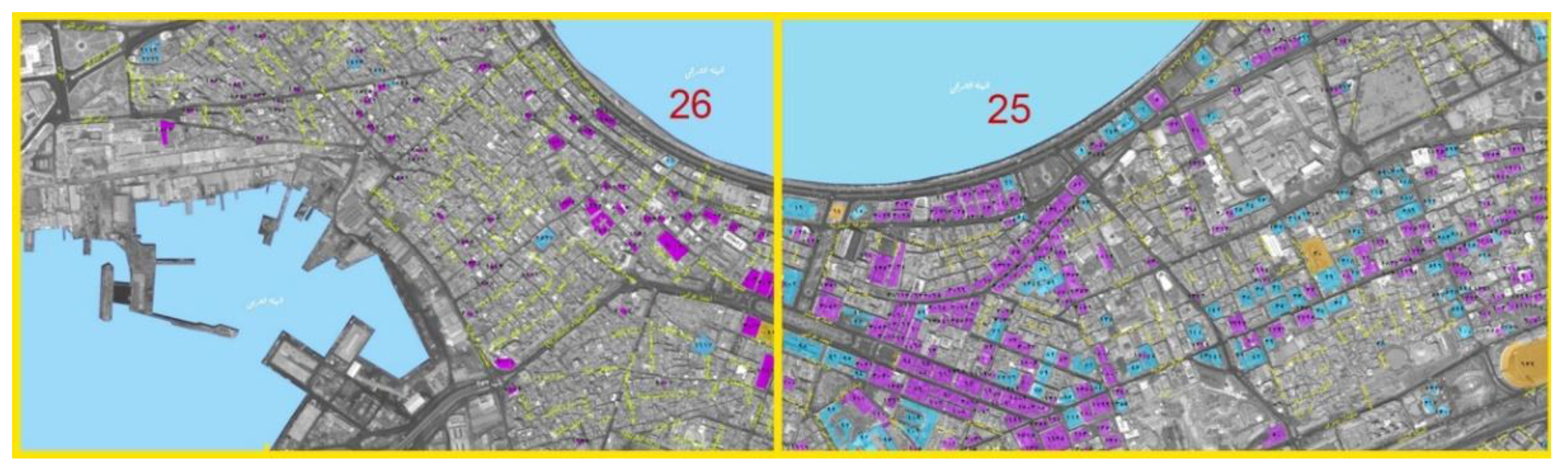
Figure 2.
The way El-Raml Station was designed and envisaged originally, is shown in a picture of the area taken in 1940 (Source:(Bakr Gomaa, 2015).
Figure 2.
The way El-Raml Station was designed and envisaged originally, is shown in a picture of the area taken in 1940 (Source:(Bakr Gomaa, 2015).
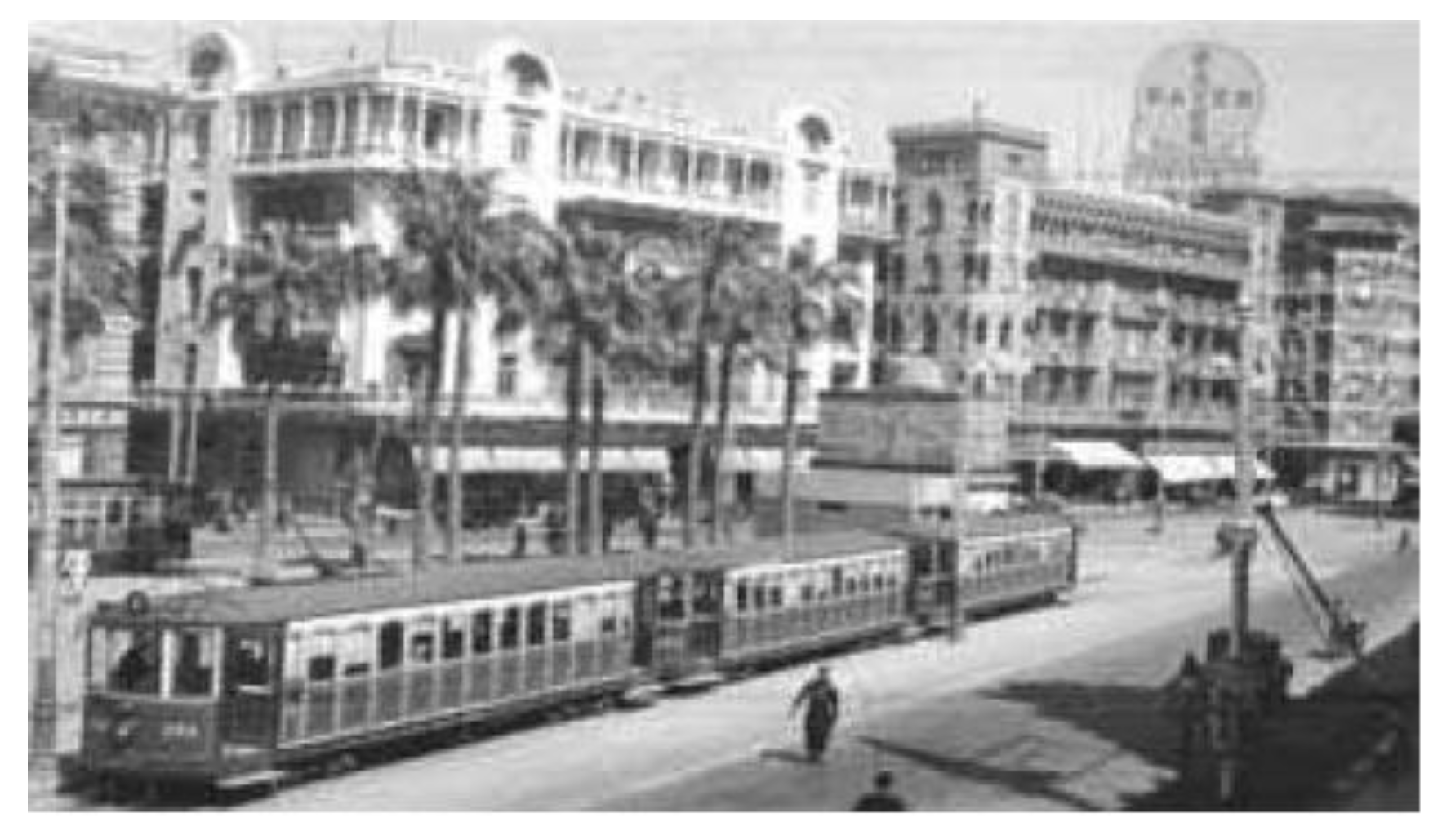
Figure 3.
Old image of Mohmed Ali Square, Now Al-Manshya Square.
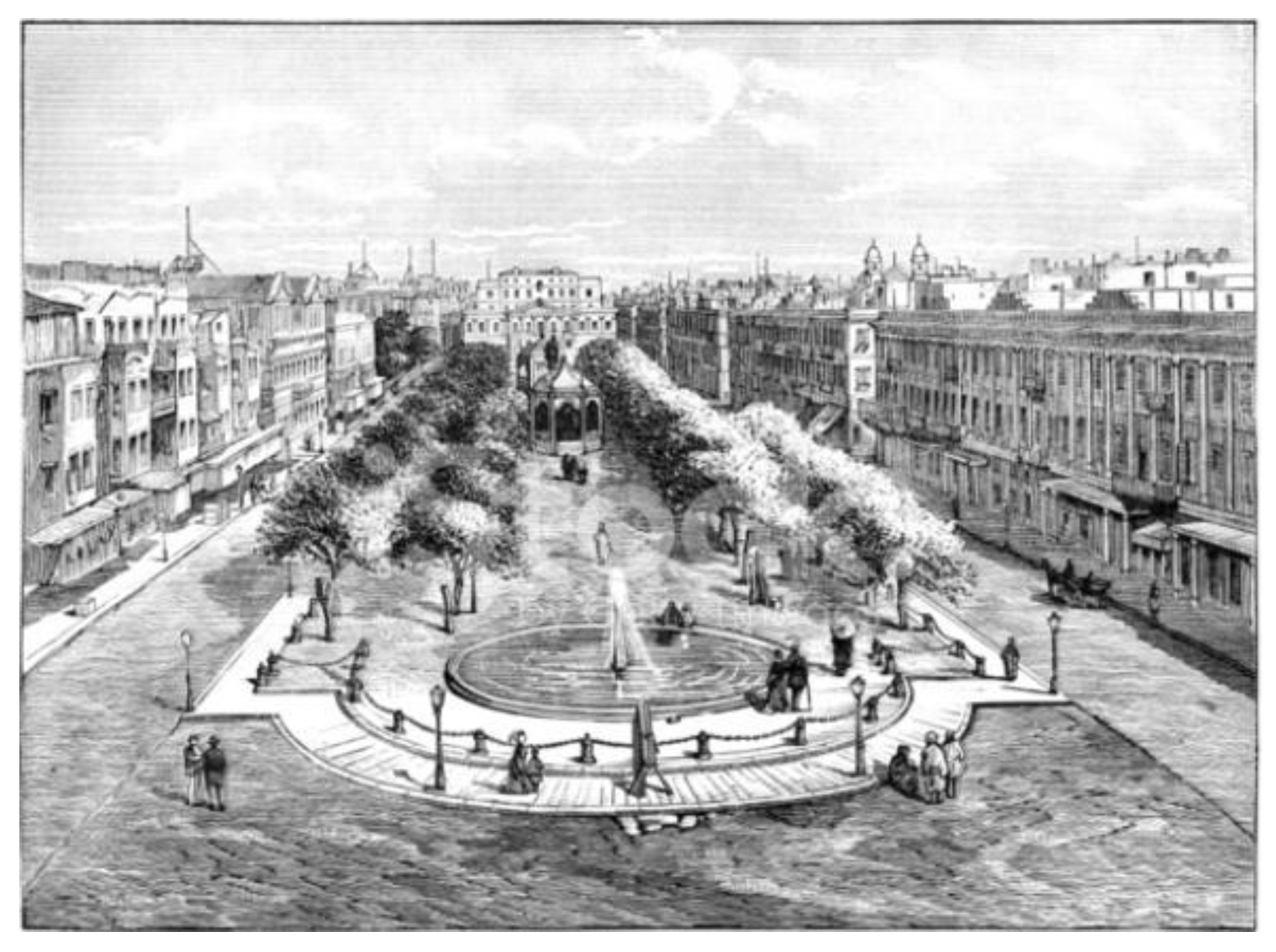
Figure 4.
Map of study case’s listed heritage buildings. (Alexandria heritage report 2007).
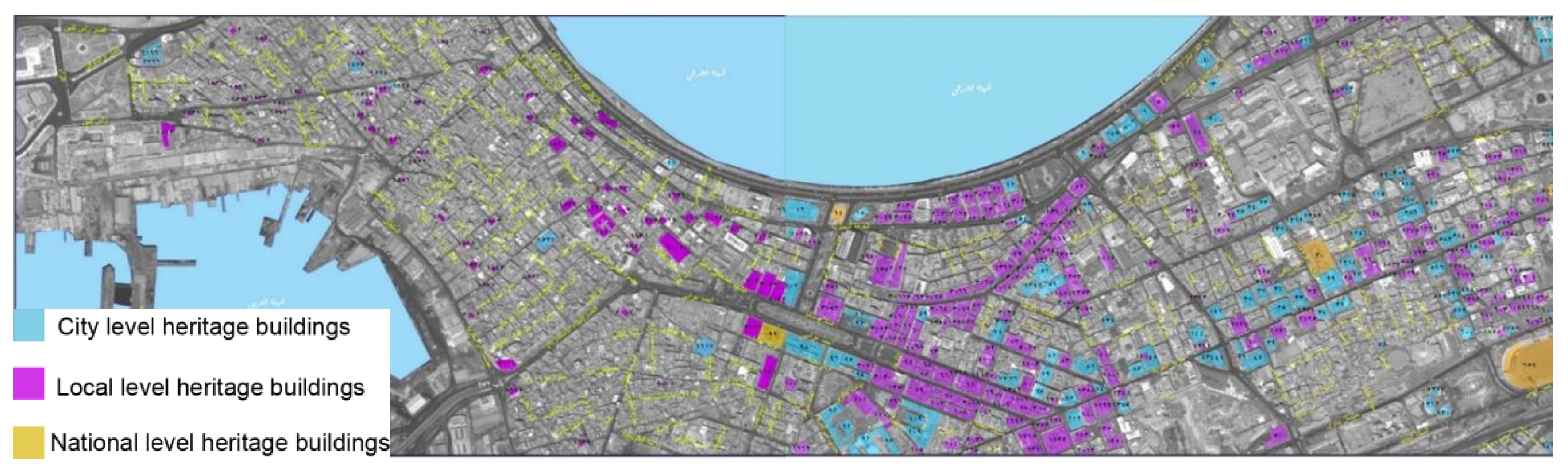
Figure 5.
El – Atareen district is one of the oldest districts in Alexandria.
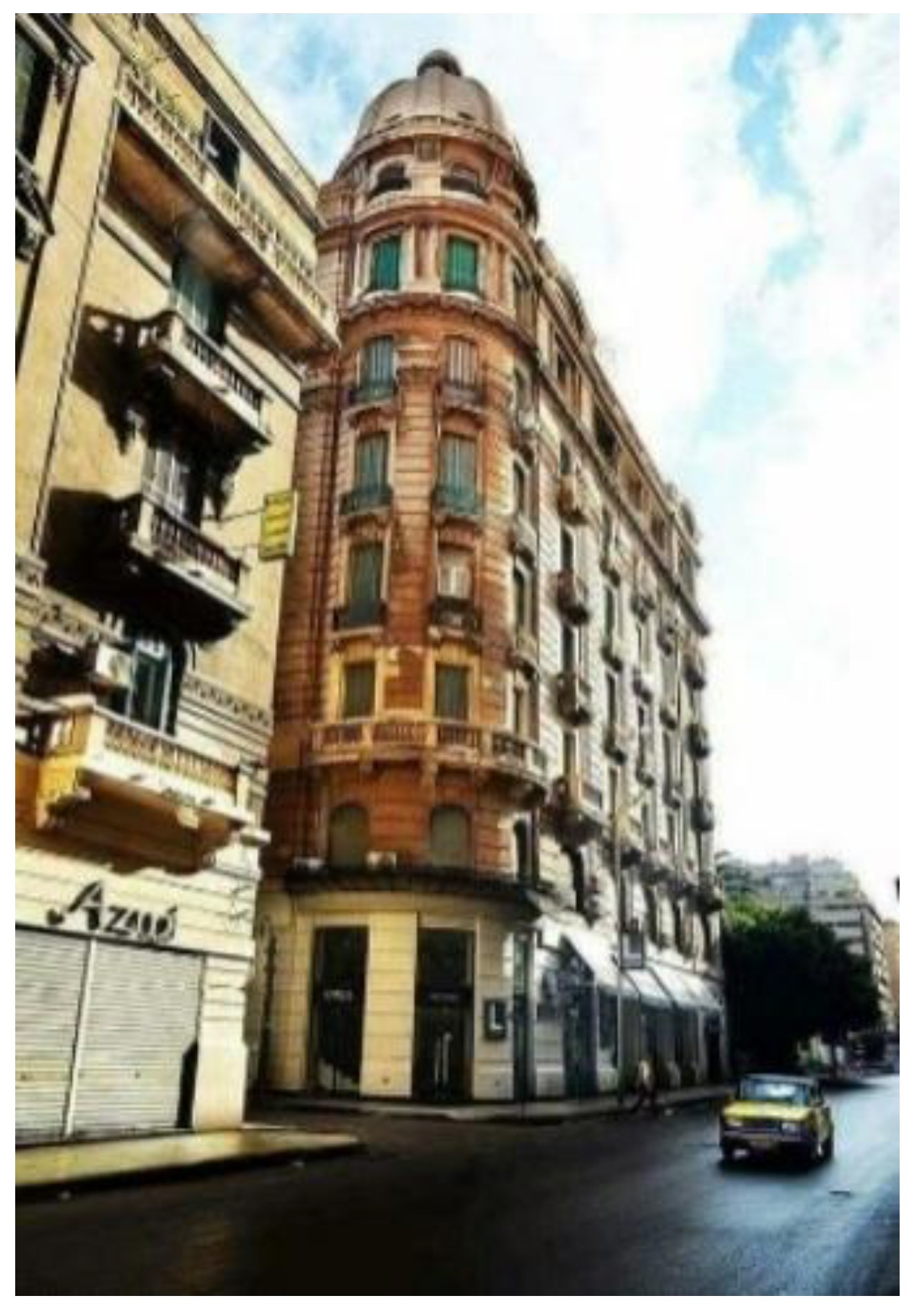
Figure 6.
Fouad Street, Alexandria, Egypt, one of the listed heritage streets. By author.
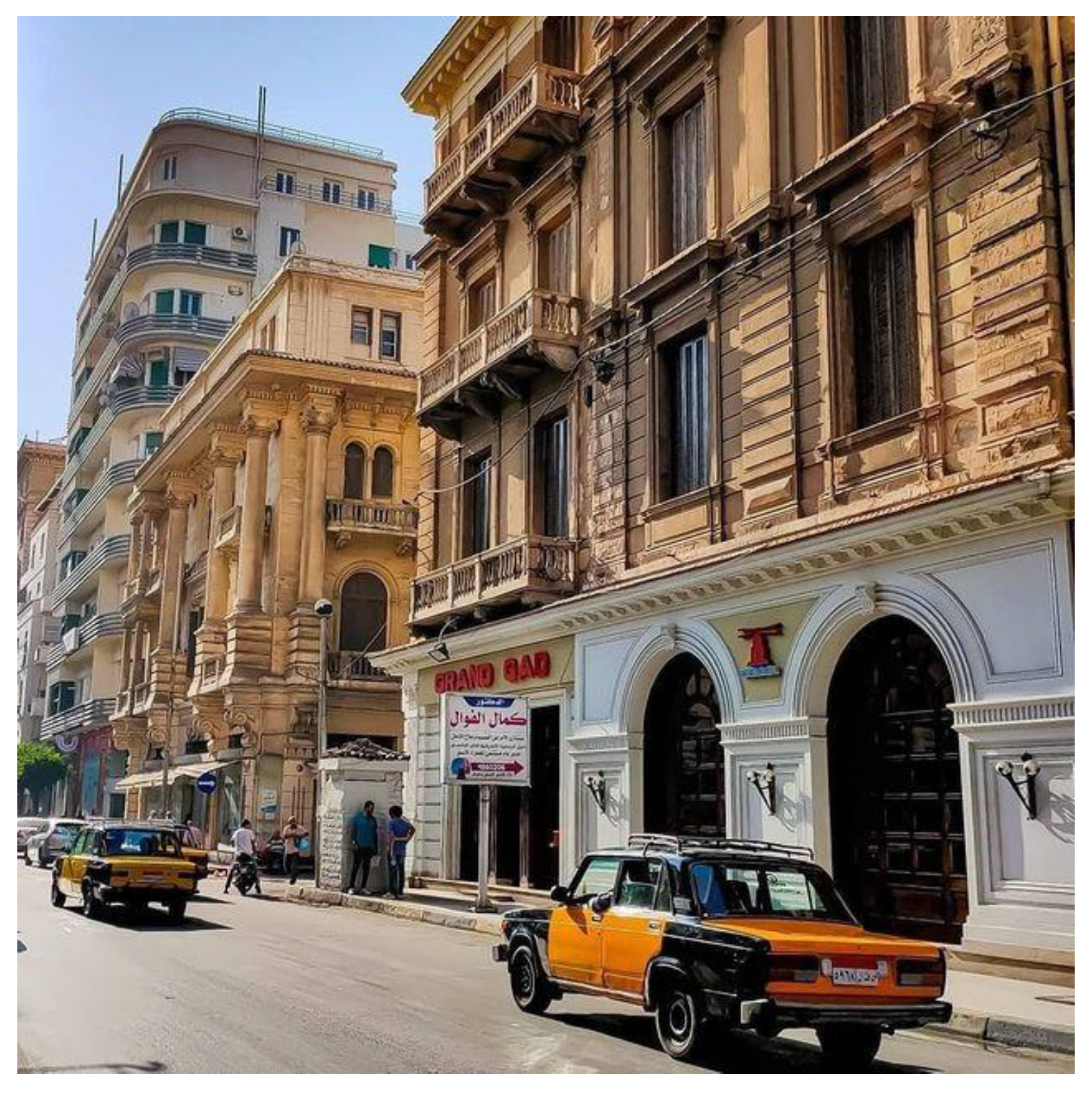
Figure 7.
Map25- 26 of Alexandria’s listed heritage streets. (Alexandria heritage report 2007).
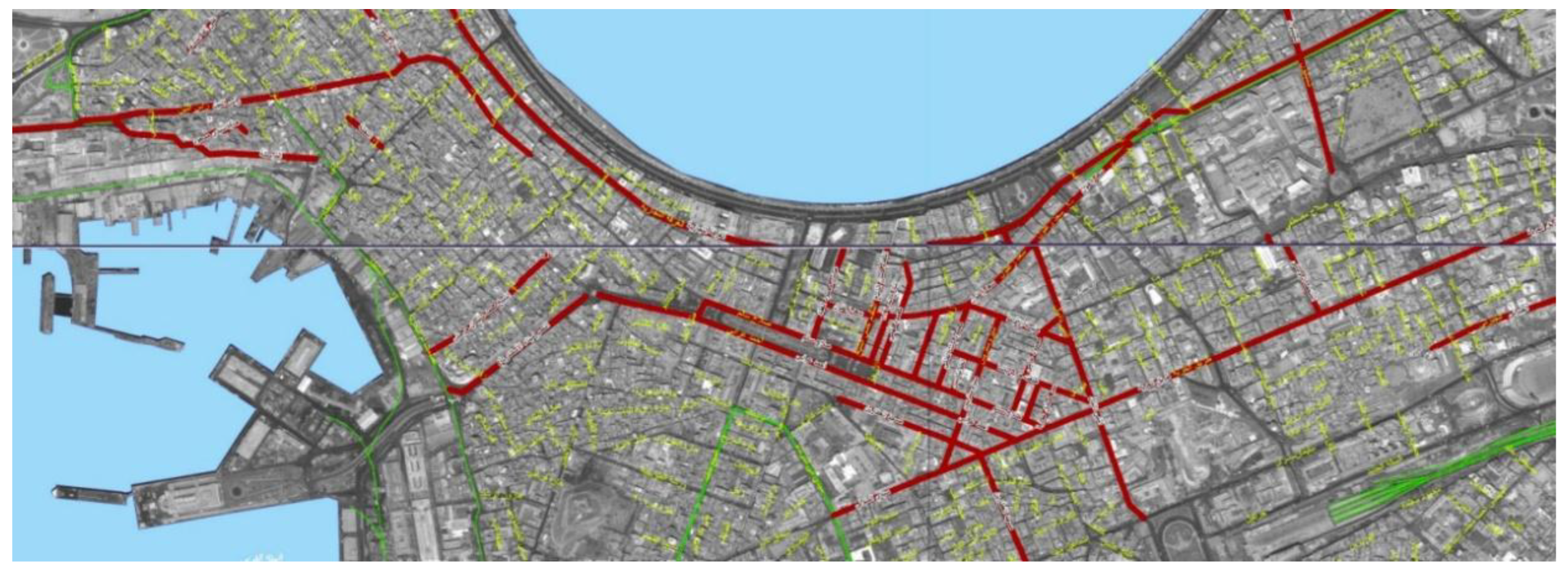
Figure 8.
Culture mapping procedure. (by author based on (pillai, 2013).
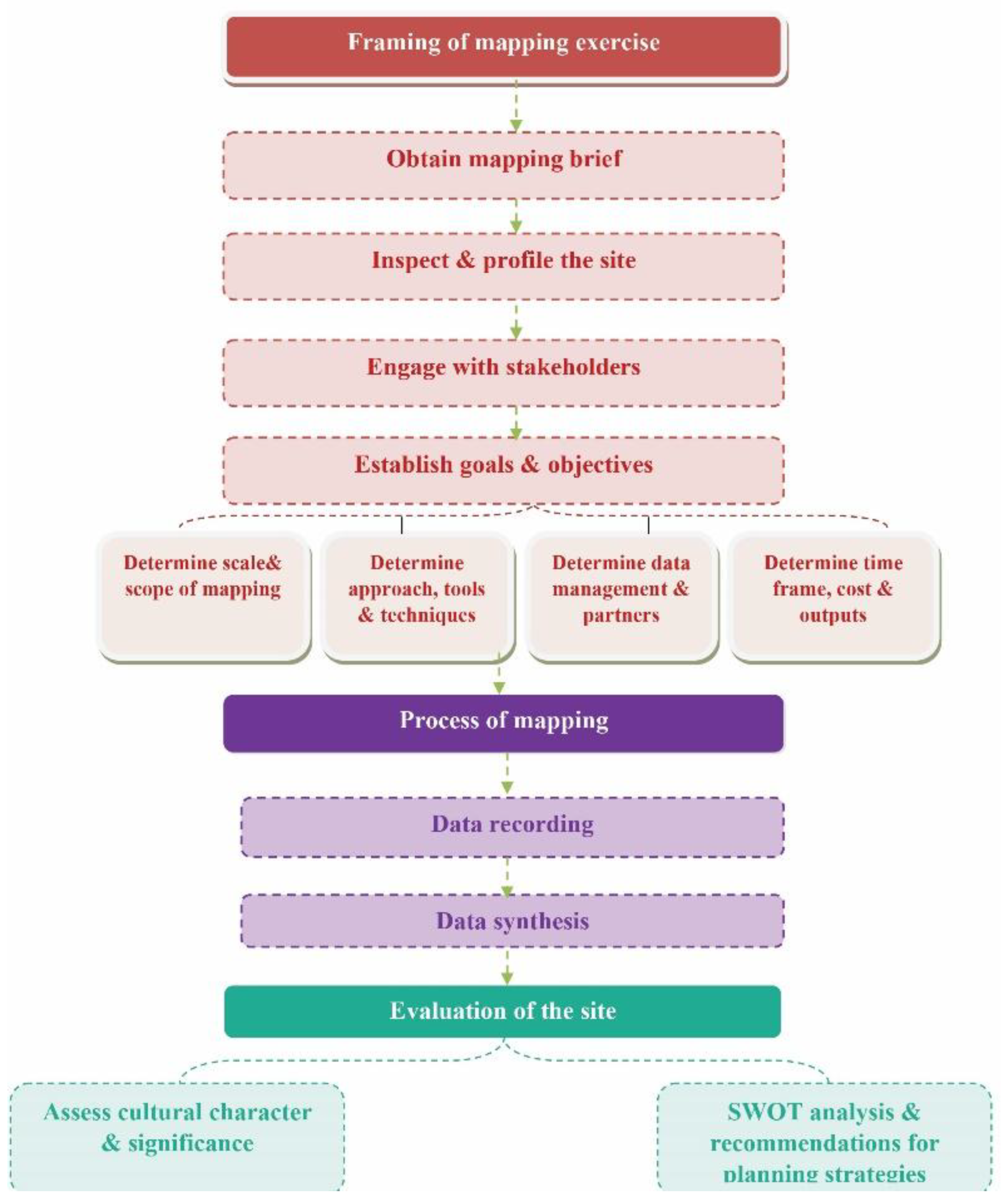
Figure 9.
Cultural centers within the boundaries of the study area in Alexandria. The map also contains the listed heritage buildings with the specification of its importance country level. Source: author based on (Alexandrina., 2008).
Figure 9.
Cultural centers within the boundaries of the study area in Alexandria. The map also contains the listed heritage buildings with the specification of its importance country level. Source: author based on (Alexandrina., 2008).
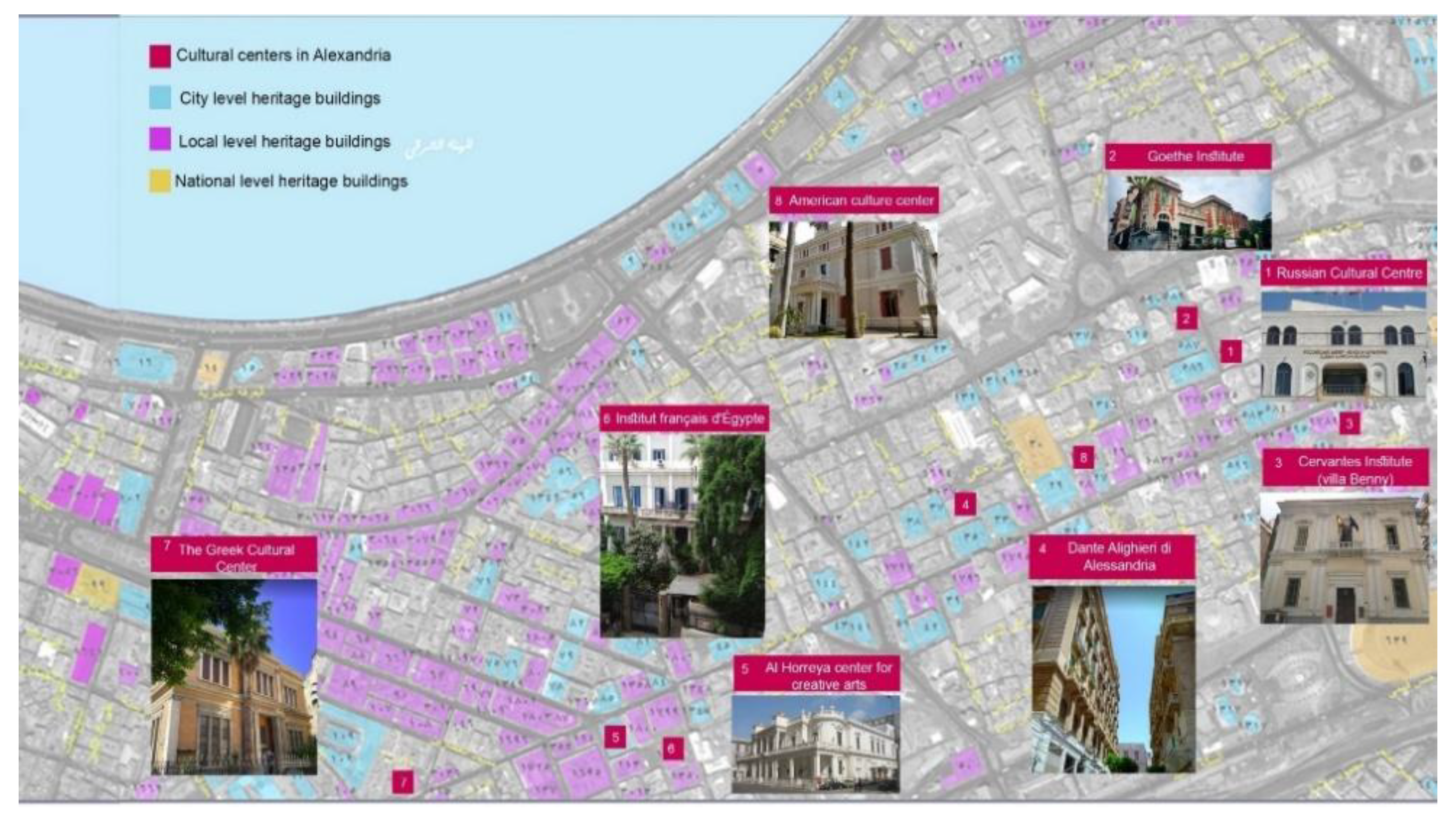
Figure 10.
Historical listed hotels in the study area in order to hold conferences, meetings and events of the organization regarding literature, whether local or international events. Source: author based on (Alexandrina., 2008).
Figure 10.
Historical listed hotels in the study area in order to hold conferences, meetings and events of the organization regarding literature, whether local or international events. Source: author based on (Alexandrina., 2008).
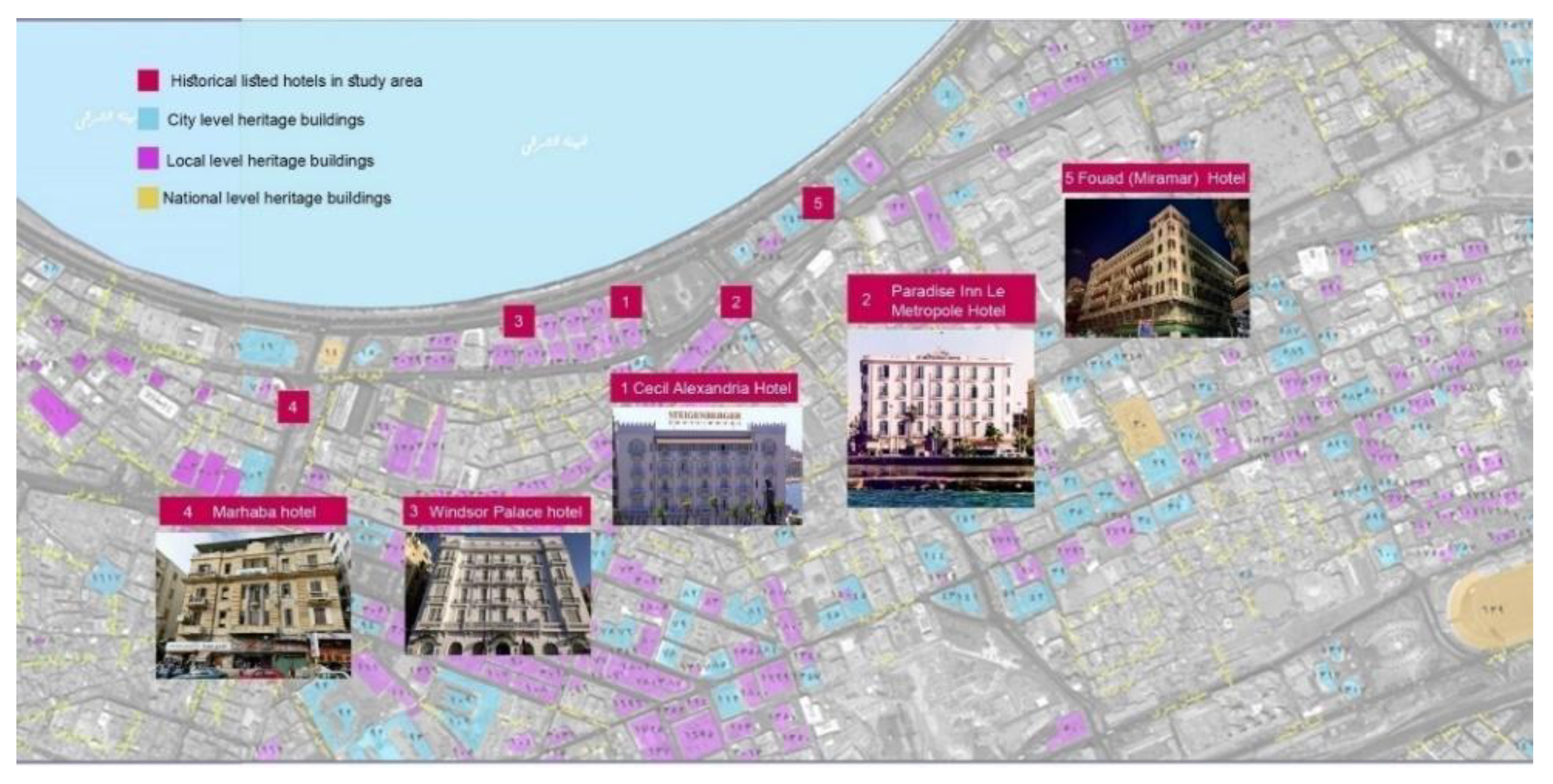
Figure 11.
The historical streets and squares listed on the Alexandria listed heritage report and recommended to hold the literature and poet festivals and events of the UCCN.Source: author based on (Alexandrina., 2008).
Figure 11.
The historical streets and squares listed on the Alexandria listed heritage report and recommended to hold the literature and poet festivals and events of the UCCN.Source: author based on (Alexandrina., 2008).
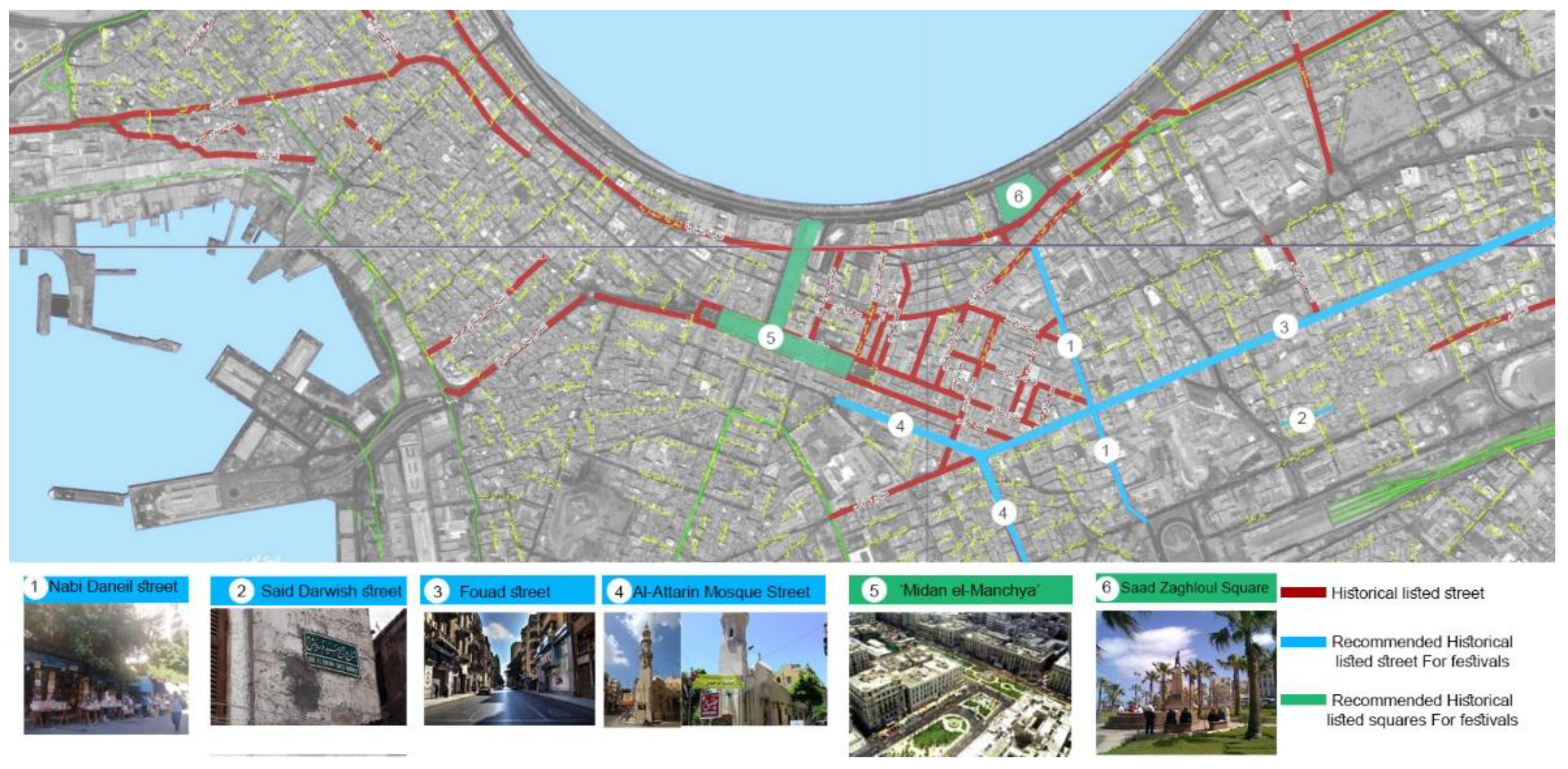
Figure 12.
Map of the open spaces in Kom El Dika District .(Aref Y. , 2015).
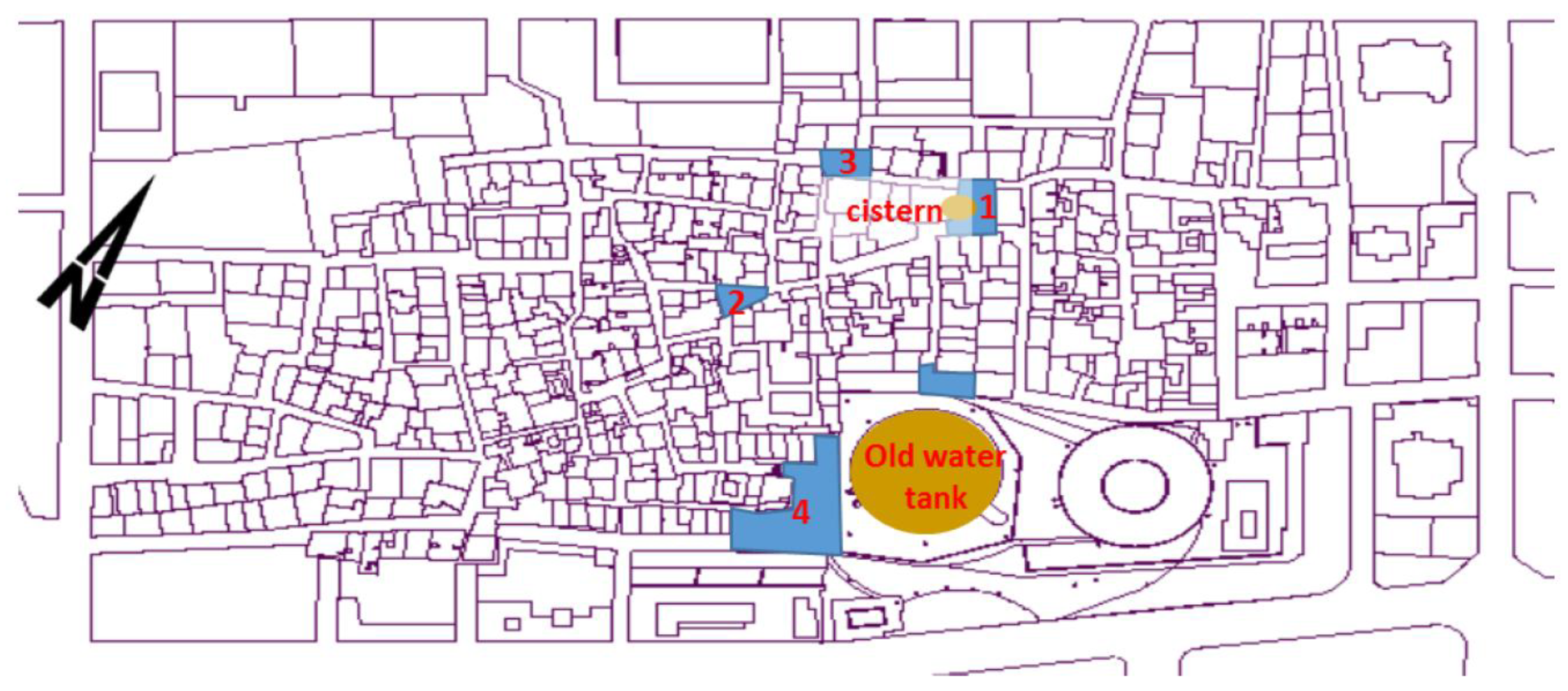
Figure 13.
A map explains the location of the twelve listed heritage okelles in the study area. Source: author based on (Alexandrina., 2008).
Figure 13.
A map explains the location of the twelve listed heritage okelles in the study area. Source: author based on (Alexandrina., 2008).
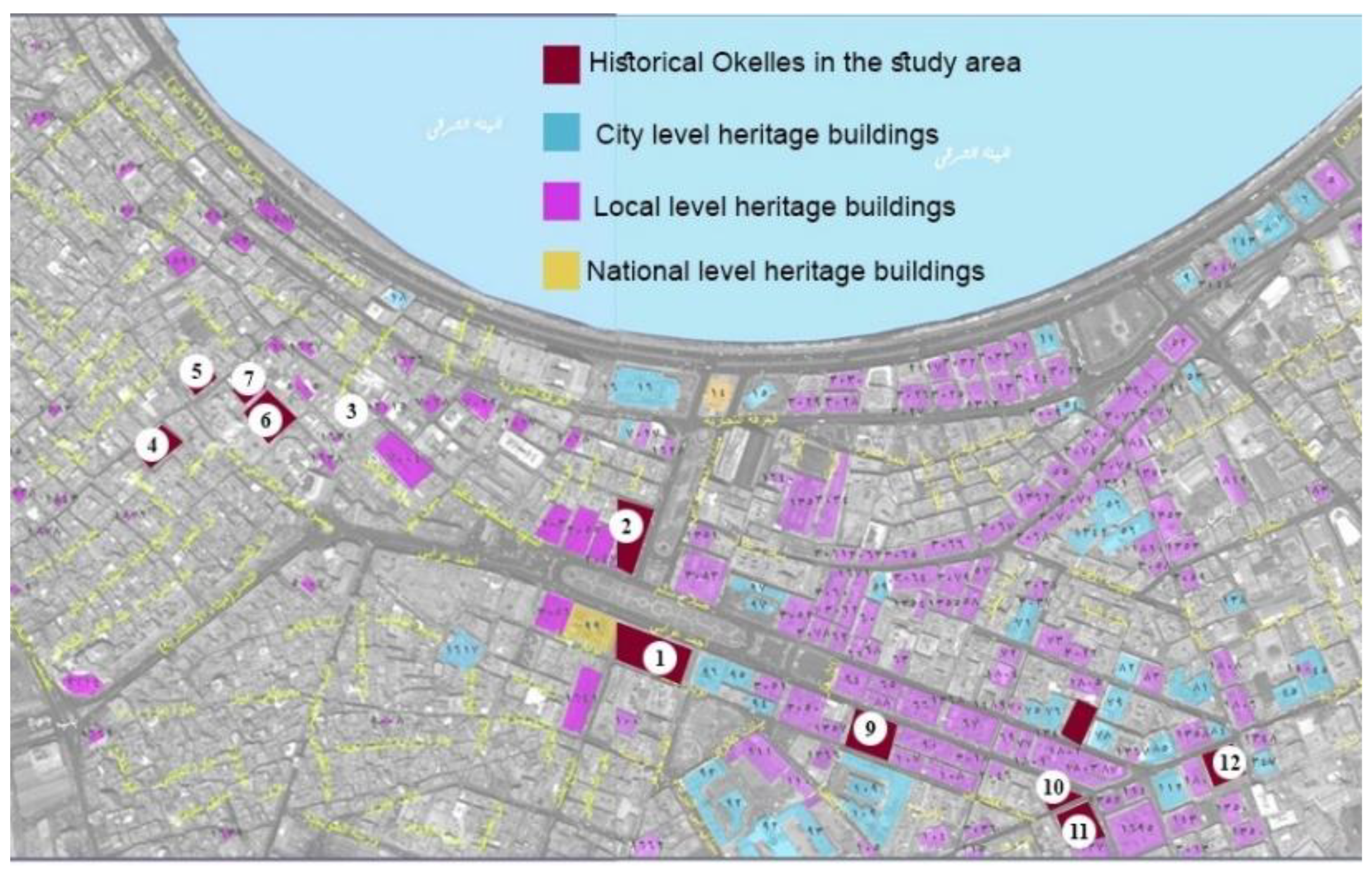
Figure 14.
The historical newspaper in Alexandria throughout the study area and integrating it with its historical building. Source: author based on (Alexandrina., 2008).
Figure 14.
The historical newspaper in Alexandria throughout the study area and integrating it with its historical building. Source: author based on (Alexandrina., 2008).
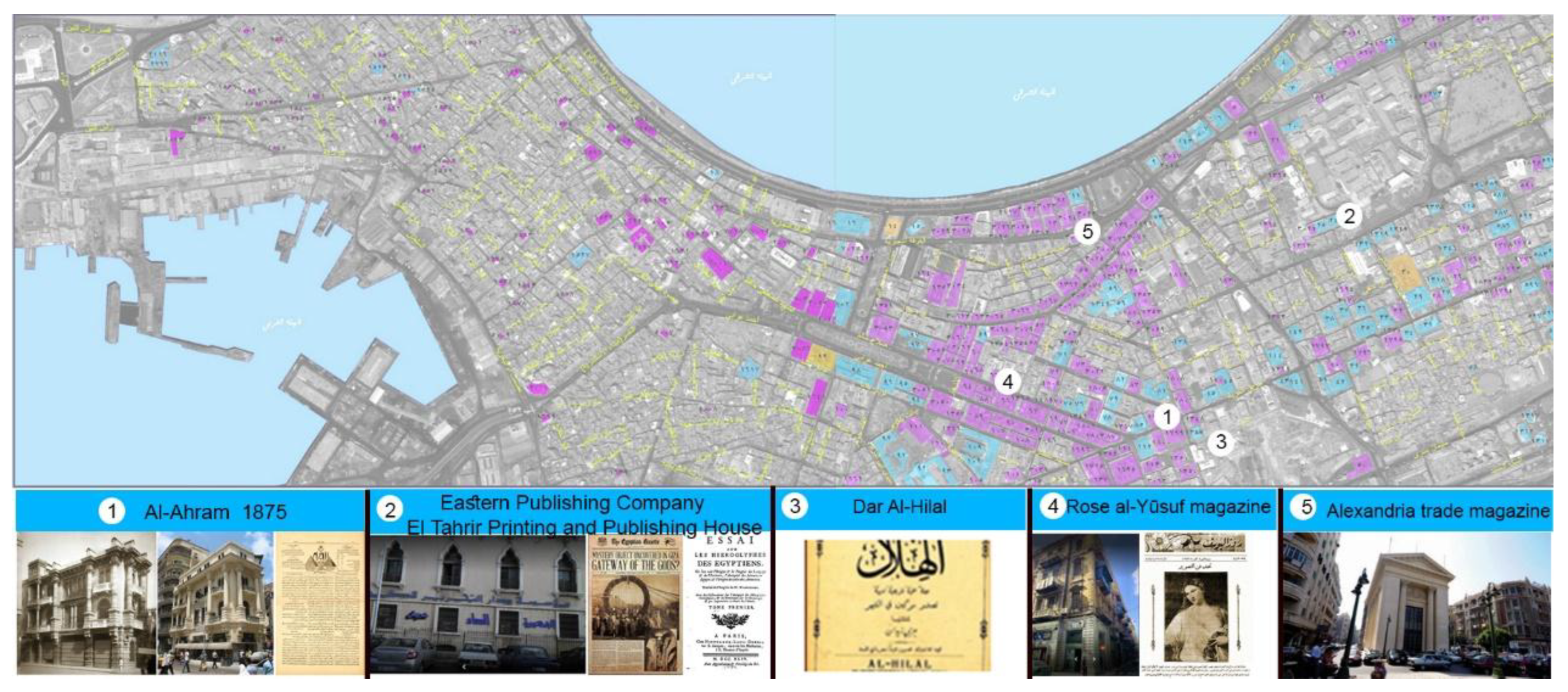
Figure 15.
The historical poetry and poet in Alexandria throughout the study area and integrating it with its historical building. Source: author based on (Alexandrina., 2008).
Figure 15.
The historical poetry and poet in Alexandria throughout the study area and integrating it with its historical building. Source: author based on (Alexandrina., 2008).
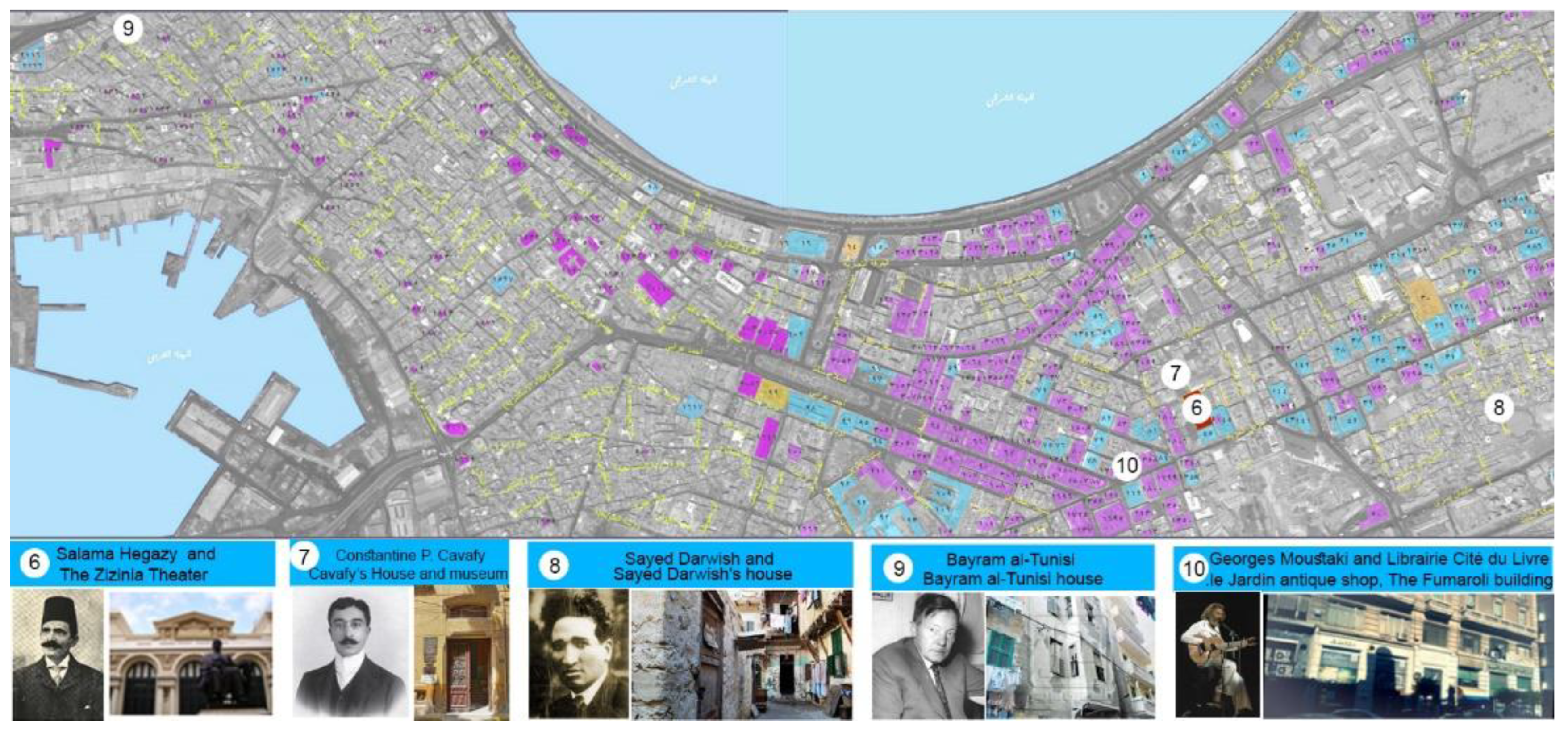
Figure 16.
The historical writers in Alexandria throughout the study area and integrating it with its historical building. Source: author based on (Alexandrina., 2008).
Figure 16.
The historical writers in Alexandria throughout the study area and integrating it with its historical building. Source: author based on (Alexandrina., 2008).
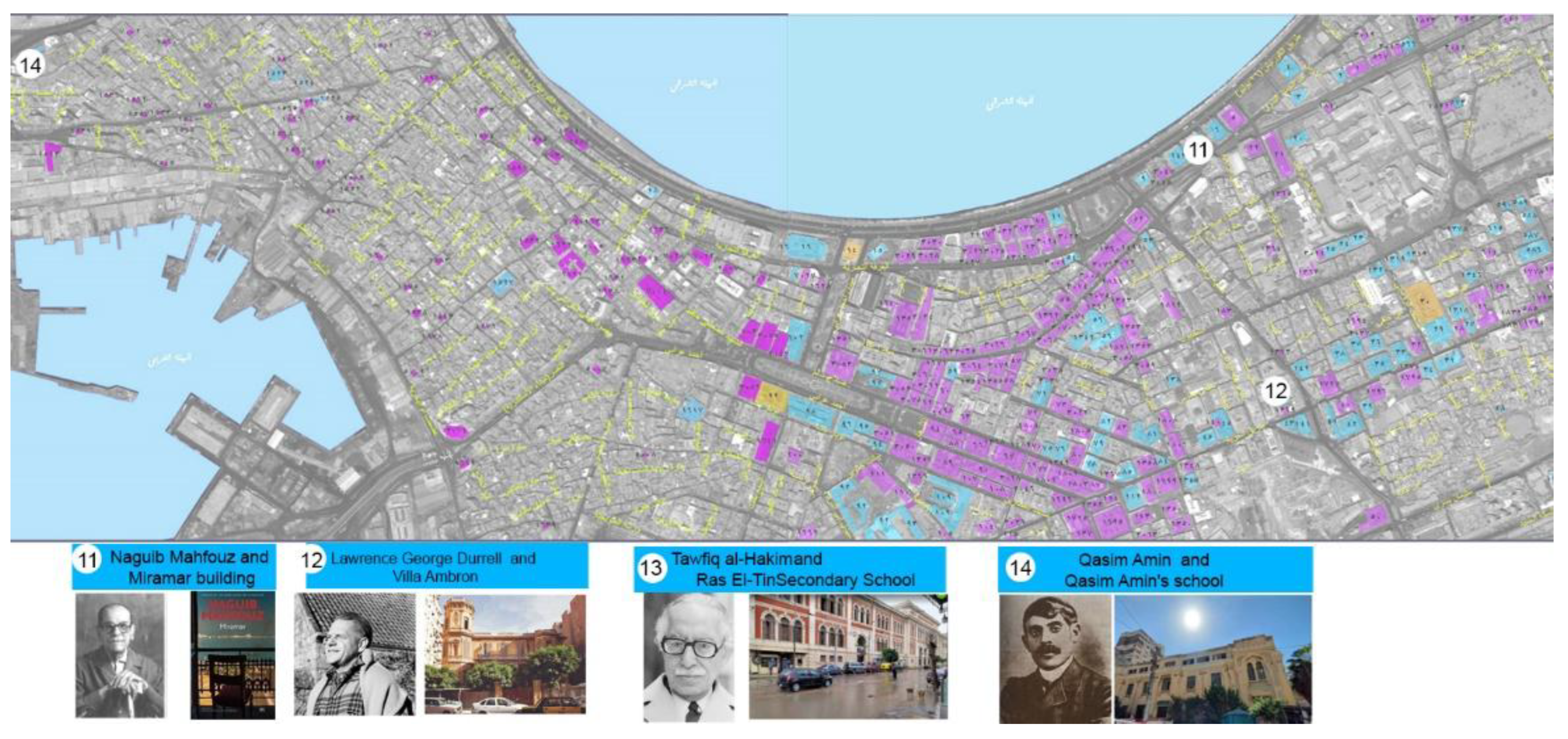
Figure 17.
The historical literary cafe in Alexandria throughout the study area and integrating it with its historical building. Source: author based on (Alexandrina., 2008).
Figure 17.
The historical literary cafe in Alexandria throughout the study area and integrating it with its historical building. Source: author based on (Alexandrina., 2008).
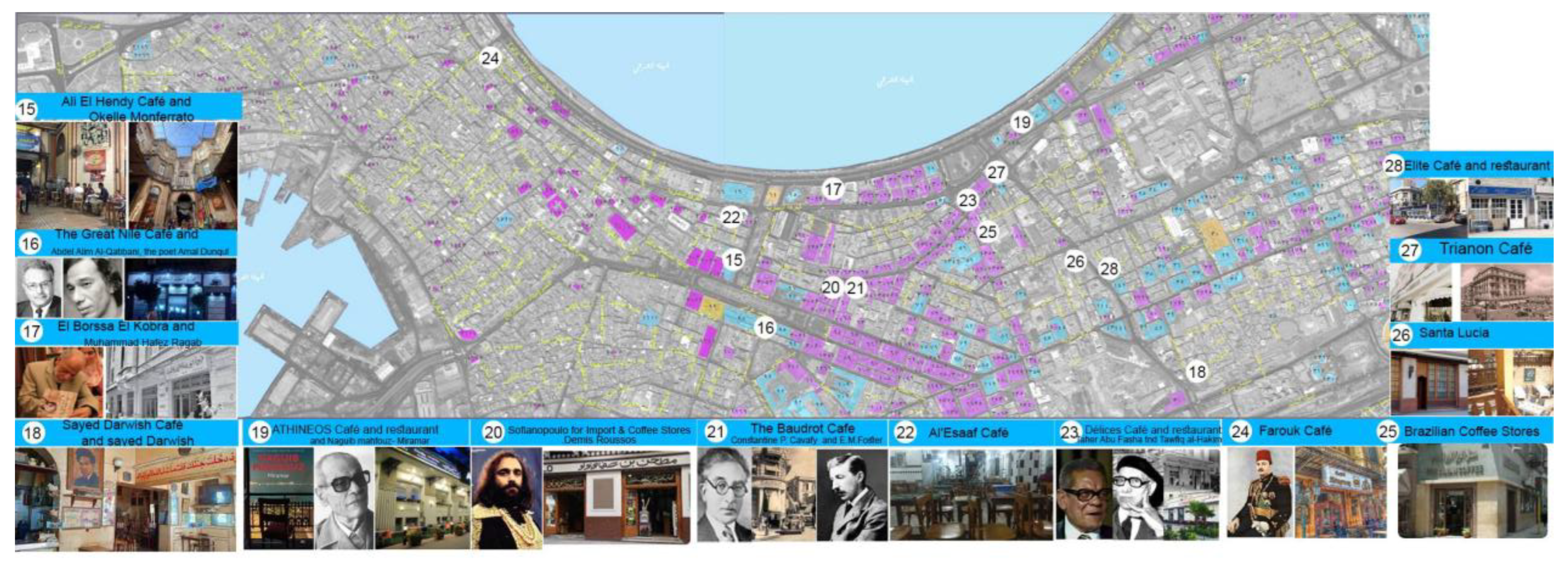
Figure 18.
Framework of Integrating Tangible and Intangible Cultural Heritage in UNESCO Creative City Designation.
Figure 18.
Framework of Integrating Tangible and Intangible Cultural Heritage in UNESCO Creative City Designation.
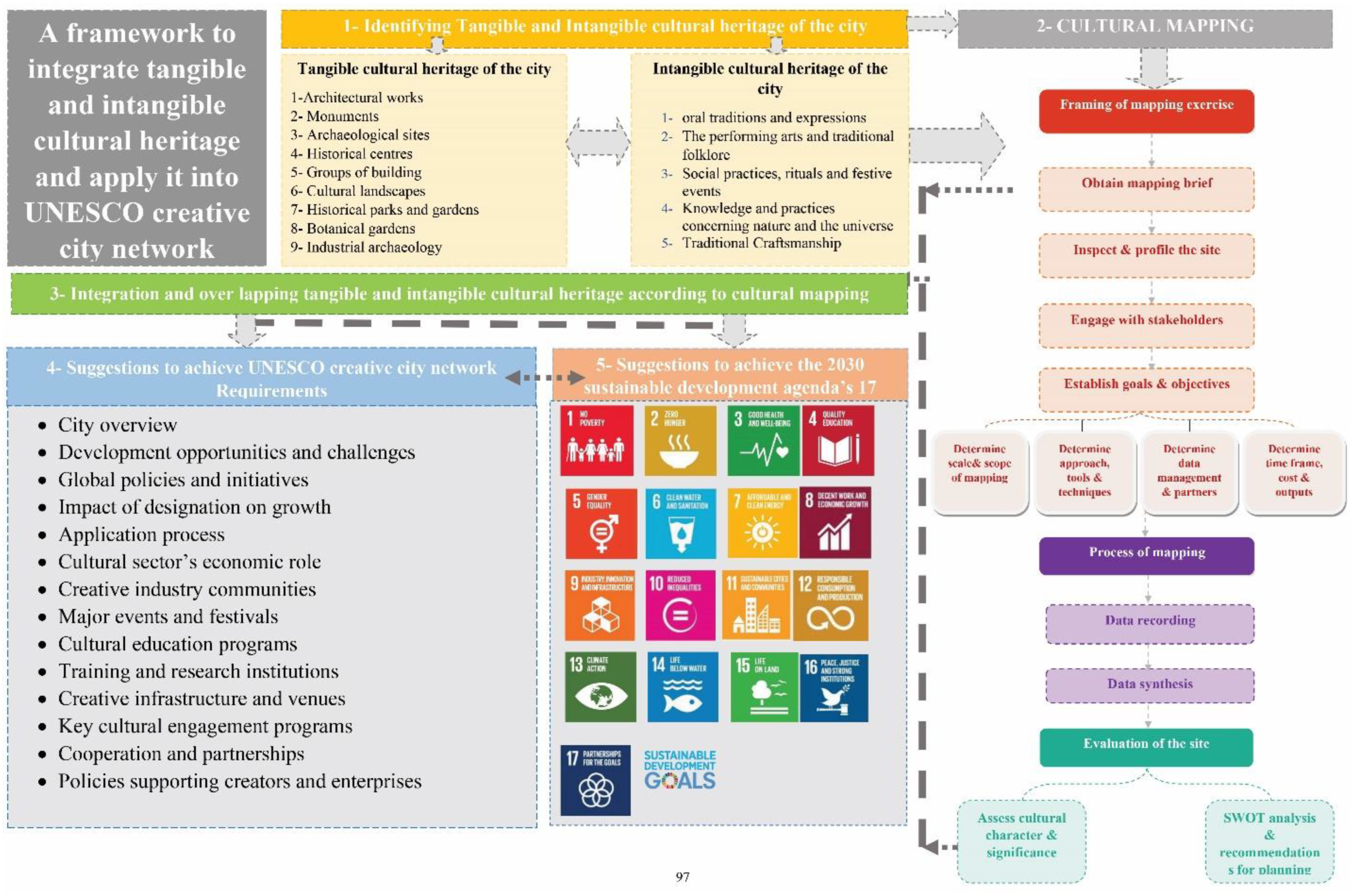
Figure 19.
Some of private and public sectors, academia and civil society, as well as creators, professionals and practitioners in Alexandria.
Figure 19.
Some of private and public sectors, academia and civil society, as well as creators, professionals and practitioners in Alexandria.
Figure 20.
The Four proposed heritage walks to the historical literature in Alexandria throughout the study area. Source: author based on (Alexandrina., 2008).
Figure 20.
The Four proposed heritage walks to the historical literature in Alexandria throughout the study area. Source: author based on (Alexandrina., 2008).
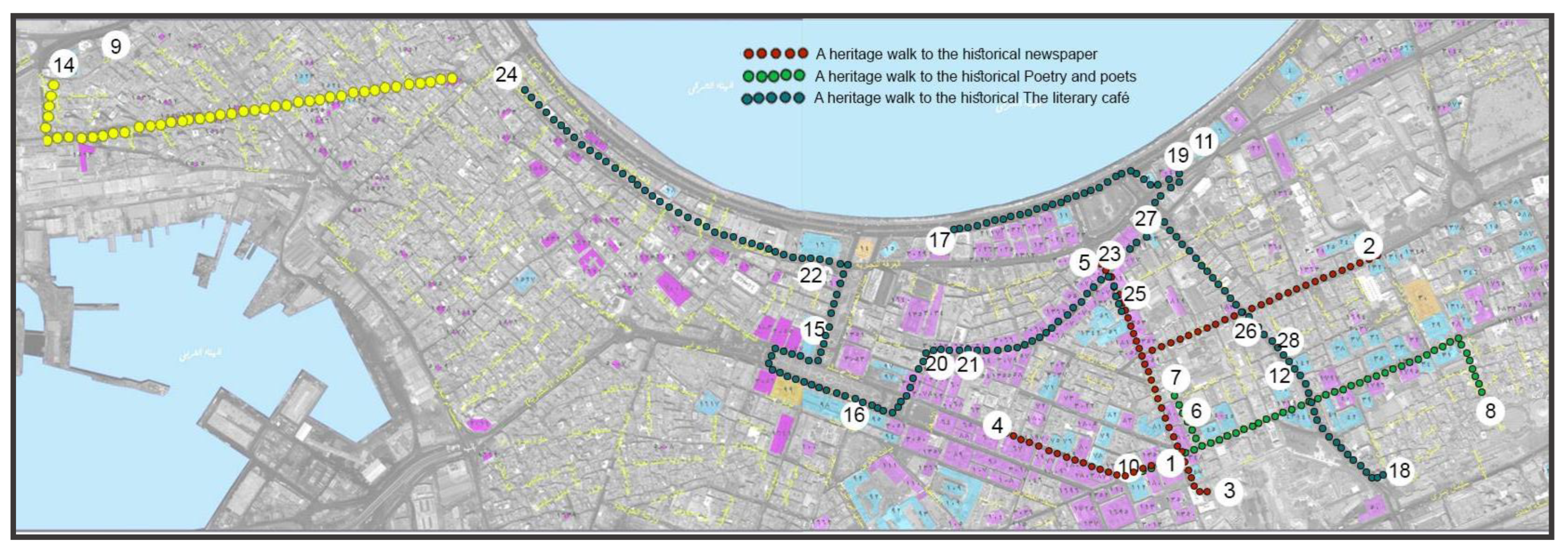
Table 1.
Total of heritage buildings number in map 25,26 classified according to its level (Alexandria listed heritage).
Table 1.
Total of heritage buildings number in map 25,26 classified according to its level (Alexandria listed heritage).
| Map name | National level | City level | Local level |
| Map 25 | 4 | 86 | 202 |
| Map 26 | 1 | 76 | 9 |
| Total buildings | 5 | 162 | 211 |
Source: author based on[11].
Table 2.
Historical OKelles in the study case area, their address, building importance level and the map reference number.
Table 2.
Historical OKelles in the study case area, their address, building importance level and the map reference number.
| Building code | Building name | Building address | Building level | Map reference number |
| 1 | OkelleManasha | 11 Tahrir square | City level | 25 |
| 2 | Okelle Monferrato | 2 Tahrir square | City level | 26 |
| 3 | OkelleDahaan | 5 Orabi square | Local level | 25 |
| 4 | Okelle Al -lemon | 33 Abd Al MonaemAl Dba | City level | 26 |
| 5 | Okelle Al- Betash | 4 al Souq Al Tabakhen | Local level | 26 |
| 6 | Okelle Fatema Hatun | 48 Souq Al Dakakeen | Local level | 26 |
| 7 | OkelleTerbana | 6 Souq Al Tork | Local level | 26 |
| 8 | Okelle Abo- Haief | 42 Faranca street | Local level | 26 |
| 9 | Okelle | 9 Ahmed Orabi street | Local level | 25 |
| 10 | Okelle | 30 Gamal Abd Elnaser street | Local level | 25 |
| 11 | Okelle | 37 Sedi El Metwally street | Local level | 25 |
| 12 | Okelle | 5 Gamal Abd Elnaser street | Local level | 25 |
Source: author based on (Alexandrina., 2008).
Disclaimer/Publisher’s Note: The statements, opinions and data contained in all publications are solely those of the individual author(s) and contributor(s) and not of MDPI and/or the editor(s). MDPI and/or the editor(s) disclaim responsibility for any injury to people or property resulting from any ideas, methods, instructions or products referred to in the content. |
© 2025 by the authors. Licensee MDPI, Basel, Switzerland. This article is an open access article distributed under the terms and conditions of the Creative Commons Attribution (CC BY) license (http://creativecommons.org/licenses/by/4.0/).
Copyright: This open access article is published under a Creative Commons CC BY 4.0 license, which permit the free download, distribution, and reuse, provided that the author and preprint are cited in any reuse.


