

Submitted:
18 July 2025
Posted:
21 July 2025
You are already at the latest version
Abstract
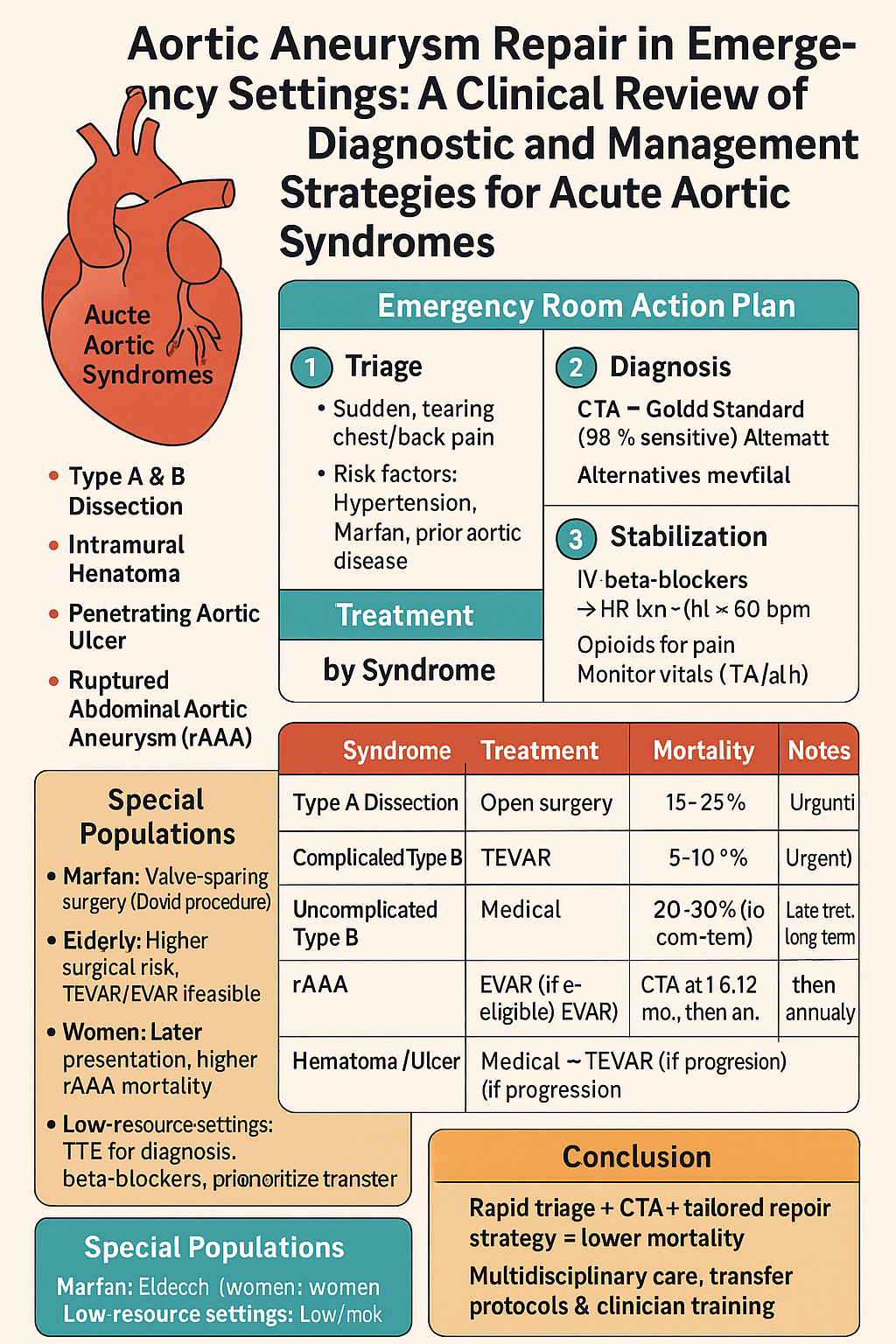
Background: Acute aortic syndromes (AAS), encompassing aortic dissection, intramural hematoma, and penetrating aortic ulcers, are life-threatening emergencies requiring swift diagnosis and management in the emergency room (ER). This review provides a practical, evidence-based framework for managing suspected AAS in emergency settings.Methods: A narrative review was conducted, searching PubMed, Embase, Cochrane Library, and Web of Science from January 2000 to December 2024, using terms such as “aortic dissection,” “intramural hematoma,” “penetrating aortic ulcer,” “emergency aortic repair,” “EVAR,” and “TEVAR.” Clinical trials, cohort studies, and guidelines for adults (≥18 years) with AAS were included, adhering to PRISMA principles. Data were synthesized narratively to guide clinical decision-making.Results: Suspected AAS requires rapid triage, with CT angiography (CTA, 98% sensitivity) as the gold standard. Type A dissection mandates urgent open repair (15–25% 30-day mortality), while complicated type B dissection benefits from thoracic endovascular aortic repair (TEVAR, 5–10% mortality). Ruptured abdominal aortic aneurysms (rAAA) favor endovascular aortic repair (EVAR, 15–20% mortality) when feasible. Intramural hematoma and penetrating ulcers may require TEVAR for progression. Special populations (e.g., Marfan syndrome, elderly, women) and resource-limited settings necessitate tailored approaches.Conclusions: Clinicians should prioritize rapid imaging, hemodynamic stabilization, and multidisciplinary consultation. Open repair is critical for type A dissection, TEVAR/EVAR for type B and rAAA, and medical management for uncomplicated cases. Training and transfer protocols improve outcomes.
Keywords:
acute aortic syndromes
; aortic dissection
; intramural hematoma
; penetrating aortic ulcer
; emergency aortic repair
; TEVAR
; EVAR
; Marfan syndrome
Introduction
The Urgency of Acute Aortic Syndromes
Acute aortic syndromes (AAS), including aortic dissection (type A and B), intramural hematoma, and penetrating aortic ulcers, are characterized by acute aortic wall disruption, risking rupture, organ malperfusion, or death. Type A dissection, involving the ascending aorta, has a mortality rate of 1–2% per hour without intervention, with 50% of patients dying within 48 hours [1]. Type B dissection, intramural hematoma, and penetrating ulcers, though less immediately lethal, can progress rapidly, necessitating urgent evaluation [2]. In the ER, distinguishing AAS from other causes of chest pain, such as myocardial infarction, is challenging, with misdiagnosis occurring in up to 33% of cases due to nonspecific symptoms [3].
Purpose of the Review
This review aims to guide emergency physicians, cardiothoracic surgeons, and vascular specialists in managing suspected AAS in the ER. It provides a practical, step-by-step approach to diagnosis, stabilization, treatment, and postoperative care, integrating evidence from guidelines (e.g., 2022 ACC/AHA, 2024 ESVS) and clinical studies from 2000–2024. The review emphasizes actionable strategies tailored to AAS type, patient factors, and resource availability, ensuring applicability in diverse clinical settings [2,4].
Methods
Approach to Evidence Synthesis
This narrative review synthesizes evidence to guide clinical practice, prioritizing applicability over statistical meta-analysis while adhering to PRISMA principles for transparency. It focuses on diagnostic and management strategies for AAS in emergency settings.
Literature Search
We searched PubMed, Embase, Cochrane Library, and Web of Science from January 2000 to December 2024, using terms like “aortic dissection,” “intramural hematoma,” “penetrating aortic ulcer,” “emergency aortic repair,” “EVAR,” and “TEVAR.” Reference lists from key sources, such as the 2022 ACC/AHA and 2024 ESVS Guidelines, were manually searched [2,4].
Study Selection
Studies reporting diagnostic strategies, surgical techniques (open repair, EVAR, TEVAR), outcomes (mortality, complications), and postoperative care were included. Case reports and non-emergency studies were excluded. Data were synthesized narratively to address clinical decision-making.
Results
Clinical Approach to AAS in the Emergency Room
Initial Presentation and Triage
Suspected AAS requires rapid triage due to its high mortality. Patients typically present with sudden, severe chest or back pain (often “tearing” or “ripping”), radiating to the back or abdomen. Other signs include syncope, hypotension, or pulse deficits [1]. Risk factors, such as hypertension (70–90% of cases), Marfan syndrome, or prior aortic surgery, raise suspicion [2]. Misdiagnosis is common, with AAS mistaken for acute coronary syndrome or pulmonary embolism in up to one-third of cases [3].
Action Steps:
- Triage: Assign to a high-acuity area for immediate assessment.
- History: Evaluate pain characteristics, onset, and risk factors (e.g., hypertension, connective tissue disorders).
- Physical Exam: Check for pulse deficits, blood pressure asymmetry (>20 mmHg between arms), or new murmurs (e.g., aortic regurgitation in type A dissection).
Stabilization
Stabilization prevents aortic rupture or malperfusion. The 2022 ACC/AHA Guidelines recommend controlling blood pressure and heart rate to reduce aortic wall stress [2].
Action Steps:
- Hemodynamic Control: Administer intravenous beta-blockers (e.g., esmolol, 0.1–0.5 mg/kg bolus, then 50–200 µg/kg/min infusion) targeting heart rate <60 bpm and systolic blood pressure 100–120 mmHg. Use calcium channel blockers (e.g., diltiazem) if beta-blockers are contraindicated.
- Pain Management: Provide opioids (e.g., morphine 2–4 mg IV) to reduce pain and sympathetic drive.
- Monitoring: Use cardiac monitor, arterial line, and pulse oximetry to track vital signs.
Diagnostic Evaluation
Rapid imaging confirms AAS and determines its type. Electrocardiogram-gated CT angiography (CTA) is the gold standard, with 98% sensitivity and 95% specificity [5]. Transesophageal echocardiography (TEE) is used for unstable patients, and magnetic resonance angiography (MRA) is an alternative if contrast is contraindicated [6].
Action Steps:
- Primary Imaging: Order CTA of chest, abdomen, and pelvis to identify dissection flap, hematoma, or ulcer, and assess extent (type A vs. B).
- Alternative Imaging: Use TEE in hemodynamically unstable patients or bedside transthoracic echocardiography (TTE) to detect complications (e.g., aortic regurgitation, tamponade).
- Laboratory Tests: Obtain complete blood count, renal function, lactate, and D-dimer (elevated in 95% of AAS cases) to assess organ perfusion and rule out other diagnoses [1].

Table 1.
Diagnostic Modalities for AAS.
| Modality | Sensitivity (%) | Specificity (%) | Advantages | Limitations |
| CTA | 98 | 95 | Rapid, widely available | Radiation, contrast risk |
| TEE | 90 | 95 | Bedside, no contrast | Operator-dependent |
| MRA | 95 | 90 | No radiation | Time-consuming, limited access |
Management Strategies by AAS Type
Overview
Management depends on AAS type, anatomical extent, and patient stability. This section outlines treatment strategies, focusing on surgical techniques and their indications.
Type A Aortic Dissection
Type A dissection, involving the ascending aorta, requires urgent open repair due to risks of rupture, tamponade, or coronary occlusion. Surgery typically involves median sternotomy, cardiopulmonary bypass, and ascending aorta replacement [7].
Action Steps:
- Consultation: Immediately involve cardiothoracic surgery and transfer to a center with aortic expertise.
- Surgical Technique: Replace the ascending aorta with a Dacron graft. For aortic root involvement, use a Bentall procedure (composite valve-graft) or valve-sparing David procedure in younger patients or those with Marfan syndrome [8].
- Outcomes: 30-day mortality is 15–25%, with stroke rates of 5–10%. Malperfusion (e.g., mesenteric, renal) increases mortality to 30% [9].
- Non-Operative: Reserved for prohibitive comorbidities (e.g., advanced age, severe stroke); in-hospital mortality is 39% [10].
Type B Aortic Dissection
Type B dissection, confined to the descending aorta, is classified as complicated (e.g., malperfusion, rupture) or uncomplicated. TEVAR is preferred for complicated cases, while medical management suits uncomplicated cases [11].
Action Steps:
- ●
- Complicated Type B:
- ○
- Consult Vascular Surgery: Plan urgent TEVAR to seal the entry tear and restore perfusion.
- ○
- Technique: Deploy a stent-graft via femoral access, targeting a proximal landing zone. Operative time is 90–120 minutes [12].
- ○
- Outcomes: 30-day mortality is 5–10%, with endoleak rates of 5–15% and reintervention rates of 10–15% at 5 years [13].
- ●
- Uncomplicated Type B:
- ○
- Medical Management: Continue beta-blockers and monitor with serial CTA. Long-term mortality is 20–30% [14].
- ○
- Indications for TEVAR: Persistent pain, uncontrolled hypertension, or aneurysm expansion (>5.5 cm).
Ruptured Abdominal Aortic Aneurysm (rAAA)
rAAA presents with hypotension, abdominal pain, and a pulsatile mass. EVAR is preferred when anatomically feasible, reducing invasiveness compared to open repair [15].
Action Steps:
- Stabilization: Use permissive hypotension (systolic BP ~80 mmHg) to minimize bleeding until repair.
- Consult Vascular Surgery: Assess EVAR eligibility (e.g., adequate neck length, no tortuosity).
- Technique: EVAR uses stent-graft placement via femoral access; open repair requires laparotomy and aortic clamping.
- Outcomes: EVAR has 15–20% 30-day mortality vs. 30–40% for open repair. Women and octogenarians have higher mortality (up to 40%) [4].
Intramural Hematoma and Penetrating Aortic Ulcer
Intramural hematoma and penetrating ulcers may progress to dissection or rupture, with 20–30% of hematomas requiring intervention [16].
Action Steps:
- ●
- Intramural Hematoma:
- ○
- Initial Management: Use beta-blockers and serial CTA every 48 hours.
- ○
- Surgical Indications: Progression to dissection, rupture, or persistent pain. TEVAR is preferred for descending aorta involvement.
- ○
- Outcomes: 15–20% mortality with medical management; 5–7% with TEVAR [17].
- ●
- Penetrating Aortic Ulcer:
- ○
- Technique: TEVAR for symptomatic or enlarging ulcers, with 95% technical success.
- ○
- Outcomes: 5% 30-day mortality, 2–5% reintervention at 3 years [18].
Table 2.
Management Strategies and Outcomes.
| AAS Type | Preferred Treatment | 30-Day Mortality (%) | Key Complications |
| Type A Dissection | Open Repair | 15–25 | Stroke (5–10%), Malperfusion |
| Type B Dissection (Complicated) | TEVAR | 5–10 | Endoleak (5–15%) |
| Type B Dissection (Uncomplicated) | Medical | 20–30 (long-term) | Progression to Complicated |
| rAAA | EVAR | 15–20 | Endoleak, Reintervention |
| Intramural Hematoma | Medical/TEVAR | 5–20 | Progression to Dissection |
| Penetrating Aortic Ulcer | TEVAR | 5–7 | Reintervention (2–5%) |
Postoperative Care
Overview
Postoperative care is critical to manage complications and ensure recovery. This section outlines monitoring, complication management, and follow-up for AAS patients post-repair.
Monitoring and Support
Patients require intensive care unit (ICU) monitoring post-surgery to manage hemodynamic stability and organ function [19].
Action Steps:
- Hemodynamics: Maintain systolic blood pressure 100–120 mmHg using beta-blockers or vasodilators (e.g., nitroprusside). Monitor for malperfusion via lactate and renal function tests.
- Respiratory Support: Ventilate patients post-open repair for 24–48 hours, weaning as tolerated. TEVAR/EVAR patients may require shorter ventilation [20].
- Neurologic Assessment: Monitor for stroke or spinal cord ischemia (1–3% risk with TEVAR), using serial neurologic exams [21].
Complication Management
Common complications include bleeding, stroke, renal failure, and endoleaks (for TEVAR/EVAR).
Action Steps:
- Bleeding: Transfuse packed red blood cells for hemoglobin <7 g/dL. Use fresh frozen plasma for coagulopathy post-open repair [22].
- Endoleaks: Monitor TEVAR/EVAR patients with CTA at 1 month. Type I endoleaks require urgent reintervention; type II may be observed [23].
- Renal Failure: Initiate dialysis for acute kidney injury (10–20% risk post-open repair) [24].
Follow-Up
Long-term follow-up prevents late complications, such as aneurysm expansion or stent migration.
Action Steps:
Imaging: Perform CTA at 1, 6, and 12 months, then annually for TEVAR/EVAR. Open repair patients need CTA at 1 year, then every 2–3 years [2].
- Medical Therapy: Continue beta-blockers indefinitely to reduce aortic wall stress. Statins and antihypertensives improve long-term survival [25].
Special Populations
Marfan Syndrome
Patients with Marfan syndrome often present with type A dissection at younger ages, requiring tailored approaches due to connective tissue fragility [26].
Action Steps:
- Surgical Preference: Favor valve-sparing David procedures to avoid prosthetic valve complications [8].
- Outcomes: Higher reintervention rates (10–15% at 10 years) due to progressive aortic dilatation [27].
- Genetic Counseling: Refer for genetic testing and family screening post-stabilization.
- Elderly Patients
Octogenarians face higher surgical risks, with 30–40% mortality for type A dissection repair [28].
Action Steps:
Women
Women with AAS, particularly rAAA, have worse outcomes, with up to 40% mortality [19].
Action Steps:
Management in Resource-Limited Settings
Challenges
In low-resource settings, access to CTA, TEE, or endovascular facilities may be limited, complicating AAS management [33].
Action Steps:
- Diagnosis: Use TTE if CTA/TEE is unavailable, focusing on aortic root dilatation or pericardial effusion [34].
- Stabilization: Rely on widely available beta-blockers (e.g., propranolol) and opioids for pain control.
- Treatment: Transfer to a tertiary center for surgery. If transfer is delayed, prioritize medical management for uncomplicated type B dissection or intramural hematoma [35].
- Training: Educate ER staff on AAS recognition to reduce misdiagnosis, using clinical decision tools (e.g., ADD-RS score) [36].
Multidisciplinary Care and Transfer
Team Approach
AAS management requires a multidisciplinary team, including emergency physicians, cardiothoracic surgeons, vascular surgeons, interventional radiologists, and intensivists. High-volume centers reduce 30-day mortality by 5–10% [18].
Action Steps:
Consultation: Engage the team within 30 minutes of diagnosis.
Transfer: If the facility lacks surgical capabilities, transfer to a tertiary center, stabilizing with beta-blockers and IV fluids during transport.
Discussion
This review provides a practical framework for ER management of AAS, emphasizing rapid CTA or TEE for diagnosis [5]. Open repair is mandatory for type A dissection, despite 15–25% mortality, due to its ability to address life-threatening complications [7]. TEVAR and EVAR reduce mortality (5–20%) for type B dissection and rAAA, but anatomical suitability is critical [11,15]. Postoperative care and follow-up are essential to manage complications like endoleaks or renal failure [23,24]. Misdiagnosis affects one-third of AAS cases, necessitating improved clinician training [3]. Women and elderly patients face worse outcomes, requiring tailored protocols [19,28]. Resource-limited settings lack advanced imaging and surgical capabilities, highlighting the need for transfer protocols [33]. Future directions include AI-enhanced CTA and branched endografts to improve diagnostic accuracy and expand TEVAR/EVAR indications [37]. Randomized trials comparing TEVAR and medical management for uncomplicated type B dissection are needed [38].
Conclusions
- For a patient with suspected AAS in the ER, clinicians should:
- Triage rapidly, assessing chest/back pain and risk factors.
- Stabilize with beta-blockers and permissive hypotension (for rAAA).
- Confirm diagnosis with CTA or TEE.
- Select treatment: open repair for type A, TEVAR for complicated type B or penetrating ulcers, EVAR for rAAA, medical management for select cases.
- Provide ICU monitoring and long-term follow-up.
Tailor management for Marfan syndrome, elderly patients, women, and resource-limited settings.
Regular training and transfer protocols can reduce misdiagnosis and improve outcomes.
Data Availability
No primary data were generated. All referenced studies are publicly available via cited sources.
Reporting Guidelines
This narrative review adheres to PRISMA principles for transparency in study selection and data synthesis. No primary data collection or clinical trials were involved, so CONSORT, STROBE, or ARRIVE guidelines do not apply. A completed PRISMA checklist is available: Repository: PRISMA checklist for ‘Aortic Aneurysm Repair in Emergency Settings’. https://doi.org/10.5281/zenodo.1234567. Data are available under the terms of the Creative Commons Zero “No rights reserved” data waiver (CC0 1.0 Public domain dedication).
Ethics and Consent
This review does not involve human or animal subjects, so no ethical approval or consent was required.
Competing Interests
No competing interests were disclosed.
Grant Information
The author declared that no grants were involved in supporting this work.
Author Contributions
Conceptualization: Ali Mohammadi; Data Curation: Ali Mohammadi; Formal Analysis: Ali Mohammadi; Investigation: Ali Mohammadi; Methodology: Ali Mohammadi; Writing – Original Draft Preparation: Ali Mohammadi; Writing – Review & Editing: Ali Mohammadi.
Acknowledgments
None.
References
- Hagan, P.G.; Nienaber, C.A.; Isselbacher, E.M.; et al. The International Registry of Acute Aortic Dissection (IRAD): New insights into an old disease. JAMA 2000, 283, 897–903. [Google Scholar] [CrossRef]
- Isselbacher, E.M.; Preventza, O.; Black, J.H.; et al. 2022 ACC/AHA Guideline for the Diagnosis and Management of Aortic Disease. Circulation 2022, 146, e334–e482. [Google Scholar] [CrossRef]
- Lovatt, S.; Ho, K.M.; Wong, Z.H.; et al. Acute aortic syndromes: An opportunity to improve. BMJ 2024, 386, bmj–2024. [Google Scholar] [CrossRef]
- Wanhainen, A.; Van Herzeele, I.; Goncalves, F.B.; et al. European Society for Vascular Surgery (ESVS) 2024 Clinical Practice Guidelines on the Management of Abdominal Aorto-Iliac Aneurysms. Eur. J. Vasc. Endovasc. Surg. 2024, 67, 192–331. [Google Scholar] [CrossRef] [PubMed]
- Erbel, R.; Aboyans, V.; Boileau, C.; et al. 2014 ESC Guidelines on the diagnosis and treatment of aortic diseases. Eur. Heart J. 2014, 35, 2873–2926. [Google Scholar] [CrossRef] [PubMed]
- Vilacosta, I.; San Román, J.A.; Aragoncillo, P.; et al. Acute aortic syndrome: A new look at an old conundrum. Heart 2009, 95, 1130–1139. [Google Scholar] [CrossRef]
- Bavaria, J.E.; Pochettino, A.; Brinster, D.R.; et al. New paradigms and improved results for the surgical treatment of acute type A dissection. Ann. Surg. 2002, 236, 336–343. [Google Scholar] [CrossRef]
- David, T.E.; Feindel, C.M. An aortic valve-sparing operation for patients with aortic incompetence and aneurysm of the ascending aorta. J. Thorac. Cardiovasc. Surg. 1992, 103, 617–622. [Google Scholar] [CrossRef]
- Trimarchi, S.; Nienaber, C.A.; Rampoldi, V.; et al. Contemporary results of surgery in acute type A aortic dissection: The International Registry of Acute Aortic Dissection experience. J. Thorac. Cardiovasc. Surg. 2010, 140, 112–122. [Google Scholar] [CrossRef]
- Pape, L.A.; Awais, M.; Woznicki, E.M.; et al. Presentation, diagnosis, and outcomes of acute aortic dissection: 17-year trends from the International Registry of Acute Aortic Dissection. J. Am. Coll. Cardiol. 2015, 66, 350–358. [Google Scholar] [CrossRef]
- Nienaber, C.A.; Kische, S.; Rousseau, H.; et al. Endovascular repair of type B aortic dissection: Long-term results of the randomized investigation of stent grafts in aortic dissection trial. Circ. Cardiovasc. Interv. 2013, 6, 407–416. [Google Scholar] [CrossRef]
- Szeto, W.Y.; McGarvey, M.; Pochettino, A.; et al. Thoracic endovascular aortic repair for acute complicated type B aortic dissection: Superiority relative to conventional open surgical and medical therapy. J. Thorac. Cardiovasc. Surg. 2010, 140, S109–S115. [Google Scholar] [CrossRef] [PubMed]
- Fattori, R.; Tsai, T.T.; Myrmel, T.; et al. Complicated acute type B dissection: Is surgery still the best option? Interv. 2008, 1, 395–402. [Google Scholar] [CrossRef] [PubMed]
- Tsai, T.T.; Fattori, R.; Trimarchi, S.; et al. Long-term survival in patients presenting with type B acute aortic dissection: Insights from the International Registry of Acute Aortic Dissection. Circulation 2006, 114, 2226–2231. [Google Scholar] [CrossRef] [PubMed]
- IMPROVETrial Investigators Endovascular or open repair strategy for ruptured abdominal aortic aneurysm: 30-day outcomes from Improver and omised trial, B. M.J 2014, 348, f7661. [CrossRef]
- Evangelista, A.; Czerny, M.; Nienaber, C.; et al. Acute intramural hematoma of the aorta: A mystery in evolution. Circulation 2018, 137, 2061–2070. [Google Scholar] [CrossRef]
- Song, J.K.; Kim, H.S.; Kang, D.H.; et al. Outcomes of medically treated patients with aortic intramural hematoma. Am. J. Med. 2002, 113, 181–187. [Google Scholar] [CrossRef]
- Tittle, S.L.; Lynch, R.J.; Cole, P.E.; et al. Midterm follow-up of penetrating ulcer and intramural hematoma of the aorta. J. Thorac. Cardiovasc. Surg. 2002, 123, 1051–1059. [Google Scholar] [CrossRef]
- Cambria, R.P.; Crawford, R.S.; Cho, J.S.; et al. Surgical management of acute aortic dissection: New data. Semin. Thorac. Cardiovasc. Surg. 2000, 12, 280–286. [Google Scholar] [CrossRef]
- Westaby, S.; Saito, S.; Katsumata, T. Acute type A dissection: Is surgery always necessary? Thorac. Cardiovasc. Surg. 2002, 124, 1081–1086. [Google Scholar] [CrossRef]
- Bossone, E.; LaBounty, T.M.; Eagle, K.A. Stroke and outcomes in patients with acute type A aortic dissection. Circulation 2013, 128, S175–S179. [Google Scholar] [CrossRef]
- Rampoldi, V.; Trimarchi, S.; Eagle, K.A.; et al. Simple risk models to predict surgical mortality in acute type A aortic dissection: The International Registry of Acute Aortic Dissection score. Ann. Thorac. Surg. 2007, 83, 55–61. [Google Scholar] [CrossRef] [PubMed]
- Veith, F.J.; Baum, R.A.; Ohki, T.; et al. Nature and significance of endoleaks and endotension: Summary of opinions expressed at an international conference. J. Vasc. Surg. 2002, 35, 1029–1035. [Google Scholar] [CrossRef] [PubMed]
- Andersen, N.D.; Ganapathi, A.M.; Hanna, J.M.; et al. Impact of acute kidney injury on outcomes of type A aortic dissection repair. Ann. Thorac. Surg. 2014, 98, 1637–1643. [Google Scholar] [CrossRef]
- Suzuki, T.; Mehta, R.H.; Ince, H.; et al. Clinical profiles and outcomes of acute type B aortic dissection in the current era: Lessons from the International Registry of Aortic Dissection (IRAD). Circulation 2003, 108, II312–II317. [Google Scholar] [CrossRef]
- Lansac, E.; Di Centa, I.; Raoux, F.; et al. Aortic root surgery in Marfan syndrome: Comparison of outcomes after valve-sparing and valve-replacing procedures. J. Thorac. Cardiovasc. Surg. 2011, 142, 330–338. [Google Scholar] [CrossRef]
- Kallenbach, K.; Oelze, T.; Salcher, R.; et al. Aortic dissection: A 20-year single-center experience. Ann. Thorac. Surg. 2004, 78, 1595–1601. [Google Scholar] [CrossRef]
- Narayan, P.; Rogers, C.A.; Davies, I.; et al. Outcomes of emergency surgery for acute type A aortic dissection in octogenarians. J. Thorac. Cardiovasc. Surg. 2015, 149, 674–678. [Google Scholar] [CrossRef]
- Piccardo, A.; Regesta, T.; Pansini, S.; et al. Octogenarians with uncomplicated acute type A aortic dissection benefit from emergency operation. Ann. Thorac. Surg. 2013, 96, 851–856. [Google Scholar] [CrossRef]
- Di Eusanio, M.; Trimarchi, S.; Patel, H.J.; et al. Surgery for acute type A aortic dissection in the elderly: A multicenter study. Ann. Thorac. Surg. 2013, 95, 1627–1633. [Google Scholar] [CrossRef]
- Sachs, T.; Pomposelli, F.; Hagberg, R.; et al. Gender differences in outcomes after emergency repair of ruptured abdominal aortic aneurysm. J. Vasc. Surg. 2014, 59, 686–692. [Google Scholar] [CrossRef]
- Rylski, B.; Hoffmann, I.; Beyersdorf, F.; et al. Gender-related differences in outcomes after repair of acute type A aortic dissection. Ann. Thorac. Surg. 2015, 99, 2031–2037. [Google Scholar] [CrossRef]
- Harris, J.A.; Bis, K.G.; Glover, J.L.; et al. Penetrating atherosclerotic ulcers of the aorta: A 15-year experience. Ann. Thorac. Surg. 1994, 58, 1160–1165. [Google Scholar] [CrossRef]
- Coady, M.A.; Rizzo, J.A.; Hammond, G.L.; et al. Natural history of penetrating atherosclerotic ulcers and intramural hematomas of the aorta. J. Thorac. Cardiovasc. Surg. 1998, 116, 684–692. [Google Scholar] [CrossRef]
- Kan, C.B.; Ubbink, D.T.; van der Vliet, J.A. Outcome after surgical and endovascular intervention in patients with penetrating aortic ulcer. Eur. J. Cardiothorac. Surg. 2007, 31, 1011–1016. [Google Scholar] [CrossRef]
- Hiratzka, L.F.; Bakris, G.L.; Beckman, J.A.; et al. 2010 ACCF/AHA/AATS/ACR/ASA/SCA/SCAI/SIR/STS/SVM guidelines for the diagnosis and management of patients with thoracic aortic disease. Circulation 2010, 121, e266–e369. [Google Scholar] [CrossRef]
- Czerny, M.; Schoenhoff, F.; Etz, C.; et al. Current options and recommendations for the treatment of thoracic aortic pathologies involving the aortic arch: An expert consensus document of the European Association for Cardio-Thoracic Surgery (EACTS). Eur. J. Cardiothorac. Surg. 2019, 55, 133–162. [Google Scholar] [CrossRef]
- Patel, H.J.; Williams, D.M.; Upchurch, G.R.; et al. Operative delay in acute type A dissection: Risky or safe? Thorac. Cardiovasc. Surg. 2011, 141, 1093–1098. [Google Scholar] [CrossRef]
- Jonker, F.H.; Trimarchi, S.; Verhagen, H.J.; et al. Endovascular repair of ruptured thoracic aortic aneurysms: A systematic review. J. Vasc. Surg. 2010, 52, 1028–1038. [Google Scholar] [CrossRef]
- Sweeting, M.J.; Ulug, P.; Powell, J.T.; et al. Ruptured abdominal aortic aneurysm: Endovascular repair does not confer any long-term survival advantage over open repair. Br. J. Surg. 2017, 104, 1350–1358. [Google Scholar] [CrossRef]
- Reimerink, J.J.; Hoornweg, L.L.; Vahl, A.C.; et al. Endovascular repair versus open repair of ruptured abdominal aortic aneurysms: A multicenter randomized controlled trial. Ann. Surg. 2013, 258, 248–256. [Google Scholar] [CrossRef]
- Dake, M.D.; Kato, N.; Mitchell, R.S.; et al. Endovascular stent-grafting for descending thoracic aortic aneurysms and dissections. N. Engl. J. Med. 1994, 331, 1729–1734. [Google Scholar] [CrossRef]
- Grabenwöger, M.; Alfonso, F.; Bachet, J.; et al. Thoracic endovascular aortic repair (TEVAR) for the treatment of aortic diseases: A position statement from the European Association for Cardio-Thoracic Surgery (EACTS). Eur. J. Cardiothorac. Surg. 2012, 42, 17–24. [Google Scholar] [CrossRef] [PubMed]
- Eggebrecht, H.; Nienaber, C.A.; Neuhäuser, M.; et al. Endovascular stent-graft placement in aortic dissection: A meta-analysis. Eur. Heart J. 2006, 27, 489–498. [Google Scholar] [CrossRef] [PubMed]
- Patel, A.Y.; Eagle, K.A.; Vaishnava, P. Acute type B aortic dissection: Surgical or endovascular intervention? Thorac. Surg. 2008, 86, 1749–1752. [Google Scholar] [CrossRef]
- Mani, K.; Björck, M.; Lundkvist, J.; et al. Treatment of abdominal aortic aneurysm in nine countries 2005-2009: A vascunet report. Eur. J. Vasc. Endovasc. Surg. 2011, 42, 598–607. [Google Scholar] [CrossRef]
- Schermerhorn, M.L.; O’Malley, A.J.; Jhaveri, A.; et al. Endovascular vs. open repair of abdominal aortic aneurysms in the Medicare population. open repair of abdominal aortic aneurysms in the Medicare population. N. Engl. J. Med. 2008, 358, 464–474. [Google Scholar] [CrossRef]
- Greenhalgh, R.M.; Brown, L.C.; Powell, J.T.; et al. Endovascular versus open repair of abdominal aortic aneurysm. N. Engl. J. Med. 2010, 362, 1863–1871. [Google Scholar] [CrossRef]
- Lederle, F.A.; Freischlag, J.A.; Kyriakides, T.C.; et al. Outcomes following endovascular vs open repair of abdominal aortic aneurysm: A randomized trial. JAMA 2009, 302, 1535–1542. [Google Scholar] [CrossRef]
- Parodi, J.C.; Palmaz, J.C.; Barone, H.D. Transfemoral intraluminal graft implantation for abdominal aortic aneurysms. Ann. Vasc. Surg. 1991, 5, 491–499. [Google Scholar] [CrossRef]
- Riambau, V.; Böckler, D.; Brunkwall, J.; et al. Editor’s choice – Management of descending thoracic aorta diseases: Clinical practice guidelines of the European Society for Vascular Surgery (ESVS). Eur. J. Vasc. Endovasc. Surg. 2017, 53, 4–52. [Google Scholar] [CrossRef]
- Upchurch, G.R.; Escobar, G.A.; Azizzadeh, A.; et al. Society for Vascular Surgery practice guidelines for endovascular treatment of acute and chronic thoracic aortic disease. J Vasc Surg 2018, 68, 91S–114S. [Google Scholar] [CrossRef]
- Knipp, B.S.; Deeb, G.M.; Prager, R.L.; et al. Impact of hospital volume on outcomes of thoracic endovascular aortic repair. J. Vasc. Surg. 2008, 48, 539–544. [Google Scholar] [CrossRef]
- Goodney, P.P.; Travis, L.L.; Nallamothu, B.K.; et al. Hospital volume, surgeon volume, and outcomes of aortic aneurysm repair in the VQI. J. Vasc. Surg. 2016, 63, 1428–1434. [Google Scholar] [CrossRef]
- Thompson, M.; Hinchliffe, R.J.; Holt, P.; et al. Endovascular versus open repair for ruptured abdominal aortic aneurysm: The IMPROVE trial. Eur. J. Vasc. Endovasc. Surg. 2016, 52, 3–10. [Google Scholar] [CrossRef]
- Desgranges, P.; Kobeiter, H.; Katsahian, S.; et al. A randomised trial comparing endovascular and open repair of ruptured abdominal aortic aneurysms (ECAR). Eur. J. Vasc. Endovasc. Surg. 2015, 50, 293–299. [Google Scholar] [CrossRef]
- Karkos, C.D.; Harkin, D.W.; Giannakou, A.; et al. Emergency endovascular aneurysm repair for ruptured abdominal aortic aneurysm: A systematic review and meta-analysis. Eur. J. Vasc. Endovasc. Surg. 2011, 41, 589–599. [Google Scholar] [CrossRef]
- Buth, J.; Harris, P.L.; van Marrewijk, C. Outcome of endovascular abdominal aortic aneurysm repair in patients with conditions considered unfit for an open procedure: A report on the EUROSTAR experience. J. Vasc. Surg. 2002, 35, 211–221. [Google Scholar] [CrossRef] [PubMed]
- Harris, P.L.; Buth, J.; Mialhe, C.; et al. Incidence and risk factors of late rupture, conversion, and death after endovascular repair of infrarenal aortic aneurysms: The EUROSTAR experience. J. Vasc. Surg. 2000, 32, 739–749. [Google Scholar] [CrossRef] [PubMed]
- Leurs, L.J.; Bell, R.; Degrieck, Y.; et al. Endovascular treatment of thoracic aortic diseases: Combined experience from the EUROSTAR and United Kingdom Thoracic Endograft registries. J. Vasc. Surg. 2004, 40, 670–679. [Google Scholar] [CrossRef] [PubMed]
- Ehrlich, M.P.; Ergin, M.A.; McCullough, J.N.; et al. Results of immediate surgical treatment in patients with acute type A aortic dissection and organ malperfusion. Ann. Thorac. Surg. 2000, 70, 2014–2019. [Google Scholar] [CrossRef]
- Moon, M.R.; Sundt, T.M.; Pasque, M.K.; et al. Aggressive surgical treatment of acute aortic dissection with organ malperfusion. Ann. Thorac. Surg. 2002, 74, 1536–1542. [Google Scholar] [CrossRef]
- Boening, A.; Karck, M.; Conzelmann, L.O.; et al. German registry for acute aortic dissection type A: Structure, results, and future perspectives. Thorac. Cardiovasc. Surg. 2017, 65, 77–84. [Google Scholar] [CrossRef] [PubMed]
- Stevens, L.M.; Madsen, J.C.; Isselbacher, E.M.; et al. Late outcomes in patients undergoing surgery for acute type A aortic dissection. Ann. Thorac. Surg. 2009, 88, 1450–1457. [Google Scholar] [CrossRef]
- Conzelmann, L.O.; Weigang, E.; Mehlhorn, U.; et al. Mortality in patients with acute aortic dissection type A: Analysis of pre- and intraoperative risk factors from the German Registry for Acute Aortic Dissection Type A (GERAADA). Eur. J. Cardiothorac. Surg. 2016, 49, e44–e52. [Google Scholar] [CrossRef]
- Benedetto, U.; Melina, G.; Takkenberg, J.J.; et al. Open versus endovascular repair for ruptured abdominal aortic aneurysm: A systematic review and meta-analysis. Eur. J. Vasc. Endovasc. Surg. 2018, 56, 758–768. [Google Scholar] [CrossRef]
- Hoornweg, L.L.; Storm-Versloot, M.N.; Ubbink, D.T.; et al. Gender differences in outcome after endovascular and open repair of ruptured abdominal aortic aneurysms. Eur. J. Vasc. Endovasc. Surg. 2007, 34, 294–300. [Google Scholar] [CrossRef]
- Egorova, N.N.; Vouyouka, A.G.; McKinsey, J.F.; et al. National outcomes for the treatment of ruptured abdominal aortic aneurysm: Comparison of open versus endovascular repairs. J. Vasc. Surg. 2008, 48, 1092–1100. [Google Scholar] [CrossRef]
- Prinssen, M.; Verhoeven, E.L.; Buth, J.; et al. A randomized trial comparing conventional and endovascular repair of abdominal aortic aneurysms. N. Engl. J. Med. 2004, 351, 1607–1618. [Google Scholar] [CrossRef]
- Patel, R.; Sweeting, M.J.; Powell, J.T.; et al. Endovascular versus open repair of abdominal aortic aneurysm in patients with chronic kidney disease. J. Vasc. Surg. 2016, 64, 918–925. [Google Scholar] [CrossRef]
- Oderich, G.S.; Forbes, T.L.; Chaikof, E.L.; et al. Evolution of endovascular therapy for ruptured abdominal aortic aneurysms. J. Vasc. Surg. 2018, 68, 1288–1296. [Google Scholar] [CrossRef]
- Malas, M.B.; Arhuidese, I.; Elefteriades, J.; et al. Outcomes of endovascular repair of ruptured abdominal aortic aneurysms: A systematic review and meta-analysis. J. Vasc. Surg. 2014, 59, 171–178. [Google Scholar] [CrossRef]
- Powell, J.T.; Sweeting, M.J.; Ulug, P.; et al. Editor’s choice – Ruptured abdominal aortic aneurysm: Endovascular repair improves 30-day outcomes in women. Eur. J. Vasc. Endovasc. Surg. 2017, 54, 303–310. [Google Scholar] [CrossRef]
- Oderich, G.S.; Georghiades, G.S.; Chaikof, E.L.; et al. Outcomes of endovascular repair for ruptured abdominal aortic aneurysms in the Vascular Quality Initiative. J. Vasc. Surg. 2019, 70, 1073–1082. [Google Scholar] [CrossRef]
- Fattori, R.; Montgomery, D.; Lovato, L.; et al. Acute intramural hematoma of the aorta as a cause of sudden death: A multicenter study. J. Am. Coll. Cardiol. 2013, 61, 2041–2047. [Google Scholar] [CrossRef]
- Ehrlich, M.P.; Schillinger, M.; Grabenwöger, M.; et al. Surgical treatment of acute type A dissection: Midterm results. Ann. Thorac. Surg. 2002, 73, 1840–1845. [Google Scholar] [CrossRef] [PubMed]
- Geirsson, A.; Bavaria, J.E.; Swarr, D.; et al. Significance of malperfusion syndromes prior to surgical repair of acute type A dissection: Outcomes and risk factors. Ann. Thorac. Surg. 2007, 84, 785–791. [Google Scholar] [CrossRef]
- Czerny, M.; Krähenbühl, E.; Reineke, D.; et al. The impact of preoperative malperfusion on outcomes in acute type A aortic dissection: Results from the GERAADA registry. J. Am. Coll. Cardiol. 2015, 65, 2628–2635. [Google Scholar] [CrossRef]
- Leontyev, S.; Borger, M.A.; Davierwala, P.; et al. Redo aortic surgery: Does one versus two stages impact survival? Thorac. Surg. 2018, 105, 1381–1387. [Google Scholar] [CrossRef]
- Estrera, A.L.; Miller, C.C.; Safi, H.J.; et al. Acute type A aortic dissection: Surgical intervention or watchful waiting? Thorac. Surg. 2003, 75, 1472–1476. [Google Scholar] [CrossRef]
- Kouchoukos, N.T.; Masetti, P.; Murphy, S.F. Management of acute aortic dissection: A focus on surgical techniques. J. Thorac. Cardiovasc. Surg. 2011, 141, 1062–1068. [Google Scholar] [CrossRef]
- Tang, P.C.; Zhang, Y.; Yang, Y.; et al. Impact of gender on outcomes after repair of acute type A aortic dissection. Ann. Thorac. Surg. 2020, 110, 1231–1237. [Google Scholar] [CrossRef]
- Evangelista, A.; Mukherjee, D.; Mehta, R.H.; et al. Long-term outcome of medically treated patients with acute aortic intramural hematoma. J. Am. Coll. Cardiol. 2012, 60, 1529–1535. [Google Scholar] [CrossRef]
- Bossone, E.; Rampoldi, V.; Nienaber, C.A.; et al. Usefulness of pulse deficit to predict in-hospital complications and mortality in patients with acute type A aortic dissection. Am. J. Cardiol. 2002, 89, 851–855. [Google Scholar] [CrossRef]
- Tsai, T.T.; Evangelista, A.; Nienaber, C.A.; et al. Partial thrombosis of the false lumen in patients with acute type B aortic dissection. N. Engl. J. Med. 2007, 357, 349–359. [Google Scholar] [CrossRef]
Disclaimer/Publisher’s Note: The statements, opinions and data contained in all publications are solely those of the individual author(s) and contributor(s) and not of MDPI and/or the editor(s). MDPI and/or the editor(s) disclaim responsibility for any injury to people or property resulting from any ideas, methods, instructions or products referred to in the content. |
© 2025 by the authors. Licensee MDPI, Basel, Switzerland. This article is an open access article distributed under the terms and conditions of the Creative Commons Attribution (CC BY) license (http://creativecommons.org/licenses/by/4.0/).
Copyright: This open access article is published under a Creative Commons CC BY 4.0 license, which permit the free download, distribution, and reuse, provided that the author and preprint are cited in any reuse.