

Submitted:
18 July 2025
Posted:
21 July 2025
You are already at the latest version
Abstract
The growing complexity of smart home technologies and the need for personalized energy management have led to the development of a user-centric Smart Home Management System (hereinafter SHMS) selection tool. This study presents a solution combining a web-based administration dashboard and a mobile application that allows users to evaluate and select suitable SHMS alternatives based on a structured questionnaire. Four systems—KNX, JUNG Home, LB Management, and eNet Smart Home—were compared using the Simple Additive Weighting (hereinafter SAW) method. Evaluation criteria included installation complexity, communication technology, control capabilities, and user experience. Results show that the proposed system enhances user engagement, reduces decision-making uncertainty, and contributes to the wider adoption of energy-efficient solutions in residential buildings.
Keywords:
mobile application
; decision-making
; Simple Additive Weighting (SAW)
; smart home management system (SHMS)
; KNX
; JUNG Home
; LB Management
; eNet
1. Introduction
The building sector in the European Union remains one of the main energy consumers; therefore, in pursuit of climate change mitigation goals, special attention is given to their energy efficiency. According to the Directive 2010/31/EU of the European Parliament and of the Council, from 2020 all new buildings must comply with the nearly Zero Energy Buildings (hereinafter nZEB) standard [1]. This standard is based on minimal energy consumption and the use of renewable energy sources (hereinafter RES). Such buildings must produce as much energy from RES as they consume [2]. Smart control systems become a key element in implementing nZEB building requirements, as they allow efficient control of energy flows, optimization of heating-cooling cycles, and integration of RES. The implementation of nZEB standards is unimaginable without integrated automated systems that not only reduce energy consumption but also ensure building self-regulation in real time, depending on user behaviour and environmental conditions. Typically, users have limited knowledge about building management technologies, are unaware of how to use smart home functions, and do not know which building management system to choose.
However, in recent years, a slow engagement of end users in the smart home solutions market has been observed. This may be influenced by a lack of knowledge, a lack of trust in the systems, or insufficient understanding of the technology. Current scientific literature focuses mainly on technical solutions but pays less attention to the user decision-making process. Most existing studies analyse the technical aspects of smart homes [3,4,5,6]. However, the reasons why users do not trust the systems, lack knowledge, or face excessive complexity are rarely examined [7]. In addition, user distrust may be caused by issues related to data privacy, as smart systems collect and analyse information about residents' behaviour [4,8]. One of the distinguishing features of this work is its focus on the individual user and their decision-making process.
This study aims to develop and evaluate a mobile application that enables the personalization of SMHS selection based on user priorities. The research focuses on the individual user's decision-making process by evaluating four different technological platforms. The results of the study may be valuable both to the academic community analysing the adaptation of smart systems and to industry representatives developing personalized solutions for energy control in residential (business, industrial) buildings.
2. Justification of the Study, Methodology, and Mobile Application Development Decisions
The methodological foundation of this study is based on a constructivist approach, which focuses on the systematic creation of knowledge through practical interaction, feedback, and continuous improvement. The study was conducted using an iterative information systems development model, which includes literature analysis, comparison of existing solutions, requirements formulation, prototype development, testing, and evaluation. This sequence allows not only the conceptualization of the research object but also the justification of decision-making and evaluation processes through real user experiences.
This methodological approach ensures that the developed system is adapted to the specific needs of users. Due to its iterative nature, the solution is continuously improved based on practical applicability and user feedback, which enables greater functional suitability and user interaction effectiveness of the solution.
In the evaluation phase, a comparative analysis was applied to compare four SHMS based on technical, functional, and user interaction criteria. To also assess individual user needs, a SAW multi-criteria decision-making method [9] was used. This method allows the evaluation of alternatives based on subjective criterion priorities, thus ensuring a user-oriented decision-making process.
2.1. Literature Analysis
This section presents the systematic literature analysis methodology applied in the study, aimed at selecting the most recent and relevant scientific sources covering the main thematic research areas: smart home control, SHMS, energy efficiency, device integration, security, and Internet of Things (hereinafter IoT) solutions. The selection of these topics was driven by their interrelation in forming complex smart home solutions and the aim to ensure a contemporary, technology-driven foundation for the research.
The literature search was conducted in international scientific databases – ScienceDirect, IEEE Xplore, and MDPI – which are widely recognized by the scientific community as high-quality sources of academic publications. To ensure the relevance and scientific reliability of the publications, only peer-reviewed scientific articles were included in the analysis. Meanwhile, patents, citations, and other secondary information sources were not examined – this approach was taken to maintain data quality and the academic validity of the study.
For the literature analysis, the period from 2013 to 2026 was selected to cover both the early stages of smart home technology development and the latest scientific insights in this field. However, during the analysis, it became clear that the most significant increase in the number of publications has occurred since 2020, when scientific interest in the development of advanced control systems grew rapidly. For example, in the ScienceDirect database, 43,451 publications with the terms "smart house control system" and "smart house management system" in the title were identified before 2020, while between 2020 and 2026, this number increased to 50,186.
This trend indicates that most of the relevant research in this field has been conducted in recent years. Therefore, although the study included the earlier period, the main focus was placed on the most recent sources, which best reflect the current technological realities.
The transformation of the building sector into an energy-efficient system is inseparable from the implementation of RES and the development of automated technologies. One of the most prominent results of these changes is smart homes – buildings in which integrated technologies allow the control, monitoring, and optimization of building functions in real time [10,11].
In the literature, a smart home is defined as a set of centrally controlled systems that include comfort maintenance solutions (air conditioning, water and electricity supply), security measures (alarm systems, window and door control), household electronics, device maintenance functions, and energy control – including the control of alternative sources via the internet [12].
The advancement of smart home systems is directly related to the development of the IoT, which enables the integration of all major household devices into a unified network via wireless communication. These devices are connected through sensors and actuators that communicate with each other and respond to user behaviour [2]. As noted by [13], IoT allows users to control systems remotely – using mobile applications or computers – thereby increasing control flexibility and efficiency.
The direction of smart systems development is closely related to the optimization of energy consumption. The goal of these technologies is to reduce energy usage without compromising comfort by applying principles such as energy use only when needed, maximum utilization of RES, and minimal use of non-renewable resources [14]. The Table 1 presents an overview of decision-making directions in smart building design.
The literature identifies four main smart energy management strategies:
In summary, SHMS play a significant role in optimizing energy consumption; however, existing literature mostly focuses on technological aspects, paying less attention to the personalization of decision-making at the user level. This gap justifies the need for research focused on user needs analysis and the search for personalized solutions.
2.2. Analysis of Existing Solutions
For the study, four SHMS of varying architectural complexity and functional capabilities were selected – Jung Home, KNX, LB Management, and eNet Smart Home. These platforms are widely used in the European market and represent different levels of solution integration – from local control to advanced IoT-based systems. Such selection provides a basis for a representative evaluation, allowing the analysis of the decision-making process in the context of different user needs.
The systems were evaluated based on four essential criteria: energy efficiency, user comfort, integration capabilities, and overall system security. The study also considered the applicability of the solutions in the residential sector and the technical readiness of the end user, aiming to ensure accessibility of the solution to a wider range of users.
Jung Home. The German company JUNG created the contemporary smart home system known as Jung Home, which is intended for easy, scalable, and adaptable smart building control, particularly for residences, apartments, and small business spaces [37]. Lighting, HVAC, and shutter automation are all possible with Jung Home Systems. In addition to energy control, this system integrates security and alarms. Voice and/or remote control are available for this system with KNX IP [38] and Alexa, Google Assistant, and Apple HomeKit. The primary feature, applicability, should be considered when comparing these four BM systems. For the most elite KNX-based smart homes, Jung Home was determined to be the best option. The KNX standard is best suited for big BMS tasks that require flexibility and scalability. For commercial buildings with a lot of HVAC systems, LB Management is appropriate. An affordable cloud-based household option is eNet Smart Home. Table 2 displays the comparative analysis in more detail.
KNX. KNX technology is an internationally recognized decentralized bus system used for smart building automation. It supports a wide range of operational and technical services, including lighting, electrical outlets, push buttons, environmental sensors, blinds, HVAC systems, and alarm control [39]. The protocol enables communication between up to 65,536 devices using a 16-bit address scheme. While KNX is effective for low-data-rate signalling and device control, it requires dedicated wiring infrastructure, which increases installation costs and complexity. The system supports three topologies—line, tree, and star—and accommodates multiple transmission media: KNX-IP (Ethernet), KNX-RF (radio frequency), KNX-PL (power line communication), and KNX-TP (twisted pair cabling) [40]. Although the KNX communication protocol can integrate biometric sensors such as fingerprint scanners for security purposes, it was not originally designed to support sensors that track users’ emotional responses [41]. To address this limitation, a framework was developed for the testing booth’s communication system that integrates KNX-based infrastructure with emotion recognition systems. The framework was built using the Python programming language, leveraging the open-source nature of the KNX protocol to enable the synchronization of user data collected from biometric sensors with environmental data during user-product interaction. Furthermore, Python facilitates the integration of AI and Machine Learning (ML) tools to support advanced emotion recognition and automate scenario control within the product testing environment [41].
LB Management. The German company JUNG designed the intelligent lighting and load management technology known as LB Management (Load Balance Management). Its goal is to provide automated, easy, and energy-efficient solutions for both residential and commercial buildings [42]. Some benefits of the LB Management System include its compatibility with KNX, its ease of electrical installation, its capacity to automate a single location or the entire compartment, and its reduced cost when compared to a complete KNX bus. Furthermore, the system is not reliant on Wi-Fi, the Internet, or the cloud [43]. Nevertheless, LBMS lacks central control, a voice assistant, and the ability to display logical scenarios without KNX. The system's inability to connect a large number of appliances is its primary drawback [44]. European countries are the main users of the LBMS, particularly in cases where basic local automation of blinds and lighting is required in homes without the need to create a comprehensive bus-based "smart home" system like KNX [45].
eNet Smart Home. eNet SMART HOME is a wireless smart home automation system developed in collaboration between the German companies Gira and JUNG. The system architecture is based on decentralized control and two-way radio communication, which allows the integration of various building components without the need to modify the electrical installation. This technology is becoming especially relevant in renovated homes, where wiring is limited [46]. Unlike traditional systems, eNet SMART HOME allows the user to control lighting, blinds, heating and scenario-based automation solutions via a mobile application. Such user interface solutions, focused on simplicity and adaptability, increase the acceptability of smart systems among a wide segment of consumers [47]. A summary of the comparative characteristics of SHMS is presented in Table 2.
2.3. SHMS Selection Questionnaire
Based on the results of the literature analysis and expert recommendations, a structured questionnaire was developed to identify and assess user needs related to the selection of smart home management solutions. The questionnaire was created using scientific sources that emphasize the importance of personalized solution delivery in smart home architecture [48]. Research shows that analysing user needs is a key prerequisite for the successful implementation of a smart home system; therefore, the questionnaire becomes an important tool for forming the user profile [49,50].
One of the main goals of building management is the sustainable use of energy while ensuring optimal living and working conditions that comply with standards. Energy management in buildings is most often associated with the optimization of energy consumption. In this way, all technological systems of a building can be divided into energy-intensive systems and those ensuring safety and comfort, integrating all areas of home management into one unified system.
Energy-intensive systems include:
Lighting. Lighting is controlled individually or according to pre-programmed scenarios, maintaining the desired illumination in different rooms of the smart home.
Microclimate. Ventilation, heating, air conditioning, and blinds systems are managed in an integrated manner, thus creating an optimal indoor microclimate.
Temperature. An optimal temperature is maintained in the premises; each room’s temperature is regulated separately according to needs, saving energy by heating only when the rooms are occupied.
Blinds. Desired functions can be set based on the time of day, seasons, or selected control mode. For example, blinds can respond to the sun's position relative to the building, outdoor weather conditions, indoor lighting, or temperature.
Security system. Building security is ensured by surveillance and safety systems, which can be integrated into the overall building management system. The security system allows for simulating human presence in the premises, monitoring the building and its surroundings via a smart device.
Multimedia equipment. Comfort is ensured by integrating multimedia systems (audio equipment, televisions, home theatre systems) and other household appliances into the building management system, as well as by the ability to control devices via voice commands or smart devices.
When developing the questionnaire for the home management system selection application, a clear and logical structure was followed, based on a hierarchical classification of systems and functional compatibility. Priority is given to essential functions and optimal energy usage.
The prepared questionnaire consists of 65 questions covering the main engineering systems of the building – from automation scenarios, lighting, and climate control, to security systems, energy source management, and device integration. All questions are divided into six groups (building information, main function group, security, multimedia, smart device control, additional features), with each question group reflecting the key components of smart systems most frequently identified as determining user satisfaction and system functionality [51,52]. Studies also show that identifying the connection between system functionality and the user's context allows for anticipating potential needs in advance and ensuring system flexibility [53,54].
The questionnaire responses are used for decision personalization and the logic behind recommendation generation. In this way, the survey data serve as input for the mobile application, enabling the formation of a smart home system proposal tailored to the user's needs. According to [55], such a decision model, focused on user needs analysis, increases both the effectiveness of technology application and its acceptance among users. Furthermore, the literature confirms that classifying user needs through a questionnaire can be effectively applied in recommendation systems, especially when based on contextual and semantic information [55].
In addition, the questionnaire includes several different smart system solutions available on the market (KNX, JUNG, eNet SMART HOME systems used in the study) to evaluate their suitability based on the type of property and user priorities. The evaluation of systems applies the principle of a higher-level system – meaning that if a system is more advanced and has more complex features, it is assumed that it also supports all lower-level management system functions. This ensures indirect compatibility, where a more advanced system encompasses the capabilities of simpler systems, allowing for efficient presentation of functional coverage without redundant duplication of information.
Finally, after the desired functions are entered, the application automatically evaluates which of the systems best meets the user's requirements. The evaluation is based on functional compatibility rather than solely on brand or financial criteria, making the decision more objective and better aligned with the user's actual needs. This approach enables the user to quickly and clearly understand which system is most suitable for their home, even if they lack appropriate technical knowledge.
This comparative analysis allows for the integration of both technical characteristics and subjective user needs into the final decision. The applied methodology ensures that the decision regarding the selection of a home management system is well-founded, understandable, and effectively adaptable to each user's individual needs.
2.4. System Design and Technological Justification
This section presents an integrated decision-making system designed for generating personalized smart home product recommendations. The solution includes three essential components: a browser-based administration dashboard, a mobile application for end users, and a relational database that ensures information storage and accessibility (Figure 1).
The administration dashboard allows system administrators to manage user accounts, configure questionnaires, control product packages, and analyse collected statistics. The mobile application for users provides a convenient interface for filling out questionnaires, receiving personalized recommendations, viewing summaries of product technical specifications, reviewing previous responses, and accessing partner contact information.
The system architecture is based on a Representational State Transfer Application Programming Interface (hereinafter REST API), developed using the Next.js platform. The API serves as an intermediary for data exchange between user interfaces and the data storage layer. This solution enables flexibility in deployment environments—both on local servers and in cloud infrastructure—by automatically adapting the configuration to the execution environment.
From a technological perspective, the system is implemented using tools from the JavaScript ecosystem: the user interface components are developed with Next.js and Tailwind CSS, while the mobile application is built on React Native. For data access and management on the server side, a PostgreSQL database is used. In the API layer, Next.js API routes are implemented and organized by functional areas.
At the functionality level, the system includes two user groups – administrators and end users. The administration dashboard provides the following capabilities: user registration and management functions, questionnaire structure configuration, creation of answer options, assignment of product packages, and review of data analysis. The mobile application for the end user presents a dynamically generated questionnaire, which forms the basis for personalized product recommendations. The recommendations are based on the match between the user’s responses and the products available in the system, evaluating their mutual compatibility. The user is also provided with a recommendation match indicator – a percentage score showing how well the proposed product or package aligns with the respondent’s answers. This enables the user not only to see the recommended solution but also to assess its relevance based on their individually expressed needs. Additionally, users can access their questionnaire history and contact information for consultants.
A two-tier database architecture is used for system data management, adapted to the operational specifics of different components. On the server side, a PostgreSQL relational database is used, known for its high performance, data integrity assurance, and advanced transaction management capabilities. PostgreSQL efficiently processes complex queries, supports a normalized data model, and ensures secure data consistency when multiple users interact with the system simultaneously. The overall data model is based on several core entities, including users, questions, answers, questionnaires, answer categories, product packages, comments, and invitation links. The tables are interlinked using foreign keys, ensuring a consistent structure and enabling efficient analysis and recommendation generation.
The mobile application includes a local database based on SQLite technology. It operates within the device's internal memory and is used for intermediate data storage and offline functionality. SQLite allows the user to access previously completed questionnaires, received recommendations, and contact information even without a network connection. This type of architecture ensures data integrity on the central server, while also providing the mobile applications with the necessary flexibility, fast access, and partial autonomy.
In the administration dashboard, centrally edited questionnaires, product descriptions, and recommendation logic can be transmitted in real time to both the server-side (PostgreSQL) and the mobile application (SQLite) via the API interface. The synchronization process is triggered automatically when the device regains network connectivity or is executed periodically according to a predefined schedule. This data architecture solution ensures smooth operation even under unreliable or limited connectivity conditions and provides the basis for continuous content updates and dynamic data management. It enables rapid system adaptation to new products, market changes, or user needs. Additionally, the automated collection and analysis of responses allows for systematic monitoring of user behaviour, identification of the most popular selection combinations, and optimization of the recommendation model based on actual usage data. In this way, the system becomes not only a decision-making tool but also a data-driven analytical platform that supports the improvement of smart home offerings based on real user engagement.
Several measures have been implemented to ensure security: authentication uses the JSON Web Token (hereinafter JWT) mechanism, allowing user identity verification via the Authorization: Bearer header. Access control is implemented using a role-based access control (hereinafter RBAC), which restricts access to system resources based on the user's assigned type. To ensure data confidentiality, HTTP headers are used to prevent result caching, and a maximum waiting time of 30 seconds is set for requests, adapting to mobile network conditions. In addition, security measures have been applied to reduce the risk of access token leakage.
3. Results
Considering the growing supply of control systems and the increasing variety of available solutions along with their technical heterogeneity, a systematic evaluation of the criteria influencing the selection of a specific system is essential. The selection criteria for control systems, based on their importance and the functions being evaluated, can be grouped into corresponding categories.
The building management system selection application was tested by specialists (system integrators, designers, architects) through the evaluation of real objects, as well as by students (inexperienced users) during the preparation of independent assignments and final theses in the course “Building Management Systems.” According to most evaluators, the main system selection criteria included in the application’s questionnaire (65 questions) enable informed decision-making – properly assessing key management functions and selecting an appropriate building management system.
Considering the testers’ feedback, additional criteria should also be considered when selecting a building management system, as they may influence the decision-making process. According to the testers, the following could serve as additional criteria in selecting a building management system:
- Installation complexity. This is one of the most important practical criteria. Systems with lower installation complexity and minimal technical requirements (e.g., eNet SMART HOME, JUNG Home) are more suitable for renovation projects or users without engineering experience. In contrast, more complex platforms (e.g., KNX) require qualified specialists but offer greater control capabilities.
- Device design. This is related to the building's interior concept – a wide range of devices allows for greater variety in interior design solutions. This criterion is important at the early stage of the project and influences the selection of the equipment manufacturer.
- Communication technology. The communication technologies used, such as wireless protocols (Bluetooth, REG-Bus), IP protocols, or standardized KNX networks, have a significant impact on integration with other building systems. Open protocols provide broader interoperability with third-party solutions.
- Control and integration capabilities. Control mechanisms such as mobile applications, server integration, and compatibility with external platforms reflect the system’s flexibility. These criteria are particularly relevant to project developers seeking scalable and user-tailored solutions.
- User-friendliness. An intuitive interface, simple and straightforward programming (the ability for the user to program independently), convenient control, and the availability of mobile applications, while not decisive at the technical level, are important to end users and can influence both the decision-making process and the choice of the management system.
The results of this analysis show that, to effectively select a smart home system, the selection criteria need to be categorized. This approach allows the user to quickly and clearly understand which system is most suitable for their home, even if they do not have the necessary technical knowledge.
Study limitation – the limited sample size of users during the testing phase, which in the future could be expanded by conducting applied research across different demographic segments.
This methodology ensures that the decision regarding the selection of a home management system is well-founded, understandable, and effectively adaptable to each user's individual needs.
The proposed building management system selection criteria and selection algorithm can be integrated into decision support systems, which would help designers, architects, and system integrators make well-founded decisions.
4. Conclusions
In this study, a personalized decision-making system was developed and evaluated for selecting smart home management solutions based on individual user needs in the context of nZEB. The created mobile application, based on a structured questionnaire and the SAW multi-criteria evaluation method, allows the user to objectively assess the functions important to them and receive personalized recommendations.
The system is essentially not intended for the direct control of smart devices but serves as an intermediary between user needs and the solutions offered by manufacturers. This allows even users without technical knowledge to make an informed, functionally grounded decision regarding system selection.
The mobile application was tested in two user groups – specialists (system integrators, architects, designers) and students – demonstrating its suitability for both practical and educational contexts. Evaluators positively assessed the structure of the questionnaire, the scope of criteria, and the validity of the recommendations.
Although the system was developed based on the solutions of the German manufacturer JUNG, its functional logic is universal and applicable to any building management solution that meets the defined criteria. In this way, the decision-making algorithm is flexible and open for integration into other manufacturers' solution selection platforms.
Study limitation – a limited user sample size was used during testing; therefore, it is recommended to conduct broader empirical applied studies in different demographic segments in the future to ensure even more accurate applicability of the recommendations.
Future development directions include: implementation of interactive product comparison functionality, integration of a preliminary cost calculator, enhancement of user experience through 3D visualizations, adaptive questionnaire logic, and the ability to export recommendations in PDF format or share them with specialists.
In summary, it can be stated that the developed decision-making tool addresses the contemporary challenges of user engagement, decision personalization, and energy efficiency. This study contributes to both practical and academic discussions on the implementation of smart systems, providing a well-founded model for the development of decision-making systems.
Author Contributions
Conceptualization, A.A., D.S. and B.R..; methodology, D.S.; software, B.R. and A.N..; validation, B.R., A.A. and A.N.; formal analysis, J.D., G.K. and D.S.; investigation, J.D., G.K. and D.S.; data curation, A.A.; writing—original draft preparation, G.K. and D.S.; writing—review and editing, G.K., D.S. and B.R..; visualization, A.N.; supervision, B.R.; project administration, D.S.; funding acquisition, D.S. All authors have read and agreed to the published version of the manuscript.
Funding
This research received no external funding.
Data Availability Statement
Not applicable.
Acknowledgments
We sincerely thank the reviewers for their insightful constructive criticism and invaluable suggestions, which greatly improved this paper.
Conflicts of Interest
The authors declare no conflict of interest
Abbreviations
The following abbreviations are used in this manuscript:
| AI | Artificial Intelligence |
| BIM | Building Information Modelling |
| BMS | Building Management System |
| HVAC | Heating, Ventilation, and Air Conditioning |
| IoT | Internet of Things |
| JWT | JSON Web Token |
| nZEB | nearly Zero Energy Buildings |
| RBAC | Role-Based Access Control |
| RES | Renewable Energy Sources |
| REST API | Representational State Transfer Application Programming Interface |
| SAW | Simple Additive Weighting |
| SHMS | Smart Home Management System |
References
- Magrini, A.; Marenco, L.; Bodrato, A. Energy Smart Management and Performance Monitoring of a NZEB: Analysis of an Application. Energy Reports 2022, 8, 8896–8906. [CrossRef]
- Listewnik, K.; Formela, P. Multi-Criterion Analysis of Selected Power Management Strategies in Smart Home Systems. sjgmu 2022, 79–93.
- Popoola, O.; Rodrigues, M.; Marchang, J.; Shenfield, A.; Ikpehai, A.; Popoola, J. A Critical Literature Review of Security and Privacy in Smart Home Healthcare Schemes Adopting IoT & Blockchain: Problems, Challenges and Solutions. Blockchain: Research and Applications 2024, 5 (2), 100178. [CrossRef]
- Paparis, G.; Zarras, A.; Farao, A.; Xenakis, C. CRASHED: Cyber Risk Assessment for Smart Home Electronic Devices. Journal of Information Security and Applications 2025, 91, 104054. [CrossRef]
- Risteska Stojkoska, B. L.; Trivodaliev, K. V. A Review of Internet of Things for Smart Home: Challenges and Solutions. Journal of Cleaner Production 2017, 140 (Part 3), 1454–1464. [CrossRef]
- Ullah, A.; Nadeem, A.; Arif, M.; Bashir, M. M.; Choi, W. 6G Internet-of-Things Assisted Smart Homes and Buildings: Enabling Technologies, Opportunities and Challenges. Internet of Things 2025, 32, 101658. [CrossRef]
- Sovacool, B. K.; Martiskainen, M.; Furszyfer Del Rio, D. D. Knowledge, Energy Sustainability, and Vulnerability in the Demographics of Smart Home Technology Diffusion. Energy Policy 2021, 153, 112196. [CrossRef]
- Kaushik, K.; Bhardwaj, A.; Dahiya, S. Framework to Analyze and Exploit the Smart Home IoT Firmware. Measurement: Sensors 2025, 37, 101406. [CrossRef]
- Zionts, S.; Wallenius, J. An Interactive Multiple Objective Linear Programming Method for a Class of Underlying Nonlinear Utility Functions. Management Science 1983, 29 (5), 519–529. [CrossRef]
- Sun, G. Optimizing Power System Efficiency and Costs in Smart Buildings with Renewable Resources. Ain Shams Engineering Journal 2024, 15 (11), 103014. [CrossRef]
- Hui, C.; Dan, G.; Alamri, S.; Toghraie, D. Greening Smart Cities: An Investigation of the Integration of Urban Natural Resources and Smart City Technologies for Promoting Environmental Sustainability. Sustainable Cities and Society 2023, 99, 104985. [CrossRef]
- Almusaed, A.; Yitmen, I.; Almssad, A. Enhancing Smart Home Design with AI Models: A Case Study of Living Spaces Implementation Review. Energies 2023, 16, 2636. [CrossRef]
- Balta-Ozkan, N.; Davidson, R.; Bicket, M.; Whitmarsh, L. Social Barriers to the Adoption of Smart Homes. Energy Policy 2013, 63, 363–374. [CrossRef]
- Raza, A.; Jingzhao, L.; Ghadi, Y.; Adnan, M.; Ali, M. Smart Home Energy Management Systems: Research Challenges and Survey. Alexandria Engineering Journal 2024, 92, 117–170. [CrossRef]
- Iluyomade, T. D.; Okwandu, A. C. Smart Buildings and Sustainable Design: Leveraging AI for Energy Optimization in the Built Environment. International Journal of Science and Research Archive 2024, 12 (1), 2448–2456. [CrossRef]
- Yussuf, R.; Asfour, O. Applications of Artificial Intelligence for Energy Efficiency throughout the Building Lifecycle: An Overview. Energy and Buildings 2024, 305, 113903. [CrossRef]
- Aazami, R.; Moradi, M.; Shirkhani, M.; Harrison, A.; Al-Gahtani, S. F.; Elbarbary, Z. M. S. Technical Analysis of Comfort and Energy Consumption in Smart Buildings with Three Levels of Automation: Scheduling, Smart Sensors, and IoT. IEEE Access 2025, 1. [CrossRef]
- Tran, D. H.; Nazari, M. H.; Sadeghi-Mobarakeh, A.; Mohsenian-Rad, H. Smart Building Design: A Framework for Optimal Placement of Smart Sensors and Actuators. IEEE PES Innovative Smart Grid Technologies Conference 2019, 1–5. [CrossRef]
- Walczyk, G.; Ożadowicz, A. Building Information Modeling and Digital Twins for Functional and Technical Design of Smart Buildings with Distributed IoT Networks—Review and New Challenges Discussion. Future Internet 2024, 16 (7), 225. [CrossRef]
- Almusaed, A.; Yitmen, I. Architectural Reply for Smart Building Design Concepts Based on Artificial Intelligence Simulation Models and Digital Twins. Sustainability 2023, 15 (6), 4955. [CrossRef]
- Fawaz, A.; Elhendawi, A. S.; Darwish, P. A Framework for Leveraging the Incorporation of AI, BIM, and IoT to Achieve Smart Sustainable Cities. Journal of intelligent systems and internet of things. [CrossRef]
- Marinakis, V.; Doukas, H. An Advanced IoT-Based System for Intelligent Energy Management in Buildings. Sensors 2018, 18 (2), 610. [CrossRef]
- Barrutieta, X.; Kolbasnikova, A.; Irulegi, M. O.; Hernández-Minguillón, R. J. Decision-Making Framework for Positive Energy Building (Peb) Design Through Kpis Relating Geometry, Localization, Energy and Building Integrated Photovoltaics (Bipv). 2023. [CrossRef]
- Farzaneh, H.; Malehmirchegini, L.; Bejan, A.; Afolabi, T.; Mulumba, A.; Daka, P. P. Artificial Intelligence Evolution in Smart Buildings for Energy Efficiency. Applied Sciences 2021, 11 (2), 763. [CrossRef]
- Huan, Y. Research on Energy-Efficient Building Design Using Target Function Optimization and Genetic Neural Networks. EAI Endorsed Transactions on Energy Web 2025, 12. [CrossRef]
- Adewale, B. A.; Ene, V. O.; Ogunbayo, B. F.; Aigbavboa, C. Application of Artificial Intelligence (AI) in Sustainable Building Lifecycle; A Systematic Literature Review. 2024. [CrossRef]
- Fawaz, A.; Elhendawi, A. S.; Darwish, P. A Framework for Leveraging the Incorporation of AI, BIM, and IoT to Achieve Smart Sustainable Cities. Journal of intelligent systems and internet of things. [CrossRef]
- Casado-Mansilla, D.; Moschos, I.; Kamara-Esteban, O.; Tsolakis, A. C.; Borges, C. E.; Krinidis, S.; Irizar-Arrieta, A.; Konstantinos, K.; Pijoan, A.; Tzovaras, D.; López-de-Ipiña, D. A Human-Centric & Context-Aware IoT Framework for Enhancing Energy Efficiency in Buildings of Public Use. IEEE Access 2018, 6, 31444–31456. [CrossRef]
- Luna, J. D. F. de O.; Naspolini, A.; Gouvêa dos Reis, G. N.; Mendes, P. R. da C.; Normey-Rico, J. E. A Novel Joint Energy and Demand Management System for Smart Houses Based on Model Predictive Control, Hybrid Storage System and Quality of Experience Concepts. Applied Energy 2024, 369, 123466. [CrossRef]
- Liu, S.; Xie, Z.; Hu, Z. Research on Distributed Smart Home Energy Management Strategies Based on Non-Intrusive Load Monitoring (NILM). Electronics 2025, 14, 1719. [CrossRef]
- Azzi, A.; Tabaa, M.; Chegari, B.; Hachimi, H. Balancing Sustainability and Comfort: A Holistic Study of Building Control Strategies That Meet the Global Standards for Efficiency and Thermal Comfort. Sustainability 2024, 16, 2154. [CrossRef]
- Lagarde, C.; Robillart, M.; Bigaud, D.; Pannier, M.-L. Assessing and Comparing the Environmental Impact of Smart Residential Buildings: A Life Cycle Approach with Uncertainty Analysis. Journal of Cleaner Production 2024, 467, 143004. [CrossRef]
- Gao, G.; Li, J.; Wen, Y. Energy-Efficient Thermal Comfort Control in Smart Buildings via Deep Reinforcement Learning. 2019. [CrossRef]
- Shaikh, P. H.; Mohd Nor, N. B.; Nallagownden, P.; Elamvazuthi, I.; Ibrahim, T. A Review on Optimized Control Systems for Building Energy and Comfort Management of Smart Sustainable Buildings. Renewable and Sustainable Energy Reviews 2014, 34, 409–429. [CrossRef]
- Khan, M. H.; Asar, A. U.; Ullah, N.; Albogamy, F. R.; Rafique, M. K. Modeling and Optimization of Smart Building Energy Management System Considering Both Electrical and Thermal Load. Energies 2022, 15, 574. [CrossRef]
- Mariano-Hernández, D.; Hernández-Callejo, L.; Zorita-Lamadrid, A.; Duque-Pérez, O.; Santos García, F. A Review of Strategies for Building Energy Management System: Model Predictive Control, Demand Side Management, Optimization, and Fault Detect & Diagnosis. Journal of Building Engineering 2021, 33, 101692. [CrossRef]
- JUNG HOME. JUST SMART. JUNG. Available online: https://www.jung-group.com/et-EE/Tooted/Suesteemid/JUNG-HOME/.
- Jia, M. K. Adopting Internet of Things for the Development of Smart Buildings: A Review of Enabling Technologies and Ap-Plications. Automation in Construction 2019, 101, 111–126.
- Petnik, J.; Vanus, J. Design of Smart Home Implementation within IoT with Natural Language Interface. IFAC-PapersOnLine 2018, 51 (6), 174–179. [CrossRef]
- Mocrii, D.; Chen, Y.; Musilek, P. IoT-Based Smart Homes: A Review of System Architecture, Software, Communications, Privacy and Security. Internet of Things 2018, 1 (2), 81–98. [CrossRef]
- Lopez-Aguilar, A. A.; Bustamante-Bello, M. R.; Navarro-Tuch, S. A.; Molina, A. Development of a Framework for the Commu-Nication System Based on KNX for an Interactive Space for UX Evaluation. Sensors 2023, 23, 9570. [CrossRef]
- Eini, R.; Linkous, L.; Zohrabi, N.; Abdelwahed, S. Smart Building Management System: Performance Specifications and Design Requirements. Journal of Building Engineering 2021, 39 (102222). [CrossRef]
- Overview of the LB Management modular system, its advantages and installation features. STYLEPARK. Available online: https://www.stylepark.com/en/jung/lb-management.
- LB Management – flexible operation, easy installation. JUNG. Available online: https://www.jung-group.com/en-DE/Products/Systems/Light-shading-control/.
- Darwazeh, D.; Duquette, J.; Gunay, B.; Wilton, I.; Shillinglaw, S. Review of Peak Load Management Strategies in Commercial Buildings. Sustainable Cities and Society 2022, 77, 103493. [CrossRef]
- Alahakoon, D.; Yu, K. Smart Electricity Meter Data Intelligence for Future Energy Systems: A Survey. IEEE Transactions on Industrial Informatics 2016, 12 (1), 425–436. [CrossRef]
- Ali, M.; Wrede, J. C. A.; Windridge, D. A Survey of User-Centred Approaches for Smart Home Transfer Learning and New User Home Automation Adaptation. Applied Artificial Intelligence 2019, 33 (1), 1–28. [CrossRef]
- Georgia, D.; Filiopoulou, E.; Chatzithanasis, G.; Michalakelis, C.; Kamalakis, T. Evaluation of End User Requirements for Smart Home Applications and Services Based on a Decision Support System. Internet of Things 2021, 16, 100431. [CrossRef]
- Basarir-Ozel, B.; Nasir, V. A.; Turker, H. B. Determinants of Smart Home Adoption and Differences across Technology Readiness Segments. Technological Forecasting and Social Change 2023, 197, 122924. [CrossRef]
- Yu, Y.; Fu, Q.; Zhang, D.; Gu, Q. Understanding User Experience with Smart Home Products. Journal of Computer Information Systems 2024. [CrossRef]
- Ghafurian, M.; Ellard, C.; Dautenhahn, K. An Investigation into the Use of Smart Home Devices, User Preferences, and Impact during COVID-19. Computers in Human Behavior Reports 2023, 11, 100300. [CrossRef]
- Samancioglu, N.; Väänänen, K.; Castaño-Rosa, R. Aligning Smart Home Technology Attributes with Users’ Preferences: A Literature Review. Intelligent Buildings International 2024, 16 (3), 129–143. [CrossRef]
- Alam, M. R.; Reaz, M. B. I.; Ali, M. A. M. A Review of Smart Homes—Past, Present, and Future. IEEE Transactions on Systems, Man, and Cybernetics, Part C (Applications and Reviews) 2012, 42 (6), 1190–1203. [CrossRef]
- Dilekh, T.; Benharzallah, S.; Mokeddem, A.; Kerdoudi, S. Dynamic Context-Aware Recommender System for Home Automation Through Synergistic Unsupervised and Supervised Learning Algorithms. Acta Informatica Pragensia 2024, 13 (1), 38–61.
- Chang, S.; Nam, K. Smart Home Adoption: The Impact of User Characteristics and Differences in Perception of Benefits. Buildings 2021, 11, 393. [CrossRef]
Figure 1.
Interaction Diagram of SHMS Selection System Components.
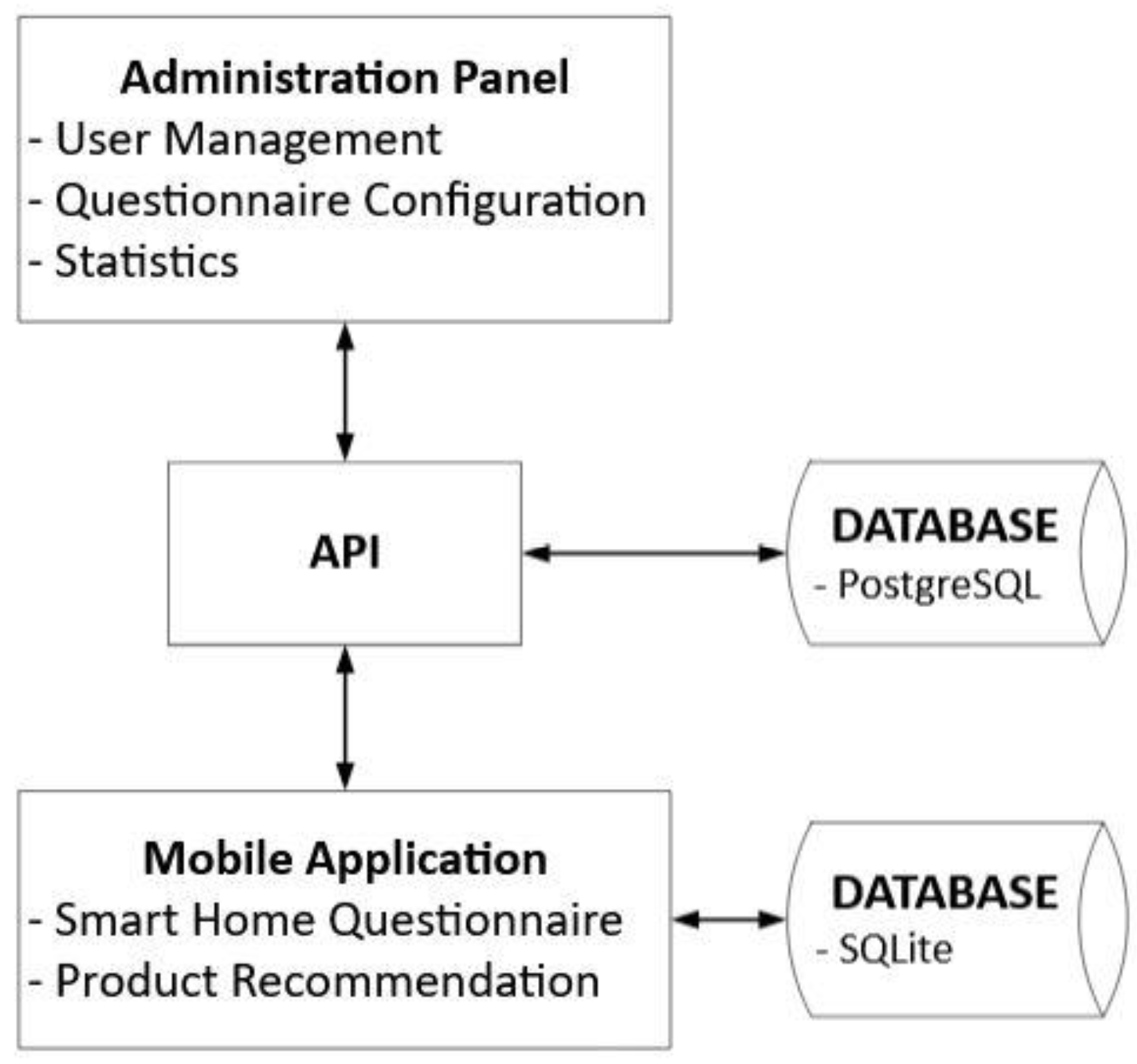

Table 1.
Decision-Making Directions in Smart Building Design.
| Topic | References |
| Practical Applications in Smart Building Design | |
| Energy Efficiency and Optimization | One of the primary practical applications of smart building design is the optimization of energy efficiency. Advanced technologies such as artificial intelligence (hereinafter AI), machine learning, IoT play a pivotal role in achieving this goal. For instance, AI-driven algorithms can analyse real-time data from building management systems (hereinafter BMS) to predict and optimize energy consumption patterns [15,16]. Similarly, IoT enabled sensors and actuators can monitor and control heating, ventilation, and air conditioning (hereinafter HVAC) systems, lighting, and other energy-intensive components, ensuring that energy usage is minimized without compromising occupant comfort [17,18]. |
| Integration of IoT and BIM | The integration of IoT and Building Information Modelling (hereinafter BIM) is another practical application in smart building design. BIM provides a digital representation of the building, enabling architects and engineers to simulate and analyse various design scenarios. When combined with IoT, BIM can facilitate real-time monitoring and control of building operations, leading to improved energy efficiency and operational efficiency [19,20]. This integration also supports the creation of digital twins, which are digital replicas of physical buildings that can be used to test and optimize design decisions before implementation [19,21]. |
| Smart Sensors and Actuators | The deployment of smart sensors and actuators is a key practical application in smart building design. These devices enable the collection of real-time data on various parameters such as temperature, humidity, lighting, and occupancy. This data can be used to make informed decisions about energy control, leading to significant reductions in energy consumption [17,18]. For example, smart sensors can detect occupancy patterns and adjust lighting and HVAC settings, accordingly, ensuring that energy is used only when and where it is needed [17,22]. |
| Renewable Energy Integration | The integration of renewable energy sources into smart building design is another practical application. Building-integrated photovoltaics (BIPV) and solar energy harvesting are being increasingly adopted to reduce reliance on non-renewable energy sources. AI-driven decision-making frameworks can optimize the design and placement of these systems, ensuring maximum energy generation and self-sufficiency [21,23]. |
| Theoretical Frameworks in Smart Building Design | |
| AI-Driven Decision-Making | AI-driven decision-making is a cornerstone of smart building design. AI algorithms can analyse vast amounts of data from various sources, including IoT sensors, weather forecasts, and occupant behaviour, to make optimal decisions about energy management. These decisions can be made at various stages of the building lifecycle, including design, construction, operation, and maintenance [16,24]. For example, AI can be used to optimize building orientation, envelope design, and HVAC systems during the design phase, leading to significant energy savings [25,26]. |
| Emerging Trends in Smart Building Design | |
| Green Building and Sustainability | Green building and sustainability are emerging trends that are driving innovation in smart building design. Green building certifications such as LEED and BREEAM encourage the adoption of sustainable practices, including energy efficiency, water conservation, and waste reduction. Smart building technologies can support these goals by optimizing resource usage and reducing environmental impact [21,27]. |
| Human-Centric Design | Human-centric design is an emerging trend that prioritizes occupant comfort and well-being in smart building design. Smart building technologies can be used to create personalized environments that adapt to the needs and preferences of occupants. For example, smart lighting and HVAC systems can adjust settings based on occupant behaviour, leading to improved comfort and productivity [17,28]. |
Table 2.
Summary of comparative characteristics of SHMS
| BMS | Jung Home | KNX | LB Management | eNet Smart Home |
| Type | Smart home system, conventional 230V installation | Open BMS standard (wired/wireless) | HVAC-focused BMS | Cloud-based smart home |
| Protocol | Bluetooth® Mesh | KNX (ISO/IEC 14543) | Proprietary (BACnet, Modbus) | IP-based (Wi-Fi, Ethernet) |
| Building types | Residential home and offices | Any building size with global BMS standard | Large building with commercial HVAC | Residential and small commercial |
| Main features | Lighting, HVAC, security, premium design switches, KNX integration | Interoperable devices, secure and reliable | Energy optimization, HVAC-centric, BACnet support | Cloud control, App-based automation, Easy DIY setup |
| Integration | Works with all KNX devices | Compatible with 500+ KNX brands | BACnet, Modbus, KNX gateways | Limited (mostly eNet devices) |
| Energy Control | Advanced (KNX energy monitoring) | Excellent (open standard) | Best for HVAC efficiency | Basic energy tracking |
| Security | High | Very high (encrypted) | High (industrial grade) | Medium (cloud-dependent) |
| Cost | Premium (high-end) | Mid to high (depends on devices) | High (commercial focus) | Affordable (consumer-grade) |
Disclaimer/Publisher’s Note: The statements, opinions and data contained in all publications are solely those of the individual author(s) and contributor(s) and not of MDPI and/or the editor(s). MDPI and/or the editor(s) disclaim responsibility for any injury to people or property resulting from any ideas, methods, instructions or products referred to in the content. |
© 2025 by the authors. Licensee MDPI, Basel, Switzerland. This article is an open access article distributed under the terms and conditions of the Creative Commons Attribution (CC BY) license (http://creativecommons.org/licenses/by/4.0/).
Copyright: This open access article is published under a Creative Commons CC BY 4.0 license, which permit the free download, distribution, and reuse, provided that the author and preprint are cited in any reuse.


