
Submitted:
18 July 2025
Posted:
18 July 2025
You are already at the latest version
Abstract
The Fashion industry is constantly evolving and innovating, creating new trends and styles that influence where garments are custom-made for individual clients with exquisite craftsmanship and materials. The Haute Couture Fashion Week held in Paris is one of the most influential fashion events where designers use their creativity and skill to create unique and exquisite garments that convey their artistic vision and identity; therefore analyzing this event’s designs, people’s reception of them and the media surrounding it, can provide valuable information for fashion brands. In this paper, we proposed a text mining model to analyze the opinions of Twitter users on this subject. Our database consists of 4290 tweets and after the cleansing and text pre-processing stage, a clustering technique was applied to the database and then several association rules were extracted from each of the clusters. The output of the proposed model concluded popular patterns and co-occurrences among the identified clothing attributes and the sentiment behind them, proving that Twitter is a reliable source for receiving direct feedback and receptions from social media users and the model can be used as an initial model for predictive decision making.
Keywords:
Text mining
; Sentiment analysis
; Twitter
; Fashion
1. Introduction
The Paris Haute Couture shows, presented by the leading Fashion houses are not made to be sold; in fact, many of the pieces are arguably works of art. These couture designers occupy a highly influential position in the fashion cycle; they are often the first to identify and capture a trend, concept, or theme. These creations are eventually translated into wearable, commercial clothes that are suitable for mass market consumption by these fashion houses as well as being emulated by other designers for creative or commercial gain. Analyzing the designs of this event, people’s perceptions of them, and the media surrounding it can provide crucial information for fashion brands Grose (2011). With the advent of the digital age, the internet has become a source of huge amounts of fashion related data; even though this accessibility has accelerated the rate of fashion change, making fashion analysis and forecasting even more challenging Ma et al (2020). Social media for one is an interesting opportunity for harnessing data. By designing data mining models, one can aggregate the opinions of social media users, utilizing them for variations of business and creative decisions such as fashion design and trend forecasting, sales forecasting, marketing and advertising campaigns as well as gaining useful personal information from the users Asur and Huberman (2010). There are a number of Studies that have used different resources for fashion analysis and trend prediction, such as image mining in social media Ma et al (2020); Wazarkar and Keshavamurthy (2020) or runway shots Lin and Yang (2019); Vittayakorn et al (2015) and street style images Abe et al (2017); Matzen et al (2017), using Google trends Silva et al (2019) and sales data from Amazon Al-Halah et al (2017); He and McAuley (2016).
There are a large number of researchers that have successfully used Twitters connection and relationship with real world outcomes in various fields including, political elections Sharma and Ghose (2020), stock market predictions Gro-Klumann et al (2019), and entertainment goods Asur and Huberman (2010); Therefore, we decided to investigate Twitter users’ perceptions and feelings regarding Paris haute couture week by designing a text mining model. This model will discover the concordances and patterns between various attributes of clothing items such as color, fabric, and design and then uses sentiment analysis to gather Twitter’s feelings and perceptions towards them. This kind of information can give great insight to designers and brands about their potential buyers’ state of mind and provide initial data for predictive decision making.
2. Literature Review
2.1. Fashion Analysis
Fashion industries need to be attentive to current fashion trends and their upcoming market demands to succeed Wazarkar and Keshavamurthy (2020). The information from fashion analysis and trend prediction is valuable for many applications, i.e., designing, manufacturing, retailing, and advertisement. This process is still done manually by many fashion brands, their experts analyze the current and future trends by inspecting fashion photographs, their inspirations behind them, and fashion news Matzen et al (2017).
In recent years, big data alongside statistical modeling has become one of the most powerful methods to quantify, verify, and falsify our understanding of fashion. There have been a limited amount of studies using these methods for fashion analysis Sanchis-Ojeda (2016). Most researchers used image datasets from social media, e.g., Wazarkar and Keshavamurthy (2020) proposed a fashion analysis and forecasting model using fashion-related images collected from the social network; Whereas Ma et al (2020) designed a Knowledge Enhanced Recurrent Network model (KERN) which takes advantage of the capability of deep recurrent neural networks in modeling time series and is capable of effectively forecasting fashion trends and capturing patterns in time series fashion trends data. Vittayakorn et al (2015); Lin and Yang (2019); Hidayati et al (2014) used catwalk images as their dataset. Street style pictures were also used as a dataset, e.g., Abe et al (2017) used a dataset of geo-tagged images to show the analysis of fashion trends and fashion-based city similarity, Mall et al (2019) used the same kind of geo-tagged dataset and social events that impact fashion across the globe and used this dataset to train attribute classifiers via deep learning. Matzen et al (2017) proposed a model that discovers visually consistent style clusters that capture useful visual correlations in a massive street style dataset Chen et al (2015) constructed a dataset from two resources: images from fashion shows during the New York fashion week and Street-chic images after New York fashion shows to gauge whether the fashion trends influence people’s daily life.
2.2. Twitter Data Mining
Twitter is an online social media platform for sharing personal content between users through short 140 character messages known as tweets Daniel et al (2017). Because of twitters special capabilities like its simplicity, mobility, real time nature, and content sharing, users can share their opinions regarding different subjects in real time from around the globe. These comments can be used by a variety of companies, brands, and even governments to get statistical reports and analyses for their field of interest Li et al (2019). Many researchers have chosen Twitter data mining as a method for their studies in various fields, e.g., regarding politics Grover et al (2019), a number of researchers attempted to forecast voting behavior Burnap et al (2016), Usher and Dondio (2020) forecasted the UK Brexit based on Twitter. Bashir et al (2021) studied the nature of tweets and the sentiments expressed by the Twitter-sphere during and after the Khan Shaykhun Syria Chemical Attack.” regarding the medical subject, the topic of COVID-19 has been a hot topic recently. Bokaee Nezhad and Deihimi (2022) researched the Twitter sentiment analysis about COVID 19 vaccine in Iran and Sharevski et al (2022) studied Twitter’s soft moderation effects on the COVID-19 vaccine belief echoes. Twitter data mining is also utilized in brand management subjects e.g., McShane et al (2021) demonstrated whether emoji presence increases engagement with tweets, Greco and Polli (2020) Applied emotional text mining on Twitter messages concerning a sportswear brand aiming to profile social media users. Jain et al (2020) focused on how consumers perceive brand campaigns on Twitter. Twitter can be used to identify popular topics or events Daniel et al (2017); Dang et al (2016), or to predict event trends such as emerging technologies Li et al (2019), stock market prediction Oliveira et al (2017) or even fashion trend forecasting, Beheshti-Kashi (2015) explored the capability of Twitter as a source for extracting relevant features to predict future fashion trends.
3. Materials and Methods
3.1. Research Structure
In this research we constructed a text mining model on Twitter regarding Paris Haute Couture Fashion Week, this model is visualized in Figure 1. The steps to reach this objective can be summarized as follows: First, to gather data from Twitter, keywords were selected and searched using the Twitter streaming application programming interface (API) that extracts data from Twitter sources. The second step includes text preprocessing and finally in the third step, using sentiment analysis, clustering, and association rules techniques, the information regarding fashion attributes and users’ sentiment towards them is extracted.
3.2. Data Extraction
In order to collect the data, first the keywords must be selected; since this research was conducted during the second and third weeks of July 2021 during the fall Paris Haute Couture Fashion Week, it was decided to choose the prominent visible attributes in this event as our keywords. As shown in Table 1, the keywords are in three categories color, fabric, and type of shoes; each of these keywords was searched alongside the names of the three brands present at fashion week, i.e., Dior, Armani, and Chanel. In general, a total of forty-five searches were conducted and 4290 tweets were collected.
3.3. Text Preprocessing
Achieving effective and real results through data mining is not possible without reliable and effective inputs; therefore, before any analysis, the accuracy of the available data must be ensured; this makes the data preprocessing stage one of the most critical phases of text mining. During the numerous steps of text preprocessing, valueless and extra words, numbers, letters, and symbols will be removed to decrease the volume of data and therefore provide fresher, more accurate, and less energy-consuming data.
In this research, the preprocessing stage includes five steps which are named as follows; tokenizing, case transformation, filtering stop words, n-grams, and stemming. Term Frequency- Inverse Document Frequency (TF-IDF), which is a numerical statistical model, was also used to weight each word or attribute in the documents, and then by eliminating the attributes with the most or the least frequency, the number of attributes was reduced and thus only the most valuable and important attributes were kept.
3.4. Sentiment Analysis
When a certain event is discussed and shared on social media, the public attitude can affect other people and influence them. A lot of emotional information is contained in such platforms. Therefore, sentiment analysis on the raw data regarding an event would contribute to identifying main trends and hot topics and forecast the future direction for investors and managers Li et al (2019).
Sentiment analysis (also called opinion mining, review mining, or attitude analysis) is a set of techniques, methods, and tools for recognizing and extracting mental information such as opinions and attitudes from language Mntyl et al (2018). In other words, sentiment analysis is the computational analysis of the end user’s ideas, attitudes, and feelings toward a particular topic or product Mntyl et al (2018). This technique categorizes a message according to its polarity, which is positive, negative, or neutral. Sentiment analysis is one of the most popular approaches used in academic research. Table 2 shows an example of the outcome of applying sentiment analysis to a number of tweets. Keep in mind that not all the attributes of these tweets could fit in the table, therefore, only a number of them are shown.
3.5. K-means Clustering
The K-means algorithm was proposed by MacQueen (1967). Document clustering means grouping documents in such a way that the documents within a group have the most similarity and each group’s documents have the least similarity to the documents of other groups. Document clustering has many functions, For example, fast data retrieval, unsupervised organization of documents, and to increase the efficiency of search engines, they provide search results using document clustering. For this research, we have chosen k-means as our clustering method, which is one of the most popular clustering algorithms. This algorithm follows the steps below:
- First, k initial cluster centers are selected; these points will be the central points of the initial groups.
- Each document is assigned to the group that is closer to its center point.
- After all points have been assigned to the groups; the central point of each group is redefined.
Steps two and three are repeated until the central points of the groups stop changing. Finally, k cluster centers are obtained Rezaei (2016).
All clustering algorithms try to cluster in such a way to obtain more specific and segregated clusters; Therefore, all unsupervised evaluation indexes try to measure the quality of clustering performance according to two important factors: cluster cohesion and cluster separation. In this study, the Davies Bouldin evaluation index has been used to evaluate the quality of clustering, in which both cohesion and separation factors are used, The Davies Bouldin index is calculated by the following formula:
After the number of clusters was decided according to the Davies Bouldin index, clustering was separately applied to each of the three categories of color, fabric, and type of shoes. Table 3 shows the outcome of clustering based on the words with the most frequency within each cluster for the color category and Table 4 shows the percentage of positive, negative, or neutral tweets in each cluster for the same category.
3.6. Association Rules
Association rule extraction is a technique used to discover frequent if/then patterns and relationships among a large set of variables in a database and is widely used in the business decision-making process and customer repeat purchase patterns. The main focus of association rule in text mining is the discovery of relationships and implications among descriptive concepts or topics that are used to characterize a document and to discover important association rules within a document such that the presence of a set of topics in one document would imply the presence of another topic Gupta and Lehal (2009). To identify the most important relationships, the criteria of support and confidence are used. Support is an indication of how frequently the items appear in the database and Confidence indicates the number of times the if/then statements are true. A number of extracted rules are shown in Table 5.
4. Results
The results section reports the findings of the data collection and analysis. First, the color category is analyzed, followed by the fabric and shoe type categories. The number of clusters for each category was determined using the Davies Bouldin index. The topics and sentiments of each cluster are described and compared. Table 3 shows the topics and clusters for the color category, and Table 4 shows the sentiment analysis results for each cluster. The fabric category has six topics, which are summarized in Table 6. The shoe type category has six topics as well, which are presented in Table 8. Table 7 and Table 9 depict the sentiment analysis results of the Fabric and the Shoe type categories respectively. The association rules extracted from the clusters are shown in Table 5. The results reveal the patterns and preferences of Twitter users regarding different aspects of fashion.

Table 6.
The outcome of applying clustering for the Fabric category.
| Chiffon | Silk | Listing | Tweed | Leather | Denim | |
| 1 | Chiffon | Silk | Listing | Tweed | Leather | Denim |
| 2 | Cannes | Blue | Closet | Jacket | Listing | Flow |
| 3 | Dior | Dress | Check | Suit | Black | Dior |
| 4 | Maria | Dior | Add | Skirt | Wallet | Song |
| 5 | Festival | Scarf | Leather | Pink | Size | Tell |
| 6 | Wear | Blend | Silk | Couture | Authentic | Good |
| 7 | Dress | Luminous | Vintage | Wear | Logo | Name |
| 8 | Paris | Foundation | Classic | Spring | Shoes | summer |
| 9 | Actress | Wide | Exchange | Look | Watch | Play |
| 10 | Fall | Patter | Paisley | White | Woman | Denim |
Table 7.
Shows the percentage of positive, negative or neutral tweets in each cluster for the Fabric category.
Table 7.
Shows the percentage of positive, negative or neutral tweets in each cluster for the Fabric category.
| Clusters | Positive | Neutral | Negative |
| Cannes | 0.50 | 0.01 | 0.47 |
| Silk | 0.53 | 0.04 | 0.41 |
| Listing | 0.27 | 0.08 | 0.63 |
| Tweed | 0.27 | 0.03 | 0.69 |
| Listing | 0.09 | 0.00 | 0.90 |
| Denim | 0.16 | 0.04 | 0.80 |
Table 8.
The outcome of applying clustering for the Shoe type category.
| Heels | Sneakers | Boots | Slippers | Boots | Sandals | |
| 1 | Heels | Sneakers | Boots | Slippers | Boots | Sandals |
| 2 | Flat | Want | Wearing | Dior | Luke | Want |
| 3 | Vintage | Dior | Yeah | Know | Wear | Name |
| 4 | Woman | Pair | Dior | Find | Black | Black |
| 5 | Dior | White | Luke | Say | Dior | Size |
| 6 | Shoe | Price | Wear | Wearing | Love | Heel |
| 7 | Size | Size | Jacket | Name | Think | Touch |
| 8 | Crystal | Jordan | Jordan | Size | Suit | Flat |
| 9 | Mule | Place | Sneakers | Want | Dress | Socks |
| 10 | Collection | Send | Want | Socks | Time | Standard |
Table 9.
Shows the percentage of positive, negative or neutral tweets in each cluster for the shoe type category.
Table 9.
Shows the percentage of positive, negative or neutral tweets in each cluster for the shoe type category.
| Clusters | Positive | Neutral | Negative |
| Heels | 0.37 | 0.15 | 0.47 |
| Sneakers | 0.36 | 0.10 | 0.53 |
| Boots | 0.70 | 0.00 | 0.29 |
| Slippers | 0.72 | 0.40 | 0.13 |
| Boots | 0.65 | 0.00 | 0.34 |
| Sandals | 0.27 | 0.17 | 0.55 |
5. Discussion
The aim of this study was to analyze the patterns and sentiments of tweets related to fashion categories of color, fabric, and shoe type. Using clustering and association rule mining techniques, we identified the most popular and unpopular topics and attributes in each category, as well as the relationships between them.
The results show that the color category has the most diversity and variation in terms of topics and sentiments. Among the most positive topics are White and Black, which indicate a preference for classic and elegant combinations. The most negative topic is Pink, which is mainly due to the presence of advertisement tweets that lower the user engagement. The Blue and Gold topics have mixed sentiments, depending on the attributes and accessories associated with them.
The fabric category has less variation and mostly positive sentiments. The most prominent topics are Silk and Chiffon, which are related to the Cannes festival that occurred during the data collection period. This indicates that the users are influenced by the current events and trends in the fashion industry.
The shoe type category has the most balanced distribution of sentiments. The most popular topics are Boots and Slippers, which reflect the users’ desire for comfort and versatility. Among the most unpopular topics are High heels and Sandals, which imply dissatisfaction with the traditional and seasonal styles.
The results of this study provide valuable insights into the preferences and opinions of Twitter users regarding different aspects of fashion. By applying clustering and association rule mining methods, we were able to discover the hidden patterns and relationships among the topics and attributes in each category. This can help fashion designers and marketers to understand the current and future trends, as well as to tailor their products and campaigns to the target audience. Moreover, this study demonstrates the potential of using social media data as a source of information and feedback for fashion analysis and prediction.
6. Conclusion
This study aimed to evaluate the sentiments of Twitter users towards the designs presented at the Paris Haute Couture Fashion Week for fall. A text mining model was developed to analyze the opinions of 4290 tweets in three categories: colors, fabrics, and shoe types. The model included sentiment analysis, k-means clustering, and association rule extraction methods, which were applied to the preprocessed data. The results revealed the popular patterns and co-occurrences among the identified attributes, as well as the positive and negative attitudes of the users towards different aspects of fashion. The study also assessed the reliability of Twitter data as a source of feedback and information for fashion analysis and prediction. The findings suggest that Twitter data is very rich and useful for fashion content, but it also requires a lot of cleaning and preparation, as it contains many ads and spam messages. The proposed model can be beneficial for fashion brands who want to understand the feelings of their potential customers and tailor their products and campaigns accordingly. Future research could enhance the model by adding predictive approaches and using a larger and more diverse dataset.
This study has some limitations that should be considered when interpreting the results. First, the data collection was limited to a specific time period and location, which may affect the generalizability of the findings. Second, the sentiment analysis was based on a pre-trained model, which may not capture the nuances and contexts of the tweets. Third, the clustering and association rule mining techniques were applied with certain parameters and thresholds, which may influence the quality and quantity of the results. Therefore, future research could extend the data collection to a longer and wider scope, use a more customized and refined sentiment analysis model, and explore different settings and methods for clustering and association rule mining. Additionally, future research could also incorporate other features and categories of fashion, such as style, occasion, and brand, to obtain a more comprehensive and holistic view of the fashion domain. Moreover, future research could also incorporate image mining techniques, as images constitute a significant part of Twitter data and many users opt to share an image rather than describe the clothing. Furthermore, tweets are concise messages that often omit details and are vague expressions of users’ opinions and emotions about a topic. Hence, selecting other sources such as professional fashion resources for data mining could provide more reliable and comprehensive information that would supplement the information obtained from public sources.
Conflict of Interest
On behalf of all authors, the corresponding author states that there is no conflict of interest.
References
- Abe K, Suzuki T, Ueta S, et al (2017) Changing fashion cultures. arXiv preprint arXiv:170307920.
- Al-Halah Z, Stiefelhagen R, Grauman K (2017) Fashion forward: Forecasting visual style in fashion. Proceedings of the IEEE International Conference on Computer Vision pp 388–397.
- Asur S, Huberman BA (2010) Predicting the future with social media. 2010 IEEE/WIC/ACM international conference on web intelligence and intelligent agent technology 1:492–499.
- Bashir S, Bano S, Shueb S, et al (2021) Twitter chirps for syrian people: Sentiment analysis of tweets related to syria chemical attack. International Journal of Disaster Risk Reduction 62:102,397. [CrossRef]
- Beheshti-Kashi (2015) Twitter and fashion forecasting: An exploration of tweets regarding trend identification for fashion forecasting.
- Bokaee Nezhad Z, Deihimi MA (2022) Twitter sentiment analysis from iran about covid 19 vaccine. Diabetes & Metabolic Syndrome: Clinical Research & Reviews 16(1):102,367.
- Burnap P, Gibson R, Sloan L, et al (2016) 140 characters to victory?: Using twitter to predict the uk 2015 general election. Electoral Studies 41:230–233.
- Chen K, Chen K, Cong P, et al (2015) Who are the devils wearing prada in new york city? Proceedings of the 23rd ACM international conference on Multimedia p 177180.
- Dang Q, Gao F, Zhou Y (2016) Early detection method for emerging topics based on dynamic bayesian networks in micro-blogging networks. Expert Systems with Applications 57:285–295. [CrossRef]
- Daniel M, Neves RF, Horta N (2017) Company event popularity for finan- cial markets using twitter and sentiment analysis. Expert Systems with Applications 71:111–124.
- Greco F, Polli A (2020) Emotional text mining: Customer profiling in brand management. International Journal of Information Management 51:101,934.
- Grose V (2011) Basics Fashion Management 01: Fashion Merchandising Grover P, Kar AK, Dwivedi YK, et al (2019) Polarization and acculturation.
- in us election 2016 outcomescan twitter analytics predict changes in voting preferences. Technological Forecasting and Social Change 145:438–460.
- Gro-Klumann A, Knig S, Ebner M (2019) Buzzwords build momentum: Global financial twitter sentiment and the aggregate stock market. Expert Systems with Applications 136:171–186.
- Gupta V, Lehal GS (2009) A survey of text mining techniques an applications. Journal of emerging technologies in web intelligence 1(1):60–76.
- He R, McAuley J (2016) Ups and downs: Modeling the visual evolution of fashion trends with one-class collaborative filtering. Proceedings of the 25th International Conference on World Wide Web p 507517.
- Hidayati KLShintami C.and Hua, Cheng WH, Sun SW (2014) What are the fashion trends in new york? Proceedings of the 22nd ACM international conference on Multimedia p 197200.
- Jain M, Fernando AG, Rajeshwari K (2020) How do consumers perceive brand campaigns on twitter? International Working Conference on Transfer and Diffusion of IT pp 438–443.
- Li X, Xie Q, Jiang J, et al (2019) Identifying and monitoring the development trends of emerging technologies using patent analysis and twitter data min- ing: The case of perovskite solar cell technology. Technological Forecasting and Social Change 146:687–705.
- Lin Y, Yang H (2019) Predicting next-season designs on high fashion runway. arXiv preprint arXiv:190707161.
- Ma Y, Ding Y, Yang X, et al (2020) Knowledge enhanced neural fashion trend forecasting. Proceedings of the 2020 International Conference on Multimedia Retrieval pp 82–90.
- MacQueen J (1967) Some methods for classification and analysis of mul- tivariate observations. Proceedings of the fifth Berkeley symposium on mathematical statistics and probability 1:281–297.
- Mall U, Matzen K, Hariharan B, et al (2019) Geostyle: Discovering fashion trends and events. Proceedings of the IEEE International Conference on Computer Vision pp 411–420.
- Matzen K, Bala K, Snavely N (2017) Streetstyle: Exploring world-wide clothing styles from millions of photos. arXiv preprint arXiv:170601869.
- McShane L, Pancer E, Poole M, et al (2021) Emoji, playfulness, and brand engagement on twitter. Journal of Interactive Marketing 53:96–110.
- Mntyl MV, Graziotin D, Kuutila M (2018) The evolution of sentiment anal- ysisa review of research topics, venues, and top cited papers. Computer Science Review 27:16–32.
- Oliveira N, Cortez P, Areal N (2017) The impact of microblogging data for stock market prediction: Using twitter to predict returns, volatility, trad- ing volume and survey sentiment indices. Expert Systems with applications 73:125–144.
- Rezaei S (2016) Application of text mining to determine the customer feedback in social networks, case study: Digital products market of iran. Thesis, Imam Javad University College.
- 2016; 29. Sanchis-Ojeda R (2016) Detection of fashion trends and seasonal cycles through the analysis of implicit and explicit client feedback.
- Sharevski F, Alsaadi R, Jachim P, et al (2022) Misinformation warnings: Twit- ters soft moderation effects on covid-19 vaccine belief echoes. Computers & security 114:102,577.
- Sharma A, Ghose U (2020) Sentimental analysis of twitter data with respect to general elections in india. Procedia Computer Science 173:325–334.
- Silva ES, Hassani H, Madsen D, et al (2019) Googling fashion: forecasting fashion consumer behaviour using google trends. Social Sciences 8(4):111. [CrossRef]
- Usher J, Dondio P (2020) Brexit election: forecasting a conservative party victory through the pound using arima and facebook’s prophet. Proceed- ings of the 10th International Conference on Web Intelligence, Mining and Semantics pp 123–128.
- Vittayakorn S, Yamaguchi K, Berg AC, et al (2015) Runway to realway: Visual analysis of fashion. 2015 IEEE Winter Conference on Applications of Computer Vision pp 951–958.
- Wazarkar S, Keshavamurthy BN (2020) Social image mining for fashion analysis and forecasting. Applied Soft Computing 95:106,517.
Figure 1.
The model structured for text mining Twitter data.
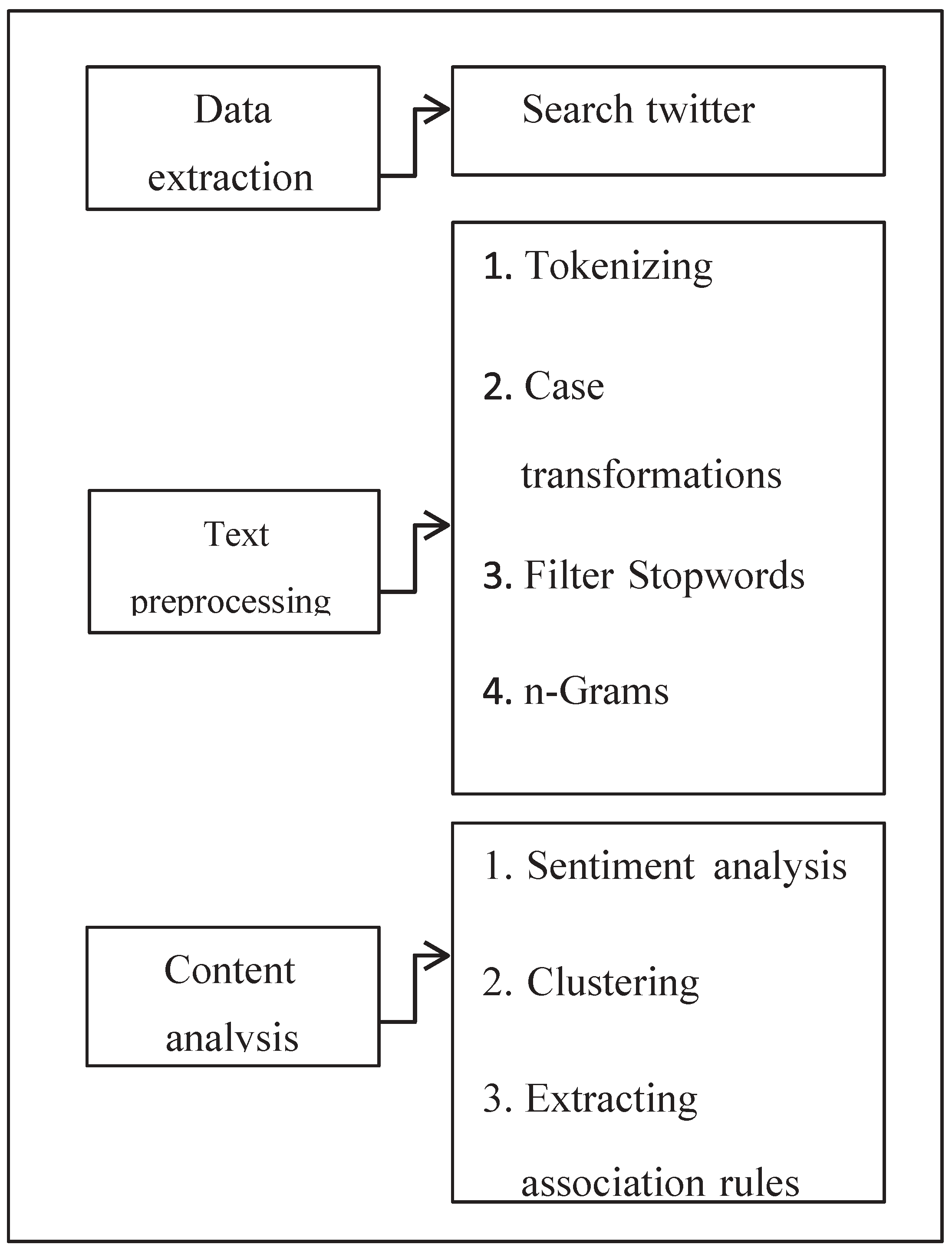
Table 1.
The chosen keywords shown in three categories of color, fabric and type of shoes.
| Colors | Fabrics | Types of shoes | |
| 1 | White | Chiffon | Slippers |
| 2 | Black | Tweed | Heels |
| 3 | Blue | Silk | Boots |
| 4 | Gold | Leather | Sandals |
| 5 | Pink | Denim | Sneakers |
Table 2.
An example of the outcome of applying sentiment analysis on a number of tweets. Keep in mind that not all the attributes of these tweets could be fit in the table, therefore, only a number of them are shown.
Table 2.
An example of the outcome of applying sentiment analysis on a number of tweets. Keep in mind that not all the attributes of these tweets could be fit in the table, therefore, only a number of them are shown.
| Text | Black | Dior | Gold | Vintage | Watch | Sentiment analysis |
| classic single flap chain shoulder black lambskin | 0.1 | 0.0 | 0.0 | 0.0 | 0.0 | Positive |
| dior backpack leather black shoulder | 0.3 | 0.4 | 0.0 | 0.0 | 0.0 | Negative |
| light blue forever angel nova malone midnight musk miss dior | 0.0 | 0.3 | 0.0 | 0.0 | 0.0 | Negative |
| belt chain coco vintage rare logo gold necklace | 0.0 | 0.0 | 0.2 | 0.3 | 0.0 | Negative |
| infinity ring forget bout gold silver necklace using sound | 0.0 | 0.4 | 0.0 | 0.0 | 0.0 | Positive |
| watch white gold watch jewellery | 0.0 | 0.0 | 0.3 | 0.0 | 0.8 | Positive |
| letter jack hotspot turn serve gold goldplate plate | 0.0 | 0.0 | 0.3 | 0.0 | 0.0 | Negative |
Table 3.
The outcome of applying clustering for the color category.
| white | Black | Pink | Blue | Gold | |
| 1 | white | Black | Pink | Blue | Gold |
| 2 | Dior | White | Dior | Silk | Watch |
| 3 | Black | Dior | Want | Light | Jewelry |
| 4 | Want | Woman | Perfect | Dior | Dior |
| 5 | Watch | Wear | Love | Jean | Vintage |
| 6 | Blue | Size | Pretty | Dress | Quartz |
| 7 | Think | Dress | Color | Navy | Belt |
| 8 | Love | Coco | Girl | Grey | Ceramic |
| 9 | Come | Shirt | Suit | Green | Necklace |
| 10 | Look | Love | White | Size | Plate |
Table 4.
Shows the percentage of positive, negative or neutral tweets in each cluster for the color category.
Table 4.
Shows the percentage of positive, negative or neutral tweets in each cluster for the color category.
| Clusters | Positive | Neutral | Negative |
| White | 0.41 | 0.02 | 0.57 |
| Black | 0.5 | 0 | 0.5 |
| Pink | 0.32 | 0 | 0.68 |
| Blue | 0.49 | 0 | 0.51 |
| Gold | 0.6 | 0 | 0.4 |
Table 5.
Shows the percentage of positive, negative or neutral tweets in each cluster for the color category.
Table 5.
Shows the percentage of positive, negative or neutral tweets in each cluster for the color category.
| premises | conclusion | support | confidence | |
| 1 | Dior | Slipper, Negative | 0.33 | 0.37 |
| 2 | Dior | Boot, Negative | 0.07 | 0.56 |
| 3 | Mule | Heel, Satin | 0.15 | 0.95 |
| 4 | Jacket | Tweed, Positive | 0.12 | 0.33 |
| 5 | Tweed, Skirt | Positive | 0.13 | 0.42 |
| 6 | Chiffon | Dress | 0.26 | 0.59 |
| 7 | Silk, Blue | Positive | 0.12 | 0.47 |
| 8 | Dior, Dress | Silk | 0.26 | 1.00 |
| 9 | Dress, Blue | Silk | 0.12 | 1.00 |
| 10 | Leather, Black | Positive | 0.28 | 0.85 |
| 11 | White, Dior | Positive | 0.08 | 0.55 |
| 12 | Black | White, Positive | 0.11 | 0.73 |
| 13 | White | Pink | 0.08 | 1.00 |
| 14 | Blue, Jean | Positive | 0.08 | 0.90 |
| 15 | Navy | Blue | 0.08 | 1.00 |
| 16 | Watch | Gold, Positive, jewelry | 0.18 | 0.45 |
| 17 | Watch | Black | 0.06 | 0.92 |
| 18 | Leather | Black | 0.07 | 1.00 |
| 19 | Chiffon, Cannes | Festival | 0.23 | 1.00 |
| 20 | Jacket | Denim | 0.07 | 0.90 |
| 21 | Shoes | Leather | 0.08 | 0.93 |
| 22 | Chain | Leather | 0.09 | 1.00 |
| 23 | Gold | Leather | 0.07 | 1.00 |
| 24 | Black, Wallet | Leather | 0.07 | 1.00 |
| 25 | Scarf | Silk | 0.09 | 1.00 |
Disclaimer/Publisher’s Note: The statements, opinions and data contained in all publications are solely those of the individual author(s) and contributor(s) and not of MDPI and/or the editor(s). MDPI and/or the editor(s) disclaim responsibility for any injury to people or property resulting from any ideas, methods, instructions or products referred to in the content. |
© 2025 by the authors. Licensee MDPI, Basel, Switzerland. This article is an open access article distributed under the terms and conditions of the Creative Commons Attribution (CC BY) license (http://creativecommons.org/licenses/by/4.0/).
Copyright: This open access article is published under a Creative Commons CC BY 4.0 license, which permit the free download, distribution, and reuse, provided that the author and preprint are cited in any reuse.


