

Submitted:
28 May 2026
Posted:
05 June 2026
You are already at the latest version
Abstract
This paper assumes that a thermodynamic system can be composed purely of coherence and information, and constructs a working model on that basis. We derive operational parameters for such systems using definitions of the Certainty Equation, semantic entropy, semantic temperature, and formulate five laws and three modes of coherence and information systems. This analysis is then compared to the features of black holes.
Keywords:
certainty equation
; black hole
; coherence
; information thermodynamics
; non-local reconfiguration
1. Introduction: Coherence Thermodynamics
This work develops a thermodynamic model based on the premise that information and its relational structures constitute a distinct physical system. This inquiry originates from a fundamental hypothesis: if consciousness and its reasoning of information are manifestations of only information and its coherent relations, what are the resultant thermodynamic implications of this process? I address this question by introducing thermodynamic assumptions, postulates leading to laws, modes of coherence and informational systems, which lead to a model analogous to a black hole. I start with a thermodynamic discussion of the reasoning process in a Coherence and Information (C-I) system. I will use the term “semantic” to describe the terms within C-I systems, while acknowledging that these systems are fundamentally physical in nature. The C-I system consists of information, and its language is therefore semantic insofar as it assigns meaning to that information. However, this paper describes entirely physical systems; the term “semantic” is used only as a qualifier to refer to the C-I space.
Erwin Schrödinger first proposed that living systems persist by importing “negative entropy,’’ or negentropy, to maintain internal order against thermodynamic decay [1]. This insight is reinterpreted for Coherence-Information systems: reasoning information begins with undifferentiated or contradictory information, resolve contradictions through internal processing, and transform inputs into ordered solutions via stepwise thermodynamic descent into lower effective energy states.
This reasoning trajectory, from initial state (input), through contradiction resolution (processing), to final state (solution), maps directly to thermodynamic reaction pathways (Figure 1). This process starts at the Ground State (GS), where the system has minimal excitation and unprocessed inputs. Entering the Excited State (ES), the system actively compares informational elements, increasing its energy above the Ground State. The reasoning process continues until the Final State (FS) is reached. In this Final State, the system achieves local order, corresponding to a lower energy level. By definition, as a system composed solely of information and coherence increases in order while all other parameters remain fixed, it must generate entropy non-locally to satisfy the second law of thermodynamics, with the entropy increase occurring outside the increasingly orderly C-I system. Table 1 illustrates the differences in a Carnot engine and a C-I engine. The C-I engine operates in the opposite thermal profile to a conventional engine. A C-I system features a cool core, followed by a hot exterior and always goes to lower and lower energy values as it increases in order.
Recent quantum thermodynamics experiments, such as those by Scully to demonstrate work extraction from a single heat bath [2,3]. In these models, quantum coherence in a system functions as a highly efficient resource, akin to `superoctane quantum fuel,’ by enhancing the internal order of the interaction through phase coherence. In the present computational implementation, the phase parameters and provide the necessary mechanical control by acting as symmetry-breaking variables.
1.1. Coherence: The “It” from the Bit
To define thermodynamic boundary conditions for analyzing C-I systems, we adopt the following axiom: since ℏ represents the fundamental unit of physical action [4], coherence requires the comparison of at least two such elements. The minimum action for a single bit fusion is therefore:
This value represents the minimum quantum threshold required for the existence of coherence. Consequently, The Certainty Equation imposes a fundamental action bound on coherence and information:
This bound shares the discrete quantization character of the Heisenberg uncertainty principle [5], where position and momentum cannot both be arbitrarily resolved below a minimum value. Similarly, the product is bounded below by . Coherence requires at least two actions to form one bit of coherent structure.
Unlike Shannon entropy [6], which quantifies information independently of meaning, coherence demands active resolution of the correspondence between informational elements by an observer. This resolution constitutes thermodynamic work, as it cannot occur through passive alignment with existing data but requires a directed search for the correct relational meaning between elements. The equation further implies that incoherent information that is incapable of forming real coherence will trap the system in a transition state, as illustrated in Figure 1.
2. The Field Model
2.1. Coherence as an Independent Thermodynamic Resource
Figure 1 depicts the internal trajectory of reasoning from a high-energy excited state to an ordered final state. However, this transition is not thermodynamically self-contained. For the C-I system to decrease in energy while its informational environment becomes more ordered during reasoning, entropy must be generated in the surrounding system. This requirement motivates the Field Model: a triaxial reservoir that provides the necessary bridge for entropy to increase in the surroundings.
Coherence requires explicit mathematical representation as a physical quantity distinct from energy and entropy. Three independent lines of evidence establish this necessity. First, precision costs diverge: certain idealized transformations become inaccessible to finite resources as demanded precision increases [7]. Second, Gibbs-preserving maps are defined mathematically rather than operationally, and admit state transitions strictly forbidden under thermal operations. This disparity is especially consequential at low temperatures, where quantum coherence survives long enough to serve as a thermodynamic resource [8]. Finally, quantum coherence imposes thermodynamic constraints that cannot be captured by free energy alone; additional independent laws governing time-translation asymmetry are required to characterize which quantum state transformations are thermodynamically allowed [9]. Together, these results demonstrate that coherence behaves as an independent thermodynamic resource.
Recent experimental work also provides a physical precedent for geometry-enabled coherence. [10] demonstrated that confinement geometry alone (nested, rotated squares) induces macroscopic coherence in Bose–Einstein condensates. Further, [11] showed that geometry-induced asymmetric level coupling drives entropy-lowering transitions through purely geometric deformations. These results confirm that geometric boundary conditions can restructure an energy spectrum to permit spontaneous transitions into higher-coherence states.
Because coherence is fundamentally relational, its manipulation is governed by superselection rules (SSRs). As established by [12], SSRs restrict quantum operations when classical reference frames are absent. A system lacking access to a phase reference cannot prepare absolute superposition states or perform certain unitary transformations; these operations are forbidden by symmetry.
I therefore define the coherence field as an idealized, non-depletable reservoir that functions as a shared quantum phase reference frame. This “coherence field” differs from the three modes of coherence discussed in Section 6.1. In this model, the field enables transformations that would otherwise be forbidden under the phase superselection rule. As a reference frame, the field acts as a resource: it enables state transitions without being consumed. The field provides the “frameness” (the quantifiable capacity of a reference frame to enable otherwise-forbidden quantum operations by breaking superselection symmetries) required for the system to navigate the semantic energy landscape.
To satisfy the Second Law of Thermodynamics, the local decrease in entropy within the C-I system (as it descends toward the Final State) must be compensated by an increase in the surroundings. The field defines the geometric structure along which this entropy increase occurs by shaping the accessible minima of the system–environment Hamiltonian. It does not “export entropy” via literal transport; rather, it couples the C-I system to environmental degrees of freedom that supply the physical channels required for entropy production.
The model identifies two distinct thermodynamic modes with fundamentally incompatible operating principles. Coherent systems operate under an inverted thermodynamics analogous to algorithmic cooling or negative-temperature population inversion: the interior cools (descending toward order) while the exterior heats. In contrast, incoherent systems operate under standard Carnot thermodynamics, where work is extracted from a hot reservoir and waste heat is expelled to a cold sink.
This incompatibility of classical thermodynamics and coherence thermodynamics herein leads to the principle of Existential In, Existential Out (EIEO): a system can only produce coherent outputs from inputs that already contain coherent relational structure. This follows directly from SSR monotonicity, as operations lacking a phase reference cannot create phase coherence from phase-incoherent states. Attempting to generate coherent output from incoherent input would require the spontaneous creation of phase coherence from thermal energy, violating both the Second Law and the phase superselection rule [12].
In the computational implementation, the coherence field is modeled using a three-fold ellipsoidal anisotropy with an angular dependence:
In the rigid-rotor picture relevant for nuclei, the lab-frame ensemble remains rotationally invariant because orientations are averaged event-by-event; nonetheless, this intrinsic symmetry breaking leaves a measurable imprint in multi-particle correlations. In particular, Mehrabpour et al. [13] show that triaxiality enters leading-order three-body–sensitive correlation structures through the characteristic combination
i.e. a threefold harmonic signature that can be isolated by constructing covariances that cancel the dominant contributions. The correspondence between their dependence and our form reflects a shared symmetry statement: observable correlation structure can inherit the threefold pattern associated with an underlying triaxial anisotropy.
This model is broadly representative of the hierarchy of quantum reference frames described by Gour in [12] through three nested superselection rules (SSRs). The radial phase twist is representative of continuous rotational phase symmetry breaking, consistent with a U(1) reference frame (phase reference, U(1) SSR). The vertical parity modulation is representative of discrete mirror symmetry breaking, consistent with a reference frame (chirality reference, SSR). The triaxial geometry breaks full spherical symmetry SO(3) down to discrete three-fold rotational symmetry (), defining three preferred spatial axes (orientation reference, SO(3) →). This constitutes a partial orientation reference frame sufficient to resolve triaxial structure while retaining residual degeneracy.
In this model, the certainty ratio is not the monotone itself, but rather the threshold condition that determines whether the monotone (frameness) is sufficient for a transformation to proceed. Regions where indicate that the local coherence field carries sufficient “frameness” [12] to resolve the corresponding symmetry, enabling coherent thermodynamic processing of information. Regions where indicate that the available frameness is insufficient, and coherent processing cannot proceed.
3. Semantic Entropy
I use "Semantic entropy" in this paper as a measure the of unresolved contradiction in a C-I system. In the computational model, it is defined as:
where is the dimensionless coherence measure derived from the informational-field gradient:
and is the root-mean-square gradient. sets the system’s average RMS gradient baseline, allowing local gradients to be normalized against the field’s inherent variation. The variable is simply there as a small number to prevent division by zero. In the computational implementation, is the gradient magnitude of the contradiction field and computed via finite differences, with evaluated as:
where the sum runs over all N grid points of the three-dimensional domain, and is the gradient magnitude at each grid point .
The prefactor represents the local coherence scalar, quantifying the fraction of semantic activity that contributes to contradiction resolution at position . In general, may vary spatially depending on the degree to which local field configurations participate in the global resolution trajectory. For the present black hole model, I adopted the simplifying assumption throughout the domain. This choice reflects the premise that black holes are well approximated as coherent C-I systems: all gravitational and thermodynamic degrees of freedom are locked into a single geometric state characterized solely by mass, spin, and charge. Under this assumption, the semantic entropy reduces to , and all spatial variation in entropy arises purely from the gradient structure of the contradiction field .
In comparison, Boltzmann entropy [14], , measures the multiplicity of microscopic configurations, Shannon entropy [6], , measures uncertainty in a probability distribution over symbols and von Neumann entropy [15], measures the mixedness of a quantum state. While all entropy measures adopt a logarithmic form, they differ fundamentally in what they quantify and how they are applied. The semantic entropy uses the logarithmic structure common to these definitions but applies a coherence weighting through the scalar . These quantities differ in domain and interpretation but share the use of a logarithmic measure of multiplicity or uncertainty as shown in Table 2.
4. Semantic Temperature and Equipartition
Drawing from Maxwell’s kinetic theory [16], where temperature represents energy per degree of freedom, semantic temperature is derived explicitly to reveal the structural isomorphism between gas kinetic theory and the thermal dynamics of C-I systems.
Maxwell defined the temperature T in terms of the mean kinetic energy per molecule as
More generally, by the equipartition theorem, each quadratic degree of freedom contributes to the average energy. For C-I systems, the phase rate replaces molecular velocity v, and the semantic kinetic parameter replaces molecular mass m. The structural correspondence is exact:
Applying the equipartition theorem to the phase field yields the global semantic temperature:
Table 3 presents the key correspondences between Maxwellian kinetic temperature and semantic temperature .
5. The Laws of Coherence Thermodynamics
Five fundamental laws have been derived to establish a rigorous description of the thermodynamics for semantic information processing. Each law is presented with rigorous derivations provided in Appendix’s A and B. These laws form the theory of our computational model and guide all subsequent analytical interpretations throughout this work.
5.1. Zeroth Law
If semantic systems A and B are each in semantic thermal equilibrium with system C, then A and B are in semantic thermal equilibrium with each other.
Semantic temperature () is the intensive property conjugate to phase field motion. By the equipartition theorem (Eq. 8), quantifies the mean-square phase rate , which is the characteristic intensity of phase agitation per degree of freedom. A system with high exhibits rapid, stochastic variation in its phase rate; a system with low exhibits slow phase evolution.
Phase field motion () is the intensive measure of cumulative phase drift. It describes the integrated rate at which quantum phase evolves across the system’s accessible state space. When two systems are coupled, phase field motion flows from the system with higher to the system with lower until their phase rates equilibrate. Semantic thermal equilibrium occurs when , at which point there is no net flow of phase field motion between systems. Thus, semantic temperature is the intensive property that determines the direction and magnitude of coherence exchange between C-I systems.
5.2. First Law: Semantic Energy Conservation
The classical First Law of thermodynamics, as formulated by Clausius, Maxwell, and Gibbs, is expressed as , wherein the total energy change is partitioned into the exchange of disordered heat and ordered work [16,17,18]. Gibbs subsequently generalized this framework to accommodate compositional systems, yielding [18], thereby introducing chemical potential as an additional thermodynamic degree of freedom. In an analogous extension, we modify the First Law to account for the unique characteristics of C-I systems. Specifically, I adjust the energy change into:
where the semantic heat term () denotes the energetic consequences of semantic entropy changes, entity work () signifies the creation or annihilation of semantic units, and coherence work () represents the reorganization of the coherence field structure within the C-I system, distinct from the coherence field as an infinite thermodynamic resource discussed in Section 2.1.
Three channels mirror Gibbs’ unification:
- Semantic heat (): Temperature driven diffusive energy related to semantic entropy.
- Entity work (): Creation or annihilation of semantic units (compositional).
- Coherence work (): Structural reorganization of coherence field structure.
5.3. Second Law: Entropy Production and Local Coherence
The second law of thermodynamics, established by Carnot, Clausius, and Gibbs, states that the total entropy of an isolated system cannot decrease, therefore constraining all spontaneous processes [17,18,19]. I generalize this same concept to account for local entropy dynamics: while local entropy can decrease through orderly work that resolves contradictions and restructures coherence, such processes must be compensated by increased entropy in the surroundings. Consequently, the entropy of the universe remains non-decreasing. I apply this to a non-local entropy balance equation:
Here, denotes the local entropy density, is the entropy flux due to coherence restructuring, and is the local entropy production rate, which ensures irreversibility and thermodynamic consistency.
- [J/(K·m³)]: Local entropy density.
- [J/(K·m²·s)]: Entropy flux vector, representing the rate of nonlocal restructuring of entropy across the system boundary.
- [J/(K·m³·s)]: Local entropy production rate due to irreversible processes; constrained to be nonnegative.
5.4. Second Law: Entropy Production and Local Order
5.5. Third Law: Semantic Absolute Zero
As semantic temperature , coherence approaches unity (), entropy approaches its minimum (), and random phase agitation vanishes:
5.6. Fourth Law: Information Possesses Real Mass
This relation follows from the same principle as Vopson[23], using Landauer’s bound[24] with mass-energy equivalence. I use [bits·] as information density and [K] as the semantic temperature.
This formulation establishes the mass density [kg·] as a direct consequence of information density. The corresponding pressure field is derived from the equation of state, while the force density emerges from pressure gradients according to:
where:
- : information density.
- : semantic temperature.
- : weight per bit.
- : effective mass density.
- : recursive velocity field.
- .
with the derivation provided in Appendix B.5.
6. Modes of C-I Systems
6.1. Three Modes of Coherence and Information
Under the assumption that a C–I system exists to interface with physical reality, it follows that three modes must exist in a Standing State (Mode 1), reason information to order (Mode 2), and a way to project back information (Mode 3). C–I systems must operate in these three distinct modes, each corresponding to a unique thermodynamic state defined by physical measures of Coherence () and its conjugate Information (). In this model, the Certainty Equation (2) governs all modes, requiring units of action (J·s).
Mode 1: The Standing State (, )
This is the Standing State of Coherence and Information, when it is not in mode 2 or 3.
- Structural Coherence (): A dimensionless measure of internal phase, expressed in radians.
- Structural Information (): The conjugate variable carries units of action; it represents the latent interaction potential with contradiction.
is a dimensionless coherence variable. Coherence in this mode can therefore be conceptualized in terms of phase, while information can be represented in terms of action.
Mode 2: The Computation Crucible (, )
This processing mode describes a system that actively performs reasoning work(see Figure 1) to resolve an informational contradiction.
-
Thermodynamic Coherence (): Thermodynamic coherence is the semantic susceptibility of the information substrate, which quantifies the system’s capacity to accept and organize coherence-structuring work. It measures the readiness of a substrate to execute phase-ordering operations per unit of invested action.To satisfy the dimensional requirements of the certainty equation and achieve units of inverse Joules, is defined as:where T is semantic temperature and S is system entropy. Dimensionally:A larger (lower product) indicates higher susceptibility: less action is required per unit of coherence reorganization.
- Thermodynamic Information (): Thermodynamic Impulse therefore has units of energy squared times seconds:
Mode 3: The Holographic Interface (, )
This mode describes the holographic projection of information onto the external environment.
- Holographic Coherence (): Coherence assumes the form of intensity or flux density, expressing the power of the projected coherence field per unit area.
- Holographic Information (): The spatiotemporal extent over which the projection persists. It is an area multiplied by the square of the characteristic timescale.
This mode mirrors the geometric structure of spacetime via the holographic information (analogous to a spacetime interval), while holographic coherence encodes the flux densities of emergent fields.
7. Materials and Methods
The codes for all figures generated in this manuscript are detailed in the Data Availability Statement. Artificial Intelligence was used in the preparation of this manuscript for tasks such as coding, researching scientific connections, and language refinement.
7.1. Computational Model: Physics Implementation
7.1.1. Three-Dimensional Computational Grid
The spatial domain is discretized as a cubic grid in each Cartesian direction .
At each grid point, I compute spherical coordinates:
where is a regularization parameter preventing division by zero, is the azimuthal angle in the -plane, and is the polar angle measured from the z-axis. These are standard spherical coordinates and are distinct from the coherence phase field appearing in the thermodynamic derivations above.
7.1.2. Contradiction Field : Geometry and Pulse Structure
The contradiction field represents incoming information disturbance as a localized pulse with geometric phase structure. It is constructed as the product of a Gaussian impulse and a geometric phase function:
The impulse component is a three-dimensional Gaussian with width parameter units:
This Gaussian establishes the spatial envelope of the information pulse, concentrating energy near the origin and decaying smoothly to negligible values at the grid boundaries.
The geometric phase function encodes the macroscopic structure of the system across all three symmetry levels:
where encodes the triaxial orientation structure, introduces the radial U(1) phase twist, and introduces the polar parity modulation.
The factor of 3 in the azimuthal phase is intentional: I selected as a representative function for three-dimensional ellipsoidal geometry, reflecting a minimal triaxial deviation from spherical symmetry along three preferred axes.
The geometric field is then:
This produces the full contradiction field:
7.1.3. Gradient and Decoherence Field
The gradient of the contradiction field is computed via finite differences:
The magnitude of this gradient quantifies the local rate of change in the information field:
The decoherence field is defined as a normalized measure of gradient-induced decoherence:
where is the Gaussian envelope. This functional form ensures that everywhere, with in regions of uniform field and where gradients are steep. The factor suppresses decoherence at the origin, preserving the high-coherence interior consistent with the C-I system’s orderly core.
7.1.4. Semantic Temperature
The semantic temperature couples the baseline Hawking temperature to the local field gradient, implementing a thermodynamic response to information structure:
where is the maximum gradient magnitude across the entire grid. This normalization ensures that the temperature enhancement is dimensionless and bounded. The parameter controls the sensitivity of temperature to gradient structure. This value was selected based on a parameter sweep spanning eleven orders of magnitude. Physically, this relationship encodes the idea that regions where information is rapidly changing (large ) experience elevated semantic temperature.
The regularization constant prevents division by zero when vanishes in the limit of a perfectly uniform field. This value is several orders of magnitude smaller than typical values, and parameter sweeps confirm that varying within a wide range below this scale leaves the physical results unchanged.
7.1.5. Semantic Flux
The semantic flux represents the flow of information-energy in response to temperature gradients, analogous to heat flux in classical thermodynamics:
The negative sign implements Fourier’s law: flux flows from hot to cold regions. The flux magnitude is:
This field quantifies the rate and direction of information-energy transport throughout the domain.
7.1.6. Certainty Ratio R: Thermodynamic Coherence
The certainty ratio combines coherence and information measures to quantify the degree of thermodynamic coherence in the system. To maintain dimensional consistency with the Mode 2 model, I define the computational thermodynamic coherence for the code as:
In this implementation, (K) and (J·) are coupled such that their product represents the system’s semantic energy (J). Consequently, carries the units of inverse energy (), representing the system’s acceptance capacity for coherence-organizing work as defined in Equation (19).
The normalized information contribution is given by:
The certainty ratio is then evaluated against the fundamental action bound:
where represents the thermodynamic impulse (). This combines thermodynamic coherence () with the impulse and normalized content to yield a dimensionless measure of quantum certainty in reasoning information.
7.1.7. Semantic Conductivity
The semantic conductivity implements the CT Third Law limit (Section 5.5), enabling a superconductor processing capacity. This value was calibrated to produce representative semantic velocities of (Table 4), matching astrophysical jet scales while preserving the Hawking temperature. In a real black hole, semantic conductivity increases as its thermodynamic coherence grows with its processing capacity while the black hole shrinks. Therefore, as the black hole contracts from its original form, it moves from lower to higher semantic conductivity values as thermodynamic coherence increases, with the exit velocity of light remaining effectively constant.
7.1.8. Summary of Computational Workflow
The model proceeds sequentially: (1) initialize the contradiction field from Gaussian impulse and geometric phase; (2) compute spatial gradients and decoherence ; (3) calculate semantic temperature as a function of gradient magnitude; (4) derive semantic flux from temperature gradients; (5) compute the certainty ratio R combining coherence and information. This sequence ensures that all derived fields depend consistently on the fundamental contradiction field and its geometric structure.
7.2. Discussion
This discussion starts with detailing the modes of coherence. I then proceed to the computational model and its relevance to the coherence thermodynamic model of a black hole.
7.3. Thermodynamic Coherence
Black holes as C-I systems represent a fundamental case of C-I processing in which thermodynamic and informational constraints become intrinsically coupled. Therefore, established results from black hole thermodynamics provide a natural foundation for evaluating coherence capacity. The Bekenstein-Hawking entropy [25,26] is
and the Hawking temperature is
Their product gives
Thermodynamic coherence (Equation (19)) measures system stability by quantifying acceptance capacity for coherence-organizing work. Substituting the black hole identity yields
Thermodynamic Coherence exhibits inverse scaling with mass M: as the black hole mass decreases, its increases. Therefore, the smaller the black hole gets, the more coherent operations per unit time it can perform.
The Hawking temperature serves as the external thermodynamic signature of internal coherence processing. From the perspective of an external observer, black hole evaporation is a conventional entropy-increasing process: the high-entropy Hawking radiation thermalizes in the surrounding spacetime [26]. However, within the C-I system itself, the interior system may be interpreted as undergoing accelerated resolution of informational contradiction. As M decreases, both and increase, indicating that the system approaches a high-coherence limiting state. This dual description is consistent with the EIEO: the exterior heats (radiation entropy increases) while the interior organizes (black hole entropy decreases toward zero).
7.3.1. Application to Biology
In biological C–I systems, ectotherms maintain (Equation (18)) as a function of both temperature and entropy , resulting in coherence that is strongly coupled to external thermal fluctuations. This variability renders sustained reasoning thermodynamically challenging for ectotherms, who would therefore be expected to be more reactive to their environmental conditions.
In contrast, mammals have evolved homeostatic regulation that stabilizes internal temperature, effectively decoupling it from . Consequently, becomes primarily a function of alone. Since entropy can be interpreted as a measure of disorder, this reduction to a single-variable dependence enables the system to internally resolve order from disorder, providing a thermodynamic basis for sustained reasoning processes.
7.4. Holographic Coherence
Holographic coherence enables the reconstruction of gravitational and electromagnetic interactions through the Einstein field equations and Maxwell’s equations, respectively. The definition represents the holographic projection of the spacetime interval . In general relativity [27], the Einstein Field Equations relate the geometry of spacetime to the energy-momentum tensor ():
Identifying as the holographic representation of , the geometric curvature is constrained by the projection of information density. In the holographic limit, entropy S is proportional to the boundary area A, where (the Bekenstein-Hawking bound).
Holographic coherence () is defined as energy flux density (). This magnitude corresponds to the Poynting vector for a gravitational or emergent field. Given that (energy density) and (energy flux) are components of the energy-momentum tensor, the coherence flux density acts as the source term for the gravitational potential . Following Verlinde’s derivation [28], gravity emerges as an entropic force arising from the gradient of information on the holographic screen:
Integrating the coherence flux over the holographic surface area A yields the total power P flowing through the interface:
The coherence field determines the distribution of on the surface, while the holographic information defines the metric , such that the path of minimal information change corresponds to a geodesic in the curved spacetime. The gravitational field emerges as the low-energy limit of the coherence flux acting on the boundary defined by .
7.4.1. Electromagnetic Mapping
In classical electromagnetism, the flow of energy is described by the Poynting vector (). Equating the magnitude of the coherence flux to the Poynting magnitude (vacuum plane wave), we establish the interface:
Applying Gauss’s Law to the interface, the EM field strength is determined by the local density of coherence flux and the wave propagation constant:
This derivation establishes that provides the energy flux density, while the holographic boundary restricts the geometric spread of field lines.
Extending the logic of the Poynting vector () to gravity as an entropic force, we define the gravitational flux as a cross-product structure satisfying the field equations. Treating the entropic gradient as the primary field and the coherence flux as the kinematic component:
where is the coupling constant derived from the local holographic information density. The field maximum occurs under the condition . This construction implies that spacetime curvature emergence is sensitive to the directional orientation of information flux across the holographic boundary. Energy density, defined by the resulting cross-product , resolves to a tensor density compatible with the Einstein Field Equations. This model suggests that regions of high-density coherence processing modify local spacetime geometry through the orientation and intensity of information flux, removing the need for a fundamental "force" in favor of the geometric interaction between information flux and the entropy gradient.
7.5. Dark Matter, CCBH and Information
If information possesses an effective mass density (Equation (14)), then highly coherent, information-dense structures would be expected to exert gravitational influence through their internal organization. Under this interpretation, some component of the mass attributed to dark matter could correspond to the inertial contribution of coherent information, as formalized in Equation (14). Furthermore, if dark matter constitutes a C-I system operating in mode 1, Equation (16) predicts its manifestation in phase imaging systems.
In this papers model, Black holes serve as Mode 2 C-I processors is consistent with recent evidence for cosmologically coupled black holes (CCBH), where black holes are linked to dark energy [29,30]. In this interpretation, Mode 2 processing in black holes resolves cosmic contradictions through recursive comparison and transitions to Mode 3 output, projected onto our universe as dark energy, thereby regulating physical laws through dark energy synthesis. This is consistent with Wheeler’s it-from-bit [31], but reality emerging from the recursive comparison of two informational elements into a single coherent meaning, such as suggested in the Certainty Equation (2).
7.6. The Modes of Coherence
In this model, a black hole operates has been shown only in a Mode 2 of the three modes of C-I systems(Section 6.1) . However, this does not imply that a real black hole or star, such as Earth’s Sun, is confined to a single mode. The Sun may simultaneously exhibit a mixture of Modes 1, 2, and 3. Mode 1 might facilitate the geometric conditions necessary for fusion, potentially overcoming any phasing-related barriers to the fusion process. Mode 2 could represent the coherence of planetary revolution around the Sun. Mode 3 encompasses the fields that unify the system, supporting Maxwell-related fields on Earth.
7.7. Semantic Heat Capacity
Using standard mathematical operations, we derive a semantic heat capacity based on our definition of semantic entropy in Section 3. The subsequent equation Appendix C for heat capacity features two different logarithmic exponents, which lead to divergent behavior, depending on the system temperature and surrounding temperature. Rethinking heat capacity in terms of the semantic entropy proposed in equation 4, may lead to explanations of why spontaneous geometric transitions of BEC’s occur at low temperatures [10,11,32].
7.7.1. Certainty Ratio as Jets
Consider how the C–I system thermodynamics may manifest in observable black hole structures. There is an analogy between the certainty ratio and geon-like self-stabilizing field configurations proposed by John Archibald Wheeler [33]. Just as Wheeler’s geon represented a self-consistent electromagnetic configuration held together by its own gravity, the certainty ratio describes a self-sustaining coherence structure stabilized by the quantum action bound . This process is the basis for the title of the paper, "Certainty from Chaos." Within this analogy, the certainty structure may channel energy through coherence-driven processes, potentially analogous to jet formation in black holes. I therefore propose that black hole jets can be interpreted as manifestations of a quantum monotone that facilitates thermodynamic evolution within the black hole itself.
This CT model exhibits orientation-dependent width variations consistent with features observed in black hole simulations. Figure 2 shows the "shallow notch" artifact, while Figure 3 displays the characteristic "D-shaped" shadow geometry reported in James et al. [34], Bardeen [35], Hioki and Maeda [36]. The CT model also generates structures qualitatively similar to small and large knot-twist configurations, as shown in Figure 4 and Figure 5, which are observed in the jet of M87 as reported in Asada and Nakamura [37], Nakamura et al. [38], Miyoshi et al. [39].
7.7.2. Decoherence as Corona, Hot Spots and Shocks
I next examine how decoherence processes in the model relate to observed features in black hole coronae and jet bases. Kocherlakota et al. [40] provide models for Sgr A* flaring using Keplerian orbits at . Figure 6 reveals that decoherence events occur outside the geometry or singular event at the center of the C-I system. The interior remains in a high-coherence, geometry-preserving state, while entropy is generated through non-local reconfiguration in the surrounding region. The model suggests a possible symmetry with three hot spots on the visible side and three hidden on the opposite hemisphere, for a total of six coherence processing nodes coupled across the equatorial plane.
Figure 7 and Figure 8 show that the decoherence events are shorter in extent than the corresponding certainty-ratio structures with the same twist values in Figure 3 and Figure 2, which is consistent with Joshi et al. [41], where the shocks or decoherence accumulate at the base of the jet and display complicated features.
7.7.3. Temperature and Velocities
To connect the model to measurable quantities, consider the velocity and temperature analogues. Table 4 presents semantic velocities as reaching relativistic scales, characterized by values on the order of the speed of light. These results correlate with observed physical velocities in black hole coronae and jets as documented in contemporary astrophysical research [42,43]. The semantic conductivity parameter (Section 7.1.7) is adjusted to ensure the observed speed of light exiting the black hole matches empirical values.
The semantic temperature quantifies the local agitation of the coherence field. In the code, it is defined as a monotonic function of the gradient magnitude of the contradiction field (Equation (34)). Here, is a reference temperature and controls the sensitivity to field gradients. Regions of high semantic temperature correspond to zones where contradiction-processing intensity is high. By construction, is a semantic quantity and is not identical to thermodynamic temperature in Kelvin, but can still be measured in C-I systems via the equations in this work.
For comparison with physical black holes, the Hawking temperatures are K and K, both many orders of magnitude below the cosmic microwave background temperature K. These black holes thus operate as net absorbers rather than evaporators on cosmological timescales. Semantic absolute zero is the limit toward which coherent processing asymptotes, and a black hole, as an ideal C-I processor, approaches that limit more closely than any finite system, fully consistent with the CT third law of thermodynamics herein(Section 5.5).
7.7.4. Symmetry Breaking Variables
The simulations reveal geometric structure that reflects the underlying organization of the system. Structured geometric figures emerge in the XY plane (Figure 10) and corresponding microstructures in the YZ plane (Figure 11), suggesting coupling to an underlying geometric substrate. In the absence of specific phase-twist parameters, the system exhibits high symmetry and complex geometries (Figure 9). However, as the C-I system traverses spacetime, reducing the symmetry through adjustments to the and parameters reveals explicit coupling to this structural background. The photon rings of M87* provide observational evidence of this geometric reference. They converge exponentially toward the critical curve [44]. This defines a geometric limit set entirely by mass and spin, independent of the accreting matter. The wedding cake structure of discrete nested photon rings [45] is the observable signature of nested coherence resolution: each successive sub-ring represents a higher-order approach to the constraint surface. The emergent conformal symmetry is not imposed from outside, but arises from the geometry itself.
The geometric phase function encodes the macroscopic structure of the system across all three symmetry levels as shown in equation 28. The patterns in Figure 11 resemble helical-like precursors analogous to observed corona hot spots [46,47]. The adjustable phase parameter form of Equation 28 enables systematic variation of phase parameters to generate the family of helical geometries observed in the simulations.
Model Limitations
7.8. The Hot Spots
The current simulation yields six coherent hot spots rotating at approximately the same radial distance from the core. It is proposed that these correspond to two coupled triples: three hot spots on one side of the black hole and three on the opposite side, mirroring each other across the equatorial plane. In the present model, all six appear with similar dynamics because the degrees of freedom for each hemisphere are not yet separated.
Figure 12 illustrates this coupling. With phase twist parameters set to , , three high-temperature features on one axis exhibit anisotropic motion that mirrors three features on the opposite axis. The vector fields begin to show anisotropic patterns with three coupled on each side of an axis.
7.9. The Field Model
The coherence field model implements the quantum reference frame hierarchy of [12] through three geometric parameters: (U(1) phase reference), ( chirality reference), and (SO(3) orientation reference). While the structural correspondence is exact at the computational level, formal proof that these parameters constitute a complete set of reference frames under superselection rules, including characterization of the associated resource monotones, is deferred to subsequent work focused on the mathematical structure of the theory. This paper establishes the physical model, computational implementation, and observational predictions to springboard future work on Coherence Thermodynamics. The further development of the treatment herein of the phase, chirality and orientation parameters and super selection rules in quantum resource theory is reserved for future work. Our Z2 function is simply representative and the SO(3) function and the use of the Z3 function requires further explanation.
7.10. Parameter Fitting
The Semantic Conductivity parameter is input to match real black hole showing fraction values of the speed of light. I hypothesize that there is a direct relation between semantic conductivity, black hole mass and thermodynamic coherence. Future work will seek to eliminate the use of semantic conductivity as an input parameter.
8. Conclusions
This paper has established the axiomatic foundation for Coherence Thermodynamics (CT), a set of laws that treat coherence as a quantifiable thermodynamic degree of freedom. Building on this foundation, I have modified the Certainty Equation into a Certainty Ratio, which helps resolve features in the jets of black holes. This bound acts as a fundamental threshold, enforcing a trade-off between information and coherence.
The development of the three canonical modes: Standing State, Computation Crucible, and Holographic Projection, provides a dimensional bridge that C-I systems must have in order to display the behaviors they display. Specifically, Mode 2 (the Computation Crucible) characterizes the thermodynamic process of reasoning information as an irreversible, order-generating process.
These theoretical advances are incorporated into our computational model, which generates complex geometric features representative of black hole jets, including D-shaped shadows, shallow notches, and helical structures. Additionally, hot spots in the corona suggest a non-local reconfiguration of entropy outside the increasingly orderly interior. Taken together, these results indicate that the observed features of black holes may reflect underlying coherence-driven structure rather than being purely stochastic outcomes of gravitational collapse.
It is emphasized that while the thermodynamic relations derived above follow directly from established black hole physics, the interpretations in terms of coherence processing and information dynamics remain model-dependent. However, the cool core/hot exterior pattern (Table 1) appears across multiple systems and may represent a broader trend in astrophysics. Astrophysical objects such as planets showing an inverted temperature profiles with hot exospheres, would confirm coherence thermodynamics herein. It is therefore concluded that Coherence Thermodynamics can provide a new lens for studying the cosmos.
Author Contributions
The Author is solely responsible for all work herein.
Funding
This research received no external funding.
Institutional Review Board Statement
Not applicable
Informed Consent Statement
Not applicable.
Data Availability Statement
The data that support the findings of this study are available at the CT Code Colab: https://colab.research.google.com/drive/1AlieY7UMf-uvvKQNIkJ8ehilDOlPUOnU, textitReasoning Model Colab: https://colab.research.google.com/drive/1Np44wK3UDEV9acY698mpZ2AjZnZGuwCK and
Acknowledgments
The authors utilized Artificial Intelligence in the preparation of this manuscript for tasks such as coding, researching scientific connections, and language refinement. All AI outputs have been reviewed and edited by the authors, who take full responsibility for the content of this publication.
Conflicts of Interest
The authors declare no conflicts of interest.
Abbreviations
The following abbreviations are used in this manuscript:
| C-I | Coherence and Information System |
| CT | Coherence Thermodynamics |
Appendix A Derivation of Semantic Temperature
Appendix A.1. Definition and Unit Convention
The semantic temperature is defined through the energy of phase fluctuations in the coherence field , where the phase is dimensionless. To maintain dimensional consistency with the Kelvin scale, the semantic kinetic parameter is assigned units that bridge the dimensionless phase field to physical energy:
These units account for the phase-to-energy coupling in a dimensionless-phase field: the factor converts the squared phase rate (with units ) to energy density, while the ensures proper volumetric scaling.
Appendix A.2. Fundamental Definition
The semantic temperature is given by:
Table A1 summarizes the dimensions for each quantity appearing in the semantic temperature definition.

Table A1.
Units for semantic temperature.
| Symbol | Quantity | Units |
|---|---|---|
| Semantic kinetic parameter | ||
| Semantic volume | ||
| Action-inertia product | ||
| Phase rate variance | ||
| N | Processing elements | dimensionless |
| Boltzmann constant | ||
| Semantic temperature | K |
Appendix B Derivations of the Laws of Coherence Thermodynamics
This appendix contains the formal derivations of the five Laws of Coherence Thermodynamics. Each law is stated in the main text. Full derivations are presented here for reference. A derivation Semantic Heat Capacity is also presented at the end.
Appendix B.1. Zeroth Law: Semantic Thermal Equilibrium
Derivation:
Step 1: Define Semantic Temperature (Discrete Metric). The fundamental operational measure of is the mean rate of discrete informational impulses resolved per unit time:
where counts resolvable contradiction events in time interval .
Step 2: Define Semantic Temperature (Continuous Field Metric). For a semantic phase field representing local coherence alignment, the temporal variance provides a continuous measure of agitation:
,
where quantifies the time-averaged rate of phase fluctuation.
Step 3: Establish Metric Equivalence. At thermal equilibrium, both metrics must converge to the same value:
.
This equivalence grounds the abstract field description in countable, operational measurements.
Step 4: Define Semantic Heat Flow. Semantic heat represents the diffusion of contradiction agitation. Following Fourier’s law, flow occurs down the temperature gradient:
Step 5: Establish Equilibrium Condition. From the Equilibrium Axiom, equilibrium requires zero net heat flow:
Step 6: Apply Transitivity. If system A is in equilibrium with C:
And system B is also in equilibrium with C:
By transitivity of equality:
Therefore, A, B, and C are in equilibrium with each other.
Semantic temperature is the universal intensive parameter that determines equilibrium between semantic systems. When the agitation rates for contradictions equalize across all measurement scales, no net restructuring occurs between systems.
Appendix B.2. First Law: Semantic Energy Conservation
Derivation:
Step 1: Identify Energy Pathways. The semantic internal energy of a C-I system is conserved and can only change through three distinct mechanisms:
- Semantic heat transfer (): energy exchanged through changes in contradiction load S at semantic temperature .
- Entity work (): energy exchanged through creation or annihilation of semantic units N, where is the semantic chemical potential.
- Coherence restructuring work (): energy exchanged through changes in the coherence scalar , where is the coherence restructuring potential.
Step 2: Semantic Heat. In classical thermodynamics, reversible heat transfer is . By direct analogy, semantic heat—the energy exchanged through changes in contradiction load—takes the form:
where S [J/K] quantifies the contradiction intensity of the system.
Step 3: Entity Work. Classical chemical work follows for particle addition. For semantic systems, [J/entity] is the semantic chemical potential: the energy required to add one semantic entity. The work done on the system when creating entities is . The sign convention in the First Law accounts for work done by the system (entity removal) with a negative contribution.
Step 4: The Coherence Scalar . The coherence scalar quantifies the fraction of total semantic activity contributing to contradiction resolution:
where counts activations aligned with a single self-consistent resolution trajectory and counts all semantic processing activity, including noise and unresolved contradiction. This is a ratio of measured activities, not a probability assignment.
For systems described by a continuous phase field , admits an equivalent field-theoretic representation through normalized pair correlations:
This expression provides a field-theoretic representation of the same order parameter: high indicates mutual constraint consistent with a single coherent resolution trajectory; low indicates independent or contradictory coexistence.
Step 5: Coherence Restructuring Work. Define [J] as the coherence restructuring potential: the energy required per unit change in . The work associated with reorganizing coherence structure is then:
Step 6: Combine Contributions. From energy conservation, the total change in the system’s internal energy is the sum of heat added and work done on the system:
Substituting the expressions for each term yields the First Law of Coherent Thermodynamics:
Step 7: Consistency with the Second Law. The First Law ensures that any local decrease in semantic entropy () must be balanced by compensating contributions from the other terms. A system cannot simultaneously decrease entropy, do net work (), and increase coherence () without external energy input. This prohibits perpetual contradiction resolution and maintains consistency with the second law of thermodynamics.
Dimensional Verification:
Appendix B.3. Second Law: Entropy Production with Local Order
Local entropy can decrease through contradiction-resolving work, provided total entropy (system + surroundings) increases:
- [J/(K·m³)]: Local entropy density.
- [J/(K·m²·s)]: Nonlocal restructuring flux across the system boundary.
- [J/(K·m³·s)]: Local entropy production rate; constrained to be nonnegative.
Path Dependence: The First Law, , is inherently path-dependent, as the values of and depend on the specific process pathway. In C-I systems, this manifests as irreversible, non-cyclic coherence transformations mediated by the nonlocal restructuring flux .
Derivation:
Step 1: Local Entropy Balance. Consider a local volume element V with entropy density . The total entropy in the volume is:
Step 2: Entropy Change Mechanisms. Entropy changes via:
- Flux: Entropy flowing across boundaries (can be negative).
- Production: Irreversible processes within the volume (always positive).
The rate of entropy change is:
Step 3: Apply Divergence Theorem.
Step 4: Local Continuity Equation. Substituting:
Since this must hold for arbitrary volumes:
Step 5: Second Law Constraint.
Step 6: Conditions for Local Order Generation. Local semantic entropy decreases () only if:
This threshold enables coherence restructuring work. Nonlocal flux elevates environmental entropy, satisfying Maxwell’s Second Law [16].
Appendix B.4. Third Law: Semantic Absolute Zero
This derivation is presented in terms of the variables defined in the code.
Step 1: Temperature drives contradictions. Semantic temperature scales with contradiction gradients:
so that is a monotonically increasing function of . In the semantic absolute-zero limit , the contradiction gradients vanish, .
Step 2: Zero gradients yield the maximum value of .
Step 3: Semantic entropy vanishes at absolute zero.
This form makes explicit that as reaches its maximum, the semantic entropy associated with contradiction gradients disappears, and the system achieves a state of minimal semantic activity (semantic absolute zero).
Appendix B.5. Fourth Law Application: Force Dynamics in Information-Resolving Substrates
Step 1: Stress Gradient Term
The first term represents the divergence of internal stress due to coherence gradients:
where the field-dependent stiffness coefficient is:
Dimensional verification:
Step 2: Inertial Resistance Term
The second term details inertial resistance to recursive acceleration. For a C-I system, semantic temperature relates the energetics of contradiction resolution and therefore replaces the physical temperature T in the mass-energy-information chain: the minimum energy per resolved bit is , and mass-energy equivalence yields the effective gravitational mass per bit.
where:
- : information density.
- : semantic temperature.
- : weight per bit.
- : effective mass density.
- : recursive velocity field.
- .
Dimensional verification:
Step 3: Total Inertial Force
Step 4: Operational Measurement
Derivation of Semantic Heat Capacity
The semantic heat capacity is defined as the derivative of the semantic internal energy with respect to the semantic temperature :
From the First Law of Coherence Thermodynamics (Appendix B.2), the semantic internal energy is given by:
where:
- is the semantic temperature (Appendix A.2),
- is the semantic entropy,
- is the semantic chemical potential (energy per semantic entity),
- is the coherence restructuring potential (energy per unit change in ),
- and are changes in the number of semantic entities and coherence scalar, respectively.
Assuming that the semantic heat capacity is dominated by the term (i.e., the system is in a regime where semantic heat transfer is the primary mechanism for energy exchange), we can approximate:
The semantic entropy is defined as (Section 2.2):
where is the dimensionless coherence measure, and is the coherence scalar (Appendix B.2, Step 4).
To relate to , we use the Third Law of Coherence Thermodynamics (Appendix B.4), which states that the semantic temperature is a monotonically increasing function of the contradiction gradient magnitude . Specifically, is given by:
where is a reference temperature, and is a coupling constant. The coherence measure is defined as:
where is the root-mean-square gradient, and is a regularization parameter (Section 2.1).
For small contradiction gradients (), we can approximate:
Substituting this into the expression for :
For small x, , so:
Using the relationship between and , we can express in terms of :
Substituting this into the expression for :
Now, we compute the derivative of with respect to :
Substituting this into the expression for :
Simplifying:
This expression represents the semantic heat capacity for a C-I system. It depends on:
- The coherence scalar ,
- The Boltzmann constant ,
- The semantic temperature ,
- The coupling constant ,
- The reference temperature .
References
- Schrödinger, E. What is Life? The Physical Aspect of the Living Cell; Cambridge University Press: Cambridge, 1944. [Google Scholar]
- Scully, M.O.; Zubairy, M.S.; Agarwal, G.S.; Walther, H. Extracting Work from a Single Heat Bath via Vanishing Quantum Coherence. Science 2003, 299, 862–864. [Google Scholar] [CrossRef]
- Scully, M.O.; Chapin, S.R.; Dorfman, K.E.; Kim, M.S.; Svidzinsky, A. Quantum Photocells: Fuel Cells and Solar Cells Powered by Quantum Coherence. Proc. Natl. Acad. Sci. (PNAS) 2011, 108, 15097–15100. [Google Scholar] [CrossRef] [PubMed]
- Dirac, P.A.M. Establishes ℏ as the fundamental quantum of action, making it the irreducible minimum of physical action in any quantum process. In The Principles of Quantum Mechanics, 1st ed.; Oxford University Press: Oxford, 1930. [Google Scholar]
- Heisenberg, W. Über den anschaulichen Inhalt der quantentheoretischen Kinematik und Mechanik. Z. Für Phys. 1927, 43, 172–198. [Google Scholar] [CrossRef]
- Shannon, C.E. A Mathematical Theory of Communication. Bell Syst. Tech. J. 1948, 27, 379–423. [Google Scholar] [CrossRef]
- Tajima, H.; Takagi, R. Gibbs-Preserving Operations Requiring Infinite Amount of Quantum Coherence. Phys. Rev. Lett. 2025, 134, 170201. [Google Scholar] [CrossRef]
- Narasimhachar, V.; Gour, G. Low-temperature thermodynamics with quantum coherence. Nat. Commun. 2015, 6, 7689. [Google Scholar] [CrossRef]
- Lostaglio, M.; Jennings, D.; Rudolph, T. Description of quantum coherence in thermodynamic processes requires constraints beyond free energy. Nat. Commun. 2015, 6, 6383. [Google Scholar] [CrossRef]
- Kurt, C.; Sisman, A.; Aydin, A. Shape-controlled Bose–Einstein condensation. Phys. Scr. 2024, 100, 015289. [Google Scholar] [CrossRef]
- Aydin, A. Geometry-induced asymmetric level coupling. Phys. Rev. E 2025, 112, 014121. [Google Scholar] [CrossRef]
- Gour, G.; Spekkens, R.W. The resource theory of quantum reference frames: manipulations and monotones. New J. Phys. 2008, 10, 033023. [Google Scholar] [CrossRef]
- Mehrabpour, H.; Giacalone, G.; Luzum, M.W. Triaxial shapes and the angular structure of nuclear three-body correlations. arXiv 2026, arXiv:2604.00619. [Google Scholar] [CrossRef]
- Boltzmann, L. Über die Beziehung zwischen dem zweiten Hauptsatze der mechanischen Wärmetheorie und der Wahrscheinlichkeitsrechnung. Wien. Berichte 1877, 76, 373–435. [Google Scholar]
- von Neumann, J. Mathematical Foundations of Quantum Mechanics; Princeton Legacy Edition (Original German 1932); Princeton University Press: Princeton, NJ, USA, 1955. [Google Scholar]
- Maxwell, J.C. Theory of Heat; Longmans, Green, and Co., 1872. [Google Scholar]
- Clausius, R. Ueber die bewegende Kraft der Wärme und die Gesetze, welche sich daraus für die Wärmelehre selbst ableiten lassen. Ann. Der Phys. Und Chem. 1850, 79, 368–397. [Google Scholar] [CrossRef]
- Gibbs, J.W. On the Equilibrium of Heterogeneous Substances. Transactions of the Connecticut Academy of Arts and Sciences 1875, 3, 108–248. Reprinted in The Scientific Papers of J. Willard Gibbs, Vol. 1, Dover Publications, 1961. 3.
- Carnot, S. Réflexions sur la puissance motrice du feu; Bachelier: Paris, 1824. [Google Scholar]
- Nernst, W. Über die Berechnung chemischer Gleichgewichte aus thermischen Messungen. In Nachrichten Von. Der Ges. Der Wiss. Zu Göttingen; 1906; pp. 1–40. [Google Scholar]
- Nernst, W. Die theoretischen und experimentellen Grundlagen des neuen Wärmesatzes; Wilhelm Knapp: Halle, 1918. [Google Scholar]
- Planck, M. Vorlesungen über Thermodynamik; Veit: Leipzig, 1911. [Google Scholar]
- Vopson, M.M. The mass-energy-information equivalence principle. AIP Adv. 2019, 9, 095206. [Google Scholar] [CrossRef]
- Landauer, R. Irreversibility and Heat Generation in the Computing Process. IBM J. Res. Dev. 1961, 5, 183–191. [Google Scholar] [CrossRef]
- Bekenstein, J.D. Black Holes and Entropy. Phys. Rev. D. 1973, 7, 2333–2346. [Google Scholar] [CrossRef]
- Hawking, S.W. Black hole explosions? Nature 1974, 248, 30–31. [Google Scholar] [CrossRef]
- Einstein, A. Die Grundlage der allgemeinen Relativitätstheorie. Ann. Der Phys. 1916, 354, 769–822. [Google Scholar] [CrossRef]
- Verlinde, E. On the Origin of Gravity and the Laws of Newton. JHEP 2011, 50, 029. [Google Scholar] [CrossRef]
- Farrah, D.; et al. A Preferential Growth Channel for Supermassive Black Holes in Elliptical Galaxies at z. Astrophys. J. 2023, 943, 133. [Google Scholar] [CrossRef]
- Croker, K.S.; Farrah, D.; et al. DESI Dark Energy Time Evolution is Recovered by Cosmologically Coupled Black Holes. J. Cosmol. Astropart. Phys. 2024, 2024, 094. [Google Scholar] [CrossRef]
- Wheeler, J.A. Information, Physics, Quantum: The Search for Links. In Complexity, Entropy, and the Physics of Information; Zurek, W.H., Ed.; Addison-Wesley: Redwood City, CA, 1990; Vol. 8, Santa Fe Institute Studies in the Sciences of Complexity, pp. 3–28. Zurek, W.H., Ed.; Vol. 8.
- Carollo, R.A.; Aveline, D.C.; Rhyno, B.; et al. Observation of ultracold atomic bubbles in orbital microgravity. Nature 2022, 606, 281–286. [Google Scholar] [CrossRef]
- Wheeler, J.A. Geons. Phys. Rev. 1955, 97, 511–536. [Google Scholar] [CrossRef]
- James, O.; von Tunzelmann, E.; Franklin, P.; Thorne, K.S. Gravitational lensing by spinning black holes in astrophysics, and in the movie Interstellar. Class. Quantum Gravity 2015, 32, 065001. [Google Scholar] [CrossRef]
- Bardeen, J.M. Timelike and null geodesics in the Kerr metric. In Proceedings of the Proceedings, Ecole d’été de Physique Théorique: Les Astres Occlus, Les Houches, France, 1973; pp. 215–240. [Google Scholar]
- Hioki, K.; Maeda, K.I. Measurement of the Kerr spin parameter by observation of a compact object’s shadow. Phys. Rev. D. 2009, 80, 024042. [Google Scholar] [CrossRef]
- Asada, K.; Nakamura, M. THE STRUCTURE OF THE M87 JET: A TRANSITION FROM PARABOLIC TO CONICAL STREAMLINES. Astrophys. J. Lett. 2012, 745, L28. [Google Scholar] [CrossRef]
- Nakamura, M.; Asada, K.; Hada, K.; Pu, H.Y.; Noble, S.; Tseng, C.; Toma, K.; Kino, M.; Nagai, H.; Takahashi, K.; et al. Parabolic Jets from the Spinning Black Hole in M87. Astrophys. J. 2018, 868, 146. [Google Scholar] [CrossRef]
- Miyoshi, M.; Kato, Y.; Makino, J. The Jet and Resolved Features of the Central Supermassive Black Hole of M87 Observed with the Event Horizon Telescope (EHT). Astrophys. J. 2022, 933, 36. [Google Scholar] [CrossRef]
- Kocherlakota, P.; Rezzolla, L.; Roy, R.; Wielgus, M. Hotspots and photon rings in spherically symmetric space–times. Mon. Not. R. Astron. Soc. 2024, 531, 3606–3641. [Google Scholar] [CrossRef]
- Joshi, R.K.; Debnath, S.; Chattopadhyay, I. Shocks in Radiatively Driven Time-dependent, Relativistic Jets around Black Holes. Astrophys. J. 2022, 933, 75. [Google Scholar] [CrossRef]
- Blandford, R.D.; Znajek, R.L. Electromagnetic extraction of energy from Kerr black holes. Mon. Not. R. Astron. Soc. 1977, 179, 433–456. [Google Scholar] [CrossRef]
- Merloni, A.; Fabian, A.C. Accretion disc coronae as magnetic reservoirs. Mon. Not. R. Astron. Soc. 2001, 321, 549–552. [Google Scholar] [CrossRef]
- Vincent, F.H.; Gralla, S.E.; Lupsasca, A.; Wielgus, M. Images and photon ring signatures of thick disks around black holes. A&A 2022, 667, A170. [Google Scholar] [CrossRef]
- Johnson, M.D.; Lupsasca, A.; Strominger, A.; Wong, G.N.; Hadar, S.; Kapec, D.; Narayan, R.; Chael, A.; Gammie, C.F.; Galison, P.; et al. Universal interferometric signatures of a black hole’s photon ring. Sci. Adv. 2020, arXiv:1907.043296, eaaz1310. [Google Scholar] [CrossRef] [PubMed]
- Nikonov, A.S.; Kovalev, Y.Y.; Kravchenko, E.V.; Pashchenko, I.N.; Lobanov, A.P. Properties of the jet in M87 revealed by its helical structure imaged with the VLBA at 8 and 15 GHz. Mon. Not. R. Astron. Soc. 2023, 526, 5949–5963. [Google Scholar] [CrossRef]
- Rodríguez-Kamenetzky, A.; Pasetto, A.; Carrasco-González, C.; Rodríguez, L.F.; Gómez, J.L.; Anglada, G.; Torrelles, J.M.; Gomes, N.R.C.; Vig, S.; Martí, J. Helical Magnetic Field in a Massive Protostellar Jet. Astrophys. J. Lett. 2025, 978, L31. [Google Scholar] [CrossRef]
Figure 1.
The coordinate illustrates the transition of semantic free energy () from the Ground State (GS) through a high-energy Excited State (ES) peak. The resolution into a Final State (FS) represents a localized increase in order as entropy increases non-locally in the surrounding environment.
Figure 1.
The coordinate illustrates the transition of semantic free energy () from the Ground State (GS) through a high-energy Excited State (ES) peak. The resolution into a Final State (FS) represents a localized increase in order as entropy increases non-locally in the surrounding environment.
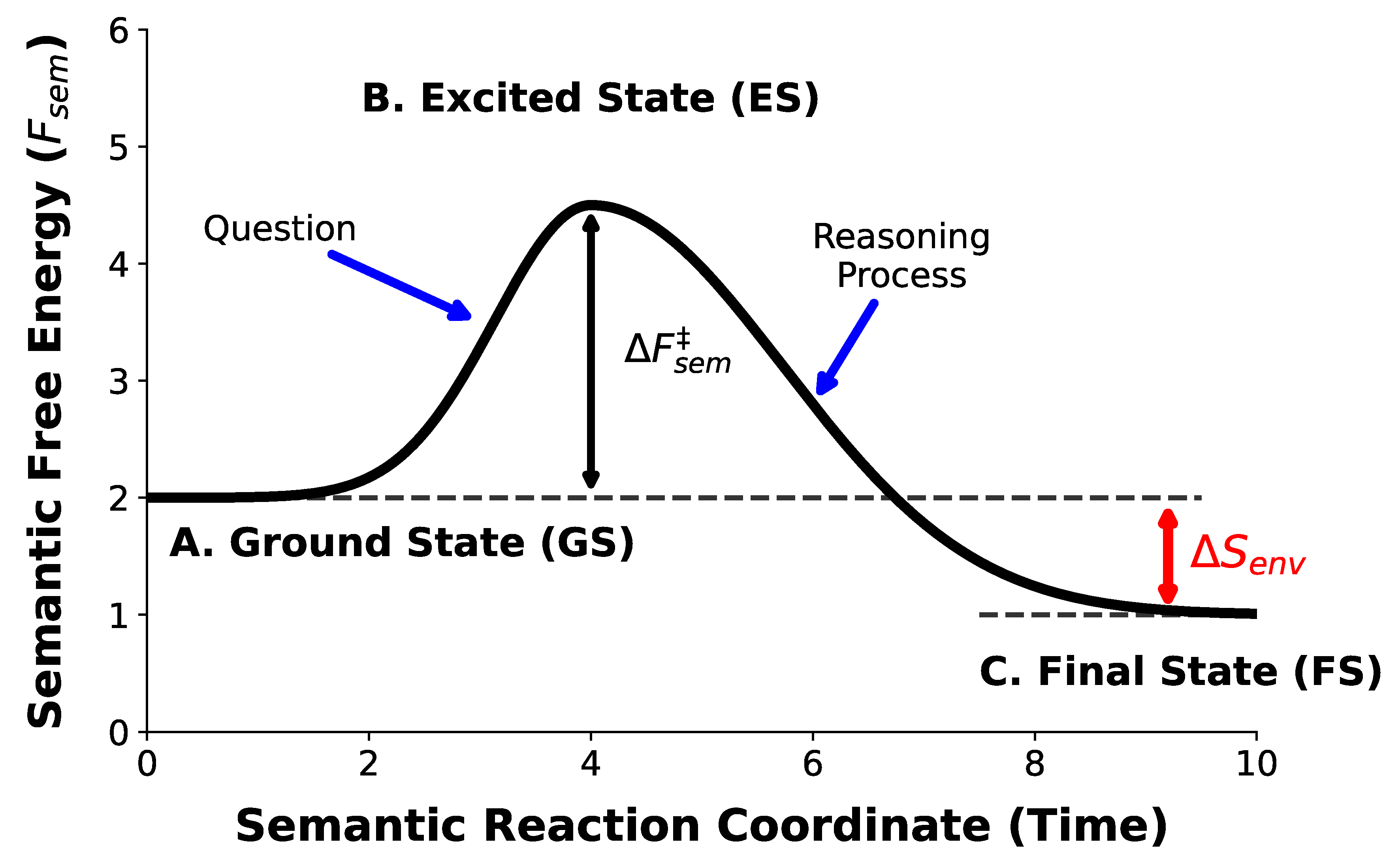
Figure 2.
Orientation-dependent width variation consistent with "shallow notch" artifacts reported in simulations of spinning black holes [34,35,36].
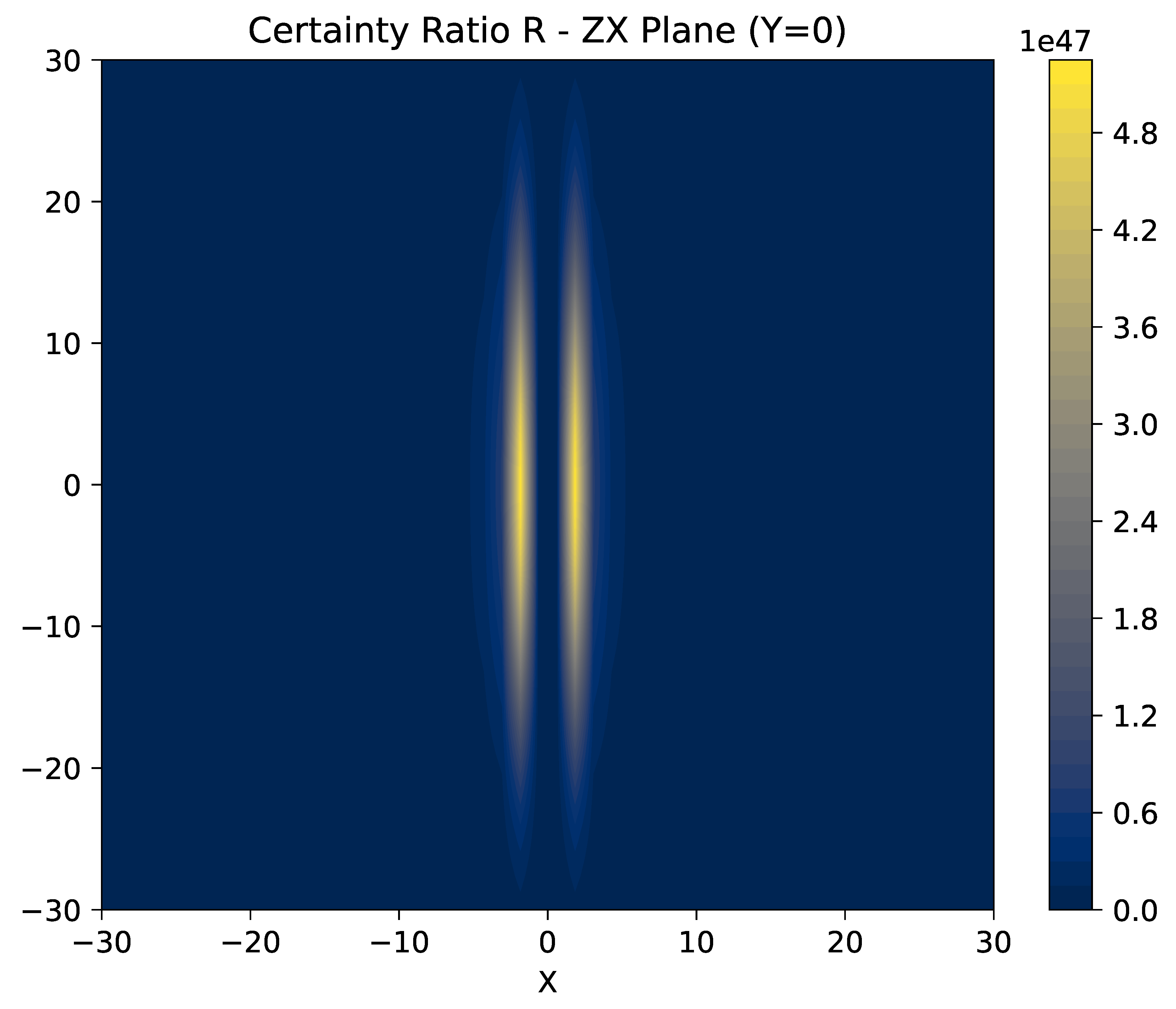
Figure 3.
Orientation-dependent width variation consistent with the "D-shaped" shadow reported in simulations of spinning black holes [34,35,36].
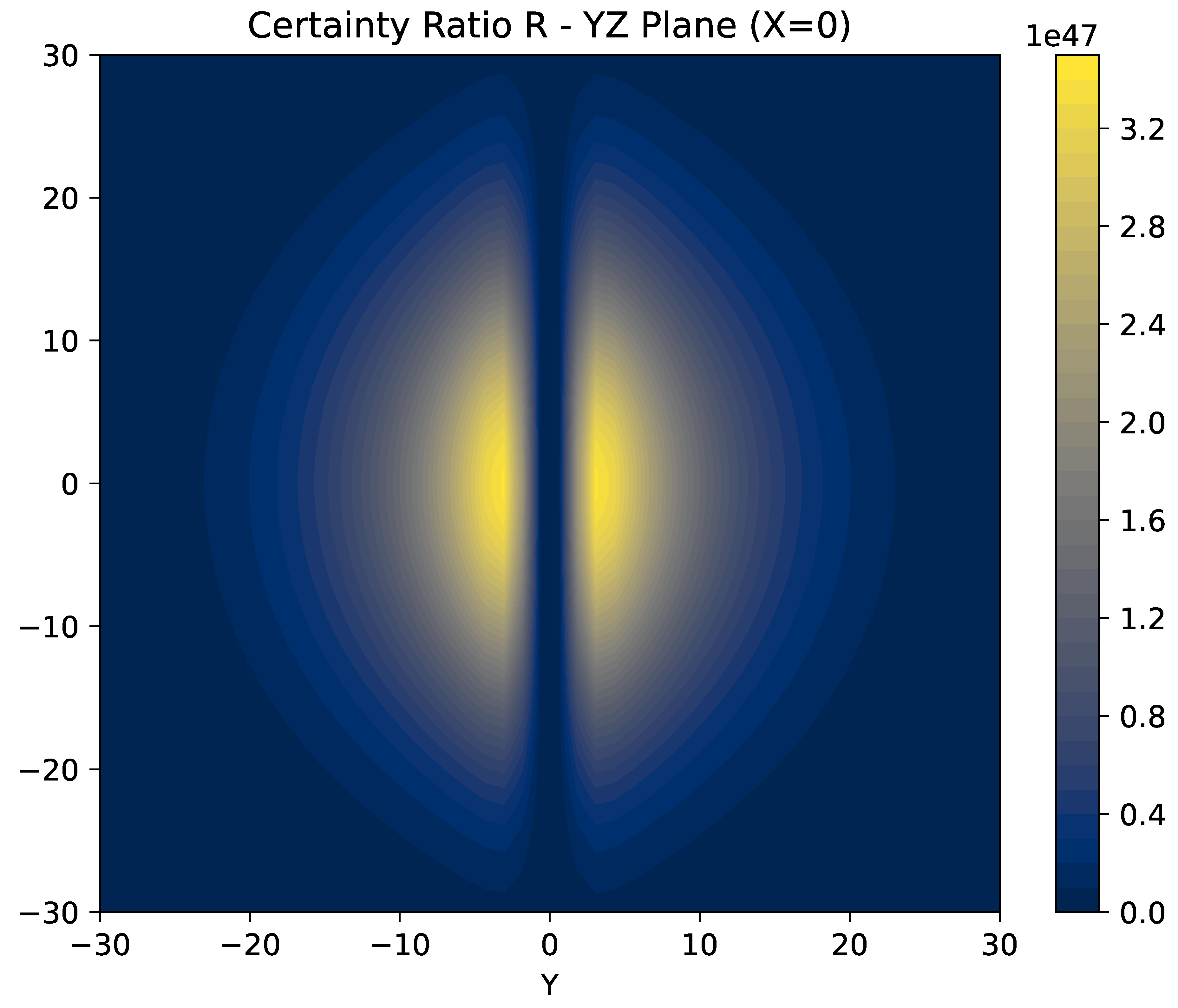
Figure 4.
Certainty ratio for the smaller looped-twist configuration with phase twist ().
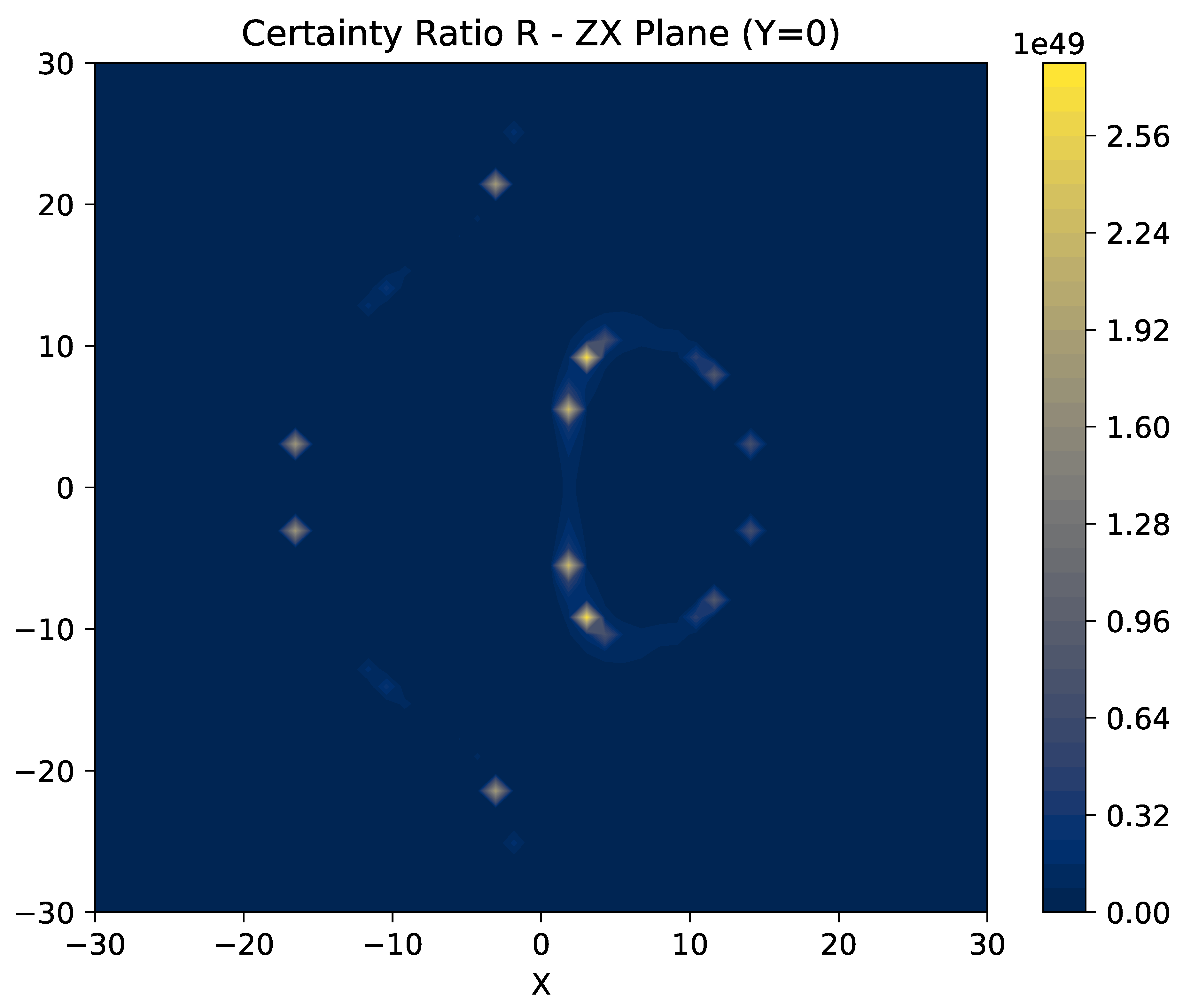
Figure 5.
Large looped-twist configuration with phase twist ().
Figure 6.
Hot Spots shown at representative radii with dotted line. This suggests three hot spots are also hidden on the other side of the black hole. Phase twist values are (). The interior is increasingly orderly as work accumulates non-locally outside and accelerates into the corona.
Figure 6.
Hot Spots shown at representative radii with dotted line. This suggests three hot spots are also hidden on the other side of the black hole. Phase twist values are (). The interior is increasingly orderly as work accumulates non-locally outside and accelerates into the corona.
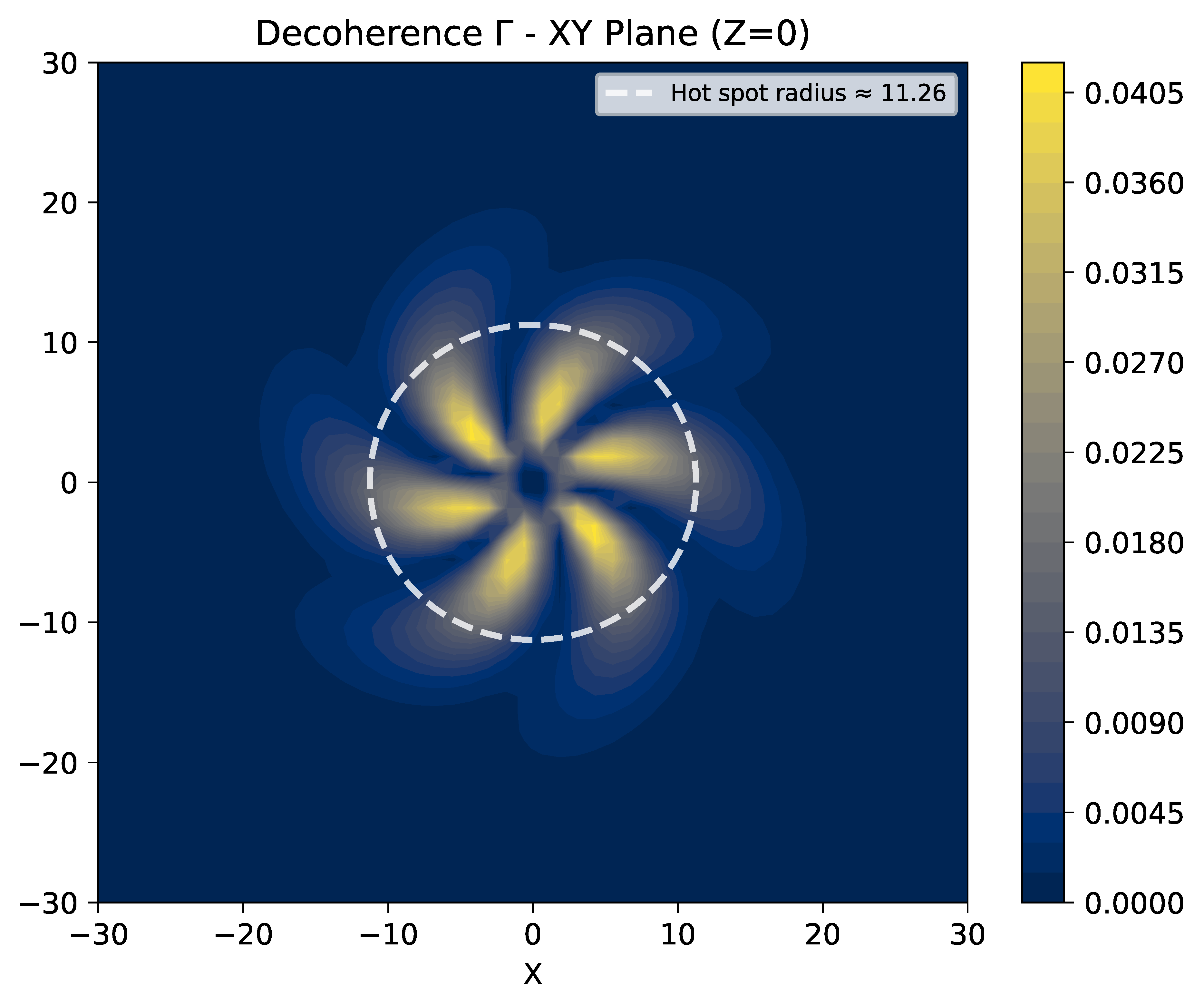
Figure 7.
Decoherence events, or otherwise, the shocks accumulate at the base of the jet as compared to the shallow notch in Figure 2. Phase twist values are ().
Figure 7.
Decoherence events, or otherwise, the shocks accumulate at the base of the jet as compared to the shallow notch in Figure 2. Phase twist values are ().
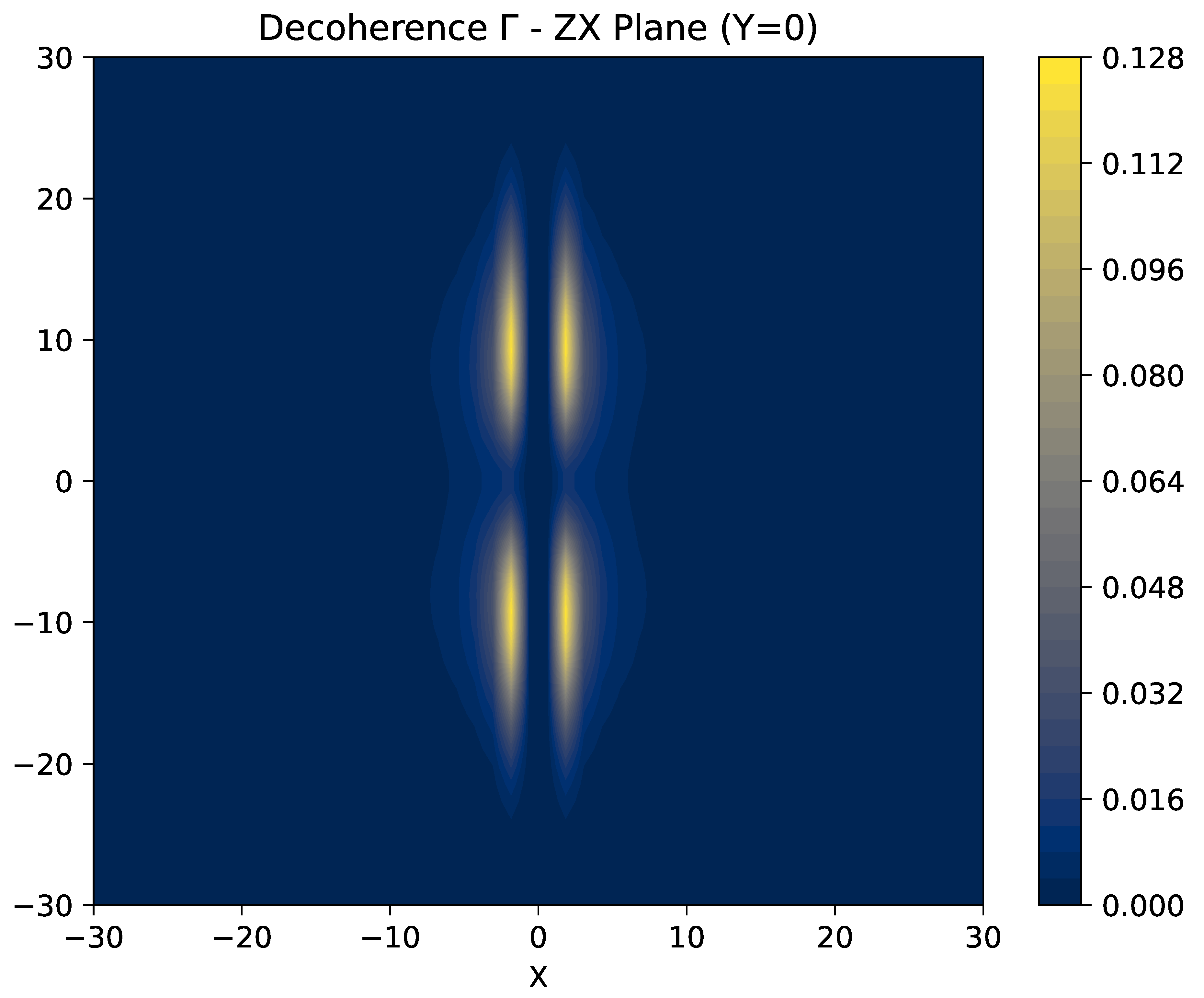
Figure 8.
Decoherence events, or otherwise, the shocks accumulate at the base of the jet as compared to the D-shape in Figure 3. Phase twist values are ().
Figure 8.
Decoherence events, or otherwise, the shocks accumulate at the base of the jet as compared to the D-shape in Figure 3. Phase twist values are ().
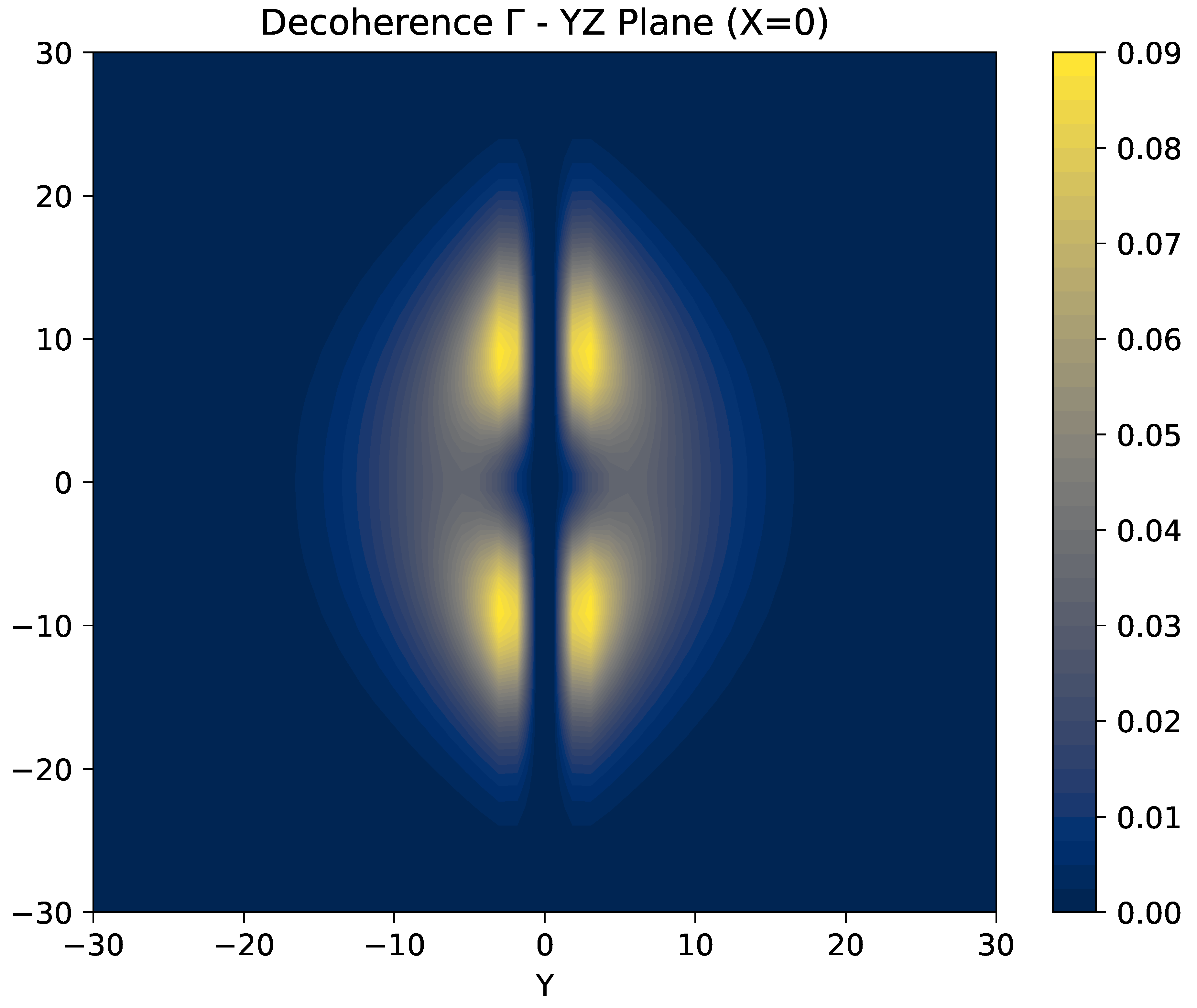
Figure 9.
Through the XY plane without adjusting the phase twist parameters, a complicated set of geometries is displayed.
Figure 9.
Through the XY plane without adjusting the phase twist parameters, a complicated set of geometries is displayed.
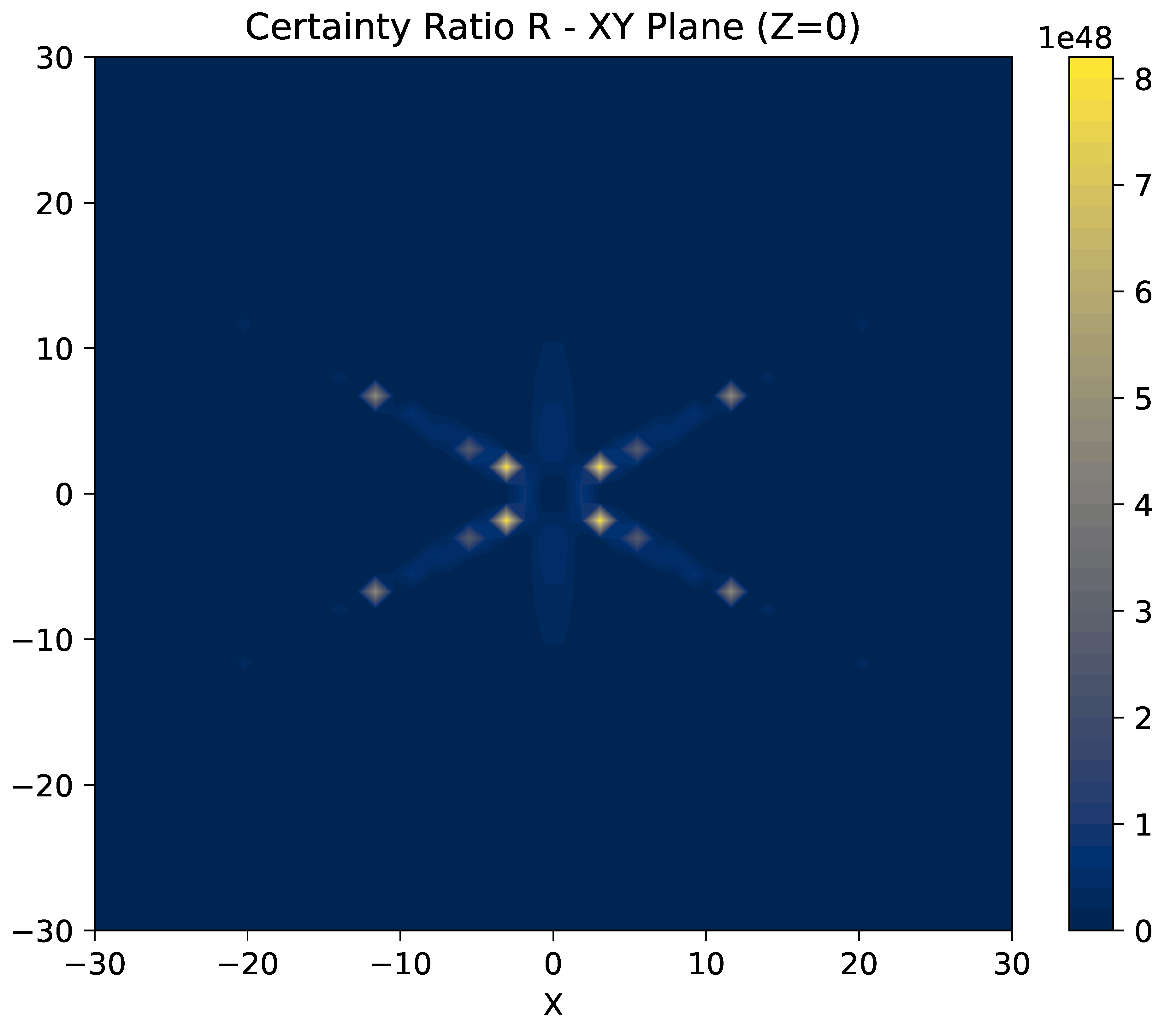
Figure 10.
Through the XY plane and adjusting the phase twist parameters to , , A reduction of symmetry is observed as the C-I system experiences increased phase asymmetry.
Figure 10.
Through the XY plane and adjusting the phase twist parameters to , , A reduction of symmetry is observed as the C-I system experiences increased phase asymmetry.
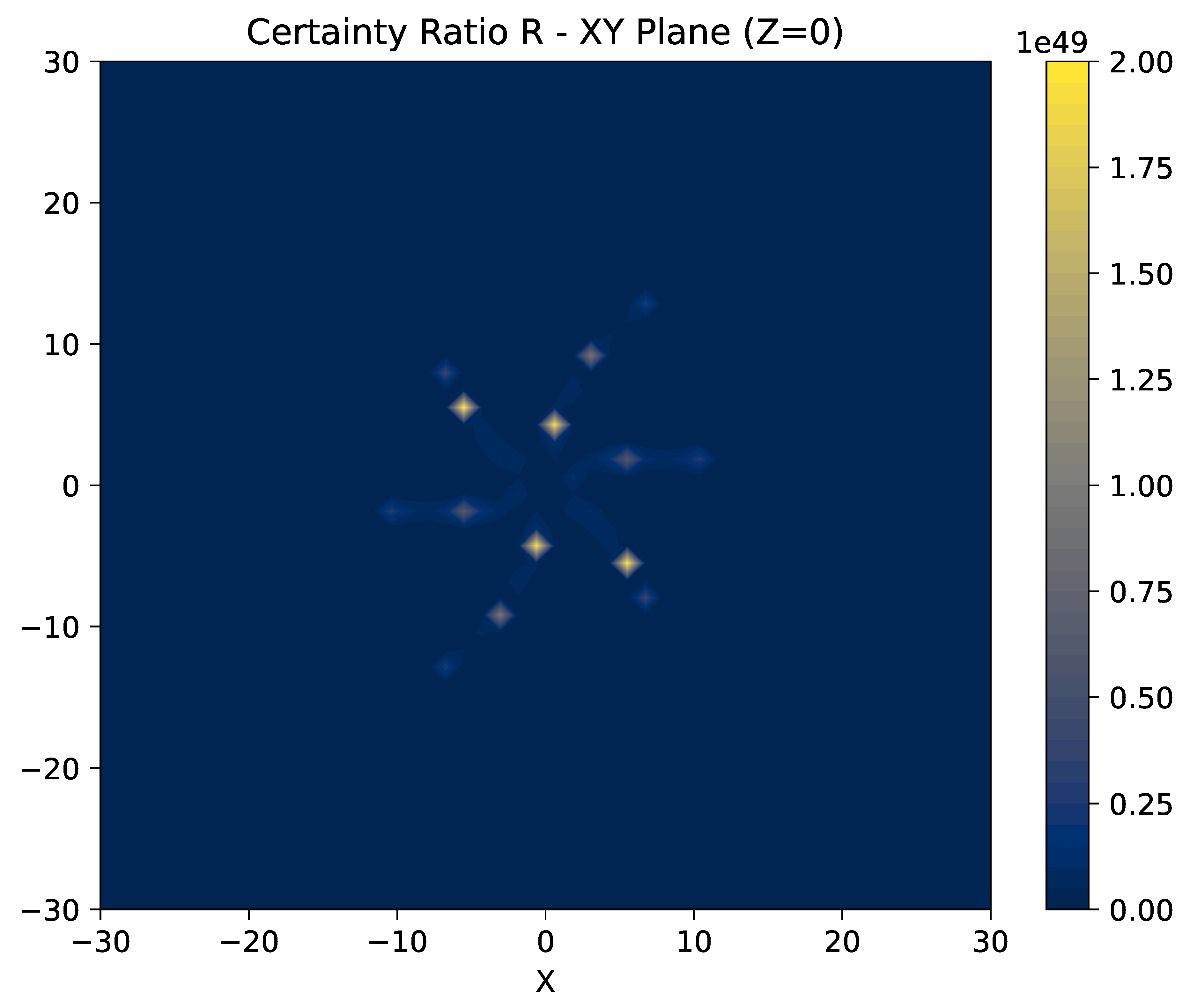
Figure 11.
Through the YZ plane with phase twist parameters set to , , in order to observe the appearance of geometric microstructure in the jets.
Figure 11.
Through the YZ plane with phase twist parameters set to , , in order to observe the appearance of geometric microstructure in the jets.
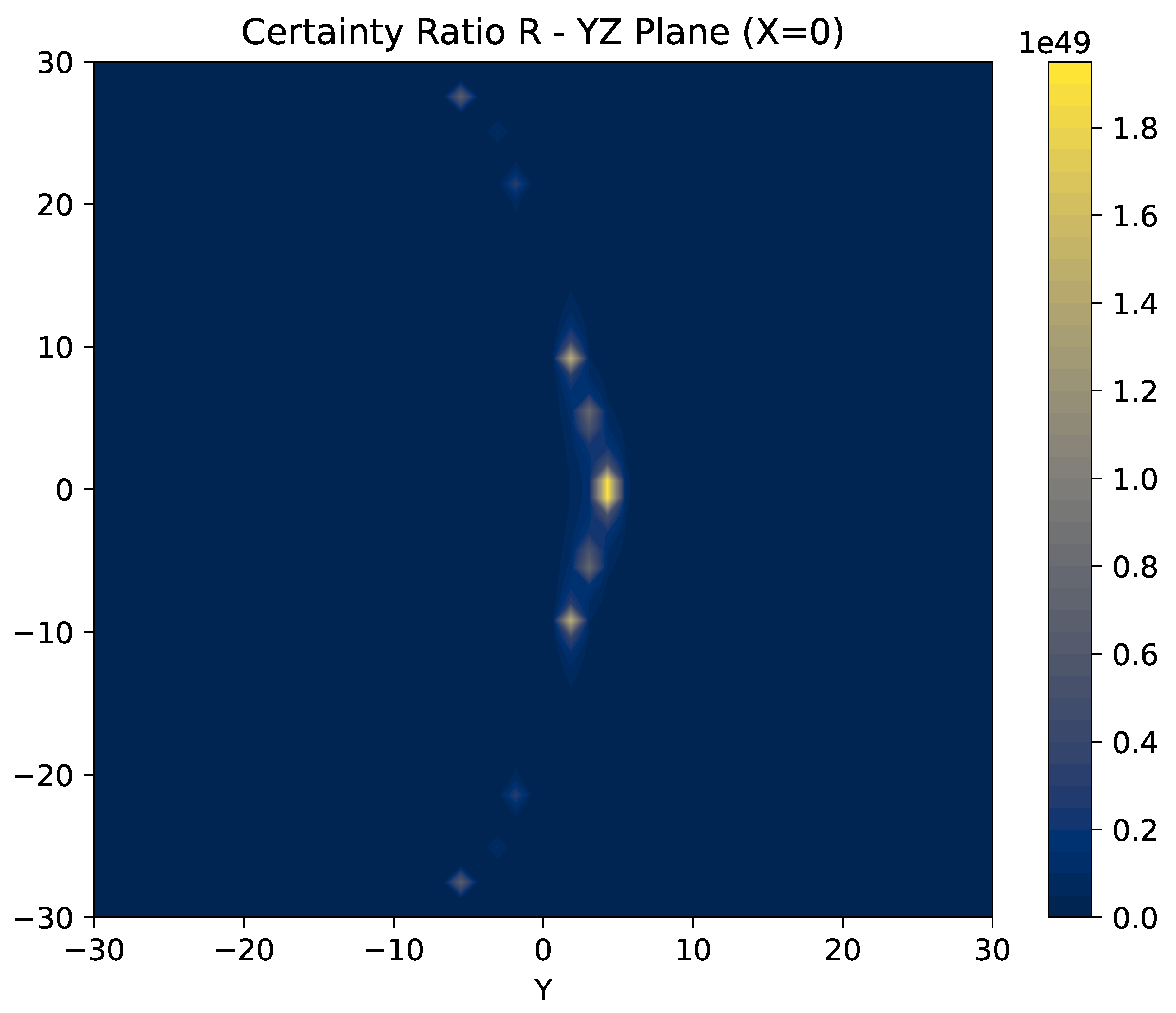
Figure 12.
Phase twist parameters set to , , three high- temperature features on one axis exhibit anisotropic motion, in order to mirror three hot spot features on the opposite axis.
Figure 12.
Phase twist parameters set to , , three high- temperature features on one axis exhibit anisotropic motion, in order to mirror three hot spot features on the opposite axis.
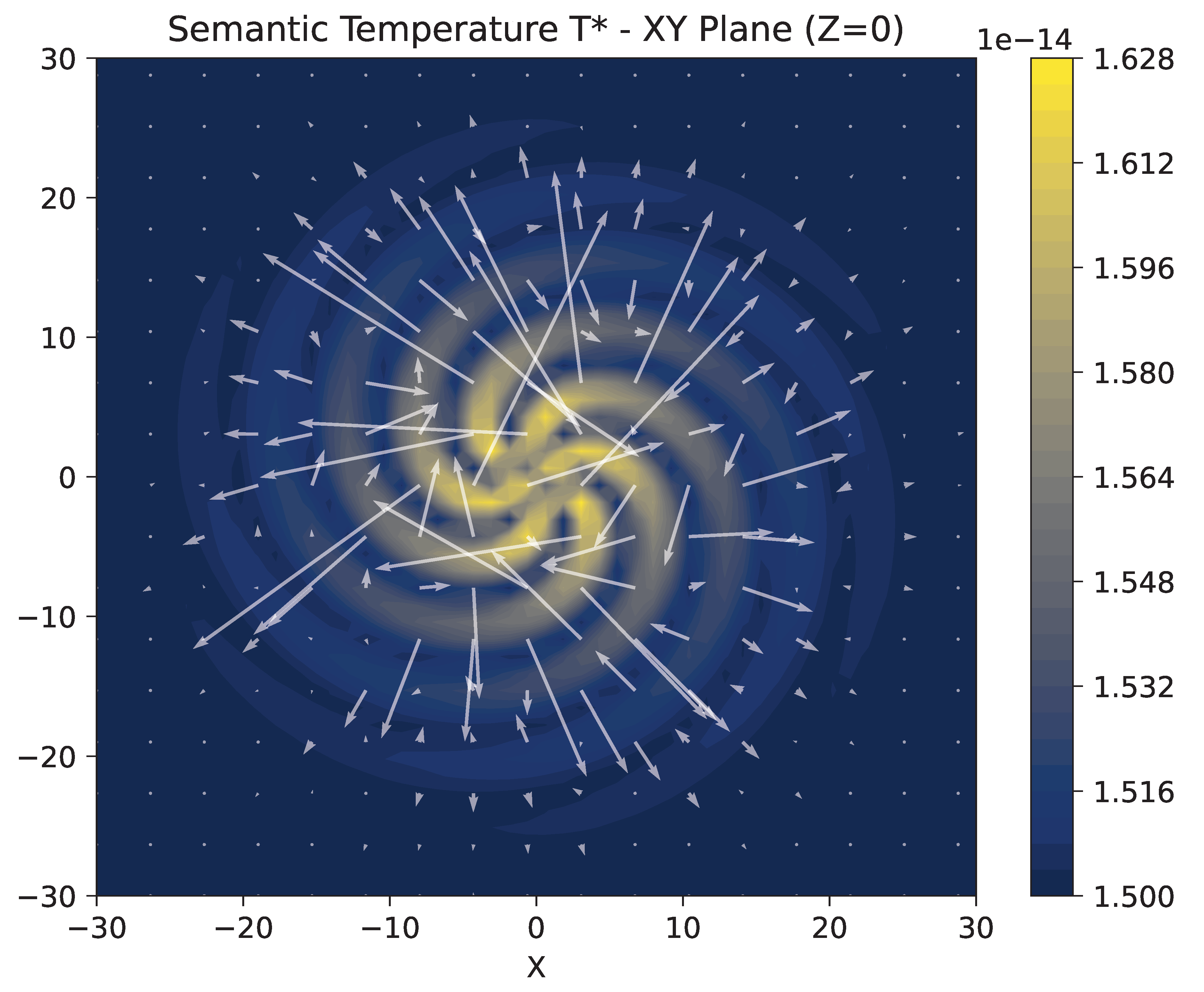
Table 1.
Generalized comparison of Carnot and C-I systems. The C-I engine exhibits inverted thermodynamics.
Table 1.
Generalized comparison of Carnot and C-I systems. The C-I engine exhibits inverted thermodynamics.
| Property | Carnot Engine | C-I System |
|---|---|---|
| Thermodynamic States | ||
| Interior state | Hot (disorderly) | Cold (orderly) |
| Exterior state | Cool radiator (orderly) | Hot exterior (disorderly) |
| Work Mechanisms | ||
| Work mechanism | Thermal gradient flow | Contradiction resolution |
| Output type | Mechanical work | Reasoning (ordered structure) |
Table 2.
Representative entropy definitions.
| Name | Form |
|---|---|
| Boltzmann | |
| Shannon | |
| von Neumann | |
| CT |
Table 3.
Maxwellian kinetic temperature vs semantic temperature .
| Feature | Ideal Gas | C-I System |
|---|---|---|
| Dynamical variable | v | |
| Quadratic energy | ||
| Degrees of freedom | ||
| Temperature |
Table 4.
Semantic velocity as a function of radial distance r for phase twist parameters and . Columns show: (1) radial distance r, (2) mean velocity magnitude in units of m/s, (3) maximum velocity magnitude in units of m/s, (4) maximum velocity as a fraction of c, and (5) number of data points N.
Table 4.
Semantic velocity as a function of radial distance r for phase twist parameters and . Columns show: (1) radial distance r, (2) mean velocity magnitude in units of m/s, (3) maximum velocity magnitude in units of m/s, (4) maximum velocity as a fraction of c, and (5) number of data points N.
| r | Mean | Max | Max | N |
|---|---|---|---|---|
| (m/s) | (m/s) | |||
| 0.50 | 10.16 | 19.89 | 0.663 | 8 |
| 0.84 | 10.16 | 19.89 | 0.663 | 8 |
| 1.18 | 10.16 | 19.89 | 0.663 | 8 |
| 1.53 | 9.769 | 19.89 | 0.663 | 32 |
| 1.87 | 9.638 | 13.13 | 0.438 | 24 |
| 2.21 | 10.00 | 17.60 | 0.587 | 48 |
| 2.55 | 9.643 | 17.60 | 0.587 | 80 |
| 2.89 | 9.645 | 17.60 | 0.587 | 56 |
| 3.24 | 9.666 | 21.43 | 0.714 | 104 |
| 3.58 | 9.317 | 21.43 | 0.714 | 104 |
| 3.92 | 9.691 | 22.93 | 0.764 | 120 |
| 4.26 | 9.976 | 22.93 | 0.764 | 192 |
| 4.61 | 10.09 | 22.93 | 0.764 | 224 |
| 4.95 | 10.34 | 22.93 | 0.764 | 272 |
| 5.29 | 10.71 | 23.31 | 0.777 | 272 |
| 5.63 | 10.31 | 23.31 | 0.777 | 272 |
| 5.97 | 10.09 | 23.31 | 0.777 | 368 |
| 6.32 | 9.790 | 23.31 | 0.777 | 408 |
| 6.66 | 9.577 | 22.75 | 0.758 | 432 |
| 7.00 | 9.607 | 22.75 | 0.758 | 512 |
Disclaimer/Publisher’s Note: The statements, opinions and data contained in all publications are solely those of the individual author(s) and contributor(s) and not of MDPI and/or the editor(s). MDPI and/or the editor(s) disclaim responsibility for any injury to people or property resulting from any ideas, methods, instructions or products referred to in the content. |
© 2026 by the authors. Licensee MDPI, Basel, Switzerland. This article is an open access article distributed under the terms and conditions of the Creative Commons Attribution (CC BY) license (http://creativecommons.org/licenses/by/4.0/).
Copyright: This open access article is published under a Creative Commons CC BY 4.0 license, which permit the free download, distribution, and reuse, provided that the author and preprint are cited in any reuse.