

Submitted:
15 July 2025
Posted:
17 July 2025
You are already at the latest version
Abstract
This research article explores the pressing issue of soil degradation and contamination, highlighting their adverse environmental effects and the necessity for sustainable solu-tions. Soil degradation disrupts ecosystems and accelerates climate change, while soil contamination poses serious health risks to humans and wildlife. Recent advances in mitigation strategies demonstrate promising solutions, focusing on both degradation and contamination. This paper presents innovative methods, including the utilization of a dolomite-sewage sludge mixture to combat soil degradation effectively, enhancing soil fertility and supporting ecosystem restoration. Additionally, it introduces a novel approach using a dolomite-stainless steel slag mixture for petroleum hydrocarbon absorption, showcasing its efficacy in remediating contaminated sites. The results indicate significant improvements in soil health and a reduction in environmental pollutants, underscoring the potential of these mixtures to revolutionize soil management practices. Implementing such strategies not only mitigate degradation and contamination but also contributes to the sustainability of agricultural and natural ecosystems. This article aims to provide a comprehensive overview of these advancements, offering insights for re-searchers, policymakers, and environmental practitioners striving to foster a healthier and more sustainable environment.
Keywords:
soil degradation
; dolomite
; petroleum hydrocarbon absorption
; sustainable environment
1. Introduction
Soil quality is a term widely referenced in discussions on sustainable agriculture, capturing the overall condition of the soil. It includes various factors that contribute to the soil’s ability to support plant life, regulate water, sustain biodiversity, and act as a buffer against environmental changes. However, there is growing evidence that many agricultural soils are suffering from significant degradation. This degradation is manifesting in various ways, including erosion, loss of organic matter, contamination, compaction, and increased salinity. These issues collectively pose substantial risks to our agricultural systems, highlighting the urgent need for improved soil management practices to ensure soil health and sustainability for future generations [1]. The soil degradation problems can be classified into four groups: biological, chemical, ecological and physical (Figure 1). Soil degradation manifests in multiple forms—biological, chemical, ecological, and physical—each contributing to the decline in land productivity. Biological degradation is marked by a reduction in microbial activity, often triggered by harmful biochemical reactions in exposed or unprotected soils. This leads to diminished soil fertility and reduced crop yields. Chemical degradation results from excessive use of synthetic fertilizers and pesticides, causing nutrient imbalances, loss of humus, shifts in pH, and a decline in beneficial microbial populations. Ecological degradation, largely driven by climate change, includes altered rainfall patterns, temperature increases, and extreme weather events, all of which reduce land productivity. Deforestation and vegetation loss further accelerate this process by increasing erosion risk and disrupting local ecosystems. Lastly, physical degradation involves the loss of topsoil through floods, runoff, landslides, wind erosion, over-tillage, and the use of heavy machinery. This form of degradation severely impairs soil structure, composition, and long-term fertility [2].
At the global level, the main threats to soil function include the loss of soil organic carbon (SOC), soil erosion, and nutrient imbalances. In Europe, additional concerns such as soil sealing and land take, salinization and sodification, contamination, and changes in SOC are particularly pressing [3]. Soil organic carbon is the largest carbon reservoir in terrestrial ecosystems and a key determinant of critical soil functions, including agricultural productivity. Under stable environmental conditions and long-term, steady-state management, SOC in agricultural soils tends to reach a dynamic equilibrium—balancing carbon inputs (from crop residues and organic fertilizers) with losses from organic matter decomposition [4].
However, decomposition rates of soil organic matter increase more rapidly with temperature than net primary production. As a result, climate change–driven temperature rises are expected to significantly reduce SOC levels. This trend is especially critical in agricultural soils, where stagnating crop yields in recent decades may already limit carbon inputs, further accelerating SOC depletion [5,6].
Anthropogenic soil erosion has contributed to the long-term degradation of agricultural land, often leading to land abandonment and reduced productivity. While nitrogen and phosphate fertilizers are commonly used to mitigate yield losses, the need to compensate for eroded cropland often drives the conversion of forests and pastures into new farmland, which also requires nutrient enrichment [7,8,9,10]. Moreover, erosion negatively affects the diversity of soil organisms, plants, and animals [11]. The impact of erosion on SOC dynamics depends on specific processes such as detachment and deposition. Research indicates that eroded landscapes contain a smaller total ecosystem carbon pool and that soil organic matter mineralizes more rapidly in sediments than in original topsoil [12]. Soil contamination by heavy metals constitutes a significant global environmental hazard, predominantly arising from anthropogenic activities [13]. Accurately assessing the pollution effects in various areas necessitates data on contamination levels, the mobility of metals, and the key soil properties related to the adsorption and retention of pollutants [14]. The speciation of metals determines the degree of environmental hazard posed by landscape pollution and the migration ability of their compounds [15]. Soil organic matter plays a crucial role in these processes, and studying the relationship between metals and SOM components is essential to evaluate the bioavailability of heavy metals [16]. Salinization and sodification are major processes of soil degradation threatening land productivity and global food security [17]. Salt-induced land degradation is prevalent in arid and semi-arid regions due to insufficient rainfall to sustain the percolation of water through the soil, coupled with irrigation practices that lack adequate drainage systems [18]. The expansion of irrigated agriculture in arid and semi-arid regions has been crucial to meeting the food supply needs of a burgeoning global population. Over the past 50 years, the world's net cultivated area has increased by 12%, while the global irrigated area has doubled during the same timeframe [19]. Among various degradation processes, land-surface impermeabilization poses the greatest threat to soils, as it significantly reduces or eliminates ecosystem functions and services [20]. The processes of land take and soil sealing entail significant reductions in soil function capacities. Consequently, soil subjected to these activities experiences a substantial loss of ecosystem functionalities, many of which are irrecoverable. As a result, land take emerges as a primary contributor to soil degradation, encompassing declines in biodiversity [21], advancing desertification [22], increasing pollutant accumulation [23], and the depletion of productive land [24].
This study highlights the need for developing new strategies to improve contaminated/ degraded soils. This analysis centered to identify and underscore the urgent need for innovative strategies and technologies to remediate and rehabilitate soils that have been contaminated or degraded due to industrial activities, agricultural practices, and environmental pollutants. By conducting a comprehensive assessment of current remediation techniques and their limitations, the study seeks to propose new, effective methods that can enhance soil health, restore ecological balance, and ensure sustainable land use practices for future generations. In addition to synthesizing recent advances in soil degradation mitigation, this paper presents two novel composite formulations developed by the authors. These are currently the subject of national patents and represent applied, sustainable solutions for restoring degraded and contaminated soils. Their inclusion reinforces the practical and innovative focus of this research.
2. Environmental Effects of Soil Degradation/Contamination
2.1. Loss of Soil Fertility
Contaminants like heavy metals, pesticides, and industrial chemicals can degrade soil, leading to reduced agricultural productivity and poor crop yields. Petroleum industry operations, encompassing drilling, exploration, storage, transportation, processing, and refining, are significant contributors to petroleum hydrocarbon spillage. This results in terrestrial oil pollution characterized predominantly by the presence of hydrophobic compounds [25]. The release of petroleum hydrocarbons into the environment presents a significant threat to ecosystems and poses substantial risks to both human health and the environment [26]. Petroleum hydrocarbons are naturally abundant, complex heterogeneous mixtures primarily composed of hydrocarbons, with notable quantities of nitrogen, oxygen, sulphur, and trace metals. They exist in various states, including solid, liquid, and gaseous forms. Petroleum hydrocarbons can be categorized into four main structural groups based on their geographical origin: saturates, aromatics, asphaltenes, and resins [27]. Crude oil composition varies by source but generally consists of 82%–85% carbon, 10%–14% hydrogen, 0.01%–7% sulphur, 0.02%–2% nitrogen, and 0.1%–1% oxygen [28]. Petroleum hydrocarbon release is a global environmental issue. Recently, soil pollution by petroleum hydrocarbons has surged, contaminating many arable lands with organic compounds. This contamination diminishes the availability of arable land and negatively impacts agricultural practices such as decreased yields, health hazards [29]. Petroleum and its products primarily cause adverse changes in all soil properties, impacting everything from soil layer morphology to humic acid chemistry. Petroleum is recognized as one of the most hazardous environmental contaminants owing to its significant toxicity and widespread presence in the biosphere. When evaluating its detrimental effects, petroleum, along with its derivatives and byproducts, is considered second only to radioactive contaminants [28]. The accumulation of spilled petroleum hydrocarbons in the soil at high levels is hazardous to human health and the environment. Soils are major dumps for organic contaminants of various origins and characteristics. Petroleum hydrocarbons contain toxic components that pollute groundwater and soil, alter the soil microbial community, and adversely affect human health and other living organisms [30]. Petroleum spills resulting from mining and processing accidents inflict considerable damage on ecosystems. In these instances, soil is predominantly impacted due to its capacity to accumulate substantial amounts of pollutants, facilitated by its extensive adsorptive surface area. Petroleum contamination adversely affects soil biocenosis, significantly alters the chemical composition, structure, and properties of soil, and diminishes its fertility and agricultural value. Such spills can transform soils into typical technogenic deserts, where biological processes are virtually non-existent. Petroleum-contaminated soils are unsuitable for agricultural and recreational purposes and pose potential risks for contaminating surface and groundwater sources [28]. Petroleum hydrocarbon contaminants (PHCs) are distinguished by their substantial resistance to physical, chemical, and biological degradation processes, resulting in their prolonged persistence in environmental settings. Additionally, PHCs have the capacity to accumulate within living organisms (bioaccumulation) and to amplify in concentration along trophic levels (biomagnification). They also demonstrate significant mobility across various environmental media and exhibit considerable adsorption onto soil organic matter. The inherent toxicological properties of PHCs pose significant risks to both environmental and human health [31]. Polycyclic aromatic hydrocarbons (PAHs) are highly hazardous pollutants due to their remarkable stability, toxicity, and carcinogenic potential. Hydrocarbon contaminants lead to both immediate and delayed effects, including genetic mutations, immunotoxicity, teratogenicity, neurotoxicity, significant immune toxicity, chromosomal damage, carcinogenesis, high bioaccumulation potential, and the degradation of ecosystem functionality. These contaminants adversely impact both animal and plant life [32]. The self-restoration of petroleum-contaminated soils can be a prolonged process, often spanning 10 to 30 years or even longer, contingent upon the soil type and specific environmental conditions [33].
Heavy metal contamination, including arsenic (As), represents a major threat to soil quality and agricultural productivity worldwide [34]. Arsenic exists in two primary oxidation states: As (III), commonly found in anaerobic (reducing) soils, and As (V), prevalent in oxidizing (aerated) environments [35,36]. Both species are toxic to plants and soil microorganisms, impairing nutrient uptake, inhibiting root development, and ultimately reducing soil fertility. The presence of arsenic in agricultural soils often originates from historical pesticide use and industrial pollution, and its remediation is both difficult and time-consuming. In addition to its persistence in soil, arsenic can migrate into crops and groundwater, compounding environmental and health risks. Anthropogenic sources, such as emissions from coal-fired power plants, contribute significantly to atmospheric arsenic deposition, particularly near industrial areas, with concentrations reaching up to 50 ng/m³ [37]. These processes collectively reduce the biological productivity of soils, disturb microbial ecosystems, and lead to long-term fertility decline.
2.2. Water Pollution
Nearby water bodies and wetlands suffer due to pollution, and cropland productivity decreases due to erosion. A leading cause of soil erosion is rainwater, which breaks soil apart, removes it from its location, and carries it away as runoff. Additionally, the type of land use influences the process of soil erosion [38,39]. Besides traditional pathways of soil pollution like using pesticides in agriculture and industrial or urban pollution through contaminated groundwater or irrigation with polluted water, the dangers of airborne soil contamination often receive less attention [40]. Recently, with the exponential increase in plastic waste, nano- and microplastics have gained significant attention due to their prevalence and suspected negative ecological impacts on inshore waters, the sea, and soil. In these environments, plastic waste undergoes mechanical and photochemical degradation, breaking down into smaller, biologically active particles. Manufactured plastics often contain up to 50% of their weight in chemical additives like phthalates, bisphenols, flame retardants, per- and polyfluoroalkyl substances, PCBs, and heavy metals. These additives are used to impart specific properties, such as colour, flexibility, fire resistance, and water resistance. However, many of these additives are known carcinogens, endocrine disruptors, and neurotoxicants. They are not chemically bound to the plastic matrix, allowing them to leach out from microplastic particles and enter the environment or human tissues [41]. Nano- and microplastic particles in polluted seawater primarily enter the human body through the consumption of contaminated seafood. However, some of these particles may also transition from polluted seawater, soil, or household sources into the air as particulates or dust, leading to potential inhalation exposure over long distances. Additionally, the contamination of drinking or irrigation water with nano- and microplastics, along with industrially engineered nanomaterials from wastewater, raises concerns about exposure through the ingestion of contaminated water [40]. In agricultural systems, fertilizers are widely used to boost plant growth, but excess nitrogen, typically as nitrate, can leach from the soil into streams and rivers, eventually reaching drinking water [42]. The significant impact of agricultural and industrial activities on water quality, with contaminants like pesticides, heavy metals, and nitrates leaching into water bodies. Intensive farming practices exacerbate soil erosion and nutrient runoff, further degrading surface water quality. Urban expansion contributes to this issue by altering water infiltration patterns and increasing pollutant transport. Both industrial and mining activities deposit heavy metals in soils, which can then contaminate water through runoff. To counter these negative impacts, integrated land and water management practices are crucial, focusing on reducing soil erosion and managing water contamination to safeguard soil health and water quality.
2.3. Decreased Biodiversity
Ineffective land management results in a significant loss of soil biodiversity, threatening global food production systems. Ecosystems are collapsing due to deforestation, grassland loss, wetland drainage, and flow disruptions, leading to a biodiversity crisis and the highest extinction rate in Earth's history. Five key trends are apparent, including soil degradation and associated biodiversity loss, undermining food production and essential ecosystem services; deforestation and forest degradation, notably in tropical regions; conversion of natural grasslands to erosion-prone, species-poor ecosystems; disappearance of wetlands, endangering freshwater biodiversity; a mass extinction, marking the unprecedented loss of wild plant and animal species [43]. The decline in soil biodiversity, resulting from various individual or combined factors, directly affects surface ecosystems. This loss is more than a conservation concern; it hampers numerous ecosystem functions like decomposition rates, nutrient retention, soil structure development, and nutrient cycling [44]. The degradation of soil and loss of biodiversity are interconnected processes, forming a detrimental cycle. When land is degraded—through activities like over-farming, deforestation, or pollution, the environment for soil microorganisms becomes hostile. These organisms are vital for nutrient cycling and maintaining soil health. As their habitat diminishes, their populations decline, impairing the soil's ability to recover and function effectively. Soil organisms, including earthworms, fungi, and various microorganisms, play crucial roles in maintaining soil structure. Their movements create channels that improve aeration and water drainage. When these organisms are reduced due to biodiversity loss, the soil becomes compacted, leading to poor drainage and increased erosion risk. As biodiversity diminishes, the functions that organisms provide—like breaking down organic matter, recycling nutrients, and promoting plant growth—are also lost. This leads to weakened soil structure, reducing its resistance to erosion from wind and water. The result is accelerated soil degradation, which further reduces biodiversity, continuing the cycle [45,46,47].
Overall, maintaining soil biodiversity is essential to preserve soil health and prevent degradation. This relationship highlights the importance of integrated land management practices to protect ecosystems and sustain their functions.
2.4. Erosion
Soil erosion intensifies soil degradation, creating a reciprocal relationship, as diminished soil quality can trigger a deterioration trend. Indeed, soil erosion can be seen as an indication of soil degradation, as it entails the physical displacement of soil both vertically and horizontally, thereby degrading its quality. The acceleration of this process due to anthropogenic disturbances can severely affect both soil and environmental quality. The mechanism of soil erosion encompasses a three-stage process: detachment, transportation, and deposition of soil [48]. Soil erosion significantly impacts agriculture, influencing both crop yield and long-term sustainability. Erosion removes the nutrient-rich topsoil, essential for plant growth. This loss reduces soil fertility and crop yield, prompting farmers to rely more on fertilizers, which can increase costs and environmental impact [49]. The eroded soil typically lacks organic matter, leading to decreased water retention capacity. This condition makes crops more susceptible to drought and necessitates increased irrigation, raising agricultural costs [50]. Soil erosion leads to a denser and more compacted soil structure, which restricts root development and reduces the infiltration of air and water, ultimately impairing crop growth and productivity [51]. Prolonged erosion can significantly reduce the availability of arable land, limiting the area suitable for cultivation. Moreover, the runoff associated with erosion often carries pesticides and fertilizers into nearby water bodies, contributing to eutrophication and harming aquatic ecosystems and biodiversity [52]. The loss of the topsoil layer also leaves plants more vulnerable to diseases and extreme weather, increasing dependence on chemical plant protection measures [53]. As a consequence, reduced crop yields can translate into economic losses for farmers and potentially lead to rising food prices [54].
To counter these effects, it is essential to implement erosion control strategies such as contour farming, cover cropping, and maintaining permanent vegetation cover. These practices not only help preserve soil integrity but also support long-term agricultural productivity and ecological balance.
2.5. Increased Greenhouse Gas Emissions
Societal challenges, including food security, sustainability, climate change, carbon sequestration, greenhouse gas emissions, and the degradation of soil through erosion and the depletion of organic matter and nutrients, are intricately interconnected with the soil resource. In many regions, the intensification of agricultural practices and land use has led to a decline in the organic matter content in agricultural soils. Furthermore, the extensive application of mineral fertilizers has contributed to atmospheric pollution; greenhouse gas emissions, such as carbon dioxide (CO2) and nitrous oxide (N2O); water eutrophication; and potential human health risks. Nutrient management is especially intensive in greenhouse production systems, where nutrient inputs significantly influence the earth's climate. Globally, around one percent of nitrogen additions is emitted into the atmosphere as nitrous oxide (N2O), a greenhouse gas with 300 times the warming potential of carbon dioxide [56,57]. Soils emit nitrous oxide (N2O), a greenhouse gas about 300 times more potent for climate warming over 100 years than CO2. The primary sources of N2O emissions include agriculture, industry, and biomass burning, indirect emissions from reactive nitrogen through processes like leaching, runoff, and atmospheric deposition. Any soil with available mineral nitrogen (N) can emit N2O through the mineralization of soil organic matter. However, most emissions are driven by nitrogen additions to the soil, primarily from fertilizers, which can be synthetic or organic, such as manures, slurries, and composts. Due to the strong link between nitrogen addition and N2O emission, these emissions are often calculated as a direct function of the amount of nitrogen added to the soil [58]. Methane (CH4) is a potent greenhouse gas, 20–35 times more powerful for climate warming over 100 years than CO2. Soils emit methane through methanogenesis, a process occurring during the decomposition of organic matter in anaerobic soil layers. Conversely, in aerobic layers, methane is oxidized by methanotrophy. Thus, methane emissions result from the balance between methanogenesis and methanotrophy. Soil management strategies focusing on reducing methane (CH4) emissions or enhancing CH4 uptake can bolster the soil’s role in climate regulation. However, enhancing CH4 uptake in managed soils is challenging, making most mitigation efforts concentrate on reducing CH4 emissions instead [59]. Increased greenhouse gas emissions significantly contribute to soil degradation, adversely impacting soil health and productivity. Methane and nitrous oxide emissions from agricultural practices and organic matter decomposition accelerate this degradation by altering soil chemistry, reducing organic matter content, and affecting nutrient cycles. These changes impair the soil's ability to support plant growth, maintain microbial diversity, and regulate water and nutrient retention. Effective soil management strategies that focus on minimizing these emissions and restoring organic matter are crucial for mitigating degradation and enhancing the soil's overall resilience to climate change.
2.6. Impact on Food Safety
Soil degradation directly impacts food safety by compromising the quality and quantity of agricultural produce. As soil health declines, its ability to supply essential nutrients to crops diminishes, leading to nutrient-poor food that may not meet dietary needs. Degraded soils are also more prone to erosion and waterlogging, which can introduce contaminants and pathogens into the food supply, increasing the risk of foodborne illnesses. Additionally, degraded soils often require increased use of chemical fertilizers and pesticides to maintain crop yields, potentially leaving harmful residues in food. Therefore, maintaining healthy soils is crucial for ensuring safe, nutritious food production. In agricultural regions, the challenge has been to increase food production within economic and institutional frameworks that often lack the means to enhance productivity sustainably. The pressure to boost output without supportive measures has resulted in a substantial expansion of agricultural land—over 65 percent in the past thirty years—and a reduction in the fallow periods in traditional, extensive land use systems. This reduction has limited the natural restoration of soil fertility. Additionally, the intensified use of fire for land clearing has further depleted nutrients in numerous systems. Reduced fallow periods and the increasing incidence of fires have been shown to accelerate soil degradation, primarily by depleting soil organic carbon, disrupting microbial communities, and exacerbating erosion processes [60,61]. For example, in shifting cultivation systems across tropical regions, shortened fallow cycles have been linked to declining soil fertility and crop yields [62]. Similarly, repeated burning leads to the volatilization of nutrients and long-term structural damage to soil [63]. Fertilizer consumption has not risen sufficiently to offset the nutrient loss caused by intensified land use, leading to the widespread depletion of soil organic matter and nutrients. Consequently, poor land management practices coupled with inherent vulnerability, have left a significant portion of cropland with low organic matter content, frequently accompanied by low pH and aluminium toxicity. On degraded soils with diminished organic matter, inorganic fertilizers are prone to leaching, which could have adverse long-term implications for agricultural productivity and the quality of downstream water resources [64]. Soil contamination poses a multifaceted threat to food security by directly impacting crop yields and the safety of food products. Contaminants, including heavy metals and persistent organic pollutants, can disrupt plant growth processes, reducing agricultural productivity. When crops are grown on contaminated soils, they may absorb these toxic substances, leading to poor growth and reduced yields. Moreover, the food produced on contaminated lands often poses health risks when consumed. This situation can lead to a reduction in the availability of safe, nutritious food, thereby threatening food security and public health.
Diffuse soil contamination is prevalent and primarily raises concerns about food safety. Diffuse contamination—arising from widespread, low-level inputs of pollutants such as heavy metals, nitrates, and pesticides—can accumulate in soils over time, leading to chronic exposure pathways through food and water, and posing long-term health risks including cancer, neurological disorders, and reproductive issues [65,66,67]. This type of contamination often originates from widespread sources such as industrial emissions, agricultural runoff, and urban waste, which result in lower concentrations of contaminants spread over large areas. Although these concentrations might not always severely impair crop yields, they can still reach harmful levels in edible plant parts, posing long-term health risks to consumers [68].
The challenge lies in managing these contamination sources and implementing effective agricultural practices that mitigate the risk to both crop productivity and food safety. Addressing soil contamination through remediation efforts, improving industrial waste management, and adopting safer agricultural practices (such as precision agriculture and organic farming) are critical for reducing the health risks associated with soil contaminants and ensuring the sustainability of food systems.
3. Recent Advances in Mitigating Soil Degradation/Decontamination
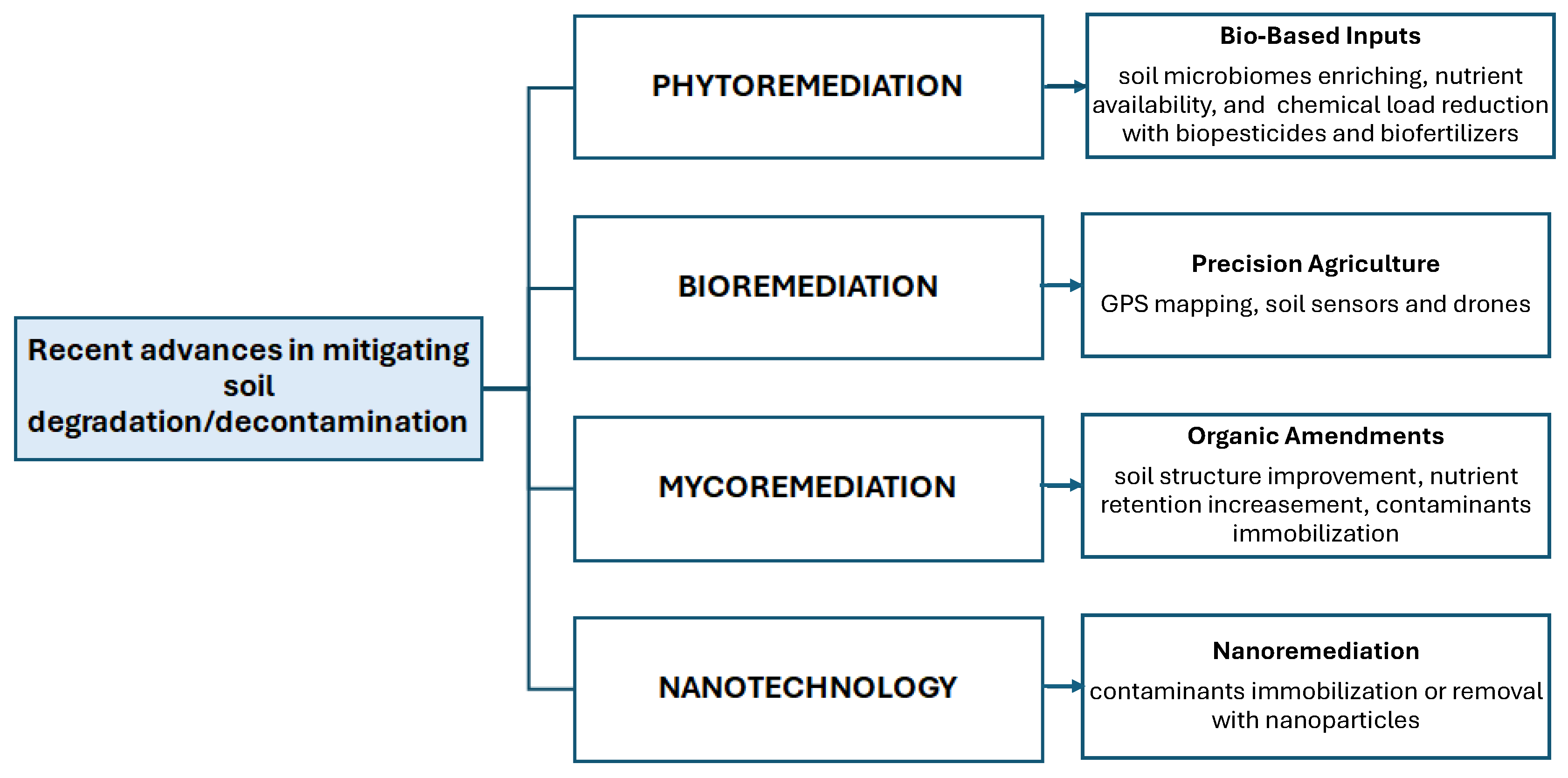
Recent advances in mitigating soil degradation and decontamination have focused on sustainable practices and innovative technologies. The schematic diagram (Figure 2) summarizes the main strategies currently employed to address soil degradation and contamination. The approaches are grouped into key categories: phytoremediation, bioremediation, mycoremediation, nanotechnology, bio-based inputs, precision agriculture, and organic amendments. Each method plays a specific role in restoring soil health—whether by enhancing biological activity, stabilizing contaminants, or improving soil structure and fertility. The diagram highlights the interconnectedness of these techniques and their contribution to sustainable soil management and environmental protection.
Phytoremediation: This plant-based approach uses specific plants to absorb, sequester, and detoxify contaminants from the soil. Researchers are optimizing plant species that are more effective at extracting heavy metals and other pollutants. Biochemical mechanisms facilitate the maintenance of lower metal concentrations within the cytoplasm compared to the surrounding soil, thereby mitigating the detrimental effects of heavy metals on cytoplasmic organelles. This regulation is accomplished via vacuolar sequestration. Plant species lacking an elimination mechanism can uptake and translocate substantial quantities of heavy metals, storing them in their shoots without displaying any toxic symptoms [69]. The sequestration or compartmentalization of metals within cellular compartments, particularly vacuoles, facilitates heavy metal tolerance. This process protects vulnerable cellular regions from heavy metals and prevents the inhibition of cytoplasmic metabolic processes. In contaminated environments, organic solutes and amino acids such as proline support plant growth. The complexation of metals with solutes diminishes the transport of heavy metals to sensitive plant tissues [70]. The concept of avoidance tactics in plants refers to their ability to control the absorption of heavy metals (HMs) and limit their movement into plant tissues through root cells [71]. Five types of phytoremediation mechanisms are used to clean up affected soils. These methods include [72]: (i) Phytoextraction- plants involves the uptake and accumulation of contaminants (typically heavy metals) in plant tissues. It is effective for low-to-moderate contamination levels but is limited by slow biomass growth and metal bioavailability -plants (Sesuvium portulacastrum [73], Noccaea caerulescensis [74], Melilotus officinalis and Amaranthus retroflexus [75], Pennisetum purpureum [76], Alternanthera bettzickiana's [77]) absorb pollutants through their roots and store them in their tissues; (ii) Phytodegradation/Phytotransformation uses plant enzymes to break down organic contaminants (e.g., hydrocarbons, pesticides), offering sustainable in situ remediation, though it is ineffective for inorganic pollutants -plants (Vetiveria zizanioides [78], Nicotiana tabacum [79], Populus deltoids [80], Typha latifolia [81]) break down pollutants into less harmful substances; (iii) Phytovolatilization transforms pollutants into volatile forms released into the atmosphere. While it can be efficient for elements like mercury or selenium, it raises concerns over air quality and secondary pollution – plants (Brassica juncea [82]) release pollutants into the air through their leaves; (iv) Phytofiltration employs plant roots (often in hydroponic systems) to absorb or precipitate contaminants from water. It is efficient for wastewater treatment but requires frequent biomass management-parts of plants (Atriplex halimus [83] Indian mustard (B. juncea) and sunflower (H. annuus) [84,85,86]), such as roots, shoots, or seedlings, are used to remove contaminants from polluted surface waters or wastewater; (v) Phytostabilization reduces contaminant mobility by immobilizing them in the rhizosphere. It is suitable for preventing leaching and erosion but does not remove pollutants from the site -plants (Sorghum bicolor and Carthamus tinctorius [87], Erica australis [88], Helichrysum microphyllum [89]) immobilize pollutants in the soil to prevent their spread.
Bioremediation has emerged as a promising eco-friendly strategy for detoxifying contaminated soils. This technique utilizes microorganisms—primarily bacteria and fungi—to break down or neutralize organic pollutants such as petroleum hydrocarbons (PHCs). These microorganisms facilitate the biotransformation of complex contaminants into simpler, less harmful substances including carbon dioxide, water, and inorganic compounds [90]. Studies have shown that a wide range of microbial species, along with certain algae and plants, are capable of fully mineralizing PHCs in both soil and aquatic environments [91]. Bioremediation encompasses not only microbial activity but also the role of plant-derived enzymes and metabolites in the detoxification process [92].
Mycoremediation, a subset of bioremediation, employs fungal networks to degrade persistent organic compounds and immobilize heavy metals. Through their extensive hyphal systems and metabolic capacity, fungi can mineralize pollutants into harmless end-products such as carbon dioxide, water, and microbial biomass, reducing the risk of contaminant bioaccumulation in the food chain [93]. Mycoremediation represents a sustainable biotechnological approach that employs fungi, as well as associated microorganisms such as bacteria and microalgae, for the degradation and removal of a wide range of environmental contaminants. Specific fungal species have demonstrated targeted bioremediation capabilities against distinct classes of pollutants. For instance, Penicillium simplicissimum is effective in degrading synthetic dyes such as Crystal Violet, Methyl Violet, Malachite Green, and Cotton Blue. Lasiodiplodia sp. has been identified as a potent degrader of Malachite Green, while Cylindrocephalum maurelium shows activity against Mordant Orange-1. In the case of Methyl Blue dye, Aspergillus carbonarius has proven effective. Heavy metal pollutants are also targeted by various fungal species: an Ascomycota consortium is capable of bioaccumulating metals such as Mn, Fe, Cu, Cr, and As; Penicillium chrysogenum demonstrates efficiency in removing Cd(II), Pb, and Cu(II); and Talaromyces islandicus specifically targets Pb. For organic pollutants, Bjerkandera adusta is active against the herbicide Atrazine, while Phlebia lindtneri and Phlebia brevispora are efficient in degrading Lindane, an organochlorine insecticide. Trichoderma harzianum has been shown to degrade polyethylene, a persistent plastic pollutant. Furthermore, Aspergillus niger is capable of degrading the organophosphorus pesticide Diazinon, Fusarium proliferatum targets the insecticide Allethrin, and Trametes versicolor has been utilized for the degradation of the pharmaceutical compound Ketoprofen [94,95].
In parallel, bio-based agricultural inputs such as biopesticides and biofertilizers have gained attention as sustainable alternatives to synthetic chemicals. These products enrich soil microbiomes, enhance nutrient availability, and reduce chemical load, thus preventing further soil degradation.
Precision agriculture technologies, including GPS mapping, soil sensors, and drones, further contribute to sustainable land management. By optimizing input application—particularly fertilizers and irrigation—these innovations minimize environmental contamination and conserve soil resources.
Finally, the application of organic soil amendments, such as biochar, has been shown to improve soil structure, increase nutrient retention, and immobilize contaminants, making them less bioavailable to plants and reducing their ecological impact.
Nanotechnology: Nano-remediation is an innovative approach that addresses the significant pollution challenges of the 21st century. By utilizing nanostructures for environmental remediation, it becomes feasible to reduce the overall costs associated with decreasing large-scale pollution. This method is time-efficient and negates the necessity for additional disposal stages of recycled materials [96]. Compared to traditional materials, nanomaterials offer a higher surface area, leading to enhanced reactivity and increased productivity. Their unique surface chemistry can be tailored with functional groups for selective and efficient contaminant remediation. [97]. Since soil and groundwater pollution are closely linked, nanomaterials used for remediation in both mediums, including nZVI (nano zero-valent iron), bimetallic nanoparticles, and emulsified zerovalent nanoparticles, are generally similar [98,99,100]. Utilizing nanoparticles to immobilize or remove contaminants is a burgeoning field. These particles can be engineered to capture and detoxify specific pollutants in the soil.
Increasing awareness and providing training for sustainable land management practices help prevent further degradation. Policy frameworks support the restoration of contaminated lands and encourage sustainable agricultural practices.
Together, these advances not only help in rehabilitating contaminated soils but also enhance the resilience and productivity of agricultural landscapes, ensuring long-term food security and environmental health.
4. Benefits of Using Mixtures on Soil Degradation/Decontamination
In the context of circular economy and sustainable soil remediation strategies, recent innovations have focused on valorizing industrial by-products through engineered mixtures. This section synthesizes findings from patented technologies and previously validated approaches involving dolomite-based composites for treating degraded and contaminated soils. These case studies exemplify the practical implementation of concepts discussed in the literature and demonstrate the potential of such mixtures in soil restoration frameworks.
4.1. Dolomite–Sewage Sludge Mixture for Soil Quality Enhancement
One notable strategy involves the synergistic use of dolomite and sewage sludge, a concept supported by prior studies [101] that highlight the benefits of combining organic and inorganic amendments. These mixtures create a composite with enhanced structural stability, improved nutrient availability, and reduced toxic element concentrations.
Dolomite, a calcium–magnesium carbonate, is known to regulate pH and provide essential nutrients such as Ca and Mg, both crucial for plant development. Sewage sludge contributes organic matter and a variety of micronutrients, boosting fertility and supporting microbial activity. When applied in tandem, these amendments can enhance soil texture, water retention, and biodegradation of contaminants through microbial pathways.
Documented advantages of such mixtures include:
- -
- Soil fertility restoration via mineral and organic nutrient input.
- -
- pH correction and nutrient balance, particularly in acidic and depleted soils.
- -
- Improved soil structure due to organic matter promoting aggregation.
- -
- Resource recycling, aligning with EU circular economy goals.
Contaminant mitigation, notably polycyclic aromatic hydrocarbons (PAHs), through sorption and microbial degradation mechanisms.
One nationally patented formulation describes the use of a dolomite-to-sewage sludge ratio of 1:2, with both components characterized for their beneficial properties [102]. Analytical results available in the patent documentation indicate notable reductions in PAH concentrations post-application, suggesting the mixture’s potential for restoring soil health and enhancing agricultural productivity. These outcomes fall within the safety thresholds stipulated by Romanian Order no. 344/708/2004, which aligns with EU regulatory frameworks [103,104].
Such patented solutions underscore the applicability of mineral–organic mixtures for the remediation of degraded soils and demonstrate how by-products can be transformed into value-added products for sustainable agriculture.
4.2. Dolomite–Stainless Steel Slag Mixture for Petroleum Hydrocarbon Remediation
Stainless steel slag serves as an effective absorbent for petroleum hydrocarbons due to its porous structure and alkaline composition, while dolomite enhances the stabilization of the mixture and contributes to pH regulation [105,106]. Moreover, metallurgical slags have been previously shown to immobilize or catalytically degrade hydrocarbons, while simultaneously improving soil fertility through the release of essential minerals and the enhancement of soil structure [107,108]. Another patented approach involves using a dolomite and stainless steel slag mixture to target soils contaminated with petroleum hydrocarbons [109]. The innovation leverages the alkaline and porous nature of steel slag to absorb and partially degrade hydrocarbons, while dolomite contributes to pH buffering and soil stabilization.
Studies and patents concerning this mixture have demonstrated the efficacy of combining dolomite (rich in CaCO₃ and MgCO₃) with slag (containing reactive oxides such as CaO, Fe₂O₃, and MgO) in a 1:1 mass ratio. This blend has been shown to enhance hydrocarbon adsorption through surface interactions and catalytic degradation pathways, outperforming conventional absorbents like clay or activated carbon in some applications.
Patent literature reports that application of this mixture to contaminated soils resulted in a substantial decrease in total PAH concentrations, bringing them below the recommended safety limit of 5 mg/kg (as per Order no. 344/708/2004). This approach is aligned with the goals of the EU Mission “A Soil Deal for Europe”, which emphasizes innovative soil recovery technologies.
The formulation provides a cost-effective, scalable solution for remediating hydrocarbon-impacted soils, especially in post-industrial or petroleum-polluted areas. However, as noted in the patent documentation, further field studies and ecotoxicological assessments are required to validate its long-term environmental impact and agronomic efficacy.
4.3. Dolomite–Zeolite Mixture for Heavy Metal Immobilization
Another effective approach involves combining dolomite with natural zeolite, which offers synergistic absorption and immobilization capacity for heavy metals such as Cd, Pb, and Zn [110]. A field experiment carried out in the heavily contaminated region of Copșa Mică (Romania) compared amendments including dolomite, zeolite, bentonite, and manure. Results after two years demonstrated that dolomite and natural zeolite notably increased soil pH, significantly reduced metal bioavailability, and lowered plant uptake of lead and zinc compared to untreated control plots.
The key benefits of this mixture include:
- -
- pH regulation and metal immobilization: Dolomite raises soil pH, decreasing metal solubility, while zeolite’s high cation exchange capacity adsorbs heavy metals, reducing their mobility and uptake.
- -
- Sustained environmental safety: Over two years, the treatment kept metal bioavailability low, although caution is advised regarding potential re-mobilization of metals after the liming effect diminishes.
This section highlighted three validated and documented formulations utilizing dolomite in conjunction with sewage sludge, steel slag, and natural zeolite, each presenting promising strategies for soil remediation. By synthesizing existing knowledge from patents and peer-reviewed literature, these case studies demonstrate how industrial and natural by-products can be successfully repurposed to restore soil quality, reduce contamination, and support sustainable land management. Collectively, they reinforce the connection between scientific innovation, practical application, and the broader goals of circular economy and environmental protection.
5. Conclusions
The study highlights the severe environmental impacts of soil degradation and contamination, including reduced soil fertility, deteriorating water quality and loss of biodiversity. These issues highlight the urgent need for effective mitigation strategies. Recent technological and methodological advances have shown promising results in mitigating the effects of soil degradation. Innovative approaches, such as bioremediation, phytoremediation and advanced chemical treatments, offer more sustainable and environmentally friendly options compared to traditional methods, especially as large areas of agricultural land are annually taken out of service due to oil contamination or increased soil salinity leading to degradation and thus risking the growth of desertified areas.
The research highlights the effectiveness of novel material mixtures in treating contaminated soils. The use of a dolomite-sewage sludge mixture has been shown to be beneficial in improving soil fertility and structural integrity. Similarly, a mixture of dolomite and stainless-steel slag has shown significant potential in absorbing petroleum hydrocarbons, contributing to cleaner soil systems. Applying these mixtures not only helps rehabilitate soil but also promotes sustainability by recycling industrial by-products. This dual function supports environmental integrity while encouraging circular economic principles. Integrating these innovative materials into larger-scale soil remediation projects could mark a substantial step forward in achieving sustainable land management. Further research and field testing will be essential to optimize application techniques and understand the long-term impact precisely to prevent accelerated desertification.
6. Patents
The recipe of the mixture sewage sludge-dolomite for degraded soil is the subject of the national patent intitled: Sewage sludge-based composition with a fertilizing role, RO138471 (A0) ― 2024-11-29, National OSIM patent [102].
The recipe of the mixture dolomite-stainless steel slag for contaminated soil with petroleum hydrocarbons is the subject of the national patent intitled: Petroleum hydrocarbon absorption mixture using dolomite, RO137696 (A0) ― 2023-10-30, National OSIM patent [109].
Supplementary Materials
The following supporting information can be downloaded at the website of this paper posted on Preprints.org, Figure S1: SEM image of dolomite and Figure S2. EDX mapping of dolomite.
Author Contributions
Conceptualization, D.L.B. and V.G.; Methodology, A.C.M., N.L.B. and E.E.H.; Formal analysis and investigation, D.L.B. and V.G.; Writing - original draft preparation, D.L.B. and V.G. All authors have read and agreed to the published version of the manuscript.
Funding
This research was funded by “Dunarea de Jos” University of Galati, Romania, grant research no. 7954/31.03.2025.
Data Availability Statement
All data analyzed during this study are included in this published article and its Supplementary Information files.
Acknowledgments
This research was supported by project Establishment and operationalization of a Competence Center for Soil Health and Food Safety – CeSoH, Contract no.: 760005/2022, specific project no.4, with the title: Innovative and emerging solutions for smart valorisation of residual resources impacting health and safety of soil-food axis (InnES - Innovation, Emerging, Solutions-Soil), Code 2, financed through PNRR-III-C9-2022 – I5 (PNRR-National Recovery and Resilience Plan, C9 Support for the private sector, research, development and innovation, I5 Establishment and operationalization of Competence Centers).”.
Conflicts of Interest
The authors declare no conflicts of interest.
References
- European Commission. Communication from the Commission to the Council, the European Parliament, the Economic and Social Committee and the Committee of the Regions: Towards a Thematic Strategy for Soil Protection [COM (2002) 179 final]. 2002. Available online: https://eur-lex.europa.eu/LexUriServ/LexUriServ.do?uri=COM:2002:0179:FIN:EN:PDF (accessed on 10 December 2024).
- Nunes, F.C.; Alves, L.J.; Cseko, C.; de Carvalho, N.; de Gross, E.M.; Soares, T.; Narasimha, M.; Prasad, V. Chapter 9 - Soil as a complex ecological system for meeting food and nutritional security. In Climate Change and Soil Interactions, Narasimha, M., 1st ed.; Elsevier: Amsterdam, Netherlands, 2020. [Google Scholar]
- Montanarella, L.; Pennock, D.J.; McKenzie, N.; Badraoui, M.; Chude, V.; Baptista, I.; Mamo, T.; Yemefack, M.; Aulakh, M.S.; Yagi, K.; et al. World's soils are under threat. SOIL 2016, 2, 79–82. [Google Scholar] [CrossRef]
- Scharlemann, J.P.; Tanner, E.V.; Hiederer, R.; Kapos, V. Global soil carbon: understanding and managing the largest terrestrial carbon pool. Carbon Manag. 2014, 5, 81–91. [Google Scholar] [CrossRef]
- Wiesmeier, M.; Hübner, R.; Kögel-Knabner, I. Stagnating crop yields: An overlooked risk for the carbon balance of agricultural soils? Sci. Total. Environ. 2015, 536, 1045–1051. [Google Scholar] [CrossRef]
- Grassini, P.; Eskridge, K.M.; Cassman, K.G. Distinguishing between yield advances and yield plateaus in historical crop production trends. Nat. Commun. 2013, 4, 2918. [Google Scholar] [CrossRef]
- Pimentel, D.; Harvey, C.; Resosudarmo, P.; Sinclair, K.; Kurz, D.; McNair, M.; Crist, S.; Shpritz, L.; Fitton, L.; Saffouri, R.; et al. Environmental and Economic Costs of Soil Erosion and Conservation Benefits. Science 1995, 267, 1117–1123. [Google Scholar] [CrossRef] [PubMed]
- Young, A. Land Resources: Now and for the Future; Cambridge University Press: Cambridge, UK, 1998. [Google Scholar]
- Lal, R. Enhancing crop yields in the developing countries through restoration of the soil organic carbon pool in agricultural lands. Land Degrad. Dev. 2005, 17, 197–209. [Google Scholar] [CrossRef]
- Pimentel, D. Soil Erosion: A Food and Environmental Threat. Environ. Dev. Sustain. 2006, 8, 119–137. [Google Scholar] [CrossRef]
- Pimentel, D.; Cornell University, Ithaca, NY, USA. Personal communication. 18 July 2013. [Google Scholar]
- Roose, E.J.; Lal, R.; Feller, C.; Barthes, B.; Stewart, B.A. (Eds.) Soil Erosion and Carbon Dynamics, 1st ed.; CRC Press: Boca Raton, FL, USA, 2005. [Google Scholar]
- Zhao, X.; Gao, B.; Xu, D.; Gao, L.; Yin, S. Heavy metal pollution in sediments of the largest reservoir (Three Gorges Reservoir) in China: a review. Environ. Sci. Pollut. Res. 2017, 24, 20844–20858. [Google Scholar] [CrossRef]
- Barsova, N.; Motuzova, G.; Kolchanova, K.; Stepanov, A.; Karpukhin, M.; Minkina, T.; Mandzhieva, S. The effect of humic substances on Cu migration in the soil profile. Chem. Ecol. 2018, 35, 86–101. [Google Scholar] [CrossRef]
- Liu, X.-P.; Bi, Q.-F.; Qiu, L.-L.; Li, K.-J.; Yang, X.-R.; Lin, X.-Y. Increased risk of phosphorus and metal leaching from paddy soils after excessive manure application: Insights from a mesocosm study. Sci. Total. Environ. 2019, 666, 778–785. [Google Scholar] [CrossRef]
- Lasota, J.; Błońska, E.; Łyszczarz, S.; Tibbett, M. Forest Humus Type Governs Heavy Metal Accumulation in Specific Organic Matter Fractions. Water, Air, Soil Pollut. 2020, 231, 1–13. [Google Scholar] [CrossRef]
- Butcher, K.; Wick, A.F.; DeSutter, T.; Chatterjee, A.; Harmon, J. Soil Salinity: A Threat to Global Food Security. Agron. J. 2016, 108, 2189–2200. [Google Scholar] [CrossRef]
- Qadir, M.; Quillérou, E.; Nangia, V.; Murtaza, G.; Singh, M.; Thomas, R.; Drechsel, P.; Noble, A. Economics of salt-induced land degradation and restoration. Nat. Resour. Forum 2014, 38, 282–295. [Google Scholar] [CrossRef]
- FAO. The State of the World’s Land and Water Resources for Food and Agriculture (SOLAW) – Managing Systems at Risk; FAO: Rome, Italy; Earthscan: London, UK, 2011. [Google Scholar]
- Shahtahmassebi, A.R.; Song, J.; Zheng, Q.; Blackburn, G.A.; Wang, K.; Huang, L.Y.; Pan, Y.; Moore, N.; Shahtahmassebi, G.; Haghighi, R.S.; et al. Remote sensing of impervious surface growth: A framework for quantifying urban expansion and re-densification mechanisms. Int. J. Appl. Earth Obs. Geoinformation 2016, 46, 94–112. [Google Scholar] [CrossRef]
- McKinney, M.L. Urbanization, biodiversity, and conservation. Bioscience 2002, 52, 883–890. [Google Scholar] [CrossRef]
- Barbero-Sierra, C.; Marques, M.; Ruíz-Pérez, M. The case of urban sprawl in Spain as an active and irreversible driving force for desertification. J. Arid. Environ. 2013, 90, 95–102. [Google Scholar] [CrossRef]
- Charzyński, P.; Plak, A.; Hanaka, A. Influence of the soil sealing on the geoaccumulation index of heavy metals and various pollution factors. Environ. Sci. Pollut. Res. 2016, 24, 4801–4811. [Google Scholar] [CrossRef]
- Tóth, G. Impact of land-take on the land resource base for crop production in the European Union. Sci. Total. Environ. 2012, 435-436, 202–214. [Google Scholar] [CrossRef]
- Chettri, B.; Singha, N.A.; Singh, A.K. Efficiency and kinetics of Assam crude oil degradation by Pseudomonas aeruginosa and Bacillus sp. Arch. Microbiol. 2021, 203, 5793–5803. [Google Scholar] [CrossRef]
- Guarino, C.; Spada, V.; Sciarrillo, R. Assessment of three approaches of bioremediation (Natural Attenuation, Landfarming and Bioagumentation – Assistited Landfarming) for a petroleum hydrocarbons contaminated soil. Chemosphere 2017, 170, 10–16. [Google Scholar] [CrossRef]
- Kebede, G.; Tafese, T.; Abda, E.M.; Kamaraj, M.; Assefa, F.; He, Y. Factors Influencing the Bacterial Bioremediation of Hydrocarbon Contaminants in the Soil: Mechanisms and Impacts. J. Chem. 2021, 2021, 1–17. [Google Scholar] [CrossRef]
- Stepanova, A.Y.; Gladkov, E.A.; Osipova, E.S.; Gladkova, O.V.; Tereshonok, D.V. Bioremediation of Soil from Petroleum Contamination. Processes 2022, 10, 1224. [Google Scholar] [CrossRef]
- Popoola, L.T.; Yusuff, A.S.; Adeyi, A.A.; Omotara, O.O. Bioaugmentation and biostimulation of crude oil contaminated soil: Process parameters influence. South Afr. J. Chem. Eng. 2022, 39, 12–18. [Google Scholar] [CrossRef]
- Chaudhary, D.K.; Bajagain, R.; Jeong, S.-W.; Kim, J. Effect of consortium bioaugmentation and biostimulation on remediation efficiency and bacterial diversity of diesel-contaminated aged soil. World J. Microbiol. Biotechnol. 2021, 37, 1–12. [Google Scholar] [CrossRef]
- Morillo, E.; Madrid, F.; Lara-Moreno, A.; Villaverde, J. Soil bioremediation by cyclodextrins. A review. Int. J. Pharm. 2020, 591, 119943. [Google Scholar] [CrossRef] [PubMed]
- Chaudhary, D.K.; Kim, J. New insights into bioremediation strategies for oil-contaminated soil in cold environments. Int. Biodeterior. Biodegrad. 2019, 142, 58–72. [Google Scholar] [CrossRef]
- L.K. Sadovnikova, O.O. L.K. Sadovnikova, O.O. Ekologiya H.Z. Sredy, S. Vysshaya Moscow, Russia, 2006; ISBN 5-06-005558-2.; Lifshits, S.K.; Glyaznetsova, Y.; Chalaya, O.N. Self-Regeneration of Oil-Contaminated Soils in the Cryolithozone on the Example of the Territory of the Former Oil Pipeline «Talakan-Vitim». In Proceedings of the INTEREKSPO GEO-SIBIR, Novosibirsk, Russia, pp. 199–206, 2018.
- García-Carmona, M.; Romero-Freire, A.; Aragón, M.S.; Garzón, F.M.; Peinado, F.M. Evaluation of remediation techniques in soils affected by residual contamination with heavy metals and arsenic. J. Environ. Manag. 2017, 191, 228–236. [Google Scholar] [CrossRef] [PubMed]
- L. Kashyap, N. Garg, Arsenic toxicity in crop plants: responses and remediation strategies, in: M. Hasanuzzaman, K. Nahar, M. Fujita (Eds.), Mechanisms of Arsenic Toxicity and Tolerance in Plants, Springer, Singapore, 2018. [CrossRef]
- Wang, H.-T.; Ding, J.; Xiong, C.; Zhu, D.; Li, G.; Jia, X.-Y.; Zhu, Y.-G.; Xue, X.-M. Exposure to microplastics lowers arsenic accumulation and alters gut bacterial communities of earthworm Metaphire californica. Environ. Pollut. 2019, 251, 110–116. [Google Scholar] [CrossRef]
- Official Journal of the European Union, Directive 2004/107/EC of the European Parliament and of the Council of 15/12/2004 relating to arsenic, cadmium, mercury, nickel and polycyclic aromatic hydrocarbons in ambient air, J. Eur. Union L 23 (2005) 3–16.
- Y. Liu, Landscape connectivity in Soil Erosion Research: concepts, implication, quantification. Geogr. Res. Pap. 1 (2016) 195–202.
- Sun, W.; Shao, Q.; Liu, J.; Zhai, J. Assessing the effects of land use and topography on soil erosion on the Loess Plateau in China. CATENA 2014, 121, 151–163. [Google Scholar] [CrossRef]
- Münzel, T.; Hahad, O.; Daiber, A.; Landrigan, P.J. Soil and water pollution and human health: what should cardiologists worry about? Cardiovasc. Res. 2022, 119, 440–449. [Google Scholar] [CrossRef]
- Wright, S.L.; Thompson, R.C.; Galloway, T.S. The physical impacts of microplastics on marine organisms: A review. Environ. Pollut. 2013, 178, 483–492. [Google Scholar] [CrossRef] [PubMed]
- Ward, M.H.; Jones, R.R.; Brender, J.D.; De Kok, T.M.; Weyer, P.J.; Nolan, B.T.; Villanueva, C.M.; Van Breda, S.G. Drinking Water Nitrate and Human Health: An Updated Review. Int. J. Environ. Res. Public Heal. 2018, 15, 1557. [Google Scholar] [CrossRef] [PubMed]
- Wilson, E.O. (Ed.) Biodiversity; National Academy Press: Washington, DC, USA, 1988. [Google Scholar]
- Wagg, C.; Bender, S.F.; Widmer, F.; van der Heijden, M.G.A. Soil biodiversity and soil community composition determine ecosystem multifunctionality. Proc. Natl. Acad. Sci. 2014, 111, 5266–5270. [Google Scholar] [CrossRef] [PubMed]
- Bardgett, R.D.; van der Putten, W.H. Belowground biodiversity and ecosystem functioning. Nature 2014, 515, 505–511. [Google Scholar] [CrossRef]
- FAO, ITPS, GSBI, SCBD, EC. State of knowledge of soil biodiversity—Status, challenges and potentialities; FAO: Rome, Italy, 2020. [Google Scholar]
- Wall, D.H.; Bardgett, R.D.; Behan-Pelletier, V.; Herrick, J.E.; Jones, T.H.; Ritz, K.; Six, J.; Strong, D.R.; van der Putten, W.H. Soil Ecology and Ecosystem Services. Oxford University Press: Oxford, UK, 2012. [CrossRef]
- Lal, R. Soil degradation by erosion. Land Degrad. Dev. 2001, 12, 519–539. [Google Scholar] [CrossRef]
- Bashagaluke, J.B.; Logah, V.; Opoku, A.; Sarkodie-Addo, J.; Quansah, C.; Marelli, B. Soil nutrient loss through erosion: Impact of different cropping systems and soil amendments in Ghana. PLOS ONE 2018, 13, e0208250. [Google Scholar] [CrossRef]
- Silva, T.P.; Bressiani, D.; Ebling, É.D.; Reichert, J.M. Best management practices to reduce soil erosion and change water balance components in watersheds under grain and dairy production. Int. Soil Water Conserv. Res. 2024, 12, 121–136. [Google Scholar] [CrossRef]
- Lal, R. Soil Structure and Sustainability. J. Sustain. Agric. 1991, 1, 67–92. [Google Scholar] [CrossRef]
- Quinton, J.N.; Fiener, P. Soil erosion on arable land: An unresolved global environmental threat. Prog. Phys. Geogr. Earth Environ. 2023, 48, 136–161. [Google Scholar] [CrossRef]
- Zuazo, V.D.; Pleguezuelo, C.R.R. Soil-Erosion and Runoff Prevention by Plant Covers: A Review. Agron. Sustain. Dev. 2009, 28, 785–811. [Google Scholar] [CrossRef]
- Gyssels, G.; Poesen, J.; Bochet, E.; Li, Y. Impact of plant roots on the resistance of soils to erosion by water: a review. Prog. Phys. Geogr. 2005, 29, 189–217. [Google Scholar] [CrossRef]
- Galloway, J.N.; Townsend, A.R.; Erisman, J.W.; Bekunda, M.; Cai, Z.; Freney, J.R.; Martinelli, L.A.; Seitzinger, S.P.; Sutton, M.A. Transformation of the Nitrogen Cycle: Recent Trends, Questions, and Potential Solutions. Science 2008, 320, 889–892. [Google Scholar] [CrossRef] [PubMed]
- Klein Goldewijk, K.; van Drecht, G. Current and historical population and land cover. In: Bouwman, A.F., Kram, T., Klein Goldewijk, K. (Eds.), Integrated Modelling of Global Environmental Change. An overview of IMAGE 2.4. Netherlands Environmental Assessment Agency, 2006; pp. 93–112.
- Klein Goldewijk, K.; Beusen, A.; van Drecht, G.; De Vos, M. The HYDE 3.1 spatially explicit database of human-induced global land-use change over the past 12,000 years. Glob. Ecol. Biogeogr. 20(1) (2011) 73–86.
- Reay, D.S.; Davidson, E.A.; Smith, K.A.; Smith, P.; Melillo, J.M.; Dentener, F.; Crutzen, P.J. Global agriculture and nitrous oxide emissions. Nat. Clim. Chang. 2012, 2, 410–416. [Google Scholar] [CrossRef]
- Le Mer, J.; Roger, P. Production, oxidation, emission and consumption of methane by soils: A review. Eur. J. Soil Biol. 2001, 37, 25–50. [Google Scholar] [CrossRef]
- Lal, R. Soil degradation by erosion. Land Degrad. Dev. 2001, 12, 519–539. [Google Scholar] [CrossRef]
- Pellegrini, A.F.A.; Ahlström, A.; Hobbie, S.E.; Reich, P.B.; Nieradzik, L.P.; Staver, A.C.; Scharenbroch, B.C.; Jumpponen, A.; Anderegg, W.R.L.; Randerson, J.T.; et al. Fire frequency drives decadal changes in soil carbon and nitrogen and ecosystem productivity. Nature 2017, 553, 194–198. [Google Scholar] [CrossRef]
- Ziegler, A.D.; Phelps, J.; Yuen, J.Q.; Webb, E.L.; Lawrence, D.; Fox, J.M.; Bruun, T.B.; Leisz, S.J.; Ryan, C.M.; Dressler, W.; et al. Carbon outcomes of major land-cover transitions in SE Asia: great uncertainties and REDD + policy implications. Glob. Chang. Biol. 2012, 18, 3087–3099. [Google Scholar] [CrossRef]
- Certini, G. Effects of fire on properties of forest soils: a review. Oecologia 2005, 143, 1–10. [Google Scholar] [CrossRef]
- FAO and ITPS. Status of the World’s Soil Resources (SWSR) – Main Report; Food and Agriculture Organization of the United Nations and Intergovernmental Technical Panel on Soils: Rome, Italy, 2015. [Google Scholar]
- van Grinsven, H.J.M.; Rabl, A.; de Kok, T.M.; Drews, M.; Friedrich, R.; Hertel, O.; Holland, M.; Klimont, Z.; Matsuoka, Y.; Mayorga, E.; et al. Estimating the costs of nitrogen pollution in Europe and the effects of measures. Environ. Sci. Technol. 2013, 47, 3571–3579. [Google Scholar] [CrossRef]
- Sharma, B.; Singh, S. Heavy metals in vegetables: Screening health risks involved in cultivation along wastewater drain and irrigated river in India. J. Environ. Sci. Health Part B 2014, 49, 781–788. [Google Scholar] [CrossRef]
- Panagos, P.; Van Liedekerke, M.; Yigini, Y.; Montanarella, L. Contaminated Sites in Europe: Review of the Current Situation Based on Data Collected through a European Network. J. Environ. Public Heal. 2013, 2013, 1–11. [Google Scholar] [CrossRef]
- Blum, W.E.H.; Nortcliff, S. Soils and food security. In: Brevik, E.C., Burgess, L.C. (Eds.), Soils and Human Health. CRC Press: Boca Raton, FL, USA, 2013; pp. 299–321.
- Ali, H.; Khan, E.; Sajad, M.A. Phytoremediation of heavy metals—Concepts and applications. Chemosphere 2013, 91, 869–881. [Google Scholar] [CrossRef]
- Memon, A.R.; Aktoprakligil, D.; Ozdemir, A.; Vertii, A. Turk. J. Bot. 25(3) (2001) 111–121.
- Nedjimi, B.; Daoud, Y. Flora: Morphol. Distrib. Funct. Ecol. Plants 204(4) (2009) 316–324.
- Dalvi, A.A.; Bhalerao, S.A. Ann. Plant Sci. 2(9) (2013) 362–368.
- Fourati, E.; Wali, M.; Vogel-Mikuš, K.; Abdelly, C.; Ghnaya, T. Plant Physiol. Biochem. 108 (2016) 295–303.
- Jacobs, A.; Drouet, T.; Noret, N. Plant Soil 430 (2018) 381–394.
- Ghazaryan, K.A.; Movsesyan, H.S.; Minkina, T.M.; Sushkova, S.N.; Rajput, V.D. Environ. Geochem. Health 43 (2021) 1327–1335.
- Yang, W.J.; Gu, J.F.; Zhou, H.; Huang, F.; Yuan, T.Y.; Zhang, J.Y.; Liao, B.H. Sci. Pollut. Res. 27 (2020) 16134–16144.
- Khalid, A.; Farid, M.; Zubair, M.; Rizwan, M.; Iftikhar, U.; Ishaq, H.K.; Ali, S. Int. J. Environ. Res. 14 (2020) 243–255.
- Das, P.; Datta, R.; Makris, K.C.; Sarkar, D. Environ. Pollut. 158(5) (2010) 1980–1983.
- Hannink, N.K.; Subramanian, M.; Rosser, S.J.; Basran, A.; Murray, J.A.; Shanks, J.V.; Bruce, N.C. Int. J. Phytorem. 9(5) (2007) 385–401.
- Just, C.L.; Schnoor, J.L. Environ. Sci. Technol. 38(1) (2004) 290–295.
- Sampaio, C.J.; de Souza, J.R.; Damiao, A.O.; Bahiense, T.C.; Roque, M.R. Biotechnology 9 (2019) 1–10.
- Mahar, A.; Wang, P.; Ali, A.; Awasthi, M.K.; Lahori, A.H.; Wang, Q.; Zhang, Z. Ecotoxicol. Environ. Saf. 126 (2016) 111–121.
- Nedjimi, B.; Daoud, Y. Flora: Morphol. Distrib. Funct. Ecol. Plants 204(4) (2009) 316–324.
- Tome, F.V.; Rodrıguez, P.B.; Lozano, J.C. Sci. Total Environ. 393(2–3) (2008) 351–357.
- Rezania, S.; Taib, S.M.; Din, M.F.M.; Dahalan, F.A.; Kamyab, H. J. Hazard. Mater. 318 (2016) 587–599.
- Dhanwal, P.; Kumar, A.; Dudeja, S.; Chhokar, V.; Beniwal, V. Advanced Environmental Biotechnology; Springer: Singapore, 2017; pp. 227–241. [Google Scholar]
- Al Chami, Z.; Amer, N.; Al Bitar, L.; Cavoski, I. Int. J. Environ. Sci. Technol. 12 (2015) 3957–3970.
- Monaci, F.; Trigueros, D.; Mingorance, M.D.; Rossini-Oliva, S. Environ. Geochem. Health 42 (2020) 2345–2360.
- Bacchetta, G.; Boi, M.E.; Cappai, G.; De Giudici, G.; Piredda, M.; Porceddu, M. Environ. Contam. Toxicol. 101(6) (2018) 758–765.
- Macaulay, B.; Rees, D. Bioremediation of oil spills: a review of challenges for research advancement. Ann. Environ. Sci. 8 (2014) 9–37.
- Das, N.; Chandran, P. Microbial Degradation of Petroleum Hydrocarbon Contaminants: An Overview. Biotechnol. Res. Int. 2011, 2011, 1–13. [Google Scholar] [CrossRef]
- Huang, Y.; Pan, H.; Wang, Q.; Ge, Y.; Liu, W.; Christie, P. Enrichment of the soil microbial community in the bioremediation of a petroleum-contaminated soil amended with rice straw or sawdust. Chemosphere 2019, 224, 265–271. [Google Scholar] [CrossRef]
- Rhodes, C.J. Mycoremediation (bioremediation with fungi) – growing mushrooms to clean the earth. Chem. Speciat. Bioavailab. 2014, 26, 196–198. [Google Scholar] [CrossRef]
- Kumar, A.; Yadav, A.N.; Mondal, R.; Kour, D.; Subrahmanyam, G.; Shabnam, A.A.; Khan, S.A.; Yadav, K.K.; Sharma, G.K.; Cabral-Pinto, M.; et al. Myco-remediation: A mechanistic understanding of contaminants alleviation from natural environment and future prospect. Chemosphere 2021, 284, 131325. [Google Scholar] [CrossRef]
- Akpasi, S.O.; Anekwe, I.M.S.; Tetteh, E.K.; Amune, U.O.; Shoyiga, H.O.; Mahlangu, T.P.; Kiambi, S.L. Mycoremediation as a Potentially Promising Technology: Current Status and Prospects—A Review. Appl. Sci. 2023, 13, 4978. [Google Scholar] [CrossRef]
- Ekrami, E.; Pouresmaieli, M.; Hashemiyoon, E.S.; Noorbakhsh, N.; Mahmoudifard, M. Nanotechnology: A sustainable solution for heavy metals remediation. Environ. Nanotechnology, Monit. Manag. 2022, 18. [Google Scholar] [CrossRef]
- Guerra, F.D.; Attia, M.F.; Whitehead, D.C.; Alexis, F. Nanotechnology for Environmental Remediation: Materials and Applications. Molecules 2018, 23, 1760. [Google Scholar] [CrossRef]
- Agarwal, A.; Joshi, H. Application of nanotechnology in the remediation of contaminated groundwater: a short review. Rec. Res. Sci. Technol. 2(6) (2010) 51–57.
- Mueller, N.C.; Nowack, B. Nanoparticles for Remediation: Solving Big Problems with Little Particles. Elements 2010, 6, 395–400. [Google Scholar] [CrossRef]
- Yang, Z.; Fang, Z.; Zheng, L.; Cheng, W.; Tsang, P.E.; Fang, J.; Zhao, D. Remediation of lead contaminated soil by biochar-supported nano-hydroxyapatite. Ecotoxicol. Environ. Saf. 2016, 132, 224–230. [Google Scholar] [CrossRef]
- Ghisman, V.; Georgescu, P.L.; Ghisman, G.; Buruiana, D.L. A New Composite Material with Environmental Implications for Sustainable Agriculture. Materials 2023, 16, 6440. [Google Scholar] [CrossRef]
- Buruiana, D.-L.; Benea, L.; Ghisman, V.; Arama, P.C.; Ghisman, G. Sewage sludge-based composition with a fertilizing role. RO138471 (A0), National. OSIM patent 11 2024. [Google Scholar]
- European Commission. Directive 86/278/EEC on the Protection of the Environment, and in Particular of the Soil, When Sewage Sludge Is Used in Agriculture. Off. J. Eur. Communities 1986, L181, 6–12. https://eur-lex.europa.eu/legal-content/EN/TXT/?uri=CELEX%3A31986L0278.
- Fytili, D.; Zabaniotou, A. Utilization of sewage sludge in EU application of old and new methods—A review. Renew. Sustain. Energy Rev. 2008, 12, 116–140. [Google Scholar] [CrossRef]
- Buruiana, D.L.; Obreja, C.-D.; Herbei, E.E.; Ghisman, V. Re-Use of Silico-Manganese Slag. Sustainability 2021, 13, 11771. [Google Scholar] [CrossRef]
- Ghisman, V.; Muresan, A.C.; Buruiana, D.L.; Axente, E.R. Waste slag benefits for correction of soil acidity. Sci. Rep. 2022, 12, 1–9. [Google Scholar] [CrossRef]
- Vanhille, J.; Goedemé, T.; Penne, T.; Van Thielen, L.; Storms, B. Measuring water affordability in developed economies. The added value of a needs-based approach. J. Environ. Manag. 2018, 217, 611–620. [Google Scholar] [CrossRef]
- Song, Y.; Park, M. Assessment of Quantitative Standards for Mega-Drought Using Data on Drought Damages. Sustainability 2020, 12, 3598. [Google Scholar] [CrossRef]
- Buruiana, D.L.; Georgescu, P.L.; Ghisman, V.; Bogatu, N.L.; Ghisman, G.; Axente, E.R.; Arama, C. Petroleum hydrocarbon absorption mixture using dolomite. RO137696 (A0), National. OSIM patent 10 2023. [Google Scholar]
- Vrînceanu, N.; Motelică, D.; Dumitru, M.; Calciu, I.; Tănase, V.; Preda, M. Assessment of using bentonite, dolomite, natural zeolite and manure for the immobilization of heavy metals in a contaminated soil: The Copșa Mică case study (Romania). CATENA 2019, 176, 336–342. [Google Scholar] [CrossRef]
Figure 1.
Types of soil degradation causes.
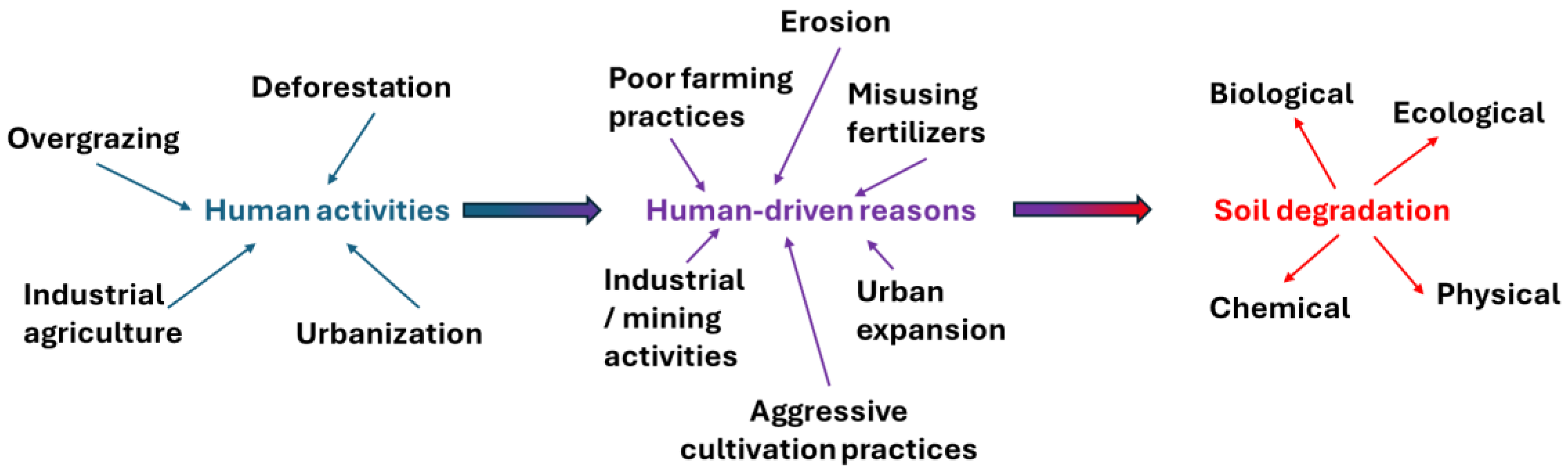
Figure 2.
Schematic diagram of recent advances in soil restoration technologies.
Disclaimer/Publisher’s Note: The statements, opinions and data contained in all publications are solely those of the individual author(s) and contributor(s) and not of MDPI and/or the editor(s). MDPI and/or the editor(s) disclaim responsibility for any injury to people or property resulting from any ideas, methods, instructions or products referred to in the content. |
© 2025 by the authors. Licensee MDPI, Basel, Switzerland. This article is an open access article distributed under the terms and conditions of the Creative Commons Attribution (CC BY) license (http://creativecommons.org/licenses/by/4.0/).
Copyright: This open access article is published under a Creative Commons CC BY 4.0 license, which permit the free download, distribution, and reuse, provided that the author and preprint are cited in any reuse.


