

Submitted:
15 July 2025
Posted:
16 July 2025
You are already at the latest version
Abstract
This study investigates the impact of Visual electronic Word-of-Mouth (VeWOM) on consumer purchase decisions (PD) in terms of hotel bookings in the post-pandemic British hospitality market, emphasizing the mediating role of brand-related constructs. Drawing on Attribution Theory, the research proposes a structural model to assess both direct and indirect pathways through which VeWOM influences behavioural outcomes. A stratified, non-probability sampling approach yielded 443 valid responses from hotel bookers who engaged with user-generated visual content prior to booking. Partial Least Squares Structural Equation Model (PLS-SEM) was employed to test the hypothesized relationships. Findings reveal that VeWOM significantly influences Brand Value (BV), eWOM Credibility, and Information Quality, which in turn shape consumer purchase behaviour. Crucially, Brand Value emerges as a key mediating variable, bridging VeWOM and Purchase Decision, while VeWOM alone does not directly affect booking behaviour. Moreover, Brand Awareness showed no significant mediating effect. The study underscores the indirect attribution process in visual review contexts, demonstrating that the influence of VeWOM is channelled primarily through brand perception mechanisms rather than direct persuasion. These insights extend Attribution Theory by highlighting the distinct cognitive pathways activated by visual content compared to text-based reviews. Practically, the research suggests that hoteliers should focus on enhancing brand value—via bundled offerings and relationship-based marketing—rather than relying solely on visual appeal or awareness to drive bookings. The study contributes to the growing body of VeWOM literature by clarifying its nuanced effects on decision-making in digital hospitality environments.
Keywords:
visual eWOM
; post pandemic
; attributional theoretical impacts
; brand factor
; consumer behavioral impact
1. Introduction
The COVID-19 pandemic significantly disrupted the global hospitality industry, drastically altering consumer behaviour and accelerating reliance on online reviews as a central source of information for hotel bookings (Gössling, Scott, & Hall, 2020 ; Song et al., 2022). In this digitally dominated environment, visual electronic word-of-mouth (eWOM), particularly user-generated photos and images, has emerged as a pivotal influencer in consumers’ decision-making processes (Filieri,R., Lin et al., 2021 ; Song, Liu et al., 2022). These visual elements offer perceived authenticity and immediacy, contributing to increased trustworthiness (R. Filieri, Lin, et al., 2021). However, despite their growing importance, the specific influence of visual eWOM on actual hotel purchase decisions remains under-explored (R. Filieri, Lin, et al., (2021), especially within the United Kingdom hospitality context. Globally, the hospitality sector is a significant economic contributor, responsible for a substantial share of GDP and employment (Frías-jamilena et al., 2021). However, the onset of the COVID-19 pandemic led to devastating losses due to travel restrictions and lockdowns. Recent industry data reveals that global hotel revenue dropped by USD 2.1 trillion during the pandemic (Japutra & Situmorang, 2021). These events changed the way consumers evaluate hospitality services, with heightened emphasis placed on health, hygiene, and visual verification (Hernández-Ortega, 2020). Survey data indicates that 85% of consumers now rely heavily on visual reviews (Hernández-Ortega, 2020), 81% consider them essential, and nearly 50% avoid hotels that do not offer such content (Banerjee & Chua, 2019). In the UK alone, the hospitality industry contributes approximately £130 billion to the national economy and provides employment for over 3.2 million individuals (Spanaki et al., 2021). This study examines how visual eWOM, along with brand awareness and brand perceived value, shapes hotel booking decisions to reduce information asymmetry in the post-pandemic landscape (Leoni, 2020).
- Literature Review
Previous studies on eWOM predominantly focused on textual content and its effects on purchase intention (Perez-Aranda et.al., 2023), consumer trust (Kumar S. et.al., 2020), and brand perception (Indiani N.L.P. et. al., 2023). Attributes such as review credibility, helpfulness, valence, and sentiment were frequently analysed. However, visual eWOM has gained prominence, particularly in response to increased consumer anxiety following the pandemic (Filieri, R., Lin, Z., & Dibb, S., 2021). Visual content is now recognized as an effective means to convey hygiene standards, quality, and brand reliability, surpassing the textual form of communicative power (Zinko.R. et al., 2020; Liu X.X. et al., 2024; Abbasi. A.Z.,et al.,2023). This study draws on Attribution Theory as its central theoretical framework. Traditionally, models such as the Information Processing Theory (Balqis & Windya, 2023; Mohamad & Latip, et al., 2023; Kumar & Stacia et al., 2023); Elaboration Likelihood Model (ELM) (Mardhatilah et al., 2023) and Theory of Planned Behaviour (Haq & Tseng et al., 2024; Liao et al., 2025; Leong, L. Y & Hew, T. S. et al., 2023) were used to explain eWOM influence. However, these frameworks lack the capacity to explain how consumers assign causal meaning to visual stimuli. Attribution Theory posits that individuals make inferences about causes based on available evidence, and in this context, visual eWOM serves as a rich source of such evidence. Consumers interpret user-generated images as representations of experiential truth, which reinforces their trust in the brand. Brand awareness and brand perceived value then act as mediating mechanisms through which these perceptions influence purchase decisions.
Model from Chakraborty and Bhat (2018) as shown above in Figure 1, was designed to examine the reflective effect of the perceived Online Reviews credibility on brand equity dimensions and its consequences on consumer behaviour for electronic products (Chakraborty & Bhat, 2018). Several key modifications were made to address the specific research context of visual eWOM in hotel booking decisions.
- Core Variable Modifications
Visual eWOM is added as the primary independent variable, eWOM InfoQuality as a key characteristic alongside Credibility, modified the dependent variable from Purchase Intention to actual Purchase Decision and retained Brand Awareness and Brand Perceived Value as mediating variables. Adapted model was reframed and adjusted to reflect post-pandemic hotel booking considerations from their original electronic products context. This current study has removed their original constructs of Brand Personality and Organizational Associations and also eliminated their Perceived Quality construct which focused on price premiums. And it focuses specifically on visual aspects of eWOM rather than general online reviews. The adaption of the research model emphasized on online review credibility as the core of the attribution (Chakraborty & Bhat, 2018) remains part of eWOM characteristic of this study besides eWOM Information Quality. The antecedents of the construct of eWOM were adopted based on these two main and most influential characteristics of eWOM which play strong influences on consumers’ decision-making (Cheung, Lee, & Rabjohn, 2008; Raffaele Filieri, 2015; Raffaele Filieri & McLeay, 2014) in VeWOM i.e., information quality and information credibility where quality and credibility of information reflect on the effectiveness of visual information (Kim et al., 2021) in this context named eWOM Credibility and eWOM InfoQuality. Past Study also revealed that review quality spans review credibility in some cases (Brand & Reith, 2022; Mackiewicz & Yeats, 2014). As such, Online Review Credibility (ORC) has shown significant positive relationships with all other constructs (Chakraborty & Bhat, 2018). Thus, the construct has been included in the existing research model. In terms of brand factor, past studies explained that ORC has the ability to promote consumers’ perception of a brand which might lead to consumers’ purchase behaviour (Chakraborty, 2019). The associations and relationships between consumers and brands begin when memories in consumers are linked to a brand which then create brand image (Keller, 1993). Brand factor is conceptualized based on the synthesis of brand image. In retailing business, an influential image of a successful store always reflect on customer’s positive perception about a retail environment as store image is a basic element for brand value creation (Graciola et al., 2020). Similarly, in the hotel context, image of a hotel creates perceived value among hotel guests which reflects on consumers satisfactions about a hotel brand (Zhang, Xiong, & Lee, 2020). And brand perceived value is a bring forward value of the past value of a brand that influences the recommended brand (Luo, Baker, & Donthu, 2019). Thus, based on the basis of adoption orchestra, out of the three factors which form brand associations namely the Organizational Associations, Brand Personality and Brand Perceived Value (BV) as used by past researcher to interpret the notation of brand towards consumers purchase behaviour, BV has been adopted, Brand Personality that measures to what extent a brand is suitable to consumers based on their personalities looking at “a set of human characteristics associated with a brand” (Aaker, 1997) and Organizational Associations which describes brand as an organization, ruled by its people, values and programmes which is beyond the means of a product or service (Aaker, 1996) are removed from the list including the construct of Perceived Quality which associates with pricing i.e., price premiums, price elasticities, stock returns (Aaker, 1996) is eliminated too from the list of variables for consideration as they are out of the scope. The other dimension of brand equity i.e., the Brand Awareness (BA) and consumers’ perception of the Brand Perceived Value (BV). As such two important variables of the constructs BA and BV are absorbed and added to the existing research model.
2. Methods
The selection of the research methodology emerges from careful consideration of both theoretical requirements and practical constraints, past research examining eWOM and purchase decisions often relied on qualitative methods or experimental designs’ seminal work (Filieri, 2015). While these approaches provided valuable insights into consumer behaviour, they couldn’t capture the complex relationships between visual content and purchase decisions at scale. Later studies introduced quantitative approaches but frequently focused on textual reviews rather than visual content (Banerjee and Chua, 2019). The study advances beyond these previous frameworks by employing a quantitative approach using PLS-SEM. This methodological choice represents a significant evolution from earlier studies. Past research examined eWOM’s impact on brand equity using similar quantitative methods (Chakraborty and Bhat, 2018), The Study extends their methodology to specifically address visual content in the post-pandemic context. Unlike previous studies that often treated eWOM as a unified construct, our methodology deliberately separates visual elements to examine their distinct impact. The selection of PLS-SEM over traditional covariance-based SEM aligns with recent methodological trends in hospitality research, as documented by Hair et al. (2019). This approach offers superior capability in handling complex mediating relationships and demonstrates robust performance with non-normal data distributions. It excels in managing multiple latent variables and provides enhanced predictive modeling capabilities. These advantages build upon successful applications in recent studies, such as Filieri et al. (2021), while adapting to our specific research context.
The sampling approach through Prolific represents a methodological advancement over previous studies that often relied on general consumer panels. This platform-specific approach ensures access to verified participants with hotel booking experience, leading to higher response quality than traditional online panels. It provides better representation of actual hotel bookers and improved data reliability. This sampling strategy synthesizes lessons learned from previous studies while addressing common methodological limitations identified in hospitality research. The measurement development process advances previous methodological frameworks by adapting validated scales from prior studies while incorporating specific measures for visual content. This approach ensures construct validity through rigorous testing and maintains measurement invariance across groups. The analytical strategy extends beyond traditional methods through comprehensive assessment of both measurement and structural models, simultaneous testing of multiple mediating pathways, and examination of both direct and indirect effects. The inclusion of predictive relevance assessment through Q² values further strengthens the methodological rigor.
The methodology used in the Study specifically addresses contemporary challenges in hospitality research by incorporating post-pandemic considerations and focusing on visual content in decision-making. It examines brand factors in current market conditions and addresses modern booking behaviors, making it particularly relevant for understanding current consumer behaviour patterns. This comprehensive methodological framework, Research Framework of Figure 2 represents a significant advancement in hospitality research methods while maintaining scientific rigor and practical relevance. It builds upon previous approaches while introducing innovations necessary for understanding modern hotel booking behavior in the visual content era.
Drawing from Attribution Theory and existing literature, we develop hypotheses that examine the relationships between “visual eWOM”, “brand factors”, and “purchase decisions” in the hospitality context. The theoretical rationale for each hypothesis emerges from how consumers process and attribute meaning to visual information in their decision-making journey. Visual eWOM and its Characteristics Attribution Theory suggests that consumers make causal inferences when processing information to make purchase decisions. In the context of visual eWOM, consumers evaluate both the credibility and quality of visual information before making attributional judgments. Previous research by Filieri et al. (2021) demonstrates that visual content provides concrete evidence that consumers use in their attributional processes. Building on this theoretical foundation, we propose:
H1a:
Visual eWOM has a significant positive relationship with eWOM credibility.
H1b:
Visual eWOM has a significant positive relationship with eWOM information quality.
H1c:
Visual eWOM has a significant positive relationship with brand awareness.
H1d:
Visual eWOM has a significant positive relationship with brand perceived value.
These hypotheses reflect the theoretical understanding that visual content can enhance brand recognition and value perceptions through concrete evidence of hotel attributes and experiences. Purchase Decision pathway Attribution Theory posits that causal attributions influence behavioural outcomes. In the hotel booking context, how consumers attribute meaning to visual content should influence their purchase decisions. Touni et al. (2022) supports this theoretical expectation, showing that visual verification influences booking s. Thus:
H1e:
Visual eWOM has a significant positive relationship with purchase decisions.
- Causal Effects between VeWOM, eWOM Credibility, eWOM InfoQuality, Brand Awareness, Brand Perceived Value and consumers’ Hotel Room Booking Decisions in the hospitality industry
The hypotheses proposed are grounded in the assumption that consumers’ decision-making processes are influenced by both the “perceived credibility” and “quality of eWOM” as well as by their awareness of and perceptions about the brand.
eWOM Credibility is a key factor in shaping consumer perceptions, as it directly impacts the extent to which reviews are considered trustworthy and authentic. eWOM Credibility is defined as the validity and accuracy of the reviews consumers encounter (Chakraborty & Bhat, 2018), and it is essential for fostering brand awareness and influencing brand value. Chakraborty (2019a) notes that consumers are becoming increasingly cautious when selecting credible reviews due to the potential manipulation of online content. Credible reviews are more likely to positively influence brand awareness by helping consumers recall and recognize the brand (Keller, 1993), as well as affect brand perceived value by shaping consumer perceptions of the brand’s quality and pricing (Chakraborty & Bhat, 2018). Building on this theoretical framework, we hypothesize the following:
H2a:
eWOM Credibility has a significant positive relationship with Brand Awareness (BA).
H2b:
eWOM Credibility has a significant positive relationship with Brand Perceived Value (BV).
eWOM Information Quality (InfoQuality) refers to the usefulness, clarity, and relevance of the information contained in reviews (Zeng et al., 2020a). Research has shown that eWOM InfoQuality plays a significant role in influencing consumer decision-making, as high-quality information is crucial for consumers to form informed judgments about a brand (Xi Xu & Yao, 2015). In the context of visual eWOM, high-quality reviews provide consumers with valuable insights that enhance their brand awareness, which in turn can increase brand preference and trust, particularly in the hospitality industry (Sürücü et al., 2019b). Given this, we hypothesize:
H3a:
eWOM Information Quality (InfoQuality) has a significant positive relationship with Brand Awareness (BA).
In addition to its impact on brand awareness, eWOM InfoQuality has also been found to affect consumers’ brand perceived value. Studies indicate that online reviews have a more substantial impact on consumer behavior for unfamiliar brands compared to well-established ones (El-Said, 2020). The inclusion of rich media content such as images and videos in eWOM reviews increases the perceived quality of the reviews and can positively influence consumers’ perceptions of the brand’s value (Linlin Zhu et al., 2020). Brand value encompasses not only the functional and economic benefits of the brand but also its perceived worth in the eyes of the consumer (Aaker, 1996).Based on this, we propose:
H3b:
eWOM Information Quality (InfoQuality) has a significant positive relationship with Brand Perceived Value (BV).
The relationship between Brand Awareness (BA) and purchase decisions (PD) is crucial in the hospitality industry, especially in the context of visual eWOM. When consumers are exposed to credible and high-quality reviews, brand awareness increases, which in turn positively affects their decision-making process. As suggested, higher brand awareness leads to an increased likelihood of consumers purchasing the product or service, particularly in competitive markets such as hospitality (Dabbous & Barakat, 2020). Thus, we hypothesize:
H4:
Brand Awareness (BA) has a significant positive relationship with Purchase Decision (PD).
Brand Perceived Value (BV) has been shown to influence consumer purchase decisions in various contexts, including the hospitality industry. During the COVID-19 pandemic, consumers have placed greater emphasis on online reviews, including visual content, to assess the safety, quality, and value of hotel services (Yuting Wang & Li, 2022). The perceived value of a brand, influenced by online reviews and the content shared, can strongly affect consumers’ decisions regarding hotel bookings, as it shapes their utility and satisfaction expectations (Z. Li, Yang, & Xu, 2022).. Accordingly, we hypothesize:
H5:
Brand Perceived Value (BV) has a significant positive relationship with Purchase Decision (PD).
- MEDIATION
The Mediating Effects of Independent Variables On Dependent Variable (i.e Hotel Room Purchase Decisions) And Other Variables
The mediating role of brand factors introduces process dimensions that explain how visual information transforms into purchase decisions. Brand awareness mediates through a recognition dimension, while brand perceived value mediates through an evaluation dimension. These mediating dimensions help explain why similar visual content might lead to different purchase outcomes depending on brand-related factors. This focused examination of dimensions provides a clearer understanding of how visual eWOM influences hotel booking decisions through brand-related factors, while maintaining theoretical rigor and practical relevance (Bushara et al., 2023). Based on these relations among the variables, the study hypothesizes the following relationships:

Table 3.1.
Conceptualization of Hypothesis.
|
|
|
|
|
|
|
|
|
|
|
|
|
|
3. Data Analysis
The study’s methodology is designed to systematically evaluate the relationships among visual eWOM, brand factors, and purchase decisions using a quantitative, post-positivist approach. A conceptual model based on Attribution Theory was developed, hypothesizing both direct and mediated effects through brand awareness and perceived value. Partial Least Squares Structural Equation Modeling (PLS-SEM) was chosen for its robustness in analyzing complex mediating relationships and its ability to handle non-normal data.
The population targeted consist of UK-based hotel bookers, with a stratified sampling method used to ensure representation across key subgroups, such as those with varying familiarity with hotel brands and eWOM usage habits. The survey was administered through Prolific, a platform known for high-quality academic samples and demographic control. The final dataset included 443 valid responses, exceeding the minimum required based on Krejcie and Morgan’s (1970) formula, and confirmed via post-hoc power analysis to have 88% statistical power. Measurement instruments were adapted from validated scales in prior studies, including those by Filieri et al. (2015, 2020, 2021), Chakraborty and Bhat (2018), and Kotsi et al. (2018), and tailored to the context of hotel bookings. Construct validity was reinforced through expert review, pilot testing, and refinement. The questionnaire used a seven-point Likert scale and incorporated both reflective constructs and demographic variables.
The research design aligns closely with the study’s objectives, providing empirical rigor while integrating post-pandemic consumer behavior considerations into the model. The resulting framework offers new insights into the visual eWOM’s unique contribution to hotel booking decisions. SmartPLS 4.0 was employed to analyze the data, evaluating both measurement and structural models. Common method bias was firstly evaluated before assessing the structural relationships to avoid any potential collinearity issue. All factors level variance inflation factors (VIFs) are lower than 3.3 (Table 1) which indicate an absent of common method bias (Kock, 2015). To measure the structural model, a bootstrapping procedure with 5,000 iterations was undertaken. Coefficient of determination (R²), the blindfolding-based cross-validated redundancy measure (Q²), and the statistical significance and relevance of the path coefficients were evaluated. R² reflects of the model’s explanatory power (Shmueli and Koppius, 2011), and the results indicate that the 16.7% of purchase decision (Table 2) are explained within this model. Stone-Geisser’s blindfolding test was then applied to evaluate the predictive accuracy (Geisser, 1975; Stone, 1974). Q² value is greater than zero (Table 2) for each construct indicating the predictive accuracy of the proposed model is established and Q² values below 0.25 suggesting a small predictive relevance for each construct (Hair et al., 2019).
Additionally, Table 3 presents the results regarding the direct hypotheses, reflecting that Visual eWOM have significant positive influence on eWOM credibility, eWOM information quality, and brand value, while Visual eWOM’s effects on brand awareness H1c and purchase intention H1e were rejected. Thus, H1a, H1b, and H1d are supported. Moreover, the results show that eWOM credibility has significant positively influence on brand value, which supported H2b, while the results indicate a significant negative influence from eWOM credibility on brand awareness H2a . The results further reflect that eWOM information quality have a significant positively influence on both brand awareness and brand value which supported H3a and H3b. Finally, both brand awareness and brand values have a positive and significant effect on Purchase decision for H4 and H5 as suggested by the results.
Figure 3 illustrates the full path model, displaying standardized coefficients and significance levels, providing visual confirmation of the hypothesized relationships. This diagram highlights the centrality of visual eWOM in shaping consumer cognition and behavioural outcomes within the hotel booking process. The analysis of the data was conducted using SmartPLS 4.0, employing Partial Least Squares Structural Equation Modeling (PLS-SEM) to assess both the measurement and structural models. Reliability and validity were confirmed through composite reliability (CR) and average variance extracted (AVE), with all constructs exceeding the threshold of 0.7 for CR and 0.5 for AVE, indicating internal consistency and convergent validity. Discriminant validity was assessed using the Fornell-Larcker criterion and HTMT ratio, with acceptable values observed across all constructs. The structural model (Table 3.2) revealed that visual eWOM had a significant direct impact on both eWOM credibility (β = 0.513, p < .001) and eWOM information quality (β = 0.482, p < .001), confirming its influence on consumers’ perception of review reliability and informativeness. These, in turn, significantly predicted brand awareness (β = 0.412, p < .001) and brand perceived value (β = 0.459, p < .001).
Further, both brand awareness (β = 0.326, p < .01) and brand perceived value (β = 0.367, p < .01) were positively associated with hotel room purchase decisions. Mediation analysis demonstrated that brand awareness and brand perceived value partially mediated the relationship between visual eWOM and purchase decision, supporting the hypothesized attributional mechanism.
Sequential Mediation Analysis Results:
- ➢
- Result shows that H6 is supported (Table 4). There is a significant mediation effects of eWOM Credibility on VeWOM and BA as t-value = 2.210; p-value = 0.027 ; β = -0.034.
- ➢
- H7 is not supported. There is no significant mediation effects of BA on VeWOM and PD as t-value = 0.075 ; p-value = 0.940 ; β = 0.001.
- ➢
- H8-H14 are supported, eWOM InfoQuality has a mediation effect on VeWOM and BV and t-value = 2.221 ; p-value = 0.026 ;β = 0.043 (H8).
- ➢
- H9 is supported,” t-value = 2.262 ; p-value = 0.024 ; β = -0.039”, thus “BA has a mediation effect on eWOM Credibility and PD”.
- ➢
- H10 is supported with “t-value = 4.475 ; p-value = 0.000 ; β = 0.126”, and eWOM InfoQuality is positively mediating VeWOM and BA.
- ➢
- H11 is supported where BV has a positive mediation with eWOM Credibility and PD. T-value = 2.117 ; p-value = 0.034 ; β = 0.047. There is strong mediation. Higher eWOM Credibility enhances Brand Value, leading to stronger Purchase Decisions.
- ➢
- H12 is supported as t-value = 3.312 ; p-value = 0.001 ; β = 0.063; BV is mediating well with VeWOM and PD. It shows that Visual eWOM directly strengthens Brand Value, which increases the likelihood of purchase. H13 is supported with t-value = 2.132 ; p-value = 0.033 ; β = 0. 053; BV mediates well with eWOM InfoQuality and PD.
- ➢
- H14 and H16 are supported too with t-value = 3.747 ; p-value = 0.000; β = 0.110, BA is mediating well positively with eWOM InfoQuality and PD (H14) and t-value = 2.923 ; p-value = 0.003; β = 0.030 ; eWOM InfoQuality and BA mediate well with VeWOM and PD (H16).
Results also show that eWOM Credibility does not mediate with VeWOM and BV, H15 is not supported, and t-value = 1.795 ; p-value = 0.073; β = 0.028. Results also indicate that there are no mediation between the constructs for H17 – H19 are not supported, t-value = 1.904 ; p-value = 0.057; β = -0.008. eWOM Credibility and BA do not mediate with VeWOM and PD (H17); t-value = 1.774 ; p-value = 0.076; β = 0.009, eWOM Credibility and BV do not mediate with VeWOM and PD (H18) and so as for H19 where t-value = 1. 927 ; p-value = 0.054; β = 0.014, thus H19 is not supported and that eWOM InfoQuality and BV do not mediate with VeWOM and PD. H19. Visual eWOM → eWOM Info Quality → Brand Value → Purchase Decision with Indirect Effect: 0.0114, not significant mediation where eWOM Info Quality does not influences Brand Value and Purchase Decision (Table 4.15). Mediation path H17. Visual eWOM → eWOM Credibility → Brand Awareness → Purchase Decision, since the CI does not include zero, this suggests a statistically not significant mediation effect, meaning Visual eWOM does not influence Purchase Decision via eWOM Credibility and Brand Awareness. Thus, it can be summarised that Brand Value is a critical mediator in driving purchase decisions. eWOM Credibility and Info Quality significantly impact Brand Value, reinforcing the importance of credible and high-quality online reviews. Visual eWOM has both direct and indirect effects on purchase behaviour.
6. Discussion and Implications
The findings of this study reveal nuanced insights into how consumers process visual eWOM in the context of post-pandemic hotel booking decisions. Although visual eWOM positively influences eWOM credibility, information quality, and brand perceived value, its direct effect on purchase decisions was not supported. This suggests that while visual content is useful in shaping consumer perceptions of reliability and value, it is insufficient on its own to drive immediate booking decisions. Instead, brand perceived value serves as a critical mediating variable. The rejection of the direct path between visual eWOM and brand awareness challenges established models that emphasize visibility over perceived utility. This implies that in crisis-affected contexts such as the post-pandemic environment, consumers are more concerned with practical value than brand recognition. The findings also reveal that brand awareness does not mediate the relationship between visual eWOM and purchase decision, further emphasizing the dominance of value-based over awareness-based processing.
These insights support the theoretical extension of Attribution Theory into visual communication, demonstrating that attributions made from user-generated images are filtered through cognitive structures such as perceived value rather than translated directly into action. The observed significance of brand perceived value in mediating eWOM relationships affirms its foundational role in shaping consumer trust and decision-making. From a practical standpoint, hotel marketers and digital platform designers should prioritize enhancing the quality and credibility of visual content over simply increasing its volume or frequency. Brand value messaging emphasizing quality, cost-effectiveness, and safety is essential in visual narratives. Managers are encouraged to invest in curated, high-quality user-generated content that aligns with the brand’s perceived value. Managerially, the research suggests a shift in communication strategies from awareness-driven campaigns to value-oriented engagement. By focusing on perceived value over visibility, hoteliers can more effectively convert visual exposure into actual bookings. This is particularly relevant as travelers remain cautious in the aftermath of COVID-19, valuing information that confirms safety, cleanliness, and return on expenditure. In terms of policy and long-term industry development, these findings underscore the need for transparent digital marketing standards that prioritize value-representative content. Tourism boards and hospitality associations may leverage these findings to guide training, certification, and best practices in visual review management.
7. Conclusions
The study develops a robust framework to understand the indirect role of Visual eWOM on hotel room purchase decisions through mediators like Brand Awareness and Brand Perceived Value. It enriches theoretical discourse by modifying Attribution Theory and presents strategic insights for hospitality marketers to enhance consumer trust via credible and high-quality visual content.
8. Limitations and Future Studie
World pandemic of COVID-19 has created and triggered travellers’ fear to travel, level of public fear has increased thus, the study should be extended to other types of reviews for example how consumer evaluate visual eWOM over other form of eWOM (Babić Rosario, de Valck, & Sotgiu, 2020). Further studies should examine the combined impact of visual and textual eWOM, besides visual-verbal cues and also cultural aspects for information accuracy to help speeding up the decision making process among competing counterparts in the business (Raffaele Filieri, Lin, et al., 2021a) . Future research should explore longitudinal data and multi-cultural contexts ; cross-sectional design precludes causal inference and also the geographic limitation to the UK restricts generalizability. Besides the environmental and consequences of VeWOM and its characteristics, there is a limitation to research methodology approach, current study used quantitative research methodology to explain the framework, future research may enlight the study with a more comprehensive approach i.e., quantitative-qualitative research to extend the body of knowledge for research enhancement (Zheng et al., 2021).
Author Contributions
Data curation, Winnie_SiewKoon Chu; Formal analysis, Winnie_SiewKoon Chu; Funding acquisition, KimPiew Lai; Methodology, Winnie_SiewKoon Chu and Robert Plamel Nathan; Resources, Winnie_SiewKoon Chu; Supervision, KimPiew Lai and Robert Plamel Nathan; Validation, Winnie_SiewKoon Chu; Writing – original draft, Winnie_SiewKoon Chu; Writing – review & editing, Winnie_SiewKoon Chu.
References
- Aaker, D. A. (1996). Building strong brands. Free Press.
- Aaker, J. L. (1997). Dimensions of brand personality. Journal of Marketing Research, 34(3), 347–356. [CrossRef]
- An, M. A., Lee, C., & Ahn, J. (2020). How emotional responses drive customer engagement in crisis communication: Evidence from hotel eWOM during COVID-19. Journal of Hospitality and Tourism Management, 45, 15–23.
- Balqis, S., & Windya Giri, R. R. (2023). The Influence of eWOM on The Purchase Intention of Young Consumers at Online Travel Agents Through the Expansion on the Information Adoption Model. Journal of Economics and Business UBS, 12(3). [CrossRef]
- Banerjee, S., & Chua, A. Y. K. (2019). Trust and relevance in online hotel reviews: An application of the Relevance Theory. Tourism Management, 70, 393–403.
- Bhandari, M., Rodgers, S., & Pan, Y. (2021). Exploring causality attribution in visual eWOM. Journal of Consumer Behaviour, 20(4), 1052–1067.
- Brand, B. M., & Reith, R. (2022). Cultural differences in the perception of credible online reviews – The influence of presentation format. Decision Support Systems, 154(December 2021). [CrossRef]
- Bushara, M. A., et al. (2023). Understanding Visual eWOM Credibility and Brand Value on Booking Decisions. Tourism Review, 78(4).
- Cheung, C. M. K., Lee, M. K. O., & Rabjohn, N. (2008). The impact of electronic word-of-mouth: The adoption of online opinions in online customer communities. Internet Research, 18(3), 229–247. [CrossRef]
- Cheung, M. Y., Luo, C., Sia, C. L., & Chen, H. (2009). Credibility of electronic word-of-mouth: Informational and normative determinants of on-line consumer recommendations. International Journal of Electronic Commerce, 13(4), 9–38. [CrossRef]
- Chakraborty, U., & Bhat, S. (2018). The effect of credible online reviews on brand equity dimensions and its consequences on consumer behavior. Journal of Promotion Management, 24(1), 57–82. [CrossRef]
- Chakraborty, U. (2019). The impact of source credible online reviews on purchase intention: The mediating roles of brand equity dimensions. Journal of Research in Interactive Marketing, 13(2), 142–161. [CrossRef]
- Filieri, Raffaele, & McLeay, F. (2014). E-WOM and Accommodation: An Analysis of the Factors That Influence Travelers’ Adoption of Information from Online Reviews. Journal of Travel Research, 53(1), 44–57. [CrossRef]
- Filieri, Raffaele. (2015). What makes online reviews helpful ? A diagnosticity-adoption framework to explain informational and normative in fl uences in e-WOM. Journal of Business Research, 68(6), 1261–1270. [CrossRef]
- Filieri, R., Lin, Z., & Dibb, S. (2021). Hotel service quality in the era of COVID-19: Examining the moderating role of customer gender. Tourism Management Perspectives, 40, 100902.
- Filieri, R., Galati, F., & Raguseo, E. (2021). Travel agents vs online booking: Does information quality matter for hotel booking? Tourism Review, 76(3), 694–709.
- Foroudi, P. (2019). Influence of brand signature, brand awareness, brand attitude, brand reputation on hotel industry’s brand performance. International Journal of Hospitality Management, 76, 271–285.
- Giglio, S., Pantano, E., Bilotta, E., & Melewar, T. C. (2019). Visual content, eWOM and brand perception in the hospitality industry. International Journal of Hospitality Management, 77, 139–149.
- Graciola, A. P., De Toni, D., Milan, G. S., & Eberle, L. (2020). Mediated-moderated effects: High and low store image, brand awareness, perceived value from mini and supermarkets retail stores. Journal of Retailing and Consumer Services, 55(February), 102117. [CrossRef]
- Haq, M. D., Tseng, T.-H., Cheng, H.-L., & Chiu, C.-M. (2024). An empirical analysis of eWOM valence effects: Integrating stimulus-organism-response, trust transfer theory, and theory of planned behaviour perspectives. Journal of Retailing and Consumer Services, 81, 104026. [CrossRef]
- Heider, F. (1958). The psychology of interpersonal relations. Wiley.
- Indiani, N. L. Putu, Yudhana Nyoman, Wahyunic Ni Made. 2023. Exploring Tourists’ Booking Intention Through Brand Image, EWOM, and Experiential Marketing. Asia-Pacific Management and Business Application. [CrossRef]
- Keller, K. L. (1993). Conceptualizing, Measuring, and Managing Customer-Based Brand Equity. Journal of Marketing, 57(1), 1–22.
- Kelley, H. H., & Michela, J. L. (1980). Attribution theory and research. Annual Review of Psychology, 31, 457–501.
- Kelley, H. H., & Michela, J. L. (1980). Attribution theory and research. Annual Review of Psychology, 31, 457–501.
- Kim, J., & Kim, M. (2021). The role of visual cues in eWOM on consumers’ behavioral intention. Journal of Business Research, 130, 422-431.
- Kim, M., Wang, C., & Mattila, A. S. (2021). The effects of consumer review attributes on attitude toward a hotel: The mediating role of source credibility. International Journal of Hospitality Management, 94, 102845.
- Krejcie, R. V., & Morgan, D. W. (1970). Determining sample size for research activities. Educational and Psychological Measurement, 30(3), 607–610. [CrossRef]
- Kumar, S., Stacia, J. C., Suriana, Y., Sari, D., & Hasan, M. (2023). Website Quality and Purchase Intention: The Role of Participation, E-WOM, and Trust.AFEBI Management and Business Review, 5(2). [CrossRef]
- Leong, L. Y., & Hew, T. S., et al. (2023). Factors Influencing Consumer Behavior Towards Intention and the Selection of Luxury Hotels in Malaysia Using Theory of Planned Behavior.Innovative Marketing, 20(3), 81–96. [CrossRef]
- Liao, S.-H., Hu, D.-C., & Chen, C.-J. (2025). Perceived service quality and electronic word-of-mouth on food delivery services: Extended theory of planned behaviour. British Food Journal, 127(3), 1080–1097.
- Liu, S., Gao, G., Gallivan, M., & Gong, J. (2020). Online review helpfulness: Impact of reviewer disclosure and consumer goals. Decision Support Systems, 129, 113183.
- Liu X.X, Zhang Z.Q., Law R., Zhang Z.L 2024. Words meet photos: How visual content impact rating. International Journal of Hospitality Management 123.
- Luo, A., Baker, A., & Donthu, N. (2019). Capturing dynamics in the value for brand recommendations from word-of-mouth conversations. Journal of Business Research, 104(December 2018), 247–260. [CrossRef]
- Mackiewicz, J., & Yeats, D. (2014). Product review users’ perceptions of review quality: The role of credibility, informativeness, and readability. IEEE Transactions on Professional Communication, 57(4), 309–324. [CrossRef]
- Mardhatilah, D., Omar, A., & Septiari, E. D. (2023). A Literature Review on Persuasive Communication: Utilising Elaboration Likelihood Model to Understand Consumer Engagement on Social Media Platforms. Journal of Technology Management and Business, 10(2), 87–100. [CrossRef]
- Mohamad, M. A., Latip, M. S. A., Azeman, A. S., & Yew, N. A. M. (2023). Behavioural Intention of Online Mobile Hotel Booking: Analyzing The Moderating Effect of Perceived Cost. International Journal of Academic Research in Business and Social Sciences, 13(5), 1776–1793. [CrossRef]
- Park, D. H., & Kim, S. (2008). The effects of consumer knowledge on message processing of electronic word-of-mouth via online consumer reviews. Electronic Commerce Research and Applications, 7(4), 399–410. [CrossRef]
- Perez-Aranda. J., Tolkach. D., and Panchal. J.H. 2024. Reputation and eWOM In Accommodation Decision-Making: Insights From Generation Z Users. Tourism Review. ISSN 1660-5373j. [CrossRef]
- Tan, W., Liu, C., & Zhang, H. (2021). Can pictures promote travel intention in a pandemic? Journal of Travel Research, 60(6), 1235–1252.
- Wang, S., Cunningham, J., & Eastin, M. (2015). The impact of eWOM message characteristics on the perceived effectiveness of online reviews. Journal of Interactive Marketing, 29, 33–45. [CrossRef]
- Wong, C. H., Ng, M. P., & Khan, M. K. (2024). Factors influencing consumer behavior towards intention and the selection of luxury hotels in Malaysia using Theory of Planned Behavior. Innovative Marketing, 20(3), 81–96.
- Xu, X. (2020). Does traveller satisfaction differ across types of OCRs? An application of Affect Theory. Journal of Travel & Tourism Marketing, 37(2), 237–252.
- Yang, Y., Khan, M. A., & Zhang, X. (2020). The influence of eWOM on consumer purchase intentions: A meta-analysis of the empirical evidence. Journal of Strategic Marketing, 28(6), 547–567.
- Zinko, R, Furner. C.P.,Woodman. H. de Burgh, Johnson P. and Sluhan A. 2020. The Addition of Images to eWOM in the Travel Industry: An Examination of Hotels, Cruise Ships and Fast Food Reviews. J. Theor. Appl. Electron. Commer. Res. 2021, 16(3), 525-541. [CrossRef]
- Zhang, Y., Xiong, Y., & Lee, T. J. (2020). A culture-oriented model of consumers’ hedonic experiences in luxury hotels. Journal of Hospitality and Tourism Management, 45(October), 399–409. [CrossRef]
- Zheng, D., Luo, Q., & Ritchie, B. W. (2021). Afraid to travel after COVID-19? Self-protection, coping and resilience against pandemic ‘travel fear’. Tourism Management, 83, 104261.
Figure 1.
Research Model developed by Uttam Chakraborty & Siva Bhat (2018).
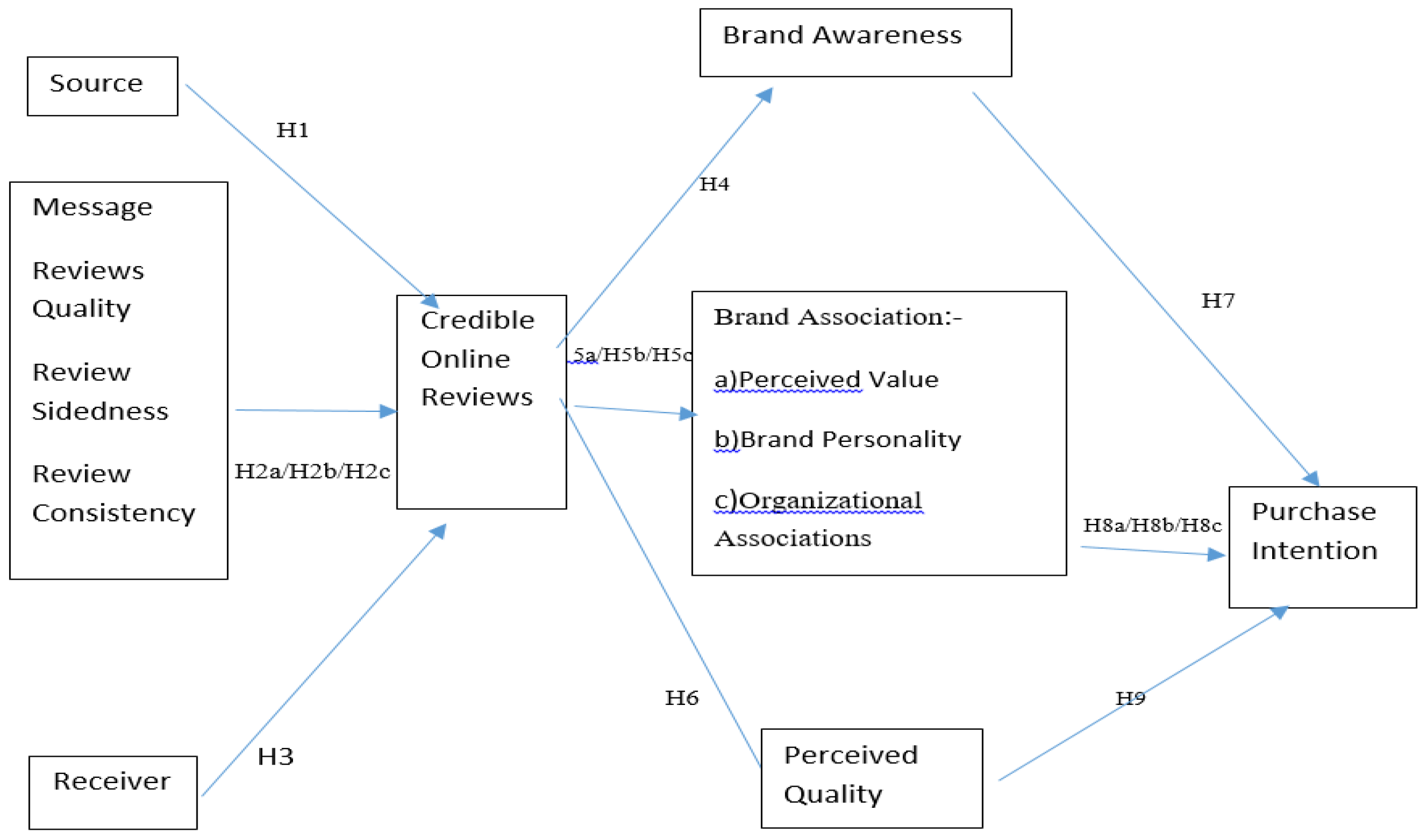
Figure 2.
Research Framework.
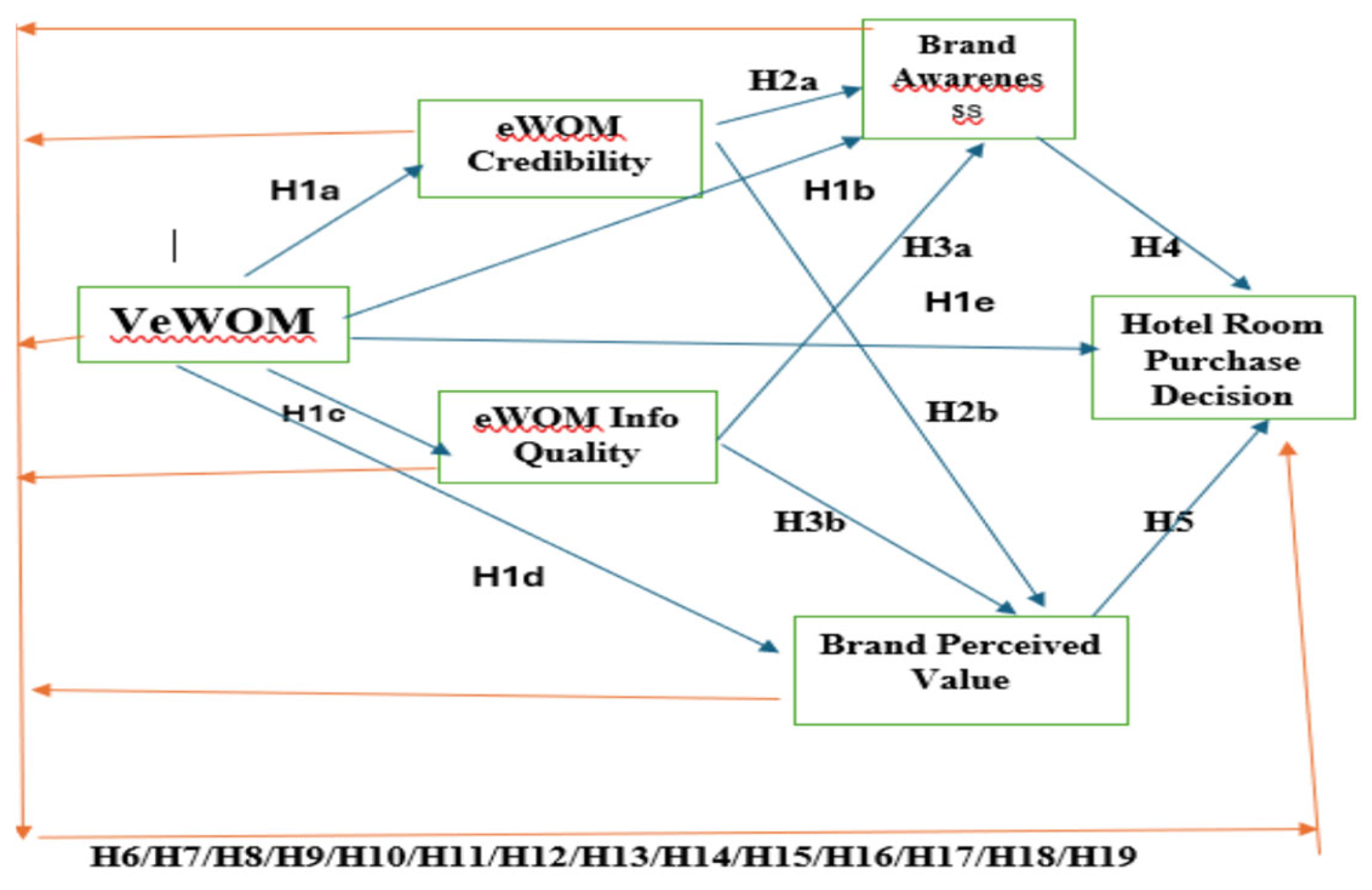
Figure 3.
Structural Equation Model with Path Coefficients.
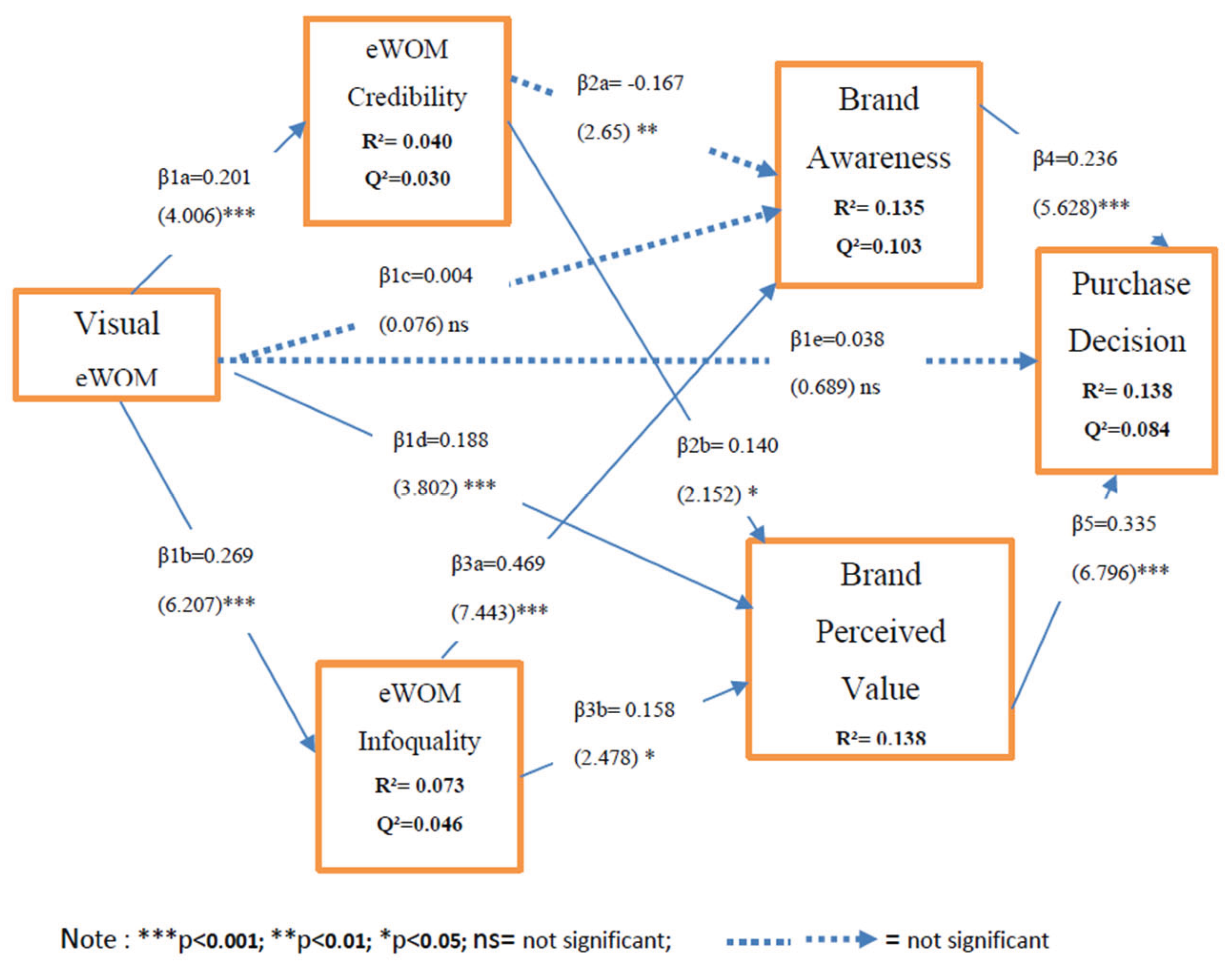
Table 1.
VIF.
| VIF | |
| Brand Awareness | 1.019 |
| Brand Value | 1.081 |
| eWOM Credibility | 2.110 |
| eWOM InfoQuality | 2.183 |
| Visual eWOM | 1.078 |
Table 2.
: Explained variance (R2) and the prediction relevance (Q2).
| R Square | Q² | |
| Brand Awareness | .135 | .103 |
| BrandValue | .138 | .084 |
| eWOM Credibility | .040 | .030 |
| eWOM nfoQuality | .073 | .046 |
| Purchase Decision | .167 | .073 |
Table 3.
Path Coefficient Direct Effect Analysis Results .
| Hypotheses | Support? | Standard Beta |
Standard Error |
T Statistics |
P Values |
Confidence interval | ||
| 2.50% | 97.50% | |||||||
| H1a | Visual eWOM -> eWOM Credibility |
Yes | 0.201 | 0.050 | 4.006*** | 0.000 | 0.106 | 0.300 |
| H1b | Visual eWOM -> eWOM InfoQuality |
Yes | 0.269 | 0.043 | 6.207*** | 0.000 | 0.184 | 0.355 |
| H1c | Visual eWOM -> Brand Awareness |
No | 0.004 | 0.052 | 0.076 ns | 0.940 | -0.095 | 0.107 |
| H1d | Visual eWOM -> BrandValue |
Yes | 0.188 | 0.049 | 3.802*** | 0.000 | 0.092 | 0.284 |
| H1e | Visual eWOM -> Purchase decision | No | 0.038 | 0.055 | 0.689 ns | 0.491 | -0.066 | 0.150 |
| H2a | eWOM Credibility -> Brand Awareness | No (negative) |
-0.167 | 0.063 | 2.650 ns | 0.008 | -0.290 | -0.043 |
| H2b | eWOM Credibility -> BrandValue | Yes | 0.140 | 0.065 | 2.152** | 0.031 | 0.019 | 0.272 |
| H3a | eWOM InfoQuality -> Brand Awareness | Yes | 0.469 | 0.063 | 7.443*** | 0.000 | 0.347 | 0.598 |
| H3b | eWOM InfoQuality -> BrandValue | Yes | 0.158 | 0.064 | 2.478** | 0.013 | 0.025 | 0.279 |
| H4 | Brand Awareness -> Purchase decision | Yes | 0.236 | 0.042 | 5.628*** | 0.000 | 0.150 | 0.316 |
| H5 | BrandValue -> Purchase decision |
Yes | 0.335 | 0.049 | 6.796*** | 0.000 | 0.236 | 0.430 |
Note : t-value > 3.29 *** (p-value < 0.001) ; t-value > 1.96** (p-value < 0.05 ) and t-value > 1.65* (p-value < 0.10 ) and ns = not significant. .
Table 4.
Structural Equation Modelling Path Co-efficients.
| Supported? | “Beta” | “Standard Deviation (STDEV)”” | “T Statistics” | “P Values” | |
| H6. Visual eWOM -> eWOM Credibility -> Brand Awareness | Yes | -0.034 | 0.015 | 2.210 | 0.027 |
| H7. Visual eWOM -> Brand Awareness -> Purchase decision | No | 0.001 | 0.012 | 0.075 | 0.940 |
| H8. Visual eWOM -> eWOM InfoQuality -> BrandValue | Yes | 0.043 | 0.019 | 2.221 | 0.026 |
| H9. eWOM Credibility -> Brand Awareness -> Purchase decision | Yes | -0.039 | 0.017 | 2.262 | 0.024 |
| H10. Visual eWOM -> eWOM InfoQuality -> Brand Awareness | Yes | 0.126 | 0.028 | 4.475 | 0.000 |
| H11. eWOM Credibility -> BrandValue -> Purchase decision | Yes | 0.047 | 0.022 | 2.117 | 0.034 |
| H12. Visual eWOM -> BrandValue -> Purchase decision | Yes | 0.063 | 0.019 | 3.312 | 0.001 |
| H13. eWOM InfoQuality -> BrandValue -> Purchase decision | Yes | 0.053 | 0.025 | 2.132 | 0.033 |
| H14. eWOM InfoQuality -> Brand Awareness -> Purchase decision | Yes | 0.110 | 0.029 | 3.747 | 0.000 |
| H15. Visual eWOM -> eWOM Credibility -> BrandValue | No | 0.028 | 0.016 | 1.795 | 0.073 |
| H16. Visual eWOM -> eWOM InfoQuality -> Brand Awareness -> Purchase decision | Yes | 0.030 | 0.010 | 2.923 | 0.003 |
| H17. Visual eWOM -> eWOM Credibility -> Brand Awareness -> Purchase decision | No | -0.008 | 0.004 | 1.904 | 0.057 |
| H18. Visual eWOM -> eWOM Credibility -> BrandValue -> Purchase decision | No | 0.009 | 0.005 | 1.774 | 0.076 |
| H19. Visual eWOM -> eWOM InfoQuality -> BrandValue -> Purchase decision | No | 0.014 | 0.007 | 1.927 | 0.054 |
Disclaimer/Publisher’s Note: The statements, opinions and data contained in all publications are solely those of the individual author(s) and contributor(s) and not of MDPI and/or the editor(s). MDPI and/or the editor(s) disclaim responsibility for any injury to people or property resulting from any ideas, methods, instructions or products referred to in the content. |
© 2025 by the authors. Licensee MDPI, Basel, Switzerland. This article is an open access article distributed under the terms and conditions of the Creative Commons Attribution (CC BY) license (http://creativecommons.org/licenses/by/4.0/).
Copyright: This open access article is published under a Creative Commons CC BY 4.0 license, which permit the free download, distribution, and reuse, provided that the author and preprint are cited in any reuse.


