

Submitted:
15 July 2025
Posted:
16 July 2025
You are already at the latest version
Abstract
There is limited information on the prevalence of mental health symptoms among the population of Mexico City. To provide an update and determine the prevalence of symptoms associated with various disorders in the city, a modified version of the “Screener Questionnaire” was used, the same instrument employed in the National Survey on Drug, Alcohol, and Tobacco Use (ENCODAT) 2016–2017. Data were collected at PILARES centers in different boroughs of Mexico City. A total of 868 questionnaires on symptoms of psychiatric disorders and the use of drugs, alcohol, and tobacco were completed. The most frequently reported symptoms were anxiety (52.67%), depression (39.34%), and post-traumatic stress disorder (44.57%). Additionally, results showed alcohol use at 15.1%, followed by tobacco (13.6%) and illicit drug use (6.8%). The prevalence of these symptoms was also compared with data from ENCODAT 2016–2017 to observe changes over the years.
Keywords:
mental health
; Mexico City
; prevalence
; substance use
; psychiatric disorders
; epidemiological survey
1. Introduction
Mental health is a fundamental aspect of human well-being, significantly affecting both individual quality of life and social functioning. It plays a key role in daily coping, emotional regulation, and decision-making [1]. Mood disorders, anxiety, and substance use disorders are often associated with multiple risk factors, such as low educational attainment, violence, socioeconomic disadvantage, genetic vulnerability, and interpersonal difficulties
Global studies, including those conducted in Mexico, have explored lifetime prevalence of mental disorders through the World Health Organization’s World Mental Health Surveys 1, using DSM-IV diagnostic criteria. Prevalence rates vary widely across countries, with the United States reporting a lifetime prevalence of 47.7%, while Nigeria reports only 12.0%. Anxiety disorders are among the most common worldwide, with the highest rates found in the U.S. (31.0%) and Colombia (25.3%). Similarly, mood disorders show high prevalence in the U.S. (21.4%) and France (21.0%). Regarding substance use disorders, Ukraine (15%) and the U.S. (14.6%) present the highest figures [3].
In Mexico, the most recent nationwide mental health evaluation was conducted through ENCODAT 2016–2017, targeting individuals aged 12 to 65 through a randomized household survey. This study generated data on conditions such as mania/hypomania, psychosis, anxiety, depression, obsessive-compulsive disorder, PTSD, and suicide attempts, alongside information on alcohol, drug, and tobacco use [4].
The COVID-19 pandemic (2020–2023) introduced unprecedented challenges to daily life, disrupting routines and increasing psychological distress due to prolonged social isolation [5]. According to the WHO’s scientific brief “Mental Health and COVID-19: Early Evidence of the Pandemic’s Impact”, there was a significant global increase in mental health issues, particularly among young people and adults, including a rise in suicidal thoughts linked to loneliness and positive COVID-19 diagnoses [6].
In Mexico, these effects were especially pronounced among women, young individuals, and people working in informal employment. Despite global data showing an increase in psychiatric disorders in urban areas after the pandemic, there is still no specific data available for Mexico City. Updating this information is essential for developing public policies aimed at improving access to mental health care. Therefore, this study seeks to provide updated prevalence data on mental health symptoms and substance use across various boroughs of Mexico City, and to compare these results with those previously reported in ENCODAT 2016–2017 [7].
2. Materials and Methods
Surveys were administered using an adapted version of the “Screener Questionnaire” [4] among volunteers aged 12 to 65. Nursing students from the Universidad de la Salud conducted the surveys in selected PILARES (Points of Innovation, Freedom, Art, Education, and Knowledge) across five boroughs of Mexico City: Xochimilco, Iztacalco, Álvaro Obregón, Miguel Hidalgo, and Gustavo A. Madero.
Data analysis was carried out in collaboration with the National Institute of Genomic Medicine and the Ramón de la Fuente Muñiz National Institute of Psychiatry. This allowed for a comparative analysis with previously gathered data from ENCODAT 2016–2017, focusing specifically on Mexico City.
2.1. Instrument
2.1.1. Sociodemographic Data
Participants are asked to provide their name, sex, age and date of birth.
It asked if they actually study, having the options of: no, I have never been in school; no, but I went to school; yes. In this section also is included which is the level of study the person has.
Participants are asked the marital status, having the options of: married, divorced, domestic partnership, widow, separated and single.
2.1.2. Mental Health InformationMania/Hypomania
Symptoms of mania/hypomania were determined based on a positive response to: have you ever been diagnosed with bipolar disorder?; or answering yes to the following questions: have you ever experienced a period of time that last 3 days or more during which you felt unusually cheerful, irritable, energetic, or hyperactive, to the point that your behavior or mood was clearly different from your usual self? and 2), have you ever gone through a period of three days or more during which you needed very little sleep (or no sleep at all) and still didn’t feel tired, or even had more energy than usual?
Psychosis
Symptoms of psycosis were determined based on a positive response to: have you ever been diagnosed with schizophrenia; or answering yes to the following questions: 1) have you ever experienced a period of time in which you heard voices or saw things that others couldn’t? and 2) have you ever had beliefs or ideas that others didn’t share and then discovered they weren’t true?
Anxiety
Symptoms of anxiety were determined based on a positive response to both of the following criteria: 1) having experienced a sudden episode of intense fear or anxiety along with physical symptoms of panic, and 2) having gone through a period of at least one month of persistent worry about having another attack.
Alcohol Use
Symptoms of alcohol abuse were determined based on a positive response to frequently consuming more than four drinks (for women) or more than five drinks (for men) in a single day.
Tobacco Use
Symptoms of tobacco abuse were determined based on a positive response to both of the following criteria: 1) smoking daily for at least one month, and 2) smoking their first cigarette within one hour of waking up.
Depression
Symptoms of depression were determined based on a positive response to: 1) having experienced a period of at least two weeks feeling depressed, sad, or down; and at least one of the following: 2) having no interest or motivation for two weeks or more, 3) feeling worthless or guilty, or 4) experiencing changes in appetite, sleep, or concentration.
Obsessive-Compulsive Disorder (OCD)
Symptoms of OCD were determined based on a positive response to: having repetitive, intrusive, and distressing thoughts or mental images that lasted for more than one hour per day.
Drug Use
Symptoms of drug abuse were determined based on a positive response to: having tried to reduce their drug use without success.
Post-Traumatic Stress Disorder (PTSD)
Symptoms of PTSD were determined based on a positive response to: having experienced a traumatic event during which they felt their life was in danger, followed by recurring images or intense memories of the event.
Suicide Attempt
Symptoms were considered present when the individual reported having attempted to take their own life within the past year.
Gambling with Money
Symptoms of gambling were determined based on a positive response to:o having gambled on races, fights, sports, or games.
3. Results
The graphic 1 presents the results obtained in the surveys conducted in 2023, with an n=868 answers, where sociodemographic data such as age, educational level, marital status, internet use and boroughs represented and the psychiatric disorders surveyed this year, divided in men, women and the total.

Table 1.
Surveys obtained in 2023.
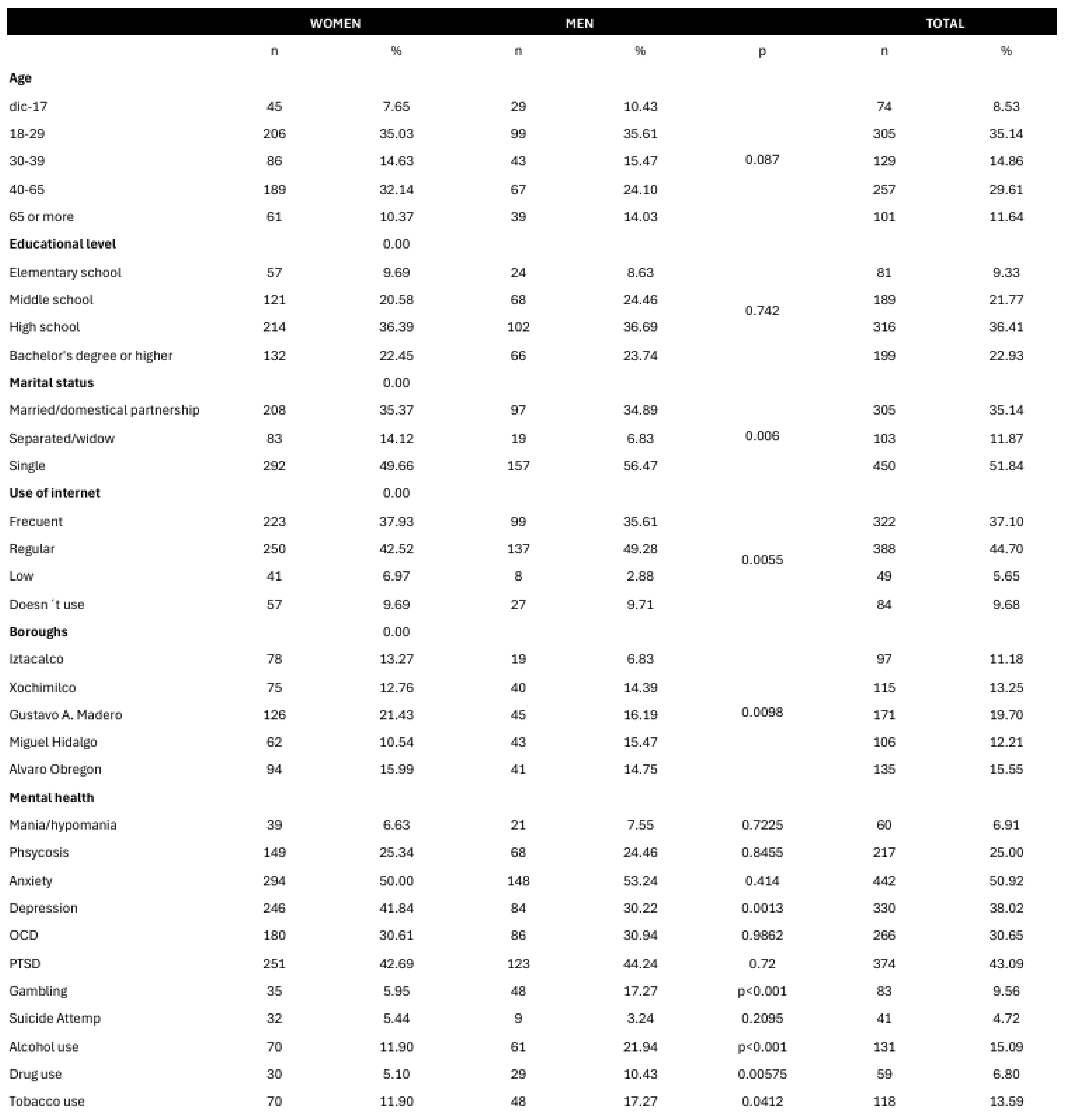
The sociodemographic data show that most of the respondents were young people between 18-29 years (35.03% women and 35.61% men). The highest educational level was high school with 36.41%, with a similar distribution between genders. The most represented marital status was single (49.66% women and 56.47% men). In use of the internet, the principal response was more than 5 hours per day (37.33% women and 35.61% men).
In psychiatric disorders, anxiety was the most reported disorder with 50.32%, depression with 32.73% and obsessive compulsive disorder with 28.86%.
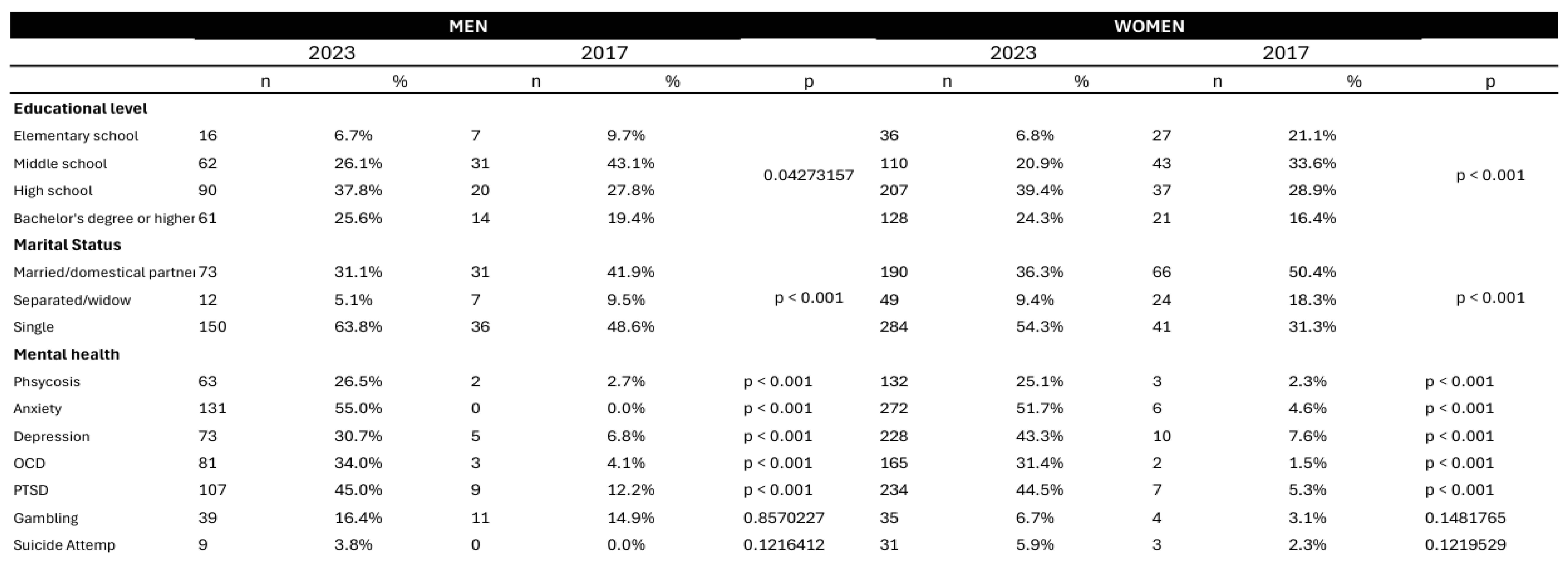
This graphic shows the comparison between the prevalence of psychiatric symptomatology in Mexico City based on data from the ENCODAT 2016–2017 and the 2023 survey, broken down by sex (male and female).
The level of education was very similar across both surveys, although in 2023 the most common academic level among both men and women was high school, whereas in 2017 it was middle school. The proportion of individuals with undergraduate and postgraduate degrees increased in both genders by 2023.
Regarding marital status, the most frequently reported status in 2023 was single, which showed a significant increase compared to 2017, when the most common status was married or in a domestic partnership.
As for psychiatric disorders, it is worth noting that unlike in 2017—when the three most prevalent disorders were post-traumatic stress disorder, depression, and obsessive-compulsive disorder—the most recent data indicate that the top three in 2023 were anxiety, depression, and post-traumatic stress disorder.
4. DISCUSSION
In the 2023 survey results, the most represented group was young people aged 18 to 29. This may influence the educational level results, with higher proportions in high school, undergraduate, or postgraduate education. Previous studies from INEGI [8] have found that higher education levels may be related to lower incidence of mental disorders. However, in our study, the most prevalent disorders were anxiety and depression, suggesting that other social and environmental factors might be involved.
One factor that may affect mental health is the area in which people live and carry out their daily activities. The most represented boroughs in our sample were Gustavo A. Madero and Álvaro Obregón, which include medium and low socioeconomic areas. This may influence access to health, psychological, and psychiatric services [9].
Another important factor for mental health is interpersonal relationships. Results show that single people reported a higher prevalence of mental disorders (51.84%) compared to those who were married or in a cohabiting relationship (35.17%). This aligns with other studies suggesting that marriage or stable relationships can provide emotional support [10]. However, the difference between people who are separated, widowed, or divorced and those who are married is small, which could mean that the quality of interpersonal relationships is more important than marital status itself for mental health.
The most prevalent disorders were anxiety (50.32%), followed by depression (32.73%) and OCD (28.86%). This trend is also seen in other studies, which show increases in anxiety and depression in recent years, especially after the COVID-19 pandemic [6, 11]. Although increases were observed in both sexes, women showed slightly higher prevalence. A study by UNAM (2022) found that young women reported higher levels due to emotional burdens, family responsibilities, and greater exposure to gender-based violence. This may also explain the rise in PTSD cases [11].
Regarding substance use, illegal drug use has increased since the last survey [7], where 4% was reported in the general population and 17% in high-risk groups. This may reflect increased use among young people [4]. Tobacco use was lower compared to ENCODAT, possibly due to habit changes or the transition to vaping, which has increased among adolescents and young people [12]. Alcohol use showed no significant change and remained within similar parameters (25% in men and 8.5% in women), with higher prevalence in men [4].
In terms of education, a comparison between the 2017 and 2023 data showed an increase in high school and university levels, reflecting better access to education. This could be due to growing competition in the labor market, which increasingly demands higher education levels for well-paying jobs [13].
Marital status showed a significant increase in the proportion of single individuals in 2023 compared to 2017, which aligns with trends in recent generations to postpone marriage and prioritize financial and personal stability [14].
Data from Table 2 shows a significant increase in the prevalence of mental disorders between 2017 and 2023, especially in anxiety, psychosis, depression, OCD, and PTSD.
During the social isolation caused by the COVID-19 pandemic —with distancing, activity interruptions, and transitions to remote work, school, and socialization— anxiety and depression became more severe due to the abrupt change in daily routines, directly affecting mental health. The rise in family concerns, such as the loss of loved ones, economic uncertainties, and health issues, led to a general increase in mental disorders [15], as observed in Table 2.
Anxiety was the most prevalent disorder in 2023, affecting 55.0% of men and 51.7% of women, while it was barely reported in 2017. This increase is consistent with global studies reporting a 25% rise in anxiety and depression following the COVID-19 pandemic [5]. Research in Mexico [16] also showed increased levels of anxiety and PTSD among students and workers due to economic uncertainty and isolation.
Post-Traumatic Stress Disorder (PTSD) rose from 5.3% in 2017 to 44.5% in women and 45.0% in men in 2023. The impact of COVID-19, loss of loved ones, economic crises, and violence were key factors in this increase, according to studies by the UNAM Faculty of Psychology [17].
Psychosis increased from 3% in 2017 to more than 25% in 2023 across both genders. The Pan American Health Organization [18] has reported a rise in psychotic symptoms due to the use of psychoactive substances, which have also seen an increase, possibly due to extreme stress and precarious living conditions [19].
The data suggests that women reported higher levels of anxiety (51.7% vs. 55.0% in men) and depression (43.3% vs. 30.7% in men), while men had slightly higher prevalence in psychosis, OCD, and gambling disorder. These findings are consistent with international epidemiological studies showing that women are at greater risk of developing affective disorders, while men are more prone to impulse control disorders and psychosis [20].
It is also important to note that with greater awareness of mental health issues, people may feel more comfortable talking about them. This could help explain the overall increase observed in recent years. Despite this, men’s results may appear lower compared to women’s. According to Dr. Jason Hunziker from the Huntsman Mental Health Institute, men face social pressures to appear strong and self-reliant. This can lead them to downplay their symptoms and avoid seeking professional help, which may conceal the real impact on men’s mental health.
5. Conclusions
The increase in the prevalence of mental disorders has grown considerably in recent years. The data suggest that there is a need to strengthen mental health care and implement public policies that support these interventions. Although awareness and services have increased, it is important to continue conducting this type of survey to gain a broader understanding of the ongoing issues in the population. This will allow for the proposal of more awareness campaigns in society and help ensure access to mental health services and treatments.
Author Contributions
For E.S., A.D.G.-M and H.N. developed the analyses and wrote the first version of the manuscript. E.S, P.M. and MBG. performed bioinformatics and statistical analyses. E. S., and M.E.M.-M. contributed to data collection. E.S. R.B., D.P., D.M., G. B. and A.D.G.-M. All authors reviewed and contributed to the article and approved the submitted version. All authors have read and agreed to the published version of the manuscript.
Funding
This research received no external funding.
Institutional Review Board Statement
The study was conducted in accordance with the Declaration 114 of Helsinki, and approved by the Ethics Committee of Instituto Nacional de Medicina Genómica (official document number 23/2015/I.
Informed Consent Statement
Informed consent was obtained from all subjects involved in the study.
Acknowledgments
Special thanks to the fifth-semester nursing students of the School of Family and Community Nursing of 2023 from the Universidad de la Salud (UNISA), who supported us in carrying out the data collection. Special thanks to Alexia Basurto, Rosa Torres, Sofia Gomez, and Leslie Chavez, students from the School of Family and Community Nursing, University of Health (UNISA), who also actively helped with sample processing.
Conflicts of Interest
The authors declare no conflicts of interest.
References
- OMS (2022) SALUD MENTAL: FORTALECER NUESTRA RESPUESTA. Recuperado de https://www.who.int/es/news-room/fact-sheets/detail/mental-health-strengthening-our-response.
- Ramos, L (2014) ¿POR QUÉ HABLAR DE GÉNERO Y SALUD MENTAL? Recuperado de https://www.scielo.org.mx/scielo.php?script=sci_arttext&pid=S0185-33252014000400001.
- Kessler, R.C.; Angermeyer, M.; Anthony, J.C.; De Graaf, R.; Demyttenaere, K.; Gasquet, I.; De Girolamo, G.; Gluzman, S.; Gureje, O.; Haro, J.M.; et al. Lifetime prevalence and age-of-onset distributions of mental disorders in the World Health Organization’s World Mental Health Survey Initiative. World Psychiatry 2007, 6, 168–176. Available online: https://www.ncbi.nlm.nih.gov/pmc/articles/PMC2174588/ (accessed on 24 June 2020). [PubMed]
- Medina-Mora, M.E.; Genis-Mendoza, A.D.; Velázquez, J.A.V.; Bustos-Gamiño, M.; Bautista, C.F.; Camarena, B.; Martínez-Magaña, J.J.; Nicolini, H. The Prevalence of Symptomatology and Risk Factors in Mental Health in Mexico: The 2016–17 ENCODAT Cohort. Int. J. Environ. Res. Public Heal. 2023, 20, 3109. [Google Scholar] [CrossRef] [PubMed]
- OMS (2022) SALUD MENTAL Y COVID-19: DATOS INICIALES SOBRE LAS REPERCUSIONES DE LA PANDEMIA. Recuperado de https://iris.who.int/bitstream/handle/10665/354393/WHO-2019-nCoV-Sci-Brief-Mental-health-2022.1-spa.pdf?
- Organización Mundial de la Salud (OMS). (2021). Impacto del COVID-19 en la Salud Mental. Recuperado de https://www.who.int.Bhugara, D. Organización Mundial de la Salud (OMS). (2021). Impacto del COVID-19 en la Salud Mental. Recuperado de https://www.who.int.Bhugara, D., Till, A., Sartorius, N (2013) WHAT IS MENTAL HEALTH? Recuperado de https://www.researchgate.net/publication/235371865_What_is_mental_health.
- Comisión Nacional contra las Adicciones (2017) ENCUESTA NACIONAL DE CONSUMO DE DROGAS, ALCOHOL Y TABACO, ENCODAT 2016,2017. Recuperado de https://inprf.gob.mx/psicosociales/archivos/ena/resumen_metodologico_ENCODAT_2016.
- Instituto Nacional de Estadística y Geografía (INEGI). (2021). Encuesta Nacional de Bienestar Autorreportado. Recuperado de https://www.inegi.org.mx.
- Secretaría de Salud, México. (2021). Acceso a Servicios de Salud Mental en México. Recuperado de https://www.gob.mx/salud.
- Pew Research Center. (2019). Marriage and Mental Health: A Global Perspective. Recuperado de https://www.pewresearch.org.
- Facultad de Medicina, UNAM. (2022). COVID-19 No.28: ¿Cómo impactó a la salud mental de los estudiantes? [PDF]. Dirección de Servicios Psicológicos. Recuperado de https://dsp.facmed.unam.mx/wp-content/uploads/2022/02/COVID-19-No.28-03-Como-impacto-a-la-salud-mental-de-los-estudiantes-1.
- National Institutes of Health. (2019, diciembre). El vapeo aumenta entre los adolescentes. NIH Noticias de Salud. https://salud.nih.
- Organización para la Cooperación y el Desarrollo Económicos (OCDE). (2021). Panorama de la educación 2021: Indicadores de la OCDE. OCDE Publishing. https://www.oecd.org/es/publications/panorama-de-la-educacion_20795793.
- Fry, R. , & Parker, K. (2021, ). Rising Share of U.S. Adults Are Living Without a Spouse or Partner. Pew Research Center. https://www.pewresearch. 5 October 2021. [Google Scholar]
- Infante Castañeda C, Peláez Ballestas I, Murillo López SC. Opiniones de los universitarios sobre la epidemia de COVID-19 y sus efectos sociales. Ciudad Universitaria: UNAM. Instituto de Investigaciones Sociales; 2020. Disponible en: https://buff.ly/3POgb0w.
- Universidad Nacional Autónoma de México (UNAM). (2022). Impacto del COVID-19 en la Salud Mental de los Estudiantes. Recuperado de https://www.unam.mx.
- UNAM. (2022). Impacto del COVID-19 en la Salud Mental de los Estudiantes Mexicanos.
- Organización Panamericana de la Salud (OPS). (2022). The Rise of Mental Disorders in Latin America.
- World Health Organization. (2022). World mental health report: Transforming mental health for all. Organización Panamericana de la Salud. https://www.paho.org/en/news/17-6-2022-who-highlights-urgent-need-transform-mental-health-and-mental-health-care.
- American Psychological Association (APA). (2020). Gender and Mental Health Report.
Table 2.
Comparison of prevalence percentages obtained in 2017 and 2023, from the CDMX divided into men and women.
Table 2.
Comparison of prevalence percentages obtained in 2017 and 2023, from the CDMX divided into men and women.
Disclaimer/Publisher’s Note: The statements, opinions and data contained in all publications are solely those of the individual author(s) and contributor(s) and not of MDPI and/or the editor(s). MDPI and/or the editor(s) disclaim responsibility for any injury to people or property resulting from any ideas, methods, instructions or products referred to in the content. |
© 2025 by the authors. Licensee MDPI, Basel, Switzerland. This article is an open access article distributed under the terms and conditions of the Creative Commons Attribution (CC BY) license (https://creativecommons.org/licenses/by/4.0/).
Copyright: This open access article is published under a Creative Commons CC BY 4.0 license, which permit the free download, distribution, and reuse, provided that the author and preprint are cited in any reuse.


