
Submitted:
14 July 2025
Posted:
16 July 2025
You are already at the latest version
Abstract
In this work, a Novel, simple 4D Hyperchaotic Sprott-D System extended from the well-known three-dimensional (3D) Sprott-D chaotic system proposed by Z. Wei in 2011 and a First order Discrete time Delta Sigma Modulator system are used to securely modulate two physiological signals for e-health applications. By incorporating a new dynamic variable and enhanced coupling structures, the proposed 4D system demonstrates hyperchaotic behavior, characterized by two positive Lyapunov exponents. Comparative analysis with the original Wei system and related literature underscores the advantages of the new model in terms of complexity, unpredictability, and potential applications in secure communication systems. Pseudo random bits are generated from the proposed new 4D Hyperchaotic system, successfully tested via NIST-800.22 test, and conveniently used in MATLAB Simulink software to encrypt and decrypt ECG and EEG signals in a reliable, confidential, simple and secure digital telemedicine system. Some standard metrics, such as key space analysis, key sensitivity, histogram and cross-correlation, are applied to verify the strength of the encryption scheme.
Keywords:
e-health
; hyper-chaos
; chaotic attractors
; Pseudo random number generator
; discrete time delta sigma modulator
; chaos-based cryptography
; ECG signal
; EEG signal
; key space
; key sensitivity
; correlation
; histogram
1. Introduction
E-health technology is increasingly in need of high fidelity with strict linearity requirements and a reduction in the power budget of electronic devices. New analogue-to-digital conversion techniques, which permit high resolution and low cost and are power conscious, need to be conceived [1]. A good choice for realizing these types of converters is the use of Sigma‒Delta modulators. Information security cannot be taken for granted in e-health services. Many means by which information is kept private, such as cryptography, exist [2]. Most recent authors who have shown interest in cryptography have used chaotic systems given their nonperiodicity, randomness, and very sensitive dependence on initial conditions and system parameters [3]. In 2023, Wang, Ning, et al. proposed a general configuration for nonlinear circuits, which was based on current controlled nonlinearity. Under their proposed configuration, they came up with two new five-element chaotic circuits which included the first third-order, in which one employed a current-controlled anti-parallel connection diode pair and the second, a fourth-order one, which employed a current-controlled memristor emulator. Their work results to Several rich dynamical properties of the two chaotic circuits which they investigated using numerical simulations and certified by both Pspice circuit simulations and analog circuit measurements. Such circuits have applicability in security and many other fields of engineering [4]. Still in 2023, Wang, Ning et al. proposed a new hidden Chua’s attractor using the operation of complex numbers. In this work, they presented the detailed system construction, equilibrium calculation, and numerical simulation. They did a physical experiment using field programmable gate array to implement the hidden attractors [5]. In 2024, Wang, Ning et al. again present two simple circuit topologies as paradigms, which were respectively dual to the classical Chua’s circuit and the canonical Chua’s circuit. They proposed from here two simple implementations of the dual Chua’s circuits which consisted of two inductors, a capacitor, a passive/active linear resistor, and a piecewise-linear current-controlled Chua’s diode [6]. Looking at the application of chaotic system in information security, In 2019, Tiedeu et al. worked on an image encryption algorithm based on the substitution technique and chaos mixing [7]. In 2020, to achieve standard image encryption, Nkandeu et al. used combinations of one-dimensional discrete maps and synchronized parallel diffusion. In 2022, Musanna et al., to encrypt images, implemented an encryption algorithm that was based on a cellular neural network and fractional chaos [8]. In 2022, Yu Fei et al. proposed a secure medical information transmission scheme based on 03 new memristive Hopfield neural network [9]. They used a non-ideal flux-controlled memristor model with multi-piecewise nonlinearity. Their model yielded complex dynamics such as coexisting attractors, multi-scroll attractors and grid multi-scroll attractors. They implemented their proposed model on (FPGA). Nevertheless, in 2022, Nkandeu et al. encrypted images via an algorithm that is based on a logistic map coupled with self-synchronizing streaming [10]. In 2023, Jeatsa. Kitio et al. proposed a chaos-based encryption/decryption scheme using a novel memristive Chua oscillator to protect medical images [11]. In 2024, Ayemtsa Kuete et al. used a new 3-D map implemented in a microcontroller for medical image encryption [12]. In 2024, Qiang Lai and Genwen Hu. combined compressive sensing techniques based on a designed memristive hyperchaotic system in image encryption. With their proposed encryption method, they quickly encrypted a large volume of medical images. Their experimental results yielded NPCR and UACI values closer to 99.60% and 33.46% respectively with an encryption speed reaching 1860.47 kb / s [13]. Qiang Lai et al. in 2024, conceived a multilevel secure communication technique based on the fixed-time synchronization of multiscroll memristive chaotic system with which they successfully and securely transferred and image, audio and data [14]. Still in 2024, Qiang Lai et al. coupled ideal discrete memristors with an oscillatory term to yield hyperchaotic maps which they applied in pseudorandom number generation for secure information transmission [15]. In 2024, Kong, Xinxin, et al. proposed a new 5D Fractional-order differentiation with interesting dynamics such as hyperchaos, multiscroll, extreme multistability, and “overclocking” with which they encrypted and image in a very secure and efficient way [16]. Just of recent in 2025, Yu Fei et al. proposed an efficient video data encryption scheme based on a multiscroll hopfield neural network system. They proved the feasibility of their encryption scheme with an FPGA implementation [17].
Previous Works
With respect to the application of digital communication and information security in e-health, in 2020, Mboupda Pone et al. used an integrator-based chaotic oscillator with antiparallel connected diodes in the encryption of a patient’s ECG signal [18]. They used their proposed chaotic system to generate random keys, with which they encrypted and decrypted the ECG signal. In 2021, Abeer D. Algarni et al. fused ECG signals with other masking signals that are rich in activities, such as speech signals, for which three cryptosystems that are robust against both noisy and hacking scenarios were presented [19]. An important conclusion from this work is that one good way to increase the security of a cryptosystem is the use of many encryption levels. In 2022, Murillo-Escobar et al improved the randomness of five selected chaotic maps and used them in the encryption of physiological signals [20]. This was done with the use of trigonometric (cosine, sine and tangent) functions, alongside the exponential function combined with module one operation. Wen Dong et al. in 2022 used a K-sine transform-based coupled chaotic system by combining two 1-D chaotic maps to generate a new map [21]. They generated three new chaotic mappings via a K-sine transform-based coupled chaotic system and then used them in the encrypted EEG signal via confusion‒diffusion techniques. In 2023, Murillo-Escobar et al. used the Badola map to encrypt experimentally acquired ECGs [22]. The encryption algorithm makes use of symmetric key cryptography and a one-round confusion‒diffusion approach. Banmene Lontsi et al. in 2024 used a 4wing-4D chaotic oscillator in real-time encryption and transmission of ECG signals via an AWGN transmission channel [23]. They generated pseudorandom bits with which they performed the encryption decryption process in MATLAB Simulink.
With the desire to build a low-cost secure digital e-health system, In this work, a new 4D hyperchaotic oscillator is applied in its hyperchaotic state to add security to a first-order discrete times delta sigma (ΔΣM) modulator system applied in ECG and EEG signals transmission. The work is performed in MATLAB Simulink software. Among various low-dimensional chaotic systems, the Sprott D system [24] and its derivatives [25], including the 3D system introduced by Z. Wei [26], have become significant for their simplicity and chaotic behavior. While Wei's system and many other 3D systems modified the Sprott D structure by introducing quadratic nonlinearities to eliminate equilibria and enhance chaotic dynamics, it remains limited in terms of dimensional complexity and security applications. To address these limitations, we propose a novel 4D hyperchaotic system that extends the Wei system by integrating a fourth dynamic variable with feedback mechanisms. This modification not only preserves the desirable properties of the original model but also introduces additional degrees of freedom, enabling hyperchaotic behavior which is more suitable for secure communication application schemes. The proposed system has a total of eight (08) system parameters and four (04) state variables, which are manipulated as keys to generate pseudorandom encryption bitstreams. These bits are tested statistically via the NIST-800.22 test, which, with p values greater than 0.001, proved to be random. The encryption process makes use of all the systems state variables, and this in a three-stage confusion and key shuffling, which makes it highly unpredictable. Each encryption stage improves the previous stage.
The rest of this paper is structured as follows: In section 2, the description and analysis of the different circuits used in this contribution is done. In section 3, the obtained results are presented and discussed. In section 4, a comparison is performed between this work and existing works in the literature, and finally, concluding remarks are provided in section 5.
2. System Descriptions and Analysis
In this section, the analytical, numerical, and experimental studies of the novel 4D Sprott-D system as well as the modified first order discrete time delta sigma modulator digital communication system is conducted to validate the e-health service.
2.1. Mathematical Modelling of the Novel 4D Sprott-D System
The newly proposed 4D system is defined in equation (1):
where, , are state variables, and are real system parameters. The added dynamic variable w introduces new feedback into , which significantly alters the system dynamics compared to the 3D Wei system [26]. This approach allows for the analysis of more complex and varied dynamic behaviours, highlighting the richness of interactions within the system [11].
Comparison of the Proposed 4D Hyperchaotic System with the Wei 2011 System [26].
Wei's 3D system is shown in equation (2):
The Wei system is a minimal chaotic system with quadratic nonlinearity, exhibiting single-scroll chaotic behavior. While it is structurally simple and suitable for theoretical exploration, its limited dimensionality and lack of hyperchaos restrict its utility in practical applications such as secure communication. By contrast, the 4D system proposed as its extension:
- Incorporates an additional dimension with dynamic coupling;
- Introduces additional nonlinear and linear terms through w and εy;
- Exhibits hyperchaotic behavior due to increased degrees of freedom;
- Enables higher unpredictability and sensitivity to initial conditions.
The primary motivation for extending to a 4D hyperchaotic system lies in secure communication. Hyperchaotic systems with many system parameters and hidden attractors are widely recognized for greater key space and encryption strength; Multiple positive Lyapunov exponents enabling parallel masking schemes; Superior resistance to signal reconstruction attacks.
The structural richness and hyperchaotic behavior of the proposed 4D system make it an excellent candidate for signal encryption, image encryption, digital watermarking, and chaotic masking in wireless communication. Moreover, the inclusion of the w-dimension adds extra layers of complexity, which are crucial in counteracting modern cryptanalytic techniques. These improvements directly translate into enhanced performance in systems requiring high complexity and unpredictability, such as secure data transmission.
2.2. Basic Properties of the Novel Sprott System
2.2.1. Symmetry
Symmetry in dynamical systems refers to invariance under transformations such as variable negation. Testing inversion symmetry with , we find that system (1) does not maintain invariance. None of the transformed equations retain their original forms. Hence, the system is asymmetric. Asymmetric systems are beneficial for secure communication, as they lack of symmetry increases structural complexity, making reconstruction by an adversary more difficult [27].
2.2.2. Dissipation and Existence of Attractor
The study of the dissipation and existence of attractors is the first step in the research of the dynamic behaviour of a dynamic system [28]. It is a necessary property of a dynamical system for bounded, attractor-like behavior [29] [30]. Dissipativity is established by computing the divergence of the system’s vector field. For the proposed 4D hyperchaotic system, the derivativity is computed as in equation (3):
This shows that the system is dissipative on average if ε − λ < 0, given that x(t) oscillates around zero.
2.2.3. Equilibrium Point Analysis
The equilibrium points of a dynamic system are the set of points for which the system does not evolve in space time. To find the equilibria, the derivatives of the state variables are set to zero () as in equation (4)
Solving equation (4) yields the following equilibria:
and, with .
If for any given values of the system parameters, the system has no real equilibrium point. This is a classic signature of hidden attractors, which is greatly desired for secure communication as hidden attractors do not have basin of attraction connected with unstable equilibria, which makes them hard to detect and analyse [31]. Also, hidden attractors provide a new class of oscillations suitable for secure communication since their unpredictability is harder to exploit by attackers [32]. Additionally, hidden attractors are reachable only from a specific set of initial conditions and system parameters which makes it harder for an attacker to synchronize or clone the system without full key knowledge. For this study, the system parameters chosen are ; ; ; ; ; ; ; , which yields and so the system admits no equilibria. The attractors generated with the parameters are therefore hidden and so suitable for secure communication. Table 1 below compares the proposed novel 4D chaotic oscillator with exiting 4D systems in the literature.
It can be observed from Table 1 that the proposed system falls within the family of hyperchaotic systems with no equilibria and so its attractors are hidden, making the system ideal for information security as hidden attractors foster unpredictability.
2.3. Lyapunov Exponents
The numerical properties of the average exponential dispersion rate of neighbouring trajectories in phase space are represented by the Lyapunov exponent (LE). One of the key instruments for determining whether dynamical systems behave in a chaotic or hyperchaotic manner is the Lyapunov exponent. The positive or negative Lyapunov characteristic exponents serve as the basic foundation for determining whether a system is respectively chaotic or not; a system is considered chaotic if it has one positive exponent, and hyperchaotic if it has two or more positive exponents. In order to assess the system's complexity, it considers the maximal quantum Kaplan-Yorke dimension [46]. The simulations in this research work were performed via the MATLAB2020a ODE45 numerical solver. Calculations were made for equation Erreur ! Source du renvoi introuvable.) by setting system parameters ; ; ; ; ; ; ; , and initial conditions , with and . The obtained Lyapunov exponents (LEs) are given in equation (7):
The first two Lyapunov exponents are positive, corresponding to hyper-chaos. The Lyapunov exponent diagram (Figure 1 (a)) and the attractor diagram (Figure 1 (b)) at this point are given. The Kaplan–Yorke (KY) fractal dimension is calculated as follows:
where j is the largest index such that . For the proposed 4D chaotic system, . The fact that , and is a non-integer value reflects a fractal attractor.
2.4. Transition to Chaos: Sensitivity of the System Towards α and ε
To investigate the various types of bifurcation modes that can be observed in dynamical systems, system (1) is solved numerically via the fourth-order Runge–Kutta algorithm. For each phenomenon examined in this study, we maintain a consistent integration step of [49], ensuring that all calculations utilize the variables and constants in extended mode.
Two critical elements are rigorously employed to identify the scenarios that lead to chaotic behaviour. The first indicator is the bifurcation diagram, which gives insights into how the system transitions between different states as some given parameters vary. The second indicator is the graph of the Lyapunov exponent spectrum, which helps in the classification of the dynamic behaviour of the system. In relation to the Lyapunov exponents, we categorize the system's dynamics via numerical calculations based on the algorithm proposed in [50]. This approach allows for a precise assessment of the stability characteristics and chaotic nature of the system (1). The bifurcation diagrams and their corresponding Lyapunov exponents for the variation of the parameters α and ε are presented in Figure 2
Figure 2 illustrates the dynamic response of the proposed 4D system to variations in parameters α and ε. Subfigures (a₁) and (b₁) show bifurcation diagrams, while (a₂) and (b₂) present the corresponding largest Lyapunov exponents (LLEs).
In Figure 2 (a₁), the system begins in a clearly chaotic regime for α-values between approximately 0.01 and 0.03, as evidenced by a dense spread of bifurcation points. Interestingly, as increases beyond this range, the attractor narrows and organizes into periodic bands. This reveals a transition from chaos to periodicity, a phenomenon known as a boundary crisis, where a chaotic attractor disappears and the system stabilizes into a periodic orbit [51]. This type of reverse transition is particularly useful for applications that require controlled switching between complex and stable regimes. In Figure 2 (b₁), Contrary to initial interpretations for α-values, the region with ε-values from -0.08 to approximately -0.03 displays periodic behavior, evident from narrow and organized trajectories. As ε increases toward approximately -0.015, the system undergoes a periodic-to-chaotic transition, marked by branching and increased complexity in the attractor structure. For values of ε approaching 0 and slightly above, the system exhibits signs of hyper-chaos or multistability, characterized by wide, irregular bifurcation structures. The corresponding Lyapunov exponent diagrams in Figure 2 (a₂) and (b₂) support these observations. Positive values of the largest Lyapunov exponent confirm chaotic regions. In Figure 2 (a₂), the LLE decreases as α increases, aligning with the observed chaos-to-periodic transition. In Figure 2(b₂), the LLE increases with ε, confirming the onset of chaos beyond. The presence of spikes and irregular growth patterns in both LLE plots suggests the emergence of hyperchaotic dynamics—a desirable trait for systems used in cryptography due to their enhanced complexity and unpredictability [52]. The ability to control transitions between chaos and periodic behavior via parameters makes chaotic systems suitable for dynamic synchronizations [53]. This controlled switching and high-dimensional instability reinforce the system’s utility in adaptive chaotic cryptosystems, where security, unpredictability, and dynamic control are essential. These transitions from one state of the chaotic system is further illustrated in Figure 3.
Figure 3 three shows that the state of the system (1) changes from periodic to chaotic to quasiperiodic and vices versa as the parameters increases. This agrees with the result illustrated in Figure 2.
2.5. Poincaré Section of the New Sprott System
The Poincaré section is a powerful method used to reduce the dimensionality of chaotic systems and to visually inspect the recurrence properties of trajectories in phase space. For a four-dimensional (4D) dynamical system, it allows projection onto a lower-dimensional subspace, revealing intricate details about the underlying structure of chaos [48] [54]. In this section, we examine Poincaré sections on the hyperplane y = 0, capturing intersections for various state variable pairs as illustrated in Figure 4. This technique is crucial in the qualitative analysis of high-dimensional chaotic attractors
Collectively, these Poincaré sections affirm the chaotic nature of the proposed 4D system. They demonstrate that despite dimensional augmentation, the system preserves a rich set of nonlinear dynamical features, vital for applications in secure communications, random number generation, and more.
2.6. Pseudo Random Number Generation (PRNG) Algorithm
Here the algorithm used in generating pseudo random bit streams for encryption from the new 4D Sprott-D chaotic system is presented. The algorithm is presented as follows:
Inputs:
Floating point data: x(t), y(t), z(t), and w(t) from the four (04) State variables of the 4D Sprott-D chaotic system each containing exactly 1,000,000 rows of floating-point numbers.
PRNG Steps:
1. Generation of hyperchaotic state variables:
Use the chaotic oscillator initial conditions and system parameters when at least two to generate hyperchaotic state variables
2. IEEE Conversion and Bit Extraction:
- Convert each floating-point value to its 32-bit IEEE 754 single-precision binary representation.
- Extract the last 8 bits (least significant byte) of each data representation.
3. Decimal Digit Indexing
- Extract the 4th, 5th, and 6th decimal digits from each floating-point data.
- Compute combined indexes (4th+5th, 6th, 4th+6th, 5th+6th) and reduce them modulo 8 to select 4 bits from the 8-bit string.
4. Bit Concatenation
- For each float, extract 4 bits from the 8-bit string using the derived indices.
- Concatenate all bits from all state variables to form a bitstream of 4,000,000 bits.
7. Key Extraction
- Divide the final bitstream into 4 equal parts (1,000,000 bits each) named , , , and .
The generated bits are then tested statistically using the NIST800.22 statistical test which proved to be random as p-values for all fifteen tests where greater than 0.001 [55]. The results obtained after the test are successful, as shown in Table. This proves that the chaotic oscillator proposed in this work is suitable for information encryption [55].
2.7. The First Order Discrete Time Delta Sigma Modulator (DTΔΣM)
The delta-sigma modulator make use of oversampling, noise shaping, and filtering of digital signals to yield a high-resolution digitized output [56]. Here, the analog input signal is modulated into a digital signal. The spectrum of this digital sequence approximates that of the analogue input signal in a narrow frequency range containing some noise [57], which arises as a result of the quantization of the analogue signal [58]. The ΔΣ- modulator is made up of an antialiasing filter that functions as a band-limiter of the analogue input signal by avoiding aliasing during its subsequent sampling [59]; a low-pass delta-sigma analogue to digital converter (which consists of a loop filter, a quantizer (ADC) and a feedback digital-to-analogue converter (DAC)) where the analogue signal is digitized and where noise shaping (making sure that the quantization noise lies away from the desired frequency range) occurs; and finally, the decimation filter, which reduces the output sample rate without causing a loss of information and provides increased resolution [60]. The block diagram of the ΔΣM is shown in Figure 5.
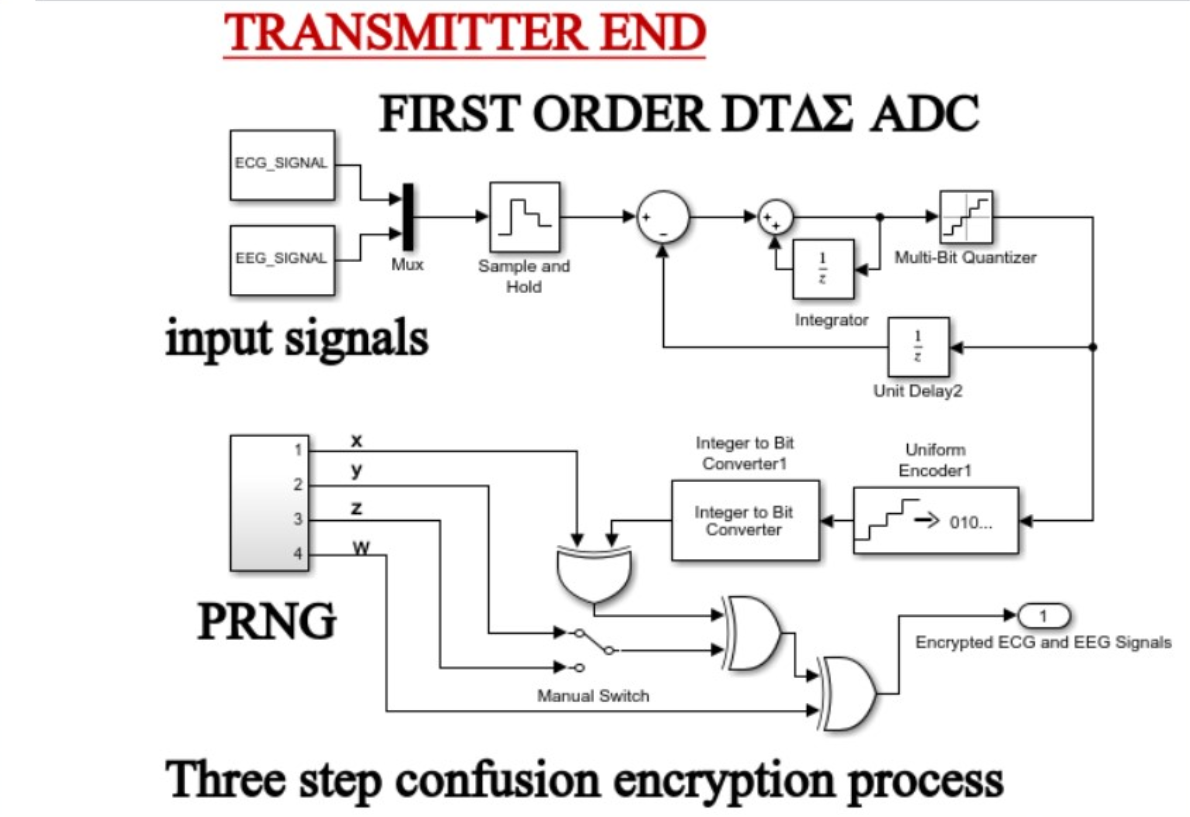
In this work, chaos cryptography is applied to a first-order discrete-time delta sigma modulator (DTΔΣM) and applied in the simultaneous secure transmission of ECG and EEG signals. To enhance security and privacy, as well as multi-data transmission, the transmitter and receiver ends of the first-order DTΔΣM system are modified. Once analogue-to-digital conversion is done, the digitized signals are cyphered with the pseudo random generated keys before transmission. Decryption takes place immediately when the cyphered signals reach the receiver, and then, demodulation is performed to obtain the required signals. This is done in MATLAB Simulink, as shown in Figure 6. The recommended sampling frequencies for ECG signals vary depending on the application. For basic ECG monitoring and heart rate detection, 100 Hz to 200 Hz is recommended [61], [62]; for diagnostic ECG and arrhythmia detection, 500 Hz to 1 kHz is recommended [63] [64]; and for high-fidelity ECG and detailed waveform analysis, 2 kHz to 5 kHz is recommended [65] [66]. Similarly, as far as EEG sampling is concerned, for general EEG monitoring and sleep tagging, 200 Hz to 500 Hz is recommended; for seizure detection and epilepsy monitoring, 500 Hz to 1 kHz is recommended [67]; and for high-fidelity EEG and detailed waveform analysis, 1 kHz to 5 kHz is recommended [68]. Given the above sampling rates, for the conception of the proposed first-order DTΔΣM system, a sampling rate of 500 Hz is chosen, which permits good reconstruction of both the ECG and EEG signals. Therefore, what so ever be the physiological signal, the appropriate sampling rate should be chosen so as to suite its reconstructions, depending on the information to be extracted from the signal. The MATLAB Simulink block diagram of the first order DTΔΣM system is illustrated in Figure 6 (the transmitter end) and Figure 7 (the receiver end).
As already mentioned, the decryption process occurs immediately the encrypted signals are received at the receiver end of the first-order DTΔΣM system, after which demodulation takes place, as shown in Figure 7. The results of the Simulink implementation of the modified first-order DTΔΣM systems in the transmission of two physiological signals are shown in Figure 8. The encryption and decryption processes shown in Figure 6 and Figure 7 are described in more detail in section 2.8.
In the subsection that follows, a detailed description of the encryption-decryption processes is provided.
2.8. Chaos-Based Encryption Applied to the First-Order DTΔΣM System
In this subsection, the three-step confusion and key shuffling processes that lead to the encryption of the physiological signals are describe. Chaos-based cryptography is applied to the DTΔΣM system, as shown in Figure 6 and Figure 7, to produce a simple, secure and effective information transmission system. The encryption process starts immediately after the encoding process of the designed first-order DTΔΣM process is completed, after which the encrypted signal is transmitted. Decryption begins once the securely transmitted signal reaches the receiver end. After decryption, the signal is demodulated to retrieve the transmitted signal.
- The encryption-decryption process
At this point, the PRNG bits generated as described in section 2.6 above are applied to secure the first order DTΔΣM system for the simultaneous transfer of ECG and EEG signals. The original encoded signals are successfully retrieved after decryption. The designed cryptosystem consists of two units, the encryption and decryption units, which are designed after signal encoding and before demodulation begins, as illustrated in Figure 6 and Figure 7 respectively. In the encryption unit, random keys generated from the four (04) state variable signals of the proposed chaotic oscillator with the system’s parameter and initial conditions in its hyperchaotic state are use. The encryption process is as described below:
- Encryption process
The encryption process uses four keys , , , and and takes place in three (03) confusion and key shuffling stages. During the first confusion stage, the digitized ECG signal, which represents the plain text , is XORed with the encryption keys to yield the first cyphered text , as shown in equation (9).
In the second confusion stage, the encryption keys and are shuffled through a switch, that continually switches the two keys to produce a single key , which is then XORed with the first cyphered signals to obtain the second cyphered signals , as shown in equation (10).
Finally, the last key is XORed with the cyphered signal to yield the cyphered signal .
The use of a switch in the second confusion stage adds an extra layer of security to the encryption algorithm given that it increases the key’s unpredictability without increasing the key length. Once encryption is complete, the encrypted signal is transmitted to the decryption unit of the first-order DTΔΣM receiver end where decryption and demodulation takes place to retrieve the transmitted signal.
- b. Decryption process
In the decryption unit illustrated in Figure 7, the encrypted signal received from the transmitter end is progressively XORed with the same keys used during encryption in three different stages to reverse the encryption process, as shown in equations (12) to (14).
Thus, the encoded signals are successfully obtained by decrypting the encrypted signals, after which decoding and filtering occur to obtain the transmitted physiological signals.
A comparison is made between the original signals and the encrypted signals and between the original and decrypted signals. This is accomplished via cross-correlation, as shown in Figure 11.
3. Results and Discussions
At this point, we present and discussed all the results obtained during the investigations in this work.
3.1. NIST-800.22 Statistical Test Results
Table 2 shows the results of the NIST statistical test for 4000000 values obtained from the proposed chaotic oscillator system.
Table 2 shows that all the p values are greater than 0.001. This affirms that the data from the proposed 4D hyperchaotic attractor are statistically valid and therefore suitable for use in information encryption.
3.2. Results of the Secured First Order DTΔΣM Digital Communication Systems
Here, the results obtained from the first order DTΔΣM systems are presented. They are as shown in Figure 8.
It can be seen from Figure 8 that the demodulated ECG (b) and EEG (d) signals are highly similar to the original signals shown in (a) and (c) respectively. This shows that the modified secure first-order DTΔΣM system can adequately transmit medical data with high fidelity and hence is suitable for e-health services. To confirm the security and confidentiality of the modified first-order DTΔΣM system, the encryption-decryption results are discussed in the following section.
3.3. Results of the Encryption-Decryption Process
In this subsection, the results of the encryption-decryption processes are presented. These results are shown in Figure 9 and later on more discussed via the cross-correlation diagrams in Figure 11.
It can be seen that the original encoded signal Figure 9 (a) and the encoded encrypted signals Figure 9 (b) to Figure 9 (d) are different, whereas the original encoded signal Figure 9 (a) and decrypted encoded signal Figure 9 (d) are identical. To make this result more concrete, a cross correlation between the original and decrypted signals at each encryption stage is performed, as shown in Figure 11 (a), and between the original and encrypted encoded signals at each encryption stage, as shown in Figure 11 (b) to Figure 11 (d). In addition, imagining a situation where an attacker is at the receiver end. He therefore has access to the receiver circuit but not to the encrypted key. In an attempt to demodulate the encrypted signal, he should not be able to obtain the original signal or any part of it. The encrypted signals are demodulated without decrypting it, and the results shown in Figure 10(b) for the ECG signal and for the Figure 10(e) for EEG signal is obtain.
It can be seen from Figure 10 that the encrypted ECG and ECG signals are different from the original signals. The DTΔΣM system typically employs a prediction filter to estimate the signal’s next value on the basis of the past value and then encodes the difference between the predicted and actual values [1]. To this effect, it is normal to witness a reduction in the encrypted signal’s entropy, as the filter removes some of the randomness introduced by encryption [69].
Nonetheless, the impact of the filters on the encrypted signal distribution does not compromise the security of the encryption. The encrypted signal remains secure as long as the encryption algorithms and keys remain secure. It is seen that despite the filtering process of the DTΔΣM system, the encrypted signal is absolutely different from the original signal. This raises the argument for the effective security provided by the proposed clock control chaos-based encryption scheme.
It can be seen that Figure 11(a) presents a maximum point with the highest cross-correlation coefficient equal to one (01), which is interpreted as high similarity between the encrypted and decrypted waveforms. On the other hand, Figure 11(b) , Figure 11(c) and Figure 11(d) shows correlation coefficients highly close to zero. In addition, moving from Figure 11(b) to Figure 11(d), the cross-correlation coefficient progressively approaches zero, which indicates that the second encryption process highly improves the first encryption process and so does the third encryption stage on the second encryption stage by causing more confusion in the previously encrypted signal.
Key Analysis
- Key space
For a cryptosystem to be good for information security, its key space must be large enough to withstand any brute force attack. A key size of is sufficient [7]. The secret keys used in the proposed crypto system consist of four (04) initial conditions and eight (08) system parameters, resulting in a total of twelve (12) encryption keys that yield a total key space of , which equals , given that the accuracy of the machine used to perform the encryption is. This key space is large enough to set a barrier against brute force attack for the encryption system [7].
- b. Key sensitivity
A cryptosystem must be sensitive to the least significant decimal value of its key to resist the chosen plain signal or chosen cipher signal attack due to an insensitive, weak or equivalent key. Therefore, the slightest change in the encryption keys in a cryptosystem should not be able to decrypt the cyphered information. The proposed cryptosystem is attacked by attempting to decrypt the cyphered ECG signal with keys slightly different from the original keys. In effect, a very small value of is added to all the encryption keys with which an attempt to decrypt the cyphered ECG signal is performed. The results of this process in MATLAB Simulink are shown in Figure 12.
Figure 12 shows that the encryption keys are sensitive to any minute change given that Figure 12 (a) to Figure 12 (l), which represents the demodulated ECG signals, for a negligible change in all the encryption keys, are completely different from the signals decrypted using the correct encryption keys, shown in Figure 10 (b). Also, Figure 12 (a) to Figure 12 (l) are completely different from each other, which shows that none of these keys will successfully decrypt the encrypted signals if they are not used as encryption keys. In Figure 13 Key sensitivity test result on encrypted ECG signal after an addition of to the encryption keys are also presented.
In addition to the results presented in Figure 12, it can be observed from Figure 13 (a) to (l), that for any minute change on the encryption key, the encrypted ECG signals are different from the ECG signal encrypted using the correct encryption keys. This brings more arguments to the sensitivity of the encryption keys.
4. Comparison with the Literature
The encryption scheme showed high security results as the encrypted signals was fully different from the modulated signals, which makes it difficult to identify the exact information sent. The encryption process also had a very high key space making the system robust against any brute force attack. The use of a first order discrete time delta sigma modulator opens great possibility for low cost application as it does not require heavy energy as would require a second or higher order discrete time delta sigma modulator and so, for low-cost, power-conscious applications of the transmission system, the proposed scheme provides satisfactory results. As perspective, the FPGA implementation of the proposed communication system can be performed to evaluate the time complexity and feasibility of the communication system. A comparison with similar works in the literature is presented in Table 3.
5. Conclusions
This paper reports on the conception of a chaos based secure digital information transmission system. The aim of the investigations was to produce a secure digital communication system that is applicable in e-health services. This study also demonstrated an improvement in the dynamics of a chaotic system through an increase in its dynamic. By incorporating a new dynamic variable and enhanced coupling structures, the proposed 4D system demonstrates hyperchaotic behavior, characterized by two positive Lyapunov exponents and the phenomenon of intermittency, which not only enhances an understanding of chaotic systems but also opens avenues for further exploration of nonlinear dynamics and their applications in various fields. Pseudorandom bits are generated from the proposed 4D hyperchaotic system and used in the encryption of the encoded ECG signal. The bits generated from the hyperchaotic oscillators are tested statistically via the NIST-800.22 test, and the result is successful. The hyperchaotic oscillator is used to secure digital modulated ECG data over a first-order discrete-time delta sigma modulation system. The encryption and decryption processes are successful. The encryption keys are well analysed, and it is found that the cryptosystem has a good key space and thus will support any brute force attack. Additionally, the encryption key’s sensitivity is tested, and it is observed that any minute change in the encryption keys makes it impossible for an attacker to decrypt the encrypted signal, making the system resistant to any attack on the encryption keys. These results showed that chaos cryptography can be successfully and reliably applied in digital communication systems there by bringing high security in e-health services and in the field on digital communication at large.
Author Contributions
Conceptualization, Borel Dilane Banmene Lontsi; Investigation, Borel Dilane Banmene Lontsi; Methodology, Justin Roger MBOUPDA PONE; Project administration, Borel Dilane Banmene Lontsi and Justin Roger MBOUPDA PONE; Supervision, Justin Roger MBOUPDA PONE; Validation, Justin Roger MBOUPDA PONE; Writing – original draft, Borel Dilane Banmene Lontsi; Writing – review & editing, Borel Dilane Banmene Lontsi and Justin Roger MBOUPDA PONE.
Funding
This research has not received any specific grant from any funding agency in the commercial, public, or not-for-profit sectors.
Data Availability Statement
The data used to support the findings of this study are available from the corresponding author upon request.
Consent to Publish declaration
Not applicable
Ethics and consent to participate declaration
Not applicable
Acknowledgements
The authors would like to thank Mr Jean Baptist Koinfo for his help in correcting the errors in the different codes used in this investigation.
Conflicts of Interest
The authors declare that they have no conflicts of interest regarding the publication of this paper.
References
- Arnaldi, I., Design of sigma-delta converters in Matlab/Simulink. 2019. [CrossRef]
- Shiu, H.-J., et al., Preserving privacy of online digital physiological signals using blind and reversible steganography. Computer methods and programs in biomedicine, 2017. 151: p. 159-170. [CrossRef]
- Chen, C.-K., et al., Personalized information encryption using ECG signals with chaotic functions. Information Sciences, 2012. 193: p. 125-140. [CrossRef]
- Wang, N., Xu, D., Li, Z., & Xu, Q, A general configuration for nonlinear circuit employing current-controlled nonlinearity: Application in Chua’s circuit. Chaos, Solitons & Fractals, (2023). 177: p. 114233. [CrossRef]
- Wang, N., Cui, M., Yu, X., Shan, Y., & Xu, Q, Generating multi-folded hidden Chua’s attractors: Two-case study. Chaos, Solitons & Fractals, (2023): p. 114242. [CrossRef]
- Wang, N., Xu, D., Iu, H. H. C., Wang, A., Chen, M., & Xu, Q., Dual Chua’s circuit. IEEE Transactions on Circuits and Systems I: Regular Papers, (2023). 71(3): p. 1222-1231. [CrossRef]
- Nkandeu, Y.P.K. and A. Tiedeu, An image encryption algorithm based on substitution technique and chaos mixing. Multimedia Tools and Applications, 2019. 78(8): p. 10013-10034. [CrossRef]
- Musanna, F., D. Dangwal, and S. Kumar, Novel image encryption algorithm using fractional chaos and cellular neural network. Journal of Ambient Intelligence and Humanized Computing, 2022. 13(4): p. 2205-2226. [CrossRef]
- Yu, F., Shen, H., Yu, Q., Kong, X., Sharma, P. K., & Cai, S., Privacy protection of medical data based on multi-scroll memristive Hopfield neural network. IEEE Transactions on Network Science and Engineering, , (2022). 10(2): p. 845-858. [CrossRef]
- Nkandeu, Y.K., et al., Image encryption using the logistic map coupled to a self-synchronizing streaming. Multimedia Tools and Applications, 2022. 81(12): p. 17131-17154. [CrossRef]
- Jeatsa Kitio, G., et al., Biomedical image encryption with a novel memristive chua oscillator embedded in a microcontroller. Brazilian Journal of Physics, 2023. 53(3): p. 56. [CrossRef]
- Ayemtsa Kuete, G.P., et al., Medical image cryptosystem using a new 3-D map implemented in a microcontroller. Multimedia Tools and Applications, 2024: p. 1-40. [CrossRef]
- Lai, Q., and Genwen Hu., "A Nonuniform Pixel Split Encryption Scheme Integrated With Compressive Sensing and Its Application in IoMT." IEEE Transactions on Industrial Informatics, 2024. 20(9). [CrossRef]
- Lai, Q., Yijin Liu, and Luigi Fortuna., Dynamical analysis and fixed-time synchronization for secure communication of hidden multiscroll memristive chaotic system. IEEE Transactions on Circuits and Systems I: Regular Papers, 2024. 71(10). [CrossRef]
- Lai, Q., Liang Yang, and Guanrong Chen., Two-dimensional discrete memristive oscillatory hyperchaotic maps with diverse dynamics. IEEE Transactions on Industrial Electronics, 2024. 72(1). [CrossRef]
- Kong, X., Yu, F., Yao, W., Cai, S., Zhang, J., & Lin, H., Memristor-induced hyperchaos, multiscroll and extreme multistability in fractional-order HNN: Image encryption and FPGA implementation. . Neural Networks, (2024). 171: p. 85-103. [CrossRef]
- Yu, F., Lin, Y., Yao, W., Cai, S., Lin, H., & Li, Y. , , 106904., Multiscroll hopfield neural network with extreme multistability and its application in video encryption for IIoT. Neural Networks, (2025). 182: p. 106904. [CrossRef]
- Mboupda Pone, J.R., et al., Passive–active integrators chaotic oscillator with anti-parallel diodes: Analysis and its chaos-based encryption application to protect electrocardiogram signals. Analog Integrated Circuits and Signal Processing, 2020. 103(1): p. 1-15. [CrossRef]
- Algarni, A.D., et al., Encryption of ECG signals for telemedicine applications. Multimedia Tools and Applications, 2021. 80: p. 10679-10703. [CrossRef]
- Murillo-Escobar, M.Á., et al., Biosignal encryption algorithm based on Ushio chaotic map for e-health. Multimedia Tools and Applications, 2023. 82(15): p. 23373-23399. [CrossRef]
- Wen, D., et al., The EEG signals encryption algorithm with K-sine-transform-based coupling chaotic system. Information Sciences, 2023. 622: p. 962-984. [CrossRef]
- Murillo-Escobar, D., Cruz-Hernández, C., López-Gutiérrez, R.M. and Murillo-Escobar, M.A., Chaotic encryption of real-time ECG signal in embedded system for secure telemedicine. Integration, 2023. 89: p. 261-270. [CrossRef]
- Banmene Lontsi, B.D., Gideon Pagnol Ayemtsa Kuete, and Justin Roger Mboupda Pone. , "On the Telemedicine Microcontroller-Based ECG Security Using a Novel 4Wings-4D Chaotic Oscillator (N4W4DCO).". IET Circuits, Devices & Systems, 2024. 1 (2024): p. 27 pages. [CrossRef]
- Sprott, J.C., Simple chaotic systems and circuits. American Journal of Physics, 2000. 68(8): p. 758-763.
- Chen, G. and X. Dong, From chaos to order: methodologies, perspectives and applications. Vol. 24. 1998: World Scientific.
- Wei, Z., Dynamical behaviors of a chaotic system with no equilibria. Physics Letters A, 2011. 376(2): p. 102-108. [CrossRef]
- Chen, G. and T. Ueta, Chaos in circuits and systems. Vol. 11. 2002: World Scientific.
- Hilborn, R.C., Chaos and nonlinear dynamics: an introduction for scientists and engineers. 2000: Oxford University Press on Demand.
- Kaplan, J.L. and J.A. Yorke, Chaotic behavior of multidimensional difference equations, in Functional Differential Equations and Approximation of Fixed Points: Proceedings, Bonn, July 1978. 2006, Springer. p. 204-227.
- Strogatz, S.H., Nonlinear dynamics and chaos with student solutions manual. (No Title), 2018. [CrossRef]
- Leonov, G., N. Kuznetsov, and V. Vagaitsev, Hidden attractor in smooth Chua systems. Physica D: Nonlinear Phenomena, 2012. 241(18): p. 1482-1486. [CrossRef]
- Azar, A.T. and S. Vaidyanathan, Advances in chaos theory and intelligent control. Vol. 337. 2016: Springer.
- Pham, V.-T., et al., From Wang–Chen system with only one stable equilibrium to a new chaotic system without equilibrium. International Journal of Bifurcation and Chaos, 2017. 27(06): p. 1750097. [CrossRef]
- Zhang, S., et al., A novel simple no-equilibrium chaotic system with complex hidden dynamics. International Journal of Dynamics and Control, 2018. 6: p. 1465-1476. [CrossRef]
- Deng, Q., C. Wang, and L. Yang, Four-wing hidden attractors with one stable equilibrium point. International Journal of Bifurcation and Chaos, 2020. 30(06): p. 2050086. [CrossRef]
- Singh, J.P. and B. Roy, Multistability and hidden chaotic attractors in a new simple 4-D chaotic system with chaotic 2-torus behaviour. International Journal of Dynamics and Control, 2018. 6: p. 529-538. [CrossRef]
- Singh, J.P. and B. Roy, Coexistence of asymmetric hidden chaotic attractors in a new simple 4-D chaotic system with curve of equilibria. Optik, 2017. 145: p. 209-217. [CrossRef]
- Al-Azzawi, M.A.A.-h.a.F.S., A 4D hyperchaotic Sprott S system with multistability and hidden attractors. Journal of Physics: ConferenceSeries, 2021. 1879(3): p. 032031. . [CrossRef]
- Gong, L., R. Wu, and N. Zhou, A new 4D chaotic system with coexisting hidden chaotic attractors. International Journal of Bifurcation and Chaos, 2020. 30(10): p. 2050142. [CrossRef]
- Al-Azzawi, S.F. and M.A. Al-Hayali, Coexisting of self-excited and hidden attractors in a new 4D hyperchaotic Sprott-S system with a single equilibrium point. Archives of Control Sciences, 2022. 32. [CrossRef]
- Li, C. and J.C. Sprott, Coexisting hidden attractors in a 4-D simplified Lorenz system. International Journal of Bifurcation and Chaos, 2014. 24(03): p. 1450034. [CrossRef]
- Z. Wang, S.C., E.O. Ochola, and Y. Sun, A hyperchaotic system without equilibrium. Nonlinear Dynamics, 2012. (69)1: p. 531–537. [CrossRef]
- S. Dadras, H.R.M., G. Qi, and Z.L. Wang, Four-wing hyperchaotic attractor generated from a new 4D system with one equilibrium and its fractional-order form. . Nonlinear Dynamics 2012. 67(2): p. 1161–1173. [CrossRef]
- H. Yu, G.C., and Y. Li, Dynamic analysis and control of a new hyperchaotic finance system. . Nonlinear Dynamics, (2012). 67(3): p. 2171–2182. [CrossRef]
- P. Prakash, K.R., I. Koyuncu, J.P. Singh, M. Alcin, B.K. Roy, and M. Tuna, A novel simple 4-D hyperchaotic system with a saddlepoint Index-2 equilibrium point and multistability: Design and FPGA-based applications. Circuits, Systems, and Signal Processing, (2020). 39(9): p. 4259–4280. [CrossRef]
- Yu, F., et al., Dynamic analysis and FPGA implementation of a new, simple 5D memristive hyperchaotic Sprott-C system. Mathematics, 2023. 11(3): p. 701. [CrossRef]
- Rossler, O., An equation for hyperchaos. Physics Letters A, 1979. 71(2-3): p. 155-157. [CrossRef]
- Sprott, J.C., Chaos and time-series analysis. 2003: Oxford university press.
- Awrejcewicz, J., Bifurcation and chaos: theory and applications. 2012: Springer Science & Business Media.
- Wolf, A., et al., Determining Lyapunov exponents from a time series. Physica D: Nonlinear Phenomena, 1985. 16(3): p. 285-317. [CrossRef]
- Ott, E., Grebogi, C., & Yorke, J.A., Controlling chaos. Physical Review Letters, 1990. 64(11): p. 1196. [CrossRef]
- Sprott, J.C., A new class of chaotic circuit. Physics Letters A, 2000. 266: p. 19–23. [CrossRef]
- Kocarev, L.P., U.,, General approach for chaotic synchronization with applications to communication. Phys. Rev. Lett., 1995. 74(25): p. 5028. [CrossRef]
- Alligood, K.T., T.D. Sauer, and J.A. Yorke, One-dimensional maps. Chaos: An Introduction to Dynamical Systems, 1996: p. 1-42.
- Kaya Turgay, A true random number generator based on a Chua and RO-PUF: design, implementation and statistical analysis. Analog Integrated Circuits and Signal Processing, 2019. 102(2): p. 415-426. [CrossRef]
- Candy, J.C. and G.C. Temes, Oversampling delta-sigma data converters: theory, design, and simulation. 1991: John Wiley & Sons.
- Kester, w., Data conversion handbook. 2005: Newnes.
- Pohlmann, K.C., Principles of digital audio. 2000: McGraw-Hill Professional.
- Oppenheim, A.V., Discrete-time signal processing. 1999: Pearson Education India.
- Schreier, R., and Gabor C. Temes. , Understanding delta-sigma data converters. . Piscataway, NJ: IEEE press,, 2005. Vol. 74.
- Kligfield, P., Gettes, L.S., Bailey, J.J., Childers, R., Deal, B.J., Hancock, E.W., Van Herpen, G., Kors, J.A., Macfarlane, P., Mirvis, D.M. and Pahlm, O.,, Recommendations for the standardization and interpretation of the electrocardiogram: part I: the electrocardiogram and its technology: a scientific statement from the American Heart Association Electrocardiography and Arrhythmias Committee, Council on Clinical Cardiology. the American College of Cardiology Foundation; and the Heart Rhythm Society endorsed by the International Society for Computerized Electrocardiology. Circulation,, 2007. 115(10): p. pp.1306-1324. [CrossRef]
- Mason, J.W., Hancock, E.W. and Gettes, L.S., , Recommendations for the standardization and interpretation of the electrocardiogram: part II: Electrocardiography diagnostic statement list: a scientific statement from the American Heart Association Electrocardiography and Arrhythmias Committee, Council on Clinical Cardiology. the American College of Cardiology Foundation; and the Heart Rhythm Society: endorsed by the International Society for Computerized Electrocardiology. Circulation, 2007. 115(10): p. pp.1325-1332. [CrossRef]
- Rijnbeek, P.R., Jan A. Kors, and Maarten Witsenburg., "Minimum bandwidth requirements for recording of pediatric electrocardiograms.". Circulation 2001. 104.25(2001): p. 3087-3090. [CrossRef]
- Van den Berg, M.E., Rijnbeek, P.R., Niemeijer, M.N., Hofman, A., Van Herpen, G., Bots, M.L., Hillege, H., Swenne, C.A., Eijgelsheim, M., Stricker, B.H. and Kors, J.A.,. ,, Normal values of corrected heart-rate variability in 10-second electrocardiograms for all ages. Frontiers in physiology, 2018. 9: p. p.424. [CrossRef]
- Cohen, A.B.S.P., Biomedical Signal Processing. Vol. 2. 2019: Compression and Automatic Recognition.
- Pal, S., and Madhuchhanda Mitra. , "Increasing the accuracy of ECG based biometric analysis by data modelling." in Measurement 2012. p. 1927-1932.
- Gotman, J., Automatic recognition of epileptic seizures in the EEG. Electroencephalography and clinical Neurophysiology, 1982. 54.5 (1982): p. 530-540. [CrossRef]
- Nuwer, M.R., Comi, G., Emerson, R., Fuglsang-Frederiksen, A., Guérit, J.M., Hinrichs, H., Ikeda, A., Luccas, F.J.C. and Rappelsburger, P., , IFCN standards for digital recording of clinical EEG. Electroencephalography and clinical Neurophysiology, 1998. 106(3): p. 259-261. [CrossRef]
- Borges, V.S., Nepomuceno, E.G., Duque, C.A. and Butusov, D.N., Some remarks about entropy of digital filtered signals. Entropy, 2020. . 22(3): p. p.365. [CrossRef]
Figure 1.
(a) Lyapunov exponent and (b) phase portrait in x-w plane of system (1) with parameters ; ; ; ; ; ; ; , and initial conditions
Figure 1.
(a) Lyapunov exponent and (b) phase portrait in x-w plane of system (1) with parameters ; ; ; ; ; ; ; , and initial conditions
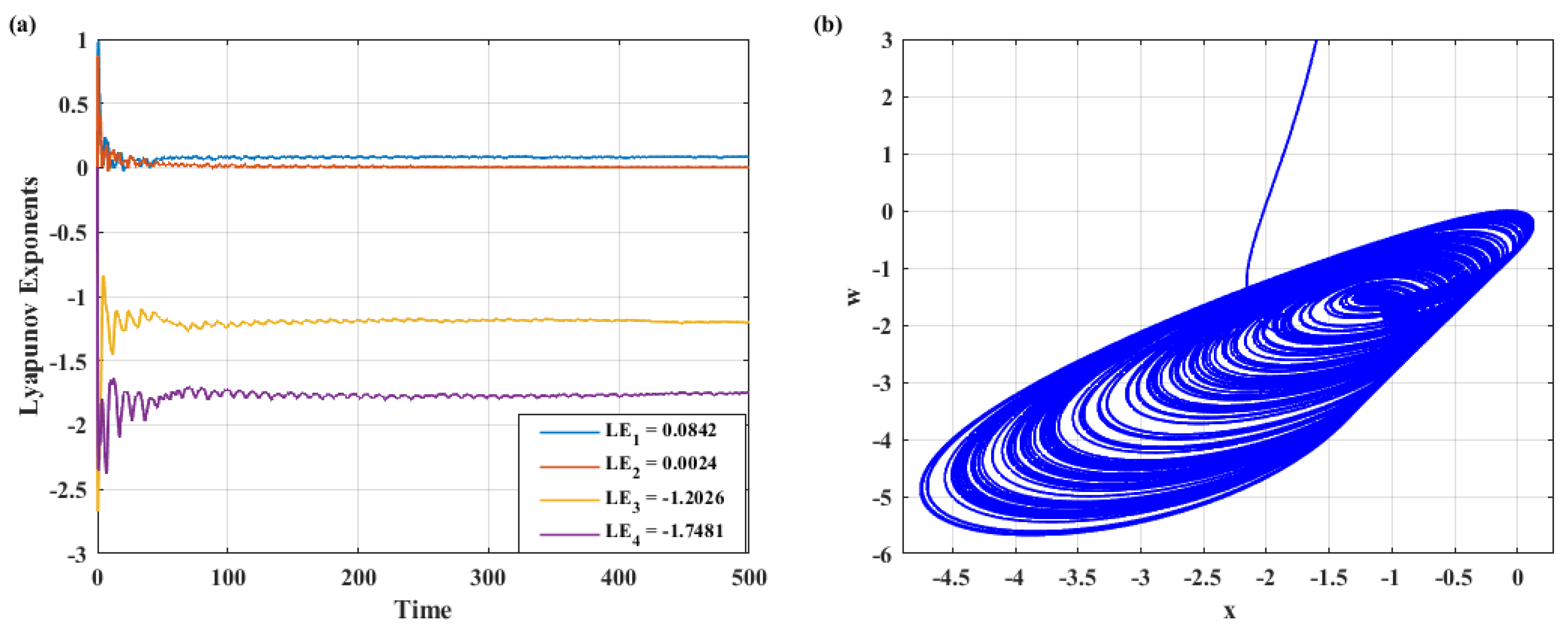
Figure 2.
Bifurcation diagrams and the corresponding Lyapunov exponents for a variation in the parameters (a) and (b) with other parameters ; ; ; ; ; , kept constant and initial conditions
Figure 2.
Bifurcation diagrams and the corresponding Lyapunov exponents for a variation in the parameters (a) and (b) with other parameters ; ; ; ; ; , kept constant and initial conditions
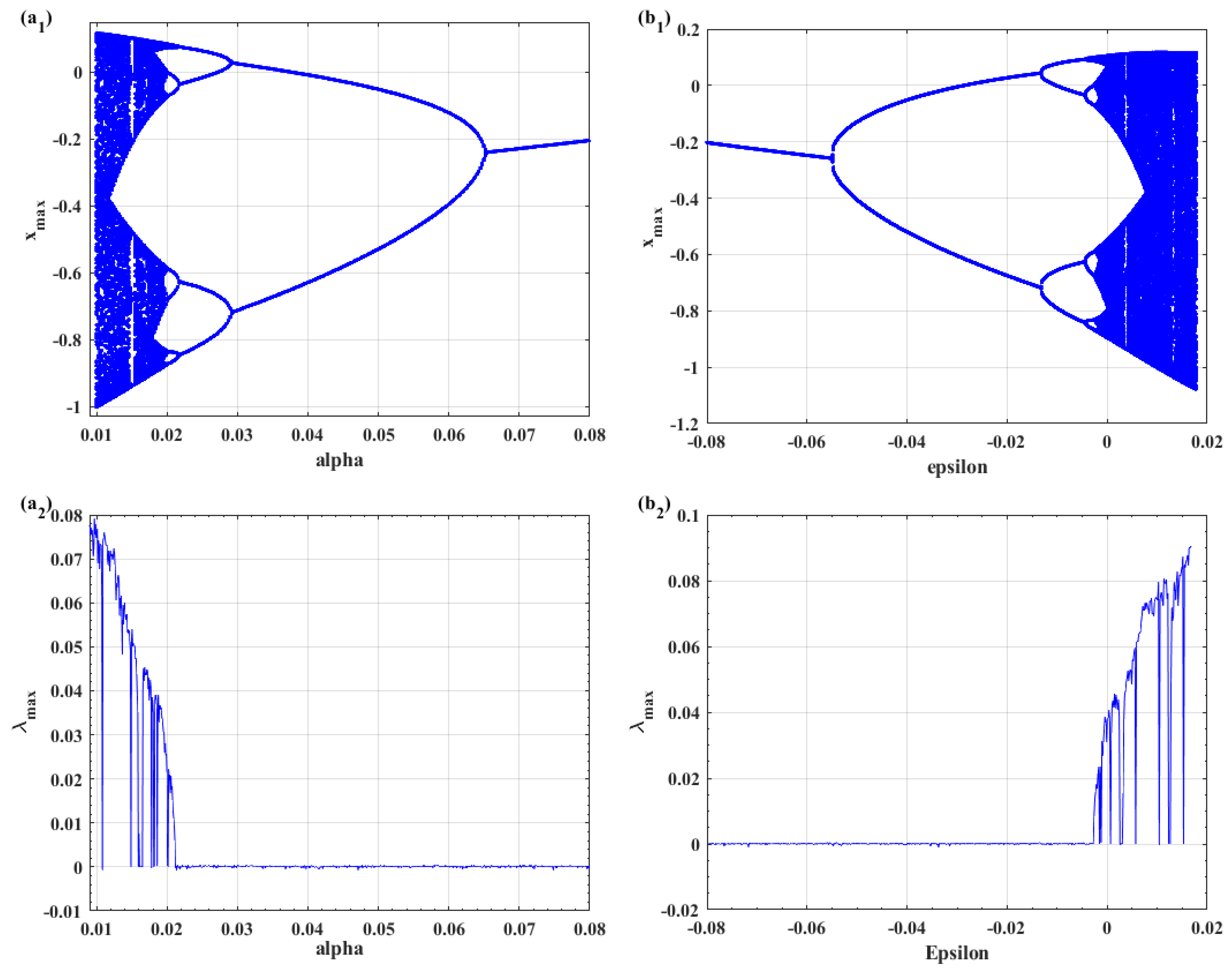
Figure 3.
Phase portrait of the proposed chaotic system showing transition in state for a variation in the parameters (a) , and (b) , with other parameters ; ; ; ; ; , kept constant and initial conditions
Figure 3.
Phase portrait of the proposed chaotic system showing transition in state for a variation in the parameters (a) , and (b) , with other parameters ; ; ; ; ; , kept constant and initial conditions
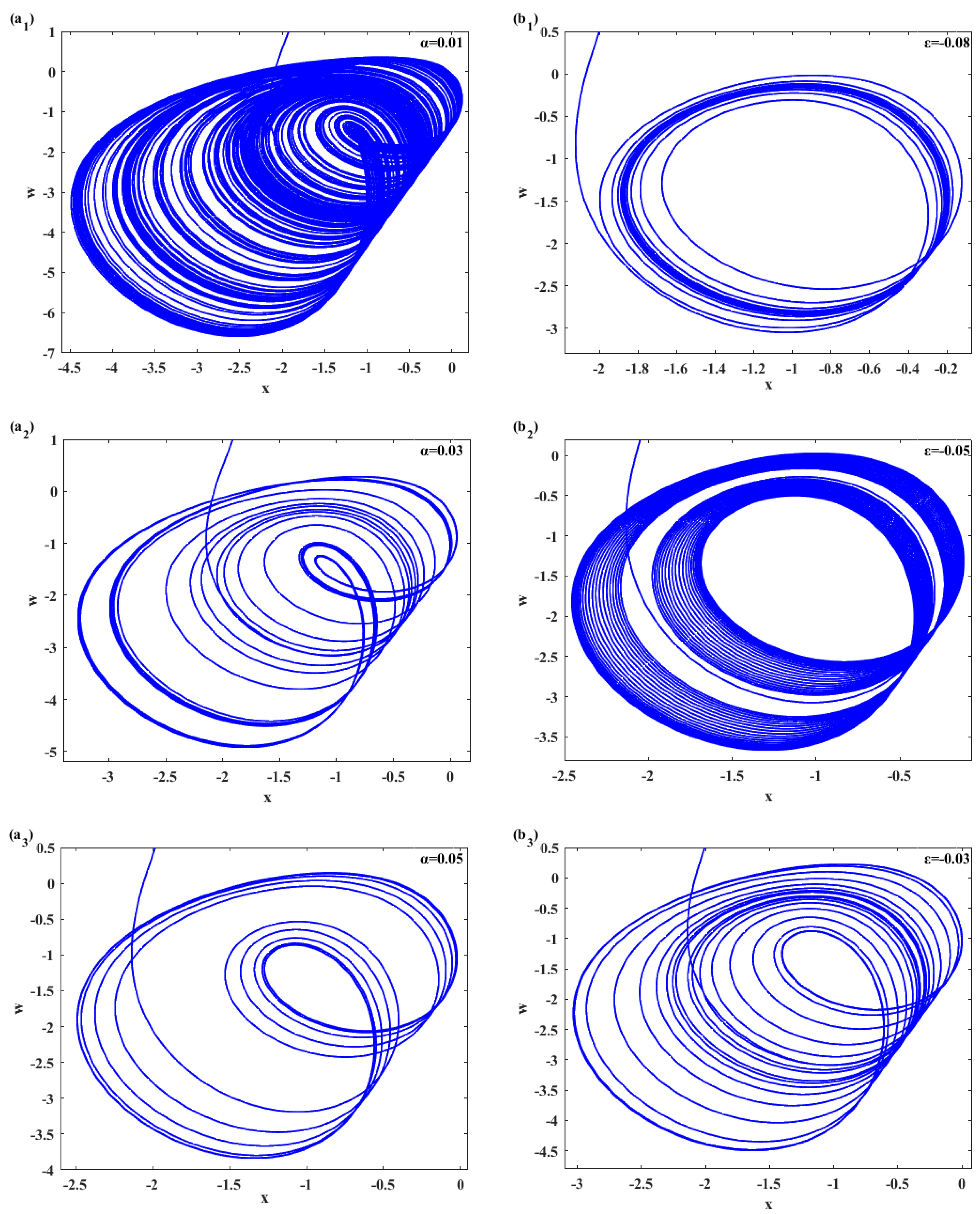
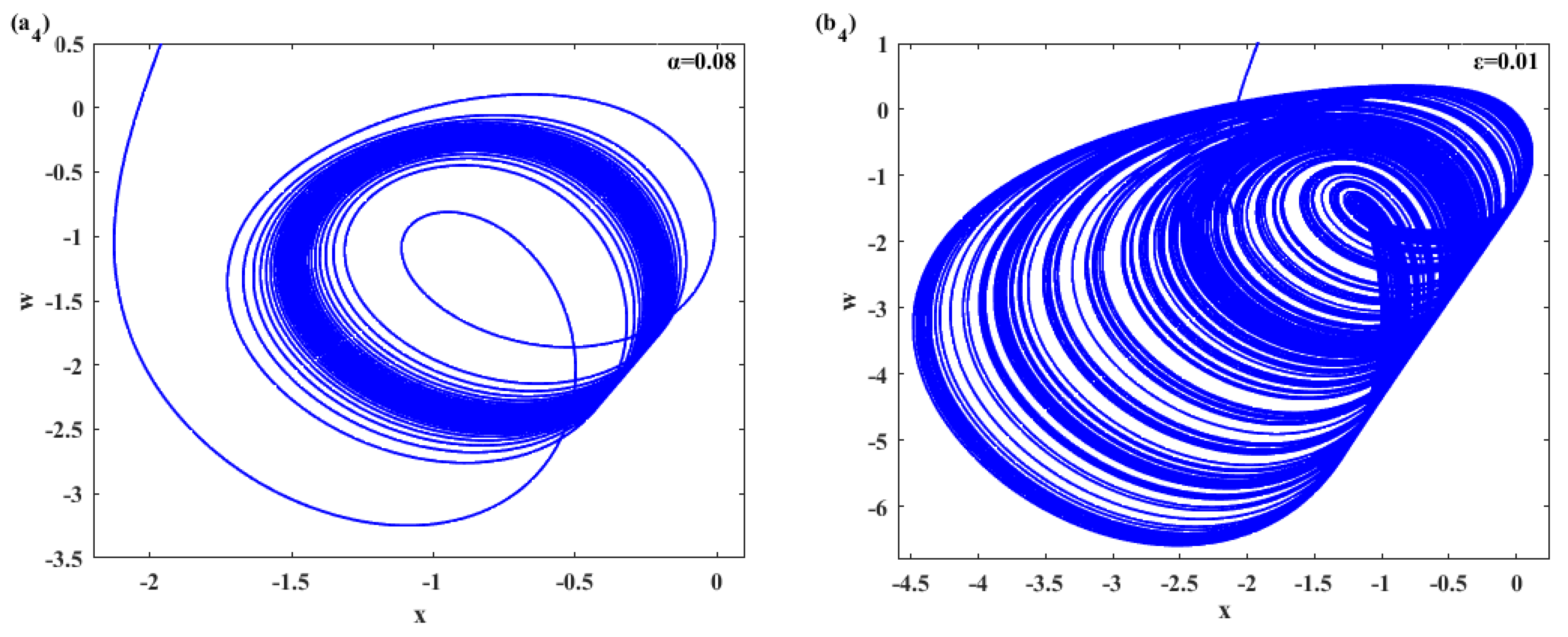
Figure 4.
(a) 3D Poincaré Section at y = 0 (x-z-w plane) ; (b) 2D Poincaré Section on x-z plane (y = 0) ; (c) 2D Poincaré Section on x-w plane (y = 0); and (d) 2D Poincaré Section on z-w plane (y = 0). Plotted with constant parameters values and ; ; ; ; ; , and initial conditions
Figure 4.
(a) 3D Poincaré Section at y = 0 (x-z-w plane) ; (b) 2D Poincaré Section on x-z plane (y = 0) ; (c) 2D Poincaré Section on x-w plane (y = 0); and (d) 2D Poincaré Section on z-w plane (y = 0). Plotted with constant parameters values and ; ; ; ; ; , and initial conditions
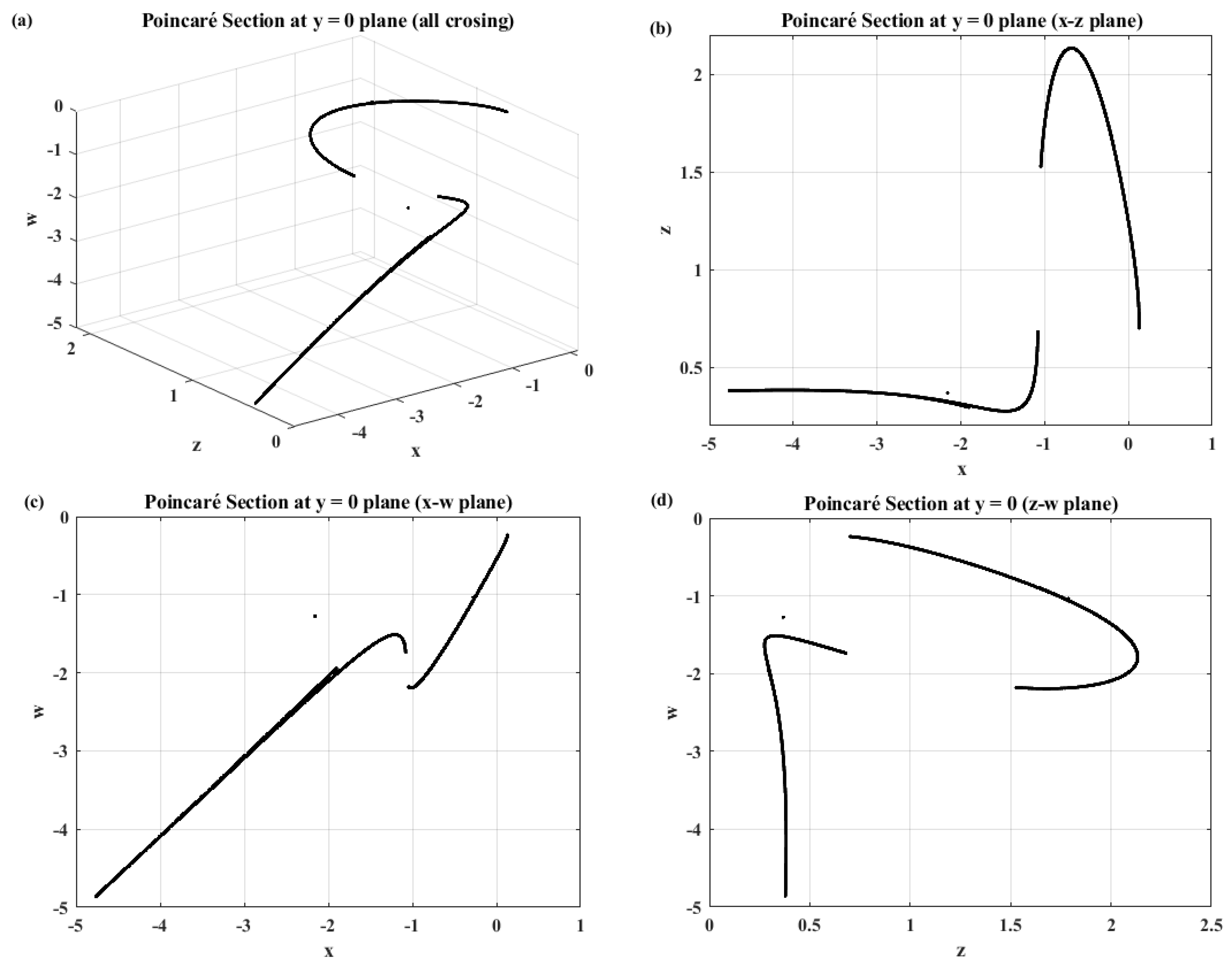
Figure 5.
Block diagram of the delta-sigma modulator (ΔΣM) [1].
Figure 5.
Block diagram of the delta-sigma modulator (ΔΣM) [1].
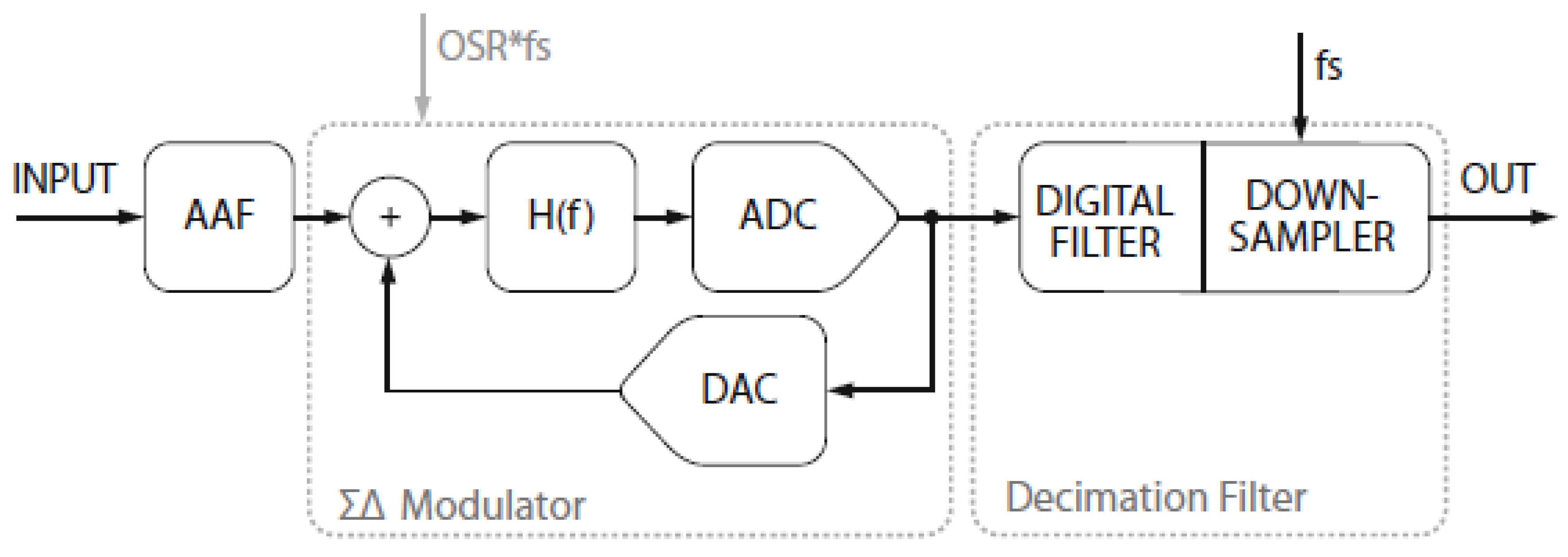
Figure 6.
Simulink Block diagram of the transmitter end of the secure first order DTΔΣM system.
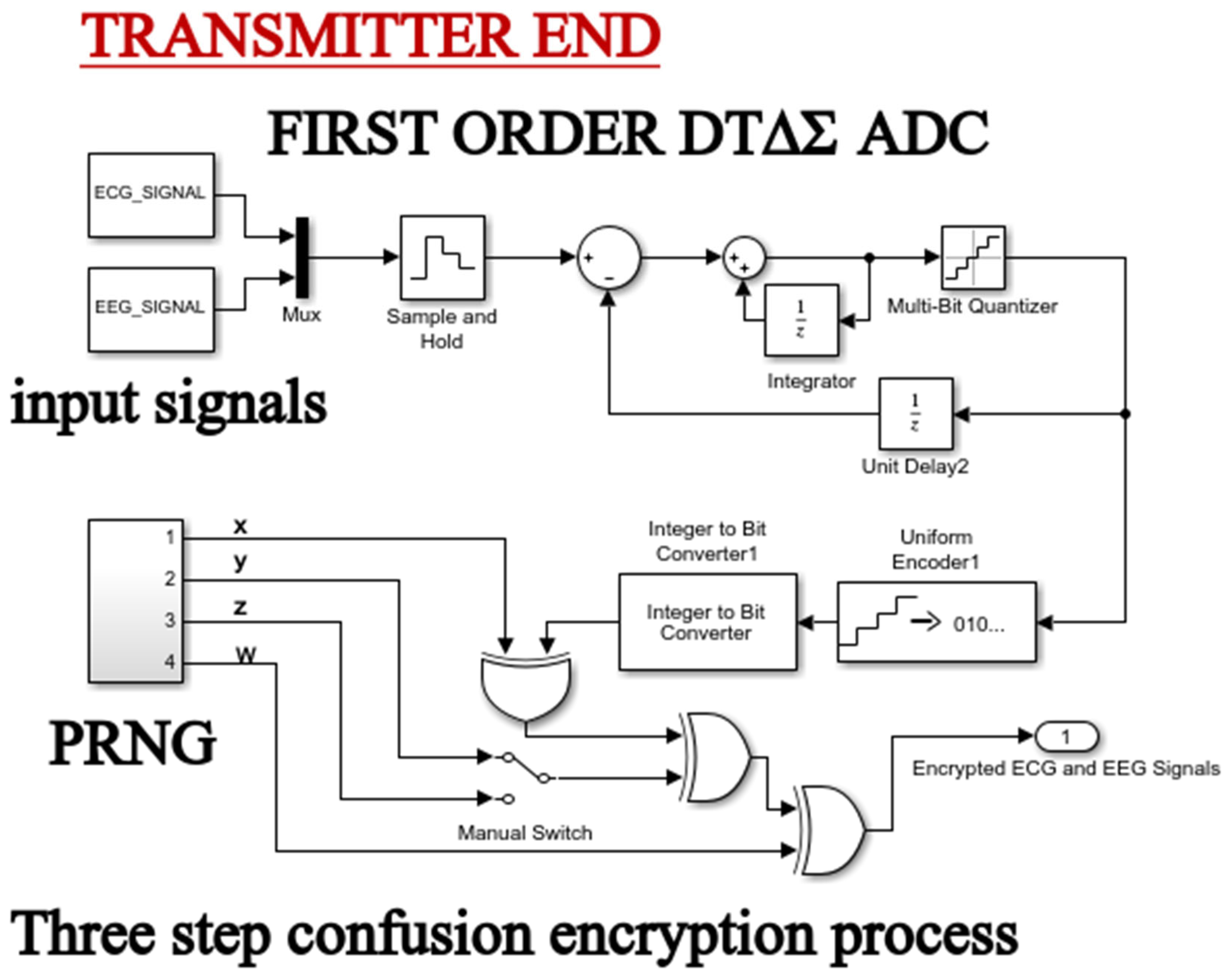
Figure 7.
Simulink Block diagram of the receiver end of the secure first order DTΔΣM system.
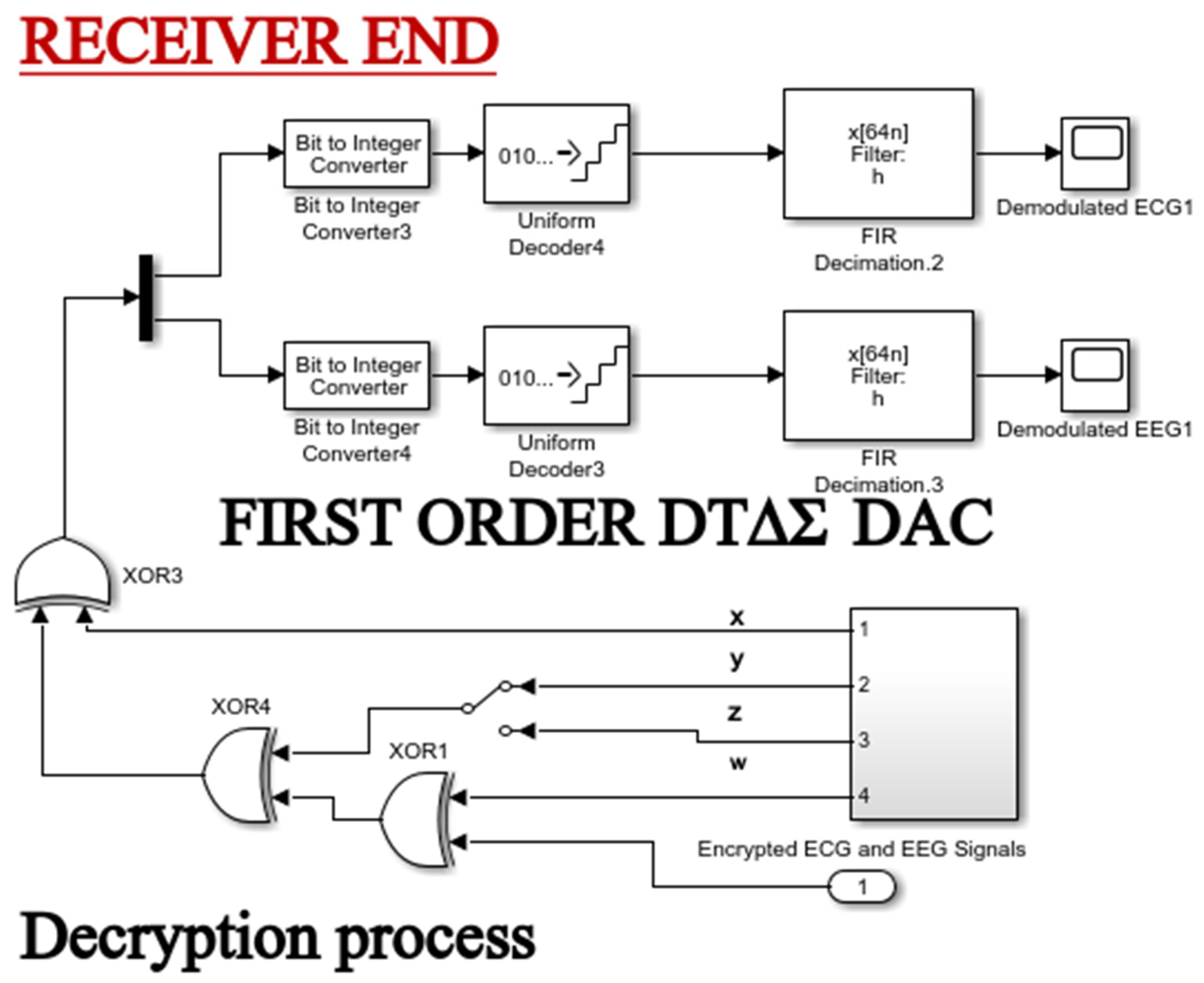
Figure 8.
(a) Original ECG signal; (b) Demodulated ECG signal; (c) Original EEG signal; (d) Demodulated EEG signal.
Figure 8.
(a) Original ECG signal; (b) Demodulated ECG signal; (c) Original EEG signal; (d) Demodulated EEG signal.
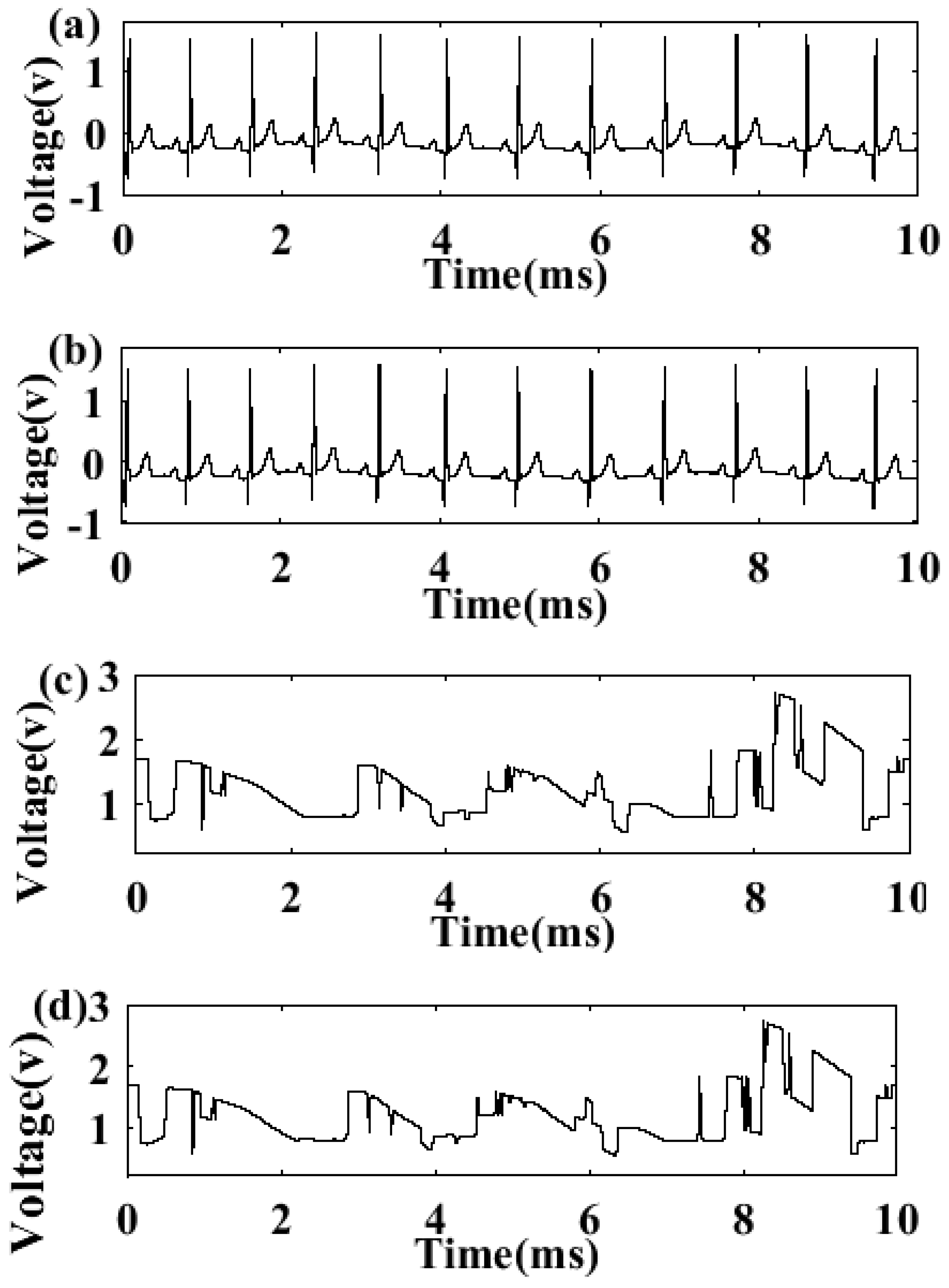
Figure 9.
(a) Original signal from encoder; (b) First signal encryption stage; (c) Second signal encryption stage; (d) Third signal encryption stage; (e) Decrypted ECG signal.
Figure 9.
(a) Original signal from encoder; (b) First signal encryption stage; (c) Second signal encryption stage; (d) Third signal encryption stage; (e) Decrypted ECG signal.
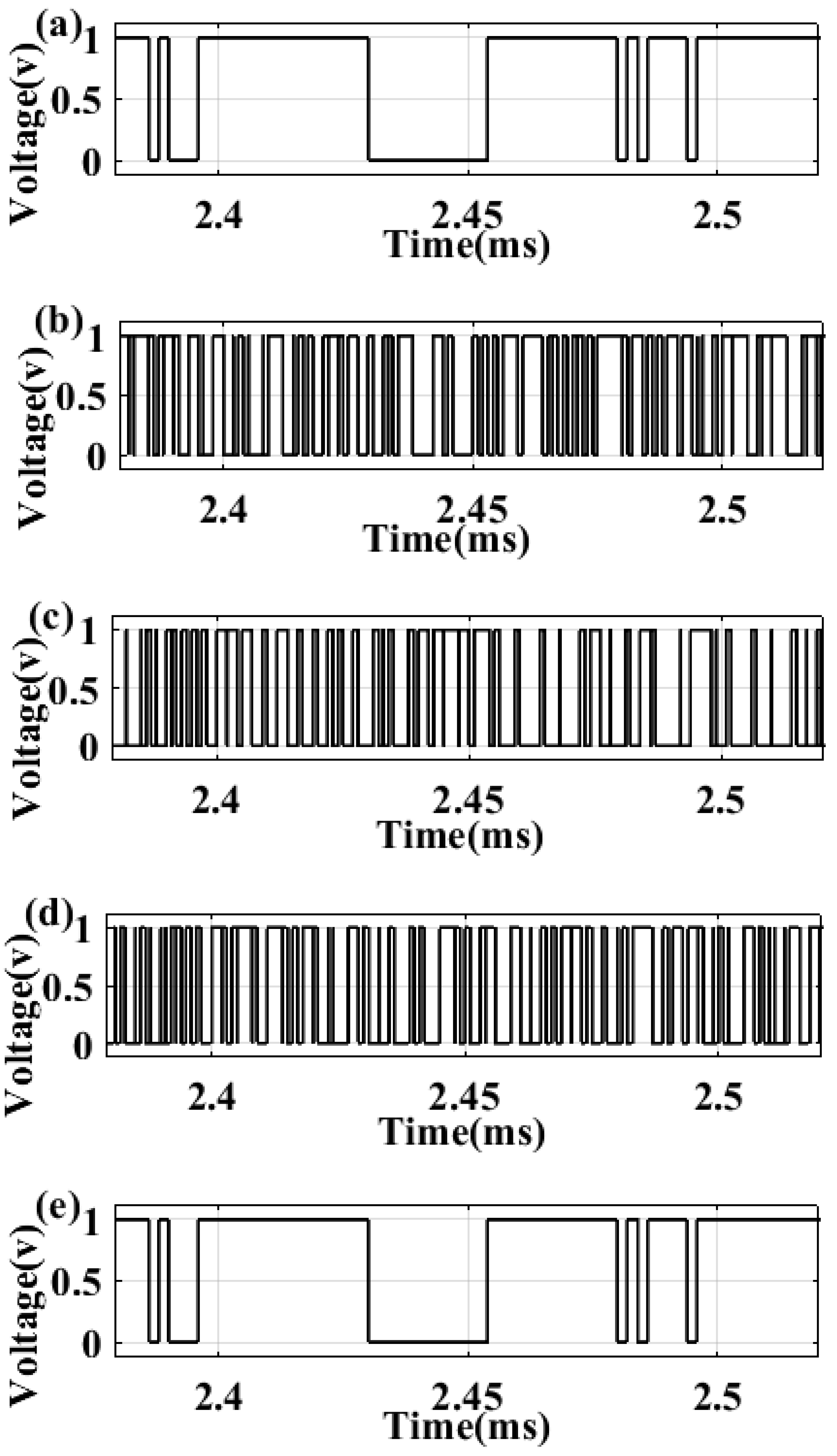
Figure 10.
(a) Original ECG; (b) encrypted ECG; (c) Decrypted ECG; (d) Original EEG (e) encrypted EEG and (f) Decrypted EEG.
Figure 10.
(a) Original ECG; (b) encrypted ECG; (c) Decrypted ECG; (d) Original EEG (e) encrypted EEG and (f) Decrypted EEG.
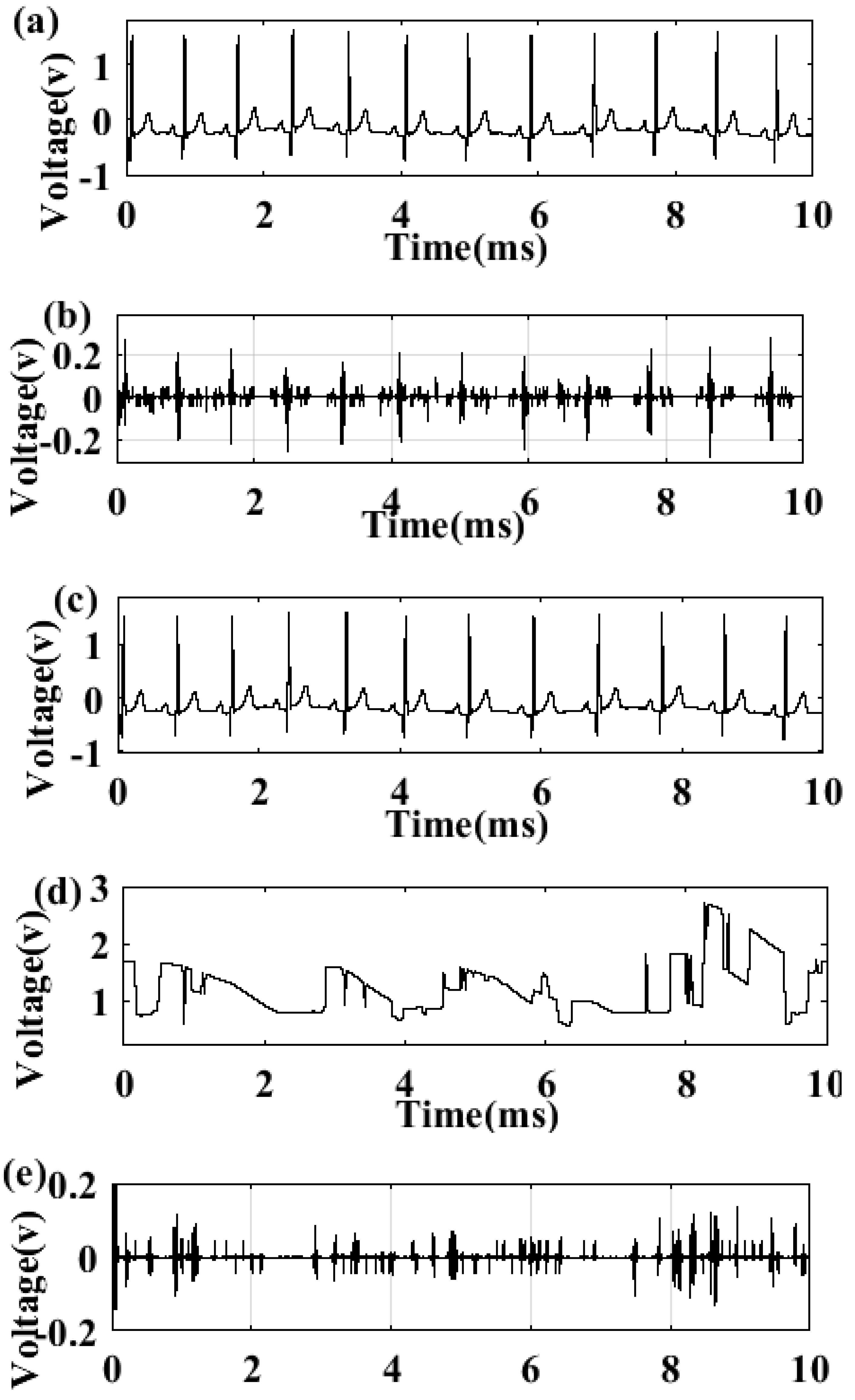
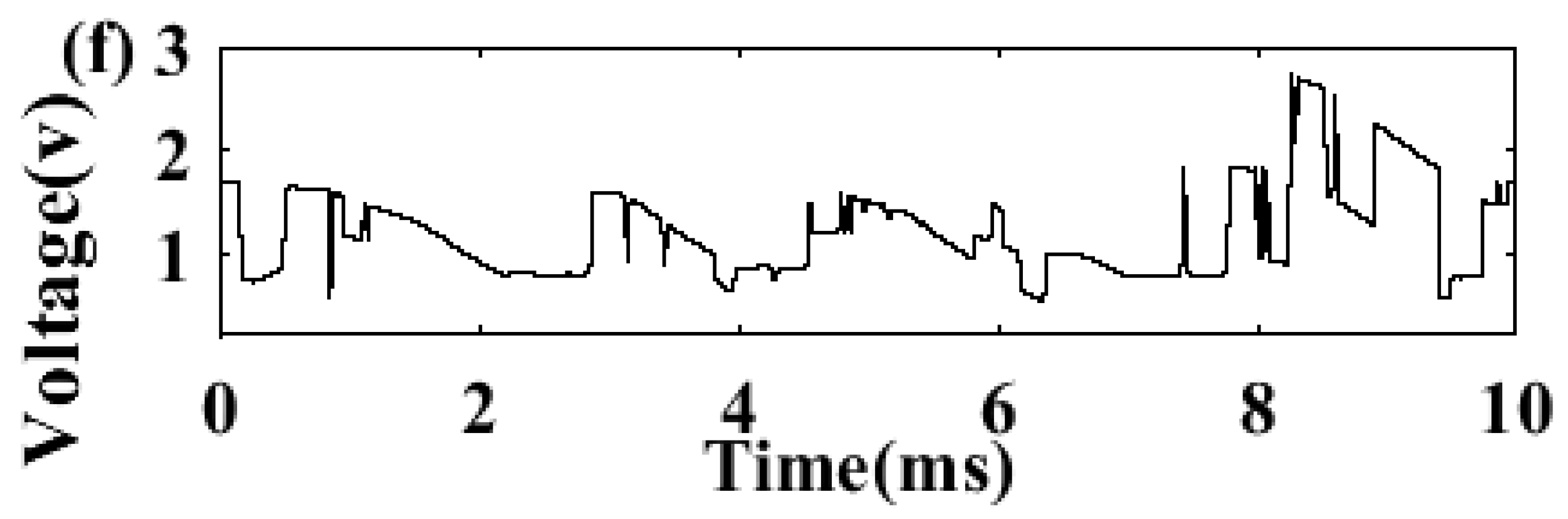
Figure 11.
Cross correlation between the original and; (a) decrypted waveforms; (b) first encryption stage; (c) second encryption stage; and (d) third encryption stage;.
Figure 11.
Cross correlation between the original and; (a) decrypted waveforms; (b) first encryption stage; (c) second encryption stage; and (d) third encryption stage;.
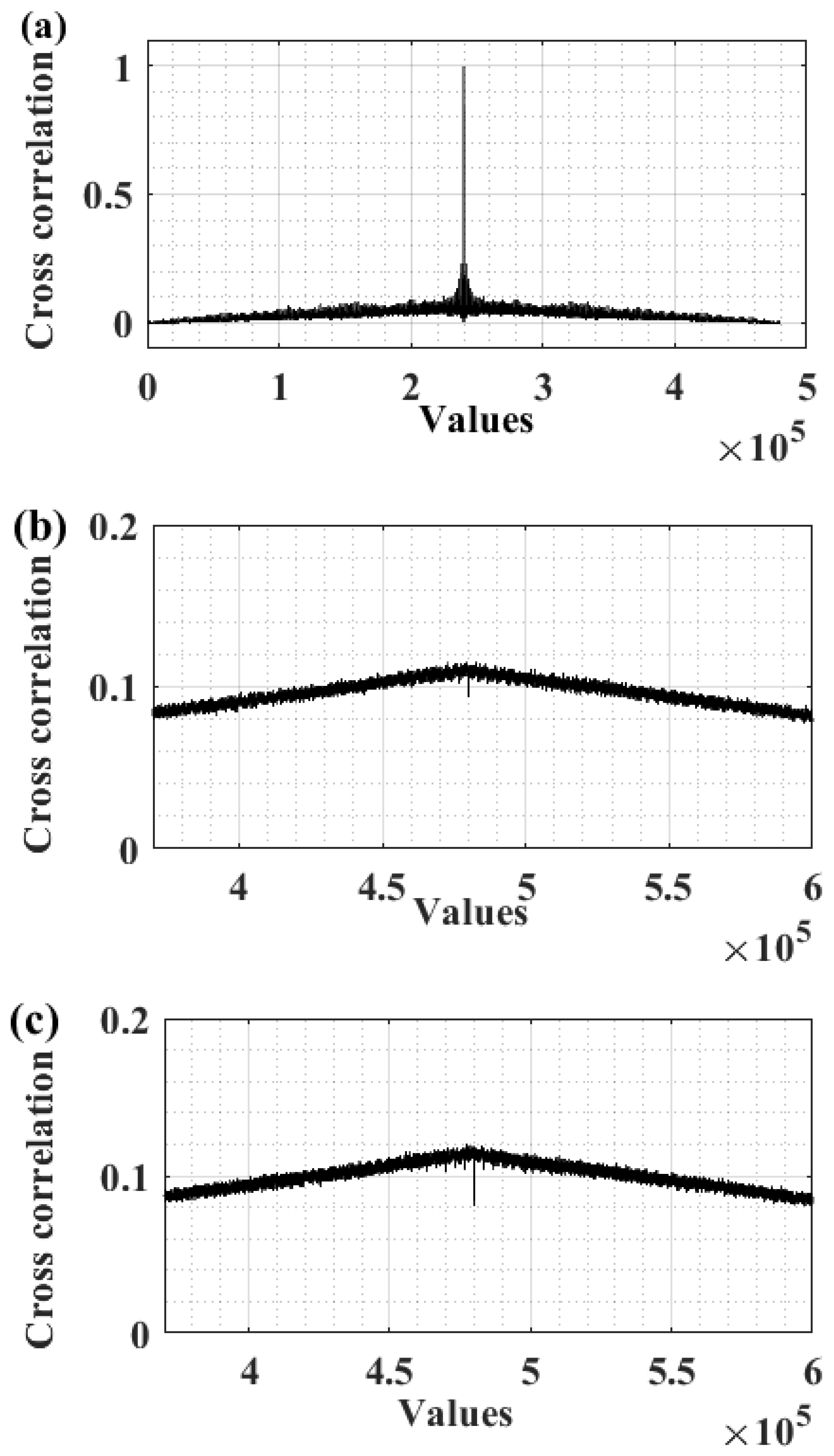
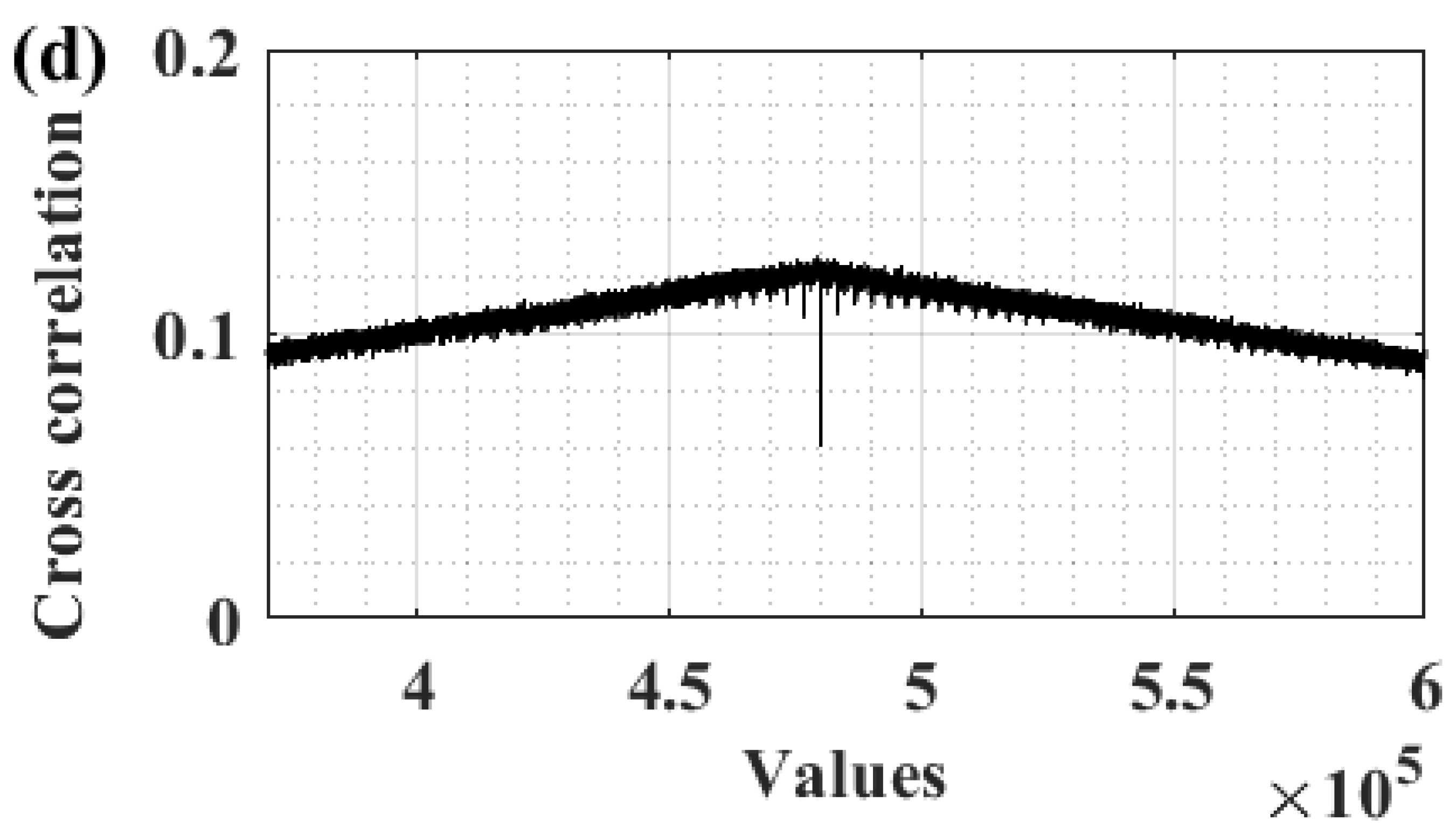
Figure 12.
Key sensitivity test result on decrypted ECG signal after an addition of to the encryption keys; (a) key_a; (b) key_c; (c) key_d; (d) key_ε; (e) key_∝; (f) key_γ; (g) key_μ; (h) key_ν; (i) key_x0; (j) key_y0; (k) key_z0; (l) key_w0.
Figure 12.
Key sensitivity test result on decrypted ECG signal after an addition of to the encryption keys; (a) key_a; (b) key_c; (c) key_d; (d) key_ε; (e) key_∝; (f) key_γ; (g) key_μ; (h) key_ν; (i) key_x0; (j) key_y0; (k) key_z0; (l) key_w0.
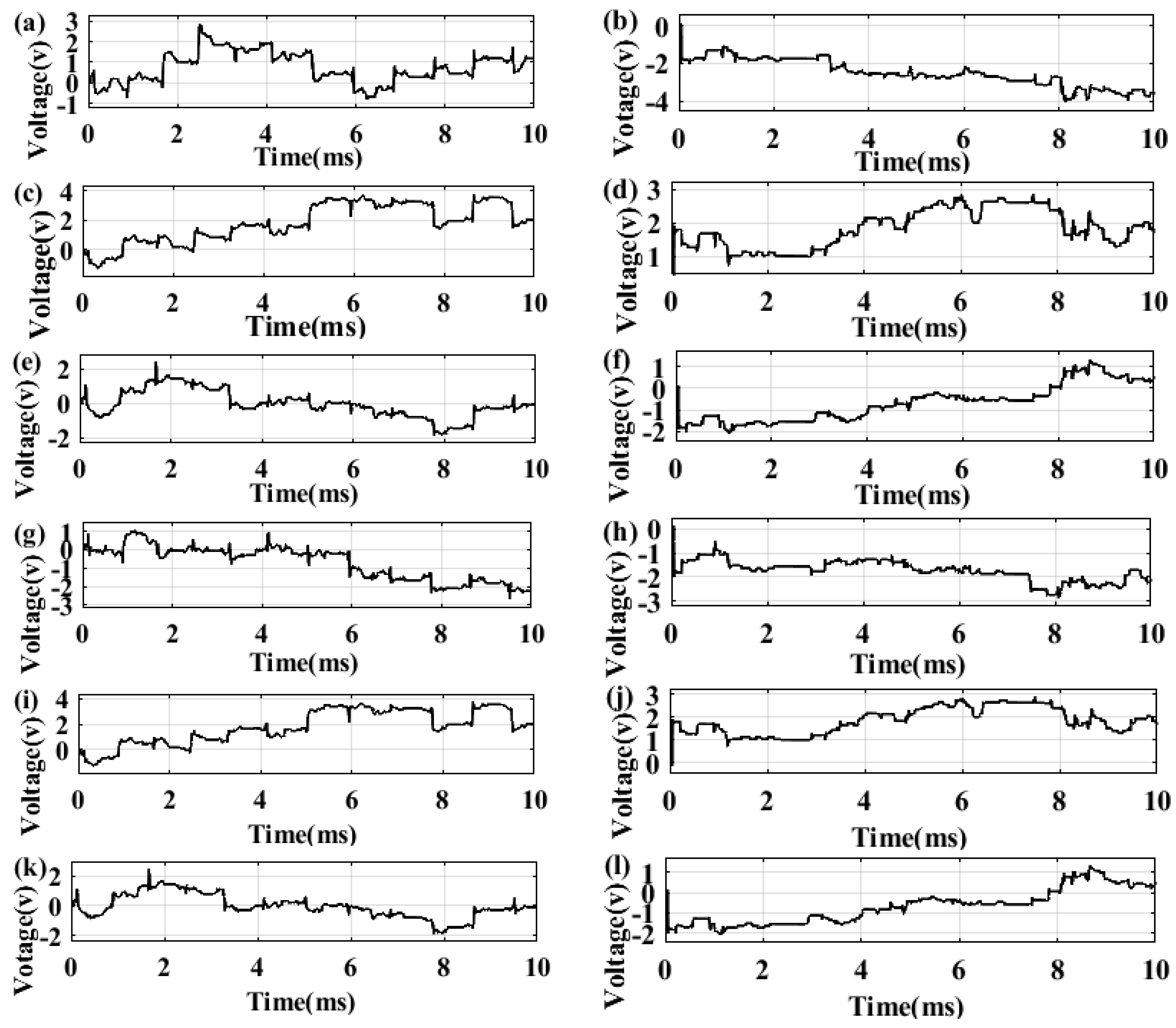
Figure 13.
Key sensitivity test result on encrypted ECG signal after an addition of to the encryption keys; (a) key_a; (b) key_c; (c) key_d; (d) key_ε; (e) key_∝; (f) key_γ; (g) key_μ; (h) key_ν; (i) key_x0; (j) key_y0; (k) key_z0; (l) key_w0.
Figure 13.
Key sensitivity test result on encrypted ECG signal after an addition of to the encryption keys; (a) key_a; (b) key_c; (c) key_d; (d) key_ε; (e) key_∝; (f) key_γ; (g) key_μ; (h) key_ν; (i) key_x0; (j) key_y0; (k) key_z0; (l) key_w0.
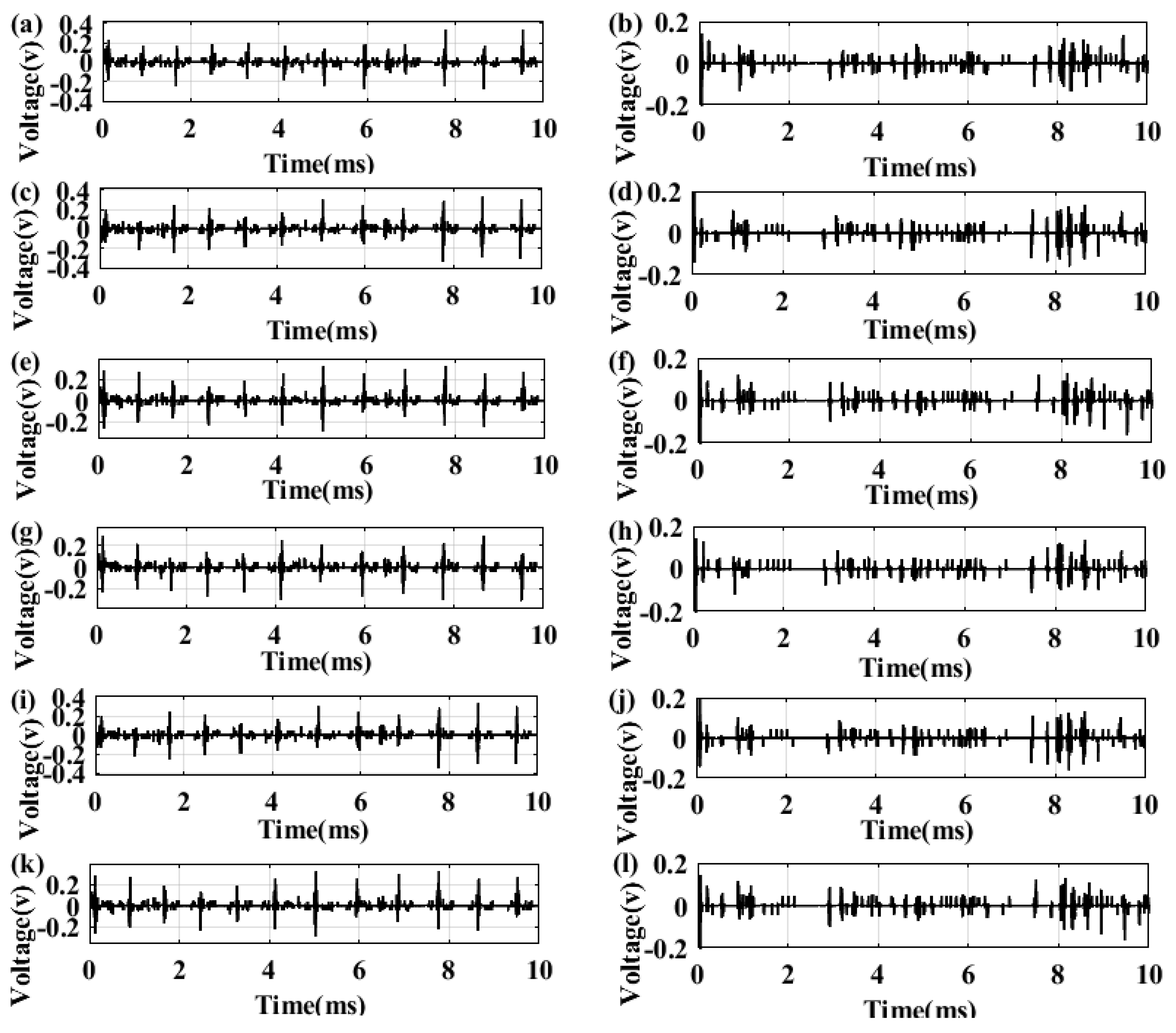

Table 1.
Categorization of the proposed 4D hyperchaotic system with respect to existing 4D chaotic/hyperchaotic systems.
Table 1.
Categorization of the proposed 4D hyperchaotic system with respect to existing 4D chaotic/hyperchaotic systems.
| No |
Behavior of System |
No. of Positive LEs |
Nature of Equilibria |
Attractor Behavior |
No of Terms |
No. of Nonlinear Terms |
Reference |
| 1 | Chaotic | 1 | no equilibria | hidden | 9 | 2 | 2017 [33] |
| 2 | Chaotic | 1 | no equilibria | hidden | 8 | 1 | 2018 [34] |
| 3 | Chaotic | 1 | Stable | hidden | 10 | 3 | 2020 [35] |
| 4 | Chaotic | 1 | no equilibria | hidden | 8 | 1 | 2017 [36] |
| 5 | Chaotic | 1 | curve of points | hidden | 8 | 1 | 2017 [37] |
| 6 | Chaotic | 1 | no equilibria | hidden | 8 | 2 | 2021 [38] |
| 7 | Chaotic | 1 | infinite equilibria | hidden | 7 | 2 | 2020 [39] |
| 8 | Hyperchaotic | 2 | stable/unstable | self-excited | 9 | 2 | 2022 [40] |
| 9 | Hyperchaotic | 2 | no equilibria | hidden | 7 | 2 | 2014 [41] |
| 10 | Hyperchaotic | 2 | no equilibria | hidden | 7 | 5 | 2012 [42] |
| 11 | Hyperchaotic | 2 | unstable point | Self-excited | 9 | 4 | 2012 [43] |
| 12 | Hyperchaotic | 2 | three equilibria | Self-excited | 11 | 3 | 2012 [44] |
| 13 | Hyperchaotic | 2 | unstable point | Self-excited | 9 | 2 | 2020 [45] |
| 14 | Hyperchaotic | 2 | no equilibria | hiddden | 11 | 2 | this work |
Table 2.
NIST-800.22 test results for 4 000 000 values from our proposed chaotic oscillator.
| Tests type | P value | Result |
| Frequency (monobit) test | 0.578210854772423 | Success |
| Frequency test within a block | 0.111423028947461 | Success |
| Runs test | 0.632430089580616 | Success |
| Test for the longest run of ones in a block | 0.908448608148175 | Success |
| Binary Matrix Rank Test | 0.968582507884855 | Success |
| Discrete Fourier Transform | 0.274824796911087 | Success |
| Non overlapping Template Matching Test | 0.507703387782452 | Success |
| Overlapping Template Matching Test | 0.25669821913924 | Success |
| Maurer's "Universal Statistical" Test | 0.487893879474829 | Success |
| Linear Complexity Test | 0.558529628886096 | Success |
| The Serial Test | 0.8436652966348 | Success |
| Approximate Entropy Test | 0.510914962117407 | Success |
| Cumulative Sums Test | 0.207047692439126 | Success |
| Random Excursions Test | 0.783496150475357 | Success |
| Random Excursions Variant Test | 0.907743035768127 | Success |
Table 3.
Comparisons with similar works in the literature.
|
Proposed Scheme |
Ref. 2020 [13] |
Ref. 2021 [15] |
Ref. 2022 [18] |
Ref. 2023 [19] |
Ref. 2024 [20] |
|
| Acquisition method | ||||||
|
Real-time signal acquisition |
-- | -- | -- | -- | ✓ | ✓ |
| Data Base | Ref. [20] | MIT-BIH | -- | MIT-BIH | -- | AD8232 ECG sensor |
| Chaotic map | ||||||
| Name | New 4D Sprott-D system | AES | 2-D chaotic Baker map | 3-DES | Badola map | Novel 4Wings-4D Chaotic Oscillator (N4W4DCO) |
| Dimension | 4D | 3D | 2D | - | 2D | 4D |
| Microcontroller implementation | ✓ | -- | -- | -- | -- | ✓ |
| Security analysis | ||||||
|
Encryption key space analysis |
✓ | -- | -- | -- | -- | ✓ |
|
Encryption key sensitivity |
✓ | -- | -- | -- | ✓ | ✓ |
| Histogram | -- | -- | ✓ | -- | -- | ✓ |
| Correlation | ✓ | -- | -- | -- | -- | ✓ |
| Noise robustness | -- | ✓ | -- | --- | -- | - |
| NIST 800-22 | ✓ | ✓ | -- | -- | ✓ | ✓ |
| Implementation | ||||||
| Embedded system | -- | -- | -- | -- | ✓ | ✓ |
| Simulation | ||||||
| MATLAB Simulink | ✓ | -- | -- | -- | -- | ✓ |
| Transmission mode | ||||||
| Encoding-decoding | ✓ | -- | -- | -- | -- | ✓ |
Disclaimer/Publisher’s Note: The statements, opinions and data contained in all publications are solely those of the individual author(s) and contributor(s) and not of MDPI and/or the editor(s). MDPI and/or the editor(s) disclaim responsibility for any injury to people or property resulting from any ideas, methods, instructions or products referred to in the content. |
© 2025 by the authors. Licensee MDPI, Basel, Switzerland. This article is an open access article distributed under the terms and conditions of the Creative Commons Attribution (CC BY) license (http://creativecommons.org/licenses/by/4.0/).
Copyright: This open access article is published under a Creative Commons CC BY 4.0 license, which permit the free download, distribution, and reuse, provided that the author and preprint are cited in any reuse.


