

Submitted:
14 July 2025
Posted:
16 July 2025
You are already at the latest version
Abstract
Urban street canyons, characterized by their narrow roadways flanked by tall buildings, create complex airflow patterns that significantly influence turbulence and vehicular pollution dispersion. This chapter explores the interplay between urban morphology, atmospheric boundary layer dynamics, and emission sources in street canyons. Computational fluid dynamics (CFD) models and field experiments illustrate how turbulence, eddies, and thermal effects impact pollutant concentration levels. Additionally, the role of meteorological factors, street geometry, and vehicular-induced turbulence is examined to understand dispersion mechanisms. Effective mitigation strategies, including green infrastructure and urban design modifications, are discussed to enhance air quality and reduce human exposure to pollutants. This study provides insights into improving urban air quality through engineering and planning interventions.
Keywords:
urban street canyon
; turbulence
; vehicular pollution
; dispersion modelling
; air quality
1. Introduction
Urban environments are characterized by densely packed buildings, narrow streets, and high vehicular traffic. These structural elements create what is known as an urban street canyon, where the geometry of the built environment significantly influences wind patterns and turbulence (Ehrnsperger & Klemm, 2022). Understanding street canyon turbulence is crucial for assessing vehicular pollution dispersion and its impact on air quality and human health (Miao et al., 2020). Urban street canyons create localized wind turbulence due to the obstruction of natural airflow by buildings. The wind velocity, direction, and canyon aspect ratio influence vortex formations, stagnation zones, and re-circulations within the canyon (Muniz-Gäal et al., 2020a). These airflow patterns determine how pollutants disperse, accumulate, or get ventilated from the canyon. Computational fluid dynamics (CFD) and wind tunnel experiments have been widely used to analyze turbulence behaviors in such environments (Miao, Yu, et al., 2023a).
Pollution dispersion within street canyons is significantly affected by traffic-induced turbulence, vehicle density, and street geometry (Miao, He, et al., 2023a; Miao, Yu, et al., 2023b, 2023a). Higher buildings with narrow gaps create deep-canyon effects, where pollutants become trapped, leading to deteriorated air quality. Conversely, shallow canyons with lower buildings facilitate better ventilation, reducing pollutant concentrations. Meteorological conditions, such as temperature inversions and atmospheric stability, further influence dispersion efficiency.
Mitigation strategies, such as green infrastructure, increased ventilation corridors, and improved street design, can alleviate the adverse effects of pollution accumulation. Vegetation barriers, for example, can act as natural filters, absorbing pollutants and improving air quality. However, improper placement of trees may exacerbate pollutant trapping by altering flow structures. Thus, urban planning should integrate aerodynamic considerations for sustainable urban air quality management.
The health impacts of poor air dispersion in street canyons are profound, leading to increased exposure to particulate matter (PM), nitrogen oxides (NOx), and volatile organic compounds (VOCs) (Dong et al., 2024; Elmarakby & Elkadi, 2024; Q. Wang et al., 2019; Zhu et al., 2022a). Long-term exposure is linked to respiratory and cardiovascular diseases, necessitating the development of regulatory frameworks to control vehicular emissions and improve urban ventilation (Bouma et al., 2023; Jin et al., 2022; Q. Wang et al., 2019). Future research must focus on the interplay of microclimate factors and pollution dynamics to refine predictive models for urban pollution mitigation.
Research Questions
How does street canyon geometry influence turbulence patterns and pollution dispersion?
What are the most effective urban design strategies to minimize pollutant accumulation?
How do meteorological variations affect turbulence and pollution dispersion in different seasons?
What role does vegetation play in modifying air flow and pollution levels in street canyons?
The detailed literature review methods have been leveraged to synthesize findings on street canyon pollution impacts and guide future research.
2. Methodology
The detailed literature review method has been leveraged to synthesize findings on street canyon pollution impacts and guide future research. This approach involves an extensive analysis of peer-reviewed journal articles, conference proceedings, and technical reports to identify key trends, methodologies, and gaps in existing research. Various computational and experimental studies on street canyon aerodynamics and pollutant dispersion are systematically examined to establish a comprehensive understanding. Comparative assessments of different urban settings and case studies provide insights into effective mitigation strategies. Additionally, interdisciplinary perspectives from environmental science, transportation engineering, and urban planning are integrated to formulate a holistic approach to understanding and addressing pollution challenges in urban street canyons.
3. Finding
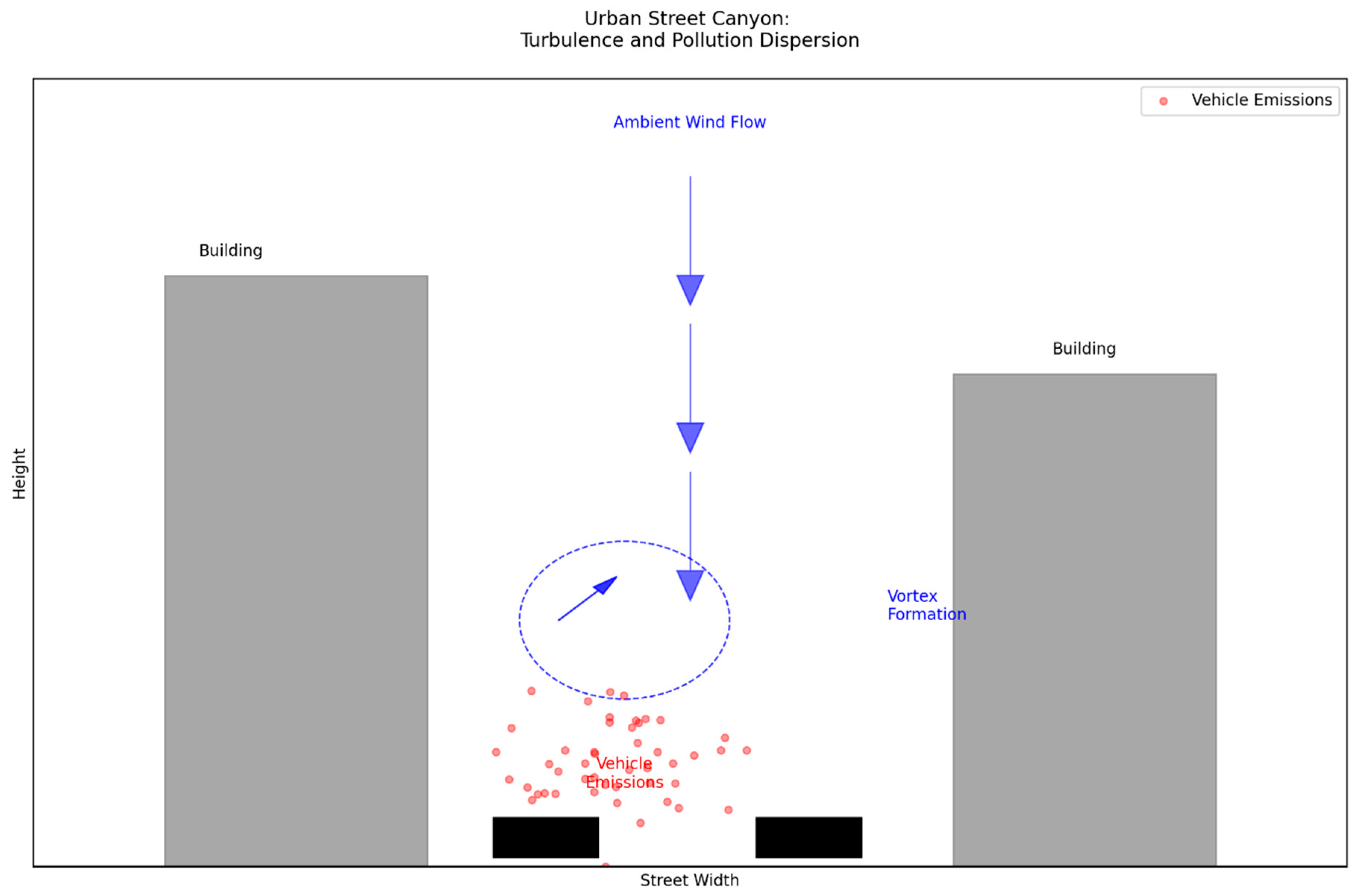
The Figure 1 illustrates how air pollution behaves in an urban street canyon - a common scenario where tall buildings flank a city street. When wind flows over the buildings, it creates a vortex (circular air motion) within the canyon. Vehicle emissions, shown as red particles, get trapped in this vortex pattern, leading to increased pollution concentrations at street level. This effect is particularly important for understanding air quality and public health in dense urban environments.
3.1. Definition of Urban Street Canyon
An urban street canyon is defined as a street flanked by buildings on both sides, forming a canyon-like environment (Miao et al., 2020). An urban street canyon is a street space confined by buildings on both sides, resembling a canyon-like structure (Dong et al., 2024). This configuration plays a significant role in shaping the microclimate, air circulation, and pollution levels within the urban environment (Miao, He, et al., 2023a). The most critical parameter defining a street canyon is its aspect ratio, which is the ratio of building height (H) to street width (W). A higher aspect ratio (narrow streets with tall buildings) tends to restrict airflow and trap pollutants, leading to poor air quality and increased urban heat island effects. Conversely, a lower aspect ratio (wider streets with shorter buildings) allows for better ventilation and pollutant dispersion. The canyon length (L), or the horizontal extent of the enclosed street section, also influences wind patterns, determining how effectively air pollutants are diluted or accumulated. The orientation of the buildings relative to prevailing winds further dictates airflow dynamics, with perpendicular canyons facilitating ventilation while parallel canyons often experience stagnant air conditions (Miao, Yu, et al., 2023b, 2023a; Muniz-Gäal et al., 2020a).
Street vegetation within an urban canyon adds another layer of complexity to airflow and thermal regulation (Chen et al., 2021). Trees and greenery can improve air quality by absorbing pollutants and providing shade, which mitigates heat buildup in densely built-up areas (Chatzidimitriou & Yannas, 2017). However, dense vegetation may also obstruct wind movement, reducing natural ventilation and slowing pollutant dispersion, depending on the canyon’s configuration. The interactions between these factors make urban street canyons a key focus in urban planning and transportation engineering. Understanding their impacts is essential for designing sustainable urban spaces that balance built infrastructure, air quality, and thermal comfort. By optimizing street geometry, building layouts, and vegetation placement, planners can create healthier and more livable urban environments.
3.2. Street Canyon Flow Regimes
The airflow within a street canyon is categorized into different flow regimes based on the relationship between building height, street width, and prevailing wind direction (C. Wang et al., 2024). The first regime, Isolated Roughness Flow, occurs when buildings are spaced far apart, allowing wind to pass over individual structures with minimal disruption. In this case, the airflow remains largely unaffected by the presence of buildings, and pollutant dispersion is relatively efficient. This regime is commonly observed in low-density urban areas where the spacing between structures prevents significant interactions between building-induced turbulence and ambient wind patterns (Chatzidimitriou & Yannas, 2017; Miao, He, et al., 2023a).
As building density increases, two other flow regimes emerge. Wake Interference Flow occurs when buildings are closer together, causing wind to be deflected and creating turbulent wakes that interact with adjacent structures. This regime results in complex airflow patterns, leading to moderate pollutant dispersion but also areas of stagnation where contaminants may accumulate. In contrast, Skimming Flow is characteristic of deep canyons, where the aspect ratio (H/W) exceeds 2 (Kim & Baik, 2001). In this scenario, the wind predominantly moves over the rooftops, with limited penetration into the street level. This creates a trapped air circulation within the canyon, restricting ventilation and leading to higher concentrations of pollutants. Understanding these flow regimes is crucial for urban planners and environmental engineers to design street canyons that enhance air quality, thermal comfort, and overall urban livability.
3.3. Turbulence in Street Canyons
Turbulence in street canyons plays a crucial role in determining airflow patterns, pollutant dispersion, and thermal comfort. Several factors influence turbulence, including wind shear, which arises due to friction between the wind and building surfaces, causing variations in wind speed at different heights (Cai et al., 2020; H. Wang & Ngan, 2025). Buoyancy effects also contribute to turbulence, as temperature differences between building facades, streets, and the surrounding air generate convective currents. Additionally, vortex formation within the canyon leads to complex airflow patterns, particularly in narrow and deep canyons. Street furniture, trees, and vehicles further disrupt the airflow, creating localized turbulence that can either enhance or hinder ventilation. The interaction of these factors results in highly dynamic wind conditions within urban street canyons, affecting pollutant concentration and pedestrian comfort.
Among the dominant turbulent features in street canyons, the Primary Recirculation Vortex is the most significant, forming in deep canyons where airflow becomes trapped and circulates within the canyon space (DePaul & Sheih, 1986; Mei et al., 2019). This vortex can hinder pollutant dispersion, leading to poor air quality at the pedestrian level. Secondary vortices develop near street-level walls or within the canyon, enhancing air mixing but also contributing to pollutant accumulation in certain areas. Additionally, corner eddies form where wind is deflected at building corners, influencing pollutant concentration and local wind conditions. Understanding these turbulence characteristics is essential for designing urban spaces that promote better air quality, thermal comfort, and pedestrian-friendly environments. By strategically planning street layouts, vegetation placement, and building configurations, urban designers can mitigate adverse effects and improve overall air circulation within street canyons.
3.4. Vehicular Emissions and Pollution Dispersion
Vehicular emissions are a major source of urban air pollution, including nitrogen oxides (NOx), carbon monoxide (CO), particulate matter (PM), and volatile organic compounds (VOCs) (López-Pérez et al., 2019; Zhu et al., 2022b). Vehicular emissions significantly contribute to urban air pollution, releasing harmful pollutants such as nitrogen oxides (NOx), carbon monoxide (CO), particulate matter (PM), and volatile organic compounds (VOCs) (Miao, He, et al., 2023b; Zhao et al., 2004; Zhu et al., 2022b). In street canyons, the dispersion of these pollutants is influenced by multiple atmospheric and urban design factors. Wind direction and speed play a crucial role, as strong winds facilitate pollutant dispersion, improving air quality, while weak or stagnant winds trap emissions, leading to higher concentrations at the street level. Thermal stratification further affects pollutant behavior, where temperature variations can create stable atmospheric conditions that limit vertical mixing, thereby trapping pollutants near the ground, or unstable conditions that enhance dispersion.
The configuration of buildings within a street canyon also has a major impact on pollution dispersion. Tall buildings and narrow streets can reduce airflow, creating areas where pollutants accumulate, leading to poor air quality and increased health risks for pedestrians and residents. In contrast, well-ventilated canyons with lower aspect ratios allow for better air exchange, reducing pollutant concentrations. Additionally, street vegetation, while beneficial for absorbing certain pollutants, can sometimes obstruct airflow and contribute to localized accumulation. Understanding these factors is essential for urban planners and environmental engineers to design streets that balance mobility needs with improved air quality, promoting healthier and more sustainable urban environments.
3.5. Pollutant Transport Mechanisms
Pollutant transport in street canyons is governed by various mechanisms that determine how emissions disperse, accumulate, or settle in the urban environment. One of the primary processes is advection, where pollutants are transported horizontally by the prevailing wind (Caton et al., 2003a). The efficiency of advection depends on wind speed and direction relative to the canyon orientation. In well-ventilated canyons, advection helps disperse pollutants, while in poorly ventilated or deep canyons, pollutants may remain trapped. Another key mechanism is turbulent diffusion, which results from random air motion, causing pollutants to spread vertically and laterally (Caton et al., 2003b). This process is influenced by wind turbulence, building configurations, and temperature gradients, affecting air quality at different heights within the canyon.
Apart from dispersion, pollutants are also subject to deposition, where they interact with surfaces such as building facades, roads, and vegetation, leading to their removal from the air. Vegetation, in particular, can play a role in filtering particulate matter and gaseous pollutants, though excessive tree coverage may also restrict airflow. Additionally, re-entrainment occurs when pollutants that have settled on surfaces are resuspended into the air due to vehicle-induced turbulence or pedestrian movement. This effect is particularly significant for particulate matter, as it can prolong exposure to harmful pollutants. Understanding these transport mechanisms is crucial for designing urban areas that minimize pollution buildup and enhance air quality through strategic planning of street layouts, building heights, and ventilation strategies.
4. Discussion
4.1. Impact of Street Canyon Geometry on Pollution Dispersion
The geometry of a street canyon significantly influences pollutant dispersion, directly affecting air quality and urban ventilation (Chatzidimitriou & Yannas, 2017). One of the most critical factors is the aspect ratio (H/W), which defines the relationship between building height (H) and street width (W). Higher aspect ratios, where buildings are tall and streets are narrow, create deep canyons that restrict airflow and trap pollutants, leading to poor air quality. In contrast, lower aspect ratios allow for better ventilation, reducing pollutant accumulation. Additionally, canyon length (L) impacts dispersion by determining how long pollutants remain within the confined space. Longer canyons limit the escape of emissions, increasing residence time and exacerbating pollution buildup, particularly in areas with heavy traffic.
Other geometric factors, such as building permeability and street orientation, also play crucial roles in ventilation efficiency (Muniz-Gäal et al., 2020b). Gaps between buildings enhance airflow by allowing pollutants to disperse more easily, reducing concentration levels within the canyon. Similarly, street orientation relative to the prevailing wind direction dictates how effectively fresh air enters and pollutants exit the canyon. Streets aligned perpendicular to the wind promote better ventilation by facilitating air exchange, whereas parallel orientations often lead to stagnant air, reducing dispersion and increasing pollutant accumulation. By considering these geometric influences, urban planners can design street canyons that optimize air circulation, minimize pollution exposure, and improve overall urban air quality.
4.2. Mitigation Strategies for Pollution Control
To improve air quality in urban street canyons, several mitigation strategies can be implemented:
4.2.1. Urban Design Modifications
Increasing building setbacks helps improve urban air circulation by creating more open spaces between structures (H. Wang & Ngan, 2025). This allows wind to flow more freely, reducing heat buildup and improving overall air quality. Larger setbacks also contribute to better pedestrian comfort by minimizing the effects of wind tunnels and providing space for green areas that further enhance ventilation. Additionally, setbacks can help mitigate the urban heat island effect by reducing the concentration of heat-absorbing surfaces, leading to a cooler and more breathable environment.
Introducing gaps between buildings further enhances ventilation by allowing air to pass through and preventing the formation of stagnant air pockets. These gaps break up dense urban clusters, facilitating natural airflow and reducing pollutants trapped within city blocks. Optimizing street layouts complements these measures by ensuring effective dispersion pathways for wind and air movement. Well-planned street orientations, wider road sections, and interconnected pathways allow for continuous airflow, promoting a healthier urban environment while also improving thermal comfort for residents and pedestrians.
4.3. Green Infrastructure
Planting trees and vegetation plays a crucial role in improving urban air quality by absorbing pollutants such as carbon dioxide, nitrogen oxides, and particulate matter (Zhu et al., 2022b). In addition, trees provide shade, reducing surface and air temperatures, which helps counteract the urban heat island effect. The cooling effect of vegetation enhances thermal comfort for pedestrians and reduces the demand for air conditioning, leading to energy savings. Furthermore, green spaces contribute to biodiversity and create a more aesthetically pleasing and livable urban environment.
Green roofs and walls further enhance air quality and temperature regulation by increasing air exchange and reducing heat buildup in densely built areas (Sharma et al., 2025). These features act as natural insulation for buildings, lowering indoor temperatures and decreasing the need for artificial cooling. Additionally, green roofs and walls can help trap dust and pollutants, preventing their dispersion into the air. By integrating vegetation into building surfaces, cities can maximize limited urban space while promoting environmental sustainability.
Porous pavements provide another effective solution for improving air quality and urban comfort. Unlike conventional concrete and asphalt surfaces, porous materials allow water to seep through, reducing runoff and preventing dust resuspension. This helps minimize airborne particulates, which contribute to respiratory problems and poor air quality. Additionally, porous pavements contribute to cooling by allowing moisture to evaporate from the ground, further mitigating the urban heat island effect. Their implementation in sidewalks, parking lots, and streets can significantly enhance the environmental performance of urban infrastructure.
4.4. Traffic and Emission Control Measures
Implementing low-emission zones (LEZs) is an effective strategy to restrict high-polluting vehicles from entering certain areas, thereby improving urban air quality (Borowska-Stefańska et al., 2024). These zones encourage the use of cleaner transportation options, such as electric vehicles and public transit, by imposing restrictions on older, high-emission vehicles. By limiting traffic from polluting sources, LEZs help reduce concentrations of harmful pollutants like nitrogen oxides and particulate matter, leading to healthier air for residents. Additionally, these zones can incentivize businesses and individuals to transition toward more sustainable mobility solutions, contributing to long-term environmental benefits.
The adoption of electric vehicles (EVs) further enhances air quality by eliminating tailpipe emissions, which are a major source of urban pollution (Xie et al., 2024). Unlike conventional gasoline or diesel-powered vehicles, EVs produce no direct emissions, helping to reduce carbon monoxide, nitrogen oxides, and fine particulate matter in the atmosphere. Widespread EV adoption, supported by charging infrastructure and policy incentives, can significantly lower transportation-related greenhouse gas emissions. Moreover, EVs contribute to noise pollution reduction, creating a quieter and more livable urban environment.
Improving public transport plays a crucial role in decreasing vehicle congestion and emissions by providing a reliable alternative to private car use. Well-integrated and efficient public transit systems encourage people to shift away from personal vehicles, leading to fewer cars on the road and lower overall emissions (Sharma et al., 2024). Investments in buses, metro systems, and non-motorized transport infrastructure can enhance connectivity and accessibility while reducing the carbon footprint of urban mobility. Additionally, promoting sustainable transport options, such as cycling and walking, further contributes to a cleaner and healthier urban environment (Sharma & Dehalwar, 2025).
Adaptive traffic signal control systems help minimize stop-and-go traffic, reducing pollutant buildup in congested areas. These systems use real-time traffic data to optimize signal timing, improving traffic flow and decreasing unnecessary idling. By reducing the frequency of acceleration and braking, adaptive signals lower fuel consumption and emissions from vehicles. Implementing such smart traffic management strategies can significantly enhance air quality while also improving overall transportation efficiency, leading to a more sustainable and commuter-friendly urban landscape.
4.5. Ventilation Enhancements
Mechanical ventilation systems play a crucial role in enhancing air exchange within urban environments and indoor spaces (Lim et al., 2021; Mucha et al., 2024). By using fans and exhaust systems, these systems help remove stale air, pollutants, and excess humidity while introducing fresh air from outside. In high-density areas where natural ventilation is limited, mechanical ventilation ensures consistent airflow, improving air quality and reducing health risks associated with poor ventilation. Additionally, advanced filtration systems integrated into mechanical ventilation can effectively capture airborne pollutants, further enhancing the air quality in enclosed spaces.
Street geometry modifications, such as designing openings in buildings and aligning structures to facilitate wind penetration, contribute significantly to urban ventilation (Hu et al., 2020; Muniz-Gäal et al., 2020b). By strategically placing gaps between buildings and optimizing street orientations, natural airflow can be enhanced, preventing the buildup of stagnant air and pollutants. These modifications help disperse vehicle emissions, dust, and other airborne contaminants, creating a more breathable environment. Properly planned urban layouts that incorporate wind corridors can also mitigate heat retention in cities, reducing overall temperatures and improving thermal comfort for pedestrians.
Artificial air circulation systems provide an active solution for dispersing pollutants and improving air quality in high-traffic or industrial areas. These systems use air-purifying technologies, such as large-scale fans, air curtains, or ionization devices, to control and direct airflow for better pollutant dispersion. In enclosed spaces like underground parking lots or tunnels, artificial circulation systems help prevent the accumulation of harmful gases, ensuring safe air quality levels. By integrating such systems into urban infrastructure, cities can enhance environmental conditions, especially in areas where natural or mechanical ventilation alone may not be sufficient.
5. Conclusion
Urban street canyon turbulence significantly influences the dispersion of vehicular pollutants. Factors such as canyon geometry, wind conditions, and vehicle emissions determine air quality. Understanding these dynamics helps in designing effective mitigation strategies, improving urban air quality, and ensuring healthier environments for city dwellers. Urban street canyons, characterized by tall buildings lining narrow streets, significantly influence turbulence and the dispersion of vehicular pollution. The airflow within these canyons is often restricted, leading to pollutant accumulation, particularly under low wind conditions. The interaction between wind, street geometry, and vehicle emissions creates complex turbulence patterns that can either enhance or hinder pollutant dispersion. Proper urban planning strategies, such as optimizing building heights, introducing gaps between structures, and incorporating vegetation, can improve airflow and reduce pollution concentration within these confined spaces.
To mitigate the adverse effects of vehicular pollution in urban street canyons, a combination of engineering solutions and policy measures is essential. Implementing adaptive traffic management systems, promoting low-emission zones, and increasing green infrastructure can help improve air quality. Additionally, integrating mechanical ventilation and artificial air circulation systems can actively disperse pollutants in areas with persistent air stagnation. By adopting a holistic approach that combines urban design, technological interventions, and sustainable transport policies, cities can create healthier and more livable environments while minimizing the impact of street canyon turbulence on pollution dispersion.
References
- Borowska-Stefańska, M., Dulebenets, M. A., Sahebgharani, A., Wiśniewski, S., & Kozieł, M. (2024). Evaluating low-emission-zone impacts on urban road transport system in large city. Transportation Research Part D: Transport and Environment, 137, 104503. [CrossRef]
- Bouma, F., Janssen, N. A., Wesseling, J., van Ratingen, S., Strak, M., Kerckhoffs, J., Gehring, U., Hendricx, W., de Hoogh, K., Vermeulen, R., & Hoek, G. (2023). Long-term exposure to ultrafine particles and natural and cause-specific mortality. Environment International, 175, 107960. [CrossRef]
- Cai, C., Ming, T., Fang, W., de Richter, R., & Peng, C. (2020). The effect of turbulence induced by different kinds of moving vehicles in street canyons. Sustainable Cities and Society, 54, 102015. [CrossRef]
- Caton, F., Britter, R. E., & Dalziel, S. (2003a). Dispersion mechanisms in a street canyon. Atmospheric Environment, 37(5), 693–702. [CrossRef]
- Caton, F., Britter, R. E., & Dalziel, S. (2003b). Dispersion mechanisms in a street canyon. Atmospheric Environment, 37(5), 693–702. [CrossRef]
- Chatzidimitriou, A., & Yannas, S. (2017). Street canyon design and improvement potential for urban open spaces; the influence of canyon aspect ratio and orientation on microclimate and outdoor comfort. Sustainable Cities and Society, 33, 85–101. [CrossRef]
- Chen, X., Wang, X., Wu, X., Guo, J., & Zhou, Z. (2021). Influence of roadside vegetation barriers on air quality inside urban street canyons. Urban Forestry & Urban Greening, 63, 127219. [CrossRef]
- DePaul, F. T., & Sheih, C. M. (1986). Measurements of wind velocities in a street canyon. Atmospheric Environment (1967), 20(3), 455–459. [CrossRef]
- Dong, Z., Zhang, D., Wang, T., Song, X., Hao, Y., Wang, S., & Wang, S. (2024). Sources and environmental impacts of volatile organic components in a street canyon: Implication for vehicle emission. Science of The Total Environment, 917, 170569. [CrossRef]
- Ehrnsperger, L., & Klemm, O. (2022). Air pollution in an urban street canyon: Novel insights from highly resolved traffic information and meteorology. Atmospheric Environment: X, 13, 100151. [CrossRef]
- Elmarakby, E., & Elkadi, H. (2024). Comprehending particulate matter dynamics in transit-oriented developments: Traffic as a generator and design as a captivator. Science of The Total Environment, 931, 172528. [CrossRef]
- Hu, C.-B., Zhang, F., Gong, F.-Y., Ratti, C., & Li, X. (2020). Classification and mapping of urban canyon geometry using Google Street View images and deep multitask learning. Building and Environment, 167, 106424. [CrossRef]
- Jin, T., Di, Q., Réquia, W. J., Danesh Yazdi, M., Castro, E., Ma, T., Wang, Y., Zhang, H., Shi, L., & Schwartz, J. (2022). Associations between long-term air pollution exposure and the incidence of cardiovascular diseases among American older adults. Environment International, 170, 107594. [CrossRef]
- Kim, J.-J., & Baik, J.-J. (2001). Urban street-canyon flows with bottom heating. Atmospheric Environment, 35(20), 3395–3404. [CrossRef]
- Lim, A.-Y., Yoon, M., Kim, E.-H., Kim, H.-A., Lee, M. J., & Cheong, H.-K. (2021). Effects of mechanical ventilation on indoor air quality and occupant health status in energy-efficient homes: A longitudinal field study. Science of The Total Environment, 785, 147324. [CrossRef]
- López-Pérez, E., Hermosilla, T., Carot-Sierra, J.-M., & Palau-Salvador, G. (2019). Spatial determination of traffic CO emissions within street canyons using inverse modelling. Atmospheric Pollution Research, 10(4), 1140–1147. [CrossRef]
- Mei, S.-J., Luo, Z., Zhao, F.-Y., & Wang, H.-Q. (2019). Street canyon ventilation and airborne pollutant dispersion: 2-D versus 3-D CFD simulations. Sustainable Cities and Society, 50, 101700. [CrossRef]
- Miao, C., He, X., Xu, S., & Chen, W. (2023a). Vertical distribution of air pollutants in an urban street canyon during winter air pollution episodes in Shenyang, China. Building and Environment, 245, 110853. [CrossRef]
- Miao, C., He, X., Xu, S., & Chen, W. (2023b). Vertical distribution of air pollutants in an urban street canyon during winter air pollution episodes in Shenyang, China. Building and Environment, 245, 110853. [CrossRef]
- Miao, C., Yu, S., Hu, Y., Bu, R., Qi, L., He, X., & Chen, W. (2020). How the morphology of urban street canyons affects suspended particulate matter concentration at the pedestrian level: An in-situ investigation. Sustainable Cities and Society, 55, 102042. [CrossRef]
- Miao, C., Yu, S., Zhang, Y., Hu, Y., He, X., & Chen, W. (2023a). Assessing outdoor air quality vertically in an urban street canyon and its response to microclimatic factors. Journal of Environmental Sciences, 124, 923–932. [CrossRef]
- Miao, C., Yu, S., Zhang, Y., Hu, Y., He, X., & Chen, W. (2023b). Assessing outdoor air quality vertically in an urban street canyon and its response to microclimatic factors. Journal of Environmental Sciences, 124, 923–932. [CrossRef]
- Mucha, W., Mainka, A., & Brągoszewska, E. (2024). Impact of ventilation system retrofitting on indoor air quality in a single-family building. Building and Environment, 262, 111830. [CrossRef]
- Muniz-Gäal, L. P., Pezzuto, C. C., Carvalho, M. F. H. de, & Mota, L. T. M. (2020a). Urban geometry and the microclimate of street canyons in tropical climate. Building and Environment, 169, 106547. [CrossRef]
- Muniz-Gäal, L. P., Pezzuto, C. C., Carvalho, M. F. H. de, & Mota, L. T. M. (2020b). Urban geometry and the microclimate of street canyons in tropical climate. Building and Environment, 169, 106547. [CrossRef]
- Wang, C., Lv, W., Wu, Y., Gao, N., & Zang, J. (2024). Airflow and traffic pollutant dispersion in street canyons under combined wind-thermal forces. Transportation Research Part D: Transport and Environment, 134, 104322. [CrossRef]
- Wang, H., & Ngan, K. (2025). Turbulent flow over street canyons with balconies. Urban Climate, 59, 102331. [CrossRef]
- Wang, Q., Fang, W., de Richter, R., Peng, C., & Ming, T. (2019). Effect of moving vehicles on pollutant dispersion in street canyon by using dynamic mesh updating method. Journal of Wind Engineering and Industrial Aerodynamics, 187, 15–25. [CrossRef]
- Xie, D., Gou, Z., & Gui, X. (2024). How electric vehicles benefit urban air quality improvement: A study in Wuhan. Science of The Total Environment, 906, 167584. [CrossRef]
- Zhao, L., Wang, X., He, Q., Wang, H., Sheng, G., Chan, L. Y., Fu, J., & Blake, D. R. (2004). Exposure to hazardous volatile organic compounds, PM10 and CO while walking along streets in urban Guangzhou, China. Atmospheric Environment, 38(36), 6177–6184. [CrossRef]
- Zhu, X., Wang, X., Lei, L., & Zhao, Y. (2022a). The influence of roadside green belts and street canyon aspect ratios on air pollution dispersion and personal exposure. Urban Climate, 44, 101236. [CrossRef]
- Zhu, X., Wang, X., Lei, L., & Zhao, Y. (2022b). The influence of roadside green belts and street canyon aspect ratios on air pollution dispersion and personal exposure. Urban Climate, 44, 101236. [CrossRef]
Figure 1.
Conceptual Diagram to Understand the Street Canyon and Pollutants Dispersion.
Disclaimer/Publisher’s Note: The statements, opinions and data contained in all publications are solely those of the individual author(s) and contributor(s) and not of MDPI and/or the editor(s). MDPI and/or the editor(s) disclaim responsibility for any injury to people or property resulting from any ideas, methods, instructions or products referred to in the content. |
© 2025 by the authors. Licensee MDPI, Basel, Switzerland. This article is an open access article distributed under the terms and conditions of the Creative Commons Attribution (CC BY) license (http://creativecommons.org/licenses/by/4.0/).
Copyright: This open access article is published under a Creative Commons CC BY 4.0 license, which permit the free download, distribution, and reuse, provided that the author and preprint are cited in any reuse.