

Submitted:
10 October 2025
Posted:
13 October 2025
You are already at the latest version
Abstract
Growing evidence suggests that the increase in global temperatures is partly driving the rise in type 2 diabetes (T2DM), with dietary choices playing a key mediating role. This review offers a novel perspective on the complex feedback loop involving gen-dered dietary behaviours, greenhouse gas emissions (GHGE), climate change, and T2DM risk.
Diets high in red meat and ultra-processed foods contribute substantially to green-house gas emissions (GHGE), while plant-based diets offer both environmental and health benefits. Biological sex and gender influence physiological vulnerability and di-etary patterns, noting that women typically consume less meat and have metabolic characteristic that differently influence diabetes risk compared to men. We performed a comprehensive literature search to collect information on dietary behaviours, GHGE, ambient temperature, and diabetes outcomes, with a particular focus on sex and gen-der differences.
Evidence indicates that rising global temperatures impairs glucose homeostasis, spe-cifically through a reduced activity of brown adipose tissue and increased insulin re-sistance, thereby exacerbating diabetes risk. Gender-specific dietary choices not only affect individual and collective contributions to climate change but also modulate vulnerability to climate-related health risks, including diabetes. Modelling studies suggest that shifting to plant-based diets, especially among men, could significantly reduce both GHGE and diabetes burden. These findings highlight the importance of incorporating sex and gender perspectives into dietary strategies to develop targeted mitigation measures against climate change while improving metabolic health world-wide.
Keywords:
type 2 diabetes
; climate change
; gender
; dietary behaviors
; metabolic health
; global warming
1. Introduction
How diets indirectly affect diabetes outcomes? Climate change is widely recognized as the most urgent and complex challenge of the 21st century, exerting profound and multifaceted effects on both the environment and human health. Over the past few decades, scientific attention has increasingly focused on the intricate relationships among dietary choices, environmental sustainability, and public health. It is now evident that individual consumption patterns not only impact personal well-being but also has far-reaching consequences for planetary health and the progression of chronic diseases such as type 2 diabetes (T2DM).
Unhealthy diets, especially those rich in red meat and ultra-processed foods, disproportionately contribute to global warming. Livestock production accounts for approximately 14.5% of the annual anthropogenic greenhouse gas emissions (GHGE), measured as kg CO₂ equivalent. Emissions from ruminant animals are between 20 and 100 times higher per gram of protein than plant-based sources [1]. Such disproportionate dietary habits affect every stage of the food supply chain, including agriculture, land use, and deforestation for grazing and fodder production—factors that further increase CO₂ emissions [2].
Emerging evidence links the rising of global temperatures with increasing T2DM prevalence. This relationship appears mediated by various physiological and environmental mechanisms currently under investigation. However, most existing evidence connecting ambient temperature to T2DM is observational.
Exposure to elevated ambient temperatures associated with impaired glucose metabolism and reduced insulin sensitivity, increases vulnerability to metabolic disorders including T2DM [3]. Heat stress has been shown to disrupt brown adipose tissue (BAT) function, promoting insulin resistance by inducing mitochondrial dysfunction [4,5,6]. BAT, crucial for glucose homeostasis, is a metabolically active organ that consumes glucose and fatty acids to produce heat (thermogenesis) improving glucose and lipid metabolism. The activity of BAT diminishes in warmer conditions, weakening its beneficial effects on glucose regulation [7,8] thus reinforcing the concept that temperature represents a critical factor for glucose homeostasis
Adopting diets rich in plant-based foods and low in animal-source products mitigates food sector-induced global warming, potentially lessening temperature impacts on disease development and outcomes [9,10].
Within this broader context, accumulating evidence highlights the significant influence of sex and gender on dietary behaviors and health outcomes [11,12]. These differences contribute to enhanced understanding and education in food and nutrition sciences [13,14]. On average, women consume 40–60% less meat than men, resulting in 20–30% lower diet-related greenhouse gas emission and lower rates of T2DM [15].
Sex and gender disparities arise from a complex interaction of biological, cultural, and socioeconomic factors. Women, on average, tend to demonstrate a greater awareness of environmental issues and a stronger inclination to adopt sustainable eating habits. On the other hand, biological factors, including hormonal changes during pregnancy and menopause, interact with heat exposure, making women especially vulnerable to climate-related health risks such as gestational diabetes mellitus (GDM) [16,17]. Hormonal fluctuations during these key life stages, in fact, can modify metabolic responses to environmental changes. These findings clearly indicate the need to integrate sex and gender perspectives in dietary and public health strategies for climate adaptation.
Progressive replacement of animal products with plant-based foods correlates with a reduction in premature mortality from T2DM, coronary heart disease, stroke, and cancer—ranging from a 4% decrease (95% CI: 4–4) with a 25% reduction in animal-source food consumption, to a 12% reduction (95% CI: 10–13) with the complete elimination of these foods [18].
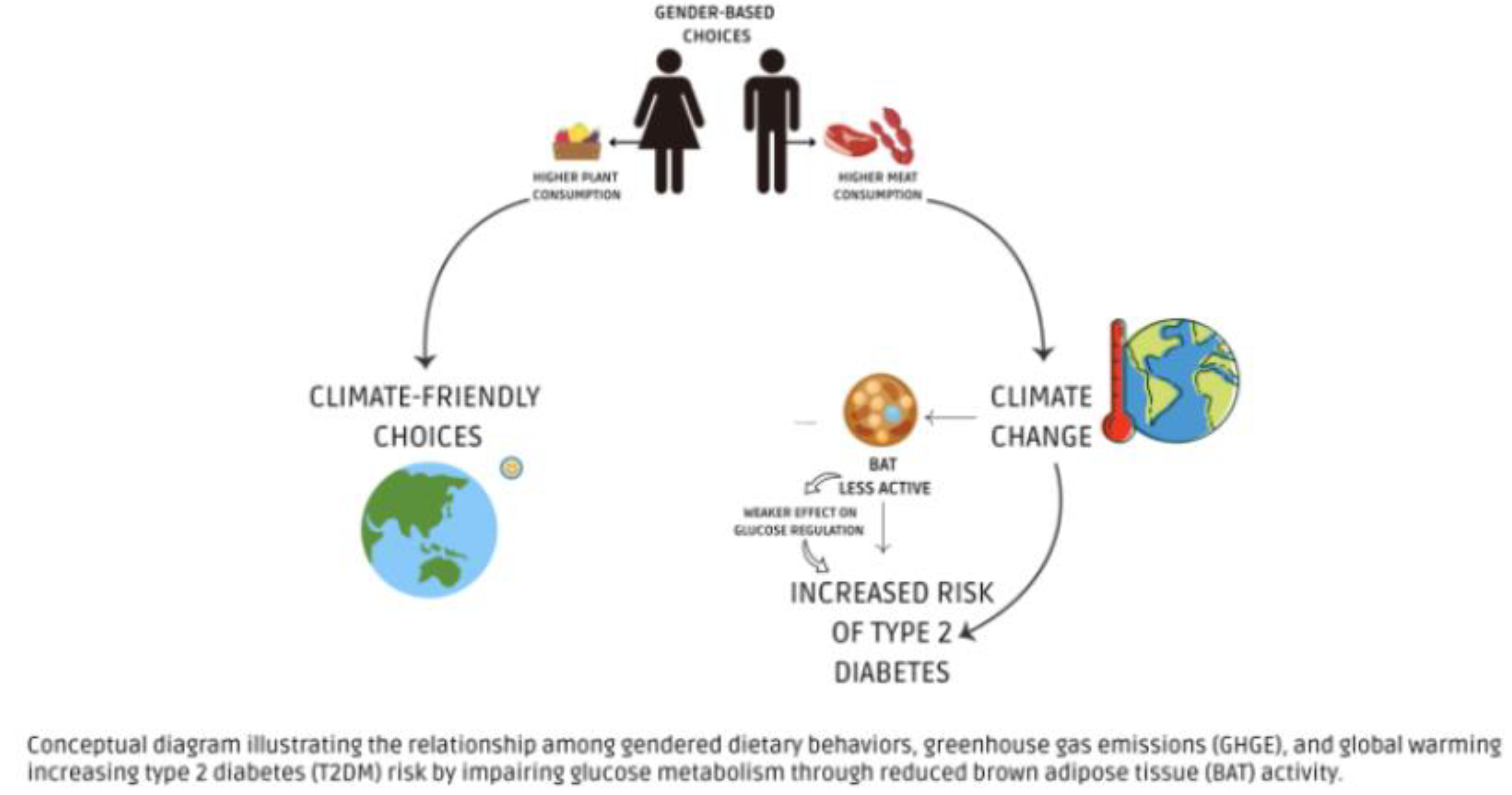
This review explores the novel and understudied role of gender in the multidimensional feedback between climate change and diabetes via dietary behaviors. We investigate how gender differences in diet contribute to GHGE and how the resultant global temperature increase could exacerbate diabetes and impair glucose homeostasis (Figure 1), moving beyond simple reiterations to identify a gendered driver in the climate-health nexus.
By integrating the gender perspectives into the analyses of climate, diet, and health, we can identify targeted strategies to combat global warming through changes in consumer behaviour. These strategies include promoting sustainable eating habits in male-dominated food cultures -where traditional male roles and identities are linked to higher meat consumption and less adoption of plant-based diets, often influenced by social norms linking meat-eating to masculinity- thus reducing heat exposure and diabetes.
We conducted a comprehensive literature search until 30 July 2025 using electronic databases PubMed and Scopus. We selected studies that provided quantitative data on diabetes outcomes, fasting blood glucose levels, brown adipose tissue (BAT) activity, and their associations with sex or gender and environmental temperature or climate change. The search syntax combined the keywords ‘type 2 diabetes or T2DM or T2D’, ‘glucose levels’ ‘brown adipose tissue or BAT’ in combination with ‘sex or gender” and/or ‘temperature’ or ‘climate change’.
2. Climate Change and Its Impact on Diabetes
Worldwide, approximately 537 million adults aged 20 to 79 live with T2DM, a number expected to increase to 643 million by 2030 and 783 million by 2045. Notably, over three-quarters of these individuals reside in low- and middle-income countries, highlighting significant global health disparities [19,20]. This expected rise in diabetes prevalence underscores the urgent need for coordinated global action to address both the environmental and social determinants of metabolic health.
T2DM is a major global health challenge due to its association with severe complications such as cardiovascular disease, nephropathy, retinopathy, neuropathy, and diabetic foot ulcers. These complications substantially increase morbidity and mortality and severely impair patients' quality of life [21,22]. The cumulative impact of these complications not only affects individuals but also places a significant strain on families, communities, and healthcare systems. The economic impact is profound: in 2021, global healthcare costs related to diabetes reached approximately USD 966 billion, placing a heavy financial burden on healthcare systems, especially in resource-limited settings [23]. Complications further escalate these costs through prolonged hospitalizations, complex treatments, and indirect losses like reduced productivity and workforce participation [22]. These challenges highlight the urgent need for effective prevention and management strategies [24].
The rising of global temperatures and the increased frequency of heat waves pose significant health risks, including impacts on metabolic health. Emerging research reveals complex interactions between ambient temperature and type 2 diabetes prevalence, including GDM [25,26,27].
Prolonged exposure to heat can overwhelm the body’s thermoregulatory systems, leading to heat-related illnesses such as heat exhaustion and heat stroke, conditions characterized by the body's inability to maintain its core temperature around the normal range (37°C or 98.6°F) [28].
Heat stress disrupts physiological processes like metabolism, vasodilation, and sweating, which can contribute to insulin resistance and the development of T2DM and GDM [29,30]. Heat stress reduces insulin sensitivity, exacerbating metabolic dysfunction [31]. These physiological disruptions may be further aggravated by dehydration, electrolyte imbalances, and changes in physical activity patterns during periods of extreme heat.
BAT plays a crucial role in thermogenesis, which is the process of heat production in living organisms [32]. Thermogenesis is primarily achieved through the activation of uncoupling protein 1 (UCP1) in the mitochondria, which allows the conversion of chemical energy into heat [33]. By burning lipids and glucose to produce heat, BAT helps maintain glucose homeostasis and improve insulin sensitivity. The activity of BAT is inversely correlated with ambient temperature; cold exposure activates it, leading to enhanced glucose uptake and utilization, whereas elevated temperatures suppress this beneficial function, directly contributing to impaired glucose regulation and increased diabetes risk [34]. Strategies to activate or preserve BAT activity may offer novel approaches to improve glucose regulation and reduce diabetes risk in the context of rising global temperatures [35]. This thermogenic function of BAT is particularly important in preventing obesity and related metabolic disorders, including T2DM [36].
A very recent study investigated the effect of short-term heat stress on T2DM mice, focusing on the role of BAT [5]. The results showed that heat stress significantly aggravated metabolic disorders in T2DM mice, leading to a marked increase in fasting blood glucose and insulin resistance, along with worsened dyslipidemia as demonstrated by increased triglycerides and LDL, and decreased HDL levels. Mechanistically, heat stress was found to inhibit BAT activity by significantly reducing the mRNA expression of the thermogenic gene UCP1 and decreasing BAT glucose uptake. The failure of BAT to clear glucose and regulate metabolism contributes directly to the observed hyperglycemia and insulin resistance.
The functional inhibition of BAT is directly linked to structural damage to adipocyte mitochondria. In fact, electron microscopy revealed that heat stress severely exacerbated mitochondrial dysfunction. Specific damage included the deformation, fracture, and disordered arrangement of the mitochondrial cristae, as well as a decrease in matrix electron density. This structural damage in the mitochondria, where UCP1 is located, fundamentally impairs the tissue ability to perform oxidative phosphorylation and thermogenesis, thereby aggravating metabolic dysregulation. The results of this study clearly provide a mechanistic support to link temperature and diabetes, indicating that heat stress aggravates the dysregulation of glucose and lipid metabolism, exacerbates mitochondrial dysfunction in BAT and reduces the activity of BAT in T2DM mice [5].
On the other hand, it has been demonstrated that cold exposure can improve insulin sensitivity and reduce fasting glycaemia in individuals with T2DM. A landmark study by Hanssen et al. [34]showed that exposing T2DM patients to moderate cold (16°C) for 10 days significantly improved insulin sensitivity without weight changes, likely through increased fatty acid flux to BAT and increased glucose uptake by skeletal muscle and liver, the primary insulin target tissues [34] BAT activity is inversely correlated with outdoor temperature, being higher in winter [37,38]. Conversely, elevated temperatures reduce BAT activity, potentially worsening glucose regulation and increasing diabetes risk [25]. Rising global temperatures may thus contribute to the T2DM epidemic by suppressing BAT function [39]. Supporting this hypothesis, Lee P. [40] found a positive association between outdoor temperature and glycated hemoglobin (HbA1c) levels, indicating environmental temperature influences systemic glucose homeostasis.
In this context, a comprehensive epidemiological study linking outdoor temperature to T2DM incidence [26] demonstrated that rising ambient temperatures are associated with an increase in diabetes incidence. Specifically, for every 1°C increase, the incidence of diabetes in the United States rises by 0.314 per 1000 people, and the global prevalence of glucose intolerance increases by 0.170% This suggests a strong correlation between higher temperatures and diabetes risk (Figure 1). Mechanistically, elevated temperatures impair insulin receptor signaling, reduce BAT thermogenic activity, and induce systemic inflammation and oxidative stress, all contributing to insulin resistance and impaired glucose metabolism [41,42,43]. These mechanistic insights provide a foundation for developing targeted preventiaon strategies, such as promoting physical activity during cooler periods, optimizing indoor climate control, and encouraging dietary patterns that support metabolic resilience.
Temperature fluctuations also affect GDM risk. Studies show that exposure to extreme temperatures during pregnancy, particularly the second trimester, increases GDM risk [44], with seasonal trends revealing higher prevalence during warmer months [45]. Teyton et al. identified critical windows in the second trimester where temperature changes of 10°C increased GDM risk by 6–9% [46]. Other studies report similar seasonal and temperature-related increases in GDM incidence [45,47,48,49]. These findings underscore the importance of monitoring environmental conditions during pregnancy and implementing adaptive strategies to protect maternal and fetal health.
Higher daily mean temperatures correlate with increased diabetes-related hospitalizations, especially among older adults [50]. Studies in Spain and China confirm these findings, showing stronger effects in males and older individuals [25]. Conversely, lower temperatures enhance BAT activity, improving glucose metabolism, with younger age, female sex, and non-diabetic status predicting higher BAT prevalence [51,52].
In conclusion, all these studies collectively demonstrate a consistent association between rising ambient temperatures and increased incidence and prevalence of T2DM. Heat stress was found to disrupt BAT activity, impairing its capacity to regulate glucose homeostasis and contributing to increased insulin resistance.
Climate change, through rising ambient temperatures and increased heat exposure, poses a growing risk to metabolic health by impairing insulin sensitivity, reducing BAT activity, and increasing the prevalence of T2DM and GDM. Understanding these temperature-related mechanisms is critical for developing effective prevention and management strategies to mitigate the expanding global diabetes burden.
3. Gender Differences in Dietary Choices and Their Impact on Climate Change
Recent research highlights the significant role of the food sector in driving climate change, with about one-third of global greenhouse gas emissions originating from food systems [53]. Among all food sources, meat—especially from ruminant animals—is a major contributor, with livestock production alone responsible for approximately 14% of global GHGE [54]. As a result, dietary guidelines increasingly recommend shifting towards plant-based protein sources to promote environmental sustainability, though the full impact of such changes is still being explored [55].
Transitioning to plant-forward diets offers significant climate benefits [56]. For example, a global move toward low-meat diets could cut the economic costs of climate change mitigation by up to 50% by 2050 [57]. The EAT–Lancet Commission’s “planetary health diet” emphasizes plant-based foods and limited animal products, and its adoption could reduce global dietary emissions by approximately 17% and prevent millions of diet-related deaths annually [9,58]. The adoption of these diets requires coordinated efforts from governments, industry, and civil society to overcome barriers related to food preferences, cultural traditions, and economic constraints.
Western diets, characterized by high consumption of red meat and dairy, contribute disproportionately to GHGE and resource depletion [59]. The environmental impact of food choices varies widely, making it crucial to collect dietary data at the individual level to design targeted and effective policies. Importantly, nutritional behaviors differ significantly across demographic groups, including distinctions based on sex and gender [59]. Understanding these demographic differences is crucial for designing targeted interventions that can effectively shift consumption patterns toward more sustainable options. Gender emerges as a key determinant, influencing not only what is eaten but also the motivations and attitudes underlying food choices.
Sociological and psychological research consistently finds that meat consumption is often linked to traditional masculinity [60]. Women express greater concern for animal welfare and environmental protection, which may explain their higher rates of vegetarianism and veganism [58]. Studies show that women generally have a better understanding of climate change and are more concerned about its effects than men [61]. These gender differences in food choices are influenced by cultural norms, education, socioeconomic status, and personal beliefs[60,62]. Furthermore, socialization processes from an early age reinforce these patterns, where boys and girls are often exposed to different messages about food, health, and environmental responsibility. Media representations and marketing strategies can also perpetuate gendered stereotypes about diet, further shaping consumption habits across the lifespan [63,64].
A recent cross-cultural study offers compelling and robust evidence that women generally consume less meat than men do, and this difference in dietary behavior becomes even more pronounced in countries that are highly developed and exhibit greater gender equality [65]. The comprehensive research, which gathered data from a large sample of 20,802 participants across 23 diverse countries, consistently found that men reported higher levels of meat consumption than women, regardless of the specific region or cultural context. Interestingly, the gap between male and female meat consumption was most significant in countries distinguished by advanced levels of human development and strong gender equality indices. This finding suggests that as societies progress and achieve greater equality between the sexes, the differences in dietary patterns—particularly regarding meat intake—may become more marked rather than diminish, highlighting the complex interplay between social development and individual food choices.
Culliford et al. [66] have effectively demonstrated how education level further influences food choices, as individuals with higher education are more likely to recognize the environmental benefits and adopt sustainable diets. However, while environmental concerns motivate some to reduce meat intake, other factors—such as taste preferences, health considerations, and cultural tradition—also play a major role [66].
Changing consumer food behaviors remains challenging; for example, Downs et al. [67] reported that among individuals reducing red meat intake, only a small proportion (6%) cited environmental sustainability as their primary motivation, highlighting the complex interplay of factors influencing dietary decisions.
The environmental impact of dietary choices is substantial and varies by gender. For instance, Auclair et al. [55] investigates the effects of partially replacing animal protein foods with plant protein foods in Canadian consumers, focusing on nutrition, health, and climate outcomes. The authors found that replacing 50% of red and processed meat with plant-based proteins could reduce GHGE by up to 25% of kg CO2-equivalent per person per day, with men seeing a greater reduction than women due to higher baseline meat consumption (27% for males, 21% for females; P < 0.0001).
Studies in the U.S. and Europe [68,69] consistently show that men have higher diet-related GHGE than women (5.85 vs. 3.88 kg CO2 equivalent, respectively), largely due to greater overall food intake (2631 kcal/day for men, compared to 1906 kcal/day for women) and higher meat consumption. However, it has to be underlined that when adjusting for calorie intake, the difference in climate impact per unit of energy consumed is smaller [70].
Switching to plant-based diets, such as vegan or Mediterranean diets, can significantly reduce GHGE compared to typical Western diets – by up to 50% of kg CO2 equivalent per year per functional unit for vegan diet and 20-30% for Mediterranean diets [71,72]. Here, the term Functional Unit refers to a standardized measure that captures the basic functions of food intake, primarily providing adequate nutrition and satiety. This approach allows fair comparison of environmental impacts by focusing not just on the amount of food consumed but on the nutritional value and the ability of the diet to satisfy hunger, ensuring that reductions in emissions are measured relative to equivalent dietary benefits. Among various dietary patterns, vegan diets have the lowest environmental impact, while omnivorous diets have the highest.
Allenden et al. [73] assigned environmental impact scores from 1 to 10 to six dietary patterns, where higher scores represent greater environmental benefits. The diets evaluated were omnivore, Mediterranean, pescatarian, flexitarian/semi-vegetarian, vegetarian, and vegan. Their results showed that the omnivore diet received the lowest score of 1, while the vegan diet scored the highest with a 10. Among the intermediate diets, the pescatarian diet stood out with a relatively high score of 6.81.
In summary, gender differences in dietary choices are a key factor in shaping the environmental impact of food systems. Men’s dietary patterns thus indirectly increase their metabolic risk through higher exposure to climate warming effects. These findings emphasize the need to incorporate sex and gender considerations into public health interventions aimed at climate change mitigation and diabetes prevention.
4. Conclusions and Future Perspective
This review highlights the complex and reciprocal relationship among climate change, gender-specific dietary behaviors, and the risk of developing T2DM. Our analysis of scientific literature indicates that rising global temperatures impair glucose regulation, primarily through suppression of BAT function and increased insulin resistance. Heat stress was also shown to exacerbate GDM, especially affecting pregnant women.
We highlighted the complex feedback loop where gendered dietary patterns disproportionately influence GHGE, accelerating climate change, which in turn acts as a metabolic stressor affecting diabetes outcomes. Specifically, higher meat consumption by men contributes substantially to climate change, leading to elevated emissions, faster global warming, and increased diabetes risk. Encouraging the adoption of plant-based diets could reduce GHGE. Targeted campaigns focusing on male dietary behaviours, which disproportionately contribute to climate change and diabetes risk, should be prioritized.
Women face additional vulnerabilities because of biological factors such as hormonal fluctuations during pregnancy and menopause. Combined with heat stress exposure, these factors increase the susceptibility to diabetes-related conditions including GDM.
Public health and climate policies should take a sex and gender-sensitive approach to effectively reduce emissions, prevent diabetes, and address both biological and social vulnerabilities. Future research should further investigate in depth sex-specific biological mechanisms by which heat and climate change impact metabolic health, especially regarding hormonal status and life-stage variations in women.
Eco-epidemiological studies are essential to monitor changes in ambient temperature, dietary patterns, and diabetes incidence by sex and gender to refine risk assessments and guide targeted public health interventions. Raising public awareness about the environmental impact of dietary choices and their health consequences—tailored by gender—can empower individuals to adopt healthier, more sustainable eating habits. Policymakers should develop integrated approaches that simultaneously address climate mitigation, dietary behavior change, and diabetes prevention, while considering sex and gender-specific needs and vulnerabilities.
Ultimately, a multifaceted approach combining environmental sustainability with gender-sensitive health promotion is necessary to reduce the growing global burden of T2DM in the era of climate change.
Author Contributions
Conceptualization, M.D. and C.C.; methodology, C.C.; writing—original draft preparation, M.D. and C.C.; writing—review and editing, G.Z and A.T.; supervision, R.M.; All authors have read and agreed to the published version of the manuscript.
Funding
The research leading to these results has received funding from the European Union - NextGenerationEU through the Italian Ministry of University and Research under PNRR - M4C2-I1.3 Project PE_00000019 "HEAL ITALIA". The views and opinions expressed are those of the authors only and do not necessarily reflect those of the European Union or the European Commission. Neither the European Union nor the European Commission can be held responsible for them.
Conflicts of Interest
The authors declare no conflicts of interest
References
- Poore, J.; Nemecek, T. Reducing Food’s Environmental Impacts through Producers and Consumers. Science (80-. ). 2018, 360, 987–992. [Google Scholar] [CrossRef]
- Foley, J. A.; Ramankutty, N.; Brauman, K. A.; Cassidy, E. S.; Gerber, J. S.; Johnston, M.; Mueller, N. D.; O’Connell, C.; Ray, D. K.; West, P. C.; Balzer, C.; Bennett, E. M.; Carpenter, S. R.; Hill, J.; Monfreda, C.; Polasky, S.; Rockström, J.; Sheehan, J.; Siebert, S.; Tilman, D.; Zaks, D. P. M. Solutions for a Cultivated Planet. Nature 2011, 478, 337–342. [Google Scholar] [CrossRef]
- Symonds, M. E.; Farhat, G.; Aldiss, P.; Pope, M.; Budge, H. Brown Adipose Tissue and Glucose Homeostasis–the Link between Climate Change and the Global Rise in Obesity and Diabetes. Adipocyte 2019, 8, 46–50. [Google Scholar] [CrossRef]
- Van Marken Lichtenbelt, W. D.; Vanhommerig, J. W.; Smulders, N. M.; Drossaerts, J. M. A. F. L.; Kemerink, G. J.; Bouvy, N. D.; Schrauwen, P.; Teule, G. J. J. Cold-Activated Brown Adipose Tissue in Healthy Men. N. Engl. J. Med. 2009, 360, 1500–1508. [Google Scholar] [CrossRef]
- Lai, P.; Zhang, L.; Qiu, Y.; Ren, J.; Sun, X.; Zhang, T.; Wang, L.; Cheng, S.; Liu, S.; Zhuang, H.; Lu, D.; Zhang, S.; Liang, H.; Chen, S. Heat Stress Reduces Brown Adipose Tissue Activity by Exacerbating Mitochondrial Damage in Type 2 Diabetic Mice. J. Therm. Biol. 2024, 119. [Google Scholar] [CrossRef]
- Wang, X.; Dong, W.; Yuan, B.; Yang, Y.; Yang, D.; Lin, X.; Chen, C.; Zhang, W. Vitamin E Confers Cytoprotective Effects on Cardiomyocytes under Conditions of Heat Stress by Increasing the Expression of Metallothionein. Int. J. Mol. Med. 2016, 37, 1429–1436. [Google Scholar] [CrossRef]
- Zhu, P.; Zhang, Z. H.; Huang, X. F.; Shi, Y. C.; Khandekar, N.; Yang, H. Q.; Liang, S. Y.; Song, Z. Y.; Lin, S. Cold Exposure Promotes Obesity and Impairs Glucose Homeostasis in Mice Subjected to a High-fat Diet. Mol. Med. Rep. 2018, 18, 3923–3931. [Google Scholar] [CrossRef] [PubMed]
- Yoneshiro, T.; Kataoka, N.; Walejko, J. M.; Ikeda, K.; Brown, Z.; Yoneshiro, M.; Crown, S. B.; Osawa, T.; Sakai, J.; McGarrah, R. W.; White, P. J.; Nakamura, K.; Kajimura, S. Metabolic Flexibility via Mitochondrial BCAA Carrier SLC25A44 Is Required for Optimal Fever. Elife 2021, 10, e66865. [Google Scholar] [CrossRef] [PubMed]
- Willett, W.; Rockström, J.; Loken, B.; Springmann, M.; Lang, T.; Vermeulen, S.; Garnett, T.; Tilman, D.; DeClerck, F.; Wood, A.; Jonell, M.; Clark, M.; Gordon, L. J.; Fanzo, J.; Hawkes, C.; Zurayk, R.; Rivera, J. A.; De Vries, W.; Majele Sibanda, L.; Afshin, A.; Chaudhary, A.; Herrero, M.; Agustina, R.; Branca, F.; Lartey, A.; Fan, S.; Crona, B.; Fox, E.; Bignet, V.; Troell, M.; Lindahl, T.; Singh, S.; Cornell, S. E.; Srinath Reddy, K.; Narain, S.; Nishtar, S.; Murray, C. J. L. Food in the Anthropocene: The EAT–Lancet Commission on Healthy Diets from Sustainable Food Systems. Lancet 2019, 393, 447–492. [Google Scholar] [CrossRef] [PubMed]
- Springmann, M.; Godfray, H. C. J.; Rayner, M.; Scarborough, P. Analysis and Valuation of the Health and Climate Change Cobenefits of Dietary Change. Proc. Natl. Acad. Sci. U. S. A. 2016, 113, 4146–4151. [Google Scholar] [CrossRef]
- Andrews, R. R.; Anderson, K. R.; Fry, J. L. Sex-Specific Variation in Metabolic Responses to Diet. Nutr. 2024, Vol. 16, Page 2921 2024, 16, 2921. [Google Scholar] [CrossRef] [PubMed]
- Feraco, A.; Armani, A.; Amoah, I.; Guseva, E.; Camajani, E.; Gorini, S.; Strollo, R.; Padua, E.; Caprio, M.; Lombardo, M. Assessing Gender Differences in Food Preferences and Physical Activity: A Population-Based Survey. Front. Nutr. 2024, 11. [Google Scholar] [CrossRef]
- Varì, R.; Silenzi, A.; d’Amore, A.; Catena, A.; Masella, R.; Scazzocchio, B. MaestraNatura Reveals Its Effectiveness in Acquiring Nutritional Knowledge and Skills: Bridging the Gap between Girls and Boys from Primary School. Nutr. 2023, Vol. 15, Page 1357 2023, 15, 1357. [Google Scholar] [CrossRef]
- Varì, R.; D’amore, A.; Silenzi, A.; Chiarotti, F.; Del Papa, S.; Giovannini, C.; Scazzocchio, B.; Masella, R. Improving Nutrition Knowledge and Skills by the Innovative Education Program MaestraNatura in Middle School Students of Italy. Nutr. 2022, Vol. 14, Page 2037 2022, 14, 2037. [Google Scholar] [CrossRef]
- Satija, A.; Bhupathiraju, S. N.; Rimm, E. B.; Spiegelman, D.; Chiuve, S. E.; Borgi, L.; Willett, W. C.; Manson, J. A. E.; Sun, Q.; Hu, F. B. Plant-Based Dietary Patterns and Incidence of Type 2 Diabetes in US Men and Women: Results from Three Prospective Cohort Studies. PLoS Med. 2016, 13. [Google Scholar] [CrossRef] [PubMed]
- Mauvais-Jarvis, F.; Bairey Merz, N.; Barnes, P. J.; Brinton, R. D.; Carrero, J. J.; DeMeo, D. L.; De Vries, G. J.; Epperson, C. N.; Govindan, R.; Klein, S. L.; Lonardo, A.; Maki, P. M.; McCullough, L. D.; Regitz-Zagrosek, V.; Regensteiner, J. G.; Rubin, J. B.; Sandberg, K.; Suzuki, A. Sex and Gender: Modifiers of Health, Disease, and Medicine. Lancet 2020, 396, 565–582. [Google Scholar] [CrossRef]
- Plows, J. F.; Stanley, J. L.; Baker, P. N.; Reynolds, C. M.; Vickers, M. H. The Pathophysiology of Gestational Diabetes Mellitus. Int. J. Mol. Sci. 2018, 19, 3342. [Google Scholar] [CrossRef]
- Springmann, M.; Wiebe, K.; Mason-D’Croz, D.; Sulser, T. B.; Rayner, M.; Scarborough, P. Health and Nutritional Aspects of Sustainable Diet Strategies and Their Association with Environmental Impacts: A Global Modelling Analysis with Country-Level Detail. Lancet Planet. Heal. 2018, 2, e451–e461. [Google Scholar] [CrossRef] [PubMed]
- Meo, S. A.; Meo, A. S. Climate Change and Diabetes Mellitus - Emerging Global Public Health Crisis: Observational Analysis. Pakistan J. Med. Sci. 2024, 40, 559–562. [Google Scholar] [CrossRef]
- IDF Diabetes Atlas. Global Diabetes Data & Statistics. Available online: https://diabetesatlas.org/ (accessed on 3 July 2025).
- Schlienger, J. L. Complications Du Diabète de Type 2. Press. Medicale 2013, 42, 839–848. [Google Scholar] [CrossRef]
- Zheng, Y.; Ley, S. H.; Hu, F. B. Global Aetiology and Epidemiology of Type 2 Diabetes Mellitus and Its Complications. Nat. Rev. Endocrinol. 2018, 14, 88–98. [Google Scholar] [CrossRef] [PubMed]
- Bommer, C.; Heesemann, E.; Sagalova, V.; Manne-Goehler, J.; Atun, R.; Bärnighausen, T.; Vollmer, S. The Global Economic Burden of Diabetes in Adults Aged 20–79 Years: A Cost-of-Illness Study. Lancet Diabetes Endocrinol. 2017, 5, 423–430. [Google Scholar] [CrossRef] [PubMed]
- Iwasaki, H.; Yagyu, H.; Shimano, H. A Comprehensive Analysis of Diabetic Complications and Advances in Management Strategies. J. Atheroscler. Thromb. 2025, 32, 550–559. [Google Scholar] [CrossRef] [PubMed]
- Valdés, S.; Doulatram-Gamgaram, V.; Lago, A.; Torres, F. G.; Badía-Guillén, R.; Olveira, G.; Goday, A.; Calle-Pascual, A.; Castaño, L.; Castell, C.; Delgado, E.; Menendez, E.; Franch-Nadal, J.; Gaztambide, S.; Girbés, J.; Gomis, R.; Ortega, E.; Galán-García, J. L.; Aguilera-Venegas, G.; Soriguer, F.; Rojo-Martínez, G. Ambient Temperature and Prevalence of Diabetes and Insulin Resistance in the Spanish Population: Di@bet.Es Study. Eur. J. Endocrinol. 2019, 180, 275–282. [Google Scholar] [CrossRef]
- Centers for Disease Control and Prevention (CDC). Managing Diabetes in the Heat. CDC. Available online: https://www.cdc.gov/diabetes/articles/managing-diabetes-in-the-heat.html (accessed on 7 July 2025).
- Blauw, L. L.; Aziz, N. A.; Tannemaat, M. R.; Blauw, C. A.; de Craen, A. J.; Pijl, H.; Rensen, P. C. N. Diabetes Incidence and Glucose Intolerance Prevalence Increase with Higher Outdoor Temperature. BMJ Open Diabetes Res. Care 2017, 5, 317. [Google Scholar] [CrossRef]
- Molina-Vega, M.; Gutiérrez-Repiso, C.; Muñoz-Garach, A.; Lima-Rubio, F.; Morcillo, S.; Tinahones, F. J.; Picón-César, M. J. Relationship between Environmental Temperature and the Diagnosis and Treatment of Gestational Diabetes Mellitus: An Observational Retrospective Study. Sci. Total Environ. 2020, 744. [Google Scholar] [CrossRef]
- Penn Leonard Davis Institute (Penn LDI). People with Type 2 Diabetes and Extreme Temperatures. Penn LDI. Available online: https://ldi.upenn.edu/our-work/research-updates/extreme-heat-and-cold-put-people-with-type-2-diabetes-at-risk-for-dangerous-health-conditions/ (accessed on 7 July 2025).
- Kenny, G. P.; Yardley, J.; Brown, C.; Sigal, R. J.; Jay, O. Heat Stress in Older Individuals and Patients with Common Chronic Diseases. C. Can. Med. Assoc. J. 2010, 182, 1053–1060. [Google Scholar] [CrossRef]
- Li, N.; Xiao, Y.; Wang, H.; Zhong, Y.; Yang, H.; Huang, K. Insulin Desensitization and Cell Senescence Induced by Heat Stress in Pig Testicular Cell Model. Anim. Biotechnol. 2023, 34, 4947–4956. [Google Scholar] [CrossRef]
- Liu, X.; Zhang, Z.; Song, Y.; Xie, H.; Dong, M. An Update on Brown Adipose Tissue and Obesity Intervention: Function, Regulation and Therapeutic Implications. Front. Endocrinol. (Lausanne). 2023, 13, 1065263. [Google Scholar] [CrossRef]
- Nicholls, D. G. Mitochondrial Proton Leaks and Uncoupling Proteins. Biochim. Biophys. Acta - Bioenerg. 2021, 1862, 148428. [Google Scholar] [CrossRef]
- Hanssen, M. J. W.; Hoeks, J.; Brans, B.; Van Der Lans, A. A. J. J.; Schaart, G.; Van Den Driessche, J. J.; Jörgensen, J. A.; Boekschoten, M. V.; Hesselink, M. K. C.; Havekes, B.; Kersten, S.; Mottaghy, F. M.; Van Marken Lichtenbelt, W. D.; Schrauwen, P. Short-Term Cold Acclimation Improves Insulin Sensitivity in Patients with Type 2 Diabetes Mellitus. Nat. Med. 2015, 21, 863–865. [Google Scholar] [CrossRef]
- McNeill, B. T.; Morton, N. M.; Stimson, R. H. Substrate Utilization by Brown Adipose Tissue: What’s Hot and What’s Not? Front. Endocrinol. (Lausanne). 2020, 11, 571659. [Google Scholar] [CrossRef]
- Merkel, M.; Schmid, S. M.; Iwen, K. A. Physiology and Clinical Importance of White, Beige and Brown Adipose Tissue. Internist 2019, 60, 151–159. [Google Scholar]
- Schilperoort, M.; Hoeke, G.; Kooijman, S.; Rensen, P. C. N. Relevance of Lipid Metabolism for Brown Fat Visualization and Quantification. Curr. Opin. Lipidol. 2016, 27, 242–248. [Google Scholar] [CrossRef] [PubMed]
- Saito, M.; Okamatsu-Ogura, Y.; Matsushita, M.; Watanabe, K.; Yoneshiro, T.; Nio-Kobayashi, J.; Iwanaga, T.; Miyagawa, M.; Kameya, T.; Nakada, K.; Kawai, Y.; Tsujisaki, M. High Incidence of Metabolically Active Brown Adipose Tissue in Healthy Adult Humans: Effects of Cold Exposure and Adiposity. Diabetes 2009, 58, 1526–1531. [Google Scholar] [CrossRef]
- Shao, X.; Shao, X.; Wang, X.; Wang, Y. Characterization of Brown Adipose Tissue 18F-FDG Uptake in PET/CT Imaging and Its Influencing Factors in the Chinese Population. Nucl. Med. Biol. 2016, 43, 7–11. [Google Scholar] [CrossRef]
- Au-Yong, I. T. H.; Thorn, N.; Ganatra, R.; Perkins, A. C.; Symonds, M. E. Brown Adipose Tissue and Seasonal Variation in Humans. Diabetes 2009, 58, 2583–2587. [Google Scholar] [CrossRef]
- Lee, P.; Bova, R.; Schofield, L.; Bryant, W.; Dieckmann, W.; Slattery, A.; Govendir, M. A.; Emmett, L.; Greenfield, J. R. Brown Adipose Tissue Exhibits a Glucose-Responsive Thermogenic Biorhythm in Humans. Cell Metab. 2016, 23, 602–609. [Google Scholar] [CrossRef] [PubMed]
- Hopkins, T.; Ragsdale, C.; Seo, J. Elevated Ambient Temperature Reduces Fat Storage through the FoxO-Mediated Insulin Signaling Pathway. PLoS One 2025, 20, e0317971. [Google Scholar] [CrossRef]
- Clayton, Z. S.; McCurdy, C. E. Short-Term Thermoneutral Housing Alters Glucose Metabolism and Markers of Adipose Tissue Browning in Response to a High-Fat Diet in Lean Mice. Am. J. Physiol. Regul. Integr. Comp. Physiol. 2018, 315, R627–R637. [Google Scholar] [CrossRef] [PubMed]
- Märker, T.; Sell, H.; Zilleßen, P.; Glöde, A.; Kriebel, J.; Margriet Ouwens, D.; Pattyn, P.; Ruige, J.; Famulla, S.; Roden, M.; Eckel, J.; Habich, C. Heat Shock Protein 60 as a Mediator of Adipose Tissue Inflammation and Insulin Resistance. Diabetes 2012, 61, 615–625. [Google Scholar] [CrossRef]
- Zhang, H.; Wang, Q.; Benmarhnia, T.; Jalaludin, B.; Shen, X.; Yu, Z.; Ren, M.; Liang, Q.; Wang, J.; Ma, W.; Huang, C. Assessing the Effects of Non-Optimal Temperature on Risk of Gestational Diabetes Mellitus in a Cohort of Pregnant Women in Guangzhou, China. Environ. Int. 2021, 152, 106457. [Google Scholar] [CrossRef]
- Booth, G. L.; Luo, J.; Park, A. L.; Feig, D. S.; Moineddin, R.; Ray, J. G. Influence of Environmental Temperature on Risk of Gestational Diabetes. CMAJ 2017, 189, E682–E689. [Google Scholar] [CrossRef]
- Teyton, A.; Sun, Y.; Molitor, J.; Chen, J. C.; Sacks, D.; Avila, C.; Chiu, V.; Slezak, J.; Getahun, D.; Wu, J.; Benmarhnia, T. Examining the Relationship between Extreme Temperature, Microclimate Indicators, and Gestational Diabetes Mellitus in Pregnant Women Living in Southern California. Environ. Epidemiol. 2023, 7, E252. [Google Scholar] [CrossRef] [PubMed]
- Qian, N.; Xu, R.; Wei, Y.; Li, Z.; Wang, Z.; Guo, C.; Zhu, X.; Peng, J.; Qian, Y. Influence of Temperature on the Risk of Gestational Diabetes Mellitus and Hypertension in Different Pregnancy Trimesters. Sci. Total Environ. 2023, 899. [Google Scholar] [CrossRef]
- Retnakaran, R.; Ye, C.; Kramer, C. K.; Hanley, A. J.; Connelly, P. W.; Sermer, M.; Zinman, B. Impact of Daily Incremental Change in Environmental Temperature on Beta Cell Function and the Risk of Gestational Diabetes in Pregnant Women. Diabetologia 2018, 61, 2633–2642. [Google Scholar] [CrossRef] [PubMed]
- Vallianou, N. G.; Geladari, E. V.; Kounatidis, D.; Geladari, C. V.; Stratigou, T.; Dourakis, S. P.; Andreadis, E. A.; Dalamaga, M. Diabetes Mellitus in the Era of Climate Change. Diabetes Metab. 2021, 47. [Google Scholar] [CrossRef] [PubMed]
- Persichetti, A.; Sciuto, R.; Rea, S.; Basciani, S.; Lubrano, C.; Mariani, S.; Ulisse, S.; Nofroni, I.; Maini, C. L.; Gnessi, L. Prevalence, Mass, and Glucose-Uptake Activity of 18F-FDG-Detected Brown Adipose Tissue in Humans Living in a Temperate Zone of Italy. PLoS One 2013, 8, e63391. [Google Scholar] [CrossRef]
- Ouellet, V.; Routhier-Labadie, A.; Bellemare, W.; Lakhal-Chaieb, L.; Turcotte, E.; Carpentier, A. C.; Richard, D. Outdoor Temperature, Age, Sex, Body Mass Index, and Diabetic Status Determine the Prevalence, Mass, and Glucose-Uptake Activity of 18F-FDG-Detected BAT in Humans. J. Clin. Endocrinol. Metab. 2011, 96, 192–199. [Google Scholar] [CrossRef]
- Crippa, M.; Solazzo, E.; Guizzardi, D.; Monforti-Ferrario, F.; Tubiello, F. N.; Leip, A. Food Systems Are Responsible for a Third of Global Anthropogenic GHG Emissions. Nat. Food 2021 23 2021, 2, 198–209. [Google Scholar] [CrossRef]
- Gerber, P.; Steinfeld, H.; Henderson, B.; Mottet, A.; Opio, C.; Dijkman, J.; Falcucci, A.; Tempio, G. Tackling Climate Change through Livestock—A Global Assessment of Emissions and Mitigation Opportunities; Food and Agriculture Organization of the United Nations (FAO): Rome, Italy, 2013. [Google Scholar]
- Auclair, O.; Eustachio Colombo, P.; Milner, J.; Burgos, S. A. Partial Substitutions of Animal with Plant Protein Foods in Canadian Diets Have Synergies and Trade-Offs among Nutrition, Health and Climate Outcomes. Nat. Food 2024, 5, 148–157. [Google Scholar] [CrossRef] [PubMed]
- De Boer, J.; de Witt, A.; Aiking, H. Help the Climate, Change Your Diet: A Cross-Sectional Study on How to Involve Consumers in a Transition to a Low-Carbon Society. Appetite 2016, 98, 19–27. [Google Scholar] [CrossRef]
- Stehfest, E.; Bouwman, L.; Van Vuuren, D. P.; Den Elzen, M. G. J.; Eickhout, B.; Kabat, P. Climate Benefits of Changing Diet. Clim. Change 2009, 95, (1–2). [Google Scholar] [CrossRef]
- Klapp, A. L.; Wyma, N.; Alessandrini, R.; Ndinda, C.; Perez-Cueto, A.; Risius, A. Recommendations to Address the Shortfalls of the EAT–Lancet Planetary Health Diet from a Plant-Forward Perspective. Lancet Planet. Heal. 2025, 9, e23–e33. [Google Scholar] [CrossRef]
- Heller, M. C.; Willits-Smith, A.; Meyer, R.; Keoleian, G. A.; Rose, D. Greenhouse Gas Emissions and Energy Use Associated with Production of Individual Self-Selected US Diets. Environ. Res. Lett. 2018, 13, 04404. [Google Scholar] [CrossRef]
- Rosenfeld, D. L.; Tomiyama, A. J. Gender Differences in Meat Consumption and Openness to Vegetarianism. Appetite 2021, 166. [Google Scholar] [CrossRef]
- Korkala, E. A. E.; Hugg, T. T.; Jaakkola, J. J. K. Awareness of Climate Change and the Dietary Choices of Young Adults in Finland: A Population-Based Cross-Sectional Study. PLoS One 2014, 9, e97846. [Google Scholar] [CrossRef]
- Ruby, M. B.; Heine, S. J. Meat, Morals, and Masculinity. Appetite 2011, 56, 447–450. [Google Scholar] [CrossRef]
- Castronuovo, L.; Guarnieri, L.; Tiscornia, M. V.; Allemandi, L. Food Marketing and Gender among Children and Adolescents: A Scoping Review. Nutr. J. 2021, 20, 1–16. [Google Scholar] [CrossRef]
- Amson, A.; Bagnato, M.; Remedios, L.; Pritchard, M.; Sabir, S.; Gillis, G.; Pauzé, E.; White, C.; Vanderlee, L.; Hammond, D.; Kent, M. P. Beyond the Screen: Exploring the Dynamics of Social Media Influencers, Digital Food Marketing, and Gendered Influences on Adolescent Diets. PLOS Digit. Heal. 2025, 4, e0000729. [Google Scholar] [CrossRef] [PubMed]
- Hopwood, C. J.; Zizer, J. N.; Nissen, A. T.; Dillard, C.; Thompkins, A. M.; Graça, J.; Waldhorn, D. R.; Bleidorn, W. Paradoxical Gender Effects in Meat Consumption across Cultures. Sci. Rep. 2024, 14, 13033. [Google Scholar] [CrossRef] [PubMed]
- Culliford, A.; Bradbury, J. A Cross-Sectional Survey of the Readiness of Consumers to Adopt an Environmentally Sustainable Diet. Nutr. J. 2020, 19, 138. [Google Scholar] [CrossRef] [PubMed]
- Downs, S. M.; Merchant, E. V.; Sackey, J.; Fox, E. L.; Davis, C.; Fanzo, J. Sustainability Considerations Are Not Influencing Meat Consumption in the US. Appetite 2024, 203. [Google Scholar] [CrossRef]
- Willits-Smith, A.; Aranda, R.; Heller, M. C.; Rose, D. Addressing the Carbon Footprint, Healthfulness, and Costs of Self-Selected Diets in the USA: A Population-Based Cross-Sectional Study. Lancet Planet. Heal. 2020, 4, e98–e106. [Google Scholar] [CrossRef]
- Kirwan, L. B.; Walton, J.; Flynn, A.; Nugent, A. P.; McNulty, B. A. Preliminary Environmental Analyses of Irish Adult Food Consumption Data to Facilitate a Transition to Sustainable Diets. Proc. Nutr. Soc. 2022, 81. [Google Scholar] [CrossRef]
- Hallström E, Bajzelj B, Håkansson N, Sjörs J, Åkesson A, Wolk A, Sonesson U. Dietary climate impact: contribution of foods and dietary patterns by gender and age in a Swedish population. J Clean Prod. 2021, 306, 127189. [Google Scholar] [CrossRef]
- Paris, J. M. G.; Falkenberg, T.; Nöthlings, U.; Heinzel, C.; Borgemeister, C.; Escobar, N. Changing Dietary Patterns Is Necessary to Improve the Sustainability of Western Diets from a One Health Perspective. Sci. Total Environ. 2022, 811. [Google Scholar] [CrossRef]
- Kjellberg, M.; Skoglund, W.; Haller, H. Decreasing the Carbon Footprint of Food through Public Procurement—A Case Study from the Municipality of Härnösand. Front. Nutr. 2024, 11, 1156784. [Google Scholar] [CrossRef] [PubMed]
- Allenden, N.; Hine, D. W.; Craig, B. M.; Cowie, A. L.; McGreevy, P. D.; Lykins, A. D. What Should We Eat? Realistic Solutions for Reducing Our Food Footprint. Sustain. Prod. Consum. 2022, 32, 541–549. [Google Scholar] [CrossRef]
Figure 1.
Feedback Loop among Gender-Specific Dietary Choiches, GHGE, CC, BAT AND T2D.
Disclaimer/Publisher’s Note: The statements, opinions and data contained in all publications are solely those of the individual author(s) and contributor(s) and not of MDPI and/or the editor(s). MDPI and/or the editor(s) disclaim responsibility for any injury to people or property resulting from any ideas, methods, instructions or products referred to in the content. |
© 2025 by the authors. Licensee MDPI, Basel, Switzerland. This article is an open access article distributed under the terms and conditions of the Creative Commons Attribution (CC BY) license (http://creativecommons.org/licenses/by/4.0/).
Copyright: This open access article is published under a Creative Commons CC BY 4.0 license, which permit the free download, distribution, and reuse, provided that the author and preprint are cited in any reuse.


