

Submitted:
13 July 2025
Posted:
15 July 2025
You are already at the latest version
Abstract
Abstract: This paper introduces the multi-level Job Content Questionnaire: JCQ 2.0 (JCQ2) to promote health and wellbeing at the workplace in the context of a new generation of psychosocial work environment challenges arising in the global economy. The paper provides the theoretical basis for the new instrument and defines the questionnaire instrument’s new scales at task, organization, and external-to-work levels. This paper highlights the JCQ2’s potential as a diagnostic and proactive intervention tool for promoting worker health and well-being, providing actionable insights for both workers and company management. The paper first reviews Demand/Control (D/C) model and the JCQ. It then outlines an intellectual bridging strategy to support multi-level hypothesis testing with the JCQ2 - based on a much-extended Associationalist Demand/Con¬trol (ADC), which utilizes linkages to both system theory and several social science literatures. Conducive behavior supplies the individual level motivational platform. A new mid-level construct - Platforms of Dynamic Stability - is introduced to facilitate cross-level analyses and postulate multi-level processes for participatory workplace redesign which are based on balance between worker wellbeing and company economic market adaptive pressures. Thereafter, generalized versions of the Demands, Control and Stability-Support constructs are defined, and then further articulated in short scales at multiple workplace levels. Finally, each JCQ2 scale is defined in terms of both the generalized scale concepts and relevant research literatures. The paper provides a discussion of multi-level work redesign actions and reviews the JCQ2’s practical health promotion implications.
Keywords:
demand-control (D/C) model
; health promotion
; psychological job demands
; decision latitude
; job strain
; active work
; conducive behavior
; platforms of dynamic stability
; associationalist demand-control theory (ADC)
; ordering capacity
; equilibrium of flows
1. Moving Beyond the JCQ and Demand/Control Model
This paper introduces the multi-level Job Content Questionnaire, JCQ 2.0, to promote worker health and wellbeing in the context of a new generation of psychosocial work environment challenges. The challenges, arising from current complex social and economic conditions, require generalizations of the underlying, well-known Demand/Control/Support (D/C/S) theory and an expansion of the original JCQ (hereafter: labelled JCQ1). The JCQ 2.0 (hereafter labeled the JCQ2) extends the JCQ1 assessment of the work experience beyond the task level - making use of the generalizability of the D/C model’s “energy and order” implications.
The D/C model has always emphasized an Active Work health promotion focus - at the task level. The JCQ2 extends this health promotion tradition to multiple workplace levels, serving as both a diagnostic tool for psychosocial risk factors - and as a foundation framework for designing interventions aimed at promoting well- being and preventing health risks (in Section 4 and Section 6-B). This dual functionality aligns with contemporary goals in public health to shift from reactive care to proactive prevention and health promotion.
The extended health promotion focus of the JCQ2 requires a theoretical expansion. Furthermore, current global economic and organizational structures introduce new contexts for workplace jobs which also require a new multi-level theoretic framework. The new framework must be able to span the historic break from the mass-production focused, material goods economy which the 1970’s D/C model addressed. Just as the framework for the JCQ1 was the Demand/Control model, we propose the framework for the JCQ2 is the Associationalist Demand/ Control (ADC) theory. The label “Association” refers to an expansion of the social relational aspects of working conditions to include social support, complex organization social stability, and social identity consequences of conducive behavior. We claim that the association-linked motivation assessed by the JCQ2’s new conducive behavior scales can underpin a social development process which evolves in a non-materialist manner, and thus, environmentally sustainable direction.
The challenge is to develop an integrating theory base that can bridge these historic changes – and maintain the practical utility of the JCQ -D/C/S base – while more directly assessing the job’s social context. This paper makes use of Karasek’s ADC theory’s [1] systems theory and complex adaptive system (CAS) concepts to provide a foundation for both the JCQ2’s multi-level measurement goals and to describe the dynamics of multilevel workplace effects. The theory narrative must be broadly enough formulated to translate across diverse disciplinary boundaries. Secondly, the attempt is made to maintain as closely as possible the pragmatically and intellectually useful Demand-Control (D/C) narrative - which addresses negative wellbeing outcomes (health deficit/disease) - and positive outcomes (active, motivational, learning-related behaviors and attitudes) both of which are important in the job redesign processes and in economic policy. The theoretical integration builds upon generalizations that extend demands, control, stability, and support concepts to formats for multi-level work experiences.
These definitions are then translated into the JCQ2 hypothesized scales at the task, organization and external-to-work levels. Several papers in this special issue are based on JCQ 2.0 pilot studies including over 16,000 subjects in four countries that empirically assess the multi-level ADC hypotheses and the utility and validity of the proposed multi-level D/C/S scales (becoming D/C/S-S scales, as described below). The JCQ2 attempts to extend the international practical utility of the JCQ1 as demonstrated in large nationally representative and multi-occupation samples from both West (France, US, Canada and Brazil: [2,3,4,5], respectively) and East (Japan, Tiawan, Thailand: [6,7,8], respectively), and in nurses across cultures (Iran, Korea, and Vietnam: [9,10,11], respectively).
1.1. Brief Review of the Demand/Control Model
The original D/C model’s dual hypotheses about worker health and wellbeing are based on two combinations of work organization output-related goals (psychological job demands) and work organizational structure (control /decision latitude) at the job task level – these are basic “energy and order” related working conditions. The active learning hypothesis (hypothesis #1) predicts positive developmental, Active Work when high – but not too high - job demands are combined with high control. The job strain hypothesis (hypothesis #2) predicts negative or risk-prone high Job Strain work when jobs combine high demands and low control (see Figure 1).
The D/C model emphasized the effort and energy required by the worker to get the job done. Demands arise from the organization’s need to produce output, which translates into mental demands for the individual worker. Demands are operationalized in the JCQ1 as task level demands – psychological job demands – referring to high output per unit of time, rapid, time-pressured work or conflicting demands. Job control in the D/C model and JCQ1, labelled decision latitude, combines two related components: skill discretion, the allocation of tasks to individuals related to his/her skills, and decision authority, the individual worker’s degrees of freedom or autonomy to use his/her capacities toward the organization’s goals, as articulated in Karasek 1976 and 1979 [12,13] and in Karasek and Theorell in 1990 [3] 1. When the worker has control over the possibilities for directing energy to goal attainment the result is an active job via feelings of mastery and problem solving leading to motivation: the D/C model’s primary health promotion strategy. If such action is inhibited by a lack of control the result is discomfort, exhaustion, dissatisfaction, and stress-related disease as in a high strain job.
The Active Work and Job Strain effects can be integrated over time and understood as contributors to personal behavior, with two feedback loops illustrating their cross-moderating effects (hypotheses #3 and #4), as shown in the Figure 1 [3] (p. 99). These lead to two supplementary hypotheses: “learning inhibits strain” and “strain inhibits learning.” Support for such hypotheses is found in the case of (#3) mastery and social learning by Bandura [14], and (#4) as by Holmes and Rahe as life-event burden [15]. These supplementary hypotheses are described by Karasek in 1976 [12], Karasek and Theorell [3], noted by Grant and Parker [16], and empirically tested with both pathways simultaneously by Taris and Feij in 2004 [17].
The JCQ1 has been mainly used to test the D/C and D/C/S models with a focus on task-level job characteristics in the context of promoting workplace health. Broader coverage – but also with a primarily individual-level focus2 - has been addressed in the closely-related Job Demands-Resources model (JD-R) literature (see Demerouti et al. 2001 [18] and Bakker, et al, 2010 [19]). The extensive body of specifically JD-R research illustrates the successful empirical utility of adopting a longer list of demand moderators other than job control alone (which much of the D/C/S-JCQ1 research has emphasized). However, the JD-R model’s breadth comes at the cost of
theoretic predictive specificity: in particular JD-R lacks an obvious pathway toward organizational/ multi-level analysis (however, Dollard, et al, is one exception [20]).This lack of specificity also allows misleading interpretations to occur in JDR usage, wherein the work environment refers to Job Demands only, and Resources - an unspecific list – are considered to be the worker’s responsibilities.
Furthermore, the original D/C model formulation has a clear requirement of a positive coefficient for psychological demands to address the challenging, mastery-based experiences of health-promoting, active work. By contrast in JD-R research original work engagement hypotheses postulate a negative association with work demands. However, the current status of the two models is quite similar since Bakker, et al, 2010 [19] also observe that the coefficient for work demands can be positive in an “active“ version of the JDR model.3
Active Work’s (high demands, high control) empirical associations with positive outcomes have been well demonstrated (i.e., Czicksentmihalyi’s flow[21].4, Nevertheless. the Active Work hypothesis is far less often directly tested in the psychosocial literature than Job Strain [26,27]. The JCQ2 and this paper’s theory platform attempts to give support to further utilization of Active Work concepts.
1.2. Moving Beyond the Classic D/C Model’s Task Level
1.2.1. Status of the D/C Model—Today
The original D/C model’s formulation provided a simply understandable theory, and a task-level health and wellbeing promotion strategy also, but the primary critique of the original two-dimensional model is that it is “too simple.5 The original D/C model and JCQ1 focused on static task-level work conditions [3] (p. 61) and presumes the existence of a work organizational (i.e.: company) structure as a given– to provide the jobs it describes. Pressures to further evolve the model come from diverse directions: new social context factors, global economic integration, sustainability requirements, and decades of international research usage experience, as is noted by Parker et al in 2017 [28].
In our more complex world of today, worker psychosocial well-being cannot be assessed by task-based empirical tests6 and measures alone. The individual-level focus of the D/C model - and also of most JD-R research - is not sufficient to support the JCQ2’s health and wellbeing promotion goals: in particular, its multi-level social context assessment and health promotion goals at the organization and work-related external-to-work levels. The JCQ2’s ambition is to support an equivalently useful narrative of plausible causality for JCQ2 hypothesis testing and practical work redesign strategy goals - in the current global economy context. We need to upgrade a D/C theory base relevant to a societal context so vastly expanded that many issues now are “global.” The question is: How to do this?
1.2.2. Evolution of the Theoretical Model for the JCQ2: From D/C to A/D/C
To address the over-simplicity critique, in this paper the D/C model and the related JCQ1 are extended to define a far more general version of the D/C narrative which is both multi-level and more explicitly social - and which is then empirically validated in further special issue papers. This revised narrative also remains consistent with the D/C model’s signature goals of active, participatory worker engagement, while addressing it at much higher levels of psychosocial working conditions.
Social development ideas have always been some part of the D/C model’s underlying “DNA” [23,34,35,36] - as evidenced by Johnson’s 1982 Social Support D/C/S expansion 7 .- But he broadly expanded social relations focus of the social narrative emerges in explicit form only in this paper and its accompanying empirical JCQ2 papers in this Special Issue (and in [1]) and is thus denoted with the extended acronym D/C/S-S model (Section 3-C).
We can use the very general and abstract “energy and order” D/C platform to build consistent extensions, now in a multilevel workplace social context. While the JCQ1 focused on task implications, the focal theoretical innovations for the JCQ2 represent primarily extensions of “control “as multi-level, action pathways – which still retain the underlying “energy and order” conceptualizations, via the Associationalist Demand Control theory (ADC theory).
However, this extension – and use of the ADC and its systems theory related expansions - will requires a very significant jump in theoretic generalization [37]: The first step in such a major evolution will require that we re-construct the theory narrative already on a revised description of individual level behavior and motivation which can be a better foundation for the multilevel action and future societal developments than the original D/C model (in Section 2). This extension allows modification of the D/C narrative to give it a much more broadly generalizable foundation, thus usable at the workplace organization level, and beyond.
Fortunately, the Active work combination (high in both energy and order) also works for ADC-related development of democratic and sustainable Conducive Economy – with societal possibilities capable of encompassing existentially evolved premises, beyond those central to the original D/C model (see Paper 8). This gives the JCQ2 a parallel, broad ranging evolutionary transition rather than requiring an unbridgeable theoretic break.
The original focus of D/C/S research was job stress and chronic disease, and thus original use of the ADC’s theory’s principles were at the individual level (These were system-theory related and labeled Stress-Disequilibrium Theory (SDT) discussed below in Section 2-B). These early explanations have provided an important precursor discussion which could be anchored in relatively-easily summarized micro-level, natural science-based physiological evidence (Karasek 2008). However, this JCQ2 paper’s multilevel social science focus utilizes that cross-level discussion in the extremely different context of human-level social organization -and the process of worker’s Bottom-up participation.
Thus, the same underlying “energy and order theorization template” used in previous physiological explanations must now be evolved to support active, multilevel social processes. These processes are at the core of the JCQ2’s multilevel occupational health and wellbeing promotion ideas (further discussed below as ordering capacity development in Section 3 and Section 4). But because of the multiple, and explicitly social explanatory levels are here addressed, to avoid the risk of a serious ecological fallacy this paper needs to present a very well structured “narrative of plausible causality” (in Section 3A to 3D).
1.2.3. JCQ2 Practical Criteria
The JCQ2 does not just emerge from such theory alone. There are several important practical determinants for the JCQ2 extension to insure optimal long-term usage of the JCQ1 and JCQ2 as assessment tools and to insure constructive relation to other large, closely related research traditions.
(A) Compatibility with the JCQ1’s main D/C/S scales from the past three decades of health risk and health promotion research is needed to support time-comparative research investigations. (While the primary JCQ2 includes somewhat shortened JCQ1 scales, full compatibility is possible with a briefly extended Archive Version of the JCQ2).
(B) The JCQ2 maintains the JCQ1 policy of simply formatted, broadly understandable question text language, which is intended to be applicable to all respondents in either company-based or full population-studies, also for the newly developed scale questions.
(C) Scale segments and questions in several cases that are (1) consistent with the overall gestalt of the JCQ2’s theory base and (2) already significant in the research literatures have been incorporated with the originator’s permission into JCQ2 scales at the organizational level (a subset of the Psychosocial Safety Climate (PSC), Effort-Reward and Procedural Justice instruments) as noted in Section 5.
(D) New questions and scales - not covered in A and C above- are directly derived from ADC theory in a hybrid form related to social scientific literatures at the appropriate levels. Scale validity and reliability are tested internationally where possible (the German version the latest and most complete version of the JCQ2 among the four pilot studies discussed).
Finally, we must highlight a practical limitation: while the JCQ2’s focus explicitly expands beyond the task level, its assessments cannot directly measure the full organizational structure. The JCQ2’s “organizational level” is operationally defined based on what can be seen by the individual survey respondents while doing their jobs and looking up at the workplace to report on it as an undifferentiated whole, regardless of its real complexity. This is explicitly defined in the JCQ2 questionnaire as the place “where the rules are made about how I should do my job.” While JCQ1 subjects could focus on their perceptions of the micro workplace close at hand, the JCQ2 questionnaire subjects are often asked to assess their broad social context at work.
1.3. Transdisciplinary Theoretic Base Across Multiple-Levels: A Spine and Limbs Intellectual Bridge to Bring Active Health Promotion Agency
1.3.1. A Seamless, Upward Pathway for Workplace Health Promotion
The Bottom-up health promotion and wellbeing improvements introduced below are action-related processes which requires a seamless upward pathway of actions across workplace levels - necessarily requiring dynamic and integrated actions spanning these levels.
In reality, the worker's task-level job context is inextricably and causally connected to the organization and external-to work social structures. The challenge of describing working conditions in the complex organizations of our global economy is that the solutions must be able to apply for both the workers who are focal for the JCQ2, and managers who must coordinate the company’s overall actions for workers and many separate departments.
To accommodate work-related health promotion, creativity, and growth across all the JCQ2-relevant levels requires extension beyond the academic boundaries of intellectual disciplines - which are indeed often defined as separately bounded: sociology, psychology and contemporary economics at the macro level, and even inclusion of micro-level physiologically relevant explanations of stress-related chronic disease. Unfortunately, the relatively rigid boundaries of the social sciences above do not easily facilitate cross/ boundary analysis and action planning.
1.3.2. Flipping a Systems-Theory Hierarchy—To Put the Human Being on Top
However, systems theory offers the needed multilevel, action-based generalizing explanatory power for our JCQ2 - via its basic principles which both span and - significantly - delimit functional relationships across the connected levels of action (see for example explanations in Holland, and Briggs and Peat [38,39], and can accommodate dynamic change (see systems theory-based explanation of social context effects in v. Bertalanffy and Luhmann [40,41]). While complex adaptive system conceptions - borrowed here from the natural sciences - are rather sparsely used in combination with social science theory, some examples are available for psychology [42] and for economics [43].
The JCQ2 – and its theory base - must retain a unified, basic focus on human wellbeing at the workplace. Thus, major modifications to the conventional use of systems theory propositions are needed to make certain that human health and well-being at the workplace –at the lowest level of our global environment triad (individual-company-global economy) – stays as the top priority for our utilization of ADC theory and its JCQ2 goals. System theory, and complex adaptive system (CAS)/ complexity theory – with their natural science origins – do not automatically supply this human-centered focus.
Thus, we here attempt to adapt system theory’s - and complex adaptive system complexity theory (CAS)’s - very abstract foundation principles to provide an outline template of the JCQ2 inter-level linkage involving coordination and communication between workplace sub-systems and between levels of function. Their usage can be seen in the example of a context interpretation of high-level control for the JCQ2 organizational level version of the Decision Latitude scale.8 As an example, this form of control arises from the collaborative decision-making process among workers or groups of workers, and is a construct that inherently encompasses the underlying concept of individual worker task level control, since without such higher-level control, workers could remain isolated and dominated by relationships with machines, fixed production routines, or otherwise dehumanized aspects of work organization.
Unfortunately, systems theory examples are often used as hierarchical, multi-level explanatory frameworks9. But we must avoid risky explanations which would involve unidirectional Top-Down applications10. Thus, we must restructure the logic. Systems theory’s otherwise helpful principles must be interrupted or flipped11 for our theorization-focus at the level of human behavior in a global economy - to avoid yielding control to the “levels above” in the hierarchy.
This requires new forms of behavioral support to directly and actively protect human wellbeing and development from the Bottom up – instead of Top-down - to keep the JCQ2 focus on human wellbeing at the top. Thus: our explanations will introduce person-to-person conducive social interactions (see Section 2-1) as human behavioral model “motor” for action and development. This alternative, conducive behavior model can apply “horizontally” between individuals - or within companies - and also apply as the “motor” for Bottom-Up individual action and development “vertically” in companies.
As we can see below, this “flip” will imply the new importance of a mid-level in our JCQ2 theory-base evolution: a locus where the new worker-empowered structures from the shop floor, Bottom-up, can meet “half-way” with management’s requirements to thrive in a global economy coming from Top-down.
Importantly: both goals – health promotion and sustainability– are consistent in the present day: beyond active, participatory workplace health promotion, the JCQ2 theory base attempts to provide a plausible explanatory platform toward sustainable, climate-friendly, non-materialistic economic development – based on conducive behavior. Historically, the goal of making active human agency central simply reflects further extension of motivations already emerging at the beginning of the Renaissance in Western societies when human beings came to be understood as “molders and overcomers” [of their fate].12 Thereafter, the development of capitalism theoretically kept individual human wellbeing on top. But further expansion of capitalism’s “consumer” materialist market consumption model would now result in a societal dynamic that is no longer sustainable - when applied in isolation.
1.3.3. Developing a Multi-Level Intellectual Bridge Concept for Both Promotion and Sustainability
Thus :to support both health promotion and sustainability in the current economic context, the dynamic linkages of the Spine and Limb Intellectual Bridge are proposed. This intellectual bridge combines both the insights of system theory with the strength and breadth of human motivation, and micro-level social interaction research – simultaneously. Each level of JCQ2 scales jointly evolves from (a) its own set of science-informed empirical findings and principles (Limbs) - and (b) the system-science principles of ADC theory that supply a uniting logic structure (Spine) across the several social science levels involved. Testing the implied hypotheses and solutions will require a new set of multi-level scientific studies (here in the JCQ2 empirical papers and beyond).
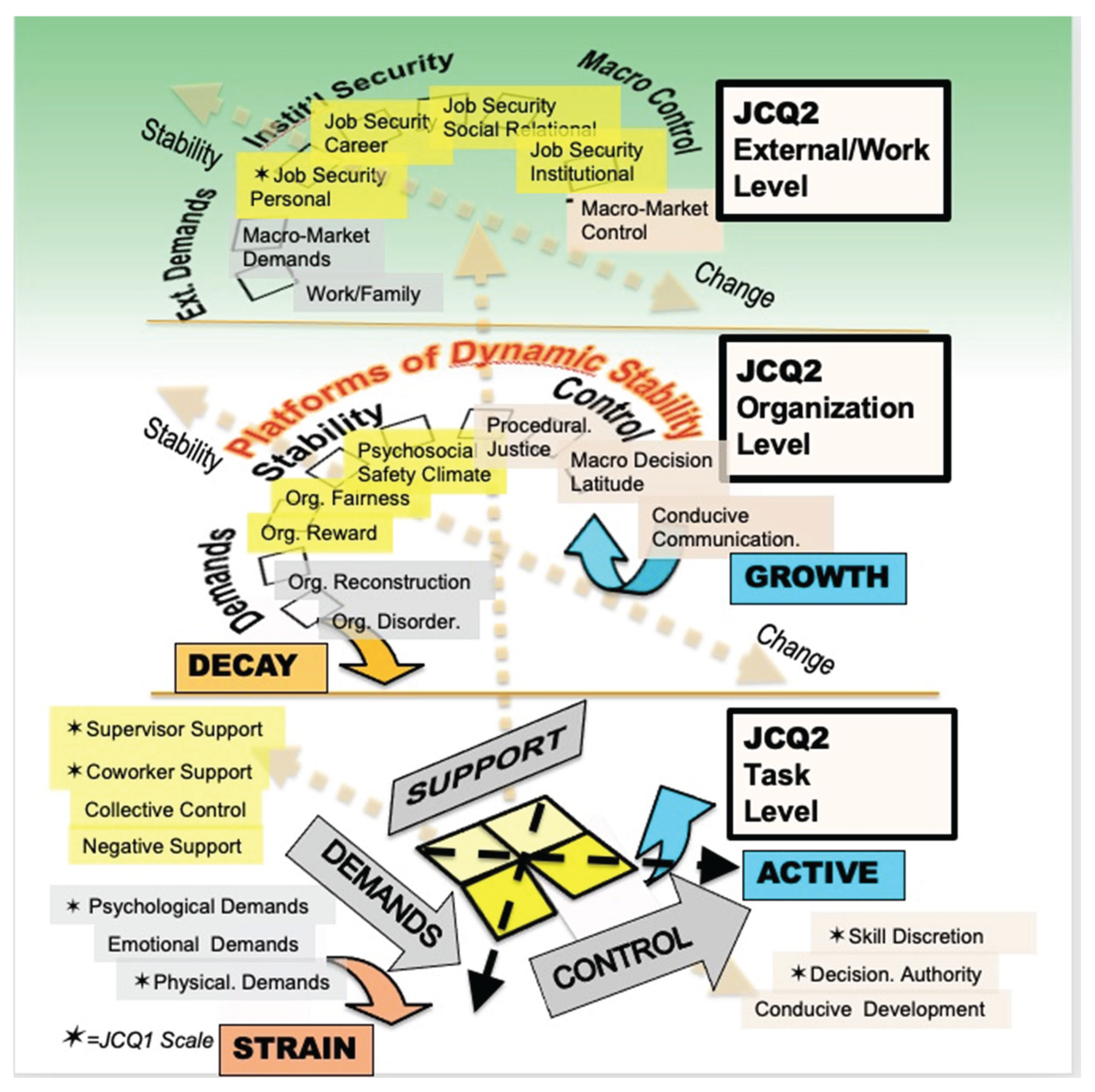
Our integration will be built on three successive processes of translation from ADC’s systems theory-related propositions to accommodate the multiple social science disciplines (our Limb: the angled horizontals in Figure 2). This gives us both a cross-level conception (our Spine: the vertical axis in Figure 2) - and several social science-based Limbs to help facilitate the translation of the D/C/S-S narrative across disciplines. A visual representation of the bridging structure’s implications for multi-level extension of the D/C/S-S model is shown in Figure 2 below, which also illustrates Growth and Decay inter-level relationships. The full complement of the JCQ2 scales shown in a more detailed version as Figure 5 and then discussed scale-by-scale in Section 5.
- In Section 2 below our first stage of integration – at the micro-level, is anchored in psychology and focuses on individual motivations. It defines conducivity’s collaborative self-actualizing behavior using motivation theory and group dynamic theory to articulate micro-level boundary-spanning social behavior relating to both disease-preventing growth and disease-related decay.
- In Section 3 and Section 4 the workplace organization’s internal functions will be linked - via system theory propositions – to research in organizational sociology and psychology to support both our selection of JCQ2 scales at the organization level and Bottom-up workplace redesign processes. The new JCQ2 organization level scales specifically address the costs and difficulties, as well as the unexpectedly large bonuses associated the processes involved in health promotion. This is the most challenging set of system science/social science theory relations, but it underpins the largest number of JCQ2 scales for multi-level D/C/S-S model’s characteristic workplace predictions – in Section 5. It then further provides a platform for the External-To-Work scales in a forthcoming paper in this issue.
- Finally, in a separate paper in this Special Issue which focuses on macro-level themes, a further extrapolation of the “intellectual bridge” utilizes the JCQ2’s conducive behavior task and organization scales in relation to economics and political theory. That paper attempts to explain how JCQ2 usage could monitor global progress in major current social issue areas such as climate sustainability and Western democratic societal stability, as well as psychosocial workplace health. In our ever-more constantly integrated, multibillion person world, many populations, and economists 13, are looking for precisely such “next steps forward” in societal development. Examples of forward-looking search process include Lerouge and Karasek’s conference on a New Economy of Innovative and Healthy Work [52] and a major European Union “Beyond-Growth” Conference [53].
2. The New Individual Level: Extending the JCQ2-ADC Theory Platform at: Assessment of Growth and Decay/Disease
2.1. GROWTH: Active Work for Wellbeing Promotion, Conducive Behavior and Collaborative Self-Actualization
Fortunately, the expanded ADC theory-base theory platform is grounded in behavioral phenomena very consistent with early D/C model explanations. Active work is an obvious similarity between its specific company task-level hypotheses, and the more generalized skill-developing conducive behavior described below. The original core vision behind the full set of D/C ideas in Karasek 1976 and 1978 [12,[12,,23] placed personal and interpersonal development as the primary goal with Active Work as central [1,35] , with job strain-related health initially as the secondary goal in spite of its research preminence.
Active Work is the positive-growth side of the Demand/Control narrative and relates to the worker’s development of new capabilities, both individually and socially (we often use the label “skills” to designate capabilities) – which are key processes for promoting work-related health and wellbeing In a parallel manner, economist Sen [54] expanded the traditional materialist-based preview of economic science by adding a macro-economic focus on “capabilities,” with the importance of this addition now demonstrated in an alternative measure of GDP which includes human capital development.
Our skill development perspective begins with very fundamental personal motivational research [21,55] – with consistent implication for both the original D/C model and the expanded SDC theory. Our discussion [35] emphasizes the fact that skills bring with them a “need” to be used and thus become the potential motivational precursors [56] to still further capability development. Such motivation is the “motor” driving both the worker participatory behaviors in this paper and the societal development discussed in a later paper in this issue.
Maslow [57] [58] [59] outlined a model of human motivation which can be imagined as pyramid-like in which he defines self-actualization as a small section at its top, which becomes a behavioral motivator only after needs at its lower levels are fulfilled for basic existence and social affiliation (which, itself, is often a requirement for fulfilling existence needs). But for the socially focused, multi-level goals of the JCQ2, this paper formulates a more socially articulated, high-level theory of activation and motivation for human development. Human beings are social animals – and developmental.
Thus, there is a need for a new, explicitly social version of self-actualization as a motivator: a collaborative form of self-actualization, which we label in this paper: conducive behavior. It goes beyond personal motivation to address the differing degrees of constructive social behavior that are a species-integral characteristic of Homo Sapiens sapiens. Conducive behavior is defined as a synergistic skill development social process, based on the mutual enhancement of joint capabilities involving one’s closely collaborating colleagues (see Karasek [36]). It describes a situation in which another person´s actions facilitate one’s own capability development. “My colleague’s skills increase the effectiveness of my own skills.” Simultaneously, and reciprocally, it can be imagined that my work activities contribute to the growth of skills and capabilities of the other directly involved persons - including customers and colleagues.
This is a value-creating process where “value” deriving from this form of social behavior is synergistic among collaborators and purposeful. All persons´ contributions can have simultaneous utility, with the joint effects being greater than the sum of the separate effects. Thus, we must move beyond the “zero-sum” evaluation typical of classic economic theory for our analysis.
This form of “Conducive Surplus Value,”14 (CSV) is thus very broadly evolved social exchange process [36] (see Supplement, Fig 2-S), moving from basic barter processes between strangers as a first stage, to further stages of dynamic employee-customer linkages as in Karasek’s Conducive Production [35] (see Supplement -Fig 1-S). Conducive value accumulates within capability-using, living beings who can offer the growth initiatives they have learned to the next actor in a collaborative chain, as well as learning from that actor’s feedback,[36] (see Supplement, Fig 2-S, Stage I-B-2).. The production cycles are “horizontal:” promoting creative, value enhancing linkages between individuals or between sub-units within companies without the requirement of major differentiation in power or status. The reciprocity of this communication ensures that no party fails to gain some benefit from the process and thus such communication promotes constructive social integration. Notably: it is a process with many aspects almost opposite to current unidirectional, computer-based innovations in some social communication areas. For example, artificial intelligence’s use of difficult to identify creation processes which could lead to ambiguous and thus socially destabilizing communication. 15
Conducive processes are creative, skill-building processes for employees, consistent with Active Work, and thus represent a high level of control, autonomy, and personal development, as is noted by Gallie and others [60,61]. Skill development at the task level and important aspects of other-person capability facilitation can be measured by the JCQ2 (as noted in scales in Section 5): as Conducive Development at the task level, as Collective Control at the work group level, and as Conducive Communication along with several organization-level scales (see Section 5 and further discussion in a later paper in this issue).
Collaborative self-actualization carries important social cohesiveness implications beyond Active Work at a task level alone. Social collectivities are created as potential members agree to abide by, and be defined by, sets of collectively agreed upon rules, and this social integration is measurable by JCQ2 scales at the group level (Collective Control scale, Section 4-E-b). The range of and the differences between potential members contributing skills in developing the group or collectivity (Section 4-E-d) also helps determine the potential effectiveness of these behaviors.16
Conducive processes are an important component of our ADC version of a person’s social identity development: “I ‘Do’ [socially], therefore I am”17. Such processes also represent a constructive form of social engagement that can give meaning to work life, as well as supporting the growth of worker capabilities, and - when extended to an organization and market level – can develop customer’s capabilities as well, further expanding workers´ social networks, as in Conducive Production ([35] Figure 1.
2.2. DECAY/DISEASE: Work Stress-Related Health Risks
Going further, ADC theory also presents hypotheses about “negative outcomes:” health risks - and with generalization of the Job Strain, hypothesis about how systems decay and are no longer able to sustain their original complexity and capability. Health status is clearly the primary focus of most D/C-related research via the Job Strain concept (see for example research reviews: [65,66]), even if it was initially a secondary goal to Active Work. Thus, JCQ2 empirical test sometimes refer to “positive” behavioral outcomes and “negative” illness risks, in compact summaries. Good health is of course the foundation for personal development since competency building cannot easily occur without freedom from disease risk (i.e.: freedom from job strain, anxiety, and drudgery). Thus, multiple levels of health risk factors are specifically assessed in the JCQ2 for development of the workplace demands, control and stability-support scales.
However, resolving health risks brings a person only up to “zero-level” in Maslow’s developmental pyramid. But for health and wellbeing promotion, we must go further. By itself health is a necessary - but not sufficient - condition for developmental increments of well-being which are relevant for large scale change.
Active Work in the classic D/C definition also involves “high demands, but not too high demands.” However, many low-level jobs – for example those in the nominally social service sectors in particular - can involve very high levels of personal emotional demands but offer limited worker control possibilities and no conducive value benefits. The result is that stress-related health risk often becomes the focal consequence instead.
The original D/C model used disease explanations that were entirely physiological, person-based on work-stress related psycho-endocrinology. In this paper we do not discuss in detail our newly extended within-person systemic decay process - now ADC-based - associated with job strain and chronic disease development. However, some implications of our newly extended theory base, as discussed in Karasek [37,67] as Stress Disequilibrium Theory (SDT) and ordering capacity development/deficits (see Section 3-D-1), are summarized in several relevant theoretical points below.18
ADC/systems theoretic principles are central to SDT job strain/chronic disease discussions. As evidence for this perspective, it must be noted that many chronic diseases observed in patients do not occur in isolation, but appear as multi-focal diseases involving multiple physiological system failures often beyond attribution to any specific “low-level” personal physiological deficit (one significant example is sudden-death heart disease [72]). Altogether, the search for “higher level context” explanation of disease - beyond low-level internal physiological causation19– introduces the possibility of direct social causation of disease, for example where social stressors overwhelm a person’s overall internal physiological system regulatory control capacities.
This in turn implies that the key to disease prevention and health promotion in many workplace situations would be identification of such social-level risks and formulation of social-context-based prevention interventions, both which the JCQ2 scales can help assess20
3. Organization Level: JCQ2 Workplace Assessment: Evolving an Extended Theory Base
3.1. JCQ2 Solutions to Multi-Level Workplace Context Challenges: Mid-Level Core Concepts Using a Multi-Level Systems Theory Base
We outline below the detailed logical steps needed for our JCQ2-relevant, socially structured workplace application. To avoid ecological fallacy, a very significant increase in sophistication of our “modeling” of workplace structure is required to make use of the “energy and order” theorization template in a multi-level manner, as is mentioned in Section 1-B-2. In the following parts of Section 3, Three Stages of Method Evolution are used to evolve the theoretical measurement base to define the JCQ2 scales and articulate their hypothesized relationships: (1) Stage 1 (Section 3-B) defines mid-level function in the workplace; (2) Stage 2 (Section 3-C) covers generalization of the new D/C/S-S dimensions; and (3) Stage 3 (Section 3-D) applies of system-theoretic logics to support a process of workplace participatory function. Then, a following Section 4 presents translation of this theory evolution into work organizational context, and thereupon JCQ2 scales are defined in Section 5 following.
Substantial changes have occurred in the way work is organized around the world due to globalization, strong free market-based socio-economic policy, and dramatic industrial concentration - often leading to a handful of competitors worldwide [76,77]. These changes altogether present a far different reality than that of the mid-1970’s and 1980’s when both the D/C model and the JCQ1 were originally conceived. In the not-too-distant past Western societies had more stable and understandable structures, with jobs in local companies, dominated by local labour markets and national labour relations with functional collective bargaining, and national workplace legal protections, as Standing notes [78].
Since then, work related social organizational factors – the job task’s external context - such as the organization (i.e. company) itself and the external-to-work social structure, have gained importance for worker wellbeing and stress-related outcomes and the guidelines for improving and optimizing these factors, and assessed by Dhondt, Pot, Kraan and others [78],[79,80] . Organizational policy actors are now compelled to evolve and become dynamically adaptable and flexible to enable organizations to survive in our global, location-dispersed, financially and internet-integrated economy [81,82].
As a result, workers are directly facing turbulent company contexts and global economic forces with increasing risks of unstable working conditions, job insecurity and overall wellbeing losses in many advanced economies. To measure the upstream workplace context factors that pose the current risks and to address those challenges, we develop below an array of JCQ2 scales - which can be utilized in an equally dynamic manner – and can assess worker well-being protective goals involving multi-level integrated functioning.
Actions to rebalance the worker wellbeing equation in a positive manner for workers represent a normative decision focus for JCQ2 workplace assessment., a focus consistent with the D/C model and JCQ1 since 1979. This requires a multi-level psychosocial workplace analytic model that can illuminate HOW work organizational effects are actually manifest and can be positively modified - from the worker on the shop floor up. The important questions for active work life improvement are thus: what are mechanisms for, what are the constraints upon, and what are the resources for facilitating the development of such dynamic, multi-level structures?
3.2. Mid-Level Core Concepts (Stage 1—Method Evolution)
We begin with a well-known example of integration of social science and systems theories which introduces the use of system’s theory metaphors to illuminate the effect of the environment on the organizational structure and policy by Katz and Kahn [83]. They use a two-level system-environment model (Organizational Systems Theory (OST) to illustrate the relationships. However, Katz and Kahn’s model cannot easily address the JCQ2-important internal worker well-being processes: relating to either stress (on the negative side) or innovative work and worker creativity (on the positive side). It also leaves the worker at the very bottom of organizational hierarchy in a fixed role inside Weber’s “iron cage of bureaucracy”[84,85]- with no explicit alternative behavioral program.
To adapt the useful OST example to address this paper’s multi-level social focus requires a significant restructuring of Katz and Kahn two-level systems-environment pair. To do this requires nesting a second system-environment pair within the first pair, to get a three-level system (see [37] (see Supplement, Fig 3-S). Three levels allow definition of a mid-level.
For health and wellbeing promotion, these mid-level structures are potentially importantly protective. A three-level conceptual structure - at least - is needed to model the workplace social context’s effects on worker stress and creative behavior. The mid-level provides a locus for the mitigation of the hierarchical bureaucracy’s Top-down control of worker behaviors - providing worker possibilities of Bottom-up participation21 within the context of a complex organization as described below (Section 4) as Platforms of Dynamic Stability, as is shown in Figure 3.
The Bottom-up /Top-down worker participation requirement clearly highlights the need for a mid-level. The mid-level allows a greater range of worker/management effects on the job to be modeled since it identifies the (a) central management, (b) employees in many departments (potentially collectively as discussed below), and (c) the contextual societal environment outside the workplace.
The three-level spine and limbs intellectual bridge formulation can generate (A) the sought-for, hypothesis-generating consistency of system theory’s order-delimiting principles 22 [37] as a guide to flows of resources and communication still appropriate for our (B) social science-oriented narrative in a multi-level workplace context.
However, Katz and Kahn’s original contribution, and even the above multi-level extensions, still provide only a descriptive outline of multilevel internal structure. The JCQ2- ADC theory goals require further elaboration of the spine and limbs theoretic base to provide an action-focused formula for Bottom-up-based worker participation.
3.3. Newly Generalized D/C/S-S Dimensions (Stage 2—Method Evolution)
Fortunately, the basic concepts of Demand and Control have far more general meanings than the DC model’s original exposition and the task-based questionnaire scales of the JCQ1. Broad possibilities to generalize the demands, control and support concepts are found at the micro level in a physiological extension via Stress-Disequilibrium Theory [37,67] which addresses how social control affects self-regulatory stability and chronic disease development, anchored in systems dynamics explanations of Job Strain. Thereafter, Conducive Behavior theory is used to explain Active Work at a higher analytic levels to facilitate development of responsive work organization and to address worker-friendly societal level development [1], with conducivity theory discussed in Karasek [35,36,37,87], and implications discussed in a further macro-level paper in this issue.
The integrated theoretical combination represents Karasek’s Associationalist Demand Control Theory (ADC) [1]. ADC theory presents hypotheses about how systems can either organize themselves into higher levels of complexity (the generalized Active Work hypothesis) or dissolve into systems with lower levels of complexity (the generalized Job Strain hypothesis). Thus, the key issues – at a now extremely generalized level - are coordination, the association of parts, and ordering capacity (see below) – rather than the physical reality of the parts themselves. This allows us to move the discussion beyond a purely materialist construction of reality. The movement beyond materialism ultimately it provides the basis for a new step in economic development (Conducive Economy) – topics beyond the scope of this paper, but further developed in the Special Issue.
To make them ADC theory congruent with the original D/C model-related scale definitions are generalized below to be “cross-level relevant:” that is meaningful at all JCQ2 relevant levels: task, organization, and external-to-work. This allows their interpretation using our system theory propositions relating to ordering capacity creation, a construct further explained below. In this new definition format, Demands are the constant requirement of processing the often plentiful but disordered resources and energy available in the external environment into the ordered energy (Work) needed internally for the complex organization’s survival. This constant process is based on the worker’s or organization’s use of its Skills and Control possibilities: the definitions from the D/C model are basically unchanged, but more broadly applied. The ADC model Support definition is broadened to Stability-Support which now spans both the previous individual-level social support definition and a generalization reflecting a form of context level (organization-level and above) stability which allows not only maintenance of health, but growth and effective adaptation by the organization to ever-more complex environmental challenges. This combination of general dimensions is hereafter labeled the D/C/S-S model.
3.4. Extension of the ADC with “Spine and Limbs” Concepts to Explain Bottom-Up Workplace Participation: A Grounded Speculation: (Stage 3—Method Evolution)
The D/C tradition has focused on prediction of outcomes in the context of highly structured social organization: workplaces and the labor market/economy. Thus, control exercised by workers in the context of Active Work is not simply one of several possible constructs for an ADC expansion: but it is the most central determinant of structure, function, and has significant predictive utility in psychosocial work environment contexts [88]. It is explicitly used to design such social structures.
Previous Job Strain research has utilized control as a behavior-level indicator of the potential effective use of internal physiological resources for healthy moderation of environmental stress effects23. However, with respect to direct participatory workplace engagement we must understand HOW such worker-engaging ordering capacity creation could occur in complex work organizations, to assess the ability of the multilevel JCQ2 scale set to support relevant measurement. These processes will directly depart from the otherwise-traditional, top-down hierarchical control, rationalistically simplistic paradigm outlined in Max Weber’s “iron cage of bureaucracy” [84,85], but can offer other multiple advantages, which are often non-economically assessable.
In this paper we want to go further by proposing a new new general hypotheses about workers´ development of control possibilities: how human high-level ordering capacity could be created in complex social organizations (see also [89], with discussion of [90] De Sitter’s work).
The concept of ordering capacity development outlined below is the common intellectual construct used to explain (1) how its deficit can cause disease and decay, (2) how its creation is health promoting, (3) how its stability maintenance in the workplace is a constant balance process in our current economic context, and (4) how its creation can support participatory worker reorganization and sustainability-conducive behavior.
The very general label ordering capacity development 24 is introduced because nature in general operates with precisely the opposite tendency: to lapse persistently into disorder. Ordering capacity is defined as the ability to exert internal control over the otherwise random actions of sub-components within a complex structure - to ensure a focused, unitary function of the complex organization overall in its environment. We label it high-level ordering capacity because we discuss control in potentially multi-level structures. From a general systems theory perspective, such functioning can give the organization Ashby’s “requisite variety” [92] of well-ordered responses to the ever-present variety of challenges it faces in the environment: responses which are needed to insure the organization’s internal stability and survival.
However, the usage of such responses will deplete the ordering capacity. Thus, it must be continually and cyclically replenished as Prigogine (1978) noted [93]25. Just maintaining the daily function of an organism requires constant processing of available energy (albeit disordered) into these needed well-ordered, and survival-necessary responses: a baseline of constant energy input. The alternative is system decay: the system’s complex functioning declines (chronic disease is one example) [37]. At least a baseline level of ordering capacity is needed to maintain optimal coordination of internal physiological systems.26
The growth and developmental goals of JCQ2 usage – which imply improvement of working conditions – thus go beyond Ashby’s requite variety responses and require creation of yet additional ordering capacity). In the JCQ2’s specific work environment social context, building up human high-level ordering capacity is what is needed for Bottom-up participatory workplace redesign – creation of new high-level ordering capacity in human behaviors from the shop floor up [96]. where it maybe be otherwise in limited supply.
Growth is thus the systematic, albeit energy demanding, process of integrating micro-skills into ordering capacity efficient (i.e.: low information cost) macro-programs to extend higher level ordering capacity. As an example: once a dance step is well learned by an individual, a much more sophisticated group choreography can then be undertaken based upon it: the available ordering capacity can be utilized for a higher-level action.
We claim that an outline of likely feasible steps forward - in a broadly applicable manner - is now necessary to facilitate creation and sufficient support for democratic processes in our complex, global economy. Below we describe a process of building a mid-level structure in a complex organization in a broad metaphorical manner: the steps are translated into practical organizational operations in Section 4.
(a). The bottom line is this: to create ordering capacity we must start the process with a significant amount of a usable surplus of environmentally available input resources - above normal requirements (a surplus of albeit disordered resources). We will also make use of what we refer to below as constraints27 - which might initially appear to be limitations (workplace policies, and rules) - but which are here seen as internally generated building blocks and energy-to-order promotion pathways in the ordering capacity creation process. To summarize such a process in very, very general terms: it goes - by hypothesis – as a step-by-step process of building up a multi-level ordering capacity pyramid.
(b1). As the organizational structure attempts to add levels of functional complexity to achieve its precise goals - it must add levels of control specificity.
(b2). The complex system requires very specific high-level actions - but the uncountable number of combinations of lower-level inputs (persons, etc.) and their numerous activities would be astronomically numerous. This overwhelming variability of outcomes leaves negligible possibility that the desirable combinations would occur at random.
(b3). So: the possibility of creating each step of new ordering capacity is achieved at a “cost.” This cost is investment in the high precision assemblage/platform of underlying “constraints:”the platform is an assemblage of variability-limitations: order-forming limitations on the unstructured available inputs from outside28. This cost must be paid to create every new level.
This “cost,” when paid, then allows successful processing - in a highly specific manner - the available (i.e., unstructured: cheap) input resources that are available to the structure at this level. In summary: unstructured input resources must be carefully processed: re-constructed/ shaped/assembled/re-configured such that that level’s output can function with the required high “power” (ordered energy) at that level. And then in a further step that output may also become the “new constraint” to mold the unstructured resources for use at an even higher level above (a la enzymes in biochemistry). Thus, a multiple-level constraint structure is created. And so it can go: step-by-step: creating higher level ordering capacity pyramid - but only at the cost of following extremely specific energy-to-order plans across multiple levels.
Creation of these action limitation structures is much like the important steps in some complex construction projects, for example a big new bridge: the elaborate, jigsaw puzzle-like concrete formwork for the bridge must be perfectly assembled before the concrete is poured (you better get the formwork, and thus the wet concrete, in precisely the right place the first time. After a few hours when it sets, the structure will permanently configured – either as a beautiful bridge - or with enormously costly corrections).
(b3). Thus, constraints are really energy-to-order pathways that are favored because of their demonstrated effectiveness in multiple trials in utilizing resources. They are “constraining” only in that they selectively up use available resources in process of reaching the goals). Thus, a constraint structure is actually a set of highly specific energy-to-order promotional pathways designed to facilitate precisely focused and regulated high-level ordering capacity creation -when external resources are available.
(b4). Importantly, while much disordered energy will be discarded as waste in such a process, the resulting assembly of building blocks can serve as the desired platform for completely new functions that can be undertaken by the complex structure at that new, higher level - thereby achieving a step towards our goal of increased functionality.
(c). Let us now simultaneously review the two opposite process for ordering capacity: Building it up and Using it up. The Using-it-up, multi-level coordination needs for normal daily function of the person or organization represent just the opposite process to those described above (b1-b4): Using it up depleting this ordering capacity. Both processes, operating together, are depicted in Supplementary Materials (“Up and Down the Ordering Capacity Hill” – (see Supplement, Fig 4-S) [37]. Furthermore, each level of the multi-level system relies on the level above it to create a “favorable context” for the maintenance of a stable equilibrium state - while that lower level is in process of creating ordering capacity (see also Figure 4 below). This “context” must therefore supply appropriate resources - and in addition must allow protected periods of activity when this level need not respond to its environment by taking actions (i.e.: rest periods: periods of low Demands are thus required), which are assessable with the JCQ2, as is noted in Section 2-2.
Our claim is that an analogically similar step-by-step generation of new social context structures can also occur in the work organization world: providing an outline for higher-level ordering capacity creation to secure worker wellbeing and sustainability can proceed. To link this narrative to our JCQ2 context, we propose using an extrapolation of what we have referred to as the systems theory spine and ADC model using SDT Theory [37] to create increases in functional possibility.
Creating Stable Equilibria for Dynamic, Participatory Workplace Contexts
The above ordering capacity creation process may appear to be an inefficient in use of resources when compared to use of resources for direct actions commanded Top-down by central hierarchies. But they can achieve important benefits otherwise difficult to achieve and easily missed by short-term company economic benefit calculations or value-extraction optimizations. Such non-market-measurable omissions are in fact our focus in a further paper in this issue.
The criteria above are abstractly stated to accommodate the very flexible range of structures and work process the JCQ2 should be able to address. Lerouge explains [52] such developmental processes in a social structural context: once the higher level-order platforms are established, they enable decisively important new levels of function for new levels of organizational and societal progress: “legal rules are an instrument of mobilization…and are a mode of regulation… that can lead to social change”29 - especially in interdisciplinary contexts, such as the JCQ2 assessments. The intended purpose of law in democratic governance is not to hinder personal freedom (constraint), but, via agreement to common rules, to allow societal support for new levels of political action to face challenges not otherwise addressable at the individual level (see also [99] relating to Western governments30). Such challenges - climate change, and Western democratic processes’ robust development are discussed in a further paper in this issue in the context of global risk monitoring using the JCQ2.
A major theoretical benefit of the system theory /ADC theory-based Spine and Limbs metaphor’s cross-level anchorage is that it clearly identifies the need for the equilibrium of flows31 that would be required for Bottom-up worker participation to function – and it highlights the risks of long-term failure if these flows are not sufficiently supported. These are flows of ordering capacity and resources moving up and down, across level boundaries in complex organizations [37] (Figure 1). These are important design criteria that must be fulfilled in a stably functioning complex organization.
To clarify this explanation, we can shift our focus to a familiar daily life context: we can say that maintaining the stability of flows for self and for families is always the major “control challenge” of adult lives. It means not only the person’s control over specific job situations, but more broadly, the control strategies he or she has developed to maintain the stability of his or her life sustaining flows (i.e., flows of nourishing and practical things: the money from workers’ wages flows into the bank, and the rent payments flow out from the bank…). What is important is that the input and output flows are roughly in balance: even if a current acute problem arises, in the future strategic solutions to maintain overall stability can be possible to achieve without undue hardship: a dynamic form of stability.
4. Translation of Theory to JCQ2 Multi-Level Organizational Hypotheses: Platforms of Dynamic Stability
4.1. JCQ2 Multi-Level Organizational Hypotheses: Platforms of Dynamic Stability
Many conventional company structures now require new forms of mid-level structure to address new requirements for worker psychosocial wellbeing. Below we both review how JCQ2 scales can descriptively measure structure normal well-functioning organization - and describe how the same scales could assess new high-level ordering capacity developmental potential using our synthesis above.
We introduce the mid-level level Platforms of Dynamic Stability construct to outline processes consistent with our D/C-JCQ signature worker participation goals: active participatory work redesign from the Bottom-up. Platforms of Dynamic Stability are generic mid-level platforms at the intersection of and balance of multiple adaptation/stability processes. They are represented in the central section of Figure 4 as unitary entities in spite of the organization’s actual multilevel/multifunctional complexity (and they will likely be assessed in an aggregate manner by JCQ2 questionnaire respondents). The multiple balancing processes bring workers´ collective control-based ordering capacity – via these platforms –to affect internal management policy relating to job design.
Figure 4 depicts the functionality to be analytically measured by our proposed JCQ2 scales to insure joint optimization of goals. We can see a multi-level model of the psychosocial workplace illustrating the necessary equilibrium of flows of both external resources into the organization, and Bottom-up creation of ordered-work outputs within the organization, operating in both directions to ensure productive performance in the external economy and as a platform for adapting to workers wellbeing needs.
4.2. An Organizational Management/Leadership View
The top of Figure 4 shows the organization making use of variable response options – enabled by its workforce’s flexibility - to respond to environmental challenges to gain external resources - with pathways for feedback between management and mid-level structures. From the company management view, this mid-level represents the locus of integrated and flexible organizational response options that allow adaptation to constantly changing external environmental challenges, a goal discussed in organizational robustness/resilience literatures [100,101,102,103] describing how complex organizations maintain stable functioning in the context of a changing environment – while still contributing to worker psychological health and engagement.
These platforms can function as coherent entities with benefits to company effectiveness potentially exercising a kind of intelligent response acting in concert. As the organization faces a new environmental goal, these subsystems can reconfigure quickly to meet the challenge and yet maintain stable, humane functioning. Such flexible interdepartmental relations – when functioning optimally- can produce a unitary, coordinated organizational output, as discussed as loosely coupled systems [104], and by Gittel [105] as relational coordination, where sub-group goal integration is based on effective communication processes, and in case studies by Hvid and Hasle [106] where the challenges arising in such coordination are also cataloged.
On the positive side, fully functioning Platforms of Dynamic Stability provide a humane formula to guide the company’s policies for selection of the types of environmental challenges it could decide to address. The company could be encouraged to pick its markets (as is further elaborated in a following paper in this issue): to select environmental challenges that are both economically feasible and humanely congruent. Cooley [107] offers examples of such worker-well-being production in large-scale industry. This is an important possibility for the new forms of companies in the Conducive Economy, as is further discussed in a later paper in this issue.
4.3. A Worker’s Shop Floor View
Figure 4 also depicts pathways for feedback between mid-level structures and individual workers to insure high-level support for worker well-being goals. While the highest-level structures - companies – must operate in an externally competitive global economy, they must do so in a manner that creates astable local context for lower-level systems to function/do the company’s work. They must provide protection against external-world uncertainties, moderating its risks to create overall a predictable daily order (see Precondition #5 below on “rules,”: 4-E-e) for workers to accomplish their jobs. In physiology, this complementary integration of higher and lower-level functions is termed homeostasis. Thus, we require a foundation of organization-level homeostasis as a within-company context for effective development of our Platforms of Dynamic Stability below - with a significant addition. In the context of human social organization, these organizational processes must also provide a surplus of resources32 - not only to be profitable in a conventional sense, but also to allocate a share of resources to formation of Platforms of Dynamic Stability (see Precondition #3 below, 4-E-c) for worker-wellbeing enhancement.
4.4. Dynamic Adaptation and Stability Support Processes in Mid-Level Organizational Function
Short-term adaptive change processes are most relevant for our JCQ2 focus on internal work organization. These are dynamic adjustments which can simultaneously ensure predictable functioning for the company and can protect against job stress and allow employees creative new steps.
From a social science perspective, the foundation for stability in all collectivities are social norms [108]created as potential members agree to abide by, and be defined by, sets of collectively agreed upon rules – but such norms can be quite inflexible in the short term. However, our goal with the ADC stability-support construct is based on processes which could maintain a more flexible equilibrium, while not undermining a predictable life structure for workers.
Inside-the-company integrated actions of subsystems (e.g., multiple organizational departments, work teams, policies, communication modes) that could ideally occur with a relatively easy-to-achieve, moderated flexibility that does not automatically require immediate transformation of the long-term organizational functions. The goal is to maintain a periodic balancing that could represent a more frequent exposure to manageable challenges – and simultaneously more frequent and effectively supportive response.33 The equilibrium of flows theory discussion above (and [1,37] outlines requirements whereby the short and long-term adaptive processes could be configured to provide stable support for the humane job redesign - using the Spine and Limbs terminology of the previous sections and with the motivation for creative engagement is found in conducive behavior.
4.5. Nine Requirements for Developing Platforms of Dynamic Stability: Two Characteristics, Four Preconditions, Two Pitfalls, and a Possibility
Below we translate the generalized ordering capacity creation processes from Section 4-D above into more specific guidelines for promoting wellbeing at work: a Requirements List. These involve two Characteristics, four general Preconditions, and three Implications for the Platform of Dynamic Stability development process. These guidelines can then be assessed by JCQ2 scales.
A major goal of this paper is to articulate a broad basis for the development of mid-level social structures that could be applicable in a thoroughly general manner - to provide a very broad pathway for development of democratic/participatory structures which are also consistent with JCQ2 measurement.
The list below is meant to assess democratic possibilities in the context of increasingly stark vertical inequalities in economic resources and power in our global economy. The Bottom-up/ Top-down process model advanced here requires further supplemental - but not contradictory processes - to address job redesign challenges that come from differential perspectives arising from more “horizontal” (power-equal) diverse occupational groups with strong occupational anchors (e.g. physicians vs. social assistants in hospitals [106].
This Requirements List discussion attempts to provide “proof,” via its details that the list is logically exhaustive: meaning that the possibility for such midlevel structures is only restricted by the generally formulated Spine functions and the further specifications of the respective Limbs requirements implied by this list.
If this claim is valid, the list would provide new suggestions for creating many new forms of mid-level company structures. These would be alternatives to otherwise centrally controlled (see Figure 3 and Section 1-E, 3-B-1) large scale organizations which are sometimes autocratic and represent an increasing risk for both worker well-being and economic competition. A significant implication of the List is thus that the alternative structures would not be limited in size, nor to only one workplace group, nor to only one functional level at the workplace.
4.5.1. Characteristic #1. Extensive Feasibility of Direct Democratic Development
Living things are growing and developing everywhere all the time – also human systems34. This paper attempts to outline a D/C/S-S model-consistent development process for work organization. Platforms of Dynamic Stability is a generalized mid-level social structural conception – representing for example the organizational mid-level of a company. Its general validity is anchored in the ubiquity of collective social relations development. Cornerstone contributions of sociological theory, for example Homans in 1950 [108] document the inevitability of such social development in the workplace.
Obvious examples of such structures are labor unions and health and safety committees, but these are constituted based on limitations related to specific country contexts or national programs35.
4.5.2. Characteristics #2. Flexibility of Social Integration
Our workplace version of these Platforms will represent a human group or collectivity. The motive force to take the building steps below to build these entities into higher level structures is conducive behavior-based skill building: the socially collaborative motivational behavior described in Section 2-A.
The Platform of Dynamic Stability construct is not pre-specified in terms of intensity of group integration or the binding strength of its internal norms or rule structures. These can vary and develop over time or even via differing assemblies of members (for example: health and safety committees, labor/management company workshops, etc.), as assessed in the Collective Control scale. More intensive social integration will likely be required for strong functionality and is certainly required for some mid-level structures in organizations. Labor unions, for example, do indeed have both precisely defined membership boundaries and rigorously specific goals both within the union and within the company.
4.5.3. Precondition #3. Surplus for Mid-Level Platform of Dynamic Stability
As the foundational resource for the effective operation of the integrated individual motivations above, the higher-level structures – companies, for example - must provide a surplus of resources36. They must be profitable in the broad sense in that they have available resources, and they must prioritize (or at least not hinder) these processes to a degree that allows the formation of new ordering capacity-related structures (such prioritization is assessed by the JCQ2 Psychosocial Safety Climate scale). This represents Organizational Homeostasis Plus - a condition which could occur via wages, time to meet, slack in production intensity, outside assistance, etc. Management’s sharing of an allocation of worker-created surplus is assessed in the JCQ2 in the Organizational Fairness and Organizational Rewards scales.
4.5.4. Precondition #4. Competencies, Diversity and Division of Labor
Clearly articulated and diversity-respectful differentiation between group members can be a necessary step to facilitate their integration within the collectivity [62]. Articulation of the collectivity’s range of skills and differences between members´ skills and background awareness will help determine the potential powers it can develop, as noted in Section 2-A. Such differentiation can be consistent with collaborative self-actualization processes, and it can build group cohesiveness. Furthermore, it can support a preliminary division of labor for taking actions in subsequent structure building steps, facilitating complex organization growth processes (further discussed in [1]).
4.5.5. Precondition #5. “Rules” of Work Process and JCQ2 Scales
The organization level – as assessed in our JCQ2 questionnaire - is the location in the workers’ eyes where “the rules are made about how you do your job.” From our systems theory Spine-and-Limbs perspective, rules serve as constraints which are used in a stepwise manner to build high-level ordering capacity. While sounding like limitations, a constraint structure actually represents a set of specific-action promoter pathways designed to facilitate precisely focused and regulated high-level actions. In a social context a short description of the concept of “rules” is provided by legal philosopher Lon Filler [112,113]. A review of his seven characteristics shows37 that they indeed can be assessed by the JCQ2 organization level scales that we suggest in Section 5 specifically: Organizational Decision Latitude, Procedural Justice, and Organizational Fairness, with stability addressed in Organizational Reconstruction, Organizational Disorder, and in the macro-level external-to-work demand scales [114].
4.5.6. Precondition #6, A Development Pathway Meta-Narrative (A Social Organizational “DNA”)
The extended Demand/Control/Stability-Support model is used as our narrative of plausible causality. While other meta-narratives could certainly be found for selection of rules, in our case this is the narrative that is tested in the following JCQ2 empirical papers, as is further articulated in Section 5-F below.
4.5.7. Pitfalls #7 and #8: Failures and Demands
If these order-creating processes above fail, the result could likely be perceived by workers as a negative organizational level demand – quite separate from their task’s demands. Such work conditions are also assessed by the JCQ2: one scale assesses heavy or frequent re-organization activity (Organizational Restructuring). Another scale assesses chaotic outcomes of either a process failure, personnel reductions, or chronic lack of company-level effective coordination for worker’s tasks (Organizational Disorder).
4.5.8. Possibility # 9: Growth Towards a New Level of Functionality
ADC theory [1] discusses systems as evolving to either higher, as well as lower levels of function, and thus Platforms of Dynamic Stability can evolve in positive (growth) directions - both in their own development and in their functional effectiveness within a complex organization. At the extreme high-control end of the newly proposed JCQ2 organizational control scales comes positive change that could be associated with expanded customer contact and skill development via Conducive Communication as well as Conducive Development at the task level (the integrated array of JCQ2 scales from Pitfalls #7 and #8 and Possibility #9 is represented in Figure 5).
Figure 5.
A Visual Representation of JCQ2 Scales Level-By-Level.
4.6. Healthy Work Redesign Process Literature on Platforms of Dynamic Stability and Participative Democracy
As the JCQ2 and its theory base move to a multi-level format, so too must work redesign praxis encompass expanded organizational redesign solutions beyond its original D/C task-based implications. The JCQ2 significantly increases the number of and range of scales beyond the JCQ1 (as described in Section 5-E), allowing more precise location of work organization challenges and intervention points.
Work redesign success essentially involves developing triple balances: (a) a balance between company-determined job functions and the individual worker’s wellbeing, (b) a successful balance between the organization and its environment, and finally (c) a third balance jointly maximizing these other balances - at the organization’s mid-level intersection in Platforms of Dynamic Stability. Demerouti [115] discusses such Top-down/Bottom-up worker/management dialogues on organizational design.
Empirical assessment of the overall effectiveness of such a strategy of integrated cross-level support principles is illustrated with respect to development of an effective Psychosocial Safety Climate (PSC) by Dollard and Karasek [116] in their innovative application of SDT. The organization support structure turns out to be a two-level inter-linked process with the higher level (management) and the lower level (worker) linked in a constructive and dynamic manner – functioning as a Platform of Dynamic Stability [20,117]. How to achieve an improvement in PSC in the face of major external change is shown in Dollard and Bailey [118] and is functionally described in terms relevant for dynamic stability platforms [118]. The specific list of work organization improvement actions is very consistent with JCQ2 scale assessments: job demand stabilization, job control enhancement to match demand variations, and both communication and participation enhancement.
Dollard and Bailey’s, and Loh’s [118,119] successful implementations of their PSC interventions highlight the importance of management will in their multisite project. This is also a consistent element in successful work redesign interventions elsewhere documented [3] (Chapter 5), [120].
Nevertheless, we hope that our very generalized bottom-up participatory strategy above can provide even broader coverage. The Platforms of Dynamic Stability’s participatory pathways are meant to address the vast number of potential worksites where management support is neutral at best, or altogether missing obvious prioritization of workers´ psychosocial wellbeing goals.
Thus, instead of directly assessing the implications of power imbalances, the JCQ2’s anchorage in Conducive Behavior and Platform of Dynamic Stability conditions emphasizes general positive processes creating win-win solutions for both workers and companies to enhance the sustainability of these interventions [110]. This is also seen in the measurement of structures to protect against work job stress [121] including Eisenberger et al. 1986’s POS concept [122], which at the same time insure the potential for generating flexible response alternatives for the company [123].
However, many real-life organizational scenarios do not evolve in a win-win manner. A forthcoming paper in this issue will attempt to provide a more comprehensive comparison between the optimistic, functionalist and future-focused “collaborative” perspective presented above and an antagonistic, conflict-theory based perspective on work and also recent anti-democratic theorizations [124,125]. Conducive Production’s mainly horizontal (power-equal), synergistic perspective can be used as a counterpoint to many classic conflict-theory critiques which focus on vertical power differentials. Review of the policy and strategic advantages of each viewpoint may illuminate some dilemmas regarding political implications of work structure, which are often overlooked: leaving a “vacuum” in this important policy area [126] .
The underlying D/C model’s dual Active Work and Job Strain perpendicular gradients can represent an empirical anchor for such needed new political dialogue. The dual gradients support a new and separate psychosocial-work-based social class conception, as was noted by Karasek in 1989 [34]. This adds a new, work-based duality to conflict-based implications of societal evolutionary processes, as discussed in this issue. At the societal level there is confirming evidence of this duality. Job Strain is primarily independent of (i.e.,orthogonal to) classic income-education related class conflict gradients found in the US and Belgium in occupational level analyses [127]. By contrast, these status gradients are directly related to the Active-Passive Work gradient axis from the mid-population up to the highest active levels. Further evidence for such a dual class structure is found in bifurcations of elite-level political influence activity in the US in the 2020’s 38 [128,129] and in the complexity of other post-classic Western political contradictions [130].
5. Definition of JCQ2 Scales from Multi-Level Demand, Control and Support-Stability Concepts and Literature
5.1. Introduction: D/C/S-S Framework as an Empirically Valid Scale Structure
There are significant empirical and theoretical reasons to maintain close linkages to the D/C/S-S framework as the JCQ2 is further evolved. Empirically, Luchman and Gonzales-Morales [131] demonstrate the utility of the D/C/S framework in a meta-analysis of 106 studies, as do Fila, Purl and Griffeth [132] in a separate meta-analysis of 141 D/C/S studies adding multiple moderating effects, and additional, longitudinal analysis confirmation comes in a major Swedish data set [133]. Furthermore, the validity of this structure, across the 25 JCQ2 scales proposed herein, is tested across all pilot studies internationally in several separate papers in this Special Issue (see Section 5-F).
5.2. A Review of the JCQ2 Developmental Process
The development of the JCQ 2.0 involved pilot studies in four countries. Items and scales evolved considerably across a span of eight years; with large scale surveys in Korea in 2005, in China in 2006, in Australia in 2009, and in Germany in 2011 - all occurring in the context of a robust international researcher dialogue [134]. The second stage of the pilots, in Australia and Germany, came after the utilization of the new more coherent and rigorous ADC theory base [134,135], and after a broader set of organizational scales in Australia (Dollard and colleagues own organizational scale development [116,117]. The JCQ2 task and organizational scale set is tested first in Australia and Germany [136], and then tested across all levels in Germany [114,135,137]. The final, German, JCQ 2.0 Pilot contains new organizational and external scales and is the version that most fully assesses the expanded version of the D/C model: ADC theory-based model.
1. From A-priori Pilot Studies to Final JCQ2 Scales: Final Scale Selection and Criteria
To develop the full Recommended Researcher Version JCQ2, a multi-stage process was followed. The first stage was based on separate analyses of the four a priori pilot studies in each country separately. Several stages of psychometric testing were applied to derive the commonly defined JCQ2 scales across all countries. (Figure [134] ). A common analysis strategy was used across all pilots for the finally selected common final scales, with the resulting inclusion decisions made for each scale and country discussed in the comparative reliability paper (a completely pooled survey analysis was not possible since not all scales and items were available in all countries). A separate, half-length User Version of the JCQ2 maintains almost all the predictive validity of the full version but cannot support scale-by-scale reliability analyses or detailed scale-based theorization.
Design challenges for the final JCQ2 instrument involved: (a) its goal of detailed assessment of multiple levels of work content, (b) the developmental nature of the projects’s process, and (c) the limitation on number of questions per scale (three on average) to maintain usage feasibility. JCQ2 coverage breadth goals and international comparability goals have effectively given priority to (A) international scale content similarity testing over (B) internal scale reliability testing: however, the final scale-item reliability differences between countries are usually not large. The observed between-country differences are further discussed in two accompanying papers (international comparative reliability and concurrent validity in one paper [134], and comparative scale structure in another [135].
5.3. Review of JCQ2 Scales in D/C/S-S Areas
5.3.1. JCQ2 Demand Concept and Scales
In the JCQ1 the individual’s job is the source of the task demands, resources and the employee’s skill application area – and is where output is expected to be delivered. However, an expanded perspective, including the organizational context, is needed for the JCQ2.
JCQ2 demand assessment at the task level retain the scale on Quantitative Psychological Demands (see Table 1 below) further includes a proposed question for future JCQ2 use relating to computer monitoring of workplace productivity and AI39 [140]. The JCQ2 adds an Emotional Demands scale to more fully assess work conditions based on research demonstrating high levels of burnout outcomes, particularly for service workers [141]. A Physical Demands scale is retained in the JCQ2 as in the JCQ1, in spite of its theoretical non-congruence, because of its salience for workload in many occupations and countries.
JCQ2 demands at the organization level include two scales. One scale, Organizational Reconstruction, assesses adaptive changes in the organizational structure arising because of company instability from either risk coping or growth processes, which is stressful in either case [88,142,143,144]. An Organizational Disorder scale assesses the degree to which poor organizational administration or coordination is causing its own set of job demands for employees, associated with extra load on the workers beyond the job task itself or limited organizational ability to maintain a stable state [144].
Some forms of psychological demands in the literature - referred to as “hindrance” stressors – can be differentiated from the challenge-type stressors listed above, particularly those at the task level [145,146]. Many of the above-noted hindrances are addressed in our multi-level approach by JCQ2 organization-level demand scales and the utilization of control concepts.
5.3.2. JCQ2 Control Concept and Scales
From the perspective of the individual worker, control can refer to the internal constraints that emanate from the organization’s rules of work process [83].
A substantially differentiated set of workplace control measures is necessary in the multi-level assessment of JCQ2 control. New requirements of flexibility are required for defining current work roles [16]. At the task level the JCQ 2.0 contains three scales to assess control: Decision Authority and Skill Discretion come from the JCQ1. The Conducive Development scale focuses on organizational facilitation of employee capability development via co-partnering among employees and with customers [35,36,110] as is relevant in our dynamic global economic context.
McPhee and Zaug [147] and Putnam and Nicotera [148] outline four standard modes of organizational communication which can assist our categorization of JCQ2 control scales. Two involve standard forms of organizational communication in bureaucracies (similar to those of OST [83]), relating to maintenance and development of standard operating procedures, and are reflected in two JCQ 2.0 organization-level Control scales: Organizational Decision Latitude and Procedural Justice.
Two other forms of communication are addressed by [147] McPhee and Zaug for unusual situations crossing internal boundaries, and external environment communication. These are more relevant for the flexible communication processes measured by the Conducive Communication scale [35,36]. Conducive Communication [36] is an entirely different form of communication involving decentralized and partly autonomous processes where skilled workers engage reciprocally with collaborators and even customers (perhaps directly) in a flexible and developmental manner, even involving “language” development [36], as is further discussed in a separate paper in this Special Issue (Paper 8, see ff39).
5.3.3. JCQ 2.0 Social Stability/Support Concept and Scales
ADC theory requires that we expand the previously adopted concept of social support and re-label it for multi-level usage, as Social Stability-Support; yielding the acronym: D/C/S-S model. The classic task-level Social Support [31] lacked an active side and was thus incomplete as a basis for model extension. In the ADC model, the Active component of Stability-Support reflects an active engagement within the work context environment which theoretically anchors support in stability and growth processes at the organization level.
To assess task level social support, the JCQ1’s Supervisor Support and Coworker Support scales are retained with their respective instrumental and socio-emotional support components, but each further adds a “respect” question inspired by Siegrist [149] reflecting its close empirical relation to social support. Two additional support scales added at the task level. Collective Control refers to collective forms of support and integration among colleagues through the development of work groups [150]. A Negative Social Support scale briefly assessing adverse aspects of social relations at work, including social isolation, and diverse forms of harassment and bullying.
Social Support-Stability at the organizational level is assessed in the JCQ2 by three scales, all of which contribute to the organization’s Platforms of Dynamic Stability: Organizational Rewards, Organizational Fairness, and Psychosocial Safety Climate. The Organizational Rewards sub-scale assesses recognition and financial rewards based on Siegrist’s effort-reward imbalance model [149], while the JCQ2’s newly created Organizational Fairness scale extends consideration of worker interests to reward fairness in organizational change processes (it incorporates the Organizational Rewards sub-scale in some computations). The Psychosocial Safety Climate scale [20] assesses collective perceptions of organizational policy and management prioritization of protection of worker psychological health and safety.
5.3.4. JCQ 2.0 External-To-Work Scales: Effects from Beyond the Organization
The JCQ2 attempts to measure a limited number of “external-to-work” phenomena. The external scales also attempt to measure effect-modifications of job effects: the degree to which outside-work social structures affect the strength of the psychosocial task/organizational work characteristics’ impact on wellbeing. The set of external-to-work scales are both strongly associated with wellbeing and relatively uncorrelated with the other JCQ2 scales, with the result that they can account for a substantial amount of the total JCQ2 instrument explained variance [151,152] (up to 30% [114]).
A Work-Family Interface scale is assessed, since this inter-relationship comprises a current and potentially increasingly important trade-off in contemporary work-life (for example: during Covid-19 epidemic exposure containment) and can also modulate the impact of direct job-related risks.
Utilizing our ADC ‘s multi-level D/C/S-S analytic format, the JCQ2 job insecurity scales could also be viewed as assessment of an “emergent work-related structure” at a high level - beyond the work organization or company itself - responding to our global neo-liberal economy’s diminished national labor market protections. These risks could now be seen as motivating the individual worker to construct his or her own labor market interface. Such personally organized plans-of-action, even if not existing as formal social structures, are attempts to insure equilibrium of flows in the uncertain job market and in life outside of work.
The job insecurity scales originate in existing measures in literature and in the JCQ1. They are discussed in a further JCQ2 empirical paper [114]. Four scales cover job insecurity in a socially expansive manner: an overall impression scale (Job Insecurity-Personal); a long-term career-related insecurity scale (Job Insecurity-Career); a scale of reflecting a worker’s use of social resources from other life spheres to support job security (Job Insecurity-Social RelationaI); and a preliminary scale assessing public support for job search in job insecurity contexts (Job Insecurity-Institutional).
Additionally, two JCQ2 scales assess effects of the demands of the global economy on worker’s own workload and insecurity and the workers perception of “control” in his/her labor market position: Macro Labor Market Demands and Macro Labor Market Control. These scale questions tested in extended versions of the JCQ1 [114,153].
5.4. Visualization of JCQ2 Organization-Level Scales
The ADC/JCQ2 model of organizational function can conceptualize substantial changes in both positive (Growth) and negative (Decay-disease) directions – a major advantage given ever more turbulent economic contexts, shown both in Figure 2 above and Figure 4 below. JCQ2 organizational scales might be hypothetically ordered in a stability/ change sense: with both positive and negative change ends (as s was described by [154] Dextras-Gauthier and colleagues, citing [155]). ADC theory discusses systems as evolving to either higher or lower levels of function, and the above stability-change ordering thus can be sketched as a spiral form for JCQ2 organizational scales. 40
At the extreme high-control end of the newly proposed JCQ2 organizational control scales come positive change which could be associated with expanded customer contact and skill development via Conducive Communication. At the extreme organizational demands end, negative change could be most associated with Organizational Disorder (and also Organizational Restructuring perhaps, at least for employees). Meanwhile, in the middle - representing non-change or stability - can be found Organizational Fairness and Organizational Rewards dimensions and Psychosocial Safety Climate.
Fitting the conventional, 2-dimension quadrant DC model to this image would imply a 3-dimersional “tear” between Active work and Job Strain; with the Job Strain quadrant pointing to a lower functionality level below, while the Active Work quadrant would point upwards toward higher functionality – as depicted at task level of Figure 2 and Figure 4.
5.5. Overview of Scale Evolution from JCQ1 to JCQ2
Table 1 illustrates how the original JCQ1 scale set is extended in the JCQ2 to provide additional precision and multi-level coverage of psychosocial work organization. At the task level, the JCQ2 has 10 scales (vs. 6 in the JCQ1): one duplicates the classic JCQ1 “core;” five others revise the classic core scales, and four new scales are added (one close to the existing literature, three others newly constituted as scales). At the organizational level, the JCQ2 has now eight new scales (vs. none in the JCQ1): three are close to the existing literature, and five are theoretically derived and newly constituted scales. At the external-to-work level, the JCQ2 now has seven scales: one a revision of a JCQ1 scale, one from the literature, and five new scales original to the JCQ2.
5.6. Simplifying the Empirical Validations of the JCQ2
This expanded list of 25 JCQ2 scales bring the advantage of much more detailed assessment of risks. However, the empirical testing of the JCQ2 and theory as herein articulated requires a “simplification” of the vast multitude of potential empirical prediction that could be tested, in light of the of the paper’s ambitious goals of assessment of positive behavioral and negative illness outcomes (using multiple measures), and international validity and reliability of scales across multiple country data sets. The validity of such simplifications must themselves be tested - which is undertaken in the accompanying set of empirical papers. 41 To facilitate integrated understanding of the overall empirical evaluation, two of these stand-alone papers are planned to be published simultaneously with this introductory paper in this Special Issue, and two others are in final preparation for submission for publication in the same issue, pending review.
6. Discussion
6.1. Discussion
This paper introduces the multi-level Job Content Questionnaire (JCQ2) and uses a new conceptual framework (ADC theory) for theoretical support in the context of workplace health and wellbeing promotion. The JCQ2 assesses a new generation of psychosocial work environment context challenges arising from economic conditions in the current complex global economy and further attempts to outline requirements of a Bottom-up process of participatory workplace redesign in such a context.
The JCQ2 has multi-level psychosocial workplace assessment requirements to support health and wellbeing promotion processes. The task-level structure of both the original D/C model, and of the nominally competing JD-R model are not sufficient to theoretically support measurement at the organization and work-related external-to-work levels. This paper address this missing social context, by employing a far more general version of the D/C narrative which is both multi-level, more explicitly social, and which also reinforces the D/C model’s signature goal of active, participatory worker engagement.
Overall, the challenge of describing working conditions in modern economic contexts requires that we go beyond the limits of single disciplinary boundaries to attempt to describe multiple, linked levels of function. To do this, the paper outlines an intellectual bridging strategy to support multi-level hypothesis testing using the JCQ2 - based on Associationalist Demand/Con trol (ADC) theory’s linkages to both system theory and several social science literatures. The new mid-level construct - Platforms of Dynamic Stability - is introduced to facilitate cross-level analyses and postulate multi-level processes for participatory workplace redesign.
Each level of JCQ2 scales jointly evolves from (a) its own set of science-informed empirical findings and principles (Limbs) - and (b) the system-science principles of ADC theory that supply a uniting logic structure (Spine) across the several social science levels involved to facilitate cross-level hypothesis testing with a Spine and Limbs intellectual bridge. The intent is to accommodate this journal’s (IJERPH) transdisciplinary goal by engaging new readers in multiple areas.
This intellectual bridge is intended to also support multi-level hypothesis testing with the JCQ2. The fact that the JCQ2 scales have been developed using a common theoretical spine of general principles could be useful for further development of cross-disciplinary analyses and solutions. Cross-level hypotheses have also been outlined with respect to the broad ADC themes of decay, stability and growth to facilitate dynamic adaptations in the current global economic, sustainability, and democratic development challenged context.
The paper outlines the evolution of the JCQ2 scales questions from both these generalized scale concepts and from relevant literature in the field, and then provides a discussion of practical implications. The paper provides specific JCQ2 Researcher-Recommended scale definitions at the task, organization and external-to-work levels. The expanded set of JCQ2 scales allows greater descriptive precision in JCQ2 scales. There are nine scales at the task level, eight scales at the organization level, and eight scales at the external-to-work level. All new scales are articulated in such a manner that they can be utilized as generalized forms of the Demand/ Control/ Support-Stability narrative to facilitate a consistent pathway for historical comparisons.
The empirical testing of the JCQ2 and theory as herein articulated requires “simplification” of the vast multitude of potential empirical prediction that could be tested, in light of the of the ambitious goals outlined relating to assessment of: international validity and reliability of scales across multiple country data sets; assessment of positive behavioral and negative illness outcomes with multiple measures; and a significantly expanded set of ADC-based hypothesizes to facilitate multi-level testing. The validity and utility of such simplifications must themselves be tested - which is undertaken in the accompanying set of empirical papers. To facilitate integrated understanding of the overall empirical evaluations, four of these stand-alone papers are planned to be published simultaneously with this introductory paper in this Special Issue, and two others are in final preparation for submission for publication in the same issue (see ff39).
The JCQ2’s limitations are also significant – especially in light of the ambitious goals sometime noted herein. This paper is an attempt to create a separate, but fully measurable, narrative of plausible causality for important psychosocial workplace issues. In doing so the paper completely omits the overwhelming importance of market economics and of the astonishingly high economic inequality levels which contribute to political instability (however Paper 8 in this Special Issue specifically outlines the complementarity and political implications of an integration of the two approaches). This paper does not effectively integrate conflict theories of organizational function, where further work may be needed. Furthermore – and as is more explicitly articulation in the following empirical papers - this paper’s presentation has not yet been sufficiently assessed in Asian cultural contexts. Finally, the JCQ2 presented in this paper’s Table 1 (JCQ 2.0/2.1) recommends a small supplementary set of questions not included in the JCQ 2.0: towards a JCQ2.
6.2. JCQ2 Practical Guidelines and Validation
The new mid-level construct - Platforms of Dynamic Stability - is introduced to facilitate cross-level analyses. It postulates multi-level processes for participatory workplace redesign which are based on a balance between worker well-being and company market adaptive pressures which could potentially help to engage the multiple parties involved in workplace organization negotiation processes.
Labor unions in general have been central to employee well-being progress in the past [156] and they could easily be a major part of almost any work redesign process. However, the JCQ 2.0 cannot easily provide a set of standard scales for labor union participation since they involve such substantial social institutional differences both across national political boundaries, and across policy-evolution time spans. Nevertheless, we recommend each user develop questions in their surveys to determine the following: respondent’s coverage by a worker-representative body; membership in it; and whether members have some influence on relevant policies in the workplace context as a result.
A significant research tradition compares managers’ reports of task characteristics and organizational policies to those of employees as assessed by Houtman and others [157,158,159], and such validations will be a necessary next stage for many recently constructed JCQ2 scales. Assessment of the empirical validity of the JCQ2 is further supported by an organization-context review instrument which involves multi-party organizational assessments. An extension of a classic organizational overview method called SWOT (Strengths, Weaknesses Opportunities, Threats) was developed with a psychosocial focus to specifically parallel the JCQ2 scale structure: the “PSWOT” was developed [160] by Hagedorn-Rasmussen in the above labor/management context.
The JCQ Center has taken advantage of the decades of Scandinavian work redesign practice and has been recently engaged in projects in Denmark - a country with a robust labor union structure where labor/management collaboration processes are both realistic and well developed. In particular, the Platforms of Dynamic Stability concept emerged as a compromise between emphases on psychosocial worker health and organizational effectiveness in a Danish labor-management supported workplace well-being project.
7. Conclusions
Substantial changes have occurred in the way work is organized and carried out around the world due to globalization and strong free market-based socio-economic policy, bringing turbulent implications to workplace policy around the world. To measure the upstream workplace context factors that pose the current health and wellbeing risks and to address those challenges, with effective health promotion strategies, we develop below an array of JCQ2 scales - which we hope can be utilized in an equally dynamic manner.
Most psychosocial work risk instruments are initially developed in one language and in one country and then tested in multiple countries. However, the research and methodological design of the JCQ 2.0 involved in a decade long process, tightly integrated process of simultaneous translation and testing in four very different countries. The inclusion of multiple cultural, social, and language interpretations in its psychometric development can hopefully contribute to the JCQ 2.0 instrument’s long-term robustness and utility to capture relevant variations of health risks and [119] health [120] promotion strategies across disparate societies and cultures.[120], as well as across intellectual disciplines.
The JCQ2 not only identifies key stressors in work environments but also enables organizations to implement targeted interventions that enhance employee well-being. These applications have broad implications for public health, supporting efforts to promote health equity and reduce occupational disparities in well-being.
The JCQ2 instrument’s structure and theoretical interpretation in the above sections attempts to establish the utility of the JCQ2 scales for assessment of a workplace organization’s progress with respect to current political and economic challenges of mature economies: (a) retaining capabilities to assess psychosocial illness risks, (b) assessing opportunities for work-related direct participatory development, and (c) assessment of progress toward a new sustainable economic model, Conducive Economy- via JCQ2 global monitoring (as described in a further Special Issue paper).
In conclusion, the JCQ2 is positioned as a vital tool for workplace health promotion, offering a robust framework for understanding and addressing psychosocial risks at multiple organizational levels. Its adoption could lead to significant advancements in both individual and organizational health outcomes.
Supplementary Materials
The following supporting information can be downloaded at the website of this paper posted on Preprints.org.
Author Contributions
Conceptualization, Methodology, Writing-review and Editing: All authors; Preliminary draft manuscripts authorship: R.K.; Visualization: R.K.; Supervision, R.K., P.-O.Ö. and M.D.; Project administration, R.K., I.H. and M.D. All authors have read and agreed to the published version of the manuscript.
Funding
The work of all authors was part of their ordinary activities at their respective institutes. Additionally M.D.’s work for related research in Australia is funded by an Australian Research Council Discovery Grant ID: DP087900 “Working wounded or engaged? Australian work conditions and consequences through the lens of the Job Demands-Resources Model.”.
Institutional Review Board Statement
N.A (review paper).
Informed Consent Statement
N.A (review paper).
Data Availability Statement
N.A (review paper).
Acknowledgments
The authors thank Norito Kawakami, Loic Lerouge, Paul Conway, Maren Formazin, Jian Li, Bong-Kyoo Choi, and Wilfred Agbenyikey for review contributions during the development process of the JCQ 2.0.
Conflicts of Interest
There has been no external funding for the manuscript and there are no conflicts of interest.
References
- Karasek, R. , The Associationalist Demand–Control (ADC) Theory: Toward a Sustainable Psychosocial Work Environment, in Handbook of Socioeconomic Determinants of Occupational Health: From Macro-level to Micro-level Evidence, T. Theorell, Editor. 2021, Springer. p. 573-610.
- Niedhammer, I. , et al., Psychometric properties of the French version of Karasek's "Job Content Questionnaire" and its scales measuring psychological pressures, decisional latitude and social support: the results of the SUMER. 2006, Sante Publique (Vandoeuvre-les-Nancy.
- Karasek, R. and T. Theorell, Healthy work: Stress, productivity and the reconstruction of working life. 1990: Basic Books, Hachette.
- Brisson, C. , et al., Reliability and validity of the French version of the 18-item Karasek job content questionnaire. Work & Stress 1998, 12, 322–326. [Google Scholar]
- Araújo, T.M. and R. Karasek, Validity and reliability of the job content questionnaire in formal and informal jobs in Brazil. Scandinavian Journal of Work Environment and Health 2008, Supplement 6, 52–59. [Google Scholar]
- Kawakami, N. , et al., Assessment of job stress dimensions based on the job de-mands-control model of employees of telecommunication and electric power companies in Japan: Reliability and validi-ty of the Japanese version of job content questionnaire. International Journal of Behavioral Medicine 1995, 2, 358–375. [Google Scholar] [CrossRef] [PubMed]
- Cheng, Y., W. M. Luh, and Y.L. Guo, Reliability and validity of the Chinese version of the Job Content Questionnaire in Taiwanese workers. Int J Behav Med 2003, 10, 15–30. [Google Scholar] [CrossRef] [PubMed]
- Phakthongsuk, P. and N. Apakupakul, Psychometric properties of the Thai version of the 22-item and 45-item Karasek job content questionnaire. Int J Occup Med Environ Health 2008, 21, 10–2478. [Google Scholar] [CrossRef] [PubMed]
- Bagheri Hossein Abadi, M. , et al., Social Support, and Depression in Iranian Nurses. Journal of Nurs-ing Re-search.
- Eum KD, et al. , Psychometric properties of the Korean version of the job content questionnaire: data from health care workers.. Int Arch Occup Environ Health. 2007, 80, 497–504. [CrossRef]
- Sasaki, N. , et al., Validation of the Job Content Questionnaire among hospital nurses in Vietnam. Journal of Occupational Health 2020. 62(ue 1): p. 12086,‐12086.
- Karasek, R. , The impact of the work environment on life outside the job., in Dept of Sociology and Labor Relations. 1976, Massachusetts Institute of Technology: Boston. p. 349.
- Karasek, R. , Job demands, job decision latitude, and mental strain: Implications for job redesign. Administrative Science Quarterly 1979, 24, 285–308. [Google Scholar] [CrossRef]
- Bandura, A. , Self-efficacy: Toward a unifying theory of behavioral change. Psychological Review 1977, 84, 191–215. [Google Scholar] [CrossRef] [PubMed]
- Holmes, T.H. and R.H. Rahe, The social readjustment rating scale. Journal of Psychosomatic Research 1967, 11, 213–218. [Google Scholar] [CrossRef] [PubMed]
- Grant, A.M. and S.K. Parker, Redesigning work design theories: The rise of relational and proactive perspectives. Academy of Management Annals 2009, 3, 317–375. [Google Scholar] [CrossRef]
- Taris, T.W. and J.A. Feij, Learning and strain among newcomers: A three-wave study on the effects of job demands and job control. The Journal of psychology 2004, 138, 543–563. [Google Scholar] [CrossRef] [PubMed]
- Demerouti, E. , et al., The job demands-resources model of burnout. Journal of Applied Psychology 2001, 86, 499–512. [Google Scholar] [CrossRef] [PubMed]
- Bakker, A., M. Van Veldhoven, and D. Xanthopoulou, Beyond the Demand-Control Model: Thriving on High Job Demands and Resources. Journal of Personnel Psychology 2010, 9, 3–16. [Google Scholar] [CrossRef]
- Dollard, M.F. and A.B. Bakker, Psychosocial safety climate as a precursor to conducive work environments, psychological health problems, and employee engagement. Journal of Occupational and Organizational Psychology 2010, 83, 579–599. [Google Scholar] [CrossRef]
- Czikszentmihalyi, M. , Flow: The psychology of optimal experience. 1990, New York: Harper & Row.
- Gonzalez-Mulé, E. and B. Cockburn, Worked to death: The relationships of job demands and job control with mortality. Personnel Psychology 2017, 70, 73–112. [Google Scholar] [CrossRef]
- Karasek, R. , Job socialization: The carry-over effects of work on political and leisure activities. Bulletin of Science, Technology & Society 2004, 24, 284–304. [Google Scholar] [CrossRef]
- Nilsen, C. , et al., The influence of active jobs in midlife on leisure activity in old age. Part 4 in: Nilsen C Do psychosocial working conditions contribute to healthy and active aging? Studies of mortality, late-life health and leisure.. 2017, Karolinska Institute: Solna, Sweden.
- Hovbrandt, P. , et al., Psychosocial Working Conditions and Social Participation. A 10-Year Follow-Up of Senior Workers. IJERPH.
- Dollard, M.F. and A.H. Winefield, A test of the demand–control/support model of work stress in correctional officers. Journal of occupational health psychology 1998, 3, 243. [Google Scholar] [CrossRef] [PubMed]
- Taris, T.W. , et al., Learning new behaviour patterns: A longitudinal test of Karasek's active learning hypothesis among Dutch teachers. Work & Stress 2003, 17, 1–20. [Google Scholar]
- Parker, S. , Van den Broeck, A., Holman, D., Work Design Influences: a Synthesis of Multilevel Factors that affect the Design of Jobs. Academy of Management Annals 2017, 11, 267–308. [Google Scholar] [CrossRef]
- Lundberg, U. , Frankenhaeuser, M., Pituitary-adrenal and sympathetic-adrenal correlates of distress and effort. Journal of Psychosomatic Research 1980. 24(3‐4): p. 125‐130.
- Karasek, R. , Baker, D., Marxer, F., Ahlbom, A., Theorell,T., Job Decision Latitude, Job Demands, and Cardiovascular Disease: A Prospective Study of Swedish Men. Am J Public Health 1981, 71, 694–705. [Google Scholar] [CrossRef] [PubMed]
- Johnson, J. and E. Hall, Job Strain, Work Place Social Support, and Cardiovascular Dsease: A Cross-Sectional Study of a Random Sample of the Swedish Working Population. American Journal of Public Health 1988, 78, 1336–1342. [Google Scholar] [CrossRef] [PubMed]
- Uehata, T. , Long working hours and occupational stress-related cardiovascular attacks among middle-aged workers in Japan. J Hum Ergo (Tokyo) 1991. 20, 147–153.
- Ke, D.-S. , Overwork, Stroke, and Karoshi-death from Overwork. Acta Neurol Taiwan 2012, 21, 54–59. [Google Scholar] [PubMed]
- Karasek, R. , The political implications of psychosocial work redesign: a model of the psychosocial class structure. International Journal of Health Services 1989, 19, 481–508. [Google Scholar] [CrossRef] [PubMed]
- Karasek, R. , An alternative economic vision for healthy work: Conducive economy. Bulletin of Science, Technology & Society 2004, 24, 397–429. [Google Scholar] [CrossRef]
- Karasek, R. , The social behaviors in conducive production and exchange. Bulletin of Science, Technology & Society 2004, 24, 457–468. [Google Scholar] [CrossRef]
- Karasek, R. , Low social control and physiological deregulation - the stress-disequilibrium theory, towards a new demand-control model. Scandinavian Journal of Work, Environment and Health 2008, 6 (Suppl 2008), 117–135. [Google Scholar]
- Holland, J.H. , Signals and boundaries: Building blocks for complex adaptive systems. 2012, Cambridge: MIT Press.
- Briggs, J. and F.D. Peat, Turbulent mirror: An illustrated guide to chaos theory and the science of wholeness. 1989: HarperCollins Publishers.
- Bertalanffy, L.v. , General system theory: Foundations, development, applications. 1968: G. Braziller.
- Luhmann, N., D. Baecker, and P. Gilgen, Introduction to systems theory. 2013: Polity Cambridge.
- Tooby, J., L. Cosmides, and H.C. Barrett, The second law of thermodynamics is the first law of psychology: evolutionary developmental psychology and the theory of tandem, coordinated inheritances: comment on Lickliter and Honeycutt Psychological Bulletin 2003. 129, 858–865.
- Daly, H.E. , Beyond growth: the economics of sustainable development. 2014: Beacon Press.
- Keshavarz Mohammadi N, et al., Exploring settings as social complex adaptive systems in setting-based health research: a scoping review. Health promotion international 2024. 39 (1): daae001.
- Buzsaki, G. , Rhythms of the Brain. 2006: Oxford university press.
- Copernicus, N. , De Revolutionibus Orbitum Coelestium 1543: Nuremberg Press.
- Rank, O. , Art and artist: Creative urge and personality development. 1932, New York: Alfred A. Knopf.
- Mazzucato, M. , The value of everything: Making and taking in the global economy. 2018: Hachette UK.
- Raworth, K. , Doughnut economics: seven ways to think like a 21st-century economist. 2017: Chelsea Green Publishing.
- Piketty, T. , A brief history of equality. 2022: Harvard University Press.
- Fukuyama, F. , Liberalism and its Discontents. 2022: Profile Books.
- Lerouge, L. and R. Karasek. Towards a New Economy of Innovative and Healthy Work. in Towards a New Economy of Innovative and Healthy Work. 2016. Univ. of Bordeaux, France. keynote resources annotated: https://healthywork2016.sciencesconf.org/resource/page/id/6.
- European Union. Beyond Growth 2023 in Beyond Growth 2023. 2023. Brussels, Conference, May 15-17: European Union.
- Sen, A. , Commodities and Capabilities: Amartya Sen. 1999: Oxford University Press.
- White, R.W. , Motivation reconsidered: The concept of competence. Psychological Review 1959, 66, 297–333. [Google Scholar] [CrossRef] [PubMed]
- Scitovsky, T. , The joyless economy. 1976: Oxford University Press.
- Maslow, A.H. , A Theory of Human Motivation. Psychological Review 1943, 50, 370–396. [Google Scholar] [CrossRef]
- Maslow, A.H. , A preface to motivation theory, Psychosomatic medicine 1943. 5, 85–92. [CrossRef]
- Maslow, A.H. , The instinctoid nature of basic needs. Journal of personality 1954.
- Gallie, D. , et al., The implications of direct participation for organisational commitment, job satisfaction and affective psychological well-being: a longitudinal analysis. Industrial Relations Journal 2017, 48, 174–191. [Google Scholar] [CrossRef]
- Martín-Hernández, P. , et al., Mindfulness and job control as moderators of the relationship between demands and innovative work behaviours. Revista de Psicología del Trabajo y de las Organizaciones 2020, 36, 95–101. [Google Scholar]
- Slater, P.E. , Role differentiation in small groups. American Sociological Review 1955, 20, 300–310. [Google Scholar] [CrossRef]
- Descartes, R. , Meditations on first philosophy: With selections from the objections and replies. 2008: Oxford University Press.
- Parsons, T. , The social system. 1951: The Free Press.
- Theorell, T. , et al., A systematic review including meta-analysis of work environment and depressive symptoms. BMC Public Health 2015, 15, 1–14. [Google Scholar] [CrossRef] [PubMed]
- Theorell, T. , et al., A systematic review of studies in the contributions of the work environment to ischaemic heart disease development. The European Journal of Public Health 2016, 26, 470. [Google Scholar] [CrossRef] [PubMed]
- Karasek, R. , The Stress-Disequilibrium Theory of Chronis Disease Development: Low Social Control and Physiological De-regulation. 2005, University of Masachusetts Lowell. p. 1-38.
- Siegal, J. and M. Rogawski, A function for REM sleep: regulation of noradrnergc receptor activity. Brain Research 1988, 472(3), 213–233. [Google Scholar] [CrossRef] [PubMed]
- Ilankovic, N., A. Ilankovic, and V. Ilanvokic., New Hypothses and Theory and Functions of Sleep and Dreams. Macedonian Journal of Meducal Science 2014, 7, 78–82. [Google Scholar]
- Recordati, G. , A thermodynamic model of the sympathetic and parasympathetic nervous systems. Autonomic Neuroscience 2003, 103, 1–12. [Google Scholar] [CrossRef] [PubMed]
- Buxton, R.B. , Recharging the brain’s batteries: a thermodynamic perspective on modeling brain energetics. Front Sci 2025, 3. [Google Scholar] [CrossRef]
- Huikuri, H. , Castellanos, A.,Myerburg, R.,, Sudden Death Due to Cardiac Arrythmias. New England Journal of Medicine 2001, 345. [Google Scholar]
- Walker, S.I. , Life as No One Knows It: The Physics of Life’s Emergence. 2015, New York.
- Theorell, T. and N. A., Cultural activity at work: reciprocal associations with depressive symptoms in employees. Int Arch Occup Environ Health. 2019, 92, 1131–1137. [Google Scholar] [CrossRef] [PubMed]
- Karasek, R. and S. Collins, P.O.T.D. - Social Prevention-Only Treatable Disease. 2014, University of Massachusetts Lowell: Lowell, Massachusetts, US. p. 50.
- New York Times Editorial Board, Protecting Competition is a Vital Goal, , 2023, in New York Times. 2023, New York Times: New York. p. 11. 26 August.
- Phillippon, T. , The Great Reversal. 2019.
- Standing, G. , The precariat: The new dangerous class. 2011: Bloomsbury Academic.
- Dhondt, S., F. D. Pot, and K.O. Kraan, The importance of organizational level decision latitude for well-being and organizational commitment. Team Performance Management 2014, 20, 307–327. [Google Scholar] [CrossRef]
- Söderfeldt, B. , et al., Does organization matter? A multilevel analysis of the demand-control model applied to human services. Social science & medicine 1997, 44, 527–534. [Google Scholar]
- Senge, P.M. , et al., Schools that learn (updated and revised): A fifth discipline fieldbook for educators, parents, and everyone who cares about education. 2012: Currency.
- Frigon, A. and D.L. Rigby, Where do capabilities reside? Analysis of related technological diversification in multi-locational firms. Regional Studies 2022, 56, 2045–2057. [Google Scholar] [CrossRef]
- Katz, D. and R.L. Kahn, The Social Psychology of Organizations. 2nd ed. 1978, New York: Wiley. 838.
- Weber, M. , Economy and society: An outline of interpretive sociology. Vol. 2. 1978: University of California press.
- Weber, M. , From Max Weber: essays in sociology. 2009, Routledge.
- Locke, J., Two Treatises of Government and A Letter Concerning Toleration (second treatise). 1690: Yale University Press.
- Karasek, R. and L. Lerouge, A New Economy of Innovative and Healthy Work-Keynote Resources Annotated. 2016, CNRS, U. Bordeaux: University of Bordeaux, France.
- Karasek, R. , Lower health risk with increased job control among white collar workers. Journal of Organizational Behavior 1990, 11, 171–185. [Google Scholar] [CrossRef]
- Achterbergh, J. and D. Vriens, Organizations: Social systems conducting experiments. 2nd Rev. ed. 2010: Springer.
- Sitter, L.U.D., J. F.D. Hertog, and B. Dankbaar, From complex organizations with simple jobs to simple organizations with complex jobs. Human relations 1997, 50, 497–534. [Google Scholar] [CrossRef]
- Schrodinger, E. , What is Life. 1943, New York.
- Ashby, R. , An introduction to cybernetics. 1956: John Wiley & Sons Inc.
- Prigogine, I. and G. Nicolis, Biological order, structure and instabilities1. Quarterly reviews of biophysics 1971, 4(2-3), 107-148.
- Pincus, S. , Approximate entropy as a measure of system complexity PNAS Proc Nat Acad Sci 1991. 88(March 1991), 2297–2301.
- Skinner, J.E. , Pratt, C.M., Vybiral,T., A reduction in the correlation dimension of heartbeat intervals precedes imminent ventricular fibrillation in human subjects. American Heart Journal 1993, 125, 731–743. [Google Scholar] [CrossRef] [PubMed]
- Prigogine, I. and I. Stengers, Order out of chaos: Man's new dialogue with nature. 1984: Bantam Books.
- Chomsky, N. , Syntactic Structures. 1957, The Hague: Mouton.
- Gustavsen, B. , Work Organization and ‘the Scandinavian Model'. Economic and Industrial Democracy 2007, 28, 650–671. [Google Scholar] [CrossRef]
- Koh, H. , International law in cyberspace, in USCYBERCOM Inter-Agency Legal Conference 2012, Achived: Ft. Meade US.
- Hagedorn-Rasmussen, P., Robust organisationsforandring - design om implementering i orkanens øje, ed. P. Hagedorn-Rasmussen. 2016, Denmark: Samfundslitteratur (Danish).
- Lengnick-Hall, C.A. and T.E. Beck, Adaptive fit versus robust transformation: How organizations respond to environmental change. Journal of Management 2005, 31, 738–757. [Google Scholar] [CrossRef]
- Weick, K.E. and K.M. Sutcliffe, Managing the unexpected: Resilient performance in an age of uncertainty. 2007: Jossey-Bass.
- Taylor, C. , et al., Psychosocial Safety Climate as a Factor in Organisational Resilience: Implications for Worker Psychological Health, Resilience, and Engagement. Psychosocial Safety Climate 2019. 2019. [CrossRef]
- Orton, J.D. and K.E. Weick, Loosely coupled systems: A reconceptualization. Academy of Management Review 1995, 15, 203–223. [Google Scholar] [CrossRef]
- Gittel, J. , New directions for relational coordination theory, in Oxford handbook of positive organizational scholarship, K.S. Cameron and G.M. Spreitzer, Editors. 2011, University Press: Oxford. p. 74–94.
- Hvid, H. and P. Hasle, Human development and working life. 2003, England: Ashgate Publishing.
- Cooley, M. , Architect or bee? 1980: Langley Technical Services Slough.
- Homans, G.C. , The Human Group. 2017: Routledge.
- Kauffman, S.A. , The origins of order: Self-organization and selection in evolution. 1993: Oxford University Press, USA.
- Karasek, R. , Tool for creating healthier workplaces: The conducivity process. Bulletin of Science, Technology and Society 2004, 24, 471–479. [Google Scholar] [CrossRef]
- Thorsrud, E. , Democracy at work—Norwegian experiences with non-bureaucratic forms of organization. Journal of Applied Behavioral Science 1977. 13, 410–421.
- Fuller, L.L. , American Legal Philosophy at Mid-Century--A Review of Edwin W. Patterson's Jurisprudence, Men and Ideas of the Law. J. Legal Educ. 1953, 6, 457. [Google Scholar]
- Fuller, L.L. , The morality of law. 1964.
- Agbenyikey, W. , et al., Empirical Validation and Value Added of the External-To-Work Scales of the Multilevel Job Content Questionnaire 2.0 (JCQ 2) International Journal of Environmental Reseach and Pubic Health, 2025.
- Demerouti, E. , Design your own job through job crafting. European Psychologist 2014, 19, 237–247. [Google Scholar] [CrossRef]
- Dollard, M.F. and R.A. Karasek, Building psychosocial safety climate: Evaluation of a socially coordinated PAR risk management stress prevention study, in Contemporary occupational health psychology: Global perspectives on research and practice, J. Houdmont and S. Leka, Editors. 2010, Wiley-Blackwell: Oxford, UK. p. 208–233.
- Hall, G.B., M. F. Dollard, and J. Coward, Psychosocial safety climate: Development of the PSC-12. International Journal of Stress Management 2010, 17, 353–383. [Google Scholar] [CrossRef]
- Dollard, M.F. and T. Bailey, Building psychosocial safety climate in turbulent times: The case of COVID-19. Journal of Applied Psychology 2021, 106, 951. [Google Scholar] [PubMed]
- Loh, M. , et al., Associationalist Demand Control (ADC) Theory: The role of Psychosocial Safety Climate in the platform of dynamic stability in ICOH-WOPS-ASPA A. Nakata and A. Shimazu, Editors. 2023, ICOH-WOPS-ASPA Tokyo. p. 1.
- Abualoush, S. , et al., The effect of knowledge sharing on the relationship between empowerment, service innovative behavior and entrepreneurship. International Journal of Data and Network Science 2022, 6, 419–428. [Google Scholar] [CrossRef]
- Bennett, J.B., R. F. Cook, and K.R. Pelletier, Toward an integrated framework for comprehensive organizational wellness: Concepts, practices, and research in workplace health promotion, in Handbook of occupational health psychology, J.C. Quick and L.E. Tetrick, Editors. 2003, American Psychological Association: Washington, DC. p. 69–95.
- Eisenberger, R. , et al., Perceived organizational support. Journal of Applied Psychology 1986, 71, 500–507. [Google Scholar] [CrossRef]
- Mayrhofer, W. , Warning: Flexibility can damage your organizational health! Employee Relations 1997, 19, 519–534. [Google Scholar] [CrossRef]
- Deneen, P.J. , Why liberalism failed. 2019: Yale University Press.
- Deneen, P. , Regime Change: Towards a Postliberal Future. 2023: Swift Press.
- Karasek, R. , Labor participation and job quality policy: Requirements for an alternative economic future. Scandinavian Journal of Work, Environment and Health 1997, 23, 55–65. [Google Scholar] [PubMed]
- Choi, B. , et al., Socioeconomic status, job strain, and common mental disorders: an ecological (occupational) analysis. Scandinavian Journal of Work, Environment and Health 2008, Supplement 6, 22–32.
- Hertel-Fernandez, A., T. Skocpol, and J. Sclar, When Political Mega-Donors Join Forces [to] Organize U.S. Politics on the Right and Left 2018 (?), Columbia University.
- Sperling, N. and B. Barnes, Reaction to Hamas Attack Leaves Some…Hollywood, an Ideological bubble.. a bastion of progressive politics..and liberal ideas..”, in Los Angeles Times. 2023: Los Angeles.
- Henley, J. , How Europe's far right is marching steadily into the mainstream, in Guardian. 2023: London.
- Luchman, J.N. and M.G. González-Morales, Demands, control, and support: A meta-analytic review of work characteristics interrelationships. Journal of Occupational Health Psychology 2013, 18, 37–52. [Google Scholar] [CrossRef] [PubMed]
- Fila, M.J., J. Purl, and R.W. Griffeth, Job demands, control and support: Meta-analyzing moderator effects of gender, nationality, and occupation. Human Resource Management Review 2017, 27, 39–60. [Google Scholar] [CrossRef]
- Chungkham, H.S. , et al. , Factor structure and longitudinal measurement invariance of the demand control support model: an evidence from the Swedish Longitudinal Occupational Survey of Health (SLOSH). PLoS One 2013, 8, 1–11. [Google Scholar]
- Agbenyikey, W., et al., Internationally Comparative Psychometrics and Internal Validity Assessment of the Multilevel Job Content Questionnaire 2.0 (JCQ 2) International Journal of Environmental Reseach and Pubic Health 2025,.
- Formazin, M., et al., The Structure of Demand, Control, and Support underlying the Job Content Questionnaire (JCQ) 2.0. International Journal of Environmental Reseach and Pubic Health 2025,.
- Formazin, M., et al., International Empirical Validation and Value Added of the Multilevel Job Content Questionnaire 2.0 (JCQ 2). International Journal of Environmental Reseach and Pubic Health 2025,.
- Formazin, M., et al., The association of scales from the revised Job Content Questionnaire 2.0 (JCQ 2) with burnout and affective commitment among German employees. International Journal of Environmental Reseach and Pubic Health 2025,.
- Kristeva, G. , ZZZ- Future economic and employmnt Implications of AI. 2024, International Monetary Fund: Washington, D.C.
- Cazzaniga, M. , et al., AI Will Transform the Global Economy. Let’s Make Sure It Benefits Humanity Gen-AI: Artificial Intelligence and the Future of Work, in Series: Staff Discussion Notes No. 2024/001. 2024, International Monetary Fund: Washington, D.C. p. 41.
- Goodman, E.P. and J. Trehu, Algorithmic Auditing: Chasing AI Accountability. Santa Clara High Technology Law Journal 2023, 39, 289. [Google Scholar]
- Maslach, C. and S.E. Jackson, The measurement of experienced burnout. Journal of organizational behavior 1981, 2, 99–113. [Google Scholar] [CrossRef]
- Jong, T. , et al., The impact of restructuring on employee well-being: a systematic review of longitudinal studies. Work & Stress 2016, 30, 91–114. [Google Scholar] [CrossRef]
- Quinlan, M. , Organisational restructuring/downsizing, OHS regulation and worker health and wellbeing. International Journal of Law and Psychiatry 2007, 30, 385–399. [Google Scholar] [CrossRef] [PubMed]
- Quinlan, M., C. Mayhew, and P. Bohle, The global expansion of precarious employment, work disorganisation, and consequences for occupational health: A review of recent research. International Journal of Health Services 2001, 31, 335–414. [Google Scholar] [CrossRef] [PubMed]
- LePine, J.A., N. P. Podsakoff, and M.A. LePine, A meta-analytic test of the challenge stressor–hindrance stressor framework: An explanation for inconsistent relationships among stressors and performance. Academy of Management Journal 2005, 48, 764–775. [Google Scholar] [CrossRef]
- Podsakoff, N.P., J. A. LePine, and M.A. LePine, Differential challenge stressor-hindrance stressor relationships with job attitudes, turnover intentions, turnover, and withdrawal behavior: a meta-analysis. Journal of applied psychology 2007, 92, 438–438. [Google Scholar]
- McPhee, R. and P. Zaug, The communicative constitution of organizations: A framework for exploration. Electronic Journal of Communication 2000, 10, 1–2. [Google Scholar]
- Putnam, L. and A. Nicotera, Building theories of organizations: The constititive role of communication. 2009: Routledge.
- Siegrist, J. , Adverse health effects of high-effort/low-reward conditions. Journal of Occupational Health Psychology 1996, 1, 27–41. [Google Scholar] [CrossRef] [PubMed]
- Johnson, J.V. , Collective control: Strategies for survival in the workplace, in The psychosocial work environment: Work organization, democratization and health, J.V. Johnson and G. Johansson, Editors. 1991, Baywood Publishing Company, Inc. p. 121–132.
- Clays, E. , et al. , Long-term changes in the perception of job characteristics: results from the Belstress II-study. Journal of occupational health 2006, 48, 339–346. [Google Scholar]
- Pelfrene, E. , et al., The job content questionnaire: methodological considerations and challenges for future research. Archives of Public Health 2003, 61, 53–74. [Google Scholar]
- Clays, E. , et al., Job stress and depression symptoms in middle-aged workers—prospective results from the Belstress study. Scandinavian journal of work, environment & health, 2007, 252-259.
- Dextras-Gauthier, J., A. Marchand, and V. Haines, Organizational culture, work organization conditions, and mental health: A proposed integration. International Journal of Stress Management 2012, 19, 81–104. [Google Scholar] [CrossRef]
- Quinn, R.E. and J. Rohrbaugh, A spatial model of effectiveness criteria: Towards a competing values approach to organizational analysis. Management Science 1983, 29, 363–377. [Google Scholar] [CrossRef]
- Dollard, M.F. and D.Y. Neser, Worker Health is good for the economy: Union density and psychosocial safety climate as determinants of country differences in worker health and productivity in 31 European Countries. Social Science and Medicine 2013, 92, 114–123. [Google Scholar] [CrossRef] [PubMed]
- Houtman, I.L. , et al., Dutch monitor on stress and physical load: Risk factors, consequences, and preventive action. Occupational and Environmental Medicine 1998, 55, 73–83. [Google Scholar] [CrossRef] [PubMed]
- Iavicoli, S. , et al., Occupational health and safety policy and psychosocial risks in Europe: The role of stakeholders’ perceptions. Health Policy 2011, 101, 87–94. [Google Scholar] [CrossRef] [PubMed]
- Dollard, M., K. Osborne, and I. Manning, A macro-level shift in modelling work distress and morale. Journal of Organizational Behavior 2013, 34, 629–647. [Google Scholar] [CrossRef]
- Hagedorn-Rasmussen, P. , P-SWOT-et redskab til dialogisk udforskning. 2017.
- Karasek, R. , et al., The Job content questionnaire (JCQ): An instrument for internationally comparative assessments of psychosocial job characteristics. Journal of Occupational Health Psychology 1998, 3, 322–355. [Google Scholar] [CrossRef] [PubMed]
| 1 | Analyses in the JCQ2 Pilot studies in following papers confirms the empirically utility of the combination of skill discretion and decision authority, as does much other research. At the macro-level, the relationship between (a) skill and capability development contributions (from conducive behavior) and (b) the generalized control propositions used to evolve the Platforms of Dynamic Stability construct (Section 4) are further discussed in a forthcoming paper in this issue (Paper 8, on global risk monitoring). However, potentially significant occupational differences between these two constructs are discussed at the micro-level in [3] Karasek and Theorell , 1990 p. 58 -61). |
| 2 | Definitions: The generic social scientific terms such as “individual level,” “societal level” are descriptive of different human behavioral levels. Task level, Organization level, and External-To-Work level are this paper’s JCQ2 instrument scale level labels. |
| 3 | In fact the D/C model can be considered a precursor to the JD-R (see JDR model of Figure 1 from 2001 [18] is functionally analogous to Karasek’s 1976 dissertation figure (pps. 73[78], (also pps.66 -74)) [12] ((See Supplement, Fig 5-S)). |
| 4 | Examples include health and longevity [22], active leisure and political activity [23], post-retirement social engagement [24], and a longitudinal study of senior workers in Sweden [25]. |
| 5 | Bottom-up Note #1: Also simplistically: Demands can be related to classical physics’ First Law of Thermodynamics and Control related to the Second Law of Theormodynamics.. We do not emphasize this terminolgy in this social scicnce manuscript, but we nevertheless attempt to retain a number of core limitations and insights therefrom. |
| 6 | The D/C model’s original health research hypotheses which were consistent with psycho-endocrine response duality emerging in the then-current 1970-80’s Swedish physiological work stress and cardiovascular disease research (Lundberg and Frankenhaeuser in 1980, [29], Karasek, et al in 1981[30]). Even a 3-dimensional image of D/C/S work demands and cardiovascular disease emerged (Johnson and Hall in 1988 [31], (Uehata (1991)[32] and Ke (2012) [33]. |
| 7 | Task-level social support was already added as a “moderator” scale in the early 1980’s by Johnson and Hall, [31] and appears as a vertical precursor to multi-level analyses in Figure 2. |
| 8 |
Emergent properties is the CAS-system theory label for such for such across-level evolutions and potential feedback-related processes, as Cho discusses [44]. |
| 9 | To illustrate this point, consider the following extrapolation of systems theory as a thought experiment: the actions of a large and relentlessly efficient multilevel, hierarchically functioning system focused on attainment of a major global goal, positioned at the top of a globally integrated economy. It could command a cascading set of hierarchically controlling actions down to the level of “us” JCQ2 respondents - now assisted by inscrutable artificial intelligence-based communication, facial recognition programming, etc. - placing human beings as low level automatons in processes directed to only benefit organizations in top of the global economy. |
| 10 | We can try to differentiate the multi-level analytic model developed here from several other multi-level approaches which do not have direct human wellbeing as a driver: (a). An army at war; (b). System theory is used as a “humanely-focused” multi-level boundary spanning, theoretical perpective by van Bertalanffy [40], but as a natural scientist he uses only natural science examples without a human agency component (c). A partially analogous theoretical approach is used by Buzsaki [45] to describe the human brain as a multi-level complex structure with three major levels and integrated operation. He shows: (i) that multilevel modeling as needed to understand brain function, (ii) that each level must be understood in terms of its unique internal functional mechanisms (with evolutionarily recent mental function mainly built “on-top-of” more primitive structures); and (c) that empirical data is needed to validate the inter-level linkage hypotheses. The obvious major difference is that this JCQ2 paper integrates the multi-level behaviors of sentient human beings (who must be at the ”top-level”), while Buzsaki integrates ”bottom-level” neurons into complex overall brain operations. |
| 11 | Intellectually, Östergren has noted that this modification involves effectively undertaking a ”reverse Copernican flip” - for the multiple JCQ2-relevant levels of social behavior (for us as sentient Homo Sapiens sapiens). The astronomer [46] Copernicus in 1543 ushered in the primacy of the natural sciences in Western intellectual discourse by demonstrating that man was not at the center of the universe (with the earth instead revolvimg around the sun). Here we attempt a partial ”Copernican-reversal” by placing human wellbeing back into the center of our own global economic social order’s universe, with the assistance of several physical science-based logical propositions. |
| 12 | 500 years ago such thoughts were revolutionary in that these very words “molders and overcomers” [of their fate] from Pico dello Mirandola’s book “Oration of the Dignity of Man” in 1486 lead to the first Church of Rome printed book banning by Pope Innocent VIII in 1487. Thereafter, in Europe’s age of reformation and revolutions economic philosophers such as Locke, Ricardo and Smith evolved the modern market economy based on the individual’s material goods consumpion. In more modern times “molders and overcomers” [of their fate] are alluded to in a significanty different manner by psychoanalyst Otto Rank [47] . He introduces psychosocial innovations relevant for the JCQ2 which include: (a) the action learning principles that are reflected in platforms of Dynamic Stability in Section 4; and (b) the social relational motivational structure reflected in conducive behaviors in Section 2-1, where Rank’s object relations theory, relational therapy and gestalt therapy in psychoanalysis helped move the field of psychoanalysis beyond Freud’s originating biological drive-based conceptions. |
| 13 | Economists, especially in urbanized sections of advanced economies, are looking for new solutions ([48] Mazzucato, [49] Raworth, and [50] Piketty). Positive scenarios are being offered, and also with solutions requiring the appropriately equitable redistribution policies (such as recently discussed (2022) by inequality economist Thomas Piketty [50].The constructive search continues even in a world where great poverty and inequality are yielding the consequent marginalization which then supports simultaneously conflicting dialogues relating to regression to past social values [51] (see Fukuyama, 2022). We suggest -alternatively - focus on conducive behavior – as is discussed in the section below: the simplest forms of conducive behaviors are ubiquitous: they are core elements of the repertoire of basic of human social interactions, occurring for example in barter processes (see Figure 1 [36]) and can be the basis of future progress. |
| 14 | Several definitions of “surplus”and surplus value appear in this paper (full discussion of the topic is outside this paper’s boundaries). Our CSV discussion above focuses on analytic concepts and tools to assess the Non-Material components of value creation central to economic and social processes in 21st century developed societies. This first formulation of surplus value, Definition A, involves is very broad definition of surplus, but one that can stepwise evolve into a raison d’etre for collaborative work organization. Karasek [36] (see Supplement: Figure 2-S) four stages in the general presentation of conducive behavior, initially beginning in barter: an outside-company-boundary, producer/consumer social interaction. When conducive processes dynamically link employees to customers and move inside a company-boundary they give rise to Conducive Production (see Karasek 2004 [35], see Supplement: Figure 1-S), which is a dynamic sequence of value development in multiple market contexts. Such broad definitions of surplus, are also impled for (C) the ordering capacity creation discussion (Section 3-D), and (D) for the Platforms of Dynamic Stability discussion (Section 4-E-c). However, Definition A must be differentiated from a second Definition B: conventional business economics computations of profit computations for within company operations which are primarily material value computations and much more specifically defined, for example: direct market-measurable production costs, plus allocatable indirect costs. Obviously Definition A also differentiates CSV from the powerful Material Surplus Value discussion that Marx articulated for surplus value extracted by production process owners under 19th century capitalism’s legal systems, closely related to Definition B. |
| 15 | Powerful Artificial Intelligence (AI) computer-generated capabilities do not accrue to any living being (or to any member of a human society with distinctly-bounded membership and unique member personalities), and thus such capabilites become “person-less”- and useless to promote - or even validate - human social integration. The identity-hiddn impersonality of the communication fails to guarantee any equitable distribution of input or output resources to participants. Furthermore, the notable lack of equality between communicating parties - based on the huge economic resources AI needs to create its Large Language Model plaforms -is inconsistent with the reciprocal dynamic value generation process noted above. |
| 16 | As Slater has shown [62], individuals who are otherwise typically autonomously functioning and self-regulating need to differentiate themselves - demonstrating “who they are” - before they are willing to yield some of their autonomy to the collectivity’s rules and norms. |
| 17 | This definition of identity is a step beyond Descartes [63] 1643 formulation: “I think, therefore I am;“ and is distinct from Parson’s contemporary [64] demographic-based ascriptive status identity-based categories (age, gender, ethnicity, etc.). |
| 18 | A more complete discussion in Karasek, 2004, 2005, 2008 [37,67] , cites physiological evidence behind this ”high-level” theory of disease causation, based on a muti-level version of open systems theory (also recently updated [1]). Some similarities with the list of propositions there presented can be found in hypotheses relating to the function of REM sleep formulated by Siegal and Rogawski [68] and others [69]. Also, Recordati's [70] and Buxton [71] present a multi-level theory of a central nervous system based on thermodynamic propositions. |
| 19 | The ambitious claim is made in the Karasek’s SDT articles [37,67] that since there is is no low-level, single-system physiological failure explanation, there is likely to be a high level context explanation for their cause – and that high-level ordering capacity deficits - possibly only transitory - are indeed a consistent explanation of a escalating systemic deregulatory failure. Such failures can be often be evidence of a chronic disease. |
| 20 | Biologists and biophysicists [73] have recently turned greater attention to ”high-level,” healthy, regenerative (anabolic) processes - often with systems-theoretic implications, and which might be considered a physiological consequence of Active Work. For example, workplace cultural activty-based prevention programs have been demonstrated as health promoting [74]. This commentary is further extended in unpublished memos on Socially-focused Prevention-Only-Treatable-Disease [75] (S.P.-O.T.D) by Karasek and Collins. |
| 21 | Democrtic development - since Locke’s times in 1690’s England: at the beginnings of democratic governments - have always implied the need of an active ”mid-level” to protect citzens at the low level from excess domination by the highest level social forces. In Locke’s time that meant protection against the autocracy of the Devine Right of kings, via a mid-level which was then, and still is, our very contemporary ”representtve democracy” [86]). |
| 22 | Bottom-up Note #2: The very-generally applicable Second Law of Thermodynamics, which governs interrelationships between order and disorder and describes the limits on creating high-level complex systems (see Section 3-D and the sull set of Bottom-up Notes). |
| 23 | The origins of the more generalized ADC formulation can already be seen in the [13]1979 D/C model publication: “the individual’s job decision latitude [control] is the constraint which modulates the release or transformation of ‘stress’ (potential energy) into the energy of action,” which is an explanation with energy and order origins presented as a task design concept. |
| 24 | Bottom-up Note #3: Our term ordering capacity [37,67]) is what is often referred to in systems theory and thermodynamics references as Neg-Entropy. Ordering capacity represents the possibility of creating Work. Ordered Work is the very generalized definition of the coordination multiple channels of disorganized energy, with many degrees of freedom, into the constrained energy, with very few degrees of freedom – which can then be precisely commanded and controlled, Top-Down, for the Work’s energetic and precise actions to be taken. Work processes are defined when they as embodying information about exact times, places, persons, forces, etc.: bringing order out of chaos. Adopting Second Law language the creation of ordered work outcomes is labeled a ”Neg-Entropy Pump.[37,67] (Karasek, 2005, Figures 2 and 3; and Karasek, 2008, Figure 2; see also Supplement, Figure 4-S) , and going “up and down the neg-entropy hil Figure 3 [67]. Briggs and Peat popular-press’s book [39], with its dual thematic structure: from Order to Chaos and from Chaos to Order, was a partial inspiration of Karasek’s SDT model [37] ordering capacity creation hypotheses. This process is described by physicist Schrodinger [91] p. 26: we “extract ‘order’ from the envronment” [to undertake our life functions], and as a result“we give off heat.” |
| 25 | Bottom-up Note #4: Rhetorically the “daily life of the animal” is thus: it goes around and around constantly seaching to find food and shelter enough just to survive for another day – and then do the same again, and again, the next day (and also reproduces). Prigogine in 1978 won his Nobel prize for describing such order maintaining and order creating systems which he labeled: “disspative systems” because of the environmental energy they must constantly consume. They also demonstrate self-organizing, life-like behavior. |
| 26 | Bottom-up Note #5: This baseline is likely reflected related to the commonly used basal metabolic rate (BMR) in terms of human energy consumption. Separately, new basline levels of ordering capacity required for complex system functioning may also exist, for example the measurent methodologieas for Approximate Entopy [94]. Skinner [95] discusses to the nmber of independetly functiong reguatory sub-systems in an organism needed to maintain healthy stablity in constantly challenging environments. |
| 27 | Bottom-up Note #6; The concept of constraints to build up higher lervel order is discussed by Chomsky [97] in the context of human language development. |
| 28 | Bottom-up Note #7: The “precision” of the underlying building blocks reperesent themselves high level of order capacity and there construction itself required a major investment, all just to be able to create the foundation for the next higher level step. This higher level next step, while costly, will have the power and the capacity to produce outcome actions for the complex organization that are far higher in sophistation or breadth of imnpact then the lower- level itself could supply. Examples: (a): enzymes which can create important proteins in high volumes; (b): construction frameworks which shape and support new pouring concrete for a concrete bridge. |
| 29 | One progressive, work-organization example was the Swedish government’s LOM (Leadership, Organization, Management) umbrella program as organized by Gustavsen [98](1990_). in the late 1980’s and early 1990’s. |
| 30 | Koh, clarifies that in this US state department-archived memo. He was a Senior Advisor to the US Departemnt of State, and a legal historian. |
| 31 | Bottom-up Note #8:. Equilibrium of Flows terminology is used herein a new manner relevant for our ordering capacity discussion, but other forms of this general construct are a commonplace explanatory tool in almost every introductory economics textbook. Chapter 1 of such textbooks might show the two polarities of the modern free-market economy - with company on the one side with goods produced and wages paid; and the worker on the other side with labor applied and purchases made. These all flow in a continuous equilbrium of cycles which represent the economy’s life-blood circulation (albiet: for physical commodities). An elaborated further usage can be found in Figure 3 of Karasek, 2021 - which adds a parallel structure of two Conducive Value also with poles for companies and workers with flows in between them - and additionally also flows between the respective company and worker poles in the parallel commodity and conducive value “economies.” |
| 32 | See Definitions of Surplus p. 12 (footnote 14). |
| 33 | Returning to our system theory physical science base, we can note that a physical object’s movement “momentum” can also generate stability. For example, a bicycle provides the rider a stable platform while in rapid motion, when it is constantly guided towards an external goal. |
| 34 | Bottom-up Note #9. Prigogene has used non-linear forms of thermodynamics to formulate a theory of "self-organizing systems,” [93, 96] – implying opportunities to ”grow” exist everywhere for complex systems in the natural world: grass, flowers, and molds, etc. grow with internally (i.e.: self-determined) futures which adapt to environmental conditions. We contend that such growth also occurs naturally in complex social sysrems, which can only be “molded” into hierarchically-controlled behavior patterns through use of specifically structured external forces (constraints). Also Kauffman [109] has postulated that there are only two requirements for, i.e., the definition of, a living entity: (a) the ability to reproduce, and (b) the "ability to perform a thermodynamic work cycle". |
| 35 | The shop-level work redesign dialogues of the Conducivity Game in Karsek’s Nord Net project in Sweden [110] developed tools to specifically promote such structures. Less specifically focused contemporary examples include company “training workshops,” which often span worker and management representatives to foster multi-level communication. Major early examples were found in the national cross-level dialogues fundamental for the development and progress of the international Industrial Democracy movement in Sweden and Norway by Gustavsen in 1990 [98] and by Thorsrud in 1987 [111]. |
| 36 | See Definitions of Surplus, page 12, footnote 124 |
| 37 | Fuller’s list: comprehensibility; non-contradictory rules; rules consistent with power of actor; relative stability; transparency, non-retroactivity; consistency between announced and enforced rules. |
| 38 | Hertel-Fernandez, et al [128] document a duality/split in the ultra-wealthy political donor class in the US (circa 2016) which consistent with Karasek’s dual psychosocial class-structure predictions [34]. Hertel-Fernandez’s Figure 4 shows that Donor Consortia #1 as 46% of its sources of wealth from a “material/commodity-related”- industry base: mining, manufacturing, trade/distribution industries. By contrast Donor Consortia #2 has 50% of its contributions “non-material” wealth base: professional services, information, education/arts (such sources of wealth would beconsistnt with our conducive economy, discussed in Section 2-1). A smaller portion – about 35% - of wealth sources are common to both Donor Consortia: finance, insurance, real estate industries. |
| 39 |
[39] A new AI-based, monitoring question is added to psychologial demand scale for future use in an updated JCQ2 version: JCQ 2.01. Major, future AI effects on employment and economic inequality [138] are discussed by the Interntional Monetary fund[139]. |
| 40 | Supplemental exploratory findings using SEM modeling in the German Pilot data to test the closeness of association between scales are roughly consistent with this simple spiral picture. The organizational support scales Organizational Fairness and Psychosocial Safety Climate are quite highly correlated (.62). in a SEM model that includes Conducive Communication as an organizational control indicator. When Conducive Communication is combined together with Macro Decision Latitude and Procedural Justice this ordering produces the strongest SEM model. A less “good fit” occurs when grouping Conducive Communication with organizational support scales for fairnss and climate. A model using Procedural Justice as an organizational control indicator fits better than one using it as an organizational support indicator. On the organizational demands end of the “spiral,” the associations are somewhat less clear. The correlation between Organizational Restructuring and Organizational Disorder is only moderate at.35: (however, the Oganizational Restructuring scale has only one item in the German Pilot study). |
| 41 | In forthcoming papers in preparation for this special issue: 1. Internationally Comparative Psychometrics and Internal Validity Assessment, (Special Issue label Paper 2) [134] Agbenyikey, W. Li, J., Cho S-I., McLinton, S., Dollard, M., Formazin, M., Choi, BK. Houtmam, I., Karasek, R., (in submission for IJERPH, 2025), This paper selects internationally congruent and compact scale-question sets across four countries and tests their reliabilities. 2. The Structure of Demand, Control, and Support Underlying the JCQ 2.0; (Special Issue label Paper 3)[135], Formazin M, Choi B-K, Dollard M, Li J, Agbenyikey W, Cho S-I, Houtman I, Karasek, R;, This paper tests the validity of Composites scales for D/C/S-S dimensions to reduce the 18 detailed task and organization level detailed scales to three composites at each of two levels. (in submission for IJERPH, 2025), 3. JCQ2 Task and Organization-level Associations with Dependent Variables in Australia and Germany, (Special Issue label Paper 4 - in submission, for IJERPH, 2025), [136] Formazin, M., Dollard, M., Choi, BK., Li J., Agbenyikey, W., Cho, S-I., Houtman, I., Karasek, R.,. This paper presents findings based on the Composite Scales from the paper above. This allows reduction of the hypotheses tested to basic Job strain and Active work core predictions across two levels (based on the multi-level Spine and Limb dynamic relations presented in Section 1-C above), and further reduces the international testing scope to two non-Asian counties (Germany and Australia). 4. JCQ2 External-To-Work Scale Associations in Germany (Special Issue label Paper 5) [114] Agbenyikey W., Clays, E., Formazin, M., Karasek, R., (in preparation for IJERPH, 2025), This paper assess the JCQ2 added predictive value using the External-To-Work Scale level in D/C/S-S. 5. JCQ2 Detailed Task and Organizational Level Scale Associations with Burnout and Engagement in Germany (Special Issue label Paper 6)[137], Formazin, M., Martus, P., Burr, H., Pohrt, A., Choi, BK., Dollard, M., Karasek, R. (in publicationfor IJERPH, 2025). 6. JCQ2 Global Risk Monitoring – The JCQ2 monitoring goals briefly noted in Section 1-C above are adapted to address important social economic risks in the global economy (Special Issue label Paper 8; in preparation for IJERPH, 2025). |
| 42 | The JCQ Center, originally created at University of Massachusetts Lowell, has been transferred to the JCQ Center under Oresund Synergy ApS, Copenhagen, Denmark, operating not for profit. Instrument usage fees cover costs to maintain reliablity of the instrument standardization in an international context: including: usage review, administrative and distribution costs, and website-based communication. Usage permission for the JCQ2 and cost information can be obtained at (www.jcqcenter.org). |
Figure 1.
Demand/Control Model.
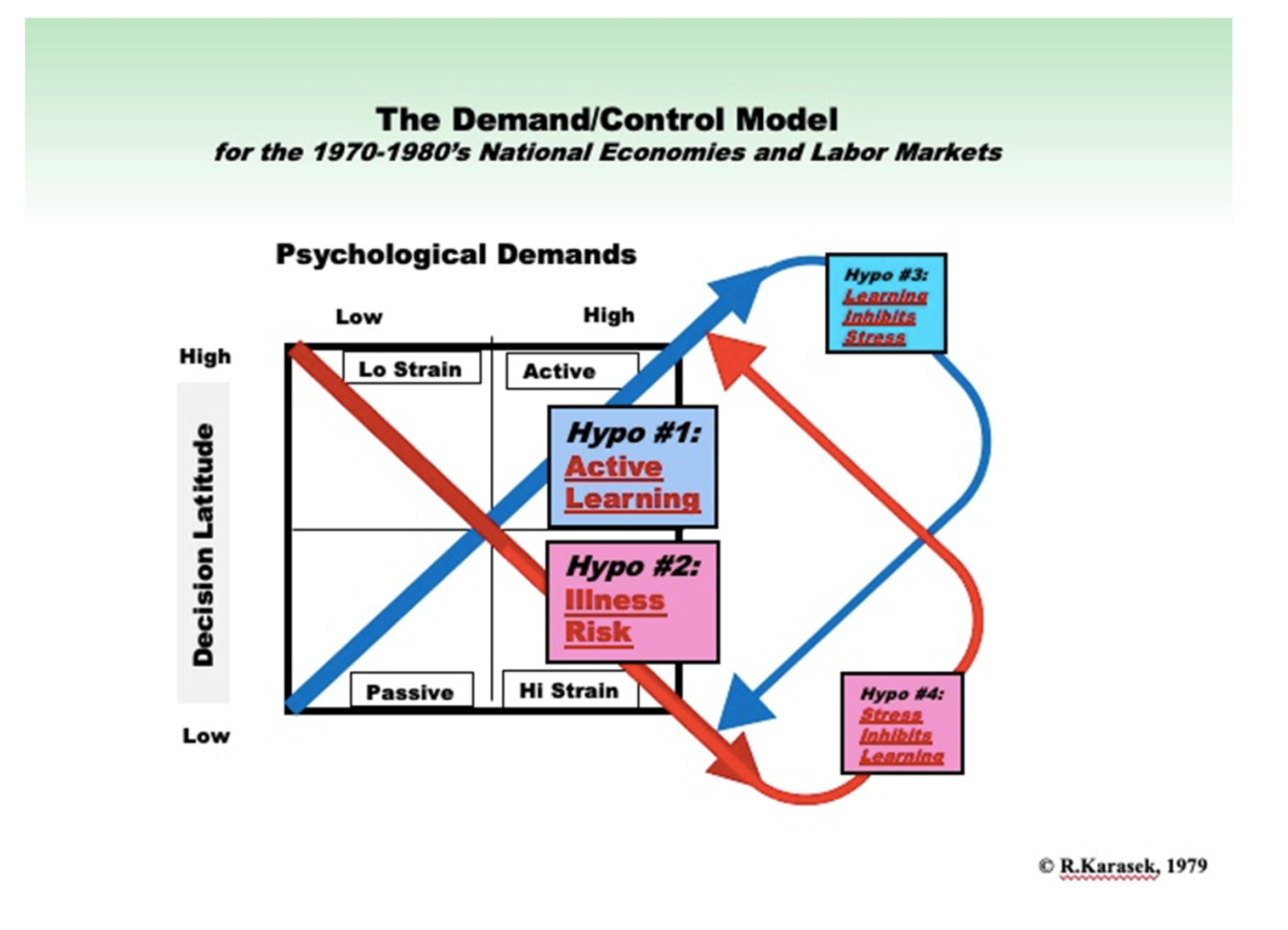
Figure 2.
Multi-level JCQ2: Developing a Cross-level Intellectual Bridge with Spine and Limbs.
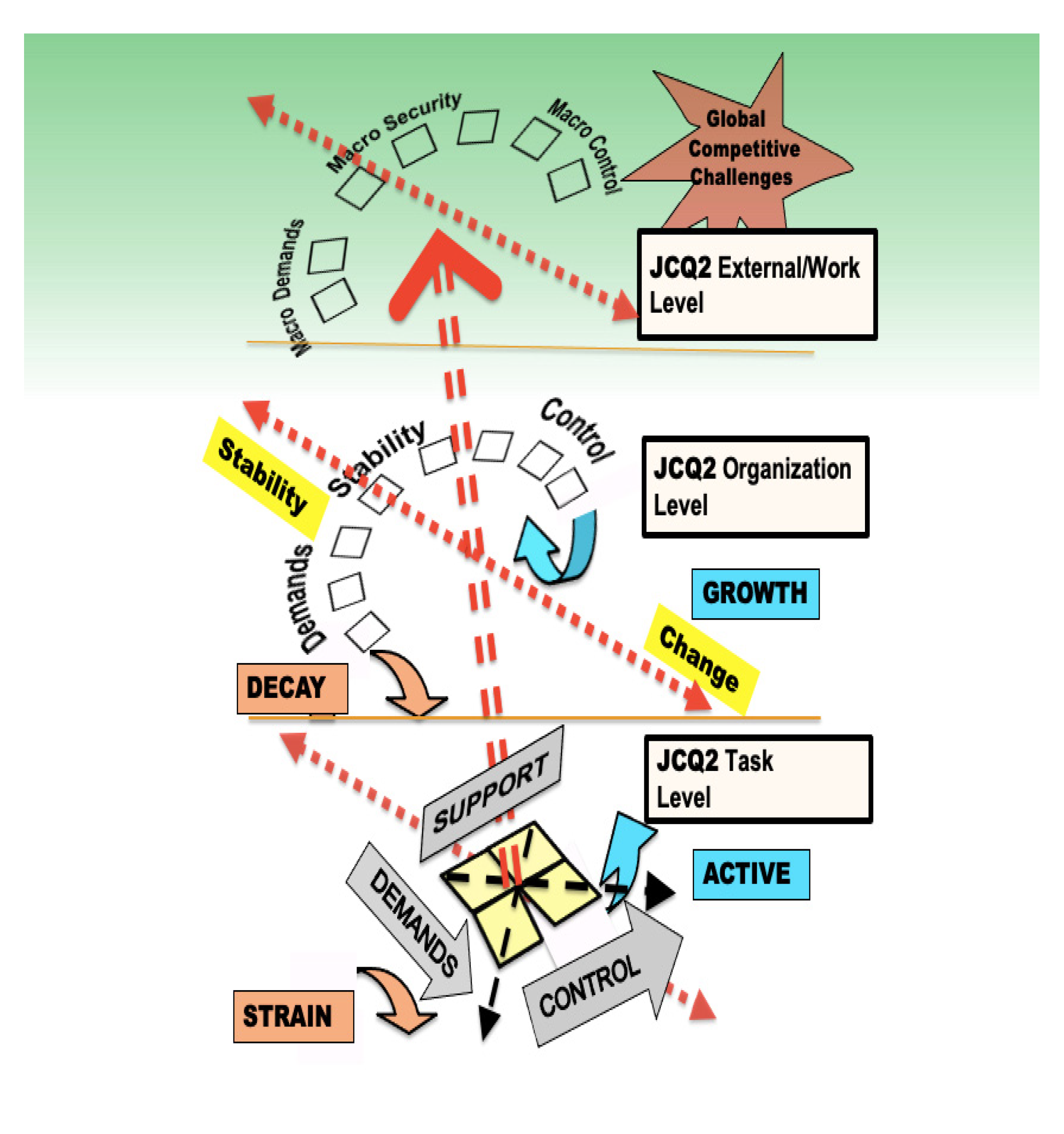
Figure 3.
Addressing Employee Wellbeing with Platforms of Dynamic Stability.
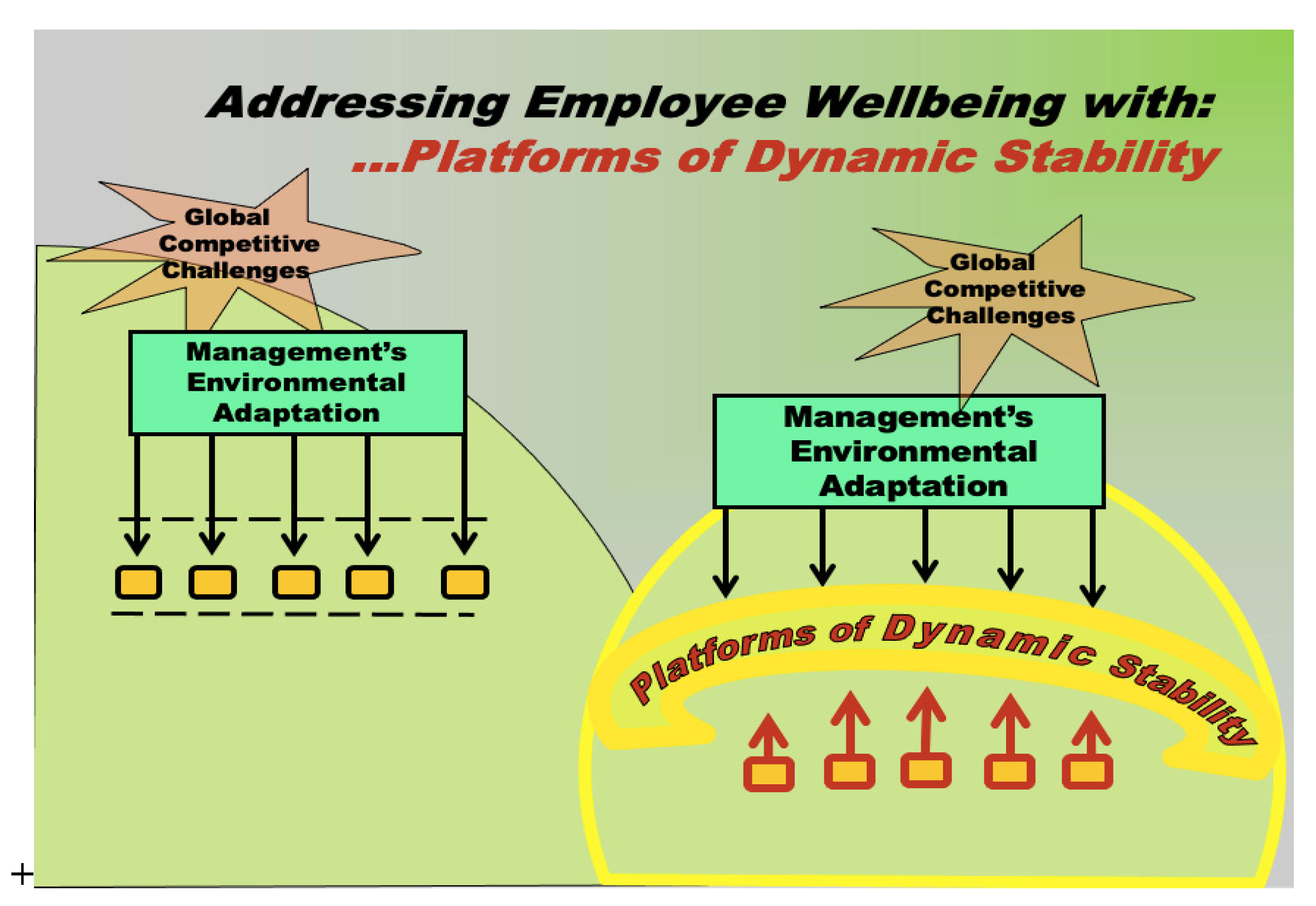
Figure 4.
The JCQ2 Questionnaire, Platforms of Dynamic Stability, and Flows of Incoming Resources and Ordered-work Outputs.
Figure 4.
The JCQ2 Questionnaire, Platforms of Dynamic Stability, and Flows of Incoming Resources and Ordered-work Outputs.
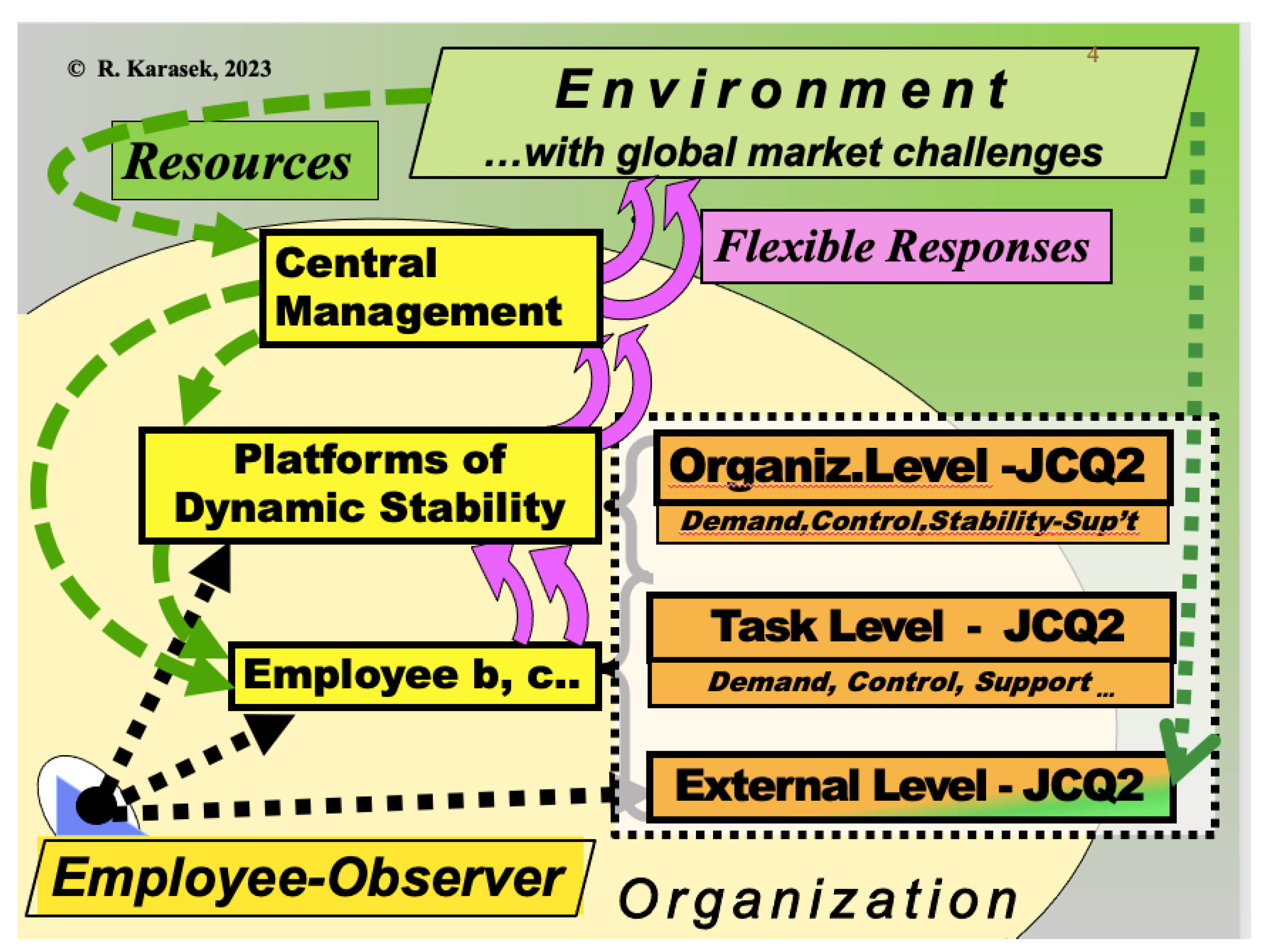

Table 1.
JCQ2.0/2.1 Scale Questions – Origin of Scales and Scale Keywords) .
| JCQ2 Scale Type and Origin(Footnote) | Recommended JCQ 2.0 Scales | Keywords |
|---|---|---|
|
JCQ 2.0/2.1 Scales – Task Level (modified JCQ 1.0 scales) | ||
| C-*r |
Skill Discretion*r, Decision Authority (when added=Decision Latitude JCQ1) |
learn new, creative, develop self /lot of say, own decisions, few decisions [R] |
| D-*r | Quantitative Psychological Demands*r | work fast, excessive, enough time[R], conflicting demands, easy[R],task monitoring -2.1 |
|
S-*r |
Supervisor Support*r, Coworker Support*r (when added=Social Support JCQ 1) |
supervisor: concerned, supportive, respectful / coworkers: friendly, supportive, respectful |
| --*r | Physical Demands*r | physical effort, heavy lift, body awkward |
|
JCQ 2.0 Scales -Task Level | ||
| D-L | Emotional Demands | demanding, suppression emotion |
| C-N |
Conducive Development |
skills w/o pressure, job motivates skills, decide development |
| S-L | Collective Control | coworker unity, coworkers pitch in-2.1, competition [R], distrust [R] , |
| S-N | Negative Social Support | harassments, isolation |
|
JCQ 2.0 Scales- Organizational Level | ||
| C-N |
Conducive Communication |
customer feedback, fit customer needs, upskilling supported, person-to-person -2.1, [others help my skill - 2.1], [I help others´ skills - 2.1 |
| C-N | Organizational Decision Latitude | influence, parties represented, informed |
|
C-L |
Procedural Justice | hear all concerns, information accuracy, can disagree, |
|
S-L |
Organizational Rewards | salary adequate, appreciation adequate |
| S-N |
Organizational Fairness |
re-organization benefits, re-organization manageable |
| S-L |
Psychosocial Safety Climate |
active stress prevention policy, consultation all parties, listened to, psychological well-being equal priority |
|
D-N |
Organizational Restructuring | cost cutting, management turnover |
|
D-N |
Organizational Disorder | work process, planning, poor tasks, organizational goals |
|
JCQ 2.0 / 2.1 Scales – External-to-work Level | ||
| D/S- r* | Job Insecurity-Person (~ JCQ1) | lose job, security [R], life decisions, |
| D/S-N | Job Insecurity-Career | career prospects [R], skills valuable [R], no change opportunities |
| D/S-N | Job Insecurity-Social Relation | use work social relations, use friends, use family |
|
D/S-N |
Job Insecurity-Institutional Support | government resources [R], job search help [R] |
|
D-N |
Macro/Global Economic Demands/Insecurity | global economy affects demands, affects insecurity, [company experiences pressures -2.1] |
|
C-N |
Macro/Labour Market Control |
global economy affects work influence [R], labour market control perception |
|
D-L |
Work/Family Boundary | work interferes family energy, plans amily interferes with work -2.1 |
Notes:*r = Revision of JCQ1 scale; L = New Literature-based scale; N = New original JCQ 2.0 scale; R= reversed scoring; Hypothesized Composite Scale association: D = Demands; C= Control; S = Stability-Support, with hypothesized items; JCQ 2.1: For future use by JCQ2 researchers, Table 1 shows keywords of several questions (in yellow) that are recommended to be added yield a better fit to ADC-evolved theory in Section 2 and Section 3..
Disclaimer/Publisher’s Note: The statements, opinions and data contained in all publications are solely those of the individual author(s) and contributor(s) and not of MDPI and/or the editor(s). MDPI and/or the editor(s) disclaim responsibility for any injury to people or property resulting from any ideas, methods, instructions or products referred to in the content. |
© 2025 by the authors. Licensee MDPI, Basel, Switzerland. This article is an open access article distributed under the terms and conditions of the Creative Commons Attribution (CC BY) license (http://creativecommons.org/licenses/by/4.0/).
Copyright: This open access article is published under a Creative Commons CC BY 4.0 license, which permit the free download, distribution, and reuse, provided that the author and preprint are cited in any reuse.


