

Submitted:
14 July 2025
Posted:
14 July 2025
You are already at the latest version
Abstract
This work proposes a unified framework for the four fundamental forces based on quantum spin dynamics. The universe consists solely of matter and active space, which originate from convergent real space energy and divergent imaginary space energy, respectively. Therefore, the world is a 6D complex geometry, with 3D real space and 3D imaginary space which are symmetric. A primordial neutron cosmology posits that the universe originates from a neutron emerging from nothingness (zero net energy), with subsequent neutron decay (via Hawking radiation = β-radiation) generating protons and electrons. Accelerated cosmic expansion arises from continuous matter-space creation. Crucially, all forces reduce to a universal spin force: attraction/repulsion is governed by relative spin alignment (+1/-1) between particles or space vectors. This model offers novel interpretations of quark confinement, supersymmetry, and time’s origin while circumventing the graviton problem.
Keywords:
spin force
; neutron universe model
; 6D complex spacetime
; space-spin coupling
; perpendicular-opposite equivalence
1. Introduction
The unification of nature’s four fundamental forces – gravitation, electromagnetism, the strong nuclear force, and the weak nuclear force, stands as the foremost challenge in theoretical physics. This quest began with Maxwell’s groundbreaking unification of electricity and magnetism in the 19th century. While the Standard Model has successfully merged electromagnetism with the weak and strong interactions [1,2], gravity remains the final unconquered frontier, resisting consistent quantization. Leading approaches such as string theory [3,4] and loop quantum gravity (LQG) [5,6] aim to reconcile gravity with quantum mechanics, alongside alternative paradigms like entropic gravity [7] and Ads/CFT correspondence [8].
In the recent years, there have been significant advances in the research on the unification of the four fundamental forces or unified field theory. Searight (2021) [9] proposes a mirror world consisting of matter which interacts with ordinary matter via gravity and weakly via other forces, as a model for dark matter. The study synthesizes geometric unification, particle phenomenology, and dark matter theory into a falsifiable framework, marking a consequential step toward empirical validation of fundamental physics beyond the Standard Model. Adom (2025) [10] proposes a novel quantum force wave equation (QFWE) as a unified framework redefining quantum forces as emergent phenomena from the dynamic coupling between wave functions, gauge fields, and spacetime curvature. It extends beyond semi-classical approaches by incorporating backreaction effects into modified Einstein field equations and predicts oscillatory quantum spacetime behavior, though experimental validation remains challenging due to the theory’s mathematical complexity and reliance on extreme gravitational regimes. The framework offers potential insights into quantum gravity, black hole physics, and entanglement but requires further development to fully quantize gravity. Partanen and Tulkki (2025) [11] proposes a unified gravitational gauge theory with the Standard Model by employing a spacetime dimensional field and four U(1) gauge symmetries. The core innovation lies in the quantization framework under Minkowski metric and the proof of renormalizability, opening up new avenues for quantum gravity research. Although challenges remain in experimental verification and higher-order divergence issues, the theory demonstrates significant advantages in mathematical consistency, compatibility with teleparallel equivalent of general relativity, and computational feasibility, marking a major breakthrough in gravitational gauge theory in recent years.
Despite these advances, no existing framework provides a mathematically concise unification of all four forces. Given that profound physical laws often exhibit elegant simplicity, we propose a novel approach: extending quantum spin interactions, inspired by the Pauli exclusion principle and the Heisenberg model, to incorporate space-spin coupling. This leads to a unified force termed the spin force, offering a potential pathway toward complete force unification.
2. Geometric Structure of the World
2.1. Matter-space Model
In classical physics, researchers tend to focus on studying interactions between material entities while overlooking the role of space. Although field concepts may substitute for space, LQG pioneers a paradigm shift by treating space as a dynamical variable rather than a static background [12]. Adom (2025) extends this further, establishing a direct mathematical formulation for the interaction between quantum particles and curved spacetime [10].
The necessity of treating space as an active participant stems from the fact that fundamental forces, such as gravity, propagate through vacuum. Here, “vacuum” equates to space itself, which must be regarded as a physical entity or energetic substance rather than an abstract concept. In other words, “vacuum is not void.” This statement does not refer merely to vacuum fluctuations but posits that vacuum constitutes a fundamental energy – space itself. Guided by Occam’s razor, we minimize redundant concepts by proposing the following hypothesis: The universe consists solely of matter and space. Any other conceivable concepts may ultimately be derivative manifestations of these two elements.
The question then arises: What is the geometric distribution of matter and space? This issue can be briefly explained through logical reasoning. We know that any object is inherently stationary within its own reference frame. Let us first examine “stationarity”. For an object to be stationary, only one possibility exists: it must occupy the central position in space. If an object is moving in space, then it necessarily cannot be the center of the space. Further analysis reveals that the characteristics of a cosmic center manifest in two distinct forms: (1) spatial convergence – where space contracts toward this point from all directions, see Figure 1(a); (2) spatial divergence – where space expand radially outward in all directions from this point, see Figure 1(b).
As illustrated in Figure 1(a), the centripetal motion of space energy theoretically converges to a Schwarzschild singularity (infinite large density, zero volume). While such ideal singularities may remain unobserved in physical reality, they inherently manifest as rigid material structures, namely matter. Conversely, Figure 1(b) shows the centrifugal motion of space energy, theoretically generating a domain with infinitesimal density and infinite large volume, that is, space (vacuum). It should be noted that the motion form of space here is spiral rather than linear for each space flow, because linear motion would inevitably create true vacuum regions between different individual space flows. According to the previous analysis, such regions are forbidden within the universe. Furthermore, the spiral motion form also implies that the space energy density increases as one gets closer to the central origin, which is consistent with general relativity.
From the proper reference frame of a stationary object, inward spiral processes of space energy become ontologically inaccessible, as the object constitutes their final state, while outward spiral dynamics remain exclusively perceivable in an intangible form. This establishes a fundamental principle: The space energy surrounding any stationary matter exhibits radial expansion originating from its geometric center.
A critical dualism emerges: Material existence necessitates coexistent inward/outward spiral energy fields. Universal mass annihilation would consequently collapse space structure instantaneously, proving these energy modes constitute dual topological manifestations of the same spacetime continuum. This duality parallels string theory’s chiral photon oscillation paradigm: left-handed (past-directed) and right-handed (future-directed) vibrational modes coexisting within a single quantum entity. In short, no matter, no space, and vice versa.
2.2.6. D Complex Spacetime
Since space energy exhibits both inward and outward spiral motions, we can define its motion as a vector with velocity magnitude . Moreover, as inward and outward spiral motions are two aspects of the same energy entity, a third-party observer cannot directly perceive both motions simultaneously to prevent the violation of causality. Therefore, one space vector must be observable real energy, defined as the real space vector , and the other as imaginary which is unobservable, defined as . Because the convergent space energy forms matter, we can infer that the inward space vector is the real vector (real particle), while the outward space vector is the imaginary vector (virtual particle). Let represents the quantity of space vectors (assume it is manifested as mass from the perspective of particle), the total energy of an object including the real and imaginary energy can be expressed as: . This indicates that the total energy state of the entire universe is zero-sum, potentially explaining the origin of the universe (see Section 3).
Science uses perpendicular axes to represent spatial dimensions; thus, the world’s spatial dimensions can be depicted as Figure 2. It shows that the world’s spacetime geometry forms a 6D complex framework [13,14], denoted by [(x, y, z); (i, j, k)], comprising the real space (x, y, z) and the imaginary space (i, j, k). It must be noted that the real and imaginary space dimensions overlap, explaining why we perceive only a 3D world. Furthermore, Figure 2 shows that the real space and the imaginary space are space-inversion symmetric; that is, they are each other’s mirror worlds (more precisely, pinhole imaging worlds, with inverted left and right, up and down, and front and back) [9]. We strongly suspect this underlies the origin of supersymmetry in physical theories.
The 6D metric signature is with line element:
Where are imaginary coordinates which remain undetectable in a form of vacuum as space.
Within this 6D spacetime framework, the metric signature of the three imaginary dimensions matches that of the temporal dimension in conventional spacetime. This implies that spatial dimensions are metrically equivalent to the temporal dimension, a conclusion consistent with the constancy of light speed (, where is the spatial length) when considered within a self-referential frame (i.e., one that excludes external observers). This intrinsic temporal dimension, termed innate time, is observed to be three-dimensional. The temporal dimension incorporating external observers, referred to as acquired time, will be discussed in Section 4.1.
2.3. Space Vector Direction vs. Spin Direction
For an energy entity, real particles and virtual particles are inherently symbiotic and therefore exist in an entangled state. Consequently, their spins must be opposite. Building on prior analysis, the vector directions of real and virtual particles are also mutually inverted. Within a 3D coordinate system, real particle vectors are intrinsically oriented inward toward the origin, contrasting with virtual particle vectors that exhibit outward orientation relative to the origin. From a one-dimensional perspective, if a real particle’s vector direction is defined as left/downward/backward, its corresponding virtual particle’s vector direction is right/forward/upward. Thus, space vector orientation correlates with its spin direction. For example, particles with parallel vector directions exhibit identical spins, while particles with opposite vector directions exhibit opposite spins.
In quantum mechanics, two states with opposite spins are orthogonal: , i.e., their inner product is zero. In mathematics, the inner product of two mutually perpendicular vectors is also zero, meaning that these perpendicular vectors are orthogonal as well (it should be noted that perpendicularity does not necessarily imply a 90° angle but depends on the geometric properties of the space, such as Euclidean or non-Euclidean spaces). Based on this, this article proposes an equivalence correspondence: The perpendicularity between two space vectors (real or imaginary) is equivalent to the opposite relationship of their spins. For instance, consider two space vectors, and . If their vector directions are perpendicular, then their spins can be seen as opposite.
However, there is a contradiction within this equivalence relationship: the fact that space has three perpendicular coordinate axes implies that three mutually perpendicular space vectors would have spins that are mutually opposite. But spin states only have two eigenvalues: up or down. This contradiction indeed imposes constraints on physical reality. Suppose each dimensional space vector is a particle. Then, for a three-dimensional pair of particles in an entangled state, consisting of three real particles and three virtual particles, the three mutually perpendicular real particles can coexist harmoniously. This is because, in their anti-space, there are three virtual particles that neutralize the energy. This example essentially corresponds to the case of a neutron. However, for a one-dimensional particle in a separated state (where entanglement is broken), such as an electron, electron A can only coexist harmoniously with one other electron B that is perpendicular to it, not two (e.g., B and C). With only one electron, B can act as the dimension opposite to A’s spin. When another electron C attempts to join, A’s opposite dimension is already occupied by B, so C cannot join the shared space of A and B.
Moreover, according to the 6D complex space framework mentioned in the previous subsection, the same coordinate axis cannot be occupied by two space vectors with the same nature, but by one real and one imaginary space vectors. In a particular case, regarding the Pauli exclusion principle, while two electrons with opposite spins can occupy the same orbital, when they actually do so, their spatial distributions are perpendicular to each other, rather than in opposite directions. This prediction could be verified if experimental conditions permit, e.g., if it were possible to photograph the two electrons sharing the same orbital, or other feasible methods.
The perpendicular-opposite equivalence relation is crucial for understanding the action mechanism of fundamental forces, particularly the weak and strong nuclear forces.
3. Neutron Universe Model
3.1. Origin of the Universe
Inspired by Section 2, if the universe’s total energy is zero, explaining its origin becomes simpler. The modern standard cosmological model is based on the Big Bang theory, but this theory cannot resolve the singularity energy problem prior to the universe’s birth, namely, the source of the universe’s initial energy.
Logically, the universe should not exist without initial energy, and the initial energy cannot be pre-existing. Thus, non-existence would be the norm, while existence would be the anomaly. Based on this, we hypothesize that before the universe’s birth, the “world” was a state of nothingness. However, nothingness implies encompassing all possibilities, meaning it contains all information of the world: . For example, before a basketball game starts, infinitely many possible game trajectories exist. Once finished, only one actual path remains. Furthermore, nothingness cannot persist eternally because implied possibilities must manifest; otherwise, how could they be called possibilities? Therefore, to self-prove, nothingness generates existence, i.e., zero produces one: . This “one” is defined here as the initial space energy. To conserve zero total energy (since nothingness has zero energy), the initial space energy immediately divides into positive and negative energy, manifested by light-speed movement in opposite directions along the same dimension as space vectors: , or equivalently . This positive space energy/vector is real matter, manifested as the universe’s initial singularity, while the negative space energy/vector is virtual matter, manifested as undetectable space.
Upon the generation of this initial singularity, the universe was born as a one-dimensional microscopic black hole with Planck length and Planck mass. Due to space’s isotropy, real-space vectors converge toward the origin from all directions, while imaginary-space vectors diverge from the origin in all directions. At this point, the universe transitions from one to three dimensions, causing the Planckian black hole to cast projections in all three dimensions, forming three duplicates and transforming into a black hole-like substance – the neutron. Since a neutron contains three quarks, and quarks cannot be observed individually, similarly, the Planckian black hole cannot be observed individually due to the cosmic supervision hypothesis. Therefore, it is reasonable to hypothesize that the original quark is the Planckian black hole. The three quarks within the neutron are thus the three components of the original quark in 3D space. In quantum chromodynamics (QCD), each quark carries a “color” label [15], but in reality, these colors represent spatial dimensions. Consequently, the three quarks within a neutron are mutually perpendicular. According to the perpendicular-opposite equivalence principle, the spins of these three quarks are also mutually opposite. This conclusion is crucial because it is key to understanding the strong force.
Following the formation of the first neutron as the birth of the universe, a primordial nothingness persists beyond its boundary. From this nothingness, new particles continuously emerge. As neutrons proliferate, space itself expands accordingly. Crucially, the expansion of the universe simultaneously extends the boundary of this nothingness, enabling the generation of even more neutrons. This self-reinforcing cycle, where cosmic growth enlarges the nothingness, producing more neutrons and further accelerating expansion, provides a theoretical mechanism for the observed acceleration of the universe’s expansion. The growth dynamics can be formally described as follows:
Equation (2) reveals that the universe’s real energy (matter) and imaginary energy (space) continuously increases. Simultaneously, because real and imaginary energy maintain balance, the universe’s total energy remains zero. This equation, termed the conservation of real and virtual, demonstrates the universe’s profound wisdom. The universe acts like a magician, constantly performing the trick of creating something from nothing. Additionally, this law reflects the incompleteness of the second law of thermodynamics: while the universe exhibits local entropy increase, it maintains global entropy balance. The universe will not die from heat death but will continue growing indefinitely. The conservation of real and virtual corresponds to supersymmetry – the symmetry between real and imaginary space. Besides, the essence of the conservation of real and virtual is the conservation of energy.
Neutrons alone are insufficient to form a diverse world. Consequently, through weak interaction, spontaneous entanglement breaking occurs, resulting in the neutron giving birth to an “offspring”, the electron, while the neutron itself decays into a proton. Therefore, under this view, no innate protons exist in the universe; all protons originate from neutron decay. This can reasonably explain the issue of the conservation of positive and negative charges in the universe. Subsequently, the combination of an electron and a proton forms a hydrogen atom, and multitudes of hydrogen atoms combine into hydrogen molecules. Under gravitation and strong interaction, these hydrogen molecules aggregate, undergo nuclear fusion, and form burning stars. Numerous stars are generated, burn, collide, and eventually explode within the universe’s initially confined space. The afterglow of these explosions gives rise to the cosmic microwave background radiation observed today.
3.2. Weak Interaction (Hawking Radiation = β-Radiation)
In the context of this article, the weak interaction is carried out through Hawking radiation.
Hawking radiation is believed to occur not only on macroscopic black holes but also on microscopic Planckian black holes. In this article, we propose that the 1D Planckian black hole exists non-singularly as the 3D neutron. In Hawking radiation, vacuum fluctuations produce real-virtual particle pairs. From an external observer’s perspective, they must move in opposite directions. One may fall into a neutron, becoming a virtual positron, while the other becomes a real electron. The neutron, having absorbed the additional negative energy, becomes positively charged and its mass decreases, becoming a proton (see Figure 3). Therefore, Hawking radiation explains the weak interaction mechanism as well as β-radiation.
Note that a claim exists that microscopic black holes evaporate quickly via Hawking radiation. This view is incorrect because a proton carries only a single positive charge, meaning a neutron can absorb at most one positron. This appears to be a protective mechanism, although its principle remains unclear. It seems related to identical electrons; we hypothesize as follows: an absolute vacuum (void zone) exists within a neutron, which can only absorb virtual particles of specific energy. When the energy is too low to occupy the void zone, decay cannot occur. Conversely, excess energy that cannot be fully absorbed is released as secondary particles such as neutrinos. Crucially, once this zone is occupied, other virtual particles become excluded from absorption due to the exclusion principle. However, this hypothesis requires theoretical verification beyond this article’s scope.
4. Unified Force Framework
4.1. Force Nature Formula
Here, “force nature” refers to either attraction or repulsion. All fundamental forces in nature fall essentially into these two categories. For instance, gravity is always attractive, while the Coulomb force is attractive for opposite charges and repulsive for like charges. According to the Pauli exclusion principle, fermions with opposite spins can coexist in the same orbital (attraction), whereas fermions with parallel spins cannot (repulsion). We extend the Pauli exclusion principle to include bosons and even virtual particles (i.e., space). Let the spins of two observed objects be and , respectively. , representing positive (up) and negative (down) spins (similar for ). The force nature between them is given by:
Therefore, is either +1 or -1. When , the force is repulsive ( and have parallel spins); otherwise, it is attractive ( and have opposite spins).
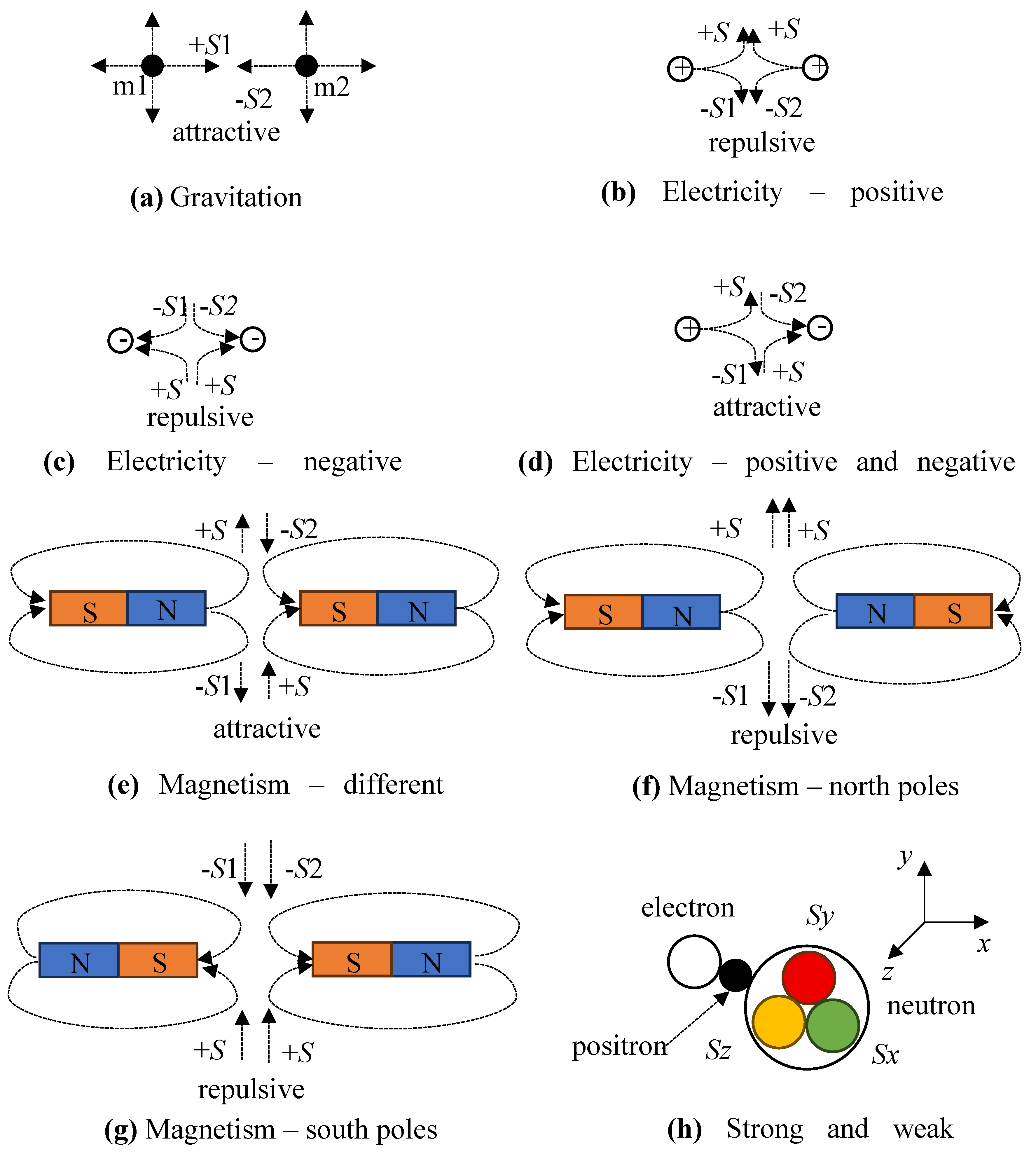
Details for the interaction mechanism of the four fundamental forces are shown in Figure 4. We define space vectors pointing right or up as positive spins (), and vectors pointing left or down as negative spins ().
(1) Gravitation
See Figure 4(a). For simplicity, consider stationary masses m1 and m2. The imaginary space vectors radiate outwards from both points. At points midway between m1 and m2, the spin directions are opposite, generating an attractive force. The specific mechanism is that imaginary space vectors with opposite directions cannot coexist in the same dimension; they must become perpendicular as an equivalent configuration. Consequently, a true vacuum of Planckian scale is created along the original axis. The universe’s interior does not permit true vacuums larger than the Planck length (except inside black holes). Allowing such would split the universe into fragments. Therefore, surrounding space energy flows in to fill this vacuum, forming a spatial flow that drives matter movement. Quantum gravity based on Planckian vacuum has been explored by Sengupta [16], reasonably explaining galactic rotation curves.
(2) Electricity-magnetism
See Figure 4(b)-(g). Based on previous analysis, the positron (positive charge) is a form of imaginary matter; thus, space vectors diverge from a positive charge and converge at a negative charge (real matter). For magnets, experimental evidence suggests space vectors (magnetic line) converge at the south pole and diverge from north pole. On the tangent line to the space vector envelope’s contact surface between charges or magnetic poles, the force nature is determined by spin direction: opposite spins yield attraction; parallel spins yield repulsion. The illustrations in Figure 4 demonstrate consistency with observed facts in terms of electricity and magnetism.
(3) Strong and weak forces
See Figure 4(h). Based on previous analysis, the three real quarks within a neutron are mutually perpendicular, equivalent to having opposite spins, so they attract each other. Note that because the three quarks within an atomic nucleus form an anti-de Sitter space, the orthogonal relationship may deviate from 90° as in flat spacetime. Additional neutrons attract each other because each quark carries equal weight (in a triplet configuration, indistinguishable as separate entities). As long as adjacent quarks have different “colors” (indicating different spins), attraction is maintained, similar to the four-color theorem in geography.
In weak interaction, generated electrons are repelled by the nucleus because the electron’s spin direction always matches one of the three quarks. Moreover, the electron’s energy level is much lower than the quark’s; preventing equal treatment. Conversely, positrons are virtual particles with spins opposite to all three real quarks, so they are always attracted by the nucleus. Regarding proton decay, it probably be that extremely high-energy electrons overcome quark repulsion and combine with positrons within the proton. However, this is quite difficult, so the probability of proton decay is much smaller than that of neutron decay. Representing this with colors: the three quarks (red, green, blue mixture) form white. Electrons, observable real particles, can be defined as white. Positrons, unobservable virtual particles, can be defined as black. Like color repel; opposite colors attract. Thus, the spin force can also be expressed as the color force. This also explains why ground-state electrons do not fall into the nucleus.
Similarly, in theory, the neutron’s three “negative” dimensions are occupied by three virtual quarks, so the positron should also be repelled. However, because the neutron’s center is hypothesized to be a void (true vacuum, see the hollow center in Figure 4(h)), the positron can precisely fill this void, becoming the fourth dimension. Therefore, the positron, and only one, is attracted to the neutron. This fourth dimension appears to be time, suggesting that time originates from neutron decay. After a neutron decays, the electron produced serves as an observer relative to the neutron, and observation implies the existence of time. Since the electron and positron pair are initially in an entangled state when they are created, and the positron is subsequently captured by the neutron, this is equivalent to the electron-positron pair being observed, thereby breaking their entanglement. Therefore, one could also say that time arises from the breaking of quantum entanglement in the direction of observation.
Note that the time mentioned here is relative to an external observer. Observer time belongs to acquired time: . Acquired time is an independent dimension from space because is not a constant, materialized as positrons. As a consequence, after the entanglement is broken, the electron, now a fermion, no longer moves at the speed of light.
4.2. Potential Energy Formula
In quantum mechanics, the relationship between the nature of force (attractive or repulsive) and quantum spin can be expressed through a spin-dependent potential energy formula. Specifically, when the spins of two objects are the same (parallel spins), the force manifests as repulsive; when the spins are opposite (antiparallel spins), the force manifests as attractive. This relationship originates from the spin exchange interaction, which is commonly seen in quantum many-body systems, such as the Heisenberg model in ferromagnetic or antiferromagnetic materials [17]. In this article, we extend this mechanism of action to all fundamental forces.
The system potential energy is determined by the spin dot product:
Where is the distance-dependent exchange integral or the coupling function for different fundamental forces, is the spin operator. The symbol of the force is jointly determined by and the relative orientation of spin: (a) Repulsive force condition: , and (b) Attractive force condition: .
Hence, the Hamiltonian form is:
Where is the exchange integral. For simplicity, the kinetic energy term has been omitted here.
5. Discussions
The unified theoretical framework proposed in this article offers first-principles explanations for diverse physical phenomena that confuse the physicists for long time.
- (1)
- The relative weakness of gravity and the origin of spacetime curvature. It can be explained through two mechanisms. First, as space diverges radially outward from a mass center in solid angles, its energy density diminishes with increasing radial distance. Second, as illustrated in Figure 4(a), gravitational attraction peaks along the axis connecting two objects’ centers of mass. At oblique angles, space vectors decompose into horizontal and vertical components. Crucially, only the horizontal component contributes to attraction, while the vertical component may induce repulsion, particularly when spins and share parallel upward alignment. This directional dependence also generates spacetime curvature: when an object passes near a massive body, it experiences maximized gravitational pull toward the body’s center, creating a trajectory bias toward the gravitational core. Concurrently, higher space energy density near massive bodies causes time dilation.
- (2)
- Short-range nature of strong and weak forces. Strong force: when neutrons are in close proximity, a symmetry (termed equal-weight in this framework enables quark-level interactions that produce attraction. However, as separation increases, particularly in nuclear peripheries, this symmetry breaks, causing the attractive force between quarks to attenuate exponentially with distance.
Weak force: Near the atomic nucleus center, reduced overlap between real energy (real quarks) and virtual energy (virtual quarks) allows the real energy to dominate, generating strong electron repulsion. In peripheral nuclear regions, greater real/virtual quark overlap creates an effective equilibrium effect without significant attraction or repulsion. Beyond this equilibrium region, electron-neutron attraction is primarily dominated by positrons absorbed within neutrons.
- (3)
- Origin of charge and revised Boson concept. This framework suggests the fundamental origin of electric charge emerges from energy separation in entangled particle-antiparticle pairs, where the particle endowed with positive/real energy manifests as negative charge, while its antiparticle counterpart carrying negative/imaginary energy manifests as positive charge. This energy-charge equivalence necessitates a revised conception of bosons: rather than elementary particles, bosons constitute entangled pairs of these positive and negative-energy entities whose net zero energy results in zero rest mass, with the positive-energy component possessing quantized energy . Upon measurement-induced entanglement collapse, this positive energy becomes detectable, as evidenced in phenomena like the photoelectric effect. Crucially, electron-positron annihilation provides experimental substantiation: when these separated fermions collide, they transform into entangled photon pairs, effectively converting fermionic closed strings into a bosonic open string configuration, where the charge-neutral fermion pair yields charge-neutral bosonic radiation, demonstrating the interconversion between separated charge states and integrated neutral bosonic states through entanglement dynamics.
6. Conclusion
This article presents a concise unified framework for the four fundamental forces, based on spin operators of material spin and spatial spin. By circumventing the graviton problem inherent in gravitational mechanisms, this theoretical framework offers new insights into grand unification. While largely consistent with most existing theories, it also provides distinct interpretations. For instance, unlike the Standard Model which posits quarks carry fractional charges, the neutron cosmological model proposed here suggests neutrons are electrically neutral due to the overlapping of three real quarks and three virtual quarks. Furthermore, in this model, the three quarks within a neutron are projections of an original one-dimensional quark into 3D space, rendering them inseparable and thereby explaining quark confinement.
It should be noted that this theoretical framework remains underdeveloped in certain aspects and requires further theoretical refinement and experimental validation. For example, the theory predicts continuous increases in the total mass and spatial extent of the universe, while matter density in cosmic edge regions would be expected to decrease, as expanded space inhibits gravitational and strong-force aggregation of matter.
Supplementary Materials
The following supporting information can be downloaded at the website of this paper posted on Preprints.org, Video S1: A life example of perpendicular-opposite equivalence.
Author Contributions
Single-authored.
Funding
N/A.
Data Availability Statement
No data was generated.
Conflicts of Interest
The authors declare no conflicts of interest.
References
- Weinberg, S. A model of leptons. Phys. Rev. Lett. 1967, 19, 1264. [Google Scholar] [CrossRef]
- Georgi, H.; Glashow, S.L. Unity of all elementary-particle forces. Phys. Rev. Lett. 1974, 32, 438. [Google Scholar] [CrossRef]
- Green, M.B.; Schwarz, J.H. Anomaly cancellations in supersymmetric D = 10 gauge theory and superstring theory. Phys. Lett. B 1984, 149, 117–122. [Google Scholar] [CrossRef]
- Witten, E. String theory dynamics in various dimensions. Nucl. Phys. B 1995, 443, 85–126. [Google Scholar] [CrossRef]
- Rovelli, C.; Smolin, L. Loop space representation of quantum general relativity. Nucl. Phys. B 1990, 331, 80–152. [Google Scholar] [CrossRef]
- Thiemann, T. Quantum spin dynamics (QSD). Class. Quantum Grav. 1998, 15, 839. [Google Scholar] [CrossRef]
- Verlinde, E. On the origin of gravity and the laws of Newton. J. High Energ. Phys. 2011, 2011, 29. [Google Scholar] [CrossRef]
- Maldacena, J.M. The large N limit of superconformal field theories and supergravity. Adv. Theor. Math. Phys. 1999, 38, 1113–1133. [Google Scholar]
- Searight, T.P. Mirror Matter from a Unified Field Theory. Found. Phys. 2021, 51, 11. [Google Scholar] [CrossRef]
- Adom, R. Manifestation of quantum forces in spacetime: towards a general theory of quantum forces. Found. Phys. 2025, 55, 44. [Google Scholar] [CrossRef]
- Partanen, M.; Tulkki, J. Gravity generated by four one-dimensional unitary gauge symmetries and the Standard Model. Rep. Prog. Phys. 2025, 88, 057802. [Google Scholar] [CrossRef] [PubMed]
- Ashtekar, A.; Singh, P. Loop quantum cosmology: a status report. Class. Quantum Grav. 2011, 28, 213001. [Google Scholar] [CrossRef]
- Shu, L.; Cui, K.; Liu, X.; et al. Electron’s horizon in a 6-D complex space. arXiv 2019, arXiv:1804.04495. [Google Scholar]
- Omolo, J.A. Complex Spacetime Frame: Four-Vector Identities and Tensors. APM 2014, 4, 567–579. [Google Scholar] [CrossRef]
- Guido, G. The origin of the color charge into quarks. JHEPGC 2019, 5, 1–34. [Google Scholar] [CrossRef]
- Sengupta, S. Gravity theory with a dark extra dimension. Phys. Rev. D 2020, 101, 104040. [Google Scholar] [CrossRef]
- Heisenberg, W. W. Zur Theorie des Ferromagnetismus. Z. Physik. 1928, 49, 619–636. [Google Scholar] [CrossRef]
Figure 1.
The cases of the spatial center. In (a), space flows form an anti-de Sitter space. In (b), space flows form an de Sitter space.
Figure 1.
The cases of the spatial center. In (a), space flows form an anti-de Sitter space. In (b), space flows form an de Sitter space.
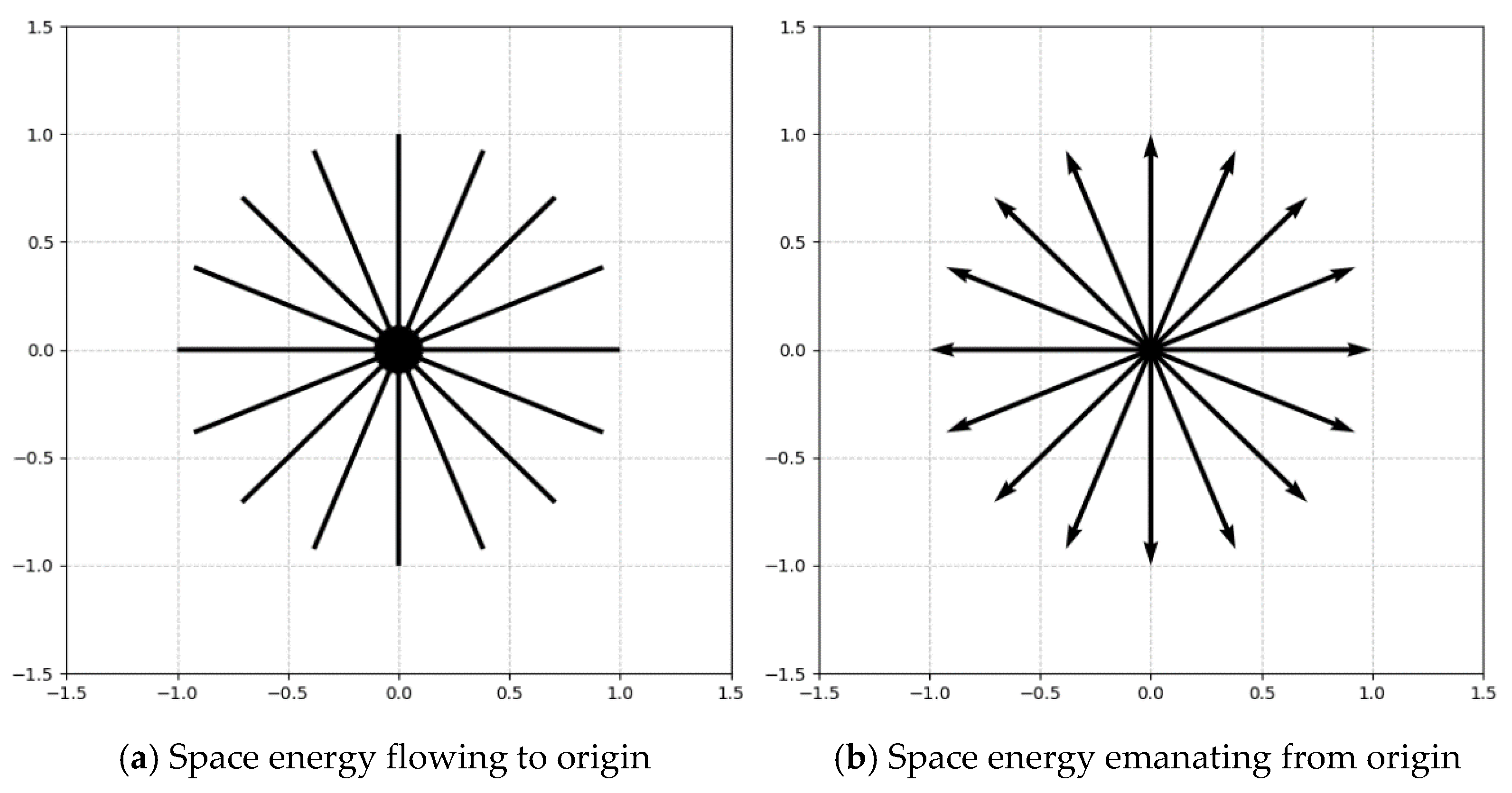
Figure 2.
6D complex spacetime of the world.
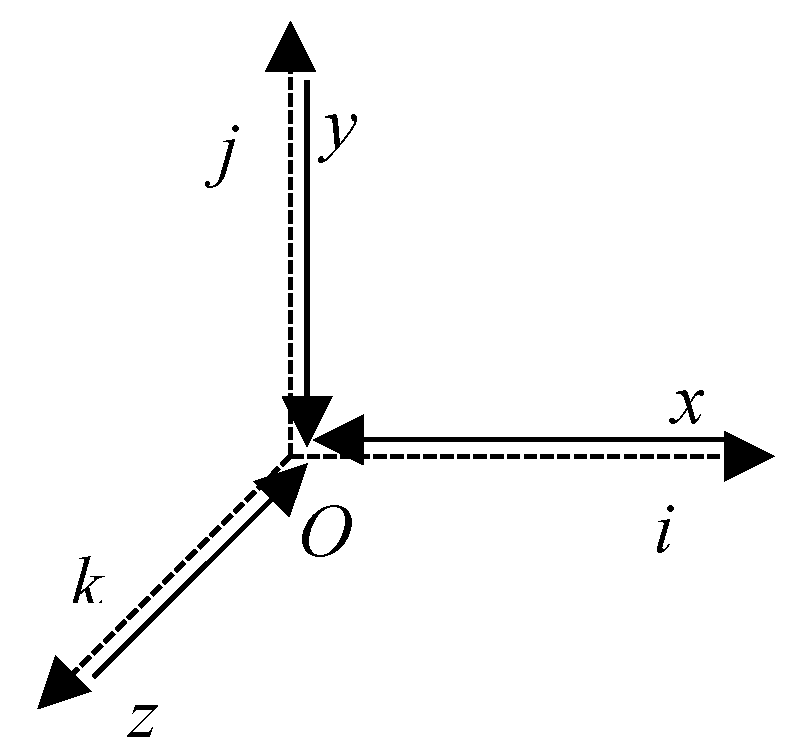
Figure 3.
Hawking radiation process interpreted as β-decay.
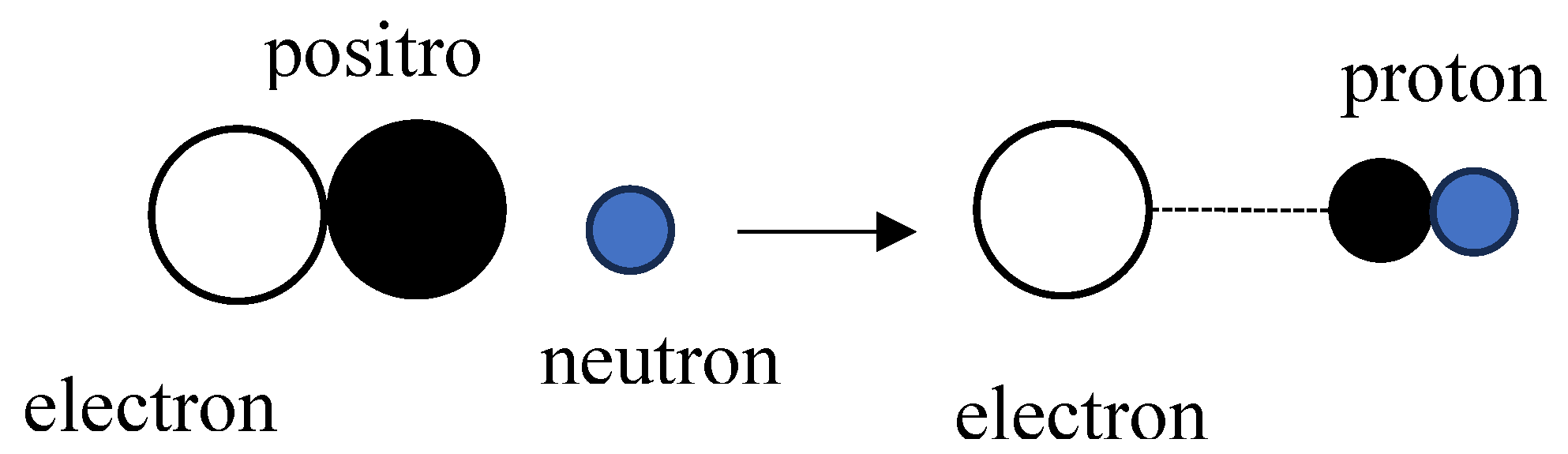
Figure 4.
Illustration of four fundamental forces.
Disclaimer/Publisher’s Note: The statements, opinions and data contained in all publications are solely those of the individual author(s) and contributor(s) and not of MDPI and/or the editor(s). MDPI and/or the editor(s) disclaim responsibility for any injury to people or property resulting from any ideas, methods, instructions or products referred to in the content. |
© 2025 by the authors. Licensee MDPI, Basel, Switzerland. This article is an open access article distributed under the terms and conditions of the Creative Commons Attribution (CC BY) license (http://creativecommons.org/licenses/by/4.0/).
Copyright: This open access article is published under a Creative Commons CC BY 4.0 license, which permit the free download, distribution, and reuse, provided that the author and preprint are cited in any reuse.


