

Submitted:
10 July 2025
Posted:
11 July 2025
You are already at the latest version
Abstract
The instability of mRNA-LNP vaccines presents significant challenges in storage, transportation, and large-scale distribution, particularly in resource-constrained countries. Recently, freeze-drying (lyophilization) has been considered as a promising approach for preserving efficacy and enhancing the long-term stability of mRNA vaccines by converting mRNA-LNP formulations into a stable dry powder. The purpose of this review is to provide an overview of the current knowledge on the optimization and progress of freeze-drying techniques for mRNA-LNP vaccines, with a particular emphasis on the associated challenges. This review highlights the factors influencing the stability of freeze-dried mRNA-LNP vaccines and provides a comprehensive overview of the formulation components like excipients (cryoprotectants and lyoprotectants), buffers, surfactants and also the process parameters, and storage conditions. By providing these insights, this review supports the advancement of more robust, scalable, and efficient lyophilization protocols, ultimately addressing the stability limitations of mRNA-LNP vaccines and enhancing their global accessibility.
Keywords:
mRNA vaccines
; mRNA-LNP
; lipid nanoparticles
; freeze-drying
; lyophilization
; vaccine stability
; bioprocessing
1. Introduction
Messenger RNA (mRNA) vaccines encapsulated in lipid nanoparticles (LNP) have emerged as a rapidly scalable platform in modern vaccinology. mRNA–LNP vaccines are now being considered as a first choice to combat a wide range of life-threatening diseases. The scope extends across infectious diseases [1,2], cancers [3,4], immunological diseases [5], tissue damage [6], and rare diseases (cystic fibrosis, amyloidosis, and type I diabetes) [7,8], demonstrating the versatility and potential of mRNA vaccines in diverse therapeutic areas [9] To date, numerous preclinical and clinical trials using mRNA vaccines have been successfully conducted against multiple infectious diseases, including severe acute respiratory syndrome coronavirus 2 (SARS-CoV-2), Zika virus, human immunodeficiency virus (HIV), influenza virus, cytomegalovirus, respiratory syncytial virus, varicella-zoster virus, and rabies virus. [9,10]. More recently, clinical trials investigating the effect of the mRNA vaccine against various cancers have been registered in the U.S. National Library of Medicine, including melanoma [3], brain cancer [11], non-small cell lung cancer (NSCLC) [12], ovarian cancer [13], prostate cancer [14], hematological cancers [15], digestive system cancer [16], and breast cancer [17].
While mRNA vaccines have emerged as a highly promising and effective technology, their widespread adoption is limited by their poor thermostability [18,19]. Indeed, one of the primary challenges in the global distribution of mRNA vaccines is their limited thermostability, which requires ultra-cold storage conditions to maintain stability and potency. For instance, the Pfizer-BioNTech COVID-19 vaccine requires storage at −80 °C, whereas the Moderna COVID-19 vaccine requires storage at −20 °C, both with a shelf life of up to 6 months [19]. Furthermore, the two recently released, updated COVID-19 mRNA-LNP vaccines, SpikeVax and Comirnaty, have reported stability at ambient temperature for only 12 hours and 6 hours, respectively. [20]. Despite several years of the COVID-19 pandemic, the stability issues persist, with limited improvements. Such storage limitations pose significant logistical challenges, particularly in low-and middle-income countries with limited infrastructure, which hinders the widespread use of mRNA vaccines. Therefore, it is crucial to improve the stability of mRNA vaccines at higher temperatures to facilitate their storage, transportation, and distribution.
Building on the foundation and theory of other vaccine formulations, such as viral-vector vaccines, freeze-drying has also been considered a superior method for mRNA-LNP vaccines to extend their shelf life [21,22,23]. LNP formulations are self-assembled polymeric materials that serve as delivery vehicles for nucleic acid payloads, such as the enveloped viral vectors used in vaccines. These similarities help to extrapolate the freeze-drying process conditions and formulations from viral vector vaccines to mRNA-LNP vaccines. Freeze-drying has been used for the stabilization of biological molecules, including enzymes, antibodies, and vaccines, for many months and years. For mRNA vaccines, the challenge lies in preserving both the mRNA and the LNP carrier, which shields the fragile mRNA from physical and chemical agents of degradation. The freeze-drying process, which removes water by sublimation under vacuum at low temperatures, stabilizes the mRNA-LNP by immobilizing them in a solid matrix of a cryoprotectant. Water removal by sublimation contributes to removing moisture and preventing hydrolysis and oxidation, two common pathways of mRNA degradation in liquid formulations [24]. In fact, in a dehydrated state, hydrolysis is less likely to occur, while molecular mobility is drastically reduced, thereby slowing down degradation reactions. Significant research has been conducted in recent years to optimize the freeze-drying process of mRNA vaccines, and several studies have shown promising results.
Furthermore, currently, there is a lack of specific FDA regulatory standards specific to lyophilized mRNA–lipid nanoparticle (LNP) formulations. While general guidelines for biologics, injectable drugs, and liposomal formulations provide a foundational regulatory framework, they do not fully address the unique challenges posed by lyophilizing mRNA-LNP, such as preserving mRNA integrity, maintaining nanoparticle stability, and ensuring efficient reconstitution. This regulatory gap creates uncertainty in the development and approval process. This review aims to address that gap by pointing out the critical aspects of freeze-drying mRNA–LNP freeze-dried formulations. Based on the current scientific findings, the review provides a foundation for defining quality attributes such as particle size, polydispersity, encapsulation efficiency, mRNA integrity, and reconstitution behavior—key parameters that are essential for regulatory assessment but not yet formally codified.
Thus, overall the literature review provides a comprehensive overview of the state-of-the-art freeze-drying strategies for mRNA vaccines, focusing on process optimization, methodologies, and advancements in the stabilization of mRNA-LNP vaccines. This review also provides an overview of the key principles and challenges associated with freeze-drying mRNA-LNP vaccines. Finally, we highlight potential future directions to address the remaining hurdles and facilitate the widespread adoption of freeze-dried mRNA vaccines.
2. Stability of mRNA-LNP Vaccines
The stability of an mRNA-LNP vaccine is influenced by three main factors: (i) the molecular structures of lipid components and their interactions with the mRNA payload, (ii) the excipient formulations (e.g., buffers and cryoprotectants) and (iii) formulation techniques (e.g., freeze-drying cycles) as well as the storage conditions.
2.1. Structure of mRNA-LNP Vaccines
Lipid nanoparticles for RNA-based vaccines offer several advantages, including ease of formulation [25], modularity [2], biocompatibility [26] and a flexible capacity for mRNA payload (1000 nt to 10000 nt) [26]. LNP are typically composed of four lipids: an ionizable lipid, a polyethylene glycol-functionalized lipid (PEG-lipid), an amphiphilic phospholipid, and cholesterol (Figure 1). The ionizable lipid is crucial for encapsulating the anionic mRNA during LNP synthesis at low pH, and for facilitating endosomal release as it undergoes protonation in the acidic environment of the endosomes (pH 4.5–6.8) [27,28]. The other lipid components improve the LNP properties, including stability, delivery efficiency, tolerability and biodistribution. First, cholesterol enhances the LNP stability by filling in the gaps between the phospholipids, thereby influencing the membrane integrity and rigidity. [29]. The PEG-lipid regulates particle size, and zeta potential further enhances the particle stability by forming a steric barrier against aggregation [30]. Further, phospholipids increase mRNA encapsulation efficiency and promote fusion with cellular and endosomal membranes, thereby facilitating cellular uptake and endosomal release [31] Specifically, phospholipids with high transition temperatures, such as 1,2-distearoyl-sn-glycero-3-phosphocholine (DSPC, transition temperature of 55 °C), can stabilize the LNP structure by forming a lamellar phase, thus increasing membrane rigidity and reducing permeability [32].
Despite these protective components, the mRNA payload remains inherently unstable due to the presence of its reactive 2’-hydroxyl (2’-OH) groups on the nucleic acid bases, causing spontaneous cleavage (especially under heat, alkaline pH, or in the presence of metal ions) [33,34]. LNP, while providing some degree of protection by acting as a physical barrier for the encapsulated mRNA, are also sensitive to physical stress, especially during freeze-drying and subsequent rehydration [35]. Several studies concluded that mRNA hydrolysis is a key determinant of mRNA-LNP instability. These studies suggest that optimizing mRNA nucleotide composition and structure may help improve stability [33].
In addition to the active drug substance (mRNA), LNP consists of several self-assembled components that can interact dynamically with each other, thereby influencing the overall stability of the formulated product. For instance, the major degradation pathway for lipids in the LNP is oxidation that occurs due to exposure to light, oxygen, metal residues, and high temperatures [35]. Hydrolysis also represents an important degradation pathway influenced by lipid structure, pH, temperature, and buffer composition (Figure 2). For example, Packer et al. pointed out that amino lipids, such as those used in the Moderna and Pfizer/BioNTech mRNA-LNP COVID-19 vaccines, can generate reactive electrophilic impurities that may inactivate mRNA through N-oxidation and hydrolysis, forming reactive aldehydes that adversely affect biological performance [33,36].
Physical instability (Figure 2) can be characterized by the aggregation or fusion of the LNP, which manifests as an increase in particle size or polydispersity of the LNP. Chemical instability is most often observed as degradation of the mRNA payload and/or lipid components. Thus, both forms of instability impose challenges for storage in an aqueous buffer as a wet or liquid formulation. Extrinsic parameters, such as the pH of the storage buffer and temperature, can also affect stability. Molecular mobility in a liquid formulation can impact the LNP stability during storage under liquid conditions. The addition of excipients helps reduce molecular mobility during ambient or refrigerated storage conditions. However, these methods are not effective; therefore, sub-zero storage at –20 °C and –80 °C was used. As a result, lyophilization appears to be a promising solution to improve the stability of mRNA-LNP vaccines by converting wet formulations into more stable dry formulations, thus reducing molecular mobility.
2.2. Stabilizing mRNA-LNP Through Freeze-Drying
Due to the poor long-term stability of liquid mRNA-LNP vaccines and their limited shelf life at non-frozen temperatures, freeze-drying has gained attention as a strategy to enhance thermostability, with promising results reported in recent studies. Kim et al. reported that mRNA-LNP composed of TT3, Dlin-MC3-DMA, DOPE, cholesterol, and DMG-PEG2000 at a molar ratio of 10:25:20:40:5, and stabilized with 10% (w/v) sucrose, remained stable for at least 30 days at -20°C [37]. Additionally, Muramatsu et al. synthesized freeze-dried mRNA-LNP composed of PEG lipid (PEG2000-C-DMA), cholesterol, DSPC, and an ionizable lipid ((6Z,16Z)-12-((Z)-dec-4-en-1-yl)docosa-6,16-dien-11-yl 5-(dimethyl amino pentanoate) in a molar ratio of 1.5:38.5:10:50, encapsulating firefly luciferase (Fluc)-encoding mRNA (101-nt-long, poly-A tails)[21]. Lyophilized formulations containing 10% (w/v) sucrose and 10% (w/v) maltose as cryoprotectants preserved stability and physicochemical integrity for over 12 weeks at room temperature and at least 24 weeks at 4°C [38]. Muramatsu et al. also demonstrated that stability during storage was dependent on the storage temperature over a wide range of temperatures, specifically -80, -20, 4, 25, and 42°C. Similarly, Wang et al. found that using an optimal 8.7% (w/v) concentration of C-type mRNA-LNP ensured stability for more than 12 weeks at 4°C [32]. In a recent study, Alejo et al. demonstrated that by optimizing the buffer system (favouring Tris over PBS), selecting effective cryoprotectants (such as sucrose or maltose), and fine-tuning the freeze-drying parameters, the lyophilized LNP retained in vivo bioactivity at an almost unaffected level for 1 year when stored at 4°C. The research group also demonstrated that lyophilized LNP retained its thermostability at room temperature for 4 weeks. To evaluate the stability of their formulations, the authors employed dynamic light scattering (DLS), zeta potential analysis, mRNA encapsulation efficiency assays, in vitro transfection experiments in HeLa and 293T cells, and in vivo bioluminescence imaging in animal models [39].
Additionally, Shirane et al. described a novel approach for freeze-drying mRNA-LNP that retains ethanol in the formulation [40]. This approach is known as the "alcohol-dilution-lyophilization method." Originally, the method was successfully applied to siRNA-loaded LNP. This one-pot process combines two key steps —alcohol dilution and freeze-drying —into a single workflow. By bypassing ethanol removal, this method simplifies production and reduces the number of processing steps. Instead of removing ethanol, the mRNA-LNP were directly freeze-dried, resulting in a solid formulation stable at 4°C for at least 4 months [41].
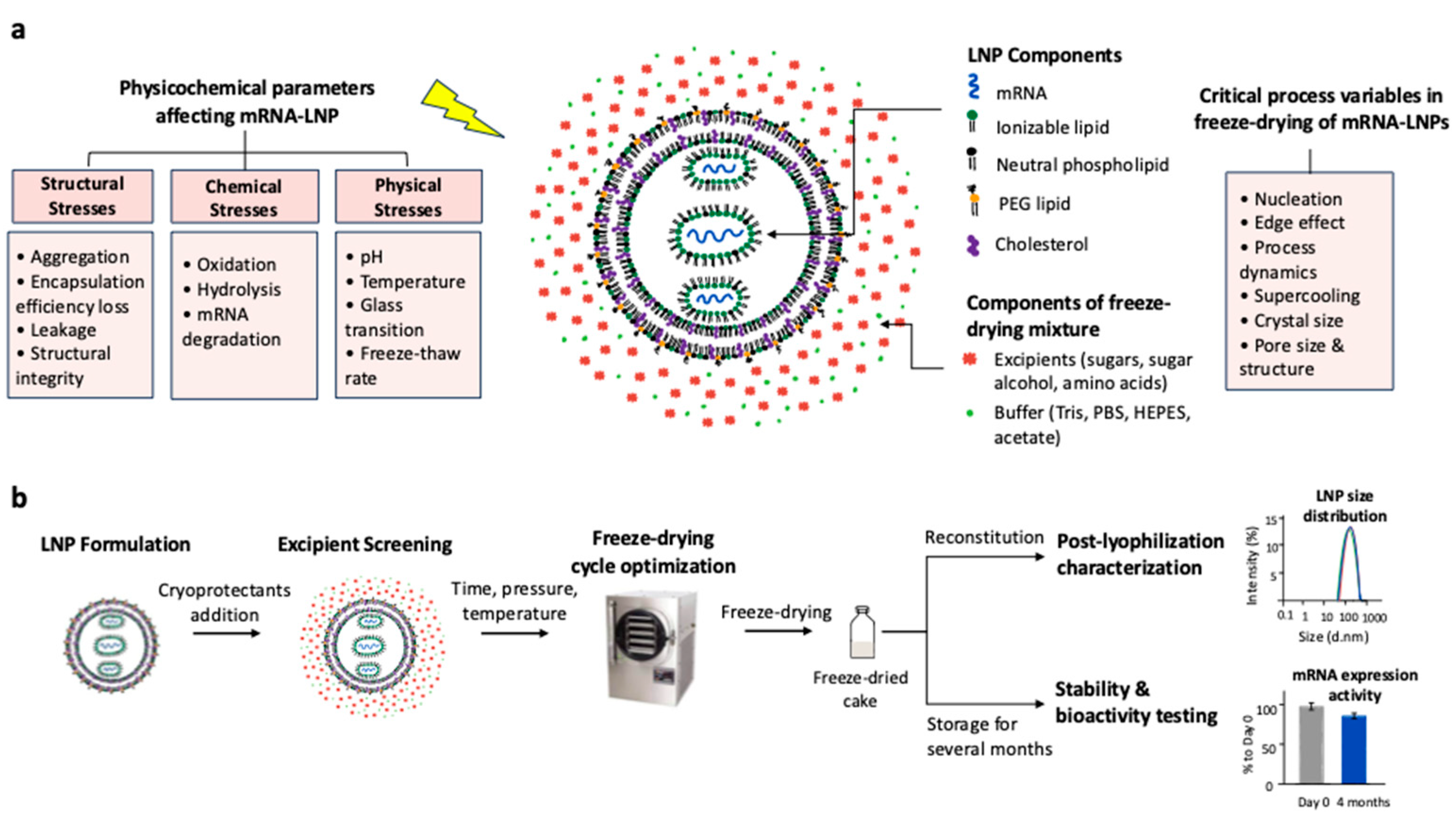
Overall, these freeze-dried formulations demonstrated a significant improvement in stability over time compared to liquid formulations. Freeze-drying mRNA vaccines offers the advantages of enabling ambient storage compared to sub-zero temperatures, as well as extending shelf life, which facilitates storage, transportation, and distribution. However, the freeze-drying process is complex and requires fresh screening of excipients, optimization of reagent and process parameters, such as buffer, excipient, and surfactant concentrations, cycle duration, and iterations, as well as temperature, to preserve LNP physicochemical properties (Figure 2). Further research into the development of stabilizers and optimization of freeze-drying protocols is essential to enhance the thermostability of all mRNA vaccine formulations.
Figure 2.
Key Considerations and Workflow for Developing Freeze-dried mRNA-LNP Vaccine Formulations. a) Schematic representation of mRNA-loaded lipid nanoparticles (LNP) highlighting physicochemical stresses affecting stability (structural, chemical, and physical) and key critical process variables to control during freeze-drying. b | Stepwise process for the development and evaluation of freeze-dried mRNA-LNP vaccines.
Figure 2.
Key Considerations and Workflow for Developing Freeze-dried mRNA-LNP Vaccine Formulations. a) Schematic representation of mRNA-loaded lipid nanoparticles (LNP) highlighting physicochemical stresses affecting stability (structural, chemical, and physical) and key critical process variables to control during freeze-drying. b | Stepwise process for the development and evaluation of freeze-dried mRNA-LNP vaccines.
2.3. Challenges During Freeze-Drying of mRNA-LNP
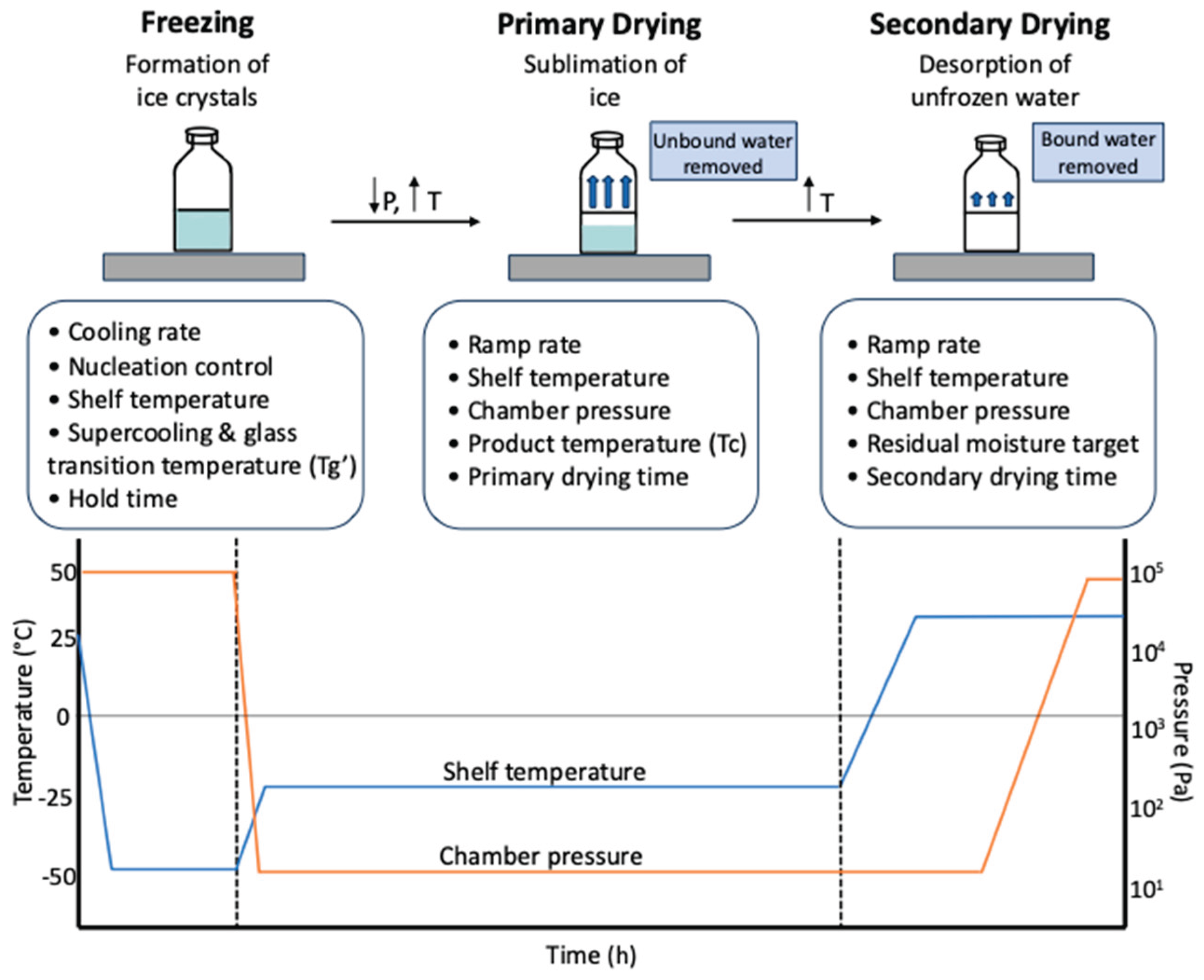
The freeze-drying process involves three stages: freezing, primary drying (sublimation), and secondary drying (desorption) (Figure 3). Each stage presents unique challenges for mRNA vaccines, affecting the preservation of the LNP structure and the stability of the encapsulated mRNA. For instance, freezing can lead to the formation of ice crystals that disrupt the LNP membrane, while drying stages can introduce mechanical stress and dehydration-induced destabilization of lipid components. Both the freezing phase and drying phase are known to induce stresses to lipid-based nanoparticle formulations [42]. Alejo et al. demonstrated that freezing and dehydration impose mechanical stress and deformation on lipid structures, leading to LNP aggregation and the release of encapsulated mRNA (Figure 2) [39]. During freezing, the formation of ice crystals can damage the LNP, potentially leading to aggregation or leakage of mRNA. The freezing rate is thus a critical parameter for freeze-drying [43]. Careful optimization of this phase is crucial to ensure product quality and transfection efficiency. During the secondary drying phase, improper control of drying temperatures and pressures can also lead to irreversible damage to the lipid bilayer.
3. Formulations
During lyophilization, mRNA-LNP is exposed to a variety of stresses like pH changes, freeze-concentration, and aggregation caused by drying (Figure 2) [21,33,37]. Therefore, an adequate formulation must be used to protect the product and ensure its integrity and activity. The development of lyophilization protocols must consider both formulation and process optimization simultaneously to establish an effective process for freeze-drying mRNA vaccines [44]. In this section, different stabilizers commonly used in mRNA-LNP formulations are described, and their influence on the freeze-drying process is discussed.
3.1. Influence of Lipid Composition
The composition of lipid nanoparticles, particularly the choice of lipids, can also influence the stability of mRNA-LNP after freeze-drying. Each lipid component in mRNA-LNP has specific functions during particle formation, such as stabilization and biological performance, and it is critical to maintain the stability of lipid components in mRNA-LNP to ensure a pharmacologically active drug product. Wang et al. showed that DSPC/cholesterol ratio might be the most influential factor for the stability and transfection efficiency of mRNA-LNP after lyophilization [32]. The authors found that ratios of DSPC to cholesterol ranging from 2 to 2.2 appeared to be most suitable for maintaining the high transfection efficiency of mRNA-LNP after lyophilization. In addition, Wang et al. found that ionizable lipids are one of the most important factors influencing the transfection efficiency and transfection intensity of mRNA-LNP in HEK-293 T cells, and the second important parameter was the PEGylated lipid used in the mRNA-LNP [32].
3.2. Stabilizers
To address challenges associated with the inherent sensitivity of mRNA to environmental stressors during the freeze-drying process, various stabilizers have been incorporated into the formulation of freeze-dried mRNA vaccines. Stabilizers are added to protect the mRNA-LNP against chemical and physical degradation during processing and storage. Selecting an appropriate stabilizer is key to protecting the mRNA-LNP against structural changes, fusion/aggregation, membrane damage caused by ice crystals, intracellular ice formation and pH shift [22]. Different stabilizers, also known as cryoprotectants, have been used to stabilize freeze-dried mRNA-LNP vaccines. Common stabilizers include sugars like sucrose and trehalose, sugar alcohols such as mannitol and sorbitol, and amino acids like histidine. As the exact stabilization mechanisms for mRNA vaccines remain unclear, published studies have identified valuable trends that guide formulation strategies [45,46,47].
3.2.1. Sugars
Sugars, such as trehalose and sucrose, are commonly used due to their ability to protect various types of vaccines and biopharmaceutical products (Table 1 and Table 2) [48]. They are described as very effective stabilizers in multiple studies, as they exhibit high viscosity, low molecular mobility after drying, and form an amorphous glassy matrix [22]. Recent studies by Kefetzis et al. and Zhang et al. have demonstrated that incorporating these stabilizers into formulations can significantly enhance the long-term stability of mRNA-LNP, allowing for effective storage at ambient temperatures [45,49]. Although not definitively confirmed, sucrose and trehalose are thought to protect mRNA-LNP during freeze-drying through vitrification and/or hydrogen bonding (water substitution), helping to prevent stress-induced damage during the process [22].
Sucrose is one of the most used cryoprotectants in mRNA vaccine formulations, as it effectively stabilizes LNP during the freeze-drying process (Table 2). The presence of sucrose not only prevents the aggregation of LNP but also protects the mRNA from freezing and dehydration stresses that could lead to a loss of potency [22]. Sucrose is used in concentrations ranging from 2 to 20% (w/v), as higher concentrations may result in difficulties in reconstitution of the formulation after lyophilization [32,37]. For instance, Wang et al. demonstrated that 8.7% sucrose is the optimal cryoprotectant concentration to maintain the transfection efficiency of lyophilized mRNA-LNP, and Kim et al. found that mRNA-LNP vaccines were stably stored at -20°C for at least 30 days when 10% (w/v) sucrose was added to PBS [32]. Kim et al. also showed that the absence of sugar in the buffer for both PBS (Phosphate-buffered saline)- and TBS (Tris-buffered saline)-stored LNP resulted in a 20–50 nm increase in the particle size distribution, hinting at the cryoprotective effects of sucrose [37]. However, there is no single optimal concentration for LNP formulations. Additionally, the percentages of sugars as excipients in the LNP formulation may vary based on several parameters, such as the composition of the LNP particles, payload sizes, and whether the cargo is single or dual (Table 2).
3.2.2. Sugar Alcohols
Mannitol is a frequently used sugar alcohol in mRNA-LNP formulations, serving primarily as an excipient in spray-freeze drying or as a bulking agent during lyophilization (Table 1) [50]. Its addition in freeze-dried products helps form a crystalline phase instead of an amorphous one, which helps prevent cake shrinkage. For example, Luo et al. demonstrated that replacing disaccharides, which remain amorphous after freeze-drying, with mannitol provided the necessary crystallinity to maintain the structural integrity of the lyophilized cake, thus preventing cracking [46]. Mannitol has also been shown to improve the stability of LNP during freeze-drying [37]. To date, based on the literature screening conducted for this work, mannitol is the only sugar alcohol that has been explored for LNP formulation. However, other sugar alcohols, namely sorbitol, xylitol, erythritol, maltitol, and lactitol, could also be potential choices to explore.
3.2.3. Amino Acids
Excipients such as arginine, histidine, glycine and methionine are deemed to be commonly used amino acid stabilizers [51]. These amino acids stabilize the formulations through preferential hydration, exclusion and enhanced solubility. Although arginine, glycine and methionine are commonly used as stabilizers in protein formulations, histidine is also used in mRNA-LNP formulations, particularly as a buffer at pH values between 5.0 and 7.0. Histidine has been linked to low-viscosity formulations, making it an attractive excipient [52].

Table 1.
Choices of Excipients in the Formulations of Freeze-dried mRNA-LNP Vaccines.
| Formulations | Protecting Mechanism | Positive Impacts on mRNA-LNP | References | |
|---|---|---|---|---|
| Sugars | Sucrose | Protective coating and prevents mechanical damage, vitrification (formation of a glassy matrix), water replacement (hydrogen bonds), cryoprotection | Prevents LNP aggregation, preserves particle size, maintains mRNA integrity, reduces freeze and dehydration stresses | [7,12,47,53,54] |
| Trehalose | Increase formulations' viscosity, high glass transition temperature (Tg), low crystallization risk, vitrification, water replacement, cryoprotection | Higher Tg' than sucrose, maintains structural integrity, enhances LNP' resistance to drying | [22,49,53,55,56,57] | |
| Maltose | Glass matrix formation | Often combined with sucrose, helps prevent structural collapse | [21,58] | |
| Sugar alcohol | Mannitol | Bulking agent, prevents cake shrinkage | Prevents cake collapse, may reduce aggregation but can crystallize unfavorably | [37,46,50] |
| Buffer choices | Tris | Scavenges hydroxyl radicals, stabilizes pH during freezing | Reduces pH shift, improves encapsulation and transfection efficiency, and reduces zeta potential shift | [39,42,59,60,61] |
| PBS | Ionic stabilization maintains a stable pH during freezing and drying but is prone to pH shift in the presence of sodium ion | Common but inferior to Tris, used for its ionic strength, can decrease encapsulation efficiency and stability | [37,39,42,59] | |
| HEPES | PH buffering, stabilizing effect during freeze-thaw | Helps to maintain LNP's integrity during freeze-thaw cycles and long-term storage | [59] | |
3.3. Influence of pH and Buffer
Besides the choice of stabilizers, the choice of buffer and pH can also significantly impact the thermostability of mRNA-LNP vaccines (Table 1). In 2021, the Comirnaty® vaccine formulation was updated by replacing the originally used PBS (phosphate-buffered saline) with Tris (short for tris(hydroxymethyl)aminomethane) as the buffering agent, which enhanced its stability and allowed approval by the European Medicines Agency (EMA) for storing the BioN- Tech/Pfizer vaccine between −15 and −25°C for up to two weeks [39]. Recent works, aligned with the buffer used for Comirnaty, suggested that buffer composition can influence the ionic strength, pH stability, and interaction with lipid and nucleic acid components, ultimately affecting the physical and chemical stability of mRNA-LNP formulations [58].
Indeed, buffer composition not only affects the ionic environment but also helps mitigate pH fluctuations during freezing, which can significantly influence the rate of mRNA hydrolysis [62]. Phosphate buffers are known to undergo substantial pH changes upon freezing, with drops of up to 3.6 units when cooled from 0 °C to −30 °C, whereas Tris and histidine buffers exhibit only minor pH shifts (~0.5–0.6 units) [61,63]. These pH shifts can accelerate mRNA degradation, particularly under acidic conditions and in the presence of divalent cations such as Mg²⁺ and Ca²⁺ [64]. In contrast, Tris-HCl helps stabilize nucleic acids by maintaining pH and scavenging hydroxyl radicals, thereby improving the chemical stability of mRNA during storage and lyophilization [60]. For instance, Alejo et al. demonstrated that Tris is more efficient than PBS at preserving the physicochemical and functional properties of mRNA-LNP during freeze-drying, regardless of the cryoprotectants used [39]. Alejo et al. evaluated the impact of two different buffers, PBS and 5 mM Tris, both at pH 7.4, on the physicochemical properties of freshly prepared and freeze-dried LNP. Results showed that the encapsulation efficiency of LNP was preserved in the presence of 5 mM Tris buffer. Additionally, particle size and zeta potential did not change significantly after lyophilization, indicating the superior stability of the formulations in this buffer.
In contrast, the use of PBS buffer for mRNA-LNP stabilization resulted in reduced encapsulation efficiency, a marked increase in particle size, and a shift toward a more negative zeta potential [39]. In another study, Henderson et al. demonstrated that Tris and HEPES buffer yielded better cryoprotection and transfection efficiency for LNP stored frozen at −20°C compared to PBS [59]. The superiority of Tris buffer compared to PBS was also demonstrated by Meulewaeter et al., who evaluated the impact of three different buffers —Tris, PBS, and phosphate —on the freeze-drying of mRNA-LNP. It was found that the properties of mRNA LNP dispersed in phosphate and Tris buffer remained unchanged upon lyophilization and that the mRNA LNP retained their transfection efficiency. In contrast, a loss in encapsulation efficiency and a drastic decrease in transfection efficiency were observed when using PBS [42]. Therefore, Meulewaeter et al. concluded that phosphate and Tris, but not PBS, were appropriate buffers for the lyophilization of mRNA LNP, aligning with the findings of other studies. Finally, Fan et al. conducted the high-throughput screening of 45 cryoprotectants and buffer conditions for mRNA-LNP. Fan et al. identified PVP-K12 in Tris or acetate as the optimal cryoprotectants/buffer combinations to maintain the physical stability of mRNA-LNP, resulting in both minimal particle size increase and minimal decrease in encapsulation efficiency post-lyophilization. It was found that 5–20% PVP-K12 in Tris or acetate buffers achieved both the physical stability of mRNA-LNP and the chemical stability of the encapsulated mRNA, suggesting that Tris and acetate are better buffers than PBS [65].
Additionally, HEPES has been shown to offer advantages over PBS in certain cases. Specifically, Henderson et al. reported that HEPES-buffered saline (HBS) outperformed PBS and Tris-buffered saline (TBS) in preserving the properties of LNP after freeze-thaw cycles [59]. While both TBS and HBS buffers enhanced transfection efficiency compared to PBS, HBS provided additional protection against pH shifts and aggregation [59]. Therefore, HEPES, along with Tris, appears to be a more suitable buffer than PBS for maintaining the stability and functionality of mRNA-LNP during storage and lyophilization [42,65,66].
3.4. Impact of Reconstitution Buffer
The reconstitution process can also influence the stability of freeze-dried mRNA-LNP products. While most mRNA-LNP formulations are reconstituted in water, some studies have employed buffers for reconstitution (Table 2). Meulewaeter et al. evaluated the impact of different reconstitution buffers by using 400 μl of Tris, phosphate, or PBS buffer at pH 7.4 to reconstitute lyophilized cakes immediately after the freeze-drying cycle [42]. The properties of the rehydrated mRNA-LNP, including size, polydispersity index (PDI), zeta potential, and mRNA encapsulation efficiency, were analyzed after rehydration. The findings by Meulewaeter et al. indicated that the size and polydispersity index (PDI) of all formulations remained unchanged after lyophilization. However, encapsulation efficiency and the amount of mRNA encapsulated decreased when reconstituted in PBS, while phosphate and Tris buffers preserved the mRNA-LNP properties [42]. The points mentioned above highlight that the choice of buffer for reconstitution can impact the characteristics of the freeze-dried product.
Several studies have used buffer-free formulations, that is, the reconstitution after freeze drying used RNase, DNase, pyogen-free, sterile, distilled water (Table 2). In fact, buffer-free approaches are often preferred to avoid additional excipients that could cross-react with the freeze-dried LNP, leading to variations in the final formulations and even other complications. For instance, histidine in the reconstitution buffer can cause discoloration, and citrate can be associated with a stinging sensation when injected subcutaneously or may lead to toxic effects due to the chelation of calcium in the blood [67]. Acetate in the reconstitution buffer can sublime during freeze-drying, which may limit its usefulness in lyophilization. Some buffers, such as phosphate, can undergo selective crystallization during cooling, resulting in significant pH shifts. In addition, Tris has a high ΔpKa/°C, such that its pH shifts from pH 7.1 at 25 °C to pH 5.0 at 100 °C [67].
Table 2.
Formulation composition of published studies on mRNA-LNP vaccine stabilization.
| Formulations (w/v) | Buffer/ pH | Reconstitution | Stability | References |
|---|---|---|---|---|
| 10% sucrose 10% maltose |
5 mM Tris/ pH 8 | Water | Physicochemical properties do not significantly change for 12 weeks after storage at room temperature and for at least 24 weeks after storage at 4°C | [21] |
| 8.8% sucrose, 2% trehalose, 0.04% mannitol |
- | - | The lyophilized mRNA-LNP were stable at 2–8 °C, and it did not reduce immunogenicity in vivo or in vitro. | [68] |
| 8.7% sucrose | (PBS) | 90 μl of nuclease-free water | Optimal O9 mRNA-LNP could be stored at 4 °C for more than 12 weeks and at room temperature for 4 weeks after lyophilization. | [32] |
| 10% sucrose | PBS/ pH 7.4 | Deionized water | LNP-RNA vaccines are stably stored in 10% w/v sucrose in PBS at −20 °C for at least 30 days. | [37] |
| 20% maltose | Tris 5 mM/ pH 7.4 | 300 μl RNase-free water | Lyophilized LNP retained their in vivo bioactivity at an almost unaffected level for 1 year when stored at 4°C. Lyophilized LNP also presented unaltered thermo-stability at room temperature (25°C) for 4 weeks. | [39] |
| 12.5% sucrose | 20 mM Tris/ pH 7.4 |
400 μl of Tris-, phosphate- or PBS buffer at pH 7.4 | Lyophilized mRNA LNP preserved their functionality when stored at 4°C, 22°C and even at 37°C for 12 weeks. | [42] |
| 5% sucrose/ 5 % trehalose |
- | - | 5% (w/v) sucrose or trehalose LLNs stored in liquid nitrogen maintained mRNA delivery efficiency for over three months. | [54] |
| 9% trehalose/ 1 % PVP |
20 mM Tris / pH 7.4 | 275 μl RNase-free water | The most promising formulations for storage at higher temperatures were identified as 9% (w/v) trehalose + 1% (w/v) PVP, with only a slight increase in size over 6 months at 25 °C, while maintaining PDI and encapsulation efficiency. | [69] |
| 10% sucrose / 5% trehalose | 10 mm Tris / pH 7.4 | Water | Lyophilized mRNA-LNP can be stored at 4°C for at least 12 months and for at least 8 hours after reconstitution at ambient temperature without a significant change in product quality. They also preserved the in vitro biological activity and immunogenicity in mice, comparable to that of freshly prepared mRNA-LNP. | [70] |
| 10% sucrose / 9% mannitol / 1% PEG60 | Tris | Water | Dry powder formulation that could maintain the physicochemical properties of LNP-mRNA after storage at 4 °C for at least two months. | [66] |
| 10% sucrose | - | Nuclease-free water | Lyophilized form of LION/repRNA-CoV-2S with 10 % w/v sucrose, maintained in vivo immunogenicity after 1 week at 25 °C and 6 months at 2–8 °C. Lyophilized LION/repRNA-PyCS vaccine with 10% w/v sucrose, stored for 12 months at 2–8 °C, demonstrated no loss in immunogenicity. | [71] |
4. Lyophilization Process Development and Intensification
The freeze-drying process itself must be optimized to ensure the stability and efficacy of mRNA vaccines. Factors such as the freezing rate, primary drying temperature, and final moisture content are critical parameters that influence the stability and quality of the final product. The development of a lyophilization cycle must be tailored to the specific formulation; therefore, the temperature, pressure, and time conditions must be optimized for each new product. This optimization is essential due to the impact that these parameters have on product critical quality attributes, including mRNA integrity, encapsulation efficiency, particle size (~80–100 nm), PDI, surface charge, lipid composition, transfection efficiency and immunogenicity.
Like enveloped viral vectors, mRNA-LNP vaccines share supramolecular assemblies that encapsulate nucleic acids and are sensitive to freeze-drying stress, including H shifts, phase separation, osmotic imbalance, and ice-induced mechanical disruption [72,73]. As Felix Franks emphasized, the design of a successful lyophilization cycle depends on understanding the thermochemical and thermomechanical behaviour of amorphous formulations, particularly their glass transition temperature (Tg), ice crystallization tendencies, and solute interactions. These considerations are equally applicable to mRNA-LNP, which relies on excipients to maintain the LNP nanostructure and encapsulated cargo.
Claes et al. also emphasize the importance of using compatible excipients such as bulking agents and cryoprotectants to maintain the structure and activity of the product, while keeping residual moisture low to ensure good stability and reconstitution [75]. Although originally developed for proteins and viral vector vaccines, these principles apply well to mRNA-LNP, which have similar structural sensitivities. For example, excipients such as sucrose and trehalose are commonly used to protect both proteins and mRNA-LNP by forming a stable glassy matrix. The choice of buffer during reconstitution is also critical for preserving product integrity. By building on these established guidelines, researchers can design more effective freeze-drying protocols for mRNA-LNP vaccines, thereby reducing their dependence on empirical methods.
Table 3 presents an overview of the freeze-drying process parameters used in various mRNA-LNP vaccine studies. However, comparing the different process conditions (temperature, pressure, and time) between the different studies is difficult because critical product parameters, such as Tg', Tc, and filling volume, are formulation dependent. Table 3 illustrates a high variability in freeze-drying conditions, particularly in terms of freezing, primary drying, and secondary drying stages, reflecting differences in the optimization strategies employed. Freezing temperatures range from -30°C to -80°C with durations spanning 20 minutes to 12 hours. Primary drying conditions also show significant variation, with temperatures from -50°C to -10°C and pressures between 6 Pa and 24 Pa, lasting anywhere from 4 to 84 hours. Secondary drying stages typically occur at higher temperatures (ranging from 2°C to 30°C) and moderate pressures (3 to 20 Pa) for durations of 5 to 10 hours. These studies indicate a broad range of approaches, with differences often lying in the specific temperature and pressure settings, which are optimized based on formulation composition, volume, and specific critical quality attributes (CQAs).
5. Critical Process Parameters (CPPs) and Critical Quality Attributes (CQAs)
Following freeze-drying with optimized process parameters, a freeze-dried cake is obtained. The appearance of this cake is a subjective yet important quality attribute for assessing the success of the lyophilization process. Ideally, the cake should maintain the same size and shape as the original liquid fill and exhibit a uniform colour and texture [80]. The most critical quality indicator is a smooth, uniform white surface, with no evidence of cake collapse, shrinkage or structural failure [68]. Multiple studies focusing on the freeze-drying of mRNA-LNP vaccines describe the resultant lyophilized product as a white, fluffy cake [21,68].
Critical process parameters (CPPs) and critical quality attributes (CQAs) are crucial for ensuring the efficacy, safety, and reproducibility of mRNA-LNP products from batch to batch production. CPPs refer to those process parameters that are non-negotiable for a robust production process, with minimum variability of the final product. Some of the CPPs for mRNA-LNP are lipid composition ratio, ethanol concentration, buffer, pH, total flow rate, and N/P ratio (amine-to-phosphate groups in RNA) during the encapsulation process [81,82]. These CPPs have a direct influence on CQAs like particle size, polydispersity index (PDI), encapsulation efficiency, RNA payload distribution across LNPs, zeta potential, and RNA integrity [33,83,84]. Thus, the CQAs refer to the attributes that are used to quantify the quality attributes.
In some cases, lipid ratios (e.g., ionizable cationic lipids, PEG-lipids) determine nanoparticle stability and cellular uptake [23,84]. On the other hand, flow rate and pH during microfluidic mixing impact particle size, encapsulation efficiency and distribution of RNA payloads [82,85]. The CPPs and CQAs are further discussed below.
5.1. Critical Process Parameters (CPPs)
Among the key CPPs, lipid composition ratio is considered critical, where the type and molar ratio of ionizable lipids, helper lipids, cholesterol, and PEG-lipids determine nanoparticle structure, encapsulation efficiency, payload distribution and stability (Table 4) [42,86]. In the case of microfluidic mixing for encapsulation, the total flow rate, mixing speed, and temperature affect particle size, polydispersity, and encapsulation efficiency. Other critical parameters are buffer (e.g., phosphate or Tris, but not PBS) and pH, which are crucial for maintaining LNP integrity during both formulation and freeze-drying. Improper buffer selection can lead to aggregation or loss of encapsulation. [39]. Another important parameter is the lipid and mRNA weight ratio, where a sufficiently high ionizable lipid to mRNA weight ratio (3:1) is necessary to maintain the encapsulation efficiency [45].
During the freeze-drying cycle, the freezing temperature, primary and secondary drying temperatures, chamber pressure, and ramp rates are critical. Figure 3 illustrates the importance of precise control over temperature and pressure at each stage. Additionally, the choice and amount of cryoprotectants (e.g., sucrose, trehalose) are crucial for protecting LNP and mRNA during freezing and drying. They can also affect the cake structure, reconstitution time, and preservation of CQAs [68].
Figure 3.
Critical Process Parameters Across the Freeze-drying Cycle of mRNA-LNP Vaccines.
5.2. Critical Quality Attributes (CQAs)
Critical quality attributes (CQAs) for freeze-dried samples include the maintenance of LNP physicochemical structure and integrity before and after lyophilization. CQAs are considered the standard attributes that define the efficacy, stability and safety of mRNA-LNP products (Table 4). Among the CQAs, physical characteristics, including the particle size and polydispersity index (PDI), are commonly used. The standard size of the mRNA-LNP is typically 80–200 nm, with a low polydispersity index (PDI) or high uniformity, which is critical for biodistribution, cellular uptake, and immunogenicity. Both the CQAs should remain stable throughout the freeze-drying process and during subsequent reconstitution [21,42,69]. Another important attribute is encapsulation efficiency, where a high encapsulation efficiency (≥80%) ensures that the maximum mRNA is encapsulated with the LNP. High encapsulation efficiency must be maintained throughout freeze-drying and during storage to maintain its efficacy [42,69] The zeta potential of mRNA-lipid nanoparticles (mRNA-LNP), another crucial factor, typically ranges from slightly positive to near-neutral (around +5 to +20 mV), depending on the formulation conditions and lipid composition. A balanced zeta potential helps optimize cellular uptake by promoting interaction with cell membranes [87]. To be considered an effective vaccine, the integrity and purity of the mRNA need to be well maintained, which is determined by capillary electrophoresis or similar methods. Lyophilization or storage conditions should maintain the integrity of mRNA. Additionally, the lipid composition is crucial for ensuring the efficient delivery of mRNA to cells.
Most importantly, potency and transfection efficiency are the key CQAs for protein expression, whether in vitro or in vivo. These attributes must be retained after lyophilization and during the entire storage period [68] In vitro testing of mRNA-LNPs typically evaluates transfection efficiency, payload distribution, and cellular uptake in relevant cell lines. They can reveal the differences in delivery and efficacy based on lipid composition and formulation parameters before and after the freeze-drying [4,88]. In vivo animal testing, using models such as mice, assesses biodistribution, organ-specific accumulation, and the potency of mRNA delivery [25,88,89]. Together, these analytical and biological approaches provide a comprehensive understanding of mRNA-LNP structure, function, and therapeutic potential. These can guide the rational design and optimization of effective freeze-drying preparations.
Additionally, the appearance, cake structure, moisture content, and reconstitution time are critical quality attributes specific to lyophilization. For lyophilized products, a uniform, intact cake indicates successful freeze-drying, whereas collapse or shrinkage may signal process issues. One of the main factors impacting vaccine stability after lyophilization is the residual moisture of the product, which is influenced by the temperature, pressure, and duration of secondary drying. Maintaining a specified range of residual moisture levels is crucial for product integrity. While over-drying is to be avoided, too high residual moisture levels can cause structural collapse during storage and can increase the mRNA degradation rate as the absorbed water provides molecular mobility that can induce chemical degradation and aggregation [22]. Low residual moisture (<1–2%) is necessary for long-term stability [90]. The lyophilized product should be reconstituted quickly and completely, restoring original particle characteristics.[68].
Table 4.
Key CPPs and CQAs for mRNA-LNP (Including Freeze Drying).
| Critical Process Parameters (CPPs) | Critical Quality Attributes (CQAs) |
|---|---|
| • Lipid composition and molar ratios e.g., ionizable lipid, helper lipid, cholesterol, PEG-lipid) |
• Particle size and PDI (affects biodistribution, cellular uptake, and dose uniformity) |
| • Buffer type and pH (affects LNP assembly, mRNA stability, and lyophilization compatibility) |
• Encapsulation efficiency (% of mRNA encapsulated; impacts potency and dosing) |
| • Lipid: mRNA weight ratio (key determinant for encapsulation and particle stability) |
• Zeta potential (an indicator of colloidal stability and cellular interaction) |
| • Mixing rate and temperature during microfluidic formulation (impacts LNP size and uniformity) |
• mRNA integrity and purity (determines efficacy; assessed by electrophoresis, HPLC) |
| • Freeze-drying (lyophilization) cycle parameters (freezing rate, primary/secondary drying temps and pressures) |
• Lipid composition/identity post-processing (assures no degradation or phase separation) |
| • Cryoprotectant type and concentration (e.g., sucrose, trehalose; critical for preserving structure) |
• Appearance and cake structure (e.g., collapse, shrinkage, or uniformity after lyophilization) |
| • Residual moisture content (influenced by secondary drying endpoint) |
• Moisture content (affects storage stability and reconstitution) |
| • Reconstitution conditions (solvent type, volume, and agitation) |
• Reconstitution time (speed and ease of redispersion into solution) |
| • Storage temperature and container closure system | • Potency / Transfection efficiency (in vitro and in vivo functional activity of mRNA-LNP) |
6. Analytics for the Freeze-Drying Study
In addition to visual inspection, analytical characterization of freeze-dried mRNA-LNP post-rehydration is essential to evaluate the preservation of key attributes. The reconstituted solution should appear uniform and translucent, like freshly prepared mRNA-LNP solutions. It is also important that the reconstituted product readily and rapidly dissolves in water or a chosen buffer. Post-rehydration, analytical methods such as dynamic light scattering (DLS) for size and polydispersity index (PDI), zeta potential measurements, RiboGreen assays for mRNA encapsulation efficiency, in vitro cell expression study and in vivo animal study are frequently employed [42]. Electron microscopy techniques such as scanning electron microscopy (SEM), transmission electron microscopy (TEM), and cryogenic TEM (cryo-TEM) are vital for characterizing mRNA-lipid nanoparticles. SEM provides surface morphology, TEM enables visualization of internal structures, and cryo-TEM offers high-resolution images of LNPs in their native hydrated state, which is essential for accurately assessing mRNA encapsulation and distribution within the nanoparticles [21,24,66,68,70].
These analytics confirm the maintenance of LNP integrity and functional performance (Table 5).
7. Conclusion
Freeze-drying is now being considered a promising strategy to overcome the intrinsic thermal and chemical instability of the mRNA-LNP vaccine. This review has comprehensively discussed the progress and challenges in freeze-drying mRNA-LNP vaccines. This also highlights the critical roles of formulation components (disaccharides, sugar alcohols, amino acids, buffers (e.g., Tris, acetate), lipid composition) and process parameters (freezing rate, primary and secondary drying temperature, chamber pressure, thermal properties (e.g., Tg′, Tc)). Key findings from this review demonstrate that the success of freeze-drying depends on a multifactorial optimization of formulation and process parameters. Besides these parameters, the LNP composition, fill volume and vial geometry also influence the critical quality attributes (CQAs) of the mRNA-LNP. Moreover, the integration of Digital Twin principles and Design of Experiments (DOE) has been proposed to further improve the freeze-drying process by enabling predictive modelling and systematic optimization of critical process parameters [32,91]. Modelling of the freeze-drying process can simulate heat and mass transfer to anticipate drying behaviour without physical trials. On the other hand, using DOE in freeze-drying helps to identify the significance and interaction of different process parameters (like freezing rate, primary drying temperature, etc.), affecting the critical quality attributes (CQA) of the mRNA vaccine. These techniques, applied within the Quality by Design (QbD) framework, help to accelerate the process development, reduce experimental workload, and ensure consistent product quality. From a cost-effectiveness standpoint, lyophilization introduces additional process steps, making manufacturing optimization lengthy and expensive, with long cycles, additional operational and capital expenditures, and the need to reconstitute the product. However, it is worth the investment because it reduces the need for cold chains and prevents the wastage of precious vaccines. In summary, freeze-drying represents a promising solution for the next-generation thermostable mRNA vaccines. By tackling the challenges of formulation, process, and analytical techniques, it is possible to unlock the full potential of mRNA-based immunization. This will ultimately strengthen public health impact, pandemic preparedness, and equitable vaccine distribution worldwide.
References
- Zhang, N.-N. et al. A Thermostable mRNA Vaccine against COVID-19. Cell 182, 1271-1283.e16 (2020).
- Chivukula, S. et al. Development of multivalent mRNA vaccine candidates for seasonal or pandemic influenza. NPJ Vaccines 6, 153 (2021). [CrossRef]
- Sittplangkoon, C. et al. mRNA vaccine with unmodified uridine induces robust type I interferon-dependent anti-tumor immunity in a melanoma model. Front Immunol 13, (2022). [CrossRef]
- Qiu, K. et al. mRNA-LNP vaccination-based immunotherapy augments CD8+ T cell responses against HPV-positive oropharyngeal cancer. NPJ Vaccines 8, (2023). [CrossRef]
- Krienke, C. et al. A noninflammatory mRNA vaccine for treatment of experimental autoimmune encephalomyelitis. Science (1979) 371, 145–153 (2021). [CrossRef]
- Rizvi, F. et al. Murine liver repair via transient activation of regenerative pathways in hepatocytes using lipid nanoparticle-complexed nucleoside-modified mRNA. Nat Commun 12, (2021). [CrossRef]
- Robinson, E. et al. Lipid Nanoparticle-Delivered Chemically Modified mRNA Restores Chloride Secretion in Cystic Fibrosis. Molecular Therapy 26, 2034–2046 (2018). [CrossRef]
- Perez-Garcia, C. G. et al. Development of an mRNA replacement therapy for phenylketonuria. Mol Ther Nucleic Acids 28, 87–98 (2022). [CrossRef]
- Zhang, G., Tang, T., Chen, Y., Huang, X. & Liang, T. mRNA vaccines in disease prevention and treatment. Signal Transduct Target Ther 8, 365 (2023). [CrossRef]
- Chaudhary, N., Weissman, D. & Whitehead, K. A. mRNA vaccines for infectious diseases: principles, delivery and clinical translation. Nat Rev Drug Discov 20, 817–838 (2021). [CrossRef]
- Kobayashi, T. et al. Tumour mRNA-loaded dendritic cells elicit tumor-specific CD8+ cytotoxic T cells in patients with malignant glioma. Cancer Immunology, Immunotherapy 52, 632–637 (2003). [CrossRef]
- Sebastian, M. et al. A phase I/IIa study of the mRNA-based cancer immunotherapy CV9201 in patients with stage IIIB/IV non-small cell lung cancer. Cancer Immunology, Immunotherapy 68, 799–812 (2019). [CrossRef]
- Hernando, J. J. et al. Vaccination with dendritic cells transfected with mRNA-encoded folate-receptor-α for relapsed metastatic ovarian cancer. Lancet Oncology 8, 451–454 (2007). [CrossRef]
- Xu, Z. et al. Novel mRNA adjuvant ImmunER enhances prostate cancer tumor-associated antigen mRNA therapy via augmenting T cell activity. Oncoimmunology 13, (2024). [CrossRef]
- Van Tendeloo, V. F. et al. Induction of complete and molecular remissions in acute myeloid leukemia by Wilms' tumor 1 antigen-targeted dendritic cell vaccination. Proc Natl Acad Sci U S A 107, 13824–13829 (2010).
- Golubovskaya, V. et al. mRNA-Lipid Nanoparticle (LNP) Delivery of Humanized EpCAM-CD3 Bispecific Antibody Significantly Blocks Colorectal Cancer Tumor Growth. Cancers (Basel) 15, (2023). [CrossRef]
- Sung, H. et al. Global Cancer Statistics 2020: GLOBOCAN Estimates of Incidence and Mortality Worldwide for 36 Cancers in 185 Countries. CA Cancer J Clin 71, 209–249 (2021). [CrossRef]
- Hashiba, K. et al. Overcoming thermostability challenges in mRNA–lipid nanoparticle systems with piperidine-based ionizable lipids. Commun Biol 7, (2024). [CrossRef]
- Uddin, M. N. & Roni, M. A. Challenges of Storage and Stability of mRNA-Based COVID-19 Vaccines. Vaccines (Basel) 9, 1033 (2021). [CrossRef]
- Young, R. E., Hofbauer, S. I. & Riley, R. S. Overcoming the challenge of long-term storage of mRNA-lipid nanoparticle vaccines. Molecular Therapy 30, 1792–1793 (2022). [CrossRef]
- Muramatsu, H. et al. Lyophilization provides long-term stability for a lipid nanoparticle-formulated, nucleoside-modified mRNA vaccine. Molecular Therapy 30, 1941–1951 (2022). [CrossRef]
- Hansen, L. J. J., Daoussi, R., Vervaet, C., Remon, J.-P. & De Beer, T. R. M. Freeze-drying of live virus vaccines: A review. Vaccine 33, 5507–5519 (2015). [CrossRef]
- Hou, X., Zaks, T., Langer, R. & Dong, Y. Lipid nanoparticles for mRNA delivery. Nature Reviews Materials vol. 6 1078–1094 . [CrossRef]
- Ai, L. et al. Lyophilized mRNA-lipid nanoparticle vaccines with long-term stability and high antigenicity against SARS-CoV-2. Cell Discov 9, 9 (2023). [CrossRef]
- Swetha, K. et al. Recent Advances in the Lipid Nanoparticle-Mediated Delivery of mRNA Vaccines. Vaccines (Basel) 11, (2023). [CrossRef]
- Sercombe, L. et al. Advances and challenges of liposome assisted drug delivery. Front Pharmacol 6, (2015). [CrossRef]
- Granot, Y. & Peer, D. Delivering the right message: Challenges and opportunities in lipid nanoparticles-mediated modified mRNA therapeutics—An innate immune system standpoint. Semin Immunol 34, 68–77 (2017). [CrossRef]
- AboulFotouh, K. et al. Effect of lipid composition on RNA-Lipid nanoparticle properties and their sensitivity to thin-film freezing and drying. Int J Pharm 650, (2024). [CrossRef]
- Cheng, X. & Lee, R. J. The role of helper lipids in lipid nanoparticles (LNPs) designed for oligonucleotide delivery. Adv Drug Deliv Rev 99, 129–137 (2016). [CrossRef]
- Kim, J., Eygeris, Y., Gupta, M. & Sahay, G. Self-assembled mRNA vaccines. Adv Drug Deliv Rev 170, 83–112 (2021). [CrossRef]
- Hajj, K. A. & Whitehead, K. A. Tools for translation: Non-viral materials for therapeutic mRNA delivery. Nat Rev Mater 2, (2017). [CrossRef]
- Wang, T. et al. Design and lyophilization of mRNA-encapsulating lipid nanoparticles. Int J Pharm 662, 124514 (2024). [CrossRef]
- Schoenmaker, L. et al. mRNA-lipid nanoparticle COVID-19 vaccines: Structure and stability. Int J Pharm 601, 120586 (2021). [CrossRef]
- Houseley, J. & Tollervey, D. The Many Pathways of RNA Degradation. Cell 136, 763–776 (2009). [CrossRef]
- Trenkenschuh, E. & Friess, W. Freeze-drying of nanoparticles: How to overcome colloidal instability by formulation and process optimization. European Journal of Pharmaceutics and Biopharmaceutics 165, 345–360 (2021). [CrossRef]
- Packer, M., Gyawali, D., Yerabolu, R., Schariter, J. & White, P. A novel mechanism for the loss of mRNA activity in lipid nanoparticle delivery systems. Nat Commun 12, 6777 (2021). [CrossRef]
- Kim, B. et al. Optimization of storage conditions for lipid nanoparticle-formulated self-replicating RNA vaccines. Journal of Controlled Release 353, 241–253 (2023). [CrossRef]
- Li, W. et al. Application of Saccharide Cryoprotectants in the Freezing or Lyophilization Process of Lipid Nanoparticles Encapsulating Gene Drugs for Regenerative Medicine. (2024). [CrossRef]
- Alejo, T. et al. Comprehensive Optimization of a Freeze-Drying Process Achieving Enhanced Long-Term Stability and In Vivo Performance of Lyophilized mRNA-LNPs. Int J Mol Sci 25, 10603 (2024). [CrossRef]
- Shirane, D. et al. Development of an Alcohol Dilution–Lyophilization Method for the Preparation of mRNA-LNPs with Improved Storage Stability. Pharmaceutics 15, 1819 (2023). [CrossRef]
- Shirane, D. et al. Development of an Alcohol Dilution–Lyophilization Method for the Preparation of mRNA-LNPs with Improved Storage Stability. Pharmaceutics 15, 1819 (2023). [CrossRef]
- Meulewaeter, S. et al. Continuous freeze-drying of messenger RNA lipid nanoparticles enables storage at higher temperatures. Journal of Controlled Release 357, 149–160 (2023). [CrossRef]
- Gan, K. H., Bruttini, R., Crosser, O. K. & Liapis, A. I. Freeze-drying of pharmaceuticals in vials on trays: effects of drying chamber wall temperature and tray side on lyophilization performance. Int J Heat Mass Transf 48, 1675–1687 (2005). [CrossRef]
- Klepzig, L. S., Juckers, A., Knerr, P., Harms, F. & Strube, J. Digital twin for lyophilization by process modeling in manufacturing of biologics. Processes 8, 1–31 (2020). [CrossRef]
- Zhang, L. et al. Effect of mRNA-LNP components of two globally-marketed COVID-19 vaccines on efficacy and stability. NPJ Vaccines 8, 156 (2023). [CrossRef]
- Luo, W.-C. et al. Impact of formulation on the quality and stability of freeze-dried nanoparticles. European Journal of Pharmaceutics and Biopharmaceutics 169, 256–267 (2021). [CrossRef]
- Kafetzis, K. N. et al. The Effect of Cryoprotectants and Storage Conditions on the Transfection Efficiency, Stability, and Safety of Lipid-Based Nanoparticles for mRNA and DNA Delivery. Adv Healthc Mater 12, (2023). [CrossRef]
- Flood, A., Estrada, M., McAdams, D., Ji, Y. & Chen, D. Development of a Freeze-Dried, Heat-Stable Influenza Subunit Vaccine Formulation. PLoS One 11, e0164692 (2016). [CrossRef]
- Taylor, L. S. & Zografi, G. Sugar–polymer hydrogen bond interactions in lyophilized amorphous mixtures. J Pharm Sci 87, 1615–1621 (1998). [CrossRef]
- Ogawa, K. et al. Stable and inhalable powder formulation of mRNA-LNPs using pH-modified spray-freeze drying. Int J Pharm 665, 124632 (2024). [CrossRef]
- Kommineni, N., Butreddy, A., Sainaga Jyothi, V. G. S. & Angsantikul, P. Freeze-drying for the preservation of immunoengineering products. iScience 25, 105127 (2022). [CrossRef]
- Falconer, R. J. Advances in liquid formulations of parenteral therapeutic proteins. Biotechnol Adv 37, 107412 (2019). [CrossRef]
- Lball, R., Bajaj, P. & Whitehead, K. A. Achieving long-term stability of lipid nanoparticles: Examining the effect of pH, temperature, and lyophilization. Int J Nanomedicine 12, 305–315 (2017). [CrossRef]
- Zhao, P. et al. Long-term storage of lipid-like nanoparticles for mRNA delivery. Bioact Mater 5, 358–363 (2020). [CrossRef]
- Hu, Y. et al. Trehalose in Biomedical Cryopreservation-Properties, Mechanisms, Delivery Methods, Applications, Benefits, and Problems. ACS Biomater Sci Eng 9, 1190–1204 (2023).
- Sola-Penna, M. & Meyer-Fernandes, J. R. Stabilization against Thermal Inactivation Promoted by Sugars on Enzyme Structure and Function: Why Is Trehalose More Effective Than Other Sugars? Arch Biochem Biophys 360, 10–14 (1998).
- Roos, Y. Melting and glass transitions of low molecular weight carbohydrates. Carbohydr Res 238, 39–48 (1993). [CrossRef]
- Elbrink, K., Van Hees, S., Holm, R. & Kiekens, F. Optimization of the different phases of the freeze-drying process of solid lipid nanoparticles using experimental designs. Int J Pharm 635, (2023). [CrossRef]
- Henderson, M. I., Eygeris, Y., Jozic, A., Herrera, M. & Sahay, G. Leveraging Biological Buffers for Efficient Messenger RNA Delivery via Lipid Nanoparticles. Mol Pharm 19, 4275–4285 (2022). [CrossRef]
- Oude Blenke, E. et al. The Storage and In-Use Stability of mRNA Vaccines and Therapeutics: Not A Cold Case. J Pharm Sci 112, 386–403 (2023). [CrossRef]
- Kolhe, P., Amend, E. & Singh, S. K. Impact of freezing on pH of buffered solutions and consequences for monoclonal antibody aggregation. Biotechnol Prog 26, 727–733 (2010). [CrossRef]
- Cheng, F. et al. Research Advances on the Stability of mRNA Vaccines. Viruses 15, 668 (2023). [CrossRef]
- Lewis, L. M., Badkar, A. V., Cirelli, D., Combs, R. & Lerch, T. F. The Race to Develop the Pfizer-BioNTech COVID-19 Vaccine: From the Pharmaceutical Scientists' Perspective. J Pharm Sci 112, 640–647 (2023). [CrossRef]
- Wayment-Steele, H. K. et al. Theoretical basis for stabilizing messenger RNA through secondary structure design. bioRxiv (2021). [CrossRef]
- Fan, Y. et al. Physicochemical and structural insights into lyophilized mRNA-LNP from lyoprotectant and buffer screenings. Journal of Controlled Release 373, 727–737 (2024). [CrossRef]
- Suzuki, Y. et al. Design and lyophilization of lipid nanoparticles for mRNA vaccine and its robust immune response in mice and nonhuman primates. Mol Ther Nucleic Acids 30, 226 (2022). [CrossRef]
- Garidel, P., Pevestorf, B. & Bahrenburg, S. Stability of buffer-free freeze-dried formulations: A feasibility study of a monoclonal antibody at high protein concentrations. European Journal of Pharmaceutics and Biopharmaceutics 97, 125–139 (2015). [CrossRef]
- Li, M. et al. Lyophilization process optimization and molecular dynamics simulation of mRNA-LNPs for SARS-CoV-2 vaccine. NPJ Vaccines 8, 153 (2023). [CrossRef]
- Ruppl, A. et al. Formulation screening of lyophilized mRNA-lipid nanoparticles. Int J Pharm 671, (2025). [CrossRef]
- Wang, B. et al. Lyophilized monkeypox mRNA lipid nanoparticle vaccines with long-term stability and robust immune responses in mice. Hum Vaccin Immunother 21, 2477384 (2025). [CrossRef]
- Gulati, G. K. et al. Preclinical development of lyophilized self-replicating RNA vaccines for COVID-19 and malaria with improved long-term thermostability. Journal of Controlled Release 377, 81–92 (2025). [CrossRef]
- Khan, M. F. H., Wagner, C. E. & Kamen, A. A. Development of Long-Term Stability of Enveloped rVSV Viral Vector Expressing SARS-CoV-2 Antigen Using a DOE-Guided Approach. Vaccines (Basel) 12, (2024). [CrossRef]
- Khan, M. F. H., Youssef, M., Nesdoly, S. & Kamen, A. A. Development of Robust Freeze-Drying Process for Long-Term Stability of rVSV-SARS-CoV-2 Vaccine. Viruses 16, 942 (2024). [CrossRef]
- Franks, F. Freeze-drying of bioproducts: putting principles into practice. European Journal of Pharmaceutics and Biopharmaceutics 45, 221–229 (1998). [CrossRef]
- Ghaemmaghamian, Z., Zarghami, R., Walker, G., O'Reilly, E. & Ziaee, A. Stabilizing vaccines via drying: Quality by design considerations. Adv Drug Deliv Rev 187, (2022). [CrossRef]
- Lamoot, A. et al. Successful batch and continuous lyophilization of mRNA LNP formulations depend on cryoprotectants and ionizable lipids. Biomater Sci 11, 4327–4334 (2023). [CrossRef]
- Stitz, L. et al. A thermostable messenger RNA based vaccine against rabies. PLoS Negl Trop Dis 11, e0006108 (2017). [CrossRef]
- Guimarães, D., Noro, J., Silva, C., Cavaco-Paulo, A. & Nogueira, E. Protective Effect of Saccharides on Freeze-Dried Liposomes Encapsulating Drugs. Front Bioeng Biotechnol 7, (2019). [CrossRef]
- Anindita, J. et al. Development of a Ready-to-Use-Type RNA Vaccine Carrier Based on an Intracellular Environment-Responsive Lipid-like Material with Immune-Activating Vitamin E Scaffolds. Pharmaceutics 15, 2702 (2023). [CrossRef]
- Patel, S. M. et al. Lyophilized Drug Product Cake Appearance: What Is Acceptable? J Pharm Sci 106, 1706–1721 (2017).
- Li, B. et al. Combinatorial design of nanoparticles for pulmonary mRNA delivery and genome editing. Nat Biotechnol 41, 1410–1415 (2023). [CrossRef]
- Sato, S. et al. Understanding the Manufacturing Process of Lipid Nanoparticles for mRNA Delivery Using Machine Learning. Chem Pharm Bull (Tokyo) 72, 529–539 (2024). [CrossRef]
- Identifying Critical Quality Attributes for mRNA/LNP. https://www.biophorum.com/news/an-industry-standard-for-mrna-lnp-analytics/.
- A guide to RNA-LNP formulation screening - Inside Therapeutics. https://insidetx.com/review/a-guide-to-rna-lnp-formulation-screening/.
- Koganti, V., Luthra, S. & Pikal, M. J. The Freeze-Drying Process: The Use of Mathematical Modeling in Process Design, Understanding, and Scale-Up. in Chemical Engineering in the Pharmaceutical Industry: R&D to Manufacturing 801–817 (John Wiley and Sons, 2010). doi:10.1002/9780470882221.ch41.
- Defining the required critical quality attributes (CQAs) and phase requirements for mRNA/ LNP product development and manufacture Defining the required critical quality attributes (CQAs) and phase requirements for mRNA/LNP product development and manufacture 2. (2023).
- Baden, L. R. et al. Efficacy and Safety of the mRNA-1273 SARS-CoV-2 Vaccine. New England Journal of Medicine 384, 403–416 (2021). [CrossRef]
- Haque, M. A., Shrestha, A., Mikelis, C. M. & Mattheolabakis, G. Comprehensive analysis of lipid nanoparticle formulation and preparation for RNA delivery. Int J Pharm X 8, 100283 (2024). [CrossRef]
- Hermosilla, J. et al. Analysing the In-Use Stability of mRNA-LNP COVID-19 Vaccines ComirnatyTM (Pfizer) and SpikevaxTM (Moderna): A Comparative Study of the Particulate. Vaccines (Basel) 11, 1635 (2023).
- Wang, T. et al. Development of lyophilized mRNA-LNPs with high stability and transfection efficiency in specific cells and tissues. Regen Biomater 12, (2025).
- Schmidt, A., Helgers, H., Vetter, F. L., Juckers, A. & Strube, J. Digital Twin of mRNA-Based SARS-COVID-19 Vaccine Manufacturing towards Autonomous Operation for Improvements in Speed, Scale, Robustness, Flexibility and Real-Time Release Testing. Processes 9, 748 (2021). [CrossRef]
Figure 1.
Structure and Delivery Mechanism of mRNA-LNP Vaccines. a) Lipid nanoparticle (LNP) composition illustrating ionizable lipid, PEG-lipid, cholesterol, and phospholipid surrounding encapsulated mRNA. b) Administration routes of mRNA-LNP, including intramuscular (IM), subcutaneous (SB), intravenous (IV), and intradermal (ID) injection. c) Ideal expectation of cellular uptake via endocytosis, endosomal escape facilitated by ionizable lipids, and mRNA release into the cytoplasm for translation.
Figure 1.
Structure and Delivery Mechanism of mRNA-LNP Vaccines. a) Lipid nanoparticle (LNP) composition illustrating ionizable lipid, PEG-lipid, cholesterol, and phospholipid surrounding encapsulated mRNA. b) Administration routes of mRNA-LNP, including intramuscular (IM), subcutaneous (SB), intravenous (IV), and intradermal (ID) injection. c) Ideal expectation of cellular uptake via endocytosis, endosomal escape facilitated by ionizable lipids, and mRNA release into the cytoplasm for translation.
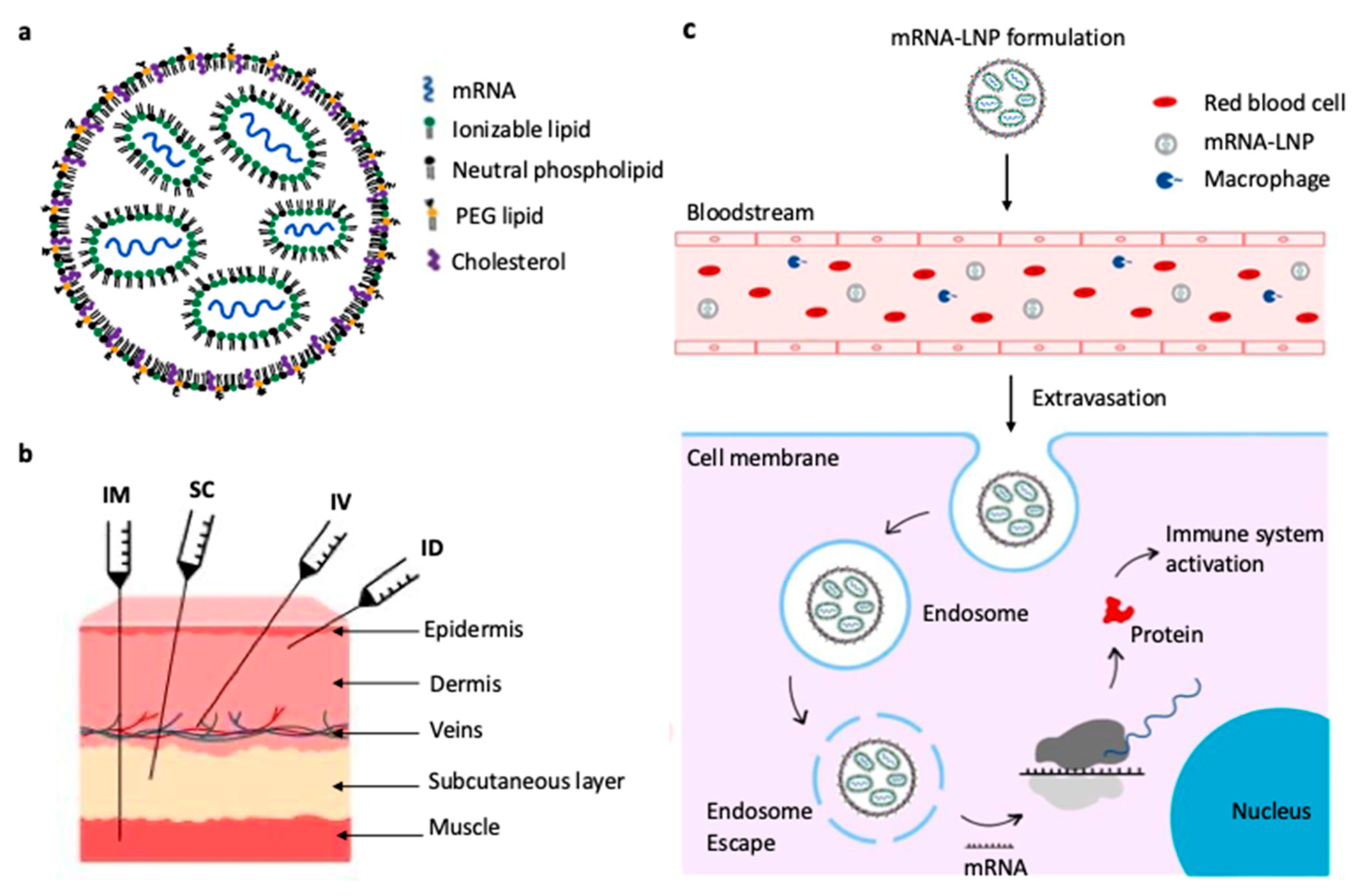
Table 3.
Freeze-drying process parameters of some mRNA vaccine studies.
| Freezing (Temperature/ Time) | Primary drying (Temperature/ Pressure/ Time) | Secondary drying (Temperature/ Pressure/ Time) | References |
|---|---|---|---|
| -45 °C / 3h | -25 °C / 2.7 Pa / 84h | 30 °C / 2.7 Pa / 5h | [21] |
| -40 °C / 2h | -35 °C / 10 Pa / 24h | 25 °C / 5h | [76] |
| -40 °C / 2h | -10 °C / 16 Pa / 17h | 2 °C / 6.8 Pa / 10h | [77] |
| -80 °C / 6h | -50 °C / 6 Pa / 24h | [78] | |
| -30 °C / 3h | -25 °C / 5-10 Pa / 16-18h | 22-27 °C / 20 Pa / 5h | [32] |
| -80 °C | 12h | - | [53,54] |
| -40 °C / 40 min -40 °C / 20 min |
-30 °C / 1h -20 °C / 1h -10 °C / 1h 0 °C / 1h |
10 °C / 1h 20 °C / 1h 30 °C / 3h |
[40,79] |
| -50 °C / 5h | -15 °C / 24 Pa / 12h |
30 °C / 13.3 Pa / 7h |
[39] |
| -40 °C / 3h | -20 °C / 13 Pa/ 10h | 25 °C / 5h | [69] |
| -20 °C | -30 °C / 3 Pa/ 30h | 25 °C / 3 Pa / 6h | [70] |
| -50 °C / 3h | -50 °C / 1h / 27 Pa -40 °C / 1h / 27 Pa -35 °C / 12h / 27 Pa |
30 °C / 10h | [66] |
| -50 °C / 1.5h | -30 °C / 7 Pa / 17.5h | 25 °C / 7 Pa / 1.5h | [71] |
Table 5.
Analytical Methods Used for Post-Lyophilization Characterization of mRNA-LNP Vaccines.
| Property | Analytical Method | Reference Study | Recommended Standard |
|---|---|---|---|
| Particle size | Dynamic light scattering (DLS) | [21,32,37,39,42,54,68] | Between 80 and 110 nm for optimal cellular uptake and biodistribution |
| Nanoparticle morphology, size, and internal structure | Transmission electron microscopy (TEM) Scanning Electron Microscopy (SEM) Cryogenic Electron Microscope Cryo-Transmission Electron Microscopy (Cryo-TEM) |
[32,37,39,69] [21,68] [68,70] [24,66] |
Uniform spherical or vesicular structures depending on the design Between 50 and 150 nm for optimal cellular uptake and biodistribution |
| Polydispersity index (PDI) | Dynamic light scattering (DLS) | [21,32,39,42,68] | ≤ 0.2 indicates a homogeneous particle population |
| Zeta potential | Electrophoretic light scattering (ELS) Dynamic light scattering (DLS) |
[32,37,39,42,54] | ± 20 to 30 mV is generally sufficient for colloidal stability and minimal aggregation |
| mRNA encapsulation efficiency | Quant-it Ribogreen fluorescence assay | [21,32,39,42,68] | ≥ 90-95% is typically targeted for therapeutic efficacy |
| mRNA concentration | Ribogreen fluorescence assay | [21,39] | Consistency across batches is key, the quantitative threshold depends on dose |
| mRNA integrity | Capillary electrophoresis | [21,32,39,68] | Intact single bands, degradation products should be minimal or absent |
| Lipid content | Ultra high-performance liquid chromatography (UHPLC) | [21] | Must match expected lipid: mRNA molar ratios |
| Residual moisture | Karl Fischer Titration | [69] | < 1% w/w is typically recommended to ensure long-term stability and prevent degradation |
| Visual appearance (cake quality) | Visual inspection (macroscopic evaluation) | [69] | Cake should be uniform, white, intact, without collapse or shrinkage |
| In vitro transfection efficiency | Luciferase report assay, GFP expression assay | [39,90] | Comparable or improved transfection vs freshly prepared LNP |
| In vitro cytotoxicity | Cell viability assays (CCK-8, MTT) | [68,90] | Usually, > 80% cell viability |
| In vivo immunogenicity | ELISA, HAI assay/titer | [21,24,68] | Robust and comparable immune response to fresh vaccine |
| In vivo biodistribution | IVIS imaging, fluorescence/ RNA quantification in organs | [39,90] | Distribution to the target tissue, low off-target accumulation |
Disclaimer/Publisher’s Note: The statements, opinions and data contained in all publications are solely those of the individual author(s) and contributor(s) and not of MDPI and/or the editor(s). MDPI and/or the editor(s) disclaim responsibility for any injury to people or property resulting from any ideas, methods, instructions or products referred to in the content. |
© 2025 by the authors. Licensee MDPI, Basel, Switzerland. This article is an open access article distributed under the terms and conditions of the Creative Commons Attribution (CC BY) license (http://creativecommons.org/licenses/by/4.0/).
Copyright: This open access article is published under a Creative Commons CC BY 4.0 license, which permit the free download, distribution, and reuse, provided that the author and preprint are cited in any reuse.