

Submitted:
11 July 2025
Posted:
11 July 2025
You are already at the latest version
Abstract
High-altitude and marine mammals inhabit vastly different ecosystems yet share the selective pressure of chronic hypoxia. Convergent evolutionary adaptations, particularly in pulmonary architecture with increased elastic fibers, facilitate efficient oxygen use under hypoxia. This review synthesizes molecular insights into these adaptations, highlighting gene family dynamics, positive selection, and convergent amino acid substitutions. The findings from comparative genomic studies offer valuable insights for human pulmonary fibrosis research.
Keywords:
convergent evolution
; pulmonary fibrosis
; hypoxia
; high-altitude mammals
; marine mammals
; gene families
; positive selection
; elastic fibers
Introduction
Hypoxia imposes severe selective pressures, driving convergent evolution among mammals in high-altitude and marine habitats. Despite differing environments, these mammals exhibit parallel adaptations, particularly in lung structure and function, essential for survival in low-oxygen conditions¹⁻4 (see Figure 1).”
Phenotypic Adaptations: Pulmonary Elasticity
Enhanced pulmonary elasticity, characterized by abundant elastic fibers, represents a critical adaptation. High-altitude mammals such as wild yaks and Xizang antelopes exhibit extensive elastic fibers in their alveolar septa, optimizing gas exchange efficiency5⁻7. Marine mammals, including whales and seals, similarly possess elastic-rich alveolar walls enabling lung collapse during deep dives, mitigating decompression sickness risks8.
Gene Family Expansion and Contraction
Comparative genomic analyses reveal significant expansions and contractions of gene families involved in cell morphogenesis, protein folding, and stress responses (see Figure 2). Notably, contractions in the keratin gene family are consistently observed, correlating with increased pulmonary elasticity and reduced fibrosis susceptibility9.
Genes Under Positive Selection and Accelerated Evolution
Genes undergoing positive selection and accelerated evolution, such as ZFP36L1, FN1, and NEDD9, are critical to pulmonary fibrosis pathways and lung morphogenesis. These genetic modifications are instrumental in developing enhanced elastic fiber networks crucial for pulmonary adaptation to chronic hypoxia10.
Convergent Amino Acid Substitutions
Convergent amino acid substitutions, exemplified by the leucine-to-isoleucine mutation in the SLC26A3 gene, influence pulmonary cellular adhesion and vascular development. These changes likely contribute to improved pulmonary functionality under prolonged hypoxic stress11.
Convergent Gene Loss
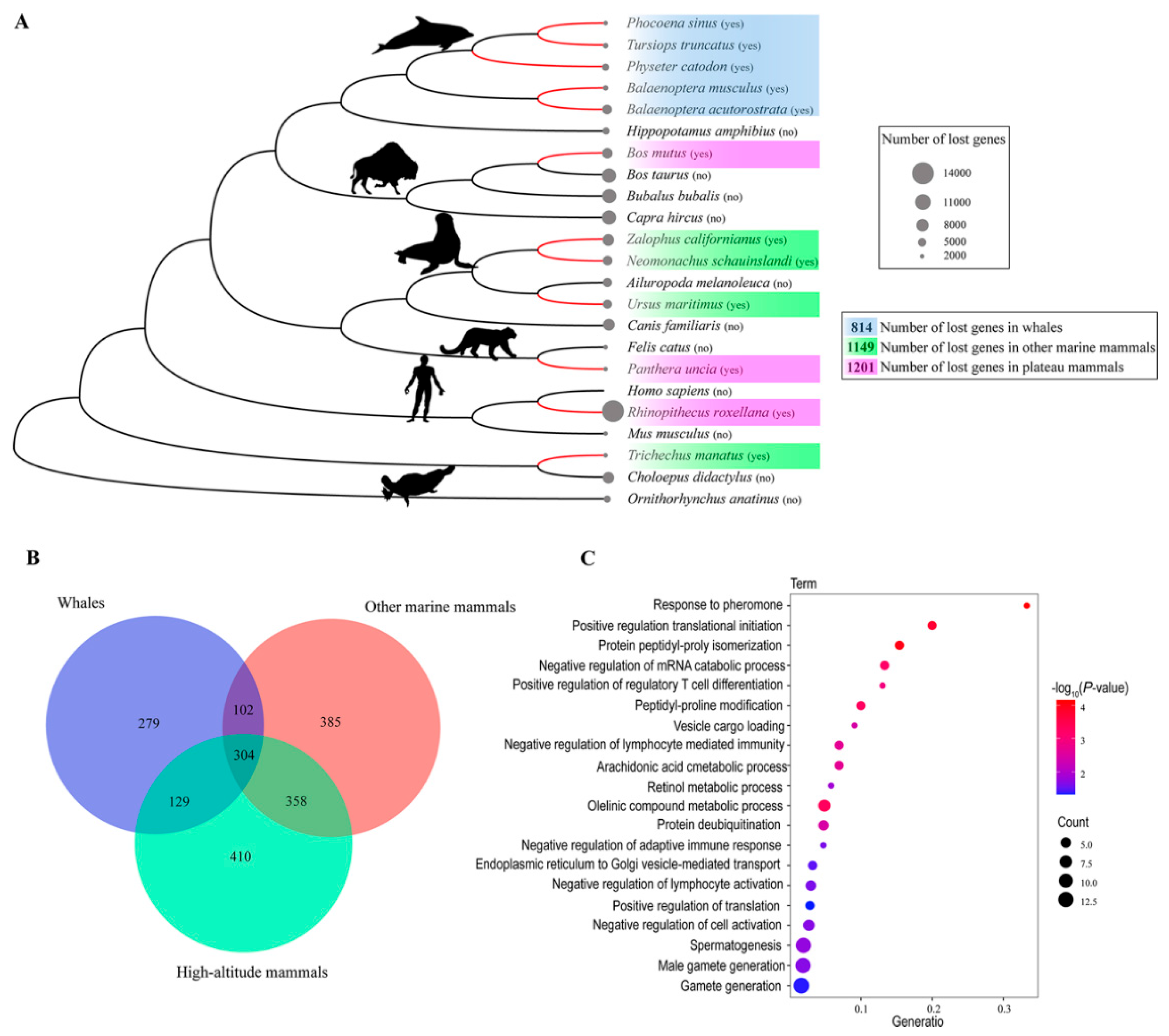
Gene loss analyses reveal convergent pseudogenization of CFAP47, vital in sperm morphology, in hypoxia-tolerant mammals. This relaxation in selective pressure highlights indirect reproductive adaptations potentially related to hypoxia tolerance mechanisms (see Figure 3).
Implications for Human Health
These evolutionary insights offer novel perspectives on human pulmonary disorders such as pulmonary fibrosis. In addition to the structural and genomic adaptations discussed above, recent advances in transcriptomic and multi-omics studies have highlighted the importance of regulatory networks—especially those involving non-coding RNAs—in pulmonary fibrosis and hypoxic adaptation. For example, competing endogenous RNA (ceRNA) networks and cross-talks among RNAs play crucial roles in regulating lung tissue remodeling, fibrosis, and cell survival under hypoxic stress, as shown in integrative studies of lung adenocarcinoma and other disease models12,13. Identifying these molecular pathways from comparative genomics and network-based research can inform new therapeutic strategies for managing human pulmonary fibrosis and related diseases.
Conclusion and Future Directions
Convergent pulmonary adaptations in hypoxia-adapted mammals involve complex genetic and molecular modifications, notably in lung elasticity and structure. Future studies focusing on functional validations and translational applications could significantly advance treatments for human pulmonary diseases.
Acknowledgments
Supported by the National Natural Science Foundation of China (Grant No. 32270442, 31872219, 31370401, 32030011, 31630071, 31772448) and the Postgraduate Research & Practice Innovation Program of Jiangsu Province (Grant No. KYCX23_1747, KYCX23_1740).
Conflict of Interest Statement
The author declares no conflicts of interest related to this manuscript.
References
- Mallet RT, Burtscher J, Pialoux V, Pasha Q, Ahmad Y, Millet GP, Burtscher M. Molecular Mechanisms of High-Altitude Acclimatization. Int J Mol Sci. 2023 Jan 15;24(2):1698. [CrossRef] [PubMed] [PubMed Central]
- Nathan J, Ramachandran A. Efficacy of marine biomolecules on angiogenesis by targeting hypoxia inducible factor/vascular endothelial growth factor signaling in zebrafish model. J Biochem Mol Toxicol. 2022;36(2):e22954. [CrossRef]
- Dong-Dong Wu, Cui-Ping Yang, Ming-Shan Wang, Kun-Zhe Dong, Da-Wei Yan, Zi-Qian Hao, Song-Qing Fan, Shu-Zhou Chu, Qiu-Shuo Shen, Li-Ping Jiang, Yan Li, Lin Zeng, He-Qun Liu, Hai-Bing Xie, Yun-Fei Ma, Xiao-Yan Kong, Shu-Li Yang, Xin-Xing Dong, Ali Esmailizadeh, David M Irwin, Xiao Xiao, Ming Li, Yang Dong, Wen Wang, Peng Shi, Hai-Peng Li, Yue-Hui Ma, Xiao Gou, Yong-Bin Chen, Ya-Ping Zhang, Convergent genomic signatures of high-altitude adaptation among domestic mammals, National Science Review, Volume 7, Issue 6, June 2020, Pages 952–963. [CrossRef]
- Pamenter ME, Hall JE, Tanabe Y, Simonson TS. Cross-Species Insights Into Genomic Adaptations to Hypoxia. Front Genet. 2020;11:743. Published 2020 Jul 22. [CrossRef]
- Li J, Meng X, Wang L, Yu Y, Yu H, Wei Q. Changes in the expression levels of elastic fibres in yak lungs at different growth stages. BMC Dev Biol. 2021 Apr 20;21(1):9. [CrossRef] [PubMed] [PubMed Central]
- Ivy CM, Scott GR. Control of breathing and the circulation in high-altitude mammals and birds. Comp Biochem Physiol A Mol Integr Physiol. 2015;186:66-74. [CrossRef]
- Tong X, Yang Y, Wang W, et al. Expression profiling of abundant genes in pulmonary and cardiac muscle tissues of Tibetan Antelope (Pantholops hodgsonii). Gene. 2013;523(2):187-191. [CrossRef]
- Zhang Y, Lv W, Yan W, Guo B, Yang G, Ren W. Molecular adaptations in MMP genes support lung elasticity and diving adaptations in cetaceans. BMC Genomics. 2025;26(1):562. Published 2025 Jun 5. [CrossRef]
- Lyu T, Zhou S, Fang J, et al. Convergent Genomic Signatures of High-Altitude Adaptation among Six Independently Evolved Mammals. Animals (Basel). 2022;12(24):3572. Published 2022 Dec 16. [CrossRef]
- Haine L, Bravais J, Yegen CH, et al. Sleep Apnea in Idiopathic Pulmonary Fibrosis: A Molecular Investigation in an Experimental Model of Fibrosis and Intermittent Hypoxia. Life (Basel). 2021;11(9):973. Published 2021 Sep 15. [CrossRef]
- Guo B, Sun Y, Wang Y, et al. Evolutionary genetics of pulmonary anatomical adaptations in deep-diving cetaceans. BMC Genomics. 2024;25(1):339. Published 2024 Apr 4. [CrossRef]
- Yang Y, Zhang S, Guo L. Characterization of Cell Cycle-Related Competing Endogenous RNAs Using Robust Rank Aggregation as Prognostic Biomarker in Lung Adenocarcinoma. Front Oncol. 2022;12:807367. Published 2022 Feb 3. [CrossRef]
- Guo L, Dou Y, Yang Y, et al. Protein profiling reveals potential isomiR-associated cross-talks among RNAs in cholangiocarcinoma. Comput Struct Biotechnol J. 2021;19:5722-5734. Published 2021 Oct 14. [CrossRef]
Figure 1.
Phylogenetic tree and divergence times based on fourfold degenerate sites of 5,243 one-to-one orthologous genes. Red font and “yes” represent species living in low-oxygen environments; black font and “no” represent closely related species. Adapted from the original article11.
Figure 1.
Phylogenetic tree and divergence times based on fourfold degenerate sites of 5,243 one-to-one orthologous genes. Red font and “yes” represent species living in low-oxygen environments; black font and “no” represent closely related species. Adapted from the original article11.
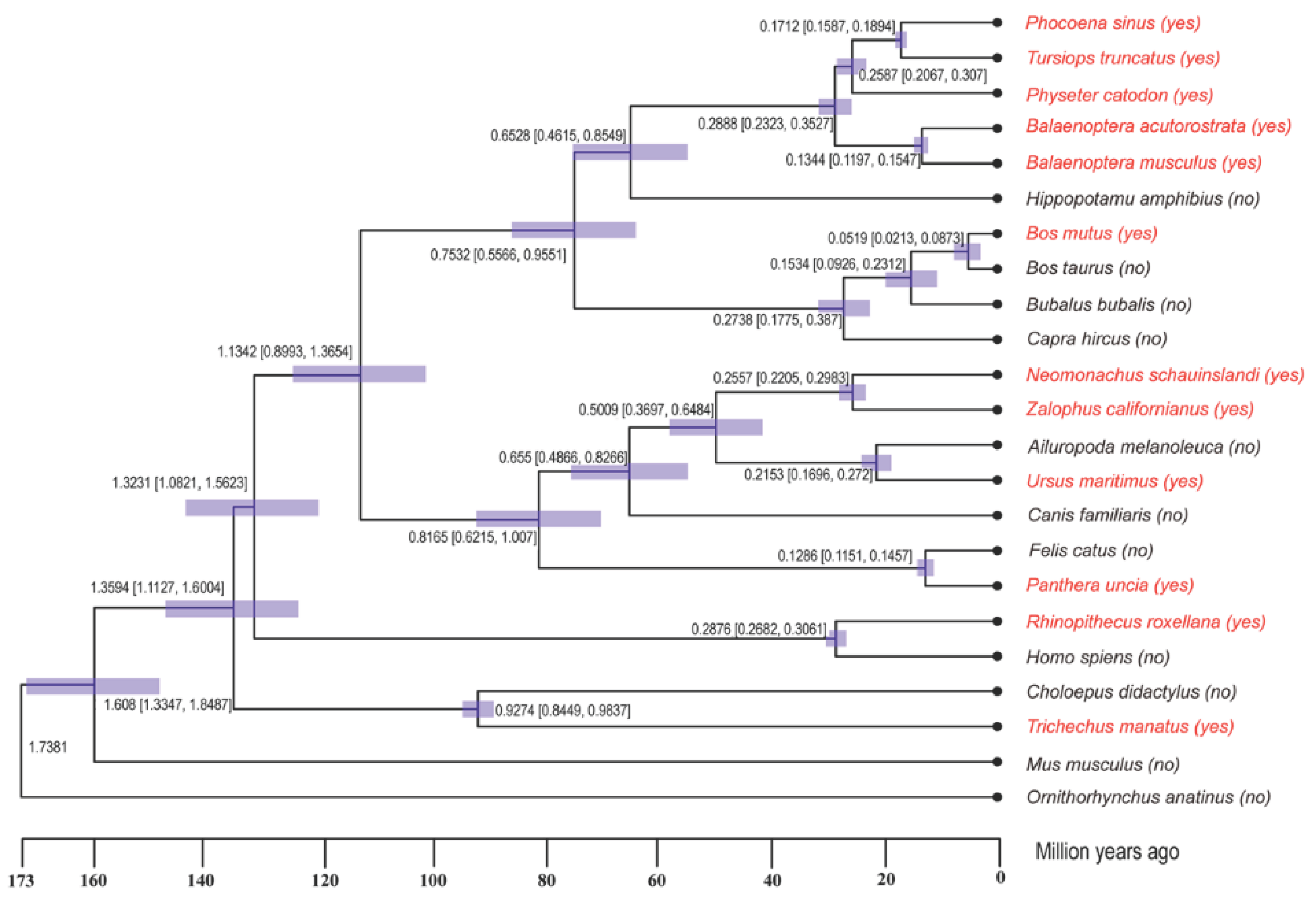
Figure 2.
Gene family expansion and contraction in 23 mammalian species. (A) Phylogenetic tree showing expansions (blue) and contractions (green). (B) Significant gene family expansions in hypoxia-tolerant mammals. (C) Functional annotation of significantly expanded gene families. Adapted from original article11.
Figure 2.
Gene family expansion and contraction in 23 mammalian species. (A) Phylogenetic tree showing expansions (blue) and contractions (green). (B) Significant gene family expansions in hypoxia-tolerant mammals. (C) Functional annotation of significantly expanded gene families. Adapted from original article11.
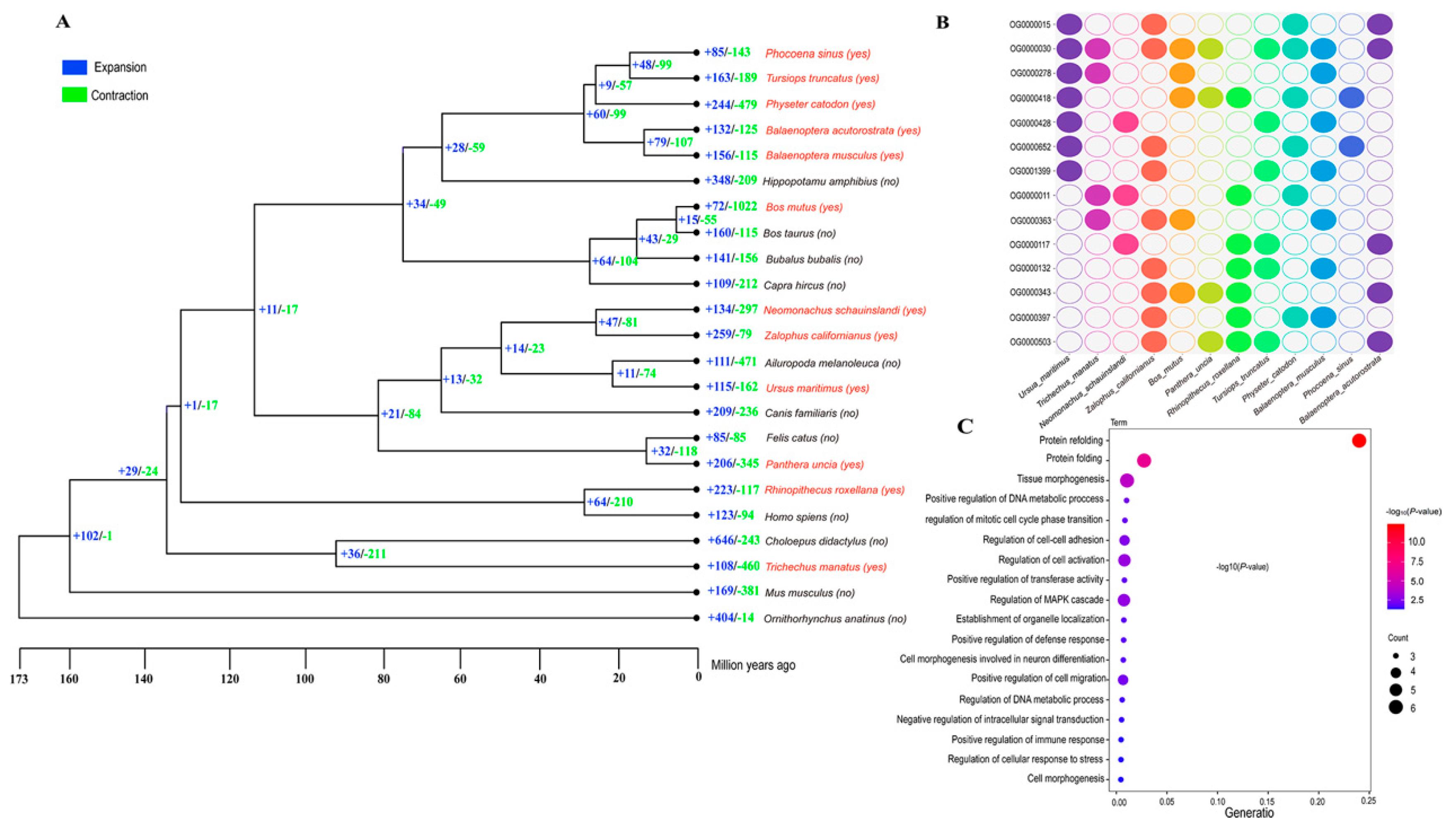
Figure 3.
Convergent gene loss and GO term enrichment analysis in whales, marine mammals, and high-altitude mammals. (A) Numbers of gene losses by lineage. (B) Venn diagram of commonly lost genes. (C) GO term enrichment of lost genes. Adapted from original article11.
Figure 3.
Convergent gene loss and GO term enrichment analysis in whales, marine mammals, and high-altitude mammals. (A) Numbers of gene losses by lineage. (B) Venn diagram of commonly lost genes. (C) GO term enrichment of lost genes. Adapted from original article11.
Disclaimer/Publisher’s Note: The statements, opinions and data contained in all publications are solely those of the individual author(s) and contributor(s) and not of MDPI and/or the editor(s). MDPI and/or the editor(s) disclaim responsibility for any injury to people or property resulting from any ideas, methods, instructions or products referred to in the content. |
© 2025 by the authors. Licensee MDPI, Basel, Switzerland. This article is an open access article distributed under the terms and conditions of the Creative Commons Attribution (CC BY) license (http://creativecommons.org/licenses/by/4.0/).
Copyright: This open access article is published under a Creative Commons CC BY 4.0 license, which permit the free download, distribution, and reuse, provided that the author and preprint are cited in any reuse.


