
Submitted:
09 July 2025
Posted:
10 July 2025
You are already at the latest version
Abstract
Power electronics is at the core of modern energy systems, including renewable integration, electric vehicles, and smart grids. With increasing system complexity and performance demands, Artificial Intelligence (AI) has emerged as a transformative tool in optimizing design, enhancing control strategies, diagnosing faults, and improving power quality. This paper presents a comprehensive review of AI applications in power electronics, focusing on four critical domains: converter design, control strategies, fault diagnosis, power quality. Key AI techniques, including neural networks, fuzzy logic, support vector machines, and reinforcement learning, are discussed in the context of their practical deployment. The paper also highlights future directions, challenges, and opportunities for integrating AI in next-generation power electronic systems.
Keywords:
power electronics
; artificial intelligence
; machine learning
; fault diagnosis
; converter design
; power quality
I. Introduction
Power electronics is a cornerstone of contemporary energy systems, enabling precise control and conversion of electrical power through semiconductor-based topologies such as DC-DC converters, inverters, and rectifiers. These systems are integral to applications ranging from grid-tied photovoltaic inverters to electric vehicle powertrains and variable-frequency drives, where primary objectives include minimizing switching and conduction losses, ensuring dynamic stability, and optimizing energy efficiency [1] . However, the increasing prevalence of high-frequency switching (>10 kHz), nonlinear load profiles, and stringent grid synchronization requirements, as mandated by standards like IEEE 1547, challenges traditional analytical and empirical approaches, resulting in suboptimal performance and reliability [2].
Artificial Intelligence (AI), encompassing supervised and unsupervised machine learning, deep learning architectures, and reinforcement learning paradigms, provides a robust framework to address these challenges. By leveraging data-driven optimization, adaptive control, and predictive analytics, AI enhances the design, operation, and maintenance of power electronic systems [3]. Comparable data-driven optimisation has also been demonstrated in mobile-cloud scenarios, where interaction-aware scheduling improves smartphone battery endurance [31]. This systematic review critically examines AI’s transformative impact across four domains: converter design, control strategies, fault diagnosis, and renewable energy systems. Each domain is explored through rigorously selected case studies, grounding AI applications in power electronics principles such as switching dynamics, thermal management, and harmonic mitigation. The paper synthesizes theoretical insights, practical implementations, and methodological limitations, offering a comprehensive perspective for researchers and practitioners in the field.
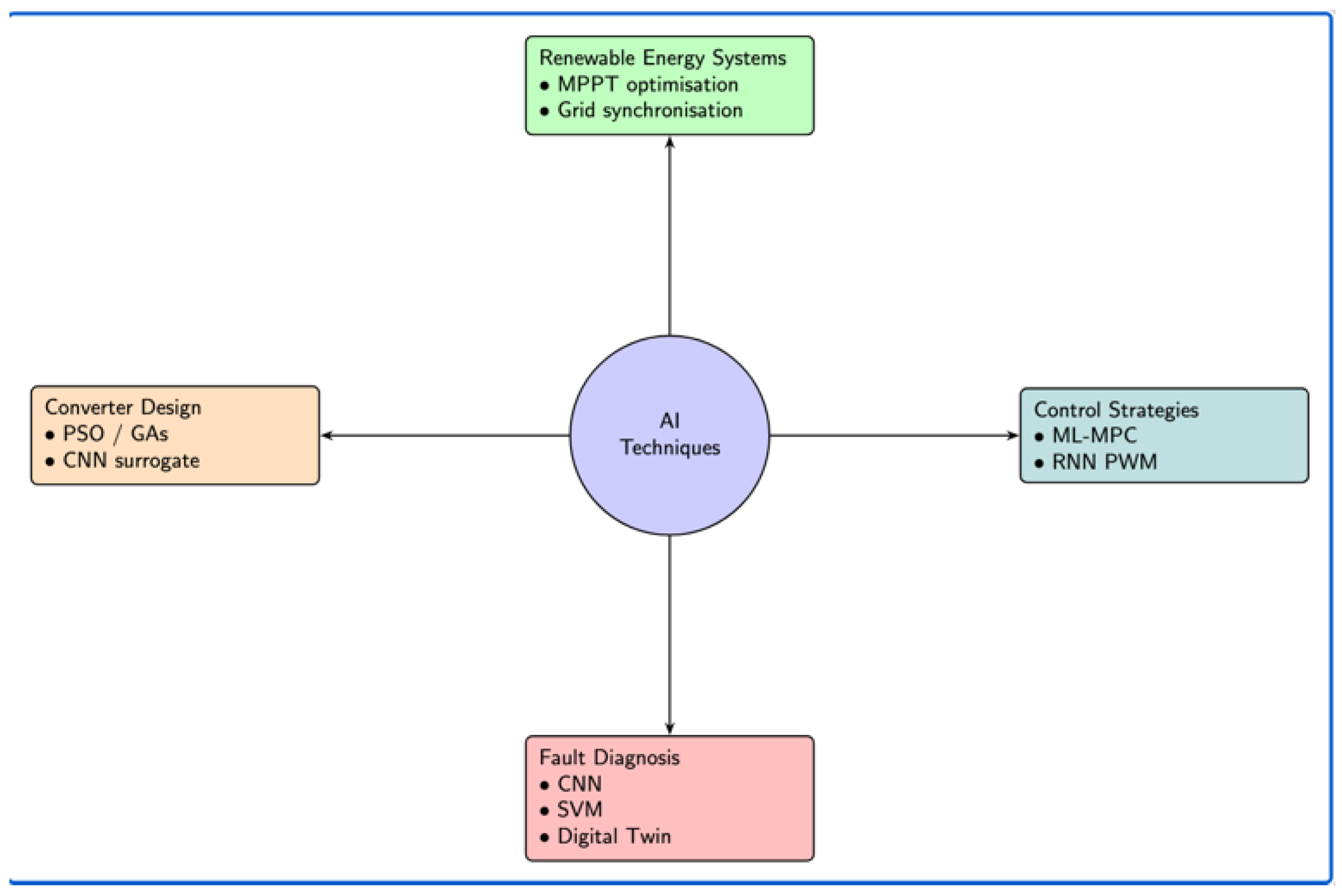
II. Ai in Converter Design
Power electronic converters of typologies including buck, boost, and multilevel inverters are essential for converting electrical energy to meet application-specific needs such as voltage, current, or frequency requirements. Converter design involves the selection of topologies, switching frequencies, and component parameters (inductors, capacitors, etc.) with minimal losses while maintaining thermal and electromagnetic limitations [4]. Traditional design processes often include analytical modeling followed by simulations, which require extensive computational time without the full design space exploration. AI-enabled approaches utilize optimization algorithms and surrogate models and automate and augment the converter design process.
A. AI Techniques in Converter Design
AI techniques for converter design include:
Evolutionary methods (e.g., GA, PSO) and deep/interactive learning methods (e.g., CNN, RL) constitute the two prevailing lines of AI-assisted converter design.
• Evolutionary class: global-search heuristics (GA, PSO) rapidly scan the discrete design space to approach a near-optimal trade-off between switching and conduction losses[5, 7].
• Deep & RL class: representation-learning networks (CNN) capture spatial–temporal device patterns, while policy-learning agents (RL) autonomously refine switching sequences via environment interactions [3 ,6].A recent algorithmic survey offers a taxonomy of these learning paradigms and their convergence properties [32].
These complementary paradigms jointly advance converter efficiency without manual parameter sweeps. Fuzzy-logic controllers—successfully adopted in automatic parking platforms [33]—constitute an alternative lightweight heuristic
B. Case in Converter Design
-
GA/PSO Encoding & Fitness
- a.
- Fitness function:
- b.
-
CNN Surrogate Model
- a.
- dataset generation workflow (Latin hyper-cube sampling → PLECS simulations)
- b.
- CNN architecture (input dim, #Conv layers, activation)
- c.
- MSE/MAE training loss & inference latency numbers.
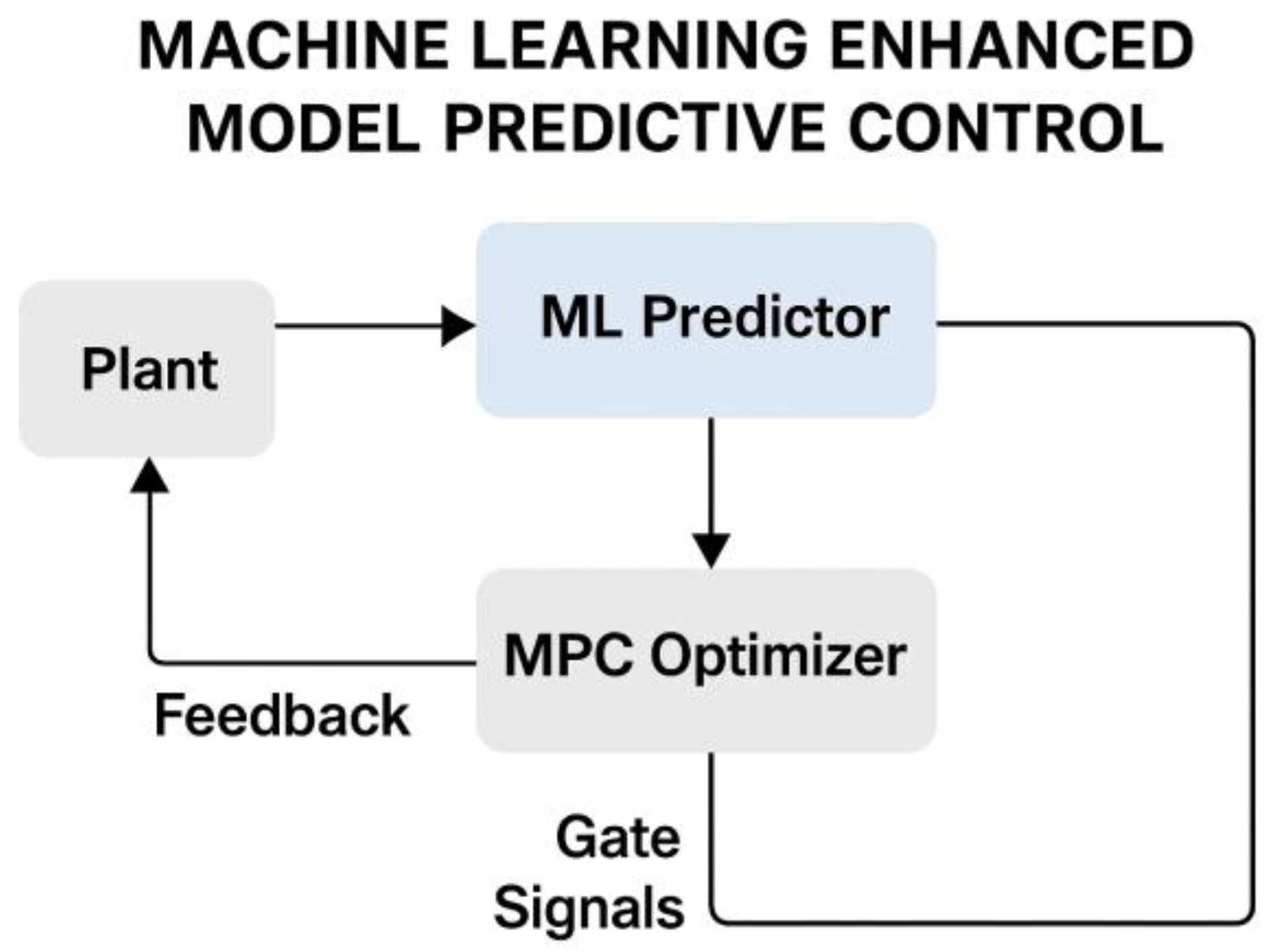
Siemens SINAMICS S120 AI Control: Siemens’ SINAMICS S120 industrial drive system integrates machine learning-enhanced Model Predictive Control (ML-MPC) to improve dynamic performance in converter design. The system leverages regression models to predict inductor current and torque ripple, dynamically optimizing Space Vector Modulation (SVM) for efficient Pulse Width Modulation (PWM). At a 12 kHz switching frequency, the AI-enhanced control reduces Total Harmonic Distortion (THD) from 4% to 2.5%, while overall system efficiency increases to 96%. This predictive control approach significantly reduces transient response times, improving stability under varying industrial load conditions [8,9].
Although the official documentation does not explicitly mention evolutionary algorithms, research studies have demonstrated that Particle Swarm Optimization (PSO) algorithms can effectively optimize drive control strategies, particularly for SVM-based industrial drives [10].
SolarEdge PV Monitoring System: SolarEdge’s Smart PV systems utilize machine learning algorithms optimize MPPT (maximum power point tracking) and improve fault detection for large solar energy applications. The AI system is able to predict shading effects from the monitoring of temperature and voltage distributions from the series of PV modules. Similarly, the AI performs an analysis on the anomalies that highlight hot spots of data instances. The AI-optimized-MPPT control will increase energy yield on average by 2.5% annually, while reducing operation and maintenance (O&M) costs by as much as 15%, which adds reliability and reduces unplanned downtime [11].
Although SolarEdge’s product documentation does not explicitly mention the use of Convolutional Neural Networks (CNNs), previous studies have shown that CNN-based models can effectively classify PV system faults and optimize MPPT tracking under complex environmental conditions [12,13].
These case studies demonstrate the transformative impact of AI techniques such as machine learning-enhanced predictive control and unsupervised anomaly detection in improving converter efficiency and reliability. Despite these notable advancements, several technical challenges remain that hinder the full realization of AI's potential in converter design.
III. AI in Power Electronics Control Strategies
Control strategies in power electronics regulate the dynamic behavior of converters and inverters, ensuring stable output voltage/current, minimizing harmonic distortion, and adapting to transient load conditions. Techniques such as pulse-width modulation (PWM) and space vector modulation (SVM) govern switching devices, but conventional proportional-integral-derivative (PID) controllers exhibit limited performance in nonlinear and high-frequency systems [8]. AI-driven control strategies leverage adaptive algorithms to optimize switching dynamics and enhance system robustness
A. AI Techniques in Power Electronics Control Strategies
AI techniques include:
- Machine Learning-Enhanced Model Predictive Control (ML-MPC): Employs regression models to predict state variables (e.g., inductor current) for optimal switching sequences [14].
- Recurrent Neural Networks (RNNs): Dynamically adjust PWM duty cycles based on real-time feedback, accommodating nonlinear load profiles [3].
- Fuzzy Logic Systems: Model imprecise sensor data to ensure robust control under grid disturbances [15].
B. Case in Power Electronics Control Strategies
Mitsubishi Electric DIASYS Netmation 5: Mitsubishi Electric’s DIASYS Netmation 5 control platform integrates deep learning models to stabilize grid frequency and optimize the operation of Flexible AC Transmission Systems (FACTS). The AI system predicts voltage deviations and load fluctuations, dynamically adjusting Static Var Compensator (SVC) and Static Synchronous Compensator (STATCOM) settings in real time. This predictive capability expands the grid’s stable operating range by 15% and reduces reactive power adjustment latency, contributing to improved system resilience during peak load scenarios [16].
Studies have validated the use of Particle Swarm Optimization (PSO) to enhance the control performance of FACTS devices like SVC and STATCOM [10].
Schneider Electric EcoStruxure: Schneider Electric’s EcoStruxure platform applies AI-driven load forecasting and real-time optimization in industrial power distribution systems. Using time-series analysis and clustering algorithms, EcoStruxure dynamically schedules loads and identifies inefficient energy usage. The AI-enhanced control improves energy efficiency by 8% and reduces system faults by 30%, resulting in a 20% annual reduction in maintenance costs and enhanced system stability [17,18].
IV. AI in Power Electronics Fault Diagnosis
Fault detection is an important area of research to avoid power electronic components being failure due to overcurrent, thermally induce stress or degradation of insulation. Common faults such as IGBT open-circuit failure, capacitor degradation, etc. may eventually result in system outages. Traditional fault diagnostics and detection schemes, that simply rely on thresholds, do not have predictive capabilities and sensitivity to complex fault patterns [13]. However, artificial intelligence (AI) based techniques provide, even if opportunistically, the benefit of proactive fault classifying and detection techniques thereby making the system more reliable.
A. AI Techniques in Power Electronics Fault Diagnosis
AI techniques include:
- Convolutional Neural Networks (CNNs): Analyze time-series data (e.g., gate drive signals) for fault classification [3].
- Unsupervised Anomaly Detection: Identify deviations in switching patterns via clustering algorithms [20].
- Digital Twins with AI: Simulate circuit behavior to predict component degradation [14].
B. Case in Power Electronics Fault Diagnosis
GE Wind Turbine Converter – Digital Wind Farm: The Digital Wind Farm platform developed by GE uses Long Short-Term Memory (LSTM) networks, a prescribed type of Recurrent Neural Network (RNN), to provide wind turbine converter predictive maintenance. The core of the predictive maintenance model uses time-series data resulting from the analysis of IGBT current, voltage, and temperature. If a fault occurs, the AI technology can identify and predict the fault as much as 48 hours ahead of a fault and beyond detecting faults, the AI technology can also predict failure of components before they arrive at the point of failure [21]. This predictive technology provides increased turbine availability from 97.8% to 99.7% and annual energy production improvements of 3% per turbine, at an approximate cost reduction of $20,000 in maintenance per turbine per year [22,23,24]. A federated-incremental framework equipped with anti-forgetting mechanisms [36] can further curtail bandwidth usage when models are updated across geographically dispersed turbines.
V. AI in Renewable Energy System
Renewable energy systems, including solar photovoltaic and wind power, rely on power electronics for energy conversion, grid synchronization, and storage management. Inverters, rectifiers, and maximum power point tracking (MPPT) algorithms are pivotal, yet challenges such as intermittency and grid stability persist [18]. AI optimizes power electronic components and control strategies to enhance system performance and integration.
A. AI Techniques in Renewable Energy System
AI techniques include:
- Machine Learning for Forecasting: Employs regression models to predict solar irradiance and wind speed [14].
- MPPT Optimization: Uses neural networks and RL to adjust duty cycles for optimal power extraction [6].
- Grid Synchronization: Adjusts inverter modulation using adaptive control algorithms [3].
B. Case in Renewable Energy System
ABB HVDC System with AI: ABB’s High Voltage Direct Current (HVDC) transmission system integrates advanced control strategies supported by AI and digital twin technologies. The MACH™ control system employs reinforcement learning algorithms to adjust converter parameters dynamically, improving system adaptability to real-time grid demands. The AI-enhanced control reduces transmission losses by 5% and voltage fluctuation amplitude by 30%, with system recovery times decreasing from 500 ms to 300 ms, significantly enhancing cross-regional grid reliability [25,26].
Conclusion
Artificial intelligence (AI) is transforming power electronics by offering new capabilities in design optimization, advanced control strategies, intelligent fault diagnostics, and management of renewable energy resources. In this paper, we reviewed these key areas of application in a systematic way and discussed concrete examples in industry by some of the leading companies, including Siemens, SolarEdge, Mitsubishi Electric, Schneider Electric, General Electric, and ABB. Through case studies, we evidenced that machine learning models, reinforcement learning (RL) approaches, recurrent neural networks (RNNs), and unsupervised anomaly detection have been applied to demonstrate tangible benefits to system performance, reliability, and responsiveness. For example, by using RNNs for predictive maintenance of wind turbines, availability rose, RL-based control approaches in high-voltage direct current (HVDC) systems improved dynamic stability and lowered transmission losses.
While various commercial deployments do not always provide specific AI algorithms used, a vast body of rigorous research has demonstrated, in academic literature, clear innovation paths forward (e.g., convolutional neural networks (CNNs), genetic algorithms (GA), particle swarm optimization (PSO), etc.), and demonstrated opportunities to take the next step from industry practice to academic innovation. Emerging privacy-preserving pipelines such as SPOT [38] and the growing emphasis on global cyber-security readiness [39]underscore the need for secure, standards-compliant AI deployment in power-conversion infrastructure.
Further, some significant overall challenges still remain. The ability to deploy complex AI models in real-time onto embedded hardware, robust operation under changeable operating conditions, and the absence of evaluations protocols that are agreed and applied in standardized ways, all pose significant barriers to replicable largescale AI deployments. Additionally, high-quality labeled datasets with scale to allow models to generalize for scaled-up deployment remain a scarcity [29]. Human–machine co-adaptation for prompt disambiguation [40], lightweight adaptor-based video inversion [41], coherence-aware narrative generation [42,46] and domain-specific surveys of ML algorithms [43,44,45] illustrate a rapidly widening methodological toolkit from which future power-electronics research can draw.
Moving forward, we suggest that future efforts focus on development low-latency AI algorithms for embedded hardware with continuous learning mechanisms [30], applied standardized AI frameworks as paradigms for specific power electronics applications, and use of digital twin models to build systems capable of predictive and adaptiveness. As the maturity of AI technologies continues to grow, its seamless integration into power electronic infrastructure will be important for achieving smarter, future-ready, resilient, and sustainable energy systems.
References
- “Electric Machines and Drives, 1st Edition | Wiley,” Wiley.com. Accessed: Apr. 28, 2025. [Online]. Available: https://www.wiley.com/en-us/Electric+Machines+and+Drives%2C+1st+Edition-p-9781118214480R150.
- “IEEE Standards Association,” IEEE Standards Association. Accessed: Apr. 28, 2025. [Online]. Available: https://standards.ieee.org/ieee/1547/5915/.
- “An Overview of Artificial Intelligence Applications for Power Electronics | IEEE Journals & Magazine | IEEE Xplore.” Accessed: Apr. 28, 2025. [Online]. Available: https://ieeexplore.ieee.org/document/9200511.
- von Jouanne, E. Agamloh, and A. Yokochi, “A Review of Matrix Converters in Motor Drive Applications,” Energies, vol. 18, no. 1, Art. no. 1, Jan. 2025. [CrossRef]
- J. H. Holland, “Genetic Algorithms,” Sci. Am., vol. 267, no. 1, pp. 66–73, 1992.
- L. P. Kaelbling, M. L. Littman, and A. W. Moore, “Reinforcement Learning: A Survey,” J. Artif. Intell. Res., vol. 4, pp. 237–285, May 1996. [CrossRef]
- J. Kennedy and R. Eberhart, “Particle swarm optimization,” in Proceedings of ICNN’95 - International Conference on Neural Networks, Nov. 1995, pp. 1942–1948 vol.4. [CrossRef]
- “Siemens accelerates path toward AI-driven industries through innov ...” Accessed: Apr. 28, 2025. [Online]. Available: https://press.siemens.com/global/en/pressrelease/siemens-accelerates-path-toward-ai-driven-industries-through-innovation-and.
- “SINAMICS S120,” siemens.com Global Website. Accessed: Apr. 28, 2025. [Online]. Available: https://www.siemens.com/global/en/products/drives/sinamics/low-voltage-converters/servo-converter/sinamics-s120.html.
- K. Ravi and M. Rajaram, “Optimal location of FACTS devices using Improved Particle Swarm Optimization,” Int. J. Electr. Power Energy Syst., vol. 49, pp. 333–338, Jul. 2013. [CrossRef]
- “PV Monitoring Platform - Solar Panel Efficiency | SolarEdge.” Accessed: Apr. 28, 2025. [Online]. Available: https://www.solaredge.com/en/products/software-tools/monitoring-platform.
- “Enhanced photovoltaic panel diagnostics through AI integration with experimental DC to DC Buck Boost converter implementation | Scientific Reports.” Accessed: Apr. 28, 2025. [Online]. Available: https://www.nature.com/articles/s41598-024-84365-5.
- S. Ansari, A. Ayob, M. S. H. Lipu, M. H. M. Saad, and A. Hussain, “A Review of Monitoring Technologies for Solar PV Systems Using Data Processing Modules and Transmission Protocols: Progress, Challenges and Prospects,” Sustainability, vol. 13, no. 15, Art. no. 15, Jan. 2021. [CrossRef]
- “Machine Learning-Enhanced Model Predictive Control for Incremental Bending of Skeletal Fixation Plates | ISFA | ASME Digital Collection.” Accessed: Apr. 28, 2025. [Online]. Available: https://asmedigitalcollection.asme.org/ISFA/proceedings-abstract/ISFA2024/87882/1204945.
- J. Y. Yoon, “A genetic algorithm approach to design an optimal fuzzy controller for rectifier current control in HVDC system,” in 1998 IEEE International Conference on Evolutionary Computation Proceedings. IEEE World Congress on Computational Intelligence (Cat. No.98TH8360), May 1998, pp. 404–409. [CrossRef]
- “Mitsubishi Power | DIASYS Netmation,” Mitsubishi Power. Accessed: Apr. 28, 2025. [Online]. Available: https://power.mhi.com/products/control-systems/diasys/spec/diasys-netmation.
- “Artificial Intelligence solutions and AI use cases.” Accessed: Apr. 28, 2025. [Online]. Available: https://www.se.com/us/en/work/solutions/artificial-intelligence/solutions.jsp.
- “EcoStruxure: IoT – Internet of Things.” Accessed: Apr. 28, 2025. [Online]. Available: https://www.se.com/us/en/work/campaign/innovation/overview.jsp.
- N. Shahid, S. A. Aleem, I. H. Naqvi, and N. Zaffar, “Support Vector Machine based fault detection & classification in smart grids,” in 2012 IEEE Globecom Workshops, Dec. 2012, pp. 1526–1531. [CrossRef]
- “Anomaly Detection in Smart Grids using Machine Learning.” Accessed: Apr. 28, 2025. [Online]. Available: https://www.researchgate.net/publication/356141365_Anomaly_Detection_in_Smart_Grids_using_Machine_Learning.
- M. Bošnjaković, M. Martinović, and K. Đokić, “Application of Artificial Intelligence in Wind Power Systems,” Appl. Sci., vol. 15, no. 5, Art. no. 5, Jan. 2025. [CrossRef]
- “GE Launches the Next Evolution of Wind Energy Making Renewables More Efficient, Economic: the Digital Wind Farm | GE News.” Accessed: Apr. 28, 2025. [Online]. Available: https://www.ge.com/news/press-releases/ge-launches-next-evolution-wind-energy-making-renewables-more-efficient-economic.
- “3 MW Onshore Wind Turbine | GE Vernova.” Accessed: Apr. 28, 2025. [Online]. Available: https://www.gevernova.com/wind-power/wind-turbines/onshore-wind-turbines-3mw.
- Walker, C. Rothon, K. Aslansefat, Y. Papadopoulos, and N. Dethlefs, “A Deep Learning Framework for Wind Turbine Repair Action Prediction Using Alarm Sequences and Long Short Term Memory Algorithms,” Jul. 26, 2022, arXiv: arXiv:2207.09457. [CrossRef]
- “Control and Protection for HVDC : An introduction to MACH : Hitachi Review.” Accessed: Apr. 28, 2025. [Online]. Available: https://www.hitachihyoron.com/rev/archive/2023/r2023_04/04a04/index.html.
- “MACHTM control and protection system | Hitachi Energy.” Accessed: Apr. 28, 2025. [Online]. Available: https://www.hitachienergy.com/us/en/products-and-solutions/hvdc/mach-control-and-protection-system.
- Y. P. Wang, N. R. Watson, and H. H. Chong, “Modified genetic algorithm approach to design of an optimal PID controller for AC–DC transmission systems,” Int. J. Electr. Power Energy Syst., vol. 24, no. 1, pp. 59–69, Jan. 2002. [CrossRef]
- P. Li et al., “Deep Reinforcement Learning-Based Adaptive Voltage Control of Active Distribution Networks with Multi-terminal Soft Open Point,” Int. J. Electr. Power Energy Syst., vol. 141, p. 108138, Oct. 2022. [CrossRef]
- “Applications of AI for Power Electronics and Drives Systems: A Review | IEEE Conference Publication | IEEE Xplore.” Accessed: Apr. 28, 2025. [Online]. Available: https://ieeexplore.ieee.org/abstract/document/8960123.
- E. Ragusa, C. Gianoglio, S. Dosen, and P. Gastaldo, “Hardware-Aware Affordance Detection for Application in Portable Embedded Systems,” IEEE Access, vol. 9, pp. 123178–123193, 2021. [CrossRef]
- J. Xu, C. Guan and X. Xu, “Energy-efficiency for smartphones using interaction link prediction in mobile cloud computing,” in Computer Supported Cooperative Work and Social Computing (ChineseCSCW 2018), Guilin, China, Aug. 2018, Revised Selected Papers, pp. 517-526, Springer, 2019.
- M. Gao, Y. Wei, Z. Li, B. Huang and C. Zheng, “A survey of machine learning algorithms,” in Proc. 8th Int. Conf. on Computing, Control and Industrial Engineering (CCIE 2024), vol. 1, pp. 467-474, Springer, 2024.
- M. Gao, Y. Wei, Y. He, D. Zhang, Y. Tian and B. Huang, “Fuzzy controller-based design and simulation of an automatic parking system,” Journal of Software Engineering and Applications, vol. 16, no. 9, pp. 505-520, 2023.
- J. Wang, Z. Zhang, Y. He, Y. Song, T. Shi, Y. Li et al., “Enhancing code LLMs with reinforcement learning in code generation,” arXiv:2412.20367, 2024.
- Wang, C. Nie and Y. Liu, “Evaluating supervised learning models for fraud detection: a comparative study of classical and deep architectures on imbalanced transaction data,” arXiv:2505.22521, 2025.
- K. Zhu, J. Xu, L. Zhou, X. Li, Y. Zhao, X. Xu and S. Li, “DMAF: data-model anti-forgetting for federated incremental learning,” Cluster Computing, vol. 28, no. 1, art. 30, 2025.
- J. Xu, Y. Zhao, X. Li, L. Zhou, K. Zhu, X. Xu et al., “TEG-DI: dynamic incentive model for federated learning based on tripartite evolutionary game,” Neurocomputing, vol. 621, art. 129259, 2025.
- X. Xu, Q. Zhang, R. Ning, C. Xin and H. Wu, “SPOT: structure patching and overlap tweaking for effective pipelining in privacy-preserving MLaaS with tiny clients,” in Proc. 44th IEEE Int. Conf. on Distributed Computing Systems (ICDCS), pp. 1318-1329, 2024.
- Y. Weng and J. Wu, “Fortifying the global data fortress: a multidimensional examination of cyber security indexes and data protection measures across 193 nations,” International Journal of Frontiers in Engineering Technology, vol. 6, no. 2, pp. 13-28, 2024.
- Y. He, J. Wang, K. Li, Y. Wang, L. Sun, J. Yin et al., “Enhancing intent understanding for ambiguous prompts through human-machine co-adaptation,” arXiv:2501.15167, 2025.
- Y. He, S. Li, K. Li, J. Wang, B. Li, T. Shi et al., “Enhancing low-cost video editing with lightweight adaptors and temporal-aware inversion,” arXiv:2501.04606, 2025.
- Q. Yi, Y. He, J. Wang, X. Song, S. Qian, M. Zhang et al., “SCORE: story coherence and retrieval enhancement for AI narratives,” arXiv:2503.23512, 2025.
- Y. Wei, D. Zhang, M. Gao, A. Mulati, C. Zheng and B. Huang, “Skin cancer detection based on machine learning,” Journal of Knowledge Learning and Science Technology, vol. 3, no. 2, pp. 72-86, 2024.
- M. Gao, Y. Wei, Z. Li, B. Huang, C. Zheng and A. Mulati, “A survey of machine learning algorithms for defective steel plates classification,” in International Conf. on Computing, Control and Industrial Engineering, pp. 467-476, Springer, 2024.
- Y. Weng and J. Wu, “Big data and machine learning in defence,” International Journal of Computer Science and Information Technology, vol. 16, no. 2, art. 03, 2024.
- T. Ding, D. Xiang, T. Sun, Y. Qi, and Z. Zhao, "AI-driven prognostics for state of health prediction in Li-ion batteries: A comprehensive analysis with validation," in Proc. 6th Int. Conf. Electr. Technol. Autom. Control (ICETAC), 2025, arXiv:2504.05728.
Disclaimer/Publisher’s Note: The statements, opinions and data contained in all publications are solely those of the individual author(s) and contributor(s) and not of MDPI and/or the editor(s). MDPI and/or the editor(s) disclaim responsibility for any injury to people or property resulting from any ideas, methods, instructions or products referred to in the content. |
© 2025 by the authors. Licensee MDPI, Basel, Switzerland. This article is an open access article distributed under the terms and conditions of the Creative Commons Attribution (CC BY) license (http://creativecommons.org/licenses/by/4.0/).
Copyright: This open access article is published under a Creative Commons CC BY 4.0 license, which permit the free download, distribution, and reuse, provided that the author and preprint are cited in any reuse.


