

Submitted:
09 July 2025
Posted:
10 July 2025
You are already at the latest version
Abstract
Inflation was originally conceived as an elegant solution to the horizon, flatness, and relic problems of standard cosmology, with single-field models long favored for their simplicity and predictive power. However, developments in high-energy theory increasingly motivate scenarios with multiple interacting scalar fields. Multifield inflation introduces new conceptual elements, including field-space geometry, entropy perturbations, and non-geodesic dynamics, which can significantly affect inflationary predictions. This conceptual paper examines the foundational shift from single-field to multifield inflation, highlighting how multifield models provide novel mechanisms for generating cosmological relics, such as primordial black holes (PBHs) and nonthermal dark matter (DM). Once viewed as an artificial complication, multifield inflation now emerges as a conceptually rich and observationally testable paradigm for early universe cosmology.
Keywords:
Inflation
; Single‑field models
; Multifield inflation
; PBHs
; Early universe cosmology
1. Introduction
Cosmic inflation was originally proposed as a mechanism to explain key puzzles in the standard Big Bang model, such as the horizon, flatness, and monopole problems [1,2,3]. The introduction of a brief epoch of accelerated expansion resolved these issues while providing a natural origin for the nearly scale-invariant spectrum of primordial fluctuations, which later seeded large-scale structure (LSS) [4,5]. Over time, the predictions of inflationary models have been impressively confirmed by increasingly precise observations [6] of the cosmic microwave background (CMB) [7,8,9,10,11,12,13]. For much of its history, the inflationary paradigm has been dominated by single-field models. These involve a single canonical scalar field slowly rolling down a potential, and they are prized for their simplicity, calculability, and often, their predictive power. In such models, observables such as the scalar spectral index , the tensor-to-scalar ratio r, and the level of non-Gaussianity are primarily determined by the form of the inflaton potential and its derivatives [14,15]. This led to a common perception that the best models are those with the fewest parameters, an aesthetic preference often justified by Occam’s razor.
However, there is increasing recognition that this minimalist approach, while elegant, may not reflect the structure of realistic high-energy theories. Theoretical constructions arising from supergravity, string theory, and higher-dimensional models generically predict the existence of multiple scalar fields1 with nontrivial interactions and kinetic terms [16,17,18]. Even within the context of effective field theory (EFT), additional degrees of freedom often cannot be consistently decoupled without fine-tuning. This realization has led to renewed interest in multifield models of inflation [19,20,21,22,23,24], in which inflation is driven or influenced by more than one scalar field.
Multifield inflation introduces a host of new conceptual and phenomenological possibilities. The presence of multiple fields generically gives rise to entropy (isocurvature) perturbations in addition to the adiabatic mode, and the evolution of the system is governed not just by the potential, but by the geometry of the field-space manifold. In particular, when the trajectory of inflation in field space deviates from a geodesic, new dynamical features such as turning rates and coupling between perturbation modes become central to the dynamics [17,25]. These effects can lead to observable deviations from single-field predictions, including scale-dependent non-Gaussianities, modified consistency relations, and characteristic signatures in the tensor and isocurvature sectors [26,27].
Moreover, multifield models offer promising avenues for addressing persistent cosmological questions. Notably, they provide new mechanisms for the generation of PBHs, which have been proposed as candidates for DM and as probes of small-scale cosmological perturbations [28,29]. For instance, features in the potential or sudden turns in the inflationary trajectory can enhance power at small scales, triggering gravitational collapse upon horizon re-entry. Similarly, spectator fields or curvaton-like mechanisms can yield non-thermal DM or non-Gaussian signatures beyond what is accessible in single-field models [30,31,32,33].
At the same time, the multifield paradigm raises deep conceptual and philosophical questions. The proliferation of models and parameters complicates issues of predictivity and testability. If a wide range of models can reproduce the same set of observed CMB parameters, then what, if anything, does current data truly reveal about the inflationary mechanism? This issue is compounded by the “measure problem" [34,35,36,37,38,39] in eternal inflation, where different regions of the universe sample different field configurations, potentially undermining the statistical significance of any given prediction [40,41]. Furthermore, the move from single-field to multifield frameworks intersects with discussions on naturalness, fine-tuning, and the role of anthropic selection in cosmology [42,43].
Despite these challenges, the rise of multifield models reflects a broader maturation of inflationary theory. Rather than viewing multifield dynamics as unnecessary complications, the modern perspective increasingly treats them as expected consequences of embedding inflation in a high-energy theoretical context. As such, they deserve conceptual as well as phenomenological scrutiny.
In this paper, we explore the conceptual transition from single-field to multifield inflation, emphasizing foundational motivations, theoretical structures, and cosmological consequences. We begin by reviewing the standard single-field paradigm and its limitations ( Section 2) then in Section 3 we examine drivers of the multifield turn including string theory motivations, observational hints, and philosophical shifts. Section 4 introduces the geometry, dynamics, and attractor structures of multifield inflation with illustrative models, while Section 5 contrasts single- and multifield frameworks in terms of predictivity, initial conditions, and quantum-classical issues. Section 6 discusses multifield implications for cosmological relics such as PBHs and DM, and Section 7 examines observational tests from CMB, LSS, and gravitational waves (GWs). We provide a general synthesis in Section 8, and we conclude with discussion in Section 9 about the directions for future theoretical inquiry.
2. Single-Field Inflation: Successes and Concealed Assumptions
The success of the inflationary paradigm is often credited to its explanatory power in solving long-standing puzzles of the standard Big Bang cosmology. In its simplest realization, inflation is modeled by a single scalar field , minimally coupled to gravity, rolling slowly down a potential ; an illustration of a simple potential is shown in Figure 1. This section elaborates on two core conceptual pillars of this framework: (i) the ability of a period of accelerated expansion to resolve the horizon and flatness problems, and (ii) the mechanism by which quantum fluctuations in the inflaton field generate classical cosmological perturbations that seed the formation of LSS.
The horizon problem refers to the observed homogeneity and isotropy of the CMB over causally disconnected regions. In standard cosmology without inflation, the particle horizon at the time of recombination corresponds to only a few degrees on the sky, implying that regions on larger angular scales could not have been in causal contact to thermalize. Inflation resolves this by postulating a period of accelerated expansion, characterized by , where is the scale factor. This causes comoving Hubble radius to shrink, allowing initially microscopic regions to grow and encompass the entire observable universe. More formally, consider the comoving distance to the particle horizon
In a decelerating universe, is bounded, but in an inflationary epoch with nearly constant Hubble parameter H, and grows exponentially, enabling causal contact over much larger scales. Similarly, the flatness problem arises from the Friedmann equation
which implies that any initial curvature grows relative to the critical density as during standard expansion. Inflation rapidly drives due to the exponential increase in a, effectively flattening the universe. Quantitatively, only about 60 e-folds of inflation are needed to suppress curvature to a level consistent with current observations [1,44,45].
These successes form the empirical backbone of the inflationary model, explaining features of the universe without requiring finely tuned initial conditions. However, the assumption of a single field slowly rolling on a flat potential is critical to achieving sufficient e-folds, and as we discuss later, this simplicity masks deeper issues related to initial conditions and fine-tuning.
The second key pillar of single-field inflation lies in its explanation of the origin of cosmic structure. Quantum fluctuations of the inflaton field, generated during inflation, are stretched to super-Hubble scales by the rapid expansion. These fluctuations become effectively classical and serve as the seeds for the temperature anisotropies observed in the CMB and for the large-scale distribution of galaxies.
In the linear perturbation theory of inflation, the scalar field is decomposed as
where is the homogeneous background and represents fluctuations. These fluctuations couple to metric perturbations and evolve according to the Mukhanov-Sasaki equation [47]
where is a canonical variable related to and , with denoting conformal time [47,48,49].
On sub-Hubble scales (), these modes oscillate as quantum vacuum fluctuations. As the universe expands, modes cross the Hubble radius (), and the oscillatory behavior freezes out, leading to classical stochastic perturbations. The power spectrum of the curvature perturbation is then given by
predicting a nearly scale-invariant spectrum consistent with CMB observations [7,8,9,10,11,12,13,15].
This quantum-to-classical transition remains an area of debate. While decoherence and squeezing of field modes offer partial explanations, the measurement problem of cosmology lingers: what constitutes an “observer" in the early universe? Nonetheless, single-field inflation provides a compelling and mathematically precise mechanism for generating primordial structure, one that has been remarkably successful in confronting observations. Figure 2 provides a powerful observational testbed for inflationary theories by juxtaposing cosmological data with theoretical predictions in the –r plane. Each trajectory corresponds to a distinct inflationary potential, with its associated predictions for the spectral tilt and tensor amplitude. The exclusion or viability of models depends on their overlap with the shaded regions, which encode the current empirical bounds.
These two pillars—the resolution of classical cosmological puzzles via accelerated expansion and the generation of primordial fluctuations from quantum origin—form the conceptual heart of single-field inflation. Their success is undeniable. Yet, as we explore in later sections, this elegance may obscure the need for fine-tuned potentials, carefully chosen initial conditions, and assumptions about the uniqueness and isolation of the inflaton field.
2.1. Implicit Assumptions
Despite the empirical success of single-field inflationary models, several implicit assumptions underlie their theoretical simplicity. These assumptions are often accepted without question but carry significant implications for the naturalness and generality of the inflationary framework. Two such foundational assumptions are the uniqueness of the inflaton field and the assumed trade-off between simplicity and naturalness.
In canonical single-field models, inflation is driven by a unique scalar degree of freedom, , the inflaton—whose evolution determines both the background expansion and the spectrum of primordial perturbations. This assumption dramatically simplifies the theoretical treatment, but it raises deep conceptual questions: Why should there exist a single scalar field dominating the dynamics of the early universe? What selects this field out of the many scalar degrees of freedom expected in ultraviolet (UV)-complete theories such as string theory or supergravity [50]? And what ensures that this field evolves in isolation, unaffected by other light or heavy fields [51]?
In high-energy completions of the Standard Model, such as string compactifications, supersymmetric theories, or extra-dimensional frameworks, scalar fields are generically abundant. These include moduli fields, axions, dilatons, and others arising from compactification geometries or symmetry breaking [52,53,54]. In these settings, it is unnatural to assume that only one scalar field remains light and dynamically relevant during inflation while all others are either stabilized or decoupled. Instead, multifield dynamics often emerge as the generic case [17,23]. From this perspective, single-field inflation is not minimal but highly specialized.
Furthermore, the uniqueness assumption implicitly posits a highly tuned field-space structure—flat directions, decoupling of interactions, and absence of significant turns or field-space curvature. These features are not generic in a high-dimensional landscape. Even if other fields are massive, their couplings to the inflaton can induce nontrivial effects through quantum loops or during turns in the inflationary trajectory, potentially modifying observable predictions [55].
Observationally constraining single-field models can mislead if the underlying dynamics involve transient multifield behavior that effectively reduces to single-field by horizon crossing. This underscores the importance of considering more general field-space geometries and dynamical couplings when interpreting cosmological data.
One of the main attractions of single-field inflation is its mathematical and phenomenological simplicity. With only a few parameters—the shape of , the slow-roll (SR) conditions, and initial values—it provides a predictive and elegant mechanism for early-universe dynamics. Yet this simplicity comes at a price. Achieving sufficient inflation, compatibility with observations, and graceful exit often requires fine-tuning of the potential’s shape and the initial conditions [56,57]. For instance, large-field inflationary models (e.g., ) are increasingly disfavored by Planck data [8] due to their prediction of high r [8]. Meanwhile, small-field or plateau-like models (e.g., Starobinsky inflation, , or Higgs inflation, c.f. [58,59,60,61,62,63,64,65,66]) match observations well but raise questions about UV completion, stability, and the origin of the flatness of the potential [4,67,68]. Such models often involve non-minimal couplings or require tuning of parameters to preserve SR over the desired number of e-folds.
Moreover, the SR conditions themselves represent a form of fine-tuning 2. The parameters must remain small over many Hubble times, requiring the inflaton potential to be both flat and stable against quantum corrections. In quantum field theory, maintaining such flatness generically demands a degree of fine-tuning or protection via symmetry, such as shift symmetries or supersymmetry, which must be embedded consistently within a UV theory [72,73].
The simplicity of the single-field models also precludes many phenomenologically rich behaviors: multiple phases of inflation, curved field-space dynamics, entropy/isocurvature perturbations, and non-Gaussian signatures—all of which are naturally incorporated in multifield models. Thus, the trade-off between simplicity and naturalness invites reevaluation: perhaps what is perceived as “simplest" is, in fact, an artifact of our preference for minimal models, not a reflection of fundamental physics. The assumptions of a unique inflaton and simplicity as a guiding principle may obscure important theoretical challenges. These assumptions warrant careful scrutiny, especially in light of both observational constraints and theoretical expectations from high-energy physics. As we argue in the next section, these hidden assumptions are among the key reasons to explore the multifield generalizations of inflation more seriously.
2.2. Emerging Tensions
Despite the elegance and empirical adequacy of single-field inflation, a number of theoretical and observational tensions have emerged in recent years. These tensions challenge the internal consistency and naturalness of the paradigm, particularly in light of high-energy physics considerations and improving observational constraints. In what follows, we focus on two such tensions: the implications of the Lyth bound for field excursions and tensor amplitudes, and the pervasive issue of fine-tuning—both in the inflationary potential and in the initial conditions required to achieve successful inflation.
Lyth Bound and Tensor Amplitudes
The detection or non-detection of primordial tensor modes (GWs) is among the most important observational probes of inflation. In single-field SR inflation, the amplitude of tensor perturbations is directly related to the Hubble scale during inflation and to the energy scale of the inflaton potential. r is given by
where is a SR parameter. Integrating this expression leads to the so-called Lyth bound [74,75,76], which relates the total field excursion to the tensor amplitude
This bound implies that an observable tensor amplitude requires a super-Planckian field excursion. Large-field models of inflation, such as , naturally accommodate this, but they face serious theoretical challenges. In particular, EFTs are typically only trusted below the Planck scale, and super-Planckian field excursions invite concerns about UV sensitivity, control over higher-dimensional operators, and breakdown of the low-energy description [50].
Conversely, small-field models, in which , often predict small tensor amplitudes. These models, such as hilltop or plateau potentials, match current constraints from Planck [8], which place an upper limit at 95% confidence level. However, the suppression of tensors in such models is achieved at the cost of additional tuning: the potential must be sufficiently flat, and inflation must start in a finely selected region of field space. Moreover, if future observations detect primordial B-modes at a level , many of these small-field scenarios would be ruled out, tightening the tension between naturalness and empirical viability.
This dichotomy presents a conceptual impasse: while small-field models are observationally viable under current constraints, they offer limited prospects for direct detection of tensor modes; large-field models promise observable GWs but challenge theoretical consistency at high energies. The Lyth bound crystallizes this tension, indicating that any detectable r implies Planck-scale dynamics, thereby motivating the need to embed inflation within a more complete high-energy framework. This tension suggests that a shift beyond the single-field paradigm may be necessary to reconcile observational accessibility with theoretical robustness.
Fine-Tuning of Potential and Initial Conditions
Another longstanding criticism of single-field inflation concerns the degree of fine-tuning required in both the shape of the inflaton potential and the initial conditions for the field. In the simplest models, successful inflation requires the inflaton to start high on a sufficiently flat potential and roll slowly enough to generate the required number of e-folds (typically ). This entails that the potential satisfies the SR conditions
Achieving this often requires a degree of parameter tuning. For example, plateau-like potentials such as the Starobinsky model [4] or Higgs inflation [67,68] fit observations well but rely on non-minimal couplings or engineered cancellations to maintain flatness over the relevant field range.
Attempts to resolve this include invoking attractor solutions (in which a wide range of initial conditions converge on an inflationary trajectory) or pre-inflationary dynamics that set favorable initial conditions [77,78,79]. However, these approaches typically require additional assumptions or extensions to the basic framework. Moreover, attractor behavior is more generic in multifield or noncanonical models than in standard single-field scenarios3 [81].
Recent studies also point out that quantum corrections can destabilize inflationary potentials unless protected by symmetries (e.g., shift symmetries or supersymmetry). Embedding these protections in a UV-complete theory like string theory is nontrivial and remains an active area of research [50,72]. Some string-inspired models, such as axion monodromy, attempt to achieve large-field inflation with controlled corrections, but they face their own challenges4 [85].
The interplay between theoretical consistency and observational expectations brings out subtle challenges in single-field inflation. The Lyth bound illustrates the difficulty of generating observable GWs while maintaining effective field theory control, and the sensitivity to specific potentials and initial conditions invites further investigation into the generality of inflationary dynamics. These considerations naturally lead to the exploration of more flexible scenarios, such as multifield inflation, which we turn to in the next section.
3. Drivers of the Multifield Turn
The increasing interest in multifield models of inflation is not merely a matter of empirical flexibility or phenomenological richness; rather, it is strongly motivated by theoretical developments in high-energy physics. In particular, two broad imperatives have emerged: (i) the expectation of scalar field multiplicity in UV-complete theories such as string theory, and (ii) the constraints imposed by swampland conjectures, which challenge the viability of conventional single-field SR inflation. Together, these drivers form a compelling conceptual basis for revisiting the foundations of inflationary cosmology through a multifield lens.
One of the most robust predictions of string theory is the ubiquity of scalar fields in its low-energy effective descriptions. These fields arise from compactification moduli, axions associated with antisymmetric form fields, and other degrees of freedom inherited from higher dimensions [86,87,88]. For example, compactification of extra dimensions on Calabi-Yau manifolds yields a large number of Kähler and complex structure moduli, each corresponding to a massless scalar at tree level. Stabilizing these moduli is a nontrivial task, often requiring fluxes, non-perturbative effects, and quantum corrections.
Even after moduli stabilization, some fields remain light enough to participate in inflationary dynamics. This leads to a high-dimensional scalar field space where inflation can proceed along complex trajectories, involving multiple fields with nontrivial interactions and field-space curvature [89,90]. In this context, single-field inflation appears as a severe truncation—a limit that discards a vast amount of structure intrinsic to stringy cosmology.
Moreover, anthropic arguments in the string landscape further highlight the importance of multifield configurations. The so-called “landscape of vacua" encompasses a vast number (estimated at [91]) of metastable vacua with differing values of vacuum energy and coupling constants [42,43]. Traversing this landscape—whether through quantum tunneling, stochastic eternal inflation, or classical motion—inevitably entails the dynamics of multiple scalar fields. Thus, multifield inflation is not an exotic possibility but a natural consequence of embedding cosmology in a realistic string-theoretic setting.
Multifield dynamics also open up new phenomenological possibilities, including features in the primordial power spectrum, scale-dependent non-Gaussianities, and isocurvature perturbations [19,21]. These signatures are actively being searched for in current and upcoming observational programs [9,10,11]. Importantly, multifield models can also generate novel reheating dynamics and curvaton-like mechanisms5 [92,93,94,95], offering rich post-inflationary phenomenology. The scalar multiplicity endemic to string theory and the broader landscape paradigm naturally elevate multifield models from a speculative extension to a theoretically grounded necessity. Ignoring these degrees of freedom not only truncates the theory but potentially misses key cosmological signals.
Recent developments in string theory have led to a suite of “swampland conjectures," which aim to delineate the boundary between EFTs that can be consistently embedded in quantum gravity (the “landscape") and those that cannot (the “swampland") [96,97]. Several of these conjectures pose severe challenges to traditional single-field SR inflation.
The Distance Conjecture asserts that EFTs break down when scalar fields undergo trans-Planckian excursions [98,99,100]
This is in direct tension with the Lyth bound, which requires to produce observable tensor modes in single-field models. While the conjecture is not rigorously proven, it has been supported in various string compactifications and moduli spaces [98].
The de Sitter Conjecture further constrains inflationary potentials by asserting that [101]
where c is a positive constant. This inequality implies that flat potentials supporting SR inflation are incompatible with quantum gravity, at least in their standard form. Several refinements and counterexamples have been proposed, but the core tension persists [101,102].
Multifield models offer a potential resolution to these conflicts. First, the trajectory in field space can be curved, allowing inflation to proceed with sub-Planckian field displacements while still achieving sufficient e-folds [17,103]. This circumvents the Distance Conjecture’s restriction on without violating SR conditions. Second, the effective slope can be large in some directions while inflation proceeds along a nearly flat trough orthogonal to them—exploiting the geometry of field space to evade the de Sitter bound.
Furthermore, the swampland program has motivated a renewed interest in the role of field-space curvature, encoded in the metric governing the kinetic terms
Curved field-space geometries can significantly affect the inflationary dynamics, leading to nontrivial turning trajectories, geometrically induced mass terms, and a rich structure of adiabatic and entropy modes [104,105,106]. In some cases, these effects enhance stability and reduce sensitivity to initial conditions, addressing some of the fine-tuning issues discussed earlier. These geometric considerations extend naturally to supergravity and string-derived effective actions, where field-space curvature is not optional but built into the theory via Kähler potentials and moduli metrics. Multifield dynamics then become not only permissible but essential for consistency with fundamental theory.
Taken together, the swampland conjectures suggest that conventional single-field models of inflation may face important limitations within a quantum gravity context. In contrast, multifield scenarios appear more naturally aligned with the demands of high-energy theory. By embracing the full geometric and dynamical richness of multifield models, it becomes possible to identify new mechanisms for inflation that are both observationally viable and theoretically consistent. In this light, constraints from quantum gravity, field-space geometry, and string-theoretic considerations provide strong motivation for a shift toward multifield frameworks in inflationary cosmology. These developments call for a broader, more adaptable approach to inflation—one that reflects the intricate structure emerging from our most ambitious theories of fundamental physics.
3.1. Observational Provocations
While theoretical considerations have played a key role in motivating the transition to multifield inflationary frameworks, observational developments have provided equally compelling provocations. Improved cosmological data, particularly from the Planck satellite [8] and ground-based experiments, have sharpened the constraints on inflationary models and brought into focus key signatures that challenge or evade the predictions of single-field inflation. In this section, we examine three principal observational provocations: the tightening of isocurvature bounds, the search for primordial non-Gaussianity, and the continuing effort to detect B-mode polarization from tensor modes.
Single-field inflation generically predicts purely adiabatic primordial fluctuations. However, multifield models typically yield a mix of adiabatic and isocurvature (entropy) perturbations. These isocurvature modes, arising from field fluctuations orthogonal to the inflationary trajectory, can leave distinctive imprints in the CMB temperature and polarization anisotropies [19,107].
Isocurvature modes can be classified into various types: CDM isocurvature, neutrino density, and neutrino velocity modes. The Planck 2018 data [8] has placed stringent upper limits on the contribution of these modes, especially in the case of uncorrelated or anti-correlated CDM isocurvature, where the isocurvature fraction is constrained to be below a few percent [8]. This has led to a common misconception that multifield models are disfavored. In reality, the situation is more nuanced.
In many multifield scenarios, the transfer of power from isocurvature to adiabatic modes can be efficient, especially when the inflationary trajectory undergoes a significant turn in field space [17,25]. This transfer converts entropy perturbations into curvature perturbations, effectively diluting the residual isocurvature component by the time of horizon exit. As a result, multifield models can comply with observational constraints while still involving rich dynamics. Moreover, multifield inflation predicts specific correlated signatures. For instance, residual correlated isocurvature can arise in curvaton models or modulated reheating scenarios [20,108]. The nature of the correlation and the power spectrum shape depends sensitively on the post-inflationary evolution and the reheating history. This complexity underscores the importance of moving beyond simple parameterizations when interpreting isocurvature constraints.
Future CMB missions such as Simons Observatory, CMB-S4, and LiteBIRD [9,10,11], aim to improve sensitivity to isocurvature modes by an order of magnitude. These data will enable us to test multifield predictions more finely, particularly in distinguishing between dynamically converted and residual isocurvature components. Rather than ruling out multifield models, tightening constraints serve to guide and refine the space of viable multifield dynamics.
A key observational signature that differentiates multifield inflation from single-field models is primordial non-Gaussianity. In single-field SR inflation, non-Gaussianities are predicted to be small—of the order [109,110]. This results from the consistency relation, which ties the amplitude of non-Gaussianity to the deviation from scale invariance and the sound speed. THINK Consequently, a confirmed detection of local-type non-Gaussianity would serve as strong evidence against single-field SR inflation, effectively ruling out such models in favor of alternatives involving additional degrees of freedom [1,2,3,4,5,110].
Multifield models, by contrast, can naturally produce larger local-type non-Gaussianities, especially when curvature perturbations are generated or enhanced after horizon exit. This is the case in curvaton scenarios [20], modulated reheating [111], or models with sharp turns and transient violations of SR [112,113]. In such cases, can reach observable values , depending on the strength of non-linearities in the conversion process.
The Planck satellite [8] has constrained the amplitude of the local, equilateral, and orthogonal shapes of non-Gaussianity with high precision [8]
These constraints remain consistent with single-field models but leave ample room for multifield scenarios. Moreover, some multifield setups predict non-standard bispectrum shapes—such as resonant, flattened, or mixed shapes—that are not yet fully probed by standard analyses [114].
Next-generation galaxy surveys (e.g., Euclid, SKA, DESI) will improve constraints on via scale-dependent halo bias, potentially reaching [115]. This level of sensitivity would probe even the minimal predictions of certain multifield attractor models, offering a powerful tool to test the multifield hypothesis. Detection of non-Gaussianity beyond the single-field consistency threshold would be a smoking gun for multifield inflation.
The search for primordial B-mode polarization remains one of the central goals in observational cosmology. B-modes, arising from tensor (GW) perturbations generated during inflation, provide a direct probe of the inflationary energy scale. As discussed in the previous section, single-field inflation models predict a relation between the tensor amplitude r and the field excursion, via the Lyth bound [74]. Multifield inflation complicates this picture. In many multifield scenarios, the power in tensor modes can be suppressed or uncorrelated with the field excursion [26]. For example, inflation may proceed along angular directions in a field space with constant radius (as in hyperinflation [116] or orbital inflation [117]), leading to prolonged inflation without large or large r [116,118]. Thus, the non-detection of B-modes does not necessarily disfavor high-energy inflation in the multifield context.
Conversely, the detection of primordial B-modes would strongly constrain multifield models, particularly those that suppress tensors through dynamical means. Some models, such as axion monodromy or N-flation [119], naturally predict tensor amplitudes within reach of upcoming observations [85,120]. The shape of the tensor spectrum—its tilt and possible features—could also offer discriminating power between single-field and multifield dynamics.
Current experiments [7,8,12,13]have placed an upper bound of (95% C.L.), but upcoming missions (Simons Observatory, CMB-S4, and LiteBIRD) aim to probe or lower [9,10,11]. This would cover a large portion of the parameter space predicted by multifield inflation and may help to identify or exclude classes of models.
Observational constraints are rapidly advancing into the precision regime where multifield predictions can be meaningfully tested. Rather than challenging the viability of multifield inflation, these constraints offer a fertile ground for model differentiation, refinement, and potentially, discovery. Multifield inflation is not just consistent with current data—it offers pathways to explain what single-field models cannot, and to exploit upcoming observations in a richer phenomenological context.
3.2. Philosophical Shifts
The evolution of inflationary cosmology from single-field to multifield paradigms marks a deeper philosophical transformation in our understanding of naturalness, simplicity, and explanatory adequacy in fundamental physics. This shift reflects a broader change in scientific attitudes: from a preference for parsimony and minimalism toward an embrace of structural richness and high-dimensional complexity. Subsequently, we explore how these changing conceptual norms are reshaping the landscape of inflationary theory, particularly in how we assess naturalness and the role of high-energy frameworks like string theory.
The early success of single-field inflation was partially due to its elegant simplicity. With only one scalar degree of freedom—the inflaton—governing the dynamics, early models like chaotic inflation [121] offered a clean resolution to the horizon and flatness problems while generating nearly scale-invariant perturbations. This minimalist design aligned with long-standing philosophical values in theoretical physics: parsimony, economy of assumptions, and the ideal of unification.
However, as inflationary model-building became increasingly constrained by data, and as connections with high-energy theory deepened, this simplicity began to appear more artificial than natural. For example, embedding single-field models in string theory often required elaborate constructions to suppress additional fields or interactions [50]. Rather than arising generically, single-field inflation became a special limit of a far more complex, multi-scalar structure. This raised a fundamental question: is parsimony a sign of truth, or merely an artifact of limited observational resolution?
Recent theoretical work suggests that complexity may be a more faithful reflection of the underlying physics. In the context of string theory, flux compactifications naturally yield dozens or even hundreds of moduli fields [87]. These fields are not exotic or speculative additions but expected features of any realistic UV-complete theory. Similarly, in supergravity and higher-dimensional field theories, scalar fields arise ubiquitously through dimensional reduction. The assumption of a single active degree of freedom during inflation thus becomes a strong and potentially unjustified simplification.
Furthermore, multifield models have revealed dynamical behaviors that are inaccessible to single-field scenarios—such as non-geodesic motion, isocurvature transfer, transient deviations from SR, and novel attractor structures [122,123,124]. These features are not theoretical liabilities but rich sources of testable predictions. Philosophically, this reframes the value of a model: not in its minimalism, but in its capacity to capture the depth of possible phenomena, given the known structure of fundamental theory.
The notion of naturalness has historically guided theoretical physics by providing heuristic constraints on parameter choices and model structures. Traditionally, a model is deemed “natural" if its predictions are stable under small perturbations of parameters—i.e., it does not require fine-tuning. In the inflationary context, this meant favoring potentials that were flat without requiring delicate cancellations and initial conditions that robustly lead to inflation.
However, in high-dimensional field spaces, the concept of naturalness must be re-examined. In multifield models, the dynamics are governed not only by the potential but also by the geometry of the field space and the kinetic couplings among fields. The effective evolution of the background and perturbations is shaped by the full metric on field space, including its curvature and topology [103]. For example, a model with a steep potential may still support SR inflation if the field trajectory bends sharply, effectively reducing the adiabatic acceleration. This mechanism—known as geometrical SR or rapid-turn inflation—has been shown to occur generically in certain curved field spaces [118,125]. In such settings, apparent fine-tuning of the potential is compensated by dynamical effects, challenging the standard definition of naturalness.
Moreover, in a statistical sense, certain multifield configurations may be more probable than their single-field counterparts. In the string landscape, for instance, inflationary attractors can arise from random potentials and field-space metrics without special tuning [126]. The concept of “typicality" becomes central: we must ask not whether a model is simple, but how likely it is to emerge from an underlying high-energy ensemble. This probabilistic redefinition of naturalness reflects a more data-driven and less axiomatic philosophy of theory evaluation.
This shift also mirrors changes in related areas of physics. In particle theory, the failure to discover supersymmetry at the electroweak scale has prompted similar reflections: perhaps naturalness, as traditionally defined, is not a reliable guide. Instead, frameworks like the string landscape and the multiverse propose an anthropic or environmental re-interpretation of naturalness [42,127]. Multifield inflation, with its sensitivity to initial conditions and complex dynamics, is well-suited to this broader perspective.
Furthermore, multifield models can exhibit a form of structural robustness absent in single-field scenarios. Because multiple degrees of freedom can dynamically compensate for one another—via transfer functions, isocurvature decay, or modulation—the model’s predictions can remain stable even when individual parameters are perturbed. This suggests a redefinition of naturalness not in terms of individual parameter stability, but in terms of global dynamical attractors and emergent behavior [128,129].
The philosophical landscape of inflationary cosmology is shifting. The move from single-field to multifield models is not merely an increase in technical complexity, but a deeper re-evaluation of what constitutes an explanatory and predictive theory. In high-dimensional field spaces, richness may be more natural than parsimony, and robustness may lie not in simplicity, but in the interplay of complexity and structure. Embracing this shift opens new avenues for both theoretical innovation and empirical discovery.
4. Conceptual Framework of Multifield Inflation
4.1. Field-Space Geometry
A defining feature of multifield inflationary models is the nontrivial geometry of the scalar field space in which inflationary trajectories evolve. Unlike single-field inflation, where the inflaton evolves in a one-dimensional scalar potential, multifield scenarios involve dynamics across a higher-dimensional manifold equipped with its own metric and curvature. This geometrical structure has profound implications for the dynamics of the background fields, the generation and evolution of perturbations, and the resulting observational signatures.
Let us consider a generic action for N scalar fields minimally coupled to gravity
where is the field-space metric, a positive-definite Riemannian metric on the target space of the scalar fields with . The kinetic term thus generalizes from the canonical flat form to one dictated by the geometry of .
The dynamics of the homogeneous background fields are governed by the covariant generalization of the Klein-Gordon equations
where includes the Christoffel symbols associated with . The Hubble parameter H evolves according to the Friedmann equation
In the absence of a potential gradient, the background fields follow a geodesic trajectory in field space
This geodesic motion corresponds to straight-line evolution in field space as dictated by the affine structure induced by . However, inflation requires a potential, and thus in realistic scenarios, the trajectory typically deviates from geodesic motion due to the influence of .
To analyze this deviation, it is useful to decompose the motion into an adiabatic direction , where , and orthogonal isocurvature directions [130]. The curvature of the trajectory can then be characterized by a turn-rate vector , defined via
with , so lies in the normal bundle to the trajectory. The norm measures how rapidly the trajectory bends in field space. The turning of the trajectory has significant consequences. First, it sources isocurvature fluctuations, and second, it induces couplings between adiabatic and entropy modes. In the effective single-field picture, the presence of turning suppresses the speed of sound of curvature perturbations [17]
where is the mass scale of the isocurvature modes. Thus, rapid turns can lead to strong signatures in the primordial bispectrum. Another critical aspect is the role of field-space curvature in modifying the effective mass of fluctuations. The mass matrix governing linear perturbations includes a curvature-dependent term [25,105,131]
where is the covariant Hessian of the potential, and is the Riemann tensor associated with . This term shows that a negatively curved field space can induce a tachyonic mass for isocurvature modes, potentially destabilizing the background trajectory.
This phenomenon, termed “geometrical destabilization,” plays a crucial role in the viability of multifield models [103]. If the curvature is too negative, entropy perturbations grow exponentially, disrupting inflation or leading to non-perturbative dynamics. Conversely, small negative curvature can amplify fluctuations in a controlled manner, producing observable features. In hyperbolic field spaces (e.g., ), which naturally arise in -attractor and supergravity-based models [73], these effects become particularly important. The interplay between field-space curvature and trajectory bending shapes both the stability and the phenomenology of the model.
The deviation between nearby inflationary trajectories can also be analyzed using the field-space geodesic deviation equation [105]
where represents the separation vector between trajectories. This equation captures how perturbations evolve due to both the curvature of field space and the dynamical background. In negatively curved spaces, neighboring trajectories diverge exponentially—an effect analogous to classical chaos—which has implications for the predictability and sensitivity of inflationary observables. Figure 3 illustrates this geometrical intuition.
This geometrical view is not merely aesthetic—it encodes the structure of the effective theory and connects directly to observable quantities such as the power spectrum, bispectrum, and isocurvature transfer functions. It also provides a systematic way to study stability, attractor behavior, and the robustness of predictions in high-dimensional models. The conceptual framework of multifield inflation is fundamentally shaped by the geometry of field space. The metric, curvature, and turning of trajectories are not mathematical details but key physical ingredients that control the dynamics of both the background and perturbations. A deep understanding of this structure is essential to interpreting current data and building models compatible with a UV-complete theory of inflation.
4.2. Mode Decomposition
In multifield inflationary models, a central conceptual tool is the decomposition of perturbations into adiabatic and entropy (or isocurvature) modes as shown in Figure 4. This framework allows for a transparent analysis of how multiple scalar fields contribute to the primordial curvature perturbation and how dynamics in field space—including bending trajectories and geometrical effects—modify observational predictions. In this section, we present the formal machinery of this decomposition, elucidate the physical interpretation of adiabatic and entropy modes, and explore the pivotal role of the turn-rate as a mediator of dynamical mixing.
Let denote the scalar fields split into homogeneous backgrounds and perturbations. The full space of fluctuations spans an N-dimensional vector space associated with the field manifold . To extract physical modes, we construct an orthonormal basis adapted to the background trajectory [131]:
- is the adiabatic unit vector, defined as the tangent to the trajectory
- with span the entropy subspace orthogonal to .
Perturbations are then decomposed as
where and represent the adiabatic and entropy perturbations, respectively. The curvature perturbation is directly related to via
The evolution of and follows from the perturbed action or directly from linearized equations of motion. In the two-field case, the coupled system reads [19]
Here:
- , the second derivative of the potential along the trajectory,
- , the entropy mass term,
- , the turn-rate.
The system clearly shows how entropy modes act as sources for curvature modes when . The stronger the turning, the greater the coupling. This mechanism allows multifield models to generate curvature perturbations even if they begin as pure entropy fluctuations—a key difference from single-field inflation.
The turn-rate plays a dual role: it controls the strength of the coupling between adiabatic and entropy perturbations, and it modifies the effective single-field dynamics. When , the system decouples, and entropy modes evolve independently. When , curvature perturbations are continuously sourced, and evolves outside the horizon
Thus, is no longer conserved on superhorizon scales, and the standard single-field prediction of a constant breaks down. This opens the door to scale-dependent spectral index running, enhanced non-Gaussianity, and other observational signatures. In addition, controls the speed of sound , which enters the scalar power spectrum
Lower due to high can enhance and lead to large in the bispectrum.
The transfer of entropy fluctuations to curvature perturbations can be described via a transfer matrix [21]
where quantifies how much of the initial isocurvature perturbation converts into adiabatic modes. This transfer function depends sensitively on , field-space curvature, and background evolution. Observables such as , r, and non-Gaussianity parameter are influenced by this mixing. For example:
- If is transiently large, sharp features or oscillations can arise in or .
- If is sustained, the model can mimic a single-field scenario but with modified consistency relations.
A key phenomenological implication is that a model with a simple-looking potential but complex trajectory (i.e., nonzero ) can produce rich observational features—underscoring the importance of field-space dynamics beyond the potential. In fields, the entropy space has multiple directions. The decomposition then involves principal entropy modes, defined through a Gram-Schmidt process or by diagonalizing the Hessian projected orthogonally to . The dominant mode couples most strongly to , but subdominant modes can affect observables at second order.
Recent techniques such as the covariant transport method [27] allow for full evolution of N-field perturbations without assuming SR. These methods retain the role of as a geometric mediator of coupling across the mode network. The decomposition of perturbations into adiabatic and entropy modes, together with the notion of turn-rate, provides a powerful lens through which to understand multifield dynamics. This framework connects geometry to observables and reveals how multifield inflationary models can generate features that are inaccessible to single-field theories—offering both richer phenomenology and more sensitive tests of high-energy physics.
4.3. Dynamics and Attractors
Multifield inflation introduces new layers of dynamical richness beyond the single-field case. One of the most significant aspects of this complexity lies in the existence of attractor solutions—trajectories in field space toward which a wide class of initial conditions evolve. Attractors play a key role in determining the predictability of a model and influence the robustness of observable predictions. This section is divided into two parts: (i) we explore multifield attractor solutions and their geometrical underpinnings. (ii) we discuss hybrid and waterfall transitions, which offer novel exit mechanisms for inflation and generate intricate post-inflationary dynamics.
Multifield Attractor Solutions
In multifield inflation, attractor behavior refers to the dynamical tendency of background field trajectories to converge in phase space, despite varying initial conditions. This convergence enhances the predictivity of inflationary observables and enables a form of cosmic forgetfulness—a desirable feature for any early universe theory.
The evolution of background fields obeys the covariant Klein-Gordon equations (16), with the Friedmann equation (17). In SR conditions, when , one obtains
indicating that the background trajectory tends to align with the steepest descent in the potential, modulated by the inverse metric.
However, in multifield settings, this descent is often complicated by curvature of field space, nontrivial gradients, and isocurvature interactions. Despite this, a number of works [122,133] have shown that under mild assumptions, multifield attractors exist and are stable provided the turn-rate and isocurvature mass satisfy
In this regime, isocurvature modes decay and the system effectively projects onto a single adiabatic trajectory. Field-space curvature contributes nontrivially to the effective mass of isocurvature modes
and this mass must remain large and positive for the attractor behavior to hold.
This picture can be illustrated with -attractor models in hyperbolic field spaces, where the radial direction quickly settles, and inflation proceeds along angular geodesics [134]. A schematic potential stretched along an angular direction, where the hyperbolic field-space geometry causes the inflaton to follow a curved trajectory rather than rolling directly into the valley as naively expected show in Figure 5. The resulting SR attractor is robust and nearly universal, leading to universal predictions for and r.
An important recent insight is that attractor dynamics are not limited to geodesic motion. Even when , the system may settle into a “turning attractor," where the trajectory maintains a nonzero turn-rate and still exhibits stable evolution. This opens new possibilities for controlling non-Gaussianity and enhancing observables in controlled ways [135,136].
Waterfall and Hybrid Transitions
Beyond the SR phase, multifield inflation can exhibit complex exit dynamics through mechanisms such as waterfall and hybrid transitions [137,138,139]. These are hallmark features of hybrid inflation [140] and its multifield generalizations.
Consider a two-field potential of the form
Here, is the inflaton driving the SR dynamics, while is the “waterfall" field. Inflation occurs as slowly rolls toward a critical value . When , the -field becomes tachyonic, and the system rapidly transitions to a new vacuum where . The mass of is given by
and becomes negative when , triggering the end of inflation via a fast instability. This transition, known as the “waterfall phase," is often modeled as instantaneous, but a full multifield treatment reveals rich structure. Several dynamical features arise in this context:
- Tachyonic preheating: The exponential growth of -modes leads to efficient particle production.
- Entropy transfer: Rapid evolution in generates isocurvature perturbations that feed into .
- Topological defects: If has a nontrivial vacuum manifold, cosmic strings or domain walls can form.
Hybrid transitions also permit inflationary phases with concave potentials , alleviating constraints on the potential’s shape. Moreover, a multifield landscape allows for modulated reheating scenarios and local features in the potential that can lead to localized enhancements in the power spectrum [28,141].
Generalizations to more than two fields include cascading waterfall transitions, wherein successive instabilities end inflation in stages. These scenarios exhibit complex attractor behavior and nontrivial trajectory dependence that cannot be captured in single-field approximations. Multifield dynamics naturally lead to attractor behavior in both SR and post-inflationary phases. The existence of attractors stabilizes the system and increases predictivity, while hybrid and waterfall transitions provide compelling mechanisms for exiting inflation. Together, they illustrate the unique dynamical richness enabled by multifield models.
5. Comparing Paradigms: Single- vs. Multifield Inflation
The transition from single-field to multifield inflationary models marks a profound shift not just in the dynamical and phenomenological possibilities but also in the conceptual underpinnings of early universe cosmology. Herein, we examine these paradigms side by side, focusing in this part on the issue of predictivity and the measure problem—a longstanding difficulty in the context of eternal inflation [40].
5.1. Predictivity and the Measure Problem
Single-field inflation is often praised for its predictive power, stemming from its minimalistic assumptions and the conservation of the curvature perturbation on superhorizon scales. However, when embedded in a broader landscape—such as in theories of eternal inflation—single-field models face serious conceptual challenges. Among these, the measure problem6 remains central: how to assign probabilities to different regions of spacetime when inflation is eternal and produces an infinite number of pocket universes.
Multifield inflation introduces further complexity, but also provides tools to potentially alleviate or reformulate the measure problem. Here, we explore how the two paradigms differ in handling predictivity and in how they are affected by volume-weighting ambiguities in the context of eternal inflation.
Volume Weighting in Eternal Inflation
Eternal inflation arises when quantum fluctuations dominate over classical SR evolution in certain regions of the inflating universe. The criterion for this regime is [143]
meaning the inflaton’s quantum jumps exceed its classical roll per Hubble time. When this happens, inflation never ends in some regions, leading to a multiverse populated by eternally inflating domains7.
In such scenarios, volume weighting becomes an issue: different patches of the universe inflate by different amounts, and naive expectations may suggest weighting probabilities by the physical volume of these regions. However, this leads to paradoxes such as the “youngness problem" [40,147,148,149] and Boltzmann brain domination [150]. Table 1 summarizes key features of the measure problem under both paradigms.
Multifield models often explore landscapes with multiple inflationary valleys, allowing for a diversity of classical trajectories and exit channels. For example, in a model with two light fields and , different patches of the universe may evolve along different directions in field space, leading to local variations in observables. This introduces a new class of measure problems: how to compute the probability distribution when the statistical ensemble includes dynamically inequivalent trajectories.
One proposal to tame the infinities of eternal inflation is the introduction of a “cutoff surface" in field space or time [151,152,153,154] (e.g., proper time, scale factor, or a reheating hypersurface). However, the results depend strongly on the choice of . In multifield models, field-space curvature provides a natural candidate to regulate this: certain regions of field space (e.g., with negative curvature) may dynamically suppress eternal inflation [116]. Additionally, multifield scenarios can support attractor manifolds with built-in cutoff mechanisms. For instance, models with steep radial directions and flat angular valleys (-attractors on hyperbolic field spaces) force the fields into inflationary geodesics, which may terminate inflation within a finite number of e-folds [134].
Another angle involves entropy production. In models with long-lived isocurvature modes, regions that retain large entropy may inflate longer or evolve differently. This suggests a dynamical selection effect, where field configurations with faster entropy decay dominate the ensemble of reheating patches [92,155,156].
5.1.0.1. Langevin and Fokker-Planck Treatments
The stochastic approach to inflation models the long-wavelength evolution of fields as Langevin processes [157]
where are Gaussian white noise terms satisfying . This gives rise to a Fokker-Planck equation for the field-space distribution , whose stationary solution determines the late-time attractor measure.
In multifield models, the field-space metric and potential geometry influence both the drift and diffusion terms, altering the stability and topology of the equilibrium distribution [158]. Certain models may yield sharply peaked distributions around stable attractors, while others admit broad plateaus over large regions of .
5.1.0.2. Toward a Predictive Framework
The multifield perspective suggests that rather than eliminating the measure problem outright, one should reconceptualize predictivity: instead of focusing solely on global volume fractions, one may compute relative likelihoods conditioned on attractor basins and reheating outcomes. This has led to proposals such as:
- Conditional Probabilities: Weighting predictions by likelihood of ending up in an attractor basin compatible with observed parameters.
- Holographic Cutoffs: Defining measures on the boundary of field space using covariant entropy bounds [43].
- Anthropic Conditioning: Restricting to regions where complex structure or life-supporting conditions are met.
While multifield models add complexity, they may offer a more geometrically and dynamically natural context in which to address the measure problem. Their attractor structure, entropic dynamics, and stochastic properties open new avenues toward defining well-behaved probability measures in eternal inflation.
5.2. Initial-Condition Naturalness
A central conceptual question in inflationary cosmology is the naturalness of its initial conditions. Single-field models often appear to require finely tuned initial field values and velocities to achieve sufficient e-folds of inflation, raising doubts about their plausibility in a generic pre-inflationary phase. Multifield models have been argued to alleviate such fine-tuning problems [126,159] through what is termed statistical easing, whereby the presence of multiple fields enhances the likelihood of at least one inflating trajectory. However, this statistical advantage comes at the cost of a proliferation of possibilities, introducing measure ambiguities and potentially undermining predictive power.
Consider a canonical single-field SR inflation model with potential . The classical Friedmann and Klein-Gordon equations in a flat FLRW universe are
Inflation occurs when the SR parameters conditions in (8) are satisfied. For potentials with a narrow flat region, achieving inflation requires the field to start within that region with sufficiently small initial kinetic energy, implying low measure in the phase space [56].
In multifield scenarios, the dynamics generalize to a field-space manifold with metric , and equations of motion given in (16) and (17). The key idea is that with N scalar fields, the phase space of initial conditions expands to dimensions (fields and velocities). For example, in Assisted inflation [161], multiple fields with similar potentials collectively drive inflation. The probability of achieving inflation scales approximately as
where p is the single-field probability. For and large N, exponentially fast, implying statistical easing. This effect has been quantified in multifield measure studies [162,163]. The two panels in Figure 6 illustrate the dynamical behavior of multiple scalar fields during assisted inflation under different initial conditions. In both cases, inflation proceeds efficiently, with more than enough e-foldings to resolve classical cosmological problems. Notably, even though the heavier fields decouple early, the lighter fields continue to drive inflation well into the observable era. This demonstrates that while multifield models can alleviate the fine-tuning of initial conditions, they also introduce a rich dynamical structure. The non-identical late-time evolution among the fields suggests that observable features such as density perturbations may retain memory of their initial field-space positions, adding a layer of complexity to interpreting observational data.
However, this comes with conceptual costs. First, the enhanced dimensionality renders the measure problem more severe, as defining a unique probability distribution becomes ambiguous [35]. Second, the dynamical possibilities proliferate: curved field-space trajectories, turns generating entropy modes, and couplings that can divert inflaton-like fields into non-inflating directions. Thus, while the chance of some inflation increases, the predictive power of specific inflationary outcomes (e.g. , r, non-Gaussianity) becomes diluted.
Consider the two-field hybrid potential in (34). In this model, the basin of initial conditions leading to successful inflation is enlarged compared to the single-field limit, especially when accounting for kinetic terms along [164]. Multifield inflation offers a statistical easing of initial-condition fine-tuning by increasing the measure of inflating solutions, but at the expense of a proliferation of possible outcomes. Resolving this tension requires deeper understanding of measure theory in cosmology and insights from a quantum gravity embedding.
5.3. Quantum-to-Classical Transition
A fundamental cornerstone of inflationary cosmology is the generation of primordial fluctuations via the amplification of quantum vacuum fluctuations of scalar fields. These microscopic quantum perturbations become the classical seeds for structure formation observed in the CMB and LSS. This quantum-to-classical transition, however, is subtle and involves nontrivial physics, particularly in multifield models where cross-couplings and entanglement between fields complicate the picture.
Inflation stretches vacuum fluctuations of scalar fields from sub-Hubble to super-Hubble scales. Quantization proceeds by promoting perturbations to operators expanded in Fourier modes [165]
where is conformal time, and , are annihilation and creation operators obeying canonical commutation relations. The mode functions satisfy coupled equations derived from the perturbed action, often expressed using the Mukhanov-Sasaki variables [47,166]
where is the conformal Hubble parameter, is the covariant derivative on field space, and is the effective mass matrix incorporating potential curvature and geometrical corrections [19].
To explain why these quantum fluctuations appear classical in late-time cosmology, one invokes decoherence: the loss of quantum coherence through interactions with an environment or other degrees of freedom, leading to classical stochastic behavior. In single-field inflation, the environment is often modeled as sub-Hubble modes or gravitational degrees of freedom [167]. In multifield inflation, the situation becomes more complex because of nontrivial cross-couplings between fields, leading to entanglement8 and mixed states. The total density matrix of perturbations in field space is generally not separable9
and the reduced density matrix for a single mode I requires tracing over the complementary fields
This tracing out results in partial decoherence but can leave residual quantum correlations [169]. The coupling matrix in eq. (42) encodes how modes mix and influence each other’s evolution. For instance, off-diagonal terms induce energy exchange and phase correlations in eq. (21). Such curvature effects can induce adiabatic-entropy mixing and contribute to isocurvature perturbations10 [17,19]. These cross-terms complicate decoherence because entanglement persists between fields, demanding a more sophisticated treatment beyond the standard master equation approaches.
A key quantity in decoherence studies is the decoherence functional , which quantifies interference between field configurations and . Decoherence is effective if suppresses off-diagonal terms in the density matrix given in Eq. (43).
Selecting a pointer basis (the basis in which the density matrix becomes approximately diagonal) is nontrivial in multifield setups. Typically, the adiabatic perturbation (along the inflationary trajectory) and entropy perturbations (orthogonal directions) provide a natural splitting [131]
where is the unit vector tangent to the background trajectory and spans the entropy directions [19]. Decoherence tends to be more effective in the entropy directions because these modes couple to unobserved degrees of freedom more readily, while the adiabatic mode remains more coherent due to its direct imprint on the curvature perturbation [171].
Several criteria have been proposed for classicalization of perturbations:
- Wigner function positivity: The Wigner quasi-probability distribution should become positive-definite and sharply peaked [172].
- Squeezing of modes: The field modes become highly squeezed on super-Hubble scales, implying classical stochastic behavior [173].
- Suppression of off-diagonal density matrix elements: Decoherence functionals suppress quantum interference terms [167].
Multifield couplings can delay or complicate these processes, requiring that decoherence analyses explicitly include cross-correlation terms and mixed noise sources [174,175]. Recent work uses entanglement entropy between adiabatic and entropy modes as a diagnostic of classicalization [176,177]. For a Gaussian state, the von Neumann entropy of the reduced density matrix is
Growth of signals loss of coherence and transition to classicality. Numerical studies indicate that field-space curvature and potential gradients strongly influence the entanglement dynamics [178]. The partial decoherence and entanglement effects in multifield inflation leave imprints on:
Thus, understanding quantum-to-classical transition in multifield inflation is thus critical not only for foundational physics but also for connecting theory to precision cosmological data.
6. Primordial Relics in Multifield Scenarios
The emergence of PBHs from inflationary scenarios has garnered substantial attention in recent years, not only for their potential to constitute a fraction or even all of DM11, but also as unique probes of inflationary dynamics on scales vastly smaller than those directly constrained by the CMB [8]. Figure 7 shows the observational bounds on as a function of PBH mass, delineating the mass windows where PBHs could plausibly constitute a significant fraction of dark matter. Multifield inflation, with its inherently rich dynamical structure, provides new mechanisms to generate sharp enhancements in the small-scale curvature power spectrum , potentially triggering PBHs formation. This section examines how features like transient turns in field space or excited spectator fields naturally generate such enhancements, and discusses the conceptual significance of PBHs as a diagnostic of multifield physics.
6.1. Transient Turns and Spectator-Field Spikes
In single-field inflation, producing the amplitude of needed for PBHs formation typically requires extreme fine-tuning of the potential, often involving a temporary ultra-slow-roll (USR) phase12.
To illustrate the difference between SR and USR inflationary dynamics, Figure 8 presents phase space diagrams that depict the evolution of the inflaton field and its velocity in both regimes. In the SR case, trajectories initiated with different kinetic energies converge to a single attractor solution, ensuring that field fluctuations can be absorbed into a shift in local e-folds without leaving a lasting imprint on local observables. This underpins the consistency condition that enforces vanishing squeezed bispectrum in single-field SR inflation. By contrast, the USR phase lacks such an attractor; field fluctuations displace the inflaton onto entirely different trajectories, resulting in a position-dependent number of e-folds until the end of inflation. This generates a nonzero and sizable squeezed bispectrum , which is visually connected to the curvature of constant-N surfaces in the diagram. The diagram thus serves as a powerful visual tool to explain the distinct behavior of perturbations in SR and USR.
In multifield inflation, however, enhancements can arise more generically through dynamical effects:
(a) Transient Turns in Field Space.
A sharp turn in the inflationary trajectory causes the inflaton to deviate momentarily from the adiabatic direction. This generates kinetic couplings between the adiabatic mode and isocurvature modes , leading to a transient sourcing of the curvature perturbation is given in Eq. (28). A sudden increase in , i.e., a sharp turn, can cause an exponential amplification of curvature modes on certain scales [51,199]
where is the transfer function encoding isocurvature-to-adiabatic conversion.
(b) Excited Spectator Fields.
In scenarios involving one dominant inflaton and additional light spectator fields , localized features in the potential can excite oscillations or cause temporary trapping [200,201]. These features induce resonant or non-adiabatic evolution that modifies the curvature perturbation, either via entropy perturbations or through modulated reheating. For example, a sharp drop in can trap the spectator field temporarily, enhancing its effective mass
and inducing strong squeezing of isocurvature modes that convert into curvature modes later.
(c) Coupled Field Oscillations.
Fields with nontrivial kinetic terms (e.g., curved field-space metrics ) can exhibit coupled oscillations and resonance phenomena analogous to preheating. These effects can temporarily enhance fluctuations on sub-Hubble scales that re-enter much later, forming PBHs if the enhancement is sufficiently localized.
Threshold and Abundance
PBHs formation requires the curvature perturbation to exceed a threshold . The fraction of energy density collapsing into PBHs of mass M is exponentially sensitive to the amplitude of at small scales13
A modest increase in from to can thus dramatically boost PBHs production.
While CMB observations constrain on scales , PBHs formation is sensitive to much smaller scales: . This makes PBHs an invaluable probe of inflationary physics well beyond CMB reach.
Multifield inflation opens a rich space of dynamics at these scales. PBHs thus serve as a unique observational window into:
- Field-Space Geometry: Nontrivial curvature can induce dynamical focusing, attractor behavior, or instabilities that localize power spectrum enhancement [103].
- Potential Structure: Small localized features in that are irrelevant for CMB-scale modes can dominate on smaller scales [185].
- Isocurvature Conversion: The efficiency and scale-dependence of isocurvature sourcing of is sensitive to turning trajectories, mass hierarchies, and kinetic couplings [19].
PBHs as a “microscope”
PBHs abundances and masses encode the shape and timing of curvature enhancements, providing indirect reconstruction of inflationary dynamics. For example, a narrow enhancement in leads to a peaked PBH mass spectrum [187]
PBHs formed during multifield-driven enhancements may constitute all or a fraction of DM [180,202]. Importantly, multifield models can produce multiple spikes in , leading to multimodal PBH mass functions — a clear signature against single-field USR models.

Table 2.
Comparison of PBHs formation mechanisms in single-field vs. multifield inflation.
| Feature | Single-field | Multifield |
|---|---|---|
| Amplitude source | USR / inflection point | Turn-induced sourcing, entropy modes |
| Field-space geometry | Flat (usually) | Curved |
| Multiple spikes | Fine-tuned | Natural (multiple turns / fields) |
| Predictivity | Higher | Requires trajectory classification |
| Observational signatures | Single peak | Broadened / multimodal mass spectrum |
6.2. Multifield DM production
In multifield inflationary scenarios, isocurvature (entropy) perturbations arise naturally due to the presence of additional light scalar fields beyond the inflaton. These perturbations can seed DM overdensities if the fields decay or transfer their fluctuations to DM degrees of freedom. The isocurvature mode S between DM () and radiation () is defined as
Consider a light spectator field with mass during inflation. Its vacuum fluctuations freeze out with amplitude
If contributes to DM production post-inflation, its perturbations manifest as isocurvature modes [203,204]. In particular, for axion-like particles (ALPs) produced via vacuum misalignment
where is the decay constant and is the initial misalignment angle.
Isocurvature fluctuations remain constant on superhorizon scales and later evolve into DM density contrasts. The fraction of isocurvature modes is constrained by Planck to be less than a few percent [8], yet even subdominant isocurvature can significantly impact small-scale structure [30,205]. Moreover, [114,206] have shown that in multifield models with curved field-space trajectories, entropy perturbations can efficiently convert into curvature perturbations or persist as isocurvature, depending on post-inflationary decay histories. This interplay determines DM isocurvature signatures and motivates careful treatment of reheating mechanisms.
In a two-field model with potential , the Mukhanov-Sasaki variables obey [207]
where is the effective mass matrix including field-space curvature [19]. The entropy mode sources the curvature mode when the field trajectory turns:
where is the turn rate.
Curvaton mechanism.
The curvaton scenario posits a light scalar field with negligible energy density during inflation but dominating or contributing post-inflation. Its decay transfers its isocurvature perturbations into curvature perturbations and potentially produces non-thermal DM [20,108]. If the curvaton decays partly into DM particles , the resulting relic abundance is
where is set by the curvaton decay rate and branching ratio. Non-thermal production yields cold DM even for low masses, distinct from thermal freeze-out relics [208].
Spectator fields with isocurvature perturbations can decay into DM via similar mechanisms. For example, moduli fields in string compactifications (mass GeV) can dominate the energy density before decaying, producing DM non-thermally [209].
Table 3.
Comparison of thermal and non-thermal DM production mechanisms in multifield contexts.
| Thermal freeze-out | Non-thermal (curvaton/spectator) | |
|---|---|---|
| Production | Boltzmann suppression | Decay of heavy field |
| Velocity dispersion | Warm/cold depending on mass | Typically cold |
| Isocurvature | Negligible | Potentially significant |
| Predictivity | Relic density fixed by cross-section | Sensitive to decay rates and branching |
Non-thermal DM production is constrained by:
Multifield models naturally produce non-thermal DM via decays of fields with primordial isocurvature perturbations. This provides a distinctive observational signature: correlated adiabatic and isocurvature modes. As [206] emphasizes, careful treatment of decay history, branching ratios, and thermalization is required to make robust predictions. Moreover, multifield inflationary models offer rich possibilities for DM production, with both isocurvature seeds evolving into DM overdensities and non-thermal relics arising from curvaton or spectator field decays. These mechanisms connect early-universe field content to testable cosmological signatures, motivating integrated analyses of inflation, reheating, and DM phenomenology.
6.3. Synergies and Tensions
Multifield inflationary models predict a rich spectrum of primordial relics, including non-Gaussianity, isocurvature modes, PBHs, and stochastic gravitational wave backgrounds (SGWB). The joint constraints from CMB, LSS, microlensing, and GW observations provide powerful synergies to test these models, but also reveal tensions arising from the multiplicity of observables and underlying parameter degeneracies. The Planck satellite [8] places tight constraints on primordial scalar perturbations. The power spectrum is measured to be
with and [8]. Non-Gaussianity constraints are especially important in multifield models due to entropy mode couplings, c.f. Eqs. (12). Multifield turns and curvaton decays can generate detectable local [114].
CMB polarization and temperature spectra constrain isocurvature fractions to (95% CL) for uncorrelated CDM isocurvature modes [8]. Multifield inflation with residual isocurvature thus faces strong tension unless decay mechanisms efficiently convert them into adiabatic modes.
LSS surveys such as BOSS and DESI measure the matter power spectrum , sensitive to both adiabatic and isocurvature perturbations. Isocurvature modes enhance small-scale power, potentially conflicting with Lyman- forest bounds [210]. Furthermore, primordial non-Gaussianity alters halo bias via
where relates matter and curvature perturbations. PBHs are an intriguing multifield relic. Their abundance is constrained by microlensing surveys such as OGLE, EROS, and Subaru HSC [212]. For mass range , constraints limit PBH fraction to below unity by several orders of magnitude, depending on mass.
Table 4.
Summary of observational probes constraining multifield relics.
| Observable | Scale | Key Constraint | Multifield Impact |
|---|---|---|---|
| CMB | Mpc−1 | , r, , | Entropy-curvature transfer |
| LSS | Mpc−1 | Halo bias, shape | Non-Gaussianity bias |
| Microlensing | PBH masses | Small-scale power spikes | |
| GW | Hz | spectrum | Second-order scalar sourcing |
Multifield inflation predicts SGWB from second-order scalar perturbations enhanced during inflation (e.g., near-field turns or waterfall transitions). The GW energy density is [213]
where is the tensor power spectrum sourced by scalar modes. Pulsar Timing Arrays (PTAs) such as NANOGrav have recently reported SGWB hints [214], potentially compatible with enhanced curvature perturbations producing PBHs. The combination of CMB, LSS, microlensing, and GW constraints can break parameter degeneracies in multifield models. For example, enhanced small-scale power implied by PBHs production also sources GWs, with correlated amplitudes.
[114,206] emphasize that multifield dynamics with curved trajectories generically produce isocurvature and non-Gaussian signatures. Combining cosmological probes thus provides a crucial test of these underlying field-space structures. Joint analyses of CMB, LSS, microlensing, and GW data represent a powerful approach to constrain multifield inflationary relics. While synergies enhance discovery potential, the proliferation of parameters and tension among constraints pose conceptual challenges for naturalness and predictivity.
7. Observational Implications as Conceptual Tests
Multifield inflationary theories are not just extensions of the single-field paradigm—they offer qualitatively distinct predictions for observable phenomena. These differences arise from field-space geometry, mode coupling, and the transfer of entropy perturbations, and they serve as direct conceptual tests of inflation’s core assumptions. This section presents four major domains where observations can challenge or support multifield dynamics: isocurvature constraints, non-Gaussianity, tensor-mode relations, and upcoming survey capabilities.
In multifield inflation, curvature and isocurvature (entropy) perturbations are naturally coupled, especially when the inflationary trajectory is curved in field space. The presence of isocurvature modes challenges the assumption that perturbations originate from a single adiabatic source. The total curvature perturbation evolves even on superhorizon scales if there is a nonzero entropy mode S, through the sourcing term
where is the derivative of the potential in the entropy direction and is the velocity along the adiabatic direction. The fractional contribution of isocurvature modes to the CMB power spectrum is quantified by
and is tightly constrained by Planck [8]. Multifield models can suppress isocurvature through rapid decay of orthogonal fields, but models with light or long-lived fields—e.g., axions, curvaton-type scenarios—can violate this limit [215,216]. Table 5 compares several multifield cases.
Single-field inflation predicts a consistency relation between r and the tensor tilt
which holds under SR conditions. Multifield dynamics can break this relation:
- Entropy sourcing: Part of comes from isocurvature modes ⇒ enhanced scalar spectrum ⇒ reduced r.
- Heavy field production: Tensor spectrum sourced nontrivially.
- Non-standard reheating: Affects post-inflation evolution of modes.
EFT of multifield inflation shows this explicitly through a modified quadratic action
where is the sound speed, typically in multifield theories, suppressing r even further [217]
Measuring violations of at future CMB missions [9,10,11] would be direct evidence of multifield physics. Together, these observations provide a multilayered test of inflation’s structure: a falsification of single-field consistency, detection of isocurvature, or a positive at the level would strongly favor multifield paradigms.
8. Synthesis
8.1. Toward an Effective Single-Field Emergent Description
Despite the conceptual richness and phenomenological diversity of multifield inflationary models, there remains a strong motivation to seek effective single-field descriptions. Such descriptions not only simplify calculations and model-building but also align with observational results to date, which are consistent with single-field predictions within current sensitivities [8]. In what follows we explores under what conditions multifield dynamics can be captured by an effective single-field theory, the techniques used to derive such descriptions, and their limitations.
In many multifield inflationary models, the dynamics are dominated by motion along a single field-space direction, while other fields remain stabilized or heavy. Consider a two-field model with fields and potential . If has a mass satisfying , it rapidly relaxes to its instantaneous minimum , and the system effectively evolves along the single-field trajectory
This decoupling underlies the standard EFT of inflation [218], where heavy fields generate higher-derivative corrections suppressed by . The condition for validity is that the background trajectory remains nearly aligned with the light field direction, with small turning rates:
where is the derivative normal to the trajectory and the speed along it.
In curved field spaces, the effective sound speed of adiabatic perturbations encodes heavy field effects [17]. For example, integrating out a heavy field orthogonal to the trajectory yields:
where is the turn rate and the heavy field mass orthogonal to the trajectory. Significant turning reduces , enhancing equilateral non-Gaussianity:
Even when multiple fields are light during inflation, if isocurvature perturbations decay before horizon re-entry (e.g. due to mass terms or conversion into curvature perturbations), the late-time observables become effectively single-field. This is the so-called “adiabatic limit" [44]. However, the process of reaching the adiabatic limit can imprint observable non-Gaussianity or isocurvature residuals. Thus, emergent single-field behavior is compatible with multifield origins but leaves potential signatures distinguishable from fundamental single-field models [19].
In high-dimensional multifield setups, the background trajectory defines a single dynamical degree of freedom, with transverse heavy modes integrated out. This leads to an EFT with higher-order operators encoding geometric and heavy field effects [55]
The possibility of describing multifield systems via emergent single-field EFTs raises foundational questions about reduction and emergence in cosmology [219]. While the microphysical description involves many fields, macroscopic observables may only probe an effective single degree of freedom. This resonates with the broader philosophical theme of effective theories: what is fundamental may not be what is observationally accessible.
Despite significant advances in multifield inflation and its observational implications, several conceptual questions remain open. Here we highlight the role of reheating entropy in setting observable predictions.
8.2. Role of Reheating Entropy
Reheating is the process by which the inflationary vacuum energy is converted into a hot plasma of particles, setting the initial conditions for standard Big Bang evolution. In multifield inflation, reheating can involve multiple scalar fields decaying into various sectors with different coupling strengths. This creates the possibility of generating residual entropy (isocurvature) perturbations between different components [92]. Consider a curvaton field decaying after inflation ends. Its perturbations generate curvature perturbations, while the inflaton may decay into a separate sector. The resulting entropy perturbation between these fluids is
where is the curvature perturbation on hypersurfaces of constant energy density of field i. Such entropy perturbations are tightly constrained by CMB observations [8], requiring their amplitude to be subdominant relative to adiabatic perturbations.
An open question is the extent to which reheating and thermalization erase multifield signatures. If the reheating process involves sufficient entropy production and thermal mixing, the universe may effectively “forget" its multifield origin, yielding purely adiabatic initial conditions [220]. Alternatively, incomplete thermalization could preserve isocurvature relics, providing a rare window into pre-reheating field content.
The role of reheating entropy remain open conceptual frontiers. Resolving these will not only clarify the predictive power of multifield models but also deepen our understanding of fundamental physics .
9. Conclusions
As we reach the culmination of this conceptual exploration, it is essential to chart future directions for both theory and observation in multifield inflation and its broader cosmological context. Here, we outline key avenues that promise to deepen our understanding of the early universe and sharpen our insights into fundamental physics.
Refining theoretical frameworks.
Developing robust EFT frameworks capable of systematically capturing heavy field effects, rapid turns, and field-space curvature remains a frontier [17]. Techniques such as covariant multi-field EFTs and the inclusion of higher-order derivative corrections will be crucial for bridging multifield models with precision cosmology.
Further work on embedding inflationary models within string theory and quantum gravity is needed, particularly under the constraints of the swampland program [101]. Advances in understanding moduli stabilization, flux compactifications, and their cosmological dynamics could illuminate viable high-energy completions. Given the high-dimensional parameter spaces of multifield theories, statistical approaches inspired by random matrix theory and non-perturbative lattice simulations can complement traditional analytic techniques [27].
Observational frontiers.
Next-generation CMB experiments [9,10,11] and LSS surveys (e.g. Euclid, LSST) will tighten constraints on isocurvature modes and primordial non-Gaussianity [10]. Distinguishing multifield signatures from single-field consistency relations will test the paradigm at unprecedented precision. Future detectors such as LISA and DECIGO will open windows into small-scale inflationary physics, potentially revealing multifield-induced features in the primordial GWs spectrum [221]. Improved microlensing surveys and GWs probes of PBH mergers could test multifield mechanisms of PBHs formation, while non-thermal DM searches will constrain curvaton and spectator decay scenarios [180,202].
Ultimately, multifield inflation exemplifies a profound shift in cosmology: from seeking the minimal to embracing the possible. It reveals a cosmos where complexity is not merely tolerated but becomes the very source of explanatory and predictive power. As we refine our theories and design new experiments, we stand at the threshold of uncovering the deepest origins of cosmic structure. Multifield inflation challenges us to expand not only our technical horizons but also our conceptual imagination. The early universe may yet reveal that its beauty lies not in reduction to a single essence, but in the harmonious interplay of many fields, each whispering part of the story of creation.
Acknowledgments
It is a great pleasure to thank Nilay Bostan for her kind encouragement and engaging conversations. This research has benefited from discussions with Anish Ghoshal, Qaisar Shafi, Antonio Racioppi, Christian Dioguardi, and Jason Kristian. I am indebted to Andrew L. Miller and Yaren Doruk for many illuminating discussions.
This work has made extensive use of publicly available data, software, and web tools from the following missions and collaborations: the Gravitational Wave Open Science Center (GWOSC) of the LIGO Scientific Collaboration and Virgo Collaboration (https://www.gw-openscience.org/), Planck, LiteBIRD, Simons Observatory, BICEP/Keck, and WMAP. We gratefully acknowledge the National Science Foundation (NSF, USA), the Science and Technology Facilities Council (STFC, UK), the Max-Planck-Gesellschaft (Germany), the State of Niedersachsen (Germany), and the Australian Research Council for support of LIGO Laboratory and Advanced LIGO. Virgo is supported via the European Gravitational Observatory (EGO) by CNRS (France), INFN (Italy), and Nikhef (The Netherlands), with additional contributions from institutions in Belgium, Germany, Greece, Hungary, Ireland, Japan, Monaco, Poland, Portugal, and Spain. The Planck Collaboration is funded by ESA member states, with contributions from NASA (USA). LiteBIRD is supported by JAXA (Japan), JSPS, MEXT, CNES (France), and DLR (Germany). The Simons Observatory receives support from the Simons Foundation, NSF, and participating institutions. BICEP/Keck is funded by NSF and the Moore Foundation. WMAP is supported by NASA. We thank all the scientists, engineers, and technical staff whose efforts have produced these invaluable resources.
We gratefully acknowledge the indispensable role of essential workers during the COVID-19 pandemic. Their unwavering commitment under extraordinary circumstances allowed us to carry on our research.
We acknowledge that some of the facilities and computational resources used in this work are located on lands historically stewarded by Indigenous peoples, and we honor their enduring connection to these territories.
Appendix A. Foundational Reflections: What Counts as a “Field”?
The concept of a field lies at the heart of modern physics, especially in cosmology and quantum field theory. Yet, despite its foundational role, the precise meaning of “field” remains surprisingly subtle and contested, both scientifically and philosophically. Here we explore the conceptual and operational criteria for what should count as a field, especially in the context of multifield inflationary models, where scalar fields proliferate and challenge traditional ontologies.
Originally, fields emerged in classical physics as continuous entities assigning values (e.g., scalar, vector) to every point in spacetime, such as the electromagnetic field [222]. Fields serve as carriers of force and energy, mediating interactions without direct contact between particles. With the advent of quantum field theory (QFT), fields were promoted to fundamental operators, and particles became excitations of underlying quantum fields [223].
A field in physics is often defined operationally as a dynamical degree of freedom described by a function over spacetime, with a Lagrangian or Hamiltonian governing its evolution. In inflationary cosmology, scalar fields are introduced as classical background fields driving the dynamics of the early universe. Multifield inflation posits multiple such scalar fields interacting in a potentially curved field space [114]. This operational viewpoint, however, raises foundational questions: are these fields fundamental, emergent, effective descriptions, or mere bookkeeping devices?
Modern cosmology heavily relies on EFT principles [224]. Here, fields represent effective degrees of freedom valid below some energy cutoff scale . From this perspective, what counts as a field depends on the energy regime and the coarse-graining scale. Multifield models may arise naturally from higher-dimensional theories (e.g., string theory moduli), but below these appear as distinct scalar fields. This leads to a form of ontological pluralism about fields: they are context-dependent entities that may lose meaning beyond their EFT domain. As discussed by [206], the curvature of field space and interactions complicate the notion of independent fields, as mixing and noncanonical kinetic terms arise naturally.
In multifield inflation, the fields inhabit a curved field space with metric , endowing the field manifold with geometric structure [19]. This geometric viewpoint shifts the question from counting scalar fields to analyzing trajectories and perturbations on this manifold. Two aspects illustrate the subtleties:
- Field redefinitions: Scalar fields related by nonlinear transformations may describe the same physical system. The physical observables depend on invariant geometric quantities, suggesting fields are coordinate-dependent labels on a manifold rather than absolute entities.
- Non-geodesic motion: Multifield inflation often involves turning trajectories in field space, generating entropy perturbations. This challenges the notion of fields as isolated objects and highlights their relational character.
The proliferation of scalar fields in string-inspired inflationary models [42] suggests a landscape of vacua with different effective field content. Here, what counts as a field may depend on which vacuum the universe occupies. This viewpoint introduces a form of emergence where fields are context-dependent entities whose identity varies with background conditions and cosmological history. This is consistent with the multiverse paradigm, where distinct “pocket universes” exhibit different low-energy field content, blurring the classical notion of a universal field ontology [225].
In multifield inflation, “field” transcends its classical roots as a simple function on spacetime to become a complex, geometric, and context-dependent concept. Fields are dynamical coordinates on a curved manifold, effective degrees of freedom emerging from underlying UV completions, and pragmatic tools for organizing cosmological data.
References
- A.H., Guth. The Inflationary Universe: A Possible Solution to the Horizon and Flatness Problems. Phys. Rev. D 1981, 23, 347. [Google Scholar] [CrossRef]
- A.D., Linde. A New Inflationary Universe Scenario: A Possible Solution of the Horizon, Flatness, Homogeneity, Isotropy and Primordial Monopole Problems. Phys. Lett. B 1982, 108, 389. [Google Scholar] [CrossRef]
- A. Albrecht and P.J., Steinhardt. Cosmology for Grand Unified Theories with Radiatively Induced Symmetry Breaking. Phys. Rev. Lett. 1982, 48, 1220. [Google Scholar] [CrossRef]
- A., Starobinsky. A new type of isotropic cosmological models without singularity. Physics Letters B 1980, 91, 99. [Google Scholar] [CrossRef]
- V.F. Mukhanov and G.V., Chibisov. Quantum Fluctuations and a Nonsingular Universe. JETP Lett. 1981, 33, 532. [Google Scholar]
- A. Achúcarro et al., Inflation: Theory and Observations, 2203.08128.
- C.L. Bennett; et al. Nine-year wilkinson microwave anisotropy probe ( wmap ) observations: Final maps and results. The Astrophysical Journal Supplement Series 2013, 208, 20. [Google Scholar] [CrossRef]
- Planck collaboration. Planck 2018 results. X. Constraints on inflation. Astron. Astrophys. 2020, 641, A10 [1807.06211]. [Google Scholar]
- Simons Observatory collaboration, The Simons Observatory: Science goals and forecasts, JCAP 02 (2019) 056 [1808. 0 7445.
- K. Abazajian et al., CMB-S4 Science Case, Reference Design, and Project Plan, 1907.04473.
- M., Hazumi; et al. LiteBIRD satellite: JAXA’s new strategic L-class mission for all-sky surveys of cosmic microwave background polarization. In Space Telescopes and Instrumentation 2020: Optical, Infrared, and Millimeter; Wave, M. Lystrup, M.D. Perrin, Ed.; International Society for Optics and Photonics, SPIE, 2020; Volume 11443, p. 114432F. [Google Scholar]
- BICEP, Keck collaboration. Improved Constraints on Primordial Gravitational Waves using Planck, WMAP, and BICEP/Keck Observations through the 2018 Observing Season. Phys. Rev. Lett. 2021, 127, 151301 [2110.00483]. [Google Scholar]
- ACT collaboration, The Atacama Cosmology Telescope: DR6 Constraints on Extended Cosmological Models, 2503. 1 4454.
- D.H. Lyth and A. Riotto, Particle physics models of inflation and the cosmological density perturbation, Physics Reports 314 (1999) 1–146.
- D. Baumann, Tasi lectures on inflation, 2012.
- M. Cicoli, J.P. M. Cicoli, J.P. Conlon and F. Quevedo, General analysis of large volume scenarios with string loop moduli stabilisation, Journal of High Energy Physics 2008 (2008) 105–105.
- A. Achucarro, J.-O. Gong, S. Hardeman, G.A. Palma and S.P. Patil, Features of heavy physics in the CMB power spectrum, JCAP 01 (2011) 030 [1010.3693].
- D. Baumann and D. Green, Equilateral non-gaussianity and new physics on the horizon, Journal of Cosmology and Astroparticle Physics 2011 (2011) 014.
- C. Gordon, D. Wands, B.A. Bassett and R. Maartens, Adiabatic and entropy perturbations from inflation, Phys. Rev. D 63 (2000) 023506 [astro-ph/0009131].
- D.H. Lyth and D. Wands, Generating the curvature perturbation without an inflaton, Phys. Lett. B 524 (2002) 5 [hep-ph/0110002].
- D. Wands, N. Bartolo, S. Matarrese and A. Riotto, An Observational test of two-field inflation, Phys. Rev. D 66 (2002) 043520 [astro-ph/0205253].
- Z. Lalak, D. Langlois, S. Pokorski and K. Turzynski, Curvature and isocurvature perturbations in two-field inflation, JCAP 07 (2007) 014 [0704.0212].
- D. Wands, Multiple field inflation, Lect. Notes Phys. 738 (2008) 275 [astro-ph/0702187].
- D. Langlois, Cosmological perturbations from multi-field inflation, J. Phys. Conf. Ser. 140 (2008) 012004 [0809.2540].
- S. Groot Nibbelink and B.J.W. van Tent, Scalar perturbations during multiple field slow-roll inflation, Class. Quant. Grav. 19 (2002) 613 [hep-ph/0107272].
- C.M. Peterson and M. Tegmark, Testing Two-Field Inflation, Phys. Rev. D 83 (2011) 023522 [1005.4056].
- M. Dias, J. Frazer and D. Seery, Computing observables in curved multifield models of inflation—A guide (with code) to the transport method, JCAP 12 (2015) 030 [1502.03125].
- S. Clesse and J. García-Bellido, Massive Primordial Black Holes from Hybrid Inflation as Dark Matter and the seeds of Galaxies, Phys. Rev. D 92 (2015) 023524 [1501.07565].
- O. Özsoy and G. Tasinato, Inflation and Primordial Black Holes, Universe 9 (2023) 203 [2301.03600].
- M. Kawasaki, N. Kitajima and T.T. Yanagida, Primordial black hole formation from an axionlike curvaton model, Phys. Rev. D 87 (2013) 063519 [1207.2550].
- T. Markkanen, A. Rajantie and T. Tenkanen, Spectator Dark Matter, Phys. Rev. D 98 (2018) 123532 [1811.02586].
- T. Tenkanen, Dark matter from scalar field fluctuations, Phys. Rev. Lett. 123 (2019) 061302 [1905.01214].
- T. Tenkanen and L. Visinelli, Axion dark matter from Higgs inflation with an intermediate H*, JCAP 08 (2019) 033 [1906.11837].
- S. Hawking and D.N. Page, How probable is inflation?, Nuclear Physics B 298 (1988) 789.
- G.W. Gibbons and N. Turok, The Measure Problem in Cosmology, Phys. Rev. D 77 (2008) 063516 [hep-th/0609095].
- D.N. Page, Finite Canonical Measure for Nonsingular Cosmologies, JCAP 06 (2011) 038 [1103.3699].
- V. Vanchurin, Dynamical systems of eternal inflation: a possible solution to the problems of entropy, measure, observables and initial conditions, Phys. Rev. D 86 (2012) 043502 [1204.1055].
- J.S. Schiffrin and R.M. Wald, Measure and Probability in Cosmology, Phys. Rev. D 86 (2012) 023521 [1202.1818].
- A. Ashtekar and D. Sloan, Loop quantum cosmology and slow roll inflation, Physics Letters B 694 (2010) 108.
- A.H. Guth, Eternal inflation and its implications, J. Phys. A 40 (2007) 6811 [hep-th/0702178].
- B. Freivogel, Making predictions in the multiverse, Class. Quant. Grav. 28 (2011) 204007 [1105.0244].
- L. Susskind, The Anthropic landscape of string theory, hep-th/0302219.
- R. Bousso, Positive vacuum energy and the N bound, JHEP 11 (2000) 038 [hep-th/0010252].
- D. Wands, K.A. Malik, D.H. Lyth and A.R. Liddle, A New approach to the evolution of cosmological perturbations on large scales, Phys. Rev. D 62 (2000) 043527 [astro-ph/0003278].
- S. Weinberg, Cosmology (2008).
- A.R. Liddle, An Introduction to cosmological inflation, in ICTP Summer School in High-Energy Physics and Cosmology, pp. 260–295, 1, 1999 [astro-ph/9901124].
- M., Sasaki. Large Scale Quantum Fluctuations in the Inflationary Universe. Prog. Theor. Phys. 1986, 76, 1036. [Google Scholar] [CrossRef]
- V.F. Mukhanov, Gravitational Instability of the Universe Filled with a Scalar Field, JETP Lett. 41 (1985) 493.
- V. Mukhanov, H. Feldman and R. Brandenberger, Theory of cosmological perturbations, Physics Reports 215 (1992) 203.
- D. Baumann and L. McAllister, Inflation and String Theory, Cambridge Monographs on Mathematical Physics, Cambridge University Press (5, 2015), 10.1017/CBO9781316105733, [1404.2601].
- S. Cespedes, V. Atal and G.A. Palma, On the importance of heavy fields during inflation, JCAP 05 (2012) 008 [1201.4848].
- M. Cicoli and A. Mazumdar, Reheating for Closed String Inflation, JCAP 09 (2010) 025 [1005.5076].
- C.P. Burgess, M. Majumdar, D. Nolte, F. Quevedo, G. Rajesh and R.-J. Zhang, The Inflationary brane anti-brane universe, JHEP 07 (2001) 047 [hep-th/0105204].
- F. Quevedo, Lectures on string/brane cosmology, Class. Quant. Grav. 19 (2002) 5721 [hep-th/0210292].
- A.J. Tolley and M. Wyman, The Gelaton Scenario: Equilateral non-Gaussianity from multi-field dynamics, Phys. Rev. D 81 (2010) 043502 [0910.1853].
- A. Ijjas, P.J. Steinhardt and A. Loeb, Inflationary paradigm in trouble after Planck2013, Phys. Lett. B 723 (2013) 261 [1304.2785].
- J. Martin, V. Vennin and P. Peter, Cosmological Inflation and the Quantum Measurement Problem, Phys. Rev. D 86 (2012) 103524 [1207.2086].
- Antoniadis, A. Karam, A. Lykkas and K. Tamvakis. Palatini inflation in models with an R2 term. JCAP 2018, 11, 028 [1810.10418]. [Google Scholar] [CrossRef]
- A. Karam, T. Pappas and K. Tamvakis, Nonminimal Coleman–Weinberg Inflation with an R2 term, JCAP 02 (2019) 006 [1810.12884].
- T. Tenkanen, Minimal Higgs inflation with an R2 term in Palatini gravity, Phys. Rev. D 99 (2019) 063528 [1901.01794].
- I. Antoniadis, A. Karam, A. Lykkas, T. Pappas and K. Tamvakis, Single-field inflation in models with an R2 term, PoS CORFU2019 (2020) 073 [1912.12757].
- I.D. Gialamas, A. Karam and A. Racioppi, Dynamically induced Planck scale and inflation in the Palatini formulation, JCAP 11 (2020) 014 [2006.09124].
- A. Karam, E. Tomberg and H. Veermäe, Tachyonic preheating in Palatini R 2 inflation, JCAP 06 (2021) 023 [2102.02712].
- A. Ghoshal, D. Mukherjee and M. Rinaldi, Inflation and primordial gravitational waves in scale-invariant quadratic gravity with Higgs, JHEP 05 (2023) 023 [2205.06475].
- S. Aoki, A. Ghoshal and A. Strumia, Cosmological collider non-Gaussianity from multiple scalars and R2 gravity, JHEP 11 (2024) 009 [2408.07069].
- N. Bostan and R.H. Dejrah, Minimally coupled β-exponential inflation with an R2 term in the Palatini formulation, 2409.10398.
- F.L. Bezrukov and M. Shaposhnikov, The Standard Model Higgs boson as the inflaton, Phys. Lett. B 659 (2008) 703 [0710.3755].
- F.L. Bezrukov, The Standard model Higgs as the inflaton, in 43rd Rencontres de Moriond on Electroweak Interactions and Unified Theories, pp. 53–58, 5, 2008 [0805.2236].
- D. Boyanovsky, H.J. de Vega and N.G. Sanchez, Clarifying slow roll inflation and the quantum corrections to the observable power spectra, in 15th Workshop on General Relativity and Gravitation, 1, 2006 [astro-ph/0601132].
- K.I. Izawa, Fine tunings for inflation with simple potentials, PTEP 2014 (2014) 113B05 [1407.2328].
- S.M. Carroll, In What Sense Is the Early Universe Fine-Tuned?, (2014) [1406.3057].
- R. Kallosh and A. Linde, Universality Class in Conformal Inflation, JCAP 07 (2013) 002 [1306.5220].
- R. Kallosh and A. Linde, Hidden Superconformal Symmetry of the Cosmological Evolution, JCAP 01 (2014) 020 [1311.3326].
- D.H. Lyth, What would we learn by detecting a gravitational wave signal in the cosmic microwave background anisotropy?, Phys. Rev. Lett. 78 (1997) 1861 [hep-ph/9606387].
- G. Efstathiou and K.J. Mack, The Lyth bound revisited, JCAP 05 (2005) 008 [astro-ph/0503360].
- J. Garcia-Bellido, D. Roest, M. Scalisi and I. Zavala, Lyth bound of inflation with a tilt, Phys. Rev. D 90 (2014) 123539 [1408.6839].
- D.S. Goldwirth and T. Piran, Inhomogeneity and the onset of inflation, Phys. Rev. Lett. 64 (1990) 2852.
- W.E. East, M. Kleban, A. Linde and L. Senatore, Beginning inflation in an inhomogeneous universe, JCAP 09 (2016) 010 [1511.05143].
- K. Clough, E.A. Lim, B.S. DiNunno, W. Fischler, R. Flauger and S. Paban, Robustness of Inflation to Inhomogeneous Initial Conditions, JCAP 09 (2017) 025 [1608.04408].
- P. Carrilho, D. Mulryne, J. Ronayne and T. Tenkanen, Attractor Behaviour in Multifield Inflation, JCAP 06 (2018) 032 [1804.10489].
- D.I. Kaiser, Nonminimal Couplings in the Early Universe: Multifield Models of Inflation and the Latest Observations, Fundam. Theor. Phys. 183 (2016) 41 [1511.09148].
- T. Rudelius, Constraints on Axion Inflation from the Weak Gravity Conjecture, JCAP 09 (2015) 020 [1503.00795].
- E. Palti, The Weak Gravity Conjecture and Scalar Fields, JHEP 08 (2017) 034 [1705.04328].
- E. Palti, The Swampland: Introduction and Review, Fortsch. Phys. 67 (2019) 1900037 [1903.06239].
- L. McAllister, E. Silverstein and A. Westphal, Gravity Waves and Linear Inflation from Axion Monodromy, Phys. Rev. D 82 (2010) 046003 [0808.0706].
- M. Grana, Flux compactifications in string theory: A Comprehensive review, Phys. Rept. 423 (2006) 91 [hep-th/0509003].
- M.R. Douglas and S. Kachru, Flux compactification, Rev. Mod. Phys. 79 (2007) 733 [hep-th/0610102].
- F. Denef, Lectures on constructing string vacua, Les Houches 87 (2008) 483 [0803.1194].
- M. Cicoli, C.P. M. Cicoli, C.P. Burgess and F. Quevedo, Fibre Inflation: Observable Gravity Waves from IIB String Compactifications, JCAP 03 (2009) 013 [0808.0691].
- J.J. Blanco-Pillado, C.P. Burgess, J.M. Cline, C. Escoda, M. Gomez-Reino, R. Kallosh et al., Racetrack inflation, JHEP 11 (2004) 063 [hep-th/0406230].
- J. Read and B. Le Bihan, The landscape and the multiverse: What’s the problem?, Synthese 199 (2021) 7749.
- B.A. Bassett, S. Tsujikawa and D. Wands, Inflation dynamics and reheating, Rev. Mod. Phys. 78 (2006) 537 [astro-ph/0507632].
- C.T. Byrnes and K.-Y. Choi, Review of local non-Gaussianity from multi-field inflation, Adv. Astron. 2010 (2010) 724525 [1002.3110].
- G. Leung, E.R.M. Tarrant, C.T. Byrnes and E.J. Copeland, Reheating, Multifield Inflation and the Fate of the Primordial Observables, JCAP 09 (2012) 008 [1206.5196].
- S. Enomoto and T. Matsuda, Curvaton mechanism after multifield inflation, Phys. Rev. D 87 (2013) 083513 [1303.7023].
- C. Vafa, The String landscape and the swampland, hep-th/0509212.
- T.D. Brennan, F. Carta and C. Vafa, The String Landscape, the Swampland, and the Missing Corner, PoS TASI2017 (2017) 015 [1711.00864].
- H. Ooguri and C. Vafa, On the Geometry of the String Landscape and the Swampland, Nucl. Phys. B 766 (2007) 21 [hep-th/0605264].
- M. Etheredge, B. Heidenreich, S. Kaya, Y. Qiu and T. Rudelius, Sharpening the Distance Conjecture in diverse dimensions, JHEP 12 (2022) 114 [2206.04063].
- G. Payeur, E. McDonough and R. Brandenberger, Swampland conjectures constraints on dark energy from a highly curved field space, Phys. Rev. D 110 (2024) 106011 [2405.05304].
- G. Obied, H. G. Obied, H. Ooguri, L. Spodyneiko and C. Vafa, De Sitter Space and the Swampland, 1806.08362.
- D. Andriot, On the de Sitter swampland criterion, Phys. Lett. B 785 (2018) 570 [1806.10999].
- S. Renaux-Petel and K. Turzyński, Geometrical Destabilization of Inflation, Phys. Rev. Lett. 117 (2016) 141301 [1510.01281].
- R. Kallosh and A. Linde, New models of chaotic inflation in supergravity, JCAP 11 (2010) 011 [1008.3375].
- J.-O. Gong and T. Tanaka, A covariant approach to general field space metric in multi-field inflation, JCAP 03 (2011) 015 [1101.4809].
- R. Kallosh, A. R. Kallosh, A. Linde and D. Roest, Large field inflation and double α-attractors, JHEP 08 (2014) 052 [1405.3646].
- D. Wands, Primordial perturbations from inflation, in 5th RESCEU International Symposium on New Trends in Theoretical and Observations Cosmology, pp. 1–10, 1, 2002 [astro-ph/0201541].
- T. Moroi and T. Takahashi, Effects of cosmological moduli fields on cosmic microwave background, Phys. Lett. B 522 (2001) 215 [hep-ph/0110096].
- J.M. Maldacena, Non-Gaussian features of primordial fluctuations in single field inflationary models, JHEP 05 (2003) 013 [astro-ph/0210603].
- R. Bravo, S. Mooij, G.A. Palma and B. Pradenas, A generalized non-Gaussian consistency relation for single field inflation, JCAP 05 (2018) 024 [1711.02680].
- G. Dvali, A. G. Dvali, A. Gruzinov and M. Zaldarriaga, A new mechanism for generating density perturbations from inflation, Phys. Rev. D 69 (2004) 023505 [astro-ph/0303591].
- X. Chen, Primordial Non-Gaussianities from Inflation Models, Adv. Astron. 2010 (2010) 638979 [1002.1416].
- J. Kristiano and J. Yokoyama, Comparing sharp and smooth transitions of the second slow-roll parameter in single-field inflation, JCAP 10 (2024) 036 [2405.12145].
- D.I. Kaiser, E.A. D.I. Kaiser, E.A. Mazenc and E.I. Sfakianakis, Primordial Bispectrum from Multifield Inflation with Nonminimal Couplings, Phys. Rev. D 87 (2013) 064004 [1210.7487].
- M. Alvarez et al., Testing Inflation with Large Scale Structure: Connecting Hopes with Reality, 1412.4671.
- A.R. Brown, Hyperbolic Inflation, Phys. Rev. Lett. 121 (2018) 251601 [1705.03023].
- A. Achúcarro and Y. Welling, Orbital Inflation: inflating along an angular isometry of field space, 1907.02020.
- T. Bjorkmo, Rapid-Turn Inflationary Attractors, Phys. Rev. Lett. 122 (2019) 251301 [1902.10529].
- S. Dimopoulos, S. Kachru, J. McGreevy and J.G. Wacker, N-flation, JCAP 08 (2008) 003 [hep-th/0507205].
- R. Easther and L. McAllister, Random matrices and the spectrum of N-flation, JCAP 05 (2006) 018 [hep-th/0512102].
- A.D. Linde, Chaotic Inflation, Phys. Lett. B 129 (1983) 177.
- P. Christodoulidis, D. Roest and E.I. Sfakianakis, Scaling attractors in multi-field inflation, JCAP 12 (2019) 059 [1903.06116].
- P. Christodoulidis, D. Roest and R. Rosati, Many-field Inflation: Universality or Prior Dependence?, JCAP 04 (2020) 021 [1907.08095].
- J. Fumagalli, S. Garcia-Saenz, L. Pinol, S. Renaux-Petel and J. Ronayne, Hyper-Non-Gaussianities in Inflation with Strongly Nongeodesic Motion, Phys. Rev. Lett. 123 (2019) 201302 [1902.03221].
- O. Grocholski, M. Kalinowski, M. Kolanowski, S. Renaux-Petel, K. Turzyński and V. Vennin, On backreaction effects in geometrical destabilisation of inflation, JCAP 05 (2019) 008 [1901.10468].
- M. Dias, J. Frazer and M.c.D. Marsh, Seven Lessons from Manyfield Inflation in Random Potentials, JCAP 01 (2018) 036 [1706.03774].
- R. Bousso, Precision cosmology and the landscape, in Amazing Light: Visions for Discovery: An International Symposium in Honor of the 90th Birthday Years of Charles H. Townes, 10, 2006 [hep-th/0610211].
- P. Christodoulidis, D. Roest and E.I. Sfakianakis, Angular inflation in multi-field α-attractors, JCAP 11 (2019) 002 [1803.09841].
- P. Christodoulidis, R. P. Christodoulidis, R. Rosati and E.I. Sfakianakis, Robust non-minimal attractors in many-field inflation, 2504.12406.
- E. McDonough, A.H. Guth and D.I. Kaiser, Nonminimal Couplings and the Forgotten Field of Axion Inflation, 2010.04179.
- D. Langlois and S. Renaux-Petel, Perturbations in generalized multi-field inflation, JCAP 04 (2008) 017 [0801.1085].
- A. Achúcarro, R. Kallosh, A. Linde, D.-G. Wang and Y. Welling, Universality of multi-field α-attractors, JCAP 04 (2018) 028 [1711.09478].
- P. Christodoulidis, D. Roest and E.I. Sfakianakis, Attractors, Bifurcations and Curvature in Multi-field Inflation, JCAP 08 (2020) 006 [1903.03513].
- R. Kallosh, A. Linde and D. Roest, Superconformal Inflationary α-Attractors, JHEP 11 (2013) 198 [1311.0472].
- Y.-F. Cai, X. Chen, M.H. Namjoo, M. Sasaki, D.-G. Wang and Z. Wang, Revisiting non-Gaussianity from non-attractor inflation models, JCAP 05 (2018) 012 [1712.09998].
- R. Bravo and G.A. Palma, Unifying attractor and nonattractor models of inflation under a single soft theorem, Phys. Rev. D 107 (2023) 043524 [2009.03369].
- S. Clesse, Hybrid inflation along waterfall trajectories, Phys. Rev. D 83 (2011) 063518 [1006.4522].
- J.-O. Gong and M. Sasaki, Waterfall field in hybrid inflation and curvature perturbation, JCAP 03 (2011) 028 [1010.3405].
- H. Kodama, K. Kohri and K. Nakayama, On the waterfall behavior in hybrid inflation, Prog. Theor. Phys. 126 (2011) 331 [1102.5612].
- A.D. Linde, Hybrid inflation, Phys. Rev. D 49 (1994) 748 [astro-ph/9307002].
- J.-O. Gong, Multi-field inflation and cosmological perturbations, Int. J. Mod. Phys. D 26 (2016) 1740003 [1606.06971].
- K.D. Olum, Is there any coherent measure for eternal inflation?, Phys. Rev. D 86 (2012) 063509 [1202.3376].
- S. Brahma and S. Shandera, Stochastic eternal inflation is in the swampland, JHEP 11 (2019) 016 [1904.10979].
- M. Tegmark, The multiverse hierarchy, 2009.
- A.D. Linde, Eternally Existing Selfreproducing Chaotic Inflationary Universe, Phys. Lett. B 175 (1986) 395.
- A. Vilenkin, Predictions from quantum cosmology, Phys. Rev. Lett. 74 (1995) 846 [gr-qc/9406010].
- A.D. Linde, D.A. Linde and A. Mezhlumian, Do we live in the center of the world?, Phys. Lett. B 345 (1995) 203 [hep-th/9411111].
- M. Tegmark, What does inflation really predict?, JCAP 04 (2005) 001 [astro-ph/0410281].
- R. Bousso, B. Freivogel and I.-S. Yang, Boltzmann babies in the proper time measure, Phys. Rev. D 77 (2008) 103514 [0712.3324].
- D.N. Page, Return of the Boltzmann Brains, Phys. Rev. D 78 (2008) 063536 [hep-th/0611158].
- A.D. Linde and A. Mezhlumian, Stationary universe, Phys. Lett. B 307 (1993) 25 [gr-qc/9304015].
- A.D. Linde, D.A. Linde and A. Mezhlumian, From the Big Bang theory to the theory of a stationary universe, Phys. Rev. D 49 (1994) 1783 [gr-qc/9306035].
- S. Winitzki, A Volume-weighted measure for eternal inflation, Phys. Rev. D 78 (2008) 043501 [0803.1300].
- R. Bousso, B. Freivogel, S. Leichenauer and V. Rosenhaus, Boundary definition of a multiverse measure, Phys. Rev. D 82 (2010) 125032 [1005.2783].
- I. Huston and A.J. Christopherson, Isocurvature Perturbations and Reheating in Multi-Field Inflation, 1302.4298.
- R. Allahverdi et al., The First Three Seconds: a Review of Possible Expansion Histories of the Early Universe, Open J. Astrophys. 4 (2021) astro.2006.16182 [2006.16182].
- A.A. Starobinsky and J. Yokoyama, Equilibrium state of a self-interacting scalar field in the de sitter background, Phys. Rev. D 50 (1994) 6357.
- J. Grain and V. Vennin, Stochastic inflation in phase space: Is slow roll a stochastic attractor?, JCAP 05 (2017) 045 [1703.00447].
- S.A. Kim and A.R. Liddle, N-flation: Multifield inflationary dynamics and perturbations. Phys. Rev. D 2006, 74, 023513. [CrossRef]
- N. Kaloper and A.R. Liddle, Dynamics and perturbations in assisted chaotic inflation, Phys. Rev. D 61 (2000) 123513 [hep-ph/9910499].
- A.R. Liddle, A. Mazumdar and F.E. Schunck, Assisted inflation, Phys. Rev. D 58 (1998) 061301 [astro-ph/9804177].
- S.M. Carroll and J. Chen, Spontaneous inflation and the origin of the arrow of time, hep-th/0410270.
- G.N. Remmen and S.M. Carroll, How Many e-Folds Should We Expect from High-Scale Inflation?, Phys. Rev. D 90 (2014) 063517 [1405.5538].
- N. Tetradis, Fine tuning of the initial conditions for hybrid inflation, Phys. Rev. D 57 (1998) 5997 [astro-ph/9707214].
- A. Belfiglio, O. Luongo and S. Mancini, Quantum entanglement in cosmology, 2506.03841.
- V.F. Mukhanov, Quantum Theory of Gauge Invariant Cosmological Perturbations, Sov. Phys. JETP 67 (1988) 1297.
- C. Kiefer, D. Polarski and A.A. Starobinsky, Quantum to classical transition for fluctuations in the early universe, Int. J. Mod. Phys. D 7 (1998) 455 [gr-qc/9802003].
- N. Bolis, T. Fujita, S. Mizuno and S. Mukohyama, Quantum Entanglement in Multi-field Inflation, JCAP 09 (2018) 004 [1805.09448].
- D. Boyanovsky, Effective field theory during inflation: Reduced density matrix and its quantum master equation, Phys. Rev. D 92 (2015) 023527 [1506.07395].
- J.-c. Hwang and H. Noh, Cosmological perturbations with multiple scalar fields, Phys. Lett. B 495 (2000) 277 [astro-ph/0009268].
- D. Polarski and A.A. Starobinsky, Semiclassicality and decoherence of cosmological perturbations, Class. Quant. Grav. 13 (1996) 377 [gr-qc/9504030].
- J.J. Halliwell, Decoherence in quantum cosmology, Phys. Rev. D 39 (1989) 2912.
- L.P. Grishchuk and Y.V. Sidorov, Squeezed quantum states of relic gravitons and primordial density fluctuations, Phys. Rev. D 42 (1990) 3413.
- D. Campo and R. Parentani, Decoherence and entropy of primordial fluctuations. I: Formalism and interpretation, Phys. Rev. D 78 (2008) 065044 [0805.0548].
- D. Campo and R. Parentani, Decoherence and entropy of primordial fluctuations II. The entropy budget, Phys. Rev. D 78 (2008) 065045 [0805.0424].
- T. Prokopec and G.I. Rigopoulos, Decoherence from Isocurvature perturbations in Inflation, JCAP 11 (2007) 029 [astro-ph/0612067].
- K. Boutivas, D. Katsinis, G. Pastras and N. Tetradis, Entanglement in cosmology, JCAP 04 (2024) 017 [2310.17208].
- J. Weenink and T. Prokopec, On decoherence of cosmological perturbations and stochastic inflation, 1108.3994.
- D. Langlois and B. van Tent, Isocurvature modes in the CMB bispectrum, JCAP 07 (2012) 040 [1204.5042].
- A.M. Green, Primordial black holes as a dark matter candidate - a brief overview, Nucl. Phys. B 1003 (2024) 116494 [2402.15211].
- A.L. Miller, Gravitational wave probes of particle dark matter: a review, 2503.02607.
- W.H. Kinney, Horizon crossing and inflation with large eta, Phys. Rev. D 72 (2005) 023515 [gr-qc/0503017].
- J. Martin, H. Motohashi and T. Suyama, Ultra Slow-Roll Inflation and the non-Gaussianity Consistency Relation, Phys. Rev. D 87 (2013) 023514 [1211.0083].
- J. Garcia-Bellido and E. Ruiz Morales, Primordial black holes from single field models of inflation, Phys. Dark Univ. 18 (2017) 47 [1702.03901].
- J.M. Ezquiaga, J. Garcia-Bellido and E. Ruiz Morales, Primordial Black Hole production in Critical Higgs Inflation, Phys. Lett. B 776 (2018) 345 [1705.04861].
- K. Kannike, L. Marzola, M. Raidal and H. Veermäe, Single Field Double Inflation and Primordial Black Holes, JCAP 09 (2017) 020 [1705.06225].
- C. Germani and T. Prokopec, On primordial black holes from an inflection point, Phys. Dark Univ. 18 (2017) 6 [1706.04226].
- H. Motohashi and W. Hu, Primordial Black Holes and Slow-Roll Violation, Phys. Rev. D 96 (2017) 063503 [1706.06784].
- H. Di and Y. Gong, Primordial black holes and second order gravitational waves from ultra-slow-roll inflation, JCAP 07 (2018) 007 [1707.09578].
- G. Ballesteros and M. Taoso, Primordial black hole dark matter from single field inflation, Phys. Rev. D 97 (2018) 023501 [1709.05565].
- C. Pattison, V. Vennin, H. Assadullahi and D. Wands, Quantum diffusion during inflation and primordial black holes, JCAP 10 (2017) 046 [1707.00537].
- S. Passaglia, W. Hu and H. Motohashi, Primordial black holes and local non-Gaussianity in canonical inflation, Phys. Rev. D 99 (2019) 043536 [1812.08243].
- C.T. Byrnes, P.S. Cole and S.P. Patil, Steepest growth of the power spectrum and primordial black holes, JCAP 06 (2019) 028 [1811.11158].
- M. Biagetti, G. Franciolini, A. Kehagias and A. Riotto, Primordial Black Holes from Inflation and Quantum Diffusion, JCAP 07 (2018) 032 [1804.07124].
- P. Carrilho, K.A. Malik and D.J. Mulryne, Dissecting the growth of the power spectrum for primordial black holes, Phys. Rev. D 100 (2019) 103529 [1907.05237].
- K. Inomata, E. McDonough and W. Hu, Amplification of primordial perturbations from the rise or fall of the inflaton, JCAP 02 (2022) 031 [2110.14641].
- K. Inomata, E. McDonough and W. Hu, Primordial black holes arise when the inflaton falls, Phys. Rev. D 104 (2021) 123553 [2104.03972].
- C. Pattison, V. Vennin, D. Wands and H. Assadullahi, Ultra-slow-roll inflation with quantum diffusion, JCAP 04 (2021) 080 [2101.05741].
- X. Gao, D. Langlois and S. Mizuno, Oscillatory features in the curvature power spectrum after a sudden turn of the inflationary trajectory, JCAP 10 (2013) 023 [1306.5680].
- S.S. Mishra and V. Sahni, Primordial Black Holes from a tiny bump/dip in the Inflaton potential, JCAP 04 (2020) 007 [1911.00057].
- S.R. Geller, W. Qin, E. McDonough and D.I. Kaiser, Primordial black holes from multifield inflation with nonminimal couplings, Phys. Rev. D 106 (2022) 063535 [2205.04471].
- B. Carr and F. Kuhnel, Primordial black holes as dark matter candidates, SciPost Phys. Lect. Notes 48 (2022) 1 [2110.02821].
- S. Kasuya and M. Kawasaki, Axion isocurvature fluctuations with extremely blue spectrum, Phys. Rev. D 80 (2009) 023516 [0904.3800].
- D.I. Kaiser, Conformal Transformations with Multiple Scalar Fields, Phys. Rev. D 81 (2010) 084044 [1003.1159].
- K. Schutz, E.I. Sfakianakis and D.I. Kaiser, Multifield Inflation after Planck: Isocurvature Modes from Nonminimal Couplings, Phys. Rev. D 89 (2014) 064044 [1310.8285].
- D.I. Kaiser and E.I. Sfakianakis, Multifield Inflation after Planck: The Case for Nonminimal Couplings, Phys. Rev. Lett. 112 (2014) 011302 [1304.0363].
- A.E. Romano, S.A. Vallejo-Peña and K. Turzyński, Model-independent approach to effective sound speed in multi-field inflation, Eur. Phys. J. C 82 (2022) 767 [2006.00969].
- G. Gelmini and P. Gondolo, Neutralino with the right cold dark matter abundance in (almost) any supersymmetric model, Phys. Rev. D 74 (2006) 023510.
- T. Moroi and L. Randall, Wino cold dark matter from anomaly mediated SUSY breaking, Nucl. Phys. B 570 (2000) 455 [hep-ph/9906527].
- M. Viel, G.D. Becker, J.S. Bolton and M.G. Haehnelt, Warm dark matter as a solution to the small scale crisis: New constraints from high redshift Lyman-α forest data, Phys. Rev. D 88 (2013) 043502 [1306.2314].
- J. Chluba and R.A. Sunyaev, The evolution of CMB spectral distortions in the early Universe, Mon. Not. Roy. Astron. Soc. 419 (2012) 1294 [1109.6552].
- H. Niikura et al., Microlensing constraints on primordial black holes with Subaru/HSC Andromeda observations, Nature Astron. 3 (2019) 524 [1701.02151].
- K.N. Ananda, C. Clarkson and D. Wands, The Cosmological gravitational wave background from primordial density perturbations, Phys. Rev. D 75 (2007) 123518 [gr-qc/0612013].
- NANOGrav collaboration, The NANOGrav 12.5 yr Data Set: Search for an Isotropic Stochastic Gravitational-wave Background, Astrophys. J. Lett. 905 (2020) L34 [2009.04496].
- M. Beltran, J. Garcia-Bellido and J. Lesgourgues, Isocurvature bounds on axions revisited, Phys. Rev. D 75 (2007) 103507 [hep-ph/0606107].
- J.-O. Gong, N. Kitajima and T. Terada, Curvaton as dark matter with secondary inflation, JCAP 03 (2017) 053 [1611.08975].
- G. D’Amico, N. Kaloper and A. Westphal, General double monodromy inflation, Phys. Rev. D 105 (2022) 103527 [2112.13861].
- C. Cheung, P. Creminelli, A.L. Fitzpatrick, J. Kaplan and L. Senatore, The Effective Field Theory of Inflation, JHEP 03 (2008) 014 [0709.0293].
- J. Butterfield, Emergence, reduction and supervenience: A varied landscape, Foundations of Physics 41 (2011) 920–959 [1106.0704].
- L. Kofman, A.D. Linde and A.A. Starobinsky, Towards the theory of reheating after inflation, Phys. Rev. D 56 (1997) 3258 [hep-ph/9704452].
- N. Bartolo et al., Science with the space-based interferometer LISA. IV: Probing inflation with gravitational waves, JCAP 12 (2016) 026 [1610.06481].
- J.D. Jackson, Classical Electrodynamics, Wiley (1998).
- S. Weinberg, The Quantum theory of fields. Vol. 1: Foundations, Cambridge University Press (6, 2005), 10.1017/CBO9781139644167.
- H. Georgi, Effective field theory, Ann. Rev. Nucl. Part. Sci. 43 (1993) 209.
- A. Vilenkin, Many Worlds in One: The Search for Other Universes, Farrar, Straus and Giroux (2007).
| 1 | For a conceptual discussion on the nature and definition of fields in the context of multifield inflation, see App. Appendix A. |
| 2 | See [69] for a discussion regarding the stability of flat potentials against quantum corrections, [70] examines how realizing SR often entails tuning model parameters, even in simple monomial or polynomial potentials, and [71] argues that the early universe’s remarkable smoothness is not best captured by the horizon or flatness problems but by the fact that, under a natural measure on cosmological histories conditioned on late-time observations, almost all trajectories are wildly inhomogeneous at early times—making our universe’s initial state extraordinarily fine-tuned. |
| 3 | However, this attractor behavior may depend on the underlying gravitational formulation: for instance, in multifield -attractor models, the metric formulation exhibits attractor behavior in the large-coupling limit, while the Palatini formulation does not [80]. |
| 4 | These challenges include issues such as backreaction from branes or fluxes, the potential flattening required for SR conditions, and the difficulty of stabilizing moduli without spoiling inflationary dynamics. Moreover, achieving trans-Planckian field excursions in a controlled setting often leads to tensions with the Weak Gravity Conjecture and related swampland criteria; see, [82,83,84]. |
| 5 | As emphasized in [92], the presence of multiple light fields fundamentally alters the post-inflationary dynamics. Unlike in single-field models, where predictions are robust and largely independent of reheating details, multifield scenarios require careful treatment of reheating and entropy transfer processes. This opens a novel window into particle physics beyond the Standard Model through cosmological observations. However, it also enlarges the parameter space and weakens some of the model-independent appeal of single-field inflation. The authors highlight the exciting opportunity that future data from missions like Planck, LSST, and the Square Kilometre Array (SKA) will offer in probing such multifield effects. |
| 6 | The measure problem in eternal inflation remains unresolved. As [142] argues, the infinities generated by eternal inflation render probabilities ill-defined, and no measure satisfying reasonable axioms has yet been found that is fully acceptable. Similarly, surveys by [35] and others highlight deep mathematical ambiguities in regularizing the diverging spacetime volume, noting that different cutoff schemes yield dramatically different predictions. |
| 7 | This scenario underlies what Max Tegmark classifies as a Level II multiverse, where different “bubble" universes arise with varying low-energy physics due to eternal inflation populating a landscape of vacua [144]. Tegmark’s multiverse hierarchy extends to Level III (quantum many-worlds) and Level IV (the mathematical universe hypothesis). He also discusses the measure problem, a deep challenge in assigning probabilities in an infinite multiverse. Foundational work on eternal inflation and its implications for a multiverse was independently developed by Andrei Linde and Alexander Vilenkin [145,146]. |
| 8 | [168] develops a general formalism to describe quantum entanglement between scalar field perturbations in multi-field inflation. They construct entangled initial states by expressing the in-vacuum as an excited state of the out-vacuum via Bogoliubov transformations involving multiple creation and annihilation operators. Their analysis shows that multi-field dynamics can naturally lead to entangled quantum states and oscillatory features in the power spectrum, offering potential observational signatures. |
| 9 | In this expression, the operator ⨂ denotes the tensor product, a mathematical operation that combines the state spaces of different fields into a single composite Hilbert space. Concretely, the tensor product corresponds to a state where each field’s perturbations are independent and uncorrelated with the others, forming a product (separable) state. The inequality indicates that, in general, the actual full density matrix is not equal to this simple tensor product of individual field density matrices. This reflects the presence of quantum entanglement and correlations between the different fields, which must be accounted for when analyzing decoherence and the emergence of classicality in multifield inflationary models. |
| 10 | [170] presented a complete gauge-ready formulation of multi-field perturbation equations and showed that adiabatic and isocurvature modes decouple on super-horizon scales under SR when field-space curvature is neglected. [19] demonstrates that this decoupling cannot, in general, be assumed when the background trajectory is curved even in SR inflation models, highlighting the importance of curvature-induced adiabatic–entropy mixing. |
| 11 | For a comprehensive overview of gravitational-wave probes of particle DM, see [181]. |
| 12 | USR inflation refers to a brief phase during inflation where the inflaton field experiences a nearly flat potential region, leading to a significant departure from the usual SR conditions. In this regime, the inflaton’s velocity decreases rapidly due to Hubble friction, and the usual relation between the curvature perturbation and the inflaton potential breaks down. As a result, curvature perturbations on superhorizon scales can grow significantly, even exponentially, which is in stark contrast to the conserved behavior in standard SR. This makes USR an attractive mechanism for generating the large enhancements in the curvature power spectrum, , necessary for PBHs formation. However, achieving a sustained and controlled USR phase typically demands a delicate tuning of the inflationary potential, such as constructing an inflection point or a near-plateau feature, which often raises concerns about naturalness and stability in single-field models. For a detailed discussion, see [182,183,184,185,186,187,188,189,190,191,192,193,194,195,196,197,198]. |
| 13 |
The function appearing in Eq. (49) is the complementary error function, defined as
It quantifies the probability that a Gaussian-distributed variable exceeds a certain threshold. In the context of PBHs formation, it captures the exponentially suppressed probability that the curvature perturbation exceeds the critical threshold necessary for gravitational collapse. Since is typically modeled as a Gaussian random field with variance , the fraction of regions collapsing into PBHs of mass M, denoted , is highly sensitive to the amplitude of . Even a small increase in around the relevant scale can dramatically enhance , making a powerful diagnostic of sharp features or amplification mechanisms in multifield inflation.
|
Figure 1.
Adapted from [46]. An example of a basic SR inflationary potential, where the scalar field is depicted as a ball gradually descending the slope of the potential.
Figure 1.
Adapted from [46]. An example of a basic SR inflationary potential, where the scalar field is depicted as a ball gradually descending the slope of the potential.
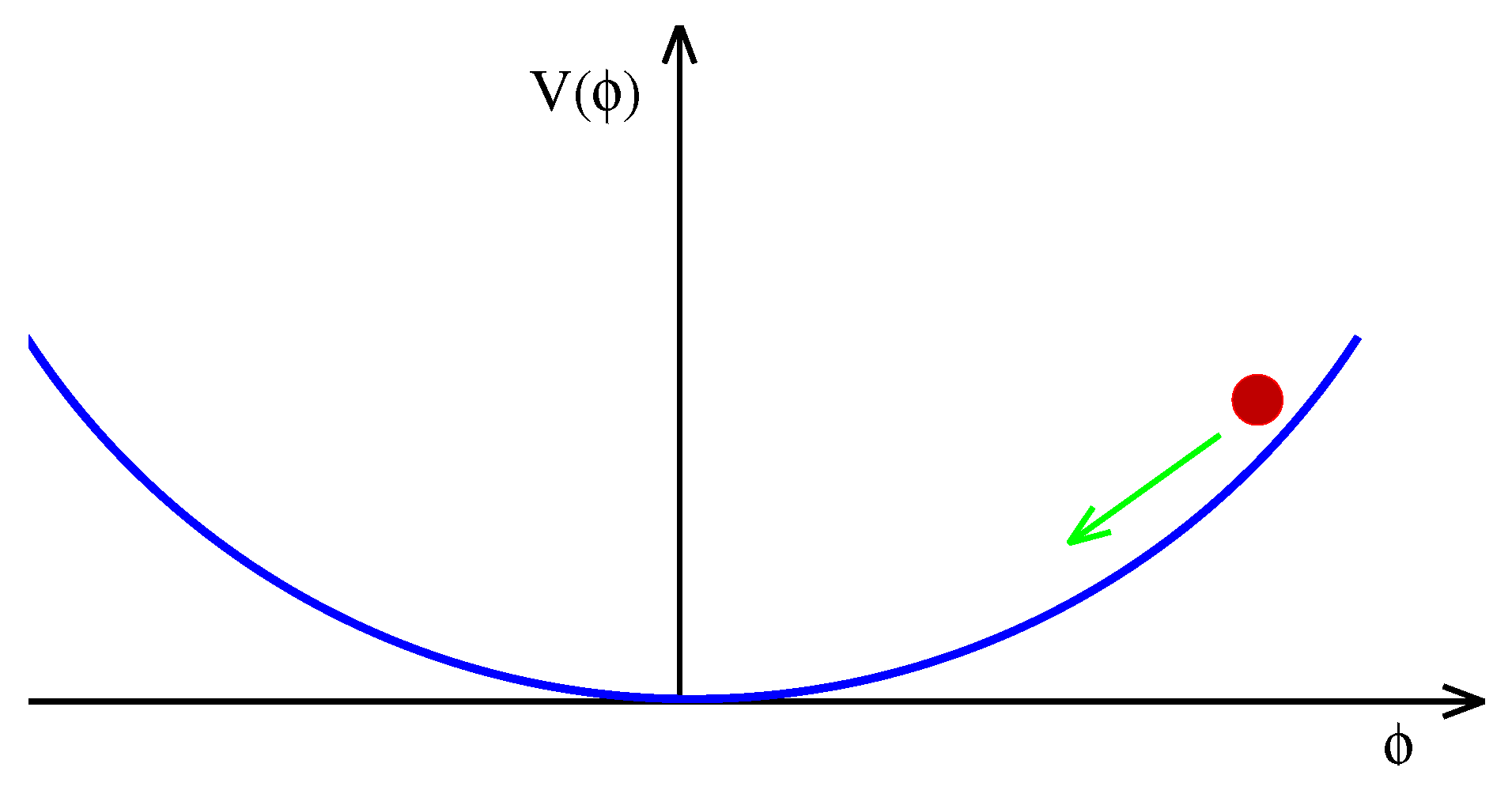
Figure 2.
Taken from [8]. Joint marginalized 68% and 95% confidence level (CL) regions for the scalar spectral index and tensor-to-scalar ratio r at pivot scale , derived from Planck data alone and in combination with BICEP/Keck 2015 (BK15) and BAO datasets [8]. The contours are compared against predictions from representative single-field inflationary models. These constraints assume a scale-invariant running, .
Figure 2.
Taken from [8]. Joint marginalized 68% and 95% confidence level (CL) regions for the scalar spectral index and tensor-to-scalar ratio r at pivot scale , derived from Planck data alone and in combination with BICEP/Keck 2015 (BK15) and BAO datasets [8]. The contours are compared against predictions from representative single-field inflationary models. These constraints assume a scale-invariant running, .
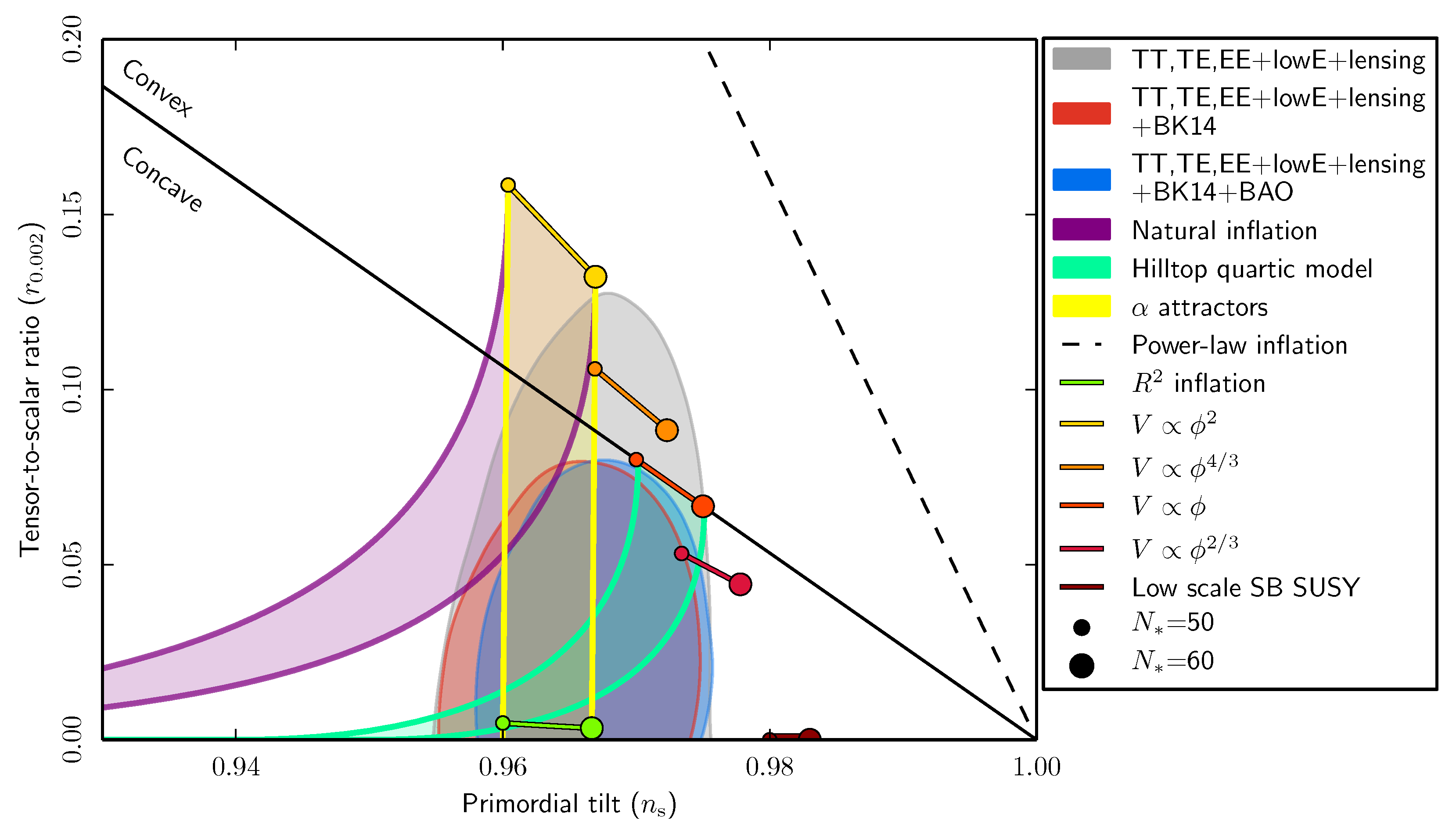
Figure 3.
Taken from [105]. Schematic representation of field-space geometry: a physical field configuration is shown in the neighborhood of a background trajectory . The geodesic connecting and is parametrized by , running from 0 to , and encodes the separation vector . This visualizes the deviation between inflationary paths due to field-space curvature.
Figure 3.
Taken from [105]. Schematic representation of field-space geometry: a physical field configuration is shown in the neighborhood of a background trajectory . The geodesic connecting and is parametrized by , running from 0 to , and encodes the separation vector . This visualizes the deviation between inflationary paths due to field-space curvature.
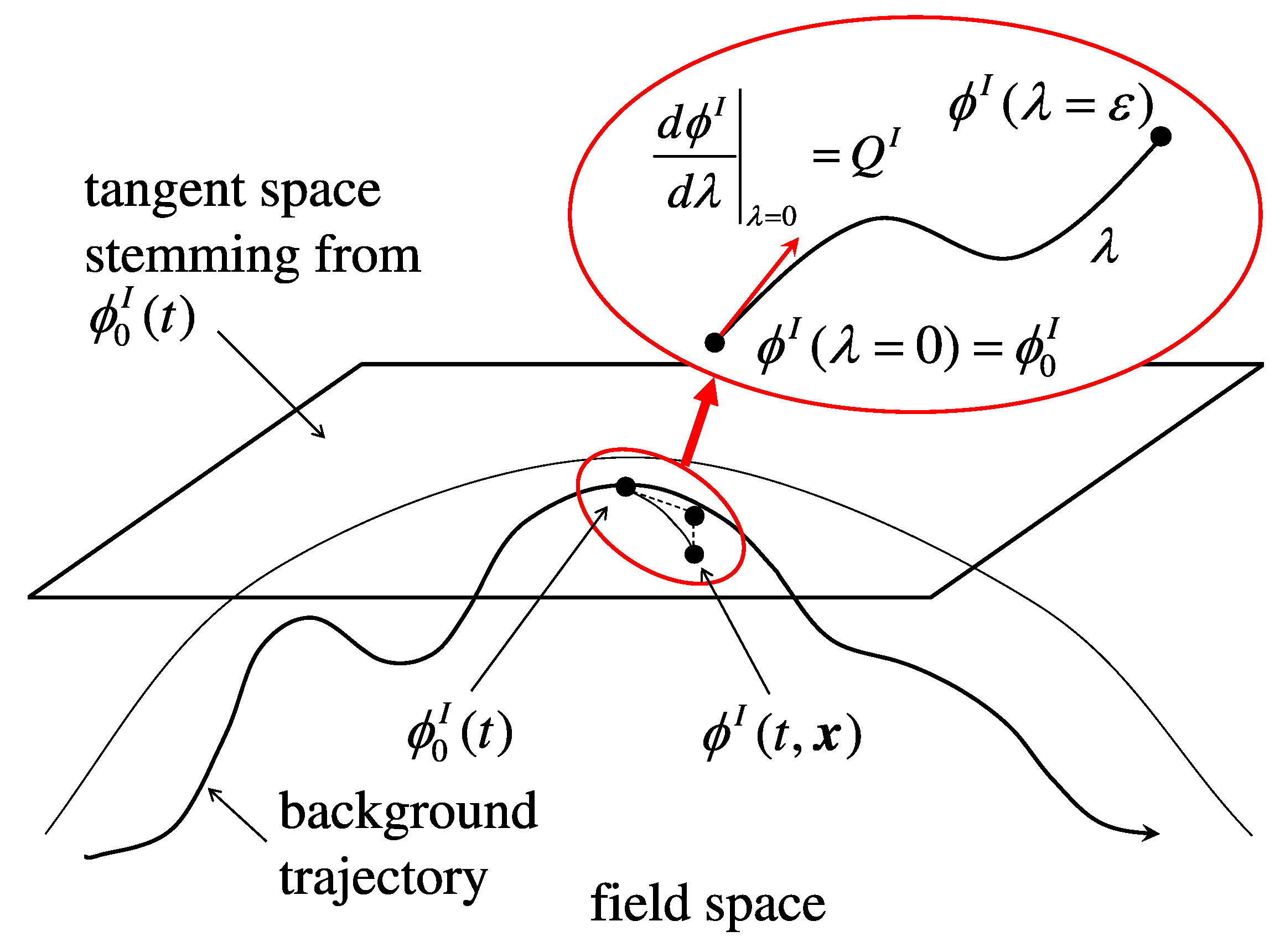
Figure 4.
Taken from [19]. An illustration showing how a general field perturbation can be decomposed into its adiabatic component (), aligned with the tangent to the background trajectory, and its entropy component (), orthogonal to it. The angle represents the orientation of the background motion in field space. For reference, the standard decomposition along the and field directions is also included.
Figure 4.
Taken from [19]. An illustration showing how a general field perturbation can be decomposed into its adiabatic component (), aligned with the tangent to the background trajectory, and its entropy component (), orthogonal to it. The angle represents the orientation of the background motion in field space. For reference, the standard decomposition along the and field directions is also included.

Figure 5.
Adapted from [132]. A stretched potential with angular dependence
Figure 5.
Adapted from [132]. A stretched potential with angular dependence
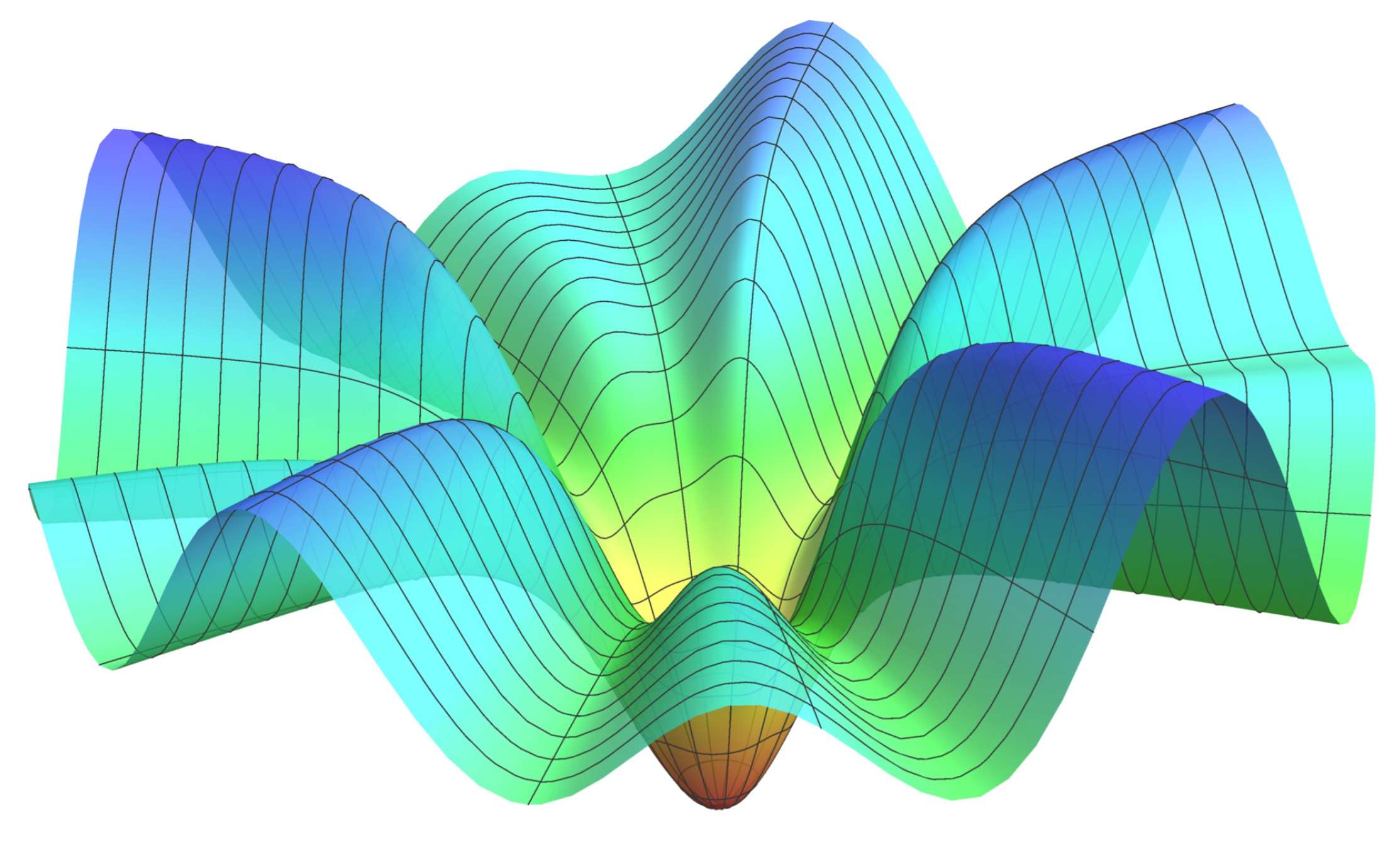
Figure 6.
Adpoted from [160]. Left panel: Evolution of fields in an assisted inflation scenario with 300 scalar fields, each initialized at . The plot shows how fields with different indices (i.e., masses) decouple at different times, with heavier fields decoupling earlier. The inset displays the lightest 15 fields near the end of inflation, many of which remain dynamically relevant. Right panel: Same model parameters as the left panel ( and ), but with varied initial field values. Despite the diversity in initial conditions, inflation is successfully driven by the collective dynamics of the fields.
Figure 6.
Adpoted from [160]. Left panel: Evolution of fields in an assisted inflation scenario with 300 scalar fields, each initialized at . The plot shows how fields with different indices (i.e., masses) decouple at different times, with heavier fields decoupling earlier. The inset displays the lightest 15 fields near the end of inflation, many of which remain dynamically relevant. Right panel: Same model parameters as the left panel ( and ), but with varied initial field values. Despite the diversity in initial conditions, inflation is successfully driven by the collective dynamics of the fields.
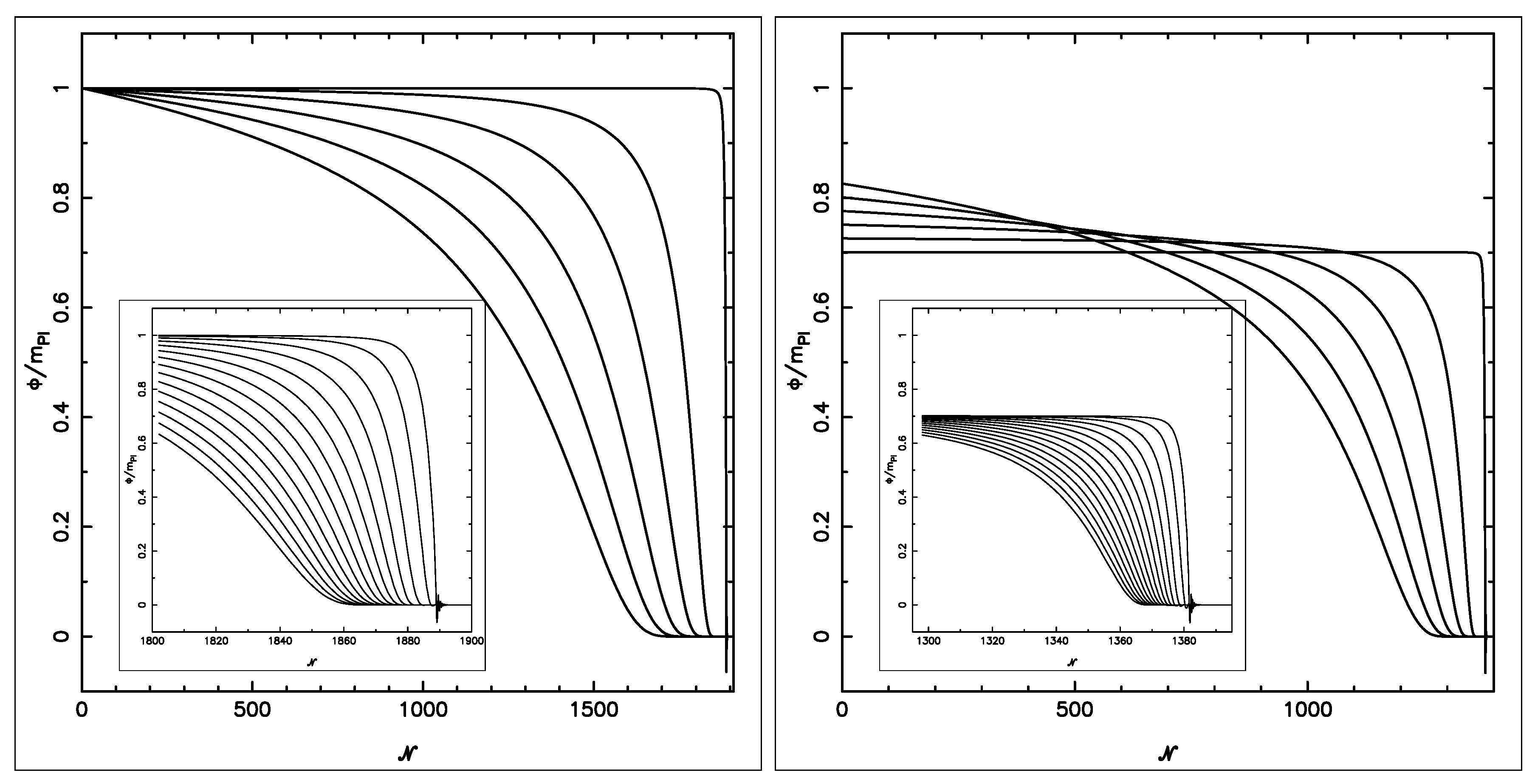
Figure 7.
Adapted from [180]. The possible contribution of PBHs to the dark matter density, expressed as the fraction , plotted against their mass .
Figure 7.
Adapted from [180]. The possible contribution of PBHs to the dark matter density, expressed as the fraction , plotted against their mass .
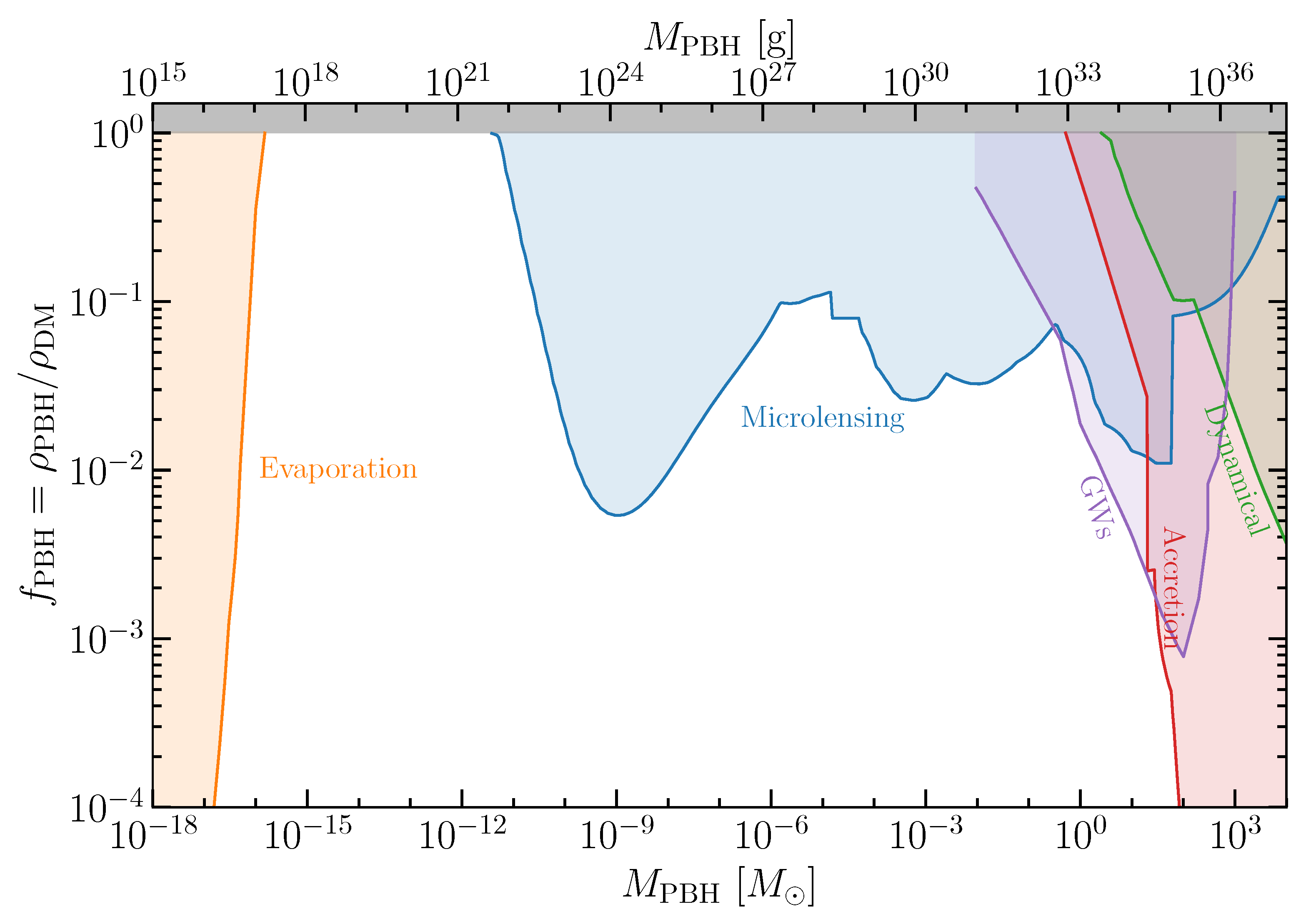
Figure 8.
Adptoped from [192]. Left panel: In SR inflation, background trajectories (blue lines) initiated at with various velocities converge to a common attractor. Constant e-fold contours (red lines) are uniformly spaced, and field fluctuations (arrows) merely shift the inflaton along this attractor, leaving no observable signature once clocks are synchronized to the end of inflation. Right panel: In USR, the absence of an attractor allows different trajectories to evolve with distinct e-fold durations. Fluctuations result in genuine changes to the local expansion history, modulating the power spectrum and generating non-negligible non-Gaussianity characterized by .
Figure 8.
Adptoped from [192]. Left panel: In SR inflation, background trajectories (blue lines) initiated at with various velocities converge to a common attractor. Constant e-fold contours (red lines) are uniformly spaced, and field fluctuations (arrows) merely shift the inflaton along this attractor, leaving no observable signature once clocks are synchronized to the end of inflation. Right panel: In USR, the absence of an attractor allows different trajectories to evolve with distinct e-fold durations. Fluctuations result in genuine changes to the local expansion history, modulating the power spectrum and generating non-negligible non-Gaussianity characterized by .
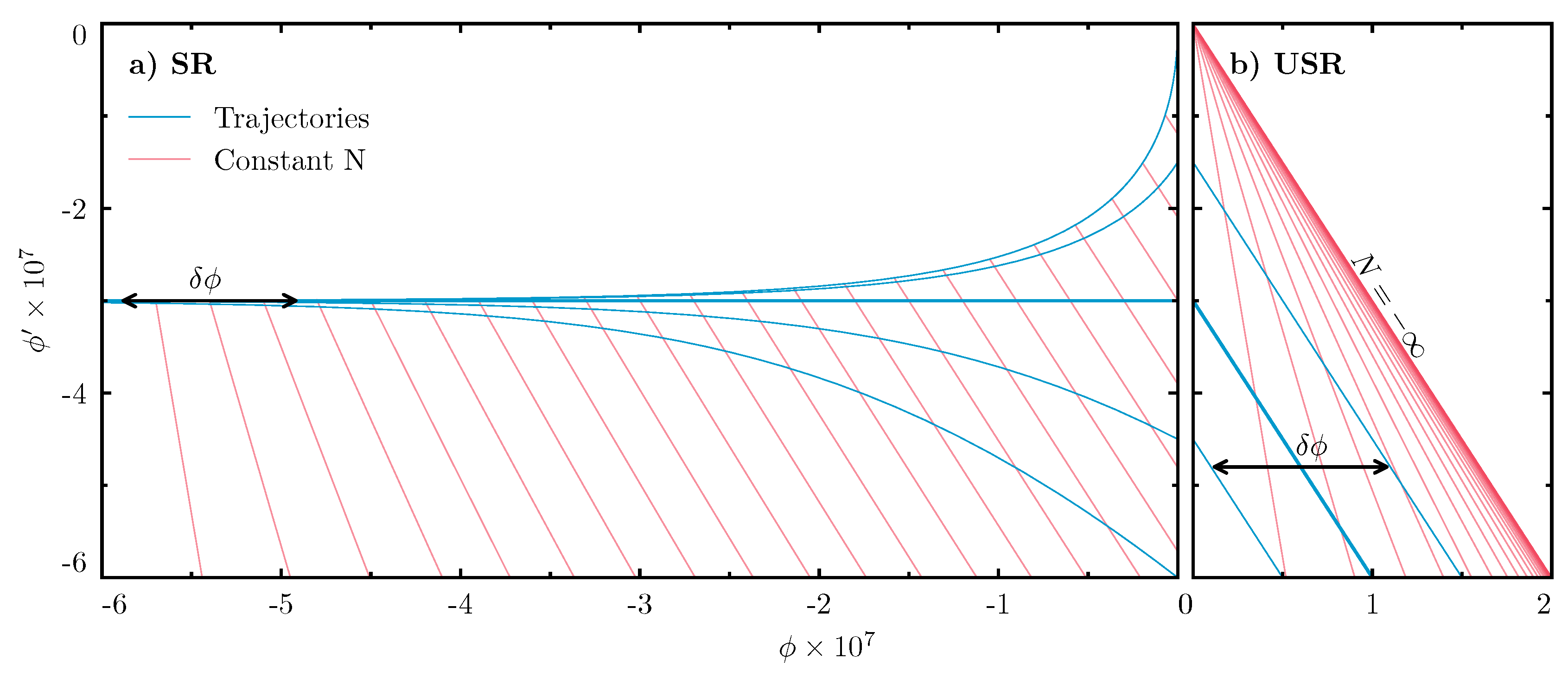
Table 1.
Conceptual and technical aspects of the measure problem in single-field and multifield inflation.
Table 1.
Conceptual and technical aspects of the measure problem in single-field and multifield inflation.
| Aspect | Single-field | Multifield |
|---|---|---|
| Quantum fluctuation criterion | ||
| Attractor structure | Unique | Manifold of attractors |
| Isocurvature degrees | Absent | Present; slow or fast decay |
| Measure ambiguities | Severe | Modulated by field-space geometry |
| Exit channels | Unique or tunneling | Rich network of transitions |
Table 5.
Selected multifield models and their isocurvature status.
| Model | Mechanism | Compatible? |
|---|---|---|
| Curvaton | Post-inflation decay of light field | Yes, if |
| Hybrid (waterfall) | Sudden field drop with reheating | Often Yes |
| Axion inflation | Axionic isocurvature survives | Often No |
Disclaimer/Publisher’s Note: The statements, opinions and data contained in all publications are solely those of the individual author(s) and contributor(s) and not of MDPI and/or the editor(s). MDPI and/or the editor(s) disclaim responsibility for any injury to people or property resulting from any ideas, methods, instructions or products referred to in the content. |
© 2025 by the authors. Licensee MDPI, Basel, Switzerland. This article is an open access article distributed under the terms and conditions of the Creative Commons Attribution (CC BY) license (http://creativecommons.org/licenses/by/4.0/).
Copyright: This open access article is published under a Creative Commons CC BY 4.0 license, which permit the free download, distribution, and reuse, provided that the author and preprint are cited in any reuse.


