

Submitted:
09 July 2025
Posted:
11 July 2025
You are already at the latest version
Abstract
Structural rearrangements at calorimetric glass transition are behind drastic changes of materials characteristics causing differences of glasses from melts. Structural description of materials includes both species (atoms, molecules) and connecting bonds which are directly affected by changing conditions such as the increase of temperature. At and above the glass transition a macroscopic percolation cluster made up of configurons (broken bonds) is formed, an account of which enables unambiguous structural differentiation of glasses from melts. Connection of transition caused by configuron percolation is also discussed in relation to Noether theorem, Anderson localization and melting criteria of condensed matter.
Keywords:
glass
; melt
; glass transition
; configuron
; percolation
; Hausdorff-Besicovitch dimension
1. Introduction
While the calorimetric glass transition in amorphous materials is an obvious effect mechanically expressed by the solid-like behaviour such as brittleness of glasses against liquid-like behaviour including plasticity of molten state the underlying microscopic, atomic-size mechanisms and structural rearrangements responsible for the transition itself are still poorly understood. This resulted in widely spread affirmations that there is no structural difference between glasses and liquids and that both glasses and liquids are the same fluid state of matter which differ from each other only by the magnitude of viscosity or relaxation times [1]. Apart from the fact that the viscosity being even used on the logarithmic scale cannot serve as a criterion of glass transition - see e.g. Table 4 of Ref. [2] which shows that the viscosity at the calorimetric glass transition spans over four orders of magnitude from 108.8 to 1013 Pa⋅s – it is now acknowledged that “the treatment of vitrification as a process of continuously breaking ergodicity with entropy loss and a residual entropy tending to zero in the limit of zero absolute temperature is in disagreement with the absolute majority of experimental and theoretical investigations of this process and the nature of the vitreous state”, a conclusion which has been explicitly illustrated by model computations [3].
This overview outlines the importance of distinguishing structural differences of amorphous materials below and above the glass transition temperature and highlights the role of the system in understanding the nature of transformation of glasses into melts. The focus is on utilisation of configuron percolation theory (CPT) aiming to use it on treating experimental data. Considering glass-liquid transition as melting of amorphous solids we formulate the melting criterion of solids as the condition of increase of Hausdorff-Besicovitch dimensionality of the set (SB) of configurons (broken bonds) from zero to . The constant volume jump of heat capacity at the glass transition then closely follows the equipartition theorem resulting from change of dimensionality of configurons set from 0 in the glassy phase to DH in the liquid , where R is the gas constant.
2. Structural Differences Between Glasses and Melts
Glasses drastically differ from liquids structurally – thermally disrupted bonds in glasses constitute a small and often negligible fraction of the total number of chemical bonds which provide the integrity and rigidity of condensed matter while liquids are overloaded by broken bonds. Obviously the materials become gaseous if all chemical bonds between atoms or molecules are broken while we expect that they will melt when a significant and well-determined threshold fraction of bonds is broken [4]. Melting is accompanied by a clearly seen change of atomic arrangements in crystalline materials which transform from solid to liquid state via the first-order phase transformation in the Ehrenfest sense while for glasses the rearrangements of initially disorderedly distributed species (atoms, molecules) are almost indetectable. Meantime it is well recognised that the topology of the phase space of glasses drastically changes at the glass transition by reducing its dimensionality [5,6,7,8,9]. One can also state that topologically glasses differ from liquids in the real space which is characterised by the set theory via a fractal Hausdorff-Besicovitch (HB) dimensionality (set dimension) DH equals to ≈ 2.5, while glasses hold an integer DH which is equal to the dimension of physical space d = 3 [4,10,11,12,13,14,15]. The dimension of the set of chemical bonds of materials {SB} is determined by Minkowski box-covering of the set by boxes with side ε via limit:
where N(,ε) is the number of boxes of the grid intersecting {SB} [16]. The structural difference between glasses and liquids is hence schematically illustrated by Figure 1.
This contributed to a misleading belief that glasses having a disordered distribution of atoms similarly to liquids are just liquids but having a very high viscosity which is arbitrarily set to be higher than about 1012 Pa⋅s aiming to consider an amorphous material in the glassy state [1,17,18,19,20,21,22,23,24,25,26,27]. The belief that glasses are the same liquids but at high viscosity is amplified by relatively small differences in the X-ray and neutron diffraction patterns exhibited by glasses and liquids as illustrated by Figure 2 with details provided in [28] (See also Figure 2 of ref. [29]).
Meantime not the changes in viscosity but the connectivity between species (atoms and molecules) constituting the condensed matter is the governing parameter dictating the state of condensed matter [4,14,30,31,32,33]. Indeed, the viscosity at the calorimetric glass transition can be significantly larger or many orders of magnitude smaller than 1012 Pa⋅s [2,34,35,36] whilst ordered liquid crystals flow at a quite low viscosity being an ordered state of matter. Table 1 from [33] illustrates this statement by characterising phase states of condensed matter as a function of ordering and connectivity.
Direct visualisation of oxide glass structure in line with the existing modified random network model [31] is available [39,40]. Structural differences between glasses and melts have been revealed a long time ago with Wendt and Abraham pioneering the identification of Tg based on them [41]. They have observed the different temperature behaviour of pair distribution functions (PDF) g(r) below and above the glass transition and proposed an empirical (statistically based) criterion for the glass transition by defining the empirical parameter RWA = gmin/gmax, where gmin and gmax are the magnitudes of the first minimum and first maximum of the PDF. It was found that the glass transition caused by changes of temperature (T), pressure (P) or both T and P always occurs when RWA ≈ 0.139 – 0.142. It was shown later that this threshold coincides with the percolation threshold RWA = φc [42] given by the universal Scher−Zallen critical density in the 3D space φc = θc = 0.15 ± 0.01 [43,44]. Among the most important experimental works confirming the structural differences between glasses and melts was the work by Mattern et.al, [45] which analysed the thermal behaviour of the structure of Pd40Cu30Ni10P20 bulk metallic glass using high-temperature X-ray synchrotron diffraction. The temperature dependence of structure factor S(q) followed the Debye theory up to the Tg while above it was altered indicating on structural changes in the liquid. The temperature dependence of structural parameters is different in glass and in supercooled liquid (see Figure 3) whilst the atomic pair correlation functions PDF(r)=g(r) reveals changes in short-range-order parameters of the first and the second neighbourhood with temperature. Figure 3 demonstrates that for amorphous Ni.
Whilst Figure 2 demonstrated the fact that the PDFmin always increases on increase of temperature Figure 3A shows an evident kink of structure factor S(q) at Tg, Figure 3B demonstrates that the rate of increase of PDFmin has the same kink at Tg and becomes higher exactly above it. The changes in the structure of amorphous material at Tg cause thus changes in the macroscopic properties of the material and first of all in its thermal expansion – the thermal expansion coefficient of liquid is larger compared to that of glass.
In addition to the well-recognised short-range order (SRO) the medium-range order (MRO) is revealed in both glasses and liquids where it is emphasised that the atomic pair-distribution function of simple liquids and glasses shows exponentially decaying oscillations beyond the first peak as a representative of MRO [46,47,48,49]. The structural coherence length that characterizes the exponential decay freezes at the glass transition and attenuates on increase of temperature [47].
3. Role of Configurons in the Phase Transformation
A straightforward description of glass transition as a percolation-type phase transformation between the highly connected glassy state and less connected liquid phase (see Table 1) is provided by the configuron percolation theory (CPT) [10,11,12,13,14] which can be considered as one of the variants of the well-known two-state model also referred to as a two-level system which has been successfully used by glass researchers [50,51,52,53]. The liquid phase is typically treated in the two-state models as a mixture of two types of structural units with the internal variable being the molar fraction of one or the other type of them where the CPT uses as units the chemical bonds either intact or broken (configurons) which provide one or another state of matter – see Table 1. Notable that coupling of the two-state model with well-investigated relaxation models has also been demonstrated in many works [54,55,56,57,58,59,60]. Benigni [50] has accounted vibrational contributions to the thermodynamic functions using weighted sums of Einstein functions and configurational contributions to the liquid and glass phase functions applying a single internal variable the freezing kinetics of which on cooling being calculated with an Adam-Gibbs logarithmic relaxation law [61]. The main conclusions of CPT of glass transition are as follows [62]:
- Universality – all disordered systems should exhibit percolation-type transformations from solid-like at higher degrees of connectivity (e.g. lower temperatures) to liquid-like (plastic) at lower degrees of connectivity at higher temperatures.
- Singularities for derivative parameters – thermal expansion, heat capacity, shear modulus, and other properties of glasses show a relatively sudden change at the glass transition temperature. Derivative parameters of amorphous materials thus show typical features of second-order phase transformations e.g. theoretically they diverge at Tg.
- Dimensionality change - the HB dimensionality of the system of configurons (broken bonds) changes at Tg from 0 in glasses to fractal DH ≈ 2.5 for melts.
- Dynamic (twinkling) fractals – The glass–liquid transition is accompanied by the formation of a percolation macroscopic cluster made up of broken bonds – configurons – which is dynamic in nature — similar to Wool's twinkling fractals [63,64,65]. The cluster is dynamical and changes with time due to configuron diffusion. Nonetheless, at any moment of time there, is a percolating cluster made of configurons above the Tg whereas no such macroscopic clusters can be seen in the glassy state e.g. below the Tg. The characteristic linear scale which describes the branch sizes of dynamic clusters formed by configurons is the correlation length ξ(T);
- Fractal medium range order – the higher cooling rate the larger remnant fractal cluster frozen at liquid–glass transition. Correlation length gives the average size of clusters made of broken bonds at T < Tg. At T > Tg it shows the average size of atomic clusters formed. Second-order phase transitions in ordered substances are typically associated with a change in the crystal lattice symmetry, and the symmetry is lower in the ordered phase than in the less ordered phase. In the spirit of Landau's ideas, the transition from a glass to a liquid spontaneously breaks the symmetry of bonds e.g. of the configuron system. At glass–liquid transition the amorphous material changes the group of isometries from the Euclidian to the fractal space group of isometries at length scales smaller than ξ(T).
- Two activation energies of viscosity – the viscous flow has a variable activation energy above the glass transition temperature Q(T) which is high for glasses and low at high temperatures (Table 2).
Fractal structures formed near the glass transition are dynamic structures. On melting glasses transform to melts which are supercooled melts above the Tg and transform to real melts at higher temperatures e.g. at and above the melting temperature Tm (Figure 4).
The CPT approach also provides an explicit picture of the melting of solids enabling to reveal the reason for first-order solid-to-liquid phase transformation for crystalline solids and second-order continuous solid-to-liquid transformation for amorphous materials [4,62]. The mechanism behind one or another type of melting lies in the mobility of configurons which is high for crystals because of periodicity of crystalline lattice resulting in equivalence of their positions within the lattice and is low within the disordered lattices of amorphous materials due to fast localisation of excitations following Anderson’s localisation mechanism [69,70,71,72]. Due to their high mobility in crystals configurons are quickly migrating to areas of already formed liquid near impurities or surfaces where they condense or partly recombine adding the heat of condensation and recombination and thus effectively arresting the temperature referred as melting point Tm whereas configurons are highly localised (almost immobile) in amorphous materials forming geometrically clysters when their concentration becomes enough high without practical release of any heat due to absence of condensation and recombination processes. In crystals that resembles boiling process for water when the temperature is arrested at the boiling temperature with the difference that configurons rather than vapour bubbles are moving through the structure of crystals and are localised in amorphous substances.
Symmetry changes are characteristic for all phase transformations including melting of materials which is transition from their solid to liquid form. Crystalline materials obey this law with obvious changes of symmetry group from that of a crystal to that of the group of Euclidean isometries of a Euclidean space comprising all translations, rotations, and reflections and arbitrary finite combinations of them where n=3 for three-dimensional space [73]. Symmetry changes are not so obvious for the glass transition i.e. the transition of amorphous materials from the vitreous to molten state because both these states belong to the E(3). Symmetry changes become evident for the phase space which account not only for the space location but also for momentum. The breaking of symmetry during phase transitions plays a crucial role in determining the system’s behaviour and the nature of the glass transition [74,75,76]. Within the CPT the main symmetry change is the change of dimensionality of space accessible to configurons from 0 in the glass to the fractal one DH in the liquid – i.e. here we observe an increase of dimensionality which can be linked with the new degrees of freedom related to translational motion. Following many publications such as [2,4,5,6,7,8,9,10,11,12,13,14,15,30,31,32,33,34,35,36,37,42,50,62,63,64,65,66,67,77,78] we therefore conclude that the glass transition is a true phase transformation – a specific case within critical phenomena generically termed topological phase transitions which are amenable to the scaling approach and characterized by diverging length and time at the transition.
4. The Jump of Heat Capacity
In the experiment the glass transition is always observed as a second-order phase transformation following the Ehrenfest classifications of phase transitions: there is a continuity of material volume and entropy (although with a kink at Tg) and there is a discontinuity of their derivatives at the transition. That specifically allowed the International Union of Pure and Applied Chemistry (IUPAC) to define the glass transition as a second-order transition in which a supercooled melt yields, on cooling, a glassy structure so that below the glass-transition temperature the physical properties vary in a manner similar to those of the crystalline phase [79]. In practice, namely the kinks and discontinuities observed using e.g. DSC are used to detect the Tg hence most of the data published are those which belong to the so-called calorimetric glass transition [80].
Observing that melting of substances has only small effects on the volume, cohesive forces, and specific heat which permitted Frenkel to conclude that ‘‘the character of the heat motion in liquid bodies, at least near the crystallization point, remains fundamentally the same as in solid bodies, reducing mainly to small vibrations about certain equilibrium positions’’ [79]. Moreover, he has also argued that these equilibrium positions are irregular in a liquid, just as in an amorphous solid, but while the equilibrium positions are permanent in a solid, they are not so in a liquid; rather each liquid atom oscillates for a time about the same equilibrium position, then jumps to a new one [82]. Wallace has refined Frenkel’s qualitative picture of the liquid state of matter by formulating the hypothesis that the liquid contains a universal ion-motional disordering entropy of NkBΔW relative to the solid where kB is Boltzmann constant and ΔW = 0.80 [83]. He observed from experiment that for large-N systems the constant-density entropy of melting contains the universal disordering contribution of NkBΔW suggesting that the random structural valleys, which are static structure potentials as sums of harmonic normal modes, are of universal number wN, where ln(w) =ΔW and experimental estimate for Δ is 0.80. Thus, the Hamiltonians of structural valley in materials is the static structure potential, a sum of harmonic normal modes, and an anharmonic correction [84]. Using this approach he has shown that in quasi-harmonic approximation, the liquid theory for entropy agrees with the experiment at elevated temperatures, to within 1–2% of the total entropy [83,84]. Based on the CPT picture of melting (see below) we conclude that the Wallace parameter ΔW is equal to HB dimensionality of percolation clusters formed by configurons at melting DH divided by the dimensionality of space d, i.e. that ΔW = DH /d ≈ 0.8.
The glass transition in amorphous materials is typically revealed using differential scanning calorimetry (DSC) which always reveals a jump of constant pressure and constant volume heat capacity ΔCp, ΔCv at the glass transition temperature Tg [80]. The appearance of this jump, which is an obvious and generally accepted indication of a phase transformation is well understood and confirmed as an appearance in the system of new translational degrees of freedom for atomic or molecular constituents of matter [85,86]. We note that always Cp > Cv due to the relationship Cp = Cv + Vα2B, where V is the molar volume, α is the coefficient of thermal expansion (CTE), and B is the bulk modulus, and thus always ΔCp > ΔCv. Typically one holds ΔCv ≈ 0.85ΔCp [86]. Recent computer experiments by Cockrell and Grimes [87] have unambiguously confirmed that immediately above the glass transition temperature effectively all atoms in inorganic glasses are mobile while in the glassy state the fraction of mobile atoms is negligible which stands in line with CPT of glass transition and its conclusions. They concluded that the atoms’ atomic mobility is a universal marker of the glass transition which emphasises the role of structural changes resulting in mobilisation of atoms at the glass transition. Moreover, molecular dynamic simulations by [88] have revealed that the jump ΔCp of amorphous silica at the glass transition is entirely determined by the component of structural energy.
The heat capacity behaviour at glass transition generically has two prominent features: (i) it diverges on the increase of temperature towards Tg and (ii) has a distinct jump from the lower heat capacity of glass which is almost the same as of a crystal to that of a liquid [89]. Figure 5 modified from [84] shows both these features.
The first feature – the divergence of heat capacity – is given within CPT as a universal law so on approaching the glass transition temperature the heat capacity follows the dependence [11,12,13,14]:
where β=0.41 is the critical index in the three-dimensional space [44]. One can note that experimentally measured critical exponents α for several metallic glasses varied from 0.16 to 0.54 [90] with deviations of α from 1-β possibly resulting from a more complex percolating scheme of these metallic systems.
The magnitude of the jump of heat capacity at glass transition is dictated by the liberation of new degrees of freedom including translational (trans), which can be also related as due to structural changes, vibrational (vib) and rotational (rot) ones: the main component of which is typically the translational one [85]. In principle at the transition from one phase (glassy) to another (liquid) some of vibrational degrees can be lost thus the jump can effectively be diminished which may be the case for some materials oxide and even metallic materials. Within CPT the constant volume heat capacity jump at the glass transition is directly related to structural changes and to the appearance of new translational degrees of motion, and is as follows:
reflecting the equipartition theorem for the change of HB dimensionality of configurons from 0 in the glassy phase to DH in the liquid (Figure 4). Experimentally it was found that the constant pressure jump of heat capacity at glass transition ΔCp in a variety of metallic glasses is almost an invariable value (13.69 J/mol⋅K), and is close to 3R/2 = 12.47 J/mol⋅K (where R = 8.3145 J/mol⋅K is gas constant), which can be quantitatively described by the atomic transitional diffusion [86]. Additionally, it was found that the ratio ΔCv/ΔCp does not change with the liquid fragility, and almost keeps a constant: 0.85, hence the jump of constant volume heat capacity at glass transition of metallic systems is almost constant ΔCv = 0.85⋅ΔCp = 11.64 J/mol⋅K. We observe from CPT that this jump is slightly smaller, namely DHR/2 = (2.55±0.05)⋅8.3145/2 = (10.6±0.2) J/mol⋅K. The constant volume heat capacity jump at glass transition is illustrated in Table 3.
We also note that Table II of reference [85] which demonstrated that for most of substances at glass transition hold 2ΔCp/R ≈ 3 in fact confirms the validity of equation (3) because it is known from [86] that ΔCv/ΔCp ≈ 0.85 so that we get ΔCv/ΔCp ≈ DH/d in line with (3). Similarly, data from [88] have shown that for amorphous silica the constant pressure jump of heat capacity per atom is ranging from 0.50R to 0.68R, which means that the jump of constant volume heat capacity is ΔCv ≈ 0.85ΔCp = 10.6 – 14.4 J/mol⋅K in line with CPT estimation (10.4 – 10.8 J/mol⋅K). However, the equation (3) cannot be universally valid for the overall heat capacity jump at glass transition having well known deviations [91,92] and it is only approximately giving the contribution to the overall heat capacity due to liberation at the phase transformation of translational degrees of motion and in this sense is somehow similar in its nature to Dulong-Petit law. We emphasize however that we consider only structural challenges related to the calorimetric glass transition and we have to conclude that no phase transformation occurs in the Ehrenfest sense if neither thermodynamic functions nor their derivatives exhibit any peculiarities.
5. Melting Criteria
Melting is defined as a physical process that results in the phase transition of a substance from a solid to a liquid where the melting point of crystalline solids is the temperature at which a solid changes its state into a liquid at atmospheric pressure, so at the melting point the solid and liquid phases coexist in equilibrium [93]. Encyclopaedia Britanica specifies that amorphous (non-crystalline) substances melt by gradually decreasing in viscosity as temperature is raised without a sharp transition from solid to liquid [94]. We note, however, that melts are much less polymerised compared to glasses, which have a similar structure to that of liquids. Instead of a well-connected network like in solids they contain many finite size clusters as well as many broken bonds whereas in solids the lasts are almost not present at all or occur as point defects generated by thermal fluctuations (Figure 1) and are characterised by a different dimensionality of the set of configurons (broken chemical bonds).
Lindemann’s and Born’s criteria of melting are the two most frequently used as a basis to analyse the melting conditions [95,96,97]. The Lindemann criterion states that melting occurs because of vibrational instability when the root of mean square vibration amplitude exceeds a threshold value taken as a fraction δL = () of interatomic distance a [89,98,99,100,101]. Lindemann supposed that δL should be about 0.5, which was later revised, observing that it is within the range between 0.068 and 0.114 [101]. The analysis of experimental data of elements determined that the Lindemann melting coefficient δL is in fact an exact value for each element belonging to a given periodic group of Mendeleev’s periodic table of elements [93]. Although it is considered that the Lindemann criterion is supported by data for glass transition the parameter δL is not the same as for melting of crystals [29,102,103,104]. Finally, we note that Khrapak has shown that Lindemann’s criterion of melting can be formulated for two-dimensional classical solids using statistical mechanics arguments with an expression for the melting temperature derived which is valid for both three and two dimensions [105]. Here vT = (T/m)1/2 is the thermal velocity, cl is the longitudinal and ct is the transverse sound velocity. The expression is reduced to the condition of constant transverse-to thermal velocity ratio at melting of materials, accounting that cl >> ct.
The Born criterion of melting [96,97] is based on a rigidity catastrophe caused by the vanishing elastic shear modulus so that the crystal spontaneously changes its crystallographic symmetry or becomes fully amorphous, which in many cases can be the melted state, although not necessarily, as amorphization does not really envisage transition to a molten state. Born’s stability condition is formulated as the condition that where Cijkl is the (second order) elastic constant tensor which determines the stress tensor Tij = CijklEkl as a linear function of the infinitesimal strain tensor Ekl. Naturally, for glasses which are considered as isotropic solid materials, the elasticity tensor has only two independent components, which are the bulk (K) and shear (μ) moduli. We further use an orthonormal Cartesian coordinate basis with no distinction between upper and lower indices. The elastic constant tensor is then written in terms of Lame’s first and second parameters λ and μ correspondingly: Cijkl = λδijδkl + μ(δikδjl + δilδkj), where δij are the Kronecker’s deltas. The bulk modulus K = - ∂p/∂lnV, where p is pressure and V volume, is then K = λ + 2μ/3. The instability of lattices when Born’s criterion is breached does not necessarily cause melting, as it can be due to either a change of lattice symmetry class or amorphization without melting. It is also worth noting that Born’s criterion was specified for homogeneous lattices under a constant uniform load to be where B is the four-rank elastic stiffness tensor [106]. Here we note that instabilities under pressure may also occur for the amorphous state, leading to its phase decomposition, see [107] and the references there.
There is a substantial reason initially outlined by Angell [108] to analyse the distribution and behaviour of broken chemical bonds termed configurons in condensed matter rather than of atoms or electrons since the former are weekly interacting with each other whilst the latter are strongly interacting and form either clusters or are integral parts of the network of material. A configuron is formed by breaking of a chemical bond, followed by the associated strain-releasing local adjustment of centres of atomic vibration. The Hamiltonian of configurons in the first approximation is that of almost free boson (apart from spin glasses) particles in the periodic (for crystals) or aperiodic (for glasses and liquids) potential created by atoms of material so that the Schrodinger equation for the wave function of a configuron is: . In crystalline materials, the potential repeats the symmetry of the lattice, therefore the wave function of configurons following the Bloch theorem can be represented as , where has the period of the crystal lattice and the exponent is the running wave that carries the momentum . The configurons are almost freely moving at least at small wavenumbers k with energy , where m* is the effective mass. The situation for wave propagation drastically changes for disordered lattices amenable to Anderson localisation of configurons instead of almost free motion [68,69,70,71,72]. Indeed, instead of almost free propagation due to identical positions of configurons in the crystal lattice, they quickly localise, which in turn affects the melting process [62]. Once configurons are weakly interacting in the first approximation, they can be considered as almost non-interacting with a random spatial distribution and use for their description the two-level system, applying standard apparatus of statistical physics [11,12].
The mutual interaction between bonds and configurons at distances exceeding their sizes, which are approximately equal, can be practically neglected. In this case, the association and formation of clusters of configurons is purely geometrical, depending only on the volume fraction occupied by them, which is well described by the percolation theory [44,109,110,111]. It means that knowing the temperature dependence of relative concentration of configurons c (0 ≤ c ≤1) one can estimate the probability of cluster formation purely geometrically using c as the occupation probability p = c. It is known that p plays the same role as the temperature in thermal phase transitions being the control parameter of formation of percolation clusters which are fractal above the percolation threshold p > pc with HB dimension DH = d – β/ν [44], where d is the dimension of space and critical exponents β and ν describe the critical behaviour associated with the percolation transition and are universal not depending at all on the structure of the lattice and on the type of percolation which can be either site, bond or even continuum [44,107,108,109]. For d = 3 these are approximately as follows β = 0.41, ν = 0.88 [44]. The order parameter P∞ describes the probability that a configuron belongs to the percolation cluster [11,12]. Classical percolation exhibits all the characteristics of a continuous phase transition. For p ≥ pc the order parameter P∞ which is identified in the CPT as the power of percolation cluster (fraction of configurons as a part of the largest cluster) made up of configurons increases with p by a power law P∞ ∝ (p – pc)β while the correlation length describing the inhomogeneities of structure diverges as ξ ∝ (p – pc)-ν.
Instead of using the lattice specific parameter p one can refer to Scher and Zallen [43] who have found that for each dimension there exists an invariant that is almost independent of the type of lattice. This invariant φc = fpc is the critical fraction of space occupied by spheres (discs in 2D) of the bond length diameter, positioned in the occupied sites of the lattice. The quantity f is called the "filling factor" of the lattice and denotes the volume fraction occupied by mutually touching spheres positioned at each site. The critical space occupation probability equals φc = 0.44+0.02 in two dimensions and φc = 0.15±0.01 in three dimensions [43,44]. This permits to calculate the glass transition temperature, Tg, for simple systems such as amorphous silica with only one type of bonds (and thus configurons) based on thermodynamic parameters of bonds [10,11,12]:
where Hd and Sd are the enthalpy and entropy of connecting bonds (configuron formation), R is the universal gas constant, and φc is the percolation threshold volume invariant approximately equal to 0.15 [43,44]. Equation (4) can be used utilising this invariant for simple systems such as amorphous silica, giving for the glass transition temperature Tg = 1482 K [12] compared with the experimental Tg value of 1480 K measured by drop calorimetry [112].
Equation (4) can be simplified neglecting the logarithmic term [4] reducing it to a view similar to Dienne’s ratio for melting temperatures of substances (presumably crystalline) [110,111] contains thermodynamic characteristics of joining bonds rather than the enthalpy and entropy of the activated state.
What happens at the transition of condensed matter from a solid to a liquid state, i.e. on melting, e.g. when an amorphous solid (glass) transforms to a liquid? In solids, including glasses, there are both longitudinal and transverse (shear) sound waves, the latter one having two polarizations. Sound waves are characterized by the acoustic dispersion relations ωl(k) = kcl, whereas shear waves have ωt(k) = kct where k is the wavenumber. These are found from equalities: , and . In the liquid state the shear modulus becomes nil (below the Frenkel line [115,116,117]), thus there are only longitudinal modes for sound waves in the molten state. This makes it different from the point of view of stress reaction, although the condition that μ = 0 applies only below the Frenkel line which is at frequencies ω < ωF = 1/τM determined by the Maxwell relaxation time τM. At high frequencies, when ω > ωF, all liquids behave solid-like with both longitudinal and transverse waves propagating with sound velocities given by the same expressions as for solids, where parameters used are the high-frequency adiabatic bulk modulus K∞ and shear modulus μ∞. This well-known property does not result by any means in the conclusion that the liquid state is the same as the solid state of matter. Meantime, the disappearance of transverse waves means a topological change in the phase space, which is supported by many findings [5,6,7,8,9,10,11,12,118]. Loss of transverse momentum signals that one of the symmetries of amorphous materials below the Frenkel line is broken at Tg. A symmetry is a property which will remain the same even after some kind of transformation is applied. Among known symmetries the dimensionality of bonding system which provides the condensed character (either solid or liquid) of matter unambiguously changes on passing through the glass transition temperature [14]: the broken bonds of materials (termed configurons [108]) are point-like entities (defects of glass network) below the Tg whereas above the glass transition temperature they for percolating clusters. Denoting the set of broken bonds as SB we see that at T < Tg and at T > Tg, where dimH denotes the HB dimension of the set of configurons {SB}, coinciding in our case with the well-known Minkovsky box-counting dimension of the set. Configurons, which are bound to their locations in glasses, cannot freely move except changing their location by thermal hoping through the glass network (disordered lattice of bonds [108]), become mobile above the Tg, freely moving via percolating clusters made up of configurons as any site within it is equivalent for their location. Hence, the configurons acquire new degrees of freedom on passing the Tg. Finally, on transition of melt to gaseous phase at higher temperatures , that is the dimension of space available for configurons motion equalises with the dimension of 3D space with all degrees of freedom acquired. The dimensionality of space is connected with conservation of momentum through the concept of translational symmetry which implies that the physical laws governing the system remain unchanged everywhere in space on moving the system from one location to another. Noether's theorem formalizes this idea by stating that every continuous symmetry of a physical system's action corresponds to a conservation law [119,120,121]. For translational symmetry, this conservation law is the conservation of momentum. If consider the configuron moving through the space of percolation clusters, its momentum remains conserved because the percolation cluster space itself does not impose any preferred locations or directions within it which is true in any number of spatial dimensions. How to formulate mathematically the condition for a transformation of a solid into a liquid and vice versa when crystallisation or vitrification occur [122,123].
One can hence add the melting criterion based on set theory which for 3-dimensional (3D) materials can be formally based on equation:
The fractal dimension DH, of a percolation cluster is always smaller than the dimension d of the ambient space, due to numerous "holes" in the cluster. In two dimensions DH = 91/48 = 1.90; for d =3, DH =2.5 [44]. The condition (5) also follows from the Kantor-Webman theorem, which states that the rigidity threshold is identical to the geometrical threshold, and on the equivalence of the elasticity of random percolating networks to regular bond percolation systems [124]. To prove that Kantor and Webman have used the framework of the Born model for the microscopic elasticity of a lattice with elasticity energy given by Hamiltonian: with nn denoting the nearest neighbours, giving the relative displacement of the site j in the direction parallel to the bond (ij), giving the relative displacement in the perpendicular direction, and Ki,j being a random variable which assumes values 1 and 0 with probabilities p and (1-p), respectively. Kantor and Webman found that the rigidity threshold is identical to the geometrical threshold, which allows us to use in practice the well-known properties if percolating clusters, namely their well-known the volume invariant independence on the type of lattice, valid for disordered lattices of amorphous materials which once exceeded the percolation is achieved [43,44].
6. Importance of Bonds Breakage
The distribution of species (atoms, molecules) in amorphous materials looks similar both for glasses, which are solid and for melts, which are liquid. However, not the species distribution determines the state of matter but the degree of connectivity between them, i.e. the bonding system is crucial so that for more tightly connected atoms more durable substances occur. The structure of materials is thus presented not solely by atomic distribution but has an integral part in the bonds between them. From this point of view, the structure of glasses is different from the structure of liquids because glasses do not substantially contain broken bonds apart from some remnant defects of temperature-induced breakages, while liquids have a significant part of bonds disrupted, which allow species to exhibit a much higher degree of freedom in motion. Moreover, the structural differences between glasses and melts composed out of the same species were noted a long time ago and is readily identified using standard X-ray or neutron scattering techniques based on scattering patterns utilising structure factor S(q) or pair distribution functions g(r) [2,41,42,45]. Notable is the approach developed by Stoch and Krakowiak [125] who proposed to analyse the temperature changes of radial distribution functions within the whole range of sizes in oxide glasses. In this approach the changes in the further coordination and due to other glass constituents are also taken into consideration, which resulted in a better description of the glass-liquid transition and have again confirmed that the transition temperature depends on the glass structure and its thermal changes. Nevertheless, despite this, many works including university handbooks, focus on just species, affirming that there is no structural difference between a material below and above the glass transition temperature. On increase of temperature (or other external action on matter such as pressure and intensity of radiation) chemical bonds between species are broken and the connectivity gradually decreases until reaching a well-defined threshold level when bonding system cannot sustain the solid-like behaviour such as preservation of shape, presence of yield stress for deformation etc and the material melts. The transition from solid (vitreous) state to liquid (molten) state is continuous in amorphous materials and because of that the transition is a second order thermodynamical transition following Ehrenfest classification although it occurs in a metastable system of topologically disordered species which by the total energy is less favourable compared to a ordered (crystalline) distribution of the same species which would otherwise minimise it. In contrast with equilibrium phase transitions which are well understood within statistical mechanics [126,127] the nonequilibrium phase transformations (to which the glass transition undoubtedly belongs) are in reality quite common across many branches of science and technology ranging from biological systems to cosmology and galactic patterns [128,129,130,131]. The transition from the metastable glass to a stable (or still metastable but with a lower energy) crystalline phase is kinetically impeded, and in many if not most natural glasses at room temperature would require times exceeding the lifetime of the Universe which makes these considerations out of any practical sense.
Consideration of bonding systems equally with species (atomic and molecular systems) became routine after Angell introduced the concept of configurons as elementary excitations in condensed matter formed by breaking a chemical bond, followed by the associated strain-releasing local adjustment of centres of atomic vibration. In contrast to strongly interacting species, which constitute the matter, the configurons can be, in the first approximation, considered as non-interacting and subject to ideal mixing. In such approximation, the well-developed apparatus of two-level systems applies, and the glass transition is a percolation effect in the system of configurons – the amorphous material is in the vitreous state until the percolation threshold is reached. The behaviour of percolating systems is universal thus it becomes possible to calculate the glass transition temperature, describe diverging heat capacity and TEC at glass transition, estimate the constant volume jump of heat capacity and universally describe the viscosity of material across all temperature interval from the glass trough melt till gas [14,67,68] as well as to understand the kinetic aspect of glass transition [132] and to model it [11,12,13,34,35]. Additionally, it is possible to formalise the melting criterion using the concepts of set theory as the condition of achieving a certain degree of disruption of the bonding system when the HB dimensionality DH exceeds that of a percolating cluster, which is known for 3D space to be larger or about 2.5 (Figure 6).
7. Conclusions
Amorphous materials drastically alter their properties at the calorimetric glass transition from solid-like brittleness to liquid-like plasticity. Although the distribution of atomic-molecular species remains almost unchanged, the bonding system exhibits a continuous percolation-like change of its dimensionality from zero in the glassy phase to about 2.5 in the melt, hence this change can be used as a melting criterion.
Author Contributions
Conceptualization, M.I.O. and D.V.L.-L.; methodology, M.I.O. and D.V.L.-L.; validation, M.I.O. and D.V.L.-L.; writing—original draft preparation, M.I.O. and D.V.L.-L.; writing—review and editing, M.I.O. and D.V.L.-L.; All authors have read and agreed to the published version of the manuscript.
Funding
This research received no external funding.
Institutional Review Board Statement
Not applicable.
Informed Consent Statement
Not applicable.
Data Availability Statement
No new data was created.
Acknowledgments
The work was presented as keynote [135] and invited [136] talks at XXVII Congress on Glass held on 20-24.01.2025 in Kolkata, India. Authors are grateful to participants for discussions with especial thanks to John Parker, Arun Varshneya, Reinhard Conradt, Manoj Choudhary, Sitendu Mandal, K. Annapurna, Atiar Molla and Ashis Mandal.
Conflicts of Interest
The authors declare no conflicts of interest.
Abbreviations
The following abbreviations are used in this manuscript:
| CET | Coefficient of thermal expansion |
| CPT | Configuron percolation theory |
| DSC | Differential scanning calorimetry |
| HB | Hausdorff-Besicovitch dimensionality |
| MRO | medium-range order |
| SRO | short-range order |
References
- J.D. Musgraves, J. Hu, L. Calvez (Eds.), Springer Handbook of Glass, Springer Handbooks, Springer Nature Switzerland AG 2019, Cham. 2019, 1851 p. [CrossRef]
- D.S. Sanditov, M.I. Ojovan, M.V. Darmaev. Glass transition criterion and plastic deformation of glass. Physica B, 582, 411914, (2020). [CrossRef]
- J.W.P. Schmelzer, T.V. Tropin. Glass Transition, Crystallization of Glass-Forming Melts, and Entropy. Entropy 2018, 20, 103; [CrossRef]
- M.I. Ojovan, W.E. Lee. Connectivity and glass transition in disordered oxide systems. J. Non-Cryst. Solids, 356, 2534-2540 (2010). [CrossRef]
- M.G. Vasin. Glass transition as a topological phase transition. Phys. Rev E 106, 044124 (2022). [CrossRef]
- M. Gori, R. Franzosi, G. Pettini, M. Pettini. Topological Theory of Phase Transitions. J. Phys. A: Math. Theor. 55 (2022) 375002 (34pp). [CrossRef]
- Vesperini, R. Franzosi, M. Pettini. The Glass Transition: A Topological Perspective. (2024). [CrossRef]
- Z. Nussinov, N. B. Weingartner, F. S. Nogueira. The “glass transition” as a topological defect driven transition in a distribution of crystals and a prediction of a universal viscosity collapse. In: Topological Phase Transitions and New Developments. Eds. L. Brink, M. Gunn, J.V. José, J.M. Kosterlitz, K.K. Phua, World Scientific, pp. 61-79. (2018). [CrossRef]
- de Candia, A., Fierro, A., Coniglio, A. Scaling and universality in glass transition. Sci. Rep. 6, 26481; (2016). [CrossRef]
- M.I. Ojovan. Glass formation in amorphous SiO2 as a percolation phase transition in a system of network defects. J. Exp. Theor. Phys. Let., 79 (12) 632-634 (2004). [CrossRef]
- M.I. Ojovan, W.E. Lee. Topologically disordered systems at the glass transition. J. Phys.: Condensed Matter, 18, 11507-11520 (2006). [CrossRef]
- M.I. Ozhovan. Topological characteristics of bonds in SiO2 and GeO2 oxide systems at glass-liquid transition. J. Exp. Theor. Phys., 103 (5) 819-829 (2006). [CrossRef]
- M.I. Ojovan. Configurons: thermodynamic parameters and symmetry changes at glass transition. Entropy, 10, 334-364 (2008). [CrossRef]
- M. Ojovan. Glass formation.. Chapter 3.1 in P. Richet, R. Conradt, A. Takada, J. Dyon. Encyclopedia of Glass Science, Technology, History, and Culture. Wiley, Hoboken, NJ, 2021. 1568 p., pp. 249-259. [CrossRef]
- Ojovan, M.I., Tournier R.F. On structural rearrangements near the glass transition temperature in amorphous silica. Materials 2021, 14. 19 pp. [CrossRef]
- V. Županović, D. Žubrinić, Fractal Dimensions in Dynamics. J.-P. Françoise, G.L. Naber, T.S. Tsun, Encyclopedia of Mathematical Physics, Academic Press, 2006, 394-402, ISBN 9780125126663. [CrossRef]
- C.A. Angell, W. Sichina: Thermodynamics of the glass transition: Empirical aspects, Ann. N.Y. Acad. Sci. 279, 53–67 (1976). [CrossRef]
- C.A. Angell: Formation of glasses from liquids and biopolymers, Science 267, 1924–1935 (1995).
- Kittel, C. Introduction to solid state physics; J. Wiley and Sons Inc.: New York, 1996.
- Richert, R. Heterogeneous dynamics in liquids: fluctuations in space and time. J. Phys.: Condens. Matter 2002, 14, R703-R738. [CrossRef]
- J. Holubova, Z. Černošek, E. Cernoskova, M. Liska. Isothermal structural relaxation: temperature and time dependencies of relaxation parameters, J. Non-Cryst. Solids 326, 135–140 (2003). [CrossRef]
- J. Machacek, O. Gedeon, M. Liska. Group connectivity in binary silicate glasses, J. Non-Cryst. Solids 352, 2173–2179 (2006). [CrossRef]
- Fluegel: Glass viscosity calculation based on a global statistical modelling approach, Glass Technol. 48(1), 13–30 (2007).
- J.C. Mauro, Y. Yue, A.J. Ellison, P.K. Gupta, D.C. Allan. Viscosity of glass-forming liquids, Proc. Natl. Acad. Sci. 106(47), 19780–19784 (2009). [CrossRef]
- Q. Zheng, J.C. Mauro: Viscosity of glass forming systems, J. Am. Ceram. Soc. 100, 6–25 (2017).
- U. Fotheringham. Viscosity of glass and glass-forming melts. In: J.D. Musgraves, J. Hu, L. Calvez (Eds.), Springer Handbook of Glass, Springer Handbooks. (2019). [CrossRef]
- P. Richet, R. Conradt, A. Takada, J. Dyon. Encyclopedia of Glass Science, Technology, History, and Culture. Wiley, Hoboken, NJ, 2021. 1568 p. https://onlinelibrary.wiley.com/doi/book/10.1002/9781118801017.
- D.V. Louzguine-Luzgin, R. Belosludov, M. Saito, Y. Kawazoe, A. Inoue. Glass-transition behavior of Ni: Calculation, prediction, and experiment. J. Appl. Phys. 104, 123529 (2008). [CrossRef]
- J.C. Dyre. Colloquium: The glass transition and elastic models of glass-forming liquids. Rev. Mod. Phys. 78, 953–972 (2006). [CrossRef]
- R.F. Tournier, M.I. Ojovan. Undercooled phase behind the glass phase with superheated medium-range order above glass transition temperature. Physica B: Condensed Matter, 602, 412542, 17 pp.. (2021). [CrossRef]
- M.I. Ojovan. The Modified Random Network (MRN) Model within the Configuron Percolation Theory (CPT) of Glass Transition. Ceramics, 4 (2):121-134 (2021). [CrossRef]
- Tournier, R.F.; Ojovan, M.I. Prediction of Second Melting Temperatures Already Observed in Pure Elements by Molecular Dynamics Simulations. Materials, 2021, 14, 6509 (2021). [CrossRef]
- Tournier, R.F.; Ojovan, M.I. NiTi2, a New Liquid Glass. Materials 2023, 16, 6681. [CrossRef]
- D.S. Sanditov. M.I. Ojovan. On relaxation nature of glass transition in amorphous materials. Physica B, 523, 96–113. (2017). [CrossRef]
- D.S. Sanditov, M.I. Ojovan. Relaxation aspects of the liquid—glass transition. Physics Uspekhi 62 (2) 111 - 130 (2019). [CrossRef]
- Ojovan, M.I. On Viscous Flow in Glass-Forming Organic Liquids. Molecules 2020, 25 (17), 4029, 13 p. (2020). [CrossRef]
- Ojovan, M.I. The Flow of Glasses and Glass–Liquid Transition under Electron Irradiation. Int. J. Mol. Sci. 2023, 24, 12120. [CrossRef]
- Bruns, S., Durst, K., Local crack suppression and activation of plastic flow via electron irradiation in oxide glasses, Materials & Design (2025). [CrossRef]
- P.Y. Huang, S. Kurasch, A. Srivastava, V. Skakalova, J. Kotakoski, A.V. Krasheninnikov, R. Hovden, Q. Mao, J.C. Meyer, J. Smet, D.A. Muller, U. Kaiser. Direct Imaging of a Two-Dimensional Silica Glass on Graphene. Nano Letters, 12, 1081-1086 (2012). [CrossRef]
- Khouchaf, L., Boulahya, K., Das, P. P., Nicolopoulos, S., Kis, V. K., & Lábár, J. L. (2020). Study of the Microstructure of Amorphous Silica Nanostructures Using High-Resolution Electron Microscopy, Electron Energy Loss Spectroscopy, X-ray Powder Diffraction, and Electron Pair Distribution Function. Materials, 13 (19), 4393. [CrossRef]
- Wendt, H. H.; Abraham, F. F. Empirical Criterion for the Glass Transition Region Based on Monte Carlo Simulations. Phys. Rev. Lett. 1978, 41, 1244−1246. [CrossRef]
- M.I. Ojovan, D.V. Louzguine-Luzgin. Revealing Structural Changes at Glass Transition via Radial Distribution Functions. J. Phys. Chem. B, 124 (15), 3186-3194 (2020. [CrossRef]
- Scher, H.; Zallen, R. Critical Density in Percolation Processes. J. Chem. Phys. 1970, 53, 3759−3761. [CrossRef]
- Isichenko, M.B. Percolation, statistical topography, and transport in random media. Rev. Mod. Phys. 1992, 64, 961–1043. [CrossRef]
- N. Mattern, H. Hermann, S. Roth, J. Sakowski, M-P. Macht, P. Jovari, J. Jiang. Structural behavior of Pd40Cu30Ni10P20 bulk metallic glass below and above the glass transition. Appl. Phys. Lett., 82 (16) 2589-2591 (2003). [CrossRef]
- Egami, T. & Billinge, S. J. L. Underneath the Bragg Peaks: Structural Analysis of Complex Materials, Pergamon, 2003.
- T. Egami, C.W. Ryu. Origin of medium-range atomic correlation in simple liquids: Density wave theory. AIP Advances 13, 085308 (2023). [CrossRef]
- J. Du. Molecular Dynamics Simulations of Oxide Glasses. In: J.D. Musgraves, J. Hu, L. Calvez (Eds.), Springer Handbook of Glass, Springer Handbooks. https://doi.org/10.1007/978-3-319-93728-1_32. [CrossRef]
- Y. Yang, J. Zhou, F. Zhu, Y. Yuan, D.J. Chang, D.S. Kim, M. Pham, A. Rana, X. Tian, Y. Yao, S.J. Osher, A.K. Schmid, L. Hu, P. Ercius, J. Miao. Determining the three-dimensional atomic structure of an amorphous solid. Nature 592, 60 (2021. [CrossRef]
- P. Benigni. CALPHAD modeling of the glass transition for a pure substance, coupling thermodynamics and relaxation kinetics. CALPHAD: Computer Coupling of Phase Diagrams and Thermochemistry 72 (2021) 102238. [CrossRef]
- C.A. Becker, J. Ågren, M. Baricco, Q. Chen, S.A. Decterov, U.R. Kattner, J. H. Perepezko, G.R. Pottlacher, M. Selleby, Thermodynamic modelling of liquids: CALPHAD approaches and contributions from statistical physics, Phys. Status Solidi 52 (2014) 33–52. [CrossRef]
- J. Ågren, Thermodynamics of supercooled liquids and their glass transition, Phys. Chem. Liq. 18 (1988) 123–139. [CrossRef]
- P.B. Macedo, W. Capps, T.A. Litovitz, Two-state model for the free volume of vitreous B2O3, J. Chem. Phys. 44 (1966) 3357–3364. [CrossRef]
- S.A. Langer, A.T. Dorsey, J.P. Sethna, Entropy distribution of a two-level system: an asymptotic analysis, Phys. Rev. B 40 (1989) 345–352. [CrossRef]
- S.A. Langer, J.P. Sethna, E.R. Grannan, Nonequilibrium entropy and entropy distributions, Phys. Rev. B 41 (1990) 2261–2278. [CrossRef]
- V. Halpern, J. Bisquert, The effect of the cooling rate on the fictive temperature in some model glassy systems, J. Chem. Phys. 114 (2001) 9512–9517. [CrossRef]
- J. Bisquert, Master equation approach to the non-equilibrium negative specific heat at the glass transition, Am. J. Phys. 73 (2005) 735–741. [CrossRef]
- J. Bisquert, F. Henn, J.C. Giuntini, A simple model of entropy relaxation for explaining effective activation energy behavior below the glass transition temperature, J. Chem. Phys. 122 (2005) 1–9. [CrossRef]
- Takada, R. Conradt, P. Richet, Residual entropy and structural disorder in glass: a two-level model and a review of spatial and ensemble vs. temporal sampling, J. Non-Cryst. Solids 360 (2013) 13–20. [CrossRef]
- H. Jabraoui, S. Ouaskit, J. Richard, J.-L. Garden, Determination of the entropy production during glass transition: theory and experiment, J. Non-Cryst. Solids 533 (2020) 119907. [CrossRef]
- G. Adam, J. Gibbs: On the temperature dependence of cooperative relaxation properties in glass-forming liquids, J. Chem. Phys. 43, 139–146 (1965). [CrossRef]
- M.I. Ojovan. Ordering and structural changes at the glass-liquid transition. J. Non-Cryst. Solids, 382, 79-86 (2013). [CrossRef]
- R.P. Wool. Twinkling fractal theory of the glass transition. J. Polym. Sci. B Polym. Phys. 46 (2008) 2765–2778. [CrossRef]
- R.P. Wool, A. Campanella. Twinkling fractal theory of the glass transition: Rate dependence and time–temperature superposition. J. Polym. Sci. B Polym. Phys. 47 (2009) 2578–2589. [CrossRef]
- Stanzione, J. F., III; Strawhecker, K. E.; Wool, R. P. Observing the Twinkling Nature of the Glass Transition. J. Non-Cryst. Solids 2011, 357, 311−319.
- Hrma, P.; Ferkl, P.; Kruger, A.A. Arrhenian to non-Arrhenian crossover in glass melt viscosity. J. Non-Cryst. Solids 2023, 619, 122556.
- Ojovan, M.I.; Louzguine-Luzgin, D.V. On Crossover Temperatures of Viscous Flow Related to Structural Rearrangements in Liquids. Materials 2024, 17, 1261. [CrossRef]
- Ojovan, M.I.; Louzguine-Luzgin, D.V. The Minima of Viscosities. Materials 2024, 17, 1822. (12 p.). [CrossRef]
- J.J. Ludlam, S.N. Taraskin, S.R. Elliott, D.A. Drabold. Universal features of localized eigenstates in disordered systems. J. Phys.: Condens. Matter 17 (2005) L321–L327. [CrossRef]
- Lagendijk, B. van Tiggelen, D.S. Wiersma. Fifty years of Anderson localization. Physics Today 62 (8), 24–29 (2009). [CrossRef]
- A.D. Mirlin. Statistics of energy levels and eigenfunctions in disordered systems. Physics Reports 326 (2000) 259-382. [CrossRef]
- P.W. Anderson. Absence of Diffusion in Certain Random Lattices. Phys. Rev. 109 (5) 1492-1505 (1958). [CrossRef]
- S.A. Dembovsky. Symmetry of a liquid and symmetry breaking at the glass transition. Physics Letters A 238 (1998) 315-321. [CrossRef]
- Salmon, P.S.: Order within disorder. Nature Materials 1(2), 87–88 (2002). [CrossRef]
- Zhou, Y., Xue, D., Tian, Y., et al.: Direct evidence for local symmetry breaking during a strain glass transition. Physical review letters 112(2), 025701 (2014). [CrossRef]
- Drozd-Rzoska, A., Rzoska, S.J., Starzonek, S.: New paradigm for configurational entropy in glass-forming systems. Scientific Reports 12(1), 1–9 (2022). [CrossRef]
- Albert, S.; Bauer, Th.; Michl, M.; Biroli, G.; Bouchaud, J.-P.; Loidl, A.; Lunkenheimer, P.; Tourbot, R.; Wiertel-Gasquet, C.; Ladieu, F. Fifth-order Susceptibility Unveils Growth of Thermodynamic Amorphous Order in Glass-formers. Science 2016, 352, 1308−1311. [CrossRef]
- Sanditov, D. S. Model of Delocalized Atoms in the Physics of the Vitreous State. J. Exp. Theor. Phys. 2012, 115, 112−124. [CrossRef]
- IUPAC. Compendium of Chemical Terminology; Royal Society of Chemistry: Cambridge. U.K., 1997; Vol. 66, p 583.
- Zheng, Q.; Zhang, Y.; Montazerian, M.; Gulbiten, O.; Mauro, J.C.; Zanotto, E.D.; Yue, Y. Understanding glass through differential scanning calorimetry. Chem. Rev. 2019, 119, 7848–7939. [CrossRef]
- J. Frenkel, Kinetic Theory of Liquids. Clarendon, Oxford, 1946.
- Frenkel, J. Über die Wärmebewegung in festen und flüssigen Körpern. Z. Physik, 1926, 35, 652–669 (1926). [CrossRef]
- D.C. Wallace. Statistical mechanics of monatomic liquids. Phys. Rev. E, 56 (4), 4179-4186 (1997). [CrossRef]
- D.C. Wallace. Liquid dynamics theory of high-temperature specific heat. Phys. Rev. E, 57 (2), 1717-1722 (1998). [CrossRef]
- H.B. Ke, P. Wen, W.H. Wang. The inquiry of liquids and glass transition by heat capacity. AIP Advances 2, 041404 (2012); [CrossRef]
- M.B. Tang, W.H. Wang, L. Xia, J.T. Zhao. Constant-volume heat capacity at glass transition. Journal of Alloys and Compounds 577 (2013) 299–302.
- C. Cockrell, R.W. Grimes. Crossover in atomic mobility underlying the glass transition in inorganic glasses. J. Phys.: Condens. Matter 37 (2025) 095402 (11pp). [CrossRef]
- K. Shirai, K. Watanabe, H. Momida, S. Hyun. First-principles study on the specific heat jump in the glass transition of silica glass and the Prigogine-Defay ratio. arXiv:2202.09088v1 [cond-mat.soft] 18 Feb 2022. 20 p. [CrossRef]
- Conradt, R. (2019). Thermodynamics and Kinetics of Glass. In: Musgraves, J.D., Hu, J., Calvez, L. (eds) Springer Handbook of Glass. Springer Handbooks. Springer, Cham. pp. 51-77. [CrossRef]
- R.A. Konchakov, A.S. Makarov, G.V. Afonin, J.C. Qiao, M.G. Vasin, N.P. Kobelev, V.A. Khonik. Critical behavior of the fluctuation heat capacity near the glass transition of metallic glasses. Journal of Non-Crystalline Solids 619 (2023) 122555. [CrossRef]
- I.S. Klein, C.A. Angell. Excess thermodynamic properties of glassforming liquids: The rational scaling of heat capacities, and the thermodynamic fragility dilemma resolved. J. Non-Cryst. Solids 451 (2016) 116–123. [CrossRef]
- D.V. Louzguine, S. Sobu, A. Inoue. The influence of scandium in effecting fragile to strong glass transition in aluminium-based alloys. Appl. Phys. Lett., 85 (17) 3758-3759 (2004). [CrossRef]
- M.M. Vopson, N. Rogers, I. Hepburn. The generalized Lindemann melting coefficient. Solid State Communications 318 (2020) 113977. [CrossRef]
- Melting. Encyclopaedia Britanica. https://www.britannica.com/science/melting (accessed 1.02.2025).
- F.A. Lindemann. Über die Berechnung molekularer Eigenfrequenzen. Physikalische Zeitschrift. 11 (14) 609–614 (1910).
- M. Born, Thermodynamics of Crystals and Melting. The Journal of Chemical Physics. 7 (8) 591–603 (1939). [CrossRef]
- M. Born, Proc. Cambridge Philos. Soc. 36, 160 (1940); M. Born, K. Huang, Dynamical Theory of Crystal Lattices. Clarendon, Oxford (1956).
- F.A. Lindemann, The calculation of molecular vibration frequencies, Phys. Z. 11 (1910) 609–614.
- J.J. Gilvarry, The Lindemann and grüneisen laws, Phys. Rev. 102 (2) (1956) 308–316.
- R. Guardiola, J. Navarro, On the Lindemann criterion for quantum clusters at very low temperature, J. Phys. Chem. 115 (2011) 6843–6850. [CrossRef]
- V. Lubchenko. A Universal Criterion of Melting. J. Phys. Chem. B 2006, 110, 18779-18786. [CrossRef]
- D.S. Sanditov. A criterion for the glass–liquid transition. Journal of Non-Crystalline Solids 385 (2014) 148–152. [CrossRef]
- R.F. Tournier. Lindemann’s rule applied to the melting of crystals and ultra-stable glasses. Chemical Physics Letters 651 (2016) 198–202. [CrossRef]
- Tournier, R.F.; Ojovan, M.I. Multiple Melting Temperatures in Glass-Forming Melts. Sustainability, 2022, 14, 2351. [CrossRef]
- S.A. Khrapak. Lindemann melting criterion in two dimensions. Phys. Rev. Res. 2, 012040(R) (2020). [CrossRef]
- J. Wang, J. Li, S. Yip, S. Phillpot, D. Wolf. Mechanical instabilities of homogeneous crystals. Phys. Rev. B, 52 (17) 12627-12635 (1995). [CrossRef]
- D.V. Louzguine-Luzgin, R.V. Belosludov, M.I. Ojovan. Room-temperature Pressure-induced Phase Separation in Glassy Alloys. Materials Today Communications, 2024, 109453. [CrossRef]
- Angell, C.A.; Rao, K.J. Configurational excitations in condensed matter, and “bond lattice” model for the liquid-glass transition. J. Chem. Phys. 1972, 57, 470-481.
- Bunde, S. Havlin, Fractals and Disordered Systems, Springer-Verlag, Berlin, Heidelberg, 1996.
- D. Stauffer, A. Aharony, Introduction to Percolation Theory, Taylor & Francis, London, 1994.
- K.J. Schrenk, N. Posé, J.J. Kranz, L.V.M. van Kessenich, N.A.M. Araújo, H.J. Herrmann, Percolation with long-range correlated disorder, Phys. Rev. E 88 (2013) 052102. [CrossRef]
- P. Richet, Y. Bottinga, L. Denielou, J.P. Petitet, C. Tequi, Thermodynamic properties of quartz, cristobalite and amorphous SiO2: drop calorimetry measurements between 1000 and 1800 K and a review from 0 to 2000 K, Geochimica et Cosmochimica Acta, 46, 12, 1982, 2639-2658. [CrossRef]
- G.J. Dienes. Frequency Factor and Activation Energy for the Volume Diffusion of Metals. J. Appl. Phys. 21 (1950) 1189-1192. [CrossRef]
- D.P. Almond, A.R. West. The activation entropy for transport in ionic conductors. Solid State Ionics 23 (1987) 27–35. [CrossRef]
- Bolmatov, D.; Brazhkin, V.; Trachenko, K. The phonon theory of liquid thermodynamics. Sci. Rep. 2012, 2, 421. [CrossRef]
- Bolmatov, D. The Phonon Theory of Liquids and Biological Fluids: Developments and Applications. J. Phys. Chem. Lett. 2022, 13, 7121–7129. [CrossRef]
- Trachenko, K. Theory of Liquids: From Excitations to Thermodynamics; Cambridge University Press: Cambridge, UK, 2023.
- Glova, M. Karttunen. Learning glass transition temperatures via dimensionality reduction with data from computer simulations: Polymers as the pilot case. J. Chem. Phys. 161, 184902 (2024. [CrossRef]
- E. Noether. Invariante Variations probleme. Nachr. v. d. Ges. d. Wiss. zu Göttingen 1918, pp 235-257.
- R. P. Feynman and S. Weinberg, Elementary particles and the laws of physics, Cambridge, University Press, 1999, ISBN 0 521 65862 4), p.73. [CrossRef]
- J. Hanc, S. Tuleja, M. Hancova. Symmetries and Conservation Laws: Consequences of Noether’s Theorem. Am. J. Phys. 72, 428–435 (2004). [CrossRef]
- Louzguine-Luzgin, D.V. Structural Changes in Metallic Glass-Forming Liquids on Cooling and Subsequent Vitrification in Relationship with Their Properties. Materials 2022, 15, 7285. [CrossRef]
- Louzguine-Luzgin, D.V. Crystallization of Metallic Glasses and Supercooled Liquids. Materials 2024, 17, 3573. [CrossRef]
- Kantor, Y.;Webman, I. Elastic properties of random percolating systems. Phys. Rev. Lett. 1984, 52, 1891–1894. [CrossRef]
- Stoch, P., Krakowiak, I. Thermal properties of Sr-containing iron-phosphate glasses experimental and theoretical approach. J Therm Anal Calorim (2025). [CrossRef]
- L. D. Landau and E. M. Lifshitz, Course of Theoretical Physics Volume 5: Statistical Physics Part 1, Elsevier, Amsterdam (2012).
- N. Goldenfeld, Lectures on Phase Transitions and the Renormalization Group, CRC Press, Boca Raton, FL (2018).
- M. Henkel and M. Pleimling, Non-Equilibrium Phase Transitions: Volume 2: Ageing and Dynamical Scaling Far from Equilibrium, Springer Science & Business Media, Dordrecht (2011).
- H. Haken, Synergetics: An Introduction: Nonequilibrium Phase Transitions and Self-organization in Physics, Chemistry and Biology, Springer, Berlin (2004).
- M. C. Cross and P. C. Hohenberg, Pattern formation outside of equilibrium, Rev. Mod. Phys. 65, 851 (1993).
- Wang J., Li R. Effects, methods and limits of the cryopreservation on mesenchymal stem cells. Stem Cell Research & Therapy (2024) 15:337. [CrossRef]
- Gallino, I., Busch, R. (2024). Thermodynamic and Kinetic Aspects of the Glass Transition. In: Physical Metallurgy of Bulk Metallic Glass-Forming Liquids. Springer Series in Materials Science, vol 341. Springer, Cham. [CrossRef]
- Zhang, HR., Yang, Q., Fang, ZL. et al. Size-dependent vitrification in hybrid glasses at micro-meter scale. Sci. China Phys. Mech. Astron. 68, 266103 (2025). [CrossRef]
- Stiehler, M.E., Georgarakis, K. From metallic liquids to metallic glasses: in-situ monitoring the atomic structure evolution by synchrotron X-ray diffraction, Critical Reviews in Solid State and Materials Sciences, 2025. [CrossRef]
- M.I. Ojovan. Vitreous materials for nuclear waste immobilisation. XXVII International Congress on Glass (ICG 2025), January 20-24, 2025. Biswa Bangla Convention Centre, Kolkata, India. Book of Abstracts. KT-S6-2. P.204. CSIR-Central Glass and Ceramic Research Institute, Kolkata - 700 032, India (2025). [CrossRef]
- M.I. Ojvan, D.V. Louzguine-Luzgin. Three crossover temperatures related to structural changes in glass forming systems. XXVII International Congress on Glass (ICG 2025), January 20-24, 2025. Biswa Bangla Convention Centre, Kolkata, India. Book of Abstracts. IT-S2-7. P. 79. CSIR-Central Glass and Ceramic Research Institute, Kolkata - 700 032, India (2025).
Figure 1.
Schematic of interphases between the crystalline, vitreous and molten states of Me2O3 condensed matter where Me is a three-valent metal: A: Crystal-glass interface; B- Crystal-melt interface; C: Glass-melt interphase. Both crystals and glasses are fully polymerised practically without any broken bonds at low temperatures. Melts are much less polymerised containing many finite size clusters and many broken bonds compared to solids where these are not present. Most of publications including recognised handbooks attribute the same schematic image to both glasses and liquids erroneously not revealing the large fraction of broken bonds in liquids compared to glasses.
Figure 1.
Schematic of interphases between the crystalline, vitreous and molten states of Me2O3 condensed matter where Me is a three-valent metal: A: Crystal-glass interface; B- Crystal-melt interface; C: Glass-melt interphase. Both crystals and glasses are fully polymerised practically without any broken bonds at low temperatures. Melts are much less polymerised containing many finite size clusters and many broken bonds compared to solids where these are not present. Most of publications including recognised handbooks attribute the same schematic image to both glasses and liquids erroneously not revealing the large fraction of broken bonds in liquids compared to glasses.
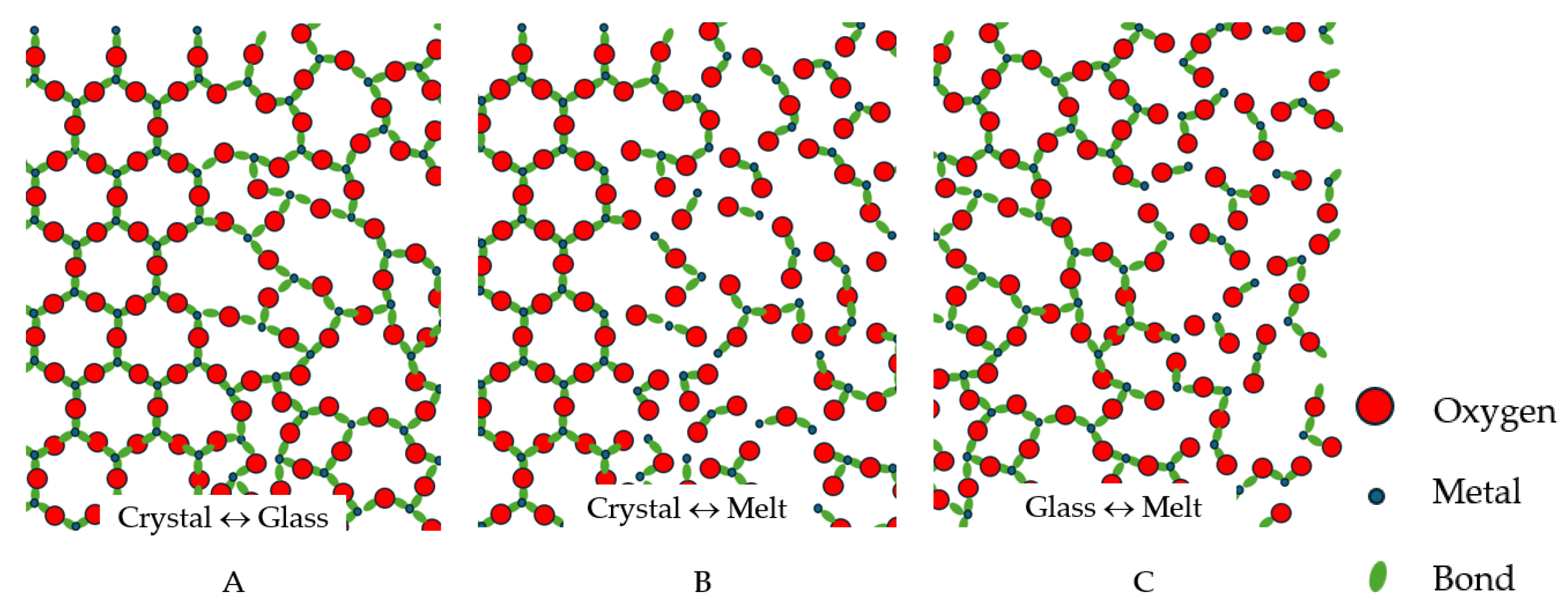
Figure 2.
The pair-distribution function PDF of liquid and vitreous Ni with the inset showing a bulk Ni supercell obtained using molecular dynamic simulations (adapted from [28]).
Figure 2.
The pair-distribution function PDF of liquid and vitreous Ni with the inset showing a bulk Ni supercell obtained using molecular dynamic simulations (adapted from [28]).
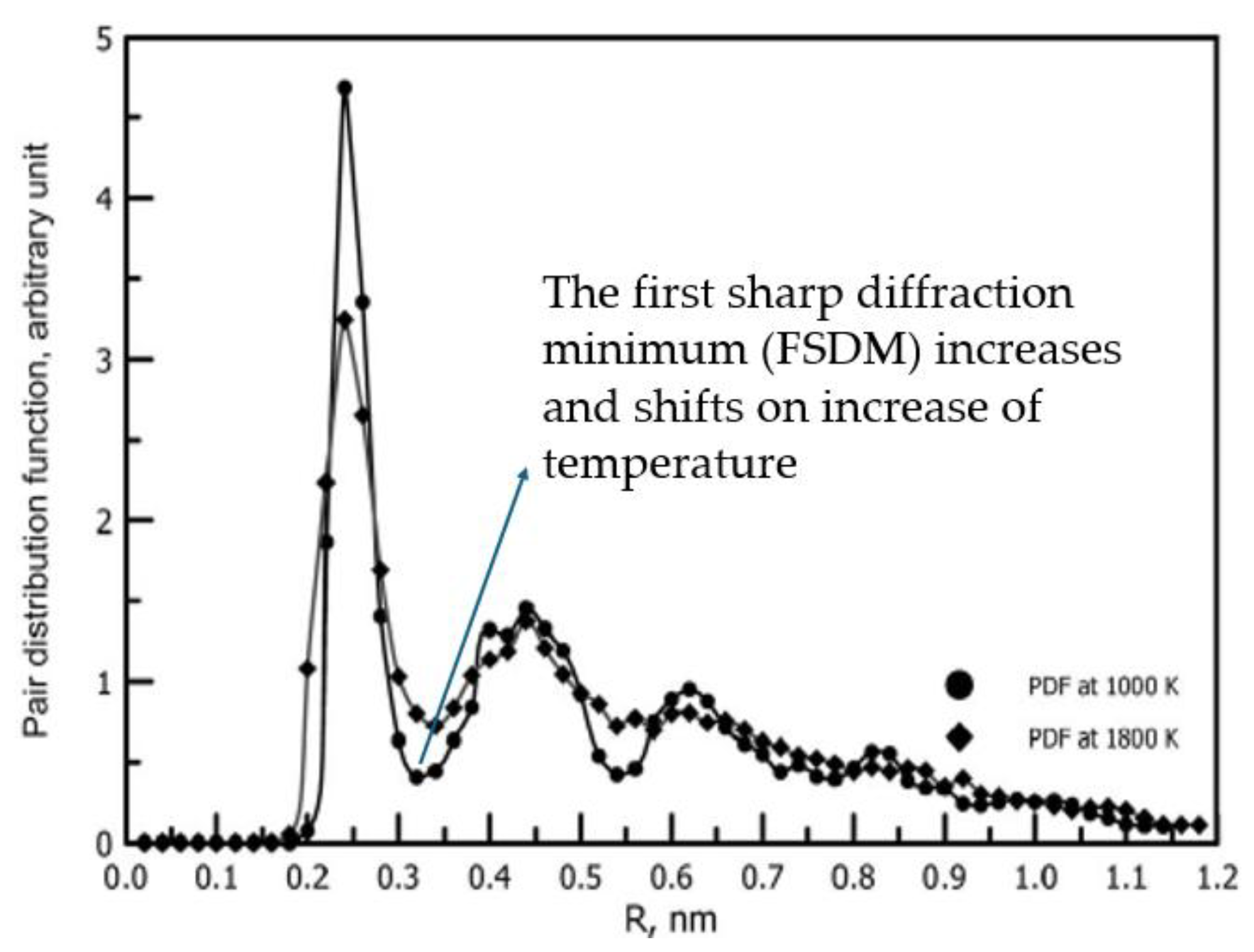
Figure 3.
Variation with temperature of structural factor and pair distribution function on crossing the glass transition temperature: (A) the first maximum of the structure factor S(q)max and its shifting position q1 reflecting the thermal expansion of Pd40Cu30Ni10P20 bulk metallic glass [45]. (B) the first sharp diffraction minimum PDFmin of amorphous Ni near Tg = 930 K [42].
Figure 3.
Variation with temperature of structural factor and pair distribution function on crossing the glass transition temperature: (A) the first maximum of the structure factor S(q)max and its shifting position q1 reflecting the thermal expansion of Pd40Cu30Ni10P20 bulk metallic glass [45]. (B) the first sharp diffraction minimum PDFmin of amorphous Ni near Tg = 930 K [42].
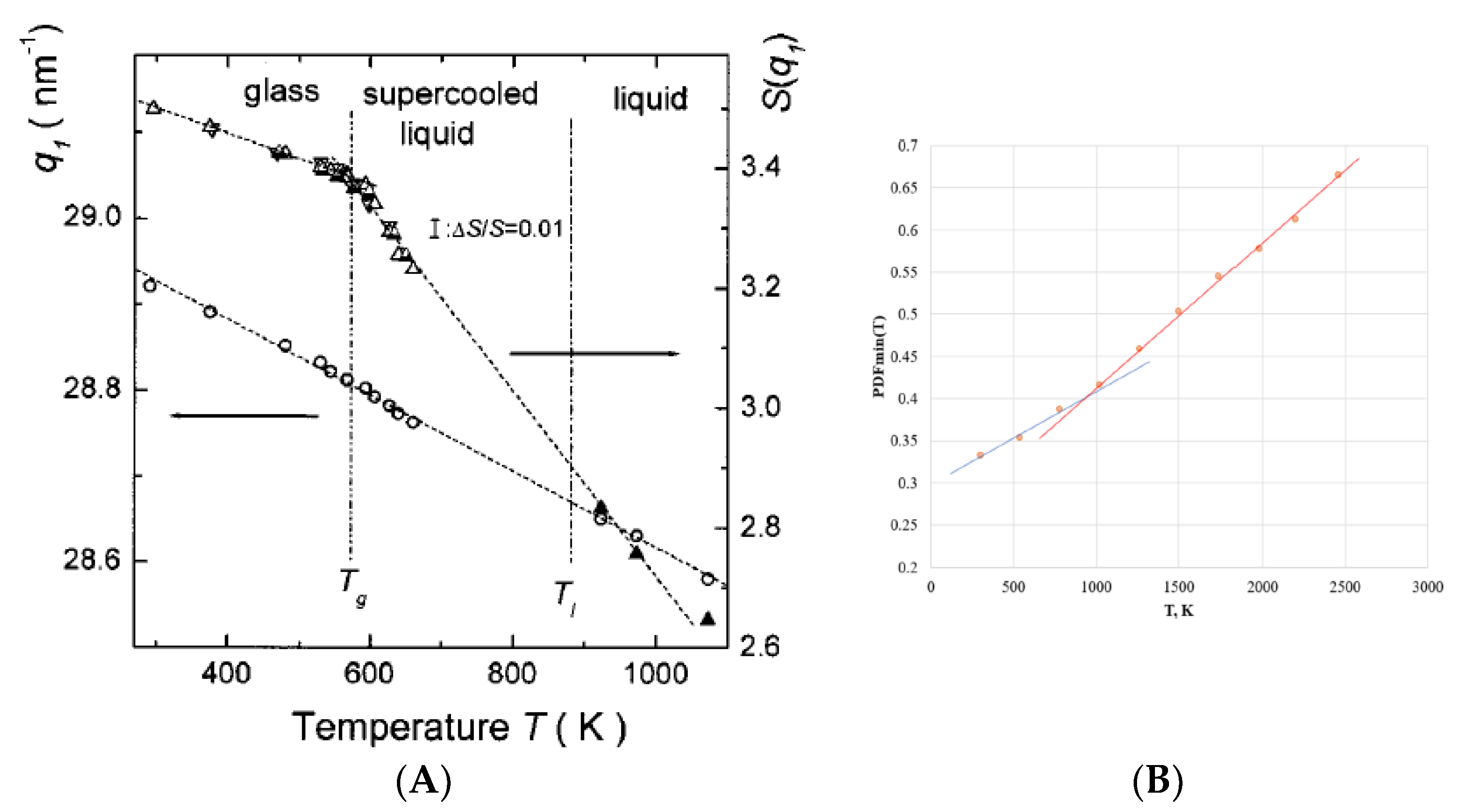
Figure 4.
Temperature dependence of density and Hausdorff-Besicovitch (HB) dimensionalities of bonds in materials following CPT.
Figure 4.
Temperature dependence of density and Hausdorff-Besicovitch (HB) dimensionalities of bonds in materials following CPT.
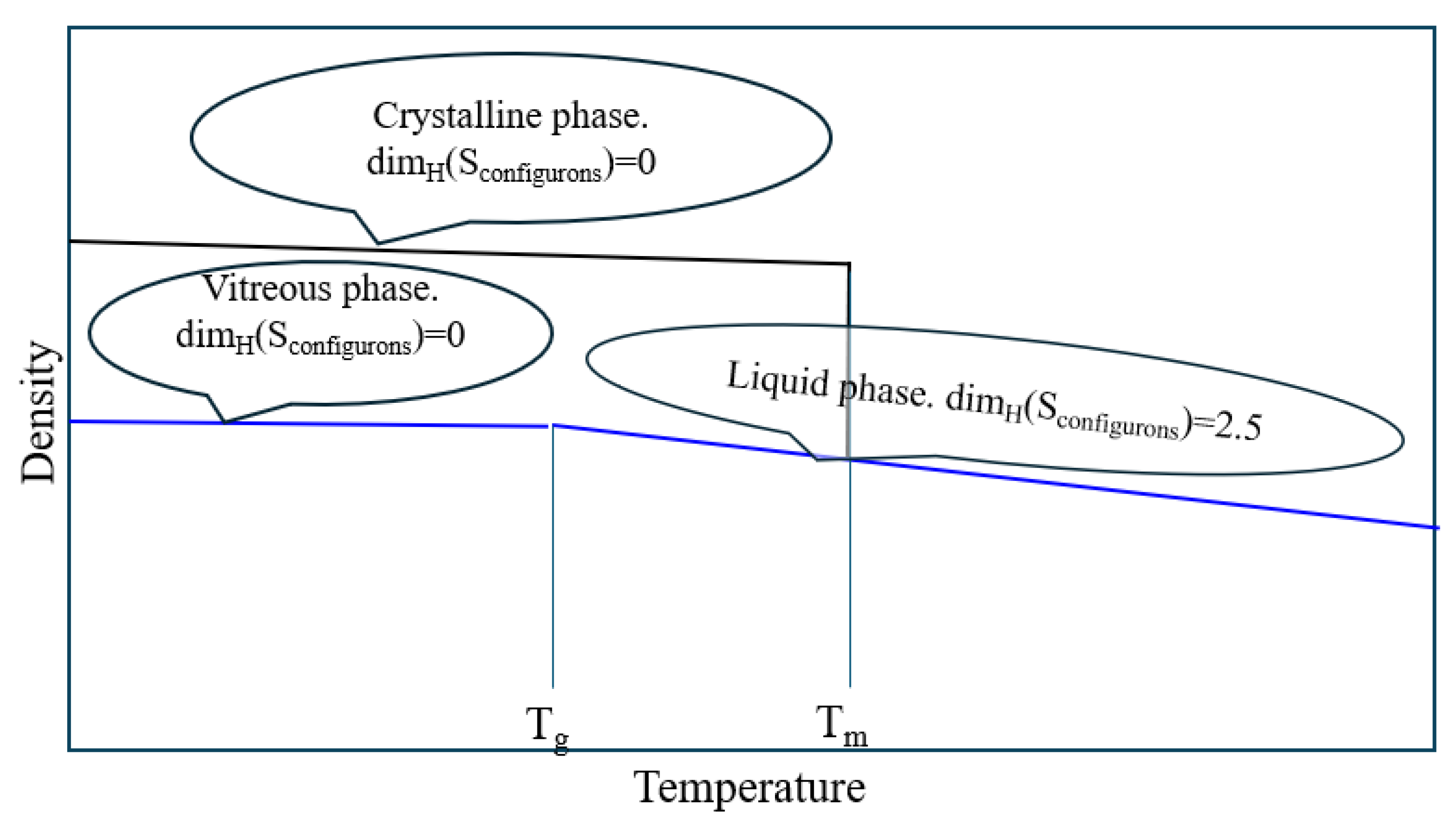
Figure 5.
The jump of constant pressure heat capacity at the glass transition of diopside. Courtesy Reinhard Conrad.
Figure 5.
The jump of constant pressure heat capacity at the glass transition of diopside. Courtesy Reinhard Conrad.
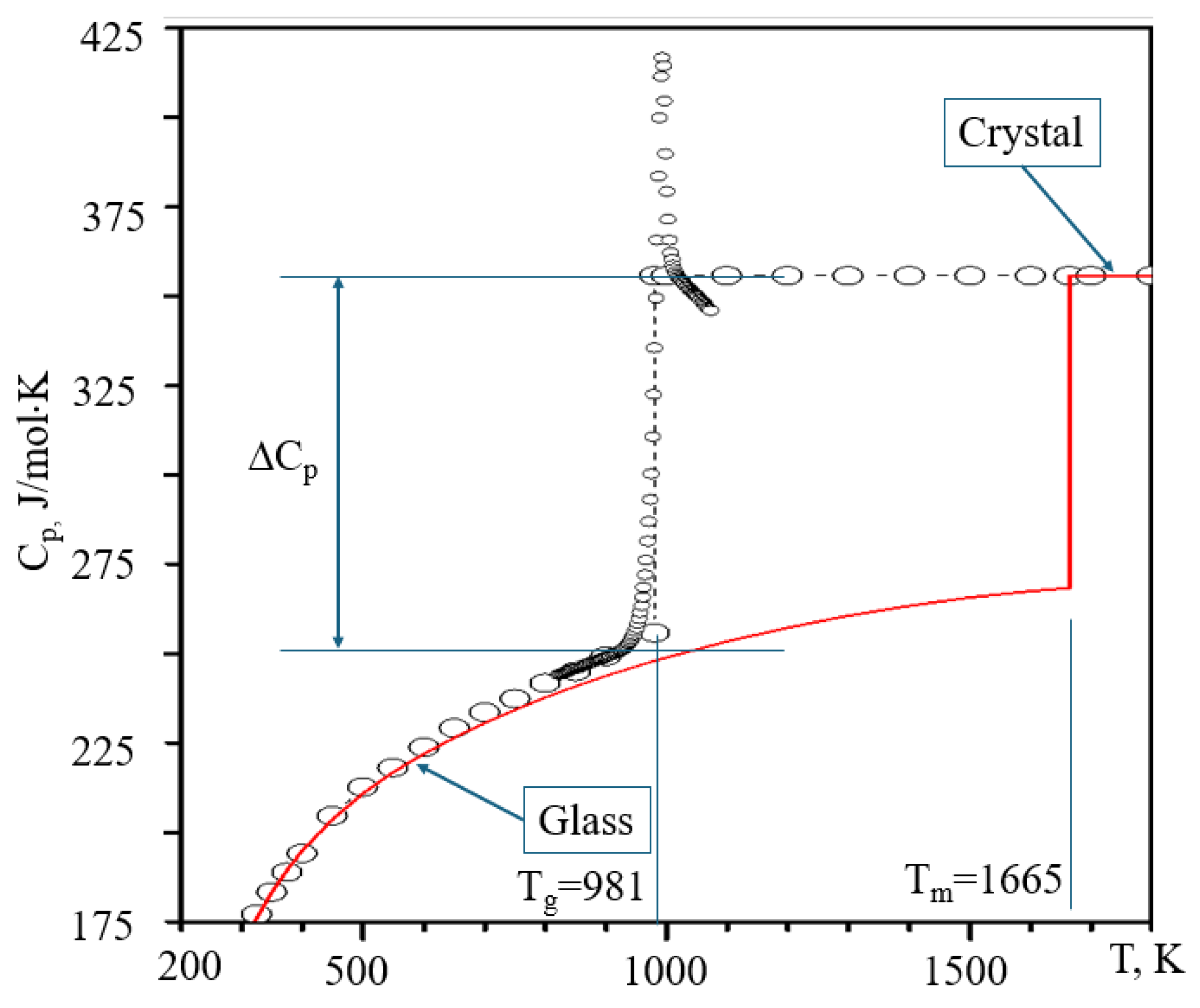
Figure 6.
Schematic of “fragmentation” of solids by breaking bonds in the cases when they have 1D (linear), 2D (surface) or 3D (body) dimensionalities of bonds after [2]. Broken bonds sets are shown here in red colour and are schematically characterized by 0D, 1D or 2D dimensionalities. In the case of a 3D amorphous solid material (glass) the structure formed out of configurons at the glass transition temperature is a percolation cluster (a macroscopic fractal structure) which has a dimensionality exceeding 2.5.
Figure 6.
Schematic of “fragmentation” of solids by breaking bonds in the cases when they have 1D (linear), 2D (surface) or 3D (body) dimensionalities of bonds after [2]. Broken bonds sets are shown here in red colour and are schematically characterized by 0D, 1D or 2D dimensionalities. In the case of a 3D amorphous solid material (glass) the structure formed out of configurons at the glass transition temperature is a percolation cluster (a macroscopic fractal structure) which has a dimensionality exceeding 2.5.
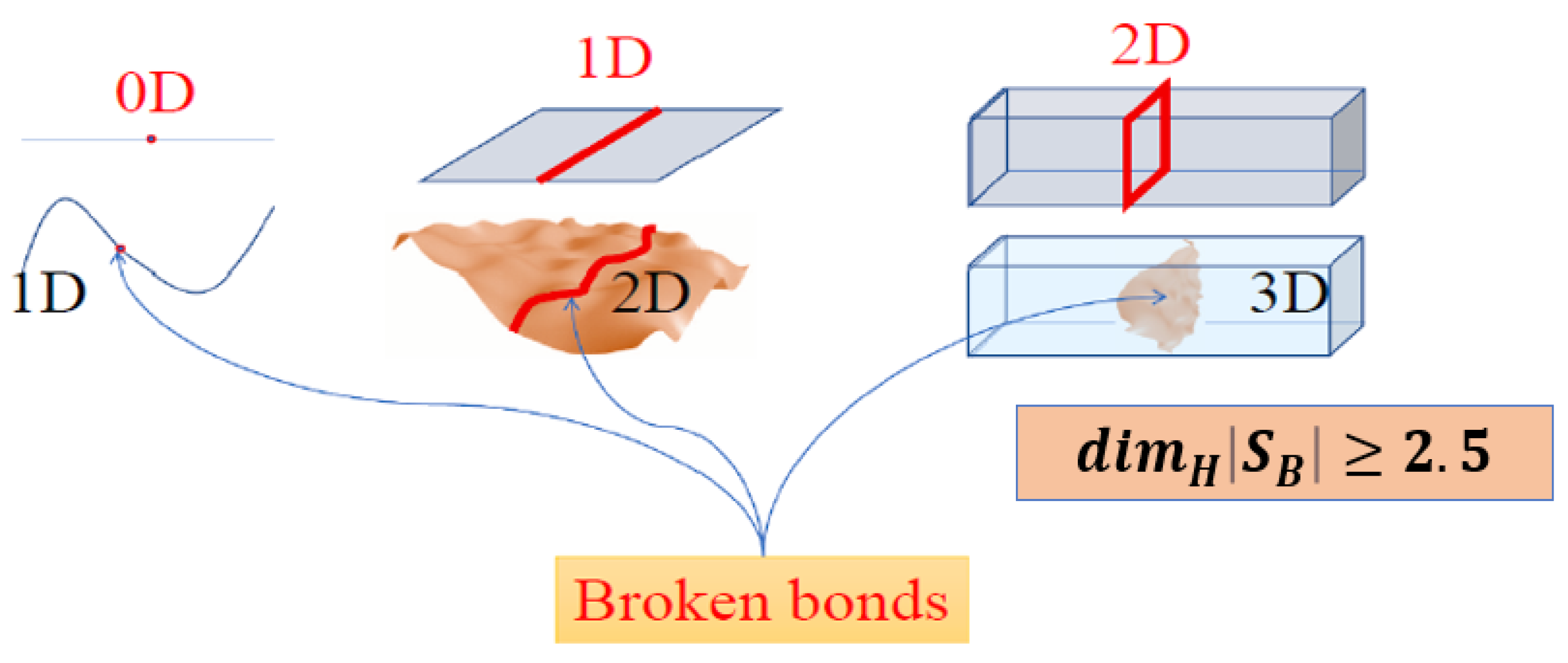

Table 1.
Phases of materials as a function of connectivity and ordering of atomic constituents.
| Degree of Ordering | Degree of Connectivity | |
| Low | High | |
| High | Liquid crystals; Liquid quasi-crystals | Crystals; Quasi-crystals |
| Medium | Liquid glasses | Glass-crystalline materials |
| Low | Melts | Glass 1 |
Table 2.
Viscous flow types and the CPT universal viscosity equation also known as DDO model [66,67].
| Table 1. |
Low (in the glass) T <Tg |
Intermediate (in the supercooled melt) Tg<T<TA |
High (in the melt) T>TA=(1.10±0.15)Tm |
Extremely High |
| Viscous flow type | Arrhenian with high activation energy QH |
Non-Arrhenian, apparent variable activation energy Q(T) |
Arrhenian with low activation energy QL |
Non-activated, growing with temperature rise |
| Universal viscosity equation 1 | ||||
1 The universal viscosity equation resulting from CPT correctly predicts the minima of viscosities at very high temperatures [68].
Table 3.
Comparison of some constant volume heat capacity jumps at calorimetric glass transition with CPT value ΔCv = 10.4 – 10.8 J/mol⋅K.
Table 3.
Comparison of some constant volume heat capacity jumps at calorimetric glass transition with CPT value ΔCv = 10.4 – 10.8 J/mol⋅K.
| Alloy, compound | Tg, K | ΔCv, J/mol⋅K |
| La55Al25Ni20 | 465 | 12.31 |
| Zr65Al7.5Ni10Cu17.5 | 653 | 11.02 |
| Mg65Cu25Y10 | 380 | 10.06 |
| Zr41.2Ti13.8Cu12.5Ni10Be22.5 | 623 | 11.95 |
| Pd77.5Cu6Si16.5 | 625 | 10.33 |
| Pd40Cu30Ni10P20 | 525 | 10.89 |
| Pd40Ni40P20 | 551 | 11.02 |
| Zr55Al10Ni5Cu30 | 653 | 11.32 |
Disclaimer/Publisher’s Note: The statements, opinions and data contained in all publications are solely those of the individual author(s) and contributor(s) and not of MDPI and/or the editor(s). MDPI and/or the editor(s) disclaim responsibility for any injury to people or property resulting from any ideas, methods, instructions or products referred to in the content. |
© 2025 by the authors. Licensee MDPI, Basel, Switzerland. This article is an open access article distributed under the terms and conditions of the Creative Commons Attribution (CC BY) license (http://creativecommons.org/licenses/by/4.0/).
Copyright: This open access article is published under a Creative Commons CC BY 4.0 license, which permit the free download, distribution, and reuse, provided that the author and preprint are cited in any reuse.


