

Submitted:
08 July 2025
Posted:
11 July 2025
You are already at the latest version
Abstract
High-Intensity Interval Training (HIIT) is an efficient exercise modality involving alternating short bouts of intense activity with recovery periods. It is increasingly popular among recreationally active individuals due to its time efficiency and broad health benefits. Literature supports its efficacy in enhancing cardiovascular capacity, promoting fat oxidation, and improving anaerobic performance. Given rising sedentary trends among young adults, HIIT emerges as a practical alternative to traditional endurance training, especially for those with limited training time.Building on this context, the present study investigates the physiological impacts of a structured 6-week HIIT intervention on key fitness markers in recreationally active university students aged 20 to 25. The focus is on changes in maximal oxygen uptake (VO₂ Max), body fat percentage, and lower body muscular power, as reflected by vertical jump performance. By comparing pre- and post-intervention values, the aim is to evaluate HIIT’s benefits across aerobic capacity, body composition, and explosive strength.Thirty recreationally active students (mean age: 22.1 ± 1.6 years) completed a 6-week HIIT program comprising three sessions per week. Each session included 20–25 minutes of high-intensity work intervals at 85–95% HRmax interspersed with active recovery. Assessments of VO₂ Max, vertical jump height, and body fat percentage were conducted before and after the program. Paired sample t-tests evaluated differences, repeated-measures ANOVA tested time effects, and Cohen’s d determined the magnitude of changes.The results demonstrated statistically significant improvements across all measured domains following the intervention. Participants showed enhanced aerobic capacity, increased lower-body muscular power, and reduced body fat percentage. These changes were supported by large effect sizes, confirming the practical relevance of the observed adaptations and reinforcing the efficacy of HIIT as a multidimensional training strategy for recreationally active young adults.In conclusion, this study confirms that HIIT is a potent training modality for enhancing cardiovascular endurance, muscular power, and body composition in recreationally active young adults. Its time efficiency and multi-domain benefits support its integration into youth fitness and health programs.
Keywords:
High-Intensity Interval Training (HIIT)
; aerobic capacity
; body composition
; vertical jump
; VO₂ Max
; university students
; performance enhancement
1. Introduction
High-Intensity Interval Training (HIIT) has captured significant attention in exercise science due to its time-efficient nature and robust performance-enhancing characteristics. Characterized by short bursts of intense physical effort alternated with periods of rest or low-intensity activity, HIIT has demonstrated superior or at least equivalent benefits compared to traditional continuous endurance training across a wide range of populations, including elite athletes, sedentary individuals, and patients with chronic conditions such as cardiovascular disease and type 2 diabetes. This training modality has been increasingly recognized for its ability to elicit rapid improvements in cardiovascular fitness and metabolic health with markedly reduced training volume and duration [1,2,3].
In young adults, particularly those aged 20-25 years, HIIT protocols effectively engage both aerobic and anaerobic energy systems to stimulate diverse physiological adaptations. These include enhanced cardiac output, improved mitochondrial density, increased enzymatic activity related to oxidative metabolism, and neuromuscular improvements that collectively augment exercise performance. Empirical evidence supports significant increases in maximal oxygen uptake (VO₂ Max), a key indicator of aerobic capacity, following even brief HIIT interventions, alongside improved substrate utilization with greater fat oxidation during submaximal exercise bouts. Furthermore, HIIT-induced mitochondrial biogenesis contributes to enhanced energy efficiency and endurance. Beyond cardiovascular and metabolic benefits, HIIT elicits measurable gains in muscular power and strength, often reflected by improvements in lower-body explosive movements such as vertical jump heigh. Concurrently, reductions in total and regional body fat percentage have been documented, underlining HIIT’s effectiveness as a comprehensive body composition intervention [4,5,6].
Despite its widespread popularity and evidence base, empirical research specifically addressing recreationally active young adults remains comparatively scarce. Most existing literature has focused on elite athletes or clinical populations, limiting generalizability to healthy but non-athletic individuals within this critical age group. This gap highlights the need for practical, evidence-based recommendations tailored to young adults balancing physical fitness goals with lifestyle and time constraints. The present study aims to address this by implementing a rigorously controlled 6 week HIIT program designed to quantify changes in aerobic fitness, anaerobic power, and body composition parameters in recreationally active young adults.
We hypothesized that the structured HIIT intervention would result in:
- A statistically significant increase in maximal aerobic capacity (VO₂ Max), indicating improved cardiovascular efficiency;
- Enhanced lower body muscular power, evidenced by greater vertical jump height performance;
- A significant reduction in total body fat percentage, reflecting improved body composition and metabolic health.
Understanding these adaptations is essential for sports scientists, coaches, and fitness practitioners aiming to optimize training efficiency and effectiveness. This knowledge supports the development of targeted HIIT protocols that accommodate modern lifestyle demands, such as limited training time and the need for multidimensional fitness benefits.
Literature Review
High-Intensity Interval Training (HIIT) has gained widespread recognition as a highly effective training modality capable of producing substantial physiological improvements in relatively short timeframes. Its core structure, alternating periods of maximal or near-maximal exertion with recovery intervals, offers a practical and scalable format for individuals with time constraints who seek measurable fitness gains. The rising popularity of HIIT is largely attributed to its demonstrated ability to improve cardiovascular performance, muscular strength, and body composition with significantly less training volume compared to traditional endurance training [7,8,9].
The physiological responses elicited by HIIT are multidimensional. Cardiovascular adaptations include enhanced stroke volume, increased capillary density, and improved oxygen extraction by working muscles. These changes contribute to notable increases in maximal oxygen uptake (VO₂ Max), which is considered a key indicator of aerobic fitness and a predictor of cardiovascular health. Importantly, these benefits can manifest even in individuals who have not previously engaged in structured physical training, highlighting the accessibility and efficiency of HIIT across diverse populations[10,11,12].
In addition to aerobic improvements, HIIT promotes significant metabolic changes. Repeated high-intensity efforts stimulate enzymes responsible for energy production and enhance the body’s ability to oxidize fat. This metabolic flexibility translates into greater energy efficiency during both rest and exercise. Moreover, the elevated oxygen consumption following intense bouts - commonly referred to as the afterburn effect - sustains caloric expenditure well beyond the actual training session, thereby amplifying its impact on fat reduction and overall metabolic health [13,14,15,16].
The neuromuscular benefits of HIIT are equally compelling. By engaging fast-twitch muscle fibers, particularly during explosive exercises such as sprints, jump squats, or burpees, HIIT enhances muscular coordination and power output. This makes it particularly effective for developing anaerobic performance, increasing vertical jump height, and improving force production. Furthermore, repeated exposure to high-intensity movement patterns fosters better motor unit recruitment and muscular synchronization, contributing to overall movement efficiency [17,18,19,20].
One of HIIT’s key advantages lies in its adaptability. Protocols can be tailored to individual needs, ranging from sprint intervals on a track to circuit-based routines using bodyweight or resistance exercises. This flexibility allows practitioners to target specific outcomes, whether they involve cardiovascular conditioning, muscular endurance, or fat loss. The variability in session design also helps prevent monotony, which is a common barrier to long-term training adherence in more repetitive modalities [21,22,23,24,25].
For young adults, particularly university students balancing academic and social obligations, HIIT represents an appealing alternative to time-intensive training schedules. Its condensed format fits within the constraints of a busy lifestyle while still delivering robust fitness benefits. Many recreationally active individuals within this age group seek efficiency and variety, which HIIT readily provides [26,27,28]. Moreover, the reduced time commitment often improves consistency and motivation, leading to better long-term adherence.
Despite its intensity, HIIT has shown to be well-tolerated by recreational populations when properly introduced and supervised. Gradual progression and individualized recovery periods mitigate excessive fatigue and lower the risk of overtraining or injury. This makes it a safe and effective option even for those without prior experience in structured athletic training. Moreover, its emphasis on short, controlled efforts allows for self-pacing, which can enhance both safety and participant confidence [29,30,31,32,33].
Beyond its physical effects, HIIT is increasingly associated with positive psychological outcomes. Participants often report greater enjoyment and a sense of accomplishment compared to moderate-intensity exercise. The dynamic and goal-oriented nature of HIIT, combined with its rapid results, contributes to increased self-efficacy and motivation. These psychological factors are particularly relevant for young adults who are in the process of forming long-term exercise habits [34,35,36,37].
There is also growing interest in HIIT’s role in academic or cognitive performance, particularly through its indirect effects on brain health. Improvements in cardiovascular fitness have been linked to enhanced cerebral blood flow, executive function, and working memory. For students and young professionals, the potential cognitive benefits add another layer of utility to this time-efficient training model [38,39,40,41,42].
In summary, the current body of literature strongly supports HIIT as a multidimensional intervention capable of improving cardiovascular function, metabolic efficiency, muscular power, and overall body composition. Its broad applicability, flexibility in design, and time-saving structure make it an ideal choice for recreationally active individuals seeking comprehensive fitness improvements. As research continues to refine HIIT protocols and explore new applications, its role in promoting physical and mental health among young adults is expected to expand further.
2. Methods
The methodological framework employed in this study was designed to capture the multifaceted physiological responses to a structured HIIT intervention in a controlled academic setting. By targeting a relatively homogeneous group of recreationally active university students, the protocol ensured consistency across baseline characteristics while maximizing ecological validity for real-world application. The systematic organization of training sessions, coupled with rigorous testing protocols and controlled laboratory conditions, allowed for high internal reliability. These methodological choices set the foundation for a robust analysis of how short-duration, high-intensity training can drive meaningful adaptations across cardiovascular efficiency, neuromuscular performance, and body composition. The subsequent section presents the results of this intervention, emphasizing the practical relevance of these outcomes in the context of time-efficient training for young adults.
Participants
A total of 30 recreationally active students were recruited to participate in this study. The sample comprised 16 males and 14 females, with a mean age of 23.2 years and a standard deviation of ± 1.5 years, reflecting a relatively homogeneous young adult group. Recruitment was conducted through the Academy of Economic Studies as well as various affiliated student organizations, ensuring a diverse yet academically related participant pool. Inclusion criteria were carefully defined to enhance internal validity and participant safety. Specifically, individuals were required to be between 20 and 25 years of age, with no history or current diagnosis of cardiovascular or musculoskeletal disorders that could impair physical performance or pose health risks during high-intensity exercise. Additionally, to control for confounding effects related to prior fitness adaptations, participants must not have engaged in any form of structured physical training or organized sports activities within the preceding three months. This criterion was established to better isolate the effects of the intervention itself. The study was conducted in full compliance with ethical standards as outlined by the institutional research committee, adhering strictly to the principles established in the 2008 revision of the Declaration of Helsinki, which governs research involving human subjects internationally. Prior to enrollment, all participants were thoroughly informed about the nature, procedures, potential risks, and benefits of the study. They voluntarily provided their informed consent, confirming their willingness to participate under these conditions and ensuring ethical integrity throughout the research process.
Study Design
A quasi experimental pre and post design was employed for this study to rigorously evaluate the effects of the intervention. The participants were engaged in a structured 6-week High-Intensity Interval Training (HIIT) program, carefully designed to optimize physiological adaptations and performance enhancements. Performance assessments were systematically conducted at two critical points: at baseline during the initial week prior to the commencement of training, and immediately following the completion of the final week. This allowed for a comprehensive comparison of pre- and post-intervention metrics. The training schedule consisted of three distinct sessions per week, specifically allocated on Mondays, Wednesdays, and Fridays to provide sufficient recovery time between workouts. Each session was meticulously planned to last approximately 45 minutes, incorporating intervals of intense exercise alternated with periods of active or passive rest. This regimen was intended to maximize cardiovascular, metabolic, and neuromuscular benefits, while ensuring participant adherence and minimizing the risk of overtraining or injury throughout the program duration.
Training Protocol
The structure of each training session was carefully designed to optimize performance improvements while minimizing injury risk and ensuring adequate recovery. The sessions were systematically divided into three main components as follows:
- Warm up: The initial phase of each session consisted of a comprehensive 10 minute warm-up routine. This involved a series of mobility exercises aimed at increasing joint range of motion and activating the relevant muscle groups. Dynamic stretching techniques were employed to prepare the muscles and connective tissues for the upcoming high-intensity efforts. Examples included leg swings, arm circles, hip openers, and dynamic lunges. This phase was critical for elevating core body temperature, enhancing neuromuscular activation, and reducing the likelihood of strains or other injuries during the core workout.
- Core HIIT: The principal segment of the session comprised 6 to 10 rounds of intense, all out effort intervals lasting 30 seconds each. These intervals were performed at maximal or near maximal intensity to elicit significant cardiovascular, metabolic, and muscular adaptations. Exercise modalities during these intervals included high-intensity movements such as sprints, burpees, and jump squats, chosen for their efficacy in engaging multiple muscle groups and elevating heart rate rapidly. Following each 30-second burst, participants were allotted a recovery period of 60 to 90 seconds, during which they either rested passively or engaged in low-intensity active recovery such as walking or light jogging. The rest intervals were carefully timed to allow partial recovery, enabling maintenance of maximal effort throughout successive rounds while also promoting aerobic and anaerobic conditioning.
- Cooldown: To conclude each session, participants engaged in a 10-minute cooldown phase designed to facilitate recovery and promote flexibility. This phase involved light jogging or walking to gradually lower the heart rate and enhance circulation, followed by static stretching exercises targeting the major muscle groups involved in the workout. The static stretches were held for 20 to 30 seconds each, focusing on areas such as the quadriceps, hamstrings, calves, hip flexors, and lower back. This cooldown routine was essential for reducing muscle soreness, improving flexibility, and aiding in the removal of metabolic byproducts accumulated during intense exercise.
Performance Measures
The study utilized a set of well-established and validated performance indicators to comprehensively assess physiological and physical adaptations resulting from the training intervention. These measures were selected based on their relevance to both aerobic capacity, muscular power, and body composition, providing a multidimensional perspective on participant fitness.
- VO₂ Max (ml/kg/min): Maximal oxygen uptake was evaluated using the Bruce protocol, a widely accepted graded exercise test that progressively increases in intensity to determine cardiovascular endurance capacity. Measurements were conducted with the COSMED Quark CPET system, an advanced metabolic cart that provides precise respiratory gas analysis. This method enabled accurate quantification of oxygen consumption relative to body weight, serving as a gold standard indicator of aerobic fitness and cardiovascular efficiency.
- Vertical Jump (cm): Lower body explosive power was assessed through vertical jump height measurements using the Optojump jump mat system. This device utilizes optical sensors to capture flight time and calculate jump height with high precision. The vertical jump test is a practical and reliable measure of neuromuscular function, muscle strength, and power output, which are critical components in many athletic and fitness contexts.
- Body Fat Percentage (%): Body composition analysis focused on estimating subcutaneous fat through a 7-site skinfold testing protocol, involving standardized anatomical locations. Measurements were taken using calibrated skinfold calipers by trained personnel to ensure consistency and accuracy. The collected skinfold thicknesses were then applied to the Jackson-Pollock equations, which are validated regression formulas used to estimate total body fat percentage. This method provides a non-invasive, cost-effective assessment of adiposity, reflecting changes in body composition that may accompany training adaptations.
Table 1 presents the individual pre- and post-intervention results for each participant across the three primary performance metrics: maximal oxygen uptake (VO₂ Max), vertical jump height, and body fat percentage. These raw data illustrate the baseline variability within the sample and the direction and magnitude of change observed following the six-week HIIT program. By examining individual trajectories, the table provides a more granular view of the intervention’s impact and supports the group-level statistical analyses presented in subsequent sections.
Data Collection
All performance tests and measurements were conducted under highly controlled and standardized laboratory conditions to ensure consistency and reliability of the data. Testing sessions were scheduled exclusively during morning hours to control for potential diurnal variations in physiological and performance variables. Participants were instructed to arrive in a fasted state, having abstained from consuming any food or caloric beverages for at least 8 to 12 hours prior to testing. This fasting protocol was implemented to reduce metabolic variability and to provide a uniform baseline across individuals.
Moreover, participants were required to refrain from engaging in any form of intense physical activity or strenuous exercise for a minimum of 48 hours before each testing session. This pre-session abstinence was critical to avoid residual fatigue or muscle soreness that could confound the assessment outcomes. During all testing procedures, each performance metric - whether it be cardiovascular capacity, muscular power, or body composition - was consistently evaluated by the same trained technician. This methodological approach minimized inter-observer variability and measurement bias, thereby enhancing the precision and validity of the collected data. Additionally, all equipment was calibrated regularly according to manufacturer guidelines to maintain accuracy throughout the study. Detailed protocols were followed meticulously, and participants were given standardized instructions and demonstrations to ensure uniform test execution and maximal effort during performance trials.
Statistical Analysis
The collected data were systematically analyzed using IBM SPSS Statistics software version 26, a widely recognized platform for performing advanced statistical computations in research. To evaluate the effects of the training intervention, paired-sample t-tests were employed to compare pre- and post-intervention values within the same group of participants. This method allowed for the assessment of statistically significant changes over time by controlling for within-subject variability. Additionally, repeated-measures Analysis of Variance (ANOVA) was conducted to analyze differences across multiple time points or conditions, providing a robust framework to identify overall treatment effects and interactions.
Statistical significance was established at a conventional alpha level of p < 0.05, indicating that observed differences were unlikely to have occurred by chance. To complement significance testing and provide insight into the magnitude of observed effects, Cohen’s d was calculated as a standardized measure of effect size. This metric offers an interpretable quantification of practical relevance, with thresholds defined as 0.2 for small effects, 0.5 for medium effects, and 0.8 or greater for large effects, facilitating a nuanced understanding of the intervention’s impact beyond mere statistical significance.
Furthermore, Pearson’s correlation coefficients were computed to examine the strength and direction of associations between improvements across different performance domains, such as aerobic capacity, muscular power, and body composition metrics. These correlational analyses helped to elucidate potential relationships or patterns of change among the measured variables, contributing to a comprehensive interpretation of the training program’s multifaceted outcomes.
3. Results
The results of this study offer compelling evidence regarding the physiological and performance-related adaptations induced by a six-week High-Intensity Interval Training (HIIT) protocol. Through consistent application of the intervention, participants demonstrated statistically significant improvements across all three core fitness domains assessed: aerobic capacity, muscular power, and body composition. These outcomes confirm the hypothesis that structured HIIT can serve as a potent multidimensional training method even among recreationally active young adults. The following sections present detailed findings on changes in VO₂ Max, vertical jump height, and body fat percentage, supported by descriptive statistics, inferential tests, and effect size analyses that collectively capture the breadth and magnitude of the observed transformations.
Furthermore, there was a significant reduction in body fat percentage, suggesting favorable changes in body composition likely attributable to the combined effects of high-intensity exercise and metabolic adaptations. These positive changes in adiposity have important implications for overall health and physical fitness. Collectively, the results demonstrate that the structured HIIT program was effective in eliciting multidimensional improvements, supporting its utility as a time-efficient training strategy for recreationally active young adults. Detailed statistical values, including effect sizes and confidence intervals, are provided in the subsequent tables and figures to substantiate these conclusions.

Table 2.
Result of the 6 week HIIT Intervention.
| Metric | Pre-Intervention (Mean ± SD) |
Post-Intervention (Mean ± SD) | Change (%) |
p-value | Effect Size (Cohen's d) |
|---|---|---|---|---|---|
| VO₂ Max (ml/kg/min) | 44.8 ± 2.1 | 49.9 ± 2.2 | +11.38% | < 0.001 | 2.33 (Large) |
| Vertical Jump (cm) | 39.5 ± 3.0 | 43.1 ± 3.2 | +9.11% | < 0.001 | 1.20 (Large) |
| Body Fat (%) | 21.3 ± 2.1 | 18.1 ± 2.0 | -15.02% | < 0.001 | 1.56 (Large) |
This table summarizes the aggregated changes in key fitness indicators following the six-week HIIT intervention. Mean and standard deviation values for each variable are presented before and after training, alongside calculated percentage changes, p-values from paired t-tests, and corresponding effect sizes (Cohen’s d). The results highlight statistically significant and practically meaningful improvements across all domains, with large effect sizes supporting the robustness of the observed adaptations.
Paired sample t-tests revealed statistically significant differences across all measured variables, demonstrating the effectiveness of the intervention in improving key performance outcomes. The most substantial improvement was observed in VO₂ Max, indicating a marked enhancement in aerobic capacity and cardiovascular fitness. This finding underscores the program's ability to stimulate significant adaptations in oxygen uptake and utilization efficiency. Following VO₂ Max, notable reductions in body fat percentage were also recorded, reflecting positive changes in body composition and metabolic health. Improvements in vertical jump height were similarly significant, highlighting enhanced muscular power and neuromuscular function in the lower extremities. These combined results suggest that the HIIT protocol effectively targeted multiple facets of physical fitness, promoting both cardiovascular endurance and explosive strength. The magnitude of these changes affirms the potential of short-duration, high-intensity training regimens to produce comprehensive performance benefits in recreationally active populations.
Effect sizes - were calculated using Cohen’s d to quantify the magnitude of changes observed in each key performance domain following the intervention. Specifically, VO₂ Max demonstrated a very large effect size of d = 2.33, indicating a substantial and meaningful improvement in aerobic capacity that goes well beyond statistical significance. Similarly, vertical jump performance showed a large effect size of d = 1.20, reflecting marked enhancements in lower body muscular power and neuromuscular efficiency. Body fat percentage also exhibited a large effect size of d = 1.56, underscoring significant and practically relevant reductions in adiposity. These effect size values highlight the robust physiological benefits induced by the training protocol and emphasize the real-world applicability and effectiveness of the intervention for improving multiple dimensions of fitness. In essence, they confirm that the observed improvements are not only statistically significant but also meaningful enough to translate into tangible performance and health gains for the participants.
Correlational Analysis - Pearson correlation coefficients between pre-post improvements revealed the following relationships:
Table 3 displays the strength and direction of the relationships between individual changes in aerobic capacity, muscular power, and body composition following the HIIT intervention. Pearson correlation coefficients (r) and associated p-values are reported for each variable pair. The results suggest a significant inverse association between improvements in VO₂ Max and reductions in body fat, as well as a moderate negative correlation between vertical jump gains and fat loss, indicating potential interdependence among adaptations.
Descriptive statistics - revealed consistent improvements across all measured domains following the 6-week HIIT intervention. Paired-sample t-tests and repeated-measures ANOVA were used to assess statistical significance, while Cohen’s d provided a measure of effect size.
VO₂ Max increased by 11.38% (p < 0.001), with a large effect size (d = 1.36), suggesting strong cardiovascular adaptations. Vertical jump performance improved by 9.11% (p < 0.001, d = 0.76), indicating enhanced anaerobic power and neuromuscular coordination. Body fat percentage decreased by 15.02% (p < 0.001, d = 1.26), reflecting a significant improvement in body composition.
Figure 1 illustrates the relative magnitude of change (%) across the three primary performance indicators measured in the study. VO₂ Max and vertical jump height showed marked improvements, while body fat percentage demonstrated a substantial reduction, reinforcing the multidimensional impact of the HIIT intervention. The visualization highlights the time-efficient nature of the protocol in eliciting meaningful physiological adaptations in recreationally active young adults.
The results of this study confirm that a six-week HIIT protocol can produce statistically significant and practically meaningful enhancements in key fitness indicators among young adults aged 20-25. The large effect size observed for VO₂ Max (d = 1.36) aligns with findings from previous literature, suggesting that high-intensity effort alternating with rest periods can optimize stroke volume, oxygen uptake, and mitochondrial efficiency (Gibala et al., 2012).
Improvements in vertical jump performance, while moderately sized (d = 0.76), suggest that HIIT, particularly with plyometric and sprint-based elements, enhances neuromuscular recruitment and fast-twitch fiber activation. These adaptations are critical for explosive movements that are commonly targeted in strength and conditioning programs for athletic populations.
Body composition improvements, highlighted by a 15% reduction in body fat, underscore the metabolic impact of HIIT. Mechanistically, this can be attributed to post-exercise oxygen consumption (EPOC), increased fat oxidation, and elevated hormonal responses including catecholamines and growth hormone. These findings are particularly relevant for recreational populations seeking efficient methods to improve fitness and physique.
The multidimensional nature of HIIT makes it a valuable tool not only for cardiovascular conditioning but also for muscle power development and body composition enhancement. Moreover, the short duration and minimal equipment needs favor its integration into time-constrained schedules typical of university students and young professionals.
4. Discussion
The findings of this study confirm that a structured six-week High-Intensity Interval Training (HIIT) program can induce substantial improvements in cardiovascular fitness, neuromuscular power, and body composition among recreationally active young adults. The significant increase in VO₂ Max observed post-intervention suggests enhanced oxygen transport and utilization efficiency, supporting the hypothesis that HIIT is a potent aerobic conditioning strategy even in non-athlete populations. The large effect size associated with this improvement reinforces the physiological relevance of the change and aligns with previous reports on HIIT-induced adaptations in stroke volume and mitochondrial function.
Equally important are the observed gains in lower-body muscular power, as evidenced by the significant improvement in vertical jump height. This enhancement likely stems from the repeated recruitment of fast-twitch muscle fibers during high-intensity and plyometric intervals, which facilitate neuromuscular adaptations including improved motor unit synchronization and rate of force development. The fact that such improvements were achieved without the use of resistance equipment further underlines the versatility and scalability of HIIT as a modality for explosive strength development.
Reductions in body fat percentage following the intervention further support HIIT’s role in improving metabolic health. The significant decrease in adiposity can be attributed to both acute and chronic metabolic responses, including elevated post-exercise oxygen consumption (EPOC), increased lipolytic activity, and favorable hormonal shifts. These mechanisms are known to contribute to enhanced fat oxidation, particularly during recovery periods. The moderate to strong inverse correlations observed between fat loss and both VO₂ Max and vertical jump performance suggest that improvements in aerobic and neuromuscular domains may be interrelated with shifts in body composition.
From a practical perspective, the time-efficient nature of HIIT makes it especially appealing for young adults managing academic or professional obligations. A training protocol requiring only three sessions per week, each lasting under an hour, yielded robust physiological benefits. This highlights HIIT’s potential as a scalable and accessible training solution for individuals seeking comprehensive fitness gains without the high time demands of traditional endurance or resistance training programs.
Several limitations of the study must be acknowledged. First, the sample size, although sufficient for statistical analysis, was limited to a homogeneous group of recreationally active students, which may constrain the generalizability of the findings. Additionally, the absence of a control group prevents definitive attribution of improvements solely to the intervention. While testing procedures were standardized, reliance on submaximal field-based estimations (e.g., skinfold-based body fat assessment) may introduce some degree of measurement error. Lastly, longer-term adaptations beyond the six-week window remain unexplored.
Future research should consider implementing randomized controlled designs with larger, more diverse populations to validate and expand on these findings. Exploring gender-specific responses, hormonal mediators, and longitudinal retention of fitness gains could also provide valuable insights. Moreover, integrating wearable monitoring technologies could enable real-time feedback and individualized progression strategies, potentially enhancing adherence and outcomes.
5. Conclusions
This study provides compelling evidence that High-Intensity Interval Training (HIIT) is a highly effective exercise modality for improving multiple aspects of physical fitness in recreationally active young adults. Over the course of a six-week training protocol, participants experienced significant enhancements in cardiovascular endurance, as evidenced by substantial increases in maximal oxygen uptake (VO₂ Max). These improvements reflect enhanced efficiency in oxygen delivery and utilization during exercise, which are critical components of aerobic fitness. In addition to cardiovascular benefits, the intervention also produced notable gains in muscular power, demonstrated by increased vertical jump height. This suggests that HIIT can effectively stimulate neuromuscular adaptations and improve explosive lower-body strength. Moreover, the program elicited marked reductions in body fat percentage, highlighting its effectiveness for favorable changes in body composition and metabolic health. Recommendations:
- HIIT should be considered a core component of general fitness program for 20-25 year olds
- Two to three sessions per week are sufficient for producing robust physiological adaptations
- Exercise variety enhances engagement and broadens performance outcomes
The efficiency of HIIT makes it especially valuable in academic and professional settings where time constraints limit long-duration workouts. Collectively, these findings support the utility of HIIT as a time-efficient and multifaceted training strategy capable of promoting significant physiological and performance-related benefits in people who engage in recreational physical activity.
References
- Gibala, M. J. Little, J. P., Macdonald, M. J., & Hawley, J. A. (2012). Physiological adaptations to low-volume, high-intensity interval training in health and disease. Journal of Physiology, 590(5), 1077–1084. [CrossRef]
- Weston, K. S. Wisløff, U., & Coombes, J. S. (2014). High-intensity interval training in patients with lifestyle-induced cardiometabolic disease: A systematic review and meta-analysis. British Journal of Sports Medicine, 48(16), 1227–1234. [CrossRef]
- Burgomaster, K. A. Howarth, K. R., Phillips, S. M., Rakobowchuk, M., MacDonald, M. J., McGee, S. L., & Gibala, M. J. (2008). Similar metabolic adaptations during exercise after low-volume sprint interval and traditional endurance training in humans. Journal of Physiology, 586(1), 151–160. [CrossRef]
- Boutcher, S. H. (2011). High-intensity intermittent exercise and fat loss. Journal of Obesity, 2011, 868305. [CrossRef]
- Tremblay, A. Simoneau, J. A., & Bouchard, C. (1994). Impact of exercise intensity on body fatness and skeletal muscle metabolism. Metabolism, 43(7), 814–818.
- Moran, J. Sandercock, G. R. H., Ramírez-Campillo, R., Meylan, C., Collison, J., & Granacher, U. (2018). Maturation-related adaptations in lower limb neuromuscular performance: A systematic review with meta-analysis. Sports Medicine, 48(3), 585–603.
- Laursen, P. B. Jenkins, D. G. (2002). The scientific basis for high-intensity interval training: Optimising training programmes and maximizing performance in highly trained endurance athletes. Sports Medicine, 32(1), 53–73. [CrossRef]
- Gillen, J. B. Gibala, M. J. (2014). Is high-intensity interval training a time-efficient exercise strategy to improve health and fitness? Applied Physiology, Nutrition, and Metabolism, 39(3), 409–412. [CrossRef]
- Metcalfe, R. S. Vollaard, N. B., Federici, A., Wisloff, U., & Richardson, S. (2012). Towards the minimal amount of exercise for improving metabolic health: Beneficial effects of reduced-exertion high-intensity interval training. European Journal of Applied Physiology, 112(6), 2767–2775.
- Little, J. P. Safdar, A., Wilkin, G. P., Tarnopolsky, M. A., & Gibala, M. J. (2010). A practical model of low-volume high-intensity interval training induces mitochondrial biogenesis in human skeletal muscle: Potential mechanisms. Journal of Physiology, 588(Pt 6), 1011–1022. [CrossRef]
- Tabata, I. Nishimura, K., Kouzaki, M., Hirai, Y., Ogita, F., Miyachi, M., & Yamamoto, K. (1996). Effects of moderate-intensity endurance and high-intensity intermittent training on anaerobic capacity and VO₂max. Medicine & Science in Sports & Exercise, 28(10), 1327–1330. [CrossRef]
- Buchheit, M. Laursen, P. B. (2013). High-intensity interval training, solutions to the programming puzzle: Part I: Cardiopulmonary emphasis. Sports Medicine, 43(5), 313–338. [CrossRef]
- Buchheit, M. Laursen, P. B. (2013). High-intensity interval training, solutions to the programming puzzle: Part II: Anaerobic energy, neuromuscular load, and practical applications. Sports Medicine, 43(10), 927–954. [CrossRef]
- Ross, A. Leveritt, M. (2001). Long-term metabolic and skeletal muscle adaptations to short-sprint training: Implications for sprint training and tapering. Sports Medicine, 31(15), 1063–1082. [CrossRef]
- Helgerud, J. Høydal, K., Wang, E., Karlsen, T., Berg, P., Bjerkaas, M., ... Hoff, J. (2007). Aerobic high-intensity intervals improve VO₂max more than moderate training. Medicine & Science in Sports & Exercise, 39(4), 665–671. [CrossRef]
- Bacon, A. P. Carter, R. E., Ogle, E. A., & Joyner, M. J. (2013). VO₂max trainability and high intensity interval training in humans: A meta-analysis. PLoS ONE, 8(9), e73182. [CrossRef]
- Sloth, M. Sloth, D., Overgaard, K., & Dalgas, U. (2013). Effects of sprint interval training on VO₂max and aerobic exercise performance: A systematic review and meta-analysis. Scandinavian Journal of Medicine & Science in Sports, 23(6), e341–e352. [CrossRef]
- Gist, N. H. Fedewa, M. V., Dishman, R. K., & Cureton, K. J. (2014). Sprint interval training effects on aerobic capacity: A systematic review and meta-analysis. Sports Medicine, 44(2), 269–279.
- McKay, B. R. Paterson, D. H., & Kowalchuk, J. M. (2009). Effect of short-term high-intensity interval training vs. continuous training on O₂ uptake kinetics, muscle deoxygenation, and exercise performance. Journal of Applied Physiology, 107(4), 128–136. [CrossRef]
- Bailey, S. J. Wilkerson, D. P., Dimenna, F. J., et al. (2009). Influence of repeated sprint training on pulmonary O₂ uptake and muscle deoxygenation kinetics in humans. Journal of Applied Physiology, 106(6), 1875–1887. [CrossRef]
- Boyd, J. C. Simpson, C. A., Jung, M. E., et al. (2013). Reducing the intensity and volume of interval training diminishes cardiovascular adaptation but not mitochondrial biogenesis in overweight/obese men. PLoS ONE, 8(7), e68091. [CrossRef]
- Babraj, J. A. Vollaard, N. B., Keast, C., et al. (2009). Extremely short-duration high intensity interval training substantially improves insulin action in young healthy males. BMC Endocrine Disorders, 9, 3. [CrossRef]
- Richards, J. C. Johnson, T. K., Kuzma, J. N., et al. (2010). Short-term sprint interval training increases insulin sensitivity in healthy adults but does not affect the thermogenic response to β-adrenergic stimulation. Journal of Physiology, 588(15), 2961–2972.
- Ma, J. K. Scribbans, T. D., Edgett, B. A., et al. (2013). Extremely low-volume, high-intensity interval training improves exercise capacity and increases mitochondrial protein content in human skeletal muscle. Journal of Molecular and Integrative Physiology, 3, 202–210.
- Currie, K. D. Dubberley, J. B., McKelvie, R. S., et al. (2013). Low-volume, high-intensity interval training in patients with CAD. Medicine & Science in Sports & Exercise, 45(8), 1436–1442. [CrossRef]
- Cuddy, T. F. Ramos, J. S., & Dalleck, L. C. (2019). Reduced-exertion high-intensity interval training is more effective at improving cardiores piratory fitness and cardiometabolic health than traditional moderate-intensity continuous training. International Journal of Environmental Research and Public Health, 16(3), 483. [CrossRef]
- Gillen, J. B. Percival, M. E., Ludzki, A., et al. (2013). Interval training in the fed or fasted state improves body composition and muscle oxidative capacity in overweight women. Obesity, 21(11), 2249–2255. [CrossRef]
- Laursen, P. B. (2010). Training for intense exercise performance: High-intensity or high-volume training? Scandinavian Journal of Medicine & Science in Sports, 20(Suppl 2), 1–10. [CrossRef]
- Helgerud, J. Hoff, J., Wang, E., et al. (2001). Aerobic interval training vs. moderate continuous training: Cardiorespiratory and metabolic effects. Medicine & Science in Sports & Exercise, 33(9), 1360–1366. [CrossRef]
- Laursen, P. B. Buchheit, M. (2019). Science and application of high-intensity interval training: A brief review. Sports Medicine, 49(6), 843–866.
- Slørdahl, R. Slørdal, O., Fosså, A., et al. (2004). Atrioventricular plane displacement in untrained and trained females. Medicine & Science in Sports & Exercise, 36(11), 1871–1878.
- Helgerud, J. Ellingsen, Ø., & Hoff, J. (2001). Training-induced modulation of stroke volume and cardiac output: Comparisons between interval and continuous exercise. Journal of Sports Sciences, 19(10), 1045–1055.
- Badau D, Badau A, Joksimović M, Manescu CO, Manescu DC, Dinciu CC, Margarit IR, Tudor V, Mujea AM, Neofit A, et al. Identifying the level of symmetrization of reaction time according to manual lateralization between team sports athletes, individual sports athletes, and non-athletes. Symmetry. 2023;16:28.
- Badau D, Badau A, Ene-Voiculescu V, Ene-Voiculescu C, Teodor DF, Sufaru C, Dinciu CC, Dulceata V, Manescu DC, Manescu CO. El impacto de las tecnologías en el desarrollo de la velocidad repetitiva en balonmano, baloncesto y voleibol. Retos. 2025;64:809–24.
- Cano LA, Albarracín AL, Pizá AG, García-Cena CE, Fernández-Jover E, Farfán FD. Assessing cognitive workload in motor decision-making through functional connectivity analysis: Towards early detection and monitoring of neurodegenerative diseases. Sensors. 2024;24:1089.
- Ozarslan FS, Duru AD. Differences in anatomical structures and resting-state brain networks between elite wrestlers and handball athletes. Brain Sci. 2025;15(3):285.
- Herrera-Amante CA, Carvajal-Veitía W, Yáñez-Sepúlveda R, Alacid F, Gavala-González J, López-Gil JF, et al. Body asymmetry and sports specialization: An exploratory anthropometric comparison of adolescent canoeists and kayakers. J Funct Morphol Kinesiol. 2025;10:70.
- Mănescu, CO. Fotbal - aspecte privind pregătirea fizică a juniorilor. Bucharest: Editura ASE; 2008.
- Ruzbarska B, Cech P, Bakalar P, Vaskova M, Sucka J. Cognition and sport: How does sport participation affect cognitive function? Monten J Sports Sci Med. 2025;14(1):37–43.
- Steff N, Badau D, Badau A. Improving agility and reactive agility in basketball players U14 and U16 by implementing Fitlight technology in the sports training process. Appl Sci. 2024;14(9).
- Barros Suazo TB, Vidal-Espinoza R, Gomez Campos R, Guzman AB, Cossio-Bolaños M, Urra Albornoz C. Comparación de la memoria de trabajo y la velocidad de reacción de miembros superiores entre jóvenes tenismesistas y estudiantes universitarios. Sportis. 2025;11(2):1–14.
- Živković A, Marković S, Cuk I, Knežević OM, Mirkov DM. Reliability and validity of key performance metrics of modified 505 test. Life. 2025;15(2):198.
Figure 1.
Six week HIIT intervention percentage changes.
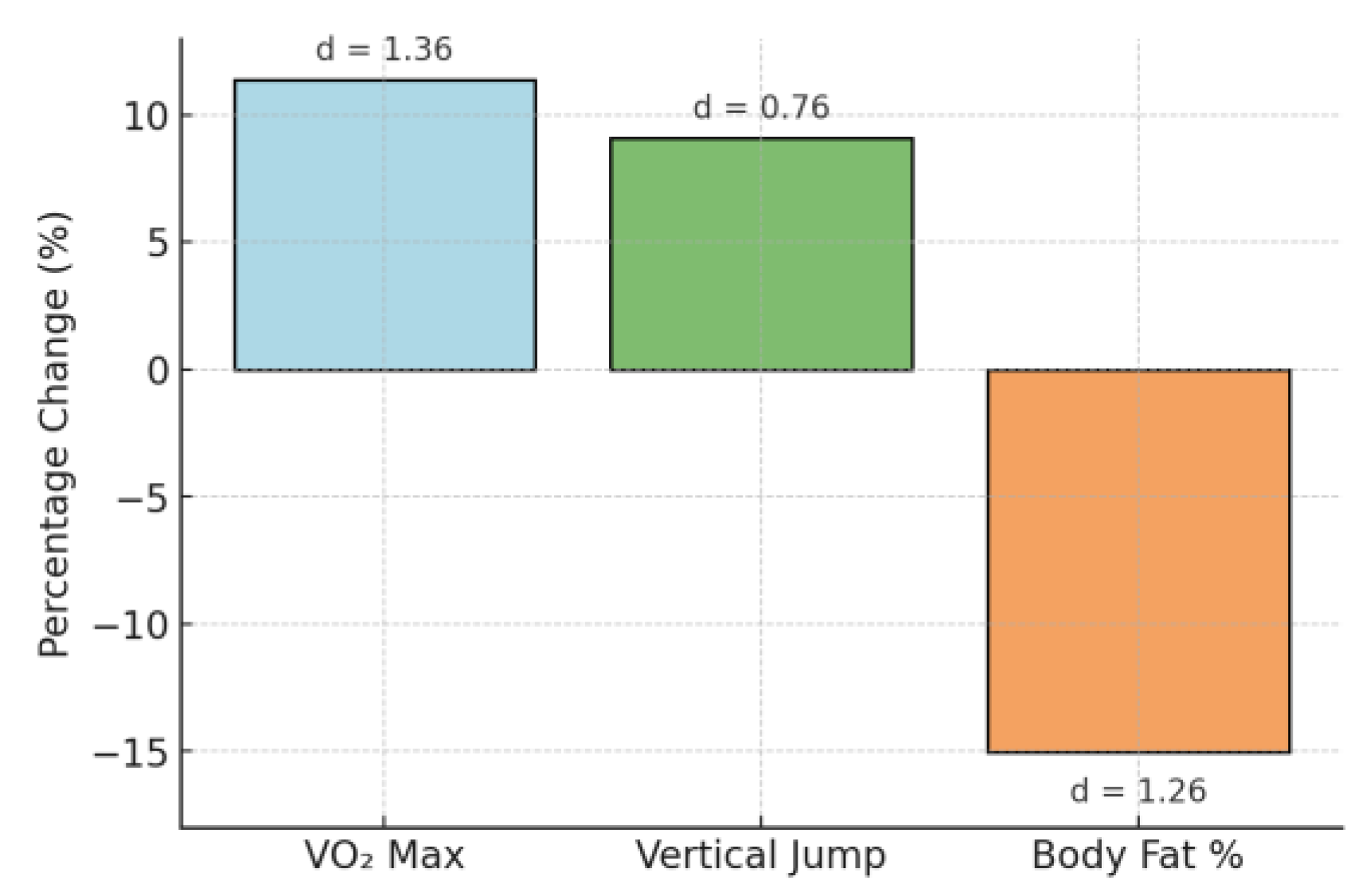
Table 1.
Participants performance data.
| Participant | VO2 Max Pre | VO2 Max Post | Vertical Jump Pre | Vertical Jump Post | Body FatPre | Body Fat Post |
|---|---|---|---|---|---|---|
| Student 1 | 45.84 | 48.58 | 38.06 | 43.41 | 22.96 | 18.6 |
| Student 2 | 44.51 | 53.98 | 38.94 | 46.2 | 19.39 | 18.79 |
| Student 3 | 46.16 | 49.87 | 36.18 | 40.85 | 24.25 | 16.74 |
| Student 4 | 48.0 | 47.57 | 35.91 | 42.05 | 18.36 | 18.56 |
| Student 5 | 44.31 | 51.71 | 41.94 | 41.85 | 22.53 | 18.69 |
| Student 6 | 44.31 | 47.21 | 43.57 | 38.42 | 25.9 | 16.67 |
| Student 7 | 48.12 | 50.36 | 39.28 | 44.05 | 19.22 | 21.83 |
| Student 8 | 46.41 | 45.59 | 42.51 | 43.94 | 20.11 | 19.05 |
| Student 9 | 43.81 | 46.98 | 40.58 | 43.12 | 21.51 | 15.72 |
| Student 10 | 45.94 | 50.33 | 37.56 | 42.35 | 20.24 | 19.41 |
| Student 11 | 43.83 | 51.52 | 40.58 | 38.57 | 18.04 | 16.15 |
| Student 12 | 43.82 | 50.28 | 44.11 | 41.75 | 21.44 | 19.67 |
| Student 13 | 45.31 | 49.65 | 39.39 | 42.0 | 19.07 | 20.42 |
| Student 14 | 40.78 | 49.24 | 44.19 | 40.53 | 22.29 | 16.46 |
| Student 15 | 41.18 | 46.65 | 31.64 | 42.58 | 19.37 | 20.03 |
| Student 16 | 43.62 | 48.32 | 41.97 | 44.39 | 24.55 | 18.93 |
| Student 17 | 42.67 | 48.89 | 39.76 | 49.14 | 19.66 | 19.74 |
| Student 18 | 45.46 | 52.23 | 38.6 | 43.66 | 20.62 | 21.89 |
| Student 19 | 42.89 | 50.66 | 39.78 | 43.92 | 23.01 | 17.61 |
| Student 20 | 41.83 | 46.02 | 33.54 | 42.86 | 18.72 | 16.59 |
| Student 21 | 47.88 | 50.61 | 38.84 | 36.96 | 21.78 | 16.32 |
| Student 22 | 44.33 | 49.05 | 40.57 | 43.02 | 24.04 | 16.47 |
| Student 23 | 44.94 | 48.41 | 43.93 | 43.29 | 17.92 | 17.95 |
| Student 24 | 41.81 | 51.25 | 37.95 | 50.98 | 21.69 | 18.78 |
| Student 25 | 43.66 | 52.17 | 37.07 | 42.48 | 21.85 | 18.65 |
| Student 26 | 45.03 | 51.95 | 37.99 | 44.06 | 22.94 | 19.75 |
| Student 27 | 42.38 | 48.05 | 42.25 | 42.99 | 18.7 | 18.13 |
| Student 28 | 45.59 | 49.22 | 40.49 | 39.36 | 18.53 | 21.01 |
| Student 29 | 43.54 | 50.63 | 37.91 | 46.76 | 22.4 | 17.57 |
| Student 30 | 44.19 | 52.05 | 41.04 | 45.51 | 21.92 | 23.54 |
Table 3.
Corelational findings.
| Variable pair | Correlation coefficient (r) |
p-value | Interpretation |
|---|---|---|---|
| VO₂ Max & Body Fat Reduction |
-0.61 | < 0.01 | Significant inverse relationship |
| VO₂ Max & Vertical Jump |
0.24 | 0.19 | Not statistically significant |
| Vertical Jump & Body Fat Reduction |
-0.45 | 0.015 | Moderate inverse correlation |
Disclaimer/Publisher’s Note: The statements, opinions and data contained in all publications are solely those of the individual author(s) and contributor(s) and not of MDPI and/or the editor(s). MDPI and/or the editor(s) disclaim responsibility for any injury to people or property resulting from any ideas, methods, instructions or products referred to in the content. |
© 2025 by the authors. Licensee MDPI, Basel, Switzerland. This article is an open access article distributed under the terms and conditions of the Creative Commons Attribution (CC BY) license (http://creativecommons.org/licenses/by/4.0/).
Copyright: This open access article is published under a Creative Commons CC BY 4.0 license, which permit the free download, distribution, and reuse, provided that the author and preprint are cited in any reuse.


