

Submitted:
08 July 2025
Posted:
09 July 2025
You are already at the latest version
Abstract
This study explored a competency-based soft-skills programme supporting evolving community pharmacy professionals’ roles and sustainable practice in Serbia. Four researchers with academic and practice backgrounds developed the programme using healthcare guidelines and the International Pharmaceutical Federation’s competency framework. The process involved defining objectives, selecting methods, designing and organising activities, accreditation, and evaluating outcomes based on the Kirkpatrick model. From January 2021 to March 2025, the "Galenika Academy" was implemented through webinars, accredited tests, onsite courses, and a mobile application. Satisfaction was assessed via a validated online questionnaire among participants attending ≥80% of sessions, following evaluation of attendance and test performance. The programme reached 5,107 participants, 10,427 webinar views, and 8,252 test completions. The "Galiverse" mobile app, launched in February 2023, had 5,558 users by March 2025. The most attended webinar was "Burnout" (787). Average test success was 82.9%, with 95.3% for "Resilience" and 61.0% for "Team Management." Satisfaction was 95.5% for content, 94.2% for quality, 92.3% for materials, 77.1% for the application, and 96.3% would recommend it. Among those reporting improved resilience, 96.9% believed it could positively impact pharmacy operations. Pharmacists found the programme relevant and effective. Further research is needed to evaluate its impact on practice and patient outcomes.
Keywords:
pharmacy practice
; continuing pharmacy education
; competencies
; training and development
1. Introduction
Since the COVID-19 pandemic, there has been increasing discussion about the healthcare workforce crisis [1,2]. Issues such as staff shortages, burnout, the second victim phenomenon, and employee turnover have become global concerns [3-6]. By aligning the needs of employees and the healthcare system, it is possible to enhance the capacities of both and ensure a sustainable healthcare system [7]. In 2020, the World Health Organization (WHO) introduced the World Patient Safety Day Goals 2020–2021 to mark Patient Safety Day. Goal 2 focuses on reducing work-related stress and burnout, while Goal 4 aims to prevent violence against healthcare professionals [8]. In 2021, WHO launched the Global Patient Safety Action Plan 2021–2030, which, for the first time, recognised the importance of soft skills (non-technical, cognitive and interpersonal [9]) in healthcare practice and patient safety [10]. Furthermore, in collaboration with the International Labour Organization, the WHO released the 2022 guide Caring for Those Who Care [11], providing strategies for creating supportive environments for healthcare workers.
Although pharmacists' roles as healthcare professionals are defined by clinical pharmacy and pharmaceutical care [12,13], they are often under-recognised by general practitioners [14]. Collaboration at the primary care level remains limited. A potential reason is the lack of funding integration, as pharmacists are not employed under national health insurance systems [15]. Despite these challenges, pharmacists' roles in primary care are expanding, with advanced services like medication reviews and even prescribing being implemented [16-18]. The WHO UNESCO FIP Pharmacy Education Taskforce highlighted the need for additional pharmacist training to prepare for future practice [19]. As studies show reluctance among pharmacists to accept responsibility for therapy outcomes [20, a shift in educational approaches is essential to meet these evolving demands.
Traditional systems for continuous professional development (CPD) for pharmacists have focused on technical skills, with soft skills only recently gaining attention [21]. The International Pharmaceutical Federation (FIP) Competency Framework defines clusters of these skills for both early practitioners and educators, highlighting the need for competency-based education [22-24]. As advanced practice standards align with competencies, their development directly impacts practice quality and safety [25,26]. Adverse pharmaceutical care outcomes often stem from compromised standards, further underscoring the need to strengthen pharmacists' soft skills [27,28].
In Serbia, pharmacists self-assess these skills as well-developed, yet CPD programmes have traditionally excluded such topics and lacked accreditation for licence renewal [29]. This intervention aimed to support community pharmacy professionals in Serbia in evolving roles and pharmacy business sustainability through a competency-based modular development programme.
2. Materials and Methods
2.1. Study Design and Tools
The research was designed as an interventional study with community pharmacy professionals at the national level in Serbia. Academic and practice experts developed the modular programme, named "Galenika Academy", based on a literature review and practical experience, in line with the healthcare guideline Intervention Mapping: A Process for Developing Theory and Evidence-Based Health Education Programs [30] and the International Pharmaceutical Federation’s competency framework [25]. The process included (i) defining programme objectives according to previous needs assessment, (ii) selecting theory-based intervention methods and practical strategies, (iii) designing and organising online lectures, tests, and courses, (iv) accreditation by national bodies, and (v) generating plan for evaluating programme outcomes using the renowned Kirkpatrick model.
The Ethics Committee of the Pharmaceutical Chamber of Serbia approved the evaluation of this programme (Reference number: 75/5-4, dated October 8th, 2024) with the previous consent for data usage from the association for continuous medical education EduMed and Galenika a.d. Beograd (Reference number: 380, dated March 22nd, 2024).
The study followed the Template for Intervention Description and Replication (TIDieR) guide [31] and the Defined Criteria to Report Innovations in Education (DoCTRINE) guidelines [32]. The complete method is illustrated in Figure 1 for detailed visual review.
2.1.1. Defining Programme Objectives According to the Previous Needs Assessment
A group of five experts from academia and practice, including pharmacists, psychologists, human resource managers, and experienced trainers in soft skills development, assessed needs based on the available literature [27,29], regulatory changes [33-35], and the necessity to support pharmacists for advanced practice [25]. The programme objectives include (i) developing organisational, management, personal, and professional competencies for pharmacists and pharmacy technicians in community pharmacies; (ii) enhancing staff resilience and motivation to accept responsibility for outcomes; (iii) ensuring the sustainability of pharmacy operations; (iv) promoting advanced pharmacy services and improving patient safety; and (v) reducing staff turnover.
2.1.2. Selecting Theory-Based Intervention Methods and Practical Strategies
The approach involved building on previous research and successful practices in training and CPD [36]. It drew from theoretical literature to ensure a solid conceptual foundation, while empirical training methodologies were applied to guarantee practical relevance. The programme also considered accreditation for professional licence renewal, aligning with regulatory requirements and previous practices [21,36] as well as fostering motivation for learning, ensuring its effectiveness and sustainability within the professional framework.
2.1.3. Designing and Organising Online Lectures, Tests, and Courses
Strategic plans were tailored to implementers and implementation sites to ensure effective delivery. Course curricula, learning materials, tests, and training modules were developed in alignment with the FIP Development Goals and Competency Framework [22,37,38]. Educational activities were carefully designed to address competency clusters, specific competencies, and expected behaviours outlined in the FIP framework. These materials were pilot-tested with a group of five expert practitioners to ensure their relevance and effectiveness before broader implementation.
2.1.4. Specifying Adoption and Implementation Plans
The programme was accredited by the Health Council of Serbia and the Pharmaceutical Chamber and integrated into the professional licensure renewal system for nationwide accessibility. Collaboration was established with the Association for Continuous Medical Education (EduMed), the Pharmaceutical Chamber of Serbia, and partnerships with healthcare institutions and pharmacy chains to enhance credibility and participation. Most educational sessions were planned via EduMed’s online platform, aligning with previous research to maximise accessibility and efficiency [39], while on-site courses were tailored for smaller groups of pharmacy owners and key managers [40]. Industry support played a crucial role in programme implementation. To ensure sustainability, a learning mobile application "Galiverse" was developed, offering pharmacists 24/7 access to video recordings of previous educational sessions and accredited license renewal tests (free for pharmacists and available in mobile application stores).
2.1.5. Generating a Plan for Evaluating Programme Outcomes
A programme evaluation plan was developed using the Kirkpatrick model [41] at three levels, assessing participants' satisfaction and engagement, knowledge, skills, and attitudes gained. Engagement was assessed through analysis of participation data from the EduMed platform, the official programme organiser, while knowledge was evaluated using accredited tests approved by the Pharmaceutical Chamber of Serbia for professional licence renewal, in line with national continuing professional education regulations. A validated self-reported satisfaction questionnaire was developed by a group of five experts in pharmaceutical practice, psychology and human resources management. Five practice experts validated this questionnaire according to Polit and Beck’s guideline [42], with the final version consisting of 14 questions on the created programme and 7 demographic questions (Supplementary material 1). Satisfaction-related questions were measured using a 5-point Likert scale (1 – Very dissatisfied, 2 – Dissatisfied, 3 – Neutral, 4 – Satisfied, 5 – Very satisfied). A satisfaction questionnaire was distributed to assess participants’ satisfaction, attitudes, and self-reported competence improvement.
2.2. Setting, Sampling, and Recruitment
The study included 5,107 pharmacy professionals employed in community pharmacies in Serbia. Participants were required to have (i) an active working licence issued by the Pharmaceutical Chamber of Serbia and (ii) a working position in a community pharmacy at the moment of attending of programme. Recruitment was purposive using snowball sampling [43] with email invitations to all members from the EduMed database (15,000 pharmacy professionals), ensuring diversity in gender, age, educational level, working position, and geographic location.
2.3. Data Collection
Data collection was conducted by two researchers (I.Z. and T.M.) analysing the EduMed database. At the start of the registration on the platform, the pharmacy professionals agreed to the membership conditions. They consented to personal data to participate in the research, previously anonymised and coded. The previously validated satisfaction survey was sent online via the EduMed platform to the email addresses of participants who attended 80% or more of the available educational sessions.
2.4. Data Analysis, Interpretation, and Storage
All raw data from the EduMed platform was coded and stored in Microsoft Word and Excel. The lead researcher ensured secure electronic storage with restricted access to personal computers. Descriptive statistics were conducted using SPSS software (SPSS 29.0 for Windows, SPSS Inc., Chicago, IL, USA). Data analysis included attendance, test performance, and exam success rates. Satisfaction survey data of participants attending ≥80% of sessions were analysed separately. Statistical significance was set at p<0.05. The chi-square test examined the relationship between programme attendance and pharmacy professionals' outcomes with Phi, Cramer’s V, and contingency coefficient to assess the strength of relationships.
3. Results
3.1. Demographic Characteristics of the Programme Participants
In the total sample (5,107), most participants were female (91.8%) and pharmacists (67.2%), employed in private pharmacies (84.5%), mostly in large cities (45.2%). The response rate for educational calls was 34.1% (the total number of EduMed base participants was 15,000). Around 15% of the total sample attended over 80% of the educational sessions (766 participants). Of them, 93.5% were female and pharmacists (60.9%), employed in private pharmacies (85.7%), and from large cities (46.8%).
3.2. Demographic Characteristics of the Satisfaction Survey (Participants Who Attended ≥ 80% of the Education)
The satisfaction survey received a 29% response rate. Sociodemographic data for 222 respondents show an average age of 43 years and 17 years of work experience. The majority were female (91.4%), with 48.2% holding a master’s degree. Most participants were pharmacists in community pharmacies (66.2%) and worked in private pharmacies (87.0%). Detailed sociodemographic information is provided in Table 1.
3.3. Participant Engagement and Performance Outcomes
3.3.1. Online Education: Webinars Accessible to the Entire Pharmacy Community
Between 2021 and 2025, 25 online webinars were delivered via the EduMed platform, following the FIP competency framework and covering clusters such as Organisation and Management and Professional/Personal, with additional impact on Pharmaceutical Public Health and Emergency Response. The sessions addressed topics like resilience, burnout, second victims, communication, teamwork, performance management, employee development, risk management, business decision-making, professionalism, and ethics. Participants were invited to webinars using the EduMed database, which covers the entire pharmacy community in Serbia. All topics are summarised in Table 2, with a detailed mapping of each competence to the level of expected behaviour.
During the entire programme period, a total of 10,427 participants attended the webinars, with the most popular being "Small school of resilience for healthcare professionals – burnout" (787 participants), "Why is time management important for pharmacists in pharmacies?" (752 participants), and "Risk management in pharmaceutical care" (734 participants). Other well-attended sessions included "Why digital communication and leadership are important for pharmacists?" (650 participants) and "Why negotiation is important for pharmacists?" (570 participants). Of the total participants, 5,107 were unique individuals, representing approximately 34% of the entire pharmacy community.
3.3.2. Accredited Tests: Available to All Pharmacy Professionals
For the same period (2021-2025), 15 online tests were accredited by the Health Council of Serbia for pharmacist licence renewal. For the first time in Serbia, training on soft skills for pharmacy professionals was accredited. The tests covered certain competencies from the FIP framework, most aligned with the webinar topics. Key themes included pharmacy as a business system, business skills requirements, time management, teamwork, performance management, decision-making in pharmacy practice, negotiation, practice research, and employee development. Each test contained 20-40 questions, required 2-4 hours of study from pre-provided materials, and took 30 minutes to 1 hour to complete. Tests awarded 2-4 CPD points for licence renewal. Access codes for the tests were sent to participants after each webinar, and from 2023, following the launch of the "Galiverse" learning mobile application, the tests became available to all pharmacists via the application throughout the entire accreditation period. All tests are summarised in Table 3, with detailed information on each test.
Additionally, there were 8,252 test accesses. As shown in Table 2, Table 3 and Table 4, the evaluation of the accredited education programme reflects strong participant engagement. Notably, 928 individuals participated in the "Teamwork of health professionals as a prerequisite for patient safety" test, with 722 achieving a pass rate of 77.8%. The "Resilience of health professionals as a prerequisite for patient safety" test had the highest success rate, with 482 out of 506 passing (95.3%). On the other hand, the "Creating and managing teams in pharmaceutical organisations" test saw a success rate of 61.0%, with only 292 out of 479 participants passing.
3.3.3. Onsite Trainings for Pharmacy Managers
Between 2021 and 2025, five onsite training sessions were organised for pharmacy owners and managers of key pharmacy chains. The aim was to empower and develop participants who are responsible for on-site staff development, influencing the growth of the pharmacy business. Topics included building effective relationships, leadership, performance management, employee development, change management, and time management. The educational objectives and expected outcomes for each training session are summarised in Table 4. The sessions were designed for smaller participant groups, following the training methodology and available resources. In the total period, 61 unique participants attended the management onsite training courses, with 20 managers completing all five modules.
3.4. Galenika Academy Satisfaction Questionnaire Results
Chi-square results indicated a significant relationship between participation and participants’ outcomes (p < 0.001). Of those who were aware that they attended 80% of the training, 84% were very satisfied with the content, 85.1% with the quality and choice of speakers, and 67.3% of those aware of the mobile application were very satisfied with it. However, 77.8% of them expressed high satisfaction with the test preparation materials, while 67.3% were very satisfied with the mobile application, and 73.6% of mobile application users were very satisfied. Furthermore, 83.6% of those who felt they improved their competencies through the programme were very satisfied with its quality, 81.1% would recommend it, and 75.6% were very satisfied with the content within the application. Among those who were very satisfied with their competency improvement, 92.2% were highly satisfied with the programme's content, 90.7% with the test preparation materials, 79.8% with the mobile application, and 96.9% with the programme’s impact on business sustainability. Detailed statistical results are presented in Table 5.
4. Discussion
The "Galenika Academy" programme has effectively addressed a wide range of competencies within the clusters of organisation and management and personal and professional competencies, with elements of public health from the FIP framework. Over its four-year existence, more than a third of the pharmacy workforce has engaged with the offered training, acquiring knowledge, initiating skills, and earning CPD points for licence renewal. Cross-tabulation analysis highlights the impact of the programme on satisfaction and self-perceived competence improvement, revealing clear links between programme participation and its positive effects on pharmacists and pharmacy practice.
The most attended webinars were on topics that, while familiar to participants, were also of perceived benefit in delivering pharmaceutical care, personal life, and career development. A similar pattern emerged with the accredited tests, where those available for longer periods saw higher completion rates. The success rate of test completion also reflects participants' interest and perception of the importance of developing specific competencies.
Pharmacists directly involved with patients mainly focused on burnout and second victim prevention, resilience, teamwork, communication, conflict management, time management, and risk management skills. In contrast, managers expressed greater interest in skills that could directly contribute to the business performance of their organisations. The demand for onsite training for owners and managers was notably high; however, due to resource limitations, the number of participants was restricted. Participants of these training sessions have been empowered and motivated to further support the programme within their pharmacy organisations and to create internal development programmes within pharmacy chains.
The highest percentage of those who attended the majority of the educational sessions expressed satisfaction with the programme, the quality of the training, the choice of lecturers, and improvements in personal competencies while also recognising the programme's impact on business operations. They are likely to recommend the programme to colleagues seeking further development.
The programme has aligned both its content and delivery methods with the latest trends, recommending changes in CPD activities for pharmacists worldwide [44,45]. Additionally, the incorporation of competencies relevant to emergencies reflects contemporary research trends [46]. Soft skills are increasingly recognised as essential for advancing pharmaceutical practice, as well as the impact of management and leadership competencies on employee satisfaction within pharmacies [47]. This, in turn, enhances work motivation and potentially improves outcomes in pharmaceutical care [48]. Global initiatives in healthcare professional development have also sparked research into the development of such skills, with several pilot projects already underway [49,50].
These results provide valuable guidelines for potential training and educational programmes for pharmacy professionals to be implemented for handling and preventing primary healthcare crises in the future. They could have a positive effect on employee satisfaction and the quality and sustainability of pharmaceutical practice.
Considering that community pharmacists are not yet included in educational-change research studies and development projects like other healthcare professionals, further recommendations for all stakeholders involved in education, regulation, and pharmaceutical development would be to engage with global research initiatives and implement and evaluate similar projects on an international scale and assess the impact on real-life practice.
Strengths and Limitations
This study's strengths include its rigorous methodology and, to the best of our knowledge, the first programme of its kind for pharmacy professionals. The sample reflects Serbia’s pharmacy population [51]. The intervention aligned with the FIP Competency Framework, improved digital adaptability, and offered a scalable, accredited model. A limitation is the small satisfaction survey sample, limiting generalizability. Data protection regulations also restricted access to some personal data, ensuring participant privacy.
5. Conclusions
To our best knowledge, this modular programme is the first accredited to develop soft-skills competencies among community pharmacy professionals, highlighting potential links to improvement in practice standards. According to participants’ self-assessment, this programme improved skills, resilience, and pharmacy operations, with positive effects on patient outcomes, warranting further research in a real-practice environment.
Supplementary Materials
The following supporting information can be downloaded at: https://www.mdpi.com/article/doi/s1, Supplementary Material 1: Galеnika Academy satisfaction questionnaire.
Author Contributions
Conceptualization, I.Z. and L.D.; methodology, L.D., V.M. and I.Z.; software, T.M. and I.Z.; validation, I.Z., L.D., T.M. and V.M.; formal analysis, I.Z. and T.M.; investigation, I.Z. and L.D.; resources, I.Z. and L.D.; data curation, T.M. and I.Z.; writing—original draft preparation, I.Z.; writing—review and editing, L.D. and V.M.; visualization, I.Z., L.D.; supervision, L.D. and V.M.; project administration, I.Z. and T.M.; funding acquisition, I.Z. All authors have read and agreed to the published version of the manuscript.
Funding
This research received no external funding. This research was supported by the Galenika a.d. Beograd. No funding was received to assist with the preparation of this manuscript.
Institutional Review Board Statement
The study was conducted in accordance with the Declaration of Helsinki, and approved by the Ethics Committee of the Pharmaceutical Chamber of Serbia (Reference number: 75/5-4, dated October 8th, 2024) with the previous consent for data usage from the association for continuous medical education EduMed and Galenika a.d. Beograd (Reference number: 380, dated March 22nd, 2024).
Informed Consent Statement
Informed consent was obtained from all subjects involved in the study.
Data Availability Statement
The raw data supporting the conclusions of this article will be made available by the authors on request.
Acknowledgments
The authors would like to thank the Pharmaceutical Chamber of Serbia for accrediting the training sessions, Galenika a.d. Beograd for technical support during the implementation of the programme, and all participating pharmacy professionals for the practical aspect and contribution to content creation. This article/publication is based on work from COST Action CA19113, supported by COST (European Cooperation in Science and Technology). During the preparation of this work, the authors used AI language models (ChatGPT4, OpenAI, San Francisco, CA, USA; Grammarly, Inc., San Francisco, CA, USA) in order to assist in refining the language in this manuscript. They were used for the improvement of sentence reformulation and readability, but did not contribute to authorship or content creation. The authors have reviewed and edited the output and take full responsibility for the content of this publication.
Conflicts of Interest
The authors declare no conflicts of interest.
Abbreviations
The following abbreviations are used in this manuscript:
| WHO | World Health Organization |
| CPD | Continuous Professional Development |
| FIP | International Pharmaceutical Federation |
References
- Banse, E.; Petit, G.; Cool, G.; Durbecq, J.; Hennequin, I.; Khazaal, Y.; de Timary, P. Case study: Developing a strategy combining human and empirical interventions to support the resilience of healthcare workers exposed to a pandemic in an academic hospital. Front Psychiatry 2022, 13, 1023362. [Google Scholar] [CrossRef] [PubMed]
- Förster, C.; Füreder, N.; Hertelendy, A. Why time matters when it comes to resilience: how the duration of crisis affects resilience of healthcare and public health leaders. Public Health 2023, 215, 39–41. [Google Scholar] [CrossRef] [PubMed]
- Busch, I.M.; Moretti, F.; Purgato, M.; Barbui, C.; Wu, A.W.; Rimondini, M. Dealing With Adverse Events: A Meta-analysis on Second Victims' Coping Strategies. J Patient Saf 2020, 16, e51–e60. [Google Scholar] [CrossRef]
- Busch, I.M.; Moretti, F.; Campagna, I.; Benoni, R.; Tardivo, S.; Wu, A.W.; Rimondini, M. Promoting the Psychological Well-Being of Healthcare Providers Facing the Burden of Adverse Events: A Systematic Review of Second Victim Support Resources. Int J Environ Res Public Health 2021, 18. [Google Scholar] [CrossRef]
- Busch, I.M.; Moretti, F.; Purgato, M.; Barbui, C.; Wu, A.W.; Rimondini, M. Psychological and Psychosomatic Symptoms of Second Victims of Adverse Events: a Systematic Review and Meta-Analysis. J Patient Saf 2020, 16, e61–e74. [Google Scholar] [CrossRef]
- Burlison, J.D.; Quillivan, R.R.; Scott, S.D.; Johnson, S.; Hoffman, J.M. The Effects of the Second Victim Phenomenon on Work-Related Outcomes: Connecting Self-Reported Caregiver Distress to Turnover Intentions and Absenteeism. J Patient Saf 2021, 17, 195–199. [Google Scholar] [CrossRef]
- Kuhlmann, E.; Falkenbach, M.; Brînzac, M.G.; Correia, T.; Panagioti, M.; Rechel, B.; Sagan, A.; Santric-Milicevic, M.; Ungureanu, M.I.; Wallenburg, I.; Burau, V. Tackling the primary healthcare workforce crisis: time to talk about health systems and governance-a comparative assessment of nine countries in the WHO European region. Hum Resour Health 2024, 22, 83. [Google Scholar] [CrossRef]
- Donaldson, L.J.; Neelam, D. World patient safety day: A call for action on health worker safety. Journal of Patient Safety and Risk Management 2020, 25, 171–173. [Google Scholar] [CrossRef]
- Mahadevan, A.; Rivera, R.; Najhawan, M.; Saadat, S.; Strehlow, M.; Rao, G.V.R.; Youm, J. Assessing the Efficacy of a Novel Massive Open Online Soft Skills Course for South Asian Healthcare Professionals. J Med Syst 2024, 48, 32. [Google Scholar] [CrossRef]
- Astier-Peña, M.P.; Martínez-Bianchi, V.; Torijano-Casalengua, M.L.; Ares-Blanco, S.; Bueno-Ortiz, J.M.; Férnandez-García, M. The Global Patient Safety Action Plan 2021-2030: Identifying actions for safer primary health care. Aten Primaria 2021, 53, 102224. [Google Scholar] [CrossRef]
- World Health Organization. Caring for those who care: Guide for the development and implementation of occupational health and safety programmes for health workers: Executive summary. 2022. Available online: https://www.who.int/publications/i/item/9789240040779 (accessed on 08.07.2025).
- Dreischulte, T.; van den Bemt, B.; Steurbaut, S.; European Society of Clinical Pharmacy. European Society of Clinical Pharmacy definition of the term clinical pharmacy and its relationship to pharmaceutical care: a position paper. Int J Clin Pharm 2022, 44, 837–842. [Google Scholar] [CrossRef] [PubMed]
- Allemann, S.S.; van Mil, J.W.; Botermann, L.; Berger, K.; Griese, N.; Hersberger, K.E. Pharmaceutical care: the PCNE definition 2013. Int J Clin Pharm 2014, 36, 544–555. [Google Scholar] [CrossRef] [PubMed]
- Chong, J.B.K.; Yap, C.Y.H.; Tan, S.L.L.; Thong, X.R.; Fang, Y.; Smith, H.E. General practitioners' perceptions of the roles of community pharmacists and their willingness to collaborate with pharmacists in primary care. J Pharm Policy Pract 2023, 16, 114. [Google Scholar] [CrossRef] [PubMed]
- Sanchez-Molina, A.I.; Benrimoj, S.I.; Ferri-Garcia, R.; Martinez-Martinez, F.; Gastelurrutia, M.A.; Garcia-Cardenas, V. Development and validation of a tool to measure collaborative practice between community pharmacists and physicians from the perspective of community pharmacists: the professional collaborative practice tool. BMC Health Serv Res 2022, 22, 649. [Google Scholar] [CrossRef]
- Griese-Mammen, N.; Hersberger, K.E.; Messerli, M. Leikola, S.; Horvat, N., van Mil, J.W.F., Eds.; Kos, M. PCNE definition of medication review: reaching agreement. Int J Clin Pharm 2018, 40, 1199-1208. [Google Scholar] [CrossRef]
- Ogundipe, A.; Sim, T.F.; Emmerton, L. The case to improve technologies for pharmacists' prescribing. Int J Pharm Pract 2023, 31, 113–115. [Google Scholar] [CrossRef]
- Bates, I.; Bader, L.R.; Galbraith, K. A global survey on trends in advanced practice and specialisation in the pharmacy workforce. Int J Pharm Pract 2020, 28, 173–181. [Google Scholar] [CrossRef]
- Anderson, C.; Bates, I.; Beck, D.; Brock, T.P.; Futter, B.; Mercer, H.; Rouse, M.; Whitmarsh, S.; Wuliji, T.; Yonemura, A. The WHO UNESCO FIP Pharmacy Education Taskforce. Hum Resour Health 2009, 7, 45. [Google Scholar] [CrossRef]
- Dreischulte, T.; Fernandez-Llimos, F. Current perceptions of the term Clinical Pharmacy and its relationship to Pharmaceutical Care: a survey of members of the European Society of Clinical Pharmacy. Int J Clin Pharm 2016, 38, 1445–1456. [Google Scholar] [CrossRef]
- Batista, J.P.B.; Torre, C.; Sousa Lobo, J.M.; Sepodes, B. A review of the continuous professional development system for pharmacists. Hum Resour Health 2022, 20, 3. [Google Scholar] [CrossRef]
- Koudmani, D.; Bader, L.R.; Bates, I. Developing and validating development goals towards transforming a global framework for pharmacy practice. Res Social Adm Pharm 2024, 20, 1118–1124. [Google Scholar] [CrossRef]
- Udoh, A.; Bruno-Tomé, A.; Ernawati, D.K.; Galbraith, K.; Bates, I. The development, validity and applicability to practice of pharmacy-related competency frameworks: A systematic review. Res Social Adm Pharm 2021, 17, 1697–1718. [Google Scholar] [CrossRef] [PubMed]
- Udoh, A.; Bruno-Tomé, A.; Ernawati, D.K.; Galbraith, K.; Bates, I. The effectiveness and impact on performance of pharmacy-related competency development frameworks: A systematic review and meta-analysis. Res Social Adm Pharm 2021, 17, 1685–1696. [Google Scholar] [CrossRef] [PubMed]
- Meilianti, S.; Galbraith, K.; Bader, L.; Udoh, A.; Ernawati, D.; Bates, I. The development and validation of a global advanced development framework for the pharmacy workforce: a four-stage multi-methods approach. Int J Clin Pharm 2023, 45, 940–951. [Google Scholar] [CrossRef]
- Rushworth, G.F.; Innes, C.; Macdonald, A.; MacDonald, C.; McAuley, L.; McDavitt, A.; Stewart, F.; Bruce, R. Development of innovative simulation teaching for advanced general practice clinical pharmacists. Int J Clin Pharm 2021, 43, 817–824. [Google Scholar] [CrossRef]
- Zimonjić, I.; Marinković, V.; Mira, J.J.; Djokic, B.B.; Odalović, M. Addressing the second victim phenomenon among community pharmacists and its impact on clinical pharmacy practice: a consensus study. Int J Clin Pharm 2025, 47, 68–79. [Google Scholar] [CrossRef]
- Earle-Payne, K.; Forsyth, P.; Johnson, C.F.; Harrison, H.; Robertson, S.; Weidmann, A.E. The standards of practice for delivery of polypharmacy and chronic disease medication reviews by general practice clinical pharmacists: a consensus study. Int J Clin Pharm 2022, 44, 663–672. [Google Scholar] [CrossRef]
- Stojkov, S.; Tadić, I.; Crnjanski, T.; Krajnović, D. Assessment and self-assessment of the pharmacists' competencies using the global competency framework (GbCF) in Serbia. Vojnosanit Pregl 2016, 73, 803–10. [Google Scholar] [CrossRef]
- Bartholomew, L.K.; Parcel, G.S.; Kok, G. Intervention mapping: a process for developing theory- and evidence-based health education programs. Health Educ Behav 1998, 25, 545–63. [Google Scholar] [CrossRef]
- Hoffmann, T.C.; Glasziou, P.P.; Boutron, I.; Milne, R.; Perera, R.; Moher, D.; Altman, D.G.; Barbour, V.; Macdonald, H.; Johnston, M.; Lamb, S.E.; Dixon-Woods, M.; McCulloch, P.; Wyatt, J.C.; Chan, A.W.; Michie, S. Better reporting of interventions: template for intervention description and replication (TIDieR) checklist and guide. BMJ 2014, 348, g1687. [Google Scholar] [CrossRef]
- Blanco, M.; Prunuske, J.; DiCorcia, M.; Learman, L.A.; Mutcheson, B.; Huang, G.C. The DoCTRINE Guidelines: Defined Criteria To Report Innovations in Education. Acad Med 2022, 97, 689–695. [Google Scholar] [CrossRef]
- El-Awaisi, A.; Koummich, S.; Koraysh, S.; El Hajj, M.S. Patient Safety Education in Entry to Practice Pharmacy Programs: A Systematic Review. J Patient Saf. 2022, 18, e373–e386. [Google Scholar] [CrossRef] [PubMed]
- Friedman, E.A.; Bickford, R.; Bjork, C.; Campbell, J.; Cometto, G.; Finch, A.; Kane, C.; Wetter, S.; Gostin, L. The global health and care worker compact: evidence base and policy considerations. BMJ Glob Health 2023, 8, e012337. [Google Scholar] [CrossRef] [PubMed]
- McIsaac, M.; Buchan, J.; Abu-Agla, A.; Kawar, R.; Campbell, J. Global Strategy on Human Resources for Health: Workforce 2030-A Five-Year Check-In. Hum Resour Health 2024, 22, 68. [Google Scholar] [CrossRef] [PubMed]
- Ballaram, S.; Perumal-Pillay, V.; Suleman, F. A scoping review of continuing education models and statutory requirements for pharmacists globally. BMC Med Educ 2024, 24, 343. [Google Scholar] [CrossRef]
- Bader. ; Kusynová, Z.; Duggan, C. FIP Perspectives: Realising global patient safety goals requires an integrated approach with pharmacy at the core. Res Social Adm Pharm 2019, 15, 815–817. [Google Scholar] [CrossRef]
- Bajis, D.; Al-Haqan, A.; Mhlaba, S.; Bruno, A.; Bader, L.; Bates, I. An evidence-led review of the FIP global competency framework for early career pharmacists training and development. Res Social Adm Pharm 2023, 19, 445–456. [Google Scholar] [CrossRef]
- Aryee, G.F.B.; Amoadu, M.; Obeng, P.; Sarkwah, H.N.; Malcalm, E.; Abraham, S.A.; Baah, J.A.; Agyare, D.F.; Banafo, N.E.; Ogaji, D. Effectiveness of eLearning programme for capacity building of healthcare professionals: a systematic review. Hum Resour Health 2024, 22, 60. [Google Scholar] [CrossRef]
- BinDhim, N.F.; Althumiri, N.A.; Albluwi, R.A.; Aljadhey, H.S. Competencies, skills, and personal characteristics needed for pharmacy leaders: An in-depth interview. Saudi Pharm 2024, 32, 102181. [Google Scholar] [CrossRef]
- Smidt, A.; Balandin, S.; Sigafoos, J.; Reed, V.A. The Kirkpatrick model: A useful tool for evaluating training outcomes. J Intellect Dev Disabil 2009, 34, 266–74. [Google Scholar] [CrossRef]
- Polit, D.F.; Beck, C.T. The content validity index: are you sure you know what's being reported? Critique and recommendations. Res Nurs Health 2006, 29, 489–97. [Google Scholar] [CrossRef]
- Goodman, L.A. Snowball Sampling. Annals of Mathematical Statistics 1961, 32, 148–170. [Google Scholar] [CrossRef]
- Tamiru, H.; Huluka, S.A.; Negash, B.; Hailu, K.; Mekonen, Z.T. National Continuing Professional Development (CPD) training needs of pharmacists in Ethiopia. Hum Resour Health 2023, 21, 87. [Google Scholar] [CrossRef] [PubMed]
- Alnahar, S.A.; Darwish, R.M.; Al Qasas, S.Z.; Al Shabani, M.M.; Bates, I. Identifying training needs of practising community pharmacists in Jordan-a self-assessment study. BMC Health Serv Res 2024, 24, 712. [Google Scholar] [CrossRef] [PubMed]
- Safwan, J.; Akel, M.; Sacre, H.; Haddad, C.; Sakr, F.; Hajj, A.; Zeenny, R.M.; Iskandar, K.; Salameh, P. Academic pharmacist competencies in ordinary and emergency situations: content validation and pilot description in Lebanese academia. BMC Med Educ 2023, 23, 737. [Google Scholar] [CrossRef]
- Zeineddine, L.; Sacre, H.; Haddad, C.; Zeenny, M.R.; Akel, M.; Hajj, A.; Salameh, P. The association of management and leadership competencies with work satisfaction among pharmacists in Lebanon. J Pharm Policy Pract 2023, 16, 48. [Google Scholar] [CrossRef]
- Zimonjić, I.; Marinković, V.; Mira, J.J.; Knežević, B.; Djokic, B.B.; Bogavac-Stanojević, N.; Odalović, M. The second victim experience and support tool: a cross-cultural adaptation, validation and psychometric evaluation of the Serbian version for pharmacy professionals (SR-SVEST-R). Int J Clin Pharm 2025, 47, 803–814. [Google Scholar] [CrossRef]
- European Platform for Vocational Excellence in Health Care. Innovation and development of the healthcare sector. Available online: https://euveca.eu/ (accessed on 8 July 2025).
- Blueprint alliance for a future health workforce strategy on digital and green skills. Shaping the health and care workforce of tomorrow. Available online: https://bewell-project.eu/ (accessed on 8 July 2025).
- The Pharmaceutical Chamber of Serbia. Register of Pharmacists. Available online: https://www.farmkom.rs/registar-farmaceuta (accessed on 8 July 2025).
Figure 1.
Development of a competency-based educational programme for pharmacy professionals.
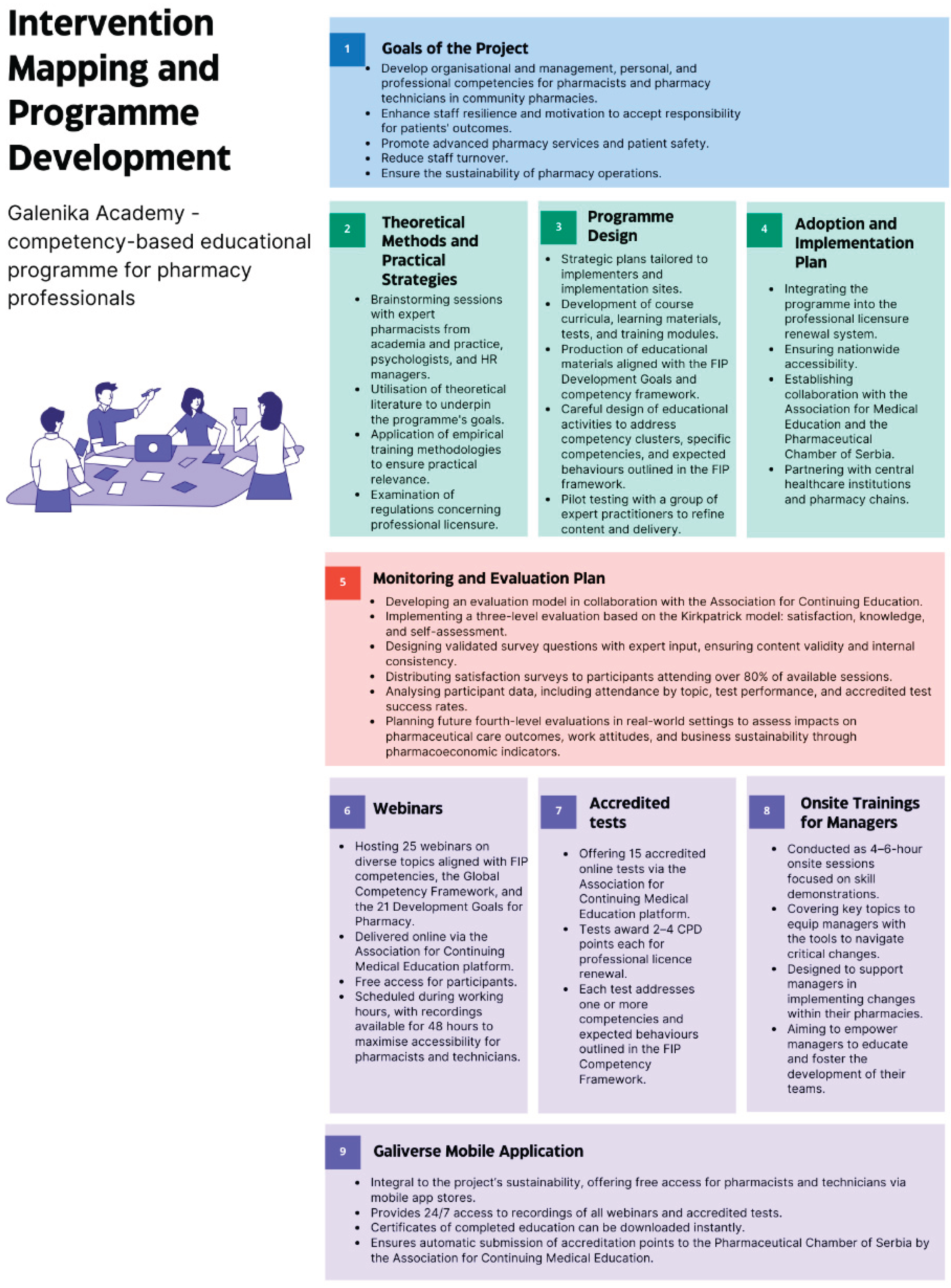

Table 1.
Demographic characteristics of the satisfaction survey (participants who attended ≥ 80% of the education).
Table 1.
Demographic characteristics of the satisfaction survey (participants who attended ≥ 80% of the education).
| Sociodemographic variables (n=222) | Categories | n (%) | Mean (min-max) (SD) |
|---|---|---|---|
| Age | 43 (20-74) (11.6) | ||
| Years of work experience | 17 (1-65) (11.9) | ||
| Gender | Female | 203 (91.4) | |
| Male | 19 (8.6) | ||
| Level of education | Secondary School | 58 (26.1) | |
| College - Bachelor's Degree | 14 (6.3) | ||
| University - Master's Degree | 107 (48.2) | ||
| Specialised Academic Studies | 29 (13.1) | ||
| Health Specialisation | 3(1.3) | ||
| Master's or Doctorate | 11 (4.9) | ||
| Job position | Pharmacy technician in a community pharmacy | 75 (33.8) | |
| Pharmacist in a community pharmacy | 147 (66.2) | ||
| Type of institution | Private Pharmacy | 193 (87.0) | |
| State Pharmacy | 29 (13.0) | ||
| Size of the city | Rural area | 22 (9.9) | |
| Smaller town (up to 100,000 inhabitants) | 90 (40.5) | ||
| Medium-sized city (100-200,000 inhabitants) | 30 (13.5) | ||
| Large city (over 200,000 inhabitants) | 80 (36.0) |
Table 2.
Summary of webinars and participants in live sessions online.
| Webinar topics | Competence cluster 1 | Competencies | Number of participants |
|---|---|---|---|
| "Small school of resilience for healthcare professionals – burnout" | 1. Pharmaceutical Public Health, 4. Professional/Personal | 1.1 Emergency response, 4.5 Leadership and self-regulation, 4.7 Professional and ethical practice | 787 |
| "Small school of resilience for healthcare professionals – second victims" | 1. Pharmaceutical Public Health, 4. Professional/Personal | 1.1 Emergency response, 4.5 Leadership and self-regulation | 692 |
| "Teamwork in healthcare" | 1. Pharmaceutical Public Health, 3. Organisation and Management | 3.2 Human resources management | 563 |
| "Small school of resilience for healthcare professionals – resilience" | 1. Pharmaceutical Public Health, 4. Professional/Personal | 1.1 Emergency response, 4.5 Leadership and self-regulation | 452 |
| "Communication in healthcare" | 1. Pharmaceutical Public Health, 4. Professional/Personal | 4.1 Communication skills | 438 |
| "Quality in pharmaceutical care" | 4. Professional/Personal | 4.2. Continuing Professional Development (CPD), 4.8 Quality assurance and research in the workplace | 433 |
| "Why is time management important for pharmacists in pharmacies?" | 3. Organisation and Management, 4. Professional/Personal | 3.2. Human resources management, 3.6. Workplace management, 4.5 Leadership and self-regulation | 752 |
| "Risk management in pharmaceutical care" | 1. Pharmaceutical Public Health, 3. Organisation and Management, 4. Professional/Personal | 1.1 Emergency response, 3.3 Improvement of service, 3.4 Procurement, 3.5 Supply chain management, 4.5. Leadership and self-regulation, 4.6. Legal and regulatory practice | 734 |
| "Why are digital communication and leadership important for pharmacists?" | 4. Professional/Personal | 4.1 Digital literacy, 4.5. Leadership and self-regulation | 650 |
| "Why is negotiation important for pharmacists?" | 3. Organisation and Management | 3.1 Budget and reimbursement, 3.4 Procurement, 3.5 Supply chain management | 570 |
| "Why team development is important for pharmacists" | 3. Organisation and Management | 3.2 Human resources management | 558 |
| "How to motivate employees in pharmacies?" | 3. Organisation and Management, 4. Professional/Personal | 3.2 Human resources management, 3.6. Workplace management, 4.5 Leadership and self-regulation | 514 |
| "Why a business plan is important for a new service in a pharmacy" | 3. Organisation and Management | 3.1. Budget and reimbursement, 3.2 Human resources management, 3.3 Improvement of service | 446 |
| "Why conflict management is important for pharmacists" | 4. Professional/Personal | 4.4. Interprofessional collaboration | 410 |
| "Why is communication important for pharmacists in pharmacies?" | 4. Professional/Personal | 4.1 Communication skills, 4.4. Interprofessional collaboration | 375 |
| "Why is business continuity management important in pharmacies?" | 3. Organisation and Management, 4. Professional/Personal | 3.1. Budget and reimbursement, 3.6 Workplace management, 4.8 Quality assurance and research in the workplace | 286 |
| "Pharmacy as a business system and the development of personal skills" | 3. Organisation and Management | 3.1 Budget and reimbursement, 3.2 Human resources management, 3.6 Workplace management | 269 |
| "Why is research in pharmaceutical practice important for pharmacists?" | 3. Organisation and Management, 4. Professional/Personal | 3.3. Improvement of service, 4.2. Continuing Professional Development (CPD), Quality assurance and research in the workplace, 4.3. Digital literacy, 4.4. Interprofessional collaboration | 250 |
| "Tools for problem solving and business decision-making in pharmacies" | 1. Pharmaceutical Public Health, 3. Organisation and Management, 4. Professional/Personal | 1.1 Emergency response, 3.3 Improvement of services, 3.6 Workplace management, 4.7 Professional and ethical practice | 239 |
| "Why is performance management important for pharmacy professionals?" | 3. Organisation and Management, 4. Professional/Personal | 3.2 Human resources management, 3.6 Workplace management, 4.2 Continuing Professional Development (CPD) | 189 |
| "Why is employee development important for the business of pharmacies?" | 3. Organisation and management, 4. Professional/Personal | 3.2. Human resources management, 4.2 Continuing Professional Development (CPD) | 172 |
| "Pharmacy marketing mix and brand management" | 4. Professional/Personal | 4.6 Legal and regulatory practice, 4.7 Professional and ethical practice | 171 |
| "Regulations in advertising in pharmacies" | 4. Professional/Personal | 4.6 Legal and regulatory practice, 4.7 Professional and ethical practice | 167 |
| "Project management in pharmaceutical practice" | 3. Organisation and Management, 4. Professional/Personal | 3.1. Budget and reimbursement, 3.6 Workplace management, 4.8 Quality assurance and research in the workplace | 158 |
| "Why are professionalism and ethics important for pharmacy professionals?" | 4. Professional/Personal | 4.6 Legal and regulatory practice, 4.7 Professional and ethical practice | 152 |
| Total | 10,427 |
1 Individual competencies are categorised into clusters, and expected behaviours are presented in alignment with the International Pharmaceutical Federation (FIP) Global Competency Framework – Early Career Training Version 2.
Table 3.
Summary of accredited tests: topics, covered competencies, participant numbers, and pass rates.
Table 3.
Summary of accredited tests: topics, covered competencies, participant numbers, and pass rates.
| Education - accredited test | Accreditation number ² | Expected learning time | Number of questions | Number of points for licence renewal | Number of participants | Number of successfully completed (>60% of questions with correct answers) | Success rate (% of enrolled) |
|---|---|---|---|---|---|---|---|
|
B-74/23, Re-accreditation B-41/24 | 2 hours for learning, 30 minutes for test completion | 20 | 2 | 725 | 605 | 83.4% |
|
B-88/21, Re-accreditations: B-122/22, B-161/23 | 4 hours for learning, 1 hour for test completion | 40 | 4 | 762 | 654 | 85.8% |
|
B-89/21, Re-accreditations: B-118/22, B-157/23 | 4 hours for learning, 1 hour for test completion | 40 | 4 | 479 | 292 | 61.0% |
|
B-75/23, Re-accreditation B-44/24 | 2 hours for learning, 30 minutes for test completion | 20 | 2 | 572 | 498 | 87.1% |
|
B-20/23, Re-accreditation B-6/24 | 4 hours for learning, 1 hour for test completion | 40 | 4 | 928 | 722 | 77.8% |
|
B-73/23, Re-accreditation B-46/24 | 3 hours for learning, 45 minutes for test completion | 30 | 3 | 521 | 436 | 83.7% |
|
B-79/21, Re-accreditations: B-119/22, B-159/23 | 4 hours for learning, 1 hour for test completion | 40 | 4 | 291 | 216 | 89.7% |
|
B-22/23, Re-accreditation B-11/24 | 2 hours for learning, 20 minutes for test completion | 20 | 2 | 555 | 470 | 84.7% |
|
B-21/23, Re-accreditation B-7/24 | 3 hours for learning, 45 minutes for test completion | 30 | 3 | 813 | 694 | 85.4% |
|
B-77/23, Re-accreditation B-45/24 | 2 hours for learning, 20 minutes for test completion | 20 | 2 | 371 | 297 | 80.1% |
|
B-31/23, Re-accreditation B-10/24 | 2 hours for learning, 30 minutes for test completion | 20 | 2 | 682 | 544 | 79.8% |
|
B-76/23, Re-accreditation B-40/24 | 2 hours for learning, 30 minutes for test completion | 20 | 2 | 361 | 292 | 80.9% |
|
B-29/23, Re-accreditation B-9/24 | 2 hours for learning, 30 minutes for test completion | 20 | 2 | 506 | 482 | 95.3% |
|
B-30/23, Re-accreditation B-8/24 | 2 hours for learning, 30 minutes for test completion | 20 | 2 | 546 | 516 | 94.5% |
|
B-78/23, Re-accreditation B-39/24 | 2 hours for learning, 30 min for completion | 20 | 2 | 140 | 126 | 90.0% |
|
8,252 | 6,844 | 82.9% |
² Health Council of the Republic of Serbia approval and Pharmaceutical Chamber of Serbia accreditation for working licence renewal. Professional licences are renewed every seven years, requiring the accumulation of 140 continuing education points over the period, with a minimum of 10 points earned per working year.
Table 4.
Onsite training for pharmacy managers in key pharmacies.
| Training topic | Educational goals | Expected outcomes | Number of participants |
|---|---|---|---|
| 1. "Building effective relationships in pharmaceutical practice" | 1. Enhance communication skills for effective collaboration. 2. Understand how to build trust with colleagues and patients. 3. Develop strategies for managing professional relationships. 4. Learn how to improve teamwork and conflict resolution skills. 5. Learn how to strengthen pharmaceutical care effectiveness in pharmacy practice. |
1. Improved communication skills for effective collaboration. 2. Building trust with colleagues and patients. 3. Effective management of professional relationships. 4. Improved teamwork and conflict resolution. 5. Strengthen pharmaceutical care effectiveness in pharmacy practice. |
28 |
| 2. "Effective leadership in pharmaceutical practice" | 1. Understand core principles of leadership in pharmacy practice. 2. Develop skills to inspire and motivate team members. 3. Enhance decision-making and problem-solving abilities. 4. Foster a collaborative and productive work environment. 5. Build strategies for effective team management and performance improvement. |
1. Enhanced understanding of leadership principles in pharmaceutical practice. 2. Improved ability to inspire and motivate pharmacy teams. 3. Strengthened decision-making and problem-solving skills. 4. Creation of a more collaborative and productive workplace. 5. Effective implementation of team management strategies for improved performance. |
30 |
| 3. "Performance management and employee development in pharmacy practice" | 1. Understand the key concepts of performance management in pharmacy practice. 2. Develop skills to assess and improve employee performance. 3. Learn strategies for setting clear goals and expectations. 4. Enhance abilities in providing constructive feedback and coaching. 5. Foster a culture of continuous professional development and growth. |
1. Improved understanding of performance management practices in pharmacy. 2. Enhanced ability to assess and support employee performance effectively. 3. Clear goal setting and expectation management for pharmacy teams. 4. Improved skills in providing constructive feedback and coaching. 5. Stronger culture of continuous professional development and growth within the pharmacy. |
28 |
| 4. "Change management in pharmacy business" | 1. Understand the principles and processes of change management in the pharmacy business. 2. Develop skills to assess and manage change effectively within the pharmacy environment. 3. Learn strategies for overcoming resistance to change and fostering acceptance. 4. Enhance the ability to lead and support teams through change. 5. Explore methods for evaluating the success of change initiatives in pharmacy business operations. |
1. Enhanced understanding of change management principles and processes in the pharmacy business. 2. Improved ability to manage and implement change effectively in the pharmacy setting. 3. Increased competency in addressing resistance to change and promoting acceptance. 4. Stronger leadership skills in guiding teams through change initiatives. 5. Greater capability in evaluating and measuring the success of change efforts within the pharmacy business. |
30 |
| 5. "Change implementation: the impact of (i) resilience, (ii) effective time management, and (iii) change management in the education system on success" | 1. Understand the role of resilience in change implementation. 2. Develop effective time management skills for managing change. 3. Learn key change management strategies for successful implementation. 4. Explore the impact of resilience and time management on educational success. 5. Strengthen skills to adapt and lead in changing educational environments. |
1. Improved resilience in managing and adapting to change. 2. Enhanced time management skills for more effective change implementation. 3. Better understanding and application of change management strategies. 4. Greater ability to assess the impact of resilience and time management on success. 5. Increased capacity to lead and succeed in dynamic educational settings. |
25 |
Pharmacy managers included owners of small and medium-sized pharmacies as well as regional managers in large pharmacy chains (covering the entire country's territory).
Table 5.
Galenika Academy satisfaction questionnaire results (participants attended ≥ 80% of the education).
Table 5.
Galenika Academy satisfaction questionnaire results (participants attended ≥ 80% of the education).
| Variable | How much are you satisfied with the content of Galenika Academy? | P* Value | How much are you satisfied with the quality of education and the choice of lecturers? | p Value | How much are you satisfied with the content of the materials provided for test preparation? | p Value | How much are you satisfied with the mobile application? | p Value | How much are you satisfied with how education improved your business sustainability? | P Value | |||||||||||||||||||||
|---|---|---|---|---|---|---|---|---|---|---|---|---|---|---|---|---|---|---|---|---|---|---|---|---|---|---|---|---|---|---|---|
| Number (%) of participants, n=222 | |||||||||||||||||||||||||||||||
| 1 - Very dissatisfied | 2 - Dissatisfied | 3 - Neutral | 4 - Satisfied | 5 - Very satisfied | 1 - Very dissatisfied | 2 - Dissatisfied | 3 - Neutral | 4 - Satisfied | 5 - Very satisfied | 1 - Very dissatisfied | 2 - Dissatisfied | 3 - Neutral | 4 - Satisfied | 5 - Very satisfied | 1 - Very dissatisfied | 2 - Dissatisfied | 3 - Neutral | 4 - Satisfied | 5 - Very satisfied | 1 - Very dissatisfied | 2 - Dissatisfied | 3 - Neutral | 4 - Satisfied | 5 - Very satisfied | |||||||
| Are you aware that you have attended ≥ 80% educations within the Galenika Academy? | Yes | 1 (0.5%) | 0 (0.0%) | 5 (2.6%) | 25 (12.9%) | 163 (84%) | <0.001 | 1 (0.5%) | 0 (0.0%) | 5 (2.6%) | 23 (11.9%) | 165 (85.1%) | <0.001 | 3 (1.5%) | 2 (1.0%) | 7 (3.6%) | 31 (16.0%) | 151 (77.8%) | 0.096 | 12 (6.2%) | 7 (3.6%) | 24 (12.4%) | 32 (16.5%) | 119 (61.3%) | 0.603 | 1 (0.5%) | 1 (0.5%) | 23 (11.9%) | 35 (18.0%) | 134 (69.1%) | 0.684 |
| No | 0 (0.0%) | 1 (3.6%) | 3 (10.7%) | 8 (28.6%) | 16 (57.1%) | 0 (0%) | 1 (3.6%) | 6 (2.4%) | 4 (14.3%) | 17 (60.7%) | 2 (7.1%) | 1 (3.6%) | 2 (7.1%) | 7 (25%) | 16 (27.1%) | 3 (10.7%) | 1 (3.6%) | 4 (14.3%) | 7 (25.0%) | 13 (46.4%) | 0 (0.0%) | 0 (0.0%) | 6 (21.4%) | 4 (14.3%) | 18 (64.3%) | ||||||
| 0.319 | 0.030 | 0.018 | <0.001 | 0.085 | |||||||||||||||||||||||||||
| Have you heard of the Galiverse application? | Yes | 0 (0.0%) | 1 (0.6%) | 5 (2.9%) | 26 (15.2%) | 139 (81.3%) | 0 (0.0%) | 1 (0.6%) | 5 (2.9%) | 20 (11.7%) | 145 (84.8%) | 1 (0.6%) | 3 (1.8%) | 8 (4.7%) | 27 (15.8) | 132 (77.2%) | 5 (2.9%) | 5 (2.9%) | 13 (7.6%) | 33 (19.3%) | 115 (67.3%) | 0 (0.0%) | 1 (0.6%) | 18 (10.5%) | 32 (18.7%) | 120 (70.2) | |||||
| No | 1 (2.0%) | 0 (0.0%) | 3 (5.9%) | 7 (13.7%) | 40 (78.4) | 1 (2.0%) | 0 (0.0.%) | 6 (11.8%) | 7 (13.7%) | 37 (72.5%) | 4 (7.8%) | 0 (0.0%) | 1 (2.0%) | 11 (21.6%) | 35 (68.6%) | 10 (19.3%) | 3 (5.9%) | 15 (29.4%) | 6 (11.8%) | 17 (33.3%) | 1 (2.0%) | 0 (0.0%) | 11 (21.6%) | 7 (13.6%) | 32 (32.7%) | ||||||
| 0.416 | 0.284 | 0.093 | <0.001 | 0.147 | |||||||||||||||||||||||||||
| Do you use the Galiverse application? | Yes | 0 (0.0%) | 0 (0.0%) | 4 (3.2%) | 16 (12.8%) | 105 (84.0%0 | 0 (0.0%) | 0 (0.0%) | 4 (3.2%) | 14 (11.2%) | 107 (85.6%) | 0 (0.0%) | 2 (1.6%) | 6 (4.8%) | 19 (15.2%) | 98 (78.4%) | 0 (0.0%) | 1 (0.8%) | 3 (2.4%) | 29 (23.2%) | 92 (73.6%) | 0 (0.0%) | 1 (0.8%) | 11 (8.8%) | 24 (19.2%) | 89 (71.2%) | |||||
| No | 1 (0.5%) | 1 (0.5%) | 4 (4.1%) | 17 (17.5%) | 74 (76.3%) | 1 (1.0%) | 1 (1.0%) | 7 (7.2%) | 13 (13.4%) | 75 (77.3%) | 5 (5.2%) | 1 (1.0%) | 3 (3.1%) | 19 (19.6%) | 69 (71.1%) | 15 (15.5%) | 7 (7.2%) | 25 (25.8%) | 10 (10.3%) | 40 (40.1%) | 1 (1.0%) | 0 (0.0%) | 18 (18.6%) | 15 (15.5%) | 63 (64.9%) | ||||||
| 0.350 | 0.029 | 0.005 | <0.001 | 0.062 | |||||||||||||||||||||||||||
| Do you perceive that the programme(s) you attended improved your competence? | Yes | 1 (0.5%) | 1 (0.5%) | 7 (3.3%) | 30 (14.1%) | 174 (81.7%) | 1 (0.5%) | 1 (0.5%) | 9 (4.2%) | 24 (11.3%) | 178 (83.6%) | 4 (1.9%) | 3 (1.4%) | 7 (3.3%) | 35 (16.4%) | 164 (77.0%) | 11 (5.2%) | 8 (3.8%) | 26 (12.2%) | 38 (17.8%) | 130 (61.0%) | 1 (0.5%) | 1 (0.05%) | 25 (11.7%) | 37 (17.4%) | 149 (70.0%) | |||||
| No | 0 (0.0%) | 0 (0.0%) | 1 (11.1%) | 3 (33.3%) | 5 (55.6%) | 0 (0.0%) | 0 (0.0%) | 2 (22.2%) | 3 (33.3%) | 4 (44.4%) | 1 (11.1%) | 0 (0.0%) | 2 (22.2%) | 3 (33.3%) | 3 (33.3%) | 4 (44.4%) | 0 (0.0%) | 2 (22.2%) | 1 (11.1%) | 2 (22.2%) | 0 (0.0%) | 0 (0.0%) | 4 (44.4%) | 2 (22.2%) | 3 (33.3%) | ||||||
| <0.001 | 0.009 | <0.001 | 0.346 | 0.476 | |||||||||||||||||||||||||||
| Would you recommend an educational program to colleagues who wish to develop professionally? | Yes | 1 (0.5%) | 1 (0.5%) | 6 (2.8%) | 33 (15.2%) | 176 (81.1%) | 1 (0.5%) | 1 (0.5%) | 9 (4.1%) | 27 (12.4%) | 179 (82.5%) | 4 (1.8%) | 2 (0.9%) | 9 (4.1%) | 38 (17.5%) | 164 (75.6%) | 15 (6.9%) | 8 (3.7%) | 26 (12.0%) | 39 (18.0%) | 129 (29.4%) | 1 (0.5%) | 1 (0.5%) | 27 (12.4%) | 38 (17.5%) | 150 (69.1%) | |||||
| No | 0 (0.0%) | 0 (0.0%) | 2 (40%) | 0 (0.0%) | 3 (60.0%) | 0 (0.0%) | 0 (0.0%) | 2 (40.0%) | 0 (0.0%) | 3 (60.0%) | 1 (20.0%) | 1 (20.0%) | 0 (0.0%) | 0 (0.0%) | 3 (60.0%) | 0 (0.0%) | 0 (0.0%) | 2 (40.0%) | 0 (0.0%) | 3 (60.0%) | 0 (0.0%) | 0 (0.0%) | 2 (40.0%) | 1 (20.0%) | 2 (40.0%) | ||||||
| <0.001 | <0.001 | <0.001 | <0.001 | <0.001 | |||||||||||||||||||||||||||
| How much are you satisfied with how you have improved your resilience through the educational program? | 1 - Very dissatisfied | 0 (0.0%) | 0 (0.0%) | 0 (0.0%) | 0 (0.0%) | 2 (100.0%) | 0 (0.0%) | 0 (0.0%) | 0 (0.0%) | 0 (0.0%) | 2 (100.0%) | 0 (0.0%) | 0 (0.0%) | 1 (50.0%) | 0 (0.0%) | 1 (50.0%) | 1 (50.0%) | 0 (0.0%) | 0 (0.0%) | 0 (0.0%) | 1 50.0%) | 1 (50.0%) | 0 (0.0%) | 0 (0.0%) | 1 (50.0%) | 0 (0.0%) | |||||
| 2 - Dissatisfied | 0 (0.0%) | 1 (20.0%) | 1 (20.0%) | 2 (40.0%) | 1 (20.0%) | 0 (0.0%) | 1 (20.0%) | 1 (20.0%) | 2 (40.0%) | 1 (20.0%) | 0 (0.0%) | 2 (40.0%) | 0 (0.0%) | 2 (40.0%) | 1 (20.0%) | 0 (0.0%) | 1 20.0%) | 0 (0.0%) | 2 (40.0%) | 2 (40.0%) | 0 (0.0%) | 0 (0.0%) | 1 (20.0%) | 2 (40.0%) | 2 (40.0%) | ||||||
| 3 - Neutral | 0 (0.0%) | 0 (0.0%) | 5 12.8%) | 15 (28.5%0 | 19 (48.7%) | 0 (0.0%) | 0 (0.0%) | 7 (17.9%) | 13 (33.3%) | 19 (48.7%) | 3 (7.7%) | 1 (2.6%) | 5 (12.8%) | 18 (46.2%) | 12 (30.8%) | 6 (15.4%) | 2 (5.1%) | 12 (30.8%) | 12 (30.8%) | 7 (17.9%) | 0 (0.0%) | 1 (2.6%) | 23 (29.0%) | 11 (28.2%) | 4 (10.3%) | ||||||
| 4 - Satisfied | 0 (0.0%) | 0 (0.0%) | 1 (2.1%) | 8 (17.0%) | 38 (80.9%) | 0 (0.0%) | 0 (0.0%) | 3 (6.4%) | 7 (14.9%) | 37 (78.7%) | 0 (0.0%) | 0 (0.0%) | 1 (2.1%) | 10 (21.3%) | 36 (76.6%) | 3 (6.4%) | 2 (4.3%) | 10 (21.3%) | 13 (27.7%) | 19 (40.4%) | 0 (0.0%) | 0 (0.0%) | 5 (10.6%) | 21 (44.7%) | 21 (44.7%) | ||||||
| 5 - Very satisfied | 1 (0.8%) | 0 (0.0%) | 1 (0.8%) | 8 (6.2%) | 119 (92.2%) | 1 (0.5%) | 1 (0.5%) | 11 (5.0%) | 27 (12.2%) | 182 (82.0%) | 2 (1.6%) | 0 (0.0%) | 2 (1.6%) | 8 (6.2%) | 117 (90.7%) | 5 (3.9%) | 3 (2.3%) | 6 (4.7%) | 12 (9.3%) | 103 (79.8%) | 0 (0.0%) | 0 (0.0%) | 0 (0.0%) | 4 (3.1%) | 125 (96.9%) | ||||||
* Bold typeface indicates significant p values (p<0.05).
Disclaimer/Publisher’s Note: The statements, opinions and data contained in all publications are solely those of the individual author(s) and contributor(s) and not of MDPI and/or the editor(s). MDPI and/or the editor(s) disclaim responsibility for any injury to people or property resulting from any ideas, methods, instructions or products referred to in the content. |
© 2025 by the authors. Licensee MDPI, Basel, Switzerland. This article is an open access article distributed under the terms and conditions of the Creative Commons Attribution (CC BY) license (http://creativecommons.org/licenses/by/4.0/).
Copyright: This open access article is published under a Creative Commons CC BY 4.0 license, which permit the free download, distribution, and reuse, provided that the author and preprint are cited in any reuse.


