

Submitted:
04 July 2025
Posted:
08 July 2025
You are already at the latest version
Abstract
Deep eutectic solvents (DESs) have emerged as sustainable and tunable alternatives to conventional solvents for the extraction polysaccharides. This review presents a struc-ture-informed framework linking DES composition to polysaccharide solubility, em-phasizing the differential responsiveness of amorphous, interfacial, and crystalline domains. Amorphous polysaccharides are efficiently extracted under mild DES condi-tions, while crystalline polymers often require stronger hydrogen bond acceptors or thermal/mechanical activation. Beyond dissolution, DESs modulate key properties of the extracted polysaccharides, including molecular weight, monomer composition, and bioactivity. Comparative analysis highlights how acidic, basic, or metal-coordinating DESs selectively target distinct polymer classes. Emerging innovations, such as in situ DES formation, mechanochemical systems, and switchable solvents, enhance efficiency and reduce downstream processing demands. Furthermore, the integration of machine learning and COSMO-RS modeling enables predictive solvent design, reducing reliance on empirical screening. By combining mechanistic insight, compositional tailoring, and computational tools, this review provides a scientifically grounded perspective for ad-vancing DES-mediated extraction processes and enabling structure-preserving, appli-cation-oriented recovery of polysaccharides in food, pharmaceutical, and biorefinery domains.
Keywords:
deep eutectic solvents (DESs)
; polysaccharide extraction
; hydrogen bonding interactions
; in situ DES formation
; mechanochemical processing
; machine learning (ML)
1. Introduction
Polysaccharides – such as cellulose, hemicelluloses, pectins, and other biopolymers from plant, algal, and microbial sources, are of increasing interest due to their applications in food, pharmaceutical, and materials science [1]. However, recovering these polysaccharides from biomass presents longstanding challenges. Traditional extraction methods often rely on hot water or harsh chemical treatments, which are energy-intensive and can lead to partial hydrolysis or degradation of the target polysaccharides [2]. For example, prolonged heating in water or dilute acid may break glycosidic bonds or cause depolymerization, diminishing molecular weight and bioactivity of the extracted polysaccharides [1,2]. Conventional processes (e.g. hot water, dilute alkali) also struggle with recalcitrant plant cell wall structures – crystalline cellulose microfibrils enmeshed with lignin and other matrix components – yielding low extraction efficiencies without extensive pretreatment. As a result, multi-step workflows (including mechanical disruption, enzyme or microwave assistance, and solvent purification) are often required to isolate relatively pure polysaccharide fractions [3]. These approaches not only generate chemical waste and consume significant time, but they also risk altering the native structure of polysaccharides (e.g. by de-esterification of pectins or deacetylation of hemicelluloses). In the context of green chemistry and biorefinery development, there is a critical need to reevaluate conventional extraction paradigms by identifying solvent systems capable of efficiently liberating polysaccharides from structurally recalcitrant biomass, while preserving their native conformation and functional properties.
Deep eutectic solvents (DESs) have rapidly emerged as promising alternatives to classical solvents for polysaccharide extraction and dissolution [1]. DESs are formed by combining a hydrogen bond acceptor (e.g. a quaternary ammonium or phosphonium salt) with one or more hydrogen bond donors (e.g. polyols, organic acids, amides) [4], resulting in a eutectic mixture with a melting point far below that of the individual components [5,6]. This concept offers several key advantages aligned with the needs of biopolymer solubilization. Among those, DESs are often composed of inexpensive, biodegradable, and low-toxicity ingredients – for instance, choline chloride (a vitamin B₄ derivative) mixed with natural acids or sugars – making them safer and cost-effective compared to ionic liquids [7]. Also, their physicochemical properties are highly tunable: by varying the component identities and ratios, one can obtain solvents with a tailored polarity, hydrogen-bonding capacity, and pH, optimized for a given polysaccharide [1]. This versatility is particularly important because polysaccharides differ in solubility and bonding (e.g., cellulose is a neutral, crystalline polymer requiring strong hydrogen bond disruption, whereas pectins are acidic, amorphous polysaccharides requiring mild conditions to avoid depolymerization). Furthermore, DESs have negligible vapor pressure and are non-flammable, enabling extractions at elevated temperatures or with microwave/ultrasound without solvent loss or safety hazards [7]. Crucially, DES-based extraction has demonstrated improved efficiency and selectivity: in many cases, DESs yield higher polysaccharide recovery than water or alcohol-based solvents, and the extracts can exhibit equal or greater bioactivity, as shown in Table 1.
The comparative findings presented in Table 1 highlight the considerable advantages of DESs in the extraction of bioactive polysaccharides from various biological sources. Compared to conventional extraction methods such as hot water, ethanol, or acid-base systems, DES-based approaches consistently demonstrate superior extraction efficiency, selectivity, and preservation of functional integrity. Choline chloride-based DESs, in particular, have shown high compatibility with both plant and fungal matrices. For instance, polysaccharides yield from Poria cocos [13], Polygonatum kingianum [26], and Dendrobium devonianum [25] increased by 2.5- to 8.6-fold relative to traditional techniques, with notable enhancements in antioxidant or immunomodulatory activity. In marine-derived matrices such as Saccharina japonica and Fucus vesiculosus, DES-assisted extraction achieved higher yields of alginate and sulfated polysaccharides, while also improving the functional attributes of the extracts.
A key determinant of extraction performance is the specific DES composition. Acidic systems incorporating oxalic acid have been particularly effective for extracting acidic heteropolysaccharides, such as those rich in uronic acids from Morchella importuna [32] and Eucommia ulmoides [24], yielding products with stronger antioxidant and enzyme inhibitory properties. In contrast, DESs based on neutral hydrogen bond donors such as urea, glycerol, or ethylene glycol facilitated the extraction of glucomannan and β-glucan-type polysaccharides from Bletilla striata [35], Ganoderma lucidum [14], and related sources. Additionally, innovative DES designs including temperature-responsive systems and mechanochemically formed DESs enabled efficient extraction under mild conditions, enhanced solvent reusability, and co-extraction of additional phytochemicals, as observed in Lycium barbarum [27], Lilium lancifolium [23], and Schisandra chinensis [36].
For example, a recent study showed that a lactic acid/proline DES (with modest water content) extracted nearly three times more polysaccharide from Acanthopanax biomass than hot water, and the DES-extracted polysaccharide had lower molecular weight and enhanced antioxidant activity [37]. Such findings underscore that beyond simply dissolving the polymers, DESs may modulate polysaccharide structure (e.g. by breaking certain linkages or enriching functional groups) in beneficial ways. Finally, the push for sustainable, “green” extraction technologies has catalyzed interest in natural deep eutectic solvents (NADES) – DESs made from entirely natural metabolites (like organic acids, amino acids, cholines, sugars) – which align with food and pharma regulations [7]. Collectively, DESs represent an emerging solvent system that meets the modern criteria of efficiency, selectivity, and sustainability in polysaccharide extraction. This review provides a comprehensive overview of DESs as sustainable and tunable media for polysaccharide extraction. It examines the physicochemical principles governing DES-polysaccharide interactions, highlights advances in extraction efficiency and structural preservation, and explores process intensification strategies, analytical tools, and emerging applications. The review also addresses future directions in AI-guided DES design, biotechnological integration, and sustainability to support the development of next-generation biorefinery platforms.
Fundamentals of DESs Relevant to Polysaccharide Systems
Physicochemical Properties of DESs: Implications for Biopolymer Interactions
The DESs are often described as analogues of ionic liquids, sharing the trait of extensive ionic and hydrogen-bond interactions, yet distinguishable by their simple formulation and safer components [1,38,39]. When one of the DES components is an active pharmaceutical ingredient, it is known as therapeutic DES (THEDES) [40,41,42,43,44,45,46]. A typical DES is a binary or ternary mixture comprising an HBA, often a quaternary ammonium salt such as choline chloride, and an HBD, which may include polyols (e.g., glycerol, ethylene glycol), amides (e.g., urea), or carboxylic acids (e.g., lactic or oxalic acid) [47]. Upon mixing in a specific molar ratio, these components self-associate into a eutectic phase via a dense network of hydrogen bonds, resulting in a dramatic melting point depression – the mixture becomes liquid at a temperature far below the melting points of the individual constituents [48]. This in situ generation of a solvent avoids the need for chemical synthesis or organic diluents, exemplifying facile preparation. From a physicochemical standpoint, DESs possess several properties that directly impact their interactions with polysaccharides such as their polarity and solvating power [9]. DESs can dissolve a wide range of substances, from metal oxides to biomolecules, due to their unique polarity profile. They often exhibit moderate to high polarity predominantly governed by hydrogen-bonding rather than purely dipolar interactions as shown in Table 2.
The wide range of solutes presented in Table 2 demonstrates the broad solvating capacity of DES. This versatility is primarily governed by the nature of the hydrogen bonding network, the polarity profile, and the structural flexibility of DESs, which can be tuned to interact effectively with different classes of compounds. While many entries focus on inorganic and low-molecular-weight organics, several studies clearly show that DESs are also capable of dissolving structurally complex biomolecules such as DNA, keratin, and notably, polysaccharides like cellulose and chitin. These findings suggest that the same molecular interactions that govern DES solubility for metals and bioactives are equally critical in the disruption of polysaccharide hydrogen-bond networks. As such, the mechanistic patterns observed across diverse solutes offer a conceptual bridge to better understand and optimize DES-based dissolution strategies specifically for polysaccharides in applications ranging from biomass processing to biopolymer modification.
Kamlet–Taft solvatochromic measurements of DESs indicate high HBD (α) and/or acceptor (β) parameters, depending on composition [7,76]. In general, a strong HBA character (high β) is crucial for solubilizing polysaccharides, as it enables the DES to accept hydrogen bonds from the polymer’s numerous –OH groups, thereby competing with the polymer’s internal H-bond network [7]. Indeed, comparative studies have shown that DESs with more basic acceptors (e.g. choline hydroxide or imidazole-based DESs) exhibit markedly better cellulose dissolution capacity than less basic ones [77]. Conversely, DESs dominated by hydrogen-bond donation (high α, as in acidic formulations) may protonate or interact strongly with anionic polysaccharides (like pectins), aiding their solvation through different mechanisms [78,79]. Unlike conventional molecular solvents, the polarity of a DES is highly tunable, and simple descriptors like dielectric constant or Hildebrand solubility parameter are often insufficient to predict polymer solubility [7]. This tunable polarity and hydrogen-bonding networks of DESs enable tailored solvation of recalcitrant polysaccharides such as cellulose. However, their inherently high viscosity can hinder mass transfer [80]. This can be mitigated by moderate heating or controlled water addition, which lowers viscosity without compromising solvent structure [7]. Ternary DESs further allow fine-tuning of viscosity and polarity. DESs are also thermally stable and non-volatile, supporting prolonged extraction under heat or assisted techniques (e.g. ultrasound, microwave) without solvent loss [81,82]. Their biocompatible nature and recyclability make them particularly attractive for food, pharmaceutical, and biomedical applications. Overall, the adjustable physicochemical properties of DESs directly enhance their efficiency and sustainability in polysaccharide extraction.
Hydrogen Bonding Networks and Viscosity Modulation in Polysaccharide-Compatible DESs
Hydrogen bonding is the defining interaction in DESs, both for their formation and their function as solvents [83,84]. In typical DESs, the HBA and HBD form an extensive hydrogen-bond network that drives the eutectic effect and imparts high viscosity [85]. For polysaccharide dissolution, the strength and flexibility of this network are pivotal. Tightly bound systems exhibit higher viscosity and reduce solute interaction, whereas more dynamic, loosely bonded DESs facilitate intermolecular exchange, enhancing polysaccharide solubilization [54].
One practical manifestation of this principle is seen in studies of cellulose dissolution. Ren et al. (2016) examined a series of choline chloride-based DESs and found that the one with the highest HBA basicity (choline chloride/imidazole) not only had the greatest cellulose solubility but also the lowest viscosity among the series [86]. The lower viscosity was attributed to weaker hydrogen bonding within the DES, as imidazole interacts less strongly with choline chloride than urea. This allows more hydrogen bonding capacity to be directed toward cellulose rather than internal DES interactions [86]. In essence, the DES serves as a reservoir of hydrogen bond donors and acceptors for the polysaccharide. Effective solvation requires a balance: if the internal HBD–HBA network is too stable, it restricts polymer access; if too weak, it lacks the cooperative strength to disrupt polymer bonds.
Viscosity in DESs correlates with the strength and persistence of internal hydrogen bonding, serving as an indirect indicator of hydrogen-bond coordination number and lifetime [87]. Studies have shown that DESs with higher viscosity exhibit stronger HBD–HBA interactions, limiting the availability of free hydrogen bond sites for solute interaction [88]. This reduces their capacity to disrupt and solubilize polysaccharide structures such as cellulose. In contrast, DESs with lower viscosity—due to weaker internal H-bonding—exhibit enhanced solvation efficiency by facilitating more accessible and dynamic hydrogen bonding with the polymer substrate [89].
For instance, Fan et al. (2021) reported that natural DESs based on multi-functional organic acids (capable of multiple H-bonding interactions) showed significantly higher viscosity than those based on monofunctional acids or simpler donors [89].
Beyond intrinsic viscosity, the spatial organization and mobility of the hydrogen-bond network critically influence the ability of DESs to infiltrate plant tissue and access embedded polysaccharides [90,91]. High-viscosity DESs may still dissolve cellulose, but their limited diffusivity often restricts effective penetration into dense biomass [92,93]. Strategic modulation of the H-bond network—via altered HBA structure, ternary components, or co-solvent incorporation—can markedly enhance mass transfer. For example, replacing choline chloride with allyl triethylammonium chloride in an oxalic acid-based DES reduced viscosity and improved cellulose solubilization, attributable to weaker chloride–oxalate interactions and lower dissolution activation energy [94]. Furthermore, controlled addition of co-solvents (e.g., water or ethanol) can disrupt and loosen the hydrogen-bond network and promote substrate access, though excessive dilution may compromise H-bond-mediated interactions [90]. These findings highlight the need for rational design of DESs that optimize both hydrogen-bond availability and transport properties to enable efficient extraction from recalcitrant biomass.
Tailoring Polarity and Solvent Microenvironments for Polysaccharide Affinity
The extraction efficacy of DESs arises not merely from their polarity or hydrogen-bonding potential, but from the ability to rationally design their microenvironment to match the chemical nature of target polysaccharides. This tunability enables DESs to act not as passive solvents but as interactive matrices that facilitate specific solvation mechanisms through hydrogen bonding, acid–base interactions, or even metal coordination [25,95].
The extraction efficiency of DESs relies on their capacity to engage in specific interactions—ranging from hydrogen bond disruption to protonation or Lewis acid coordination—enabled by tailored polarity, pH, and ionic strength. Such behavior can be rationalized using solvatochromic parameters (α, β, π*), which guide the design of DESs with optimized affinity for different polysaccharide types [96,97].
More specialized DESs incorporate metal salts such as AlCl₃, FeCl₃, or ZrOCl₂, which act as Lewis acids capable of coordinating to electron-donating sites within lignocellulosic structures [98]. These metal-containing DESs facilitate the cleavage of ether and ester bonds—particularly β-O-4 and lignin–carbohydrate linkages—resulting in enhanced delignification and improved accessibility of cellulose and hemicellulose [99,100]. For example, a FeCl₃–glycerol DES achieved a glucose yield of 91.1% after enzymatic hydrolysis, indicating effective polysaccharide release [100]. Additionally, the polarity and pH of DESs can be tuned to favor selective fractionation. Acidic DESs promote delignification, while alkaline DESs—such as choline hydroxide–based or glycerol–K₂CO₃ systems—selectively cleave lignin–carbohydrate ester bonds, thereby preserving polysaccharides like cellulose and hemicellulose [101,102]. Such selective behavior enables one-pot fractionation of biomass into purified carbohydrate and lignin streams.
Therefore, fine-tuning DES composition, such as by introducing ternary components or minimal water content, enables adjustment of viscosity and diffusivity to support structure-sensitive extraction. This design flexibility allows DESs to selectively target distinct polysaccharide–matrix interactions, aligning solvent function with specific bonding patterns in complex biomass.
Mechanistic Insights into DES–Polysaccharide Interactions
Effective extraction of polysaccharides from biomass hinges on the ability of solvents to disrupt both amorphous and crystalline domains within the polymer matrix [103]. The DESs achieve this primarily through competitive hydrogen bonding, wherein solvent components interact with the hydroxyl, carboxyl, or amino groups of polysaccharide chains, thereby displacing the intra- and intermolecular hydrogen bonds that stabilize native polymer conformations [91].
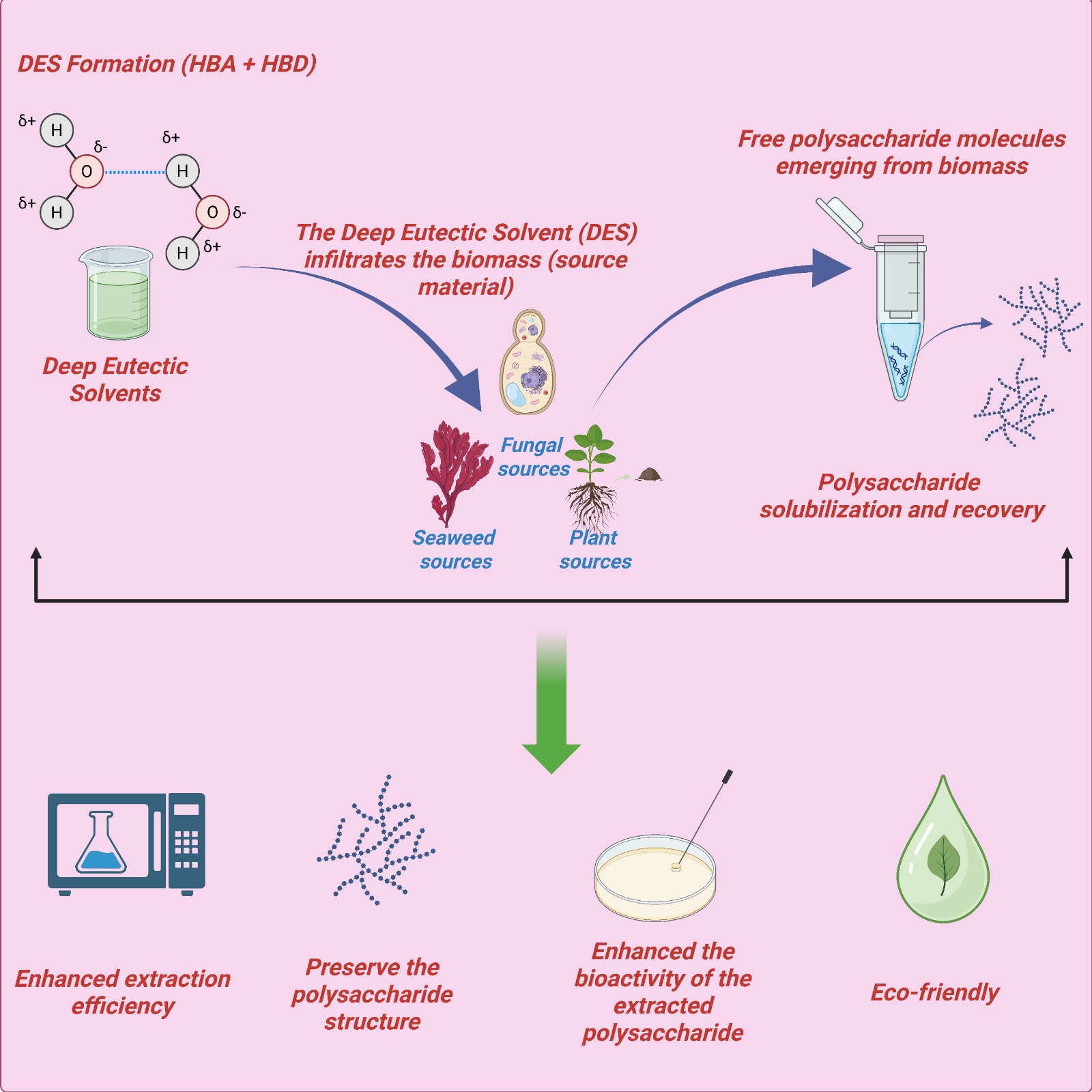
Figure 1 is a schematic representation of DES-mediated polysaccharide extraction. DESs penetrate biomass and disrupt intra- and intermolecular hydrogen bonds by interacting with hydroxyl and carboxyl groups, leading to matrix swelling and enhanced solubilization. This process enables the efficient recovery of polysaccharides from plant, algal, and fungal sources under mild conditions, with minimal structural degradation.
In amorphous domains, characterized by irregular chain packing and high free volume, DES molecules readily infiltrate and form hydrogen bonds with exposed functional groups [91]. This leads to matrix swelling, chain disentanglement, and eventual dissolution. Such behavior is particularly pronounced in loosely structured polysaccharides such as pectins [104,105], hemicelluloses [106], and inulin-type fructans [107,108], where microscopy and histological evidence consistently reveal significant tissue expansion, wall rupture, and cell layer delamination upon DES exposure [109]. By contrast, crystalline domains, such as those in cellulose microfibrils or native chitin, resist solvent penetration due to their dense, regularly ordered hydrogen-bonding network and van der Waals interactions. Standard DESs (e.g., choline chloride–urea) show limited capacity to solubilize such regions under ambient conditions, primarily extracting non-crystalline fractions. Nonetheless, DES pretreatment can effectively remove amorphous polysaccharides and open the microstructure, thereby enhancing the accessibility of crystalline regions to further processing (e.g., enzymatic hydrolysis or secondary solvation) [110].
Under elevated temperatures, or when combined with ultrasound or microwave irradiation, more aggressive DES systems—particularly those with high hydrogen-bond acceptor strength or metal-coordinating species—can partially disrupt crystalline architectures [111]. Mechanistically, this involves stepwise binding to hydroxyl-rich chain surfaces, insertion into lattice voids, and progressive weakening of the hydrogen-bond network. This transition from rigid crystallinity to a swollen intermediate phase is supported by X-ray diffraction, which shows reductions in crystallinity index, and by electron microscopy, which reveals collapse and fibril delamination in treated tissues [61].
Importantly, not all polysaccharides contain all three structural domains. For example, pectins and β-glucans are predominantly amorphous and dissolve readily, while cellulose and chitin exhibit strong crystalline ordering and require more intensive processing. Hemicelluloses and partially deacetylated chitosan may exhibit both amorphous and semi-ordered regions, resulting in intermediate solvation behavior. The extent to which each polysaccharide presents crystalline, amorphous, or interfacial architecture—determined by its biosynthetic origin and supramolecular organization—directly influences its interaction with DESs and the mechanisms by which dissolution proceeds. A comparative overview of these structural distinctions across major polysaccharide classes is shown in Table 3, associating the domain composition with solvation behavior and extraction efficiency under DES conditions.
The patterns summarized in Table 3 suggest a structure–responsive framework, wherein the domain architecture of polysaccharides—whether predominantly amorphous, crystalline, or intermediate—plays a critical role in determining their behavior in DES systems. Amorphous polysaccharides generally exhibit higher extractability under mild, polar DES conditions, attributed to their accessible hydroxyl-rich surfaces and reduced molecular packing [105,127]. In contrast, highly crystalline polysaccharides such as cellulose and chitin tend to display limited solubility unless subjected to strong hydrogen bond acceptors, elevated temperatures, or mechanical or enzymatic pretreatment [128,129]. Polysaccharides with intermediate structures, including hemicellulose and chitosan, show partial responsiveness, with solubility modulated by factors such as branching, acetylation, and charge distribution [109,130]. These observations underscore the potential of leveraging domain-level structural features to tailor DES systems—adjusting properties such as acidity, polarity, viscosity, or the inclusion of functional additives—to enable selective, efficient, and structure-preserving extraction across diverse biomass sources.
The patterns summarized in Table 3 suggest a structure–responsive framework, wherein the domain architecture of polysaccharides—whether predominantly amorphous, crystalline, or intermediate—plays a critical role in determining their behavior in DES systems. Amorphous polysaccharides generally exhibit higher extractability under mild, polar DES conditions, attributed to their accessible hydroxyl-rich surfaces and reduced molecular packing [105,127]. In contrast, highly crystalline polysaccharides such as cellulose and chitin tend to display limited solubility unless subjected to strong hydrogen bond acceptors, elevated temperatures, or mechanical or enzymatic pretreatment [128,129]. Polysaccharides with intermediate structures, including hemicellulose and chitosan, show partial responsiveness, with solubility modulated by factors such as branching, acetylation, and charge distribution [109,130]. These observations underscore the potential of leveraging domain-level structural features to tailor DES systems—adjusting properties such as acidity, polarity, viscosity, or the inclusion of functional additives—to enable selective, efficient, and structure-preserving extraction across diverse biomass sources.
Role of DES Composition in Breaking Glycosidic and Hydrogen Bonding Networks
The composition of a DES plays a decisive role in determining its interaction with polysaccharides, governing whether the solvent primarily disrupts non-covalent interactions or actively cleaves covalent glycosidic bonds [9]. This functional distinction stems from the acid–base properties, hydrogen-bonding capacity, and potential catalytic activity of the DES constituents [131,132].
Neutral or basic DESs (e.g., choline chloride with urea, imidazole, or acetate) predominantly act through competitive hydrogen bonding. These systems destabilize the extensive intra- and inter-chain hydrogen bonds in polysaccharides—particularly in cellulose and hemicelluloses—without significantly affecting the glycosidic linkages [133,134]. Solubility enhancement correlates with the basicity of the HBA; for instance, imidazole-based DESs exhibit superior cellulose solubilization compared to urea-based systems due to stronger competition for hydroxyl protons [77]. Polysaccharides recovered from such systems typically retain high molecular weights, indicating structural preservation.
In contrast, acidic DESs—often formulated with carboxylic acids (e.g., lactic, oxalic, malic acids)—can catalyze partial hydrolysis of glycosidic bonds. These systems provide a protic environment sufficient to protonate ether oxygen atoms in glycosidic linkages, enabling acid-catalyzed cleavage [135]. Experimental evidence shows that polysaccharides extracted using acidic DESs often exhibit reduced molecular weight, elevated reducing sugar content, and modified monomeric profiles [78,132]. For example, extraction with choline chloride–maltose NADESs yielded pectins enriched in galacturonic acid monomers, consistent with depolymerization [136]. Similarly, malic acid–based systems increased oligosaccharide yield and bioactivity in Acanthopanax extracts [30].
Additional compositional factors influence reactivity. Chloride-containing DESs (e.g., choline chloride) may enhance solubilization through specific anion–hydroxyl interactions [137]. Metal salt-based DESs (e.g., ZnCl₂, FeCl₃ systems) introduce Lewis acidic sites capable of coordinating to glycosidic oxygen atoms, weakening C–O bonds and facilitating hydrolysis [138]. Moreover, controlled water addition (~10–30%) can increase proton mobility and transition state stabilization, thereby enhancing hydrolytic efficiency without excessive dilution of solvent polarity [139].
Altogether, DES composition can be strategically modulated to yield either intact high-molecular-weight polysaccharides or short-chain oligosaccharides and monomers, depending on the intended application. This dual capability highlights the importance of mechanistically guided DES selection, wherein acidity, basicity, and catalytic potential are tailored to the structural and functional goals of polysaccharide extraction.
Enhancing Polysaccharide Solubility and Dispersibility Using DESs
Beyond extraction, DESs enable the dissolution and dispersion of structurally recalcitrant polysaccharides such as cellulose and chitin, which are otherwise insoluble in water or conventional solvents due to extensive hydrogen bonding and crystallinity [140]. DESs disrupt these interactions by forming new hydrogen-bond networks with the polymer, facilitating dissolution [115].
For example, Zhang et al. (2020) has evaluated several choline chloride-based DESs—including oxalic acid/ChCl, citric acid/ChCl, and urea/ChCl—and found oxalic acid/ChCl to be the most effective, fully dissolving cellulose at elevated temperatures. The regenerated product exhibited a transformation from cellulose I to cellulose II, as confirmed by XRD analysis [141].
Enhancing usability even further, Li et al. (2024) formulated a DES from tetramethylammonium hydroxide pentahydrate and urea (1:3 molar ratio) capable of dissolving up to 7.5 wt% cellulose at room temperature, producing regenerated cellulose with a reduced degree of polymerization (DP = 526) and altered crystallinity—both indicators of disrupted polymer networks and increased dispersibility [142]. Moreover, Yang et al. (2022) employed ternary DESs, such as choline chloride–oxalic acid–malonic acid, to pretreat bagasse cellulose at 90 °C for 4 hours, achieving a 71.6% lignin removal and boosting cellulose crystallinity to 67.6%, which facilitated not just solubility but also the downstream dispersibility of cellulose fibers [143].
Even without full solubilization, DES pretreatment can reduce crystallinity and molecular weight, enhancing aqueous dispersibility [144]. For instance, levulinic acid–based DESs applied to moso bamboo caused microstructural disruptions such as the formation of ~30 nm voids and fibril cracking, resulting in shorter cellulose crystallites and improved enzymatic accessibility, even without full dissolution [144].
In another case, an arginine:lactic acid DES (1:7) used with microwave assistance decreased the crystallinity index of bamboo cellulose from 67.2% to 53.0%, while also reducing crystallite size from 3.41 nm to 3.14 nm, leading to a dramatic increase in saccharification yield from 6.3% to 81.9% [145]. Similarly, choline chloride:urea DES (1:2) applied to oil palm empty fruit bunch (OPEFB) at 110 °C for 4 hours reduced cellulose crystallinity as confirmed by XRD, and improved glucose yield to 66.3 mg/ml despite partial retention of lignin and hemicellulose [146]. Finally, ternary DES pretreatment of wheat straw achieved ~69.5% lignin removal, surface erosion, and crystallinity alteration, leading to a 5.1-fold increase in sugar yield after enzymatic hydrolysis [147].
Collectively, these results confirm that DESs can induce partial deconstruction of polysaccharide networks, enabling better water interaction and dispersibility without requiring complete dissolution.
In Situ vs. Pre-Formulated DES
When deploying DESs in polysaccharide processing, one can either pre-formulate the DES (by mixing and heating its components in advance) or generate the DES in situ during the extraction/processing step. The conventional approach uses pre-formulated DESs: a well-characterized solvent mixture (e.g. choline chloride–urea at 1:2 molar ratio) is prepared beforehand and then applied to the biomass. This ensures consistent properties (viscosity, pH, H-bond donor/acceptor ratio) and reproducibility in performance. Pre-formulated DESs have been the standard in most studies, enabling researchers to screen a variety of solvent compositions systematically [148]. However, handling certain DESs can be challenging due to their high viscosity and tendency to solidify at room temperature, particularly for common formulations such as choline chloride–glycerol or choline chloride–urea. These properties significantly affect their pumpability and mixing efficiency during processing and scale-up. For example, DESs like ChCl:Urea (1:2) have been reported to exhibit very high viscosities at low temperatures, which dramatically decrease only at elevated temperatures above 60 °C [149].
This introduces a need for heating steps and energy input when handling large volumes. Moreover, viscosity modeling studies emphasize that energy requirements for industrial-scale use are closely linked to the DES formulation, further complicating process design and operational logistics [150]. To address the challenges posed by the high viscosity of many DESs—a key limitation in large-scale applications due to increased pumping and mixing energy demands—Benguerba et al. (2019) developed predictive models for the viscosity of amine-based DESs [150]. They employed a quantitative structure–property relationship (QSPR) approach based on COSMO-RS-derived Ss-profile molecular descriptors, which describe the surface polarity distribution of solvent components. Two modeling techniques were used: multilinear regression (MLR) and artificial neural networks (ANN). The MLR model, trained on 108 experimental viscosity data points, achieved a coefficient of determination R² = 0.9305, while the more advanced ANN model demonstrated exceptional predictive power with R² = 0.9975 for training and R² = 0.9863 for validation, along with a root mean square error (RMSE) of just 0.0531 [150]. These models enable accurate viscosity predictions based solely on molecular structure and temperature, allowing researchers to screen and optimize DES formulations for low viscosity, thereby reducing energy input and improving process feasibility for industrial-scale applications. As a result, selecting or engineering low-viscosity DESs is often a prerequisite for energy-efficient and scalable applications.
On the other hand, in situ formation of DESs is emerging as a promising strategy to simplify biomass processing workflows. In this approach, the hydrogen bond donor (HBD) and hydrogen bond acceptor (HBA) are added separately to the biomass or extraction medium, where they interact and form the eutectic mixture directly on-site. This eliminates the need for prior DES preparation, reduces energy and solvent use, and enhances efficiency. For example, Liu et al. (2022) demonstrated a mechanochemical method in which plant polysaccharides served as in situ HBDs, reacting with choline chloride to form a DESys (deep eutectic system) during extraction [151]. This approach not only improved polysaccharide recovery but also maintained their structural integrity while simplifying purification steps. This concept is exemplified in the mechanochemical extraction of Dendrobium officinale, wherein the polysaccharides themselves acted as functional components in solvent formation [151]. In this approach, choline chloride was directly combined with the plant powder and subjected to mechanochemical extraction, allowing the hydroxyl-rich polysaccharide chains to serve as hydrogen bond donors during eutectic assembly. Similarly, Wang et al. (2024) reviewed the growing use of DESys in extractions, emphasizing that in situ DES formation allows better solute-solvent compatibility and one-step processing, which enhances efficiency and lowers environmental impact [152].
Similarly, Lim et al. (2024) used in situ-formed DES combined with ultrasound to extract nanocellulose from durian husk. Their one-pot method achieved a high cellulose nanofibril yield of 58.22% and reduced lignin content, indicating effective deconstruction of the biomass matrix [153]. These cases illustrate that in situ DES formation not only enhances polysaccharide solubilization and extraction yields but also supports greener, more integrated workflows by minimizing pretreatment steps and chemical waste.
Despite these potential benefits, in situ DES systems are largely exploratory at present. One concern is achieving the correct molar ratios and homogeneity directly in the extraction vessel, especially at larger scales. If the components do not mix intimately, the full depression of melting point and solvating power of the DES may not be realized. There is also less control over water content; moisture from the biomass could alter the DES’s properties unpredictably. By contrast, pre-formulated DESs offer known, optimized compositions and can be characterized for reusability and stability prior to use. Thus, a current view is that pre-formulated DESs provide the reliability needed for most polysaccharide extractions, whereas in situ DES formation holds promise for simplifying certain processes. As research progresses, we may see hybrid approaches to combine the convenience of in situ formation with the precision of pre-formulation
AI, ML, and Biotechnological Innovations in DES–Polysaccharide Research
In recent years, artificial intelligence (AI) and machine learning (ML) techniques have become instrumental in accelerating the development of DESs, particularly for applications in solubilization and extraction. The traditional trial-and-error approach in DES research is often time-consuming and inefficient due to the nearly limitless combinations of HBDs and HBAs. AI offers a transformative solution by enabling high-throughput screening and predictive modeling of DES properties based on molecular features.
One pioneering study demonstrated the machine-learning-assisted design of pharmaceutically acceptable DESs for enhancing the solubility of non-selective COX inhibitors like ibuprofen and ketoprofen [154]. Using COSMO-RS molecular descriptors and experimental solubility data, a predictive model was developed that accurately forecasted solubility across several DES formulations [154]. The authors emphasized that “a machine learning approach utilizing COSMO-RS descriptors enables the rational design and solubility prediction of DES formulations” and effectively replaces traditional labor-intensive solubility testing [154].
A parallel advancement in DES discovery came through the development of ML models based on hydrogen bond (HB) network characteristics, critical to DES formation. Abbas et al. (2024) extracted molecular dynamics data from 38 known DES and 111 non-DES systems and identified two key HB features distinguishing DES: an imbalance in intra-component HBs and a dominance of strong inter-component HBs [155]. These insights were translated into HB-based descriptors to train 30 ML models, where the Extra Trees Forest model achieved the highest predictive accuracy (ROC-AUC = 0.88) [155]. The predictive modeling of physical properties, such as viscosity—a critical parameter in extraction processes—has also been significantly improved through AI. A 2024 study developed models using Support Vector Regression (SVR), Feedforward Neural Networks (FFNN), and CatBoost on one of the most extensive DES viscosity datasets [156]. The CatBoost model, leveraging COSMO-RS-derived σ-profile descriptors, achieved excellent accuracy with an R² of 0.99 and an average absolute relative deviation (AARD) of 5.22% [156]. The authors also employed SHapley Additive Explanations (SHAP) to interpret model outputs, enhancing the transparency of predictions and aiding solvent selection.
In the context of biomass and polysaccharide extraction, AI is increasingly utilized to fine-tune DES-based extraction processes. For example, Firouzi et al. (2024) applied a suite of ML models, including Random Tree and Multilayer Perceptron, to predict and optimize cellulose extraction from hemp bast fiber using DESs [157]. Based on experimental data from response surface methodology (RSM), the Random Tree model achieved the highest predictive capability with an R² of 0.8548. The study showed the capabilities of AI models in enabling more precise process optimization.
Finally, moving beyond predictive modeling, researchers have begun exploring generative AI for DES discovery. Luu et al. (2023) implemented a transformer-based diffusion model capable of proposing novel solvent candidates while optimizing for multiple objectives like viscosity, stability, and solubility. The authors described their framework as a multi-task generative model capable of integrating distinct chemical objectives into a unified design platform [158].
Despite these technological advances, the application of AI and ML in DES research brings with it a number of ethical considerations that cannot be overlooked. A primary concern is transparency [159, 160] and reproducibility [161, 162]. Many ML models, especially deep neural networks and generative algorithms, operate as "black boxes," offering limited interpretability [163, 164]. In contexts like pharmaceutical or food-grade DES development, such opacity can hinder trust and regulatory acceptance [165]. Tools like SHAP and model-agnostic explainability methods help address this [166], but their adoption must become standard rather than optional.
Furthermore, the quality and representativeness of training data directly affect AI model outputs [167-170]. If datasets are biased, favoring certain chemical categories, temperature ranges, or solvent types, the resulting models may generalize poorly and could misguide experimentalists [171, 172]. Ethical AI in this field requires rigorous dataset curation, documentation, and periodic auditing for chemical diversity and inclusion [172]. There is also the issue of equity and accessibility. High-performance AI tools, along with large proprietary datasets, may be available only to well-funded institutions or countries, potentially widening the gap in global green chemistry research [173]. To address this, researchers and publishers should consider open-source models, shared datasets, and collaborative platforms. Finally, over-reliance on computational predictions poses a subtle but important ethical risk. While AI can reduce the experimental burden, it should not substitute for validation. Especially in health-related or environmentally sensitive applications, models should support—not replace—critical empirical testing and peer-reviewed evaluation. Collectively, AI and ML hold remarkable potential to accelerate DES research and enable greener, more efficient extraction processes. However, their ethical deployment requires a thoughtful commitment to transparency, inclusiveness, and responsible innovation.
Challenges and Future Directions
While DESs offer a promising approach for polysaccharide extraction, several critical challenges limit their broader application. High viscosity, common in sugar- and polyol-based DESs, hinders mass transfer and increases energy demands for mixing and separation [80]. Mitigation strategies include dilution with water, elevated temperatures, reactor innovations, and designing inherently lower-viscosity formulations. Product recovery is another hurdle, as the non-volatile nature of DESs complicates separation from extracted polysaccharides [174]. Solutions under exploration include anti-solvent precipitation, thermoresponsive phase separation, and direct formulation of DES extracts for end-use, each with trade-offs in cost and process complexity [174]. The selection of effective DESs remains largely empirical due to the vast formulation space. Heuristics guide current practice, but this limits discovery. Emerging computational tools—including machine learning and COSMO-RS modeling- offer a path toward predictive solvent design based on polysaccharide characteristics [175]. On the industrial scale, economic and engineering constraints must be addressed. While many DES components are affordable, others may be corrosive or costly. Integration into biorefinery workflows may require pre-treatment steps and additional purification to handle co-extracted impurities [176]. Regulatory and intellectual property issues also influence commercialization. Patents on specific DES systems may restrict freedom to operate, while standardized safety and residue guidelines are still developing. Looking ahead, promising directions include task-specific DESs with built-in reactivity, enzyme-compatible solvents for integrated processing, and AI-guided high-throughput screening for accelerated optimization. Modular, continuous extraction systems could enhance scalability and solvent recyclability. Overall, addressing these limitations will require coordinated advances in solvent chemistry, process design, and data-driven modeling, supported by the growing demand for sustainable, efficient bioprocessing solutions.
5. Conclusions
This review comprehensively elucidates the mechanistic basis and structural considerations underpinning the application of deep eutectic solvents (DESs) in the extraction polysaccharides. By correlating the physicochemical properties of DESs with the supramolecular organization of polysaccharides, this work introduces a domain-responsive framework that facilitates rational solvent selection based on polymer architecture, specifically, the predominance of amorphous, crystalline, or interfacial domains. Such an approach enables a shift from empirical solvent choice toward a structure-guided extraction strategy. In addition, this review highlights the role of DES composition not merely as a solubilization medium but as a modulator of polysaccharide characteristics, including molecular weight distribution, functional group enrichment, and bioactivity. Recent advancements, including in situ DES formation, mechanochemically assisted systems, and stimulus-responsive formulations, are critically evaluated as emerging tools for enhancing process efficiency and reducing downstream processing demands. Finally, the integration of machine learning and COSMO-RS-based predictive models is discussed as a forward-looking strategy to accelerate solvent design. Collectively, this review contributes a novel, structure-informed perspective to the field, offering a conceptual and methodological basis for advancing DES-based extraction within polysaccharide research and bioprocessing.
Conflicts of Interest
The authors declare no conflicts of interest.
References
- Md Yusoff MH, Shafie M. Pioneering polysaccharide extraction with deep eutectic solvents: A review on impacts to extraction yield, physicochemical properties and bioactivities. Int J Biol Macromol 2025; 306: 141469. [CrossRef]
- Tian X, Liang T, Liu Y, Ding G, Zhang F, Ma Z. Extraction, Structural Characterization, and Biological Functions of Lycium Barbarum Polysaccharides: A Review. Biomolecules 2019; 9 (9). [CrossRef]
- Chen Y, Yao F, Ming K, Wang D, Hu Y, Liu J. Polysaccharides from Traditional Chinese Medicines: Extraction, Purification, Modification, and Biological Activity. Molecules 2016; 21 (12). [CrossRef]
- Nakaweh A, Al-Akayleh F, Al-Remawi M, Abdallah Q, Agha ASA. Deep eutectic system-based liquisolid nanoparticles as drug delivery system of curcumin for in-vitro colon cancer cells. J Pharm Innov 2024; 19 (2): 18.
- Al-Akayleh F, Alkhawaja B, Al-Zoubi N, Abdelmalek SM, Daadoue S, AlAbbasi D et al. Novel therapeutic deep eutectic system for the enhancement of ketoconazole antifungal activity and transdermal permeability. J Mol Liq 2024; 413: 125975.
- Al-Akayleh F, Alkhawaja B, Al-Remawi M, Al-Zoubi N, Nasereddin J, Woodman T et al. An Investigation into the Preparation, Characterization, and Therapeutic Applications of Novel Gefitinib/Capric Acid Deep Eutectic Systems. J Pharm Innov 2024; 19 (6): 79. [CrossRef]
- Alsoy Altinkaya S. A perspective on cellulose dissolution with deep eutectic solvents. Frontiers in Membrane Science and Technology 2024; Volume 3 - 2024. [CrossRef]
- Zhang L, Wang M. Optimization of deep eutectic solvent-based ultrasound-assisted extraction of polysaccharides from Dioscorea opposita Thunb. Int J Biol Macromol 2017; 95: 675-681. [CrossRef]
- Li R, Shi G, Chen L, Liu Y. Polysaccharides extraction from Ganoderma lucidum using a ternary deep eutectic solvents of choline chloride/guaiacol/lactic acid. Int J Biol Macromol 2024: 130263.
- Saravana PS, Cho Y-N, Woo H-C, Chun B-S. Green and efficient extraction of polysaccharides from brown seaweed by adding deep eutectic solvent in subcritical water hydrolysis. Journal of Cleaner Production 2018; 198: 1474-1484. [CrossRef]
- Nie J-Y, Chen D, Lu Y. Deep Eutectic Solvents Based Ultrasonic Extraction of Polysaccharides from Edible Brown Seaweed Sargassum horneri. Journal of Marine Science and Engineering 2020.
- Shang X-c, Chu D, Zhang J-x, Zheng Y, Li Y. Microwave-assisted extraction, partial purification and biological activity in vitro of polysaccharides from bladder-wrack (Fucus vesiculosus) by using deep eutectic solvents. Sep Purif Technol 2020: 118169.
- Zhang W, Cheng S, Zhai X, Sun J-s, Hu X, Pei H-s et al. Green and Efficient Extraction of Polysaccharides From Poria cocos F.A. Wolf by Deep Eutectic Solvent. Nat Prod Commun 2020; 15.
- Cai C, Wang Y, Yu W, Wang C, Li F, Tan Z. Temperature-responsive deep eutectic solvents as green and recyclable media for the efficient extraction of polysaccharides from Ganoderma lucidum. Journal of Cleaner Production 2020; 274: 123047. [CrossRef]
- Kim EJ, Kim CY, Yoon KY. Application of Taguchi Method to Optimize Deep Eutectic Solvent-Based Ultrasound-Assisted Extraction of Polysaccharides from Maca and Its Biological Activity. Food and Bioprocess Technology 2025; 18 (3): 2709-2720. [CrossRef]
- Zhang R, Yang X, Liu Y, Hu J, Hu K, Liu Y et al. Investigation of natural deep eutectic solvent for the extraction of crude polysaccharide from Polygonatum kingianum and influence of metal elements on its immunomodulatory effects. Talanta 2024; 271: 125721. [CrossRef]
- Wen Y, Chen J. Optimization of Ultrasound-Assisted Deep Eutectic Solvent Extraction, Characterization, and Bioactivities of Polysaccharide from Pericarpium Citri Reticulatae. Applied biochemistry and biotechnology 2024.
- Qu H, Wu Y, Luo Z, Dong Q, Yang H, Dai C. An efficient approach for extraction of polysaccharide from abalone (Haliotis Discus Hannai Ino) viscera by natural deep eutectic solvent. Int J Biol Macromol 2023; 244: 125336. [CrossRef]
- Wu Y, Hu H, Yang G, Chen Y, Zhong X, Li S et al. Enhancing the black truffle polysaccharide extraction efficiency using a combination of natural deep eutectic solvents and ultrasound-assisted techniques. Journal of Food Measurement and Characterization 2025; 19 (4): 2208-2219. [CrossRef]
- Zhang H, Lin Y, Bao Y, Li W-J, Hong B, Zhao M. A high selective separation method for high-purity polysaccharides from dandelions by density-oriented deep eutectic solvent ultrasonic-assisted system. Sustainable Chemistry and Pharmacy 2024; 42: 101844. [CrossRef]
- Zhang J, Ye Z, Liu G, Liang L, Wen C, Liu X et al. Subcritical Water Enhanced with Deep Eutectic Solvent for Extracting Polysaccharides from Lentinus edodes and Their Antioxidant Activities. Molecules 2022; 27.
- Gao Z, Zha F, Zhang J, Zhong Q, Tian H, Guo X. Simultaneous extraction of Saponin and Polysaccharide from Acanthopanax senticosus fruits with three-component Deep eutectic solvent and the extraction mechanism analysis. J Mol Liq 2024; 396: 123977. [CrossRef]
- Chen L, Yang Y-Y, Zhou R-r, Fang L-z, Zhao D, Cai P et al. The extraction of phenolic acids and polysaccharides from Lilium lancifolium Thunb. using a deep eutectic solvent. Analytical Methods 2021; 13 (10): 1226-1231. [CrossRef]
- Wen Y, Xiangyi Y, and Chen H. Optimization of ultrasonic-assisted deep eutectic solvent extraction, characterization, and bioactivities of polysaccharides from Eucommia ulmoides. Prep Biochem Biotechnol 2025; 55 (5): 577-589. [CrossRef]
- Liu M, Wang S, Bi W, Chen DDY. Plant polysaccharide itself as hydrogen bond donor in a deep eutectic system-based mechanochemical extraction method. Food Chem 2023; 399: 133941. [CrossRef]
- Meng J, Guan C, Chen Q, Pang X, Wang H, Cui X et al. Structural Characterization and Immunomodulatory Activity of Polysaccharides from Polygonatum sibiricum Prepared with Deep Eutectic Solvents. J Food Qual 2023.
- Tang Z, Xu Y, Cai C, Tan Z. Extraction of Lycium barbarum polysaccharides using temperature-switchable deep eutectic solvents: A sustainable methodology for recycling and reuse of the extractant. J Mol Liq 2023; 383: 122063. [CrossRef]
- Xia B, Liu Q, Sun D, Wang Y, Wang W, Liu D. Ultrasound-Assisted Deep Eutectic Solvent Extraction of Polysaccharides from Anji White Tea: Characterization and Comparison with the Conventional Method. Foods 2023. [Epub ahead of print] . [CrossRef]
- Chen X, Wang R, Tan Z. Extraction and purification of grape seed polysaccharides using pH-switchable deep eutectic solvents-based three-phase partitioning. Food Chem 2023; 412: 135557. [CrossRef]
- Xue J, Su J-S, Wang X, Zhang R, Li X, Li Y et al. Eco-Friendly and Efficient Extraction of Polysaccharides from Acanthopanax senticosus by Ultrasound-Assisted Deep Eutectic Solvent. Molecules 2024; 29.
- Wang W, Lin L, Zhao M. Simultaneously efficient dissolution and structural modification of chrysanthemum pectin: Targeting at proliferation of Bacteroides. Int J Biol Macromol 2024; 267: 131469. [CrossRef]
- Pan X, Xu L, Meng J, Chang M, Cheng Y, Geng X et al. Ultrasound-Assisted Deep Eutectic Solvents Extraction of Polysaccharides From Morchella importuna: Optimization, Physicochemical Properties, and Bioactivities. Frontiers in Nutrition 2022; Volume 9 - 2022. [CrossRef]
- Meng Y, Sui X, Pan X, Zhang X, Sui H, Xu T et al. Density-oriented deep eutectic solvent-based system for the selective separation of polysaccharides from Astragalus membranaceus var. Mongholicus under ultrasound-assisted conditions. Ultrason Sonochem 2023; 98: 106522. [CrossRef]
- Feng S, Zhang J, Luo X, Xu Z, Liu K, Chen T et al. Green extraction of polysaccharides from Camellia oleifera fruit shell using tailor-made deep eutectic solvents. Int J Biol Macromol 2023: 127286.
- Luo L, Fan W, Qin J, Guo S, Xiao H, Tang Z. Study on Process Optimization and Antioxidant Activity of Polysaccharide from Bletilla striata Extracted via Deep Eutectic Solvents. Molecules 2023; 28.
- Yan X-Y, Cai Z-H, Zhao P-Q, Wang J-D, Fu L-N, Gu Q et al. Application of a novel and green temperature-responsive deep eutectic solvent system to simultaneously extract and separate different polar active phytochemicals from Schisandra chinensis (Turcz.) Baill. Food Res Int 2023; 165: 112541. [CrossRef]
- Xue J, Su J, Wang X, Zhang R, Li X, Li Y et al. Eco-Friendly and Efficient Extraction of Polysaccharides from Acanthopanax senticosus by Ultrasound-Assisted Deep Eutectic Solvent. Molecules 2024. [Epub ahead of print] . [CrossRef]
- Al-Akayleh F, Al-Remawi M, Agha A, Abu-Nameh E. Applications and risk assessments of ionic liquids in chemical and pharmaceutical domains: an updated overview. Jordan Journal of Chemistry (JJC) 2023; 18 (2): 53-76.
- Alkhawaja B, Al-Akayleh F, Al-Rubaye Z, Bustami M, Smairat Ma, Agha AS et al. Dissecting the stability of Atezolizumab with renewable amino acid-based ionic liquids: Colloidal stability and anticancer activity under thermal stress. Int J Biol Macromol 2024; 270: 132208.
- Al-Akayleh F, Ali HHM, Ghareeb MM, Al-Remawi M. Therapeutic deep eutectic system of capric acid and menthol: Characterization and pharmaceutical application. J Drug Deliv Sci Technol 2019; 53: 101159.
- Daadoue S, Al-Remawi M, Al-Mawla L, Idkaidek N, Khalid RM, Al-Akayleh F. Deep eutectic liquid as transdermal delivery vehicle of Risperidone. J Mol Liq 2022; 345: 117347.
- Al-Mawla L, Al-Akayleh F, Daadoue S, Mahyoob W, Al-Tameemi B, Al-Remawi M et al. Development, characterization, and ex vivo permeation assessment of diclofenac diethylamine deep eutectic systems across human skin. J Pharm Innov 2023; 18 (4): 2196-2209.
- Luhaibi DK, Ali HHM, Al-Ani I, Shalan N, Al-Akayleh F, Al-Remawi M et al. The formulation and evaluation of deep eutectic vehicles for the topical delivery of azelaic acid for acne treatment. Molecules 2023; 28 (19): 6927.
- Al-Akayleh F, Khalid R, Hawash D, Al-Kaissi E, Al-Adham I, Al-Muhtaseb N et al. Antimicrobial potential of natural deep eutectic solvents. Lett Appl Microbiol 2022; 75 (3): 607-615.
- Al-Akayleh F, Adwan S, Khanfar M, Idkaidek N, Al-Remawi M. A novel eutectic-based transdermal delivery system for risperidone. AAPS PharmSciTech 2021; 22: 1-11.
- Alkhawaja B, Al-Akayleh F, Nasereddin J, Malek SA, Alkhawaja N, Kamran M et al. Levofloxacin–fatty Acid systems: dual enhancement through deep eutectic formation and solubilization for Pharmaceutical potential and antibacterial activity. AAPS PharmSciTech 2023; 24 (8): 244.
- Alkhawaja B, Al-Akayleh F, Nasereddin J, Kamran M, Woodman T, Al-Rubaye Z et al. Structural insights into novel therapeutic deep eutectic systems with capric acid using 1D, 2D NMR and DSC techniques with superior gut permeability. RSC advances 2024; 14 (21): 14793-14806.
- Crespo EA, Silva LP, Martins MAR, Bülow M, Ferreira O, Sadowski G et al. The Role of Polyfunctionality in the Formation of [Ch]Cl-Carboxylic Acid-Based Deep Eutectic Solvents. Ind Eng Chem Res 2018.
- Aragón-Tobar CF, Endara D, de la Torre E. Dissolution of Metals (Cu, Fe, Pb, and Zn) from Different Metal-Bearing Species (Sulfides, Oxides, and Sulfates) Using Three Deep Eutectic Solvents Based on Choline Chloride. Molecules 2024; 29.
- Chen Y, Wang Y, Bai Y, Feng M, Zhou F, Lu Y et al. Mild and efficient recovery of lithium-ion battery cathode material by deep eutectic solvents with natural and cheap components. Green Chemical Engineering 2023; 4 (3): 303-311. [CrossRef]
- Cicci A, Sed G, Bravi M. Potential of Choline Chloride-based Natural Deep Eutectic Solvents (nades) in the Extraction of Microalgal Metabolites. Chemical engineering transactions 2017; 57: 61-66.
- Dai Y, van Spronsen J, Witkamp GJ, Verpoorte R, Choi YH. Natural deep eutectic solvents as new potential media for green technology. Anal Chim Acta 2013; 766: 61-68.
- Długosz O, Krawczyk P, Banach M. Equilibrium, kinetics and thermodynamics of metal oxide dissolution based on CuO in a natural deep eutectic solvent. Chem Eng Res Des 2024.
- Feng Y, Liu G, Sun H, Xu C, Wu B, Huang C et al. A novel strategy to intensify the dissolution of cellulose in deep eutectic solvents by partial chemical bonding. BioResources 2022.
- Gamare JS, Vats BG. A Hydrophobic Deep Eutectic Solvent for Nuclear Fuel Cycle: Extraction of Actinides and Dissolution of Uranium Oxide. Eur J Inorg Chem 2023.
- Guajardo N, Carlesi C, Aracena Á. Toluene Oxidation by Hydrogen Peroxide in Deep Eutectic Solvents. ChemCatChem 2015; 7.
- Gupta R, Gamare JS, Gupta SK, Kumar S. Direct dissolution of uranium oxides in deep eutectic solvent: An insight using electrochemical and luminescence study. J Mol Struct 2020; 1215: 128266.
- Hou Y, Wang Z, Ren S, Wu W. The applications of deep eutectic solvents in the separation of mixtures. Chin Sci Bull 2015; 60: 2490-2499.
- Kianpoor A, Sadeghi R. Novel acidic deep eutectic solvents: synthesis, phase diagram, thermal behavior, physicochemical properties and application. Journal of the Iranian Chemical Society 2024.
- Kumari T, Chauhan R, Sharma N, Kaur K, Krishnamurthy A, Pandey P et al. Zinc Chloride as Acetamide based Deep Eutectic Solvent. 2016.
- Liu Q, Che J, Yu Y, Chu D, Zhang H, Zhang F et al. Dissolving Chitin by Novel Deep Eutectic Solvents for Effectively Enzymatic Hydrolysis. Applied biochemistry and biotechnology 2024.
- Manasi I, King S, Edler KJ. Cationic micelles in deep eutectic solvents: effects of solvent composition. Faraday Discuss 2024.
- Migliorati V, Fazio G, Pollastri S, Gentili A, Tomai P, Tavani F et al. Solubilization properties and structural characterization of dissociated HgO and HgCl2 in deep eutectic solvents. J Mol Liq 2021; 329: 115505.
- Mu L, Gao J, Zhang Q, Kong F, Zhang Y, Ma Z et al. Research Progress on Deep Eutectic Solvents and Recent Applications. Processes 2023.
- Omar KA, Sadeghi R. New chloroacetic acid-based deep eutectic solvents for solubilizing metal oxides. J Mol Liq 2021.
- Popović BM, Uka D, Alioui O, Ždero Pavlović R, Benguerba Y. Experimental and COSMO-RS theoretical exploration of rutin formulations in natural deep eutectic solvents: solubility, stability, antioxidant activity, and bioaccessibility. J Mol Liq 2022.
- Ru J, Hua Y-x, Wang D, Xu C, Zhang Q, Jian L et al. Dissolution-electrodeposition pathway and bulk porosity on the impact of in situ reduction of solid PbO in deep eutectic solvent. Electrochimica Acta 2016; 196: 56-66.
- Sakhno T, Barashkov NN, Irgibaeva IS, Mendigaliyeva S, Bostan DS. Ionic Liquids and Deep Eutectic Solvents and Their Use for Dissolving Animal Hair. Advances in Chemical Engineering and Science 2020.
- Schiavi PG, Altimari P, Sturabotti E, Giacomo Marrani A, Simonetti G, Pagnanelli F. Decomposition of Deep Eutectic Solvent Aids Metals Extraction in Lithium-Ion Batteries Recycling. Chemsuschem 2022; 15.
- Sharma GK, Sequeira RA, Pereira MM, Maity TK, Chudasama NA, Prasad K. Are ionic liquids and deep eutectic solvents the same?: Fundamental investigation from DNA dissolution point of view. J Mol Liq 2021; 328: 115386.
- Sharma A, Park YR, Garg A, Lee B-S. Deep Eutectic Solvents Enhancing Drug Solubility and Its Delivery. J Med Chem 2024.
- Söldner A. Deep Eutectic Solvents as Extraction, Reaction and Detection Media for Inorganic Compounds. 2020.
- Söldner A, Zách J, Iwanow M, Gärtner T, Schlosser M, Pfitzner A et al. Preparation of Magnesium, Cobalt and Nickel Ferrite Nanoparticles from Metal Oxides using Deep Eutectic Solvents. Chemistry (Easton) 2016; 22 37: 13108-13113.
- Zinov’eva IV, Fedorov A, Milevskii NA, Zakhodyaeva YA, Voshkin AA. Dissolution of Metal Oxides in a Choline Chloride–Sulphosalicylic Acid Deep Eutectic Solvent. Theor Found Chem Eng 2021; 55: 663 - 670.
- Zhu J, Shao C, Hao S, Xue K, Zhang J, Sun Z et al. Green synthesis of multifunctional cellulose-based eutectogel using a metal salt hydrate-based deep eutectic solvent for sustainable self-powered sensing. Chem Eng J 2025.
- Kundu D, Rao PS, Banerjee T. First-principles prediction of Kamlet–Taft solvatochromic parameters of deep eutectic solvent using the COSMO-RS model. Ind Eng Chem Res 2020; 59 (24): 11329-11339.
- Ren H, Chen C, Wang Q, Zhao D, Guo S. The Properties of Choline Chloride-based Deep Eutectic Solvents and their Performance in the Dissolution of Cellulose. Bioresources 2016; 11: 5435-5451.
- Md Yusoff MH, Shafie MH. Microwave-assisted extraction of polysaccharides from Micromelum minutum leaves using citric acid monohydrate-glycerol based deep eutectic solvents and evaluation of biological activities. Anal Chim Acta 2024; 1331: 343351.
- Bing Y, Zhang D-q, Xie C, Yu F, Yu S-t. Hydration of α-pinene catalyzed by oxalic acid/polyethylene glycol deep eutectic solvents. Journal of Fuel Chemistry and Technology 2021; 49: 330-338.
- Duan C, Tian C, Feng X, Tian G, Liu X, Ni Y. Ultrafast process of microwave-assisted deep eutectic solvent to improve properties of bamboo dissolving pulp. Bioresour Technol 2023; 370: 128543. [CrossRef]
- Chourasia VR, Bisht M, Pant KK, Henry RJ. Unveiling the Potential of Water as a Co-solvent in Microwave-assisted Delignification of Sugarcane Bagasse using Ternary Deep Eutectic Solvents. Bioresour Technol 2022: 127005.
- Ji Q, Yu X, Yagoub AE-GA, Chen L, Zhou C. Efficient removal of lignin from vegetable wastes by ultrasonic and microwave-assisted treatment with ternary deep eutectic solvent. Industrial Crops and Products 2020; 149: 112357.
- Al-Akayleh F, Alkhawaja B, Al-Remawi M, Al-Zoubi N, Nasereddin J, Woodman T et al. An Investigation into the Preparation, Characterization, and Therapeutic Applications of Novel Gefitinib/Capric Acid Deep Eutectic Systems. J Pharm Innov 2024; 19 (6): 79.
- Rifai A, Bayan A, Faisal A-A, Mayyas A-R, Jehad N, Safwan AR et al. Eutectic-based self-emulsifying drug delivery system for enhanced oral delivery of risperidone. J Dispersion Sci Technol: 1-12. [CrossRef]
- Chatterjee S, Deshmukh SH, Bagchi S. Does Viscosity Drive the Dynamics in an Alcohol-Based Deep Eutectic Solvent? The journal of physical chemistry B 2022.
- Ren H, Chen C, Wang Q, Zhao D, Guo S. The properties of choline chloride-based deep eutectic solvents and their performance in the dissolution of cellulose. BioResources 2016; 11 (2): 5435-5451.
- Fan C, Sebbah T, Liu Y, Cao X. Terpenoid-capric acid based natural deep eutectic solvent: Insight into the nature of low viscosity. Cleaner Engineering and Technology 2021; 3: 100116. [CrossRef]
- Chatterjee S, Deshmukh SH, Chowdhury T, Bagchi S. Viscosity effects on the dynamics of diols and diol-based deep eutectic solvents. Photochemistry and Photobiology 2024; 100: 946 - 955.
- Fan C, Liu Y, Sebbah T, Cao X. A Theoretical Study on Terpene-Based Natural Deep Eutectic Solvent: Relationship between Viscosity and Hydrogen-Bonding Interactions. Global Challenges 2021; 5.
- Cheng K, Xu X, Song J, Chen Y, Kan Z, Li C. Molecular dynamics simulations of choline chloride and ascorbic acid deep eutectic solvents: Investigation of structural and dynamics properties. J Mol Graph Model 2024; 130: 108784.
- Sun Y, Jia XD, Yang R-J, Qin X, Zhou X, Zhang H et al. Deep eutectic solvents boosting solubilization and Se-functionalization of heteropolysaccharide: Multiple hydrogen bonds modulation. Carbohydr Polym 2022; 284: 119159.
- Shen XB, Sinclair NS, Wainright JS, Savinell RF. (Invited) Effects of Halide Anion Type and Alkyl Chain Length on Hydrogen Bonding in Eutectic Solvent System. ECS Meeting Abstracts 2022.
- D'agostino C, Harris RC, Abbott AP, Gladden LF, Mantle MD. Molecular motion and ion diffusion in choline chloride based deep eutectic solvents studied by 1H pulsed field gradient NMR spectroscopy. Physical chemistry chemical physics : PCCP 2011; 13 48: 21383-21391.
- Ren H, Chen C, Guo S, Zhao D, Wang Q. Synthesis of a Novel Allyl-Functionalized Deep Eutectic Solvent to Promote Dissolution of Cellulose. Bioresources 2016; 11: 8457-8469.
- Li R, Shi G, Chen L, Liu Y. Polysaccharides extraction from Ganoderma lucidum using a ternary deep eutectic solvents of choline chloride/guaiacol/lactic acid. Int J Biol Macromol 2024; 263: 130263. [CrossRef]
- Florindo C, Florindo C, McIntosh AJS, Welton T, Branco LC, Marrucho IM et al. A closer look into deep eutectic solvents: exploring intermolecular interactions using solvatochromic probes. Physical chemistry chemical physics : PCCP 2017; 20 1: 206-213.
- Teles ARR, Capela EV, Carmo RS, Coutinho JAP, Silvestre AJD, Freire MG. Solvatochromic parameters of deep eutectic solvents formed by ammonium-based salts and carboxylic acids. Fluid Phase Equilib 2017; 448: 15-21.
- He C, Shen F, Tian D, Huang M, Zhao L, Yu Q et al. Lewis acid/base mediated deep eutectic solvents intensify lignocellulose fractionation to facilitate enzymatic hydrolysis and lignin nanosphere preparation. Int J Biol Macromol 2023: 127853.
- Xia Q, Liu Y, Meng J, Cheng W, Chen W, Liu S et al. Multiple hydrogen bond coordination in three-constituent deep eutectic solvents enhances lignin fractionation from biomass. Green Chem 2018; 20: 2711-2721.
- Chen T, Guo G-m, Shen D, Tang YR. Metal Salt-Based Deep Eutectic Solvent Pretreatment of Moso Bamboo to Improve Enzymatic Hydrolysis. Fermentation 2023.
- Guo Y, Xu L, Shen F, Hu J, Huang M, He J et al. Insights into lignocellulosic waste fractionation for lignin nanospheres fabrication using acidic/alkaline deep eutectic solvents. Chemosphere 2021; 286 Pt 2: 131798.
- Tian D, Zhang Y, Wang T, Jiang B, Liu M, Zhao L et al. The swelling-induced fractionation strategy to mediate cellulose availability and lignin structural integrity. Chem Commun 2025.
- Huang J, Chang PR, Dufresne A. Polysaccharide Nanocrystals: Current Status and Prospects in Material Science. 2014.
- Liu H, Lin J, Hu Y, Lei H, Zhang Q, Tao X et al. DES-Assisted Extraction of Pectin from Ficus carica Linn. peel: Optimization, Partial Structure Characterization, Functional and Antioxidant Activities. Journal of the science of food and agriculture 2024.
- Shafie MH, Gan C-Y. Could choline chloride-citric acid monohydrate molar ratio in deep eutectic solvent affect structural, functional and antioxidant properties of pectin? Int J Biol Macromol 2020.
- Yang J, Wang Y, Zhang W, Li M, Peng F, Bian J. Alkaline deep eutectic solvents as novel and effective pretreatment media for hemicelluloses dissociation and enzymatic hydrolysis enhancement. Int J Biol Macromol 2021.
- Marullo S, Raia G, Bailey JJ, Gunaratne HQN, D'Anna F. Inulin Dehydration to 5-HMF in Deep Eutectic Solvents Catalyzed by Acidic Ionic Liquids Under Mild Conditions. ChemSusChem 2025; 18 (10): e202402522. [CrossRef]
- Cheng W-Y, Lam K-L, Pik-Shan Kong A, Chi-Keung Cheung P. Prebiotic supplementation (beta-glucan and inulin) attenuates circadian misalignment induced by shifted light-dark cycle in mice by modulating circadian gene expression. Food Res Int 2020; 137: 109437.
- Yahaya N, Mohamed AH, Sajid M, Zain NNM, Liao P-C, Chew KW. Deep eutectic solvents as sustainable extraction media for extraction of polysaccharides from natural sources: Status, challenges and prospects. Carbohydr Polym 2024; 338: 122199.
- Ling Z, Tang W, Su Y, Shao L, Wang P, Ren Y et al. Promoting enzymatic hydrolysis of aggregated bamboo crystalline cellulose by fast microwave-assisted dicarboxylic acid deep eutectic solvents pretreatments. Bioresour Technol 2021; 333: 125122.
- Sharma M, Mukesh C, Mondal D, Prasad K. Dissolution of α-chitin in deep eutectic solvents. RSC Advances 2013; 3: 18149-18155.
- Chen Q, Chen Y, Wu C. Probing the evolutionary mechanism of the hydrogen bond network of cellulose nanofibrils using three DESs. Int J Biol Macromol 2023; 234: 123694. [CrossRef]
- Soleimanzadeh H, Bektashi FM, Ahari SZ, Salari D, Olad A, Ostadrahimi A. Optimization of cellulose extraction process from sugar beet pulp and preparation of its nanofibers with choline chloride–lactic acid deep eutectic solvents. Biomass Conversion and Biorefinery 2022; 13: 14457 - 14469.
- Ghasemi MF, Tsianou M, Alexandridis P. Solvent-Induced Decrystallization of Cellulose: Thermodynamics, Transport, and Kinetics. 2014.
- Wang X, Zhou P, Lv X-y, Liang YL. Insight into the structure-function relationships of the solubility of chitin/chitosan in natural deep eutectic solvents. Materials today communications 2021; 27: 102374.
- Gupta V, Thakur R, Das AB. Effect of natural deep eutectic solvents on thermal stability, syneresis, and viscoelastic properties of high amylose starch. Int J Biol Macromol 2021.
- Xiao Q, Dai M, Zhou H, Huang M, Lim LT, Zeng C. Formation and structure evolution of starch nanoplatelets by deep eutectic solvent of choline chloride/oxalic acid dihydrate treatment. Carbohydr Polym 2022; 282: 119105.
- Kim H, Kang S, Li K, Jung D, Park K, Lee J. Preparation and characterization of various chitin-glucan complexes derived from white button mushroom using a deep eutectic solvent-based ecofriendly method. Int J Biol Macromol 2020.
- Zeng C, Zhao H, Wan Z, Xiao Q, Xia H, Guo S. Highly biodegradable, thermostable eutectogels prepared by gelation of natural deep eutectic solvents using xanthan gum: preparation and characterization. RSC Advances 2020; 10: 28376 - 28382.
- Hiemstra ISA, Meinema JT, Eppink MHM, Wijffels RH, Kazbar A. Choline chloride-based solvents as alternative media for alginate extraction from brown seaweed. LWT 2024.
- Afifah N, Sarifudin A, Purwanto WW, Krisanti EA, Mulia K. Glucomannan isolation from porang (Amorphophallus muelleri Blume) flour using natural deep eutectic solvents and ethanol: A comparative study. Food Chem 2024; 453: 139610.
- Pedro SN, Valente BFA, Vilela C, Oliveira H, Almeida A, Freire MG et al. Switchable adhesive films of pullulan loaded with a deep eutectic solvent-curcumin formulation for the photodynamic treatment of drug-resistant skin infections. Materials Today Bio 2023; 22.
- Depoorter J, Mourlevat A, Sudre G, Morfin I, Prasad K, Serghei A et al. Fully Biosourced Materials from Combination of Choline Chloride-Based Deep Eutectic Solvents and Guar Gum. ACS Sustainable Chemistry & Engineering 2019.
- Keerthashalini P, Sobanadevi V, Uppuluri KB. Deep eutectic solvent assisted recovery of high molecular weight levan from an isolated Neobacillus pocheonensis BPSCM4. Prep Biochem Biotechnol 2023; 54: 407 - 418.
- Li X, Row KH. Separation of Polysaccharides by SEC Utilizing Deep Eutectic Solvent Modified Mesoporous Siliceous Materials. Chromatographia 2017; 80: 1161-1169.
- Das AK, Sharma M, Mondal D, Prasad K. Deep eutectic solvents as efficient solvent system for the extraction of κ-carrageenan from Kappaphycus alvarezii. Carbohydr Polym 2016; 136: 930-935.
- Tang PL, Hao E, Du Z, Deng J, Hou X, Qin J. Polysaccharide extraction from sugarcane leaves: combined effects of different cellulolytic pretreatment and extraction methods. Cellulose 2019; 26: 9423 - 9438.
- Zdanowicz M, Wilpiszewska K, Spychaj T. Deep eutectic solvents for polysaccharides processing. A review. Carbohydr Polym 2018; 200: 361-380. [CrossRef]
- Pan M, Zhao G, Ding C, Wu B, Lian Z, Lian H. Physicochemical transformation of rice straw after pretreatment with a deep eutectic solvent of choline chloride/urea. Carbohydr Polym 2017; 176: 307-314.
- Meng Y, Sui X, Pan X, Zhang X, Sui H, Xu T et al. Density-oriented deep eutectic solvent-based system for the selective separation of polysaccharides from Astragalus membranaceus var. Mongholicus under ultrasound-assisted conditions. Ultrason Sonochem 2023; 98.
- Li R, Hsueh P-H, Ulfadillah SA, Wang S-T, Tsai M-L. Exploring the Sustainable Utilization of Deep Eutectic Solvents for Chitin Isolation from Diverse Sources. Polymers 2024; 16.
- Xu L, Pan X-c, Li D, Wang Z, Tan L, Chang M et al. Structural characterization, rheological characterization, hypoglycemic and hypolipidemic activities of polysaccharides from Morchella importuna using acidic and alkaline deep eutectic solvents. LWT 2024.
- Sirviö JA, Hyypiö K, Asaadi S, Junka K, Liimatainen H. High-strength cellulose nanofibers produced via swelling pretreatment based on a choline chloride–imidazole deep eutectic solvent. Green Chem 2020; 22: 1763-1775.
- Ashworth C, Matthews RP, Welton T, Hunt PA. Doubly ionic hydrogen bond interactions within the choline chloride-urea deep eutectic solvent. Physical chemistry chemical physics : PCCP 2016; 18 27: 18145-18160.
- Wen L, Fan C, Cao X. One-step extraction and hydrolysis of crocin into crocetin by recyclable deep eutectic solvents. Industrial Crops and Products 2024; 209: 117969. [CrossRef]
- Santra S, Das M, Karmakar S, Banerjee R. NADES assisted integrated biorefinery concept for pectin recovery from kinnow (Citrus reticulate) peel and strategic conversion of residual biomass to L(+) lactic acid. Int J Biol Macromol 2023: 126169.
- Zhao J, Pedersen CM, Chang H, Hou X, Wang Y, Qiao Y. Switchable product selectivity in dehydration of N-acetyl-d-glucosamine promoted by choline chloride-based deep eutectic solvents. iScience 2023; 26.
- Lee CBTL, Wu TY, Yong KJ, Cheng CK, Siow LF, Jahim JM. Investigation into Lewis and Brønsted acid interactions between metal chloride and aqueous choline chloride-oxalic acid for enhanced furfural production from lignocellulosic biomass. The Science of the total environment 2022: 154049.
- AlZahrani YM, Britton MM. Probing the influence of Zn and water on solvation and dynamics in ethaline and reline deep eutectic solvents by 1H nuclear magnetic resonance. Physical chemistry chemical physics : PCCP 2021.
- Wang J, Qin C, Xu B, Yan L. Fast Dissolution of Chitin in Amino Acids Based Deep Eutectic Solvents Under the Assistance of Microwave. Macromol Rapid Commun 2024: e2400685.
- Zhang H, Lang J, Lan P, Yang H, Lu J, Wang Z. Study on the Dissolution Mechanism of Cellulose by ChCl-Based Deep Eutectic Solvents. Materials 2020; 13.
- Li L, Zhang M, Feng Y, Zhang X, Xu F. Deep eutectic solvent (TMAH·5H2O/Urea) with low viscosity for cellulose dissolution at room temperature. Carbohydr Polym 2024; 339: 122260. [CrossRef]
- Yang Y, Zhao L, Ren J, He B-h. Effect of Ternary Deep Eutectic Solvents on Bagasse Cellulose and Lignin Structure in Low-Temperature Pretreatment. Processes 2022.
- Ling Z, Guo Z, Huang C, Yao L, Xu F. Deconstruction of oriented crystalline cellulose by novel levulinic acid based deep eutectic solvents pretreatment for improved enzymatic accessibility. Bioresour Technol 2020; 305: 123025.
- Xie Y, Zhao J, Wang P, Ling Z, Yong Q. Natural arginine-based deep eutectic solvents for rapid microwave-assisted pretreatment on crystalline bamboo cellulose with boosting enzymatic conversion performance. Bioresour Technol 2023; 385: 129438. [CrossRef]
- Nor NAM, Mustapha WAW, Hassan O. Deep eutectic solvent (DES) as a pretreatment for oil palm empty fruit bunch (OPEFB) in production of sugar. 2015.
- Teng Z, Wang L, Huang B-N, Yu Y, Liu J, Li T. Synthesis of Green Deep Eutectic Solvents for Pretreatment Wheat Straw: Enhance the Solubility of Typical Lignocellulose. Sustainability 2022.
- Wils L, Hilali S, Boudesocque-Delaye L. Biomass Valorization Using Natural Deep Eutectic Solvents: What’s New in France? Molecules 2021. [Epub ahead of print] . [CrossRef]
- Pereda-Cruz D, Macías-Salinas R. Viscosity Modelling of Deep Eutectic Solvents via the Use of a Residual-entropy Scaling. 2023.
- Benguerba Y, Alnashef I, Erto A, Balsamo M, Ernst B. A quantitative prediction of the viscosity of amine based DESs using Sσ-profile molecular descriptors. J Mol Struct 2019.
- Liu M, Wang S, Bi W, Chen DDY. Plant polysaccharide itself as hydrogen bond donor in a deep eutectic system-based mechanochemical extraction method. Food Chem 2022; 399: 133941.
- Wang Z, Wang S, Zhang Y, Bi W. Switching from deep eutectic solvents to deep eutectic systems for natural product extraction. Green Chemical Engineering 2025; 6 (1): 36-53. [CrossRef]
- Lim JJY, Hoo DY, Tang SY, Manickam S, Yu LJ, Tan KW. One-pot extraction of nanocellulose from raw durian husk fiber using carboxylic acid-based deep eutectic solvent with in situ ultrasound assistance. Ultrason Sonochem 2024; 106: 106898. [CrossRef]
- Cysewski P, Jeliński T, Przybyłek M, Mai A, Kułak J. Experimental and Machine-Learning-Assisted Design of Pharmaceutically Acceptable Deep Eutectic Solvents for the Solubility Improvement of Non-Selective COX Inhibitors Ibuprofen and Ketoprofen. Molecules 2024; 29.
- Abbas UL, Zhang Y, Tapia J, Md S, Chen J, Shi J et al. Machine-Learning-Assisted Design of Deep Eutectic Solvents Based on Uncovered Hydrogen Bond Patterns. Engineering (Beijing, China) 2024; 39: 74 - 83.
- Mohan M, Jetti KD, Smith MD, Demerdash ON, Kidder MK, Smith JC. Accurate Machine Learning for Predicting the Viscosities of Deep Eutectic Solvents. J Chem Theory Comput 2024.
- Firouzi M, Siddiqua S, Kazemian H, Kiamahalleh MV. Green solvent-based extraction of cellulose from hemp bast fibers: From treatment efficacy to characterizations and optimization. Int J Biol Macromol 2025; 288: 138689. [CrossRef]
- Luu RK, Wysokowski M, Buehler M. Generative discovery of de novo chemical designs using diffusion modeling and transformer deep neural networks with application to deep eutectic solvents. Appl Phys Lett 2023.
- Al-Remawi M, Abdel-Rahem RA, Al-Akayleh F, Aburub F, Agha ASA. Transforming Obesity Care Through Artificial Intelligence: Real-Case Implementations and Personalized Solutions. 2025 1st International Conference on Computational Intelligence Approaches and Applications (ICCIAA). IEEE; 2025:1-5.
- Aburub F, Al-Remawi M, Abdel-Rahem RA, Al-Akayleh F, Agha ASA. AI-Driven Whole-Exome Sequencing: Advancing Variant Interpretation and Precision Medicine. 2025 1st International Conference on Computational Intelligence Approaches and Applications (ICCIAA). IEEE; 2025:1-5.
- Aburub F, Al-Akayleh F, Abdel-Rahem RA, Al-Remawi M, Agha ASA. AI-Driven Transcriptomics: Advancing Gene Expression Analysis and Precision Medicine. 2025 1st International Conference on Computational Intelligence Approaches and Applications (ICCIAA). IEEE; 2025:1-5.
- Al-Akayleh F, Abdel-Rahem RA, Al-Remawi M, Aburub F, Al-Adham IS, Agha ASA. AI-Driven Tools and Methods for Wound Healing: Towards Precision Wound Care and Optimized Outcomes. 2025 1st International Conference on Computational Intelligence Approaches and Applications (ICCIAA). IEEE; 2025:01-05.
- Al-Akayleh F, Al-Remawi M, Abdel-Rahem RA, Al-Adham IS, Aburub F, Agha ASA. AI-Driven Strategies in Prebiotic Research: Addressing Challenges and Advancing Human Health. 2025 1st International Conference on Computational Intelligence Approaches and Applications (ICCIAA). IEEE; 2025:1-5.
- Al-Remawi M, Aburub F, Al-Akayleh F, Abdel-Rahem RA, Agha ASA. Artificial Intelligence in Lipidomics: Advancing Biomarker Discovery, Pathway Analysis, and Precision Medicine. 2025 1st International Conference on Computational Intelligence Approaches and Applications (ICCIAA). IEEE; 2025:01-05.
- Al-Akayleh F, Ali Agha AS, Abdel Rahem RA, Al-Remawi M. A mini review on the applications of artificial intelligence (AI) in surface chemistry and catalysis. Tenside Surfactants Detergents 2024; 61 (4): 285-296.
- Al-Akayleh F, Agha ASA. Trust, ethics, and user-centric design in AI-integrated genomics. 2024 2nd International Conference on Cyber Resilience (ICCR). IEEE; 2024:1-6.
- Al-Remawi M, Agha ASA, Al-Akayleh F, Aburub F, Abdel-Rahem RA. Artificial intelligence and machine learning techniques for suicide prediction: Integrating dietary patterns and environmental contaminants. Heliyon 2024.
- Ghunaim L, Agha ASAA, Aburjai T. Integrating artificial intelligence and advanced genomic technologies in unraveling autism spectrum disorder and gastrointestinal comorbidities: a multidisciplinary approach to precision medicine. Jordan Journal of Pharmaceutical Sciences 2024; 17 (3): 567-581.
- Al-Akayleh F, Al-Remawi M, Agha ASA. AI-driven physical rehabilitation strategies in post-cancer care. 2024 2nd International Conference on Cyber Resilience (ICCR). IEEE; 2024:1-6.
- Aburub F, Agha ASA. AI-driven psychological support and cognitive rehabilitation strategies in post-cancer care. 2024 2nd International Conference on Cyber Resilience (ICCR). IEEE; 2024:1-6.
- Liu Y, Kashima H. Chemical property prediction under experimental biases. Sci Rep 2020; 12.
- Jia X, Lynch A, Huang Y, Danielson ML, Lang’at I, Milder A et al. Anthropogenic biases in chemical reaction data hinder exploratory inorganic synthesis. Nature 2019; 573: 251 - 255.
- Ghunaim L, Agha ASA, Al-Samydai A, Aburjai T. The Future of Pediatric Care: AI and ML as Catalysts for Change in Genetic Syndrome Management. Jordan Medical Journal 2024; 58 (4).
- Isci A, Kaltschmitt M. Recovery and recycling of deep eutectic solvents in biomass conversions: a review. Biomass Conversion and Biorefinery 2021; 12: 197 - 226.
- Wang D, Zhang M, Lim Law C, Zhang L. Natural deep eutectic solvents for the extraction of lentinan from shiitake mushroom: COSMO-RS screening and ANN-GA optimizing conditions. Food Chem 2023; 430: 136990.
- Panić M, Andlar M, Tišma M, Rezić T, Šibalić D, Cvjetko Bubalo M et al. Natural deep eutectic solvent as a unique solvent for valorisation of orange peel waste by the integrated biorefinery approach. Waste management 2020; 120: 340-350.
Figure 1.
Schematic representation of DES-mediated polysaccharide extraction. DESs disrupt hydrogen bonds within biomass, promoting matrix swelling and polysaccharide solubilization.
Figure 1.
Schematic representation of DES-mediated polysaccharide extraction. DESs disrupt hydrogen bonds within biomass, promoting matrix swelling and polysaccharide solubilization.
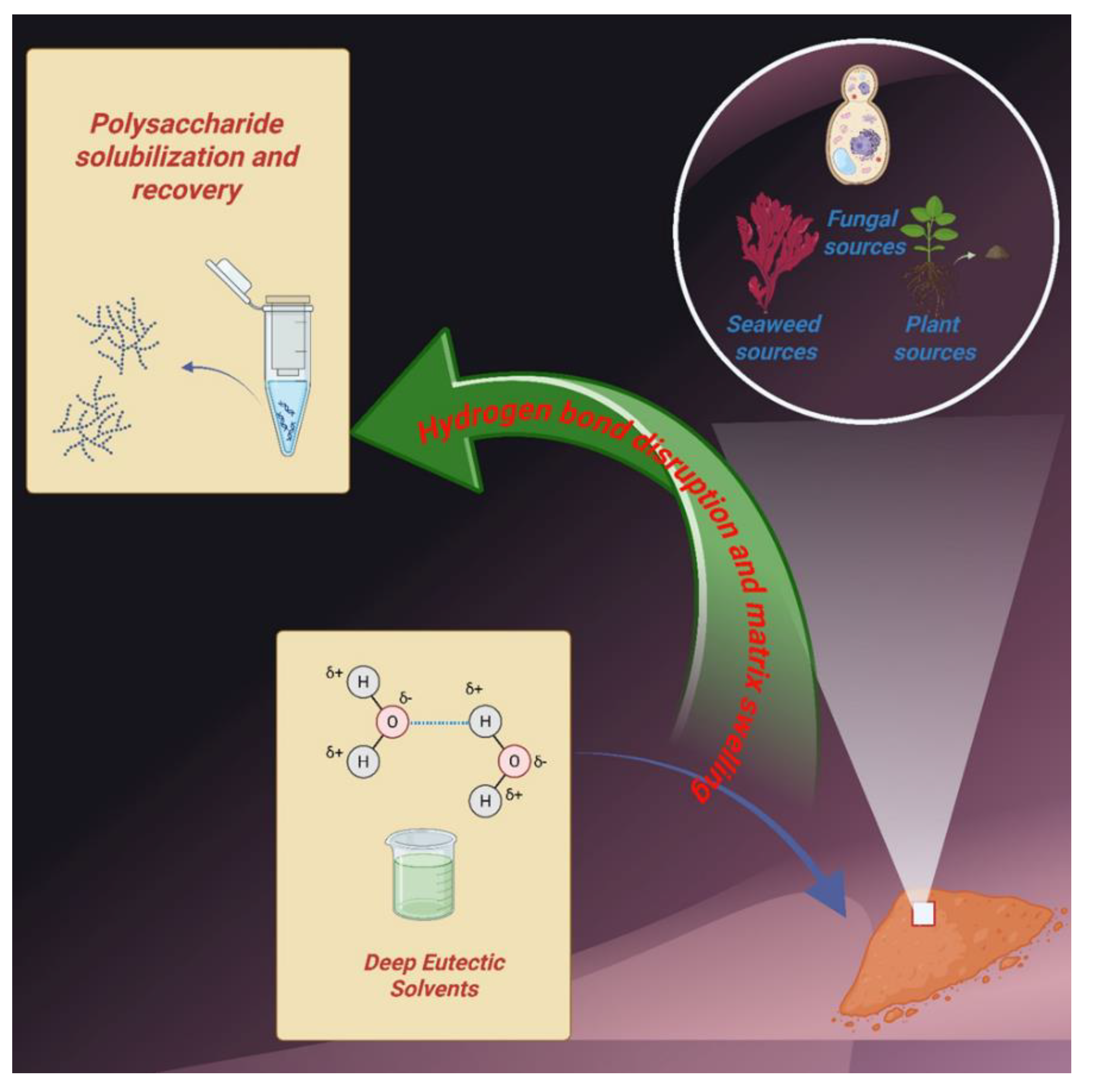

Table 1.
Representative DES-based polysaccharide extractions: systems, methods, and performance advantages.
Table 1.
Representative DES-based polysaccharide extractions: systems, methods, and performance advantages.
| Source | Polysaccharide Type | DES Extraction Method/System | Benefit/Remarks vs. Conventional | Reference |
| Dioscorea opposita | Crude polysaccharides | Choline chloride + 1,4-butanediol (ultrasound-assisted) | Higher yield than hot water or water-ultrasound extraction | [8] |
| Ganoderma lucidum | β-glucan-rich polysaccharides | Choline chloride + guaiacol + lactic acid (ternary DES) | 94.7 mg/g yield; stable reuse; superior due to strong hydrogen bonding | [9] |
| Saccharina japonica | Alginate, Fucoidan | DES + subcritical water hydrolysis | High yields of alginate (28.1%) and fucoidan (14.9%) | [10] |
| Sargassum horneri | Sulfated polysaccharides | Choline chloride + 1,2-propanediol (ultrasound-assisted) | Better removal of impurities and higher antioxidant activity | [11] |
| Fucus vesiculosus | Sulfated fucose-rich polysaccharides | Microwave-assisted DES: choline chloride + 1,4-butanediol | 116.3 mg/g yield; strong antioxidant and anticancer activity | [12] |
| Poria cocos | (1→3)-β-D-glucan-rich branched glucans | Choline chloride + oxalic acid DES | 8.6x yield over hot water; good recyclability | [13] |
| Ganoderma lucidum | Acidic heteropolysaccharides composed primarily of glucose, galactose, and glucuronic acid | Temperature-responsive DES | Polysaccharides recovered at UCST; green and recyclable system | [14] |
| Maca | Crude maca polysaccharides (unspecified heteropolysaccharide mixture) | Choline chloride + urea (ultrasound-assisted) | 2x yield over water; strong antioxidant and prebiotic benefits | [15] |
| Polygonatum kingianum | Crude polysaccharide (uncharacterized) | Choline chloride: glycerol (1:2), NADES | 2.5x higher yield than water; boosts IL-6 and iNOS in macrophages | [16] |
| Pericarpium Citri Reticulatae | Acidic heteropolysaccharide (PCRPs-1) rich in galactose, rhamnose, and uronic acids | Ultrasound-assisted DES | 5.41% yield vs. 3.92% (water); antioxidant and antidiabetic effects | [17] |
| Abalone viscera | Marine-derived acidic heteropolysaccharide rich in galactose and glucuronic acid (AVP) | Choline chloride + ethylene glycol (1:3 molar ratio), 25% water, ultrasound-assisted | Higher yield (17.32%), enhanced glucuronic acid content, lower Mw (53.33 kDa), stronger antioxidant activity than hot water extraction | [18] |
| Black truffle | Crude black truffle polysaccharide (uncharacterized) | Betaine + citric acid NADES (ultrasound-assisted) | 11x yield over ethanol; antioxidant and anti-aging bioactivity | [19] |
| Dandelion | Crude dandelion polysaccharides (likely inulin-type fructans, arabinogalactans, and/or pectic polysaccharides) | Ultrasound-assisted NADES (Choline chloride:Oxalic acid 1:2; 60% water) | Higher yield (68.5 mg/g) and purity (0.88 mg/mg); outperforming traditional methods; green and cost-effective | [20] |
| Lentinus edodes | Heteropolysaccharide (Glucose:Galactose:Mannose ≈ 32.9:1:2.54) | Subcritical Water Extraction (SWE) + ChCl–Malonate (1:2) DES | 19.2% more yield than SWE; better antioxidant profile | [21] |
| Acanthopanax senticosus | Glucose-based heteropolysaccharide | 3c-DES (betaine:triethanolamine:MgCl₂·6H₂O = 1:4:0.08, molar ratio); ethanol precipitation | Simultaneous extraction of saponins and polysaccharides | [22] |
| Lilium lancifolium | Crude heteropolysaccharides (glucose-, galactose-, arabinose-, mannose-containing) | Choline chloride–ethylene glycol (ChEtgly, 1:2) with 20% water, ultrasound-assisted at 50 °C for 40 min | Comparable yield to hot water extraction in 1/3 the time; simultaneous phenolic acid co-extraction; green solvent advantage | [23] |
| Eucommia ulmoides | Acidic heteropolysaccharides (mannose, rhamnose, galacturonic) | Choline chloride + oxalic acid (ultrasound-assisted) | 2.3x yield vs. water; strong antioxidant and enzyme inhibition | [24] |
| Dendrobium devonianum | Glucose-based heteropolysaccharide (α-/β-glucans) | Mechanochemical self-forming DESys | No external HBD needed; high efficiency and bioactivity | [25] |
| Polygonatum sibiricum | Galactose- and mannose-rich heteropolysaccharide (DPSP-3) | Choline chloride:oxalic acid (1:1, m/m) DES at 70 °C for 40 min | 15.62% yield (1.53× higher than water extraction); enriched in galactose (65.75%) and mannose (19.76%); improved immunomodulatory activity (ROS, NO, IL-6, TNF-α release in RAW264.7) | [26] |
| Lycium barbarum | Low-MW heteropolysaccharides (glucose-rich LBP) | Temperature-switchable DES (tetracaine:lauric acid, 1:1; 70 wt%) | 465 mg/g yield; recyclable; strong antioxidant profile | [27] |
| Anji white tea | Acidic arabinogalactan-type heteropolysaccharide | Choline chloride + 1,6-hexanediol (ultrasound-assisted) | Higher yield and antioxidant activity vs. water | [28] |
| Grape seed | Heteropolysaccharide (mannose, glucose, galactose, arabinose) | pH-switchable DES: dodecanoic acid + octanoic acid | 98 mg/g yield; reusable 25x; green alternative to t-butanol | [29] |
| Acanthopanax senticosus root | Acidic heteropolysaccharide (rich in galacturonic acid, arabinose, galactose) | L-malic acid + L-proline (ultrasound-assisted) | 2.6x higher yield than hot water; strong antioxidant activity | [30] |
| Chrysanthemum morifolium | Pectin (RG-I-rich) | DES (urea:choline chloride or 1,2-PG:ChCl) | D2: 83.5% RG-I domain; low GalA; enhanced prebiotic activity vs. inulin | [31] |
| Morchella importuna | Acidic heteropolysaccharide (GlcN, Gal, Glc, Man; 0.39:1.88:3.82:3.91) | Choline chloride + oxalic acid (2:1), 90% H₂O | 4.5× higher yield than HWE; higher carbohydrate (85.3%) and sulfate content (34.2%); enhanced antioxidant and α-glucosidase inhibitory effects | [32] |
| Astragalus membranaceus | Astragalus polysaccharides (APS); heteropolysaccharides containing Glc, Gal, Ara, Rha, Man | Choline chloride + oxalic acid (ultrasound-assisted) | Increased yield, reduced impurities vs. conventional | [33] |
| Camellia oleifera | Pectic-like heteropolysaccharide (rich in Ara, Glc, Gal, Rha, GalA, GlcA) | Choline chloride + propionic acid + 1,3-butanediol (DES-28; ternary) | 1.5× higher yield than hot water; enhanced antioxidant and hypoglycemic activity | [34] |
| Bletilla striata | Glucomannan | Choline chloride + urea | ↑Yield (36.77%), ↑Antioxidant activity (DPPH, ABTS, FRAP), recyclable DES | [35] |
| Schisandra chinensis | Galacturonic acid-rich pectic polysaccharide | Ethanolamine:4-Methoxyphenol (1:1) | 1.39× higher yield vs. water; recyclable TRDES; simultaneous lignanoid extraction | [36] |
1 Abbreviations, DES: Deep eutectic solvent, NADES: Natural deep eutectic solvent, DESys: Deep eutectic systems (in situ-formed DES), TRDES: Temperature-responsive deep eutectic solvent, UCST: Upper critical solution temperature, ChCl: Choline chloride, 1,2-PG: 1,2-Propanediol, ChEtgly: Choline chloride–ethylene glycol, SWE: Subcritical water extraction, HBD: Hydrogen bond donor, LBP: Lycium barbarum polysaccharide, DPSP-3: Polygonatum sibiricum polysaccharide fraction 3, APS: Astragalus polysaccharides, RG-I: Rhamnogalacturonan-I, GalA: Galacturonic acid, HWE: Hot water extraction, DPPH: 2,2-Diphenyl-1-picrylhydrazyl, ABTS: 2,2′-Azino-bis(3-ethylbenzothiazoline-6-sulfonic acid), FRAP: Ferric reducing antioxidant power, IL-6: Interleukin-6, iNOS: Inducible nitric oxide synthase, ROS: Reactive oxygen species, NO: Nitric oxide, TNF-α: Tumor necrosis factor-alpha.
Table 2.
Representative solutes dissolved in deep eutectic solvents (DESs), highlighting mechanistic insights into solvation behavior and dissolution efficiency.
Table 2.
Representative solutes dissolved in deep eutectic solvents (DESs), highlighting mechanistic insights into solvation behavior and dissolution efficiency.
| Soluble Substances | Mechanism/Insight | Reference |
| Cu, Fe, Pb, Zn (oxides, sulfates, sulfides) | Sulfates dissolve best; solubility ~100× higher due to enhanced coordination in DES. | [49] |
| LiCoO₂, Lithium cobalt oxide | Reductive dissolution via ascorbic acid and PEG-based DES with 84.2% Co leaching. | [50] |
| Lipids, proteins, carbohydrates | NaDES polarity and viscosity enhance biomolecule extraction. | [51] |
| DNA, starch, gluten, bioactives | Natural DESs dissolve biopolymers via extensive hydrogen bonding networks. | [52] |
| CuO, ZnO, MgO, CaO, Fe₂O₃ | Thermodynamic favorability and morphology changes improve solubility. | [53] |
| Cellulose | Partial bonding and enhanced H-bonding increase cellulose solubility in ChCl–resorcinol DES. | [54] |
| Uranium oxide (UO₃) | Coordination with TOPO and HTTA in hydrophobic DESs achieves high solubility. | [55] |
| Toluene (reaction medium) | DESs activate H₂O₂ via H-bonding and low viscosity, enhancing oxidation reactions. | [56] |
| UO₂, U₃O₈, UO₃ | Strong hydrogen bonding in PTSA:ChCl DES enables uranium oxide dissolution. | [57] |
| CO₂, SO₂, H₂S, aromatic bioactives | DESs solvate via selective polarity and hydrogen bonding matched to target compounds. | [58] |
| PbO, CuO, Fe₂O₃, ZnO | Acidic DESs use H-bond networks and phase behavior to dissolve metal oxides. | [59] |
| Metal oxides, salts, polar organics | Ionic interactions and hydrogen bonds enhance solubility of diverse substances. | [60] |
| Chitin | Novel DESs using TMBAC and acids dissolved chitin up to 12% and enhanced enzymatic hydrolysis 2×. | [61] |
| CnTAB surfactants (micelles) | Micelle formation in DESs depends on solvent microstructure and hydrogen bonding. | [62] |
| HgO, HgCl₂ | Complete dissociation via Cl⁻ coordination in DES; H-bond donors don’t replace chloride ligands. | [63] |
| Metal oxides, drugs, flavonoids, phenols | Broad solubility via strong hydrogen bonding, high polarity, and solvent customization. | [64] |
| Fe₃O₄, CuO, ZnO, PbO | Chloroacetic acid DESs with ammonium bromides dissolve oxides through optimized H-bonding. | [65] |
| Rutin | High solubility in ChCl:propanediol/urea DES due to hydrogen bonding and polarity. | [66] |
| PbO | [PbO·Cl·EG]⁻ species formation drives dissolution in ChCl–EG DES. | [67] |
| Keratin (animal hair) | Sulfur-containing DESs disrupt protein structure, achieving up to 79% solubility. | [68] |
| Metal oxides from lithium-ion batteries | DES decomposition products (e.g., Cl₃⁻) promote oxidative dissolution. | [69] |
| DNA | Solubility depends on hydrogen bonding strength and ionic conductivity in DES. | [70] |
| Bioactive pharmaceutical ingredients | DES polarity and hydrogen bonding tailored to drug properties, improving solubility. | [71] |
| Metal salts, oxides, phosphates | Solubility varies with DES pH and polarity; acidic DESs dissolve oxides effectively. | [72] |
| MgFe₂O₄, ZnFe₂O₄, CoFe₂O₄, NiFe₂O₄ | DESs enable low-temp synthesis and precursor dissolution for ferrite nanoparticles. | [73] |
| Co, Cu, Zn, Fe, Ni, Mn oxides | Temp/time-dependent coordination and solubilization in choline chloride–acid DES. | [74] |
| Cellulose | ZnCl₂ hydrate–acrylic acid DES disrupts cellulose H-bonding for efficient dissolution. | [75] |
| APIs (Fluconazole, mometasone furoate, Risperidone, diclofenac diethylamine, azelaic acid, tadalafil) | THEDES systems can dissolve APIs by transforming the crystalline drug into a supramolecular liquid mixture. | [40,41,42,43,44,45,46] |
2 Abbreviations, DES: Deep eutectic solvent, NaDES: Natural deep eutectic solvent, ChCl: Choline chloride, PEG: Polyethylene glycol, TOPO: Trioctylphosphine oxide, HTTA: Thenoyltrifluoroacetone, PTSA: p-Toluenesulfonic acid, TMBAC: Trimethylbenzylammonium chloride, CnTAB: Alkyltrimethylammonium bromide (where n denotes carbon chain length), EG: Ethylene glycol, THEDES: Therapeutic deep eutectic solvent, API: Active pharmaceutical ingredient.
Table 3.
Domain-level classification of major polysaccharides with structural features and implications for extraction using deep eutectic solvents (DESs).
Table 3.
Domain-level classification of major polysaccharides with structural features and implications for extraction using deep eutectic solvents (DESs).
| Polysaccharide | Biological Source | Dominant Domain(s) | Structural Features | Implication for DES Extraction | Key Reference |
| Cellulose | Plant cell walls | Crystalline > Interfacial | Linear β(1→4)-Glc; extensive hydrogen bonding; microfibrillar | Requires strong HBAs or heat/ultrasound; limited solubility in mild DESs | [112,113,114] |
| Pectin (RG-I, HG) | Plant middle lamella | Amorphous | Galacturonic acid-rich; HG linear, RG-I branched | Readily extracted by acidic DESs; mild DESs preserve structure, promote bioactivity | [104,105] |
| Hemicellulose | Secondary plant walls | Amorphous + Interfacial | Heterogeneous; short chains; variable composition | Extractable under mild DESs; solubility depends on sugar composition and structure | [106] |
| Chitin | Fungi, crustaceans | Crystalline | β(1→4)-GlcNAc; highly ordered, strong H-bonding | Requires acidic/basic DESs; needs thermal/ultrasonic pretreatment | [61] |
| Chitosan | Deacetylated chitin | Amorphous + Interfacial | Linear, partially cationic; degree of deacetylation influences solubility | Soluble in acidic DESs (e.g. choline chloride–lactic acid); forms gels and films | [115] |
| Starch (Amylose) | Plant storage tissues | Semi-crystalline | Linear α(1→4)-Glc; helical; forms double helices | Requires thermal gelatinization to be solubilized in DESs | [116] |
| Starch (Amylopectin) | Plant storage tissues | Amorphous (contributes to semi-crystalline lamellae in native starch) | Highly branched α(1→4)/α(1→6) Glc | Easily solubilized by polar DESs under mild conditions | [117] |
| Inulin | Chicory, dahlia | Amorphous | Linear and branched fructans (β(2→1)-linked) | Fully soluble in polar DESs; enhances bioactive film formation | [107,108] |
| β-Glucan | Oats, barley, yeast | Amorphous | Mixed β(1→3)/(1→4)-Glc; gel-forming | Soluble in neutral DESs; used in functional food and pharma | [118] |
| Xanthan gum | Bacterial EPS | Amorphous | β(1→4)-linked glucose backbone with charged side chains | Highly soluble in DESs; enables shear-thinning formulations | [119] |
| Alginate | brown seaweed | Amorphous | Linear mannuronic and guluronic acid blocks; polyanionic | Acidic DESs shield charges and promote solubilization | [120] |
| Fucoidan | brown seaweed | Amorphous | Sulfated, branched α(1→3)/α(1→4)-L-fucose | Soluble in ionic and polar DESs; mild extraction preserves bioactivity | [10] |
| Glucomannan | porang (Amorphophallus muelleri Blume) | Amorphous | Linear β(1→4)-linked glucose and mannose | Highly extractable under mild polar DESs | [121] |
| Pullulan | Fungi (Aureobasidium) | Amorphous | Linear α(1→6)-linked maltotriose units; non-ionic and water-soluble | Compatible with polar DESs; maintains solubility across solvents | [122] |
| Galactomannan | Legumes (e.g., guar) | Amorphous | β(1→4)-linked mannan with α(1→6)-galactose side chains | Easily solubilized in polar DESs; can be enzymatically modified | [123] |
| Levan | Bacterial (e.g., Bacillus) | Amorphous | β(2→6)-linked fructose units; highly branched and water-soluble | Readily soluble in polar DESs; useful in prebiotic applications | [124] |
| Dextran | Bacterial (Leuconostoc) | Amorphous | Linear α(1→6)-Glc backbone with α(1→3/1→4) branches | Soluble in mild, neutral DESs; applicable in food and pharma | [125] |
| Carrageenan | Red algae | Amorphous | Sulfated galactans; alternating α(1→3)/β(1→4)-linked units; gelling | Soluble in ionic DESs; gelation influenced by ions and solvent polarity | [126] |
* Abbreviations, DES: Deep eutectic solvent, RG-I: Rhamnogalacturonan-I, HG: Homogalacturonan, Glc: Glucose, GlcNAc: N-acetylglucosamine, HBA: Hydrogen bond acceptor, EPS: Exopolysaccharide, α(1→4), β(1→4), α(1→6), β(1→3), β(1→6), etc.: Glycosidic linkages indicating position and stereochemistry of sugar bonds, Gal: Galactose, Man: Mannose, Ara: Arabinose, GalA: Galacturonic acid, GlcA: Glucuronic acid.
Disclaimer/Publisher’s Note: The statements, opinions and data contained in all publications are solely those of the individual author(s) and contributor(s) and not of MDPI and/or the editor(s). MDPI and/or the editor(s) disclaim responsibility for any injury to people or property resulting from any ideas, methods, instructions or products referred to in the content. |
© 2025 by the authors. Licensee MDPI, Basel, Switzerland. This article is an open access article distributed under the terms and conditions of the Creative Commons Attribution (CC BY) license (http://creativecommons.org/licenses/by/4.0/).
Copyright: This open access article is published under a Creative Commons CC BY 4.0 license, which permit the free download, distribution, and reuse, provided that the author and preprint are cited in any reuse.


