
Submitted:
29 August 2025
Posted:
05 September 2025
You are already at the latest version
Abstract
This paper presents a systematic review of the use of ChatGPT in higher education. We adopted the Technology Acceptance Model to explain how students and faculty perceive the opportunities, perceptions, and challenges of using ChatGPT. We included peer-reviewed journal articles and conference proceedings from January 2022 to April 2024, taken from APA PsycInfo, CINAHL Ultimate, Education Source Ultimate, ERIC, and Web of Science. Out of 1046 studies, we selected 58, with 21 of these studies offering differing perspectives on the accuracy and reliability of ChatGPT. There were also 14 concerns concerning its ethical implications and 25 views on its future role in higher education. We found that professors and students held different opinions regarding ChatGPT's usage in higher education.
Keywords:
artificial intelligence
; ChatGPT
; higher education
; systematic review
; ethical considerations
Abstract
This paper presents a systematic review of the use of ChatGPT in higher education. We adopted the Technology Acceptance Model to explain how students and faculty perceive the opportunities, perceptions, and challenges of using ChatGPT. We included peer-reviewed journal articles and conference proceedings from January 2022 to April 2024, taken from APA PsycInfo, CINAHL Ultimate, Education Source Ultimate, ERIC, and Web of Science. Out of 1046 studies, we selected 58, with 21 of these studies offering differing perspectives on the accuracy and reliability of ChatGPT. There were also 14 concerns concerning its ethical implications and 25 views on its future role in higher education. We found that professors and students held different opinions regarding ChatGPT's usage in higher education.
Introduction
The invention of Artificial Intelligence (AI) has significantly transformed pedagogical approaches and learning outcomes in higher education. Leveraging AI to improve education and cultivate a new generation of knowledgeable citizens is essential. The study by Zawacki-Richter et al. (2019) asserted that AI technology can help personalized education by tailoring learning components to suit individual preferences and objectives, improving teaching effectiveness, and strengthening educational competencies. This positions AI as a beneficial educational tool when used correctly (Gartner & Krasna, 2023). Among the various AI tools, the Chat Generative Pre-Trained Transformer (GPT) stands out for its advanced capabilities and widespread application.
Chat Generative Pre-Trained Transformer (ChatGPT) is the most advanced and broadest possible application among the various AI tools. The technology is designed to generate human-like text responses based on extensive pre-training data (OpenAI, 2023). Moving from GPT-3.5 in November 2022 to GPT-4 in March 2023 and most recently to the more advanced GPT-4o in May 2024 has happened at a pace genuinely indicative of its sophistication and transformative potential for education. The work of Fauzi et al. (2023) brings out distinctive characteristics of ChatGPT that make it suitable for different learning tasks. These tasks include providing research assistance, personalized tutoring, and making available customized materials and support for students to increase their efficiency. However, the infusion of this AI-based program into traditional teaching methods would result in a more interactive and exciting classroom atmosphere where students can comfortably interact with technology as if they were best friends, thus leading to individuals’ educational paths and higher degrees of student participation (An et al., 2023). Although it faces some challenges, such integration holds immense promise.
Therefore, the current study is guided by the following research questions to gain a full understanding of the consequences of ChatGPT in higher education:
- What opinions do instructors and students have about ChatGPT's accuracy and reliability in higher education?
- What are the attitudes of students and professors towards the ethical implications of ChatGPT in higher education?
- How do faculty and students forecast the future role of ChatGPT in promoting traditional teaching methods?
Theoretical Framework
Our paper adopted the Technology Acceptance Model (Davis, 1989) as the theoretical framework. This model states that people's technology acceptance most of the time depends on perceived usefulness (PU) and perceived ease of use (PEOU). These factors are interrelated and crucial for understanding how technology is adopted. TAM’s application to our study can be seen in the following ways:
- PU refers to how users believe ChatGPT makes educational tasks easy. Studies reviewed indicate that both students and faculty find ChatGPT beneficial for generating research ideas, assisting in problem-solving, and providing immediate feedback on complex topics (Fauzi et al., 2023).
- PEOU refers to how effortless users interact with ChatGPT. According to RomeroRodríguez et al. (2023), ChatGPTs' ease of usage makes it a great choice for higher education. This tool's fast response times make it easier to include in teaching and learning.
The literature is replete with empirical evidence that positive perceptions of PU and PEOU significantly influence ChatGPT’s acceptance among students and faculty (Hamid et al., 2023; Han et al., 2023). Addressing barriers such as response accuracy and ethical concerns can further enhance adoption in higher education (Bazelais et al., 2024). This paper provides insights into promoting the effective integration of ChatGPT in educational settings by taking advantage of the Technology Acceptance Model (TAM)
Methodology
The Systematic Review Approach
ChatGPT has become well-known and has drawn much attention due to its amazing potential. Therefore, the need to understand how it would affect higher education and the possible threats that come with it is urgently needed. The systematic review is the best to uncover the most recent research and significant findings on ChatGPT in higher education. Advanced online publications, preprints, and non-academic sources (e.g., mass and social media) were excluded from this review.
In this sense, studies of ChatGPT in higher education that focus on perceptions, attitudes, or experiences concerning the use are included in the review. Additionally, only articles written in English were included. The review included a quantitative and qualitative (content) type of analysis to obtain a complete understanding of the research findings.
Search Strategy
The selection of eligible articles for this review adhered to the Preferred Reporting Items for Systematic Reviews and Meta-Analyses (PRISMA) guidelines (Moher, 2009). We conducted the last search on April 27, 2024, for articles that include ChatGPT versions 3.5 and 4. Five electronic databases were used: (1) APA PsycInfo; (2) CINAHL Ultimate; (3) Education Source Ultimate; (4) ERIC; and (5) Web of Science. The search strategy included the following terms: "generative AI" OR "generative artificial intelligence" OR "ChatGPT") AND ("higher education" OR "university*" OR "college*" OR "undergrad*" OR "graduate" OR "postgrad*").
Data Sources
Peer-reviewed journal articles and conference proceedings were used as data sources between January 1, 2022, and April 27, 2024, to limit the search to high-quality literature. Conversely, we excluded articles published outside the specified period, non-peer-reviewed materials, and studies conducted outside higher education. Our final sample comprised 58 articles from an initial pool of 1,046 studies. The included studies were subjected to quantitative and qualitative analyses. We used descriptive statistics to analyze the distribution of studies by geographical location and perceptions of ChatGPT’s accuracy and reliability. We then conducted content analysis to identify key themes relating to our research questions. Using a standardized form in Covidence, we extracted and analyzed data to identify common themes and patterns across the included studies.
Results General Description of the Literature
Figure 1 shows the PRISMA diagram of the review. A total of 1,046 records were retrieved from database searches (Education Source Ultimate = 564, Web of Science = 263, ERIC = 149, APA PsycINFO = 43, CINAHL Ultimate = 27). There were still 840 records available for screening after removing 206 duplicates (3 manually identified, 203 by Covidence). Due to their failure to meet the inclusion criteria, 738 records were removed after the screening. After the 102 full texts were reviewed for eligibility, 44 articles were excluded for the following reasons: 19 studies focused on outcomes unrelated to perceptions, attitudes, or experiences; 10 reviews lacked empirical data collection and analysis; 8 studies involved populations outside of higher education settings; 4 full texts were not available; 2 studies had primary outcomes unrelated to the direct use of AI; and 1 study was not written in English. A total of 58 studies were included in the final review. Figure 1 illustrates the process of selecting articles. We used quantitative and qualitative analyses to identify common themes and patterns related to using ChatGPT in higher education from 58 studies we included in our review. The studies were grouped according to their locations (Figure 2) and the general opinions of ChatGPT's accuracy and reliability (Figure 3).
Perceptions of ChatGPT's Accuracy and Reliability
The 58 articles came from different geographical distributions (Figure 2). We found 28 articles from Asia, 11 articles from Europe, 9 articles from North America, 8 articles from Africa, and 2 articles from Oceania. Perceptions of ChatGPT’s accuracy and reliability were mixed (Table 1; Figure 3):
- Positive Perceptions: Eleven studies highlighted ChatGPT’s ability to provide accurate and reliable responses, support academic tasks, and improve productivity. For instance, medical students and healthcare professionals found ChatGPT’s responses trustworthy and useful for clinical practice and education.
- Negative Perceptions: Five studies pointed out limitations and inaccuracies in ChatGPT’s responses, leading to concerns about its reliability. Some users reported incorrect or contextually inappropriate responses, which affected their trust.
- Mixed Perceptions: Another five studies reported positive and negative perceptions. While some users appreciated ChatGPT’s assistance in generating ideas and content, concerns remained about its accuracy and the potential for over-reliance.
Ethical Implications
The review identified ethical concerns associated with using ChatGPT in higher education (Table 2):
- Privacy: Both students and faculty expressed concerns about sharing personal information with ChatGPT. They said ChatGPT can collect and misuse personal data, necessitating strict privacy regulations and transparent policies.
- Biases and Fairness: There is the risk of societal reflection in ChatGPT's responses due to its programming.
- Academic Integrity: The ability of ChatGPT to provide precise responses raises fears of AI-assisted cheating and plagiarism.
Future Role in Aiding Traditional Teaching Methods
The use of ChatGPT in higher education shows its ability to aid traditional teaching methods (Table 3):
- Teaching and Learning: ChatGPT supports teaching by providing comprehensive and understandable information on complex topics. It creates a ubiquitous learning environment and improves student engagement.
- Content Creation: ChatGPT assists professors in developing instructional materials and promotes overall teaching efficiency.
- Personalized Learning: ChatGPT provides personalized feedback, facilitates tailored learning experiences, and identifies and corrects writing errors.
- Creative Capabilities: ChatGPT promotes better student engagement and academic performance through interactive and creative content that fosters innovation and problemsolving skills.
- Collaboration and Interaction: ChatGPT facilitates collaboration and interaction, provides real-time assistance and feedback to students, and supports group activities.
Scholarly Significance of the Study
This systematic review provides a better understanding of the integration of ChatGPT in higher education, contributing significantly to the existing body of knowledge. The study offers valuable insights into the varied perceptions of ChatGPT’s accuracy and reliability among students and faculty. The result of this study is useful for educationists and policymakers/administrators. It offers advice on using AI technologies in classrooms, making learning better for students and teaching more efficient.
The study also addresses ethical issues like privacy, biases, and plagiarism. It provides a starting point for creating strong rules to manage the use of AI tools in schools. These insights can help policymakers ensure that ChatGPT is used fairly and ethically, protecting student information and academic standards.
In addition to its practical and policy implications, this study promotes educational innovation by demonstrating how ChatGPT can support personalized learning, streamline content creation, and foster interactive and collaborative learning environments. These innovations pave the way for more dynamic and engaging educational practices, ultimately contributing to the advancement of educational technology.
In conclusion, this paper shows ChatGPT's ability to improve teaching and learning and stresses the importance of continuous improvement and ethical considerations. The findings contribute to the broader discussion on AI in education and provide a foundation for future research and policy development.
References
- Adams, D. , Chuah, K.-M., Devadason, E., & Abdul Azzis, M. S. (2023). From novice to navigator: Students’ academic help-seeking behavior, readiness, and perceived usefulness of ChatGPT in learning. Education and Information Technologies. [CrossRef]
- Adetayo, A. J. (2023). ChatGPT and librarians for reference consultations. Internet Reference.
- Services Quarterly, 27(3), 131-147. [CrossRef]
- Ajlouni, A. O. , Almahaireh, A. S., & Whaba, F. A.-A. (2023). Students’ perception of using ChatGPT in counseling and mental health education: The benefits and challenges. International.
- Journal of Emerging Technologies in Learning (iJET), 18(20), 199–218. [CrossRef]
- Algaraady, J. , & Mahyoob, M. (2023). ChatGPT’s capabilities in spotting and analyzing writing errors experienced by EFL learners. Arab World English Journal, 9. [CrossRef]
- Al-Khatib, A. W. (2023). Drivers of generative artificial intelligence to fostering exploitative and exploratory innovation: A TOE framework. Technology in Society, 75. [CrossRef]
- An, Y. , Ouyang, W. , & Zhu, 47-56., F. (2023). ChatGPT in higher education: Design teaching model involving ChatGPT. In Proceedings of the International Conference on Global Politics and Socio-Humanities. [Google Scholar] [CrossRef]
- Barrett, A. , & Pack, A. (2023). Not quite eye to A.I.: Student and teacher perspectives on the use of generative artificial intelligence in the writing process. International Journal of Educational Technology in Higher Education, 20. [CrossRef]
- Bazelais, P. , Lemay, D. J., & Doleck, T. (2024). User acceptance and adoption dynamics of ChatGPT in educational settings. EURASIA Journal of Mathematics, Science and Technology Education, 20, 2393. [Google Scholar] [CrossRef]
- Chan, C. K. (2023). A comprehensive AI policy education framework for university teaching and learning. International Journal of Educational Technology in Higher Education, 20. [CrossRef]
- Chan, C. K. , & Hu, W. (2023). Students’ voices on generative AI: Perceptions, benefits, and challenges in higher education. International Journal of Educational Technology in Higher Education, 20. [CrossRef]
- Chan, C. K. , & Zhou, W. (2023). An expectancy value theory (EVT) based instrument for measuring student perceptions of generative AI. Smart Learning Environments, 10. [CrossRef]
- Choudhury, A. , & Shamszare, H. (2023). Investigating the impact of user trust on the adoption and use of ChatGPT: Survey analysis. Journal of Medical Internet Research, 25. [CrossRef]
- Crawford, J. , Allen, K. A., Pani, B., & Cowling, M. (2024). When artificial intelligence substitutes humans in higher education: The cost of loneliness, student success, and retention. Studies in Higher Education,. [CrossRef]
- ČrčekN., & PatekarJ. (2023). Writing with AI: University Students’ Use of ChatGPT. Journal of.
- Language and Education, 9(4), 128-138. [CrossRef]
- Cummings, R. E. , Monroe, S. M., & Watkins, M. (2024). Generative AI in first-year writing: An early analysis of affordances, limitations, and a framework for the future. Computers and Composition, 71. [CrossRef]
- Damiano, A. D. , Lauría, E. J., Sarmiento, C., & Zhao, N. (2024). Early perceptions of teaching and learning using generative AI in higher education. ( 52(3), 346–375. [CrossRef]
- Das, S. R. & Madhusudan, J. V. (2024). Perceptions of higher education students towards ChatGPT usage. V. ( 7(1), 86–106. [CrossRef]
- Davis, F. D. (1989). Perceived usefulness, perceived ease of use, and user acceptance of information technology. MIS Quarterly, 13(3), 319-340. [CrossRef]
- Delcker, J. , Heil, J., Ifenthaler, D., Seufert, S., & Spirgi, L. (2024). First-year students AIcompetence as a predictor for intended and de facto use of AI-tools for supporting learning processes in higher education. International Journal of Educational Technology in Higher Education, 21(18). [CrossRef]
- Denecke, K. , Glauser, R., & Reichenpfader, D. (2023). Assessing the potential and risks of AIbased tools in higher education: Results from an eSurvey and SWOT analysis. Trends in Higher Education, 2. [CrossRef]
- Ding, L. , Li, T., Jiang, S., & Gapud, A. (2023). Students’ perceptions of using ChatGPT in a physics class as a virtual tutor. International Journal of Educational Technology in Higher Education, 20. [CrossRef]
- Fauzi, F. , Tuhuteru, L., Sampe, F., Ausat, A. M. A., & Hatta, H. R. (2023).
- ChatGPT in improving student productivity in higher education. Journal on Education, 5.
- 14886-14891. [CrossRef]
- Fiialka, S. , Kornieva, Z., & Honcharuk, T. (2023). ChatGPT in Ukrainian education: Problems and prospects. International Journal of Emerging Technologies in Learning (iJET), 18. [CrossRef]
- Gao, Y. , Wang, Q., & Wang, X. (2024). Exploring EFL university teachers’ beliefs in integrating ChatGPT and other large language models in language education: A study in China. Asia Pacific.
- Journal of Education, 44(1), 29-44. [CrossRef]
- Gartner, S. , & Krasna, M. (2023). Artificial Intelligence in Education - Ethical framework. In 2023 12th Mediterranean Conference on Embedded Computing (MECO). [CrossRef]
- Grájeda, A. , Burgos, J., Córdova, P., & Sanjinés, A. (2023). Assessing student-perceived impact of using artificial intelligence tools: Construction of a synthetic index of application in higher education. Cogent Education, 11. [CrossRef]
- Hamid, H. , Zulkifli, K., Naimat, F., Che Yaacob, N. L., & Ng, K. W. (2023). Exploratory study on student perception on the use of chat AI in process-driven problem-based learning. Currents in Pharmacy Teaching and Learning, 15, 1025. [Google Scholar] [CrossRef]
- Han, J. , Yoo, H., Kim, Y., Myung, J., Kim, M., Lim, H., Kim, J., Lee, T. Y., Hong, H., Ahn, S.-Y.
- & Oh, A. (2023). RECIPE: How to integrate ChatGPT into EFL writing education.
- 20 July 2023; -22.
- Copenhagen, Denmark (pp. 5). ACM. [CrossRef]
- Hu, J. M. , Liu, F. C., Chu, C. M., & Chang, Y. T. (2023). Health care trainees’ and professionals’ perceptions of ChatGPT in improving medical knowledge training: Rapid survey study. Journal of Medical Internet Research, 25. [CrossRef]
- Jepkemoi, B. , Mulwa, P. K., & Mwanda, S. O. (2024). Influence of ChatGPT affordances on adaptive learning experiences among undergraduate religious education teacher trainees at the University of Nairobi, Kenya. O. ( 4(1), 25–35. [CrossRef]
- Johnston, H. , Wells, R. F., Shanks, E. M., Boey, T., & Parsons, B. N. (2024). Student perspectives on the use of generative artificial intelligence technologies in higher education. International Journal for Educational Integrity, 20. [CrossRef]
- Kamoun, F. , El Ayeb, W., Jabri, I., Sifi, S., & Iqbal, F. (2024). Exploring students’ and faculty’s knowledge, attitudes, and perceptions towards ChatGPT: A cross-sectional empirical study. Journal of Information Technology Education: Research, 23. [CrossRef]
- Karaman, M.R. & Goksu, I. (2024). Are lesson plans created by ChatGPT more effective? An experimental study. International Journal of Technology in Education. [CrossRef]
- Kavadella, A. , Dias da Silva, M. A., Kaklamanos, E. G., Stamatopoulos, V.
- K. (2024).
- Mixed methods study. JMIR Medical Education, 10, 5134. [CrossRef]
- Kelly, A. , Sullivan, M., & Strampel, K. (2023). Generative artificial intelligence: University student awareness, experience, and confidence in use across disciplines. Journal of University Teaching & Learning Practice, 20. [CrossRef]
- Kiryakova, G. , & Angelova, N. (2023). ChatGPT—A challenging tool for the university professors in their teaching practice. Education Sciences, 13. [CrossRef]
- Lelepary, H. L. , Rachmawati, R., Zani, B. N., & Maharjan, K. (2022). GPT Chat: Opportunities and challenges in the learning process of Arabic language in higher education. Journal International of Lingua and Technology, 2(1), 10-22. https://doi.org/10.55849/jiltech.v2i1.439 Li, H. (2023). Effects of a ChatGPT-based flipped learning guiding approach on learners’ courseware project performances and perceptions. Australasian Journal of Educational Technology, 39. [CrossRef]
- Liu, G. L. , Darvin, R., & Ma, C. (2024). Exploring AI-mediated informal digital learning of English (AI-IDLE): A mixed-method investigation of Chinese EFL learners’ AI adoption and experiences. Computer Assisted Language Learning,. [CrossRef]
- Liu, G. , & Ma, C. (2023). Measuring EFL learners’ use of ChatGPT in informal digital learning of English based on the technology acceptance model. Innovation in Language Learning and Teaching, 18. [CrossRef]
- Michael, P. Rogers, Hannah Miller Hillberg, and Christopher L. In Groves. 2024. Attitudes towards the use (and misuse) of ChatGPT: A preliminary study. In Proceedings of the 55th ACM Technical Symposium on Computer Science Education V. 1 (SIGCSE 2024), March 20–23, Portland, OR, USA. ACM, NewYork, NY, USA, 7 pages. 2024. [Google Scholar] [CrossRef]
- Moher, D. , Liberati, A., Tetzlaff, J., Altman, D. G., & The PRISMA Group. (2009). Reprint— preferred reporting items for systematic reviews and meta-analyses: The PRISMA statement. Physical Therapy, 89. [CrossRef]
- Mosleh, R. , Jarrar, Q., Jarrar, Y., Tazkarji, M., & Hawash, M. (2023). Medicine and pharmacy students’ knowledge, attitudes, and practice regarding artificial intelligence programs: Jordan and West Bank of Palestine. Advances in Medical Education and Practice, 14,.
- . [CrossRef]
- Ngo, T. T. (2023). The perception by university students of the use of ChatGPT in education. International Journal of Emerging Technologies in Learning (iJET), 18. [CrossRef]
- Ngo, T. T. , Tran, T. T., Khuong An, G., Tuan, N. D., & Quang, T. A. (2024). ChatGPT for educational purposes: Investigating the potentials and challenges. IEEE Transactions on Learning Technologies, 17. [CrossRef]
- Ofosu-Ampong, K. (2024). Beyond the hype: Exploring faculty perceptions and acceptability of AI in teaching practices. Discover Education, 3. [CrossRef]
- Park, J. (2023). Medical students’ patterns of using ChatGPT as a feedback tool and perceptions of ChatGPT in a Leadership and Communication course in Korea: A cross-sectional study. Journal of Educational Evaluation for Health Professions, 20. [CrossRef]
- Qu, K. , & Wu, X. (2024). ChatGPT as a CALL tool in language education: A study of hedonic motivation adoption models in English learning environments. Education and Information Technologies. [CrossRef]
- Romero-Rodríguez, J.-M. , Ramírez-Montoya, M.-S., Buenestado-Fernández, M., & Lara-Lara, F. (2023). Use of ChatGPT at university as a tool for complex thinking: Students' perceived usefulness. Journal of New Approaches in Educational Research, 12. [CrossRef]
- Saxena, A. , & Doleck, T. (2023). A structural model of student continuance intentions in ChatGPT adoption. EURASIA Journal of Mathematics, Science and Technology Education, 19, 2366. [Google Scholar] [CrossRef]
- Tangadulrat, P. , Sono, S., & Tangtrakulwanich, B. (2023). Using ChatGPT for clinical practice and medical education: Cross-sectional survey of medical students’ and physicians’ perceptions. JMIR Medical Education, 9. [CrossRef]
- Urban, M. , Děchtěrenko, F., Lukavský, J., Hrabalová, V., Svacha, F., Brom, C., & Urban, K. (2024). ChatGPT improves creative problem-solving performance in university students: An experimental study. Computers & Education, 215. [CrossRef]
- Yusuf, A. , Pervin, N., & Román-González, M. (2024). Generative AI and the future of higher education: A threat to academic integrity or reformation? Evidence from multicultural perspectives. International Journal of Educational Technology in Higher Education, 21. [CrossRef]
- Zawacki-Richter, O. , Marín, V., Bond, M., & Gouverneur, F. (2019). Systematic review of research on artificial intelligence applications in higher education – where are the educators?
- Journal of Educational Technology in Higher Education, 16. Journal of Educational Technology in Higher Education, 16. [CrossRef]
Figure 1.
PRISMA flow diagram of article.
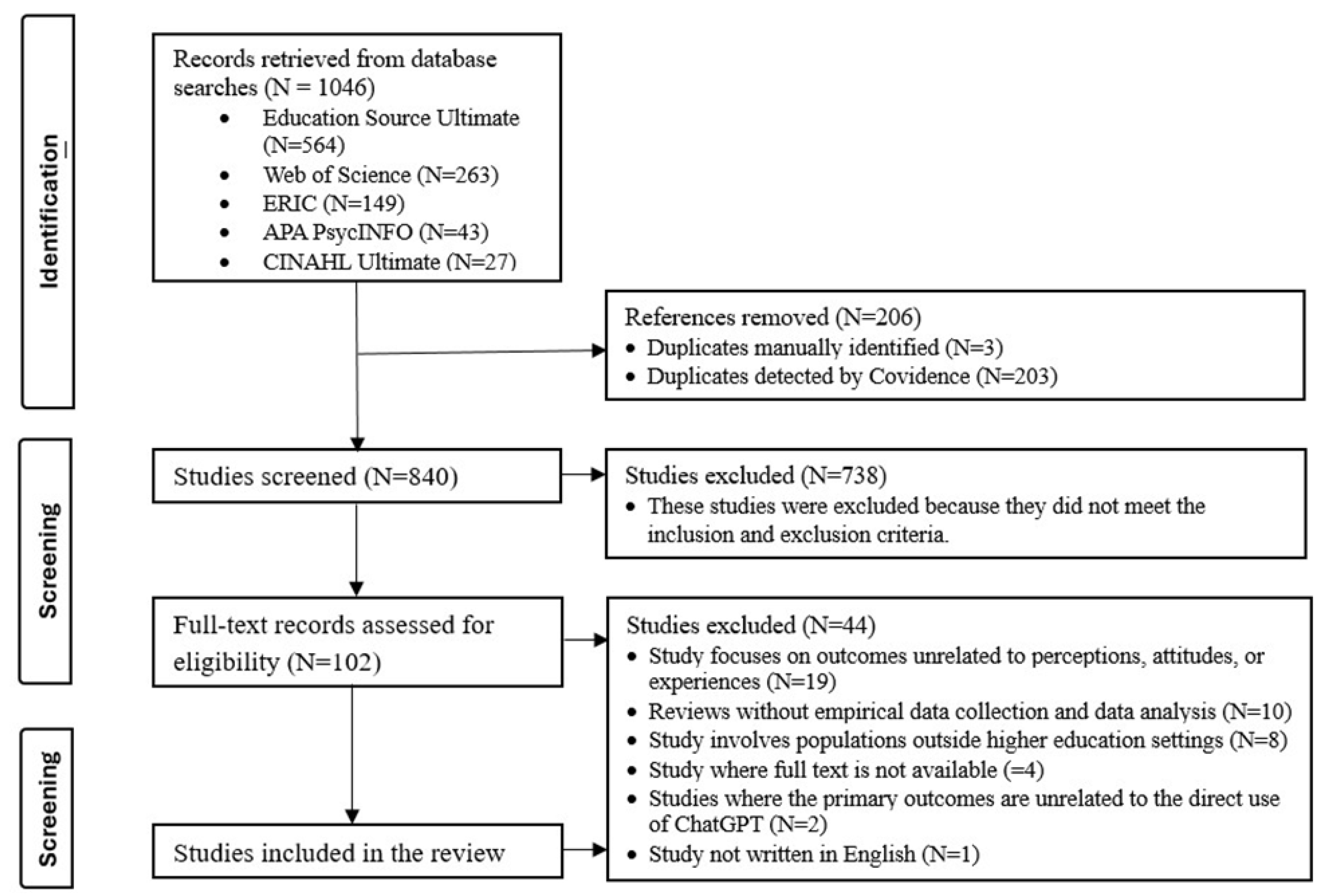
Figure 2.
Countries/locations of the included articles (N = 58).
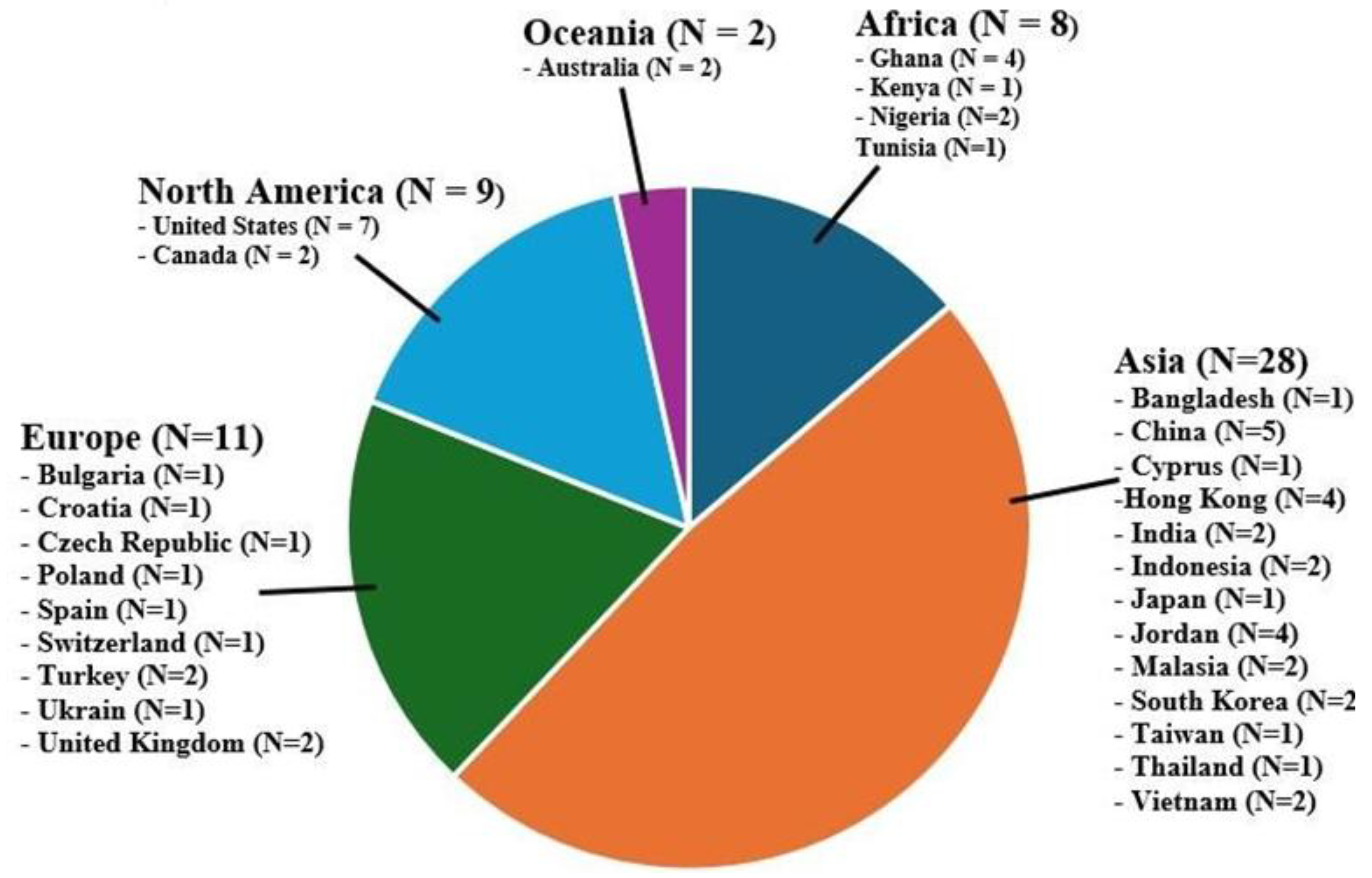

Table 1.
Studies categorized by perceptions of ChatGPT’s accuracy and reliability.
| Perceptions | Studies | Representative Researcher Comments | |
|---|---|---|---|
| Positive | Denecke et al. (2023) | "Students and lecturers already use ABTs for tasks within teaching and learning and in exams. The currently most popular tasks supported by ABTs are related to scientific writing, translating texts, and programming." Denecke et al. (2023) [p. 681]. | |
| Ding et al. (2023) | “And those students are also found to be perceiving ChatGPT as easy to use and more likely to use it in the future.” Ding et al. (2023) [p. 10] | ||
| Adetayo (2023) | "This reflects the practical application of ChatGPT in students’ lives and its potential as a useful tool for work-related purposes." Adetayo (2023) [p. 139] | ||
|
Romero-Rodriguez et al., (2023) |
“The acceptance of ChatGPT by university students is due to their perception of the potential use of this technology in the learning process.” Romero-Rodriguez et al., (2023) [p. 335] | ||
| Qu and Wu (2024) | “Notably, the findings endorse H1 and H2, illustrating that users’ perception of ChatGPT’s ease of use significantly boosts its perceived usefulness.” Qu and Wu (2024) [p. 15] | ||
| Michael et al. (2024) | “I believe ChatGPT is a useful tool for explaining concepts that aren’t understood well or that a student is struggling to understand" Michael et al. (2024) [p. 1149] | ||
| Adams (2023) | “The findings also showed students’ positive perception of ChatGPT’s usefulness in facilitating task and assignment completions and its resourcefulness in locating learning materials.” Adams (2023) [p. 14] | ||
| Ngo et al. (2024) | "The results provided strong support for several hypotheses, revealing significant positive effects of expectation confirmation on perceived usefulness and satisfaction, as well as perceived usefulness on user satisfaction and continuous usage of ChatGPT." Ngo et al. (2024) [p. 1367]. | ||
| Hu et al. (2023) | "Trainees and professionals were generally positive and excited about using ChatGPT as a training tool. Most of them were excited about the potential of ChatGPT to enhance knowledge transfer.” Hu et al., (2023) [p. 5]. | ||
| Tangadulrat et al. (2023) |
"Medical students generally had a positive perception of using ChatGPT for guiding treatment and medical education. Both medical students and graduated doctors positively perceived using ChatGPT for creating patient educational materials." Tangadulrat et al. (2023) [p. 5] |
||
| Delcker et al. (2024) |
"AI-based tools like ChatGPT is a significant predictor of student learning in higher education. It explained 15.41% of the variation in the estimation of AI as a cooperation possibility for humans" Delcker et al. (2024) [p. 7] |
||
| Negative | Ngo (2023) | "The most concerning issues for students while using ChatGPT were the inability to assess the quality and reliability of sources, inability to cite sources accurately, and inability to replace words and use idioms accurately." Ngo (2023) [p. 4]. | |
| Barrett and Pack (2023) | “Interestingly, both students and teachers predominantly viewed the use of GenAI for writing essays, even when the student is a competent writer, as inappropriate.” Barrett and Pack (2023) [p. 11] |
||
| Yusuf et al. (2024) | “A majority of respondents concurred that GenAI systems are susceptible to producing factually inaccurate outputs.” Yusuf et al. (2024) [p. 19]. | ||
| Chan and Zhou (2023) | “Compared with knowledge, the connection between the student-perceived cost of using generating AI and students’ intention to use GenAI was stronger, though in a negative way.” Chan and Zhou (2023) [p. 16] | ||
| Das and Madhusudan (2024) |
“It is revealed that a significant proportion of students (73.4%), either strongly agree or agree that using ChatGPT raises uncertainty about the reliability of information provided.” Das and Madhusudan (2024) [p. 96]. | ||
| Mixed | Cummings et al. (2024) | “Student reflections reveal a spectrum of reactions to using Fermat’s AI-powered writing assistant. While many students found it helpful for brainstorming and structuring their essays, others faced challenges with Fermat’s spatial canvas interface and confusion over its AI capabilities." Cummings et al. (2024) [p. 7] |
|
| Bazelais et al. (2024) |
“Although the use of ChatGPT has exploded, it is important to explore the drivers of adoption to mitigate bad outcomes and support best practices in educational environments. Given the novelty and potentially disruptive nature of ChatGPT, it is crucial to understand how advances in AIchatbots are likely to change education.” Bazelais et al. (2024) [p. 2] | ||
| CrcekN and PatekarJ (2023) |
"Students were concerned about the tool not being able to answer certain prompts and about receiving incomplete or incorrect information. Nonetheless, the authors concluded that incorporating ChatGPT in programming courses is the right approach due to the predominantly positive influence." CrcekN and PatekarJ (2023) [p. 131] | ||
| Kamoun et al. (2024) |
“For the faculty survey, four items (P1, P4, P6, P8) conveyed a negative perception of ChatGPT, while six (P2-P3, P5, P7, P9-P10) conveyed a positive perception.” Kamoun et al. (2024) [p. 8] | ||
| Kavadella at al. (2024) |
"While comparing the output with a reference text, students reported that the answers supplied by ChatGPT were not detailed; sometimes included false data; and were brief, general, or superficial; nevertheless, the key points were evident" Kavadella at al. (2024) [p. 6]. | ||
Table 2.
Studies categorized by ethical implications of ChatGPT.
| Privacy Concerns | Fiialka et al. (2023) | "Consequently, over-reliance on ChatGPT may become an issue, and the use of the application in education requires respect for privacy, fairness, non-discrimination, and transparency." Fiialka et al. (2023) [p. 237] | ||
| Chan and Hu (2023) | "The use of GenAI also raised privacy and ethical concerns which was mostly mentioned by students who majored in arts and social science. They were worried that AI would collect personal information from our messages." Chan and Hu (2023) [p. 11]. | |||
| Ofosu-Ampong (2024) | "Regarding privacy and ethics, 83% of lecturers (professors) reported it to be a concern for their students." Ofosu-Ampong (2024) [p. 5]. | |||
| Ajlouni et al. (2023) | "80.5% of undergraduates agreed that they would not discuss their personal and psychological matters with ChatGPT regarding their concerns about privacy and confidentiality issues." Ajlouni et al. (2023) [p. 212] | |||
| Choudhury and Shamszare (2023) | “Policy makers should mandate adherence to ethical and legal guidelines related to privacy, data security, and bias.” Choudhury and Shamszare (2023) [p. 7] | |||
| Biases and Fairness | Fiialka et al. (2023) | “It is crucial to be mindful of the social implications of relying on AI in education, such as addressing issues of accessibility, equity, and human biases.” Fiialka et al. (2023) [p. 247] | ||
| Choudhury and Shamszare (2023) | “There is a possibility of the technology exacerbating preexisting societal biases, as the model’s training data may have inadvertently reflected these biases and cause ChatGPT to produce biased responses.” Choudhury and Shamszare (2023) [p. 2] | |||
| Chan (2023) | “Universities should be transparent about the use of generative AI in teaching and learning, which includes disclosing information about the algorithms and their functions, as well as any potential biases or limitations of the AI tools.” Chan (2023) [p. 14] | |||
| Academic Integrity | Fiialka et al. (2023) | “Among the negative ones are the generation of non-existent publications, invented biographical facts, students’ violations of academic integrity, students’ performance of tasks without understanding them, and mistakes in mathematical tasks.” Fiialka et al. (2023) [p. 244] | ||
| Ajlouni et al. (2023) |
“There have been challenges about the limitations of GenAI and issues related to ethics, plagiarism, and academic integrity.” Ajlouni et al. (2023) [p. 2] | |||
| Ngo (2023) | “The capability to provide precise responses to user inquiries gives rise to apprehensions about the possibility of AI-enabled academic dishonesty, as it can be exploited for completing assignments and exams on behalf of students.” Ngo (2023) [p. 5] | |||
| Das and Madhusudan (2024) |
“When using ChatGPT in language learning, privacy, bias, reliability, accessibility, authenticity, and negative impact on academic integrity are significant ethical implications to consider while integrating ChatGPT into the language classroom.” Das and Madhusudan (2024) [p. 90] | |||
| Chan (2023) | “Both teachers and students have also suggested the use of assessments that minimize opportunities for AI misuse, such as oral examinations or controlled settings where internet access is limited, to help maintain academic integrity.” Chan (2023) [p. 13] | |||
| CrcekN and PatekarJ (2023) |
“Guidelines on ChatGPT use are needed and that academic integrity should be promoted among students to “ensure ethical uses of ChatGPT in academic context.” CrcekN and PatekarJ (2023) [p. 131] |
|||
Table 3.
The future role of ChatGPT in enhancing traditional teaching methods.
| Theme | Studies | Representative Quotes |
| Teaching and Learning | Li (2023) | "ChatGPT may create a ubiquitous learning environment that allows learners to interact with it in out-of-class and in-class activities." Li (2023) [p. 42] |
| Al-Khatib (2023) | “In the long run, LLM-based chatbots would revolutionize research and education. If adopted successfully, they could be used as online instructors, curriculum developers, markers, and contributors to scholarly publications." Al-Khatib (2023) [p. 1] | |
| Kelly et al. (2023) | “Some academic responses to GenAI have been largely positive, noting these tools’ capability to enhance student learning and accessibility.” Kelly et al. (2023) [p. 13] | |
| Gao et al. (2024) | “The respondents believed ChatGPT and other LLMs can serve as a powerful instructional tool (M = 4.55, SD = 0.965).” Gao et al. (2024) [p. 39] |
|
| Content Creation | Al-Khatib (2023) | “For the educator, generative AI presents opportunities to streamline and optimize instructional material development. Generative AI can generate such materials, allowing educators to allocate more time to direct interactions with students.” Al-Khatib (2023) [p. 2] |
| Johnson et al. (2024) | “Chat GPT can act as a “virtual teaching assistant” in helping students to understand concepts and ideas.” Johnson et al. (2024) [p. 3] | |
| Liu et al. (2024) | “Participants frequently utilized AI to collect and integrate online English learning materials and resources.” Liu et al. (2024) [p. 11] | |
| Adetayo (2023) | “ChatGPT uses deep learning techniques to generate human-like responses to text inputs in a conversational manner.” Adetayo (2023) [p. 134]. | |
| Saxena and Doleck (2023) |
“Educators could use ChatGPT to create learning evaluation items while saving time and effort and potentially enhancing the content of the questions.” Saxena and Doleck (2023) [p. 2] | |
| Mosleh et al. (2023) | "Less than half the participants used AI programs in their university study: for drug information (44.5%), homework (38.9%), and writing research articles (39.3%)." Mosleh et al. (2023) [p. 1392] |
|
| Personalized Learning | Urban et al. (2024) | "ChatGPT can make the task seem more manageable, strengthening participants’ belief in their ability to successfully complete the task and generate high-quality solutions." Urban et al. (2024) [p. 4] |
| Liu and Ma (2023) | “ChatGPT allows language learners to enact new meaning-making practices and benefit from enhanced personalized learning with creativity and productivity.” Liu and Ma (2023) [p. 126] | |
| Algaraady and Mahyoob (2023) |
“With ChatGPT, users can quickly identify grammatical errors, spelling mistakes, and other common writing issues. The platform also offers suggestions for improving sentence structure, word choice, and clarity.” Algaraady and Mahyoob (2023) [p. 4] | |
| Jepkemoi et al. (2024) | “Employing ChatGPT in higher education has been attributed to numerous benefits. These benefits include creating innovative assessments, providing automated administrative services, supporting data analysis and research, offering personalized feedback, and facilitating adaptive learning.” Jepkemoi et al. (2024) [p. 26] | |
| Damiano et al. (2024) | “Students recognized the potential for personalized learning support, writing, brainstorming assistance, and research and analysis capabilities.” Damiano et al. (2024) [p. 369] | |
| Creative Capabilities | Liu and Ma (2023) | "ChatGPT can act as a powerful and authentic language-learning tool for EFL learners." Liu and Ma (2023) [p. 134] |
| Karaman and Goksu (2024) | “ChatGPT-4.0 is a chatbot with empathy, creative writing skills, and superior dialogue features, as well as the ability to provide its users with the ability to gain knowledge in different fields, improve their language skills, and provide instant feedback.” Karaman and Goksu (2024) [p. 109] |
|
| Park (2023) | “The strongest advantages were “providing answers to questions” and “summarizing information.” Park (2023) [p. 1] | |
| Lelepary (2022) | “Chat GPT can present interactive and engaging learning content, such as quizzes or text-based activities.” Lelepary (2022) [p. 13] | |
| Grajeda et al. (2023) | “The A.I. tools used in this subject encouraged my creativity and innovation.” Grajeda et al. (2023) [p. 10] |
|
| Collaboration and Interaction | Hamid et al. (2023) | “The use of ChatGPT helped the collaboration with your group members during the PBL process.” Hamid et al. (2023) [p. 1020] |
Crawford et al. Students with stronger perceptions of AI social support felt less socially supported by AI. This (2024) finding suggests that individuals who have fewer friends may seek out more opportunities to feel more connected and supported by AI.” Crawford et al. (2024) [p. 9] Adams et al. “ChatGPT can also enhance students’ educational experience by simulating conversations and (2023) providing immediate support and feedback to students.” Adams et al. (2023) [p. 2] Romero- “The use of ChatGPT facilitates dialogue and interaction between the user and the AI.” Romero-Rodriguez et al. Rodriguez et al. (2023) [p. 324] (2023) Kiryakova and “ChatGPT can function as an intelligent assistant in the learning process and provide learners Angelova with interactive help at any time and from any place.” Kiryakova and Angelova (2023) [p. 3] (2023).
Disclaimer/Publisher’s Note: The statements, opinions and data contained in all publications are solely those of the individual author(s) and contributor(s) and not of MDPI and/or the editor(s). MDPI and/or the editor(s) disclaim responsibility for any injury to people or property resulting from any ideas, methods, instructions or products referred to in the content. |
© 2025 by the authors. Licensee MDPI, Basel, Switzerland. This article is an open access article distributed under the terms and conditions of the Creative Commons Attribution (CC BY) license (http://creativecommons.org/licenses/by/4.0/).
Copyright: This open access article is published under a Creative Commons CC BY 4.0 license, which permit the free download, distribution, and reuse, provided that the author and preprint are cited in any reuse.