

Submitted:
04 July 2025
Posted:
07 July 2025
You are already at the latest version
Abstract
Traditionally, the fields of arithmetic and creative writing have been regarded as intellectual opposites: the former praised for its unmistakable artistic and emotional intuition, the latter for its strict logic and objective truth. This work challenges this long-standing split by contending that several mathematical concepts—including algorithms, patterns, combinatorics, and fractal geometry—are not only inherently included inside great literary works but also can be intentionally used as effective teaching aids. Through a mathematical perspective, re-framing narrative form, character development, and poetic style helps educators to offer students a concrete, analytical framework to complement their creative impulses rather than replace them. First examining the theoretical synthesis of these various domains, the current exposition next suggests actual mathematical approaches for the creative writing classroom. Later, it discusses the major open difficulties this method causes, including the possibility of formulaic writing and pedagogic opposition. Finally, it highlights the bright prospects for a new generation of writers, who, armed with a type of "computational literacy," may be better suited to create intricate, resonant, and imaginative narrative worlds. By combining mathematical concepts with computational thinking, the algorithmic muse offers a next-level pedagogy for professional creative writing. By using algorithms and patterns, this method redefines creativity as a process that may be organized and investigated rather than as an elusive gift. Writers may use the underlying mathematical structures of narrative, plot, and character development as a creative scaffold by grasping them. Rather than substituting creative intuition, this "algorithmic muse improves it by providing fresh techniques for producing ideas, conquering writer's block, and building sophisticated stories. It helps experts innovate by combining logical structures with their creative intuition.
Keywords:
creative writing
; pedagogy
; mathematics
; computational creativity
; narrative structure
; digital humanities
; interdisciplinary studies
; algorithm
; fractal
1. Introduction
Deconstructing the Art/Science Dichotomy
The romantic idea that a creative writer is little more than a channel for some sudden, unearthly inspiration has been entrenched into the Western literary tradition for several centuries (Wimsatt and Brooks, 2022). This view considers creativity as something spontaneous, mystical almost, and therefore diametrically opposed to the logical, rule-bound world of mathematics. Writing workshops under modern creative writing pedagogy generally prioritise subjective responses to voice, tone, and emotional effect over technical structure instruction (McGurl, 2011). This paper contends that this perceived chasm between art and logic is a false one. Structure is not the cage of creativity but its skeleton. From the rigid metrical constraints of a Shakespearean sonnet to the archetypal plot points of the hero’s journey, literature is replete with underlying patterns, symmetries, and algorithms (Stiemsma, 2024). The Russian Formalists were among the first to systematically analyze these mechanics, treating literature as a system of devices and structures rather than purely a medium for personal expression (de Vos, 2024). More recently, the rise of digital humanities and computational creativity has provided new language and tools to explore this intersection (Di Rosario, 2021; O’Sullivan et al., 2025).
The central theme of this paper is that by making these “hidden mathematics” visible and teachable, we can revolutionize creative writing pedagogy. This approach does not seek to reduce literature to a mere equation but rather to empower writers with a new set of analytical and generative tools. It aims to foster a “next-generation thinking” where writers are not just storytellers but also story architects, capable of manipulating complex systems of plot, character, and theme with intention and precision. This paper will explore the frameworks for this pedagogy, confront its inherent challenges, and map its prospects in an increasingly computational world.
2. Mathematical Frameworks for Literary Creation
Some main mathematical ideas are chosen and matched with the elements of literary creation to forge linkage between mathematical concepts and creative writing. This provides a new vocabulary that serves in the deconstruction of a text and the scaffolding for producing new ones.
2.1. Narrative as Algorithm
The cornerstone of a plot is, for instance, an algorithm: a finite sequence of instructions precisely laid down, which can be programmed onto a computer, if it so be. Perhaps the most famous literary algorithm is Campbell’s (2008), or the “Hero’s Journey,” which is a pattern comprising seventeen stages that lie at the core of innumerable myths and screenplays. More modern writing manuals such as Blake Snyder’s Save the Cat! (2005) took this even further, providing an almost frame-by-frame blueprint, setting out precise moments for inciting incidents to occur, the midpoint, and the final act. Often, critics frown upon such systems for encouraging unoriginal writing-with this very challenge taken up later-thereby these structures serve as an educational aid, not as rigid rules, but as proven algorithms for plotting tension and emotional catharsis (Jackson, 2022).
Tutoring students that the plot is an algorithm demystifies the process. They learn to flow chart their stories by identifying in “” agency decision points for their characters and tracking their logical cause-and-effect progression. This computational way of looking at matters allows them to notice, with analytical clarity, that their plot has a sagging second act or an unearned climax (Batty and Taylor, 2021).The work of Propp (1968), who identified 31 sequential “functions” common to Russian folktales, provides a foundational academic model for this algorithmic view of narrative.
2.2. Poetics, Patterns, and Symmetries
Poetry is perhaps the most overtly mathematical literary form. Prosody has to do with patterns of stress and unstressed syllables, metrical feet, and rhyme schemes (Haskell, 2021). A sonnet is a very precise 14-line structure that is defined by its rhyme scheme (for instance, ABAB CDCD EFEF GG) and meter (usually iambic pentameter).A villanelle is a recursive algorithm, with its first and third lines repeating in a specific sequence throughout the poem (Lane, 2019).
Using these forms mathematically, students begin to appreciate their intricacies and the creative tension that emerges while imposing emotional content into a confining container (Pinsky, 1998). Symmetry and asymmetry hold great meaning for the narrative structure as well. A classic tragic arc is a symmetrical inversion of a heroic one (rise then fall, vs. fall then rise). Character foils are created through asymmetry, highlighting a protagonist’s qualities by contrasting them with another character’s opposite traits (Destrée et al., 2020). By teaching students to recognize and deploy these patterns, educators give them control over the aesthetic and emotional rhythm of their work (Tipper and Gilman, 2024).
2.3. Combinatorics and Generative Brainstorming
Combinatorics, the branch of mathematics dealing with combinations and permutations, is a powerful engine for creativity. Renowned for its inventive use of combinatorial constraints to produce fresh literary works, the French movement Oulipo (short for Ouvroir de littérature potentielle) uses ten sonnets with changeable lines to create an amazing possible poems (Hutchison, 2020). Combinatorial thought is a great approach in the classroom to help one to get beyond writer’s block.
Teachers can give lists of character types, locations, genres, and main conflicts to inspire kids to come up with fresh narrative ideas. For instance: “A hard-boiled detective” + “in a zero-gravity space station” + “must solve a murder where the only witness is an AI” should be used. According to computational creativity experts, this strategy encourages authors to stray from their typical cognitive processes and explore fascinating new narrative possibilities (Sawyer and Henriksen, 2024; Cropley et al., 2023). By methodically examining the “space of the possible,” it uncovers linkages that might be overlooked by intuition alone (Montfort, 2021).
2.4. Fractals, Self-Similarity, and Thematic Cohesion
How would you describe a “fractal” in simple terms? The component’s smaller parts are roughly akin to the larger one on comparatively small scale (Mageed and Bhat, 2022; Mageed, 2023; Mageed, 2024 a-m, Mageed and Li, 2025; Mageed, 2025 a-c), and it is shaped like spheres with self-similarity.
This theory is a brilliant example of how themes and forms may interact in a long-form story. Consider this: the battle of one chapter, scene, or perhaps even the structure of a sentence can mirror the main conflict of a book—the big picture.
As in Jennifer Egan’s A Visit from the Goon Squad, a non-linear, fragmented plot structure may reflect a story that penetrates social fracture. This fractal pattern recurs in dialogue where people are continuously interrupting one another and in circumstances that seem abrupt (Eggers, 2023). Students who are taught to think fractally are more likely to create profoundly meaningful stories in which form, and content are inseparable (Bandia et al.,2024).
It moves beyond asking “What is your theme?” to “How is your theme mathematically represented at every level of the story’s structure?” (Mohseni et al., 2020; Mageed and Nazir, 2024).
2.5. Graph Theory and Narrative Networks
Complex narratives can be thought of as intricate networks. In this structure, characters act as nodes, while their different relationships—be they familial, romantic, or antagonistic—serve as the edges linking them. Plot points also operate as nodes, linked together by lines of causality. Graph theory offers a unique visual and analytical tool to map out these systems (Saoub, 2021). Students can even design their stories as graphs, which helps them manage big groups of people, keep track of convoluted story lines, and maintain consistency in world-building (King, 2022). For a more descriptive of what graph theory can be linked to complex narratives.
Let’s think on the next things. Every one of the five teams in the Roanoke Soccer League’s end-of-season competition plays every other team once with no ties—a round-robin format. Graphs help us to study and see the structure of the competition; each team is shown as a vertex (a dot), and an edge (a line) connects two vertices if those teams have played against one another. Particularly as the competition advances, graphs G1 and G2 show how the games are scheduled and played among the teams; this graphical representation aids in better grasp of the connections and results of the tournaments as illustrated in Figure 1 (Saoub, 2021). Every vertex in these graphs stands for a team, and the edges denote the games that have taken place between them. Graph G3 shows the complete tournament, in which every team has faced every other, hence offering a thorough overview of the results of the event.
The text explains how graph models can help a tournament director determine the number of games needed and the outcomes of those games. By counting the edges in graph G3, we find that 10 games are required. To represent the results of the games, we can add arrows to the edges, creating a directed graph (digraph) that shows which teams won against others, as in Figure 2 (Saoub, 2021), such as the Aardvarks winning all their matches, while other teams have varying records.
This technique operates particularly well for genres like science fiction and fantasy, where extensive systems of magic or technology, family trees, and complicated political alignments are frequently included (Paulding, 2022). Authors can identify characters that may be feeling a little alone and require more integration into the story by imagining the story as a network. They can also see how a single incident affects the entire novel (Pósfai and Barabási, 2016). The author is transformed from a storyteller to a world architect by this “systems thinking” (Schmidt, 2021).
3. Open Challenges and Pedagogical Considerations
Integrating mathematics into the creative writing classroom holds great promise, but it also comes with its fair share of challenges that need to be tackled for it to truly thrive.
3.1. The Risk of Formulaic Writing
The most significant and valid criticism is that this approach will produce derivative, “paint-by-numbers” stories that slavishly follow a formula (Lee, 2023). If every student is taught the same algorithm (e.g., Save the Cat!), will all their stories become homogenous? This is a genuine risk if the frameworks are taught as prescriptive rules rather than descriptive tools. The pedagogical emphasis must be on understanding the algorithm to innovate upon it. The goal is to teach students the principles of narrative tension so they can invent their own structures, not just copy existing ones (Macdonald, 2023). The key is to present these mathematical structures as a classical education—one must first learn the rules before one can artfully break them (Uchkunovich, 2025).
3.2. Pedagogical and Ideological Resistance
Many creative writing instructors and students are drawn to the field precisely because it feels like a refuge from the quantitative, systematized thinking that dominates other disciplines (Barton and Leonard, 2021). Introducing mathematical language can feel like a colonization of a sacred humanistic space (Fish, 2021).
Overcoming this resistance requires a careful and empathetic pedagogical approach. Instructors must frame these tools as supplementary, not supplanting, and demonstrate their value through an analysis of beloved literary works, showing how authors like Shakespeare or Austen were masterful (if perhaps intuitive) mathematical architects (Underwood, 2019).
3.3. Assessment and Evaluation
In this new paradigm, how is a story graded? Conventional rubrics emphasise emotional resonance, literary style, and character depth (Smith, 2020). Criteria like structural integrity, thematic self-similarity, or creative application of a combinatorial constraint would need to be added by a mathematically-informed pedagogy.
This requires developing new, hybrid rubrics that can value both the architectural ingenuity and the ineffable “soul” of a piece (Culham, 2023). Balancing these quantitative and qualitative assessments without privileging one over the other will be a significant challenge for educators (Bazerman and Russell, 2020).
3.4. The Role of Digital Tools and the Digital Divide
With the advent of AI writing aids like GPT-4 and Sudowrite, this change in teaching approaches is truly taking off. Just like powerful creative engines, these devices can quickly generate new story concepts, evaluate data for pace, or suggest complex themes. This creates unique chances but also creates some problems, especially in access, digital literacy, and upholding academic integrity. Rather than letting these technologies replace the own critical thinking of the students, teachers have to assist them in using them as creative and analytic instruments. The key is to guarantee that these technologies are accessible to everyone on an equal basis.
4. Prospects for Next-Generation Thinking
Navigating these challenges successfully opens exciting prospects for the future of creative writing and its pedagogy
4.1. Fostering Computational and Systems Literacy
Writers develop a type of computational literacy that goes well beyond the written word when they begin to see stories as systems (Wing, 2006). They start to comprehend feedback loops, complex, dynamic interactions, and the appearance of novel features. Applying this systems-thinking approach to storytelling enables them to address the intricate, interrelated narratives that we encounter in the twenty-first century, whether in science, literature, or politics (Payne, 2022).
4.2. Empowering Neurodiverse Learners
For neurodiverse learners, particularly those on the autism spectrum who often thrive in logic, patterns and organized systems, a method of teaching that is based on mathematics can be an excellent starting point (Grandin, For children who find it difficult to interpret subtle social cues or display emotions in conventional means, the clear, rational framework of an algorithmic plot or a balanced character arc offers a safe and approachable way to explore creative expression (Bluhm, 2020). It presents a unique, equally valuable route to creativity.
4.3. Interdisciplinary Innovation
This approach inherently breaks down the institutional silos between the humanities and STEM fields (Gaukroger, 2020). It invites collaboration between creative writing departments, computer science programs, and mathematics departments. Future courses could be co-taught, exploring everything from procedural poetry generation to the use of data visualization in narrative design (Drucker, 2020). This interdisciplinary fusion could lead to entirely new literary forms and new ways of understanding the creative process itself (Berry, 2022).
4.4. A New Relationship with AI
Instead of viewing AI as a threat, a mathematically-literate writer can engage with it as a sophisticated creative partner (Piper, 2023). They can use AI to rapidly prototype combinatorial ideas, to model the network effects of a plot change, or to check for thematic consistency at a fractal level. The writer’s role shifts from pure originator to that of a discerning curator, a creative director guiding a powerful mathematical muse (Ryan, 2024). This human-AI collaboration may be the hallmark of the next generation of literary production.
Artificial Intelligence (AI) (Mageed and Nazir, 2024) has changed how we create art by introducing new methods for artistic expression. This paper examines how AI can transform poetry into visual art, specifically focusing on abstract expressionism, which emphasizes emotional and abstract qualities. By using a tool called Leonardo AI, the research shows that even simple poetic phrases can lead to meaningful and impactful artworks, highlighting the collaboration between human creativity and AI technology.
The Leonardo AI is a tool used in this study to create visual art based on the poetic work titled “Internal Monologues in Poetic Form” by Ismail A Mageed(Mageed and Nazir, 2024). The Mageed and Nazir (2024) explored how this AI can transform simple poetic phrases into unique visual interpretations, showcasing the connection between poetry and abstract art. It also highlights some unresolved questions and suggests future directions for research in this area.
In Figure 3 (Yildirim, 2023) created by Leonardo AI, green spaces, like parks and gardens, are primarily located at ground level, which is a common feature in urban design. The inclusion of bridges in these images suggests a focus on improving transportation and movement within the city. Additionally, the crowded skyline filled with tall buildings highlights the contrast between realistic-looking structures and those that are generated purely by computer algorithms, emphasizing the varying levels of detail and authenticity in the visualizations.
The “visual effect of poetic message” refers to how the arrangement and design of words in a poem can enhance its meaning and emotional impact (Mageed and Nazir, 2024). For example, in the work by Franz Mon, the shape and layout of the text create a visual representation that complements the poem’s themes, making the reading experience more engaging, as depicted in Figure 4 (Bajohr, 2024). This concept is important in visual poetry, where the interplay between text and images allows for a richer understanding of the artistic message being conveyed.
Leonardo AI effectively creates abstract expressionist images that capture the deeper meanings behind poetic themes of “Internal Monologues in Poetic Form” by Ismail A Mageed(Mageed and Nazir, 2024). The generated visuals use symbolism, such as hearts and water, to explore complex ideas like love, life, and change(Mageed and Nazir, 2024). For instance, a heart in water symbolizes both fragility and strength, while waterfalls represent the ongoing nature of life, reflecting the poem’s thoughtful and introspective tone(Mageed and Nazir, 2024), as portrayed by Figure 5, Figure 6 and Figure 7 (Mageed and Nazir, 2024).
5. Conclusion
The proposal to integrate mathematical thinking into creative writing pedagogy is not an attempt to mechanize art or to find a single equation for the perfect novel. It is a call to recognize and harness the powerful, elegant structures that have always underpinned our most enduring stories. By teaching the algorithms of plot, the symmetries of character, the combinatorics of invention, and the fractals of theme, we are not caging the muse; we are giving her a new language and a more robust architectural toolkit.
The challenges—of resisting formula, of overcoming ideological inertia, and of assessing a new kind of craft—are substantial. But the prospects are more compelling. This synthesis promises to create a new generation of writers who are both passionate artists and deliberate designers, capable of building narrative worlds of greater complexity, resonance, and innovation. They will be writers who understand that the shortest path between two emotional points is not always a straight line, but is often a beautifully constructed, mathematically sound, and profoundly human curve. By embracing the algorithmic muse, we can teach writers not just to tell stories, but to understand the very nature of story itself.
References
- Bandia, P. F.; Hadley, J.; McElduff, S. (Eds.) Translation Classics in Context; Routledge, 2024. [Google Scholar]
- Bajohr, H. Operative ekphrasis: the collapse of the text/image distinction in multimodal AI. Word & image 2024, 40(2), 77–90. [Google Scholar] [CrossRef]
- Barton, A. W.; Leonard, S. J. Incorporating social justice in tourism planning: Racial reconciliation and sustainable community development in the Deep South. In 50 Years of Community Development Vol II; Routledge, 2021; pp. 121–145. [Google Scholar]
- Batty, C.; Taylor, S. (Eds.) Script development: Critical approaches, creative practices, international perspectives; Springer Nature, 2021. [Google Scholar]
- Bazerman, C.; Russell, D. (Eds.) Landmark Essays on Writing Across the Curriculum. Routledge, 2020; Volume 6. [Google Scholar]
- Berry, D. AI, ethics, and digital humanities. University of Sussex. Chapter. 2022. Available online: https://hdl.handle.net/10779/uos.23309129.v1.
- Bluhm, R. Neurosexism and our understanding of sex differences in the brain. In The Routledge handbook of feminist philosophy of science; Routledge, 2020; pp. 316–327. [Google Scholar]
- Campbell, J. The hero with a thousand faces; New World Library, 2008; Vol. 17. [Google Scholar]
- Cropley, D. H.; Medeiros, K. E.; Damadzic, A. The intersection of human and artificial creativity. In Creative provocations: Speculations on the future of creativity, technology & learning; Springer International Publishing; Cham, 2023; pp. 19–34. [Google Scholar]
- Warshauer, M. Technology and social inclusion: Rethinking the digital divide; MIT Press, 2003. [Google Scholar]
- Culham, R. Writing thief: Using mentor texts to teach the craft of writing; Routledge, 2023. [Google Scholar]
- de Vos, R. Making the Strange Familiar: Getting Intimate with Toxicity. In E (n) stranged: Rethinking Defamiliarization in Literature and Visual Culture; Springer International Publishing; Cham, 2024; pp. 73–92. [Google Scholar]
- Destrée, P.; Heath, M.; Munteanu, D. L. (Eds.) The poetics in its aristotelian context; London: Routledge, 2020. [Google Scholar]
- Di Rosario, G.; Meza, N.; Grimaldi, K.; O’Sullivan, J. The origins of electronic literature: An overview. Electronic Literature as Digital Humanities: Contexts, Forms, & Practices 2021, 9–26. [Google Scholar]
- Drucker, J. Visualization and interpretation: Humanistic approaches to display; MIT Press, 2020. [Google Scholar]
- Eggers, F. Networking in Jennifer Egan’s A Visit from the Goon Squad, 2023.
- Fish, S. Is there a text in this class? In Campus wars; Routledge, 2021; pp. 49–56. [Google Scholar]
- Gaukroger, S. Civilization and the Culture of Science: Science and the Shaping of Modernity; Oxford University Press, 2020. [Google Scholar]
- Haskell, D. Form and Formlessness in English Language Poetry. Journal of Language and Communication 2021, 8(2), 166–179. [Google Scholar]
- Hutchison, A. Cultivating the Classical Style: The Stanford-Denver Creative Writing Axis. MFS Modern Fiction Studies 2020, 66(3), 474–498. [Google Scholar] [CrossRef]
- Interconnections: journal of posthumanism 2(1), 63–77.
- Jackson, B. The Story Is True, Revised and Expanded: The Art and Meaning of Telling Stories; State University of New York Press, 2022. [Google Scholar]
- King, S. The Eyes of the Dragon: A Novel; Simon and Schuster, 2022. [Google Scholar]
- Lane, G. The shape of the psyche: vision and technique in the late poems of Sylvia Plath. In Sylvia Plath: New Views on the Poetry; Johns Hopkins University Press, 2019; pp. 57–73. [Google Scholar]
- Lee, J. Culture, Madness and Wellbeing; London: Springer, 2023. [Google Scholar]
- Macdonald, I. W. How to Think About Screenwriting. In The Palgrave Handbook of Screenwriting Studies; Springer International Publishing; Cham, 2023; pp. 21–43. [Google Scholar]
- Mageed, I. A.; Bhat, A. H. Generalized Z-Entropy (Gze) and fractal dimensions. Appl. math 2022, 16(5), 829–834. [Google Scholar]
- Mageed, I. A. Fractal Dimension (Df) of Ismail’s Fourth Entropy (with Fractal Applications to Algorithms, Haptics, and Transportation. In 2023 international conference on computer and applications (ICCA); IEEE, 2023; pp. 1–6. [Google Scholar]
- Mageed, I. A. The Fractal Dimension Theory of Ismail’s Third Entropy with Fractal Applications to CubeSat Technologies and Education. Complexity Analysis and Applications 2024a, 1(1), 66–78. [Google Scholar]
- Mageed, I. A. Fractal Dimension of the Generalized Z-Entropy of The Rényian Formalism of Stable Queue with Some Potential Applications of Fractal Dimension to Big Data Analytics, 2024b.
- Mageed, I. A. Fractal Dimension (Df) Theory of Ismail’s Entropy (IE) with Potential Df Applications to Structural Engineering. Journal of Intelligent Communication 2024c, 3(2), 111–123. [Google Scholar] [CrossRef]
- Mageed, I. A. The Generalized Z-Entropy’s Fractal Dimension within the Context of the Rényian Formalism Applied to a Stable M/G/1 Queue and the Fractal Dimension’s Significance to Revolutionize Big Data Analytics. J Sen Net Data Comm 2024d, 4(2), 01–11. [Google Scholar]
- Mageed, I. A. Do You Speak The Mighty Triad?(Poetry, Mathematics and Music) Innovative Teaching of Mathematics. MDPI preprints 2024e. [Google Scholar]
- Mageed, I. A.; Mohamed, M. Chromatin can speak Fractals: A review, 2023.
- Mageed, I.A. Do You Speak The Mighty Triad?(Poetry, Mathematics and Music) Innovative Teaching of Mathematics. MDPI Preprints 2024f. [Google Scholar]
- Mageed, I.A. The Mathematization of Puzzles or Puzzling Mathematics Innovative Teaching of Mathematics. Preprints 2024g. [Google Scholar] [CrossRef]
- 37. Mageed, I.A. Let’s All Dance and Play Mathematics Innovative Teaching of Mathematics. Preprints 2024h. [Google Scholar] [CrossRef]
- Mageed, I.A. AI-Generated Abstract Expressionism Inspiring Creativity Through Ismail A Mageed’s Internal Monologues in Poetic Form. Preprints 2024i. [Google Scholar] [CrossRef]
- 39. Mageed, I.A. Let’s All Dance and Play Mathematics Innovative Teaching of Mathematics. Preprints 2024j. [Google Scholar] [CrossRef]
- Mageed, I.A. AI-Generated Abstract Expressionism Inspiring Creativity Through Ismail A Mageed’s Internal Monologues in Poetic Form. Preprints 2024k. [Google Scholar] [CrossRef]
- Mageed, I. A. Fractal Dimension (Df) Theory of Ismail’s entropy (IE) with Potential Df applications to Smart Cities. J Sen Net Data Comm 2024l, 4(2), 01–10. [Google Scholar]
- Mageed, I. A. Entropic Advancement To Education. Int J Med Net 2024m, 2(6), 01–10. [Google Scholar]
- Mageed, I. A.; Nazir, A. R. AI-Generated Abstract Expressionism Inspiring Creativity through Ismail A Mageed’s Internal Monologues in Poetic Form. Annals of Process Engineering and Management 2024, 1(1), 33–85. [Google Scholar]
- Mageed, I. A. The Hidden Poetry & Music of Mathematics for Teaching Professionals: Inspiring Students through the Art of Mathematics: A Guide for Educators; Eliva Press, 2025a; Available online: https://www.elivabooks.com/en/book/book-1450104825.
- Mageed, I.A. The Hidden Dancing & Physical Education of Mathematics for Teaching Professionals; Eliva Press, 2025b; Available online: https://www.elivabooks.com/en/book/book-7724827898.
- 46. Mageed, I. A. Fractals Across the Cosmos: From Microscopic Life to Galactic Structures. In MDPI Preprints; CrossRef, 2025c. [Google Scholar]
- Mageed, I. A.; Li, H. The Golden Ticket: Searching the Impossible Fractal Geometrical Parallels to solve the Millennium, P vs. NP Open Problem. In MDPI Preprints; CrossRef, 2025. [Google Scholar]
- McGurl, M. The program era: Postwar fiction and the rise of creative writing; Harvard University Press, 2011. [Google Scholar]
- Mohseni, M.; Gast, V.; Redies, C. Comparative computational analysis of global structure in canonical, non-canonical and non-literary texts. arXiv 2020, arXiv:2008.10906. [Google Scholar]
- Montfort, N. Exploratory programming for the arts and humanities; MIT Press, 2021. [Google Scholar]
- O’Sullivan, J.; Pidd, M.; Whittle, S.; Wessels, B.; Kurzmeier, M.; Murphy, Ó. Digital editing and publishing in the twenty-first century; 2025. [Google Scholar]
- Paulding, J. K. The Bulls and the Jonathans; BoD–Books on Demand, 2022. [Google Scholar]
- Payne, C. A. Fundamentals of systems thinking. Vet. Clin. N. Am. Food Anim. Pract 2022, 38, 165–178. [Google Scholar] [CrossRef] [PubMed]
- Pinsky, R. The sounds of poetry: A brief guide; Macmillan, 1999. [Google Scholar]
- Piper, A. Computational narrative understanding: A big picture analysis. In Proceedings of the Big Picture Workshop; December 2023; pp. 28–39. [Google Scholar]
- Propp, V. Morphology of the Folktale; University of Texas press, 1968. [Google Scholar]
- Pósfai, M.; Barabási, A. L. Network science; Cambridge University Press: Cambridge, UK, 2016; Vol. 3. [Google Scholar]
- Ryan, M. L. Beyond Ludus: narrative, videogames and the split condition of digital textuality. In Videogame, player, text; Manchester University Press, 2024; pp. 8–28. [Google Scholar]
- Saoub, K. R. Graph Theory: an introduction to proofs, algorithms, and applications; Chapman and Hall/CRC, 2021. [Google Scholar]
- Stiemsma, S. Booth, Michael. Spakespeare and Conceptual Blending: Cognition, Creativity, Criticism. Impact: The Journal of the Center for Interdisciplinary Teaching & Learning 2024, 8(1). [Google Scholar]
- Sawyer, R. K.; Henriksen, D. Explaining creativity: The science of human innovation; Oxford university press, 2024. [Google Scholar]
- Schmidt, G. D. Just Like that; Clarion Books, 2021. [Google Scholar]
- Smith, H. The writing experiment: strategies for innovative creative writing; Routledge, 2020. [Google Scholar]
- Tipper, B.; Gilman, L. Creating and sharing fiction. In Fiction and Research; Policy Press, 2024; pp. 97–98. [Google Scholar]
- Uchkunovich, A. K. Boosting Writing Skills at Secondary Schools. Spanish Journal of Innovation and Integrity 2025, 40, 377–380. [Google Scholar]
- Underwood, T. Distant horizons: digital evidence and literary change; University of Chicago Press, 2019. [Google Scholar]
- Wing, J. M. Computational thinking. Communications of the ACM; 2006; 49, pp. 33–35. [Google Scholar]
- Wimsatt, W. K., Jr.; Brooks, C. Literary criticism: A short history; Taylor & Francis, 2022. [Google Scholar]
- Wittgenstein, L. Über gewissheit; BoD–Books on Demand, 2023. [Google Scholar]
- Yildirim, E. Comparative analysis of Leonardo AI, midjourney, and Dall-E: Ai’s perspective on future cities. Urbanizm: journal of urban planning & sustainable development 2023, (28), 82–96. [Google Scholar] [CrossRef]
Figure 1.
G1 and G2 are stages-descriptors ,and and G3 is a complete graph.
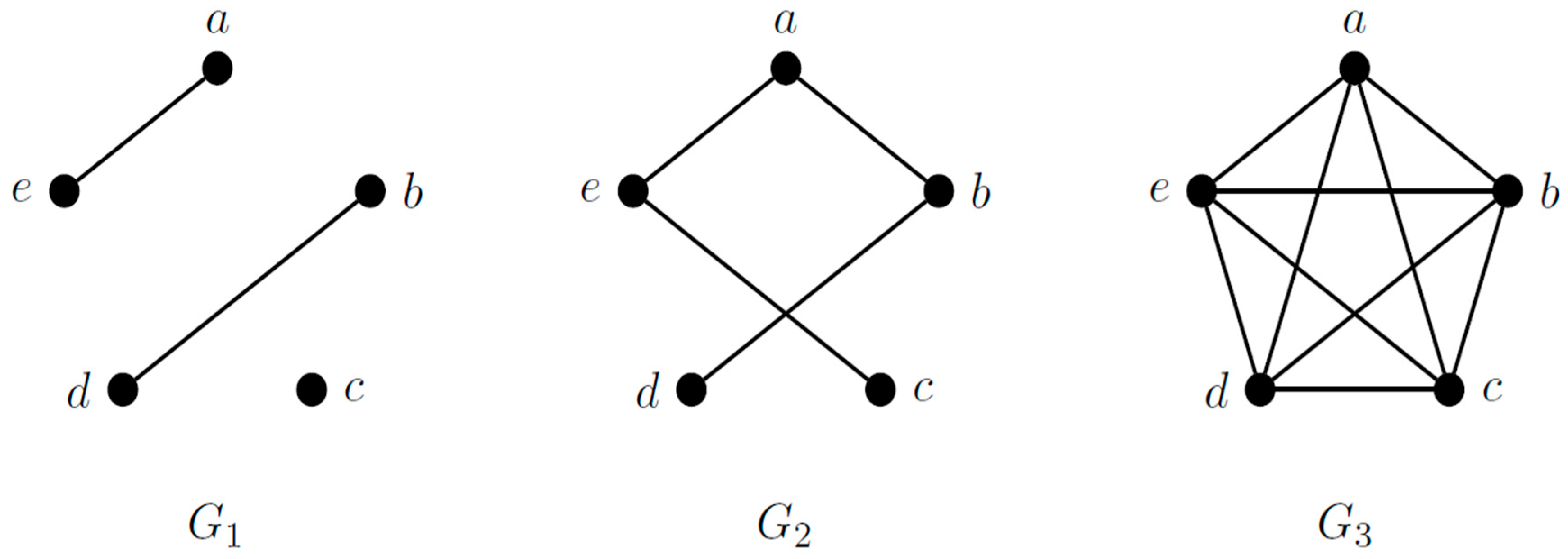
Figure 2.
Digraph Representation.
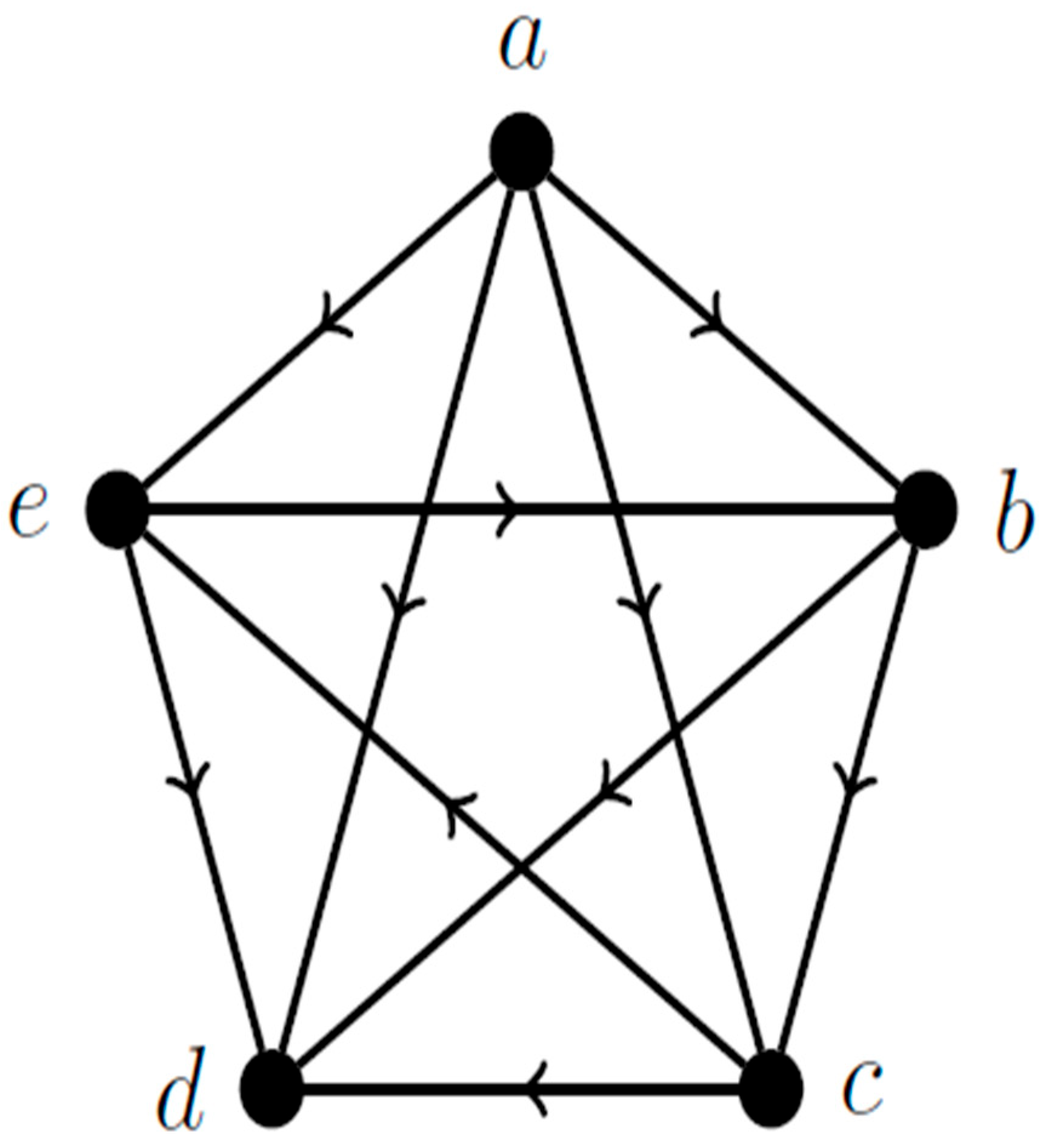
Figure 3.
Leonardo AI descriptor of a future city.
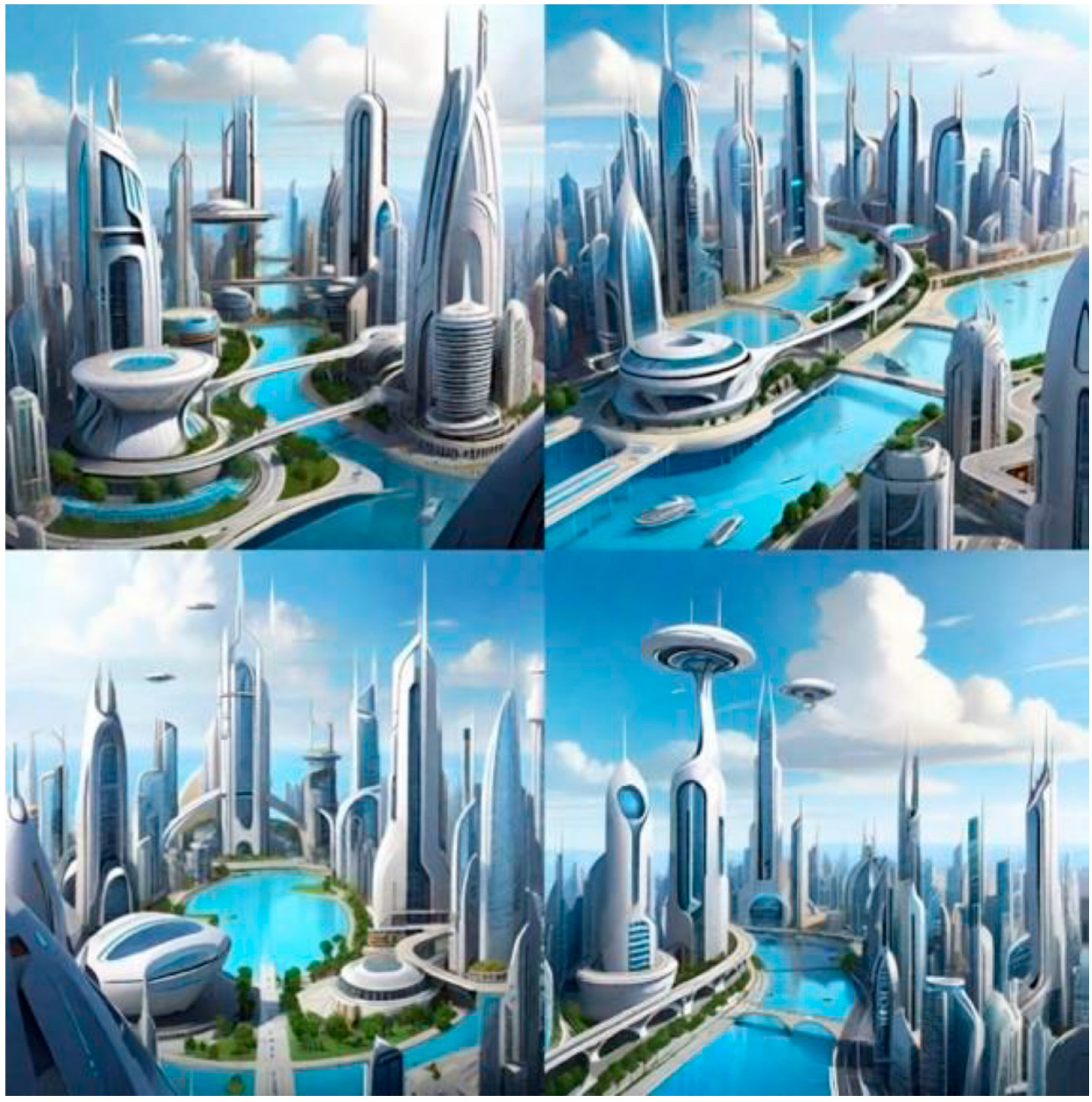
Figure 4.
Visual effects of poetic message.
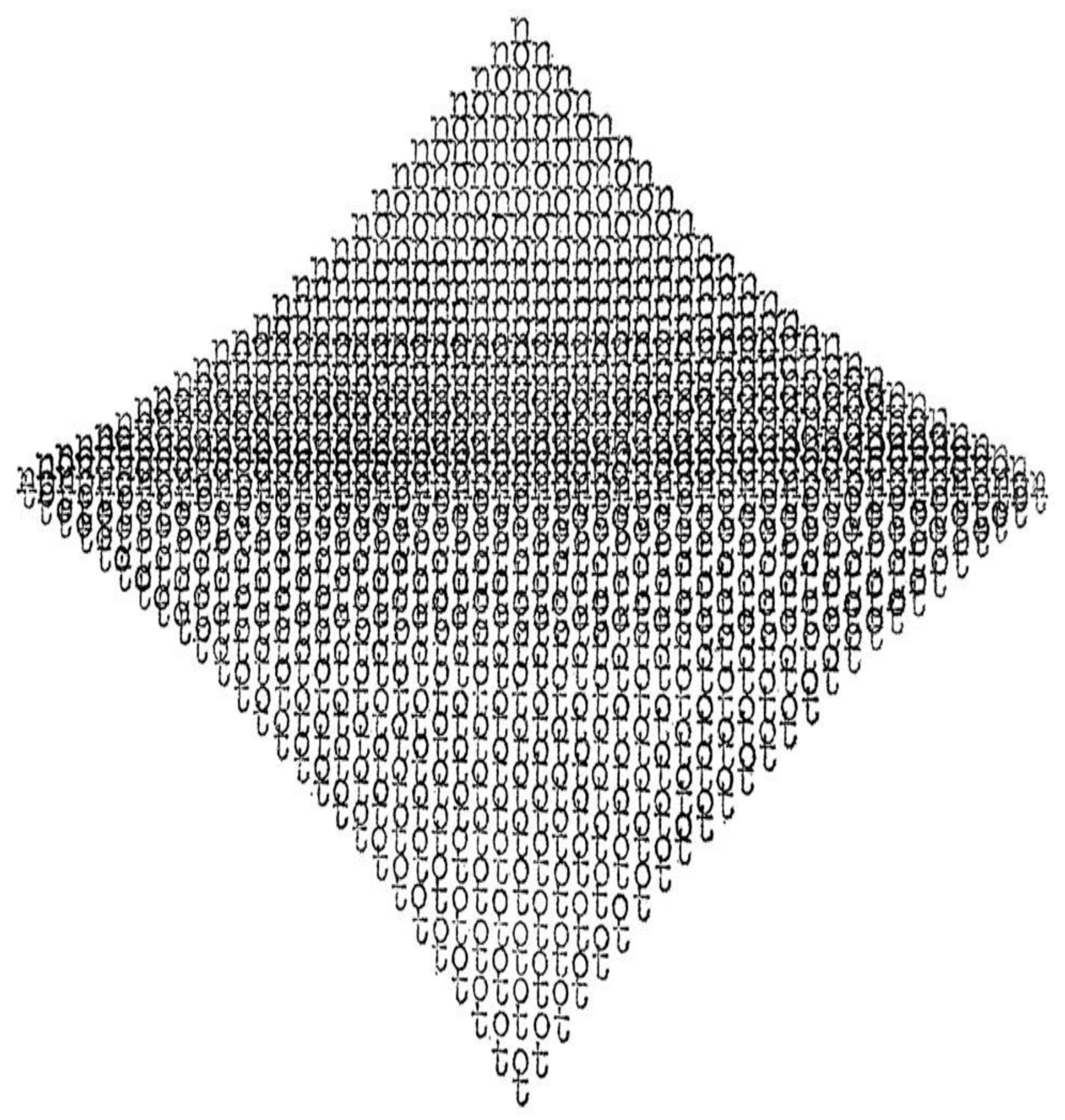
Figure 5.
Batch One.
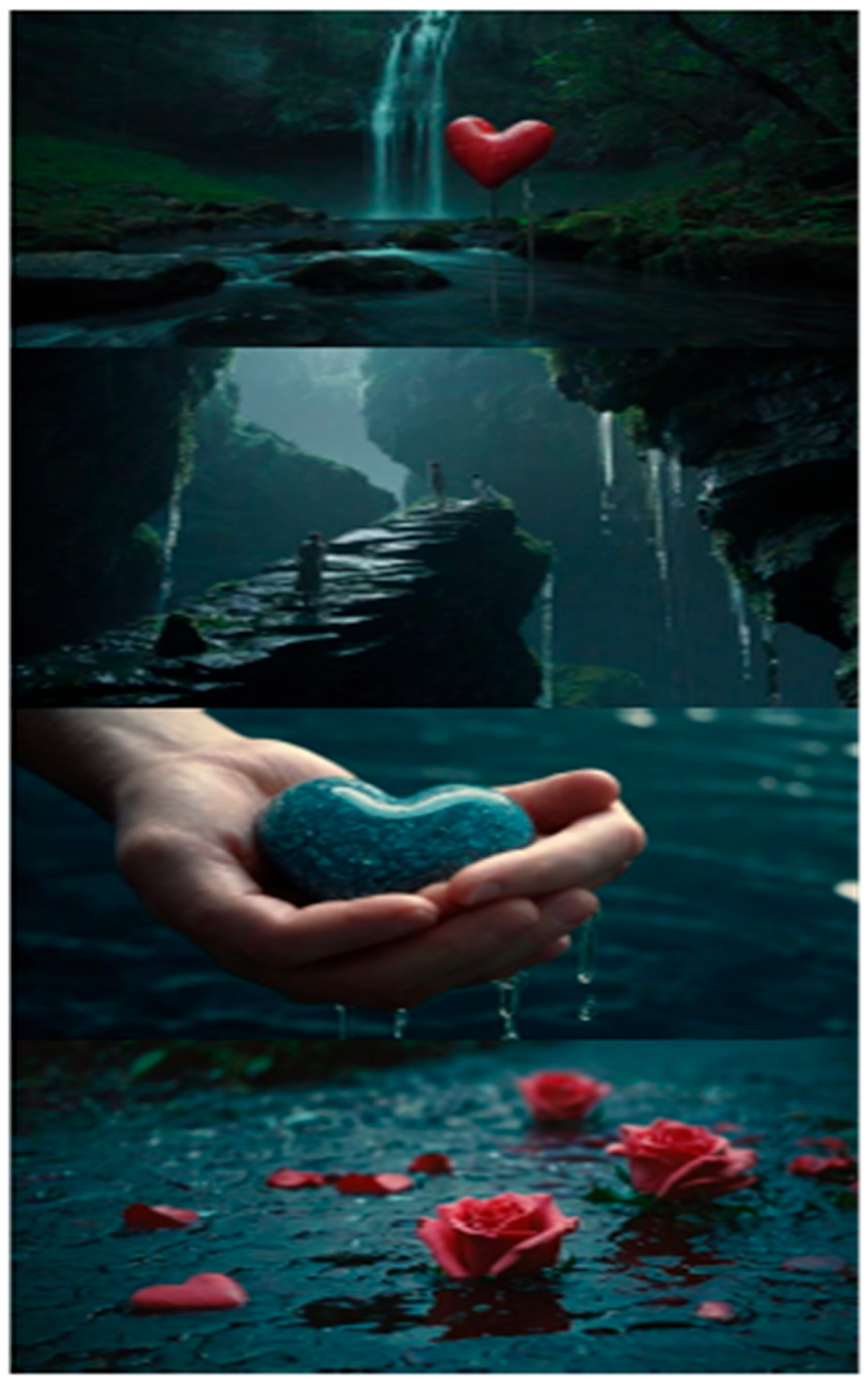
Figure 6.
Batch Two.

Figure 7.
Batch Three.

Disclaimer/Publisher’s Note: The statements, opinions and data contained in all publications are solely those of the individual author(s) and contributor(s) and not of MDPI and/or the editor(s). MDPI and/or the editor(s) disclaim responsibility for any injury to people or property resulting from any ideas, methods, instructions or products referred to in the content. |
© 2025 by the authors. Licensee MDPI, Basel, Switzerland. This article is an open access article distributed under the terms and conditions of the Creative Commons Attribution (CC BY) license (http://creativecommons.org/licenses/by/4.0/).
Copyright: This open access article is published under a Creative Commons CC BY 4.0 license, which permit the free download, distribution, and reuse, provided that the author and preprint are cited in any reuse.


