

Submitted:
03 July 2025
Posted:
04 July 2025
You are already at the latest version
Abstract
Per- and PolyFluoroAlkyl Substances (PFAS) are highly chemically stable synthetic compounds. They are widely used in industrial and commercial sectors due to their ability to repel water and oil, thermal stability, and surfactant properties. However, this stability results in environmental persistence and bioaccumulation, posing signif-icant health risks as PFAS eventually find their way into environmental media. Key PFAS compounds, including PerFluoroOctanoic Acid (PFOA), PerFluoroOctane Sul-fonic acid (PFOS), and PerFluoroHexane Sulfonic acid (PFHxS), have been linked to hepatotoxicity, immunotoxicity, neurotoxicity, and endocrine disruption. In response to the health threats these substances pose, global regulatory measures, such as the Stockholm Convention restrictions and national drinking water standards, have been implemented to reduce PFAS exposure. Despite these efforts, a lack of universally ac-cepted definitions or comprehensive inventories of PFAS compounds hampers the ef-fective management of these substances. As definitions differ across regulatory bodies, research and policy integration have become complicated. PFAS are broadly catego-rized as either PerFluoroAlkyl Acids (PFAAs), precursors, or other fluorinated sub-stances, however, PFAS encompasses over 5,000 distinct compounds, many of which are poorly characterized. PFAS contamination arises from direct industrial emissions and indirect environmental formation, these substances have been detected in water, soil, and air samples from all over the globe, including from remote regions like Ant-arctica. Analytical methods, such as primarily liquid and gas chromatography coupled with tandem mass spectrometry, have advanced PFAS detection. However, standard-ized monitoring protocols remain inadequate. Future management requires unified definitions, expanded monitoring efforts, and standardized methodologies to address the persistent environmental and health impacts of PFAS. This review underscores the need for improved regulatory frameworks and further research.
Keywords:
PFAS
; PFOA
; PFOS
1. Introduction
Per- and PolyFluoroAlkyl Substances (PFAS) are fluorinated substances containing at least one fully fluorinated methyl or methylene carbon atom, with no hydrogen (H), chlorine (Cl), bromine (Br), or iodine (I) atoms attached [1]. In PFAS structures, the carbon atoms are not bonded with H, Cl, Br, or I, resulting in fully or nearly fully fluorinated molecular frameworks. The carbon-fluorine (C-F) bond in PFAS creates extremely stable substances, this means their terminal transformation products persist in the environment for long periods (Table 1). Furthermore, the perfluorinated carbon chains in PFAS exhibit both hydrophobic and lipophobic characteristics, making them effective surfactants and surface protectants [2]. Due to their advantageous properties—such as an ability to repel water and oil, thermal stability, and surfactant behavior—PFAS have been utilized in various industrial and commercial applications since the 1950s, while patents list PFAS uses across 39 categories [3,4]. The unique chemical characteristics and stability of PFAS have lead to their widespread application in industry. However, this chemical stability hinders their natural degradation, resulting in their detection across global environmental matrices, including water, soil, and air, after being steadily distributed by environmental transport and long-range atmospheric movement (Figure 1) [4,5,6,7]. Additionally, PFAS bioaccumulate in organisms and have been detected in both humans and animals. Certain PFAS, such as PerFluoroOctanoic Acid (PFOA), PerFluoroOctane Sulfonic acid (PFOS), and PerFluoroHexane Sulfonic acid (PFHxS), are recognized as hazardous to human health [2,6,8,9,10,11,12]. As a result, PFAS are now perceived to require strict management due to their health risks, persistence, and bioaccumulation potential. These dangers are seen to outweigh their industrial utility for current and future generations.
In response to these risks, regulatory measures on PFAS have been implemented worldwide. For instance, the Stockholm Convention has classified certain PFAS compounds as substances subject to production and usage restrictions [9]. Specifically, PFOS was listed in Annex B of the Convention in 2009, restricting its production and use, while PFOA was added to Annex A in 2019, permitting only limited uses. PFHxS was included in Annex A in 2022, prohibiting all uses without exemptions. The U.S. Environmental Protection Agency (EPA) established drinking water standards for PFAS in April 2024, PFAS are also regulated under the Toxic Substances Control Act (TSCA). Additionally, U.S. states such as California, New York, Maine, Vermont, Washington, Connecticut, and Minnesota adopted legislation in 2022–2023 banning PFAS in food packaging [17]. In the European Union (EU), usage restrictions were proposed by the European Chemicals Agency (ECHA) in February 2023, these proposals are currently under public consultation [17].
Despite increased research and regulation due to the health and environmental risks posed by PFAS, a universally accepted definition of PFAS has yet to be established. The health effects of most PFAS compounds, apart from a few well-known examples, remain unverified, while their sources of release and environmental cycling have not been fully elucidated [18]. Moreover, due to the diversity of PFAS compounds, comprehensive data on their environmental concentrations, analytical methodologies, and toxicological profiles remain scarce. Therefore, this study aims to summarize existing PFAS research and highlight the importance of further studies focusing on the accumulation of these substances in environmental media.
2. Definition, Types, and Health Risks of PFAS
Although various studies on PFAS have been conducted, a standardized definition of PFAS has not been universally adopted. An initial definition was proposed by Buck et al. in 2011, this study defined PFAS as an aliphatic substance in which all hydrogen atoms in the carbon chain are replaced by fluorine, incorporating a perfluoroalkyl moiety (-CnF₂ₙ₊₁-) [6]. However, this definition implied, but did not explicitly specify, the inclusion of fully fluorinated terminal carbons. In 2018, the OECD expanded the definition to include chemicals with a perfluoroalkyl moiety containing at least three carbon atoms (-CnF₂ₙ-, n ≥ 3) or a perfluoroalkyl ether moiety with at least two carbon atoms (-CnF₂ₙOCmF₂ₘ-, n, m ≥ 1) [13]. In 2021, the OECD redefined PFAS as fluorinated substances containing at least one fully fluorinated methyl (-CF₃) or methylene (-CF₂-) carbon without any bonded H, Cl, Br, or I atoms, removing the requirement for an aliphatic structure [1]. Similarly, the TSCA defines PFAS as substances or mixtures structurally characterized by R-(CF₂)-C(F)(R′)R″, this definition was applied to the draft drinking water contaminant candidate list [14]. The U.S. National Defense Authorization Act defines PFAS as synthetic chemicals containing at least one fully fluorinated carbon atom [15]. Over time, these definitions have evolved to become more precise and practical. However, differences in definitions across institutions and regulatory purposes hinder consistent communication and complicate the delineation of PFAS for research purposes.
The lack of a universally agreed-upon definition also complicates the categorization of PFAS. Nevertheless, substances with the general structure (CnF₂ₙ₊₁-R) are conservatively classified as PFAS. More than 5,000 such compounds are known to exist in the global market, most of these are uncharacterized and referred to as PFAS precursors [19]. Common PFAS and PFAS precursor compounds are categorized and summarized in Table 2, along with their toxicity and applications [20]. PFAS are broadly divided into categories such as PerFluoroAlkyl Acids (PFAAs), PFAA precursors, and other substances. PFAAs include subcategories such as PerFluoroCarboxylic Acids (PFCAs), PerFluoroSulfonic Acids (PFSAs), PerFluoroPhosphonic Acids (PFPAs), perfluoroalkyl iodides (PFPIAs), PerFluoroEther Carboxylic Acids (PFECAs), and PerFluoroEther Sulfonic Acids (PFESAs). PFAA precursors are comprise of PerfluoroAlkyl Sulfonyl Fluoride (PASF)-based and fluorotelomer-based substances, while other categories include fluoropolymers and PerFluoroPolyEthers (PFPEs).
Among these, PFCAs (e.g., PerFluoroButanoic Acid [PFBA], PerFluoroPentanoic Acid [PFPeA), PerFluoroHexanoic Acid [PFHxA]) are primarily long-chain compounds with significant potential for environmental persistence and bioaccumulation, posing risks of hepatotoxicity, immunosuppression, and carcinogenicity. PFCAs are commonly used in fluorinated coatings and water repellents [16,29]. PFSAs are structurally similar to PFOA but are more chemically stable, they exhibit high environmental and biological persistence and cause toxic effects such as carcinogenicity, hormonal disruption, and immunosuppression. They are mainly used in firefighting foams and waterproof coatings [30]. Other PFAS categories, including PFPAs, PFPIAs, PFECAs, and PFESAs, show varying degrees of environmental accumulation and toxicity, these substances are used in specialty chemicals and industrial applications [31,32]. Fluorotelomer-based substances, despite having shorter chains, resist degradation and exhibit reproductive toxicity and immunosuppressive effects [29,30,31]. Fluoropolymers are non-biodegradable but tend to be less toxic than other PFAS, they are used as insulators [16,32].
Over 5,000 PFAS products are available on the global market, these products can generate secondary PFAS substances when they degrade [33]. Despite the danger these substances pose, a comprehensive definition of PFAS and a detailed inventory of PFAS compounds have not yet been established. This lack of clarity complicates both human health risk assessments and regulatory measures aimed at mitigating the harm these substances cause. To address these challenges, since 2018, the EPA and the National Toxicology Program (NTP) have been developing a detailed library of PFAS definitions, management protocols, and toxicity testing resources to facilitate the evaluation of PFAS-related human health risks. This PFAS library employs both structure-based chemical informatics and expert-derived structural categories linked to human health risks. The PFAS structure candidates utilized in this library are drawn from the Distributed Structure–Searchable Toxicity (DSSTox) database. As of December 10, 2024, DSSTox contains a curated list of approximately 1,218,248 substances, each substance’s chemical structure is examined prior to registration [34]. Within this database, the KEMI PFAS list (PFASKEMI) serves as one of the largest inventories containing about 1,200 chemical structures [35,36]. From this, around 600 potentially purchasable substances have been identified, and approximately 400 of them have been included in the PFAS toxicity testing library. Through these efforts, 150 substances have been prioritized for human health risk assessment, with toxicity evaluations currently underway [35,36].
Although the health risks of certain PFAS substances (e.g., PFOA, PFOS) have been demonstrated, the risks associated with most other PFAS compounds remain unconfirmed. In response, in vitro experiments have been conducted on priority PFAS substances identified in the EPA’s library. Due to the limited availability of health risk data on many PFAS, these studies have been designed to encompass a wide range of biological responses, based on known human health risks associated with PFOA and PFOS. The selected in vitro tests include assessments of developmental neurotoxicity, developmental toxicity, immunotoxicity, endocrine disruption, and general toxicity. Studies predicting the distribution and metabolism of PFAS in biological systems have also been carried out (Table S2). Specifically, the above experiments include developmental toxicity assays using zebrafish embryos, MicroElectrode Array (MEA) network formation tests for developmental neurotoxicity, high-throughput screening assays provided by ACEA Biosciences and Attagene, BioSeek Diversity Plus assays for immunosuppression and other phenotypic evaluations, High-Throughput Transcriptomics (HTTr), High-Throughput Phenotypic Profiling (HTPP) for broad biological activity assessment, and in vitro toxicokinetics studies 36.
PFAS have been shown to pose various human health risks, particularly risks related to developmental toxicity, immunotoxicity, neurotoxicity, and endocrine disruption. In addition, liver damage has been identified as a critical point of impact, this conclusion is supported by evidence of mRNA alterations and changes in cellular organelle morphology, which indicate potential carcinogenic and teratogenic risks. These findings suggest that PFAS not only cause neurological damage but also exhibit carcinogenic, mutagenic, and genotoxic properties. The results of these human health risk assessments for PFAS have been corroborated by previous studies (Table 2). PFAS exposure has been associated with immunosuppression, metabolic disorders, impaired neurodevelopment, liver dysfunction, and adverse effects on fetal development. These findings align closely with the outcomes of the EPA's in vitro experiments. Collectively, both the EPA’s research and prior studies confirm that PFAS pose significant genotoxic, immunotoxic, neurotoxic, and hepatotoxic human health risks.
3. PFAS Environmental Concentration and Behavior in Air Pollution Research
The presence of PFAS in the environment is classified into direct and indirect emissions [37]. Direct emissions refer to the release of PFAS during production, consumption, and transportation from industrial and domestic environments. In contrast, indirect emissions involve the formation of PFAS in the environment through photolysis, chemical reactions, or biological degradation of precursor substances. Direct emissions have been associated with the production of fluoropolymers and their subsequent use since PFOA production began in 1947 [38]. According to studies that looked at the EPA's ECHO (Enforcement and Compliance History Online) database, approximately 41,862 facilities, out of 1.5 million regulated facilities, were identified as potential sources of PFAS emissions [39]. These facilities include not only waste treatment, landfill, incineration, and sewage treatment facilities but also industrial sites involved in plating, coating, petrochemicals, metal manufacturing, cleaning, papermaking, textile production, and mining. It has been estimated that approximately 3% of industrial facilities in the United States are potential PFAS emission sources, indicating that emissions are not limited to any specific industrial sector.
Indirect PFAS emissions remain poorly understood, largely due to the extensive variety of PFAS and their precursors, making it impractical to comprehensively track all PFAS-related formation and degradation products. However, some known indirect emission processes have been documented. For example, firefighting Aqueous Film-Forming Foam (AFFF) has been found to produce over 10 types of PFAS, including PFOS, when released into aquatic environments [33]. Fluoropolyalcohols, used in water-repellent coatings in the construction industry, are emitted into the atmosphere due to their high vapor pressure, once emitted they react with water vapor and Nitrogen Oxides (NOx) to form PFCAs [40]. Fluorotelomer alcohols (FTOHs), used in the synthesis of fluoropolymers and water repellents, are more volatile than fluoropolyalcohols and can undergo oxidation and biodegradation to produce PFOA and PerFluoroNonanoic Acid (PFNA). These volatile compounds can travel long distances in the atmosphere [41]. FluoroTelomer Iodides (FTIs), precursors in polymer synthesis, convert to FTOHs, these subsequently form PFOA and PFNA. FluoroTelomer Sulfonic Acids (FTSAs), which are used as industrial surfactants, degrade to produce PFOA and PFOS [42,43]. Similarly, perfluoroalkane sulfonamido ethanols (FOSEs), previously used as PFOS precursors, degrade into PFOS and PFOA, while polyfluoroalkyl substances used in food packaging convert to PFOA within the environment or even in the human body [44,45,46,47].
The stability of the C-F bond in PFAS contributes to their long-term environmental persistence after direct or indirect emission. PFAS and PFAA precursor substances are often found in ionic form within aqueous environments due to their physicochemical properties. These substances are transported downstream in rivers and through groundwater. PFAS species commonly found in water include highly soluble short-chain PFCAs such as PFBA, PFPeA, and PFHxA, although long-chain compounds like PFOA may also be present [37]. PFAS in water can adsorb to or desorb from suspended particulates. Adsorbed PFAS may settle into sediments along riverbanks or deposit in sediment layers, in these cases their behavior is influenced by both hydrophobic and hydrophilic functional groups. However, unlike other persistent organic pollutants, the behavior of PFAS in sediment environments is not fully understood. Sediment samples generally contain a higher proportion of long-chain PFAS, such as PFOS and PerFluoroUnDecanoic Acid (PFUnDA), compared to water samples that tend to contain higher concentrations of short-chain PFAS.
While most PFAS are found in ionic form in water, soil, or sediment, some PFAS compounds and precursors are present in the atmosphere. These atmospheric PFAS undergo long-range transport driven by air currents. For instance, perfluoroaldehyde and fluoropolyaldehyde can photodegrade to form PFCAs. Volatile compounds such as HydroChloroFluoroCarbons (HCFCs) and N-Methyl perFluoroButane SulfonamidoEthanol (NMeFBSE) are oxidized in the atmosphere to produce PerFluoroButane Sulfonate (PFBS) and PFCAs [48,49]. Additionally, fluorotelomer compounds such as FTIs and FTOHs contribute to atmospheric PFAS formation through chemical reactions. Atmospheric PFAS can be deposited into aquatic environments through precipitation or particle deposition, where they eventually accumulate in sediment or soil. Some PFAS in these media may re-enter the atmosphere through volatilization. This environmental cycling highlights the persistence of PFAS, which facilitates their widespread distribution and bioaccumulation in organisms. Through various exposure pathways, including by entering the food chain, PFAS can accumulate and exert toxic effects on biological systems [50,51,52].
Figure 2 provides PFAS concentrations in water, soil, and atmospheric environments. The primary PFAS of concern for human health are PFOA and PFOS. Although making direct comparisons across studies is challenging due to differences in research periods and analytical methods, the data indicate that PFOA concentrations in drinking water are generally higher than PFOS concentrations. In certain regions, such as Japan and the United States, higher PFAS levels have been detected compared to other countries. Groundwater samples from Australian landfills and Chinese fluorochemical complexes show the highest concentrations of PFOA and PFOS. These findings suggest that PFAS concentrations vary significantly depending on local industrial activities, waste management practices, and water treatment systems. The elevated concentrations near industrial and landfill sites indicate that PFAS emissions are associated with production and disposal processes.
The concentrations of PFAS in soil have been reported in a study by Rankin, who collected soil samples on a global scale and analyzed them using consistent methods. The highest concentrations of PFOA and PFOS were observed in Asia, while the lowest concentrations were detected in Africa. Identifying clear causes for these variations is challenging due to limited data. However, it can be inferred that higher PFOA and PFOS concentrations may be linked to the presence of PFAS manufacturing facilities. PFOA production began in 1947 by 3M in the United States, while perfluorinated compound manufacturing has primarily taken place in countries such as the United States, Belgium, and Italy [38]. Over time, companies like 3M phased out the production of perfluorinated compounds, resulting in a shift of these manufacturing activities to Asian countries [73,74]. Therefore, the elevated concentrations of PFOA and PFOS in Asian countries may be attributed to current production activities, while the concentrations detected in Europe and North America may reflect the legacy of past PFAS production and serve as another indication of the environmental persistence of these substances.
One significant finding is the detection of PFOA and PFOS in Antarctica, which demonstrates not only the environmental persistence of PFAS but also their potential for long-range transport through atmospheric pathways. The highest atmospheric concentrations of PFOA and PFOS were found in industrial regions of China. Countries such as the United States, Canada, Japan, and Australia showed moderate concentrations, while Sweden and Finland had the lowest levels. These differences are consistent with the influence of fluorochemical manufacturing facilities, with direct emissions from industrial sites in China being a notable factor. Comparisons of PFOA and PFOS concentrations across regions reveal that urban and industrial areas exhibit relatively higher PFAS concentrations, whereas rural areas have lower concentrations. These findings emphasize the role of industrial emissions in determining atmospheric PFAS levels and suggest that the spatial distribution of PFAS is closely tied to regional industrial activities and facility emissions.
4. PFAS Analysis Methods in Air Pollution Research
The growing recognition of the significance effect PFAS have on human and environmental health has increased global demands for enhanced PFAS monitoring. However, the number of PFAS compounds to be monitored and their permissible concentrations have not yet been standardized, except for recommendations in a few countries such as Germany, Australia, and the United States [75,76]. This lack of standardization is attributed to the vast number of PFAS compounds and the absence of universally established analytical methods for all PFAS substances. Consequently, researchers face challenges in determining appropriate analytical parameters and methods for testing various environmental media, which may hinder effective monitoring efforts. Therefore, this study aims to introduce current trends in PFAS analytical parameters and methods. The standardized methods for PFAS analysis, along with the associated target compounds and measurement instruments, are presented in Table S3. As indicated, water is the primary medium for PFAS analysis, most analytical methods have been developed to monitor drinking water. Specifically, EPA methods 537, 533, and 537.1 focus on PFAS detection in drinking water, while EPA SW-846 addresses PFAS analysis in surface water, groundwater, and wastewater for pollution control. Similarly, International Organization for Standardization (ISO) 25101:2009 and ISO 21675:2019 provide guidelines for analyzing PFAS in drinking water, surface water, groundwater, and wastewater. However, the American Society for Testing and Materials (ASTM) standards emphasize PFAS analysis in solid materials. These standardized methods primarily use Liquid Chromatography-tandem Mass Spectrometry (LC-MS/MS) with Multiple Reaction Monitoring (MRM) techniques that incorporate internal or isotope dilution standards to enhance sensitivity. This approach is taken because PFAS concentrations in the environment are often extremely low.
The number of PFAS compounds monitored by standardized methods, including those from the EPA, ISO, and ASTM, is generally limited to a maximum of 25 compounds. This is insufficient considering the extensive number of PFAS compounds that require surveillance. Additionally, these standardized methods focus on ionic PFAS and may not effectively detect volatile and semi-volatile PFAS compounds or PFAS precursors in gaseous form. Consequently, non-standardized analytical methods have been developed based on recent research to address these limitations. Due to the persistence of PFAS in the environment, various chromatographic and mass spectrometric techniques have been employed to detect trace concentrations in environmental media. High-performance Liquid Chromatography (HPLC), Ultra-High-Performance Liquid Chromatography (UHPLC), Capillary Liquid Chromatography (CLC), and Gas Chromatography (GC) are commonly used for PFAS analysis. LC methods are typically employed to analyze ionic PFAS (e.g., PFCAs, PFSAs), while GC is used for volatile and semi-volatile PFAS compounds (e.g., fluorotelomer alcohols, FTOHs, and fluorotelomer sulfonate esters, FASEs). Tandem mass spectrometry is frequently employed in combination with these chromatographic techniques to improve accuracy by using MRM, which minimizes interferences and enhances detection limits.
The analysis of low concentrations of PFAS requires not only advanced instrumentation but also appropriate sample preparation and pretreatment procedures to minimize matrix effects and concentrate target analytes. Common pretreatment methods, summarized in Table S4 and Figure 2, include Solid-Phase Extraction (SPE), Solid-Liquid Extraction (SLE), Pressurized Liquid Extraction (PLE), Liquid-Liquid Extraction (LLE), ultrasonic extraction, Soxhlet extraction, and Solid-Phase MicroExtraction (SPME) (Al et al., 2020). These methods may be employed individually or in combination, depending on the sample type and analytical requirements. After extraction, analytes may undergo further concentration, purification, or chemical derivatization to optimize detection. Internal or isotope-labeled standards (e.g., ¹³C, ¹⁸O, ¹⁵N-labeled PFAS analogs) are typically used to improve quantification accuracy. Detection involves comparing the mass-to-charge ratio (m/z) and retention time of analytes to known standards.
In tandem mass spectrometry, MRM analysis is performed to selectively detect characteristic secondary ions by eliminating interfering substances. This process involves generating primary fragment ions (precursor ions) through applying a Fragmentation Voltage (FV) in the first mass analyzer. These ions are then subjected to Collision-Induced Dissociation (CID) to produce secondary product ions, these are selectively detected in a second mass analyzer under Selected Ion Monitoring (SIM) conditions. MRM analysis provides greater sensitivity and specificity than conventional mass spectrometry. While Time-Of-Flight Mass Spectrometry (TOF-MS) is generally less sensitive than tandem MS, it offers advantages such as an unlimited mass range and superior resolution, making it useful for screening unknown compounds. Since PFAS samples often contain a wide variety of precursor compounds and degradation products, TOF-MS is particularly effective for comprehensive profiling and structural identification of these samples. A summary of the analytical methods used in prior research for various environmental media is provided in Table 3.
5. Future PFAS Management Strategies and Review Conclusions
PFAS are recognized as hazardous substances due to their environmental persistence and adverse health effects, warranting global management efforts. Despite their widespread distribution, including detection in remote regions such as Antarctica, comprehensive definitions, regulatory inventories, and toxicity studies for PFAS remain inadequate. Table S5 presents PFAS guideline concentrations established by key countries. Looking at this table, we can see regulatory thresholds are primarily focused on PFOA and PFOS, while monitoring is largely restricted to drinking water. However, other PFAS compounds have also been shown to pose environmental and health risks, necessitating broader monitoring efforts across various media, including soil and air. To manage PFAS effectively, it is crucial to establish a unified definition, compile comprehensive inventories of environmentally and toxicologically significant PFAS, and develop standardized analytical methods for their detection. Furthermore, monitoring efforts should encompass PFAS precursors and degradation products to account for the full environmental impact of these substances. Current research has shown that PFAS concentrations vary greatly based on industrial activities, regulatory frameworks, and waste management practices. Therefore, coordinated international efforts are required to ensure consistent regulatory measures across the globe.
Enhanced monitoring infrastructure, including training of personnel and the development of laboratory capacities, is essential for addressing the challenges posed by PFAS analysis. Improved access to analytical standards, coupled with the establishment of harmonized protocols, can enhance the accuracy and comparability of PFAS measurements worldwide. In addition, data sharing among regulatory bodies, researchers, and industries can facilitate early detection of emerging PFAS compounds and improve our understanding of their environmental behavior. The regulatory landscape for PFAS continues to evolve. In the EU, public consultation is ongoing regarding the proposed restrictions on PFAS usage under the ECHA. In the United States, individual states are implementing PFAS bans in consumer products such as food packaging, while the EPA are tightening drinking water standards. Similarly, Australia and Germany have expanded their PFAS monitoring programs to include new compounds and stricter regulatory limits.
Future studies should prioritize the identification of emerging PFAS and their degradation products, more research on their toxicological profiles and environmental transport mechanisms is also needed. In particular, research focusing on indirect emissions and the long-term behavior of PFAS in sediments and the atmosphere will help elucidate critical exposure pathways. Understanding the cumulative effects of multiple PFAS compounds in complex environmental systems is also vital for properly assessing the risks they pose to human health and ecosystems. In order to support future research and regulatory efforts, this study has outlined current PFAS definitions, lists, and analytical methods for detecting PFAS. It is hoped that the findings presented here will contribute to the establishment of effective PFAS management practices and enhanced environmental protection. Continued interdisciplinary collaboration among scientists, policymakers, and industry stakeholders is necessary to mitigate the risks associated with PFAS and protect both public health and the environment.
Author Contributions
Myoungki Song contributed to experiment measurements, data analysis, and manuscript preparation. Hajeong Jeon contributed research sample analyses. Min-Suk Bae contributed to experiment planning and data analysis. All authors have read and agreed to the published version of the manuscript.
Funding
This study was supported by the National Institute of Environmental Research funded by the Ministry of Environment (MOE) of the Republic of Korea (NIER- 2021–03-03–007).
Informed Consent Statement
Not applicable.
Data Availability Statement
Not applicable.
Conflicts of Interest
The authors declare no conflicts of interest.
References
- OECD. Reconciling terminology of the universe of per- and polyfluoroalkyl substances: recommendations and practical guidance. Organisation for Economic Co-operation and Development. 2021.
- Glüge, J.; Scheringer, M.; Cousins, I.T.; DeWitt, J.C.; Goldenman, G.; Herzke, D.; Lohmann, R.; Ng, C.A.; Trier, X.; Wang, Z. An overview of the uses of per- and polyfluoroalkyl substances (PFAS). Environ. Sci.: Process. 2020, Impacts 22, 2345–2373.
- E. Kissa, Fluorinated Surfactants and Repellents, Marcel Dekker AG, 2001.
- Johansson, J.H.; Berger, U.; Cousins, I.T. Can the use of deactivated glass fibre filters eliminate sorption artefacts associated with active air sampling of perfluorooctanoic acid? Environ. Pollut. 2017, 224, 779–786. [Google Scholar] [CrossRef] [PubMed]
- Ahrens, L.; Bundschuh, M. Fate and effects of poly- and perfluoroalkyl substances in the aquatic environment: A review. Environ. Toxicol. Chem. 2014, 33, 1921–1929. [Google Scholar] [CrossRef]
- Buck, R.C.; Franklin, J.; Berger, U.; Conder, J.M.; Cousins, I.T.; de Voogt, P.; Jensen, A.A.; Kannan, K.; Mabury, S.A.; van Leeuwen, S.P. Perfluoroalkyl and polyfluoroalkyl substances in the environment: Terminology, classification, and origins. Integr. Environ. Assess. Manag. 2011, 7, 513–541. [Google Scholar] [CrossRef] [PubMed]
- Martin, J.W.; Smithwick, M.M.; Braune, B.M.; Hoekstra, P.F.; Muir, D.C.G.; Mabury, S.A. Identification of long-chain perfluorinated acids in biota from the Canadian Arctic. Environ. Sci. Technol. 2004, 38, 373–380. [Google Scholar] [CrossRef]
- Houde, M.; Czub, G.; Small, J.M.; Backus, S.; Wang, X.; Alaee, M.; Muir, D.C.G. Fractionation and bioaccumulation of perfluorooctane sulfonate (PFOS) isomers in a Lake Ontario food web. Environ. Sci. Technol. 2008, 42, 9397–9403. [Google Scholar] [CrossRef]
- Lindstrom, A.B.; Strynar, M.J.; Libelo, E.L. Polyfluorinated compounds: Past, present, and future. Environ. Sci. Technol. 2011, 45, 7954–7961. [Google Scholar] [CrossRef] [PubMed]
- Loos, R.; Locoro, G.; Huber, T.; Wollgast, J.; Christoph, E.H.; de Jager, A.; Manfred Gawlik, B.; Hanke, G.; Umlauf, G.; Zaldívar, J.-M. Analysis of perfluorooctanoate (PFOA) and other perfluorinated compounds (PFCs) in the River Po watershed in N-Italy. Chemosphere. 2008, 71, 306–313. [Google Scholar] [CrossRef]
- Powley, C.R.; George, S.W.; Russell, M.H.; Hoke, R.A.; Buck, R.C. Polyfluorinated chemicals in a spatially and temporally integrated food web in the Western Arctic. Chemosphere. 2008, 70, 664–672. [Google Scholar] [CrossRef]
- Yamashita, N.; Taniyasu, S.; Petrick, G.; Wei, S.; Gamo, T.; Lam, P.K.S.; Kannan, K. Perfluorinated acids as novel chemical tracers of global circulation of ocean waters. Chemosphere. 2008, 70, 1247–1255. [Google Scholar] [CrossRef]
- OECD. ‘OECD, Summary Report on Updating the OECD 2007 List of Per- and Polyfluorinated Substances (PFASs), Report ENV/JM/MONO. 2018. Available online: http://www.oecd.org/officialdocuments/publicdisplaydocumentpdf/?cote= ENV-JM-MONO(2018)7&doclanguage=en (accessed on 12 October 2024).
- TSCA. “Toxic Substances Control Act Reporting and Recordkeeping Requirements for Perfluoroalkyl and Polyfluoroalkyl Substances.” TSCA Substances (2020). 2020.
- National Defense Authorization (2020). National Defense Authorization Act for Fiscal Year. 2020. Available online: https://www.congress.gov/bill/116th-congress/senatebill/1790 (accessed on 12 October 2024).
- EPA. Per- and polyfluoroalkyl substances (PFAS): Basic Information and Effects. U.S. Environmental Protection Agency. 2021.
- Kourtchev, I.; Sebben, B.G.; Bogush, A.; Godoi, A.F.L.; Godoi, R.H.M. Per- and polyfluoroalkyl substances (PFASs) in urban PM2.5 samples from Curitiba, Brazil. Atmos. Environ. 2023, 309, 119911. [Google Scholar] [CrossRef]
- Ford, L.C.; Lin, H.-C.; Zhou, Y.-H.; Wright, F.A.; Gombar, V.K.; Sedykh, A.; Shah, R.R.; Chiu, W.A.; Rusyn, I. Characterizing PFAS hazards and risks: a human population-based in vitro cardiotoxicity assessment strategy. Hum. Genomics. 2024, 18, 92. [Google Scholar] [CrossRef] [PubMed]
- Al Amin, M.; Sobhani, Z.; Liu, Y.; Dharmaraja, R.; Chadalavada, S.; Naidu, R.; Chalker, J.M.; Fang, C. Recent advances in the analysis of per- and polyfluoroalkyl substances (PFAS)—A review. Environ. Technol. Innov. 2020, 19, 100879. [Google Scholar] [CrossRef]
- Wang, Z.; DeWitt, J.C.; Higgins, C.P.; Cousins, I.T. A never-ending story of per- and polyfluoroalkyl substances (PFASs)? Environ. Sci. Technol. 2017, 51, 2508–2518. [Google Scholar] [CrossRef] [PubMed]
- Cousins, I.T.; Goldenman, G.; Herzke, D.; Lohmann, R.; Miller, M.; Ng, C.A. PFAS: forever chemicals—persistent, bioaccumulative and mobile. Reviewing the status and the need for their phase-out and remediation of contaminated sites. Environ. Sci. Eur. 2023, 35, 1–18. [Google Scholar]
- Averill, S.; Ginsberg, G.; Hays, S.; Makris, S.L. Perfluoroalkyl substances and cardiometabolic consequences in adolescents exposed to the World Trade Center disaster and a matched comparison group. Int. J. Hyg. Environ. Health. 2018, 221, 1087–1096. [Google Scholar]
- Sunderland, E.M.; Hu, X.C.; Dassuncao, C.; Tokranov, A.K.; Wagner, C.C.; Allen, J.G. A review of the pathways of human exposure to poly- and perfluoroalkyl substances (PFASs) and present understanding of health effects. J. Expo. Sci. Environ. Epidemiol. 2018, 28, 147–168. [Google Scholar] [CrossRef]
- Rappazzo, K.M.; Coffman, E.; Hines, E.P. Per- and polyfluoroalkyl substance toxicity and human health review: Current state of knowledge and strategies for informing future research. Environ. Health Perspect. 2017, 125, 124501. [Google Scholar]
- Grandjean, P.; Andersen, E.W.; Budtz-Jørgensen, E.; Nielsen, F.; Mølbak, K.; Weihe, P.; Heilmann, C. Serum vaccine antibody concentrations in children exposed to perfluorinated compounds. JAMA. 2012, 307, 391–397. [Google Scholar] [CrossRef]
- Melzer, D.; Rice, N.; Depledge, M.H.; Henley, W.E.; Galloway, T.S. Association between serum perfluorooctanoic acid (PFOA) and thyroid disease in the US National Health and Nutrition Examination Survey. Environ. Health Perspect. 2010, 118, 686–692. [Google Scholar] [CrossRef]
- Fei, C.; McLaughlin, J.K.; Lipworth, L.; Olsen, J. Maternal levels of perfluorinated chemicals and subfecundity. Hum. Reprod. 2007, 22, 3254–3256. [Google Scholar] [CrossRef]
- Eriksen, K.T.; Sørensen, M.; McLaughlin, J.K.; Tjønneland, A.; Overvad, K.; Raaschou-Nielsen, O. Perfluorooctanoic acid and perfluorooctane sulfonate plasma levels and risk of cancer in the general Danish population. J. Natl. Cancer Inst. 2009, 101, 605–609. [Google Scholar] [CrossRef] [PubMed]
- OECD. Reconciling terminology of the universe of per- and polyfluoroalkyl substances: recommendations and practical guidance. Organisation for Economic Co-operation and Development. 2023.
- IARC. Evaluation of the carcinogenicity of perfluorooctanoic acid (PFOA) and perfluorooctane sulfonic acid (PFOS). International Agency for Research on Cancer. 2020.
- Wang, Z.; DeWitt, J.C.; Higgins, C.P.; Cousins, I.T. A never-ending story of per- and polyfluoroalkyl substances (PFASs)? Environ. Sci. Technol. 2020, 54, 3747–3751. [Google Scholar] [CrossRef]
- UNEP. Environmental Risks of Per- and Polyfluoroalkyl Substances. United Nations Environment Programme. 2019.
- Place, B.J.; Field, J.A. Identification of novel fluorochemicals in aqueous film-forming foams used by the US military. Environ. Sci. Technol. 2012, 46, 7120–7127. [Google Scholar] [CrossRef] [PubMed]
- Williams, A.J.; Grulke, C.M.; Edwards, J.; McEachran, A.D.; Mansouri, K.; Baker, N.C.; Patlewicz, G.; Shah, I.; Wambaugh, J.F.; Judson, R.S.; Richard, A.M. The CompTox Chemistry Dashboard: A community data resource for environmental chemistry. J. Cheminform. 2017, 9, 61. [Google Scholar] [CrossRef] [PubMed]
- Patlewicz, G.; Richard, A.M.; Williams, A.J.; Grulke, C.M.; Sams, R.; Lambert, J.; Noyes, P.D.; DeVito, M.J.; Hines, R.N.; Strynar, M.; Guiseppi-Elie, A.; Thomas, R.S. A chemical category-based prioritization approach for selecting 75 per- and polyfluoroalkyl substances (PFAS) for tiered toxicity and toxicokinetic testing. Environ. Health Perspect. 2019, 127, 014501. [Google Scholar] [CrossRef]
- Patlewicz, G.; Richard, A.M.; Williams, A.J.; Judson, R.S.; Thomas, R.S. Towards reproducible structure-based chemical categories for PFAS to inform and evaluate toxicity and toxicokinetic testing. Comput. Toxicol. 2022, 24, 100250. [Google Scholar] [CrossRef]
- Liu, W.; Wu, J.; He, W.; Xu, F. A review on perfluoroalkyl acids studies: Environmental behaviors, toxic effects, and ecological and health risks. Ecosyst. Health Sustain. 2019, 5, 1–19. [Google Scholar] [CrossRef]
- Prevedouros, K.; Cousins, I.T.; Buck, R.C.; Korzeniowski, S.H. Sources, fate, and transport of perfluorocarboxylates. Environ. Sci. Technol. 2006, 40, 32–44. [Google Scholar] [CrossRef]
- Andrews, D.Q.; Hayes, J.; Stoiber, T.; Brewer, B.; Campbell, C.; Naidenko, O.V. Identification of point source dischargers of per- and polyfluoroalkyl substances in the United States. AWWA Water Sci. 2021, 3, e1252. [Google Scholar] [CrossRef]
- Ellis, D.A.; Martin, J.W.; De Silva, A.O.; Mabury, S.A.; Hurley, M.D.; Sulbaek Andersen, M.P.; Nielsen, O.J. Degradation of fluorotelomer alcohols: A likely atmospheric source of perfluorinated carboxylic acids. Environ. Sci. Technol. 2004, 38, 3316–3321. [Google Scholar] [CrossRef]
- Dinglasan, M.J.A.; Ye, Y. , Edwards, E.A.; Mabury, S.A. Aerobic biotransformation of 14C-labeled 8-2 telomer alcohol by activated sludge from a domestic sewage treatment plant. Environ. Sci. Technol. 2004, 38, 1225–1231. [Google Scholar]
- Butt, C.M.; Berger, U.; Bossi, R.; Tomy, G.T. Review: Spatial trends of perfluoroalkyl substances in wildlife. Chemosphere. 2010, 78, 933–941. [Google Scholar]
- Martin, J.W.; Asher, B.J.; Beesoon, S.; Benskin, J.P.; Ross, M.S. Biodegradation and metabolism of polyfluorinated compounds. Rev. Environ. Contam. Toxicol. 2010, 208, 53–71. [Google Scholar]
- Begley, T.H.; White, K.; Honigfort, P.; Twaroski, M.L.; Neches, R.; Walker, R.A. Perfluorochemicals: Potential sources of and migration from food packaging. Food Addit. Contam. 2005, 22, 1023–1031. [Google Scholar] [CrossRef]
- Boulanger, B.; Peck, A.M.; Schnoor, J.L.; Hornbuckle, K.C. Mass budget of perfluorooctane surfactants in Lake Ontario. Environ. Sci. Technol. 2005, 39, 74–79. [Google Scholar] [CrossRef]
- D'Eon, J.C.; Mabury, S.A. Production of perfluorinated carboxylic acids (PFCAs) from polyfluoroalkyl phosphate diesters (PAPs) in the rat. Environ. Sci. Technol. 2007, 41, 956–962. [Google Scholar] [CrossRef]
- Webster, E.; Ellis, D.A.; McLachlan, M.S. Modeling the fate of perfluorocarboxylates and their precursors in the atmosphere. Environ. Sci. Technol. 2006, 40, 6123–6130. [Google Scholar]
- Chiappero, M.S.; Malanca, F.E.; Argüello, G.A.; Wooldridge, S.T.; Hurley, M.D.; Ball, J.C.; Wallington, T.J.; Waterland, R.L.; Buck, R.C. Atmospheric chemistry of perfluoroaldehydes and fluorotelomer aldehydes: Quantification of the important role of photolysis. J. Phys. Chem. A. 2006, 110, 11944–11953. [Google Scholar] [CrossRef]
- D'Eon, J.C.; Hurley, M.D.; Wallington, T.J.; Mabury, S.A. Atmospheric chemistry of N-methyl perfluorobutane sulfonamidoethanol: Kinetics and mechanism of reaction with OH. Environ. Sci. Technol. 2006, 40, 1862–1868. [Google Scholar] [CrossRef]
- Conder, J.M.; Hoke, R.A.; Wolf, W.d.; Russell, M.H.; Buck, R.C. Are PFCAs bioaccumulative? A critical review and comparison with regulatory criteria and persistent lipophilic compounds. Environ. Sci. Technol. 2008, 42, 995–1003. [Google Scholar] [CrossRef]
- Kannan, K.; Corsolini, S.; Falandysz, J.; Oehme, G.; Focardi, S.; Giesy, J.P. Perfluorooctanesulfonate and related fluorinated hydrocarbons in marine mammals, fishes, and birds from coasts of the Baltic and the Mediterranean Seas. Environ. Sci. Technol. 2002, 36, 3210–3216. [Google Scholar] [CrossRef] [PubMed]
- Kumar, K.S.; Zushi, Y.; Masunaga, S.; Gilligan, M.; Pride, C.; Sajwan, K.S. Perfluorinated organic contaminants in sediment and aquatic wildlife, including sharks, from Georgia, USA. Mar. Pollut. Bull. 2009, 58, 621–629. [Google Scholar] [CrossRef] [PubMed]
- Toms, L.; Bräunig, J.; Vijayasarathy, S.; Phillips, S.; Hobson, P.; Aylward, L.; Kirk, M.; Mueller, J. Per-and polyfluoroalkyl substances (PFAS) in Australia: Current levels and estimated population reference values for selected compounds. Int. J. Hyg. Environ. Health. 2019, 222, 387–394. [Google Scholar] [CrossRef]
- Bossi, R.; Skjøth, C.A.; Skov, H. Three years (2008–2010) of measurements of atmospheric concentrations of organochlorine pesticides (OCPs) at Station Nord, North-East Greenland. Environ. Sci.: Process Impacts. 2013, 15, 2213–2219. [Google Scholar] [CrossRef]
- Dreyer, A.; Matthias, V.; Temme, C.; Ebinghaus, R. Annual Time Series of Air Concentrations of Polyfluorinated Compounds. Environ. Sci. Technol. 2009, 43, 4029–4036. [Google Scholar] [CrossRef]
- Jahnke, A.; Berger, U.; Ebinghaus, R.; Temme, C. Latitudinal Gradient of Airborne Polyfluorinated Alkyl Substances in the Marine Atmosphere between Germany and South Africa (53° N−33° S). Environ. Sci. Technol. 2007, 41, 3055–3061. [Google Scholar] [CrossRef] [PubMed]
- Shimizu, M.S.; Mott, R.; Potter, A.; Zhou, J.; Baumann, K.; Surratt, J.D.; Turpin, B.; Avery, G.B.; Harfmann, J.; Kieber, R.J.; Mead, R.N.; Skrabal, S.A.; Willey, J.D. Atmospheric Deposition and Annual Flux of Legacy Perfluoroalkyl Substances and Replacement Perfluoroalkyl Ether Carboxylic Acids in Wilmington, NC, USA. Environ. Sci. Technol. Lett. 2021, 8, 366–372. [Google Scholar] [CrossRef]
- Wang, Q.; Ruan, Y.; Lin, H.; Lam, P.K.S. Review on perfluoroalkyl and polyfluoroalkyl substances (PFASs) in the Chinese atmospheric environment. Sci. Total Environ. 2020, 737, 139804. [Google Scholar] [CrossRef]
- Shoeib, M.; Harner, T.; M Webster, G.; Lee, S.C. Indoor Sources of Poly- and Perfluorinated Compounds (PFCS) in Vancouver, Canada: Implications for Human Exposure. Environ. Sci. Technol. 2011, 45, 7999–8005. [Google Scholar] [CrossRef]
- Valsecchi, S.; Conti, D.; Crebelli, R.; Polesello, S.; Rusconi, M.; Mazzoni, M.; Preziosi, E.; Carere, M.; Lucentini, L.; Ferretti, E.; Balzamo, S.; Simeone, M.G.; Aste, F. Deriving environmental quality standards for perfluorooctanoic acid (PFOA) and related short chain perfluorinated alkyl acids. J. Hazard. Mater. 2017, 323, 84–98. [Google Scholar] [CrossRef]
- Chen, S.; Jiao, X.-C.; Gai, N.; Li, X.-J.; Wang, X.-C.; Lu, G.-H.; Piao, H.-T.; Rao, Z.; Yang, Y.-L. Perfluorinated compounds in soil, surface water, and groundwater from rural areas in eastern China. Environ. Pollut. 2016, 211, 124–131. [Google Scholar] [CrossRef]
- Bao, J.; Yu, W.-J.; Liu, Y.; Wang, X.; Jin, Y.-H.; Dong, G.-H. Perfluoroalkyl substances in groundwater and home-produced vegetables and eggs around a fluorochemical industrial park in China. Ecotoxicol. Environ. Saf. 2019, 171, 199–205. [Google Scholar] [CrossRef]
- Hepburn, E.; Madden, C.; Szabo, D.; Coggan, T.L.; Clarke, B.; Currell, M. Contamination of groundwater with per- and polyfluoroalkyl substances (PFAS) from legacy landfills in an urban re-development precinct. Environ. Pollut. 2019, 248, 101–113. [Google Scholar] [CrossRef] [PubMed]
- Sharma, B.M.; Bharat, G.K.; Tayal, S.; Larssen, T.; Bečanová, J.; Karásková, P.; Whitehead, P.G.; Futter, M.N.; Butterfield, D.; Nizzetto, L. Perfluoroalkyl substances (PFAS) in river and ground/drinking water of the Ganges River basin: Emissions and implications for human exposure. Environ. Pollut. 2016, 208, 704–713. [Google Scholar] [CrossRef]
- Yong, Z.Y.; Kim, K.Y.; Oh, J.-E. The occurrence and distributions of per- and polyfluoroalkyl substances (PFAS) in groundwater after a PFAS leakage incident in 2018. Environ. Pollut. 2021, 268, 115395. [Google Scholar] [CrossRef] [PubMed]
- Mak, Y.L.; Taniyasu, S.; Yeung, L.W.Y.; Lu, G.; Jin, L.; Yang, Y.; Lam, P.K.S.; Kannan, K.; Yamashita, N. Perfluorinated compounds in tap water from China and several other countries. Environ. Sci. Technol. 2009, 43, 4824–4829. [Google Scholar] [CrossRef] [PubMed]
- Quinete, N.; Wu, Q.; Zhang, T.; Yun, S.H.; Moreira, I.; Kannan, K. Specific profiles of perfluorinated compounds in surface and drinking waters and accumulation in mussels, fish, and dolphins from southeastern Brazil. Chemosphere. 2009, 77, 863–869. [Google Scholar] [CrossRef]
- Quiñones, O.; Snyder, S.A. Occurrence of perfluoroalkyl carboxylates and sulfonates in drinking water utilities and related waters from the United States. Environ. Sci. Technol. 2009, 43, 9089–9095. [Google Scholar] [CrossRef]
- Takagi, S.; Adachi, F.; Miyano, K.; Koizumi, Y.; Tanaka, H.; Mimura, M.; Watanabe, I.; Tanabe, S.; Kannan, K. Perfluorooctanesulfonate and perfluorooctanoate in raw and treated tap water from Osaka, Japan. Chemosphere. 2008, 72, 1409–1412. [Google Scholar] [CrossRef]
- Thompson, J.; Eaglesham, G.; Mueller, J. Concentrations of PFOS, PFOA and other perfluorinated alkyl acids in Australian drinking water. Chemosphere. 2011, 83, 1320–1325. [Google Scholar] [CrossRef]
- Wilhelm, M.; Bergmann, S.; Dieter, H.H. Occurrence of perfluorinated compounds (PFCs) in drinking water of North Rhine-Westphalia, Germany, and new approach to assess drinking water contamination by shorter-chained C4-C7 PFCs. Int. J. Hyg. Environ. Health. 2010, 213, 224–232. [Google Scholar] [CrossRef] [PubMed]
- Rankin, K.; Mabury, S.A.; Jenkins, T.M.; Washington, J.W. A North American and global survey of perfluoroalkyl substances in surface soils: Distribution patterns and mode of occurrence. Chemosphere. 2016, 161, 333–341. [Google Scholar] [CrossRef]
- Wang, T.; Wang, P.; Meng, J.; Liu, S.; Lu, Y.; Khim, J.S.; Giesy, J.P. A review of sources, multimedia distribution and health risks of perfluoroalkyl acids (PFAAs) in China. Chemosphere. 2015, 129, 87–99. [Google Scholar] [CrossRef] [PubMed]
- Zareitalabad, P.; Siemens, J.; Hamer, M.; Amelung, W. Perfluorooctanoic acid (PFOA) and perfluorooctanesulfonic acid (PFOS) in surface waters, sediments, soils and wastewater—A review on concentrations and distribution coefficients. Chemosphere. 2013, 91, 725–732. [Google Scholar] [CrossRef]
- Podder, A.; Sadmani, A.H.M.A.; Reinhart, D.; Chang, N.-B.; Goel, R. Per- and polyfluoroalkyl substances (PFAS) as a contaminant of emerging concern in surface water: A transboundary review of their occurrences and toxicity effects. J. Hazard. Mater. 2021, 419, 126361. [Google Scholar] [CrossRef] [PubMed]
- Zarębska, M.; Bajkacz, S. Poly- and perfluoroalkyl substances (PFAS)—Recent advances in the aquatic environment analysis. TrAC Trends Anal. Chem. 2023, 163, 117062. [Google Scholar] [CrossRef]
- Barber, J.L.; Berger, U.; Chaemfa, C.; Huber, S.; Jahnke, A.; Temme, C.; Jones, K.C. Analysis of per- and polyfluorinated alkyl substances in air samples from Northwest Europe. J. Environ. Monit. 2007, 9, 530–541. [Google Scholar] [CrossRef]
- Boulanger, B.; Vargo, J.D.; Schnoor, J.L.; Hornbuckle, K.C. Perfluorooctane sulfonic acid–photolysis, and intermediates. Environ. Toxicol. Chem. 2005, 24, 1338–1340. [Google Scholar]
- Fiedler, H.; de Boer, J.; Abad, E. Persistent organic pollutants in air across the globe using a comparative passive air sampling method. TrAC Trends in Analytical Chemistry. 2024, 171, 117494. [Google Scholar] [CrossRef]
- Jahnke, A.; Ahrens, L.; Ebinghaus, R.; Berger, U.; Barber, J.L.; Temme, C. An improved method for the analysis of volatile polyfluorinated alkyl substances in environmental air samples. Anal. Bioanal. Chem. 2007, 387, 965–975. [Google Scholar] [CrossRef]
- Kubwabo, C.; Stewart, B.; Zhu, J.; Marro, L. Occurrence of perfluorosulfonates and other perfluorochemicals in dust from selected homes in the city of Ottawa, Canada. J. Environ. Monit. 2005, 7, 1074–1078. [Google Scholar] [CrossRef] [PubMed]
- Li, J.; Del Vento, S.; Schuster, J.; Zhang, G.; Chakraborty, P.; Kobara, Y.; Jones, K.C. Perfluorinated Compounds in the Asian Atmosphere. Environ. Sci. Technol. 2011, 45, 7241–7248. [Google Scholar] [CrossRef] [PubMed]
- Moriwaki, H.; Takata, Y.; Arakawa, R. Concentrations of perfluorooctane sulfonate (PFOS) and perfluorooctanoic acid (PFOA) in vacuum cleaner dust collected in Japanese homes. J. Environ. Monit. 2003, 5, 753–757. [Google Scholar] [CrossRef] [PubMed]
- Padilla-Sánchez, J.A.; Papadopoulou, E.; Poothong, S.; Haug, L.S. Investigation of the best approach for assessing human exposure to poly- and perfluoroalkyl substances through indoor air. Environ. Sci. Technol. 2017, 51, 12836–12843. [Google Scholar] [CrossRef]
- Saini, A.; Chinnadurai, S.; Schuster, J.K.; Eng, A.; Harner, T. Per- and polyfluoroalkyl substances and volatile methyl siloxanes in global air: Spatial and temporal trends. Environ. Pollut. 2023, 323, 121291. [Google Scholar] [CrossRef]
- Shoeib, M.; Harner, T.; Ikonomou, M.; Kannan, K. Indoor and outdoor air concentrations and phase partitioning of perfluoroalkyl sulfonamides and polybrominated diphenyl ethers. Environ. Sci. Technol. 2004, 38, 1313–1320. [Google Scholar] [CrossRef]
- Shoeib, M.; Harner, T.; Lee, S.C.; Lane, D.; Zhu, J. Sorbent-impregnated polyurethane foam disk for passive air sampling of volatile fluorinated chemicals. Anal. Chem. 2008, 80, 675–682. [Google Scholar] [CrossRef]
- Shoeib, T.; Hassan, Y.; Rauert, C.; Harner, T. Poly- and perfluoroalkyl substances (PFASs) in indoor dust and food packaging materials in Egypt: Trends in developed and developing countries. Chemosphere. 2016, 144, 1573–1581. [Google Scholar] [CrossRef]
- Yao, Y.; Zhao, Y.; Sun, H.; Chang, S.; Zhu, L.; Alder, A.C.; Kannan, K. Per- and polyfluoroalkyl substances (PFASs) in indoor air and dust from homes and various microenvironments in China: Implications for human exposure. Environ. Sci. Technol. 2018, 52, 3156–3166. [Google Scholar] [CrossRef]
- Backe, W.J.; Day, T.C.; Field, J.A. Zwitterionic, cationic, and anionic fluorinated chemicals in aqueous film-forming foam formulations and groundwater from US military bases by nonaqueous large-volume injection HPLC-MS/MS. Environ. Sci. Technol. 2013, 47, 5226–5234. [Google Scholar] [CrossRef]
- Boiteux, V.; Dauchy, X.; Bach, C.; Colin, A.; Hemard, J.; Sagres, V.; Rosin, C.; Munoz, J.-F. Concentrations and patterns of perfluoroalkyl and polyfluoroalkyl substances in a river and three drinking water treatment plants near and far from a major production source. Sci. Total Environ. 2017, 583, 393–400. [Google Scholar] [CrossRef]
- Boulanger, B.; Vargo, J.; Schnoor, J.L.; Hornbuckle, K.C. Detection of perfluorooctane surfactants in Great Lakes water. Environ. Sci. Technol. 2004, 38, 4064–4070. [Google Scholar] [CrossRef] [PubMed]
- Deng, Z.-H.; Cheng, C.-G.; Wang, X.-L.; Shi, S.-H.; Wang, M.-L.; Zhao, R.-S. Preconcentration and determination of perfluoroalkyl substances (PFASs) in water samples by bamboo charcoal-based solid-phase extraction prior to liquid chromatography–tandem mass spectrometry. Molecules. 2018, 23, 902. [Google Scholar] [CrossRef] [PubMed]
- González-Barreiro, C.; Martínez-Carballo, E.; Sitka, A. , Scharf, S.; Gans, O. Method optimization for determination of selected perfluorinated alkylated substances in water samples. Anal. Bioanal. Chem. 2006, 386, 2123–2132. [Google Scholar] [CrossRef]
- Hansen, K.J.; Johnson, H.; Eldridge, J.; Butenhoff, J.; Dick, L. Quantitative characterization of trace levels of PFOS and PFOA in the Tennessee River. Environ. Sci. Technol. 2002, 36, 1681–1685. [Google Scholar] [CrossRef]
- Hao, S.; Choi, Y.J.; Deeb, R.A.; Strathmann, T.J.; Higgins, C.P. Application of hydrothermal alkaline treatment for destruction of per- and polyfluoroalkyl substances in contaminated groundwater and soil. Environ. Sci. Technol. 2022, 56, 6647–6657. [Google Scholar] [CrossRef] [PubMed]
- Hebert, G.N.; Odom, M.A.; Craig, P.S.; Dick, D.L.; Strauss, S.H. Method for the determination of sub-ppm concentrations of perfluoroalkylsulfonate anions in water. J. Environ. Monit. 2002, 4, 90–95. [Google Scholar] [CrossRef]
- Janda, J.; Nödler, K.; Brauch, H.-J.; Zwiener, C.; Lange, F.T. Robust trace analysis of polar (C2-C8) perfluorinated carboxylic acids by liquid chromatography-tandem mass spectrometry: method development and application to surface water, groundwater and drinking water. Environ. Sci. Pollut. Res. 2019, 26, 7326–7336. [Google Scholar] [CrossRef]
- Kaboré, H.A.; Duy, S.V.; Munoz, G.; Méité, L.; Desrosiers, M.; Liu, J.; Sory, T.K.; Sauvé, S. Worldwide drinking water occurrence and levels of newly-identified perfluoroalkyl and polyfluoroalkyl substances. Sci. Total Environ. 2018, 616, 1089–1100. [Google Scholar] [CrossRef]
- Loewen, M.; Halldorson, T.; Wang, F.; Tomy, G. Fluorotelomer carboxylic acids and PFOS in rainwater from an urban center in Canada. Environ. Sci. Technol. 2005, 39, 2944–2951. [Google Scholar] [CrossRef]
- Loos, R.; Tavazzi, S.; Mariani, G.; Suurkuusk, G.; Paracchini, B.; Umlauf, G. Analysis of emerging organic contaminants in water, fish and suspended particulate matter (SPM) in the Joint Danube Survey using solid-phase extraction followed by UHPLC-MS-MS and GC–MS analysis. Sci. Total Environ. 2017, 607, 1201–1212. [Google Scholar] [CrossRef] [PubMed]
- Miyake, Y.; Yamashita, N.; Rostkowski, P.; So, M.K.; Taniyasu, S.; Lam, P.K.S.; Kannan, K. Determination of trace levels of total fluorine in water using combustion ion chromatography for fluorine: A mass balance approach to determine individual perfluorinated chemicals in water. J. Chromatogr. A. 2007, 1143, 98–104. [Google Scholar] [CrossRef] [PubMed]
- Schaefer, C.E.; Nguyen, D.; Fang, Y.; Gonda, N.; Zhang, C.; Shea, S.; Higgins, C.P. PFAS Porewater concentrations in unsaturated soil: Field and laboratory comparisons inform on PFAS accumulation at air-water interfaces. J. Contam. Hydrol. 2024, 264, 104359. [Google Scholar] [CrossRef]
- Schultz, M.M.; Barofsky, D.F.; Field, J.A. Quantitative determination of fluorotelomer sulfonates in groundwater by LC MS/MS. Environ. Sci. Technol. 2004, 38, 1828–1835. [Google Scholar] [CrossRef] [PubMed]
- Wilson, S.R.; Malerød, H.; Holm, A.; Molander, P.; Lundanes, E.; Greibrøkk, T. On-line SPE–Nano-LC–Nanospray-MS for rapid and sensitive determination of perfluorooctanoic acid and perfluorooctane sulfonate in river water. J. Chromatogr. Sci. 2007, 45, 146–152. [Google Scholar] [CrossRef]
- Yamashita, N.; Kannan, K.; Taniyasu, S.; Horii, Y.; Okazawa, T.; Petrick, G.; Gamo, T. Analysis of perfluorinated acids at parts-per-quadrillion levels in seawater using liquid chromatography-tandem mass spectrometry. Environ. Sci. Technol. 2004, 38, 5522–5528. [Google Scholar] [CrossRef]
- Baqar, M.; Saleem, R.; Zhao, M.; Zhao, L.; Cheng, Z.; Chen, H.; Yao, Y.; Sun, H. Combustion of high-calorific industrial waste in conventional brick kilns: An emerging source of PFAS emissions to agricultural soils. Sci. Total Environ. 2024, 906, 167612. [Google Scholar] [CrossRef]
- Higgins, C.P.; Field, J.A.; Criddle, C.S.; Luthy, R.G. Quantitative determination of perfluorochemicals in sediments and domestic sludge. Environ. Sci. Technol. 2005, 39, 3946–3956. [Google Scholar] [CrossRef]
- Müller, V.; Andrade Costa, L.C.; Rondan, F.S.; Matic, E.; Mesko, M.F.; Kindness, A.; Feldmann, J. Per- and polyfluoroalkylated substances (PFAS) target and EOF analyses in ski wax, snowmelts, and soil from skiing areas. Environ. Sci.: Process. Impacts. 2023, 25, 1926–1936. [Google Scholar] [CrossRef]
- Powley, C.R.; George, S.W.; Ryan, T.W.; Buck, R.C. Matrix effect-free analytical methods for determination of perfluorinated carboxylic acids in environmental matrices. Anal. Chem. 2005, 77, 6353–6358. [Google Scholar] [CrossRef]
- Schröder, H.F. Determination of fluorinated surfactants and their metabolites in sewage sludge samples by liquid chromatography with mass spectrometry and tandem mass spectrometry after pressurized liquid extraction and separation on fluorine-modified reversed-phase sorbents. J. Chromatogr. A. 2003, 1020, 131–151. [Google Scholar] [PubMed]
- Semerád, J.; Hatasová, N.; Grasserová, A.; Černá, T.; Filipová, A.; Hanč, A.; Innemanová, P.; Pivokonský, M.; Cajthaml, T. Screening for 32 per- and polyfluoroalkyl substances (PFAS) including GenX in sludges from 43 WWTPs located in the Czech Republic - Evaluation of potential accumulation in vegetables after application of biosolids. Chemosphere. 2020, 261, 128018. [Google Scholar] [CrossRef]
- Sinclair, E.; Kannan, K. Mass loading and fate of perfluoroalkyl surfactants in wastewater treatment plants. Environ. Sci. Technol. 2006, 40, 1408–1414. [Google Scholar] [CrossRef]
- Wang, L.; Chen, L.; Wang, J.; Hou, J.; Han, B.; Liu, W. Spatial distribution, compositional characteristics, and source apportionment of legacy and novel per- and polyfluoroalkyl substances in farmland soil: A nationwide study in mainland China. J. Hazard. Mater. 2024, 470, 134238. [Google Scholar] [CrossRef]
- Washington, J.W.; Ellington, J.J.; Jenkins, T.M.; Evans, J.J. Analysis of perfluorinated carboxylic acids in soils: Detection and quantitation issues at low concentrations. J. Chromatogr. A. 2007, 1154, 111–120. [Google Scholar] [CrossRef]
- Washington, J.W.; Henderson, W.M.; Ellington, J.J.; Jenkins, T.M.; Evans, J.J. Analysis of perfluorinated carboxylic acids in soils II: Optimization of chromatography and extraction. J. Chromatogr. A. 2008, 1181, 21–32. [Google Scholar] [CrossRef] [PubMed]
- Fromme, H.; Schlummer, M.; Möller, A.; Gruber, L.; Wolz, G.; Ungewiss, J.; Böhmer, S.; Dekant, W.; Mayer, R.; Liebl, B. Exposure of an adult population to perfluorinated substances using duplicate diet portions and biomonitoring data. Environ. Sci. Technol. 2007, 41, 7928–7933. [Google Scholar] [CrossRef]
- Lee, S.; Kim, S.; Park, J.; Kim, H.-J.; Choi, G.; Choi, S.; Kim, S.; Kim, S.Y.; Kim, S.; Choi, K.; Moon, H.-B. Perfluoroalkyl substances (PFASs) in breast milk from Korea: Time-course trends, influencing factors, and infant exposure. Sci. Total Environ. 2018, 612, 286–292. [Google Scholar] [CrossRef] [PubMed]
- Llorca, M.; Farré, M.; Picó, Y.; Teijón, M.L.; Álvarez, J.G.; Barceló, D. Infant exposure of perfluorinated compounds: Levels in breast milk and commercial baby food. Environ. Int. 2010, 36, 584–592. [Google Scholar] [CrossRef]
- Luque, N.; Ballesteros-Gómez, A.; van Leeuwen, S.; Rubio, S. Analysis of perfluorinated compounds in biota by microextraction with tetrahydrofuran and liquid chromatography/ion isolation-based ion-trap mass spectrometry. J. Chromatogr. A. 2010, 1217, 3774–3782. [Google Scholar] [CrossRef]
- Nania, V.; Pellegrini, G.E.; Fabrizi, L.; Sesta, G.; De Sanctis, P.; Lucchetti, D.; Di Pasquale, M.; Coni, E. Monitoring of perfluorinated compounds in edible fish from the Mediterranean Sea. Food Chem. 2009, 115, 951–957. [Google Scholar] [CrossRef]
- Squadrone, S.; Ciccotelli, V.; Prearo, M.; Favaro, L.; Scanzio, T.; Foglini, C.; Abete, M. Perfluorooctane sulfonate (PFOS) and perfluorooctanoic acid (PFOA): Emerging contaminants of increasing concern in fish from Lake Varese, Italy. Environ. Monit. Assess. 2015, 187, 1–7. [Google Scholar] [CrossRef] [PubMed]
- Tittlemier, S.A.; Pepper, K.; Seymour, C.; Moisey, J.; Bronson, R.; Cao, X.-L.; Dabeka, R.W. Dietary exposure of Canadians to perfluorinated carboxylates and perfluorooctane sulfonate via consumption of meat, fish, fast foods, and food items prepared in their packaging. J. Agric. Food Chem. 2007, 55, 3203–3210. [Google Scholar] [CrossRef]
- Zabaleta, I.; Bizkarguenaga, E.; Iparragirre, A.; Navarro, P.; Prieto, A.; Fernández, L.Á.; Zuloaga, O. Focused ultrasound solid–liquid extraction for the determination of perfluorinated compounds in fish, vegetables and amended soil. J. Chromatogr. A. 2014, 1331, 27–37. [Google Scholar] [CrossRef]
- Dinglasan-Panlilio, M.J.A.; Mabury, S.A. Significant residual fluorinated alcohols present in various fluorinated materials. Environ. Sci. Technol. 2006, 40, 1447–1453. [Google Scholar] [CrossRef]
- Sinclair, E.; Kim, S.K.; Akinleye, H.B.; Kannan, K. Quantitation of gas-phase perfluoroalkyl surfactants and fluorotelomer alcohols released from nonstick cookware and microwave popcorn bags. Environ. Sci. Technol. 2007, 41, 1180–1185. [Google Scholar] [CrossRef] [PubMed]
- Zabaleta, I.; Bizkarguenaga, E.; Bilbao, D.; Etxebarria, N.; Prieto, A.; Zuloaga, O. Fast and simple determination of perfluorinated compounds and their potential precursors in different packaging materials. Talanta. 2016, 152, 353–363. [Google Scholar] [CrossRef]
- Zabaleta, I.; Negreira, N.; Bizkarguenaga, E.; Prieto, A.; Covaci, A.; Zuloaga, O. Screening and identification of per- and polyfluoroalkyl substances in microwave popcorn bags. Food Chem. 2017, 230, 497–506. [Google Scholar] [CrossRef]
- Zafeiraki, E.; Costopoulou, D.; Vassiliadou, I.; Bakeas, E.; Leondiadis, L. Determination of perfluorinated compounds (PFCs) in various foodstuff packaging materials used in the Greek market. Chemosphere. 2014, 94, 169–176. [Google Scholar] [CrossRef]
Figure 1.
Environmental Cycling and Distribution of PFAS Across Air, Water, and Soil.
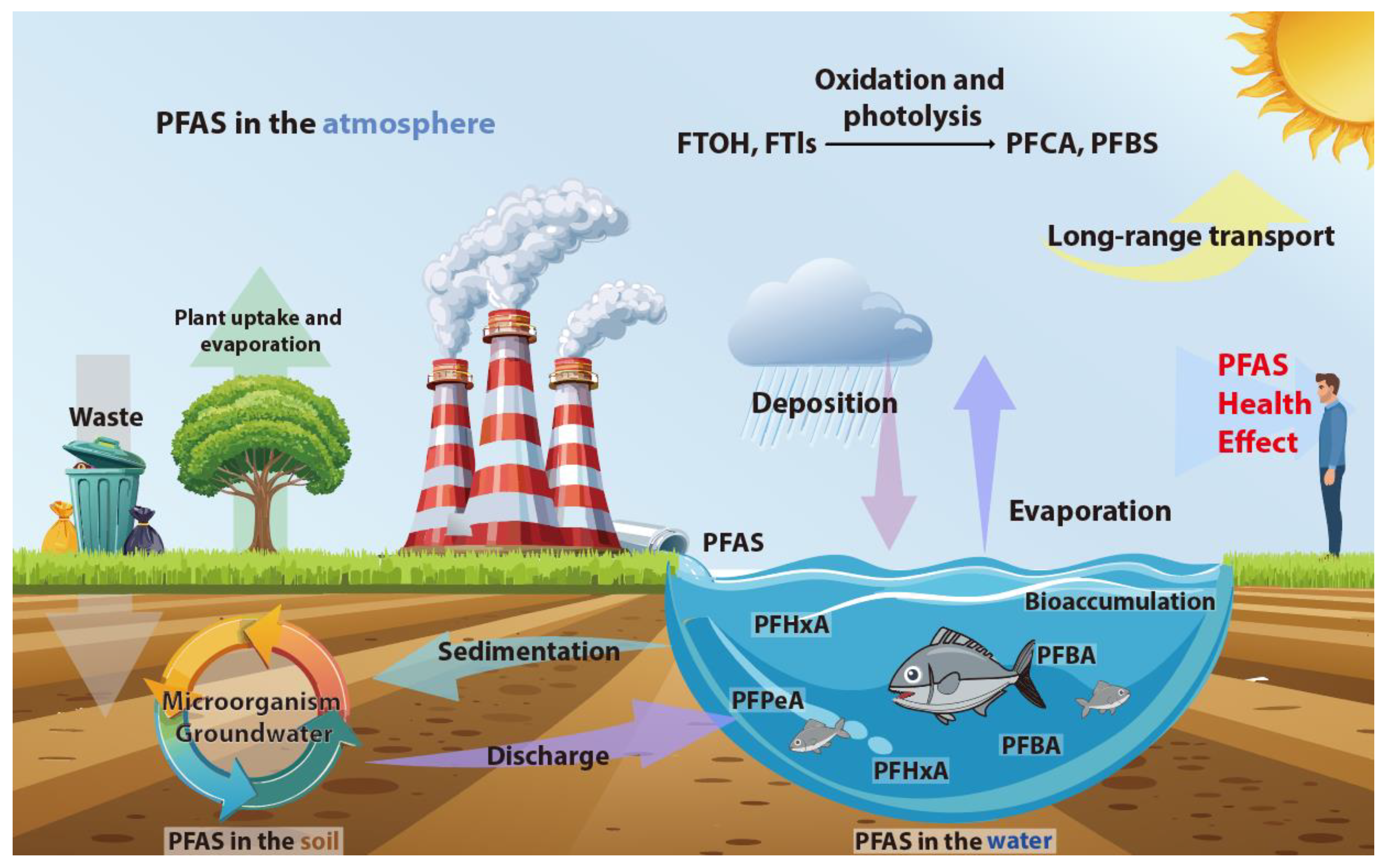
Figure 2.
Global Distribution of PFOA and PFOS Concentrations in Environmental Media ((a)Atmosphere, (b)Underground Water, (c) Drinking Water, and (d) Soil,). (References for atmosphere: [5,53,54,55,56,57,58,59,60], ground water: [61,62,63,64,65], drinking water: [66,67,68,69,70,71], soil: [72]).
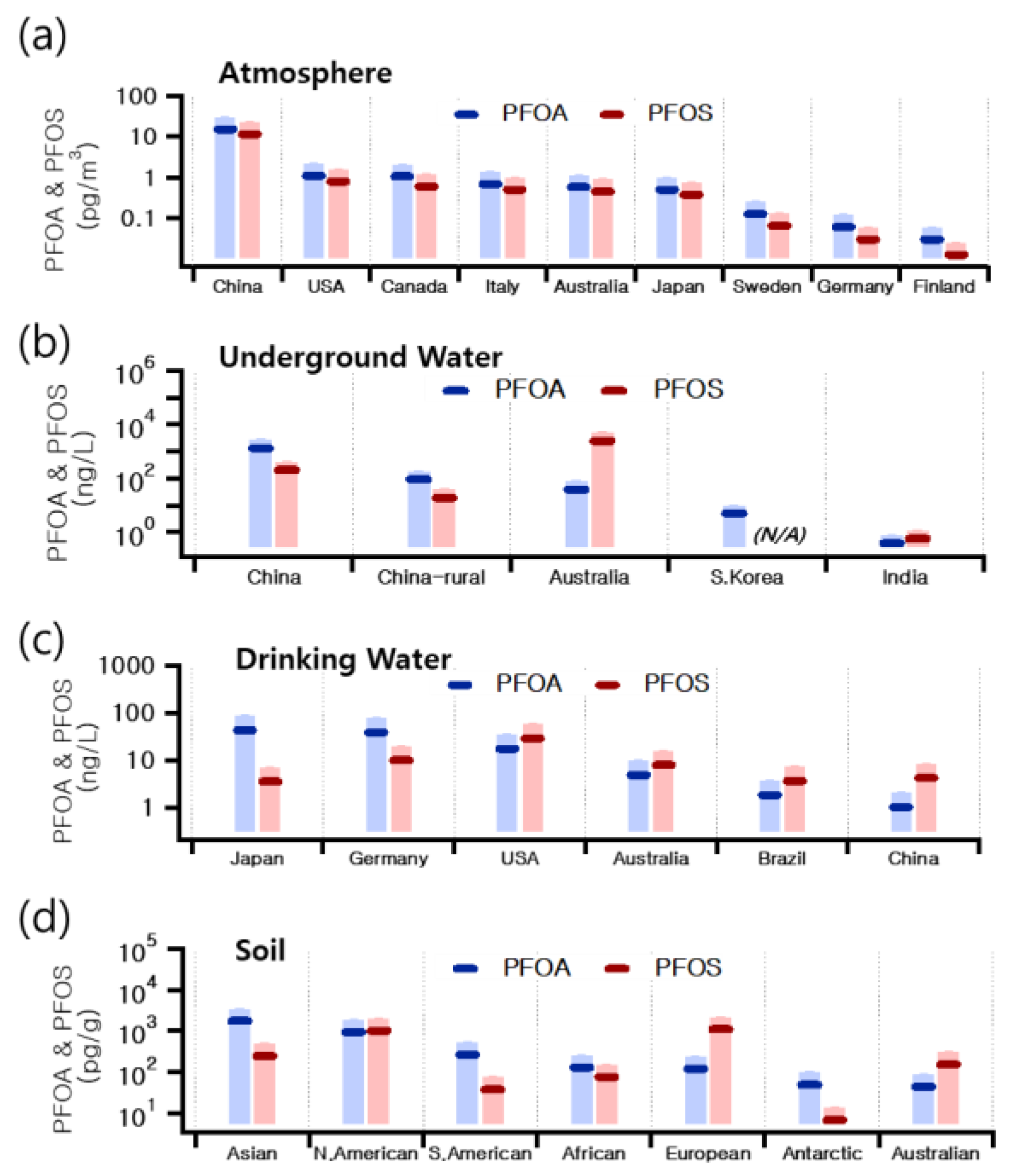

Table 1.
Evolution of PFAS Definitions Across Regulatory and Research Frameworks.
| References | Definitions |
|---|---|
| Buck et al. (2011) [6] | -Definition: PFAS are aliphatic substances where all hydrogen atoms in the carbon chain are replaced by fluorine atoms, including the "perfluoroalkyl moiety (-CnF2n+1−)." -Note: The moiety implies a fully fluorinated terminal carbon, but the textual definition does not explicitly require it. |
| OECD (2018) [13] | -Definition: PFAS are chemicals with a perfluoroalkyl moiety containing at least three carbons (–CnF2n−, n ≥ 3) or a perfluoroalkylether moiety with at least two carbons (–CnF2nOCmF2m−, n, m ≥ 1). -Note: Expanded the perfluoroalkyl moiety from Buck et al.'s "(CnF2n+1−)" to "–CnF2n–," including cases where both ends of the moiety are attached to functional groups. |
| TSCA (2020) [14] | -Definition: Any chemical substance or mixture containing the structural unit R-(CF2)-C(F)(R′)R″. -Both CF2 and CF moieties are saturated carbons, and none of the R groups (R, R′, or R″) can be hydrogen. -Application: Proposed rule for TSCA reporting and recordkeeping requirements and the 2021 Draft Drinking Water Contaminant Candidate List. |
| National Defense Authorization (2020) [15] | -Definition: Man-made chemicals with at least one fully fluorinated carbon atom. -Note: A simplified definition to encompass a broad range of PFAS. |
| OECD (2021) [1] | -Definition: Fluorinated substances containing at least one fully fluorinated methyl (–CF3) or methylene (–CF2–) carbon atom without any H/Cl/Br/I attached. -Note: Removes the requirement for entirely aliphatic structures, only requiring a minimally fully fluorinated carbon group. |
| EPA (2021) [16] | -PFASMASTER List: Initially contained over 5,000 unique PFAS, including substances without defined chemical structures, polymers, and mixtures. -PFASSTRUCT List: Structure-based definitions to clearly delineate PFAS chemical space for research and regulatory purposes. |
Table 2.
Key Research Findings on PFAS Exposure and Health Effects.
| Reference | Key Findings |
|---|---|
| Cousins et al., 2023 [21] |
Highlighted the persistence, bioaccumulation, and mobility of PFAS and stressed the need for phase-out strategies and remediation of contaminated areas. The study detailed the effects of PFAS on the immune system and liver. |
| Averill et al., 2018 [22] |
Investigated the association between PFAS exposure and cardiometabolic outcomes in adolescents exposed to the World Trade Center disaster. Found that PFAS exposure may affect lipid profiles and insulin resistance. |
| Sunderland et al., 2018 [23] | Examined the human exposure pathways and health effects of PFASs. Found that PFAS persist in the environment and can expose humans through drinking water and seafood. PFAS exposure is linked to immune suppression, metabolic disorders, and neurodevelopmental issues. |
| Rappazzo et al., 2017 [24] | Reviewed the toxicity of PFAS and their impact on human health, emphasizing links between PFAS exposure and liver dysfunction, reduced immune response, and developmental problems. |
| Grandjean et al., 2012 [25] | Reviewed the link between PFAS exposure and immune-related health outcomes in children. Found that PFAS exposure could negatively impact the immune system, including reduced antibody response to vaccines. |
| Melzer et al., 2010 [26] | Investigated the relationship between PFAS exposure and thyroid function in adults. Found that PFAS exposure may alter thyroid hormone levels. |
| Fei et al., 2007 [27] | Found that PFAS exposure during pregnancy is associated with reduced birth weight in offspring, emphasizing the potential negative effects of PFAS on fetal development. |
| Eriksen et al., 2009 [28] | Examined the association between PFAS exposure and hepatocellular carcinoma in the general population. Concluded that high PFAS exposure is linked to an increased risk of liver cancer. |
Table 3.
Analytical Techniques and Extraction Approaches for PFAS Detection Across Environmental and Food Matrices.
Table 3.
Analytical Techniques and Extraction Approaches for PFAS Detection Across Environmental and Food Matrices.
| Sample Matrix | Analytical Technique | Extraction Approach | Reference |
|---|---|---|---|
| Air and air particle | GC-MS1, GC-MS/MS2, LC-MS/MS3 | ASE10, Cold column extraction, Concentration after solvent capture, SLE11, Soxhlet extraction, SPE12 | [77,78,79,80,81,82,83,84,85,86,87,88,89] |
| Water | GC-MS/MS, LC-MS/MS, LC-HRMS4, 19F-NMR5, Nano-LC-MS6 | Automated solid phase extraction, LLE13, Micro-LLE14, Soxhlet extraction, SPE, SPME15, Turbulent flow chromatography based online extraction | [69,90,91,92,93,94,95,96,97,98,99,100,101,102,103,104,105,106] |
| Soil and sediment | Flow injection-MS/MS7, LC-HRMS, LC-MS/MS, LC-QToF-MS8 | FUSLE16, Hot vapour/Soxhelt extraction & PLE17, PLE, SLE, SPE | [107,108,109,110,111,112,113,114,115,116] |
| Foods | LC-MS/MS, LC-QqLIT-MS9 | FUSLE, IPE18, LLE, Micro-extraction, PLE, SLE, SPE | [117,118,119,120,121,122,123,124] |
| Packaging materials | GC-MS, LC-MS/MS, LC-QToF-MS | FUSLE, PLE, SLE, SPE, UPAE19, XAD extracted with EtOAc20 | [125,126,127,128,129] |
1 GC-MS - Gas Chromatography-Mass Spectrometry. 2 GC-MS/MS - Gas Chromatography-Tandem Mass Spectrometry. 3 LC-MS/MS - Liquid Chromatography-Tandem Mass Spectrometry. 4 LC-HRMS - Liquid Chromatography-High Resolution Mass Spectrometry. 5 19F-NMR - Fluorine-19 Nuclear Magnetic Resonance Spectroscopy. 6 Nano-LC-MS - Nano Liquid Chromatography-Mass Spectrometry. 7 Flow injection-MS/MS - Flow Injection-Tandem Mass Spectrometry. 8 LC-QToF-MS - Liquid Chromatography-Quadrupole Time-of-Flight Mass Spectrometry. 9 LC-QqLIT-MS - Liquid Chromatography-Quadrupole Linear Ion Trap Mass Spectrometry. 10 ASE - Accelerated Solvent Extraction. 11 SLE - Solid-Liquid Extraction. 12 SPE - Solid Phase Extraction. 13 LLE - Liquid-Liquid Extraction. 14 Micro-LLE - Micro-Liquid-Liquid Extraction. 15 SPME - Solid Phase Microextraction. 16 FUSLE - Fast Ultrasound-Assisted Solvent Extraction. 17 PLE - Pressurized Liquid Extraction. 18 IPE - Ion-Pair Extraction. 19 UPAE - Ultrasound-Phased Array Extraction. 20 XAD extracted with EtOAc - Use of XAD resin (a polymeric adsorbent) followed by elution with ethyl acetate for analyte recovery.
Disclaimer/Publisher’s Note: The statements, opinions and data contained in all publications are solely those of the individual author(s) and contributor(s) and not of MDPI and/or the editor(s). MDPI and/or the editor(s) disclaim responsibility for any injury to people or property resulting from any ideas, methods, instructions or products referred to in the content. |
© 2025 by the authors. Licensee MDPI, Basel, Switzerland. This article is an open access article distributed under the terms and conditions of the Creative Commons Attribution (CC BY) license (http://creativecommons.org/licenses/by/4.0/).
Copyright: This open access article is published under a Creative Commons CC BY 4.0 license, which permit the free download, distribution, and reuse, provided that the author and preprint are cited in any reuse.


