
Submitted:
02 July 2025
Posted:
03 July 2025
You are already at the latest version
Abstract
Municipal Solid Waste (MSW) management remains a global challenge. With landfilling generating environmental concerns and with a significant portion of waste being subjected to incineration due to limited land availability and recycling infrastructure, incineration reduces waste volume, and produces incineration residue, including ashes, which can be sources of environmental contamination, especially due to the presence of toxic metals. This review provides an overview of the current global status of MSW management, with a focus on the environmental impact of incineration and the techniques used for analysing metals in incineration residues. Analytical methods, such as Atomic Absorption Spectroscopy (AAS), Inductively Coupled Plasma Mass Spectrometry (ICP-MS), X-ray Fluorescence (XRF), and Microwave Inductive Plasma Optical Emission Spectrometry (MIP-OCP) are highlighted, along with their applications and cross-country/regional studies of metals in incineration residues. Finally, the paper also explores suitable sampling methods, mineralizatio/digestion methods and what parameters to evaluate for more efficient, cost-effective, and environmentally sustainable approaches for managing and analysing metals in incineration residues.
Keywords:
municipal solid waste (MSW)
; waste management
; incineration
; metals
; metal analysis
; analytical techniques
; incineration ash
; sustainable approaches
; contamination parameters
1.0. Introduction to Municipal Solid Waste
In general, the term “waste” encompasses materials regarded as having little or no value by producers or consumers. More specifically, solid waste (SW) refers to non-liquid discarded materials generated from human and animal activities [1,2,3]. These materials are typically solid in nature, meaning they contain minimal liquid and cannot easily flow. Solid waste is produced during various processes such as raw material extraction, manufacturing, and product consumption. A substantial portion of the solid waste generated in communities arises from agricultural and mining activities. Other significant waste types include residues from sewage treatment and power generation, which also warrant special attention. Municipal solid waste (MSW) comprises durable goods like discarded furniture and appliances, as well as nondurable goods, packaging materials, food waste, yard trimmings, and other organic materials originating from residential, commercial, institutional, and industrial sources. Waste types generally excluded from MSW include industrial waste from manufacturing, construction and demolition debris, agricultural waste, hazardous waste (e.g., oil and gas residues), and mineral waste from extraction processes [3].
Irrespective of the waste type, it is the collective responsibility of individuals, private organizations, and government entities to develop solutions that minimize waste generation, control harmful emissions from waste management, and recover materials and energy from waste streams. Waste disposal strategies must prioritize human health and minimize environmental impact. In modern society, waste management issues have become a central environmental concern, particularly in developed communities. The increased volume and complexity of waste (e.g., Tetra Pak containers replacing glass bottles) is a characteristic feature of industrialized societies.
In 2016, global solid waste production exceeded two billion tons, with at least one-third unmanaged, and projections estimate waste production will exceed 3.4 billion tons by 2050 (Kaza et al., 2018). The growing volume of goods production and consumption has led to the emergence of specialized waste categories, some of which resist biological decomposition, are toxic to ecosystems, or are combustible, corrosive, or explosive, hence, hazardous. Mismanagement of solid waste, such as the poor management of unsanitary landfills and untreated leachate ponds, remains a critical environmental issue [4,5,6]. Environmental incidents have increased public awareness of the challenges associated with waste disposal sites, underscoring the need for stricter regulations, sufficient financial resources, and a skilled workforce in waste management. One prominent example is the Love Canal disaster in the Niagara region, New York. In the 1940s, the Hooker Chemical Company stored hazardous waste in a canal site, which eventually resulted in widespread contamination and a public health crisis. The subsequent environmental damages led to the enactment of the Comprehensive Environmental Response, Compensation, and Liability Act (CERCLA), a law designed to address hazardous waste sites [7,8].
Despite the lessons from past incidents, much of the current focus is on the increasing volumes of solid waste in developing countries. For example, reports and images from Beirut (Lebanon), Naples (Italy), and Paris (France) highlight the challenges faced by municipalities in managing waste, especially in the face of protests or labor strikes in the waste management sector. Many cities are struggling with finding alternatives to landfills that have reached their capacity [9].
Waste management systems have evolved, with residents in many areas now required to separate waste into different bins for recycling. Some materials, such as garden waste, are managed by the producer rather than being collected with household waste. The costs associated with waste disposal have also risen sharply. For instance, in 2016, low-income countries spent at least $35 per ton on basic waste management, while high-income communities with advanced recycling systems faced costs of up to $100 per ton [10]. Waste management typically consumes a significant portion of municipal budgets, particularly in low-income countries, where it can account for nearly 20% of the budget [11]. Furthermore, residents' concerns regarding the proximity of waste facilities, such as landfills or incinerators, have led to public opposition. This opposition often stems from fears of potential environmental hazards, including air pollutants from incineration, leachate leakage in landfills, or bio-gas emissions. Hazardous substances like heavy metals (e.g., lead, mercury, cadmium) from solvents, paints, and pesticides remain a significant concern in the waste stream, especially from smaller-scale household and commercial producers [12]. This review highlights the current global status of MSW and provides insights into relevant available data regarding MSW incineration. Additionally, and most importantly, looking at challenges faced in finding suitable analytical methods and techniques for the analysis of trace elements in MSW and its incineration residues, the review provides researchers with suitable analytical methods, from sampling, global guideline, analytical techniques, and what parameters to evaluate regarding contamination and pollution.
1.1. Integrated Solid Waste Management (ISWM)
The rapid population growth and urbanization, coupled with economic development and rising demand for goods and services, have led to a significant increase in MSW generation, particularly in developing countries. To address these challenges, the adoption of an Integrated Solid Waste Management (ISWM) system is crucial [13]. ISWM involves a hierarchical approach that includes source reduction (both in terms of quantity and toxicity), reuse, recycling (most effective when source separation is done), recovery, and disposal (Figure 1).
The first priority in this hierarchy should be reducing waste generation, followed by reusing or recycling materials to create new products. Disposal should only be considered as a last resort. The implementation of such a system requires addressing all aspects of waste management, including waste generation, storage, collection, transfer, and transportation.
1.2. Rates of Municipal Solid Waste Generation
The rate of MSW generation is influenced by several factors, including geography, socioeconomic conditions, and the frequency of waste collection [14,15,16]. A clear understanding of how waste generation trends evolve is essential for the planning of effective collection and disposal systems. Figure 2A shows waste per capita generated by select countries. Globally, only about one-third of the 2 billion tons of MSW generated annually is collected by municipalities (Waste Atlas, 2018). The World Bank (2020) projects that by 2050, urban solid waste generation will increase to 3.4 billion tons. Currently, 70% of MSW is collected by municipalities, with 19% recycled and 11% used for energy recovery. However, about 30% of the global waste stream is still disposed of in landfills or other disposal sites. Alarmingly, approximately 3.5 billion people lack access to essential waste management services, with this number expected to grow to 5.6 billion by 2050 (Figure 2B).
Overall, there exists a positive correlation between waste generation and income levels. Projections indicate that daily per capita waste generation in high-income countries is expected to increase by 19% by 2050, while in low- and middle-income countries, the increase is anticipated to be approximately 40% or more. At lower income levels, waste generation initially decreases, but as income rises, the rate of increase in waste generation accelerates. This trend is especially pronounced in low-income regions, where incremental income changes result in a faster rate of increase in waste generation compared to high-income regions. In fact, the total volume of waste generated in low-income countries is expected to more than triple by 2050 (Figure 3A)
Regionally, East Asia and the Pacific currently generate the largest share of the world’s waste, accounting for 23% of global waste, while the Middle East and North Africa (MENA) region produces the least in absolute terms, contributing only 6%. Despite this, the fastest-growing regions in terms of waste generation are Sub-Saharan Africa, South Asia, and MENA. By 2050, the total waste generated in these regions is expected to more than triple in Sub-Saharan Africa and double in both South Asia and the MENA region. At present, more than half of the waste in these regions is disposed of through open dumping, which poses significant environmental and health risks. The rapid growth in waste generation in these regions will have profound implications for the environment, public health, and economic development, necessitating immediate and coordinated action to mitigate the risks associated with unmanaged waste. Figure 3 represents the global outlook of regional and country-wise waste generation.
Waste collection plays a pivotal role in waste management, but the rates of collection differ significantly depending on income levels. In upper-middle- and high-income countries, nearly universal waste collection services are provided. In contrast, low-income countries manage to collect only about 48% of the waste generated in urban areas, with this proportion decreasing sharply to just 26% in rural areas. Regionally, Sub-Saharan Africa collects approximately 44% of waste, while Europe, Central Asia, and North America achieve collection rates of at least 90%. These disparities in waste collection rates highlight the challenges faced by low-income countries in managing waste, which can have profound implications for public health, environmental sustainability, and urban development [3,19,20]. Figure 4 presents relationships between waste generation/collection, and income and per capita.
Waste composition varies significantly across income levels, reflecting different consumption patterns. High-income countries tend to generate relatively less food and green waste, which accounts for 32% of total waste. Instead, these countries produce a higher proportion of dry waste, including materials that are more amenable to recycling, such as plastic, paper, cardboard, metal, and glass, which together comprise 51% of the waste stream. In contrast, middle- and low-income countries generate larger proportions of food and green waste, with these organic materials making up 53% and 57% of total waste, respectively. This increase in organic waste is correlated with lower levels of economic development. In low-income countries, recyclable materials make up only about 20% of the waste stream, indicating significant challenges in waste diversion and recycling (Figure 5).
Regionally, the general composition of waste aligns with income levels. Most regions produce 50% or more organic waste on average. However, Europe, Central Asia, and North America diverge from this pattern, generating a higher percentage of dry waste materials compared to other regions. This difference underscores the varying capacity for waste management and recycling across the globe, particularly as economic development influences both consumption habits and waste diversion practices.
It is a common misconception that technology alone can solve the challenges posed by unmanaged and increasing waste. While technological advancements can play a crucial role, they are not a universal remedy. Effective solid waste management often requires a combination of factors, with technology being just one element. Countries transitioning away from open dumping and other basic waste management methods are more likely to succeed when they adopt locally appropriate and context-sensitive solutions. Currently, the global waste management landscape is characterized by a heavy reliance on landfilling and open dumping. Approximately 37% of global waste is disposed of in landfills, with 8% of this being managed in sanitary landfills equipped with landfill gas collection systems (Figure 6). Open dumping remains a prevalent method, accounting for around 31% of waste disposal. In contrast, only 19% of waste is recovered through recycling and composting, and 11% is subjected to incineration for final disposal. The practice of adequate waste disposal or treatment, such as controlled landfills or more rigorously managed facilities, is predominantly seen in high- and upper-middle-income countries. Lower-income nations, however, are more likely to rely on open dumping, with 93% of waste in these countries disposed of in this manner, compared to just 2% in high-income nations.
Three regions: the Middle East and North Africa, Sub-Saharan Africa, and South Asia account for more than half of their waste disposed of through open dumping. Upper-middle-income countries have the highest proportion of waste going to landfills, with 54% of waste sent to landfills. In high-income countries, this rate drops to 39%, where 36% of waste is diverted for recycling and composting, and 22% is incinerated. Incineration, while less common globally, is most widely used in high-income, land-constrained countries with high waste management capacities, reflecting a preference for technologies that can reduce waste volume in urbanized and densely populated areas [10,16,19]
1.3. Municipal Solid Waste: Characteristics and Composition
Although municipal solid waste (MSW) varies greatly in content and classification between towns worldwide, it generally comprises both biodegradable and non-biodegradable fractions derived from organic and inorganic components. MSW typically includes household waste, yard waste, paper and cardboard, plastic and rubber, metal, glass, electronic waste, and inert materials. The organic fraction of MSW is primarily composed of kitchen and garden waste, which are biodegradable. The most diverse type of MSW is miscellaneous garbage, which includes textiles, biological wastes (including sharps and glasses), personal hygiene products, healthcare products, cosmetics, pharmaceuticals, pet litter, leather, rubber, and polymeric residues [15,22].
Globally, organic waste (food and green waste) accounts for 44% of MSW, followed by paper and cardboard at 17%, plastic at 12%, glass at 5%, metal at 4%, wood at 2%, and other materials at 2% [23]. While MSW contains biodegradable materials, it also includes many non-biodegradable substances, which pose environmental risks if not properly managed. Plastic waste, particularly from food packaging made from synthetic polymers, can take hundreds of years to decompose, posing significant environmental challenges [24]. Improper disposal of these materials, often ending up in landfills, contributes to long-lasting environmental contamination [15,25].
The composition of municipal solid waste varies across regions, and understanding this composition is essential for managing waste efficiently and implementing sustainable recycling, composting, and energy recovery systems.
2.0. Management Municipal Solid Waste
Municipal solid waste (MSW) is managed in various ways by municipalities, towns, states, and countries. The main steps involved in managing MSW are:
- Producing waste
- Collecting, handling, and transporting waste
- Disposing of, processing, and treating waste [22]
Landfilling remains the most common method for managing MSW, despite increased efforts in recycling and the development of new waste treatment techniques. It remains a practical solution, albeit not environmentally friendly. Effective landfill design requires a thorough understanding of the geotechnical properties of the deposited MSW. Quantifying waste material characteristics can be particularly challenging due to the heterogeneous nature of MSW [26,27]. Large cities, especially in developing nations, face significant challenges in managing solid waste due to rapid urbanization, industrialization, and economic growth, which have led to substantial increases in waste generation. In many urban areas of developing countries, waste management is handled by government and municipal authorities, from collection to processing. However, many enterprises struggle to provide high-quality waste management services due to various challenges. Critical MSW components that cannot easily be recycled or composted can result in pollution, loss of aesthetic value, and financial losses. Inadequate waste management can also cause severe environmental and sanitary issues, including groundwater contamination from leachate percolation, unpleasant odors, and explosion risks in landfill zones.
In developed countries, waste management strategies generally follow the Waste Management Hierarchy model, as previously highlighted in Figure 1, which emphasizes prevention/minimization, material recovery, landfilling, and incineration. The extent to which each alternative is used depends on factors such as terrain, population density, transportation infrastructure, socioeconomics, and environmental constraints [23,28]. Techniques like anaerobic digestion, composting, and other biological treatments are being reintroduced as economically viable strategies to permanently reduce the amount of organic material in the waste stream [16].
Composting biodegradable waste plays a significant role in replenishing soil nutrients and can be used as fertilizer for farming, thus contributing to sustainable agricultural practices [24]. However, in developing countries, municipal solid waste management has deteriorated due to rapid population growth [29], increased economic activity in expanding metropolitan areas, and a lack of training in modern waste management techniques. Although these countries generate less waste per capita than developed nations, they are ill-equipped to effectively collect, process, dispose of, or recycle waste in a cost-effective manner [10,22,28].
The waste management issues faced by human settlements are similar across developing countries, though regional differences exist due to geographic, social, industrial, infrastructural, legal, and environmental factors [30,31,32]. Industrialized nations like Britain, the United States, and Canada benefit from efficient waste management systems, thanks to technological advancements and strong economic foundations. Conversely, developing nations such as Nigeria, Ghana, and Cameroon face significant challenges in waste management, even as their populations and waste generation continue to rise [33].
Effective waste management in developing countries is hindered by the absence of appropriate management plans, institutional structures, and financial resources. Additionally, the rapid growth of urban populations exacerbates the challenge of implementing effective waste management systems. City residents, particularly those near disposal sites, face significant health risks due to waste contamination of water, food sources, soil, air, and agricultural products [23,28]. MSW is typically disposed of in dumps and landfills, as this remains the most cost-effective and low-tech option. However, the decomposition of organic matter in anaerobic landfills generates greenhouse gases. Integrated solid waste management (ISWM) is widely regarded as the best approach for addressing waste disposal and environmental impacts. When executed properly, ISWM can reduce greenhouse gas emissions while providing economic benefits [34,35]. In developing countries and emerging regions with mixed economies, improving solid waste disposal methods is much more complex than in wealthier nations. Most municipal administrations in these regions lack the resources and expertise to provide adequate waste management infrastructure and services. As these nations seek to balance economic growth with environmental sustainability, collaboration between government, local authorities, and the private sector is essential for achieving effective and sustainable waste management.
2.1. Municipal Solid Waste Management in the European Union (EU): A brief overview
In 1975, the EU enacted and issued the first act that formed the basis for the waste economy, along with the introduction of Directive 74/442/EWG that elucidated the strategy of the Union in the waste economy [36,37]. Another Directive of European Parliament and the Council 2008/98/WE was introduced in 2008 which focuses on the promotion of the 3Rs concept of wastes Reuse, Recycling, and Reduction as well as waste recovery and disposal. The concept is presented in Figure 7.
2.2. Incineration as a Conventional Approach of Municipal Solid Waste Management
Several systems of managing solid wastes are hinged upon the waste hierarchy (Figure 4), with hierarchy of importance for solving waste generation problems in the order of waste minimization, recycling/reuse, treatment and disposal. For example, a review and analysis of the state of MSW management system reveal that most EU member state have less developed MSW management systems and still have significant rate of landfilling [38,39]. Among the various methods of waste management, such as traditional composting and landfilling treatments, modern, conventional incineration remains a popular, efficient, sustainable and widely used method for treating, processing, and managing municipal wastes [40]. These wastes are usually combusted in incinerators at municipal waste facilities with a number of advantages especially for non-recyclable residues [41,42,43] which are as follows:
- i.
- reduction of waste mass (up to 75%) and volume (up to 90%).
- i.
- ii. organic contaminants destruction, and inertization (solidification and stabilization) of residual waste.
- i.
- iii. utilization of the residual waste enthalpy for energy production
- i.
- iv. transfer of some residues into recyclable secondary products (e.g., phosphorus or metals recovery)
In Poland for instance, it is forbidden to incinerate waste in equipment which is not adapted to it. According to the Waste Act and the Code of Offenses, it is prohibited to burn waste in furnaces, domestic boiler rooms, and in the open air [37] as is the case in many other EU member states. To ensure the safety of human health and the environment requires incinerators to be adequately equipped for a reduction in emission of contaminated air. Therefore, to this end, countries adopt specific regulations to ensure fly and bottom ashes which are the waste products of all incineration processes possess low leachability of metals and other toxic materials [44]. Cieślik et al. [45] posits that due to economic reasons (temperature of the incineration process and the possibility of conduction autothermic process) incineration must be preceded by pre-drying to 18 – 35% dry solid and the ashes generated must be recycled or used in other ways because the ashes from first and second filters are usually different. In addition, MSW from different facilities differ from each other, and the municipal solid waste ash (MSW-BA) is often totally different. A schematic diagram of a waste incineration plant is shown in Figure 5.
From Figure 4, after storage in a waste bunker, the wastes are usually incinerated using the stoker or fluidized-bed (FB) firing to obtain the ashes. However, grate-firing furnace and rotary-kiln system are other techniques of incineration that are also exist (which are used in MSW incineration to obtain MSW-BA. Typically, at least 850oC firing temperature is used to obtain ashes but the firing temperature for MSW incineration can range from 850 – 1000 ℃, with the continuous blowing of primary air from the bottom into the bed. However, the temperature is increased to 1100 ℃ for wastes that contain more than 1% halogenated organics. Via the flue gas, the emission of volatile compounds together with other particles of dust occurs, and via multi-stage cleaning system, the flue gases are purified [46]. At the section of heat recovery, fly ashes particles enriched in metals, organic pollutants and salts are collected or removed from the flue gas by fabric filters or electrostatic precipitators [46]. The direct injection of water into the flue gas leads to wet flue gas cleaning where HCl, NH3 and HF are mainly removed (acidic scrub water) [42,44,47,48,49]. The second step involves the addition of lime for sulphur oxides (SO2, SO3) removal as sodium sulphate solution known as neutral scrub water. In this regard, bottom ash, fly ash and air pollution control (APC) residues are the three main residues that are generated from the waste incineration process [42,49,50].
2.2.1. Bottom Ash
The bottom ash constitutes about 20% of the waste input mass of incombustible solid residues that remain after waste incineration [44,47,48]. According to reports on the metal partition coefficient among the residues during combustion [50,51,52], the chemical composition of bottom ash depends on the waste input and, the partitioning of the elements that occur during incineration. High boiling point elements like Si, Ca, Al, Mg, Fe or Ti are to be almost not volatilized during the incineration process, and therefore, end up in the bottom ash [44,53] (see Table 1). Yao et al. further reported that the presence and distribution of metals in the input MSW; the physico-chemical state in the incinerator, such as temperature, content of chlorine in the waste, flue gas composition; and kinetic parameters of combustion, such as residence time, mixing condition, etc., play important roles in behaviour and distribution of metals in bottom ashes from incineration process [53].
2.2.2. Fly Ash
Fly ash makes up about 1-3% of the waste input mass with aluminosilicates, oxides, soluble salts, heavy metals, and toxic organic compounds as its primary constituents [54,55]. During incineration, chlorides forming metals such as Zn, Cd and Pb become volatile, and escape with the flue gas. Thus, for such metals, they either condense on the particles of the fly ash or are trapped by the APC system. Here, metals fractionation is dependent upon the MSW composition, the binding nature of the metals, and the incinerator’s operating conditions [55]. Higher furnace temperatures favour the transfer of metal to the fly ash; hence, the amount of dust particles increases along with increased concentration of sulphur and chlorine in the flue gas [56,57,58]. The metals concentration in fly ash is between 10 – 15% with Zn, Al, Fe, and Pb as the dominant metals (see Table 1). Morf et al., [59] also reported that the high concentration of metals like Zn, Al, Fe, Pb, and Cu in fly ash favours an economically interesting heavy metal separation and recovery (urban mining) besides the gain of avoiding deposition of such metals.
2.2.3. Air Pollution Control Residue
The APC residues constitute particulate materials trapped after reagent injection into the acid gas treatment units before effluents discharge into the atmosphere [42,59]. However, solid APC residues are obtained depending on whether dry or wet flue gas cleaning processes were installed and used. A typical liquid APC residue which can be utilized in leaching fly ash for metals removal is Scrub water derived from the cleaning of the wet flue gas, and this is due to its acidic property [60]. Information on the APC residue as a product of the incineration process is presented in Table 1.
3.0. Potential Contaminants of MSW and their Impacts on the Environment3.1. Landfills as Culprits?
3.1.1. Gases
Municipal solid waste (MSW) landfills pose a significant environmental threat primarily due to the production of landfill gas and leachate [61]. While landfills consist of many components, landfill gas is the most significant emission [25]. As waste materials break down in landfills, both through aerobic and anaerobic processes, a variety of intricate physical, chemical, and biological transformations occur, leading to the release of landfill gas and leachate [62]. The composition of landfill gas largely consists of methane (65%), carbon dioxide (35%), and a small proportion of trace organic and vapor components (1%) [63]. Methane is particularly concerning due to its flammability, with its accumulation in landfills often leading to explosions, which are a significant risk[64]. As a result, the collection and reduction of methane emissions are critical for both preventing fires and mitigating global warming [65]. The volatile compounds released from landfills, as well as the exchange of gaseous components between the landfill and the atmosphere, contribute to variations in landfill gas composition [66,67]. Volatile organic compounds (VOCs) and hydrogen sulfide (H2S) are also potential gases emitted during landfill operations, including processes like landfill mining, and should not be overlooked [68]. Due to the explosive nature of methane and the toxic effects of VOCs and H2S, these gases can have substantial negative impacts on both the environment and human health [69].
3.1.2. Metals, Minerals, Natural Inorganic Fibres and Persistent Organic Pollutants
In addition to gases, metals are commonly found in MSW, including cadmium (Cd), chromium (Cr), copper (Cu), mercury (Hg), lead (Pb), antimony (Sb), and zinc (Zn), etc. as well as inorganic salts like chlorides and sulphates [70]. These metals pose a significant toxic risk to human health and have a tendency to bioaccumulate in the environment [71]. Research suggests that heavy metal contamination in landfills could constitute as much as 51% of the total contamination, highlighting the substantial environmental harm they can cause[72]. Moreover, minerals and natural inorganic fibres found in MSW can have localized environmental and health impacts upon release. Materials such as asbestos, crystalline silica, and quartz dust are particularly harmful to human health when inhaled in high doses [69,73]. Persistent organic pollutants (POPs), a group of toxic chemicals generated by industrial processes, are also commonly disposed of in MSW landfills [74]. Examples include polybrominated diphenyl ethers (PBDEs), polybrominated biphenyls (PBBs), and polychlorinated biphenyls (PCBs). Even at extremely low concentrations, POPs pose significant threats to both the environment and human health [75]. These chemicals are known for their high resistance to chemical and biological degradation, mobility in the environment, and strong bioaccumulation in the food chain [76]. Additionally, MSW landfills provide nutrients that promote the growth of harmful microorganisms, which can be aerosolized into the atmosphere due to local meteorological conditions and various waste disposal activities. The release of bioaerosols from landfills can lead to adverse health effects for both workers and residents living near landfill sites [77].
3.2. The Focus: Metals as Components of Total Waste Composition
One of the vital and critical aspects in choosing appropriate systems for the storage and transport of waste, assessment of equipment needs, determination of the potential for resource recovery, selecting best disposal procedure, sustainable management programs and appropriate planning, is having adequate information on the waste composition. The availability of such information is expedient to establish the possible environmental impact on the ecosystem as well as on the society. Furthermore, such information on waste composition aids in identifying technical professionals for the design of waste facilities such as facilities for material recovery, facilities for composting, sanitary landfill and so on [38,78]. Today, a changeable structure of municipal waste can be observed which comprises a mixture of materials found in different amounts. It is also observed that the proportion of certain constituents alters depending on the climatic and living conditions and on the waste removal areas infrastructure [2].
Metals occur naturally in the environment (ubiquitous) – soil and food, and are utilized in the process of manufacturing [79]. Metals are also widely used in the built environment [80]. Amongst other components of wastes, metal contamination constitutes a major problem in MSW management systems [81]. It is well established that these metals are not susceptible to biodegradation, and as such, they can be precipitated easily into the soil and subsequently, leached into underground water if they are not removed or immobilized on time [82]. Metals dispersion from sources like incineration ashes into the water, soil, and air causes a considerable pollution in the environment, which, in this case, may be indirectly inimical to humans and the ecosystem in general. The entrance of metals into the environment after a prolonged leaching is a severe menace to environmental and human health [82,83,84]. Chronic exposure to these toxic metals like Cd has been reported to result to cancer, pulmonary adenocarcinomas, prostatic proliferative lesion [85,86]. From a detailed test on the morphological composition of municipal waste adopted as the most representative, there is no significant difference in the morphological composition of the EU’s MSW when compared to wastes from other members of the Organization for Economic Cooperation and Development (OECD) nations [18], and is found to be composed mainly of organic waste, small particles (0-10mm), and packaging waste as seen in Table 2; where metals constitute 2.60% in large cities, 1.50% in small cities and 2.40% in rural areas. Because these metals are nonrenewable resources, the need for their recycling for sustainable waste management becomes expedient [87]. Furthermore, given the importance of the subject of metals in MSW and its components or residues, over the years, researchers from across the globe have published reports on quantifying the significance of metals from MSW and its residues which are summarized in Table 3. It was reported that MSW contain a larger number of metals than the background values found in soil [80].
3.3. Some Global Guidelines for Sampling of MSW and Its Residues for Metal Analysis
3.3.1. Environmental Protection Agency (EPA) - United States
The U.S. Environmental Protection Agency (EPA) provides guidelines for sampling waste materials, including bottom ash, under 40 CFR 258 for landfills and 40 CFR 261 for waste classification [90,91]. The EPA emphasizes the need for random, representative sampling to ensure that the sample reflects the overall composition of the entire batch. The composite sampling method is recommended for heterogeneous materials like bottom ash, and multiple increments should be collected from different locations within the batch or pile to ensure a fair representation. EPA Method 3051A [92] and EPA Method 6010C [91] are typically used for leachate testing and metal analysis in bottom ash samples. Specific guidelines from the EPA require that for large-scale sampling, at least 30 increments must be collected to provide a reliable sample. Containers for these samples must be non-reactive and capable of preserving the integrity of the sample without contamination or degradation. Additionally, samples should be refrigerated until analysis to prevent changes in the sample that could affect the results [90].
3.3.2. EU Waste Framework Directive - European Union
The EU Waste Framework Directive and EU Decision 2000/532/EC [93] provide guidelines for the sampling and characterization of waste materials, including bottom ash. Standard EN 12457 [94] outlines procedures for leaching tests on waste materials, recommending the collection of a composite sample made up of at least five sub-samples of bottom ash. The EU Commission Decision suggests that waste incineration plants use a combination of random sampling and automatic sampling systems like conveyor belt sampling to minimize bias. For trace metal analysis and leachate testing, the EN 12457-3 protocol [95] is followed for both sample preparation and testing. According to EU guidelines, at least 5 kg of sample must be collected for comprehensive analysis, with particular focus on heavy metals and salts. Sampling frequency depends on the amount of bottom ash produced, typically occurring on a batch-by-batch basis, especially when the materials are considered for reuse.
3.3.3. The ANZECC Waste Classification Guidelines - Australia and New Zealand (ANZECC)
The Australian and New Zealand Environment and Conservation Council (ANZECC) provides guidelines for the characterization of solid waste, including bottom ash, with a focus on leaching tests and metal content analysis. The ANZECC Waste Classification Guidelines [96,97] recommend composite sampling methods for heterogeneous materials such as bottom ash. The sample must be representative of the entire batch, with increments taken from different depths and locations within the pile. The sampling interval should be defined based on the variability of the material, and for large batches, bulk sampling is required. In terms of specific guidelines, three sets of increments should be collected at regular intervals for contaminant analysis. The samples should then be homogenized and subdivided for further analysis. Containerization and preservation methods must adhere to ANZECC guidelines to ensure the samples are not contaminated during transit.
3.3.4. Canadian Environmental Protection Act (CEPA) - Canada
In Canada, guidelines for waste management and bottom ash sampling are governed by Environment Canada under the Canadian Environmental Protection Act (CEPA) and related guidelines for waste disposal [98,99]. The CEPA recommends composite sampling where increments are collected from multiple locations across the batch, ensuring the sample is representative of the entire batch. Random sampling is also encouraged for municipal solid waste and bottom ash to ensure that the sample reflects the overall composition. Specific guidelines suggest that the sample size for accurate analysis should not be less than 5 kg, with multiple composite samples taken if the batch size is large. Samples must be handled carefully to avoid contamination and should be stored at 4°C until analysis to prevent degradation or alteration of the sample.
3.3.5. National Environmental Monitoring Standards (NEMS) - China
In China, guidelines for sampling waste materials such as bottom ash are outlined under the National Environmental Monitoring Standards [100]. These standards specify that sampling should be random and representative, utilizing composite sampling from various sections of the ash pile. For large-scale industrial operations, automated systems, like stopped belt sampling, are often employed to ensure consistency and reliability in sample collection. Specific guidelines for sampling frequency suggest that it should occur on a quarterly or annual basis, depending on the volume of bottom ash generated. The guidelines also require that multiple increments be collected from various locations and depths within the pile.
3.3.6. Other Regions - Global
In other regions, including Asia and Africa, sampling guidelines for bottom ash generally align with international standards such as those set by ISO. For instance, ISO 13909 [101], which governs mechanical sampling for materials like coal and coke, is often applied in countries like India, Japan, and South Korea where bottom ash is considered a significant waste product. These standards emphasize representative sampling methods and the need for composite samples to reflect the overall composition of the waste. In Sub-Saharan Africa, guidelines typically follow EU or ISO standards for waste management and environmental protection. These guidelines ensure that sampling is done using representative techniques and appropriate analytical methods, although specific regional variations may exist based on local regulations and waste management practices.
Table 3 summarizes various standards and guidelines for the sampling of MSW and its residues for analytical evaluations.
3.4. Sampling Techniques for Ash from Municipal Waste Incineration Plants
Sampling bottom ash from municipal waste incineration plants is a critical component in assessing its environmental impact, particularly regarding leachate trace elements and its potential for reuse. Given the highly heterogeneous nature of bottom ash, careful selection of an appropriate sampling method is essential to ensure accurate and representative results. This section explores three primary sampling methods for bottom ash: mechanical sampling, stopped belt sampling, and manual sampling [102].
3.4.1. Mechanical Sampling
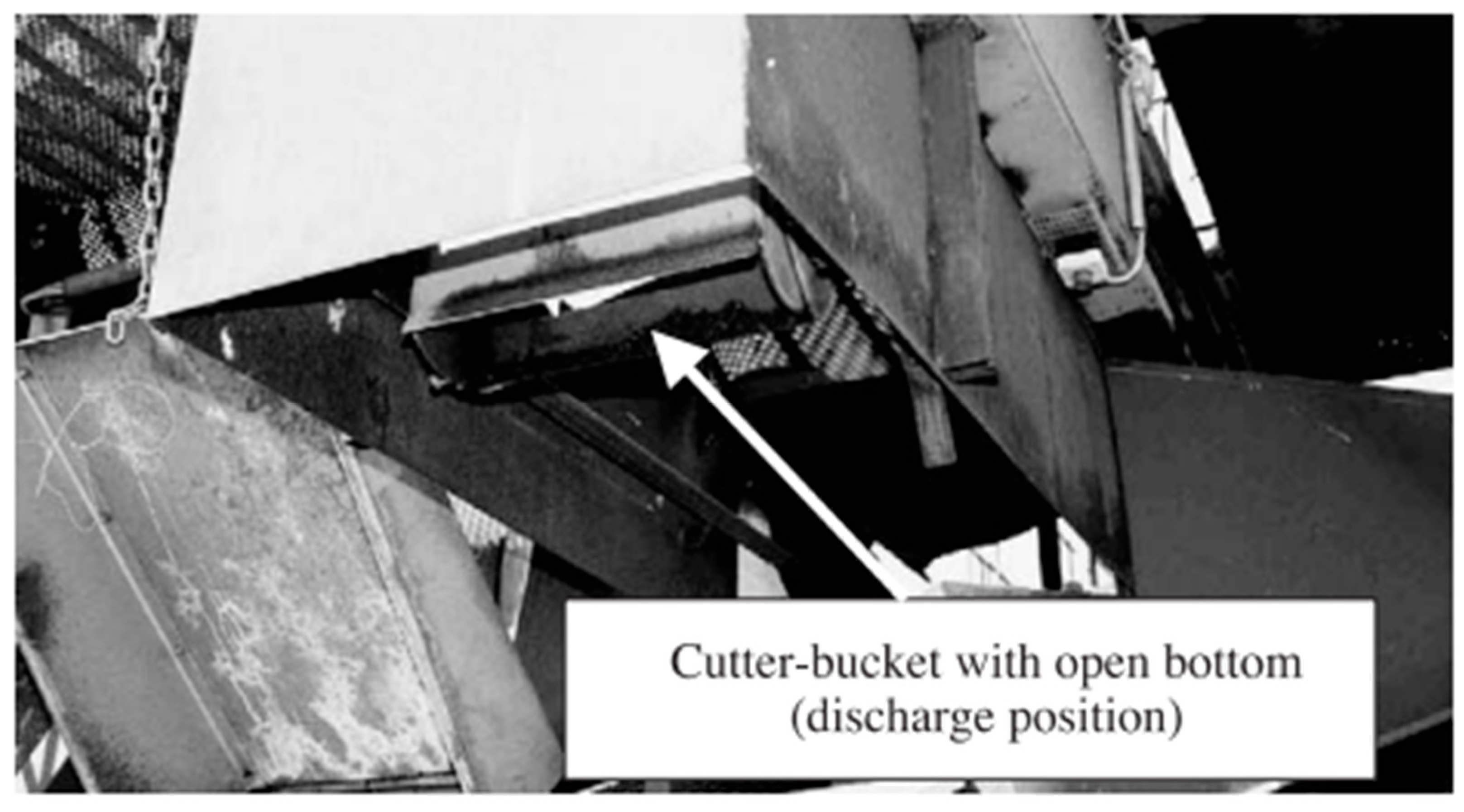
Mechanical sampling involves the use of a cutter-bucket type sampler to collect increments from a free-falling stream of bottom ash. This method ensures that each part of the batch has an equal chance of being sampled, which helps minimize sampling bias. Mechanical sampling provides a representative sample that is particularly beneficial for large-scale or continuous sampling. The method allows for the collection of large increments, making it more efficient and less prone to human error compared to manual methods. The cutter-bucket sampler operates by collecting a fixed volume of material as it falls, ensuring consistent sampling across the entire stream. This technique is recognized as the most reliable for bottom ash sampling, especially when a high level of accuracy is required [103].
Figure 1.
Mechanical Cutter-Bucket Sampler: Diagram of a mechanical cutter-bucket sampler used for collecting increments from a free-falling stream of bottom ash. Source [103] Copyright 2004 Elsevier B.V.
Figure 1.
Mechanical Cutter-Bucket Sampler: Diagram of a mechanical cutter-bucket sampler used for collecting increments from a free-falling stream of bottom ash. Source [103] Copyright 2004 Elsevier B.V.
3.4.2. Stopped Belt Sampling
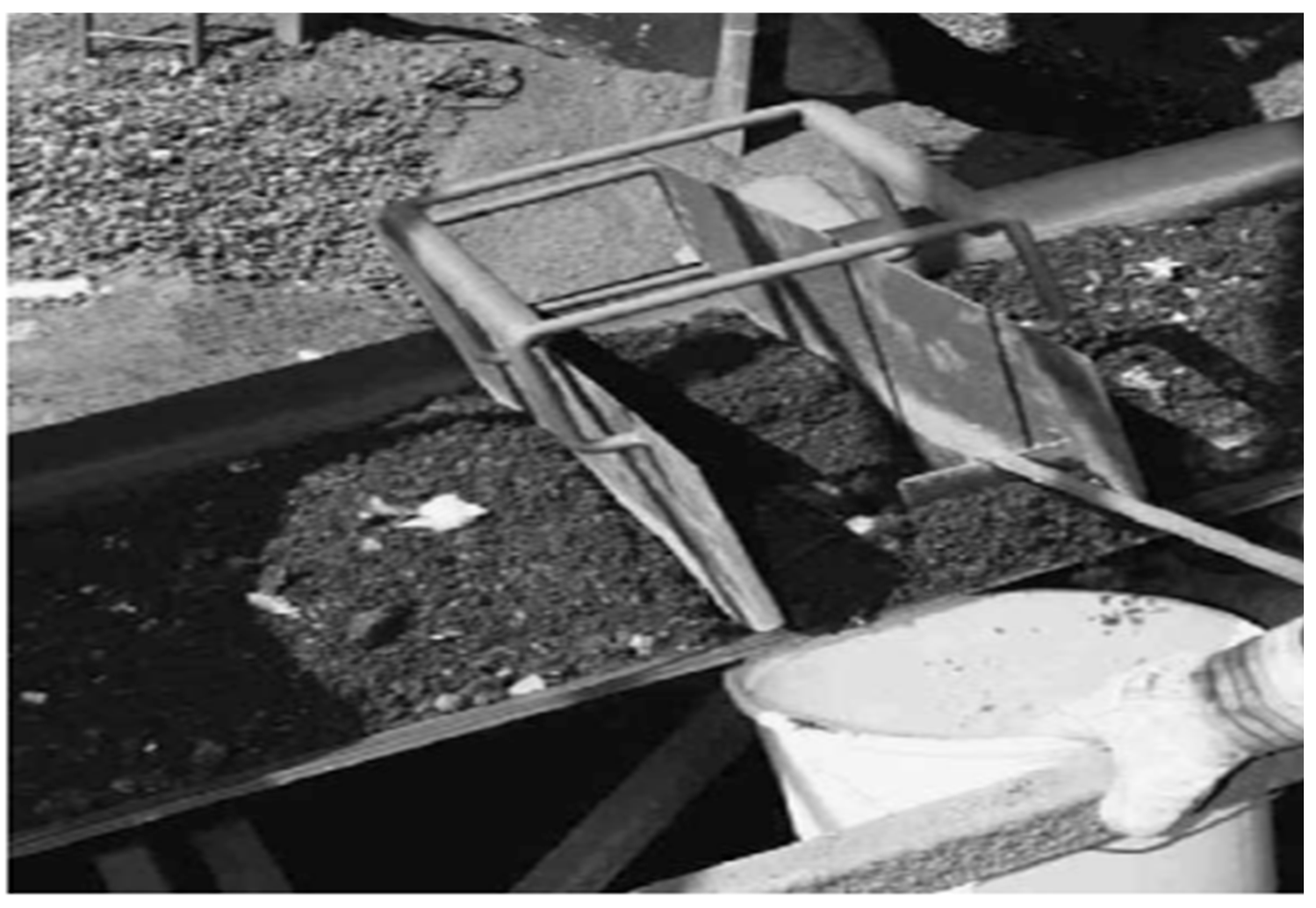
Stopped belt sampling is another highly effective method for collecting representative samples from bottom ash. In this technique, a conveyor belt is periodically stopped, and a full cut of the bottom ash is collected using a specially designed sampling frame. This method ensures that all parts of the batch are sampled, leading to highly accurate and unbiased results. Møller [103] noted that stopped belt sampling produces consistently reliable samples because it allows for comprehensive collection from a uniformly mixed batch. This technique is considered a reference method in the industry for sampling bottom ash, as it minimizes the risk of bias and provides a robust sampling framework for analytical testing.
Figure 2.
Stopped Belt Sampling Setup: Illustration of stopped belt sampling procedure where a full cut of bottom ash is collected from a conveyor belt. Source [103] Copyright 2004 Elsevier B.V.
Figure 2.
Stopped Belt Sampling Setup: Illustration of stopped belt sampling procedure where a full cut of bottom ash is collected from a conveyor belt. Source [103] Copyright 2004 Elsevier B.V.
3.4.3. Manual Sampling
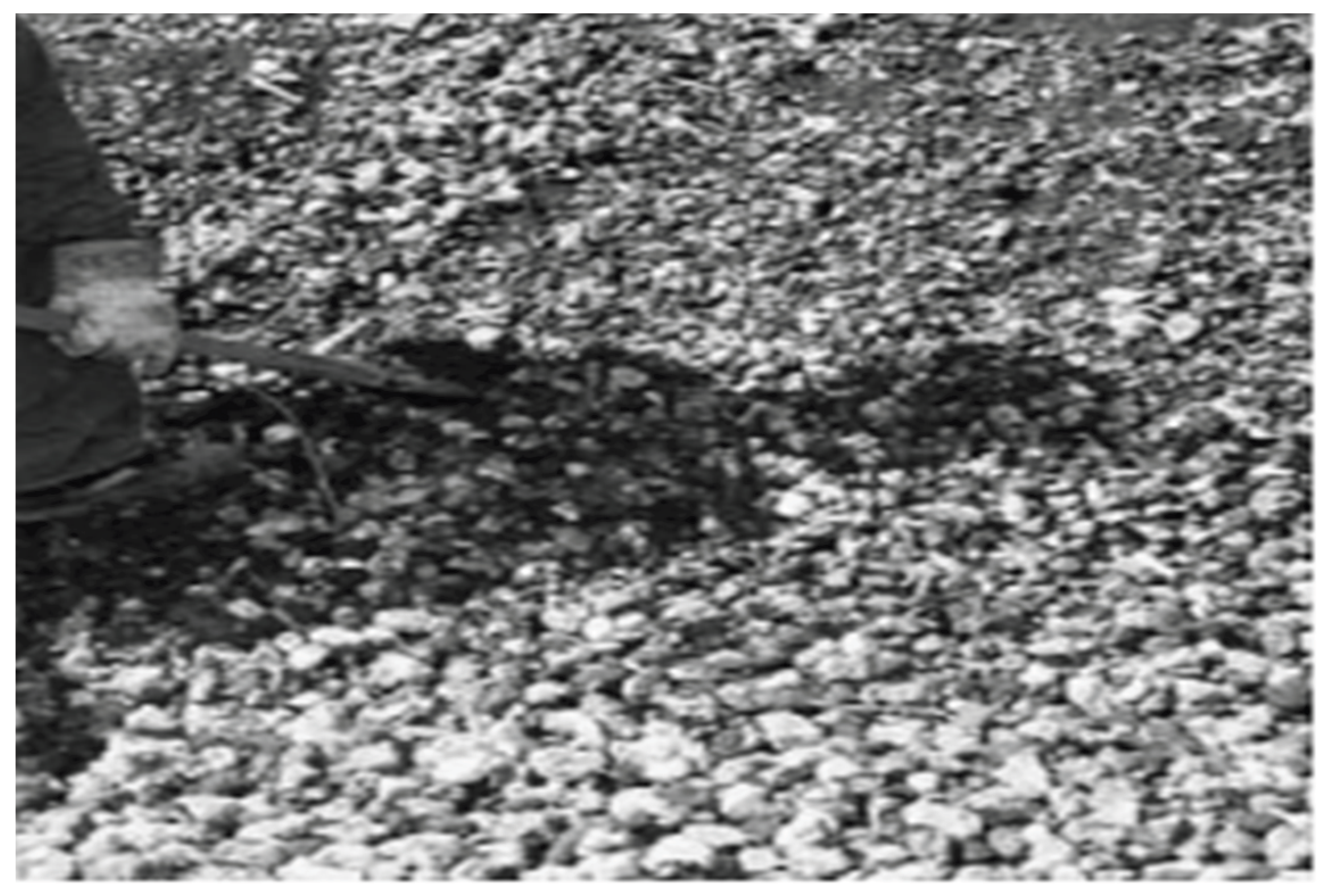
Manual sampling, also known as grab sampling, involves collecting samples directly from the surface of a stockpile or a batch of bottom ash. While this method is simple and cost-effective, it is prone to significant bias, especially in heterogeneous materials like bottom ash. It was demonstrated that manual sampling often leads to inaccurate results, particularly when particle size distribution varies within the batch. Because manual samples are typically smaller in mass (often only 2 kg) and not representative of the full batch, this technique is less reliable for precise measurements of trace metals and other important parameters. The study found that manual sampling was particularly problematic for analytes such as chromium, where variations in concentration with particle size led to biased results. Thus, manual sampling is generally not recommended for bottom ash, as it introduces a high degree of uncertainty into the final analysis [103].
Figure 3.
Manual Grab Sampling from Stockpile: Manual grab sampling technique shown, where increments are collected directly from the surface of a stockpile. Source [103]. Copyright 2004 Elsevier B.V.
Figure 3.
Manual Grab Sampling from Stockpile: Manual grab sampling technique shown, where increments are collected directly from the surface of a stockpile. Source [103]. Copyright 2004 Elsevier B.V.
The study by Møller (2004) [103] provided a direct comparison between the three methods of sampling: mechanical, stopped belt, and manual sampling. For elements such as sulphate, copper, and chromium, the mechanical and stopped belt sampling methods produced results that were closest to the true concentrations, making them the most accurate and reliable. In contrast, manual sampling introduced significant bias, particularly for chromium, where variations in concentration based on particle size led to unreliable results. The comparison underscored the importance of selecting the right sampling technique to minimize bias and uncertainty, particularly when dealing with heterogeneous materials like bottom ash.
3.4.5. Uncertainty and Error Estimation
Uncertainty in the final analytical results was primarily driven by sampling error, with sample preparation and analysis errors contributing secondary uncertainty. Møller (2004) [103] highlighted that increasing the number of increments sampled, particularly when using mechanical or stopped belt sampling methods can significantly reduce overall uncertainty. By increasing the sample size and reducing the potential for bias, these methods help to provide more accurate and reproducible results. Additionally, the study emphasized that for accurate bottom ash characterization, the sampling protocol must be carefully designed to account for potential sources of error and minimize bias, especially when manual sampling is used.
Based on the findings from the study, it is clear that mechanical and stopped belt sampling are the preferred methods for collecting bottom ash samples, as they produce representative and unbiased samples. Manual sampling should be avoided due to its inherent bias, particularly in materials where particle size distribution significantly affects analyte concentration. The study recommends that current sampling protocols, particularly in Denmark, be revised to incorporate mechanical or stopped belt sampling techniques to improve accuracy and reduce uncertainty. This is crucial for the reliable characterization of bottom ash, ensuring that the material is properly assessed for reuse and environmental impact.
4.0. Analytical Approaches for Analysis of Metals in MSW and its Residues
Recently, some studies have reported how metals in MSW can be removed especially in the ashes [58,104,105]. Acid leaching pretreatments have proven effective in facilitating the metals separation and recovery. Organic acids such as tartaric, oxalic, citric; inorganic acids such as HNO3, HCl, H2SO4; chelating agents such as Diethyleneaminepentaacetic acid (DTPA), Ethylenediaminetetraacetic acid (EDTA), Ethylenediaminedisuccinic acid (EDDS) and Nitrilotriacetic acid (NTA), citric acid (CA) and alkaline reagents such as sodium hydroxides and ammonium salts represent the groups of laxiviants that have been used in the acid leaching pretreatment process [58,104,106] . Soluble metals such as Zn and Pb are transferred from the solid phase to the liquid phase and are easily extracted and recovered after acid leaching [58,104]. However, some literature provide comprehensive procedure for the digestion/mineralization residues such as ashes from incineration processes using different acid combination. For example, the United States Environmental Protection Agency (US EPA) method 3050B describes the digestion procedure using HNO3/H2O2/HCl on hot plate. The Chinese standard GB17141–1997 was employed by Wang et al. [107] for the digestion of MSW fly ash using HCl-HNO3-HF-HClO4. As captured by Aucott et al. [108] and, USEPA SW-846 and 7471A 3051/6020 methods have been utilized for the digestion of MSW-BA with HNO3/HCl combination, the so-called aqua-regia. In their recent study, Joachim and Cieslik [15] utilized the microwave assisted digestion (MA) with aqua regia for the determination of ten (10) metals in various incineration residues including bottom ashes and fluidized beads using MIP-OES analytical technique. Stephenson in his investigation [109] highlighted a microwave-assisted (MA) digestion procedure for the determination of metals in MSW-BA samples using aqua-regia. A more recent work by Fabricius et al. [56] discussed MA digestion procedure for the determination of about 65 metals using ICP-QMS and ICP-OES techniques. In their work, aqua-regia digestion was used as “pseudo-total content” while the hydro fluoric acid (HF) digestion was employed for ‘total content’. A summary of some of the literature consulted on available methods is presented in Table 4 which aims to make the choice of analytical procedure for the determination of metals in incineration residues straightforward, quick and easy. Additionally, regional studies on the determination of metals in incineration residues have been compiled and presented in Table 5 for adoption and proper comparisons.
4.1. Parameters to Evaluate for Metal Pollution Indicators in MSW and its Residues
Pollution indicators, also known as pollution indices, are the most effective and widely used tools for assessing metal pollution in soil, sediment, and waste. These indices help determine the level of contamination and the environmental risks associated with metals in various media. A range of pollution indicators, such as geoaccumulation index (Igeo), enrichment factor (EF), pollution load index (PLI) and the potential ecological risk index (PERI) have been suggested and applied in literature [138,139,140,141,142,143,144] to assess metal contamination in MSW and its incineration residues. The mean values of the metal concentrations for each site are applied to estimate each index.
4.1.1. Degree of Contamination Index
The contamination factor (Cf) is applied to describe the contamination of a given metal in the matrice(s) of interest using equation 1.
where Cm is metal concentration in matrix and Bn is the metal background from Muller et. al., [145]. Cf is classified as: low contamination (Cf<1), moderate contamination (Cf=1–3), considerable contamination (Cf=3–6) and very high contamination when Cf value is >6. The degree of contamination, Cd, is the sum of all contamination factors for various metals and Cd is calculated as proposed by Hakanson [146] in equation 2.
4.1.2. Degree of Contamination (mCd) in Matrices Is Defined as:
where n is the number of analyzed elements (10 in the present study) and i=ith element. The mCd is classified on the basis of contamination as: very low (mCd < 1.5), low (1.5 < mCd < 2), moderate (2 < mCd < 4), high (4 < mCd < 8), very high (8 < mCd < 16), extremely high (16 < mCd < 32) and ultra-high (32 < mCd).
4.1.3. Index of Geoaccummulation (Igeo)
Geoaccummulation index (Igeo) is an assessment indicator of metals contamination in matrices as proposed by German Scientist, Muller [147]:
Bn and Cn are the background and measured concentrations of the MSW samples respectively. Igeo is classified as: Igeo≤0 unpolluted, 0–1 from unpolluted to moderately polluted, 1–2 moderately polluted, 2–3 moderately to strongly polluted, 3–4 strongly polluted, 4–5 strongly to extremely polluted and >6 extremely polluted.
4.1.4. Enrichment Factor
Enrichment factor (EF) is another pollution assessment parameter which is widely used to express the enrichment degree and metal contamination of an environmental matrix. EF normalizes the metal content with respect to a sample reference metal, such as Fe or Al, as follows [139]:
where (Mash/MAl) is the ratio of each metal and Al concentration of the matrix and (Mref /Alref) is ratio of the background sample. The ecological risks based on the EF values are categorized as: ≤ 2 (low enrichment), 2–5 (moderate enrichment), 5–20 (high enrichment), 20–40 (very high enrichment), and >40 (extreme enrichment).
4.1.5. Pollution Load Index (PLI)
The PLI is an index for assessing the contamination of environmental matrices by metals and it is defined as:
PLI = (CF1 × CF2 × CF3 × ….. × CFn)1/n
CF is the contamination factor and n is the number of metals studied (10 in the present study). PLI is classified as: PLI < 1 (no pollution, under baseline levels); PLI = 1 (baseline level pollution, minimal level expected naturally); 1 < PLI ≤ 2 (moderate pollution) and PLI > 2 (heavy pollution).
4.1.6. Potential Ecological Risk Index (PERI)
The PERI, suggested by Hakason [146] is a risk evaluates the ecological risk of metals in environmental matrices and is defined as:
where, is the contamination factor; is the potential ecological risk index of an individual metal; is the given metal toxic response factor ( 5, 2, 30, 5, 5, 1, 5, 1 and 1, for Cu, Cr, Cd, Ni, Pb, Zn, Co, Al and Mn, respectively). The PERI is the sum of potential ecological risks of each metal. For a single metal element, is classified as follows: low potential ecological risk ( < 40), moderate potential ecological risk (40 ≤ < 80), considerable potential ecological risk (80 ≤ < 160), high potential ecological risk (160 ≤ < 320), and very high ecological risk (320 ≤ . The ranges for PERI employed are: <150 - low risk (LR); 150 < PERI < 300 - moderate risk (MR); 300 < PERI < 600 - considerable risk (CR); PERI > 600 - very high risk (VHR)
4.2. Health Risk Assessment
A human health risk assessment evaluates the potential health impacts of chemical exposure, particularly from metals in contaminated environments [148]. It typically involves estimating the exposure risks associated with non-carcinogenic and carcinogenic effects [149,150]. The main exposure pathways include ingestion of contaminated soil or dust, inhalation of suspended dust particles and dermal contact with contaminated soil particles[151].The Hazard Quotient (HQ) is used to assess non-carcinogenic risk by comparing the average daily intake (ADI) to the reference dose (RfD) using equation 9.
HQ = ADI / RfD
If HQ or Hazard Index (HI) is greater than or equal to 1, adverse health effects may occur. For carcinogenic risks, the Cancer Risk (CR) and Lifetime Cancer Risk (LCR) are calculated based on daily intake and the cancer slope factor (SF) as in equation 10.
CR = ADI × SF
LCR = ΣCR
The cancer risk is considered unacceptable if LCR > 1 × 10⁻⁴, and acceptable if LCR < 1 × 10⁻⁶[152] (Wang et al. 2022).
Conclusion
The management of Municipal Solid Waste remains a global challenge. While method like landfilling has been identified as inimical to the environment, other methods like composting remains less efficient. However, incineration continues to be a prevalent solution worldwide, but it brings forth significant environmental concerns, particularly regarding the release of toxic metals into the environment via leaching and air pollution. Analytical techniques for metal analysis in incineration residues have advanced significantly, offering sensitive and accurate methods for detecting hazardous metals. However, challenges remain, particularly in terms of sample preparation, matrix interference, and ensuring consistency across different analytical methods. Proper choice of suitable sampling method and analytical techniques as well adequate evaluation of risks and contamination parameters will ensure easy process that captures the accurate state of metals in MSW incineration residue. Also, the integration of more robust and standardized analytical approaches in envisages and recommended, which could significantly improve our ability to monitor and mitigate the risks associated with incineration.
References
- Polish Ministry of Climate and Environment, National Waste Management Plan 2022: Annex to the Resolution No 88 of the Council of Ministers of 1 July 2016 (item 784), (2016).
- Waste Management, Recycling: Poland is slowly catching up, WMW (2022). https://waste-management-world.com/artikel/recycling-poland-is-slowly-catching-up/ (accessed August 22, 2022).
- World Bank Group, What a Waste: An Updated Look into the Future of Solid Waste Management, Waste Atlas (2018). https://www.worldbank.org/en/news/immersive-story/2018/09/20/what-a-waste-an-updated-look-into-the-future-of-solid-waste-management (accessed June 27, 2025).
- M. Ghaffariraad, M. Ghanbarzadeh Lak, Landfill Leachate Treatment Through Coagulation-flocculation with Lime and Bio-sorption by Walnut-shell, Environmental Management 68 (2021) 226–239. [CrossRef]
- M. Ghanbarzadeh Lak, M.R. Sabour, E. Ghafari, A. Amiri, Energy consumption and relative efficiency improvement of Photo-Fenton – Optimization by RSM for landfill leachate treatment, a case study, Waste Management 79 (2018) 58–70. [CrossRef]
- M. Ghanbarzadeh Lak, M.R. Sabour, A. Amiri, O. Rabbani, Application of quadratic regression model for Fenton treatment of municipal landfill leachate, Waste Management 32 (2012) 1895–1902. [CrossRef]
- R.C. Herdman, G.E. Haughie, L.E. Campbell, D. Axelrod, N. Vianna, W. Hennessy, J. Sachs, C. Hoffman, M. Cuddy, THE OFFICE OF PUBLIC HEALTH, 1978. https://www.health.ny.gov/environmental/investigations/love_canal/lctimbmb.htm (accessed June 27, 2025).
- C.R. Rhyner, L.J. Schwartz, R.B. Wenger, M.G. Kohrell, Waste Management and Resource Recovery, CRC Press, Boca Raton, 2017. [CrossRef]
- M. Ghanbarzadeh Lak, M. Ghaffariraad, H. Jahangirzadeh Soureh, Characteristics and Impacts of Municipal Solid Waste (MSW), in: A. Anouzla, S. Souabi (Eds.), Technical Landfills and Waste Management : Volume 1: Landfill Impacts, Characterization and Valorisation, Springer Nature Switzerland, Cham, 2024: pp. 31–92. [CrossRef]
- S. Kaze, L.C. Yao, P. Bhada Tata, F. Van Woerden, T.M.R. Martin, K.R.B. Serrona, R. Thakur, F. Pop, S. Hayashi, G. Solorzano, N.S. Alencastro Larios, R.A. Poveda Maimoni, A. Isamil, What a Waste 2.0 : A Global Snapshot of Solid Waste Management to 2050Kaza,Silpa; Yao,Lisa Congyuan; Bhada Tata,Perinaz; Van Woerden,Frank; Martin,Thierry Michel Rene; Serrona,Kevin Roy B.; Thakur,Ritu; Pop,Flaviu; Hayashi,Shiko; Solorzano,Gustavo; Alencastro Larios,Nadya Selene; Poveda Maimoni,Renan Alberto; Ismail,Anis, Washington DC, 2021. https://documents.worldbank.org/en/publication/documents-reports/documentdetail/en/697271544470229584 (accessed June 27, 2025).
- M. Zari, Characteristics and Impact Assessment of Municipal Solid Waste (MSW), in: A. Anouzla, S. Souabi (Eds.), Technical Landfills and Waste Management : Volume 1: Landfill Impacts, Characterization and Valorisation, Springer Nature Switzerland, Cham, 2024: pp. 93–113. [CrossRef]
- S. Sikder, M. Toha, Md. Mostafizur Rahman, An Overview on Municipal Solid Waste Characteristics and Its Impacts on Environment and Human Health, in: A. Anouzla, S. Souabi (Eds.), Technical Landfills and Waste Management : Volume 1: Landfill Impacts, Characterization and Valorisation, Springer Nature Switzerland, Cham, 2024: pp. 135–155. [CrossRef]
- F.Y.Y. Ling, D.S.A. Nguyen, Strategies for construction waste management in Ho Chi Minh City, Vietnam, Built Environment Project and Asset Management 3 (2013) 141–156. [CrossRef]
- M.R. Alavi Moghadam, N. Mokhtarani, B. Mokhtarani, Municipal solid waste management in Rasht City, Iran, Waste Management 29 (2009) 485–489. [CrossRef]
- J.E. Arikibe, B.M. Cieślik, Assessing Metal Distribution in Diverse Incineration Ashes: Implications for Sustainable Waste Management in Case of Different Incineration Facilities, Water Air Soil Pollut 236 (2025) 81. [CrossRef]
- Z. Gueboudji, M. Mahmoudi, K. Kadi, K. Nagaz, Characteristics and Impacts of Municipal Solid Waste (MSW): A Review, in: A. Anouzla, S. Souabi (Eds.), Technical Landfills and Waste Management : Volume 1: Landfill Impacts, Characterization and Valorisation, Springer Nature Switzerland, Cham, 2024: pp. 115–134. [CrossRef]
- Alves, Statista - The Statistics Portal, Bruna (2025). https://www.statista.com/ (accessed June 27, 2025).
- OECD, The Organisation for Economic Co-operation and Development, OECD (2025). https://www.oecd.org/en.html (accessed June 27, 2025).
- The World Bank Group, Trends in Solid Waste Management, (2025). https://datatopics.worldbank.org/what-a-waste/trends_in_solid_waste_management.html (accessed June 27, 2025).
- UNEP, ed., Beyond an age of waste: turning rubbish into a resource, UNEP, Nairobi, 2024.
- W.E.C. WEC, World energy resources-2016, 2016. https://www.worldenergy.org/assets/images/imported/2016/10/World-Energy-Resources-Full-report-2016.10.03.pdf.
- S. Nanda, F. Berruti, Municipal solid waste management and landfilling technologies: a review, Environ Chem Lett 19 (2021) 1433–1456. [CrossRef]
- K.D. Sharma, S. Jain, Municipal solid waste generation, composition, and management: the global scenario, Social Responsibility Journal 16 (2020) 917–948. [CrossRef]
- R.G. de S.M. Alfaia, A.M. Costa, J.C. Campos, Municipal solid waste in Brazil: A review, Waste Manag Res 35 (2017) 1195–1209. [CrossRef]
- S. Dack, E. Cheek, S. Morrow, D. Medlock, A. Dobney, Impacts on health of emissions from landfill sites, GOV.UK (2024). https://www.gov.uk/government/publications/landfill-sites-impact-on-health-from-emissions/impacts-on-health-of-emissions-from-landfill-sites (accessed June 27, 2025).
- B.M. Cieślik, J. Namieśnik, P. Konieczka, Review of sewage sludge management: standards, regulations and analytical methods, Journal of Cleaner Production 90 (2015) 1–15. [CrossRef]
- E. Durmusoglu, I.M. Sanchez, M.Y. Corapcioglu, Permeability and compression characteristics of municipal solid waste samples, Environ Geol 50 (2006) 773–786. [CrossRef]
- J.N. Ihedioha, P.O. Ukoha, N.R. Ekere, Ecological and human health risk assessment of heavy metal contamination in soil of a municipal solid waste dump in Uyo, Nigeria, Environ Geochem Health 39 (2017) 497–515. [CrossRef]
- US Cencus Bureau, Population Clock, Https://Www.Census.Gov/Popclock/ (2025). https://www.census.gov/popclock/ (accessed June 27, 2025).
- D. Gavrilescu, B.-C. Seto, C. Teodosiu, Sustainability analysis of packaging waste management systems: A case study in the Romanian context, Journal of Cleaner Production 422 (2023) 138578. [CrossRef]
- L. Gritsch, J. Lederer, A historical-technical analysis of packaging waste flows in Vienna, Resources, Conservation and Recycling 194 (2023) 106975. [CrossRef]
- J. Lederer, D. Schuch, The contribution of waste and bottom ash treatment to the circular economy of metal packaging: A case study from Austria, Resources, Conservation and Recycling 203 (2024) 107461. [CrossRef]
- Ahsan, M. Alamgir, M.M. El-Sergany, S. Shams, M.K. Rowshon, N.N.N. Daud, Assessment of Municipal Solid Waste Management System in a Developing Country, Chinese Journal of Engineering 2014 (2014) 561935. [CrossRef]
- F. Cucchiella, I. D’Adamo, M. Gastaldi, Strategic municipal solid waste management: A quantitative model for Italian regions, Energy Conversion and Management 77 (2014) 709–720. [CrossRef]
- A.M. Damghani, G. Savarypour, E. Zand, R. Deihimfard, Municipal solid waste management in Tehran: Current practices, opportunities and challenges, Waste Management 28 (2008) 929–934. [CrossRef]
- K. Mizerna, Determination of forms of heavy metals in bottom ash from households using sequential extraction, E3S Web Conf. 44 (2018) 00116. [CrossRef]
- J. Poluszyńska, The content of heavy metal ions in ash from waste incinerated in domestic furnaces, Archives of Environmental Protection; 2020; Vol. 46; No 2; 68-73 (2020). https://journals.pan.pl/dlibra/publication/133476/edition/116623 (accessed June 27, 2025).
- M. Alwaeli, An overview of municipal solid waste management in Poland. The current situation, problems and challenges, Environment Protection Engineering 41 (2015) 181–193. [CrossRef]
- B. Klojzy-Karczmarczyk, S. Makoudi, Analysis of municipal waste generation rate in Poland compared to selected European countries, E3S Web Conf. 19 (2017) 02025. [CrossRef]
- X. Zhao, J. Yang, N. Ning, Z. Yang, Chemical stabilization of heavy metals in municipal solid waste incineration fly ash: a review, Environ Sci Pollut Res 29 (2022) 40384–40402. [CrossRef]
- Valavanidis, N. Iliopoulos, K. Fiotakis, G. Gotsis, Metal leachability, heavy metals, polycyclic aromatic hydrocarbons and polychlorinated biphenyls in fly and bottom ashes of a medical waste incineration facility, Waste Manag Res 26 (2008) 247–255. [CrossRef]
- 42. G. Weibel, Optimized Metal Recovery from Fly Ash from Municipal Solid Waste Incineration, Inauguraldissertation der Philosophisch-naturwissenschaftlichen Fakultät der Universität Bern, Universität Bern, 2017.
- G. Weibel, U. Eggenberger, D.A. Kulik, W. Hummel, S. Schlumberger, W. Klink, M. Fisch, U.K. Mäder, Extraction of heavy metals from MSWI fly ash using hydrochloric acid and sodium chloride solution, Waste Management 76 (2018) 457–471. [CrossRef]
- S. Yao, L. Zhang, Y. Zhu, J. Wu, Z. Lu, J. Lu, Evaluation of heavy metal element detection in municipal solid waste incineration fly ash based on LIBS sensor, Waste Management 102 (2020) 492–498. [CrossRef]
- B.M. Cieślik, J. Namieśnik, P. Konieczka, Review of sewage sludge management: standards, regulations and analytical methods, Journal of Cleaner Production 90 (2015) 1–15. [CrossRef]
- J. Yu, L. Sun, J. Xiang, L. Jin, S. Hu, S. Su, J. Qiu, Physical and chemical characterization of ashes from a municipal solid waste incinerator in China, Waste Manag Res 31 (2013) 663–673. [CrossRef]
- H. Belevi, M. Langmeier, Factors Determining the Element Behavior in Municipal Solid Waste Incinerators. 2. Laboratory Experiments, Environ. Sci. Technol. 34 (2000) 2507–2512. [CrossRef]
- H. Belevi, H. Moench, Factors Determining the Element Behavior in Municipal Solid Waste Incinerators. 1. Field Studies, Environ. Sci. Technol. 34 (2000) 2501–2506. [CrossRef]
- G. Weibel, U. Eggenberger, D.A. Kulik, W. Hummel, S. Schlumberger, W. Klink, M. Fisch, U.K. Mäder, Extraction of heavy metals from MSWI fly ash using hydrochloric acid and sodium chloride solution, Waste Management 76 (2018) 457–471. [CrossRef]
- Y.-Y. Long, D.-S. Shen, H.-T. Wang, W.-J. Lu, Y. Zhao, Heavy metal source analysis in municipal solid waste (MSW): Case study on Cu and Zn, Journal of Hazardous Materials 186 (2011) 1082–1087. [CrossRef]
- V. Funari, S.N.H. Bokhari, L. Vigliotti, T. Meisel, R. Braga, The rare earth elements in municipal solid waste incinerators ash and promising tools for their prospecting, Journal of Hazardous Materials 301 (2016) 471–479. [CrossRef]
- L.S. Morf, P.H. Brunner, S. Spaun, Effect of operating conditions and input variations on the partitioning of metals in a municipal solid waste incinerator, Waste Manag Res 18 (2000) 4–15. [CrossRef]
- J. Yao, W.-B. Li, Q.-N. Kong, Y.-Y. Wu, R. He, D.-S. Shen, Content, mobility and transfer behavior of heavy metals in MSWI bottom ash in Zhejiang province, China, Fuel 89 (2010) 616–622. [CrossRef]
- M. Ajorloo, M. Ghodrat, J. Scott, V. Strezov, Heavy metals removal/stabilization from municipal solid waste incineration fly ash: a review and recent trends, J Mater Cycles Waste Manag (2022). [CrossRef]
- W. Chen, G.M. Kirkelund, P.E. Jensen, L.M. Ottosen, Comparison of different MSWI fly ash treatment processes on the thermal behavior of As, Cr, Pb and Zn in the ash, Waste Management 68 (2017) 240–251. [CrossRef]
- A.-L. Fabricius, M. Renner, M. Voss, M. Funk, A. Perfoll, F. Gehring, R. Graf, S. Fromm, L. Duester, Municipal waste incineration fly ashes: from a multi-element approach to market potential evaluation, Environ Sci Eur 32 (2020) 88. [CrossRef]
- F. Jiao, L. Zhang, Z. Dong, T. Namioka, N. Yamada, Y. Ninomiya, Study on the species of heavy metals in MSW incineration fly ash and their leaching behavior, Fuel Processing Technology 152 (2016) 108–115. [CrossRef]
- F. Liu, H.-Q. Liu, G.-X. Wei, R. Zhang, T.-T. Zeng, G.-S. Liu, J.-H. Zhou, Characteristics and Treatment Methods of Medical Waste Incinerator Fly Ash: A Review, Processes 6 (2018) 173. [CrossRef]
- L.S. Morf, R. Gloor, O. Haag, M. Haupt, S. Skutan, F.D. Lorenzo, D. Böni, Precious metals and rare earth elements in municipal solid waste – Sources and fate in a Swiss incineration plant, Waste Management 33 (2013) 634–644. [CrossRef]
- H. Zhang, P.-J. He, L.-M. Shao, Fate of heavy metals during municipal solid waste incineration in Shanghai, Journal of Hazardous Materials 156 (2008) 365–373. [CrossRef]
- Singh, M.K. Chandel, Effect of ageing on waste characteristics excavated from an Indian dumpsite and its potential valorisation, Process Safety and Environmental Protection 134 (2020) 24–35. [CrossRef]
- M. Danthurebandara, S. Van Passel, I. Vanderreydt, K. Van Acker, Assessment of environmental and economic feasibility of Enhanced Landfill Mining, Waste Manag 45 (2015) 434–447. [CrossRef]
- T. Parker, J. Dottridge, S. Kelly, INVESTIGATION OF THE COMPOSITION AND EMISSIONS OF TRACE COMPONENTS IN LANDFILL GAS, 2002.
- Y.-C. Weng, T. Fujiwara, H.J. Houng, C.-H. Sun, W.-Y. Li, Y.-W. Kuo, Management of landfill reclamation with regard to biodiversity preservation, global warming mitigation and landfill mining: experiences from the Asia–Pacific region, Journal of Cleaner Production 104 (2015) 364–373. [CrossRef]
- P. Frändegård, J. Krook, N. Svensson, M. Eklund, Resource and Climate Implications of Landfill Mining, Journal of Industrial Ecology 17 (2013) 742–755. [CrossRef]
- D. Huang, Y. Du, Q. Xu, J.H. Ko, Quantification and control of gaseous emissions from solid waste landfill surfaces, Journal of Environmental Management 302 (2022) 114001. [CrossRef]
- S.M. Monavari, S. Tajziehchi, R. Rahimi, Environmental Impacts of Solid Waste Landfills on Natural Ecosystems of Southern Caspian Sea Coastlines, JEP 04 (2013) 1453–1460. [CrossRef]
- L. Ziyang, W. Luochun, Z. Nanwen, Z. Youcai, Martial recycling from renewable landfill and associated risks: A review, Chemosphere 131 (2015) 91–103. [CrossRef]
- G.A. Dino, P. Rossetti, G. Biglia, M.L. Sapino, F.D. Mauro, H. Sarkka, F. Coulon, D. Gomes, L. Parejo-Bravo, P.Z. Aranda, A.L. Lopez, J. Lopez, E. Garamvolgyi, S. Stojanovic, A. Pizza, M.D.L. Feld, Smart ground project: a new approach to data accessibility and collection for raw materials and secondary raw materials in europe, Environ. Eng. Manag. J. 16 (2017) 1673–1684. [CrossRef]
- Assi, F. Bilo, A. Zanoletti, J. Ponti, A. Valsesia, R. La Spina, A. Zacco, E. Bontempi, Zero-waste approach in municipal solid waste incineration: Reuse of bottom ash to stabilize fly ash, Journal of Cleaner Production 245 (2020) 118779. [CrossRef]
- Singh, M.K. Chandel, Mobility and environmental fate of heavy metals in fine fraction of dumped legacy waste: Implications on reclamation and ecological risk, Journal of Environmental Management 304 (2022) 114206. [CrossRef]
- M. Abu-Daabes, H.A. Qdais, H. Alsyouri, Assessment of Heavy Metals and Organics in Municipal Solid Waste Leachates from Landfills with Different Ages in Jordan, Journal of Environmental Protection 4 (2013) 344–352. [CrossRef]
- K. Warren, A. Read, Landfill Mining: Goldmine or Minefield?, (2014). http://www.ismenvis.nic.in/Database/Landfill_Mining-Goldmine_or_Minefield_5478.aspx (accessed June 28, 2025).
- Sun, Q. Li, M. Zheng, G. Su, S. Lin, M. Wu, C. Li, Q. Wang, Y. Tao, L. Dai, Y. Qin, B. Meng, Recent advances in the removal of persistent organic pollutants (POPs) using multifunctional materials:a review, Environmental Pollution 265 (2020) 114908. [CrossRef]
- P.N. Nomngongo, J.C. Ngila, T.A.M. Msagati, B.P. Gumbi, E.I. Iwuoha, Determination of selected persistent organic pollutants in wastewater from landfill leachates, using an amperometric biosensor, Physics & Chemistry of the Earth 50–52 (2012) 252–261. [CrossRef]
- R. Weber, A. Watson, M. Forter, F. Oliaei, Review Article: Persistent organic pollutants and landfills - a review of past experiences and future challenges, Waste Manag Res 29 (2011) 107–121. [CrossRef]
- A.T. Nair, Bioaerosols in the landfill environment: an overview of microbial diversity and potential health hazards, Aerobiologia 37 (2021) 185–203. [CrossRef]
- G. Tchobanoglous, F. Kreith, Handbook of Solid Waste Management, McGraw Hill Professional, 2002.
- J. Dong, Y. Chi, Y. Tang, M. Ni, A. Nzihou, E. Weiss-Hortala, Q. Huang, Partitioning of Heavy Metals in Municipal Solid Waste Pyrolysis, Gasification, and Incineration, Energy Fuels 29 (2015) 7516–7525. [CrossRef]
- S. Smith, A critical review of the bioavailability and impacts of heavy metals in municipal solid waste composts compared to sewage sludge, Environment International 35 (2009) 142–156. [CrossRef]
- Y.-M. Li, Wang ,Chun-Feng, Wang ,Lin-Jun, Huang ,Tian-Yong, G.-Z. and Zhou, Removal of heavy metals in medical waste incineration fly ash by Na2EDTA combined with zero-valent iron and recycle of Na2EDTA: Acolumnar experiment study, Journal of the Air & Waste Management Association 70 (2020) 904–914. [CrossRef]
- Y.-M. Li, Wang ,Chun-Feng, Wang ,Lin-Jun, Huang ,Tian-Yong, G.-Z. and Zhou, Removal of heavy metals in medical waste incineration fly ash by Na2EDTA combined with zero-valent iron and recycle of Na2EDTA: Acolumnar experiment study, Journal of the Air & Waste Management Association 70 (2020) 904–914. [CrossRef]
- J.E. Arikibe, S. Prasad, Determination and comparison of selected heavy metal concentrations in seawater and sediment samples in the coastal area of Suva, Fiji, Marine Pollution Bulletin 157 (2020) 111157. [CrossRef]
- Necsulescu, L. Ionita, E. Bucur, Stationary sources emissions. Total Cd, Cr, Cu determination in exhaust gases from incinerators, Journal of Environmental Protection and Ecology 9 (2008) 1–14.
- K.-B. Li, Y. Zang, H. Wang, J. Li, G.-R. Chen, T.D. James, X.-P. He, H. Tian, Hepatoma-selective imaging of heavy metal ions using a ‘clicked’ galactosylrhodamine probe, Chem. Commun. 50 (2014) 11735–11737. [CrossRef]
- Y.H. Li, X. Peng, D.W. Li, K. Yang, The Environmental Toxicity of Heavy Metals in Municipal Solid Waste Incineration Fly Ash, Applied Mechanics and Materials 71–78 (2011) 4760–4764. [CrossRef]
- E.A. Deliyanni, G.Z. Kyzas, K.A. Matis, Various flotation techniques for metal ions removal, Journal of Molecular Liquids 225 (2017) 260–264. [CrossRef]
- den Boer, M. Sebastian, E. Kluczkiewicz, Skład sitowy i morfologiczny odpadów komunalnych. Jarocin, INSTYTUT INŻYNIERII OCHRONY ŚRODOWISKA, Wrocław, 2013. https://wcr-jarocin.pl/PLIKI/sortownia/zalacznik4.pdf?utm_source=chatgpt.com (accessed June 28, 2025).
- EUROSTAT, Waste statistics, (2024). https://ec.europa.eu/eurostat/statistics-explained/index.php?title=Waste_statistics (accessed June 29, 2025).
- US EPA, Sampling, (2020). https://www.epa.gov/hw-sw846/sampling (accessed June 28, 2025).
- N.E.M.I. NEMI, NEMI Method Summary - 6010 C, (2000). https://www.nemi.gov/methods/method_summary/4712/ (accessed June 28, 2025).
- 92. U.E.P.A. US EPA, Standard Operating Procedure 3051a Microwave Assisted Acid Digestion of Soil, (18AD).
- European Union Commission, Directive 2008/98/EC of the European Parliament and of the Council of 19 November 2008 on waste and repealing certain Directives (Text with EEA relevance), 2008. http://data.europa.eu/eli/dir/2008/98/oj/eng (accessed June 28, 2025).
- CEN, EN 12457-2:2002 - Characterisation of waste - Leaching - Compliance test for leaching of granular waste materials and sludges - Part 2: One stage batch test at a liquid to solid ratio of 10 l/kg for materials with particle size below 4 mm (without or with size reduction), iTeh Standards (n.d.). https://standards.iteh.ai/catalog/standards/cen/db6fbdf3-1de7-457c-a506-46c4898e3f09/en-12457-2-2002 (accessed June 28, 2025).
- BS, EN 12457-3:2002 - Characterisation of waste - Leaching - Compliance test for leaching of granular waste materials and sludges - Part 3: Two stage batch test at a liquid solid ratio of 2 l/kg and 8 l/kg for materials with a high solid content and with particle size below 4mm (without or with size reduction)., (2002).
- ANZECC, Waste classification guidelines. Part 1: classifying waste, (2008). https://support.esdat.net/Environmental%20Standards/australia/nsw_waste/091216classifywaste.pdf (accessed June 27, 2025).
- J. Costello, Waste - General Classifications and Principles, AUSTRALIAN ENVIRO SERVICES (2018). https://ausenvserv.wpengine.com/waste-general-classification-principles/ (accessed June 29, 2025).
- and C.C. Canada, Canadian Environmental Protection Act and hazardous waste and hazardous recyclable materials, (2009). https://www.canada.ca/en/environment-climate-change/services/canadian-environmental-protection-act-registry/general-information/fact-sheets/hazardous-waste-recyclable-materials.html (accessed June 29, 2025).
- L.S. Branch, Consolidated federal laws of Canada, Canadian Environmental Protection Act, 1999, (2025). https://laws-lois.justice.gc.ca/eng/acts/c-15.31/FullText.html (accessed June 29, 2025).
- C.N.E.M.C. CNEMC, Major Responsibilities, (1983). https://www.cnemc.cn/en/main_responsibilities/ (accessed June 29, 2025).
- I.O. for S. ISO, ISO 13909-4:2016, ISO (2016). https://www.iso.org/standard/63910.html (accessed June 29, 2025).
- K. Khodier, S.A. Viczek, A. Curtis, A. Aldrian, P. O’Leary, M. Lehner, R. Sarc, Sampling and analysis of coarsely shredded mixed commercial waste. Part I: procedure, particle size and sorting analysis, Int. J. Environ. Sci. Technol. 17 (2020) 959–972. [CrossRef]
- H. Møller, Sampling of heterogeneous bottom ash from municipal waste-incineration plants, Chemometrics and Intelligent Laboratory Systems 74 (2004) 171–176. [CrossRef]
- Y.-M. Li, C.-F. Wang, L.-J. Wang, T.-Y. Huang, G.-Z. Zhou, Removal of heavy metals in medical waste incineration fly ash by Na 2 EDTA combined with zero-valent iron and recycle of Na 2 EDTA: Acolumnar experiment study, Journal of the Air & Waste Management Association 70 (2020) 904–914. [CrossRef]
- Meer, R. Nazir, Removal techniques for heavy metals from fly ash, J Mater Cycles Waste Manag 20 (2018) 703–722. [CrossRef]
- R. Pöykiö, M. Mäkelä, G. Watkins, H. Nurmesniemi, O. Dahl, Heavy metals leaching in bottom ash and fly ash fractions from industrial-scale BFB-boiler for environmental risks assessment, Transactions of Nonferrous Metals Society of China 26 (2016) 256–264. [CrossRef]
- X. Wang, M. Gao, M. Wang, C. Wu, Q. Wang, Y. Wang, Removal of heavy metals in municipal solid waste incineration fly ash using lactic acid fermentation broth, Environ Sci Pollut Res 28 (2021) 62716–62725. [CrossRef]
- M. Aucott, A. Namboodiripad, A. Caldarelli, K. Frank, H. Gross, Estimated Quantities and Trends of Cadmium, Lead, and Mercury in US Municipal Solid Waste Based on Analysis of Incinerator Ash, Water Air Soil Pollut 206 (2010) 349–355. [CrossRef]
- Stephenson, A. Heavy Metal Analysis of Municipal Solid Waste Incinerator Ash and Slag, Palma de Mallorca, 1996, Greenpeace Research Laboratory, University of Exeter, UK, 1996.
- M. Peña-Icart, M.E. Villanueva Tagle, C. Alonso-Hernández, J. Rodríguez Hernández, M. Behar, M.S. Pomares Alfonso, Comparative study of digestion methods EPA 3050B (HNO3–H2O2–HCl) and ISO 11466.3 (aqua regia) for Cu, Ni and Pb contamination assessment in marine sediments, Marine Environmental Research 72 (2011) 60–66. [CrossRef]
- K. Zhao, Y. Hu, Y. Wang, D. Chen, Y. Feng, Speciation and Risk Assessment of Heavy Metals in Municipal Solid Waste Incineration Fly Ash during Thermal Processing, Energy Fuels 33 (2019) 10066–10077. [CrossRef]
- H.Y. Zhang, G.X. Ma, G.L. Yuan, Content Analysis of Heavy Metals in Fly Ash from One Shanghai Municipal Solid Waste Incineration (MSWI) Plant, AMR 531 (2012) 272–275. [CrossRef]
- J. Gao, T. Wang, J. Zhao, X. Hu, C. Dong, An Experimental Study on the Melting Solidification of Municipal Solid Waste Incineration Fly Ash, Sustainability 13 (2021) 535. [CrossRef]
- J. Seniunaite, S. Vasarevicius, Leaching of Copper, Lead and Zinc from Municipal Solid Waste Incineration Bottom Ash, Energy Procedia 113 (2017) 442–449. [CrossRef]
- M. Pazalja, M. Salihović, J. Sulejmanović, A. Smajović, S. Begić, S. Špirtović-Halilović, F. Sher, Heavy metals content in ashes of wood pellets and the health risk assessment related to their presence in the environment, Sci Rep 11 (2021) 17952. [CrossRef]
- L. Kuboňová, Š. Langová, B. Nowak, F. Winter, Thermal and hydrometallurgical recovery methods of heavy metals from municipal solid waste fly ash, Waste Management 33 (2013) 2322–2327. [CrossRef]
- L.S. Morf, P.H. Brunner, S. Spaun, Effect of operating conditions and input variations on the partitioning of metals in a municipal solid waste incinerator, Waste Manag Res 18 (2000) 4–15. [CrossRef]
- A.J. Pedersen, L.M. Ottosen, A. Villumsen, Electrodialytic removal of heavy metals from different fly ashes: Influence of heavy metal speciation in the ashes, Journal of Hazardous Materials 100 (2003) 65–78. [CrossRef]
- C. Riber, G.S. Fredriksen, T.H. Christensen, Heavy metal content of combustible municipal solid waste in Denmark, Waste Manag Res 23 (2005) 126–132. [CrossRef]
- K. Lin, J.-H. Kuo, C.-L. Lin, Z.-S. Liu, J. Liu, Sequential extraction for heavy metal distribution of bottom ash from fluidized bed co-combusted phosphorus-rich sludge under the agglomeration/defluidization process, Waste Manag Res 38 (2020) 122–133. [CrossRef]
- Y. Tian, R. Wang, Z. Luo, R. Wang, F. Yang, Z. Wang, J. Shu, M. Chen, Heavy Metals Removing from Municipal Solid Waste Incineration Fly Ashes by Electric Field-Enhanced Washing, Materials 13 (2020) 793. [CrossRef]
- F.-H. Wang, F. Zhang, Y.-J. Chen, J. Gao, B. Zhao, A comparative study on the heavy metal solidification/stabilization performance of four chemical solidifying agents in municipal solid waste incineration fly ash, Journal of Hazardous Materials 300 (2015) 451–458. [CrossRef]
- X. Wang, M. Gao, M. Wang, C. Wu, Q. Wang, Y. Wang, Removal of heavy metals in municipal solid waste incineration fly ash using lactic acid fermentation broth, Environ Sci Pollut Res 28 (2021) 62716–62725. [CrossRef]
- Y. Xu, Y. Chen, Leaching heavy metals in municipal solid waste incinerator fly ash with chelator/biosurfactant mixed solution, Waste Manag Res 33 (2015) 652–661. [CrossRef]
- Y. Xu, Fu ,Yu, Xia ,Wei, Zhang ,Dan, An ,Da, G. and Qian, Municipal solid waste incineration (MSWI) fly ash washing pretreatment by biochemical effluent of landfill leachate: a potential substitute for water, Environmental Technology 39 (2018) 1949–1954. [CrossRef]
- J. Zhou, S. Wu, Y. Pan, L. Zhang, Z. Cao, X. Zhang, S. Yonemochi, S. Hosono, Y. Wang, K. Oh, G. Qian, Enrichment of heavy metals in fine particles of municipal solid waste incinerator (MSWI) fly ash and associated health risk, Waste Management 43 (2015) 239–246. [CrossRef]
- H. Zhang, P.-J. He, L.-M. Shao, Fate of heavy metals during municipal solid waste incineration in Shanghai, Journal of Hazardous Materials 156 (2008) 365–373. [CrossRef]
- H. Ji, W. Huang, Z. Xing, J. Zuo, Z. Wang, K. Yang, Experimental study on removing heavy metals from the municipal solid waste incineration fly ash with the modified electrokinetic remediation device, Sci Rep 9 (2019) 8271. [CrossRef]
- M.E. Bakkali, M. Bahri, S. Gmouh, H. Jaddi, M. Bakkali, A. Laglaoui, M.E. Mzibri, Characterization of bottom ash from two hospital waste incinerators in Rabat, Morocco, Waste Manag Res 31 (2013) 1228–1236. [CrossRef]
- H. Raclavská, A. Corsaro, A. Hlavsová, D. Juchelková, O. Zajonc, The effect of moisture on the release and enrichment of heavy metals during pyrolysis of municipal solid waste, Waste Manag Res 33 (2015) 267–274. [CrossRef]
- Ilyushechkin, A.; He, C.; Hla, S.S. Characteristics of inorganic matter from Australian municipal solid waste processed under combustion and gasification conditions, Waste Manag Res 39 (2021) 928–936. [CrossRef]
- S. Esakku, K. Palanivelu, K. Joseph, Assessment of Heavy Metals in a Municipal Solid Waste Dumpsite, in: Workshop, Chennai, India, 2003: pp. 139–145.
- Łukowski, S. Fractions of Zinc, Chromium and Cobalt in Municipal Solid Waste Incineration Bottom Ash, J. Ecol. Eng. 23 (2022) 12–16. [CrossRef]
- Gworek, A.; Dmuchowski, W.; Koda, E.; Marecka, M.; Baczewska, A.H.; Brągoszewska, P.; Sieczka, A.; Osiński, P. Impact of the Municipal Solid Waste Łubna Landfill on Environmental Pollution by Heavy Metals, Water 8 (2016) 470. [CrossRef]
- V. Funari, S.N.H. Bokhari, L. Vigliotti, T. Meisel, R. Braga, The rare earth elements in municipal solid waste incinerators ash and promising tools for their prospecting, Journal of Hazardous Materials 301 (2016) 471–479. [CrossRef]
- M.A. Al-Ghouti, M. Khan, M.S. Nasser, K.A. Saad, O.O.N.E. Heng, Physiochemical characterization and systematic investigation of metals extraction from fly and bottom ashes produced from municipal solid waste, PLOS ONE 15 (2020) e0239412. [CrossRef]
- K.-Y. Chiang, Y.-H. Hu, Water washing effects on metals emission reduction during municipal solid waste incinerator (MSWI) fly ash melting process, Waste Management 30 (2010) 831–838. [CrossRef]
- J. Latosińska, P. Czapik, The Ecological Risk Assessment and the Chemical Speciation of Heavy Metals in Ash after the Incineration of Municipal Sewage Sludge, Sustainability 12 (2020) 6517. [CrossRef]
- K.C. Pancholi, P.J. Singh, K. Bhattacharyya, M. Tiwari, S.K. Sahu, T. Vincent, D.V. Udupa, C.P. Kaushik, Elemental analysis of residual ash generated during plasma incineration of cellulosic, rubber and plastic waste, Waste Manag Res 40 (2022) 665–675. [CrossRef]
- E.A. Ubuoh, P.A. Ogwo, C.S. Kanu, Analyses of Metal Cations in the Bottom Ash of Hospital Incinerator and Open Waste Burning Dumpsite in Umuahia, Abia State, Nigeria, Journal of Sustainable Agriculture and the Environment 17 (2019) 264–285.
- B. Valizadeh, M.A. Abdoli, S. Dobaradaran, R. Mahmoudkhani, Y.A. Asl, Risk control of heavy metal in waste incinerator ash by available solidification scenarios in cement production based on waste flow analysis, Sci Rep 14 (2024) 6252. [CrossRef]
- Z. Xiao, X. Yuan, L. Leng, L. Jiang, X. Chen, W. Zhibin, P. Xin, Z. Jiachao, G. Zeng, Risk assessment of heavy metals from combustion of pelletized municipal sewage sludge, Environ Sci Pollut Res 23 (2016) 3934–3942. [CrossRef]
- Z. Zhang, C. Zhao, Y. Rao, C. Yu, Z. Luo, H. Zhao, X. Wang, C. Wu, Q. Wang, Solidification/stabilization and risk assessment of heavy metals in municipal solid waste incineration fly ash: A review, Science of The Total Environment 892 (2023) 164451. [CrossRef]
- Z. Zhang, A. Li, X. Wang, L. Zhang, Stabilization/solidification of municipal solid waste incineration fly ash via co-sintering with waste-derived vitrified amorphous slag, Waste Management 56 (2016) 238–245. [CrossRef]
- J.-M. Martin, M. Meybeck, Elemental mass-balance of material carried by major world rivers, Marine Chemistry 7 (1979) 173–206. [CrossRef]
- L. Hakanson, An ecological risk index for aquatic pollution control.a sedimentological approach, Water Research 14 (1980) 975–1001. [CrossRef]
- Muller, INDEX OF GEOACCUMULATION IN SEDIMENTS OF THE RHINE RIVER, GeoJournal (1969). https://www.semanticscholar.org/paper/INDEX-OF-GEOACCUMULATION-IN-SEDIMENTS-OF-THE-RHINE-Muller/03688e2c0b4cabea9023db05e6b9a33281f0ea06 (accessed April 24, 2024).
- S. Yang, L. Sun, Y. Sun, K. Song, Q. Qin, Z. Zhu, Y. Xue, Towards an integrated health risk assessment framework of soil heavy metals pollution: Theoretical basis, conceptual model, and perspectives, Environmental Pollution 316 (2023) 120596. [CrossRef]
- X. Wang, Z. Dan, X. Cui, R. Zhang, S. Zhou, T. Wenga, B. Yan, G. Chen, Q. Zhang, L. Zhong, Contamination, ecological and health risks of trace elements in soil of landfill and geothermal sites in Tibet, Science of The Total Environment 715 (2020) 136639. [CrossRef]
- US EPA, Superfund Soil Screening Guidance, (2015). https://www.epa.gov/superfund/superfund-soil-screening-guidance (accessed June 29, 2025).
- S. Yang, J. Zhao, S.X. Chang, C. Collins, J. Xu, X. Liu, Status assessment and probabilistic health risk modeling of metals accumulation in agriculture soils across China: A synthesis, Environ Int 128 (2019) 165–174. [CrossRef]
- W. Wang, C. Chen, D. Liu, M. Wang, Q. Han, X. Zhang, X. Feng, A. Sun, P. Mao, Q. Xiong, C. Zhang, Health risk assessment of PM2.5 heavy metals in county units of northern China based on Monte Carlo simulation and APCS-MLR, Science of The Total Environment 843 (2022) 156777. [CrossRef]
Figure 1.
The waste hierarchy.
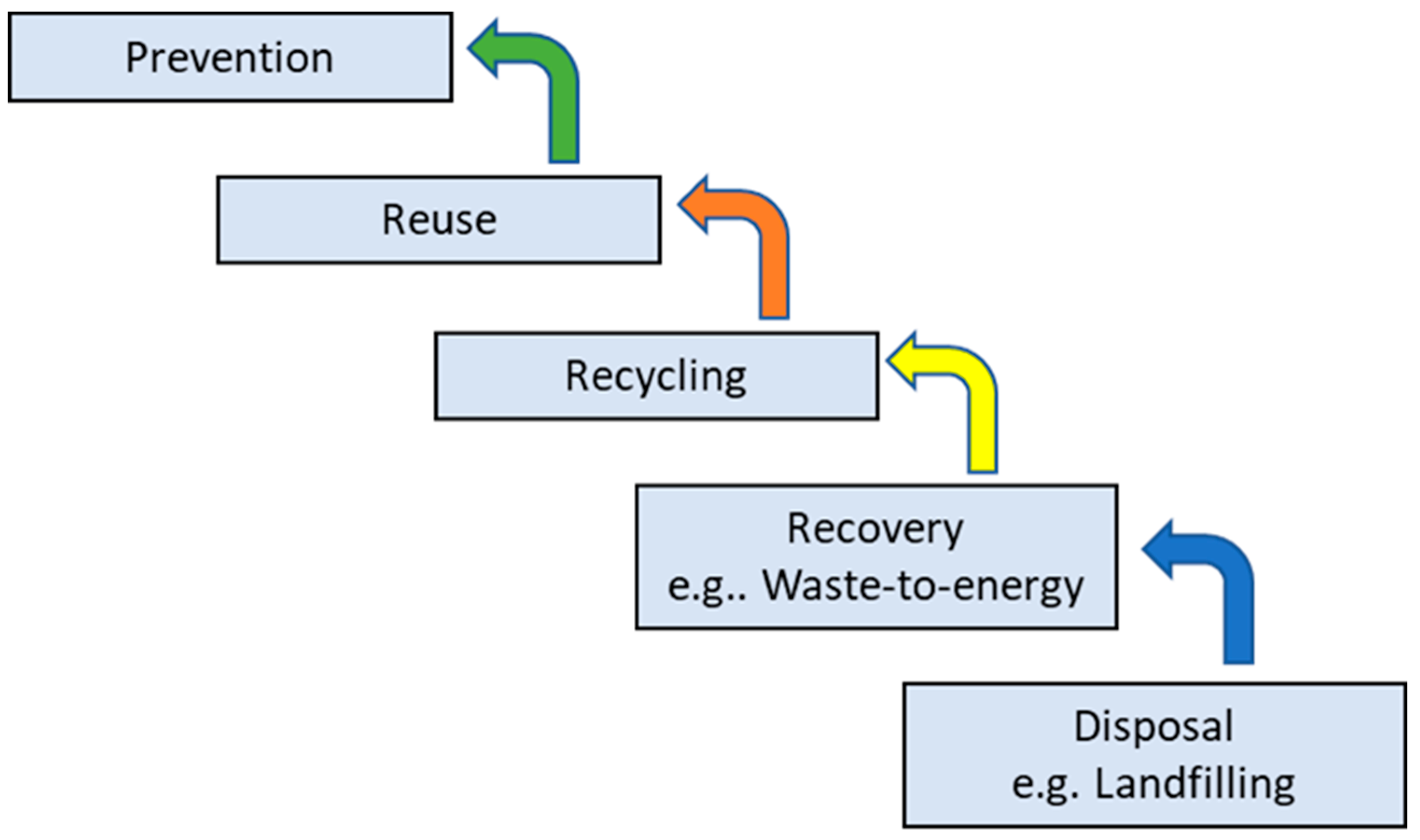
Figure 2.
(A) global municipal waste generation per capita as of 2022, by select countries (in kilograms) and (B) global municipal waste generation in 2020, and 2030 – 2050 projections (in billion metric tons). Source: [17,18,19,20].
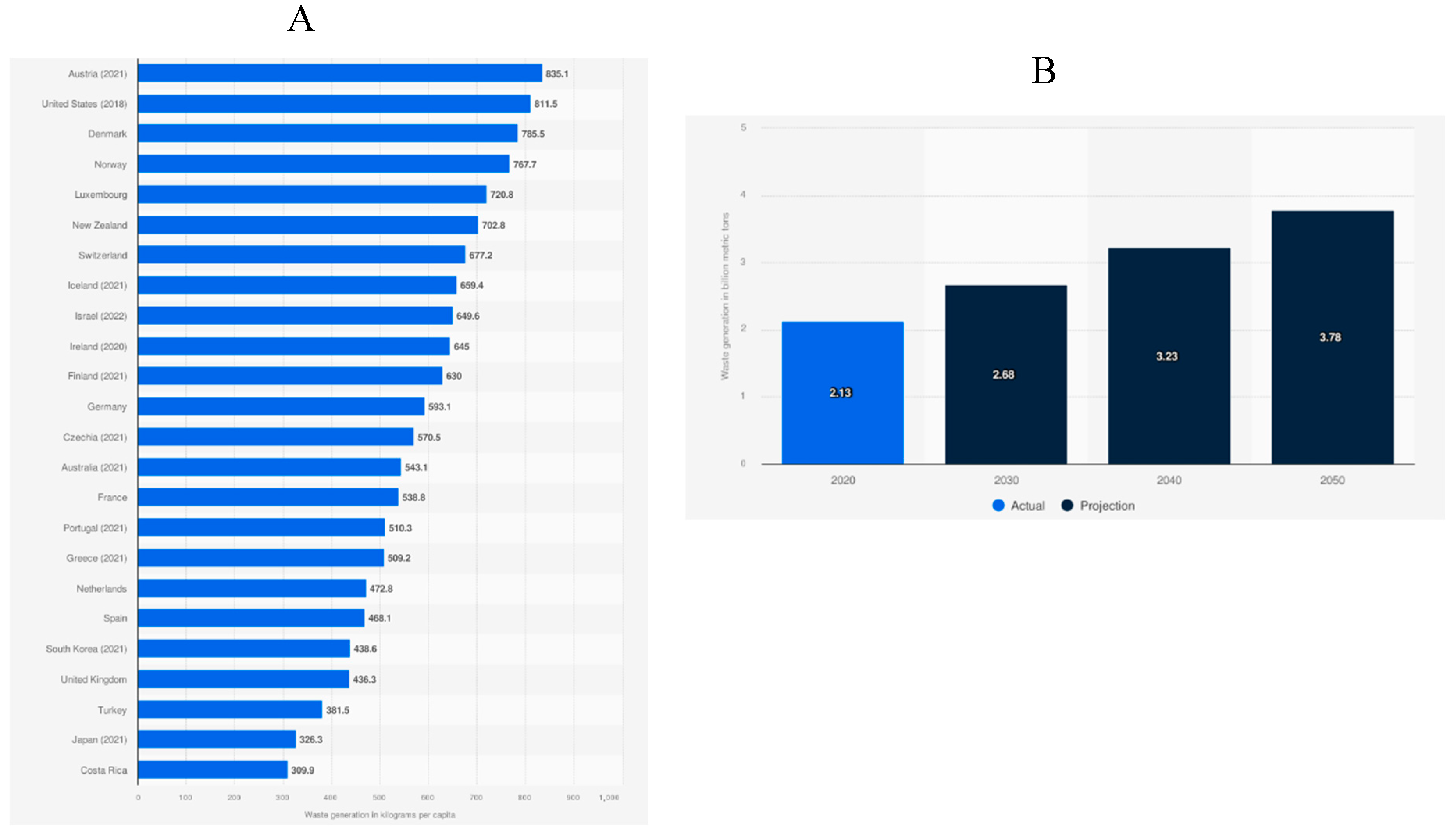
Figure 3.
Global outlook of (A) projected waste generation by region (millions of tones/year) and (B) municipal waste generation as of 2022 by select county (in million metric tons). Source [17,18,19,20].
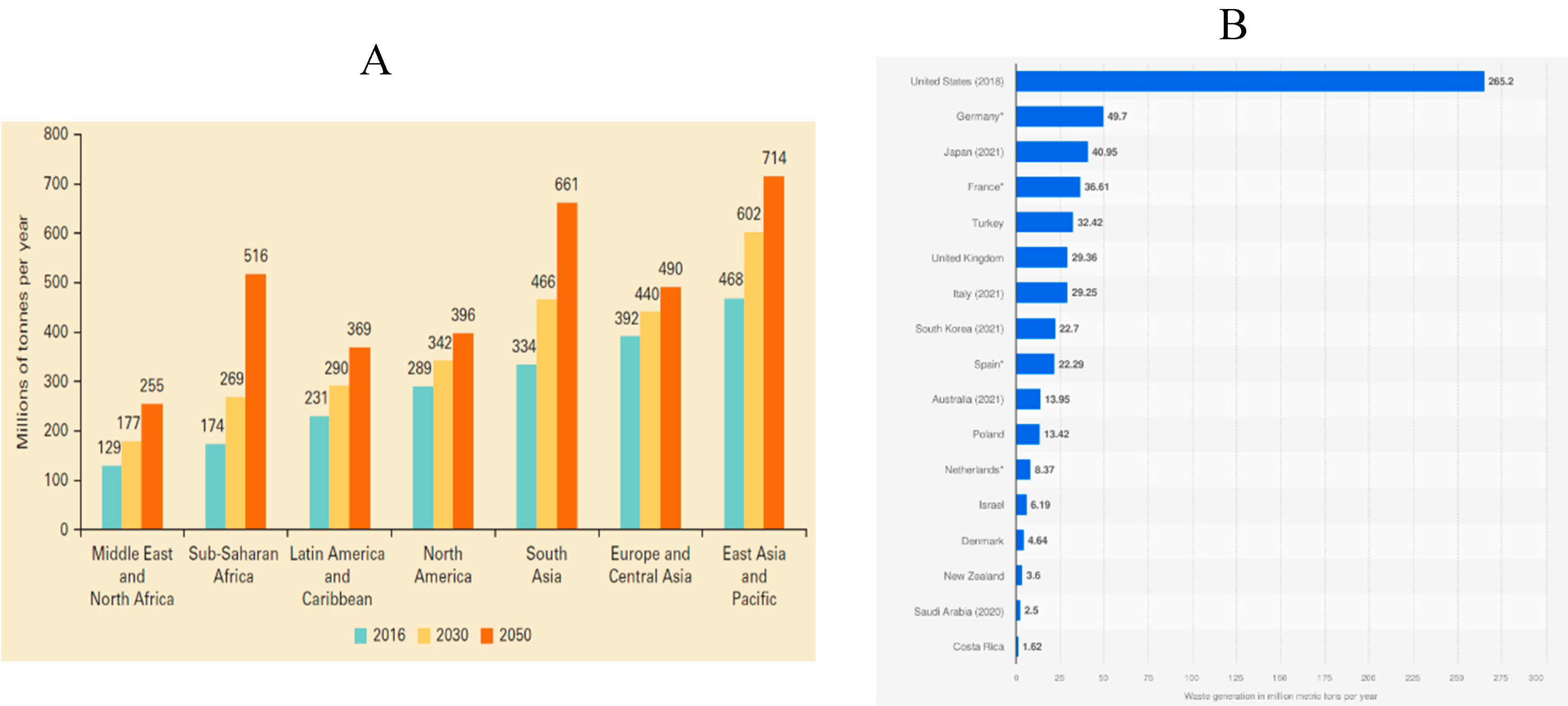
Figure 4.
(A) Waste collection rates, by income level (percent) and (B) Municipal solid waste generation per capita in 2020, and 2030 – 2050 projections, by scenario (in kilograms per day). Sources: [17,18,19,20].
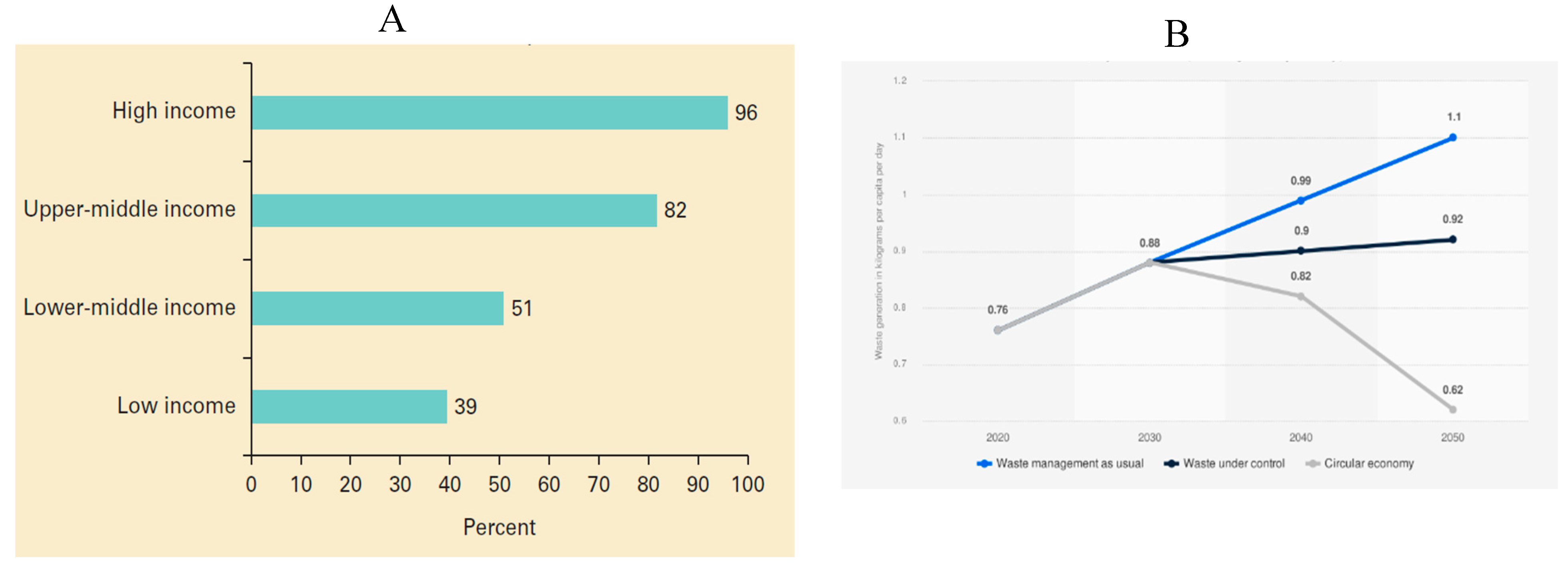
Figure 5.
(A) Global waste composition (percent) and (B) Average composition of municipal solid waste according to the regions of countries. Sources: [3,10,19,21].
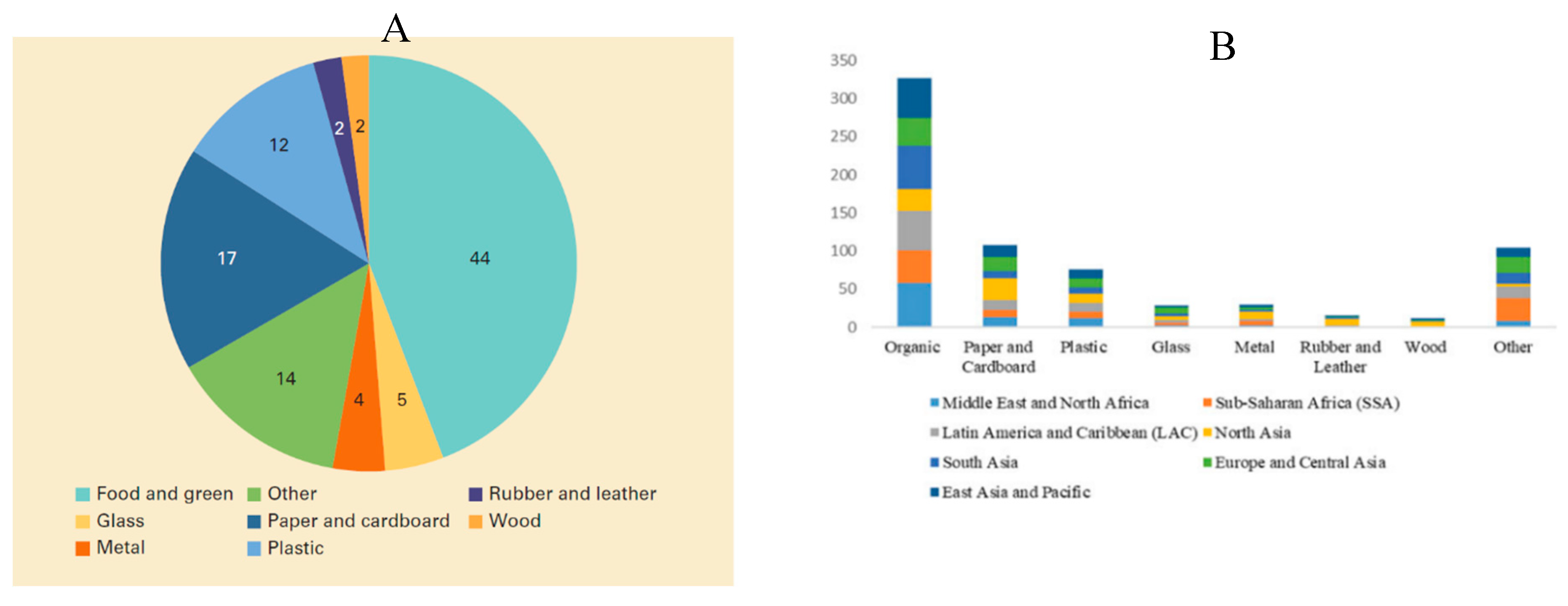
Figure 6.
Global treatment and disposal of waste (percent). Source [19].
Figure 6.
Global treatment and disposal of waste (percent). Source [19].
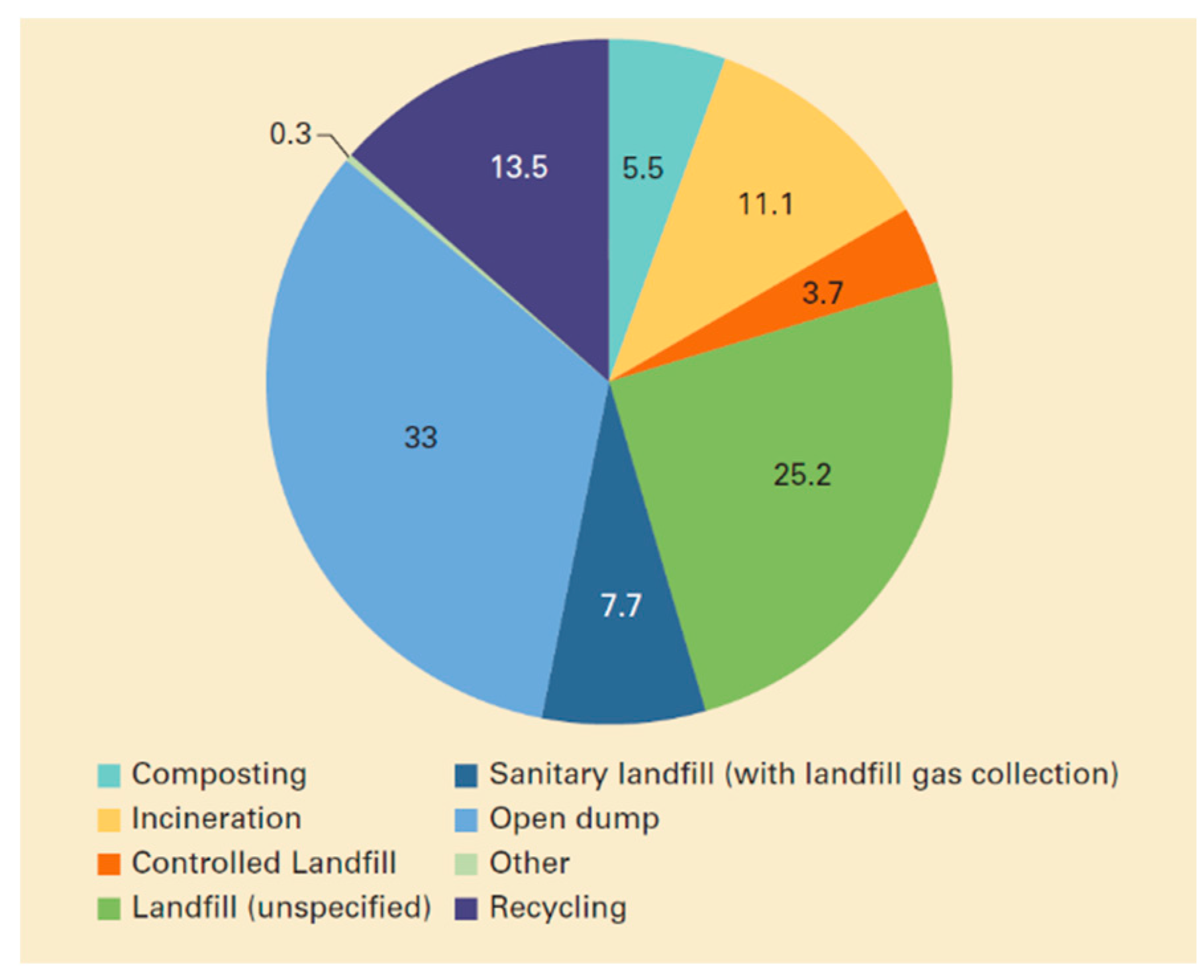
Figure 7.
3R concept of waste management.
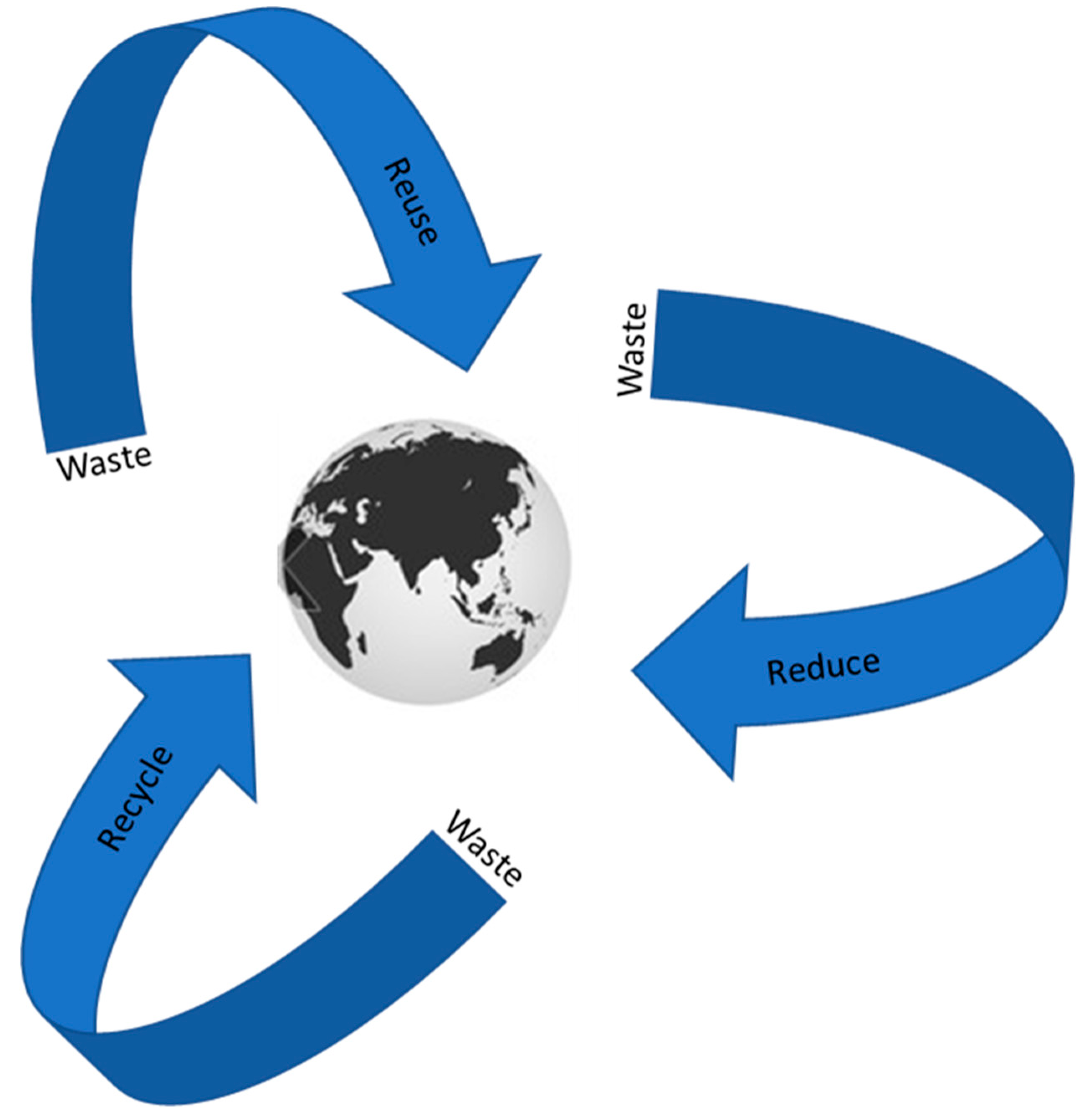
Figure 1.
Schematic diagram of municipal solid waste incinerator: 1) fluidized bed chamber; 2) cyclone; 3) heat exchanger; 4) lime; 5) active carbon 6) bag filter. Source of design concept: [46].
Figure 1.
Schematic diagram of municipal solid waste incinerator: 1) fluidized bed chamber; 2) cyclone; 3) heat exchanger; 4) lime; 5) active carbon 6) bag filter. Source of design concept: [46].
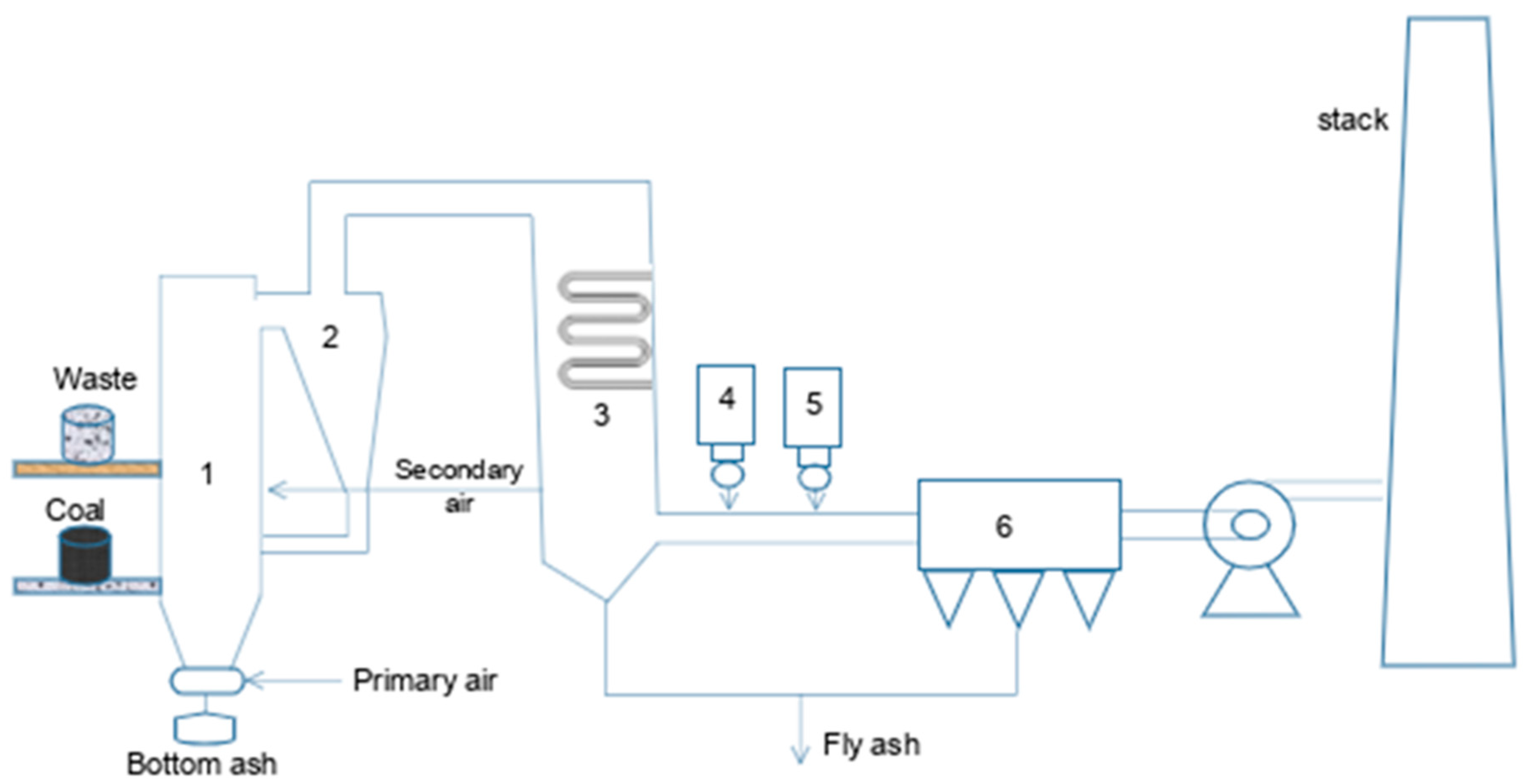

| Concentration (mg/kg) | ||||
| Element | Bottom ash | Fly ash | Dry -/semi dry APC residues | Liquid APC residues |
| Zn | 610 – 7800 | 7000 – 70000 | 7000 – 20000 | 8100 – 53000 |
| As | 0.1 – 190 | 37 – 320 | 18 – 530 | 41 – 210 |
| V | 20 – 120 | 29 – 150 | 8 – 62 | 25 – 86 |
| Ca | 370 – 123000 | 74000 – 130000 | 110000 – 350000 | 87000 – 200000 |
| Si | 91000 – 308000 | 95000 – 210000 | 36000 – 120000 | 78000 |
| Cl | 800 – 4200 | 29000 – 210000 | 62000 – 380000 | 17000 – 51000 |
| Pb | 100 – 13700 | 5300 – 26000 | 2500 – 10000 | 3300 – 22000 |
| Sb | 10 – 43 | 260 – 1100 | 300 – 1100 | 80 – 200 |
| Fe | 4100 – 150000 | 12000 – 44000 | 2600 – 71000 | 20000 – 97000 |
| S | 1000 – 5000 | 11000 – 45000 | 1400 – 25000 | 2700 – 6000 |
| K | 750 – 16000 | 22000 – 62000 | 5900 – 40000 | 810 – 8600 |
| Ni | 7 – 4200 | 60 – 260 | 19 – 710 | 20 – 310 |
| Mn | 80 - 2400 | 800 - 1900 | 200 - 900 | 5000 - 12000 |
| Na | 2800 – 42000 | 15000 – 57000 | 7600 – 29000 | 720 – 3400 |
| Al | 22000 – 73000 | 49000 – 90000 | 83000 – 120000 | 21000 – 39000 |
| Ba | 400 – 3000 | 330 – 3100 | 51 – 14000 | 55 – 1600 |
| Cd | 0.3 – 70 | 50 – 450 | 140 – 300 | 150 – 1400 |
| Cu | 190 – 8200 | 600 – 3200 | 16 – 1700 | 440 – 2400 |
| Hg | 0.02 – 8.00 | 0.7 – 30 | 0.1 – 51 | 80 – 560 |
| Cr | 23 – 3200 | 140 – 1100 | 73 – 570 | 80 – 560 |
| Mo | 2 – 280 | 15 – 150 | 9 – 29 | 2 – 44 |
| Mg | 400 – 26000 | 11000 – 19000 | 5100 – 14000 | 19000 – 170000 |
Table 2.
Different components of MSW composition [%] in Poland as representative of the EU and OECD nations [1,2,88,89].
| Components | Big Citya | Small Cityb | Rural area | Average |
| Organic waste (%) | 34.20 | 42 | 35.60 | 37.27 |
| Paper and cardboard (%) | 19.10 | 9.7 | 5 | 11.27 |
| Wood (%) | 0.20 | 0.30 | 0.70 | 0.40 |
| Multilayer packages (%) | 2.5 | 2.6 | 1.3 | 2.13 |
| Plastics (%) | 15.10 | 11 | 10.20 | 12.13 |
| Glass (%) | 10 | 10.20 | 10 | 10.07 |
| Metals (%) | 2.6 | 1.5 | 2.40 | 2.17 |
| Textiles (%) | 2.3 | 4 | 2.1 | 2.80 |
| Hazardous (%) | 0.80 | 0.6 | 0.8 | 0.73 |
| Minerals (%) | 3.2 | 2.8 | 6 | 4.00 |
| Bulky (%) | 2.5 | 4 | 4.10 | 3.53 |
| <10 mm fraction (%) | 4.2 | 6.8 | 16.90 | 9.30 |
| Otherc (%) | 3.2 | 4.5 | 4.9 | 4.20 |
aMore than 50 thousand citizens. bLess than 50 thousand citizens. cRefers to any unknown or hardly classified material in solid waste.
Table 3.
MSW Sampling Guidelines by Regions.
| Region | Key Guidelines | Sampling Method | Sample Size | Frequency | Notes |
| EPA (USA) | 40 CFR 258, 261 | Composite, Random | 5-10 kg | Batch-by-batch | Leachate and trace metals |
| EU | EN 12457, Commission Decision | Composite, Automatic | 5 kg | Batch-by-batch | Focus on leachate testing |
| Australia & New Zealand | ANZECC Guidelines | Composite, Random | 5-10 kg | Batch-by-batch | Focus on contaminants |
| Canada | CEPA Guidelines | Composite, Random | 5-10 kg | Quarterly/Annually | Preservation at 4°C |
| China/Asia | GB 3433-2008 | Composite, Automated | 5-10 kg | Quarterly/Annually | Focus on industrial operations |
Table 4.
Metals, digestion procedures, standard analytical method, analytical techniques obtained from the literature studies for the determination of metals in municipal solid waste ash.
Table 4.
Metals, digestion procedures, standard analytical method, analytical techniques obtained from the literature studies for the determination of metals in municipal solid waste ash.
| Metals | Matrix/samples | Acid combination | Method description | Source | Ref | comment |
| Cd, Cr, Pb, Cu, Zn, and Ni | MSW Fly ash | HNO3/H2O2/HCl | Digestion on hot plate Temp. not stated |
EPA 3050B | [110,111] | May be suitable |
| Ni, Zn, Cd, Pb and Cu | MSW Fly ash | HNO3/HCl | Not stated | [112] | May be suitable | |
| Pb, Cd, Zn, Cu | MSW Fly ash | HCl-HNO3-HF-HClO4 | 0.1g sample used | Chinese standard GB17141–1997 | [113] | May not be suitable due to the presence of HF |
| Cu, Pb and Zn | MSW Bottom ash | HNO3 | Pre-treatment before determination | ISO 15586:2003 | [114] | May be suitable |
| f Cd, Co, Cr, Cu, Fe, Mn, Ni, Pb, and Zn | Wood pellet ashes | 65% HNO3 | Sample + 25 mL of 65% HNO3 in PTFE vessels. Close vessel after NOs + react for 14 h at 80 °C, cool to 20 or 25 oC | [115] | May be suitbale | |
| Hg, Pb and Cd | MSW ash | HNO3/HCl | AAS for Hg, ICP-MS for Pb and Cd | USEPA SW-846 Method 7471A; USEPA Method 3051/6020 | [108] | May be suitable |
| Mn, Cr, Zn, Cu, Pb, Ni, Co, Cd | MSW ash and slag | HNO3/HCl | MA-digestion ICP-AES | [109] | Suitable | |
|
M1: Al, Ca, Cu, Fe, K, Mg, Mn, Na, P, Pb, S, Sb, Si, Sn, Zn M2: Ag, As, Cd, Co, Cr, Mo, Ni, Se, Tl, U, V |
MSW fly ash | HNO3/HCl | MA-digestion; ICP-OES for M1 and ICP-QMS for M2 |
[56] | Suitable | |
| Zn, Mn, Ni, Co, Fe, Cr, Al, Cu, and Pb | MSW ash and fluidized beads | HNO3/HCl | MIP-OES | [15] | Suitable |
n.a. = not available.
Table 5.
A compilation of some literature dedicated to analysis of metals in municipal solid wastes and its constituents from different location across the globe.
Table 5.
A compilation of some literature dedicated to analysis of metals in municipal solid wastes and its constituents from different location across the globe.
| Country/location | Metals investigated | Analytical technique used | Reference |
| Switzerland | Pb, Cu, Cd, Ca, Al, Fe, Sb and Zn | XRF, ICP-OES, ICP-MS | [42,43] |
| Austria | Zn, Cu, Cd, and Pb | ICP-OES | [116,117] |
| Denmark |
Zn, Cu, Cd, Ni, As, Hg and Pb Cd, Pb, Zn, Cu, Cr |
FAAS |
[55,118,119] |
| Greece | Ba, Mn, Pb, Cr, Cd, Cu, Zn, Ni, Na, Ca, Mg, Fe, K, Al | ICP-OES | [41] |
| China | Pb, Cd, Zn, Cu, Mn, Cd, Pb, Cr As, Cr, Pb, Zn Cd, Pb, Zn, Cu, Cr, Ni Cu, Zn, Ni Ca, K, Na, Al, Zn, Pb, Cr, Cu Cu, Zn Pb, Cu, Zn, Cd, Cr, Ni, As, Ba Zn, Cu, Ni, Pb, Cr, Cd Cu, Cd, Pb, Zn, Cr Cu, Zn, Cd, Cr, Hg, Ni, As, Pb Ca, Pb, Zn, Cu, Ni, Cd, Cr Zn, Cu, Pb, Cd, Cr, Fe, Mn Cd, Cr, Cu, Ni, Pb, Zn, Ca, Na, K, Pb, Zn, Cd, Cr, Cu, Mn, Cu, Pb, Zn, Cd, Ni |
ICP-MS FAAS ICP-OES ICP-MS ICP-OES XRF FAAS ICP-OES XRF ICP-MS AAS, XRF ICP-OES ICP-MS ASS XRF ICP-M |
[46] [120] [55] [79] [86] [50] [121] [122] [123] [124] [125] [126] [127] [128] [81] |
| Morocco | As, Cd, Cr, Ni, Pb, Sn, Zn | XRF | [129] |
| Czech Republic | As, Cd, Cr, Hg, Ni, Pb, V | ICP-OES | [130] |
| Australia | As, Se, Hg, Cr, Cu, Ni, Zn, Cd, Ag, Co, Sn | ICP-OES, ICP-MS | [131] |
| India | As, Hg, Cr, Cd, Cu, Pb, Ni, Zn | F-AAS (hydride generation for As and Hg by cold vapour techniques, respectively | [132] |
| Poland (Biatystock) | Zn, Cr, Co Mn, Cu, Mo, Zn, Cd, Ti, Cr, Co, Ni, As, Sn, Pb, Sb, V Cd, Pb, Cr, Cu, Zn |
F-AAS ICP-MS ICP-OES |
[133] [37] [134] |
| Italy | Mn, Fe, Cu, Ba, Sn, Zn Pb, Ti | ICP-MS | [135] |
| Japan | Cd, Cu, Zn, Pb, Cr | ICP-OES | [57] |
| Qatar | Al, As, Ba, Ca, Cd, Co, Cr, Cu, Fe, K, Mg, Mn, Na, Ni, Pb, Zn, Mg | ICP-OES | [136] |
| Austria | Cd, Cr, Cu, Ni, Pb, Zn, Al, Ca, Fe, K, Mg, Na | ICP-OES | [116] |
| Taiwan | Cu, Cr, Zn, Al, Na, K, Ca, Mg, Pb, Cd | ICP-OES | [137] |
Disclaimer/Publisher’s Note: The statements, opinions and data contained in all publications are solely those of the individual author(s) and contributor(s) and not of MDPI and/or the editor(s). MDPI and/or the editor(s) disclaim responsibility for any injury to people or property resulting from any ideas, methods, instructions or products referred to in the content. |
© 2025 by the authors. Licensee MDPI, Basel, Switzerland. This article is an open access article distributed under the terms and conditions of the Creative Commons Attribution (CC BY) license (http://creativecommons.org/licenses/by/4.0/).
Copyright: This open access article is published under a Creative Commons CC BY 4.0 license, which permit the free download, distribution, and reuse, provided that the author and preprint are cited in any reuse.