

Submitted:
28 June 2025
Posted:
30 June 2025
You are already at the latest version
Abstract
In basic schooling, the rote memorization of multiplication tables is a fundamental yet often difficult rite of passage. Often, this conventional approach encourages math anxiety and misses the opportunity to develop profound conceptual knowledge of patterns and number theory. The use of phenomenal fractal geometric techniques is suggested in this article as a paradigm shift toward a more interesting, visual, and constructivist approach. Students find complex and lovely geometric patterns, resembling fractals, by graphing the last digit of multiplication outputs on a circular number line; this helps them to see the inherent structure of multiplication. This technique turns a mnemonic activity into mathematical and aesthetic inquiry. By encouraging curiosity, prioritizing conceptual learning above procedural repetition, alleviating math anxiety, and including interdisciplinary elements of art and mathematics, this method fits next-generation teaching principles. This technique develops the critical thinking and pattern-recognition abilities required for 21st-century students in addition to making multiplication more effective and fun. Further empirical studies are needed to confirm its long-term influence on mathematical ability and attitude.
Keywords:
fractal geometry
; multiplication tables
; primary education
1. Introduction: The Enduring Challenge of the Multiplication Table
Mastering multiplication tables has been a cornerstone of elementary school mathematics programs all around for decades (Boaler, 2019). Developing numerical fluency depends on this proficiency, which also acts as a gateway to more sophisticated mathematical ideas like as division, fractions, and algebra (Clements et al., 2024). Still, the instructional approach used has mostly stayed constant: rote memorization via timed tests, flashcards, and drills. Though useful for some, this approach is much criticized for its emotional and cognitive disadvantages. Furthermore, rote learning promotes procedural knowledge—the how—at the expense of conceptual understanding—the why (Rittle-Johnson and Siegler, 2022).). The emphasis on speed and memory can create great mathematics anxiety, a debilitating emotional reaction to math shown to lower working memory and performance (Lau et al., 2024; Pellizzoni et al., 2022). Although students might know that 7 times 8 is 56, they frequently lack a more complex understanding of the multiplicative interactions, properties, and patterns supporting this fact. This article proposes and recommends a remarkable fractal geometric approach as a means of transforming multiplication teaching toward the objectives of next-generation education.
2. Theoretical Framework: Constructivism, Embodied Cognition, and the Beauty of Fractals
Several well-established educational ideas form the basis of the suggested method. First, constructivist learning theory holds that students actively develop their own knowledge by experience and interaction with their surroundings rather than passively receiving information (Piaget, 1970; Vygotsky, 1978).
Students learn the rules of multiplication by participating in the geometric pattern building process rather than being informed them. Bruner (1961) claims that this active, investigative method produces more significant and long-lasting learning.
Second, the method builds upon visual and embodied cognitive principles. The brain is an amazing pattern-recognizing organ; visual data is processed with great speed (Medina, 2011). According to embodied cognition theory, the interactions of the body with the outside world are deeply ingrained cognitive processes (Wilson, 2002).
Through physically drawing lines and shapes, students engage their sensorimotor systems, hence forming a stronger cognitive connection to the abstract mathematical concepts (Dehaene, 2011). Finally, the technique finds motivation from Mandelbrot's 1982 fractal geometry(Mageed and Bhat 2022; Mageed and Mohamed, 2023; Mageed, 2023; Mageed and Nazir, 2024; Mageed, 2024 a-m; Mageed, 2025 a-c ), the mathematics of self-similarity and natural patterns.
Fractals show that the repetitive application of basic laws may produce great beauty and complexity. Introducing children to these ideas through multiplication offers a straightforward portal into more sophisticated mathematical thought connecting arithmetic to the wider, often aesthetically pleasing realm of mathematical structures (Devlin, 2000).
The "phenomenal" element of the approach lies in the "aha! " moment of discovery when a child notes a striking, predictable pattern emanating from a seemingly insignificant list of numbers (Csikszentmihalyi, 1990).
3. The Fractal Geometric Technique Explained
Simple digital tools or basic supplies (paper, pencil, ruler) make this approach easy to use. Ten equally spaced points labelled 0 through 9 are arranged like a clock face along the circumference of a circle beginning the procedure. The student or instructor selects, say, the 2s table from among several accessible multiplying tables to explore. 2.
Focusing solely on the final digit—the digit in the ones—of each product, the pupil detects the pattern. 3. The student recites or writes out the outcomes of the chosen table: 2, 4, 6, 8, 10, 12, 14, 16, 18, 20. . . 4.
This is the base10 number system; it emphasizes the last digit of every integer. The 2s table follows: 2, 4, 6, 8, 0, 2, 4, 6, 8, 0. . . This repeating pattern is the basic rule producing the geometric form.
Beginning at the center or an arbitrary point, the student draws a line to the point on the circle corresponding to the first digit (2). From there, they tie 4, then 6, then 8, then 0, then back to 2, in that order. The pentagon shape results for the 2s table. Repeating this procedure for the 3s table (last digits: 3, 6, 9, 2, 5, 8, 1, 4, 7, 0. . . ) reveals a gorgeous and intricate ten-pointed star, a decagram. As pupils investigate further tables, the "phenomenal" revelation goes on.
These visual symmetries and connections (e. g., the shapes for the 2s and 8s tables are mirror images, as are the 3s and 7s) provide profound insights into the commutative and distributive properties of multiplication and the principles of modular arithmetic, all without using intimidating terminology (Lockhart, 2009).
The 4s table also creates a pentagon, the 7s table creates the same decagram as the 3s table but is drawn in the reverse direction, and the 5s table creates a simple line oscillating between 5 and 0. In principle.
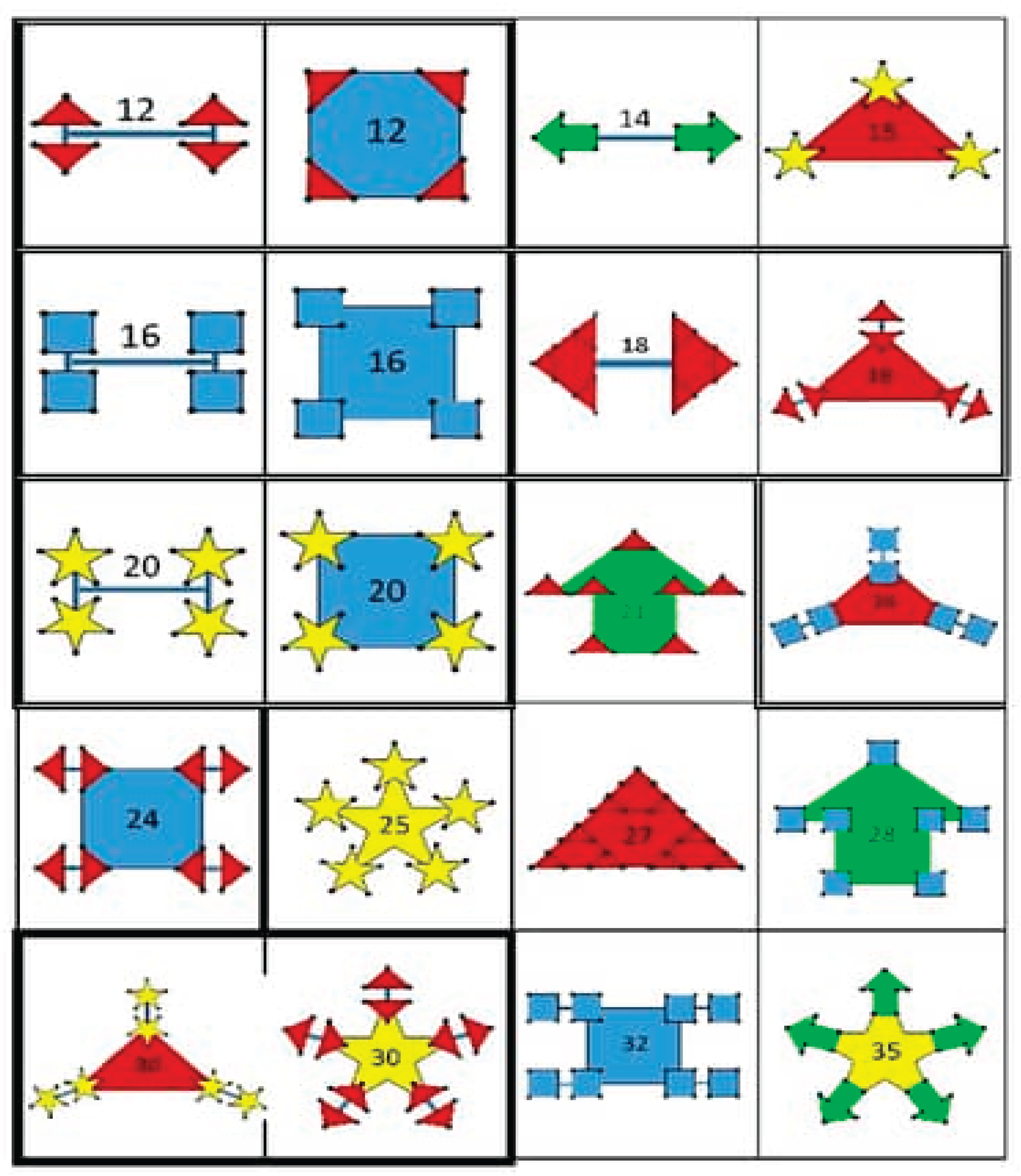
The reader should consult(Mathews, 2025; TPT, 2025). Fig.1(TPT, 2025) portrays employing cognitive research-based concepts, a drawing/image-based activity aids students in Key Stage 2 in grasping the connection between number multiples, prime numbers, prime factors, and division. Non-stressful memorization of times tables is enabled by the picture-based puzzles for Key Stage 2 students.
Figure 1.
Fractal Multiplication Table.
4. Pedagogical Implications for Next-Generation Teaching
Including this fractal geometric approach into first grade classrooms provides a strong means toward next- generation education and learning.
- From Memorization to Conceptualization: The major advantage is the change from rote remembering to a profound, visual comprehension of the mechanics of multiplication. Students grasp the patterns' recurrence, so developing number sense rather than only fact retrieval (Gray and Tall, 1994). By turning a high-stakes memory exercise into a low-stakes creative one, the approach can greatly alleviate anxiety (Boaler, 2019). Rather than on speed and accuracy, the focus is on exploration and beauty, hence creating a more welcoming and inclusive learning environment (Dweck, 2006).
- Encouragement of Creativity and Curiosity: Connecting mathematics organically with art encourages students to question what if? queries. Using a 12-point circle (base12), the 13s table yields what pattern? This encourages questioning and positions mathematics as a creative rather than simply a procedural discipline (Sawyer and Henriksen, 2024).
- More sophisticated students can be tasked to predict patterns, describe the symmetries, or even utilize simple coding tools (e.g. Scratch) to generate the shapes digitally, therefore integrating computational thinking (Papert, 2020; Wing, 2006); younger children can concentrate on building the forms for easier tables. Mirroring the multidisciplinary nature of modern problem solving (Rogers et al., 2007), this method flawlessly integrates arithmetic, visual arts, and technology.
5. Conclusion: Towards a New Mathematical Pedagogy
For a generation needing flexibility, creativity, and strong conceptual thought, the permanence of rote learning for multiplication tables is a pedagogical inertia that negatively benefits it. Accessible, interesting, and math-rich, the amazing fractal geometric method provides a persuasive substitute. It turns multiplication from a static list of facts to be remembered into a lively, visual, and gorgeous system to be investigated. Giving kids guided discovery so they may create their own knowledge helps us to develop them into confident and inquisitive mathematical thinkers. It is a micro cosmos of what next-generation mathematics education should be: visual, investigational, conceptually focused, and joyful—not just a "trick" for memorizing tables.
Future development should include empirical studies on the long-term effects of this method on math fluency, conceptual comprehension, and attitudes toward the subject in pupils. Teachers also need tools and professional development to assist them to include other pattern-based, constructivist methods in their lessons. Through such innovative techniques, we can begin to produce a generation that sees math as a world of remarkable patterns to be investigated rather than as a collection of rules to be hated.
References
- Boaler, J. (2019). Limitless mind: Learn, lead, and live without barriers. San Francisco.
- Bruner, J. S. (1961). The act of discovery. Harvard Educational Review, 31(1), 21–32.
- Clements, M. A. Kaur, B., Lowrie, T., Mesa, V., & Prytz, J. (Eds.). (2024). Fourth international handbook of mathematics education. Springer.
- Csikszentmihalyi, M. Csikzentmihaly, M. (1990). Flow: The psychology of optimal experience (Vol. 1990, p. 1). New York: Harper & Row.
- Dehaene, S. (2011). The number sense: How the mind creates mathematics (Rev. ed.). Oxford University Press.
- Devlin, K. j. (2000). The math gene: How mathematical thinking evolved and why numbers are like gossip. New York: Basic Books.
- Dweck, C. S. (2006). Mindset: The new psychology of success. Random House.
- Gray, E. M. Tall, D. O. (1994). Duality, ambiguity, and flexibility: A "proceptual" view of simple arithmetic. Journal for Research in Mathematics Education, 25(2), 116–140.
- Lau, N. T. , Ansari, D., & Sokolowski, H. M. (2024). Unraveling the interplay between math anxiety and math achievement. Trends in Cognitive Sciences.
- Lockhart, P. (2009). A mathematician's lament: How school cheats us out of our most fascinating and imaginative art form. Bellevue Literary Press.
- Mageed, I. A. (2023a, November). Fractal Dimension (Df) of Ismail’s Fourth Entropy (with Fractal Applications to Algorithms, Haptics, and Transportation. In 2023 international conference on computer and applications (ICCA) (pp. 1-6). IEEE.
- Mageed, I. A. (2024a). The Fractal Dimension Theory of Ismail's Third Entropy with Fractal Applications to CubeSat Technologies and Education. Complexity Analysis and Applications, 1(1), 66-78.
- Mageed, I. A. (2024b). Fractal Dimension of the Generalized Z-Entropy of The Rényian Formalism of Stable Queue with Some Potential Applications of Fractal Dimension to Big Data Analytics.
- Mageed, I. A. (2024c). Fractal Dimension (Df) Theory of Ismail’s Entropy (IE) with Potential Df Applications to Structural Engineering. Journal of Intelligent Communication, 3(2), 111-123.
- Mageed, I. A. (2024d). A Theory of Everything: When Information Geometry Meets the Generalized Brownian Motion and the Einsteinian Relativity. J Sen Net Data Comm, 4(2), 01-22.
- Mageed, I. A. (2024e). The Generalized Z-Entropy’s Fractal Dimension within the Context of the Rényian Formalism Applied to a Stable M/G/1 Queue and the Fractal Dimension’s Significance to Revolutionize Big Data Analytics. J Sen Net Data Comm, 4(2), 01-11.
- Mageed, I. A. (2024j). Do You Speak The Mighty Triad?(Poetry, Mathematics and Music) Innovative Teaching of Mathematics. MDPI preprints.
- Mageed, I. A. (2025c). Fractals Across the Cosmos: From Microscopic Life to Galactic Structures.
- Mageed, I. A. (2025a). The Hidden Poetry & Music of Mathematics for Teaching Professionals: Inspiring Students through the Art of Mathematics: A Guide for Educators. Eliva Press. Available online: https://www.elivabooks.com/en/book/book-1450104825.
- Mageed, I. A. Bhat, A. H. (2022). Generalized Z-Entropy (Gze) and fractal dimensions. Appl. math, 16(5), 829-834.
- Mageed, I. A. , & Mohamed, M.(2023). Chromatin can speak Fractals: A review.
- Mageed, I.A. (2024f). Do You Speak The Mighty Triad?(Poetry, Mathematics and Music) Innovative Teaching of Mathematics. MDPI Preprints.
- Mageed, I.A. (2024g). The Mathematization of Puzzles or Puzzling Mathematics Innovative Teaching of Mathematics. Preprints. [CrossRef]
- Mageed, I.A. (2024h). Let’s All Dance and Play Mathematics Innovative Teaching of Mathematics. Preprints. [CrossRef]
- Mageed, I.A. (2024i). AI-Generated Abstract Expressionism Inspiring Creativity Through Ismail A Mageed's Internal Monologues in Poetic Form. Preprints. [CrossRef]
- Mageed, I.A. (2024k). The Mathematization of Puzzles or Puzzling Mathematics Innovative Teaching of Mathematics. Preprints. [CrossRef]
- Mageed, I.A. (2024l). Let’s All Dance and Play Mathematics Innovative Teaching of Mathematics. Preprints. [CrossRef]
- Mageed, I.A. (2024m). AI-Generated Abstract Expressionism Inspiring Creativity Through Ismail A Mageed's Internal Monologues in Poetic Form. Preprints. [CrossRef]
- Mageed, I.A. (2025b). The Hidden Dancing & Physical Education of Mathematics for Teaching Professionals. Eliva Press. Available online: https://www.elivabooks.com/en/book/book-7724827898.
- Mageed, I.A. and Nazir, A.R. (2024). AI-Generated Abstract Expressionism Inspiring Creativity through Ismail A Mageed's Internal Monologues in Poetic Form. Annals of Process Engineering and Management, 1(1), pp.33-85.
- Matthews, C. D. M. (2025). Middle School Mathematics Teachers’ Use of Diverse Mathematics Educational Technology Tools: IXL, i-Ready, and/or MATHia (Doctoral dissertation, Walden University).
- Medina, J. (2011). Brain rules: 12 principles for surviving and thriving at work, home, and school. ReadHowYouWant. com.
- Papert, S. A. (2020). Mindstorms: Children, computers, and powerful ideas. Basic books.
- Pellizzoni, S. Cargnelutti, E., Cuder, A., & Passolunghi, M. C. (2022). The interplay between math anxiety and working memory on math performance: A longitudinal study. Annals of the New York Academy of Sciences, 1510(1), 132-144.
- Piaget, J. (1970). Science of education and the psychology of the child. Trans. D. Coltman.
- Rittle-Johnson, B. Siegler, R. S. (2022). The relation between conceptual and procedural knowledge in learning mathematics: A review. The development of mathematical skills, 75-110.
- Rogers, M. Volkmann, M. J., & Abell, S. K. (2007). Science and mathematics: A natural connection. Science and Children, 45(2), 60-61.
- Sawyer, R. K. Henriksen, D. (2024). Explaining creativity: The science of human innovation. Oxford university press.
- TPT. (2025). IXL LEARNING. Fractal Multiplication table. Online available at. Available online: https://www.teacherspayteachers.com/Product/Fractal-Multiplication-table-2397128.
- Vygotsky, L. S. (1978). Mind in society: The development of higher psychological processes (Vol. 86). Harvard university press.
- Wilson, M. (2002). Six views of embodied cognition. Psychonomic Bulletin & Review, 9(4), 625–636.
- Wing, J. M. (2006). Computational thinking. Communications of the ACM, 49(3), 33–35.
Disclaimer/Publisher’s Note: The statements, opinions and data contained in all publications are solely those of the individual author(s) and contributor(s) and not of MDPI and/or the editor(s). MDPI and/or the editor(s) disclaim responsibility for any injury to people or property resulting from any ideas, methods, instructions or products referred to in the content. |
© 2025 by the authors. Licensee MDPI, Basel, Switzerland. This article is an open access article distributed under the terms and conditions of the Creative Commons Attribution (CC BY) license (http://creativecommons.org/licenses/by/4.0/).
Copyright: This open access article is published under a Creative Commons CC BY 4.0 license, which permit the free download, distribution, and reuse, provided that the author and preprint are cited in any reuse.


