

Submitted:
28 June 2025
Posted:
30 June 2025
You are already at the latest version
Abstract
This paper explores the intervening role of corporate culture’s activities and initiatives in corporate blockchain transformation. There is always an explicit requirement for entrepreneurship to be responsive to change in technological agility for ESG (Environmental, Social, and Governance) performance success. Furthermore, blockchain disruptive functionalities are particularly useful in geographical areas, like the Western Balkans, (WB) where extended fraud and ethnic and cultural differences ask for transparent and trustworthy entrepreneurship. Additionally, in WB, cultural, social, and DEI (diversity, equity, inclusion) corporate initiatives are a common and successful practice. Therefore, a question is raised, is there any correlation between Blockchain adoption (BCA) performance and corporate social and cultural initiatives in a mediating role? A serial mediation model was tested on a dataset of 630 WB and EU companies, and the research conceptual model was validated (CFA) and fit assessed (SEM). We found a statistically sound (significant, positive) correlation between BCA and ESG success performance, especially in the innovation and integrity ESG performance success indicators, when corporate social and DEI initiatives mediate. This study adds to the literature on corporate blockchain transformation, especially for organizations seeking investment opportunities in new international markets to diversify their assets and skill pool. Furthermore, it contributes to a deeper understanding of how DEI initiatives impact the correlation between business transformation and socioeconomic performance, which is referred to as the "social impact."
Keywords:
fintech
; sustainability
; entrepreneurship performance
; blockchain adoption
; transparency
; knowledge sharing
; diverse workspace
; national cultural values
; ethnical particularities
1. Introduction
There is always an explicit requirement for entrepreneurship to be responsive to change in technological agility for ESG performance success. Furthermore, blockchain disruptive functionalities are particularly useful in geographical areas where extended fraud and ethnic and cultural differences ask for transparent and trustworthy entrepreneurship like the Western Balkans region (WB). Additionally, in WB, corporate environmental, cultural, and ethnic activities (ECEA) and diversity, equity, inclusion, and social initiatives (DEISI) are common and successful corporate practices.
Traditionally, entrepreneurship foundation has been laid on the fundamental issue of proof in transactions, while commercial activities depend on fidelity, trust, and transparency between all involved parties [1,2,3,4,5,6,7,8]. Blockchain technology (BCT), a distributed ledger disruptive technology, offers this proof since minimizes fraudulence and cyber hacking, supports same-data and knowledge sharing among stakeholders, introduces smart contracts, and terminates brokers, agents, and intermediaries [9,10,11,12].
Blockchain technology builds trust and transparent management because by leveraging cryptographic techniques, blockchain can enable secure digital signatures and timestamping, making it difficult for malicious actors to manipulate or forge digital assets or transactions [13,14,15,16,17]. This enhances fidelity, trust, and confidence among participants in the metaverse ecosystem [18,19,20,21,22]. Therefore, corporate blockchain transformation is a new challenge in entrepreneurship management [23,24,25,26,27,28].
Since there is a lack of standard metrics it is difficult to evaluate performance progress. Consequently, firms often don’t know the means to access data and track information efficiently and reliably, and therefore trust issues are raised in their earnings reports. According to [1], [8], and [27] the recently introduced ESG (Environmental, Social, Governance) entrepreneurship approach can create value, measure performance, and report sustainability. Hence, ESG theory’s performance success dimensions, implemented as sustainable entrepreneurship performance (SEP) metric indicators [8], [29], are an alternative to KPIs (Key Performance Indicators) [15], [30], [31], while all KPIs are business metrics but not all business metrics are KPIs [15]. Hence, business model metrics track and monitor performance in quality, quantity, productivity, and efficiency [28], [32,33,34,35,36,37].
According to [8], [30], and [38,39,40,41] modern businesses therefore need both BCT technology and ESG business model metrics assessment. Hence, for trusty and transparent management (entrepreneurship blockchain ESG compliance transformation), Blockchain adoption (BCA) should be measured by ESG performance success indicators [8], [28], [36]. BCT can provide immutable certification and automated reporting on commitments, and data that relate to an organization’s ESG performance monitoring (e.g., commitment to significantly reducing or eliminating carbon footprint, as well as data relating to an organization’s carbon emissions and credits can be tracked on a Blockchain and benchmarked against set goals). Similarly, firms can track products, evaluate services, and monitor quality along their supply chains [27], [42,43,44,45,46,47].
Following, the findings through the ESG metric indicators can be archived on a Blockchain and all the information would remain permanently on-chain. Following, these immutable key ESG performance findings can be shared with stakeholders in a trusty, transparent, and efficient way through smart contracts [48,49,50]. The need for trust and transparency in ESG business model metrics and reporting presents a challenge for entrepreneurship management and therefore discloses the role of BCT [47], [51,52,53,54].
Additionally, BCT is correlated to corporate ECEA activities, and to DEISI initiatives due to reliability (decentralization, transparency, visibility, immutability), traceability, and autonomous agreements enforcement [55,56,57,58,59,60]. Corporate sustainability issues, equity and ethics challenges, and ethnic affairs require trust, transparency, innovation, and integrity. Therefore, in this domain, Blockchain is an essential tool [56], [61], [62]. Additionally, with ESG performance success metrics for Corporate Social Responsibility (CSR), green, innovation, and integrity, firms can be liable for their environmental, cultural, and ethnic activities, and DEI social initiatives [1], [8], [15], []63-65]. In addition, the utilization of BCT visibility and traceability applications assists retailers in addressing cultural and ethical variations, resolving issues, dealing with inquiries, and verifying the proofs of their merchandise [47], [50], [66,67,68,69,70].
In the context of the WB, for example, if a local farmer issues a recall for its milk product due to a fault (e.g., dirtiness), a vendor has the option to employ BCT to identify and eliminate the affected foods and products [15], [71,72,73]. Blockchain technology can effectively monitor and safeguard the origination and nomination of distinct items, such as local food-related products [74,75,76,77].
This is particularly critical for protecting the origin’s designation which serves as a significant form of geographical indication, especially in the culturally and ethnically diverse WB region [8], [15], [78,79,80].
Hence, ECEA activities alongside DEISI initiatives could have a crucial mediating role between BCA and SEP measured by ESG success indicators (business model metrics) [15], [28], [81,82,83].
1.1. ECEA and DEISI Mediators’ Theoretical Foundation
1.1.1. ESG (ECEA) Mediator
ESG (ECEA in our WB case study with emphasis in “ethnic” corporate activities because of the particularities in WB) is an acronym for an investment philosophy that gives corporate governance, social concerns, and environmental concerns top priority. ESG is a complete framework that considers organizational implications on the environment, how a firm treats its employees, stakeholders, and community members, and the quality of its governance systems. It is also a metric used to assess a company's performance in three key categories. Investment in ESG factors is sometimes called impact investment or, in more proactive situations, responsible investing [6], [8], [51].
Businesses may operate responsibly and sustainably with the support of the ESG pillars. These pillars -economic sustainability, social responsibility, governance, and environmental sustainability- all centre on how businesses impact people, the environment, and their bottom line. Impact on the natural environment, including carbon footprint, resource utilization, waste management, stakeholder theory, agency theory, institutional theory, and resource-based theory, are the most often used pertinent theoretical frameworks for comprehending ESG performance. In the context of sustainability, corporate behaviour refers to how a business's actions and policies affect social and environmental systems [8], [15], [51].
1.1.2. DEI (DEISI) Mediator
Organizations employ DEI (DEISI in our WB case study with emphasis in “social” corporate initiatives because of the particularities in WB) as a concept and practice to value individual diversity, provide equitable opportunities for all, and create a work atmosphere where everyone is valued and feels welcome [8], [76]. DEI's theoretical underpinnings are derived from several social science fields, most notably organizational studies, psychology, and sociology. The term DEI refers to the values that organizations and groups should adhere to promote varied surroundings, guarantee fair treatment, and establish an inclusive culture [15], [51], [76].
We are striving for a more inclusive, equitable, and diversified future where no human difference -race, gender, or otherwise- will prevent people from achieving better educational outcomes, enjoying excellent health, or escaping and remaining out of poverty [8], [15], [71], [76].
DEISI key concepts include:
- Embedded Intergroup Relations Theory: This theory examines how relationships between groups are influenced by structural factors and historical inequalities.
- Structural Integration Theory: This theory focuses on how individuals' integration into different social structures (e.g., workplace, community) can impact their experiences with diversity, equity, and inclusion.
- Social Identity Theory: This theory explores how individuals perceive themselves and others based on group membership, which can influence attitudes and behaviors towards out-groups.
- Critical Race Theory: This framework analyzes how race and racism have shaped social structures and institutions, offering a lens through which to examine systemic inequalities.
- Human Capital Theory: This theory emphasizes the importance of individual characteristics and skills in determining employment outcomes, but DEI challenges the notion that all individuals have equal opportunities to acquire these skills.
- Intersectionality: This concept recognizes that individuals' identities (race, gender, class, sexual orientation, etc.) intersect and shape their experiences of discrimination and privilege.
- Social Justice: This concept focuses on creating a fair and equitable society, where all individuals have equal access to opportunities and resources.
- Organizational Behavior: This field examines how individuals and groups behave within organizations, including issues of diversity, equity, and inclusion.
- Human Resources Management: This field focuses on attracting, retaining, and developing diverse talent within organizations, and DEI plays a crucial role in shaping human resources practices.
- Leadership Theories: Different leadership styles (e.g., transformational, servant) can impact on how organizations approach DEI initiatives and create inclusive cultures.
1.2. Research Questions
Considering the previous discussion regarding the connection between BCA and SEP, green corporate activities, and corporate culture, it becomes necessary to evaluate the dependability of these correlations. Therefore, the primary objective of this article is to assess the statistical significance of the correlation by addressing the following four research questions in view of structural (inner) model fit assessment.
The theoretical mechanisms through which BCA affects firm performance are not well understood, and there is a dearth of empirical studies that examine the BCA–firm performance relationship for a large cross-section of firms [15], [74], [75].
This motivated our first research question “Does BCT adoption improve a firm’s ESG performance?” BCA can result in immediate performance gains, for example, by improving supply chain efficiency and lowering operational costs [84,85,86] . We believe that adopting BCT can also increase the number of growth opportunities a company has, which boosts hopes for the company's future performance [87,88,89,90]. According to [91,92,93,94,95] the benefits of BCT adoption may depend on how well a company can implement BCT into its operations and the racial and cultural makeup of the business environment it operates [27], [69], [70], [96,97,98,99,100].
Therefore, we produced the second research question: "How do environmental, cultural, and ethnic corporate activities affect (mediate) the link between BCA and a firm’s ESG performance?". We specifically look, in the case of a BCA, at the correlation between a company's intangible environmental, cultural, and ethnic activities (ECEA) dynamism and its long-term ESG performance metrics.
Additionally, as the third research question we considered the corporate DEI and social initiatives (DEISI) in a mediating role between BCA and SEP (“How does corporate DEI and social activities affect (mediate) the link between BCA and a firm’s ESG performance?"). Finally, we considered a chain mediation, with the DEISI as a mediator between BCA and SEP and the ECEA as an intervenor between DEISI and SEP to process the fourth research question “How do environmental, cultural, and ethnic activities, and corporate DEI and social initiatives influence BCA impact on ESG performance?”.
To answer these four research questions, we used the classic Structural Equation Model (SEM) method and performed a structural model fit assessment to value the standardized path coefficients (BCA to SEP through ECEA and DEISI). Therefore, the primary objective of this article is to address the following set of four research inquiries:
RQ1: Is Blockchain adoption an effective channel to support sustainable entrepreneurship performance?
RQ2: Do environmental, cultural, and ethnic activities mediate positively the relationship between Blockchain adoption and sustainable entrepreneurship performance?
RQ3: In a firm that has adopted BCT, does a corporate strategy with diversity, equity, inclusion, and social initiatives affect sustainable entrepreneurship performance?
RQ4: Are environmental, cultural, and ethnic activities productive intervenors between corporate’s DEISI initiatives and the firm’s ESG performance?
Furthermore, the advantages of using BCT may depend on the firm’s age (i.e., the time of the incorporated day), size, type of business, and location [101,102,103,104]. Hence, we want to know how the age, size, type of industry, and country of business as independent control variables (corporate features) of a firm that has adopted BCT affect its ESG performance metrics indirectly through the DEISI mediator factor [8], [105,106,107]. This is an application domain assessment of the fourth research question (i.e., the best-performing hypothesis) (Table 8).
1.3. Research Purpose
According to [93], [101], [108], [109], and [110] although there has been a growing emphasis in recent literature on the benefits and advantages of BCT in corporate management and entrepreneurship performance, the practical applications of BCT are still in their initial stages. The existing literature does not specifically highlight the integration of BCT to entrepreneurship as a promoter of entrepreneurship performance [27], [56], [69], [111].
This integration can potentially contribute to various aspects such as reducing fraudulence and cyber hacking, facilitating same-data and knowledge sharing, utilizing smart contracts, and mitigating cultural and ethnic differences [47], [74], [112,113,114,115]. Therefore, the objective of this study is to address the existing gap in literature by examining the potential contribution of BCT to sustainable entrepreneurial performance through the mediating role of green corporate activities and DEI initiatives, while exploring cultural influences, ethnic variations and issues within the Western Balkans region [8], [15], [116,117,118,119,120].
Entrepreneurship in Western Balkans developing countries, as recent democracies in a poor region of Europe with many corruption problems, face many challenges with financing, restrictions on international markets and loans, lack of trust, corruption, and bureaucracy [121,122,123]. According to [28], [50], [124], [125], and [126] these entrepreneurship performance limitations are more obvious when sustainability is adopted in corporate strategy.
The BCA among small and medium enterprises (SMEs) poses a significant challenge in this field [127,128,129,130]. The impact of Blockchain technology adoption on business performance was examined in a study conducted by [8] in Western Balkans, a developing region in Southwest Europe. The findings revealed that new companies experience a more significant influence on their performance because of adopting Blockchain technology, as opposed to established organizations. It is evident that developing nations naturally seek solutions for the internal challenges of their economies through the utilization of innovative technologies [131,132,133,134,135].
The significance of cultural and ethical values in the context of corporate strategic planning has been extensively examined by scholars such as [136,137,138,139]. [140] conducted a recent study that suggests that implementing BCT may impact on the operational aspects of corporate management within a firm. According to [141] and [142] as well as [143], a positive relationship exists between a heterogeneous corporate work environment and financial performance. While previous research has investigated the impact of business coaching and training on various aspects of corporate functioning, there is currently no published literature that explores the dynamics of BCT adoption on sustainable entrepreneurship performance, specifically considering the influence of national cultural values, ethnic characteristics, and diverse work environments [8], [15], [28], [144,145,146,147].
This paper aims to address this research gap by proposing a conceptual framework for studying these factors.
In the Western Balkans region, the greater the absence of transparency or susceptibility to corruption, the more imperative it becomes to adopt innovative strategies. This is the context in which BCT emerges as a potential solution to address the challenge of integrating entrepreneurship performance within corporate management. The study at hand examines the potential impact of Blockchain's decentralized nature on the supervisory mechanism of organizations, specifically in relation to the relationship between BCA and companies' performance. This assumption is based on the understanding that the elimination of intermediaries and the immutability of information facilitated by Blockchain can have implications for the supervisory processes within organizations. Contrarily, it is hypothesized that the incorporation of Blockchain technology as a framework for digital currency infrastructure could potentially impact the operational efficiency of a company by enabling transparency and fostering trust.
Therefore, the primary objective of this work is to propose a theoretical model that examines the influence of BCT on ESG corporate governance, with a specific focus on the mediating roles of ECEA activities and DEISI initiatives. Furthermore, the findings of this study might be applicable to WB corporate managers adopting the ESG theory.
1.4. Paper’s Structure
The subsequent sections of this work are structured in the following manner. Section 2 (Theoretical foundation) gives an overview of the theoretical justification of Blockchain technology and its impact on sustainable (ESG metrics) entrepreneurship.
In addition, the mediating role of both the environmental, cultural, and social corporate activities, and the corporate culture (diversity, equity, inclusion) initiatives is analyzed. In Section 3 (Method), the paper goes through data topics, research methodology, hypotheses, and the conceptual framework pertaining to the dynamics of adopting BCT. Section 4 (Results) introduces the research instrument (questionnaire) and presents an in-depth CFA (Confirmation Factor Analysis) and SEM analysis of the obtained results, while Section 5 (Discussion) delves into a comprehensive discussion of the research findings. Finally, Section 6 (Conclusions) serves as the final segment of this empirical investigation.
2. Theoretical Foundation
2.1. Blockchain Adoption (BCA) and Sustainable Entrepreneurship Performance (SEP)
Considering the entrepreneurship Blockchain transformation concept, the BCA can significantly alter organizational processes and capabilities, leading to increased value creation and improved firm performance [128,129,130,131,132,133,134,135,136,137,138,139,140,141,142,143,144,145,146,147,148,149]. BCA can grant a competitive edge to firms that enhance their prospective earnings and offer a long-lasting competitive advantage by enhancing the adaptability and agility of sustainable entrepreneurship performance [56], [74], [78], [150,151,152]. Hence, BCA dynamics and ESG/SEP metric indicators are the two main factors of the proposed measurement model.
BCA dynamics. Our conceptual framework integrates into the BCT adoption component seven indicators (BCT functionality dimensions) strengthening BCA dynamics (transparency/TRA, same-data sharing/SDS, knowledge sharing/KNS, smart contracts utilization/SCU, cyber-hacking protection/CHP, fraudulence suspension/FRS, and fidelity-integrity-trust/FIT). We defined these indicators as independent observed variables (TRA, SDS, KNS, SCU, CHP, FRS, and FIT).
ESG/SEP metric indicators. We considered the three factors of ESG theory as an ESG strategy for sustainable corporate practices. Hence, our corporate performance evaluation approach apart from the typical financial and operational practices and procedures (the G in ESG, governance criteria) considered the role of the environment like green corporate (the E in ESG; i.e., environmental criteria as an observed variable affected by corporate environmental disclosure activities as a responsibility to the society), and the role of the social initiatives like CSR (the S in ESG; i.e., social criteria as an observed variable affected by corporate culture (diversity, equity, inclusion), and cultural and ethnic activities). Every company, let alone companies in the Western Balkans, operates within a broader, diverse society and a strong ESG proposition can create value [8], [140].
Following, we describe seven ESG indicators as accounting and qualitative performance metrics to rate a company's sustainable entrepreneurship performance: financial performance (FIP), operational performance (OPP), quality and supply-chain performance (QSP), CSR performance (CSR), green corporate performance (GCP), innovation performance (IVP), and integrity performance (IGP). Finally, we defined the seven corresponding sustainable entrepreneurship performance indicators as dependent observed variables (FIP, OPP, QSP, CSR, GCP, IVP, and IGP).
BCA may exhibit a positive correlation with SEP as it is expressed by the seven ESG performance metrics (dependent observed variables) and therefore an initial hypothesis could be formulated as follows “BCA has a favorable influence on the performance of sustainable entrepreneurship.” (a positive statistical correlation into the RQ1 domain).
2.2. Environmental, Cultural, and Ethnic Activities (ECEA) as a Mediator Between Blockchain Adoption (BCA) and Sustainable Entrepreneurship Performance (SEP)
The identification, valuation, and exploitation of opportunities within the external environment of a firm are crucial factors [140], [151]. The external environment’s intangible capital encloses the human capital, routines, processes, and practices of firms [27], [70], [151].
The acquisition and integration of new knowledge into a firm's existing knowledge base is widely recognized as being dependent on intangible capital and it is posited that companies possessing a greater quantity of intangible assets are more likely to effectively incorporate blockchain technology into their business operations and reap the multitude of advantages it offers for commercial purposes in agility, efficiency, and performance [151]. In this domain, we defined intangible assets the environmental, cultural, and social corporate activities [8], [140].
We considered the environmental, cultural, and ethnic activities as the ECEA mediator described by four indicators (staff and laborer habits/SLH, clients and customs values/CCV, ethnic communities’ customs/ECC, and power consumption reduction/PCR) and defined as independent observed variables (SLH, CCV, ECC, and PCR). In addition, the creation of synthetic (artificial) data that replicates the characteristics of real-world data, specifically for simulating social media events, can enhance the facilitation of the ECEA mediating [144]. Therefore, it is anticipated that BCA companies, possessing ECEA intangible capital as a mediator, will enjoy improved ESG performance success metrics.
Consequently, the second hypothesis could be formulated as follows: "The adoption of Blockchain technology (BCA) has a beneficial influence on the performance of sustainable entrepreneurship (SEP), with the mediating role of ECEA." (a positive statistical correlation into the RQ2 domain).
2.3. Corporate DEI and Social Initiatives (DEISI) as a Mediator Between Blockchain Adoption (BCA) and Sustainable Entrepreneurship Performance (SEP)
Corporate culture is about behavior culture, social codes, and biases. Diversity, equity, and inclusion (DEI) are three closely linked values held by many organizations that are working to be supportive of different groups of individuals, including people of different races, ethnicities, cultures, religions, abilities, education, genders, and sexual orientations.
Companies that are diverse, equitable, and inclusive are better able to respond to challenges, win top talent, and meet the needs of different customer bases [1]. Diversity is about recognizing and understanding individual differences. The literature review shows a correlative relationship between business performance (e.g., Return on Equity/ROE, Return on Assets/ROA, and Tobin’s Q) and diversity. Equality is about creating a fairer corporate environment by providing all employees with opportunities to make the most of their abilities and skills. Inclusion underpins both equality and diversity. Being inclusive means creating an environment where people feel comfortable [120], [128], [129].
It’s worth noting that greater access to talent and increased employee engagement contribute to this performance effect. The business case for DEI is robust, and the relationship between the DEI factors on executive teams and the likelihood of financial outperformance has gotten stronger over time [27].
There are clear correlations between the DEI factors and business performance. Analysis of 2019 data shows that companies in the top quartile for gender diversity within executive teams were 25 percent more likely than companies in the fourth quartile to have above-average ROE, ROA, and Tobin’s Q profitability.
The business case for ethnic and cultural diversity is also strong: in 2024, companies in the top quartile bested those in the fourth quartile by 39% in profitability. Notably, the likelihood of outperformance continues to be higher for diversity in ethnicity than in gender [26], [151].
In addition, inclusion and diversity can significantly affect an organization’s overall performance (winning talent, improving the quality of decision-making, increasing customer insight and innovation as diverse teams are typically more innovative and better at anticipating shifts, driving employee motivation and satisfaction, and improving a company’s global image and license to operate as companies that can maintain or increase their focus on inclusion and diversity during crises are poised to avoid consequences such as struggling to attract talent or losing customers and government support [26], [81], [93].
Valuing DEI has a positive financial and reputational impact on business, innovation, corporate integrity, and CSR [112,113,114]. Having a more diverse workforce has been shown to build trust. According to PwC (PricewaterhouseCoopers), 80% of young professionals look for diversity and inclusion markers before applying to a role [13], [140].
Valuing diversity enhances employee engagement and corporate integrity. It shows that your company understands and respects different cultures. This can cut costs by reducing turnover and absenteeism, which in turn increases overall productivity. The examination of how BCT provides a competitive advantage to enterprises operating in a DEI environment is of the greatest significance since conventional models fail to consider the DEI impact as a competitive advantage. Notably, these conventional models also fail to consider the impact of environmental dynamism [27], [32], [33].
In accordance with previous scholarly works on dynamic business and market dynamics [6], [17], and [19], we employ the three DEI indicators as corporate culture and dynamics. DEI is regarded as a dynamic capability due to its ability to enhance visibility, performance, innovation functionality, and trust within a company, and can assist organizations in reorganizing their resources to capitalize on opportunities presented by uncertain environments, such as the Western Balkans region [8], [140]. Hence, in our conceptual framework, diversity, equity, and inclusion are described as indicators in corporate social initiatives (DEISI) and defined as independent observed variables (D, E, I).
Therefore, the third hypothesis could be formulated as follows: “Corporate DEISI initiatives act significantly and positively as a mediator in the association between BCA and firm performance, specifically in terms of return on equity (ROE), return on assets (ROA), Tobin's Q, CSR, quality performance, green performance, innovation, and integrity” (a positive statistical correlation into the RQ3 domain).
2.4. Research Aim
The three hypotheses, as initially approached above, describe a positive correlation between the adoption of BCT and the performance of firms as defined by the ESG theory. Hence, this study investigates, as the main research aim, the statistically significant correlation between blockchain adoption (corporate blockchain transformation) and sustainable entrepreneurship performance in the Western Balkans region and the Eurozone as the experimental domain.
Additionally, the intangible influence of both the environmental, cultural, and social corporate activities, and the corporate culture dynamics (diversity, equity, inclusion) is examined as a mediating factor between BCT dynamics and ESG performance success indicators.
Consequently, the main research aim is defined as “Examine the impact of Blockchain adoption (BCA) on sustainable entrepreneurship performance (SEP), in compliance with the ESG business success model, through the mediating roles of environmental, cultural, and ethnic corporate activities (ECEA), and corporate DEI and social initiatives (DEISI).”
3. Method
In this Section, we theoretically present the methodology and the basic statistical tools that will allow us to draw statistically significant conclusions about the impact of BCA on ESG performance success indicators. Subsequently, in the next Section (Results) we will discuss real measurements from a questionnaire for companies located in the EU and the Western Balkans.
3.1. Questionnaire Sampling Design
We collected targeted corporate data from a questionnaire (refer to Appendix A for further details) which sampling design and construction followed the methodology outlined in previous studies [25], [33], [35]. Additionally, it adhered to the guidelines provided by the University of Macedonia's Department of Balkan, Slavic, and Oriental Studies (Thessaloniki, Greece), which focuses on economic and social sciences. The Department of Balkan, Slavic, and Oriental Studies is an active and interdisciplinary academic department that seeks to advance understanding of the languages, history, and culture of Balkan, Slavic, and Oriental nations. Its primary objective is to examine and enhance the economic, social, and political connections between these countries and Greece.
3.2. Research Methodology – CFA Validity and Reliability and SEM fit Assessment
We utilized the classical Partial Least Squares Structural Equation Model (PLS-SEM) method to evaluate the proposed conceptual path model (The partial least squares structural equation modeling (PLS-SEM) is a method for structural equation modeling that allows, in path models with latent constructs, the estimation of complex cause-effect relationships).
PLS-SEM is a robust multivariate technique increasingly used in scientific research to examine and assess causal relationships among multiple variables and distinguishes itself from other modeling approaches (e.g., Covariance-based SEM/CB-SEM) by its ability to assess both direct and indirect effects within pre-established causal relationships [1], [15], [152], [153].
According to [140] the PLS-SEM is indicated in cases where the phenomenon to be considered (i.e., BCA in our case) is relatively new and an outer (measurement) model needs to be introduced with many latent constructs and items (observed variables).
The PLS-SEM method encompasses two primary components: (a) the outer (measurement) model, which outlines the factors' quantity, the associations between the different indicators and factors, and the interconnections among indicator errors, i.e., a CFA model; and (b) the inner (structural) model, which outlines the relationships between the multiple factors. The outer model is employed to assess latent constructs and investigate the association between these constructs and their observable indicators (variables) as entities that are measurable with a battery of items. On the other hand, the inner model encompasses the relationships between the latent constructs and evaluates all hypothetical dependencies using path analysis for fit assessment.
Figure 1 presents the proposed measurement model. In our theoretical concept design considerations, The BCA functions as a reflective construct due to (a) its inherent nature, which allows it to exist independently of the measures employed; (b) the direction of construct-items causality (BCA variation causes variation in the items measures and variation in item’s measures does not cause variation in the BCA); and (c) the items characteristics; because, the items (i.e., the seven BCA dynamics and the seven SEP dimensions as ESG metric indicators) share a common theme (BCT dynamic and performance respectively), are interchangeable, and removing/adding an item does not change the conceptual BCA’s domain.
Additionally, in the proposed measurement model the BCA reflective latent construct operates as an independent variable, while the SEP latent construct is a dependent one.
SEM is a statistical technique that integrates two validation analysis techniques, namely confirmatory factor analysis and path analysis. CFA is a statistical technique developed in the field of psychometrics and is utilized to estimate latent psychological constructs, such as attitude and satisfaction. Path analysis (PA) originated in biometrics and was developed to identify causal relationships between variables through the construction of path diagrams.
The SEM enhances the capabilities of path analysis by enabling the establishment of connections between latent variables, also known as factors or hypothetical constructs in other methodologies. These latent variables are not directly observable but are inferred through their influence on observed and recorded observable variables, such as BCT dynamics, corporate dimensions, and features, measured, usually, with questionnaire/survey scale items as a set of answer options for dedicated closed-ended questions on performance.
3.3. Proposed Conceptual Model
For the proposed validation model “BCA impact on ESG performance with environmental, cultural, and ethnic activities, and DEI, and social initiatives in a mediation role”, we initiated an SEM methodology with control, latent, and observable variables (definition and reliability/validity tests). Particularly, the proposed model verifies the questionnaire’s consistency and coherence (reliability test), the latent-observed variables meaningful relationships (constructs reliability test), and the constructs’ distinctiveness (validity test).
Figure 2 displays the path analysis of the proposed conceptual model with a double mediation (ECEA, DEISI) applied for the EU and WB countries. There are both direct and indirect effects in the path analysis relationships, where ECEA and DEISI are the mediators that intervene between BCA and SEP, and the company’s features age, size, type of industry, and country operate as independent control variables. We decided to describe the path analysis of the proposed conceptual model emphasizing the “Ethnic” activities and “Social” initiatives because of the strong WB ethnic and social particularities.
3.4. Latent Constructs and Observed Indicators (Variables)
The term "construct" pertains to the depiction of a particular concept within a specified statistical model. The establishment of a concept is typically accomplished through a conceptual or theoretical definition. On the other hand, the development of a construct for a concept is undertaken by the researcher, who operates the concept within a statistical model.
In the context of SEM, constructs are regarded as latent variables due to their unobservable nature and inability to be directly measured. SEM involves the formulation of a system of linear equations that encompasses both these latent variables and observed variables. Latent variables play a critical role in SEM as they function as fundamental constructs that assist in clarifying the correlations among observed variables. The entities in question possess qualities that cannot be quantified, yet their existence can be deduced by examining fluctuations in observable indicators. Prominent instances of latent variables encompass intelligence, personality traits, and attitudes.
Figure 3 demonstrates the SEM latent constructs (i.e., the proposed abstract concepts in the four ovals) and the SEM observed variables (i.e., the dynamics, dimensions, and firm features with measurement functionality).
3.5. Conceptual Model Evaluation (Measurement Model Validation & Structural Model Fit Assessment)
The proposed conceptual model’s fit evaluation was achieved by performing (a) descriptive statistics (normality distribution and multi-collinearity tests), and (b) outer model validation (i.e., validity test for accuracy and reliability test for consistency) and inner model fit assessment.
Particularly, we assessed the questionnaire’s consistency and coherence (i.e., how distinct from one another the latent constructs and the observed variables are). Thus, the reflective outer (measurement) model was tested for internal consistency reliability using Cronbach’s a coefficient criterion as our preference vs. the composite reliability criterion because the topic under consideration is new and undocumented [22], [28]. Additionally, we considered composite and internal consistency reliability through the utilization of CFA, which serves the purpose of verifying the unidimensionality of the proposed reflective model (Table 4).
In literature, the unidimensional construct refers to a single theoretical concept characterized by a particular type of 1D measurement scale. In alternative terms, a construct is multidimensional when it refers to several distinct but related dimensions treated as a single theoretical concept.
Subsequently, we considered the constructs’ validity (i.e., how meaningful the relationships between the latent constructs and the observed variables being measured are). We accomplished constructs’ validity by performing both convergent and discriminant validity tests.
Particularly, to establish that the constructs within the conceptual model are distinct from one another in an empirical sense, we conducted Discriminant Validity Analysis (DVA) using the Fornell and Larcker criterion because the topic under consideration is new and undocumented (Table 5).
In the context of the inner (structural) model, a statistical technique known as "path analysis" was employed to examine and evaluate the theoretical relationships posited by the conceptual model under consideration (Table 6).
3.5.1. Descriptive Statistics (Normality Distribution, Multi-Collinearity)
3.5.1.1. Normality Distribution Statistics (Mean, Std, Median, Skew, Kurtosis)
Skewness and kurtosis serve as measures to characterize the dispersion and peakedness of a normal distribution. Skewness is a statistical measure used to quantify the degree of asymmetry or asymmetry (departure from symmetry) in a dataset's distribution along the X-axis.
On the other hand, kurtosis is a measure used to assess the vertical pull or the height of the peak in a distribution, indicating whether the data exhibit heavy-tailed or light-tailed behavior relative to a normal distribution. Specifically, a skewness value greater than +1.0 indicates a right-skewed distribution and a smaller than -1.0 indicates that the distribution is skewed towards the left.
In the context of kurtosis, a distribution can be classified as leptokurtic, indicating heavy-tailed data, when its kurtosis value exceeds +3.0 and if the value is below -3.0, the distribution can be classified as platykurtic, indicating the presence of light-tailed data.
We examined the statistical measures of normality distribution, including the mean, standard deviation, median, skewness, and kurtosis. Skewness and kurtosis statistics were utilized as measures to assess the adherence of a distribution to the normality assumption.
Skewness statistics were employed to assess the symmetry of a distribution. In contrast, the Kurtosis statistic was employed to evaluate the extent of heaviness in the distribution tails. We detected that the research variables (latent and observed) distribution is normal as indicated by their skewness values falling within the range of -2 to 2, as presented in Table 3.
3.5.1.2. Multi-Collinearity Statistics (Tolerance, VIF)
The statistical measures of multi-collinearity, namely tolerance and Variance Inflation Factor (VIF), are also of interest in the conceptual model’s assessment. The presence of multicollinearity in the independent variables dimensions was assessed by employing the VIF and the tolerance variant statistics (Tolerance).
Table 3 shows the tolerance coefficient, lower than the threshold of 1, indicating an important level of multicollinearity. Additionally, the tolerance coefficient was higher than the significance level of 0.05, suggesting that the independent variables are not highly correlated. Furthermore, all three values of the VIF were observed to be less than the threshold of 10, indicating that multicollinearity is not a significant concern in the model.
3.5.2. Reflective Measurement Model’s Validity and Reliability
The SEM method offers valuable tools for conducting preliminary assessments of differential validity and reliability of measurement instruments across diverse demographic cohorts. The consideration of reliability and validity is of utmost importance in research design, procedures organization, and findings presentation, particularly in the context of quantitative research.
The assessment of research quality involves the application of validity and reliability as principles about how well a method measures something. Validity refers to the accuracy of a measure (i.e., whether the results really do represent what they are supposed to measure), and reliability refers to the consistency of a measure (i.e., whether the results can be reproduced under the same conditions) [27].
Figure 4 presents the validity and reliability terms relationship under the proposed reflective PLS-SEM outer model.
3.5.2.1. Validity Test
The assessment of the research instrument (questionnaire), as a dataset's validity, is related to the extent to which the collected or analyzed dataset accurately represents the relevant information. Therefore, it is imperative to establish validity and in our case a reflective measurement’s model validity. The concept of validity refers to the degree of accuracy in the results obtained from a test, as stated by Rex B. Kline [153], and in the context of the adopted PLS-SEM analysis, this statistical technique offers valuable evidence to support the accurate interpretation of the findings.
(A) Measurement model’s validity. Measurement validity refers to the degree to which the data or outcomes obtained from a research methodology (e.g., questionnaire) accurately reflect the intended construct (e.g., SEP in our case). Establishing validity in methods and results is crucial to ensure the utility and applicability of the research findings across diverse contexts. Hence, we tested whether the methods employed for data collection exhibit both reliability and reproducibility (i.e., composite reliability).
We performed the reflective measurement model’s validation by assessing the construct validity for all constructs using CFA. Particularly, we investigated and evaluated the correlation between the latent construct (BCA, SEP, ECEA, and DEISI) and their corresponding measurement determinants (BCA dynamics, SEP dimensions, and ECEA and DEISI indicators).
CFA is a statistical technique used to assess latent variables by extracting a latent construct from a set of variables and identifying those items that have the highest shared variance with this construct. Additionally, CFA can help reduce the dimensions of the dataset, standardize the scale of multiple indicators, and account for the inherent correlations present in the data.
Construct validity is about how well a test measures the concept it was designed to evaluate and pertains to the degree to which a given assessment accurately measures the underlying construct (e.g., SEP) it is designed to assess. Hence, construct validity tested how well the set of the 21 indicators represents or reflects the proposed concept (BCA impact on ESG performance metrics) that is not directly measurable (questionnaire soundness). Therefore, we considered the soundness of the evaluation using construct validity, which is classified into two primary forms (convergent validity, and discriminant validity) and recorded evidence of these two forms also demonstrated evidence for construct validity.
(a) Convergent Validity (CV), as measured by the Average Variance Extracted (AVE), is an important aspect of assessing the validity of a measurement instrument in academic research. Convergent validity refers to the degree to which two measures that theoretically should be related, are in fact related. Criteria for convergent validity: Convergent validity pertains to the degree of correlation observed between the responses of distinct variables when evaluating a shared construct. Convergent validity is a statistical assessment that ensures the presence of a meaningful relationship between variables (e.g., CSR, innovation, integrity) and the underlying construct (e.g., SEP) being measured. Consequently, it is imperative for factors to exhibit a robust correlation with the underlying construct.
To assess convergent validity, we evaluated the AVE value as the AVE technique is deemed suitable due to its ability to elucidate the extent to which items are jointly accounted for by constructs. To achieve validity, it is necessary for the AVE to have a value that is equal to or greater than 0.5.
(b) Discriminant Validity (DV), also referred to as Divergent Validity, as a measure of validity was established to ascertain the distinctiveness of the constructs (e.g., BCA, SEP, ECEA, DEISI) and in SEM using PLS is usually evaluated by three informative approaches (criterions), the Fornell-Larcker, cross loading, and HTMT criterions. We chose the Fornell-Larcker criterion because the other two criterions are too sensitive to causal effects interpretation that does not fit in our traditional PLS-SEM case for evaluating a relatively new complex concept (BCA impact on ESG performance metrics) with many latent constructs and observed variables .
In DV it is imperative to ascertain that all constructs exhibit empirical distinctiveness from one another and DV investigates the extent to which a latent construct demonstrates distinctiveness from other latent variables in its ability to predict the dependent variable.
According to [154], in the assessment of the Fornell-Larcker criterion, if all construct’s correlation coefficient values are lower than the square root of its AVE value, it indicates the presence of discriminant validity. Therefore, in our method, the constructs’ AVE values and the initiation of the correlations between the constructs served as evidence for the presence of discriminant validity, [15], [154] (Table 5).
(B) Structural model’s validity (fit assessment). The development of path analysis (a statistical technique) aimed to quantitatively assess the relationships between multiple variables. Path analysis was utilized to illuminate the causal relationships that exist among variables.
Moreover, mediation (ECEA, DEISI) is a commonly utilized component of path analysis, in which it is hypothesized that a variable can have both direct and indirect impacts on an outcome through the involvement of another variable.
3.5.2.2. Reliability test
The concept of reliability pertains to the degree of consistency in measuring outcomes, as stated by [15], [154], and [155]. The assessment of reliability holds considerable importance as it pertains to the consistency of measuring the various components of the instrument. When the items on a scale exhibit coherence and assess the same underlying construct, the scale is considered favorable internal consistency reliability. The measurement of reliability for any given dataset or construct can be categorized into three distinct forms, reliability of internal consistency, composite reliability, and reliability of external consistency:
(a) The reliability of internal consistency refers to the extent to which the items within a measurement instrument are consistent in measuring the same construct. This reliability can be assessed using various methods, such as Cronbach's Alpha coefficient and CFA. In statistics and research, the concept of internal consistency is commonly assessed by examining the intercorrelations among distinct items within a given test. This assessment determines the degree of similarity in scores among multiple items designed to measure a common construct.
Therefore, internal reliability refers to the extent to which a measurement instrument demonstrates consistency and coherence within its own set of items or components. Put differently, if the same question were asked in an alternative manner, it would yield identical outcomes. The split-half method is frequently employed for measurement.
External reliability pertains to the extent to which findings can be compared among different individuals and over different time periods. The assessment of internal consistency as a measure of reliability in SEM analysis. Internal consistency reliability refers to the degree of consistency in the data obtained from multiple tests. The reliability method is employed to assess the degree of association between the factors present in each test and other factors, as described by [15], [28], and [154].
The Cronbach Alpha coefficient was used as a measure of internal consistency and the Likert scale, widely recognized as the most employed method for assessing consistency, was adopted in our questionnaire. It is advisable that the level of reliability for an exploratory or pilot study should be at least 0.70 or higher. According to [53] and [54], reliability can be categorized into distinct levels based on the values obtained. An index of 0.90 and above is indicative of excellent reliability, while a range of 0.70-0.90 signifies high reliability. On the other hand, the range of 0.50-0.70 suggests moderate reliability, and values of 0.50 and below indicate low reliability.
(b) Composite reliability (CR) is a statistical measure used to assess the extent to which the variables that underlie constructs are effective in SEM and CFA is employed to assess the constructs’ CR. The estimation of CR is derived from the analysis of factor loadings, as demonstrated by [15] and [153]. The build-reliability coefficient may exhibit a value exceeding 0.70. To attain construct reliability, it is necessary to have a value of CR ≥ 0.7.
(c) The reliability of external consistency evaluates the degree of consistency in the measurement of a variable across multiple applications or instances. For instance, in the context of a study, if a participant underwent an IQ assessment at one point in time, and subsequently underwent the same assessment a year later, yielding a notably comparable score, this would indicate the presence of external reliability. An illustration of external consistency can be observed in the context of a cognitive ability test, wherein the test has been demonstrated to yield consistent scores across diverse populations or cultures.
3.5.3. Conceptual Model’s Validation and Fit Assessment Process
With respect to the above discussion, we performed the following validation and fit assessment process for the proposed “BCA impact on ESG performance metrics” conceptual model (see next Section “Results”).
(A) Descriptive statistics (normality distribution, multi-collinearity).
(B) Measurement’s model validity (accuracy) and reliability (consistency) test:
Step I. Questionnaire/research instrument’s internal consistency reliability (Cronbach’s alpha coefficient and Dillon Goldstein’s rho). Cronbach’s alpha coefficient and Dillon Goldstein’s rho were used to evaluate the research instrument’s consistency and coherence (Table 4). As a rule of thumb Dillon-Goldstein's rho values higher than 0.70 suggest one-dimensionality and given that both indexes are larger than 0.7, it can be claimed that the research instrument (i.e., the questionnaire) has an acceptable reliability [154], [155].
Step II. Construct reliability as indicated by the convergent validity (Composite reliability and AVE). The reliability of each construct and its scale items is acceptable when the composite reliability (CR) is ≥0.7 and the average variance extracted (AVE) is ≥0.5. The values of these indices are shown in Table 4.
Step III. Constructs’ distinctiveness as measured by discriminant validity (SQRT(AVE)). The distinctiveness of the constructs (BCA, SEP, ECEA, DEISI) is discovered by the discriminant validity analysis (Table 5).
(C) SEM structural model’s fit assessment. Structural model assessment in PLS-SEM focuses on evaluating the significance and relevance of path coefficients, followed by the model’s explanatory and predictive power:
Step IV. Research hypotheses assessment/construct paths (t-statistics, p-value). Results are reported in Table 6.
Step V. Research hypotheses assessment from measurement invariants through a control variable. Results are reported in Table 7.
Step VI. Comparative analysis (a) for all the hypotheses (H01, H02, H03, and H04) testing results as they projected on the seven ESG model’s success dimensions (financial success, agility success, quality success, social success, green success, innovation success, and integrity success), and (b) for the hypothesis H04 (most successful setup) as it projected on company’s age, size, type of industry, and country as the four independent control variables (Table 8).
3.6. Research Hypotheses
The primary hypothesis of the study was formulated as follows: There is a statistically significant effect at the level (α≤0.05) of BCA on ESG performance. To evaluate the primary hypothesis, a multiple linear regression analysis was conducted. The null hypothesis (H0) is either accepted or rejected based on the predetermined significance level (α).
A significance level (α) of 0.05 was chosen as the upper limit. Hence, when the level of significance is equal to or below 0.05, a statistically significant effect will be observed. Conversely, if the level exceeds 0.05, no statistically significant effect will be observed.
The primary hypothesis and the four research questions defined the scope for the development of the main four hypotheses (H01, H02, H03, and H04) as follows:
First Hypothesis (H01): Blockchain adoption governance strategy without corporate environmental, cultural, and ethnic activities, and corporate DEI and social initiatives. The 1st hypothesis constructs path is defined as BCA→SEP and is formulated as follows (Figure 3):
H01: Blockchain adoption (BCA) has a positive impact on SEP.
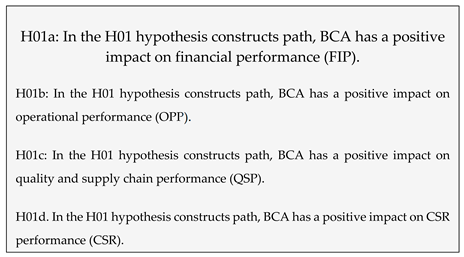
- Additionally, the following seven thematic sub-hypotheses are proposed to examine the BCT-Entrepreneurship Performance in detail.
Additionally, considering the mediating role of ECEA and DEISI, the following three hypotheses and many relative sub-hypotheses are proposed.
Second Hypothesis (H02): Blockchain adoption governance strategy with ECEA activities. The 2nd hypothesis constructs path is defined as BCA→ECEA (mediator)→SEP and is formulated as follows (Figure 3):
H02: ECEA activities mediate positively in the relationship between BCA and SEP.
Additionally, the following seven thematic sub-hypotheses are proposed to examine the BCT-ECEA-Entrepreneurship Performance in detail.
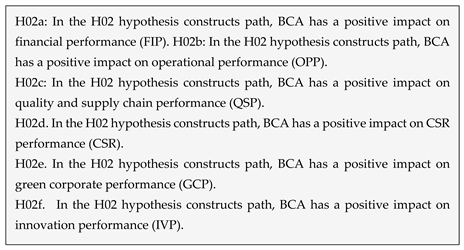
Third Hypothesis (H03): Blockchain adoption governance strategy with DEISI initiatives. The 3rd hypothesis constructs path is defined as BCA→DEISI (mediator)→SEP and is formulated as follows (Figure 3):
H03: Corporate DEISI initiatives mediate positively in the relationship between BCA and SEP.
Additionally, the following seven thematic sub-hypotheses are proposed to examine the BCT-DEISI-Entrepreneurship Performance in detail.
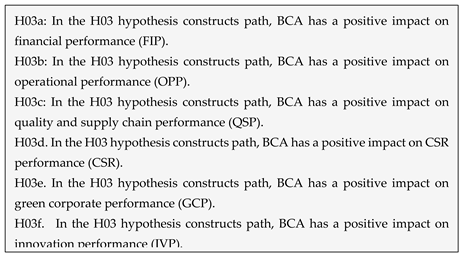
Fourth Hypothesis (H04): Blockchain adoption governance strategy with ECEA activities and DEISI initiatives. The 4th hypothesis constructs path defined as BCA→DEISI (mediator)→ECEA (intervenor)→SEP and formulated as follows:
H04: Corporate ECEA activities intervened positively in the DEISI mediating role between BCA and SEP.
Additionally, the following seven thematic sub-hypotheses are proposed to examine the BCT-DEISI-ECEA-Entrepreneurship Performance in detail.
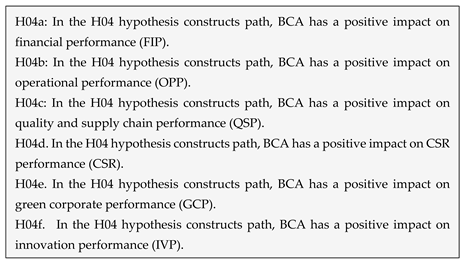
We also performed a hypothesis H04 assessment with the company’s age, size, type of industry, and country as independent control variables (constructs path: BCA→DEISI mediator→ECEA intervenor→SEP).
3.7. The Final Conceptual Model
After the latent, observed, and control variables’ introduction (see Subsection 3.4) and the research hypotheses definition (see Subsection 3.6), the final conceptual framework for evaluating the BCT adoption dynamics on sustainable entrepreneurship ESG performance has been formulated.
Figure 3 shows the proposed conceptual model in detail (latent, observed, and control variables, mediations, constructs path’s direct and indirect relationships, and formulated hypotheses).
4. Results
4.1. Questionnaire Structured Formation (Data)
According to the findings of a survey, the central Europe and Western Balkans region had a recorded number of over 30,000 registered companies at the time, [8], [140]. This study's purpose involved selecting 3,270 companies whose products had successfully reached the production stage. These companies were chosen based on their products, which not only incorporated a design informed by research and development but also demonstrated a significant level of technological advancement. The website provided contact details for the company.
A convenience sampling technique was employed to distribute 3,000 electronic questionnaires to CEOs and managers of small and medium-sized enterprises (SMEs). 654 questionnaires were completed and returned. After removing any outliers, 630 responses were deemed valid and included in the analysis. The research hypotheses were tested using path analysis and the Smart PLS software, which was chosen for its capability to analyze causal relationships among multiple variables.
The demographic information of the participants reveals that most of them possessed a higher education degree in the field of Information and Communication Technology (ICT), accounting for 58% of the total (Table 1). Additionally, 51.7% of the participants had accumulated over ten years of experience in management, indicating a satisfactory level of expertise among the participants. Furthermore, it is worth noting that out of the total number of participants, 62 individuals (equivalent to 9.8%) possessed experience in the field of DevOps, while 38 participants (accounting for 6%) had experience specifically in DevSecOps (Table 1).
DevOps is a set of tools, practices, and cultural philosophies that integrate and automate the processes between software development and deployment, and IT teams. It emphasizes team empowerment, cross-team collaboration, technology, and software delivery and deployment automation.
DevSecOps represents development, security, and operations. This mindset, automation, and platform design approach make security a shared responsibility across the IT lifecycle. DevSecOps is often considered the safer alternative.
To establish the measurement model’s validity (accuracy) and reliability (consistency), we conducted tests to assess the reliability of the questionnaire (Table 4) and the constructs (Table 4 and Table 5). There are two types of constructs reliability, namely convergent validity (Table 4), and discriminant validity (Table 5). The concept of convergent validity refers to the measurement of constructs that are theoretically expected to be correlated, and empirical evidence supports this expectation.
Conversely, the concept of discriminant validity concerns constructs’ measurements that are theoretically expected to be unrelated, and empirical evidence confirms this lack of association.
The full sample used for this analysis comprises 630 firm-year observations for corporates that adopt BCT. The analysis encompasses a sample period ranging from June 1, 2024, to October 31, 2024. In total, the dataset used for the blockchain analysis consists of 630 observations spanning multiple years.
These observations pertain to firms operating in 13 different countries, including 8 countries from the Western Balkans region and 5 countries from the European Union. The firms in the dataset are classified into four industry sectors based on the 2-digit Global Industry Classification Standard (GICS) classification. These sectors are hi-tech, supply-chain, construction, and real estate. The data in this applied research study were collected through a questionnaire administered to polling companies operating in the Western Balkans region and the Eurozone.
A total of three thousand (3,000) questionnaires were distributed electronically to managers, CEOs, and presidents of various companies. Out of these, 654 questionnaires were returned and considered for analysis. After removing outliers, the final sample size was reduced to 630 complete questionnaires.
The questionnaire addressed only corporate management and consisted of two parts. In part A’ we are asking for information about the company’s features, economic performance, investments in BCA, and various management data. The questionnaire’s second part is composed of four sections, each addressing a specific topic.
The first section comprised 26 questions about the BCT adoption, with a latent variable called BCA for the statistical evaluation. The second section included 32 questions focusing on the performance of sustainable entrepreneurship (ESG approach), represented in the statistical analysis by a latent variable denoted as SEP. The third section consisted of 19 questions exploring environmental, cultural, and social corporate activities, with a latent variable for the statistical analysis named ECEA.
Lastly, the fourth section encompassed 6 questions examining the corporate culture’s dynamics (diversity, equity, inclusion), represented by a latent variable labeled DEISI. Please refer to Appendix A for further details.
Table 1 presents detailed demographic information of the questionnaire respondents.
4.2. Conceptual Model Constructs (Control, Latent, and Observed Variables)
In our experimental evaluation study, the control, latent, and observable variables were defined as follows:
- Control variables: The company’s features CA, CS, CTI, and CGA (Table 2).
- Latent constructs/variables: The BCA, SEP, ECEA, and DEISI were defined as latent constructs (common factors) (Table 3).
- Observable variables: Respectively, as observable variables seven BCA dynamics (TRA, SDS, KNS, SCU, CHP, FRS, and FIT), seven SEP dimensions as ESG indicators (FIP, OPP, QSP, CSR, GCP, IVP, and IGP), four ECEA indicators (SLH, CCV, ECC, and PCR), and three DEISI indicators (D, E, and I) (Table 2, and Figure 1 and Figure 3).
Subsequently, the questionnaire’s validity and reliability were tested.

Table 2.
Independent Control Variables.
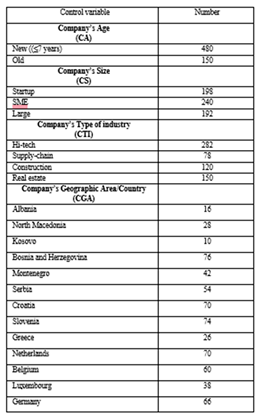 |
Table 3.
Descriptive statistics for the full sample (n=630). Constructs statistics, dimensions, and distribution and collinearity statistics.
Table 3.
Descriptive statistics for the full sample (n=630). Constructs statistics, dimensions, and distribution and collinearity statistics.
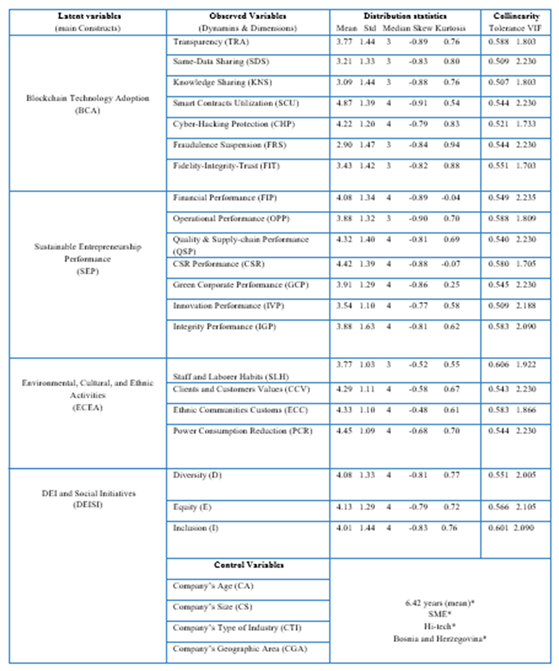 |
Source: Questionnaire data under a 5-point Likert scale ranging from “strongly disagree” (1) to “strongly agree” (5). *. Most of the companies polled were new, SME, and hi-tech from Bosnia and Herzegovina.
4.3. Descriptive Statistics
Descriptive statistics (mean, standard deviation, median, skewness, and kurtosis) pertain to the proposed PLS-SEM model’s assessment. Table 3 displays the descriptive statistics for the entire sample. Subsequently, the means of the characteristics are compared using the t-test as a means of testing for equality, with the corresponding β-value and p-value provided for each comparison.
4.4. Outer (Measurement) Model’s Validity and Reliability Assessment (CFA Analysis)
4.4.1. Questionnaire’s Reliability (Internal Consistency Reliability)
4.4.2. Constructs Validity as Indicated by Convergent Validity
Construct validity is strongly associated with construct convergent validity (CV) which is associated with composite reliability (CR) and average variance extracted (AVE).
Hence, initially, the CR and the AVE values were computed and utilized to assess the convergent validity of all latent variables (constructs), including their subscales BCA dynamics, SEP dimensions, and corporate features.
According to [155], the criteria for establishing convergent validity are met when the CR is equal to or greater than 0.7 and the AVE is equal to or greater than 0.5. Subsequently, after the CV assessment, the construct reliability was estimated for all constructs separately.
Table 4 indicates that construct validity has been established for all constructs and their dynamics, dimensions, and features. Hence, we detect a meaningful relationship between the latent variables (e.g., SEP) and the underlying observed ones being measured (e.g., CSR performance, innovation performance, integrity performance).
4.4.3. Constructs Distinctiveness Validity as Estimated by Discriminant Validity
A discriminant validity assessment (Fornell-Larcker criterion) is conducted by analyzing the correlation matrix between the constructs while the measurement of the degree of correlation was conducted using a correlation coefficient, specifically Pearson's r.
Fornell-Larcker criterion compared the square root of AVE with the latent variable correlations (off-diagonal correlation coefficients). In particular, the square root of each construct’s AVE was found greater than its highest correlation with any other construct. The findings, reported in Table 5, demonstrate the extent to which the research discriminant validity is deemed acceptable, [154], [155]. For the IGP-FIP, IGP-OPP, and IGP-GSP constructs a small dispute was found. Nevertheless, the negative differences are too small (-0.14, -0.08, and -0.11 respectively) and disregarded.
The diagonal line in Table 5 consists of bold values, which correspond to the square roots of the AVE values. The square roots of the AVE values exhibit a stronger correlation between the paired indicators, which serves as an indicator of discriminant validity. Additionally, it is important to note that the correlation between the pair of variables (off-diagonal) used as predictors should not exceed a value of 0.90.
4.5. Inner Model Fit Assessment (SEM Analysis)
4.5.1. Structural Model Evaluation Results
Structural model evaluation results achieved on the pooled data are presented in Table 6. Based on these results, 21 out of the 28 research hypotheses were confirmed with statistical significance at a level below 0.05. Particularly, the findings support the H01 hypothesis for a direct, significant, and positive impact of BCA governance strategy on SEP for three of the seven ESG success dimensions (financial, agility, and quality success) as follows: H01a (β = 0.401, p-value < 0.05), H01b (β = 0.398, p-value < 0.05), and H01c (β = 0.211, p-value < 0.05). Hypotheses H01d (social success), H01e (green success), H01f (innovation success), and H01g (integrity success) were not verified.
For hypothesis H02 (indirect, significant, and positive impact of BCA governance strategy on SEP through the mediating role of environmental, cultural, and ethnic corporate activities, ECEA), the results verified hypotheses H02a (β = 0.405, p-value < 0.05), H02b (β = 0.377, p-value < 0.05), H02c (β = 0.210, p-value < 0.05), H02d (β = 0.266, p-value < 0.05), and H02e (β = 0.242, p-value < 0.05). Hypotheses H02f (innovation success), and H02g (integrity success) were not verified.
For hypothesis H03 (indirect, significant, and positive impact of BCA governance strategy on SEP through the mediating role of corporate DEI and Social activities, DEISI), the results verified hypotheses H03a (β = 0.401, p-value < 0.05), H03b (β = 0.390, p-value < 0.05), H03c (β = 0.287, p-value < 0.05), H03d (β = 0.299, p-value < 0.05), H03f (β = 0.298, p-value < 0.05), and H03g (β = 0.331, p-value < 0.05). Hypothesis H03e (green success) was not verified.
Finally, for hypothesis H04 (indirect, significant, and positive impact of BCA governance strategy on SEP through the intervening role of ECEA on the mediating role of DEISI), the results verified all hypotheses as follows: H04a (β = 0.365, p-value <0.05), H04b (β = 0.352, p-value < 0.05), H04c (β = 0.222, p-value < 0.05), H04d (β = 0.243, p-value < 0.05), H04e (β = 0.329, p-value < 0.05), H04f (β = 0.290, p-value < 0.05), and H04g (β = 0.383, p-value < 0.05).
Based on the p-value (<0.05) and the t-statistic values presented in Table 6, 21 out of 28 research hypotheses were found to be statistically significant at a 95% confidence level. The findings from the hypotheses testing indicate that a corporate governance strategy for blockchain technology transformation has a favorable impact on ESG model success dimensions especially when the corporate culture favors diversity, equity, inclusion, and environmental, cultural, and social activities.
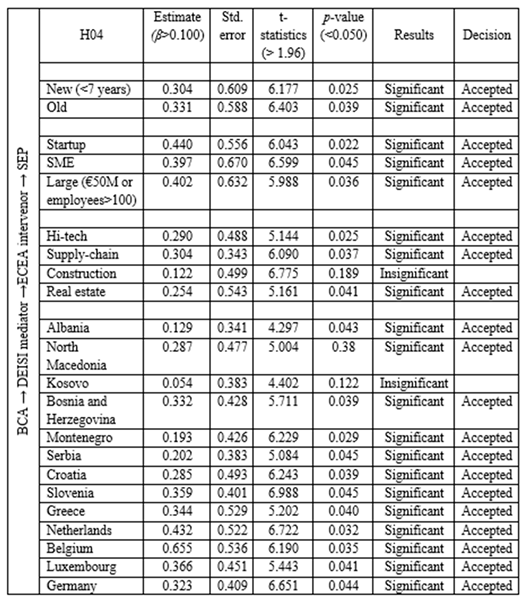
Regarding the four (4) control variables that remain consistent throughout the study (CA, CS, CTI, and CGA), we found that any influence of corporate Blockchain transformation (BCA adoption) on ESG performance is not affected by the company’s incorporated age (CA) and size (CS). Additionally, as regards the type of industry (CTI) and the geographical area/country (CGA) of activity of the enterprise, we found that even the H04 setup (BCA → DEISI mediator →ECEA intervenor → SEP) does not create significant results in the case of construction (CTI item) and Kosovo (CGA item). We believe this is due to the particularities of the “construction” industry which do not favor cultural and social activities, as well as the fact that in the case of “Kosovo”, the intense ethnic differences do not allow BCA to function smoothly.
Table 7 presents the research hypothesis H04 evaluation results from measurement invariants through the four control variables CA, CS, CTI, CGA, and their 22 scale items (2 items for age, 3 for size, 4 for type of industry, and 13 for country).
Table 4.
CFA-Confirmatory factor analysis for questionnaire and constructs’ validity.
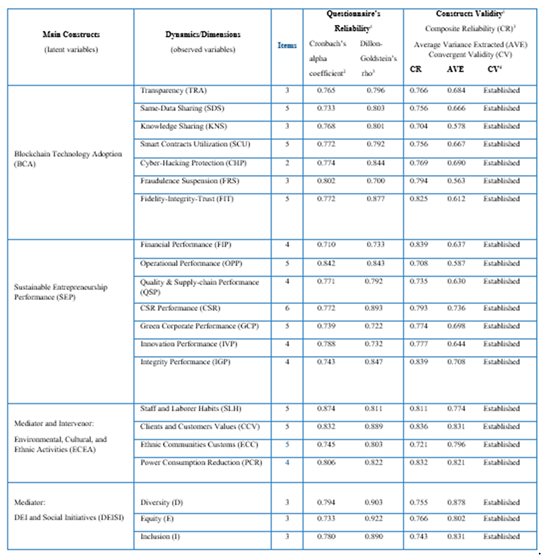 |
1 Questionnaire’s (research instrument’s) Reliability refers to the degree of consistency exhibited by research findings over time and their ability to accurately reflect the entire target population under investigation. Put simply, if a study's findings can be replicated using a comparable methodology, then the research instrument, in this case, a questionnaire, can be considered reliable.2 Computed according to [154] and [155] with acceptable values range: 0.70 – 0.90.3 As a rule of thumb Dillon-Goldstein's rho values higher than 0.70 suggest unidimensionality.4 According to [154] Convergent Validity (CV) is acceptable when Composite Reliability (CR) is ≥0.70 and Average Variance Extracted (AVE) is ≥0.50.5 Constructs validity establishment as indicated by convergent validity.
Table 5.
DVA-Discriminant validity analysis (correlation matrix among constructs).
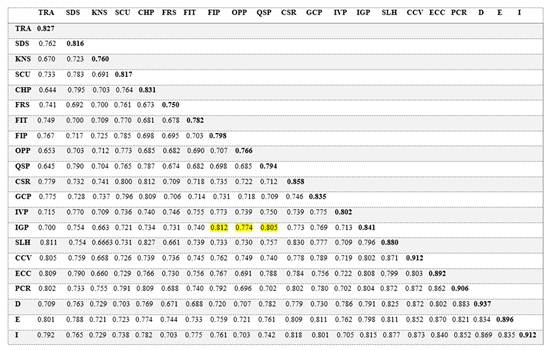 |
Table 6.
Conceptual framework fit assessment: Structural model evaluation results.
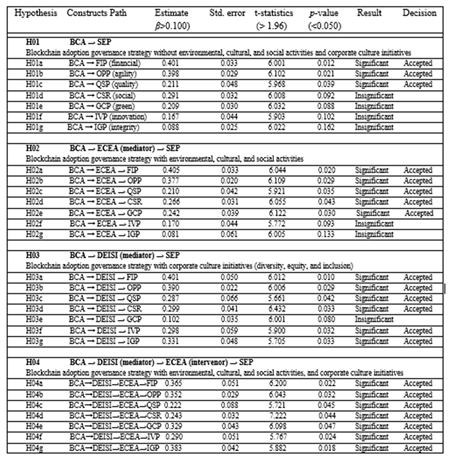 |
Table 7.
Conceptual framework fit assessment: Hypothesis H04 evaluation results with the company’s age, size, type of industry, and country as control variables (constructs path: BCA → DEISI mediator → ECEA intervenor → SEP).
Table 7.
Conceptual framework fit assessment: Hypothesis H04 evaluation results with the company’s age, size, type of industry, and country as control variables (constructs path: BCA → DEISI mediator → ECEA intervenor → SEP).
 |
4.5.2. Comparative Analysis on Hypotheses Testing Results
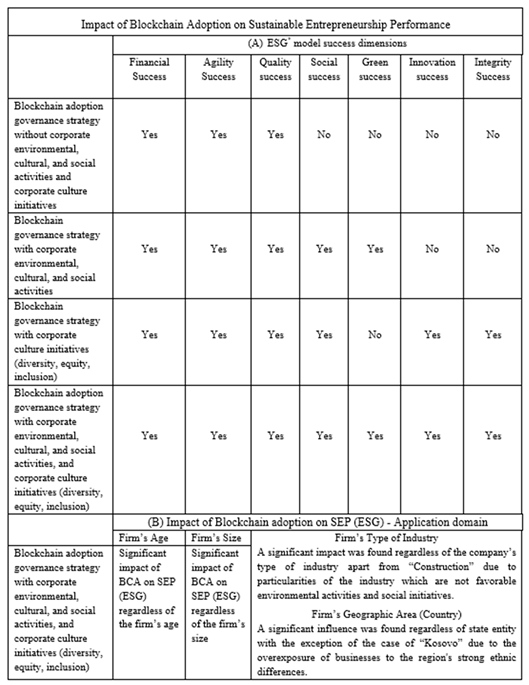
Finally, we performed a comparative analysis (a) for all the hypotheses (H01, H02, H03, and H04) testing results as they projected on the seven ESG model’s success dimensions (financial success, agility success, quality success, social success, green success, innovation success, and integrity success), and (b) for the hypothesis H04 (most successful setup) as it projected on company’s age, size, type of industry, and country as independent control variables (Table 8).
Table 8.
Comparative analysis on hypotheses testing results (“Yes” for β > 0.100 with p-value < 0.050).
Table 8.
Comparative analysis on hypotheses testing results (“Yes” for β > 0.100 with p-value < 0.050).
 |
* Environmental, social, and governance (ESG) is a framework used to assess an organization's business practices and performance on various sustainability and ethical issues. It also provides a way to measure business risks and opportunities in those areas.
5. Discussion
The objective of this paper is to investigate, following the SEM methodology, the correlation between blockchain adoption and sustainable entrepreneurship performance (defined by seven ESG success indicators) by performing an experimental study with corporations from the Western Balkans region and the central EU. The investigation considered the mediating influence of environmental, cultural, and social corporate activities, and corporate culture initiatives. An electronic survey was distributed via email, resulting in 654 responses. Following the removal of outliers, a total of 630 responses were utilized for the implementation of the SEM method.
Contribution: Previous studies on BCT adoption in entrepreneurship performance do not demonstrate the impact and influence of corporate culture, and social and ethnic diversities on SEP as postulated in our hypotheses H02 (indirect impact through environmental, cultural, and ethnic corporate activities/ECEA), H03 (indirect impact through corporate DEI and Social initiatives/DEISI), and H04 (indirect impact through ECEA, and DEISI). Our statistically sound findings validate relative correlation and therefore contribute to corporate blockchain transformation literature.
The presence of a diverse workforce contributes to the generation of innovative ideas and input. The presence of diverse talents within an organization results in a wider array of skills among its employees, as well as a multitude of experiences and perspectives. Consequently, this enhances the likelihood of heightened productivity. The collaboration of diverse cultures and backgrounds fosters an enhanced potential for creative expression.
The findings of this research provide important new information about the intersection between business performance and corporate culture. It also aids in deepening our comprehension of the influence of cultural and ethnic diversity on the relationship between business culture transformation and socioeconomic performance (social impact).
This implies that our research aligns with the primary conclusions drawn by other scholars, including the assertion that Blockchain technology has the potential to enhance transaction transparency and reduce transaction costs.
This study contributes to the comprehension of how corporations originating from emerging markets effectively leverage their operational resources, such as national cultural values and ethnic specificities, to achieve robust financial performance. Hence, to effectively compete on a global scale against well-established firms from developed countries, emerging markets must depend on intangible managerial and labor resources to foster and exploit service innovation.
Results: The findings of this study corroborate previous research, specifically highlighting the efficacy of BCT in promoting sustainable improvements in corporate performance (measured by the FIP, OPP, QSP, CSR, GCP, IVP, and IGP observable variables as ESG indicators) both through direct and indirect means. The results revealed a statistically significant influence of BCA, in the case of both ECEA and DEISI mediation, on all seven SEP dimensions as ESG indicators.
This is interpreted due to the multicultural environment in Western Balkans and is a prompt to the management to strengthen the involvement of the corporation with cultural and social activities, and CSR initiatives.
This finding is particularly important considering that a direct, significant, and positive impact of BCA on SEP is limited to only three ESG indicators (financial, agility, and quality success). Not surprisingly, these results confirmed previous reports [8] and[15], while in the case of the ECEA mediation the significant, positive impact covers extra the social and green success ESG indicators but, by contrast to previous studies [8] and [27], still excludes the innovation and integrity ESG success indicators.
Accordingly, in the case of the DEISI mediation the significant, positive impact covers all ESG success indicators apart from the green one, in agreement with [8] and [23] but by contrast with the results of earlier studies conducted by [15] and [18].
Furthermore, the results of our study pertaining to supply chain transparency, blockchain transparency, and supply chain performance indicate that the weaknesses identified by [36] and [40], such as the absence of privacy and standardization, as well as inefficiency, may be perceived differently within supply chains [54], [61].
Findings: The indirect impact of BCA on SEP through the mediation of ECEA, and DEISI was validated for all hypotheses regardless of the incorporated company’s age, and size. Nevertheless, a significant, positive impact was not detected in the case of companies in the “construction” industry (CTI indicator) and “Kosovo” country (CGA indicator). However, this validation is contracted with previous studies on CTI in that the firm’s “type of industry” does not affect the impact of its technological transformation on SEP [8], [140].
We estimate that this is due to the particularities of the operating conditions of the construction companies which are not favorable cultural and social activities, as well as the fact that the differences in Kosovo between various ethnicities and religions have become particularly acute in recent years. This validation is partially in line with previous studies on “company’s geographic area” (CGA indicator) in that the firm’s “country” does not affect the impact of its technological transformation on SEP [8].
It is noteworthy (significant finding) that in the case of the additional intervention of the ECEA variable (intervention) in all Western Balkans enterprises, ESG success indicators are affected by BCA apart from the “Kosovo” cases. This is a prompt to the management to strengthen the corporation's involvement with cultural activities and CSR initiatives and is interpreted due to the multicultural environment in WB. However, this does not apply in the case of “Kosovo” due to the lack of a multi-ethnical culture.
The research results provide support for the proposed framework and demonstrate a significant association between the adoption of BCT and sustainable entrepreneurship performance, particularly in new, startup, small and medium-sized enterprises (SMEs) operating in the high-technology sector within the countries of the Western Balkans. These countries exhibit noticeable cultural variations and face evident pressures to uphold transparent corporate governance.
Our findings offer significant insights from the managerial and theoretical perspectives, providing valuable input to help corporate management and they are in line with the findings of the literature [8], [20], [31], and [155]. However, a study conducted by [128] and [129] presents a unique perspective, as they found no significant association between ICT and green corporate performance.
The authors suggest that ICT can have both positive and negative environmental effects, resulting in a non-linear relationship characterized by a U-shape [47], [50]. The obtained positive outcome suggests that the sampled firms' management effectively utilizes BCA to improve their GCP. Moreover, in the Western Balkans area, the various cultural and ethnic activities and initiatives could have a positive impact on SEP (BCT adoption domain).
Finally, the findings of this study underscore the significance of key capabilities for emerging market firms, as evidenced by their profitable returns and growth in foreign sales. Given the difficulty in replicating operant capabilities of high performance, it is probable that well-managed emerging market professional service firms will continue to experience financial benefits from service innovation and global expansion.
Significance: We also found that entrepreneurship performance is significantly influenced by transparency, knowledge-sharing functionality, and stakeholders’ trust (statistically significant results). Because of its powerful features, blockchain technology has an impact on business processes.
This study analyzed blockchain technology's effect on creating ESG value and suggested its potential as an efficient business tool. Blockchain adoption influences corporate governance, according to the conceptual model significant in nature fit assessment.
Blockchain affects the corporate governance mechanism by eliminating intermediaries, and information invariance, and creating transparency in companies that operate in environments with a significant presence of shadow economy like the Western Balkans case [114], [115].
Therefore, Blockchain can be introduced as one of the factors affecting the regulatory and control mechanism of a company and BCA has direct and indirect (through cultural activities and initiatives) impact on corporate performance. Therefore, corporate managers can use Blockchain as a digital currency platform and information distribution feature to improve their financial and operational performance.
Limitations: Due to conceptual and empirical limitations, our findings should be interpreted cautiously. According to [8], [116], and [117] many Western Balkans companies believe that Blockchain technology does not provide enough returns to justify the costs of replacing their current systems.
This parameter may reduce the reliability of our results. Additionally, the research was limited to WB and central EU firms, and the sample's cultural and contextual characteristics may have affected the findings. Comparative research in countries and regions with different cultural, religious, and political differences would yield undocumented and unpredictable perspectives on corporate Blockchain transformation.
The present study takes a limited organizational perspective on innovation. However, [6] and [52] argue that to improve innovation capabilities, companies should adopt a comprehensive approach that encompasses multiple forms of innovation. The various forms of innovation encompass process, organizational, and marketing innovation, as well as the interrelation among these diverse types [74], [75]. In addition, the conceptual scope of the research, which focuses on the ESG performance success indicators in a BCA context, is adequate for testing our hypotheses [8], [140].
Nevertheless, it is important to recognize that the narrow focus of this study may hinder the applicability of the results to different areas of research and settings. In our research, the concept of "innovation" was examined as a concise dimension of success in the realm of environmental, social, and governance (ESG) factors, but it is commonly classified into four categories: basic, sustaining, breakthrough, or disruptive, as described by [92], [156].
Additionally, “countries” (control variable) are frequently categorized as either emerging or developed beyond their spatial determination as in our study (World Bank and Central Europe). The limitations of these conceptual simplifications may constrain the scope of our findings, as different approaches and definitions could have led to different relationships and outcomes.
In our study, the latent constructs of BCA, SEP, ECEA, and DEISI are conceptualized as global variables. They are assessed as unified entities comprising multiple items, without considering the potential implications of subcomponents. For instance, in the case of ECEA, the waste to energy process involves the conversion of non-recyclable waste materials into usable heat, electricity, or fuel through various processes such as combustion, gasification, pyrolysis, anaerobic digestion, and landfill gas recovery.
Similarly, factors contributing to power consumption reduction can encompass circuit activity, current frequency, transition time, capacitive load, voltage, leakage current, and peak current. Additionally, the spatiotemporal dimension should be considered when examining ECEA cultural activities, as they are strongly associated with specific locations and calendar events.
Suggestions for improvements and further study: Integration with AI, machine learning, and social media data can benefit blockchain-based applications, [31], [33]. Additionally, alternative decision-making layers like directive, conceptual, analytical, and behavioral approaches can also be utilized. Future research should examine a multi-factor independent intervention study to expand on the current discovery. Corporate features CA, CS, CTI, and CGA should be independent variables in this study.
An additional study should analyze two-factor independent interventions (ECEA, DEISI). Our study does not use temporal functionality because the data were collected at one time and are eternal. Future research should include “time” [124]. Additional categories like technological and non-technological classifications could create research opportunities [125]. This would benefit future research by including product, process, marketing, organizational, and architectural innovation, as well as demographic categories like firm types, job roles, industry sectors, and firm sizes.
Global cultural diversity: The development of AI gives rise and functionality to global environmental, cultural, and social initiatives that directly impact the global cultural ecosystem, while the indirect impact of global cultural diversity on ESG performance metrics has been observed in various studies [9], [10], [11].
Particularly, international clients from culturally diverse countries may influence corporate innovation and integrity ESG metrics because cultural differences between the stakeholders affect entrepreneurial behavior [11]. Moreover, the significance of corporate culture becomes evident during periods of significant transformations or economic recessions [15].
A strong DEI-friendly corporate environment helps a company adapt faster and weather these issues, giving employees confidence in their future. Thus, companies from culturally restricted countries should consider DEI compliance when internationalizing to gain a competitive edge.
6. Conclusions
In the corporate blockchain transformation domain the factors behind the blockchain adoption are still undocumented. This work focuses on the social impact of blockchain technology (BCT) deployment, as it transitions from an academic concept to real-world implementation.
Contribution: This paper contributes to this research discussion and indicates that environmental, cultural, and social corporate activities in cooperation with corporate culture DEI (diversity, equity, inclusion) initiatives are significant variables contributing to this debate.
However, in the case of entrepreneurship in environments with strong ethnic, cultural, and religious issues (case of Kosovo) corporate cultural activities and initiatives gave insignificant results. The primary contribution of this study lies in its prediction, definition, and evaluation of the BCT adoption dynamics in the context of sustainable entrepreneurship (SEP) in newly established countries with unique cultural and ethnic characteristics.
Therefore, this research study provides a significant contribution to the current scholarly literature about corporate blockchain transformation and the effectiveness of sustainable entrepreneurship in work environments characterized by cultural, heritage, and ethnic diversity.
Findings (to what extent the proposed research questions have been answered): Four main hypotheses, with seven sub-hypotheses per hypothesis, focused on examining the impact of blockchain adoption on ESG performance success indicators, both directly and indirectly, were proposed.
The hypotheses were examined using the SEM statistical method for the sample (630 firm-year observations for corporates in Western Balkans and central Europe that have adopted BCT). Most of the hypotheses (21 out of the 28) were validated indicating a strong correlation between the adoption of Blockchain technology (BCA) and the performance of sustainable entrepreneurship.
The direct BCA-SEP correlation returned significant, positive results only for three out of seven ESG indicators, and when it was further analyzed, considering two mediating factors (green corporate activities and diversity-equity-inclusion/DEI initiatives) all the ESG indicators were validated.
Hence, based on the findings, it can be concluded that the inclusion of green corporate activities and DEI initiatives as mediating variables strengthens the influence of BCA on SEP among firms operating in the multi-cultural and multi-ethnic Western Balkans area.
Additionally, the impact of four corporate features (incorporated age, size, type of industry, and geographic area/country) as control variables was considered indicating a non-significant effect apart from the “construction” industry (special conditions of the construction industry that are not favor green and DEI functionalities) and the “Kosovo” country (particularly entrepreneurship environment that does not accept ethnic and cultural differences).
Results (in practice): The statistically sound results of this study suggest that the incorporation of innovative technology within the framework of total quality management allows organizations to transition from conventional practices to environmentally sustainable operations, thus enhancing their performance in the realm of sustainable entrepreneurship (practical results in line with [8], [15, and [155]).
An additional significant discovery of the present study is the positive correlation between BCA and GCP (green corporate performance), as indicated by the β coefficient of 0.409 and a p-value of 0.020. The correlation between this relationship aligns with the findings of [155], which indicate that information and communication technology (ICT) has a positive influence on the sustainable performance of manufacturing companies in the Asian region.
Limitations: Our study was based on some conceptual simplifications (e.g., simple ESG performance success indicators; while for instance the ESG terms “innovation”, and “integrity” as indicators have many dimensions) which can restrict the extent of our findings since alternative conceptualizations and definitions could have yielded distinct relationships and outcomes.
Practical implications for the research community: To examine the mediating role of national cultural values, ethnic characteristics, and diverse corporate workspaces, we conducted a study based on the recommendations provided by [157].
The focus of our investigation was on four industries and the potential direct and indirect interventions and effects mainly in the Western Balkans region. Hence, future research should consider metadata that would offer a more general approach with a multi-factor independent intervention study with the firm features CA, CS, CTI, and CGA as independent variables.
Practical implications for the SMEs and policy makers: This is a prompt to the Western Balkans SME’s management and policy makers to strengthen the corporation's involvement with cultural and ethnic activities and CSR, DEI, and social initiatives due to the multicultural environment in WB. Leveraging the WB’s unique context
The result will be impressive for the SEP in general and the green corporate performance in particular, especially for new startup or SME enterprises operating in the high-technology sector.
However, this policy requires special attention because it seems not to work in cases of particularly intense (sharp; lack of a multi-ethnical culture) cultural differences between the inhabitants (e.g., the “Kosovo” case in WB). In this special case, it is recommended the policy makers gradually adopt policies that favor ECEA activities and DEISI initiatives, e.g. full financing with European funds of joint cultural events, sports activities, mixed start-ups, etc.
Utilizing the framework of research on the Western Balkans (i.e., leveraging the WB’s unique context) at a more global level (European or even global), a spectacular improvement in profitable returns, service innovation, global expansion, and growth in foreign sales is expected if an ECEA strategy and DEISI policies are adopted by policy makers interested in adopting blockchain technology. Particularly, in international supply chain projects, the identified weaknesses at the levels of transparency (absence of privacy and standardization) and corporate performance inefficiency, may be perceived differently in BCA projects adopted ECEA activities and DEISI initiatives.
It should be noted, however, that in BCA projects a simple adoption of an ECEA intervention strategy without DEISI initiatives (second hypothesis; H02), the significant and positive impact will cover the social and green success ESG indicators but will still exclude the innovation and integrity ESG success indicators (Figure 3, Table 8).
Hence, to complete leveraging the proposed WB’s unique context, in blockchain adoption governance strategies, we need apart from the ECEA intervention the DEISI mediation (third hypothesis; H03), so the significant and positive impact will cover all ESG success indicators apart from the green one (Figure 3, Table 8).
Practical implications for the practitioner: The findings of this study have significant practical implications for the performance of business creation and technology entrepreneurship in various aspects, including financial, operational, supply chain management, corporate social responsibility, and environmentally sustainable practices. Within the Western Balkans region, corporate social responsibility (CSR) and good corporate governance practices (GCP) are perceived differently. Some view them as acts of philanthropy and a financial burden, while others, particularly progressive organizations, regard them as strategic investments with potential long-term benefits.
The paper’s SEM analysis suggests that the leadership of the examined corporations acknowledges the CSR and GCP significance in relation to the tangible and intangible advantages they offer, which contribute to the improvement of corporate sustainability and economic performance.
Appendix A. The Research Questionnaire
Part A’ – Basic Questions
5-point Likert scale questionnaire (Strongly disagree, Disagree, Neither agree nor disagree, Agree, Strongly agree)
A. Company's age
New (≤7 years) Old
- Our company's age is engaged in sustainability perspectives to a considerable extent.
B. Company’s size
Startup Large enterprise SME (annual sales turnover ≤ €50 million or employing no more than 100 staff)
- Our company’s size is engaged in sustainability.
C. Company’s type of industry
High-tech Food production Construction Real-estate
- The effect of our company’s type of industry is engaged in the sustainability perspectives to a considerable extent.
D. Company’s geographic area (country)
Albania North Macedonia Kosovo Bosnia-Herzegovina Montenegro Serbia Croatia Slovenia Greece Netherlands Belgium Luxembourg Germany
- Our company’s geographic area has a significant impact upon the business (climate conditions, availability of labor force, raw material, land, water, power, capital, transport network, and market).
E. Company’s Revenue/Earnings/EBITDA growth rate last 5 years:
≤5% ≤0% 0%-5% 5%-10% ≥ 10%
- Profit as a % of sales has been maintained or steadily increased over the last 5 years.
- Return on investment has increased over the last 5 years.
- Our overall market position has been maintained or steadily increased over the last 5 years.
- Customers perceive they receive their money's worth when they purchase our products.
- The customer retention rate has been maintained or steadily increased over the last 5 years.
F . My company invested resources in Blockchain technology adoption in the last 5 years:
≤ €10.000 ≤ €50.000 €50.000 – 100.000 ≥ €100.000
G. Our company’s production and activities require the use of Blockchain technology:
Strongly disagree; Disagree; Neither agree nor disagree; Agree; Strongly agree
H . Management
University education in ICT Management experience >10 years
DevOps experience DevSecOps experience
Part B’ Constructs and Survey Scale Items (Set of Answer Options for Closed-Ended Questions)
5-point Likert scale questionnaire (Strongly disagree, Disagree, Neither agree nor disagree, Agree, Strongly agree)
Blockchain Technologies Adoption (BCA latent variable)
Transparency (TRA)
· Blockchain technology is used in our company based on the principle of transparency (corporate, stakeholders).
· In our company managers and employees have access to products and services in a transparent way.
· In our company, all departments coordinate with each other transparently.
Same-Data Sharing (SDS)
· Blockchain technology’s same-data sharing functionality enhances data compatibility in our business operations (information).
· Blockchain technology’s same-data sharing functionality enhances data compatibility in our business operations (sales).
· Blockchain technology’s same-data sharing functionality enhances data compatibility in our business operations (statistics).
· Blockchain technology’s same-data sharing functionality enhances data compatibility in business operations (trends).
· Blockchain technology’s same-data sharing functionality enhances data compatibility in business operations (external data).
Knowledge Sharing (KNS)
· Blockchain technology’s knowledge-sharing dynamics were regarded in our company as the best practice in the industry (skill, care, diligence, prudence, efficiency, foresight, standards, practices, methods, procedures, and timelines).
· In our company the management uses quality and knowledge data for strategies, plans, and decisions.
· In our company, the management provides quality and knowledge data to the personnel regularly.
Smart Contracts Utilization (SCU)
· Our company utilizes smart contracts and inter-ledger mechanisms to provide decentralized authorization for constrained IoT devices.
· Smart contracts utilization makes our company’s process more efficient and secure (invoicing process automation).
· Smart contracts utilization makes our company’s process more efficient and secure (payments process automation).
· The company departments operate an inter-departmental smart contracts framework.
· Our company provides smart contract development frameworks as software tools (platforms) that support ICT personnel with pre-written code, libraries, and templates to streamline the process of creating and deploying smart contracts on intranet blockchain networks.
Cyber-Hacking Protection (CHP)
· Blockchain technology’s cyber-hacking protection dynamics fit with our security culture (erosion of consumer loyalty, revenue loss, profit loss, brand ruin, competitive disadvantages, and crippling lawsuits.)
· We have a protected, efficient, and user-friendly Blockchain-based information system for products, services, and all stakeholders involved.
Fraudulence Suspension (FRS)
· The adoption of Blockchain technology and smart devices in our company significantly improves the compliance measures of the trading system and effectively avoids fraud.
· Blockchain technology’s fraudulence suspension dynamics enable us to deploy an enforcement fine-mapping strategy for financial penalties and fines.
· Blockchain technology helps us to address fraud issues in the corporate Emission Trading Scheme and to improve its efficacy with a reputation system.
Fidelity – Integrity - Trust (FIT)
· Blockchain fidelity is a key tool for meeting our domestic and international climate change targets, including the 2050 target set.
· In our company transparency and consent from all the stakeholders are combined to give truth to the data and related actions because stored data is immutable and permanent.
· Our corporate Blockchain meets the main data integrity requirements, according to the FDA's (Food & Drug Administration) ALCOA (Attributable, Legible, Contemporaneous, Original, and Accurate) concept.
· In our company the achieved data integrity within corporate Blockchain applications is broadly composed of three pillars: data origin integrity, oracle integrity, and digital-twin integrity.
· Blockchain technology’s trust dynamics fit with our corporate culture.
(B) Sustainable entrepreneurship Performance (SEP latent variable)
Financial performance (FIP)
· We expect an increase in growth in financial performance (sales, profit margin of sales, ROI, and market share).
· We expect an increase in revenue.
· We expect an increase in earnings.
· We expect an increase in EBITDA.
Operational performance (OPP)
· We expect an increase in growth in operational performance (operational cost improvements, services, product quality, in-time delivery).
· Our company’s ICT intranet allows us to inspect and track critical corporate processes.
· I believe that Blockchain fits the size of the company.
· I believe that Blockchain technology is affordable for our corporate operational scale.
· Our corporate management supports Blockchain adoption.
Quality and Supply-chain performance (QSP)
· We expect an increase in growth in supply-chain performance (supply chain visibility, transparency, product safety, and supply-chain management with spatial functionalities e.g., best-route, vehicle fleet supervision).
· Our company’s quality management is focused on excellence and can rapidly adjust production in response to customer demand.
· We are disciplined and continuously seek exceptional products and quality results.
· Our supply-chain has a fast and reliable client and customer response time.
CSR performance (CSR)
· We expect an increase in growth in CSR performance (voluntary initiatives, philanthropic activities).
· Our company provides financial support to local educational institutions.
· Our company respects client and customer consumer rights beyond the legal requirements.
· Our company facilitates the employees to improve their quality of life.
· Participation in social development activities is always our company’s priority.
· My company offers equal opportunities to all employees regardless of their nationality or ethnicity.
Green Corporate performance (GCP)
· We expect an increase in growth in green corporate performance (green management system certifications, green management strategies, green processes, principles of codes of practice sustainability rating indices).
· Our company’s management is highly committed to following green-friendly policies and methods.
· Our company’s management ensures that production and corporate activities minimize their environmental impact.
· We always take initiatives to raise awareness about sustainability and environmental issues (like Net-Zero carbon target by 2040).
· We are always in touch with new EU environmental directives and redesign our products accordingly.
Innovation performance (IVP)
· We are a pivotal leader in innovation building upon our expertise.
· Our advancements provide the foundation for the next-generation products.
· Our products and corporate activities enable our clients to transfer their ideas into reality.
· Our services and initiatives help our clients achieve creative solutions, profitability, and sustainability.
Integrity performance (IGP)
· We are trustworthy and operate ethically and transparently.
· Integrity is the foundation of our corporate culture and anti-corruption policy is the foundation of our compliance with competitive behavior initiatives.
· We are authentic, competing legally and fairly, and complying with the regulations and rules.
· We always avoid conflicts of interest and obey our Code of Business Conduct.
(C) Corporate Environmental, Cultural, and Ethnic Activities (ECEA latent variable)
Staff and Labourer Habits (SLH)
· Multicultural activities in our company help staff and laborers to have a better business understanding and increase service quality performance (multicultural day, arts, music dance parties).
· Ethnical-oriented initiatives in our company help staff and laborers to have a better business understanding and increase product quality performance (honesty, fairness, and equity in interpersonal and professional relationships and in corporate activities).
· Our company’s ethical behavior respects the dignity, diversity, and rights of our stakeholders, employees, and customers.
· In our company the projects are developed using cross-functional teams in a collaboration environment.
· In our company new concepts, products, and services are encouraged by staff and labor collaboration and adopted effectively.
Clients and Customers Values (CCV)
· Multicultural activities in our company improve understanding and relations with clients and customers.
· Ethnical-oriented initiatives in our company accept any form of clothing and literature.
· Our company’s ethnic behavior respects religious values and beliefs.
· National cultural values are always the corporate’s preferences for managing external clients and customers’ adaptation and internal integration challenges.
· In our company ethnic particularities like customs, practices, or food and diet are not a thing.
Ethnic Communities Customs (ECC)
· Multicultural activities by local people are always welcomed in our company.
· Ethnical-oriented initiatives in our company accept the local community’s traditional art in the form of music, dance, or visual art.
· Our company’s ethnic behavior respects the local community’s traditions and religious attitude.
· National cultural values and heritage are always corporate preferences for managing local community challenges.
· In our company ethnicity is not an issue.
Power Consumption Reduction (PCR)
· We are committed to environmental sustainability.
· Our company is taking steps to reduce the environmental impact of corporate operations.
· We always monitor corporate performance on emissions, waste, energy, and water to preserve resources and decrease cost.
· Our company encouraged initiatives to fight climate change.
(D) Corporate DEI and Social Initiatives (DEISI latent variable)
Diversity (D)
· In our company the diverse workspace has a positive effect on entrepreneurship performance. We recognize the importance of gender, color, ethnic, and sex diversity.
· The diverse corporate workspace in our company helps us to have a better understanding of the company’s master plan.
· The diverse employee groups (LGBTQ+, women, minorities) in our company provide support and reward in terms of customs, heritage, and traditions.
Equity (E)
· Equity and multicultural activities in our company help us to have a better business understanding and increase service quality performance (multicultural day, arts, music dance parties).
· The equity behavior in our company respects the dignity, diversity, and rights of our stakeholders, employees, and customers.
· Our cultural equity explicitly appraises the unique cultures of heterogeneous communities and supports their existence.
Inclusion (I)
· Inclusion and ethnic-oriented initiatives in our company help us to have a better business understanding and increase product quality performance (honesty, fairness, and equity in interpersonal and professional relationships and in corporate activities).
· Our company’s work environment makes every employee feel valued.
· Our company acknowledges all kinds of differences and how these differences contribute to corporate culture and business success.
Author Contributions
Conceptualization, V.B.; methodology, V.B.; software, V.B. and H.P.; validation, V.B. and H.P.; formal analysis, V.B.; investigation, V.B.; resources, V.B.; data curation, V.B.; writing—original draft preparation, V.B.; writing—review and editing, V.B.; visualization, V.B.; supervision, H.P.; and project administration, H.P. All authors have read and agreed to the published version of the manuscript.
Funding
This research received no external funding.
Data Availability Statement
The data used in the study are available on open-access journal article databases (Web of Science, Scopus, MDPI, and DOAJ) and the freely accessible web search engine Google Scholar.
Acknowledgments
We would like to acknowledge the support of the Department of Balkan, Slavic & Oriental Studies/University of Macedonia (Greece).
Conflicts of Interest
The authors declare no conflicts of interest.
References
- Basdekidou, V.; Papapanagos, H. Blockchain Technology Adoption for Disrupting FinTech Functionalities: A Systematic Literature Review for Corporate Management, Supply Chain, Banking Industry, and Stock Markets. Digital 2024, 4, 762–803. [Google Scholar] [CrossRef]
- Morkunas, V.J.; Paschen, J.; Boon, E. How blockchain technologies impact your business model. Bus. Horiz. 2019, 62, 295–306. [Google Scholar] [CrossRef]
- Chang, V.; Baudier, P.; Zhang, H.; Xu, Q.; Zhang, J.; Arami, M. How Blockchain can impact financial services: The overview, challenges and recommendations from expert interviewees. Technol. Forecast. Soc. Change 2020, 158, 120166. [Google Scholar] [CrossRef] [PubMed]
- Varveris, D.; Styliadis, A.; Xofis, P.; Dimen, L. Tree Architecture & Blockchain Integration: An off-the-shelf Experimental Approach. WSEAS Trans. Environ. Dev. 2023, 19, 969–977. [Google Scholar] [CrossRef]
- Varveris, D.; Styliadis, A.; Xofis, P.; Dimen, L. Distributed and Collaborative Tree Architecture: A Low-cost Experimental Approach for Smart Forest Monitoring. Balt. J. Mod. Comput. 2023, 11, 653–685. [Google Scholar] [CrossRef]
- Khan, N.; Zafar, M.; Okunlola, A.F.; Zoltan, Z.; Robert, M. Effects of Financial Inclusion on Economic Growth, Poverty, Sustainability, and Financial Efficiency: Evidence from the G20 Countries. Sustainability 2022, 14, 12688. [Google Scholar] [CrossRef]
- Schueffel, P.; Stuessi, D. Beyond Traditions: Swiss Banking’s Journey into Digital Assets and Blockchain. FinTech 2025, 4, 18. [Google Scholar] [CrossRef]
- Basdekidou, V.; Papapanagos, H. The Use of DEA for ESG Activities and DEI Initiatives Considered as “Pillar of Sustainability” for Economic Growth Assessment in Western Balkans. Digital 2024, 4, 572–598. [Google Scholar] [CrossRef]
- Ayeni, A.A.W. Entrepreneurial Abilities and Business Performance: Enacting Business Survival Paradigm from Electronics Informal Market, Nigeria. World 2025, 6, 75. [Google Scholar] [CrossRef]
- Renduchintala, T.; Alfauri, H.; Yang, Z.; Pietro, R.D.; Jain, R. A Survey of Blockchain Applications in the FinTech Sector. J. Open Innov. Technol. Mark. Complex. 2022, 8, 185. [Google Scholar] [CrossRef]
- Walker, K.; Lee, M.C.C. Entrepreneurial Resources, Decision-Making Logic and Organisational Change Readiness: Enhancing SME Sustainability in New Zealand. Administrative Sciences 2025, 15. [Google Scholar] [CrossRef]
- Manta, O.; Vasile, V.; Rusu, E. Banking Transformation Through FinTech and the Integration of Artificial Intelligence in Payments. FinTech 2025, 4, 13. [Google Scholar] [CrossRef]
- Hudayah, S.; Ramadhani, M.A.; Raharjo, S.; Ambarita, N.P.; Hidayani, H.; Yudaruddin, R. The Impact of Knowledge Management on Digital Innovation in Time of Covid-19 Pandemic: The Role of Digital Capability and Digital Orientation. WSEAS Transactions on Business and Economics 2024, 21, 1276–1285. [Google Scholar] [CrossRef]
- Anita, D.; Bhappu, T.L.; Yeo, M.L. Platform Service Designs: A Comparative Case Analysis of Technology Features, Affordances, and Constraints for Ridesharin. Digital 2022, 2, 320–332. [Google Scholar] [CrossRef]
- Basdekidou, V.; Papapanagos, H. Empirical Model for Estimating Sustainable Entrepreneurship’s Growth Potential and Positive Outlook. Balt. J. Mod. Comput. 2023, 11, 181–201. [Google Scholar] [CrossRef]
- Liu, D.; Liang, D. A Blockchain Approach of Model Architecture for Crowdsourcing Design Services under the Context of Social Manufacturing. Machines 2023, 11, 69. [Google Scholar] [CrossRef]
- Khan, B.U.I.; Goh, K.W.; Khan, A.R.; Zuhairi, M.F.; Chaimanee, M. Integrating AI and Blockchain for Enhanced Data Security in IoT-Driven Smart Cities. Processes 2024, 12, 1825. [Google Scholar] [CrossRef]
- Qian, C.; Gao, Y.; Chen, L. Green Supply Chain Circular Economy Evaluation System Based on Industrial Internet of Things and Blockchain Technology under ESG Concept. Processes 2023, 11, 1999. [Google Scholar] [CrossRef]
- Kashem, M.A.; Shamsuddoha, M.; Nasir, T.; Chowdhury, A.A. Supply Chain Disruption versus Optimization: A Review on Artificial Intelligence and Blockchain. Knowledge 2023, 3, 80–96. [Google Scholar] [CrossRef]
- Avdimiotis, S.; Moschotoglou, P. Knowledge Spillover through Blockchain Network in Tourism: Development and Validation of Tblock Questionnaire. Knowledge 2022, 2, 337–346. [Google Scholar] [CrossRef]
- Cinieri, V.; Garzulino, A. A Sustainable Opportunity to Re-Inhabit Traditional Buildings in Italy: Energy Efficiency Actions End Fiscal Incentives. Architecture 2022, 2, 660–670. [Google Scholar] [CrossRef]
- Grammatikis, P.R.; Sarigiannidis, P.; Dalamagkas, C.; Spyridis, Y.; Lagkas, T.; Efstathopoulos, G.; Sesis, A.; Pavon, I.L.; Burgos, R.T.; Diaz, R. SDN-Based Resilient Smart Grid: The SDN-microSENSE Architecture. Digital 2021, 1, 173–187. [Google Scholar] [CrossRef]
- Erboz, G.; Abbas, H.; Nosratabadi, S. Investigating supply chain research trends amid COVID-19: A bibliometric analysis. Manag. Res. Rev. 2023, 46, 413–436. [Google Scholar] [CrossRef]
- Kukman, T.; Gricar, S. Blockchain for Quality: Advancing Security, Efficiency, and Transparency in Financial Systems. FinTech 2025, 4. [Google Scholar] [CrossRef]
- Mboma, J.G.M.; Tshipata, O.T.; Kambale, W.V.; Salem, M.; Joel, M.T.; Kyamakya, K. Enhancing the Reliability of Academic Document Certification Systems with Blockchain and Large Language Models. WSEAS Transactions on Information Science and Applications 2024, 21, 419–437. [Google Scholar] [CrossRef]
- Agnola, T.; Ambrosini, L.; Beretta, E.; Gremlich, G. Empowering Global Supply Chains Through Blockchain-Based Platforms: New Evidence from the Coffee Industry. FinTech 2025, 4, 3. [Google Scholar] [CrossRef]
- Gariya, N.; Asrani, A.; Mandal, A.; Shaikh, A.; Cha, D. A Comprehensive Analysis of Integrating Blockchain Technology into the Energy Supply Chain for the Enhancement of Transparency and Sustainability. Energies 2025, 18, 2951. [Google Scholar] [CrossRef]
- Basdekidou, V.; Papapanagos, H. Blockchain Technology Adoption for Agriculture, Manufacturing, Services, Knowledge, Culture, and Research: A Systematic Literature Review. WSEAS Transactions on Systems 2025, 24, 156–204. [Google Scholar] [CrossRef]
- Pal, A.; Tiwari, C.K.; Haldar, N. Blockchain for business management: Applications, challenges and potentials. J. High Technol. Manag. Res. 2021, 100414. [Google Scholar] [CrossRef]
- Basdekidou, C.; Styliadis, A.D.; Argyriadis, A.; Dimen, L. A Low-cost Feasibility Training Study for DCD Children’s Perceptual-motor Therapy. Balt. J. Mod. Comput. 2023, 11, 726–754. [Google Scholar] [CrossRef]
- Boumaiza, A. Development and Experimental Evaluation of an Investment Policy Framework for Enhancing Green Finance in Qatar. FinTech 2025, 4, 1. [Google Scholar] [CrossRef]
- Hoo, W.C.; Tatt, W.C.; Teck, T.S. The Influence of Perceived Organizational Support on Employee Commitment: A Systematic Review. WSEAS Transactions on Business and Economics 2024, 21, 121–129. [Google Scholar] [CrossRef]
- Sultana, J.; Teoh, S. Y.; Karanasios, S. The Impact of Blockchain on Supply Chains: A systematic Review. Australasian Journal of Information Systems 2022, 26. [Google Scholar] [CrossRef]
- Ellahi, R.M.; Wood, L.C.; Bekhit, A.E.-D.A. Blockchain-Based Frameworks for Food Traceability: A Systematic Review. Foods 2023, 12, 3026. [Google Scholar] [CrossRef]
- Wannenwetsch, K.; Ostermann, I.; Priel, R.; Gerschner, F.; Theissler, A. Blockchain for Supply Chain Management: A Literature Review and Open Challenges. Procedia Computer Science 2023, 225, 1312–1321. [Google Scholar] [CrossRef]
- Ioannou, I.; Demirel, G. Blockchain and supply chain finance: a critical literature review at the intersection of operations, finance and law. Journ. of Banking and Financial Technology 2022, 6, 83–107. [Google Scholar] [CrossRef]
- Mohammad, A.; Chirchir, B. Challenges of Integrating Artificial Intelligence in Software Project Planning: A Systematic Literature Review. Digital 2024, 4, 555–571. [Google Scholar] [CrossRef]
- Kountios, G.; Kanakaris, S.; Moulogianni, C.; Bournaris, T. Strengthening AKIS for Sustainable Agricultural Features: Insights and Innovations from the European Union: A Literature Review. Sustainability 2024, 16, 7068. [Google Scholar] [CrossRef]
- Sandra, K.-A.; Cevers, A.; Kovalenko, A.; Auzins, A. Challenges for Customs Risk Management Today: A Literature Review. J. Risk Financ. Manag. 2024, 17, 321. [Google Scholar] [CrossRef]
- Deuber, D.; Gruber, J.; Humml, M.; Ronge, V.; Scheler, N. Argumentation Schemes for Blockchain Deanonymisation. FinTech 2024, 3, 236–248. [Google Scholar] [CrossRef]
- Sun, Y.; Jiang, S.; Jia, W.; Wang, Y. Blockchain as a cutting-edge technology impacting business: A systematic literature review perspective. Telecommun. Policy 2022, 46, 102443. [Google Scholar] [CrossRef]
- Sadman, N.; Ahsan, M.M.; Rahman, A.; Siddique, Z.; Gupta, K.D. Promise of AI in DeFi, a Systematic Review. Digital 2022, 2, 88–103. [Google Scholar] [CrossRef]
- Dissanayake, H.; Popescu, C.; Iddagoda, A. A Bibliometric Analysis of Financial Technology: Unveiling the Research Landscape. FinTech 2023, 2, 527–542. [Google Scholar] [CrossRef]
- Dagkinis, I.; Psomas, P.; Vlachvei, A.; Koskeris, A.; Ziouzios, D.; Frengkou, E.-A.; Nikitakos, N. An Online Platform in 3D Virtual Environment, a Tool in Entrepreneurship Empowerment for Goods and Services Supply Chain. WSEAS Transactions on Business and Economics 2024, 21, 1441–1448. [Google Scholar] [CrossRef]
- Liyanaarachchi, G.; Viglia, G.; Kurtaliqi, F. Addressing challenges of digital transformation with modified blockchain. Technol. Forecast. Soc. Change 2024, 201, 123254. [Google Scholar] [CrossRef]
- Zheng, C. An innovative MS-VAR model with integrated financial knowledge for measuring the impact of stock market bubbles on financial security. J. Innov. Knowl. 2022, 7, 100207. [Google Scholar] [CrossRef]
- Cambaza, E. The Role of FinTech in Sustainable Healthcare Development in Sub-Saharan Africa: A Narrative Review. FinTech 2023, 2, 444–460. [Google Scholar] [CrossRef]
- Al-Qasimi, M.; Khudari, M.; Al Balushi, Z. A Review on Mitigating Disruptions and Improving Resilience in Supply Chain Logistics. WSEAS Transactions on Business and Economics 2024, 21, 2551–2577. [Google Scholar] [CrossRef]
- Deuber, D.; Gruber, J.; Humml, M.; Ronge, V.; Scheler, N. Argumentation Schemes for Blockchain Deanonymisation. FinTech 2024, 3, 236–248. [Google Scholar] [CrossRef]
- Alnaimat, M.A.; Kharit, O.; Purhani, S.; Symonenko, O.; Bratus, H. The Impact of using Blockchain on the Auditing Profession. WSEAS Transactions on Information Science and Applications 2023, 20, 364–374. [Google Scholar] [CrossRef]
- Chen, X.; Zhou, Y. Open-Source Collaboration and Technological Innovation in the Industrial Software Industry: A Multi-Case Study. Systems 2025, 13, 433. [Google Scholar] [CrossRef]
- Cuc, S. Unlocking the Potential of Blockchain Technology in the Textile and Fashion Industry. FinTech 2023, 2, 311–326. [Google Scholar] [CrossRef]
- Giannaris, P.S.; Mastorakis, N.E. Overview of Taxonomy and Ontology Approaches for the Classification of Blockchain Components. WSEAS Transactions on Computer Research 2023, 11, 33–56. [Google Scholar] [CrossRef]
- Zhao, G.; Olan, F.; Liu, S.; Hormazabal, J.H.; Lopez, C.; Zubairu, N.; Jinhua, Z.; Chen, X. Links between risk source identification and resilience capability building in agri-food supply chains: A comprehensive analysis. IEEE Trans. Eng. Manag. 2022, 1–18. [Google Scholar] [CrossRef]
- Yfantis, V.; Ntalianis, K. A Blockchain Platform For Teaching Services Among The Students. WSEAS Transactions on Advances in Engineering Education 2022, 19, 141–146. [Google Scholar] [CrossRef]
- Chen, C.-P.; Huang, K.-W.; Kuo, Y.-C. Conditional Token: A New Model to Supply Chain Finance by Using Smart Contract in Public Blockchain. FinTech 2023, 2, 170–204. [Google Scholar] [CrossRef]
- Ante, L.; Fiedler, I.; Willruth, J.M.; Steinmetz, F. A Systematic Literature Review of Empirical Research on Stablecoins. FinTech 2023, 2, 34–47. [Google Scholar] [CrossRef]
- Poutachidou, N.; Koulis, A. The Investment Styles and Performance of AI-Related ETFs: Analyzing the Impact of Active Management. FinTech 2025, 4, 20. [Google Scholar] [CrossRef]
- Xiong, H.; Dalhaus, T.; Wang, P.; Huang, J. Blockchain Technology for Agriculture: Applications and Rationale. Front. Blockchain 2020, 3. [Google Scholar] [CrossRef]
- Lin, W.; Huang, X.; Fang, H.; Wang, V.; Hua, Y.; Wang, J.; Yin, H.; Yi, D.; Yau, L. Blockchain Technology in Current Agricultural Systems: From Techniques to Applications. IEEE Access 2020, 8, 143920–143937. [Google Scholar] [CrossRef]
- Vu, N.; Ghadge, A.; Bourlakis, M. Blockchain adoption in food supply chains: A review and implementation framework. Prod. Plan. Control 2021, 1–18. [Google Scholar] [CrossRef]
- Khanfar, A.A.A.; Iranmanesh, M.; Ghobakhloo, M.; Senali, M.G.; Fathi, M. Applications of Blockchain Technology in Sustainable Manufacturing and Supply Chain Management: A Systematic Review. Sustainability 2021, 13, 7870. [Google Scholar] [CrossRef]
- Lohmer, J.; Lasch, R. Blockchain in operations management and manufacturing: Potential and barriers. Computers & Industrial Engineering 2020, 149, 106789. [Google Scholar] [CrossRef]
- Andersone, I.; Bazone, G.; Ievins, J. Mitigation of Shift Rotation Effects on Workers’ Health and Sleep Quality in Manufacturing Companies in Latvia. WSEAS Transactions on Systems and Control 2022, 17, 579–584. [Google Scholar] [CrossRef]
- Unal, I.M.; Aysan, A.F. Fintech, Digitalization, and Blockchain in Islamic Finance: Retrospective Investigation. FinTech 2022, 1, 388–398. [Google Scholar] [CrossRef]
- Lehmann, M.; Nunes, R.R.; Barroso, J. (João); Rocha, T. (Tânia). Good Practices for Designing a UI/UX Motorcycle Display: A Systematic Literature Review. WSEAS Transactions on Information Science and Applications 2024, 21, 499–508. [Google Scholar] [CrossRef]
- Karaki, B.A.; Al-Kasasbeh, O. Analyzing the Banking Sector- Fintech Companies Nexus in Jordan. WSEAS Transactions on Business and Economics 2024, 21, 280–287. [Google Scholar] [CrossRef]
- Seyedkolaei, A.A.; Mahmoudi, F.; García, J. A Deep Learning Approach for Multiclass Attack Classification in IoT and IIoT Networks Using Convolutional Neural Networks. Future Internet 2025, 17, 230. [Google Scholar] [CrossRef]
- Yaqoob, I.; Salah, K.; Uddin, M.; Jayaraman, R.; Omar, M.; Imran, M. Blockchain for digital twins: Recent advances and future research challenges. IEEE Netw. 2020, 34, 290–298. [Google Scholar] [CrossRef]
- Altun, C.; Tavli, B.; Yanikomeroglu, H. Liberalization of digital twins of IoT-enabled home appliances via blockchains and absolute ownership rights. IEEE Commun. Mag. 2019, 57, 65–71. [Google Scholar] [CrossRef]
- Teng, Z.; Xia, H.; He, Y. Rewiring Sustainability: How Digital Transformation and Fintech Innovation Reshape Environmental Trajectories in the Industry 4.0 Era. Systems 2025, 13, 400. [Google Scholar] [CrossRef]
- Hasan, H.R.; Salah, K.; Jayaraman, R.; Omar, M.; Yaqoob, I.; Pesic, S.; Taylor, T.; Boscovic, D. A blockchain-based approach for the creation of digital twins. IEEE Access 2020, 8, 34113–34126. [Google Scholar] [CrossRef]
- Leng, J.; Yan, D.; Liu, Q.; Xu, K.; Zhao, J.L.; Shi, R.; Wei, L.; Zhang, D.; Chen, X. ManuChain: Combining permissioned blockchain with a holistic optimization model as bi-level intelligence for smart manufacturing. IEEE Trans. Syst. Man. Cybern. Syst. 2019, 50, 182–192. [Google Scholar] [CrossRef]
- Gramoli, V. From blockchain consensus back to Byzantine consensus. Future Gener. Comput. Syst. 2020, 107, 760–769. [Google Scholar] [CrossRef]
- Nikolakis, N.; Alexopoulos, K.; Xanthakis, E.; Chryssolouris, G. The digital twin implementation for linking the virtual representation of human-based production tasks to their physical counterpart in the factory-floor. Int. J. Comput. Integr. Manuf. 2019, 32, 1–12. [Google Scholar] [CrossRef]
- Beverly, S.P.; Clark, Q.M.; Hill, L.B.; & Gillian-Daniel, D.L.; Gillian-Daniel, D. L. Advancing Diversity, Equity, and Inclusion: Operationalizing the Inclusive Professional Framework to Develop STEM Faculty Change Agents. Education Sciences 2025, 15. [Google Scholar] [CrossRef]
- Pandey, L.K.; Bhattacharjee, J.; Singh, R.; Baker, H.K.; Sharma, R.K. Fintech Adoption and Dispositional Innovativeness in E-Gold Investment: Evidence from India. J. Theor. Appl. Electron. Commer. Res. 2025, 20, 105. [Google Scholar] [CrossRef]
- Alnoor, A.; Abbas, S.; Sadaa, A.M.; Chew, X.Y.; Bayram, G.E. . Navigating the power of blockchain strategy: Analysis of technology-organization-environment (TOE) framework and innovation resistance theory using PLS-SEM and ANN insights. Technological Forecasting and Social Change 2025, 214, 124044. [Google Scholar] [CrossRef]
- Javaid, M.; Haleem, A.; Singh, R.P.; Suman, R.; Khan, S. A review of Blockchain Technology applications for financial services. BenchCouncil Transactions on Benchmarks, Standards and Evaluations 2022, 2. [Google Scholar] [CrossRef]
- Ali, O.; Ally, M.; Clutterbuck, P.; Dwivedi, Y. The state of play of blockchain technology in the financial services sector: A systematic literature review. International Journal of Information Management 2020, 54, 102199. [Google Scholar] [CrossRef]
- Goia, I.; Bacioiu, A.-S. The Analysis of Freight Forwarding Services Using the Business Process Modelling Tools. Study Case in Constanta Port. Design, Construction, Maintenance 2022, 2, 217–220. [Google Scholar] [CrossRef]
- Barbu, C.M.; Gîrboveanu, S.-R.; Popescu, D.V.; Dabija, D.-C. Examining Customer Brand Engagement in Online Financial Services Provided by Fintech. J. Theor. Appl. Electron. Commer. Res. 2025, 20, 100. [Google Scholar] [CrossRef]
- Dev, N.K.; Shankar, R.; Qaiser, F.H. Industry 4.0 and circular economy: Operational excellence for sustainable reverse supply chain performance. Resour. Conserv. Recycl. 2020, 153, 104583. [Google Scholar] [CrossRef]
- Priyanka, Bansal, S. ; Kaur, P. A Review on Microstrip Patch Antenna Sensors: Agriculture, Environment, Health Care and IoT Applications. WSEAS Transactions on Communications 2024, 23, 149–169. [Google Scholar] [CrossRef]
- Sarkis, J.; Kouhizadeh, M.; Zhu, Q.S. Digitalization and the greening of supply chains. Ind. Manag. Data Syst. 2021, 121, 65–85. [Google Scholar] [CrossRef]
- Pournader, M.; Shi, Y.; Seuring, S.; Koh, S.L. Blockchain applications in supply chains, transport and logistics: A systematic review of the literature. Int. J. Prod. Res. 2020, 58, 2063–2081. [Google Scholar] [CrossRef]
- Al Ghunaimi, H.; Almaqtari, F.A.; Wesonga, R.; Elmashtawy, A. The Rise of FinTech and the Journey Toward a Cashless Society: Investigating the Use of Mobile Payments by SMEs in Oman in the Context of Vision 2040. Administrative Sciences 2025, 15. [Google Scholar] [CrossRef]
- Astarita, V.; Giofrè, V.P.; Mirabelli, G.; Solina, V. A Review of Blockchain-Based Systems in Transportation. Information 2020, 11. [Google Scholar] [CrossRef]
- Konstandakopoulou, F. Health and Safety Challenges in Bridge Construction: A Comprehensive Review of Workplace Accidents. Engineering World 2024, 6, 277–290. [Google Scholar] [CrossRef]
- Rohayati, T.; Dwidienawati, D.; Aniesta, D. Systematic Literature Review of Antecedents and Outcomes of Employee Experience. WSEAS Transactions on Computer Research 2025, 13, 14–26. [Google Scholar] [CrossRef]
- Mohapatra, N.; Das, M.; Shekhar, S.; Singh, R.; Khan, S.; Tewari, L.M.; Félix, M.J.; Santos, G. Assessing the Role of Financial Literacy in FinTech Adoption by MSEs: Ensuring Sustainability Through a Fuzzy AHP Approach. Sustainability 2025, 17, 4340. [Google Scholar] [CrossRef]
- Geng, Y.; Sarkis, J.; Bleischwitz, R. How to globalize the circular economy. Nature 2019, 565, 153–155. [Google Scholar] [CrossRef]
- Weshah, S. Modeling and Analyzing of Financial Data within Digital Transformation Era and its Impact on Balanced Scorecards Utilizations: A Theoretical Review. WSEAS Transactions on Financial Engineering 2024, 2, 180–186. [Google Scholar] [CrossRef]
- Philsoophian, M.; Akhavan, P.; Namvar, M. The mediating role of blockchain technology in improvement of knowledge sharing for supply chain management. Management Decision 2022, 60, 784–805. [Google Scholar] [CrossRef]
- Vouzikas, A.; Gazis, A. On the Robust Multiple Objective Control with Simultaneous Pole Placement in LMI Regions. WSEAS Transactions on Systems 2021, 20, 272–280. [Google Scholar] [CrossRef]
- Okuneviciute Neverauskiene, L.; Danileviciene, I.; Labašauskiene, G. An Assessment of Lithuania’s Financial Technology Development. FinTech 2025, 4, 19. [Google Scholar] [CrossRef]
- Park, G.; Shin, S.R.; Choy, M. Early mover (dis)advantages and knowledge spillover effects on blockchain startups’ funding and innovation performance. J. Bus. Res. 2020, 109, 64–75. [Google Scholar] [CrossRef]
- Onaolapo, A.K.; Akindeji, K.T.; Adefarati, T.; Moloi, K. A Comprehensive Review of the Smart Microgrids’ Modeling and Control Methods for Sustainable Developments. WSEAS Transactions on Power Systems 2024, 19, 285–306. [Google Scholar] [CrossRef]
- Massaro, A. Multi-Level Decision Support System in Production and Safety Management. Knowledge 2022, 2, 682–701. [Google Scholar] [CrossRef]
- Zheng, Z.; Xie, S.; Dai, H.-N.; Chen, X.; Wang, H. Blockchain challenges and opportunities: A survey. Int. J. Web Grid Serv. 2018, 14, 352–375. [Google Scholar] [CrossRef]
- Bratianu, C.; Paiuc, D. A Bibliometric Analysis of Knowledge Dynamics in Managerial Decision Making. Knowledge 2022, 2, 702–718. [Google Scholar] [CrossRef]
- Zheng, Z.; Xie, S.; Dai, H.-N.; Chen, W.; Chen, X.; Weng, J.; Imran, M. An overview on smart contracts: Challenges, advances and platforms. Future Gener. Comput. Syst. 2020, 105, 475–491. [Google Scholar] [CrossRef]
- Spennemann, D.H.R. The Decentralized Generation of Public Knowledge during the COVID-19 Pandemic: Examples from Australia. Knowledge 2023, 3, 320–332. [Google Scholar] [CrossRef]
- Mandic, A.; Markovic, B.; Žigo, I.R. Risks of the Use of FinTech in the Financial Inclusion of the Population: A Systematic Review of the Literature. Journal of Risk and Financial Management 2025, 18. [Google Scholar] [CrossRef]
- Satar, A. Examining the Determinants of Sustainable Competitive Advantage: A Systematic Literature Review. WSEAS Transactions on Computer Research 2024, 12, 112–122. [Google Scholar] [CrossRef]
- Kumar, S.R.; Devakumar, J. Intelligent Techniques for Control and Fault Diagnosis in Pressurized Water Reactor: A Review. Earth Sciences and Human Constructions 2024, 4, 25–42. [Google Scholar] [CrossRef]
- Pasias, V.; Karras, D.A.; Papademetriou, R.C. Advances in Survivability-supported Framework for Traffic Engineering in Multi-service Backbone Networks. WSEAS Transactions on Systems 2022, 21, 294–303. [Google Scholar] [CrossRef]
- Erkec, T.Y.; Hajiyev, C. Vision-Based Approaches of the Small Satellites Relative Navigation. WSEAS Transactions on Computer Research 2021, 9, 13–20. [Google Scholar] [CrossRef]
- Salcedo, E.; Gupta, M. The effects of individual-level espoused national cultural values on the willingness to use Bitcoin-like blockchain currencies. Int. J. Inf. Manag. 2021, 60, 102388. [Google Scholar] [CrossRef]
- Filip, A.; Lobo, G.J.; Paugam, L. Managerial discretion to delay the recognition of goodwill impairment: The role of enforcement. J. Bus. Financ. Account. 2021, 48, 36–69. [Google Scholar] [CrossRef]
- Unal, I.M.; Aysan, A.F. Fintech, Digitalization, and Blockchain in Islamic Finance: Retrospective Investigation. FinTech 2022, 1, 388–398. [Google Scholar] [CrossRef]
- Basdekidou, V.; Styliadou, A. Corporate Social Responsibility & Market Volatility: Relationship and Trading Opportunities. Int. Bus. Res. 2017, 10, 1–12. [Google Scholar] [CrossRef]
- Basdekidou, V.; Styliadou, A. Corporate Social Responsibility Performance & ETF Historical Market Volatility. Int. J. Econ. Financ. 2017, 6, 30–39. [Google Scholar] [CrossRef]
- Abdullah, H.O.; Atshan, N.; Al-Abrrow, H.; Alnoor, A.; Valeri, M.; Bayram, G.E. Leadership styles and sustainable organizational energy in family business: modeling non-compensatory and nonlinear relationships. Journal of Family Business Management 2023, 13, 1104–1131. [Google Scholar] [CrossRef]
- Dehghani, M.; Kennedy, R.W.; Mashatan, A.; Rese, A.; Karavidas, D. High interest, low adoption. A mixed-method investigation into the factors influencing organisational adoption of blockchain technology. Journal of Business Research 2022, 149, 393–411. [Google Scholar] [CrossRef]
- O’Dwyer, R. Limited edition: Producing artificial scarcity for digital art on the blockchain and its implications for the cultural industries. Convergence 2020, 26, 874–894. [Google Scholar] [CrossRef]
- Hughes, L.; Dwivedi, Y.K.; Misra, S.K.; Rana, N.P.; Raghavan, V.; Akella, V. Blockchain research, practice and policy: Applications, benefits, limitations, emerging research themes and research agenda. International Journal of Information Management 2019, 49, 114–129. [Google Scholar] [CrossRef]
- Johar, S.; Ahmad, N.; Asher, W.; Cruickshank, H.; Durrani, A. Research and Applied Perspective to Blockchain Technology: A Comprehensive Survey. Appl. Sci. 2021, 11, 6252. [Google Scholar] [CrossRef]
- Yapa, C.; De Alwis, C.; Liyanage, M.; Ekanayake, J. Survey on blockchain for future smart grids: Technical aspects, applications, integration challenges and future research. Energy Rep. 2021, 7, 6530–6564. [Google Scholar] [CrossRef]
- Snihur, Y.; Zott, C.; Amit, R. Managing the Value Appropriation Dilemma in Business Model Innovation. Strategy Sci. 2021, 6, 22–38. [Google Scholar] [CrossRef]
- Albahri, A.S.; Alnoor, A.; Zaidan, A.A.; et al. Hybrid artificial neural network and structural equation modelling techniques: a survey. Complex Intell. Syst. 2022, 8, 1781–1801. [Google Scholar] [CrossRef] [PubMed]
- Sjödin, D.; Parida, V.; Jovanovic, M.; Visnjic, I. Value Creation and Value Capture Alignment in Business Model Innovation: A Process View on Outcome-Based Business Models. J. Prod. Innov. Manag. 2020, 37, 158–183. [Google Scholar] [CrossRef]
- Mohammad, A.; Abbas, Y. Key Challenges of Cloud Computing Resource Allocation in Small and Medium Enterprises. Digital 2024, 4, 372–388. [Google Scholar] [CrossRef]
- Alnoor, A.; Atiyah, A.G.; Abbas, S. Blockchain Adoption Strategy from the Perspective of Organization, Technology and Environment Theory: A Hybrid SEM and ANN Approach. Global Business Review 2024. [Google Scholar] [CrossRef]
- Alnoor, A.; Tiberius, V.; Atiyah, A. G.; Khaw, K. W.; Yin, T. S.; Chew, X.; Abbas, S. How positive and negative electronic word of mouth (eWOM) affects customers' intention to use social commerce? A dual-stage multi group-SEM and ANN analysis. International Journal of Human-Computer Interaction 2024, 40, 808–837. [Google Scholar] [CrossRef]
- Meskini, F.Z.; Alaoui, Y.L.; Aboulaich, R. Evaluating Barriers to Blockchain Adoption in the Insurance Sector using Interval-Valued Intuitionistic Fuzzy TOPSIS. WSEAS Transactions on Business and Economics 2024, 21, 1584–1597. [Google Scholar] [CrossRef]
- Meskini, F.Z.; Aboulaich, R. Insurance Based on Waqf and Blockchain Technology: A Strong Social Impact & Efficiency. WSEAS Transactions on Business and Economics 2024, 21, 741–752. [Google Scholar] [CrossRef]
- Komulainen, R.; Nätti, S. Barriers to blockchain adoption: Empirical observations from securities services value network. Journal of Business Research 2023, 159. [Google Scholar] [CrossRef]
- Krichen, M.; Ammi, M.; Mihoub, A.; Almutiq, M. Blockchain for modern applications: a survey. Sensors 2022, 22, 1–27. [Google Scholar] [CrossRef] [PubMed]
- Jena, R.K. Exploring Antecedents of Peoples’ Intentions to Use Smart Services in a Smart City Environment: An Extended UTAUT Model. J. Inf. Syst. 2022, 36, 133–149. [Google Scholar] [CrossRef]
- Jevsikova, T.; Gabrielė, S.; Stumbrienė, D.; Juškevičienė, A.; Dagienė, V. Acceptance of distance learning technologies by teachers: Determining factors and emergency state influence. Informatica 2021, 32, 517–542. [Google Scholar] [CrossRef]
- Nanos, I.; Giannakou, E.; Skylogiannis, V.; Zoumpeloulis, A.P.; Stafyla, A. Is Local Sustainable? Exploring Consumers’ Perceptions Towards Short Food Supply Chains in Greece. In: Kostavelis, I., Folinas, D., Aidonis, D., Achillas, C. (eds) Supply Chains. ICSC 2024. In Communications in Computer and Information Science; Springer: Cham, 2025; p. 2111. [Google Scholar] [CrossRef]
- Malik, S.; Chadhar, M.; Vatanasakdakul, S.; Chetty, M. Factors Affecting the Organizational Adoption of Blockchain Technology: Extending the Technology–Organization–Environment (TOE) Framework in the Australian Context. Sustainability 2021, 13, 9404. [Google Scholar] [CrossRef]
- Peng, R.; Zeng, B. Digital Financial Inclusion and Inclusive Green Growth: Evidence from China’s Green Growth Initiatives. International Journal of Financial Studies 2025, 13, 2. [Google Scholar] [CrossRef]
- Sadaa, A.M.; Ganesan, Y.; Khaw, K.W.; et al. Based on the perception of ethics in social commerce platforms: Adopting SEM and MCDM approaches for benchmarking customers in rural communities. Curr Psychol 2023, 42, 31151–31185. [Google Scholar] [CrossRef]
- Leong, L.-Y.; Hew, T.-S.; Ooi, K.-B.; Chong, A. Y-L. Predicting the antecedents of trust in social commerce – A hybrid structural equation modeling with neural network approach. Journal of Business Research 2020, 110, 24–40. [Google Scholar] [CrossRef]
- Hurani, J.; Abdel-Haq, M.K. Factors Influencing FinTech Adoption Among Bank Customersin Palestine: An Extended Technology Acceptance Model Approach. zaidanInternational Journal of Financial Studies 2025, 13. [Google Scholar] [CrossRef]
- Shiyyab, F.S.; Alzoubi, A.B.; Obidat, Q.M.; Alshurafat, H. The Impact of Artificial Intelligence Disclosure on Financial Performance. International Journal of Financial Studies 2023, 11, 115. [Google Scholar] [CrossRef]
- Lu, L.; Liang, C.; Gu, D.; Ma, Y.; Xie, Y.; Zhao, S. What advantages of blockchain affect its adoption in the elderly care industry? A study based on the technology–organisation–environment framework. Technology in Society 2021, 67. [Google Scholar] [CrossRef]
- Basdekidou, V.; Papapanagos, H. The impact of FinTech/Blockchain adoption on corporate ESG and DEI performance. WSEAS Transactions on Business and Economics 2024, 21, 2145–2157. [Google Scholar] [CrossRef]
- Eleftheriadis, I. M. Corporate trade-off hypothesis: An investigation of relationship between business and financial risk. Corporate Ownership & Control 2018, 15, 258–263. [Google Scholar] [CrossRef]
- Zaidan, A.A.; Alnoor, A.; Albahri, O.S.; Mohammed, R.T.; Alamoodi, A.H.; Albahri, A.S.; Zaidan, B.B.; Garfan, S.; Hameed, H.; Al-Samarraay, M.S.; Jasim, A.N.; Malik, R.Q. Review of artificial neural networks-contribution methods integrated with structural equation modeling and multi-criteria decision analysis for selection customization. Engineering Applications of Artificial Intelligence 2023, 124, 106643. [Google Scholar] [CrossRef]
- Wong, L.-W.; Tan, G.W.-H; Lee, V.-H.; Ooi, K.-B.; Sohal, A. Psychological and System-Related Barriers to Adopting Blockchain for Operations Management: An Artificial Neural Network Approach. IEEE Transactions on Engineering Management 2023, 70, 67–81. [Google Scholar] [CrossRef]
- Ducrée, J. Research - A blockchain of knowledge? Elsevier/Blockchain: Research and Applications 2020, 1, 100005. [Google Scholar] [CrossRef]
- Habib, G.; Sharma, S.; Ibrahim, S.; Ahmad, I.; Qureshi, S.; Ishfaq, M. Blockchain Technology: Benefits, Challenges, Applications, and Integration of Blockchain Technology with Cloud Computing. Future Internet 2022, 14, 341. [Google Scholar] [CrossRef]
- Karamanlis, I.; Kokkalis, A.; Profillidis, V.; Botzoris, G.; Galanis, A. Identifying Road Accident Black Spots using Classical and Modern Approaches. WSEAS Transactions on Systems 2023, 22, 556–565. [Google Scholar] [CrossRef]
- Han, M.S.; Chen, W. Determinants of eco-innovation adoption of small and medium enterprises: an empirical analysis in Myanmar. Technol. Forecast. Soc. Chang. 2021, 173, 1–9. [Google Scholar] [CrossRef]
- Tsakiridis, S.; Papakonstantinou, A.; Kapandelis, A.; Mastorocostas, P.; Tsimpiris, A.; Varsamis, D. Optimizing UAV-Based Inventory Detection and Quantification in Industrial Warehouses: A LiDAR-Driven Approach. WSEAS Transactions on Systems 2024, 23, 121–127. [Google Scholar] [CrossRef]
- Bhatnagar, V.; Batra, B. Estimating Blockchain Using Time-Series Forecasting ARIMA. In book: Rising Threats in Expert Applications and Solutions 2022. [CrossRef]
- Huang, Y.; Wang, H.; Chen, Z.; Feng, C.; Zhu, K.; Yang, X. Evaluating Cryptocurrency Market Risk on the Blockchain: An Empirical Study Using the ARMA-GARCH-VaR Model. IEEE Open Journal of the Computer Society 2024, 5, 83–94. [Google Scholar] [CrossRef]
- Grünewald, A.; Gürpinar, T.; Culotta, C. Archetypes of blockchain-based business models in enterprise networks. Inf Syst E-Bus Manage 2024, 22, 633–665. [Google Scholar] [CrossRef]
- Ringle, C.M.; Wende, S.; Becker, J.-M. SmartPLS 4. Bönningstedt: SmartPLS 2024. Available online: https://www.smartpls.com (accessed on day month year).
- Kline, R.B. Principles and Practice of Structural Equation Modeling 2023, 5 ed.; Guilford Press; Available online: https://www.guilford.com/books/Principles-and-Practice-of-Structural-Equation-Modeling/Rex-Kline/9781462551910.
- Peterson, R. A. Meta-analysis of alpha Cronbach’s coefficient. Journal of Consumer Research 1994, 21, 381–391. [Google Scholar] [CrossRef]
- Dwivedi, Y.K.; Balakrishnan, J.; Das, R.; Dutot, V. Resistance to innovation: A dynamic capability model based enquiry into retailers’ resistance to blockchain adaptation. Journal of Business Research 2023, 157, 113632. [Google Scholar] [CrossRef]
- Iqbal, S.; Nawaz, A.; Ehsan, S. Financial performance and corporate governance in microfinance: Evidence from Asia. Journal of Asian Economics 2019, 60, 1–13. [Google Scholar] [CrossRef]
- World Bank Group & University of Cambridge/Judge Business School (2020). FinTech Innovation in Western Balkans: Policy and Regulatory Implications & Potential Interventions. Report, 94 pages. Available online: https://www.jbs.cam.ac.uk/wpcontent/uploads/2020/08/2020-ccaf-fintech-innovation-western-balkans.pdf.
Figure 1.
The proposed PLS-SEM outer (measurement) model.
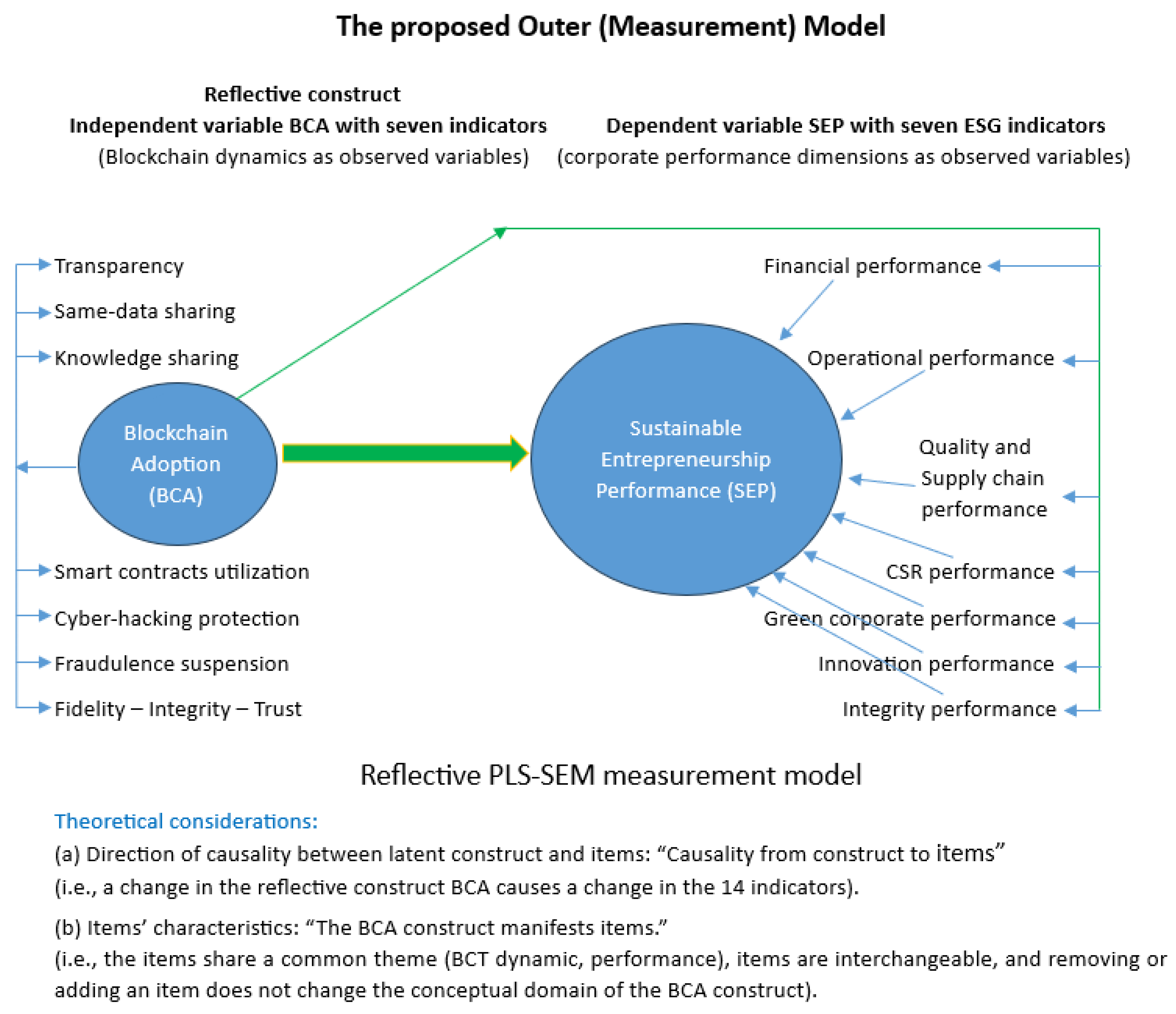
Figure 2.
The proposed conceptual framework with path analysis (Business success – ESG model).
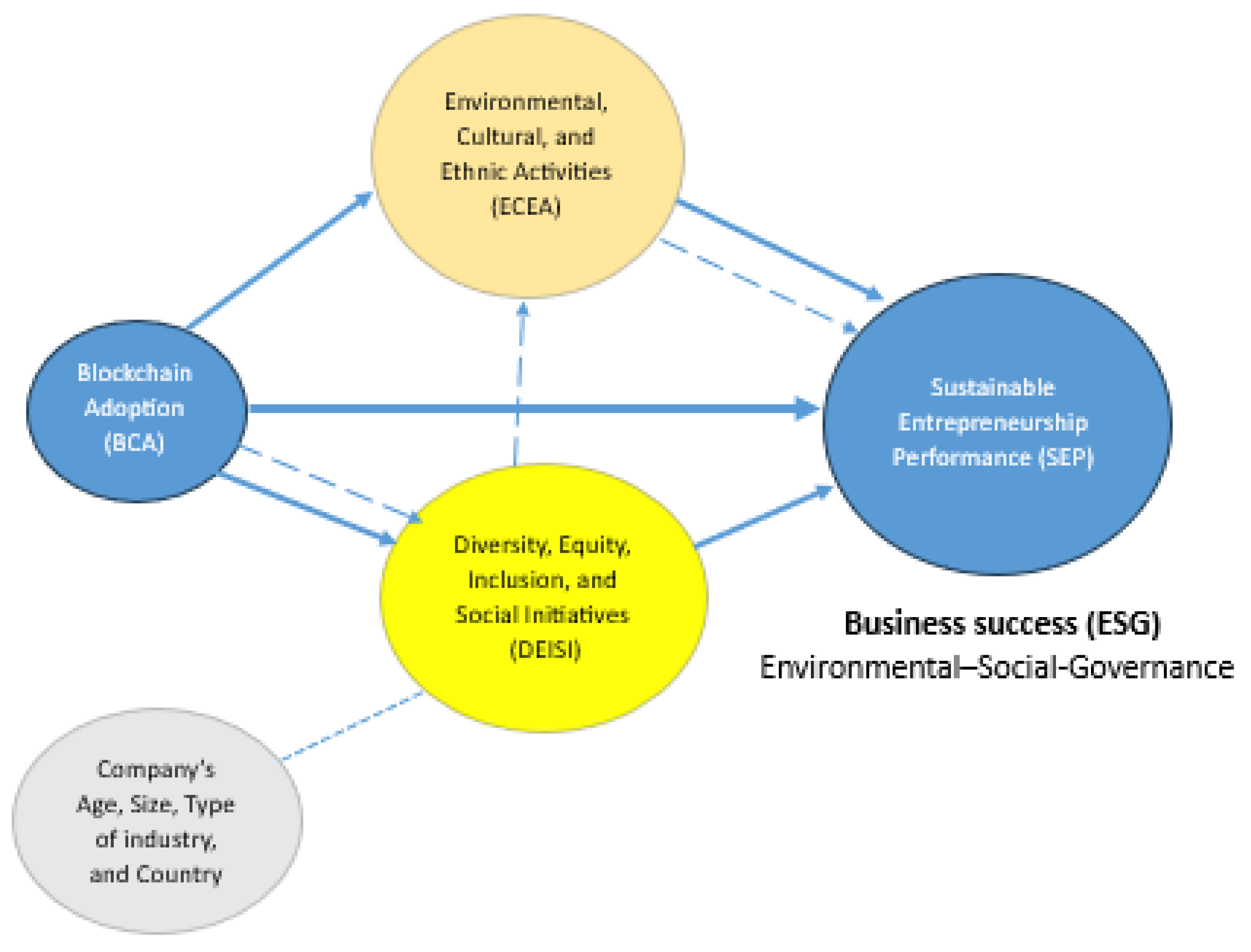
Figure 3.
The latent constructs and the observed variables. The proposed conceptual model (path diagram in both “reflective” and “formative” measurement models).
Figure 3.
The latent constructs and the observed variables. The proposed conceptual model (path diagram in both “reflective” and “formative” measurement models).
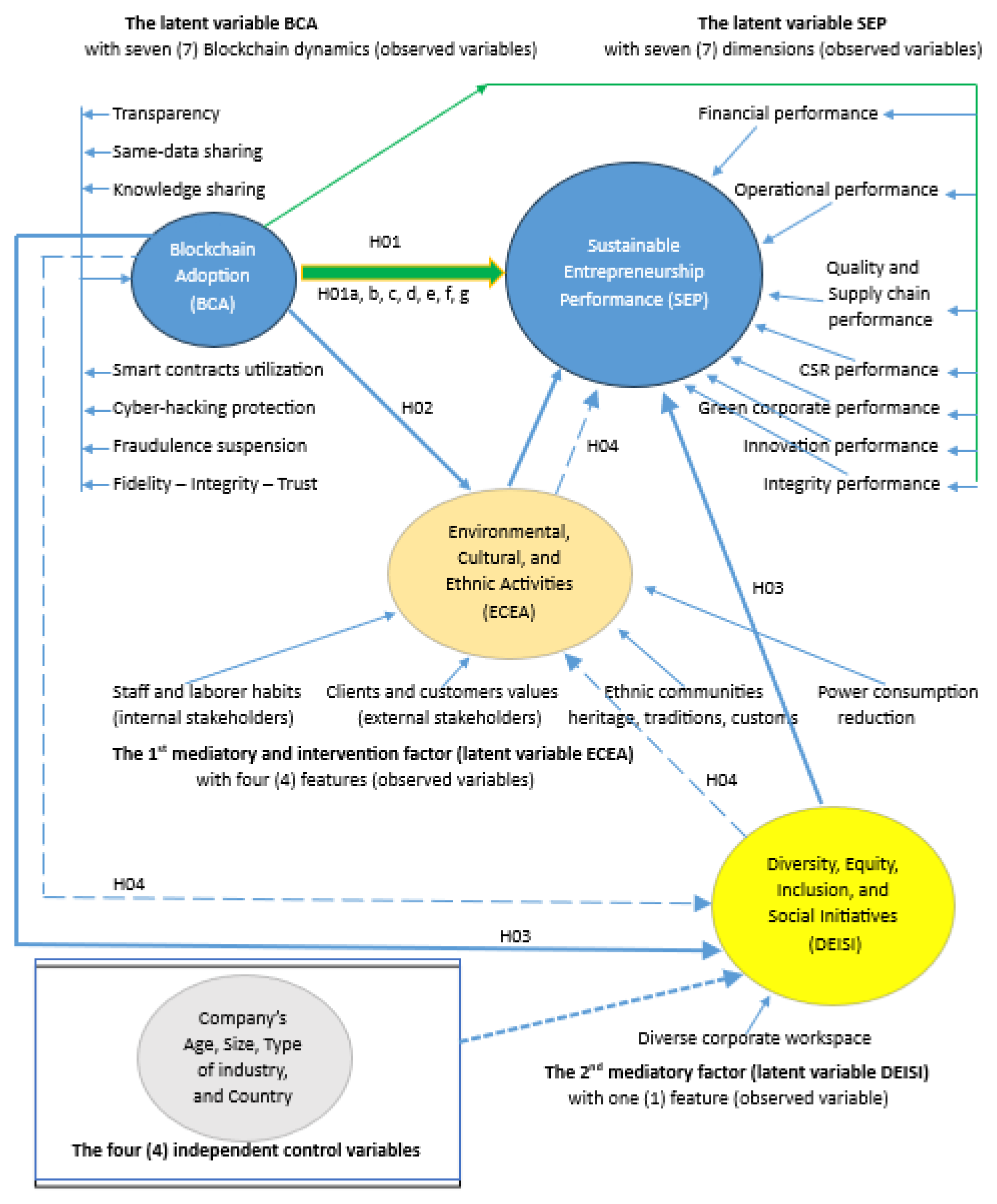
Figure 4.
Reliability and validity in our reflective PLS-SEM analysis.
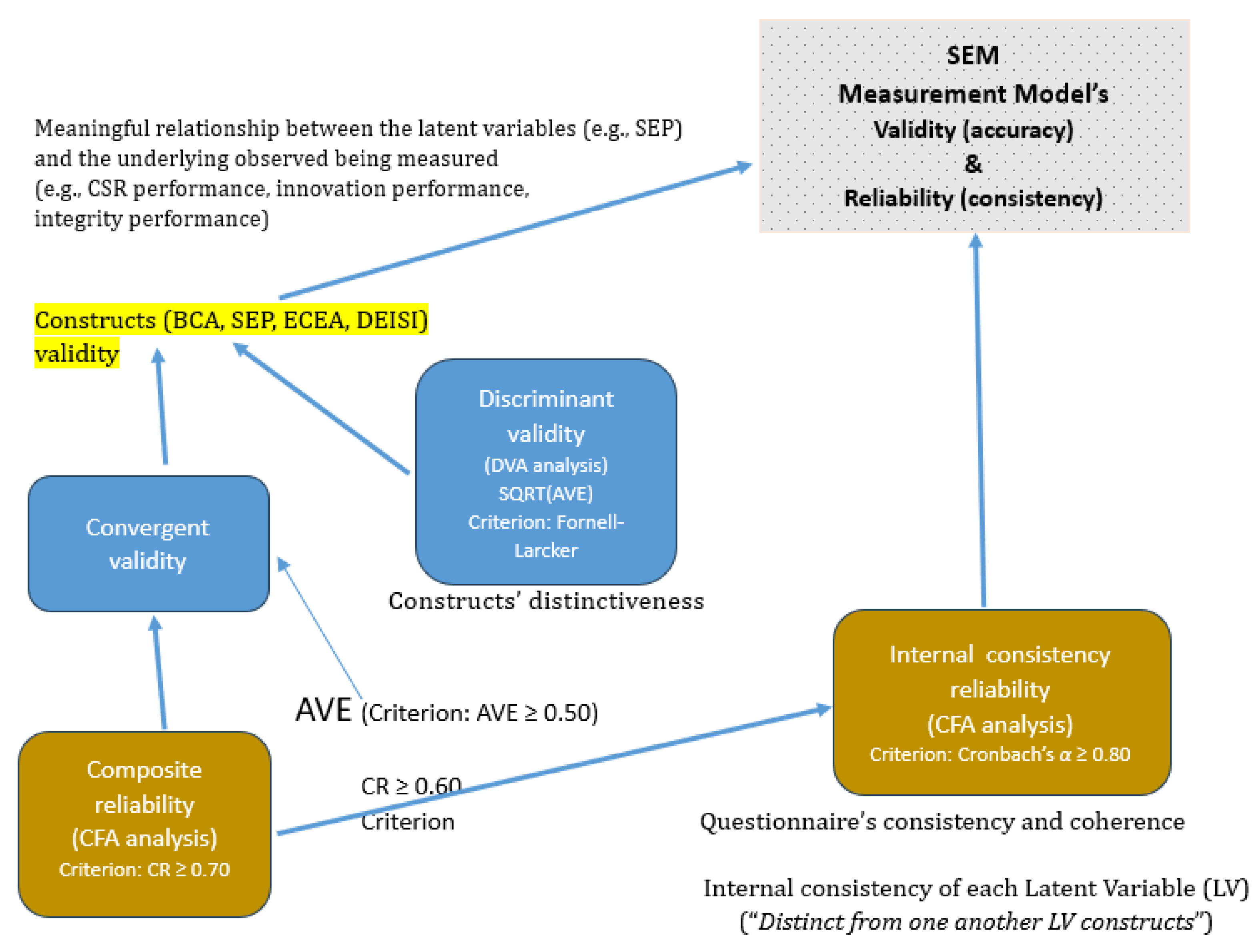
Table 1.
The Demographic Profile.
| Participants | Number |
| Managers | 438 |
| CEO | 150 |
| Presidents | 42 |
| ICT education | 366 |
| DevOps experience | 62 |
| DevSecOps experience | 38 |
| Management experience (years >10) | 326 |
Disclaimer/Publisher’s Note: The statements, opinions and data contained in all publications are solely those of the individual author(s) and contributor(s) and not of MDPI and/or the editor(s). MDPI and/or the editor(s) disclaim responsibility for any injury to people or property resulting from any ideas, methods, instructions or products referred to in the content. |
© 2025 by the authors. Licensee MDPI, Basel, Switzerland. This article is an open access article distributed under the terms and conditions of the Creative Commons Attribution (CC BY) license (http://creativecommons.org/licenses/by/4.0/).
Copyright: This open access article is published under a Creative Commons CC BY 4.0 license, which permit the free download, distribution, and reuse, provided that the author and preprint are cited in any reuse.


