

Submitted:
12 August 2024
Posted:
13 August 2024
You are already at the latest version
Abstract
Smart technology is essential for integrating circular economy principles. This study examines how conflict management strategies including collaboration, accommodation, avoidance, compromise, and competitions impact smart technology adoption, particularly blockchain, in Jordanian SMEs, a context that has been under-explored. Additionally, the research examines the moderating role of customer-centric green supply chain management in the relationship between blockchain adoption and the implementation of circular economy principles. Data were collected from 421 senior managers, department heads, and executives of Jordanian SMEs. Primarily, this study employed robust methodological approach, a structural equation modeling (SEM) technique, to test the hypotheses and analyze complex relationships. This research provides valuable insights into the adoption of blockchain technology in Jordanian SMEs, highlighting the importance of strategic conflict management, a context that is rarely explored. Incorporating customer-centric green supply chain management as a moderating factor enhance the sustainability and competitiveness of SMEs through blockchain technology. This approach offers new insights into how blockchain technology aligns with circular economic principles, highlighting the strategic role of conflict management in driving technological innovation and sustainability. The study results indicate that conflict management strategies have a significant impact on the adoption of blockchain technology among Jordanian SMEs. The results also revealed a unique finding that collaboration and compromise are the most influential strategies. Furthermore, the study found that blockchain adoption positively impacts the implementation of circular economy principles. This study provides theoretical and practical insights for SMEs, especially in the context of Jordan.
Keywords:
Circular economy principles
; blockchain adoption
; conflict management strategies
; customer-centric GSCM
; Jordan
; SMEs
; green supply chain management
1. Introduction
The continuous growth of modern businesses is increasingly attributed to the benefits offered by circular economy principles, particularly in the areas of technology adoption and strategic planning. This shift has motivated businesses worldwide to invest in smart technology that enhance resource efficiency, waste reduction and environmental sustainability, making them critical tools for modern enterprises [1]. Among these technology, blockchain stands out for its potential to address transparency, traceability, and sustainably issues in supply chain management. However, its adoption remains under-explored, especially among small and medium-sized enterprises (SMEs)[1,2].
While the organizations encompasses a wide range of business sizes and structured, this study specifically focuses on small and medium enterprises (SMEs) in Jordan for several critical reasons. SMEs play a crucial role in Jordan’s economy, comprising 95% of all registered firms, contributing over half of the GDP, and employing more than 60% of the workforce [3]. Despite being the backbone of the economy, SMEs face significant challenges in technology adoption due to such like the limited resources, lack of technology infrastructure, and insufficient awareness [3,4]. In addition, SMEs are known for their flexibility and innovative capacity, making them ideal candidates for adopting cutting-edge technologies, which enhancing the circular economy. Moreover, the conflicts in SMEs can offer valuable lessons for fostering innovation in the broader business community ([5,6]. By concentrating on SMEs, this study providing unique insights that are often overlooked in border studies examining larger corporations.
Recent studies have extensively explored the technical aspects and potential applications of blockchain adoption in small and medium-sized enterprises (SMEs), emphasizing the critical role of blockchain technologies in improving transparency, traceability, and sustainability in business operations. Research by [3] highlights the unique challenges SMEs face in adopting Industry 4.0 technologies, particularly in Jordan, where limited financial resources, technological infrastructure, and government support further compound these challenges. Similarly, studies by [7,8,9] have delved into the transformative potential of blockchain across various sectors, underscoring its role in decentralizing data management and enhancing transparency.
Despite the growing body of research on blockchain technology, there remains a significant gap in understanding its human and organizational dimensions, especially within the context of SMEs in developing countries like Jordan [10]. Much of the existing literature has focused on large corporations or tech-centric sectors [11,12], leaving a void in how SMEs, with their unique dynamics and constraints, navigate the challenges of adopting advanced technologies.
The adoption of blockchain technology offers SMEs significant advantages, such as improved supply chain management, enhanced data security, and operational efficiency, all of which can boost their competitive edge and sustainability [5,6]. By aligning with circular economy principles, blockchain also promotes sustainability and resource efficiency. However, the adoption process is fraught with challenges, including resistance to change, implementation complexity, and a general lack of understanding of the technology, compounded by concerns over cost [13,14]. These challenges often lead to conflicts among stakeholders due to differing interests and levels of expertise [15].
Previous studies have affirmed that conflicts during technological adoption can significantly impede progress, making the application of conflict management strategies crucial for successful blockchain integration in SMEs [10,16]. The existing literature, however, largely overlooks how these technologies can be effectively integrated with conflict management strategies to promote sustainable practices in SMEs. This gap is particularly pronounced in the socio-economic context of Jordan, where targeted interventions are needed to help SMEs adopt smart technologies while adhering to circular economy principles, thereby fostering sustainable business practices and economic growth in the region.
It is at this juncture that effective conflict management strategies become crucial. Understanding and applying appropriate conflict management strategies is essential for the successful integration of blockchain technology in SMEs [16]. The importance of conflict management in organizational change is widely acknowledged in the literature [16,17]. However it specific application in the adoption of smart technology by SMEs remains understudied. Existing literature provides a limited understanding of the role of different conflict management strategies in the smart technology adoption process withing SMEs. This gap is particularly significant concerning Jordanian SMEs, where societal, economic, and organizational influences play a crucial role in transforming business practices through technological changes [14].
Recent calls from researchers [18,19] have highlight the need to examine the relationship between smart technology, such as blockchain and sustainable practices. Additionally, [20] have emphasized the connection between blockchain and prosperity benefits, while [1] have called for examining circular economy principles as an outcome variable. Similarly, [21] have called for an exploring behaviors and green supply chain practices related to blockchain adoption and their impact on organizational performance management and sustainability. [22] underscores the important of selecting strategies that promote harmony within organizations, and improving the necessary skills and techniques to identify, manage, and resolve conflicts constructively. Future studies are suggested to explore conflict management styles across different industries and cultural contexts with larger sample sizes to generalize findings, as recommended by[23].
This study aims to investigate the impact of various conflict management strategies on blockchain adoption among Jordanian SMEs, addressing a critical gap in the literature on organizational conflict and technological innovation. By examining how these strategies facilitate or hinder blockchain adoption within the unique organizational culture and business environment of Jordan, this research provides valuable insights into fostering innovation, sustainability, and enhancing supply chain transparency and efficiency. Additionally, the research examines the moderating role of customer-centric green supply chain management (GSCM) in the relationship between blockchain adoption and the implementation of circular economy principles
Integrating stakeholder theory with the technology acceptance model (TAM), the study bridges the gap between theoretical constructs and practical applications, emphasizing the role of managing stakeholder conflicts in promoting technological adoption. Furthermore, the study incorporates Ting-Toomey and Oetzel’s Culture-Based Social Ecological Conflict Model (CBSECM), offering a comprehensive framework for understanding how individual-level conflict management strategies influence organizational-level blockchain adoption and the implementation of circular economy principles.
Overall, this study contributes to a better understanding of the human and organizational factors that affect SMEs’ technological adoption within Customer-Centric Green Supply Chain Management (CCGSCM). It uniquely contributes to understanding the human and organizational factors affecting SMEs’ technological adoption within the context of Customer-Centric Green Supply Chain Management (CCGSCM), providing new insights into aligning blockchain technology with circular economy principles.
2. Literature Review
2.1. Conflict Management Strategies (CMS)
Conflict management is a critical aspect of organizational behavior and interpersonal relationships, involving effective understanding and handling of conflicts [24]. Since the 1960s, different researchers have proposed some strategies to manage conflicts, most of which are based on the managerial grid developed by Robert R. Blake and Jane Mouton. This model features two axes: “concern for people” on the vertical axis and “concern for task” on the horizontal axis, each with a numerical scale from 1 to 9. These axes intersect to represent five different management styles, illustrating how the interplay between task orientation and relationship orientation influences interactions with others[25].
In the 1970s, Kenneth Thomas and Ralph Kilmann introduced a two-dimensional model, including assertiveness and cooperativeness, resulting in the five different strategies including Competing (assertive, uncooperative), Avoiding (unassertive, uncooperative), Accommodating (unassertive, cooperative), Collaborating (assertive, cooperative), and Compromising (intermediate assertiveness and cooperativeness)[26]. These strategies are paramount as they provide a framework for resolving conflicts that ensure productive communication and resolution highlighting the dynamic interplay between an individual’s approach to their own needs versus the needs of others in conflict situations.
Building upon the existing foundation, Thomas and Kilmann’s model, Rahim (1983) developed the Rahim Organizational Conflict Inventory (ROCI), specifically designed to measure conflict management styles within organizational settings. While retaining the five styles identified by Thomas and Kilmann, Rahim’s model tailored the framework to better address the specification of organizational conflicts. This adaptation provides a more detailed understanding of how different conflict management strategies can be applied in a business context to improve organizational effectiveness and interpersonal relationships. Rahim’s work, therefore not only builds on but also enhances the applicability of Thoman and Kilmann’s model, making it more relevant and useful for studying conflict management in organizational settings. Managers often seek to stimulate conflict at optimal levels to boost risk-taking, creativity, and long-term performance [27].
The dual concerns model of conflict management, proposed by Pruitt and Rubin, provides a comprehensive framework by considering two dimensions: concern for self and concern for others. This model also identifies the five similar conflict management strategies, aligning closely with the frameworks proposed by both, Thomas and Kilmann, and Rahim, reinforcing the robustness of these approaches. Moreover, this model propose that effective conflict management by understanding the balance between both the self and others concern [28,29].
To further enhance the understanding of the conflict management in diverse organizational contexts, this research integrates Ting-Toomey and Qetzel’s Culture-Based Social Ecological Conflict Model (CBSECM). CBSECM provides a meta-theoretical framework to understand conflict in a social-ecological context, Integrating cultural and ecological perspectives and emphasizing the interplay between individual behaviors, organizational practices, and broader environmental contexts [30]. This model is particularly relevant for analyzing how conflict management strategies at the individual level impact organizational outcomes and system-level sustainability goals [30].
Rahim’s (1983) Conflict Management Styles Inventory, refinements and builds upon the foundational models of Thomas and Kilmann, Pruitt and Rubin, and integrations insights from Ting-Toomey and Oetzel’s Culture-Based Social Ecological Conflict Model (CBSECM). Rahim’s model provides a more applied and specific approach, particularly suited to organizational contexts. This comprehensive framework allows to examine how different conflict management strategies influence blockchain adoption and the implementation of circular economy principles in Jordanian SMEs, driving organizational-level technological adoption and system-level sustainability practices. The following is a brief explanation of the five conflict management strategies:
2.1.1. Collaboration (CL)
Collaboration (CL) is a strategy in which concerned parties work together to find mutually beneficial solutions. This involves high assertiveness and cooperativeness [31,32] found that emotional intelligence significantly predicted the use of CL in situations of conflict. This is particularly significant owing to its effectiveness in achieving win-win outcomes. [33] noted that this strategy is particularly relevant in the interactions of stakeholders where joint problem-solving can lead to innovative solutions.
2.1.2. Accommodation (AC)
Accommodation (AC) involves preferring another point of view, which often comes at one’s own expense [34]. It is high in cooperativeness but low in assertiveness. [35] showed gender-based differences in the preference for AC and noted that females are more inclined towards this strategy. This approach can be effective in maintaining relationships in which the issue is more important to the other party.
2.1.3. Avoidance (AV)
Avoidance (AV) refers to sidestepping a conflict and not satisfying either party’s concerns. [36] noted that AV reflects low assertiveness and cooperativeness. [37] asserted that inner conflict increases the chances of selecting AV. This strategy may be used when a conflict is unimportant or when more information is required.
2.1.4. Compromise (CM)
CM involves finding a middle ground on which each party makes concessions. This represents a moderate level of both assertiveness and cooperativeness [38,37] indicated a greater inclination towards CM in the presence of interpersonal conflict, suggesting its use as a balanced approach in conflict resolution.
2.1.5. Competition (CP)
CP is an assertive and uncooperative approach that aims to win conflict at the other’s expense [34]. This is often used when one’s rights or principles are at stake. However, [39] revealed that competitive strategies could negatively affect organizational performance if not managed effectively. Therefore, it indicates the need for careful consideration of this approach in stakeholder interactions.
2.2. Smart Technology Adoption with a Focus on Blockchain
The adoption of new technology has evolved significantly since its inception, primarily associated with the cryptocurrency Bitcoin [40]. The integration of networked devices and systems, such as the Internet of Things (IoT), artificial intelligence (AI), Blockchain, and big data analytics, enables businesses to become smarter and more efficient, facilitating predictive maintenance in manufacturing [41]. However, the complex nature of smart technology ecosystems, security vulnerabilities, data privacy concerns, and geopolitical disturbances necessitate proactive conflict management strategies to ensure efficient operations and reduce risks [42].
Blockchain, a decentralized and secure distributed ledger technology key for trust and transparency in supply chains [9]. Its applications extend beyond finance to sectors like healthcare and e-government [8]. Blockchain enhances supply chain transparency and accountability, aligning with circular economy principles [43]. Initially viewed with skepticism due to it’s complexity, blockchain technology has gradually gained recognition for its potential beyond financial applications, becoming a subject of burgeoning research across various sectors [9,44]. These features collectively ensure the integrity and transparency of data. In this way, blockchain technology is a smart technology considered to be a powerful tool for various applications [45,46].
Examining the connection between this technology and conflict management will provide valuable insights into the potential advantages of implementing these emerging technologies [47]. Its integration within supply chains indicates a paradigm shift towards increased transparency and efficiency [19]. Blockchain’s ability to provide an unalterable record of transactions ensures traceability and accountability, which are key factors in managing supply chain complexities [48,49]. The technology’s capacity to track the lifecycle of products and materials aligns seamlessly with the circular economy principles and sustainable supply chain practices [43,50].
The novel and complex nature of this technology creates multiple barriers concerning its operation and understanding [13]. SMEs tend to be more flexible and innovative compared to larger organizations. However, the rapid evolution of blockchain, especially in finance, necessitates continuous adaptation to technological advancements [51]. This is especially in the case of SMEs, as they are more vulnerable to the risks of not adopting advanced technology and lack sufficient resources [1]. Firms outside the technology sector often recognize their lack of knowledge regarding blockchain technology creating conflicts among stakeholders regarding the adoption of the technology [52,53].
2.3. Circular Economy Principles (CEP)
Unlike the traditional linear economic model, circular economy principles (CEP) focus on a sustainable and regenerative approach particularly within smart cities [10]. The conventional take-produce-sell-spend-reject’ sequence is now challenged by CEP, as it promotes a closed-loop system to minimize waste. In addition, this results in resources being continuously cycled back into the economy [54,55]. 3Rs: Reduction, reuse, and recycling are considered the foundational circular economy principles [20]. Reduction focuses on minimizing resource extraction and consumption. The reuse principle enhances the life cycle of products, whereas recycling converts waste into new resources [56,57,58] highlighted the operationalization of circular economy principles, which involves distinguishing between renewable and nonrenewable resources. For renewable resources, the extraction rate should not exceed the regeneration rate, aligning with the sustainable development targets [59,60]. According to [61], nonrenewable resources, by contrast, should be used sparingly, with an emphasis on developing renewable alternatives to ensure long-term sustainability. CEP also advocates the minimization of waste, distinguishing between biological and technical waste [61]. Biological waste should be reintegrated into natural cycles, while technical waste requires human intervention for reintegration into the economic system [62,63].
[58] asserted that the operational principles of circular economy include closing the system, maintaining the resource value, and reducing the size of the system. These principles include strategies such as enhancing the efficiency of energy, promoting renewable energy, increasing product durability, and resource re-circulation [64,65]. On the other hand, transversal operational principles, including designing and education for CEP, are important. Based on these two principles, design plays an important role in ensuring that products are recyclable, repairable, and modular. [66] noted that education fosters a societal shift towards a circular economy mindset, involving both producers and consumers.
2.4. Customer-Centric Green Supply Chain Management (CCGSCM)
Customer-centric green supply chain management (GSCM) contributes to the smart business concept by integrating sustainable practices with a focus on customer needs, enhancing resource efficiency, reducing environmental impact, and promoting a circular economy principles, as evidenced by recent research [67]. In the current business landscape, smart business practices face a fundamental shift concerning focusing on customer satisfaction while integrating environmental sustainability [68]. The primary objective of CCGSCM is not only to increase the efficiency and sustainability of supply chain practices but also to consider customers’ expectations. This aspect is particularly relevant and preferred in today’s environmentally conscious market [69].
Previous studies have underscored the important highlighted that aligning green supply chain management (GSCM) practices with customer expectations, noting that such alignment can significantly improve operational efficiency while simultaneously enhancing customer satisfaction [70,71]. This dual focus on efficiency and satisfaction positions CCGSCM as a critical strategy for businesses aiming to thrive in the modern marketplace.
The approach aligns supply chain practices with customer expectations for sustainability, especially in the post-COVID-19 era. The pandemic has further amplified the relevance and popularity of CCGSCM, changing consumers’ expectations, making them more proactive in seeking sustainable practices and expecting organizations to engage and incorporate social responsibility and sustainable practices[72]. This shift has developed unique opportunities for businesses to reevaluate and enhance their strategies regarding GSCM. By emphasizing a customer-centric approach and prioritizing environmental sustainability, businesses can better meet the evolving demand of the market [73].
3. Theoretical Lens and Hypothesis Development
3.1. Stakeholder Theory and Technology Acceptance Model
Stakeholder theory emphasizes considering all stakeholders in decision-making [74]. This study uses stakeholder theory to explore how conflict management strategies address stakeholder concerns, facilitating blockchain adoption. The Technology Acceptance Model (TAM) highlights usability and perceived usefulness as key factors influencing technology adoption [75].
It is important to understand how different internal stakeholders, including employees and management, interact and resolve conflicts [76]. According to [77], conflict management strategies help address the various needs and views of different stakeholders, such as employees, management, customers, suppliers, and regulatory bodies in the organization, especially in Jordan [78]. Concerning smart technology adoption, [79] noted that stakeholder theory highlights the significance of considering the expectations and requirements of both internal stakeholders (like employees who will use the technology) and external stakeholders (such as customers demanding transparency and suppliers involved in the smart technology). [80] emphasized the importance of dual emphasis for SMEs to effectively utilize and incorporate smart technologies. This hypothesis is pertinent to the study because blockchain technology frequently necessitates organizational transformation, which has varying impacts on stakeholders. Implementing blockchain technology necessitates the identification and effective management of various stakeholders’ diverse interests and influences. Active participation of stakeholders in the decision-making process can enhance the acceptance and effectiveness of blockchain technology.
The Technology Acceptance Model (TAM) proposed by [75] provides a framework for understanding how the usability and usefulness of technology impact customer adoption, with usability and perceived usefulness being key factors expected to influence the popularity of blockchain technology. Implementing conflict resolution strategies that address stakeholder concerns and emphasize the advantages of blockchain technology may enhance stakeholders’ perceptions of the technology, affecting their willingness to embrace it. Further, regarding circular economy principles, stakeholder theory highlights the need to align business practices with the broader environmental and social goals valued by external stakeholders, including customers, community groups, and regulatory agencies [81]. Finally, in the context of CCGSCM, [67] employed this theory and noted that stakeholder theory highlights the role of customers as key stakeholders. Based on customers’ demand for environmentally sustainable products, SMEs adopt green practices in their supply chains. [82] noted that this theory helps understand the role of customer preferences in driving supply chain management decisions. In this study, stakeholder theory was employed to explain the relationships and develop hypotheses. The relationships and hypotheses are presented in Figure 1.
3.2. Conflict Management Strategies and Blockchain Adoption
The adoption of smart technology in Jordanian SMEs is intricately linked to the effective management of stakeholder conflict [16,17,83] asserted that there may be conflicting opinions, resistance to change, or a lack of understanding among stakeholders regarding the adoption of new technologies such as blockchain; therefore, conflict management strategies play a key role in solving such conflicts [84]. By employing these strategies, organizations can ensure a smooth and inclusive transition towards blockchain technology [8,85,86]. This study aims to explore how specific conflict management strategies impact blockchain adoption, providing a nuanced understanding that goes beyond general positive associations.
Collaboration, as one of the important conflict management strategies, emerges as a foundation strategy, promoting a culture of open communication and joint problem-solving [87]. This strategy is particularly effective in scenarios requiring high stakeholder engagement and alignment. By fostering a supportive environment, collaboration enhances the acceptance and integration of blockchain technology within the organization [88,89] asserted that accommodation plays an important role in dealing with stakeholders’ reservations (by ensuring that they are all heard) regarding the adoption of new technologies, such as blockchain. This inclusive is vital for the acceptance and support of blockchain adoption [90,91]. Accommodation is particularly relevant in hierarchical organizational structures where top-down directives benefit from buy-in at multiple levels.
Apart from the above, another conflict management strategy, namely avoidance, is seemingly passive. However, they can be strategically employed to address conflicts that are either premature or based on misinformation [92]. Another important conflict management strategy, compromise, is significant in finding a middle ground in which the goals of blockchain adoption are followed [93]. However, it should be realistic and achievable, considering the constraints of the organization [94].
Finally, competition, when harnessed positively within the organization, can act as a promoter of innovation and progress. A competitive spirit can motivate different departments to proactively engage in blockchain technology and seek efficient and creative solutions [95]. This internal drive can accelerate the adoption process, leading to more effective and competitive blockchain applications [83]. From the above discussion, it can be concluded that conflict management strategies help and facilitate the adoption of smart technology focusing on Blockchain in organizations. Therefore, the following hypothesis was developed:
H1
: Collaboration, as a conflict management strategy employed by senior managers and department heads, significantly enhances the likelihood of blockchain adoption in Jordanian SMEs by promoting open communication and joint problem-solving.
H2
: Accommodation, as a conflict management strategy used by decision-makers, facilitates blockchain adoption in Jordanian SMEs by ensuring stakeholder concerns are addressed.
H3
: Avoidance, as a conflict-management strategy utilized by organizational leaders, strategically delays premature conflicts to support the thorough evaluation and eventual adoption of blockchain technology in Jordanian SMEs.
H4
: Compromise, as a conflict management strategy adopted by key stakeholders, balances diverse interests to promote the realistic and achievable implementation of blockchain in Jordanian SMEs.
H5
: Competition, as a conflict management strategy fostered within departments, drives innovation and significantly enhances blockchain adoption in Jordanian SMEs by leveraging competitive dynamics.
By focusing on these specific hypotheses, this study aims to contribute a detailed and contextually rich understanding of how different conflict management strategies impact the adoption of blockchain technology in Jordanian SMEs.
3.3. Blockchain Technology Adoption and Circular Economy Principles
Blockchain adoption enhances sustainability in supply chains by providing transparent and immutable records [96]. This relationship is particularly highlighted in Green Supply Chain Management (GSCM), where the capabilities of smart technology align well with sustainability goals. Here, blockchain technology offers transparent and undisputable records that aid in tracking the sustainability performance of suppliers [13]. This alignment supports circular economy principles by reducing waste and optimizing resource utilization [57], Narayan and Tidström [97] noted the role of blockchain technology in promoting a decentralized approach to value creation, which is crucial for circular economy principles (CEP) models that aim to minimize waste and maximize resource efficiency.
The smart technology can be applied to multiple sectors. For instance, [98] asserted that blockchain technology is a smart technology that can improve vehicle routing and minimize energy consumption and carbon emissions in the manufacturing sector, and the IoT can collect data for real-time decisions. In the food supply chain, smart technology increases traceability and reduces waste [99]. The use of smart contracts and tokenization in smart technology platforms streamline CEP processes. These features enable automated and secure transactions and agreements that are essential for efficient resource circulation and waste minimization [97,100]. However, the integration of blockchain technology into existing systems is not without challenges. Trust, reliability, and organizational change are significant barriers that must be addressed for smart technology to realize its full potential in advancing CEP [57,101].
The objective of CEP is to reduce or completely eradicate waste, a goal emphasized by Schulte [102]. This reduction can be achieved by converting the end-of-life of products and services into renewed value, thereby extending their lifespan or creating new usage methods [103]. This approach ensures the sustainable circulation of resources. Additionally, integrating the concept of CEP with systems thinking is recommended, where a business model incorporates a broader network of stakeholders to promote a cyclical life cycle in the design of products and services [97,104]. In this context, Yadav and Singh [51] stated that blockchain technology plays a pivotal role by underpinning these systems and connecting complex networks and databases with configurations that allow for simultaneous, irreversible updates and the potential for necessary automation. The successful implementation of such innovations requires various firms within a network or chain to adapt and integrate this blockchain technology [101]. Blockchain technology adoption, in particular, is increasingly recognized as a key driver in the digital economy [10]. Hence, based on the above discussion, it can be concluded that blockchain adoption is beneficial for CEP; therefore, the following hypothesis is proposed.
H6
: Blockchain adoption by Jordanian SMEs has a positive impact on the implementation of Circular Economy Principles (CEP).
3.4. Moderating Role of Customer-Centric Green Supply Chain Management
Customer-centric green supply chain management (CCGSCM) enhances the effectiveness of blockchain in promoting circular economy principles by aligning technological efforts with market demands [67]. Blockchain technology, which is known for its ability to ensure transparency, traceability, and efficiency, plays a significant role in enhancing circular economy principles [1,5,10] noted that smart technology enables the tracking of products throughout their lifecycle; therefore, this technology facilitates the principles of reduction, reuse, and recycling inherent in the circular economy principles model [105]. However, the effectiveness of blockchain technology in promoting circular economy principles can be significantly influenced by how supply chains are managed, particularly from a customer-centric green perspective. [67] highlighted the significance of customer-centric GSCM and asserted that it involves understanding and responding to customer demands for sustainable products and practices. Modern consumers are increasingly environmentally conscious and seek products that align with sustainable practices [106]. This shift in consumer behavior drives companies to adopt more sustainable practices [19,68].
Moreover, [107] noted that customer-centric GSCM facilitates a feedback loop between consumers and companies. As consumers use products and provide feedback, companies gain valuable insights into consumer preferences and behaviors [108]. This information can be crucial for refining product design, sourcing strategies, and manufacturing processes in line with circular economy principles [109]. Smart technology can enhance this feedback loop by offering a reliable and transparent method of collecting and analyzing consumer data. Furthermore, the alignment of blockchain adoption with market needs is crucial for ensuring that blockchain adoption effectively supports circular economy principles by focusing on areas that are most impact-full from a sustainability perspective [110]. Hence, based on the above discussion, it can be concluded that customer-centric GSCM increases the strength of the relationship between the blockchain adoption and circular economy principles. Therefore, the following hypothesis was developed:
H7
: Customer-centric green supply chain management (CCGSCM) moderates the relationship between blockchain adoption and Circular Economy Principles (CEP), strengthening the positive impact of blockchain adoption on CEP in Jordanian SMEs.
4. Methodology
4.1. Study Context and Sampling
The Jordanian SMEs were selected in this study. This context was selected owing to the significance of SMEs in the context of Jordan’s economy. These businesses are pivotal in driving economic growth, as evidenced by various studies. For instance, SMEs represent approximately 95% of all registered firms in Jordan, contributing significantly to GDP and employment [3]. Their potential for flexibility and innovation makes them ideal candidates for adopting cutting-edge technologies like blockchain. [111] find that credit guarantees in Jordan have a positive impact on the economy and note that SMEs play a major role in the national economy. Their findings revealed that government interventions have successfully overcome the financial constraints of SMEs, thereby boosting economic growth.
Additionally, the research of [112] on the impact of the COVID-19 pandemic on Jordanian manufacturing SMEs reveals the sector’s vulnerability and significance. The study shows that a significant portion of these enterprises experienced a drop in sales due to the pandemic, highlighting their critical role in the economy and the need for strategic decisions focusing on SME recovery.
Finally, [113] examines the impact of SME finance on Jordan’s economic growth. The findings suggest that small and medium-sized finance positively influences economic growth, highlighting the importance of SMEs in the national economic landscape.
Participants and Recruitment
Similar to [1,47], and [5], this study selected top-level executives, senior management, and department heads. These individuals are key decision-makers who have a comprehensive understanding of the company’s strategic direction and operational practices. This demographic was chosen specifically because their perceptions and attitudes toward blockchain technology are likely to significantly influence the organizational readiness and overall acceptance of such innovations. They were recruited through professional networks, industry associations, and direct invitations sent to them, explaining the purpose of the study and requesting their participation. Follow-up emails and phone calls were made to ensure a sufficient response rate.
Data collection
Data were collected using an online survey platform to ensure convenience and accessibility for participants. The survey included questions designed to measure conflict management strategies, blockchain adoption, and circular economy principles (CEP). The data collection period spanned from July to September 2023. Participants were assured of the confidentiality of their responses and the anonymity of their data to encourage honest and accurate reporting.
4.2. Study Design
The survey was conducted to evaluate the adoption of blockchain technology within Jordanian SMEs. The participants were surveyed using an online questionnaire distributed over a period of three months. The questionnaire was designed to capture detailed information on conflict management strategies, blockchain adoption, circular economy principles, and customer-centric green supply chain management. The survey ensured anonymity and confidentiality to encourage honest and unbiased responses.
4.4. Meaurement Instruments
The survey included items to measure conflict management strategies, blockchain adoption (BA), circular economy principles (CEP), and Customer-Centric Green Supply Chain Management (CCGSCM) ensuring that all constructs were adequately operationalized.
Conflict Management Strategies
The study used previously validated scales to measure the constructs, Rahim’s conflict management strategies inventory due to its specific design for organizational and business settings, , making it more relevant for our analysis of conflict management in Jordanian SMEs. A modified version of Rahim’s 1983 Conflict Management Styles Inventory was used, incorporating 15 items instead of the original 28. The selection of these 15 item was made to ensure the questionnaire remained concise and manageable for respondents, which is critical in survey based research to maintain engagement and response rates. And based on their relevance to organizational settings and their ability to comprehensively capture the essence of the five conflict management strategies: collaboration, accommodation, avoidance, compromise, and competition. The specific items chosen were those that previous studies had found to be most applicable to organizational contexts [114,115].
Blockchain Adoption (BA)
The blockchain adoption (BA) refers to the extent to which blockchain technology is implemented and utilized within an organization’s operations. BA was measured using a three-item scale adapted from [19]. The items focused on employee perceptions of blockchain technology adoption, on the perceived usefulness, ease of use, and implementation success of blockchain technology within the organization
Circular Economy Principles (CEP)
Customer-Centric Green Supply Chain Management (CCGSCM)
Customer-Centric Green Supply Chain Management (CCGSCM) refers to the integration of environmentally sustainable practices into supply chain management, with a focus on meeting customer expectations. CCGSCM was measured using a three-item scale developed by [118], which is in line with [67].
Respondents indicated their level of agreement with statements on a 5-point likert scale ranging form 1 (strongly disagree) to 5 (strongly agree).
5. Data Analysis and Results
The data collected from the survey was analyzed using both descriptive and inferential statistics to gain a comprehensive understanding of the impact of conflict management strategies on blockchain adoption among Jordanian SMEs. The analysis began with descriptive statistics to provide an overview of the sample characteristics, including mean, standard deviation, and distribution of responses for each item in the survey.
The analysis of collected data was performed with the help of SPSS 21 and SmartPLS 3.0. Demographic characteristics were analyzed using frequency distribution with the help of the SPSS 21. Table 1 shows that the final sample consisted of 421 respondents, with the plurality of the respondents are male (66.3%), reflecting the gender division in top positions in Jordanian SMEs. Most respondents were in the age range of 31-40 years (52.5%), while the smallest number of participants were above 50 years of age.
The majority of the respondents (52.7%) hold a master’s degree, while most of the respondents (48%) have more than 10 years of working experience. In addition, Table 1 highlights that the majority of the respondents were senior managers (44.7%), and most of the participants belonged to the production/operations department (43.7%) in their organizations. The participants held various positions, including senior managers (44.7%), department heads (35.4%), and executives (20.0%), with a significant portion having more than 10 years of experience (48%).
5.1. Descriptive Statistics
Table 2 presents the results of the descriptive statistics for the the variables used in this study, providing summarized information regarding the direction of relationships and normality statistics [119]. The mean values range of 2.877 to 3.066, while the standard deviation (SD) values lie in the range of 0.6785 to 1.0059. These values indicate a consistent direction of relationships among the variables and suggest a normal distribution of responses. The mean values reflect the positive relationships among variables, while the standard deviation values indicate a typical variation around the mean. All values fall within the acceptable range confirming a normal variation among responses.
5.2. Reliability and Validity
Table 3 shows the results regarding the factor loadings, reliability, validity measures, and multicollinearity. This table shows that all factor loadings are above 0.5; indicating acceptable convergent validity, and there is no need to remove any item [121]. Reliability was measured with the help of both popular methods, including Cronbach’s alpha (α) and Composite Reliability (CR). Although α is considered a less accurate measure (as it assumes that all indicators are equally weighted and contribute equally to the construct) than CR (as it takes into account the different loadings of indicators on a latent variable), it is still prevalent among the majority of scholars; therefore, both measures are utilized in this study[122].
According to a majority of scholars, the acceptable range of both α and CR is 0.6 to 0.7 or above [123,124]. However, situations may arise where α falls below 0.6, whereas CR exceeds 0.7. In such scenarios, it is important to note that an α value lower than 0.6 suggests reduced reliability of the latent constructs as per the standards set by [125]. Conversely, if the CR value for all latent constructs is above 0.70, it can serve as a substitute measure for construct reliability, particularly in cases where the α value is marginally lower than the CR value, as indicated by Peterson & Kim (2013). A CR value exceeding 0.7 is indicative of satisfactory reliability of the latent variables, as noted by [126]. Therefore, based on these standards, although the value of α is below 0.6, the values of CR for all variables are above 0.6, hence proving an acceptable level of reliability.
In Table 3, the values of AVE show the average variance extracted, commonly used to measure convergent validity [127]. According to Table 3, all the values of AVE are greater than 0.5; therefore, these values present an acceptable level of convergent validity [128]. To measure discriminant validity, the commonly used criterion proposed by [129] was employed (see Table 4). This method posits that the square root of the AVE must be higher than the corresponding correlation among the variables. The highlighted diagonal values in Table 4 are the square roots of AVE, which are compared to their corresponding values of correlation among variables in rows and columns. As per the criterion, the square root values of AVE are greater than the correlation values of the variables; therefore, discriminant validity is acceptable.
5.2. Hypothesis Testing
A robust Structural Equation Modeling (SEM) approach was employed to test the hypotheses and analyze the complex relationships involved, which is a regourous and novel approach in this context. SEM is particularly well-suited for this study due to it’s capacity to simultaneously examine multiple relationships between latent constructs, as highlighted by [130]. This provides a comprehensive understanding of how conflict management strategies influence blockchain adoption. The structural model, developed using Bootstrapping in SmartPLS, presented in Figure 2.
Path diagrams visually depict the hypothesized relationships. Prior research has utilize SEM to investigate technology adoption within organizations, establishing it’s suitability for testing similar hypothesis [75,131]. This study builds upon this empirical foundation to delve into the influence of conflict management strategies on blockchain adoption and subsequent circular economy principles in Jordanian SMEs.
Table 5 details the path coefficients, revealing that collaboration and compromise are the most influential conflict management strategies in fostering blockchain adoption within Jordanian SMEs. These findings lend support to hypotheses 1 and 4. While accommodation, avoidance, and competition also exhibit positive impacts on blockchain adoption, their effects are comparatively weaker. Furthermore, blockchain adoption positively influences circular economy principles, thereby supporting hypothesis 6. The moderating effect of customer-centric green supply chain management (CCGSCM) on the relationship between blockchain adoption and circular economy principles is also positive and significant, confirming hypothesis 7.
The path coefficients results, as detailed in Table 5, reveal the magnitude and significance of the relationships between conflict management strategies, blockchain adoption, and circular economy principles. Below is an interpretation of path coefficients:
- H1 (Collaboration → Blockchain Adoption): The path coefficients (β=0.179, p<0.01) indicates a significant positive relationship, suggesting that increased collaboration among stakeholders enhances the likelihood of blockchain adoption.
- H2 (Accommodation→ Blockchain Adoption): A significant positive relationship (β =0.159, p<0.01) demonstrates that adopting an accommodating approach in conflicts can contribute to the successful adoption of blockcahin technology.
- H3 (Avoidance→ Blockchain Adoption): The positive and significant path coefficient (β=0.125, p<0.01), though smaller compared to collaboration and compromise, suggests that avoiding conflicts, while somewhat helpful, might not be as effective as other strategies in facilitating blockchain adoption.
- H4 (Compromise→ Blockchain Adoption): Similar to collaboration, compromise exhibits a significant positive impact on blockchain adoption (β=0.179, p<0.01), indicating that finding middle-ground solutions in conflicts can be instrumental in driving blockchain adoption.
- H5 (Competition→ Blockchain Adoption): The smallest path coefficient among the five conflict management strategies (β=0.124, p<0.05) suggests that competition might be the least effective approach in fostering blockchain adoption, although the relationship remains positive and significant.
- H6 (Blockchain Adoption→ Circular Economy Principles): The path coefficients (β=0.152, p<0.01) demonstrates a significant positive relationship, implying that the adoption of blockchain technology can contribute to the implementation of more sustainable business practices.
- H7 (Moderating effect (CCGSCM)→ Circular Economy Principles): The positive and significant path coefficient (β=0.165, p<0.05) indicates that customer-centric green supply chain management (CCGSCM) strengthens the positive relationship between blockchain adoption and circular economy principles.
The analysis of path coefficients indicates that although all conflict management strategies demonstrate statistically significant positive relationships with blockchain adoption, their strengths vary. Collaboration and compromise exhibit stronger associations compared to accommodation, avoidance, and competition, suggesting a differential impact on blockchain adoption.
While the statistical significance confirms the presence of measurable effects, the relatively small path coefficients imply that the practical implications of these strategies might be modest. It is crucial for practitioners to acknowledge that while these strategies can facilitate blockchain adoption, their effectiveness may differ, and relying solely on them might not be sufficient to drive substantial adoption.
Overall, the results substantiate all hypotheses, indicating that conflict management strategies positively influence blockchain adoption among senior managers, department heads, and executives in Jordanian SMEs. Additionally, blockchain adoption positively affects circular economy principles, and this relationship is moderated by CCGSCM. Notably, collaboration and compromise emerge as the most effective conflict management strategies in this context.
6. Discussion and Conclusion
6.1. Discussion
6.1.1. Impact of Conflict Management Strategies on Blockchain Adoption
This study employs a robust methodological approach using structural equation modeling (SEM) to analyze data from 421 senior managers, offering a comprehensive understanding of the impact of conflict management strategies on blockchain adoption. The use of (SEM) in this study represents an innovative approach to analyzing complex relationships. SEM allows for simultaneous testing of multiple relationships and hypotheses, providing a detailed and rigorous analysis of the impact of conflict management strategies on blockchain adoption. The extensive data collection from 421 senior managers, department heads, and executives adds robustness to the findings. These individuals were chosen for their comprehensive understanding of their organizations’ strategic direction and operational practices, ensuring that the data accurately reflects the impact of conflict management strategies on blockchain adoption.
The results reveal that collaboration and compromise are the most effective conflict management strategies for promoting blockchain adoption, aligning with the Stakeholder Theory and the Technology Acceptance Model (TAM). According to Stakeholder Theory, involving key stakeholders in decision-making process increases their support for organizational changes [74]. Similarly, TAM suggests that the perceived usefulness and ease of use of a technology, effectively communicated through collaborative efforts, are critical factors in technology adoption [75].
On the other hand, strategies like avoidance and competition, while still positively associated with blockchain adoption, may have a less significant impact. This suggests that practitioners should prioritize strategies that encourage open communication and mutual agreement when implementing new technologies. The modest path coefficients for these strategies highlight the need for a multifaceted approach to technology adoption, integrating conflict management with broader organizational change strategies to achieve more meaningful results.
However, The study also presents a nuanced view of the impacts of other strategies. Avoidance strategies showed a non-significant impact, suggesting that evading conflict might delay necessary organizational readiness and adaptation to new technologies. In contrast, compromise, which promotes flexibility and consensus among stakeholders, and competition, which encourages stakeholders to enhance their competitive edge through innovation, had significant positive impacts on adoption [132,133].
To understand these dynamics more deeply, the following sections provide a detailed analysis of each conflict management strategy’s specific impact on blockchain adoption in Jordanian SMEs.
- 1)
- Collaboration
Collaboration stands out as a crucial conflict management strategy for blockchain adoption in Jordanian SMEs. Notably, this approach is highly effective in scenarios where high stakeholder engagement and alignment are needed. consistent with the literature on this approach, which emphasizes cooperative and integrative strategies, reduces resistance, fosters innovation, enhances operational transparency and agility, and highlights the importance of cooperative and integrative strategies in technology adoption by engaging key stakeholders in decision-making processes making it will-suited to the challenges of implementing blockchain technology [74,75,114,134,135,136]. In the context of Jordanian SMEs, collaborative environments were found to be conducive to adopting new technologies like blockchain [137,138]. The findings confirm that collaboration not only positively influences perceptions but also supports the practical integration of blockchain into business processes.
- 2)
- Accommodation
Accommodation was also found to positively influence blockchain adoption. This strategy aligns with Stakeholder Theory, suggesting that accommodating stakeholders’ needs creates a conducive environment for technological integration, particularly in sensitive organizational climates where the introduction of disruptive technologies like blockchain may be met with skepticism or resistance [139,140]. The flexible nature of accommodation helps resolve conflicts by considering diverse perspectives, facilitating smoother technology adoption [141]. This approach is especially effective in SMEs, where decision-making often involves balancing various stakeholder interests [142].
- 3)
- Avoidance
The study found that avoidance strategies had a non-significant impact on blockchain adoption, suggesting that this cautious approach, which involves deferring decisions until more information is available, may delay organizational readiness for new technologies [92,134,143,144]. This finding challenges the conventional understanding within the Technology Acceptance Model (TAM) and Stakeholder Theory, indicating that avoiding conflict might hinder timely adoption of blockchain technology. While this strategy ensures well-considered decisions, it may not be effective for quick technology integration [145].
- 4)
- Compromise
Compromise, involving mutually beneficial solutions through concessions, emerged as a viable strategy for facilitating blockchain adoption. This approach balances stakeholder interests and promotes flexibility in decision-making [132,134,146]. The positive effect of compromise on blockchain adoption underscores the importance of consensus in the adoption process, making it effective in addressing diverse stakeholder views and needs [147,148]. This strategy aligns with the role of conflict management in balancing stakeholder interests and fostering the adoption of technology [134,146].
- 5)
- Competition
Competition, when managed positively, can drive stakeholders to embrace blockchain technology to gain a competitive advantage [133]. This strategy promotes creativity and progress by fostering a culture of excellence and innovation within the organization [6,36,149]. Competitive pressures were found to have a positive effect on blockchain adoption, particularly in SMEs, where striving for a competitive edge can enhance performance and innovation [150]. This competitive environment supports the adoption of blockchain technology to improve organizational performance and maintain a competitive advantage [133,150].
6.1.2. Blockchain Adoption and Circular Economy Principles
The study demonstrates that blockchain adoption significantly influences circular economy principles, supporting the hypothesis that blockchain’s features of transparency, traceability, and security align with sustainability goals. This alignment facilitates practices aimed at reducing waste and optimizing resource use [10,97]. The moderating role of customer-centric green supply chain management (CCGSCM) further enhances the relationship between blockchain adoption and circular economy principles, indicating that aligning technological efforts with market demands and customer expectations amplifies the benefits of sustainable practices [67].
Furthermore, the study demonstrates that blockchain adoption significantly influences circular economy principles, in the context of Jordanian SMEs, supporting the hypothesis that blockchain’s features of transparency, traceability, and security align with sustainability goals. This alignment facilitates practices aimed at reducing waste and optimizing resource use [10,97]. [20] noted that the adoption of blockchain helps track materials and promote different sustainable practices. This finding is consistent with [151]. They noted that blockchain can increase the sustainability and efficiency of the supply chain. Similarly, [1,5] found a positive connection between blockchain adoption and sustainable practices, which are part of the circular economy principles.
6.1.3. The Moderating Role of CCGSCM
The moderating role of Customer-Centric Green Supply Chain Management (CCGSCM) is crucial in aligning technological efforts with customer-centric strategies, ensuring that sustainable initiatives meet market demands and customer expectations [67,109]. This study demonstrates that CCGSCM significantly moderates the relationship between blockchain adoption and circular economy principles. This finding aligns with previous research [152], which shows that customer-focused approaches enhance the connection between sustainable practices and technology.
Moreover, the study deepens our understanding of the interplay between conflict management strategies and smart technology adoption in Jordanian SMEs. Specifically, it highlights how blockchain technology supports circular economy principles when moderated by CCGSCM. According to the literature, blockchain acts as a catalyst for enhancing transparency, traceability, and accountability—key attributes that are essential for implementing circular economy principles [9,151]. Blockchain technology allows precise tracking of product life cycles and resource flows, which is vital for reducing waste and optimizing resource utilization [57,60].
The moderating effect of CCGSCM not only ensures that sustainability efforts align with market demands but also enhances customer satisfaction and business competitiveness. This alignment is critical for the broader adoption and effectiveness of circular economy principles within the SME sector. Additionally, the findings are consistent with previous studies that emphasize the importance of conflict management strategies in adopting new technologies and how blockchain adoption improves sustainable practices. These results also tie into stakeholder theory, contributing to a better understanding of how conflict management influences the adoption of new technologies in SMEs.
6.2. Implications
6.2.1. Implications Theoretical Implications
This study enhances the understanding of conflict management strategies in technological adoption, particularly how collaboration and compromise can significantly impact blockchain adoption. By integrating these strategies with established theories like Diffusion of Innovations, TAM, and Stakeholder Theory, the research provides a comprehensive framework for understanding their role in SMEs. Additionally, introducing Customer-Centric Green Supply Chain Management (CCGSCM) as a moderating factor offers new insights into aligning blockchain technology with circular economy principles, enriching both theory and practical application.
6.2.2. Practical Implications
This study provides SMEs with key insights into adopting blockchain technology. Effective conflict management strategies, particularly collaboration and compromise, are crucial for improving supply chain management, data security, and operational efficiency. Managers should focus on fostering collaboration, open communication, and trust to ensure successful technology integration. Additionally, aligning supply chain practices with customer expectations for sustainability through customer-centric approaches can boost market competitiveness. These insights highlight the importance of tailored conflict management strategies and leveraging competitive dynamics to accelerate blockchain adoption while enhancing sustainable practices.
6.2.3. Societal Implications
This research underscores the significant societal impact of adopting blockchain technology in SMEs. Effective conflict management can enhance transparency, traceability, and security in supply chains, aligning with circular economy principles to promote environmental sustainability. This study highlights SMEs’ crucial role in achieving the United Nations’ Sustainable Development Goals (SDGs), particularly in fostering sustainable industrialization, reducing waste, and enhancing resource efficiency. In developing countries like Jordan, SMEs have the potential to drive socio-economic development, create jobs, and support inclusive economic growth, which is vital in the post-pandemic recovery.
6.2.4. Implications for Public
This study’s insights can guide public policy to promote technology adoption in SMEs. Policymakers should develop training programs and incentives to encourage blockchain adoption and support conflict management training for managers. By fostering innovation and sustainability, public policy can drive economic growth.
6.2.5. Implications for Teaching
The research can be incorporated into educational curricula to emphasize the role of conflict management in technology adoption. Case studies from the findings can illustrate practical applications, and the study’s framework can serve as a foundation for academic discussions and research in business education.
6.3. Limitations and Future Indications
This study provides valuable insights, but it has limitations that future research could address to deepen understanding. The focus on Jordanian SMEs in the manufacturing sector may limit the generalizability of the findings. Future studies should explore similar themes in different regions and industries to enhance applicability.
The cross-sectional design captures data at a single point in time, limiting the ability to observe how conflict management strategies and their impact on technology adoption evolve. Longitudinal research could offer a more dynamic perspective. Additionally, the reliance on self-reported data introduces potential biases, and the quantitative approach may overlook qualitative factors such as organizational culture and leadership style. Future research could benefit from qualitative methods, such as interviews or case studies, to explore these complexities.
While this study examined five conflict management strategies, exploring additional strategies and their effects on the adoption of emerging technologies would provide a more comprehensive understanding. Future research could also investigate the impact of conflict management strategies on other business outcomes, such as employee satisfaction, innovation, and financial performance.
6.4. Conclusions
This study significantly advances the understanding of blockchain adoption in SMEs by highlighting the critical role of conflict management strategies and the moderating effect of CCGSCM. Strategies like collaboration and compromise are particularly effective in fostering an environment conducive to technological innovation reducing resistance, and promoting a culture of open communication and mutual agreement. These strategies are essential for the successful integration of new technologies like a blockchain, particularly in the context of circular economy principles.
The findings underscore the importance of tailored conflict management strategies for SMEs to foster technological innovation and sustainability. By understanding the role of conflict management strategies and the customer-centric GSCM, SMEs can make informed decisions about technological adoption and sustainability initiatives, thereby enhancing their competitiveness and alignment with circular economy principles.
References
- Hassan, N.M., et al., Interconnection between the role of blockchain technologies, supply chain integration, and circular economy: A case of small and medium-sized enterprises in Pakistan. Science Progress, 2023. 106(3): p. 00368504231186527. [CrossRef]
- Jum’a, L., The role of blockchain-enabled supply chain applications in improving supply chain performance: the case of Jordanian manufacturing sector. Management Research Review, 2023. [CrossRef]
- Shqair, M.I. and S.A. Altarazi, Evaluating the status of SMEs in Jordan with respect to Industry 4.0: a pilot study. Logistics, 2022. 6(4): p. 69. [CrossRef]
- Abaddi, S. and M.d.A. AL-Shboul, “Revealing the hidden”–challenges facing early digital entrepreneurs in Jordan. Management & Sustainability: An Arab Review, 2023.
- Mukherjee, S., et al., Blockchain-based circular economy for achieving environmental sustainability in the Indian electronic MSMEs. Management of Environmental Quality: An International Journal, 2023. 34(4): p. 997-1017. [CrossRef]
- Wong, L.-W., et al., Time to seize the digital evolution: Adoption of blockchain in operations and supply chain management among Malaysian SMEs. International Journal of Information Management, 2020. 52: p. 101997. [CrossRef]
- Shareef, M.A., et al., Disaster management in Bangladesh: developing an effective emergency supply chain network. Annals of Operations Research, 2019. 283: p. 1463-1487. [CrossRef]
- Angraal, S., H.M. Krumholz, and W.L. Schulz, Blockchain technology: applications in health care. Circulation: Cardiovascular quality and outcomes, 2017. 10(9): p. e003800.
- Crosby, M., et al., Blockchain technology: Beyond bitcoin. Applied Innovation, 2016. 2(6-10): p. 71.
- Upadhyay, A., et al., Blockchain technology and the circular economy: Implications for sustainability and social responsibility. Journal of cleaner production, 2021. 293: p. 126130. [CrossRef]
- de Oliveira, R.T. M. Indulska, and T. Zalan, Guest editorial: blockchain and the multinational enterprise: progress, challenges and future research avenues. Review of International Business and Strategy, 2020. 30(2): p. 145-161. [CrossRef]
- Niu, B., et al., Should multinational firms implement blockchain to provide quality verification? Transportation Research Part E: Logistics and Transportation Review, 2021. 145: p. 102121.
- Kouhizadeh, M., S. Saberi, and J. Sarkis, Blockchain technology and the sustainable supply chain: Theoretically exploring adoption barriers. International journal of production economics, 2021. 231: p. 107831. [CrossRef]
- Al-Weshah, G., D. Kakeesh, and F. Alhammad, Entrepreneurial marketing in Jordanian SMEs: Initiatives and challenges. Entrepreneurial Rise in the Middle East and North Africa: The Influence of Quadruple Helix on Technological Innovation, 2022: p. 67-91.
- Toufaily, E., T. Zalan, and S.B. Dhaou, A framework of blockchain technology adoption: An investigation of challenges and expected value. Information & Management, 2021. 58(3): p. 103444. [CrossRef]
- Akhtar, A., et al., Conflict Management Strategies and Organizational Performance in Banking Sector of Pakistan. Foundation University Journal of Business & Economics, 2020. 5(1): p. 1-12. [CrossRef]
- Aqqad, N., et al., The relationship among emotional intelligence, conflict management styles, and job performance in Jordanian banks. International Journal of Human Resources Development and Management, 2019. 19(3): p. 225-265.
- Elhidaoui, S., et al., Critical success factors of blockchain adoption in green supply chain management: contribution through an interpretive structural model. Production & Manufacturing Research, 2022. 10(1): p. 1-23. [CrossRef]
- Mohamed, S.K., et al., Blockchain Technology Adoption for Improved Environmental Supply Chain Performance: The Mediation Effect of Supply Chain Resilience, Customer Integration, and Green Customer Information Sharing. Sustainability, 2023. 15(10): p. 7909. [CrossRef]
- Corsini, F., N.M. Gusmerotti, and M. Frey, Fostering the Circular Economy with Blockchain Technology: Insights from a Bibliometric Approach. Circular Economy and Sustainability, 2023: p. 1-21. [CrossRef]
- Khan, S.A., et al., Social sustainable supply chains in the food industry: A perspective of an emerging economy. Corporate Social Responsibility and Environmental Management, 2021. 28(1): p. 404-418. [CrossRef]
- Agabe, N., CONFLICT MANAGEMENT STRATEGIES AND INDUSTRIAL HARMONY IN OIL AND GAS INDUSTRIES IN RIVERS STATE. BW Academic Journal, 2023: p. 12-12.
- ALHAMOUD, O.D.K.A.M.G.A. IMPACT OF CONFLICT MANAGEMENT STYLES ON CREATIVITY. in Proceedings of 52nd Research World International Conference. 2018. Istanbul, Turkey.
- Awalluddin, M.A. and A.S. Maznorbalia, A systematic literature review of the preferred organizational conflict management styles in Malaysia. Environment and Social Psychology, 2023. 8(2). [CrossRef]
- Blake, R. and J. Mouton, The managerial grid: The key to leadership excellence. Houston: Gulf Publishing Co, 1964. 350.
- Thomas, K.W, Conflict and Conflict Management. 1976, Chicago: Rand McNally: Handbook of Industrial and Organizational Psychology.
- Afzalur Rahim, M. , Toward a theory of managing organizational conflict. International journal of conflict management, 2002. 13(3): p. 206-235. [CrossRef]
- Pruitt, D.G. , Trends in the scientific study of negotiation and mediation. Negot. J., 1986. 2: p. 237.
- Sorenson, R.L. , Conflict management strategies used by successful family businesses. Family business review, 1999. 12(4): p. 325-340.
- Ting-Toomey, S. and J.G. Oetzel, Introduction to intercultural/international conflict. The SAGE handbook of conflict communication, 2013: p. 635-638.
- Musick, G., et al. Selective sharing is caring: Toward the design of a collaborative tool to facilitate team sharing. in Proceedings of the 56th Hawaii international conference on system sciences. 2023.
- Monteiro, N.M. and S.K. Balogun, Psychosocial predictors of relationship conflict styles as mediated by emotional intelligence: A study of Botswana adults. Sage Open, 2015. 5(2): p. 2158244015587558.
- Salinas, J.I. , An Exploration of Self Perceived Emotional Intelligence and Use of Conflict Management Style in Healthcare Leaders. 2023, Our Lady of the Lake University.
- Ashraf, F., G. Zareen, and M. Yıldırım, Religious self-regulation, self-determination, resilience, and conflict management strategies in a community sample of international Muslim students in Pakistan. Journal of Religion & Spirituality in Social Work: Social Thought, 2023: p. 1-23. [CrossRef]
- Gbadamosi, O., A. Ghanbari Baghestan, and K. Al-Mabrouk, Gender, age and nationality: Assessing their impact on conflict resolution styles. Journal of Management Development, 2014. 33(3): p. 245-257. [CrossRef]
- Vallone, F., et al., Teachers’ multicultural personality traits as predictors of intercultural conflict management styles: Evidence from five European countries. International Journal of Intercultural Relations, 2022. 87: p. 51-64.
- Smiley, F. , Leadership guide to conflict and conflict management. Leadership in Healthcare and Public Health, 2018.
- Cai, J. and D.Y. Wohn. Understanding Moderators’ Conflict and Conflict Management Strategies with Streamers in Live Streaming Communities. in Proceedings of the 2023 CHI Conference on Human Factors in Computing Systems. 2023.
- Khan, K., S.K. Hussainy, and Y. Iqbal, Causes, effects, and remedies in conflict management. The South East Asian Journal of Management, 2017.
- Nakamoto, S. , Bitcoin: A peer-to-peer electronic cash system. Decentralized business review, 2008.
- Richards, S. , McKinsey & Company: People and Organizational Performance Strategic Analysis. 2023.
- Stefán, C.I. , The World Economic Forum, in The Palgrave Handbook of Non-State Actors in East-West Relations. 2023, Springer. p. 1-13.
- Kouhizadeh, M. and J. Sarkis, Blockchain characteristics and green supply chain advancement, in Global Perspectives on Green Business Administration and Sustainable Supply Chain Management. 2020, IGI Global. p. 93-109.
- Johnson, S. , Beyond the Bitcoin bubble. The New York Times Magazine, 2018. 16(1).
- Antman, E.M. , et al., Stakeholder discussion to reduce population-wide sodium intake and decrease sodium in the food supply: a conference report from the American Heart Association Sodium Conference 2013 Planning Group. Circulation, 2014. 129(25): p. e660-79.
- Davidson, S., P. De Filippi, and J. Potts, Economics of blockchain. Available at SSRN 2744751, 2016.
- Chowdhury, S. , et al., Blockchain technology adoption for managing risks in operations and supply chain management: evidence from the UK. Annals of operations research, 2023. 327(1): p. 539-574. [CrossRef]
- Tönnissen, S. and F. Teuteberg, Analysing the impact of blockchain-technology for operations and supply chain management: An explanatory model drawn from multiple case studies. International Journal of Information Management, 2020. 52: p. 101953.
- Korpela, K., J. Hallikas, and T. Dahlberg, Digital supply chain transformation toward blockchain integration. 2017. [CrossRef]
- de Sousa Jabbour, A.B.L. , et al., Decarbonisation of operations management–looking back, moving forward: a review and implications for the production research community. International Journal of Production Research, 2019. 57(15-16): p. 4743-4765. [CrossRef]
- Yadav, S. and S.P. Singh, Blockchain critical success factors for sustainable supply chain. Resources, Conservation and Recycling, 2020. 152: p. 104505.
- Schmidt, C.G. and S.M. Wagner, Blockchain and supply chain relations: A transaction cost theory perspective. Journal of Purchasing and Supply Management, 2019. 25(4): p. 100552. [CrossRef]
- Longo, F. , et al., Blockchain-enabled supply chain: An experimental study. Computers & Industrial Engineering, 2019. 136: p. 57-69. [CrossRef]
- Mitrović, Ð. and E. Manić, Tranzicija Ka Cirkularnoj Ekonomiji U Zemljama Evropske Unije–Konvergencija Ili Divergencija. Ekonomske ideje i praksa, 2020(38).
- Prieto-Sandoval, V., C. Jaca, and M. Ormazabal, Towards a consensus on the circular economy. Journal of cleaner production, 2018. 179: p. 605-615.
- Kirchherr, J., D. Reike, and M. Hekkert, Conceptualizing the circular economy: An analysis of 114 definitions. Resources, conservation and recycling, 2017. 127: p. 221-232. [CrossRef]
- Geissdoerfer, M. , et al., The Circular Economy–A new sustainability paradigm? Journal of cleaner production, 2017. 143: p. 757-768.
- Suárez-Eiroa, B. , et al., Operational principles of circular economy for sustainable development: Linking theory and practice. Journal of cleaner production, 2019. 214: p. 952-961. [CrossRef]
- Daly, H.E. , Toward some operational principles of sustainable development 1, in The economics of sustainability. 2017, Routledge. p. 97-102.
- Korhonen, J., A. Honkasalo, and J. Seppälä, Circular economy: the concept and its limitations. Ecological economics, 2018. 143: p. 37-46. [CrossRef]
- de Oliveira, C.T. and G.G.A. Oliveira, What Circular economy indicators really measure? An overview of circular economy principles and sustainable development goals. Resources, Conservation and Recycling, 2023. 190: p. 106850.
- Vanhamäki, S. , et al., Transition towards a circular economy at a regional level: A case study on closing biological loops. Resources, Conservation and Recycling, 2020. 156: p. 104716. [CrossRef]
- Navare, K. , et al., Circular economy monitoring–how to make it apt for biological cycles? Resources, Conservation and Recycling, 2021. 170: p. 105563.
- Elia, V., M. G. Gnoni, and F. Tornese, Measuring circular economy strategies through index methods: A critical analysis. Journal of cleaner production, 2017. 142: p. 2741-2751. [CrossRef]
- Kalmykova, Y., M. Sadagopan, and L. Rosado, Circular economy–From review of theories and practices to development of implementation tools. Resources, conservation and recycling, 2018. 135: p. 190-201. [CrossRef]
- Korhonen, J. , et al., Circular economy as an essentially contested concept. Journal of cleaner production, 2018. 175: p. 544-552. [CrossRef]
- Chavez, R. , et al., The effect of customer-centric green supply chain management on operational performance and customer satisfaction. Business Strategy and the Environment, 2016. 25(3): p. 205-220. [CrossRef]
- Raoof, S. , Developing a customer-centric green supply chain strategy in the era of big data. 2023, Universitat Politècnica de Catalunya.
- Ye, Y., K. H. Lau, and L. Teo, Alignment of green supply chain strategies and operations from a product perspective. The International Journal of Logistics Management, 2023. [CrossRef]
- Laari, S. , et al., Firm performance and customer-driven green supply chain management. Journal of cleaner production, 2016. 112: p. 1960-1970. [CrossRef]
- Jena, S.K. , Impact of customer-centric approach and customer dissatisfying cost on supply chain profit under price competition. Journal of Business & Industrial Marketing, 2023. [CrossRef]
- Villar, A., S. Paladini, and O. Buckley. Towards Supply Chain 5.0: Redesigning Supply Chains as Resilient, Sustainable, and Human-Centric Systems in a Post-pandemic World. in Operations Research Forum. 2023. Springer. [CrossRef]
- Kholaif, M.M.N.H.K. , et al., Post-pandemic opportunities for F&B green supply chains and supply chain viability: the moderate effect of blockchains and big data analytics. European Journal of Innovation Management, 2023. [CrossRef]
- Freeman, R.E. , Strategic management: A stokcholder approach. 1984: Pitman.
- Davis, F.D. , Technology acceptance model: TAM. Al-Suqri, MN, Al-Aufi, AS: Information Seeking Behavior and Technology Adoption, 1989. 205: p. 219.
- Galuppo, L. , et al., Building social sustainability: multi-stakeholder processes and conflict management. Social Responsibility Journal, 2014. 10(4): p. 685-701. [CrossRef]
- Okoye, P.V.C., F. C. Egbunike, and O.M. Meduoye, Sustainability reporting: A paradigm for stakeholder conflict management. International Business Research, 2013. 6(5): p. 157. [CrossRef]
- Nasrallah, N. and R. El Khoury, Is corporate governance a good predictor of SMEs financial performance? Evidence from developing countries (the case of Lebanon). Journal of Sustainable Finance & Investment, 2022. 12(1): p. 13-43. [CrossRef]
- Gao, Y. A Promising Application Prospect of Blockchain in Banking Industry from the Perspective of Stakeholder Theory. in 1st International Symposium on Innovative Management and Economics (ISIME 2021). 2021. Atlantis Press.
- Kramer, M.P., L. Bitsch, and J.H. Hanf, The impact of instrumental stakeholder management on blockchain technology adoption behavior in agri-food supply chains. Journal of Risk and Financial Management, 2021. 14(12): p. 598. [CrossRef]
- Shah, M.U. and J.H. Bookbinder, Stakeholder theory and supply chains in the circular economy, in Circular Economy Supply Chains: From Chains to Systems. 2022, Emerald Publishing Limited. p. 129-148.
- Cousins, P.D. , et al., Investigating green supply chain management practices and performance: The moderating roles of supply chain ecocentricity and traceability. International Journal of Operations & Production Management, 2019. 39(5): p. 767-786.
- Muniandi, G. , Blockchain-enabled virtual coupling of automatic train operation fitted mainline trains for railway traffic conflict control. IET Intelligent Transport Systems, 2020. 14(6): p. 611-619. [CrossRef]
- Maiti, S. and J.-h. Choi, Investigation and implementation of conflict management strategies to minimize conflicts in the construction industry. International journal of construction management, 2021. 21(4): p. 337-352. [CrossRef]
- Perera, P. , A Study on Conflict Management Styles for Decision Making in Sri Lankan Construction Projects. 2020.
- Dwivedi, S.K., R. Amin, and S. Vollala, Blockchain based secured information sharing protocol in supply chain management system with key distribution mechanism. Journal of Information Security and Applications, 2020. 54: p. 102554. [CrossRef]
- Omene, G.R. , Conflict management strategies as a prerequisite for effective organizational performance: An exploratory analysis. International Journal of Business & Law Research 9 (4), 2021: p. 187-199.
- Polatov, A.N. and I.V. Pavlovets, Theoretical Analysis of Conflict Management in the Perspective of Urban Society. International Journal Papier Public Review, 2022. 3(1): p. 1-6.
- Diab, A.L. , et al., Accommodation of local wisdom in conflict resolution of Indonesia’s urban society. Cogent Social Sciences, 2022. 8(1): p. 2153413. [CrossRef]
- Eluozo, S., U. U. Johnson, and S. Eluozo, Predictive Model to Evaluate Accommodation of Conflict Management Strategies and Board Performance of Oil and Gas Companies in Port Harcourt. Journal of Management Science & Engineering research, 2021. 4(2): p. 1-8. [CrossRef]
- Merolla, A.J. and J.J. Harman, Relationship-specific hope and constructive conflict management in adult romantic relationships: Testing an accommodation framework. Communication Research, 2018. 45(3): p. 339-364. [CrossRef]
- Lee, J.Y. , et al., Ambidextrous knowledge sharing within R&D teams and multinational enterprise performance: The moderating effects of cultural distance in uncertainty avoidance. Management International Review, 2020. 60: p. 387-425. [CrossRef]
- Chandolia, E. and S. Anastasiou, Leadership and conflict management style are associated with the effectiveness of school conflict management in the Region of Epirus, NW Greece. European Journal of Investigation in Health, Psychology and Education, 2020. 10(1): p. 455-468. [CrossRef]
- Qiu, H. and M. Freel, Managing family-related conflicts in family businesses: A review and research agenda. Family Business Review, 2020. 33(1): p. 90-113. [CrossRef]
- Brands, H. and F.J. Gavin, COVID-19 and world order: The future of conflict, competition, and cooperation. 2020: Johns Hopkins University Press.
- Zhang, Y. , et al., Exploring the longitudinal effects of emotional intelligence and cultural intelligence on knowledge management processes. Asia Pacific Journal of Management, 2022: p. 1-24. [CrossRef]
- Narayan, R. and A. Tidström, Tokenizing coopetition in a blockchain for a transition to circular economy. Journal of Cleaner Production, 2020. 263: p. 121437. [CrossRef]
- Tan, B.Q. , et al., A blockchain-based framework for green logistics in supply chains. Sustainability, 2020. 12(11): p. 4656. [CrossRef]
- Ellen Macarthur Foundation. Growth within: a circular economy vision for a competitive Europe. 2015 [cited 2024 5 January]; Available from: https://www.ellenmacarthurfoundation.org/growth-within-a-circular-economy-vision-for-a-competitive-europe.
- Catalini, C. and J.S. Gans, Initial coin offerings and the value of crypto tokens. 2018, National Bureau of Economic Research.
- Meherishi, L., S. A. Narayana, and K. Ranjani, Sustainable packaging for supply chain management in the circular economy: A review. Journal of cleaner production, 2019. 237: p. 117582. [CrossRef]
- Schulte, U.G. , New business models for a radical change in resource efficiency. Environmental Innovation and Societal Transitions, 2013. 9: p. 43-47. [CrossRef]
- Sousa-Zomer, T.T. , et al., Lifecycle management of product-service systems: a preliminary investigation of a white goods manufacturer. Procedia CIRP, 2017. 64: p. 31-36. [CrossRef]
- Murray, A., K. Skene, and K. Haynes, The circular economy: an interdisciplinary exploration of the concept and application in a global context. Journal of business ethics, 2017. 140: p. 369-380.
- Taylor, P., K. Steenmans, and I. Steenmans, Blockchain technology for sustainable waste management. Frontiers in Political Science, 2020: p. 15. [CrossRef]
- Nygaard, A. and R. Silkoset, Sustainable development and greenwashing: How blockchain technology information can empower green consumers. Business Strategy and the Environment, 2023. 32(6): p. 3801-3813. [CrossRef]
- Gholizadeh, H. and H. Fazlollahtabar, Robust optimization and modified genetic algorithm for a closed loop green supply chain under uncertainty: Case study in melting industry. Computers & Industrial Engineering, 2020. 147: p. 106653. [CrossRef]
- Kholaif, M.M.N.H.K., X. Ming, and G.K. Getele, Post COVID-19’s opportunities for customer-centric green supply chain management and customers’ resilience; the moderate effect of corporate social responsibility. International Journal of Emerging Markets, 2022(ahead-of-print). [CrossRef]
- Centobelli, P. , et al., Determinants of the transition towards circular economy in SMEs: A sustainable supply chain management perspective. International Journal of Production Economics, 2021. 242: p. 108297. [CrossRef]
- Bag, S. , et al., Effect of eco-innovation on green supply chain management, circular economy capability, and performance of small and medium enterprises. Journal of Business Research, 2022. 141: p. 60-72. [CrossRef]
- Abu-baker, R. and M. Adeinat, The Economic Impact of Credit Guarantees in Jordan. International Journal of Business and Economics Research 2020. 9(5): p. 298-307.
- Al-Hyari, K. , Initial empirical evidence on how Jordanian manufacturing SMEs cope with the covid-19 pandemic. Academy of Strategic Management Journal, 2020. 19: p. 1-12.
- Alkousini, E.M. , The role of SMEs finance in economic growth, and will their interactions lead to stimulating economic growth in Jordan? International Journal of Scientific and Research Publications, 2021. 11(10): p. 509-521.
- Rahim, M.A. , A measure of styles of handling interpersonal conflict. Academy of Management journal, 1983. 26(2): p. 368-376. [CrossRef]
- Sorenson, R.L., E. A. Morse, and G.T. Savage, A TEST OF THE MOTIVATIONS UNDERLYING CHOICE OF CONFLICT STRATEGIES IN THE DUAL-CONCERN MODEL. International Journal of Conflict Management, 1999. 10(1): p. 25-44. [CrossRef]
- Zeng, H. , et al., Institutional pressures, sustainable supply chain management, and circular economy capability: Empirical evidence from Chinese eco-industrial park firms. Journal of Cleaner Production, 2017. 155: p. 54-65. [CrossRef]
- Rodríguez-Espíndola, O. , et al., The role of circular economy principles and sustainable-oriented innovation to enhance social, economic and environmental performance: Evidence from Mexican SMEs. International Journal of Production Economics, 2022. 248: p. 108495. [CrossRef]
- Vachon, S. and R.D. Klassen, Environmental management and manufacturing performance: The role of collaboration in the supply chain. International journal of production economics, 2008. 111(2): p. 299-315. [CrossRef]
- Wan, X. , et al., Estimating the sample mean and standard deviation from the sample size, median, range and/or interquartile range. BMC medical research methodology, 2014. 14: p. 1-13.
- Brown, T.A. , Confirmatory factor analysis for applied research. 2006: Guilford publications.
- Shevlin, M. and J.N. Miles, Effects of sample size, model specification and factor loadings on the GFI in confirmatory factor analysis. Personality and Individual differences, 1998. 25(1): p. 85-90. [CrossRef]
- Peterson, R.A. and Y. Kim, On the relationship between coefficient alpha and composite reliability. Journal of applied psychology, 2013. 98(1): p. 194.
- Yusoff, A.S.M. , et al. Discriminant validity assessment of religious teacher acceptance: The use of HTMT criterion. in Journal of Physics: Conference Series. 2020. IOP Publishing. [CrossRef]
- Purwanto, A. , Partial least squares structural squation modeling (PLS-SEM) analysis for social and management research: a literature review. Journal of Industrial Engineering & Management Research, 2021.
- Nunnally, J. and I.H. Bernstein, McGraw-Hill series in psychology. Psychometric theory. New York, NY, US: McGraw-Hill, 1967.
- Bell, E., A. Bryman, and B. Harley, Business research methods. 2022: Oxford university press.
- Cheung, G.W. , et al., Reporting reliability, convergent and discriminant validity with structural equation modeling: A review and best-practice recommendations. Asia Pacific Journal of Management, 2023: p. 1-39.
- Cheung, G.W. and C. Wang. Current approaches for assessing convergent and discriminant validity with SEM: Issues and solutions. in Academy of management proceedings. 2017. Academy of Management Briarcliff Manor, NY 10510. [CrossRef]
- Fornell, C. and D.F. Larcker, Evaluating structural equation models with unobservable variables and measurement error. Journal of marketing research, 1981. 18(1): p. 39-50.
- Kline, R.B. , Principles and practice of structural equation modeling. 2023: Guilford publications.
- Venkatesh, V. , et al., User acceptance of information technology: Toward a unified view. MIS quarterly, 2003: p. 425-478.
- Malhotra, A., H. O’Neill, and P. Stowell, Thinking strategically about blockchain adoption and risk mitigation. Business Horizons, 2022. 65(2): p. 159-171. [CrossRef]
- Porter, M.E. , Technology and competitive advantage. Journal of business strategy, 1985. 5(3): p. 60-78.
- Thomas, K.W. and R.H. Kilmann, Comparison of Four Instruments Measuring Conflict Behavior. Psychological Reports, 1978. 42(3_suppl): p. 1139-1145.
- Liang, X. , et al. Integrating blockchain for data sharing and collaboration in mobile healthcare applications. in 2017 IEEE 28th annual international symposium on personal, indoor, and mobile radio communications (PIMRC). 2017. IEEE. [CrossRef]
- Kalbouneh, N. , et al., The effects of the blockchain technology and big data analytics on supply chain performance: The mediating effect supply chain risk management. Uncertain Supply Chain Management, 2023. 11(3): p. 903-914. [CrossRef]
- Mater, W.A. and H. Kanasro, Advanced Managerial Accounting Techniques and Decision Support System: An Empirical Analysis of Small And Medium Enterprises in Jordan. European Scientific Journal, 2018. 14: p. 233-254.
- Anthony Jnr, B. , Toward a collaborative governance model for distributed ledger technology adoption in organizations. Environment Systems and Decisions, 2022. 42(2): p. 276-294. [CrossRef]
- Freeman, R.E. , Strategic management: A stakeholder approach. 1984: Cambridge university press. [CrossRef]
- Pappas, N. , et al., The complexity of decision-making processes and IoT adoption in accommodation SMEs. Journal of Business Research, 2021. 131: p. 573-583. [CrossRef]
- Muharam, I.N., I. P. Tussyadiah, and A.N. Kimbu, A theoretical model of user acceptance of blockchain-based peer-to-peer accommodation. Current Issues in Tourism, 2023: p. 1-18. [CrossRef]
- Nuryyev, G. , et al., Blockchain technology adoption behavior and sustainability of the business in tourism and hospitality SMEs: An empirical study. Sustainability, 2020. 12(3): p. 1256. [CrossRef]
- Mahon, M.M. and A.M. Nicotera, Nursing and conflict communication: avoidance as preferred strategy. Nursing Administration Quarterly, 2011. 35(2): p. 152-163.
- Guo, F. , et al., Early disruptors: Examining the determinants and consequences of blockchain early adoption. Journal of Information Systems, 2021. 35(2): p. 219-242. [CrossRef]
- Abbas, J. , et al., Tourism management in financial crisis and industry 4.0 effects: Managers traits for technology adoption in reshaping, and reinventing human management systems. Human Systems Management, 2023(Preprint): p. 1-18.
- Pruitt, D.G. , Strategic choice in negotiation. American Behavioral Scientist, 1983. 27(2): p. 167-194. [CrossRef]
- Mathews, M. , Managing local supplier networks: conflict or compromise? Regional Studies, 2018. 52(7): p. 890-900.
- Limani, Y., L. Stapleton, and P.P. Groumpos, The challenges of digital transformation in post-conflict transition regions: digital technology adoption in Kosovo. IFAC-PapersOnLine, 2018. 51(30): p. 186-191. [CrossRef]
- Yin, J. , et al., Team leader’s conflict management styles and innovation performance in entrepreneurial teams. International Journal of Conflict Management, 2020. 31(3): p. 373-392. [CrossRef]
- Bag, S. , et al., Data-driven digital transformation and the implications for antifragility in the humanitarian supply chain. International Journal of Production Economics, 2023. 266: p. 109059. [CrossRef]
- Kshetri, N. , 1 Blockchain’s roles in meeting key supply chain management objectives. International Journal of information management, 2018. 39: p. 80-89. [CrossRef]
Figure 1.
Conceptual Model of Blockchain Adoption and Circular Economy Principles in Jordanian SMEs.
Figure 1.
Conceptual Model of Blockchain Adoption and Circular Economy Principles in Jordanian SMEs.
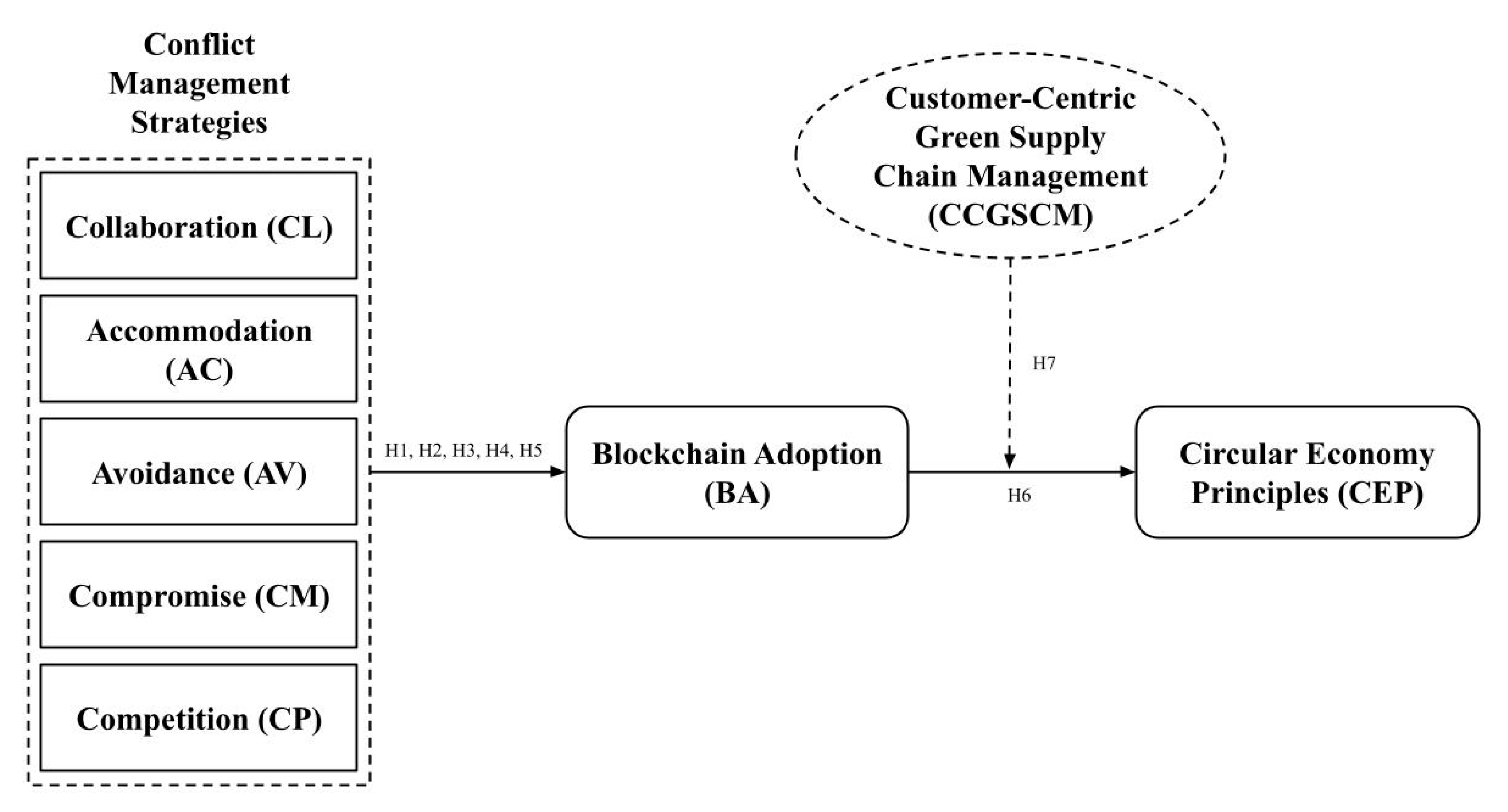
Figure 2.
Structural Model. This figure illustrates the relationships between conflict management strategies, blockchain adoption, and circular economy principles, highlighting the significant path coefficients and their corresponding t-values and p-values.
Figure 2.
Structural Model. This figure illustrates the relationships between conflict management strategies, blockchain adoption, and circular economy principles, highlighting the significant path coefficients and their corresponding t-values and p-values.
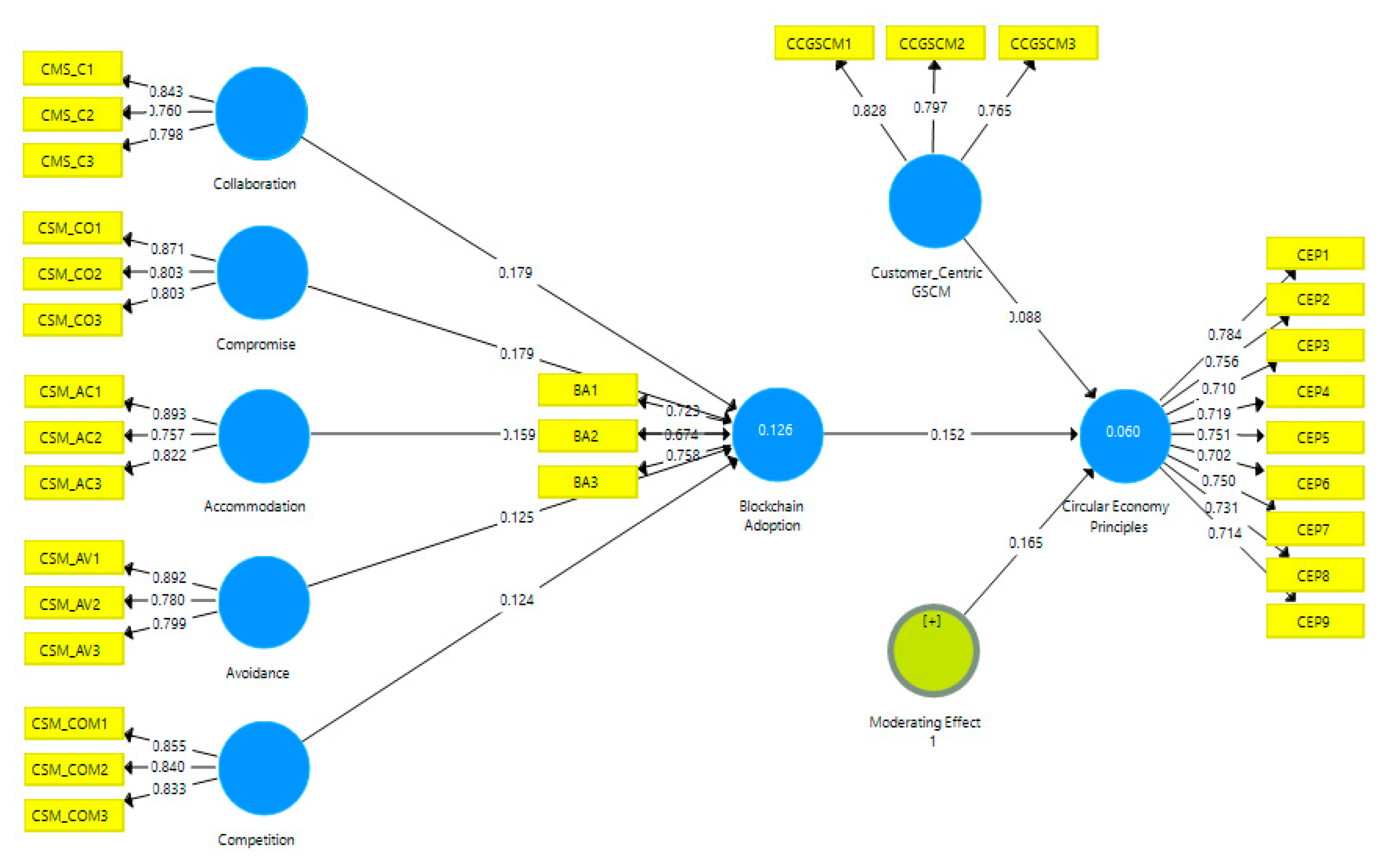

Table 1.
Demographic Profile of Respondents.
| Demographic characteristics | Number | Percentage | |
|---|---|---|---|
| Gender | Male | 279 | 66.3 |
| Female | 142 | 33.7 | |
| Total | 421 | 100.0 | |
| Age | <30 years | 83 | 19.7 |
| 31-40 years | 221 | 52.5 | |
| 41-50 years | 90 | 21.4 | |
| >50 years | 27 | 6.4 | |
| Total | 421 | 100.0 | |
| Qualification | Bachelor’s Degree | 170 | 40.4 |
| Master’s Degree | 222 | 52.7 | |
| Doctorate or Higher | 29 | 6.9 | |
| Total | 421 | 100.0 | |
| Experience | <1 year | 16 | 3.8 |
| 1-5 years | 122 | 29.0 | |
| 5-10 years | 81 | 19.2 | |
| >10 years | 202 | 48.0 | |
| Total | 421 | 100.0 | |
| Position | Senior Manager | 188 | 44.7 |
| Department Head | 149 | 35.4 | |
| Executive | 84 | 20.0 | |
| Total | 421 | 100.0 | |
| Department | Production/Operations | 184 | 43.7 |
| Supply Chain and Logistics | 111 | 26.4 | |
| Research & Development | 35 | 8.3 | |
| Human Resources | 7 | 1.7 | |
| Finance & Accounting | 21 | 5.0 | |
| IT and Technology | 49 | 11.6 | |
| Other | 14 | 3.3 | |
| Total | 421 | 100.0 | |
Table 1: This table provides detailed demographic information about the study’s respondents, including gender, age, qualification, experience, position, and department.
Table 2.
Descriptive Statistics.
| Variable Names | Mean | SD | Skewness | Kurtosis | ||
|---|---|---|---|---|---|---|
| Stat | Error | Stat | Error | |||
| Collaboration | 2.984 | .9168 | -.096 | .119 | -.917 | .237 |
| Compromise | 2.877 | .9631 | .044 | .119 | -.865 | .237 |
| Accommodation | 2.995 | .9817 | -.016 | .119 | -.839 | .237 |
| Avoidance | 3.052 | .9655 | -.088 | .119 | -.898 | .237 |
| Competition | 2.911 | 1.0059 | .021 | .119 | -.918 | .237 |
| Blockchain Adoption | 2.940 | .6785 | -.116 | .119 | .460 | .237 |
| Circular Economy Principles | 3.007 | .8312 | -.031 | .119 | -1.123 | .237 |
| Customer Centric GSCM | 3.066 | .8892 | -.120 | .119 | -.780 | .237 |
Table 2 presents the descriptive statistics, providing summarized information regarding the direction of relationships and normality statistics. It’s shows that skewness values fall in the range of +3 to –3 and kurtosis values fall in the range of +10 to –10; therefore, the normality of the data is acceptable [120].
Table 3.
Reliability and Validity.
| Construct | Loadings | VIF | α | CR | AVE |
|---|---|---|---|---|---|
| Collaboration | 0.726 | 0.843 | 0.641 | ||
| CMS_C1 | 0.843 | 1.376 | |||
| CMS_C2 | 0.760 | 1.439 | |||
| CMS_C3 | 0.798 | 1.485 | |||
| Compromise | 0.773 | 0.866 | 0.683 | ||
| CMS_CO1 | 0.871 | 1.554 | |||
| CMS_CO2 | 0.803 | 1.573 | |||
| CMS_CO3 | 0.803 | 1.637 | |||
| Accommodation | 0.780 | 0.865 | 0.682 | ||
| CMS_AC1 | 0.893 | 1.631 | |||
| CMS_AC2 | 0.757 | 1.654 | |||
| CMS_AC3 | 0.822 | 1.572 | |||
| Avoidance | 0.778 | 0.864 | 0.681 | ||
| CMS_AV1 | 0.892 | 1.557 | |||
| CMS_AV2 | 0.780 | 1.568 | |||
| CMS_AV3 | 0.799 | 1.779 | |||
| Competition | 0.796 | 0.880 | 0.710 | ||
| CMS_COM1 | 0.855 | 1.775 | |||
| CMS_COM2 | 0.840 | 1.604 | |||
| CMS_COM3 | 0.833 | 1.722 | |||
| Blockchain Adoption | 0.534 | 0.762 | 0.517 | ||
| BA1 | 0.723 | 1.153 | |||
| BA2 | 0.674 | 1.114 | |||
| BA3 | 0.758 | 1.148 | |||
| Circular Economy Principles | 0.895 | 0.914 | 0.541 | ||
| CEP1 | 0.784 | 1.775 | |||
| CEP2 | 0.756 | 1.794 | |||
| CEP3 | 0.710 | 1.725 | |||
| CEP4 | 0.719 | 1.692 | |||
| CEP5 | 0.751 | 1.944 | |||
| CEP6 | 0.702 | 1.683 | |||
| CEP7 | 0.750 | 1.859 | |||
| CEP8 | 0.731 | 1.836 | |||
| CEP9 | 0.714 | 1.753 | |||
| Customer-Centric GSCM | 0.717 | 0.839 | 0.635 | ||
| CCGSCM1 | 0.828 | 1.349 | |||
| CCGSCM2 | 0.797 | 1.459 | |||
| CCGSCM3 | 0.765 | 1.425 |
Table 3 shows the factor loadings, variance inflation factors (VIF), Cronbach’s alpha (α), Composite Reliability (CR), and Average Variance Extracted (AVE) for each construct., providing evidence for the measurement model’s robustness.
Table 4.
Discriminant Validity.
| 1 | 2 | 3 | 4 | 5 | 6 | 7 | 8 | |
| Accommodation | 0.826 | |||||||
| Avoidance | -0.053 | 0.825 | ||||||
| Blockchain Adoption | 0.148 | 0.126 | 0.719 | |||||
| Circular Economy Principles | 0.004 | -0.112 | 0.160 | 0.736 | ||||
| Collaboration | 0.037 | 0.024 | 0.201 | 0.003 | 0.801 | |||
| Competition | 0.009 | -0.042 | 0.134 | -0.061 | 0.040 | 0.842 | ||
| Compromise | -0.071 | 0.057 | 0.188 | -0.108 | 0.043 | 0.038 | 0.826 | |
| Customer Centric GSCM | -0.074 | 0.038 | 0.048 | 0.093 | -0.039 | 0.053 | -0.039 | 0.797 |
Table 4 presents the discriminant validity of the constructs. The diagonal elements (in bold) represent the square root of the Average Variance Extracted (AVE) for each construct, indicating the amount of variance captured by the construct relative to the amount of variance due to measurement error. The off-diagonal elements represent the correlations between the constructs. The correlations are provided to demonstrate that each construct shares more variance with its own indicators than with other constructs, thereby supporting discriminant validity.
Table 5.
Path Coefficients.
| Original Sample | Sample Mean | SD | T | P | ||
| H1 | Collaboration -> Blockchain Adoption | 0.179 | 0.187 | 0.046 | 3.885 | 0.000 |
| H2 | Accommodation -> Blockchain Adoption | 0.159 | 0.165 | 0.043 | 3.679 | 0.000 |
| H3 | Avoidance -> Blockchain Adoption | 0.125 | 0.134 | 0.039 | 3.233 | 0.001 |
| H4 | Compromise -> Blockchain Adoption | 0.179 | 0.183 | 0.045 | 3.959 | 0.000 |
| H5 | Competition -> Blockchain Adoption | 0.124 | 0.126 | 0.050 | 2.460 | 0.014 |
| H6 | Blockchain Adoption -> Circular Economy Principles | 0.152 | 0.149 | 0.049 | 3.067 | 0.002 |
| H7 | Moderating Effect 1 -> Circular Economy Principles | 0.165 | 0.192 | 0.076 | 2.166 | 0.031 |
Table 5. This table summarizes the path coefficients for the hypothesized relationships, including the original sample, sample mean, standard deviation, t-value, and p-value.
Disclaimer/Publisher’s Note: The statements, opinions and data contained in all publications are solely those of the individual author(s) and contributor(s) and not of MDPI and/or the editor(s). MDPI and/or the editor(s) disclaim responsibility for any injury to people or property resulting from any ideas, methods, instructions or products referred to in the content. |
© 2024 by the authors. Licensee MDPI, Basel, Switzerland. This article is an open access article distributed under the terms and conditions of the Creative Commons Attribution (CC BY) license (http://creativecommons.org/licenses/by/4.0/).
Copyright: This open access article is published under a Creative Commons CC BY 4.0 license, which permit the free download, distribution, and reuse, provided that the author and preprint are cited in any reuse.


