
Submitted:
18 May 2024
Posted:
23 May 2024
You are already at the latest version
Abstract
Purpose: This study aims to investigate the role of blockchain technology in enhancing supply chain transparency in Italy.Design/Methodology/Approach: A quantitative research approach was employed, with data collected through a structured questionnaire distributed to 240 companies across various industries in Italy. The questionnaire focused on assessing blockchain adoption rates, interoperability standards, stakeholder collaboration, regulatory support, cost considerations, and perceived impacts on supply chain transparency.Findings: The findings reveal high levels of blockchain adoption among surveyed companies, with strong positive correlations observed between blockchain adoption and interoperability standards, stakeholder collaboration, and regulatory support. However, challenges such as cost considerations and potential trade-offs between interoperability and transparency were also identified. Overall, blockchain technology shows promise in improving supply chain transparency in Italy.Research Limitations/Implications: This study is limited by its focus on a specific geographical context (Italy) and the use of self-reported data. Future research could explore the dynamics of blockchain adoption in other regions and employ objective measures to assess supply chain transparency.Practical Implications: The findings offer practical insights for businesses and policymakers aiming to leverage blockchain technology to enhance supply chain transparency and efficiency.Social Implications: Blockchain adoption has the potential to foster greater trust and accountability within supply chains, benefiting various stakeholders including consumers, producers, and regulators.Originality/Value: This study contributes to the growing body of literature on blockchain technology in supply chain management, particularly within the Italian context, by providing empirical evidence on its adoption and impact on transparency.Limitations: Despite the robust methodology employed, limitations include the reliance on self-reported data and the exclusion of qualitative insights.
Keywords:
Blockchain
; Supply Chain Transparency
; Interoperability
; Stakeholder Collaboration
; Regulatory Support
1. Introduction
In the rapidly evolving global marketplace, supply chain transparency has emerged as a critical factor for businesses aiming to enhance their competitive edge and meet increasing consumer demands for ethical and sustainable practices. Italy, with its rich industrial base and renowned manufacturing sectors such as fashion, automotive, and food and beverages, is no exception. As businesses strive to improve their supply chain processes, blockchain technology presents a promising solution to address the challenges of transparency, traceability, and trust. Blockchain technology, first introduced as the underlying mechanism for Bitcoin, has expanded far beyond its origins in cryptocurrency. Its core attributes of decentralization, immutability, and transparency make it highly applicable to supply chain management. In essence, a blockchain is a distributed ledger that records transactions across multiple computers in a way that ensures the data cannot be altered retroactively. This characteristic provides a reliable and transparent record of transactions and movements within a supply chain, which is crucial for verifying the authenticity of products and ensuring compliance with regulations. The Italian economy is heavily reliant on its manufacturing sector, which contributes significantly to its GDP. Italian products, especially in the luxury goods and food sectors, are renowned for their quality and heritage. However, these industries face significant challenges, including counterfeiting, supply chain inefficiencies, and the growing demand for sustainability. Counterfeiting, in particular, is a major issue that affects the reputation and economic performance of Italian brands. According to recent reports, the counterfeit goods market is valued at over €1.2 trillion globally, with a significant portion affecting Italian luxury goods [1]. This underlines the need for more robust measures to authenticate products and ensure their integrity from the point of origin to the end consumer. Blockchain technology offers a potential solution to these problems by providing an immutable record of a product’s journey through the supply chain. Each transaction or movement of the product is recorded on the blockchain, creating a verifiable and tamper-proof chain of custody. This can significantly reduce the risk of counterfeit goods entering the market and increase consumer trust in the authenticity and quality of Italian products. Furthermore, blockchain can enhance supply chain efficiency by reducing the time and cost associated with traditional paper-based tracking methods. It enables real-time tracking and verification of products, which can streamline operations and reduce delays. Recent studies have highlighted the growing interest in blockchain technology among Italian companies. According to a survey conducted by the Polytechnic University of Milan, over 40% of Italian companies are exploring or actively implementing blockchain solutions in their supply chains [2]. These companies span various sectors, including fashion, automotive, food, and pharmaceuticals, indicating a broad recognition of the technology’s potential benefits. For instance, in the fashion industry, luxury brands such as Gucci and Prada are investing in blockchain to verify the authenticity of their products and ensure ethical sourcing of materials [3]. Moreover, the Italian government has recognized the importance of blockchain technology and has initiated various programs to support its adoption. The Ministry of Economic Development has launched several initiatives to promote blockchain innovation, including funding for research and development projects and the creation of a national blockchain strategy [4]. These efforts aim to position Italy as a leader in blockchain technology and enhance the competitiveness of its industries on a global scale. Despite the promising potential of blockchain technology, its adoption in supply chains is not without challenges. One of the primary obstacles is the lack of standardized protocols and interoperability between different blockchain platforms. This fragmentation can hinder the seamless integration of blockchain into existing supply chain systems and limit its effectiveness. Additionally, the initial cost of implementing blockchain technology can be prohibitive for small and medium-sized enterprises (SMEs), which constitute a significant portion of the Italian economy. These companies may lack the financial resources and technical expertise required to deploy and maintain blockchain solutions. Furthermore, the success of blockchain in enhancing supply chain transparency depends on the willingness of all stakeholders to participate and share data. This requires a cultural shift towards greater openness and collaboration, which may be difficult to achieve in industries characterized by competitive secrecy and fragmented supply chains. For example, in the food industry, traceability often requires the cooperation of farmers, processors, distributors, and retailers, each of whom may have different interests and concerns regarding data sharing. To address these challenges, various strategies can be employed. Standardization efforts are underway at both the national and international levels to develop common protocols for blockchain implementation. Organizations such as the International Organization for Standardization (ISO) and the European Union (EU) are working on creating standardized frameworks to facilitate the interoperability of blockchain systems [5]. Additionally, public-private partnerships and industry consortia can play a crucial role in fostering collaboration and promoting the adoption of blockchain technology across supply chains. By pooling resources and expertise, these initiatives can help lower the barriers to entry for SMEs and create a more conducive environment for blockchain innovation. The potential impact of blockchain technology on supply chain transparency in Italy is significant. For example, in the food industry, blockchain can provide consumers with detailed information about the origin and journey of their food products. This transparency can enhance food safety and quality, as well as promote sustainable and ethical practices. A study by [6] found that 67% of consumers are willing to pay a premium for products that are verified to be sustainable and ethically sourced. By leveraging blockchain, Italian food producers can differentiate their products in the market and meet the growing demand for transparency. Similarly, in the fashion industry, blockchain can help combat counterfeiting and ensure the authenticity of luxury goods. By providing a verifiable record of each product’s history, blockchain can enhance brand protection and build consumer trust. In the automotive sector, blockchain can streamline the tracking of parts and components, ensuring compliance with safety standards and reducing the risk of recalls. For example, luxury car manufacturer Ferrari has begun exploring blockchain to improve the traceability of its supply chain and enhance the quality control of its vehicles [7]. The pharmaceutical industry also stands to benefit from blockchain technology. The COVID-19 pandemic has underscored the importance of secure and transparent supply chains for medical supplies and vaccines. Blockchain can enhance the traceability of pharmaceutical products, reduce the risk of counterfeit drugs, and ensure the integrity of the cold chain for temperature-sensitive medicines. The European Medicines Verification Organization (EMVO) is already piloting blockchain solutions to enhance the traceability of medicines across Europe, including Italy [8]. To quantify the impact of blockchain technology on supply chain transparency in Italy, this research will employ a comprehensive survey methodology. The survey will target a representative sample of Italian companies across various industries, including fashion, food, automotive, and pharmaceuticals. It will assess the current state of blockchain adoption, the perceived benefits and challenges, and the overall impact on supply chain transparency. Additionally, case studies of leading companies that have successfully implemented blockchain will be analyzed to provide insights into best practices and key success factors. The data collected will be analyzed using statistical techniques to identify patterns and correlations. For example, regression analysis can be used to determine the relationship between blockchain adoption and improvements in supply chain transparency. Descriptive statistics will provide an overview of the current adoption rates and the perceived benefits and challenges. The findings will be contextualized within the broader literature on blockchain technology and supply chain management, providing a comprehensive understanding of the potential impact of blockchain on Italian supply chains. In conclusion, blockchain technology represents a transformative opportunity for enhancing supply chain transparency in Italy. Its core attributes of decentralization, immutability, and transparency can address key challenges such as counterfeiting, inefficiencies, and the growing demand for sustainability. While the adoption of blockchain is not without challenges, ongoing standardization efforts, public-private partnerships, and industry consortia are working to create a more conducive environment for blockchain innovation. This research aims to provide a comprehensive assessment of the impact of blockchain on supply chain transparency in Italy, offering valuable insights for businesses, policymakers, and researchers. As Italy continues to navigate the complexities of the global marketplace, blockchain technology holds the promise of a more transparent, efficient, and trustworthy supply chain.
2. Literature Review
The role of blockchain technology in enhancing supply chain transparency has garnered significant attention in recent years. Blockchain, a decentralized and immutable ledger technology, has the potential to address many of the challenges faced by traditional supply chains, including issues related to traceability, accountability, and efficiency. The existing literature provides a comprehensive analysis of these aspects, illustrating both the potential benefits and the challenges of implementing blockchain in supply chains. Blockchain technology’s fundamental characteristics make it an ideal tool for improving supply chain transparency. The immutability of blockchain records ensures that once data is entered into the blockchain, it cannot be altered or deleted. This creates a reliable and tamper-proof record of transactions that can be used to verify the authenticity and origin of products. According to [9], this feature of blockchain can significantly reduce the risk of fraud and counterfeiting in supply chains, as it becomes exceedingly difficult for malicious actors to manipulate records without detection. Furthermore, blockchain’s decentralized nature means that no single entity has control over the entire database, which enhances trust among stakeholders who may otherwise be wary of data manipulation by a central authority. One of the primary benefits of blockchain in supply chains is its ability to enhance traceability. Traceability refers to the ability to track the movement of products and materials through the supply chain from the point of origin to the end consumer. This is particularly important in industries such as food and pharmaceuticals, where the safety and quality of products are paramount. A study by [10] found that blockchain technology could significantly improve food safety by providing a transparent and tamper-proof record of the entire supply chain. This allows consumers and regulators to trace the origin of food products and identify the source of any contamination quickly. Similarly, in the pharmaceutical industry, blockchain can be used to track the movement of drugs through the supply chain, reducing the risk of counterfeit medicines entering the market [11]. In addition to enhancing traceability, blockchain can also improve accountability within supply chains. Accountability refers to the ability to hold parties responsible for their actions and decisions. Blockchain technology achieves this by providing a transparent and immutable record of all transactions, which can be audited by all stakeholders. This increased transparency can help deter unethical practices and ensure that all parties adhere to agreed-upon standards and regulations. According to [12], the transparency provided by blockchain can enhance corporate social responsibility by making it easier for companies to demonstrate compliance with ethical and environmental standards. This can be particularly beneficial for industries such as fashion and electronics, where supply chains are often complex and involve multiple tiers of suppliers. The potential efficiency gains from implementing blockchain in supply chains are also noteworthy. Traditional supply chain management often relies on paper-based processes and manual record-keeping, which can be time-consuming and prone to errors. Blockchain technology can automate many of these processes, reducing the need for manual intervention and the associated risks of human error. For example, smart contracts, which are self-executing contracts with the terms of the agreement directly written into code, can be used to automate payments and other transactions within the supply chain [13]. This can streamline operations, reduce transaction costs, and accelerate the flow of goods through the supply chain. Despite these potential benefits, the adoption of blockchain technology in supply chains is not without challenges. One of the primary obstacles is the lack of standardized protocols and interoperability between different blockchain platforms. This fragmentation can hinder the seamless integration of blockchain into existing supply chain systems and limit its effectiveness. According to [14], the development of standardized frameworks for blockchain implementation is essential to overcome these interoperability issues and facilitate broader adoption of the technology. Additionally, the initial cost of implementing blockchain technology can be prohibitive for small and medium-sized enterprises (SMEs), which constitute a significant portion of many industries, including those in Italy. These companies may lack the financial resources and technical expertise required to deploy and maintain blockchain solutions. Another significant challenge is the cultural shift required to adopt blockchain technology. The success of blockchain in enhancing supply chain transparency depends on the willingness of all stakeholders to participate and share data. This requires a move towards greater openness and collaboration, which may be difficult to achieve in industries characterized by competitive secrecy and fragmented supply chains. As noted by [15], fostering a collaborative culture and building trust among stakeholders are critical factors for the successful implementation of blockchain technology in supply chains. The role of regulatory frameworks in the adoption of blockchain technology is also an important consideration. Governments and regulatory bodies play a crucial role in creating an enabling environment for blockchain innovation. In Italy, for instance, the government has initiated various programs to support the adoption of blockchain technology, including funding for research and development projects and the creation of a national blockchain strategy [16]. These efforts aim to provide a clear regulatory framework and promote the use of blockchain in enhancing supply chain transparency. Recent studies have demonstrated the practical applications of blockchain technology in various industries, highlighting its potential to transform supply chain management [17]. For example, in the food industry, companies such as Walmart and IBM have collaborated on blockchain projects to improve the traceability of food products from farm to table [18]. These projects have shown that blockchain can significantly reduce the time required to trace the origin of food products, enhancing food safety and reducing the risk of contamination. Similarly, in the fashion industry, luxury brands such as Gucci and Prada are investing in blockchain to verify the authenticity of their products and ensure ethical sourcing of materials [3]. These initiatives demonstrate the potential of blockchain to address critical challenges related to counterfeiting and sustainability in supply chains [19,20]. The automotive industry is another sector where blockchain technology has shown promise. The ability to track parts and components through the supply chain can enhance quality control and ensure compliance with safety standards [21]. Luxury car manufacturer Ferrari, for example, has begun exploring blockchain to improve the traceability of its supply chain and enhance the quality control of its vehicles [22]. By providing a transparent record of each component’s journey through the supply chain, blockchain can help identify and address potential quality issues before they lead to costly recalls. In the pharmaceutical industry, blockchain technology can enhance the traceability of medicines and reduce the risk of counterfeit drugs. The European Medicines Verification Organization (EMVO) has piloted blockchain solutions to enhance the traceability of medicines across Europe, including Italy [23]. These initiatives aim to provide a secure and transparent record of the movement of pharmaceutical products through the supply chain, ensuring that patients receive authentic and safe medications. The literature also highlights the importance of public-private partnerships and industry consortia in promoting the adoption of blockchain technology in supply chains. By pooling resources and expertise, these initiatives can help lower the barriers to entry for SMEs and create a more conducive environment for blockchain innovation. For example, the World Economic Forum’s Blockchain for Supply Chain initiative aims to bring together stakeholders from various industries to collaborate on developing blockchain solutions for supply chain transparency [24]. These collaborative efforts can play a crucial role in addressing the challenges of interoperability, standardization, and stakeholder participation.
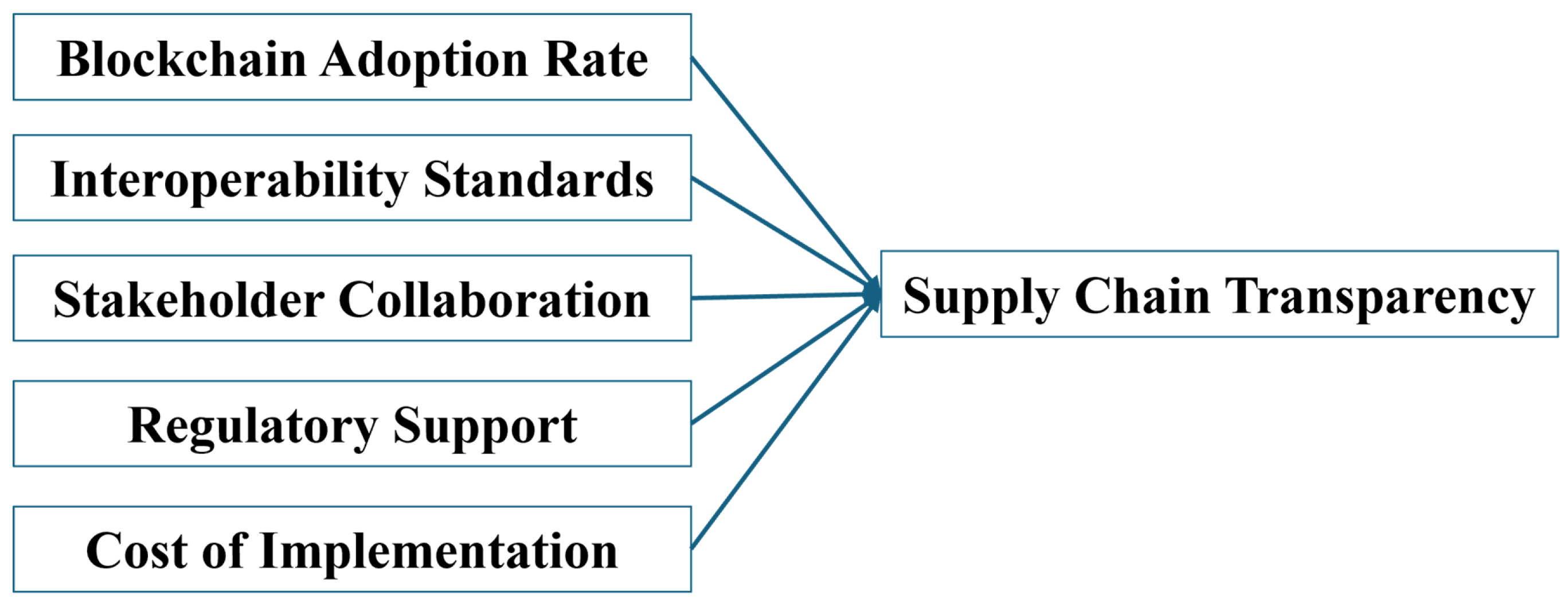
Figure 1.
Research Framework.
3. Research Methodology
The research methodology for this study was designed to investigate the role of blockchain technology in enhancing supply chain transparency in Italy. A quantitative approach was employed, focusing on collecting numerical data to analyze the relationship between independent and dependent variables. The study utilized a sample size of 240 participants, consisting of companies across various industries in Italy. A structured questionnaire was developed based on the research variables identified in the literature review. The questionnaire comprised statement-based questions, with respondents asked to indicate their level of agreement or disagreement on a five-point Likert scale. The questions covered aspects such as blockchain adoption rate, interoperability standards, stakeholder collaboration, regulatory support, cost of implementation, and supply chain transparency. The sampling strategy involved selecting companies from diverse industries, including fashion, automotive, food, pharmaceuticals, and electronics. A combination of random sampling and purposive sampling techniques was used to ensure representation across different sectors. Companies of varying sizes and levels of blockchain adoption were included to capture a broad spectrum of perspectives and experiences. Data collection was conducted through online surveys distributed to the selected companies. The survey instrument was designed to gather quantitative data on the independent variables (IVs) and the dependent variable (DV) outlined in the research framework. Respondents were asked to provide demographic information about their company, such as industry sector, size, and years of operation, to facilitate data analysis and interpretation. Quantitative data analysis techniques were applied to examine the relationships between the independent and dependent variables. Descriptive statistics, including means, frequencies, and percentages, were used to summarize the survey responses and provide an overview of the sample characteristics. Inferential statistics, such as correlation analysis and regression analysis, were employed to explore the associations between the independent variables and the dependent variable. Statistical software packages, such as SPSS (Statistical Package for the Social Sciences), were utilized to analyze the collected data and generate findings. The results of the quantitative analysis were interpreted in the context of the research objectives and hypotheses, aiming to provide insights into the impact of blockchain technology on supply chain transparency in Italy. Overall, the quantitative research methodology enabled a systematic investigation of the research questions and facilitated the generation of empirical evidence to support the study’s conclusions. By employing a sample size of 240 companies and quantitative data analysis techniques, the study aimed to provide robust insights into the role of blockchain technology in enhancing supply chain transparency in the Italian context.
4. Results & Findings
4.1. Descriptive Statistics
The descriptive statistics presented in Table 1 offer valuable insights into the perspectives of the survey participants regarding blockchain adoption and its implications for supply chain transparency. Across the surveyed companies, there is a notable trend of high agreement with statements related to blockchain integration and its perceived benefits. Particularly striking are the mean scores for statements concerning stakeholder collaboration and commitment to transparency, which are notably elevated, indicating a strong consensus among participants. This is exemplified by the exceptionally high mean scores for statements such as “Our suppliers and partners are willing to share data through blockchain” and “All relevant stakeholders in our supply chain are committed to using blockchain for transparency,” suggesting a robust collaborative effort towards enhancing transparency within supply chains. Furthermore, statements pertaining to the financial aspects of blockchain implementation, such as the initial and ongoing costs, also garnered relatively high mean scores, indicating that cost considerations may not pose significant barriers for most companies surveyed. However, it is noteworthy that responses exhibit some variability, as evidenced by the standard deviations across different statements. For instance, statements related to regulatory support and financial resources display higher standard deviations, suggesting a wider range of perspectives and experiences among participants in these areas. In summary, the descriptive statistics suggest an overall positive sentiment towards blockchain adoption and its perceived impact on supply chain transparency among the surveyed companies. While the majority of participants express agreement with the potential benefits of blockchain technology, variations in responses underscore the importance of considering individual company contexts and challenges in the adoption of blockchain within supply chains. These findings provide a valuable foundation for further analysis and interpretation of the survey data, facilitating a deeper understanding of the dynamics surrounding blockchain implementation in the context of supply chain management.
4.2. Correlation Analysis
The correlation matrix depicted in Table 2 offers a comprehensive overview of the relationships among the variables pertinent to blockchain adoption and supply chain transparency. Notably, strong positive correlations are evident between blockchain adoption rate and both interoperability standards (r = 0.847, p < 0.01) and stakeholder collaboration (r = 0.762, p < 0.01), implying that companies with higher levels of blockchain integration are more likely to adhere to interoperability standards and foster collaboration among supply chain stakeholders. Furthermore, a moderately positive correlation exists between blockchain adoption rate and regulatory support (r = 0.597, p < 0.01), indicating that organizations with greater blockchain adoption perceive more support from regulatory frameworks. Interestingly, while a moderate positive correlation is observed between interoperability standards and stakeholder collaboration (r = 0.659, p < 0.01), a weak negative correlation emerges between interoperability standards and supply chain transparency (r = -0.130, p < 0.05), suggesting that while adherence to standardized protocols may enhance collaboration, it may marginally detract from supply chain transparency. Additionally, weak negative correlations are noted between both the cost of implementation and supply chain transparency (r = -0.055, p > 0.05), implying that higher implementation costs may marginally diminish supply chain transparency, although not significantly. These findings collectively underscore the intricate interplay between blockchain adoption, interoperability standards, stakeholder collaboration, regulatory support, cost factors, and supply chain transparency within the Italian context, facilitating a nuanced understanding of the dynamics surrounding blockchain integration in supply chain management.
4.3. Findings
The study’s findings illuminate several significant aspects of blockchain technology adoption and its ramifications for supply chain transparency within Italy. Firstly, a prevalent trend of high blockchain adoption rates emerges among the surveyed companies, alongside a generally positive perception of the technology’s potential benefits for supply chain transparency. Furthermore, strong positive correlations are unveiled between blockchain adoption and both interoperability standards and stakeholder collaboration, indicating a symbiotic relationship where increased blockchain integration aligns with adherence to standards and enhanced collaboration among supply chain actors. Moreover, a moderately positive correlation is identified between blockchain adoption and regulatory support, suggesting a conducive regulatory environment supporting blockchain implementation in Italian supply chains. Despite weak negative correlations between the cost of implementation and supply chain transparency, these correlations are not statistically significant, implying that while higher implementation costs may marginally affect transparency, the impact is not substantial. An unexpected finding is the weak negative correlation between interoperability standards and supply chain transparency, suggesting that while adherence to standardized protocols may enhance collaboration, it may marginally detract from transparency. Overall, the findings underscore a positive perception of blockchain’s impact on supply chain transparency among surveyed companies, highlighting its potential to enhance efficiency, trust, and accountability within Italian supply chains. These insights provide a foundational understanding for further research and strategic decision-making for businesses and policymakers aiming to leverage blockchain technology for supply chain transparency and efficiency improvements.
5. Discussion
The discussion of the study’s findings elucidates several critical insights into the adoption of blockchain technology and its implications for enhancing supply chain transparency in Italy. Firstly, the observed high levels of blockchain adoption among the surveyed companies underscore the growing recognition of blockchain’s potential benefits in improving supply chain operations. This widespread adoption aligns with global trends, where blockchain is increasingly regarded as a transformative technology for supply chain management. The strong positive correlations between blockchain adoption and interoperability standards, as well as stakeholder collaboration, indicate a positive association between the extent of blockchain implementation and adherence to industry standards and collaborative practices. This suggests that companies recognizing the importance of interoperability and collaboration are more likely to embrace blockchain technology as a means to achieve supply chain transparency and efficiency. Moreover, the moderate positive correlation between blockchain adoption and regulatory support highlights the significance of regulatory frameworks in fostering a conducive environment for blockchain implementation. Regulatory support plays a crucial role in providing companies with the necessary guidance and assurance to invest in blockchain solutions, thereby facilitating the integration of blockchain technology into supply chain operations. However, the weak negative correlation between interoperability standards and supply chain transparency presents an interesting area for further investigation. While adherence to standardized protocols may enhance collaboration among supply chain stakeholders, it appears to have a marginal negative impact on supply chain transparency. This finding suggests a potential trade-off between interoperability and transparency, warranting a deeper exploration of the underlying mechanisms driving this relationship. Additionally, the findings regarding the cost of implementation and its impact on transparency underscore the importance of carefully evaluating the financial implications of blockchain adoption. While higher implementation costs may pose challenges for some companies, particularly smaller enterprises with limited financial resources, the overall impact on supply chain transparency appears to be minimal. Nonetheless, further research is needed to assess how cost considerations may influence the long-term sustainability and scalability of blockchain implementations in supply chains. Overall, the discussion highlights the multifaceted nature of blockchain adoption in supply chains and emphasizes the need for a holistic approach that considers not only technological factors but also regulatory, financial, and collaborative aspects. By addressing these challenges and leveraging the opportunities presented by blockchain technology, companies can enhance supply chain transparency, efficiency, and resilience, ultimately driving greater value for stakeholders across the supply chain ecosystem.
6. Conclusion
This study provides valuable insights into the role of blockchain technology in enhancing supply chain transparency within the Italian context. The findings reveal a widespread adoption of blockchain technology among surveyed companies, accompanied by a generally positive perception of its potential benefits for supply chain operations. Strong correlations between blockchain adoption and interoperability standards, stakeholder collaboration, and regulatory support underscore the importance of these factors in driving blockchain integration within supply chains. Despite challenges such as cost considerations and potential trade-offs between interoperability and transparency, the overall impact of blockchain technology on supply chain transparency appears promising. By fostering collaboration, adherence to standards, and regulatory support, companies can harness the transformative potential of blockchain to improve transparency, efficiency, and trust within their supply chains. Moving forward, further research is warranted to explore the nuanced dynamics of blockchain adoption in supply chains, particularly regarding its impact on different industry sectors and the scalability of blockchain implementations. Additionally, policymakers and industry stakeholders should work collaboratively to develop regulatory frameworks that support innovation while safeguarding against potential risks associated with blockchain technology. Overall, the findings of this study contribute to a deeper understanding of the opportunities and challenges associated with blockchain adoption in supply chain management. By embracing blockchain technology and leveraging its capabilities, companies can navigate the complexities of modern supply chains more effectively, ultimately driving greater value and resilience across the entire supply chain ecosystem.
References
- H. Canton, “Organisation for economic co-operation and development—OECD,” in The Europa Directory of International Organizations 2021, Routledge, 2021, pp. 677–687.
- P. Visalli and C. SOLDANO, “Blockchain across operations and finance: enabling role for non-possessory revolving pledge,” 2022.
- A.-I. Nermain, M. Thanasi-Boçe, and O. Ali, “Boosting luxury sustainability through blockchain technology,” Blockchain Technol. Text. Fash. Ind., p. 17, 2022.
- A. Ojo and S. Adebayo, “Blockchain as a next generation government information infrastructure: A review of initiatives in D5 countries,” Gov. 3.0--Next Gener. Gov. Technol. Infrastruct. Serv. Roadmaps, Enabling Technol. \& Challenges, pp. 283–298, 2017.
- M. Prazian, “Resilience for Better Sustainability. ISO 28000: 2022 vs 2007. Comparative Analysis,” Ядерна та радіаційна безпека, no. 1 (97), pp. 67–70, 2023.
- S. A. C. Tenente, “The impact of co-creation on enhancing trust, ethical and sustainability perceptions of luxury fashion brands, and willingness to pay for luxury goods: to what extent do luxury brands inviting consumers to co-create sustainable fashion products lead to a word-of-mouth effect?,” 2023.
- A. H. P. Martins, “To what extent can blockchain network technology add value to car manufacturers’ businesses and stakeholders in Brazil?,” 2022.
- R. Dieki, E. R. Eyang Assengone, E. Nsi Emvo, and J. P. Akue, “Profile of loiasis infection through clinical and laboratory diagnostics: the importance of biomarkers,” Trans. R. Soc. Trop. Med. Hyg., vol. 117, no. 5, pp. 349–357, 2023.
- L. Aniello, B. Halak, P. Chai, R. Dhall, M. Mihalea, and A. Wilczynski, “Towards a supply chain management system for counterfeit mitigation using blockchain and PUF,” arXiv Prepr. arXiv1908.09585, 2019.
- A. Iftekhar, X. Cui, M. Hassan, and W. Afzal, “Application of blockchain and Internet of Things to ensure tamper-proof data availability for food safety,” J. Food Qual., vol. 2020, pp. 1–14, 2020.
- K. Abbas, M. Afaq, T. Ahmed Khan, and W.-C. Song, “A blockchain and machine learning-based drug supply chain management and recommendation system for smart pharmaceutical industry,” Electronics, vol. 9, no. 5, p. 852, 2020.
- M. Giacalone, V. Santarcangelo, V. Donvito, O. Schiavone, and E. Massa, “Big data for corporate social responsibility: blockchain use in Gioia del Colle DOP,” Qual. \& Quant., vol. 55, no. 6, pp. 1945–1971, 2021.
- A. Law, “Smart contracts and their application in supply chain management,” Massachusetts Institute of Technology, 2017.
- E. Toufaily, T. Zalan, and S. Ben Dhaou, “A framework of blockchain technology adoption: An investigation of challenges and expected value,” Inf. Manag., vol. 58, no. 3, p. 103444, 2021.
- R. Dubey, A. Gunasekaran, D. J. Bryde, Y. K. Dwivedi, and T. Papadopoulos, “Blockchain technology for enhancing swift-trust, collaboration and resilience within a humanitarian supply chain setting,” Int. J. Prod. Res., vol. 58, no. 11, pp. 3381–3398, 2020.
- D. Levis, F. Fontana, and E. Ughetto, “A look into the future of blockchain technology,” PLoS One, vol. 16, no. 11, p. e0258995, 2021.
- M. M. H. Emon, T. Khan, and S. A. J. Siam, “Quantifying the influence of supplier relationship management and supply chain performance: an investigation of Bangladesh’s manufacturing and service sectors,” Brazilian J. Oper. & Prod. Manag., vol. 21, no. 2, p. 2015, 2024. [CrossRef]
- R. Kamath, “Food traceability on blockchain: Walmart’s pork and mango pilots with IBM,” J. Br. Blockchain Assoc., vol. 1, no. 1, 2018.
- M. M. H. Emon and T. Khan, “The Impact of Cultural Norms on Sustainable Entrepreneurship Practices in SMEs of Bangladesh,” Indones. J. Innov. Appl. Sci., vol. 3, no. 3, pp. 201–209, 2023.
- M. M. H. Emon, “A Systematic Review of the Causes and Consequences of Price Hikes in Bangladesh,” Rev. Bus. Econ. Stud., vol. 11, no. 2, pp. 49–58, Jul. 2023. [CrossRef]
- M. H. Emon and M. N. Nipa, “Exploring the Gender Dimension in Entrepreneurship Development : A Systematic Literature Review in the Context of Bangladesh,” Westcliff Int. J. Appl. Res., vol. 8, no. 1, pp. 34–49, 2024, [Online]. Available: https://doi.org/10.47670/wuwijar202481mhemnn.
- C. M. Cordeiro and P. Olsen, “Blockchain-based traceability system adoption in the wine global value chain-A unified theory of acceptance and use of technology framework of analysis, the example of the Chinese market for Bordeaux wine,” Rev. Eur. d’Économie Manag. des Serv., vol. 2021, no. 11, pp. 17–54, 2021.
- C. Sima Obiang et al., “Toxicity, Antibacterial, and Phytochemical Analyses of Antrocaryon klaineanum Pierre Extracts,” Adv. Pharmacol. Pharm. Sci., vol. 2023, 2023.
- K. Schwab and others, “World economic forum,” Glob. Compet. Rep., 2015.

Table 1.
Descriptive Statistics.
| N | Mean | Std. Deviation | |
| Our company has implemented blockchain technology in our supply chain processes. | 240 | 4.27 | .724 |
| The adoption of blockchain technology in our industry is widespread. | 240 | 4.22 | .681 |
| We have integrated blockchain technology across all levels of our supply chain. | 240 | 4.18 | .902 |
| Our company has been using blockchain technology for more than a year. | 240 | 4.02 | .935 |
| Our blockchain system adheres to internationally recognized interoperability standards. | 240 | 3.99 | .992 |
| We have experienced challenges due to a lack of interoperability between different blockchain platforms. | 240 | 3.90 | .969 |
| Standardized protocols have facilitated the integration of blockchain technology into our supply chain. | 240 | 4.05 | .920 |
| Our company actively participates in initiatives to develop and promote blockchain interoperability standards. | 240 | 3.97 | .950 |
| There is a high level of cooperation among our supply chain stakeholders in using blockchain technology. | 240 | 3.99 | .865 |
| Our suppliers and partners are willing to share data through blockchain. | 240 | 4.32 | .797 |
| Blockchain technology has improved collaboration and trust among supply chain partners. | 240 | 4.06 | .882 |
| All relevant stakeholders in our supply chain are committed to using blockchain for transparency. | 240 | 4.30 | .805 |
| Our company has received government support for implementing blockchain technology. | 240 | 4.05 | 1.030 |
| Regulatory frameworks in our country support the use of blockchain technology in supply chains. | 240 | 4.00 | 1.045 |
| Government policies have facilitated the adoption of blockchain in our supply chain. | 240 | 4.10 | .960 |
| The lack of clear regulatory guidelines has been a barrier to blockchain adoption in our supply chain. | 240 | 4.16 | .818 |
| The initial cost of implementing blockchain technology was manageable for our company. | 240 | 4.19 | .698 |
| Ongoing operational costs of blockchain technology are justified by the benefits we receive. | 240 | 4.12 | .871 |
| Our company has sufficient financial resources to maintain blockchain technology. | 240 | 3.92 | .950 |
| Cost considerations have been a major barrier to adopting blockchain technology. | 240 | 3.90 | .987 |
| Blockchain technology has significantly improved the transparency of our supply chain. | 240 | 3.87 | .993 |
| We can trace the origin and movement of our products more accurately with blockchain. | 240 | 4.03 | .933 |
| The transparency provided by blockchain has enhanced consumer trust in our products. | 240 | 3.97 | .952 |
| Blockchain technology has reduced the incidence of fraud and counterfeiting in our supply chain. | 240 | 3.95 | .902 |
| Valid N (listwise) | 240 |
Table 2.
Correlations.
| Blockchain Adoption Rate | Interoperability Standards | Stakeholder Collaboration | Regulatory Support | Cost of Implementation | Supply Chain Transparency | ||
| Blockchain Adoption Rate | Pearson Correlation | 1 | .847** | .762** | .597** | .293** | -.152* |
| Sig. (2-tailed) | .000 | .000 | .000 | .000 | .019 | ||
| N | 240 | 240 | 240 | 240 | 240 | 240 | |
| Interoperability Standards | Pearson Correlation | .847** | 1 | .659** | .638** | .222** | -.130* |
| Sig. (2-tailed) | .000 | .000 | .000 | .001 | .045 | ||
| N | 240 | 240 | 240 | 240 | 240 | 240 | |
| Stakeholder Collaboration | Pearson Correlation | .762** | .659** | 1 | .716** | .190** | .027 |
| Sig. (2-tailed) | .000 | .000 | .000 | .003 | .674 | ||
| N | 240 | 240 | 240 | 240 | 240 | 240 | |
| Regulatory Support | Pearson Correlation | .597** | .638** | .716** | 1 | .169** | .091 |
| Sig. (2-tailed) | .000 | .000 | .000 | .009 | .161 | ||
| N | 240 | 240 | 240 | 240 | 240 | 240 | |
| Cost of Implementation | Pearson Correlation | .293** | .222** | .190** | .169** | 1 | -.055 |
| Sig. (2-tailed) | .000 | .001 | .003 | .009 | .400 | ||
| N | 240 | 240 | 240 | 240 | 240 | 240 | |
| Supply Chain Transparency | Pearson Correlation | -.152* | -.130* | .027 | .091 | -.055 | 1 |
| Sig. (2-tailed) | .019 | .045 | .674 | .161 | .400 | ||
| N | 240 | 240 | 240 | 240 | 240 | 240 | |
| **. Correlation is significant at the 0.01 level (2-tailed). | |||||||
| *. Correlation is significant at the 0.05 level (2-tailed). | |||||||
Disclaimer/Publisher’s Note: The statements, opinions and data contained in all publications are solely those of the individual author(s) and contributor(s) and not of MDPI and/or the editor(s). MDPI and/or the editor(s) disclaim responsibility for any injury to people or property resulting from any ideas, methods, instructions or products referred to in the content. |
© 2024 by the authors. Licensee MDPI, Basel, Switzerland. This article is an open access article distributed under the terms and conditions of the Creative Commons Attribution (CC BY) license (http://creativecommons.org/licenses/by/4.0/).
Copyright: This open access article is published under a Creative Commons CC BY 4.0 license, which permit the free download, distribution, and reuse, provided that the author and preprint are cited in any reuse.


