

Submitted:
27 June 2025
Posted:
30 June 2025
You are already at the latest version
Abstract
We report about the effect of nitrogen and carbon concentration on the superconducting transition temperature TC of (NbMoTaW)1CxNy carbonitride films deposited using reactive DC magnetron sputtering. By measuring the temperature dependence of electrical resistance and magnetization of these carbonitrides, with 0.20 x 1.17 and 0 y 0.73, we observe a TC enhancement that occurs especially at high (x 0.76) carbon concentrations, with the largest TC = 9.6 K observed in the over-doped fcc crystal structure with x = 1.17 and y = 0.41. The reason why the largest TC appears at high carbon concentrations is probably related to the lower atomic mass of carbon compared to nitrogen and to the increase of the electron-phonon interaction due to different bonding of carbon (compared to nitrogen) to the Nb-Mo-Ta-W metallic sublattice. However, as for concentrations y 0.71 and x + y 1.58 two structural phases begin to form, also the proximity to structural instability may play a role in the observed TC enhancement. Additional measurements in magnetic field show that the upper critical fields Bc2 of (NbMoTaW)1CxNy carbonitrides provide Bc2/TC 2 T/K ratios, which are within the weak-coupling pair breaking limit.
Keywords:
high and medium entropy carbonitrides
; superconductivity
; superconducting transition temperature
; upper critical field
1. Introduction
Superconductivity in compounds consisting of transition metal (TM) elements and nonmetals as carbon and nitrogen has been known since 1930 [1]. Later on, extensive research related to superconductivity in carbides and nitrides has been performed, and it was shown that superconductivity can be observed in several transition metals carbides or nitrides (see e.g. [2-6]), in transition metal alloy carbides or nitrides (see e.g. [7,8]), and in carbonitrides containing both carbon and nitrogen (see e.g. [9]). Among TM carbides and nitrides the highest transition temperatures have been observed in molybdenum carbide MoC with a superconducting transition temperature TC of ~14.3 K [4] and niobium nitride NbN with a TC of ~17.3 K [3], which are much higher as that for pure Mo and Nb with 0.92 K and 9.2 K, respectively. For niobium carbonitrides the highest TC ≈ 16.9 K was observed for the NbC0.3N0.7 composition [9]. It is necessary to add that all the mentioned above TM carbides and nitrides can be considered as conventional weak-coupling s-wave phonon mediated Bardeen-Cooper-Schrieffer (BCS) superconductors, in which in the simplest case the TC dependence may be described using the relation kBTC = 1.13 ħωD exp(-1/N(EF)V) (see e.g. [10]), where ωD denotes the phonon Debye frequency, N(EF) the electronic density of states (DOS) at the Fermi energy EF, V the electron-phonon interaction potential, and kB and ħ the Boltzmann and Planck constant, respectively.
Very recently, multicomponent materials as high entropy alloys (HEAs), containing five or more metallic elements in near-equiatomic proportions, and high entropy ceramics (HECs), which in addition to metallic ones also contain non-metallic atoms as e.g. carbon and nitrogen, have begun to be investigated [11-14]. The reason for this is that in HEAs and HECs, due to the cocktail effect coming from synergy phenomenon of constituent atoms (having a different number of valence electrons, different atomic radii and a high mixing / configurational entropy that represents a measure of the number of ways in which a particular configuration of metal atoms can be achieved), also new and unexpected results can be expected. Overviews of unique properties of HEAs and HECs can be found e.g. in [15-17], reviews and new knowledge about their superconducting properties e.g. in [18-21]. It has to be added that investigated were also RE123 high-Tc superconductors with a HEA-type of the rare earth (RE) site (Y0.28Nd0.16Sm0.18Eu0.18Gd0.20Ba2Cu3O7-δ and Y0.18La0.24Nd0.14Sm0.14Eu0.15Gd0.15Ba2Cu3O7-δ, see [22]) which exhibit transition temperatures exceeding 90 K.
Regarding high entropy carbides, e.g. in [12] superconductivity at 2.35 K and topological properties in (Ti0.2Zr0.2Nb0.2Hf0.2Ta0.2)C HEC is reported. Related density functional theory (DFT) calculations show that six type-II Dirac points exist in this material, and due to the stability of the structure, robust superconductivity under pressure in this HEC superconductor is also observed. Similarly, in [13] the authors designed and produced a sequence of original bulk (Ti0.2Nb0.2Ta0.2Mo0.2W0.2)C1-xNx (0 ≤ x ≤ 0.45) superconductors, and observed that these high entropy carbonitrides possess type-Ⅱ Dirac points in the electronic band structure which imply that they have a potential as candidates to bridge superconductivity with topology. These discoveries indicate that the physical properties and potential applications establish HE carbonitrides as a promising platform for exploring unconventional physics. On the other hand, in [14] it was shown that with the rise of nitrogen concentration x in (TiNbMoTaW)1.0Nx nitride films a large increase of TC is observed, from 0.62 K for x = 0 up to 5.02 K for x = 0.74. The observed high TC enhancement and the dome-like TC vs x dependence have been attributed to the phonon frequency increase due to incorporation of light N atoms and to the simultaneous strengthening of the electron-phonon interaction that probably develops due to the high configuration entropy in this HEM. This high configuration entropy namely offers lots of options for N atoms to find the thermodynamically most appropriate positions in the lattice, and thus to create a suitable phonon mode distribution and thus strengthen the electron-phonon interaction.
As introduction of carbon and nitrogen greatly affects the properties of medium and high entropy materials, the aim of the current work is to investigate the impact of C and N incorporation on the superconducting properties of NbMoTaW, mainly their impact on the transition temperature TC. The choice of this medium entropy alloy was based on the fact that practically all possible constituents of this MEA are superconducting, the TM elements (Nb: TC ≈ 9.2 K, Mo: TC ≈ 0.92 K, Ta: TC ≈ 4.4 K, W: TC ≈ 0.01 K), the corresponding carbides (NbC: TC ≈ 11 K, MoC: TC ≈ 14.3 K, TaC: TC ≈ 10 K, WC: TC ≈ 10 K), as well as the corresponding nitrides (NbN: TC ≈ 17.3 K, MoN: TC ≈ 5.8 K, TaN: TC ≈ 6 K). In tungsten nitride a TC of about 4.85 K was observed in nitride films close to the phase boundary between β-W and W2N [23]. On the other hand, based on first-principles calculations [24] it was shown that superconductivity in WN can be found and its TC enhanced significantly to about 31 K through electron doping.
In this contribution, we analyze and discuss in detail the investigations of the superconducting properties of sputtered (NbMoTaW)1CxNy films within a wide range of carbon (x) and nitrogen concentration (y) values. The obtained results show a threefold TC enhancement through C and N incorporation, nevertheless, it appears that carbon concentration plays the dominant role in this enhancement. This is probably related to the lower atomic mass of C compared to N and to the parallel increase of the electron-phonon interaction due to the different bonding of carbon atoms (compared to nitrogen) to the metallic NbMoTaW sub-lattice. However, as the highest TC values are observed at the boundary between one-phase and two-phase crystal structures, it may indicate that the TC enhancement is additionally related to the proximity of structural instability. It should be added that some results on these carbonitride films have been published [25], this mainly concerns their composition, structure and mechanical properties.
2. Materials and Methods
Two series of films with different C and N concentrations were deposited in the Cryofox 500 system (Polyteknik, Denmark) using a NbMoTaW target with composition 25:25:25:25 at% (99.9% purity) and a C target (99.9% purity) having a diameter of 76.2 mm and 4 mm thickness (Testbourne Ltd., UK). However, additional ToF ERDA measurements on the target revealed its contamination by ~15 at% of carbon, most probably from the previous depositions involving carbon and/or hydrocarbons. The substrates were polished (0001) sapphire wafers (diameter - 50.8 mm, thickness - 430 μm) heated to a temperature of 500 oC without any bias voltage. The film deposition parameters were optimized for metallic films and included 300 W of DC power on the NbMoTaW target and a constant deposition time of 15 min. In series I, the only variable was the flow of nitrogen, x, added to the Ar sputtering atmosphere. It varied from 0 sccm up to 5 sccm with a 1 sccm step. In series II, a power of 600 W was used to sputter carbon from the C - target.
The structure of the sputtered films was investigated using scanning electron microscopy (SEM) devices FESEM/FIB Auriga Compact and EVO MA 15, Zeiss, Germany. In parallel, X-ray measurements were made on a Rigaku Ultima IV with parallel beam CoKα radiation in a symmetrical θ-θ (Bragg-Brentano, B-B) and additional grazing incidence (GI) with fixed incident beam angle of 5º scan modes to eliminate diffraction from single-crystal sapphire substrate. Crystalline phases were identified using the Crystal-Impact Match! software, unit cell parameters were refined in a Full-Prof program package. CoKα measurements were recalculated to correspond to CuKα radiation. The texture was analyzed by comparing experimental diffractograms from B-B scans with GI scans and theoretically calculated texture-free diffractograms.
The chemical composition of the films was determined using Time-of-Flight Elastic Recoil Detection Analysis (ToF-ERDA) at the telescope of the 6 MV tandem ion accelerator and 197Au8+ analyzing beam with an energy of 45 MeV [26]. Recoiled ions from the sample were detected by the TOF-ERDA spectrometer with a Gas Ionizing Chamber with an analysis sensitivity of 0.02 at. %. More details about the films preparation and their characterization can be found in Ref. [25].
The electrical resistance of the films has been measured using a probe alternating current method in a 4He cryostat with variable temperature insert in the temperature range from 300 K down to about 1.8 K. The electrical contacts were made using four spring contacts. During the measurements in magnetic field with different intensities, the field was oriented perpendicularly to the film/substrate plane. Magnetization measurements between 2 K and 300 K in a field B of 1 mT were carried out in a commercial magnetic property measurement system (MPMS, Quantum Design).
3. Additional Comments to the Choice of the Target Composition
An important parameter that has to be considered when designing a suitable initial HEA for subsequent HEA carbonization or/and nitridation is the ability of HEA - metals to form thermodynamically stable carbon or nitride compounds, which varies along the periodic table (see e.g. [27,28]). This ability points to strong carbide formers for all metals (Nb, Mo, Ta and W) of our initial HEA, and to strong nitride formers found in group 5 of the periodic table, as e.g. Nb and Ta. On the other hand, metals in group 6, as e.g. Mo and W are considered as weak nitride formers. Highly stable transition metal nitrides, based on strong nitride formers, are typically so-called interstitial compounds where N atoms at low concentration can occupy voids in the metal structure. At higher N concentrations these interstitial compounds usually transform into a NaCl-type (fcc) crystal structure. Whereas on contrary the nitride bond strength decreases to the right of the periodic table, the formation enthalpy of fcc-type nitrides also decreases and more complex structures with other stoichiometries become more common. The reason for this trend is the filling of anti- and non-bonding electronic states as the valence electron count increases [29]. Examples of complex nitride structures can be found e.g. also among tungsten nitrides which include hexagonal WN, W2N, W5N4, W5N8, rhombohedral W2N3, W7N6 or cubic W3N4 structures [30]. Nevertheless, due to the limited atom mobility during film deposition methods, such complex structure formation is not expected.
Another important parameter which has to be considered is related to the atomic size differences of HEA constituents, namely, HEAs with increasing atomic size difference prefer to form the bcc structure instead of the fcc one (see e.g. [31,32]). This preference comes from the ability of the bcc structure to accommodate larger atomic size differences with lower strain energy. If the average deviation from the composition-weighted average atomic radius of the included metals δ = (Σci.(1 - ri/ra)2)1/2, where ra = Σci.ri is the composition-weighted average atomic radius, and ci and ri the atomic percentage and atomic radius of the i-th element, exceeds a threshold value of δ ≈ 6.4 %, the bcc → fcc transition during nitridation or carbonization of HEAs may not happen [28,31,32]. When calculating this deviation for the case of Nb25Mo25Ta25W25 with atomic radius data taken from [33] (with Nb: ri = 143 pm, Mo: ri = 136 pm, Ta: ri = 143 pm, W: ri = 137 pm) a deviation of δ ≈ 4.7 % can be obtained, which lies below the 6.4 % threshold. Thus, from this point of view there should be no obstacles to the formation of the fcc phase in corresponding carbides or nitrides.
4. Results and Discussion
4.1. Composition and Structure
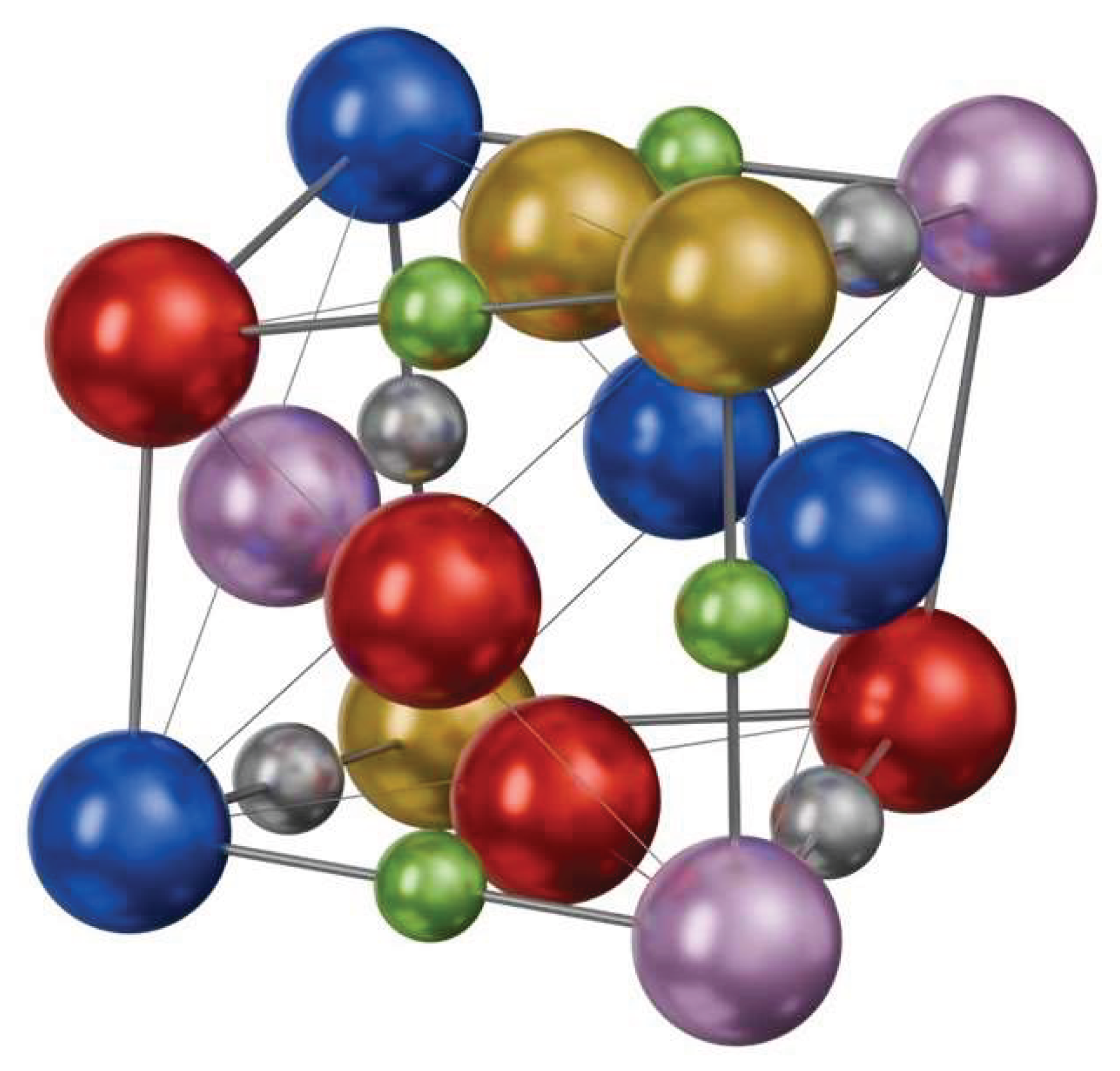
The crystal structure of investigated (NbMoTaW)1CxNy films, which are described in more details in [25], as well as their composition are given in Table 1. It can be seen that the transition from the bcc structure of the initial (NbMoTaW)1C0.2N0 HEA metal (polluted by carbon) to the NaCl-like fcc structure of (NbMoTaW)1CxNy films is observed in the concentration range 0 < x + y < ~0.5. At higher x + y concentrations the films exhibit a fcc crystal structure, however, for high C concentration (x > 1.17) this structure contains also C-clusters, and for high N concentration (y > 0.71) an additional hexagonal close-packed structure (hcp) begins to emerge. A schematic visualization of the expected fcc structure of (NbMoTaW)1CxNy carbonitrides is shown in Fig. 1. Illustrated is the case with (x + y)/M < 1, i.e. when the ratio between the concentration of carbon and nitrogen atoms (x + y) and the concentration of metal atoms (M = Nb + Mo + Ta + W = 1) is sub-stoichiometric and also contains vacancies.
Figure 1.
Schematic illustration of the fcc structure of (NbMoTaW)1CxNy carbonitrides. Illustrated is the case with (x + y)/M < 1, i.e. when the ratio between the concentration of carbon and nitrogen atoms (x + y) and the concentration of metal atoms (M = Nb + Mo + Ta + W = 1) is sub-stoichiometric and contains vacancies (unoccupied edges of the cube). Metal atoms are shown by large spheres, carbon atoms by grey and nitrogen atoms by green small spheres.
Figure 1.
Schematic illustration of the fcc structure of (NbMoTaW)1CxNy carbonitrides. Illustrated is the case with (x + y)/M < 1, i.e. when the ratio between the concentration of carbon and nitrogen atoms (x + y) and the concentration of metal atoms (M = Nb + Mo + Ta + W = 1) is sub-stoichiometric and contains vacancies (unoccupied edges of the cube). Metal atoms are shown by large spheres, carbon atoms by grey and nitrogen atoms by green small spheres.
4.2. Resistance and Magnetization Results
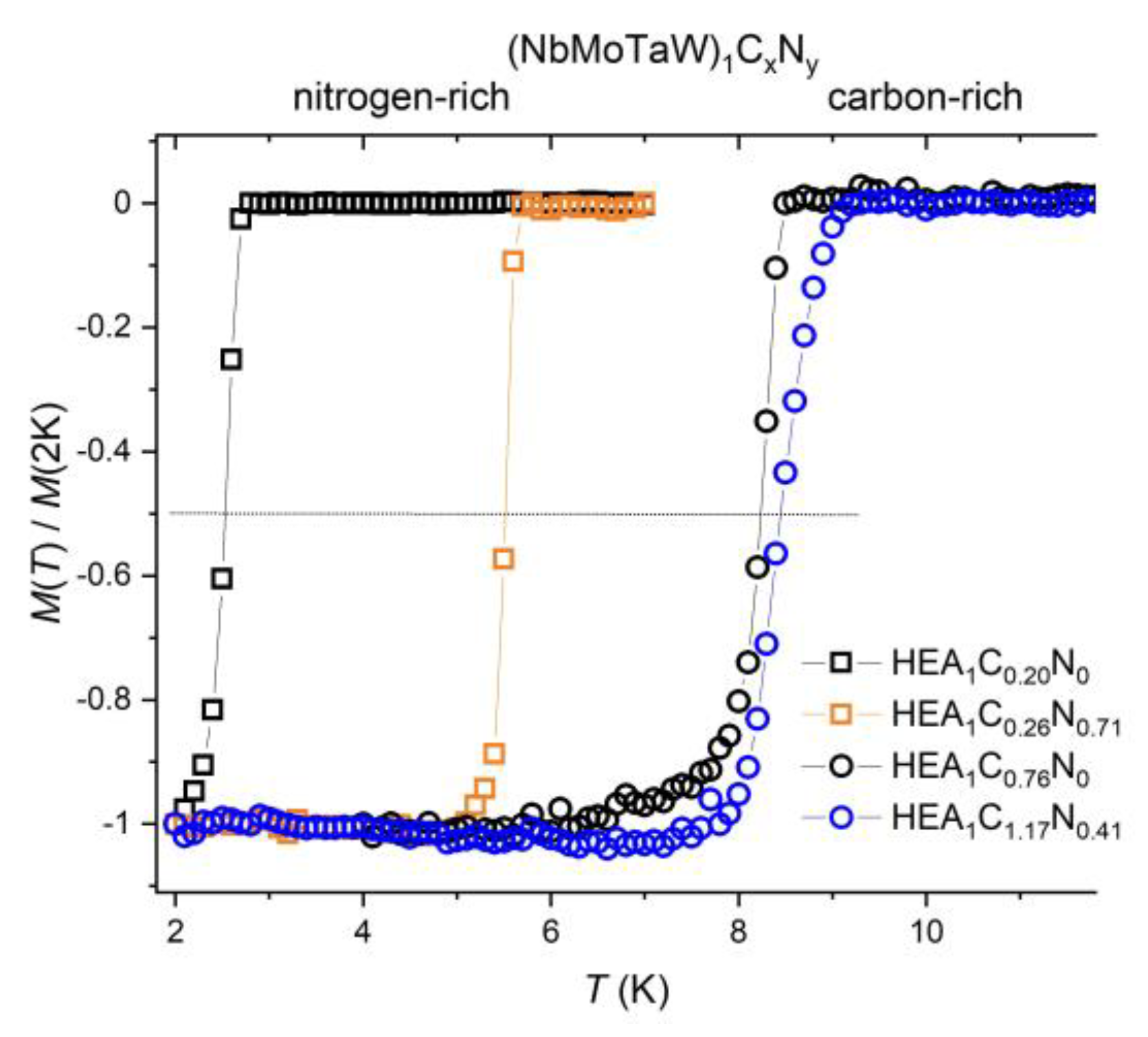
Fig. 2 shows the temperature dependencies of electrical resistance R(T) of the studied films normalized to their resistance values R0 just above the superconducting transition temperature onset. Sudden drops of R(T)/R0 to zero represent the transitions into the superconducting state. The relevant TC value was defined as the temperature at which R(T) reaches 50 % of the normal state resistance R0. These resistance superconducting transitions were confirmed for some films by a sharp diamagnetic drop at TC in parallelly performed magnetization measurements (see Fig. 3). Nevertheless, in (Nb0.35Mo0.17Ta0.23W0.25)C0.80N0 and (Nb0.32Mo0.18Ta0.24W0.26)C1.17N0.41) films of series II with a high carbon concentration, two TC onsets in the R(T)/R0 dependencies were observed, the higher ones at 9.2 K and 10.1 K, and the lower ones at 8.28 K and 9.6 K, respectively. However, the magnetization measurements (Fig. 3) point to the fact that at TC values of 8.28 K and 9.6 K, respectively, the entire samples enter a superconducting state. It is necessary to add that the inaccuracy (error) of TC determination is usually given by the ratio Δ(TC)/TC, where Δ(TC) represents the range between temperatures at which is R(T)/R0 = 0.9 and R(T)/R0 = 0.1. In our case, for the carbon-rich (Nb0.35Mo0.17Ta0.23W0.25)C0.80N0 and (Nb0.32Mo0.18Ta0.24W0.26)C1.17N0.41) films is Δ(TC)/TC ≈ 3 %, for other films (showing one sharp phase transitions) is Δ(TC)/TC ≈ 0.5 %.
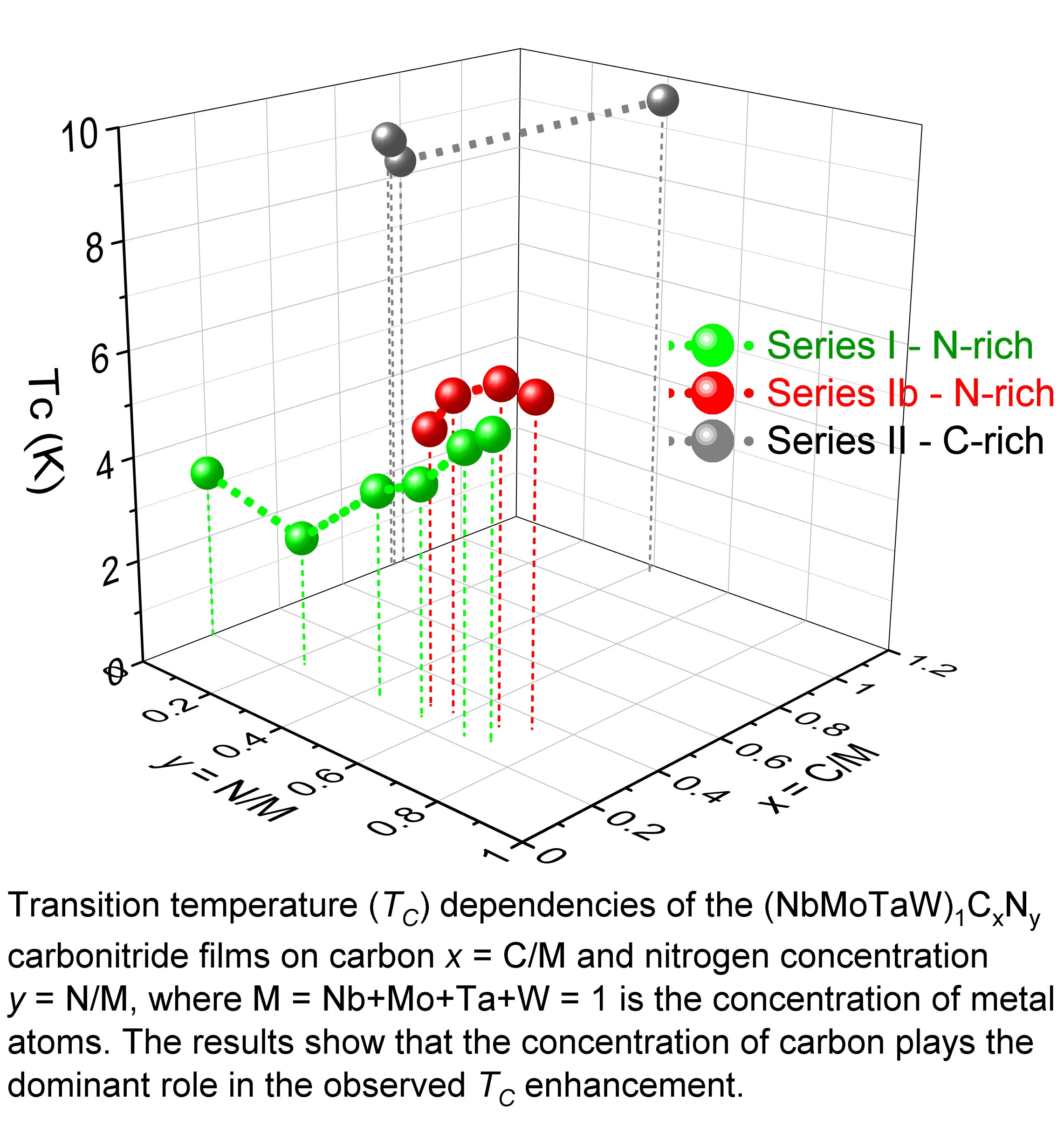
All obtained TC values are shown in Fig. 4, as a dependence of N concentration y (a) and C concentration x. These dependencies indicate that high concentration of carbon plays the dominant role in the about threefold TC increase. Moreover, one can see that the highest TC values of 6.3 K for the nitrogen-rich series (with y ≈ 0.7, see Series Ib) and of 9.6 K for the carbon-rich series (with x = 1.17 and y = 0.41, see Series II), are observed in samples at the verge of fcc structure instability. Namely, at higher concentrations two-phase structures begin to form: a fcc + hcp structure for y > 0.71 (see Series 1b) and a fcc + C-clusters structure for x + y > 1.58 (see Series II). This indicates that in investigated carbonitrides is the TC enhancement also related to the proximity of structural instability, as predicted in [34].
Figure 2.
Temperature dependencies of normalized resistance R(T)/R0 for (NbMoTaW)1CxNy films in zero magnetic field, where R(T) is the temperature dependence and R0 the resistance just above the transition temperature onset, respectively. The samples are labelled based on Table 1.
Figure 2.
Temperature dependencies of normalized resistance R(T)/R0 for (NbMoTaW)1CxNy films in zero magnetic field, where R(T) is the temperature dependence and R0 the resistance just above the transition temperature onset, respectively. The samples are labelled based on Table 1.
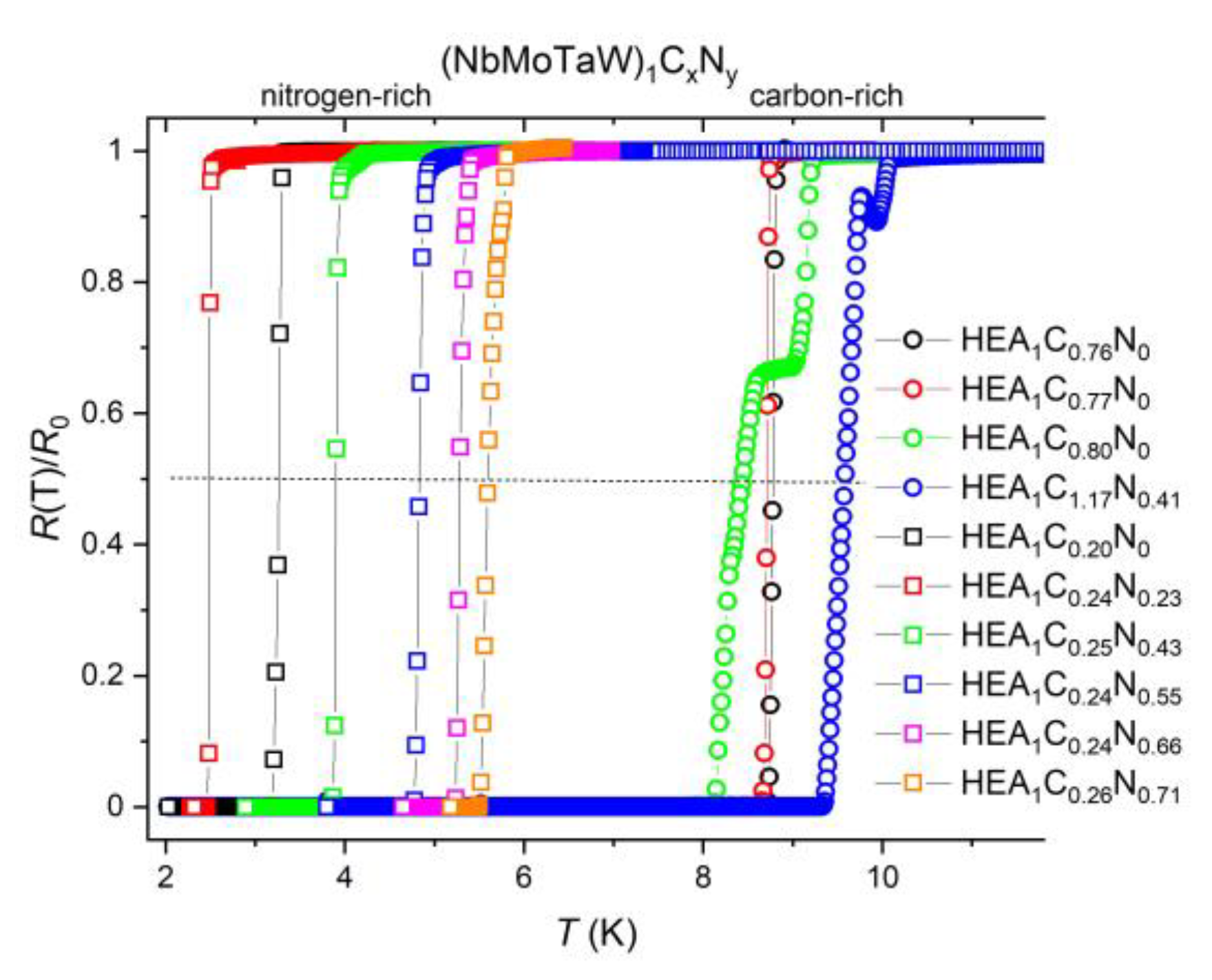
Figure 3.
Normalized DC magnetization dependencies M(T)/M(2K) in field of 1 mT for some (NbMoTaW)1CxNy films. Samples are labelled based on Table 1.
Figure 3.
Normalized DC magnetization dependencies M(T)/M(2K) in field of 1 mT for some (NbMoTaW)1CxNy films. Samples are labelled based on Table 1.
On the other hand, in the case of samples with a considerably over-stoichiometric sum of N and C concentrations (when x + y > 2) no superconducting transition was observed. Reasons for this are discussed in the next part.
Figure 4.
Transition temperature (TC) dependencies of the (NbMoTaW)1CxNy films: (a) - on nitrogen concentration y, (b) - on carbon concentration x, and (c) - as a three-dimensional display of TC vs x = C/M and y = N/M.
Figure 4.
Transition temperature (TC) dependencies of the (NbMoTaW)1CxNy films: (a) - on nitrogen concentration y, (b) - on carbon concentration x, and (c) - as a three-dimensional display of TC vs x = C/M and y = N/M.

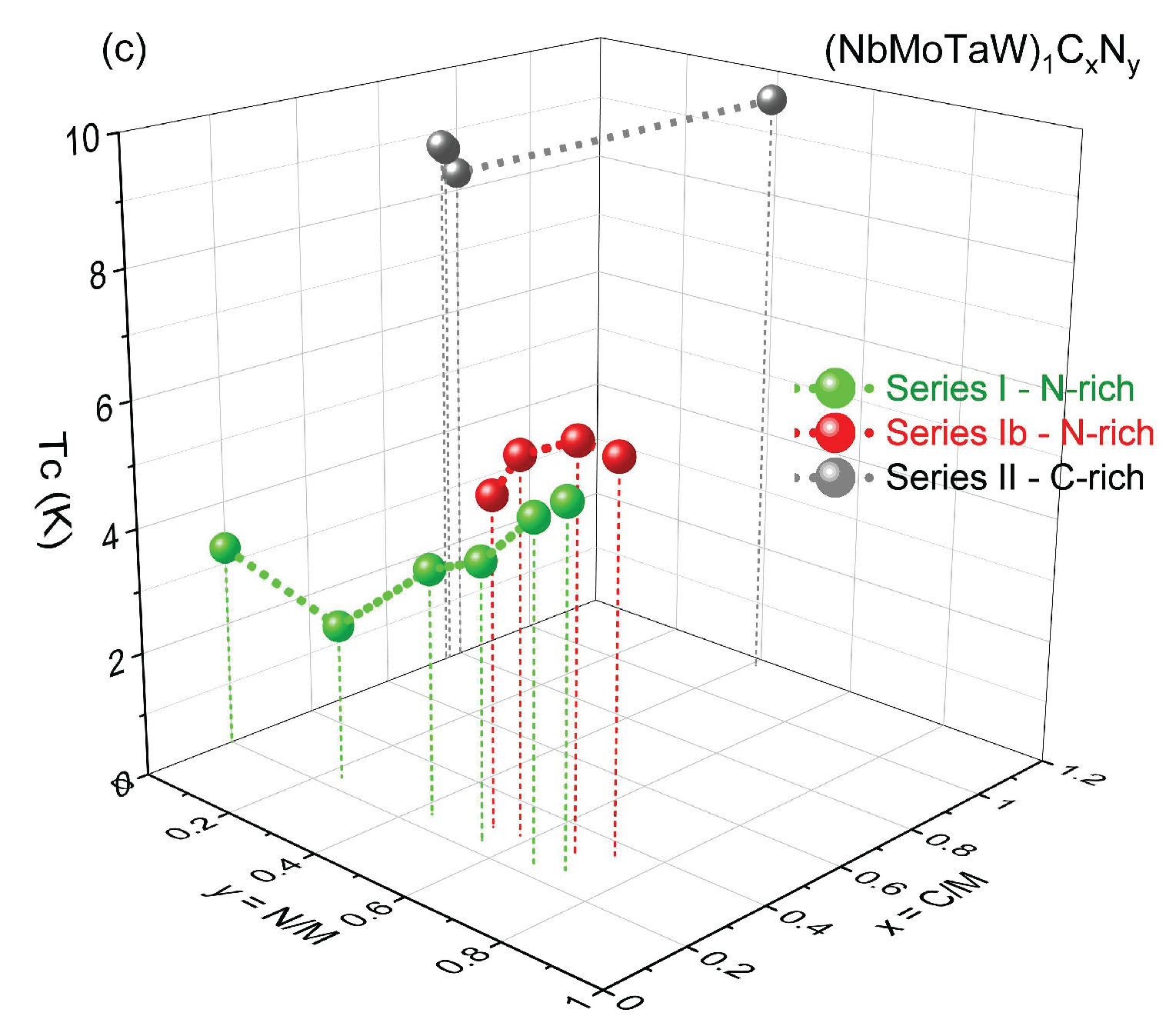
As can be additionally seen from Fig. 4(a), the TC dependence on N concentration y in the nitrogen-rich series (Series I) is not monotonic. With increasing y, TC first decreased from an initial value of 3.25 K to 2.49 K at y = 0.23, then gradually increased to a maximum value of TC = 5.61 K at y = 0.71. The initial decline of TC is apparently associated with the transition of the bcc structure of the initial HEA lattice to the fcc structure of HEA nitrides. The N concentration range in which the bcc → fcc structural change takes place is apparently a region with a high degree of disorder (containing e.g. also a mixture of bcc and fcc clusters). This high degree of disorder can lead to suppression of superconductivity (see e.g. [35,36]). Furthermore, it was shown in [36] that nonmagnetic impurities destroy superconductivity when the residual resistivity exceeds about 1 μΩcm, i.e. when the carrier mean free path l falls below the superconducting coherence length ξ. To make an estimate, according to [37] can be the Ginzburg-Landau coherence length ξGL(0) calculated as ξGL(0) = (Φ0/2πBc2(0))1/2, where Φ0 denotes the magnetic flux quantum and Bc2 the upper critical magnetic field, which reaches e.g. in (NbTa)0.67(MoHfW)0.33 HEA superconductor a value of ~15 nm. Simultaneously, the theoretical analysis of the electronic structure of another HEA superconductor (ScZrNb)1−x(RhPd)x, with 0.35 < x < 0.45 [38], leads to an electron mean free path between 3.2 and 9.2 Å, i.e. to an l < 1 nm. Thus, the high degree of disorder that is apparently present in the bcc → fcc structural transition area is likely the main cause for the observed TC suppression.
The second series of nitrogen-rich films (Series Ib), in which a higher nitrogen concentration was achieved, exhibits the highest TC value of 6.3 K in the fcc phase with x = 0.68 (see Fig. 4). But, at higher N concentration (x = 0.73) a two-phase (fcc + hcp) crystal structure forms and TC starts to decrease. This points to the fact that the highest TC is observed in the fcc phase, but near the border between the fcc and (fcc + hcp) phases.
Results on carbon-rich coatings, on the other hand, show that carbon incorporation leads to a substantially higher TC increase than in the case of nitrogen. According to the conventional Bardeen-Cooper-Schrieffer (BCS) theory of superconductivity, the stronger influence of carbon than nitrogen can be attributed to its lower atomic mass which may lead to an increase in the phonon frequency. However, also the enhancement of the electron-phonon interaction due to a different valence electron count (VEC) of carbon (having a VEC(C) = 4, see the periodic table of elements) and nitrogen (in this case VEC(N) = 5) and thus a different bonding between carbon-to-metal (compared to nitrogen-to-metal) atoms may play an important role. Thus, even if the carbon and nitrogen influence the transition temperature similarly, the more pronounced TC enhancement by carbon seems to be a result of a combination of its lower mass, the different configuration of its valence electrons, and subsequently a stronger electron-phonon interaction. And also in this case, the highest TC = 9.6 K is obtained in the fcc phase and at the border between two phases, beween the fcc phase and the (fcc + C-clusters) phase for x + y > 1.58 (see Table 1, Series II).
Moreover, with increasing nitrogen and carbon concentrations, there is a tendency to a semiconducting-like temperature dependence of resistance (i.e. with R0 > R300, see the R300/R0 ratios in Table 1), caused by the localization of conduction electrons through their bonding to incorporated N and C atoms.
4.3. TC vs VEC - Transition Temperature Dependence on the Valence Electron Count
To take a closer look how TC develops with the overall VEC of studied high entropy alloy carbonitrides (i.e. including N atoms with VEC = 5 and C atoms with VEC = 4), Fig. 5 shows this dependence for the above-discussed (NbMoTaW)1CxNy films. The upper grey trend line in this figure with a dome-like shape represents the TC vs VEC dependence for transition metals and their alloys in the crystalline form taken from ref. [39]. This trend line is often referred to as the Matthias TC vs VEC rule and exhibits a maximum of TCmax ≈ 11 K near VEC ≈ 4.7 el./atom (a second dome-like dependence, not shown here, with a maximum of TCmax ≈ 16 K is formed at VEC ≈ 6.5 el/atom, see e.g. also [18, 20].
Figure 5.
TC vs VEC dependencies for investigated carbonitrides. The upper grey line with a dome-like shape shows the TC vs VEC dependence (Matthias rule) for transition metals and their alloys in the crystalline form taken from [39]. Grey points represent Series II, green and red points the Series I and Series Ib of (NbMoTaW)1CxNy films. Black squares show the approximative course for the bulk (Ti0.2Nb0.2Ta0.2Mo0.2W0.2)C1-xNx (0 ≤ x ≤ 0.45) superconductors [13]. The point-connecting dotted lines are the guide to the eyes. .
Figure 5.
TC vs VEC dependencies for investigated carbonitrides. The upper grey line with a dome-like shape shows the TC vs VEC dependence (Matthias rule) for transition metals and their alloys in the crystalline form taken from [39]. Grey points represent Series II, green and red points the Series I and Series Ib of (NbMoTaW)1CxNy films. Black squares show the approximative course for the bulk (Ti0.2Nb0.2Ta0.2Mo0.2W0.2)C1-xNx (0 ≤ x ≤ 0.45) superconductors [13]. The point-connecting dotted lines are the guide to the eyes. .
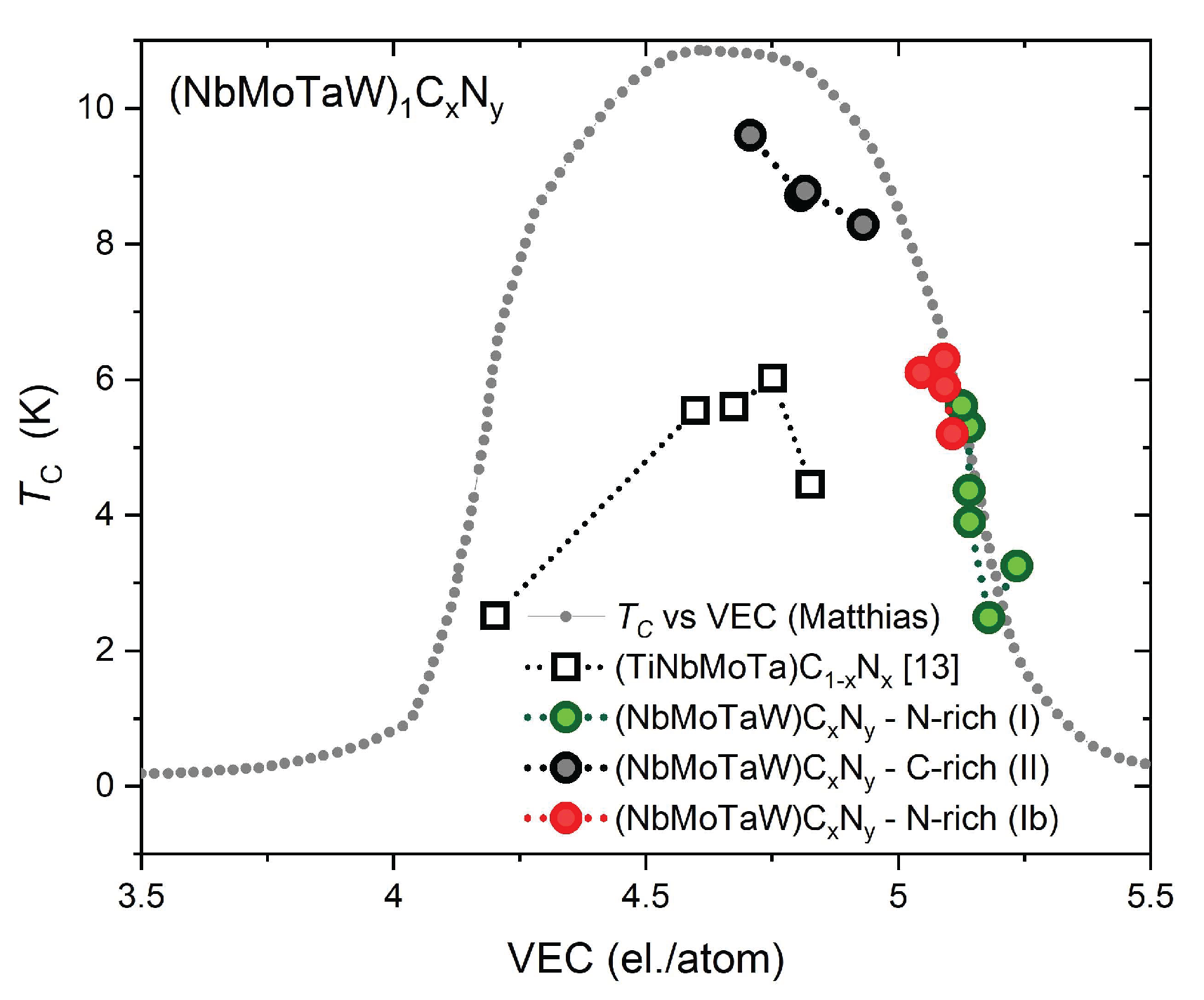
From the displayed TC vs VEC dependencies one can see that all carbonitrides lie inside the dome bordered by the trendline [39] (including the carbonitrides studied in [13]). Thus, also from here it turns out that incorporations of N and C into HEAs have a different impact, and that high C concentration leads to a more pronounced TC enhancement. However, as e.g. the TC of MoC (with a total VEC = 5) reaches a value of 14.3 K, which exceeds the value of TCmax ≈ 11 K, it is not excluded that also some HEA alloy carbonitrides or carbides will not obey the Mattias TC vs. VEC rule [39] and provide a higher TC.
It should be also noted that in (HEA)1CxNy films with a significantly over-stoichiometric sum of (N + C) concentrations (i.e. with x + y > 2, not shown in Table 1) no superconducting transition was observed. This is probably related to the strong localization of otherwise mobile (conduction) electrons of the metallic sublattice due to their bonding to the high (considerably over-stoichiometric) concentration of C and N atoms. This localization leads namely to an insulating state, which was for the case of these two samples documented by the observation of a sharp increase of their electrical resistance with decreasing temperature. Very similar results, related to the localization of conduction electrons, were recently observed in zirconium nitrides ZrNy with various N concentrations [40], where a strongly insulating state was detected at the over-stoichiometric concentrations of nitrogen (y > 1.15).
4.4. Upper Critical Magnetic Field Bc2
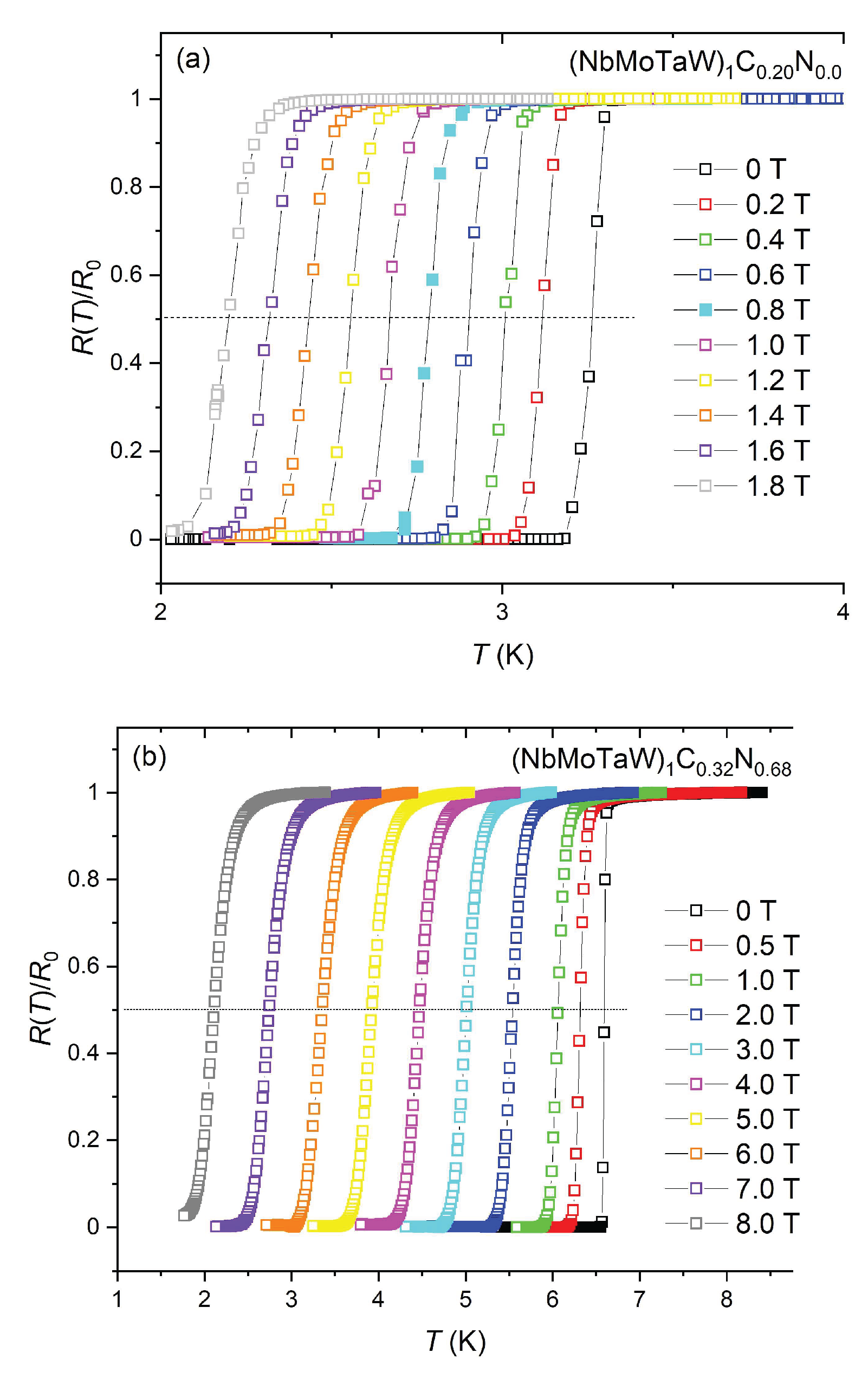
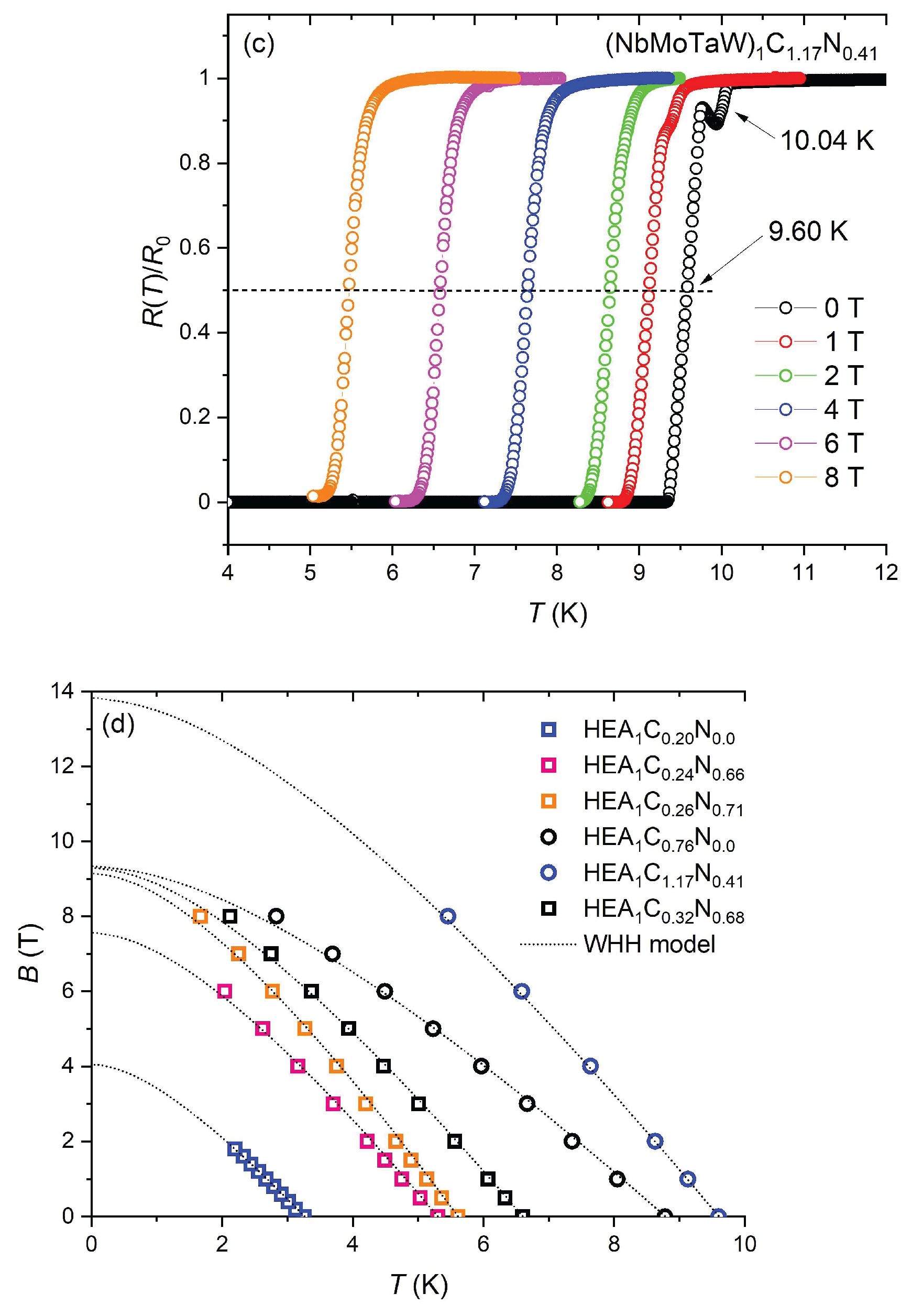
To obtain more information about the superconducting properties of the (NbMoTaW)1CxNy films, resistance R(T) measurements in different magnetic fields B were carried out. Fig. 6a shows the R(T) dependence of these films exposed to magnetic fields between 0 T and 8 T, demonstrating the decrease of TC with increasing B. As a criterion for the TC determination in magnetic fields, we used again the temperature value at which 50 % of the normal state resistance R0 just above TC is reached. From these results we constructed the corresponding upper critical magnetic field Bc2 vs T phase diagrams (see Fig. 6d). The observed Bc2 vs T dependencies were described by the Werthamer-Helfand-Hohenberg (WHH) model [41], which e.g. for a nitrogen-rich sample with x = 0.26 and y = 0.71 (TC = 5.61 K) provides a Bc2 value of 9.16 T and for a carbon-rich sample with x = 1.17 and y = 0.41 (TC = 9.6 K) a Bc2 value of ~13.8 T. On the other hand, the nitrogen-free HEA (x = 0) shows a Bc2 value of ~4 T.
Thus, the determined zero-temperature Bc2(0) values (see Table 1) provide Bc2(0)/TC ratios below 1.86 T/K and point to the fact that the upper critical field in the investigated HEA nitrides does not exceed the weak-coupling Pauli paramagnetic pair breaking limit. Namely, in the weak-coupling BCS theory of superconductivity, the Pauli paramagnetic pair breaking limit is BPauli = Δ(0)/(√2.μB) ≈ 1.86[T/K].TC, with μB being the Bohr magneton and Δ(0) the superconducting gap at T = 0 (see e.g. [42,43]). The mentioned Pauli paramagnetic limit may be different for strong-coupled superconductors [44,45].
Figure 6.
(a) - temperature dependencies of normalized resistance R(T)/R0 for the (NbMoTaW)1CxNy film of Series I with x = 0.2 and y = 0.0, (b) - of Series Ib with x = 0.32 and y = 0.68 and (c) - of Series II with x = 1.17 and y = 0.41 in increasing magnetic field. (d) - temperature dependencies of the upper critical field Bc2 (symbols) for some of the (NbMoTaW)1CxNy films together with corresponding fits based on the WHH model [41] (lines). The estimated Bc2(0) values are listed in Table 1.
Figure 6.
(a) - temperature dependencies of normalized resistance R(T)/R0 for the (NbMoTaW)1CxNy film of Series I with x = 0.2 and y = 0.0, (b) - of Series Ib with x = 0.32 and y = 0.68 and (c) - of Series II with x = 1.17 and y = 0.41 in increasing magnetic field. (d) - temperature dependencies of the upper critical field Bc2 (symbols) for some of the (NbMoTaW)1CxNy films together with corresponding fits based on the WHH model [41] (lines). The estimated Bc2(0) values are listed in Table 1.
5. Conclusions
Transport and magnetization investigations of sputtered (NbMoTaW)1CxNy carbonitride films show that the concentration of carbon plays the dominant role in the observed about threefold enhancement of the superconducting transition temperature TC. This is probably related to the lower atomic mass of C compared to N that can lead to a phonon-frequency increase and to the parallel increase of the electron-phonon interaction due to different bonding of carbon atoms (compared to nitrogen) to the metallic sub-lattice. However, as the highest TC values are observed at the verge of the fcc structure stability (for concentrations y > 0.71 and x + y > 1.58 two-phase structures begin to form), it indicates that the TC enhancement is additionally related to the proximity of structural instability [34].
Further investigations will be needed, especially on high entropy carbonitrides in the form of bulk crystalline samples, from which it will be possible to determine exactly how the electronic density of states, the phonon modes and the electron-phonon interaction change with C and N incorporation, especially at their higher concentrations.
Author Contributions
Conceptualization, K.F. and F.L.; Methodology, F.L., P.H., J.D., D.A. and M.L.; Formal analysis, G.P., S.G. and K.F.; Investigation, G.P., S.G., O.O. and J.Z.; Resources, G.P. and F.L.; Data curation, G.P. and S.G.; Writing - original draft preparation, K.F.; Writing - review and editing, G.P., F.L., S.G., and K.F.; Visualization, G.P., S.G., J.Z. and K.F.; Supervision, K.F. and F.L.; Project administration, G.P. and F.L.; Funding acquisition, G.P. and F.L. All authors have read and agreed to the published version of the manuscript.
Funding
This work was supported by the Slovak Research and Development Agency under the contracts no. APVV-23-0624 and APVV-21-0042, by the Slovak Scientific Grant Agency under Contract No. VEGA 2/0091/24 and by the EU NextGenerationEU through the Recovery and Resilience Plan for Slovakia under project No. 09I03-03-V04-00281. Liquid nitrogen for experiments was sponsored by U. S. Steel Košice, s.r.o.
Institutional Review Board Statement
Not applicable.
Informed Consent Statement
Not applicable.
Data Availability Statement
The data presented in the study are included in the article, further inquiries can be directed to the corresponding author.
Acknowledgement
We are grateful for the help of Ms. M. Gabániová with the illustration of the fcc structure of carbonitrides.
Conflicts of Interest
The authors declare no conflicts of interest.
References
- Meissner, W.; Franz, H. Messungen mit Hilfe von flüssigem Helium IX. Supraleitfähigkeit von Carbiden and Nitriden. Z. Physik 1930, 65, 30–in German. [Google Scholar] [CrossRef]
- Matthias, B.T.; Hulm, J.K. A search for new superconducting compounds. Phys. Rev. 1952, 87, 799. [Google Scholar] [CrossRef]
- Toth, L.E.; Wang, C.P.; Yen, G.M. Superconducting critical temperatures of non-stoichiometric transition metal carbides and nitrides. Acta Metall. 1966, 14, 1403. [Google Scholar] [CrossRef]
- Willens, R.H.; Buehler, E.; Matthias, B.T. Superconductivity of the Transition-Metal Carbides. Phys. Rev. 1967, 159, 327. [Google Scholar] [CrossRef]
- Zou, Y.; Jin, Q.; Wang, Y.; Jiang, K.; Wang, S.; Li, Y.; Guo, E-J.; Cheng, Z.G. Tuning superconductivity in vanadium nitride films by adjusting strain. Phys. Rev. B 2022, 105, 224516. [Google Scholar] [CrossRef]
- Azam, M.; Shahbaz, M.; Rehman, H.; Khan, N. Superconductivity in transition metal carbides, TaC and HfC: A density functional theory study with local, semilocal, and nonlocal exchange-correlation functionals. Mater. Today Comm. 2024, 39, 108546. [Google Scholar] [CrossRef]
- Burdastyh, M.V.; Postolova, S.V.; Proslier, T.; Ustavshikov, S.S.; Antonov, A.V.; Vinokur, V.M.; Mironov, A.Y. Superconducting phase transitions in disordered NbTiN films. Sci. Rep. 2020, 10, 1471. [Google Scholar] [CrossRef]
- Shi, L.; Ma, K.; Ruan, B.; Wang, N.; Hou, J.; Shan, P.; Yang, P.; Sun, J.; Chen, G.; Ren, Z.; von Rohr, F.O.; Wang, B.; Cheng, J. Nonmonotonic superconducting transition temperature and large bulk modulus in the alloy superconductor Nb4Rh2C1-δ. Phys. Rev. B 2024, 110, 214520. [Google Scholar] [CrossRef]
- Roedhammer, P.; Gmelin, E.; Weber, W.; Remeika, J.P. Observation of phonon anomalies in NbCxN1-x alloys. Phys. Rev. B 1977, 15, 711. [Google Scholar] [CrossRef]
- Tinkham, M. The BCS theory, In Introduction to superconductivity, 2nd ed.; Dover Publ., Mineola, New York, USA, 2004; Chapter 3, p. 43, ISBN-13: 978-0-486-43503-9, ISBN-10: 0-486-43503-2.
- Akrami, S.; Edalati, P.; Fuji, M.; Edalati, K. High-entropy ceramics: Review of principles, production and applications. Mater. Sci. & Engineer. R 2021, 146, 100644. [Google Scholar] [CrossRef]
- Zeng, L.; Wang, Z.; Song, J.; Lin, G.; Guo, R.; Luo, S-C.; Guo, S.; Li, K.; Yu, P.; Zhang, C.; Guo, W-M.; Ma, J.; Hou, Y.; Luo, H. Discovery of the High-Entropy Carbide Ceramic Topological Superconductor Candidate (Ti0.2Zr0.2Nb0.2Hf0.2Ta0.2)C. Adv. Funct. Mater 2023, 33, 2301929. [Google Scholar] [CrossRef]
- Zeng, L.; Hu, X.; Zhou, Y.; Liu, Y.; Boswell, M.; Xie, W.; Li, K.; Li, L.; Yu, P.; Zhang, C.; Guo, W-M.; Yao, D-X.; Luo, H. Superconductivity and non-trivial band topology in high-entropy carbonitride (Ti0.2Nb0.2Ta0.2Mo0.2W0.2)C1-xNx. The Innov. Mater 2023, 1, 100042. [Google Scholar] [CrossRef]
- Pristáš, G.; Gruber, G.C.; Orendáč, M.; Bačkai, J.; Kačcmarčík, J.; Košuth, F.; Gabáni, S.; Szabó, P.; Mitterer, C.; Flachbart, K. Multiple transition temperature enhancement in superconducting TiNbMoTaW high entropy alloy films through tailored N incorporation. Acta Mater. 2024, 262, 119428. [Google Scholar] [CrossRef]
- Senkov, O.N.; Wilks, G.B.; Miracle, D.B.; Chuang, C.P.; Liaw, P.K. Refractory high entropy alloys. Intermetallics 2010, 18, 1758–1765. [Google Scholar] [CrossRef]
- Ren, X.; Li, Y.; Qi, Y.; Wang, B. Review on Preparation Technology and Properties of Refractory High Entropy Alloys. Materials 2022, 15, 2931. [Google Scholar] [CrossRef]
- Zhang, J.; Liang, J.; Li, H.; Yang, Y.; Huo, D.; Liu, C. A review of high-entropy ceramics preparation methods, properties in different application fields and their regulation methods. J. Mater. Res. Technol. 2024, 32, 1083–1117. [Google Scholar] [CrossRef]
- Sun, L.; Cava, R.J. High-entropy alloy superconductors: status, opportunities, and challenges. Phys. Rev. Mat. 2019, 3, 090301. [Google Scholar] [CrossRef]
- Idczak, R.; Nowak, W.; Rusin, B.; Topolnicki, R.; Ossowski, T.; Babij, M.; Pikul, A. Enhanced Superconducting Critical Parameters in a New High-Entropy Alloy Nb0.34Ti0.33Zr0.14Ta0.11Hf0.08. Materials 2023, 16, 5814. [Google Scholar] [CrossRef]
- Kitagawa, J.; Hamamoto, S.; Ishizu, N. Cutting Edge of High-Entropy Alloy Superconductors from the Perspective of Materials Research. Metals 2020, 10, 1078. [Google Scholar] [CrossRef]
- Zeng, L.; Li, L.; Li, K.; Chen, R.; Luo, H. Recent advances in high-entropy superconductors. NPG Asia Materials 2024, 16, 60. [Google Scholar] [CrossRef]
- Shukunami, Y.; Yamashita, A.; Goto, Y.; Mizuguchi, Y. Synthesis of RE123 high-Tc superconductors with a high-entropy-alloy-type RE site. Physica C: Supercond. 2020, 572, 1353623. [Google Scholar] [CrossRef]
- Kilbane, F.M.; Habig, P.S. Superconducting transition temperatures of reactively sputtered films of tantalum nitride and tungsten nitride. J. Vac. Sci. Technol. 1975, 12, 107. [Google Scholar] [CrossRef]
- Chen, J.; Gao, J. Strong Electron–Phonon Coupling in 3D WN and Coexistence of Intrinsic Superconductivity and Topological Nodal Line in Its 2D Limit, Phys. Stat. Solidi RRL 2022, 16, 2100477. [Google Scholar] [CrossRef]
- Lofaj, F.; Hviščová, P.; Pristáš, G.; Dobrovodský, J.; Albov, D.; Lisnichuk, M.; Gabáni, S.; Flachbart, K. The effects of carbon and nitrogen incorporation on the structure, mechanical properties and superconducting transition temperature of (NbMoTaW)100-z(CN)z coatings. Thin Sol. Films 2025, 823, 140704. [Google Scholar] [CrossRef]
- Dobrovodský, J.; Vaňa, D.; Beňo, M.; Lofaj, F.; Riedlmajer, R. Ion Beam Analysis including ToF-ERDA of complex composition layers, J. Phys. Conf. Ser. 2024, 2712, e012024. [Google Scholar] [CrossRef]
- Jansson, U.; Lewin, E. Carbon-containing multi-component thin films. Thin Sol. Films 2019, 688, 137411. [Google Scholar] [CrossRef]
- Lewin, E. Multi-component and high-entropy nitride coatings - A promising field in need of a novel approach. J. Appl. Phys. 2020, 127, 160901. [Google Scholar] [CrossRef]
- Häglund, J.; Fernández Guillermet, A.; Grimvall, G.; Körling, M. Theory of bonding in transition-metal carbides and nitrides. Phys. Rev. B 1993, 48, 11685. [Google Scholar] [CrossRef]
- Wang, S.; Yu, X.; Lin, Z.; Zhang, R.; He, D.; Qin, J.; Zhu, J.; Han, J.; Wang, L.; Mao, H.; Zhang, J.; Zhao, Y. Synthesis, Crystal structure, and elastic properties of novel tungsten nitrides. Chem. Mater. 2012, 24, 3023. [Google Scholar] [CrossRef]
- Guo, S.; Hu, Q.; Ng, C.; Liu, C.T. More than entropy in high-entropy alloys: Forming solid solutions or amorphous phase. Intermetallics 2013, 41, 96. [Google Scholar] [CrossRef]
- Kube, S.A.; Sohn, S.; Uhl, D.; Datye, A.; Mehta, A.; Schroers, J. Phase selection motifs in High Entropy Alloys revealed through combinatorial methods: Large atomic size difference favors BCC over FCC. Acta Mater. 2019, 166, 677. [Google Scholar] [CrossRef]
- Miracle, D.B.; Senkov, O.N. A critical review of high entropy alloys and related concepts. Acta Mater. 2017, 122, 448. [Google Scholar] [CrossRef]
- van der Marel, D. Thoughts about boosting superconductivity. Physica C: Supercond 2025, 632, 1354688. [Google Scholar] [CrossRef]
- Kirkpatrick, T.R.; Belitz, D. Suppression of superconductivity by disorder. Phys. Rev. Lett. 1992, 68, 3232. [Google Scholar] [CrossRef]
- Mackenzie, A.P.; Haselwimmer, R.K.W.; Tyler, A.W.; Lonzarich, G.G.; Mori, Y.; Nishizaki, S.; Maeno, Y. Extremely Strong Dependence of Superconductivity on Disorder in Sr2RuO4. Phys. Rev. Lett. 1998, 80, 161. [Google Scholar] [CrossRef]
- Sobota, P.; Topolnicki, R.; Ossowski, T.; Pikula, T.; Pikul, A.; Idczak, R. Superconductivity in the high-entropy alloy (NbTa)0.67(MoHfW)0.33. Phys. Rev. B 2022, 106, 184512. [Google Scholar] [CrossRef]
- Gutowska, S.; Kawala, A.; Wiendlocha, B. Superconductivity near the Mott-Ioffe-Regel limit in the high-entropy alloy superconductor (ScZrNb)1−x(RhPd)x with a CsCl-type lattice. Phys. Rev. B 2023, 108, 064507. [Google Scholar] [CrossRef]
- Matthias, B.T. Empirical relation between superconductivity and the number of valence electrons per atom. Phys. Rev. 1955, 97, 74. [Google Scholar] [CrossRef]
- Chen, F.; Bai, X.; Wang, Y.; Dong, T.; Shi, J.; Zhang, Y.; Sun, X.; Wei, Z.; Qin, M.; Yuan, J.; Chen, Q.; Wang, X.; Wang, X.; Zhu, B.; Huang, R.; Jiang, K.; Zhou, W.; Wang, N.; Hu, J.; Li, Y.; Jin, K.; Zhao, Z. Emergence of superconducting dome in ZrNx films via variation of nitrogen concentration. Sci. Bull. 2023, 68, 674–678. [Google Scholar] [CrossRef]
- Werthamer, N.R.; Helfand, E.; Hohenberg, P.C. Temperature and Purity Dependence of the Superconducting Critical Field, Hc2. III. Electron Spin and Spin-Orbit Effects. Phys. Rev 1966, 147, 295. [Google Scholar] [CrossRef]
- Ma, K.-Y.; Gornicka, K.; Lefevre, R.; Yang, Y.; Rønnow, H.M.; Jeschke, H.O.; Klimczuk, T.; von Rohr, F.O. Superconductivity with High Upper Critical Field in the Cubic Centrosymmetric η-Carbide Nb4Rh2C1-δ. ACS Mater. Au 2021, 1, 55. [Google Scholar] [CrossRef] [PubMed]
- Womack, F.N.; Young, D.P.; Browne, D.A.; Catelani, G.; Jiang, J.; Meletis, E.I.; Adams, P.W. Extreme high-field superconductivity in thin Re films. Phys. Rev. B 2021, 103, 024504. [Google Scholar] [CrossRef]
- Clogston, A.M. Upper limit for the critical field in hard superconductors. Phys. Rev. Lett. 1962, 9, 266. [Google Scholar] [CrossRef]
- Orlando, T.; McNiff Jr., E.; Foner, S.; Beasley, M. Pauli paramagnetic limiting, and material parameters of Nb3Sn and V3Si. Phys. Rev. B 1979, 19, 4545. [Google Scholar] [CrossRef]

Table 1.
Overview of data obtained from performed investigations on (NbMoTaW)1CxNy films. The first column indicates the sample composition determined by ToF ERDA, the name of the corresponding sample from [25] and the measurements performed on this sample. The second column shows the dominating crystal structure of the film (here bcc stands for body-centered cubic, fcc for face-centered cubic, and hcp for hexagonal close-packed). In the next columns, R300/R0 shows the resistance ratio, where R300 denotes the film resistance at 300 K and R0 the resistance just above the TC onset , TC denotes the superconducting transition temperature (in parentheses the transition onset value for two sapmles is given), and Bc2 the upper critical field in Tesla. The last column represents the valence electron count (VEC), i.e. the average number of valence electrons per atom in el./atom (including metal, carbon and nitrogen atoms). Sign n.d. in some cells means not determined. .
Table 1.
Overview of data obtained from performed investigations on (NbMoTaW)1CxNy films. The first column indicates the sample composition determined by ToF ERDA, the name of the corresponding sample from [25] and the measurements performed on this sample. The second column shows the dominating crystal structure of the film (here bcc stands for body-centered cubic, fcc for face-centered cubic, and hcp for hexagonal close-packed). In the next columns, R300/R0 shows the resistance ratio, where R300 denotes the film resistance at 300 K and R0 the resistance just above the TC onset , TC denotes the superconducting transition temperature (in parentheses the transition onset value for two sapmles is given), and Bc2 the upper critical field in Tesla. The last column represents the valence electron count (VEC), i.e. the average number of valence electrons per atom in el./atom (including metal, carbon and nitrogen atoms). Sign n.d. in some cells means not determined. .
| sample composition (sample label in [25]), measurements |
crystal structure |
R300/R0 (RRR) |
TC [K] |
Bc2(0) [T] |
VEC el./at. |
| Series I | |||||
| (Nb0.23Mo0.24Ta0.26W0.27)1.0C0.20N0.0 ( 4ME-C(0)-0N-a ), R(T), M(T) |
bcc | 1.004 | 3.25 | 4.05 | 5.235 |
| (Nb0.24Mo0.25Ta0.25W0.26)1.0C0.24N0.23 ( 4ME-C(0)-1N ), R(T) |
bcc with fcc |
0.989 | 2.49 | 2.70 | 5.180 |
| (Nb0.24Mo0.25Ta0.25W0.26)1.0C0.25N0.43 ( 4ME-C(0)-2N ), R(T) |
fcc | 0.975 | 3.90 | 3.94 | 5.141 |
| (Nb0.24Mo0.26Ta0.25W0.25)1.0C0.24N0.55 ( 4ME-C(0)-3N ), R(T) |
fcc | 0.940 | 4.83 | 6.55 | 5.140 |
| (Nb0.24Mo0.26Ta0.24W0.26)1.0C0.24N0.66 ( 4ME-C(0)-4N ), R(T) |
fcc | 0.905 | 5.30 | 7.57 | 5.140 |
| (Nb0.24Mo0.26Ta0.24W0.26)1.0C0.26N0.71 ( 4ME-C(0)-5N ), R(T), M(T) |
fcc | 0.847 | 5.61 | 9.16 | 5.126 |
| Series Ib | |||||
| (Nb0.20Mo0.29Ta0.25W0.26)1C0.29N0.53 ( new, with N-flow 3N ), M(T) |
fcc | n.d. | 5.2 | n.d. | 5.108 |
| (Nb0.20Mo0.29Ta0.25W0.26)1C0.30N0.58 ( new, with N-flow 4N ), M(T) |
fcc | n.d. | 5.9 | n.d. | 5.092 |
| (Nb0.20Mo0.29Ta0.25W0.26)1C0.32N0.68 ( new, with N-flow 5N ), M(T), R(T) |
fcc | 0.832 | 6.3 | 9.30 | 5.091 |
| (Nb0.22Mo0.28Ta0.24W0.26)1C0.36N0.73 ( new, with N-flow 7N ), M(T) |
fcc with hcp | n.d. | - | - | 5.046 |
| Series II | |||||
| (Nb0.31Mo0.18Ta0.25W0.26)1.0C0.76N0.0 ( 4ME-C(500)-0N-a ), R(T), M(T) |
fcc | 1.001 | 8.78 | 9.34 | 4.816 |
| (Nb0.31Mo0.18Ta0.25W0.26)1.0C0.77N0.0 ( 4ME-C(600)-0N-b ), R(T) |
fcc | 0.939 | 8.71 | 8.70 | 4.807 |
| (Nb0.35Mo0.17Ta0.23W0.25)1.0C0.80N0.0 ( 4ME-C(700)-0N-c ), R(T) |
fcc | 0.989 | 8.28 (~9.2) | n.d. | 4.931 |
| (Nb0.32Mo0.18Ta0.24W0.26)1.0C1.17N0.41 ( 4ME-C(600)-2N ), R(T), M(T) |
fcc | 0.939 | 9.60 (~10.1) |
13.83 | 4.707 |
| (Nb0.32Mo0.19Ta0.24W0.25)1.0C1.18N1.13 ( 4ME-C(600)-5N ), R(T) |
fcc with C-clusters |
0.599 | - | - | 4.771 |
Disclaimer/Publisher’s Note: The statements, opinions and data contained in all publications are solely those of the individual author(s) and contributor(s) and not of MDPI and/or the editor(s). MDPI and/or the editor(s) disclaim responsibility for any injury to people or property resulting from any ideas, methods, instructions or products referred to in the content. |
© 2025 by the authors. Licensee MDPI, Basel, Switzerland. This article is an open access article distributed under the terms and conditions of the Creative Commons Attribution (CC BY) license (http://creativecommons.org/licenses/by/4.0/).
Copyright: This open access article is published under a Creative Commons CC BY 4.0 license, which permit the free download, distribution, and reuse, provided that the author and preprint are cited in any reuse.


