

Submitted:
25 June 2025
Posted:
27 June 2025
You are already at the latest version
Abstract
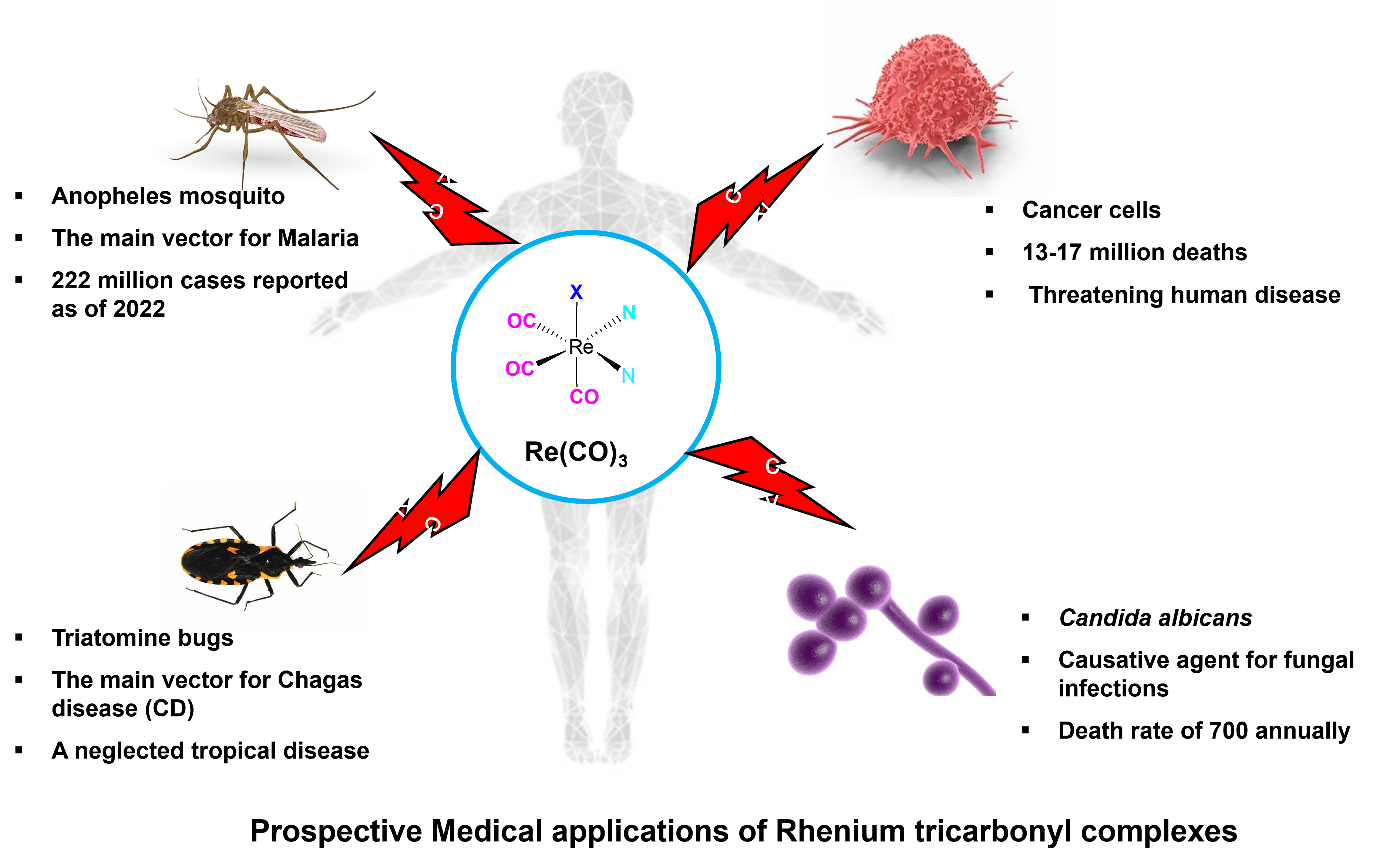
The use of metal-based complexes is currently taking center stage in the field of nanomedicine for the treatment and control of various ailments. Rhenium(I) tricarbonyl complexes have frequently been evaluated in vitro for their anticancer activities, and a few have advanced to in vivo and clinical trials, owing to the distinct application characteristics of these complexes. Their inception in drug development is key. This study explores a detailed chronological overview of the medical applications of Re(I) tricarbonyl complexes over the past six years (2019-2024), focusing on their applications and clinical tests in the control and management of various ailments. An in-depth examination of their activities in anticancer treatments, Chagas disease, antifungal infections, antimalarial, and microbial infections was conducted, comparing the complexes to various standard antibiotics, conventional antimalarial drugs, antifungals, and standard anticancer agents.
Keywords:
antichagasic
; antimalarial
; antimicrobial
; diagnostics
; Re(I) tricarbonyl
; therapeutics
1. Introduction
The field of medicine and the healthcare system is a progressive unit with immense pressure on pharmaceutical industries and academic research institutions to conduct research towards developing drugs that are effective and specific in action.[1] The emergence of novel infectious diseases, as well as the re-emergence of other diseases due to resistance, puts more emphasis on the discovery of new drugs.[2] Computational chemistry and biology play a central role in drug discovery. The process involves a multiparameter optimization of drug discovery and a target-specific drug formulation, a procedure that has shortened the development period of drugs.[1]
First off, antimicrobial resistance (AMR) has become a global challenge. The World Health Organization (WHO) has ranked it as the 10th public health threat to humanity as of 2021.[4] AMR has caused a severe breakdown in many countries’ economies, prolonged hospital stays, and irreversible disabilities in patients, which have negatively impacted the livelihood of many people worldwide.[5] This multidrug resistance of the causative agents has caused a drying-up in clinical trials of the antibiotics that can suppress the advancing antimicrobial resistance (AMR), hence posing a critical issue for researchers to develop novel antibiotics that are effective against the emerging and re-emerging pathogenic effects.[5,6,7,8]
Second, Malaria is still a public health concern worldwide. The Malaria World Report of 2022 reveals that approximately 247 million people worldwide were infected with malaria, with about 619,000 fatalities reported in 2022.[9] Sub-Saharan Africa leads with about 95 % of new cases of infections annually and 96 % of fatalities compared to the rest of the world. Insecticide-treated nets (ITNs) are the primary control method for vectors; however, their efficiency and effectiveness are declining drastically due to severe vector resistance to the insecticides used, as reported by WHO, 2022.[9] Primaquine, mefloquine, and quinine gluconate are among the primary antimalarial drugs that are in use currently; however, their usage and efficiency have been adversely affected by the increasing resistance of Plasmodium falciparum to the used antimalarial drugs in use. This has, therefore, necessitated the development of new treatment methods for the eradication of Malaria.[10,11]
Thirdly, Chagas Disease (CD) is a neglected parasitic infectious disease worldwide, affecting about 70 million people and resulting in approximately 34,000 deaths yearly.[12] CD can be cured if the infection is detected early enough in children.[13] Benznidazole and nifurtimox drugs are the only reliable drugs that have been in use for the past 60 years in the treatment of severe cases of CD [14,15] However, the resistance of Trypanosoma cruzi to these drugs, as well as the toxicity associated with their usage, makes them less effective; hence, a new drug development approach should be put in place to curb the drawbacks.[14,15]
Fourthly, cancer is the most threatful disease currently, with about 13-17 million deaths and 26-30 million new cases projected to be realized by 2030.[16] The illness is characterized by redox imbalances with a greater shift towards oxidative conditions, evident of free radicals accumulation in the body systems which can bind to the micro molecules such as proteins, phospholipids and DNA in the normal cells causing damage to the DNA and proteins.[16] Conventional cancer treatments (i.e., radiotherapy, surgery, and chemotherapy) have shown a positive impact on cancer treatment; however, such have reported varied shortcomings in their applications, treatment, and management of cancer.[17,18]
Radiotherapy is one of the cancer treatment approaches that has improved the lifespans of cancer patients; it works by utilizing a high dosage of radiation to eradicate cancer cells and reduce the size of the tumour.[19] This, therefore, has opened another sphere of medical application in the treatment and management of cancer. However, overexposure to radiation causes even development of a new cancer in the patient, a condition to which can lead to death. Unfortunately, a larger percentage of cancer patients do not survive even after a series of controlled medications.[20] This has therefore called for a better approach to developing reliable anticancer agents for the management of various types of cancer at different stages.
The introduction of metal-based drugs has sought to improve the efficiency and specificity of the drugs by introducing a metal complex that works by enhancing drug stability and creating more reactive sites within the drugs.[21],[22] This nanotechnology uses nanomaterials such as Manganese Mn (II), Mn (I), platinum (Pt), and rhenium (Re (I), (II) among others.[21]
Re(I)Tricarbonyl Complexes is one among these nanomaterials (Figure 1), which possess enormous potential in the field of medicine. The complex contains a low-spin d[6] electronic configuration as well as stability of CO ligands, making it probable for substitution of the Re in the [Re(I)(CO)3] complex, hence its usefulness in radiopharmaceutical medicine. The metal neutrality in the Re(I) complex makes it a more advantageous property as opposed to its radioisotope state. The complex also has a relatively small size as compared to its stability and inertness, serving as a probable benefit in nanomedicine applications.[19,23]
The luminescent cum phosphorescence of the Re(CO)3 complexes gives it a characteristic application as a photosensitizer and for bio-imaging agent.[24] Re(I) tricarbonyl complexes have a general formula of Re(CO)3 (Figure 1), exhibiting Good photo-redox stability allows for easy synthesis through a one-step strategy. The remarkable C-O stretching frequency enabled many of the Re complexes for imaging.[24]
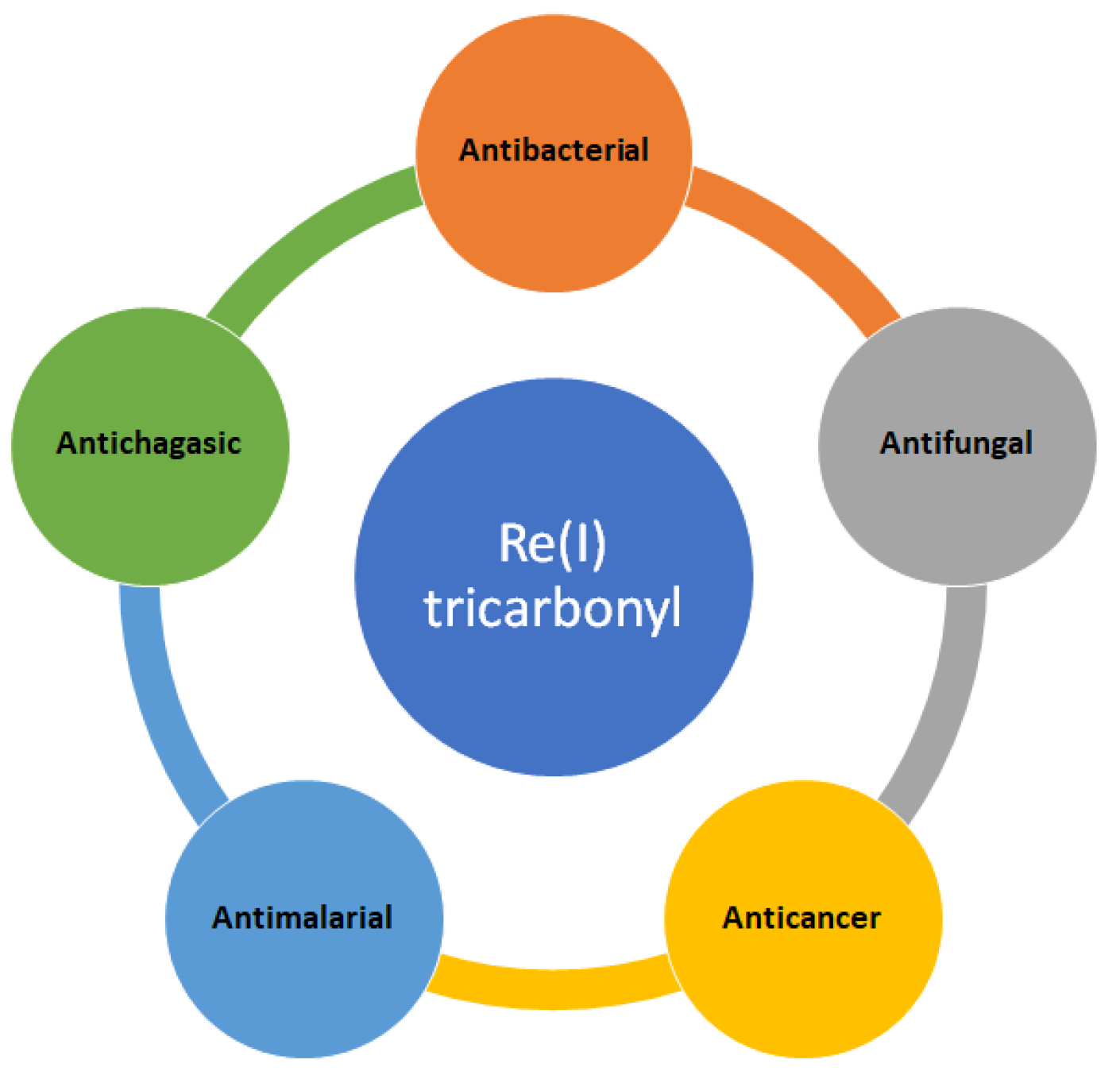
These structural cum chemical characteristics of Re(I) tricarbonyl complexes make them useful in the management of varied medical conditions as shown in Figure 2.
Re(CO)3-N, N-diamine derivatives have been evaluated as photocatalysts in CO2 reduction as well as in photodynamic therapy (PDT) (1-3). These complexes have also shown a desirable antibacterial activity against Streptococcus aureus and E. coli, with complex 3 showing the lowest MIC value of 50 µg/mL.[25]
The introduction of bis-quinoline to the N-N-diamine complexes enhances their antibacterial activities, as shown by 9, which exhibited notable antibacterial activity against S. aureus (MIC = 0.0002 mM) and E. coli (MIC = 0.023 mM), respectively.[25] The activity of the complex did not change when the methicillin-resistant strain of S. aureus, as well as the colistin-resistant strain of E. coli, were used, an indication that the complex is a prospective candidate in drug development.[25,26,27,28,29]
Most of the complexes herein reported showed poor antifungal activities against Candida albicans, with only 12 showing a potent activity of 0.00062 mg/ml MIC against C. albicans.[7,27,30] It is reported that both antifungal and antibacterial agents work by generating singlet oxygen responsible for enhancing drug penetration to the pathogenic organs, hence inhibiting their growth.[25,31]
Derivatization of triazoles with Re(CO)3 enhanced the antimalarial activities of complexes. Complex 14 of the azole group of compounds showed an interesting IC50 value of 4.16 µM against P. falciparum (Table 4).[32,33] Conversely, Re(CO)3-clotrimazole derivatives showed desirable antichagasic activities against T. cruzi, with 18 showing the least IC50 value of 3.48 ± 0.98 µM against T. cruzi epimastigotes.[34,35,36] However, many of the complexes have been dismally evaluated for their antichagasic activities.
Several complexes have been evaluated for anticancer activities against different cancer cell lines, with the complexes ranging from simple N-N-diamine (23-28), sulfonated Re(CO)3 complexes (29), benzo thiols derivatives (30-33), 1,10-phenanthroline derivatives (36-41), Re(I) Re(CO)3 acetylacetone tricarbonyl-1,2-dimethylimidazole (43) to the Re(I) binuclear carboline and 1,10-phenanthroline derivates (44-48)[16,19,37,38,39,40,41,42,43,44,45,46,47,48,49] in each case, the anticancer activities of these complexes were compared with those of cisplatin (42), the positive control, as shown in Table 6. The present review seeks to evaluate the medicinal applications of Rhenium(I) complexes with a narrower approach to the antimicrobial, antifungal, antimalarial, antichagasic, and anticancer activities of Re(I) Re(CO)3 complexes published over the past six years (2019-2024). The data herein was extensively analyzed from scientific databases such as Google Scholar, Scopus, PubChem, Sci-Finder, and Science Direct.
2. Medical Applications of Re(I)Tricarbonyl Complexes
The Re(I) tricarbonyl core has recently emerged as an ideal metal synthon in medicinal applications due to the biocompatibility, low toxicity, and unique electronic properties that the complexes of this metal possess.[19] The applications that make these Re(CO)3 complexes valuable in medicine are diagnostic imaging, cancer treatment, and antibacterial capabilities. This is due to the versatility of the metal core, where scientists can modify the ligands coordinated in the octahedral sphere, allowing for various fine-tuning to optimize the complex properties.[41,50] In addition, the Re(CO)3 complexes with diamine (N-N’) coordinated ligands are the desired complexes owing to their desirable luminescent properties. They are simply synthesized at room temperature and can easily emit light in the UV-VIS region; their characteristics, however, are dependent on the conditions set and the type of ligands used. Due to these remarkable advantages, they have been formerly used as photocatalysts in the reduction of CO2, as sensors for different microenvironments, and as singlet oxygen sensitizers for photodynamic therapy (PDT). They have a general formula of Re(CO)3(N N’)X]+, where X represents a halide that is characteristic of yielding a triplet Metal-ligand charge transfer (3MLCT).
The properties of the Re(I) complexes depend on the ligands, the solvent used, and other physical properties applied, hence yielding varied types of complexes with distinguished biomedical applications.[19] This review, therefore, seeks to identify these complexes and their biomedical applications for the past six years (2019-2024), with an in-depth look into some of their antimicrobial, antifungal, antimalarial, antichagasic, and anticancer activities.
2.1. Antibacterial Applications
The World Health Organization (WHO) termed antimicrobial resistance (AMR) a global challenge affecting countries at all levels[6]. It is the leading cause of antibiotics’ ineffectiveness worldwide. The spread of drug-resistant pathogens is occurring at an alarming rate, as clinical innovation in antibiotics is drying up, posing a challenge to the growing antimicrobial resistance (AMR) menace. The increasing antimicrobial resistance (AMR) worldwide has strained the economic power and health systems of many countries, a concern that demands urgent attention from all sectors.[6] However, the recent increasing adoption of metal-based complexes has shown a green light to end the AMR menace, even though a few of them have undergone clinical trials.
Irradiating 1, 2, and 3 with UV-visible light at 365 nm gives an advanced antibacterial activity against human pathogens S. aureus and E. coli (Table 1). Acosta et al., (2021) [25] reported significant activities of irradiated complexes against selected human pathogens compared to non-irradiated ones. The irradiated form of 1 showed a profound activity against both S. aureus and E. coli, with a MIC of 50 µgmL-1, respectively. Conversely, the irradiated form of 2 provoked cell arrests against the gram-negative bacterial strain E. coli at 300 µgmL-1, whereas 3 had a significant activity against S. aureus at 50 µgmL-1.
Sharma et al., (2022) [27] evaluated the antimicrobial potency of (4-8) against gram-positive bacterium S. aureus and its methicillin-resistant strain (MRSA), Enterococcus faecium, and Listeria monocytogenes and gram-negative bacterial strain Pseudomonas aeruginosa, wherein 4-8 showed profound activities against S. aureus NCTC 6171 and S. aureus ATCC 43300 (MRSA) with minute concentrations of less than 0.8 µM (700-800 ng/ml) (Table 2).27
The complexes 4-8 demonstrated potent activity, approximately 8 times greater than that of linezolid [MIC = 5.9 µM], indicating that the complexes perform significantly better than the approved antibiotics in the treatment of methicillin-resistant S aureus.[27]
In vivo, investigations of these complexes were evaluated in the zebrafish model [51]. The results disclosed that Rhenium complexes with anti-staphylococcal activity were of low toxicity at higher dosage as compared to corresponding MICs against MRSA and S. aureus NCTC 6571, and thus can serve as a probable lead in the control and treatment of bacterial infections.[25]
P-N bidentate (1-3), as demonstrated by Acosta et al., (2021), [25] showed promising activities against some of the selected human pathogens S. aureus and E. coli, with the lowest MIC value of 50 µgmL-1, respectively. However, Sharma et al., (2022) [27] demonstrated that the introduction of an electron donor to the ligand, as well as increasing the length of the side chain, will enhance the antibacterial activities of the complexes, which was then affirmed via zebrafish tests by Briggs (2002).[51]
On the other hand, as demonstrated by Frei et al., (2020)[53], the introduction of a bis-quinoline ligand to the Re(CO)3 core increases its antibacterial activities. The complexes (9-11) are the derivatives of bis-quinolone, which were subjected to an antibacterial activity test against Gram-positive bacterium S. aureus and Gram-negative bacterium E. coli, as well as their resistant species MRSA and colistin-resistant E. coli strains, respectively, wherein their MIC values (mM) are tabulated in Table 2.
Complex 9 showed profound antibacterial activity against S. aureus and E. coli, with corresponding MIC values of 0.0002 and 0.023 mM, respectively. It was also noticed that these antibacterial activities did not change in any way when Methicillin-resistant S. aureus (MRSA) and colistin-resistant E. coli strains were used.[53] This is evident that the complex has potent antibacterial activities against both Gram-negative and Gram-positive bacterial strains, hence a good candidate for the development of antibiotics.[53,55]
As reported by Frei et al., (2020)[53], irradiating of the complexes at around 365 nm enhances its activities, This is because it aids in the release of singlet oxygen, which enhances penetration antibiotics into bacterial membrane, this was also evaluated and affirmed by Acosta et al., (2021) [25], where, a twofold increase in the antibacterial activities of 1-3 were reported after a 365 nm irradiation of the complexes.
Meagre antibacterial activities of Re(CO)3 complexes against Gram-negative bacterial strains have been reported in several studies; Frei et al., (2020)[53], Betts et al., (2020) [55], and Sharma et al., (2022) [27], affirm this when poor antibacterial activities of 1-11, against gram-negative bacterium E. coli were reported (Table 1 and 2). This may be attributed to the resistance of the bacterium, aided by a thick bacterial membrane as well as the presence of an efflux pump, which helps in evacuating antibiotic accumulation within their systems.[30]
From 2019-2024, many Re(I) complexes have been evaluated for their antibacterial activities against varied bacterial strains; however, a few have been tested in varied animal models to establish their safety for human uptake, as compared to their anticancer activities. [27,31] Many of the studies have largely focused on sensitivity tests on S. aureus and E. coli, with no concern for some neglected tropical pathogenic bacterial strains such as; Mycobacterium ulcerans which causes Buruli ulcers; a disease characterized by the formation of large ulcers on the skin and reported to cause acute paralysis in human, and consequently may cause skin cancer if not treated early.[56] Secondly, Gardnerella vaginalis a common bacterial infection that causes vaginal microbiota imbalance, the condition, however, is not life-threatening but an untreated condition may cause serious complications during pregnancy and acts as a route way for other sexually transmitted infections.[57] The two bacterial infections are among many other neglected pathogens that silently cause death; hence, a research call ought to be created to look into the potential of MNPs in the development of other classes of antibacterial drugs.
2.3. Antimalarial Activities
Malaria is still a public health concern, owing to its prevalence and significant impact on the health systems, especially in countries in sub-Saharan Africa [10]. In 2023, UNICEF reported about 222 million cases as of 2022, an indication that the prevalence is increasing yearly[60]. Multidrug resistance of Plasmodium falciparum is the main concern in the management and control of malaria. However, the introduction of Metal-based drugs has been reported to scale down such resistance. The Re(CO)3 complexes of the quinoline triazoles ligand scaffold work best by inhibiting haemoglobin oxidation, which is key in the treatment of the most dreadful cerebral malaria.[33]
Derivatizing quinoline triazoles with the Re(CO)3 core led to the development of more probable antimalarial complexes with profound activities[33]. The study evaluated by Ishmail [33], showed that 14, [IC50 = 4.61 µM] against P. falciparum and its resistant isolate, conversely, improved antimalarial activities were reported with 15 and 16 against P. falciparum, and its resistant isolate with corresponding IC50 values of 0.356 and 0.441 µM, respectively (Table 4).[32]
The potent activity of these complexes is enhanced by the incorporation of CO, which has the characteristic advantage of preventing the polymerization of heme, hence preventing plasmodium infections. [33] Silicon hemozoin docking reveals that the complexes work by disrupting plasmodial heme detoxification pathways, a process that aids in inhibiting the pathogenic effects of P. falciparum. The quinoline functionalized complexes have recorded the lowest IC50 value of 0.098 ± 0.008µM against P. falciparum in vitro [32,33], an indication that these can be utilized in antimalarial drug development.

Table 4.
IC50 values of Complexes (14-16) against P. falciparum and a resistant isolate of P. falciparum (L1) as compared to the positive control chloroquine diphosphate (CDP).
Table 4.
IC50 values of Complexes (14-16) against P. falciparum and a resistant isolate of P. falciparum (L1) as compared to the positive control chloroquine diphosphate (CDP).
| Complexes | IC50 value (µM) | ||
|---|---|---|---|
| P. falciparum | L1 | References | |
| 14 | 4.61 | - | [32,33] |
| 15 | 0.356 | 0.611 | [32,33] |
| 16 | 0.441 | 1.80 | [32,33] |
| CDP | 0.014 | 0.247 | [32,33] |
Over half a decade ago, many studies on the antimalarial potential of Re(CO)3 complexes were reported. However, a few of these complexes have been scaled up for in vivo studies and lately on clinical trials, but none have been approved for pharmaceutical applications. Secondly, more research is needed to understand the mode of action of such MNPs to improve their novel properties towards the development of viable drugs. This, therefore, calls for multi-disciplinary research and development to bring in novel metal-based antimalarials.
2.4. Antichagasic Activities
The treatment of CD has overtime been hampered by the resistance of the main causative agent T. cruzi, and severe toxicity of the drugs, used [61,62], There has been no drug development along the antichagasic line, with Benznidazole and nifurtimox which developed about 60 years ago being actively used to date[34,35]. There is an urgent need, therefore, to improve the efficiency of CD treatment. The emergence of metal-complexes created a new sphere for the development of varied drugs, Soba et al., (2023)[34] synthesized and characterized the multi-functionalized Re(I)(CO)3 complexes with varied N- bioactive monodentate clotrimazole and bidentate polypyridyl N,N derivative of 1,10- phenanthroline ligands (Scheme 1), four active complexes of Re(I) were synthesized; 17, 18, 19 and 20 where in each case Hexafluorophosphate (PF6) was used as an anionic stabilizer.
Complex 19 showed the highest activity against the epimastigotes of T. cruzi, with its corresponding IC50 value of 3.48 ± 0.98 µM [34], however, 17 showed the lowest selectivity index against epimastigotes of T . cruzi, corresponding to 0.34, an indication that the complex could be the preferred candidate for the development of antichagasic metal-based drugs (Table 5). These results on the antichagasic activities of the azole complexes of Re(CO)3 conform with those of Goncalves et al., (2024)[36], wherein on the metallomics study done on microwave plasma spectrometry (MP-AES), similar IC50 values of these complexes were reported.
In each case, the complexes work on inhibiting the biosynthesis of ergosterol as well as disrupting their DNA mark-ups of the epimastigotes via the use of free electrons on the N-N moiety.[34,35]
The synthesis of 17-20, to the best of our knowledge, are the new Re(CO)3 complexes with micromolecular IC50 values against T. cruzi epimastigotes and are prospective agents in the development of antichagasic drugs. Antichagasic properties of Metal-complexes haven’t been exhaustively investigated, this, therefore, opens up another spectrum for further investigation and research along the Trypanosoma line. however, such complexes with the azole functional unit have been formally investigated for their antimalarial and antifungal activities as reported by Sovari et al., (2021) [31], Sovari et al., (2019) [32] and Ishmail, (2019) [33].
Between 2019 and 2024, a few Re(CO)3 derivatives have been evaluated in vivo for their antichagasic activities, and none have passed through clinical trials in preparation for metal-based drug development, an indication that the disease is a neglected tropical disease, despite causing many deaths in Latin America. There has also been stranded research alongside the development of antichagasic conventional drugs, with only benznidazole and Nifurtimox being in use for the past 60 years. The two drugs have been reported to cause severe toxicity in patients, alongside them becoming less effective due to the resistance of T. cruzi towards their usage. This is a clear indication that a lot must be done to enhance the availability of antichagasic metal-based drugs.
2.5. Anticancer Activities
In recent years, organometallic compounds have emerged as promising candidates for anti-cancer drugs. While radioactive 186/188Re compounds are already used in cancer treatment, cold Re organometallic compounds have been studied primarily as luminescent probes for cell imaging and photosensitizers in photocatalysis. However, a growing number of studies have shown that Re organometallic complexes have anti-cancer properties. Several compounds have demonstrated cytotoxicity equal to or greater than that of the well-known anti-cancer drug cisplatin. For example, Sharma, Vaibhavi [37] examined the anticancer activity of some N-N-diamine complexes and their derivatives against selected cancer cell lines. Scheme 1 herein gives some of these complexes (21 and 22) with activities and selectivity slightly higher than those of cisplatin against colon cancer, with corresponding IC50 values of 18.11 µM and 22.23 µM in HT-29 and PT-45 cell lines, respectively. The cytotoxicity of 21 and 22 is dependent on the size of the side chain alkyl substituent, i.e., the larger the alkyl length, the more active the complex is.
Konkankit et al., (2018)[63] further focused on the synthesis of Re(I) complexes bearing different lengths of alkyl chains side substituents (Scheme 1), where 23-27 exhibited activity against HeLa cells with IC50 values going below 15 µM, which reduces with an increasing alkyl chain substituent. Complex 33, therefore, had the highest activity as compared to the rest of the complexes, which is attributed to the increasing lipophilicity of the complexes, enhancing the lethal actions of the anti-cancer molecules on the cancer cell lines.
Sulphonating of Re(CO)3 complexes resulted in the formation of Nitro-sulphated complexes, which are formed by the addition of ligand (N(SO2PiP)dPa) into the N-N in diamine (Scheme 1). The study revealed that the ligand part of 29 had more activity as compared to its complexes with corresponding IC50 values of 139 and 360 µM against MCF-7 cell lines, respectively.
Therefore, these findings call for the advancement of the sulfated complexes by the introduction of aromatic benzothiols to the Re(CO)3 complexes stabilised by (N, S, and O) electron donors to enhance their activities, 30-33.[63,64]
Vitale, (2019) [65] reported potent anticancer activities of such complexes against MCF and PC3 cancer cell lines, with 32 and 33 showing the highest activities with their corresponding IC50 values of 15.9 µM and 32.1µM against the two cancer cell lines, respectively. On the other hand, 30 demonstrated activity less than 50 µM.[65]
The anticancer activities of 33-35 were determined against A549R, HeLa, MCF, and HLF cancer cell lines (Table 6 and Scheme 1), wherein interesting anticancer activities against cisplatin-resistant lung carcinoma (A549R) were reported.[66]
Complex 35 (Scheme 1) showed the highest anticancer activity with a corresponding IC50 value of 2.1 µM against the selected cancer cell lines, on the other hand, an in vivo study of the complex in nude mice bearing A549 tumour xenografts showed a 60 % reduction of the ovarian volume of the tumour tested in 21 days with the corresponding activity of 5 mgKg-1.[47,66]
Complex 36 revealed promising anticancer activities in vitro against a range of human cancer cell lines (Table 6). On the other hand, 37 had an intact aqua-chloride stability, indicating its stability in vivo studies. The complex showed a recommendable IC50 value of 2.2 µM and 3.0 µM against the A2780 (wild-type) and A2780CP70 (cisplatin-resistant ovarian carcinoma), respectively.
In a study carried out by Mkhatshwa et al., (2021) [41], 37-41 showed distinct anticancer activities against a series of human cancer cell lines (Table 6 and Scheme 1). The comparative study of their anticancer activities with cisplatin (42) showed a very close correlation with complexes scoring higher than the positive control. 39 showed the highest anticancer activity against A2780 (Ovarian epithelial carcinoma cell lines) with an IC50 value of 2.2 ± 0.2 µM in phosphate-buffered saline solvent systems. Similar activity was noticed in 38 with an IC50 value of 2.2 ± 0.2 µM in the same solvent mixtures.
Table 6 shows a comparative anticancer activity of 34-41 with cisplatin against a series of human cancer cell lines.
In totality varied Re(CO)3 with different ligands donors under different solvent systems, have been used as target-specific chemotherapeutic activities for different cancer cell lines i.e., HT-29, HeLa, HepG2, PT-45, A2780, and CP70, this is so because Re(CO)3 complexes coordinated with bipyridinium serves as potent chemo-theranostics owing to their activities to easily impair cells division (mitosis).[16,19,37,38,39,40,41,42,43]
Complex 43 showed positive anticancer activities against breast carcinoma, with a high drug-binding affinity of 6.7 kcal/mol, a prospective view for drug development.[67] Complex 44 reported by Konkankit, King [68], showed greater activity against ovarian carcinoma with equivalent drug uptakes in nuclei, mitochondria, and the whole cancer cell, an indication that there is no drug resistance in the cancer cell lines. It was also identified that the pH plays a critical role in the drug uptake of 44, with intensified luminescence at lower pH levels.[68]
To enhance the activity of rhenium complexes, binuclear Re(CO)3 complexes have been evaluated to determine their advancing activities against varied cancer cell lines, as well as reducing the drug resistance of the cancer cells by increasing reactive sites. Wang et al., (2019)[69] Synthesised 45 and evaluated anticancer activities against varied cancer cell lines, wherein an advanced anticancer activity with its action on mitochondria, causing oxidative stress and disruption of glutathione biosynthetic pathways, inhibiting its spread was reported (Table 6). Conversely, Pan et al., (2020)[70] evaluated the anticancer activities of two Re(I) binuclear tricarbonyl complexes of carboline derivatives, 46 and 47, where activities of about 16-fold that of cisplatin were reported. 46 and 47 work by triggering the production of reactive oxygen from the cancer cells and instantaneous cell apoptosis. Irradiating 46 and 47, at 425 nm enhances their toxicity against lung carcinoma.[70]
Complex 48 is generally referred to as TRIP (Tricarbonyl Rhenium Isonitrile Polypyridyl) wherein its anticancer activities against ovarian carcinoma were examined in vivo, and the studies showed that the mice treated with 48 in cancer xerograph had a 150 % prolonged lifetime as compared to the normal tissues, an indication that the complex has a potential of prolonging the lifespan of a cancer patient by almost a double-digit, hence can be a potent candidate in the development of anticancer drugs.[71]
Several anticancer activities of Re(CO)3 complexes have mainly been evaluated between 2019-2024. Several tests have been performed against varied cancer cell lines; however, there is no effective agent that has been found to act against them. Cisplatin, the currently used metal-based anticancer, has been reported to have significant side effects, which may include nausea, vomiting, and hearing loss. Resistance to the drug has developed over time, a clear indication that a safer agent is needed. mononuclear rhenium complexes have been largely tested for their anticancer activities as opposed to binuclear Re(CO)3 complexes, despite binuclear species presenting more reactive sites palpable of arresting varied cancer cells, therefore, opens another horizon to investigate the potentiality of functionalizing binuclear complexes of rhenium to creating more reactive species with improved biomedical activities. Consequently, the adoption of metal-organic frameworks (MOFs) in the fight against cancer has created another avenue to unlocking the potential of organic molecules encapsulated in metal complexes, owing to their comparative advantage of being specific in action as well as their ability in drug delivery and imaging. MOFs are bringing a light of hope to developing viable anticancer agents; however, less has been done to evaluate their anticancer activities against varied cancer cell lines. In totality, the fight against cancer has proven to be an unending engagement which calls for a better approach every day, a situation that warrants an extensive look into many options for developing viable anticancer drugs.
Table 6.
A summarized anticancer activity of different Re(I) tricarbonyl complexes (34-42), IC50 in µM.
Table 6.
A summarized anticancer activity of different Re(I) tricarbonyl complexes (34-42), IC50 in µM.
| Cell line | 34 | 35 | 36 | 37 | 38 | 39 | 40 | 41 | 42 | Reference |
|---|---|---|---|---|---|---|---|---|---|---|
| KB-3-1 | – | – | 0.92±0.2 | – | [66] | |||||
| KBCP20 | – | – | 1.6±0.4 | – | [66] | |||||
| A2780 | – | – | 2.2±0.2 | 3.5 ±2.8 | 2.2 ± 0.8 | 2.2 ± 0.2 | – | – | 0.23 ± 0.07 | [66] |
| A2780 CP70 | – | – | 3.0±0.7 | – | – | – | – | [66] | ||
| A549 | 133.2±4.3 | 2.2±0.2 | 6.7±4.9 | – | – | – | – | – | – | [66] |
| AF49 CisR | – | 2.1±0.1 | 5.4±1.8 | – | – | – | – | – | – | [66] |
| H460 | – | – | 4.5±0.7 | – | – | – | – | – | – | [66] |
| H460 CisR | – | – | 5.3±2.9 | – | – | – | – | – | – | |
| MRC-5 | – | – | 4.1±0.9 | – | – | – | – | – | – | |
| HeLa | 126.4±2.8 | 1.8±0.2 | 1.2±0.2 | – | – | – | – | – | 6.6 ± 0.7 | [66,67] |
| MCF-7 | 51.4±3.0 | 2.2±0.2 | – | – | – | – | – | – | – | [66,67] |
| T98G | – | – | – | – | >50 | [66,67] | ||||
| PC3 | 59.4±3.8 | – | – | – | – | – | – | >50 | 2.19 ± 0.11 | [66,67] |
| HepG2 | – | – | – | – | – | – | – | – | 10.5 ± 0.5 | [66,67] |
| LO2 | – | – | – | – | – | – | – | – | – | [66,67] |
| HLF | – | 12.7±0.8 | – | – | – | – | – | – | – | [66,67] |
| MDA-MB-231 | 48.5±2.8 | – | – | – | – | – | – | – | – | [66,67] |
| PT-45 | – | – | – | >250 | 2.2 ± 0.3 | [66,67] | ||||
| HT-29 | 47.5 ±0.9 | – | – | – | – | – | >250 | 32.6 ± 0.7 | [66,67] |
This review, therefore, has given an insightful look into the various applications of Re(CO)3 complexes in the field of nuclear chemistry, with a narrowed focus on the past six years (2019-2024).
3. Rhenium Labelling
While radiopharmaceuticals containing rhenium-188 or rhenium-186 radioisotopes have been extensively studied in the literature, labelling of rhenium complexes with alternative isotopes has received far less attention. Rhenium complexes can be used to image melanoma tumours by combining them with α-MSH analogues conjugated with radiometals and radiohalogens. This improves fluorine-18 incorporation into ligands that were previously impossible to synthesize, and investigation of the mechanisms and coordination sites of rhenium through deuterium incorporation. Radiopharmaceuticals with a rhenium metal centre have been used for the treatment of breast tumours, restenosis, and atherosclerotic coronary artery disease,[72,73,74,75,76,77,78] and have also found use in radio-immunotherapies treating B-cell chronic lymphocytic leukaemia, pulmonary tumours, and intensifying monoclonal antibody therapy conditioning regimens for patients about to undergo stem cell transplantation in the treatment of acute myeloid leukaemia and myelodysplastic[79,80,81,82,83]. Rhenium-labelled hydroxyethylidene-1,1-diphosphate (HEDP), in particular, is routinely used to treat painful skeletal metastases caused by breast, prostate, myeloma, and lung cancers.[84]
The labelling of rhenium complexes has found widespread application in many fields, providing significant benefits in addition to the SPECT imaging and radiotherapy afforded by the rhenium-188 and rhenium-186 isotopes. To diagnose melanoma tumours using PET and SPECT imaging, highly targeted agents were radiolabeled using αMSH cyclisation with a rhenium centre. Radiolabeling studies facilitated optimisation of the molecular structures of α-MSH analogues for tumour uptake, such as substituting lysine for arginine in the peptide sequence and replacing the conjugate lysine D-enantiomer. The use of rhenium has revealed potential to improve fluorine-18 incorporation, and labelled complexes may have new applications in PET-optical imaging. Finally, the deuteration of rhenium complexes was cleverly used to assess the diastereo selectivity of rhenium alkyloxy ligands afforded by reactions between rhenium aldehyde coordinated complexes, to determine the atoms of cycloalkyl ligands involved in coordination to a rhenium centre, and to determine the coupling constants of rhenium deuteride bridged complexes arising from the deuterium quadrupolar moment. Overall, the collection of these cases is a valuable resource for researchers developing new rhenium complexes for biomedical and chemical applications.
3.1. Antifungal Activities
There are currently fewer antifungal drugs in clinical trials; however, new fungal strains resistant to most current antifungals are spreading quickly around the world. Fungal infections present a dreadful trend in human health. Candida spp is among this group of fungal infections, presenting the 3rd leading cause of bloodstream infections worldwide, with a projected annual death rate of 700 annually[7,8]. For the past 3 decades, only three classes of antifungals have been developed and have undergone clinical practice.
The azoles, polyenes, and echinocandins are among these antifungal drugs.[58] A clear suggestion that attention is required to ensure the development of more potent antifungals. Conversely, the currently used antifungal agents have been faced with severe multidrug resistance and a synergistic cohabitation with other microbes such as S. aureus, causing serious polymicrobial infections to humans.[8] To prevent a second resistance crisis, new antifungal drug classes are urgently required. Metal complexes have proven to be promising candidates for novel antibiotics. However, few of these complexes have been explored for their potential application as antifungal agents, shown in Table 3 and Scheme 1, respectively.
Many of the complexes showed mild activities against the varied species of Candida as reported by Sovari et al., (2021) [31]. However, 12 showed potent antifungal activity against C. albicans with its corresponding MIC value of 0.00062 mg/ml, a promising activity for the development of antifungal drugs. Mansour [59], synthesized complexes of azide analogous with coordination ligands of pyridyl benzimidazole 13 and reported promising antifungal activities against the invasive species of C. albicans and C. neoformans with a MIC value of 0.032 mg/ml. These antifungal activities have no significant difference as compared to antifungal reference drugs: fluconazole, vancomycin, and colistin, an indication that their activities are desirable in the development of antifungal drugs.
As compared to antibacterial complexes, antifungal agents work by generating singlet oxygen, which is responsible for enhancing penetration of antibiotics via the cell membrane to the organ system, hence prohibiting its multiplication.[25,31] Most of the antifungal agents, however, haven’t been evaluated in vivo, barring their clinical applications in drug development.[25]
Between 2019 and 2024, a few investigations have been done to evaluate the antifungal potential of MNPs in the development of probable antifungal drugs, with a narrower approach to the Candida species only. This has left aside other life-threatening fungal strains such as Blastomyces dermatitidis, which causes blastomycosis disease, Coccidioides immitis and Coccidioides posadasii, which cause coccidioidomycosis diseases, and Paracoccidioides brasiliensis, which causes paracoccidioidomycosis disease. These neglected fungal pathogenic strains are prevalent in specific areas and can cause a series of respiratory and systemic infections. Secondly, no Re(I) tricarbonyl complex with antifungal activities has been evaluated in vivo, barring their clinical applications in drug development.[25] These conditions therefore call for a better approach to developing metal-based antifungal agents to enhance effective treatment of varied fungal infections.
4. Conclusion
Re(I) tricarbonyl complexes are the new insight in the field of nanomedicine for the therapeutic and diagnostic approaches. In vitro analysis of such complexes has been evaluated with HeLa and MCF cancer cell lines, but a few have made it through to in vivo and clinical trials, respectively. Anticancer activities of Re(I) tricarbonyl complexes have been frequently reported, with a few of which have been investigated for their antimicrobial activities. The majority of anti-proliferative (Re) organometallic complexes function as "traditional" chemotherapeutic agents, though a few photoactive Re complexes have recently been identified. An even larger number of (Re) organometallic compounds with PDT activity could be determined by screening the singlet oxygen production of known Re photocatalysts. Most of the complexes presented in this Review are potent anti-cancer agents, with IC50 values that are equal to or greater than those of the standard cancer drug. However, the underlying toxicity mechanisms are not always fully understood, and to our knowledge, only one in vivo study on cold Re organometallic complexes has been conducted. Undoubtedly, more extensive biological studies, both in vitro and in vivo, would provide a better understanding of the cytotoxicity of Re organometallic complexes. The hope of depleting the multidrug resistance in microbes calls for a better approach to developing potent metal complexes that may aid in antimicrobial management. The results herein give demonstrative examples of the medical application of Re(I) tricarbonyl complexes in the treatment and management of different types of antibacterial infections with 9, showing the least MIC value of 0.0002 mM against both S. aureus and E. coli. It was also noted that most of the complexes had poor antifungal activities against the invasive species of C. albicans, with only 12 showing desirable antifungal activity with its corresponding IC50 value of 0.00062 mg/ml against C. albicans. Conversely, quinoline triazole derivatives of Re(I) tricarbonyl were reported to possess advanced antimalarial activities against P. falciparum, with 15 showing the least IC50 value of 0.356 µM against P. falciparum. Finally, many of the complexes have demonstrated anticancer activities against varied cancer cell lines. However, advanced anticancer activities were reported with binuclear Re2(CO)6 46 and 47 with 16-fold anticancer activities as compared to cisplatin (42). The improved activities could be associated with increased reactive sides in binuclear Re(I) tricarbonyl.
Re(I) tricarbonyl complexes have shown a promising breakthrough in various medical applications and clinical trials, especially in cancer treatment, owing to their distinct properties such as; photodynamic therapy and radiolabeling capacities. The commercialization of these complexes is gaining insightful thoughts from pharmaceutical companies, researchers, and investors owing to their potential in target therapies and imaging techniques; however, further research and development are still needed to enhance their efficacy, safety as well as manufacturing before its commercialization is achieved.
Cancer Cell Line Description
| Cell line | Description |
| HeLa | Cervical cancer cell |
| A2780 | Human ovary epithelial cell, ovarian endometrioid adenocarcinoma |
| HT-29 | Human colon epithelial cell, adenocarcinoma. |
| PT-45 | Human pancreas epithelial cell, adenocarcinoma. |
| T98G | Human brain fibroblast, glioblastoma. |
| PC3 | Human prostate epithelial cell, adenocarcinoma |
| HepG2 | Human liver epithelial cell, hepatocellular carcinoma. |
| KB-3-1 | Cervix carcinoma (a subclone of HELA) |
| KBCP20 | Breast cancer carcinoma |
| A2780CP70 | Ovarian endometroid adenocarcinoma |
| A549 | Lung carcinoma epithelial cells |
| H460 | Type II pulmonary epithelium carcinoma |
| H460CisR | Lewis lung carcinoma |
| MRC-5 | Fetal lung fibroblast cell carcinoma |
| MCF-7 | Breast cancer |
| LO2 | Human fetal hepatocyte cell line |
| HLF | Liver carcinoma cell lines |
| MDA-MB-231 | Epithelial, human breast cancer cell line |
Author Contributions
Writing, editing, and visualisation of the original draft. DK: Review and editing. JVT: Supervise, review, and edit. MKL: Supervise, review, and edit. AEM: Conceptualization, supervision, visualization, review, and editing. All authors have read and agreed to the published version of the manuscript.
Acknowledgements
The authors wish to thank the Tshwane University of Technology for institutional support, and the National Research Fund (NRF), South Africa, for funding (Grant No. 129468 (AEM) and Ref No: PMDS23041793997.
Conflicts of Interest
The authors declare no conflicts of interest
References
- Fokunang, E.T.; Fokunang, C.N. Overview of the Advancement in the Drug Discovery and Contribution in the Drug Development Process. Journal of Advances in Medical and Pharmaceutical Sciences. 2022, 24, 10–32. [Google Scholar] [CrossRef]
- Segura, N.A.; Muñoz, A.L.; Losada-Barragán, M.; Torres, O.; Rodríguez, A.K.; Rangel, H.; et al. Minireview: Epidemiological impact of arboviral diseases in Latin American countries, arbovirus-vector interactions and control strategies. Pathogens and Disease. 2021, 79, ftab043. [Google Scholar] [CrossRef] [PubMed]
- Wu, G.; Zhao, T.; Kang, D.; Zhang, J.; Song, Y.; Namasivayam, V.; et al. Overview of recent strategic advances in medicinal chemistry. Journal of Medicinal Chemistry. 2019, 62, 9375–9414. [Google Scholar] [CrossRef] [PubMed]
- Organization, W.H. Global antimicrobial resistance and use surveillance system (GLASS) report: 2021. 2021.
- Shaw, J.A. World Disease BIO242.
- Morrison, L.; Zembower, T.R. Antimicrobial resistance. Gastrointestinal Endoscopy Clinics. 2020, 30, 619–635. [Google Scholar] [CrossRef]
- Alkharashi, N.; Aljohani, S.; Layqah, L.; Masuadi, E.; Baharoon, W.; Al-Jahdali, H.; et al. Candida bloodstream infection: changing pattern of occurrence and antifungal susceptibility over 10 years in a tertiary care Saudi hospital. Canadian Journal of Infectious Diseases and Medical Microbiology. 2019, 2019. [Google Scholar] [CrossRef]
- Santolaya, M.E.; Thompson, L.; Benadof, D.; Tapia, C.; Legarraga, P.; Cortés, C.; et al. A prospective, multi-center study of Candida bloodstream infections in Chile. PLoS One. 2019, 14, e0212924. [Google Scholar] [CrossRef]
- Monroe, A.; Williams, N.A.; Ogoma, S.; Karema, C.; Okumu, F. Reflections on the 2021 World Malaria Report and the future of malaria control. BioMed Central; 2022.
- Alkadir, S.; Gelana, T.; Gebresilassie, A. A five year trend analysis of malaria prevalence in Guba district, Benishangul-Gumuz regional state, western Ethiopia: a retrospective study. Tropical Diseases, Travel Medicine and Vaccines. 2020, 6, 1–7. [Google Scholar] [CrossRef]
- White, N.J. Anti-malarial drug effects on parasite dynamics in vivax malaria. Malaria Journal. 2021, 20, 1–12. [Google Scholar] [CrossRef]
- Kariuki, C.K. Deciphering the structure and function of select membrane associated proteins in haemo-protozoan parasites. 2022.
- Medina, L.J.; Chassaing, E.; Ballering, G.; Gonzalez, N.; Marqué, L.; Liehl, P.; et al. Prediction of parasitological cure in children infected with Trypanosoma cruzi using a novel multiplex serological approach: an observational, retrospective cohort study. The Lancet Infectious Diseases. 2021, 21, 1141–1150. [Google Scholar] [CrossRef]
- Echeverría, L.E.; Marcus, R.; Novick, G.; Sosa-Estani, S.; Ralston, K.; Zaidel, E.J.; et al. WHF IASC Roadmap on Chagas Disease. Global heart. 2020, 15, 26. [Google Scholar] [CrossRef]
- Lidani, K.C.F.; Andrade, F.A.; Bavia, L.; Damasceno, F.S.; Beltrame, M.H.; Messias-Reason, I.J.; et al. Chagas disease: from discovery to a worldwide health problem. Frontiers in public health. 2019, 7, 166. [Google Scholar] [CrossRef] [PubMed]
- Filho, O.M.; Viale, G.; Stein, S.; Trippa, L.; Yardley, D.A.; Mayer, I.A.; et al. Impact of HER2 heterogeneity on treatment response of early-stage HER2-positive breast cancer: phase II neoadjuvant clinical trial of T-DM1 combined with pertuzumab. Cancer discovery. 2021, 11, 2474–2487. [Google Scholar] [CrossRef] [PubMed]
- Caballero, D.; Abreu, C.M.; Lima, A.C.; Neves, N.N.; Reis, R.L.; Kundu, S.C. Precision biomaterials in cancer theranostics and modelling. Biomaterials. 2022, 280, 121299. [Google Scholar] [CrossRef] [PubMed]
- Bhandari, S.; Soni, B.W.; Bahl, A.; Ghoshal, S. Radiotherapy-induced oral morbidities in head and neck cancer patients. Special Care in Dentistry. 2020, 40, 238–250. [Google Scholar] [CrossRef]
- Mkhatshwa, M.; Moremi, J.M.; Makgopa, K.; Manicum, A.-L.E. Nanoparticles functionalised with Re (I) tricarbonyl complexes for cancer theranostics. International Journal of Molecular Sciences. 2021, 22, 6546. [Google Scholar] [CrossRef]
- Giaquinto, A.N.; Sung, H.; Miller, K.D.; Kramer, J.L.; Newman, L.A.; Minihan, A.; et al. Breast cancer statistics, 2022. CA: a cancer journal for clinicians. 2022, 72, 524–541. [Google Scholar] [CrossRef]
- Kateb, B.; Chiu, K.; Black, K.L.; Yamamoto, V.; Khalsa, B.; Ljubimova, J.Y.; et al. Nanoplatforms for constructing new approaches to cancer treatment, imaging, and drug delivery: what should be the policy? Neuroimage. 2011, 54, S106–S24. [Google Scholar] [CrossRef]
- Peña, Q.; Wang, A.; Zaremba, O.; Shi, Y.; Scheeren, H.W.; Metselaar, J.M.; et al. Metallodrugs in cancer nanomedicine. Chemical Society Reviews. 2022, 51, 2544–2582. [Google Scholar] [CrossRef]
- Lee, L.C.-C.; Leung, K.-K.; Lo, K.K.-W. Recent development of luminescent rhenium (I) tricarbonyl polypyridine complexes as cellular imaging reagents, anticancer drugs, and antibacterial agents. Dalton Transactions. 2017, 46, 16357–16380. [Google Scholar] [CrossRef]
- Ranasinghe, K.; Handunnetti, S.; Perera, I.C.; Perera, T. Synthesis and characterization of novel rhenium (I) complexes towards potential biological imaging applications. Chemistry Central Journal. 2016, 10, 1–10. [Google Scholar] [CrossRef]
- Acosta, A.; Antipán, J.; Fernández, M.; Prado, G.; Sandoval-Altamirano, C.; Günther, G.; et al. Photochemistry of P, N-bidentate rhenium (i) tricarbonyl complexes: Reactive species generation and potential application for antibacterial photodynamic therapy. RSC advances. 2021, 11, 31959–31966. [Google Scholar] [CrossRef] [PubMed]
- Ikotun, A.A.; Owoseni, A.A.; Egharevba, G.O. Synthesis, physicochemical and antimicrobial properties of rhenium (I) tricarbonyl complexes of isatin Schiff bases. African Journal of Biotechnology. 2021, 20, 175–185. [Google Scholar]
- Sharma, D.; Dhayalan, V.; Chatterjee, R.; Khatravath, M.; Dandela, R. Recent advances in the synthesis of coumarin and its derivatives by using aryl propiolates. ChemistrySelect. 2022, 7, e202104299. [Google Scholar] [CrossRef]
- Fulgencio, S.; Scaccaglia, M.; Frei, A. Exploration of Rhenium Bisquinoline Tricarbonyl Complexes for their Antibacterial Properties. ChemBioChem. 2024, 25, e202400435. [Google Scholar] [CrossRef]
- Rahmani, F.; Demirci, G.; Plackic, N.; Tran, B.; Crochet, A.; Cortat, Y.; et al. Rhenium tricarbonyl complexes of thiazolohydrazinylidene-chroman-2, 4-diones derivatives: antibacterial activity and in vivo efficacy. 2024.
- Patil, H.V.; Mohite, S.T.; Patil, V.C. Multidrug Resistant Acinetobacter in Patient with Ventilator Associated Pneumonia. Journal of Krishna Institute of Medical Sciences University. 2019, 8, 1–18. [Google Scholar]
- Sovari, S.N.; Radakovic, N.; Roch, P.; Crochet, A.; Pavic, A.; Zobi, F. Combatting AMR: A molecular approach to the discovery of potent and non-toxic rhenium complexes active against C. albicans-MRSA co-infection. European Journal of Medicinal Chemistry. 2021, 226:113858.
- Sovari, S.N.; Golding, T.M.; Mbaba, M.; Mohunlal, R.; Egan, T.J.; Smith, G.S.; et al. Rhenium (I) derivatives of aminoquinoline and imidazolopiperidine-based ligands: synthesis, in vitro and in silico biological evaluation against Plasmodium falciparum. Journal of Inorganic Biochemistry. 2022, 234, 111905. [Google Scholar] [CrossRef]
- Ishmail, F.-Z. Antimalarial Evaluation of Quinoline-triazoleMn (I) and Re (I) PhotoCORMs: Faculty of Science; 2019.
- Soba, M.; Scalese, G.; Casuriaga, F.; Pérez, N.; Veiga, N.; Echeverría, G.A.; et al. Multifunctional organometallic compounds for the treatment of Chagas disease: Re (i) tricarbonyl compounds with two different bioactive ligands. Dalton Transactions. 2023, 52, 1623–1641. [Google Scholar] [CrossRef]
- Soba, M.; Scalese, G.; Pérez-Díaz, L.; Gambino, D.; Machado, I. Application of microwave plasma atomic emission spectrometry in bioanalytical chemistry of bioactive rhenium compounds. Talanta. 2022, 244, 123413. [Google Scholar] [CrossRef]
- Gonçalves, A.C.; Libardi, S.H.; Borges, J.C.; Oliveira, R.J.; Gotzmann, C.; Blacque, O.; et al. Rhenium (I) and technetium (I) complexes with megazol derivatives: towards the development of a theranostic platform for Chagas disease. Dalton Transactions. 2024, 53, 19153–19165. [Google Scholar] [CrossRef]
- Sharma, A.; Vaibhavi, N.; Kar, B.; Das, U.; Paira, P. Target-specific mononuclear and binuclear rhenium (i) tricarbonyl complexes as upcoming anticancer drugs. RSC advances. 2022, 12, 20264–20295. [Google Scholar] [CrossRef]
- Siddhardha, B.; Parasuraman, P. Theranostics application of nanomedicine in cancer detection and treatment. Nanomaterials for Drug Delivery and Therapy: Elsevier; 2019. p. 59-89.
- Alshehri, S.; Imam, S.S.; Rizwanullah, M.; Akhter, S.; Mahdi, W.; Kazi, M.; et al. Progress of cancer nanotechnology as diagnostics, therapeutics, and theranostics nanomedicine: preclinical promise and translational challenges. Pharmaceutics. 2020, 13, 24. [Google Scholar] [CrossRef] [PubMed]
- Liew, H.S.; Mai, C.W.; Zulkefeli, M.; Madheswaran, T.; Kiew, L.V.; Delsuc, N.; et al. Recent Emergence of Rhenium(I) Tricarbonyl Complexes as Photosensitisers for Cancer Therapy. Molecules. 2020, 25, 18. [Google Scholar] [CrossRef]
- Mkhatshwa, M.; Moremi, J.M.; Makgopa, K.; Manicum, A.E. Nanoparticles Functionalised with Re(I) Tricarbonyl Complexes for Cancer Theranostics. Int J Mol Sci. 2021, 22, 12. [Google Scholar] [CrossRef] [PubMed]
- Sharma, S.A. ; NV; Kar, B. ; Das, U.; Paira, P. Target-specific mononuclear and binuclear rhenium(i) tricarbonyl complexes as upcoming anticancer drugs. RSC Adv. 2022, 12, 20264–20295. [Google Scholar]
- Sovari, S.N.; Vojnovic, S.; Bogojevic, S.S.; Crochet, A.; Pavic, A.; Nikodinovic-Runic, J.; et al. Design, synthesis and in vivo evaluation of 3-arylcoumarin derivatives of rhenium(I) tricarbonyl complexes as potent antibacterial agents against methicillin-resistant Staphylococcus aureus (MRSA). Eur J Med Chem. 2020, 205, 112533. [Google Scholar] [CrossRef]
- de Lavor, T.S.; Teixeira, M.H.S.; de Matos, P.A.; Lino, R.C.; Silva, C.M.F.; do Carmo, M.E.G.; etal., *!!! REPLACE !!!*. The impact of biomolecule interactions on the cytotoxic effects of rhenium (I) tricarbonyl complexes. Journal of Inorganic Biochemistry. 2024, 257, 112600. [Google Scholar] [CrossRef]
- Shtemenko, N.; Galiana-Rosello, C.; Gil-Martínez, A.; Blasco, S.; Gonzalez-García, J.; Velichko, H.; et al. Two rhenium compounds with benzimidazole ligands: synthesis and DNA interactions. RSC advances. 2024, 14, 19787–19793. [Google Scholar] [CrossRef]
- Moherane, L.; Alexander, O.T.; Schutte-Smith, M.; Kroon, R.E.; Mokolokolo, P.P.; Biswas, S.; et al. Polypyridyl coordinated rhenium (I) tricarbonyl complexes as model devices for cancer diagnosis and treatment. Polyhedron. 2022, 228:116178.
- Schindler, K.; Horner, J.; Demirci, G.; Cortat, Y.; Crochet, A.; Mamula Steiner, O.; et al. In vitro biological activity of α-diimine rhenium dicarbonyl complexes and their reactivity with different functional groups. Inorganics. 2023, 11, 139. [Google Scholar] [CrossRef]
- Sovari, S.N.; Kolly, I.; Schindler, K.; Djuric, A.; Srdic-Rajic, T.; Crochet, A.; et al. Synthesis, characterization, and in vivo evaluation of the anticancer activity of a series of 5-and 6-(halomethyl)-2, 2′-bipyridine rhenium tricarbonyl complexes. Dalton Transactions. 2023, 52, 6934–6944. [Google Scholar] [CrossRef]
- Matlou, M.L.; Malan, F.P.; Nkadimeng, S.; McGaw, L.; Tembu, V.J.; Manicum, A.-L.E. Exploring the in vitro anticancer activities of Re (I) picolinic acid and its fluorinated complex derivatives on lung cancer cells: a structural study. JBIC Journal of Biological Inorganic Chemistry. 2023, 28, 29–41. [Google Scholar] [CrossRef]
- Kleynhans, J.; Duatti, A.; Bolzati, C. Fundamentals of Rhenium-188 Radiopharmaceutical Chemistry. Molecules. 2023, 28, 3. [Google Scholar] [CrossRef] [PubMed]
- Briggs, J.P. The zebrafish: a new model organism for integrative physiology. American Journal of Physiology-Regulatory, Integrative and Comparative Physiology. 2002, 282, R3–R9. [Google Scholar] [CrossRef] [PubMed]
- Frei, A.; Van Niekerk, A.; Joseph, C.M.; Kavanagh, A.; Dinh, H.; Swarts, A.J.; et al. The antimicrobial properties of Pd (II)-and Ru (II)-pyta complexes. 2023.
- Frei, A.; Amado, M.; Cooper, M.A.; Blaskovich, M.A. Light-Activated Rhenium Complexes with Dual Mode of Action against Bacteria. Chemistry–A European Journal. 2020, 26, 2852–2858. [Google Scholar] [CrossRef] [PubMed]
- Abubakar, T.A.; Eke, U.B.; Sylvestre, D.K. (Eds.) Isoniazid stabilized tungsten tricarbonyl complex: A new CO-releasing molecule with antibacterial activity. Science Forum (Journal of Pure and Applied Sciences); 2020: Faculty of Science, Abubakar Tafawa Balewa University Bauchi.
- Betts, J.W.; Roth, P.; Pattrick, C.A.; Southam, H.M.; La Ragione, R.M.; Poole, R.K.; et al. Antibacterial activity of Mn (i) and Re (i) tricarbonyl complexes conjugated to a bile acid carrier molecule. Metallomics. 2020, 12, 1563–1575. [Google Scholar] [CrossRef]
- Enslin, L.E.; Purkait, K.; Pozza, M.D.; Saubamea, B.; Mesdom, P.; Visser, H.G.; et al. Rhenium (I) Tricarbonyl Complexes of 1, 10-Phenanthroline Derivatives with Unexpectedly High Cytotoxicity. Inorganic Chemistry. 2023, 62, 12237–12251. [Google Scholar] [CrossRef]
- Dobrokhotova, Y.E.; Kazantseva, V.D.; Ozolinya, L.A. Bacterial vaginosis: modern aspects of pathogenesis, diagnosis, and treatment. VF Snegirev Archives of Obstetrics and Gynecology. 2023, 10, 209–218. [Google Scholar] [CrossRef]
- Roemer, T.; Krysan, D.J. Antifungal drug development: challenges, unmet clinical needs, and new approaches. Cold Spring Harbor perspectives in medicine. 2014, 4, a019703. [Google Scholar] [CrossRef]
- Mansour, A.M. Tricarbonyl triazolato Re (i) compounds of pyridylbenzimidazole ligands: spectroscopic and antimicrobial activity evaluation. RSC advances. 2021, 11, 22715–22722. [Google Scholar] [CrossRef]
- UNICEFFD Public health round-up. Bull World Health Organ. 2023, 101, 301–302. [CrossRef]
- Sulleiro, E.; Muñoz-Calderon, A.; Schijman, A.G. Role of nucleic acid amplification assays in monitoring treatment response in chagas disease: Usefulness in clinical trials. Acta tropica. 2019, 199, 105120. [Google Scholar] [CrossRef]
- Almeida-Silva, J.; Menezes, D.S.; Fernandes, J.M.P.; Almeida, M.C.; Vasco-dos-Santos, D.R.; Saraiva, R.M.; et al. The repositioned drugs disulfiram/diethyldithiocarbamate combined to benznidazole: Searching for Chagas disease selective therapy, preventing toxicity and drug resistance. Frontiers in Cellular and Infection Microbiology. 2022, 12, 926699. [Google Scholar] [CrossRef] [PubMed]
- Murphy, B.L.; Marker, S.C.; Lambert, V.J.; Woods, J.J.; MacMillan, S.N.; Wilson, J.J. Synthesis, characterization, and biological properties of rhenium (I) tricarbonyl complexes bearing nitrogen-donor ligands. Journal of Organometallic Chemistry. 2020, 907, 121064. [Google Scholar] [CrossRef]
- Uppal, B.S.; Booth, R.K.; Ali, N.; Lockwood, C.; Rice, C.R.; Elliott, P.I. Synthesis and characterisation of luminescent rhenium tricarbonyl complexes with axially coordinated 1, 2, 3-triazole ligands. Dalton Transactions. 2011, 40, 7610–7616. [Google Scholar] [CrossRef] [PubMed]
- Vitale, D. Facial Rhenium Tricarbonyl Complexes with Modified DII Ligands. 2019.
- Capper, M.S.; Packman, H.; Rehkämper, M. Rhenium-based complexes and in vivo testing: A brief history. Chembiochem. 2020, 21, 2111–2115. [Google Scholar] [CrossRef]
- Manicum, A.-L.E.; Louis, H.; Mathias, G.E.; Agwamba, E.C.; Malan, F.P.; Unimuke, T.O.; et al. Single crystal investigation, spectroscopic, DFT studies, and in-silico molecular docking of the anticancer activities of acetylacetone coordinated Re (I) tricarbonyl complexes. Inorganica Chimica Acta. 2023, 546, 121335. [Google Scholar] [CrossRef]
- Konkankit, C.C.; King, A.P.; Knopf, K.M.; Southard, T.L.; Wilson, J.J. In vivo anticancer activity of a rhenium (I) tricarbonyl complex. ACS Medicinal Chemistry Letters. 2019, 10, 822–827. [Google Scholar] [CrossRef]
- Wang, F.-X.; Liang, J.-H.; Zhang, H.; Wang, Z.-H.; Wan, Q.; Tan, C.-P.; et al. Mitochondria-accumulating rhenium (I) tricarbonyl complexes induce cell death via irreversible oxidative stress and glutathione metabolism disturbance. ACS applied materials & interfaces. 2019, 11, 13123–13133. [Google Scholar]
- Pan, Z.-Y.; Cai, D.-H.; He, L. Dinuclear phosphorescent rhenium (I) complexes as potential anticancer and photodynamic therapy agents. Dalton Transactions. 2020, 49, 11583–11590. [Google Scholar] [CrossRef]
- Matlou, M.L.; Louis, H.; Charlie, D.E.; Agwamba, E.C.; Amodu, I.O.; Tembu, V.J.; et al. Anticancer Activities of Re (I) Tricarbonyl and Its Imidazole-Based Ligands: Insight from a Theoretical Approach. ACS omega. 2023, 8, 10242–10252. [Google Scholar] [CrossRef]
- Dadachova, E.; Bouzahzah, B.; Zuckier, L.; Pestell, R. Rhenium-188 as an alternative to Iodine-131 for treatment of breast tumors expressing the sodium/iodide symporter (NIS). Nuclear medicine and biology. 2002, 29, 13–18. [Google Scholar] [CrossRef]
- Dadachova, E.; Nguyen, A.; Lin, E.Y.; Gnatovskiy, L.; Lu, P.; Pollard, J.W. Treatment with rhenium-188-perrhenate and iodine-131 of NIS-expressing mammary cancer in a mouse model remarkably inhibited tumor growth. Nuclear medicine and biology. 2005, 32, 695–700. [Google Scholar] [CrossRef] [PubMed]
- Kothari, K.; Bapat, K.; Korde, A.; Sarma, H.; Suresh, R.; Padma, S.; et al. Radiochemical and biological studies of 188Re-labeled monoclonal antibody CAMA3C8 specific for breast cancer. Ind J Nuc Med. 2004, 19, 6–11. [Google Scholar]
- Wohlfrom, M.; Kotzerke, J.; Kamenz, J.; Eble, M.; Hess, B.; Wöhrle, J.; et al. Endovascular irradiation with the liquid β-emitter Rhenium-188 to reduce restenosis after experimental wall injury. Cardiovascular research. 2001, 49, 169–176. [Google Scholar] [CrossRef] [PubMed]
- Park, S.-W.; Hong, M.-K.; Moon, D.H.; Oh, S.J.; Lee, C.W.; Kim, J.-J.; et al. Treatment of diffuse in-stent restenosis with rotational atherectomy followed by radiation therapy with a rhenium-188–mercaptoacetyltriglycine-filled balloon. Journal of the American College of Cardiology. 2001, 38, 631–637. [Google Scholar] [CrossRef] [PubMed]
- Hsieh, B.-T.; Hsieh, J.-F.; Tsai, S.-C.; Lin, W.-Y.; Huang, H.-T.; Ting, G.; et al. Rhenium-188-Labeled DTPA: a new radiopharmaceutical for intravascular radiation therapy. Nuclear medicine and biology. 1999, 26, 967–972. [Google Scholar] [CrossRef]
- Höher, M.; Wöhrle, J.; Wohlfrom, M.; Kamenz, J.; Nusser, T.; Grebe, O.C.; et al. Intracoronary ß-Irradiation With a Rhenium-188–Filled Balloon Catheter. 2003.
- De Decker, M.; Bacher, K.; Thierens, H.; Slegers, G.; Dierckx, R.A.; De Vos, F. In vitro and in vivo evaluation of direct rhenium-188-labeled anti-CD52 monoclonal antibody alemtuzumab for radioimmunotherapy of B-cell chronic lymphocytic leukemia. Nuclear medicine and biology. 2008, 35, 599–604. [Google Scholar] [CrossRef]
- Klein, S.A.; Hermann, S.; Dietrich, C.F.; Hoelzer, D.; Martin, H. Transplantation-related toxicity and acute intestinal graft-versus-host disease after conditioning regimens intensified with Rhenium 188–labeled anti-CD66 monoclonal antibodies. Blood, The Journal of the American Society of Hematology. 2002, 99, 2270–2271. [Google Scholar] [CrossRef]
- Koenecke, C.; Hofmann, M.; Bolte, O.; Gielow, P.; Dammann, E.; Stadler, M.; et al. Radioimmunotherapy with [188 Re]-labelled anti-CD66 antibody in the conditioning for allogeneic stem cell transplantation for high-risk acute myeloid leukemia. International journal of hematology. 2008, 87, 414–421. [Google Scholar] [CrossRef]
- Bunjes, D. 188 Re-labeled anti-CD66 monoclonal antibody in stem cell transplantation for patients with high-risk acute myeloid leukemia. Leukemia & lymphoma. 2002, 43, 2125–2131. [Google Scholar]
- Ringhoffer, M.; Blumstein, N.; Neumaier, B.; Glatting, G.; von Harsdorf, S.; Buchmann, I.; et al. 188Re or 90Y-labelled anti-CD66 antibody as part of a dose-reduced conditioning regimen for patients with acute leukaemia or myelodysplastic syndrome over the age of 55: results of a phase I–II study. British journal of haematology. 2005, 130, 604–613. [Google Scholar] [CrossRef]
- Zhang, H.; Tian, M.; Li, S.; Liu, J.; Tanada, S.; Endo, K. Rhenium-188-HEDP therapy for the palliation of pain due to osseous metastases in lung cancer patients. Cancer Biotherapy and Radiopharmaceuticals. 2003, 18, 719–726. [Google Scholar] [CrossRef]
Figure 1.
An analogous structure of Re(I) (CO)3 Complex (X, N, N= represents the coordination ligands).
Figure 1.
An analogous structure of Re(I) (CO)3 Complex (X, N, N= represents the coordination ligands).
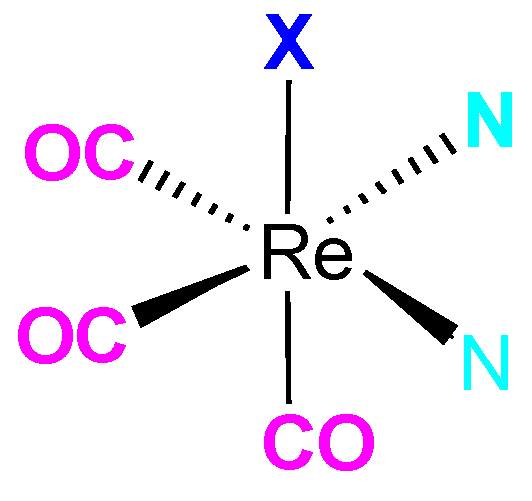
Figure 2.
Medical applications of Re(I) tricarbonyl complexes.
Scheme 1.
Structures of Re(CO)3-diphenylphosphinebromide[Re(CO)3PNBr] (1), Re(CO)3diphenylphosphine-iminebromide, [Re-PNNBr] (2), Re(CO)3 diphenylphosphinetriflate [RePNTfO] (3), 3-arylcumourin derivatives of Re(CO)3 complexes (4-8), benzo-quinoline derivatives of Re(CO)3 complexes (9-11) and triazoto Re(CO)3 pyridylbenzimidazole derivatives (12 and 13), Re(CO)3-quinine triazole complexes (14, 15 and 16), Re(CO)3-clotrimazole -1,10-phenanthroline (17), Re(CO)3-clotrimazole-5-amino-1,10-phenanthroline(18), Re(CO)3-clotrimazole-3,4,7,8-tetramethyl-1,10 phenanthroline-(19) and Re(CO)3-clotrimazole-4,7-dimethyl-1,10-phenanthroline-(20), Re(CO)3-nitro sulphonated complex (29), Re(CO)3-benzothiols derivatives (30-33), Re(CO)3-chloro-(1,4-sodium ethanoate)-acetly (34), Re(CO)3-phenyl-1,10-phenanthroline-4,4′-azopyridine (35), Re(CO)3-1,10-phenthroline derivatives (36-41), Cisplatin positive control (42), Re(CO)3-acetylacetone-1,2-dimethylImidazole(43),Re(CO)3-(2,9-dimethyl-1,10-phenathroline(44), Re2(CO)6(diphenylphenanthroline)-2-4,7-diphenyl-1,10-phenanthroline-4,4′-azopyridine (45), Re2(CO)6-complexes of carboline derivatives (46, 47), Re(CO)3-2,9-dimethyl-1,10-phenanthroline-para tolylisonitrile (48).
Scheme 1.
Structures of Re(CO)3-diphenylphosphinebromide[Re(CO)3PNBr] (1), Re(CO)3diphenylphosphine-iminebromide, [Re-PNNBr] (2), Re(CO)3 diphenylphosphinetriflate [RePNTfO] (3), 3-arylcumourin derivatives of Re(CO)3 complexes (4-8), benzo-quinoline derivatives of Re(CO)3 complexes (9-11) and triazoto Re(CO)3 pyridylbenzimidazole derivatives (12 and 13), Re(CO)3-quinine triazole complexes (14, 15 and 16), Re(CO)3-clotrimazole -1,10-phenanthroline (17), Re(CO)3-clotrimazole-5-amino-1,10-phenanthroline(18), Re(CO)3-clotrimazole-3,4,7,8-tetramethyl-1,10 phenanthroline-(19) and Re(CO)3-clotrimazole-4,7-dimethyl-1,10-phenanthroline-(20), Re(CO)3-nitro sulphonated complex (29), Re(CO)3-benzothiols derivatives (30-33), Re(CO)3-chloro-(1,4-sodium ethanoate)-acetly (34), Re(CO)3-phenyl-1,10-phenanthroline-4,4′-azopyridine (35), Re(CO)3-1,10-phenthroline derivatives (36-41), Cisplatin positive control (42), Re(CO)3-acetylacetone-1,2-dimethylImidazole(43),Re(CO)3-(2,9-dimethyl-1,10-phenathroline(44), Re2(CO)6(diphenylphenanthroline)-2-4,7-diphenyl-1,10-phenanthroline-4,4′-azopyridine (45), Re2(CO)6-complexes of carboline derivatives (46, 47), Re(CO)3-2,9-dimethyl-1,10-phenanthroline-para tolylisonitrile (48).
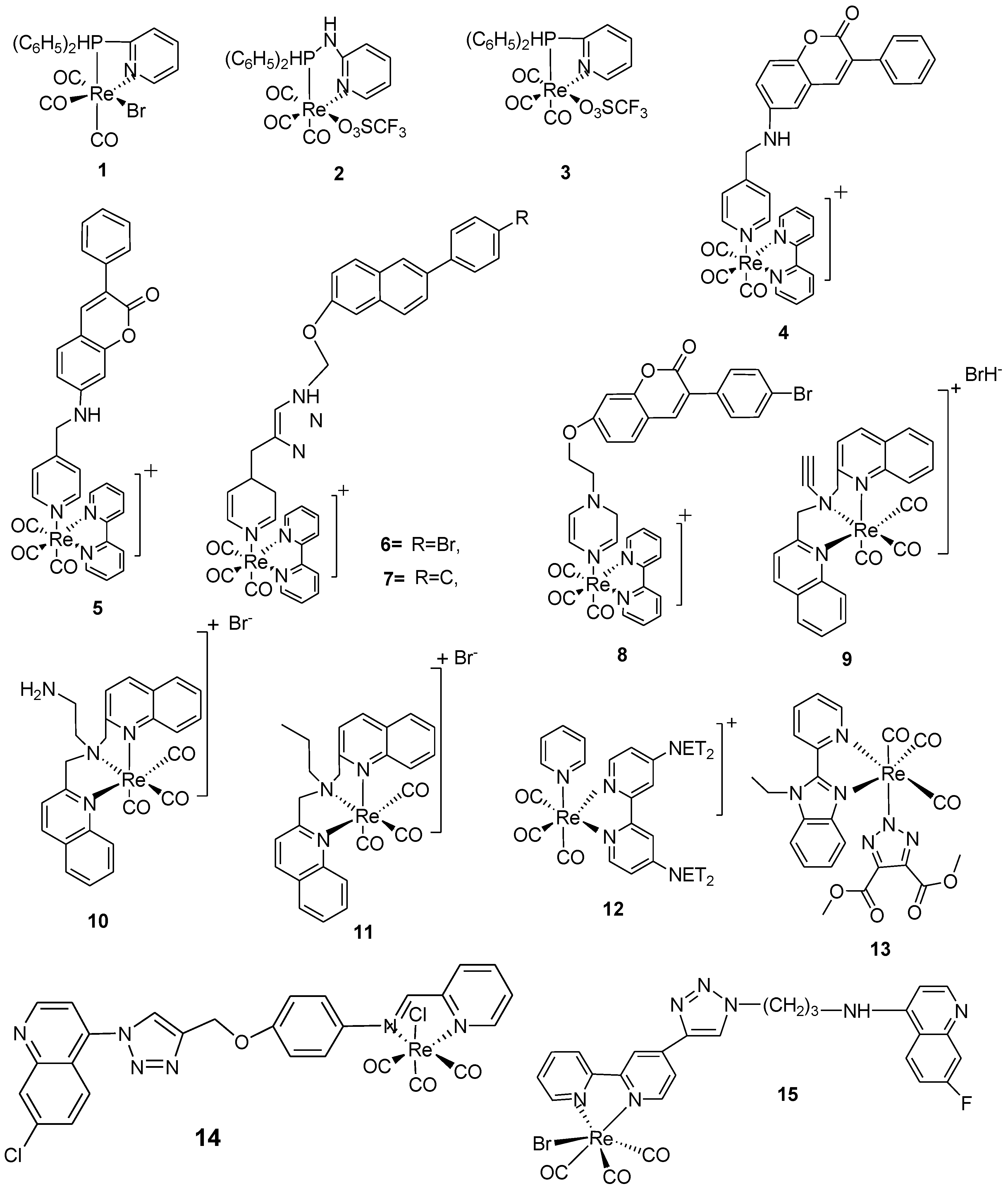
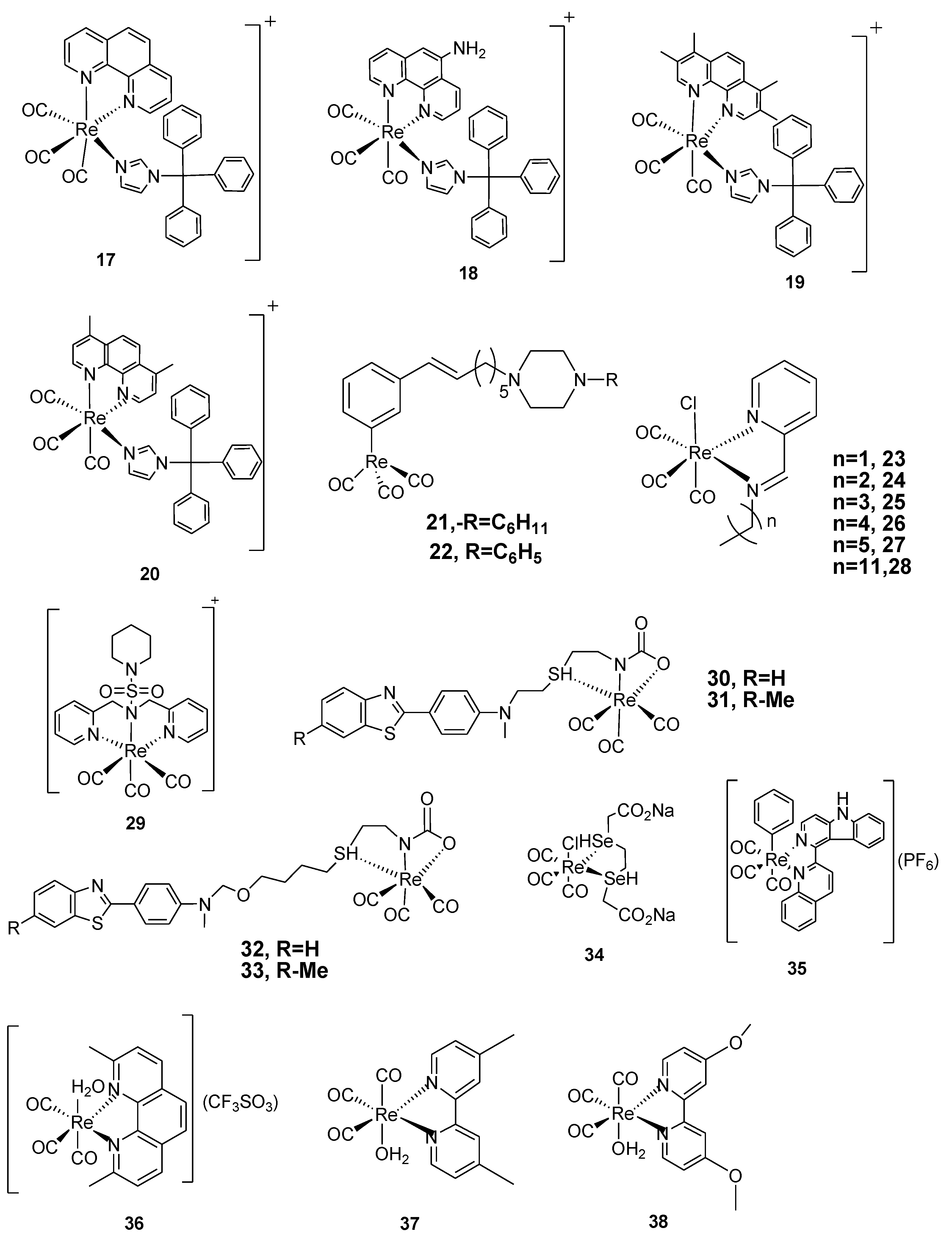
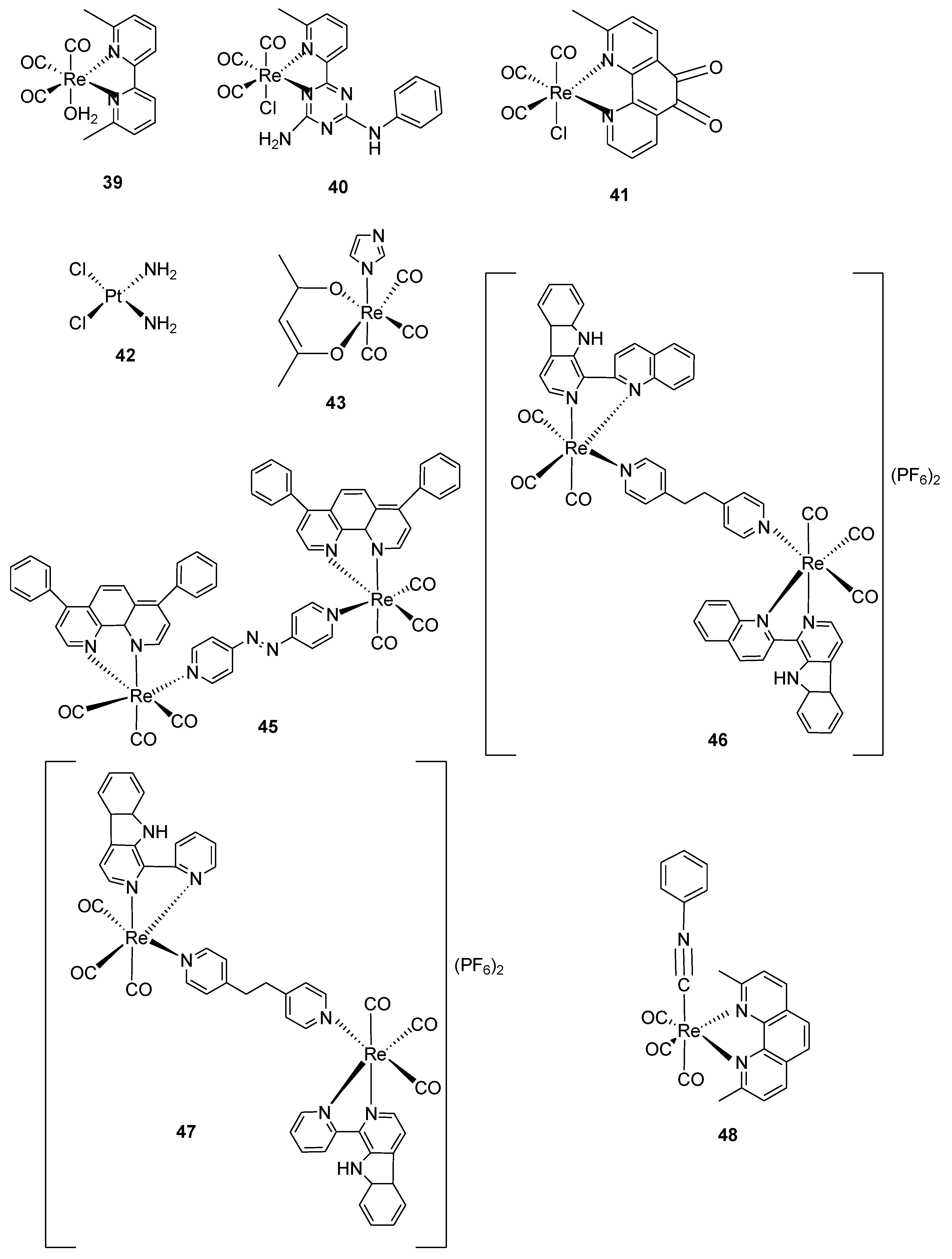
Table 1.
The antibacterial activities of Re(CO)3(N, N’)X]+ against selected human pathogens.
| Complexes | Bacterial strains (MIC µgmL-1 ) |
Outcomes | References | |
|---|---|---|---|---|
| S. aureus | E. coli | |||
| 1 | 50 | 300 | The complex showed a candidate compound for the formulation of antibiotics | [25] |
| 2 | >300 | >300 | Low activity was noticed against the selected pathogens | [25] |
| 3 | 50 | 50 | Palpable antibacterial activity against selected test organisms was noticed. A clear indication that the complexes can be used in the formulation of antibiotics | [25] |
Table 2.
The minimum inhibitory concentration of complexes 4 - 8 against selected bacterial strains.
Table 2.
The minimum inhibitory concentration of complexes 4 - 8 against selected bacterial strains.
| Complexes | MIC values (mM) | Outcomes | References | ||
|---|---|---|---|---|---|
| S. aureus | E. faecium | E. coli | |||
| 4 | 0.8 | 3.1 | Potent activities against both S. aureus and E. faecium were reported with the lowest millimolar concentration of 0.8 mM. A significant anti-bacterial activity against S. aureus is noticed, with a corresponding MIC value of 0.8 mM, which is statistically comparable with the known antibiotics, linezolid and vancomycin. | [26,27] | |
| 5 | 0.8 | 3.1 | The complex had activities nearly the same as complex 4; this could be due to their structural similarities, with only variation on the side chain lactone ring. Its activities were also comparable to those of the positive control, having promising antibacterial applications. | [27] | |
| 6 | 0.8 | 3.1 | A probable antibacterial agent with promising activities both in vitro and in vivo | [27] | |
| 7 | 0.8 | 3.1 | The introduction of more electron donors, namely, Oxygen and nitrogen, to the complex helps to arrest and inhibit microbial colonies within the system. This complex has several active sites and hence reduces multidrug resistance |
[27] | |
| 8 | 0.8 | 6.1 | It is reported that this complex exhibited activities that aren’t different from the positive control; consequently, in vivo tests also affirm this in zebrafish tests. | [6,8] | |
| 9 | 0.002 | - | 0.023 | The complex showed activity twice as compared as the positive control. It also had no variation in its activities when MRSA and colistin-resistant E. coli strains were used. The toxicological reports affirm that the complex is safe and shows no hemolysis even up to a concentration of 300 µM, hence it can be used as a prospective antibiotic |
[25,26,27] |
| 10 | 0.01 | - | >64 | The reduced form of complex 9 showed a reduction in activity; it exhibited very low activity against the Gram-negative E. coli but showed better activity against the Gram-positive bacterium strain S. aureus. | [25,26,27] |
| 11 | 0.002 | - | >64 | The hydrogenated form of complex 10, a derivative of bis-quinoline, showed a noticeable activity against S. aureus at micromolar concentrations; however, poor activity was reported against the gram-negative bacterium strain of E. coli | [25,26,27,52] |
| Linezolid | 0.7 | - | - | [25,26,27,53,54] | |
| Vancomycin | 0.7 | - | - | [25,26,27,53,54] | |
| Polymyxin | 0.0005 | - | 0.0002 | - | [25,26,27,53,54] |
Table 3.
MIC (mg/ml) of Complexes (4-8, 12, and 13) against Candida albicans, Candida krusei, Candida glabrata, Candida parapsilosis, and Cryptococcus neoformans.
Table 3.
MIC (mg/ml) of Complexes (4-8, 12, and 13) against Candida albicans, Candida krusei, Candida glabrata, Candida parapsilosis, and Cryptococcus neoformans.
| Complexes | MIC (mg/ml) | References | ||||
|---|---|---|---|---|---|---|
| C. lbicans | C. glabrata | C. krusei | C. parapsilosis | C. neoformans | ||
| 4 | 22.50 | 22.50 | 11.20 | 22.50 | - | [7,27,30] |
| 5 | 11.20 | 22.50 | 4.50 | 11.20 | - | [7,27,30] |
| 6 | 13.50 | 13.50 | 13.50 | <7.00 | - | [7,27,30] |
| 7 | 12.90 | 12.90 | 12.90 | 12.90 | - | [7,27,30] |
| 8 | 4.90 | 4.90 | 4.90 | 4.90 | - | [7,27,30] |
| 12 | 0.00062 | - | - | - | - | [7,27,30] |
| 13 | 0.032 | - | - | - | 0.032 | [26,59] |
Table 5.
Antichagasic activities of 16 to 19 against T. cruzi epimastigotes ± SD (μM) and their corresponding selectivity indexes.
Table 5.
Antichagasic activities of 16 to 19 against T. cruzi epimastigotes ± SD (μM) and their corresponding selectivity indexes.
| Complex | Antichagasic activities IC50 T. cruzi epimastigotes ± SD (μM) |
Selectivity index epimastigotes |
References |
|---|---|---|---|
| 16 | 9.42 ± 1.53 | 0.34 | [34,35,36] |
| 17 | 8.43± 2.20 | 1.5 | [34,35,36] |
| 18 | 3.48 ± 0.98 | 0.89 | [34,35,36] |
| 19 | 8.48 ± 1.46 | 1.6 | [34,35,36] |
Disclaimer/Publisher’s Note: The statements, opinions and data contained in all publications are solely those of the individual author(s) and contributor(s) and not of MDPI and/or the editor(s). MDPI and/or the editor(s) disclaim responsibility for any injury to people or property resulting from any ideas, methods, instructions or products referred to in the content. |
© 2025 by the authors. Licensee MDPI, Basel, Switzerland. This article is an open access article distributed under the terms and conditions of the Creative Commons Attribution (CC BY) license (http://creativecommons.org/licenses/by/4.0/).
Copyright: This open access article is published under a Creative Commons CC BY 4.0 license, which permit the free download, distribution, and reuse, provided that the author and preprint are cited in any reuse.


