

Submitted:
26 June 2025
Posted:
27 June 2025
You are already at the latest version
Abstract
Changes in lifestyles, as well as the growing attention in healthy nutrition, led to the in-creasing request of wines with reduced alcohol content. The reduction of fermentable sug-ars in the pre-fermentation stage of wine is one of the common methods for the production of wines with lower alcohol content. Viticultural practices such as early harvesting, use of growth regulators, reducing leaf area to limit photosynthetic rate, and pre-harvest irriga-tion are utilized. Additionally, techniques such as juice dilution, juice filtration with membranes, the use of enzymes (e.g., glucose oxidase), are also employed in the pre-fermentation stage. This review summarizes and describes the classic and innovative viticultural and pre-fermentation techniques used to reduce the alcohol content and their main impact on the compositional characteristics of wine.
Keywords:
alcoholic beverages
; alcoholic fermentation
; innovative winemaking
; ethanol
1. Introduction
The global market for both low- and zero-alcohol beverages is undergoing significant global expansion, growing by 34% between 2020 and 2023, and the International Wine & Spirits Research (ISWR) predicts that the Compound Annual Growth Rate will grow by +6% between 2023 and 2027 with an increase of +7% in the non-alcohol category and +3% in the low-alcohol category [1,2,3]. With health risks awareness, consumer preferences are shifting toward new product offerings alternatives to traditional alcoholic beverages, with increasing percentage of the adult population seeking more frequently lower alcohol wines [4]. In addition, these products meet the needs of those who avoid alcohol for safety reasons, such as those who have to drive, as well as for reasons related to age or religious beliefs [5,6]. Finally, some consumers are attracted to new trends and want to try innovative and trendy consumer experiences [7,8,9,10,11]. Although this represents an expanding industry, it must be also noted that many consumers are still reluctant to buy or consume wines with a low alcohol content, due to their taste, as well as the consumers hesitation to pay the same price of a standard wine [11,12,13].
However, harmful alcohol use and the related health effects are a global problem and therefore need to be addressed not only by individual nations but also on an international level. World Health Organization (WHO) leads a global strategy to reduce the harmful use of alcohol worldwide [14].
In winemaking sector, some countries have legislative complexity arising from different government authorities regulating wine and reduced alcohol wine. In the United States, wine as defined within the Federal Alcohol Administration Act (FAA Act), must contain between 7% and 24% v/v alcohol. Dealcoholized wines containing less than 7% v/v alcohol are not covered by the FAA Act and are subject to the labeling provisions of the Federal Food, Drug, and Cosmetic Act (FD&C Act) [15].
By contrast, Australia recognizes as “low alcohol” only the beverages containing less than 1.15% alcohol by volume, whereas “dealcoholized” term is not defined in the Food Standards Code [16]. These products are often labelled with statements such as: “dealcoholized wine”, “less than 0.5% v/v alcohol” and “less than 1.0% v/v alcohol”. Products with less than 0.5% v/v alcohol are not required to declare the alcohol content on the label though many producers choose to voluntarily include this information [17].
In Europe, the sector is governed by Regulation (EU) 1308/2013 supplemented by Regulation (EU) 2021/2117, which establishes the definition and classification of dealcoholized wines (alcohol content not exceeding 0.5%) and partially dealcoholized wines (alcohol content higher than 0.5% but lower than the minimum of the original category), as well as the technologies (partial evaporation under vacuum, membrane and distillation techniques) that can be adopted to obtain the production of totally and partially dealcoholized wines [18,19]. In defining this new framework, the EU has used the recommendations by the International Organization of Vine and Wine (OIV) as a basis, in particular Resolutions OIV-ECO 433-2012, OIV-ECO 432-2012, OIV-OENO 394A-2012 and OIV-ECO 523-2016 [20,21,22,23].
The great demand of beverages, both alcohol-free and with low alcohol content, is a great challenge for the production of wines with controlled alcohol content using sustainable practices [10]. Therefore, winemakers are really seeking different possibilities at the various stages of winemaking for obtaining high quality wines with a reduced alcohol content [24]. At present, strategies for decreasing alcohol content in wines can be classified in pre-fermentation, fermentation, and post-fermentation techniques [25].
The reduction of alcohol, at the pre-fermentation, fermentation, and post-fermentation stages, include the reduction of fermentable sugars, the reduction of alcohol production, and the separation of alcohol product, respectively [24,26,27,28]. However, the technological procedures used during the pre-fermentation and fermentation stages usually result in wines with alcohol contents that are still above the required ethanol concentration needed to fall under dealcoholized wines. While, post-fermentation technological approaches, namely distillation-based, membrane-based techniques, and their combination, have been used for the removal of alcohol up to content lower than 0.5% v/v [29].
There is clearly great interest in curbing the excess alcoholic strength of some wines, and also in producing low-alcohol wines and/or alcohol-free wines that suit market requirements, while maintaining their sensory quality in all cases.
This review summarizes and describes the classic and innovative viticultural and pre-fermentation techniques used to reduce the alcohol content and their main impact on the compositional characteristics of wine.
2. Agronomic Strategies
The development of viticultural practices has historically also been aimed at promoting the accumulation of sugars in the berries [30]. Today, in the context of global warming, physiology of grapevines is changing; these modifications exert a profound shift in primary (sugar and organic acid balance) and secondary (phenolic and aromatic compounds) berry metabolisms and the resulting composition of wine [31,32].
Therefore, with a view to producing wines with a low alcohol content, the concept of grape ripening must be reconsidered and must necessarily include other parameters such as polyphenols, aromas and acidity/alcohol balance in addition to sugars [33,34,35,36,37].
Understanding the factors that influence grape sugar concentration is crucial for winegrowers, not only to determine the optimal timing for harvest, but also to anticipate future adaptations to climate change. Recent temperature trends have affected the wine producing sector, leading to increased sugar concentrations at harvest, reduced ripening duration, and a shift in ripening period to earlier in the season, when temperatures are higher [38].
As global surface temperatures are projected to continue to rise during the 21st century, a comprehensive understanding of the effects of environmental factors on grape berry ripening dynamics is necessary to better anticipate adaptation strategies [39]. Therefore, winegrowers and winemakers are required to adopt cultivation approaches and strategies in order to obtain grapes with an adequate phenolic and/or aromatic maturity, but without an excessive sugar content [28,40].
In viticulture, three strategies can basically affect alcohol level in wines; these approaches are very different each other and can be summarized as follows: i) choice of grape variety; ii) location of the vineyard; iii) management practices [41,42].
This last strategy appears the most interesting one because it could be applied also on current vineyards without making any substitution of vineyards, as is the case in the first two options. Considering the physiological mechanism of the plant, winemakers can employ different viticultural practices useful to align vine growth, vine development, and fruit ripening with environment conditions: these are canopy management, pre-harvest irrigation, early grape harvest. These viticultural strategies should be taken into account to be applied to improve the adaptation of vineyards and their ripening in a warmer climate and contribute to the reduction of alcohol in wines [24,25].
For instance, improving vine water status by increasing irrigation regimes has been shown to increase vegetative growth and yield, often resulting in a delay in the harvest date [43]. By contrast, reducing the vine source capacity by defoliation should result in a delay in the capacity of the vine to produce carbohydrates, therefore, reducing the accumulation of grape sugar [44].
2.1. Canopy Management
Although it is possible to lower wine alcohol content post-fermentation at present, it would be more useful to start the process in the vineyard. In this regard, proper grapevine canopy management can also be used to control the accumulation of sugar during grape ripening, this resulting inr wines with a low alcohol content [45]. In addition, some viticultural techniques such as severe shoot trimming, minimal pruning, late winter pruning and leaf removal may delay grapevine ripening [41].
2.1.1. Defoliation and Trimming
Defoliation, otherwise referred to as “leaf removal” or “leaf thinning” is a classical and fundamentally canopy management practice in vineyards for the productivity and quality of grapes [44,46,47,48]. The primary objective of early leaf removal practices is to promote both aeration and drying in order to mitigate yield loss due to diseases, such as gray mold (Botrytis cinerea) and sour rot, particularly in compacted cluster varieties [49,50]. Another main purpose of early leaf removal is to enhance fruit and wine quality in cool climate. In addition, defoliation at different canopy positions using various methods (e.g., manual or mechanical defoliation practices) leads to a reduction in the photosynthetic active leaf area (LA) [51]. It is known, in fact, that the rate of sugar accumulation in berries is largely dependent on the ratio of LA to fruit weight (FW), and LA reduction has a strong influence on the rate of sugar accumulation in berries which can lower the alcohol concentration in the resulting wine [52].
The impacts of defoliation on the composition of the harvested grapes and related wines have variable results depending on several factors, among which the main are: cultivars and clones, timing, methods (mechanical or manual), environmental conditions, defoliation site (basal or apical leaf removal) [46,53,54,55,56,57].
Many studies reported that grapes of defoliated vines generally show higher sugar content and lower titratable acidity, as well as a reduction in the flavonoids and phenolic total content with respect to grapes from not-defoliated vines [46,53,58,59].
On the other hand, some studies have indicated that reducing carbohydrate production during the growing season, as a consequence of defoliation, may have a negative impact on subsequent grapevine productivity [60,61]. However, other studies in which a delay in berry ripening was obtained by decreasing the ratio between LA and yield as a result of defoliation treatments, showed a reduced concentration of fermentable sugars in grapes during ripening, but any negative impact on the capacity of the vine in the following year [62,63].
Another study reported that, as a result of late leaf removal above a Sangiovese bunch area (at post veraison, average 12° Brix), the total soluble solids content in grape must were significantly reduced without affecting other compositional parameters such as phenolic substances [48]. Similar results were very recently found also for Pinot noir variety [64].
It has been demonstrated that, compared to basal defoliation, apical defoliation can be a novel and effective way to moderate wine alcohol with minimal influenced on wine aromatic properties, and therefore may be a technique to mitigate the influences of global warming on increasing wine alcohol level [65].
It is therefore necessary to carefully evaluate the effects of this practice on the vegetative-productive balance of the vine and on the qualitative characteristics of the grape [66].
Although defoliation practices result in ripening delay, they could also lead to excessive bunch exposure and, therefore, heat-damaged fruit. In addition, unbalanced vines, the ones in which the vegetative vigor is too high compared to the fruit load, could cause an imbalance in grape composition. In this regard, the technique and phenological phase in which defoliation takes place greatly influences both the sugar concentration and the pH, as well as the phenolic profile and the aromatic component of the harvested grapes [54,59,67,68,69,70,71,72].
In this regard, it has been found that late leaf removal (post-veraison defoliation) causes a reduction in the concentration of soluble solids in the juice (-0.7° Brix compared to control), but negatively affected the concentration of anthocyanin and phenolic substances in Montepulciano grapevines [73].
A concomitant decrease in both grape anthocyanin accumulation and berry sugar concentration has been reported as a result of late leaf removal in Bobal and Tempranillo vines in eastern Spain [74].
In a recent study, Vitis vinifera L. cv. Grenache has been trained in an open-vase system in La Rioja (Spain) and two severe leaf removal were carried out at two different stages, after fruit set and at veraison, and compared each other besides to a third untreated control. Both leaf removal treatments tended to decrease sugar content with no effect on yield; these effects were highly affected by the year. Defoliation accounted for a decreased flavanol and stilbene contents in berries at harvest [54].
In another study, the impacts of defoliation in the pre-flowering phase (T1), after fruit set (T2) and at veraison (T3), on yield components, grape composition and wine of the cv. Trnjak was investigated. Berries of T1 had lowest sugar content (19.47 °Brix) while T3 had highest (22.3 °Brix). The wines of early defoliation treatment were associated with significantly lower alcohol (11.9% v/v) in comparison to both T3 (13.9% v/v) and control (12.1% v/v). Both techniques applied at veraison produced wines with lower anthocyanins and flavonols than those obtained without any intervention [75].
Defoliation in the upper middle part of the canopy of Sangiovese vineyard resulted in a reduced content of soluble solids in the berries and a lower alcohol wine, with minimal changes in anthocyanins and phenolics [57].
In another study, the veraison phase of Tempranillo was delayed by 20 days by making a severe cut immediately after fruit set. At the same harvest date, the fruits on the pruned vines (LA/FW = 0.64) were 3.5°Brix lower than the control (LA/FW = 1.88) but there was also a small but significant reduction in yield and total anthocyanin amount [63].
Differently, in a Sangiovese vineyard, late trimming increased the total berry skin anthocyanin and phenolic concentration, without affecting the berry soluble solids, pH, and titratable acidity at harvest, whereas reduced yield, loosened bunches and limited the severity of botrytis bunch rot [76].
On the basis of the above-mentioned studies, significant research is still needed to determine the optimal ratio of leaves to crops, the timing and location of leaf removal from vines relative to fruit location, and the long-term impact on vine physiology.
The identification of updated climatic reports and phenology of the vine could be an important step to optimize the defoliation technique with a view to climatic changes and to reduce the sugar content of the grapes without penalizing other components of the grapes.
2.1.2. Shoot Topping
Shoot topping (ST), also known as tipping, is a typical viticulture practice in which the shoot tip is removed in order to limit excessive growth [77]. ST involves both the removal of a major sink for nutrients (shoot tip) and a sharp reduction in active LA [63]. Conventionally, ST is mainly used for balancing grapevine shoot vigor, improving the canopy microclimate and providing feasibility for mechanized operation [78].
In Sangiovese vines, the post-veraison ST resulted in a good reduction in must sugar concentration without modifying the pH, organic acid content, anthocyanins concentration, as well as the skin and seed tannins content [79]. Similar results for phenolic compounds were found in Sangiovese vines, in which the treatment did not significantly affect total and extractable anthocyanins, skin, and seed tannins [80].
Another study reported that LA reduction by trimming after berryset (berry diameter 3-4 mm) delayed ripening and lowers sugar content, but has a favorable impact on anthocyanins [81].
Lately, severe ST (SST) become a widely used viticultural technique to adjust the vines source/sink ratio, and that has been proposed in extenuating the negative influence brought by global warming due to successfully delaying ripening [82]. However, some authors found that SST carried out in the early stages of berry development (late veraison) limited the accumulation of both sugars and anthocyanins [83]. On the other hand, the reduction of assimilation surface and the relative reduced sugar accumulation by SST has still not been sufficiently investigated and the limited data available in literature remain discordant. It seems that, if applied in the pre-bloom stage, SST delays ripening, and reduces Brix and anthocyanins. By contrast, other studies have shown that manipulating different SST treatments could cause a reduction of 0.4–1.7 mg/berry/d (0.02–0.11°Brix/d) in grape sugar accumulation without affecting the yield and can significantly increase flavonols concentration [84,85].
Therefore, the management of canopy should take into account the warming trends in viticulture regions, rather than being preemptively applied. In this regard, Torres et al. revealed that in warm climates, canopy management practices need to be reconsidered in context of climate change. Increasing the cluster exposure (i.e., increased temperature and solar radiation) in warm climates did not enhance wine quality traits based on their potential aging capacity, antioxidant properties and color stability [86].
Therefore, future and in-depth studies on the relationships between climate and phenology of the vine could provide important information on the management of the vineyard canopy in order to decrease the concentration of sugars in the grapes and the consequent alcohol content of the wine without undermining the quality of both raw material and final product.
Furthermore, another study reported a 20-day delay in grape ripening, a lower pH (0.1 to 0.3), a reduction in soluble solids (21.0 vs 24.4 °Brix), and a 10% to 27% reduction in total anthocyanin content through shoot trimming of Grenache over 3 years [63].
2.1.3. Winter Pruning
Winter pruning is intended to regulate vine vigor and yield and, consequently, to achieve desired must chemical composition by harvest. In Mediterranean growing areas, it is normally carried out any time after leaf fall and before budbreak.
It has been shown that spur pruning at the phenological stage of swollen buds can delay vegetative growth, flowering, fruit set and ripening.
Pruning performed on Merlot in New Zealand when apical shoots on the canes were ~5 cm long resulted in lower sugar and higher organic acid content in grapes [67,68,69].
Post-Budburst Spur-Pruning (early May), reduced fruit set and berry weight and slowed fruit ripening compared to the other pruning dates (February-March). In particular, the soluble solids of the must and the titratable acidity were respectively 1.6 °Brix lower and 1.8 g/L higher in the May treatment compared to the standard pruning dates [87].
Another viticultural technique is double-pruning, which forces bud growth during the spring and summer, shifting berry ripening to cooler periods of the season, and thus improving the phenolic composition and chromatic parameters of the berries and ensuring a more balanced sugar/phenolic content [88].
2.2. Pre-Harvest Irrigation
In general, irrigation is a common cultural practice in viticulture in Earth’s Western Hemisphere countries, whereas in Europe its use for wine production is still quite limited or even forbidden on the basis of a common consideration, not-scientifically proven in many cases, that irrigation negatively affects the composition of wine [89,90].
As an example, several winemakers reported a significant grape ripening delay, and reduced wine quality, as a result of increased irrigation in the last few weeks before harvest.
Irrigation of plants in the period after veraison, especially when combined with ST could cause reduction of sugar accumulation. This is due to nutrients competition between grape berries and lateral shoots which are plant response on shoot trimming and applied irrigation. However, a dense vine canopy that derives from an abundant water supply can also produce a decrease in wine color due to excessive shading of clusters [91].
A study showed the potential of the combined use of pruning and increased irrigation to delay ripening, although it is necessary to analyze the implications that the delay obtained had on the lower values of anthocyanins and phenolics observed in pruned vines that were not solely due to delayed ripening [82].
According to several studies, there is a variation in sugar concentration (increase, decrease or no changes) as a result of irrigation practice. The impact of water availability on wort yield and composition from Tempranillo grapes has been evaluated during a three-year period and the study showed that total soluble solids and concentrations of both glucose and fructose were significantly higher in irrigated vines than that obtained in non-irrigated vines, mainly towards the end of ripening [92]. On the other hand, other studies consider that the effects of irrigation on must and wine composition are largely dependent of climatic characteristics of each year, namely by the different rainfall amount and crop levels [93,94].
Therefore, compared to other viticultural techniques, pre-harvest irrigation could not be the best choice whether the winegrower’s goal is limited to delay the ripening of the grapes.
2.3. Managing Harvest Date
Another pre-fermentation strategy that can be used to reduce wine alcohol content is the harvest date management [95,96].
Grape ripening is a critical phenological phase during which many metabolites that impact wine quality accumulate in the berries [97,98].
For low alcohol wine production, the influence of early harvesting of grapes, as well as the blending of grapes, must or wines from unripe and fully mature grapes have been studied for some varieties [96,99,100,101,102,103,104,105]. Unripe grapes were used to produce a low-sugar and high-acid mixing material to be successively added to the must made from ripe grapes; this method has been reported to result in a significant decrease in ethanol concentration (-3% v/v), although the wines exhibited undesirable acidic and herbaceous characters [106].
Other studies aimed at investigating the effect of blending low-alcohol wine from unripe grapes with musts from well-ripened grapes have been conducted on several V. vinifera varieties (Shiraz, Malbec, Cabernet-Sauvignon, Grenache, Pinot noir and Tannat); these mixed wines showed higher total acidity and lower alcohol and pH content [102,103,107,108].
By replacing mature must with less mature must, Piccardo and coauthors obtained wines with a lower alcohol content (14-21% reduction range with respect to control wines values) and pH, whereas wine color intensity was increased, as well as the concentrations of phenolic compounds and anthocyanins, proanthocyanidins, and polysaccharides content [102].
Another viticulture method used for reducing sugar levels in the grape must is double harvesting. This entails harvesting grapes at two different maturity levels to produce the same wine as was carried out in study of 2013, in which the first batch of low maturity grapes was harvested at 15.2 and 13.4 °Brix (in the 2009 and 2010 harvest years, respectively), and the second batch harvested at high phenolic maturity with high sugar content (>24 °Brix) [63].
2.4. Other Techniques
2.4.1. Shading Nets
Another possible way to reduce the accumulation of sugars in grapes is based on the use of shade nets. These sheets placed to cover different parts of the canopy reduce the amount of solar radiation that reaches the leaves, thus inducing a restriction of photosynthesis. This reduction in photosynthetic activity can improve water use efficiency and slow down the ripening process, preserving must acidity and sensory quality and volatile flavours [109,110].
At harvest, lower pH and reduced content of total soluble solids (-1.5 °Brix), combined with higher titratable acidity, were registered in Shiraz grapevines after a post-veraison use of a white cloth above the canopy [111].
In another study, shading treatment (applied when the berries have reached about 5 mm in diameter) generally delayed the ripening of Syrah vines causing a significant reduction in sugar concentrations [112].
The use of a bird net in different stages of the vegetative growth of Cabernet franc grapevines resulted in a significant decrease in both must soluble solids and pH [113].
Finally, an increase in total soluble solids in the berries was observed in Alphones Lavallée and Narince grapes with the use of black nets starting from veraison [114].
Therefore, the use of artificial shading can be a valid alternative in viticulture to slow down the ripening process.
2.4.2. Anti-Transpirant Products
A different technique to reduce berry sugar accumulation without physical reduction of leaf area consists of the application of film-forming anti-transpirant products. These compounds are polymers that create a thin film layer resulting in an anti-transpirant effect, once sprayed over the canopy [91].
As an example, a study demonstrated that total soluble solids of Cabernet-Sauvignon grapes were reduced by 2.09° Brix after treatment with the film-forming anti-transpirant agent 1-p-menthene (also known as pinolene) [115].
Advantageous anti-transpirant action of pinolene was also shown in another study in which its application to Falanghina vines induced a significant reduction in the rate of net photosynthesis (25%-40%) and stomatal conductance (40%-60%) on the leaves, a lower accumulation of sugars in the berries (2°Brix), and a consequent reduction of alcohol in the wine obtained (0.9%-1.6% vol.) [116].
Similarly, the application of a pinolene based natural anti-transpirant on post-veraison Sangiovese grapes (2% concentration to the upper two-thirds of the canopy) effectively reduced grape ripening grade resulting in –1.2° Brix of grapes at harvest and –1% alcohol content of wine [117].
Pre-veraison application of pinolene either alone or in combination with a pre-flowering application has been shown to be effective in delaying sugar accumulation in Barbera grapes (−2.4 and −3.7° Brix, respectively, vs control) without affecting colour development [118].
Similar results were obtained in another recent study, conducted by Andreotti et al., on Sauvignon Blanc vines in which the use of pinolene significantly reduced the concentration of sugar in the berries at harvest by -1.5°Brix compared to the control [119]. The effectiveness of this compound on Sauvignon Blanc vines was also shown in a previous study in which the anti-transpirant effect has been evaluated in three consecutive years: at harvest, a significant difference between pinolene-treated and untreated grapes was found (average values -2.09 °Bx) resulting in reduced alcohol content (-1.06% v/v) in wine [120].
In a recent study, the efficacy of fulvic acid as an anti-transpirant was checked on both Cabernet Sauvignon and Riesling ripe grapes: the total soluble solids of grapes decreased significantly by 0.6 °Brix and 1.1 °Brix in 2017 and 2018, respectively, for Cabernet and 1.5 °Brix and 1.0 °Brix, for the same period, for Riesling grapes [121].
2.4.3. Application of Growth Regulators
Exogenous application of growth regulators to either the bunch zone or the whole canopy may be a useful tool for delaying the onset of sugar ripening [122].
Over the last decades, the use of plant growth regulators has progressively faded, mostly due to several factors as the increasing restrictive regulations for the use of chemicals, the still uncomplete knowledge of physiological processes regulation, and the uncertainty of results. Despite that, for some of these compounds there is a novel interest in the light of their capability to interact with the ripening process, and in particular to induce slower ripening.
Several studies describe the ripening-delaying effect of the application of natural auxin or synthetic auxin analogs, as 1-naphthalene acetic acid, on grapes. Böttcher and coauthors used the anti-transpirant 1-naphthalene acetic acid on Vitis vinifera L. cv. Syrah grapes during pre-veraison, which effectively delayed the start of berry ripening and improved sugar accumulation management without affecting wine sensory characteristics [123].
In another study, the treatment with this compound in pre-veraison of Shiraz and Cabernet Sauvignon grapes delayed harvest maturity by 3–4 weeks [124].
Application of this compound offers a management tool to delay ripening and expand the harvest window. The mechanism by which auxins delay ripening is still unknown, but auxin treatments maintain the berry in the pre-veraison state as judged by a delay in the physical and biochemical changes normally associated with ripening. This includes a delay in the accumulation of sugars and anthocyanins, and a delayed decrease in acidity and chlorophyll [125,126].

Table 1.
Overview of alcohol reduction in wines obtained by the application of different viticultural (in white) and perfermentative (in grey) strategies.
Table 1.
Overview of alcohol reduction in wines obtained by the application of different viticultural (in white) and perfermentative (in grey) strategies.
| Strategy | Techniques (grape cv/wine) | Alcohol reduction (v/v) |
Ref. |
|---|---|---|---|
| defoliation | post veraison leaf removal (Sangiovese) | 0.6% | [57] |
| apical defoliation (Shiraz) | 0.2-0.7% | [65] | |
| pre-flowering defoliation (Trnjak) | 0.2% | [75] | |
| pruning | pruning severity modulation (Malbec) | 0.7% | [127] |
| shoot trimming (Grenache, Tempranillo) | 2% | [128] | |
| harvest date management | unripe grapes - cluster thinning (Grenache) | 3% | [106] |
| unripe grapes (Pinot and Tannat) | 0.5-3% | [102] | |
| shade | overhead shade (Shiraz) | 1% | [111] |
| anti-transpirant agent | pinolene application (Falanghina) | 0.9-1.6% | [115] |
| pinolene application (Sangiovese) | 1.0% | [117] | |
| pinolene application (Sauvignon) | 1.0% | [120] | |
| enzyme addition | GOX1 (Muscat-Ottonel) | 1.05% | [129] |
| GOX (Riesling) | 4.3% | [130] | |
| GOX preparation from A oryzae (Pinotage) | 0.7% | [131] | |
| encapsulated GOX-CAT (Verdejo) | 2.0% | [132] | |
| GOX-CAT (Verdejo) | 2-3% | [133] | |
| must dilution | late harvest (Shiraz) | 0.5-2.0% | [134] |
| three stages harvesting (Shiraz) | 1.6-2.1% | [135] | |
| filtration and membrane processing | must NF (Verdejo and Tinta de Toro) | 2-3% | [136] |
| must NF (Verdejo and Garnacha) | 1-2% | [137] | |
| must RO (Tinta Roriz, Syrah, Alicante Bouschet) | 1.5-10% | [138] |
1 Abbreviations: GOX, glucose oxidase; A. oryzae, Aspergillus oryzae; CAT, catalase; NF, nanofiltration; RO, reverse osmosis.
3. Pre-Fermentative Strategies
As for viticultural techniques, pre-fermentation strategies aimed at decreasing ethanol production are also based on the reduction of fermentable sugar content, which is primarily made by filtration and/or dilution of grape must. As additional biotechnological strategy, some studies proposed as alternative tool the use of enzymes (mainly Glucose Oxidase/Catalase) supplementation. All these approaches were discussed below.
3.1. Filtration of Grape Must
Membrane filtration has been applied to wine for a long time; classical examples are the ultrafiltration used to clarify white wine from grape must, as well as the nanofiltration (NF) and reverse osmosis (RO) applied for sugar concentration in musts (Figure 1) [139,140].
However, several studies have proposed membrane filtration of grape must juice as a method to produce also wines with a low alcohol content, by taking advantage of the reduction in sugar content of must before fermentation [136,138,141]. Such a process consists in extracting the sugar from musts, by using membrane coupling combining microfiltration or ultrafiltration with NO or RO [112,113]. After that, the filtered juice is mixed with the other portion of the sugar-rich juice and fermented to obtain lower or reduced alcohol content wine [24]. More in detail, NF consists of passing a fraction of grape must into a membrane under a pressure gradient to separate permeate (with a low amount of sugar) and retentate (with a higher content of sugar). At the end of filtration, the two parts are mixed in specific portions to obtain a must with desired characteristics (Figure 1) [142].
Figure 1.
Scheme of grape must filtration for the production of wines with reduced ethanol content. Abbreviations: UF, ultrafiltration; NF, nanofiltration; RO, reverse osmosis; LAW, low-alcohol wine.
Figure 1.
Scheme of grape must filtration for the production of wines with reduced ethanol content. Abbreviations: UF, ultrafiltration; NF, nanofiltration; RO, reverse osmosis; LAW, low-alcohol wine.
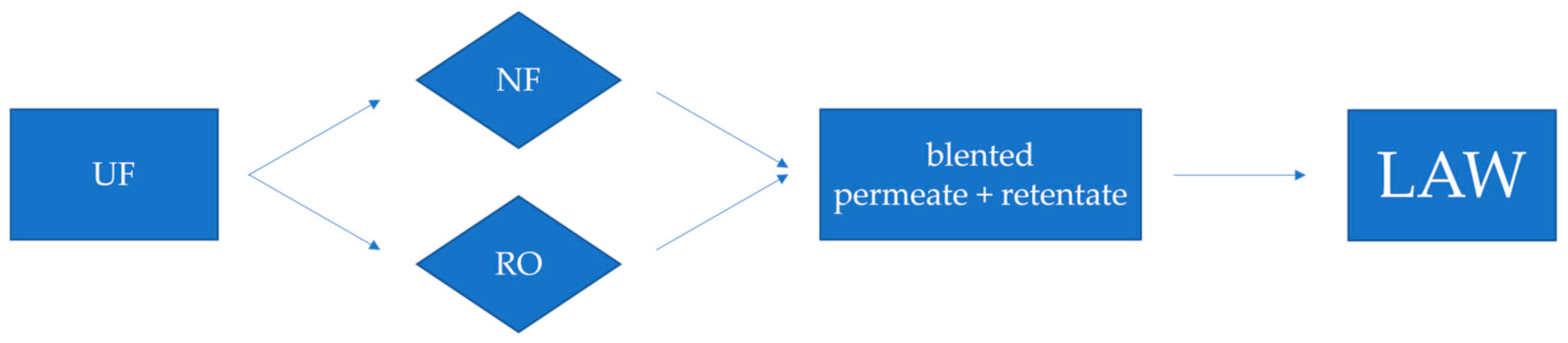
Several studies in which NF was applied on both red and white musts showed that the final product (wines obtained after fermentation by a mix of original must and a portion of the must) had a lower content of ethanol.
A study carried out on Verdejo and Tinta de Toro grapes showed that mixing, in adequate proportion, untreated musts with the filtration permeate and retentate, obtained from the first NF stage, resulted in white and red wines with alcohol content reduced by about 3% and 2% (v/v), respectively [136].
Salgado and coauthors investigated the effect of a single-stage and two-stage NF process with a 200 Da spiral-wound membrane on the sugar content of white and red musts prior to fermentation; the control musts, as well as the filtration permeate and retentate were successively blended and fermented. When compared to the control wines, wines obtained after the fermentation of the blend must show about 1 to 2 degrees of alcohol reduction with no significant differences in sensory attributes [137].
Therefore, optimal operating conditions and a suitable membrane conformation with good molecular weight cut-off could increase the retention of volatile compounds and preserve the good taste in wine [143,144].
Similar to NF, the reverse osmosis (RO) technique is applied as well to lower sugar contents before alcoholic fermentation. Reverse osmosis is a separation technique based on the application of high pressures (60–80 bar) for purification of water systems. Instead, if a pressure more than osmotic pressure is applied to the system, then water, ethanol, and other small molecules are forced through a semi-permeable membrane, leaving behind the rest of compounds [26,138].
To produce a wine with a lower or lower alcohol content (≤ 10.5% v/v) by filtration techniques, optimal operating conditions and an appropriate membrane configuration with a good molecular weight cut-off must be taken into account to increase the retention of volatile compounds and not compromise the sensory characteristics of the wine. On the contrary, this could lead to a lower content of volatile organic compounds, polyphenols, anthocyanins, and color intensity and consequently affect the sensory properties of the nonalcoholic wine [28,145].
RO has been used on different varieties of grape juices to obtain permeate (with low sugars) and retentate (with high sugars), which were successively mixed in different proportions to obtain fermented beverages with an alcohol volume content of 5%, 7%, 10% and 13% (v/v). However, the decrease in the alcohol content led also to a lower content of polyphenols compounds, this affecting the sensory evaluation [138].
In addition, since RO membranes are permeable to both alcohol and water, it is necessary to add again water to the dealcoholized wine after filtration, this raising legal concerns in that Countries where water addition is prohibited (see below) [146].
3.2. Addition of Enzymes
The production of wines with a reduced alcohol can take advantages also by the use of enzymes, as glucose oxidase (GOX) and catalase (CAT). This enzymatic method can be used to reduce grape must glucose at the onset of alcoholic fermentation, leading to the acidification of the must, besides the reduction of sugar concentration [147,148]. GOX (EC 1.1.3.4) is an aerobic glycoprotein with dehydrogenase activity that catalyzes the oxidation of β-D-glucose to D-glucono-1,5-lactone (D-gluconic acid δ-lactone); this reaction requires the presence of molecular oxygen, and flavin adenine dinucleotide (FAD) as prosthetic group involved in the electron donation to form hydrogen peroxide (H2O2). In a second step reaction, D-gluconic acid δ-lactone spontaneously hydrates to form gluconic acid and this process lowers must pH [149]. The second enzyme, CAT (EC 1.11.1.6), is required to degrade H2O2, generating water and oxygen that can be used again in a new cycle by GOX (Figure 2). CAT is frequently present in commercial GOX preparations, since the removal of the highly reactive compound H202 precludes any inactivation of GOX, as well as the possibility of any oxidation of desirable compounds in wine, and the inhibition of fermentative yeasts proliferation.
Several studies have reported the use of GOX for the reduction of wine alcohol [131,150,151]. Is important to note that U.S. Food and Drug Administration (FDA) classified GOX and CAT as GRAS (Generally Recognized As Safe) and the use of both enzymes (whose structures and sources are shown in Figure 2) in wine production has been authorized [152]. The OIV does not specifically regulate the use of the two enzymes, although enzyme preparations in general are permitted for use in grape juice and wine as long as they are safe from a health perspective and do not negatively affect the quality of the wines [153].
The first studies about the use of the GOX to reduce the alcohol degree of wines date back to 1998, when Pickering, Heatherbell, and Barnes carried out several trials on Riesling and Müller-Thurgau white grapes to produce low alcohol wines. They used calcium carbonate to increase the pH of the must to 6.0 to improve the GOX activity, obtaining a marked increase in final gluconic acid content (about 42%), although the organoleptic characteristics of the wines were altered [150].
Later on, the same authors used 2 g/L of GOX in Riesling grape juice, obtaining the conversion of about 87% glucose into gluconic acid (after 6 hours of fermentation), this resulting in a reduction in alcohol content up to 4.3% v/v [130].
In another study, a GOX-product obtained from Aspergillus oryzae was added at a concentration of 30 kU in the treatment of Pinotage grape must before fermentation. Compared to control, wines obtained by treated must showed a 0.7% v/v decrease in ethanol content [131].
However, these studies showed that the low pH of the wort was found to be a limiting factor in the catalytic capacity of the enzymes.
In this regard, some more recent studies have shown that the encapsulation of GOX and CAT in Ca-alginate hydrogel would improve the catalytic efficacy of the enzymes and is a promising alternative for industrial use in the production of reduced-alcohol wines [154].
More recently, silica–Ca–alginate hydrogel with co-immobilized GOX–CAT proved to show a high capacity to simultaneously decrease the glucose content and reduce the release of gluconic acid in must. As a result of encapsulated enzymes treatment, a noteworthy glucose consumption (up to 26 g/L) led to a reduction in the potential alcoholic strength of the must by about 2.0% v/v. In addition, a significant reduction of up to 73.75% in the estimated concentration of gluconic acid was obtained [132].
It must be noted that the treatment of musts with GOX could also result in lower concentrations of several phenolic compounds and some volatile organic compounds (VOCs) responsible of floral notes in the obtained wines.
Treatment of a white grape must with GOX enzyme gives musts with a marked decreased alcohol content at pH 3.4–3.5, which resulted in more acidic (2.7–2.8) and less fruity wines [147].
In a recent study, the enzymatic treatment with GOX and CAT was applied to Verdejo must causing a remarkable decrease in glucose concentration (61.5 g/L) and a reduction of alcohol content by about 20–30 mL/L in the produced wine. However, concentrations of some VOCs responsible of floral and fruit notes (heptyl acetate and 2-phenylethanol, ketones) were lower in wines from treated musts. Moreover, a significant decrease in total polyphenol index, as well as in flavonoids and hydroxycinnamic acid content, was observed in the treated musts compared with control ones [133].
Conversely, it was reported that addition of GOX in combination with CAT decreased the pH of the must, reduced wine alcohol concentration, and had a positive impact on the sensory profiles of Tempranillo wine [155].
3.3. Grape Must Dilution
To reduce ethanol yield, a further pre-fermentation technological approach available to winemakers is represented by the addition of (dilution) or substitution with (“bleed and replace”) water to high sugar musts before fermentation [156].
However, in most wine-producing Countries, the practice of grape must or wine dilution is either forbidden or strictly limited and regulated by competent authorities. OIV admit water addition in winemaking only for aromatized wines, beverages based on vitivinicultural products and wine-based beverages [157]. The only case in which water could be reintroduced is the practice of reducing sugar content in musts through membrane coupling [158]. The water and organic acids filtered by nanofiltration process are reintroduced into the treated must.
In the European Union (EU) wine regulations, water addition is not allowed in wine production “except where required on account of a specific technical necessity” (Regulation No 1308/2013) [159].
Conversely, as a tool to facilitate fermentation, the addition of water to wine is authorized and commonly accepted by the USA legislation [160].
Food Standards Australia New Zealand have permitted the adjustment of must sugar levels with the addition of water (before the addition of yeast to initiate fermentations) in order to ensure a sound fermentation progress as well as to mitigate excessive wine–alcohol levels. However, a limit has been set so that the dilution must not dilute the grape must below 13.5 degrees Baumé (Bé) which is a measurement of grape sugar content [161].
Juice dilution involves adding water to grape juice or mixing the juice with green harvest to reduce the concentration of fermentable sugars, but generally has a negative effect on the resulting wines, because it can reduce must acidity, lower the concentrations of phenolics compounds and have a negative impact on wine appearance and sensory attributes [162].
For instance, Piccardo and coauthors showed that for V. vinifera cv. Merlot Noir and cv. Tempranillo Tinto, water treatments reduced ethanol levels, but resulted in significant differences in flavour profiles for each variety [102].
In a recent study, the direct addition of water to the must in winemaking in late harvests (15.5 °Bé) and medium harvests (14.5 °Bé) produced wines with lower alcohol levels while avoiding the unfavorable unripe “green” chemical and sensory attributes that can be present in wines produced from early harvests [163].
In another study, it was reported that water substitution treatments (within certain limits) could be a suitable approach to control alcohol concentrations in Cabernet Sauvignon and Shiraz wines without critically modifying colour or tannin properties and only marginally changing volatile and sensory profiles [104].
The same research group also demonstrated that water substitution treatments (at varying levels) of a late harvest 15.4 °Bé high sugar Shiraz must were able to decrease the alcohol levels in the final wines by 0.5%–2.0% v/v compared to the late harvest control wine [134].
Water treatments of late harvest (13.5 °Bé) high sugar musts proved to decrease wine ethanol levels from 1.6% (v/v) to 2.1% v/v compared to the late harvest control wine, without a negative impact on phenols, tannin composition, and color properties of wine [135].
Therefore, although these results suggest that the addition of water can be considered an easy strategy to control wine alcohol content, further research is still required to better investigate the effects of such a practice on both volatile profile and sensory attributes of the produced wine.
4. Conclusions
It is important for the wine industry to consider a response to market signals suggesting emerging consumer interest in products containing less alcohol than has been tradition- ally associated with this sector.
These considerations stimulate a greater attention for a multipronged approach directed to reduce alcohol level in wine. In the vineyard, wine grape growers can for example: reduce leaf areas, irrigate vines just before harvest, apply growth regulators in the vineyard and also review and optimize the harvest date.
In the winery, winemakers have several pre-fermentative approaches available to them to produce wines with lower more favourable alcohol levels: dilution of the must, combined use of GOX-CAT enzymes and specific filtration techniques (nanofiltration and reverse osmosis). Although the technology now exists to lower the alcohol content of post-fermentation wine, it would be useful to start the process in the vineyard and in the pre-fermentation phases.
Author Contributions
Conceptualization, M.I., G.P., and B.T.; writing—original draft preparation, F.C., B.T., M.S., G.P., C.D.M., and M.I.; writing—review and editing, M.I., G.P., and M.S.; visualization, F.C., G.P. and C.D.M.; supervision, M.I. All authors have read and agreed to the published version of the manuscript.
Funding
This research received no external funding
Data Availability Statement
The original contributions presented in the study are included in the article, and further inquiries can be directed to the corresponding author.
Conflicts of Interest
The authors declare no conflicts of interest.
References
- Fact.MR. https://www.factmr.com/report/4532/non-alcoholic-wine-market.
- IWSR. https://www.theiwsr.com/insight/the-innovations-shaping-future-low-alcohol-growth (accessed on 28 March 2025).
- IWSR. https://www.theiwsr.com/insight/key-statistics-the-no-alcohol-and-low-alcohol-market (accessed on 28 March 2025).
- Núñez-Caraballo, A.; García-García, J.D.; Ilyina, A.; Flores-Gallegos, A.C.; Michelena-Álvarez, L.G.; Rodríguez-Cutiño, G.; Martínez-Hernández, J.L.; Aguilar, C.N. Alcoholic Beverages: Current Situation and Generalities of Anthropological Interest. In Processing and Sustainability of Beverages; Elsevier, 2019; pp. 37–72. [Google Scholar]
- WHO. https://www.who.int/publications/i/item/9789240072152 (accessed on 28 March 2025).
- Succi, M.; Coppola, F.; Testa, B.; Pellegrini, M.; Iorizzo, M. Alcohol or No Alcohol in Wine: Half a Century of Debate. Foods 2025, 14, 1854. [Google Scholar] [CrossRef]
- Caluzzi, G.; MacLean, S.; Livingston, M.; Pennay, A. “No One Associates Alcohol with Being in Good Health”: Health and Wellbeing as Imperatives to Manage Alcohol Use for Young People. Sociol Health Illn 2021, 43, 493–509. [Google Scholar] [CrossRef]
- Filter, M.; Pentz, C.D. Dealcoholised Wine: Exploring the Purchasing Considerations of South African Generation Y Consumers. British Food Journal 2023, 125, 205–219. [Google Scholar] [CrossRef]
- Geffroy, O.; Podworny, M.; Brian, L.; Gosset, M.; Peter, M.; Cheriet, F. In a Fully Dealcoholised Chardonnay Wine, Sugar Is a Key Driver of Liking for Young Consumers. OENO One 2024, 58. [Google Scholar] [CrossRef]
- Del Rey, R.; Loose, S. State of the International Wine Markets in 2022: New Market Trends for Wines Require New Strategies. Wine Economics and Policy 2023. [Google Scholar] [CrossRef]
- Shaw, C.L.; Dolan, R.; Corsi, A.M.; Goodman, S.; Pearson, W. Exploring the Barriers and Triggers towards the Adoption of Low- and No-Alcohol (NOLO) Wines. Food Qual Prefer 2023, 110, 104932. [Google Scholar] [CrossRef]
- Day, I.; Deroover, K.; Kavanagh, M.; Beckett, E.; Akanbi, T.; Pirinen, M.; Bucher, T. Australian Consumer Perception of Non-Alcoholic Beer, White Wine, Red Wine, and Spirits. Int J Gastron Food Sci 2024, 35, 100886. [Google Scholar] [CrossRef]
- Bucher, T.; Frey, E.; Wilczynska, M.; Deroover, K.; Dohle, S. Consumer Perception and Behaviour Related to Low-Alcohol Wine: Do People Overcompensate? Public Health Nutr 2020, 23, 1939–1947. [Google Scholar] [CrossRef]
- WHA63.13. https://www.who.int/publications/i/item/wha63-13-global-strategy-to-reduce-the-harmful-use-of-alcohol.
- FDA. https://www.fda.gov/regulatory-information/search-fda-guidance-documents/cpg-sec-510400-dealcoholized-wine-and-malt-beverages-labeling.
- Food Standards Australia New Zealand. https://www.foodstandards.gov.au/food-standards-code.
- Wine Australia. https://www.wineaustralia.com/getmedia/9303c879-1b6f-4649-b51d-3deb5e632286/low-alcohol-wine-guide-v2.pdf.
- EUR-Lex. https://eur-lex.europa.eu/eli/reg/2013/1308/oj/eng.
- EUR-Lex IT. https://eur-lex.europa.eu/legal-content/it/all/?uri=celex:32021r2117.
- OIV. https://www.oiv.int/public/medias/1911/oiv-eco-432-2012-it.pdf.
- OIV. https://www.oiv.int/public/medias/1912/oiv-eco-433-2012-it.pdf.
- OIV. https://www.oiv.int/public/medias/4927/oiv-eco-523-2016-en.pdf.
- OIV. https://www.oiv.int/public/medias/1490/oiv-oeno-394a-2012-it.pdf.
- Ma, T.-Z.; Eudes Sam, F.; Zhang, B. Low-Alcohol and Nonalcoholic Wines: Production Methods, Compositional Changes, and Aroma Improvement. In Recent Advances in Grapes and Wine Production - New Perspectives for Quality Improvement; IntechOpen, 2023. [Google Scholar]
- Testa, B.; Coppola, F.; Succi, M.; Iorizzo, M. Biotechnological Strategies for Ethanol Reduction in Wine. Fermentation 2025, 11, 159. [Google Scholar] [CrossRef]
- Afonso, S.M.; Inês, A.; Vilela, A. Bio-Dealcoholization of Wines: Can Yeast Make Lighter Wines? Fermentation 2024, 10, 36. [Google Scholar] [CrossRef]
- Kumar, Y.; Ricci, A.; Parpinello, G.P.; Versari, A. Dealcoholized Wine: A Scoping Review of Volatile and Non-Volatile Profiles, Consumer Perception, and Health Benefits. Food Bioproc Tech 2024, 17, 3525–3545. [Google Scholar] [CrossRef]
- Sam, F.E.; Ma, T.-Z.; Salifu, R.; Wang, J.; Jiang, Y.-M.; Zhang, B.; Han, S.-Y. Techniques for Dealcoholization of Wines: Their Impact on Wine Phenolic Composition, Volatile Composition, and Sensory Characteristics. Foods 2021, 10, 2498. [Google Scholar] [CrossRef]
- Liguori, L.; Russo, P.; Albanese, D.; Di Matteo, M. Production of Low-Alcohol Beverages: Current Status and Perspectives. In Food Processing for Increased Quality and Consumption; Elsevier, 2018; pp. 347–382. [Google Scholar]
- Lu, L.; Delrot, S.; Liang, Z. From Acidity to Sweetness: A Comprehensive Review of Carbon Accumulation in Grape Berries. Molecular Horticulture 2024, 4, 22. [Google Scholar] [CrossRef]
- Drappier, J.; Thibon, C.; Rabot, A.; Geny-Denis, L. Relationship between Wine Composition and Temperature: Impact on Bordeaux Wine Typicity in the Context of Global Warming—Review. Crit Rev Food Sci Nutr 2019, 59, 14–30. [Google Scholar] [CrossRef]
- Gerbi, V.; De Paolis, C. The Effects of Climate Change on Wine Composition and Winemaking Processes. Italian Journal of Food Science 2025, 37, 246–260. [Google Scholar] [CrossRef]
- Allamy, L.; Van Leeuwen, C.; Pons, A. Impact of Harvest Date on Aroma Compound Composition of Merlot and Cabernet-Sauvignon Must and Wine in a Context of Climate Change: A Focus on Cooked Fruit Molecular Markers. OENO One 2023, 57, 99–112. [Google Scholar] [CrossRef]
- Piña-Rey, A.; González-Fernández, E.; Fernández-González, M.; Lorenzo, M.N.; Rodríguez-Rajo, F.J. Climate Change Impacts Assessment on Wine-Growing Bioclimatic Transition Areas. Agriculture 2020, 10, 605. [Google Scholar] [CrossRef]
- Rienth, M.; Vigneron, N.; Darriet, P.; Sweetman, C.; Burbidge, C.; Bonghi, C.; Walker, R.P.; Famiani, F.; Castellarin, S.D. Grape Berry Secondary Metabolites and Their Modulation by Abiotic Factors in a Climate Change Scenario–A Review. Front Plant Sci 2021, 12. [Google Scholar] [CrossRef]
- Rouxinol, M.I.; Martins, M.R.; Barroso, J.M.; Rato, A.E. Wine Grapes Ripening: A Review on Climate Effect and Analytical Approach to Increase Wine Quality. Applied Biosciences 2023, 2, 347–372. [Google Scholar] [CrossRef]
- Tubaro, F.; Pizzuto, R.; Raimo, G.; Paventi, G. A Novel Fluorimetric Method to Evaluate Red Wine Antioxidant Activity. Periodica Polytechnica Chemical Engineering 2019, 63, 57–64. [Google Scholar] [CrossRef]
- van Leeuwen, C.; Sgubin, G.; Bois, B.; Ollat, N.; Swingedouw, D.; Zito, S.; Gambetta, G.A. Climate Change Impacts and Adaptations of Wine Production. Nat Rev Earth Environ 2024, 5, 258–275. [Google Scholar] [CrossRef]
- Rogiers, S.Y.; Greer, D.H.; Liu, Y.; Baby, T.; Xiao, Z. Impact of Climate Change on Grape Berry Ripening: An Assessment of Adaptation Strategies for the Australian Vineyard. Front Plant Sci 2022, 13. [Google Scholar] [CrossRef]
- Gutiérrez-Escobar, R.; Aliaño-González, M.J.; Cantos-Villar, E. Wine Polyphenol Content and Its Influence on Wine Quality and Properties: A Review. Molecules 2021, 26, 718. [Google Scholar] [CrossRef]
- Gutiérrez-Gamboa, G.; Zheng, W.; Martínez de Toda, F. Current Viticultural Techniques to Mitigate the Effects of Global Warming on Grape and Wine Quality: A Comprehensive Review. Food Research International 2021, 139, 109946. [Google Scholar] [CrossRef]
- Gutiérrez-Gamboa, G.; Zheng, W.; Martínez de Toda, F. Strategies in Vineyard Establishment to Face Global Warming in Viticulture: A Mini Review. J Sci Food Agric 2021, 101, 1261–1269. [Google Scholar] [CrossRef]
- Mirás-Avalos, J.M.; Intrigliolo, D.S. Grape Composition under Abiotic Constrains: Water Stress and Salinity. Front Plant Sci 2017, 8. [Google Scholar] [CrossRef]
- VanderWeide, J.; Frioni, T.; Ma, Z.; Stoll, M.; Poni, S.; Sabbatini, P. Early Leaf Removal as a Strategy to Improve Ripening and Lower Cluster Rot in Cool Climate (Vitis Vinifera L.) Pinot Grigio. Am J Enol Vitic 2020, 71, 70–79. [Google Scholar] [CrossRef]
- Ozturk, B.; Anli, E. Different Techniques for Reducing Alcohol Levels in Wine: A Review. BIO Web Conf 2014, 3, 02012. [Google Scholar] [CrossRef]
- Cataldo, E.; Salvi, L.; Paoli, F.; Fucile, M.; Mattii, G.B. Effects of Defoliation at Fruit Set on Vine Physiology and Berry Composition in Cabernet Sauvignon Grapevines. Plants 2021, 10, 1183. [Google Scholar] [CrossRef]
- Pastore, C.; Zenoni, S.; Fasoli, M.; Pezzotti, M.; Tornielli, G.B.; Filippetti, I. Selective Defoliation Affects Plant Growth, Fruit Transcriptional Ripening Program and Flavonoid Metabolism in Grapevine. BMC Plant Biol 2013, 13, 30. [Google Scholar] [CrossRef]
- Poni, S.; Gatti, M.; Bernizzoni, F.; Civardi, S.; Bobeica, N.; Magnanini, E.; Palliotti, A. Late Leaf Removal Aimed at Delaying Ripening in Cv. Sangiovese: Physiological Assessment and Vine Performance. Aust J Grape Wine Res 2013, n/a–n/a. [Google Scholar] [CrossRef]
- Poni, S.; Gatti, M. Affecting Yield Components and Grape Composition through Manipulations of the Source-Sink Balance. Acta Hortic 2017, 21–34. [Google Scholar] [CrossRef]
- Tessarin, P.; Ricci, A.; Baraldi, G.; Lombini, A.; Parpinello, G.P.; Rombolà, A.D. Beneficial Effects of Bunch-Zone Late Defoliations and Shoot Positioning on Berry Composition and Colour Components of Wines Undergoing Aging in an Organically-Managed and Rainfed Sangiovese Vineyard. OENO One 2022, 56, 13–27. [Google Scholar] [CrossRef]
- Stoll, M.; Scheidweiler, M.; Blank, M.; Schultz, H.R. Possibilities to Reduce the Velocity of Berry Maturation through Various Leaf Area to Fruit Ratio Modifications in Vitis Vinifera L; 2010. [Google Scholar]
- Kliewer, W.M.; Dokoozlian, N.K. Leaf Area/Crop Weight Ratios of Grapevines: Influence on Fruit Composition and Wine Quality. Am J Enol Vitic 2005, 56, 170–181. [Google Scholar] [CrossRef]
- Ćirković, D.; Matijašević, S.; Ćirković, B.; Laketić, D.; Jovanović, Z.; Kostić, B.; Bešlić, Z.; Sredojević, M.; Tešić, Ž.; Banjanac, T.; et al. Influence of Different Defoliation Timings on Quality and Phenolic Composition of the Wines Produced from the Serbian Autochthonous Variety Prokupac (Vitis Vinifera L.). Horticulturae 2022, 8, 296. [Google Scholar] [CrossRef]
- Fernández-Zurbano, P.; Santesteban, L.G.; Villa-Llop, A.; Loidi, M.; Peñalosa, C.; Musquiz, S.; Torres, N. Timing of Defoliation Affects Anthocyanin and Sugar Decoupling in Grenache Variety Growing in Warm Seasons. Journal of Food Composition and Analysis 2024, 125, 105729. [Google Scholar] [CrossRef]
- Frioni, T.; Zhuang, S.; Palliotti, A.; Sivilotti, P.; Falchi, R.; Sabbatini, P. Leaf Removal and Cluster Thinning Efficiencies Are Highly Modulated by Environmental Conditions in Cool Climate Viticulture. Am J Enol Vitic 2017, 68, 325–335. [Google Scholar] [CrossRef]
- Ivanišević, D.; Kalajdžić, M.; Drenjančević, M.; Puškaš, V.; Korać, N. The Impact of Cluster Thinning and Leaf Removal Timing on the Grape Quality and Concentration of Monomeric Anthocyanins in Cabernet-Sauvignon and Probus (Vitis Vinifera L.) Wines. OENO One 2020, 54, 63–74. [Google Scholar] [CrossRef]
- Palliotti, A.; Panara, F.; Silvestroni, O.; Lanari, V.; Sabbatini, P.; Howell, G.S.; Gatti, M.; Poni, S. Influence of Mechanical Postveraison Leaf Removal Apical to the Cluster Zone on Delay of Fruit Ripening in Sangiovese (Vitis Vinifera L.) Grapevines. Aust J Grape Wine Res 2013, n/a–n/a. [Google Scholar] [CrossRef]
- Baiano, A.; De Gianni, A.; Previtali, M.A.; Del Nobile, M.A.; Novello, V.; de Palma, L. Effects of Defoliation on Quality Attributes of Nero Di Troia (Vitis Vinifera L.) Grape and Wine. Food Research International 2015, 75, 260–269. [Google Scholar] [CrossRef]
- Ćirković, D.; Matijašević, S.; Deletić, N.; Ćirković, B.; Gašić, U.; Sredojević, M.; Jovanović, Z.; Djurić, V.; Tešić, Ž. The Effect of Early and Late Defoliation on Phenolic Composition and Antioxidant Properties of Prokupac Variety Grape Berries (Vitis Vinifera L.). Agronomy 2019, 9, 822. [Google Scholar] [CrossRef]
- Bennett, J.; Jarvis, P.; Creasy, G.L.; Trought, M.C.T. Influence of Defoliation on Overwintering Carbohydrate Reserves, Return Bloom, and Yield of Mature Chardonnay Grapevines. Am J Enol Vitic 2005, 56, 386–393. [Google Scholar] [CrossRef]
- Zufferey, V.; Murisier, F.; Vivin, P.; Belcher, S.; Lorenzini, F.; Spring, J.L.; Viret, O. Carbohydrate Reserves in Grapevine (Vitis Vinifera L. ’Chasselas’): The Influence of the Leaf to Fruit Ratio; 2012; Vol. 51. [Google Scholar]
- Stoll, M.; Bischoff-Schaefer, M.; Lafontaine, M.; Tittmann, S.; Henschke, J. Impact of Various Leaf Area Modifications on Berry Maturation in Vitis Vinifera L. “Riesling.”. Acta Hortic 2013, 293–299. [Google Scholar] [CrossRef]
- Martinez de Toda, F.; Balda, P. Delaying Berry Ripening through Manipulating Leaf Area to Fruit Ratio. Vitis 2013, 52, 171–176. [Google Scholar] [CrossRef]
- Assefa, M.K.; Creasy, G.L.; Hofmann, R.W.; Parker, A.K. Asynchronous Accumulation of Sugar and Phenolics in Grapevines Following Post-Veraison Leaf Removal. OENO One 2025, 59. [Google Scholar] [CrossRef]
- Zhang, P.; Wu, X.; Needs, S.; Liu, D.; Fuentes, S.; Howell, K. The Influence of Apical and Basal Defoliation on the Canopy Structure and Biochemical Composition of Vitis Vinifera Cv. Shiraz Grapes and Wine. Front Chem 2017, 5. [Google Scholar] [CrossRef]
- Parker, A.K.; Hofmann, R.W.; van Leeuwen, C.; McLachlan, A.R.G.; Trought, M.C.T. Manipulating the Leaf Area to Fruit Mass Ratio Alters the Synchrony of Total Soluble Solids Accumulation and Titratable Acidity of Grape Berries. Aust J Grape Wine Res 2015, 21, 266–276. [Google Scholar] [CrossRef]
- Kujundžić, T.; Rastija, V.; Šubarić, D.; Jukić, V.; Schwander, F.; Drenjančević, M. Effects of Defoliation Treatments of Babica Grape Variety(Vitis Vinifera L.) on Volatile Compounds Content in Wine. Molecules 2022, 27, 714. [Google Scholar] [CrossRef]
- Moreno, D.; Vilanova, M.; Gamero, E.; Intrigliolo, D.S.; Talaverano, M.I.; Uriarte, D.; Valdés, M.E. Effects of Preflowering Leaf Removal on Phenolic Composition of Tempranillo in the Semiarid Terroir of Western Spain. Am J Enol Vitic 2015, 66, 204–211. [Google Scholar] [CrossRef]
- Osrečak, M.; Karoglan, M.; Kozina, B.; Preiner, D. Influence of Leaf Removal and Reflective Mulch on Phenolic Composition of White Wines. OENO One 2015, 49, 183. [Google Scholar] [CrossRef]
- Poni, S.; Casalini, L.; Bernizzoni, F.; Civardi, S.; Intrieri, C. Effects of Early Defoliation on Shoot Photosynthesis, Yield Components, and Grape Composition. Am J Enol Vitic 2006, 57, 397–407. [Google Scholar] [CrossRef]
- Verdenal, T.; ZUFFEREY, V.; Dienes-Nagy, A.; Gindro, K.; Belcher, S.; Lorenzini, F.; Rösti, J.; Koestel, C.; Spring, J.-L.; Viret, O. Pre-Flowering Defoliation Affects Berry Structure and Enhances Wine Sensory Parameters. OENO One 2017, 51. [Google Scholar] [CrossRef]
- Vilanova, M.; Diago, M.P.; Genisheva, Z.; Oliveira, J.M.; Tardaguila, J. Early Leaf Removal Impact on Volatile Composition of Tempranillo Wines. J Sci Food Agric 2012, 92, 935–942. [Google Scholar] [CrossRef]
- Lanari, V.; Lattanzi, T.; Borghesi, L.; Silvestroni, O.; Palliotti, A. Post-Veraison Mechanical Leaf Removal Delays Berry Ripening on “Sangiovese” and “Montepulciano” Grapevines. Acta Hortic 2013, 327–333. [Google Scholar] [CrossRef]
- Buesa, I.; Caccavello, G.; Basile, B.; Merli, M.C.; Poni, S.; Chirivella, C.; Intrigliolo, D.S. Delaying Berry Ripening of Bobal and Tempranillo Grapevines by Late Leaf Removal in a Semi-Arid and Temperate-Warm Climate under Different Water Regimes. Aust J Grape Wine Res 2019, 25, 70–82. [Google Scholar] [CrossRef]
- Mucalo, A.; Budić-Leto, I.; Lukšić, K.; Maletić, E.; Zdunić, G. Early Defoliation Techniques Enhance Yield Components, Grape and Wine Composition of Cv. Trnjak (Vitis Vinifera L.) in Dalmatian Hinterland Wine Region. Plants 2021, 10, 551. [Google Scholar] [CrossRef]
- Tessarin, P.; Parpinello, G.P.; Rombolà, A.D. Physiological and Enological Implications of Postveraison Trimming in an Organically-Managed Sangiovese Vineyard. Am J Enol Vitic 2018, 69, 59–69. [Google Scholar] [CrossRef]
- Sun, Q.; Sacks, G.L.; Lerch, S.D.; Vanden Heuvel, J.E. Impact of Shoot and Cluster Thinning on Yield, Fruit Composition, and Wine Quality of Corot Noir. Am J Enol Vitic 2012, 63, 49–56. [Google Scholar] [CrossRef]
- Poni, S.; Zamboni, M.; Vercesi, A.; Garavani, A.; Gatti, M. Effects of Early Shoot Trimming of Varying Severity on Single High-Wire Trellised Pinot Noir Grapevines. Am J Enol Vitic 2014, 65, 493–498. [Google Scholar] [CrossRef]
- Filippetti, I.; Movahed, N.; Allegro, G.; Valentini, G.; Pastore, C.; Colucci, E.; Intrieri, C. Effect of Post-Veraison Source Limitation on the Accumulation of Sugar, Anthocyanins and Seed Tannins in V Itis Vinifera Cv. Sangiovese Berries. Aust J Grape Wine Res 2015, 21, 90–100. [Google Scholar] [CrossRef]
- Valentini, G.; Allegro, G.; Pastore, C.; Colucci, E.; Filippetti, I. Post-veraison Trimming Slow down Sugar Accumulation without Modifying Phenolic Ripening in Sangiovese Vines. J Sci Food Agric 2019, 99, 1358–1365. [Google Scholar] [CrossRef]
- De Toda, F.M.; Sancha, J.C.; Zheng, W.; Balda, P. Leaf Area Reduction by Trimming, a Growing Technique to Restore the Anthocyanins: Sugars Ratio Decoupled by the Warming Climate; 2014; Vol. 53. [Google Scholar]
- Santesteban, L.G.; Miranda, C.; Urrestarazu, J.; Loidi, M.; Royo, J.B. Severe Trimming and Enhanced Competition of Laterals as a Tool to Delay Ripening in Tempranillo Vineyards under Semiarid Conditions. OENO One 2017, 51, 191–203. [Google Scholar] [CrossRef]
- Bubola, M.; Persic, M.; Rossi, S.; Bestulić, E.; Zdunić, G.; Plavša, T.; Radeka, S. Severe Shoot Trimming and Crop Size as Tools to Modulate Cv. Merlot Berry Composition. Plants 2022, 11, 3571. [Google Scholar] [CrossRef]
- Lu, H.-C.; Hu, L.; Liu, Y.; Cheng, C.-F.; Chen, W.; Li, S.-D.; He, F.; Duan, C.-Q.; Wang, J. Manipulating the Severe Shoot Topping Delays the Harvest Date and Modifies the Flavor Composition of Cabernet Sauvignon Wines in a Semi-Arid Climate. Food Chem 2023, 405, 135008. [Google Scholar] [CrossRef]
- Lu, H.-C.; Tian, M.-B.; Shi, N.; Han, X.; Li, H.-Q.; Cheng, C.-F.; Chen, W.; Li, S.-D.; He, F.; Duan, C.-Q.; et al. Severe Shoot Topping Slows down Berry Sugar Accumulation Rate, Alters the Vine Growth and Photosynthetic Capacity, and Influences the Flavoromics of Cabernet Sauvignon Grapes in a Semi-Arid Region. European Journal of Agronomy 2023, 145, 126775. [Google Scholar] [CrossRef]
- Torres, N.; Martínez-Lüscher, J.; Porte, E.; Yu, R.; Kaan Kurtural, S. Impacts of Leaf Removal and Shoot Thinning on Cumulative Daily Light Intensity and Thermal Time and Their Cascading Effects of Grapevine (Vitis Vinifera L.) Berry and Wine Chemistry in Warm Climates. Food Chem 2021, 343, 128447. [Google Scholar] [CrossRef]
- Frioni, T.; Tombesi, S.; Silvestroni, O.; Lanari, V.; Bellincontro, A.; Sabbatini, P.; Gatti, M.; Poni, S.; Palliotti, A. Postbudburst Spur Pruning Reduces Yield and Delays Fruit Sugar Accumulation in Sangiovese in Central Italy. Am J Enol Vitic 2016, 67, 419–425. [Google Scholar] [CrossRef]
- Martínez-Moreno, A.; Sanz, F.; Yeves, A.; Gil-Muñoz, R.; Martínez, V.; Intrigliolo, D.S.; Buesa, I. Forcing Bud Growth by Double-Pruning as a Technique to Improve Grape Composition of Vitis Vinifera L. Cv. Tempranillo in a Semi-Arid Mediterranean Climate. Sci Hortic 2019, 256, 108614. [Google Scholar] [CrossRef]
- Balint, G.; Reynolds, A.G. Effect of Different Irrigation Strategies on Vine Physiology, Yield, Grape Composition and Sensory Profiles of Vitis vinifera L. Cabernet-Sauvignon in a Cool Climate Area. OENO One 2014, 48, 269. [Google Scholar] [CrossRef]
- Mirás-Avalos, J.; Araujo, E. Optimization of Vineyard Water Management: Challenges, Strategies, and Perspectives. Water 2021, 13, 746. [Google Scholar] [CrossRef]
- Palliotti, A.; Tombesi, S.; Silvestroni, O.; Lanari, V.; Gatti, M.; Poni, S. Changes in Vineyard Establishment and Canopy Management Urged by Earlier Climate-Related Grape Ripening: A Review. Sci Hortic 2014, 178, 43–54. [Google Scholar] [CrossRef]
- Esteban, M.A.; Villanueva, M.J.; Lissarrague, J.R. Effect of Irrigation on Changes in Berry Composition of Tempranillo During Maturation. Sugars, Organic Acids, and Mineral Elements. Am J Enol Vitic 1999, 50, 418–434. [Google Scholar] [CrossRef]
- Intrigliolo, D.S.; Castel, J.R. Effects of Irrigation on the Performance of Grapevine Cv. Tempranillo in Requena, Spain. Am J Enol Vitic 2008, 59, 30–38. [Google Scholar] [CrossRef]
- Lizama, V.; Pérez-Álvarez, E.P.; Intrigliolo, D.S.; Chirivella, C.; Álvarez, I.; García-Esparza, M.J. Effects of the Irrigation Regimes on Grapevine Cv. Bobal in a Mediterranean Climate: II. Wine, Skins, Seeds, and Grape Aromatic Composition. Agric Water Manag 2021, 256, 107078. [Google Scholar] [CrossRef]
- Longo, R.; Blackman, J.W.; Antalick, G.; Torley, P.J.; Rogiers, S.Y.; Schmidtke, L.M. Volatile and Sensory Profiling of Shiraz Wine in Response to Alcohol Management: Comparison of Harvest Timing versus Technological Approaches. Food Research International 2018, 109, 561–571. [Google Scholar] [CrossRef]
- Martínez-Moreno, A.; Martínez-Pérez, P.; Bautista-Ortín, A.B.; Gómez-Plaza, E. Use of Unripe Grape Wine as a Tool for Reducing Alcohol Content and Improving the Quality and Oenological Characteristics of Red Wines. OENO One 2023, 57, 109–119. [Google Scholar] [CrossRef]
- Van Leeuwen, C.; Destrac-Irvine, A.; Gowdy, M.; Farris, L.; Pieri, P.; Marolleau, L.; Gambetta, G.A. An Operational Model for Capturing Grape Ripening Dynamics to Support Harvest Decisions. OENO One 2023, 57, 505–522. [Google Scholar] [CrossRef]
- Zhao, T.; Wu, J.; Meng, J.; Shi, P.; Fang, Y.; Zhang, Z.; Sun, X. Harvesting at the Right Time: Maturity and Its Effects on the Aromatic Characteristics of Cabernet Sauvignon Wine. Molecules 2019, 24, 2777. [Google Scholar] [CrossRef]
- Bovo, B.; Nadai, C.; Vendramini, C.; Fernandes Lemos Junior, W.J.; Carlot, M.; Skelin, A.; Giacomini, A.; Corich, V. Aptitude of Saccharomyces Yeasts to Ferment Unripe Grapes Harvested during Cluster Thinning for Reducing Alcohol Content of Wine. Int J Food Microbiol 2016, 236, 56–64. [Google Scholar] [CrossRef]
- Bindon, K.; Varela, C.; Kennedy, J.; Holt, H.; Herderich, M. Relationships between Harvest Time and Wine Composition in Vitis Vinifera L. Cv. Cabernet Sauvignon 1. Grape and Wine Chemistry. Food Chem 2013, 138, 1696–1705. [Google Scholar] [CrossRef]
- Bindon, K.; Holt, H.; Williamson, P.O.; Varela, C.; Herderich, M.; Francis, I.L. Relationships between Harvest Time and Wine Composition in Vitis Vinifera L. Cv. Cabernet Sauvignon 2. Wine Sensory Properties and Consumer Preference. Food Chem 2014, 154, 90–101. [Google Scholar] [CrossRef]
- Piccardo, D.; Favre, G.; Pascual, O.; Canals, J.M.; Zamora, F.; González-Neves, G. Influence of the Use of Unripe Grapes to Reduce Ethanol Content and PH on the Color, Polyphenol and Polysaccharide Composition of Conventional and Hot Macerated Pinot Noir and Tannat Wines. European Food Research and Technology 2019, 245, 1321–1335. [Google Scholar] [CrossRef]
- Schelezki, O.J.; Smith, P.A.; Hranilovic, A.; Bindon, K.A.; Jeffery, D.W. Comparison of Consecutive Harvests versus Blending Treatments to Produce Lower Alcohol Wines from Cabernet Sauvignon Grapes: Impact on Polysaccharide and Tannin Content and Composition. Food Chem 2018, 244, 50–59. [Google Scholar] [CrossRef]
- Schelezki, O.J.; Antalick, G.; Šuklje, K.; Jeffery, D.W. Pre-Fermentation Approaches to Producing Lower Alcohol Wines from Cabernet Sauvignon and Shiraz: Implications for Wine Quality Based on Chemical and Sensory Analysis. Food Chem 2020, 309, 125698. [Google Scholar] [CrossRef]
- Teslić, N.; Patrignani, F.; Ghidotti, M.; Parpinello, G.P.; Ricci, A.; Tofalo, R.; Lanciotti, R.; Versari, A. Utilization of ‘Early Green Harvest’ and Non-Saccharomyces Cerevisiae Yeasts as a Combined Approach to Face Climate Change in Winemaking. European Food Research and Technology 2018, 244, 1301–1311. [Google Scholar] [CrossRef]
- Kontoudakis, N.; Esteruelas, M.; Fort, F.; Canals, J.M.; Zamora, F. Use of Unripe Grapes Harvested during Cluster Thinning as a Method for Reducing Alcohol Content and PH of Wine. Aust J Grape Wine Res 2011, 17, 230–238. [Google Scholar] [CrossRef]
- Fanzone, M.; Sari, S.E.; Mestre, M.V.; Catania, A.A.; Catelén, M.J.; Jofré, V.P.; González-Miret, M.L.; Combina, M.; Vazquez, F.; Maturano, Y.P. Combination of Pre-Fermentative and Fermentative Strategies to Produce Malbec Wines of Lower Alcohol and PH, with High Chemical and Sensory Quality. OENO One 2020, 54. [Google Scholar] [CrossRef]
- Schelezki, O.J.; Šuklje, K.; Boss, P.K.; Jeffery, D.W. Comparison of Consecutive Harvests versus Blending Treatments to Produce Lower Alcohol Wines from Cabernet Sauvignon Grapes: Impact on Wine Volatile Composition and Sensory Properties. Food Chem 2018, 259, 196–206. [Google Scholar] [CrossRef]
- Pallotti, L.; Silvestroni, O.; Dottori, E.; Lattanzi, T.; Lanari, V. Effects of Shading Nets as a Form of Adaptation to Climate Change on Grapes Production: A Review. OENO One 2023, 57, 467–476. [Google Scholar] [CrossRef]
- Ranjitha, K.; Shivashankar, S.; Prakash, G.S.; Sampathkumar, P.; Roy, T.K.; Suresh, E.R. Effect of Vineyard Shading on the Composition, Sensory Quality and Volatile Flavours of Vitis Vinifera L. Cv. Pinot Noir Wines from Mild Tropics. Journal of Applied Horticulture 2015, 17, 3–6. [Google Scholar] [CrossRef]
- Caravia, L.; Collins, C.; Petrie, P.R.; Tyerman, S.D. Application of Shade Treatments during Shiraz Berry Ripening to Reduce the Impact of High Temperature. Aust J Grape Wine Res 2016, 22, 422–437. [Google Scholar] [CrossRef]
- Bureau, S.M.; Baumes, R.L.; Razungles, A.J. Effects of Vine or Bunch Shading on the Glycosylated Flavor Precursors in Grapes of Vitis Vinifera L. Cv. Syrah. J Agric Food Chem 2000, 48, 1290–1297. [Google Scholar] [CrossRef]
- Pagay, V.; Reynolds, A.G.; Fisher, K.H. The Influence of Bird Netting on Yield and Fruit, Juice, and Wine Composition of Vitis Vinifera L. OENO One 2013, 47, 35. [Google Scholar] [CrossRef]
- Sabir, F.K.; Sabir, A.; Unal, S. Maintaining the Grape Quality on Organically Grown Vines (Vitis Vinifera L.) at Vineyard Condition under Temperate Climate of Konya Province. Erwerbs-Obstbau 2021, 63, 71–76. [Google Scholar] [CrossRef]
- Brillante, L.; Belfiore, N.; Gaiotti, F.; Lovat, L.; Sansone, L.; Poni, S.; Tomasi, D. Comparing Kaolin and Pinolene to Improve Sustainable Grapevine Production during Drought. PLoS One 2016, 11, e0156631. [Google Scholar] [CrossRef]
- Di Vaio, C.; Villano, C.; Lisanti, M.T.; Marallo, N.; Cirillo, A.; Di Lorenzo, R.; Pisciotta, A. Application of Anti-Transpirant to Control Sugar Accumulation in Grape Berries and Alcohol Degree in Wines Obtained from Thinned and Unthinned Vines of Cv. Falanghina (Vitis Vinifera L.). Agronomy 2020, 10, 345. [Google Scholar] [CrossRef]
- Palliotti, A.; Panara, F.; Famiani, F.; Sabbatini, P.; Howell, G.S.; Silvestroni, O.; Poni, S. Postveraison Application of Antitranspirant Di-1-p-Menthene to Control Sugar Accumulation in Sangiovese Grapevines. Am J Enol Vitic 2013, 64, 378–385. [Google Scholar] [CrossRef]
- Gatti, M.; Galbignani, M.; Garavani, A.; Bernizzoni, F.; Tombesi, S.; Palliotti, A.; Poni, S. Manipulation of Ripening via Antitranspirants in Cv. Barbera (Vitis Vinifera L.). Aust J Grape Wine Res 2016, 22, 245–255. [Google Scholar] [CrossRef]
- Andreotti, C.; Benyahia, F.; Petrillo, M.; Lucchetta, V.; Volta, B.; Cameron, K.; Targetti, G.; Tagliavini, M.; Zanotelli, D. Comparing Defoliation and Canopy Sprays to Delay Ripening of Sauvignon Blanc Grapes. Sci Hortic 2024, 326, 112736. [Google Scholar] [CrossRef]
- Lucchetta, V.; Volta, B.; Tononi, M.; Zanotelli, D.; Andreotti, C. Effects of Pre-Harvest Techniques in the Control of Berry Ripening in Grapevine Cv. Sauvignon Blanc. BIO Web Conf 2019, 13, 04016. [Google Scholar] [CrossRef]
- Li, W.; Yao, H.; Chen, K.; Ju, Y.; Min, Z.; Sun, X.; Cheng, Z.; Liao, Z.; Zhang, K.; Fang, Y. Effect of Foliar Application of Fulvic Acid Antitranspirant on Sugar Accumulation, Phenolic Profiles and Aroma Qualities of Cabernet Sauvignon and Riesling Grapes and Wines. Food Chem 2021, 351, 129308. [Google Scholar] [CrossRef]
- Nanthakumar, S.; Manju, V.; Kumar, V.A. Influence of Plant Growth Regulators to Improve the Colour and Sugar Content of Grapes (Vitis Vinifera L.). Cv. Red Globe. International Journal of Environment and Climate Change 2021, 216–221. [Google Scholar] [CrossRef]
- Bottcher, C.; Harvey, K.; Forde, C.G.; Boss, P.K.; Davies, C. Auxin Treatment of Pre-Veraison Grape (Vitis Vinifera L.) Berries Both Delays Ripening and Increases the Synchronicity of Sugar Accumulation. Aust J Grape Wine Res 2011, 17, 1–8. [Google Scholar] [CrossRef]
- Böttcher, C.; Johnson, T.E.; Burbidge, C.A.; Nicholson, E.L.; Boss, P.K.; Maffei, S.M.; Bastian, S.E.P.; Davies, C. Use of Auxin to Delay Ripening: Sensory and Biochemical Evaluation of Cabernet Sauvignon and Shiraz. Aust J Grape Wine Res 2022, 28, 208–217. [Google Scholar] [CrossRef]
- Dal Santo, S.; Tucker, M.R.; Tan, H.-T.; Burbidge, C.A.; Fasoli, M.; Böttcher, C.; Boss, P.K.; Pezzotti, M.; Davies, C. Auxin Treatment of Grapevine (Vitis Vinifera L.) Berries Delays Ripening Onset by Inhibiting Cell Expansion. Plant Mol Biol 2020, 103, 91–111. [Google Scholar] [CrossRef]
- Gouthu, S.; Deluc, L.G. Timing of Ripening Initiation in Grape Berries and Its Relationship to Seed Content and Pericarp Auxin Levels. BMC Plant Biol 2015, 15, 46. [Google Scholar] [CrossRef]
- Gonzalez, C.V.; Ahumada, G.E.; Fontana, A.R.; Segura, D.; Belmonte, M.J.; Giordano, C.V. Impact of Pruning Severity on the Performance of Malbec Single-High-Wire Vineyards in a Hot and Arid Region. Aust J Grape Wine Res 2025, 2025. [Google Scholar] [CrossRef]
- Martinez de Toda, F.M.; Sancha, J.C.; Balda, P. Reducing the Sugar and PH of the Grape (Vitis Vinifera L. Cvs. ‘Grenache’ and ‘Tempranillo’) Through a Single Shoot Trimming. South African Journal of Enology and Viticulture 2016, 34. [Google Scholar] [CrossRef]
- Filimon, V.R.; Filimon, R.M.; Pașa, R.; Nechita, A.; Damian, D. Enzymatic Reduction of Glucose from Grape Must Using Glucose Oxidase as a Strategy for the Production of Low-Alcohol Wine. Acta Hortic 2025, 391–400. [Google Scholar] [CrossRef]
- Pickering, G.J.; Heatherbell, D.A.; Barnes, M.F. The Production of Reduced-Alcohol Wine Using Glucose Oxidase Treated Juice. Part I. Composition. Am J Enol Vitic 1999, 50, 291–298. [Google Scholar] [CrossRef]
- Biyela, B.N.E.; du Toit, W.J.; Divol, B.; Malherbe, D.F.; van Rensburg, P. The Production of Reduced-Alcohol Wines Using Gluzyme Mono® 10.000 BG-Treated Grape Juice. South African Journal of Enology & Viticulture 2016, 30. [Google Scholar] [CrossRef]
- del-Bosque, D.; Vila-Crespo, J.; Ruipérez, V.; Fernández-Fernández, E.; Rodríguez-Nogales, J.M. Entrapment of Glucose Oxidase and Catalase in Silica–Calcium–Alginate Hydrogel Reduces the Release of Gluconic Acid in Must. Gels 2023, 9, 622. [Google Scholar] [CrossRef]
- Mangas, R.; González, M.R.; Martín, P.; Rodríguez-Nogales, J.M. Impact of Glucose Oxidase Treatment in High Sugar and PH Musts on Volatile Composition of White Wines. LWT 2023, 184, 114975. [Google Scholar] [CrossRef]
- Schelezki, O.J.; Deloire, A.; Jeffery, D.W. Substitution or Dilution? Assessing Pre-Fermentative Water Implementation to Produce Lower Alcohol Shiraz Wines. Molecules 2020, 25, 2245. [Google Scholar] [CrossRef]
- Teng, B.; Petrie, P.R.; Smith, P.A.; Bindon, K.A. Comparison of Water Addition and Early-harvest Strategies to Decrease Alcohol Concentration in Vitis Vinifera Cv. Shiraz Wine: Impact on Wine Phenolics, Tannin Composition and Colour Properties. Aust J Grape Wine Res 2020, 26, 158–171. [Google Scholar] [CrossRef]
- García-Martín, N.; Perez-Magariño, S.; Ortega-Heras, M.; González-Huerta, C.; Mihnea, M.; González-Sanjosé, M.L.; Palacio, L.; Prádanos, P.; Hernández, A. Sugar Reduction in White and Red Musts with Nanofiltration Membranes. Desalination Water Treat 2011, 27, 167–174. [Google Scholar] [CrossRef]
- Salgado, C.M.; Fernández-Fernández, E.; Palacio, L.; Hernández, A.; Prádanos, P. Alcohol Reduction in Red and White Wines by Nanofiltration of Musts before Fermentation. Food and Bioproducts Processing 2015, 96, 285–295. [Google Scholar] [CrossRef]
- Mira, H.; de Pinho, M.N.; Guiomar, A.; Geraldes, V. Membrane Processing of Grape Must for Control of the Alcohol Content in Fermented Beverages. Journal of Membrane Science and Research 2017, 3, 308–312. [Google Scholar] [CrossRef]
- Pati, S.; La Notte, D.; Clodoveo, M.L.; Cicco, G.; Esti, M. Reverse Osmosis and Nanofiltration Membranes for the Improvement of Must Quality. European Food Research and Technology 2014, 239, 595–602. [Google Scholar] [CrossRef]
- Versari, A.; Ferrarini, R.; Parpinello, G.P.; Galassi, S. Concentration of Grape Must by Nanofiltration Membranes. Food and Bioproducts Processing 2003, 81, 275–278. [Google Scholar] [CrossRef]
- García-Martín, N.; Perez-Magariño, S.; Ortega-Heras, M.; González-Huerta, C.; Mihnea, M.; González-Sanjosé, M.L.; Palacio, L.; Prádanos, P.; Hernández, A. Sugar Reduction in Musts with Nanofiltration Membranes to Obtain Low Alcohol-Content Wines. Sep Purif Technol 2010, 76, 158–170. [Google Scholar] [CrossRef]
- Varela, C.; Dry, P.R.; Kutyna, D.R.; Francis, I.L.; Henschke, P.A.; Curtin, C.D.; Chambers, P.J. Strategies for Reducing Alcohol Concentration in Wine. Aust J Grape Wine Res 2015, 21, 670–679. [Google Scholar] [CrossRef]
- Mihnea, M.; González-SanJosé, M.L.; Ortega-Heras, M.; Pérez-Magariño, S.; García-Martin, N.; Palacio, L.; Prádanos, P.; Hernández, A. Impact of Must Sugar Reduction by Membrane Applications on Volatile Composition of Verdejo Wines. J Agric Food Chem 2012, 60, 7050–7063. [Google Scholar] [CrossRef]
- Salgado, C.; Palacio, L.; Carmona, F.J.; Hernández, A.; Prádanos, P. Influence of Low and High Molecular Weight Compounds on the Permeate Flux Decline in Nanofiltration of Red Grape Must. Desalination 2013, 315, 124–134. [Google Scholar] [CrossRef]
- Török, D.F. Review: Polyphenols and Sensory Traits in Reverse Osmosis NoLo Wines. Journal of Knowledge Learning and Science Technology 2023, 2. [Google Scholar] [CrossRef]
- Schmitt, M.; Christmann, M. Alcohol Reduction by Physical Methods. In Advances in Grape and Wine Biotechnology; IntechOpen, 2019. [Google Scholar]
- Röcker, J.; Schmitt, M.; Pasch, L.; Ebert, K.; Grossmann, M. The Use of Glucose Oxidase and Catalase for the Enzymatic Reduction of the Potential Ethanol Content in Wine. Food Chem 2016, 210, 660–670. [Google Scholar] [CrossRef]
- Valencia, P.; Espinoza, K.; Ramirez, C.; Franco, W.; Urtubia, A. Technical Feasibility of Glucose Oxidase as a Prefermentation Treatment for Lowering the Alcoholic Degree of Red Wine. Am J Enol Vitic 2017, 68, 386–389. [Google Scholar] [CrossRef]
- Khatami, S.H.; Vakili, O.; Ahmadi, N.; Soltani Fard, E.; Mousavi, P.; Khalvati, B.; Maleksabet, A.; Savardashtaki, A.; Taheri-Anganeh, M.; Movahedpour, A. Glucose Oxidase: Applications, Sources, and Recombinant Production. Biotechnol Appl Biochem 2022, 69, 939–950. [Google Scholar] [CrossRef]
- Pickering, G.J.; Heatherbell, D.A.; Barnes, M.F. Optimising Glucose Conversion in the Production of Reduced Alcohol Wine Using Glucose Oxidase. Food Research International 1998, 31, 685–692. [Google Scholar] [CrossRef]
- Pickering, G.J.; Heatherbell, D.A.; Barnes, M.F. The Production of Reduced-Alcohol Wine Using Glucose Oxidase-Treated Juice. Part III. Sensory. Am J Enol Vitic 1999, 50, 307–316. [Google Scholar] [CrossRef]
- CFR 24.246. https://www.law.cornell.edu/cfr/text/27/24.246 (accessed on 16 May 2025).
- OIV. https://www.oiv.int/public/medias/4310/f-coei-1-prenzy.pdf (accessed on 16 May 2025).
- Ramos-Ruiz, R.; Poirot, E.; Flores-Mosquera, M. GABA, a Non-Protein Amino Acid Ubiquitous in Food Matrices. Cogent Food Agric 2018, 4, 1–89. [Google Scholar] [CrossRef]
- Botezatu, A.; Essary, A.; Bajec, M. Glucose Oxidase in Conjunction with Catalase—An Effective System of Wine PH Management in Red Wine. Am J Enol Vitic 2023, 74, 0740004. [Google Scholar] [CrossRef]
- Rolle, L.; Englezos, V.; Torchio, F.; Cravero, F.; Río Segade, S.; Rantsiou, K.; Giacosa, S.; Gambuti, A.; Gerbi, V.; Cocolin, L. Alcohol Reduction in Red Wines by Technological and Microbiological Approaches: A Comparative Study. Aust J Grape Wine Res 2018, 24, 62–74. [Google Scholar] [CrossRef]
- OIV. https://www.oiv.int/public/medias/1438/oiv-oeno-439-2012-en.pdf.
- OIV. https://www.oiv.int/public/medias/1502/oiv-oeno-450b-2012-it.pdf.
- EUR-Lex. https://eur-lex.europa.eu/eli/reg/2013/1308/oj/eng.
- CFR 24.176. https://www.law.cornell.edu/cfr/text/27/24.176.
- FSANZ. https://www.foodstandards.gov.au/sites/default/files/food-standards-code/applications/documents/a1119%20addition%20of%20water%20to%20wine%20appr.pdf.
- Gardner, J.M.; Walker, M.E.; Boss, P.K.; Jiranek, V. The Effect of Grape Juice Dilution on Oenological Fermentation 2020.
- Xynas, B.; Barnes, C.; Howell, K. Amending High Sugar in V. Vinifera Cv. Shiraz Wine Must by Pre-Fermentation Water Treatments Results in Subtle Sensory Differences for Naïve Wine Consumers. OENO One 2024, 58. [Google Scholar] [CrossRef]
Figure 2.
Biochemical reactions (left) and molecular structures (right) of glucose oxidase (GOX) and catalase (CAT). The reported structures refer to enzymes from Aspergillus niger (GOX) and Bos taurus (CAT), whose use has been approved by FDA.
Figure 2.
Biochemical reactions (left) and molecular structures (right) of glucose oxidase (GOX) and catalase (CAT). The reported structures refer to enzymes from Aspergillus niger (GOX) and Bos taurus (CAT), whose use has been approved by FDA.
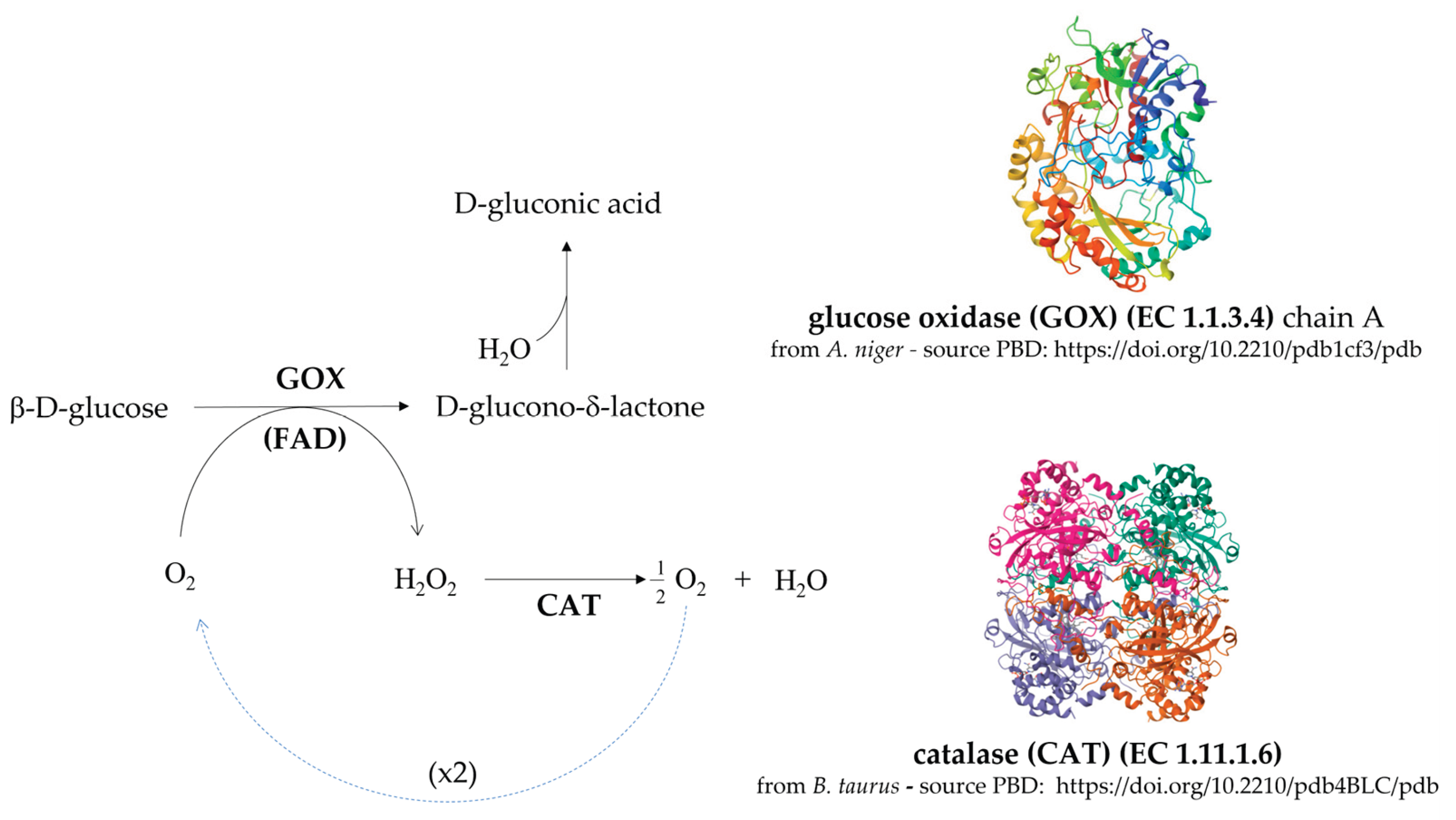
Disclaimer/Publisher’s Note: The statements, opinions and data contained in all publications are solely those of the individual author(s) and contributor(s) and not of MDPI and/or the editor(s). MDPI and/or the editor(s) disclaim responsibility for any injury to people or property resulting from any ideas, methods, instructions or products referred to in the content. |
© 2025 by the authors. Licensee MDPI, Basel, Switzerland. This article is an open access article distributed under the terms and conditions of the Creative Commons Attribution (CC BY) license (http://creativecommons.org/licenses/by/4.0/).
Copyright: This open access article is published under a Creative Commons CC BY 4.0 license, which permit the free download, distribution, and reuse, provided that the author and preprint are cited in any reuse.


