

Submitted:
25 June 2025
Posted:
26 June 2025
You are already at the latest version
Abstract
Solid-state lithium batteries (SSLBs) offer significant advantages over conventional lithium-ion systems, including improved safety, higher energy density, and the possibility of integrating lithium metal anodes. However, the formation and propagation of lithium dendrites remain a critical obstacle to their widespread deployment. This review provides a concise yet comprehensive overview of recent advances in dendrite suppression strategies, encompassing solid electrolyte innovations, interfacial engineering, and mechanical design approaches. Key mechanisms of dendrite nucleation, such as interfacial stress, grain boundary pathways, and electrochemical heterogeneity, are discussed in the context of sulfide-, oxide-, and polymer-based electrolytes. Interface modification techniques, including artificial interlayers, surface coatings, and chemical additives, are evaluated for their role in enhancing lithium-ion transport and promoting uniform deposition. Mechanical strategies based on nanostructured reinforcements, gradient architectures, and self-healing materials are highlighted as emerging solutions to prevent dendrite intrusion. The article also emphasizes the role of advanced characterization methods, such as in situ electron microscopy, spectroscopy, and NMR, in understanding and validating suppression mechanisms. By integrating multidisciplinary insights, this review outlines the current limitations and identifies promising directions toward the development of reliable, dendrite-free SSLBs suitable for practical applications.
Keywords:
Solid-state lithium batteries
; lithium dendrites
; solid electrolytes
; interface engineering
; interlayers
; coatings
; composite electrolytes
; mechanical design
; advanced characterization
1. Introduction
Solid-state lithium batteries (SSLBs) are increasingly considered a transformative platform in energy storage, offering a route to overcome the intrinsic limitations of conventional lithium-ion batteries (LIBs). The fundamental innovation of SSLBs lies in the replacement of flammable organic liquid electrolytes with solid-state ionic conductors. This architectural shift addresses key safety concerns such as leakage, volatility, and thermal runaway, while enabling the use of lithium metal as an anode, an element with the highest known theoretical specific capacity (3860 mAh·g⁻¹), and the lowest electrochemical potential among all metals (−3.04 V vs SHE), which together unlock the possibility of achieving gravimetric energy densities exceeding 500 Wh·kg⁻¹ [1,2]. The structure of SSLBs resembles that of conventional LIBs but introduces significant differences in materials and interfacial behavior. A typical SSLB consists of a lithium metal anode, a solid-state electrolyte (SSE), and a high-voltage cathode such as LiNi₀.₈Co₀.₁Mn₀.₁O₂ (NCM811) or LiCoO₂. The SSE is required to exhibit high lithium-ion conductivity (≥10⁻³ S·cm⁻¹), negligible electronic conductivity, and robust mechanical properties to simultaneously ensure ion transport and block dendrite growth [3]. However, combining these properties in a single material remains a complex challenge, leading to the exploration of diverse classes of SSEs including ceramics, sulfides, polymers, and hybrid composites [4].
Oxide-based electrolytes such as garnet-type Li₇La₃Zr₂O₁₂ (LLZO) exhibit excellent stability against lithium and wide electrochemical windows (>5 V), but their high interfacial resistance and brittleness pose practical limitations [5]. Sulfide-based electrolytes such as Li₁₀GeP₂S₁₂ [6] and Li₆PS₅Cl [7] offer exceptional room-temperature ionic conductivities (>10⁻² S·cm⁻¹) and softness, promoting better interfacial contact. However, they are highly sensitive to air and moisture, releasing toxic H₂S gas upon degradation [4]. Polymeric electrolytes, particularly polyethylene oxide (PEO) with LiTFSI [8], are flexible and easier to process but suffer from poor ionic conductivity at room temperature and limited electrochemical stability [9].
To harness the advantages of multiple classes, researchers have proposed composite electrolytes that incorporate ceramic fillers into polymer matrices, aiming to combine mechanical flexibility with enhanced conductivity. While promising, these systems still face challenges related to phase compatibility, homogeneity, and interfacial degradation [10]. One of the most significant bottlenecks in SSLB development is the engineering of the solid–solid interfaces. Unlike liquid electrolytes, which wet electrode surfaces and reduce interfacial resistance naturally, SSEs require careful interfacial tuning. Poor contact at interfaces can result in high impedance, void formation, and localized current densities that exacerbate dendrite growth. Methods such as interlayer coatings (e.g., Li₃PO₄, LiNbO₃), hot pressing, and surface modification are actively being pursued to mitigate these issues [11]. Moreover, the SSE must serve as both an efficient lithium-ion conductor and a mechanical barrier against dendrite penetration. While ceramics provide the required mechanical strength, they are brittle and susceptible to microcracking. Polymers, though more compliant, may deform under cycling-induced stress. Thus, optimizing the mechanical profile of SSEs is as critical as enhancing their ionic properties [12]. Industrially, SSLBs are drawing strong interest from companies like QuantumScape, Toyota, and Solid Power. Prototypes have shown energy densities above 400 Wh·kg⁻¹, fast-charging capabilities, and extended cycle life, though full validation under practical conditions remains pending. Toyota, for example, has publicly announced its roadmap toward commercial SSLBs before 2030 [13].
Despite these advances, critical challenges persist, including cost-effective synthesis, ambient stability of materials, scalable fabrication techniques, and, most importantly, dendrite suppression. Understanding the mechanisms that govern dendrite formation and propagation through solid electrolytes is crucial to unlocking the full potential of SSLBs. These interfacial and mechanical challenges form the scientific basis for the current review.
2. Understanding Lithium Dendrites in Solid-State Lithium Batteries (SSLBs)
2.1. Mechanism of Dendrite Formation
Lithium dendrite formation remains a critical challenge in the development of solid-state lithium batteries (SSLBs), undermining their potential advantages in energy density and safety [14]. The formation of dendrites involves complex interplays between electrochemical, mechanical, and structural factors within the battery system [15]. Recent studies have elucidated that lithium dendrites can initiate at the interface between the lithium metal anode and the solid electrolyte, particularly at sites of inhomogeneous current distribution or mechanical defects. For instance, molecular dynamics simulations have demonstrated that lithium deposition leads to the accumulation of internal stress, culminating in the fracture of the solid electrolyte at dendrite tips. This fracture facilitates the propagation of dendrites through the electrolyte, compromising the battery’s integrity [16,17]. Furthermore, the microstructural characteristics of the solid electrolyte, such as grain boundaries in polycrystalline materials, play a significant role in dendrite formation. Dendrite nuclei within grains tend to deflect towards and propagate along grain boundaries, where fractures exhibit mixed-mode patterns contingent on fracture toughness and the angle between dendrites and grain boundaries [16]. In addition to mechanical factors, electrochemical conditions at the electrode-electrolyte interface influence dendrite initiation. Poor interfacial contact can lead to high polarization voltage during lithium dissolution, increasing the likelihood of dendrite formation in subsequent deposition steps. Moreover, the presence of crystalline defects and dislocations near dendrite tips has been observed, suggesting that these structural irregularities serve as pathways for lithium insertion and dendrite growth [18,19].
2.2. Impact on Battery Performance and Safety
The propagation of lithium dendrites through solid electrolytes poses a significant threat to the performance and safety of SSLBs. Once initiated, dendrites can penetrate the solid electrolyte, leading to internal short circuits that result in rapid capacity loss and potential thermal runaway [6]. This phenomenon has been observed in various solid electrolyte systems, including garnet-type and sulfide-based electrolytes. Advanced characterization techniques, such as operando optical microscopy and ex situ dark-field X-ray microscopy, have provided insights into the strain patterns and lattice orientation changes associated with dendrite growth. These studies have revealed that dendrite-induced fractures often originate at grain boundaries and are accompanied by the formation of dislocations anchored to dendrite tips [20]. Moreover, nuclear magnetic resonance (NMR) and magnetic resonance imaging (MRI) studies have identified two distinct mechanisms of dendrite formation in solid-state batteries: non-uniform lithium plating at electrode-electrolyte interfaces and local lithium-ion reduction at grain boundaries. These mechanisms contribute to the complex interplay between electrochemical and mechanical factors driving dendrite propagation [19].
The presence of lithium dendrites severely compromises the reliability of SSLBs. Dendrite-induced short circuits can lead to catastrophic battery failure, posing safety hazards such as fires or explosions [21,22]. Additionally, dendrite growth increases the internal resistance of the battery, reducing its efficiency and life cycle [23]. To mitigate these risks, various strategies have been proposed, including the development of solid electrolytes with enhanced mechanical properties, engineering of electrode-electrolyte interfaces to promote uniform lithium deposition, and the application of pulse-current protocols to suppress dendrite formation [24,25]. Despite these efforts, achieving long-term dendrite suppression remains a significant challenge, requiring further research into the fundamental mechanisms governing dendrite growth and propagation [26].
3. Dendrite Suppression Strategies
3.1. Material Innovations
The suppression of lithium dendrite formation is paramount for the advancement of SSLBs. Material innovations, particularly in the development of advanced solid electrolytes, play a crucial role in mitigating dendritic growth. These electrolytes can be broadly categorized into sulfide-based, oxide-based, and polymer-based electrolytes, each offering unique advantages and challenges.
3.1.1. Sulfide-Based Electrolytes
Sulfide-based solid electrolytes are renowned for their exceptionally high lithium-ion conductivities, often surpassing those of conventional liquid electrolytes. Among these, lithium germanium phosphorous sulfide (Li₁₀GeP₂S₁₂ or LGPS) stands out, exhibiting ionic conductivities exceeding 10 mS·cm⁻¹ at room temperature [27]. This remarkable conductivity is attributed to its unique crystal structure, which facilitates rapid lithium-ion transport through interconnected pathways. The high ionic conductivity of sulfide electrolytes like LGPS enables fast charge-discharge rates and improved power densities in solid-state lithium batteries (SSLBs) [28]. Additionally, the soft mechanical nature of sulfide electrolytes allows for better contact with electrode materials, reducing interfacial resistance and enhancing overall battery performance [29]. Despite their superior ionic conductivities, sulfide-based electrolytes face challenges related to mechanical properties and chemical stability. They are generally softer and more prone to deformation under pressure, which can compromise the structural integrity of the battery [30]. Moreover, their sensitivity to moisture and oxygen necessitates stringent handling conditions to prevent degradation and the release of toxic hydrogen sulfide gas. To address these issues, composite approaches have been explored. Incorporating polymers as binders or frameworks within sulfide electrolytes can enhance flexibility and processability. For example, the integration of poly(vinylidene fluoride-co-trifluoroethylene) (PVDF-TrFE) with Li₆PS₅Cl [31] has resulted in composite films exhibiting increased conductivities and improved mechanical robustness. Furthermore, advancements in processing techniques, such as electrospinning-infiltration-hot-pressing methods, have enabled the fabrication of thin, flexible composite solid electrolyte membranes composed of argyrodite sulfide Li₆PS₅Cl and PVDF-TrFE. These membranes demonstrate high lithium-ion conductivity and good mechanical ductility, contributing to enhanced cycling performance in SSLBs [32]. In addition to polymer integration, surface modifications have been investigated to improve the moisture stability of sulfide electrolytes. For instance, surface molecular engineering techniques have been employed to enable processing of sulfide solid electrolytes in humid ambient air, thereby extending their applicability in practical battery manufacturing environments [33,34].
3.1.2. Oxide-Based Electrolytes
Oxide-based solid electrolytes, particularly garnet-type Li₇La₃Zr₂O₁₂ (LLZO), are celebrated for their wide electrochemical stability windows, often exceeding 6 V [35]. This broad stability range allows for compatibility with high-voltage cathode materials, expanding the potential energy density of solid-state lithium batteries (SSLBs). LLZO’s stability against lithium metal and various cathode materials positions it as a promising candidate for next-generation SSLBs [36]. However, it is important to note that while LLZO exhibits a wide electrochemical window, its stability can be influenced by factors such as the presence of impurities, grain boundaries, and the specific doping elements used. For example, studies have shown that doping LLZO with elements like aluminum (Al), gallium (Ga), or tantalum (Ta) can stabilize its cubic phase at room temperature, which is essential for achieving high ionic conductivity and maintaining electrochemical stability [37].
In terms of mechanical properties, oxide-based electrolytes like LLZO generally exhibit higher hardness and elastic moduli compared to their sulfide counterparts. This mechanical strength contributes to their ability to resist dendrite penetration, a critical factor in enhancing the safety and longevity of SSLBs [38]. For example, LLZO has been reported to have an elastic modulus of approximately 150 GPa and a hardness of around 9 GPa, indicating its robust mechanical nature [39]. However, the inherent brittleness of oxide-based electrolytes can pose challenges during battery assembly and operation, potentially leading to microcracks and increased interfacial resistance. To mitigate these issues, strategies such as doping and the development of composite electrolytes have been employed. Doping LLZO with elements like aluminum or tantalum not only stabilizes its cubic phase but also enhances its sinterability and reduces grain boundary resistance, thereby improving its mechanical and electrochemical performance [37]. Furthermore, incorporating polymers into oxide-based electrolytes can improve flexibility and interfacial contact. For instance, composite electrolytes combining LLZO with polymers like polyethylene oxide (PEO) have been explored to enhance mechanical compliance and reduce interfacial resistance, leading to improved battery performance [40].
3.1.3. Polymer-Based Electrolytes
Polymer-based solid electrolytes (PSEs) represent a distinct class of materials in the development of all-solid-state lithium batteries (SSLBs), offering a unique balance between mechanical adaptability, ease of fabrication, and electrochemical compatibility [41]. Their inherent softness, elasticity, and low-temperature processability stand in stark contrast to the brittle nature of oxide and sulfide-based solid electrolytes, making them particularly suitable for flexible and deformable device architectures. Among the various candidates, polyethylene oxide (PEO) and its derivatives have garnered the most attention due to their excellent lithium salt solvation capabilities and ability to form homogeneous ion-conducting networks when doped with lithium salts such as LiTFSI (lithium bis(trifluoromethanesulfonyl)imide) [42]. The repeating ether oxygen units in PEO coordinate readily with Li⁺ ions, creating pathways for ion hopping that are particularly efficient in the amorphous phase [43].
A critical advantage of PSEs lies in their straightforward processability. PEO-based membranes, for instance, can be prepared by solution casting from (common organic solvents, hot-pressing into free-standing films, or by melt-processing methods that are scalable and compatible with roll-to-roll manufacturing) [44]. This is of special relevance in the context of emerging battery formats such as pouch cells, 3D-printed cells, or flexible wearable energy storage devices, where conformability to complex geometries is necessary [43]. Another significant benefit of polymer-based electrolytes is their ability to accommodate large strain without mechanical failure. During lithium plating and stripping, electrode materials undergo volumetric changes that impose stress at the electrode–electrolyte interface [45]. PSEs can deform elastically and plastically to absorb these stresses, thereby preserving interfacial integrity, reducing delamination risks, and minimizing interfacial resistance buildup over long-term cycling. In contrast, ceramic electrolytes are prone to cracking under similar conditions due to their high elastic moduli and low fracture toughness [9]. The low density of polymers, typically less than 1.0 g·cm⁻³, also enables the design of ultralightweight energy storage systems—an attribute that is critical in sectors such as aerospace and biomedical devices where gravimetric energy density is a dominant design criterion. Furthermore, the chemical structure of polymers can be readily tuned by molecular design to incorporate cross-linkable functionalities, ion-conducting moieties, or interpenetrating phases that allow the tailoring of mechanical, thermal, and electrochemical behavior in a way not possible with most inorganic matrices [46].
Despite their many mechanical and processing advantages, polymer electrolytes exhibit one fundamental limitation that restricts their widespread application in high-performance SSLBs: their intrinsically low ionic conductivity at ambient temperature. Most conventional PEO-based electrolytes, when complexed with lithium salts at optimal salt-to-polymer ratios (typically EO:Li⁺ ≈ 8:1), show room-temperature conductivities in the range of 10⁻⁷ to 10⁻⁵ S·cm⁻¹ [47]. These values fall significantly short of the target conductivity of ~10⁻³ S·cm⁻¹ required for practical fast-charging and high-power applications. This low conductivity arises primarily from the semi-crystalline nature of PEO. At room temperature, PEO exists predominantly in a crystalline phase, in which the polymer chains are tightly packed and immobilized, impeding the segmental motion necessary for Li⁺ transport. Only the amorphous regions contribute effectively to ionic conductivity, and the mobility of lithium ions in these domains is thermally activated. As a result, PEO-based electrolytes tend to exhibit adequate conductivity only at elevated temperatures (e.g., above 60 °C), where crystallinity is disrupted and chain dynamics are enhanced [48]. In addition to temperature dependence, the ionic transference number (t⁺) of lithium ions in PEO-based electrolytes is often low, typically in the range of 0.2–0.4. This means that a significant portion of the current is carried by the anions, which can lead to concentration gradients during prolonged cycling and exacerbate issues like polarization and interfacial instability. Furthermore, the accumulation of anions near the electrodes can alter the composition of the solid electrolyte interphase (SEI), impacting the long-term stability of the electrolyte–anode interface [49]. Another inherent limitation is related to the dielectric environment provided by the polymer matrix. Although PEO can dissolve lithium salts, its relatively low dielectric constant (~5–7) means that salt dissociation is not complete, particularly at high salt concentrations. This partial dissociation results in the formation of ion pairs and aggregates, which reduce the number of free Li⁺ ions available for conduction and lead to non-ideal transport behavior at practical electrolyte thicknesses [50]. Finally, it is worth noting that the electrochemical stability window of conventional polymer electrolytes is generally narrower than that of ceramic-based systems. PEO-based systems are prone to oxidative degradation at voltages above 4.0 V vs Li/Li⁺, limiting their compatibility with high-voltage cathode materials such as LiNi₀.₈Co₀.₁Mn₀.₁O₂ (NCM811) or LiCoO₂. This restricts their application range in SSLBs unless special stabilizing additives or interlayers are introduced [51].
3.2. Interface Engineering Techniques
The interface between the lithium metal anode and the solid-state electrolyte (SSE) is a critical focal point in the design of all-solid-state lithium batteries (ASSLBs). Interfacial instability can lead to increased resistance, uneven lithium deposition, and the formation of dendrites, ultimately compromising battery performance and safety. To address these challenges, several interface engineering strategies have been developed, including surface coatings, artificial interlayers, and electrolyte–electrode modifications [52].
3.2.1. Surface Coatings
In all-solid-state lithium batteries (ASSLBs), the interface between the lithium metal anode and the solid-state electrolyte (SSE) is critical for ensuring battery performance and safety. Surface coatings have emerged as a pivotal strategy to stabilize this interface by forming protective layers that mitigate undesirable reactions, suppress dendrite formation, and enhance mechanical integrity [53]. One of the primary functions of surface coatings is to enhance the chemical stability at the Li/SSE interface. Materials such as lithium phosphorus oxynitride (LiPON) have demonstrated exceptional stability when interfaced with lithium metal. LiPON forms a stable solid electrolyte interphase (SEI) that effectively suppresses side reactions and reduces interfacial resistance. Studies utilizing cryogenic electron microscopy have revealed that the Li/LiPON interface exhibits a multilayer mosaic SEI structure with concentration gradients of nitrogen and phosphorus, contributing to its stability and resistance to dendrite formation [54]. Furthermore, the application of LiPON coatings on SSEs has been shown to improve the long-term stability against lithium, making it a promising candidate for enhancing the chemical compatibility at the interface [55]. Surface coatings also serve as mechanical barriers that reinforce the interface, suppressing dendrite penetration and accommodating volume changes during cycling. Aluminum oxide (Al₂O₃), applied via atomic layer deposition (ALD), is a notable example. ALD allows for the deposition of uniform and conformal Al₂O₃ layers with precise thickness control, enabling the formation of robust interfacial layers that can withstand the mechanical stresses during lithium plating and stripping. These coatings not only enhance the mechanical strength but also contribute to the suppression of lithium dendrite growth. First-principles studies have further elucidated the role of amorphous Al₂O₃ coatings, applied via atomic layer deposition (ALD), in lithium–sulfur battery electrodes, demonstrating their effectiveness in mitigating the shuttle effect of soluble polysulfides and enhancing the mechanical stability of the electrode [56]. Surface coatings contribute significantly to the electrochemical performance of ASSLBs by facilitating uniform lithium-ion flux and reducing the formation of high-resistance interphases. For example, the application of ultrathin Al₂O₃ layers via ALD on SSE surfaces has been demonstrated to effectively suppress lithium dendrite growth and enhance the cycling stability of ASSLBs. These coatings act as artificial SEI layers that provide a stable and conductive pathway for lithium ions while preventing electronic conduction that could lead to dendrite formation [57]. Additionally, the integration of surface coatings such as LiPON and Al₂O₃ has been shown to improve the interfacial adhesion and reduce the interfacial resistance between the SSE and the lithium metal anode, thereby enhancing the overall electrochemical performance of the battery.
3.2.2. Artificial Interlayers
In all-solid-state lithium batteries (ASSLBs), the interface between the lithium metal anode and the solid-state electrolyte (SSE) is critical for ensuring battery performance and safety. Artificial interlayers have emerged as a pivotal strategy to promote uniform lithium deposition, suppress dendrite formation, and enhance interfacial stability. These engineered materials are inserted between the lithium anode and the SSE and can be designed to possess specific properties:
- (i)
- Lithiophilicity: Materials with high affinity for lithium, such as silver (Ag) or tin (Sn), can facilitate uniform nucleation and growth of lithium, leading to smoother deposition. For example, a study demonstrated that a rational layer-by-layer strategy using a lithiophilic and electron-blocking multilayer can substantially enhance the performance and stability of lithium-metal solid-state batteries by effectively blocking electron leakage and maintaining low electronic conductivity even at high temperatures [58].
- (ii)
- Ion Conductivity: Incorporating ion-conductive polymers or ceramics into the interlayer can enhance lithium-ion transport across the interface. For example, constructing a Li-rich artificial SEI layer in an alloy–polymer composite electrolyte has been shown to achieve high ionic conductivity for all-solid-state lithium metal batteries [59].
- (iii)
- Mechanical Compliance: Flexible interlayers can accommodate volume changes during cycling, maintaining intimate contact between the anode and SSE. In situ construction of a flexible interlayer has been reported to enhance the durability of solid-state lithium metal batteries [60].
A notable example is the use of a dual-component interlayer composed of LiSn and LiN, which forms in situ between the lithium anode and the SSE. This interlayer effectively suppresses dendrite growth and enhances the interfacial stability of the battery. The LiSn component exhibits enhanced lithium diffusivity, facilitating more uniform lithium deposition across the electrode surface, while the LiN component contributes to mechanical robustness [61].
3.2.3. Electrolyte–Electrode Modifications
In all-solid-state lithium batteries (ASSLBs), the interface between the solid-state electrolyte (SSE) and the electrodes plays a pivotal role in determining the overall performance and safety of the battery. Modifying this interface is crucial for enhancing stability, reducing interfacial resistance, and preventing the formation of lithium dendrites [62]. Several strategies have been developed to address these challenges, including the use of chemical additives, structural engineering, and interface passivation techniques. Incorporating specific chemical additives into the electrolyte can significantly improve the stability of the solid electrolyte interphase (SEI) [63]. For example, fluoroethylene carbonate (FEC) has been widely studied for its ability to form a stable and robust SEI layer. The presence of FEC in the electrolyte leads to the formation of a thinner and more elastic SEI, which enhances the electrochemical performance and cycling stability of the battery. Studies have shown that FEC-modified electrolytes result in improved interfacial stability and reduced impedance growth during cycling [64].
Designing the microstructure of the electrode to have a porous or three-dimensional (3D) architecture can facilitate better contact with the SSE and accommodate volume changes during cycling. Such architectures increase the effective contact area between the electrode and the electrolyte, leading to enhanced ion transport and reduced interfacial resistance. For example, the use of 3D porous copper composites as anodes has been shown to provide robust frameworks that support uniform lithium deposition and mitigate dendrite formation [65]. Applying passivation layers or coatings on the electrode surface can prevent undesirable reactions with the SSE, enhancing interfacial compatibility. These passivation layers act as protective barriers that suppress side reactions and stabilize the interface. For instance, the formation of a solid electrolyte interphase (SEI) through the decomposition of electrolyte additives like FEC can effectively passivate the electrode surface, leading to improved cycling performance and longevity.
Localized dendrite growth is a significant concern in ASSLBs, as it can lead to short circuits and battery failure. To prevent this, several approaches have been explored:
- (i)
- Electron-Blocking Interlayers
Introducing interlayers that are ionically conductive but electronically insulating can prevent electron leakage, which is a precursor to dendrite formation. For example, a study demonstrated that a lithiophilic and electron-blocking multilayer interlayer substantially enhanced the performance of lithium metal batteries by suppressing dendrite growth and improving interfacial stability [58].
- (ii)
- Mechanical Reinforcement
Enhancing the mechanical strength of the SSE or incorporating reinforcing agents can resist dendrite penetration. Materials with higher mechanical moduli can better withstand the stresses induced during lithium plating and stripping, thereby suppressing dendrite propagation. For instance, the use of amorphous Li-La-Zr-O coatings has been shown to act as effective dendrite-blocking layers due to their grain-boundary-free microstructure and high electronic insulation [66].
- (iii)
- Uniform Current Distribution
Ensuring a uniform current distribution across the electrode surface can minimize hotspots that lead to dendrite initiation. Strategies such as designing electrodes with uniform pore sizes and incorporating materials that facilitate homogeneous lithium-ion flux can contribute to uniform current distribution. A study demonstrated that constructing a three-dimensional continuous grain boundary with lithium-ion conductivity and electron-blocking properties can suppress lithium dendrites and achieve high critical current densities [67].
3.3. Mechanical Design Approaches for Dendrite Suppression
One promising avenue to mitigate lithium dendrite formation in solid-state batteries is through the mechanical design of cell components. By enhancing the mechanical robustness of electrolytes or introducing structural frameworks, these strategies aim to physically restrain dendrite growth and encourage uniform lithium plating. Recent advances in this area include the use of nanomaterial-reinforced composite electrolytes for higher strength and ion transport, self-healing materials that repair micro-cracks, gradient-structured electrolytes with spatially varying properties, and three-dimensional (3D) structured electrodes that guide homogeneous lithium deposition [68]. Below, we review each of these mechanical design approaches and how they suppress dendrites and improve lithium distribution.
3.3.1. Nanomaterials and Composite Structures for Reinforcement and Ion Transport
Incorporating nanomaterials into solid-state electrolytes has emerged as an effective strategy to improve mechanical strength without sacrificing ionic conductivity. Rigid ceramic fillers (e.g. Li₇La₃Zr₂O₁₂, Al₂O₃) dispersed in polymer electrolytes can increase the elastic modulus and toughness of the electrolyte while also creating additional Li⁺ conduction pathways [69,70]. For example, adding graphene-based materials to polymer electrolytes has been shown to both reinforce the mechanical matrix and reduce polymer crystallinity, thereby enhancing Li⁺ conductivity [69]. Zhang et al. [71] functionalized graphene oxide (GO) with poly(ionic liquid) chains to achieve a uniform GO dispersion in a PEO electrolyte, which lowered crystallinity and enabled a Li||Li cell to cycle much longer without short-circuiting compared to an unfilled PEO electrolyte [71]. Aligning 2D nanofillers within polymer matrices can enhance performance by guiding ion transport along the oriented sheets, resulting in anisotropically high ionic conductivity [69,71,72]. These graphene-based composite electrolytes exhibit higher critical current densities for dendrite-free operation by virtue of their increased stiffness and more homogeneous ion transport network.
Nanomaterials have also been used to reinforce brittle inorganic solid electrolytes. While ceramic electrolytes are intrinsically stiff, their low fracture toughness means that tiny cracks can act as conduits for dendrites [69,73]. Adding a minor fraction of reduced graphene oxide (rGO) platelets to a ceramic Li–Al–Ti–P oxide (LATP) electrolyte was found to double its fracture toughness from ~1.1 to 2.4 MPa·m0.5 by a crack-bridging mechanism [69,73]. The rGO-reinforced LATP showed no signs of dendritic short-circuit in Li//Li symmetric cells over >250 hours, whereas the pristine LATP would typically succumb to fracture-assisted Li infiltration [69]. Graphene’s extraordinary mechanical strength (Young’s modulus ~1 TPa) allows it to act as a “nano-rebar,” deflecting and blunting cracks that would otherwise enable dendrite propagation [74,75]. Importantly, an optimized low loading (∼1 vol% rGO) is used to avoid percolating electronic pathways [69], thus maintaining a high ionic/electronic selectivity. Beyond carbon, 2D inorganic additives like molybdenum disulfide (MoS₂) have been employed as protective interlayers to stabilize the Li interface. MoS₂ coatings on garnet-type electrolytes (e.g. LLZO) form a lithiated conversion layer (Li₂S/Mo) that is ion-conductive but electronically insulating, effectively blocking electron-fed dendrite growth [76]. In one study, a thin MoS₂ interlayer on LLZO dramatically flattened the Li stripping/plating voltage profile and prevented dendrites from penetrating along grain boundaries [77]. The lithiophilic MoS₂ layer improved interfacial wetting and then transformed into a robust solid-electrolyte interphase that suppressed local dendrite nucleation, enforcing a more uniform Li deposition [77]. Overall, composite design using nanomaterials (graphene, MoS₂, etc.) imbues the electrolyte with high mechanical resilience and controlled ion pathways, raising the dendrite initiation barrier and promoting more even lithium distribution across the interface.
3.3.2. Self-Healing Materials and Adaptive Interfaces
A cutting-edge approach to dendrite suppression is the development of self-healing solid electrolytes that can autonomously repair the microscopic damage associated with dendrite growth. During cycling, stress and lithium plating can induce nano-cracks, voids, or other defects in the electrolyte; these defects concentrate current and become hot-spots for dendrite initiation [78]. Self-healing electrolytes address this by incorporating dynamic chemical bonds or flowable components that allow the material to recover its integrity after damage. For example, recent studies have designed polymers with reversible crosslinks (such as hydrogen bonds, imine bonds, or disulfide bonds) that break and reform, enabling the polymer to mend cracks caused by lithium filament pressure [79,80]. The rational design of such self-healing polymer networks is intended to inhibit crack propagation and maintain intimate contact at the Li/electrolyte interface during cycling [81]. He et al. reported a “plastic crystal” composite electrolyte using a dynamically crosslinked polymer (with non-covalent –CH₃…CF₃ interactions) integrated with a ceramic filler [78]. This electrolyte exhibited a two-step self-healing mechanism where micro-cracks were first filled by the mobile polymer matrix and then fully repaired via polymer re-crosslinking [78]. Remarkably, the self-healing composite suppressed the formation of any high-current dendrite pathways (“hotspots”) and sustained dendrite-free cycling for over 2000 hours at 1 mA cm⁻² in Li||Li tests [78]. Post-mortem analysis confirmed that internal defects which would normally lead to filament growth were eliminated by the self-healing process [78]. Besides extending cell lifetime, this approach improves lithium deposition uniformity by constantly smoothing out the Li/electrolyte interface. Operando X-ray fluorescence (XRF) microscopy has recently enabled direct visualization of this healing mechanism. Figure 1 illustrates the dynamic closure of voids during electrochemical cycling, confirming that the plastic ceramic electrolyte not only adapts to mechanical stress but actively repairs damage at the microscale. The experiment reveals polymer infiltration followed by ceramic migration, validating the two-step healing process under real battery conditions. Other reports of self-healing polymer electrolytes (using, e.g., urethane–urea hydrogen bonding or disulfide linkers) similarly show that dendrite-induced cracks/voids can be spontaneously repaired, thereby preventing isolated “dead lithium” pockets and maintaining even lithium plating [82]. While still an emerging technology, self-healing solid electrolytes offer a dynamic means of arresting dendrite growth in situ, effectively combining mechanical resilience with adaptivity to achieve long-term dendrite suppression.
3.3.3. Gradient and Multilayer Electrolytes
Functionally graded electrolytes have been introduced as an innovative design to combine the best attributes of different materials and mitigate dendrites. Instead of a uniform single-phase electrolyte, a gradient structure gradually varies the composition or mechanical properties across the thickness. The rationale is to use a stiffer, dendrite-resistant layer at the lithium interface and a more compliant, interface-friendly layer toward the cathode, avoiding abrupt interfaces that can cause stress or impedance. A recent example is a gradient composite solid electrolyte (GCSE) in which a ceramic filler content transitions from high in the central region to lower at the outer faces [83]. Zhang et al. (2024) implemented this by dispersing Li₆.₄La₃Zr₁.₄Ta₀.₆O₁₂ (LLZTO) particles in a polymer matrix with a controlled spatial gradient: the core of the membrane is rich in LLZTO (imparting high hardness to block dendrites), while the surfaces are richer in pliable polymer (enhancing contact with electrodes) [83]. This smoothly graded architecture provided multiple benefits – the ceramic-rich center acted as a strong barrier against lithium penetration, and the polymer-rich sides improved interfacial compatibility and reduced contact resistance [83]. Crucially, the continuous gradient avoided any sharp interfaces between hard and soft layers, facilitating uniform Li⁺ flux and minimizing internal stress concentrations. The GCSE achieved a high room-temperature ionic conductivity (~1.5×10⁻⁴ S·cm⁻¹) and enabled stable lithium plating for over 1200 hours in symmetric cells with no short-circuit [83]. In full cells (Li||LFP), the graded electrolyte delivered improved cycling stability and capacity retention relative to a homogeneous composite [83]. Similar multi-layer or functionally graded designs have been reported by other groups – for example, bilayer electrolytes where an ultrathin, high-modulus inorganic layer is laminated onto a flexible organic layer to simultaneously resist dendrites and lower interfacial impedance [84,85]. Such gradient electrolytes leverage spatial material distribution as a design knob to localize the strongest mechanical protection exactly where needed (near the Li anode) while still ensuring fast ion transport and good electrode integration. By tailoring the electrolyte’s internal architecture, researchers are effectively spreading out the lithium deposition uniformly and preventing the formation of concentrated dendritic channels.
3.3.4.3. D-Structured Anodes and Current Collectors
In addition to engineering the electrolyte, three-dimensional structured electrodes provide a mechanical means to regulate lithium growth. The concept is to host lithium within a conductive porous scaffold or framework, rather than depositing onto a flat surface, thereby reducing local current densities and accommodating volume changes. Extensive work on 3D Li metal hosts has shown that increasing the effective surface area for Li plating leads to smoother, dendrite-free deposition [86,87,88]. Porous metal foams, woven meshes, carbon networks, and 3D-printed frameworks have all been explored as scaffolds that lithium can infuse into. These conductive 3D hosts draw plating into their interior void space (rather than protruding outward), which both lowers the propensity for needle-like dendrites and buffers the large 100% volume expansion of Li metal [87]. For instance, Hu’s group demonstrated that a carbon nanotube sponge with an alumina-coated surface provides a high-surface-area network where Li can nucleate on many sites; as a result, dendrite growth was effectively suppressed and Coulombic efficiency doubled compared to a planar Li foil anode [89]. The mechanical stability of the scaffold and the presence of lithiophilic surfaces (e.g. ALD-Al₂O₃ or other seed layers) are key to achieving uniform Li distribution. Xu et al. reported a graphene/MgF₂ hybrid framework that, after molten lithium infusion, formed a robust 3D Li-metal anode. The rigid rGO network maintained structural integrity during cycling while nanoscale MgF₂ lithiophilic sites ensured even nucleation of Li – yielding stable stripping/plating for ~450 hours at 1 mA cm⁻² with no dendrite failure [90]. The structural features and compositional distribution of this composite are shown in Figure 2.
Advanced 3D host designs increasingly focus on graded porosity and surface modifications to further homogenize the lithium deposition. Lee et al. [91] showed that a gradient pore size copper scaffold (with pores getting smaller with depth) induces “superconformal” lithium growth throughout the 3D matrix, as opposed to Li accumulating only near the entrance of uniform pores. The gradient-pore Cu host achieved 760 cycles at 2 mA cm⁻² with no short-circuit, outliving a comparable scaffold with monodisperse pores by virtue of its more uniform Li distribution in 3D [91]. In another approach, an electrospun copper nanofiber (Cu–CNF) scaffold was decorated with ultrafine Cu particles to nucleate lithium evenly across the framework [92]. The lithiophilic Cu seeds promoted uniform initial lithium plating, while the 3D CNF network guided the continued growth within its conductive filaments. This Cu–CNF host enabled remarkable cycling stability – a Li||Li cell endured 500 hours at 5 mA cm⁻² without dendritic shorting, whereas a control carbon scaffold without the Cu seeds showed erratic plating and premature failure [92]. These examples illustrate how 3D structured anodes effectively disperse the electrochemical deposition of lithium over a large area/volume, preventing any single point from developing a dendritic protrusion. Moreover, by confining lithium in a scaffold, the plated metal forms a smooth filling of the porous matrix rather than extending outward as needles [93]. The result is a more uniform lithium morphology and improved safety and reversibility of Li-metal anodes. Going forward, combining 3D hosts with solid-state electrolytes (for example, a lithium-infused porous framework integrated with a stiff separator) is a compelling direction to synergistically use mechanical design for dendrite suppression [88,94]. In summary, 3D structured electrodes exemplify mechanical ingenuity—using architectural design to tame lithium dendrites by giving lithium pre-defined, dendrite-averse spaces in which to deposit.
To synthesize the different strategies examined in previous sections Table 1 provides a comparative overview of recent dendrite suppression approaches. It highlights their respective advantages, technical challenges, and representative studies, serving as a practical reference for researchers developing next-generation SSLBs.
3.4. Advanced Characterization Techniques
Advanced characterization methods have become indispensable for understanding and mitigating lithium dendrite formation in solid-state batteries. In situ/operando electron microscopy and various spectroscopic techniques allow researchers to directly observe dendrite behavior, probe interfacial chemistry, and evaluate the effectiveness of dendrite suppression strategies in real time. These tools provide complementary insights: electron microscopy visualizes the nucleation and propagation of Li filaments under realistic conditions, while spectroscopy reveals chemical, electrochemical, and even mechanical aspects of interfaces that govern dendrite growth or suppression. Below, we review recent advances (2022–2025) in applying these techniques to solid-state lithium batteries, highlighting how they have been used to observe dendrite formation, quantify its effects, and guide the design of interface engineering and material innovations for dendrite suppression.
In situ electron microscopy (including transmission electron microscopy, TEM, and scanning electron microscopy, SEM) enables real-time monitoring of dendrite formation and propagation at nanometer to atomic scales. Recent studies have leveraged specialized operando TEM cells and environmental SEM setups to visualize how Li dendrites initiate and penetrate solid electrolytes during battery operation [99]. These experiments provide direct evidence of electro-chemo-mechanical processes at the Li/SSE interface that were previously inferred only indirectly. For example, Gao et al. used in situ TEM to observe Li plating against a garnet-type electrolyte (LLZO) under controlled pressure and current conditions [100]. They constructed a Cu|LLZO|Li nanobattery and directly visualized how Li deposition-induced stress, depending on the mechanical constraint and local current density, leads to various interfacial behaviors. At low current density and under strong uniaxial pressure, Li expanded laterally via creep, preserving the LLZO integrity. However, under rapid deposition ("Li eruption"), they observed the sudden nucleation of cracks—even in pristine single-crystal LLZO particles—driven by stress accumulation surpassing 3 A·cm⁻² and generating GPa-level pressures. This dynamic visualization demonstrated that dendrite-induced stress can fracture a stiff ceramic electrolyte, and it revealed that the mode of Li growth (lateral vs. vertical extrusion) strongly influences whether the solid electrolyte cracks or remains intact [100]. Figure 3 summarizes these contrasting growth modes: while slow, pressure-modulated extrusion enables stable lateral expansion, fast vertical eruption leads to mechanical failure. Such results underscore that not only current density but also stress release pathways at the interface dictate dendrite penetration, knowledge that is guiding strategies to accommodate or redirect stress in solid-state cells. Operando electron microscopy has also been used to compare dendrite behavior with and without interface modifications. A notable 2025 study by Zhao et al. employed an operando SEM to monitor the Li–electrolyte interface in a sulfide-based solid battery under realistic conditions [99]. By imaging the cross-section of a Li metal anode stripping from Li6PS5Cl (LPSCl) electrolyte, they visualized how voids form and evolve at the interface. Pure Li anodes developed multiple small voids during stripping that eventually coalesced into a large crack, leading to interfacial delamination [99]. In contrast, an alloyed Li–Mg anode showed a very different behavior: the initial voids were more numerous but tended to split and collapse, which partially preserved contact between the metal and SSE [99]. This real-time observation explained the improved performance of Li–Mg alloy anodes, the Mg incorporation changes interfacial dynamics so that voids do not unite into a continuous gap. Density functional theory (DFT) calculations confirmed that Mg has a strong affinity for the sulfur in the SSE, which draws Mg toward the interface and prevents lithium void accumulation by pushing Li vacancies into the bulk metal [99]. The SEM study directly correlating void dynamics with electrochemical behavior illustrated an important suppression mechanism: alloying the Li anode can maintain interfacial contact and delay the onset of dendritic short-circuit by reducing void-induced hotspots [99]. Beyond standard TEM/SEM, researchers have developed creative adaptations to visualize Li dendrites under more battery-like conditions. For instance, cryo-electron microscopy (cryo-EM) has been used to examine dendrites and interphases post-mortem by freezing battery samples to preserve delicate Li filaments. Using cryo-TEM, Li et al. and others revealed that lithium dendrites often contain lithium hydride (LiH) as a major component [98]. This LiH, formed by side reactions with trace moisture or electrolyte components, is electronically insulating and was shown to isolate active lithium within the dendrite, effectively “deadening” that Li and accelerating capacity loss [98]. Identification of LiH in dendrites (observed in both liquid and solid electrolytes) highlights the critical role of interfacial chemistry in dendritic failure and suggests that eliminating hydrogen sources or preventing LiH formation could be a strategic route to mitigate dendrite-related losses. Recent cryo-electron microscopy and spectroscopy studies confirm that LiH forms as a by-product of electrolyte decomposition at the lithium interface, and its accumulation can electrically isolate active lithium, reducing battery capacity. In another approach combining microscopy and mechanical analysis, advanced setups have paired TEM with atomic force microscopy. For example, Zhang et al. [101] employed an in situ AFM–ETEM system to measure the stress generated by growing “lithium whiskers” (filamentary Li). They found that these whiskers can exert stresses up to 130 MPa, which is sufficient to deflect or blunt dendritic growth [101]. Although this study predates 2022, its methodology continues to inspire recent work linking real-time microscopy observations with mechanical forces in dendritic evolution.
Indeed, Yildirim et al. recently used operando X-ray microscopy alongside optical imaging to show that Li dendrites growing in single-crystal LLZTO induce dislocations in the crystal lattice near the dendrite tip [20]. These stress-induced lattice defects can in turn guide the dendrite’s path and branching behavior [20]. Such multi-modal microscopy studies provide a holistic picture of dendrite propagation, wherein one can see the interplay of electrochemical deposition, mechanical stress, and microstructure of the solid electrolyte in real time. In situ electron microscopy techniques have thus allowed direct observation of dendrite nucleation sites, growth kinetics, and the effect of interventions (pressure, alloying, coatings, etc.) on dendrite suppression. The ability to watch a dendrite penetrate or be stopped by a modified interface is incredibly valuable for verifying suppression mechanisms. These techniques, however, must contend with challenges like the reactivity of Li in vacuum and the need for specialized cells or low-dose imaging to avoid beam damage. Despite these challenges, rapid progress is being made. For example, modern TEM holders now allow biasing and even heating of solid-state cell specimens, effectively creating “micro-batteries” inside the microscope [100]. In summary, operando electron microscopy has emerged as a powerful tool to directly witness dendrite formation and its prevention, yielding insights into failure mechanisms (e.g., stress-induced cracking, grain boundary transport pathways) that inform the design of more robust solid-state interfaces.
While imaging reveals where and how dendrites grow, spectroscopy techniques probe the chemical and physical state of materials before, during, and after dendrite formation. They are essential for analyzing the electrochemical and mechanical properties of interfaces and for evaluating dendrite suppression mechanisms at a molecular level. Key spectroscopic methods include surface analytical techniques (X-ray photoelectron spectroscopy and secondary-ion mass spectrometry), vibrational spectroscopies (Raman), nuclear magnetic resonance, and impedance spectroscopy. Each offers unique information that complements microscopy, helping to build a complete picture of dendrite behavior in solid-state batteries. X-ray Photoelectron Spectroscopy (XPS) is widely used to analyze surface chemistry at the Li anode–electrolyte interface. In solid-state cells, XPS can identify the compositions and oxidation states of elements in the solid-electrolyte interphase (SEI) or interfacial layers that form during cycling. Recent studies have employed in situ XPS to monitor these interphase changes as lithium is plated/stripped. For example, Huo et al. designed a thin polymer/thiophosphate composite electrolyte and used in situ XPS (with a built-in Li deposition apparatus) to observe the formation of a LiF-rich SEI at the interface during the first minutes of lithium plating [102]. The XPS spectra showed that as Li metal was deposited onto the composite SSE, species from the Li salt (LiFSI) decomposed to form LiF and lithium sulfide (Li2S) species, while harmful components like –SO2F groups were consumed [102]. In situ XPS: Investigating Stable Interfaces for Improved Solid-State Battery Performance. This LiF-rich interphase correlated with a more stable interface: concomitant electrochemical testing showed that cells with the modified SSE had lower interfacial impedance growth and suppressed dendrite formation [103]. In other words, XPS directly verified that the polymer-sulfide composite created a stable, dendrite-suppressing SEI rich in LiF (a known electronic insulator and ion-conductor), which protected the Li metal. XPS has also been applied ex situ to failed cells to identify fingerprints of dendritic failure – for instance, detecting reduced sulfur species or elemental Li within the SSE, which indicate lithium penetration. Because XPS is surface-sensitive (probing a few nanometers deep), it is especially useful for examining interfacial layers that may dictate whether a dendrite can initiate. Modern synchrotron XPS with nano-focusing has even been performed operando, providing spatially resolved chemical information at interfaces. Overall, XPS helps answer what chemical species are present at the interface and how interface chemistry evolves when a certain suppression strategy (e.g., additives, coatings) is used. Time-of-Flight Secondary Ion Mass Spectrometry (ToF-SIMS) complements XPS by mapping the spatial distribution of elements (particularly Li) and molecules in three dimensions. In solid-state batteries, ToF-SIMS depth profiling can reveal whether lithium has penetrated along grain boundaries or cracks in the electrolyte. For example, ToF-SIMS was used to examine LLZO garnet after cycling and found lithium enrichment along certain grain boundaries, correlating with observed filament paths [104]. In a recent study of solid-state cell failure, ToF-SIMS provided “plane view” maps of interfacial degradation: regions of the Li anode showed high concentration of inorganic fragments corresponding to where dendrites had formed, while intact areas remained clean [105]. Such chemical mapping confirms where dendrites travel in the microstructure. Moreover, ToF-SIMS can detect dopant or impurity migration; for instance, a fluorine-doped SSE was analyzed by ToF-SIMS which showed F distributed uniformly in the bulk of a fresh electrolyte but accumulated at the interface and within Li dendrites after cycling [106]. This suggested that F (from a LiF-based additive) migrated to form a protective layer in situ, consistent with its role in hindering dendrite growth. In summary, ToF-SIMS gives a 3D chemical view of dendrites and interphases, enabling researchers to trace dendrite pathways and identify elemental signatures of effective suppression (e.g., presence of certain elements along a blocked dendrite). Raman spectroscopy is a powerful tool to analyze both chemical species and mechanical strain in solid electrolytes. In the context of dendrite suppression, Raman has been notably used for stress mapping inside SSEs. Because many ceramic electrolytes (like LLZO) have Raman-active lattice modes that shift under stress, confocal Raman microscopy can non-destructively probe internal stress distribution.
Bo et al. developed a 3D confocal Raman method to map stress in a garnet electrolyte during lithium deposition [107]. They observed that as lithium plated, regions of the SSE experienced up to ~1 GPa of compressive stress locally. These stress “hotspots” were found near grain boundaries and pore defects, and importantly the Raman-based stress maps showed that non-uniform stress led to non-uniform lithium deposition—i.e. stress concentrations drove dendrite initiation at specific sites [107]. Figure 4 illustrates this correlation: Raman stress maps are directly overlaid with post-mortem images of lithium deposition, revealing that dendrite growth initiates at zones of high compressive stress. Using the spatial stress data, they formulated an electro-chemo-mechanical model that explained how stress increases the local overpotential for Li deposition, causing Li to prefer certain pathways (hence heterogeneous dendrite growth) [107]. This combination of experimental stress mapping and theoretical modeling provided direct evidence that mechanical inhomogeneities strongly influence electrochemical behavior. This is a key insight into a suppression mechanism: if one can make the stress distribution more uniform (for example, by pre-compressing the cell or by introducing a soft interlayer to relax stress), one can potentially avoid the extreme local overpotentials that trigger dendrites.
Raman spectroscopy is also employed to identify chemical compounds in the interphase; for instance, it can detect the formation of Li2CO3 or other crystalline reaction products on SSE surfaces [108]. These spectral signatures let researchers verify if, say, a CO2 additive indeed produces a carbonate-based passivating layer, or if a sulfide SSE decomposes into sulfates or sulfides during cycling. Additionally, in situ Raman has been used in some studies to watch changes in polymer-based electrolytes or to monitor the consumption of additives that have distinct Raman peaks. Overall, Raman provides both a chemical fingerprint and a stress map, linking mechanical and chemical facets of dendrite suppression. Nuclear Magnetic Resonance (NMR) spectroscopy (including magnetic resonance imaging, MRI) offers a unique bulk perspective, especially for quantifying lithium metal deposition and the formation of “dead” (electrically isolated) lithium. Because 7Li is NMR-active, one can distinguish between Li in different environments (metallic lithium vs. ionic lithium in SSE vs. lithium in compounds) by their resonance shifts. Recent advances in operando NMR have enabled real-time quantification of lithium plating/stripping in solid-state cells. Liang et al. in 2023 used operando 7Li NMR to monitor lithium in a symmetric cell with various sulfide electrolytes [109]. They could measure the growth of the Li metal signal during charging (plating) and how much of that lithium failed to be recovered on discharge, which corresponds to inactive Li. Impressively, by analyzing the NMR signal during resting periods, they found that mossy or dendritic lithium corrodes (reacts) faster than smoothly plated lithium in the cell [109]. In other words, a cell with rough, high-surface-area Li deposits lost NMR-visible Li signal more rapidly upon storage, indicating that dendritic Li was being consumed into inactive forms (like Li–S or Li–H compounds) much faster than a flat Li layer [109]. This quantification confirmed the intuition that dendrites not only risk short-circuiting but also exacerbate lithium consumption and capacity fade.
Another cutting-edge study by Maity et al. [110] combined solid-state NMR with Overhauser dynamic nuclear polarization (OE-DNP) to greatly boost sensitivity to the interfacial regions where dendrites and SEI form. This approach enabled unprecedented molecular-level insights into buried interphases without external spin labels. With DNP-enhanced NMR, they achieved molecular-level insight into composite polymer–ceramic electrolytes: they could detect small quantities of lithium species in the SEI and even measure how easily lithium ions moved through the SEI layer [110]. The authors quantitatively correlated ceramic content with dendrite quantity and cell lifetime, showing that 40 wt% ceramic loading offered optimal suppression, while higher filler contents (e.g., 60 wt%) impaired interfacial properties. They found that the quantity and penetration depth of dendrites depended on the ceramic filler content in the composite, correlating strongly with cell lifetime [110]. More importantly, they demonstrated that SEI signal enhancement in OE-DNP arises primarily from Li/Li⁺ charge transfer at the metal–SEI interface, rather than spin diffusion, allowing direct assessment of SEI lithium permeability. Moreover, by analyzing the NMR signal enhancements, they could directly determine the lithium permeability of the SEI, observing that certain interphase compositions allowed lithium-ion transport while blocking electron transport [110]. Through a combination of isotope enrichment, REDOR experiments, and CEST measurements, they showed that SEIs with similar chemical compositions (mainly Li₂O and LiOH) can exhibit markedly different ion permeabilities depending on their origin (polymer vs ceramic). Figure 5 illustrates these findings, comparing chemical speciation, DNP signal strength, and electron microscopy data for SEIs formed with increasing ceramic content. This kind of information is invaluable – it tells us how effective a tailored SEI or artificial interphase is at stopping dendrites (which require electronic connectivity to keep growing) while still permitting ionic flow. These findings not only elucidate how SEI architecture and ceramic fillers affect dendrite suppression, but also establish OE-DNP as a powerful diagnostic tool to assess the functional quality of SEIs in solid-state batteries.
As NMR techniques continue to advance (with higher fields, better probes, and DNP), we expect even more quantitative understanding of dendrite suppression, such as measuring how much lithium becomes “dead” in different cell configurations or how fast dendrites grow inside an opaque SSE. Finally, electrochemical impedance spectroscopy (EIS), though not a spectroscopy of photons or particles, is a frequency-domain characterization technique often classified among spectroscopic methods for batteries. In the context of dendrites, EIS is a crucial operando tool to detect interface degradation and incipient shorts [104,111]. A rising interfacial resistance or the appearance of an additional low-frequency semicircle in an EIS spectrum can indicate the build-up of a resistive SEI or the formation of voids, while a sudden drop in impedance (especially in combination with a cell voltage plunge) often signifies an internal short by a dendrite. Researchers frequently couple EIS with the aforementioned methods: for instance, Huo et al. [103] performed time-dependent EIS alongside in situ XPS to show that the LiF-rich interface not only existed (by XPS) but also maintained low impedance over time (by EIS), correlating with stable cycling without dendrites. Likewise, in operando NMR studies, EIS can track when a cell approaching failure exhibits a drop in charge transfer resistance, aligning with the NMR’s detection of increasing “dead” lithium. In a 2022 report, Gao et al. [100] noted that under strong mechanical confinement, the EIS of a Li|LLZO cell remained stable (no new interfacial arc) as lithium plated laterally, but when a vertical dendrite burst through, the cell’s impedance suddenly collapsed, reflecting the short-circuit path formed [100]. Such observations reinforce that impedance changes can serve as early warning signs of dendrite formation. Moreover, EIS is invaluable for evaluating suppression strategies: a successful strategy (e.g., a doped SSE or a protective layer) should raise the critical current density at which the impedance catastrophically drops (i.e., it delays the dendrite-induced short). Thus, many researchers report improved EIS stability or higher post-cycling impedance retention as evidence of suppressed dendrite growth [103]. While EIS alone cannot visualize dendrites, when interpreted alongside physical characterization it provides a quantitative measure of interfacial stability and ion transport over the course of cycling. In summary, advanced spectroscopic techniques offer deep insights into why and how certain interfacial engineering approaches work to suppress dendrites. XPS and ToF-SIMS reveal the chemical makeup and distribution of critical interphase layers (e.g., confirming the presence of a dendrite-blocking LiF/Li2S layer or detecting unwanted metallic Li percolation). Raman spectroscopy links mechanical stress and dendrite growth, guiding mechanical mitigation strategies. NMR directly quantifies dendritic lithium and inactive lithium, informing how much of the anode is effectively lost to side reactions and how different designs minimize that loss. EIS ties it all together by indicating the electrochemical stability of the interface throughout cycling. Together with in situ electron microscopy, these spectroscopic methods form a powerful toolkit. By applying multiple characterization techniques in tandem, researchers can observe dendrites forming (or being suppressed) in real time, identify the chemical and mechanical state of the interface, and correlate those findings with battery performance. This comprehensive understanding is driving rational design of solid-state batteries – for example, choosing dopants that create favorable interphase chemistry (as verified by XPS/NMR) or engineering flexible yet robust interfaces that relieve stress (as evidenced by Raman/SEM) – ultimately pushing the field closer to dendrite-proof, high-performance all-solid-state lithium batteries.
3.5. Conclusions and Future Perspectives
Solid-state lithium metal batteries (SSLBs) have seen rapid progress in strategies to combat lithium dendrites, which remain the primary roadblock to their reliability and commercialization [108,112]. A plethora of interface engineering approaches and material innovations have been explored to suppress dendrite initiation and propagation. On the interface side, researchers have designed artificial interphases and interlayers to stabilize the Li metal/SSE (solid-state electrolyte) contact. For example, Wan et al. introduced a mixed ionic–electronic conductive interlayer that reacts in situ to form a multiphase solid interphase (containing LiMgSx, porous LiH–Li3N, and a Li–Mg–La alloy). This interphase increased the critical interphase overpotential (CIOP) – a new figure of merit for dendrite resistance – from ~10 mV for a bare Li6PS5Cl electrolyte to ~220 mV [113]. Such a dramatic enhancement means the solid electrolyte can sustain much higher current before dendrites nucleate, by virtue of an interphase that is mechanically robust, lithiophobic, and optimally conductive [113]. Material innovations in electrolytes have been equally critical. High-modulus ceramic electrolytes (e.g. oxides like LLZO or sulfides like Li10GeP2S12) [114] were initially expected to block dendrites thanks to their stiffness. However, in practice even these “hard” electrolytes suffer dendrite penetration along microstructural weaknesses such as grain boundaries and defects [112]. This has prompted the development of advanced electrolyte architectures: examples include amorphous or nanocrystalline electrolytes with no grain boundaries (which showed dendrite-free operation up to mA cm−2 level currents) [66], and composite electrolytes where a secondary phase is embedded to redirect or blunt dendrite growth. Phase-field modeling by Yuan et al. demonstrates that incorporating “brick-and-mortar” style heterogeneous reinforcements within a brittle electrolyte can divert lithium filaments and prevent internal short-circuiting [115]. Similarly, multi-layered electrolyte designs have proven effective: Hu et al. showed that even if a dendrite begins to form, a multi-layer stack of differing materials (e.g. Li6PS5Cl – Li3ScCl6 – Li6PS5Cl) causes the dendritic crack to deflect at the layer interfaces, rather than puncturing straight through [116]. This crack-deflection mechanism can substantially raise the effective critical current density by forcing the dendrite to travel laterally, increasing the path length and resistance [116]. In essence, today’s dendrite suppression toolkit spans chemical interphase design, microstructural engineering, and mechanical modulation, each contributing to a more uniform and resilient Li plating/stripping behavior.
Despite these encouraging strategies, achieving a truly dendrite-proof solid-state battery under practical conditions remains an unsolved challenge. A critical assessment reveals several persistent limitations. First, many suppression methods succeed only under limited conditions (e.g. small cell prototypes, moderate current densities, or with external pressure). Dendrites can still emerge if the system is pushed towards EV-level fast-charge currents or long cycle counts. Recent operando studies have exposed the nuanced failure modes – initiation vs. propagation – of dendrites in SSEs. Ning et al. demonstrated that lithium filament initiation often starts at microscopic defects: Li metal can infiltrate pre-existing pores or microcracks at the Li/SSE interface, nucleating a subsurface dendrite [112]. Such initiation is governed by local features like grain boundary fracture strength, defect size, and local current hot-spots [117]. Once a filament has nucleated, its propagation through the electrolyte is controlled by more macroscopic factors: the bulk fracture toughness of the SSE, the length of the growing Li filament, the applied stack pressure, and cycling depth [117]. This dichotomy means a successful suppression strategy must address both the microscale interface flaws (to avoid initial “seed” formation) and the bulk propagation (to arrest any filament that does start). For instance, even the hardest ceramics (garnets, etc.) are not immune – tiny grain boundary gaps or electronic percolation paths can enable a dendrite to start, and high stack pressure (initially applied to ensure contact) can actually drive a crack forward once initiated [117]. Indeed, counterintuitively, Ning et al. observed that lowering stack pressure after dendrite initiation suppressed crack propagation and extended cell life [117]. This highlights the complexity of mechanical influences and the need for “smart” pressure management during operation. Another major challenge is the formation of Li voids and interface gaps during cycling. When lithium strips from the anode, voids can form at the Li/SSE interface if ion transport and Li deposition are uneven, leading to loss of contact and non-uniform current distribution. These voids then become hotspots for dendrite re-nucleation in subsequent plating. Recent research in Joule showed that regulating lithium diffusion to suppress void formation dramatically improved interface stability and delayed dendrite onset [118]. However, eliminating voids in a practical cell (which undergoes thousands of cycles and varying duty conditions) is extremely difficult. Chemical compatibility issues also exacerbate dendrite problems: if the Li metal aggressively reacts with the electrolyte, the resulting interphase can be mechanically weak or electronically conductive, both of which encourage dendrites. Sulfide electrolytes, for example, have superb ionic conductivity but tend to form reduced interphases (e.g. Li_2S or Li–In alloys) that may not effectively passivate the lithium surface [112]. While protective coating layers (LiI, LiF, polymer buffers, etc.) have been used to mitigate this, maintaining a stable, long-lived interphase is nontrivial, especially over broad temperature and current ranges.
From an engineering standpoint, manufacturability and scaling impose further constraints. Many of the laboratory demonstrations (e.g. ultrathin amorphous films, multi-layer ceramics, high-pressure cells) are difficult to translate to mass production. Creating large-area, defect-free solid electrolyte membranes is a formidable task – even tiny defects can trigger dendrites, yet completely eliminating defects in a >100 μm thick, brittle ceramic separator over square-meter areas is nearly impossible with current techniques [112]. Present solid electrolytes often require high temperature sintering or careful air-free processing; producing them in high volume with consistent quality is a challenge. In summary, today’s dendrite suppression strategies, while greatly advanced, have not fully conquered the unpredictable nature of Li dendrites under real-world conditions. Improvements tend to be incremental, and a holistic solution is still lacking.
Looking ahead, several research directions are paramount to achieving dendrite-free SSLBs. At the materials level, one priority is the development of strong yet deformable solid electrolytes that combine high ionic conductivity with excellent toughness and self-adaptivity. This might involve composite designs that marry ceramics for stiffness with polymers for elasticity, so that the electrolyte can accommodate stress without cracking. Enhancing the fracture toughness of brittle inorganic SSEs (for example, through grain boundary engineering, second-phase toughening, or even leveraging polymer-inorganic hybrids) could prevent crack initiation and propagation by lithium filaments. There is growing interest in single-crystal or texturized ceramic electrolytes – by eliminating or aligning grain boundaries, dendrite pathways may be minimized. Parallel to that, glassy or amorphous electrolytes(which inherently lack grain boundaries) are being revisited; their historically lower ionic conductivities are now improving, and their uniform structure offers potential dendrite resistance [66]. Another promising materials approach is using self-healing or adaptive components: for instance, electrolytes containing nano-sized piezoelectric or ferroelectric particles that generate local stress under an electric field, actively counteracting dendrite growth forces [119,120]. Preliminary simulations suggest a piezoelectric-infused electrolyte can dynamically suppress dendrite driving force at high current by redistributing mechanical stress [119] – this kind of “active” dendrite prevention could be revolutionary if realized experimentally. Interface-focused research remains crucial as well. The ideal Li/electrolyte interface should promote uniform Li plating/stripping and remain intimately contacted over many cycles. Future studies are likely to explore artificial interphases that are pre-engineered at the molecular level – for example, thin lithiophilic layers that ensure initial wetting and plating uniformity, coupled with lithiophobic, stiff layers that repel lithium from certain regions to prevent filament intrusion [121]. Novel interphase chemistries (e.g. based on nitrides, halides, or 2D materials) are being investigated to combine high ionic conductivity with electronic insulation and mechanical strength. In situ interface formation is another priority: one strategy is to use a slight prelithiation of a solid electrolyte or a sacrificial layer that reacts with Li on first contact to form a stable, dendrite-suppressing interphase in operando [113]. By tailoring the composition (for instance, incorporating elements that form strong ceramic phases like LiF, Li_3N, or Li_2O at the interface), the community aims to create self-passivating interfaces analogous to the SEI in liquid cells, but optimized for solids. Additionally, management of the Li deposition morphology via current modulation is an emerging research frontier. Applying pulse charging or alternating plating/stripping protocols can allow the Li surface to “relax” and redistribute, potentially avoiding runaway dendrite growth – early reports show that such electrochemical control can delay dendrite formation in solid cells [122]. These electrochemically-driven approaches will benefit from further fundamental studies linking ionic transport kinetics with interface stability.
Equally important is a mechanistic understanding that bridges nano-scale processes to macro-scale cell behavior. The community is increasingly combining advanced characterization (e.g. synchrotron X-ray tomography, electron microscopy, and micro-Raman mapping) with simulation (e.g. molecular dynamics and phase-field models) to visualize how and where dendrites form inside SSEs [16]. For instance, a recent atomic-scale simulation by Zhang et al. reproduced dendrite penetration in a ceramic and confirmed that classic fracture mechanics (Griffith’s criteria) apply at the Li tip, but with an electrochemical twist: high local Li+ concentration can reduce the ceramic’s fracture toughness [16]. Such insights imply that dendrite suppression may require both mechanical fortification and local chemical conditioning of the electrolyte. Future research will likely prioritize grain boundary modifications (to reduce electronic leakage and increase toughness at those critical interfaces) and space-charge layer engineering (using space-charge effects to distribute Li deposition more uniformly). In summary, research efforts must become more cross-disciplinary – incorporating mechanics, materials science, and electrochemistry – to converge on robust solutions. Every element of the cell, from the atomic lattice of the electrolyte to the external stack pressure, plays a role in dendrite behavior, so the next breakthroughs will stem from unifying these perspectives.
Achieving dendrite-free solid-state batteries is not only a scientific quest but also an engineering challenge of integration, scalability, and cost. From an industrial standpoint, the path forward will require translating lab-scale innovations into manufacturable components. One key consideration is electrolyte thickness and cell architecture. Presently, many ceramic SSEs need to be on the order of hundreds of microns thick to prevent mechanical failure, yet this severely penalizes energy density and increases resistance [112] . A major technical goal is to produce thin (tens of μm) electrolyte membranes that are mechanically robust over large areas. This might involve new fabrication techniques such as tape-casting, roll-pressing, or even glass-forming methods to create thin, defect-minimized sheets. Simultaneously, cell stacking designs must accommodate solid components – unlike liquid cells that tolerate some swelling, SSLB stacks must maintain contact at every interface. Innovative engineering like spring-loaded or flexible stack frames, as well as heat/pressure management systems, may be incorporated to keep cells under just the right pressure (not too high to drive dendrites, but enough to ensure contact) based on the recent understanding of pressure effects [117]. In terms of integration routes, hybrid approaches are likely to serve as interim solutions on the way to fully solid-state batteries. We may see “quasi-solid” batteries where a thin layer of gel or polymer is used at the interface to alleviate contact issues and heal minor defects, effectively combining the advantages of liquid and solid electrolytes [123]. This could allow earlier commercialization by leveraging existing lithium-ion manufacturing infrastructure (coating, lamination techniques) while incrementally improving safety and dendrite resistance. Indeed, some startups and automakers are pursuing composite electrolyte designs (ceramic particles in polymer matrices) as they are more immediately scalable – these can be made using roll-to-roll processes similar to current separators, potentially lowering the barrier to entry. The economic feasibility of SSLBs will depend heavily on such manufacturability. Current solid electrolytes involve costly materials (e.g. lanthanum, germanium, indium in LLZO or LGPS) and sensitive processing (air-free handling for sulfides, high-temperature sintering for oxides) [112]. To reach cost parity with conventional batteries, research is needed on low-cost material alternatives (for instance, halide electrolytes that avoid expensive rare-earths, or novel polymer-ceramic hybrids using abundant elements) and on streamlining the fabrication process. Encouragingly, there is progress in wet-chemical synthesis of sulfide electrolytes at scale and in sintering techniques that use lower temperatures or even pressureless sintering, which could cut production time and cost [112]. Moreover, as solid-state technology matures, economies of scale and supply-chain development (for SSE powders, Li metal foils, etc.) will drive down costs. Industry roadmaps suggest that if technical hurdles (dendrites, interface resistance, etc.) are cleared in the next few years, pilot production lines could ramp up such that solid-state EV batteries might approach competitive cost-per-kWh by the late 2020s.
Another aspect of commercial readiness is how dendrite-free SSLBs integrate into full battery packs and systems. Manufacturers must consider how to monitor and ensure long-term stability of each cell in a pack. Traditional BMS (battery management systems) may need to evolve to detect early signs of dendritic failure (for example, using voltage noise analysis or pressure sensors, since a dendrite in a solid cell might produce a subtle signal before shorting). The safety advantages of solid electrolytes – non-flammability and resistance to dendrite-induced thermal runaway – are a major driving force for commercialization [123]. If SSLBs can be truly dendrite-free, the risk of internal short and fire is drastically reduced, making them highly attractive for electric vehicles and grid storage in terms of safety. However, it is worth noting that dendrite suppression alone does not guarantee a flawless battery: issues like cathode interface degradation, manufacturing defects, or thermal stress can also cause failures. Thus, a dendrite-free SSLB must be designed in concert with robust cathode interfaces and overall cell engineering. Pilot projects are already testing solid-state cells in modules under real-world conditions (varying temperatures, fast charging, crash safety, etc.). These early trials will inform necessary design tweaks – for instance, whether additional protective circuits are needed or if the solid cells indeed prevent the kind of cascading failures seen in Li-ion packs. Achieving a commercially viable, dendrite-free SSLB will likely proceed in phases. The near-term goal (next 2–3 years) is demonstrating mid-size cells (several Ah capacity) that can cycle hundreds of times at reasonable currents without dendrite-induced failure. Success here would rely on implementing the best current strategies (optimized interlayers, high-quality SSE membranes, controlled pressure) in a scaled format. Collaboration between academia and industry is accelerating this step – for example, consortia are sharing insights on fabrication and testing protocols for solid-state cells. The medium-term goal (3–5 years) focuses on process optimization and up-scaling: refining manufacturing methods to consistently produce dendrite-resistant cells in high volume and yield. During this period, we may see the first niche commercial products using SSLBs (e.g. in consumer electronics or as auxiliary power units in luxury vehicles) where the high cost is offset by premium performance or safety. These early products will validate the technology in the field and likely use conservative designs (perhaps slightly thicker electrolytes or lower-charge protocols) to ensure no dendrite failures, while the technology is still being perfected. The long-term vision is that within a decade, dendrite-free solid-state batteries could penetrate mainstream EV markets, offering higher energy density and improved safety over current Li-ion batteries. To realize this, all the pieces must come together: materials that inherently prevent dendrites, interfaces that remain stable over thousands of cycles, and manufacturing that delivers this reliability at scale and at an acceptable cost.
In summary, while formidable challenges remain, the field has made clear strides toward understanding and suppressing dendrites in solid-state batteries. Each incremental advance – be it a new interfacial coating that boosts the critical current, or a novel electrolyte that resists fracture – builds confidence that dendrites can ultimately be tamed. The consensus in recent high-impact studies is that no single silver bullet exists; instead, a holistic engineering of materials, interfaces, and cell design is required [123]. The ongoing convergence of fundamental insights and innovative engineering gives a strategic pathway forward. By prioritizing defect-free electrolyte fabrication, self-forming stable interfaces, and smart mechanical design, researchers are actively removing the barriers one by one. The coming years will be pivotal: as research priorities align with industrial feasibility, we move steadily closer to commercializing dendrite-free solid-state lithium batteries – a technology that promises to revolutionize energy storage with greater safety and energy density. The lessons learned in this quest will not only enable SSLBs but also enrich the broader understanding of electrochemical interfaces and fracture, benefiting the battery field. There is optimism that the advances in dendrite suppression, from interface engineering to material innovation, will coalesce to deliver solid-state batteries that meet the stringent requirements of real-world applications, ushering in a new era of energy storage.
Technological and Commercial Outlook (Summary): Integration Routes: Hybrid solid–liquid designs may bridge the gap initially, but the goal is fully solid cells with thin, robust electrolytes and scalable manufacturing. Economic Feasibility: Costs remain higher than incumbent Li-ion technology due to expensive materials and processing, but innovations in materials (e.g. replacing costly elements) and process (simplified synthesis, roll-to-roll production) are actively reducing these barriers [124]. With increasing investment and pilot production lines, the economies of scale are expected to improve – recent analyses project that if challenges are overcome, solid-state EV batteries could reach competitive cost levels in the late 2020s. Industry-Readiness: Several automotive OEMs and battery startups report achieving milestone demonstrations (hundreds of cycles, moderate fast-charge) with prototype solid-state cells. However, to be industry-ready, these cells must prove reliable dendrite-free performance in multi-cell modules under diverse conditions. The next few years will likely see rapid progress in this area, guided by the research breakthroughs in dendrite suppression. The strategic vision is that through continued interdisciplinary innovation, dendrite-free solid-state lithium batteries will move from laboratories to factories, enabling safer and more powerful energy storage systems for our electrified future. A projected roadmap summarizing the key developmental milestones is shown in Figure 6.
Author Contributions
Conceptualization, F.M. and A.M.; methodology, F.M.; formal analysis, A.M. and F.M.; investigation, A.M., M.C., F.D., J.D. and F.M., resources, A.M., M.C., F.D. J.D. and F.M.; writing—original draft preparation, A.M., M.C., F.D., J.D. and F.M.; writing—review and editing, A.M., F.M., M.C., J.D. and F.D.; supervision, F.M.; project administration, F.M.; funding acquisition, F.M., A.M., F.D., J.D. and M.C. All authors have read and agreed to the published version of the manuscript.
Funding
Financial support from NSF Center for the Advancement of Wearable Technologies-CAWT (Grant 1849243) and from the Consortium of Hybrid Resilient Energy Systems CHRES (DE-NA0003982) are gratefully acknowledged.
Institutional Review Board Statement
Not applicable.
Informed Consent Statement
Not applicable.
Data Availability Statement
The data is contained in the article and is available from the corresponding authors on reasonable request.
Acknowledgments
The authors gratefully acknowledge Raúl S. García, Dina Márquez, and Dock García for their valuable assistance in organizing and updating the research databases, as well as for their support in coordinating the bibliography.
Conflicts of Interest
The authors declare no conflict of interest.
Abbreviations
The following abbreviations are used in this manuscript:
| AFM | Atomic Force Microscopy |
| ALD | Atomic Layer Deposition |
| ASSLBs | All-Solid-State Lithium Batteries |
| DFT | Density Functional Theory |
| EIS | Electrochemical Impedance Spectroscopy |
| ETEM | Environmental Transmission Electron Microscopy |
| FEC | Fluoroethylene Carbonate |
| GCSE | Gradient Composite Solid Electrolyte |
| GO | Graphene Oxide |
| LLZO | Li₇La₃Zr₂O₁₂ |
| LATP | Li–Al–Ti–P oxide |
| LFP | LiFePO₄ |
| LiTFSI | Lithium bis(trifluoromethanesulfonyl)imide |
| LLZTO | Li₆.₄La₃Zr₁.₄Ta₀.₆O₁₂ |
| LIBs | Lithium-Ion Batteries |
| LiPON | Lithium Phosphorus Oxynitride |
| MRI | Magnetic Resonance Imaging |
| MPa | Megapascal |
| MoS₂ | Molybdenum Disulfide |
| NCM811 | LiNi₀.₈Co₀.₁Mn₀.₁O₂ |
| NMR | Nuclear Magnetic Resonance |
| PEO | Polyethylene Oxide |
| PSE | Polymer-Based Solid Electrolytes |
| PVDF-TrFE | Poly(vinylidene fluoride-co-trifluoroethylene) |
| rGO | Reduced Graphene Oxide |
| SEI | Solid Electrolyte Interphase |
| SEM | Scanning Electron Microscopy |
| SHE | Standard Hydrogen Electrode |
| SSE | Solid-State Electrolyte |
| SSLBs | Solid-State Lithium Batteries |
| TEM | Transmission Electron Microscopy |
| ToF-SIMS | Time-of-Flight Secondary Ion Mass Spectrometry |
| XPS | X-ray Photoelectron Spectroscopy |
References
- Albertus, P.; Babinec, S.; Litzelman, S.; Newman, A. Status and Challenges in Enabling the Lithium Metal Electrode for High-Energy and Low-Cost Rechargeable Batteries. Nat Energy 2017, 3, 16–21. [CrossRef]
- Janek, J.; Zeier, W.G. A Solid Future for Battery Development. Nat Energy 2016, 1, 16141. [CrossRef]
- Goodenough, J.B.; Singh, P. Review—Solid Electrolytes in Rechargeable Electrochemical Cells. J. Electrochem. Soc. 2015, 162, A2387–A2392. [CrossRef]
- Famprikis, T.; Canepa, P.; Dawson, J.A.; Islam, M.S.; Masquelier, C. Fundamentals of Inorganic Solid-State Electrolytes for Batteries. Nat. Mater. 2019, 18, 1278–1291. [CrossRef]
- Kerman, K.; Luntz, A.; Viswanathan, V.; Chiang, Y.-M.; Chen, Z. Review—Practical Challenges Hindering the Development of Solid State Li Ion Batteries. J. Electrochem. Soc. 2017, 164, A1731–A1744. [CrossRef]
- Nzereogu, P.U.; Oyesanya, A.; Ogba, S.N.; Ayanwunmi, S.O.; Sobajo, M.S.; Chimsunum, V.C.; Ayanwunmi, V.O.; Amoo, M.O.; Adefemi, O.T.; Chukwudi, C.C. Solid-State Lithium-Ion Battery Electrolytes: Revolutionizing Energy Density and Safety. Hybrid Advances 2025, 8, 100339. [CrossRef]
- Li, Y.; Kim, C.; Cho, Y.; Musgrove, A.L.; Parker, G.D.; Su, Y.-F.; Sacci, R.L.; Yu, X.-Y.; Zawodzinski, T.; Nanda, J.; et al. Promising Performance of Sulfide Catholytes Compared to Halide Alternatives in NMC811 Cathodes for Sheet-Type Sulfide Solid-State Batteries. Energy Storage Materials 2025, 80, 104385. [CrossRef]
- Maurel, A.; Armand, M.; Grugeon, S.; Fleutot, B.; Davoisne, C.; Tortajada, H.; Courty, M.; Panier, S.; Dupont, L. Poly(Ethylene Oxide)−LiTFSI Solid Polymer Electrolyte Filaments for Fused Deposition Modeling Three-Dimensional Printing. J. Electrochem. Soc. 2020, 167, 070536. [CrossRef]
- Mindemark, J.; Lacey, M.J.; Bowden, T.; Brandell, D. Beyond PEO—Alternative Host Materials for Li + -Conducting Solid Polymer Electrolytes. Progress in Polymer Science 2018, 81, 114–143. [CrossRef]
- Zhu, Y.; He, X.; Mo, Y. Https://Doi.Org/10.1039/C8EE0. J. Mater. Chem. A 2016, 4, 3253–3266. [CrossRef]
- Zhang, Z.; Shao, Y.; Lotsch, B.; Hu, Y.-S.; Li, H.; Janek, J.; Nazar, L.F.; Nan, C.-W.; Maier, J.; Armand, M.; et al. New Horizons for Inorganic Solid State Ion Conductors. Energy Environ. Sci. 2018, 11, 1945–1976. [CrossRef]
- Wang, C.; Fu, K.; Kammampata, S.P.; McOwen, D.W.; Samson, A.J.; Zhang, L.; Hitz, G.T.; Nolan, A.M.; Wachsman, E.D.; Mo, Y.; et al. Garnet-Type Solid-State Electrolytes: Materials, Interfaces, and Batteries. Chem. Rev. 2020, 120, 4257–4300. [CrossRef]
- Burton, M.; Narayanan, S.; Jagger, B.; Olbrich, L.F.; Dhir, S.; Shibata, M.; Lain, M.J.; Astbury, R.; Butcher, N.; Copley, M.; et al. Techno-Economic Assessment of Thin Lithium Metal Anodes for Solid-State Batteries. Nat Energy 2024, 10, 135–147. [CrossRef]
- Machín, A.; Morant, C.; Márquez, F. Advancements and Challenges in Solid-State Battery Technology: An In-Depth Review of Solid Electrolytes and Anode Innovations. Batteries 2024, 10, 29. [CrossRef]
- Ningappa, N.G.; Vishweswariah, K.; Bouguern, M.D.; M R, A.K.; Amine, K.; Zaghib, K. Mechanistic Insights and Materials Strategies for Dendrite-Free Metal Anodes in Alkali and Zinc Batteries. Nano Energy 2025, 141, 111144. [CrossRef]
- Zhang, B.; Yuan, B.; Yan, X.; Han, X.; Zhang, J.; Tan, H.; Wang, C.; Yan, P.; Gao, H.; Liu, Y. Atomic Mechanism of Lithium Dendrite Penetration in Solid Electrolytes. Nat Commun 2025, 16, 1906. [CrossRef]
- An, Y.; Hu, T.; Pang, Q.; Xu, S. Observing Li Nucleation at Li Metal-Solid Electrolyte Interface in All-Solid-State Batteries 2024.
- Guo, W.; Wang, A.; He, X.; Lei, Y.; Li, Y.; Zhou, Z.; Li, C.; Lv, X.; Wang, H.; Shen, F.; et al. Unveiling the Mechanism of Lithium Dendrite Infiltration into Solid State Electrolyte through the Coupling of Electrochemical and In-Situ Optical Characterization. Electrochimica Acta 2024, 508, 145294. [CrossRef]
- Liu, H.; Chen, Y.; Chien, P.-H.; Amouzandeh, G.; Hou, D.; Truong, E.; Oyekunle, I.P.; Bhagu, J.; Holder, S.W.; Xiong, H.; et al. Dendrite Formation in Solid-State Batteries Arising from Lithium Plating and Electrolyte Reduction. Nat. Mater. 2025, 24, 581–588. [CrossRef]
- Yildirim, C.; Flatscher, F.; Ganschow, S.; Lassnig, A.; Gammer, C.; Todt, J.; Keckes, J.; Rettenwander, D. Understanding the Origin of Lithium Dendrite Branching in Li6.5La3Zr1.5Ta0.5O12 Solid-State Electrolyte via Microscopy Measurements. Nat Commun 2024, 15, 8207. [CrossRef]
- Wang, Y.; Richards, W.D.; Ong, S.P.; Miara, L.J.; Kim, J.C.; Mo, Y.; Ceder, G. Design Principles for Solid-State Lithium Superionic Conductors. Nature Mater 2015, 14, 1026–1031. [CrossRef]
- Zhao, J.; Feng, X.; Pang, Q.; Fowler, M.; Lian, Y.; Ouyang, M.; Burke, A.F. Battery Safety: Machine Learning-Based Prognostics. Progress in Energy and Combustion Science 2024, 102, 101142. [CrossRef]
- Misiani, A.N.; Oni, B.A. A Review on Challenges in Low Temperature Lithium-Ion Cells and Future Prospects. Applied Energy 2025, 393, 125987. [CrossRef]
- Reisecker, V.; Flatscher, F.; Porz, L.; Fincher, C.; Todt, J.; Hanghofer, I.; Hennige, V.; Linares-Moreau, M.; Falcaro, P.; Ganschow, S.; et al. Effect of Pulse-Current-Based Protocols on the Lithium Dendrite Formation and Evolution in All-Solid-State Batteries. Nat Commun 2023, 14, 2432. [CrossRef]
- Du, H.; Wang, Y.; Kang, Y.; Zhao, Y.; Tian, Y.; Wang, X.; Tan, Y.; Liang, Z.; Wozny, J.; Li, T.; et al. Side Reactions/Changes in Lithium-Ion Batteries: Mechanisms and Strategies for Creating Safer and Better Batteries. Advanced Materials 2024, 36, 2401482. [CrossRef]
- Krauskopf, T.; Richter, F.H.; Zeier, W.G.; Janek, J. Physicochemical Concepts of the Lithium Metal Anode in Solid-State Batteries. Chem. Rev. 2020, 120, 7745–7794. [CrossRef]
- Gao, Y.; Wang, D.; Li, Y.C.; Yu, Z.; Mallouk, T.E.; Wang, D. Salt-Based Organic–Inorganic Nanocomposites: Towards A Stable Lithium Metal/Li10 GeP2 S12 Solid Electrolyte Interface. Angew Chem Int Ed 2018, 57, 13608–13612. [CrossRef]
- Yao, M.; Shi, J.; Luo, A.; Zhang, Z.; Zhu, G.; Xu, H.; Xu, J.; Jiang, L.; Jiang, K. Advances in Sulfide Solid–State Electrolytes for Lithium Batteries. Energy Storage Materials 2025, 75, 104018. [CrossRef]
- Xu, C.; Chen, L.; Wu, F. Unveiling the Power of Sulfide Solid Electrolytes for Next-Generation All-Solid-State Lithium Batteries. Next Materials 2025, 6, 100428. [CrossRef]
- Man, B.; Zeng, Y.; Liu, Q.; Chen, Y.; Li, X.; Luo, W.; Zhang, Z.; He, C.; Jie, M.; Liu, S. A Comprehensive Review of Sulfide Solid-State Electrolytes: Properties, Synthesis, Applications, and Challenges. Crystals 2025, 15, 492. [CrossRef]
- Apelt, S.; Höhne, S.; Mehner, E.; Böhm, C.; Malanin, M.; Eichhorn, K.; Jehnichen, D.; Uhlmann, P.; Bergmann, U. Poly(Vinylidene Fluoride-co-trifluoroethylene) Thin Films after Dip- and Spin-Coating. Macro Materials & Eng 2022, 307, 2200296. [CrossRef]
- Liu, S.; Zhou, L.; Han, J.; Wen, K.; Guan, S.; Xue, C.; Zhang, Z.; Xu, B.; Lin, Y.; Shen, Y.; et al. Super Long-Cycling All-Solid-State Battery with Thin Li6 PS5 Cl-Based Electrolyte. Advanced Energy Materials 2022, 12, 2200660. [CrossRef]
- Liu, M.; Hong, J.J.; Sebti, E.; Zhou, K.; Wang, S.; Feng, S.; Pennebaker, T.; Hui, Z.; Miao, Q.; Lu, E.; et al. Surface Molecular Engineering to Enable Processing of Sulfide Solid Electrolytes in Humid Ambient Air 2024.
- Kwon, O.; Kim, S.Y.; Hwang, J.; Han, J.; Yu, S.; Yim, T.; Oh, S.H. Design Principles for Moisture-Tolerant Sulfide-Based Solid Electrolytes and Associated Effect on the Electrochemical Performance of All-Solid-State Battery. J. Electrochem. Sci. Technol 2024, 15, 437–458. [CrossRef]
- Umair, M.; Zhou, S.; Li, W.; Rana, H.T.H.; Yang, J.; Cheng, L.; Li, M.; Yu, S.; Wei, J. Oxide Solid Electrolytes in Solid-State Batteries. Batteries & Supercaps 2024, e202400667. [CrossRef]
- Gonzalez Puente, P.M.; Song, S.; Cao, S.; Rannalter, L.Z.; Pan, Z.; Xiang, X.; Shen, Q.; Chen, F. Garnet-Type Solid Electrolyte: Advances of Ionic Transport Performance and Its Application in All-Solid-State Batteries. J Adv Ceram 2021, 10, 933–972. [CrossRef]
- Neises, J.; Scheld, W.S.; Seok, A.-R.; Lobe, S.; Finsterbusch, M.; Uhlenbruck, S.; Schmechel, R.; Benson, N. Study of Thermal Material Properties for Ta- and Al-Substituted Li7 La3 Zr2 O12 (LLZO) Solid-State Electrolyte in Dependency of Temperature and Grain Size. J. Mater. Chem. A 2022, 10, 12177–12186. [CrossRef]
- Ni, J.E.; Case, E.D.; Sakamoto, J.S.; Rangasamy, E.; Wolfenstine, J.B. Room Temperature Elastic Moduli and Vickers Hardness of Hot-Pressed LLZO Cubic Garnet. J Mater Sci 2012, 47, 7978–7985. [CrossRef]
- Wolfenstine, J.; Allen, J.L.; Sakamoto, J.; Siegel, D.J.; Choe, H. Mechanical Behavior of Li-Ion-Conducting Crystalline Oxide-Based Solid Electrolytes: A Brief Review. Ionics 2018, 24, 1271–1276. [CrossRef]
- Ding, H.; Wang, M.; Shan, X.; Yang, G.; Tian, M. Advancements in Active Filler-Contained Polymer Solid-State Electrolytes for Lithium-Metal Batteries: A Concise Review. Supramolecular Materials 2025, 4, 100097. [CrossRef]
- Irfan, M.; Yang, Z.; Su, J.; Zhang, W. Polymer-Based Solid-State Electrolytes. In ACS Symposium Series; Gupta, R.K., Ed.; American Chemical Society: Washington, DC, 2022; Vol. 1413, pp. 201–232 ISBN 978-0-8412-9768-5.
- Lee, T.K.; Zaini, N.F.M.; Mobarak, N.N.; Hassan, N.H.; Noor, S.A.M.; Mamat, S.; Loh, K.S.; KuBulat, K.H.; Su’ait, M.S.; Ahmad, A. PEO Based Polymer Electrolyte Comprised of Epoxidized Natural Rubber Material (ENR50) for Li-Ion Polymer Battery Application. Electrochimica Acta 2019, 316, 283–291. [CrossRef]
- Xue, Z.; He, D.; Xie, X. Poly(Ethylene Oxide)-Based Electrolytes for Lithium-Ion Batteries. J. Mater. Chem. A 2015, 3, 19218–19253. [CrossRef]
- Appetecchi, G.B.; Hassoun, J.; Scrosati, B.; Croce, F.; Cassel, F.; Salomon, M. Hot-Pressed, Solvent-Free, Nanocomposite, PEO-Based Electrolyte Membranes. Journal of Power Sources 2003, 124, 246–253. [CrossRef]
- Wu, Z.; Wang, Y.; Du, W.; Shen, K.; Chen, B.; Pan, H.; Wu, Y.; Lu, Y. Controlled Radical Polymerization-Derived Solid-State Polymer Electrolytes for Lithium Batteries. EnergyChem 2025, 100160. [CrossRef]
- Croce, F.; Appetecchi, G.B.; Persi, L.; Scrosati, B. Nanocomposite Polymer Electrolytes for Lithium Batteries. Nature 1998, 394, 456–458. [CrossRef]
- Armand, M.; Tarascon, J.-M. Building Better Batteries. Nature 2008, 451, 652–657. [CrossRef]
- Yoon, J.H.; Cho, W.-J.; Kang, T.H.; Lee, M.; Yi, G.-R. Nanostructured Polymer Electrolytes for Lithium-Ion Batteries. Macromol. Res. 2021, 29, 509–518. [CrossRef]
- Luo, S.; Liu, X.; Gao, L.; Deng, N.; Sun, X.; Li, Y.; Zeng, Q.; Wang, H.; Cheng, B.; Kang, W. A Review on Modified Polymer Composite Electrolytes for Solid-State Lithium Batteries. Sustainable Energy Fuels 2022, 6, 5019–5044. [CrossRef]
- Chae, W.; Kim, B.; Ryoo, W.S.; Earmme, T. A Brief Review of Gel Polymer Electrolytes Using In Situ Polymerization for Lithium-Ion Polymer Batteries. Polymers 2023, 15, 803. [CrossRef]
- Chattopadhyay, J.; Pathak, T.S.; Santos, D.M.F. Applications of Polymer Electrolytes in Lithium-Ion Batteries: A Review. Polymers 2023, 15, 3907. [CrossRef]
- Li, Y.; Canepa, P.; Gorai, P. Role of Electronic Passivation in Stabilizing the Lithium- Li x PO y N z Solid-Electrolyte Interphase. PRX Energy 2022, 1, 023004. [CrossRef]
- Cao, D.; Sun, X.; Li, Q.; Natan, A.; Xiang, P.; Zhu, H. Lithium Dendrite in All-Solid-State Batteries: Growth Mechanisms, Suppression Strategies, and Characterizations. Matter 2020, 3, 57–94. [CrossRef]
- Cheng, D.; Wynn, T.A.; Wang, X.; Wang, S.; Zhang, M.; Shimizu, R.; Bai, S.; Nguyen, H.; Fang, C.; Kim, M.; et al. Unveiling the Stable Nature of the Solid Electrolyte Interphase between Lithium Metal and LiPON via Cryogenic Electron Microscopy. 2020. [CrossRef]
- LaCoste, J.; Li, Z.; Xu, Y.; He, Z.; Matherne, D.; Zakutayev, A.; Fei, L. Investigating the Effects of Lithium Phosphorous Oxynitride Coating on Blended Solid Polymer Electrolytes. ACS Appl. Mater. Interfaces 2020, 12, 40749–40758. [CrossRef]
- Klorman, J.A.; Guo, Q.; Lau, K.C. First-Principles Study of Amorphous Al2O3 ALD Coating in Li-S Battery Electrode Design. Energies 2022, 15, 390. [CrossRef]
- Zhou, H.; Yu, S.; Liu, H.; Liu, P. Protective Coatings for Lithium Metal Anodes: Recent Progress and Future Perspectives. Journal of Power Sources 2020, 450, 227632. [CrossRef]
- Lee, S.; Lee, K.; Kim, S.; Yoon, K.; Han, S.; Lee, M.H.; Ko, Y.; Noh, J.H.; Kim, W.; Kang, K. Design of a Lithiophilic and Electron-Blocking Interlayer for Dendrite-Free Lithium-Metal Solid-State Batteries. Sci. Adv. 2022, 8, eabq0153. [CrossRef]
- Wan, J.; Liu, X.; Diemant, T.; Wan, M.; Passerini, S.; Paillard, E. Single-Ion Conducting Interlayers for Improved Lithium Metal Plating. Energy Storage Materials 2023, 63, 103029. [CrossRef]
- Ci, N.; Zhang, L.; Li, J.; Li, D.; Cheng, J.; Sun, Q.; Xi, Z.; Xu, Z.; Zhao, G.; Ci, L. In Situ Construction of a Flexible Interlayer for Durable Solid-State Lithium Metal Batteries. Carbon 2022, 187, 13–21. [CrossRef]
- You, X.; Chen, N.; Xie, G.; Xu, S.; Buriak, J.; Sang, L. Dual-Component Interlayer Enables Uniform Lithium Deposition and Dendrite Suppression for Solid-State Batteries 2024.
- Sang, J.; Tang, B.; Pan, K.; He, Y.-B.; Zhou, Z. Current Status and Enhancement Strategies for All-Solid-State Lithium Batteries. Acc. Mater. Res. 2023, 4, 472–483. [CrossRef]
- Zhang, Y.; Wang, J. Stabilizing the Cathode-Electrolyte Interphase for Superior Li-Ion Batteries. Green Chemical Engineering 2025, S2666952825000470. [CrossRef]
- Nogales, P.M.; Lee, S.; Yang, S.; Yang, I.; Choi, S.H.; Park, S.-M.; Lee, J.H.; Kim, C.J.; An, J.-C.; Jeong, S.-K. Stabilizing the Solid Electrolyte Interphase of SiOx Negative Electrodes: The Role of Fluoroethylene Carbonate in Enhancing Electrochemical Performance. Batteries 2024, 10, 385. [CrossRef]
- Park, S.K.; Copic, D.; Zhao, T.Z.; Rutkowska, A.; Wen, B.; Sanders, K.; He, R.; Kim, H.-K.; De Volder, M. 3D Porous Cu-Composites for Stable Li-Metal Battery Anodes. ACS Nano 2023, 17, 14658–14666. [CrossRef]
- Sastre, J.; Futscher, M.H.; Pompizi, L.; Aribia, A.; Priebe, A.; Overbeck, J.; Stiefel, M.; Tiwari, A.N.; Romanyuk, Y.E. Blocking Lithium Dendrite Growth in Solid-State Batteries with an Ultrathin Amorphous Li-La-Zr-O Solid Electrolyte. Commun Mater 2021, 2, 76. [CrossRef]
- Du, C.; Li, Z.; Fang, Z.; Fang, X.; Ji, X.; Zhao, Z.; Liu, D.; Li, R.; Xiang, X.; Yang, H. Constructing a Three-Dimensional Continuous Grain Boundary with Lithium Ion Conductivity and Electron Blocking Property in LLZO to Suppress Lithium Dendrites. Journal of Alloys and Compounds 2024, 1003, 175769. [CrossRef]
- Huang, J.; Li, C.; Jiang, D.; Gao, J.; Cheng, L.; Li, G.; Luo, H.; Xu, Z.; Shin, D.; Wang, Y.; et al. Solid-State Electrolytes for Lithium Metal Batteries: State-of-the-Art and Perspectives. Adv Funct Materials 2025, 35, 2411171. [CrossRef]
- Pervez, S.A.; Madinehei, M.; Moghimian, N. Graphene in Solid-State Batteries: An Overview. Nanomaterials 2022, 12, 2310. [CrossRef]
- Yang, T.; Zheng, J.; Cheng, Q.; Hu, Y.-Y.; Chan, C.K. Composite Polymer Electrolytes with Li7 La3 Zr2 O12 Garnet-Type Nanowires as Ceramic Fillers: Mechanism of Conductivity Enhancement and Role of Doping and Morphology. ACS Appl. Mater. Interfaces 2017, 9, 21773–21780. [CrossRef]
- Zhang, Y.; Bao, W.; Hu, Z.; Wang, Y.; Jiang, J.; Huo, S.; Fan, W.; Chen, W.; Jing, X.; Long, X. Poly(Ionic Liquid)-Functionalized Graphene Oxide Towards Ambient Temperature Operation of All-Solid-State Peo-Based Polymer Electrolyte Lithium Metal Batteries. SSRN Journal 2022. [CrossRef]
- Otabil, A.; Kharbatli, A.-R.; Siddique, S.K.; Liao, K.; Schiffer, A. Recent Developments in the Incorporation of 1D/2D Nanofillers in Polymer Derived Ceramics—a Review. Adv Compos Hybrid Mater 2025, 8, 267. [CrossRef]
- Athanasiou, C.E.; Jin, M.Y.; Ramirez, C.; Padture, N.P.; Sheldon, B.W. High-Toughness Inorganic Solid Electrolytes via the Use of Reduced Graphene Oxide. Matter 2020, 3, 212–229. [CrossRef]
- Safian, M.T.; Umar, K.; Mohamad Ibrahim, M.N. Synthesis and Scalability of Graphene and Its Derivatives: A Journey towards Sustainable and Commercial Material. Journal of Cleaner Production 2021, 318, 128603. [CrossRef]
- Soldano, C.; Mahmood, A.; Dujardin, E. Production, Properties and Potential of Graphene. Carbon 2010, 48, 2127–2150. [CrossRef]
- Cha, E.; Kim, D.K.; Choi, W. Advances of 2D MoS2 for High-Energy Lithium Metal Batteries. Front. Energy Res. 2021, 9. [CrossRef]
- Fu, J.; Yu, P.; Zhang, N.; Ren, G.; Zheng, S.; Huang, W.; Long, X.; Li, H.; Liu, X. In Situ Formation of a Bifunctional Interlayer Enabled by a Conversion Reaction to Initiatively Prevent Lithium Dendrites in a Garnet Solid Electrolyte. Energy Environ. Sci. 2019, 12, 1404–1412. [CrossRef]
- He, Y.; Wang, C.; Zhang, R.; Zou, P.; Chen, Z.; Bak, S.-M.; Trask, S.E.; Du, Y.; Lin, R.; Hu, E.; et al. A Self-Healing Plastic Ceramic Electrolyte by an Aprotic Dynamic Polymer Network for Lithium Metal Batteries. Nat Commun 2024, 15. [CrossRef]
- Chen, J.; Gao, Y.; Shi, L.; Yu, W.; Sun, Z.; Zhou, Y.; Liu, S.; Mao, H.; Zhang, D.; Lu, T.; et al. Phase-Locked Constructing Dynamic Supramolecular Ionic Conductive Elastomers with Superior Toughness, Autonomous Self-Healing and Recyclability. Nat Commun 2022, 13. [CrossRef]
- Liu, F.-Q.; Wang, W.-P.; Yin, Y.-X.; Zhang, S.-F.; Shi, J.-L.; Wang, L.; Zhang, X.-D.; Zheng, Y.; Zhou, J.-J.; Li, L.; et al. Upgrading Traditional Liquid Electrolyte via in Situ Gelation for Future Lithium Metal Batteries. Sci. Adv. 2018, 4. [CrossRef]
- Le Mong, A.; Kim, D. Self-Healable, Super Li-Ion Conductive, and Flexible Quasi-Solid Electrolyte for Long-Term Safe Lithium Sulfur Batteries. J. Mater. Chem. A 2023, 11, 6503–6521. [CrossRef]
- He, Y.; Wang, C.; Lin, R.; Hu, E.; Trask, S.E.; Li, J.; Xin, H.L. A Self-Healing, Flowable, Yet Solid Electrolyte Suppresses Li-Metal Morphological Instabilities. Advanced Materials 2024, 36. [CrossRef]
- Zhang, X.; Zhao, H.; Wang, N.; Xiao, Y.; Liang, S.; Yang, J.; Huang, X. Gradual Gradient Distribution Composite Solid Electrolyte for Solid-State Lithium Metal Batteries with Ameliorated Electrochemical Performance. Journal of Colloid and Interface Science 2024, 658, 836–845. [CrossRef]
- Adany Putra Afauly, R.; Faiz Habibi, M.; Arief Budiman, B. Review on Manufacturing Methods of Functionally Graded Material of Solid-State Batteries. In Proceedings of the 2021 3rd International Symposium on Material and Electrical Engineering Conference (ISMEE); IEEE: Bandung, Indonesia, November 10 2021; pp. 236–241.
- Deng, J.; Ren, X.; Lin, H.; Hu, L.; Bai, Y.; Yu, X.; Mo, J.; Zhang, Q.; Kang, F.; Li, B. Functionally Gradient Materials for Sustainable and High-Energy Rechargeable Lithium Batteries: Design Principles, Progress, and Perspectives. Journal of Energy Chemistry 2024, 99, 426–449. [CrossRef]
- Kim, J.; Lee, J.; Yun, J.; Choi, S.H.; Han, S.A.; Moon, J.; Kim, J.H.; Lee, J.; Park, M. Functionality of Dual-Phase Lithium Storage in a Porous Carbon Host for Lithium-Metal Anode. Adv Funct Materials 2020, 30. [CrossRef]
- Chen, L.; Liu, H.; Li, M.; Zhou, S.; Mo, F.; Yu, S.; Wei, J. Boosting the Performance of Lithium Metal Anodes with Three-Dimensional Lithium Hosts: Recent Progress and Future Perspectives. Batteries 2023, 9, 391. [CrossRef]
- Pathak, R.; Chen, K.; Wu, F.; Mane, A.U.; Bugga, R.V.; Elam, J.W.; Qiao, Q.; Zhou, Y. Advanced Strategies for the Development of Porous Carbon as a Li Host/Current Collector for Lithium Metal Batteries. Energy Storage Materials 2021, 41, 448–465. [CrossRef]
- Zhang, Y.; Liu, B.; Hitz, E.; Luo, W.; Yao, Y.; Li, Y.; Dai, J.; Chen, C.; Wang, Y.; Yang, C.; et al. A Carbon-Based 3D Current Collector with Surface Protection for Li Metal Anode. Nano Res. 2017, 10, 1356–1365. [CrossRef]
- Xu, Q.; Yang, X.; Rao, M.; Lin, D.; Yan, K.; Du, R.; Xu, J.; Zhang, Y.; Ye, D.; Yang, S.; et al. High Energy Density Lithium Metal Batteries Enabled by a Porous Graphene/MgF2 Framework. Energy Storage Materials 2020, 26, 73–82. [CrossRef]
- Lee, J.; Won, E.-S.; Kim, D.-M.; Kim, H.; Kwon, B.; Park, K.; Jo, S.; Lee, S.; Lee, J.-W.; Lee, K.T. Three-Dimensional Porous Frameworks for Li Metal Batteries: Superconformal versus Conformal Li Growth. ACS Appl. Mater. Interfaces 2021, 13, 33056–33065. [CrossRef]
- Zhao, X.; Xia, S.; Zhang, X.; Pang, Y.; Xu, F.; Yang, J.; Sun, L.; Zheng, S. Highly Lithiophilic Copper-Reinforced Scaffold Enables Stable Li Metal Anode. ACS Appl. Mater. Interfaces 2021, 13, 20240–20250. [CrossRef]
- Chen, H.; Pei, A.; Wan, J.; Lin, D.; Vilá, R.; Wang, H.; Mackanic, D.; Steinrück, H.-G.; Huang, W.; Li, Y.; et al. Tortuosity Effects in Lithium-Metal Host Anodes. Joule 2020, 4, 938–952. [CrossRef]
- Yan, X.; Lin, L.; Chen, Q.; Xie, Q.; Qu, B.; Wang, L.; Peng, D. Multifunctional Roles of Carbon-based Hosts for Li-metal Anodes: A Review. Carbon Energy 2021, 3, 303–329. [CrossRef]
- Nkosi, F.P.; Valvo, M.; Mindemark, J.; Dzulkurnain, N.A.; Hernández, G.; Mahun, A.; Abbrent, S.; Brus, J.; Kobera, L.; Edström, K. Garnet-Poly(ε-Caprolactone- Co -Trimethylene Carbonate) Polymer-in-Ceramic Composite Electrolyte for All-Solid-State Lithium-Ion Batteries. ACS Appl. Energy Mater. 2021, 4, 2531–2542. [CrossRef]
- Rizvi, S.; Aladhyani, I.; Ding, Y.; Zhang, Q. Recent Advances in Doping Na3Zr2Si2PO12 (NASICON) Solid-State Electrolyte for Sodium-Ion Batteries. Nano Energy 2024, 129, 110009. [CrossRef]
- Sayed, S.Y.; Reese, C.; Kim, Y.; Sachdev, A.K. 3D Current Collectors for Lithium Metal Anodes: A Review on Concepts of Performance. International Materials Reviews 2025, 70, 139–204. [CrossRef]
- Vilá, R.A.; Boyle, D.T.; Dai, A.; Zhang, W.; Sayavong, P.; Ye, Y.; Yang, Y.; Dionne, J.A.; Cui, Y. LiH Formation and Its Impact on Li Batteries Revealed by Cryogenic Electron Microscopy. Sci. Adv. 2023, 9, eadf3609. [CrossRef]
- Zhao, L.; Feng, M.; Wu, C.; Guo, L.; Chen, Z.; Risal, S.; Ai, Q.; Lou, J.; Fan, Z.; Qi, Y.; et al. Imaging the Evolution of Lithium-Solid Electrolyte Interface Using Operando Scanning Electron Microscopy. Nat Commun 2025, 16, 4283. [CrossRef]
- Gao, H.; Ai, X.; Wang, H.; Li, W.; Wei, P.; Cheng, Y.; Gui, S.; Yang, H.; Yang, Y.; Wang, M.-S. Visualizing the Failure of Solid Electrolyte under GPa-Level Interface Stress Induced by Lithium Eruption. Nat Commun 2022, 13, 5050. [CrossRef]
- Zhang, L.; Yang, T.; Du, C.; Liu, Q.; Tang, Y.; Zhao, J.; Wang, B.; Chen, T.; Sun, Y.; Jia, P.; et al. Lithium Whisker Growth and Stress Generation in an in Situ Atomic Force Microscope–Environmental Transmission Electron Microscope Set-Up. Nat. Nanotechnol. 2020, 15, 94–98. [CrossRef]
- Sarah Zaccarine In-Situ XPS: Investigating Stable Interfaces for Improved Solid-State Battery Performance.
- Huo, H.; Jiang, M.; Mogwitz, B.; Sann, J.; Yusim, Y.; Zuo, T.; Moryson, Y.; Minnmann, P.; Richter, F.H.; Veer Singh, C.; et al. Interface Design Enabling Stable Polymer/Thiophosphate Electrolyte Separators for Dendrite-Free Lithium Metal Batteries. Angew Chem Int Ed 2023, 62, e202218044. [CrossRef]
- Zhu, C.; Fuchs, T.; Weber, S.A.L.; Richter, Felix.H.; Glasser, G.; Weber, F.; Butt, H.-J.; Janek, J.; Berger, R. Understanding the Evolution of Lithium Dendrites at Li6.25Al0.25La3Zr2O12 Grain Boundaries via Operando Microscopy Techniques. Nat Commun 2023, 14, 1300. [CrossRef]
- Lu, Y.; Zhao, C.-Z.; Hu, J.-K.; Sun, S.; Yuan, H.; Fu, Z.-H.; Chen, X.; Huang, J.-Q.; Ouyang, M.; Zhang, Q. The Void Formation Behaviors in Working Solid-State Li Metal Batteries. Sci. Adv. 2022, 8, eadd0510. [CrossRef]
- Thomas, C.; Zhang, W.; Chancey, M.R.; Di Michiel, M.; Garman, K.; Wang, Y.; Harris, S.; Finegan, D.P.; Wang, Y.; Ban, C. Cell Reports Physical Science 2025, 6, 102544. [CrossRef]
- Hu, J.; Sun, Z.; Gao, Y.; Li, P.; Wu, Y.; Chen, S.; Wang, R.; Li, N.; Yang, W.; Shen, Y.; et al. 3D Stress Mapping Reveals the Origin of Lithium-Deposition Heterogeneity in Solid-State Lithium-Metal Batteries. Cell Reports Physical Science 2022, 3, 100938. [CrossRef]
- Sun, H.; Celadon, A.; Cloutier, S.G.; Al-Haddad, K.; Sun, S.; Zhang, G. Lithium Dendrites in All-solid-state Batteries: From Formation to Suppression. Battery Energy 2024, 3, 20230062. [CrossRef]
- Liang, Z.; Xiang, Y.; Wang, K.; Zhu, J.; Jin, Y.; Wang, H.; Zheng, B.; Chen, Z.; Tao, M.; Liu, X.; et al. Understanding the Failure Process of Sulfide-Based All-Solid-State Lithium Batteries via Operando Nuclear Magnetic Resonance Spectroscopy. Nat Commun 2023, 14, 259. [CrossRef]
- Maity, A.; Svirinovsky-Arbeli, A.; Buganim, Y.; Oppenheim, C.; Leskes, M. Tracking Dendrites and Solid Electrolyte Interphase Formation with Dynamic Nuclear Polarization—NMR Spectroscopy. Nat Commun 2024, 15, 9956. [CrossRef]
- Drvarič Talian, S.; Kapun, G.; Moškon, J.; Dominko, R.; Gaberšček, M. Operando Impedance Spectroscopy with Combined Dynamic Measurements and Overvoltage Analysis in Lithium Metal Batteries. Nat Commun 2025, 16, 2030. [CrossRef]
- Li, Z.; Fu, J.; Guo, X. How to Commercialize Solid-State Batteries: A Perspective from Solid Electrolytes. NSO 2023, 2, 20220036. [CrossRef]
- Wan, H.; Wang, Z.; Liu, S.; Zhang, B.; He, X.; Zhang, W.; Wang, C. Critical Interphase Overpotential as a Lithium Dendrite-Suppression Criterion for All-Solid-State Lithium Battery Design. Nat Energy 2023, 8, 473–481. [CrossRef]
- Kato, Y.; Hori, S.; Kanno, R. Li10 GeP2 S12 -Type Superionic Conductors: Synthesis, Structure, and Ionic Transportation. Advanced Energy Materials 2020, 10, 2002153. [CrossRef]
- Yuan, C.; Sheldon, B.W.; Xu, J. Heterogeneous Reinforcements to Mitigate Li Penetration through Solid Electrolytes in All-Solid-State Batteries. Advanced Energy Materials 2022, 12, 2201804. [CrossRef]
- Hu, B.; Zhang, S.; Ning, Z.; Spencer-Jolly, D.; Melvin, D.L.R.; Gao, X.; Perera, J.; Pu, S.D.; Rees, G.J.; Wang, L.; et al. Deflecting Lithium Dendritic Cracks in Multi-Layered Solid Electrolytes. Joule 2024, 8, 2623–2638. [CrossRef]
- Ning, Z.; Li, G.; Melvin, D.L.R.; Chen, Y.; Bu, J.; Spencer-Jolly, D.; Liu, J.; Hu, B.; Gao, X.; Perera, J.; et al. Dendrite Initiation and Propagation in Lithium Metal Solid-State Batteries. Nature 2023, 618, 287–293. [CrossRef]
- Wang, Z.-X.; Lu, Y.; Zhao, C.-Z.; Huang, W.-Z.; Huang, X.-Y.; Kong, W.-J.; Li, L.-X.; Wang, Z.-Y.; Yuan, H.; Huang, J.-Q.; et al. Suppressing Li Voids in All-Solid-State Lithium Metal Batteries through Li Diffusion Regulation. Joule 2024, 8, 2794–2810. [CrossRef]
- Tao, J.; Chen, Y.; Bhardwaj, A.; Wen, L.; Li, J.; Kolosov, O.V.; Lin, Y.; Hong, Z.; Huang, Z.; Mathur, S. Combating Li Metal Deposits in All-Solid-State Battery via the Piezoelectric and Ferroelectric Effects. Proc. Natl. Acad. Sci. U.S.A. 2022, 119, e2211059119. [CrossRef]
- Shan, J.; Gu, R.; Xu, J.; Gong, S.; Guo, S.; Xu, Q.; Shi, P.; Min, Y. Heterojunction Ferroelectric Materials Enhance Ion Transport and Fast Charging of Polymer Solid Electrolytes for Lithium Metal Batteries. Advanced Energy Materials 2025, 15, 2405220. [CrossRef]
- Sung, J.; Heo, J.; Kim, D.-H.; Jo, S.; Ha, Y.-C.; Kim, D.; Ahn, S.; Park, J.-W. Recent Advances in All-Solid-State Batteries for Commercialization. Mater. Chem. Front. 2024, 8, 1861–1887. [CrossRef]
- Avadanii, D.; Ganschow, S.; Stypa, M.; Müller, S.; Lang, S.; Kramer, D.; Kirchlechner, C.; Mönig, R. Disconnected Lithium Metal Damages Solid-State Electrolytes. ACS Energy Lett. 2025, 10, 2061–2067. [CrossRef]
- Antony Jose, S.; Gallant, A.; Gomez, P.L.; Jaggers, Z.; Johansson, E.; LaPierre, Z.; Menezes, P.L. Solid-State Lithium Batteries: Advances, Challenges, and Future Perspectives. Batteries 2025, 11, 90. [CrossRef]
- Nikodimos, Y.; Huang, C.-J.; Taklu, B.W.; Su, W.-N.; Hwang, B.J. Chemical Stability of Sulfide Solid-State Electrolytes: Stability toward Humid Air and Compatibility with Solvents and Binders. Energy Environ. Sci. 2022, 15, 991–1033. [CrossRef]
Figure 1.
Self-healing behavior of plastic ceramic electrolyte (PCE) revealed by operando X-ray fluorescence (XRF) microscopy. (a) Elemental mappings of sulfur (green) and phosphorus (red) before and after cycling highlight polymer and ceramic migration into a pre-existing void; (b) Schematic of the in situ XRF measurement setup using a Kapton tube cell; (c) Time-resolved XRF images show progressive void closure within 20 hours via dual-phase polymer and ceramic infiltration. (Adapted with permission from ref. [78], Springer Nature 2024).
Figure 1.
Self-healing behavior of plastic ceramic electrolyte (PCE) revealed by operando X-ray fluorescence (XRF) microscopy. (a) Elemental mappings of sulfur (green) and phosphorus (red) before and after cycling highlight polymer and ceramic migration into a pre-existing void; (b) Schematic of the in situ XRF measurement setup using a Kapton tube cell; (c) Time-resolved XRF images show progressive void closure within 20 hours via dual-phase polymer and ceramic infiltration. (Adapted with permission from ref. [78], Springer Nature 2024).
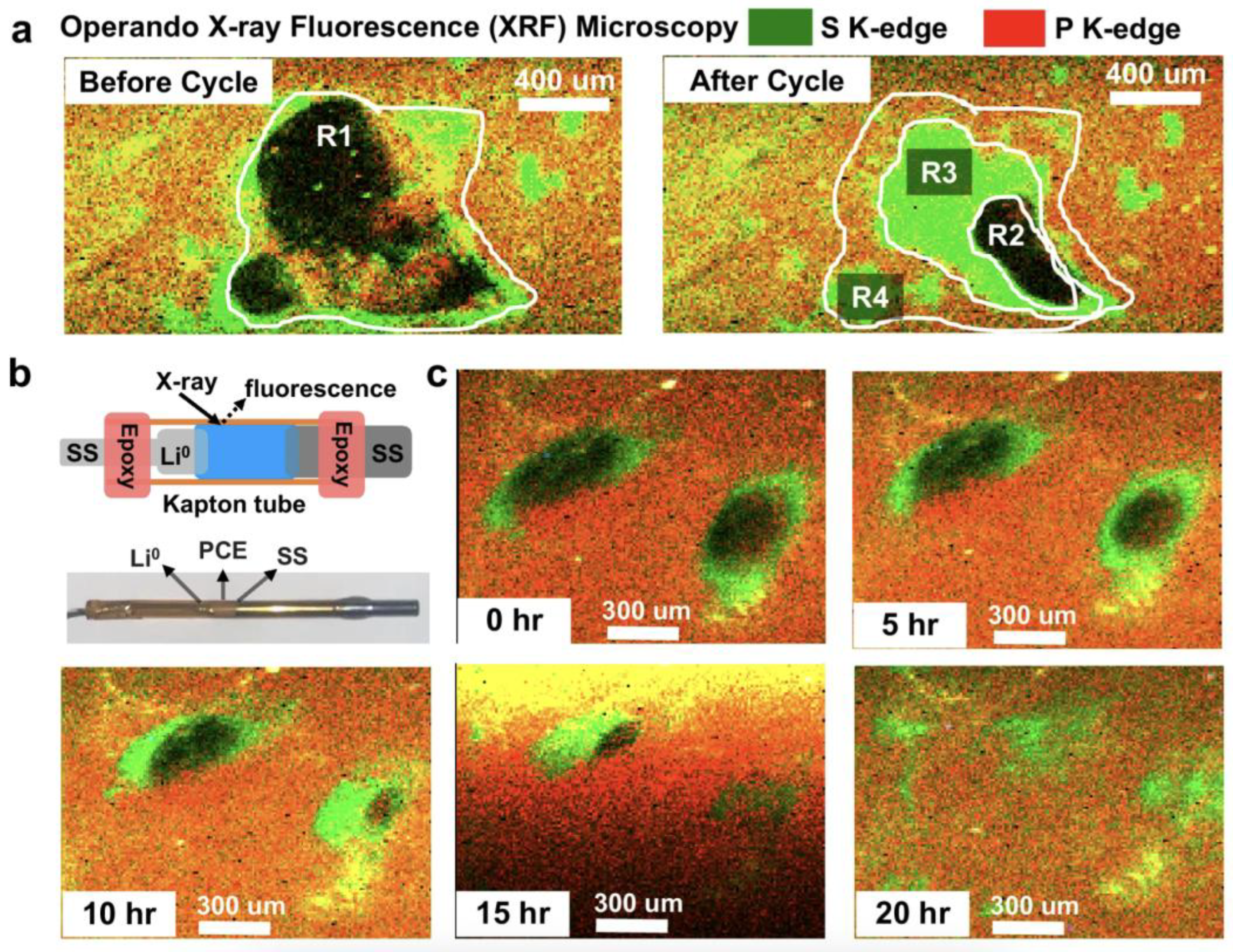
Figure 2.
Structural and compositional characterization of the MgₓLiᵧ/LiF–Li–rGO composite anode. Schematic illustration of the Li melt diffusion process and reversible plating/stripping in the MgF₂–GO scaffold (a); Cross-sectional SEM images of the MgF₂–rGO scaffold before (b) and after (c) Li infiltration, showing the formation of a porous structure (b,c); and TEM image and corresponding elemental mapping (C, Mg, F) confirm uniform distribution of Mg and F throughout the rGO framework. (Adapted with permission from ref. [90], Elsevier 2020).
Figure 2.
Structural and compositional characterization of the MgₓLiᵧ/LiF–Li–rGO composite anode. Schematic illustration of the Li melt diffusion process and reversible plating/stripping in the MgF₂–GO scaffold (a); Cross-sectional SEM images of the MgF₂–rGO scaffold before (b) and after (c) Li infiltration, showing the formation of a porous structure (b,c); and TEM image and corresponding elemental mapping (C, Mg, F) confirm uniform distribution of Mg and F throughout the rGO framework. (Adapted with permission from ref. [90], Elsevier 2020).
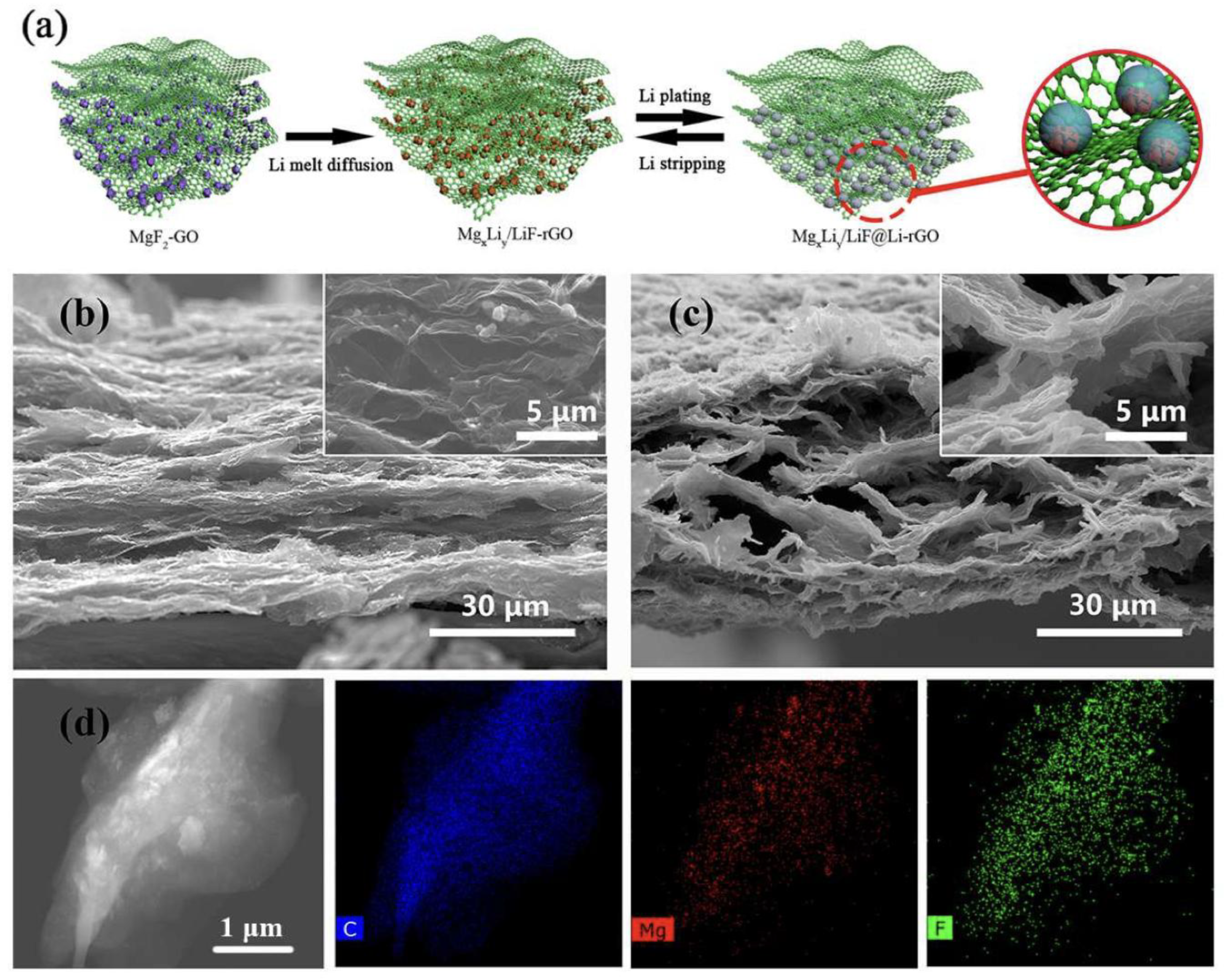
Figure 3.
Crack initiation and lithium penetration in single-crystal LLZO induced by Li eruption under constrained Cu|LLZO interface. Li eruption and stress buildup lead to sudden fracture in LLZO (a–c). Li penetrates and fills the crack, eventually splitting the entire particle (d–f). Current and volume traces reveal the onset of mechanical failure during fast Li deposition (g–h). Lateral extrusion under pressure enables stable Li plating without LLZO fracture (i–k). Direct comparison of both growth modes (l–n). Schematics of pressure-modulated growth mechanisms—creep-induced lateral growth vs. high-rate vertical rupture (o–q). (Adapted with permission from ref. [100], Springer Nature 2022).
Figure 3.
Crack initiation and lithium penetration in single-crystal LLZO induced by Li eruption under constrained Cu|LLZO interface. Li eruption and stress buildup lead to sudden fracture in LLZO (a–c). Li penetrates and fills the crack, eventually splitting the entire particle (d–f). Current and volume traces reveal the onset of mechanical failure during fast Li deposition (g–h). Lateral extrusion under pressure enables stable Li plating without LLZO fracture (i–k). Direct comparison of both growth modes (l–n). Schematics of pressure-modulated growth mechanisms—creep-induced lateral growth vs. high-rate vertical rupture (o–q). (Adapted with permission from ref. [100], Springer Nature 2022).
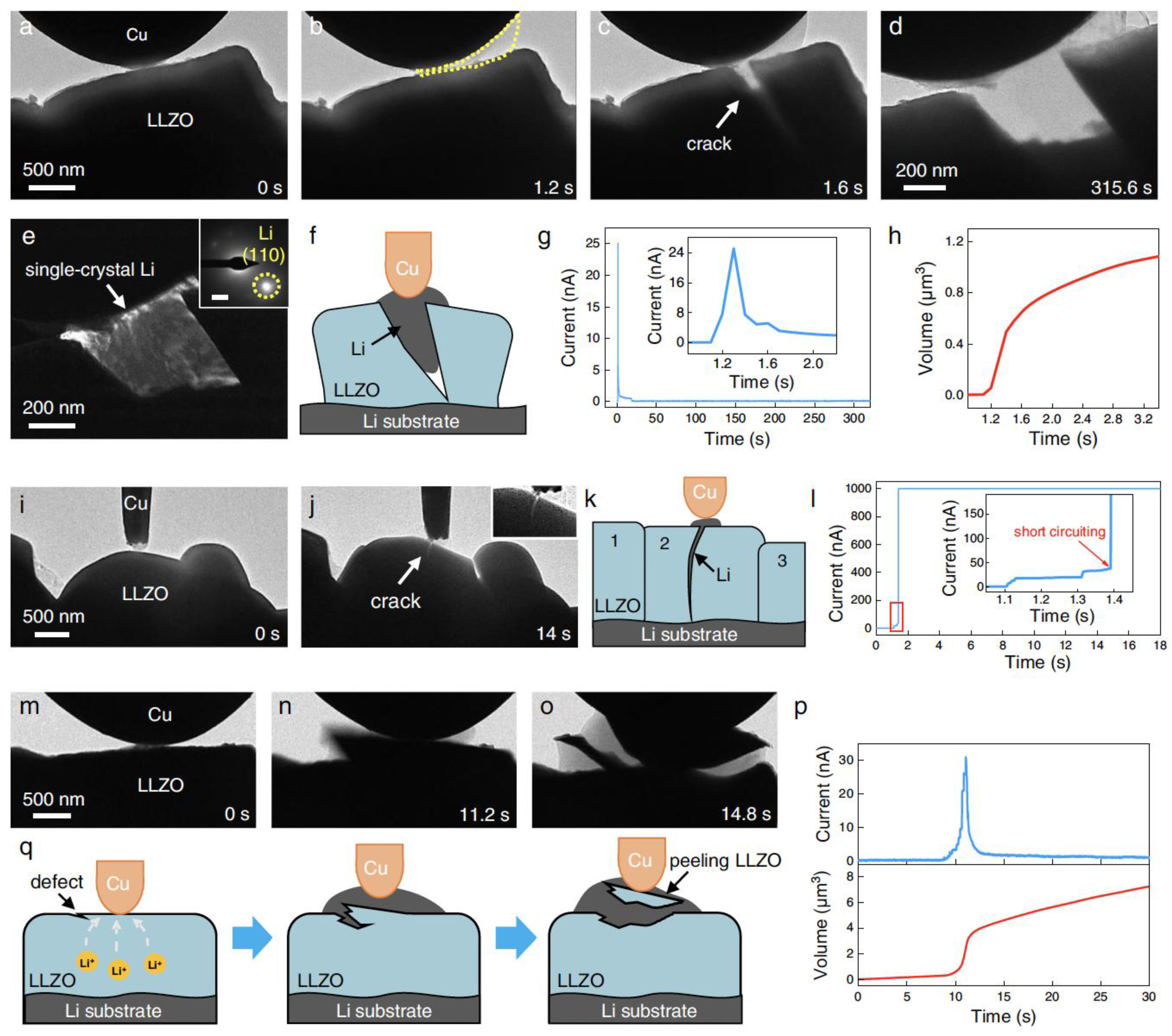
Figure 4.
Correlation between local compressive stress and dendrite formation in LLZO during Li plating, mapped via 3D confocal Raman microscopy. 3D stress map showing GPa-level compressive regions localized near microstructural defects (a). Optical and SEM images of lithium deposition reveal dendrite initiation sites aligning with Raman “hotspots” (b). Schematic of the electro-chemo-mechanical model connecting stress gradients to overpotential variation (c). (Adapted with permission from ref. [107], Cell Press 2022).
Figure 4.
Correlation between local compressive stress and dendrite formation in LLZO during Li plating, mapped via 3D confocal Raman microscopy. 3D stress map showing GPa-level compressive regions localized near microstructural defects (a). Optical and SEM images of lithium deposition reveal dendrite initiation sites aligning with Raman “hotspots” (b). Schematic of the electro-chemo-mechanical model connecting stress gradients to overpotential variation (c). (Adapted with permission from ref. [107], Cell Press 2022).
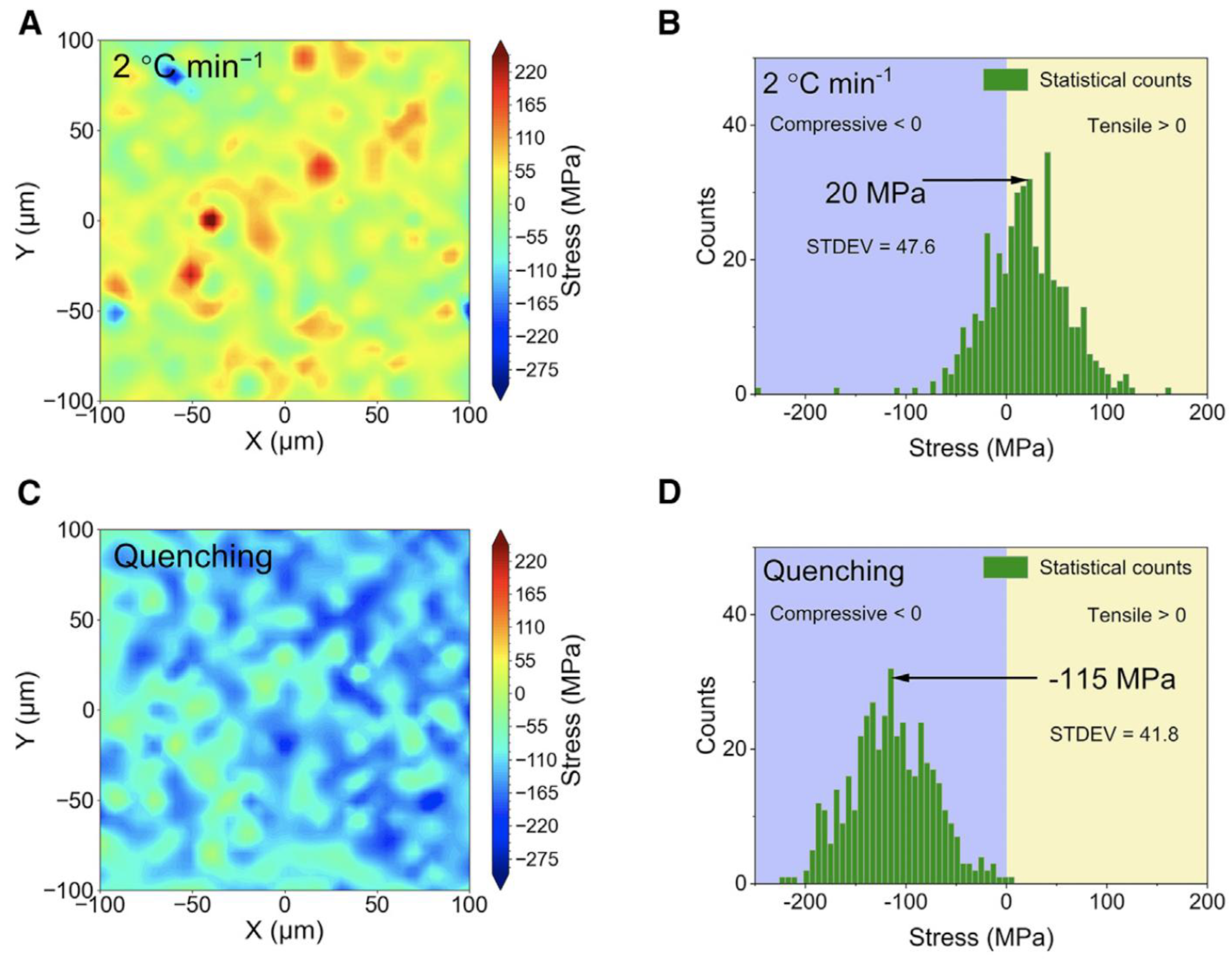
Figure 5.
DNP-enhanced NMR and HAADF-STEM analysis of SEI composition and lithium dendrite suppression in polymer–ceramic composite electrolytes. 6Li MAS NMR spectra deconvoluted into Li₂O, LiOH, Li₃PO₄, and Li–PEO species across PE, 40LGPC, and 60LGPC compositions (a–c). 31P MAS NMR spectra showing signals from Li₃PO₄ and LAGP (d–f). DNP-enhanced 6Li NMR showing signal amplification near the Li/SEI interface (g–i). HAADF-STEM and EDX maps of O, Ge, and P revealing interphase structure (j). Schematic representations of dendrite behavior under different ceramic loadings: unrestricted in PE, blocked in 60LGPC (k). (Adapted with permission from ref. [109], Springer Nature 2024).
Figure 5.
DNP-enhanced NMR and HAADF-STEM analysis of SEI composition and lithium dendrite suppression in polymer–ceramic composite electrolytes. 6Li MAS NMR spectra deconvoluted into Li₂O, LiOH, Li₃PO₄, and Li–PEO species across PE, 40LGPC, and 60LGPC compositions (a–c). 31P MAS NMR spectra showing signals from Li₃PO₄ and LAGP (d–f). DNP-enhanced 6Li NMR showing signal amplification near the Li/SEI interface (g–i). HAADF-STEM and EDX maps of O, Ge, and P revealing interphase structure (j). Schematic representations of dendrite behavior under different ceramic loadings: unrestricted in PE, blocked in 60LGPC (k). (Adapted with permission from ref. [109], Springer Nature 2024).
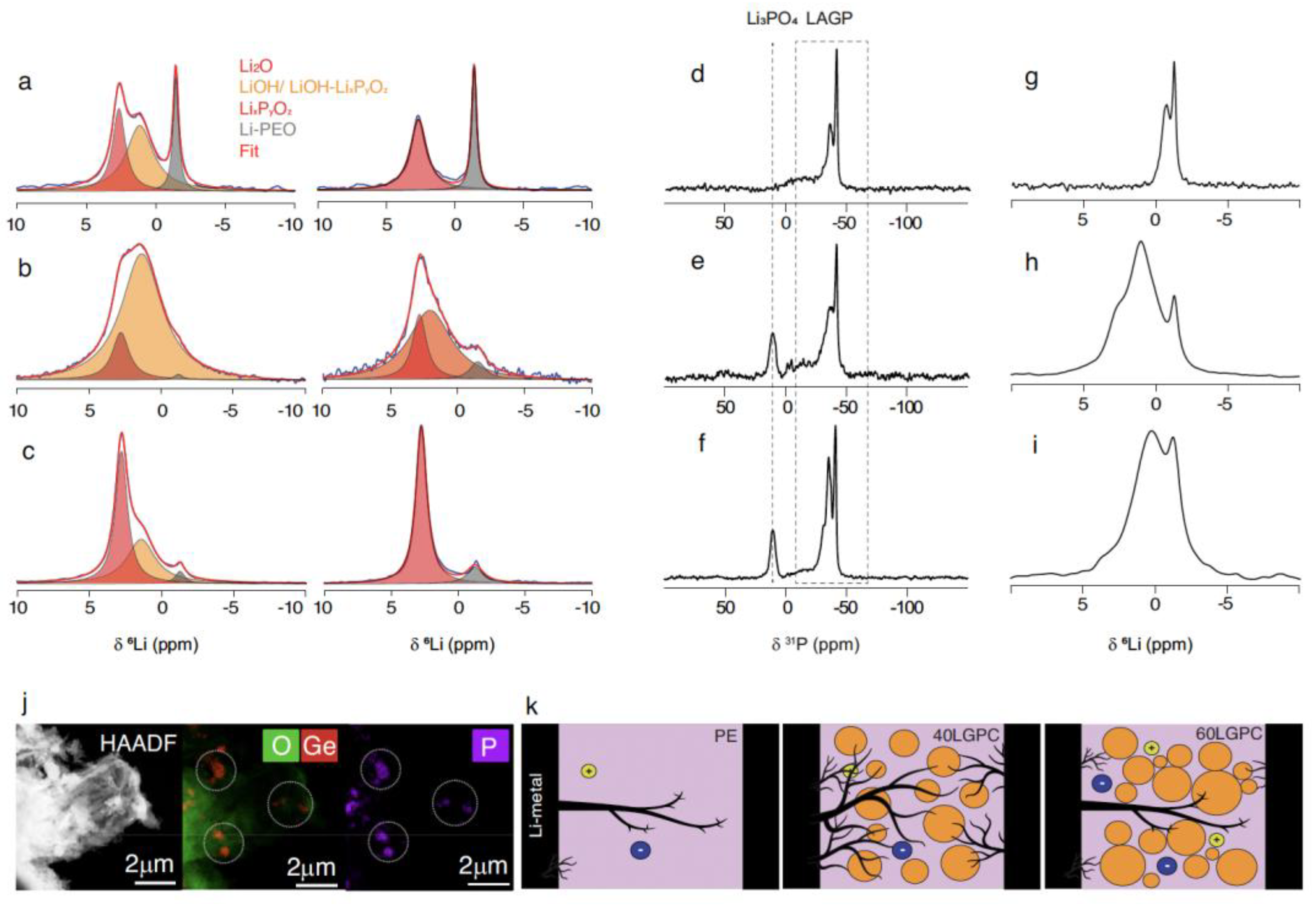
Figure 6.
Roadmap outlining critical stages toward the implementation of dendrite-free solid-state lithium batteries (SSLBs). Early-stage activities—including materials discovery, interface stabilization, and the scalable processing of solid-state electrolytes (SSEs)—are already underway or progressing significantly as of 2025. Subsequent phases, such as mechanistic validation, prototype development, and long-term safety testing, will be critical to achieve commercial integration by the end of the decade.
Figure 6.
Roadmap outlining critical stages toward the implementation of dendrite-free solid-state lithium batteries (SSLBs). Early-stage activities—including materials discovery, interface stabilization, and the scalable processing of solid-state electrolytes (SSEs)—are already underway or progressing significantly as of 2025. Subsequent phases, such as mechanistic validation, prototype development, and long-term safety testing, will be critical to achieve commercial integration by the end of the decade.
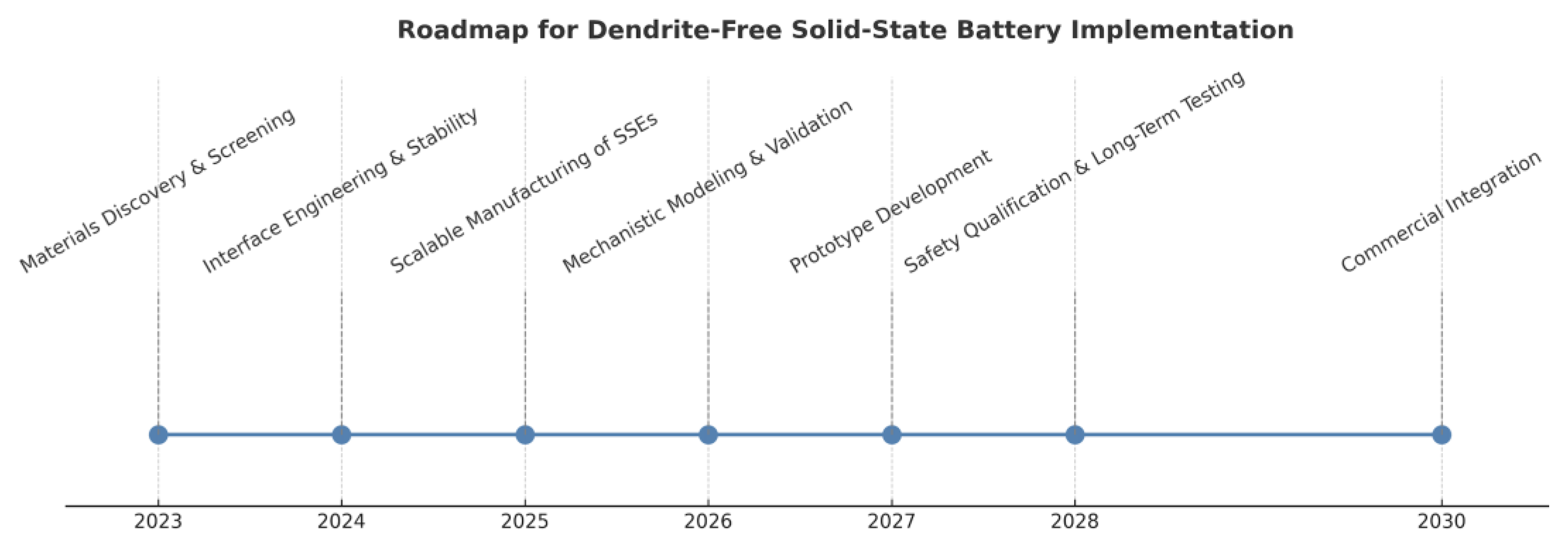

Table 1.
Comparative overview of recent dendrite suppression strategies in solid-state lithium batteries.
Table 1.
Comparative overview of recent dendrite suppression strategies in solid-state lithium batteries.
| Strategy | Main Advantage | Key Challenge | References |
|---|---|---|---|
| Interface Coatings | Enhances chemical stability at Li/SSE interface | Maintaining ionic conductivity across coating layer | [57] |
| Electron-Blocking Interlayers | Suppresses electron flow, blocks dendrite growth | Complex fabrication and interface compatibility | [58] |
| Polymer-Ceramic Composite Electrolytes | Combines mechanical flexibility and ionic conductivity | Achieving uniform dispersion and phase stability | [95] |
| Doping of SSEs | Improves ionic conductivity and structural robustness | Controlling dopant homogeneity and effects | [96] |
| 3D-Host Architectures | Reduces local current density, directs Li deposition | Fabrication scalability and maintaining conductivity | [97] |
| LiH Mitigation | Avoids insulating phases that degrade performance | Complete elimination of hydrogen sources is difficult | [98] |
Disclaimer/Publisher’s Note: The statements, opinions and data contained in all publications are solely those of the individual author(s) and contributor(s) and not of MDPI and/or the editor(s). MDPI and/or the editor(s) disclaim responsibility for any injury to people or property resulting from any ideas, methods, instructions or products referred to in the content. |
© 2025 by the authors. Licensee MDPI, Basel, Switzerland. This article is an open access article distributed under the terms and conditions of the Creative Commons Attribution (CC BY) license (http://creativecommons.org/licenses/by/4.0/).
Copyright: This open access article is published under a Creative Commons CC BY 4.0 license, which permit the free download, distribution, and reuse, provided that the author and preprint are cited in any reuse.


