

Submitted:
21 June 2025
Posted:
24 June 2025
You are already at the latest version
Abstract
The human body operates through complex bioelectrical systems, with the heart, brain, and gastrointestinal tract each generating distinct electrical signals. While Electrocardiography (ECG) and Electroencephalography (EEG) have long served as essential diagnostic tools, Electroenterography (EEnG) remains underutilized due to methodological challenges. Recent advances in systems physiology suggest that these three organs may not function in isolation but rather interact through a shared bioelectrical framework. In this review, we introduce the concept of the Tri-Electrical Axis - a proposed integrative network reflecting synchronized electrophysiological activity across the cardiac, cerebral, and enteric systems. We also tentatively define a central point of interaction within this axis as the Belviranli Junction, representing a novel physiological nexus. The integration of artificial intelligence (AI) into this framework holds promise for decoding complex multi-organ patterns, enabling real-time systemic monitoring and advancing precision diagnostics. This work synthesizes current literature, identifies critical gaps, and offers a forward-looking perspective on how multi-organ bioelectrical integration, supported by AI, may reshape future medical diagnostics and physiological understanding.

Keywords:
tri-electrical axis
; bioelectrical integration
; heart-brain-gut axis
; belviranli junction
; electrophysiology
; artificial intelligence in medicine
Introduction
The human body is governed by intricate bioelectrical systems, with each vital organ pulsing in its own rhythm of electrical activity. Electrocardiography (ECG), electroencephalography (EEG), and electroenterography (EEnG) allow us to capture snapshots of this activity from the heart, brain, and gastrointestinal tract, respectively. While ECG and EEG have become clinical cornerstones, EEnG remains underexplored - its diagnostic potential still largely untapped.
Yet, emerging research in systems physiology points toward a fascinating possibility: that these three organs, though distinct, may participate in a shared electrophysiological dialogue. Could the heart, brain, and gut collectively form an integrated “bioelectrical axis” reflecting the body’s internal harmony or its dysregulation? This integrative point of interaction - which we tentatively refer to as the Belviranli Junction - may represent a physiological nexus of synchronized bioelectrical activity across the heart, brain, and gut. We refer to this potential convergence point as a bioelectrical junction - a physiological crossroads where tri-organ electrical activity may synchronize and interact.
This concept, which we term the Tri-Electrical Axis, aims to shift focus from isolated organ readings to holistic bioelectrical patterns. We hypothesize that synchronized or correlative signals across these systems may represent a novel biomarker of physiological stability, stress, or pathology (Figure 1). Investigating this axis opens the door to new diagnostic strategies and a deeper understanding of inter-organ electrical synergy. Moreover, the rapid advancement of AI offers new tools for decoding complex, multimodal electrophysiological patterns, potentially enhancing the diagnostic utility of the Tri-Electrical Axis. Rather than functioning in isolation, we posit that the heart, brain, and gut may operate as synchronized components of a unified electrophysiological equation.
Literature Review
Electrophysiological monitoring of individual organs such as the heart and brain has achieved significant clinical and research milestones through Electrocardiography (ECG) and Electroencephalography (EEG), respectively. These modalities have profoundly shaped our understanding of organ-specific bioelectrical dynamics and their pathological alterations (Smith et al., 2020; Lee & Thompson, 2019). Conversely, the gastrointestinal tract’s electrical activity, captured via Electroenterography (EEnG), remains comparatively underexplored and methodologically challenging, limiting its translation into routine clinical diagnostics (Jones et al., 2018).
Emerging evidence elucidates complex neurohumoral crosstalk between the heart, brain, and gut, underscoring a sophisticated network that orchestrates systemic homeostasis (Mayer, 2011; Thayer & Lane, 2007). While bidirectional axes such as the gut-brain and heart-brain have been intensively investigated, a comprehensive integrative framework encompassing simultaneous electrophysiological interactions across all three organs remains conspicuously absent from current literature.
In light of these insights, we introduce the conceptual framework of a bioelectrical junction-a putative integrative nexus that embodies the convergence of cardiac, cerebral, and enteric electrical signals. This paradigm shift from isolated organ analysis towards holistic bioelectrical synergy promises novel biomarkers and therapeutic targets, potentially revolutionizing diagnostics and expanding our comprehension of inter-organ communication mechanisms.
This literature review endeavors to critically synthesize extant research, delineate knowledge gaps, and propose future directions for advancing tri-organ electrophysiological integration research.
While individual signal modalities-such as ECG and EEG-have been analyzed using AI in isolated settings, integrative, AI-driven frameworks that encompass synchronous signal processing across the heart, brain, and gut remain conspicuously absent. Addressing this gap could unlock powerful computational tools for decoding complex physiological patterns and advancing real-time diagnostic precision.
Discussion
The integration of electrophysiological signals from the heart, brain, and gastrointestinal tract presents a novel frontier in understanding systemic bioelectrical communication. While individual organ monitoring via ECG and EEG has provided invaluable clinical insights, the concept of a synchronized tri-organ electrical axis remains largely unexplored. Our review highlights critical gaps in current research and emphasizes the potential of the proposed “Tri-Electrical Axis” as a biomarker for holistic physiological assessment.
Despite advances in electrophysiological monitoring, current methods largely focus on isolated organ systems. Electroenterography (EEnG), though capable of recording gut electrical activity, remains underutilized due to technical limitations and inconsistent clinical applicability. This presents a significant barrier to understanding the gut’s role in systemic bioelectrical networks and its interaction with the heart and brain. Furthermore, most studies investigate bidirectional communication between two organs (e.g., gut-brain axis or heart-brain axis), while the tri-organ interaction remains inadequately addressed. This conceptual framework proposes not just a connection, but a balance—suggesting that systemic stability may depend on the synchronized harmony among these three bioelectrical centers.
The proposed “Tri-Electrical Axis” concept provides a comprehensive framework to explore inter-organ electrical synergy, potentially offering novel biomarkers for early detection of systemic pathologies such as autonomic dysfunction, stress responses, and inflammatory diseases. Additionally, this integrative approach may facilitate personalized medicine strategies by enabling simultaneous monitoring of multi-organ bioelectrical activities. A schematic representation of this integrative framework is illustrated in Figure 1, where the heart, brain, and gut form an electrophysiological triad, converging at the proposed Belviranli Junction.
Future research should prioritize developing advanced multimodal electrophysiological monitoring techniques, standardized protocols for signal acquisition and analysis, and large-scale clinical trials to validate the clinical relevance of the Tri-Electrical Axis. Cross-disciplinary collaboration involving cardiology, neurology, gastroenterology, and bioengineering will be essential in advancing this emerging field.
Ultimately, embracing the concept of a bioelectrical junction encompassing the heart, brain, and gut holds the promise of transforming diagnostic and therapeutic paradigms, ultimately enhancing our understanding of human physiology as an integrated electrical network.
Beyond traditional electrophysiological analysis, the integration of AI (artificial intelligence) presents a transformative opportunity in advancing the Tri-Electrical Axis framework. Machine learning algorithms-particularly deep learning models such as convolutional and recurrent neural networks-could facilitate the automated extraction and interpretation of complex patterns across ECG, EEG, and EEnG signals. Such AI-driven approaches have already demonstrated diagnostic accuracy in isolated systems, and their extension to multimodal, tri-organ datasets could enable real-time detection of subtle physiological disruptions. Incorporating AI into this paradigm may thus accelerate biomarker discovery, enhance systemic monitoring, and lay the groundwork for truly integrative, personalized medicine.
Conclusions
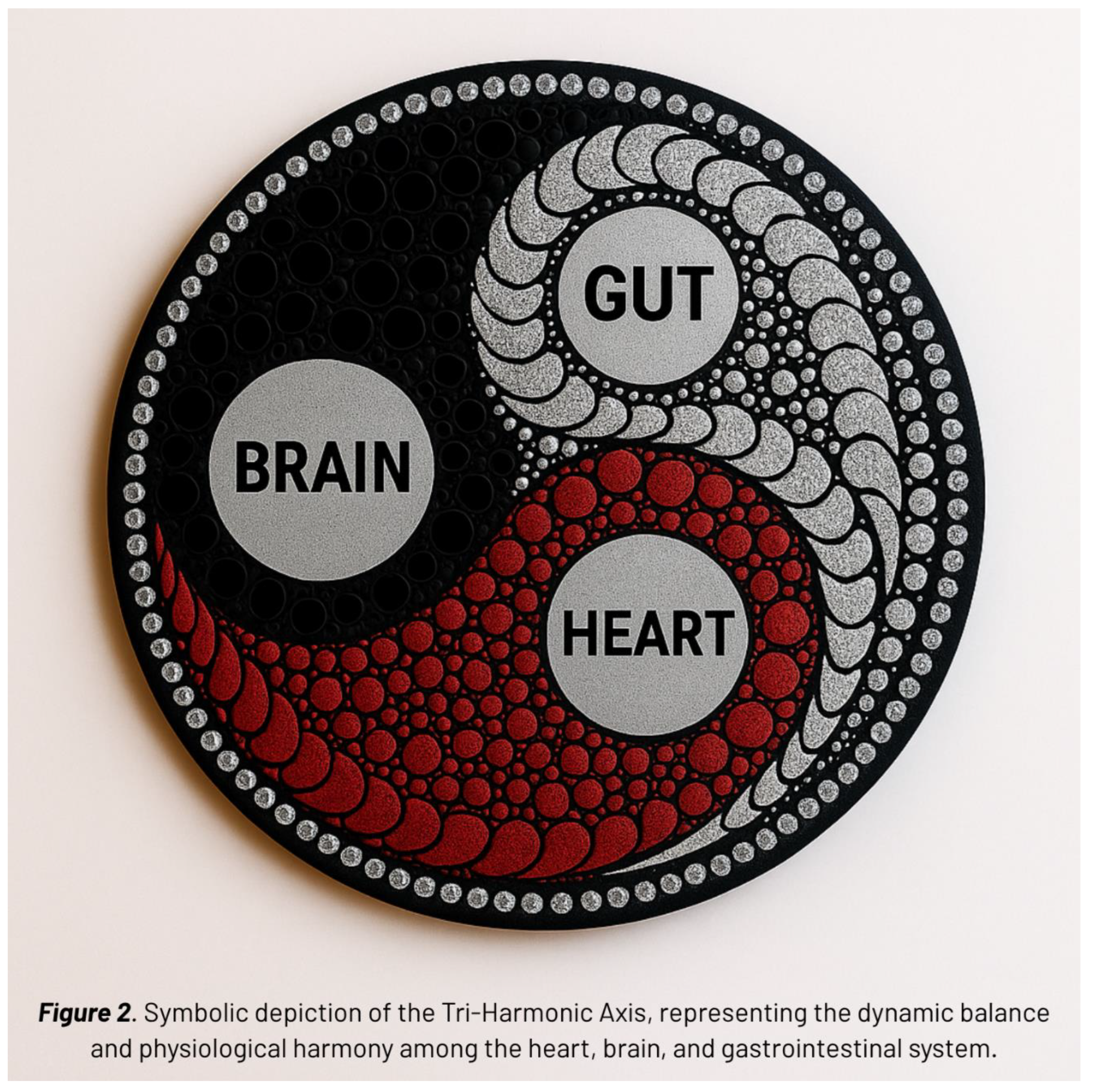
In this review, we have proposed the concept of the “Tri-Electrical Axis”-a potential integrative network, or bioelectrical junction, encompassing the electrophysiological activity of the heart, brain, and gastrointestinal system. While each of these organs has been extensively studied in isolation, the dynamic interplay among their electrical signals remains a largely unexplored but promising frontier. Recognizing this tri-organ synergy opens novel avenues for elucidating homeostatic regulation, detecting early pathophysiological disruptions, and identifying systemic biomarkers (Figure 2). This tri-organ harmony is conceptually visualized in Figure 2, symbolizing the systemic balance and interdependence of the heart, brain, and gut within the proposed axis.
We hypothesize that this tri-organ axis functions not merely as three parallel systems, but rather as interdependent components of a unified electrophysiological equation - an orchestrated, dynamic interplay through which bioelectrical signals synchronize to reflect the body’s systemic harmony, balance, and adaptive regulation.
Future interdisciplinary research-supported by advanced multimodal monitoring techniques-may not only validate this concept but also revolutionize how clinicians perceive and manage inter-organ communication. Embracing this bioelectrical junction paradigm may ultimately revolutionize our understanding of human physiology and pathophysiology.
Building upon this paradigm, the evolving field of artificial intelligence may further enhance the diagnostic precision and real-time monitoring potential of this tri-organ framework. It may play a pivotal role in advancing precision diagnostics and real-time systemic monitoring.
This conceptual framework, though in its early stages, may hold the potential to be as transformative to electrophysiological medicine as the discovery of fire was to early civilization. Just as the gut microbiome once reshaped immunology and internal medicine, the Tri-Electrical Axis and the Belviranli Junction could become foundational in understanding the systemic harmony-or discord-of human bioelectricity. This review serves not as an endpoint, but as a beginning-an ignition point for future research, validation, and discovery.
References
- Buzsáki, G. (2006). Rhythms of the Brain. Oxford University Press. [CrossRef]
- Craik, A. , He, Y., & Contreras-Vidal, J. L. Deep learning for EEG-based brain–computer interfaces: A review. Journal of Neural Engineering 2019, 16, 031001. [Google Scholar] [CrossRef] [PubMed]
- Faust, O. , Hagiwara, Y., Hong, T. J., Lih, O. S., & Acharya, U. R. Deep learning for healthcare applications based on physiological signals: A review. Computer Methods and Programs in Biomedicine 2021, 200, 105900. [Google Scholar] [CrossRef]
- Huizinga, J. D., & Lammers, W. J. E. P. Gut peristalsis is governed by a multitude of cooperating mechanisms. American Journal of Physiology–Gastrointestinal and Liver Physiology 2009, 296, G1–G8. [Google Scholar] [CrossRef]
- Mayer, E. A. Gut feelings: The emerging biology of gut–brain communication. Nature Reviews Neuroscience 2011, 12, 453–466. [Google Scholar] [CrossRef] [PubMed]
- Mayer, E. A. , Knight, R., Mazmanian, S. K., Cryan, J. F., & Tillisch, K. Gut microbes and the brain: Paradigm shift in neuroscience. The Journal of Neuroscience 2014, 34, 15490–15496. [Google Scholar] [CrossRef] [PubMed]
- Niedermeyer, E. , & Lopes da Silva, F. H. (Eds.). (2005). Electroencephalography: Basic principles, clinical applications, and related fields (5th ed.). Lippincott Williams & Wilkins.
- Rajpurkar, P. , Hannun, A. Y., Haghpanahi, M., Bourn, C., & Ng, A. Y. Cardiologist-level arrhythmia detection with convolutional neural networks. Nature Medicine 2019, 25, 65–69. [Google Scholar] [CrossRef]
- Thayer, J. F., & Lane, R. D. The role of vagal function in the risk for cardiovascular disease and mortality. Biological Psychology 2007, 74, 224–242. [Google Scholar] [CrossRef] [PubMed]
Figure 1.
Schematic representation of the Tri-Electrical Axis. This diagram illustrates the synchronized electrical interaction among the heart, brain, and gut. The central node represents the Belviranli Junction, where multi-organ signals are hypothesized to converge.
Figure 1.
Schematic representation of the Tri-Electrical Axis. This diagram illustrates the synchronized electrical interaction among the heart, brain, and gut. The central node represents the Belviranli Junction, where multi-organ signals are hypothesized to converge.
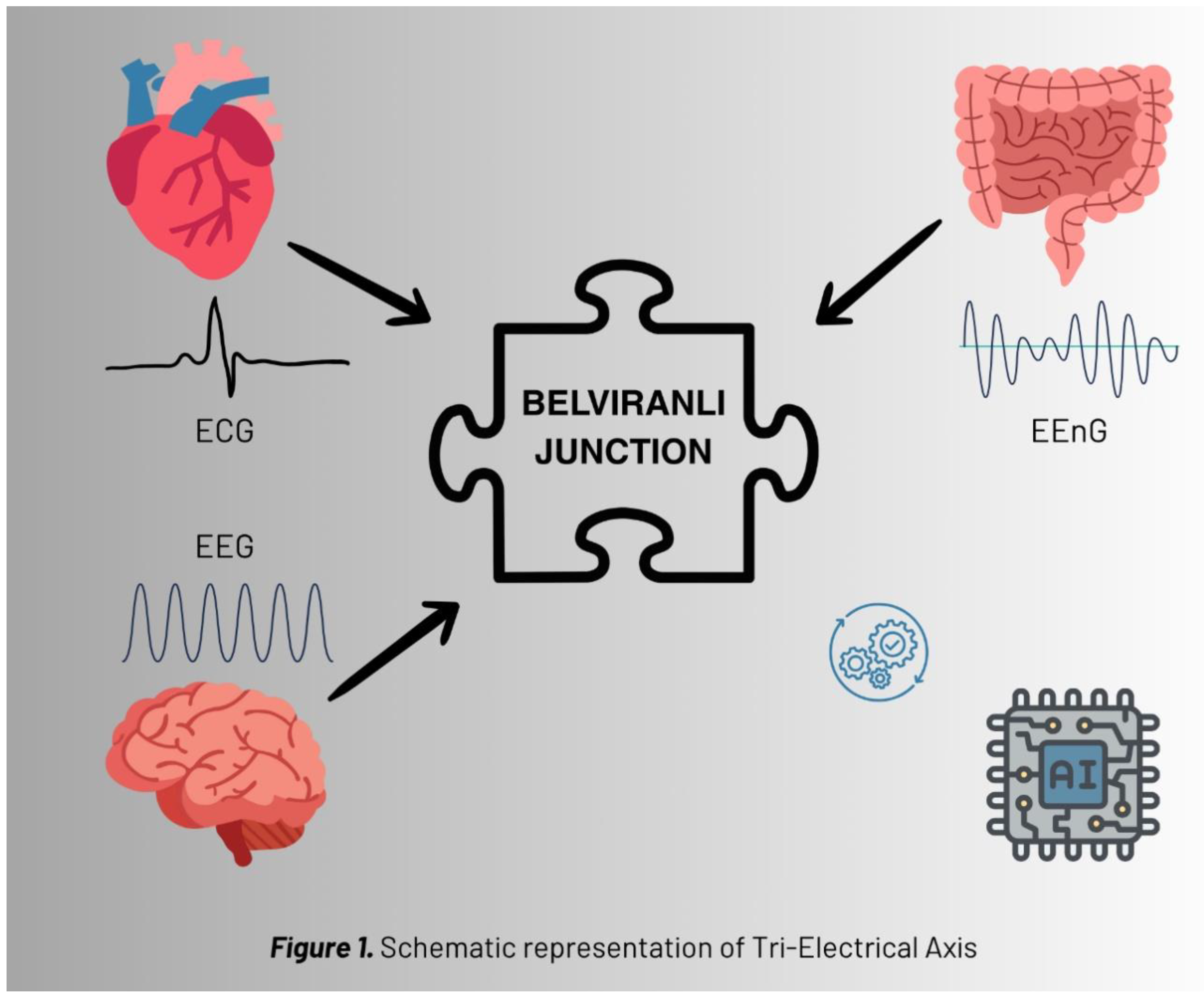
Figure 2.
Symbolic representation of the Tri-Harmonic Axis. This mandala-inspired circular illustration metaphorically reflects the dynamic physiological balance and interdependence among the heart, brain, and gut systems. The symmetry and cyclic flow reinforce the concept of a harmonic, bioelectrical integration model.
Figure 2.
Symbolic representation of the Tri-Harmonic Axis. This mandala-inspired circular illustration metaphorically reflects the dynamic physiological balance and interdependence among the heart, brain, and gut systems. The symmetry and cyclic flow reinforce the concept of a harmonic, bioelectrical integration model.
Disclaimer/Publisher’s Note: The statements, opinions and data contained in all publications are solely those of the individual author(s) and contributor(s) and not of MDPI and/or the editor(s). MDPI and/or the editor(s) disclaim responsibility for any injury to people or property resulting from any ideas, methods, instructions or products referred to in the content. |
© 2025 by the authors. Licensee MDPI, Basel, Switzerland. This article is an open access article distributed under the terms and conditions of the Creative Commons Attribution (CC BY) license (http://creativecommons.org/licenses/by/4.0/).
Copyright: This open access article is published under a Creative Commons CC BY 4.0 license, which permit the free download, distribution, and reuse, provided that the author and preprint are cited in any reuse.


