

Submitted:
17 June 2025
Posted:
19 June 2025
Read the latest preprint version here
Abstract
Both adaptive and non-adaptive theories of evolution have been proposed to explain the process of speciation: how natural selection operates on individuals and populations. Non-adaptive theories emphasize the force of genetic drift in driving speciation while adaptive theories emphasize the force of ecological selection. Both types of theory focus on genetic variation in the organism’s genotype, the set of all genes in the genome. The repeatedly observed correlation between amino acid substitution (non-synonymous nucleotide substitutions in codons, dN) and mutation rates (synonymous nucleotide substitutions in genes, dS) has remained something of a mystery since it was first observed and subsequently confirmed in multiple organisms. The following will examine the interaction between the forces of genetic drift and ecological selection in the context of two separate but interacting molecular clocks: the well established gene specific molecular clock and the largely overlooked karyotype specific or “junk” DNA clock.
Keywords:
genome stability
; DNA repair
; DNA replication timing program
; species richness
; karyotype
; mutation rate
; transposable elements
; non-adaptive radiation
Significance
The eukaryote DNA replication timing program (RT) organizes the DNA synthetic phase (S phase) of the cell cycle and coordinates genome duplication with mitosis and cell division. A complex system of DNA damage detection and repair (DDR) reinforces this organization in order to sustain and constrain mutation/substitution balance. The RT therefore has important implications for the evolution of genome architecture, karyotype diversity and species richness. To date, few studies have directly examined the role RT plays in speciation and adaptive radiations. That question will be addressed in the following.
1. Introduction
1.1.
Karyotypes evolve faster than genes, an observation frequently made since the 1970s. Maxon and Wilson, among others, reported that amphibian karyotypes evolve at several times the rate of the genes residing in the corresponding genomes; a similar observation had also been made in plants [1,2,3]. Karyotypes are therefore presumably under relaxed selection and evolve more randomly according to genetic drift, while genes are more subject to purifying and positive selection. Consequently, orthologous genes in different species are less divergent than the karyotypes of the respective genomes.
Additionally, the numbers of genes in vertebrates and invertebrates are very similar among different species in the respective groups [4], and evolve on average at the same constant rate. In contrast, karyotypes vary widely from species to species and across clades and lineages. Rates of karyotype evolution also vary widely across the mammalian phylogenetic clades and across the Tree of Life [5]. This observation is somewhat puzzling given that gene order, or synteny, is highly conserved in Mammalia, Aves and Amphibia [6], indicating that synteny is under strong purifying selection [7].
The conserved average rate of mutations in protein coding exons led to the proposal of a relatively constant molecular clock that governs the rate of gene and genotype evolution [8,9,10], and therefore the rate at which species diverge (speciation rate) [11,12], a hypothesis that remains to be fully confirmed [13,14]. A paradox emerges from the assumption that genes and genotypes diverge at a constant rate: assuming that macroevolution (species diversification) is linked to microevolution (genetic divergence), how can a relatively constant rate of genotype change explain the extreme differences in species richness (SR) and species evenness (SE) observed across phylogenetic clades and lineages?
1.2.
Ecological selection, it is commonly assumed, acting differentially and non-randomly on invariant rates of genetic change can result in environmentally determined differences in selection pressure, and therefore can explain phylogenetic differences in SR and SE [15,16,17,18,19,20]. A clear latitudinal—and therefore climatic—biodiversity gradient exists, for example, with species richness and biodiversity in biomes increasing from the poles to the equator [21,22,23,24,25]. Other factors including clade age also play determining roles [26,27,28].
The Tri-cellular model of atmospheric convection currents likewise explains differences in biome biodiversity and geographic location in climatic terms: low levels of precipitation, temperature and insolation are consistently associated with low levels of biodiversity and infertile edaphic conditions, for example, in tundra (permafrost), and in polar and desert biomes. The latitudinal location of biomes can explain SR, but SR nevertheless appears to be unlinked to diversification rates: speciation—extinction rates [29]. Furthermore, niche rate depends on climatic factors (temperature and humidity) and correlates strongly with SR [30,31].
Other ecological features such as geographic range size (a proxy variable for effective population size, Ne) [32] life history traits also correlate with SR, for example r-strategists versus K-strategists and their corresponding phenotypes including body size, metabolic rate, generation time, developmental rate, fecundity and maximum lifespan. Consequently karyotype diversity (KD) and evolution, while contributing to speciation, have long been considered generally lacking in explanatory power regarding species richness and speciation rates [33,34,35].
1.3.
This assumption has been attributed to the apparent neutral evolution of KD and related expansions and contractions in neutral non-coding DNA, resulting in a wide range of genome size in any given phylogenetic lineage (Figure 1). The random expansion and contraction in a lineage’s genome size [36,37], such as the salamander lineage [38], led to the proposal of a second “junk” DNA clock [39]. It should be noted, however, that the rate junk DNA changes in the genome is comparable to the respective mutation rate [40]. Why this should be so—such a widely varying SR yet a relatively constant molecular clock rate of gene diversification—nevertheless remains an open question and an issue of continuing debate and controversy.
Moreover, it seems unlikely a priori, that ecological selection could determine or shape any given species karyotype, or that karyotype diversification could be inherently adaptive [5,41,42], because ES acts on physical phenotype and physiology independently of karyotype in any given clade or lineage. It remains certainly plausible, however, that changes in karyotype and genome architecture result in the zygotic isolation that ensues from geographic and reproductive isolation (either sympatric or allopatric) [43]; and hence ecological selection would eventually act on genetic drift-driven karyotype diversity over geological time, thus promoting the processes of speciation and adaptive radiation.
The following sequence of events might properly frame the process of ecological succession that characterizes macroevolution ([44]; Figure 2):
- 1)
- geographic isolation following a population split.
- 2)
- neutral (non-genic) karyotype diversification driven by genetic drift, eventually involving genes in species with small effective population sizes (microevolution).
- 3)
- reproductive (pre and post-zygotic) isolation separating diverged populations (for example, ring species).
- 4)
- ecological selection driving speciation and adaptive radiation into newly evolved niches (macroevolution).
1.4.
Confounding the predominant role of ES in explaining most speciation events and the highly varying adaptive radiations across clades and lineages is the observation that amino acid substitution rates in proteins are proportional to nucleotide substitution rates in genes: non-synonymous (amino acid changing) substitutions in codons correlate with synonymous (silent) substitutions in genes in all eukaryotes examined [45,46,47] The ratio between these two is therefore relatively constant (dN/dS proportional to 1). Any detectable deviations from neutrality (dS = dN) are interpreted either as signatures of purifying selection (dN/dS << 1) or positive selection (dN/dS > 1).
The correlation between dN and dS, though lacking a comprehensive molecular explanation, is nonetheless expected if, as commonly assumed, most amino acid substitutions in proteins are either deleterious or functionally neutral (dN and dS both reflect the mutation rate). The correlation, however, is much stronger than would be expected assuming that dN/dS simply reflects the proportion of neutral non-synonymous substitutions, and therefore the underlying mutation rate [48,49]. Moreover, the effect is uniform across all genes in a genome and phylogenetically independent of species relatedness [49,50,51].
Several hypotheses have been advanced to explain the correlation (see for example: [49,52]). One hypothesis proposes that the correlation is due to a positional, or genomic context effect: because the mutation rate varies across the genome from yeast to plants and animals, any positional, or regional, change in the mutation rate will impact both dN and dS indifferently [53]. Both categories of mutation will be affected in equal proportion: region-wide dN and dS rates will increase or decrease together regardless of the fact that different genes in the same genome experience significantly differing mutation rates [51].
The effect, the hypothesis predicts, will also apply to non-genic, non-coding DNA residing in the same region as coding DNA. Mutation rates, for example, in ultra-conserved elements (UCE), which are involved in vertebrate development and reside within introns or outside genes [54], correlate with dN and dS inside the exons of the adjacent genes [45]. The two categories of mutation, dN and dS, therefore remain correlated with polymorphisms in non-coding inter-genic regions, and perhaps intra-genic introns [55,56].
The eukaryotic genome is broadly partitioned into two spatial and temporal compartments: early replicating (open) euchromatin (EC) and late replicating (compact) heterochromatin (HC). EC is enriched in GC nucleotides while HC (and facultative HC) is enriched in AT nucleotides. In all species so far examined, mutation rates are significantly higher in genome regions containing HC compared to regions containing EC [57,58,59,60,61,62]. Consequently the DNA replication timing (RT) program during DNA synthetic, or S phase, of the cell cycle will simultaneously modulate dN and dS either positively or negatively according to the genome wide variation in mutation rates: relatively low mutation rates in early replicating genes; relatively high mutation rates in late replicating genes. The following will examine the role of RT on mutation rates, genome stability, karyotype diversification and species richness.
2.1. RT and Replication Origins
The eukaryotic DNA replication timing program has been intensively studied over the last several years in yeast and metazoa [63]. Briefly, the RT program corresponds to the timing of the activation of replication origins (start sites of DNA synthesis) during the S phase of the cell cycle [64,65]. In most species, the genetic locations of replication origins are not specified by a conserved DNA sequence. Instead, origin locations depend primarily on chromatin context. Although all origins are “licensed” by an origin recognition complex (ORC and MCM helicases) in late mitotic M phase and post divisional G1 phase, only about 10% of licensed origins are activated during S phase [66]. Activation, or initiation, occurs asynchronously and with increasing density (initiations per kilobase) into mid-S phase (Figure 3), and then decreases as the cells progress toward the G2 phase prior to mitosis [67].
The timing of origin activation depends on many factors that are associated with two fundamental features: 1) the efficiency, or probability, of origin activation, which is determined by the number of MCM helicases loaded at the origin and, in budding yeast, the levels of a nuclear complex of six positively acting initiation factors [68]; and 2) the strength of the intra-S phase checkpoint, which is a complex of factors that negatively regulates origin activation. Other factors, such as Rif1 in higher eukaryotes and sir2 and rpd3 in yeast [69,70], also play a role in establishing a late replication regime. While the biochemistry of these processes is beyond the scope of this paper, it is, in part, the opposing interplay between origin efficiency and the strength of origin inhibition that coordinates origin activation with gene transcription and establishes a late replication-timing program.
It might be interesting to note that origins located near or in highly expressed genes, which are early replicating, are more prone to DNA damage, while at the same time early replicating regions have substantially lower rates of substitution [71,72]. One possible explanation might be that origin-induced DNA damage, in addition to a relatively higher density of single strand DNA, activates the intra-S checkpoint, which in turn represses later activated/less efficient origins and stimulates the DNA damage detection and repair system (DDR). Enhanced DDR function then targets earlier replicating DNA to repair the DNA in the region where the mutagenic origin resides. Mutagenic early origins thus promote DNA repair in early replicating regions while repressing replication origins in later replicating regions.
3.2. RT and the Regulation of Gene Transcription
Genome size in different species is an important modulator of RT. The RT program partitions genome duplication into successive time zones and regions (replication domains) that vary in duration (45 to 60 min.) and size (1.3 to 3.6 Mbp), in addition to varying in proportion to C-value (haploid genome size measured in picograms, where one picogram = 978 Mbp) [73,74,75,76]. Consequently, the RT program regulates the duration of S phase and the cell division cycle according to C-value, which therefore has an important influence on generation time and related mutation rates [45].
As mentioned above, a clear relationship has been found between origin firing and gene transcription activity. Transcription start sites (TSS) correlate strongly with origin location, and introns in higher eukaryotes harbor between 40 to 60 % of replication origins depending on the species ([77]; Figure 4): the earlier an origin fires in the S phase, the higher the level of transcriptional activity and gene expression [78]. Highly expressed genes are for that reason early replicating. In mammals, for example, transcriptional activity is associated with origin efficiency [79,80,81,82]. In yeast, experimentally overproducing the six limiting initiation factors causes origins to fire earlier in S phase, and concomitantly increases transcriptional activity of the adjacently located genes [83].
Importantly, the size of introns in genes is also proportional to C-value: genes in larger genomes have larger introns [84,85]. This has direct consequences on transcription rates and regulation, with larger genes being transcribed more slowly and expressed generally at lower levels (intron delay) [86,87]. The global result is a longer cell cycle and correspondingly slower developmental rates, and in paedomorphs such as salamanders even fully arrested developmental programs (neoteny) [88,89].
Introns are generally longer in later replicating genes that have tissue type specific or developmental functions, and consequently late replicating genes have lower expression levels [90]. Many proteins of late replicating genes interface with the environment such as immune system genes and the olfactory gene cluster—so called “adaptive” or “speciation genes”, or genes that are essential to organism and phenotype integrity (sensory factors) [53]. Earlier replicating genes that are highly expressed, in contrast, correspond generally to genes essential for cellular function and survival, for example, the house keeping genes that maintain cellular and genetic integrity [91,92]. Interestingly, a negative correlation between protein evolutionary rate (dN) and intron size has been observed in Drosophila [93], consistent with lower mutation/substitution rates in exons (dS; see below).
It should also be noted that older origins in yeast, independently of efficiency, tend to be more frequently lost during the course of speciation and adaptation [94]. More efficient origins, however, are under greater selection pressure, and are conserved in preference to origins of weaker efficiency. Consequently, the distances between origins, rather than their specific genome locations outside of genes, are also under selection pressure to minimize S-phase [95].
The study on origin evolution in yeast, however, did not directly address the question of whether or not origin loss (or, conversely, gain) altered levels of transcription in adjacent genes, as is the case when experimentally increasing origin efficiency alters transcription factor promoter binding and stimulates gene expression levels [83]. Importantly, the same study on yeast revealed that the RT program evolves in a manner coordinated with protein divergence and chromosomal divergence, but without an apparent causal relationship. In humans, a causal relationship between RT and transcription also appears to be more subtle [96].
3.3. RT and protein folding versus protein function
Why do essential house keeping genes and other genes that replicate early evolve more slowly? Although still controversial, one compelling explanation is that they have substantially higher expression levels, which places evolutionary constraints on the set of viable amino acid sequences and non-neutral substitutions [72,97]. It has long been assumed that the lower amino acid substitution rates were due to selection acting on the proteins’ essential functions. That turns out to be the case; but it is selection acting on protein folding rather than on protein function alone that appears to explain, at least in yeast, the high levels of expression in these genes, and hence their biased location in euchromatin.
Selection pressure against protein misfolding is an appealing hypothesis because it could provide another plausible explanation for the correlation between dN and dS. The correlation between gene expression level and dN in these genes is two times stronger than the correlation with dS, indicating selection for translational accuracy (slowing dS) coupled with selection for translational robustness (slowing dN) [72,98]. Selection on protein folding might therefore distinguish early replicating genes from later replicating genes, which are primarily subject to selection on function and adaptive phenotype. Biased selection on the functionality of adaptive and speciation genes thus might explain their enrichment in mutation/substitution prone late replicating DNA, with the fortuitous consequence of higher allelic diversity and polymorphism among more weakly expressed, late replicating developmental genes.
4.1. RT and Genome Stability
Based on these and other findings, it has been suggested that the RT program evolved to govern and regulate the transcriptome during development, and to obviate the mutagenic effects of synchronous origin firing and a surfeit of multiple, simultaneously elongating DNA replication forks, which can be mutagenic and result in genome instability [99,100,101]. Ablating the checkpoint, for example, causes origins to fire earlier and results in massive DNA damage. Conversely, over-expressing initiation-specific proteins causes all origins to fire earlier in budding yeast and is lethal unless ribonucleotide reductase is simultaneously over-produced to supply the forks with sufficient levels of dNTPs [83].
Another related explanation for the evolution of replication timing therefore concerns the intra-S checkpoint and the associated DNA damage detection and repair system (DDR). This feature relates to dNTP supply and to the fact that replication forks are sensitive to dNTP levels, which, when imbalanced or perturbed, are highly mutagenic and a major cause of genome instability (rearrangements, amplifications and deletions, etc.). Hence, replication fork rates determine origin usage under replication stress in all organisms including bacteria. So-called “dormant”, or auxiliary, origins are activated in response to perturbed or stalled replication forks [102,103].
Origin usage and replication fork rates are therefore universally correlated [104]. This is likely to be the case even under non-stressed conditions [105,106], and hence arguably replication fork rates, widely varying across the genome, coordinate the RT program [107]: larger replicons (origin to origin distances) correlate with faster replication fork rates while smaller replicons correlate with slower fork rates. In this manner, the RT program maintains a constant overall rate of replication in domains of differing size, an essential feature of genome stability. At the same time, coordination of fork rates and origin efficiencies serves to limit the rate of DNA damage and maintain mutation/substitution balance across the genome.
4.2. RT and Introns as Adaptations to DNA Damage
The origin of introns, which have multiple effects on gene transcription and protein diversification, has been of longstanding interest in molecular and evolutionary biology. What is their role or effect, however, on DNA replication and genome stability? Introns accumulate in evolutionary conserved genes [108], suggesting that introns might play a role in maintaining gene sequence and structural integrity. Intron gain rates, for example, correlate negatively with sequence evolution rates, while intron loss rates correlate positively [108]. At the same time, changes in C-value during evolution appear to be driving the evolution of intron size toward either longer introns (genome expansion) or shorter introns (genome contraction) [36,109,110,111].
Under unperturbed conditions most constitutive origins—evolutionary conserved origins—are located in inter-genic regions or are associated with transcription start sites (TSS). When S phase is advanced experimentally by over expressing certain oncogenes, origins that normally don’t fire during S phase are induced to fire in intra-genic regions—presumably inside introns, where DNA damage is most likely to occur [112]. At the same time, introns are believed to protect genes against DNA damage [113]. It therefore seems reasonable to assume that introns are enriched in anomalous intra-genic origins—dormant origins (DO) that are inefficient and fire only in the presence of blocked replication forks [77]. If so, longer introns will harbor proportionally more DOs, since dormant origins are closely and regularly spaced (about 15 kb; [114]). The dormant origins are believed to have evolved to ensure genome stability during replication stress [103,115].
Consequently, stress induced activation of dormant origins in introns might serve to protect genes against DNA damage and lethal DSBs. This could explain why genes in the giant salamander genome contain introns that are up to 5X the sizes of introns in species with smaller genomes [83], a phenomenon perhaps explained by transposon proliferation [116]: the extra, intra-genic dormant origins are required for both gene and genome stability. Additionally, checkpoint inhibition of these supplementary origins is expected to be correspondingly stronger and mutation rates correspondingly lower. This explanation of the origin of intron size variation, however, remains to be fully verified.
4.3. RT and DNA Repair
The DDR employs two principal systems that respond to and repair lethal DNA double strand breaks (DSBs): error free homologous recombination (HR) and error prone non-homologous end joining (NHEJ). HR depends on a homologous sister chromatid to repair DSBs and is largely restricted to S phase and predominates primarily in S and G2 phases [117]. NHEJ operates throughout the cell cycle and progressively replaces HR in the last half of S-G2 phase [118,119]. This might explain why late replicating DNA has relatively higher mutation rates than early replicating DNA, although other factors such as error prone DNA damage polymerases play important roles [57,120].
The relative ratios of these two repair systems thus directly impact mutation rates across the genome, and not surprisingly in a genome size manner, with NHEJ being three times more efficient than HR [117,121]. Eukaryotes with small genomes such as yeast rely predominantly on HR, while species with larger genomes such as vertebrates increasingly rely on NHEJ as C-values increase in the respective species [85,122]. Mutation rates are expected to be anti-correlated between early and late replicating DNA in a genome size dependent manner: a weaker anti-correlation in small genome species; a stronger anti-correlation in large genome species. This remains to be shown, however.
If intron densities increase in more NHEJ dependent genomes [85], then the strength of the RT program might be expected to increase in parallel [123]. In yeast, for example, although origins are initiated throughout S-phase (early to late), the vast majority of origins initiate in the first third of S-phase [68,124], with the pattern of origin activation during S phase varying considerably from cell to cell [125]. Species with larger genomes in contrast have a significantly less flexible and more deterministic RT program [75,123]. In vertebrates, for example, late firing origins rarely if ever fire early in S phase, although the RT program itself is subject to species and tissue dependent differences in replication timing.
5.1. RT and Genome Evolution: a RT Molecular Clock?
Although the RT program becomes more complex with increasing C-values, the RT program itself is subject to selection and evolution, as well as to variation in RT in facultative HC (fHC) during tissue differentiation and development [126]. Most of the RT variants are associated with weak, late firing origins, which have a greater probability of loss during evolution [94,96,127]. In addition to gene and karyotype evolution, the RT program likewise diverges widely between lineages, yet DNA replication timing is largely conserved between species [96,128,129].
Because evolution of RT programs aligns with phylogeny, evolutionary changes in RT represent a third class, or source, of molecular evolution and speciation that recapitulates the phylogenetic tree in primates and yeast [94,95,127,130]. Mutagenic loci (sites of higher sequence divergence) such as the human accelerated region (HAR) were found to be biased toward late replication, while sites of highly conserved sequences such as ultra-conserved elements and loss of function intolerant genes replicate early; divergent sites and HARs are enriched in RT variant regions, which are genomic regions that have experienced an evolutionary change in replication timing [96].
It is tempting, therefore, to speculate that evolution of the RT program and the related organization of the genome into differential compartments of fHC, HC and EC represent adaptations to generate and maintain gene polymorphisms and allelic diversity in faster evolving late replicating genes. If so, the RT program might provide a solution of sorts to the puzzling question of why the eukaryote genome has retained rather than eliminated so much and such a variety of non-coding and potentially maladaptive, largely repetitive, “junk” DNA.
The commonly held view of relaxed selection in species with low effective population size, such as salamanders, is increasingly in doubt [131,132,133,134]. This came as something of a surprise since genetic drift can explain karyotype diversity among salamander phylogenetic clades; but it does not explain genetic diversity in salamander genes [135,136], which varies little among clades and is more subject to selection compared to other vertebrates (dN/dS > 1).
The hypothesis that small effective population sizes and genetic drift explain changes in genome architecture and species richness is nonetheless comforted by the observation that speciation events have been found to be associated with higher substitution rates [10,136,137]. Relaxed selection in small effective and census population sizes, accordingly, results in respectively higher rates of mutation and subsequently higher levels of standing genetic diversity on which positive and purifying selection can act [98,138,139] This scenario suggests that repeated cycles of drift during population bottlenecks followed by ecological selection act synergistically to drive speciation and rates of species accumulation in phylogenetic clades ([44,140,141]; Figure 2)
5.2. RT and the Correlation between dN and dS
Analogous to the clonal selection theory in immunology, balancing selection on DNA polymorphisms and allelic diversity has acted to multiply the adaptive opportunities and evolutionary trajectories that have led to the emergence of increasingly complex organisms. This has been shown to be the case for certain genes in the immune system-related major histo-compatibility complex (MHC). The MHC replicates in the first half of S phase; but the class II elements (AT rich), compared to classes I and III (GC rich), replicate later toward the middle of S phase, when replication fork densities (and hence mutation probabilities) are highest during the cell cycle [67].
This study again revealed a correlation between dN and dS but instead with dN > dS, indicating selection for diversity. In salamanders, for example, levels of dN/dS are significantly higher than in other vertebrates while levels of dS are, paradoxically, substantially lower [131], reflecting stronger selection and lower mutation rates (weaker genetic drift). Strong selection in salamanders might therefore “overwhelm” genetic drift in salamander species with low effective population sizes, contrary to expectations. High rates of selection might compensate for the low rates of mutation, a plausible explanation for the relatively low species richness in most salamander family level clades: ecological selection preserves slowly evolving salamander families against elimination by genetic drift.
In agreement with the proposal of selection for diversity, the MHC replication timing study also revealed a related correlation between dN and the amount of allelic variation. The authors concluded: “increased nucleotide substitution rate can promote allelic variation within lineages” [51]. That conclusion supports the proposal that a position or regional effect on mutation rates can explain the correlation between dN and dS in terms of mutation/substitution balance, because positive selection is not expected to act on dS unless it is acting on locus specific mutation rates regardless of either of the forces of genetic drift or selection on amino acid composition—or both (dN/dS << 1, dN/dS = 1, dN/dS > 1). A locus specific, regional explanation for the correlation is consistent with the finding that dN and dS in genes are correlated with polymorphisms in proximal UCEs, the vast majority of which (77 %) are located in intergenic or intronic sequences [54].
6.1. RT and Transposable Elements
Most heterochromatin associated DNA is comprised of repetitive AT-rich transposable elements (TE) [142,143,144]. Since larger genomes are more prone to DNA damage, they must rely on correspondingly stronger checkpoints and more effective DDRs to maintain genome integrity and cell survivability. Indeed, it has been shown that the strength of the DDR does in fact increase with genome size, as had been theoretically predicted [145,146].
Moreover, it is believed that the checkpoint evolved initially to combat and suppress the spread of DNA damaging transposable elements (TE) in the genome [142], thus fortuitously enhancing, during the course of checkpoint evolution, DNA repair and genome stability. Accordingly, the evolution of metazoa and higher eukaryotes became possible with the evolution of the strength of the intra-S checkpoint and, hence, the effectiveness of the DDR systems [147,148,149]. Interestingly, TE activation induces the checkpoint as a necessary condition for tissue and limb regeneration [150], a process that depends on checkpoint activation.
6.2. RT and Two Potential Proxy Variables for Genome Stability?
Darwin’s “abominable mystery” addressed the geologically recent angiosperm radiation, considered the largest radiation in the terrestrial Tree of Life [151]. The topology of the angiosperm phylogenetic tree resembles that of other lineages with highly imbalanced taxonomic clades—similar to salamanders—in terms of karyotype diversity, species richness, species evenness, and, additionally, range of C-value ([152,153]; see Figure 1).
The observation of a correlation between dN and dS—whether or not a species (or region of the genome) is undergoing genetic drift or ecological selection—provides striking evidence for a positional effect influencing mutation rates associated with the RT program: highly expressed, early replicating genes are selected for correct protein folding under a regime of purifying selection, while later replicating and tissue specific/developmental genes are selected for allelic diversity and phenotypic diversification (differentiation and speciation) under a regime of balancing selection.
Mutation/substitution rates vary between folding-selected genes (house keeping) and function-selected genes (adaptation) according the relative strength of the checkpoint and effectiveness of the DDR in the respective genomic regions, or replication domains. It has been proposed here that the strength of the intra-S checkpoint can be measured in terms of genome size (C-value), because more origins necessitate stronger checkpoint inhibition of more numerous late activated origins in order to prevent them from competing for dNTPs with earlier firing origins [145,154]. TE driven genome expansion, for example, would lead to a greater probability of fork stalling and DNA damage and therefore would become maladaptive beyond a threshold C-value and whole body DNA content [148].
Maximum life span (MLS), in contrast, can plausibly serve as a proxy variable to measure the relative effectiveness of the DDR. Two observations support that proposal:
Peto’s paradox addresses the observation that MLS strongly correlates with body mass (mammal family level clades: adjusted R2 = 0.73; *p = 2 x 10-16; Table 1); yet, unexpectedly, long-lived large body mammals, having more cells and therefore cell division cycles, are significantly less prone to cancer and other mutation-associated disease ([155,156,157,158]; Figure 5), an observation that might be more related to cell cycle/cell size homeostasis rather than body size [158,159,160,161,162,163];
long-lived small body species, such as the Naked Mole Rat, have enhanced NHEJ and other DDR systems, but a normal mammalian C-value/cell size of about 3 pg [164,165]. The proposal made here (MLS is a plausible proxy for the DDR—see: [164,165]—and C-value is a plausible proxy for the intra-S checkpoint) is at best tentative given that MLS and C-value are not themselves correlated (adjusted R2 = 0,007, *p = 0.5; Table 1).
6.3. Genome Stability and Life History Traits
Although there is no a priori reason to expect a relationship between C-value and MLS, a yet to be investigated direct correlation might exist between the DDR and MLS, as well as a correlation between the intra-S checkpoint strength and non-coding C-value. The question of interest here concerns what specific molecular components of either system are potentially implicated (and how might they be implicated) in the established positive correlation between body mass and MLS (mammal order level: adjusted R2 = 8.0; *p = 0.0006), and the negative correlation between body mass and species richness (mammal order level: adjusted R2 = 0.56; *p = 0.01); and how might the relationships scale with each other, eg. linearly or as a power law?
Moreover, gestation time has a significant negative relationship with neoplasia and malignancy prevalence, while at the same time neoplasia prevalence and somatic mutation rates are closely associated: species with fewer somatic mutations exhibit lower levels of neoplasia [161]. It is well known, for example, that gestation time (which is related to body size) scales with embryonic growth rate (Table 2), suggesting slower rates of cell growth and division [166,167,168]. It seems reasonable then to assume that a longer S phase and slower cell cycle would allow more time to repair DNA lesions, and hence serve to enhance genetic integrity and genome stability.
Of equal interest is the positive correlation in mammals between MLS and synteny conservation (adjusted R2 = 0.48; *p = 0.03). The conservation of synteny blocks over 180 million years of karyotype evolution in mammals [169], for example, is a clear indicator of selection acting on genome stability via physiological and adaptive functions (ecological selection, or macro-evolution impacting micro-evolution). The significant correlation with MLS, however, suggests that conservation of synteny blocks is also a feature of increased genome stability and a more effective DDR: a stable genotype imbedded in a stable karyotype that is, nevertheless, evolving much faster than the corresponding genotype.
Notably, synteny conservation does not associate significantly with species richness (R2 = 0.18; *p = 0.1), whereas MLS, in contrast, is significantly associated (negatively) with SR (order level mammals: adjusted R2 = 0.59; *p = 0.016). Taken together, these observations suggest a role for the DDR—if MLS does in fact serve as a proxy for the DDR—in enhancing genome stability and in constraining rates of speciation and therefore levels of species richness. It would appear then that evolutionary changes at the sub-cellular level (MLS:DDR) promote evolutionary changes at the level of the organism (body mass) and at the level of phylogenetic clades (species richness). This hypothesis, however, warrants further investigation.
7. Conclusions
At the taxonomic family level in mammals, species richness is known to correlate significantly with rates of macro-karyotype rearrangements (genome scale: adjusted R2 = 0.42; *p = 3.3 x 10⁻¹⁰), but not with rates of micro-karyotype rearrangements (sub-chromosome scale: adjusted R2 = 0.07; *p = 0.06). The hypothesis that the imbalance in the Mammalian phylogenetic tree is due to the association between species richness and macro-karyotype diversity—and therefore can be attributed to submicroscopic factors, presumably cellular and nuclear in origin—might apply also to angiosperms and all other metazoans, a hypothesis that if verified would truly prove “abominable” for being as unexpected as it would be inscrutable [170,171,172].
It has been argued here, however, that the “submicroscopic factors” that account for the KD-SR correlation correspond to the close coordination between the RT program, the transcription program, mutation rates and the DDR, with the related interplay between genome stability and instability (mutation/substitution balance) accounting, at least in part, for the dN-dS correlation, karyotype diversity, speciation rates, species richness and species evenness across the Tree of Life. Although ecologically and molecularly independent, micro-evolutionary and macro-evolutionary processes are likely to intersect in mutually establishing speciation rates and species richness [173,174].
If that proposal is neither unreasonable nor particularly novel, a corollary nonetheless would be that extremely low mutation rates in the later replicating speciation/adaptation genes are maladaptive in those species having either an overly efficient checkpoint (large C-value) or an overly effective DDR (large NHEJ/HR ratio), which would explain the correspondingly low SR in those lineages, presumably due to high extinction/low adaptation rates.
Simply stated, hyperactive checkpoints and/or DDRs result in a long term elevated lineage specific extinction risk (in contrast to a short term species specific risk; see: [175]) due to a correspondingly low mutation/substitution supply within the lineage, and consequently a low standing level of genetic and allelic diversity and smaller effective population sizes. If so, a low maladaptive mutation rate depending on the checkpoint strength and/or the DDR effectiveness would likewise impose a ceiling on the evolution of genome sizes, body sizes and their related life history traits (Figure 5).
A causal relationship between genome/karyotype stability, maximum lifespan and cancer prevalence has yet to be firmly established, but the accumulating evidence is increasingly convincing [176,177,178]. While substantial evidence supports a role for DNA repair systems in determining maximum lifespan and other life history traits (K-strategists versus r-strategists), the hypothetical role of genome stability and the DDRs in either determining or constraining species diversification rates (and therefore species richness and evenness across a phylogenetic lineage) remains an abominable mystery and an outstanding phylogenomic challenge [179,180].
References
- Bush, G.L.; Case, S.M.; Wilson, A.C.; Patton, J.L. Rapid speciation and chromosomal evolution in mammals. Proc. Natl. Acad. Sci. 1977, 74, 3942–3946. [Google Scholar] [CrossRef] [PubMed]
- Maxson, L. E. , & Wilson, A. C. (1979). Rates of molecular and chromosomal evolution in salamanders. Evolution, 734-740.
- Levin, D.A.; Wilson, A.C. Rates of evolution in seed plants: Net increase in diversity of chromosome numbers and species numbers through time. Proc. Natl. Acad. Sci. 1976, 73, 2086–2090. [Google Scholar] [CrossRef]
- Prachumwat, A.; Li, W.-H. Gene number expansion and contraction in vertebrate genomes with respect to invertebrate genomes. Genome Res. 2007, 18, 221–232. [Google Scholar] [CrossRef] [PubMed]
- A Martinez, P.; Jacobina, U.P.; Fernandes, R.V.; Brito, C.; Penone, C.; Amado, T.F.; Fonseca, C.R.; Bidau, C.J. A comparative study on karyotypic diversification rate in mammals. Heredity 2016, 118, 366–373. [Google Scholar] [CrossRef]
- Griffin, D.K.; Kretschmer, R.; Srikulnath, K.; Singchat, W.; O’cOnnor, R.E.; Romanov, M.N. Insights into avian molecular cytogenetics—with reptilian comparisons. Mol. Cytogenet. 2024, 17, 1–23. [Google Scholar] [CrossRef]
- Simakov, O.; Marlétaz, F.; Yue, J.-X.; O’cOnnell, B.; Jenkins, J.; Brandt, A.; Calef, R.; Tung, C.-H.; Huang, T.-K.; Schmutz, J.; et al. Deeply conserved synteny resolves early events in vertebrate evolution. Nat. Ecol. Evol. 2020, 4, 820–830. [Google Scholar] [CrossRef]
- Martin, A.P.; Palumbi, S.R. Body size, metabolic rate, generation time, and the molecular clock. Proc. Natl. Acad. Sci. 1993, 90, 4087–4091. [Google Scholar] [CrossRef]
- Sarich, V.M.; Wilson, A.C. Immunological Time Scale for Hominid Evolution. Science 1967, 158, 1200–1203. [Google Scholar] [CrossRef]
- Bininda-Emonds, O.R.P. Fast Genes and Slow Clades: Comparative Rates of Molecular Evolution in Mammals. Evol. Bioinform. 2007, 3, 59–85. [Google Scholar] [CrossRef]
- Hedges, S.B.; Marin, J.; Suleski, M.; Paymer, M.; Kumar, S. Tree of Life Reveals Clock-Like Speciation and Diversification. Mol. Biol. Evol. 2015, 32, 835–845. [Google Scholar] [CrossRef] [PubMed]
- Lancaster, L.T. Molecular evolutionary rates predict both extinction and speciation in temperate angiosperm lineages. BMC Evol. Biol. 2010, 10, 162–162. [Google Scholar] [CrossRef] [PubMed]
- Goldie, X.; Lanfear, R.; Bromham, L. Diversification and the rate of molecular evolution: no evidence of a link in mammals. BMC Evol. Biol. 2011, 11, 286–286. [Google Scholar] [CrossRef] [PubMed]
- McPeek, M.A.; Brown, J.M. Clade Age and Not Diversification Rate Explains Species Richness among Animal Taxa. Am. Nat. 2007, 169, E97–E106. [Google Scholar] [CrossRef]
- Rundle, H. D. , & Nosil, P. ( 8(3), 336–352.
- Futuyma, D. The origin of species by means of ecological selection. Curr. Biol. 2013, 23, R217–R219. [Google Scholar] [CrossRef]
- Jablonski, D.; Edie, S.M. Mass extinctions and their rebounds: a macroevolutionary framework. Paleobiology 2025, 1–14. [Google Scholar] [CrossRef]
- Scholl, J.P.; Wiens, J.J. Diversification rates and species richness across the Tree of Life. Proc. R. Soc. B: Biol. Sci. 2016, 283, 20161334. [Google Scholar] [CrossRef]
- DeMalach, N.; Ke, P.; Fukami, T. The effects of ecological selection on species diversity and trait distribution: predictions and an empirical test. Ecology 2021, 103, e03567. [Google Scholar] [CrossRef]
- Wellborn, G.A.; Langerhans, R.B. Ecological opportunity and the adaptive diversification of lineages. Ecol. Evol. 2014, 5, 176–195. [Google Scholar] [CrossRef]
- Hillebrand, H. On the Generality of the Latitudinal Diversity Gradient. Am. Nat. 2004, 163, 192–211. [Google Scholar] [CrossRef] [PubMed]
- Willig, M.R.; Kaufman, D.M.; Stevens, R.D. Latitudinal Gradients of Biodiversity: Pattern, Process, Scale, and Synthesis. Annu. Rev. Ecol. Evol. Syst. 2003, 34, 273–309. [Google Scholar] [CrossRef]
- Schemske, D.W.; Mittelbach, G.G. “Latitudinal Gradients in Species Diversity”: Reflections on Pianka’s 1966 Article and a Look Forward. Am. Nat. 2017, 189, 599–603. [Google Scholar] [CrossRef] [PubMed]
- Bureš, P.; Elliott, T.L.; Veselý, P.; Šmarda, P.; Forest, F.; Leitch, I.J.; Nic Lughadha, E.; Gomez, M.S.; Pironon, S.; Brown, M.J.M.; et al. The global distribution of angiosperm genome size is shaped by climate. New Phytol. 2024, 242, 744–759. [Google Scholar] [CrossRef]
- Pianka, E.R. Latitudinal Gradients in Species Diversity: A Review of Concepts. Am. Nat. 1966, 100, 33–46. [Google Scholar] [CrossRef]
- Yu, D.; Wiens, J.J. The causes of species richness patterns among clades. Proc. R. Soc. B: Biol. Sci. 2024, 291, 20232436. [Google Scholar] [CrossRef]
- Wiens, J.J. Trait-based species richness: ecology and macroevolution. Biol. Rev. 2023, 98, 1365–1387. [Google Scholar] [CrossRef]
- Eiserhardt, W.L.; Hansen, L.E.S.F.; Couvreur, T.L.P.; Dransfield, J.; Ferreira, P.d.L.; Rakotoarinivo, M.; Bellot, S.; Baker, W.J. Explaining extreme differences in species richness among co-occurring palm clades in Madagascar. Evol. J. Linn. Soc. 2024, 3. [Google Scholar] [CrossRef]
- Tietje, M.; Antonelli, A.; Baker, W.J.; Govaerts, R.; Smith, S.A.; Eiserhardt, W.L. Global variation in diversification rate and species richness are unlinked in plants. Proc. Natl. Acad. Sci. 2022, 119. [Google Scholar] [CrossRef]
- Castro-Insua, A.; Gómez-Rodríguez, C.; Wiens, J.J.; Baselga, A. Climatic niche divergence drives patterns of diversification and richness among mammal families. Sci. Rep. 2018, 8, 8781. [Google Scholar] [CrossRef]
- Title, P.O.; Burns, K.J.; Mooers, A. Rates of climatic niche evolution are correlated with species richness in a large and ecologically diverse radiation of songbirds. Ecol. Lett. 2015, 18, 433–440. [Google Scholar] [CrossRef] [PubMed]
- Smyčka, J.; Toszogyova, A.; Storch, D. The relationship between geographic range size and rates of species diversification. Nat. Commun. 2023, 14, 1–13. [Google Scholar] [CrossRef] [PubMed]
- Kozak, K.H.; Wiens, J.J. Accelerated rates of climatic-niche evolution underlie rapid species diversification. Ecol. Lett. 2010, 13, 1378–1389. [Google Scholar] [CrossRef]
- Qiao, H.; Peterson, A.T.; Myers, C.E.; Yang, Q.; Saupe, E.E. Ecological niche conservatism spurs diversification in response to climate change. Nat. Ecol. Evol. 2024, 8, 729–738. [Google Scholar] [CrossRef]
- Kozak, K.H.; Wiens, J.J. Climatic zonation drives latitudinal variation in speciation mechanisms. Proc. R. Soc. B: Biol. Sci. 2007, 274, 2995–3003. [Google Scholar] [CrossRef]
- Kapusta, A.; Suh, A.; Feschotte, C. Dynamics of genome size evolution in birds and mammals. Proc. Natl. Acad. Sci. USA 2017, 114, E1460–E1469. [Google Scholar] [CrossRef]
- Elliott, T.A.; Gregory, T.R. What's in a genome? The C-value enigma and the evolution of eukaryotic genome content. Philos. Trans. R. Soc. B: Biol. Sci. 2015, 370, 20140331. [Google Scholar] [CrossRef] [PubMed]
- Decena-Segarra, L.P.; Bizjak-Mali, L.; Kladnik, A.; Sessions, S.K.; Rovito, S.M. Miniaturization, Genome Size, and Biological Size in a Diverse Clade of Salamanders. Am. Nat. 2020, 196, 634–648. [Google Scholar] [CrossRef]
- Martin, C.C.; Gordon, R. Differentiation trees, a junk DNA molecular clock, and the evolution of neoteny in salamanders. J. Evol. Biol. 1995, 8, 339–354. [Google Scholar] [CrossRef]
- Nuzhdin, S.V.; Mackay, T.F. The genomic rate of transposable element movement in Drosophila melanogaster. Mol. Biol. Evol. 1995, 12, 180–181. [Google Scholar] [CrossRef]
- de Oliveira, T.D.; de Freitas, T.R. Investigating the evolutionary dynamics of diploid number variation in Ctenomys (Ctenomyidae, Rodentia). Genet. Mol. Biol. 2023, 46, e20230180. [Google Scholar] [CrossRef]
- Ferguson-Smith, M.A.; Trifonov, V. Mammalian karyotype evolution. Nat. Rev. Genet. 2007, 8, 950–962. [Google Scholar] [CrossRef]
- Escudero, M.; Arroyo, J.M.; Sánchez-Ramírez, S.; Jordano, P. Founder events and subsequent genetic bottlenecks underlie karyotype evolution in the Ibero-North African endemic Carex helodes. Ann. Bot. 2023, 133, 871–882. [Google Scholar] [CrossRef] [PubMed]
- Kimura, M. The neutral theory of molecular evolution: A review of recent evidence. Jpn. J. Genet. 1991, 66, 367–386. [Google Scholar] [CrossRef]
- Saini, A. , Usmanova, D. R., & Vitkup, D. (2025). Integrated model of the protein molecular clock across mammalian species. bioRxiv, 2025-01. doi.org/10.1101/2025.01.14. 6330. [Google Scholar]
- Wu, C.-S.; Chaw, S.-M. Large-Scale Comparative Analysis Reveals the Mechanisms Driving Plastomic Compaction, Reduction, and Inversions in Conifers II (Cupressophytes). Genome Biol. Evol. 2016, 8, 3740–3750. [Google Scholar] [CrossRef] [PubMed]
- Marais, G.; Domazet-Lošo, T.; Tautz, D.; Charlesworth, B. Correlated Evolution of Synonymous and Nonsynonymous Sites in Drosophila. J. Mol. Evol. 2004, 59, 771–779. [Google Scholar] [CrossRef]
- Wyckoff, G.J.; Malcom, C.M.; Vallender, E.J.; Lahn, B.T. A highly unexpected strong correlation between fixation probability of nonsynonymous mutations and mutation rate. Trends Genet. 2005, 21, 381–385. [Google Scholar] [CrossRef] [PubMed]
- Stoletzki, N.; Eyre-Walker, A. The Positive Correlation between dN/dS and dS in Mammals Is Due to Runs of Adjacent Substitutions. Mol. Biol. Evol. 2010, 28, 1371–1380. [Google Scholar] [CrossRef]
- Guisinger, M.M.; Kuehl, J.V.; Boore, J.L.; Jansen, R.K. Genome-wide analyses of Geraniaceae plastid DNA reveal unprecedented patterns of increased nucleotide substitutions. Proc. Natl. Acad. Sci. 2008, 105, 18424–18429. [Google Scholar] [CrossRef]
- Garamszegi, L.Z.; de Groot, N.G.; E Bontrop, R. Correlated evolution of nucleotide substitution rates and allelic variation in Mhc-DRB lineages of primates. BMC Evol. Biol. 2009, 9, 73–73. [Google Scholar] [CrossRef]
- Comeron, J.M.; Kreitman, M. The Correlation Between Synonymous and Nonsynonymous Substitutions in Drosophila: Mutation, Selection or Relaxed Constraints? Genetics 1998, 150, 767–775. [Google Scholar] [CrossRef] [PubMed]
- Chuang, J.H.; Li, H.; Langley, C.H. Functional Bias and Spatial Organization of Genes in Mutational Hot and Cold Regions in the Human Genome. PLOS Biol. 2004, 2, e29. [Google Scholar] [CrossRef]
- Cummins, M.; Watson, C.; Edwards, R.J.; Mattick, J.S.; Crandall, K. The Evolution of Ultraconserved Elements in Vertebrates. Mol. Biol. Evol. 2024, 41. [Google Scholar] [CrossRef]
- Makałowski, W.; Boguski, M.S. Evolutionary parameters of the transcribed mammalian genome: An analysis of 2,820 orthologous rodent and human sequences. Proc. Natl. Acad. Sci. 1998, 95, 9407–9412. [Google Scholar] [CrossRef] [PubMed]
- Hodgkinson, A.; Eyre-Walker, A. Variation in the mutation rate across mammalian genomes. Nat. Rev. Genet. 2011, 12, 756–766. [Google Scholar] [CrossRef]
- Agier, N.; Fischer, G. The Mutational Profile of the Yeast Genome Is Shaped by Replication. Mol. Biol. Evol. 2011, 29, 905–913. [Google Scholar] [CrossRef] [PubMed]
- Chen, C.-L.; Rappailles, A.; Duquenne, L.; Huvet, M.; Guilbaud, G.; Farinelli, L.; Audit, B.; D'AUbenton-Carafa, Y.; Arneodo, A.; Hyrien, O.; et al. Impact of replication timing on non-CpG and CpG substitution rates in mammalian genomes. Genome Res. 2010, 20, 447–457. [Google Scholar] [CrossRef]
- Weber, C.C.; Pink, C.J.; Hurst, L.D. Late-Replicating Domains Have Higher Divergence and Diversity in Drosophila melanogaster. Mol. Biol. Evol. 2011, 29, 873–882. [Google Scholar] [CrossRef]
- Staunton, P.M.; Peters, A.J.; Seoighe, C.; Britt, A. Somatic mutations inferred from RNA-seq data highlight the contribution of replication timing to mutation rate variation in a model plant. Genetics 2023, 225. [Google Scholar] [CrossRef]
- Stamatoyannopoulos, J.A.; Adzhubei, I.; Thurman, R.E.; Kryukov, G.V.; Mirkin, S.M.; Sunyaev, S.R. Human mutation rate associated with DNA replication timing. Nat. Genet. 2009, 41, 393–395. [Google Scholar] [CrossRef]
- Gaboriaud, J.; Wu, P.-Y.J. Insights into the Link between the Organization of DNA Replication and the Mutational Landscape. Genes 2019, 10, 252. [Google Scholar] [CrossRef] [PubMed]
- Rhind, N. DNA replication timing: Biochemical mechanisms and biological significance. BioEssays 2022, 44, e2200097–e2200097. [Google Scholar] [CrossRef] [PubMed]
- Boos, D.; Ferreira, P. Origin Firing Regulations to Control Genome Replication Timing. Genes 2019, 10, 199. [Google Scholar] [CrossRef]
- Bechhoefer, J.; Rhind, N. Replication timing and its emergence from stochastic processes. Trends Genet. 2012, 28, 374–381. [Google Scholar] [CrossRef]
- Ge, X.Q.; Blow, J.J. Chk1 inhibits replication factory activation but allows dormant origin firing in existing factories. J. Cell Biol. 2010, 191, 1285–1297. [Google Scholar] [CrossRef]
- Goldar, A.; Marsolier-Kergoat, M.-C.; Hyrien, O.; Bähler, J. Universal Temporal Profile of Replication Origin Activation in Eukaryotes. PLOS ONE 2009, 4, e5899. [Google Scholar] [CrossRef] [PubMed]
- Yang, S.C.; Rhind, N.; Bechhoefer, J. Modeling genome-wide replication kinetics reveals a mechanism for regulation of replication timing. Mol. Syst. Biol. 2010, 6, 404–404. [Google Scholar] [CrossRef]
- Yoshida, K.; Bacal, J.; Desmarais, D.; Padioleau, I.; Tsaponina, O.; Chabes, A.; Pantesco, V.; Dubois, E.; Parrinello, H.; Skrzypczak, M.; et al. The Histone Deacetylases Sir2 and Rpd3 Act on Ribosomal DNA to Control the Replication Program in Budding Yeast. Mol. Cell 2014, 54, 691–697. [Google Scholar] [CrossRef]
- Richards, L.; Das, S.; Nordman, J.T. Rif1-Dependent Control of Replication Timing. Genes 2022, 13, 550. [Google Scholar] [CrossRef]
- Murat, P.; Perez, C.; Crisp, A.; van Eijk, P.; Reed, S.H.; Guilbaud, G.; Sale, J.E. DNA replication initiation shapes the mutational landscape and expression of the human genome. Sci. Adv. 2022, 8, eadd3686. [Google Scholar] [CrossRef]
- Drummond, D.A.; Bloom, J.D.; Adami, C.; Wilke, C.O.; Arnold, F.H. Why highly expressed proteins evolve slowly. Proc. Natl. Acad. Sci. 2005, 102, 14338–14343. [Google Scholar] [CrossRef] [PubMed]
- Rhind, N. DNA replication timing: random thoughts about origin firing. Nat. Cell Biol. 2006, 8, 1313–1316. [Google Scholar] [CrossRef]
- Dimitrova, D.S.; Gilbert, D.M. The Spatial Position and Replication Timing of Chromosomal Domains Are Both Established in Early G1 Phase. Mol. Cell 1999, 4, 983–993. [Google Scholar] [CrossRef]
- Sima, J.; Gilbert, D.M. Complex correlations: replication timing and mutational landscapes during cancer and genome evolution. Curr. Opin. Genet. Dev. 2014, 25, 93–100. [Google Scholar] [CrossRef] [PubMed]
- Rhind, N.; Gilbert, D.M. DNA Replication Timing. Cold Spring Harb. Perspect. Biol. 2013, 5, a010132–a010132. [Google Scholar] [CrossRef] [PubMed]
- Tian, M. , Wang, Z., Su, Z., Shibata, E., Shibata, Y., Dutta, A., & Zang, C. (2024). Integrative analysis of DNA replication origins and ORC-/MCM-binding sites in human cells reveals a lack of overlap. Elife, 12, RP89548. [CrossRef]
- Gilbert, D.M. Replication timing and transcriptional control: Beyond cause and effect. Curr. Opin. Cell Biol. 2002, 14, 377–383. [Google Scholar] [CrossRef]
- Sequeira-Mendes, J.; Díaz-Uriarte, R.; Apedaile, A.; Huntley, D.; Brockdorff, N.; Gómez, M.; Bickmore, W.A. Transcription Initiation Activity Sets Replication Origin Efficiency in Mammalian Cells. PLOS Genet. 2009, 5, e1000446. [Google Scholar] [CrossRef]
- Müller, C.A.; Nieduszynski, C.A. DNA replication timing influences gene expression level. J. Cell Biol. 2017, 216, 1907–1914. [Google Scholar] [CrossRef]
- Das, S.P.; Borrman, T.; Liu, V.W.; Yang, S.C.-H.; Bechhoefer, J.; Rhind, N. Replication timing is regulated by the number of MCMs loaded at origins. Genome Res. 2015, 25, 1886–1892. [Google Scholar] [CrossRef]
- Liu, Y.; Ai, C.; Gan, T.; Wu, J.; Jiang, Y.; Liu, X.; Lu, R.; Gao, N.; Li, Q.; Ji, X.; et al. Transcription shapes DNA replication initiation to preserve genome integrity. Genome Biol. 2021, 22, 1–27. [Google Scholar] [CrossRef]
- Santos, M.M.; Johnson, M.C.; Fiedler, L.; Zegerman, P. Global early replication disrupts gene expression and chromatin conformation in a single cell cycle. Genome Biol. 2022, 23, 1–24. [Google Scholar] [CrossRef] [PubMed]
- Smith, J.J.; Putta, S.; Zhu, W.; Pao, G.M.; Verma, I.M.; Hunter, T.; Bryant, S.V.; Gardiner, D.M.; Harkins, T.T.; Voss, S.R. Genic regions of a large salamander genome contain long introns and novel genes. BMC Genom. 2009, 10, 19–19. [Google Scholar] [CrossRef] [PubMed]
- Farlow, A.; Meduri, E.; Schlötterer, C. DNA double-strand break repair and the evolution of intron density. Trends Genet. 2011, 27, 1–6. [Google Scholar] [CrossRef]
- Swinburne, I.A.; Silver, P.A. Intron Delays and Transcriptional Timing during Development. Dev. Cell 2008, 14, 324–330. [Google Scholar] [CrossRef]
- Heyn, P.; Kalinka, A.T.; Tomancak, P.; Neugebauer, K.M. Introns and gene expression: Cellular constraints, transcriptional regulation, and evolutionary consequences. BioEssays 2014, 37, 148–154. [Google Scholar] [CrossRef]
- Buffenstein, R.; Lewis, K.N.; Gibney, P.A.; Narayan, V.; Grimes, K.M.; Smith, M.; Lin, T.D.; Brown-Borg, H.M. Probing Pedomorphy and Prolonged Lifespan in Naked Mole-Rats and Dwarf Mice. Physiology 2020, 35, 96–111. [Google Scholar] [CrossRef] [PubMed]
- De Groef, B.; Grommen, S.V.; Darras, V.M. Forever young: Endocrinology of paedomorphosis in the Mexican axolotl (Ambystoma mexicanum). Gen. Comp. Endocrinol. 2018, 266, 194–201. [Google Scholar] [CrossRef]
- Versteeg, R.; van Schaik, B.D.; van Batenburg, M.F.; Roos, M.; Monajemi, R.; Caron, H.; Bussemaker, H.J.; van Kampen, A.H. The Human Transcriptome Map Reveals Extremes in Gene Density, Intron Length, GC Content, and Repeat Pattern for Domains of Highly and Weakly Expressed Genes. Genome Res. 2003, 13, 1998–2004. [Google Scholar] [CrossRef]
- Castillo-Davis, C.I.; Mekhedov, S.L.; Hartl, D.L.; Koonin, E.V.; Kondrashov, F.A. Selection for short introns in highly expressed genes. Nat. Genet. 2002, 31, 415–418. [Google Scholar] [CrossRef]
- Francis, W.R.; Wörheide, G. Similar Ratios of Introns to Intergenic Sequence across Animal Genomes. Genome Biol. Evol. 2017, 9, 1582–1598. [Google Scholar] [CrossRef]
- Haddrill, P.R.; Charlesworth, B.; Halligan, D.L.; Andolfatto, P. Patterns of intron sequence evolution in Drosophila are dependent upon length and GC content. Genome Biol. 2005, 6, R67–R67. [Google Scholar] [CrossRef] [PubMed]
- Agier, N.; Delmas, S.; Zhang, Q.; Fleiss, A.; Jaszczyszyn, Y.; van Dijk, E.; Thermes, C.; Weigt, M.; Cosentino-Lagomarsino, M.; Fischer, G. The evolution of the temporal program of genome replication. Nat. Commun. 2018, 9, 1–12. [Google Scholar] [CrossRef]
- de Moura, A.; Karschau, J. Mathematical model for the distribution of DNA replication origins. Phys. Rev. E 2024, 110, 034408. [Google Scholar] [CrossRef]
- Bracci, A.N.; Dallmann, A.; Ding, Q.; Hubisz, M.J.; Caballero, M.; Koren, A. The evolution of the human DNA replication timing program. Proc. Natl. Acad. Sci. 2023, 120. [Google Scholar] [CrossRef] [PubMed]
- Yang, J.-R.; Liao, B.-Y.; Zhuang, S.-M.; Zhang, J. Protein misinteraction avoidance causes highly expressed proteins to evolve slowly. Proc. Natl. Acad. Sci. 2012, 109, E831–40. [Google Scholar] [CrossRef]
- Drummond, D.A.; Wilke, C.O. Mistranslation-Induced Protein Misfolding as a Dominant Constraint on Coding-Sequence Evolution. Cell 2008, 134, 341–352. [Google Scholar] [CrossRef]
- Syljuåsen, R.G.; Sørensen, C.S.; Hansen, L.T.; Fugger, K.; Lundin, C.; Johansson, F.; Helleday, T.; Sehested, M.; Lukas, J.; Bartek, J. Inhibition of Human Chk1 Causes Increased Initiation of DNA Replication, Phosphorylation of ATR Targets, and DNA Breakage. Mol. Cell. Biol. 2005, 25, 3553–3562. [Google Scholar] [CrossRef]
- Petermann, E.; Woodcock, M.; Helleday, T. Chk1 promotes replication fork progression by controlling replication initiation. Proc. Natl. Acad. Sci. 2010, 107, 16090–16095. [Google Scholar] [CrossRef] [PubMed]
- Maya-Mendoza, A.; Petermann, E.; Gillespie, D.A.F.; Caldecott, K.W.; A Jackson, D. Chk1 regulates the density of active replication origins during the vertebrate S phase. EMBO J. 2007, 26, 2719–2731. [Google Scholar] [CrossRef]
- Ge, X.Q.; Jackson, D.A.; Blow, J.J. Dormant origins licensed by excess Mcm2–7 are required for human cells to survive replicative stress. Genes Dev. 2007, 21, 3331–3341. [Google Scholar] [CrossRef]
- Alver, R.C.; Chadha, G.S.; Blow, J.J. The contribution of dormant origins to genome stability: From cell biology to human genetics. DNA Repair 2014, 19, 182–189. [Google Scholar] [CrossRef] [PubMed]
- Poli, J.; Tsaponina, O.; Crabbé, L.; Keszthelyi, A.; Pantesco, V.; Chabes, A.; Lengronne, A.; Pasero, P. dNTP pools determine fork progression and origin usage under replication stress. EMBO J. 2012, 31, 883–894. [Google Scholar] [CrossRef] [PubMed]
- Hand, R. Regulation of DNA replication on subchromosomal units of mammalian cells. J. Cell Biol. 1975, 64, 89–97. [Google Scholar] [CrossRef] [PubMed]
- Conti, C.; Saccà, B.; Herrick, J.; Lalou, C.; Pommier, Y.; Bensimon, A.; Matera, A.G. Replication Fork Velocities at Adjacent Replication Origins Are Coordinately Modified during DNA Replication in Human Cells. Mol. Biol. Cell 2007, 18, 3059–3067. [Google Scholar] [CrossRef]
- Ma, E.; Hyrien, O.; Goldar, A. Do replication forks control late origin firing in Saccharomyces cerevisiae? Nucleic Acids Res. 2011, 40, 2010–2019. [Google Scholar] [CrossRef]
- Carmel, L.; Rogozin, I.B.; Wolf, Y.I.; Koonin, E.V. Evolutionarily conserved genes preferentially accumulate introns. Genome Res. 2007, 17, 1045–1050. [Google Scholar] [CrossRef]
- Keane, P.A.; Seoighe, C. Intron Length Coevolution across Mammalian Genomes. Mol. Biol. Evol. 2016, 33, 2682–2691. [Google Scholar] [CrossRef]
- Blommaert, J. Genome size evolution: towards new model systems for old questions. Proc. R. Soc. B: Biol. Sci. 2020, 287. [Google Scholar] [CrossRef]
- Sun, C.; Arriaza, J.R.L.; Mueller, R.L. Slow DNA Loss in the Gigantic Genomes of Salamanders. Genome Biol. Evol. 2012, 4, 1340–1348. [Google Scholar] [CrossRef]
- Macheret, M.; Halazonetis, T.D. Intragenic origins due to short G1 phases underlie oncogene-induced DNA replication stress. Nature 2018, 555, 112–116. [Google Scholar] [CrossRef]
- Bonnet, A.; Grosso, A.R.; Elkaoutari, A.; Coleno, E.; Presle, A.; Sridhara, S.C.; Janbon, G.; Géli, V.; de Almeida, S.F.; Palancade, B. Introns Protect Eukaryotic Genomes from Transcription-Associated Genetic Instability. Mol. Cell 2017, 67, 608–621.e6. [Google Scholar] [CrossRef]
- Ge, X.Q.; Han, J.; Cheng, E.-C.; Yamaguchi, S.; Shima, N.; Thomas, J.-L.; Lin, H. Embryonic Stem Cells License a High Level of Dormant Origins to Protect the Genome against Replication Stress. Stem Cell Rep. 2015, 5, 185–194. [Google Scholar] [CrossRef]
- Woodward, A.M.; GöhLer, T.; Luciani, M.G.; Oehlmann, M.; Ge, X.; Gartner, A.; Jackson, D.A.; Blow, J.J. Excess Mcm2–7 license dormant origins of replication that can be used under conditions of replicative stress. J. Cell Biol. 2006, 173, 673–683. [Google Scholar] [CrossRef]
- Sun, C.; Shepard, D.B.; Chong, R.A.; Arriaza, J.L.; Hall, K.; Castoe, T.A.; Feschotte, C.; Pollock, D.D.; Mueller, R.L. LTR Retrotransposons Contribute to Genomic Gigantism in Plethodontid Salamanders. Genome Biol. Evol. 2011, 4, 168–183. [Google Scholar] [CrossRef]
- Mao, Z.; Bozzella, M.; Seluanov, A.; Gorbunova, V. Comparison of nonhomologous end joining and homologous recombination in human cells. DNA Repair 2008, 7, 1765–1771. [Google Scholar] [CrossRef] [PubMed]
- Shrivastav, M.; De Haro, L.P.; Nickoloff, J.A. Regulation of DNA double-strand break repair pathway choice. Cell Res. 2008, 18, 134–147. [Google Scholar] [CrossRef] [PubMed]
- Brandsma, I.; van Gent, D.C. Pathway choice in DNA double strand break repair: observations of a balancing act. Genome Integr. 2012, 3, 9. [Google Scholar] [CrossRef] [PubMed]
- Ben Yamin, B.; Ahmed-Seghir, S.; Tomida, J.; Despras, E.; Pouvelle, C.; Yurchenko, A.; Goulas, J.; Corre, R.; Delacour, Q.; Droin, N.; et al. DNA polymerase zeta contributes to heterochromatin replication to prevent genome instability. EMBO J. 2021, 40, e104543. [Google Scholar] [CrossRef]
- Guirouilh-Barbat, J.; Huck, S.; Bertrand, P.; Pirzio, L.; Desmaze, C.; Sabatier, L.; Lopez, B.S. Impact of the KU80 Pathway on NHEJ-Induced Genome Rearrangements in Mammalian Cells. Mol. Cell 2004, 14, 611–623. [Google Scholar] [CrossRef]
- Scully, R.; Panday, A.; Elango, R.; Willis, N.A. DNA double-strand break repair-pathway choice in somatic mammalian cells. Nat. Rev. Mol. Cell Biol. 2019, 20, 698–714. [Google Scholar] [CrossRef]
- Takahashi, S.; Miura, H.; Shibata, T.; Nagao, K.; Okumura, K.; Ogata, M.; Obuse, C.; Takebayashi, S.-I.; Hiratani, I. Genome-wide stability of the DNA replication program in single mammalian cells. Nat. Genet. 2019, 51, 529–540. [Google Scholar] [CrossRef] [PubMed]
- Kelly, T.; Callegari, A.J. Dynamics of DNA replication in a eukaryotic cell. Proc. Natl. Acad. Sci. 2019, 116, 4973–4982. [Google Scholar] [CrossRef]
- Zhang, Q.; Bassetti, F.; Gherardi, M.; Lagomarsino, M.C. Cell-to-cell variability and robustness in S-phase duration from genome replication kinetics. Nucleic Acids Res. 2017, 45, 8190–8198. [Google Scholar] [CrossRef]
- Nakatani, T.; Schauer, T.; Altamirano-Pacheco, L.; Klein, K.N.; Ettinger, A.; Pal, M.; Gilbert, D.M.; Torres-Padilla, M.-E. Emergence of replication timing during early mammalian development. Nature 2023, 625, 401–409. [Google Scholar] [CrossRef]
- Massip, F.; Laurent, M.; Brossas, C.; Fernández-Justel, J.M.; Gómez, M.; Prioleau, M.-N.; Duret, L.; Picard, F. Evolution of replication origins in vertebrate genomes: rapid turnover despite selective constraints. Nucleic Acids Res. 2019, 47, 5114–5125. [Google Scholar] [CrossRef] [PubMed]
- Ryba, T.; Hiratani, I.; Lu, J.; Itoh, M.; Kulik, M.; Zhang, J.; Schulz, T.C.; Robins, A.J.; Dalton, S.; Gilbert, D.M. Evolutionarily conserved replication timing profiles predict long-range chromatin interactions and distinguish closely related cell types. Genome Res. 2010, 20, 761–770. [Google Scholar] [CrossRef]
- Yaffe, E.; Farkash-Amar, S.; Polten, A.; Yakhini, Z.; Tanay, A.; Simon, I.; Bickmore, W.A. Comparative Analysis of DNA Replication Timing Reveals Conserved Large-Scale Chromosomal Architecture. PLOS Genet. 2010, 6, e1001011. [Google Scholar] [CrossRef]
- E Goldberg, M.; Harris, K.; Corbett-Detig, R. Mutational Signatures of Replication Timing and Epigenetic Modification Persist through the Global Divergence of Mutation Spectra across the Great Ape Phylogeny. Genome Biol. Evol. 2021, 14. [Google Scholar] [CrossRef] [PubMed]
- Lu, B. Evolutionary Insights into the Relationship of Frogs, Salamanders, and Caecilians and Their Adaptive Traits, with an Emphasis on Salamander Regeneration and Longevity. Animals 2023, 13, 3449. [Google Scholar] [CrossRef]
- Rios-Carlos, H.; Segovia-Ramírez, M.G.; Fujita, M.K.; Rovito, S.M. Genomic Gigantism is not Associated with Reduced Selection Efficiency in Neotropical Salamanders. J. Mol. Evol. 2024, 92, 371–380. [Google Scholar] [CrossRef]
- Roddy, A.B.; Alvarez-Ponce, D.; Roy, S.W.; Larracuente, A. Mammals with Small Populations Do Not Exhibit Larger Genomes. Mol. Biol. Evol. 2021, 38, 3737–3741. [Google Scholar] [CrossRef]
- Mohlhenrich, E.R.; Mueller, R.L. Genetic drift and mutational hazard in the evolution of salamander genomic gigantism. Evolution 2016, 70, 2865–2878. [Google Scholar] [CrossRef]
- Sessions, S.K. Evolutionary cytogenetics in salamanders. Chromosom. Res. 2008, 16, 183–201. [Google Scholar] [CrossRef] [PubMed]
- Liedtke, H.C.; Gower, D.J.; Wilkinson, M.; Gomez-Mestre, I. Macroevolutionary shift in the size of amphibian genomes and the role of life history and climate. Nat. Ecol. Evol. 2018, 2, 1792–1799. [Google Scholar] [CrossRef] [PubMed]
- Venditti, C.; Pagel, M. Speciation as an active force in promoting genetic evolution. Trends Ecol. Evol. 2010, 25, 14–20. [Google Scholar] [CrossRef]
- Lefébure, T.; Morvan, C.; Malard, F.; François, C.; Konecny-Dupré, L.; Guéguen, L.; Weiss-Gayet, M.; Seguin-Orlando, A.; Ermini, L.; Der Sarkissian, C.; et al. Less effective selection leads to larger genomes. Genome Res. 2017, 27, 1016–1028. [Google Scholar] [CrossRef]
- Fuselli, S.; Greco, S.; Biello, R.; Palmitessa, S.; Lago, M.; Meneghetti, C.; McDougall, C.; Trucchi, E.; Stabelli, O.R.; Biscotti, A.M.; et al. Relaxation of Natural Selection in the Evolution of the Giant Lungfish Genomes. Mol. Biol. Evol. 2023, 40. [Google Scholar] [CrossRef] [PubMed]
- Lynch, M. Evolution of the mutation rate. Trends Genet. 2010, 26, 345–352. [Google Scholar] [CrossRef]
- Lam, D.K.; Frantz, A.C.; Burke, T.; Geffen, E.; Sin, S.Y.W. Both selection and drift drive the spatial pattern of adaptive genetic variation in a wild mammal. Evolution 2022, 77, 221–238. [Google Scholar] [CrossRef]
- Kabi, M.; Filion, G.J. Heterochromatin: did H3K9 methylation evolve to tame transposons? Genome Biol. 2021, 22, 1–3. [Google Scholar] [CrossRef]
- Janssen, A.; Colmenares, S.U.; Karpen, G.H. Heterochromatin: Guardian of the Genome. Annu. Rev. Cell Dev. Biol. 2018, 34, 265–288. [Google Scholar] [CrossRef] [PubMed]
- Wintersberger, E. Why is there late replication? Chromosoma 2000, 109, 300–307. [Google Scholar] [CrossRef] [PubMed]
- Herrick, J. GENETIC VARIATION AND DNA REPLICATION TIMING, OR WHY IS THERE LATE REPLICATING DNA? Evolution 2011, 65, 3031–3047. [Google Scholar] [CrossRef]
- Al Mamun, M.; Albergante, L.; Moreno, A.; Carrington, J.T.; Blow, J.J.; Newman, T.J. Inevitability and containment of replication errors for eukaryotic genome lengths spanning megabase to gigabase. Proc. Natl. Acad. Sci. 2016, 113, E5765–E5774. [Google Scholar] [CrossRef]
- Fortuny, A.; Polo, S.E. The response to DNA damage in heterochromatin domains. Chromosoma 2018, 127, 291–300. [Google Scholar] [CrossRef] [PubMed]
- Al Mamun, M.; Albergante, L.; Blow, J.; Newman, T. 3 tera-basepairs as a fundamental limit for robust DNA replication. Phys. Biol. 2020, 17, 046002. [Google Scholar] [CrossRef]
- Moreno, A.; Carrington, J.T.; Albergante, L.; Al Mamun, M.; Haagensen, E.J.; Komseli, E.-S.; Gorgoulis, V.G.; Newman, T.J.; Blow, J.J. Unreplicated DNA remaining from unperturbed S phases passes through mitosis for resolution in daughter cells. Proc. Natl. Acad. Sci. 2016, 113, E5757–E5764. [Google Scholar] [CrossRef]
- Angileri, K.M.; Bagia, N.A.; Feschotte, C. Transposon control as a checkpoint for tissue regeneration. Development 2022, 149. [Google Scholar] [CrossRef]
- Zuntini, A.R.; Carruthers, T.; Maurin, O.; Bailey, P.C.; Leempoel, K.; Brewer, G.E.; Epitawalage, N.; Françoso, E.; Gallego-Paramo, B.; McGinnie, C.; et al. Phylogenomics and the rise of the angiosperms. Nature 2024, 629, 843–850. [Google Scholar] [CrossRef]
- Borowska-Zuchowska, N.; Senderowicz, M.; Trunova, D.; Kolano, B. Tracing the Evolution of the Angiosperm Genome from the Cytogenetic Point of View. Plants 2022, 11, 784. [Google Scholar] [CrossRef]
- Schubert, I.; Vu, G.T. Genome Stability and Evolution: Attempting a Holistic View. Trends Plant Sci. 2016, 21, 749–757. [Google Scholar] [CrossRef] [PubMed]
- Giannattasio, M.; Branzei, D. S-phase checkpoint regulations that preserve replication and chromosome integrity upon dNTP depletion. Cell. Mol. Life Sci. 2017, 74, 2361–2380. [Google Scholar] [CrossRef] [PubMed]
- Voskarides, K.; Giannopoulou, N. The Role of TP53 in Adaptation and Evolution. Cells 2023, 12, 512. [Google Scholar] [CrossRef]
- Roche, B.; E Hochberg, M.; Caulin, A.F.; Maley, C.C.; A Gatenby, R.; Misse, D.; Thomas, F. Natural resistance to cancers: a Darwinian hypothesis to explain Peto’s paradox. BMC Cancer 2012, 12, 387–387. [Google Scholar] [CrossRef]
- Vincze, O.; Colchero, F.; Lemaître, J.-F.; Conde, D.A.; Pavard, S.; Bieuville, M.; Urrutia, A.O.; Ujvari, B.; Boddy, A.M.; Maley, C.C.; et al. Cancer risk across mammals. Nature 2021, 601, 263–267. [Google Scholar] [CrossRef]
- Dart, A. Peto’s paradox put to the test. Nat. Rev. Cancer 2022, 22, 129–129. [Google Scholar] [CrossRef] [PubMed]
- Bowman, J. , & Lynch, V. J. (2024). Rapid evolution of genes with anti-cancer functions during the origins of large bodies and cancer resistance in elephants. bioRxiv. [CrossRef]
- Maciak, S. Cell size, body size and Peto’s paradox. BMC Evol. Biol. 2022, 22, 1–12. [Google Scholar] [CrossRef]
- Compton, Z.T.; Mellon, W.; Harris, V.K.; Rupp, S.; Mallo, D.; Kapsetaki, S.E.; Wilmot, M.; Kennington, R.; Noble, K.; Baciu, C.; et al. Cancer Prevalence across Vertebrates. Cancer Discov. 2024, 15, 227–244. [Google Scholar] [CrossRef]
- Sulak, M.; Fong, L.; Mika, K.; Chigurupati, S.; Yon, L.; Mongan, N.P.; Emes, R.D.; Lynch, V.J. TP53 copy number expansion is associated with the evolution of increased body size and an enhanced DNA damage response in elephants. eLife 2016, 5. [Google Scholar] [CrossRef]
- Butler, G.; Baker, J.; Amend, S.R.; Pienta, K.J.; Venditti, C. No evidence for Peto’s paradox in terrestrial vertebrates. Proc. Natl. Acad. Sci. 2025, 122. [Google Scholar] [CrossRef]
- Tian, X.; Firsanov, D.; Zhang, Z.; Cheng, Y.; Luo, L.; Tombline, G.; Tan, R.; Simon, M.; Henderson, S.; Steffan, J.; et al. SIRT6 Is Responsible for More Efficient DNA Double-Strand Break Repair in Long-Lived Species. Cell 2019, 177, 622–638.e22. [Google Scholar] [CrossRef] [PubMed]
- Popov, A.A.; Petruseva, I.O.; Lavrik, O.I. Activity of DNA Repair Systems in the Cells of Long-Lived Rodents and Bats. Biochem. (Moscow) 2024, 89, 1014–1023. [Google Scholar] [CrossRef]
- Cagan, A.; Baez-Ortega, A.; Brzozowska, N.; Abascal, F.; Coorens, T.H.H.; Sanders, M.A.; Lawson, A.R.J.; Harvey, L.M.R.; Bhosle, S.; Jones, D.; et al. Somatic mutation rates scale with lifespan across mammals. Nature 2022, 604, 517–524. [Google Scholar] [CrossRef]
- Johannes, F.; Baer, C.; Wolf, J. Allometric scaling of somatic mutation and epimutation rates in trees. Evolution 2024, 79, 1–5. [Google Scholar] [CrossRef] [PubMed]
- Singh, V.P.; Singh, P. Linking DNA damage and senescence to gestation period and lifespan in placental mammals. Front. Cell Dev. Biol. 2024, 12, 1480695. [Google Scholar] [CrossRef]
- Damas, J.; Corbo, M.; Kim, J.; Turner-Maier, J.; Farré, M.; Larkin, D.M.; Ryder, O.A.; Steiner, C.; Houck, M.L.; Hall, S.; et al. Evolution of the ancestral mammalian karyotype and syntenic regions. Proc. Natl. Acad. Sci. USA 2022, 119, e2209139119. [Google Scholar] [CrossRef]
- Carta, A.; Escudero, M. Karyotypic diversity: a neglected trait to explain angiosperm diversification? Evolution 2023, 77, 1158–1164. [Google Scholar] [CrossRef] [PubMed]
- Zhan, S. H. , Otto, S. S. ( 2021). Broad variation in rates of polyploidy and dysploidy across flowering plants is correlated with lineage diversification. bioRxiv, 2021–03. [CrossRef]
- Zhang, R.; Liu, H.; Shang, H.; Shu, H.; Liu, D.; Yang, H.; Jia, K.; Wang, X.; Sun, W.; Zhao, W.; et al. Convergent Patterns of Karyotype Evolution Underlying Karyotype Uniformity in Conifers. Adv. Sci. 2024, 12, e2411098. [Google Scholar] [CrossRef]
- Silva, A.C.A.; Maliet, O.; Aristide, L.; Nogués-Bravo, D.; Upham, N.; Jetz, W.; Morlon, H. Negative global-scale association between genetic diversity and speciation rates in mammals. Nat. Commun. 2025, 16, 1–12. [Google Scholar] [CrossRef]
- Bergeron, L.A.; Besenbacher, S.; Zheng, J.; Li, P.; Bertelsen, M.F.; Quintard, B.; Hoffman, J.I.; Li, Z.; Leger, J.S.; Shao, C.; et al. Evolution of the germline mutation rate across vertebrates. Nature 2023, 615, 285–291. [Google Scholar] [CrossRef] [PubMed]
- Futuyma, D.J. EVOLUTIONARY CONSTRAINT AND ECOLOGICAL CONSEQUENCES. Evolution 2010, 64, 1865–1884. [Google Scholar] [CrossRef]
- Schumacher, B.; Pothof, J.; Vijg, J.; Hoeijmakers, J.H.J. The central role of DNA damage in the ageing process. Nature 2021, 592, 695–703. [Google Scholar] [CrossRef] [PubMed]
- Sahm, A. , Cherkasov, A. ( 2024). The Greenland shark (Somniosus microcephalus) genome provides insights into extreme longevity. bioRxiv, 2024–09. [CrossRef]
- Yang, K. , Nishiwaki, K., Mizobata, H., Asakawa, S., Yoshitake, K., Watanabe, Y. Y.,... & Kinoshita, S. (2025). The Greenland shark genome: insights into deep-sea ecology and lifespan extremes. bioRxiv, 2025-02. [CrossRef]
- Kilili, H.; Padilla-Morales, B.; Castillo-Morales, A.; Monzón-Sandoval, J.; Díaz-Barba, K.; Cornejo-Paramo, P.; Vincze, O.; Giraudeau, M.; Bush, S.J.; Li, Z.; et al. Maximum lifespan and brain size in mammals are associated with gene family size expansion related to immune system functions. Sci. Rep. 2025, 15, 15087. [Google Scholar] [CrossRef] [PubMed]
- Rolland, J.; Henao-Diaz, L.F.; Doebeli, M.; Germain, R.; Harmon, L.J.; Knowles, L.L.; Liow, L.H.; Mank, J.E.; Machac, A.; Otto, S.P.; et al. Conceptual and empirical bridges between micro- and macroevolution. Nat. Ecol. Evol. 2023, 7, 1181–1193. [Google Scholar] [CrossRef]
- Bertucci-Richter, E.M.; Parrott, B.B. The rate of epigenetic drift scales with maximum lifespan across mammals. Nat. Commun. 2023, 14, 1–8. [Google Scholar] [CrossRef]
- Zhou, W.; Liang, G.; Molloy, P.L.; Jones, P.A. DNA methylation enables transposable element-driven genome expansion. Proc. Natl. Acad. Sci. 2020, 117, 19359–19366. [Google Scholar] [CrossRef]
Figure 1.
Schematic illustration (not to scale) depicting approximate ranges in genome size in different taxa. Amphibia and Angiosperms exhibit a broad range in genome size compared to birds and mammals.
Figure 1.
Schematic illustration (not to scale) depicting approximate ranges in genome size in different taxa. Amphibia and Angiosperms exhibit a broad range in genome size compared to birds and mammals.
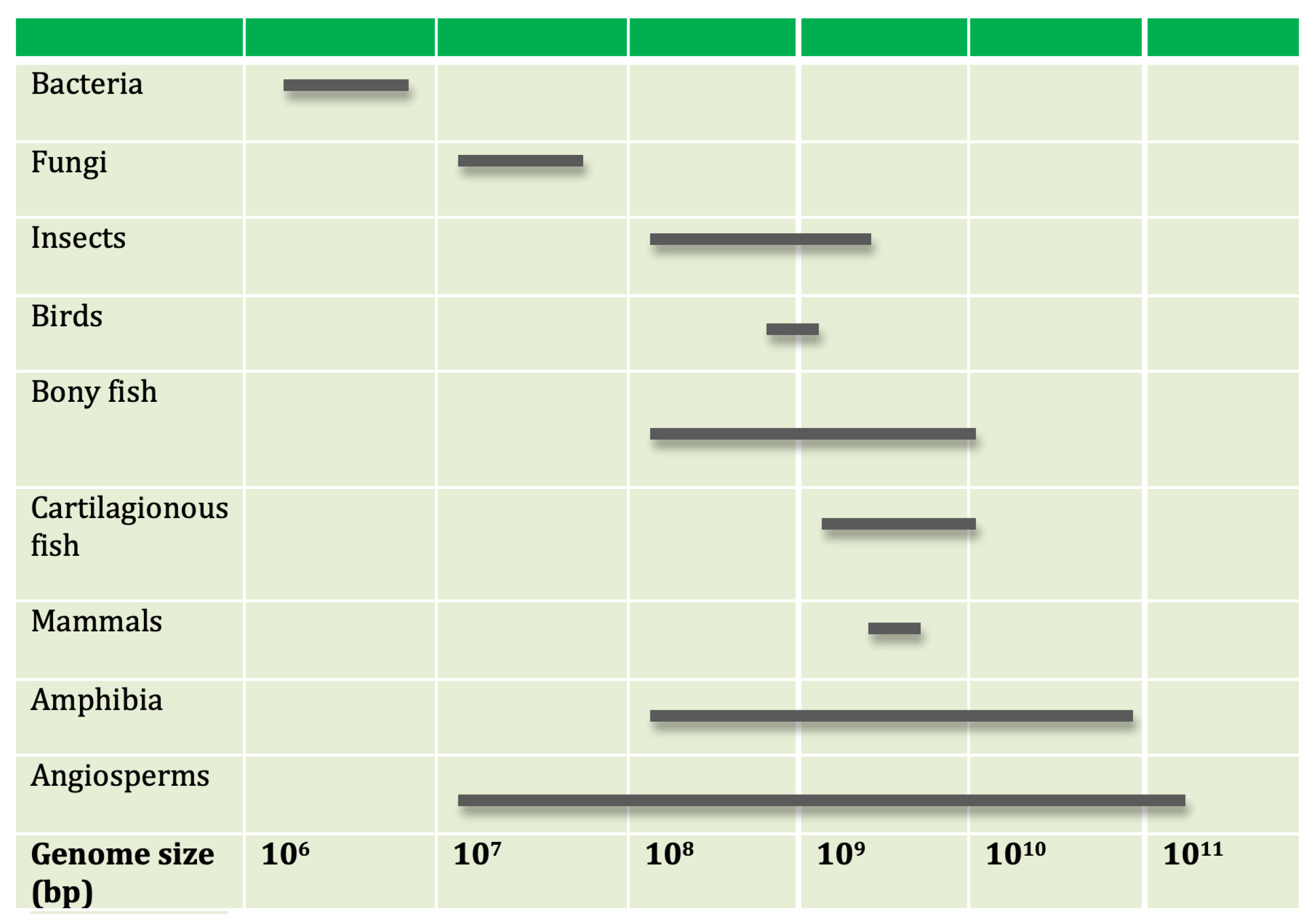
Figure 2.
Model of molecular non-adaptive radiation (chromosome/karyotype speciation).
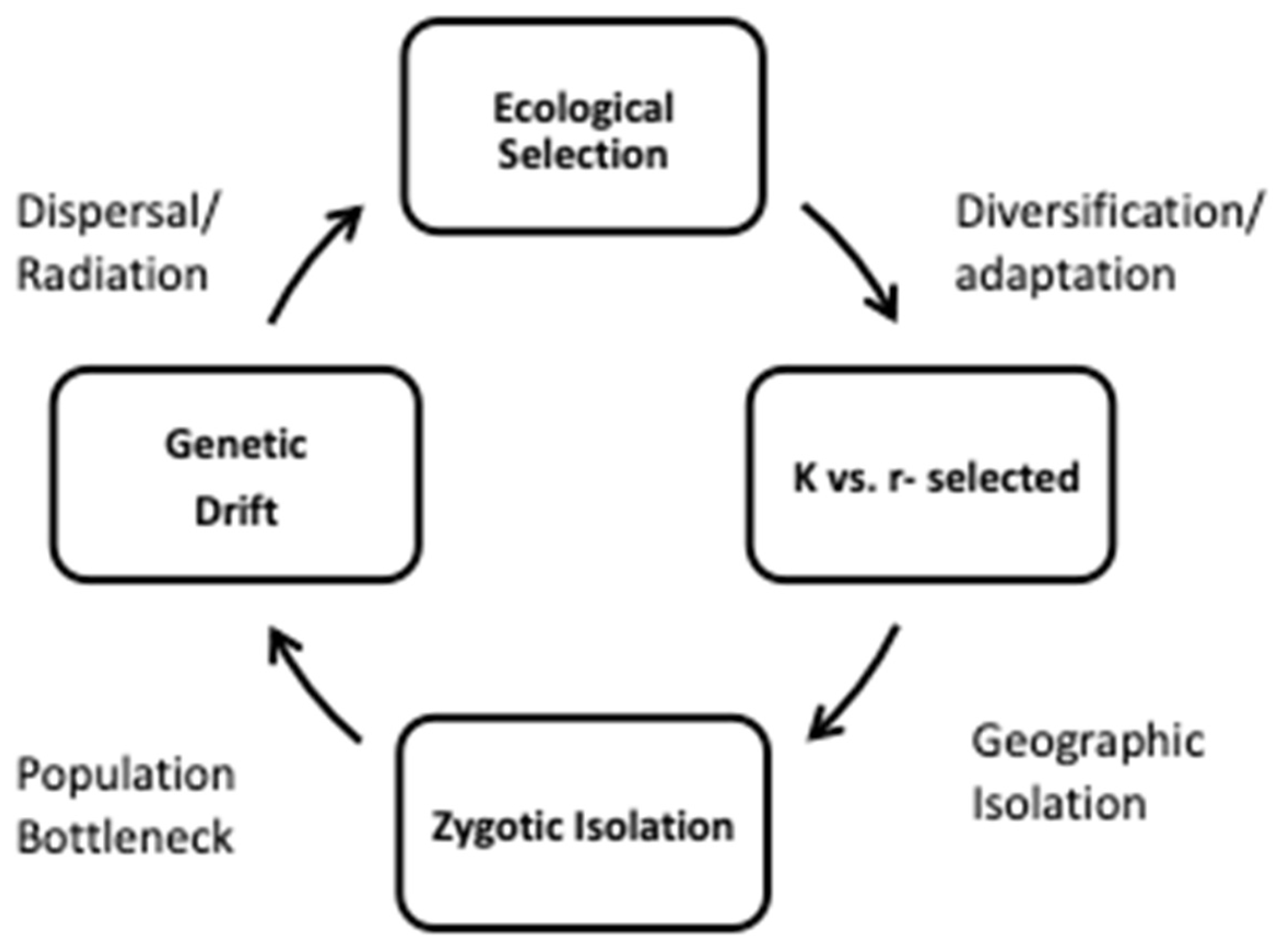
Figure 3.
Schematic representation of the replication timing program. Black boxes: origin recognition complex (ORC). Gray serrated ovals: MCM helicases. Each stage of the cell cycle is represented (G1, S, G2/M). Note that replication fork density increases to mid S-phase (S2–S3) before decreasing in late S-phase (S4). Replication forks are the major internal source of DNA damage (double strand breaks).
Figure 3.
Schematic representation of the replication timing program. Black boxes: origin recognition complex (ORC). Gray serrated ovals: MCM helicases. Each stage of the cell cycle is represented (G1, S, G2/M). Note that replication fork density increases to mid S-phase (S2–S3) before decreasing in late S-phase (S4). Replication forks are the major internal source of DNA damage (double strand breaks).
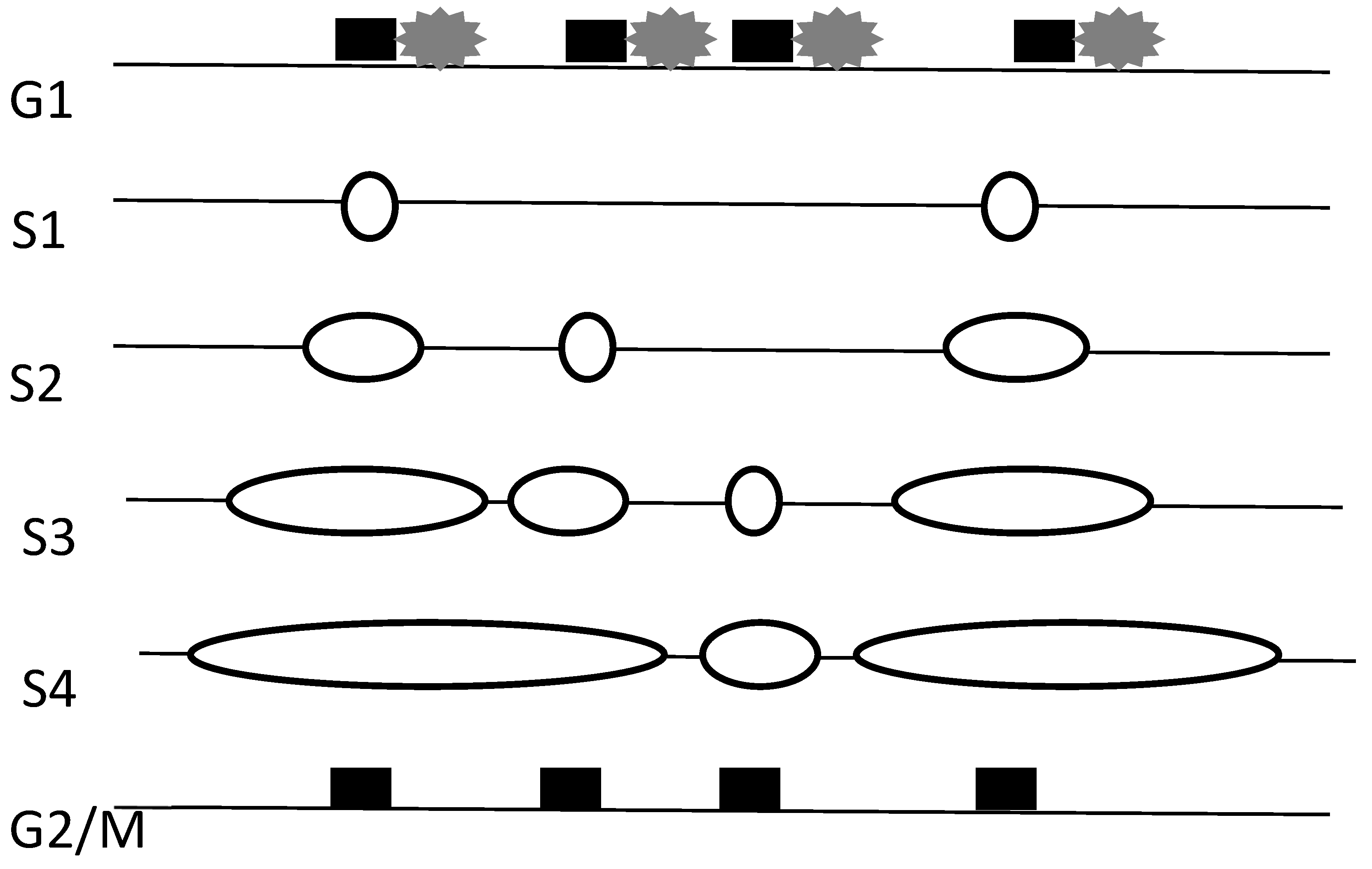
Figure 4.
Schematic representation of intron/exon gene structure. A. Chromosome level organization. Gray boxes: licensed replication origins. TSS: transcription start site. B. Gene level organization. Gray triangles: dormant origins clustered in introns.
Figure 4.
Schematic representation of intron/exon gene structure. A. Chromosome level organization. Gray boxes: licensed replication origins. TSS: transcription start site. B. Gene level organization. Gray triangles: dormant origins clustered in introns.
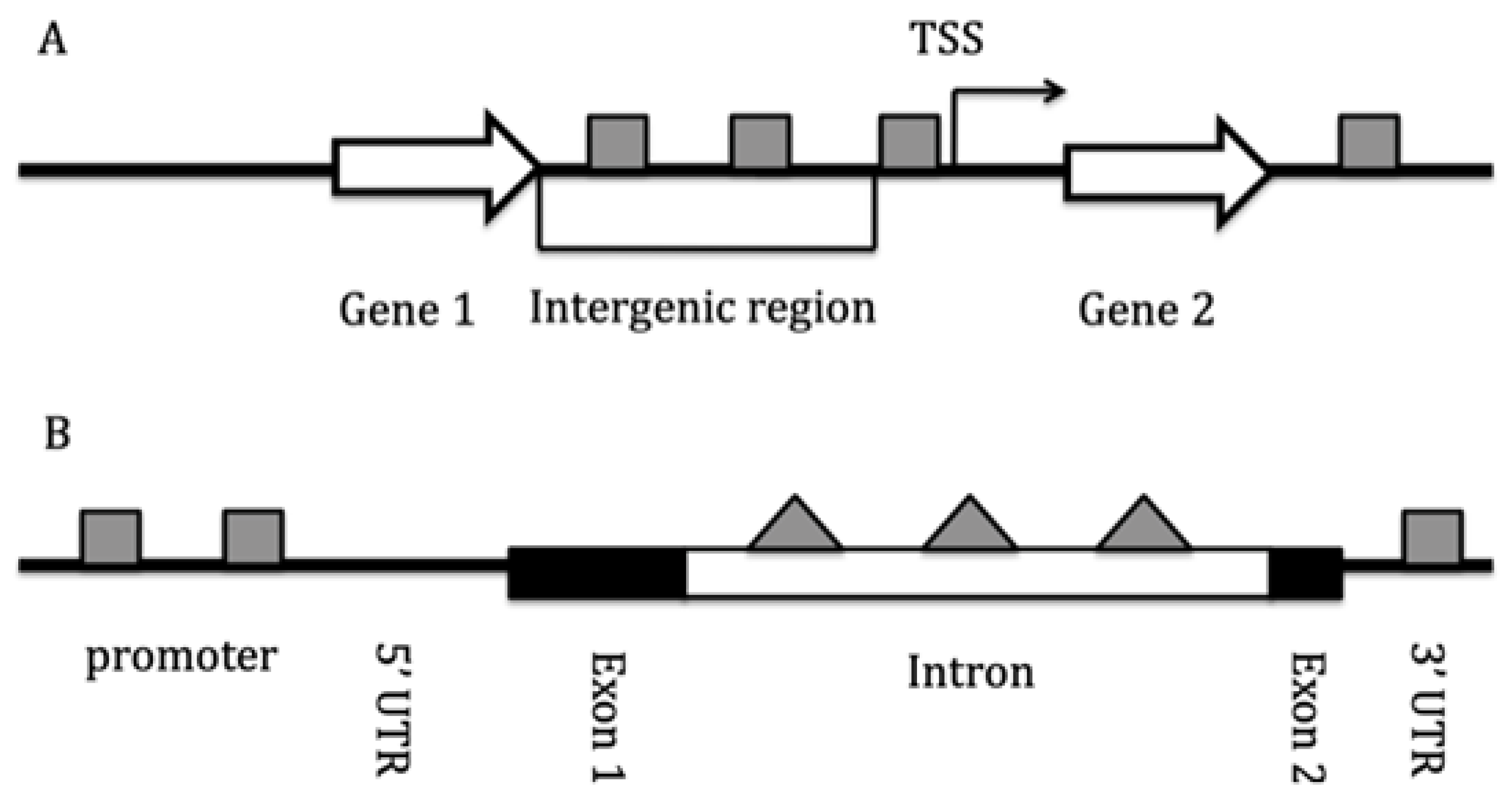
Figure 5.
Illustration of Peto’s paradox (adapted from [156]). Y-axis: cancer risk. X-axis: body mass. Red line: observed cancer risk. Black curve: theoretically expected cancer risk. Gray arrows reflect different strengths of the DDR, from weak-maladaptive DDRs (small observed body size; higher than expected cancer risk) to strong-maladaptive DDRs (large observed body size and lower than expected cancer risk). The intersection of the black and red curves indicates the threshold at which DDR efficiency switches from favoring an unstable karyotype (r-strategist) to favoring an increasingly stable karyotype (K-strategist). The ecological selection pressure in this regime therefore favors larger rather than smaller genome sizes: large genomes (higher TE density, CpG denstity and HC content; see refrerences [181,182]) are fortuitous TE-driven adaptations that enhance the DDRs and, consequently, promote increases in body mass (see references [173,174]). TEs, rather than purely selfish parasites, act instead as genome commensals and mutualists benefiting from—and proliferating as a result of—the new niches and ecological adaptations they made possible for their respective hosts (Cope’s rule: selection for K-strategists with larger genome size, body mass and longer maximum lifespan).
Figure 5.
Illustration of Peto’s paradox (adapted from [156]). Y-axis: cancer risk. X-axis: body mass. Red line: observed cancer risk. Black curve: theoretically expected cancer risk. Gray arrows reflect different strengths of the DDR, from weak-maladaptive DDRs (small observed body size; higher than expected cancer risk) to strong-maladaptive DDRs (large observed body size and lower than expected cancer risk). The intersection of the black and red curves indicates the threshold at which DDR efficiency switches from favoring an unstable karyotype (r-strategist) to favoring an increasingly stable karyotype (K-strategist). The ecological selection pressure in this regime therefore favors larger rather than smaller genome sizes: large genomes (higher TE density, CpG denstity and HC content; see refrerences [181,182]) are fortuitous TE-driven adaptations that enhance the DDRs and, consequently, promote increases in body mass (see references [173,174]). TEs, rather than purely selfish parasites, act instead as genome commensals and mutualists benefiting from—and proliferating as a result of—the new niches and ecological adaptations they made possible for their respective hosts (Cope’s rule: selection for K-strategists with larger genome size, body mass and longer maximum lifespan).
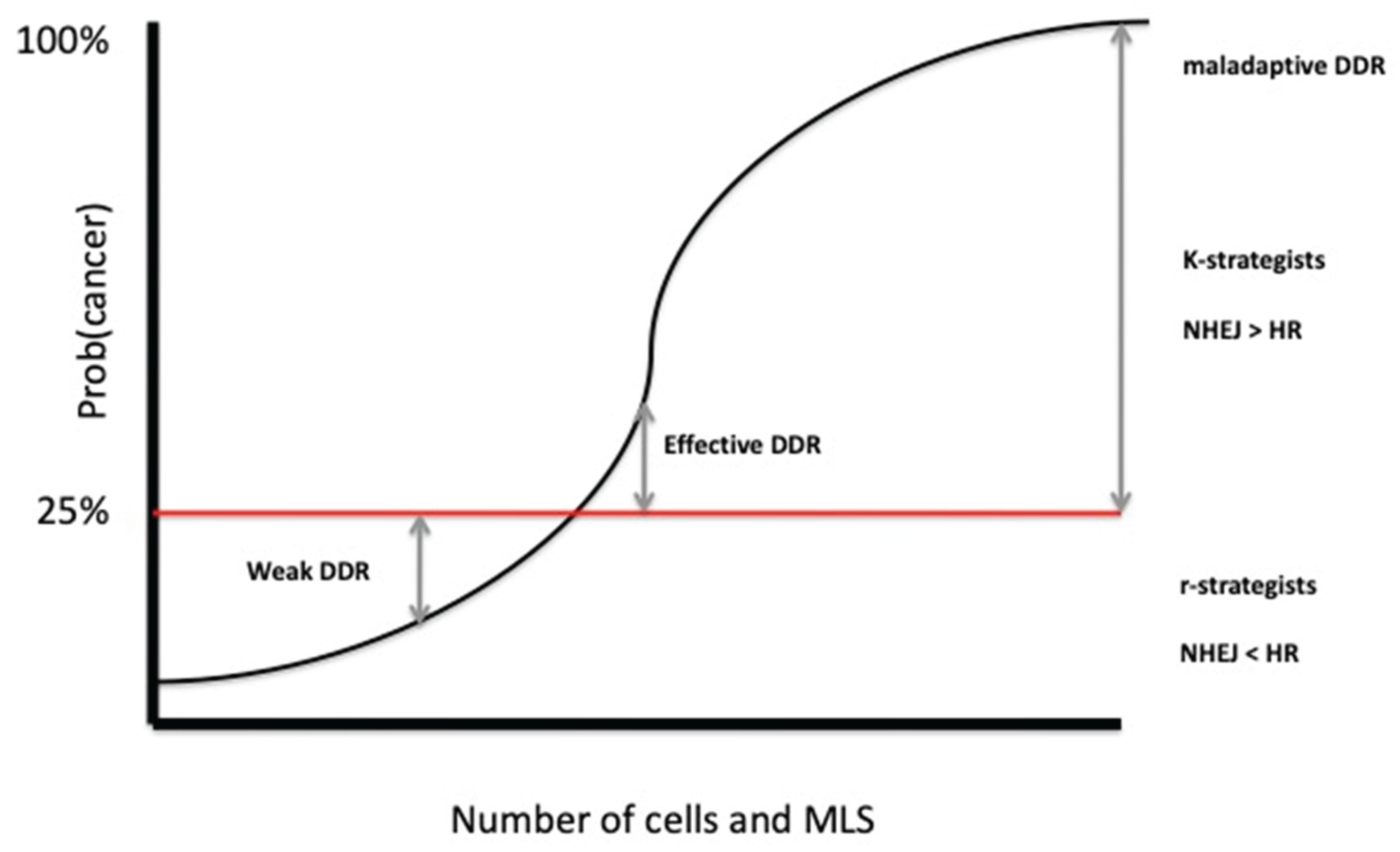

Table 1.
Phylogenetic Generalized Least Square (PGLS) correlations between mammalian life history traits. MLS: maximum lifespan. SR: species richness. rKD Macro: rate of macro-karyotype evolution (genome). rKD Micro: rate of micro-karyotype evolution (subchromosome). The rKD data are from Martinez et al. [5].
Table 1.
Phylogenetic Generalized Least Square (PGLS) correlations between mammalian life history traits. MLS: maximum lifespan. SR: species richness. rKD Macro: rate of macro-karyotype evolution (genome). rKD Micro: rate of micro-karyotype evolution (subchromosome). The rKD data are from Martinez et al. [5].
| Adj R2 | P | |
| MLS vs Body Mass (+) | 0.73 | 2 x 10-16 |
| MLS vs C-value | 0,007 | 0,5 |
| SR vs Body Mass (-) | 0.56 | 0.01 |
| MLS vs Synteny (+) | 0.48 | 0.03 |
| Synteny vs SR | 0.18 | 0.1 |
| MLS vs SR (-) | 0.59 | 0.016 |
| rKD Macro vs SR (+) | 0.42 | 3 x 10⁻¹⁰ |
| rKD Micro vs SR | 0.07 | 0.06 |
Table 2.
Association between gestation time and early embryo cell cycle duration. The parentheses indicate oviparous reproduction.
Table 2.
Association between gestation time and early embryo cell cycle duration. The parentheses indicate oviparous reproduction.
|
Table 2 Species |
Gestation Time | Embryo Cell Cycle Duration |
| Drosophila | (24 hours) | 8–10 minutes |
| Frog | (6–21 days) | 0.5 hours |
| Salamanders | (14)–728 days | 4–8 hours |
| Mouse | 19–21 days | 2–4 hours |
| Rabbit | 30–32 days | 5–8 hours |
| Dog | 58–69 days | 8–12 hours |
| Naked mole rat | 66 -77 days | NA |
| Beaver | 105–107 days | NA |
| Human | 280 days | 12–24 hours |
| Cow | 279-292days | 32 hours |
| Elephant | 660 days | 18–36 hours |
Disclaimer/Publisher’s Note: The statements, opinions and data contained in all publications are solely those of the individual author(s) and contributor(s) and not of MDPI and/or the editor(s). MDPI and/or the editor(s) disclaim responsibility for any injury to people or property resulting from any ideas, methods, instructions or products referred to in the content. |
© 2025 by the author. Licensee MDPI, Basel, Switzerland. This article is an open access article distributed under the terms and conditions of the Creative Commons Attribution (CC BY) license (https://creativecommons.org/licenses/by/4.0/).
Copyright: This open access article is published under a Creative Commons CC BY 4.0 license, which permit the free download, distribution, and reuse, provided that the author and preprint are cited in any reuse.


