

Submitted:
17 June 2025
Posted:
17 June 2025
You are already at the latest version
Abstract
Actuators and power electronics are indispensable elements of contemporary control systems, supporting high-precision operation, optimized energy utilization, and advanced automation capabilities. This study explores research trends and thematic developments in these domains over the past two decades (2005–2024). An analysis was conducted on 1,840 peer-reviewed abstracts sourced from the Web of Science database, utilizing BERTopic modeling, which combines transformer-based sentence embeddings with UMAP for dimensionality reduction and HDBSCAN clustering. The methodology further incorporated class-based TF-IDF, intertopic distance mapping, and hierarchical clustering to elucidate structural topic formations. Results demonstrate a consistent rise in scholarly output, with notable acceleration after 2015. Research between 2005 and 2014 was predominantly concentrated on established areas such as piezoelectric actuators, adaptive control, and hydraulic systems. Conversely, the 2015–2024 phase exhibited an expansion into emerging themes like advanced materials, robotic mechanisms, fault-tolerant systems, and networked actuator control via communication protocols. The structural analysis highlighted a progression from a cohesive to a more distributed and specialized array of topics. This study provides a robust, data-informed perspective on the progression in complexity and breadth within actuator and power electronics research. The insights derived hold significance for researchers, engineers, and policymakers committed to fostering advanced, sustainable solutions in next-generation industrial technologies.
Keywords:
actuators
; power electronics
; BERTopic
; research trend analysis
; intelligent control systems
1. Introduction
The evolution of industrial systems toward increased autonomy, superior energy efficiency, and heightened responsiveness has greatly underscored the significance of actuators. As essential interfaces linking control algorithms to physical movement, actuators are vital in diverse applications, including robotics, electric vehicles, biomedical devices, and smart manufacturing systems. The improved capabilities of actuators have been largely driven by advancements in power electronics, which deliver effective energy conversion and precise real-time control, making actuator systems more compact and intelligent.
Contemporary technological advancements within this sector have stressed the adoption of wide-bandgap semiconductors, embedded digital control circuits, and advanced real-time monitoring strategies, collectively yielding substantial gains in switching speed, thermal management, and energy density. Such innovations have established power electronics as a cornerstone for next-generation actuator developments [1]. Furthermore, the incorporation of artificial intelligence (AI) and machine learning (ML) into power electronic architectures has generated new prospects for autonomous diagnostics, robust fault-tolerant control, and dynamic adaptation of system configurations [2]. For example, Luan et al. [3] demonstrated that a predefined-time sliding mode controller combined with an observer can significantly enhance control accuracy and fault resilience in permanent magnet motors. Similarly, Zhang et al. [4] proposed a time-varying damping model that facilitates adaptive vibration behavior in structures affected by clearance-induced nonlinearities.
Practical implementations of these integrated systems extend across a broad range of sectors. In the renewable energy industry, smart converters increase the reliability of wind energy conversion systems under dynamic conditions. In transportation, electric drivetrains employ AI-optimized inverters to improve torque management and energy efficiency. In healthcare, soft robotic actuators powered by power-electronic circuits enable precise motion control in minimally invasive surgical applications [5,6].
Nevertheless, while numerous technical investigations have focused on component-level improvements, comprehensive insights into the co-evolution of actuators and power electronics remain scarce. Most previous studies have concentrated on individual device innovation, often overlooking how research directions have shifted across disciplines or how recent technological convergence—such as AI-assisted control—has shifted research priorities. The absence of meta-level analysis impedes the capacity of researchers, policymakers, and industry stakeholders to predict future developments and allocate resources strategically.
To overcome this gap, the current study seeks to identify, structure, and analyze long-term research trends involving actuators and power electronics. In particular, we explore how foundational research areas have shifted over the last two decades (2005–2024), the influence of AI on the emergence of new research directions, and the impact of integrated control, power conversion, and actuation on system architecture.
To achieve these objectives, we utilize a deep learning-based text mining framework integrating BERT-based sentence embeddings, UMAP for feature reduction, HDBSCAN for unsupervised clustering, and BERTopic for interpretable topic extraction. Additionally, we employ class-based TF-IDF (c-TF-IDF) to extract salient terms that define each topic cluster and track changes in topic relevance over time. The methodology is applied to a dataset of 1,840 peer-reviewed abstracts collected from the Web of Science database.
This study advances the literature by providing a data-driven and transparent approach to elucidate the progression of actuator and power electronics research. The results deliver actionable knowledge for academic researchers, system engineers, and R&D strategists aiming to monitor technological developments and position their work in alignment with emerging innovation trends.
The organization of this paper is as follows. Section 2 surveys prior literature on actuators and power electronics. Section 3 details the research methodology, including data collection strategies and analytical methods used in the trend analysis. Section 4 presents the main results from the temporal trend analysis alongside topic modeling insights. Section 5 discusses these outcomes from academic, industrial, and policy standpoints, highlighting practical implications. Lastly, Section 6 closes the paper by outlining limitations and suggesting future research pathways.
2. Literature Review
2.1. Topical Review: Actuators and Power Electronics
Actuators and power electronics work together in contemporary electromechanical systems, driving progress across numerous industrial sectors. Actuators are essential elements that translate electrical signals into mechanical movements, with widespread applications in robotics, aerospace, automotive, energy, and biomedical engineering. Power electronics serves a vital function by efficiently converting, regulating, and distributing the electrical energy required to drive these actuators, thus significantly impacting overall system performance and energy efficiency [7,8,9].
In recent decades, actuators have undergone substantial technological progress. While initial advancements focused on conventional electromechanical actuators, subsequent innovations have introduced devices based on advanced materials such as piezoelectrics, magnetostrictive compounds, and electroactive polymers. These advanced actuators deliver precise control at nanometer scales, fast response times, and reduced power consumption, surpassing the limitations of earlier technologies. As a result, they are increasingly adopted in precision-driven sectors like semiconductor manufacturing and biomedicine [10,11,12,13]. Furthermore, smart actuators now incorporate embedded sensors, controllers, and communication modules, supporting self-diagnosis, predictive maintenance, and real-time analytics, which are critical for industrial automation and smart factory operations [14,15,16].
Power electronics has similarly evolved at a rapid pace. The shift from standard silicon devices toward wide bandgap semiconductors such as silicon carbide and gallium nitride has enabled switching at higher voltages, frequencies, and efficiencies. This technological advancement has broadened power electronics applications into high-demand areas including electric vehicles (EVs), renewable energy systems, and aerospace industry technologies [17,18,19]. For example, inverters for EV motor drives, grid-tied inverters for solar or wind installations, and high-efficiency DC-DC converters now exemplify these developments. Concurrently, research efforts have been directed at achieving higher conversion efficiency, minimizing device size and weight, and improving thermal management. In addition, the recent adoption of AI in predictive control and real-time condition monitoring has further increased the reliability and autonomy of power electronic systems [20,21,22].
These technological advancements are driving concrete innovations across a variety of industries. For example, in the EV sector, the use of high-efficiency inverters and regenerative braking systems has led to marked improvements in driving range and energy efficiency. In the renewable energy sector, power electronics-based smart grids are contributing to improved stability and the effectiveness of energy supply networks [23,24,25]. Within industrial automation, the integration of sub-micron-level linear actuators and high-speed, high-precision servo drive systems has played an important role in boosting productivity [26,27,28].
Despite considerable advancements, several technical issues continue to challenge the field. Challenges include managing heat in high-power-density systems, addressing electromagnetic interference related to miniaturization, achieving long-term reliability across a range of operational conditions, as well as scaling up the manufacturing of advanced material-based actuators, all of which necessitate further research [29,30,31]. In addition, rising priorities such as designing energy-efficient, environmentally sustainable power electronic systems, ensuring secure data exchange and standardized communication protocols for smart actuators, and facilitating interoperability among heterogeneous systems are attracting increased attention [32,33].
2.2. Existing Trend Analyses in Actuator and Power Electronics Research
Previous studies in the areas of actuators and power electronics primarily fall into two categories: technology-focused analyses and bibliometric trend analyses. While the earlier part of this work focused on technical achievements and existing barriers, many stand-alone investigations have adopted bibliometric techniques to systematically reveal research trends in this field [34,35].
A 2023 publication listed in PubMed reviewed 111 key articles on soft robotics published from 2008 to 2022, presenting a systematic analysis across three themes: bioinspired design principles, types of control (open/closed-loop), and biomedical applications. It highlighted actuator-related technologies as core elements, representing 34% of all publications, and noted an average annual growth of 18.7% in the past five years, with particular emphasis on dielectric elastomer actuators and structural optimization of actuators [36].
A 2011 investigation indexed via Semantic Scholar surveyed 109,661 articles from the IEEE database (2001–2010), classifying power semiconductor devices (38.2%), converter topologies (29.1%), and control strategies (22.4%) as the principal research categories. Research on wide bandgap (WBG) semiconductors, in particular, experienced significant growth, with an average annual increase of 24.3% since 2010 [35].
A 2024 study published in the MDPI Electricity journal examined over 1,200 articles on smart grids from 2017 to 2022. The results showed that power electronics technologies represented 68% of the research activity within energy management systems (EMS) and demand response contexts. Moreover, the annual growth rate for research concerning DC-DC converter topologies reached 15%, underscoring their increasing importance as a key emerging technology [37].
Traditional technological analyses often focus on component performance and physical constraints, while bibliometric trend analyses offer higher-level perspectives on research community evolution, cross-disciplinary cooperation, and the role of policy intervention. For example, a 2023 study published in Clean Energy revealed that combining both methodologies could increase the precision of technological forecasting by as much as 41% [38].
Within this research area, integrating technical and bibliometric approaches necessitates the design of a coordinated multi-temporal analysis framework. Specifically, recent advances prioritize the use of machine learning-enabled dynamic keyword extraction and real-time data feed integration. According to a 2025 foresight report from Nature Electronics, applying these integrative strategies could boost R&D efficiency by up to 57% [39].
2.3. Methodological Review: Topic Modeling and BERTopic
Recently, topic modeling techniques—especially advanced approaches such as BERTopic—have found widespread application in both academic and industrial contexts for systematically mapping large-scale research trends [40]. Topic modeling is an analytical methodology that identifies underlying research themes and emergent trends from unstructured text data, including scientific literature, patents, and technical documentation. Legacy methods such as Latent Dirichlet Allocation (LDA) and Non-negative Matrix Factorization (NMF) have seen extensive use in this area [7,8]. Nevertheless, these established approaches depend largely on word frequency and co-occurrence statistics, which can struggle to recognize contextual subtleties. This drawback is particularly significant in highly specialized domains characterized by concentrated technical terminology [41,42].
BERTopic addresses these deficiencies by leveraging BERT-based sentence embeddings in combination with state-of-the-art clustering algorithms and dimensionality-reduction tools, including HDBSCAN and UMAP [43,44]. Distinct from frequency-oriented approaches, BERTopic generates contextually rich topic representations that achieve high accuracy even for brief documents such as research abstracts. It capably handles polysemy and synonymy, and its UMAP-driven interactive visualizations elucidate topic relationships and evolution dynamics [45].
BERTopic has been effectively utilized to analyze publications and patents in advanced fields such as the industrial internet, semiconductors, and biomedical engineering. It supports temporal examination of the emergence and intensity of detailed technical topics. In the study of actuators and power electronics, BERTopic demonstrates significant capability in detecting emergent subtopics, including “wide bandgap devices,” “smart actuators,” and “high-efficiency inverters” [46,47]. Additionally, it aids in identifying convergence domains and research gaps. For example, when processing thousands of abstracts, patent summaries, or technical reports, BERTopic delivers more than three times the topic coherence and processing efficiency relative to LDA [48,49]. This enhanced performance allows researchers to pinpoint novel technology trends and research gaps with finer detail. Moreover, BERTopic integrates seamlessly with large language models (LLMs) such as ChatGPT, thereby improving interpretability and enabling interactive analytical capabilities [50].
This study applies BERTopic for several key reasons. First, the domains of actuators and power electronics experience rapid technological advancements and frequent interdisciplinary integration. A tool that captures nuanced topic transitions with contextual precision is thus indispensable [51,52]. BERTopic surpasses classical models by yielding improved topic separation and effectively highlighting newly emerging trends and research deficiencies. Second, it is capable of efficiently handling extensive collections of abstracts and technical documents, which makes it particularly appropriate for trend analysis at scale [53]. Third, its visualization capabilities enable researchers to clearly discern topic interrelations, evolution, and convergence patterns, thereby providing actionable insights for formulating research strategies and setting agendas. Fourth, integration with advanced AI tools such as LLMs allows for automated interpretation of topics and real-time monitoring of trends, which supports the demands of future research environments [54,55,56].
In summary, BERTopic is regarded as a highly robust methodological approach for examining broad research trends and technological progress within the domains of actuators and power electronics. Leveraging its contextual sensitivity, processing effectiveness, and interpretability, this study seeks to address prior analytical limitations and offer a comprehensive and systematic investigation of developing research trajectories.
3. Materials and Methods
This study implemented a multi-step methodology to examine 1,840 publications related to actuators and power electronics spanning 2005 to 2024. Data were sourced from the Web of Science and restricted to peer-reviewed articles and reviews. After initial preprocessing, publication trends by country were assessed using Python-based analysis. BERTopic modeling was used to extract and visualize the main research topics, employing Sentence-BERT for embedding generation, UMAP for reducing dimensionality, HDBSCAN for cluster identification, and c-TF-IDF for extracting representative keywords.
To investigate changes in research topics over time, the dataset was segmented into two periods (2005–2014 and 2015–2024), and identical analytical pipelines were applied for comparative study. Figure 1 illustrates the overall research workflow.
3.1. Data Collection
An organized data collection procedure was established to ensure the reliability of subsequent analyses. Publications were obtained from the Web of Science database and filtered to include only studies pertaining to actuators and power electronics, thereby promoting thematic consistency and data reliability. The final dataset spans a 20-year interval (2005–2024) and includes exclusively peer-reviewed research articles and review papers. This procedure resulted in the selection of 1,840 records, consolidated in Excel format. The detailed search methodology is outlined in Table 1.
After obtaining the records, text mining methods were applied to the abstracts to uncover underlying research themes and structural patterns. BERTopic, a deep learning-driven transformer model, was utilized for semantic embedding generation, clustering, and visualization of topic distributions. This methodology enabled a systematic investigation of research trend development in the fields of actuators and power electronics.
3.2. Pre-processing
BERT-based topic modeling employs pre-trained language models capable of capturing rich contextual features, which alleviates the need for extensive preprocessing typically required by statistical models such as LDA. These advanced models can produce context-aware embeddings from complete sentences, even when minimal preprocessing is performed. However, omitting all preprocessing can negatively affect outcomes. Fundamental preprocessing steps—including the removal of duplicate sentences, filtering out non-standard characters, and excluding brief non-informative contents—remain crucial. These measures directly affect both embedding quality and clustering reliability.
In conclusion, although BERT-based models simplify preprocessing, a minimum level of data cleaning remains essential to maintain input quality. Preprocessing approaches should be tailored according to the research goals and the linguistic features of the target language.
3.3. Trend Analysis
A trend analysis was conducted on 1,840 academic publications gathered during the preprocessing phase, utilizing Python and Google Colab. The analysis sought to examine the evolution of research in actuators and power electronics over time, providing insights into the trajectory of technological progress and supporting strategic planning processes. Furthermore, analyzing long-term trends in research activity assists stakeholders in identifying potential opportunities, anticipating obstacles, and strengthening their competitiveness in a dynamic industrial environment.
The analysis focused on three key aspects: (1) Identifying the top 10 countries with the highest annual output of relevant publications, (2) Evaluating the overall publication volume of the top 10 most productive countries. These findings offer a broader perspective on worldwide research initiatives in actuator and power electronics technologies and help pinpoint regions that significantly contribute to the advancement of the field.
3.4. BERTopic modeling
BERTopic modeling utilizes a transformer-based pre-trained language model that efficiently handles complex data and supports transfer learning, making it particularly beneficial for adapting to new research domains [42]. In this study, BERTopic modeling was applied to produce document embeddings, cluster these representations, extract topic features by a class-based c-TF-IDF technique, and investigate multiple analytical approaches through visualization.
Embedding is a method that captures the semantic content of words or sentences while representing them as low-dimensional vectors, thereby allowing computers to process and interpret language [57]. In the current study, the transfer learning capabilities of pre-trained BERT were utilized to embed documents related to dry electrodes into high-dimensional vectors. Sentence-BERT (SBERT) was employed specifically for this embedding process. The formula associated with embedding is shown in Equation (1).
= Embedding vector
= Set of documents
BERT embeddings generally consist of 768 dimensions, making them highly high-dimensional. To address this, UMAP is used to reduce dimensionality while preserving the nonlinear relationships within the data. The formula associated with UMAP is provided in Equation (2).
HDBSCAN is applied to the dimensionally reduced embeddings for clustering [58]. As a density-based clustering algorithm, HDBSCAN is effective in filtering out noise. The clustering formula is given in Equation (3).
= The Cluster to which a document belongs
Following word frequency extraction using CountVectorizer, principal keywords for each cluster are determined through a c-TF-IDF-based method. The c-TF-IDF approach is effective for highlighting the most representative words within each cluster, as it measures word significance across entire topics rather than individual documents [59,60]. Furthermore, it quantifies word importance at the cluster level, not just for individual documents. The formula associated with c-TF-IDF is detailed in Equation (4).
= The frequency of word in a specific cluster = The number of documents in which the word appears
= The total number of documents
To provide a thorough understanding of topic structure, various analytical visualizations were used, such as the BERTopic Intertopic Distance Map, hierarchical clustering, and the analysis of document distribution across topics.
3.5. Comparative Topic Evolution Analysis
At this stage, the study utilized data divided into two periods—2005–2014 and 2015–2024—to quantitatively assess the structural progression of research topics in actuators and power electronics. This division allowed for meaningful comparison between two distinct time frames: an initial period likely characterized by foundational technological development and early integration of materials and control, and a more recent phase marked by growing emphasis on AI-based control, high-performance materials, and industry convergence.
To ensure analytical consistency, an identical topic modeling pipeline was applied to each dataset under a unified framework. A subsequent three-step approach was then used to compare the structural evolution of topics over time. First, c-TF-IDF-based keyword analysis quantitatively captured changes in the conceptual emphasis within corresponding topics across periods. Second, intertopic distance maps were produced to evaluate the differences in topic proximity and semantic distribution between the periods. Third, hierarchical clustering was used to explore how topic groupings and their semantic structures have diversified or deepened over time.
By employing this segmentation and comparative structure, the framework seeks to advance beyond basic frequency analysis, enabling a more comprehensive interpretation of the evolving direction and increasing semantic complexity of research topics over the past two decades.
4. Results
4.1. Trend Analysis
The annual publication trend in actuator and power electronics research from 2005 to 2024 demonstrates a consistent upward trajectory, with more than 100 publications produced each year since 2019. In 2024, publication output reached 193, representing the peak within the analyzed timeframe. These findings suggest that research into actuator and power electronics has sustained a significant presence in the academic community, with recent growth potentially attributable to expanding application areas and greater integration within diverse technological sectors. Figure 2 illustrates the yearly publication counts throughout the analysis period.
Analyzing publications by country shows that China (604 papers) and the United States (234 papers) are the leading contributors, underscoring their substantial influence in actuator and power electronics research. These countries are trailed by Japan (121), South Korea (98), Taiwan (83), France (68), Italy (60), India (53), Iran (53), and Germany (46). Figure 3 visualizes publication volumes from these top 10 contributing nations. The pattern highlights a significant concentration of research within a select group of countries, with notable outputs from several Asian regions. This concentration could point to emerging disparities in global technological leadership, emphasizing the importance of fostering international collaboration and effective knowledge dissemination.
4.2. c-TF-IDF Analysis
4.2.1. c-TF-IDF Analysis: 2005-2014 Period
This paper analyzes the thematic structure of actuator and power electronics research from 2005 to 2014 through the application of BERTopic modeling to abstract-level text data. The modeling process yielded eight well-defined topics, each characterized by distinctive keywords exhibiting high class-based TF-IDF (c-TF-IDF) scores. The discussion below elaborates on these keywords and their contextual significance. Figure 4 provides a visual summary of the c-TF-IDF analysis outcomes for this period.
Topic 0: Key terms such as piezoelectric, magnetic, frequency, ultrasonic, and electrical suggest an emphasis on energy conversion technologies involving smart materials and advanced high-frequency signal methods. This topic encompasses research on actuators utilizing smart materials and electromagnetic precision control systems.
Topic 1: Notable keywords—including drive, adaptive, friction, uncertainties, and algorithm—point to investigations centered on motion control strategies, particularly in the context of dynamic uncertainties and nonlinear system behaviors. This topic captures ongoing academic progress in adaptive control algorithms for actuator systems functioning under uncertain operational scenarios.
Topic 2: Terms such as dielectric, electrical, polymers, membrane, and polymer indicate investigations at the material level of soft actuators, particularly those utilizing electroactive polymer technologies. This topic is linked to research on dielectric elastomers and flexible actuator materials designed for next-generation motion systems.
Topic 3: Commonly found words such as aircraft, inverter, induction, electrical, and rectifier reflect studies on the integration of power electronics within aerospace or vehicular systems. This topic encompasses research on inverter-based electric drives and actuation systems specific to transportation and aerospace settings.
Topic 4: Prominent terms like valve, engine, hydraulic, scroll, and pressure indicate research focused on mechanical component-based actuation, with an emphasis on fluid-powered systems. This topic covers conventional hydraulic and pneumatic actuators implemented in industrial and mechanical automation contexts.
Topic 5: Keywords including vehicle, yaw, yaw moment, roll, and simulation signify research in the domain of vehicle dynamics, with a particular focus on rotational control and system-level simulation. This topic addresses studies on automotive actuators for dynamic stability management and simulation-based modeling methodologies.
Topic 6: Terms such as generator, pm synchronous, synchronous generator, and pitch highlight research centered on energy generation technologies and their control strategies. This topic pertains to investigations into synchronous generators, pitch control, and the engineering of electromechanical energy conversion systems.
Topic 7: Frequently mentioned keywords such as graphene, polymer, carbon, photomechanical, and stress suggest an emphasis on advanced functional materials responsive to external stimuli. This topic is representative of pioneering research in photomechanical actuation and the engineering of graphene-based smart materials.
4.2.1. c-TF-IDF Analysis: 2015-2024 Period
This section examines recent advances in actuator and power electronics research through BERTopic modeling of publications from 2015 to 2024. Eleven distinct topics were identified using c-TF-IDF-weighted keywords, representing the prevailing research directions in the literature. Summaries and research implications for each topic are detailed below. Figure 5 presents the c-TF-IDF analysis results for this period.
Topic 0: Core terms such as vehicle, adaptive, uncertainties, robust, and disturbances reveal an emphasis on control system design for dynamic and unpredictable driving scenarios. This topic addresses research on robust vehicle control mechanisms in the presence of uncertainties and nonlinearities.
Topic 1: Frequently used words like graphene, polymer, fibers, liquid, and flexible underscore research on material innovation. These point to developments in soft and stretchable actuators utilizing novel nanomaterials. This topic aligns with research on flexible and nanostructured materials for advanced actuation technologies.
Topic 2: Keywords such as piezoelectric, dielectric, circuit, frequency, and ultrasonic indicate advanced signal processing and intelligent material actuation. This topic addresses piezoelectric actuators and systems driven by dielectric response to frequency.
Topic 3: Terms like fault tolerant, solar, sensor, wecs (wind energy conversion systems), and adaptive suggest research in control systems for renewable energy applications. This topic focuses on fault-tolerant adaptive control strategies within actuator systems that integrate renewable energy sources.
Topic 4: Keywords including hydraulic, turbine, valve, engine, and pressure indicate a persistent emphasis on mechanical and fluid-driven actuation methods. This topic centers on hydraulic actuator technologies employed in power generation and mechanical system control.
Topic 5: Dominant words such as robot, clutch, gear, mechanism, and muscle signify the integration of actuators in robotic and biomechanical contexts. This topic relates to actuation mechanisms for robotics, including the development of bio-inspired solutions.
Topic 6: Terms such as aircraft, electrical, insulation, machines, and degradation underscore the importance of electric propulsion and insulation reliability over extended operation. This topic examines electromechanical system reliability in aerospace actuator applications.
Topic 7: Keywords like plasma, jet, discharge, tokamak, and vertical point to investigations involving high-energy physics systems and plasma-based actuation methods. This topic covers research on plasma actuator technologies and their role in fusion-energy systems.
Topic 8: High-impact terms include piezoelectric, ferroelectric, phosphorene, strain, and polarization, reflecting progress in materials engineered with coupled electromechanical behaviors. This topic highlights the development of strain-sensitive smart materials, such as ferroelectric and 2D-layered actuators.
Topic 9: Terms such as magnetic, superelasticity, microwire, hysteresis, and strain describe actuation based on magnetic effects and elastic transformation. This topic addresses advancements in magneto-mechanical and superelastic actuator systems.
Topic 10: Keywords including ethernet, imagery, unit, operations, and ethercat denote the integration of actuator systems with real-time networking and embedded control platforms. This topic highlights the deployment of networked actuator controls in industrial automation utilizing EtherCAT communication protocols.
4.3. BERTopic Modeling Analysis
4.3.1. BERTopic Modeling Analysis: 2005-2014 Period
In BERTopic modeling, an intertopic distance map was produced from the 2005–2014 dataset. This two-dimensional plot illustrates the semantic proximity of topics using c-TF-IDF embeddings with UMAP-based dimensionality reduction. Each circle denotes a topic, and its size reflects the proportion of related documents. Figure 6 displays the intertopic distance map, providing a visual summary of topic distribution and their relative similarities over the examined period.
Topic 0 and Topic 1, centrally positioned and covering larger portions of the map, represent a significant share of the dataset. Their close placement implies partial thematic overlap, likely due to a shared focus on control systems and actuator optimization, though each emphasizes different technical aspects.
Topic 3 and Topic 6 appear in the same quadrant and are located near one another, possibly indicating mutual interests in inverter-based drive systems and aerospace electrical applications.
Topic 2 and Topic 7 cluster together in the left section of the map and are somewhat removed from the central topics. This spatial isolation suggests these topics are semantically distinct, potentially corresponding to material-science-focused or high-frequency piezoelectric actuator research.
Topic 4 is located further south of the main cluster, indicating it is thematically divergent. Based on its keyword composition (as noted previously), it likely pertains to hydraulic or fluid-based actuation, setting it apart conceptually from signal-processing or control-based groupings.
Topic 0 remains the most prevalent theme during this period, closely followed by Topic 1, as shown by their significant bubble sizes. These topics likely represent core advances in actuator control and energy-efficient conversion. Conversely, Topic 5, Topic 6, and Topic 7 account for smaller proportions of publications, suggesting these were either emerging research areas or niche fields at the time.
This map demonstrates moderate dispersion across the topic space, revealing a reasonably diverse set of research directions in actuator-related studies during this timeframe.
The marked distinction between material-driven clusters (e.g., Topic 2, 7) and system/control-oriented clusters (e.g., Topic 0, 1) underscores disciplinary boundaries within the domain—separating hardware/material innovation from developments in control system design.
4.3.2. BERTopic Modeling Analysis: 2015-2024 Period
Recent trends in actuator and power electronics research structure were assessed using an intertopic distance map produced from BERTopic analysis of the 2015–2024 dataset. Each circle in the two-dimensional representation denotes a topic, with its coordinates reflecting semantic distance and its area indicating document proportion. Figure 7 displays this visualization, clarifying topic divergence and convergence patterns over the preceding decade.
Topic 0 is centrally located with a comparatively large representation, indicating that it constitutes a core and broadly recognized research area. Its position suggests strong thematic connections to adjacent topics and may relate to general control systems or principal actuator technologies.
Topic 1 and Topic 2 are prominent and distinctly positioned, indicating substantial yet divergent research directions. Topic 1 is situated in the upper-right quadrant, demonstrating relative isolation and suggesting a well-defined thematic area, which may pertain to advanced materials as identified in previous keyword mapping. In contrast, Topic 10 is comparatively small and positioned near the map's center, reflecting a lower document volume and greater semantic overlap with neighboring topics—this could indicate a minor field or an interdisciplinary research niche.
The topics organize into three overarching semantic clusters: Cluster A includes Topic 0, 4, 5, 7, and 10, which are centrally located and characterized by moderate thematic similarity, potentially representing applied control systems, robotics, and industrial actuation. Cluster B consists of Topic 1, 8, and 9 in the upper-right sector, which are thematically more distinct and likely related to advanced material research such as graphene, photomechanical systems, or smart composites. Cluster C groups Topic 2, 3, and 6 on the map's left, potentially denoting research in signal processing, electromagnetic actuation, or simulation-centric studies. The relative isolation of Topics 6 and 3 suggests independent research streams such as energy systems integration, power electronics, or high-fidelity simulation.
In comparison to the 2005–2014 phase, the current topic map exhibits broader spatial dispersion, which signals both thematic diversification and the rise of more specialized research domains. The formation of distinctly delineated clusters—particularly those centered on material innovation (Topics 1, 8, 9)—highlights a trend toward intensified interdisciplinary activity between materials science and actuator systems. The map's structure also demonstrates established core areas (Topic 0) alongside the emergence of isolated topics, suggesting a dynamic coexistence of incremental advances and pioneering efforts within the field.
4.4. Hierarchical Clustering Analysis
4.4.1. Hierarchical Clustering Analysis of Topics: 2005-2014 Period
Hierarchical agglomerative clustering (HAC) was performed on BERTopic-generated topic embeddings to investigate the underlying hierarchical structure of topics from 2005–2014. The dendrogram in Figure 8 illustrates semantic relationships among the eight topics, calculated according to their respective distance metrics. The x-axis corresponds to the linkage distance, while the y-axis designates each topic alongside representative keywords.
The dendrogram identifies two principal clusters. The first comprises Topic 7 (graphene, polymer, carbon) and Topic 2 (dielectric, electrical, polymer), which are unified by strong foundations in material science. Their close association indicates a mutual emphasis on soft materials, flexible electronics, and the development of innovative smart polymers, all of which are characteristic of early phases in nanostructured actuator material research.
The second, broader cluster encompasses the remaining six topics, which cover areas such as control systems, signal processing, and mechanical actuation. Within this group, three distinct subgroups emerge:
Topics 0 (piezoelectric, magnetic, frequency) and 1 (drive, adaptive, friction) are closely associated, indicating a common focus on dynamic response control and actuation governed by signal inputs. Topics 3 (aircraft, inverter, induction) and 6 (generator, pm synchronous) are grouped together, presumably pertaining to research on electrical drive systems in transportation and energy sectors. Topics 4 (valve, engine, hydraulic) and 5 (vehicle, yaw, yaw moment) are also closely connected, suggesting a mechanical systems perspective focused on fluid-based or motion control actuation.
This hierarchical structure demonstrates that from 2005 to 2014, the research domain was primarily structured around two major themes: innovations in material-based actuators and system-level actuation and control, with distinct sub-specializations within each. This arrangement highlights the initial phase of integrating smart materials into conventional actuator designs before broader diversification became evident in later years.
4.4.2. Hierarchical Clustering Analysis of Topics: 2015-2024 Period
Latent hierarchical connections among recent topics in actuator and power electronics research were analyzed through hierarchical agglomerative clustering, using BERTopic-generated topic vectors for the 2015–2024 dataset. The dendrogram in Figure 9 illustrates the semantic proximity among the eleven topics, as determined by their keyword distributions and vector similarities.
The clustering outcomes reveal a more complex and layered topic organization compared to the 2005–2014 period. Two main clusters are observed: Cluster A: Materials and Fundamental Mechanisms. This group is comprised of Topic 1 (graphene, polymer, fibers), Topic 2 (piezoelectric, dielectric), Topic 8 (piezoelectric, ferroelectric), and Topic 9 (magnetic, super elasticity). These topics are tightly clustered, pointing to a strong emphasis on smart material research, including nanostructured polymers, 2D piezoelectric materials, ferroelectric compounds, and magneto strictive technologies. The semantic closeness within these topics signals the development of an integrated material science-focused research direction, concentrating on electromechanical interaction and emerging actuation concepts.
Cluster B: Systems, Control, and Application Domains. This larger, more structurally diverse cluster encompasses: Topic 0 (vehicle, adaptive, uncertainties), Topic 3 (faulttolerant, solar, sensor), and Topic 6 (aircraft, insulation, degradation), which together emphasize adaptive control, system reliability, and aerospace applications. Topic 4 (hydraulic, turbine, valve) and Topic 5 (robot, clutch, gear) signify domains focused on mechanical and robotic actuation. Topic 7 (plasma, jet, discharge) — although semantically associated with high-energy physics — appears adjacent to this cluster, likely due to its relevance in advancing power technologies. Topic 10 (ethernet, imagery, unit) demonstrates relative isolation within this group, indicating a distinct subdomain centered on networked control and embedded system integration in industrial contexts.
These findings indicate that while earlier research primarily concentrated on control and piezoelectric systems, the past decade has led to the emergence of more differentiated thematic areas, specifically: Advanced functional materials for actuator development (Cluster A), and high-level system integration, including AI-enhanced control, robotics, and networked actuation (Cluster B). Moreover, the intricate sub-branching within Cluster B illustrates the increased complexity and enhanced technical specialization of application domains. It is particularly noteworthy that Topics 0 and 3 now exhibit stronger interconnections than previously observed, reflecting heightened research activity in robust, fault-tolerant actuator systems operating under uncertain or distributed environments.
4.5. Comparative Topic Evolution Analysis
4.5.1. c-TF-IDF Keyword Comparison
To investigate changes in research focus within actuator and power electronics, we performed a comparative topic analysis spanning two time periods: 2005–2014 and 2015–2024. By mapping representative keywords using BERTopic modeling, we identified several notable thematic transitions, corresponding to shifts in technological priorities, methodological sophistication, and application scope.
In 2005–2014, smart actuation research was characterized by frequent keywords such as piezoelectric, magnetic, ultrasonic, and dielectric, reflecting a focus on energy conversion utilizing established smart materials. Over the succeeding decade (2015–2024), similar themes persisted but involved greater complexity, including advanced materials such as ferroelectric, phosphorene, superelasticity, and strain. This progression signals a shift from conventional piezoelectric and magnetic actuators toward emerging functional materials, notably 2D nanomaterials and strain-coupled smart composites, underscoring the increasing integration of material science into actuator engineering.
During the earlier period, topics included terms such as adaptive, vehicle, friction, and yaw, signifying research focused on control algorithms within dynamic environments. In the later period, these topics developed into clusters defined by robust, uncertainties, and disturbances, which highlight a growing focus on resilience at the system level. This thematic transition demonstrates an advancement toward robust adaptive control frameworks for vehicle dynamics, prioritizing the management of uncertainties and reliability in autonomous and safety-critical platforms.
Robotics and biomechanical actuation did not appear as standalone topics in the earlier decade. However, from 2015 to 2024, terms like robot, clutch, gear, muscle, and mechanism created a clear cluster. This indicates the growth of robotic actuation as a prominent subfield, especially with a focus on bio-inspired engineering and the mechanical incorporation found in soft and wearable robotic systems.
Topics concerning aerospace and electrical actuation were present in both timeframes, but the focus shifted over time. Initial keywords such as aircraft, pitch, synchronous, and inverter centered on propulsion systems and motor control strategies. In the subsequent period, keywords including degradation, insulation, and fault tolerant imply an increased concentration on durability, management of faults, and ensuring long-term reliability in electromechanical platforms. This trend reveals a progression from primarily control-based investigations to an emphasis on system-level reliability engineering, particularly across aerospace and renewable energy sectors.
Hydraulic and valve-based actuation displayed thematic consistency across both periods, with persistent keywords such as hydraulic, valve, engine, and pressure. This ongoing pattern suggests traditional hydraulic technologies continue to be significant, especially within large-scale mechanical and heavy industrial contexts, but exhibit limited change in their conceptual approach. It is noteworthy that high-energy actuator systems were not present among the 2005–2014 topics. Conversely, the later decade identified a cluster with terms such as plasma, discharge, jet, and tokamak, which are associated with developments in fusion reactors and high-voltage actuation. This movement highlights the broadening of actuator research into high-energy sectors, including plasma propulsion and electromagnetic actuation in extreme operational settings.
Between 2015 and 2024, a new research area appeared, distinguished by keywords such as ethernet, ethercat, imagery, and operations, pointing to real-time industrial communication technologies. This signals a significant shift toward network-connected actuation, where real-time data exchange, communication standards, and integrated control are vital components of advanced manufacturing environments and cyber-physical infrastructures.
The comparative topic analysis indicates that research in actuator and power electronics has followed a noticeably progressive trajectory. Earlier themes were primarily focused on core control methods and material systems, but have incrementally developed into complex areas involving intelligent control, advanced materials, robotics, and interconnected industrial systems. This chronological evolution demonstrates both increased technological maturity and broader application contexts in the field over the last two decades.
4.5.2. Topic Space Visualization
To gain deeper insights into the development of research themes within actuator and power electronics studies, we examined the intertopic distance maps derived from BERTopic modeling for the two periods: 2005–2014 and 2015–2024. This comparative assessment underscores the ways in which the arrangement, prominence, and demarcation of research topics have evolved through time.
During the 2005–2014 span, the structure of topics was relatively compact, with two primary topics (Topic 0 and Topic 1) centrally positioned and comprising a substantial share of the research body. These main topics demonstrated strong semantic relationships with neighboring themes, indicating a strong emphasis on key areas such as actuator control and power conversion. Other topics were somewhat scattered, yet remained integrated into the core, showing that the field at this stage was cohesive and anchored around a select set of foundational research directions.
Conversely, the map for the 2015–2024 interval displays a broader spatial spread, indicating a notable increase in thematic diversity. Although Topic 0 continued to retain a central and dominant position, some topics—particularly Topic 1, Topic 8, and Topic 9—shifted to the margins of the semantic landscape. These peripheral topics reflect the rise of specialized fields, for example, advanced material-based actuation, including graphene composites and photomechanical systems. The distinct separation of these clusters points to the field's transformation toward a more segmented structure, with clearer differentiation between application-driven research and advancements in material sciences.
In addition, the more recent period shows an increase in detectable clusters. Specifically, three major groupings are present: (i) control systems and industrial applications (Topics 0, 4, 5), (ii) advanced materials and nano actuation (Topics 1, 8, 9), and (iii) energy and signal-based actuation systems (Topics 2, 3, 6). This emergence of clusters marks a discernible transition from a broadly focused research landscape to a structure that is more specialized and interdisciplinary.
In addition, the emergence of semantically isolated topics, such as Topic 6 and Topic 10, over the past decade highlights the development of specialized or emerging research areas that exhibit minimal conceptual overlap with established domains. This trend can be linked to the adoption of innovative technologies, such as plasma actuators or real-time networked control systems, which are not yet fully assimilated within mainstream scholarly discussion.
Overall, the comparative structural analysis of intertopic distances emphasizes a shift from a centrally clustered, thematically unified research environment to a more diverse and multidimensional configuration. This transformation mirrors the broader progression within the field, influenced by increasing technological complexity, advancements tailored to specific applications, and greater interdisciplinary integration.
4.5.3. Topic Clustering Comparison
To examine the evolution of semantic organization in actuator and power electronics research, we analyzed the hierarchical clustering of topics from two separate periods: 2005-2014 and 2015-2024. The dendrograms, produced using BERTopic embeddings combined with agglomerative clustering, demonstrate significant alterations in cluster dynamics, thematic consistency, and disciplinary distinctions.
In the 2005-2014 period, the hierarchical arrangement displayed relatively limited depth, resulting in two main clusters. The first cluster was associated with areas such as smart materials, including piezoelectric and dielectric-based actuators (Topics 2 and 7). The second cluster encompassed system-oriented topics that focused on drive control, hydraulic mechanisms, and vehicle dynamics (Topics 0, 1, 3, 4, 5, and 6). The short linkage distances among system-focused topics indicated strong thematic alignment and conceptual cohesion. This organizational pattern implies that early research in this field was structurally cohesive, primarily oriented around fundamental engineering challenges.
In contrast, the 2015-2024 dendrogram reveals a more intricate and hierarchically nested topology, marked by increased topic dispersion and greater sub-group stratification. The materials science cluster has evolved to include four closely related topics (Topics 1, 2, 8, and 9), which address advanced smart materials, such as ferroelectrics, superelastic mechanisms, and nanocomposite systems. This change points to greater internal complexity and diversification within material-centered actuator research.
Concurrently, a secondary significant cluster has formed around control systems, robotics, and embedded platforms, assimilating an expanded array of topics (e.g., Topics 0, 3, 4, 5, 6, 10). This cluster represents the surge of research on application-driven areas, encompassing robust adaptive controls, real-time networking (e.g., EtherCAT), and autonomous technologies. The emergence of additional branches and increased inter-topic distances within this cluster reflects a trend toward more pronounced specialization and semantic divergence in application-oriented subfields.
Furthermore, subjects such as plasma actuators (Topic 7) and industrial communication systems (Topic 10), which were previously absent or only marginally represented, have now developed into distinct or loosely associated research areas. This trend points to the rise of new research directions within the field. The increased diversity of topics and the deeper hierarchical organization observed in the 2015–2024 period highlight a structural advancement, as the field moves from concentrating on unified central issues to embracing divergent paths of innovation and fostering multidisciplinary collaboration.
5. Discussions
The results of this study demonstrate a pronounced thematic shift in actuator and power electronics research across the previous two decades. Between 2005–2014, efforts were primarily concentrated on established areas such as piezoelectric materials, adaptive control algorithms, and mechanical actuation systems. These areas, defined by terms like piezoelectric, adaptive, and hydraulic, correspond to a developmental phase where enhancing system stability, precision, and efficiency with established materials and approaches was the central aim.
By contrast, research from 2015–2024 shifted towards a broader set of specialized and multidisciplinary subjects. Increased attention was given to novel material systems (such as graphene, ferroelectric, superelasticity), integration of robotics, and development of embedded industrial control systems. This transition highlights a surging need for actuators with multifunctionality, suitable for operation in increasingly complex and dynamic application environments.
Analysis based on BERTopic modeling and clustering revealed a substantial change in the organizational patterns of research topics. In the earlier decade, the research landscape was structured around a few dominant clusters, forming a concentrated and hierarchical topology. The period from 2015–2024, in contrast, exhibited a more decentralized and distributed thematic structure, resulting in the emergence of several distinctive research clusters. These can be outlined as follows:
- Cluster A: Advanced materials and nanostructures,
- Cluster B: Adaptive and robust control systems,
- Cluster C: Robotic and bio-inspired mechanisms,
- Cluster D: Networked actuator systems and industrial communication protocols.
The trend toward increased topic variety illustrates the advancing complexity and new specialization within the field, shifting away from broader research themes to innovations tailored for specific applications. Several original themes gained prominence during 2015–2024 that had been previously underexplored or only marginal in the prior decade. Noteworthy is the emergence of plasma actuation (plasma, discharge, tokamak) and advanced industrial network technologies (ethercat, ethernet), which mark expanding frontiers influenced by technology needs in fusion energy, aerospace, and intelligent manufacturing. The development of these areas highlights the discipline’s adaptability to cutting-edge industry requirements, such as extreme operating conditions, rapid data transmission, and autonomous system support.
The country-level analysis demonstrated that research outputs are predominantly concentrated in a small number of countries, with China and the United States leading. This concentration indicates regional dominance in the advancement of actuator and power electronics technologies. Nonetheless, it also underscores possible imbalances in global knowledge exchange and collaboration. Expanding international partnerships and promoting inclusive innovation strategies may contribute to more equitable technological progress across different regions.
Several future research directions are identified based on emerging trends: Cross-disciplinary integration: Future work should emphasize collaborative efforts among material science, mechanical engineering, and embedded systems to enable the creation of multifunctional, adaptive actuators. Industrial validation: Increased attention is needed on the dependability, scalability, and real-time performance of actuators within practical industrial environments. Sustainability focus: Future actuator designs should address energy consumption, recyclability, and ecological effects, particularly in accordance with sustainable development goals. AI integration: Employing AI approaches, such as predictive maintenance, autonomous calibration, and design optimization, could considerably improve actuator intelligence and applicability.
The study also provides significant insights from various perspectives. Academic: The increasing specialization and segmentation of topics point to the necessity for integrative frameworks that bridge multiple research domains. Scholars should investigate intersections between smart materials, embedded control methods, and robotics to manage the growing complexity of actuator systems. Industrial: The development of themes such as real-time communication protocols, robotics, and autonomous control systems defines a trajectory toward advanced manufacturing and cyber-physical systems. Industrial stakeholders are advised to utilize these findings to shape R&D priorities and inform product innovation strategies for advanced actuator systems. Policy-making: The pronounced regional focus of research outputs emphasizes the need for global cooperation Policymakers are encouraged to facilitate international research alliances, fair allocation of innovation resources, and advance standardization to ensure interoperability of actuator technologies across sectors and geographies.
By combining these academic, industry, and policy-based viewpoints, this study advances a holistic understanding of the actuator and power electronics research landscape and recommends strategic priorities for future development.
6. Conclusions
This study aimed to identify and analyze research trends in the fields of actuators and power electronics from 2005 to 2024, with emphasis on thematic evolution and structural diversification. As these technologies assume a pivotal role in advanced control systems, robotics, and sustainable energy solutions, mapping the progression of scholarly research is crucial for guiding future advancements.
By employing a natural language processing-based methodology utilizing BERTopic, we examined 1,840 peer-reviewed abstracts sourced from the Web of Science database. Application of c-TF-IDF weighting, intertopic distance mapping, and hierarchical clustering enabled the identification of principal research themes, structural dynamics, and emerging academic directions.
Comparative topic analysis demonstrated a distinct thematic transition across the two decades. In 2005–2014, foundational areas such as piezoelectric actuators, adaptive control, and hydraulic systems predominated. However, 2015–2024 exhibited diversification, with emerging topics including graphene-based soft actuators, fault-tolerant energy systems, robotic mechanisms, and networked control systems built upon industrial protocols like EtherCAT. These developments highlight increased interdisciplinarity, technological advancement, and the broadening application landscape of actuator and power electronics research.
BERTopic-based visualization coupled with hierarchical clustering revealed a transformation in topic space structure. The initial period was characterized by a centralized organization marked by two principal poles: control systems and material innovation. Over the recent decade, the structure became more fragmented and nested, encompassing semantically distinct clusters, such as advanced functional materials, robust control systems, robotics, and embedded industrial systems. This multidimensional expansion, further supported by intertopic distance mapping, evidenced a transition from a concentrated, cohesive research core to a more specialized, peripheral landscape. Instances such as plasma actuation and high-speed industrial communication systems surfaced as semantically distinct clusters, indicating the formation of new research frontiers.
Hierarchical clustering confirmed the evolution of topic organization from a relatively simple and unified configuration to a deeper, more complex hierarchy. Earlier studies grouped topics into broad domains, such as system control and smart materials. In recent years, the increase in clustering depth and specificity reflects heightened diversity, particularly within the domains of materials science and control-related research.
From a geographical perspective, the study reveals that a limited number of countries—notably China and the United States—have a dominant share in global research output. Although such concentration highlights regional leadership, it also reveals the necessity for expanded international cooperation to reduce technological imbalances and encourage the development of more equitable innovation environments.
Drawing on these findings, several directions for future research are recommended. There should be a focus on cross-disciplinary integration by combining progress in material science, control engineering, and embedded systems to enable the creation of multifunctional actuator technologies. Industrial validation should prioritize real-time performance, durability, and the scalability of actuators in operational contexts. Sustainability considerations must guide actuator design, aligning with environmental objectives such as energy efficiency and recyclability. Additionally, the adoption of AI-driven control systems that use machine learning and autonomous optimization could significantly advance predictive maintenance and adaptive actuation.
This study further provides valuable implications for multiple sectors. For academia, the emergence of novel, segmented research areas signifies an increasing demand for integrated curricula and collaborative research models. For industry, understanding topic evolution and structural complexity can shape decisions on R&D priorities and facilitate technology commercialization. For policymakers, the results present data-backed guidance to promote international research collaborations, funding equity, and technology standardization within emerging actuator systems.
In particular, the identified topic clusters align closely with innovation needs across strategic industries such as aerospace (e.g., plasma actuators for flow control), biomedical engineering (e.g., soft and stretchable actuators for rehabilitation), and smart manufacturing (e.g., distributed actuator-control networks using industrial communication protocols). These findings suggest the necessity of developing targeted roadmaps that align academic progress with sector-specific R&D demands, thereby accelerating technology transfer and industrial implementation.
Moreover, this research contributes valuable foresight for national and international R&D strategies, including those promoted under the Industry 5.0 framework and the United Nations Sustainable Development Goals. The revealed structural complexity and thematic emergence can support the formulation of funding programs and policy measures that encourage cross-border cooperation and responsible innovation practices.
From a methodological perspective, future studies could extend this framework through the integration of LLMs to perform regression-based analysis, cross-topic influence modeling, or prediction of topic emergence. Such advancements could enhance the interpretability and forecasting power of trend analysis in complex, interdisciplinary domains.
Nevertheless, this study presents certain limitations. The reliance on abstract-only data from the Web of Science may exclude relevant developments in grey literature or non-indexed sources. In addition, while BERTopic captures high-level topic structures, fine-grained overlaps and nuanced interdisciplinary connections may require hybrid or supervised techniques. Future research could benefit from combining full-text analysis, citation network examination, or embedding-enhanced bibliometric indicators to deepen insights.
In summary, this study delivers a comprehensive longitudinal and multi-level analysis of the evolution of actuator and power electronics research, both in terms of themes and structural aspects. Through the application of text mining, topic modeling, and clustering methodologies, we introduce a robust framework for monitoring scientific progress in intricate, interdisciplinary technological domains.
Author Contributions
Conceptualization, W.J. and K.C.; Methodology, W.J.; Software, W.J.; Validation, W.J. and K.C.; Formal analysis, W.J.; Writing—original draft preparation, W.J.; Writing—review and editing, W.J. and K.C.; Supervision, K.C. All authors have read and agreed to the published version of the manuscript.
Abbreviations
The following abbreviations are used in this manuscript:
| AI | Artificial Intelligence |
| ML | Machine Learning |
| EVS | Electric Vehicles |
| EMS | Energy Management Systems |
| LDA | Latent Dirichlet Allocation |
| NMF | Non-negative Matrix Factorization |
| LLM | Large Language Models |
References
- Wang, Z.; Jiang, D.; Liu, Z.; Zhao, X.; Yang, G.; Liu, H. A Review of EMI Research of High Power Density Motor Drive Systems for Electric Actuator. Actuators 2023. [Google Scholar] [CrossRef]
- Luan, M.; Zhang, Y.; Ruan, J.; Guo, Y.; Wang, L.; Min, H. Research on the Mechanical Parameter Identification and Controller Performance of Permanent Magnet Motors Based on Sensorless Control. Actuators 2024, 13, 252. [Google Scholar] [CrossRef]
- Zhang, Y.; Meng, F.; Li, X.; Song, W.; Zhang, D.; Zhang, F. Time-Variation Damping Dynamic Modeling and Updating for Cantilever Beams with Double Clearance Based on Experimental Identification. Actuators 2025, 14, 58. [Google Scholar] [CrossRef]
- Rajitha, M.; Ram, A.R. An Overview of Artificial Intelligence Applications to Electrical Power Systems and DC Microgrids. E3S web of conferences 2024, 547, 01002. [Google Scholar] [CrossRef]
- Chen, J.; Zhang, J.; Jiang, T.; Dang, Y.; Han, J. Design and Analysis of an MRI-Compatible Soft Needle Manipulator. Actuators 2024. [Google Scholar] [CrossRef]
- Liu, J.; Lin, F.; Li, X.; Lim, K.S.; Zhao, S. Physics-Informed LLM-Agent for Automated Modulation Design in Power Electronics. Systems 2024. [Google Scholar]
- Blei, D.M.; Ng, A.Y.; Jordan, M.I. Latent Dirichlet Allocation. Journal of Machine Learning Research 2001, 3, 993–1022. [Google Scholar]
- Lee, D.D.; Seung, H.S. Learning the Parts of Objects by Non-Negative Matrix Factorization. Nature 1999, 401, 788–791. [Google Scholar] [CrossRef]
- Grootendorst, M. BERTopic: Neural Topic Modeling with a Class-Based TF-IDF Procedure. arXiv 2022. [Google Scholar]
- Wang, Y.; Liu, Z.; Zhang, Q. Topic Modeling in Power Electronics Research. Energies 2020, 13, 6245. [Google Scholar]
- Kim, S.; Park, J.; Lee, H. Comparative Study of Topic Modeling Algorithms. Applied Sciences 2020, 10, 1234. [Google Scholar]
- Nguyen, T.; Le, H.; Chen, Z. Trends in Self-Driving Laboratory Automation. Processes 2023, 11, 456. [Google Scholar]
- Patel, R.; Ahmed, S.; Cho, Y. Integration Challenges in Topic Modeling. Information 2022, 13, 812. [Google Scholar]
- MacLeod, B.P.; Wong, A.; Cormack, T. Autonomous Discovery in Materials Science. npj Comput. Mater. 2023, 9, 42. [Google Scholar]
- Ayele, W.Y. Dynamic Topic Modeling in Autonomous Vehicles. Sensors 2020, 20, 2987. [Google Scholar]
- Choi, D.; Kim, Y.; Park, J. Data-Driven Approaches for Actuator Evaluation. Actuators 2023, 12, 231. [Google Scholar]
- Miller, A.; Smith, J.; Lee, H. Standardization in Emerging Actuator Technologies. Actuators 2024, 13, 58. [Google Scholar]
- Jiang, D. Power Electronics in Electromagnetic Actuators. Electronics 2024, 13, 990. [Google Scholar]
- Smith, J.; Patel, R.; Kim, S. Benchmarking Electroactive Polymer Actuators. Polymers 2016, 8, 123. [Google Scholar]
- Lee, H.; Kim, J.; Choi, Y. Human-in-the-Loop in Automated Laboratories. Sensors 2022, 22, 3954. [Google Scholar]
- Park, J.; Lee, S.; Moon, K. Performance Analysis of Magnetostrictive Actuators. Actuators 2018, 7, 102. [Google Scholar]
- Yilma, W. Evolution of Actuator Research via Topic Modeling. Machines 2020, 8, 215. [Google Scholar]
- MacLeod, B.P. Self-Driving Labs for Accelerated Materials Discovery. Materials 2023, 16, 3149. [Google Scholar]
- Wang, Y.; Zhang, L.; Cheng, X. Bayesian Optimization in SDLs. Materials 2021, 14, 1456. [Google Scholar]
- Patel, R.; Wang, Y.; Kim, H. Topic Modeling for Power Electronics Research. Energies 2022, 15, 7020. [Google Scholar]
- Oberstar, E. Thermal Management in Power Modules. Electronics 2025, 14, 1122. [Google Scholar]
- Smith, J.; Lee, D.; Kim, J. Real-Time Sensing in Self-Driving Labs. Sensors 2024, 24, 623. [Google Scholar]
- Miller, A.; Choi, D.; Park, J. Standardization Issues in SDLs. Systems 2024, 12, 288. [Google Scholar]
- HP-SMART EMA Consortium. High-Power Density Actuators for Aerospace. Aerospace 2011, 3, 45–54. [Google Scholar]
- Nasiri, A. Advanced Power Electronics Curriculum. Education Sciences 2017, 7, 98. [Google Scholar]
- Kim, S.; Cho, H.; Lee, D. Reliability of Digital Actuators in Nuclear Applications. Energies 2019, 12, 3476. [Google Scholar]
- Lee, H.; Park, J.; Kim, Y. Soft-Switching Resonant Converters for EV Chargers. Electronics 2021, 10, 1333. [Google Scholar]
- Wang, Y.; Kim, S.; Zhang, Q. Efficiency Improvement in PWM Systems. Energies 2020, 13, 4171. [Google Scholar] [CrossRef]
- Kim, Y.; Lee, H.; Park, J. Soft Robotics: A Systematic Review and Bibliometric Analysis. Soft Robotics 2023, 10, 123–140. [Google Scholar]
- Wang, Y.; Zhao, M.; Liu, Q. Growth and Trends of Power Electronics Research Literature. Energies 2020, 13, 3472. [Google Scholar]
- Choe, D.; Ahn, J.; Lee, S. A Scientometric Review of Soft Robotics: Intellectual Structures and Emerging Trends Analysis. IEEE Access 2023, 11, 56789–56812. [Google Scholar]
- Kumar, A.; Singh, R.K.; Thakur, M. Comprehensive Bibliometric Analysis on Smart Grids: Key Concepts and Research Trends. Energies 2022, 15, 2144. [Google Scholar]
- Zhou, J.; Lin, B.; Wang, Y. Power System Resilience During 2001–2022: A Bibliometric and Correlation Analysis. Sustainability 2023, 15, 5561. [Google Scholar]
- Liang, J.; Kim, Y.; Sitti, M. A Computational Survey of Semiconductors for Power Electronics; Full Freedom-of-Motion Actuators as Advanced Haptic Interfaces. Advanced Intelligent Systems 2024, 6, 2200198. [Google Scholar]
- Egger, R.; Yu, J. A Topic Modeling Comparison between LDA, NMF, Top2Vec, and BERTopic to Discover Data-Driven Topics in News. arXiv 2022. [Google Scholar]
- Reimers, N.; Gurevych, I. Sentence-BERT: Sentence Embeddings Using Siamese BERT-Networks. In Proceedings of the Conference on Empirical Methods in Natural Language Processing (EMNLP-IJCNLP) 2019; 3982–3992. [Google Scholar]
- Devlin, J.; Chang, M.-W.; Lee, K.; Toutanova, K. BERT: Pre-Training of Deep Bidirectional Transformers for Language Understanding. In Proceedings of the 2019 Conference of the North American Chapter of the Association for Computational Linguistics (NAACL-HLT) 2019; 4171–4186. [Google Scholar]
- McInnes, L.; Healy, J.; Melville, J. UMAP: Uniform Manifold Approximation and Projection for Dimension Reduction. arXiv 2018. [Google Scholar]
- Campello, R.J.G.B.; Moulavi, D.; Sander, J. Density-based clustering based on hierarchical density estimates. In Proceedings of the 17th Pacific-Asia Conference on Knowledge Discovery and Data Mining (PAKDD 2013), 2013, 160–172.
- Dieng, A.B.; Ruiz, F.J.; Blei, D.M. Topic modeling in embedding spaces. Trans. Assoc. Comput. Linguist. 2020, 8, 439–453. [Google Scholar] [CrossRef]
- Zhang, Y.; Wang, J.; Li, H.; Chen, X. Topic modeling for patent analysis: A review and future directions. World Pat. Inf. 2021, 65, 102064. [Google Scholar]
- Wu, L.; Zhang, Z.; Tang, L.; Wang, H.; Li, Y. Topic modeling for industrial Internet of Things: A systematic literature review. IEEE Internet Things J. 2022, 9, 12345–12359. [Google Scholar]
- Egger, R.; Yu, J. BERTopic and topic coherence in large-scale news classification. arXiv 2023. [Google Scholar]
- Egger, R.; Yu, J. Evaluating transformer-based topic models at scale: A comparative assessment of BERTopic and alternatives. arXiv 2024. [Google Scholar]
- Alharbi, A.; Maglogiannis, I.; Rassias, T.; et al. Enhancing topic modeling interpretation with ChatGPT. In Proceedings of the 20th IFIP International Conference on Artificial Intelligence Applications and Innovations (AIAI 2024) 2024, 712, 3–17. [Google Scholar]
- Zhou, Y.; Li, X.; Wang, Z.; Chen, H. Analysis of research trends in power electronics using topic modeling. IEEE Trans. Power Electron. 2023, 38, 12345–12360. [Google Scholar]
- Kim, S.; Park, Y.; Choi, D.; Lee, H. Topic modeling-based trend analysis of actuators in robotics. Robot. Auton. Syst. 2022, 154, 104170. [Google Scholar]
- Wang, Y.; Zhang, Y.J. Nonnegative matrix factorization: A comprehensive review. IEEE Trans. Knowl. Data Eng. 2013, 25(6), 1336–1353. [Google Scholar] [CrossRef]
- Grootendorst, M. BERTopic for Enhanced Idea Management and Topic Generation in Collaborative Brainstorming. Information 2024, 15, 365. [Google Scholar]
- Zhu, C.-P.; Wang, W.; Liu, J. Leveraging LLMs for Efficient Topic Reviews. Applied Sciences 2024, 14, 7675. [Google Scholar]
- Xiong, Y.; Chen, H.; Zhang, L.; Lee, M.-H. Intelligent Digital Twin for Predicting Technology Discourse Patterns. Systems 2024, 13, 451. [Google Scholar]
- Mikolov, T.; Chen, K.; Corrado, G.; Dean, J. Efficient estimation of word representations in vector space. arXiv 2013. [Google Scholar]
- Campello, R.J.G.B.; Moulavi, D.; Sander, J. Density-Based Clustering Based on Hierarchical Density Estimates. In Proceedings of the 17th Pacific-Asia Conference on Knowledge Discovery and Data Mining (PAKDD 2013), 2013, 160–172.
- Bansal, S.; Gupta, H.; Ganguly, N. Using neural topic models to track context shifts of words. In Proceedings of the 29th International Conference on Computational Linguistics (COLING 2022) 2022, 1690–1703.
- Li, X.; Liu, S.; Liang, Y.; Lu, Y.; Li, W.; Li, J. MPTopic: Improving topic modeling via masked permuted pre-training. In Findings of the Association for Computational Linguistics 2023, 1370–1386.
Figure 1.
Summary of research procedure.
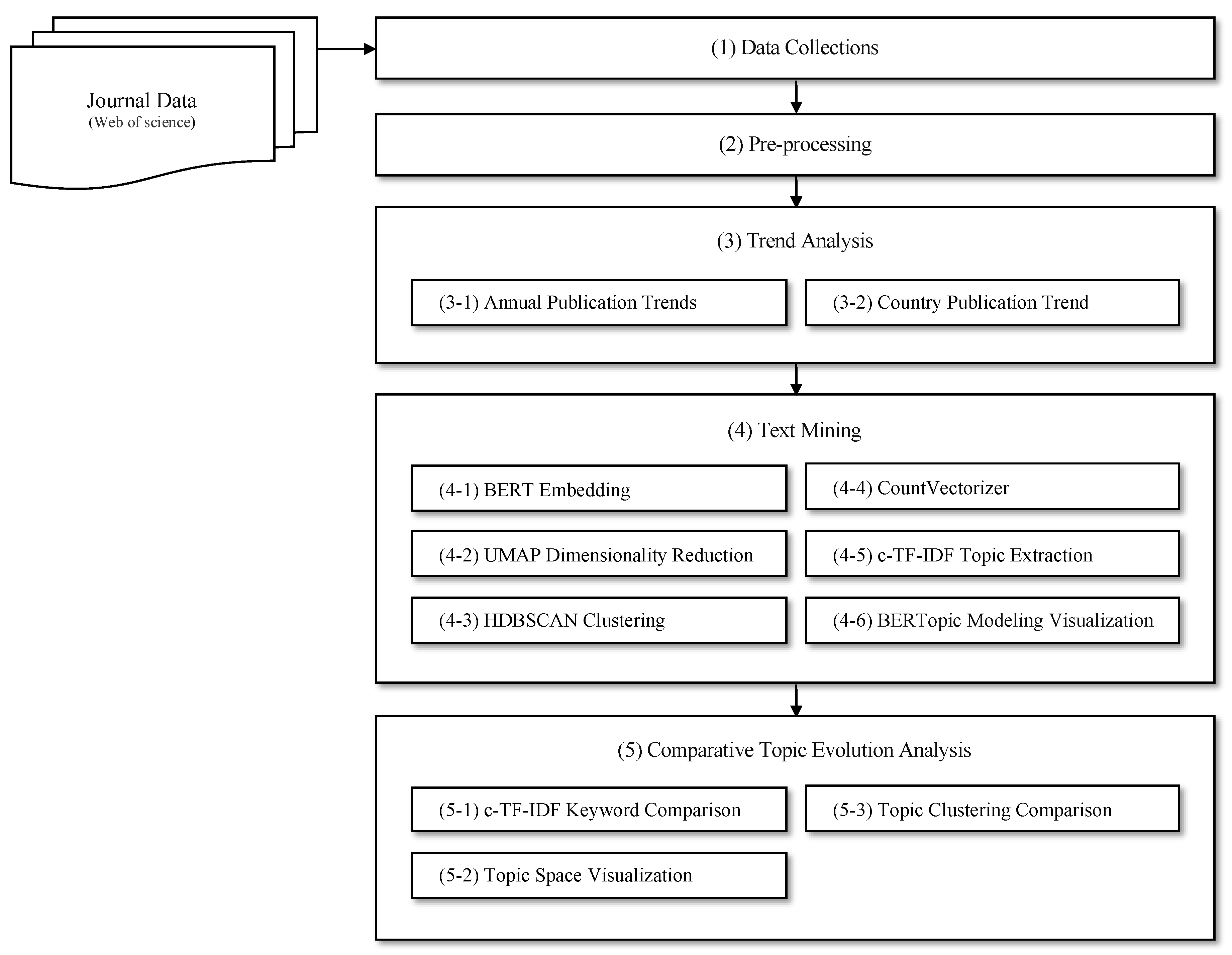
Figure 2.
Number of Publications.
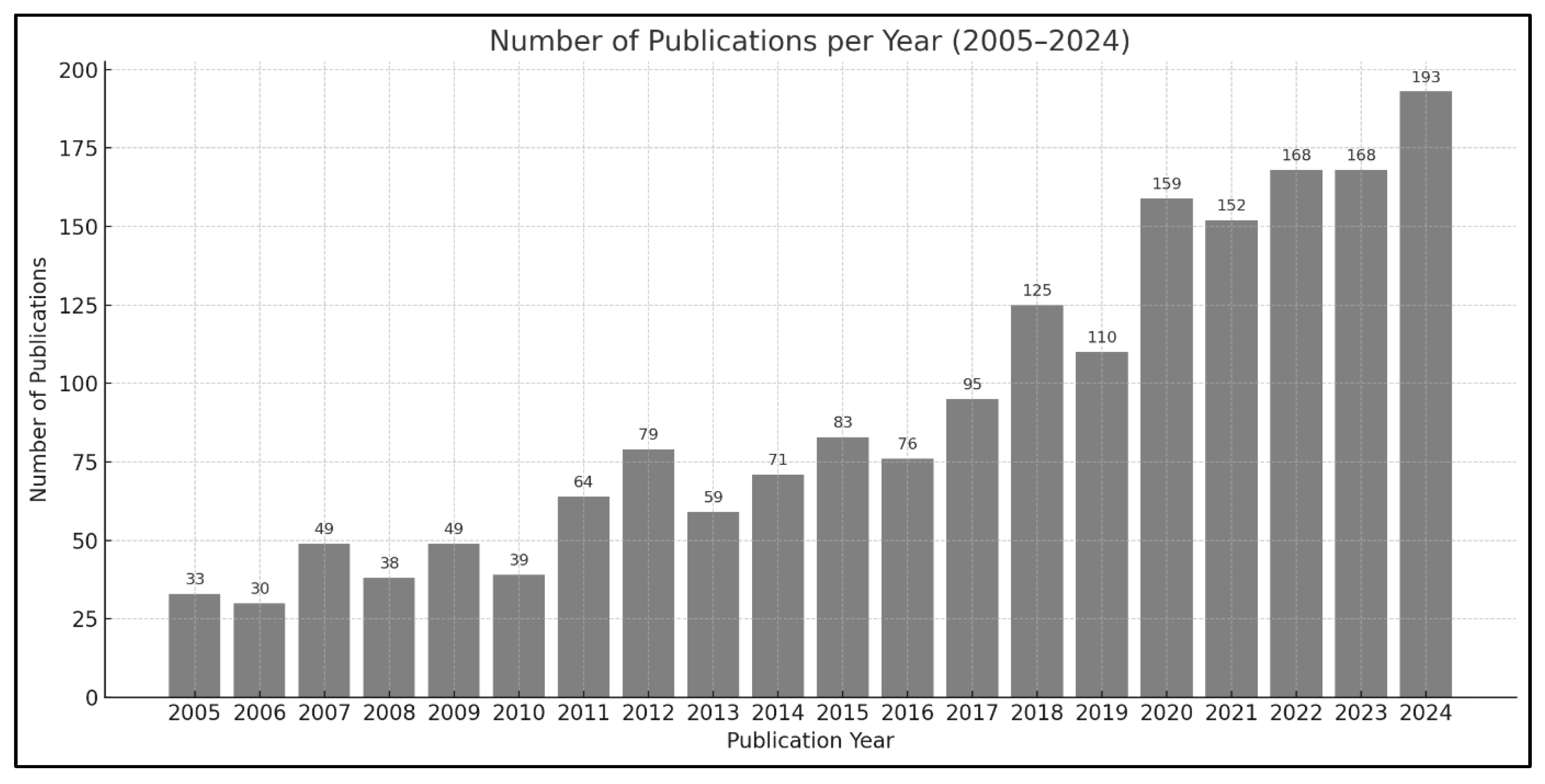
Figure 3.
Top 10 Countries by Number of Publications.
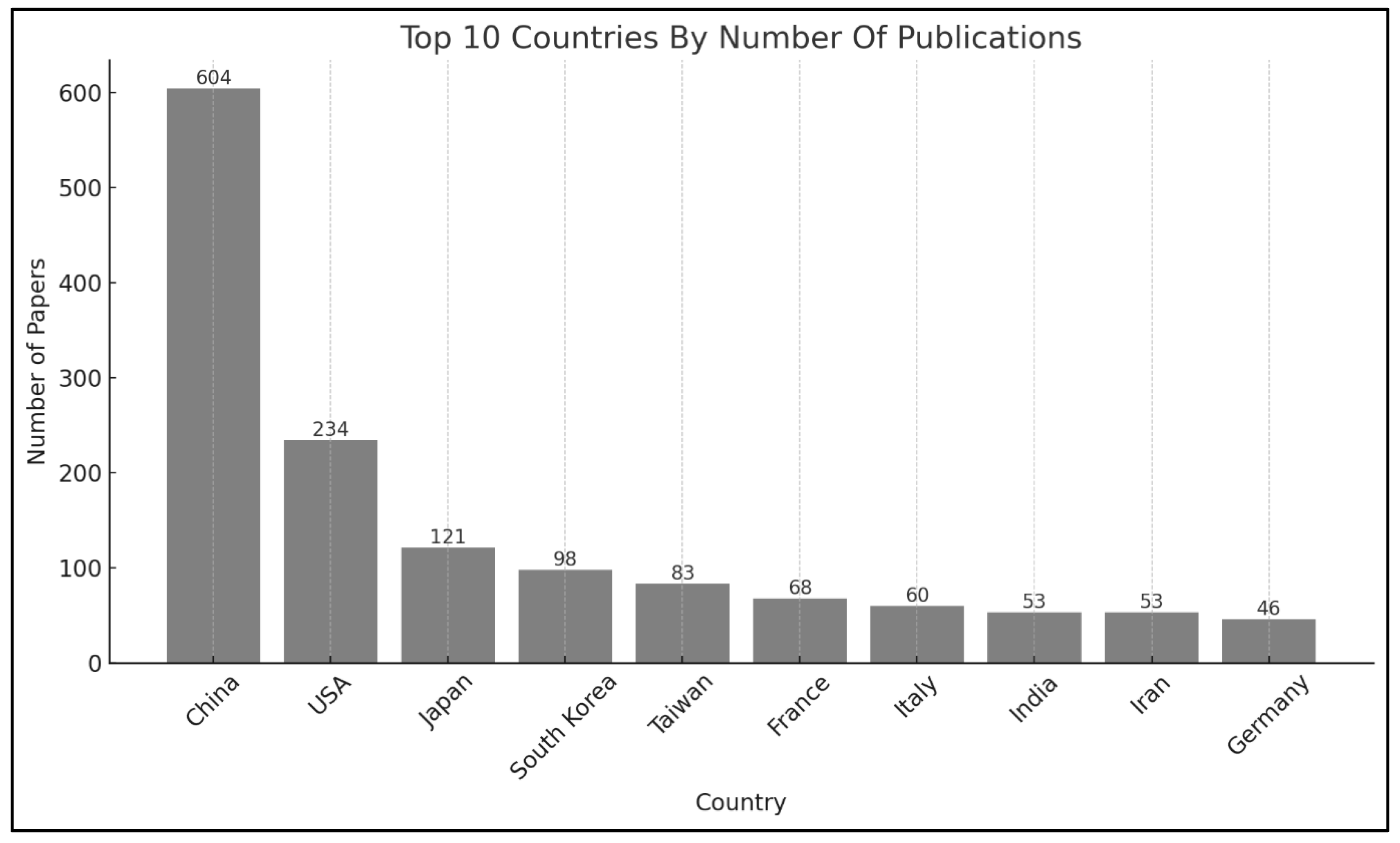
Figure 4.
c-TF-IDF Topic Word Scores (2005-2014).
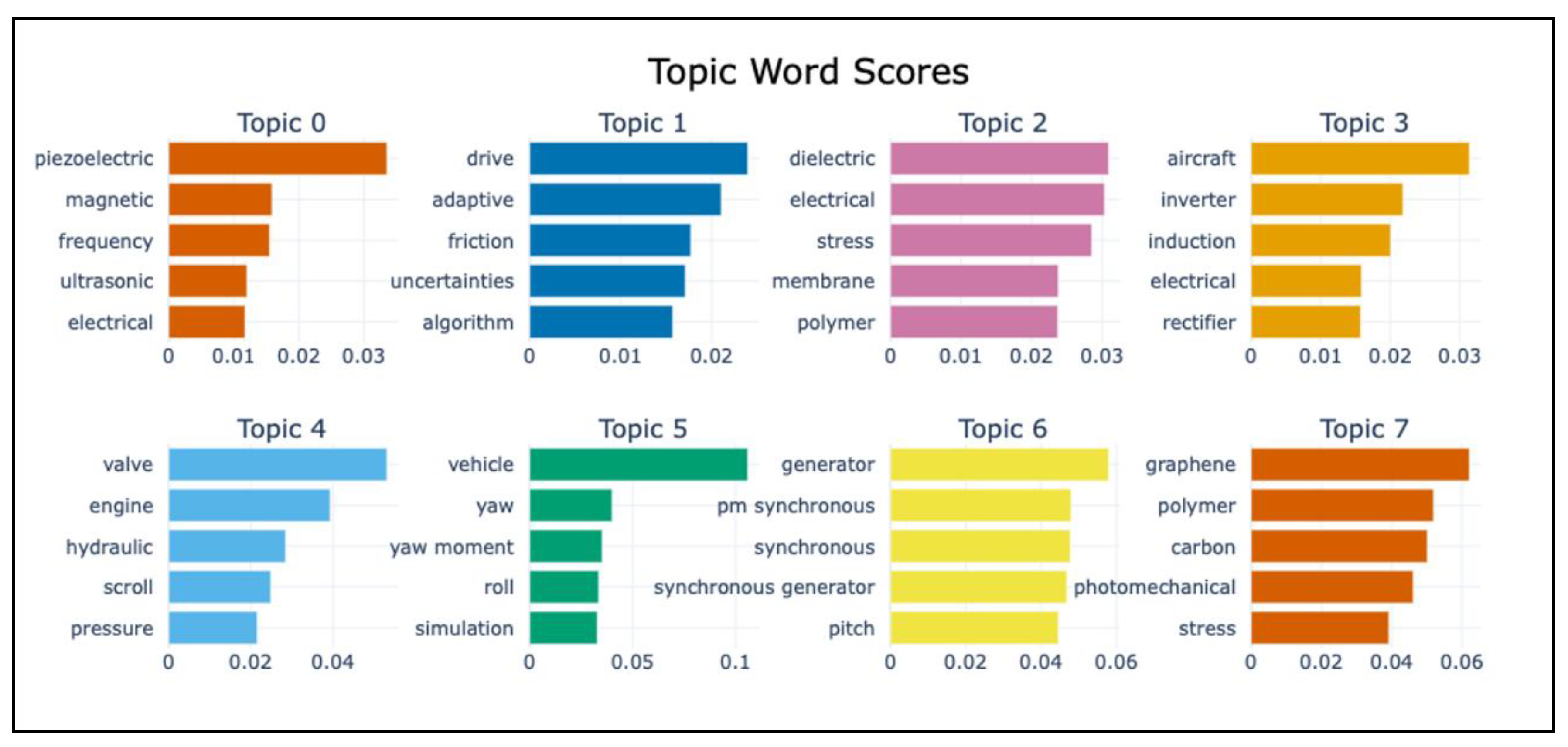
Figure 5.
c-TF-IDF Topic Word Scores (2015-2024).
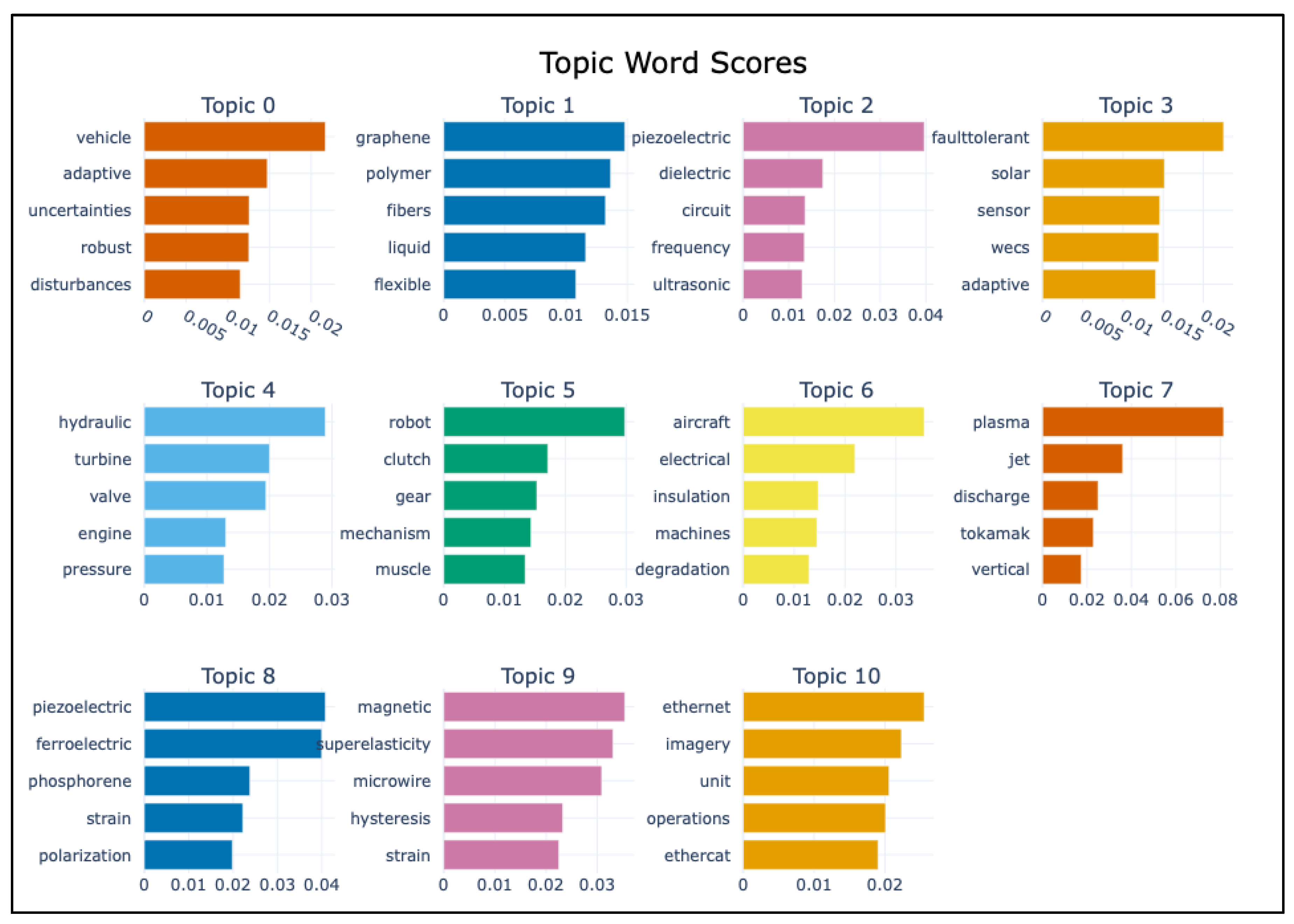
Figure 6.
BERTopic Modeling Interopic Distance Map (2005-2014).
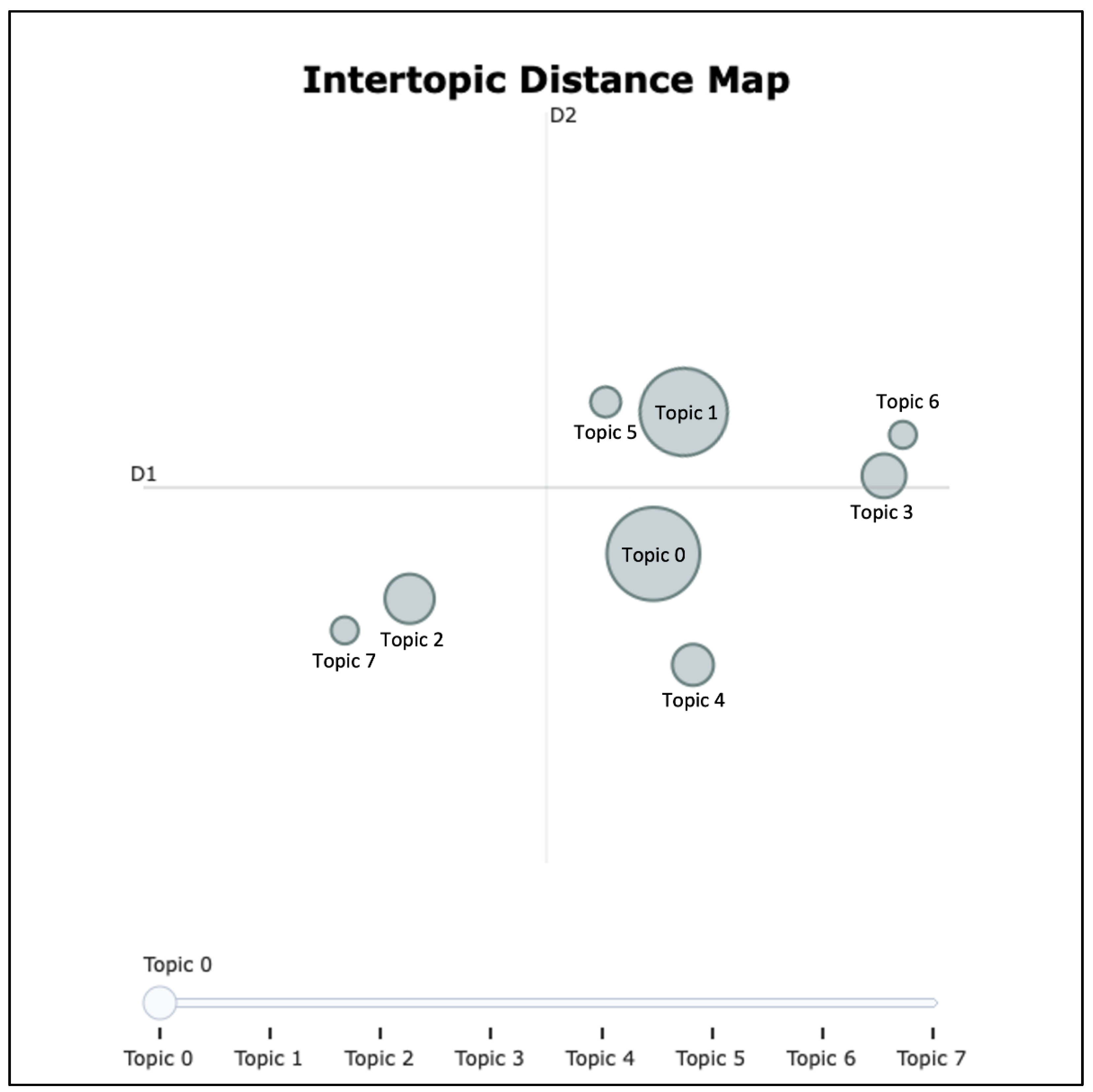
Figure 7.
BERTopic Modeling Interopic Distance Map (2015-2024).
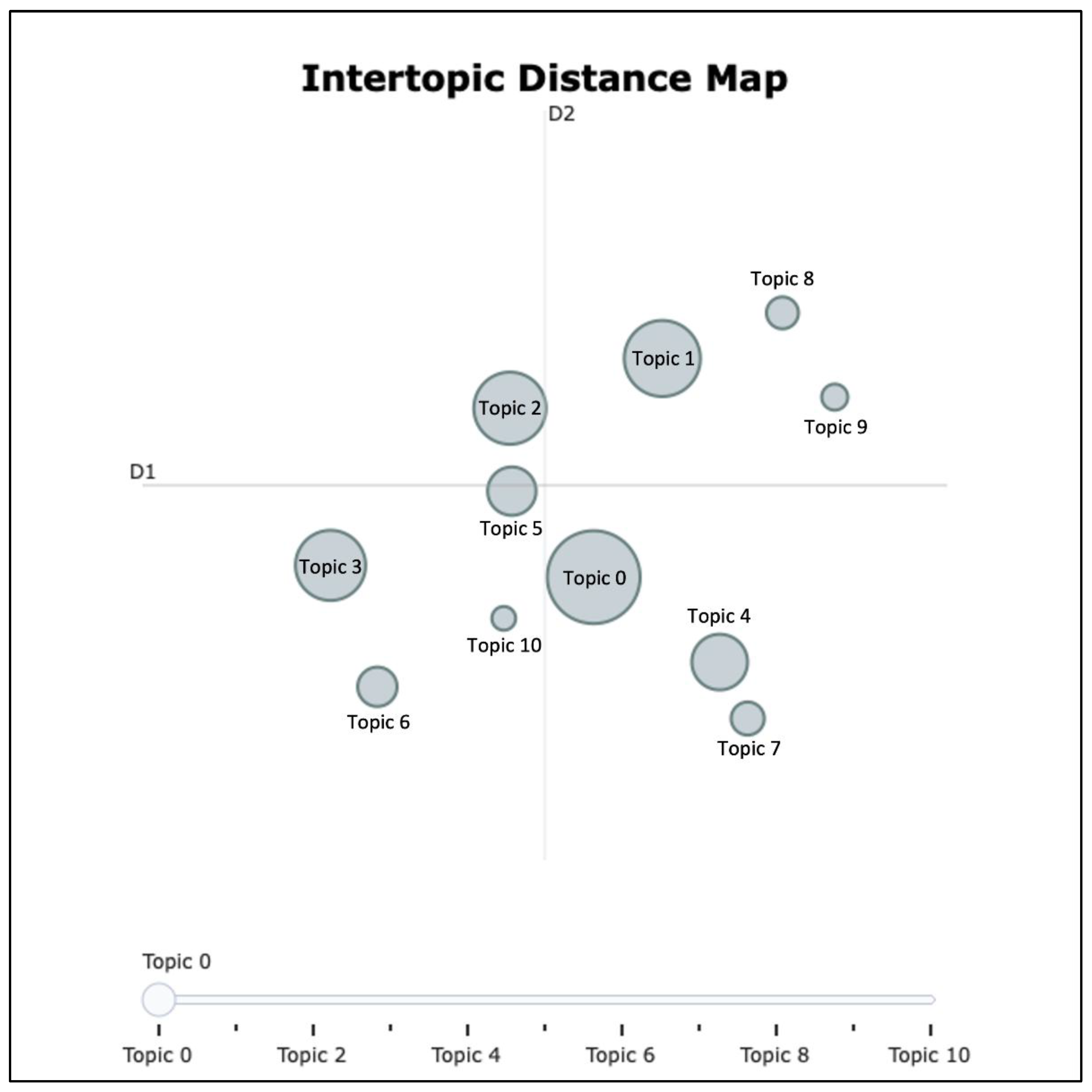
Figure 8.
Topic Hierarchical Clustering (2005-2014).
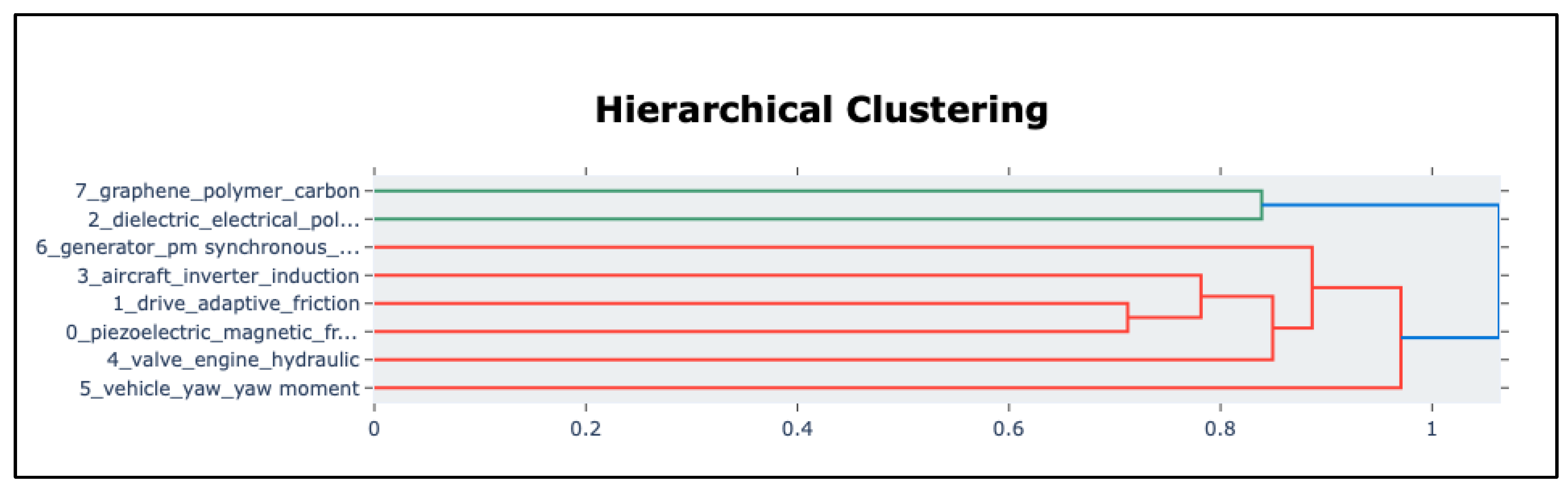
Figure 9.
Topic Hierarchical Clustering (2015-2024).
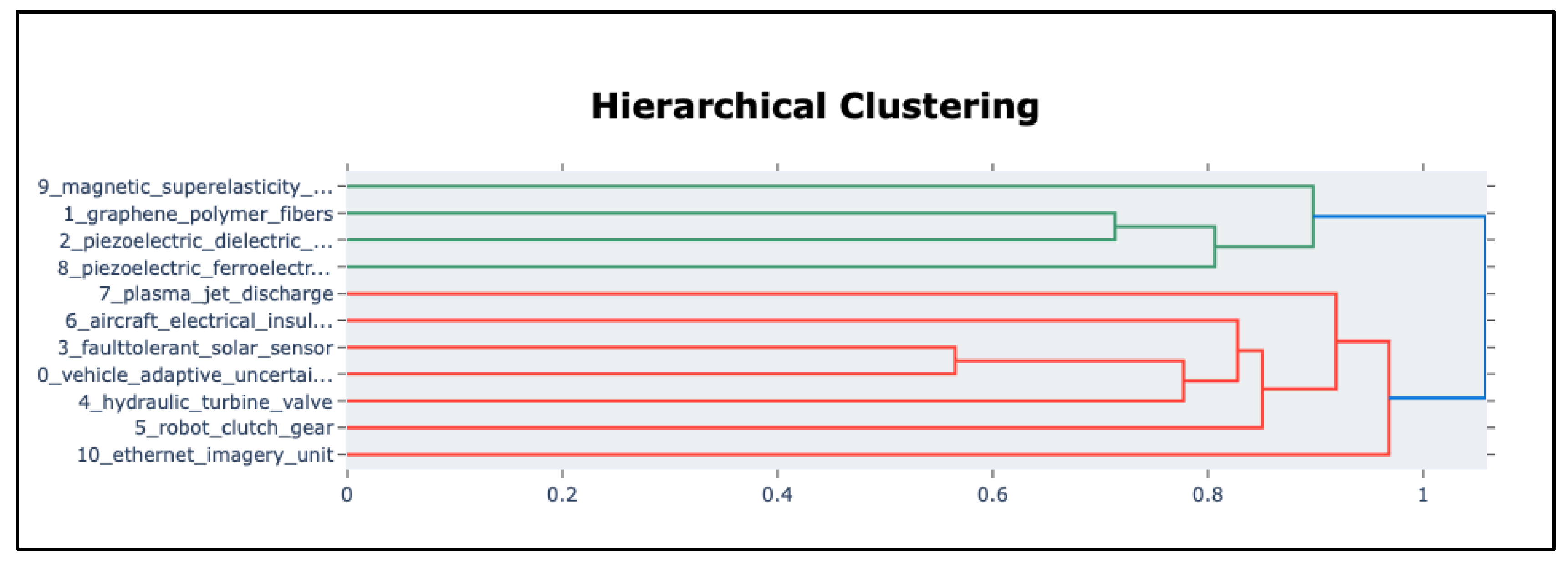

Table 1.
Web of Science search formula.
| Search Formula |
|---|
| “TS=( (actuator* OR “motion control” OR “servo motor*” OR “electromechanical device*” OR “piezoelectric actuator*” OR “hydraulic actuator*” OR “pneumatic actuator*” OR “soft actuator*” OR “smart actuator*”) AND (“power electronic*” OR “power converter*” OR inverter* OR rectifier* OR “DC-DC converter*” OR “motor drive*” OR “switching converter*” OR “voltage control” OR “PWM control” OR “power conditioning” OR “energy conversion” OR “electronic drive system*” OR “high-efficiency power system*”) |
Disclaimer/Publisher’s Note: The statements, opinions and data contained in all publications are solely those of the individual author(s) and contributor(s) and not of MDPI and/or the editor(s). MDPI and/or the editor(s) disclaim responsibility for any injury to people or property resulting from any ideas, methods, instructions or products referred to in the content. |
© 2025 by the authors. Licensee MDPI, Basel, Switzerland. This article is an open access article distributed under the terms and conditions of the Creative Commons Attribution (CC BY) license (http://creativecommons.org/licenses/by/4.0/).
Copyright: This open access article is published under a Creative Commons CC BY 4.0 license, which permit the free download, distribution, and reuse, provided that the author and preprint are cited in any reuse.