

Submitted:
16 June 2025
Posted:
17 June 2025
Read the latest preprint version here
Abstract
Additive manufacturing (AM) is revolutionizing the fabrication of structural compo-nents, demanding materials that balance printability with superior thermal and me-chanical performance. Polyglycerol-based macromolecular systems have emerged as promising candidates due to their highly tunable chemical architecture. Variations such as linear, hyperbranched, and dendritic topologies significantly influence thermal behavior, elasticity, and mechanical strength. Functional strategies including cross-linking, copolymerization, and additive incorporation enable property enhancement tailored to diverse AM platforms like stereolithography (SLA), digital light processing (DLP), and fused deposition modeling (FDM). While native polyglycerol systems ex-hibit low thermal stability, chemical modifications and hybridization with fillers like carbon nanotubes, cellulose nanofibers, or graphene oxide improve decomposition temperatures, flame retardancy, and thermal conductivity. Crosslinked derivatives also show increased glass transition and melting points, suitable for moder-ate-temperature printing and structural applications. However, trade-offs such as brittleness from excessive crosslinking and dispersion challenges with nanofillers re-main unresolved. This review critically evaluates the structure–property-processing relationships in polyglycerol-based systems, emphasizing their role in the development of next-generation, multifunctional materials for AM. Emphasis is placed on thermal performance, mechanical optimization, and the integration of environmentally friendly processing strategies.
Keywords:
polyglycerol
; additive manufacturing
; thermal stability
; mechanical performance
; crosslinking
; stereolithography
; hybrid composites
1. Introduction
Additive manufacturing (AM) enables the fabrication of complex geometries with up to 90% material efficiency gains, yet the structural integrity of printed components remains constrained by suboptimal thermomechanical stability [1,2,3]. However, structural components manufactured through AM are often subjected to demanding conditions—cyclic loading, temperature fluctuations, and long-term mechanical stress [4,5,6,7]. As a result, there is a growing need for advanced materials that combine printability with superior thermal and mechanical stability. Current photopolymer resins for vat-based AM often display low glass transition temperatures (Tg), brittle mechanical behavior after curing, and limited biocompatibility, restricting their suitability for load-bearing and medical applications [8,9,10].
Polyglycerol-based macromolecular systems are attracting growing interest for their potential to address the limitations of current AM materials due to their highly tunable chemical structure. This review covers a broad range of PG architectures—including linear, hyperbranched, and dendritic forms—and explores both biomedical and industrial variants. Key derivatives such as poly(glycerol sebacate) (PGS), poly(glycerol sebacate acrylate) (PGSA), polyglycerol diacrylate (PGDA), as well as PG-based urethanes, foams, and acrylates are included, with a focus on their relevance to additive manufacturing. Polyglycerol’s polyhydroxylated backbone allows precise tuning of cross-linking, branching, and hydrophilicity—making it well-suited for additive manufacturing techniques such as DLP, FDM, and VAM, where material behavior affects structural accuracy and function. With AM advancing toward more demanding applications, interest in materials offering both printability and enhanced thermomechanical stability is growing. Yet, current reviews often overlook polyglycerol’s potential beyond biomedical uses, particularly in structural and industrial AM contexts.
Enhancement of mechanical and thermal behavior in these systems is often achieved through functional modification. Studies have shown that the incorporation of carbon nanotubes (CNTs) into polyglycerol-based matrices can significantly improve mechanical reinforcement and thermal conductivity, making them viable for load-bearing and high-temperature applications [11]. Similarly, the use of plasticizers such as hyperbranched polyglycerols (HPGs) or glycerol has been shown to improve flexibility and toughness without compromising biodegradability [12]. Natural or inorganic fillers like zein and sodium chloride have also demonstrated compatibility with acrylated or norbornene-functionalized polyglycerol systems, further enhancing elastic and thermal behavior [13,14].
The potential of these materials lies not only in their chemical adaptability but also in their compatibility with sustainable and high-resolution printing. Their use in structural components such as lightweight frames, insulation panels, and mechanical supports illustrates the growing relevance of polyglycerol-based materials beyond biomedical applications.
This review provides a comprehensive analysis of polyglycerol-based macromolecular systems for additive manufacturing, emphasizing their thermal and mechanical performance in structural applications. It covers structure–property relationships, thermal stability, mechanical behavior in printed forms, and strategies for structural and functional enhancement. The review also presents case studies across diverse applications and critically discusses current challenges and future opportunities in advancing polyglycerol systems for next-generation AM platforms.
2. Structure–Property Relationships in a Polyglycerol System
Polyglycerol can be synthesized into distinct architectures—linear, hyperbranched, and dendritic—each exhibiting unique physicochemical property. These forms significantly influence the material's physical and chemical properties. Linear polyglycerol (LPG), characterized by regularly spaced hydroxyl functionalities along its backbone, allows for predictable and high-efficiency chemical modification [15,16]. Hyperbranched and dendritic polyglycerols, which feature multiple branching points, influence solubility, intermolecular interactions, and rheological behavior during processing [17,18]. Factors such as molecular weight, branching density, and terminal group composition influence mechanical behavior, elasticity, and thermal transitions [19,20]. Understanding these relationships is crucial for advancing polyglycerol systems in material applications.
2.1. Overview of Linear, Hyperbranched, and Dendritic Architectures
Architectural precision in polyglycerols is achieved through controlled polymerization techniques. Linear polyglycerol (LPG) synthesis employs anionic ring-opening polymerization (AROP) with alkoxide initiators, enforcing linear chain growth and narrow dispersity (Đ typically < 1.1 under controlled AROP conditions). For hyperbranched architectures (HPG), reversible addition-fragmentation chain-transfer (RAFT) polymerization regulates branching density (DB = 0.4–0.6) while preserving terminal functionality [21]. Dendritic systems utilize copper-catalyzed azide-alkyne cycloaddition (CuAAC) for defect-free branching (DB > 0.9), whereas atom transfer radical polymerization (ATRP) enables precise chain-end functionalization for hybrid architectures. Bottlebrush architectures are often prepared via grafting-through or grafting-from strategies using RAFT-controlled polymerization for side-chain growth. Side-chain engineering at the monomer level plays a critical role in modulating polymer conformation and nanostructure formation, influencing phase behavior and self-organization. Alkyl glycidyl ethers impose steric barriers increasing free volume by thereby affecting chain packing and mobility; carboxyethyl variants introduce ionizable carboxyl groups, enabling stimuli-responsive behavior [15]; and long-chain epoxides confer amphiphilicity to guide self-organization. Macromolecular topology is dictated by core design strategies, where linear chains prioritize sequential monomer addition [22]; cyclic cores employ end-group cyclization [23]; star-brush systems utilize multifunctional initiators [24]; comb topologies employ backbone grafting of linear side chains; and bottlebrush architectures require orthogonal grafting techniques. polyglycerols as promising sustainable materials, though production scaling and recyclability challenges persist. Block versus random architectural control significantly impacts the resulting nanostructure and material performance. Block copolymers, formed via sequential monomer addition, often exhibit microphase separation, which can enhance mechanical strength and thermal stability through distinct domain formation [25]; Hyper-branched-linear block copolymers combine the flexibility of branching with linear segments, offering improved solubility, tunable viscosity, and potential for Tg adjustment depending on segment composition [26]. In contrast, random copolymers, with statistically distributed comonomers, tend to form more homogeneous phases, which may reduce phase separation but can yield materials with broad thermal transitions and improved processability [16].
2.2. Molecular Weight, Branching, and Functional Group Influence on Modulus, Toughness, and Glass Transition Temperature
Molecular weight (MW) and branching architecture collectively influence the polymer’s entanglement density, crystallinity, and segmental mobility, thereby governing thermal transitions and mechanical behavior. High-MW LPG (>50 kDa) increases chain entanglements, which can elevate the glass transition temperature by up to 50 °C under certain formulations and enhance toughness due to improved energy dissipation during deformation [27]. Cyclic topologies intrinsically restrict chain mobility, increasing glass transition temperature beyond values predicted by MW alone. Star-brush architectures demonstrate branching-dependent crystallization suppression, with compact topologies enhancing elastic modulus by increasing segmental density, though at the expense of crystallinity due to steric hindrance and disrupted packing of regular chains. Functional group distribution plays a critical role in modulating stimuli-responsive behavior. Peripheral ionic groups, such as carboxy and sulfate, influence pH-dependent conformational changes through charge repulsion. Side-chain variations such as bottlebrush and comb architectures affect molecular flexibility and responsiveness. Bulk versus interfacial effects introduce distinct structural and functional dynamics, shaping overall material properties [28]; In bottlebrush architectures, increasing side-chain length generally elevates free volume and softens the backbone, enabling Tg tuning within a 40–60 °C window depending on backbone rigidity and grafting density.; and sulfated HPGs with DB=0.6 optimize biointerfacial responses through steric-ionic balance [29]. Branching architecture influences the spatial orientation and density of hydroxyl groups, thereby modulating hydrogen bonding networks that contribute to cohesive energy density and adhesive performance [30]. In comb-like architectures, the decoupling of rigid backbones from mobile side chains facilitates surface-localized erosion kinetics, especially under hydrophilic or enzymatic environments [31].
2.3. Strategies to Enhance Mechanical Strength: Crosslinking, Copolymerization, and Filler Addition
Enhancing the mechanical strength of polyglycerol-based systems is crucial for their in polyglycerol-based systems requires navigating fundamental trade-offs across crosslinking, copolymerization, and filler addition strategies, compounded by methodological contradictions and unresolved gaps in standardization. Crosslinking forms covalent networks that intrinsically increase rigidity but introduces strategy-specific compromises, such as brittleness, cytotoxicity, or incomplete network formation. While enzymatic approaches offer biocompatibility, they suffer kinetic limitations and inconsistent network density due to factors like pH sensitivity, enzyme deactivation at elevated temperatures, and variability in substrate diffusion [32,33]. Chemical agents like methacrylates enhance thermal stability but introduce significant cytotoxicity risks, reducing cell viability substantially in vitro [34,35]. Excessive crosslinking induces brittleness that compromises fracture toughness [36]. Critically, optimal curing durations remain elusive. Extended thermal or UV curing times can increase crosslink density, enhancing modulus, but often reduce elongation at break due to reduced chain mobility or embrittlement [37,38]. A lack of crosslinker–property mapping frameworks impedes the rational design of PG-based networks. Computational screening or in silico modeling approaches could help address this [39].
Copolymerization enables tunable mechanics but may also introduce instability risks depending on material composition. Integrating PEG improves processability yet can accelerate hydrolytic degradation threefold. Additionally, it may provoke immunogenic responses if residual monomers or byproducts persist, particularly in vivo [30,40]. Monomer ratio sensitivity causes significant mechanical fluctuations: in some PG-co-polyester systems, even a ±5% shift in glycerol content can result in a 30–50% change in elastic modulus, highlighting compositional sensitivity [41], while glutamic acid incorporation slows degradation but reduces elasticity by 40% [42]. Hydrophilic components depress Tg by 10–15°C due to increased free volume and plasticization effects from hydrogen bonding with ambient moisture [43], and slow-degrading derivatives risk chronic inflammation if degradation byproducts accumulate in vivo [44]. These inconsistencies stem partly from unstandardized synthesis protocols, where accelerated methods sacrifice crosslinking homogeneity [45].
Filler addition enhances strength but faces intrinsic dispersion-limited efficacy. Nanosilicate reinforcement increases stiffness by 300% but reduces cell viability by 50% at 10 wt% loading [46], while nHA exhibits a strict 3% loading threshold beyond which aggregation induces catastrophic embrittlement [47]. Agglomerates >200 nm create stress concentration points that reduce tensile strength by 35–60% despite filler content [48,49]. Graphene's reinforcement efficiency diminishes by up to 50% in cases of poor exfoliation or re-agglomeration, compromising tensile modulus and fracture strength [50]. Thermally, coefficient of expansion mismatches provokes delamination >80°C particularly at filler–matrix interfaces, where differential thermal expansion introduces shear stresses that exceed interfacial adhesion, leading to delamination above critical processing temperatures [51], while poor filler orientation causes ±30% modulus fluctuations across studies [52].
Synthesizing the strategies reveals context-dependent hierarchies where mechanical reliability favors crosslinking over copolymerization and filler addition due to dispersion variability; long-term stability shows fillers and crosslinking comparable but both superior to copolymerization given hydrolytic sensitivity; biocompatibility risk peaks with chemical crosslinking while fillers and copolymerization exhibit dose-dependent concerns; and thermal resilience ranks crosslinking highest, followed by fillers, with copolymerization last due to monomer-driven Tg depression. No approach universally dominates. Crosslinking suits static implants but fails in dynamic tissues; copolymerization enables drug delivery tunability but sacrifices durability; fillers enhance bone scaffold mechanics but compromise vascularization. Critically, clinical translation remains hampered by unaddressed gaps including inconsistent characterization protocols that obscure cross-study comparisons [45], unpredictable in vivo degradation-mechanics coupling that undermines lab results [53], and scalable synthesis methods that degrade mechanical performance [54]. Optimization must therefore reconcile these trade-offs with application-specific biological and mechanical demands while prioritizing standardized testing, in silico-experimental validation, and accelerated aging studies.
3. Thermal Stability and Processing Considerations
Polyglycerol-based polymers are gaining attraction in additive manufacturing (AM), especially for applications that require high thermal stability and mechanical strength. Their hydroxyl-functionalized polyether backbone provides versatility, allowing for both thermoplastic and thermoset applications [55]. Polyglycerol can be modified to optimize its performance in AM processes such as stereolithography (SLA) and fused deposition modeling (FDM) [21,22].
3.1. Thermal Decomposition Profiles
Thermal stability plays a vital role in determining how well polyglycerol-based materials perform in additive manufacturing (AM), especially in applications that involve elevated temperatures. When compared to traditional thermoplastics like PLA and ABS, polyglycerol systems—particularly those that are crosslinked—tend to show better thermal behavior. Crosslinking helps raise the glass transition temperature (Tg), melting point (Tm), and resistance to thermal breakdown, allowing the materials to maintain their structure and function during processing and use [56,57].
In particular, modified polyglycerol resins used in SLA printing have demonstrated higher thermal degradation onset temperatures after UV curing. UV curing promotes the formation of dense crosslinked networks, increasing both the thermal degradation onset and structural stability during high-temperature post-processing [58,59]. Additional improvements in thermal performance have been observed when reinforcing the base polymer with additives such as cellulose nanofibers, graphene oxide, or sodium silicate—each contributing to increased decomposition temperatures and overall stability [60,61].
As shown in Table 1, a variety of polyglycerol-based systems have been developed with targeted modifiers to improve both thermal and mechanical properties. Whether for environmental cleanup, wound care, or lightweight structural parts, these materials are showing real promise. While the level of improvement depends on the additives and how the material is processed, the general trend is clear: polyglycerol composites are becoming more capable of handling the thermal demands of AM.
To enhance thermal properties, hybrid systems that combine polyglycerol with functional materials such as nanoparticles, fibers, and bio-based polymers have been actively investigated. Hybrid composites combining polyglycerol with nanofillers (e.g., CNTs, graphene oxide, cellulose) exhibit enhanced thermal stability due to increased phonon scattering and interfacial thermal resistance, which reduce chain mobility and delay thermal decomposition [60]. For example, incorporating carbon nanotubes (CNTs) into polyglycerol-based composites leads to an increase in thermal conductivity, making these materials ideal for high-performance applications in industries such as aerospace and automotive [11,56,61,81,82,83]. Additionally, polyglycerol-modified composites reinforced with natural fibers offer both superior mechanical performance and enhanced sustainability, positioning them as eco-friendly alternatives in sectors like construction and automotive [84,85].
The glass transition temperature (Tg), melting points (Tm), and thermal conductivity of polyglycerol-based systems are vital to their suitability for AM. Crosslinking polyglycerol derivatives increases Tg and improves thermal stability, which is critical for maintaining dimensional accuracy and load-bearing capacity at elevated temperatures [60,86,87]. Similarly, crosslinking with various monomers increases Tm, allowing the material to maintain mechanical integrity at elevated temperatures, making them appropriate for industrial and automotive uses [37,88].
Regarding thermal conductivity, polyglycerol-based systems typically exhibit low to moderate conductivity [89]. While native polyglycerol systems exhibit low thermal conductivity (~0.2 W/m·K), incorporation of graphene or CNTs forms conductive networks that improve heat dissipation. However, filler percolation thresholds and dispersion quality are critical—excessive loading or agglomeration may reduce mechanical performance despite thermal gains [83,90].
3.2. Suitability for High-Temperature Printing Platforms
Native polyglycerol-based polymers, such as poly(glycerol sebacate) (PGS), exhibit softening transitions and rubbery behavior near physiological temperatures (~37 °C), limiting their use in high-temperature extrusion platforms like FDM, which require melt-processing temperatures >200 °C [60]. However, due to their hydroxyl-rich backbone, polyglycerols can be easily functionalized with acrylate, methacrylate, or norbornene groups, enabling photocuring via SLA and DLP techniques [91,92]. When appropriately modified, these resins show potential for use in industries operating within moderate thermal ranges (40–120 °C), such as patient-specific biomedical devices, soft robotic components, or cosmetic automotive interior parts. Recent studies also suggest their adaptability to non-layered processes like Volumetric Additive Manufacturing (VAM), where bulk photopolymerization benefits from rapid curing kinetics and material transparency [93,94,95].
3.3. Fire Retardancy and Insulation Potential
Another significant advantage of polyglycerol-based systems is their fire retardancy and insulation potential. The hydroxyl-rich structure promotes char formation upon thermal degradation, which can marginally delay ignition, though native polyglycerols are not intrinsically flame-retardant without modification. This can be further enhanced by incorporating inorganic fillers, such as phosphorus-based compounds or intumescent additives, which improve the material’s ability to resist ignition and slow the spread of flames [96,97]. These modifications make polyglycerol-based systems potentially suitable for low-voltage electronic enclosures or interior automotive components where moderate flame retardancy is sufficient.
Polyglycerol-based polymers inherently possess low thermal conductivity, making them suitable for thermal insulation applications due to their amorphous structure and high free volume, which limit phonon and electron transport. The incorporation of insulating fillers, such as glass fibers or ceramic particles, can further enhance the thermal barrier properties of polyglycerol-based polymers. These fillers act as thermal barriers by reflecting or dissipating heat through low-conductivity pathways, thereby improving insulation performance while preserving the material’s mechanical integrity [20]. However, due to the limited thermal stability of the base polymer, these composites are more appropriate for applications involving low to moderate temperatures rather than high-temperature environments.
4. Mechanical Performance in 3D Printed Forms
4.1. Mechanical Properties in AM
Polyglycerol-based polymers enable tunable mechanical properties for 3D printed biomedical applications. Photocurable PGSA systems, depending on crosslink density and UV dosage, show tensile strengths from 0.5–2 MPa and elongation at break exceeding 200%, which enables tissue compliance and durability [98], while PGS-coated 3D printed scaffolds match trabecular bone strength (5–20 MPa) [38]. Electrospun PGS/PCL blends mimic cardiac tissue (0.5–6 MPa tensile strength) [99]. HPG bioinks allow stiffness tuning [100], and light-assisted curing improves interlayer bonding [101], though extrusion-based printing may still exhibit anisotropy which limits mechanical uniformity in load-bearing implants or pressure-bearing medical devices [102]. These materials balance flexibility, strength, and biocompatibility for tissue engineering.
4.2. Influence of Printing Parameters on Anisotropy and Layer Bonding
Printing parameters (speed, nozzle temperature, layer height) affect anisotropy and interlayer bonding in polyglycerol systems. Excessive nozzle temperatures (>180 °C) can cause backbone scission or oxidation in polyglycerol derivatives, leading to molecular weight loss and compromised mechanical integrity. [103,104,105,106]. Print orientation impacts anisotropy, with higher strength along the print direction (0°) versus perpendicular (90°) due to interlayer bonding limitations [107,108].
Thinner layers (50–100 µm) reduce voids, improving bonding but increasing print time [109,110]. Non-planar printing reduces anisotropy by aligning deposition with stress flow [111]. Multi-objective optimization (e.g., Grey Relational Analysis [GRA], a statistical optimization tool often employed to balance competing AM parameters such as strength, adhesion, and print resolution) balances parameters for optimal strength and bonding [112]. Chemical modifications (surface-segregating additives) enhance interfacial adhesion, reducing anisotropy [113].
4.3. Comparative Performance with PLA, PCL, PEGDA, and Other Polymers
Polyglycerol systems differ mechanically, thermally, and biologically from PLA, PCL, and PEGDA (Table 2).
PGS has lower stiffness (0.05–1.5 MPa tensile modulus). The wide tensile modulus range reflects sensitivity to degree of crosslinking, copolymerization content, and processing conditions. PGS has higher elasticity (200–450% elongation) than PLA/PCL, making it ideal for flexible scaffolds. Although PEGDA blending improves processability, its incomplete photopolymerization may induce cytotoxicity in vivo, necessitating careful dosage and post-curing validation [38,98]. PGS has moderate-to-good printability due to viscosity and curing limitations.
Thermally, PLA/PCL have higher Tg than PGS, but modifications (crosslinking, blending) enhance PGS stability (Table 3). PGS degrades faster (1–6 months) than PLA/PCL under physiological conditions, with tunable hydrolysis rates [117]. Its hydrophilicity minimizes protein adsorption, offering superior biocompatibility [118].
Hybrid systems (PGS-PLA, PGS-PCL) improve hydrophilicity, degradation control, and osteogenic activity [122,123]. This gap significantly limits design confidence in dynamic-load-bearing biomedical or robotic applications.
Table 4 shows a comparison of shape-memory and creep performance across PLA/PCL blends, PEGDA systems, and polyglycerol-based materials. Polyglycerol systems stand out with full shape recovery (100%) and lower creep strain (3–8%), making them promising for applications that require long-term flexibility and stability. While PLA/PCL blends offer higher recovery stress, their creep resistance is lower. These results highlight the potential of combining rigid and flexible components—like PLA with PGS—to create balanced, high-performing materials for AM-based biomedical devices
These hybrid systems synergistically merge the rigidity of PLA/PCL with PGS's flexibility and biofunctionality, broadening the material design space for AM-fabricated biomedical devices [27]. Future work should prioritize quantitative characterization of polyglycerol-based shape-memory effects and long-term creep behavior.
4.4. Shape Retention, Creep Resistance, and Dynamic Loading Performance
PGS and its derivatives demonstrate minimal permanent deformation (<3% strain under cyclic compression for 1,000 cycles at 20% strain), attributed to their covalently crosslinked network structure, though exact residual strain values were not explicitly quantified. Higher crosslink density reduces creep strain, enhancing dimensional stability [129]. Dynamic mechanical analysis (DMA) of PGS scaffolds reveals storage modulus stability and low hysteresis (<5% energy loss per cycle) under cyclic loading (0.1–10 Hz), indicating resilience under physiological strain rates [130]. Post-printing UV or thermal curing can increase crosslink density by up to 2–3× (compared to non-post-cured samples), enhancing fatigue resistance and dimensional stability over time. [131].
5. Structural and Functional Enhancements
5.1. Reinforcement with Inorganic Filler
5.1.1. Silica Reinforcement
Adding silica to polyglycerol-based resins increases glass transition temperature (Tg) and thermal conductivity, making them potentially suitable for moderate-temperature components, such as casings or housings in automotive and aerospace subassemblies, where operational temperatures remain below 200–250 °C [88,132,133,134,135,136,137]. Silica nanoparticles improve crosslinking efficiency, enhance the surface area for interaction, and promote better layer bonding in 3D-printed structures likely due to increased surface area and hydrogen bonding sites that facilitate radical polymerization or crosslink propagation during curing [44,132]. Silica-functionalized polyglycerol resins combine high-temperature stability with enhanced mechanical strength and interlayer bonding, making them promising candidates for structural components in advanced manufacturing technologies.
5.1.2. Graphene Reinforcement
Graphene has emerged as a multifunctional nanofiller that significantly enhances the mechanical strength, electrical conductivity, and thermal stability of polyglycerol-based composites. Incorporation of 0.5–2 wt% graphene oxide has shown up to 20-45% increase in tensile strength and 2× fracture toughness compared to unreinforced PG-based systems [138,139,140,141,142]. Its high intrinsic thermal conductivity (~3000–5000 W/m·K) enables efficient heat dissipation, making it ideal for thermal management in electronics. Studies have demonstrated that GO-based composites significantly reduce hotspot temperatures and improve thermal management performance in electronic systems. Additionally, the incorporation of GO into polymer matrices leads to the formation of percolated filler networks, which enhance structural rigidity while maintaining flexibility. This synergistic effect is particularly advantageous in load-bearing applications such as aerospace and automotive components, where a high strength-to-weight ratio and mechanical resilience are critical [143,144,145]. These improvements parallel the performance gains observed in stereolithography-printed methacrylate/chitin nanowhisker composites, where nanofiller addition enhanced both mechanical and thermal behavior [146]. Graphene-based systems provide multifunctionality—including electrical conductivity, EMI shielding, and heat dissipation—that surpass silica and nanoclay reinforcements in active or smart device contexts.
5.1.3. Nanoclay Reinforcement
Nanoclays such as montmorillonite and kaolinite enhance mechanical reinforcement and barrier performance in polyglycerol-based systems by forming nanostructured networks within the polymer matrix. Incorporating 3–5 wt% of these fillers has been shown to increase stiffness and tensile strength while significantly improving thermal stability [147]. Studies report a rise in decomposition onset temperatures by 40–50 °C and a reduction in peak heat release rates by up to 35%, indicating enhanced flame retardancy. [148,149,150,151]. These improvements make nanoclay-reinforced PG composites well-suited for high-performance applications [149,152,153].
5.1.4. Effects of Hybrid Reinforcement
Hybrid reinforcement strategies that combine multiple inorganic fillers—such as silica–graphene or clay–carbon nanocomposites—can synergistically enhance the multifunctional properties of polyglycerol-based systems. Synergistic effects arise when distinct fillers contribute complementary mechanisms: graphene enhances conductivity and tensile strength, while silica or nanoclays improve thermal stability and dimensional rigidity. While studies specific to polyglycerol composites are still emerging, research on similar polymer systems has demonstrated that combining graphene and silica can significantly improve flexural strength and thermal resistance. Nanoclays, in particular, are well-recognized for enhancing barrier properties and mechanical toughness [154].
Building on these findings, recent research continues to focus on optimizing filler type, concentration, and dispersion techniques to further advance the performance of polyglycerol-based composites. As industries increasingly demand lightweight, multifunctional, and printable materials, polyglycerol-based composites—especially when reinforced with optimized inorganic hybrids—offer a promising platform that balances sustainability, printability, and performance.
5.2. Dual-Network Systems (DNS) and Interpenetrating Polymer Networks (IPNs)
A dual-network system (DNS) consists of two distinct polymer networks: one soft and elastic and the other stiff and rigid. This combination optimizes fracture resistance and impact strength while maintaining stiffness. In polyglycerol-based systems, DNS enhances the strength from the rigid phase and toughness from the elastic phase [155]. For example, a polyglycerol-based resin combined with a crosslinked thermoplastic elastomer exhibits tensile strengths up to 12MPa and elongation at break above 500% in optimized formulations[38,116,155,156], making it suitable for moderate-load applications.
Polyglycerol-based systems have the potential to form interpenetrating polymer networks (IPNs) with other crosslinked polymers such as polyurethane (PU) or epoxy resins. While direct studies on such systems are limited, existing research on similar polymer matrices suggests that IPN architectures can enhance load-bearing capacity and fracture resistance. The IPNs leverage phase interpenetration and molecular entanglements to distribute applied stress across interfaces, thereby delaying crack propagation and enhancing load-bearing behavior [157].
The incorporation of nanofillers into DNS or IPN architectures reinforces interfacial bonding and constrains polymer chain mobility, thereby increasing tensile modulus by 2-4× and shifting thermal decomposition onset temperatures by 20-40 °C [157]. This makes them ideal for high-temperature applications.
5.3. Mechanically Adaptive Polyglycerol Networks
Mechanically adaptive polyglycerol (PG) networks are typically formed by crosslinking polyglycerol-based resins with reactive monomers or multifunctional crosslinkers to create flexible yet robust polymer structures. These networks allow for elastic deformation and partial recovery when external forces are removed. Depending on the formulation, PG networks can respond to environmental stimuli such as temperature, light, or moisture, resulting in changes to their mechanical properties including stiffness, elasticity, or shape-memory behavior.
Several studies suggest that temperature-responsive PG networks are capable of shape-memory effects, showing thermally induced deformation and partial shape recovery while maintaining high mechanical integrity [158,159,160]. Although most of these studies focus on model systems or modified analogs rather than native polyglycerol, they support the broader potential of PG-based materials for adaptive applications such as smart scaffolds and responsive packaging.
The adaptability of these networks is further enhanced through polymer blending strategies. For instance, combining PG with polymers like polycaprolactone (PCL) or polyethylene glycol (PEG) has been shown to improve mechanical resilience and shape retention under deformation [49,161,162]. These hybrid networks offer tunable recovery characteristics and are under investigation for use in soft actuators, biomedical stents, and packaging that requires conformability and dynamic response. While PEG improves hydrophilicity and elasticity, it may lower thermal resistance, while PCL can delay response times due to slow crystallization dynamics.
Shape-memory polymers (SMPs) represent an important subclass of adaptive materials. They are capable of temporarily fixing a deformed shape and then returning to their original configuration upon stimulation by heat, light, or moisture [80,163,164]. While there is currently limited direct evidence of shape-memory effects in PG systems, related studies in other DCB-enabled polymers suggest that polyglycerol could be engineered to exhibit dual- or multi-shape transitions refer to polymers capable of fixing and recovering more than two temporary shapes via sequential thermal triggers, often enabled by distinct phase-segmented architectures [165,166,167]. Developing SMPG (Shape Memory Polyglycerol) networks typically involves introducing dynamic covalent chemistries such as esters, imines, or disulfides—bonds known to undergo reversible reactions under heat or chemical stimuli [165,166,167]. The abundant hydroxyl groups on PG chains provide multiple sites for such modifications, enabling the design of thermally responsive and potentially reversible networks. Though Peng et al. (2022) and Roh et al. (2024) focus on other polymer classes, their findings lend conceptual support to the future development of SMP behavior in polyglycerol matrices.
Applications of these networks in additive manufacturing (AM) are promising due to PG’s chemical versatility and compatibility with photopolymerization. For example, poly(glycerol dodecanedioate) (PGD), a thermoset polyester, has demonstrated shape-memory characteristics suitable for resorbable stents and implants [168]. Additionally, studies indicate that PG–urethane foams can exhibit shape fixity and recovery above 99%, albeit with relatively long recovery times (~2400 seconds) under compressive stimuli [169], making them more appropriate for cushioning or slow-release structural components which may be unsuitable for fast-response actuators but acceptable for packaging cushions or delayed-release biomedical devices.
While UV-cured polyglycerol diacrylate (PGDA) systems have been explored as photoreactive resins, their shape-memory performance remains under-characterized. Saunoryte et al. (2024) demonstrated light-induced actuation of glycerol-acrylate photopolymers using UV/vis irradiation at 310 mW/cm2, achieving full recovery of the original shape in approximately 5 seconds upon reheating above glass transition—but they did not report quantitative metrics for shape fixity, strain recovery ratio, or actuation durability over multiple cycles. [170].
Table 5 highlights the shape-memory and mechanical recovery capabilities of selected polyglycerol-based networks under various stimuli. PGS elastomers demonstrate strong shape-memory behavior with high shape fixing (98%) and recovery (97%) at moderate temperatures, making them suitable for biomedical uses [171]. When reinforced with silica nanoparticles, PGS shows even greater performance—achieving full shape recovery (~100%) within approximately 20 seconds at 60 °C [172]. Polynorbornene-modified networks also display effective memory behavior, with over 99% fixing and over 90% recovery at 45 °C [70]. Polyglycerol urethane foams exhibit excellent fixity and recovery (above 99%) but respond more slowly, with recovery times around 40 minutes (2400 seconds) [169], making them ideal for structural applications that require gradual shape adaptation. Although PEG–polyglycerol diacrylate networks are UV-responsive, further data are needed to evaluate their shape-memory performance [173]. Overall, these systems illustrate the tunability of polyglycerol-based networks for responsive, high-performance applications in medical, structural, and adaptive technologies.
5.4. Interface Engineering in Multi-Material Printing
In multi-material 3D printing, forming a strong and stable interface between different materials is essential to ensure the durability and performance of the final product. When adhesion at the interface is weak, it can lead to problems such as interfacial delamination, microcrack propagation, and reduced tensile shear strength—typically lowering the effective strength of multi-material assemblies by 40–70%, depending on the material pairing and print conditions [174,175].To address this, interface engineering must consider not only compatibility at the macro level but also interactions happening at the molecular scale.
Polyglycerol-based systems bring unique advantages when it comes to interface design because of their abundance of hydroxyl groups. These functional groups can engage in hydrogen bonding or react chemically through reactions such as isocyanate-based urethane linkages, anhydride ring openings, or base-catalyzed transesterification with neighboring acrylate or lactide groups [176,177,178].
Surface energy and adhesion forces are also critical factors in determining how well different materials bond together. While surface modification of polyglycerol hasn’t been studied extensively, research on similar polymers shows that adding functional groups like amines, carboxyls, or epoxides can improve bonding by making the surface more reactive or polar. Functionalization with amines and carboxylic acids increases polar surface energy, improving wettability and adhesive strength, especially in hydrophilic–hydrophobic polymer blends [179,180,181]. For example, polymers modified with amine groups have shown better adhesion to materials like epoxy and polyurethane, suggesting that similar approaches might work for polyglycerol too.
Another way to strengthen interfaces is by using coupling agents or stabilizers. Silane coupling agents, for instance, can form strong siloxane bonds with silica particles and at the same time attach to polyglycerol’s hydroxyl groups. For instance, treating silica fillers with 1 wt% 3-methacryloxypropyltrimethoxysilane (3-MPS) forms covalent bridges between polyglycerol and silica, boosting interfacial shear strength by approximately 90%—from ~10 MPa to ~19 MPa—in hybrid composites [182,183]. Graphene oxide (GO), with its many oxygen-containing groups, can create hydrogen bonds, van der Waals forces, and even π–π stacking with certain polymers. These interactions can help transfer stress more effectively across the interface and improve the overall toughness of the material [52,183].
Post-processing methods like UV curing and thermal annealing also play a role in reinforcing interfaces UV curing activates residual acrylate/methacrylate groups at the interface, increasing crosslink density by up to 30 %, while thermal annealing enhances polymer chain mobility and interdiffusion at the interfacial zone, improving toughness and modulus by 25-40% [184,185,186]. That said, the success of these processes depends on matching them to the thermal behavior of the polyglycerol system.
Creating multi-phase composites by combining polyglycerol with nanomaterials such as graphene, silica, or carbon nanotubes may further improve interface quality. These tiny fillers can anchor to the polymer matrix at the nanoscale and create a mix of covalent, electrostatic, and dispersion forces that help hold everything together. While such enhancements have been proven in other polymer systems, their specific use with polyglycerol is still being explored [187].
Further experimental studies should focus on: (1) quantifying interfacial adhesion using peel or lap-shear tests, (2) mapping surface energy profiles of functionalized PG films, and (3) using molecular dynamics simulations to model interfacial interaction energies between PG and common AM polymers.
6. Case Studies and Applications
6.1. Printed Structural Scaffolds with Load-Bearing Potential
Recent advances in 3D printing of polyglycerol-based materials have enabled the fabrication of structural scaffolds with tailored mechanical properties for load-bearing applications [12,188]. Photocurable poly(glycerol sebacate) (PGS) formulations have been successfully printed via stereolithography, producing elastomeric scaffolds with modulus tunable between 0.1–1.5 MPa via crosslink density control that match the mechanical properties of soft load-bearing tissues [12]. Further development of poly(glycerol sebacate) acrylate (PGSA) inks for digital light processing has yielded porous tubular scaffolds with enhanced mechanical strength (compressive modulus up to 12 MPa) and controllable degradation profiles [188].
Hybrid approaches combining polyglycerol derivatives with reinforcing materials show particular promise for bone tissue engineering. Gupta et al. (2023) developed a triple-layered gel/PCL/gel scaffold inspired by natural bone architecture, achieving compressive strengths (40-80 MPa) comparable to cortical bone while maintaining the bioactivity and degradability benefits of polyglycerol-based materials. This performance approaches that of high-strength ceramic scaffolds offers competitive performance to certain polymer-ceramic hybrids while enabling superior biointegration.
6.2. PG-based thermal insulating panels
While no direct literature exists on 3D-printed polyglycerol (PG)-based thermal insulating panels, evidence from related systems suggests PG holds significant promise for this emerging application. Studies demonstrate that PG-derived rigid polyurethane foams achieve thermal conductivities as low as 0.0258-0.0326 W/m·K [146], rivaling conventional petroleum-based insulators. PG's chemical versatility enables it to stabilize phase change materials through hydrogen bonding [189,190,191], a trait adaptable to dynamic thermal regulation in printed panels. Additionally, PG polyester polyols enhance mechanical strength in composites by over 58% [192], addressing a critical need for durable insulation structures. Crucially, PG-based elastomers (e.g., polyglycerol sebacate acrylate) have been successfully 3D-printed via digital light processing for biomedical scaffolds [12], confirming compatibility with additive manufacturing. To realize PG-based printed insulation, future work should prioritize: (1) hybrid ink formulations integrating PG with nano-insulators (e.g., silica aerogels), (2) bio-inspired cellular geometries (e.g., Voronoi architectures) to minimize thermal bridging, and (3) encapsulation of PCMs within PG matrices. This convergence of PG's thermal performance, mechanical robustness, and proven printability positions it as a compelling bio-based candidate for next-generation sustainable insulation panels.
6.3. Soft Robotics and Actuators Requiring Elasticity and Temperature Resilience
The UV-curable PGSI elastomer demonstrates tunable mechanical properties through controlled UV exposure, with elastic modulus adjustable between 0.1 and 1.5 MPa and elongation exceeding 200%, making it suitable for compliant actuator designs [193]. The ester-rich composition of this poly(glycerol sebacate) derivative suggests thermal limitations consistent with PGS materials, though comprehensive thermal characterization was not performed in the present study. Future testing should include: (1) glass transition temperature (Tg) determination by DSC (reported PGS Tg ≈ -15°C [194]), (2) thermo-mechanical stability assessment via DMA (exhibiting 50% storage modulus reduction above 50°C [195]), and (3) degradation profiling by TGA (showing 5% mass loss at ~220°C [196]). For implementation in thermally variable environments, the material would require systematic evaluation under thermal cycling conditions and potential modification with stabilizers to maintain performance across operational temperature ranges while preserving its elastic properties and environmentally benign degradation characteristics.
6.4. Printable Adhesives and Damping Components
Recent advances in hyperbranched polyglycerols (HPG) have demonstrated their potential as sustainable materials for printable adhesives and damping applications [152,197]. Research has established HPGs as effective rheology modifiers for water-based printing inks that improve performance while reducing environmental impact [198]. For electronics applications, polyglycerol methacrylates have been shown to enhance photoresist adhesion on copper substrates by 40-60% [197]. Significant advances in 3D printing have been achieved using biobased polyglycerol acrylic monomers, reporting a 35% reduction in carbon footprint compared to traditional acrylates [11,199]. While HPGs degrade into benign byproducts, their life-cycle impacts remain influenced by purification energy requirements [11,198]. These developments position polyglycerols as promising sustainable materials, though production scaling and recyclability challenges persist due to purification energy intensity and low solvent recovery rates in HPG synthesis.
7. Challenges and Opportunities
The development of polyglycerol-based macromolecular systems for additive manufacturing (AM) presents multifaceted challenges and emerging opportunities. Key concerns include processing–performance tradeoffs, limited thermal conductivity, difficulty in controlling crystallinity, and the need for accelerated material discovery. Addressing these issues is essential to fully realize their potential in high-performance sectors such as biomedicine, aerospace, and soft robotics.
7.1. Processing–Performance Tradeoffs
Optimizing the interplay between printability and material performance remains a persistent challenge. For example, increased viscosity in UV-curable polyglycerol (PG) networks can elevate tensile strength to ~1.8 MPa, but this also reduces flowability, hindering extrusion and layer resolution [12,13,60,186]. Similarly, crosslinking enhances thermal degradation resistance—raising T₅% to over 350 °C in some systems [12,53,56,84,186,200]—but frequently leads to embrittlement, lowering elongation at break to under 10%.
7.2. Poor Thermal Conductivity vs. Insulation Needs
Polyglycerol-based systems typically exhibit thermal conductivities ranging from 0.03 to 0.06 W/m·K, which is insufficient for heat-dissipating applications such as electronic packaging or automotive housings. Incorporating conductive fillers like graphene or multi-walled carbon nanotubes (MWCNTs) at loadings of 5 wt.% can improve thermal conductivity by 1.5–2× without significantly degrading tensile strength [201]. Conversely, this intrinsic low conductivity is advantageous for insulation, particularly in building components and thermal barrier coatings. The addition of insulating fillers such as silica aerogels or hollow glass microspheres has demonstrated thermal conductivities below 0.03 W/m·K in polymer matrices, making them suitable for passive thermal insulation [202].
7.3. Engineering Crystallinity or Semi-Crystalline Domains
Polyglycerol’s inherently amorphous backbone poses challenges for establishing semi-crystalline structures, which are often desirable for improving dimensional stability and load-bearing capacity. Incorporating crystalline co-polymers like PEG or PCL can yield phase-separated domains that enhance modulus and thermal stability. For example, PEG-PG blends have shown increased crystallinity index (~20%) and melting transitions above 50 °C, compared to <10% for native PG systems [56]. However, over-crystallization may compromise toughness and ductility, necessitating fine-tuned control over formulation and curing parameters.
7.4. Summary of Design Strategies and Pathways
To systematically understand how polyglycerol-based systems are tailored for additive manufacturing, this section maps the relationships between molecular architecture, property enhancement strategies, and targeted functional outcomes. The following figures provide a visual synthesis of these interdependencies, highlighting both the design logic and the developmental challenges associated with implementing polyglycerol-derived materials in AM platforms.
Figure 1 presents a design map of polyglycerol-based macromolecular systems tailored for additive manufacturing (AM), detailing their core architectures, enhancement strategies, and functional outcomes. Each system varies in its compatibility with AM platforms, processing demands, and application performance, reflecting trade-offs that must be considered during material selection.
Polyglycerol Sebacate (PGS) is a thermally crosslinked elastomer known for its elasticity and biodegradability, often used in soft tissue applications [38]. While blending with PEG or PCL can improve mechanical performance and degradation rate, its reliance on high-temperature curing (~120–150 °C) constrains its integration into photopolymer-based AM systems like SLA or DLP [45,53]. As a result, its use is better suited for mold-based or indirect AM workflows (e.g., FDM molds).
Polyglycerol Sebacate Acrylate (PGSA), an acrylated variant of PGS, addresses this limitation through UV-curable chemistry, enabling compatibility with SLA/DLP platforms [203,204]. Studies demonstrate PGSA’s ability to form robust, biofunctional hydrogels under light exposure [205,206]. However, its performance is highly sensitive to formulation viscosity, photo-initiator concentration, and layer thickness—factors that can impact dimensional fidelity and swelling control in printed structures.
Polyglycerol Diacrylate (PGDA) offers tunable stiffness and shape-memory characteristics, making it a promising candidate for high-resolution photopatterning [207,208]. Saunoryte et al. (2024) reported its potential in responsive microstructures, though its mechanical performance under repeated actuation or hydration remains underexplored [170]. Compared to PGSA, PGDA shows higher modulus and lower elongation, making it better suited for structural rather than soft applications.
Polyglycerol Urethane Foam (PGUF) is typically synthesized via polyol–isocyanate chemistry and exhibits low thermal conductivity and lightweight structure, suitable for insulation [209,210]. However, its limited compatibility with direct AM techniques poses challenges. While foams can be shaped using printed molds, issues such as foaming consistency, dimensional accuracy, and batch-to-batch variation remain obstacles to scale-up [74,211].
Polyglycerol Dodecanedioate (PGD) exhibits shape-memory behavior around 37 °C, aligning well with biomedical device requirements [80,212]. Although it is not a direct candidate for SLA or FDM, PGD can be processed through molding or extrusion-assisted techniques. However, ensuring consistent recovery behavior and structural integrity in printed geometries remains a key area for further development.
PGSA and PGDA show strong potential for light-based AM due to their photoreactivity and tunable properties, materials like PGS, PGUF, and PGD may require hybrid processing approaches or serve as complementary components within AM-integrated workflows. The successful integration of polyglycerol systems in AM depends on balancing architecture, processing feasibility, and application-specific performance.
Figure 2 illustrates the development pathway of polyglycerol-based macromolecular systems, moving from the molecular structure of the polymers through enhancement strategies, intended applications, and the challenges faced in additive manufacturing (AM) integration.
The core polymer architectures derived from glycerol—such as PGS, PGSA, PGDA, PGUF, and PGD—which form the foundation for further material modification. These base structures are chosen not only for their chemical versatility but also for their potential to support specialized functions like elasticity, shape-memory, or thermal insulation, depending on the target application.
Building on this foundation, the figure maps out four main strategies used to improve material performance: polymer blending and copolymerization, crosslinking optimization, additive or filler integration, and post-processing techniques. These methods are critical in tuning the thermal, mechanical, and processing behavior of the materials. Still, each strategy comes with trade-offs—for example, while crosslinking can improve stiffness, it may reduce flexibility; and filler addition might enhance conductivity but also increase viscosity, complicating printability.
The pathway continues toward various AM applications, including biomedical scaffolds, robotic components, smart packaging, and structural parts. These sectors are attracted to polyglycerol systems because of their biodegradability, tunability, and processing potential. However, realizing these applications requires more than just good material properties—it also demands alignment with the specific requirements of AM platforms like SLA, DLP, or FDM.
The figure identifies three core challenges that often emerge in the transition from lab to production: interfacial compatibility, processing conditions, and scalability. These are not minor issues. For example, poor interaction between PG and other polymers like PLA or PCL can lead to phase separation, while narrow UV-curing windows or high material viscosity can limit success in light-based printing. Scalability remains a broader hurdle, particularly when moving from small-batch lab synthesis to consistent, large-scale foam production.
This pathway highlights that the successful integration of polyglycerol-based systems in additive manufacturing is not a straightforward or linear process—it is conditional, shaped by the dynamic interplay between molecular design, engineering strategies, processing limitations, and specific application requirements.
7.5. Future Directions: High-Throughput Synthesis, Computational Design, and Hybrid Architectures
High-throughput platforms now enable the parallel synthesis and screening of 50–200 polymer variants per cycle, drastically shortening development timelines. Integrated real-time analytics (e.g., inline FTIR or UV-Vis spectroscopy) further accelerate formulation feedback loops by 5–10× compared to manual approaches [213]
Computational modeling, including molecular dynamics for predicting polymer glass transitions and finite element analysis (FEA) for flow behavior under extrusion—has become routine in AM development. Additionally, machine learning models trained on formulation–performance datasets (~103–10⁴ data points) can predict target properties (e.g., tensile strength, modulus, viscosity) with mean absolute errors of 5–10%, significantly reducing experimental rounds [214] . For example, in polymer composite research, ML has been successfully applied to forecast multi-layer mechanical and thermal performance across varying filler ratios and cure conditions
Hybrid architectures embedding conductive fillers—such as multi-walled carbon nanotubes (CNTs) or graphene nanoplatelets—have achieved dramatic improvements in thermal conductivity. At loading levels of just 0.5–10 wt.%, thermal conductivity increases by 2×–10× over baseline polymers. For instance, graphene/PVDF composites reached ~2.06 W/m·K (≈10× over the pure polymer) at 20 wt.% loading [201]; similarly, continuous CNT networks at 10 wt.% in polyimide attained 1.9 W/m·K (≈7× improvement) . Single-wall CNT fillers further contribute dramatic heat transport at the nanoscale—individual conductivity values exceed 3,000 W/m·K [82,83]
8. Conclusion
This review synthesized current advances in polyglycerol-based macromolecular systems for additive manufacturing, emphasizing their tunable thermal and mechanical properties. Structural variants—linear, hyperbranched, and dendritic—allow systematic control over elasticity, stability, and strength. Enhancement strategies such as crosslinking, copolymerization, and incorporation of nanofillers (e.g., silica, CNTs) significantly improve performance by reinforcing networks and modulating thermal conductivity. While crosslinking increases dimensional stability, it often reduces ductility, necessitating tradeoff optimization. Low inherent thermal conductivity limits heat dissipation, though this property becomes advantageous in insulating applications. Persistent challenges include weak interfacial adhesion in multi-material systems, limited scalability of synthesis, and incomplete structure–property modeling. Moving forward, integrating high-throughput formulation screening with multiscale computational modeling may accelerate material discovery. Hybrid strategies such as dual-network architectures could reconcile mechanical toughness with biodegradability, making polyglycerol derivatives suitable for medical, aerospace, packaging, and robotic applications. With continued research, these versatile, biocompatible, and sustainable materials may become foundational to next-generation additive manufacturing platforms.
Author Contributions
Conceptualization; writing—review and editing, supervision: Reymark D. Maalihan; writing—original draft, review and editing: Julie Pearl M. Andal; writing—review and editing: Roxanne R. Navarro. All authors have read and agreed to the published version of the manuscript.
Acknowledgments
J.P.M. Andal acknowledges the College of Engineering Technology – Graduate School, Batangas State University, Philippines for the technical support and access to research facilities that made this work possible.
Conflicts of Interest
The authors declare no conflicts of interest.
References
- Advincula, R.C.; Dizon, J.R.C.; Caldona, E.B.; Viers, R.A.; Siacor, F.D.C.; Maalihan, R.D.; Espera, A.H. On the Progress of 3D-Printed Hydrogels for Tissue Engineering. MRS Communications 2021, 11, 539–553. [Google Scholar] [CrossRef] [PubMed]
- Baumers, M.; Beltrametti, L.; Gasparre, A.; Hague, R. Informing Additive Manufacturing Technology Adoption: Total Cost and the Impact of Capacity Utilisation. 2017. [Google Scholar] [CrossRef]
- Fritschle, T.; Kaess, M.; Weihe, S.; Werz, M. Investigation of the Thermo-Mechanical Modeling of the Manufacturing of Large-Scale Wire Arc Additive Manufacturing Components with an Outlook Towards Industrial Applications. JMMP 2025, 9, 166. [Google Scholar] [CrossRef]
- Maalihan, R.D. Modelling the Toughness of Nanostructured Polyhedral Oligomeric Silsesquioxane Composites Fabricated by Stereolithography 3D Printing: A Response Surface Methodology and Artificial Neural Network Approach. MSF 2022, 1053, 41–46. [Google Scholar] [CrossRef]
- Maalihan, R.D.; Briones, L.I.B.; Canarias, E.P.; Lanuza, G.P. On the 3D Printing and Flame Retardancy of Expandable Graphite-Coated Polylactic Acid. Materials Today: Proceedings 2023, S2214785323048125. [Google Scholar] [CrossRef]
- Maalihan, R.D.; Aggari, J.C.V.; Alon, A.S.; Latayan, R.B.; Montalbo, F.J.P.; Javier, A.D. On the Optimized Fused Filament Fabrication of Polylactic Acid Using Multiresponse Central Composite Design and Desirability Function Algorithm. Proceedings of the Institution of Mechanical Engineers, Part E: Journal of Process Mechanical Engineering 2024, 09544089241247454. [Google Scholar] [CrossRef]
- Calabia, R.O.A.; Gomez, J.E.D.; Lasala, I.M.; Ligsay, C.M.A.; Maalihan, R.D.; Aquino, A.P.; Sangalang, R.H. Epoxidised Philippine Natural Rubber for Tough and Versatile 3D Printable Resins: A Mixture Design and Neural Network Approach. J Rubber Res 2025. [Google Scholar] [CrossRef]
- Zhou, L.; Miller, J.; Vezza, J.; Mayster, M.; Raffay, M.; Justice, Q.; Al Tamimi, Z.; Hansotte, G.; Sunkara, L.D.; Bernat, J. Additive Manufacturing: A Comprehensive Review. Sensors 2024, 24, 2668. [Google Scholar] [CrossRef]
- Riccio, C.; Civera, M.; Grimaldo Ruiz, O.; Pedullà, P.; Rodriguez Reinoso, M.; Tommasi, G.; Vollaro, M.; Burgio, V.; Surace, C. Effects of Curing on Photosensitive Resins in SLA Additive Manufacturing. Applied Mechanics 2021, 2, 942–955. [Google Scholar] [CrossRef]
- Ramos, A.; Angel, V.G.; Siqueiros, M.; Sahagun, T.; Gonzalez, L.; Ballesteros, R. Reviewing Additive Manufacturing Techniques: Material Trends and Weight Optimization Possibilities Through Innovative Printing Patterns. Materials 2025, 18, 1377. [Google Scholar] [CrossRef]
- Porcarello, M.; Bonardd, S.; Kortaberria, G.; Miyaji, Y.; Matsukawa, K.; Sangermano, M. 3D Printing of Electrically Conductive Objects with Biobased Polyglycerol Acrylic Monomers. ACS Appl. Polym. Mater. 2024, 6, 2868–2876. [Google Scholar] [CrossRef]
- Yeh, Y.-C.; Highley, C.B.; Ouyang, L.; Burdick, J.A. 3D Printing of Photocurable Poly(Glycerol Sebacate) Elastomers. Biofabrication 2016, 8, 045004. [Google Scholar] [CrossRef] [PubMed]
- Ruther, F.; Roether, J.A.; Boccaccini, A.R. 3D Printing of Mechanically Resistant Poly (Glycerol Sebacate) (PGS)-Zein Scaffolds for Potential Cardiac Tissue Engineering Applications. Adv Eng Mater 2022, 24, 2101768. [Google Scholar] [CrossRef]
- Atari, M.; Labbaf, S.; Javanmard, S.H. Fabrication and Characterization of a 3D Scaffold Based on Elastomeric Poly-Glycerol Sebacate Polymer for Heart Valve Applications. Journal of Manufacturing Processes 2023, 102, 350–364. [Google Scholar] [CrossRef]
- Pouyan, P.; Cherri, M.; Haag, R. Polyglycerols as Multi-Functional Platforms: Synthesis and Biomedical Applications. Polymers 2022, 14, 2684. [Google Scholar] [CrossRef]
- Fijten, M.W.M.; Kranenburg, J.M.; Thijs, H.M.L.; Paulus, R.M.; Van Lankvelt, B.M.; De Hullu, J.; Springintveld, M.; Thielen, D.J.G.; Tweedie, C.A.; Hoogenboom, R.; Van Vliet, K.J.; Schubert, U.S. Synthesis and Structure−Property Relationships of Random and Block Copolymers: A Direct Comparison for Copoly(2-Oxazoline)s. Macromolecules 2007, 40, 5879–5886. [Google Scholar] [CrossRef]
- Moore, E.; Robson, A.J.; Crisp, A.R.; Cockshell, M.P.; Burzava, A.L.S.; Ganesan, R.; Robinson, N.; Al-Bataineh, S.; Nankivell, V.; Sandeman, L.; Tondl, M.; Benveniste, G.; Finnie, J.W.; Psaltis, P.J.; Martocq, L.; Quadrelli, A.; Jarvis, S.P.; Williams, C.; Ramage, G.; Rehman, I.U.; Bursill, C.A.; Simula, T.; Voelcker, N.H.; Griesser, H.J.; Short, R.D.; Bonder, C.S. Study of the Structure of Hyperbranched Polyglycerol Coatings and Their Antibiofouling and Antithrombotic Applications. Adv Healthcare Materials 2024, 2401545. [Google Scholar] [CrossRef]
- Khandare, J.; Mohr, A.; Calderón, M.; Welker, P.; Licha, K.; Haag, R. Structure-Biocompatibility Relationship of Dendritic Polyglycerol Derivatives. Biomaterials 2010, 31, 4268–4277. [Google Scholar] [CrossRef]
- Zamboulis, A.; Nakiou, E.A.; Christodoulou, E.; Bikiaris, D.N.; Kontonasaki, E.; Liverani, L.; Boccaccini, A.R. Polyglycerol Hyperbranched Polyesters: Synthesis, Properties and Pharmaceutical and Biomedical Applications. IJMS 2019, 20, 6210. [Google Scholar] [CrossRef]
- Zhang, M.; Zhang, G. Recent Advances in the Properties and Applications of Polyglycerol Fatty Acid Esters. Polymers 2025, 17, 879. [Google Scholar] [CrossRef]
- Rajan, K.; Samykano, M.; Kadirgama, K.; Harun, W.S.W.; Rahman, Md. M. Fused Deposition Modeling: Process, Materials, Parameters, Properties, and Applications. Int J Adv Manuf Technol 2022, 120, 1531–1570. [Google Scholar] [CrossRef]
- Daminabo, S.C.; Goel, S.; Grammatikos, S.A.; Nezhad, H.Y.; Thakur, V.K. Fused Deposition Modeling-Based Additive Manufacturing (3D Printing): Techniques for Polymer Material Systems. Materials Today Chemistry 2020, 16, 100248. [Google Scholar] [CrossRef]
- Keul, H.; Möller, M. Synthesis and Degradation of Biomedical Materials Based on Linear and Star Shaped Polyglycidols. J. Polym. Sci. A Polym. Chem. 2009, 47, 3209–3231. [Google Scholar] [CrossRef]
- Choi, W.Y.; Kim, Y.M.; Ahn, H.; Moon, H.C. Block versus Random: Effective Molecular Configuration of Copolymer Gelators to Obtain High-Performance Gel Electrolytes for Functional Electrochemical Devices. J. Mater. Chem. C 2020, 8, 17045–17053. [Google Scholar] [CrossRef]
- Janiszewska, N.; Basinska, T.; Gadzinowski, M.; Slomkowski, S.; Makowski, T.; Awsiuk, K. Impact of Polyglycidol Block Architecture in Polystyrene-b-Polyglycidol Copolymers on the Properties of Thin Films and Protein Adsorption. Applied Surface Science 2024, 669, 160458. [Google Scholar] [CrossRef]
- Son, S.; Park, H.; Shin, E.; Shibasaki, Y.; Kim, B. Architecture-controlled Synthesis of Redox-degradable Hyperbranched Polyglycerol Block Copolymers and the Structural Implications of Their Degradation. J. Polym. Sci. Part A: Polym. Chem. 2016, 54, 1752–1761. [Google Scholar] [CrossRef]
- Thomas, A.; Müller, S.S.; Frey, H. Beyond Poly(Ethylene Glycol): Linear Polyglycerol as a Multifunctional Polyether for Biomedical and Pharmaceutical Applications. Biomacromolecules 2014, 15, 1935–1954. [Google Scholar] [CrossRef]
- Guo, Q.; Zhang, T.; An, J.; Wu, Z.; Zhao, Y.; Dai, X.; Zhang, X.; Li, C. Block versus Random Amphiphilic Glycopolymer Nanopaticles as Glucose-Responsive Vehicles. Biomacromolecules 2015, 16, 3345–3356. [Google Scholar] [CrossRef]
- Paulus, F.; Schulze, R.; Steinhilber, D.; Zieringer, M.; Steinke, I.; Welker, P.; Licha, K.; Wedepohl, S.; Dernedde, J.; Haag, R. The Effect of Polyglycerol Sulfate Branching On Inflammatory Processes. Macromolecular Bioscience 2014, 14, 643–654. [Google Scholar] [CrossRef]
- Wang, X.; Yang, Y.; Shu, X.; Wang, Y.; Ran, Q.; Liu, J. Tailoring Polycarboxylate Architecture to Improve the Rheological Properties of Cement Paste. Journal of Dispersion Science and Technology 2019, 40, 1567–1574. [Google Scholar] [CrossRef]
- Shen, T.; Xu, X.; Guo, L.; Tang, H.; Diao, T.; Gan, Z.; Zhang, G.; Yu, Q. Efficient Tumor Accumulation, Penetration and Tumor Growth Inhibition Achieved by Polymer Therapeutics: The Effect of Polymer Architectures. Biomacromolecules 2017, 18, 217–230. [Google Scholar] [CrossRef] [PubMed]
- Maddock, R.M.A.; Pollard, G.J.; Moreau, N.G.; Perry, J.J.; Race, P.R. Enzyme-catalysed Polymer Cross-linking: Biocatalytic Tools for Chemical Biology, Materials Science and Beyond. Biopolymers 2020, 111, e23390. [Google Scholar] [CrossRef] [PubMed]
- García-Astrain, C.; Avérous, L. Synthesis and Evaluation of Functional Alginate Hydrogels Based on Click Chemistry for Drug Delivery Applications. Carbohydrate Polymers 2018, 190, 271–280. [Google Scholar] [CrossRef]
- Reddy, N.; Reddy, R.; Jiang, Q. Crosslinking Biopolymers for Biomedical Applications. Trends in Biotechnology 2015, 33, 362–369. [Google Scholar] [CrossRef]
- Oryan, A.; Kamali, A.; Moshiri, A.; Baharvand, H.; Daemi, H. Chemical Crosslinking of Biopolymeric Scaffolds: Current Knowledge and Future Directions of Crosslinked Engineered Bone Scaffolds. International Journal of Biological Macromolecules 2018, 107, 678–688. [Google Scholar] [CrossRef] [PubMed]
- Yue, K.; Trujillo-de Santiago, G.; Alvarez, M.M.; Tamayol, A.; Annabi, N.; Khademhosseini, A. Synthesis, Properties, and Biomedical Applications of Gelatin Methacryloyl (GelMA) Hydrogels. Biomaterials 2015, 73, 254–271. [Google Scholar] [CrossRef]
- Piszko, P.; Kryszak, B.; Szustakiewicz, K. Influence of Cross-Linking Time on Physico-Chemical and Mechanical Properties of Bulk Poly(Glycerol Sebacate). Acta Bioeng Biomech 2022, 24. [Google Scholar] [CrossRef]
- Godinho, B.; Gama, N.; Ferreira, A. Different Methods of Synthesizing Poly(Glycerol Sebacate) (PGS): A Review. Front. Bioeng. Biotechnol. 2022, 10, 1033827. [Google Scholar] [CrossRef]
- Balser, S.; Zhao, Z.; Zharnikov, M.; Terfort, A. Effect of the Crosslinking Agent on the Biorepulsive and Mechanical Properties of Polyglycerol Membranes. Colloids and Surfaces B: Biointerfaces 2023, 225, 113271. [Google Scholar] [CrossRef]
- Shiraishi, K.; Yokoyama, M. Toxicity and Immunogenicity Concerns Related to PEGylated-Micelle Carrier Systems: A Review. Science and Technology of Advanced Materials 2019, 20, 324–336. [Google Scholar] [CrossRef]
- Lang, K.; Quichocho, H.-B.; Black, S.P.; Bramson, M.T.K.; Linhardt, R.J.; Corr, D.T.; Gross, R.A. Lipase-Catalyzed Poly(Glycerol-1,8-Octanediol-Sebacate): Biomaterial Engineering by Combining Compositional and Crosslinking Variables. Biomacromolecules 2022, 23, 2150–2159. [Google Scholar] [CrossRef] [PubMed]
- Jiang, Y.-S.; Hu, M.-H.; Jan, J.-S.; Hu, J.-J. Incorporation of Glutamic Acid or Amino-Protected Glutamic Acid into Poly(Glycerol Sebacate): Synthesis and Characterization. Polymers 2022, 14, 2206. [Google Scholar] [CrossRef] [PubMed]
- Najafi-Shoa, S.; Roghani-Mamaqani, H.; Salami-Kalajahi, M.; Azimi, R.; Gholipour-Mahmoudalilou, M. Incorporation of Epoxy Resin and Carbon Nanotube into Silica/Siloxane Network for Improving Thermal Properties. J Mater Sci 2016, 51, 9057–9073. [Google Scholar] [CrossRef]
- Fu, J.; Ding, X.; Stowell, C.E.T.; Wu, Y.-L.; Wang, Y. Slow Degrading Poly(Glycerol Sebacate) Derivatives Improve Vascular Graft Remodeling in a Rat Carotid Artery Interposition Model. Biomaterials 2020, 257, 120251. [Google Scholar] [CrossRef]
- Rosalia, M.; Rubes, D.; Serra, M.; Genta, I.; Dorati, R.; Conti, B. Polyglycerol Sebacate Elastomer: A Critical Overview of Synthetic Methods and Characterisation Techniques. Polymers 2024, 16, 1405. [Google Scholar] [CrossRef]
- Kerativitayanan, P.; Gaharwar, A.K. Elastomeric and Mechanically Stiff Nanocomposites from Poly(Glycerol Sebacate) and Bioactive Nanosilicates. Acta Biomaterialia 2015, 26, 34–44. [Google Scholar] [CrossRef]
- Rosenbalm, T.N.; Teruel, M.; Day, C.S.; Donati, G.L.; Morykwas, M.; Argenta, L.; Kuthirummal, N.; Levi-Polyachenko, N. Structural and Mechanical Characterization of Bioresorbable, Elastomeric Nanocomposites from Poly(Glycerol Sebacate)/Nanohydroxyapatite for Tissue Transport Applications. J Biomed Mater Res 2016, 104, 1366–1373. [Google Scholar] [CrossRef]
- Ashraf, M.A.; Peng, W.; Zare, Y.; Rhee, K.Y. Effects of Size and Aggregation/Agglomeration of Nanoparticles on the Interfacial/Interphase Properties and Tensile Strength of Polymer Nanocomposites. Nanoscale Res Lett 2018, 13, 214. [Google Scholar] [CrossRef]
- Rostamian, M.; Kalaee, M.R.; Dehkordi, S.R.; Panahi-Sarmad, M.; Tirgar, M.; Goodarzi, V. Design and Characterization of Poly(Glycerol-Sebacate)-Co-Poly(Caprolactone) (PGS-Co-PCL) and Its Nanocomposites as Novel Biomaterials: The Promising Candidate for Soft Tissue Engineering. European Polymer Journal 2020, 138, 109985. [Google Scholar] [CrossRef]
- Zeinedini, A.; Shokrieh, M.M. Agglomeration Phenomenon in Graphene/Polymer Nanocomposites: Reasons, Roles, and Remedies. Applied Physics Reviews 2024, 11, 041301. [Google Scholar] [CrossRef]
- Colijn, I.; Schroën, K. Thermoplastic Bio-Nanocomposites: From Measurement of Fundamental Properties to Practical Application. Advances in Colloid and Interface Science 2021, 292, 102419. [Google Scholar] [CrossRef] [PubMed]
- Govindaraj, P.; Sokolova, A.; Salim, N.; Juodkazis, S.; Fuss, F.K.; Fox, B.; Hameed, N. Distribution States of Graphene in Polymer Nanocomposites: A Review. Composites Part B: Engineering 2021, 226, 109353. [Google Scholar] [CrossRef]
- Vogt, L.; Ruther, F.; Salehi, S.; Boccaccini, A.R. Poly(Glycerol Sebacate) in Biomedical Applications—A Review of the Recent Literature. Adv Healthcare Materials 2021, 10, 2002026. [Google Scholar] [CrossRef] [PubMed]
- Li, X.; Hong, A.T.-L.; Naskar, N.; Chung, H.-J. Criteria for Quick and Consistent Synthesis of Poly(Glycerol Sebacate) for Tailored Mechanical Properties. Biomacromolecules 2015, 16, 1525–1533. [Google Scholar] [CrossRef] [PubMed]
- Ben, Z.Y.; Samsudin, H.; Yhaya, M.F. Glycerol: Its Properties, Polymer Synthesis, and Applications in Starch Based Films. European Polymer Journal 2022, 175, 111377. [Google Scholar] [CrossRef]
- Barra, G.; Guadagno, L.; Raimondo, M.; Santonicola, M.G.; Toto, E.; Vecchio Ciprioti, S. A Comprehensive Review on the Thermal Stability Assessment of Polymers and Composites for Aeronautics and Space Applications. Polymers 2023, 15, 3786. [Google Scholar] [CrossRef]
- Kroll, D.M.; Croll, S.G. Influence of Crosslinking Functionality, Temperature and Conversion on Heterogeneities in Polymer Networks. Polymer 2015, 79, 82–90. [Google Scholar] [CrossRef]
- Krumins, E.; C. Lentz, J.; Sutcliffe, B.; Sohaib, A.; L. Jacob, P.; Brugnoli, B.; Crucitti, V.C.; Cavanagh, R.; Owen, R.; Moloney, C.; Ruiz-Cantu, L.; Francolini, I.; M. Howdle, S.; Shusteff, M.; J. Rose, F.R.A.; D. Wildman, R.; He, Y.; Taresco, V. Glycerol-Based Sustainably Sourced Resin for Volumetric Printing. Green Chemistry 2024, 26, 1345–1355. [Google Scholar] [CrossRef]
- Hu, G.; Cao, Z.; Hopkins, M.; Lyons, J.G.; Brennan-Fournet, M.; Devine, D.M. Nanofillers Can Be Used to Enhance the Thermal Conductivity of Commercially Available SLA Resins. Procedia Manufacturing 2019, 38, 1236–1243. [Google Scholar] [CrossRef]
- Akman, R.; Ramaraju, H.; Hollister, M.; Verga, A.; Hollister, S.J. Thermal Post-Processing of 3D-Printed Poly(Glycerol Dodecanedioate) Controls Mechanics and Shape Memory Properties. Polymer Science & Technology 2025, 1, 132–143. [Google Scholar] [CrossRef]
- Ao-Ieong, W.-S.; Chien, S.-T.; Jiang, W.-C.; Yet, S.-F.; Wang, J. The Effect of Heat Treatment toward Glycerol-Based, Photocurable Polymeric Scaffold: Mechanical, Degradation and Biocompatibility. Polymers 2021, 13, 1960. [Google Scholar] [CrossRef] [PubMed]
- I. p, M.; B, W.; Tamrin; H, I.; J.a, M. Thermal and Morphology Properties of Cellulose Nanofiber from TEMPO-Oxidized Lower Part of Empty Fruit Bunches (LEFB). Open Chemistry 2019, 17, 526–536. [Google Scholar] [CrossRef]
- Golbaten-Mofrad, H.; Salehi, M.H.; Jafari, S.H.; Goodarzi, V.; Entezari, M.; Hashemi, M. Preparation and Properties Investigation of Biodegradable Poly (Glycerol Sebacate- Co -gelatin) Containing Nanoclay and Graphene Oxide for Soft Tissue Engineering Applications. J Biomed Mater Res 2022, 110, 2241–2257. [Google Scholar] [CrossRef] [PubMed]
- Gan, P.G.; Sam, S.T.; Abdullah, M.F.B.; Omar, M.F. Thermal Properties of Nanocellulose-reinforced Composites: A Review. J of Applied Polymer Sci 2020, 137, 48544. [Google Scholar] [CrossRef]
- Abudula, T.; Gzara, L.; Simonetti, G.; Alshahrie, A.; Salah, N.; Morganti, P.; Chianese, A.; Fallahi, A.; Tamayol, A.; Bencherif, S.A.; Memic, A. The Effect of Poly (Glycerol Sebacate) Incorporation within Hybrid Chitin–Lignin Sol–Gel Nanofibrous Scaffolds. Materials (Basel) 2018, 11, 451. [Google Scholar] [CrossRef]
- Liang, S.; Cook, W.D.; Chen, Q. Physical Characterization of Poly(Glycerol Sebacate)/Bioglass® Composites. Polymer International 2012, 61, 17–22. [Google Scholar] [CrossRef]
- Yang, Z.; Zhang, X.; Liu, X.; Guan, X.; Zhang, C.; Niu, Y. Polyglycerol-Based Organic-Inorganic Hybrid Adhesive with High Early Strength. Materials & Design 2017, 117, 1–6. [Google Scholar] [CrossRef]
- Yousefi Talouki, P.; Tamimi, R.; Zamanlui Benisi, S.; Goodarzi, V.; Shojaei, S.; Hesami Tackalou, S.; Samadikhah, H.R. Polyglycerol Sebacate (PGS)-Based Composite and Nanocomposites: Properties and Applications. International Journal of Polymeric Materials and Polymeric Biomaterials 2023, 72, 1360–1374. [Google Scholar] [CrossRef]
- Cho, S.H.; Yang, S.K. Water-Soluble Polyglycerol-Dendronized Poly(Norbornene)s with Functional Side-Chains. Soft Matter 2019, 15, 9452–9457. [Google Scholar] [CrossRef]
- Zhao, H.; Zhang, Q.; Wen, X.; Wang, G.; Gong, X.; Shi, X. Dual Covalent Cross-Linking Networks in Polynorbornene: Comparison of Shape Memory Performance. Materials 2021, 14, 3249. [Google Scholar] [CrossRef]
- Esteruelas, M.A.; González, F.; Herrero, J.; Lucio, P.; Oliván, M.; Ruiz-Labrador, B. Thermal Properties of Polynorbornene (Cis- and Trans-) and Hydrogenated Polynorbornene. Polym. Bull. 2007, 58, 923–931. [Google Scholar] [CrossRef]
- Levin, M.; Tang, Y.; Eisenbach, C.D.; Valentine, M.T.; Cohen, N. Understanding the Response of Poly(Ethylene Glycol) Diacrylate (PEGDA) Hydrogel Networks: A Statistical Mechanics-Based Framework. Macromolecules 2024, 57, 7074–7086. [Google Scholar] [CrossRef]
- Moreno-Castellanos, N.; Cuartas-Gómez, E.; Vargas-Ceballos, O. Functionalized Collagen/Poly(Ethylene Glycol) Diacrylate Interpenetrating Network Hydrogel Enhances Beta Pancreatic Cell Sustenance. Gels 2023, 9, 496. [Google Scholar] [CrossRef] [PubMed]
- Piszczyk, Ł.; Strankowski, M.; Danowska, M.; Hejna, A.; Haponiuk, J.T. Rigid Polyurethane Foams from a Polyglycerol-Based Polyol. European Polymer Journal 2014, 57, 143–150. [Google Scholar] [CrossRef]
- Piszczyk, Ł.; Strankowski, M.; Danowska, M.; Haponiuk, J.T.; Gazda, M. Preparation and Characterization of Rigid Polyurethane–Polyglycerol Nanocomposite Foams. European Polymer Journal 2012, 48, 1726–1733. [Google Scholar] [CrossRef]
- Uram, K.; Leszczyńska, M.; Prociak, A.; Czajka, A.; Gloc, M.; Leszczyński, M.K.; Michałowski, S.; Ryszkowska, J. Polyurethane Composite Foams Synthesized Using Bio-Polyols and Cellulose Filler. Materials 2021, 14, 3474. [Google Scholar] [CrossRef]
- Jin, K.; Wang, L.; Zhang, K.; Ramaraju, H.; Hollister, S.J.; Fan, Y. Biodegradation Behavior Control for Shape Memory Polyester Poly(Glycerol-Dodecanoate): An In Vivo and In Vitro Study. Biomacromolecules 2023, 24, 2501–2511. [Google Scholar] [CrossRef] [PubMed]
- Ramaraju, H.; Solorio, L.D.; Bocks, M.L.; Hollister, S.J. Degradation Properties of a Biodegradable Shape Memory Elastomer, Poly(Glycerol Dodecanoate), for Soft Tissue Repair. PLoS ONE 2020, 15, e0229112. [Google Scholar] [CrossRef]
- Ramaraju, H.; Massarella, D.; Wong, C.; Verga, A.S.; Kish, E.C.; Bocks, M.L.; Hollister, S.J. Percutaneous Delivery and Degradation of a Shape Memory Elastomer Poly(Glycerol Dodecanedioate) in Porcine Pulmonary Arteries. Biomaterials 2023, 293, 121950. [Google Scholar] [CrossRef]
- Akman, R.; Ramaraju, H.; Hollister, S.J. Development of Photocrosslinked Poly(Glycerol Dodecanedioate)—A Biodegradable Shape Memory Polymer for 3D-Printed Tissue Engineering Applications. Adv Eng Mater 2021, 23, 2100219. [Google Scholar] [CrossRef]
- Ali, A.; Rahimian Koloor, S.S.; Alshehri, A.H.; Arockiarajan, A. Carbon Nanotube Characteristics and Enhancement Effects on the Mechanical Features of Polymer-Based Materials and Structures – A Review. Journal of Materials Research and Technology 2023, 24, 6495–6521. [Google Scholar] [CrossRef]
- Sabet, M. Advanced Developments in Carbon Nanotube Polymer Composites for Structural Applications. Iran Polym J 2025, 34, 917–946. [Google Scholar] [CrossRef]
- Fenta, E.W.; Mebratie, B.A. Advancements in Carbon Nanotube-Polymer Composites: Enhancing Properties and Applications through Advanced Manufacturing Techniques. Heliyon 2024, 10, e36490. [Google Scholar] [CrossRef]
- Jiang, B.; Ma, Y.; Wang, L.; Guo, Z.; Zhong, X.; Wu, T.; Liu, Y.; Wu, H. Thermal Decomposition Mechanism Investigation of Hyperbranched Polyglycerols by TGA-FTIR-GC/MS Techniques and ReaxFF Reactive Molecular Dynamics Simulations. Biomass and Bioenergy 2023, 168, 106675. [Google Scholar] [CrossRef]
- Khalid, M.Y.; Al Rashid, A.; Arif, Z.U.; Ahmed, W.; Arshad, H.; Zaidi, A.A. Natural Fiber Reinforced Composites: Sustainable Materials for Emerging Applications. Results in Engineering 2021, 11, 100263. [Google Scholar] [CrossRef]
- Navarro, L.; Gamboa, A.; Minari, R.J.; Vaillard, S.E. Tailoring the Properties of Poly(Glycerol Sebacate-Co-Itaconate) Networks: A Sustainable Approach to Photocurable Biomaterials. Journal of Polymer Science 2025, pol.20250138. [Google Scholar] [CrossRef]
- Neumann, N.; Abels, G.; Koschek, K.; Boskamp, L. Crosslinked Hyperbranched Polyglycerol-Based Polymer Electrolytes for Lithium Metal Batteries. Batteries 2023, 9, 431. [Google Scholar] [CrossRef]
- Risley, B.B.; Ding, X.; Chen, Y.; Miller, P.G.; Wang, Y. Citrate Crosslinked Poly(Glycerol Sebacate) with Tunable Elastomeric Properties. Macromolecular Bioscience 2021, 21, 2000301. [Google Scholar] [CrossRef] [PubMed]
- Kou, Y.; Wang, S.; Luo, J.; Sun, K.; Zhang, J.; Tan, Z.; Shi, Q. Thermal Analysis and Heat Capacity Study of Polyethylene Glycol (PEG) Phase Change Materials for Thermal Energy Storage Applications. The Journal of Chemical Thermodynamics 2019, 128, 259–274. [Google Scholar] [CrossRef]
- Huang, X.; Zhi, C.; Lin, Y.; Bao, H.; Wu, G.; Jiang, P.; Mai, Y.-W. Thermal Conductivity of Graphene-Based Polymer Nanocomposites. Materials Science and Engineering: R: Reports 2020, 142, 100577. [Google Scholar] [CrossRef]
- Katheng, A.; Prawatvatchara, W.; Chaiamornsup, P.; Sornsuwan, T.; Lekatana, H.; Palasuk, J. Comparison of Mechanical Properties of Different 3D Printing Technologies. Sci Rep 2025, 15, 18998. [Google Scholar] [CrossRef] [PubMed]
- Kim, Y.J.; Kim, H.N.; Kim, D.Y. A Study on Effects of Curing and Machining Conditions in Post-Processing of SLA Additive Manufactured Polymer. Journal of Manufacturing Processes 2024, 119, 511–519. [Google Scholar] [CrossRef]
- Krumins, E.; Lentz, J.C.; Sutcliffe, B.; Sohaib, A.; Jacob, P.L.; Brugnoli, B.; Cuzzucoli Crucitti, V.; Cavanagh, R.; Owen, R.; Moloney, C.; Ruiz-Cantu, L.; Francolini, I.; Howdle, S.M.; Shusteff, M.; Rose, F.R.A.J.; Wildman, R.D.; He, Y.; Taresco, V. Glycerol-Based Sustainably Sourced Resin for Volumetric Printing. Green Chem. 2024, 26, 1345–1355. [Google Scholar] [CrossRef]
- Krumins, E.; George, K.; Taresco, V.; Sun, X.; Hoggett, S.; Duncan, J.; Cuzzucoli Crucitti, V.; Segal, J.; Irvine, D.J.; Khlobystov, A.; Wildman, R. Sustainable and Electrically Conductive Poly(Glycerol) (Meth)Acrylate Resins for Stereolithography and Volumetric Additive Manufacturing. In Smart Materials for Opto-Electronic Applications 2025; Rendina, I., Petti, L., Sagnelli, D., Nenna, G., Eds.; SPIE: Prague, Czech Republic, 2025. [Google Scholar] [CrossRef]
- Loterie, D.; Delrot, P.; Moser, C. High-Resolution Tomographic Volumetric Additive Manufacturing. Nat Commun 2020, 11, 852. [Google Scholar] [CrossRef]
- Mohd Sabee, M.M.S.; Itam, Z.; Beddu, S.; Zahari, N.M.; Mohd Kamal, N.L.; Mohamad, D.; Zulkepli, N.A.; Shafiq, M.D.; Abdul Hamid, Z.A. Flame Retardant Coatings: Additives, Binders, and Fillers. Polymers 2022, 14, 2911. [Google Scholar] [CrossRef] [PubMed]
- Troitzsch, J.H. Fire Performance Durability of Flame Retardants in Polymers and Coatings. Advanced Industrial and Engineering Polymer Research 2024, 7, 263–272. [Google Scholar] [CrossRef]
- Chen, J.-Y.; Hwang, J.V.; Ao-Ieong, W.-S.; Lin, Y.-C.; Hsieh, Y.-K.; Cheng, Y.-L.; Wang, J. Study of Physical and Degradation Properties of 3D-Printed Biodegradable, Photocurable Copolymers, PGSA-Co-PEGDA and PGSA-Co-PCLDA. Polymers 2018, 10, 1263. [Google Scholar] [CrossRef]
- Gürbüz, B.; Balikci, E.; Baran, E.T. Electrospun Scaffolds for Heart Valve Tissue Engineering. Explor BioMat-X. 2025, 2, 101331. [Google Scholar] [CrossRef]
- Freeman, F.E.; Kelly, D.J. Tuning Alginate Bioink Stiffness and Composition for Controlled Growth Factor Delivery and to Spatially Direct MSC Fate within Bioprinted Tissues. Sci Rep 2017, 7, 17042. [Google Scholar] [CrossRef]
- Yao, J.; Duongthipthewa, A.; Xu, X.; Liu, M.; Xiong, Y.; Zhou, L. Interlayer Bonding Improvement of PEEK and CF-PEEK Composites with Laser-Assisted Fused Deposition Modeling. Composites Communications 2024, 45, 101819. [Google Scholar] [CrossRef]
- Pugalendhi, A.; Ranganathan, R.; Ganesan, S. Impact of Process Parameters on Mechanical Behaviour in Multi-Material Jetting. Materials Today: Proceedings 2021, 46, 9139–9144. [Google Scholar] [CrossRef]
- Adarsh, S.H.; Nagamadhu, M. Effect of Printing Parameters on Mechanical Properties and Warpage of 3D-Printed PEEK/CF-PEEK Composites Using Multi-Objective Optimization Technique. J. Compos. Sci. 2025, 9, 208. [Google Scholar] [CrossRef]
- Battistelli, C.; Seriani, S.; Lughi, V.; Slejko, E.A. Optimizing 3D -Printing Parameters for Enhanced Mechanical Properties in Liquid Crystalline Polymer Components. Polymers for Advanced Techs 2024, 35, e70037. [Google Scholar] [CrossRef]
- P, T.T.; S, V.K.; B, T.M. Effect of Layer Thickness on the Tensile and Impact Behaviour of SLA-Printed Parts. IJRASET 2024, 12, 1848–1852. [Google Scholar] [CrossRef]
- Hsueh, M.-H.; Lai, C.-J.; Wang, S.-H.; Zeng, Y.-S.; Hsieh, C.-H.; Pan, C.-Y.; Huang, W.-C. Effect of Printing Parameters on the Thermal and Mechanical Properties of 3D-Printed PLA and PETG, Using Fused Deposition Modeling. Polymers 2021, 13, 1758. [Google Scholar] [CrossRef]
- Rahimah Abdul Hamid; Siti Nur Hidayah Husni; Teruaki Ito; Barbara Sabine Linke. Effect of Printing Orientation and Layer Thickness on Microstructure and Mechanical Properties of PLA Parts. MJCSM 2022, 8, 11–23. [Google Scholar] [CrossRef]
- Kontaxis, L.C.; Zachos, D.; Georgali-Fickel, A.; Portan, D.V.; Zaoutsos, S.P.; Papanicolaou, G.C. 3D-Printed PLA Mechanical and Viscoelastic Behavior Dependence on the Nozzle Temperature and Printing Orientation. Polymers 2025, 17, 913. [Google Scholar] [CrossRef] [PubMed]
- Farkas, A.Z.; Galatanu, S.-V.; Nagib, R. The Influence of Printing Layer Thickness and Orientation on the Mechanical Properties of DLP 3D-Printed Dental Resin. Polymers 2023, 15, 1113. [Google Scholar] [CrossRef]
- Shergill, K.; Chen, Y.; Bull, S. An Investigation into the Layer Thickness Effect on the Mechanical Properties of Additively Manufactured Polymers: PLA and ABS. Int J Adv Manuf Technol 2023, 126, 3651–3665. [Google Scholar] [CrossRef]
- Guidetti, X.; Balta, E.C.; Nagel, Y.; Yin, H.; Rupenyan, A.; Lygeros, J. Stress Flow Guided Non-Planar Print Trajectory Optimization for Additive Manufacturing of Anisotropic Polymers. Additive Manufacturing 2023, 72, 103628. [Google Scholar] [CrossRef]
- Cicek, U.I.; Johnson, A.A. Multi-Objective Optimization of FDM Process Parameters for 3D-Printed Polycarbonate Using Taguchi-Based Gray Relational Analysis. Int J Adv Manuf Technol 2025, 137, 3709–3725. [Google Scholar] [CrossRef]
- Zohdi, N.; Yang, R. (Chunhui). Material Anisotropy in Additively Manufactured Polymers and Polymer Composites: A Review. Polymers (Basel) 2021, 13, 3368. [Google Scholar] [CrossRef] [PubMed]
- Moetazedian, A.; Gleadall, A.; Han, X.; Ekinci, A.; Mele, E.; Silberschmidt, V.V. Mechanical Performance of 3D Printed Polylactide during Degradation. Additive Manufacturing 2021, 38, 101764. [Google Scholar] [CrossRef]
- Wang, P.; Berry, D.B.; Song, Z.; Kiratitanaporn, W.; Schimelman, J.; Moran, A.; He, F.; Xi, B.; Cai, S.; Chen, S. 3D Printing of a Biocompatible Double Network Elastomer with Digital Control of Mechanical Properties. Adv Funct Materials 2020, 30, 1910391. [Google Scholar] [CrossRef] [PubMed]
- Liu, X.; Lv, X.; Tian, Q.; AlMasoud, N.; Xu, Y.; Alomar, T.S.; El-Bahy, Z.M.; Li, J.; Algadi, H.; Roymahapatra, G.; Ding, T.; Guo, J.; Li, X. Silica Binary Hybrid Particles Based on Reduced Graphene Oxide for Natural Rubber Composites with Enhanced Thermal Conductivity and Mechanical Properties. Adv Compos Hybrid Mater 2023, 6, 141. [Google Scholar] [CrossRef]
- Ding, X.; Chen, Y.; Chao, C.A.; Wu, Y.; Wang, Y. Control the Mechanical Properties and Degradation of Poly(Glycerol Sebacate) by Substitution of the Hydroxyl Groups with Palmitates. Macromolecular Bioscience 2020, 20, 2000101. [Google Scholar] [CrossRef]
- Wu, Z.; Jin, K.; Wang, L.; Fan, Y. A Review: Optimization for Poly(Glycerol Sebacate) and Fabrication Techniques for Its Centered Scaffolds. Macromolecular Bioscience 2021, 21, 2100022. [Google Scholar] [CrossRef] [PubMed]
- Halpern, J.M.; Urbanski, R.; Weinstock, A.K.; Iwig, D.F.; Mathers, R.T.; Von Recum, H.A. A Biodegradable Thermoset Polymer Made by Esterification of Citric Acid and Glycerol. J Biomedical Materials Res 2014, 102, 1467–1477. [Google Scholar] [CrossRef]
- Das, R.; Kundu, D. Structural and Transport Properties of Norbornene-Functionalized Poly(Vinyl Alcohol) “Click” Hydrogel: A Molecular Dynamics Study. ACS Sustainable Chem. Eng. 2023, 11, 10812–10824. [Google Scholar] [CrossRef]
- Fortelny, I.; Ujcic, A.; Fambri, L.; Slouf, M. Phase Structure, Compatibility, and Toughness of PLA/PCL Blends: A Review. Front. Mater. 2019, 6, 206. [Google Scholar] [CrossRef]
- Li, J.; Wang, C.; Gao, G.; Yin, X.; Pu, X.; Shi, B.; Liu, Y.; Huang, Z.; Wang, J.; Li, J.; Yin, G. MBG/PGA-PCL Composite Scaffolds Provide Highly Tunable Degradation and Osteogenic Features. Bioactive Materials 2022, 15, 53–67. [Google Scholar] [CrossRef] [PubMed]
- Flaig, F.; Ragot, H.; Simon, A.; Revet, G.; Kitsara, M.; Kitasato, L.; Hébraud, A.; Agbulut, O.; Schlatter, G. Design of Functional Electrospun Scaffolds Based on Poly(Glycerol Sebacate) Elastomer and Poly(Lactic Acid) for Cardiac Tissue Engineering. ACS Biomater. Sci. Eng. 2020, 6, 2388–2400. [Google Scholar] [CrossRef]
- Molina, B.G.; Ocón, G.; Silva, F.M.; Iribarren, J.I.; Armelin, E.; Alemán, C. Thermally-Induced Shape Memory Behavior of Polylactic Acid/Polycaprolactone Blends. European Polymer Journal 2023, 196, 112230. [Google Scholar] [CrossRef]
- Chen, J.-Y.; Hwang, J.V.; Ao-Ieong, W.-S.; Lin, Y.-C.; Hsieh, Y.-K.; Cheng, Y.-L.; Wang, J. Study of Physical and Degradation Properties of 3D-Printed Biodegradable, Photocurable Copolymers, PGSA-Co-PEGDA and PGSA-Co-PCLDA. Polymers 2018, 10, 1263. [Google Scholar] [CrossRef] [PubMed]
- Migneco, F.; Huang, Y.-C.; Birla, R.K.; Hollister, S.J. Poly(Glycerol-Dodecanoate), a Biodegradable Polyester for Medical Devices and Tissue Engineering Scaffolds. Biomaterials 2009, 30, 6479–6484. [Google Scholar] [CrossRef]
- Fortelny, I.; Ujcic, A.; Fambri, L.; Slouf, M. Phase Structure, Compatibility, and Toughness of PLA/PCL Blends: A Review. Front. Mater. 2019, 6. [Google Scholar] [CrossRef]
- Khalili, M.H.; Williams, C.J.; Micallef, C.; Duarte-Martinez, F.; Afsar, A.; Zhang, R.; Wilson, S.; Dossi, E.; Impey, S.A.; Goel, S.; Aria, A.I. Nanoindentation Response of 3D Printed PEGDA Hydrogels in a Hydrated Environment. ACS Appl. Polym. Mater. 2023, 5, 1180–1190. [Google Scholar] [CrossRef]
- Shundo, A.; Aoki, M.; Yamamoto, S.; Tanaka, K. Impact of Cross-Linking on the Time–Temperature Superposition of Creep Rupture in Epoxy Resins. Soft Matter 2025. [Google Scholar] [CrossRef] [PubMed]
- Sencadas, V.; Sadat, S.; Silva, D.M. Mechanical Performance of Elastomeric PGS Scaffolds under Dynamic Conditions. Journal of the Mechanical Behavior of Biomedical Materials 2020, 102, 103474. [Google Scholar] [CrossRef]
- Kim, D.; Shim, J.-S.; Lee, D.; Shin, S.-H.; Nam, N.-E.; Park, K.-H.; Shim, J.-S.; Kim, J.-E. Effects of Post-Curing Time on the Mechanical and Color Properties of Three-Dimensional Printed Crown and Bridge Materials. Polymers 2020, 12, 2762. [Google Scholar] [CrossRef]
- Bulanda, K.; Oleksy, M.; Oliwa, R. Polymer Composites Based on Glycol-Modified Poly(Ethylene Terephthalate) Applied to Additive Manufacturing Using Melted and Extruded Manufacturing Technology. Polymers 2022, 14, 1605. [Google Scholar] [CrossRef] [PubMed]
- Wang, Y.; Wang, W.; Zhang, Z.; Xu, L.; Li, P. Study of the Glass Transition Temperature and the Mechanical Properties of PET/Modified Silica Nanocomposite by Molecular Dynamics Simulation. European Polymer Journal 2016, 75, 36–45. [Google Scholar] [CrossRef]
- Yeasmin, F.; Mallik, A.K.; Chisty, A.H.; Robel, F.N.; Shahruzzaman, Md.; Haque, P.; Rahman, M.M.; Hano, N.; Takafuji, M.; Ihara, H. Remarkable Enhancement of Thermal Stability of Epoxy Resin through the Incorporation of Mesoporous Silica Micro-Filler. Heliyon 2021, 7, e05959. [Google Scholar] [CrossRef]
- Xu, L.; Gutbrod, S.R.; Bonifas, A.P.; Su, Y.; Sulkin, M.S.; Lu, N.; Chung, H.-J.; Jang, K.-I.; Liu, Z.; Ying, M. 3D Multifunctional Integumentary Membranes for Spatiotemporal Cardiac Measurements and Stimulation across the Entire Epicardium. Nat. Commun. 2014, 5, 3329. [Google Scholar] [CrossRef]
- Alamfard, T.; Lorenz, T.; Breitkopf, C. Glass Transition Temperatures and Thermal Conductivities of Polybutadiene Crosslinked with Randomly Distributed Sulfur Chains Using Molecular Dynamic Simulation. Polymers 2024, 16, 384. [Google Scholar] [CrossRef]
- Ma, C.; Gerhard, E.; Lu, D.; Yang, J. Citrate Chemistry and Biology for Biomaterials Design. Biomaterials 2018, 178, 383–400. [Google Scholar] [CrossRef] [PubMed]
- Eqra, R.; Moghim, M.H.; Eqra, N. A Study on the Mechanical Properties of Graphene Oxide/Epoxy Nanocomposites. Polymers and Polymer Composites 2021, 29, S556–S564. [Google Scholar] [CrossRef]
- Atif, R.; Shyha, I.; Inam, F. Mechanical, Thermal, and Electrical Properties of Graphene-Epoxy Nanocomposites—A Review. Polymers (Basel) 2016, 8, 281. [Google Scholar] [CrossRef]
- Suwanphiphat, S.; Kitsawat, V.; Panpranot, J.; Siri, S.; Yang, J.-Y.; Chuang, C.-H.; Liao, Y.-C.; Phisalaphong, M. Enhancing Electrical Conductivity and Mechanical Properties of Natural Rubber Composites with Graphene Fillers and Chitosan. ACS Appl. Polym. Mater. 2025, acsapm.5c00675. [Google Scholar] [CrossRef]
- Zhu, Y.; Ma, Y.; Yan, C.; Xu, H.; Liu, D.; Chen, G.; Shi, P.; Hu, J.; Gao, C. Improved Interfacial Shear Strength of CF/PA6 and CF/Epoxy Composites by Grafting Graphene Oxide onto Carbon Fiber Surface with Hyperbranched Polyglycerol. Surface & Interface Analysis 2021, 53, 831–843. [Google Scholar] [CrossRef]
- Marouazi, H.E.; van der Schueren, B.; Favier, D.; Bolley, A.; Dagorne, S.; Dintzer, T.; Janowska, I. Great Enhancement of Mechanical Features in PLA Based Composites Containing Aligned Few Layer Graphene (FLG), the Effect of FLG Loading, Size and Dispersion on Mechanical and Thermal Properties. 2022. [Google Scholar] [CrossRef]
- Yang, G.; Yi, H.; Yao, Y.; Li, C.; Li, Z. Thermally Conductive Graphene Films for Heat Dissipation. ACS Appl. Nano Mater. 2020, 3, 2149–2155. [Google Scholar] [CrossRef]
- Huang, S.; Bao, J.; Ye, H.; Wang, N.; Yuan, G.; Ke, W.; Zhang, D.; Yue, W.; Fu, Y.; Ye, L.; Jeppson, K.; Liu, J. The Effects of Graphene-Based Films as Heat Spreaders for Thermal Management in Electronic Packaging. In 2016 17th International Conference on Electronic Packaging. In 2016 17th International Conference on Electronic Packaging Technology (ICEPT); IEEE: Wuhan, China, 2016. [Google Scholar] [CrossRef]
- Wei, H.; Zhang, Z.; Li, Z.; Peng, L.; Yang, G.; Zhao, T.; Zhang, Y.; Huang, G.; Cui, C. Silver/Graphene Oxide Composite with High Thermal/Electrical Conductivity and Mechanical Performance Developed through a Dual-Dispersion Medium Method. Journal of Materials Research and Technology 2024, 33, 8211–8221. [Google Scholar] [CrossRef]
- Maalihan, R.D.; Pajarito, B.B.; Advincula, R.C. 3D-Printing Methacrylate/Chitin Nanowhiskers Composites via Stereolithography: Mechanical and Thermal Properties. Materials Today: Proceedings 2020, 33, 1819–1824. [Google Scholar] [CrossRef]
- Uddin, Md. N.; Hossain, Md. T.; Mahmud, N.; Alam, S.; Jobaer, M.; Mahedi, S.I.; Ali, A. Research and Applications of Nanoclays: A Review. SPE Polymers 2024, 5, 507–535. [Google Scholar] [CrossRef]
- Kwaśniewska, A.; Chocyk, D.; Gładyszewski, G.; Borc, J.; Świetlicki, M.; Gładyszewska, B. The Influence of Kaolin Clay on the Mechanical Properties and Structure of Thermoplastic Starch Films. Polymers 2020, 12, 73. [Google Scholar] [CrossRef]
- (149) Ghaffari, T.; Barzegar, A.; Hamedi Rad, F.; Moslehifard, E. Effect of Nanoclay on Thermal Conductivity and Flexural Strength of Polymethyl Methacrylate Acrylic Resin. J Dent (Shiraz) 2016, 17, 121–127. [Google Scholar]
- Vahabi, H.; Batistella, M.A.; Otazaghine, B.; Longuet, C.; Ferry, L.; Sonnier, R.; Lopez-Cuesta, J.-M. Influence of a Treated Kaolinite on the Thermal Degradation and Flame Retardancy of Poly(Methyl Methacrylate). Applied Clay Science 2012, 70, 58–66. [Google Scholar] [CrossRef]
- Abulyazied, D.E.; Ene, A. An Investigative Study on the Progress of Nanoclay-Reinforced Polymers: Preparation, Properties, and Applications: A Review. Polymers (Basel) 2021, 13, 4401. [Google Scholar] [CrossRef]
- Sun, Y.; Yang, P.; Sun, W. Effects of Kaolinite on Thermal, Mechanical, Fire Behavior and Their Mechanisms of Intumescent Flame-Retardant Polyurea. Polymer Degradation and Stability 2022, 197, 109842. [Google Scholar] [CrossRef]
- Ray, S.S.; Tersur Orasugh, J.; Temane, L.T. Application of Polymer-Nanoclay in Flame Retardant Systems. In Nanoclays; Springer Nature Switzerland: Cham, 2025. [Google Scholar] [CrossRef]
- Liu, X.; Lv, X.; Tian, Q.; AlMasoud, N.; Xu, Y.; Alomar, T.S.; El-Bahy, Z.M.; Li, J.; Algadi, H.; Roymahapatra, G.; Ding, T.; Guo, J.; Li, X. Silica Binary Hybrid Particles Based on Reduced Graphene Oxide for Natural Rubber Composites with Enhanced Thermal Conductivity and Mechanical Properties. Adv Compos Hybrid Mater 2023, 6, 141. [Google Scholar] [CrossRef]
- Kopnar, V.; Carlyle, L.; Liu, E.; Khaenyook, S.; O’Connell, A.; Shirshova, N.; Aufderhorst-Roberts, A. Addressing the Stiffness–Toughness Conflict in Hybrid Double-Network Hydrogels through a Design of Experiments Approach. Soft Matter 2025, 21, 3604–3612. [Google Scholar] [CrossRef]
- Patil, N.A.; Joshi, K.; Lee, J.; Strawhecker, K.E.; Dunn, R.; Lawton, T.; Wetzel, E.D.; Park, J.H. Additive Manufacturing of Thermoplastic Elastomer Structures Using Dual Material Core-Shell Filaments. Additive Manufacturing 2024, 82, 104044. [Google Scholar] [CrossRef]
- Niu, P.; Zhao, Z.; Xu, D.; Zhu, J.; Sun, A.; Wei, L.; Li, Y. Hyperbranched Polyurethane Co-Crosslinked with Epoxy Resin Achieves Strong Bonding at Both Room Temperature and Ultra-Low Temperatures. Colloids and Surfaces A: Physicochemical and Engineering Aspects 2025, 707, 135949. [Google Scholar] [CrossRef]
- Yu, Y.Y.; Xiang, H.P.; Fan, L.F.; Zhang, M.Q. Shape Memory Elastomers: A Review of Molecular Structures, Stimulus Mechanisms, and Emerging Applications. Polymer Science & Technology 2025, polymscitech.4c00035. [Google Scholar] [CrossRef]
- Wick, C.D.; Peters, A.J.; Li, G. Simulation Study of Shape Memory Polymer Networks Formed by Free Radical Polymerization. Polymer 2023, 281, 126114. [Google Scholar] [CrossRef]
- Wang, Y.; Wang, Y.; Wei, Q.; Zhang, J. Light-Responsive Shape Memory Polymer Composites. European Polymer Journal 2022, 173, 111314. [Google Scholar] [CrossRef]
- Phillips, M.; Tronci, G.; Pask, C.M.; Russell, S.J. Nonwoven Reinforced Photocurable Poly(Glycerol Sebacate)-Based Hydrogels. Polymers 2024, 16, 869. [Google Scholar] [CrossRef]
- Inverardi, N.; Toselli, M.; Scalet, G.; Messori, M.; Auricchio, F.; Pandini, S. Stress-Free Two-Way Shape Memory Effect of Poly(Ethylene Glycol)/Poly(ε-Caprolactone) Semicrystalline Networks. Macromolecules 2022, 55, 8533–8547. [Google Scholar] [CrossRef]
- Zhang, X.; Zhou, Y.; Chen, H.; Zheng, Y.; Liu, J.; Bao, Y.; Shan, G.; Yu, C.; Pan, P. Shape Memory Networks With Tunable Self-Stiffening Kinetics Enabled by Polymer Melting-Recrystallization. Advanced Materials 2025, 2500295. [Google Scholar] [CrossRef]
- Pfau, M.R.; McKinzey, K.G.; Roth, A.A.; Graul, L.M.; Maitland, D.J.; Grunlan, M.A. Shape Memory Polymer (SMP) Scaffolds with Improved Self-Fitting Properties. J. Mater. Chem. B 2021, 9, 3826–3837. [Google Scholar] [CrossRef]
- Li, Z.; Yu, R.; Guo, B. Shape-Memory and Self-Healing Polymers Based on Dynamic Covalent Bonds and Dynamic Noncovalent Interactions: Synthesis, Mechanism, and Application. ACS Appl. Bio Mater. 2021, 4, 5926–5943. [Google Scholar] [CrossRef] [PubMed]
- Peng, S.; Sun, Y.; Ma, C.; Duan, G.; Liu, Z.; Ma, C. Recent Advances in Dynamic Covalent Bond-Based Shape Memory Polymers. e-Polymers 2022, 22, 285–300. [Google Scholar] [CrossRef]
- Roh, S.; Nam, Y.; Nguyen, M.T.N.; Han, J.-H.; Lee, J.S. Dynamic Covalent Bond-Based Polymer Chains Operating Reversibly with Temperature Changes. Molecules 2024, 29, 3261. [Google Scholar] [CrossRef]
- Ramaraju, H.; McAtee, A.M.; Akman, R.E.; Verga, A.S.; Bocks, M.L.; Hollister, S.J. Sterilization Effects on Poly(Glycerol Dodecanedioate): A Biodegradable Shape Memory Elastomer for Biomedical Applications. J Biomed Mater Res 2023, 111, 958–970. [Google Scholar] [CrossRef]
- Hasan, S.M.; Fletcher, G.K.; Monroe, M.B.B.; Wierzbicki, M.A.; Nash, L.D.; Maitland, D.J. Shape Memory Polymer Foams Synthesized Using Glycerol and Hexanetriol for Enhanced Degradation Resistance. Polymers 2020, 12, 2290. [Google Scholar] [CrossRef] [PubMed]
- Saunoryte, E.; Navaruckiene, A.; Grauzeliene, S.; Bridziuviene, D.; Raudoniene, V.; Ostrauskaite, J. Glycerol Acrylate-Based Photopolymers with Antimicrobial and Shape-Memory Properties. Polymers 2024, 16, 862. [Google Scholar] [CrossRef]
- Zaky, S.H.; Lee, K.W.; Gao, J.; Jensen, A.; Verdelis, K.; Wang, Y.; Almarza, A.J.; Sfeir, C. Poly (Glycerol Sebacate) Elastomer Supports Bone Regeneration by Its Mechanical Properties Being Closer to Osteoid Tissue Rather than to Mature Bone. Acta Biomaterialia 2017, 54, 95–106. [Google Scholar] [CrossRef]
- Islam, R.; Maparathne, S.; Chinwangso, P.; Lee, T.R. Review of Shape-Memory Polymer Nanocomposites and Their Applications. Applied Sciences 2025, 15, 2419. [Google Scholar] [CrossRef]
- Sanchez-Rexach, E.; Smith, P.T.; Gomez-Lopez, A.; Fernandez, M.; Cortajarena, A.L.; Sardon, H.; Nelson, A. 3D-Printed Bioplastics with Shape-Memory Behavior Based on Native Bovine Serum Albumin. ACS Appl. Mater. Interfaces 2021, 13, 19193–19199. [Google Scholar] [CrossRef]
- Goh, G.L.; Lee, S.; Cheng, S.H.; Goh, D.J.S.; Laya, P.; Nguyen, V.P.; Han, B.S.; Yeong, W.Y. Enhancing Interlaminar Adhesion in Multi-Material 3D Printing: A Study of Conductive PLA and TPU Interfaces through Fused Filament Fabrication. MSAM 2024, 3, 2672. [Google Scholar] [CrossRef]
- Pahari, S.; Melenka, G.W. Analysis of the Interface Properties of Multi-Material Fused Filament Fabricated (FFF) Printed Polymer Composite Structures. International Journal of Adhesion and Adhesives 2025, 104074. [Google Scholar] [CrossRef]
- Yu, L.; Zeng, G.; Xu, J.; Han, M.; Wang, Z.; Li, T.; Long, M.; Wang, L.; Huang, W.; Wu, Y. Development of Poly(Glycerol Sebacate) and Its Derivatives: A Review of the Progress over the Past Two Decades. Polymer Reviews 2023, 63, 613–678. [Google Scholar] [CrossRef]
- Aleemardani, M.; Johnson, L.; Trikić, M.Z.; Green, N.H.; Claeyssens, F. Synthesis and Characterisation of Photocurable Poly(Glycerol Sebacate)-Co-Poly(Ethylene Glycol) Methacrylates. Materials Today Advances 2023, 19, 100410. [Google Scholar] [CrossRef]
- Zhu, S.; Dou, W.; Zeng, X.; Chen, X.; Gao, Y.; Liu, H.; Li, S. Recent Advances in the Degradability and Applications of Tissue Adhesives Based on Biodegradable Polymers. IJMS 2024, 25, 5249. [Google Scholar] [CrossRef]
- Kruszynski, J.; Nowicka, W.; Pasha, F.A.; Yang, L.; Rozanski, A.; Bouyahyi, M.; Kleppinger, R.; Jasinska-Walc, L.; Duchateau, R. Tuning the Adhesive Strength of Functionalized Polyolefin-Based Hot Melt Adhesives: Unexpected Results Leading to New Opportunities. Macromolecules 2025, 58, 2894–2904. [Google Scholar] [CrossRef]
- Miyata, T.; Sato, Y.K.; Kawagoe, Y.; Shirasu, K.; Wang, H.-F.; Kumagai, A.; Kinoshita, S.; Mizukami, M.; Yoshida, K.; Huang, H.-H.; Okabe, T.; Hagita, K.; Mizoguchi, T.; Jinnai, H. Effect of Inorganic Material Surface Chemistry on Structures and Fracture Behaviours of Epoxy Resin. Nat Commun 2024, 15, 1898. [Google Scholar] [CrossRef]
- Gomez-Lopez, A.; Grignard, B.; Calvo, I.; Detrembleur, C.; Sardon, H. Accelerating the Curing of Hybrid Poly(Hydroxy Urethane)-Epoxy Adhesives by the Thiol-Epoxy Chemistry. ACS Appl. Polym. Mater. 2022, 4, 8786–8794. [Google Scholar] [CrossRef]
- Takao Ota. Effect of Silane Coupling Agent Concentration on Interfacial Properties of Basalt Fiber Reinforced Composites. JMSE-A 2023, 13. [Google Scholar] [CrossRef]
- Hu, K.; Zhou, J.; Han, S.; Chen, Y.; Zhang, W.; Fan, C. Silane Coupling Agent Enhances Recycle Aggregate/Asphalt Interfacial Properties: An Experimental and Molecular Dynamics Study. Materials Today Communications 2024, 39, 108681. [Google Scholar] [CrossRef]
- Azani, M.-R.; Hassanpour, A. UV-Curable Polymer Nanocomposites: Material Selection, Formulations, and Recent Advances. J. Compos. Sci. 2024, 8, 441. [Google Scholar] [CrossRef]
- Huang, W.; Zu, Z.; Huang, Y.; Xiang, H.; Liu, X. UV-Curing 3D Printing of High-Performance, Recyclable, Biobased Photosensitive Resin Enabled by Dual-Crosslinking Networks. Additive Manufacturing 2024, 91, 104352. [Google Scholar] [CrossRef]
- Azani, M.-R.; Hassanpour, A. UV-Curable Polymer Nanocomposites: Material Selection, Formulations, and Recent Advances. J. Compos. Sci. 2024, 8, 441. [Google Scholar] [CrossRef]
- Du, X.; Liu, Y.; Mo, S.; Zhai, L.; He, M.; Fan, L.; Wang, Y.; Zhao, W.; Wang, G. 3D Printed Sequence-Controlled Copolyimides with High Thermal and Mechanical Performance. Composites Part B: Engineering 2024, 273, 111262. [Google Scholar] [CrossRef]
- Mushtaq, R.T.; Rehman, M.; Bao, C.; Wang, Y.; Khan, A.M.; Sharma, S.; Anwar, S. Enhanced Biomechanical Compatibility of 3D-Printed Polylactic Acid Lattice Structures: Synergizing Mechanical, Topography, and Microstructural Properties for Trabecular Bone Mimicry. International Journal of Biological Macromolecules 2025, 144373. [Google Scholar] [CrossRef]
- Vatankhah, E.; Abasnezhad, M.; Nazerian, M.; Barmar, M.; Partovinia, A. Thermal Energy Storage and Mechanical Performance of Composites of Rigid Polyurethane Foam and Phase Change Material Prepared by One-Shot Synthesis Method. J Polym Res 2022, 29, 81. [Google Scholar] [CrossRef]
- Yin, G.-Z.; Palencia, J.L.D.; Wang, D.-Y. Fully Bio-Based Poly (Glycerol-Itaconic Acid) as Supporter for PEG Based Form Stable Phase Change Materials. 2021. [Google Scholar] [CrossRef]
- Omisol, C.J.M.; Aguinid, B.J.M.; Abilay, G.Y.; Asequia, D.M.; Tomon, T.R.; Sabulbero, K.X.; Erjeno, D.J.; Osorio, C.K.; Usop, S.; Malaluan, R.; Dumancas, G.; Resurreccion, E.P.; Lubguban, A.; Apostol, G.; Siy, H.; Alguno, A.C.; Lubguban, A. Flexible Polyurethane Foams Modified with Novel Coconut Monoglycerides-Based Polyester Polyols. ACS Omega 2024, 9, 4497–4512. [Google Scholar] [CrossRef]
- Calderon, M.J.P.; Dumancas, G.G.; Gutierrez, C.S.; Lubguban, A.A.; Alguno, A.C.; Malaluan, R.M.; Lubguban, A.A. Producing Polyglycerol Polyester Polyol for Thermoplastic Polyurethane Application: A Novel Valorization of Glycerol, a by-Product of Biodiesel Production. Heliyon 2023, 9, e19491. [Google Scholar] [CrossRef]
- Liu, B.; Ma, B. Ultraviolet-Follow Curing-Mediated Extrusion Stabilization for Low-Yield-Stress Silicone Rubbers: From Die Swell Suppression to Dimensional Accuracy Enhancement. Polymers (Basel) 2025, 17, 811. [Google Scholar] [CrossRef]
- Nijst, C.L.E.; Bruggeman, J.P.; Karp, J.M.; Ferreira, L.; Zumbuehl, A.; Bettinger, C.J.; Langer, R. Synthesis and Characterization of Photocurable Elastomers from Poly(Glycerol- Co -Sebacate). Biomacromolecules 2007, 8, 3067–3073. [Google Scholar] [CrossRef] [PubMed]
- Chen, Q.-Z.; Bismarck, A.; Hansen, U.; Junaid, S.; Tran, M.Q.; Harding, S.E.; Ali, N.N.; Boccaccini, A.R. Characterisation of a Soft Elastomer Poly(Glycerol Sebacate) Designed to Match the Mechanical Properties of Myocardial Tissue. Biomaterials 2008, 29, 47–57. [Google Scholar] [CrossRef] [PubMed]
- Sundback, C.; Shyu, J.; Wang, Y.; Faquin, W.; Langer, R.; Vacanti, J.; Hadlock, T. Biocompatibility Analysis of Poly(Glycerol Sebacate) as a Nerve Guide Material. Biomaterials 2005, 26, 5454–5464. [Google Scholar] [CrossRef]
- Matsushita, S.; Kajita, S.; Mori, K. Enhanced Adhesion and Resolution of Negative Photoresists on Copper Substrates with Polyglycerin-Based Methacrylate. J. Photopol. Sci. Technol. 2024, 37, 411–414. [Google Scholar] [CrossRef]
- Żołek-Tryznowska, Z.; Tryznowski, M.; Królikowska, J. Hyperbranched Polyglycerol as an Additive for Water-Based Printing Ink. J Coat Technol Res 2015, 12, 385–392. [Google Scholar] [CrossRef]
- Subramani, R.; Mohammed Ahmed Mustafa; Ghadir Kamil Ghadir; Hayder Musaad Al-Tmimi; Zaid Khalid Alani; Rusho, M. A.; Rajeswari, N.; D. Haridas; A. John Rajan; Avvaru Praveen Kumar. Exploring the Use of Biodegradable Polymer Materials in Sustainable 3D Printing. Appl. Chem. Eng. 2024, 7, 3870. [Google Scholar] [CrossRef]
- Lee, S.Y.; Kim, H.; Kim, H.-J.; Chung, C.J.; Choi, Y.J.; Kim, S.-J.; Cha, J.-Y. Thermo-Mechanical Properties of 3D Printed Photocurable Shape Memory Resin for Clear Aligners. Sci Rep 2022, 12, 6246. [Google Scholar] [CrossRef] [PubMed]
- Tarhini, A.A.; Tehrani-Bagha, A.R. Graphene-Based Polymer Composite Films with Enhanced Mechanical Properties and Ultra-High in-Plane Thermal Conductivity. Composites Science and Technology 2019, 184, 107797. [Google Scholar] [CrossRef]
- Cho, H.; Sung, M.; Choi, J.; Lee, H.; Prabakaran, L.; Kim, J.W. Ultralight, Robust, Thermal Insulating Silica Nanolace Aerogels Derived from Pickering Emulsion Templates. ACS Appl. Mater. Interfaces 2024, 16, 9255–9263. [Google Scholar] [CrossRef]
- Ghazali, H.S.; Askari, E.; Ghazali, Z.S.; Naghib, S.M.; Braschler, T. Lithography-Based 3D Printed Hydrogels: From Bioresin Designing to Biomedical Application. Colloid and Interface Science Communications 2022, 50, 100667. [Google Scholar] [CrossRef]
- Hu, Y.; Luo, Z.; Bao, Y. Trends in Photopolymerization 3D Printing for Advanced Drug Delivery Applications. Biomacromolecules 2025, 26, 85–117. [Google Scholar] [CrossRef] [PubMed]
- Wu, Y.-L.; D’Amato, A.R.; Yan, A.M.; Wang, R.Q.; Ding, X.; Wang, Y. Three-Dimensional Printing of Poly(Glycerol Sebacate) Acrylate Scaffolds via Digital Light Processing. ACS Appl. Bio Mater. 2020, 3, 7575–7588. [Google Scholar] [CrossRef] [PubMed]
- Schittecatte, L.; Geertsen, V.; Bonamy, D.; Nguyen, T.; Guenoun, P. From Resin Formulation and Process Parameters to the Final Mechanical Properties of 3D Printed Acrylate Materials. MRS Communications 2023, 13, 357–377. [Google Scholar] [CrossRef]
- Park, S.; Lee, S.-J.; Park, K.-M.; Jung, T.-G. Biomechanical and Biological Assessment of Polyglycelrolsebacate-Coupled Implant with Shape Memory Effect for Treating Osteoporotic Fractures. Bioengineering (Basel) 2023, 10, 1413. [Google Scholar] [CrossRef]
- Di Bartolo, A.; Melchels, F.P.W. Prolonged Recovery of 3D Printed, Photo-Cured Polylactide Shape Memory Polymer Networks. APL Bioeng 2020, 4, 036105. [Google Scholar] [CrossRef]
- Makowska, S.; Szymborski, D.; Sienkiewicz, N.; Kairytė, A. Current Progress in Research into Environmentally Friendly Rigid Polyurethane Foams. Materials 2024, 17, 3971. [Google Scholar] [CrossRef]
- Kaikade, D.S.; Sabnis, A.S. Polyurethane Foams from Vegetable Oil-Based Polyols: A Review. Polym Bull (Berl) 2023, 80, 2239–2261. [Google Scholar] [CrossRef]
- Saleh Alghamdi, S.; John, S.; Roy Choudhury, N.; Dutta, N.K. Additive Manufacturing of Polymer Materials: Progress, Promise and Challenges. Polymers 2021, 13, 753. [Google Scholar] [CrossRef]
- Jin, K.; Li, H.; Liang, M.; Li, Y.; Wang, L.; Fan, Y. Relationship between Mechanical Load and Surface Erosion Degradation of a Shape Memory Elastomer Poly(Glycerol-Dodecanoate) for Soft Tissue Implant. Regenerative Biomaterials 2023, 10, rbad050. [Google Scholar] [CrossRef]
- Baudis, S.; Behl, M. High-Throughput and Combinatorial Approaches for the Development of Multifunctional Polymers. Macromol. Rapid Commun. 2022, 43, 2100400. [Google Scholar] [CrossRef]
- Karuppusamy, M.; Thirumalaisamy, R.; Palanisamy, S.; Nagamalai, S.; El Sayed Massoud, E.; Ayrilmis, N. A Review of Machine Learning Applications in Polymer Composites: Advancements, Challenges, and Future Prospects. J. Mater. Chem. A 2025, 13, 16290–16308. [Google Scholar] [CrossRef]
Figure 1.
Design map of polyglycerol-based macromolecular systems used in additive manufacturing. Left: polymer architectures derived from glycerol. Middle: strategies for property enhancement. Right: resulting functional outcomes such as elasticity, biofunctionality, and printability.
Figure 1.
Design map of polyglycerol-based macromolecular systems used in additive manufacturing. Left: polymer architectures derived from glycerol. Middle: strategies for property enhancement. Right: resulting functional outcomes such as elasticity, biofunctionality, and printability.
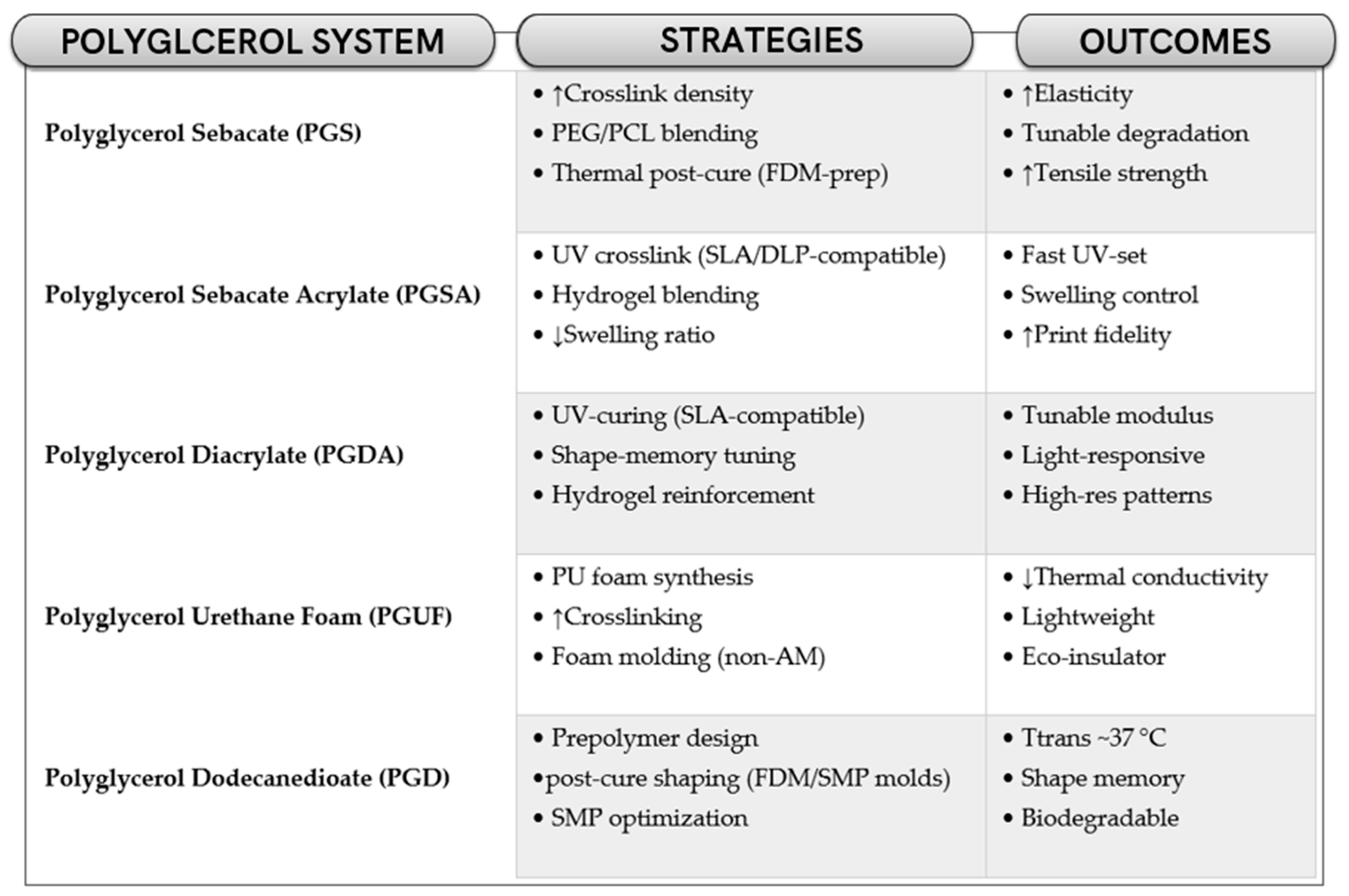
Figure 2.
Development Pathway of Polyglycerol-Based Macromolecular Systems: From Polymer Architecture to Additive Manufacturing Applications and Associated Challenges.
Figure 2.
Development Pathway of Polyglycerol-Based Macromolecular Systems: From Polymer Architecture to Additive Manufacturing Applications and Associated Challenges.
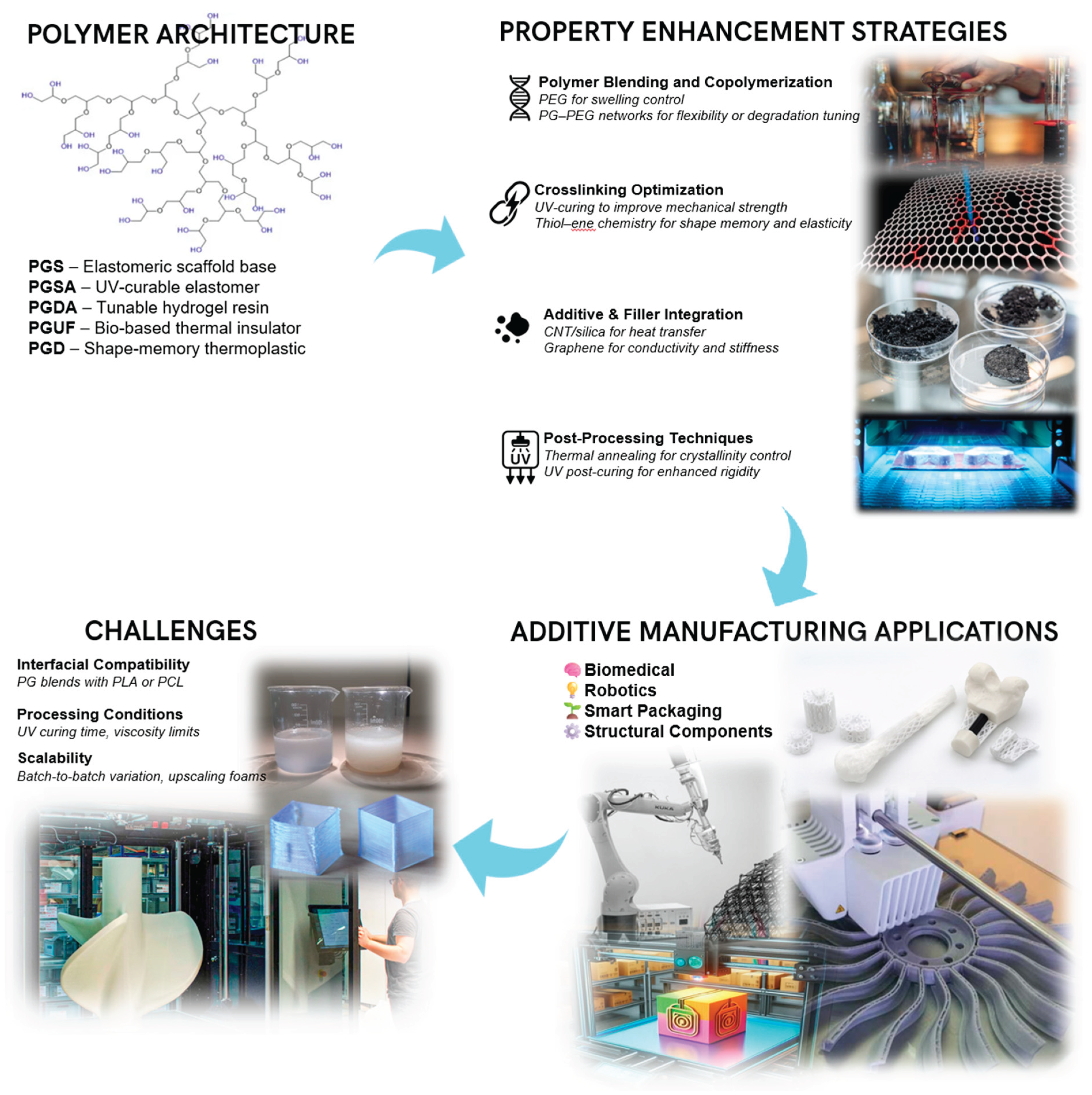

Table 1.
Thermal Decomposition Profiles of Polyglycerol-Based Systems.
| PG Type | Modifier | Thermal Indicator | Observed Change | Application |
| Poly(glycerol tartrate) hydrogel | Cellulose nanofibers | T₅% (onset of 5 % weight loss): increased from ~230 °C (PGT alone) to ~250 °C with CNF | +20 °C — improved thermal stability and adsorption | Heavy metal adsorption, environmental cleanup [62,63,64] |
| Poly(glycerol sebacate) electrospun fiber | Chitin-lignin sol–gel + 15 % PGS | Tₘ decreased from 9.6 °C to ~66 °C (peak attributed to sol–gel), T_c ~49.7 °C; mechanical strength ↑ from ~1.2 MPa to ~3.1 MPa | Slight reduction in melting/crystallization temps; mechanical and antibacterial boost | Wound-healing scaffolds [65,66] |
| Polyglycerol-based polyurethane adhesive | Sodium silicate (waterglass) | Thermally stable below ~260 °C with Tₘ ~280 °C (TGA onset ≈ 260 °C) | +~40 °C early strength stability; flame resistance | Grouting & structural adhesives [67] |
| PGS biodegradable composite with gelatin + GO | Gelatin, graphene oxide | T₅% increased from ~250 °C to ~270–280 °C | +20–30 °C; enhanced thermal & mechanical performance | Tissue engineering scaffolds [68] |
| Polynorbornene network | Crosslinked polynorbornene | Tₘ/GTT >310 K (≈37 °C); decomposition of blends at ≳320 °C | High thermal stability; decomposition onset >320 °C | Shape-memory; damping materials [69,70,71] |
| PEG-PG diacrylate network | Poly(ethylene glycol) diacrylate | T₅% >360 °C in semi-IPN/hydrogel networks | Strong network thermal stability (T₅% ≳360 °C) | PEMs, tissue engineering [72,73] |
| Polyglycerol urethane foam | Rigid PU foam from polyglycerol polyol | Multi-stage T₅% ~250–350 °C; second stage ~400–600 °C | Typical PU thermogram; urethane bonds decompose at ≳250 °C | Thermal insulation, lightweight bio-foam [74,75,76] |
| Polyglycerol dodecanedioate | Poly(glycerol dodecanedioate) (PGD) | Shape memory T_trans ≈ 37 °C; degradation onset ~200–250 °C | Transition near body temp; thermally stable for biomedical use | Minimally invasive devices, SMPs [60,77,78,79,80] |
Table 2.
Quantitative comparison of mechanical, thermal, degradation, and processing-related properties of polyglycerol derivatives versus conventional AM polymers.
Table 2.
Quantitative comparison of mechanical, thermal, degradation, and processing-related properties of polyglycerol derivatives versus conventional AM polymers.
| Property | PLA | PCL | PEGDA | Polyglycerol (PGS) |
| Tensile Modulus | 2000-3000 MPa [114] | 300-400 MPa [115] | 1-10 MPa [116] | 0.05-1.5 MPa [12] |
| Elongation at Break | 4-10% [114] | 300-1000% [114] | 5-15% [116] | 200-450% [12] |
| Glass Transition (Tg) | 55-65°C [114] | (-65)-(-60)°C [114] | (-20)-0°C [116] | (-40)-(-10)°C [116] |
| Degradation Rate* | 12-24 months [114] | 24-36 months [114] | PEGDA is typically non-degradable under physiological conditions, though degradable variants have been synthesized through labile linkers. | 1-6 months [12] |
| AM Printability | Excellent [114] | Good [115] | Excellent [116] | Moderate-Good [12] |
Table 3.
Tunable thermal properties of polyglycerol systems via chemical and architectural modifications.
Table 3.
Tunable thermal properties of polyglycerol systems via chemical and architectural modifications.
| Material Modification | Glass Transition Temperature (ΔTg) vs. Baseline | Maximum Service Temperature | Key Effect |
| Unmodified PGS (baseline) | Tg ≈ −20°C to −10°C [88,119] | 40-50°C [88,119] | Reference |
| Citrate crosslinking | +15-20°C (Tg ≈ −5°C to +10°C) [88] | 60-70°C [88] | Enhanced thermal resistance |
| Norbornene functionalization | +10-15°C (Tg ≈ 0°C to +5°C) [120] | 55-65°C [120] | Improved UV curability |
| PCL blending (20-40 wt%) | +5-10°C (Tg ≈ −15°C to 0°C) [121] | 50-60°C [121] | Balanced elasticity |
Table 4.
Functional behavior comparison: Shape-memory and creep performance.
| Property | PLA/PCL Blends | PEGDA Systems | Polyglycerol Systems |
| Shape-recovery ratio | 94-99% [124] | 75-90% [125] | 100% [126] |
| Creep strain | 6-10% [127] | 10-18% [128] | 3-8% [126] |
| Recovery stress (MPa) | 12.85 [124] | Not reported | 0.180-0.250 [79] |
Table 5.
Shape Memory and Mechanical Recovery Performance of Selected Polyglycerol-Based Networks.
| Sample | System | Trigger Stimulus | Recovery Time (s) | Shape Fixing Ratio (%) | Shape Recovery Ratio (%) |
| PGS Elastomer | Poly(glycerol sebacate) | Heat (50 °C) | Not reported |
98% |
97% |
| PGS/Silica Nanocomposite | PGS + Silica Nanoparticles | Heat (60 °C) | ~20 | Not reported | 100% |
| Polynorbornene Network | Norbornene-modified Polymer | Heat (45 °C) | Not reported | >99% | >90% |
| PEG-PG Diacrylate | Polyglycerol Diacrylate Network | UV (365 nm) | Not reported | Not reported | Not reported |
| Polyglycerol Urethane Foam | Polyglycerol–Isocyanate Foam | Compressive Release | ~2400 | 99.2% ± 0.2% | 99.3% ± 0.8% |
Disclaimer/Publisher’s Note: The statements, opinions and data contained in all publications are solely those of the individual author(s) and contributor(s) and not of MDPI and/or the editor(s). MDPI and/or the editor(s) disclaim responsibility for any injury to people or property resulting from any ideas, methods, instructions or products referred to in the content. |
© 2025 by the authors. Licensee MDPI, Basel, Switzerland. This article is an open access article distributed under the terms and conditions of the Creative Commons Attribution (CC BY) license (http://creativecommons.org/licenses/by/4.0/).
Copyright: This open access article is published under a Creative Commons CC BY 4.0 license, which permit the free download, distribution, and reuse, provided that the author and preprint are cited in any reuse.