

Submitted:
13 June 2025
Posted:
17 June 2025
You are already at the latest version
Abstract
Outdoor recreation is widely acknowledged to benefit both physical and mental health. Increasing urbanization, technological development, and the prevalence of social media have raised concerns that adolescents are spending less time in nature-based activities. We used cross-sectional data from the Ungdata Survey (2010–2019; N = 67,554) to investigate trends in adolescents' participation in outdoor recreation. Additionally, we examined parallel trends in gym training and analyzed individual and contextual factors associated with outdoor recreation participation. Multilevel regression analyses revealed a marked decline in outdoor recreation from 2010 to 2019, alongside a concurrent increase in gym training. These changes were most pronounced in urban municipalities. These findings suggest an ongoing shift in adolescent activity patterns, with potential implications for public health and environmental engagement.
Keywords:
outdoor recreation
; fitness
; population density
; mental health
; nature
; Ungdata
1. Introduction
Urbanization has significantly reshaped the landscapes in which today’s adolescents grow up, altering their physical, social, and psychological environments. According to global projections, 68% of the world's population will reside in urban areas by 2050, up from 55% in 2019 [1]. Norway is already ahead of this trend, with more than 80% of its population living in densely populated areas [2]. With this shift comes greater distance from natural surroundings and increased exposure to built environments, potentially limiting opportunities for outdoor play and physical activity [3]. At the same time, advances in technology and the pervasive use of digital media have transformed the ways in which young people socialize, entertain themselves, and engage with the world around them [4]. This raises pressing concerns about a growing disconnection between adolescents and nature, with consequences for health, well-being, and long-term behavioral patterns.
Outdoor recreation holds a central place in Norwegian identity and is recognized by national authorities as a key public health strategy [5]. A growing body of interdisciplinary research highlights the physiological and psychological benefits of nature exposure. The Biophilia Hypothesis posits an innate human affinity for nature [6], while the Stress Reduction Theory [7] and Attention Restoration Theory [8] argue that natural environments promote emotional regulation and cognitive recovery. These perspectives are supported by empirical studies showing that time spent in nature is associated with reduced stress [9], improved mood [10], and enhanced mental functioning [11,12,13], particularly among children and adolescents. In this context, access to nature is not merely a recreational asset but a foundational element of healthy development.
Over recent decades, the everyday lives of youth have become more structured and scheduled, often at the expense of unstructured outdoor time. Participation in self-organized outdoor play has declined, replaced by organized sports, screen-based activities, and school-centered routines [14]. These changes have occurred alongside an increase in mental health challenges among adolescents, particularly related to anxiety and depression [15,16]. Moreover, it has been hypothesized that traditional outdoor activities may be losing ground to indoor exercise environments such as gyms and fitness centers, particularly in urban areas where such facilities are more accessible and culturally promoted [17]. Investigating whether this shift reflects a broader societal reorientation of youth lifestyles—one that prioritizes efficiency, convenience, and performance, potentially at the expense of nature contact and holistic well-being—is therefore a key aim of the present study.
While several earlier studies have identified a decline in outdoor activity among adolescents [18,19,20], no studies have systematically examined how these trends vary across municipalities with different levels of population density. Although most prior research has focused on single-year snapshots or limited cohorts, the present study contributes by providing updated, population-based analyses covering the years leading up to the COVID-19 pandemic. Establishing a robust pre-pandemic baseline is crucial, as the pandemic may have introduced lasting shifts in youth activity patterns. By focusing on population density as a key contextual moderator, this study helps illuminate how broader structural conditions—such as urbanization—may influence adolescents’ engagement in outdoor recreation versus indoor exercise. This contributes to a more nuanced understanding of how individual behavior is shaped not only by personal factors, but also by characteristics of the environments in which young people live.
The present study addresses these gaps by analyzing national survey data from Ungdata collected between 2010 and 2019. We assess trends in self-reported participation in outdoor recreation and gym training and examine whether these patterns vary by municipal population density. Specifically, we ask whether youth participation in outdoor recreation has declined over time, whether gym training has increased in parallel, and whether these trends are moderated by contextual urbanization. In doing so, we also account for a range of individual and environmental covariates, including depressive symptoms, gender, school grade, and local vegetation density (NDVI). In doing so, the study contributes to a clearer understanding of how adolescents' engagement in outdoor recreation and gym training has evolved in relation to changes in population density and environmental context.
2. Materials and Methods
2.1. Data Source: Ungdata Survey
This study draws on data from the national Ungdata survey, a standardized self-report questionnaire offered to municipalities and counties across Norway. Initiated in 2010, Ungdata has since 2014 been administered in both lower and upper secondary schools, with students completing the survey during school hours. With response rates exceeding 80% in lower secondary and slightly lower in upper secondary, Ungdata provides broad population coverage. The survey includes core modules that all participants complete, as well as optional modules selected by participating municipalities. The survey is anonymous, digital, and designed to capture a wide range of youth experiences, including physical activity, mental health, and leisure behavior. Because students respond only once, the dataset enables cross-sectional analyses of national and regional trends across cohorts.
2.2. Sample
The original Ungdata dataset includes responses from 628,678 adolescents. For the present study, we focused on the subset who completed both the core module and optional Module E: Leisure Time, which includes items on outdoor recreation. The selection of optional modules in Ungdata is determined at the municipal level in collaboration with the regional drug and alcohol competence centers (KoRus). This means that not all municipalities include the same thematic modules in every survey year. The final analytic sample comprised 67,554 adolescents from lower and upper secondary schools who responded to relevant items between 2010 and 2019. These participants were distributed across 100 municipalities and 15 counties. Previous evaluations have confirmed that Ungdata is nationally representative and that annual variation in participating municipalities and selected modules does not substantially bias national trend estimates [21].
2.3. Measures
Outdoor Recreation. Outdoor recreation was assessed via Ungdata Module E.14, which asked students how frequently they participated in a range of seasonal outdoor activities. These included: (1) cross-country skiing in forests or mountains, (2) hiking, (3) skateboarding, (4) snowboarding or alpine skiing, (5) fishing, (6) overnight camping in nature (excluding organized campsites), (7) swimming, (8) canoeing or kayaking, and (9) climbing. Response options ranged from “several times a week” to “never/almost never,” on a five-point scale.
Gym Training. Participation in gym training was measured through an item in the physical activity section of the core module. Students reported how often they worked out at a gym or fitness center, with six response categories from “never” to “at least five times a week.”
Demographics. Gender and grade level were included as background variables. Gender was coded as a binary variable, where 1 = boy and 2 = girl. Grade level served as a proxy for age and was categorized as lower secondary (8th–10th grade) or upper secondary (VG1–VG3). To improve data quality, grade-level response options were restricted after 2014 to reflect students’ actual school level and prevent implausible combinations of age and grade.
Depressive Symptoms. Symptoms of depression were measured using a six-item short form from the Hopkins Symptom Checklist [22]. Students rated how often during the past week they had experienced: (1) everything felt like a struggle, (2) trouble sleeping, (3) feeling unhappy or depressed, (4) hopelessness about the future, (5) feeling tense or stiff, and (6) excessive worry. Responses were given on a four-point scale ranging from “not at all” to “very much.” The resulting composite score reflects subclinical depressive symptoms.
Municipality-Level Variables. Municipal identifiers allowed us to link survey data to contextual indicators at the municipal level. We included two municipality-level variables: population density (measured as residents per square kilometer) and the normalized difference vegetation index (NDVI). NDVI quantifies vegetation cover based on satellite imagery and served as a proxy for green space exposure. Values were derived from the MODIS/Terra Vegetation Indices dataset (MOD13Q1, Version 6.1) [23], which provides 250-meter spatial resolution and 16-day temporal resolution. To ensure comparability and reduce bias from cloud interference, we calculated the median NDVI for each municipality across the 12-month period from January 1, 2019, to January 1, 2020. NDVI has been validated as a robust indicator of residential green space exposure [24,25]. Municipality classification followed the standard national schema for administrative regions as of 2019.
2.4. Statistical Analyses
To examine trends in participation in outdoor recreation and gym training from 2010 to 2019, we conducted multilevel linear regression analyses in R (version 4.4.2), using the lme4 package. Two-level hierarchical models were specified, with individuals nested within municipalities. Outdoor recreation and gym training were modeled separately. Year (centered at 2009) was included as a continuous predictor to capture linear trends over time, and was the primary temporal variable of interest. Random intercepts were specified at the municipal level to account for clustering. To test whether trends over time differed by contextual factors, we included an interaction term between year and municipal population density (persons per km²), which served as a proxy for level of urbanization. To account for potential behavioral substitution or complementarity, gym training was included as a predictor in the outdoor recreation model, and outdoor recreation was included in the gym training model. Depressive symptoms, gender, age (school grade), and NDVI were included as control variables to adjust for individual and environmental covariates not central to the hypotheses. All continuous predictors were standardized prior to analysis. In sensitivity analyses, we also examined models with quadratic time trends to capture potential nonlinear patterns. Model fit was evaluated using marginal and conditional R² values.
3. Results
3.1. Descriptive Trends
Descriptive trends in specific outdoor activities are shown in Figure 1. Participation in hiking and cross-country skiing consistently ranked highest among adolescents, though both showed slight declines in later years. Activities such as fishing and camping were moderately popular but showed more fluctuation across time. Climbing and downhill skiing were the least commonly reported activities throughout the period. These patterns reflect raw, unadjusted mean scores and illustrate variation in the popularity and persistence of different forms of outdoor recreation over the past decade.
Complementing these trends, Figure 2 displays standardized participation scores for overall outdoor activity and gym training from 2010 to 2019. A clear divergence emerges over time: outdoor activity shows a gradual and consistent decline, while gym training steadily increases. These standardized trends provide a clearer view of relative change, suggesting a shift in adolescents' physical activity preferences from nature-based toward indoor, structured forms of exercise over the study period.
3.2. Multilevel regression
Multilevel linear regression models were conducted to examine changes in outdoor recreation and gym training over the period from 2010 to 2019, accounting for both individual-level and municipal-level covariates. The results, presented in Table 1, reveal distinct patterns of change for the two types of physical activity, as well as differences in how individual and contextual factors predict participation.
3.2.1. Outdoor Recreation
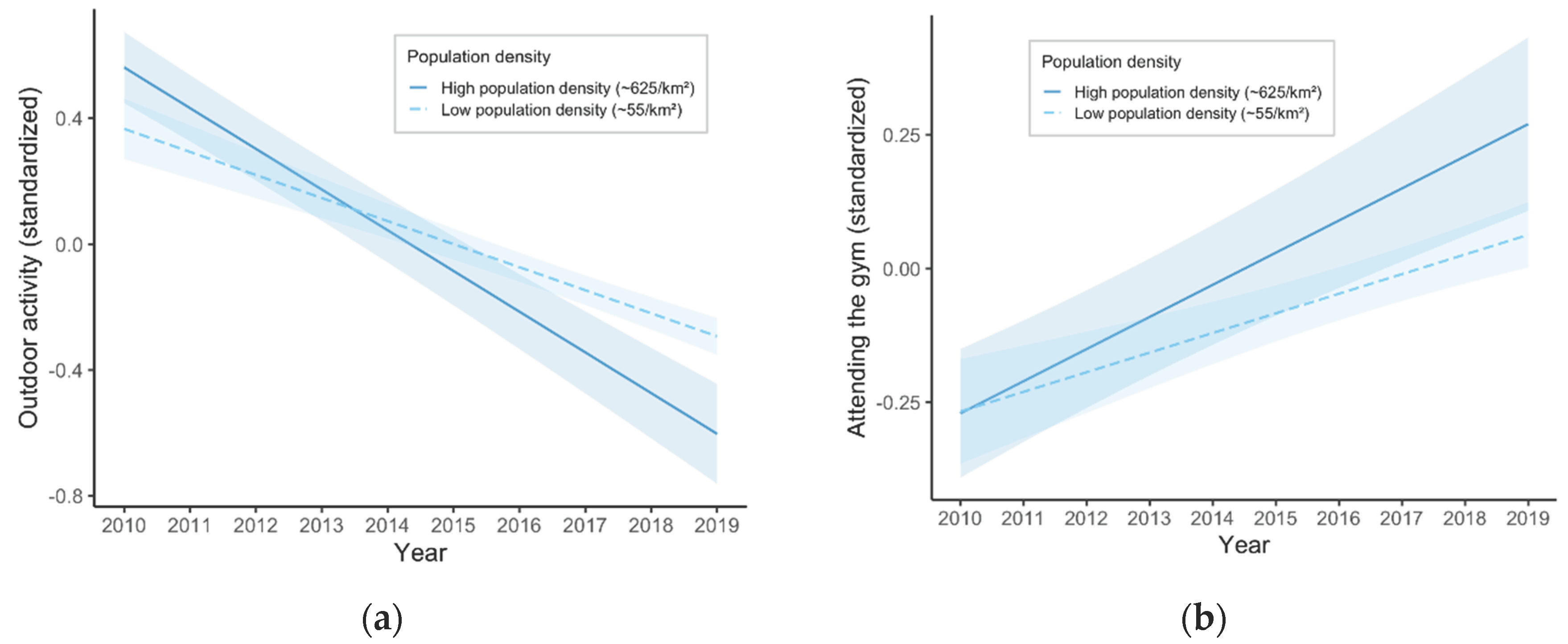
The model predicting outdoor recreation showed a significant negative linear time trend, indicating a steady decline in outdoor activity across the study period (β = –0.11, 95% CI [–0.12, –0.10], p < .001). This suggests that, on average, participants reported lower levels of outdoor recreation in later years, independent of other variables in the model. Importantly, the interaction between year and municipal population density was significant (β = –0.06, 95% CI [–0.08, –0.03], p < .001), indicating that the decline in outdoor activity was more pronounced in urban municipalities (see Figure 2a). Among the covariates, depressive symptoms were negatively associated with outdoor recreation (β = –0.07, 95% CI [–0.08, –0.06], p < .001), indicating that participants who reported more depressive symptoms also reported lower engagement in outdoor activities. Gender was a significant predictor, with girls reporting slightly lower participation than boys (β = –0.04, 95% CI [–0.05, –0.03], p < .001). Grade level (used as a proxy for age) was negatively associated with outdoor recreation (β = –0.13, 95% CI [–0.14, –0.11], p < .001), suggesting that outdoor recreation tends to decrease as students’ progress through school. At the municipal level, vegetation density (NDVI) was positively associated with outdoor activity (β = 0.07, 95% CI [0.03, 0.11], p = .001), indicating that individuals living in greener municipalities were more likely to engage in outdoor recreation. Interestingly, population density was also positively associated with outdoor recreation (β = 0.25, 95% CI [0.10, 0.40], p = .001); however, the negative interaction with time suggests this relationship may shift downward over the years. Finally, gym training was positively associated with outdoor activity (β = 0.10, 95% CI [0.09, 0.11], p < .001), suggesting that participation in structured, indoor exercise may complement rather than displace nature-based physical activity.
3.2.2. Gym Training
The model predicting gym training showed an opposite trend: a significant increase in participation over time (β = 0.05, 95% CI [0.04, 0.06], p < .001). Although the interaction between year and population density was only marginally significant (β = 0.02, 95% CI [–0.00, 0.05], p = .063), it suggests a potential trend in which the increase in gym training is somewhat more pronounced in more urban municipalities. Consistent with the outdoor recreation model, depressive symptoms showed a positive association with gym training (β = 0.02, 95% CI [0.01, 0.03], p < .001), suggesting that individuals reporting more depressive symptoms were slightly more likely to attend the gym. Gender was also a significant predictor in the same direction as for outdoor recreation, with girls reporting lower levels of gym participation (β = –0.05, 95% CI [–0.05, –0.04], p < .001). Grade level showed a strong positive association with gym training (β = 0.31, 95% CI [0.30, 0.32], p < .001), indicating that gym training increases substantially with age. In contrast to the outdoor model, vegetation density had no significant association with gym participation (β = –0.00, p = .904), and municipal population density was not a significant predictor either (β = –0.03, p = .737). Finally, outdoor recreation was positively associated with gym training (β = 0.09, 95% CI [0.08, 0.09], p < .001), further supporting the interpretation that these two activity types may reinforce rather than replace each other.
Figure 2.
Trends in physical activity from 2010 to 2019 by municipal population density. (a) Predicted levels of outdoor recreation over time, moderated by population density; (b) Predicted levels of gym training over time, moderated by population density. Shaded areas represent 95% confidence intervals. Population density was operationalized as residents per square kilometer and categorized as low (~55/km²) or high (~625/km²). Figures should be placed in the main text near the first time they are cited.
Figure 2.
Trends in physical activity from 2010 to 2019 by municipal population density. (a) Predicted levels of outdoor recreation over time, moderated by population density; (b) Predicted levels of gym training over time, moderated by population density. Shaded areas represent 95% confidence intervals. Population density was operationalized as residents per square kilometer and categorized as low (~55/km²) or high (~625/km²). Figures should be placed in the main text near the first time they are cited.
4. Discussion
4.1. Main Findings
This study investigated national trends in adolescents’ engagement in outdoor recreation and gym training from 2010 to 2019. We observed a significant decline in outdoor recreational activity over the decade, paralleled by a marked increase in gym training. These findings are consistent with prior national reports and studies indicating reduced participation in nature-based activities and a shift toward more structured or indoor exercise settings [18,19,20,26]. Our results suggest that this trend has continued beyond the time frames of earlier studies, underscoring the need for sustained attention to adolescent engagement with nature. The divergent trends in outdoor and gym-based activity may reflect broader cultural and structural shifts. Adolescents today are exposed to more time constraints, academic demands, and technology-based social interaction than previous generations [4]. Gym training may offer a more time-efficient and socially acceptable mode of physical activity, particularly in urban settings. Moreover, fitness and body image pressures may further motivate indoor training, while traditional outdoor activities may be perceived as less relevant or accessible. Importantly, we found that gym training and outdoor recreation were not mutually exclusive. Adolescents engaging in one activity were often active in the other as well. However, our findings also point to the existence of a subgroup who may disengage from both types of physical activity, aligning with prior research showing dropout in organized activity during adolescence [27].
4.2. Population Density as Moderator
One of the novel contributions of this study is the analysis of population density as a moderator of change. Our findings showed that the decline in outdoor recreation was more pronounced in municipalities with higher population density, whereas the increase in gym training was stronger in those same areas. These results suggest that urban environments may offer fewer opportunities, or reduced motivation, for outdoor recreation, possibly due to lower availability or perceived accessibility of green areas, as well as increased competition from other indoor and commercial activities. Although many urban adolescents do have access to green spaces, these areas may not always be perceived as attractive, safe, or culturally valued spaces for recreation [28]. In contrast, gym facilities may be more visible, structured, and marketed toward youth, particularly in densely populated regions [17]. This underscores the need for place-sensitive strategies to support outdoor activity.
4.3. Associations with Individual Characteristics
Consistent with earlier studies, depressive symptoms were negatively associated with participation in both outdoor activity and gym training [29]. Whether this reflects activity’s protective effects, or lower engagement due to poor mental health, cannot be determined from these data, but the associations highlight the need to consider mental health as both an outcome and a determinant of physical activity engagement. We also observed small but significant gender differences: boys participated more in outdoor recreation and gym training than girls. Age, approximated by school grade level, was negatively associated with outdoor recreation and positively with gym training. This pattern suggests a developmental shift in adolescents’ preferences or availability for different activity types as they mature.
4.4. Strengths and Limitations
A key strength of this study is the integration of national self-report survey data with high-quality, municipality-level register data from Statistics Norway (SSB), including population density and NDVI (Normalized Difference Vegetation Index). This allowed us to account for both individual and structural factors in modeling adolescents’ activity patterns. The use of repeated cross-sectional data across a ten-year span and over 100 municipalities enhances the generalizability and robustness of our findings. However, limitations must also be acknowledged. The reliance on self-reported activity introduces possible bias due to recall error or social desirability. The available items also limit precision: for example, gym training was assessed through a single frequency item, and emerging outdoor activities such as mountain biking or freeride skiing may not be well captured in the listed options. Additionally, the data are cross-sectional at each time point, limiting our ability to make inferences about individual-level change.
4.5. Implications and Future Directions
This study highlights the need to better understand and address barriers to outdoor activity among adolescents, particularly in urban areas. While gym training appears to be gaining popularity, the unique psychological and physiological benefits of contact with nature suggest that its decline is a public health concern. Adolescents growing up with fewer experiences in natural settings may be less likely to re-engage with nature as adults, with potential long-term implications for health and environmental stewardship. Policies and interventions should prioritize preserving and promoting green spaces in urban municipalities, ensuring that they are accessible, safe, and attractive to adolescents. Future research should explore how individual and contextual factors interact to shape youth preferences, and how nature engagement can be better supported in schools, communities, and health policy.
5. Conclusions
This study found a clear decline in outdoor recreation and a simultaneous increase in gym training among Norwegian adolescents between 2010 and 2019. While these activities are not mutually exclusive, the results suggest a broader shift in physical activity patterns from nature-based to indoor, structured environments. The decline in outdoor activity was steeper in urban municipalities, indicating that population density and associated environmental and social factors may influence how adolescents engage with physical activity. By combining survey data from Ungdata with register-based information on municipal population density and vegetation (NDVI), this study offers a robust and context-sensitive analysis of youth activity trends over time. The findings highlight the importance of maintaining access to green spaces, particularly in urban areas, and ensuring that outdoor recreation remains an accessible and attractive option for young people. As nature contact is linked to both physical and mental health, ongoing reductions in outdoor activity warrant attention in public health and education policy. Supporting early socialization into outdoor recreation through schools and kindergartens may be crucial for sustaining long-term engagement with nature.
Author Contributions
Conceptualization, S.S.L.; methodology, V.U.; validation, V.U. and S.S.L.; formal analysis, V.U.; investigation, S.S.L and V.U.; resources, V.U.; data curation, V.U.; writing—original draft preparation, S.S.L.; writing—review and editing, S.S.L. and V.U.; visualization, V.U.; supervision, V.U.; project administration, S.S.L. All authors have read and agreed to the published version of the manuscript.
Funding
This research received no external funding.
Institutional Review Board Statement
The study was conducted according to the guidelines of the Declaration of Helsinki and approved by the Norwegian Centre for Research Data (NSD).
Informed Consent Statement
Informed consent was obtained from all subjects involved in the study.
Data Availability Statement
The data and materials from the Ungdata Surveys are closed and stored in a national database administered by NOVA. The data are available for research purposes upon application. For request of the data, please contact ungdata@oslomet.no. Further information about the study and the questionnaires can be found on the web page (https://www.ungdata.no/english/)
Conflicts of Interest
The authors declare no conflicts of interest
References
- United Nations, World urbanization prospects: The 2018 revision (st/esa/ser. a/420). United Nations, New York, 2019.
- Statistics Norway. Land use and land cover. 2022 12.09.2022]; Available from: https://www.ssb.no/en/natur-og-miljo/areal/statistikk/arealbruk-og-arealressurser.
- Frank, L.D., P. Engelke, and T.L. Schmid, Health and community design: the impact of the built environment on physical activity. Choice Reviews Online 2004, 41, 41–2837.
- Shah, J. , et al. , New age technology and social media: adolescent psychosocial implications and the need for protective measures. Current Opinion in Pediatrics 2018, 31, 148–156. [Google Scholar]
- Friluftsliv i Norge. Regjeringen.no, 2021.
- Wilson, E.O., Biophilia. 1986: Harvard university press.
- Ulrich, R.S., et al., Stress recovery during exposure to natural and urban environments. Journal of Environmental Psychology 1991, 11, 201–230. [CrossRef]
- Kaplan, R. and S. Kaplan, The experience of nature: A psychological perspective. 1989: Cambridge university press.
- Wells, N.M. and G.W. Evans, Nearby Nature. Environment and Behavior. 2003, 35, 311–330.
- Roberts, H., et al., The effect of short-term exposure to the natural environment on depressive mood: A systematic review and meta-analysis. Environmental Research. 2019, 177, 108606.
- Nguyen, L. and J. Walters, Benefits of nature exposure on cognitive functioning in children and adolescents: A systematic review and meta-analysis. Journal of Environmental Psychology 2024, 96, 102336. [CrossRef]
- Ulset, V., et al., Time spent outdoors during preschool: Links with children's cognitive and behavioral development. Journal of Environmental Psychology 2017, 52, 69–80.
- Ulset, V.S., et al., Link of outdoor exposure in daycare with attentional control and academic achievement in adolescence: Examining cognitive and social pathways. Journal of Environmental Psychology 2023, 85, 101942. [CrossRef]
- Säfvenbom, R., W. Belinda, and J.P. and Agans, ‘How can you enjoy sports if you are under control by others?’ Self-organized lifestyle sports and youth development. Sport in Society 2018, 21, 1990–2009. [CrossRef]
- Eriksen, I.M., et al., Stress og press blant ungdom. Erfaringer, årsaker og utbredelse av psykiske helseplager. 2017: Oslo Metropolitan University-OsloMet: NOVA.
- von Soest, T., et al., Adolescents’ psychosocial well-being one year after the outbreak of the COVID-19 pandemic in Norway. Nature Human Behaviour 2022, 6, 217–228. [CrossRef] [PubMed]
- Laverty, J. and J. Wright, Going to the gym: The new urban ‘It’space, in Young people, physical activity and the everyday. 2010, Routledge. pp. 54–68.
- Redzovic, S., I. Johansen, and T. Bonsaksen, Profiling adolescent participation in wildlife activities and its implications on mental health: evidence from the Young-HUNT study in Norway. Frontiers in Public Health 2025, 13.
- Vaage, O.F. Adolescent Time Use Trends in Norway. Loisir et Société / Society and Leisure 2005, 28, 443–460. [Google Scholar] [CrossRef]
- Pergams, O.R.W. and P.A. Zaradic, Evidence for a fundamental and pervasive shift away from nature-based recreation. Proceedings of the National Academy of Sciences 2008, 105, 2295–2300. [CrossRef] [PubMed]
- Frøyland, L.R., Ungdata–Lokale ungdomsundersøkelser. Dokumentasjon av variablene i spørreskjemaet. Nova, 2017.
- Schmalbach, B., et al., Psychometric Properties of Two Brief Versions of the Hopkins Symptom Checklist: HSCL-5 and HSCL-10. Assessment 2019, 28, 617–631.
- Didkan, K. MODIS/Terra Vegetation Indices 16-Day L3 Global 250m SIN Grid V061 [Data set]. NASA EOSDIS Land Processes DAAC. 2021 2022-09-13].
- Dadvand, P., et al., Surrounding greenness and pregnancy outcomes in four Spanish birth cohorts. Environ Health Perspect 2012, 120, 1481–1487. [CrossRef] [PubMed]
- Gascon, M., et al., Normalized difference vegetation index (NDVI) as a marker of surrounding greenness in epidemiological studies: The case of Barcelona city. Urban Forestry & Urban Greening 2016, 19, 88–94.
- Dervo, B.K., et al., Friluftsliv i Norge anno 2014–status og utfordringer. 2014.
- Bakken, A. and Å. Strandby, Idrettsdeltakelse blant ungdom – før, under og etter koronapandemien [Sports participation among adolescents - before, during and after the COVID-19 pandemic]. 2023, Velferdsforskningsinstituttet NOVA.
- Lyons, R., et al.,The relationship between urban greenspace perception and use within the adolescent population: A focused ethnography. Journal of Advanced Nursing 2023, 80, 2869–2879.
- Kleppang, A.L., et al., The association between physical activity and symptoms of depression in different contexts – a cross-sectional study of Norwegian adolescents. BMC Public Health 2018, 18, 1368.
Figure 1.
Trends in raw mean participation in specific outdoor activities from 2010 to 2019. The figure displays average reported engagement in six types of outdoor recreation: cross-country skiing, hiking, downhill skiing, fishing, camping, and climbing. Participation scores reflect raw item means per activity on a Likert scale, with higher values indicating more frequent participation. Each line represents the yearly average for one activity, with points marking annual means. Shaded areas are not shown; values are unadjusted and descriptive.
Figure 1.
Trends in raw mean participation in specific outdoor activities from 2010 to 2019. The figure displays average reported engagement in six types of outdoor recreation: cross-country skiing, hiking, downhill skiing, fishing, camping, and climbing. Participation scores reflect raw item means per activity on a Likert scale, with higher values indicating more frequent participation. Each line represents the yearly average for one activity, with points marking annual means. Shaded areas are not shown; values are unadjusted and descriptive.
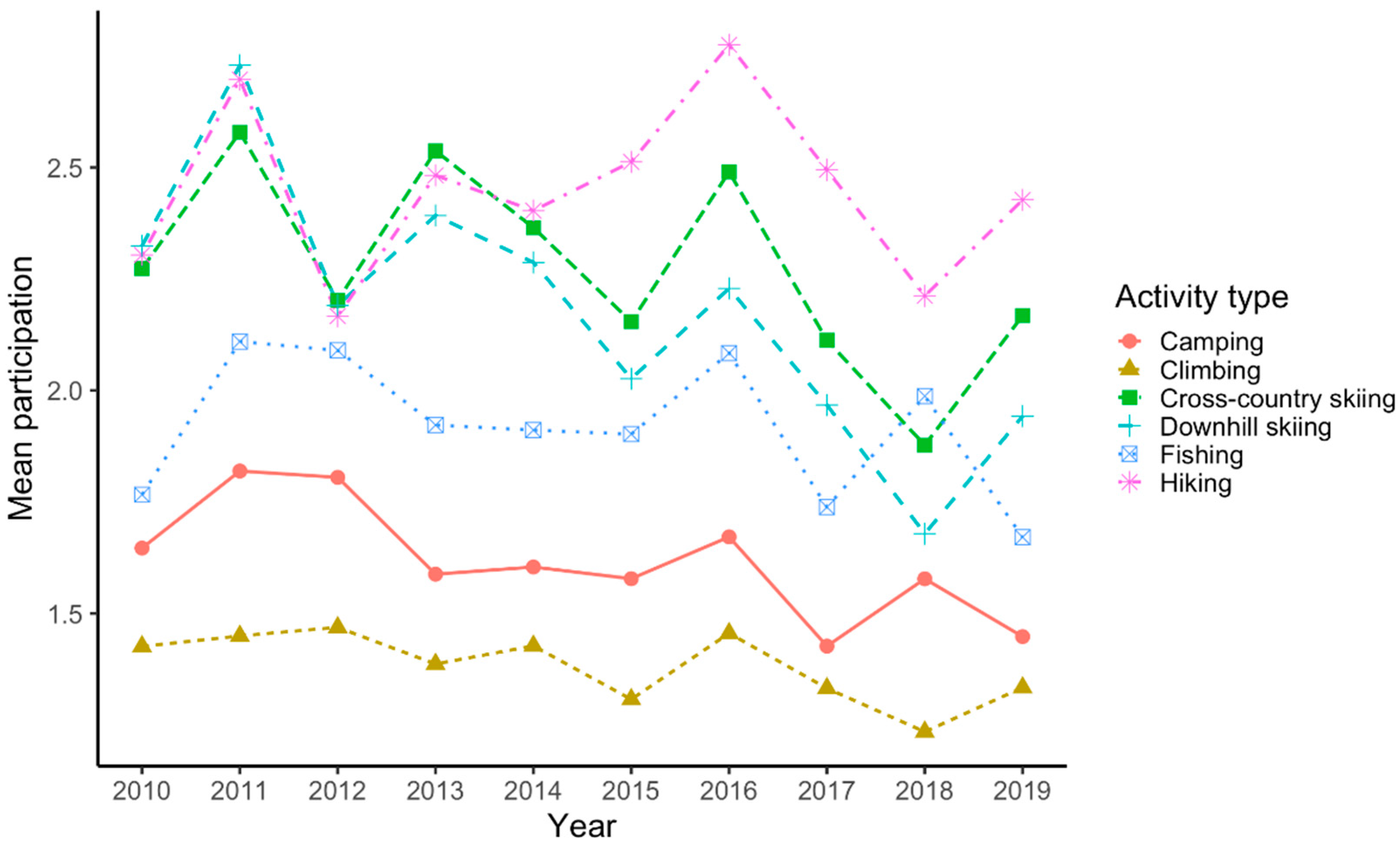
Figure 2.
Trends in standardized participation in outdoor activity and gym training from 2010 to 2019. Lines represent the yearly average standardized score for self-reported engagement in outdoor activity (e.g., hiking, skiing, camping) and gym training. Scores are based on z-transformed means per year, allowing comparison of relative change over time. Both activities show opposite trends, with outdoor activity decreasing and gym training increasing across the observed period.
Figure 2.
Trends in standardized participation in outdoor activity and gym training from 2010 to 2019. Lines represent the yearly average standardized score for self-reported engagement in outdoor activity (e.g., hiking, skiing, camping) and gym training. Scores are based on z-transformed means per year, allowing comparison of relative change over time. Both activities show opposite trends, with outdoor activity decreasing and gym training increasing across the observed period.
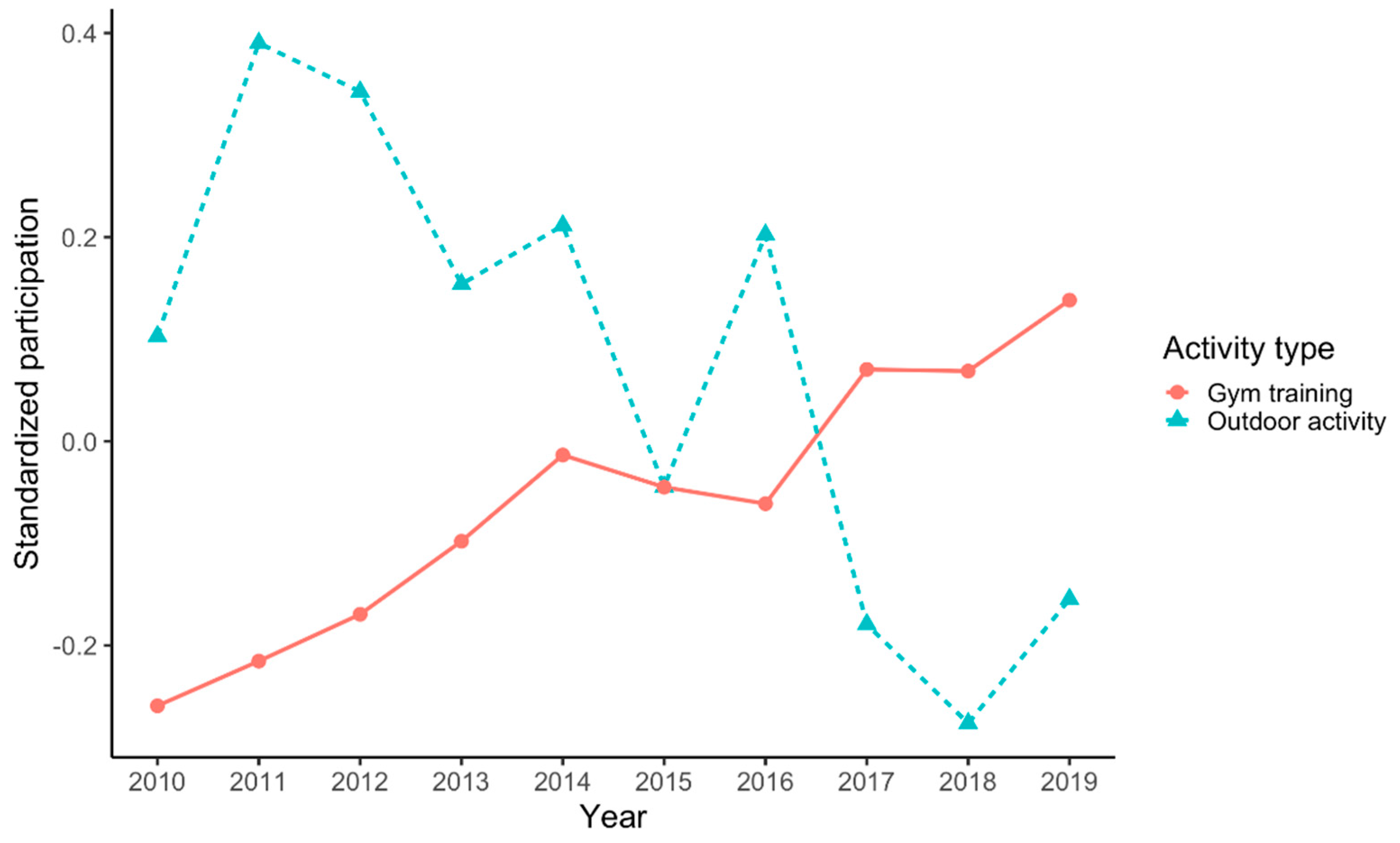

Table 1.
Multilevel Models Predicting Outdoor Recreation and Gym Training (Standardized Outcomes).
| Outdoor Recreation | Gym Training | |||||
|---|---|---|---|---|---|---|
| Predictors | Estimates | CI | p | Estimates | CI | p |
| Intercept (baseline level) | 0.59 | 0.50 – 0.69 | <0.001 | -0.32 | -0.42 – -0.23 | <0.001 |
| Depressive symptoms | -0.07 | -0.08 – -0.06 | <0.001 | 0.02 | 0.01 – 0.03 | <0.001 |
| Gender (1 = boy, 2 = girl) | -0.04 | -0.05 – -0.03 | <0.001 | -0.05 | -0.05 – -0.04 | <0.001 |
| Grade level (proxy for age) | -0.13 | -0.14 – -0.11 | <0.001 | 0.31 | 0.30 – 0.32 | <0.001 |
| Vegetation density (NDVI) | 0.07 | 0.03 – 0.11 | 0.001 | -0.00 | -0.05 – 0.04 | 0.904 |
| Gym training | 0.10 | 0.09 – 0.11 | <0.001 | |||
| Population density | 0.25 | 0.10 – 0.40 | 0.001 | -0.03 | -0.18 – 0.13 | 0.737 |
| Year (centered at 2010) | -0.11 | -0.12 – -0.10 | <0.001 | 0.05 | 0.04 – 0.06 | <0.001 |
| Interaction: Year × Population density | -0.06 | -0.08 – -0.03 | <0.001 | 0.02 | -0.00 – 0.05 | 0.063 |
| Outdoor recreation | 0.09 | 0.08 – 0.09 | <0.001 | |||
| Random Effects | ||||||
| σ2 | 0.96 | 0.84 | ||||
| τ00 | 0.02 municipality | 0.03 municipality | ||||
| ICC | 0.02 | 0.03 | ||||
| N | 75 municipality | 75 municipality | ||||
| Observations | 45627 | 45627 | ||||
| Marginal R2 / Conditional R2 | 0.100 / 0.120 | 0.106 / 0.134 | ||||
Disclaimer/Publisher’s Note: The statements, opinions and data contained in all publications are solely those of the individual author(s) and contributor(s) and not of MDPI and/or the editor(s). MDPI and/or the editor(s) disclaim responsibility for any injury to people or property resulting from any ideas, methods, instructions or products referred to in the content. |
© 2025 by the authors. Licensee MDPI, Basel, Switzerland. This article is an open access article distributed under the terms and conditions of the Creative Commons Attribution (CC BY) license (http://creativecommons.org/licenses/by/4.0/).
Copyright: This open access article is published under a Creative Commons CC BY 4.0 license, which permit the free download, distribution, and reuse, provided that the author and preprint are cited in any reuse.


