

Submitted:
14 May 2025
Posted:
16 May 2025
You are already at the latest version
Abstract
A growing number of research studies show that children spend less time in natural environments, which may have detrimental effects to children`s mental and physical health. This study explores changes in children (6-12 years) nearby nature uses and constraints for not playing in nature between the year of 2013 and 2023. We apply an ecological approach including individual, social, and structural constraints for outdoor play. The study is based on national surveys of parents answering eight categories for different activities and nineteen categories for constraints/motivation. Findings reveal a decreasing tendency for time spent on all activity categories and increasing con-straints for 17 of 19 categories during the study period. Our ecological approach makes it visible that there is less time for children`s nature to use in contemporary society, and activities are more common at built areas than in nature. The survey identifies some important socio-cultural differences regarding gender, age, and residential set-tings. In future research, the focus should be on what kind of effects less connection to nature has on children’s mental and physical health, and beyond this has effects on the understanding and care for nature among future generations.
Keywords:
neighbourhood
; nature contact
; outdoor play
; spontaneous play
; urban nature
; childhood
; natural environment
; urban forest
1. Introduction
A growing number of research studies show that children spend less time in natural environments [e.g., [1,2]]. This happens despite an increasing knowledge about the importance of natural environments for children’s physical and mental health, wellbeing and development [e.g., [3,4,5,6]]. Nature experiences and contact have similar relaxing and restorative effects for children as for adults [7]. Playing is important in children’s individual development: social, linguistic, physical, emotional and cognitive [8,9], as well as development of morale, creativity and problem-solving skills [3,10,11]. To play is also cultural, where access to different types of play including independent play in natural environments and on playgrounds helps to socialize children as participants in society [5,12,13]. Because play and nature contact are considered important for children, children’s right to play is also enshrined in the UN Convention on the Rights of the Child [14].
Children’s engagement with nature does not only depend on structural constraints as for example physical access and the quality of the natural environments, but it is closely interwoven with all aspects of their everyday life [15,16]. Today’s children are more engaged in organized activities, have more limited leisure time and competing activities [17,18]. Changing lifestyles that have more focus on screen activities and coping with pandemic and safety concerns within families have caused a shift to spend free time indoors rather than outdoors in natural environments [2,19]. In a situation where children spent more time indoors, especially during Covid-19 lockdown [e.g., [20,21]], there is a lower likelihood of meeting friends outdoors spontaneously as it was in the past [17]. But it is not only about structural and social constraints for children’s engagement with nature. It is also about parents and children’s (lack of) individual and group dispositions, motivations and preferences for playing outdoors [8,22]. There is also a question of social justice to understand constraints to access, and to develop different arenas that improve the possibilities for nature engagement across all kinds of family situations [23,24]. Despite growing international research on constraints for children’s nature engagement [e.g., [15,24,25,26,27]], there is a need for more contextual knowledge about the constraints in different socio-cultural and environment settings, and a better understanding of family and everyday life situations that increase or decrease the possibilities for children’s engagement with nature.
We take a contextual ecological approach including political, social, cultural and economic aspects to study constraints for nature play [18,28]. Taking “green” Norway as a case is highly relevant for investigating the multifaceted character of the topic, and of international interest, due to similarities in contemporary childhood across western countries [29]. Norway has excellent opportunities for children to engage with nature, both because of a high proportion of nature in residential areas, free access to all nature regardless of land ownership, and a strong cultural tradition of being out in nature, exercising “friluftsliv” [30]. In all, 97 % of parents of children aged 6 to 12 years reported that their child had good access to nature within walking and cycling distance from home [31]. To be out in nature in childhood is strongly valued among Norwegians and has been associated with rough play that should stimulate the children to be robust, rational, and independent. However, society is changing, and children’s engagement with nature seems not to be an integral part of everyday life since forests and fields are used much less by children compared to build areas [31], and their activities are to a high extend supervised by adults [10,30]. As much as 98 % of the Norwegian children participate in outdoor recreation with their families at least once a year, however, the frequency of visits has decreased by 10% between the year of 2007 and 2020 [32], which corresponds to a similar downward trend in other western societies [e.g., [33]]. In the context of “green” Norway it is interesting to study children’s engagement and tendency with nature. We collected national questionnaire parental data in 2013 and 2023, that have children aged 6 to 12 years. The following research questions guide our research:
- -
- Which outdoor activities are Norwegian children engaged in, how often, and what are the main changes?
- -
- What are the main constraints for children’s nature engagement, and what are the main changes?
- -
- What kind of demographic and social variables may explain the observed pattern of constraints?
2. Constraints to Children’s Use of Nearby Nature
2.1. An ecological Model for Studying Constraints for Outdoor Play
The broad life perspective is the basis for an article where they call for “an ecological approach to building active living societies” – and their motive is “to achieve population change in physical activity” [28]. This approach is relevant for children’s play and engagement with nature as well, and it indicates that the responsibility for children’s activities is primarily a social responsibility, not an individual one. Our paper examines what constrains children from using their neighbourhood, and particularly the potential of the natural environment for active outdoor play in their leisure time. Increasing the access to nature spaces and developing infrastructure for outdoor activities is insufficient to promote outdoor play. It is crucial to look at wider challenges linked to the social, economic, cultural, and legal aspects. Some have stated that one must build a lifestyle, a culture, where being inside doing screen and passive activities becomes the abnormal, and where children’s outdoor play is the normal [34].
Constraints to play outdoor are complex [15,30]; something which is confirms in the ecological approach for active life [28]. We have chosen to use the term ‘constraints’, to signalize that it includes all aspects of “fixed conditions” (e.g., gender, ethnicity, disabilities, etc.) and also aspects that can be influenced and altered (e.g., lack of knowledge, time constraints, the social situation, the environment). However, the term ‘barrier’ (and hindrances) that is commonly used in outdoor play literature [e.g., [16]], is often more narrowly defined. The term ‘barrier’ is used to seek for practical solutions to overcome individual barriers, especially with attention towards the external physical environment and what creates a barrier between personal (play) preference and actual personal participation in play activity [e.g., [25]]. The term constraints refer to a complexity and wider structure, from personal mental constraints to unsafe or unsuitable outdoor environments (Figure 1). Knowledge about constraints must thus be placed in a larger context, since removing e.g., personal, or structural constraints has little effect if the parents or children do not have the motivation for outdoor play. The literature does not count “lack of desire to play” as a constraint, but as a lack of motivation [e.g., [35]]. But ‘motivation for outdoor play’ is also complex and dependent on many variables - both internal/personal and external/societal. The most important reason why many are not playing outdoors, is probably a lack of motivation or interest in being outdoor and equivalent higher preferences for indoor screen activities [19,34]. In addition to having a motivation to play outdoors, the quality of the outdoor environment must be attractive and suitable regarding recreational facilities and amenities, have high availability and accessibility, and be safe [27]. Some researchers use the term “physical affordance” for this phenomenon [36]; whether an object or a physical environment ‘invites’ a specific activity or not – it could be a natural environment that is like an “open book” of possibilities for play or a swing that invites you to swing (and nothing else) [37]. In Figure 1 we have translated ‘physical affordance’ into ‘suitable environments’. Diversity in play facilities is a key factor to understand the possibilities for play and social interaction for children in the neighbourhood, including both play equipment and non-play features of natural elements [13]. A study of behaviour of small children during redesign of their childcare outdoor play space (meaning a developed, not a natural area), found that qualities like edge, levels and incline triggered the intensity and variety of children’s physical activity, and lead to greater utilization of the space [38]. These three qualities are also typical characteristics of natural areas. They emphasize the value of looking at children’s own perspective on affordances. Hence, they ask us to be aware of the influence of caregivers: Children playing on their own, can behave very differently from playing under supervision of educators or other adults [30].
Previous research has identified several individual, societal and structural constraints that may restrict individuals from participating in outdoor nature activities [e.g., [26,35,36]]. We use a 3-step framework for studying constraints concerning children’s nature contact that divide constraints into three categories (Figure 1).
- Individual, called intra-personal (and especially psychologically speaking), such as self-image, interests-preferences, age, stage of life, own physical health, knowledge, disability, anxiety, fear, attitudes, and own norms.
- Social, called inter-personal, such as social circle, lack of play companion, family responsibilities, and a social network for outdoor play.
- Structural, both related to the private and to the external environment, such as the socio-cultural, economy, transportation, time constraints, physical access to playing areas, distance to and quality of outdoor space. Institutional constraints (e.g., fee, restrictions) are included in this category, but are consider less important in Norway due to common rights of access.
2.2. Motivation and Individual/Intrapersonal Constraints
Lack of motivation is not to be regarded as a barrier (see Figure 1), but children’s interests/preferences for spending leisure time indoors, doing screen activities, organized sport activities, and adult’s preferences for other activities e.g., indoor play, doing schoolwork or organized sports activities, constrain the possibilities for outdoor play [30]. Individual constraints very much rely on parents’ level of knowledge about the advantages, motivation, and hope for their children to play outdoors [39]. Adults’ norms and attitudes are crucial to motivate the children for independent outdoor mobility and play [29].
Internationally, outdoor play activities are today limited for many children due to excessive fear of risk amongst adults [30,40,41]. When children receive constant warnings from adults about ordinary activities like climbing, swinging, jumping, and playing in the forest, the adults may transfer this fear to the children [18]. The literature expressed that fear from stranger danger, dangerous streets (violence, harassment, and drug) and car traffic is common among the parents [41,42]. Many educationists and parents feel a personal responsibility to consider risk and carry out supervision of children, however, perceptions of risk are very much subject to cultural interpretation [12]. Compared with many other Western countries, Norwegian children’s independent play still seems to be an important part of childhood as it is in the rest of Fennoscandia [29]. Most of the studies in Fennoscandia are dealing with safety and risk in pre-school and kindergarten and not in a broader perspective of children’s play in leisure time [18]. Some say that this is based on a child rearing culture where it is good for children to experience challenging situations, and through embodied experiences mastering risks [30]. For example, Norwegian researchers focus on independent playing outdoors, and that such play is risky, chaotic, and noisy, but have many advantages related to the development of social, psychological and physical skills [43,44]. However, a study from Sweden identified mobility restrictions by adults in urban settings, due to concern about traffic and stranger danger, so the picture is more diverse in Fennoscandia today than before [10].
2.3. Social/Interpersonal Constraints
Only a few decades ago play in neighbourhood without supervision by adults was a very important social arena for children. Children met informally in the neighbourhood, and it was common to ring the doorbell and ask “Come out and play” after school time [17]. When a child goes out in the neighbourhood today, there are usually no other children there, and thus the motivation to go out to play is diminished. What is regarded to be “normal afternoon behaviour” for a child seems to have changed radically during the last decades. The children meet friends today mostly in an organized or institutional settings [45]. These changes are fundamental and apply to both urban and rural settings [46]. Hence it is up to the parents whether they take their children out into nature, or if the parents have social networks that can organize informal meeting places or hikes outdoor for play. Both children’s and their parents’ social networks have changed today and constrain children’s play outdoor and in natural settings [37].
2.4. Structural Constraints and Environmental Quality
Suitable environment is an important variable including both accessibility to suitable areas and an inviting/attractive environment [27,37]. Loss of green spaces in urban areas, especially with new ideas for sustainable compact cities, is an important part of the concern about children’s opportunities to play outdoors in many western countries [23]. Norway, as well as Fennoscandia, including Sweden and Finland [31,37], have especially good opportunities for children to use nature areas for play, due to the public access rights to non-cultivated land independent of ownership. However, socio-cultural changes in the society are influencing children’s actual use of the outdoors for playing, much the same way in Norway as elsewhere in Europe [18,29]. For example, today, 93.4 % of Norwegian preschool children go to kindergartens [32], and there has been a long tradition for priority of independent play in nature in the education of preschool teachers in Norway [e.g., [42,47]]. However, there are also clear indications that some kindergartens and lower secondary schools today have less play space and changed quality of their outdoor space, namely by a shift from informal nature areas to developed areas with built installations for playing [48].
The possibilities for play and accessibility for nature describe how children and their parents are influenced by socio-environmental variables, e.g., how physical environment may restrict their participation [37]. A common feature in the international literature today is the parental control over children’s leisure time [30,49]. Some researchers termed this the “domesticated” child [12]: parents follow their children and organize their leisure activities, and consequently, children are rarely outdoor on their own or without supervision [17]. In a Norwegian survey 30 % of the parent’s report that their children never go outdoors without parents, and that their children spend more time outdoor with their adults/parents than without [18]. This highlights that children’s use of nature largely depends on the motivation for the parents to take them outdoors [37]. In addition, parents are busy with job and their own leisure activities, emphasizing lack of time as another structural constraint [46].
Society has been exposed to ever-present and increasing perception of risk [e.g., [50]], resulting in significant restrictions on outdoor play among today’s children compared to previous generations [51]. Challenging environment for the child may stimulate independent play, but adults have to balance risky play with safety [50,52]. This is especially true in institutional and learning settings like kindergarten, pre-school and primary school, that often lead to more adult-supervised activities with less time for independent play [45]. Some researchers advocate that a child’s opportunities to play should not only be a question of adult concern and risk assessment [42,44].
An important constraint for children’s outdoor playing is modern technology, and especially that children want to stay inside doing screen activities or play games using digital technologies [20]. Children in Norway are part of a prosperous society with easy access to several digital media. A national survey undertaken for The Norwegian Media Authority in 2023 among children aged 9 to 11, shows that 93 % have access to a smart phone (84 % in 2014) [55]. Both the proportion of users and time-use has increased the last decade, and their use increases with age. A world-wide shift of media practices, including children, has been seen the last decade. In addition, the market for computer games has increased significantly, not least among girls, and TV channels target a lot of their broadcasts after schooltime [55]. The consequences e.g., higher degree of inactivity and overweight among children, are complex and also influenced by variables like social class, personality and individual interests [55]. Children’s time use should be seen as a complex and dynamic issue situated within a specific cultural context [18]. Notwithstanding, the shift of media practices has undoubtedly contributed to the fact that outdoor spaces have lost much of their appeal as attractive playscapes for children.
About 63 % of 6-19 years old children and youth in Norway participate in organized leisure activities, and when including sports activities, the percentage is about 80 % [46]. Along with this, children spend increasing time in child-care, in schools and after school-care [32]. There is a picture of a target-oriented, time-scheduled and also time over scheduled everyday life for children in Norway that seems to correspond with international studies [e.g., [2]].
3. Material and Methods
3.1. Target Population, Sampling Technique, and Sample
The survey was administered in 2013 and 2023 to representative nationwide panel through the polling company TNS Gallup/Kantar. Kantar panel participants are recruited through a variety of online and offline methods, with more than 50% recruited via direct personal contact by telephone. The panellists’ consent to participate in survey-based research when they register to join the panel. The survey was web-based, and respondents answered directly via mobile phone, tablet, or PC. To secure geographical representativity, we stratified at county level and included 15 counties. We invited parents and other types of caregivers (hereafter referred to collectively as ‘parents’) with children within the age range 6–19 years to participate. The respondents were initially encountered via a screening question asking whether they were a parent of children/adolescents aged 6–12 and subsequently 3168 and 433 respondents submitted the questionnaire form, 2013 and 2023 respectively, representing our target population.
The respondents were recruited from a survey panel consisting of volunteers who are continuously tested by the polling company to ensure they are representative of the general population of Norway. Currently, there is no standardized method for calculating a response rate in this type of survey, but sample biases in terms of the target population are an important indicator of quality [54,55]. We considered the sample of respondent’s representative of the target population with respect to the children’s gender, parent’s age, geographical distribution in six regions, and family structure (child/adolescent lived in one home vs. more than one home) among the target population of Norwegian children and adolescents aged 6–12 years. To avoid over-representation of parents with children/adolescents engaged in outdoor recreation activities, the respondents were initially informed that the survey concerned children/adolescents’ leisure time in general. We considered the sample to be valid in terms of reaching both children/adolescents who were currently engaged in nature-based activities, had previously engaged in nature-based activities, and had never engaged in nature-based activities. The respondents were asked to answer the questionnaire on behalf of their oldest child within the specified age range (6–12 years). This resulted in a slight overweight of parents representing children in the upper age groups (especially 10–12 years, compared with children in the lower ones (especially 6–8 years). As is common in such national surveys of parents [31], the proportion of immigrant parents was lower (i.e., 10.2 % in 2023, not measured in 2013) in the sample than in the official national statistics relating to the Norwegian population (17%).
3.2. Questionnaire and Measurement Methods
Key content in the survey was developed based on existing literature and by applying a ecological model that included main settings for the children’s leisure time, and the survey included the parent’s and child’s demographics, their activities in different outdoor settings, and based on the literature review we selected 19 statements for constraints not being engaged in play and stay outdoor in natural environments (Attachment 1). The selected items used in this secondary analysis are listed in Table 1.
Responses to nineteen statements of constraints were reported using a 5-point Likert-type scale, ranging from ‘completely disagree’ (score 1) to ‘completely agree’ (score 5) (Table 1). In addition, we asked the parents to answer key demographic, socio-economic, and social, questions (Table 1). The definitions of these standard background variables relating to parents and children followed official definitions for statistics in Norway [32], and they have been used in several similar national surveys targeting children and adolescents [e.g., [31,46]].
3.3. Data Processing and Analyses
After data collection was complete, cleaned datasets (.csv file) were received from the polling company. Further data cleaning and verification was completed by us. The data were analyzed using IBM’s SPSS Statistics 27. We decide not weighting the dataset, i.e., by age, because the data analyses were robust with or without weighting. Overall, descriptive statistics were calculated for means (standard deviation) and percentages for all variables and were presented for selected variables. Chi-square tests were used to assess differences between variables of the categories for activities in different environmental settings used in the survey (Table 1). Selected demographic, socio-economic, and social variables were collapsed into two levels. Associations between constraints for nature play and demographic, socio-economic, and social variables were assessed by Pearson point-biserial correlation. Statistical significance was set at p < 0.01 and correlation coefficient r>0.1 are highlighted. Analyses were completed and checked by two of the authors.
3.4. Ethics Approval
The data used in the analysis were collected in line with ethical standards. The respondents, who had given prior consent to participate in research, were drawn from a panel by a third-party company, Kantar. Kantar has strict requirements for privacy and data security and works in line with both the Norwegian Data Protection Authority’s guidelines and the provisions of the Personal Data Act. Collection and analyses of data was done with approval from the Norwegian Centre for Research Data (NSD). The data file provided to us did not include any identifiable personal information and thus the participants were fully anonymized.
4. Results
4.1. Changes in Children Outdoor Use in Different Neighbourhood Settings
Parents reported that their children do different activities outdoors in summertime, and the most frequent activities to get involved in are outdoor play (play hopscotch, skipping rope, meet friends), go cycling and skating, use of a trampoline, playing football or other ball playing activities or to go outdoor without parents knowing exactly what they are doing. However, those that do this more often than on weekly basis have declined between 2013 and 2023 for all activities. In 2013 altogether 47 % of the children do activities in forests more often than on weekly basis, and this figure has declined to 29 % in 2023. Apart from walking the dog, the category playing or stay in forests is the activity that fewest children do on weekly basis (Figure 2).
4.2. Changes in Parents’ Experiences of Constraints for Children and Youth to Be Outdoor in Natural Settings
The highest rated constraints for being outdoor in natural settings for children are “The child is too busy in leisure time”, “The child prefers being indoors” and “School homework takes too much time”, and the lowest rated was “The child has poor motoric skill”, “The financial expense to reach attractive nature and green areas is too high” and “I/we parents find it unsafe in nature and green areas” (Table 2). Concerned about traffic situation and much time on screens was also rated high among the parents.
We observed significant differences between 2013 and 2023 for 17 of the 19 constraints variables, and all the significant constraints differences were rated higher in 2023 than in 2013. The only two exceptions of statements that did not show significant differences between 2013 and 2023 were “I/we parents are concerned about traffic” and “School homework takes too much time”. A robust test for unequal sample size including Welch test and Brown Forsythe test gave the same results.
4.3. Constraints to Be Outdoor Associated with Demographic, Socio-Economic, and Social Variables
Since there is a negative trend in outdoor use of children the last ten years, and an increase in experienced constraints for outdoor use, it is interesting to dig deeper into the constraints. Details of the associations between 19 statements measuring constraints for children’s outdoor use of leisure time in 2013, and their allocations to demographic, socio-economic, and social variables is summarized (Attachment 1). The following selected associations (r > 0.1, p < 0.01) are highlighted. With regards to the statements that most parents evaluated as highest hindrance “The child is too busy in leisure time” we identified three significant differences; the oldest child group (0.11), parents with highest income (0.13) and those living in urban settings agreed most on this statement. For “Distance to nature and other green areas is too far” those living in urban settings (0.15) agreed most on this statement. Those parents with the youngest children group agreed most on the statement “I/we parents are concerned about traffic” (-0.15). The parents with the oldest children group agreed most on the statements: “School homework takes too much time” (0.1), “The child prefers being indoors” (0.11), “The child uses so much time on data and other screens that to be outdoor is downgraded” (0.26), “The child does not want to play outdoors in nature” (0.17) and “The child lacks friends who want and have time to visit nature and green areas” (0.12). The statement “The child uses so much time on data and other screens that to be outdoor is downgraded” was agreed most upon those parents with boys (-0.15). Those living in urban settings agreed most for this statement “I/we parents have a time schedule filled up with job, activities, sports, and other things and to motivate the child to be outdoor is downgraded” (0.1). Single parents agreed most upon “I/we parents lack a social network that could increase activity with the child outdoor” (-012). Women showed higher constraints than men for following three statements: “Too high demand for equipment, cloths, shoes etc.” (-0.12), “The child uses so much time on data and other screens that to be outdoor is downgraded” (-0.13) and “I/we parents find participation in sports and other leisure activities more important than motivating the child to be outdoor in nature and other green areas”. Those parents with highest age agree significant more than the younger one for this statement: “The child uses so much time on data and other screens that to be outdoor is downgraded” (0.10). The variables parent’s education level (Low/High), family structure (one home/two homes), country of origin, and number of children did not show any strong associations with the measured statements of constraints.
We identified 19 significant associations with the criterium (r > 0.1, p < 0.01) in the 2023 material (Attachment 2). Those parents with children in the oldest age group (9-12 years) were least concerned about the traffic situation (-0.23), but for this group the parents agreed most on these statements: “The child uses so much time on data and other screens that to be outdoor is downgraded” (0.18), “The child does not want to play outdoors in nature” (0.15) and “The child lacks friends who want and have time to visit nature and green areas” (0.14). Those parents with the highest income agreed most on the statements: “The child is too busy in leisure time” (0.15), but those with the lowest income agreed on following three statements: “The child uses so much time on data and other screens that to be outdoor is downgraded” (-0.16), “The child does not want to play outdoors in nature” (-0.16) and “I/we parents lack a social network that could increase activity with the child outdoor” (-0.13). With regards to parent’s education (Low/high) we identified that those with low education level meant that “School homework takes too much time”. We identify that single parents have stronger constraints for four statements: areas poorly facilitated (-0.16), unsafe (-0.18), lack a social network (-0.15) and prioritize indoor activities (-0.12). For parents’ age we identify strongest constraints for the youngest group: concerned about traffic (-0.13), much bad weather (-0.14), poor motoric skills (-0.15), and unsafe (-0.13). For child’s gender, rural vs. urban living, family structure, country of origin and number of children we do not identify any strong associations.
5. Discussion and Conclusion
The purpose of our study was to explore changes in children’s nature use and constraints between 2013 and 2023. We found that all the eight categories for outdoor activities had decreased since 2013, and especially the category “Play or stay in the forest or other nature spaces” has decreased from 47 % that did this more often than on weekly basis in 2013 to 29 % in 2023. It is only the category “walk the dog” that has lower frequency of use among children. Our results corroborate a well-established downward trend in play and time spent in nature for children and adolescents in Norway and elsewhere in the Western world [e.g., [30,33,49,56]], and debates about consequences for childhood (e.g., physical and mental health, friendship, social networks) and child’s further life opportunities [3,5,6,9]. The modern childhood research’s one-sided focus on individuality has been criticised [57]. What we risk overlooking are things that people have in common with each other, and not least with nature. The criticism comes in this case from a socially oriented researcher who emphasizes the existential importance of nature for humans; for our ability to feel connected with the environment and to develop a moral relationship with nature. Removing children’s connection to nature may lead to detrimental effects on future generations’ conservation orientation and how they care for nature [57,59].
The data for children’s use of outdoor spaces show that nearby nature spaces are not an integrated part of most children’s daily life, as seem to be the case for activities that typically are being done in the more developed outdoor spaces. This is in line with a study that identified a decrease in the number of children that play outdoors with supervision of adults during the period of 2005 to 2013 in Norway [45]. A drawback of our survey is that it does not provide information about indoor and organized activities children are doing in leisure time, however, there is strong indication that a replacement in children’s play has taken part during the last decades, from outdoor play towards more indoor and organized activities [45]. An advantage of outdoor independent play in nearby nature is that it provides equal opportunities for all children, independent of social class and cultural background [17], in contrast to organized activities that systematically prevent certain groups from participation [60]. Outdoor play was earlier an important arena for meeting friends and developing social networks in childhood [17], but today there are much less opportunities for meeting friends outdoors. There is a lack of knowledge to what extent organized activities may be an important substitute for developing social networks [56].
Regarding differences in parents’ evaluation of 19 statements between 2013 and 2023 for constraints for not playing outdoor in natural settings, we identify significant higher agreement for 17 of the 19 statements. There were only the two statements “I/we parents are concerned about traffic” and “School homework takes too much time” that did not show significant increases. The most important constraints (or lack of motivation) are that the children prefer to be indoors, too busy in leisure time, prefer screen activities and missed friends. Our results should contribute to the current field of knowledge because previous research has generally focused on decreasing access to nature and perceived decreasing attractiveness of nature as the main hinderances to children’s engagement with nature [8], while less literature is concerned with how children’s and adolescents’ socio-ecological everyday settings (time pressure, indoor activities, social media, institutionalized and organized activities) affect their engagement [12,30,56]. In the following we first discuss these findings in relation to the different categories of constraints (Figure 1), then discuss the identified socio-cultural differences, and limitations of the study.
Our results support the hypothesis that societal changes and modern-day lifestyles are reducing children’s time and motivation for outdoor play. Sometimes there is a lack of nearby natural areas for play or less usable spaces for play [13], but in Norway with often short distance to nature that is suitable for children’s play [31], access to nature is considered by the parents to be a minor constraint. The parents also consider the risk of traffic and stranger danger to be of minor importance in Norway. Similarly, the parents reported that their children have good motor skills, have proficiency to be outdoor, and are well equipped. So even if the parents consider the children in Norway to have good access to nature, the nature is well-facilitated for play, it is safe and suitable for play, this is of little help if the child does not want or have time to play outdoor. Our results show that the children’s have less motivation to be outdoors. Part of the explanation for this is that there are no friends out there to play with, and the children depend on their parents to organize opportunities for play with others [39]. What used to be a matter of course that you met other friends outdoors, does not apply today. As a result, the children have more desire to be indoors engaged in screen activities. Despite that the parents seem to have a key role in inspiring and “pushing” the children to play outdoors [22,27], our results reveal that the parents prioritize schoolwork and organized activities over playing outdoor. Our data suggests that the children have become more institutionalized, and that both contact with nature and meeting friends today mainly takes place through kindergarten, school, after-school care and in organized activities [45]. There is still limited knowledge of how contact with nature and meeting friends happens for the “institutionalized” and “domesticated” child.
Our data shows that the constraints for playing outdoors with friends is about how we organize our lives in contemporary society. It’s a busy everyday life for both children and parents, and playing outdoors is given lower priority compared to many other chores and leisure activities. If more outdoor play is to be achieved, there must be a change in attitude among parents and children, which means that they prioritize outdoor play in everyday life. But how is this to be achieved? A better strategy may be to look more closely at the extent and form of outdoor play in institutions and in organized activities. It has been shown, for example, that there is great potential for facilitating independent play in organized forms, giving children time and space to let independent play unfold [11,30]. A challenge is that school and organized activities are often preoccupied with the fact that they “have to offer the children something”, and in this sense are very much organized by adults [30]. Instead, the leaders can make time and space for independent play by organizing the children’s time less [10,11,30].
Our data show that there are some important socio-cultural differences regarding constraints for children and young people’s contact with nature and outdoor play. Important age differences have been identified in our survey, and the older the child is, the harder it is to get in touch with nature and be outdoors. This is in line with other studies that identify decline in frequency of use of nature by youth compared with early childhood [26,27,59]. Young people have more schoolwork, greater preferences for being indoors, and want to be active on screens and not with friends who are outdoors. Our analyses suggests that it is mainly before the children are 12 years old that they have the best opportunities for nature contact and independent play outdoors. In the past, it was common for the older children to be outdoor looking after the younger ones, and there was then an increase in outdoor activities with increasing age and skills [17,49]. Today, the situation is the opposite, and it is the younger children who seem to be the most outdoors, however most often with adults present together with the family [6] or in an organized setting [30].
We found few differences in gender; the only significant constraint was that the parents were more concerned with screen activities for boys than girls. Our survey does not measure time use, so it may be that the parents have an expectation that the boys are more active outdoors then the girls, and thus have greater concern about the boys’ screen use. Other surveys that look at time use have come to the opposite result, that girls use screens more frequently and that boys are the most active outdoors [16,19,20]. When it comes to the gender of the parents, women believed that there were greater constraints related to equipment, and they believed that their children spent more time on screen activities than the men. This may indicate that there is a difference in parents’ attitudes towards screen activities between women and men, since women rated screen activities as a greater constraint than men did. We have not found any other studies that have looked at this variable.
We found that children who live in cities have somewhat lesser access to nature, and both children and parents have a busier everyday life. Our data reveal that there are greater constraints to outdoor play in urban than in more sparsely populated areas. An urban Dutch study identified that children’s favourite places are often playgrounds in built environments, and perhaps an emerging hypothesis is that children in urban settings become accustomed to easy-to-use and entertaining playgrounds which do not challenge them to be creative with their surroundings (e.g., build a cabin), which is a hallmark of play in nature [61]. Today, 83% of the population in Norway live in built-up areas, and urbanization has resulted in busy lifestyle [31]. Access (proximity) to good and safe natural areas can thus influence children’s engagement with nature in the most urban settings of Norway. Such differences have been shown in other studies, where access to nature and safety are important explanations for not using neighbourhoods [18,40,41]. It is especially for the younger children that the parents are worried about traffic and stranger danger.
For the other socio-cultural variables, we found few differences. We found that those who are single parents had fewer social networks than those who had several parents. Since much depends on the parents organizing with other parents that the children can play outdoors with others, this can be an important constraint for those who have single parents.
The material from 2013 has more respondents (3160) than 2023 sample, and the 2013 data is more robust identifying socio-cultural differences. However, we find similar socio-demographic patterns in the 2023 material as in 2013, with one exception related to that the parents’ income was a more important constraints in the 2013 material. Since there is limited knowledge about what constrains or limits children’s contact with nature and outdoor play, the fact that it is nationally representative of parents with school-age children, this study has many strengths. Our results show that socio-cultural variables mediate the constraints for children and youth engagement with nature, and regarding green justice this is something that should be studied more in future research. This coincides with the broad socio-ecological framework which includes both socio-demographic variables and characteristics of the physical landscape [28]. Such a holistic approach can capture in a better way how the various variables interact and show the complexity and intersection between individual, social and structural constraints in order to get children and youth better engaged with nature independent of class.
The Covid 19 pandemic with restrictions on behaviour in 2021 has had a major impact on children and youth outdoor activities and not least indoor activities with screens [e.g., [20,21]]. This is an event our study has not considered, but even though society has normalized for a while until the survey was carried out in 2023, there is reason to assume that the legacy effects of the pandemic influenced the observed patterns in our survey. When it comes to the measurement dimensions used in our study, we have taken the literature as a starting point to define the most important constraints. It is a difficult exercise to formulate valid questions, especially because the constraints are highly contextual and strongly linked to each other. However, the defined constraints in the survey help paint a broad picture about how we live our life in contemporary society, and the place of outdoor play in everyday settings. Hence, we have also included questions more related to motivation/lack of motivation, than to constraints. Asking the parents about their own children’s possibilities can lead to biases, as the parents can answer based on their desires and not the actual situation [27]. We overcome these biases by designing questions precisely, however we cannot ignore the fact that the parents answer based on a desired situation.
Supplementary Materials
The following supporting information can be downloaded at the website of this paper posted on Preprints.org. Table S1: Associations between constraints for play and stay in nature, and demographic, socio-economic and social factors in the 2013 survey (n=3168).; Table S2: Associations between constraints for play and stay in nature, and demographic, and social factors in the 2023 survey (n=433).
Author Contributions
LW and VG conceived the ideas, designed methodology and collected the data; VG analysed the data; and VG led the writing of the manuscript. All authors contributed critically to the drafts and gave final approval for publication.
Funding
This research was funded by The Research Council of Norway, grant number 281092.
Informed Consent Statement
Informed consent was obtained from all subjects involved in the study.
Acknowledgments
We would like to thank all participating parents and children for taking time to answer the questionnaire. Thanks to reviewers….
Conflicts of Interest
The authors declare no conflicts of interest. The funders had no role in the design of the study; in the collection, analyses, or interpretation of data; in the writing of the manuscript; or in the decision to publish the results.
References
- Hofferth, S. Changes in American children’s time, 1997-2003. Electronic International Journal of Time Use Research 2009, 6, 26–47. [Google Scholar] [CrossRef] [PubMed]
- Mullan, K. 2018. “A child’s day: Trends in time use in the UK from 1975 to 2015.” The British Journal of Sociology 70(3): 997–1024. [CrossRef]
- Gill, T. 2014. “The benefits of children’s engagement with nature: A systematic literature review.” Children Youth and Environments 24(2): 10-34. [CrossRef]
- Chawla, L. 2015. “Benefits of nature contact for children.” Journal of Planning Literature 30(4): 433-452. [CrossRef]
- Tillmann, S., D. Tobin, W. Avison, and J. Gilliland. 2018. «Mental health benefits of interactions with nature in children and teenagers: a systematic review.” J. Epidemiol. Community Health 72 (10): 958–966. [CrossRef]
- Rantala, O. , and R. Puhakka, R. 2020. “Engaging with nature: nature affords well-being for families and young people in Finland.” Children’s Geographies 18(4): 490–503. [CrossRef]
- Chawla, L., K. Keena, I. Pevec, and E. Stanley 2014. “Green schoolyards as havens from stress and resources for resilience in childhood and adolescence.” Health & place 28: 1-13. [CrossRef]
- McCormick, R. 2017. “Does access to green space impact the mental well-being of children: A systematic review.” Journal of Pediatric Nursing 37: 3-7. [CrossRef]
- Vella-Brodrick, D. A. , and K. Gilowska. 2022. “Effects of nature (greenspace) on cognitive functioning in school children and adolescents: A systematic review.” Educational Psychology Review 34(3): 1217-1254. [CrossRef]
- Sandberg, M. 2012. ”De är inte ute så mycket. Den bostadsnära naturkontaktens betydelse och utrymmet i storstadsbarns vardagsliv.” PhD thesis, Institutionen för kulturgeografi och ekonomisk geografi. Göteborg: Handelshögskolan.
- Fasting, M.L. 2012. ”Vi leker ute!”: en fenomenologisk hermeneutisk tilnærming til barns lek og lekesteder ute.» PhD thesis, Fakultet for samfunnsvitenskap og teknologiledelse, Pedagogisk institutt. Trondheim: NTNU.
- Prince, H. Allin, E. B. H. Sandseter, and E. Ärlemalm-Hagsér. 2013. “Outdoor play and learning in early childhood from different cultural perspectives (Editorial).” Journal of Adventure Education & Outdoor Learning 13(3): 183–188. [CrossRef]
- Parker, R. , and S. Al-Maiyah. 2022. “Developing an integrated approach to the evaluation of outdoor play settings: rethinking the position of play value.” Children’s Geographies 20(1): 1–23. [CrossRef]
- UNICEF 1989. https://www.unicef.org/child-rights-convention.
- Brockman, R., R. Jago, K.R. Fox. 2011. “Children’s active play: self-reported motivators, constraints and facilitators.” BMC public health 11: 1-7.
- Soga, M., T. Yamanoi, K. Tsuchiya, T.F. Koyanagi, and T. Kanai, T. 2018. “What are the drivers of and barriers to children’s direct experiences of nature?” Landscape and Urban Planning 180: 114-120. [CrossRef]
- Skar, M. , and E. Krogh, E. 2009. “Changes in children’s nature-based experiences near home: from spontaneous play to adult-controlled, planned and organised activities.” Children’s Geographies 7(3): 339-354. [CrossRef]
- Skar, M. C. Wold, L.C., V. Gundersen, and L. O’Brien. 2016. “Why do children not play in nearby nature? Results from a Norwegian survey.” Journal of Adventure Education & Outdoor Learning 16(3): 239-255. [CrossRef]
- Larson, L. R., R. Szczytko, R., E.P. Bowers, L.E. Stephens, L. E., K.T. Stevenson, and M.F. Floy. 2019. “Outdoor time, screen time, and connection to nature: Troubling trends among rural youth?” Environment and Behaviour 51: 966–991. [CrossRef]
- Moore, S. A., G. Faulkner, R.E. Rhodes, M. Brussoni, T. Chulak-Bozzer, L.J. Ferguson, R. Mitra, N. O’Reilly, J.C. Spence, L.M. Vanderloo, and M.S. Trembl. 2020. “Impact of the COVID-19 virus outbreak on movement and play behaviours of Canadian children and youth: A national survey.” International Journal of Behavioral Nutrition and Physical Activity 17:85. [CrossRef]
- Nathan, A., P. George, M. Ng, E. Wenden, P. Bai, Z. Phiri, and H. Christian. 2021. “Impact of COVID-19 restrictions on Western Australian children’s physical activity and screen time.” International Journal of Environmental Research and Public Health 18: 2583. [CrossRef]
- Van Truong, M., M. Nakabayashi, and T. Hosaka. 2022. “How to encourage parents to let children play in nature: Factors affecting parental perception of children’s nature play.” Urban Forestry & Urban Greening 69: 127497. [CrossRef]
- Venter, Z., H. Figari, O. Krange, and V. Gundersen. 2022. “Environmental justice in a very green city: Spatial inequality in exposure to urban nature, air pollution and heat in Oslo, Norway.” Science of Total Environment. [CrossRef]
- Waite, S., F. Husain, B. Scandone, E. Forsyth, and H. Piggott, H. 2023. “‘It’s not for people like (them)’: structural and cultural constraints to children and young people engaging with nature outdoor schooling.” Journal of Adventure Education and Outdoor Learning 23(1): 54-73. [CrossRef]
- Barron, C., A. Beckett, M. Coussens, A. Desoete, N. Cannon Jones, H. LynchM. Prellwitz, and D. Fenney Salkeld. 2017. “Constraints to play and recreation for children and young people with disabilities: Exploring environmental factors.” De Gruyter Open Poland.
- Loebach, J. Sanches, J. Jaffe, and T. Elton-Marshall. 2021. “Paving the way for outdoor play: Examining socio-environmental constraints to community-based outdoor play.” International Journal of Environmental Research and Public Health 18(7): 3617. [CrossRef]
- Arvidsen, J., T. Schmidt, S. Præstholm, S. Andkjær, A.S. Olafsson, J.V. Nielsen, and J. Schipperijn. 2022. “Demographic, social, and environmental factors predicting Danish children’s greenspace use.” Urban Forestry & Urban Greening 69: 127487. [CrossRef]
- Sallis, J. F. B. Cervero, W. Ascher, W., K.A. Henderson, M.K. Kraft, and J. Kerr. 2006. “An ecological approach to creating active living communities.” Annual Review of Public Health 27: 297–322. [CrossRef]
- Shaw, B., M. Bicket, B. Elliott, B. Fagan-Watson, E. Mocca, and M. Hillman.2015. “Children’s independent mobility: an international comparison and recommendations for action.” Policy Studies Institute.
- Skar, M., V. Gundersen, and L. O’Brien. 2016. “How to engage children with nature: Why not just let them play?” Children’s Geographies 14(5): 527-540. /: https. [CrossRef]
- Gundersen, V., M. Skår, L. O’Brien, L.C. Wold, and G. Follo. 2016. «Children and nearby nature: A nationwide parental survey from Norway.” Urban Forestry & Urban Greening 17: 116-125. [CrossRef]
- Statistics Norway. 2023. https://www.ssb.no/utdanning/barnehager/statistikk/barnehager (Retrieved 15.11.2023).
- Almeida, A., V. Rato, V., and Z.F. Dabaja. (2023). Outdoor activities and contact with nature in the Portuguese context: a comparative study between children’s and their parents’ experiences. Children’s Geographies 21(1): 108–122. [CrossRef]
- Morris, K. A. Arundell, L., Cleland, V., & Teychenne, M. (2020). Social ecological factors associated with physical activity and screen time amongst mothers from disadvantaged neighbourhoods over three years. International Journal of Behavioral Nutrition and Physical Activity 2020, 17, 1–11. [Google Scholar] [CrossRef]
- Crawford, D. W., E. L. Jackson, and G. Godbey. 1991. “A hierarchical model of leisure constraints.” Leisure Sciences 13: 309-320. [CrossRef]
- Walker, G. J. and R.J. Virden. 2005. Constraints on Outdoor Recreation. In: Jackson, E.L. (red.) 2005. Constraints to leisure (s. 201-219). State College, PA: Venture Publishing.
- Kyttâ, M., M. Oliver, E. Ikeda, E. Ahmadi, I. Omiya, and T. Laatikainen. 2018. “Children as urbanites: mapping the affordances Children’s Geographies and behavior settings of urban environments for Finnish and Japanese children.” Children’s Geographies. 16 (3): 319–332. [CrossRef]
- Morrissey, A. M. Scott, C., & Wishart, L. (2015). Infant and toddler responses to a redesign of their childcare outdoor play space. Children Youth and Environments 2015, 25(1), 29–56. [Google Scholar] [CrossRef]
- Padilla-Walker, L. M., S. A. Hardy, and K.J. Christensen. 2011. “Adolescent hope as a mediator between parent-child connectedness and adolescent outcomes.” The Journal of Early Adolescence 31(6): 853-879. [CrossRef]
- Brussoni, M. L. Olsen, I. Pike, and D.A. Sleet. 2012. “Risky play and children’s safety: Balancing priorities for optimal child development.” International Journal of Environmental Research and Public Health 9(12): 3134–3148. [CrossRef]
- Foster, S. Villanueva, L. Wood, H. Christian, and B. Giles-Corti. 2014. “The impact of parents’ fear of strangers and perceptions of informal social control on children’s independent mobility.” Health & Place 26: 60–68. [CrossRef]
- Sandseter, E. B. H. 2012. “Restrictive safety or unsafe freedom? Norwegian ECEC practitioners’ perceptions and practices concerning children’s risky play.” Childcare in Practice 18(1): 83–101. [CrossRef]
- Fjortoft, I. 2004. “Landscape as playscape: The effects of natural environments on children’s play and motor development.” Children, Youth and Environments 14:23–44. [CrossRef]
- Sandseter, E. B. H. , and L.E.O. Kennair. 2011. “Children’s risky play from an evolutionary perspective: The anti-phobic effects of thrilling experiences.” Evolutionary Psychology 9(2): 257–284. [CrossRef]
- Nordbakke, S. 2019. “Children’s out-of-home leisure activities: changes during the last decade in Norway.” Children’s Geographies 17(3): 347-360. [CrossRef]
- Wold, L.C., T. B. Broch, O.I. Vistad, S.K. Selvaag, V. Gundersen, and H. Øian. 2022. Barn og unges organiserte friluftsliv. Hva fremmer gode opplevelser og varig deltagelse? NINA Rapport 2084. Norsk institutt for naturforskning.
- Borge, A.I.H. Nordhagen, and K.K. Lie. 2003. “Children in the environment: Forest day-care centers.” The History of the Family 8: 605–618. [CrossRef]
- Nilsen, A. H. , and C.M. Hägerhäll. 2012. ”Impact of space requirements on outdoor play areas in public kindergartens.” Nordic Journal of Architectural Research 24(2).
- Karsten, L. 2005. “It all used to be better? Different generations on continuity and change in urban children’s daily use of space.” Children’s Geographies 3(3): 275-290. [CrossRef]
- Harper, N. J. 2017. “Outdoor risky play and healthy child development in the shadow of the “risk society”: A forest and nature school perspective.” Child & Youth Services 38(4): 318-334. [CrossRef]
- Sandseter, E. B. H. , and O.J. Sando. 2016. “We don’t allow children to climb trees”: how a focus on safety affects Norwegian children’s play in early-childhood education and care settings.” American Journal of Play 8(2): 178-200.
- Sandseter, E. B. H. 2007. “Risky play among four-and five-year-old children in preschool.” Conference “Vision into practice: Making quality a reality in the lives of young children” 248-256. Dublin.
- The Norwegian Media Authority (2023) Retrieved February 2024.
- Fan, W. , & Z. Yan. 2010. “Factors affecting response rates of the web survey: A systematic review.” Computers in Human Behavior 26: 132–139. [CrossRef]
- Sammut, R. , Griscti, O., and I. J. Norman. 2021. “Strategies to improve response rates to web surveys: A literature review.” International Journal of Nursing Studies 123, Article 104058. [CrossRef]
- Holloway, S. L. and H. Pimlott-Wilson, H. 2014. “Enriching children, institutionalizing childhood? Geographies of play, extracurricular activities, and parenting in England.” Annals of the Association of American Geographers 104(3): 613-627. [CrossRef]
- Chawla, L. 2002. “Insight, creativity thoughts on the environment”: integrating children and youth into human settlement development.” Environment and Urbanization 14(2): 11-22. [CrossRef]
- Chawla, L. 2007. “Childhood experiences associated with care for the natural world: A theoretical framework for empirical results.” Children, Youth and Environments 17(4): 144-170. [CrossRef]
- Larson, L. R. W. Whiting, J. W., and G.T. Green. 2011. “Exploring the influence of outdoor recreation participation on pro-environmental behaviour in a demographically diverse population.” Local Environment 16: 67-86. [CrossRef]
- Wold, L.C., M. Skar, and H. Øian. 2020. Barn og unges friluftsliv. NINA Rapport 1801. Norsk institutt for naturforskning.
- Van Heel, B. F., R. J. G. van den Born, and M.N. C. Aarts. 2023. “Everyday childhood nature experiences in an era of urbanisation: an analysis of Dutch children’s drawings of their favourite place to play outdoors.” Children’s Geographies 21(3): 378–393. [CrossRef]
Figure 1.
Illustration of the main elements (various constraints, motivation and quality of the environment) influencing children’s actual outdoor play, see text for explanations. (Outlined from leisure literature, Crawford et al. 1991, Walker & Virden 2005).
Figure 1.
Illustration of the main elements (various constraints, motivation and quality of the environment) influencing children’s actual outdoor play, see text for explanations. (Outlined from leisure literature, Crawford et al. 1991, Walker & Virden 2005).
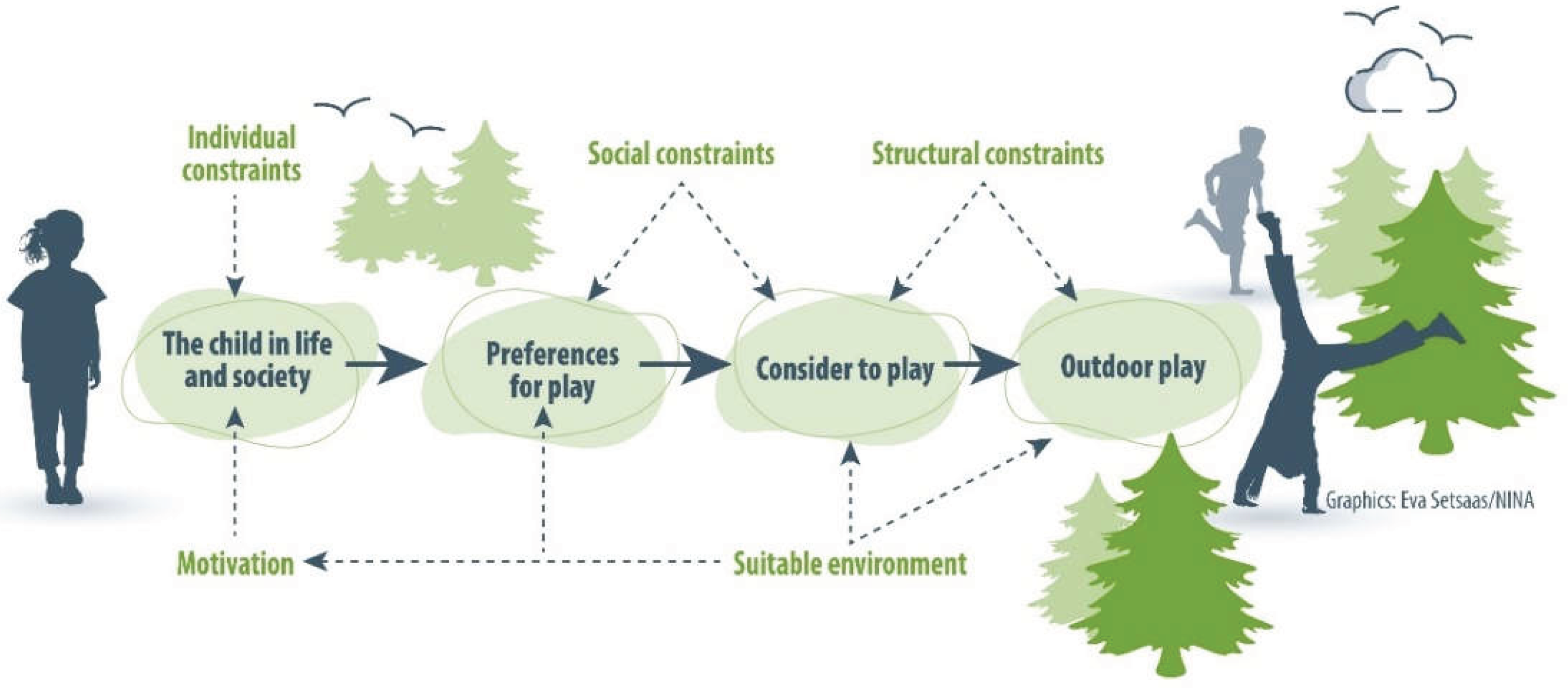
Figure 2.
Percentages of frequently use (more often than weekly) for different activities in leisure time in the neighborhood in the year of 2013 and 2023.
Figure 2.
Percentages of frequently use (more often than weekly) for different activities in leisure time in the neighborhood in the year of 2013 and 2023.
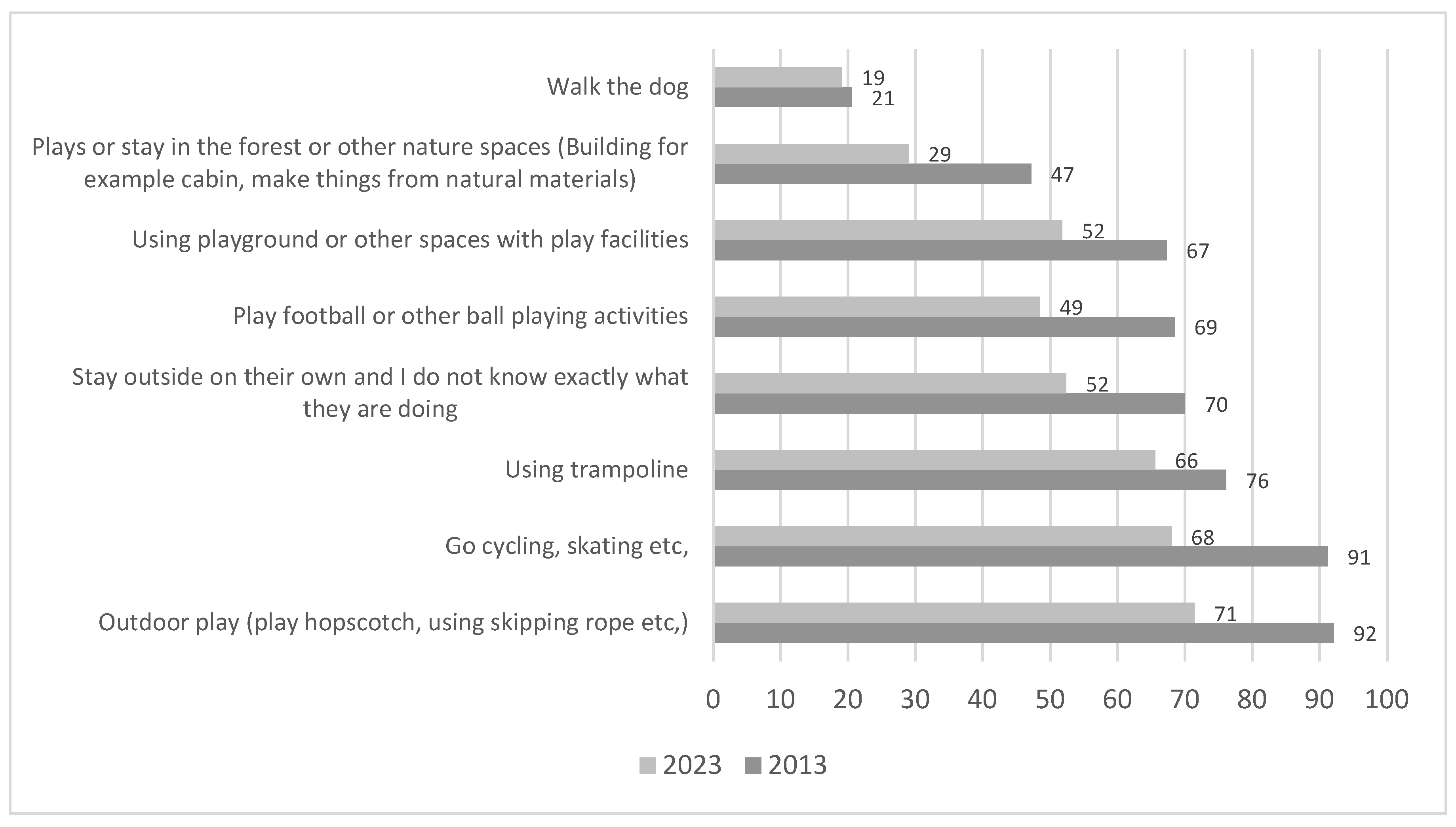

Table 1.
Selected parameters used in the analyses of children’s nature use and constraints from survey questionnaire 2013 and 2023.
Table 1.
Selected parameters used in the analyses of children’s nature use and constraints from survey questionnaire 2013 and 2023.
| Survey details | Response options |
|---|---|
| A. Questions about children outside use in different neigbourhood settings | |
| What are your children doing outside in the nearby environment in their leisure time, and how often? | [dropdown, 5 categories:
|
| B. Demographic characteristics | |
| Parent: Age and gender,Income, Education, Sole parent, Ethnicity, Post code, Family structure, Number of children, | [dropdown, age - continues] [dropdown, gender] [dropdown, income, 16 categories] [dropdown, education, 6 categories] [dropdown, sole parent, yes/no] [dropdown, ethnicity, 7 categories] [dropdown, family structure, 3 categories] [dropdown, number of children, specify] [dropdown, rural vs. urban living, 4 categories] |
| Child: Age and gender Rural vs. urban living |
[dropdown, age - continues] [dropdown, gender] [dropdown, urban-rural, 4 categories] [dropdown, postal code, specify] |
| C. Constraints for nature use To what extent do you agree or disagree that the following statements are a hindrance for the child to visit nature or green spaces? |
[dropdown, Likert scale 1–5, 1= completely disagree, 5 = completely agree, 19 statements]
|
Table 2.
Differences in survey data from 2013 and 2023 for parents’ experiences of constraints for nature use among children (6-12 yrs).
Table 2.
Differences in survey data from 2013 and 2023 for parents’ experiences of constraints for nature use among children (6-12 yrs).
| To what extent do you agree or disagree that the following statements are a hindrance for the child to visit nature or green spaces? | Year | N | Mean | Std. Deviation | Std. Error Mean | Test statistics |
|---|---|---|---|---|---|---|
| Distance to nature and other green areas is too far | 2013 | 3162 | 1,74 | 1,153 | 0,020 | t3587=-7,346; *p<.000; 2023>2013 WW: t3325=-6,903; *p<.000; 2023>2013 |
| 2023 | 426 | 2,18 | 1,356 | 0,066 | ||
| The child is too busy in leisure time (organized sports and leisure activities) | 2013 | 3163 | 2,56 | 1,212 | 0,022 | t3586=-7,692; *p<.000; 2023>2013 WW: t3325=-8,545; *p<.000; 2023>2013 |
| 2023 | 426 | 3,04 | 1,236 | 0,060 | ||
| I/we parents are concerned about traffic | 2013 | 3166 | 2,51 | 1,312 | 0,023 | t3591=-2,470; p=.014; 2023≈2013 WW: t3325=-0,520; *p=.603; 2023≈2013 |
| 2023 | 427 | 2,68 | 1,302 | 0,063 | ||
| There is too much bad weather | 2013 | 3155 | 2,03 | 1,123 | 0,020 | t3581=-5,438; *p<.000; 2023>2013 WW: t3325=-5,199; *p<.000; 2023>2013 |
| 2023 | 427 | 2,35 | 1,227 | 0,059 | ||
| School homework takes too much time | 2013 | 3166 | 2,53 | 1,135 | 0,020 | t3591=-5,438; p=.619; 2023≈2013 WW: t3325=-0,620; *p=.535; 2023≈2013 |
| 2023 | 427 | 2,49 | 1,216 | 0,059 | ||
| Too high expenses to reach attractive nature and green areas | 2013 | 3159 | 1,34 | 0,743 | 0,013 | t3585=-6,874; *p<.000; 2023>2013 WW: t3325=-7,508; *p<.000; 2023>2013 |
| 2023 | 427 | 1,61 | 0,891 | 0,043 | ||
| Too high demand for equipment, cloths, shoes etc. | 2013 | 3172 | 1,51 | 0,860 | 0,015 | t3597=-5,974; *p<.000; 2023>2013 WW: t3325=-7,508; *p<.000; 2023>2013 |
| 2023 | 427 | 1,78 | 0,952 | 0,046 | ||
| The child has poor motoric skill | 2013 | 3170 | 1,24 | 0,701 | 0,012 | t3595=-5,584; *p<.000; 2023>2013 WW: t3325=-5,883; *p<.000; 2023>2013 |
| 2023 | 427 | 1,45 | 0,898 | 0,043 | ||
| The child prefers being indoors | 2013 | 3162 | 2,48 | 1,226 | 0,022 | t3587=-9,225; *p<.000; 2023>2013 WW: t3325=-10,554; *p<.000; 2023>2013 |
| 2023 | 427 | 3,07 | 1,279 | 0,062 | ||
| The nature and green areas are poorly facilitated | 2013 | 3139 | 1,58 | 0,920 | 0,016 | t3564=-4,250; *p<.000; 2023>2013 WW: t3325=-4,571; *p<.000; 2023>2013 |
| 2023 | 427 | 1,78 | 1,057 | 0,051 | ||
| The child uses so much time on data and other screens that to be outside is downgraded | 2013 | 3166 | 2,34 | 1,221 | 0,022 | t3590=-7,284; *p<.000; 2023>2013 WW: t3325=-9,030; *p<.000; 2023>2013 |
| 2023 | 426 | 2,80 | 1,339 | 0,065 | ||
| The child does not want to play outdoors in nature | 2013 | 3159 | 2,08 | 1,107 | 0,020 | t3584=-9,278; *p<.000; 2023>2013 WW: t3325=-10,962; *p<.000; 2023>2013 |
| 2023 | 427 | 2,61 | 1,192 | 0,058 | ||
| The child lacks friends who want and have time to visit nature and green areas | 2013 | 3141 | 2,21 | 1,166 | 0,021 | t3566=-9,276; *p<.000; 2023>2013 WW: t3325=-10,590; *p<.000; 2023>2013 |
| 2023 | 426 | 2,77 | 1,259 | 0,061 | ||
| I/we parents find it unsafe in nature and green areas | 2013 | 3159 | 1,45 | 0,858 | 0,015 | t3585=-5,263; *p<.000; 2023>2013 WW: t3325=-4,224; *p<.000; 2023>2013 |
| 2023 | 427 | 1,69 | 1,002 | 0,048 | ||
| I/we parents lack a social network that could increase activity with the child outside | 2013 | 3154 | 1,85 | 1,138 | 0,020 | t3579=-7,762; *p<.000; 2023>2013 WW: t3325=-7,602; *p<.000; 2023>2013 |
| 2023 | 427 | 2,31 | 1,263 | 0,061 | ||
| I/we parents prioritize playing and other activities indoors above being outside | 2013 | 3159 | 1,93 | 1,029 | 0,018 | t3584=-6,533; *p<.000; 2023>2013 WW: t3325=-6,619; *p<.000; 2023>2013 |
| 2023 | 427 | 2,28 | 1,123 | 0,054 | ||
| I/we parents have a time schedule filled up with job, activities, sports, and other things and to motivate the child to be outside is downgraded | 2013 | 3162 | 2,22 | 1,108 | 0,020 | t3587=-5,519; *p<.000; 2023>2013 WW: t3325=-5,713; *p<.000; 2023>2013 |
| 2023 | 427 | 2,54 | 1,174 | 0,057 | ||
| I/we parents find school work more important than motivating the child to be outside in nature and other green areas | 2013 | 3156 | 2,28 | 1,097 | 0,020 | t3580=-3,656; *p<.000; 2023>2013 WW: t3325=-3,777; *p<.000; 2023>2013 |
| 2023 | 426 | 2,48 | 1,133 | 0,055 | ||
| I/we parents find participation in sports and other leisure activities more important than motivating the child to be outside in nature and other green areas | 2013 | 3146 | 2,18 | 1,081 | 0,019 | t3571=-2,951; *p=.003; 2023>2013 WW: t3325=-2,797; *p<.000; 2023>2013 |
| 2023 | 427 | 2,34 | 1,020 | 0,049 |
Disclaimer/Publisher’s Note: The statements, opinions and data contained in all publications are solely those of the individual author(s) and contributor(s) and not of MDPI and/or the editor(s). MDPI and/or the editor(s) disclaim responsibility for any injury to people or property resulting from any ideas, methods, instructions or products referred to in the content. |
© 2025 by the authors. Licensee MDPI, Basel, Switzerland. This article is an open access article distributed under the terms and conditions of the Creative Commons Attribution (CC BY) license (http://creativecommons.org/licenses/by/4.0/).
Copyright: This open access article is published under a Creative Commons CC BY 4.0 license, which permit the free download, distribution, and reuse, provided that the author and preprint are cited in any reuse.


